EP0444878A2 - Neuronales Netzwerk - Google Patents
Neuronales Netzwerk Download PDFInfo
- Publication number
- EP0444878A2 EP0444878A2 EP91301540A EP91301540A EP0444878A2 EP 0444878 A2 EP0444878 A2 EP 0444878A2 EP 91301540 A EP91301540 A EP 91301540A EP 91301540 A EP91301540 A EP 91301540A EP 0444878 A2 EP0444878 A2 EP 0444878A2
- Authority
- EP
- European Patent Office
- Prior art keywords
- layer
- neural network
- units
- output
- computation apparatus
- Prior art date
- Legal status (The legal status is an assumption and is not a legal conclusion. Google has not performed a legal analysis and makes no representation as to the accuracy of the status listed.)
- Granted
Links
Images




Classifications
-
- G—PHYSICS
- G06—COMPUTING OR CALCULATING; COUNTING
- G06N—COMPUTING ARRANGEMENTS BASED ON SPECIFIC COMPUTATIONAL MODELS
- G06N3/00—Computing arrangements based on biological models
- G06N3/02—Neural networks
- G06N3/04—Architecture, e.g. interconnection topology
-
- G—PHYSICS
- G06—COMPUTING OR CALCULATING; COUNTING
- G06N—COMPUTING ARRANGEMENTS BASED ON SPECIFIC COMPUTATIONAL MODELS
- G06N3/00—Computing arrangements based on biological models
- G06N3/02—Neural networks
- G06N3/04—Architecture, e.g. interconnection topology
- G06N3/042—Knowledge-based neural networks; Logical representations of neural networks
-
- G—PHYSICS
- G06—COMPUTING OR CALCULATING; COUNTING
- G06N—COMPUTING ARRANGEMENTS BASED ON SPECIFIC COMPUTATIONAL MODELS
- G06N3/00—Computing arrangements based on biological models
- G06N3/02—Neural networks
- G06N3/04—Architecture, e.g. interconnection topology
- G06N3/0499—Feedforward networks
-
- G—PHYSICS
- G06—COMPUTING OR CALCULATING; COUNTING
- G06N—COMPUTING ARRANGEMENTS BASED ON SPECIFIC COMPUTATIONAL MODELS
- G06N3/00—Computing arrangements based on biological models
- G06N3/02—Neural networks
- G06N3/08—Learning methods
- G06N3/09—Supervised learning
Definitions
- the present invention relates to a neural network computation apparatus which is a parallel computation apparatus modeled on the neural network of a human being.
- neural network computation apparatus also called neural-net or neural network
- the neural network computation apparatus is modeled on the neural network of a human being. It has the advantages of high speed and noise resistance due to its structure of parallel computation. However, the most attracted feature of the neural network computation apparatus is a learning capability.
- the learning capability is a capability for accomplishing desired input and/or output characteristics only by teaching examples by using input and/or output signals to the apparatus. Applications using such characteristics have been widely attempted in many fields such as image processing, character recognitions, control systems, and expert systems.
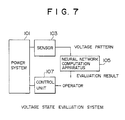
- FIG. 7 is a block diagram showing the structure of such a voltage state evaluation system.
- This system evaluates whether or not the power system is in a dangerous state with respect to stability by using a pattern of a state variable group representing the state of the power system. As the state amounts of the system, it is possible to consider voltage, passed power, phase difference angle, and so forth. However, such a system in this example only deals with the voltage.
- reference numeral 101 is a power system composed of power stations and so forth.
- a sensor 103 detects the voltages of power stations in the power system 101 and sends the voltage pattern to a neural network computation apparatus 105.
- the neural network computation apparatus 105 outputs an evaluation result in accordance with the voltage pattern sent from the sensor 103.
- the operator of the power system commands a control unit 107 in accordance with the evaluation result and thereby the control unit 107 controls the control system 101.
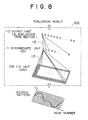
- FIG. 8 is a schematic showing the structure of the neural network computation apparatus 105 in detail. As shown in the figure, the neural network computation apparatus 105 comprises 250 input units 109, 20 intermediate units 111, 12 output units 113, and 12 links 115.
- the sensor 103 inputs the voltage pattern to the input unit 109.
- the learning operation of the aforementioned neural network computation apparatus is executed in the following manner.
- the neural network computation apparatus learnt in the aforementioned manner outputs an evaluation result shown in FIG. 9 in accordance with voltage patterns given as examples.
- FIG. 10 and FIG. 11 exemplify input and output characteristics of the neural network computation apparatus after the learning operation.
- the evaluation item 1 "Day time”, item 6 "Abnormally low”, and item 12 "Overall” are satisfied and thereby an evaluation result in accordance with the pattern 4 as shown in FIG. 11 is output.
- the neural network computation apparatus after the learning operation is completed in a learning algorithm, the strength of the links is fixed and the determination is made in accordance with only the pattern of input data. Thus, since the neural network computation apparatus only outputs fixed and simple output patterns, it cannot make logical determinations.
- the neural network computation apparatus cannot determine unknown patterns as opposed to specialists who determine matters through their experiences. Thus, the neural network computation apparatus may output improper results.
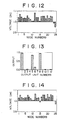
- FIG. 12 is a diagram showing voltage patterns being input to the neural network computation apparatus.
- FIG. 13 is a diagram showing an evaluation result when the voltage patterns shown in FIG. 12 are input.
- FIG. 14 is a diagram showing voltage patterns being input to the neural network computation apparatus.
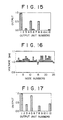
- FIG. 15 is a diagram showing an evaluation result when the voltage patterns shown in FIG. 14 are input.
- FIG. 16 is a diagram showing voltage patterns being input to the neural network computation apparatus.
- FIG. 17 is a diagram showing an evaluation result when the voltage patterns shown in FIG. 16 are input.
- FIG. 12 FIG. 14, and FIG. 16
- the node numbers 24 and 25 accord with the northwest region.
- the voltage drop amount of the region gradually decreases in the order of that shown in FIG. 12, FIG. 14, and FIG. 16.
- FIG. 13 precisely shows the output according to the pattern 8.
- the outputs of the output unit numbers 1, 5, and 8 as shown in FIG. 15 become large and thereby the determination of the pattern 8 is made.
- the output of the output unit number 3 represents “Healthy voltage”.
- the output of the output unit number 12 represents "Overall”.
- FIG. 17 is also similar to the pattern 1.
- the conventional neural network computation apparatus does not consider the relationship between the logical knowledge and the pattern recognition capability.
- Such an omission of the connection of the logical knowledge and the pattern recognition capability results in one of the major factors of restricting the performance of the neural network computation apparatus.
- an object of the present invention is to solve the aforementioned problem and to provide a neural network computation apparatus which can make determinations similar to those made by specialists in accordance with logical knowledge.
- a neural network computation apparatus comprises a plurality of layers, each of the plurality of layers has at least an input layer and an output layer, each layer having a plurality of units, a plurality of links, each of the plurality of links connecting units on the plurality of layers, and changing means for changing input and output characteristics of a particular unit of the plurality of units and/or the weight of a particular link of the plurality of links in accordance with an output of the output layer after learning an example and with a particular rule.
- the changing means changes input and output characteristics of units and weights of links in accordance with outputs of the output layer and a particular rule.
- the change of the input and output characteristics is with respect to the change of the reaction characteristics of a unit against an input thereto (namely, whether the unit strongly or lightly reacts to the input).
- the change of the weight of a link is with respect to the change of the strength of the link of a portion particularly concerned.
- the changing means By using outputs of the computation apparatus, the changing means remarkably changing a part of the computation apparatus which has learnt an example.
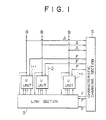
- FIG. 1 is a block diagram showing the theoretical structure of a neural network computation apparatus according to the present invention.
- the neural network computation apparatus comprises a plurality of units 1-1, ... , 1-n, a link section 3, and a characteristic changing section 5.
- the characteristic changing section 5 learns an example, it changes I/O characteristics and particular weights of the link section 3 for particular units 1-i, ... , etc. in accordance with outputs of the units 1-1, ... , 1-n and a particular rule.
- the neural network computation apparatus all or part of outputs of the units 1-1, ... , and 1-n are sent to the characteristic changing section 5.
- the output of the neural network computation apparatus is a result against an example given as a learning operation in accordance with the I/O characteristics.
- the characteristic changing section 5 outputs data in accordance with the output result of the neural network computation apparatus and feeds back it to the individual units 1-1, ... , and 1-n, and the link section 3. Since the I/O characteristics of particular units 1-i, ... , etc. and the strength of the link (weight coefficient) of the link section 3 vary in accordance with the feedback operation, the pattern recognizing characteristics vary.
- part of characteristics of the neural network computation apparatus is varied. Thereafter, the pattern is recognized in accordance with the pattern recognizing characteristics being varied. A result with respect to a particular portion is output in accordance with the arrow mark B.
- the determined result shown by the arrow mark includes a pattern recognition where a logical knowledge is fed back like a specialist does.
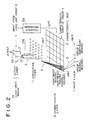
- FIG. 2 is a schematic showing the practical structure of the neural network computation apparatus according to the present invention.
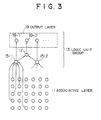
- FIG. 3 is a schematic showing the structure of an associative layer and a logical unit group.
- the neural network computation apparatus comprises an input layer 7, a characteristic layer 9, an associative layer 11, a logic unit group 13, and a feedback mechanism 5a.
- Each of the input layer 7, the characteristic layer 9, the associative layer 11, and the logic unit group 13 is composed of a plurality of units.
- the link section 3 shown in FIG. 1 is a set of links which connect the units shown in FIG. 2.
- the feedback mechanism 5 is equivalent to the characteristic changing section 5 shown in FIG. 1.
- the I/O characteristic of the units of the characteristic layer 9 and the weight coefficient of the link 3 connected from the associative layer 11 to the logical unit group 13 are changed.
- the input layer 7 functions as input terminals for receiving input data.
- the input data train is divided into a group of five portions.
- the input layer 7 is also divided into a group of five portions.
- the characteristic layer 9 is composed of a plurality of characteristic units 10 according to data train of each portion.
- the ignition characteristic of each unit of the characteristic layer 9 is of selective reaction rather than the cigmoid characteristic such as the ignition characteristic of a unit treated as the conventional backpropagation.
- the characteristic of the selective reaction is expressed by using the following equation.
- the associative layer 11 collects the outputs of the characteristic layer 9 so as to mix the information in the groups and to convert it into a logical output.
- the units in the associative layer 11 just accord with the characteristic units in the characteristic layer 9.
- the output of the associative layer 11 is the maximum value of the unit outputs of the characteristic units 10.
- the output of the associative layer 11 is expressed by using the following equation. where A np is the output of the associative layer 11 according to the p-th characteristic unit in the characteristic units 10 of the group n; ak is the output of the unit k of the associative layer 9; and R np is a set of the unit numbers included in the p-th characteristic unit in the characteristic units 10 in the group n.
- the logic unit group 13 is composed of an AND type unit 15, an OR type unit 17, output units 19-1, 19-2, ..., and so forth.
- the AND type unit 15 shown in FIG. 4 outputs 1.0 or similar value thereto only when all the inputs are close to 1.0.
- the weights of the links being input to the AND type unit 15 are defined so that the following equation is satisfied.
- Wn is the weight of the link from the output of the associative layer 11 according to the group n.
- the OR type unit 17 shown in FIG. 5 outputs 1.0 or similar value thereto when at least one of inputs thereof is close to 1.0.
- the output units 19-1, 19-2, ... , and so forth output the evaluation results shown in FIG. 11.
- the feedback mechanism 5 changes the selective reaction coefficient c (n) of the units of the characteristic layer 9 and the relative contribution coefficient fn of the link 3 in accordance with the outputs of the logic unit group 13 and a particular rule.
- the feedback mechanism 5a is a conventional sequential type computer which is a logical type expert system.
- the computer may be provided with another function such as a man-machine interface.
- the feedback operation which depends on a matter to be concerned is executed in accordance with a professional experience and knowledge.
- the feedback mechanism 5a learns an example, it changes the selective reaction coefficient c (n) and the relative contribution coefficient fn in accordance with the outputs of the logic unit group 13 and the following rule.
- FIG. 6 shows the evaluation results of the neural network computation apparatus.
- the feedback mechanism 5a increases the relative contribution coefficient f5 of the group 5 in accordance with the northwest region and the aforementioned rule. In contrast, the feedback mechanism 5a decreases the relative contribution coefficients f1 to f4. Thus, the contribution coefficient of the data of northwest region increases and thereby the evaluation result as shown in FIG. 6 (c) is obtained.
- the feedback mechanism 5a executed the feedback operation in accordance with a knowledge described in the format of a rule by a conventional computer. Since it has been widely known that a knowledge in the format of a rule can be easily networked, it is possible to accomplish a part of the feedback mechanism 5a as the neural network computation apparatus.
- the changing means for dynamically changing the reaction characteristic of each unit or the strength of the link of each unit after learning an example is provided, the logical knowledge can be related to the pattern recognition characteristics.
Landscapes
- Engineering & Computer Science (AREA)
- Theoretical Computer Science (AREA)
- Physics & Mathematics (AREA)
- General Health & Medical Sciences (AREA)
- Computing Systems (AREA)
- Biomedical Technology (AREA)
- Biophysics (AREA)
- Computational Linguistics (AREA)
- Data Mining & Analysis (AREA)
- Evolutionary Computation (AREA)
- Life Sciences & Earth Sciences (AREA)
- Molecular Biology (AREA)
- Artificial Intelligence (AREA)
- General Engineering & Computer Science (AREA)
- General Physics & Mathematics (AREA)
- Mathematical Physics (AREA)
- Software Systems (AREA)
- Health & Medical Sciences (AREA)
- Image Analysis (AREA)
- Feedback Control In General (AREA)
Applications Claiming Priority (2)
| Application Number | Priority Date | Filing Date | Title |
|---|---|---|---|
| JP48674/90 | 1990-02-27 | ||
| JP2048674A JPH03250243A (ja) | 1990-02-27 | 1990-02-27 | 神経回路網演算装置 |
Publications (3)
| Publication Number | Publication Date |
|---|---|
| EP0444878A2 true EP0444878A2 (de) | 1991-09-04 |
| EP0444878A3 EP0444878A3 (en) | 1993-12-01 |
| EP0444878B1 EP0444878B1 (de) | 1997-05-14 |
Family
ID=12809872
Family Applications (1)
| Application Number | Title | Priority Date | Filing Date |
|---|---|---|---|
| EP91301540A Expired - Lifetime EP0444878B1 (de) | 1990-02-27 | 1991-02-26 | Neuronales Netzwerk |
Country Status (4)
| Country | Link |
|---|---|
| US (1) | US5222194A (de) |
| EP (1) | EP0444878B1 (de) |
| JP (1) | JPH03250243A (de) |
| DE (1) | DE69126052T2 (de) |
Families Citing this family (11)
| Publication number | Priority date | Publication date | Assignee | Title |
|---|---|---|---|---|
| US5438644A (en) * | 1991-09-09 | 1995-08-01 | University Of Florida | Translation of a neural network into a rule-based expert system |
| US5627941A (en) * | 1992-08-28 | 1997-05-06 | Hitachi, Ltd. | Method of configuring a neural network and a diagnosis/control system using the neural network |
| US5598509A (en) * | 1992-08-28 | 1997-01-28 | Hitachi, Ltd. | Method of configuring a neural network and a diagnosis/recognition system using the same |
| US5835902A (en) * | 1994-11-02 | 1998-11-10 | Jannarone; Robert J. | Concurrent learning and performance information processing system |
| US5966460A (en) * | 1997-03-03 | 1999-10-12 | Xerox Corporation | On-line learning for neural net-based character recognition systems |
| US6063028A (en) | 1997-03-20 | 2000-05-16 | Luciano; Joanne Sylvia | Automated treatment selection method |
| US6216119B1 (en) | 1997-11-19 | 2001-04-10 | Netuitive, Inc. | Multi-kernel neural network concurrent learning, monitoring, and forecasting system |
| US6054710A (en) * | 1997-12-18 | 2000-04-25 | Cypress Semiconductor Corp. | Method and apparatus for obtaining two- or three-dimensional information from scanning electron microscopy |
| US7526467B2 (en) * | 2002-09-13 | 2009-04-28 | Natural Selection, Inc. | Intelligently interactive profiling system and method |
| JP4383302B2 (ja) * | 2004-09-29 | 2009-12-16 | 富士通株式会社 | 評価結果出力プログラム |
| US20060230008A1 (en) * | 2005-04-08 | 2006-10-12 | Robin Burgener | Artificial neural network guessing method and game |
Family Cites Families (7)
| Publication number | Priority date | Publication date | Assignee | Title |
|---|---|---|---|---|
| US5050095A (en) * | 1988-05-31 | 1991-09-17 | Honeywell Inc. | Neural network auto-associative memory with two rules for varying the weights |
| US5093899A (en) * | 1988-09-17 | 1992-03-03 | Sony Corporation | Neural network with normalized learning constant for high-speed stable learning |
| US4912652A (en) * | 1988-12-14 | 1990-03-27 | Gte Laboratories Incorporated | Fast neural network training |
| US5046020A (en) * | 1988-12-16 | 1991-09-03 | E. I. Du Pont De Nemours And Company | Distributed parallel processing network wherein the connection weights are generated using stiff differential equations |
| DE69013716T2 (de) * | 1989-02-23 | 1995-06-01 | Matsushita Electric Ind Co Ltd | Lernmaschine. |
| US5073867A (en) * | 1989-06-12 | 1991-12-17 | Westinghouse Electric Corp. | Digital neural network processing elements |
| US5131073A (en) * | 1989-07-12 | 1992-07-14 | Ricoh Company, Ltd. | Neuron unit and neuron unit network |
-
1990
- 1990-02-27 JP JP2048674A patent/JPH03250243A/ja active Pending
-
1991
- 1991-02-26 DE DE69126052T patent/DE69126052T2/de not_active Expired - Fee Related
- 1991-02-26 EP EP91301540A patent/EP0444878B1/de not_active Expired - Lifetime
- 1991-02-27 US US07/661,194 patent/US5222194A/en not_active Expired - Lifetime
Non-Patent Citations (5)
| Title |
|---|
| ELECTRONICS AND COMMUNICATION ENGINEERING JOURNAL vol. 1, no. 5, September 1989, LONDON GB pages 225 - 232 GRANT 'Artificial neural network and conventional approaches to filtering and pattern recognition' * |
| IEEE INTERNATIONAL CONFERENCE ON SYSTEMS ENGINEERING 24 August 1989, FAIRBORN ,USA pages 147 - 150 RAMAMOORTHY 'Implementation of rule-based expert systems for time-critical applications using neural networks' * |
| IEEE TENCON 89 22 November 1989, BOMBAY , INDIA pages 457 - 461 MEHRA 'Learning strategies for dynamic decision problems using artificial neural networks' * |
| IJCNN89 : INTERNATIONAL JOINT CONFERENCE ON NEURAL NETWORKS vol. 1, 19 June 1989, WASHINGTON , USA pages 683 - 688 HANDELMAN 'Integration of knowledge-based system and neural network techniques for autonomous learning machines' * |
| THE 2ND SYMPOSIUM OF THE FRONTIERS OF MASSIVELY PARALLEL COMPUTATION 10 October 1988, FAIRFAX , USA pages 663 - 669 LUNDGREN 'Signal processing with nodal networks on a simd massively parallel processor' * |
Also Published As
| Publication number | Publication date |
|---|---|
| EP0444878B1 (de) | 1997-05-14 |
| US5222194A (en) | 1993-06-22 |
| JPH03250243A (ja) | 1991-11-08 |
| DE69126052T2 (de) | 1997-10-30 |
| DE69126052D1 (de) | 1997-06-19 |
| EP0444878A3 (en) | 1993-12-01 |
Similar Documents
| Publication | Publication Date | Title |
|---|---|---|
| Takefuji et al. | Artificial neural networks for four-coloring map problems and K-colorability problems | |
| US5606646A (en) | Recurrent neural network-based fuzzy logic system | |
| US5107454A (en) | Pattern associative memory system | |
| EP0444878A2 (de) | Neuronales Netzwerk | |
| JPS6355106B2 (de) | ||
| JP2747104B2 (ja) | ニューラルネットワーク | |
| Pham et al. | Control chart pattern recognition using combinations of multi-layer perceptrons and learning-vector-quantization neural networks | |
| Buckley et al. | Solving fuzzy equations using evolutionary algorithms and neural nets | |
| US5170071A (en) | Stochastic artifical neuron with multilayer training capability | |
| EP0579341A2 (de) | Lernmaschine mit Multi-Eingangs-Einzelausgangsschaltungen verbunden in hierarchischer Struktur | |
| Fukuda et al. | Structure organization of hierarchical fuzzy model using by genetic algorithm | |
| Kulkarni | Neural-fuzzy models for multispectral image analysis | |
| US5361328A (en) | Data processing system using a neural network | |
| KR910018925A (ko) | 데이터 처리장치의 학습방법 | |
| Goh et al. | Learning algorithm for enhanced fuzzy perceptron | |
| Saade | A defuzzification based new algorithm for the design of Mamdani-type fuzzy controllers | |
| USRE36823E (en) | Inference rule determining method and inference device | |
| Wu et al. | A neural‐network‐based method for fuzzy parameter tuning of pid controllers | |
| SIMPSON | Neural network paradigms | |
| JP3101742B2 (ja) | 最小値検出器 | |
| EP0567983A2 (de) | Lernende Wellenformerkennungseinrichtung | |
| Fraser et al. | Mathematical modeling and Ada simulation of some synchronization processes | |
| Neumerkel et al. | Modelling dynamic processes with clustered time-delay neurons | |
| JPH09138786A (ja) | ニューラルネットワークの学習装置 | |
| Balazinski | GMDH by fuzzy if-then rules with certainty factors |
Legal Events
| Date | Code | Title | Description |
|---|---|---|---|
| PUAI | Public reference made under article 153(3) epc to a published international application that has entered the european phase |
Free format text: ORIGINAL CODE: 0009012 |
|
| 17P | Request for examination filed |
Effective date: 19910319 |
|
| AK | Designated contracting states |
Kind code of ref document: A2 Designated state(s): DE FR GB |
|
| PUAL | Search report despatched |
Free format text: ORIGINAL CODE: 0009013 |
|
| AK | Designated contracting states |
Kind code of ref document: A3 Designated state(s): DE FR GB |
|
| 17Q | First examination report despatched |
Effective date: 19941107 |
|
| GRAG | Despatch of communication of intention to grant |
Free format text: ORIGINAL CODE: EPIDOS AGRA |
|
| GRAH | Despatch of communication of intention to grant a patent |
Free format text: ORIGINAL CODE: EPIDOS IGRA |
|
| GRAH | Despatch of communication of intention to grant a patent |
Free format text: ORIGINAL CODE: EPIDOS IGRA |
|
| GRAA | (expected) grant |
Free format text: ORIGINAL CODE: 0009210 |
|
| AK | Designated contracting states |
Kind code of ref document: B1 Designated state(s): DE FR GB |
|
| REF | Corresponds to: |
Ref document number: 69126052 Country of ref document: DE Date of ref document: 19970619 |
|
| ET | Fr: translation filed | ||
| PLBE | No opposition filed within time limit |
Free format text: ORIGINAL CODE: 0009261 |
|
| STAA | Information on the status of an ep patent application or granted ep patent |
Free format text: STATUS: NO OPPOSITION FILED WITHIN TIME LIMIT |
|
| 26N | No opposition filed | ||
| REG | Reference to a national code |
Ref country code: GB Ref legal event code: 746 Effective date: 19981007 |
|
| REG | Reference to a national code |
Ref country code: FR Ref legal event code: D6 |
|
| REG | Reference to a national code |
Ref country code: GB Ref legal event code: IF02 |
|
| PGFP | Annual fee paid to national office [announced via postgrant information from national office to epo] |
Ref country code: GB Payment date: 20070221 Year of fee payment: 17 |
|
| PGFP | Annual fee paid to national office [announced via postgrant information from national office to epo] |
Ref country code: DE Payment date: 20070222 Year of fee payment: 17 |
|
| PGFP | Annual fee paid to national office [announced via postgrant information from national office to epo] |
Ref country code: FR Payment date: 20070208 Year of fee payment: 17 |
|
| GBPC | Gb: european patent ceased through non-payment of renewal fee |
Effective date: 20080226 |
|
| REG | Reference to a national code |
Ref country code: FR Ref legal event code: ST Effective date: 20081031 |
|
| PG25 | Lapsed in a contracting state [announced via postgrant information from national office to epo] |
Ref country code: DE Free format text: LAPSE BECAUSE OF NON-PAYMENT OF DUE FEES Effective date: 20080902 |
|
| PG25 | Lapsed in a contracting state [announced via postgrant information from national office to epo] |
Ref country code: FR Free format text: LAPSE BECAUSE OF NON-PAYMENT OF DUE FEES Effective date: 20080229 |
|
| PG25 | Lapsed in a contracting state [announced via postgrant information from national office to epo] |
Ref country code: GB Free format text: LAPSE BECAUSE OF NON-PAYMENT OF DUE FEES Effective date: 20080226 |