EP0443531B1 - Graphic data handling method and system - Google Patents
Graphic data handling method and system Download PDFInfo
- Publication number
- EP0443531B1 EP0443531B1 EP91102369A EP91102369A EP0443531B1 EP 0443531 B1 EP0443531 B1 EP 0443531B1 EP 91102369 A EP91102369 A EP 91102369A EP 91102369 A EP91102369 A EP 91102369A EP 0443531 B1 EP0443531 B1 EP 0443531B1
- Authority
- EP
- European Patent Office
- Prior art keywords
- address
- cells
- data table
- cell
- graphic
- Prior art date
- Legal status (The legal status is an assumption and is not a legal conclusion. Google has not performed a legal analysis and makes no representation as to the accuracy of the status listed.)
- Expired - Lifetime
Links
Images






Classifications
-
- G—PHYSICS
- G06—COMPUTING OR CALCULATING; COUNTING
- G06F—ELECTRIC DIGITAL DATA PROCESSING
- G06F16/00—Information retrieval; Database structures therefor; File system structures therefor
- G06F16/50—Information retrieval; Database structures therefor; File system structures therefor of still image data
- G06F16/58—Retrieval characterised by using metadata, e.g. metadata not derived from the content or metadata generated manually
- G06F16/583—Retrieval characterised by using metadata, e.g. metadata not derived from the content or metadata generated manually using metadata automatically derived from the content
- G06F16/5854—Retrieval characterised by using metadata, e.g. metadata not derived from the content or metadata generated manually using metadata automatically derived from the content using shape and object relationship
Definitions
- the present invention relates to a method and a system wherein graphic data items input into a computer are stored on a memory and searched to seek out certain graphic data. More particularly, it relates to a graphic data searching and storing well suited to quickly search for a figure at any desired position and to efficiently use a memory.
- Japanese Patent Application Laid-Open number 59-117077 proposes a method wherein a figure is searched for by the use of two tables.
- An address data table has addresses of memory areas storing the graphic data.
- a management table with respect to each of subspaces obtained by dividing a coordinate space covering all the graphic data into suitable small cells, stores coordinates representative of the subspace held in correspondence with spatial addresses on the address data table storing the addresses of figures passing through the cell.
- US-A-4,803,477 discloses a method with the features of the first part of claim 1 and a system with the features of the first part of claim 21.
- This document discloses a table structure for managing graphic data items which are related to cells of a graphic image wherein the data graphic items are stored in a segment table which is accessed indirectly via an index table. Moreover, the segment numbers of the graphic data items have to be registered in all the cells which correspond to these graphic items causing a large table size.
- a graphic data managing system wherein a multi-dimensional coordinate space is divided in a plurality of subspaces to store tree-structured data items, wherein graphic data items are searched on the basis of these tree-structured data items.
- addresses of memory storing graphic data are stored in an address data table described by a multidimensional array held in correspondence with positional coordinates, and that the unused memory spaces of the address data table are indirectly utilized for unassigned coordinates, thereby to enhance the efficiency of use of a memory.
- searching (i) end points and (ii) node points of lines constituting graphic data, (iii) other points on the lines, (iv) points constituting a surface, and (v) relevant attribute information, only addressed storing of the graphic data or attribute information which fulfills the condition to be dealt with in the address data table are searched.
- Figure discriminators corresponding to the respective items are cojointly stored in the address data table, whereby an efficient search for figures or the attribute information is achieved.
- the address data table configured of arrays, the dimension of which are not smaller in number than the dimensions of the extent of the graphic data. Coordinate transformation is performed between the graphic data and the address data table, whereby any desired point on each figure can be brought into correspondence with one array number of the address data table.
- Those memory addresses, of a graphic data table at which the individual graphic data items are sorted, are subsequently stored in the address data table.
- the corresponding array number of the address data table is obtained on the basis of the position, whereupon the desired figure can be searched for through that memory address to the graphic data which is stored.
- Nm denotes the number of points (graphic data items) constituting the m-th figure
- symbol P m n denotes the n-th point (graphic data item) constituting a part of the m-th figure
- letters X and Y written at the right of the symbol P m n denote the X-coordinate and Y-coordinate values of the point P m n , respectively.
- the attribute information data table 13 Am denotes the m-th attribute information, letters X and Y written at the right of Am denote the X-coordinate and Y-coordinate values of the attribute information, respectively, and symbol C m denotes the content of the attribute information.
- the attribute information items are stored in relation to X- and Y-coordinates on the drawing, By way of example, the attribute information items are coordinates on a map at which the symbol of a temple lies and the name of the temple, which is the content of the attribute information.
- memory addresses of the graphic data table and the attribute information data table, concerning such digitized two-dimensional linear figures and attribute information items, are registered in address data table 11 of Fig. 1(c).
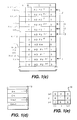
- Fig. 1(a) there is shown a space 10 where figures l 1, l 3, l 21, l 22 depicted on the drawing exist.
- the drawing has a two-dimensional extent, in which (0,0) indicates on Fig. 1 that the lower left hand corner is taken as the origin, and X- and Y-directions are determined as indicated.
- the coordinate space 10 which covers the figures, is equally divided in the respective directions X and Y into subspaces 14 called "cells".
- the address data table 11 of Fig. 1(c) fixed location memory spaces 111 are each of fixed capacity and are held in correspondence with the respective cells 14.
- Each cell 14 on the drawing is identified by its coordinates (I,J), while the starting address of the fixed-capacity memory space of the address data table 11 corresponding to each cell is expresses as X(I,J), which is a function of the drawing coordinates of the respective cells.
- the fixed capacity memory space 111 at X(I,J) corresponding to the cell (I,J) is subdivided in a fixed number DP, and the subdivided spaces can be considered as arrays.
- the number DP is the number of graphic data storing addresses which can be registered in the memory spaces X(I,J) corresponding the the cell (I,J).
- the K-th one of the storing addresses has address data, it is expressed as X (I, J,K).
- the head addresses of the memory subspaces 112 and 113 are computed using the values of I,J, and K.
- each memory subspace at X(I,J,K) stores therein a substitution discriminator A for indicating that substitutional address data is stored and an inclusion-exclusion discriminator B for distinguishing whether the stored address data is one of another cell.
- each memory subspace at X(I,J,K) registers there in address data C for indicating the head address of that space in the graphic data table 12 or the attribute information table 13 in which the graphic data, the attribute information or the like is stored, and registers therein a figure discriminator D for indicating the features of the graphic data, the attribute information or the like.
- the substitution discriminators A are registered for the respective memory subspaces at X(I,J,K) corresponding the individual cells (I,J).
- each substitution discriminator A consists of, for example, 8 bits of code, shown in Fig. 1(f) and (g) which are arrayed for the eight cells 2-9 adjoining the pertinent cell 1 of Fig. 1(e).
- the cell substitution discriminator numbers 16 and 17 have bit locations in the bit table of Figs. 1(f) and (g) respectively set in correspondence with the positional relations of the eight cells 2-9 relative to the pertinent cell 1 in Fig. 1(e).
- This substitute discriminator sets a flag of "1" to indicate the substitutional storage. When the bit is "0", it indicates that the memory space of the corresponding adjacent cell is presently unused and capable of the substitution storage.
- the bit value of "0" is sought in the train of bits of the substitution discriminator A in the memory subspace of the adjacent cell corresponding to the found "0" bit of the array number K corresponding to the pertinent cell.
- the substitutional memory subspace of an adjacent cell has an empty area as indicated by a "0" in the bit map A
- the address data is substitutionally stored therein and the flag of "1” is set at the corresponding bit of the substitution discriminator A.
- the substitutable memory subspace has no empty area, the flag is left intact at "0", and the next prospective memory subspace with a flag of "0" is examined for the pertinent cell.
- the inclusion-exclusion discriminator B in Figure 1(a) sets "0" as an initial value, and "1" is set when the address data of another cell (other than the pertinent cell) has been stored in a subspace of the pertinent cell where information is being read or written.
- "1" is set when the address data of another cell (other than the pertinent cell) has been stored in a subspace of the pertinent cell where information is being read or written.
- Fig. 1(e) has eight adjoining cells (2,3,4,5,6,7,8,9) set as the substitutional memory spaces for the referenced pertinent cell (1)
- the substitutional memory spaces are not restricted to the eight adjoining cells.
- Bit tables 16 and 17 of Figs. 1(f) and (g) are two examples of substitution discriminators A respectively registered in the memory subspaces 112 and 113 corresponding the pertinent cell (I,J) (cell of Fig. 1(e)).
- the substitution discriminators A are registered for the respective arrays K within the memory space at X(I,J) in correspondence with each cell (I,J) and they are collectively registered in part of the memory space at X(I,J) corresponding to each cell (I,J). Further, the substitution discriminators A are registered in common in correspondence with the cell without distinguishing them in accordance with the arrays K in the second embodiment, shown in Fig. 2.
- a memory space at X(I,J) includes two memory spaces 201, 202 and a memory space 203 for storing the substitution discriminator A in correspondence with each cell (I,J). The head address of this memory space at X(I,J) is computed using the values I,J.
- An owner discriminator E is checked with a substituted memory space in the data read searching operation and is in each of the inclusion-exclusion discriminator B described before.
- An example of the owner discriminator E in Fig. 2(a) is such that, when the address data C is associative with the pertinent cell itself, "1" is registered at the owner discriminator E.
- the address data C is associative with the substitutive cell, a train of bits indicating the owner are registered as the owner discriminator E, using the discrimination numbers 15 in Fig. 1(e) as stated before.
- searching for address data the address data of the substituted memory spaces can be properly searched for by finding the correspondence between the cell discrimination number indicated by the substitution discriminator in the memory subspace 203 within the memory space associated with the pertinent cell and the cell discrimination number indicated by the owner discriminator E registered for each of the arrays within the substitution memory subspaces.
- address space ADP 2 J+1 cannot be stored in the memory space X(I,J) for the cell (I,J) because of the lack of room and therefore is substitutionally stored in the right adjacent cell (I+1, J), which is cell 2 in Fig. 1(e).
- Cell discrimination numbers 21 of Fig. 2(b) are centering around the cell (I.J), while cell discrimination numbers 22 are centering around the right adjacent cell (I+1, J).
- owner discrimination number "2" owner discrimination number
- the bit train of the substitution discriminator A in sub subspace 203 in the memory space at X(I,J) for the cell (I,J) has "1" set in the bit position of the discrimination number "2".
- the owner discriminator E of memory space at X(I+1, J) for the cell (I+1, J) stored therein discrimination number "6", which indicates that the address data stored here is of the left adjacent cell (I,J).
- the eight cells adjoining the pertinent cell at the center are held in correspondence with the cell discrimination numbers as indicated at 21 and 22 in Fig. 2(b). Therefore, when the discrimination number is indicated by the substitution discriminator A is 5 or less, a value obtained by adding 4 thereto becomes the discrimination number indicated by the owner discriminator E, which is registered in correspondence with the array K within the memory space of the substitutional cell, and when the former discrimination number is 6 or greater, a value obtained by subtracting 4 therefrom becomes the latter discrimination number.
- the address data substantially stored in the memory spaces of the other cell can be searched for. In a case where the address data C is not registered yet, initial values of "0" are set as the substitution discriminator A and the owner discriminator E, and the processing of referring to the address data in the searching operation is omitted.
- the address data C which indicates the head address of the memory pace for the graphic data table 12 if Fig. 1(b) storing the coordinates of the start point or end point on the line and the figure discriminator D which indicates the point "3" are stored in the subdivided memory space within the address data table 11 of Fig. 1(c).
- the address data C which indicates the head address of the memory space of the graphic data table 12 of Fig.
- the graphic data table 12 of Fig. 1(b) stores therein the coordinates (X,Y) of the points P constituting the figures and the numbers N of the constituent points.
- the quantity N 1 stored in the space 121 within a space Y(L 1 ) on the graphic data table 12 denotes the number of polygonal lines on the linear figure L 1 .
- Space 122 stores the X-coordinate value of the first point P11 of the linear figure L 1
- space 123 stores the Y-coordinate value of the first point P11 of the linear figure L 1 .
- the X-coordinate value and Y-coordinate value of the i-th point of the linear figures L 1 are respectively stored in space 124 and space 125, and as to all the end points and node points of the linear figure L 1 , the X- and Y-coordinates thereof are stored in the space Y(L 1 ).
- the numbers of the polygonal lines thereof and the X- and Y-coordinates of the end points and node points thereof are stored in respective spaces Y(L 2 ) and Y(L 3 ).
- the address data table 11 stores for each cell the substitution discriminator A, the inclusion-exclusion discriminator B, the head address C of the corresponding space memory within the graphic data table 12, and the figure discriminator D indicating the feature of the figure.
- X(I,J) denotes that memory space within the address data table 11 which corresponds to the cell (I,J) within the coordinate space 10 covering the figures L 1 , L 2 , L 3 .
- the size (memory capacity) of this memory space X(I,J) is fixed and it is subdivided by three arrays K. In this manner, the size of the individual memory space 111 of Fig. 1(c) corresponding to each cell 14 of Fig. 1(a) is fixed.
- each of the memory subspaces at X(I,J,K) store therein data on the line in the cell (I,J) of information indicative of the substitutional memory address thereof.
- each memory subspace is partitioned into the substitution discrimination A which indicates that the address data is substitutionally stored in the substitutional memory space nearby, the inclusion-exclusion discriminator B which serves to distinguish whether the stores data is of the pertinent cell itself or the other cell, the space C in which the address data is registered, and the figure discriminator D which indicates the feature of the figure.
- a line 11 of Fig. 1(a) constituting a part of the linear figure L 1 passes in the cell (I,J). Therefore, spaces 112, 113 at the head address X(I,J) of the address data table 11 point to the graphic data table 12 that stores therein the X- and Y-coordinates of the start point and end point of the line 11 respectively. Also, there are stored the values of the figure discriminators D expressing the features of the figure, and the values "0" of the inclusion-exclusion discriminators B indicating that the stored address data belongs to the pertinent cell itself.
- the memory subspace 112 stores therein the address data AD P 1 i+1 indicating the head address of that space 126 within the graphic data table 12 in which the coordinates of the (i+1)th point P 1 i+1 of the linear figure L 1 are stored, the value "1" of the figure discriminator D indicating that the point concerned is the end point, and the value "0" of the inclusion-exclusion discriminator B indicating that the stored address data is of the pertinent cell itself
- the subspace 113 stores therein the address data ADP 1 i indicating the head address of the space 127 within the graphic data table 12 in which the coordinates of the i-th point P l l of the linear figure L 1 are stored, the value "3" of the figure discriminator D indicating that the point concerned is the point on the line, and the value "0" of the inclusion-exclusion discriminator B indicating that the stored address data is of the pertinent cell itself.
- Memory subspace 114 within the memory spaces X(I+1, J) for the right adjacent cell (I+1, J) stores therein the address data ADP 2 J+1 indicating the head address of that space 128 within the graphic data table 12 in which the coordinates of the (J+1)th point P 2 J+1 of the linear figure L2 are stored, the value "2" of the figure discriminator D indicating that the point concerned is the node point, and the value "1" of the inclusion-exclusion discriminator B indicating that the stored address data is of the other cell.
- the address data items concerning the figures of the cell (I,J) are substitutionally stored on a memory subspace 115 within a memory space at X(I+1, J+1) and a memory subspace 116 within a memory space at X(I-1,J+1), so that the substitution discriminator A, 16 of Fig. 1(f) has value "1" stored at the corresponding discrimination numbers "3" and "5".
- the substitution discriminator A, 16 of Fig. 1(f) has value "1" stored at the corresponding discrimination numbers "3" and "5".
- the substitution discriminator A,17 is registered in the memory subspace 113 of the array 2 within the memory space at X(I,J), and the bit corresponding to the discrimination number "4" is set to "1" to indicate that the address data concerning the figure of the cell (I,J) is substitutionally stored in a memory subspace 117 of the array 2 within a memory space at X(I, J+1) for a cell (I, J+1) overlying the pertinent cell and corresponding to the array number "4".
- the address data items which indicate that memory addresses of the graphic data on the figures passing in the cell (I,J) are first stored in the subspaces 112 and 113 within the memory space corresponding the the pertinent cell, and when these subspaces have become full, the remaining address data items are substitutionally stored in the subspaces 114, 115, 117 and 116 within the memory spaces corresponding the the other cells in succession.
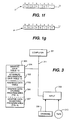
- the whole system for performing the method is shown in Fig. 3.
- the data input apparatus 308 and a memory 303 are connected to a computer 301, including a CPU through a data bus 311.
- the memory 303 includes the area 304 of the graphic data table 12 for storing graphic data, the area 302 of the attribute data table 13, the area 305 of the address data table 11 for registering the memory addresses of the graphic data, the area 306 of a graphic data storing program, and the area 307 of a graphic data searching program. It is also possible to realize the respective programs in hardware fashion.
- a drawing 309 to be processed is read as graphic data items by the graphic data input unit 308 in accordance with the graphic data storing program of Fig. 4 within the memory area 306, which program is executed by the computer 301.
- the read graphic data items are stored in the graphic data table 12 within the memory area 304 and the attribute data table 13 within the memory area 302.
- address data items indicating the memory addresses of the graphic data table 12 which store the graphic data items of respective figures therein are stored in the address data table 11 within the memory area 305.
- the graphic data items are items of the coordinates of the end points and node points of polygonal lines.
- Attribute data items are data indicating the presence of a special library figure, e.g., and data identifying the same for retrieval.
- the graphic data input apparatus 308 is constructed of e.g. a manual drawing input apparatus with which the graphic data items are manually converted into the coordinate data items, for example a digitizing drafting table, or an automatic drawing input apparatus which reads the coordinate data items automatically, for example a scanner.
- a magnetic tape apparatus 310 can also input figures generated by another system.
- the computer 301 executes the graphic data searching program of Fig. 6 within the memory area 307, and the graphic data items stored in the graphic data table 12 of the memory area are fetched with reference to the address data table 11 of the area 305.
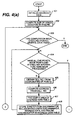
- the address data table 11 is generated according to the process shown in Fig. 4. First, the entire memory space of the address table 11 is initialized, By way of example, values "0" are substituted for data at each memory location (step 401).
- step 402 coordinate values in the respective directions X and Y are compared by referring to all the graphic data items, to find the maximum values and the minimum values, the difference of which are used for obtaining an X-directional length FX and a Y-directional length FY as the overall size of the space required by the figure represented by the graphic data (step 402).
- the answers to the determinations of steps 403 and 404 are no, since there is data to process.
- the address data items C indicating those memory addresses of the graphic data table 12 in which the coordinates of the end points and node points of the respective figures of the graphic data are stored, the substitution discriminators A, the inclusion-exclusion discriminators B or the owner discriminators E, and the figure discriminators D are registered in the memory spaces of the address data table 11 with reference to the coordinate values for the end points and node points of the figures.
- FX and FY denote the X- and Y-directional lengths of the coordinate space where the figures exist, respectively.
- AX and AY denote the numbers of division of the coordinate space in the X- and Y-directions, respectively.
- [ ] is the Gauss symbol, which signifies to take the greatest integer not exceeding a number written therein.
- the memory address of the graphic data stored in the graphic data table 12 is registered in the memory space at X(I,J) corresponding the the cell number I,J within the address data table 11.
- the capacity of the memory space at X(I,J) corresponding to the cell (I,J) is fixed.
- DP denotes the number of those memory addresses of the graphic data which can be stored in the memory space at X(I,J) corresponding to the cell (I,J)
- NB denotes the capacity of the memory space which stores therein the substitution discriminator A, the inclusion-exclusion discriminator B, the address data C and the figure discriminator D as to one memory address of the graphic data
- the symbol FST$AD denotes the first address of the address data table 11.
- the head address on the address data table area 305 is computed in accordance with Eq. (2) (step 406).
- substitution discriminator A inclusion-exclusion discriminator B, the address data C and figure discriminator D are stored in the particular memory space (step 408).
- the above precessing is repeated for each of the end points, node points and attribute information by processing from step 408 to step 404 until step 404 indicates that all end points, node points and attribute information items have been processed so that the process proceeds to step 409.
- step 409 it is determined if there are points on lines different from the end points, node points and attribute information to be registered in the address data table 11. If the answer to step 409 is yes then the answer to step 410 is no and then the intersection point between the boundary of a cell and each of the lines constituting a figure is obtained in step 411. Since two boundaries in the vertical direction and in the horizontal direction can be selected as the boundary of the cell, one of them is selected by the following method: First, a circumscribed rectangle having parallel latera in the X-direction and Y-direction is set with its diagonal line being the line within the cell, and the X-directional and Y-directional lengths thereof are respectively denoted by Dx and Dy. Herein if Dx ⁇ DY holds, then the cell boundary in the horizontal direction is selected. Then the number (I,J) of the cell including the intersection point between the line and the cell boundary is obtained using Eq. (1) (step 412).
- the middle points between them and all adjacent points are found. Subsequently, the numbers of cells including the middle points are obtained in accordance with the boundary of the cell in the horizontal direction intersect at one point, and the numbers of four cells surrounding the point of the intersection are obtained in order to regard the four cells as the cells in which the line passes. Since the numbers of two of the four cells have already been found, the numbers of the other two cells are readily obtained form the relation of adjacency of the cells. These cell numbers are added to the cell numbers obtained at step 412, whereby the numbers of all the cells in which the line passes are obtained (step 413). The cell numbers thus obtained are substituted into Eq.
- step 4134 (2) to calculate the head addresses of the address data table 11 (step 414), and the empty areas of the address data table 11 are sought to select a storable memory space (step 415).
- the substitution discriminator A, the inclusion-exclusion discriminator B, the address data C, and the figure discriminator D indicating the points on the line are stored in the selected memory space (step 416). With this method, the data items are stored in the memory spaces of the address data table 11 corresponding to all the cells in which the line passes.
- step 416 The above processing is repeated by passing from step 416 to step 410 for all lines constituting the figure.
- step 403 The operations of storing the substitution discriminators A, inclusion-exclusion discriminators B, address data items C, and figure discriminators D in the address data table 11 are executed as to all graphic data items and attribute information items (step 403).
- An address data table concerned with only specified information can be generated in such a way that step 403 is additionally endowed with the function of deciding the colors and sizes of figures, or selectively storing only specified prospective data items as only the end points of graphic data, only the end points and node points of graphic data, only points on planes or only associated attribute information items.
- the supplementation or deletion of figures can be coped with by the above processing.
- substitution discriminators A, inclusion-exclusion discriminators B, address data items C and figure discriminators D are deleted instead of being stored on the memory. It is to be understood that, in the two cases of the supplementation and the deletion, the whole address data table need not be renewed.
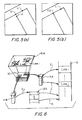
- T-shaped connection processing as shown in Figs. 5(a) and (b) will be explained.
- This processing is one in which the closest line L from an end point P that lies within a designated extent is selected (a line containing the point P is excluded), whereupon the point P is drawn onto the line L.
- the address data table is initially generated as to end points, node points and points on lines. Subsequently the data searching program memory area 307 of the memory 303 in Fig. 3 is executed.
- the graphic data searching program is shown in Fig. 6.
- the coordinates of point P are designated (step 601), and a rectangular seek window is set around the point P (step 602).
- the coordinates of the left lower corner and right upper corner of the seek window are converted to cell numbers in accordance with Eq. (1) (step 603).
- the number of a cell lying inside the seek window is evaluated with reference to the number of a cell found at the step 603 (step 604) and the address of the address data table corresponding the evaluated cell number is obtained using Eq. (2) (step 606).
- the array is updated on the basis of the designated address, and as to all corresponding figures, the address data items C and the figure discrimination D are extracted by reference to the substitution discriminators A (step 607).
- the processing to the steps 606 and 607 is executed for all the cells lying inside the seek window (step 605). From among lines which exist within the coordinate space which covers all such cells, lines which exist in the cells near the pertinent cell as specified by the figure discriminators D and that have the corresponding address are selected on the basis of the addresses and figure discriminators D in the extracted data items, the distances between the group of selected lines and the point P are mathematically evaluated from the respective coordinates thereof and are compared, and the nearest line is selected (step 608). Finally, the intersection point Q between the nearest line and the line containing the point P is obtained, and the coordinates of the point P are changed into those of the point Q.
- the method can be applied to the construction of an address data table concerning three-dimensional figures by increasing the dimensions DP of the array (I,J,K).
- FIG. 7(a) shows figures which pass in a cell (I,J).
- a linear figure L n and a linear figure L m pass in the cell (I,J).
- P n j denotes the j-th point (a point on a line) on the linear figure L n
- symbol P n j+1 denotes the (j+1)th point (a node point) on the linear figure L n
- symbol P m i denotes the i-th point (a point on a line) on the linear figure L m
- symbol P m i+1 denotes the (i+1)th point (a node point) on the linear figure L m .
- a linear figure L a indicated by broken lines is a linear figure added.
- Symbol P a 1 indicates the first point (a node point) on the linear figure L a .
- Fig. 7(b) shows an example storing the address data etc. in an address data table 700 in the case where they cannot be stored at memory space X(I,J) for lack of room.
- X(I,J) denotes a memory space corresponding to the cell (I,J).
- Value "6" stored in partial space 71 of the memory space at X(I,J) is a discriminator which indicates overflow of address data which cannot be stored in the space at X(I,J) and which is successfully stored in another memory space 72 pointed to by the address.
- the address and the discriminator "6" indicative of the overflow are stored on the head space 73 of the space at X(I,J), and the address data and new address data are combined and then shifted into another memory space 74 pointed to by the address.
- the storage of the present invention can be applied even to a cell in which graphic data items are dense.
- an address data table 720 in Fig. 7(d) even when a figure to be added to such a cell is undergoing the overflow, the address data of the figure to be added may well be shifted into another memory space 76 together with the overflowing data, In this case, only the address stored in a space 75 may be stored.
- Address data stored in a space 81 are the data added. Moreover as shown in an address data table 730 in Fig. 7(e), in the case of storing the address data in another memory space at overflow, another space 78 to form a pair with the address data and pointed to by the address of space 77 is provided. When a new figure is subsequently added, still another space 80 is pointed to using an address stored in partial space 79 within the space 78. In this way, the address data of new figures can be successfully stored. Memory space of the address data table 730 in which no data is stored can be brought into correspondence with the other space 78. On this occasion, a discriminator, which indicates that no data corresponding to the memory space is stored, is stored on the space beforehand.
- FIG. 8 The figure shows the relation among the original figure 10A and data representations of it.
- Vector graphics are represented by X and Y coordinates (and Z for three dimensions) and stored in a predetermined format in the graphics data table 12. The address in memory where data for each line are stored can then be identified by a pointer.
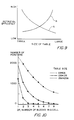
- Figure 9 shows the relation between the size of a table and the efficiency of graphics data retrieval.
- the table size increases, the amount of compressed information in each cell decreases. This means that the number of detailed decisions, curve A, reduces when retrieving graphics data from pointers, adding to efficiency.
- curve A reduces when retrieving graphics data from pointers, adding to efficiency.
- curve B there will be more cells to refer to in the case of retrieving graphics forms for any given point, curve B, thus impairing efficiency. Since each line segment is linked to more cells, it takes longer to create a table.
- the size depends upon the type of data, type of processing, configuration of processing programs, etc.
- auxiliary table 12A is of variable size and is for storing any pointers that overflow the cell storage. Overflowed cells have pointers that specify the storage area used for the pointer data in the auxiliary table 12A so that the table can be referred to.
- the reduction of the size of blocks leads to an increase in data stored in the auxiliary tale.
- the number of pointers to be stored in an auxiliary table 12A is measured.
- Figure 10 shows the change in the total number of the overflow pointers when the size of blocks is varied. It can be concluded from the measuring that a block size of 4 or 5 is preferable for a table of size 128*128. In this case, the number of pointers stored in the auxiliary table is not more than 10 percent of the total number of pointers with as little as a few percent reduction in retrieval efficiency.
- Figure 11 shows an example of a measurement of the number of pointers to be stored. The result shows that overflowed cells are not concentrated on any particular area, and are surrounded in most cases by cells with additional capacity. Therefore, it is more effective to store pointers from overflowed cells in the surrounding cells rather than an auxiliary table.
- Each pointer of each cell has a tag for specifying which of the surrounding cells are sharing its data.
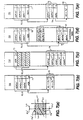
- Figure 12(a) shows the 8 neighboring cells considered along with the pertinent cell of interest.
- a 9-bit tag is used to link a pointer belonging to the pertinent cell under consideration to some of the surrounding 8 cells (for storage).
- the cell to which pointer should belong can be specified by assigning '1' in the tag of the pointer to the corresponding bit. Once the center cell is located by applying the reduction ratio to the coordinates in the original, surrounding cells are identified and their pointers linked with a tag of the pointer. If the cell to which the pointer should belong has overflowed, empty blocks are searched for in the surrounding cells and are used for storing the pointers, and '1' is assigned to the corresponding bit of the tag of the pointer to indicate its "correct" location. If all the surrounding cells in turn have overflowed, the pointers are placed in an auxiliary table.
- This method levels the distribution of pointers to be stored. Besides the method has the effect of containing almost all the pointers in a set of 9 cells, which prevents most overflows.
- the pointer is stored only in (1,1) and (4,3).
- the cells indicated by stars, (0,0),...(2,2), and (3,2),...(5,4), do not have pointers for the line; instead they are linked to the pointers of (1,1) and (4,3), respectively, by their tags. For straight lines this helps to reduce the number of pointers to be stored by 50 to 70 percent. The method is effective especially for pointers representing polygon information. In Figure 12(c), it is possible to cut down the number of pointers by a maximum of 90 percent.
- the space needed for storing one pointer is about 4 bytes after compression, though this is dependent on the type of computer and program.
- a tag covering a block of 9 neighboring cells needs 9 bits, so that in the extended method of Figures 1-7, 5 bytes are necessary for storing one pointer and tag.
- the block size of a table and memory for an auxiliary table are reduced, it is possible to cut down memory requirements by about 50 percent. This method also makes use of memory more efficiently, since the amount of memory for cells is reduced.
- the method is effective especially for such tasks as clarifying vague or broken lines and intersection, and identifying areas.
- the method has been found successful in performing such work 30 to 50 times faster than conventional high-speed programs. This speed is several hundreds of times higher than programs employing only a "round robin" algorithm and no means for increasing the speed.
- the present method achieved high-speed retrieval tens of times faster than conventional methods.
- the efficiency was proved to be almost unchanged even when the size of the table was fixed, as long as there was no sudden increase in the concentration of lines, though the optimal size of the table varied slightly with the complexity of the drawing.
- the dimension of a table is no larger than that of the original.
- this method can be applied not only to handling attribute data such as topographical descriptions, but also to retrieving three-dimensional graphical data, it is possible to extend the method to processing three- and four-dimensional topographical information which requires manipulating vast amounts of data.
- the present invention is capable of multifarious amplifications, and the graphic data storing method is extensively feasible.
- empty memory areas assigned to other cells are indirectly used, whereby an address data table can be efficiently utilized.
Landscapes
- Engineering & Computer Science (AREA)
- Library & Information Science (AREA)
- Theoretical Computer Science (AREA)
- Data Mining & Analysis (AREA)
- Databases & Information Systems (AREA)
- Physics & Mathematics (AREA)
- General Engineering & Computer Science (AREA)
- General Physics & Mathematics (AREA)
- Image Analysis (AREA)
- Information Retrieval, Db Structures And Fs Structures Therefor (AREA)
- Processing Or Creating Images (AREA)
Description
Claims (25)
- A graphic data handling method, comprising steps ofcharacterized in that said step of providing an address data table (11) includes the steps ofdividing a graphic image of figures into a plurality of graphic cells;providing a graphic data table (12) storing, in random order independent of the position of the cells relative to the graphic image, graphic data for defining the figures within the cells; andproviding an address data table (11) which includes a plurality of memory spaces of fixed capacity respectively assigned to the cells;normally storing therein memory address pointers to the graphic data table that correspond to the figures in the cells, respectively; andwhen the memory address pointers for the graphic data that corresponds to the figures in a pertinent cell cannot be stored in the memory space assigned to the pertinent cell, substitutionally storing at least some of the memory address pointers for the pertinent cell in the memory space assigned to another of the cells.
- The method of claim 1, further including a step of storing information indicative of the step of substitutional storing in the memory space of the pertinent cell of the address data table (11).
- The method of claims 1 or 2, wherein said step of providing an address data table (11) comprises the step of providing the memory spaces corresponding to the cells in a computer memory sequentially in a fixed order dependent upon the positions of the cells in the graphic image.
- The method of any of claims 1 to 3, further including a step of retrieving graphic data from the graphic data table (12) by:defining an area that is only a part of the graphic image;transposing the area into a representation of the cells within the area;searching the memory spaces of the address data table corresponding to the cells of the area and memory spaces having substitutional storing of address pointers of the area, without searching the memory spaces corresponding to the remaining cells of the graphic image and determining address pointers therein assignable to the area; andfetching from computer memory the graphic data in the graphic data table (12) using only the pointers found in said searching.
- The method of claim 4, further including steps ofdetermining, from the information indicative of the substitutional storing found in said step of searching, substitutional storage in other cells that contain address pointers relating to the cells of the area and retrieving the related address pointers; andfetching from computer memory the graphic data from the graphic data table in accordance with the retrieved related address pointers.
- The method of any of claims 1 to 5, further including a step of setting at least one coded number for each memory space of the address data table to indicate which ones of the another cells are substitutionally storing the address pointers for the pertinent cell.
- The method of any of claims 1 to 6, wherein the another cells have a fixed physical location in the graphic image relative to the pertinent cell.
- The method of any of claims 1 to 7, further including a step of storing, with respect to each address pointer in the address data table (11), a data field indicating the type of figures of graphic data pointed to by the address pointer.
- The method of any of claims 1 to 8, wherein said step of providing an address data table (11) includes a step of storing a data field including a single bit for each address pointer indicating whether the address pointer is an address pointer for the pertinent cell.
- The method of any of claims 1 to 9, further including a step of storing a plurality of bits corresponding in number to the another cells having a specific physical relationship with the pertinent cell that is the same for each cell of the graphic image, and setting the bits to indicate which ones of the another cells contain address pointers for the graphic data of the pertinent cell.
- The method of any of claims 1 to 10, performed completely by a computer system having a graphic data storage program (306), a graphic data searching program (307), a memory (305) containing the address data table, a memory(304) containing the graphic data table, an input device (308) for inputting the graphic image, and a data output device for outputting searching program results.
- The method of any of claims 1 to 11, further including a step of providing an attribute information data table (13) separate from said graphic data tablet (12) for indicating attributes of figures within each cell, wherein said step of providing an address data table (11) provides address pointers in the address data table for addresses of attribute information in the attribute information data table correlated to the cells in the same manner that the graphic data in the graphic data table is correlated to the cells, and wherein each pointer in the address data table includes a field indicating whether the pointer relates to the graphic data table or the attribute information data table.
- The method of any of claims 1 to 12, further including steps of computing the size of address data table space required for an input graphic image and dividing it into cell spaces;determining if all graphic data items of the image have been processed, if they have, ending the storage program and if they have not, determining if all address pointers for the graphic image have been processed;if all address pointers have not been processed, identifying a cell from coordinates of points in the graphic image, computing an address pointer of the cell, finding an empty space within the address data table, and storing the address pointer in the empty space of the address table according to the steps of forming an address table; andthereafter returning to the determination if all address pointers of the graphic image have been processed.
- The method of claim 3, further including a step of determining the address of an another cell within the address data table (11) by the address of the pertinent cell within the address data table and a fixed number unique to the physical location of the another cell relative to the pertinent cell in the graphic image, which is the same for the same physical relationship between any cell as a pertinent cell and it's another cells within the graphic image.
- The method of claim 7 or 14, wherein the fixed physical location for the another cells is based on the criteria of physically directly adjacent cells in the graphic image.
- The method of any of claims 1 to 15, wherein said step of providing a graphic data table stores graphic data for the cells in random order independent of the position of the cells relative to the graphic image.
- The method of any of claims 1 to 16, wherein the spaces are all of the same fixed capacity.
- The method of any of claims 1 to 17, wherein the cells are all of equal size.
- The method of any of claims 1 to 18 , wherein said step of providing a graphic data table stores graphic data for end points, for node points, and an intersection with the pertinent cell boundary for each line in or passing through the pertinent cell.
- The method of claim 19, wherein said step of providing a graphic data table includes a step of storing therein selective intermediate points and attribute information concerning the figures of the graphic image within the pertinent cell, which figures include the lines.
- A graphic data handling system to be operated by a computer system having a graphic data storage program (306), a graphic data searching program (307), a memory (305) containing an address data table (11), a memory (304) containing a graphic data table (12), an input device (308) for inputting a graphic image, and a data output device for outputting searching program results, comprising:means for dividing the graphic image of figures into a plurality of graphic cells;means for storing graphic data for defining the figures within the cells in a graphic data table (12) in random order independent of the position of the cells relative to the graphic image;means for providing the address data table (11) which includes a plurality of memory spaces of fixed capacity respectively assigned to the cells; characterized in that said means for providing the address data table comprises means for normally storing therein memory address pointers to the graphic data table that correspond to the figures in the cells respectively;means for substitutionally storing at least some of the memory address pointers for the pertinent cell in the memory space assigned to another of the cells when the memory address pointers for the graphic data that corresponds to the figures in a pertinent cell cannot be stored in the memory space assigned to the pertinent cell; andmeans for storing information indicative of the substitutional storing in the memory space of the pertinent cell of the address data table.
- The system of claim 21, wherein said means for providing the address data table provides the memory spaces corresponding to the cells in a computer memory sequentially in a fixed order dependent upon the positions of the cells in the graphic image.
- The system of claims 21 or 22, further including means for retrieving graphic data from the graphic data table (12) including means for transposing an area that is only a part of the graphic image into a representation of the cells within the area, means for searching the memory spaces of the address data table (11) corresponding to the cells of the area and memory spaces having substitutional storing of address pointers of the area, without searching the memory spaces corresponding to the remaining cells of the graphic image and determining address pointers therein assignable to the area and means for fetching from computer memory the graphic data in the graphic data table using only the pointers found by said means for searching.
- The system of any of claims 21 to 23, further including means for storing a plurality of bits corresponding in number to the another cells having a specific physical relationship with the pertinent cell that is the same for each cell of the graphic image, and setting the bits to indicate which ones of the another cells contain address pointers for the graphic data of the pertinent cell.
- The system of any of claims 21 to 24, furhter including means for determining the address of an another cell within the address data table (11) by the address of the pertinent cell within the address data table and a fixed number unique to the physical location of the another cell relative to the pertinent cell in the graphic image, which is the same for the same physical relationship between any cell as a pertinent cell and it's another cells within the graphic image.
Applications Claiming Priority (2)
| Application Number | Priority Date | Filing Date | Title |
|---|---|---|---|
| JP36038/90 | 1990-02-19 | ||
| JP2036038A JP2786294B2 (en) | 1990-02-19 | 1990-02-19 | Graphic data inspection and storage method |
Publications (3)
| Publication Number | Publication Date |
|---|---|
| EP0443531A2 EP0443531A2 (en) | 1991-08-28 |
| EP0443531A3 EP0443531A3 (en) | 1993-08-11 |
| EP0443531B1 true EP0443531B1 (en) | 1998-09-16 |
Family
ID=12458541
Family Applications (1)
| Application Number | Title | Priority Date | Filing Date |
|---|---|---|---|
| EP91102369A Expired - Lifetime EP0443531B1 (en) | 1990-02-19 | 1991-02-19 | Graphic data handling method and system |
Country Status (3)
| Country | Link |
|---|---|
| EP (1) | EP0443531B1 (en) |
| JP (1) | JP2786294B2 (en) |
| DE (1) | DE69130183D1 (en) |
Families Citing this family (3)
| Publication number | Priority date | Publication date | Assignee | Title |
|---|---|---|---|---|
| US6384847B1 (en) | 1992-03-20 | 2002-05-07 | International Business Machines Corporation | Interactive graphical method for analyzing many-dimensional data sets |
| US7774695B2 (en) * | 2006-05-11 | 2010-08-10 | International Business Machines Corporation | Presenting data to a user in a three-dimensional table |
| CN112579714B (en) * | 2019-09-30 | 2024-10-01 | 阿里巴巴集团控股有限公司 | Data query method, device, equipment and machine-readable storage medium |
Citations (1)
| Publication number | Priority date | Publication date | Assignee | Title |
|---|---|---|---|---|
| US4803477A (en) * | 1985-12-20 | 1989-02-07 | Hitachi, Ltd. | Management system of graphic data |
Family Cites Families (2)
| Publication number | Priority date | Publication date | Assignee | Title |
|---|---|---|---|---|
| NL8602654A (en) * | 1986-10-23 | 1988-05-16 | Philips Nv | METHOD FOR DIVIDING IN LOTS AND STORING BITCH IN A MASSAGE MEMORY A DATA FILE, AND FOR ADDRESSING A LOT, AND APPARATUS FOR PERFORMING THE METHOD |
| NL8702014A (en) * | 1987-08-28 | 1989-03-16 | Philips Nv | ROUTE DETERMINATION UNIT. |
-
1990
- 1990-02-19 JP JP2036038A patent/JP2786294B2/en not_active Expired - Fee Related
-
1991
- 1991-02-19 DE DE69130183T patent/DE69130183D1/en not_active Expired - Lifetime
- 1991-02-19 EP EP91102369A patent/EP0443531B1/en not_active Expired - Lifetime
Patent Citations (1)
| Publication number | Priority date | Publication date | Assignee | Title |
|---|---|---|---|---|
| US4803477A (en) * | 1985-12-20 | 1989-02-07 | Hitachi, Ltd. | Management system of graphic data |
Also Published As
| Publication number | Publication date |
|---|---|
| EP0443531A2 (en) | 1991-08-28 |
| DE69130183D1 (en) | 1998-10-22 |
| EP0443531A3 (en) | 1993-08-11 |
| JP2786294B2 (en) | 1998-08-13 |
| JPH03240168A (en) | 1991-10-25 |
Similar Documents
| Publication | Publication Date | Title |
|---|---|---|
| US5144679A (en) | Graphic data searching and storage method | |
| US6868420B2 (en) | Method for traversing quadtrees, octrees, and N-dimensional bi-trees | |
| EP0210554B1 (en) | A method of windowing image data in a computer system | |
| EP0532740B1 (en) | Computer apparatus and method for finite element identification in interactive modeling | |
| US4803477A (en) | Management system of graphic data | |
| JPH09179883A (en) | Method and device for deriving connection rule between data | |
| Ogayar et al. | Point in solid strategies | |
| EP0316144B1 (en) | Method and apparatus for classifying graphics segments to facilitate pick and display operation | |
| Bracken et al. | Towards a typology of geographical information systems | |
| US5748197A (en) | Dynamic computation of a line segment arrangement using finite precision arithmetic for use in a processor controlled system | |
| US4811244A (en) | Drawing information management system | |
| EP0443531B1 (en) | Graphic data handling method and system | |
| CA1286409C (en) | Method for enhancing three-dimensional interference checking | |
| JP2001014338A (en) | Method and system for graphic data management, and storage medium | |
| Hermann et al. | Real-time indexing and visualization of LiDAR point clouds with arbitrary attributes using the M3NO data structure | |
| US5099520A (en) | Figure retrieval method | |
| JP2644735B2 (en) | Drawing information management method | |
| Livnat | Accelerated Isosurface Extraction Approaches. | |
| KR102937378B1 (en) | Method and apparatus for recognizing triangles in graph | |
| KR100210400B1 (en) | Distance Image Classification by Quad Tree | |
| Jones | Conflict resolution in cartographic name placement | |
| JP2544330B2 (en) | Management method of drawing data | |
| EP0425180B1 (en) | Structure storage management in a graphics display system | |
| Christofides et al. | Data structures for topological and geometric operations on networks | |
| JP3251744B2 (en) | Image generation method by intersection tracking method |
Legal Events
| Date | Code | Title | Description |
|---|---|---|---|
| PUAI | Public reference made under article 153(3) epc to a published international application that has entered the european phase |
Free format text: ORIGINAL CODE: 0009012 |
|
| AK | Designated contracting states |
Kind code of ref document: A2 Designated state(s): DE FR GB |
|
| PUAL | Search report despatched |
Free format text: ORIGINAL CODE: 0009013 |
|
| AK | Designated contracting states |
Kind code of ref document: A3 Designated state(s): DE FR GB |
|
| 17P | Request for examination filed |
Effective date: 19940117 |
|
| 17Q | First examination report despatched |
Effective date: 19961209 |
|
| GRAG | Despatch of communication of intention to grant |
Free format text: ORIGINAL CODE: EPIDOS AGRA |
|
| GRAG | Despatch of communication of intention to grant |
Free format text: ORIGINAL CODE: EPIDOS AGRA |
|
| GRAG | Despatch of communication of intention to grant |
Free format text: ORIGINAL CODE: EPIDOS AGRA |
|
| GRAH | Despatch of communication of intention to grant a patent |
Free format text: ORIGINAL CODE: EPIDOS IGRA |
|
| GRAH | Despatch of communication of intention to grant a patent |
Free format text: ORIGINAL CODE: EPIDOS IGRA |
|
| GRAA | (expected) grant |
Free format text: ORIGINAL CODE: 0009210 |
|
| AK | Designated contracting states |
Kind code of ref document: B1 Designated state(s): DE FR GB |
|
| PG25 | Lapsed in a contracting state [announced via postgrant information from national office to epo] |
Ref country code: FR Free format text: LAPSE BECAUSE OF FAILURE TO SUBMIT A TRANSLATION OF THE DESCRIPTION OR TO PAY THE FEE WITHIN THE PRESCRIBED TIME-LIMIT Effective date: 19980916 |
|
| REF | Corresponds to: |
Ref document number: 69130183 Country of ref document: DE Date of ref document: 19981022 |
|
| PG25 | Lapsed in a contracting state [announced via postgrant information from national office to epo] |
Ref country code: DE Free format text: LAPSE BECAUSE OF FAILURE TO SUBMIT A TRANSLATION OF THE DESCRIPTION OR TO PAY THE FEE WITHIN THE PRESCRIBED TIME-LIMIT Effective date: 19981217 |
|
| EN | Fr: translation not filed | ||
| PG25 | Lapsed in a contracting state [announced via postgrant information from national office to epo] |
Ref country code: GB Free format text: LAPSE BECAUSE OF NON-PAYMENT OF DUE FEES Effective date: 19990219 |
|
| PLBE | No opposition filed within time limit |
Free format text: ORIGINAL CODE: 0009261 |
|
| STAA | Information on the status of an ep patent application or granted ep patent |
Free format text: STATUS: NO OPPOSITION FILED WITHIN TIME LIMIT |
|
| 26N | No opposition filed | ||
| GBPC | Gb: european patent ceased through non-payment of renewal fee |
Effective date: 19990219 |