EP0442205A2 - Methode zur Überwachung der Effekte von thermischer und Strahlungsexposition - Google Patents
Methode zur Überwachung der Effekte von thermischer und Strahlungsexposition Download PDFInfo
- Publication number
- EP0442205A2 EP0442205A2 EP90313409A EP90313409A EP0442205A2 EP 0442205 A2 EP0442205 A2 EP 0442205A2 EP 90313409 A EP90313409 A EP 90313409A EP 90313409 A EP90313409 A EP 90313409A EP 0442205 A2 EP0442205 A2 EP 0442205A2
- Authority
- EP
- European Patent Office
- Prior art keywords
- chemical compound
- providing
- environment
- interval
- extent
- Prior art date
- Legal status (The legal status is an assumption and is not a legal conclusion. Google has not performed a legal analysis and makes no representation as to the accuracy of the status listed.)
- Withdrawn
Links
Images
Classifications
-
- G—PHYSICS
- G01—MEASURING; TESTING
- G01N—INVESTIGATING OR ANALYSING MATERIALS BY DETERMINING THEIR CHEMICAL OR PHYSICAL PROPERTIES
- G01N17/00—Investigating resistance of materials to the weather, to corrosion, or to light
-
- G—PHYSICS
- G01—MEASURING; TESTING
- G01N—INVESTIGATING OR ANALYSING MATERIALS BY DETERMINING THEIR CHEMICAL OR PHYSICAL PROPERTIES
- G01N21/00—Investigating or analysing materials by the use of optical means, i.e. using sub-millimetre waves, infrared, visible or ultraviolet light
Definitions
- This invention relates to monitoring the effects of thermal and radiation energy on electrical and structural materials and, more particularly, to employing the Arrhenius rate law in selecting chemical compounds having well-known properties for use in such monitoring.
- this invention provides a simple, expedient method for monitoring the exposure of materials in various environments to thermal and radiation energy using the Arrhenius rate law.
- said method comprises identifying a particular material to be monitored, determining an appropriate monitoring interval, and using the Arrhenius rate law to select a chemical compound which behaves in a well-known manner upon exposure to thermal and radiation energy and which will undergo measurable reaction in the subject environment over the chosen interval.
- the method of this invention further comprises providing the chemical compound in the subject environment, measuring the extent of its reaction after said interval, and comparing this measurement with calibration data to determine the properties of materials exposed sharing the same environment as the selected chemical compound.
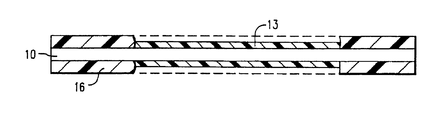
- FIG 1 is an embodiment of a monitoring device for use in the method of the present invention, in which a fiber optic core (10) is coated with an activated polymer (13) and protective material (16).
- A is called the pre-exponential factor, which is characteristic of a given reaction and is independent of temperature.
- Equation (3) the proportion of remaining reactant is given by Equation (3), where X0 is the starting quantity of species X and back reactions are ignored.
- Equation (3) one skilled in the art can estimate the appropriate parameters for a model reaction to be employed at the ambient conditions to which specific energy-sensitive materials are anticipated to be exposed.
- T might be chosen as 82°C (355K) to correspond to temperatures there encountered.
- the desired reaction should ideally have a half life comparable to the duration of a fuel cycle, or about two years, at which point the term [X]/[X0] in Equation (3) would equal one (1).
- E a activation energy
- Suitable reactions include the thermal decomposition of a chemical or an isomerization, such as the trans to cis conversion of stilbene. It is preferred that such reactions be irreversible, as where chemical decomposition generates a gaseous product.
- calibration data is obtained by comparing the behavior over time of the chemical compound and one or more materials of interest after exposure to thermal and radiation energy.
- Calibration data can be obtained through a wide variety of techniques well known in the art, such as accelerated exposure studies comparing, for example, the structural integrity of gasket material with the infrared spectra of a chemical compound selected in accordance with this invention. Using such calibration data, it then becomes possible to determine the properties of a wide variety of materials in a particular exposure environment without time-consuming individual inspection. The progress of the selected, similarly exposed chemical compound is all that need be monitored.
- a chemically reactive species having appropriate activation energy is chemically bonded to a polymer support, such as polyvinylchloride, polyethylene, polyester, or epoxy, to form a thermally activated polymer.
- a polymer support such as polyvinylchloride, polyethylene, polyester, or epoxy
- a thin film (1-10 micrometers) of this thermally activated polymer is coated on an optical substrate, such as an optical fiber or the internal reflection rod of the Circle Cell (made by Spectra-Tech, Inc.).
- the coating should be on the optically transmitting part of the substrate, such as on the fiber optic core.
- the extent of reaction can be determined by passing light through the sensor and recording its spectrum.
- Spectral changes will be observed as the reaction proceeds, and can be interpreted in terms of the amount of starting material remaining and the amount of product formed.
- a wide variety of techniques well known in the art can be employed to measure such spectral changes, such as ultraviolet, visible, infrared, fluorescence, absorption, polarization, and nuclear magnetic resonance spectroscopies.
- Another embodiment of this invention comprises a small vessel containing a liquid solution of the chemical species to be used.
- a wide variety of optical properties can be used to characterize such a system, including but not limited to absorption, fluorescence, and polarization.
- Fiber optics can be used to illuminate the sample and to determine its spectral characteristics and, in turn, the model reaction's progress.
- a thin protective coating of gadolinium or a gadolinium alloy could be used to absorb such neutrons before they can react with the reagent, as well known in the art.
- the containment area of a nuclear reactor is identified as an environment to be monitored. Since the reactor must be shut down at least every two years for replacement of its fuel, two years is chosen as a convenient interval for monitoring the thermal and radiation exposure of the its components.
- One of the rods is then placed in an accelerated aging chamber along with a sample of gasket material used in nuclear reactors.
- the chamber is maintained in such manner as to simulate a reactor containment area.
- the rod and sample are periodically removed from the chamber.
- the infrared spectrum of the polymer film and the structural properties of the sample are compared and recorded, yielding calibration data.
- the second rod is then placed in the nuclear reactor containment area for about two years. Temperature is monitored and found to be about 82°C. The rod is taken from the containment area and the infrared spectrum of the polymer film is recorded. The changes in the spectra are evaluated by comparison to calibration data to determine the structural properties of gasket materials located near the rod in the containment area.
Landscapes
- Life Sciences & Earth Sciences (AREA)
- General Health & Medical Sciences (AREA)
- General Physics & Mathematics (AREA)
- Pathology (AREA)
- Immunology (AREA)
- Physics & Mathematics (AREA)
- Health & Medical Sciences (AREA)
- Chemical & Material Sciences (AREA)
- Analytical Chemistry (AREA)
- Biochemistry (AREA)
- Ecology (AREA)
- Environmental Sciences (AREA)
- Biodiversity & Conservation Biology (AREA)
- Environmental & Geological Engineering (AREA)
- Investigating Or Analysing Materials By The Use Of Chemical Reactions (AREA)
- Investigating Or Analyzing Materials Using Thermal Means (AREA)
- Testing Of Devices, Machine Parts, Or Other Structures Thereof (AREA)
- Testing Resistance To Weather, Investigating Materials By Mechanical Methods (AREA)
- Investigating Or Analysing Materials By Optical Means (AREA)
- Investigating, Analyzing Materials By Fluorescence Or Luminescence (AREA)
Applications Claiming Priority (2)
| Application Number | Priority Date | Filing Date | Title |
|---|---|---|---|
| US469973 | 1990-01-02 | ||
| US46997390A | 1990-01-25 | 1990-01-25 |
Publications (2)
| Publication Number | Publication Date |
|---|---|
| EP0442205A2 true EP0442205A2 (de) | 1991-08-21 |
| EP0442205A3 EP0442205A3 (en) | 1992-05-06 |
Family
ID=23865769
Family Applications (1)
| Application Number | Title | Priority Date | Filing Date |
|---|---|---|---|
| EP19900313409 Withdrawn EP0442205A3 (en) | 1990-01-25 | 1990-12-11 | Method for monitoring the effects of thermal and radiation exposure |
Country Status (3)
| Country | Link |
|---|---|
| EP (1) | EP0442205A3 (de) |
| JP (1) | JP2874803B2 (de) |
| KR (1) | KR910014695A (de) |
Cited By (3)
| Publication number | Priority date | Publication date | Assignee | Title |
|---|---|---|---|---|
| EP0727656A1 (de) * | 1995-02-15 | 1996-08-21 | Hitachi, Ltd. | Methode zur Schätzung der Korrosion an strukturellem Material von Anlagen, und Korrosionsdiagnosesystem |
| WO2000075629A1 (en) * | 1999-06-02 | 2000-12-14 | The Tokyo Electric Power Company Incorporated | Thermal proof strength determination method of power-transmission line |
| EP1490672A4 (de) * | 2002-03-06 | 2005-09-21 | Bpw Inc | Elektrisches überwachungsverfahren für polymere |
Family Cites Families (4)
| Publication number | Priority date | Publication date | Assignee | Title |
|---|---|---|---|---|
| GB1604446A (en) * | 1978-05-31 | 1981-12-09 | Sybron Corp | Device and method for monitoring a component in a fluid mixture |
| JPS5917383B2 (ja) * | 1979-01-31 | 1984-04-20 | 株式会社東芝 | 12%Cr系耐熱鋼の劣化度測定法 |
| EP0261286B1 (de) * | 1986-09-24 | 1991-08-28 | Katsumi Yoshino | Verfahren und Elemente zur Strahlungsdetektion |
| US4895750A (en) * | 1988-03-28 | 1990-01-23 | General Dynamics Corp., Pomona Division | High-temperature tensile test specimen and methods of fabrication |
-
1990
- 1990-12-11 EP EP19900313409 patent/EP0442205A3/en not_active Withdrawn
-
1991
- 1991-01-21 JP JP3020563A patent/JP2874803B2/ja not_active Expired - Fee Related
- 1991-01-24 KR KR1019910001218A patent/KR910014695A/ko not_active Withdrawn
Cited By (3)
| Publication number | Priority date | Publication date | Assignee | Title |
|---|---|---|---|---|
| EP0727656A1 (de) * | 1995-02-15 | 1996-08-21 | Hitachi, Ltd. | Methode zur Schätzung der Korrosion an strukturellem Material von Anlagen, und Korrosionsdiagnosesystem |
| WO2000075629A1 (en) * | 1999-06-02 | 2000-12-14 | The Tokyo Electric Power Company Incorporated | Thermal proof strength determination method of power-transmission line |
| EP1490672A4 (de) * | 2002-03-06 | 2005-09-21 | Bpw Inc | Elektrisches überwachungsverfahren für polymere |
Also Published As
| Publication number | Publication date |
|---|---|
| JPH04339242A (ja) | 1992-11-26 |
| KR910014695A (ko) | 1991-08-31 |
| JP2874803B2 (ja) | 1999-03-24 |
| EP0442205A3 (en) | 1992-05-06 |
Similar Documents
| Publication | Publication Date | Title |
|---|---|---|
| Zhang et al. | Corrosion-sensing behavior of an acrylic-based coating system | |
| Lipták | Analytical instrumentation | |
| CN106645281A (zh) | 凝胶态云爆剂用实验室高温老化实验系统 | |
| US6809817B2 (en) | Method and apparatus for in situ determination of molten polycarbonate composition using electronic absorption spectroscopy | |
| EP0442205A2 (de) | Methode zur Überwachung der Effekte von thermischer und Strahlungsexposition | |
| Jawhari et al. | Quantitative analysis using Raman methods | |
| Klainer et al. | Fiber-optic chemical sensors offer a realistic solution to environmental monitoring needs | |
| De Molfetta et al. | Identification and treatment of false methane values produced by the tunable diode laser absorption spectroscopy technology equipped on unmanned aerial vehicles | |
| US4582991A (en) | Method of measuring the density of a material | |
| US4062650A (en) | Thermoluminescent aerosol analysis | |
| CA1210162A (en) | Method and apparatus for measuring reactivity of fissile material | |
| US4007009A (en) | Chemical analysis of ions incorporated in lattices using coherent excitation sources | |
| Pitts et al. | Interfacial stability of thin film hydrogen sensors | |
| Chipanovska et al. | Method validation for determination of 14C with the use of CO2 absorption method | |
| Edge et al. | Methods for predictive stability testing of archival polymers: a preliminary assessment of cellulose triacetate based motion picture film | |
| Sridhar et al. | Corrosion monitoring techniques for thermally driven wet and dry conditions | |
| Mockel et al. | Determination of transesterification reaction endpoint using NIR spectroscopy | |
| Hirschfeld | Remote and in-situ analysis | |
| Nakamura et al. | Development of a fiber-optic oxygen sensor for long-term corrosion monitoring of radioactive-waste repository | |
| Sciocchetti et al. | ENEA reference atmosphere facility for testing radon and daughters measuring equipment | |
| Biassoni et al. | Characterization of the performances of commercial plastic scintillators in cryogenic environments | |
| Rideout et al. | Life remaining prognostics for airframe structural components | |
| Masterson et al. | Matrix approach for testing mirrors. Part 1 | |
| Lascola et al. | Continued Evaluation of the Use of a Raman Spectrometer for H-Canyon Dissolver Monitoring | |
| Cantrell | Deployment of a Chemical Ionization Mass Spectrometer during the NOPP Calspan Chamber Experiments |
Legal Events
| Date | Code | Title | Description |
|---|---|---|---|
| PUAI | Public reference made under article 153(3) epc to a published international application that has entered the european phase |
Free format text: ORIGINAL CODE: 0009012 |
|
| AK | Designated contracting states |
Kind code of ref document: A2 Designated state(s): BE CH ES FR GB IT LI |
|
| PUAL | Search report despatched |
Free format text: ORIGINAL CODE: 0009013 |
|
| AK | Designated contracting states |
Kind code of ref document: A3 Designated state(s): BE CH ES FR GB IT LI |
|
| 17P | Request for examination filed |
Effective date: 19921021 |
|
| 17Q | First examination report despatched |
Effective date: 19950118 |
|
| STAA | Information on the status of an ep patent application or granted ep patent |
Free format text: STATUS: THE APPLICATION HAS BEEN WITHDRAWN |
|
| 18W | Application withdrawn |
Withdrawal date: 19950306 |