EP0440229B1 - Process and composition for multicomponent 100% solid fabric softeners - Google Patents
Process and composition for multicomponent 100% solid fabric softeners Download PDFInfo
- Publication number
- EP0440229B1 EP0440229B1 EP91101291A EP91101291A EP0440229B1 EP 0440229 B1 EP0440229 B1 EP 0440229B1 EP 91101291 A EP91101291 A EP 91101291A EP 91101291 A EP91101291 A EP 91101291A EP 0440229 B1 EP0440229 B1 EP 0440229B1
- Authority
- EP
- European Patent Office
- Prior art keywords
- carbon atoms
- quaternary ammonium
- fatty acid
- ammonium compound
- group
- Prior art date
- Legal status (The legal status is an assumption and is not a legal conclusion. Google has not performed a legal analysis and makes no representation as to the accuracy of the status listed.)
- Expired - Lifetime
Links
- 239000000203 mixture Substances 0.000 title claims abstract description 54
- 238000000034 method Methods 0.000 title claims abstract description 20
- 239000002979 fabric softener Substances 0.000 title abstract description 6
- 239000007787 solid Substances 0.000 title description 4
- 150000003856 quaternary ammonium compounds Chemical class 0.000 claims abstract description 56
- 235000014113 dietary fatty acids Nutrition 0.000 claims abstract description 47
- 239000000194 fatty acid Substances 0.000 claims abstract description 47
- 229930195729 fatty acid Natural products 0.000 claims abstract description 47
- -1 fatty acid ester Chemical class 0.000 claims abstract description 44
- 150000004665 fatty acids Chemical class 0.000 claims abstract description 28
- 238000006243 chemical reaction Methods 0.000 claims abstract description 20
- 239000002904 solvent Substances 0.000 claims abstract description 18
- 150000001875 compounds Chemical class 0.000 claims abstract description 10
- 125000000217 alkyl group Chemical group 0.000 claims description 43
- 125000004432 carbon atom Chemical group C* 0.000 claims description 35
- 239000004744 fabric Substances 0.000 claims description 22
- 229920006395 saturated elastomer Polymers 0.000 claims description 21
- 125000001183 hydrocarbyl group Chemical group 0.000 claims description 19
- 229930195734 saturated hydrocarbon Natural products 0.000 claims description 16
- 125000001931 aliphatic group Chemical group 0.000 claims description 15
- 229930195735 unsaturated hydrocarbon Natural products 0.000 claims description 14
- 150000003512 tertiary amines Chemical class 0.000 claims description 12
- 239000003795 chemical substances by application Substances 0.000 claims description 11
- 150000001450 anions Chemical class 0.000 claims description 10
- 239000001257 hydrogen Substances 0.000 claims description 10
- 229910052739 hydrogen Inorganic materials 0.000 claims description 10
- 150000003839 salts Chemical class 0.000 claims description 10
- 125000002947 alkylene group Chemical group 0.000 claims description 9
- 239000003599 detergent Substances 0.000 claims description 9
- 150000001412 amines Chemical class 0.000 claims description 8
- 239000000758 substrate Substances 0.000 claims description 8
- 150000002148 esters Chemical class 0.000 claims description 6
- UFHFLCQGNIYNRP-UHFFFAOYSA-N Hydrogen Chemical compound [H][H] UFHFLCQGNIYNRP-UHFFFAOYSA-N 0.000 claims description 5
- 125000003342 alkenyl group Chemical group 0.000 claims description 5
- 125000003545 alkoxy group Chemical group 0.000 claims description 5
- 125000004435 hydrogen atom Chemical group [H]* 0.000 claims description 5
- MTNDZQHUAFNZQY-UHFFFAOYSA-N imidazoline Chemical compound C1CN=CN1 MTNDZQHUAFNZQY-UHFFFAOYSA-N 0.000 claims description 5
- 238000004519 manufacturing process Methods 0.000 claims description 5
- 150000004670 unsaturated fatty acids Chemical class 0.000 claims description 4
- 235000021122 unsaturated fatty acids Nutrition 0.000 claims description 4
- 229910052757 nitrogen Inorganic materials 0.000 claims description 3
- 150000004671 saturated fatty acids Chemical class 0.000 claims description 3
- 238000004140 cleaning Methods 0.000 claims description 2
- 125000002887 hydroxy group Chemical group [H]O* 0.000 claims 4
- 125000005526 alkyl sulfate group Chemical group 0.000 claims 2
- 125000004433 nitrogen atom Chemical group N* 0.000 claims 2
- 238000002156 mixing Methods 0.000 abstract description 5
- 239000000645 desinfectant Substances 0.000 abstract description 2
- 238000011065 in-situ storage Methods 0.000 abstract description 2
- 238000005956 quaternization reaction Methods 0.000 abstract description 2
- 239000003760 tallow Substances 0.000 description 10
- KFZMGEQAYNKOFK-UHFFFAOYSA-N Isopropanol Chemical compound CC(C)O KFZMGEQAYNKOFK-UHFFFAOYSA-N 0.000 description 6
- BAVYZALUXZFZLV-UHFFFAOYSA-N Methylamine Chemical compound NC BAVYZALUXZFZLV-UHFFFAOYSA-N 0.000 description 6
- 0 CC(*)(*CC1)*1(*)P Chemical compound CC(*)(*CC1)*1(*)P 0.000 description 5
- 239000006260 foam Substances 0.000 description 5
- NLXLAEXVIDQMFP-UHFFFAOYSA-N Ammonia chloride Chemical class [NH4+].[Cl-] NLXLAEXVIDQMFP-UHFFFAOYSA-N 0.000 description 4
- QAOWNCQODCNURD-UHFFFAOYSA-L Sulfate Chemical compound [O-]S([O-])(=O)=O QAOWNCQODCNURD-UHFFFAOYSA-L 0.000 description 4
- 235000019270 ammonium chloride Nutrition 0.000 description 4
- 230000000844 anti-bacterial effect Effects 0.000 description 4
- 239000003899 bactericide agent Substances 0.000 description 3
- VAYGXNSJCAHWJZ-UHFFFAOYSA-N dimethyl sulfate Chemical compound COS(=O)(=O)OC VAYGXNSJCAHWJZ-UHFFFAOYSA-N 0.000 description 3
- 238000005553 drilling Methods 0.000 description 3
- 239000007788 liquid Substances 0.000 description 3
- QIQXTHQIDYTFRH-UHFFFAOYSA-N octadecanoic acid Chemical class CCCCCCCCCCCCCCCCCC(O)=O QIQXTHQIDYTFRH-UHFFFAOYSA-N 0.000 description 3
- 239000003921 oil Substances 0.000 description 3
- 239000003129 oil well Substances 0.000 description 3
- 238000002360 preparation method Methods 0.000 description 3
- 239000011541 reaction mixture Substances 0.000 description 3
- XLYOFNOQVPJJNP-UHFFFAOYSA-N water Substances O XLYOFNOQVPJJNP-UHFFFAOYSA-N 0.000 description 3
- QTBSBXVTEAMEQO-UHFFFAOYSA-M Acetate Chemical compound CC([O-])=O QTBSBXVTEAMEQO-UHFFFAOYSA-M 0.000 description 2
- IJGRMHOSHXDMSA-UHFFFAOYSA-N Atomic nitrogen Chemical compound N#N IJGRMHOSHXDMSA-UHFFFAOYSA-N 0.000 description 2
- VEXZGXHMUGYJMC-UHFFFAOYSA-M Chloride anion Chemical compound [Cl-] VEXZGXHMUGYJMC-UHFFFAOYSA-M 0.000 description 2
- LFQSCWFLJHTTHZ-UHFFFAOYSA-N Ethanol Chemical compound CCO LFQSCWFLJHTTHZ-UHFFFAOYSA-N 0.000 description 2
- 229910019142 PO4 Inorganic materials 0.000 description 2
- 229920005830 Polyurethane Foam Polymers 0.000 description 2
- XBDQKXXYIPTUBI-UHFFFAOYSA-M Propionate Chemical compound CCC([O-])=O XBDQKXXYIPTUBI-UHFFFAOYSA-M 0.000 description 2
- 235000021355 Stearic acid Nutrition 0.000 description 2
- 239000000654 additive Substances 0.000 description 2
- WNLRTRBMVRJNCN-UHFFFAOYSA-L adipate(2-) Chemical compound [O-]C(=O)CCCCC([O-])=O WNLRTRBMVRJNCN-UHFFFAOYSA-L 0.000 description 2
- 150000003868 ammonium compounds Chemical class 0.000 description 2
- 150000003863 ammonium salts Chemical class 0.000 description 2
- WPYMKLBDIGXBTP-UHFFFAOYSA-N benzoic acid Chemical compound OC(=O)C1=CC=CC=C1 WPYMKLBDIGXBTP-UHFFFAOYSA-N 0.000 description 2
- KCXMKQUNVWSEMD-UHFFFAOYSA-N benzyl chloride Chemical compound ClCC1=CC=CC=C1 KCXMKQUNVWSEMD-UHFFFAOYSA-N 0.000 description 2
- 229940073608 benzyl chloride Drugs 0.000 description 2
- XKXHCNPAFAXVRZ-UHFFFAOYSA-N benzylazanium;chloride Chemical compound [Cl-].[NH3+]CC1=CC=CC=C1 XKXHCNPAFAXVRZ-UHFFFAOYSA-N 0.000 description 2
- 230000015572 biosynthetic process Effects 0.000 description 2
- GZUXJHMPEANEGY-UHFFFAOYSA-N bromomethane Chemical compound BrC GZUXJHMPEANEGY-UHFFFAOYSA-N 0.000 description 2
- 239000007795 chemical reaction product Substances 0.000 description 2
- 239000004927 clay Substances 0.000 description 2
- 239000002537 cosmetic Substances 0.000 description 2
- 125000000118 dimethyl group Chemical group [H]C([H])([H])* 0.000 description 2
- 230000000694 effects Effects 0.000 description 2
- 238000005755 formation reaction Methods 0.000 description 2
- 125000004356 hydroxy functional group Chemical group O* 0.000 description 2
- 150000002462 imidazolines Chemical class 0.000 description 2
- 239000000314 lubricant Substances 0.000 description 2
- 239000004745 nonwoven fabric Substances 0.000 description 2
- OQCDKBAXFALNLD-UHFFFAOYSA-N octadecanoic acid Natural products CCCCCCCC(C)CCCCCCCCC(O)=O OQCDKBAXFALNLD-UHFFFAOYSA-N 0.000 description 2
- 235000019198 oils Nutrition 0.000 description 2
- NBIIXXVUZAFLBC-UHFFFAOYSA-K phosphate Chemical compound [O-]P([O-])([O-])=O NBIIXXVUZAFLBC-UHFFFAOYSA-K 0.000 description 2
- 239000010452 phosphate Substances 0.000 description 2
- 239000011496 polyurethane foam Substances 0.000 description 2
- 239000011369 resultant mixture Substances 0.000 description 2
- 239000008117 stearic acid Substances 0.000 description 2
- 125000004079 stearyl group Chemical group [H]C([*])([H])C([H])([H])C([H])([H])C([H])([H])C([H])([H])C([H])([H])C([H])([H])C([H])([H])C([H])([H])C([H])([H])C([H])([H])C([H])([H])C([H])([H])C([H])([H])C([H])([H])C([H])([H])C([H])([H])C([H])([H])[H] 0.000 description 2
- 239000000271 synthetic detergent Substances 0.000 description 2
- 241001148471 unidentified anaerobic bacterium Species 0.000 description 2
- 235000015112 vegetable and seed oil Nutrition 0.000 description 2
- LMBGSBKIQQYYFS-UHFFFAOYSA-N 1,1,18,18,18-pentaethoxyoctadecylazanium;chloride Chemical compound [Cl-].CCOC([NH3+])(OCC)CCCCCCCCCCCCCCCCC(OCC)(OCC)OCC LMBGSBKIQQYYFS-UHFFFAOYSA-N 0.000 description 1
- QLAJNZSPVITUCQ-UHFFFAOYSA-N 1,3,2-dioxathietane 2,2-dioxide Chemical compound O=S1(=O)OCO1 QLAJNZSPVITUCQ-UHFFFAOYSA-N 0.000 description 1
- GOHZKUSWWGUUNR-UHFFFAOYSA-N 2-(4,5-dihydroimidazol-1-yl)ethanol Chemical compound OCCN1CCN=C1 GOHZKUSWWGUUNR-UHFFFAOYSA-N 0.000 description 1
- HZAXFHJVJLSVMW-UHFFFAOYSA-N 2-Aminoethan-1-ol Chemical compound NCCO HZAXFHJVJLSVMW-UHFFFAOYSA-N 0.000 description 1
- VHUUQVKOLVNVRT-UHFFFAOYSA-N Ammonium hydroxide Chemical class [NH4+].[OH-] VHUUQVKOLVNVRT-UHFFFAOYSA-N 0.000 description 1
- 241000894006 Bacteria Species 0.000 description 1
- CPELXLSAUQHCOX-UHFFFAOYSA-M Bromide Chemical compound [Br-] CPELXLSAUQHCOX-UHFFFAOYSA-M 0.000 description 1
- WKBOTKDWSSQWDR-UHFFFAOYSA-N Bromine atom Chemical compound [Br] WKBOTKDWSSQWDR-UHFFFAOYSA-N 0.000 description 1
- BVKZGUZCCUSVTD-UHFFFAOYSA-L Carbonate Chemical compound [O-]C([O-])=O BVKZGUZCCUSVTD-UHFFFAOYSA-L 0.000 description 1
- ZAMOUSCENKQFHK-UHFFFAOYSA-N Chlorine atom Chemical compound [Cl] ZAMOUSCENKQFHK-UHFFFAOYSA-N 0.000 description 1
- 239000005977 Ethylene Substances 0.000 description 1
- BDAGIHXWWSANSR-UHFFFAOYSA-M Formate Chemical compound [O-]C=O BDAGIHXWWSANSR-UHFFFAOYSA-M 0.000 description 1
- DGAQECJNVWCQMB-PUAWFVPOSA-M Ilexoside XXIX Chemical compound C[C@@H]1CC[C@@]2(CC[C@@]3(C(=CC[C@H]4[C@]3(CC[C@@H]5[C@@]4(CC[C@@H](C5(C)C)OS(=O)(=O)[O-])C)C)[C@@H]2[C@]1(C)O)C)C(=O)O[C@H]6[C@@H]([C@H]([C@@H]([C@H](O6)CO)O)O)O.[Na+] DGAQECJNVWCQMB-PUAWFVPOSA-M 0.000 description 1
- 241001465754 Metazoa Species 0.000 description 1
- 238000005481 NMR spectroscopy Methods 0.000 description 1
- IOVCWXUNBOPUCH-UHFFFAOYSA-M Nitrite anion Chemical compound [O-]N=O IOVCWXUNBOPUCH-UHFFFAOYSA-M 0.000 description 1
- 229920001944 Plastisol Polymers 0.000 description 1
- ZLMJMSJWJFRBEC-UHFFFAOYSA-N Potassium Chemical compound [K] ZLMJMSJWJFRBEC-UHFFFAOYSA-N 0.000 description 1
- PMZURENOXWZQFD-UHFFFAOYSA-L Sodium Sulfate Chemical compound [Na+].[Na+].[O-]S([O-])(=O)=O PMZURENOXWZQFD-UHFFFAOYSA-L 0.000 description 1
- 239000002253 acid Substances 0.000 description 1
- 150000007513 acids Chemical class 0.000 description 1
- 150000007933 aliphatic carboxylic acids Chemical class 0.000 description 1
- 125000005210 alkyl ammonium group Chemical group 0.000 description 1
- 150000004996 alkyl benzenes Chemical class 0.000 description 1
- 125000005233 alkylalcohol group Chemical group 0.000 description 1
- 235000011114 ammonium hydroxide Nutrition 0.000 description 1
- 125000000129 anionic group Chemical group 0.000 description 1
- 239000002216 antistatic agent Substances 0.000 description 1
- 125000001797 benzyl group Chemical group [H]C1=C([H])C([H])=C(C([H])=C1[H])C([H])([H])* 0.000 description 1
- NUKAPDHENUQUOI-UHFFFAOYSA-N benzyl(18-methylnonadecyl)azanium;chloride Chemical compound [Cl-].CC(C)CCCCCCCCCCCCCCCCC[NH2+]CC1=CC=CC=C1 NUKAPDHENUQUOI-UHFFFAOYSA-N 0.000 description 1
- KGBXLFKZBHKPEV-UHFFFAOYSA-N boric acid Chemical group OB(O)O KGBXLFKZBHKPEV-UHFFFAOYSA-N 0.000 description 1
- GDTBXPJZTBHREO-UHFFFAOYSA-N bromine Substances BrBr GDTBXPJZTBHREO-UHFFFAOYSA-N 0.000 description 1
- 229910052794 bromium Inorganic materials 0.000 description 1
- 230000001680 brushing effect Effects 0.000 description 1
- BVKZGUZCCUSVTD-UHFFFAOYSA-N carbonic acid Chemical compound OC(O)=O BVKZGUZCCUSVTD-UHFFFAOYSA-N 0.000 description 1
- 150000007942 carboxylates Chemical class 0.000 description 1
- 125000002091 cationic group Chemical group 0.000 description 1
- 239000003153 chemical reaction reagent Substances 0.000 description 1
- 239000003638 chemical reducing agent Substances 0.000 description 1
- 239000000460 chlorine Substances 0.000 description 1
- 229910052801 chlorine Inorganic materials 0.000 description 1
- 150000001805 chlorine compounds Chemical class 0.000 description 1
- NEHMKBQYUWJMIP-NJFSPNSNSA-N chloro(114C)methane Chemical compound [14CH3]Cl NEHMKBQYUWJMIP-NJFSPNSNSA-N 0.000 description 1
- 235000019864 coconut oil Nutrition 0.000 description 1
- 239000003240 coconut oil Substances 0.000 description 1
- 229940125844 compound 46 Drugs 0.000 description 1
- 230000003750 conditioning effect Effects 0.000 description 1
- 238000005260 corrosion Methods 0.000 description 1
- 230000007797 corrosion Effects 0.000 description 1
- 125000004210 cyclohexylmethyl group Chemical group [H]C([H])(*)C1([H])C([H])([H])C([H])([H])C([H])([H])C([H])([H])C1([H])[H] 0.000 description 1
- DENRZWYUOJLTMF-UHFFFAOYSA-N diethyl sulfate Chemical compound CCOS(=O)(=O)OCC DENRZWYUOJLTMF-UHFFFAOYSA-N 0.000 description 1
- 229940008406 diethyl sulfate Drugs 0.000 description 1
- POCFBDFTJMJWLG-UHFFFAOYSA-N dihydrosinapic acid methyl ester Natural products COC(=O)CCC1=CC(OC)=C(O)C(OC)=C1 POCFBDFTJMJWLG-UHFFFAOYSA-N 0.000 description 1
- IEJIGPNLZYLLBP-UHFFFAOYSA-N dimethyl carbonate Chemical compound COC(=O)OC IEJIGPNLZYLLBP-UHFFFAOYSA-N 0.000 description 1
- IUNMPGNGSSIWFP-UHFFFAOYSA-N dimethylaminopropylamine Chemical compound CN(C)CCCN IUNMPGNGSSIWFP-UHFFFAOYSA-N 0.000 description 1
- 239000006185 dispersion Substances 0.000 description 1
- 239000003995 emulsifying agent Substances 0.000 description 1
- 238000005516 engineering process Methods 0.000 description 1
- RTZKZFJDLAIYFH-UHFFFAOYSA-N ether Substances CCOCC RTZKZFJDLAIYFH-UHFFFAOYSA-N 0.000 description 1
- 125000001495 ethyl group Chemical group [H]C([H])([H])C([H])([H])* 0.000 description 1
- 239000003925 fat Substances 0.000 description 1
- 235000019197 fats Nutrition 0.000 description 1
- 239000000835 fiber Substances 0.000 description 1
- 229940013317 fish oils Drugs 0.000 description 1
- 239000004519 grease Substances 0.000 description 1
- XLYOFNOQVPJJNP-UHFFFAOYSA-M hydroxide Chemical compound [OH-] XLYOFNOQVPJJNP-UHFFFAOYSA-M 0.000 description 1
- 125000002768 hydroxyalkyl group Chemical group 0.000 description 1
- 239000000976 ink Substances 0.000 description 1
- PNDPGZBMCMUPRI-UHFFFAOYSA-N iodine Chemical compound II PNDPGZBMCMUPRI-UHFFFAOYSA-N 0.000 description 1
- 125000000959 isobutyl group Chemical group [H]C([H])([H])C([H])(C([H])([H])[H])C([H])([H])* 0.000 description 1
- 125000001449 isopropyl group Chemical group [H]C([H])([H])C([H])(*)C([H])([H])[H] 0.000 description 1
- 238000004900 laundering Methods 0.000 description 1
- 238000005461 lubrication Methods 0.000 description 1
- 239000002932 luster Substances 0.000 description 1
- 239000000463 material Substances 0.000 description 1
- 229940102396 methyl bromide Drugs 0.000 description 1
- 150000004702 methyl esters Chemical class 0.000 description 1
- 125000002496 methyl group Chemical group [H]C([H])([H])* 0.000 description 1
- JZMJDSHXVKJFKW-UHFFFAOYSA-M methyl sulfate(1-) Chemical compound COS([O-])(=O)=O JZMJDSHXVKJFKW-UHFFFAOYSA-M 0.000 description 1
- 150000005451 methyl sulfates Chemical class 0.000 description 1
- 239000003607 modifier Substances 0.000 description 1
- 125000004923 naphthylmethyl group Chemical group C1(=CC=CC2=CC=CC=C12)C* 0.000 description 1
- 239000003973 paint Substances 0.000 description 1
- 229940112041 peripherally acting muscle relaxants other quaternary ammonium compound in atc Drugs 0.000 description 1
- 239000004999 plastisol Substances 0.000 description 1
- 239000011591 potassium Substances 0.000 description 1
- 229910052700 potassium Inorganic materials 0.000 description 1
- 235000011118 potassium hydroxide Nutrition 0.000 description 1
- 125000002924 primary amino group Chemical group [H]N([H])* 0.000 description 1
- 238000007639 printing Methods 0.000 description 1
- 239000000047 product Substances 0.000 description 1
- 230000001737 promoting effect Effects 0.000 description 1
- 239000011253 protective coating Substances 0.000 description 1
- 238000010926 purge Methods 0.000 description 1
- 125000001453 quaternary ammonium group Chemical group 0.000 description 1
- 150000003242 quaternary ammonium salts Chemical class 0.000 description 1
- 239000000376 reactant Substances 0.000 description 1
- 238000011084 recovery Methods 0.000 description 1
- 239000011347 resin Substances 0.000 description 1
- 229920005989 resin Polymers 0.000 description 1
- 239000004576 sand Substances 0.000 description 1
- 239000000344 soap Substances 0.000 description 1
- 239000011734 sodium Substances 0.000 description 1
- 229910052708 sodium Inorganic materials 0.000 description 1
- 235000011121 sodium hydroxide Nutrition 0.000 description 1
- 229910001220 stainless steel Inorganic materials 0.000 description 1
- 239000010935 stainless steel Substances 0.000 description 1
- 239000004575 stone Substances 0.000 description 1
- 239000000126 substance Substances 0.000 description 1
- 239000004094 surface-active agent Substances 0.000 description 1
- 125000000999 tert-butyl group Chemical group [H]C([H])([H])C(*)(C([H])([H])[H])C([H])([H])[H] 0.000 description 1
- RJSZFSOFYVMDIC-UHFFFAOYSA-N tert-butyl n,n-dimethylcarbamate Chemical compound CN(C)C(=O)OC(C)(C)C RJSZFSOFYVMDIC-UHFFFAOYSA-N 0.000 description 1
- 239000013008 thixotropic agent Substances 0.000 description 1
- 125000003944 tolyl group Chemical group 0.000 description 1
- 239000008158 vegetable oil Substances 0.000 description 1
- 238000009736 wetting Methods 0.000 description 1
- 239000000080 wetting agent Substances 0.000 description 1
- 125000005023 xylyl group Chemical group 0.000 description 1
Classifications
-
- C—CHEMISTRY; METALLURGY
- C11—ANIMAL OR VEGETABLE OILS, FATS, FATTY SUBSTANCES OR WAXES; FATTY ACIDS THEREFROM; DETERGENTS; CANDLES
- C11D—DETERGENT COMPOSITIONS; USE OF SINGLE SUBSTANCES AS DETERGENTS; SOAP OR SOAP-MAKING; RESIN SOAPS; RECOVERY OF GLYCEROL
- C11D17/00—Detergent materials or soaps characterised by their shape or physical properties
- C11D17/04—Detergent materials or soaps characterised by their shape or physical properties combined with or containing other objects
- C11D17/041—Compositions releasably affixed on a substrate or incorporated into a dispensing means
- C11D17/042—Water soluble or water disintegrable containers or substrates containing cleaning compositions or additives for cleaning compositions
- C11D17/044—Solid compositions
-
- A—HUMAN NECESSITIES
- A61—MEDICAL OR VETERINARY SCIENCE; HYGIENE
- A61K—PREPARATIONS FOR MEDICAL, DENTAL OR TOILETRY PURPOSES
- A61K8/00—Cosmetics or similar toiletry preparations
- A61K8/18—Cosmetics or similar toiletry preparations characterised by the composition
- A61K8/30—Cosmetics or similar toiletry preparations characterised by the composition containing organic compounds
- A61K8/33—Cosmetics or similar toiletry preparations characterised by the composition containing organic compounds containing oxygen
- A61K8/36—Carboxylic acids; Salts or anhydrides thereof
- A61K8/361—Carboxylic acids having more than seven carbon atoms in an unbroken chain; Salts or anhydrides thereof
-
- A—HUMAN NECESSITIES
- A61—MEDICAL OR VETERINARY SCIENCE; HYGIENE
- A61K—PREPARATIONS FOR MEDICAL, DENTAL OR TOILETRY PURPOSES
- A61K8/00—Cosmetics or similar toiletry preparations
- A61K8/18—Cosmetics or similar toiletry preparations characterised by the composition
- A61K8/30—Cosmetics or similar toiletry preparations characterised by the composition containing organic compounds
- A61K8/33—Cosmetics or similar toiletry preparations characterised by the composition containing organic compounds containing oxygen
- A61K8/37—Esters of carboxylic acids
-
- A—HUMAN NECESSITIES
- A61—MEDICAL OR VETERINARY SCIENCE; HYGIENE
- A61K—PREPARATIONS FOR MEDICAL, DENTAL OR TOILETRY PURPOSES
- A61K8/00—Cosmetics or similar toiletry preparations
- A61K8/18—Cosmetics or similar toiletry preparations characterised by the composition
- A61K8/30—Cosmetics or similar toiletry preparations characterised by the composition containing organic compounds
- A61K8/40—Cosmetics or similar toiletry preparations characterised by the composition containing organic compounds containing nitrogen
- A61K8/41—Amines
- A61K8/416—Quaternary ammonium compounds
-
- A—HUMAN NECESSITIES
- A61—MEDICAL OR VETERINARY SCIENCE; HYGIENE
- A61Q—SPECIFIC USE OF COSMETICS OR SIMILAR TOILETRY PREPARATIONS
- A61Q5/00—Preparations for care of the hair
- A61Q5/12—Preparations containing hair conditioners
-
- C—CHEMISTRY; METALLURGY
- C07—ORGANIC CHEMISTRY
- C07C—ACYCLIC OR CARBOCYCLIC COMPOUNDS
- C07C211/00—Compounds containing amino groups bound to a carbon skeleton
- C07C211/62—Quaternary ammonium compounds
- C07C211/63—Quaternary ammonium compounds having quaternised nitrogen atoms bound to acyclic carbon atoms
-
- C—CHEMISTRY; METALLURGY
- C11—ANIMAL OR VEGETABLE OILS, FATS, FATTY SUBSTANCES OR WAXES; FATTY ACIDS THEREFROM; DETERGENTS; CANDLES
- C11D—DETERGENT COMPOSITIONS; USE OF SINGLE SUBSTANCES AS DETERGENTS; SOAP OR SOAP-MAKING; RESIN SOAPS; RECOVERY OF GLYCEROL
- C11D1/00—Detergent compositions based essentially on surface-active compounds; Use of these compounds as a detergent
- C11D1/86—Mixtures of anionic, cationic, and non-ionic compounds
-
- C—CHEMISTRY; METALLURGY
- C11—ANIMAL OR VEGETABLE OILS, FATS, FATTY SUBSTANCES OR WAXES; FATTY ACIDS THEREFROM; DETERGENTS; CANDLES
- C11D—DETERGENT COMPOSITIONS; USE OF SINGLE SUBSTANCES AS DETERGENTS; SOAP OR SOAP-MAKING; RESIN SOAPS; RECOVERY OF GLYCEROL
- C11D17/00—Detergent materials or soaps characterised by their shape or physical properties
- C11D17/04—Detergent materials or soaps characterised by their shape or physical properties combined with or containing other objects
- C11D17/041—Compositions releasably affixed on a substrate or incorporated into a dispensing means
- C11D17/046—Insoluble free body dispenser
-
- C—CHEMISTRY; METALLURGY
- C11—ANIMAL OR VEGETABLE OILS, FATS, FATTY SUBSTANCES OR WAXES; FATTY ACIDS THEREFROM; DETERGENTS; CANDLES
- C11D—DETERGENT COMPOSITIONS; USE OF SINGLE SUBSTANCES AS DETERGENTS; SOAP OR SOAP-MAKING; RESIN SOAPS; RECOVERY OF GLYCEROL
- C11D17/00—Detergent materials or soaps characterised by their shape or physical properties
- C11D17/04—Detergent materials or soaps characterised by their shape or physical properties combined with or containing other objects
- C11D17/041—Compositions releasably affixed on a substrate or incorporated into a dispensing means
- C11D17/047—Arrangements specially adapted for dry cleaning or laundry dryer related applications
-
- C—CHEMISTRY; METALLURGY
- C11—ANIMAL OR VEGETABLE OILS, FATS, FATTY SUBSTANCES OR WAXES; FATTY ACIDS THEREFROM; DETERGENTS; CANDLES
- C11D—DETERGENT COMPOSITIONS; USE OF SINGLE SUBSTANCES AS DETERGENTS; SOAP OR SOAP-MAKING; RESIN SOAPS; RECOVERY OF GLYCEROL
- C11D3/00—Other compounding ingredients of detergent compositions covered in group C11D1/00
- C11D3/0005—Other compounding ingredients characterised by their effect
- C11D3/001—Softening compositions
-
- C—CHEMISTRY; METALLURGY
- C11—ANIMAL OR VEGETABLE OILS, FATS, FATTY SUBSTANCES OR WAXES; FATTY ACIDS THEREFROM; DETERGENTS; CANDLES
- C11D—DETERGENT COMPOSITIONS; USE OF SINGLE SUBSTANCES AS DETERGENTS; SOAP OR SOAP-MAKING; RESIN SOAPS; RECOVERY OF GLYCEROL
- C11D1/00—Detergent compositions based essentially on surface-active compounds; Use of these compounds as a detergent
- C11D1/02—Anionic compounds
- C11D1/04—Carboxylic acids or salts thereof
-
- C—CHEMISTRY; METALLURGY
- C11—ANIMAL OR VEGETABLE OILS, FATS, FATTY SUBSTANCES OR WAXES; FATTY ACIDS THEREFROM; DETERGENTS; CANDLES
- C11D—DETERGENT COMPOSITIONS; USE OF SINGLE SUBSTANCES AS DETERGENTS; SOAP OR SOAP-MAKING; RESIN SOAPS; RECOVERY OF GLYCEROL
- C11D1/00—Detergent compositions based essentially on surface-active compounds; Use of these compounds as a detergent
- C11D1/38—Cationic compounds
- C11D1/40—Monoamines or polyamines; Salts thereof
-
- C—CHEMISTRY; METALLURGY
- C11—ANIMAL OR VEGETABLE OILS, FATS, FATTY SUBSTANCES OR WAXES; FATTY ACIDS THEREFROM; DETERGENTS; CANDLES
- C11D—DETERGENT COMPOSITIONS; USE OF SINGLE SUBSTANCES AS DETERGENTS; SOAP OR SOAP-MAKING; RESIN SOAPS; RECOVERY OF GLYCEROL
- C11D1/00—Detergent compositions based essentially on surface-active compounds; Use of these compounds as a detergent
- C11D1/38—Cationic compounds
- C11D1/42—Amino alcohols or amino ethers
-
- C—CHEMISTRY; METALLURGY
- C11—ANIMAL OR VEGETABLE OILS, FATS, FATTY SUBSTANCES OR WAXES; FATTY ACIDS THEREFROM; DETERGENTS; CANDLES
- C11D—DETERGENT COMPOSITIONS; USE OF SINGLE SUBSTANCES AS DETERGENTS; SOAP OR SOAP-MAKING; RESIN SOAPS; RECOVERY OF GLYCEROL
- C11D1/00—Detergent compositions based essentially on surface-active compounds; Use of these compounds as a detergent
- C11D1/38—Cationic compounds
- C11D1/52—Carboxylic amides, alkylolamides or imides or their condensation products with alkylene oxides
- C11D1/528—Carboxylic amides (R1-CO-NR2R3), where at least one of the chains R1, R2 or R3 is interrupted by a functional group, e.g. a -NH-, -NR-, -CO-, or -CON- group
-
- C—CHEMISTRY; METALLURGY
- C11—ANIMAL OR VEGETABLE OILS, FATS, FATTY SUBSTANCES OR WAXES; FATTY ACIDS THEREFROM; DETERGENTS; CANDLES
- C11D—DETERGENT COMPOSITIONS; USE OF SINGLE SUBSTANCES AS DETERGENTS; SOAP OR SOAP-MAKING; RESIN SOAPS; RECOVERY OF GLYCEROL
- C11D1/00—Detergent compositions based essentially on surface-active compounds; Use of these compounds as a detergent
- C11D1/38—Cationic compounds
- C11D1/58—Heterocyclic compounds
-
- C—CHEMISTRY; METALLURGY
- C11—ANIMAL OR VEGETABLE OILS, FATS, FATTY SUBSTANCES OR WAXES; FATTY ACIDS THEREFROM; DETERGENTS; CANDLES
- C11D—DETERGENT COMPOSITIONS; USE OF SINGLE SUBSTANCES AS DETERGENTS; SOAP OR SOAP-MAKING; RESIN SOAPS; RECOVERY OF GLYCEROL
- C11D1/00—Detergent compositions based essentially on surface-active compounds; Use of these compounds as a detergent
- C11D1/38—Cationic compounds
- C11D1/62—Quaternary ammonium compounds
-
- C—CHEMISTRY; METALLURGY
- C11—ANIMAL OR VEGETABLE OILS, FATS, FATTY SUBSTANCES OR WAXES; FATTY ACIDS THEREFROM; DETERGENTS; CANDLES
- C11D—DETERGENT COMPOSITIONS; USE OF SINGLE SUBSTANCES AS DETERGENTS; SOAP OR SOAP-MAKING; RESIN SOAPS; RECOVERY OF GLYCEROL
- C11D1/00—Detergent compositions based essentially on surface-active compounds; Use of these compounds as a detergent
- C11D1/66—Non-ionic compounds
- C11D1/667—Neutral esters, e.g. sorbitan esters
Definitions
- the invention relates to a method of producing a mixture of a quaternary ammonium compound, fatty acid, fatty acid ester and tertiary amine salt in situ which is a highly functional mixture that is manufactured in a single step reaction whereby quaternization is completed without the aid of solvents, especially flammable solvents.
- the single step reaction process eliminates separate blending of individual components.
- quaternary ammonium compounds are usually conducted in stainless steel or glass-lined equipment to which a tertiary amine is charged and a solvent.
- Flammable solvents such as isopropyl alcohol are generally used although mixtures of isopropyl alcohol and water sometimes are employed or water alone is used. Flammable solvents are also undesirable because they are a fire hazard and special handling procedures are required when they are used. In many applications, these solvents have to be stripped from the mixture when the reaction is completed because the ultimate use of the product is in a solventless or solid form.
- the reactants are loaded into the reactor they are heated to a temperature of about 50 to about 100°C after which a quaternizing reagent is added.
- a quaternizing reagent is added.
- an exotherm is produced as a result of the quaternizing reaction and the reactor and its contents have to be cooled.
- the rate of addition of the quaternizing agent can also be controlled in order to minimize or eliminate the exotherm.
- the solvent, if any is employed in the quaternizing reaction is stripped from the quaternary ammonium compound obtained since some commercial uses for the compounds are in solventless systems. Additionally, bulk shipments of quaternary ammonium compounds with solvents adds to transportion costs which is another reason to remove the solvents.
- quaternary ammonium compounds The largest use for quaternary ammonium compounds is as a fabric softener and presently accounts for more than about three quarters of the total market for these material. Some fabric softeners are supplied as a liquid dispersion of from about 3% to about 10% by weight of the quaternary ammonium compound which is adapted to be added during the rinse cycle of a commercial or home laundering operation. Another significant fabric softening application is the utilization of quaternary ammonium compounds in combination with a substrate such as a nonwoven fabric or a polymeric foam such as a polyurethane foam, this substrate so treated being added to a fabric dryer such as a clothes dryer while the fabric or clothes are still damp.
- the quaternary ammonium compound is formulated usually with a fatty acid ester which promotes the transfer of the quaternary ammonium compound from the nonwoven or porous polymeric substrate to the fabric or clothes.
- quaternary ammonium compounds are now being added to both solid and liquid laundry detergent compositions so that the quaternary ammonium compound can be incorporated as a fabric softener during the wash cycle of fabrics or clothes.
- the most successfully utilized quaternary ammonium compounds in this last respect are the dimethyl (dihydrogenated tallow) ammonium chlorides or methyl sulfates.
- Other quaternary ammonium compounds such as imidazolines and amidoamine quaternaries are also used in this regard.
- the quaternary ammonium compound is used on a substrate for transfer to fabric or clothing in a fabric or clothes dryer, it has generally been the practice to separately blend the fatty acid ester into the quaternary ammonium compound which involves the extra manufacturing steps of transportion, handling and blending of the fatty acid esters into the quaternary ammonium compounds. If these steps can be eliminated a cost savings could be realized.
- Quaternary ammonium compounds are also used to manufacture organomodified clays which may be added to drilling muds utilized in drilling oil wells, the organomodified clay providing improved lubrication and rheological properties of the drilling muds.
- organoclays are also employed as thixotropic agents in plastisols, organosols, paints and other protective coatings, grease additives, foundry additives, cosmetics, resins and printing inks.
- the most common quaternary ammonium compounds employed in this regard are methyldi(hydrogenated tallow) benzylammonium chloride, dimethyldi(hydrogenated tallow) ammonium chloride and dimethyl(hydrogenated tallow) benzylammonium chloride.
- Quaternary ammonium compounds are also employed as bactericides the most common of which is the quaternary ammonium compound of benzylchloride and a dimethylalkylamine, the alkyl group having from about 12 to about 16 carbon atoms as well as trimethyl alkyl ammonium chlorides where the alkyl group is a long chain alkyl such as an octadecyl group. Additionally, dimethyldicoconut-oil fatty ammonium chlorides are also effective disinfectants e.g.
- bactericides or bacteristats especially against anaerobic bacteria which are sulfate reducers that are found in oil wells, these bacteria causing severe corrosion problems and plugging of formations which this type of quaternary ammonium compound can minimize or eliminate. Additionally, these quaternary ammonium compounds effective against anaerobic bacteria are also effective in removing oil from sand stone formations in oil wells and provide a two-fold effect of functioning not only as a bactericide but also in promoting so-called secondary recovery of oil.
- quaternary compounds are trimethylalkylammonium chloride, pentaethoxystearylammonium chloride, dimethylstearylbenzylammonium chloride and dimethyldialkylammonium chlorides.
- the present invention relates to a method of producing a mixture of quaternary ammonium compound, fatty acid, fatty acid ester and tertiary amine salt by single-step reacting in a solvent free system, an amine, quaternizing agent, and fatty acid each in an amount so that said mixture will contain at least a quaternary ammonium compound, fatty acid, fatty acid ester and tertiary amine salt in amounts as defined in claim 1.
- the present invention also includes as a composition of matter, a solvent free mixture with defined amounts of a quarternary ammonium compound having the formula: or where R, R1 and R2 are
- the EP-A-0345475 describes a method of producing quaternary ammonium salts of long-chain, aliphatic carboxylic acids; this method can also be carried out without a solvent (cf. page 4, line 52 et seqq.).
- a conversion of the various partial components in steps is expressly provided (see e.g. Example 3) and also a compound corresponding to the formula R4 OCOOCH3 (this being dimethylcarbonate or the methyl/ethyl mixed ester of carbonic acid) is necessarily used as a reaction partner (II) - see e.g. claim 1 or page 2, lines 52/53.
- the use of such a compound is not provided in the claimed method, however.
- reaction mixture itself according to this document contains three components (see e.g. cited Example 3), namely the quaternary ammonium compound together with the amine salt and the fatty acid in quantities totalling 100 wt. %. In the present case, however, it is proceeded such that a fatty acid ester is also present in the resultant mixture of the one-stage reaction.
- the advantage of the method of the present invention is that it provides a composition that is non-flammable and it is ready to be flaked or powdered because of its bulk form and can be used as a fabric softener, a fabric lubricant, a hair condition as well as an anti-static agent that can be released from a substrate such as a nonwoven fabric or a polymeric foam.
- These mixtures can also be used in combination with synthetic detergents or as lubricant, an emulsifier, in cosmetic preparations hair conditioning components clay modifiers, bactericidal compositions and as a floculant.
- the invention relates to a method for producing a quaternary ammonium mixture that is highly functional by means of a single step reaction as well as the various compositions that can be obtained thereby and therewith.
- the invention is directed to a method of producing in a single step reaction a mixture of a quaternary ammonium compound, fatty acid, fatty acid ester and tertiary amine salt by reacting a tertiary amine, quaternizing agent and fatty acid, each in amount so that said mixture will contain at least a quaternary ammonium compound, a fatty acid, fatty acid ester and a tertiary amine salt in percentages as defined in claim 1.
- the tertiary amine employed according to the invention has the formula: where R, R1 and R2 can be any of the following in any combination.
- Said quaternizing agent is known in the art and produces a quaternary ammonium compound having an anion A ⁇ .
- these quaternizing agents are those having the formula R7 (a) X; where R7 is a lower alkyl group or cyclo lower alkyl group such as benzyl, cyclohexylmethyl, tolyl, xylyl, naphthylmethyl, and X may be a chlorine, iodine, bromine, sulfate, methyl sulfate, carbonate, phosphate, borate group, formate, acetate, propionate, adipate, benzoate and the like and (a) is the valence of X.
- Said fatty acid is a linear or branched chain aliphatic saturated or unsaturated fatty acid having from 12 to 22 carbon atoms based on coconut oil, vegetable oils, seed oils animal fats and fish oils.
- tertiary amines that can be employed in this regard include: dimethylamino propyl amine, amino ethylanolamine, distearly methyl amine, dihydrogenated tallow methyl amine, ditallow methyl amine, dimethyl hydrogenated tallow amine, dimethyl coco amine, distearyl ethoxyethyl amine, stearyl bis-hydroxyethyl amine, stearyl bis (polyethoxy ethanol) amine, bis (tallowamidoethyl) 2-hydroxyethyl amine, bis (tallowamidoethyl) 2-hydroxylpropyl amine, 1-hydrogenated tallow amido ethyl -2-hydrogenated tallow imidazoline 1-ethylene bis (2tallow, 1-methyl, imidazolinium) dimethyl amino propyl tallow amido-amine and hydrogenated tallow hydroxyethyl imidazoline where R9, R10, R11 and
- Imidazoline compounds that may be used are also described in Demangeon ( supra ), whereas the quarternizing agents include; dimethyl sulfate, diethyl sulfate, methyl chloride, methyl bromide and benzyl chloride as well as those cited in the prior art cited herein.
- the quaternary ammonium compound thus obtained has the formula: or where R, R1, R2, R3, R4, R5, R6 and R7 have been defined above; where A ⁇ is an anion based on R7 (a) X or equivalent anions known in the quaternary ammonium compound art; where R9 is C8 to C30 preferably C12 to C18 alkyl or akenyls R10 and R11 are independently hydrogen or C1 to C4 alkyl R12 is C1 to C4 alkyl m is 2 or 3
- a ⁇ is preferably an anion such as chloride, bromide, sulfate, methosulfate, nitrite, phosphate and carboxylate (i.e., acetate, adipate, propionate, benzoate) where R10, R11, R12, m and A ⁇ have been previously defined and R9 is an alkyl or alkenyl having 8 to 22 carbon atoms.
- the tertiary amine salt has the formula: or
- the fatty acid ester has the formula: where R7 is a lower alkyl group or cyclo lower alkyl group and R8 is a linear or a branched chain aliphatic saturated or unsaturated hydrocarbon group having from 11 to 21 carbon atoms.
- lower alkoxy, lower alkylene and lower alkyl are intended to include compounds having up to 4 carbon atoms including the various isomeric configurations thereof e.g. t-butyl, i-butyl, i-propyl and the like and the various mixtures thereof whether such mixtures of such groups contain components having one, or two, or three or four carbon atoms and also where such groups individually or in combination are in any of their isomeric forms.
- the tertiary amine, quaternizing agent and fatty acid are reacted in a single step reaction with one another each in an amount so that the mixture obtained contains from 10 weight percent to 80 weight percent and especially from about 35 weight percent to about 55 weight percent of said quaternary ammonium compound, 15 weight percent to 70 weight percent and especially from about 10 weight percent to about 30 weight percent of said salt, 1 weight percent to 70 weight percent and especially from about 5 weight percent to about 25 weight percent of said ester and from 5 weight percent to 70 weight percent and especially from about 15 weight percent to about 35 weight percent of said fatty acid wherein the ratio of said quaternary ammonium compound to said salt is from about 2:1 to about 1:2.
- the method of the invention is preferably practiced so that the quaternary ammonium compound that is obtained has the structural formula (I) wherein at least one of R, R1 and R2 is a branched chain or linear aliphatic saturated or unsaturated hydrocarbon group having from 12 to 22 carbon atoms, preferably saturated, and especially those based on hard tallow acids (i.e. hydrogenated tallow fatty acids) and the balance, if any of the aforesaid R, R1 and R2 groups is a lower alkyl group and R7 is a lower alkyl group.
- X is a sulfate group.
- the invention also relates to a mixture of the various quaternary ammonium compounds as described above in combination with the various fatty acid esters, fatty acids, and tertiary amine salts also as described previously and in the amounts and ratios as described previously.
- the invention also relates to a fabric softening article of manufacture comprising a fabric softening amount of any of the mixtures as described herein operatively associated with a substrate that will release such mixture to a fabric under fabric softening conditions encountered in a fabric or clothes dryer and includes the use of any of the aforesaid mixtures in a fabric softening relationship with a nonwoven or woven fiber or a polymeric open-celled or substantially open-celled foam substrate, such combination being prepared in a manner well known in the art.
- the mixture is employed in an amount from about 0.1 to about 10 gms and especially 1 to about 39 grns per 9 in. by 11 in. (0,065 to ⁇ 2.5 g per 22,86 cm X 27,94 cm) sheet.
- the various polymeric foams that are employed in this respect comprise polyurethane foams as well as any of the art known equivalent foams.
- the invention is directed to a fabric cleaning composition
- a detergent in combination with a fabric softening amount of any of the mixtures described herein.
- These detergents can be any of the art known anionic, cationic, nonionic or amphoteric synthetic detergents or wetting agents that are well known in the art or a soap i.e. the reaction product of a fatty acid with a alkaline hydroxide that is water soluble e.g. fatty acid reaction products of sodium, potassium or ammonium hydroxides or amines or the art known equivalents thereof.
- detergents that can be employed in this respect comprise: alkyl benzene sulfate, sodium lauryl ether sulfate nonyl phenyl ethoxylates and alkyl alcohol ethoxylates as well as those noted in the prior art cited herein.
- the mixture of the invention is incorporated into the detergents (whether solid or liquid) by blending in a manner well known in the art.
- the amount of the mixture employed is any where from about 1 to about 50 and especially from about 2 to about 30 wt. % based on the quaternary ammonium compound and the active components of the detergent i.e. the component of the detergent that has both organophilic and hydrophilic groups.
- the amine was charged to a clean, dry reactor which was heated to 60°C (140°F). A slight nitrogen purge was employed over the amine that was charged to prevent it from coming into contact with any air that might enter into the reactor during the reaction.
- the stearic acid was then charged, mixed and heated to 60°C (140°F) after which the dimethyl sulfate was charged in increments sufficient to maintain the temperature of the reaction mixture at 60-76°C (140-170°F).
- the reaction is exothermic and the end point of the reaction is indicated to some degree when an exotherm is no longer obtained.
- the resultant mixture was allowed to cool.
- the foregoing method produced a reaction mixture which was analyzed by NMR analysis showing that the mixture obtained had the following components: % Quaternary Ammonium compound 46 Fatty Acid 22 Tertiary Amine and Amine Salt 19 Methyl Ester 13
Landscapes
- Chemical & Material Sciences (AREA)
- Life Sciences & Earth Sciences (AREA)
- Health & Medical Sciences (AREA)
- Organic Chemistry (AREA)
- Engineering & Computer Science (AREA)
- Chemical Kinetics & Catalysis (AREA)
- Oil, Petroleum & Natural Gas (AREA)
- Wood Science & Technology (AREA)
- General Health & Medical Sciences (AREA)
- Animal Behavior & Ethology (AREA)
- Public Health (AREA)
- Veterinary Medicine (AREA)
- Birds (AREA)
- Epidemiology (AREA)
- Emergency Medicine (AREA)
- Dermatology (AREA)
- Treatments For Attaching Organic Compounds To Fibrous Goods (AREA)
- Detergent Compositions (AREA)
- Organic Low-Molecular-Weight Compounds And Preparation Thereof (AREA)
Abstract
Description
- The invention relates to a method of producing a mixture of a quaternary ammonium compound, fatty acid, fatty acid ester and tertiary amine salt in situ which is a highly functional mixture that is manufactured in a single step reaction whereby quaternization is completed without the aid of solvents, especially flammable solvents. The single step reaction process eliminates separate blending of individual components.
- The preparation of quaternary ammonium compounds is usually conducted in stainless steel or glass-lined equipment to which a tertiary amine is charged and a solvent. Flammable solvents such as isopropyl alcohol are generally used although mixtures of isopropyl alcohol and water sometimes are employed or water alone is used. Flammable solvents are also undesirable because they are a fire hazard and special handling procedures are required when they are used. In many applications, these solvents have to be stripped from the mixture when the reaction is completed because the ultimate use of the product is in a solventless or solid form.
- After the reactants are loaded into the reactor they are heated to a temperature of about 50 to about 100°C after which a quaternizing reagent is added. In some instances an exotherm is produced as a result of the quaternizing reaction and the reactor and its contents have to be cooled. The rate of addition of the quaternizing agent can also be controlled in order to minimize or eliminate the exotherm. As noted previously, in some instances, the solvent, if any is employed in the quaternizing reaction is stripped from the quaternary ammonium compound obtained since some commercial uses for the compounds are in solventless systems. Additionally, bulk shipments of quaternary ammonium compounds with solvents adds to transportion costs which is another reason to remove the solvents.
- The largest use for quaternary ammonium compounds is as a fabric softener and presently accounts for more than about three quarters of the total market for these material. Some fabric softeners are supplied as a liquid dispersion of from about 3% to about 10% by weight of the quaternary ammonium compound which is adapted to be added during the rinse cycle of a commercial or home laundering operation. Another significant fabric softening application is the utilization of quaternary ammonium compounds in combination with a substrate such as a nonwoven fabric or a polymeric foam such as a polyurethane foam, this substrate so treated being added to a fabric dryer such as a clothes dryer while the fabric or clothes are still damp. The quaternary ammonium compound is formulated usually with a fatty acid ester which promotes the transfer of the quaternary ammonium compound from the nonwoven or porous polymeric substrate to the fabric or clothes.
- Lastly, quaternary ammonium compounds are now being added to both solid and liquid laundry detergent compositions so that the quaternary ammonium compound can be incorporated as a fabric softener during the wash cycle of fabrics or clothes. The most successfully utilized quaternary ammonium compounds in this last respect are the dimethyl (dihydrogenated tallow) ammonium chlorides or methyl sulfates. Other quaternary ammonium compounds such as imidazolines and amidoamine quaternaries are also used in this regard.
- Where the quaternary ammonium compound is used on a substrate for transfer to fabric or clothing in a fabric or clothes dryer, it has generally been the practice to separately blend the fatty acid ester into the quaternary ammonium compound which involves the extra manufacturing steps of transportion, handling and blending of the fatty acid esters into the quaternary ammonium compounds. If these steps can be eliminated a cost savings could be realized.
- Quaternary ammonium compounds are also used to manufacture organomodified clays which may be added to drilling muds utilized in drilling oil wells, the organomodified clay providing improved lubrication and rheological properties of the drilling muds. These organoclays are also employed as thixotropic agents in plastisols, organosols, paints and other protective coatings, grease additives, foundry additives, cosmetics, resins and printing inks. The most common quaternary ammonium compounds employed in this regard are methyldi(hydrogenated tallow) benzylammonium chloride, dimethyldi(hydrogenated tallow) ammonium chloride and dimethyl(hydrogenated tallow) benzylammonium chloride.
- Quaternary ammonium compounds are also employed as bactericides the most common of which is the quaternary ammonium compound of benzylchloride and a dimethylalkylamine, the alkyl group having from about 12 to about 16 carbon atoms as well as trimethyl alkyl ammonium chlorides where the alkyl group is a long chain alkyl such as an octadecyl group. Additionally, dimethyldicoconut-oil fatty ammonium chlorides are also effective disinfectants e.g. bactericides or bacteristats, especially against anaerobic bacteria which are sulfate reducers that are found in oil wells, these bacteria causing severe corrosion problems and plugging of formations which this type of quaternary ammonium compound can minimize or eliminate. Additionally, these quaternary ammonium compounds effective against anaerobic bacteria are also effective in removing oil from sand stone formations in oil wells and provide a two-fold effect of functioning not only as a bactericide but also in promoting so-called secondary recovery of oil.
- An additional use of quaternary compounds is in hair treatment because of the antistatic effects obtained with such compounds, as well as the increased wetting which promotes improvements in both wet and dry combing or brushing and improves luster and feel. The most commonly used guaternary ammonium compounds in this respect are trimethylalkylammonium chloride, pentaethoxystearylammonium chloride, dimethylstearylbenzylammonium chloride and dimethyldialkylammonium chlorides.
- The present invention relates to a method of producing a mixture of quaternary ammonium compound, fatty acid, fatty acid ester and tertiary amine salt by single-step reacting in a solvent free system, an amine, quaternizing agent, and fatty acid each in an amount so that said mixture will contain at least a quaternary ammonium compound, fatty acid, fatty acid ester and tertiary amine salt in amounts as defined in claim 1.
- The present invention also includes as a composition of matter, a solvent free mixture with defined amounts of
a quarternary ammonium compound having the formula: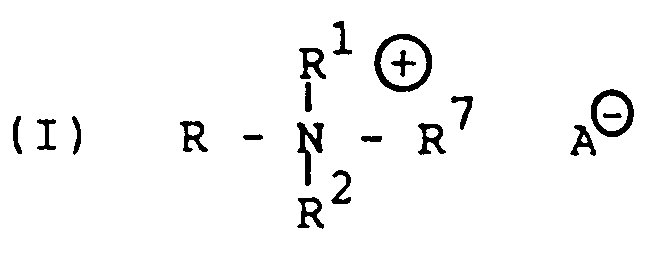
or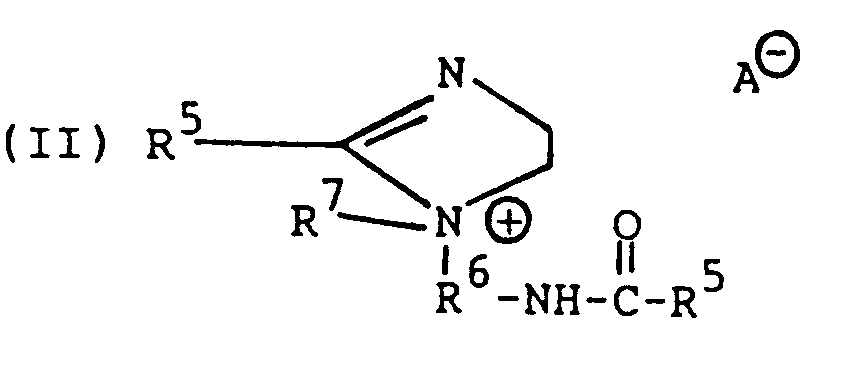
where R, R¹ and R² are - (1) linear or branched chain aliphatic saturated or unsaturated hydrocarbon group having up to about 22 carbon atoms;
- (2) a hydroxy lower alkyl group;
- (3) an alkyl amido alkylene group of the formula,

- (4) a lower alkoxy group;
- (5) a poly(oxyloweralkylene) group;
- It has been found that a highly functional mixture of a quaternary ammonium compound, a fatty acid ester, an ammonium salt and a fatty acid can be obtained in a single step reaction without the aid of solvents, especially flammable solvents to thereby produce a mixture of highly functional components. The single step reaction thereby eliminates the separate blending of such individual components as the fatty acid ester, the ammonium salt and the fatty acid with the quaternary ammonium compound.
- The EP-A-0345475 describes a method of producing quaternary ammonium salts of long-chain, aliphatic carboxylic acids; this method can also be carried out without a solvent (cf. page 4, line 52 et seqq.). According to EP-A-0345475 a conversion of the various partial components in steps is expressly provided (see e.g. Example 3) and also a compound corresponding to the formula R⁴ OCOOCH₃ (this being dimethylcarbonate or the methyl/ethyl mixed ester of carbonic acid) is necessarily used as a reaction partner (II) - see e.g. claim 1 or page 2, lines 52/53. The use of such a compound is not provided in the claimed method, however. Moreover, the reaction mixture itself according to this document contains three components (see e.g. cited Example 3), namely the quaternary ammonium compound together with the amine salt and the fatty acid in quantities totalling 100 wt. %. In the present case, however, it is proceeded such that a fatty acid ester is also present in the resultant mixture of the one-stage reaction.
- The advantage of the method of the present invention is that it provides a composition that is non-flammable and it is ready to be flaked or powdered because of its bulk form and can be used as a fabric softener, a fabric lubricant, a hair condition as well as an anti-static agent that can be released from a substrate such as a nonwoven fabric or a polymeric foam. These mixtures can also be used in combination with synthetic detergents or as lubricant, an emulsifier, in cosmetic preparations hair conditioning components clay modifiers, bactericidal compositions and as a floculant.
- As noted, the invention relates to a method for producing a quaternary ammonium mixture that is highly functional by means of a single step reaction as well as the various compositions that can be obtained thereby and therewith.
- In its broadest aspect the invention is directed to a method of producing in a single step reaction a mixture of a quaternary ammonium compound, fatty acid, fatty acid ester and tertiary amine salt by reacting a tertiary amine, quaternizing agent and fatty acid, each in amount so that said mixture will contain at least a quaternary ammonium compound, a fatty acid, fatty acid ester and a tertiary amine salt in percentages as defined in claim 1. The tertiary amine employed according to the invention has the formula:

where R, R¹ and R² can be any of the following in any combination. - (1) linear or branched chain saturated or unsaturated hydrocarbon groups having up to 22 carbon atoms;
- (2) a lower hydroxy alkyl group;
- (3) an alkyl amido alkylene group of the formula:

- (4) lower alkoxy group;
- (5) poly(oxyloweralkylene) group;
- Said quaternizing agent is known in the art and produces a quaternary ammonium compound having an anion A⁻. Generally these quaternizing agents are those having the formula R⁷(a)X;
where R⁷ is a lower alkyl group or cyclo lower alkyl group such as benzyl, cyclohexylmethyl, tolyl, xylyl, naphthylmethyl, and X may be a chlorine, iodine, bromine, sulfate, methyl sulfate, carbonate, phosphate, borate group, formate, acetate, propionate, adipate, benzoate and the like and (a) is the valence of X. - Said fatty acid is a linear or branched chain aliphatic saturated or unsaturated fatty acid having from 12 to 22 carbon atoms based on coconut oil, vegetable oils, seed oils animal fats and fish oils.
- Various tertiary amines that can be employed in this regard include:
dimethylamino propyl amine, amino ethylanolamine,
distearly methyl amine,
dihydrogenated tallow methyl amine,
ditallow methyl amine,
dimethyl hydrogenated tallow amine,
dimethyl coco amine,
distearyl ethoxyethyl amine,
stearyl bis-hydroxyethyl amine,
stearyl bis (polyethoxy ethanol) amine,
bis (tallowamidoethyl) 2-hydroxyethyl amine,
bis (tallowamidoethyl) 2-hydroxylpropyl amine,
1-hydrogenated tallow amido ethyl -2-hydrogenated tallow imidazoline
1-ethylene bis (2tallow, 1-methyl, imidazolinium) dimethyl amino propyl tallow amido-amine and
hydrogenated tallow hydroxyethyl imidazoline
where R⁹, R¹⁰, R¹¹ and R¹² are subsequently defined. - The prior art also disclosed other amines that may be used such as those described in the United States Patents to Marschner, U.S. 4,859,456; Caswell et al., U.S. 4,857,213; Demangeon, U.S. 4,851,141 and Mermelstein et al., U.S. 4,844,824 (also referred to hereafter as "the prior art cited herein.")
- Imidazoline compounds that may be used are also described in Demangeon (supra), whereas the quarternizing agents include;
dimethyl sulfate,
diethyl sulfate,
methyl chloride,
methyl bromide and
benzyl chloride as well as those cited in the prior art cited herein. - The quaternary ammonium compound thus obtained has the formula:

or
where R, R¹, R², R³, R⁴, R⁵, R⁶ and R⁷ have been defined above;
where A⁻ is an anion based on R⁷(a)X or equivalent anions known in the quaternary ammonium compound art;
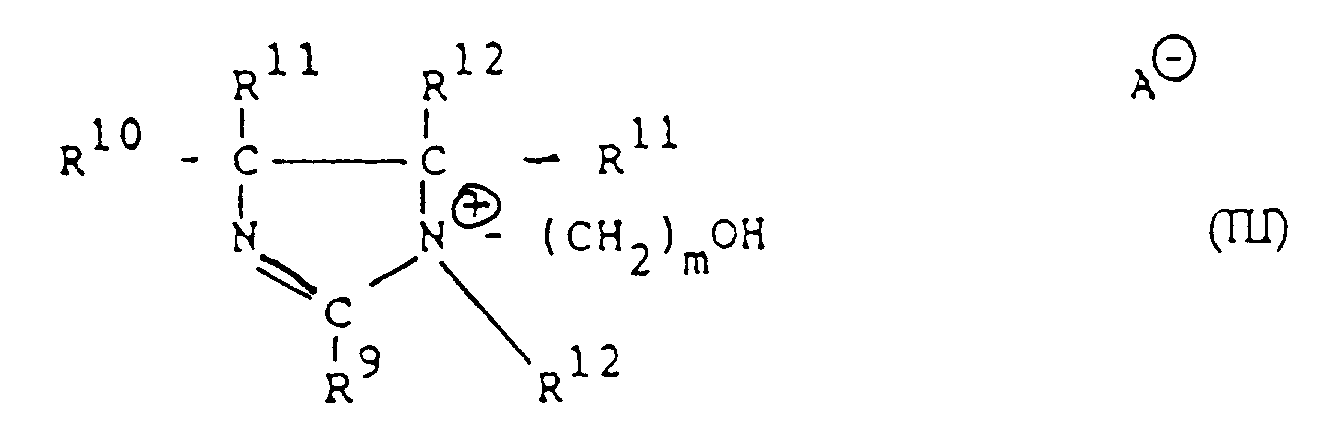
where R⁹ is C8 to C30 preferably C12 to C18 alkyl or akenyls
R¹⁰ and R¹¹ are independently hydrogen or C1 to C4 alkyl R¹² is C1 to C4 alkyl
m is 2 or 3
A⁻ is preferably an anion such as chloride, bromide, sulfate, methosulfate, nitrite, phosphate and carboxylate (i.e., acetate, adipate, propionate, benzoate)
where R¹⁰, R¹¹, R¹², m and A⁻ have been previously defined and R⁹ is an alkyl or alkenyl having 8 to 22 carbon atoms. - The tertiary amine salt has the formula:

or
The fatty acid ester has the formula:
where R⁷ is a lower alkyl group or cyclo lower alkyl group and R⁸ is a linear or a branched chain aliphatic saturated or unsaturated hydrocarbon group having from 11 to 21 carbon atoms. - As used throughout this specification the terms lower alkoxy, lower alkylene and lower alkyl are intended to include compounds having up to 4 carbon atoms including the various isomeric configurations thereof e.g. t-butyl, i-butyl, i-propyl and the like and the various mixtures thereof whether such mixtures of such groups contain components having one, or two, or three or four carbon atoms and also where such groups individually or in combination are in any of their isomeric forms.
- According to the method of the invention the tertiary amine, quaternizing agent and fatty acid are reacted in a single step reaction with one another each in an amount so that the mixture obtained contains from 10 weight percent to 80 weight percent and especially from about 35 weight percent to about 55 weight percent of said quaternary ammonium compound, 15 weight percent to 70 weight percent and especially from about 10 weight percent to about 30 weight percent of said salt, 1 weight percent to 70 weight percent and especially from about 5 weight percent to about 25 weight percent of said ester and from 5 weight percent to 70 weight percent and especially from about 15 weight percent to about 35 weight percent of said fatty acid wherein the ratio of said quaternary ammonium compound to said salt is from about 2:1 to about 1:2.
- In one embodiment, the method of the invention is preferably practiced so that the quaternary ammonium compound that is obtained has the structural formula (I) wherein at least one of R, R¹ and R² is a branched chain or linear aliphatic saturated or unsaturated hydrocarbon group having from 12 to 22 carbon atoms, preferably saturated, and especially those based on hard tallow acids (i.e. hydrogenated tallow fatty acids) and the balance, if any of the aforesaid R, R¹ and R² groups is a lower alkyl group and R⁷ is a lower alkyl group. In another embodiment X is a sulfate group.
- The invention also relates to a mixture of the various quaternary ammonium compounds as described above in combination with the various fatty acid esters, fatty acids, and tertiary amine salts also as described previously and in the amounts and ratios as described previously.
- The invention also relates to a fabric softening article of manufacture comprising a fabric softening amount of any of the mixtures as described herein operatively associated with a substrate that will release such mixture to a fabric under fabric softening conditions encountered in a fabric or clothes dryer and includes the use of any of the aforesaid mixtures in a fabric softening relationship with a nonwoven or woven fiber or a polymeric open-celled or substantially open-celled foam substrate, such combination being prepared in a manner well known in the art. The mixture is employed in an amount from about 0.1 to about 10 gms and especially 1 to about 39 grns per 9 in. by 11 in. (0,065 to ≈ 2.5 g per 22,86 cm X 27,94 cm) sheet.
- The various polymeric foams that are employed in this respect comprise polyurethane foams as well as any of the art known equivalent foams.
- Additionally, the invention is directed to a fabric cleaning composition comprising a detergent in combination with a fabric softening amount of any of the mixtures described herein. These detergents can be any of the art known anionic, cationic, nonionic or amphoteric synthetic detergents or wetting agents that are well known in the art or a soap i.e. the reaction product of a fatty acid with a alkaline hydroxide that is water soluble e.g. fatty acid reaction products of sodium, potassium or ammonium hydroxides or amines or the art known equivalents thereof.
- These surfactants are further described in Kirk-Othmer, Encyclopedia of Chemical Technology, 3rd Edition Vol. 22 pp. 332-432 which is incorporated herein by reference. Some specific detergents that are especially suitable in this regard include:
Detergents that can be employed in this respect comprise:
alkyl benzene sulfate,
sodium lauryl ether sulfate
nonyl phenyl ethoxylates and
alkyl alcohol ethoxylates as well as those noted in the prior art cited herein. - The mixture of the invention is incorporated into the detergents (whether solid or liquid) by blending in a manner well known in the art. The amount of the mixture employed is any where from about 1 to about 50 and especially from about 2 to about 30 wt. % based on the quaternary ammonium compound and the active components of the detergent i.e. the component of the detergent that has both organophilic and hydrophilic groups.
- The following example is illustrative.
- The method of the invention as well as a mixture obtained according to this method is exemplified by the preparation of a mixture employing the following components in the indicated amounts.
Components M.W. Moles % by Wt. Dihydrogenated Tallow-Methyl-Amine 523 1.00 56.63 Stearic Acid 30.00 Dimethyl Sulfate 126 0.98 13.37 - The amine was charged to a clean, dry reactor which was heated to 60°C (140°F). A slight nitrogen purge was employed over the amine that was charged to prevent it from coming into contact with any air that might enter into the reactor during the reaction. The stearic acid was then charged, mixed and heated to 60°C (140°F) after which the dimethyl sulfate was charged in increments sufficient to maintain the temperature of the reaction mixture at 60-76°C (140-170°F). The reaction is exothermic and the end point of the reaction is indicated to some degree when an exotherm is no longer obtained. When the reaction was completed, the resultant mixture was allowed to cool. The foregoing method produced a reaction mixture which was analyzed by NMR analysis showing that the mixture obtained had the following components:
% Quaternary Ammonium compound 46 Fatty Acid 22 Tertiary Amine and Amine Salt 19 Methyl Ester 13
where R⁵ is a linear or branched chain aliphatic saturated or unsaturated hydrocarbon group having up to about 22 carbon atoms and R⁶ is a lower alkylene group,
where A⁻ is an anion;
a linear or branched chain saturated or unsaturated fatty acid having from 12 to 22 carbon atoms;
a tertiary amine salt having formula (I) or (II) where R⁷ is hydrogen
and a fatty acid ester having the formula:

wherein R⁷ is a lower alkyl group or cyclo lower alkyl group and R⁸ is a linear or branched chain, aliphatic saturated or unsaturated group having from 11 to 21 carbon atoms.
or said tertiary amine is an imidazoline of the formula:

where R⁵ is a linear or branched chain, aliphatic saturated or unsaturated hydrocarbon group having up to 22 carbon atoms and R⁶ is a lower alkylene group.
Claims (12)
- A method of producing a mixture of quaternary ammonium compound, fatty acid, fatty acid ester, and tertiary amine salt by reacting in a solvent free system, a tertiary amine, quaternizing agent, and fatty acid each in an amount so that said mixture will contain at least a quaternary ammonium compound, fatty acid, fatty acid ester and tertiary amine salt wherein said tertiary amine has the formula:
 (1) a linear or branched chain aliphatic saturated or unsaturated hydrocarbon group having up to 22 carbon atoms;(2) a hydroxy lower alkyl group;(3) an alkyl amide alkylene group of the formula;
 (4) a lower alkoxy group; or(5) a poly(oxyloweralkylene) group;so that at least one of R, R¹, and R² is one of said hydrocarbon groups or one of said hydroxy lower alkyl groups;
or said tertiary amine is an imidazoline of the formula:
or an imidazoline having the formula:
R¹⁰ and R¹¹ are independently hydrogen or alkyl having up to 4 carbon atoms;
R¹² is alkyl having up to 4 carbon atoms;
m is 2 or 3;
said quaternizing agent being capable of producing a quaternary ammonium compound having anions A⁻;
said fatty acid is a linear or branched chain saturated or unsaturated fatty acid having from 12 to 22 carbon atoms;
said quaternary ammonium compound having the formula:

said tertiary amine salt is a compound according to formula (I) or (II) or (III) wherein R⁷ or R¹² respectively is hydrogen;
said fatty acid ester having the formula
where said tertiary amine, quaternizing agent and fatty acid are reacted in a single step reaction with one another in an amount so that the mixture obtained contains 10 wt.% to 80 wt.% of said quaternary ammonium compound, 15 wt.% to 70 wt.% of said salt, 1 wt.% to 70 wt.% of said ester and 5 wt.% to 70 wt.% of said fatty acid wherein the ratio of said quaternary ammonium compound to said salt is from 2:1 to 1:2 on a weight basis. - The method of claim 1 where said amine is of the formula:


R¹⁰ and R¹¹ are independently hydrogen or alkyl having up to 4 carbon atoms;
R¹² is alkyl having up to 4 carbon atoms;
m is 2 or 3;
A⁻ is an anion;
and the tertiary amine salt is a compound according to formula (IV) where R¹² on the nitrogen atom is hydrogen. - The method of claim 1 or 2 where said tertiary amine, quaternizing agent and fatty acid are reacted with one another in an amount so that said mixture obtained contains 35 wt.% to 55 wt.% of said quaternary ammonium compound, 10 wt.% to 30 wt.% of said salt, 5 wt.% to 25 wt.% of said ester and 15 wt.% to 35 wt.% of said fatty acid wherein the ratio of said quaternary ammonium compound to said salt is from 2:1 to 1:2 on a weight basis.
- The method of claim 1 where said quaternary ammonium compound is (I) and wherein at least one of said R, R¹ and R² groups is a branched chain or linear, aliphatic saturated or unsaturated hydrocarbon group having from 12 to 22 carbon atoms and the balance, if any, of said R, R¹ and R² groups is a lower alkyl group.
- The method of claim 4 where A is a lower alkyl sulfate group and where R, R¹ and R² are saturated hydrocarbon groups.
- As a composition of matter, a solvent free mixture of(i) a quaternary ammonium compound having the formula:

 (1) linear or branched chain aliphatic saturated or unsaturated hydrocarbon group having up to 22 carbon atoms;(2) a hydroxy lower alkyl group;(3) an alkyl amido alkylene group of the formula,where R⁴ is lower alkylene and R³ is (1), (2), (4) or (5);
 (4) a lower alkoxy group; or(5) a poly(oxyloweralkylene) group;so at least one of R, R¹, or R² is one of said hydrocarbon groups or one of said hydroxy lower alkyl groups
where R⁵ is a linear or branched chain aliphatic saturated or unsaturated hydrocarbon group having up to 22 carbon atoms, R⁶ is a lower alkylene group and R⁷ is a lower alkyl or cyclo lower alkyl group, or
R¹⁰ and R¹¹ are independently hydrogen or alkyl having up to 4 carbon atoms;
R¹² is alkyl having up to 4 carbon atoms;
m is 2 or 3;
where A⁻ is an anion;(ii) a linear or branched chain saturated or unsaturated fatty acid having from 12 to 22 carbon atoms;(iii) a tertiary amine salt having formula (I) or (II) or (III) where R⁷ or R¹² respectively is hydrogen and(iv) a fatty acid ester having the formula:
where said components are present in an amount so that said mixture contains 10 wt. % of 80 wt. % of said quaternary ammonium compound, 15 wt. % to 70 wt. % of said salt, 1 wt. % to 70 wt. % of said ester and 5 wt. % to 70 wt. % of said fatty acid wherein the ratio of said quaternary ammonium compound to said salt is from about 2:1 to about 1:2 on a weight basis. - The composition of claim 6 where said quaternary ammonium compound is based on an amine having the formula:


R¹⁰ and R¹¹ are independently hydrogen or alkyl having up to 4 carbon atoms;
R¹² is alkyl having up to 4 carbon atoms;
m is 2 or 3;
A⁻ is an anion;
and the tertiary amine salt is a compound according to formula (IV) where R¹² on the nitrogen atom is hydrogen. - The composition of any of claims 6 or 7 where said components are present in an amount so that said mixture contains 35 wt. % to 55 wt. % of said quaternary ammonium compound, 10 wt. % to 30 wt. % of said salt, 5 wt. % to 25 wt. % of said ester and 15 wt. % to 35 wt. % of said fatty acid wherein the ratio of said quaternary ammonium compound to said salt is from 2:1 to 1:2 on a weight basis.
- The mixture of claim 6 where said quaternary ammonium compound is (I) and wherein at least one of said R, R¹ and R² groups is a branched chain or linear, aliphatic saturated or unsaturated hydrocarbon group having from 12 to 22 carbon atoms and the balance, if any, of said R, R¹ and R² groups is a lower alkyl group.
- The mixture of claim 8 or 9 where A⁻ is a lower alkyl sulfate group and where R, R¹ and R² are saturated hydrocarbon groups.
- A fabric softening article of manufacture comprising a fabric softening amount of any of the mixtures of any of claims 6 to 10, operatively associated with a substrate that will release said mixture to a fabric under fabric softening conditions.
- A fabric cleaning composition comprising a detergent in combination with a fabric softening amount of the mixtures of any of claims 6 to 10.
Applications Claiming Priority (2)
| Application Number | Priority Date | Filing Date | Title |
|---|---|---|---|
| US47273890A | 1990-01-31 | 1990-01-31 | |
| US472738 | 1990-01-31 |
Publications (2)
| Publication Number | Publication Date |
|---|---|
| EP0440229A1 EP0440229A1 (en) | 1991-08-07 |
| EP0440229B1 true EP0440229B1 (en) | 1996-03-20 |
Family
ID=23876747
Family Applications (1)
| Application Number | Title | Priority Date | Filing Date |
|---|---|---|---|
| EP91101291A Expired - Lifetime EP0440229B1 (en) | 1990-01-31 | 1991-01-31 | Process and composition for multicomponent 100% solid fabric softeners |
Country Status (8)
| Country | Link |
|---|---|
| EP (1) | EP0440229B1 (en) |
| JP (1) | JPH06280162A (en) |
| AT (1) | ATE135679T1 (en) |
| CA (1) | CA2035193C (en) |
| DE (1) | DE69117995T2 (en) |
| DK (1) | DK0440229T3 (en) |
| ES (1) | ES2084718T3 (en) |
| GR (1) | GR3019854T3 (en) |
Families Citing this family (7)
| Publication number | Priority date | Publication date | Assignee | Title |
|---|---|---|---|---|
| GB2260997A (en) * | 1991-11-01 | 1993-05-05 | Sherex Chem | Fabric softener |
| US5503756A (en) * | 1994-09-20 | 1996-04-02 | The Procter & Gamble Company | Dryer-activated fabric conditioning compositions containing unsaturated fatty acid |
| US5696292A (en) * | 1995-02-10 | 1997-12-09 | Witco Corporation | Process for producing quarternary ammonium compounds |
| US5634969A (en) * | 1995-02-10 | 1997-06-03 | Rheox, Inc. | Organoclay compositions |
| WO1997012020A1 (en) * | 1995-09-29 | 1997-04-03 | The Procter & Gamble Company | Liquid laundry detergents containing selected alkyl amidoalkoyl quaternary ammonium compounds |
| CN1085724C (en) * | 1996-05-31 | 2002-05-29 | 阿克佐诺贝尔公司 | Process for preparing a solid composition comprising a quaternary ester ammonium compound and a fatty acid |
| GB0208099D0 (en) | 2002-04-09 | 2002-05-22 | Syltone Plc | Fluid supply system |
Family Cites Families (4)
| Publication number | Priority date | Publication date | Assignee | Title |
|---|---|---|---|---|
| US4237064A (en) * | 1978-09-08 | 1980-12-02 | Akzona Incorporated | Process for preparing quaternary ammonium compositions |
| US4328110A (en) * | 1980-09-17 | 1982-05-04 | Beecham Inc. | Fabric conditioning articles and methods of use |
| US4851141A (en) * | 1984-12-12 | 1989-07-25 | Colgate-Palmolive Company | Concentrated stable nonaqueous fabric softener composition |
| DE3816328A1 (en) * | 1988-05-13 | 1989-11-23 | Hoechst Ag | METHOD FOR PRODUCING QUATERNAUS AMMONIUM SALTS LONG-CHAIN ALIPHATIC CARBONIC ACIDS AND USE OF THESE AMMONIUM SALTS |
-
1991
- 1991-01-29 CA CA002035193A patent/CA2035193C/en not_active Expired - Lifetime
- 1991-01-31 DE DE69117995T patent/DE69117995T2/en not_active Expired - Fee Related
- 1991-01-31 ES ES91101291T patent/ES2084718T3/en not_active Expired - Lifetime
- 1991-01-31 JP JP3098330A patent/JPH06280162A/en active Pending
- 1991-01-31 AT AT91101291T patent/ATE135679T1/en active
- 1991-01-31 EP EP91101291A patent/EP0440229B1/en not_active Expired - Lifetime
- 1991-01-31 DK DK91101291.2T patent/DK0440229T3/en active
-
1996
- 1996-05-07 GR GR960401239T patent/GR3019854T3/en unknown
Also Published As
| Publication number | Publication date |
|---|---|
| CA2035193A1 (en) | 1991-08-01 |
| AU635998B2 (en) | 1993-04-08 |
| ATE135679T1 (en) | 1996-04-15 |
| ES2084718T3 (en) | 1996-05-16 |
| GR3019854T3 (en) | 1996-08-31 |
| DK0440229T3 (en) | 1996-07-15 |
| DE69117995T2 (en) | 1996-09-05 |
| CA2035193C (en) | 2003-10-21 |
| EP0440229A1 (en) | 1991-08-07 |
| JPH06280162A (en) | 1994-10-04 |
| DE69117995D1 (en) | 1996-04-25 |
| AU7005391A (en) | 1991-08-01 |
Similar Documents
| Publication | Publication Date | Title |
|---|---|---|
| US3775316A (en) | Softening finishes for washed laundry | |
| US5284650A (en) | Process for making high solids fabric softeners using low amounts of solvents and eliminating side reactions | |
| US4238531A (en) | Additives for clothes dryers | |
| US4851138A (en) | Fabric softening composition and detergent-composition comprising the same | |
| EP0729344B1 (en) | Active substance delivery system | |
| US4965100A (en) | Conditioning of fabrics | |
| USRE37555E1 (en) | Process and composition for multicomponent one hundred percent solid fabric softeners | |
| US4421792A (en) | Additives for clothes dryers | |
| US4808321A (en) | Mono-esters as fiber and fabric treatment compositions | |
| JP2001512538A (en) | Softening active substance for woven fabric and softening composition for woven fabric containing the same | |
| EP0445525B1 (en) | Process for making high solids fabric softeners using low amounts of solvents and eliminating side reactions | |
| US4954635A (en) | Process for preparing quaternized imidazoline fabric conditioning compounds | |
| CA2035193C (en) | Process and composition for multicomponent 100% solid fabric softeners | |
| JPS6368699A (en) | Fiber softener composition and detergent composition containing the same | |
| US5811385A (en) | High-concentration aqueous ester quat solutions | |
| EP0643038A2 (en) | Novel polyfunctional cationic surface active agents, compositions comprised thereof, process for the preparation thereof and uses | |
| EP0076572B1 (en) | Fabric softening detergent additive products and use thereof in detergent compositions | |
| JPH027994B2 (en) | ||
| US4623471A (en) | Aqueous textile washing compositions | |
| CA2256399A1 (en) | Process for making solid compositions comprising quaternary ester ammonium compounds and fatty acids | |
| GB2260997A (en) | Fabric softener | |
| US4129506A (en) | Fabric softeners | |
| AU2006263415B2 (en) | Oligomeric amidoamines or amidoquats for fabric or hair treatment compositions | |
| JP3021749B2 (en) | Liquid soft finish | |
| JPH06200476A (en) | Soft-finishing agent |
Legal Events
| Date | Code | Title | Description |
|---|---|---|---|
| PUAI | Public reference made under article 153(3) epc to a published international application that has entered the european phase |
Free format text: ORIGINAL CODE: 0009012 |
|
| AK | Designated contracting states |
Kind code of ref document: A1 Designated state(s): AT BE CH DE DK ES FR GB GR IT LI LU NL SE |
|
| 17P | Request for examination filed |
Effective date: 19911122 |
|
| 17Q | First examination report despatched |
Effective date: 19931116 |
|
| RAP1 | Party data changed (applicant data changed or rights of an application transferred) |
Owner name: WITCO CORPORATION |
|
| GRAH | Despatch of communication of intention to grant a patent |
Free format text: ORIGINAL CODE: EPIDOS IGRA |
|
| GRAA | (expected) grant |
Free format text: ORIGINAL CODE: 0009210 |
|
| AK | Designated contracting states |
Kind code of ref document: B1 Designated state(s): AT BE CH DE DK ES FR GB GR IT LI LU NL SE |
|
| REF | Corresponds to: |
Ref document number: 135679 Country of ref document: AT Date of ref document: 19960415 Kind code of ref document: T |
|
| REG | Reference to a national code |
Ref country code: CH Ref legal event code: NV Representative=s name: R. A. EGLI & CO. PATENTANWAELTE |
|
| REF | Corresponds to: |
Ref document number: 69117995 Country of ref document: DE Date of ref document: 19960425 |
|
| ET | Fr: translation filed | ||
| REG | Reference to a national code |
Ref country code: ES Ref legal event code: FG2A Ref document number: 2084718 Country of ref document: ES Kind code of ref document: T3 |
|
| ITF | It: translation for a ep patent filed | ||
| REG | Reference to a national code |
Ref country code: DK Ref legal event code: T3 |
|
| REG | Reference to a national code |
Ref country code: GR Ref legal event code: FG4A Free format text: 3019854 |
|
| PLBI | Opposition filed |
Free format text: ORIGINAL CODE: 0009260 |
|
| PLBQ | Unpublished change to opponent data |
Free format text: ORIGINAL CODE: EPIDOS OPPO |
|
| PLBF | Reply of patent proprietor to notice(s) of opposition |
Free format text: ORIGINAL CODE: EPIDOS OBSO |
|
| 26 | Opposition filed |
Opponent name: THE PROCTER & GAMBLE COMPANY Effective date: 19961220 |
|
| NLR1 | Nl: opposition has been filed with the epo |
Opponent name: THE PROCTER & GAMBLE COMPANY |
|
| PLBF | Reply of patent proprietor to notice(s) of opposition |
Free format text: ORIGINAL CODE: EPIDOS OBSO |
|
| PLBF | Reply of patent proprietor to notice(s) of opposition |
Free format text: ORIGINAL CODE: EPIDOS OBSO |
|
| PLBO | Opposition rejected |
Free format text: ORIGINAL CODE: EPIDOS REJO |
|
| PLBN | Opposition rejected |
Free format text: ORIGINAL CODE: 0009273 |
|
| STAA | Information on the status of an ep patent application or granted ep patent |
Free format text: STATUS: OPPOSITION REJECTED |
|
| 27O | Opposition rejected |
Effective date: 19980617 |
|
| NLR2 | Nl: decision of opposition | ||
| PGFP | Annual fee paid to national office [announced via postgrant information from national office to epo] |
Ref country code: FR Payment date: 19991231 Year of fee payment: 10 |
|
| PGFP | Annual fee paid to national office [announced via postgrant information from national office to epo] |
Ref country code: SE Payment date: 20000103 Year of fee payment: 10 Ref country code: DE Payment date: 20000103 Year of fee payment: 10 Ref country code: AT Payment date: 20000103 Year of fee payment: 10 |
|
| PGFP | Annual fee paid to national office [announced via postgrant information from national office to epo] |
Ref country code: DK Payment date: 20000106 Year of fee payment: 10 Ref country code: CH Payment date: 20000106 Year of fee payment: 10 |
|
| PGFP | Annual fee paid to national office [announced via postgrant information from national office to epo] |
Ref country code: NL Payment date: 20000110 Year of fee payment: 10 |
|
| PGFP | Annual fee paid to national office [announced via postgrant information from national office to epo] |
Ref country code: LU Payment date: 20000113 Year of fee payment: 10 |
|
| PGFP | Annual fee paid to national office [announced via postgrant information from national office to epo] |
Ref country code: ES Payment date: 20000124 Year of fee payment: 10 |
|
| PGFP | Annual fee paid to national office [announced via postgrant information from national office to epo] |
Ref country code: BE Payment date: 20000125 Year of fee payment: 10 |
|
| PGFP | Annual fee paid to national office [announced via postgrant information from national office to epo] |
Ref country code: GR Payment date: 20000127 Year of fee payment: 10 |
|
| PGFP | Annual fee paid to national office [announced via postgrant information from national office to epo] |
Ref country code: GB Payment date: 20010105 Year of fee payment: 11 |
|
| PG25 | Lapsed in a contracting state [announced via postgrant information from national office to epo] |
Ref country code: LU Free format text: LAPSE BECAUSE OF NON-PAYMENT OF DUE FEES Effective date: 20010131 Ref country code: LI Free format text: LAPSE BECAUSE OF NON-PAYMENT OF DUE FEES Effective date: 20010131 Ref country code: GR Free format text: LAPSE BECAUSE OF NON-PAYMENT OF DUE FEES Effective date: 20010131 Ref country code: DK Free format text: LAPSE BECAUSE OF NON-PAYMENT OF DUE FEES Effective date: 20010131 Ref country code: CH Free format text: LAPSE BECAUSE OF NON-PAYMENT OF DUE FEES Effective date: 20010131 Ref country code: BE Free format text: LAPSE BECAUSE OF NON-PAYMENT OF DUE FEES Effective date: 20010131 Ref country code: AT Free format text: LAPSE BECAUSE OF NON-PAYMENT OF DUE FEES Effective date: 20010131 |
|
| PG25 | Lapsed in a contracting state [announced via postgrant information from national office to epo] |
Ref country code: SE Free format text: LAPSE BECAUSE OF NON-PAYMENT OF DUE FEES Effective date: 20010201 Ref country code: ES Free format text: LAPSE BECAUSE OF NON-PAYMENT OF DUE FEES Effective date: 20010201 |
|
| BERE | Be: lapsed |
Owner name: GOLDSCHMIDT CHEMICAL CORP. UNE SOC. DE L'ETAT DE Effective date: 20010131 |
|
| PG25 | Lapsed in a contracting state [announced via postgrant information from national office to epo] |
Ref country code: NL Free format text: LAPSE BECAUSE OF NON-PAYMENT OF DUE FEES Effective date: 20010801 |
|
| REG | Reference to a national code |
Ref country code: CH Ref legal event code: PL |
|
| REG | Reference to a national code |
Ref country code: DK Ref legal event code: EBP |
|
| PG25 | Lapsed in a contracting state [announced via postgrant information from national office to epo] |
Ref country code: FR Free format text: LAPSE BECAUSE OF NON-PAYMENT OF DUE FEES Effective date: 20010928 |
|
| NLV4 | Nl: lapsed or anulled due to non-payment of the annual fee |
Effective date: 20010801 |
|
| EUG | Se: european patent has lapsed |
Ref document number: 91101291.2 |
|
| PG25 | Lapsed in a contracting state [announced via postgrant information from national office to epo] |
Ref country code: DE Free format text: LAPSE BECAUSE OF NON-PAYMENT OF DUE FEES Effective date: 20011101 |
|
| REG | Reference to a national code |
Ref country code: FR Ref legal event code: ST |
|
| REG | Reference to a national code |
Ref country code: GB Ref legal event code: IF02 |
|
| PG25 | Lapsed in a contracting state [announced via postgrant information from national office to epo] |
Ref country code: GB Free format text: LAPSE BECAUSE OF NON-PAYMENT OF DUE FEES Effective date: 20020131 |
|
| GBPC | Gb: european patent ceased through non-payment of renewal fee |
Effective date: 20020131 |
|
| REG | Reference to a national code |
Ref country code: ES Ref legal event code: FD2A Effective date: 20020916 |
|
| PG25 | Lapsed in a contracting state [announced via postgrant information from national office to epo] |
Ref country code: IT Free format text: LAPSE BECAUSE OF NON-PAYMENT OF DUE FEES;WARNING: LAPSES OF ITALIAN PATENTS WITH EFFECTIVE DATE BEFORE 2007 MAY HAVE OCCURRED AT ANY TIME BEFORE 2007. THE CORRECT EFFECTIVE DATE MAY BE DIFFERENT FROM THE ONE RECORDED. Effective date: 20050131 |