EP0439059B1 - 1-Phenylalkyl-3-phenylurea derivative - Google Patents
1-Phenylalkyl-3-phenylurea derivative Download PDFInfo
- Publication number
- EP0439059B1 EP0439059B1 EP91100515A EP91100515A EP0439059B1 EP 0439059 B1 EP0439059 B1 EP 0439059B1 EP 91100515 A EP91100515 A EP 91100515A EP 91100515 A EP91100515 A EP 91100515A EP 0439059 B1 EP0439059 B1 EP 0439059B1
- Authority
- EP
- European Patent Office
- Prior art keywords
- alkyl
- integer
- phenylalkyl
- following formula
- halo
- Prior art date
- Legal status (The legal status is an assumption and is not a legal conclusion. Google has not performed a legal analysis and makes no representation as to the accuracy of the status listed.)
- Expired - Lifetime
Links
- 239000001257 hydrogen Substances 0.000 claims abstract description 30
- 229910052739 hydrogen Inorganic materials 0.000 claims abstract description 30
- 125000006527 (C1-C5) alkyl group Chemical group 0.000 claims abstract description 23
- 125000006732 (C1-C15) alkyl group Chemical group 0.000 claims abstract description 22
- 125000003545 alkoxy group Chemical group 0.000 claims abstract description 22
- QVGXLLKOCUKJST-UHFFFAOYSA-N atomic oxygen Chemical group [O] QVGXLLKOCUKJST-UHFFFAOYSA-N 0.000 claims abstract description 14
- 229910052760 oxygen Inorganic materials 0.000 claims abstract description 14
- 239000001301 oxygen Substances 0.000 claims abstract description 14
- 125000002947 alkylene group Chemical group 0.000 claims abstract description 12
- 229910052717 sulfur Chemical group 0.000 claims abstract description 11
- NINIDFKCEFEMDL-UHFFFAOYSA-N Sulfur Chemical group [S] NINIDFKCEFEMDL-UHFFFAOYSA-N 0.000 claims abstract description 10
- 239000011593 sulfur Chemical group 0.000 claims abstract description 10
- 201000005577 familial hyperlipidemia Diseases 0.000 claims abstract description 6
- 201000001320 Atherosclerosis Diseases 0.000 claims abstract description 5
- 230000009471 action Effects 0.000 claims abstract description 3
- 125000001475 halogen functional group Chemical group 0.000 claims abstract 20
- 238000000034 method Methods 0.000 claims description 49
- -1 phenylalkyl isocyanate Chemical class 0.000 claims description 45
- 238000006243 chemical reaction Methods 0.000 claims description 30
- 125000004435 hydrogen atom Chemical class [H]* 0.000 claims description 27
- 230000008569 process Effects 0.000 claims description 22
- 239000000203 mixture Substances 0.000 claims description 17
- 150000001448 anilines Chemical class 0.000 claims description 15
- 239000012442 inert solvent Substances 0.000 claims description 14
- 239000012048 reactive intermediate Substances 0.000 claims description 14
- 239000002253 acid Substances 0.000 claims description 11
- 150000001412 amines Chemical class 0.000 claims description 11
- 239000012948 isocyanate Substances 0.000 claims description 11
- QGJOPFRUJISHPQ-UHFFFAOYSA-N Carbon disulfide Chemical compound S=C=S QGJOPFRUJISHPQ-UHFFFAOYSA-N 0.000 claims description 9
- 150000007529 inorganic bases Chemical class 0.000 claims description 8
- DGTNSSLYPYDJGL-UHFFFAOYSA-N phenyl isocyanate Chemical class O=C=NC1=CC=CC=C1 DGTNSSLYPYDJGL-UHFFFAOYSA-N 0.000 claims description 8
- MKRTXPORKIRPDG-UHFFFAOYSA-N diphenylphosphoryl azide Chemical compound C=1C=CC=CC=1P(=O)(N=[N+]=[N-])C1=CC=CC=C1 MKRTXPORKIRPDG-UHFFFAOYSA-N 0.000 claims description 7
- ZAMOUSCENKQFHK-UHFFFAOYSA-N Chlorine atom Chemical compound [Cl] ZAMOUSCENKQFHK-UHFFFAOYSA-N 0.000 claims description 6
- 239000000460 chlorine Substances 0.000 claims description 6
- 229910052801 chlorine Inorganic materials 0.000 claims description 6
- 125000004414 alkyl thio group Chemical group 0.000 claims description 5
- 125000004104 aryloxy group Chemical group 0.000 claims description 5
- 125000002496 methyl group Chemical group [H]C([H])([H])* 0.000 claims description 5
- QKFJKGMPGYROCL-UHFFFAOYSA-N phenyl isothiocyanate Chemical class S=C=NC1=CC=CC=C1 QKFJKGMPGYROCL-UHFFFAOYSA-N 0.000 claims description 5
- IOHPVZBSOKLVMN-UHFFFAOYSA-N 2-(2-phenylethyl)benzoic acid Chemical compound OC(=O)C1=CC=CC=C1CCC1=CC=CC=C1 IOHPVZBSOKLVMN-UHFFFAOYSA-N 0.000 claims description 4
- YGYAWVDWMABLBF-UHFFFAOYSA-N Phosgene Chemical compound ClC(Cl)=O YGYAWVDWMABLBF-UHFFFAOYSA-N 0.000 claims description 4
- 125000001449 isopropyl group Chemical group [H]C([H])([H])C([H])(*)C([H])([H])[H] 0.000 claims description 4
- GRVDJDISBSALJP-UHFFFAOYSA-N methyloxidanyl Chemical group [O]C GRVDJDISBSALJP-UHFFFAOYSA-N 0.000 claims description 4
- 125000000217 alkyl group Chemical group 0.000 claims description 3
- 150000001350 alkyl halides Chemical class 0.000 claims description 3
- 125000006273 (C1-C3) alkyl group Chemical group 0.000 claims description 2
- 102000001494 Sterol O-Acyltransferase Human genes 0.000 claims description 2
- 108010054082 Sterol O-acyltransferase Proteins 0.000 claims description 2
- 239000003153 chemical reaction reagent Substances 0.000 claims description 2
- CYQAYERJWZKYML-UHFFFAOYSA-N phosphorus pentasulfide Chemical compound S1P(S2)(=S)SP3(=S)SP1(=S)SP2(=S)S3 CYQAYERJWZKYML-UHFFFAOYSA-N 0.000 claims description 2
- 229940123324 Acyltransferase inhibitor Drugs 0.000 claims 1
- 239000004480 active ingredient Substances 0.000 claims 1
- 239000002404 acyltransferase inhibitor Substances 0.000 claims 1
- 239000003085 diluting agent Substances 0.000 claims 1
- 239000003937 drug carrier Substances 0.000 claims 1
- 239000008194 pharmaceutical composition Substances 0.000 claims 1
- HVYWMOMLDIMFJA-DPAQBDIFSA-N cholesterol Chemical compound C1C=C2C[C@@H](O)CC[C@]2(C)[C@@H]2[C@@H]1[C@@H]1CC[C@H]([C@H](C)CCCC(C)C)[C@@]1(C)CC2 HVYWMOMLDIMFJA-DPAQBDIFSA-N 0.000 abstract description 20
- 210000004369 blood Anatomy 0.000 abstract description 7
- 239000008280 blood Substances 0.000 abstract description 7
- 230000001603 reducing effect Effects 0.000 abstract description 7
- 235000012000 cholesterol Nutrition 0.000 abstract description 6
- 230000005764 inhibitory process Effects 0.000 abstract description 2
- UFHFLCQGNIYNRP-UHFFFAOYSA-N Hydrogen Chemical compound [H][H] UFHFLCQGNIYNRP-UHFFFAOYSA-N 0.000 abstract 1
- 150000002431 hydrogen Chemical class 0.000 abstract 1
- VLKZOEOYAKHREP-UHFFFAOYSA-N n-Hexane Chemical compound CCCCCC VLKZOEOYAKHREP-UHFFFAOYSA-N 0.000 description 65
- XEKOWRVHYACXOJ-UHFFFAOYSA-N Ethyl acetate Chemical compound CCOC(C)=O XEKOWRVHYACXOJ-UHFFFAOYSA-N 0.000 description 51
- 150000001875 compounds Chemical class 0.000 description 51
- YXFVVABEGXRONW-UHFFFAOYSA-N Toluene Chemical compound CC1=CC=CC=C1 YXFVVABEGXRONW-UHFFFAOYSA-N 0.000 description 33
- HEDRZPFGACZZDS-MICDWDOJSA-N Trichloro(2H)methane Chemical compound [2H]C(Cl)(Cl)Cl HEDRZPFGACZZDS-MICDWDOJSA-N 0.000 description 32
- 230000015572 biosynthetic process Effects 0.000 description 24
- RTZKZFJDLAIYFH-UHFFFAOYSA-N Diethyl ether Chemical compound CCOCC RTZKZFJDLAIYFH-UHFFFAOYSA-N 0.000 description 22
- 238000003786 synthesis reaction Methods 0.000 description 22
- ZMANZCXQSJIPKH-UHFFFAOYSA-N Triethylamine Chemical compound CCN(CC)CC ZMANZCXQSJIPKH-UHFFFAOYSA-N 0.000 description 21
- LFQSCWFLJHTTHZ-UHFFFAOYSA-N Ethanol Chemical compound CCO LFQSCWFLJHTTHZ-UHFFFAOYSA-N 0.000 description 18
- UHOVQNZJYSORNB-UHFFFAOYSA-N Benzene Chemical compound C1=CC=CC=C1 UHOVQNZJYSORNB-UHFFFAOYSA-N 0.000 description 15
- 239000000243 solution Substances 0.000 description 15
- 239000002904 solvent Substances 0.000 description 15
- HEMHJVSKTPXQMS-UHFFFAOYSA-M Sodium hydroxide Chemical compound [OH-].[Na+] HEMHJVSKTPXQMS-UHFFFAOYSA-M 0.000 description 12
- WYURNTSHIVDZCO-UHFFFAOYSA-N Tetrahydrofuran Chemical compound C1CCOC1 WYURNTSHIVDZCO-UHFFFAOYSA-N 0.000 description 10
- WYSPTQDSMVLCNF-UHFFFAOYSA-N 2-(1,3-benzodioxol-5-yl)hexan-1-amine Chemical compound CCCCC(CN)C1=CC=C2OCOC2=C1 WYSPTQDSMVLCNF-UHFFFAOYSA-N 0.000 description 9
- 0 CCCC(C)C(CCC)CCC(***(C)N(*)*)(C1)*2(CCC2)*1N Chemical compound CCCC(C)C(CCC)CCC(***(C)N(*)*)(C1)*2(CCC2)*1N 0.000 description 9
- OKKJLVBELUTLKV-UHFFFAOYSA-N Methanol Chemical compound OC OKKJLVBELUTLKV-UHFFFAOYSA-N 0.000 description 9
- XLYOFNOQVPJJNP-UHFFFAOYSA-N water Substances O XLYOFNOQVPJJNP-UHFFFAOYSA-N 0.000 description 9
- PXKLQZNOQVDDAQ-UHFFFAOYSA-N 2-(1,3-benzodioxol-4-yl)heptan-1-amine Chemical compound CCCCCC(CN)C1=CC=CC2=C1OCO2 PXKLQZNOQVDDAQ-UHFFFAOYSA-N 0.000 description 8
- IMNFDUFMRHMDMM-UHFFFAOYSA-N N-Heptane Chemical compound CCCCCCC IMNFDUFMRHMDMM-UHFFFAOYSA-N 0.000 description 8
- ZMXDDKWLCZADIW-UHFFFAOYSA-N N,N-Dimethylformamide Chemical compound CN(C)C=O ZMXDDKWLCZADIW-UHFFFAOYSA-N 0.000 description 7
- 238000001816 cooling Methods 0.000 description 7
- 230000002401 inhibitory effect Effects 0.000 description 7
- 239000011541 reaction mixture Substances 0.000 description 7
- 238000010898 silica gel chromatography Methods 0.000 description 7
- 239000000126 substance Substances 0.000 description 7
- 241000699800 Cricetinae Species 0.000 description 6
- XSQUKJJJFZCRTK-UHFFFAOYSA-N Urea Chemical compound NC(N)=O XSQUKJJJFZCRTK-UHFFFAOYSA-N 0.000 description 6
- FEUFNKALUGDEMQ-UHFFFAOYSA-N 2-isocyanato-1,3-di(propan-2-yl)benzene Chemical compound CC(C)C1=CC=CC(C(C)C)=C1N=C=O FEUFNKALUGDEMQ-UHFFFAOYSA-N 0.000 description 5
- 125000005843 halogen group Chemical group 0.000 description 5
- YLQBMQCUIZJEEH-UHFFFAOYSA-N tetrahydrofuran Natural products C=1C=COC=1 YLQBMQCUIZJEEH-UHFFFAOYSA-N 0.000 description 5
- FLDOZZTXJWTQGJ-UHFFFAOYSA-N 2-(1,3-benzodioxol-5-yl)heptanoic acid Chemical compound CCCCCC(C(O)=O)C1=CC=C2OCOC2=C1 FLDOZZTXJWTQGJ-UHFFFAOYSA-N 0.000 description 4
- CSNNHWWHGAXBCP-UHFFFAOYSA-L Magnesium sulfate Chemical compound [Mg+2].[O-][S+2]([O-])([O-])[O-] CSNNHWWHGAXBCP-UHFFFAOYSA-L 0.000 description 4
- JUJWROOIHBZHMG-UHFFFAOYSA-N Pyridine Chemical compound C1=CC=NC=C1 JUJWROOIHBZHMG-UHFFFAOYSA-N 0.000 description 4
- UIIMBOGNXHQVGW-UHFFFAOYSA-M Sodium bicarbonate Chemical compound [Na+].OC([O-])=O UIIMBOGNXHQVGW-UHFFFAOYSA-M 0.000 description 4
- FAPWRFPIFSIZLT-UHFFFAOYSA-M Sodium chloride Chemical compound [Na+].[Cl-] FAPWRFPIFSIZLT-UHFFFAOYSA-M 0.000 description 4
- 101100020289 Xenopus laevis koza gene Proteins 0.000 description 4
- 239000007864 aqueous solution Substances 0.000 description 4
- 239000004202 carbamide Substances 0.000 description 4
- 239000013078 crystal Substances 0.000 description 4
- 230000000694 effects Effects 0.000 description 4
- 238000001704 evaporation Methods 0.000 description 4
- 150000002632 lipids Chemical class 0.000 description 4
- 239000012280 lithium aluminium hydride Substances 0.000 description 4
- 239000012046 mixed solvent Substances 0.000 description 4
- 150000002894 organic compounds Chemical class 0.000 description 4
- 125000003884 phenylalkyl group Chemical group 0.000 description 4
- BWHMMNNQKKPAPP-UHFFFAOYSA-L potassium carbonate Chemical compound [K+].[K+].[O-]C([O-])=O BWHMMNNQKKPAPP-UHFFFAOYSA-L 0.000 description 4
- 238000001953 recrystallisation Methods 0.000 description 4
- 238000003756 stirring Methods 0.000 description 4
- YMWUJEATGCHHMB-UHFFFAOYSA-N Dichloromethane Chemical compound ClCCl YMWUJEATGCHHMB-UHFFFAOYSA-N 0.000 description 3
- 102000004190 Enzymes Human genes 0.000 description 3
- 108090000790 Enzymes Proteins 0.000 description 3
- 150000001408 amides Chemical class 0.000 description 3
- 229910052799 carbon Inorganic materials 0.000 description 3
- 239000003814 drug Substances 0.000 description 3
- 238000001914 filtration Methods 0.000 description 3
- 238000006053 organic reaction Methods 0.000 description 3
- 238000000746 purification Methods 0.000 description 3
- 229920006395 saturated elastomer Polymers 0.000 description 3
- 210000002966 serum Anatomy 0.000 description 3
- 239000007787 solid Substances 0.000 description 3
- 230000002194 synthesizing effect Effects 0.000 description 3
- HMVKMAMIRAVXAN-UHFFFAOYSA-N 1,3-dichloro-2-isocyanatobenzene Chemical compound ClC1=CC=CC(Cl)=C1N=C=O HMVKMAMIRAVXAN-UHFFFAOYSA-N 0.000 description 2
- RYHBNJHYFVUHQT-UHFFFAOYSA-N 1,4-Dioxane Chemical compound C1COCCO1 RYHBNJHYFVUHQT-UHFFFAOYSA-N 0.000 description 2
- IMDHAFOWITXSTK-UHFFFAOYSA-N 1-[1-(1,3-benzodioxol-4-yl)hexyl]-3-[2,6-di(propan-2-yl)phenyl]urea Chemical compound C=1C=CC=2OCOC=2C=1C(CCCCC)NC(=O)NC1=C(C(C)C)C=CC=C1C(C)C IMDHAFOWITXSTK-UHFFFAOYSA-N 0.000 description 2
- CZJHHBZNLZWUJB-UHFFFAOYSA-N 1-[2-(1,3-benzodioxol-4-yl)heptyl]-3-(2,4,6-trimethoxyphenyl)urea Chemical compound C=1C=CC=2OCOC=2C=1C(CCCCC)CNC(=O)NC1=C(OC)C=C(OC)C=C1OC CZJHHBZNLZWUJB-UHFFFAOYSA-N 0.000 description 2
- DAFZFAWBXLTSBU-UHFFFAOYSA-N 1-[2-(1,3-benzodioxol-4-yl)heptyl]-3-(2,6-dichlorophenyl)urea Chemical compound C=1C=CC=2OCOC=2C=1C(CCCCC)CNC(=O)NC1=C(Cl)C=CC=C1Cl DAFZFAWBXLTSBU-UHFFFAOYSA-N 0.000 description 2
- JIRWLLLJSWHKAR-UHFFFAOYSA-N 1-[2-(1,3-benzodioxol-4-yl)heptyl]-3-(2,6-dimethoxyphenyl)urea Chemical compound C=1C=CC=2OCOC=2C=1C(CCCCC)CNC(=O)NC1=C(OC)C=CC=C1OC JIRWLLLJSWHKAR-UHFFFAOYSA-N 0.000 description 2
- CJYOJPKOJKCVEP-UHFFFAOYSA-N 1-[2-(1,3-benzodioxol-4-yl)heptyl]-3-(2,6-dimethylphenyl)urea Chemical compound C=1C=CC=2OCOC=2C=1C(CCCCC)CNC(=O)NC1=C(C)C=CC=C1C CJYOJPKOJKCVEP-UHFFFAOYSA-N 0.000 description 2
- XCRLPASVMPBQHF-UHFFFAOYSA-N 1-[2-(1,3-benzodioxol-4-yl)heptyl]-3-[2,6-di(propan-2-yl)phenyl]urea Chemical compound C=1C=CC=2OCOC=2C=1C(CCCCC)CNC(=O)NC1=C(C(C)C)C=CC=C1C(C)C XCRLPASVMPBQHF-UHFFFAOYSA-N 0.000 description 2
- ACQDSGMDTLWDPU-UHFFFAOYSA-N 1-[2-(1,3-benzodioxol-5-yl)hexyl]-3-(2,6-dimethoxyphenyl)urea Chemical compound C=1C=C2OCOC2=CC=1C(CCCC)CNC(=O)NC1=C(OC)C=CC=C1OC ACQDSGMDTLWDPU-UHFFFAOYSA-N 0.000 description 2
- URUYUMGVFDKSRR-UHFFFAOYSA-N 1-[2-(1,3-benzodioxol-5-yl)hexyl]-3-[2,6-di(propan-2-yl)phenyl]thiourea Chemical compound C=1C=C2OCOC2=CC=1C(CCCC)CNC(=S)NC1=C(C(C)C)C=CC=C1C(C)C URUYUMGVFDKSRR-UHFFFAOYSA-N 0.000 description 2
- JHGLPEIHURKKTG-UHFFFAOYSA-N 1-[2-(1,3-benzodioxol-5-yl)hexyl]-3-[2,6-di(propan-2-yl)phenyl]urea Chemical compound C=1C=C2OCOC2=CC=1C(CCCC)CNC(=O)NC1=C(C(C)C)C=CC=C1C(C)C JHGLPEIHURKKTG-UHFFFAOYSA-N 0.000 description 2
- VRJRCVKEUQCCCN-UHFFFAOYSA-N 1-isocyanato-2,3-di(propan-2-yl)benzene Chemical compound CC(C)C1=CC=CC(N=C=O)=C1C(C)C VRJRCVKEUQCCCN-UHFFFAOYSA-N 0.000 description 2
- MBIZFBDREVRUHY-UHFFFAOYSA-N 2,6-Dimethoxybenzoic acid Chemical compound COC1=CC=CC(OC)=C1C(O)=O MBIZFBDREVRUHY-UHFFFAOYSA-N 0.000 description 2
- HPCJVUKBOLCLNG-UHFFFAOYSA-N 2-(1,3-benzodioxol-4-ylmethyl)hexan-1-amine Chemical compound CCCCC(CN)CC1=CC=CC2=C1OCO2 HPCJVUKBOLCLNG-UHFFFAOYSA-N 0.000 description 2
- VZAWUGFZICDDFV-UHFFFAOYSA-N 2-(1,3-benzodioxol-5-ylmethyl)hexan-1-amine Chemical compound CCCCC(CN)CC1=CC=C2OCOC2=C1 VZAWUGFZICDDFV-UHFFFAOYSA-N 0.000 description 2
- NGNBDVOYPDDBFK-UHFFFAOYSA-N 2-[2,4-di(pentan-2-yl)phenoxy]acetyl chloride Chemical compound CCCC(C)C1=CC=C(OCC(Cl)=O)C(C(C)CCC)=C1 NGNBDVOYPDDBFK-UHFFFAOYSA-N 0.000 description 2
- ZCZKABLSVRUSSY-UHFFFAOYSA-N 2-[2-(1,3-benzodioxol-5-yl)hexyl]isoindole-1,3-dione Chemical compound C1=C2OCOC2=CC(C(CN2C(C3=CC=CC=C3C2=O)=O)CCCC)=C1 ZCZKABLSVRUSSY-UHFFFAOYSA-N 0.000 description 2
- QGZKDVFQNNGYKY-UHFFFAOYSA-N Ammonia Chemical compound N QGZKDVFQNNGYKY-UHFFFAOYSA-N 0.000 description 2
- OKTJSMMVPCPJKN-UHFFFAOYSA-N Carbon Chemical compound [C] OKTJSMMVPCPJKN-UHFFFAOYSA-N 0.000 description 2
- IAZDPXIOMUYVGZ-UHFFFAOYSA-N Dimethylsulphoxide Chemical compound CS(C)=O IAZDPXIOMUYVGZ-UHFFFAOYSA-N 0.000 description 2
- VEXZGXHMUGYJMC-UHFFFAOYSA-N Hydrochloric acid Chemical compound Cl VEXZGXHMUGYJMC-UHFFFAOYSA-N 0.000 description 2
- LELOWRISYMNNSU-UHFFFAOYSA-N Hydrocyanic acid Natural products N#C LELOWRISYMNNSU-UHFFFAOYSA-N 0.000 description 2
- 229920002153 Hydroxypropyl cellulose Polymers 0.000 description 2
- TWRXJAOTZQYOKJ-UHFFFAOYSA-L Magnesium chloride Chemical compound [Mg+2].[Cl-].[Cl-] TWRXJAOTZQYOKJ-UHFFFAOYSA-L 0.000 description 2
- CTQNGGLPUBDAKN-UHFFFAOYSA-N O-Xylene Chemical compound CC1=CC=CC=C1C CTQNGGLPUBDAKN-UHFFFAOYSA-N 0.000 description 2
- RJECHNNFRHZQKU-UHFFFAOYSA-N Oelsaeurecholesterylester Natural products C12CCC3(C)C(C(C)CCCC(C)C)CCC3C2CC=C2C1(C)CCC(OC(=O)CCCCCCCC=CCCCCCCCC)C2 RJECHNNFRHZQKU-UHFFFAOYSA-N 0.000 description 2
- 150000003973 alkyl amines Chemical class 0.000 description 2
- 239000007810 chemical reaction solvent Substances 0.000 description 2
- RJECHNNFRHZQKU-RMUVNZEASA-N cholesteryl oleate Chemical compound C([C@@H]12)C[C@]3(C)[C@@H]([C@H](C)CCCC(C)C)CC[C@H]3[C@@H]1CC=C1[C@]2(C)CC[C@H](OC(=O)CCCCCCC\C=C/CCCCCCCC)C1 RJECHNNFRHZQKU-RMUVNZEASA-N 0.000 description 2
- 125000004093 cyano group Chemical group *C#N 0.000 description 2
- 235000005911 diet Nutrition 0.000 description 2
- 230000037213 diet Effects 0.000 description 2
- 229940079593 drug Drugs 0.000 description 2
- 125000001495 ethyl group Chemical group [H]C([H])([H])C([H])([H])* 0.000 description 2
- 238000009472 formulation Methods 0.000 description 2
- 239000001863 hydroxypropyl cellulose Substances 0.000 description 2
- 235000010977 hydroxypropyl cellulose Nutrition 0.000 description 2
- 125000000959 isobutyl group Chemical group [H]C([H])([H])C([H])(C([H])([H])[H])C([H])([H])* 0.000 description 2
- HQKMJHAJHXVSDF-UHFFFAOYSA-L magnesium stearate Chemical compound [Mg+2].CCCCCCCCCCCCCCCCCC([O-])=O.CCCCCCCCCCCCCCCCCC([O-])=O HQKMJHAJHXVSDF-UHFFFAOYSA-L 0.000 description 2
- 125000004108 n-butyl group Chemical group [H]C([H])([H])C([H])([H])C([H])([H])C([H])([H])* 0.000 description 2
- ZSIAUFGUXNUGDI-UHFFFAOYSA-N n-hexyl alcohol Natural products CCCCCCO ZSIAUFGUXNUGDI-UHFFFAOYSA-N 0.000 description 2
- 125000000740 n-pentyl group Chemical group [H]C([H])([H])C([H])([H])C([H])([H])C([H])([H])C([H])([H])* 0.000 description 2
- 125000004123 n-propyl group Chemical group [H]C([H])([H])C([H])([H])C([H])([H])* 0.000 description 2
- 229940105631 nembutal Drugs 0.000 description 2
- 125000001971 neopentyl group Chemical group [H]C([*])([H])C(C([H])([H])[H])(C([H])([H])[H])C([H])([H])[H] 0.000 description 2
- 239000012044 organic layer Substances 0.000 description 2
- 125000004430 oxygen atom Chemical group O* 0.000 description 2
- WEXRUCMBJFQVBZ-UHFFFAOYSA-N pentobarbital Chemical compound CCCC(C)C1(CC)C(=O)NC(=O)NC1=O WEXRUCMBJFQVBZ-UHFFFAOYSA-N 0.000 description 2
- 229940117953 phenylisothiocyanate Drugs 0.000 description 2
- 229910000027 potassium carbonate Inorganic materials 0.000 description 2
- 239000000843 powder Substances 0.000 description 2
- UMJSCPRVCHMLSP-UHFFFAOYSA-N pyridine Natural products COC1=CC=CN=C1 UMJSCPRVCHMLSP-UHFFFAOYSA-N 0.000 description 2
- 230000009467 reduction Effects 0.000 description 2
- 150000003839 salts Chemical class 0.000 description 2
- 235000017557 sodium bicarbonate Nutrition 0.000 description 2
- 229910000030 sodium bicarbonate Inorganic materials 0.000 description 2
- 239000011780 sodium chloride Substances 0.000 description 2
- 230000001225 therapeutic effect Effects 0.000 description 2
- FYSNRJHAOHDILO-UHFFFAOYSA-N thionyl chloride Chemical compound ClS(Cl)=O FYSNRJHAOHDILO-UHFFFAOYSA-N 0.000 description 2
- 150000003672 ureas Chemical class 0.000 description 2
- 239000008096 xylene Substances 0.000 description 2
- RQEUFEKYXDPUSK-SSDOTTSWSA-N (1R)-1-phenylethanamine Chemical compound C[C@@H](N)C1=CC=CC=C1 RQEUFEKYXDPUSK-SSDOTTSWSA-N 0.000 description 1
- BHQCQFFYRZLCQQ-UHFFFAOYSA-N (3alpha,5alpha,7alpha,12alpha)-3,7,12-trihydroxy-cholan-24-oic acid Natural products OC1CC2CC(O)CCC2(C)C2C1C1CCC(C(CCC(O)=O)C)C1(C)C(O)C2 BHQCQFFYRZLCQQ-UHFFFAOYSA-N 0.000 description 1
- ASNYDRAAOZQYGW-UHFFFAOYSA-N 1-(1,3-benzodioxol-4-yl)hexan-1-amine Chemical compound CCCCCC(N)C1=CC=CC2=C1OCO2 ASNYDRAAOZQYGW-UHFFFAOYSA-N 0.000 description 1
- CDOZCIFGRMOAKD-UHFFFAOYSA-N 1-(3,3-dimethyl-2-phenylbutyl)-3-[2,6-di(propan-2-yl)phenyl]urea Chemical compound CC(C)C1=CC=CC(C(C)C)=C1NC(=O)NCC(C(C)(C)C)C1=CC=CC=C1 CDOZCIFGRMOAKD-UHFFFAOYSA-N 0.000 description 1
- NHRIKKRPJGBJFK-UHFFFAOYSA-N 1-[2,6-di(propan-2-yl)phenyl]-3-[2-(7-methoxy-1,3-benzodioxol-5-yl)hexyl]urea Chemical compound C=1C=2OCOC=2C(OC)=CC=1C(CCCC)CNC(=O)NC1=C(C(C)C)C=CC=C1C(C)C NHRIKKRPJGBJFK-UHFFFAOYSA-N 0.000 description 1
- UTBNVBSNGIGVPB-UHFFFAOYSA-N 1-[2-(1,3-benzodioxol-4-yl)heptyl]-3-[2,6-di(propan-2-yl)phenyl]thiourea Chemical compound C=1C=CC=2OCOC=2C=1C(CCCCC)CNC(=S)NC1=C(C(C)C)C=CC=C1C(C)C UTBNVBSNGIGVPB-UHFFFAOYSA-N 0.000 description 1
- XPBAIXOYIQFCEA-UHFFFAOYSA-N 1-[2-(1,3-benzodioxol-4-ylmethyl)hexyl]-3-[2,6-di(propan-2-yl)phenyl]urea Chemical compound C=1C=CC=2OCOC=2C=1CC(CCCC)CNC(=O)NC1=C(C(C)C)C=CC=C1C(C)C XPBAIXOYIQFCEA-UHFFFAOYSA-N 0.000 description 1
- KVBZODCEGKDRMB-UHFFFAOYSA-N 1-[2-(1,3-benzodioxol-5-ylmethyl)hexyl]-3-[2,6-di(propan-2-yl)phenyl]urea Chemical compound C=1C=C2OCOC2=CC=1CC(CCCC)CNC(=O)NC1=C(C(C)C)C=CC=C1C(C)C KVBZODCEGKDRMB-UHFFFAOYSA-N 0.000 description 1
- BAEQJZYYFXEUGV-UHFFFAOYSA-N 1-[3-(1,3-benzodioxol-4-yl)octyl]-3-[2,6-di(propan-2-yl)phenyl]urea Chemical compound C=1C=CC=2OCOC=2C=1C(CCCCC)CCNC(=O)NC1=C(C(C)C)C=CC=C1C(C)C BAEQJZYYFXEUGV-UHFFFAOYSA-N 0.000 description 1
- YZWKKMVJZFACSU-UHFFFAOYSA-N 1-bromopentane Chemical compound CCCCCBr YZWKKMVJZFACSU-UHFFFAOYSA-N 0.000 description 1
- JATAKEDDMQNPOQ-UHFFFAOYSA-N 2,4,6-trimethoxybenzoic acid Chemical compound COC1=CC(OC)=C(C(O)=O)C(OC)=C1 JATAKEDDMQNPOQ-UHFFFAOYSA-N 0.000 description 1
- WKBALTUBRZPIPZ-UHFFFAOYSA-N 2,6-di(propan-2-yl)aniline Chemical compound CC(C)C1=CC=CC(C(C)C)=C1N WKBALTUBRZPIPZ-UHFFFAOYSA-N 0.000 description 1
- RHDZEZZQGNVCJS-UHFFFAOYSA-N 2-(1,3-benzodioxol-4-yl)acetonitrile Chemical compound N#CCC1=CC=CC2=C1OCO2 RHDZEZZQGNVCJS-UHFFFAOYSA-N 0.000 description 1
- OBLLXDITTVJICM-UHFFFAOYSA-N 2-(1,3-benzodioxol-4-yl)heptanenitrile Chemical compound CCCCCC(C#N)C1=CC=CC2=C1OCO2 OBLLXDITTVJICM-UHFFFAOYSA-N 0.000 description 1
- BNQIAFBEYCZIRW-UHFFFAOYSA-N 2-(1,3-benzodioxol-4-yl)heptanoic acid Chemical compound CCCCCC(C(O)=O)C1=CC=CC2=C1OCO2 BNQIAFBEYCZIRW-UHFFFAOYSA-N 0.000 description 1
- YGGOYIGMESXITF-UHFFFAOYSA-N 2-(1,3-benzodioxol-5-yl)hexyl methanesulfonate Chemical compound CCCCC(COS(C)(=O)=O)C1=CC=C2OCOC2=C1 YGGOYIGMESXITF-UHFFFAOYSA-N 0.000 description 1
- YOYAKQACRDKDIE-UHFFFAOYSA-N 2-(7-methoxy-1,3-benzodioxol-5-yl)hexan-1-amine Chemical compound COC1=CC(C(CN)CCCC)=CC2=C1OCO2 YOYAKQACRDKDIE-UHFFFAOYSA-N 0.000 description 1
- YQLRKXVEALTVCZ-UHFFFAOYSA-N 2-isocyanato-1,3-dimethylbenzene Chemical compound CC1=CC=CC(C)=C1N=C=O YQLRKXVEALTVCZ-UHFFFAOYSA-N 0.000 description 1
- UNROTTFAMMFIMM-UHFFFAOYSA-N 2-isocyanatosulfanyl-1,3-di(propan-2-yl)benzene Chemical compound CC(C)C1=CC=CC(C(C)C)=C1SN=C=O UNROTTFAMMFIMM-UHFFFAOYSA-N 0.000 description 1
- ZCYVEMRRCGMTRW-UHFFFAOYSA-N 7553-56-2 Chemical compound [I] ZCYVEMRRCGMTRW-UHFFFAOYSA-N 0.000 description 1
- GUBGYTABKSRVRQ-XLOQQCSPSA-N Alpha-Lactose Chemical compound O[C@@H]1[C@@H](O)[C@@H](O)[C@@H](CO)O[C@H]1O[C@@H]1[C@@H](CO)O[C@H](O)[C@H](O)[C@H]1O GUBGYTABKSRVRQ-XLOQQCSPSA-N 0.000 description 1
- 206010003210 Arteriosclerosis Diseases 0.000 description 1
- WKBOTKDWSSQWDR-UHFFFAOYSA-N Bromine atom Chemical compound [Br] WKBOTKDWSSQWDR-UHFFFAOYSA-N 0.000 description 1
- GFRXEWHCTJPLTB-NDTYDCLXSA-N C1C2C(C3)CC3[C@H]12 Chemical compound C1C2C(C3)CC3[C@H]12 GFRXEWHCTJPLTB-NDTYDCLXSA-N 0.000 description 1
- 229920002134 Carboxymethyl cellulose Polymers 0.000 description 1
- 206010008088 Cerebral artery embolism Diseases 0.000 description 1
- VEXZGXHMUGYJMC-UHFFFAOYSA-M Chloride anion Chemical compound [Cl-] VEXZGXHMUGYJMC-UHFFFAOYSA-M 0.000 description 1
- 239000004380 Cholic acid Substances 0.000 description 1
- 229920002261 Corn starch Polymers 0.000 description 1
- 238000006969 Curtius rearrangement reaction Methods 0.000 description 1
- FBPFZTCFMRRESA-KVTDHHQDSA-N D-Mannitol Chemical compound OC[C@@H](O)[C@@H](O)[C@H](O)[C@H](O)CO FBPFZTCFMRRESA-KVTDHHQDSA-N 0.000 description 1
- PXGOKWXKJXAPGV-UHFFFAOYSA-N Fluorine Chemical compound FF PXGOKWXKJXAPGV-UHFFFAOYSA-N 0.000 description 1
- 108010010803 Gelatin Proteins 0.000 description 1
- WQZGKKKJIJFFOK-GASJEMHNSA-N Glucose Natural products OC[C@H]1OC(O)[C@H](O)[C@@H](O)[C@@H]1O WQZGKKKJIJFFOK-GASJEMHNSA-N 0.000 description 1
- 238000007167 Hofmann rearrangement reaction Methods 0.000 description 1
- GUBGYTABKSRVRQ-QKKXKWKRSA-N Lactose Natural products OC[C@H]1O[C@@H](O[C@H]2[C@H](O)[C@@H](O)C(O)O[C@@H]2CO)[C@H](O)[C@@H](O)[C@H]1O GUBGYTABKSRVRQ-QKKXKWKRSA-N 0.000 description 1
- 229930195725 Mannitol Natural products 0.000 description 1
- 241000699673 Mesocricetus auratus Species 0.000 description 1
- 239000012359 Methanesulfonyl chloride Substances 0.000 description 1
- 240000004808 Saccharomyces cerevisiae Species 0.000 description 1
- 238000006923 Schmidt rearrangement reaction Methods 0.000 description 1
- 229920002472 Starch Polymers 0.000 description 1
- QAOWNCQODCNURD-UHFFFAOYSA-L Sulfate Chemical compound [O-]S([O-])(=O)=O QAOWNCQODCNURD-UHFFFAOYSA-L 0.000 description 1
- 230000003187 abdominal effect Effects 0.000 description 1
- 238000010521 absorption reaction Methods 0.000 description 1
- 239000002671 adjuvant Substances 0.000 description 1
- 230000029936 alkylation Effects 0.000 description 1
- 238000005804 alkylation reaction Methods 0.000 description 1
- 229910021529 ammonia Inorganic materials 0.000 description 1
- 208000011775 arteriosclerosis disease Diseases 0.000 description 1
- 125000003118 aryl group Chemical group 0.000 description 1
- WQZGKKKJIJFFOK-VFUOTHLCSA-N beta-D-glucose Chemical compound OC[C@H]1O[C@@H](O)[C@H](O)[C@@H](O)[C@@H]1O WQZGKKKJIJFFOK-VFUOTHLCSA-N 0.000 description 1
- 239000011230 binding agent Substances 0.000 description 1
- 230000037396 body weight Effects 0.000 description 1
- GDTBXPJZTBHREO-UHFFFAOYSA-N bromine Substances BrBr GDTBXPJZTBHREO-UHFFFAOYSA-N 0.000 description 1
- 229910052794 bromium Inorganic materials 0.000 description 1
- 239000002775 capsule Substances 0.000 description 1
- 229940074993 carbon disulfide Drugs 0.000 description 1
- 235000019994 cava Nutrition 0.000 description 1
- 230000008859 change Effects 0.000 description 1
- 239000003638 chemical reducing agent Substances 0.000 description 1
- 235000019416 cholic acid Nutrition 0.000 description 1
- BHQCQFFYRZLCQQ-OELDTZBJSA-N cholic acid Chemical compound C([C@H]1C[C@H]2O)[C@H](O)CC[C@]1(C)[C@@H]1[C@@H]2[C@@H]2CC[C@H]([C@@H](CCC(O)=O)C)[C@@]2(C)[C@@H](O)C1 BHQCQFFYRZLCQQ-OELDTZBJSA-N 0.000 description 1
- 229960002471 cholic acid Drugs 0.000 description 1
- 239000008120 corn starch Substances 0.000 description 1
- KXGVEGMKQFWNSR-UHFFFAOYSA-N deoxycholic acid Natural products C1CC2CC(O)CCC2(C)C2C1C1CCC(C(CCC(O)=O)C)C1(C)C(O)C2 KXGVEGMKQFWNSR-UHFFFAOYSA-N 0.000 description 1
- 230000008021 deposition Effects 0.000 description 1
- QSACPWSIIRFHHR-UHFFFAOYSA-N dimethylphenyl isocyanide Natural products CC1=CC=CC(C)=C1C#N QSACPWSIIRFHHR-UHFFFAOYSA-N 0.000 description 1
- 201000010099 disease Diseases 0.000 description 1
- 208000037265 diseases, disorders, signs and symptoms Diseases 0.000 description 1
- 230000008030 elimination Effects 0.000 description 1
- 238000003379 elimination reaction Methods 0.000 description 1
- 239000003480 eluent Substances 0.000 description 1
- 239000012259 ether extract Substances 0.000 description 1
- 239000000706 filtrate Substances 0.000 description 1
- 229910052731 fluorine Inorganic materials 0.000 description 1
- 239000011737 fluorine Substances 0.000 description 1
- 229920000159 gelatin Polymers 0.000 description 1
- 239000008273 gelatin Substances 0.000 description 1
- 235000019322 gelatine Nutrition 0.000 description 1
- 235000011852 gelatine desserts Nutrition 0.000 description 1
- 239000008103 glucose Substances 0.000 description 1
- 239000008187 granular material Substances 0.000 description 1
- IKDUDTNKRLTJSI-UHFFFAOYSA-N hydrazine hydrate Chemical compound O.NN IKDUDTNKRLTJSI-UHFFFAOYSA-N 0.000 description 1
- 125000001145 hydrido group Chemical group *[H] 0.000 description 1
- 239000005457 ice water Substances 0.000 description 1
- 238000002347 injection Methods 0.000 description 1
- 239000007924 injection Substances 0.000 description 1
- 210000000936 intestine Anatomy 0.000 description 1
- 201000010849 intracranial embolism Diseases 0.000 description 1
- 239000011630 iodine Substances 0.000 description 1
- 229910052740 iodine Inorganic materials 0.000 description 1
- 150000002513 isocyanates Chemical class 0.000 description 1
- 125000004491 isohexyl group Chemical group C(CCC(C)C)* 0.000 description 1
- 125000001972 isopentyl group Chemical group [H]C([H])([H])C([H])(C([H])([H])[H])C([H])([H])C([H])([H])* 0.000 description 1
- 239000008101 lactose Substances 0.000 description 1
- 230000037356 lipid metabolism Effects 0.000 description 1
- 210000001853 liver microsome Anatomy 0.000 description 1
- 239000000314 lubricant Substances 0.000 description 1
- 229910001629 magnesium chloride Inorganic materials 0.000 description 1
- 235000019359 magnesium stearate Nutrition 0.000 description 1
- 239000000594 mannitol Substances 0.000 description 1
- 235000010355 mannitol Nutrition 0.000 description 1
- 208000030159 metabolic disease Diseases 0.000 description 1
- 230000004060 metabolic process Effects 0.000 description 1
- QARBMVPHQWIHKH-UHFFFAOYSA-N methanesulfonyl chloride Chemical compound CS(Cl)(=O)=O QARBMVPHQWIHKH-UHFFFAOYSA-N 0.000 description 1
- 208000031225 myocardial ischemia Diseases 0.000 description 1
- 125000003136 n-heptyl group Chemical group [H]C([H])([H])C([H])([H])C([H])([H])C([H])([H])C([H])([H])C([H])([H])C([H])([H])* 0.000 description 1
- 125000001280 n-hexyl group Chemical group C(CCCCC)* 0.000 description 1
- YSBUANSGDLZTKV-UHFFFAOYSA-N n-phenylcarbamoyl chloride Chemical compound ClC(=O)NC1=CC=CC=C1 YSBUANSGDLZTKV-UHFFFAOYSA-N 0.000 description 1
- XDUHQPOXLUAVEE-BPMMELMSSA-N oleoyl-CoA Chemical compound O[C@@H]1[C@H](OP(O)(O)=O)[C@@H](COP(O)(=O)OP(O)(=O)OCC(C)(C)[C@@H](O)C(=O)NCCC(=O)NCCSC(=O)CCCCCCC\C=C/CCCCCCCC)O[C@H]1N1C2=NC=NC(N)=C2N=C1 XDUHQPOXLUAVEE-BPMMELMSSA-N 0.000 description 1
- 230000003287 optical effect Effects 0.000 description 1
- 239000000546 pharmaceutical excipient Substances 0.000 description 1
- BMBJSXKEXRFGAV-UHFFFAOYSA-N phenylcarbamothioic s-acid Chemical compound SC(=O)NC1=CC=CC=C1 BMBJSXKEXRFGAV-UHFFFAOYSA-N 0.000 description 1
- FYRHIOVKTDQVFC-UHFFFAOYSA-M potassium phthalimide Chemical compound [K+].C1=CC=C2C(=O)[N-]C(=O)C2=C1 FYRHIOVKTDQVFC-UHFFFAOYSA-M 0.000 description 1
- 230000003389 potentiating effect Effects 0.000 description 1
- 239000002244 precipitate Substances 0.000 description 1
- 238000010992 reflux Methods 0.000 description 1
- 238000011160 research Methods 0.000 description 1
- 125000002914 sec-butyl group Chemical group [H]C([H])([H])C([H])([H])C([H])(*)C([H])([H])[H] 0.000 description 1
- 125000003548 sec-pentyl group Chemical group [H]C([H])([H])C([H])([H])C([H])([H])C([H])(*)C([H])([H])[H] 0.000 description 1
- 239000008107 starch Substances 0.000 description 1
- 235000019698 starch Nutrition 0.000 description 1
- BDHFUVZGWQCTTF-UHFFFAOYSA-M sulfonate Chemical compound [O-]S(=O)=O BDHFUVZGWQCTTF-UHFFFAOYSA-M 0.000 description 1
- 125000004434 sulfur atom Chemical group 0.000 description 1
- 239000000725 suspension Substances 0.000 description 1
- 239000003826 tablet Substances 0.000 description 1
- 239000000454 talc Substances 0.000 description 1
- 229910052623 talc Inorganic materials 0.000 description 1
- 125000000999 tert-butyl group Chemical group [H]C([H])([H])C(*)(C([H])([H])[H])C([H])([H])[H] 0.000 description 1
- 229940124597 therapeutic agent Drugs 0.000 description 1
- 150000003585 thioureas Chemical class 0.000 description 1
- 238000005303 weighing Methods 0.000 description 1
Classifications
-
- C—CHEMISTRY; METALLURGY
- C07—ORGANIC CHEMISTRY
- C07C—ACYCLIC OR CARBOCYCLIC COMPOUNDS
- C07C275/00—Derivatives of urea, i.e. compounds containing any of the groups, the nitrogen atoms not being part of nitro or nitroso groups
- C07C275/28—Derivatives of urea, i.e. compounds containing any of the groups, the nitrogen atoms not being part of nitro or nitroso groups having nitrogen atoms of urea groups bound to carbon atoms of six-membered aromatic rings of a carbon skeleton
-
- A—HUMAN NECESSITIES
- A61—MEDICAL OR VETERINARY SCIENCE; HYGIENE
- A61P—SPECIFIC THERAPEUTIC ACTIVITY OF CHEMICAL COMPOUNDS OR MEDICINAL PREPARATIONS
- A61P3/00—Drugs for disorders of the metabolism
- A61P3/06—Antihyperlipidemics
-
- A—HUMAN NECESSITIES
- A61—MEDICAL OR VETERINARY SCIENCE; HYGIENE
- A61P—SPECIFIC THERAPEUTIC ACTIVITY OF CHEMICAL COMPOUNDS OR MEDICINAL PREPARATIONS
- A61P43/00—Drugs for specific purposes, not provided for in groups A61P1/00-A61P41/00
-
- A—HUMAN NECESSITIES
- A61—MEDICAL OR VETERINARY SCIENCE; HYGIENE
- A61P—SPECIFIC THERAPEUTIC ACTIVITY OF CHEMICAL COMPOUNDS OR MEDICINAL PREPARATIONS
- A61P9/00—Drugs for disorders of the cardiovascular system
- A61P9/10—Drugs for disorders of the cardiovascular system for treating ischaemic or atherosclerotic diseases, e.g. antianginal drugs, coronary vasodilators, drugs for myocardial infarction, retinopathy, cerebrovascula insufficiency, renal arteriosclerosis
-
- C—CHEMISTRY; METALLURGY
- C07—ORGANIC CHEMISTRY
- C07D—HETEROCYCLIC COMPOUNDS
- C07D317/00—Heterocyclic compounds containing five-membered rings having two oxygen atoms as the only ring hetero atoms
- C07D317/08—Heterocyclic compounds containing five-membered rings having two oxygen atoms as the only ring hetero atoms having the hetero atoms in positions 1 and 3
- C07D317/44—Heterocyclic compounds containing five-membered rings having two oxygen atoms as the only ring hetero atoms having the hetero atoms in positions 1 and 3 ortho- or peri-condensed with carbocyclic rings or ring systems
- C07D317/46—Heterocyclic compounds containing five-membered rings having two oxygen atoms as the only ring hetero atoms having the hetero atoms in positions 1 and 3 ortho- or peri-condensed with carbocyclic rings or ring systems condensed with one six-membered ring
- C07D317/48—Methylenedioxybenzenes or hydrogenated methylenedioxybenzenes, unsubstituted on the hetero ring
- C07D317/50—Methylenedioxybenzenes or hydrogenated methylenedioxybenzenes, unsubstituted on the hetero ring with only hydrogen atoms, hydrocarbon or substituted hydrocarbon radicals, directly attached to atoms of the carbocyclic ring
- C07D317/58—Radicals substituted by nitrogen atoms
-
- C—CHEMISTRY; METALLURGY
- C07—ORGANIC CHEMISTRY
- C07D—HETEROCYCLIC COMPOUNDS
- C07D319/00—Heterocyclic compounds containing six-membered rings having two oxygen atoms as the only ring hetero atoms
- C07D319/10—1,4-Dioxanes; Hydrogenated 1,4-dioxanes
- C07D319/14—1,4-Dioxanes; Hydrogenated 1,4-dioxanes condensed with carbocyclic rings or ring systems
- C07D319/16—1,4-Dioxanes; Hydrogenated 1,4-dioxanes condensed with carbocyclic rings or ring systems condensed with one six-membered ring
- C07D319/18—Ethylenedioxybenzenes, not substituted on the hetero ring
-
- C—CHEMISTRY; METALLURGY
- C07—ORGANIC CHEMISTRY
- C07D—HETEROCYCLIC COMPOUNDS
- C07D321/00—Heterocyclic compounds containing rings having two oxygen atoms as the only ring hetero atoms, not provided for by groups C07D317/00 - C07D319/00
- C07D321/02—Seven-membered rings
- C07D321/10—Seven-membered rings condensed with carbocyclic rings or ring systems
-
- C—CHEMISTRY; METALLURGY
- C07—ORGANIC CHEMISTRY
- C07C—ACYCLIC OR CARBOCYCLIC COMPOUNDS
- C07C2602/00—Systems containing two condensed rings
- C07C2602/02—Systems containing two condensed rings the rings having only two atoms in common
- C07C2602/04—One of the condensed rings being a six-membered aromatic ring
- C07C2602/08—One of the condensed rings being a six-membered aromatic ring the other ring being five-membered, e.g. indane
-
- C—CHEMISTRY; METALLURGY
- C07—ORGANIC CHEMISTRY
- C07C—ACYCLIC OR CARBOCYCLIC COMPOUNDS
- C07C2602/00—Systems containing two condensed rings
- C07C2602/02—Systems containing two condensed rings the rings having only two atoms in common
- C07C2602/04—One of the condensed rings being a six-membered aromatic ring
- C07C2602/10—One of the condensed rings being a six-membered aromatic ring the other ring being six-membered, e.g. tetraline
Definitions
- the present invention relates to 1-phenylalkyl-3-phenylurea derivatives and 1-phenylalkyl-3-phenyl- thiourea derivatives which are potent in reducing a lipid level in blood and, therefore, useful as therapeutical medicines for hyperlipemia and atherosclerosis.
- hyperlipemia caused by metabolic disorder of lipids results in arteriosclerosis and is one of the major dangerous factors causing ischemic heart disease or cerebral embolism.
- ACAT cholesterol acyltransferase
- 1-phenylalkyl-3-phenylurea derivatives are disclosed in Japanese Patent Application Laid-Open (KOKAI) No.316761/88, No.93569/89, No.6455/90, No.6456/90, No.6457/90, No.258756/90, and 275848/90.
- the compound according to the present invention is novel and has a high inhibitory activity of ACAT and a high cholesterol reducing action in blood.
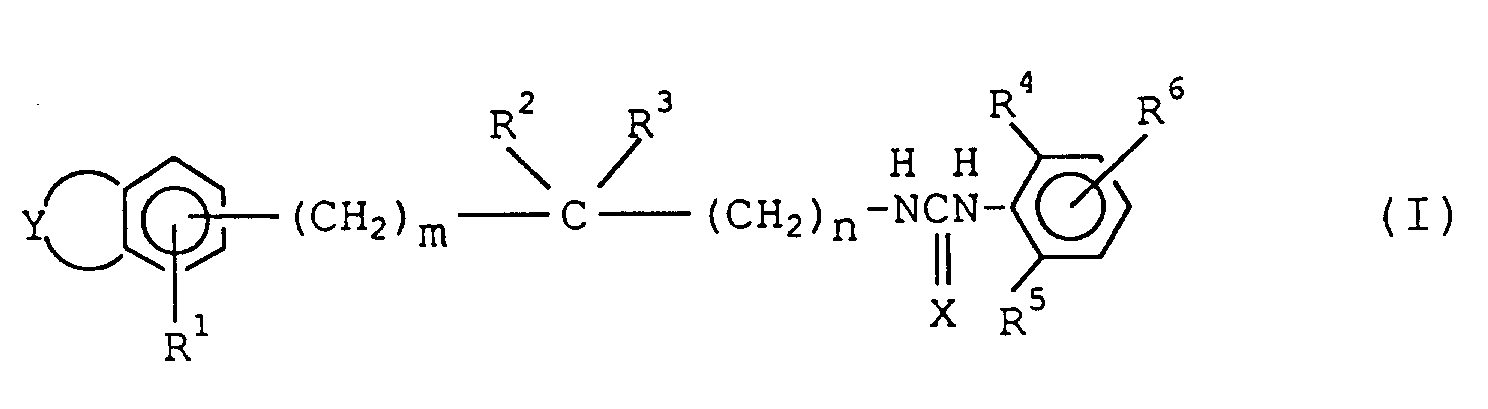
- the present invention provides a 1-phenylalkyl-3-phenylurea derivative represented by the following formula (I): wherein R 1 and R 6 represent independently hydrogen C 1 -C 5 alkyl, C 1 -C 5 alkoxyl or halo; R 2 represents hydrogen or C 1 -C 15 alkyl; R 3 represents C 1 -C 15 alkyl or R 3 represents together with R 2 C 2 -C s alkylene; R 4 and R 5 represent independently C 1 -C 5 alkyl, C 1 -C 5 alkoxyl or halo; X represents oxygen or sulfur; Y represents -O-(CH 2 )l-O-wherein I is an integer of 1 to 3 or -(CH 2 )p- wherein p is an integer of 3 to 5; m is an integer of 0 to 5; and n is an integer of 0 to 3.
- R 1 and R 6 represent independently hydrogen C 1 -C 5 alkyl, C 1 -C 5 alkoxyl or halo
- the compounds according to the present invention are represented by the above-shown general formula (I).
- the C 1 -C 5 alkyl represented by R 1 , R 4 , R 5 and R 6 in the above formula there can be mentioned methyl, ethyl, n-propyl, isopropyl, n-butyl, isobutyl, sec-butyl, tert-butyl, n-pentyl, sec-pentyl and neopentyl.
- C 1 -C 5 alkoxyl represented by R 1 , R 4 , R 5 and R 6 there can be mentioned methoxyl, ethoxyl, n-propoxyl, isopropoxyl, n-butoxyl, sec-butoxyl, tert-butoxyl, n-pentoxyl, sec-pentoxyl and neopen- toxyl.
- halo represented by R 1 , R 4 , R 5 and R 6 there can be mentioned fluorine, chlorine, bromine and iodine.
- C 1 -C 15 alkyl represented by R 2 and R 3 in the above formula (I) there can be cited methyl, ethyl, n-propyl, isopropyl, n-butyl, isobutyl, n-pentyl, isopentyl, neopentyl, n-hexyl, isohexyl, n-heptyl, n-octyl, n-nonyl, n-decyl, n-undecyl, n-dodecyl, n-tridecyl, n-tetradecyl and n-pentadecyl.
- Examples of the compounds of this invention represented by the formula (I) are shown in Table 8 to 19. Some of the compounds of this invention have an asymmetric carbon in their molecule, and racemates, optical isomers and diastereomers may be also included in the present invention.
- R 1 represents hydrogen, methyl, methoxyl or chlorine
- R 2 represents hydro or C 1 -C 5 alkyl
- R 3 represents C 2 -Cg alkyl or represents together with R 2 C 3 -C 5 alkylene
- R 4 and R 5 represent independently C 1 -C 5 alkyl, C 1 -C 5 alkoxyl or halo
- R 6 represents hydrogen, methyl, methoxyl or chlorine
- m represents 0 or an integer of 1 to 3
- n represents 0, 1 or 2.
- R 1 and R 6 represents hydrogen; R 2 represents hydrogen or C 1 -C 3 alkyl; R 3 represents C 2 -Cg alkyl; each of R 4 and R 5 represents isopropyl; X represents oxygen; m represents 0 and n represents 1.
- a phenylalkylamine derivative (II) and a phenyl isocyanate derivative (III) (or a phenyl isothiocyanate derivative) are condensed at a temperature in the range of 0°C to 150°C in a solvent which does not participate in the reaction, such as benzene, toluene, xylene, hexane, heptane, diethyl ether, tetrahydrofuran (THF), dioxane, N'N-dimethylformamide or the like, to give the compound (I) of this invention.
- a phenylalkyl isocyanate derivative (IV) (or a phenylalkyl isothiocyanate derivative) and an aniline derivative (V) are reacted under the same conditions as in the above-described process (A) to give the compound (I) of this invention.
- R 1 , R 2 , R 3 , R 4 , R 5 , R 6 , Y, m and n are as defined above.
- This process is a method for synthesizing a compound of the formula (I) wherein X is oxygen. It is basically the same as the above-described process (B), but in this process, a phenylalkyl isocyanate derivative (IVa) is formed from a phenylalkylcarboxylic acid derivative (VI) and then condensed with the aniline derivative (V) to give a compound (Ia) of this invention.
- phenylalkylcarboxylic acid derivative (VI) into phenylalkyl isocyanate derivative (IVa)
- DPPA diphenylphosphoryl azide
- the phenylalkyl isocyanate derivative (IVa) is reacted with the aniline derivative (V) under the same conditions as in the process (B) to give the compound (Ia) of this invention.
- R 4 , R 5 and R 6 are as defined above).
- This process is also a method for synthesizing a compound of the formula (I) wherein X is oxygen.
- a benzoic acid derivative (VII) is converted into a phenyl isocyanate derivative (IIIa) in the same way as in the process (C) and the derivative (IIIa) is condensed with a phenylalkylamine derivative (II) under the same conditions as in the process (A) to obtain the compound (Ia) of this invention.
- R 1 , R 2 , R 3 , R 4 , R 5 , R 6 , X, Y, m and n are as defined above, and Z represents an elimination group such as halo, aryloxy, alkylthio, etc.
- a phenylalkyl derivative (II) is converted into a reactive intermediate (VIII) and reacted with an aniline derivative (V) to obtain the compound (I) of this invention.
- the reactive intermediate (VIII) in the case where X in the formula is oxygen, there can be mentioned a phenylalkylcarbamoyl chloride (Z in the formula (VIII) is chlorine) obtained by reacting a phenylalkylamine derivative (II) with phosgene, and an aryl phenylalkylcarbamate (Z in the formula (VIII) is aryloxy) obtained by reacting a phenylalkylamine derivative (II) with aryl chloroformate.
- any solvent which is inactive to the reaction may be used, and for example, benzene, toluene, hexane, heptane, diethyl ether, tetrahydrofuran, dioxane and ethyl acetate may be used.
- the reaction may be carried out preferably in the presence of an organic amine inactive to the reaction such as triethylamine and pyridine or an inorganic base such as sodium hydrogencarbonate and potassium carbonate.
- the reaction temperature is -15 to 100°C, preferably 0 to 50 °C.
- the compound (VIII) thus obtained is reacted with the aniline derivative (V) to form the compound (I) of the present invention in the same reaction conditions as in the reaction of the phenylalkyl derivative (II) to the reactive intermediate (VIII).
- the alkylthio ester of phenylalkylthiocarbamic acid of the formula (VIII) wherein X is sulfur atom may be obtained by a reaction of the phenylalkyl derivative (II) with carbondisulfide and an alkyl halide in the presence of an organic amine such as triethylamine or an inorganic base such as sodium hydroxide and potassium carbonate.
- an organic amine such as triethylamine
- an inorganic base such as sodium hydroxide and potassium carbonate.
- any solvent which is inactive to the reaction may be used, and preferably, benzene, toluene, hexane, heptane, tetrahydrofuran, ethyl acetate and ethanol may be used.
- the reaction temperature is -15 to 100°C, preferably 0 to 50 °C.
- the thus obtained alkylthio ester is converted into the compound (I) of the present invention in the same manner as in the reaction of the phenylalkyl derivative (II) to the reactive intermediate (VIII) wherein X is oxygen atom described above. (wherein R 4 , R 5 , R 6 , X and Z are as defined above).
- This process is a method for obtaining a compound (I) of this invention by converting an aniline derivative (V) into a reactive intermediate (IX) and then reacting with a phenylalkylamine derivative (II).
- the reactive intermediate (IX) in the case where X in the formula (IX) is oxygen, there can be mentioned a phenylcarbamoyl chloride (Z in the formula (IX) is chlorine) obtained by reacting an aniline derivative (V) with phosgene, and an aryl phenylcarbamate (Z in the formula (IX) is aryloxy) obtained by reacting an aniline derivative (V) with aryl chloroformate.
- X in the formula (IX) is sulfur
- an alkylthio ester of a phenylthiocarbamic acid (Z in the formula (IX) is alkylthio) can be mentioned as the reactive intermediate (IX).
- reaction conditions for obtaining the reactive intermediate (IX) and converting the reactive intermediate (IX) into the compound (I) of the present invention are the same as described in the reaction scheme (E). (wherein R 1 , R 2 , R 3 , R 4 , R 5 , R 6 , Y, m and n are as defined above).
- This process is a method for synthesizing a compound (Ib) of this invention represented by the formula (I) wherein X is sulfur.
- the reaction solvent any solvent which is inactive to the reaction may be used, and preferably, benzene, toluene, hexane, heptane, pyridine, and tetrahydrofuran may be used.
- the reaction temperature is 0 to 150 °C, preferably 20 to 100 °C.
- the starting substances the phenyl isocyanate derivative (or the phenyl isothiocyanate derivative) (III), aniline derivative (V) and benzoic acid derivative (VII), are known or can be obtained by a known method.
- each of the starting substances (II), (IV) and (VI) may be obtained as follows.
- the phenylalkylcarboxylic acid derivative (VI) can be produced by, for example, methods similar to the various methods described in J-P. Pieu, Tetrahedron, (1985), 4095.
- the phenylalkylamine derivative (II) can be produced from the phenylalkylcarboxylic acid derivative (VI) by, for example, a method through Hofmann rearrangement, Schmidt rearrangement or Curtius rearrangement, described in E.S. Wallis, J.F. Lano, Organic Reactions 3, 267 (1946), H. Wolff, Organic Reactions 3, 307 (1946), P.A.S. Smith, Organic Reactions 3, 337 (1946).
- the phenylalkyl isocyanate (IV) can be obtained from the phenylalkylamine derivative (II) by, for example, a method similar to the method described in Shin-Jikken Kagaku Koza 14, Synthesis and Reaction of Organic Compound (III), edited by Chemical Society of Japan, Maruzen (1978), p1490, p1503 (Scheme 1
- phenylalkylamine derivative (II), phenylalkyl isocyanate (or phenylalkyl isothiocyanate) (IV) and phenylalkylcarboxylic acid derivative (VI) wherein n is an integer from 1 to 3 can be produced from the phenylalkylcarboxylic acid derivative (VI) wherein n is 0 by a method for increasing the carbon number by 1 to 3.
- a phenylalkylamine derivative (II) wherein n is 1 can be produced by reacting the phenylalkylcarboxylic acid derivative (VI) wherein n is 0 with thionyl chloride to form an acid chloride (X), reacting the acid chloride (X) with ammonia to form a phenylalkylcarboxylic amide (XI), and then reducing the amide (XI) with lithium aluminum hydride (Scheme 2).
- the phenylalkylamine derivative (II) wherein n is 1 can be also produced by subjecting a phenylalkylcarbonitrile (XII) to alkylation at a-carbon with respect to the cyano group to form an a-alkyl substituted phenylalkylcarbonitrile (XIII) in accordance with the method described in Shin-Jikken Kagaku Koza 14, Synthesis and Reaction of Organic Compound (III), edited by Chemical Society of Japan, Maruzen (1978), p1447, and then reducing the carbonitrile (XIII) with a reducing agent such as lithium aluminum hydride (Scheme 3).
- a reducing agent such as lithium aluminum hydride
- the compounds of this invention are administered to a patient preferably orally as a therapeutic agent for hyperlipemia and atherosclerosis.
- the formulations for oral administration can be applied in various forms such as tablet, granules, powder, capsule, etc. These formulations can be obtained by adding ordinary adjuvants, for example, excipient such as glucose, lactose, corn starch and mannitol, binder such as hydroxypropyl cellulose (HPC) and carboxymethyl cellulose (CMC), disintegrator such as starch and gelatin powder, lubricant such as talc and magnesium stearate, etc., to the compounds of this invention.
- excipient such as glucose, lactose, corn starch and mannitol
- binder such as hydroxypropyl cellulose (HPC) and carboxymethyl cellulose (CMC)
- disintegrator such as starch and gelatin powder
- lubricant such as talc and magnesium stearate, etc.
- the dosage of the compounds of this invention is about 0.1 to 300 mg a day for adults in the case of oral administration.
- the dosage is subject to change according to the necessity for the patient, degree of the disease to be treated and activity of the compound used.
- Example 4 The componds shown in Table 4 were synthesized by following the same procedure as in Example 34 except for using the corresponding substituted phenyl isocyanate in place of 2,6-dichlorophenyl isocyanate used in Example 34.
- the titled compound was synthesized by following the same procecure as in place of 2-(2,3- mentylenedioxyphenyl)-heptylamine used in Example 1 (Yield:88%).
- reaction solution was purified by silica gel column chromatography (developed with a 2/1 mixture of hexane and ethyl acetate) and then recrystallized from the hexane/ethyl acetate mixed solvent to obtain 330 mg of 1-(2-(3,4-methylenedioxyphenyl)hexyl)-3-(2,6-dimethyoxyphenyl)urea(yield: 12.9%).
- reaction mixture was subjected to purification by silica-gel column chromatography and recrystallization from a mixed solvent of hexane and ethyl acetate to obtain 360 mg of 1-(2-(2,3-methylenedioxyphenyl)heptyl)-3-(2,4,6-trimethoxyphenyl)urea (Yield: 42.1%).
- the titled compound was obtained by following the same procedure as in Example 27 except for using 2-(2,3-methylenedioxyphenylmethyl)-hexylamine in place of 2-(3,4-methylenedioxybenzyl)hexylamine used in Example 27.
- the titled compound was obtained by following the same procedure as in Example 53 except for using 2-(2,3-methylenedioxyphenyl)heptylamine in place of 2-(3,4-methylenedioxyphenyl)hexylamine used in Example 53 (Yield: 60%).
- Salt formed form 30 g (0.13 mol) of ( ⁇ )-2-(3,4-methylenedioxyphenyl)heptanoic acid and R-(+)-1-phenylethylamine was recrystalized from 63% ethanol. The recrystallization was repeated once.
- 46 ml of a hexane solution (0.472 M) of 2,6-diisopropylphenyl isocyanate 46 ml of a hexane solution (0.472 M) of 2,6-diisopropylphenyl isocyanate, and the mixture was stirred for one hour at room temperature.
- the precipitated crystals were collected by filtration and recrystallized from ethanol to obtain 2.89 g of (+)-1-(2-(3,4-methylenedioxyphenyl)hexyl)-3-(2,6-diisopropylphenyl)urea (Yield: 31%).
- the compounds Nos. 1 to 460 shown in Tables 8 to 19 can be also synthesized by following the same procedures as in Examples 1 to 66 described above.
- the cholesterol level in the serum was determined by using a blood cholesterol measuring kit, Determina-TC5 manufactured by Kyowa Medix Co. The results are represented by percent inhibition (%) of cholesterol level in serum relative to that of the control group, and shown in the following Table 20.
- the ACAT inhibitory action of the compounds of this invention was determined by the following method.
- ACAT activity was determined by measuring the amount of ratio-active cholesteryl oleate formed from radio-labelled oleoyl coenzyme A in each tissue specimen containing hamster liver microsome. The reduction rates (%) in the amount of formation of cholesteryl oleate by the administration of the test compound in various concentrations ( ⁇ M) as compared with as compared with the amount of formation in the control group to which no test compound was administrated were measured. The ACAT inhibitory action was evaluated by IC 50 , the concentration of the test compound necessary for inhibiting the activity of the enzyme by 50%, obtained from the reduction rates. The results are shown in Table 21.
Landscapes
- Organic Chemistry (AREA)
- Chemical & Material Sciences (AREA)
- Health & Medical Sciences (AREA)
- Bioinformatics & Cheminformatics (AREA)
- Engineering & Computer Science (AREA)
- General Health & Medical Sciences (AREA)
- Medicinal Chemistry (AREA)
- Nuclear Medicine, Radiotherapy & Molecular Imaging (AREA)
- General Chemical & Material Sciences (AREA)
- Pharmacology & Pharmacy (AREA)
- Life Sciences & Earth Sciences (AREA)
- Animal Behavior & Ethology (AREA)
- Chemical Kinetics & Catalysis (AREA)
- Public Health (AREA)
- Veterinary Medicine (AREA)
- Hematology (AREA)
- Diabetes (AREA)
- Obesity (AREA)
- Urology & Nephrology (AREA)
- Vascular Medicine (AREA)
- Cardiology (AREA)
- Heart & Thoracic Surgery (AREA)
- Organic Low-Molecular-Weight Compounds And Preparation Thereof (AREA)
- Pharmaceuticals Containing Other Organic And Inorganic Compounds (AREA)
- Acyclic And Carbocyclic Compounds In Medicinal Compositions (AREA)
- Heterocyclic Compounds That Contain Two Or More Ring Oxygen Atoms (AREA)
Abstract
Description
- The present invention relates to 1-phenylalkyl-3-phenylurea derivatives and 1-phenylalkyl-3-phenyl- thiourea derivatives which are potent in reducing a lipid level in blood and, therefore, useful as therapeutical medicines for hyperlipemia and atherosclerosis.
- Heretofore, it has been considered that hyperlipemia caused by metabolic disorder of lipids results in arteriosclerosis and is one of the major dangerous factors causing ischemic heart disease or cerebral embolism.
- Recently, it was revealed that an enzyme, acyl-CoA: cholesterol acyltransferase (ACAT) acts an important role at lipid metabolism, especially cholesterol metabolism. It is expected that compounds having an inhibitory activity of the enzyme, ACAT, actually inhibit the absorption of cholesterol at intestine, reduce the level of cholesterol in blood, and inhibit the deposition of cholesterol on arterial wall. Therefore, compounds having an inhibitory activity of ACAT, are useful as therapeutical medicines for atherosclerosis as well as hyperlipemia.
- As examples for such compounds having an inhibitory activity of ACAT, 1-phenylalkyl-3-phenylurea derivatives are disclosed in Japanese Patent Application Laid-Open (KOKAI) No.316761/88, No.93569/89, No.6455/90, No.6456/90, No.6457/90, No.258756/90, and 275848/90.
- The compound according to the present invention is novel and has a high inhibitory activity of ACAT and a high cholesterol reducing action in blood.
- As a result of further researches for the compounds showing even higher lipid reducing action than the hitherto proposed compounds such as mentioned above, the present inventors have found the novel and useful urea derivatives and attained the present invention based on the finding.
- Specifically, the present invention provides a 1-phenylalkyl-3-phenylurea derivative represented by the following formula (I):
- The present invention is described in detail below.
- The compounds according to the present invention are represented by the above-shown general formula (I). As the C1-C5 alkyl represented by R1, R4, R5 and R6 in the above formula, there can be mentioned methyl, ethyl, n-propyl, isopropyl, n-butyl, isobutyl, sec-butyl, tert-butyl, n-pentyl, sec-pentyl and neopentyl. As the C1-C5 alkoxyl represented by R1, R4, R5 and R6, there can be mentioned methoxyl, ethoxyl, n-propoxyl, isopropoxyl, n-butoxyl, sec-butoxyl, tert-butoxyl, n-pentoxyl, sec-pentoxyl and neopen- toxyl. As the halo represented by R1, R4, R5 and R6, there can be mentioned fluorine, chlorine, bromine and iodine.
- As the C1-C15 alkyl represented by R2 and R3 in the above formula (I), there can be cited methyl, ethyl, n-propyl, isopropyl, n-butyl, isobutyl, n-pentyl, isopentyl, neopentyl, n-hexyl, isohexyl, n-heptyl, n-octyl, n-nonyl, n-decyl, n-undecyl, n-dodecyl, n-tridecyl, n-tetradecyl and n-pentadecyl.
- Examples of the compounds of this invention represented by the formula (I) are shown in Table 8 to 19. Some of the compounds of this invention have an asymmetric carbon in their molecule, and racemates, optical isomers and diastereomers may be also included in the present invention.
- In the present invention, is preferred a compound wherein R1 represents hydrogen, methyl, methoxyl or chlorine; R2 represents hydro or C1-C5 alkyl; R3 represents C2-Cg alkyl or represents together with R2 C3-C5 alkylene; R4 and R5 represent independently C1-C5 alkyl, C1-C5 alkoxyl or halo; R6 represents hydrogen, methyl, methoxyl or chlorine; m represents 0 or an integer of 1 to 3; and n represents 0, 1 or 2. More preferred is a compound wherein each of R1 and R6 represents hydrogen; R2 represents hydrogen or C1-C3 alkyl; R3 represents C2-Cg alkyl; each of R4 and R5 represents isopropyl; X represents oxygen; m represents 0 and n represents 1.
- The processes for preparing the compounds of this invention are described below.
- (A)
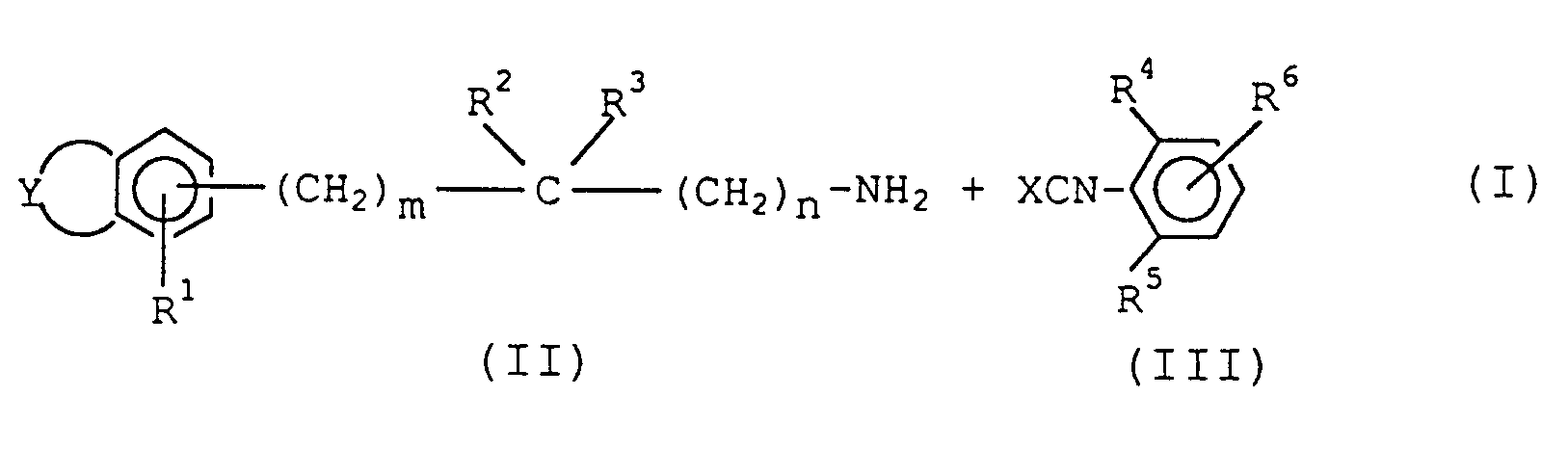
- A phenylalkylamine derivative (II) and a phenyl isocyanate derivative (III) (or a phenyl isothiocyanate derivative) are condensed at a temperature in the range of 0°C to 150°C in a solvent which does not participate in the reaction, such as benzene, toluene, xylene, hexane, heptane, diethyl ether, tetrahydrofuran (THF), dioxane, N'N-dimethylformamide or the like, to give the compound (I) of this invention.
- (B)

- A phenylalkyl isocyanate derivative (IV) (or a phenylalkyl isothiocyanate derivative) and an aniline derivative (V) are reacted under the same conditions as in the above-described process (A) to give the compound (I) of this invention.

- This process is a method for synthesizing a compound of the formula (I) wherein X is oxygen. It is basically the same as the above-described process (B), but in this process, a phenylalkyl isocyanate derivative (IVa) is formed from a phenylalkylcarboxylic acid derivative (VI) and then condensed with the aniline derivative (V) to give a compound (Ia) of this invention.
- As the way for converting phenylalkylcarboxylic acid derivative (VI) into phenylalkyl isocyanate derivative (IVa), there is available, for example, a method in which the reaction is carried out at a temperature in the range from room temperature to 150 °C in an inert solvent such as benzene, toluene, xylene, etc., in the presence of an organic amine which does not participate in the reaction such as triethylamine, and diphenylphosphoryl azide (DPPA). The phenylalkyl isocyanate derivative (IVa) is reacted with the aniline derivative (V) under the same conditions as in the process (B) to give the compound (Ia) of this invention.

- This process is also a method for synthesizing a compound of the formula (I) wherein X is oxygen. In this process, a benzoic acid derivative (VII) is converted into a phenyl isocyanate derivative (IIIa) in the same way as in the process (C) and the derivative (IIIa) is condensed with a phenylalkylamine derivative (II) under the same conditions as in the process (A) to obtain the compound (Ia) of this invention.

- A phenylalkyl derivative (II) is converted into a reactive intermediate (VIII) and reacted with an aniline derivative (V) to obtain the compound (I) of this invention. As the reactive intermediate (VIII), in the case where X in the formula is oxygen, there can be mentioned a phenylalkylcarbamoyl chloride (Z in the formula (VIII) is chlorine) obtained by reacting a phenylalkylamine derivative (II) with phosgene, and an aryl phenylalkylcarbamate (Z in the formula (VIII) is aryloxy) obtained by reacting a phenylalkylamine derivative (II) with aryl chloroformate.
- In the reaction for obtaining the compound of the formula (VIII) wherein X is oxygen atom, any solvent which is inactive to the reaction may be used, and for example, benzene, toluene, hexane, heptane, diethyl ether, tetrahydrofuran, dioxane and ethyl acetate may be used. Further, the reaction may be carried out preferably in the presence of an organic amine inactive to the reaction such as triethylamine and pyridine or an inorganic base such as sodium hydrogencarbonate and potassium carbonate. The reaction temperature is -15 to 100°C, preferably 0 to 50 °C. The compound (VIII) thus obtained is reacted with the aniline derivative (V) to form the compound (I) of the present invention in the same reaction conditions as in the reaction of the phenylalkyl derivative (II) to the reactive intermediate (VIII).
- In the case where X in the formula (VIII) is sulfur, an alkylthio ester of phenylalkylthiocarbamic acid (Z in the formula (VIII) is alkylthio group) can be mentioned as the reactive intermediate (VIII).
- The alkylthio ester of phenylalkylthiocarbamic acid of the formula (VIII) wherein X is sulfur atom may be obtained by a reaction of the phenylalkyl derivative (II) with carbondisulfide and an alkyl halide in the presence of an organic amine such as triethylamine or an inorganic base such as sodium hydroxide and potassium carbonate. As the reaction solvent, any solvent which is inactive to the reaction may be used, and preferably, benzene, toluene, hexane, heptane, tetrahydrofuran, ethyl acetate and ethanol may be used. The reaction temperature is -15 to 100°C, preferably 0 to 50 °C. The thus obtained alkylthio ester is converted into the compound (I) of the present invention in the same manner as in the reaction of the phenylalkyl derivative (II) to the reactive intermediate (VIII) wherein X is oxygen atom described above.

- This process is a method for obtaining a compound (I) of this invention by converting an aniline derivative (V) into a reactive intermediate (IX) and then reacting with a phenylalkylamine derivative (II).
- As the reactive intermediate (IX), in the case where X in the formula (IX) is oxygen, there can be mentioned a phenylcarbamoyl chloride (Z in the formula (IX) is chlorine) obtained by reacting an aniline derivative (V) with phosgene, and an aryl phenylcarbamate (Z in the formula (IX) is aryloxy) obtained by reacting an aniline derivative (V) with aryl chloroformate. In the case where X in the formula (IX) is sulfur, an alkylthio ester of a phenylthiocarbamic acid (Z in the formula (IX) is alkylthio) can be mentioned as the reactive intermediate (IX).
- The reaction conditions for obtaining the reactive intermediate (IX) and converting the reactive intermediate (IX) into the compound (I) of the present invention are the same as described in the reaction scheme (E).

- This process is a method for synthesizing a compound (Ib) of this invention represented by the formula (I) wherein X is sulfur. This is a method for converting a urea derivative to a thiourea derivative in which a compound (la) of this invention (X = oxygen) is converted into a compound (Ib) by way of a Lawsson's reagent, phosphorous pentasulfide, etc. As the reaction solvent, any solvent which is inactive to the reaction may be used, and preferably, benzene, toluene, hexane, heptane, pyridine, and tetrahydrofuran may be used. The reaction temperature is 0 to 150 °C, preferably 20 to 100 °C.
- In the above processes (A) to (F), the starting substances, the phenyl isocyanate derivative (or the phenyl isothiocyanate derivative) (III), aniline derivative (V) and benzoic acid derivative (VII), are known or can be obtained by a known method.
- The processes for producing the starting substances, the phenylalkylamine derivative (II), phenylalkyl isocyanate derivative (or phenylalkyl isothiocyanate derivative) (IV) and phenylalkylcarboxylic acid derivative (VI), the processes are different where n is 0 and where n is an integer from 1 to 3.
- When n is 0, each of the starting substances (II), (IV) and (VI) may be obtained as follows.
- The phenylalkylcarboxylic acid derivative (VI) can be produced by, for example, methods similar to the various methods described in J-P. Pieu, Tetrahedron, (1985), 4095. The phenylalkylamine derivative (II) can be produced from the phenylalkylcarboxylic acid derivative (VI) by, for example, a method through Hofmann rearrangement, Schmidt rearrangement or Curtius rearrangement, described in E.S. Wallis, J.F. Lano, Organic Reactions 3, 267 (1946), H. Wolff, Organic Reactions 3, 307 (1946), P.A.S. Smith, Organic Reactions 3, 337 (1946). The phenylalkyl isocyanate (IV) can be obtained from the phenylalkylamine derivative (II) by, for example, a method similar to the method described in Shin-Jikken Kagaku Koza 14, Synthesis and Reaction of Organic Compound (III), edited by Chemical Society of Japan, Maruzen (1978), p1490, p1503 (Scheme 1

- Each of the phenylalkylamine derivative (II), phenylalkyl isocyanate (or phenylalkyl isothiocyanate) (IV) and phenylalkylcarboxylic acid derivative (VI) wherein n is an integer from 1 to 3 can be produced from the phenylalkylcarboxylic acid derivative (VI) wherein n is 0 by a method for increasing the carbon number by 1 to 3. Such a method is described in Shin-Jikken Kagaku Koza 14, Synthesis and Reaction of Organic Compound (II), edited by Chemical Society of Japan, Maruzen (1978), p921 and Shin-Jikken Kagaku Koza 14, Synthesis and Reaction of Organic Compound (III), edited by Chemical Society of Japan, Maruzen (1978), p1332, p1490, p1503. For example, a phenylalkylamine derivative (II) wherein n is 1 can be produced by reacting the phenylalkylcarboxylic acid derivative (VI) wherein n is 0 with thionyl chloride to form an acid chloride (X), reacting the acid chloride (X) with ammonia to form a phenylalkylcarboxylic amide (XI), and then reducing the amide (XI) with lithium aluminum hydride (Scheme 2).

- The phenylalkylamine derivative (II) wherein n is 1 can be also produced by subjecting a phenylalkylcarbonitrile (XII) to alkylation at a-carbon with respect to the cyano group to form an a-alkyl substituted phenylalkylcarbonitrile (XIII) in accordance with the method described in Shin-Jikken Kagaku Koza 14, Synthesis and Reaction of Organic Compound (III), edited by Chemical Society of Japan, Maruzen (1978), p1447, and then reducing the carbonitrile (XIII) with a reducing agent such as lithium aluminum hydride (Scheme 3).

- The compounds of this invention are administered to a patient preferably orally as a therapeutic agent for hyperlipemia and atherosclerosis. The formulations for oral administration can be applied in various forms such as tablet, granules, powder, capsule, etc. These formulations can be obtained by adding ordinary adjuvants, for example, excipient such as glucose, lactose, corn starch and mannitol, binder such as hydroxypropyl cellulose (HPC) and carboxymethyl cellulose (CMC), disintegrator such as starch and gelatin powder, lubricant such as talc and magnesium stearate, etc., to the compounds of this invention.
- The dosage of the compounds of this invention is about 0.1 to 300 mg a day for adults in the case of oral administration. However the dosage is subject to change according to the necessity for the patient, degree of the disease to be treated and activity of the compound used.
- The present invention will hereinafter be described more particularly with reference to the examples thereof. It is to be understood, however, that these examples are merely intended to be illustrative and not to be construed as limiting the scope of the invention.
- Into 5 ml of dimethylsulfoxide, was added 0.26 g (1.6 mmol) of 2,3-methylenedioxyphenylacetonitrile, then, 0.24 g (1.6 mmol) of n-pentyl bromide and a 50% aqueous solution of sodium hydroxide were added dropwise thereinto simultaneously under cooling with ice. After 30-minute stirring at room temperature, the mixutre was added with water and extracted with ether. The ether extract was dried over magnesium chloride and then the solvent was evaporated off to obtain 0.30 g of oily 1-(2,3-methylenedioxyphenyl)-hexane carbonitrile.
- Then, 10 ml of ether was added to 0.06 g of lithium aluminum hydride followed by adding dropwise a solution of 0.30 g 1-(2,3-methyleneoxyphenyl)hexane carbonitrile in 5 ml ether under cooling with ice water. After 2-hour stirring at room temperature, the mixture was added with 1.6 ml of water, 1.6 ml of 15% aqueous solution of sodium hydroxide and then 4.8 ml of water. The precipitates formed were removed by filtration and the filtrate was evaporated to obtain 0.29 g of oily 2-(2,3-methylenedioxyphenyl)heptylamine (yield: 77%).
- NMR (CDCL3) 8: 0.84 (t, 3H), 1.19-1.25 (m, 6H), 1.56 (b.s, 2H), 2.71-2.82 (m, 1H), 2.89 (d, 2H), 5.90 (s. 2H), 6.64- 6.72 (m, 2H), 6.80 (t, 1 H)
- Into 10 ml of ethyl ether, was added 0.29 g (1.2 mmol) of 2-(2,3-methylenedioxyphenyl)heptylamine, followed by further addition of 2.5 ml of a hexane solution (0.48 mol/I) of 2,6-diisopropylphenyl isocyanate and overnight stirring of the mixture at room temperature.
- The precipitated crystals were filtered out to obtain 0.15 g of 1-(2-(2,3-methylenedioxyphenyl)heptyl)-3-(2,6-diisopropylphenyl)urea (yield: 29%).
- M.p.: 161-163°C (recrystallizing solvent: ethyl acetate/hexane).
- IR (KBr) cm-1: 3320, 2930, 1630, 1565, 1455, 1245, 1050, 725
- NMR (CDCl3) 8: 0.82 (t, 3H), 1.01-1.19 (m, 18H), 1.60 (m, 2H), 2.79 (m, 1H), 3.17-3.32 (m, 3H), 3.49-3.58 (m, 1 H), 4.21 (c, 1 H), 5.58-5.64 (m, 3H), 6.47 (d, 2H), 6.59-6.69 (m, 2H), 7.12 (d, 2H), 7.30 (t, 1 H).
- The compounds shown in Table 1 and Table 2 were synthesized by following the same procedure as Example 1 except for use of various kinds of phenylalkylamines in place of 2-(2,3-methylenedioxyphenyl)-heptylamine.


- To 1.01 g (4.33 mmol) of 2-(3,4-methylenedioxybenzyl)hexylamine, was added 9.2 ml of a hexane solution (0.47 mmol/I) of 2,6-diisopropylphenyl isocyanate and stirred for 3 hours. The reaction solution was concentrated and then purified by silica gel column chromatography (developed with hexane/ethyl acetate = 2/1) to obtain 1.13 g of 1-(2-(3,4-methylenedioxybenzyl)hexyl)-3-(2,6-diisopropylphenyl)urea as amorphous solid (yield: 60%).
- IR (KBr) cm-1: 3300, 2960, 1630, 1560, 1240, 1040, 930, 800
- NMR (CDCl3) 8: 0.85 (t, 3H), 1.20 (m, 18H), 1.61 (m, 1H), 2.37 (m, 2H), 3.10 (m, 2H), 3.31 (m, 2H), 4.11 (bs, 1 H), 5.89 (d, 2H), 6.37 (d, 1 H), 6.40 (s, 1 H), 6.60 (d, 1 H), 7.20 (d, 2H), 7.35 (t, 1 H).
- The compounds shown in Table 3 were synthesized by following the same procedure as in Example 27 except for use of respective 2-(2,3-methylenedioxyphenyl)alkylamine or 2-(2,3-methylenedioxyphenyl- propyl)alkylamine in place of 2-(2,3-methylenedioxybenzyl)hexylamine used in Example 27.

- By following the same procedure as in Example 1 except for using 2,6-dimethylphenyl isocyanate in place of 2,6-diisopropylphenyl isocyanate, 1-(2-(2,3-methylenedioxyphenyl)heptyl)-3-(2,6-dimethylphenyl)-urea was obtained (Yield: 52%).
- M.p.: 131 to 134°C
- IR (KBr) cm-1: 3350, 3300, 2930, 1630, 1570, 1450, 1250, 1080, 760
- NMR (CDCl3) 8: 0.82 (t, 3H) 1.20 (m, 6H) 1.58 (m, 2H) 2.10 (s, 6H) 2.85 (m, 1 H) 3.53 (m, 1H) 4.24 (t, 1H) 5.67 (d, 2H) 6.54 (m, 1 H) 6.67 (m, 2H) 7.05 (m, 3H)
- Into 0.92 g (3.91 mmol) of 1-(2,3-methylenedioxyphenyl)hexylamine, was added 10 ml of an ether solution of 2,6-dichlorophenyl isocyanate (0.39 mol/I) at room temperature and stirred over night. The precipitated crystals were collected by filtration and recrystalized from a mixed solvent of ethyl acetate and hexane to obtain 0.5 g of 1-(2-(2,3-methylenedioxyphenyl)heptyl)-3-(2,6-dichlorophenyl)urea (Yield: 30%). M.p.: 164 to 166 ° C
- IR (KBr) cm-1: 3300, 2850, 1640, 1580, 1450, 1250, 1050, 770
- NMR (CDCl3) 8: 0.83 (t, 3H) 1.21 (m, 6H) 1.62 (m, 2H) 2.93 (m, 1 H) 3.40 (m, 1 H) 3.61 (m, 1 H) 4.57 (t, 1 H) 5,84 (S, 1 H) 5.00 (bs, 1 H) 6.66 (m, 3H) 7.11 (t, 1 H) 7.35 (t, 3H)
- The componds shown in Table 4 were synthesized by following the same procedure as in Example 34 except for using the corresponding substituted phenyl isocyanate in place of 2,6-dichlorophenyl isocyanate used in Example 34.


- The compounds shown in Table 5 were synthesized by following the same procedure as Example 34 except for use of 2-(3,4-methylenedioxyphenyl)hexylamine in place of 2-(2,3-methylenedioxyphenyl)-heptylamine used in Example 34 and replacement of 2,6-diichlorophenyl isocyanate with corresponding substituted phenyl isocyanates.

- The titled compound was synthesized by following the same procecure as in place of 2-(2,3- mentylenedioxyphenyl)-heptylamine used in Example 1 (Yield:88%).
- M.p.: 132 to 133 ° C
- IR (KBr) cm-1: 3370, 3280, 2940, 1630, 1570, 1455, 1250, 1060, 945, 730
- NMR (CDCl3) 8: 0,82 (t, 3H) 1.15-1.18 (brd, 18H) 1.52-1.62 (m, 3H) 1.85-1.88 (m, 1 H) 2.62-2.74 (m, 2H) 3.23-3.30 (m, 3H) 4.46 (t, 1 H) 5.50 (s, 1 H) 5,61 (s, 1 H) 6.52 (d, 1 H) 6.61 (d, 1 H) 6.72 (t, 1 H) 7.23 (t, 2H) 7,36 (b, 1 H)
- To 1 g (6.41 mmol) of 2,6-dimethoxybenzoic acid, were added 10 ml of toluene, 1.05 ml (6.79 mmol) of triethylamine and 1.41 ml (6.54 mmol) of diphenylphosphoryl azide and stirred at 100°C for one hour. The reaction solution was cooled to room temperature, then added with a 5 ml of toluene solution of 1.40 g (6.41 mmol) of 2-(3,4-methylenedioxyphenyl)-hexylamine and stirred overnight at room temperature. The thus treated reaction solution was purified by silica gel column chromatography (developed with a 2/1 mixture of hexane and ethyl acetate) and then recrystallized from the hexane/ethyl acetate mixed solvent to obtain 330 mg of 1-(2-(3,4-methylenedioxyphenyl)hexyl)-3-(2,6-dimethyoxyphenyl)urea(yield: 12.9%).
- M.p.: 152-153 ° C
- IR (KBr) cm-1: 3300, 2930, 1640, 1560, 1490, 1250, 1140, 930
- NMR (CDCl3) 8: 0.82 (t, 3H) 1.14 (m, 4H) 1.26 (m, 2H) 2.64 (m, 1 H) 3.11 (m, 1 H) 3.57 (m, 1 H) 3.63 (s, 6H) 4.85 (bs, 1 H) 5.71 (bs, 1 H) 5.92 (s, 2H) 6.51 (m, 3H) 6.61 (d, 1 H) 6.70 (d, 1 H) 7.12 (t, 1 H)
- By following the same procedure as in Example 47 except for using 2-(2,3-methylenedioxyphenyl)-heptylamine in place of 2-(3,4-methylenedioxyphenyl)hexylamine used in Example 47, 1-(2-(2,3-methylenedioxyphenyl)heptyl)-3-(2,6-dimethoxyphenyl)urea was obtained in a yield of 36%.
- M.p.: 120 to 123 ° C
- IR (KBr) cm-1: 3320, 2950, 1630, 1560, 1450, 1250, 1050, 940, 800, 760, 730
- NMR (CDCl3) 8: 0.83 (t, 3H) 1.22 (m, 6H) 1.58 (m, 2H) 2.90 (m, 1 H) 3.59 (m, 1 H) 3.61 (m, 1 H) 3.69 (s, 6H) 5.00 (bs, 1 H) 5.72 (s, 2H) 5.77 (s, 1 H) 6.52 (m, 3H) 6.71 (m, 2H) 7.08 (t, 1 H)
- To 430 mg (2.0 mmol) of 2,4,6-trimethoxybenzoic acid, were added 10 ml of toluene, 0.52 ml (3.38 mmol) of triethylamine and 0.73 ml (3.40 mmol) of diphenylphosphoryl azide, and the mixture was stirred at 100°C for one hour. After cooling the mixture to room temperature, 5 ml of a toluene solution containing 520 mg (2.2 mmol) of 2-(2,3-methylenedioxyphenyl)heptylamine was added and the mixture was stirred at room temperature over night. The reaction mixture was subjected to purification by silica-gel column chromatography and recrystallization from a mixed solvent of hexane and ethyl acetate to obtain 360 mg of 1-(2-(2,3-methylenedioxyphenyl)heptyl)-3-(2,4,6-trimethoxyphenyl)urea (Yield: 42.1%).
- M.p.: 112 to 114°C
- IR (KBr) cm-1: 3300, 2910, 1640, 1610, 1450, 1240, 1130, 1050, 950, 800, 720
- NMR (CDCl3) 8: 0.83 (t, 3H) 1.22 (m, 6H) 1.62 (m, 2H) 2.89 (m, 1 H) 3.29 (m, 1 H) 3.55 (m, 1 H) 3.67 (s, 6H) 3.81 (s, 3H) 4.71 (bs, 1 H) 5.43 (s, 1 H) 5.76 (m, 2H) 6.09 (s, 2H) 6.57 (m, 1 H) 6.69 (m, 2H)
- The titled compound was obtained by following the same procedure as in Example 27 except for using 2-(2,3-methylenedioxyphenylmethyl)-hexylamine in place of 2-(3,4-methylenedioxybenzyl)hexylamine used in Example 27.
- M.p.: 120 to 122°C
- IR (KBr) cm-1: 3310, 2950, 1620, 1550, 1450, 1250, 1050, 940, 760, 720
- NMR (CDCl3) 8: 0.87 (t, 3H) 1.21 (m, 18H) 1.73 (m, 1 H) 2.38 (m, 1 H) 2.48 (m, 1 H) 2.98 (m, 1 H) 3.06 (m, 1 H) 3.32 (m, 2H) 4.73 (bs, 1 H) 5.45 (d, 2H) 5.76 (s, 1 H) 6.49 (m, 1 H) 6.66 (m, 2H) 7.21 (m, 2H) 7.36 (m, 1 H)
- To 800 mg (3.20 mmol) of 2-(2,3-methylenedioxyphenyl)heptanoic acid, were added 10 ml of toluene, 0.59 ml (3.84 mmol) of triethylamine and 1.0 ml (4.8 mmol) of diphenylphosphoryl azide, and the mixture was stirred at 100°C for one hour. After cooling the mixture to room temperature, 5 ml of a toluene solution containing 570 mg (3.20 mmol) of 2,6-diisopropylaniline was added and the mixture was stirred at room temperature over night. The reaction mixture was subjected to purification by silica-gel column chromatography (eluent: hexane/ethyl acetate = 5/1 ) and recrystallization from a mixed solvent of hexane and ethyl acetate to obtain 510 mg of 1-(1-(2,3-methylenedioxyphenyl)hexyl)-3-(2,6-diisopropylphenyl)urea (Yield: 38%).
- M.p.: 173 to 176°C
- IR (KBr) cm-1: 3300, 2980, 1640, 1550, 1450, 1250, 1060, 940, 790, 760, 720
- NMR (CDCl3) 8: 0.84 (t, 3H) 1.09 (m, 18H) 1.63 (m, 2H) 3.11 (bs, 1 H) 3.35 (bs, 1 H) 4.93 (m, 2H) 5.55 (s, 1 H) 5.74 (d, 2H) 6.68 (m, 3H) 7.20 (bs, 2H) 7.30 (m, 1 H)
- To 1.33 g (5.34 mmol) of 2-(3,4-methylenedioxy-5-methoxyphenyl)hexylamine, was added 11.5 ml of a hexane solution (0.46 mol/I) of 2,6-diisopropylphenyl isocyanate at room temperature and stirred overnight.
- The precipitated crystals were filtered out to obtain 0.30 g of 1-(2-(3,4-methylenedioxy-5-methoxyphenyl)hexyl)-3-(2,6-diisopropylphenyl)urea (Yield: 12%).
- M.p.: 151-152.5 °C (recrystallizing solvent: ethyl acetate/hexane)
- IR (KBr) cm-1: 3300, 2930, 1640, 1550, 1450, 1260
- NMR (CDCl3) 8: 0.81 (t, 3H) 1.10-1.23 (m, 16H) 1.60 (m, 2H) 2.51 (m, 1H) 3.03-3.16 (m, 3H) 3.53 (m, 1H) 3.78 (s, 3H) 3.94 (bs, 1 H) 5.60 (s, 1 H) 5.89 (m, 2H) 6.10 (d, 1 H) 6.15 (d, 1 H) 7.10 (d, 2H) 7.26 (t, 1 H)
- In 10 ml of dimethylformamide, were dissolved 0.50 g (2.28 mmol) of 2-(3,4-methylenedioxyphenyl)-hexylamine and 0.50 g (12.28 mmol) of 2,6-diisopropylphenyl thioisocyanate and stirred at 60 °C for 3 hours. The reaction solution was added with water, extracted with ethyl acetate, washed with water and dried over anhydrous magnesium sulfate. Then the solvent was distilled away and the residue was purified by silica gel column chromatography (developed with 1/4 mixture of ethyl acetate and hexane) to obtain 560 mg of 1-(2-(3,4-methylenedioxyphenyl)hexyl)-3-(2,6-diisopropylphenyl)thiourea as amorphous solid (yield: 55.8%).
- IR (KBr) cm-1: 3360, 3170, 2960, 1540, 1510, 1270, 710
- NMR (CDCl3) 8: 0.83 (t, 3H) 0.89 (d, 3H) 1.11 (d, 3H) 1.15 (m, 10H) 1.49 (m, 2H) 2.55 (m, 1 H) 2.92 (m, 1 H) 3.06 (m, 1 H) 3.25 (m, 1 H) 3.98 (m, 1 H) 5.04 (bs, 1 H) 5.89 (s, 2H) 6.19 (d, 1 H) 6.38 (d, 1 H) 6.44 (d, 1 H) 7.06 (d, 1 H) 7.19 (d, 1 H) 7.29 (d, 1 H) 7.36 (t, 1 H)
- The titled compound was obtained by following the same procedure as in Example 53 except for using 2-(2,3-methylenedioxyphenyl)heptylamine in place of 2-(3,4-methylenedioxyphenyl)hexylamine used in Example 53 (Yield: 60%).
- M.p.: 106 to 108°C
- IR (KBr) cm-1: 3400, 3160, 2970, 1535, 1460, 1255, 1060, 920, 730
- NMR (CDCl3) 8: 0.81 (t, 3H) 0.89 (d, 3H) 1.07-1.25 (m, 15H) 1.57 (m, 2H) 2.30-2.85 (m, 1 H) 2.88-3.08 (m, 2H) 3.50-3.61 (m, 1 H) 3.93-4.00 (m, 1 H) 5.29 (brs, 1 H) 5.56 (d, 2H) 6.38 (d, 1 H) 6.55-6.64 (m, 2H) 7.10 (d, 1 H) 7.16 (d, 1 H) 7.25-7.37 (m, 2H)
- After adding 2.31 g (10 mmol) of 2-(2,3-tetramethylenephenyl)-hexylamine to 20 ml of n-hexane, a n-hexane solution (0.426 mol/I) of diisopropylphenyl isocyanate was added thereto at room temperature in an amount corresponding to 10 mmol of diisopropylphenyl isocyanate. The mixture was stirred at room temperature over night. The reaction mixture was evaporated, and the residue was subjected to purification by silica-gel column chromatography (developing solvent: n-hexane/ethyl acetate = 4/1) and recrystallization from methanol to obtain 3.94 g of 1-(2-(2,3-tetramethylenephenyl)hexyl)-3-(2,6-diisopropylphenyl)-urea (Yield: 90%).
- M.p.: 145 to 147°C
- IR (KBr) cm-1: 3440, 2960, 2940, 2870, 1640, 1560, 1535, 1460, 1250
- NMR (CDCl3) 8: 0.80 (t, 3H) 0.92-1.25 (m, 16H) 1.41-1.59 (m, 2H) 1.62 (m, 4H) 2.43-2.70 (m, 4H) 3.39-3.49 (m, 4H) 3.45 (m, 1 H) 3.98 (bs, 1 H) 5.57 (s, 1 H) 6.81 (q, 2H) 6.93 (q, 1 H) 7.10 (q, 2H) 7.26 (q, 1 H)
- The compounds shown in Table 6 were synthesized by following the same procedure as in Example 55 except for using the corresponding substituted phenylalkylamine in place of 2-(2,3-tetramethylenephenyl)-hexylamine used in Example 55.

- Salt formed form 30 g (0.13 mol) of (±)-2-(3,4-methylenedioxyphenyl)heptanoic acid and R-(+)-1-phenylethylamine was recrystalized from 63% ethanol. The recrystallization was repeated once. The salt thus obtained was added with 4N hydrochloric acid and extracted with ethyl acetate. The organic layer was washed with saturated aqueous solution of sodium chloride and dried over anhydrous magnesium sulfate. By evaporating off the solvent, was obtained 6.14 g of (-)-2-(3,4-methylenedioxyphenyl)heptanoic acid (Yield: 21%).

- To 40 ml of ether suspension containing 1.74 g (46 mmol) of lithium aluminum hydride, was added dropwise under cooling with ice 40 ml of ether solution containing 10.9 g (46 mmol) of (-)-2-(3,4-methylenedioxyphenyl)-heptanoic acid obtained in Reference Example 2. After 2-hour reflux, the reaction mixture was cooled to room temperature and was treated with water under cooling with ice to obtain 10.2 g of oily 2-(3,4-methylenedioxyphenyl)hexyl alcohol.
- To 10.2 g (46 mmol) of 2-(3,4-methylenedioxyphenyl) hexyl alcohol, were added 50 ml of dichloromethane and 7.7 ml (55 mmol) of triethylamine, and further added dropwise under cooling with ice 4.3 ml (55 mmol) of mesyl chloride. After stirring for one hour at room temperature, the reaction mixture was washed with saturated aqueous sodium hydrogencarbonate and dried over anhydrous magnesium sulfate. By evaporating off the solvent, 2-(3,4-methylenedioxyphenyl)hexyl methanesulfonate was obtained in an almost quantitative yield.
- To the obtained sulfonate, were added 100 ml of dimethylformamide and 8.54 g (46 mmol) of potassium phthalimide and the mixture was heated at 120 °C for 30 min. After cooled to room temperature, the reaction mixture was added with water, extracted with ethyl acetate and dried over anhydrous magnesim sulfate. The residue obtained by evaporating off the solvent was purified by silica-gel column chromatography (developing solvent: hexane/ethyl acetate = 5/1) to obtain 10.7 g of N-(2-(3,4-methylenedioxyphenyl)hexyl)phthalimide (Yield: 66%).
- To 10.7 g (30 mmol) of N-(2-(3,4-methylenedioxyphenyl)hexyl)-phthalimide, were added 240 ml of methanol and 3.75 ml (60 mmol) of hydrazine (mono hydrate) and the mixture was refluxed for two hours. After cooled to room temperature, the solvent was evaporated off from the reaction mixture and residue was added with 15% aqueous sodium hydroxide and extracted with ether. The organic layer was washed with saturated aqueous solution of sodium chloride and dried over anhydrous magnesium sulfate. By evaporating off the solvent, 5.0 g of oily (+)-2-(3,4-methylenedioxyphenyl)-hexylamine was obtained (Yield: 76%).
-

- NMR (CDCl3) 8: 0.84 (t, 3H) 1.12 (m, 6H) 1.45 (m, 2H) 2.48 (m, 1 H) 2.79 (m, 2H) 5.93 (s, 2H) 6.61 (m, 2H) 6.74 (d, 1 H)
- To 4.8 g (21.7 mmol) of (+)-2-(3,4-methylenedioxyphenyl)hexylamine (

- M.p.: 153 to 155 °C
-

- IR (KBr) cm-1: 3330, 2950, 1630, 1570, 1480, 1240, 1040, 800
- NMR (CDCl3) 8: 0.81 (t, 3H) 1.09-1.27 (m, 16H) 1.40 (m, 2H) 2.52 (m, 1 H) 3.01 (m, 1 H) 3.16 (bs, 2H) 3.55 (m, 1 H) 3.96 (bs, 1 H) 5.67 (s, 1 H) 5.89 (s, 2H) 6.33 (d, 1 H) 6.47 (s, 1 H) 6.57 (d, 1 H) 7.10 (d, 2H) 7.28 (t, 1 H)
- The compounds shown in Table 7 were synthesized by following the same procedure as in Example 61 except for using an optically active substituted phenylalkylamine corresponding to (+)-2-(3,4-methylenedioxyphenyl)-hexylamine used in Example 61.


- The compounds Nos. 1 to 460 shown in Tables 8 to 19 can be also synthesized by following the same procedures as in Examples 1 to 66 described above.
- The abbreviations used in Tables 8 to 19 are as follows:


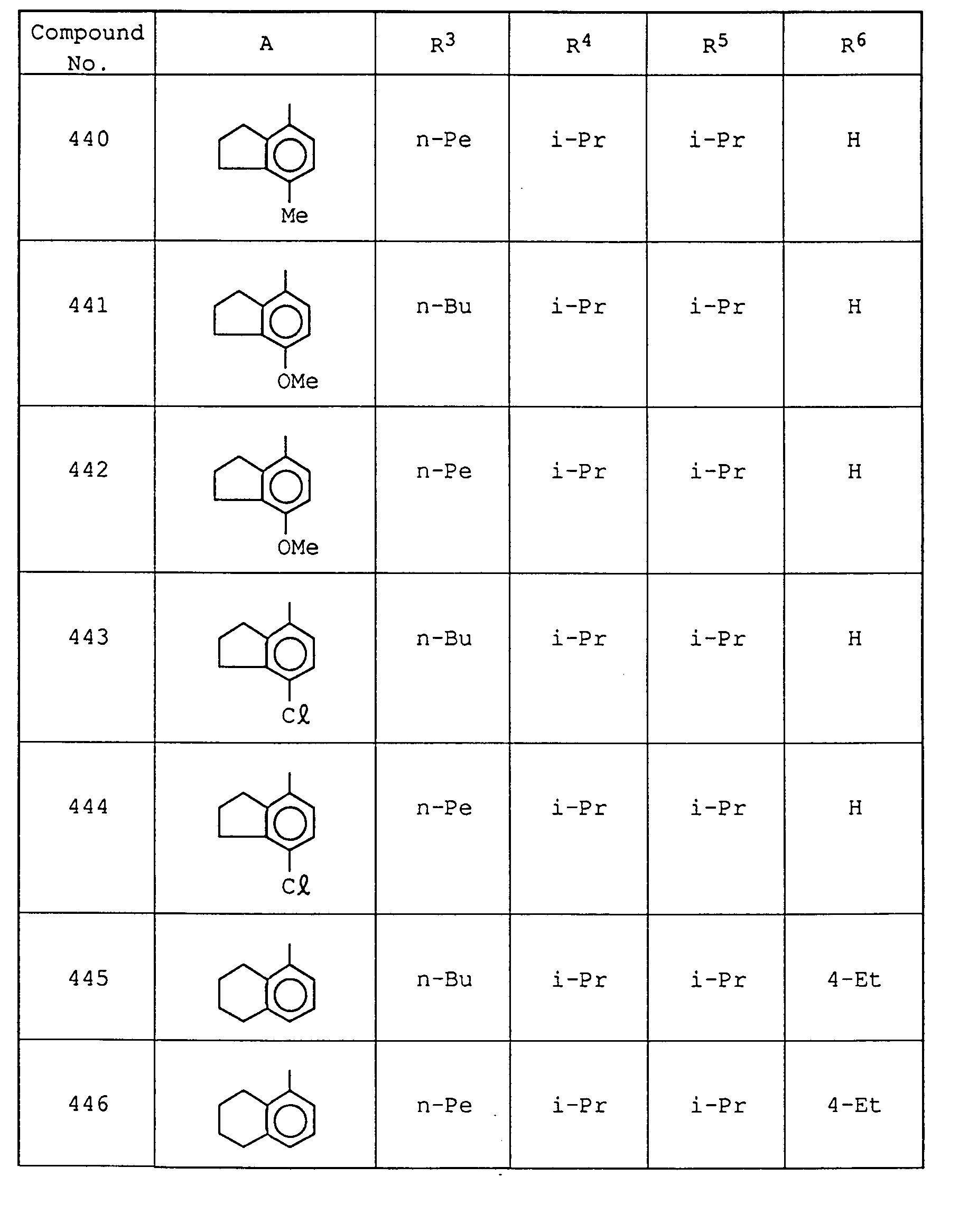


- The effect of reducing a lipid level in blood by the action of the compounds according to the present invention was determined as follows:
- Male golden hamsters weighing from 80 to 100 g were randomly divided into groups. The hamsters were first fed standard laboratory diets (solid feed MF-1 for mouse/rat/hamster, manufactured by Oriental yeast Industries, KK) for 3 days. Then, they were fed the experimental diet containing 1% cholesterol and 0.5% cholic acid ad libitum. At the same time, the compounds of the invention formulated in a shown dose (1 mg/10 ml water/kg) were administrated to the hamsters orally once a day at a determined time. Water was administrated orally to the hamsters of control group in an amount of 10 ml per 1 kg of body weight. On fifth day of administrating the compounds, the hamsters were anesthetized with nembutal (Nembutal injection, manufactured by Dainabbot) three hours after the final administration of the test compound, and a blood sample was taken from abdominal cava. The serum was separated from the sample by centrifuging.
- The cholesterol level in the serum was determined by using a blood cholesterol measuring kit, Determina-TC5 manufactured by Kyowa Medix Co. The results are represented by percent inhibition (%) of cholesterol level in serum relative to that of the control group, and shown in the following Table 20.

- 1) 1-(3,3-dimethyl-2-phenylbutyl)-3-(2,6-diisopropylphenyl)urea

- 2) Results in a does of 5 mg/kg p.o.
- The ACAT inhibitory action of the compounds of this invention was determined by the following method.
- ACAT activity was determined by measuring the amount of ratio-active cholesteryl oleate formed from radio-labelled oleoyl coenzyme A in each tissue specimen containing hamster liver microsome. The reduction rates (%) in the amount of formation of cholesteryl oleate by the administration of the test compound in various concentrations (µM) as compared with as compared with the amount of formation in the control group to which no test compound was administrated were measured. The ACAT inhibitory action was evaluated by IC50, the concentration of the test compound necessary for inhibiting the activity of the enzyme by 50%, obtained from the reduction rates. The results are shown in Table 21.

Claims (23)


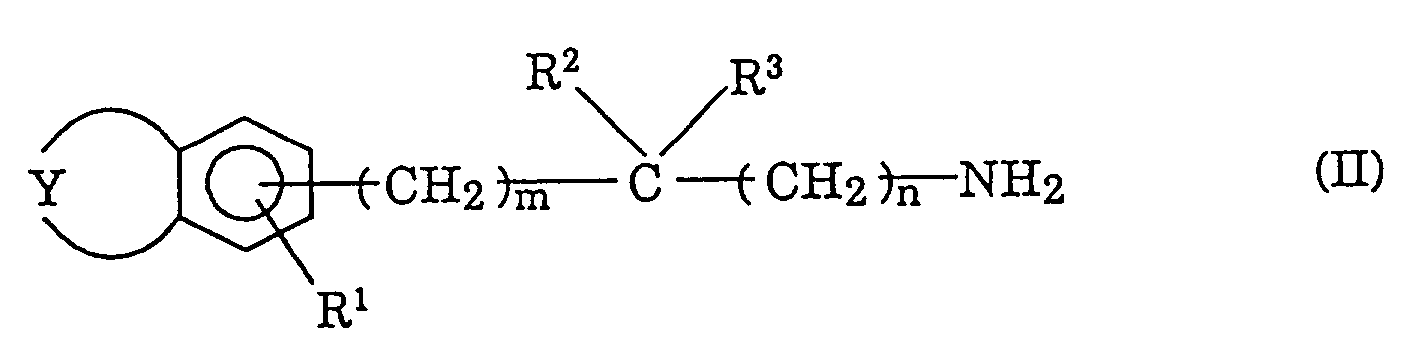
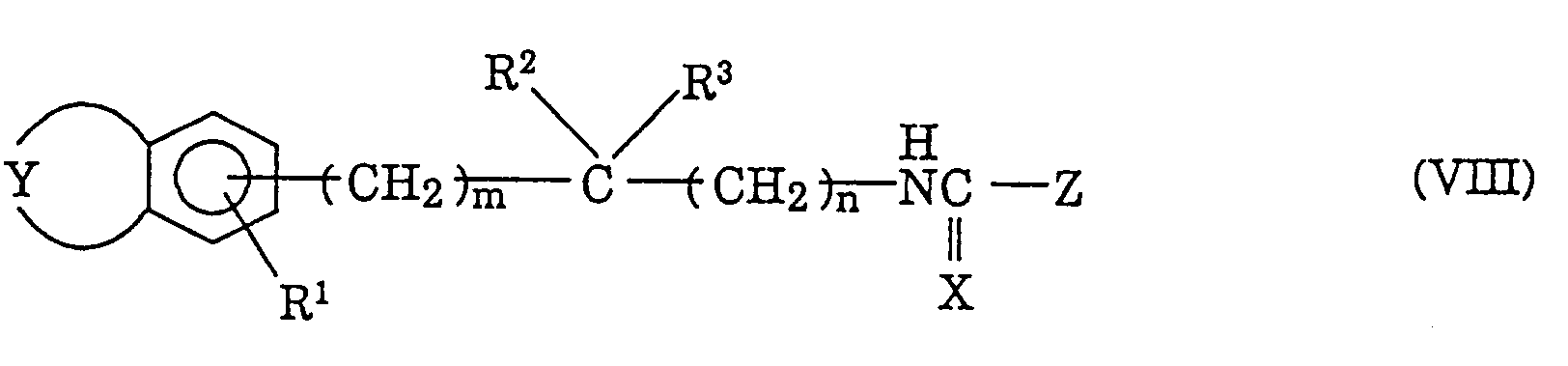
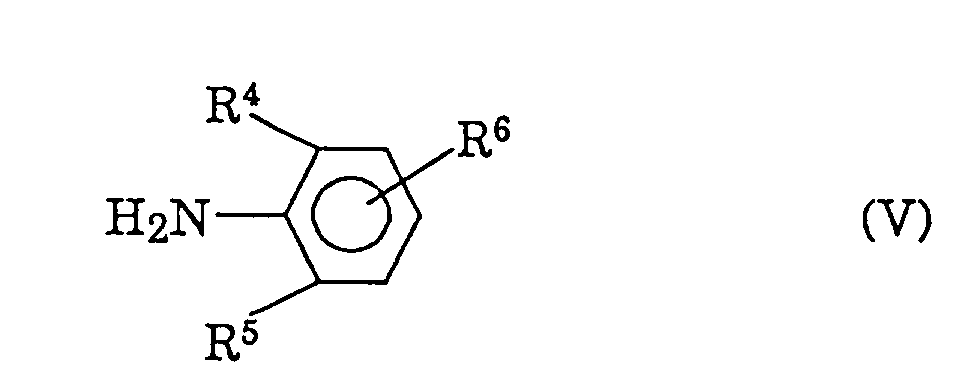


Applications Claiming Priority (4)
| Application Number | Priority Date | Filing Date | Title |
|---|---|---|---|
| JP12235/90 | 1990-01-22 | ||
| JP1223590 | 1990-01-22 | ||
| JP2876890 | 1990-02-08 | ||
| JP28768/90 | 1990-02-08 |
Publications (3)
| Publication Number | Publication Date |
|---|---|
| EP0439059A2 EP0439059A2 (en) | 1991-07-31 |
| EP0439059A3 EP0439059A3 (en) | 1991-11-13 |
| EP0439059B1 true EP0439059B1 (en) | 1994-08-24 |
Family
ID=26347808
Family Applications (1)
| Application Number | Title | Priority Date | Filing Date |
|---|---|---|---|
| EP91100515A Expired - Lifetime EP0439059B1 (en) | 1990-01-22 | 1991-01-17 | 1-Phenylalkyl-3-phenylurea derivative |
Country Status (10)
| Country | Link |
|---|---|
| US (1) | US5202351A (en) |
| EP (1) | EP0439059B1 (en) |
| JP (1) | JPH05310678A (en) |
| KR (1) | KR910014366A (en) |
| AT (1) | ATE110375T1 (en) |
| AU (1) | AU636946B2 (en) |
| CA (1) | CA2034673A1 (en) |
| DE (1) | DE69103535T2 (en) |
| DK (1) | DK0439059T3 (en) |
| ES (1) | ES2057608T3 (en) |
Families Citing this family (9)
| Publication number | Priority date | Publication date | Assignee | Title |
|---|---|---|---|---|
| IL100915A (en) * | 1991-02-19 | 1996-03-31 | Erba Carlo Spa | Disubstituted ureas and thioureas their preparation and pharmaceutical compositions containing them |
| EP0642498A1 (en) * | 1992-05-28 | 1995-03-15 | Pfizer Inc. | NEW $i(N)-ARYL AND $i(N)-HETEROARYLUREA DERIVATIVES AS INHIBITORS OF ACYL COENZYME A:CHOLESTEROL ACYL TRANSFERASE (ACAT) |
| CA2107196A1 (en) * | 1992-09-29 | 1994-03-30 | Mitsubishi Chemical Corporation | Carboxamide derivatives |
| AU672699B2 (en) * | 1993-06-30 | 1996-10-10 | Sankyo Company Limited | Amide and urea derivatives having anti-hypercholesteremic activity, their preparation and their therapeutic uses |
| US6133326A (en) | 1994-08-31 | 2000-10-17 | Pfizer Inc | Compositions and methods for decreasing sebum production |
| NO307879B1 (en) * | 1995-09-18 | 2000-06-13 | Sankyo Co | New urea derivatives with ACAT inhibitory activity and pharmaceuticals containing them |
| EP0773218A1 (en) * | 1995-11-13 | 1997-05-14 | Mitsubishi Chemical Corporation | N-(Piperazinylalkoxyphenyl)-N'phenylalkylurea derivatives as ACAT inhibitors for the treatment of atheroschlerosis |
| KR20020073574A (en) | 2000-02-02 | 2002-09-27 | 워너-램버트 캄파니 | Dual Inhibitors of Cholesterol Ester and Wax Ester Synthesis for Sebaceous Gland Disorders |
| DE602004008959T2 (en) * | 2003-11-07 | 2008-06-19 | F. Hoffmann-La Roche Ag | BENZOÄBÜÄ1,4ÜDIOXEPINDERIVATE |
Family Cites Families (12)
| Publication number | Priority date | Publication date | Assignee | Title |
|---|---|---|---|---|
| US2485600A (en) * | 1946-04-01 | 1949-10-25 | Harold W Moburg | Derivatives of safrol and isosafrol |
| FR6183M (en) * | 1967-03-10 | 1968-07-15 | ||
| US4102673A (en) * | 1971-06-21 | 1978-07-25 | Hercules Incorporated | 1-Phenyl-hexyl ureas as herbicides |
| JPS5312844A (en) * | 1976-07-20 | 1978-02-04 | Nippon Tokushu Noyaku Seizo Kk | Nn44halogenobenzyllnnmethyl*or nonsubstitutedd*cycloalkylln**phenylurea or thiourea compounds* their preparation and fungicides containing the same as active constituents |
| DE2928485A1 (en) * | 1979-07-14 | 1981-01-29 | Bayer Ag | USE OF UREA DERIVATIVES AS A MEDICINAL PRODUCT IN THE TREATMENT OF FATTY METABOLISM DISORDERS |
| US4473579A (en) * | 1982-01-26 | 1984-09-25 | American Cyanamid Company | Antiatherosclerotic tetrasubstituted ureas and thioureas |
| ATE98223T1 (en) * | 1988-03-30 | 1993-12-15 | Warner Lambert Co | N-(((2,6-DISUBSTITUTED)PHENYL>N'-ARYLALKYL> UREAS AS ANTIHYPERCHOLESTEROLMIC AND ANTIATHEROSCLEROTIC AGENTS. |
| US4868210A (en) * | 1988-03-30 | 1989-09-19 | Warner-Lambert Company | Antihyperlipidemic and antiatherosclerotic compounds and compositions |
| IL89997A0 (en) * | 1988-04-25 | 1989-12-15 | Lilly Co Eli | Propanamine derivatives |
| JPH02124884A (en) * | 1988-07-08 | 1990-05-14 | Zhongguo Yixuekexueyuan Yaowo Yanjiusuo | N-substituted amide derivative |
| PT93158A (en) * | 1989-02-17 | 1990-08-31 | Warner Lambert Co | PROCESS FOR THE PREPARATION OF TRISSUBSTITUIDE UREA COMPOUNDS AND PHARMACEUTICAL COMPOSITIONS CONTAINING THEM |
| CA2022346A1 (en) * | 1989-08-04 | 1991-02-05 | Mitsubishi Chemical Corporation | 1-phenylalkyl-3-phenylurea derivatives |
-
1991
- 1991-01-14 JP JP3002821A patent/JPH05310678A/en active Pending
- 1991-01-17 EP EP91100515A patent/EP0439059B1/en not_active Expired - Lifetime
- 1991-01-17 DK DK91100515.5T patent/DK0439059T3/en active
- 1991-01-17 ES ES91100515T patent/ES2057608T3/en not_active Expired - Lifetime
- 1991-01-17 AT AT91100515T patent/ATE110375T1/en active
- 1991-01-17 DE DE69103535T patent/DE69103535T2/en not_active Expired - Fee Related
- 1991-01-18 AU AU69482/91A patent/AU636946B2/en not_active Ceased
- 1991-01-21 KR KR1019910001093A patent/KR910014366A/en not_active Ceased
- 1991-01-21 CA CA002034673A patent/CA2034673A1/en not_active Abandoned
- 1991-01-22 US US07/643,983 patent/US5202351A/en not_active Expired - Fee Related
Also Published As
| Publication number | Publication date |
|---|---|
| KR910014366A (en) | 1991-08-31 |
| ATE110375T1 (en) | 1994-09-15 |
| JPH05310678A (en) | 1993-11-22 |
| DE69103535D1 (en) | 1994-09-29 |
| CA2034673A1 (en) | 1991-07-23 |
| AU6948291A (en) | 1991-07-25 |
| DE69103535T2 (en) | 1995-01-26 |
| DK0439059T3 (en) | 1994-12-19 |
| EP0439059A3 (en) | 1991-11-13 |
| AU636946B2 (en) | 1993-05-13 |
| US5202351A (en) | 1993-04-13 |
| EP0439059A2 (en) | 1991-07-31 |
| ES2057608T3 (en) | 1994-10-16 |
Similar Documents
| Publication | Publication Date | Title |
|---|---|---|
| US5063247A (en) | Diphenylurea derivatives | |
| EP0639178B1 (en) | Anti-atherosclerotic aryl compounds | |
| CA1336913C (en) | Saturated fatty acid amides as inhibitors of acyl-coa:cholesterol acyltransferase | |
| HU187611B (en) | Process for production of substituaded amino-acetofenon derivates | |
| CZ178092A3 (en) | Amidine compounds and process for preparing thereof | |
| DE69128477T2 (en) | BENZOPYRANDERIVAT | |
| EP0439059A2 (en) | 1-Phenylalkyl-3-phenylurea derivative | |
| JP2543690B2 (en) | Pharmaceutical composition | |
| EP0415123B1 (en) | 1-Phenylalkyl-3-phenylurea derivatives | |
| CA1145756A (en) | Stimulants | |
| US4041074A (en) | 1-Hydroxyaryl-2-amidoalkylaminoethanol derivatives | |
| EP0142102B1 (en) | Tertiary amines | |
| JP2661841B2 (en) | Indoline derivatives | |
| EP0170460A1 (en) | Derivatives of N-[2-(tetrahydro-3,5-dioxo-1H-pyrrolizin-7a(5H)-yl)ethyl]amine | |
| JPH05230008A (en) | 3-Cycloalkyl-2-propenamide derivative | |
| EP0197386B1 (en) | 2-(substituted sulfamyl) derivatives of 6-nitrobenzoic acid, process for their preparation and pharmaceutical compositions containing them | |
| US4376731A (en) | 1-Aziridine carboxylic acid derivatives with immunostimulant activity | |
| GB1568401A (en) | Biologically active amides | |
| FR2539412A1 (en) | 5-Fluorouracil derivatives and their therapeutic uses as carcinostatic agents | |
| EP0773218A1 (en) | N-(Piperazinylalkoxyphenyl)-N'phenylalkylurea derivatives as ACAT inhibitors for the treatment of atheroschlerosis | |
| US4080450A (en) | 2-Carbamoyl-1,2,4,5-tetrahydro-3H-2-benzazepin-3-ones | |
| JPH06107655A (en) | 1-phenylethyl-3-phenylurea derivative | |
| US4421917A (en) | Derivatives of 2-ureido-7-phenylhexahydrobenzo[a]quinolizines | |
| CA1105474A (en) | 1-aziridine-carboxylic acid ester derivatives and the preparation thereof | |
| KR820001277B1 (en) | Process for preparation of 5-substituted picolinic acid derivatives |
Legal Events
| Date | Code | Title | Description |
|---|---|---|---|
| PUAI | Public reference made under article 153(3) epc to a published international application that has entered the european phase |
Free format text: ORIGINAL CODE: 0009012 |
|
| AK | Designated contracting states |
Kind code of ref document: A2 Designated state(s): AT BE CH DE DK ES FR GB GR IT LI LU NL SE |
|
| PUAL | Search report despatched |
Free format text: ORIGINAL CODE: 0009013 |
|
| AK | Designated contracting states |
Kind code of ref document: A3 Designated state(s): AT BE CH DE DK ES FR GB GR IT LI LU NL SE |
|
| 17P | Request for examination filed |
Effective date: 19911114 |
|
| 17Q | First examination report despatched |
Effective date: 19931126 |
|
| GRAA | (expected) grant |
Free format text: ORIGINAL CODE: 0009210 |
|
| AK | Designated contracting states |
Kind code of ref document: B1 Designated state(s): AT BE CH DE DK ES FR GB GR IT LI LU NL SE |
|
| REF | Corresponds to: |
Ref document number: 110375 Country of ref document: AT Date of ref document: 19940915 Kind code of ref document: T |
|
| REF | Corresponds to: |
Ref document number: 69103535 Country of ref document: DE Date of ref document: 19940929 |
|
| ITF | It: translation for a ep patent filed | ||
| REG | Reference to a national code |
Ref country code: ES Ref legal event code: FG2A Ref document number: 2057608 Country of ref document: ES Kind code of ref document: T3 |
|
| ET | Fr: translation filed | ||
| REG | Reference to a national code |
Ref country code: DK Ref legal event code: T3 |
|
| EAL | Se: european patent in force in sweden |
Ref document number: 91100515.5 |
|
| REG | Reference to a national code |
Ref country code: GR Ref legal event code: FG4A Free format text: 3014058 |
|
| RAP2 | Party data changed (patent owner data changed or rights of a patent transferred) |
Owner name: MITSUBISHI CHEMICAL CORPORATION |
|
| PLBE | No opposition filed within time limit |
Free format text: ORIGINAL CODE: 0009261 |
|
| STAA | Information on the status of an ep patent application or granted ep patent |
Free format text: STATUS: NO OPPOSITION FILED WITHIN TIME LIMIT |
|
| NLT2 | Nl: modifications (of names), taken from the european patent patent bulletin |
Owner name: MITSUBISHI CHEMICAL CORPORATION TE TOKIO, JAPAN. |
|
| 26N | No opposition filed | ||
| PGFP | Annual fee paid to national office [announced via postgrant information from national office to epo] |
Ref country code: FR Payment date: 19971217 Year of fee payment: 8 |
|
| PGFP | Annual fee paid to national office [announced via postgrant information from national office to epo] |
Ref country code: DK Payment date: 19971218 Year of fee payment: 8 |
|
| PGFP | Annual fee paid to national office [announced via postgrant information from national office to epo] |
Ref country code: SE Payment date: 19971222 Year of fee payment: 8 Ref country code: GB Payment date: 19971222 Year of fee payment: 8 |
|
| PGFP | Annual fee paid to national office [announced via postgrant information from national office to epo] |
Ref country code: GR Payment date: 19971230 Year of fee payment: 8 Ref country code: BE Payment date: 19971230 Year of fee payment: 8 |
|
| PGFP | Annual fee paid to national office [announced via postgrant information from national office to epo] |
Ref country code: NL Payment date: 19971231 Year of fee payment: 8 |
|
| PGFP | Annual fee paid to national office [announced via postgrant information from national office to epo] |
Ref country code: AT Payment date: 19980114 Year of fee payment: 8 |
|
| PGFP | Annual fee paid to national office [announced via postgrant information from national office to epo] |
Ref country code: CH Payment date: 19980120 Year of fee payment: 8 |
|
| PGFP | Annual fee paid to national office [announced via postgrant information from national office to epo] |
Ref country code: ES Payment date: 19980123 Year of fee payment: 8 |
|
| PGFP | Annual fee paid to national office [announced via postgrant information from national office to epo] |
Ref country code: LU Payment date: 19980128 Year of fee payment: 8 |
|
| PGFP | Annual fee paid to national office [announced via postgrant information from national office to epo] |
Ref country code: DE Payment date: 19980331 Year of fee payment: 8 |
|
| PG25 | Lapsed in a contracting state [announced via postgrant information from national office to epo] |
Ref country code: LU Free format text: LAPSE BECAUSE OF NON-PAYMENT OF DUE FEES Effective date: 19990117 Ref country code: GB Free format text: LAPSE BECAUSE OF NON-PAYMENT OF DUE FEES Effective date: 19990117 Ref country code: AT Free format text: LAPSE BECAUSE OF NON-PAYMENT OF DUE FEES Effective date: 19990117 |
|
| PG25 | Lapsed in a contracting state [announced via postgrant information from national office to epo] |
Ref country code: SE Free format text: LAPSE BECAUSE OF NON-PAYMENT OF DUE FEES Effective date: 19990118 Ref country code: ES Free format text: THE PATENT HAS BEEN ANNULLED BY A DECISION OF A NATIONAL AUTHORITY Effective date: 19990118 |
|
| PG25 | Lapsed in a contracting state [announced via postgrant information from national office to epo] |
Ref country code: LI Free format text: LAPSE BECAUSE OF NON-PAYMENT OF DUE FEES Effective date: 19990131 Ref country code: GR Free format text: LAPSE BECAUSE OF NON-PAYMENT OF DUE FEES Effective date: 19990131 Ref country code: CH Free format text: LAPSE BECAUSE OF NON-PAYMENT OF DUE FEES Effective date: 19990131 Ref country code: BE Free format text: LAPSE BECAUSE OF NON-PAYMENT OF DUE FEES Effective date: 19990131 |
|
| PG25 | Lapsed in a contracting state [announced via postgrant information from national office to epo] |
Ref country code: DK Free format text: LAPSE BECAUSE OF NON-PAYMENT OF DUE FEES Effective date: 19990202 |
|
| BERE | Be: lapsed |
Owner name: MITSUBISHI CHEMICAL CORP. Effective date: 19990131 |
|
| PG25 | Lapsed in a contracting state [announced via postgrant information from national office to epo] |
Ref country code: NL Free format text: LAPSE BECAUSE OF NON-PAYMENT OF DUE FEES Effective date: 19990801 |
|
| GBPC | Gb: european patent ceased through non-payment of renewal fee |
Effective date: 19990117 |
|
| REG | Reference to a national code |
Ref country code: CH Ref legal event code: PL |
|
| PG25 | Lapsed in a contracting state [announced via postgrant information from national office to epo] |
Ref country code: FR Free format text: LAPSE BECAUSE OF NON-PAYMENT OF DUE FEES Effective date: 19990930 |
|
| PG25 | Lapsed in a contracting state [announced via postgrant information from national office to epo] |
Ref country code: DE Free format text: LAPSE BECAUSE OF NON-PAYMENT OF DUE FEES Effective date: 19991103 |
|
| REG | Reference to a national code |
Ref country code: FR Ref legal event code: ST |
|
| REG | Reference to a national code |
Ref country code: DK Ref legal event code: EBP |
|
| REG | Reference to a national code |
Ref country code: ES Ref legal event code: FD2A Effective date: 20020304 |
|
| PG25 | Lapsed in a contracting state [announced via postgrant information from national office to epo] |
Ref country code: IT Free format text: LAPSE BECAUSE OF NON-PAYMENT OF DUE FEES Effective date: 20050117 |