EP0437648B1 - Quality inspection method for a printed matter - Google Patents
Quality inspection method for a printed matter Download PDFInfo
- Publication number
- EP0437648B1 EP0437648B1 EP90100741A EP90100741A EP0437648B1 EP 0437648 B1 EP0437648 B1 EP 0437648B1 EP 90100741 A EP90100741 A EP 90100741A EP 90100741 A EP90100741 A EP 90100741A EP 0437648 B1 EP0437648 B1 EP 0437648B1
- Authority
- EP
- European Patent Office
- Prior art keywords
- printed matter
- memory array
- picture element
- inspection
- row
- Prior art date
- Legal status (The legal status is an assumption and is not a legal conclusion. Google has not performed a legal analysis and makes no representation as to the accuracy of the status listed.)
- Expired - Lifetime
Links
- 238000007689 inspection Methods 0.000 title claims description 94
- 238000000034 method Methods 0.000 title claims description 28
- 238000005070 sampling Methods 0.000 claims description 5
- 238000001514 detection method Methods 0.000 description 25
- 238000011109 contamination Methods 0.000 description 6
- 230000000007 visual effect Effects 0.000 description 5
- 238000002474 experimental method Methods 0.000 description 2
- 230000003287 optical effect Effects 0.000 description 2
- 239000002699 waste material Substances 0.000 description 2
- 230000002159 abnormal effect Effects 0.000 description 1
- 230000000052 comparative effect Effects 0.000 description 1
- 230000007547 defect Effects 0.000 description 1
- 230000002950 deficient Effects 0.000 description 1
- 230000006870 function Effects 0.000 description 1
- 238000005286 illumination Methods 0.000 description 1
- 230000004044 response Effects 0.000 description 1
- 230000003595 spectral effect Effects 0.000 description 1
- 230000001360 synchronised effect Effects 0.000 description 1
Images


Classifications
-
- G—PHYSICS
- G01—MEASURING; TESTING
- G01N—INVESTIGATING OR ANALYSING MATERIALS BY DETERMINING THEIR CHEMICAL OR PHYSICAL PROPERTIES
- G01N21/00—Investigating or analysing materials by the use of optical means, i.e. using sub-millimetre waves, infrared, visible or ultraviolet light
- G01N21/84—Systems specially adapted for particular applications
- G01N21/88—Investigating the presence of flaws or contamination
- G01N21/89—Investigating the presence of flaws or contamination in moving material, e.g. running paper or textiles
-
- B—PERFORMING OPERATIONS; TRANSPORTING
- B41—PRINTING; LINING MACHINES; TYPEWRITERS; STAMPS
- B41F—PRINTING MACHINES OR PRESSES
- B41F33/00—Indicating, counting, warning, control or safety devices
- B41F33/0036—Devices for scanning or checking the printed matter for quality control
-
- G—PHYSICS
- G01—MEASURING; TESTING
- G01N—INVESTIGATING OR ANALYSING MATERIALS BY DETERMINING THEIR CHEMICAL OR PHYSICAL PROPERTIES
- G01N21/00—Investigating or analysing materials by the use of optical means, i.e. using sub-millimetre waves, infrared, visible or ultraviolet light
- G01N21/84—Systems specially adapted for particular applications
- G01N21/8483—Investigating reagent band
- G01N2021/8488—Investigating reagent band the band presenting reference patches
-
- G—PHYSICS
- G01—MEASURING; TESTING
- G01N—INVESTIGATING OR ANALYSING MATERIALS BY DETERMINING THEIR CHEMICAL OR PHYSICAL PROPERTIES
- G01N21/00—Investigating or analysing materials by the use of optical means, i.e. using sub-millimetre waves, infrared, visible or ultraviolet light
- G01N21/84—Systems specially adapted for particular applications
- G01N21/88—Investigating the presence of flaws or contamination
- G01N21/89—Investigating the presence of flaws or contamination in moving material, e.g. running paper or textiles
- G01N2021/8909—Scan signal processing specially adapted for inspection of running sheets
- G01N2021/8912—Processing using lane subdivision
Definitions
- the present invention relates in general to a quality inspection method for a printed matter, and more particularly to a method for setting a reference value available in detection of white damage and/or black damage caused by shortage and/or surplus of inkfeed upon commencement of printing and a method for detecting the white damage and/or the black damage.
- This method is also applicable to detection of defective printing of a pattern such as figures, characters and the like on a printed matter and various contaminations occurring on a printed matter in quality inspection for a printed matter.
- a web-like printing paper sheet 3 fed from a roll paper 2 mounted in a feeder section of a printing machine is, after printed in a printing section 1, conveyed to a dryer and a folding machine (not shown).
- a printed matter inspection apparatus in order to inspect a printed condition after printing, pattern information is taken out through a line sensor in a detecting section 4 into a processor circuit 6 while controlling timing for sampling by means of a rotary encoder 5 mounted to the printing section, and a judgement work is effected. As a result, it becomes possible that if the printed condition has been judged to be abnormal, the apparatus can respond to the judgement by means of alarm, marking, reject and the like.
- the image information input through the detecting section 4 achieves double roles as reference information and as inspection information within the processor circuit 6.
- the reference information means image information of a pattern on a printed matter at the time point when an operator has judged that printing is normal, and this image information is stored within a reference information memory to be used as a reference for inspection.
- the inspection information means information input from the detecting section 4 after the reference information was stored in the memory, which is compared with the above-described reference information, whether the printed matter is acceptable or not is determined by judging whether or not the difference between them has exceeded a preset allowable limit, and thereby inspection of a printed matter on an in-line basis becomes possible.
- the inspection apparatus in the prior art was complicated in structure, slow in inspection speed or insufficient in inspection accuracy
- Prior art document GB-A-2 066 949 discloses a quality inspection method for a printed matter, wherein from momentarily changing detection signals obtained by optically scanning with a multi-channel optical detecting device a travelling printed matter detection signals are extracted to be used as a reference signal, and anomalies occuring in said printed matter are detected by comparing the momentarily changing detection signals with the reference signal.
- EP-A-0 194 331 discloses a print quality inspection method for a printed matter, wherein a print pattern on the printed matter is scanned by a multi-channel optical detecting device and density level and spectral characteristic data are obtained.
- Anomalies occurring in the printed matter are detected by comparing detection signals obtained by optically scanning the printed matter with reference signals which were preliminarily scanned from a "normal printed matter" and stored.
- the present invention has been worked out in order to resolve the above-mentioned problems in the prior art, and it is an object of the present invention to provide a reference information present method for feeding reference information for inspection to a printed matter inspection apparatus so that inspection of a printed matter can be carried out from immediately after commencement of printing, and a method for detecting decoloring (white damage) caused by shortage of ink feed to a printed matter upon commencement of printing or contamination of a background (black damage) caused by surplus of ink feed.
- Another object of the present invention is to provide a quality inspection method for a printed matter for inspecting print depth variations on a printed matter at a sufficient inspection accuracy and at a sufficiently high inspection speed by making use of an apparatus having a relatively simple structure.
- the present invention provides a method as specified in claim 1 or claim 3.
- a print pattern on the printed matter is optically imaged on photo-sensitive elements and a print depth of the printed matter is detected by taking out intensities of light inciding to the respective photo-sensitive elements as electrical quantities.
- detection signals generated in a particular area are extracted to be used as a reference signal, and anomalies occured in the printed matter are detected by comparing the momentarily changing detection signals with the reference signal.
- detection signals those generated from an unprinted area are used as the reference signal, and detection signals generated from a printed area are compared with this reference signal.
- detection signals those generated from an unprinted area are used as the reference signal, and detection signals generated from a non-pattern area are compared with this reference signal.
- a print pattern on a printed matter is optically imaged on photo-sensitive elements and a print depth of the printed matter is detected by taking out intensities of light incident to the respective photo-sensitive elements as electrical quantities. Anomalies occurred in the printed matter are detected by comparing detection signals obtained by optically scanning print depth variations in an ink key width unit of the printed matter with detection signals from a normal printed matter which were preliminarily detected through a similar method to the above method and stored for use as a reference signal.
- setting of reference information during the period when printing proceeds from commencement of printing up to normal printing is carried out by determining a normal area of a printed matter among inspection information possessed by the processor circuit 6 in Fig. 5 and using the information obtained from the determined particular area as reference information.
- detection of white damage (decoloring caused by shortage of ink feed which is generated entirely or partly on the printed paper surface) and/or black damage (contamination of a background caused by surplus of ink feed which is generated entirely or partly on the printed paper surface) during the period when printing proceeds from commencement of printing up to normal printing, is effected by comparing inspection information of a traveling printed matter with reference information obtained from the same inspection information, and determining that the printed matter involves white damage when a difference less than a predetermined value exists.
- a portion in a printed matter where print depth variation is liable to occur is extracted and this is used as reference data.
- a portion corresponding to this is extracted from inspection information and is used as inspection data. And by comparing the reference data with the inspection data, defects in quality of the printed matter are determined.
- image information of a traveling printed matter is input moment by moment to the processor circuit 6 shown in Fig. 5, and accumulated as inspection information in an inspection information memory.
- this inspection information detection data for a printing paper itself in an unprintable area of a printed matter, that is, in an unprinted area are extracted to be used as reference information.
- the inspection information is divided for the respective ink control widths, that is, for the respective print widths for which ink feed rates can be controlled by means of ink keys, and with respect to the respective divided widths the detection data are compared with the above-mentioned reference information, and when a difference less than a predetermined value exists, the printed matter is determined to involve white damage.
- detection data for a non-pattern section in the printed area are compared with the above-mentioned reference information, and when a difference larger than a predetermined value exists, the printed matter is determined to be unacceptable.
- image information of a traveling printed matter is accumulated in the processor circuit 6 in Fig. 5.
- the processor circuit 6 involves reference information storing a pattern on a normal printed matter and inspection information storing momentary pattern on a printed matter.
- the depth variation of ink is caused by shortage or surplus of an amount of ink fed to a plate drum 8 as controlled by ink keys (not shown) provided in a printing section 1 in Fig. 5. Accordingly, print depth variations could be detected for the respective widths of the ink keys controlling the amount of ink
- the above-mentioned reference information is divided so as to correspond to the respective ink keys, and in the respective blocks of reference information, representative informations are extracted to produce the reference data.
- portions corresponding to the reference data are extracted to produce inspection data.
- the above-mentioned reference data and inspection data are compared with each other, and when a difference larger than a predetermined value is present, the printed matter is determined to be unacceptable in print depth.
- one page 9 is a print unit corresponding to one revolution of a plate drum 8 or a rubber drum 7.
- An unprinted section 10 is a portion that is unprintable due to influence of a gap on the plate drum 8 or the rubber drum 7.
- An ink control width 11 corresponds to a width of an ink key (not shown) for controlling an amount of ink fed to the plate drum 7 in the printing section 1 in Fig. 5.
- Fig. 2 shows one example of a memory array for pattern information, that is, inspection information corresponding to one page 9 in Fig. 1, which has been input to the processor circuit 6 in Fig. 5.
- Fig. 2 in the widthwise direction of the paper sheet the area is divided into n depending upon a number of detector elements provided in a line camera or the like in a detector section 4, and in the traveling direction the area is divided into g depending upon sampling timing of a rotary encoder 5. Accordingly, inspection information corresponding to one page is composed of q x n picture elements.
- the ink control width 11 is composed of k columns, and in the width of the printing paper are present N ink control widths.
- the memory array corresponding to an unprinted section 10 consists of the p-th to q-th rows.
- inspection information for any arbitrary picture element in the i-th row and in the j-th column of the memory array is represented by D (i, j), and one column is arbitrarily selected from each ink control width 11.
- DT j can be represented by the following formula:
- NR t an average of one picture element of inspection information in the L-th column in the unprinted section 10 is represented by NR t , then NR t can be represented by the following formula:
- the unit of comparison between the inkcontrol width 11 and the unprinted section 10 could be two columns or more, and any one column of the ink control width 11 may be divided into N to compare for each block.
- one page 9 is a print unit corresponding to one revolution of a plate drum 8 or a rubber drum 7 in Fig. 8.
- An unprinted section 10 is a portion that is unprintable due to influence of a gap on the plate drum 8 or the rubber drum 7.
- a non-pattern section 11' is a portion where a pattern is not present and ink is not transferred even if printing is effected as a result of layout of patterns. Accordingly, in normal printing this non-pattern section 11' have the color of the printing paper similarly to the unprinted section.
- Fig. 4 shows one example of a memory array for pattern information, that is, inspection information corresponding one page 9 in Fig. 3 which has been input to the processor circuit 6 in Fig. 5.
- inspection information corresponding to one page is composed of g x n picture elements.
- the memory array corresponding to the non-pattern section 11' in Fig. 3 consists of the k-th to l-th rows in Fig. 4.
- the memory array corresponding to the unprinted section consists of the p-th to g-th rows.
- a sum NRp of the inspection information in the p-th row in the unprinted section is represented by the following formula:
- the allowable error ⁇ can be preliminarily measured through experiments or the like, and it could be preset in the processor circuit 6.
- the inspection information of one row consisting of n elements is divided into N blocks, and comparison could be made by presetting latitude values for the respective blocks.
Landscapes
- Engineering & Computer Science (AREA)
- Quality & Reliability (AREA)
- Textile Engineering (AREA)
- Physics & Mathematics (AREA)
- Health & Medical Sciences (AREA)
- Life Sciences & Earth Sciences (AREA)
- Chemical & Material Sciences (AREA)
- Analytical Chemistry (AREA)
- Biochemistry (AREA)
- General Health & Medical Sciences (AREA)
- General Physics & Mathematics (AREA)
- Immunology (AREA)
- Pathology (AREA)
- Inking, Control Or Cleaning Of Printing Machines (AREA)
- Investigating Materials By The Use Of Optical Means Adapted For Particular Applications (AREA)
Description
- The present invention relates in general to a quality inspection method for a printed matter, and more particularly to a method for setting a reference value available in detection of white damage and/or black damage caused by shortage and/or surplus of inkfeed upon commencement of printing and a method for detecting the white damage and/or the black damage.
- This method is also applicable to detection of defective printing of a pattern such as figures, characters and the like on a printed matter and various contaminations occurring on a printed matter in quality inspection for a printed matter.
- Heretofore, with regard to inspection of a printed matter, a method of performing inspection by relying upon human visual sense on an off-line basis was a principal trend. This is due to the fact that printed matters have different print patterns for every piece, and that it has been believed that inspection items for printed matters call a delicate difference that must rely upon human visual sense in question. On the other hand, in response to the requirement that it is wanted to evaluate a printed matter during printing, trials of making judgement after converting an image on a printed matter during printing into a stationary image by effecting stroboscopic illumination synchronized with a printing speed or by employing a rotary mirror rotating synchronously at a high speed, were carried out. However, even these measures were not the system of such class that it can be called inspection machine in the point that the inspection also relied upon human visual sense. In addition, another trial that a color patch is printed simultaneously with a print pattern of a printed matter and inspection of the printed matter is simulated by performing inspection of the color patch, has been also carried out. However, according to this method, in the event that printing faults (oil dropping, contamination, etc.) should arise in the pattern area, they would be overlooked, and so, it could not be said that a function of an inspection machine is fully achieved.
- On the other hand, as seen in the "printed matter inspection apparatus" proposed recently in JP-A-56-98634 (1981) or JP-A-59-109832 (1984), a system for performing inspection of a printed matter on an in-line basis by making use of a line sensor has been proposed (cf. also GB-A-2 066 949 and EP-A-0 194 331). An outline of this system will be explained with reference to Fig. 5.
- A web-like printing paper sheet 3 fed from a roll paper 2 mounted in a feeder section of a printing machine is, after printed in a printing section 1, conveyed to a dryer and a folding machine (not shown). In a printed matter inspection apparatus, in order to inspect a printed condition after printing, pattern information is taken out through a line sensor in a detecting section 4 into a
processor circuit 6 while controlling timing for sampling by means of a rotary encoder 5 mounted to the printing section, and a judgement work is effected. As a result, it becomes possible that if the printed condition has been judged to be abnormal, the apparatus can respond to the judgement by means of alarm, marking, reject and the like. - According to the above-described system, since an entire pattern area of a printed matter can be automatically inspected on an in-line basis, the previously described shortcomings are not present, an advantage as an inspection apparatus can be expected.
- In Fig. 5, the image information input through the detecting section 4 achieves double roles as reference information and as inspection information within the
processor circuit 6. The reference information means image information of a pattern on a printed matter at the time point when an operator has judged that printing is normal, and this image information is stored within a reference information memory to be used as a reference for inspection. On the other hand, the inspection information means information input from the detecting section 4 after the reference information was stored in the memory, which is compared with the above-described reference information, whether the printed matter is acceptable or not is determined by judging whether or not the difference between them has exceeded a preset allowable limit, and thereby inspection of a printed matter on an in-line basis becomes possible. - It will be understood that as a result, according to the above-mentioned system, before input of the reference information, that is, during the period when printing proceeds from commencement of printing up to normal printing, inspection would be impossible.
- In practical printing, since unacceptable printed matters would occur in large amount during the period when printing proceeds from commencement of printing to a normal printing state, and especially in a rotary press since loss of printing paper is large, there is the desire that after commencement of printing it is wanted to automatically judge at what time point printing has shifted to normal printing. It is obvious that the printed matter inspecting apparatus according to the above-described prior invention is not effective at all for this desire, and solution for this problem has been desired.
- In addition, according to the above-described system shown in Fig. 5, while it becomes possible to inspect an entire pattern on a printed matter, the reference information and the inspection information to be processed amount to a large information content. Hence, the inspection apparatus in the prior art was complicated in structure, slow in inspection speed or insufficient in inspection accuracy
- Prior art document GB-A-2 066 949 discloses a quality inspection method for a printed matter, wherein from momentarily changing detection signals obtained by optically scanning with a multi-channel optical detecting device a travelling printed matter detection signals are extracted to be used as a reference signal, and anomalies occuring in said printed matter are detected by comparing the momentarily changing detection signals with the reference signal.
- Further prior art document EP-A-0 194 331 discloses a print quality inspection method for a printed matter, wherein a print pattern on the printed matter is scanned by a multi-channel optical detecting device and density level and spectral characteristic data are obtained.
- Anomalies occurring in the printed matter are detected by comparing detection signals obtained by optically scanning the printed matter with reference signals which were preliminarily scanned from a "normal printed matter" and stored.
- The present invention has been worked out in order to resolve the above-mentioned problems in the prior art, and it is an object of the present invention to provide a reference information present method for feeding reference information for inspection to a printed matter inspection apparatus so that inspection of a printed matter can be carried out from immediately after commencement of printing, and a method for detecting decoloring (white damage) caused by shortage of ink feed to a printed matter upon commencement of printing or contamination of a background (black damage) caused by surplus of ink feed.
- Another object of the present invention is to provide a quality inspection method for a printed matter for inspecting print depth variations on a printed matter at a sufficient inspection accuracy and at a sufficiently high inspection speed by making use of an apparatus having a relatively simple structure.
- To solve this object the present invention provides a method as specified in claim 1 or claim 3.
- In a quality inspection method for a printed matter, a print pattern on the printed matter is optically imaged on photo-sensitive elements and a print depth of the printed matter is detected by taking out intensities of light inciding to the respective photo-sensitive elements as electrical quantities. From momentarily changing detection signals obtained by optically scanning a traveling printed matter, detection signals generated in a particular area are extracted to be used as a reference signal, and anomalies occured in the printed matter are detected by comparing the momentarily changing detection signals with the reference signal. Among the detection signals, those generated from an unprinted area are used as the reference signal, and detection signals generated from a printed area are compared with this reference signal.
- Among the detection signals, those generated from an unprinted area are used as the reference signal, and detection signals generated from a non-pattern area are compared with this reference signal.
- A print pattern on a printed matter is optically imaged on photo-sensitive elements and a print depth of the printed matter is detected by taking out intensities of light incident to the respective photo-sensitive elements as electrical quantities. Anomalies occurred in the printed matter are detected by comparing detection signals obtained by optically scanning print depth variations in an ink key width unit of the printed matter with detection signals from a normal printed matter which were preliminarily detected through a similar method to the above method and stored for use as a reference signal.
- In other words, setting of reference information during the period when printing proceeds from commencement of printing up to normal printing is carried out by determining a normal area of a printed matter among inspection information possessed by the
processor circuit 6 in Fig. 5 and using the information obtained from the determined particular area as reference information. - Next, detection of white damage (decoloring caused by shortage of ink feed which is generated entirely or partly on the printed paper surface) and/or black damage (contamination of a background caused by surplus of ink feed which is generated entirely or partly on the printed paper surface) during the period when printing proceeds from commencement of printing up to normal printing, is effected by comparing inspection information of a traveling printed matter with reference information obtained from the same inspection information, and determining that the printed matter involves white damage when a difference less than a predetermined value exists.
- Also, from the reference information possessed by the
processor circuit 6 in Fig. 5, a portion in a printed matter where print depth variation is liable to occur is extracted and this is used as reference data. A portion corresponding to this is extracted from inspection information and is used as inspection data. And by comparing the reference data with the inspection data, defects in quality of the printed matter are determined. - In the above-mentioned process of presetting reference information, image information of a traveling printed matter is input moment by moment to the
processor circuit 6 shown in Fig. 5, and accumulated as inspection information in an inspection information memory. Among this inspection information, detection data for a printing paper itself in an unprintable area of a printed matter, that is, in an unprinted area are extracted to be used as reference information. - Next, in the above-described white damage inspection method, the inspection information is divided for the respective ink control widths, that is, for the respective print widths for which ink feed rates can be controlled by means of ink keys, and with respect to the respective divided widths the detection data are compared with the above-mentioned reference information, and when a difference less than a predetermined value exists, the printed matter is determined to involve white damage.
- Also, in the above-described black damage inspection method, among the inspection information, detection data for a non-pattern section in the printed area (the portion where a printed pattern is not present though printing is possible) are compared with the above-mentioned reference information, and when a difference larger than a predetermined value exists, the printed matter is determined to be unacceptable.
- Through the above-mentioned method, even under the condition where a normal printed matter is not present upon commencement of printing, detection of white damage and/or black damage from only momentary inspection information becomes possible.
- Furthermore, in the inspection method, image information of a traveling printed matter is accumulated in the
processor circuit 6 in Fig. 5. Theprocessor circuit 6 involves reference information storing a pattern on a normal printed matter and inspection information storing momentary pattern on a printed matter. The depth variation of ink is caused by shortage or surplus of an amount of ink fed to a plate drum 8 as controlled by ink keys (not shown) provided in a printing section 1 in Fig. 5. Accordingly, print depth variations could be detected for the respective widths of the ink keys controlling the amount of ink - Therefore, the above-mentioned reference information is divided so as to correspond to the respective ink keys, and in the respective blocks of reference information, representative informations are extracted to produce the reference data. In addition with respect to the inspection information also, portions corresponding to the reference data are extracted to produce inspection data. The above-mentioned reference data and inspection data are compared with each other, and when a difference larger than a predetermined value is present, the printed matter is determined to be unacceptable in print depth.
- The above-mentioned and other objects, features and advantages of the present invention will become more apparent by reference to the following description of preferred embodiments of the invention taken in conjunction with the accompanying drawings.
- In the accompanying drawings:
- Fig. 1 is a schematic view of a printed matter that is relevant to a first preferred embodiment of the present invention;
- Fig. 2 is a schematic view showing a memory array for inspection information corresponding to one page in the printed matter shown in Fig. 1;
- Fig. 3 is a schematic view of a printed matter that is relevant to a second preferred embodiment of the present invention;
- Fig. 4 is a schematic view showing a memory array for inspection information corresponding to one page in the printed matter shown in Fig. 3; and
- Fig. 5 is a general view showing a system of an inspection apparatus in the prior art.
- At first, description will be made on a first preferred embodiment of the present invention with reference to Figs. 1, 2 and 8.
- In Fig. 1 showing an outline of a printed matter, one
page 9 is a print unit corresponding to one revolution of a plate drum 8 or a rubber drum 7. Anunprinted section 10 is a portion that is unprintable due to influence of a gap on the plate drum 8 or the rubber drum 7. Anink control width 11 corresponds to a width of an ink key (not shown) for controlling an amount of ink fed to the plate drum 7 in the printing section 1 in Fig. 5. - Fig. 2 shows one example of a memory array for pattern information, that is, inspection information corresponding to one
page 9 in Fig. 1, which has been input to theprocessor circuit 6 in Fig. 5. - In Fig. 2, in the widthwise direction of the paper sheet the area is divided into n depending upon a number of detector elements provided in a line camera or the like in a detector section 4, and in the traveling direction the area is divided into g depending upon sampling timing of a rotary encoder 5. Accordingly, inspection information corresponding to one page is composed of q x n picture elements.
- Here it is assumed that the
ink control width 11 is composed of k columns, and in the width of the printing paper are present N ink control widths. - Also, it is assumed that the memory array corresponding to an
unprinted section 10 consists of the p-th to q-th rows. - Here, inspection information for any arbitrary picture element in the i-th row and in the j-th column of the memory array is represented by D (i, j), and one column is arbitrarily selected from each
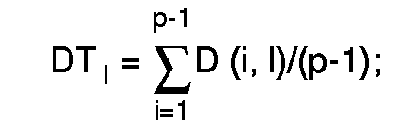
ink control width 11. - For instance, if an average of one picture element in the ink control width corresponding to the g-th column is represented by DTj, then DTj can be represented by the following formula:

- Also, if an average of one picture element of inspection information in the L-th column in the
unprinted section 10 is represented by NRt, then NRt can be represented by the following formula:
- In the case where black damage is occurring due to contamination of a background of a printed matter or the like upon commencement of printing, or during normal printing when ink is being transferred to the printed section, DTℓ≠NRℓ is fulfilled. In the event that an amount of ink feed has become short due to an ink key corresponding to the g-th column, that is, upon occurrence of white damage, DTt would approach NRt. Hence, if a latitude for one picture element that is allowed for a normal printed matter is represented by ε, then when the following relation is fulfilled, a traveling printed matter can be judged to have white damage:

- The comparison represented by the formula (3) above is carried out for all the ink control widths. This latitude can be preliminarily measured through experiments or the like, and it could be preset in the
processor circuit 6. - According to the present invention, without necessitating to preliminarily input reference information of a normal printed matter, on the basis of only inspection information of a traveling printed matter, inspection for white damage upon commencement of printing becomes possible.
- Here, the unit of comparison between the
inkcontrol width 11 and theunprinted section 10 could be two columns or more, and any one column of theink control width 11 may be divided into N to compare for each block. - Next, a second preferred embodiment of the present invention will be explained with reference to Figs. 3, 4 and 5.
- In Fig. 3 showing an outline of a printed matter, one
page 9 is a print unit corresponding to one revolution of a plate drum 8 or a rubber drum 7 in Fig. 8. Anunprinted section 10 is a portion that is unprintable due to influence of a gap on the plate drum 8 or the rubber drum 7. - And, a non-pattern section 11' is a portion where a pattern is not present and ink is not transferred even if printing is effected as a result of layout of patterns. Accordingly, in normal printing this non-pattern section 11' have the color of the printing paper similarly to the unprinted section.
- Fig. 4 shows one example of a memory array for pattern information, that is, inspection information corresponding one
page 9 in Fig. 3 which has been input to theprocessor circuit 6 in Fig. 5. - In Fig. 4, in the widthwise direction of the paper sheet the area is divided into n depending upon a number of detector elements provided in a line camera or the like in a detector section 4, and in the traveling direction the area is divided into a depending upon sampling timing of a rotary encorder 5. Accordingly, inspection information corresponding to one page is composed of g x n picture elements.
- Here it is assumed that the memory array corresponding to the non-pattern section 11' in Fig. 3 consists of the k-th to ℓ-th rows in Fig. 4.
- Also it is assumed that the memory array corresponding to the unprinted section consists of the p-th to g-th rows.
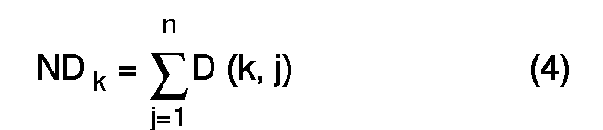
- Here, if any arbitrary picture element in the i-th row and in the j-th column of the memory array is represented by D (i, j), then a sum NDk of the inspection information in the k-th row in the non-pattern section is represented by the following formula:
-
- Also, a sum NRp of the inspection information in the p-th row in the unprinted section is represented by the following formula:

- The portion where black damage occurs due to contamination of a background of a printed matter upon commencement of printing is only the non-pattern section, and for the values represented by the formulae (4) and (5), NDκ ≠NRp is fulfilled.
- As the printing become close to normal printing, NDk would approach N Rp.
- Hence, if an error corresponding to one row that is allowed for a normal printed matter is represented by ε, then when the following relation is fulfilled, a traveling printed matter can be judged not to have blackdamage:

- The allowable error ε can be preliminarily measured through experiments or the like, and it could be preset in the
processor circuit 6. - According to the present invention, without necessitating to preliminarily input reference information of a normal printed matter, on the basis of only inspection information of a traveling printed matter, inspection for black damage upon commencement of printing becomes possible.
- Here, the unit of comparison between the
non-pattern section 11 and theunprinted section 10 could be every row, and if thenon-pattern section 11 and theunprinted section 10 have the same area, that is, if ℓ- k = q - p is fulfilled, the total sums in the respective sections could be compared. - More particularly, if the total sum of the inspection information in the non-pattern section is represented by ND, it is given by the following formula:


- Otherwise, the inspection information of one row consisting of n elements is divided into N blocks, and comparison could be made by presetting latitude values for the respective blocks.
- In a quality inspection method for a printed matter of the type that a print pattern on the printed matter is optically imaged on photo-sensitive elements and a print depth of the printed matter is detected by taking out intensities of light inciding to the respective photo-sensitive elements as electrical quantities, owing to the fact that from momentarily changing detection signals obtained by optically scanning a traveling printed matter, detection signals generated in a particular area are extracted to be used as a reference signal, and anomalies occurred in the printed matter are detected by comparing the momentarily changing detection signals with the reference signal, the present invention provides the following advantages:
- (1) Quality inspection of a printed matter during the period from commencement of printing up to normal printing, which was impossible or quite ineffective by means of a printed matter inspection apparatus in the prior art, can be carried out.
- (2) Inspection for white damage and/or black damage by numerical management having a predetermined reference and not relying upon the sixth sense based on the visual sense of a printed matter inspector, becomes possible.
- (3) Transfer from unacceptable printing caused by white damage and/or black damage to normal printing is effected smoothly, and waste printing paper is reduced.
- In a quality inspection method for a printed matter of the type that a print pattern on the printed matter is optically imaged on photo-sensitive elements and a print depth of the printed matter is detected by taking out intensities of light inciding to the respective photo-sensitive elements as electrical quantities, owing to the fact that anomalies occurred in the printed matter are detected by comparing detection signals obtained by optically scanning print depth variations in an ink key width unit of the printed matter with detection signals from a normal printed matter which were preliminarily detected through a similar method to the above method and stored for use as reference signals, the present invention also provides the following advantages:
- (1) Inspection of print depth variations of a pattern over the entire printed matter through a small number of comparative inspections, becomes possible, and also it is possible to improve an inspection speed.
- (2) Since the inspection depends upon numerical management without relying upon the sixth sense based on the visual sense of a printed matter inspector, print depth inspection not relying upon an inspector but having a fixed reference, becomes possible.
- (3) Print depth variations occurring during printing can be detected, hence it is possible to quickly deal with generated printing faults, and waste printing paper is reduced.
Claims (3)


Priority Applications (2)
| Application Number | Priority Date | Filing Date | Title |
|---|---|---|---|
| EP90100741A EP0437648B1 (en) | 1990-01-15 | 1990-01-15 | Quality inspection method for a printed matter |
| DE1990626488 DE69026488T2 (en) | 1990-01-15 | 1990-01-15 | Process for quality assessment of printed matter |
Applications Claiming Priority (1)
| Application Number | Priority Date | Filing Date | Title |
|---|---|---|---|
| EP90100741A EP0437648B1 (en) | 1990-01-15 | 1990-01-15 | Quality inspection method for a printed matter |
Publications (2)
| Publication Number | Publication Date |
|---|---|
| EP0437648A1 EP0437648A1 (en) | 1991-07-24 |
| EP0437648B1 true EP0437648B1 (en) | 1996-04-10 |
Family
ID=8203497
Family Applications (1)
| Application Number | Title | Priority Date | Filing Date |
|---|---|---|---|
| EP90100741A Expired - Lifetime EP0437648B1 (en) | 1990-01-15 | 1990-01-15 | Quality inspection method for a printed matter |
Country Status (2)
| Country | Link |
|---|---|
| EP (1) | EP0437648B1 (en) |
| DE (1) | DE69026488T2 (en) |
Cited By (1)
| Publication number | Priority date | Publication date | Assignee | Title |
|---|---|---|---|---|
| DE102016224303A1 (en) | 2016-12-07 | 2018-06-07 | Heidelberger Druckmaschinen Ag | Method and test pattern for detecting and compensating failed nozzles in an inkjet printing machine |
Families Citing this family (4)
| Publication number | Priority date | Publication date | Assignee | Title |
|---|---|---|---|---|
| JP3038666B2 (en) * | 1991-10-31 | 2000-05-08 | 株式会社小森コーポレーション | Method and apparatus for eliminating paster part recognition |
| ITTO20080556A1 (en) * | 2008-07-18 | 2010-01-19 | Giuseppe Bella | AUXILIARY APPARATUS FOR NON-VISITORS, FOR THE DETECTION OF EXCAVATIONS OR ORGANIC FLUIDS ON A MATERIAL IN THE SHEET, AND RELATIVE DETECTION METHOD |
| CN102107561B (en) * | 2009-12-25 | 2013-05-22 | 江门市得实计算机外部设备有限公司 | Printing quality intelligent monitoring method, and printer and printing system employing same |
| JP6852430B2 (en) * | 2017-02-07 | 2021-03-31 | 株式会社リコー | Inspection equipment, inspection methods and programs |
Family Cites Families (4)
| Publication number | Priority date | Publication date | Assignee | Title |
|---|---|---|---|---|
| US3756725A (en) * | 1970-10-12 | 1973-09-04 | Harris Intertype Corp | Measurement and control of ink density |
| US3970393A (en) * | 1974-07-23 | 1976-07-20 | Harris Corporation | Automatic compensation for densitometer imbalance |
| DE2917519C2 (en) * | 1979-04-30 | 1981-03-12 | Forschungsgesellschaft Druckmaschinen E.V., 6000 Frankfurt | Device on printing machines to determine the degree of dryness of the printing material |
| JPS5698634A (en) * | 1980-01-09 | 1981-08-08 | Dainippon Printing Co Ltd | Printed matter testing device |
-
1990
- 1990-01-15 EP EP90100741A patent/EP0437648B1/en not_active Expired - Lifetime
- 1990-01-15 DE DE1990626488 patent/DE69026488T2/en not_active Expired - Fee Related
Non-Patent Citations (2)
| Title |
|---|
| DE-A 2 752 412 * |
| EP-A 0 194 331 * |
Cited By (1)
| Publication number | Priority date | Publication date | Assignee | Title |
|---|---|---|---|---|
| DE102016224303A1 (en) | 2016-12-07 | 2018-06-07 | Heidelberger Druckmaschinen Ag | Method and test pattern for detecting and compensating failed nozzles in an inkjet printing machine |
Also Published As
| Publication number | Publication date |
|---|---|
| DE69026488T2 (en) | 1996-09-12 |
| EP0437648A1 (en) | 1991-07-24 |
| DE69026488D1 (en) | 1996-05-15 |
Similar Documents
| Publication | Publication Date | Title |
|---|---|---|
| US5058175A (en) | Quality inspection method for a printed matter | |
| EP0884180B1 (en) | Process for controlling or regulating operations carried out by a printing machine | |
| CA2058242C (en) | Print monitoring apparatus | |
| US4561103A (en) | Print inspecting method and apparatus | |
| EP0461338B1 (en) | Print inspection method | |
| US20060230358A1 (en) | System for inspecting a printed image | |
| US7000544B2 (en) | Measurement and regulation of inking in web printing | |
| CN109476151B (en) | Production plant with inspection system and method for adjusting sensitivity of inspection system | |
| EP0437648B1 (en) | Quality inspection method for a printed matter | |
| US5802978A (en) | Method for regulating inking when printing with a printing press | |
| JP2516606B2 (en) | Print quality inspection device | |
| GB2159623A (en) | Print inspecting method | |
| JP2566292B2 (en) | Print quality inspection method | |
| JPH07186375A (en) | Inspection method for printed matter | |
| JPH0257772B2 (en) | ||
| JP3598558B2 (en) | Method and apparatus for detecting periodic continuous defects in printed matter | |
| EP1512531A1 (en) | Inking control system for printing machines | |
| JPH03264359A (en) | Device for inspecting printed matter | |
| JPH0230536A (en) | Checking method of density fluctuation in printed matter | |
| WO2000027638A1 (en) | System and method for register mark recognition | |
| GB2159622A (en) | Print inspecting method | |
| JPH0367631B2 (en) | ||
| JPS63111057A (en) | Printing quality inspection device | |
| JPH01182049A (en) | Printed matter checkup method | |
| JPS6064850A (en) | Inspecting method of printed matter |
Legal Events
| Date | Code | Title | Description |
|---|---|---|---|
| PUAI | Public reference made under article 153(3) epc to a published international application that has entered the european phase |
Free format text: ORIGINAL CODE: 0009012 |
|
| 17P | Request for examination filed |
Effective date: 19900212 |
|
| AK | Designated contracting states |
Kind code of ref document: A1 Designated state(s): CH DE GB LI |
|
| 17Q | First examination report despatched |
Effective date: 19930401 |
|
| GRAA | (expected) grant |
Free format text: ORIGINAL CODE: 0009210 |
|
| AK | Designated contracting states |
Kind code of ref document: B1 Designated state(s): CH DE GB LI |
|
| REF | Corresponds to: |
Ref document number: 69026488 Country of ref document: DE Date of ref document: 19960515 |
|
| PLBE | No opposition filed within time limit |
Free format text: ORIGINAL CODE: 0009261 |
|
| STAA | Information on the status of an ep patent application or granted ep patent |
Free format text: STATUS: NO OPPOSITION FILED WITHIN TIME LIMIT |
|
| 26N | No opposition filed | ||
| PGFP | Annual fee paid to national office [announced via postgrant information from national office to epo] |
Ref country code: DE Payment date: 20010108 Year of fee payment: 12 |
|
| PGFP | Annual fee paid to national office [announced via postgrant information from national office to epo] |
Ref country code: GB Payment date: 20010110 Year of fee payment: 12 |
|
| PGFP | Annual fee paid to national office [announced via postgrant information from national office to epo] |
Ref country code: CH Payment date: 20010112 Year of fee payment: 12 |
|
| REG | Reference to a national code |
Ref country code: GB Ref legal event code: IF02 |
|
| PG25 | Lapsed in a contracting state [announced via postgrant information from national office to epo] |
Ref country code: GB Free format text: LAPSE BECAUSE OF NON-PAYMENT OF DUE FEES Effective date: 20020115 |
|
| PG25 | Lapsed in a contracting state [announced via postgrant information from national office to epo] |
Ref country code: LI Free format text: LAPSE BECAUSE OF NON-PAYMENT OF DUE FEES Effective date: 20020131 Ref country code: CH Free format text: LAPSE BECAUSE OF NON-PAYMENT OF DUE FEES Effective date: 20020131 |
|
| PG25 | Lapsed in a contracting state [announced via postgrant information from national office to epo] |
Ref country code: DE Free format text: LAPSE BECAUSE OF NON-PAYMENT OF DUE FEES Effective date: 20020801 |
|
| GBPC | Gb: european patent ceased through non-payment of renewal fee |
Effective date: 20020115 |
|
| REG | Reference to a national code |
Ref country code: CH Ref legal event code: PL |