EP0437517B1 - Process for selective diisopropylation of naphthyl compounds using shape selective acidic crystalline molecular sieve catalysts - Google Patents
Process for selective diisopropylation of naphthyl compounds using shape selective acidic crystalline molecular sieve catalysts Download PDFInfo
- Publication number
- EP0437517B1 EP0437517B1 EP89911744A EP89911744A EP0437517B1 EP 0437517 B1 EP0437517 B1 EP 0437517B1 EP 89911744 A EP89911744 A EP 89911744A EP 89911744 A EP89911744 A EP 89911744A EP 0437517 B1 EP0437517 B1 EP 0437517B1
- Authority
- EP
- European Patent Office
- Prior art keywords
- catalyst
- diisopropylnaphthalene
- molecular sieve
- ratio
- crystalline molecular
- Prior art date
- Legal status (The legal status is an assumption and is not a legal conclusion. Google has not performed a legal analysis and makes no representation as to the accuracy of the status listed.)
- Expired - Lifetime
Links
- 239000003054 catalyst Substances 0.000 title claims abstract description 136
- URGAHOPLAPQHLN-UHFFFAOYSA-N sodium aluminosilicate Chemical compound [Na+].[Al+3].[O-][Si]([O-])=O.[O-][Si]([O-])=O URGAHOPLAPQHLN-UHFFFAOYSA-N 0.000 title claims abstract description 44
- 239000002808 molecular sieve Substances 0.000 title claims abstract description 41
- 230000002378 acidificating effect Effects 0.000 title claims abstract description 29
- 238000000034 method Methods 0.000 title claims description 53
- 230000008569 process Effects 0.000 title claims description 28
- 125000001624 naphthyl group Chemical group 0.000 title description 5
- 239000011148 porous material Substances 0.000 claims abstract description 70
- 229910052680 mordenite Inorganic materials 0.000 claims abstract description 59
- IAUKWGFWINVWKS-UHFFFAOYSA-N 1,2-di(propan-2-yl)naphthalene Chemical compound C1=CC=CC2=C(C(C)C)C(C(C)C)=CC=C21 IAUKWGFWINVWKS-UHFFFAOYSA-N 0.000 claims abstract description 42
- GWLLTEXUIOFAFE-UHFFFAOYSA-N 2,6-diisopropylnaphthalene Chemical class C1=C(C(C)C)C=CC2=CC(C(C)C)=CC=C21 GWLLTEXUIOFAFE-UHFFFAOYSA-N 0.000 claims abstract description 35
- QVGXLLKOCUKJST-UHFFFAOYSA-N atomic oxygen Chemical group [O] QVGXLLKOCUKJST-UHFFFAOYSA-N 0.000 claims abstract description 18
- -1 naphthyl compound Chemical class 0.000 claims abstract description 18
- UFWIBTONFRDIAS-UHFFFAOYSA-N Naphthalene Chemical compound C1=CC=CC2=CC=CC=C21 UFWIBTONFRDIAS-UHFFFAOYSA-N 0.000 claims description 127
- 239000010457 zeolite Substances 0.000 claims description 60
- HNPSIPDUKPIQMN-UHFFFAOYSA-N dioxosilane;oxo(oxoalumanyloxy)alumane Chemical group O=[Si]=O.O=[Al]O[Al]=O HNPSIPDUKPIQMN-UHFFFAOYSA-N 0.000 claims description 39
- 229910021536 Zeolite Inorganic materials 0.000 claims description 37
- QQONPFPTGQHPMA-UHFFFAOYSA-N propylene Natural products CC=C QQONPFPTGQHPMA-UHFFFAOYSA-N 0.000 claims description 22
- 125000004805 propylene group Chemical group [H]C([H])([H])C([H])([*:1])C([H])([H])[*:2] 0.000 claims description 20
- 239000000203 mixture Substances 0.000 claims description 14
- PMPBFICDXLLSRM-UHFFFAOYSA-N 1-propan-2-ylnaphthalene Chemical compound C1=CC=C2C(C(C)C)=CC=CC2=C1 PMPBFICDXLLSRM-UHFFFAOYSA-N 0.000 claims description 12
- 238000011282 treatment Methods 0.000 claims description 12
- 239000003153 chemical reaction reagent Substances 0.000 claims description 7
- 239000004215 Carbon black (E152) Substances 0.000 claims description 6
- 239000012013 faujasite Substances 0.000 claims description 6
- 229930195733 hydrocarbon Natural products 0.000 claims description 6
- 150000002430 hydrocarbons Chemical class 0.000 claims description 6
- 239000011260 aqueous acid Substances 0.000 claims description 2
- 239000008139 complexing agent Substances 0.000 claims description 2
- 229910052736 halogen Inorganic materials 0.000 claims description 2
- 150000002367 halogens Chemical class 0.000 claims description 2
- 230000004048 modification Effects 0.000 abstract description 20
- 238000012986 modification Methods 0.000 abstract description 20
- 238000006243 chemical reaction Methods 0.000 description 66
- 239000002253 acid Substances 0.000 description 34
- 238000001354 calcination Methods 0.000 description 30
- 239000000463 material Substances 0.000 description 29
- 239000000047 product Substances 0.000 description 26
- 229910052782 aluminium Inorganic materials 0.000 description 20
- VEXZGXHMUGYJMC-UHFFFAOYSA-N Hydrochloric acid Chemical compound Cl VEXZGXHMUGYJMC-UHFFFAOYSA-N 0.000 description 19
- XAGFODPZIPBFFR-UHFFFAOYSA-N aluminium Chemical compound [Al] XAGFODPZIPBFFR-UHFFFAOYSA-N 0.000 description 18
- 238000009826 distribution Methods 0.000 description 17
- 238000005481 NMR spectroscopy Methods 0.000 description 16
- 238000005804 alkylation reaction Methods 0.000 description 12
- 239000000523 sample Substances 0.000 description 12
- 230000035484 reaction time Effects 0.000 description 11
- IJGRMHOSHXDMSA-UHFFFAOYSA-N Atomic nitrogen Chemical compound N#N IJGRMHOSHXDMSA-UHFFFAOYSA-N 0.000 description 10
- 239000000758 substrate Substances 0.000 description 10
- 241000894007 species Species 0.000 description 9
- 230000029936 alkylation Effects 0.000 description 8
- VSCWAEJMTAWNJL-UHFFFAOYSA-K aluminium trichloride Chemical compound Cl[Al](Cl)Cl VSCWAEJMTAWNJL-UHFFFAOYSA-K 0.000 description 8
- 239000000126 substance Substances 0.000 description 8
- YGDMAJYAQCDTNG-UHFFFAOYSA-N 2,7-di(propan-2-yl)naphthalene Chemical compound C1=CC(C(C)C)=CC2=CC(C(C)C)=CC=C21 YGDMAJYAQCDTNG-UHFFFAOYSA-N 0.000 description 7
- 230000000694 effects Effects 0.000 description 7
- 239000007789 gas Substances 0.000 description 7
- 238000004519 manufacturing process Methods 0.000 description 7
- 239000007787 solid Substances 0.000 description 7
- 239000000243 solution Substances 0.000 description 7
- VYPSYNLAJGMNEJ-UHFFFAOYSA-N Silicium dioxide Chemical compound O=[Si]=O VYPSYNLAJGMNEJ-UHFFFAOYSA-N 0.000 description 6
- PNEYBMLMFCGWSK-UHFFFAOYSA-N aluminium oxide Inorganic materials [O-2].[O-2].[O-2].[Al+3].[Al+3] PNEYBMLMFCGWSK-UHFFFAOYSA-N 0.000 description 6
- 150000001768 cations Chemical class 0.000 description 6
- 238000005384 cross polarization magic-angle spinning Methods 0.000 description 6
- 238000009792 diffusion process Methods 0.000 description 6
- 239000001301 oxygen Substances 0.000 description 6
- 229910052760 oxygen Inorganic materials 0.000 description 6
- 229910052710 silicon Inorganic materials 0.000 description 6
- SQGYOTSLMSWVJD-UHFFFAOYSA-N silver(1+) nitrate Chemical compound [Ag+].[O-]N(=O)=O SQGYOTSLMSWVJD-UHFFFAOYSA-N 0.000 description 6
- 238000001228 spectrum Methods 0.000 description 6
- XLYOFNOQVPJJNP-UHFFFAOYSA-N water Substances O XLYOFNOQVPJJNP-UHFFFAOYSA-N 0.000 description 6
- TVYVQNHYIHAJTD-UHFFFAOYSA-N 2-propan-2-ylnaphthalene Chemical class C1=CC=CC2=CC(C(C)C)=CC=C21 TVYVQNHYIHAJTD-UHFFFAOYSA-N 0.000 description 5
- 229920000106 Liquid crystal polymer Polymers 0.000 description 5
- 229910008051 Si-OH Inorganic materials 0.000 description 5
- 229910006358 Si—OH Inorganic materials 0.000 description 5
- 238000009835 boiling Methods 0.000 description 5
- 238000006555 catalytic reaction Methods 0.000 description 5
- 238000012512 characterization method Methods 0.000 description 5
- 239000003795 chemical substances by application Substances 0.000 description 5
- 230000009849 deactivation Effects 0.000 description 5
- 239000000543 intermediate Substances 0.000 description 5
- 229910052757 nitrogen Inorganic materials 0.000 description 5
- 238000002360 preparation method Methods 0.000 description 5
- 125000001436 propyl group Chemical group [H]C([*])([H])C([H])([H])C([H])([H])[H] 0.000 description 5
- 239000010703 silicon Substances 0.000 description 5
- 238000001970 27Al magic angle spinning nuclear magnetic resonance spectroscopy Methods 0.000 description 4
- XUIMIQQOPSSXEZ-UHFFFAOYSA-N Silicon Chemical group [Si] XUIMIQQOPSSXEZ-UHFFFAOYSA-N 0.000 description 4
- 230000015572 biosynthetic process Effects 0.000 description 4
- 238000000926 separation method Methods 0.000 description 4
- 229910052665 sodalite Inorganic materials 0.000 description 4
- UHOVQNZJYSORNB-UHFFFAOYSA-N Benzene Chemical compound C1=CC=CC=C1 UHOVQNZJYSORNB-UHFFFAOYSA-N 0.000 description 3
- NBIIXXVUZAFLBC-UHFFFAOYSA-N Phosphoric acid Chemical compound OP(O)(O)=O NBIIXXVUZAFLBC-UHFFFAOYSA-N 0.000 description 3
- 238000010306 acid treatment Methods 0.000 description 3
- 230000003197 catalytic effect Effects 0.000 description 3
- 239000000571 coke Substances 0.000 description 3
- 230000000052 comparative effect Effects 0.000 description 3
- 230000008025 crystallization Effects 0.000 description 3
- 238000011156 evaluation Methods 0.000 description 3
- 238000009830 intercalation Methods 0.000 description 3
- 230000002687 intercalation Effects 0.000 description 3
- 229910017604 nitric acid Inorganic materials 0.000 description 3
- 238000003756 stirring Methods 0.000 description 3
- 238000006467 substitution reaction Methods 0.000 description 3
- 238000012360 testing method Methods 0.000 description 3
- FJKROLUGYXJWQN-UHFFFAOYSA-N 4-hydroxybenzoic acid Chemical compound OC(=O)C1=CC=C(O)C=C1 FJKROLUGYXJWQN-UHFFFAOYSA-N 0.000 description 2
- VEXZGXHMUGYJMC-UHFFFAOYSA-M Chloride anion Chemical compound [Cl-] VEXZGXHMUGYJMC-UHFFFAOYSA-M 0.000 description 2
- RTZKZFJDLAIYFH-UHFFFAOYSA-N Diethyl ether Chemical compound CCOCC RTZKZFJDLAIYFH-UHFFFAOYSA-N 0.000 description 2
- 239000004977 Liquid-crystal polymers (LCPs) Substances 0.000 description 2
- IMNFDUFMRHMDMM-UHFFFAOYSA-N N-Heptane Chemical compound CCCCCCC IMNFDUFMRHMDMM-UHFFFAOYSA-N 0.000 description 2
- 229910019142 PO4 Inorganic materials 0.000 description 2
- MCMNRKCIXSYSNV-UHFFFAOYSA-N Zirconium dioxide Chemical compound O=[Zr]=O MCMNRKCIXSYSNV-UHFFFAOYSA-N 0.000 description 2
- 229910000323 aluminium silicate Inorganic materials 0.000 description 2
- 239000012298 atmosphere Substances 0.000 description 2
- 125000004429 atom Chemical group 0.000 description 2
- 238000005229 chemical vapour deposition Methods 0.000 description 2
- 238000001816 cooling Methods 0.000 description 2
- 229910052593 corundum Inorganic materials 0.000 description 2
- 238000002425 crystallisation Methods 0.000 description 2
- MGNZXYYWBUKAII-UHFFFAOYSA-N cyclohexa-1,3-diene Chemical compound C1CC=CC=C1 MGNZXYYWBUKAII-UHFFFAOYSA-N 0.000 description 2
- HGCIXCUEYOPUTN-UHFFFAOYSA-N cyclohexene Chemical compound C1CCC=CC1 HGCIXCUEYOPUTN-UHFFFAOYSA-N 0.000 description 2
- 230000001419 dependent effect Effects 0.000 description 2
- 239000012153 distilled water Substances 0.000 description 2
- 238000001035 drying Methods 0.000 description 2
- 238000011067 equilibration Methods 0.000 description 2
- 230000005284 excitation Effects 0.000 description 2
- 238000001640 fractional crystallisation Methods 0.000 description 2
- 230000035876 healing Effects 0.000 description 2
- 239000001307 helium Substances 0.000 description 2
- 229910052734 helium Inorganic materials 0.000 description 2
- SWQJXJOGLNCZEY-UHFFFAOYSA-N helium atom Chemical compound [He] SWQJXJOGLNCZEY-UHFFFAOYSA-N 0.000 description 2
- 230000036571 hydration Effects 0.000 description 2
- 238000006703 hydration reaction Methods 0.000 description 2
- 239000001257 hydrogen Substances 0.000 description 2
- 229910052739 hydrogen Inorganic materials 0.000 description 2
- 230000000415 inactivating effect Effects 0.000 description 2
- 238000005342 ion exchange Methods 0.000 description 2
- 238000006317 isomerization reaction Methods 0.000 description 2
- 239000007788 liquid Substances 0.000 description 2
- 238000005259 measurement Methods 0.000 description 2
- 229910052751 metal Inorganic materials 0.000 description 2
- 239000002184 metal Substances 0.000 description 2
- 239000012452 mother liquor Substances 0.000 description 2
- 150000002790 naphthalenes Chemical class 0.000 description 2
- 125000004430 oxygen atom Chemical group O* 0.000 description 2
- 239000010452 phosphate Substances 0.000 description 2
- 229920000642 polymer Polymers 0.000 description 2
- 239000002243 precursor Substances 0.000 description 2
- BDERNNFJNOPAEC-UHFFFAOYSA-N propan-1-ol Chemical compound CCCO BDERNNFJNOPAEC-UHFFFAOYSA-N 0.000 description 2
- 239000010453 quartz Substances 0.000 description 2
- 230000009257 reactivity Effects 0.000 description 2
- 239000000377 silicon dioxide Substances 0.000 description 2
- 239000007858 starting material Substances 0.000 description 2
- 238000010025 steaming Methods 0.000 description 2
- LFQCEHFDDXELDD-UHFFFAOYSA-N tetramethyl orthosilicate Chemical group CO[Si](OC)(OC)OC LFQCEHFDDXELDD-UHFFFAOYSA-N 0.000 description 2
- 229920001169 thermoplastic Polymers 0.000 description 2
- 238000010555 transalkylation reaction Methods 0.000 description 2
- 238000005406 washing Methods 0.000 description 2
- 229910001845 yogo sapphire Inorganic materials 0.000 description 2
- MXPFNCSRRZDGMJ-UHFFFAOYSA-N 1,8-di(propan-2-yl)naphthalene Chemical compound C1=CC(C(C)C)=C2C(C(C)C)=CC=CC2=C1 MXPFNCSRRZDGMJ-UHFFFAOYSA-N 0.000 description 1
- ZFFMLCVRJBZUDZ-UHFFFAOYSA-N 2,3-dimethylbutane Chemical group CC(C)C(C)C ZFFMLCVRJBZUDZ-UHFFFAOYSA-N 0.000 description 1
- 229940090248 4-hydroxybenzoic acid Drugs 0.000 description 1
- NLXLAEXVIDQMFP-UHFFFAOYSA-N Ammonia chloride Chemical compound [NH4+].[Cl-] NLXLAEXVIDQMFP-UHFFFAOYSA-N 0.000 description 1
- 241000269350 Anura Species 0.000 description 1
- XDTMQSROBMDMFD-UHFFFAOYSA-N Cyclohexane Chemical compound C1CCCCC1 XDTMQSROBMDMFD-UHFFFAOYSA-N 0.000 description 1
- KRHYYFGTRYWZRS-UHFFFAOYSA-N Fluorane Chemical compound F KRHYYFGTRYWZRS-UHFFFAOYSA-N 0.000 description 1
- 229910006113 GeCl4 Inorganic materials 0.000 description 1
- UFHFLCQGNIYNRP-UHFFFAOYSA-N Hydrogen Chemical compound [H][H] UFHFLCQGNIYNRP-UHFFFAOYSA-N 0.000 description 1
- QIGBRXMKCJKVMJ-UHFFFAOYSA-N Hydroquinone Chemical compound OC1=CC=C(O)C=C1 QIGBRXMKCJKVMJ-UHFFFAOYSA-N 0.000 description 1
- 238000005004 MAS NMR spectroscopy Methods 0.000 description 1
- MNIGYIKCFSPQRJ-UHFFFAOYSA-N N,N-bis(2-hydroxypropyl)nitrosamine Chemical compound CC(O)CN(N=O)CC(C)O MNIGYIKCFSPQRJ-UHFFFAOYSA-N 0.000 description 1
- GRYLNZFGIOXLOG-UHFFFAOYSA-N Nitric acid Chemical compound O[N+]([O-])=O GRYLNZFGIOXLOG-UHFFFAOYSA-N 0.000 description 1
- 101150101537 Olah gene Proteins 0.000 description 1
- 229910003910 SiCl4 Inorganic materials 0.000 description 1
- BLRPTPMANUNPDV-UHFFFAOYSA-N Silane Chemical compound [SiH4] BLRPTPMANUNPDV-UHFFFAOYSA-N 0.000 description 1
- QAOWNCQODCNURD-UHFFFAOYSA-N Sulfuric acid Chemical compound OS(O)(=O)=O QAOWNCQODCNURD-UHFFFAOYSA-N 0.000 description 1
- 239000004974 Thermotropic liquid crystal Substances 0.000 description 1
- 229910003074 TiCl4 Inorganic materials 0.000 description 1
- 229910021627 Tin(IV) chloride Inorganic materials 0.000 description 1
- 238000002441 X-ray diffraction Methods 0.000 description 1
- TZHYBRCGYCPGBQ-UHFFFAOYSA-N [B].[N] Chemical class [B].[N] TZHYBRCGYCPGBQ-UHFFFAOYSA-N 0.000 description 1
- 150000007513 acids Chemical class 0.000 description 1
- 229910052783 alkali metal Inorganic materials 0.000 description 1
- 150000001340 alkali metals Chemical class 0.000 description 1
- 125000000217 alkyl group Chemical group 0.000 description 1
- 238000001116 aluminium-27 magic angle spinning nuclear magnetic resonance spectrum Methods 0.000 description 1
- 235000019270 ammonium chloride Nutrition 0.000 description 1
- 229910052908 analcime Inorganic materials 0.000 description 1
- 238000004458 analytical method Methods 0.000 description 1
- 239000007864 aqueous solution Substances 0.000 description 1
- 125000003118 aryl group Chemical group 0.000 description 1
- 230000009286 beneficial effect Effects 0.000 description 1
- VCCBEIPGXKNHFW-UHFFFAOYSA-N biphenyl-4,4'-diol Chemical group C1=CC(O)=CC=C1C1=CC=C(O)C=C1 VCCBEIPGXKNHFW-UHFFFAOYSA-N 0.000 description 1
- 239000006227 byproduct Substances 0.000 description 1
- 229910052799 carbon Inorganic materials 0.000 description 1
- 239000012159 carrier gas Substances 0.000 description 1
- 125000002091 cationic group Chemical group 0.000 description 1
- 239000007795 chemical reaction product Substances 0.000 description 1
- MNKYQPOFRKPUAE-UHFFFAOYSA-N chloro(triphenyl)silane Chemical group C=1C=CC=CC=1[Si](C=1C=CC=CC=1)(Cl)C1=CC=CC=C1 MNKYQPOFRKPUAE-UHFFFAOYSA-N 0.000 description 1
- 239000002178 crystalline material Substances 0.000 description 1
- 230000007423 decrease Effects 0.000 description 1
- 230000002950 deficient Effects 0.000 description 1
- JYIMWRSJCRRYNK-UHFFFAOYSA-N dialuminum;disodium;oxygen(2-);silicon(4+);hydrate Chemical compound O.[O-2].[O-2].[O-2].[O-2].[O-2].[O-2].[Na+].[Na+].[Al+3].[Al+3].[Si+4] JYIMWRSJCRRYNK-UHFFFAOYSA-N 0.000 description 1
- 238000004141 dimensional analysis Methods 0.000 description 1
- 238000004821 distillation Methods 0.000 description 1
- 238000005516 engineering process Methods 0.000 description 1
- 125000001495 ethyl group Chemical group [H]C([H])([H])C([H])([H])* 0.000 description 1
- 238000002474 experimental method Methods 0.000 description 1
- 239000000706 filtrate Substances 0.000 description 1
- 238000001914 filtration Methods 0.000 description 1
- 238000004508 fractional distillation Methods 0.000 description 1
- 150000002371 helium Chemical class 0.000 description 1
- 125000004435 hydrogen atom Chemical group [H]* 0.000 description 1
- 229910000040 hydrogen fluoride Inorganic materials 0.000 description 1
- 238000002513 implantation Methods 0.000 description 1
- 230000006698 induction Effects 0.000 description 1
- 229910001387 inorganic aluminate Inorganic materials 0.000 description 1
- 229910052500 inorganic mineral Inorganic materials 0.000 description 1
- 229910052909 inorganic silicate Inorganic materials 0.000 description 1
- 238000007689 inspection Methods 0.000 description 1
- 125000001449 isopropyl group Chemical group [H]C([H])([H])C([H])(*)C([H])([H])[H] 0.000 description 1
- 238000002844 melting Methods 0.000 description 1
- 230000008018 melting Effects 0.000 description 1
- 229910001510 metal chloride Inorganic materials 0.000 description 1
- 125000002496 methyl group Chemical group [H]C([H])([H])* 0.000 description 1
- 239000011707 mineral Substances 0.000 description 1
- 239000000178 monomer Substances 0.000 description 1
- SNMVRZFUUCLYTO-UHFFFAOYSA-N n-propyl chloride Chemical compound CCCCl SNMVRZFUUCLYTO-UHFFFAOYSA-N 0.000 description 1
- RXOHFPCZGPKIRD-UHFFFAOYSA-N naphthalene-2,6-dicarboxylic acid Chemical compound C1=C(C(O)=O)C=CC2=CC(C(=O)O)=CC=C21 RXOHFPCZGPKIRD-UHFFFAOYSA-N 0.000 description 1
- MNZMMCVIXORAQL-UHFFFAOYSA-N naphthalene-2,6-diol Chemical compound C1=C(O)C=CC2=CC(O)=CC=C21 MNZMMCVIXORAQL-UHFFFAOYSA-N 0.000 description 1
- 239000012299 nitrogen atmosphere Substances 0.000 description 1
- 238000002429 nitrogen sorption measurement Methods 0.000 description 1
- 238000000655 nuclear magnetic resonance spectrum Methods 0.000 description 1
- 239000012188 paraffin wax Substances 0.000 description 1
- 239000012071 phase Substances 0.000 description 1
- 235000011007 phosphoric acid Nutrition 0.000 description 1
- 239000002798 polar solvent Substances 0.000 description 1
- 229920000728 polyester Polymers 0.000 description 1
- 238000011084 recovery Methods 0.000 description 1
- 238000010992 reflux Methods 0.000 description 1
- 238000009877 rendering Methods 0.000 description 1
- 239000011369 resultant mixture Substances 0.000 description 1
- 238000012552 review Methods 0.000 description 1
- 238000007142 ring opening reaction Methods 0.000 description 1
- 239000012266 salt solution Substances 0.000 description 1
- 238000012216 screening Methods 0.000 description 1
- FDNAPBUWERUEDA-UHFFFAOYSA-N silicon tetrachloride Chemical compound Cl[Si](Cl)(Cl)Cl FDNAPBUWERUEDA-UHFFFAOYSA-N 0.000 description 1
- 125000004469 siloxy group Chemical group [SiH3]O* 0.000 description 1
- 239000011973 solid acid Substances 0.000 description 1
- 239000011949 solid catalyst Substances 0.000 description 1
- 239000002904 solvent Substances 0.000 description 1
- 238000001179 sorption measurement Methods 0.000 description 1
- 230000003595 spectral effect Effects 0.000 description 1
- 125000001424 substituent group Chemical group 0.000 description 1
- 235000011149 sulphuric acid Nutrition 0.000 description 1
- 238000004381 surface treatment Methods 0.000 description 1
- 238000003786 synthesis reaction Methods 0.000 description 1
- 125000000999 tert-butyl group Chemical group [H]C([H])([H])C(*)(C([H])([H])[H])C([H])([H])[H] 0.000 description 1
- IEXRMSFAVATTJX-UHFFFAOYSA-N tetrachlorogermane Chemical compound Cl[Ge](Cl)(Cl)Cl IEXRMSFAVATTJX-UHFFFAOYSA-N 0.000 description 1
- 239000004416 thermosoftening plastic Substances 0.000 description 1
- HPGGPRDJHPYFRM-UHFFFAOYSA-J tin(iv) chloride Chemical compound Cl[Sn](Cl)(Cl)Cl HPGGPRDJHPYFRM-UHFFFAOYSA-J 0.000 description 1
- XJDNKRIXUMDJCW-UHFFFAOYSA-J titanium tetrachloride Chemical compound Cl[Ti](Cl)(Cl)Cl XJDNKRIXUMDJCW-UHFFFAOYSA-J 0.000 description 1
- 230000009466 transformation Effects 0.000 description 1
- 239000012808 vapor phase Substances 0.000 description 1
- 238000001947 vapour-phase growth Methods 0.000 description 1
- 239000013598 vector Substances 0.000 description 1
- 238000002424 x-ray crystallography Methods 0.000 description 1
Images


Classifications
-
- C—CHEMISTRY; METALLURGY
- C07—ORGANIC CHEMISTRY
- C07C—ACYCLIC OR CARBOCYCLIC COMPOUNDS
- C07C15/00—Cyclic hydrocarbons containing only six-membered aromatic rings as cyclic parts
- C07C15/20—Polycyclic condensed hydrocarbons
- C07C15/24—Polycyclic condensed hydrocarbons containing two rings
-
- C—CHEMISTRY; METALLURGY
- C07—ORGANIC CHEMISTRY
- C07C—ACYCLIC OR CARBOCYCLIC COMPOUNDS
- C07C2/00—Preparation of hydrocarbons from hydrocarbons containing a smaller number of carbon atoms
- C07C2/54—Preparation of hydrocarbons from hydrocarbons containing a smaller number of carbon atoms by addition of unsaturated hydrocarbons to saturated hydrocarbons or to hydrocarbons containing a six-membered aromatic ring with no unsaturation outside the aromatic ring
- C07C2/64—Addition to a carbon atom of a six-membered aromatic ring
- C07C2/66—Catalytic processes
- C07C2/68—Catalytic processes with halides
-
- C—CHEMISTRY; METALLURGY
- C07—ORGANIC CHEMISTRY
- C07C—ACYCLIC OR CARBOCYCLIC COMPOUNDS
- C07C2/00—Preparation of hydrocarbons from hydrocarbons containing a smaller number of carbon atoms
- C07C2/54—Preparation of hydrocarbons from hydrocarbons containing a smaller number of carbon atoms by addition of unsaturated hydrocarbons to saturated hydrocarbons or to hydrocarbons containing a six-membered aromatic ring with no unsaturation outside the aromatic ring
- C07C2/64—Addition to a carbon atom of a six-membered aromatic ring
- C07C2/66—Catalytic processes
-
- C—CHEMISTRY; METALLURGY
- C07—ORGANIC CHEMISTRY
- C07C—ACYCLIC OR CARBOCYCLIC COMPOUNDS
- C07C6/00—Preparation of hydrocarbons from hydrocarbons containing a different number of carbon atoms by redistribution reactions
- C07C6/08—Preparation of hydrocarbons from hydrocarbons containing a different number of carbon atoms by redistribution reactions by conversion at a saturated carbon-to-carbon bond
- C07C6/12—Preparation of hydrocarbons from hydrocarbons containing a different number of carbon atoms by redistribution reactions by conversion at a saturated carbon-to-carbon bond of exclusively hydrocarbons containing a six-membered aromatic ring
- C07C6/126—Preparation of hydrocarbons from hydrocarbons containing a different number of carbon atoms by redistribution reactions by conversion at a saturated carbon-to-carbon bond of exclusively hydrocarbons containing a six-membered aromatic ring of more than one hydrocarbon
-
- B—PERFORMING OPERATIONS; TRANSPORTING
- B01—PHYSICAL OR CHEMICAL PROCESSES OR APPARATUS IN GENERAL
- B01J—CHEMICAL OR PHYSICAL PROCESSES, e.g. CATALYSIS OR COLLOID CHEMISTRY; THEIR RELEVANT APPARATUS
- B01J2229/00—Aspects of molecular sieve catalysts not covered by B01J29/00
- B01J2229/10—After treatment, characterised by the effect to be obtained
- B01J2229/12—After treatment, characterised by the effect to be obtained to alter the outside of the crystallites, e.g. selectivation
-
- B—PERFORMING OPERATIONS; TRANSPORTING
- B01—PHYSICAL OR CHEMICAL PROCESSES OR APPARATUS IN GENERAL
- B01J—CHEMICAL OR PHYSICAL PROCESSES, e.g. CATALYSIS OR COLLOID CHEMISTRY; THEIR RELEVANT APPARATUS
- B01J2229/00—Aspects of molecular sieve catalysts not covered by B01J29/00
- B01J2229/10—After treatment, characterised by the effect to be obtained
- B01J2229/14—After treatment, characterised by the effect to be obtained to alter the inside of the molecular sieve channels
-
- B—PERFORMING OPERATIONS; TRANSPORTING
- B01—PHYSICAL OR CHEMICAL PROCESSES OR APPARATUS IN GENERAL
- B01J—CHEMICAL OR PHYSICAL PROCESSES, e.g. CATALYSIS OR COLLOID CHEMISTRY; THEIR RELEVANT APPARATUS
- B01J2229/00—Aspects of molecular sieve catalysts not covered by B01J29/00
- B01J2229/30—After treatment, characterised by the means used
- B01J2229/32—Reaction with silicon compounds, e.g. TEOS, siliconfluoride
-
- B—PERFORMING OPERATIONS; TRANSPORTING
- B01—PHYSICAL OR CHEMICAL PROCESSES OR APPARATUS IN GENERAL
- B01J—CHEMICAL OR PHYSICAL PROCESSES, e.g. CATALYSIS OR COLLOID CHEMISTRY; THEIR RELEVANT APPARATUS
- B01J2229/00—Aspects of molecular sieve catalysts not covered by B01J29/00
- B01J2229/30—After treatment, characterised by the means used
- B01J2229/34—Reaction with organic or organometallic compounds
-
- B—PERFORMING OPERATIONS; TRANSPORTING
- B01—PHYSICAL OR CHEMICAL PROCESSES OR APPARATUS IN GENERAL
- B01J—CHEMICAL OR PHYSICAL PROCESSES, e.g. CATALYSIS OR COLLOID CHEMISTRY; THEIR RELEVANT APPARATUS
- B01J29/00—Catalysts comprising molecular sieves
- B01J29/04—Catalysts comprising molecular sieves having base-exchange properties, e.g. crystalline zeolites
- B01J29/06—Crystalline aluminosilicate zeolites; Isomorphous compounds thereof
- B01J29/18—Crystalline aluminosilicate zeolites; Isomorphous compounds thereof of the mordenite type
-
- C—CHEMISTRY; METALLURGY
- C07—ORGANIC CHEMISTRY
- C07C—ACYCLIC OR CARBOCYCLIC COMPOUNDS
- C07C2521/00—Catalysts comprising the elements, oxides or hydroxides of magnesium, boron, aluminium, carbon, silicon, titanium, zirconium or hafnium
- C07C2521/12—Silica and alumina
-
- C—CHEMISTRY; METALLURGY
- C07—ORGANIC CHEMISTRY
- C07C—ACYCLIC OR CARBOCYCLIC COMPOUNDS
- C07C2529/00—Catalysts comprising molecular sieves
- C07C2529/04—Catalysts comprising molecular sieves having base-exchange properties, e.g. crystalline zeolites, pillared clays
- C07C2529/06—Crystalline aluminosilicate zeolites; Isomorphous compounds thereof
- C07C2529/18—Crystalline aluminosilicate zeolites; Isomorphous compounds thereof of the mordenite type
-
- C—CHEMISTRY; METALLURGY
- C07—ORGANIC CHEMISTRY
- C07C—ACYCLIC OR CARBOCYCLIC COMPOUNDS
- C07C2529/00—Catalysts comprising molecular sieves
- C07C2529/04—Catalysts comprising molecular sieves having base-exchange properties, e.g. crystalline zeolites, pillared clays
- C07C2529/06—Crystalline aluminosilicate zeolites; Isomorphous compounds thereof
- C07C2529/70—Crystalline aluminosilicate zeolites; Isomorphous compounds thereof of types characterised by their specific structure not provided for in groups C07C2529/08 - C07C2529/65
-
- C—CHEMISTRY; METALLURGY
- C07—ORGANIC CHEMISTRY
- C07C—ACYCLIC OR CARBOCYCLIC COMPOUNDS
- C07C2529/00—Catalysts comprising molecular sieves
- C07C2529/82—Phosphates
- C07C2529/84—Aluminophosphates containing other elements, e.g. metals, boron
- C07C2529/85—Silicoaluminophosphates (SAPO compounds)
Definitions
- This invention relates generally to isopropylation of naphthyl compounds to obtain diisopropylnaphthalenes, and more specifically this invention relates to the use of shape selective catalysts whose pores are configured to selectively obtain the desired 2,6-diisopropylnaphthalene isomer while minimizing the production of undesirable diisopropylnaphthalene isomers, triisopropylnaphthalenes and tetraisopropylnaphthalenes.
- thermotropic liquid crystal polymers A new class of thermoplastic polymers, known as thermotropic liquid crystal polymers ("LCP”), has recently been introduced to the marketplace. These polymers combine the advantageous feature of moldability with multidirectional mechanical strength superior to other thermoplastics formerly available. Generally, these new LCP materials are polyesters made up of planar, linear disubstituted aromatics. Examples of some LCPs currently in use are p-hydroxy-benzoic acid, p-hydroquinone, 4,4'-dihydroxybiphenyl and 2-hydroxy, 6-napthenoic acid.
- LCPs would appear commercially attractive if either 2,6-dihydroxynaphthalene or 2,6-dicarboxynaphthalene were readily available. Unfortunately, these materials are not commercially produced because cheap, readily available feed stocks do not exist.
- Equation 1 shows the positional reference numbers. Non-hydrogen bearing carbons are unnumbered because no substitution takes place in these positions. There are two possible isomers which are formed in the monoisopropylation of naphthalene. Substitution occurs only in the 1 and 2 positions and is respectively denoted ⁇ and ⁇ . Any monoisopropyl substitution which takes place in positions 3 through 8 is identical to the ⁇ and ⁇ positions due to their interrelationship in symmetry.
- Table 1 describes the statistical distribution of the various diisopropylates using these designations, and assuming that no ortho diisopropylation occurs, e.g., 1,2-, 2,3- and 1,8-diisopropylnaphthalene.
- Table 1 it is shown that there are seven disubstituted isomers, of which two of them, (2,6- and 2,7-) are the double ⁇ product.
- diisopropylnaphthalene In any manufacture of diisopropylnaphthalene, it is clear that some monoisopropyl- and triisopropyl-products and a mix of diisopropyl isomers will also be obtained.
- isomer separation by thermal distillation is very inefficient and difficult because the boiling points of 2,6-diisopropylnaphthalene and 2,7-diisopropylnaphthalene are very close.
- diisopropylnaphthalene isomer separation by fractional crystallization using melting points is inefficient and suffers from yield problems because of the loss of the desired product in the mother liquor, and because of large recycle streams.
- the present invention provides a process for reacting a naphthyl compound selected from the group comprising naphthalene, monoisopropylnaphthalene and mixtures thereof, with a propyl containing moiety, preferably propylene, to obtain diisopropylnaphthalene enriched in 2,6-diisopropylnaphthalene, above its expected equilibrium proportion.
- the shape selective catalyst for this process comprises an acidic crystalline molecular sieve having twelve-membered oxygen rings and pore apertures with dimensions between 5.5 ⁇ and 7.0 ⁇ .
- preferred shape selective materials are those having specific NMR characteristic which are believed to represent materials having very little non-framework aluminum in the interstices of the materials.
- the 2,6-diisopropylnaphthalene isomer comprises greater than 39 mole percent of the total diisopropylnaphthalenes obtained. It is also preferred that the ratio of 2,6-diisopropylnaphthalene to 2,7-diisopropylnaphthalene in the reaction product is greater than 1.0, preferably greater than 1.2.
- a process for obtaining diisopropylnaphthalene enriched in 2,6-diisopropylnaphthalene comprises the steps of providing a naphthyl compound selected from naphthalene, monoisopropylnaphthalene and mixtures thereof, and a propyl containing moiety, preferably propylene, to an alkylation reactor.
- a suitable catalyst is one comprising an acidic crystalline molecular sieve having twelve membered oxygen rings and pore aperture dimensions between 5.5 ⁇ and 7.0 ⁇ which has been dealuminated to a Si/Al ratio of between 15 and 35 or which has been modified to obtain a Si/Al ratio of between 15 and 35 and wherein the ratio of the broad component of the 27Al-MAJ-NMR to the narrow component is less than 5.
- the naphthyl compound is reacted with a propyl containing moiety such as propylchloride, propylalcohol, or preferably propylene, in the presence of the provided catalyst under conditions sufficient to convert said naphthyl compound and propyl containing moiety to diisopropylnaphthalene.
- 2,6-diisopropylnaphthalene comprises at least 39 mole percent of the diisopropylnaphthalenes obtained according to the process.
- the ratio of 2,6-diisopropylnaphthalene to 2,7-diisopropylnaphthalene which is obtained according to the process is greater than 1.0, preferably greater than 1.2.
- Crystalline molecular sieve catalysts are selected from MeAPSO-46, Offretite, ZSM-12 and synthetic Mordenite. Preferred catalysts are synthetic Mordenite and ZSM-12, with pore aperture dimensions of 6.5 ⁇ , 7.0 ⁇ and 5.5 ⁇ , 5.7 ⁇ and 6.2 ⁇ , respectively.
- Synthetic Mordenite is particularly preferred.
- An especially desirable material is a synthetic Mordenite which has been dealuminated to a Si/Al ratio between about 15 and 35 and which display certain characteristic NMR spectra. Also preferred are those materials which have been surface-deactivated in the manner specified below.
- Other useful catalysts may be obtained by treatment of an acidic crystalline molecular sieve having pore aperture dimensions greater than 7.0 ⁇ selected from Zeolite L, Zeolite Beta, faujasite and SAPO-5, to reduce the dimensions of the pore aperture.
- Figure 1 is a stepwise description of the isopropylation of naphthalene to the mono-, di-, tri-, and higher polyalkylnaphthalenes.
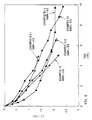
- Figures 2-6 are plots of the log of naphthalene conversion versus time for a number of different catalysts where naphthalene conversion is expressed as the natural logarithm of the naphthalene molar concentration remaining divided by the initial naphthalene molar concentration.
- These cations are mobile and may occupy various exchange sites depending on their radius, charge or degree of hydration, for example. They can also be replaced, to various degrees, by exchange with other cations. Because of the need to maintain electrical neutrality, there is a direct 1:1 relationship between the aluminum content of the framework and the number of positive charges provided by the exchange cations. When the exchange cations are protons, the molecular sieve is acidic. The acidity of the sieve is therefore determined by the amount of proton exchanged for other cations with respect to the amount of aluminum.
- Crystalline molecular sieve structures are often defined in terms of the number of their tetrahedral units (T atoms).
- T atoms tetrahedral units
- the sodalite unit is built from four and six membered oxygen rings.
- the mordenite framework is built from chains of tetrahedra cross linked by oxygen bridges. Each Al or Si tetrahedron is, in addition, part of a five-membered oxygen ring. The chains are then interconnected to obtain the mordenite structure.
- Mordenite is defined as having twelve-membered oxygen rings.
- the mordenite pore structure consists of elliptical and noninterconnected channels parallel to the c axis of the orthorhombic structure with pore aperture dimensions of 6.5 ⁇ and 7.0 ⁇ .
- ZSM-12 belongs structurally to the Mordenite group of zeolites.
- the pore structure of ZSM-12 consists of linear, non-interpenetrating channels which are formed by twelve-membered rings and possess pore aperture dimensions of 5.5 ⁇ , 5.7 ⁇ and 6.2 ⁇ .
- Jacobs, P.A. et al. "Synthesis of High Silica Aluminosilicate Zeolites," Studies in Surface Science and Catalysis #33, Elsevier, 1987 page 301.
- Meier, W.M. "Atlas of Zeolite Structure Types" 2nd ed., Structure Commission of the International Zeolite Association, 1987).
- Offretite is a 12-oxygen ring zeolite with a pore aperture dimension of 6.7 ⁇ and 6.8 ⁇ in which the structure also contains a 14-hedron cage.
- MeAPSO-46 is also a 12-oxygen ring zeolite with a pore aperture dimension of 6.2 ⁇ and 6.4 ⁇ .
- acidic crystalline molecular sieve catalysts containing twelve membered oxygen rings are useful in the isopropylation reaction of naphthyl compounds.
- Pore structure (dimensions and network) varies greatly among zeolites. Without modifications of the zeolite structure, the lowest pore aperture dimension is about 2.6 ⁇ and the highest is 7.4 ⁇ . Pores may lead to linear, parallel, or interconnected channels or may give access to larger intracrystalline cavities, sometimes referred to as cages. For all zeolites, the pore opening is determined by the free aperture of the oxygen ring that limits the pore aperture.
- the free diameter values given in the channel description and on the ring drawings are based upon the atomic coordinates of the type species in the hydrated state and an oxygen radius of 1.35 ⁇ , as determined from x-ray crystallographic data. Both minimum and maximum values are given for noncircular apertures. In some instances, the corresponding interatomic distance vectors are only approximately coplanar; in other cases the plane of the ring is not normal to the direction of the channel. Close inspection of the framework and ring drawings should provide qualitative evidence of these factors. Some ring openings are defined by a very complex arrangement of oxygen atoms we have included references to publications which contain extensive drawings and characterization data. The relevant portions of those references are incorporated herein.
- crystallographic free diameters may depend upon the hydration state of the zeolite particularly for the more flexible frameworks. It should also be borne in mind that effective free diameters can be temperature dependent. Maximum values for the four-, six-, eight-, ten-, and twelve-membered oxygen rings have been calculated to be 2.6 ⁇ , 3.6 ⁇ , 4.2 ⁇ , 6.3 ⁇ and 7.4 ⁇ , respectively.
- pore aperture is intended to refer to both the pore mouth at the external surface of the crystalline structure, and to the intracrystalline channel, exclusive of cages.
- a crystalline molecular sieve is hereinafter characterized by a "pore aperture dimension”
- pore aperture dimension we intend to adopt the geometric dimensional analysis defined as “crystallographic free diameter of channels” in Meier, W.M., Olson, D.H., Atlas of Zeolite Structure Types , (Butterworth's, 1987, 2d Rev. Ed.)
- dimension is preferred over “diameter” because the latter term implies a circular opening, which is not always accurate in crystalline molecular sieves.
- Shape selective reactions occur when the zeolite framework and its pore structure allow substrate molecules of a given size and shape to reach active sites located in the intracrystalline free space, and allow product molecules of a given size and shape to diffuse out of the intracrystalline free space. It is therefore important to characterize accurately the pore structure that is encountered in the various crystalline molecular sieve frameworks.
- interconnecting channels in acidic crystalline molecular sieve catalysts is important in determining their physical and chemical properties.
- Three types of channel systems have been defined: a one dimensional system, such as found in analcime, does not permit intersection of the channels; two dimensional systems can be found in certain zeolites; and, three dimensional systems have intersecting channels.
- the second type consists of three-dimensional, intersecting channels, but the channels are not equidimensional; the pore aperture dimension depends upon the crystallographic direction. See Donald W. Breck, "Zeolite Molecular Sieves: Structure, Chemistry, and Use," at pp. 59-60 (John Wiley & Sons, 1974).
- Crystalline molecular sieves with three-dimensional channels can also contain larger intracrystalline cavities known as cages. These cavities may accommodate substrate molecules and, in principal, play a role in shape selective reactions.
- sodalite has sodalite cages, as does faujasite. Faujasite is a 12-oxygen ring zeolite with a pore aperture dimension of 7.4 ⁇ and also has supercages (26-hedron) with a cage dimension of 11.8 ⁇ .
- Wide Type A Zeolite has cages having free dimension of 11.4 ⁇ . See E.G. Derouane, "Diffusion and Shape-Selective Catalysis in Zeolites," Intercalation Chemistry , at pp. 112-114, Ed. by M. Stanley Whittingham (Academic Press, 1982). See also Thaddeus E. Whyte et al., "Catalytic Materials: Relationship between Structure and Reactivity," at pp. 165-167, ACS Symposium Series 248 , (American Chemical Society, 1984).
- the substrate is a naphthyl compound selected from the group comprising naphthalene, monoisopropylnaphthalene and mixtures thereof.
- the isopropylation of naphthalene is known to occur in stepwise manner beginning with monoalkylates, dialkylates, trialkylates, etc. The exact scheme of this progression is set forth more completely in Figure 1 which also reveals the interconnectivity of the various alkylated species.
- Of particular interest to the present invention are the different routes and intermediates to the 2,6-diisopropylnaphthalene isomer. This isomer can be formed directly by the ⁇ isopropylation of the ⁇ -monoalkylate or by isomerization of ⁇ , ⁇ and ⁇ , ⁇ dialkylates.
- the equilibrium data for the monoisopropylation of naphthalene is important since the 2,6 isomer is the ⁇ , ⁇ product and because the ⁇ isomer is the preferred thermodynamic species for the monoalkylate. It has been shown by Olah (U.S. Patent No. 4,288,646) that the concentration of the ⁇ product increases with the stearic bulk of the substituent for monoalkylates of naphthalene. See Table 2. This is predicted to hold true for dialkylates as well.
- 2,6-diisopropylnaphthalene For the production of 2,6-diisopropylnaphthalene, there are two important measures of the distribution of diisopropylated species obtained. One is the % of 2,6-diisopropylated naphthalene among all diisopropylated naphthalenes. The other is the ratio of the 2,6- and 2,7- isomers. The values of these measures in an equilibrium distribution of diisopropylated naphthalene species have been determined using silica-alumina, which is a non-shape selective catalyst (see Example 1). A distribution at equilibrium contains 39% 2,6-diisopropylnaphthalene among all diisopropylnaphthalenes and a 2,6-/2,7- isomer ratio of 1.0.
- the use of a shape selective acidic crystalline molecular sieve catalyst provides a kinetic distribution of diisopropylnaphthalenes substantially different from the equilibrium distribution. Kinetically, the 2,6 isomer is more rapidly obtained from the ⁇ monoiisopropylnaphthalene precursor than the 2,7 isomer. Since the ⁇ isomer is the precursor for the desired 2,6 isomer, an increase in the amount of ⁇ isomer substrate will ultimately improve both the yield and selectivity to the desired 2,6 isomer.
- naphthalene was alkylated using a non-shape selective catalyst under equilibrium conditions such that thermodynamic equilibration of products was obtained.
- the present invention utilizes an acidic crystalline molecular sieve catalyst which has twelve-membered oxygen rings and a pore aperture dimension between 5.5 ⁇ and 7.0 ⁇ .
- a naphthyl compound selected from the group comprising naphthalene, monoisopropylnaphthalene and mixtures thereof is fed to an alkylation reactor.
- the naphthyl compound is reacted with a propyl containing moiety, preferably propylene, in the presence of the acidic crystalline molecular sieve catalyst having twelve-membered oxygen rings and a pore aperture width between 5.5 ⁇ and 7.0 ⁇ , preferably between 6.5 ⁇ and 7.0 ⁇ .
- the alkylation reaction is conducted at a propylene/naphthyl compound feed ratio between 0.1 and 10, preferably between 1.0 and 2.0, and elevated temperatures and pressures, generally between 100°C and 400°C, preferably between 250°C and 350°C, and between 1 and 100 atmospheres, preferably 1 to 10 atmospheres.
- a diisopropylnaphthalene product which typically contains greater than 39 mole percent diisopropylnaphthalene and a ratio of 2,6-diisopropylnaphthalene to 2,7-diisopropylnaphthalene greater than 1.0.
- the acidic crystalline molecular sieve catalyst is synthetic Mordenite.
- Substantially pure 2,6-diisopropylnaphthalene can be recovered from the diisopropylnaphthalene products in a multi-stage separation scheme.
- the diisopropylnaphthalene product is first fractionally distilled to obtain a low boiling fraction which contains unreacted naphthalene and monoisopropylnaphthalene, a middle fraction containing the diisopropylnaphthalenes, and a high boiling fraction containing triisopropylnaphthalene and tetraisopropylnaphthalenes.
- 2,6-diisopropylnaphthalene is obtained from the middle fraction by cooling the liquid to a temperature between 0°C and - 20°C to fractionally crystallize the 2,6-isomer from the other diisopropylnaphthalenes.
- the mother liquor from the crystallization can be subjected to a second crystallization step, or it can then be combined with the low boiling and high boiling fractions, and subjected to transalkylation before recycle to the alkylation reactor, along with fresh naphthalene.
- the recycle stream from the separations section is combined with a fresh naphthalene feed stream in an equilibration reactor.
- This recycle mixture containing naphthalene, monoisopropylnaphthalenes, diisopropylnaphthalenes, and higher alkylates is brought to thermodynamic equilibrium over a solid acid catalyst.
- the equilibrium mixture contains ⁇ monoisopropylnaphthalene as the predominant product.
- the equilibrated feed, enriched in ⁇ monoisopropylnaphthalene is then passed to the alkylation reactor where it is combined with propylene at a mole ratio of about one to one.
- naphthyl compound throughout this specification contemplates both of the above described process schemes, as well as fresh naphthalene feed by itself.
- While synthetic Mordenite has been described with reference to a particularly preferred embodiment of the present invention, there are other catalysts which can be used in the alkylation reaction to achieve an alkylation product enriched in both total diisopropylnaphthalenes and in the desired 2,6-diisopropylnaphthalene.
- Mordenite When Mordenite is used, only external surface acid site deactivation is required. (See below).
- ZSM-12 can also be used without modification analogous to Mordenite.
- Offretite and MeAPSO-46 also fall into the first class of catalysts whose pore aperture dimensions are between 5.5 ⁇ and 7.0 ⁇ , prior to any modification to the pores.
- the preferred Si/Al ratio in Zeolite L is 3.0.
- the structure of Zeolite L consists of columns of symmetrical e-D6R-e units crosslinked to others by single oxygen bridges; planar 12-membered rings produce wide channels parallel to the c-axis.
- the pore aperture of zeolite L determined by x-ray crystallography was found to be 7.1 ⁇ . A more detailed description of the structure of zeolite L can be found in D.W. Breck, John Wiley & Sons, page 113, 1974.
- SAPO-5 is structurally analogous to AlPO4-5.
- AlPO4-5 is a 12-ring sieve with a pore aperture of 7.3 ⁇ .
- a more detailed description of the structure can be found in J.M. Bennett et al., Intrazeolite Chemistry , ACS Symposium Series 218, American Chemical Society, page 79, 109, 1983.
- shape selective catalysts to enhance the conversion of substrate to the desired isomer involves the use of a catalyst whose intracrystalline structure permits diffusion of the substrate and the desired isomer under reaction conditions.
- certain catalyst modifications have been found to provide a shape selective catalyst particularly beneficial to the conversion of naphthalene and monoisopropylnaphthalene to the desired 2,6-diisopropylnaphthalene product.
- dealumination, calcination, and external and internal surface acid site modifications are dealumination, calcination, and external and internal surface acid site modifications.
- the preferred zeolites may be purchased in cationic form. Typically only an ion exchange is needed to convert these to the hydrogen form.
- the preferred catalysts Mordenite and ZSM-12, as well as Offretite and faujasite, can be optimized to yield greater selectivities to the desired 2,6-diisopropylnaphthalene without substantially altering its pore aperture dimensions.
- One such modification to the preferred catalysts is to dealuminate.
- Dealumination of acidic crystalline molecular sieve materials can be achieved by exposing the solid catalyst to mineral acids such as HCl. The desired degree of dealumination will dictate the strength of acid used and the time during which the crystalline structure is exposed to the acid. Nevertheless, our desired method of dealumination is via steam treatment followed by a mild acid treatment and calcination (as discussed below).
- the preferred steam treatment parameters are as follows: Parameter Range Preferred More Preferred Temperature °C 200°-1000° 300°-700° 400°-600° total pressure, ATM 0.001-15 0.001-5 0.2-2 carrier gas flowing gas inert (N2, He) None length of time 0-24 hrs. 10 min.-4 hr. 30 min.-1 hr. # of cycles several 1-2 1-2 steam partial press. ATM. 0.001-15 0.001-5 0.1-2
- the nest step should desirably be a mild acid treatment or lead.
- the preferred acid leach conditions are as follows: Parameter Range Preferred More Preferred Acid type --- inorganic acid HCl, HNO3 concentration --- 0.01 - 2M 0.1-1.0N Temperature, °C 10-100°C 80-100 °C 100°C Time 5 min-24 hrs. 2-10 hrs. 2-6 hrs.
- Zeolites having certain NMR characteristics in conjunction with the preferred Si/Al ratio discussed below, have been found to be especially suitable for the disclosed process. Specifically, materials in which the ratio of the broad component of the 27Al-MAS-NMR to the narrow component is less than 5, have been shown to be particularly preferred. (See below CATALYST TESTING AND EVALUATION METHODS.) In general, this ratio can be considered a measure of the non-framework aluminum (from whatever source) found in the interstices of the zeolite as compared to the aluminum in the zeolite framework.
- One method of dealumination which has been found to produce such a preferred material is a steam treatment (in one or more stages) followed by a mild acid leach.
- Dealumination according to the instant invention is intended to achieve Si/Al ratio between 5 and 100, preferably between 5 and 50, most preferably, at least 15 to 35. Additionally, the noted 27Al-MAS-NMR ratio for these materials is between 0 and 5, preferably between 0 and 2, and most preferably between 0 and 1. Dealumination can also be applied to the second class of molecular sieve material whose pore aperture dimensions exceed 7.0 ⁇ .
- a dealuminated crystalline molecular sieve can be calcined at temperatures between 400° and 1000° C preferably between 400°C and 600°C. Calcination serves to dehydrate or "heal” Si-OH bonds or “nests” after dealumination. healing these nests provides for a more uniform pore structure within the crystalline material, leading to structural stability and ultimately resulting in improved selectivity.
- the calcination conditions of a catalyst can critically effect the catalytic activity.
- the selection calcination gas for example oxygen or nitrogen, can effect catalyst species differently.
- calcination temperatures for crystalline molecular sieve catalysts can vary from 300°C to 1000°C.
- the optimal temperature ranges was found experimentally to lie between 400°C and 600°C, but preferentially at 500°C. (Mathur, Kuldeep, Narain, Ph.D. Thesis, University of Pittsburgh, 1977).
- H-Mordenite removal of extra and intra crystalline water can be accomplished effectively in presence of an atmosphere of oxygen or nitrogen.
- the calcination temperature and the calcination gas are both important.
- a nitrogen atmosphere is first used so that a minimal amount of water is obtained when bringing the catalyst to calcination temperature. After a sufficient time to carbonize the organic residue, the atmosphere is changed to oxygen at a temperature sufficient to combust the carbonized residue to CO2 while minimizing water formation.
- Another catalyst treatment involves catalyst external surface acid site removal or blockage.
- the reason for external surface acid removal or blockage is that inactivating the external surface of Zeolite catalyst will increase its shape-selective character as otherwise, the external surface acts as a non-shape selective catalyst.
- An additional reason for external surface acid site blockage or removal relates to caking on the catalyst surface.
- Those crystalline molecular sieves which have been adequately modified by internal acid site treatment will perform in the selective isopropylation of naphthalene to provide a diisopropylnaphthalene which contains at least 39 mole percent of 2,6-diisopropylnaphthalene, and a 2,6-/2,7-diisopropylnaphthalene mole ratio greater than 1.0.
- crystalline molecular sieves may be treated to modify internal acid sites by contact with a deactivating reagents selected from the group consisting of the halogen, hydridic and organic derivatives of Groups IIIA, IVA, IVB and VA.
- a deactivating reagents selected from the group consisting of the halogen, hydridic and organic derivatives of Groups IIIA, IVA, IVB and VA.
- Preferred embodiments of the internal acid site deactivating reagents include B2H6, SiH4 and PH3.
- Si(OCH3)4 can be deposited irreversibly on zeolite, without entering the intracrystalline pores. See Niwa, M. et al., J. Chem.Soc. , Faraday Trans. , 1, 1984, 80 , 3135-3145; Niwa, M. et al., "Modification of H-Mordenite by Vapour-phase Deposition Method," J. Chem.Soc.Commun. , 1982, pp. 819-20.
- deactivating metal chlorides such as SiCl4, GeCl4, TiCl4 and SnCl4 can be effective to modify pore mouth structures without inactivating internal surface acid sites.
- metal molecules with a range of molecular dimensions, can be selected to be larger than the catalyst pore aperture, thereby preventing substantial diffusion into the internal pore. See Hidalgo, C.V. et al., Zeolites , 1984, 4 , April, p. 175-180.
- the deactivating agents can be contacted with the molecular sieve in either solution or vapor phase.
- External surface acid site deactivation can be obtained by either acid site blockage or acid removal.
- the deactivating agent should be selected to preclude internal surface diffusion. This limitation is easily met by the use of deactivation agents in either liquid or gas phase, whose molecules are too large to fit within even the largest pores of known zeolites.
- One such molecule is triphenylchlorosilane. See Martens, J.A. et al., Zeolites , 1984, 4 , April, p. 98-100.
- the propylene feed system consisted of a heated reservoir of propylene gas.
- the propylene was manually introduced into the reactor so that a constant pressure was maintained. In this way the propylene was fed as fast as the catalyst could consume it.
- a typical run involved 90 grams of naphthalene and 1.0 g zeolite catalyst or 123 grams ⁇ -isopropylnaphthalene and 1.0 g zeolite.
- the autoclave was charged with either feed and the catalyst. The contents were flushed with nitrogen several times then pressured to 12 psig with nitrogen. With slow stirring the autoclave was heated to the desired reaction temperature at which time stirring was increased to the maximum setting (ca. 3200 rpm). Propylene was then added from a heated reservoir to a constant pressure of ca. 70 psig. Samples were taken every hour and analyzed by GC.
- the reaction temperature range was preferably between 200-300°C. However, as low as 100°C and as high as 400°C could be considered.
- H-Mordenite catalysts were characterized by 29Si MAS and CPMAS and 27Al MAS NMR using a Bruker MSL-400 spectrometer.
- the distribution of framework and non-framework aluminum in the mordenite samples was determined by 27Al MAS NMR. All spectra were obtained on a Bruker MSL400 spectrometer. The resonance frequency for aluminum was 104.261 MHz. Samples were spun at 10 kHz in 4mm zirconia rotors in a Bruker double air bearing CPMAS probe. The radio frequency power was adjusted to give a 7 ⁇ sec 90° pulse on an aqueous solution of AlCl3. The signal from this solution sample was also used as a chemical shift reference and set to 0.0 ppm. An excitation pulse length of 3 ⁇ sec (35° tip angle) was used for all experimental determinations of aluminum distribution.
- the exact procedure for determining aluminum distribution is as follows.
- the 27Al MAS NMR spectrum of the sample is obtained per the description above.
- the FID may contain two components; a fast decaying signal (linewidth typically 20 kHz) and a slow decaying component (linewidth typically 1 kHz).
- Fourier transformation of the FID's show that the narrower signal has a chemical shift of 54-55 ppm whereas the broad signal has a chemical shift of approximately 0 ppm.
- the narrower component corresponds to the aluminum in the zeolite framework.
- Si/Al ratios were obtained using ICP analyses. Surface area data were obtained using BET nitrogen adsorption measurements.
- Solid state MAS and CPMAS NMR can be particularly useful in determining the effectiveness of calcination. Calcination serves to dehydrate or "heal" Si-OH bonds or "nests". healing these nests provides for a more uniform pore structure, which improves selectivity, and also gives a more stable structure. From the CPMAS spectra we observed only those silicon atoms which were in close proximity to protons. Typically, this requires that the silicon be either a siloxyl silicon or within a few angstroms of a siloxyl group. Thus, the intensity of the silicon resonance is a direct measurement of the amount of Si-OH bonds present in the zeolite. As the calcination temperature is increased, the intensity of the peak decreases.
- the CPMAS spectrum of a dealuminated mordenite calcined at 400°C exhibits a noticeable silicon resonance indicating a significant amount of Si-OH nests remaining in the structure.
- the CPMAS spectrum of a similar mordenite calcined at 500°C contains only a negligible peak which indicates a near absence of Si-OH nests.
- the solid can be subjected to a number of steam calcination and acid washing cycles. After drying the solid at 110°C the solid can be reintroduced to the fritted quartz tube for an additional steam calcination.
- Catalyst Type1 Si/Al Ratio Conv % mol% Mono mol% Di mol% Poly 2,6/2,7 Ratio %2,6 in Di One Cycle 400°C 24.6 35.6 81.0 18.9 0.70 2.91 67.9 94.7 30.7 66.2 2.98 2.29 59.6
- Two Cycles 400°C 35.2 15.4 90.4 9.5 0.0 2.90 67.1 37.2 81.1 18.9 0.0 2.33 63.1
- One Cycle 500°C 20.8 43.4 74.6 25.3 0.0 2.72 64.1 92.6 34.9 60.3 4.71 2.35 57.8
- Toyo Soda or Norton H-Mordenite were dealuminated following a procedure similar to that of Niwa ( Chem Lett. 1987, 1637). Five grams of zeolite were dealuminated with a hydrochloric acid solution at 93°C. After dealumination, the solution was filtered and the solid washed with distilled water until no chloride was detected with a AgNO3 solution, followed by drying at 120C° and calcining at 500°C for one hour.
- naphthalene was alkylated under a constant propylene pressure of ca. 70 psig at 275°C using 1.0 gram of either Toyo Soda H-mordenite dealuminated by refluxing with 0.5 M hydrochloric acid for four hours or H-ZSM-12 and both calcined at 400°C for eight hours.
- the data in Table 10 illustrate the superiority of 12 ring zeolites having pore apertures of 5.5 ⁇ to 7.0 ⁇ (for example, Mordenite and ZSM-12) over a 10-ring zeolite (ZSM-5) and over 12-ring zeolites having larger pore apertures (for example, Zeolite L and Zeolite Beta) in the isopropylation of naphthalene to produce diisopropylnaphthalene enriched in 2,6-isomer.
- Only the 12-ring zeolites having pore apertures of 5.5 ⁇ to 7.0 ⁇ gave both >39% 2,6-diisopropylnaphthalene among all diisopropylnaphthalene and 2,6/2,7 isomer ratio >1.0.
- Example 7 Each of the samples in Example 7 were then tested for activity in a manner similar to that discussed above.
- autoclave Into a stirred 300 cc. autoclave were introduced 90 grams of naphthalene and 1.0 gram of zeolite sample. After an initial pressurization of nitrogen, the autoclave was heated to 275°C. Propylene gas was continuously introduced and the reactor pressure was manually maintained at about 110 psig. The reactor temperature was maintained at about 275°C. Samples were taken about once an hour and analyzed using a gas chromatograph.
- the first sample (a Toyo Soda Na-Mordenite) was exchanged with 1N-HCl for a period of 30 minutes, rinsed, and calcined for two hours in an oven at 700°C.
- the treated sample is Example 9(a).
- the procedure produced a zeolite having an Si/Al ratio of 14, below the desired range.
- Example 9(a) The second sample began as Example 9(a). It was dealuminated by reflexing the material under 6N-HNO3 for two hours. The material was washed, dried, and calcined in an oven at 700°C for two hours. This procedure gave a dealuminated material (Example 9(b)) having a Si/Al ratio of 63, a value above the desired range.
- the third material began as a Toyo Soda H-Mordenite. It was calcined in air at 700°C for two hours, refluxed in 6N-HNO3 for two hours, washed, rinsed, and again calcined in air at 700°C for two hours. This procedure resulted in a material (Example 9(c)) having a Si/Al ratio of 120, a value above the desired range of this invention but within the most preferred range of EPA '907.
- the conversion in this run may be found plotted in natural log form in Figure 4.
- the conversion information from a first run using another portion of the Example 7(a) catalyst is placed in this Figure 4 for ease of comparison. It is clear that the conversion for the second run remained at a level essentially equal to that of the first run.
- catalysts of Examples 9(b) and 9(c) (Si/Al ratios of 63 and 120 respectively) were analyzed using the 27Si MAN NMR techniques noted above. Additionally, three catalysts (including Example 7(c)) within the most preferred Si/Al ratios of the present invention were similarly analyzed. The following examples illustrate the relationship amongst the NMR ratio, Si/Al ratio, and catalyst effectiveness.
- a sample of Na-mordenite was exchanged twice with an appropriate amount of 5N NH4Cl. After draining and rinsing, the material was steamed for 30 minutes with 400°C steam and acid leached with 0.5N HCl for four hours. Finally, the washed mordenite was calcined for 12 hours at 500°C in air. The resulting material had a Si/Al ratio of 17.3 and a NMR ratio of 0.8.
- Example 13 a sample of Na-mordenite was treated using the procedure of Example 13.
- the resulting material had a Si/Al ratio of 27.9 and an NMR ratio of 0.3.
- Figure 6 also contains the conversion lines for preferred catalyst Example 7(c), and catalysts which are outside the preferred Si/Al and NMR ratios, i.e., Examples 9(b) and 9(c).
- the comparative data for Figure 6 may be summarized as follows: TABLE 23 Catalyst (Example #) Si/Al NMR Ratio 9(b) 63 5.6 9(c) 120 8.5 13 17.3 0.8 14 27.9 0.3 7(c) 29.8 0.6
- the catalyst within the disclosed NMR ratio criteria of this invention show clearly enhanced reaction longevity.
Landscapes
- Chemical & Material Sciences (AREA)
- Organic Chemistry (AREA)
- Chemical Kinetics & Catalysis (AREA)
- Organic Low-Molecular-Weight Compounds And Preparation Thereof (AREA)
- Low-Molecular Organic Synthesis Reactions Using Catalysts (AREA)
- Catalysts (AREA)
Abstract
Description
- This invention relates generally to isopropylation of naphthyl compounds to obtain diisopropylnaphthalenes, and more specifically this invention relates to the use of shape selective catalysts whose pores are configured to selectively obtain the desired 2,6-diisopropylnaphthalene isomer while minimizing the production of undesirable diisopropylnaphthalene isomers, triisopropylnaphthalenes and tetraisopropylnaphthalenes.
- A new class of thermoplastic polymers, known as thermotropic liquid crystal polymers ("LCP"), has recently been introduced to the marketplace. These polymers combine the advantageous feature of moldability with multidirectional mechanical strength superior to other thermoplastics formerly available. Generally, these new LCP materials are polyesters made up of planar, linear disubstituted aromatics. Examples of some LCPs currently in use are p-hydroxy-benzoic acid, p-hydroquinone, 4,4'-dihydroxybiphenyl and 2-hydroxy, 6-napthenoic acid.
- Other LCPs would appear commercially attractive if either 2,6-dihydroxynaphthalene or 2,6-dicarboxynaphthalene were readily available. Unfortunately, these materials are not commercially produced because cheap, readily available feed stocks do not exist. A viable feed stock, which is convertible into either the dihydroxy or dicarboxy monomers, based upon known technology, is 2,6-diisopropylnaphthalene.
- Before proceeding with any description of the isopropylation reaction system, it is important to first review the nomenclature and numbering scheme for the various substituted naphthalene isomers.
Equation 1 shows the positional reference numbers. Non-hydrogen bearing carbons are unnumbered because no substitution takes place in these positions.
There are two possible isomers which are formed in the monoisopropylation of naphthalene. Substitution occurs only in the 1 and 2 positions and is respectively denoted α and β. Any monoisopropyl substitution which takes place inpositions 3 through 8 is identical to the α and β positions due to their interrelationship in symmetry. - Multiple naphthalene isopropylation is usually denoted by the position number. Some literature references follow the numbering convention just described, while other references discuss the isomers in terms of the α and β terminology. Thus, the 2,6 isomer is the double β isomer.
- Table 1 describes the statistical distribution of the various diisopropylates using these designations, and assuming that no ortho diisopropylation occurs, e.g., 1,2-, 2,3- and 1,8-diisopropylnaphthalene. In Table 1, it is shown that there are seven disubstituted isomers, of which two of them, (2,6- and 2,7-) are the double β product.
TABLE 1 TYPE ISOMER EQUIVALENTS NORMALIZED FREQUENCY α, β 1,6 1,6=4,7=2,5=3,8 2 1,7 1,7=4,6=3,5=2,8 2 1,3 1,3=2,4=5,7=6,8 2 α, α 1,4 1,4=5,8 1 1,5 1,5=4,8 1 β, β 2,6 2,6=3,7 1 2,7 2,7=3,6 1 - In any manufacture of diisopropylnaphthalene, it is clear that some monoisopropyl- and triisopropyl-products and a mix of diisopropyl isomers will also be obtained. In any crude diisopropylnaphthalene product which is not particularly enriched in one diisopropylnaphthalene isomer, isomer separation by thermal distillation is very inefficient and difficult because the boiling points of 2,6-diisopropylnaphthalene and 2,7-diisopropylnaphthalene are very close. Similarly, diisopropylnaphthalene isomer separation by fractional crystallization using melting points is inefficient and suffers from yield problems because of the loss of the desired product in the mother liquor, and because of large recycle streams.
- The present invention provides a process for reacting a naphthyl compound selected from the group comprising naphthalene, monoisopropylnaphthalene and mixtures thereof, with a propyl containing moiety, preferably propylene, to obtain diisopropylnaphthalene enriched in 2,6-diisopropylnaphthalene, above its expected equilibrium proportion. The shape selective catalyst for this process comprises an acidic crystalline molecular sieve having twelve-membered oxygen rings and pore apertures with dimensions between 5.5Å and 7.0Å. Particularly, preferred shape selective materials are those having specific NMR characteristic which are believed to represent materials having very little non-framework aluminum in the interstices of the materials. Preferably, the 2,6-diisopropylnaphthalene isomer comprises greater than 39 mole percent of the total diisopropylnaphthalenes obtained. It is also preferred that the ratio of 2,6-diisopropylnaphthalene to 2,7-diisopropylnaphthalene in the reaction product is greater than 1.0, preferably greater than 1.2.
- Therefore, it is an object of this invention to provide an efficient and selective process for the isopropylation of naphthyl compounds to obtain a higher yield of 2,6 diisopropylnaphthalene in relation to 2,7-diisopropylnaphthalene, while simultaneously minimizing the formation of unwanted byproducts.
- It is a further object of this invention to provide shape selective catalysts whose pore size and configuration are designed to maximize the yield of the desired 2,6-diisopropylnaphthalene isomer relative to the sum of the other diisopropylnaphthalenes, while minimizing formation of higher substituted species.
- It is still a further object of this invention to provide a process to selectively obtain enhanced levels of 2,6-diisopropylnaphthalene using a naphthyl product feed stream comprising naphthalene, monoisopropylnaphthalene, and mixtures thereof.
- These and further objects of the invention will become apparent to those of ordinary skill in the art with reference to the following description.
- A process for obtaining diisopropylnaphthalene enriched in 2,6-diisopropylnaphthalene is described which comprises the steps of providing a naphthyl compound selected from naphthalene, monoisopropylnaphthalene and mixtures thereof, and a propyl containing moiety, preferably propylene, to an alkylation reactor. A suitable catalyst is one comprising an acidic crystalline molecular sieve having twelve membered oxygen rings and pore aperture dimensions between 5.5Å and 7.0Å which has been dealuminated to a Si/Al ratio of between 15 and 35 or which has been modified to obtain a Si/Al ratio of between 15 and 35 and wherein the ratio of the broad component of the ²⁷Al-MAJ-NMR to the narrow component is less than 5. The naphthyl compound is reacted with a propyl containing moiety such as propylchloride, propylalcohol, or preferably propylene, in the presence of the provided catalyst under conditions sufficient to convert said naphthyl compound and propyl containing moiety to diisopropylnaphthalene. In a preferred embodiment, 2,6-diisopropylnaphthalene comprises at least 39 mole percent of the diisopropylnaphthalenes obtained according to the process. In another preferred embodiment, the ratio of 2,6-diisopropylnaphthalene to 2,7-diisopropylnaphthalene which is obtained according to the process is greater than 1.0, preferably greater than 1.2. Crystalline molecular sieve catalysts are selected from MeAPSO-46, Offretite, ZSM-12 and synthetic Mordenite. Preferred catalysts are synthetic Mordenite and ZSM-12, with pore aperture dimensions of 6.5Å, 7.0Å and 5.5Å, 5.7Å and 6.2Å, respectively. These preferred catalysts can be used in the isopropylation reaction without any pretreatment to modify the pore aperture dimensions. Synthetic Mordenite is particularly preferred. An especially desirable material is a synthetic Mordenite which has been dealuminated to a Si/Al ratio between about 15 and 35 and which display certain characteristic NMR spectra. Also preferred are those materials which have been surface-deactivated in the manner specified below. Other useful catalysts may be obtained by treatment of an acidic crystalline molecular sieve having pore aperture dimensions greater than 7.0Å selected from Zeolite L, Zeolite Beta, faujasite and SAPO-5, to reduce the dimensions of the pore aperture.
- Figure 1 is a stepwise description of the isopropylation of naphthalene to the mono-, di-, tri-, and higher polyalkylnaphthalenes.
- Figures 2-6 are plots of the log of naphthalene conversion versus time for a number of different catalysts where naphthalene conversion is expressed as the natural logarithm of the naphthalene molar concentration remaining divided by the initial naphthalene molar concentration.
- Before proceeding with a detailed description of the present invention, it is first necessary to define a series of terms which relate to the physical characteristics and configuration of the acidic crystalline molecular sieve catalysts used in the present invention. Much of this terminology arises out of the literature concerning those crystalline aluminosilicate polymers known as zeolites. These acidic crystalline molecular sieve structures are obtained by the building of a three dimensional network of AlO₄ and SiO₄ tetrahedra linked by the sharing of oxygen atoms. The framework thus obtained contains pores, channels and cages or interconnected voids. As trivalent aluminum ions replace tetravalent silicon ions at lattice positions, the network bears a net negative charge, which must be compensated for by counterions (cations). These cations are mobile and may occupy various exchange sites depending on their radius, charge or degree of hydration, for example. They can also be replaced, to various degrees, by exchange with other cations. Because of the need to maintain electrical neutrality, there is a direct 1:1 relationship between the aluminum content of the framework and the number of positive charges provided by the exchange cations. When the exchange cations are protons, the molecular sieve is acidic. The acidity of the sieve is therefore determined by the amount of proton exchanged for other cations with respect to the amount of aluminum.
- Crystalline molecular sieve structures are often defined in terms of the number of their tetrahedral units (T atoms). For example, in sodalite the silica and alumina tetrahedra are linked together to form a cubooctahedron, an octahedron truncated perpendicularly to all C₄ - axes. The sodalite unit is built from four and six membered oxygen rings. The mordenite framework is built from chains of tetrahedra cross linked by oxygen bridges. Each Al or Si tetrahedron is, in addition, part of a five-membered oxygen ring. The chains are then interconnected to obtain the mordenite structure. Mordenite is defined as having twelve-membered oxygen rings. The mordenite pore structure consists of elliptical and noninterconnected channels parallel to the c axis of the orthorhombic structure with pore aperture dimensions of 6.5Å and 7.0Å. A more complete characterization of the zeolites can be found in E.G. Derouane, "Diffusion and Shape-Selective Catalysis in Zeolites," Intercalation Chemistry, Ed. by M. Stanley Whittingham (Academic Press, 1982).
- ZSM-12 belongs structurally to the Mordenite group of zeolites. The pore structure of ZSM-12 consists of linear, non-interpenetrating channels which are formed by twelve-membered rings and possess pore aperture dimensions of 5.5Å, 5.7Å and 6.2Å. See Jacobs, P.A. et al., "Synthesis of High Silica Aluminosilicate Zeolites," Studies in Surface Science and Catalysis #33, Elsevier, 1987 page 301. See also, Meier, W.M., "Atlas of Zeolite Structure Types" 2nd ed., Structure Commission of the International Zeolite Association, 1987). Offretite is a 12-oxygen ring zeolite with a pore aperture dimension of 6.7Å and 6.8Å in which the structure also contains a 14-hedron cage.
- MeAPSO-46 is also a 12-oxygen ring zeolite with a pore aperture dimension of 6.2Å and 6.4Å.
- According to the present invention, acidic crystalline molecular sieve catalysts containing twelve membered oxygen rings are useful in the isopropylation reaction of naphthyl compounds.
- Pore structure (dimensions and network) varies greatly among zeolites. Without modifications of the zeolite structure, the lowest pore aperture dimension is about 2.6Å and the highest is 7.4Å. Pores may lead to linear, parallel, or interconnected channels or may give access to larger intracrystalline cavities, sometimes referred to as cages. For all zeolites, the pore opening is determined by the free aperture of the oxygen ring that limits the pore aperture.
- The free diameter values given in the channel description and on the ring drawings (not shown here) are based upon the atomic coordinates of the type species in the hydrated state and an oxygen radius of 1.35Å, as determined from x-ray crystallographic data. Both minimum and maximum values are given for noncircular apertures. In some instances, the corresponding interatomic distance vectors are only approximately coplanar; in other cases the plane of the ring is not normal to the direction of the channel. Close inspection of the framework and ring drawings should provide qualitative evidence of these factors. Some ring openings are defined by a very complex arrangement of oxygen atoms we have included references to publications which contain extensive drawings and characterization data. The relevant portions of those references are incorporated herein. It should be noted that crystallographic free diameters may depend upon the hydration state of the zeolite particularly for the more flexible frameworks. It should also be borne in mind that effective free diameters can be temperature dependent. Maximum values for the four-, six-, eight-, ten-, and twelve-membered oxygen rings have been calculated to be 2.6Å, 3.6Å, 4.2Å, 6.3Å and 7.4Å, respectively.
- As used throughout the instant specification, the term "pore aperture" is intended to refer to both the pore mouth at the external surface of the crystalline structure, and to the intracrystalline channel, exclusive of cages. When a crystalline molecular sieve is hereinafter characterized by a "pore aperture dimension," we intend to adopt the geometric dimensional analysis defined as "crystallographic free diameter of channels" in Meier, W.M., Olson, D.H., Atlas of Zeolite Structure Types, (Butterworth's, 1987, 2d Rev. Ed.) The term "dimension" is preferred over "diameter" because the latter term implies a circular opening, which is not always accurate in crystalline molecular sieves.
- Shape selective reactions occur when the zeolite framework and its pore structure allow substrate molecules of a given size and shape to reach active sites located in the intracrystalline free space, and allow product molecules of a given size and shape to diffuse out of the intracrystalline free space. It is therefore important to characterize accurately the pore structure that is encountered in the various crystalline molecular sieve frameworks.
- The nature of interconnecting channels in acidic crystalline molecular sieve catalysts is important in determining their physical and chemical properties. Three types of channel systems have been defined: a one dimensional system, such as found in analcime, does not permit intersection of the channels; two dimensional systems can be found in certain zeolites; and, three dimensional systems have intersecting channels. There are two types of three dimensional channels; in one, the channels are equidimensional, i.e., the pore aperture dimension of all the channels is equal, regardless of the direction. The second type consists of three-dimensional, intersecting channels, but the channels are not equidimensional; the pore aperture dimension depends upon the crystallographic direction. See Donald W. Breck, "Zeolite Molecular Sieves: Structure, Chemistry, and Use," at pp. 59-60 (John Wiley & Sons, 1974).
- Crystalline molecular sieves with three-dimensional channels can also contain larger intracrystalline cavities known as cages. These cavities may accommodate substrate molecules and, in principal, play a role in shape selective reactions. For example, sodalite has sodalite cages, as does faujasite. Faujasite is a 12-oxygen ring zeolite with a pore aperture dimension of 7.4Å and also has supercages (26-hedron) with a cage dimension of 11.8Å. Wide Type A Zeolite has cages having free dimension of 11.4Å. See E.G. Derouane, "Diffusion and Shape-Selective Catalysis in Zeolites," Intercalation Chemistry, at pp. 112-114, Ed. by M. Stanley Whittingham (Academic Press, 1982). See also Thaddeus E. Whyte et al., "Catalytic Materials: Relationship between Structure and Reactivity," at pp. 165-167, ACS Symposium Series 248, (American Chemical Society, 1984).
- Having defined some of the terms used to describe the crystalline molecular sieve catalyst component, it is time to turn to the organic substrate for the alkylation reaction system of the instant invention. The substrate is a naphthyl compound selected from the group comprising naphthalene, monoisopropylnaphthalene and mixtures thereof. The isopropylation of naphthalene is known to occur in stepwise manner beginning with monoalkylates, dialkylates, trialkylates, etc. The exact scheme of this progression is set forth more completely in Figure 1 which also reveals the interconnectivity of the various alkylated species. Of particular interest to the present invention are the different routes and intermediates to the 2,6-diisopropylnaphthalene isomer. This isomer can be formed directly by the β isopropylation of the β-monoalkylate or by isomerization of α,α and α,β dialkylates.
- The equilibrium data for the monoisopropylation of naphthalene is important since the 2,6 isomer is the β,β product and because the β isomer is the preferred thermodynamic species for the monoalkylate. It has been shown by Olah (U.S. Patent No. 4,288,646) that the concentration of the β product increases with the stearic bulk of the substituent for monoalkylates of naphthalene. See Table 2. This is predicted to hold true for dialkylates as well.
TABLE 2 Equilibrium Composition of Mono-Alkylnaphthalene Alkyl α, % β, % Methyl 24.5 75.5 Ethyl 9.5 90.5 Isopropyl 1.5 98.5 tert- Butyl 0 100 - In the prior art, a considerable number of catalysts have been shown to be effective for the monoisopropylation of naphthalene. (See Table 3.) An equilibrium distribution of products for the monoalkylation has been obtained over zeolite catalysts. (Kemme, U.S. Patent No. 4,026,959.) It is shown that the concentration of the β isomer is a function of the nature of the alkylation catalyst and the reaction operating conditions. It has also been shown that the isomerization of α to β was dependent upon temperature, catalyst charge, time and substrate water content.
TABLE 3 Monoisopropylation of Naphthalene with Propylene over Various Catalysts Catalyst Solvent Reaction Temp °C α + β Yield Product Composition % α β Nafion-H --- 220 37 10 90 HF heptane 78 91.2 3 97 H₃PO₄/Kie- --- 200 36 73 27 selguhr H₂SO₄ --- 10 90 54 36 AlCl₃ --- 100 -- 4 96 RE-Y --- 218 93 -- -- BF₃·Et₂O --- -10 69 70 30 - Few literature references, however, describe catalysts or conditions for the direct preparation of 2,6 diisopropylnaphthalene. Teijin describes the preparation of the di-β product using an AlCl₃ catalyst by direct alkylation (Japanese Patent J75011379-B) or via transalkylation (Japanese Patent J75010586-B.) Haseltine (U.S. Patent No. 4,064,068) teaches the equilibrium product composition for about 2:1 propylene/ naphthalene reaction at 120°C over excess AlCl₃. See Table 4.
TABLE 4 Weight and Mole % Products for Diisopropylated Naphthalene Alkylate: Yield Total Naphthalene Mono Di Tri Other Yield, Weight % 7 26 53 12 2 88 Yield Mole % 11 30 49 10 1 -- Yield, Mole % Isopropylated Product Composition -- 33 54 11 1 -- - For the production of 2,6-diisopropylnaphthalene, there are two important measures of the distribution of diisopropylated species obtained. One is the % of 2,6-diisopropylated naphthalene among all diisopropylated naphthalenes. The other is the ratio of the 2,6- and 2,7- isomers. The values of these measures in an equilibrium distribution of diisopropylated naphthalene species have been determined using silica-alumina, which is a non-shape selective catalyst (see Example 1). A distribution at equilibrium contains 39% 2,6-diisopropylnaphthalene among all diisopropylnaphthalenes and a 2,6-/2,7- isomer ratio of 1.0.
- With non-shape selective catalysts, it is believed that the highest % of 2,6-diisopropylnaphthalene among all diisopropylnaphthalenes is at equilibrium, 39%. Therefore, in order to achieve selectivities of the desired 2,6-diisopropylnaphthalene higher than the equilibrium yield, it was recognized that it is first necessary to increase the yield of the β monoisopropylnaphthalene isomer generally, and then to kinetically increase the production of the 2,6 isomer relative to the 2,7 isomer.
- According to the present invention, the use of a shape selective acidic crystalline molecular sieve catalyst provides a kinetic distribution of diisopropylnaphthalenes substantially different from the equilibrium distribution. Kinetically, the 2,6 isomer is more rapidly obtained from the β monoiisopropylnaphthalene precursor than the 2,7 isomer. Since the β isomer is the precursor for the desired 2,6 isomer, an increase in the amount of β isomer substrate will ultimately improve both the yield and selectivity to the desired 2,6 isomer.
- To determine the
percent 2,6-isomer among all diisopropylnaphthalenes and the 2,6-/2,7-isomer ratio in an equilibrium product distribution, naphthalene was alkylated using a non-shape selective catalyst under equilibrium conditions such that thermodynamic equilibration of products was obtained. - 90.0 grams naphthalene was alkylated using 10.0 grams SiO₂-Al₂O₃ (Grace) under conditions where the naphthalene/catalyst weight ratio was 9 and the propylene was fed from a heated reservoir at a constant rate of 25 cc/min using a mass flow controller. The temperature of the reaction was 275°C.
TABLE 5 Equilibrium Product Distribution for Naphthalene Alkylation Using SiO₂-Al₂O₃ Naphth. Conv. mol% Mono mol% Di mol % Poly 2,6/2,7 Ratio % 2,6 In Di 23.4 91.9 8.1 0.0 1.00 36.8 94.2 31.1 51.5 17.4 1.03 38.5
The mole percents mono, di, and polyisopropylnaphthalenes obtained at 94.2% conversion agree excellently with the data of Haseltine, see Table 4. This demonstrates that the 2,6/2,7-isomer ratio and thepercent 2,6-isomer among all diisopropylnaphthalenes at this conversion show the same equilibrium distribution (% 2,6 and 2,6/2,7-ratio) among the diisopropylnaphthalenes at lower naphthalene conversion. - The present invention utilizes an acidic crystalline molecular sieve catalyst which has twelve-membered oxygen rings and a pore aperture dimension between 5.5Å and 7.0Å. According to the present invention, a naphthyl compound selected from the group comprising naphthalene, monoisopropylnaphthalene and mixtures thereof, is fed to an alkylation reactor. The naphthyl compound is reacted with a propyl containing moiety, preferably propylene, in the presence of the acidic crystalline molecular sieve catalyst having twelve-membered oxygen rings and a pore aperture width between 5.5Å and 7.0Å, preferably between 6.5Å and 7.0Å. The alkylation reaction is conducted at a propylene/naphthyl compound feed ratio between 0.1 and 10, preferably between 1.0 and 2.0, and elevated temperatures and pressures, generally between 100°C and 400°C, preferably between 250°C and 350°C, and between 1 and 100 atmospheres, preferably 1 to 10 atmospheres. These process conditions lead to a diisopropylnaphthalene product which typically contains greater than 39 mole percent diisopropylnaphthalene and a ratio of 2,6-diisopropylnaphthalene to 2,7-diisopropylnaphthalene greater than 1.0. Under optimum catalyst selection and reaction conditions, a ratio of 2,6-diisopropylnaphthalene to 2,7-diisopropylnaphthalene greater than 1.2 can be achieved. In a particularly preferred embodiment, the acidic crystalline molecular sieve catalyst is synthetic Mordenite.
- Substantially pure 2,6-diisopropylnaphthalene can be recovered from the diisopropylnaphthalene products in a multi-stage separation scheme. In one embodiment, the diisopropylnaphthalene product is first fractionally distilled to obtain a low boiling fraction which contains unreacted naphthalene and monoisopropylnaphthalene, a middle fraction containing the diisopropylnaphthalenes, and a high boiling fraction containing triisopropylnaphthalene and tetraisopropylnaphthalenes. 2,6-diisopropylnaphthalene is obtained from the middle fraction by cooling the liquid to a temperature between 0°C and - 20°C to fractionally crystallize the 2,6-isomer from the other diisopropylnaphthalenes. The mother liquor from the crystallization can be subjected to a second crystallization step, or it can then be combined with the low boiling and high boiling fractions, and subjected to transalkylation before recycle to the alkylation reactor, along with fresh naphthalene.
- In another embodiment, the recycle stream from the separations section (fractional distillation and crystallization) is combined with a fresh naphthalene feed stream in an equilibration reactor. This recycle mixture containing naphthalene, monoisopropylnaphthalenes, diisopropylnaphthalenes, and higher alkylates is brought to thermodynamic equilibrium over a solid acid catalyst. The equilibrium mixture contains β monoisopropylnaphthalene as the predominant product. The equilibrated feed, enriched in β monoisopropylnaphthalene, is then passed to the alkylation reactor where it is combined with propylene at a mole ratio of about one to one.
- The use of the term naphthyl compound throughout this specification contemplates both of the above described process schemes, as well as fresh naphthalene feed by itself.
- While synthetic Mordenite has been described with reference to a particularly preferred embodiment of the present invention, there are other catalysts which can be used in the alkylation reaction to achieve an alkylation product enriched in both total diisopropylnaphthalenes and in the desired 2,6-diisopropylnaphthalene. When Mordenite is used, only external surface acid site deactivation is required. (See below). ZSM-12 can also be used without modification analogous to Mordenite. Offretite and MeAPSO-46 also fall into the first class of catalysts whose pore aperture dimensions are between 5.5Å and 7.0Å, prior to any modification to the pores.
- However, other catalysts may also be considered which have aperture dimensions in excess of 7.0Å. These other catalysts are obtained by a combination of modifications of commercially available, acidic crystalline molecular sieve products. Zeolite L, Zeolite Beta, faujasite and SAPO-5, are twelve membered oxygen rings whose pore aperture dimensions typically exceed 7.0Å. SAPO is an acronym for silicoaluminophosphate molecular sieves, first reported in 1984. U.S. Patent No. 4,440,871 to B.M. Lok et al. MeAPO is an acronym for metal aluminophosphate molecular sieves reported in U.S.Patent No. 4,567,029 to S.T. Wilson et al. The numbers following the acronym are arbitrary and bear no relationship to structural numbers used previously in the literature, e.g. ZSM-5. For a more complete characterizations of each of the catalyst members discussed above, please see Flanigen, E.M. et al., Stud.Surf.Sci.Cat., 28, pp. 103-112. See also E.G. Derouane, "Diffusion and Shape-Selective Catalysis in Zeolites," Intercalation Chemistry, at pp. 112-114, Ed. by M. Stanley Whittingham (Academic Press, 1982). See also, S.Ernst, Zeolites, Vol. 7, p. 458 (1987) for a good discussion of ZSM-12.
- The preferred Si/Al ratio in Zeolite L is 3.0. The structure of Zeolite L consists of columns of symmetrical e-D6R-e units crosslinked to others by single oxygen bridges; planar 12-membered rings produce wide channels parallel to the c-axis. The pore aperture of zeolite L determined by x-ray crystallography was found to be 7.1Å. A more detailed description of the structure of zeolite L can be found in D.W. Breck, John Wiley & Sons, page 113, 1974.
- SAPO-5 is structurally analogous to AlPO₄-5. AlPO₄-5 is a 12-ring sieve with a pore aperture of 7.3Å. A more detailed description of the structure can be found in J.M. Bennett et al., Intrazeolite Chemistry, ACS Symposium Series 218, American Chemical Society, page 79, 109, 1983.
- Before discussing any modifications to molecular sieves whose pore aperture dimensions exceed 7.0Å, it is first necessary to discuss the concept of shape selective catalysts generally, and the basis for choosing among the below-described modification procedures.
- The use of shape selective catalysts to enhance the conversion of substrate to the desired isomer involves the use of a catalyst whose intracrystalline structure permits diffusion of the substrate and the desired isomer under reaction conditions. According to the present invention, certain catalyst modifications have been found to provide a shape selective catalyst particularly beneficial to the conversion of naphthalene and monoisopropylnaphthalene to the desired 2,6-diisopropylnaphthalene product. Among these modifications are dealumination, calcination, and external and internal surface acid site modifications.
- It should be understood that the preferred zeolites may be purchased in cationic form. Typically only an ion exchange is needed to convert these to the hydrogen form. The preferred catalysts, Mordenite and ZSM-12, as well as Offretite and faujasite, can be optimized to yield greater selectivities to the desired 2,6-diisopropylnaphthalene without substantially altering its pore aperture dimensions. One such modification to the preferred catalysts is to dealuminate. Dealumination of acidic crystalline molecular sieve materials can be achieved by exposing the solid catalyst to mineral acids such as HCl. The desired degree of dealumination will dictate the strength of acid used and the time during which the crystalline structure is exposed to the acid. Nevertheless, our desired method of dealumination is via steam treatment followed by a mild acid treatment and calcination (as discussed below).
- The preferred steam treatment parameters are as follows:
Parameter Range Preferred More Preferred Temperature °C 200°-1000° 300°-700° 400°-600° total pressure, ATM 0.001-15 0.001-5 0.2-2 carrier gas flowing gas inert (N₂, He) None length of time 0-24 hrs. 10 min.-4 hr. 30 min.-1 hr. # of cycles several 1-2 1-2 steam partial press. ATM. 0.001-15 0.001-5 0.1-2 - After the steam treatment is completed, the nest step should desirably be a mild acid treatment or lead.
- The preferred acid leach conditions are as follows:
Parameter Range Preferred More Preferred Acid type --- inorganic acid HCl, HNO₃ concentration --- 0.01 - 2M 0.1-1.0N Temperature, °C 10-100°C 80-100 °C 100° C Time 5 min-24 hrs. 2-10 hrs. 2-6 hrs. - For additional methods of preparing aluminum-deficient zeolites, see J. Scherzer, "The Preparation and Characterization of Aluminum-Deficient Zeolites, "Thaddeus E. Whyte et al., "Catalytic Materials: Relationship between Structure and Reactivity," at pp. 156-160, ACS Symposium Series 248, (American Chemical Society, 1984). We have found that although a wide variety of dealuminated zeolitic materials are initially suitable for the isopropylation reaction, only certain materials retain that suitability for prolonged periods. For instance, dealumination techniques employing strong acid leaches typically produce catalysts which initially are very active but are short-lived. In certain circumstances such an activity profile might be desirable, but typically a catalyst with a longer life is preferred.
- Zeolites having certain NMR characteristics, in conjunction with the preferred Si/Al ratio discussed below, have been found to be especially suitable for the disclosed process. Specifically, materials in which the ratio of the broad component of the ²⁷Al-MAS-NMR to the narrow component is less than 5, have been shown to be particularly preferred. (See below CATALYST TESTING AND EVALUATION METHODS.) In general, this ratio can be considered a measure of the non-framework aluminum (from whatever source) found in the interstices of the zeolite as compared to the aluminum in the zeolite framework.
- One method of dealumination which has been found to produce such a preferred material is a steam treatment (in one or more stages) followed by a mild acid leach.
- Dealumination according to the instant invention is intended to achieve Si/Al ratio between 5 and 100, preferably between 5 and 50, most preferably, at least 15 to 35. Additionally, the noted ²⁷Al-MAS-NMR ratio for these materials is between 0 and 5, preferably between 0 and 2, and most preferably between 0 and 1. Dealumination can also be applied to the second class of molecular sieve material whose pore aperture dimensions exceed 7.0Å.
- A dealuminated crystalline molecular sieve can be calcined at temperatures between 400° and 1000° C preferably between 400°C and 600°C. Calcination serves to dehydrate or "heal" Si-OH bonds or "nests" after dealumination. Healing these nests provides for a more uniform pore structure within the crystalline material, leading to structural stability and ultimately resulting in improved selectivity.
- The calcination conditions of a catalyst can critically effect the catalytic activity. The selection calcination gas, for example oxygen or nitrogen, can effect catalyst species differently. In general, calcination temperatures for crystalline molecular sieve catalysts can vary from 300°C to 1000°C. For a Zeolite like Hydrogen Mordenite, the optimal temperature ranges was found experimentally to lie between 400°C and 600°C, but preferentially at 500°C. (Mathur, Kuldeep, Narain, Ph.D. Thesis, University of Pittsburgh, 1977). In the case of H-Mordenite, removal of extra and intra crystalline water can be accomplished effectively in presence of an atmosphere of oxygen or nitrogen. This, however, would not be true in the case of organic residues present on the catalyst, as in a surface treated catalyst. In this case, the calcination temperature and the calcination gas are both important. In the presence of organic residues, preferably, a nitrogen atmosphere is first used so that a minimal amount of water is obtained when bringing the catalyst to calcination temperature. After a sufficient time to carbonize the organic residue, the atmosphere is changed to oxygen at a temperature sufficient to combust the carbonized residue to CO₂ while minimizing water formation.
- Another catalyst treatment (without regard to the pore aperture dimension of the starting material, thereby inclusive of both the classes of catalysts discussed herein), according to the present invention, involves catalyst external surface acid site removal or blockage. The reason for external surface acid removal or blockage is that inactivating the external surface of Zeolite catalyst will increase its shape-selective character as otherwise, the external surface acts as a non-shape selective catalyst. An additional reason for external surface acid site blockage or removal relates to caking on the catalyst surface. While benzene produces only a small amount of coke on the catalyst surface because of the high stability of the aromatic ring, unsaturated intermediates, such as cyclohexane, cyclohexene and cyclohexadiene are able to condense on the acidic function of the catalyst surface producing a substantial amount of coke. See, Studies in Surface Science and Catalysis, 34, p. 143. Coke will also be formed at the catalyst pore mouth over time. This buildup will cause the pores to become less accessible to substrate molecules, and eventually close the pores, rendering these channels inactive.
- When using catalysts obtained by the treatment of crystalline molecular sieve, whose pore aperture dimensions are initially above 7.0Å, internal acid site modification is used to reduce the pore aperture dimension to an extent which shows an enhanced 2,6-diisopropylnaphthalene concentration above its equilibrium value. Unfortunately, we have not presently obtained physical characterization data for the pore aperture dimensions of the modified species. Instead, catalysts with reduced pore aperture dimensions are best described with reference to their performance in the isopropylation reaction under consideration. Those crystalline molecular sieves which have been adequately modified by internal acid site treatment will perform in the selective isopropylation of naphthalene to provide a diisopropylnaphthalene which contains at least 39 mole percent of 2,6-diisopropylnaphthalene, and a 2,6-/2,7-diisopropylnaphthalene mole ratio greater than 1.0.
- Generally speaking, crystalline molecular sieves may be treated to modify internal acid sites by contact with a deactivating reagents selected from the group consisting of the halogen, hydridic and organic derivatives of Groups IIIA, IVA, IVB and VA. Preferred embodiments of the internal acid site deactivating reagents include B₂H₆, SiH₄ and PH₃. For a more complete discussion of the internal acid site modification techniques, see A. Thijs et al., J. Chem. Soc. Faraday Trans., 79, 2821 (1983). See also, J. Philippaerts et al., "The Implantation of Boron-Nitrogen Compounds in Mordenite LP and Their Influence on the Adsorption Properties," Stud. Surf. Sci. Catal., 28, 1986, pp. 305-310. The relevant portions of both references being hereby incorporated into this specification.
- In addition to the use of the above described deactivating reagents, which tend to be non-specific, there is an intermediate level of crystalline molecular sieve modification which can be used to perform "pore mouth engineering." These reagents provide an intermediate level since they are not specific for external acid site, but are not entirely non-specific, leading to substantial internal acid site modification. In selecting an intermediate deactivating reagent, the characteristics and pore aperture dimensions of the starting crystalline molecular sieve must be matched against the molecular dimensions of the deactivating reagent.
- It has been shown that chemical vapor deposition of Si(OCH₃)₄ on H-mordenite can be successfully used to control the intracrystalline pore aperture without substantially affecting the catalyst's internal surface acidic properties. Si(OCH₃)₄ can be deposited irreversibly on zeolite, without entering the intracrystalline pores. See Niwa, M. et al., J. Chem.Soc., Faraday Trans., 1, 1984, 80, 3135-3145; Niwa, M. et al., "Modification of H-Mordenite by Vapour-phase Deposition Method," J. Chem.Soc.Commun., 1982, pp. 819-20.
- Similarly, chemical vapor deposition of deactivating metal chlorides such as SiCl₄, GeCl₄, TiCl₄ and SnCl₄ can be effective to modify pore mouth structures without inactivating internal surface acid sites. These metal molecules, with a range of molecular dimensions, can be selected to be larger than the catalyst pore aperture, thereby preventing substantial diffusion into the internal pore. See Hidalgo, C.V. et al., Zeolites, 1984, 4, April, p. 175-180.
- It is also recognized that the deactivating agents can be contacted with the molecular sieve in either solution or vapor phase.
- As noted above, it is desireable in any case to deactivate external surface acid sites, without regard to the pore aperture dimensions of the starting crystalline molecular sieve, to prevent non-shape selective reactions on the external surface. External surface acid site deactivation can be obtained by either acid site blockage or acid removal. One major limitation of both techniques, however, is that the deactivating agent should be selected to preclude internal surface diffusion. This limitation is easily met by the use of deactivation agents in either liquid or gas phase, whose molecules are too large to fit within even the largest pores of known zeolites. One such molecule is triphenylchlorosilane. See Martens, J.A. et al., Zeolites, 1984, 4, April, p. 98-100.
- In another embodiment of external surface acid site modifications, it is sometimes necessary to fill the intracrystalline pores with a hydrocarbon to obtain an internally protected catalyst. Thereafter, either an aqueous acid or complexing agent, which is insoluble in the hydrocarbon contained within the intracrystalline pore, is contacted with the protected catalyst. Once the external surface has been deactivated, then the hydrocarbon is removed from said intracrystalline pores. In EP 86543, a non-polar organic substance is added to the zeolite to fill its pores. Subsequently, a deactivating agent solution (in polar solvent) is introduced to the catalyst. Alkali metal salt solutions, acting as ion exchange atoms to remove the acidic proton associated with aluminum, are described as suitable deactivating agents. See also U.S. Patent No. 4,415,544 which teaches the use of paraffin wax to seal off the pores prior to surface treatment with hydrogen fluoride, which remove the aluminum.
- Having described a broad range of catalyst modifications, it is necessary to indicate that a combination of some or all of these techniques can be considered in providing an optimized isopropylation catalyst. In the claims appended hereto, we have attempted to indicate a preferred chronological order of treatment steps based upon the starting material, but is not our intent to be limited to a particular order or combination of modifications.
- A stirred, 300 cc Autoclave Engineers autoclave was chosen for this work. It is conveniently operated and was suitable for the purposes of screening for selectivity improvements.
- In the autoclave reactor the propylene feed system consisted of a heated reservoir of propylene gas. The propylene was manually introduced into the reactor so that a constant pressure was maintained. In this way the propylene was fed as fast as the catalyst could consume it.
- A typical run involved 90 grams of naphthalene and 1.0 g zeolite catalyst or 123 grams β-isopropylnaphthalene and 1.0 g zeolite. In a standard alkylation reaction the autoclave was charged with either feed and the catalyst. The contents were flushed with nitrogen several times then pressured to 12 psig with nitrogen. With slow stirring the autoclave was heated to the desired reaction temperature at which time stirring was increased to the maximum setting (ca. 3200 rpm). Propylene was then added from a heated reservoir to a constant pressure of ca. 70 psig. Samples were taken every hour and analyzed by GC.
- The reaction temperature range was preferably between 200-300°C. However, as low as 100°C and as high as 400°C could be considered.
- H-Mordenite catalysts were characterized by ²⁹Si MAS and CPMAS and ²⁷Al MAS NMR using a Bruker MSL-400 spectrometer.
- The distribution of framework and non-framework aluminum in the mordenite samples was determined by ²⁷Al MAS NMR. All spectra were obtained on a Bruker MSL400 spectrometer. The resonance frequency for aluminum was 104.261 MHz. Samples were spun at 10 kHz in 4mm zirconia rotors in a Bruker double air bearing CPMAS probe. The radio frequency power was adjusted to give a 7 µsec 90° pulse on an aqueous solution of AlCl₃. The signal from this solution sample was also used as a chemical shift reference and set to 0.0 ppm. An excitation pulse length of 3 µsec (35° tip angle) was used for all experimental determinations of aluminum distribution. Shorter (1-2 µsec) and longer (>5 µsec) excitation pulses were tested and found to give unreliable aluminum distributions. A spectral width of 100 kHz was used. 1000 free induction decays (FID's) were coadded to produce the final spectrum. Spectrometers used for such measurements must meet certain criteria. The primary requirement is a fast recovery receiver/probe combination (ringdown of 5 µsec or less) to allow the observation of broad linewidth components in the aluminum spectrum.
- The exact procedure for determining aluminum distribution is as follows. The ²⁷Al MAS NMR spectrum of the sample is obtained per the description above. The FID may contain two components; a fast decaying signal (linewidth typically 20 kHz) and a slow decaying component (linewidth typically 1 kHz). Fourier transformation of the FID's show that the narrower signal has a chemical shift of 54-55 ppm whereas the broad signal has a chemical shift of approximately 0 ppm. The narrower component corresponds to the aluminum in the zeolite framework. The broader signal corresponds to the non-framework aluminum. Quantitation of the relative amounts of each component is accomplished by graphical evaluation of the FID's. "Perspectives in Molecular Sieve Science", ed. W.H. Flank and T.E. Whyte, ACS Series 368, 1988, pp. 2032. The narrow and broad components are extrapolated back to zero time and the initial intensity of each component is then determined. The ratio of the intensities of the broad component to the narrower component, B/N, is then calculated. Thus, a zeolite with little non-framework aluminum present will have a small value for B/N. A sample with a large B/N will have significant amounts of the aluminum in the sample present as non-framework species.
- Throughout the specification we will use the shorthand notation "NMR ratio" to mean this B/N value.
- Si/Al ratios were obtained using ICP analyses. Surface area data were obtained using BET nitrogen adsorption measurements.
- Solid state MAS and CPMAS NMR can be particularly useful in determining the effectiveness of calcination. Calcination serves to dehydrate or "heal" Si-OH bonds or "nests". Healing these nests provides for a more uniform pore structure, which improves selectivity, and also gives a more stable structure. From the CPMAS spectra we observed only those silicon atoms which were in close proximity to protons. Typically, this requires that the silicon be either a siloxyl silicon or within a few angstroms of a siloxyl group. Thus, the intensity of the silicon resonance is a direct measurement of the amount of Si-OH bonds present in the zeolite. As the calcination temperature is increased, the intensity of the peak decreases. The CPMAS spectrum of a dealuminated mordenite calcined at 400°C exhibits a noticeable silicon resonance indicating a significant amount of Si-OH nests remaining in the structure. The CPMAS spectrum of a similar mordenite calcined at 500°C contains only a negligible peak which indicates a near absence of Si-OH nests.
- Ten grams of Toyo Soda H-Mordenite was loaded in a fritted quartz tube and placed vertically in a tube furnace. A slow helium flow of about 200 cc/min was introduced and the furnace heated to 400°C. At 400°C steam-saturated helium was introduced at a flow rate of about 1.5 liters/minute. After thirty minutes the steam was discontinued, the helium flow was lowered to about 200 cc/min and the furnace cooled to room temperature. The solid was then transferred to a 500 mL round-bottom flask equipped with a condenser and a stir bar. Two-hundred milliliters of 0.5 N hydrochloric acid was introduced and the resultant mixture refluxed for four hours. After cooling, the solution was filtered and washed with distilled water until the filtrate was free of chloride ions by a AgNO₃ test. The solid was first dried at 110°C for two hours then calcined at 500°C for eight hours.
- If desired, the solid can be subjected to a number of steam calcination and acid washing cycles. After drying the solid at 110°C the solid can be reintroduced to the fritted quartz tube for an additional steam calcination.
TABLE 6 Comparison of Catalyst Performance and Properties As a Function of Steam Dealuminated/Acid Wash Cycles and Final Calcination Temperature Naphthalene Isopropylation Reactions Catalyst Type¹ Si/Al Ratio Conv % mol% Mono mol% Di mol % Poly 2,6/2,7 Ratio % 2,6 in Di One Cycle, 400°C 24.6 35.6 81.0 18.9 0.70 2.91 67.9 94.7 30.7 66.2 2.98 2.29 59.6 Two Cycles, 400°C 35.2 15.4 90.4 9.5 0.0 2.90 67.1 37.2 81.1 18.9 0.0 2.33 63.1 One Cycle, 500°C 20.8 43.4 74.6 25.3 0.0 2.72 64.1 92.6 34.9 60.3 4.71 2.35 57.8 ¹ Catalyst type denotes the preparation of the catalyst. The number of cycles refers to steam calcination/acid washing cycles on Toyo Soda H-Mordenite as explained above. The temperature refers to the final calcination temperature. Each calcination was done for eight hours. - These results show that synthetic Mordenite which has been dealuminated by steam, acid washed, and calcined provides a distribution of diisopropylnaphthalenes having a
percent 2,6-isomer (ca. ≧ 60%) and a 2,6/2,7 isomer ratio ≧ 2.3), far superior to an equilibrium distribution (39% and 1.0, respectively). These results also show very low production of poly isopropylnaphthalenes even at very high conversions, for example <5% poly- at >90% conversion; compare 17.4% poly at 94.2% conversion using silica-alumina in Example 1. - Toyo Soda or Norton H-Mordenite were dealuminated following a procedure similar to that of Niwa (Chem Lett. 1987, 1637). Five grams of zeolite were dealuminated with a hydrochloric acid solution at 93°C. After dealumination, the solution was filtered and the solid washed with distilled water until no chloride was detected with a AgNO₃ solution, followed by drying at 120C° and calcining at 500°C for one hour.
TABLE 7 Comparison of Catalyst Performance and Properties As a Function of Acid Wash Treatments For the Naphthalene Isopropylation Reaction Mordenite Manufacturer Si/Al Ratio Conv mol% Mono mol% Di mol % Poly 2,6/2,7 Ratio % 2,6 in Di Norton, (8M HCl)¹ 28.2 8.7 89.5 10.5 - 4.22 80.9 Toyo Soda, (0.5M HCl)¹ 21.4 16.1 91.2 8.8 - 2.93 68.5 54.5 73.9 25.7 0.46 2.51 60.4 ¹ Concentration of HCl used for acid dealumination
These results show that synthetic Mordenites from various sources which have been dealuminated by acid wash and calcined give a diisopropyl naphthalene product distribution enriched in the 2,6 isomer (≧ 60%) and having a high 2,6/2,7 isomer ratio (≧ 2.5). -
TABLE 8 Comparison of Catalyst Performance As a Function of Si/Al Ratio Naphthalene Isopropylation Reactions H-Mordenitea Manufacturer Si/Al Ratio Conv. % mol% Mono mol% Di mol % Poly 2,6/2,7 Ratio % 2,6 in Di Toyo Soda¹ 20.8 43.4 74.6 25.3 0.0 2.72 64.1 92.6 34.9 60.3 4.71 2.35 57.8 Toyo Soda² 24.6 35.6 81.0 18.9 0.70 2.91 67.9 94.7 30.7 66.2 2.98 2.29 59.6 Toyo Soda³ 35.2 15.4 90.4 9.5 0.0 2.90 67.1 37.2 81.1 18.9 0.0 2.33 63.1 Toyo Soda⁴ 21.4 16.1 91.2 8.8 0.0 2.93 68.5 54.4 73.9 25.7 0.46 2.51 60.4 Toyo Soda⁵ 8.7 3.1 100.0 0.0 0.0 - - 46.4 82.3 17.5 0.26 2.10 47.4 Norton⁶ 28.2 5.7 100.0 - - - - 8.7 89.5 10.5 - 4.22 80.9 LGP⁷ (as received) 38.4 34.5 81.0 18.5 0.16 2.85 65.8 73.3 58.0 39.3 2.07 2.65 64.2 a Types of Treatments: ¹ One cycle steam calcining/0.5 M HCl wash dealumination; 500°C calcining for eight hours. ² One cycle steam calcining/0.5 M HCl wash dealumination; 400°C calcining for one hour. ³ Two cycles steam calcining/0.5 M HCl wash dealumination; 400°C calcining for one hour. ⁴ One 0.5 M HCl wash only; 400°C calcining for two hours. ⁵ H-Mordenite without dealumination ⁶ Zeolon-100 H-mordenite treated with 8 M HCl at 96°C for 24 hours followed by calcining at 500°C for one hour. ⁷ Zeocat Z-4060 as received.
These results show that the performance of Mordenite catalyst in the process of this invention may be further improved by dealumination and calcination.
These results show that diisopropylnaphthalene products similarly enriched in 2,6-diisopropylnaphthalene are obtained from either naphthalene or β-isopropylnaphthalene as reaction substrate, using the shape selective catalysts of the instant invention. The results further show that the non-shape selective silica-alumina catalyst under the same conditions provides diisopropylnaphthalenes with inferior 2,6-isomer content and higher production of poly isopropylnaphthalenes. - 90.0 grams naphthalene was alkylated using 2.0 grams H-ZSM-5 under a constant propylene feed rate of 75 cc/min from a heated reservoir using a mass flow controller. The temperature of the reaction was 275°C. Two different identical reactions were run substituting H-Zeolite L or H-Zeolite Beta.
- In separate experiments, 90.0 grams naphthalene was alkylated under a constant propylene pressure of ca. 70 psig at 275°C using 1.0 gram of either Toyo Soda H-mordenite dealuminated by refluxing with 0.5 M hydrochloric acid for four hours or H-ZSM-12 and both calcined at 400°C for eight hours.

- The data in Table 10 illustrate the superiority of 12 ring zeolites having pore apertures of 5.5Å to 7.0Å (for example, Mordenite and ZSM-12) over a 10-ring zeolite (ZSM-5) and over 12-ring zeolites having larger pore apertures (for example, Zeolite L and Zeolite Beta) in the isopropylation of naphthalene to produce diisopropylnaphthalene enriched in 2,6-isomer. Only the 12-ring zeolites having pore apertures of 5.5Å to 7.0Å gave both >39% 2,6-diisopropylnaphthalene among all diisopropylnaphthalene and 2,6/2,7 isomer ratio >1.0.
- To further demonstrate the desirable nature of certain of the catalysts within the scope of the present invention, a series of catalysts based on synthetic Mordenite were produced having different Si/Al ratios; the higher ratios being produced by the process specified in EPA 0,317,907, published May 31, 1989. One set of catalysts is within the desired Si/Al ratio of the invention desired in EPA 0,317,907 and the other set is outside.
- Three samples of synthetic H-Mordenite were dealuminated using a procedure similar to that shown in Example 2, i.e., the zeolites were steamed, leached in 0.5 N hydrochloric acid for four hours, and calcined in air. The particulars of the specific dealumination steps are as follows:
Example No.* Steam** @ T° Calcination 7(a) Steam in He @ 400°C 500°C for 12h in air 7(b) Steam in He @ 400°C 500°C for 16h in air 7(c) Steam in He @ 600°C 500°C for 8h in air * The acid treatment step took place between steaming and calcination steps. ** Each steaming step was 30 minutes long. - Each of the dealuminated samples was then measured for Si/Al ratio using the methods discussed above. The values are as follows:
TABLE 11 Example No. Si/Al Ratio 7(a) 19 7(b) 25 7(c) 30 - Each of the samples in Example 7 were then tested for activity in a manner similar to that discussed above. Into a stirred 300 cc. autoclave were introduced 90 grams of naphthalene and 1.0 gram of zeolite sample. After an initial pressurization of nitrogen, the autoclave was heated to 275°C. Propylene gas was continuously introduced and the reactor pressure was manually maintained at about 110 psig. The reactor temperature was maintained at about 275°C. Samples were taken about once an hour and analyzed using a gas chromatograph.
- The results from the runs using each of the three catalysts are shown below.
TABLE 12 Results of isopropylation of naphthalene using the Example 7(a) mordenite catalyst (Si/Al = 19) Reaction Time (Hrs) Conversion %Mono %di %other 2,6/2,7 ratio 2,6/DiPN % 0 --- --- --- --- --- --- 0.5 44.5 76.1 23.8 .1 3.07 69.0 1.5 71.0 60.2 39.8 0 2.56 63.0 2.0 78.0 52.0 46.8 1.1 2.53 61.3 3.0 86.3 43.7 54.8 1.3 2.36 59.0 4.0 91.6 35.8 61.7 2.3 2.28 57.5 5.0 94.6 29.5 67.1 3.1 2.28 56.7 6.0 95.0 28.6 67.1 3.5 2.07 54.4 7.0 96.1 25.8 70.0 3.9 2.00 53.4 TABLE 13 Results of isopropylation of naphthalene using the Example 7(b) mordenite catalyst (Si/Al=25) Reaction Time (Hrs) Conversion %Mono %di %other 2,6/2,7 ratio 2,6/DiPN % 0 --- --- --- --- --- --- 0.5 27.1 83.1 16.4 0.0 3.02 69.8 1.5 46.9 73.1 27.0 0.0 2.84 66.2 2.5 55.0 65.7 33.8 0.5 2.44 62.6 3.5 77.6 52.4 46.5 1.1 2.57 61.5 4.5 85.0 44.7 53.7 1.6 2.52 60.1 6.5 92.2 32.4 64.6 2.6 2.39 52.9 TABLE 14 Results of isopropylation of naphthalene using the Example 7(c) mordenite catalyst (Si/Al=30) Reaction Time (Hrs) Conversion %Mono %di %other 2,6/2,7 ratio 2,6/DiPN % 0 --- --- --- --- --- --- 0.5 28.8 78.7 21.3 0 2.99 69.8 1.5 48.2 66.5 33.0 0.5 2.72 66.0 2.5 66.7 57.0 42.2 0.7 2.56 62.9 3.5 78.4 49.0 49.8 1.1 2.46 61.3 4.5 82.0 44.4 53.7 1.7 2.55 61.3 5.5 85.0 41.1 56.7 2.0 2.48 60.0 6.5 87.5 39.4 58.3 2.2 2.65 58.6 - The conversions for each of these catalysts are displayed in Figure 2 as the natural logarithm of the naphthalene conversion, i.e., the ratio of the concentration of naphthalene to its initial concentration.
- The following two examples show the preparation of and the performance of mordenite catalysts which have Si/Al ratios outside the preferred range of this invention.
- The method of dealumination used in this example generally follows the procedure disclosed in Example 1 of EPA 0,317,907. That EPA also shows a process for the production of 2,6 DIPN.
- The first sample (a Toyo Soda Na-Mordenite) was exchanged with 1N-HCl for a period of 30 minutes, rinsed, and calcined for two hours in an oven at 700°C. The treated sample is Example 9(a). The procedure produced a zeolite having an Si/Al ratio of 14, below the desired range.
- The second sample began as Example 9(a). It was dealuminated by reflexing the material under 6N-HNO₃ for two hours. The material was washed, dried, and calcined in an oven at 700°C for two hours. This procedure gave a dealuminated material (Example 9(b)) having a Si/Al ratio of 63, a value above the desired range.
- The third material began as a Toyo Soda H-Mordenite. It was calcined in air at 700°C for two hours, refluxed in 6N-HNO₃ for two hours, washed, rinsed, and again calcined in air at 700°C for two hours. This procedure resulted in a material (Example 9(c)) having a Si/Al ratio of 120, a value above the desired range of this invention but within the most preferred range of EPA '907.
- Each of the samples of Example 9 were then tested for activity using the procedure of Example 8. The results from those runs using each of the three catalysts is shown below:
TABLE 15 Results of isopropylation of naphthalene using the Example 9(a) mordenite catalyst (Si/Al=14) Reaction Time (Hrs) Conversion %Mono %di %other 2,6/2,7 ratio 2,6/ DiPN % 0 --- --- --- --- --- --- 0.5 12.2 92.2 7.8 0.0 2.36 70.2 1.3 19.6 88.5 11.6 0.0 1.47 56.7 2.0 20.6 89.9 9.9 0.2 2.23 61.8 - This run was terminated after two hours because of a lack of activity.
TABLE 16 Results of isopropylation of naphthalene using the Example 9(b) mordenite catalyst (Si/Al=63) Reaction Time (Hrs) Conversion %Mono %di %other 2,6/2,7 ratio 2,6/ DiPN % 0 --- --- --- --- --- --- 0.5 34.3 76.0 23.4 0.0 3.02 71.5 1.5 56.7 65.5 33.2 0.6 2.93 69.4 2.5 62.0 62.5 35.9 0.8 2.88 68.3 3.5 69.4 55.5 42.5 1.3 2.70 66.6 5.0 73.4 50.9 47.0 1.3 2.61 65.3 TABLE 17 Results of isopropylation of naphthalene using the Example 9(c) mordenite catalyst (Si/Al=120) Reaction Time (Hrs) Conversion %Mono %di %other 2,6/2,7 ratio 2,6/ DiPN % 0 --- --- --- --- --- --- 0.5 52.5 64.0 35.6 0.3 3.28 74.0 1.5 71.8 52.2 47.1 0.7 3.10 71.4 2.5 76.0 47.4 51.5 1.0 3.04 70.7 4.0 80.8 43.4 55.2 1.1 2.98 69.6 5.5 84.8 39.5 59.0 1.5 2.92 68.8 7.5 86.9 37.7 60.5 1.6 2.90 68.5 10.3 83.7 39.7 59.9 .5 2.64 67.4 - As was done with the results above, the reaction progress for each of catalysts Example 9(a), 9(b) and 9(c) was converted to a natural logarithmic plot. Those results are shown in Figure 3.
- A comparison of the reaction rate plots of materials having the desired Si/Al ranges in Figure 2 with those for materials outside the desired Si/Al ratio range in Figure 3 clearly shows a substantially quicker comparative deactivation rate for the nonpreferred material.
- As additional proof of the preferred nature of the materials within the desired Si/Al ratio of this invention, a second run on several of the catalysts used in Examples 7 and 9 was performed to evaluate the continuing (and comparative) activity of the catalysts.
- The catalyst in Example 7(a) was isolated from the reactor effluent by filtration, introduced into the autoclave reactor, and tested using the same procedure as found in Examples 8 and 10.
TABLE 18 Results of second isopropylation of naphthalene using the Example 7(a) mordenite catalyst (Si/Al=19) Reaction Time (Hrs) Conversion %Mono %di %other 2,6/2,7 ratio 2,6/ DiPN % 0 --- --- --- --- --- --- 0.5 23.9 80.3 19.4 0.0 2.01 62.3 1.0 41.0 74.0 25.4 0.1 2.67 66.8 2.0 68.6 57.6 40.6 1.3 2.75 66.3 2.8 76.8 51.4 46.4 1.7 2.67 64.7 4.2 86.5 41.9 54.7 2.7 2.64 63.4 5.5 89.7 38.5 57.7 3.1 2.62 62.3 7.2 90.0 35.0 60.5 3.4 2.46 60.2 - The conversion in this run may be found plotted in natural log form in Figure 4. The conversion information from a first run using another portion of the Example 7(a) catalyst is placed in this Figure 4 for ease of comparison. It is clear that the conversion for the second run remained at a level essentially equal to that of the first run.
- The two catalysts having high Si/Al ratios and which were within the desired Si/Al ratio range of EPA '907 (Examples 9(b) and 9(c)) were again subjected to a naphthalene isopropylation reaction to measure their ability to maintain naphthalene conversion.
- The catalysts of Examples 9(b) and 9(c) were again subjected to a naphthalene isopropylation using the procedure found in Example 11 as well as in Examples 8 and 10.
TABLE 19 Results of second isopropylation of naphthalene using the Example 9(b) mordenite catalyst (Si/Al = 63) Reaction Time (Hrs) Conversion %Mono %di %other 2,6/2,7 ratio 2,6/ DiPN % 0 --- --- --- --- --- --- 0.5 8.3 79.6 20.4 0.0 1.62 61.8 2 21.7 81.1 18.9 0.0 2.57 69.4 4 33.5 77.1 22.9 0.0 2.90 70.1 7 33.7 74.7 25.2 0.2 2.55 67.9 TABLE 20 Results and second isopropylation of naphthalene using the Example 9(c) mordenite catalyst (Si/Al - 120) Reaction Time (Hrs) Conversion %Mono %di %other 2,6/2,7 ratio 2,6/ DiPN % 0 --- --- --- --- --- --- 0.5 5.2 67.0 33.0 0.0 1.37 57.9 2 9.7 81.7 18.3 0.0 1.83 64.6 4.1 25.1 75.8 24.2 0.0 1.87 63.4 - The conversions of naphthalene for these catalysts were converted to natural logarithm plots and portrayed (along with the first run conversions) in Figure 5.
- It is clear that each of the two higher Si/Al Mordenite catalysts (i.e., outside the preferred range of this invention) suffered substantial deactivation during the second run.
- Finally, as we noted above, certain of the dealuminated zeolite materials as characterized both by Si/Al ratio and by the NMR ratios discussed above are superior naphthalene diisopropylation catalysts when compared to those taught in EPA '907.
- To illustrate this point, catalysts of Examples 9(b) and 9(c) (Si/Al ratios of 63 and 120 respectively) were analyzed using the ²⁷Si MAN NMR techniques noted above. Additionally, three catalysts (including Example 7(c)) within the most preferred Si/Al ratios of the present invention were similarly analyzed. The following examples illustrate the relationship amongst the NMR ratio, Si/Al ratio, and catalyst effectiveness.
- A sample of Na-mordenite was exchanged twice with an appropriate amount of 5N NH₄Cl. After draining and rinsing, the material was steamed for 30 minutes with 400°C steam and acid leached with 0.5N HCl for four hours. Finally, the washed mordenite was calcined for 12 hours at 500°C in air. The resulting material had a Si/Al ratio of 17.3 and a NMR ratio of 0.8.
- The dealuminated mordenite was then used in a diisopropylation reaction using the procedures as found in Examples 8 and 10.
TABLE 21 Results of isopropylation of naphthalene using Example 13 mordenite (Si/Al = 17.3; NMR Ratio = 0.8) Reaction Time (Hrs) Conversion %Mono %di %other 2,6/2,7 ratio 2,6/ DiPN % 0 --- --- --- --- --- --- 0.5 35.1 80.5 13.9 0.0 --- 84.5 1 42.6 77.3 22.4 0.3 2.66 84.5 2 61.9 64.8 34.4 0.7 2.31 82.9 3 76.9 55.9 42.8 1.2 2.36 81.0 4 83.6 49.7 40.5 1.6 2.26 80.2 5 88.6 43.1 56.6 --- 2.30 82.1 - The conversion, as with the other examples, is plotted logarithmically in Figure 6.
- Similarly, a sample of Na-mordenite was treated using the procedure of Example 13. The resulting material had a Si/Al ratio of 27.9 and an NMR ratio of 0.3.
- The dealuminated mordenite was then used in a diisopropylation reaction using the procedures of Examples 8 and 10.
TABLE 22 Results of second isopropylation of naphthalene using the Example 14 mordenite (Si/Al = 27.9; NMR Ratio = 0.3) Reaction Time (Hrs) Conversion %Mono %di %other 2,6/2,7 ratio 2,6/ DiPN % 0 --- --- --- --- --- --- 0.5 27.2 82.1 17.9 0.0 3.03 70.4 1.5 45.2 74.5 25.3 0.2 2.95 68.3 2.5 55.1 69.1 30.7 0.2 2.80 66.2 3.5 67.8 62.8 36.7 0.5 2.74 64.7 4.5 74.7 56.3 42.9 0.7 2.64 63.5 5.5 78.0 52.3 46.8 0.8 2.50 62.0 6.5 82.8 50.4 48.7 0.9 2.48 61.3 7.5 84.8 45.6 53.1 1.2 2.40 60.4 8.8 89.2 39.0 59.1 1.7 2.31 59.3 9.8 90.7 36.2 61.5 2.2 2.34 59.2 - The conversion was plotted logarithmically in Figure 6.
- Figure 6 also contains the conversion lines for preferred catalyst Example 7(c), and catalysts which are outside the preferred Si/Al and NMR ratios, i.e., Examples 9(b) and 9(c). The comparative data for Figure 6 may be summarized as follows:
TABLE 23 Catalyst (Example #) Si/Al NMR Ratio 9(b) 63 5.6 9(c) 120 8.5 13 17.3 0.8 14 27.9 0.3 7(c) 29.8 0.6 - Reviewing the conversions in Figure 6 reveals that the two samples (Examples 9(b) and 9(c)) having the NMR ratios higher than 5.0 have declining conversion rates. The materials with NMR ratios below 5.0, in contrast, exhibit continuing conversion. It should be understood that on a plot such as are in Figures 2 through 6, a conversion line that goes flat shows that the conversion is stopping. Lines having some vertical slope demonstrate continuing reaction.
- The catalyst within the disclosed NMR ratio criteria of this invention show clearly enhanced reaction longevity.
- While the invention has been described with reference to preferred embodiments, it will be apparent to those in the art that modifications and changes may be made which still fall within the spirit and scope of the claims appended hereto.
Claims (13)
- A process for producing a diisopropylnaphthalene stream enriched in 2,6-diisopropylnaphthalene comprising the steps of:a) contacting a naphthyl compound selected from naphthalene, monoisopropylnaphthalene, and mixtures thereof with propylene in the presence of an acidic crystalline molecular sieve catalyst having twelve membered oxygen rings and pore aperture widths between 5.5A and 7.0A which has been dealuminated to a Si/Al ratio of between 15 and 35 wherein the ratio of the broad component of the ²⁷Al-MAJ-NMR to the narrow component is less than 5 under conditions sufficient to convert the naphthyl compound and propylene to diisopropylnaphthalene; andb) recovering the diisopropylnaphthalene.
- The process of claim 1 wherein said catalyst is selected from MeAPSO-46, Offretite, ZSM-12 and synthetic Mordenite.
- The process of claim 2 wherein said acidic crystalline molecular sieve is synthetic Mordenite.
- The process of claim 2 wherein said acidic crystalline molecular sieve is ZSM-12.
- The process of claim 2 wherein said acidic crystalline molecular sieve is Offretite.
- The process of claim 2 wherein said acidic crystalline molecular sieve is MeAPSO-46.
- A process for producing a diisopropylnaphthalene stream enriched in 2,6-diisopropylnaphthalene comprising the steps of:a) contacting a naphthyl compound selected from naphthalene, monoisopropylnaphthalene and mixtures thereof with propylene in the presence of an acidic crystalline molecular sieve catalyst having twelve membered oxygen rings and pore aperture dimensions which have been reduced to less than about 7.0A by treatment, and which has been modified to obtain a Si/Al ratio of between 15 and 35 wherein the ratio of the broad component of the ²⁷Al-MAJ-NMR to the narrow component is less than 5 under conditions sufficient to convert the naphthyl compound and propylene to a diisopropylnaphthalene stream; andb) recovering the diisopropylnaphthalene.
- The process of claim 7 wherein said acidic crystalline molecular sieve is selected from Zeolite L, Zeolite Beta, faujasite, and SAPO-5.
- The process of any one of the preceding claims wherein said catalyst is calcined at a temperature between 400 and 1000°C.
- The process of claim 9 wherein acidic sites on the external surface of said catalyst are deactivated.
- The process of claim 10 wherein the acidic sites on the external surface of said catalyst are deactivated by contacting the catalyst with a deactivating reagent selected from halogen, hydridic and organic derivatives of Groups IIIA, IVA, IVB, and VA.
- The process of claim 10 wherein the acidic sites on the external surface of said catalyst are deactivated by a process comprising the steps of:a) filling the intracrystalline free pore volume of said catalyst with a hydrocarbon to obtain an internally protected catalyst;b) treating said internally protected catalyst with an aqueous acid or complexing agent which is insoluble in the hydrocarbon contained within the intracrystalline pores; andc) removing said hydrocarbon to recover said catalyst.
- The process of any one of claims 1 to 12 comprising recovering substantially pure 2,6-diisopropylnaphthalene from said diisopropylnaphthalene.
Applications Claiming Priority (3)
| Application Number | Priority Date | Filing Date | Title |
|---|---|---|---|
| US07/254,284 US5003122A (en) | 1988-10-05 | 1988-10-05 | Process for selective diisopropylation of naphthyl compounds using shape selective acidic crystalline molecular sieve catalysts |
| US254284 | 1988-10-05 | ||
| PCT/US1989/004485 WO1990003961A1 (en) | 1988-10-05 | 1989-10-05 | Process for selective diisopropylation of naphthyl compounds using shape selective acidic crystalline molecular sieve catalysts |
Publications (3)
| Publication Number | Publication Date |
|---|---|
| EP0437517A1 EP0437517A1 (en) | 1991-07-24 |
| EP0437517A4 EP0437517A4 (en) | 1991-11-06 |
| EP0437517B1 true EP0437517B1 (en) | 1994-12-14 |
Family
ID=22963676
Family Applications (1)
| Application Number | Title | Priority Date | Filing Date |
|---|---|---|---|
| EP89911744A Expired - Lifetime EP0437517B1 (en) | 1988-10-05 | 1989-10-05 | Process for selective diisopropylation of naphthyl compounds using shape selective acidic crystalline molecular sieve catalysts |
Country Status (8)
| Country | Link |
|---|---|
| US (1) | US5003122A (en) |
| EP (1) | EP0437517B1 (en) |
| JP (1) | JP2656641B2 (en) |
| KR (1) | KR920700177A (en) |
| AU (1) | AU4408689A (en) |
| CA (1) | CA1327611C (en) |
| DE (1) | DE68920043T2 (en) |
| WO (1) | WO1990003961A1 (en) |
Families Citing this family (13)
| Publication number | Priority date | Publication date | Assignee | Title |
|---|---|---|---|---|
| US5175135A (en) * | 1987-11-23 | 1992-12-29 | The Dow Chemical Company | Alkylation of aromatic compounds to alkylates enriched in the linear substituted isomers |
| US5198595A (en) * | 1987-11-23 | 1993-03-30 | The Dow Chemical Company | Alkylation of aromatic compounds |
| JPH02295936A (en) * | 1989-05-10 | 1990-12-06 | Agency Of Ind Science & Technol | Production of 2,6-dialkylnaphthalene |
| US5268523A (en) * | 1989-07-24 | 1993-12-07 | Catalytica, Inc. | Selective sorption of dialkylated multinuclear aromatic compounds |
| JP2546545B2 (en) * | 1990-02-02 | 1996-10-23 | 株式会社日本触媒 | Method for producing alkylnaphthalene |
| JPH0441446A (en) * | 1990-06-06 | 1992-02-12 | Mitsubishi Materials Corp | Production of dialkylnaphthalene and catalyst therefor |
| EP0594856B1 (en) * | 1991-08-08 | 1997-04-02 | Teijin Limited | Process for producing dialkylnaphthalene |
| DE69129496T2 (en) * | 1991-08-21 | 1998-11-19 | Solutia Europ Nv Sa | Catalytic process for the selective alkylation of polycyclic, aromatic compounds |
| JPH05221885A (en) * | 1992-02-13 | 1993-08-31 | Nkk Corp | Method for removing alkyltetralin coexisting in alkylbenzene |
| CA2293443C (en) * | 1997-08-18 | 2008-03-18 | Exxon Chemical Patents, Inc. | Process to alkylate an aromatic with a dilute stream comprising propylene and ethylene |
| US6018086A (en) | 1997-10-10 | 2000-01-25 | Kabushiki Kaisha Kobe Seiko Sho | Process for preparing 2,6-dialkylnaphthalene |
| IT1300061B1 (en) | 1998-04-17 | 2000-04-19 | Eniricerche S P A Ora Enitecno | PROCESS FOR PREPARING 2,6-DIMETHYLNAPHTHALENE |
| CN105218290A (en) * | 2014-07-03 | 2016-01-06 | 中国石油化工股份有限公司 | Naphthalene and polyisopropylbenzene liquid phase shift reaction prepare the method for diisopropylnaphthalene |
Citations (1)
| Publication number | Priority date | Publication date | Assignee | Title |
|---|---|---|---|---|
| US4415544A (en) * | 1982-05-27 | 1983-11-15 | Mobil Oil Corporation | Modification of catalytic activity of porous zeolites |
Family Cites Families (21)
| Publication number | Priority date | Publication date | Assignee | Title |
|---|---|---|---|---|
| US3251897A (en) * | 1962-12-20 | 1966-05-17 | Socony Mobil Oil Co Inc | Alkylation of aromatic compounds in the presence of an alumino-silicate catalyst |
| US3504046A (en) * | 1968-04-26 | 1970-03-31 | American Cyanamid Co | Alkylation of naphthalene with propylene in the presence of phosphoric acid catalyst |
| US3631120A (en) * | 1969-06-13 | 1971-12-28 | Exxon Research Engineering Co | Alkylation of aromatic hydrocarbons |
| US3637884A (en) * | 1970-05-08 | 1972-01-25 | Universal Oil Prod Co | Hf alkylation of naphthalene |
| JPS579222B2 (en) * | 1973-05-25 | 1982-02-20 | ||
| JPS5011379A (en) * | 1973-05-30 | 1975-02-05 | ||
| US4064068A (en) * | 1975-07-30 | 1977-12-20 | Sun Oil Company Of Pennsylvania | Preparation of isopropylnaphthalene mixture |
| US4026959A (en) * | 1976-05-07 | 1977-05-31 | American Cyanamid Company | Low temperature isomerization process for isopropylnaphthalene (100 percent sieve catalyst) |
| CA1135286A (en) * | 1978-12-14 | 1982-11-09 | Mobil Oil Corporation | Alkylation of aromatic hydrocarbons |
| US4288646A (en) * | 1979-10-05 | 1981-09-08 | Pcuk Produits Chimiques Ugine Kuhlmann | Regioselective preparation of β-isopropylnaphthalene over superacidic solid or supported perfluorinated sulfonic acid catalysts |
| US4413544A (en) * | 1982-01-18 | 1983-11-08 | The Marmon Group, Inc. | Single channel string ensemble sound system for an electronic musical instrument |
| EP0086543B1 (en) * | 1982-02-17 | 1986-05-07 | Stamicarbon B.V. | Crystalline silicate catalysts with deactivated external surface, and process for its deactivation |
| US4440871A (en) * | 1982-07-26 | 1984-04-03 | Union Carbide Corporation | Crystalline silicoaluminophosphates |
| US4567029A (en) * | 1983-07-15 | 1986-01-28 | Union Carbide Corporation | Crystalline metal aluminophosphates |
| DE3681493D1 (en) * | 1985-04-22 | 1991-10-24 | Ici Plc | ALKYLATION PROCEDURE. |
| JPS62226931A (en) * | 1986-03-29 | 1987-10-05 | Nippon Steel Chem Co Ltd | Production of 2,6-diisopropylnaphthalene |
| JPH064546B2 (en) * | 1986-07-08 | 1994-01-19 | 東ソー株式会社 | Method for producing mono- and / or dialkylnaphthalene |
| DE3703291A1 (en) * | 1987-02-04 | 1988-08-18 | Ruetgerswerke Ag | METHOD FOR PRODUCING 2,6-DIALKYLNAPHTHALINE |
| JPH0764760B2 (en) * | 1987-03-13 | 1995-07-12 | 呉羽化学工業株式会社 | Paraphenyl selective alkylation process |
| US4891448A (en) * | 1987-11-23 | 1990-01-02 | The Dow Chemical Company | Alkylation of polycyclic aromatic compounds to alkylates enriched in the para-substituted isomers |
| JPS63288582A (en) * | 1988-03-29 | 1988-11-25 | Minolta Camera Co Ltd | Image sensor |
-
1988
- 1988-10-05 US US07/254,284 patent/US5003122A/en not_active Expired - Fee Related
-
1989
- 1989-09-25 CA CA000613062A patent/CA1327611C/en not_active Expired - Fee Related
- 1989-10-05 KR KR1019900701169A patent/KR920700177A/en not_active Ceased
- 1989-10-05 JP JP1510929A patent/JP2656641B2/en not_active Expired - Lifetime
- 1989-10-05 AU AU44086/89A patent/AU4408689A/en not_active Abandoned
- 1989-10-05 WO PCT/US1989/004485 patent/WO1990003961A1/en not_active Ceased
- 1989-10-05 EP EP89911744A patent/EP0437517B1/en not_active Expired - Lifetime
- 1989-10-05 DE DE68920043T patent/DE68920043T2/en not_active Expired - Fee Related
Patent Citations (1)
| Publication number | Priority date | Publication date | Assignee | Title |
|---|---|---|---|---|
| US4415544A (en) * | 1982-05-27 | 1983-11-15 | Mobil Oil Corporation | Modification of catalytic activity of porous zeolites |
Also Published As
| Publication number | Publication date |
|---|---|
| EP0437517A4 (en) | 1991-11-06 |
| KR920700177A (en) | 1992-02-19 |
| DE68920043T2 (en) | 1995-05-04 |
| JP2656641B2 (en) | 1997-09-24 |
| DE68920043D1 (en) | 1995-01-26 |
| AU4408689A (en) | 1990-05-01 |
| US5003122A (en) | 1991-03-26 |
| WO1990003961A1 (en) | 1990-04-19 |
| CA1327611C (en) | 1994-03-08 |
| EP0437517A1 (en) | 1991-07-24 |
| JPH04500808A (en) | 1992-02-13 |
Similar Documents
| Publication | Publication Date | Title |
|---|---|---|
| EP0101316B1 (en) | Olefin processing | |
| US5157191A (en) | Modified crystalline aluminosilicate zeolite catalyst and its use in the production of lubes of high viscosity index | |
| US4724275A (en) | Crystalline aluminosilicates and their use in the conversion of methanol to low molecular weight hydrocarbons | |
| US5080878A (en) | Modified crystalline aluminosilicate zeolite catalyst and its use in the production of lubes of high viscosity index | |
| EP0844023B1 (en) | Zeolite catalyst with enhanced dealkylation activity and method for producing same | |
| US7517825B2 (en) | Aromatic transalkylation using a LZ-210 zeolite | |
| JPH0331220A (en) | Manufacture of alkyl benzene using dealuminized zeolite y based catalyst and dealuminzed mordenite based catalyst | |
| EP0719750A1 (en) | Process for the preparation of monoalkylated aromatic hydrocarbon | |
| US5003122A (en) | Process for selective diisopropylation of naphthyl compounds using shape selective acidic crystalline molecular sieve catalysts | |
| US4849570A (en) | Catalytic composition and process for the alkylation and transalkylation of aromatic hydrocarbons | |
| US7700511B2 (en) | Aromatic transalkylation using a modified LZ-210 zeolite | |
| EP0444056B1 (en) | Process for selective manufacture of 2,6-dialkylnaphthalenes | |
| US5157180A (en) | Alkylation and transalkylation processes | |
| US5026942A (en) | Process for selective diisopropylation of naphthyl compounds using shape selective acidic crystalline molecular sieve catalysts | |
| US5036033A (en) | Alkylation catalyst and processes for preparing | |
| US7297826B2 (en) | Method for producing phenylalkanes using a combination of two catalysts | |
| CA1153747A (en) | Shape selective reactions with group viia metal modified zeolite catalysts | |
| US20080171902A1 (en) | Aromatic Transalkylation Using a Y-85 Zeolite | |
| EP0113234B1 (en) | Para-selective alkylation catalysts and processes | |
| US5220086A (en) | Catalytic processes in the presence of zeolites of increased internal acid activity and decreased external acid activity | |
| EP0046005A2 (en) | Preparation of improved phenylalkylsulfonates | |
| EP0491004A4 (en) | A process for the production of 4,4'-dialkylated biphenyl compounds | |
| EP0496831A1 (en) | Selective diethylation of naphthalene to 2,6-diethylnaphthalene | |
| ZSM et al. | G. Öhlmann et al.(Editors), Catalysis and Adsorption by Zeolites |
Legal Events
| Date | Code | Title | Description |
|---|---|---|---|
| PUAI | Public reference made under article 153(3) epc to a published international application that has entered the european phase |
Free format text: ORIGINAL CODE: 0009012 |
|
| 17P | Request for examination filed |
Effective date: 19910404 |
|
| AK | Designated contracting states |
Kind code of ref document: A1 Designated state(s): BE DE FR GB IT NL |
|
| A4 | Supplementary search report drawn up and despatched |
Effective date: 19910916 |
|
| AK | Designated contracting states |
Kind code of ref document: A4 Designated state(s): BE DE FR GB IT NL |
|
| 17Q | First examination report despatched |
Effective date: 19930406 |
|
| GRAA | (expected) grant |
Free format text: ORIGINAL CODE: 0009210 |
|
| AK | Designated contracting states |
Kind code of ref document: B1 Designated state(s): BE DE FR GB IT NL |
|
| PG25 | Lapsed in a contracting state [announced via postgrant information from national office to epo] |
Ref country code: BE Effective date: 19941214 Ref country code: IT Free format text: LAPSE BECAUSE OF FAILURE TO SUBMIT A TRANSLATION OF THE DESCRIPTION OR TO PAY THE FEE WITHIN THE PRESCRIBED TIME-LIMIT;WARNING: LAPSES OF ITALIAN PATENTS WITH EFFECTIVE DATE BEFORE 2007 MAY HAVE OCCURRED AT ANY TIME BEFORE 2007. THE CORRECT EFFECTIVE DATE MAY BE DIFFERENT FROM THE ONE RECORDED. Effective date: 19941214 Ref country code: NL Effective date: 19941214 |
|
| REF | Corresponds to: |
Ref document number: 68920043 Country of ref document: DE Date of ref document: 19950126 |
|
| ET | Fr: translation filed | ||
| NLV1 | Nl: lapsed or annulled due to failure to fulfill the requirements of art. 29p and 29m of the patents act | ||
| PLBE | No opposition filed within time limit |
Free format text: ORIGINAL CODE: 0009261 |
|
| STAA | Information on the status of an ep patent application or granted ep patent |
Free format text: STATUS: NO OPPOSITION FILED WITHIN TIME LIMIT |
|
| 26N | No opposition filed | ||
| REG | Reference to a national code |
Ref country code: GB Ref legal event code: 732E |
|
| REG | Reference to a national code |
Ref country code: FR Ref legal event code: TP |
|
| PGFP | Annual fee paid to national office [announced via postgrant information from national office to epo] |
Ref country code: GB Payment date: 19990929 Year of fee payment: 11 |
|
| PGFP | Annual fee paid to national office [announced via postgrant information from national office to epo] |
Ref country code: DE Payment date: 19991008 Year of fee payment: 11 |
|
| PGFP | Annual fee paid to national office [announced via postgrant information from national office to epo] |
Ref country code: FR Payment date: 19991011 Year of fee payment: 11 |
|
| PG25 | Lapsed in a contracting state [announced via postgrant information from national office to epo] |
Ref country code: GB Free format text: LAPSE BECAUSE OF NON-PAYMENT OF DUE FEES Effective date: 20001005 |
|
| GBPC | Gb: european patent ceased through non-payment of renewal fee |
Effective date: 20001005 |
|
| PG25 | Lapsed in a contracting state [announced via postgrant information from national office to epo] |
Ref country code: FR Free format text: LAPSE BECAUSE OF NON-PAYMENT OF DUE FEES Effective date: 20010629 |
|
| PG25 | Lapsed in a contracting state [announced via postgrant information from national office to epo] |
Ref country code: DE Free format text: LAPSE BECAUSE OF NON-PAYMENT OF DUE FEES Effective date: 20010703 |
|
| REG | Reference to a national code |
Ref country code: FR Ref legal event code: ST |