EP0437372A2 - System for determining direction or attitude using GPS satellite signals - Google Patents
System for determining direction or attitude using GPS satellite signals Download PDFInfo
- Publication number
- EP0437372A2 EP0437372A2 EP91300198A EP91300198A EP0437372A2 EP 0437372 A2 EP0437372 A2 EP 0437372A2 EP 91300198 A EP91300198 A EP 91300198A EP 91300198 A EP91300198 A EP 91300198A EP 0437372 A2 EP0437372 A2 EP 0437372A2
- Authority
- EP
- European Patent Office
- Prior art keywords
- antennas
- phase
- satellites
- gps
- signals
- Prior art date
- Legal status (The legal status is an assumption and is not a legal conclusion. Google has not performed a legal analysis and makes no representation as to the accuracy of the status listed.)
- Granted
Links
Images

Classifications
-
- G—PHYSICS
- G01—MEASURING; TESTING
- G01S—RADIO DIRECTION-FINDING; RADIO NAVIGATION; DETERMINING DISTANCE OR VELOCITY BY USE OF RADIO WAVES; LOCATING OR PRESENCE-DETECTING BY USE OF THE REFLECTION OR RERADIATION OF RADIO WAVES; ANALOGOUS ARRANGEMENTS USING OTHER WAVES
- G01S19/00—Satellite radio beacon positioning systems; Determining position, velocity or attitude using signals transmitted by such systems
- G01S19/38—Determining a navigation solution using signals transmitted by a satellite radio beacon positioning system
- G01S19/39—Determining a navigation solution using signals transmitted by a satellite radio beacon positioning system the satellite radio beacon positioning system transmitting time-stamped messages, e.g. GPS [Global Positioning System], GLONASS [Global Orbiting Navigation Satellite System] or GALILEO
- G01S19/53—Determining attitude
- G01S19/54—Determining attitude using carrier phase measurements; using long or short baseline interferometry
- G01S19/55—Carrier phase ambiguity resolution; Floating ambiguity; LAMBDA [Least-squares AMBiguity Decorrelation Adjustment] method
-
- H—ELECTRICITY
- H01—ELECTRIC ELEMENTS
- H01Q—ANTENNAS, i.e. RADIO AERIALS
- H01Q3/00—Arrangements for changing or varying the orientation or the shape of the directional pattern of the waves radiated from an antenna or antenna system
- H01Q3/02—Arrangements for changing or varying the orientation or the shape of the directional pattern of the waves radiated from an antenna or antenna system using mechanical movement of antenna or antenna system as a whole
Definitions
- the present invention relates to GPS Satellite Systems and more particularly to systems which make use of the carrier phase of signals provided by GPS satellites.
- GPS Navigation Systems include a constellation of satellites each of which provides a coded signal which may be picked up by radio receivers on the surface of the earth. Separate coded signals from a set of satellites may be processed by a receiver system for use in determining location as defined by latitude and longitude based on the code carried by the signals. The operation of GPS Systems in determining location based on coded signals received from satellites reflects the conventional functioning of such systems.
- the signals generated by GPS satellites may be used in other ways and in particular the carrier phase of the signals may be used in certain surveying applications.
- a pair of stationary antenna/receiver combinations may be located at the ends of a baseline (whose length is required to be determined) and used to track and measure the phase of a GPS carrier signal arriving at their respective antenna locations.
- the subscripts 0 and 1 indicate measurements at different points in time and the distance ⁇ x may be readily determined.
- the amount of time necessary to obtain a solution is typically on the order of twenty to forty minutes for relatively short baselines.
- an alternative technique may be employed called “antenna exchange” as first introduced by B. W. Remondi in his article "Kinematic and Psuedo-kinematic GPS” in the Proceedings of the Satellite Division of the Institute Of Navigation's First International Technical Meeting in Colorado Springs, Colorado in 1985. B. W. Remondi suggested that by moving one antenna to the location of the other the total phase delay can be solved just as effectively as waiting for satellites to move appreciably. However, since there is no way to physically merge two antennas that need to occupy exactly the same location, the most effective approach is simply to exchange or swap the locations of the two antennas at the ends of the baseline.
- the present invention constitutes a system for determining attitude and/or direction (i.e. spatial orientation) based on the carrier phase of signals received from a set of GPS satellites.
- the system comprises an antenna array including a number of antennas coupled to GPS radio receivers, a mechanism for reconfiguring the positions of the antennas in the array and a signal processing unit for processing the data collected by the antennas and receivers.
- the mechanism for reconfiguring the positions of the antennas within the antenna array is constructed for enabling one pair of antennas to be exchanged and for allowing the antennas to be rearranged from collinear into non-collinear patterns.
- the antennas and receivers are used in taking samples and tracking the carrier phase of GPS signals received from a number of different satellites. These measurements are taken both before and after the positions of an antenna pair is exchanged in order to provide the information necessary to determine direction. Further, phase measurements may also be taken after the positions of the antennas are rearranged in order to provide the information necessary to determine attitude.
- three collinear antennas are initially spaced apart by equal distances and are separately connected to three receivers.
- Carrier phase measurements are taken by each of the antenna/receiver combinations with respect to signals from four different satellites.
- the positions of two of the antennas are then exchanged while continuous phase tracking is maintained and phase measurements are again taken by each of the antenna/receiver combinations with respect to signals from the same four satellites.
- the antennas are then rearranged from their collinear to a non-collinear pattern while continuous phase tracking is again maintained and phase measurements are again taken by each of the antenna/receiver combinations with respect to signals from the same four satellites.
- the phase information gathered pursuant to the foregoing measurements is then processed by a microprocessor system in which the phase ambiguities between the signals are resolved and the components of vectors representing the orientation of the antenna array are calculated based on the phase information.
- Fig. 1 provides a diagrammatic view illustrating the use of GPS satellites and their signals in accordance with the present invention.
- Fig. 2 provides a block diagram of a preferred embodiment of the electronic system associated with the present invention.
- Fig. 3 provides a diagrammatic view of the geophysical relationships of the antennas comprising the antenna array of the present invention during various stages of its operation.
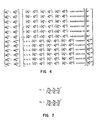
- Fig. 4 provides a system of matrix equations representing conditions before and after antenna exchange which may be solved in accordance with phase measurements to yield vectors indicating direction
- Fig. 5 is a system of matrix equations corresponding to the system of Fig.4 in which the initial integer ambiguities are expressed as independent variables.
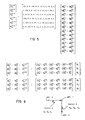
- Fig. 6 is a system of matrix equations representing conditions before and after antenna rearrangement (from collinear to non-collinear positions) which may be solved in accordance with phase measurements to yield vectors indicating attitude
- Fig. 7 provides a pair of equations which may be solved to yield unit direction vectors.
- Figs. 8a, b and c provide a diagrammatic view of the preferred embodiment of the mechanical system for antenna array configuration in accordance with the present invention also showing its operation by successive stages.
- Fig. 9 provides a diagrammatic view of an alternate embodiment of the mechanical system for antenna array configuration in accordance with the present invention.
- a set of four GPS satellites 10 are shown orbiting around the earth 12 while continuously providing GPS signals.
- the GPS signals broadcast by the satellites 10 may be picked up by vehicles on the surface of the Earth such as the ship 14 using an antenna structure such as the antenna array 16.
- the present invention allows the ship 14 to determine its direction and/or attitude from the signals provided by the satellites 10 as picked up by the antenna array 16.
- the antenna array 16 includes three separate antennas 20a, 20b and 20c suitable for receiving GPS signals such as microstrip patch antennas.
- the antennas 20a, 20b and 20c are separately connected to three multichannel radio receivers 22a, 22b and 22c adapted for receiving GPS signals from the antennas 20a, 20b and 20c and sampling the carrier phase of such signals as received at the antennas.
- the receivers 22a, 22b and 22c ordinarily have separate clocks but may operate in accordance with a common clock signal generated by a single clock 26 as shown in the figure whereby clock timing errors between the receivers may be eliminated.
- the phase measurement information generated by the receivers 22a, 22b and 22c is transferred to the microprocessor system 24 where it may be processed to yield the desired directional and/or attitude information as will be hereinafter described.
- the microprocessor system 24 also serves to regulate the operations of the receivers 22a, 22b and 22c and the array control unit 28.
- the array control unit 28 controls the configuration of the antenna array 16 so that the antennas 20a, 20b and 20c within the array 16 may be exchanged and rearranged in coordination with the taking of carrier phase measurements by the receivers 22a, 22b and 22c so that the required data may be timely acquired for properly calculating direction and attitude.
- the antennas 20a, 20b and 20c are first arranged in a collinear pattern in which they are spaced apart by equal distances. Phase measurements are taken at each of the antennas of the signals received from each of the four satellites 10. The positions of antennas 20b and 20c are then exchanged while continuous carrier phase tracking is maintained so that the antenna 20b occupies exactly the same location as previously occupied by antenna 20c and antenna 20c occupies exactly the same position previously occupied by antenna 20b. Phase measurements are then taken at each of the antennas of the signals from each of the same four satellites 10.
- the antennas 20a, 20b and 20c are then rearranged in a non-collinear pattern in which the antenna 20b is located "orthogonal" (at right angles and comparatively nearby)to the line segment defined by the positions of the antennas 20a and 20c while continuous phase tracking is again maintained.
- Phase measurements are again taken at each of the antennas 20a, 20b and 20c of the signals from each of the same four satellites 10.
- Phase information comprising 36 separate phase measurements over three different antenna array configurations and associated phase tracking data may thereby be provided to the microprocessor system 24 for processing in order to determine direction and/or attitude.
- a mechanical assembly is shown which is suitable for reconfiguring the antennas 20a, 20b and 20c within the antenna array 16 as required for the operation of the present invention.
- the mechanical assembly 30 includes a stationary frame 32 and a lever arm 34 rotatable about a fixed pivot 36.
- the antenna 20a and the pivot 36 are located on opposite ends of the frame 32 while the antennas 20b and 20c are located on opposite ends of the lever arm 34.
- the Figs. 8a, 8b and 8c illustrate the role of the mechanical assembly 30 in the operation of the present invention whereby the it allows the antennas 20b and 20c to be physically exchanged and the array 16 to be rearranged into different pattern.
- FIG. 8a shows the antenna array 16 including the antennas 20a, 20b and 20c in its initial position with the antennas arranged in a collinear pattern in which they are equally spaced apart by known distances.
- Fig. 8b shows the antenna array 16 subsequent to the positions of the antennas 20b and 20c being exchanged with the antennas still however being in a collinear pattern and being equally spaced apart.
- Fig. 8c shows the antenna array 16 subsequent to rearrangement of the antennas 20a, 20b and 20c into an non-collinear pattern.
- the exchange and rearrangement of the antennas within the array 16 is simply accomplished by the rotation of the lever arm 34 about the pivot point 36 either by 180 degrees (in the case of an exchange) or by a 90 degrees (in the case of a rearrangement).
- the lever arm 34 is driven by a servo motor actuated by the array control unit 28 under direction of the microprocessor system 24.
- an alternate type of mechanical, assembly 40 for exchanging and rearranging the positions of the antennas within the array 16 is shown as comprising the frame 40, lever arm 42 and track 44.
- the lever arm 42 is rotatable about a pivot point 46 and it performs the antenna exchange function through a 180 degree rotation.
- the track 44 allows an antenna 20a to be translated from a position collinear with the antennas 20b and 20c to an "orthogonal" type position non-collinear with these antennas thereby accomplishing the antenna array rearrangement function.
- Equation 4 describing the kinematic surveying situation may be seen to apply except that the variables ⁇ x and ⁇ x are as yet unsolved. Consequently, three variables are now present which may be solved by forming additional equations and processing more measurements, although, further measurements from the same satellite over time are not determinative since every such measurement would simply add a different phase increment. However, by adding another satellite to the measurement set enough additional information may be acquired to overcome the undetermined condition.
- matrix Equation 6 illustrates the resulting system of equations for a one dimensional example. It should be noted parenthetical superscripts assigned to the variables denote an index for the satellite associated with the variable.
- Equation 6 may be generalized to real life GPS by elevating the spatial dimensionality of the model and by accommodating troublesome receiver timing errors.
- the Equations may be generalized to three dimensions by simply including variables representing three initial positions and three incremental positions.
- the accommodation of receiver timing errors is somewhat more complicated. It is inconvenient to deal with receiver timing errors in carrier phase surveying because the error is inestimable due to the inability of the measurement situation to distinguish between the initial integer ambiguity ⁇ N and timing errors ⁇ t both of which reside in the range/measurement space of the model. Nevertheless, timing errors may be accommodated by eliminating them from consideration altogether through proper mathematical handling.
- Equation (or expression) 7 illustrates a typical double difference expression in which superscripts reference satellites and subscripts reference antenna pairings. If phase measurements are made nearly simultaneously from both satellites at the two antennas, the timing errors conveniently cancel out in the double difference expression so formed.
- the number of double difference measurements always turns out to be one less than the total number of satellites being tracked and therefore one additional satellite must be added to the measurement set to allow the equations to be formulated in terms of double difference expressions.
- Equation 6 referring to the example of Equation 6 and its generalization to three dimensions, six initial integer variables corresponding to six satellite pairs are required to provide 12 double difference equations (at two time points) and to thereby match the variables generated: three initial positions, three incremental positions and six initial integer ambiguities. Therefore, a total of seven satellites would be required to satisfy this model when the additional satellite necessary to set up the double difference expressions is included.
- the above principles would allow a baseline between two antennas to be determined although the procedure would appear to be cumbersome in requiring both a substantial time interval over which measurements must be made and the simultaneous tracking of seven satellites. Nevertheless, it should be noted that the principles referred to above would allow for the determination of a direction and in an application of GPS Satellites unrecognized previous to this time.
- the original antenna exchange technique called for a mutual exchange of antennas between fixed locations in which the baseline used between the antennas was required to remain unchanged during the period of the exchange.
- the original technique there would be no way to determine the original locations of the antennas if they were subject to movement.
- an extension of the antenna exchange technique to a mobile platform can be accomplished if the spatial relationship between the antennas during the exchange is either known or maintained and an additional antenna is used to form a three antenna array. This amounts to a substantial simplification of the non-static initialization problem whereby solutions can be immediately calculated enabling practical applications of the technique to vehicular platforms of moderate dynamics such as ships and transport aircraft.
- the antenna array must remain rigidly fixed to the moving platform whose direction and/or attitude is to be determined and be constructed so as to allow the position of a pair of antennas to be exchanged and to allow the pattern of the antennas to be changed in the case of attitude determinations as will be hereinafter explained.
- the antennas within an array would be collinear and the spaced apart by known and equal distances.
- a system of equations employing double difference phase expressions in which phase measurements from four satellites provide three double differences for each of two antenna pairs. Therefore, by making measurements both before and after antenna exchange, a total of twelve measurements are provided as required to solve twelve variables; three positions before exchange, three positions after exchange and six initial integers.
- the variables ⁇ X+, ⁇ Y+, ⁇ Z+ define a vector representing the baseline running between the antennas which corresponds to a direction for the antenna array and also the platform on which it is mounted immediately subsequent to the completion of antenna exchange.
- the system of equations shown in Figure 4 may be partially solved to yield the system shown in Figure 5 whereby the initial integer ambiguities corresponding to the double difference measurements may be readily solved by means of a constant coefficient matrix.
- attitude may be calculated with the knowledge of these initial integer ambiguities, if the antenna array is rearranged so that one of the antennas is non-collinear with the others while phase tracking is maintained and a further set of phase measurements is made with respect to the same four satellites.
- the system of equations shown allows the vectors X A , Y A , Z A and X B , Y B , Z B to be immediately calculated representing the coordinates of the two baselines defined by the antenna positions within the array which correspond to the attitude of the array and the platform upon which it is mounted.
- the two vectors may be normalized through the use of the formulas shown in Figure 7 so that the required directions are expressed in terms of unit vectors useful in subsequent calculations.
- the orientational information represented by the vectors may then be converted to any desired format such as Ueler angles or the like.
- the receivers 20a-c may be synchronized to a common clock signal such as the signal provided by the clock 26 thereby eliminating timing errors between the receivers and allowing the equations of Fig.4 to be written in terms of single difference expressions.
- This simplification may reduce the required number of satellites in the measurement set from 4 to 3 satellites, although careful calibration of the timing for the clock signals provided to the separate receivers is necessary to achieve accurate results.
- receivers 22a, 22b and 22c may be implemeted in a single module having suffient multichannel capacity thereby reducing the amount of electronic hardware necessary for the operation of the system. It is intended that the appended claims cover all such changes and modifications.
Landscapes
- Engineering & Computer Science (AREA)
- Radar, Positioning & Navigation (AREA)
- Remote Sensing (AREA)
- Computer Networks & Wireless Communication (AREA)
- Physics & Mathematics (AREA)
- General Physics & Mathematics (AREA)
- Position Fixing By Use Of Radio Waves (AREA)
Abstract
Description
- The present invention relates to GPS Satellite Systems and more particularly to systems which make use of the carrier phase of signals provided by GPS satellites.
- GPS Navigation Systems include a constellation of satellites each of which provides a coded signal which may be picked up by radio receivers on the surface of the earth. Separate coded signals from a set of satellites may be processed by a receiver system for use in determining location as defined by latitude and longitude based on the code carried by the signals. The operation of GPS Systems in determining location based on coded signals received from satellites reflects the conventional functioning of such systems.
- However, it has been found that the signals generated by GPS satellites may be used in other ways and in particular the carrier phase of the signals may be used in certain surveying applications. For example, a pair of stationary antenna/receiver combinations may be located at the ends of a baseline (whose length is required to be determined) and used to track and measure the phase of a GPS carrier signal arriving at their respective antenna locations. The situation may be described by Equation 1:


- Where:
- φA =
- phase measured by antenna A at point A
- φB =
- phase measured by antenna B at point B
- Δφo =
- measured phase difference
- ΔφN =
- initial integer (phase) ambiguity in whole cycles
- ϑ =
- angle between the horizontal and the signal path from the satellite to point A (or B)
- Δx =
- distance between points A and B
- in which the total phase delay may be seen as indeterminate due to the nature of oscillatory signals since an unknown number of whole cycles may be involved. This unknown quantity ΔφN is commonly referred to as the initial integer ambiguity and can only be resolved by additional steps in a surveying procedure. For static surveying, the simplest manner of resolving the initial integer ambiguity is by observing carrier phase over a period of time. It is clear from
Equation 1 that the two unknowns ΔφN and Δx cannot be solved with one measurement equation at a single instant in time. However, with a second measurement Δφ₁ made at a different time the T₁, the measurement situation becomes two dimensional in nature as indicated by matrix Equation 2:
- Where:
- the
subscripts
and the distance Δx may be readily determined. In real life three-dimensional GPS static surveying, the amount of time necessary to obtain a solution is typically on the order of twenty to forty minutes for relatively short baselines. - It may be appreciated how the principles given above can be extended to kinematic surveying applications so long as the phase of the carrier signal is continuously tracked. Continuity in the carrier phase profile provides the user with an exact history of positional changes of a roving antenna provided that some sort of initialization procedure has been used to resolve the initial integer ambiguity prior to antenna displacement. The situation may be described by Equation 3:

- Where:
- δφ =
- measured phase increment
- δx =
- distance increment
- Since the variables ΔφN and Δx should have already been solved from the initialization, this leaves only δx which can be solved instantaneously from a single phase tracking measurement δφ. Kinematic surveying in accordance with the above procedures constitutes the primary application of GPS carrier phase techniques since distances may be easily derived from the carrier phase tracking measurements as long as continuous carrier tracking is maintained after initialization.
- In order to speed up the resolution of the initial integer ambiguity during initialization, an alternative technique may be employed called "antenna exchange" as first introduced by B. W. Remondi in his article "Kinematic and Psuedo-kinematic GPS" in the Proceedings of the Satellite Division of the Institute Of Navigation's First International Technical Meeting in Colorado Springs, Colorado in 1985. B. W. Remondi suggested that by moving one antenna to the location of the other the total phase delay can be solved just as effectively as waiting for satellites to move appreciably. However, since there is no way to physically merge two antennas that need to occupy exactly the same location, the most effective approach is simply to exchange or swap the locations of the two antennas at the ends of the baseline. Antenna exchange can therefore be interpreted as kinematic movement of one antenna by an amount equal to 2*Δx while the other is kept stationary. This situation may be described by Equation 4:

Measurements before and after the antenna exchange result in two simultaneous equations as shown in matrix Equation 5:
which may be readily solved to determine the initial integer ambiguity ΔφN and baseline distance Δx. - The foregoing discussion indicates how the phase of GPS signals may be used in determining distances in surveying applications and how antenna exchange may allow for rapid "initialization." However, surveying applications have appeared to be the limit of the usefulness of carrier phase information derived from GPS satellite signals.
- It is an object of the present invention to provide a system adapted for determining spatial orientation based on phase measurements of GPS satellite signals.
- It is a further object of the present invention to provide a system for determining direction and/or attitude using an antenna array including antennas which may be configured in different patterns and which are each adapted for receiving and measuring the phase of signals from a set of GPS satellites.
- It is another object of the present invention to provide a system for determining spatial orientation using GPS signals which may be employed on large scale vehicles such as ships and which is accurate in operation, economic to implement and reliable in service.
- The present invention constitutes a system for determining attitude and/or direction (i.e. spatial orientation) based on the carrier phase of signals received from a set of GPS satellites. The system comprises an antenna array including a number of antennas coupled to GPS radio receivers, a mechanism for reconfiguring the positions of the antennas in the array and a signal processing unit for processing the data collected by the antennas and receivers. The mechanism for reconfiguring the positions of the antennas within the antenna array is constructed for enabling one pair of antennas to be exchanged and for allowing the antennas to be rearranged from collinear into non-collinear patterns. The antennas and receivers are used in taking samples and tracking the carrier phase of GPS signals received from a number of different satellites. These measurements are taken both before and after the positions of an antenna pair is exchanged in order to provide the information necessary to determine direction. Further, phase measurements may also be taken after the positions of the antennas are rearranged in order to provide the information necessary to determine attitude.
- In the preferred embodiment, three collinear antennas are initially spaced apart by equal distances and are separately connected to three receivers. Carrier phase measurements are taken by each of the antenna/receiver combinations with respect to signals from four different satellites. The positions of two of the antennas are then exchanged while continuous phase tracking is maintained and phase measurements are again taken by each of the antenna/receiver combinations with respect to signals from the same four satellites. The antennas are then rearranged from their collinear to a non-collinear pattern while continuous phase tracking is again maintained and phase measurements are again taken by each of the antenna/receiver combinations with respect to signals from the same four satellites. The phase information gathered pursuant to the foregoing measurements is then processed by a microprocessor system in which the phase ambiguities between the signals are resolved and the components of vectors representing the orientation of the antenna array are calculated based on the phase information.
- Fig. 1 provides a diagrammatic view illustrating the use of GPS satellites and their signals in accordance with the present invention.
- Fig. 2 provides a block diagram of a preferred embodiment of the electronic system associated with the present invention.
- Fig. 3 provides a diagrammatic view of the geophysical relationships of the antennas comprising the antenna array of the present invention during various stages of its operation.
- Fig. 4 provides a system of matrix equations representing conditions before and after antenna exchange which may be solved in accordance with phase measurements to yield vectors indicating direction
- Where:
- - and + superscripts refer to conditions before and after antenna exchange
- numerical superscripts (in parentheses) comprise indexes referencing particular satellites and double superscripts denote differences between measurements associated with different satellites
- numerical subscripts comprise indexes denoting particular antennas and referring to particular pairings of antennas
- h


-
Δφ
satellite 2 as received atantennas
h

satellites
Δx⁻, Δy⁻, Δz⁻ = components of baseline vector between antennas before exchange
N
antennas satellites - Fig. 5 is a system of matrix equations corresponding to the system of Fig.4 in which the initial integer ambiguities are expressed as independent variables.
- Fig. 6 is a system of matrix equations representing conditions before and after antenna rearrangement (from collinear to non-collinear positions) which may be solved in accordance with phase measurements to yield vectors indicating attitude
- Where:
- XA, YA, ZA = baseline vector between
antennas - XB, YB, ZB = baseline vector between
antennas - Fig. 7 provides a pair of equations which may be solved to yield unit direction vectors.
- Figs. 8a, b and c provide a diagrammatic view of the preferred embodiment of the mechanical system for antenna array configuration in accordance with the present invention also showing its operation by successive stages.
- Fig. 9 provides a diagrammatic view of an alternate embodiment of the mechanical system for antenna array configuration in accordance with the present invention.
- Referring now to Fig. 1, a set of four
GPS satellites 10 are shown orbiting around theearth 12 while continuously providing GPS signals. The GPS signals broadcast by thesatellites 10 may be picked up by vehicles on the surface of the Earth such as theship 14 using an antenna structure such as theantenna array 16. The present invention allows theship 14 to determine its direction and/or attitude from the signals provided by thesatellites 10 as picked up by theantenna array 16. - Referring now to Fig. 2, the
antenna array 16 includes threeseparate antennas antennas multichannel radio receivers antennas receivers single clock 26 as shown in the figure whereby clock timing errors between the receivers may be eliminated. The phase measurement information generated by thereceivers microprocessor system 24 where it may be processed to yield the desired directional and/or attitude information as will be hereinafter described. Themicroprocessor system 24 also serves to regulate the operations of thereceivers array control unit 28. Thearray control unit 28 controls the configuration of theantenna array 16 so that theantennas array 16 may be exchanged and rearranged in coordination with the taking of carrier phase measurements by thereceivers - Referring now to Fig. 3, the
antennas satellites 10. The positions ofantennas antenna 20b occupies exactly the same location as previously occupied byantenna 20c andantenna 20c occupies exactly the same position previously occupied byantenna 20b. Phase measurements are then taken at each of the antennas of the signals from each of the same foursatellites 10. Theantennas antenna 20b is located "orthogonal" (at right angles and comparatively nearby)to the line segment defined by the positions of theantennas 20a and 20c while continuous phase tracking is again maintained. Phase measurements are again taken at each of theantennas satellites 10. Phase information comprising 36 separate phase measurements over three different antenna array configurations and associated phase tracking data may thereby be provided to themicroprocessor system 24 for processing in order to determine direction and/or attitude. - Referring now to Figs. 8a-c, a mechanical assembly is shown which is suitable for reconfiguring the
antennas antenna array 16 as required for the operation of the present invention. Themechanical assembly 30 includes astationary frame 32 and alever arm 34 rotatable about a fixedpivot 36. The antenna 20a and thepivot 36 are located on opposite ends of theframe 32 while theantennas lever arm 34. The Figs. 8a, 8b and 8c illustrate the role of themechanical assembly 30 in the operation of the present invention whereby the it allows theantennas array 16 to be rearranged into different pattern. Fig. 8a shows theantenna array 16 including theantennas antenna array 16 subsequent to the positions of theantennas antenna array 16 subsequent to rearrangement of theantennas array 16 is simply accomplished by the rotation of thelever arm 34 about thepivot point 36 either by 180 degrees (in the case of an exchange) or by a 90 degrees (in the case of a rearrangement). In actual practice, thelever arm 34 is driven by a servo motor actuated by thearray control unit 28 under direction of themicroprocessor system 24. - Referring now to Fig. 9, an alternate type of mechanical,
assembly 40 for exchanging and rearranging the positions of the antennas within thearray 16 is shown as comprising theframe 40,lever arm 42 andtrack 44. Thelever arm 42 is rotatable about apivot point 46 and it performs the antenna exchange function through a 180 degree rotation. Thetrack 44 allows an antenna 20a to be translated from a position collinear with theantennas - It should be understood that, for the sake of simplicity, the surveying examples described in the background section were one dimensional in nature. However, the principles discussed may be readily extended to higher spatial dimensions by including more spatial variables and formulating a proportionately greater number of equations as necessary to obtain solutions. The measurements required for making the system solvable may be obtained by taking proportionately greater numbers of phase samples over time or by adding additional satellites to the measurement set until there is enough additional information to overcome the undetermined condition. The mathematical calculations necessary to obtain solutions can be rapidly and easily performed by modern digital signal processing machinery such as the
microprocessor system 24, shown in Fig. 2 - In determining direction and/or attitude many more variables exist than ordinarily present in surveying applications and accordingly more equations and measurement sets must be obtained in order to allow for solutions to be computed. First of all, the baseline defined by the antennas is not fixed to the GPS frame of reference for even the duration of the initialization procedure.
Equation 4 describing the kinematic surveying situation may be seen to apply except that the variables Δx and δx are as yet unsolved. Consequently, three variables are now present which may be solved by forming additional equations and processing more measurements, although, further measurements from the same satellite over time are not determinative since every such measurement would simply add a different phase increment. However, by adding another satellite to the measurement set enough additional information may be acquired to overcome the undetermined condition. matrix Equation 6 illustrates the resulting system of equations for a one dimensional example. It should be noted parenthetical superscripts assigned to the variables denote an index for the satellite associated with the variable.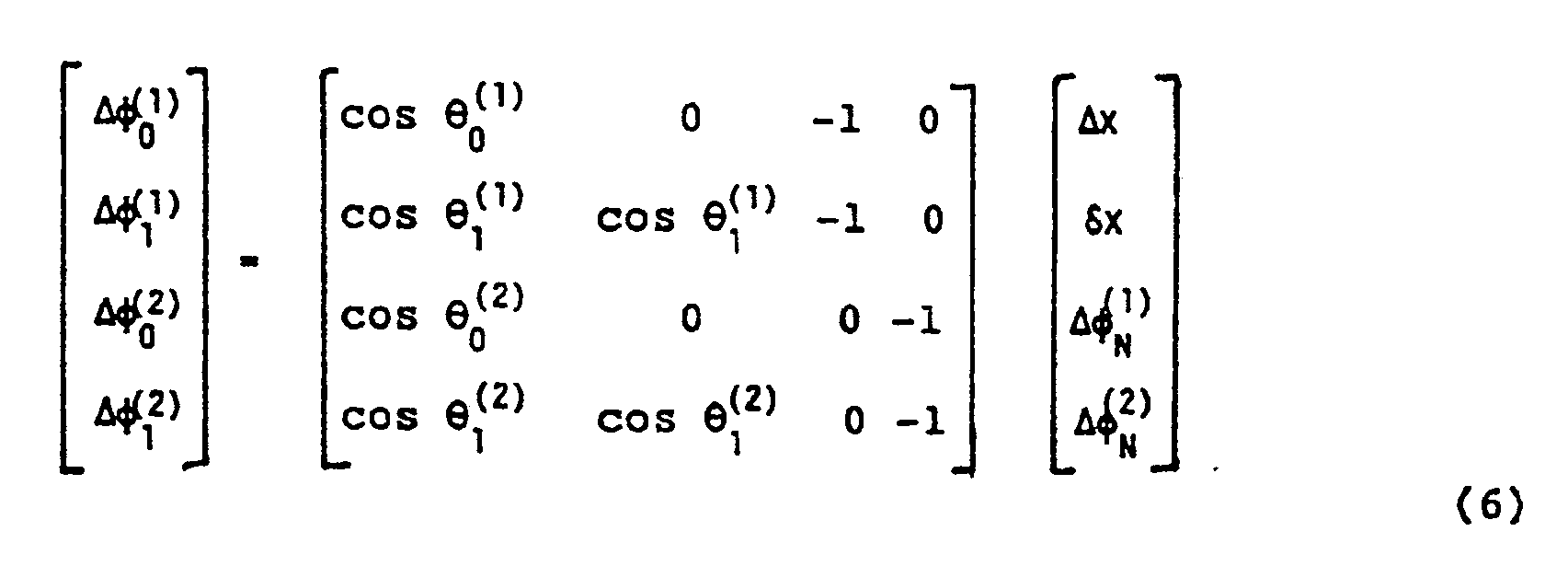
- The example of Equation 6 may be generalized to real life GPS by elevating the spatial dimensionality of the model and by accommodating troublesome receiver timing errors. The Equations may be generalized to three dimensions by simply including variables representing three initial positions and three incremental positions. However, the accommodation of receiver timing errors is somewhat more complicated. It is inconvenient to deal with receiver timing errors in carrier phase surveying because the error is inestimable due to the inability of the measurement situation to distinguish between the initial integer ambiguity ΔφN and timing errors Δt both of which reside in the range/measurement space of the model. Nevertheless, timing errors may be accommodated by eliminating them from consideration altogether through proper mathematical handling. This end can be realized by forming so called "double difference" expressions between pairs of satellites which can be made from single difference phase measurements between pairs of antennas. Equation (or expression) 7:
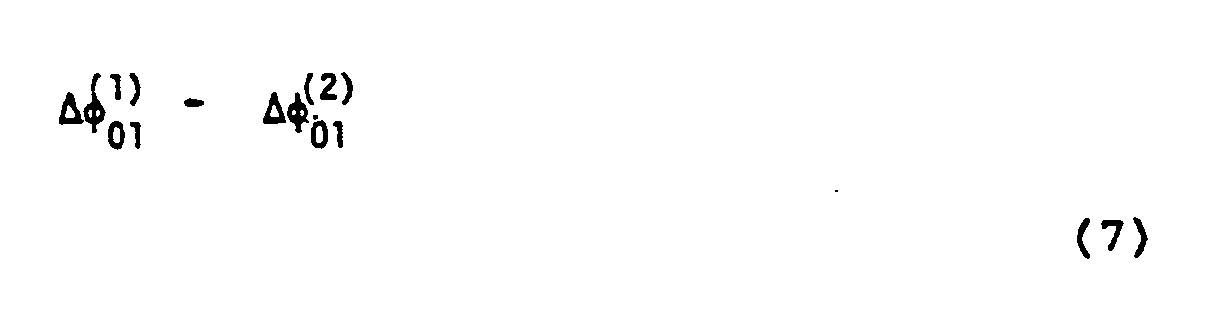
illustrates a typical double difference expression in which superscripts reference satellites and subscripts reference antenna pairings. If phase measurements are made nearly simultaneously from both satellites at the two antennas, the timing errors conveniently cancel out in the double difference expression so formed. The number of double difference measurements always turns out to be one less than the total number of satellites being tracked and therefore one additional satellite must be added to the measurement set to allow the equations to be formulated in terms of double difference expressions. - Again, referring to the example of Equation 6 and its generalization to three dimensions, six initial integer variables corresponding to six satellite pairs are required to provide 12 double difference equations (at two time points) and to thereby match the variables generated: three initial positions, three incremental positions and six initial integer ambiguities. Therefore, a total of seven satellites would be required to satisfy this model when the additional satellite necessary to set up the double difference expressions is included. The above principles would allow a baseline between two antennas to be determined although the procedure would appear to be cumbersome in requiring both a substantial time interval over which measurements must be made and the simultaneous tracking of seven satellites. Nevertheless, it should be noted that the principles referred to above would allow for the determination of a direction and in an application of GPS Satellites unrecognized previous to this time.
- The original antenna exchange technique called for a mutual exchange of antennas between fixed locations in which the baseline used between the antennas was required to remain unchanged during the period of the exchange. In accordance with the original technique, there would be no way to determine the original locations of the antennas if they were subject to movement. Nevertheless, an extension of the antenna exchange technique to a mobile platform can be accomplished if the spatial relationship between the antennas during the exchange is either known or maintained and an additional antenna is used to form a three antenna array. This amounts to a substantial simplification of the non-static initialization problem whereby solutions can be immediately calculated enabling practical applications of the technique to vehicular platforms of moderate dynamics such as ships and transport aircraft.
- The antenna array must remain rigidly fixed to the moving platform whose direction and/or attitude is to be determined and be constructed so as to allow the position of a pair of antennas to be exchanged and to allow the pattern of the antennas to be changed in the case of attitude determinations as will be hereinafter explained. In the most straightforward case, the antennas within an array would be collinear and the spaced apart by known and equal distances. These conditions may be readily fulfilled allowing the feasibility of many practical applications.
- Referring now to Figure 4, a system of equations is shown employing double difference phase expressions in which phase measurements from four satellites provide three double differences for each of two antenna pairs. Therefore, by making measurements both before and after antenna exchange, a total of twelve measurements are provided as required to solve twelve variables; three positions before exchange, three positions after exchange and six initial integers. The variables ΔX⁺, ΔY⁺, ΔZ⁺ define a vector representing the baseline running between the antennas which corresponds to a direction for the antenna array and also the platform on which it is mounted immediately subsequent to the completion of antenna exchange.
- The system of equations shown in Figure 4 may be partially solved to yield the system shown in Figure 5 whereby the initial integer ambiguities corresponding to the double difference measurements may be readily solved by means of a constant coefficient matrix. Now, not only direction but also attitude may be calculated with the knowledge of these initial integer ambiguities, if the antenna array is rearranged so that one of the antennas is non-collinear with the others while phase tracking is maintained and a further set of phase measurements is made with respect to the same four satellites.
- Referring now to Figure 6, the system of equations shown allows the vectors XA, YA, ZA and XB, YB, ZB to be immediately calculated representing the coordinates of the two baselines defined by the antenna positions within the array which correspond to the attitude of the array and the platform upon which it is mounted. In order to further complete this process the two vectors may be normalized through the use of the formulas shown in Figure 7 so that the required directions are expressed in terms of unit vectors useful in subsequent calculations. The orientational information represented by the vectors may then be converted to any desired format such as Ueler angles or the like.
- While particular embodiments of the present invention have been shown and described, it should be clear that changes and modifications may be made to such embodiments without departing from the true scope and spirit of the invention. For example, the receivers 20a-c may be synchronized to a common clock signal such as the signal provided by the
clock 26 thereby eliminating timing errors between the receivers and allowing the equations of Fig.4 to be written in terms of single difference expressions. This simplification may reduce the required number of satellites in the measurement set from 4 to 3 satellites, although careful calibration of the timing for the clock signals provided to the separate receivers is necessary to achieve accurate results. Further by way of example, certain of the functions ofreceivers
Claims (17)
- A method for determining attitude using GPS satellites and an antenna array including a plurality of antennas in which the positions of the antennas within the array may be selectively reconfigured, comprising the steps of:
arranging said antennas in a collinear pattern in which said antennas are spaced apart by known distances;
receiving and phase sampling signals from a plurality of GPS satellites with each of said antennas;
exchanging the positions of a pair of said antennas within said array while maintaining continuous phase tracking;
receiving and phase sampling signals from said plurality of GPS satellites with each of said antennas;
rearranging said antennas in a non-collinear pattern in which said antennas are spaced apart by known distances while maintaining continuous phase tracking;
receiving and phase sampling signals from said plurality of GPS satellites with each of said antennas; and
calculating the attitude of said antenna array based on the phase of said GPS signals received and sampled in the previous steps. - The method of Claim 1 in which said plurality of GPS satellites includes four separate satellites and wherein receiver clock timing errors are eliminated from the attitude calculations by double differencing phase measurements between separate antennas and separate satellites.
- The method of Claim 1 in which said antenna array includes three separate antennas which are equally spaced apart in said collinear pattern and one of which is orthogonally positioned with respect to the others in said non-collinear pattern.
- The method of Claim 1, in which the step of calculating the attitude of said antenna array includes the steps of computing a set of double difference phase integer ambiguities between separate antennas and computing the coordinates of baseline and orthogonal vectors using further phase measurements and said phase integer ambiguities.
- An appatatus for determining attitude using signals from a set of GPS satellites, comprising:
a plurality of antennas configurable into an array for receiving said signals at spaced apart locations;
means for exchanging the positions of a pair of said antennas within said array and also rearranging the positions of said antennas within said array from collinear to non-collinear patterns;
means for sampling the phase of said signals received by said antennas from said GPS satellites at the positions of each of said antennas before an antenna exchange, after an antenna exchange and after an antenna rearrangement and for tracking the phase of said signals from said GPS antennas during antenna exchange and rearrangement; and
means for calculating the attitude of said antenna array based on the measured phase of said signals. - The apparatus of Claim 5 in which said set of GPS satellites includes four separate satellites and wherein receiver clock timing errors are eliminated from attitude calculations performed by said means for calculating by double differencing phase measurements between separate antennas and separate satellites.
- The apparatus of Claim 5 in which said antenna array includes three separate antennas which are equally spaced apart when arranged in said collinear pattern and one of which is orthogonally positioned with respect to the others when arranged in said non-collinear pattern.
- The apparatus of Claim 5, in which said set of GPS satellites includes three separate satellites and wherein one set of receiver clock timing errors are eliminated by synchronizing the receiver functions associated with the antennas to a common clock signal.
- A method for determining direction using a set of GPS satellites and a system including an array of antennas, one or more GPS radio receivers coupled to said antennas, and a computing means for processing the information acquired by said antennas and receivers, said method comprising the steps of:
configuring said array of antennas in a first predetermined pattern in which said antennas are spaced-apart by known distances;
sampling the phase of the GPS signals from said GPS satellites using said antennas and receivers;
exchanging the positions of a pair of said antennas while continuously tracking the phase of the GPS signals;
sampling the phase of the GPS signals from said GPS satellites using said antennas and receivers; and
computing the direction of said antenna array based on said phase measurements using said computing means. - The method of Claim 9, further including the steps of:
reconfiguring said array of antennas in a second different predetermined pattern in which said antennas are spaced apart by known distances while continuously tracking the phase of said signals;
sampling the phase of said GPS signals from said GPS satellites using said antennas and receivers; and
computing the attitude of said second pattern using said computing means. - The method of Claim 9, wherein the antennas within said first predetermined pattern are collinear.
- The method of Claim 9 in which said set of GPS satellites includes four separate satellites and wherein receiver clock timing errors are eliminated from the directional computations by double differencing phase measurements between separate antennas and separate satellites.
- The method of Claim 9 in which said set of GPS satellites includes three separate satellites and wherein one set of receiver clock timing errors are eliminated by synchronizing the receiver functions associated with the antennas to a common clock signal.
- An apparatus for determining direction using phase information derived from the signals provided by a set of GPS satellites, said apparatus comprising:
a plurality of antennas configurable into an antenna array in which the antennas are spaced apart by known distances;
one or more radio receivers coupled to said antennas which are adapted for sampling and continuously tracking the phase of said GPS signals as received by said antennas at their individual locations;
means for exchanging the positions of a pair of said antennas; and
means for processing data from said receivers and calculating the direction of said array based on the measured phase of said GPS signals from said satellites. - The apparatus of Claim 14, wherein said means for exchanging further includes means for rearranging said array into collinear and non-collinear patterns whereby said apparatus is enabled to further determine the attitude of said antenna array.
- The apparatus of Claim 15 in which said set of GPS satellites includes four separate satellites and wherein receiver clock timing errors are eliminated from attitude calculations performed by said microprocessor means by double differencing phase measurements between separate antennas and separate satellites.
- The apparatus of Claim 15 in which said antenna array includes three separate antennas which are equally spaced apart when arranged in said collinear pattern and one of which is orthogonally positioned with respect to the others when arranged in said non-collinear pattern.
Applications Claiming Priority (2)
| Application Number | Priority Date | Filing Date | Title |
|---|---|---|---|
| US07/464,271 US5021792A (en) | 1990-01-12 | 1990-01-12 | System for determining direction or attitude using GPS satellite signals |
| US464271 | 1990-01-12 |
Publications (3)
| Publication Number | Publication Date |
|---|---|
| EP0437372A2 true EP0437372A2 (en) | 1991-07-17 |
| EP0437372A3 EP0437372A3 (en) | 1992-11-25 |
| EP0437372B1 EP0437372B1 (en) | 1995-08-16 |
Family
ID=23843223
Family Applications (1)
| Application Number | Title | Priority Date | Filing Date |
|---|---|---|---|
| EP91300198A Expired - Lifetime EP0437372B1 (en) | 1990-01-12 | 1991-01-11 | System for determining direction or attitude using GPS satellite signals |
Country Status (3)
| Country | Link |
|---|---|
| US (1) | US5021792A (en) |
| EP (1) | EP0437372B1 (en) |
| DE (1) | DE69112085T2 (en) |
Cited By (9)
| Publication number | Priority date | Publication date | Assignee | Title |
|---|---|---|---|---|
| WO1999058933A1 (en) * | 1998-05-14 | 1999-11-18 | Baker Hughes Incorporated | Apparatus for measuring magnetic declination using gps |
| FR2810456A1 (en) * | 2000-06-20 | 2001-12-21 | Mitsubishi Electric Inf Tech | RECONFIGURABLE ANTENNA DEVICE FOR TELECOMMUNICATION STATION |
| EP1022577A3 (en) * | 1999-01-19 | 2002-04-03 | Ford Global Technologies, Inc. | On-board GPS sensor systems |
| GB2370707A (en) * | 2000-07-24 | 2002-07-03 | Furuno Electric Co | Carrier phase-based relative positioning apparatus |
| US6508316B2 (en) | 1998-05-14 | 2003-01-21 | Baker Hughes Incorporated | Apparatus to measure the earth's local gravity and magnetic field in conjunction with global positioning attitude determination |
| GB2385733A (en) * | 2001-12-19 | 2003-08-27 | Furuno Electric Co | GPS receiver |
| US6718264B2 (en) | 2001-03-25 | 2004-04-06 | Communications Research Laboratory, Independent Administrative Institution | Method for acquiring azimuth information |
| EP1580894A1 (en) * | 1999-11-02 | 2005-09-28 | The Commonwealth Of Australia | Enhanced direct digitising array arrangement |
| EP1684084A1 (en) * | 2005-01-22 | 2006-07-26 | Leica Geosystems AG | Method for determining the orientation of an antenna assembly |
Families Citing this family (79)
| Publication number | Priority date | Publication date | Assignee | Title |
|---|---|---|---|---|
| WO1990013856A1 (en) * | 1989-05-01 | 1990-11-15 | Kabushiki Kaisha Komatsu Seisakusho | Travelling control apparatus for vehicules |
| JP2594483B2 (en) * | 1991-12-10 | 1997-03-26 | 新日本製鐵株式会社 | Automatic tracking satellite broadcast receiving antenna device |
| US8352400B2 (en) | 1991-12-23 | 2013-01-08 | Hoffberg Steven M | Adaptive pattern recognition based controller apparatus and method and human-factored interface therefore |
| US10361802B1 (en) | 1999-02-01 | 2019-07-23 | Blanding Hovenweep, Llc | Adaptive pattern recognition based control system and method |
| US5347286A (en) * | 1992-02-13 | 1994-09-13 | Trimble Navigation Limited | Automatic antenna pointing system based on global positioning system (GPS) attitude information |
| US5268695A (en) * | 1992-10-06 | 1993-12-07 | Trimble Navigation Limited | Differential phase measurement through antenna multiplexing |
| US5430654A (en) * | 1992-12-01 | 1995-07-04 | Caterpillar Inc. | Method and apparatus for improving the accuracy of position estimates in a satellite based navigation system |
| US5359521A (en) * | 1992-12-01 | 1994-10-25 | Caterpillar Inc. | Method and apparatus for determining vehicle position using a satellite based navigation system |
| US5917444A (en) * | 1995-05-22 | 1999-06-29 | Trimble Navigation Ltd. | Reduction of time to first fix in an SATPS receiver |
| USRE37408E1 (en) * | 1993-05-21 | 2001-10-16 | Trimble Navigation Ltd. | Reduction of time to first fix in an SATPS receiver |
| US5418538A (en) * | 1993-05-21 | 1995-05-23 | Trimble Navigation Limited | Rapid satellite signal acquisition in a satellite positioning system |
| US5506588A (en) * | 1993-06-18 | 1996-04-09 | Adroit Systems, Inc. | Attitude determining system for use with global positioning system, and laser range finder |
| US5543804A (en) * | 1994-09-13 | 1996-08-06 | Litton Systems, Inc. | Navagation apparatus with improved attitude determination |
| US5617317A (en) * | 1995-01-24 | 1997-04-01 | Honeywell Inc. | True north heading estimator utilizing GPS output information and inertial sensor system output information |
| US5631656A (en) * | 1995-03-01 | 1997-05-20 | Honeywell Inc. | Fail safe system with common mode avoidance |
| US5999123A (en) * | 1995-09-13 | 1999-12-07 | Rockwell International Corporation | Time-relative positioning for static applications |
| DE19540550A1 (en) * | 1995-10-31 | 1997-05-07 | Salomon Dr Klaczko | Process for traffic monitoring and traffic control and position determination and transmission of information from and to mobile objects, in particular ships, and for decentralized detection of the local traffic situation in the area surrounding the mobile object |
| US5815114A (en) * | 1996-04-05 | 1998-09-29 | Discovision Associates | Positioning system and method |
| FR2748571B1 (en) * | 1996-05-09 | 1998-08-07 | Europ Agence Spatiale | RECEIVER DEVICE FOR A NAVIGATION SYSTEM IN PARTICULAR BY SATELLITE |
| US5917445A (en) * | 1996-12-31 | 1999-06-29 | Honeywell Inc. | GPS multipath detection method and system |
| US6114988A (en) * | 1996-12-31 | 2000-09-05 | Honeywell Inc. | GPS receiver fault detection method and system |
| US6088653A (en) * | 1996-12-31 | 2000-07-11 | Sheikh; Suneel I. | Attitude determination method and system |
| US5990827A (en) * | 1997-03-28 | 1999-11-23 | Vectorlink, Inc. | Structure of a position processing apparatus |
| US6389333B1 (en) | 1997-07-09 | 2002-05-14 | Massachusetts Institute Of Technology | Integrated flight information and control system |
| US7268700B1 (en) | 1998-01-27 | 2007-09-11 | Hoffberg Steven M | Mobile communication device |
| US5933110A (en) * | 1998-07-13 | 1999-08-03 | Arinc, Inc. | Vessel attitude determination system and method |
| US6313788B1 (en) | 1998-08-14 | 2001-11-06 | Seagull Technology, Inc. | Method and apparatus for reliable inter-antenna baseline determination |
| US6016120A (en) * | 1998-12-17 | 2000-01-18 | Trimble Navigation Limited | Method and apparatus for automatically aiming an antenna to a distant location |
| US7966078B2 (en) | 1999-02-01 | 2011-06-21 | Steven Hoffberg | Network media appliance system and method |
| US6023240A (en) * | 1999-05-17 | 2000-02-08 | Rockwell Collins, Inc. | Method for determining a phase measurement error map using rotating antenna information |
| US6353411B1 (en) * | 1999-09-10 | 2002-03-05 | Honeywell International Inc. | Antenna with special lobe pattern for use with global positioning systems |
| CA2297598C (en) | 2000-01-28 | 2003-12-23 | Ki-Sun Jason Ryu | Accumulator for an air-conditioning system |
| US6359585B1 (en) * | 2000-05-22 | 2002-03-19 | Rockwell Collins, Inc. | Apparatus and method of determining an orientation of a GPS receiver |
| US6980812B1 (en) | 2000-11-09 | 2005-12-27 | @Road, Inc. | System and method for providing a handheld unit to a mobile position device |
| US6430958B1 (en) | 2001-01-22 | 2002-08-13 | Halla Climate Control Canada, Inc. | Suction accumulator for air conditioning systems |
| US6463757B1 (en) | 2001-05-24 | 2002-10-15 | Halla Climate Controls Canada, Inc. | Internal heat exchanger accumulator |
| US7009557B2 (en) | 2001-07-11 | 2006-03-07 | Lockheed Martin Corporation | Interference rejection GPS antenna system |
| WO2004046748A2 (en) * | 2002-11-15 | 2004-06-03 | Lockheed Martin Corporation | All-weather precision guidance and navigation system |
| US9818136B1 (en) | 2003-02-05 | 2017-11-14 | Steven M. Hoffberg | System and method for determining contingent relevance |
| US9002565B2 (en) | 2003-03-20 | 2015-04-07 | Agjunction Llc | GNSS and optical guidance and machine control |
| US8634993B2 (en) | 2003-03-20 | 2014-01-21 | Agjunction Llc | GNSS based control for dispensing material from vehicle |
| US20040212533A1 (en) * | 2003-04-23 | 2004-10-28 | Whitehead Michael L. | Method and system for satellite based phase measurements for relative positioning of fixed or slow moving points in close proximity |
| US7027918B2 (en) * | 2003-04-07 | 2006-04-11 | Novariant, Inc. | Satellite navigation system using multiple antennas |
| US6784831B1 (en) | 2003-05-05 | 2004-08-31 | Tia Mobile, Inc. | Method and apparatus for GPS signal receiving that employs a frequency-division-multiplexed phased array communication mechanism |
| US20060071849A1 (en) * | 2004-09-30 | 2006-04-06 | Lockheed Martin Corporation | Tactical all weather precision guidance and navigation system |
| US7201054B2 (en) * | 2004-10-18 | 2007-04-10 | The Boeing Company | System and method for resolving phase ambiguity of a transducer array to determine direction of arrival of received signals |
| US20080246670A1 (en) * | 2007-04-03 | 2008-10-09 | Embedded Control Systems | Aviation Application Setting Antenna Array Method and Apparatus |
| US7994971B2 (en) * | 2008-01-09 | 2011-08-09 | Mayflower Communications Company, Inc. | GPS-based measurement of roll rate and roll angle of spinning platforms |
| US8421673B2 (en) | 2008-05-15 | 2013-04-16 | The United States Of America As Represented By The Secretary Of The Navy | Method and software for spatial pattern analysis |
| US8077098B2 (en) * | 2008-05-15 | 2011-12-13 | The United States Of America As Represented By The Secretary Of The Navy | Antenna test system |
| US8106811B2 (en) | 2009-05-15 | 2012-01-31 | Mayflower Communications Company, Inc. | Antijam protected GPS-based measurement of roll rate and roll angle of spinning platforms |
| US8130142B2 (en) | 2009-09-21 | 2012-03-06 | Appareo Systems, Llc | GNSS ultra-short baseline heading determination system and method |
| US9173337B2 (en) | 2009-10-19 | 2015-11-03 | Efc Systems, Inc. | GNSS optimized control system and method |
| DE102010010951A1 (en) * | 2010-03-10 | 2011-09-15 | Astrium Gmbh | The information reproducing apparatus |
| US8229605B2 (en) | 2010-05-13 | 2012-07-24 | Embedded Control Systems Inc. | Aviation application setting antenna array and integrated temperature sensor |
| US9037407B2 (en) * | 2010-07-12 | 2015-05-19 | Palantir Technologies Inc. | Method and system for determining position of an inertial computing device in a distributed network |
| US8803735B2 (en) | 2010-11-19 | 2014-08-12 | Agjunction Llc | Portable base station network for local differential GNSS corrections |
| US9380431B1 (en) | 2013-01-31 | 2016-06-28 | Palantir Technologies, Inc. | Use of teams in a mobile application |
| US10037314B2 (en) | 2013-03-14 | 2018-07-31 | Palantir Technologies, Inc. | Mobile reports |
| US9329274B2 (en) | 2013-07-09 | 2016-05-03 | Honeywell International Inc. | Code minus carrier multipath observation for satellite exclusion |
| US9313233B2 (en) | 2013-09-13 | 2016-04-12 | Plantir Technologies Inc. | Systems and methods for detecting associated devices |
| US8868537B1 (en) | 2013-11-11 | 2014-10-21 | Palantir Technologies, Inc. | Simple web search |
| US9503844B1 (en) | 2013-11-22 | 2016-11-22 | Palantir Technologies Inc. | System and method for collocation detection |
| US10579647B1 (en) | 2013-12-16 | 2020-03-03 | Palantir Technologies Inc. | Methods and systems for analyzing entity performance |
| US9727376B1 (en) | 2014-03-04 | 2017-08-08 | Palantir Technologies, Inc. | Mobile tasks |
| US10197681B2 (en) * | 2014-12-26 | 2019-02-05 | Furuno Electric Co., Ltd. | State calculating device, method of calculating state, and state calculating program |
| US10024973B1 (en) | 2015-04-03 | 2018-07-17 | Interstate Electronics Corporation | Global navigation satellite system spoofer identification technique |
| US10031234B1 (en) | 2015-04-03 | 2018-07-24 | Interstate Electronics Corporation | Global navigation satellite system beam based attitude determination |
| US10103953B1 (en) | 2015-05-12 | 2018-10-16 | Palantir Technologies Inc. | Methods and systems for analyzing entity performance |
| US10296617B1 (en) | 2015-10-05 | 2019-05-21 | Palantir Technologies Inc. | Searches of highly structured data |
| US10043102B1 (en) | 2016-01-20 | 2018-08-07 | Palantir Technologies Inc. | Database systems and user interfaces for dynamic and interactive mobile image analysis and identification |
| US12607754B2 (en) | 2016-07-08 | 2026-04-21 | L3Harris Interstate Electronics Corporation | Global navigation satellite system spoofer identification technique based on carrier to noise ratio signatures |
| US10545246B1 (en) | 2016-07-08 | 2020-01-28 | Interstate Electronics Corporation | Global navigation satellite system spoofer identification technique based on carrier to noise ratio signatures |
| US10642853B2 (en) | 2016-12-14 | 2020-05-05 | Palantir Technologies Inc. | Automatically generating graphical data displays based on structured descriptions |
| US11138236B1 (en) | 2017-05-17 | 2021-10-05 | Palantir Technologies Inc. | Systems and methods for packaging information into data objects |
| US10725182B2 (en) | 2018-01-04 | 2020-07-28 | Interstate Electronics Corporation | Systems and methods for providing anti-spoofing capability to a global navigation satellite system receiver |
| US11946771B2 (en) | 2020-04-01 | 2024-04-02 | Industrial Technology Research Institute | Aerial vehicle and orientation detection method using same |
| US11821998B2 (en) | 2020-05-21 | 2023-11-21 | Honeywell International Inc. | Three-dimensional attitude determination system with multi-faceted integrity solution |
| DE102022119831B4 (en) * | 2022-08-07 | 2025-04-24 | Robert Brun | Aircraft and procedures |
Family Cites Families (5)
| Publication number | Priority date | Publication date | Assignee | Title |
|---|---|---|---|---|
| US3766556A (en) * | 1972-03-28 | 1973-10-16 | United Aircraft Corp | Channel switching phase interferometer radar receiver |
| US4881080A (en) * | 1985-06-24 | 1989-11-14 | The United States Of America As Represented By The Secretary Of The Navy | Apparatus for and a method of determining compass headings |
| DE3540212A1 (en) * | 1985-11-13 | 1987-05-14 | Standard Elektrik Lorenz Ag | DIRECTION DETECTING DEVICE |
| US4812991A (en) * | 1986-05-01 | 1989-03-14 | Magnavox Govt. And Industrial Electronics Company | Method for precision dynamic differential positioning |
| US4845502A (en) * | 1988-04-07 | 1989-07-04 | Carr James L | Direction finding method and apparatus |
-
1990
- 1990-01-12 US US07/464,271 patent/US5021792A/en not_active Expired - Fee Related
-
1991
- 1991-01-11 DE DE69112085T patent/DE69112085T2/en not_active Expired - Fee Related
- 1991-01-11 EP EP91300198A patent/EP0437372B1/en not_active Expired - Lifetime
Cited By (22)
| Publication number | Priority date | Publication date | Assignee | Title |
|---|---|---|---|---|
| US6508316B2 (en) | 1998-05-14 | 2003-01-21 | Baker Hughes Incorporated | Apparatus to measure the earth's local gravity and magnetic field in conjunction with global positioning attitude determination |
| GB2353651A (en) * | 1998-05-14 | 2001-02-28 | Baker Hughes Inc | Apparatus for measuring magnetic declination using gps |
| US6212476B1 (en) | 1998-05-14 | 2001-04-03 | Baker Hughes Incorporated | Apparatus to measure the earth's local gravity and magnetic field in conjunction with global positioning attitude determining |
| WO1999058933A1 (en) * | 1998-05-14 | 1999-11-18 | Baker Hughes Incorporated | Apparatus for measuring magnetic declination using gps |
| GB2353651B (en) * | 1998-05-14 | 2003-07-30 | Baker Hughes Inc | Apparatus for measuring magnetic declination using gps |
| EP1022577A3 (en) * | 1999-01-19 | 2002-04-03 | Ford Global Technologies, Inc. | On-board GPS sensor systems |
| EP1580894A1 (en) * | 1999-11-02 | 2005-09-28 | The Commonwealth Of Australia | Enhanced direct digitising array arrangement |
| FR2810456A1 (en) * | 2000-06-20 | 2001-12-21 | Mitsubishi Electric Inf Tech | RECONFIGURABLE ANTENNA DEVICE FOR TELECOMMUNICATION STATION |
| US6496157B1 (en) | 2000-06-20 | 2002-12-17 | Mitsubishi Denki Kabushiki Kaisha | Reconfigurable antenna device for a telecommunication station |
| EP1168499A1 (en) * | 2000-06-20 | 2002-01-02 | Mitsubishi Electric Information Technology Centre Europe B.V. | Reconfigurable antenna arrangement for a base station |
| GB2370707A (en) * | 2000-07-24 | 2002-07-03 | Furuno Electric Co | Carrier phase-based relative positioning apparatus |
| GB2370707B (en) * | 2000-07-24 | 2005-03-30 | Furuno Electric Co | Carrier phase-based relative positioning apparatus |
| AU776424B2 (en) * | 2000-07-24 | 2004-09-09 | Furuno Electric Company, Limited | Carrier phase-based relative positioning apparatus |
| US6718264B2 (en) | 2001-03-25 | 2004-04-06 | Communications Research Laboratory, Independent Administrative Institution | Method for acquiring azimuth information |
| GB2385733A (en) * | 2001-12-19 | 2003-08-27 | Furuno Electric Co | GPS receiver |
| GB2385733B (en) * | 2001-12-19 | 2005-08-17 | Furuno Electric Co | Carrier-phase-based relative positioning device |
| US6720914B2 (en) | 2001-12-19 | 2004-04-13 | Furuno Electric Company Limited | Carrier-phase-based relative positioning device |
| US7026982B2 (en) | 2001-12-19 | 2006-04-11 | Furuno Electric Ompany Limited | Carrier-phase-based relative positioning device |
| EP1684084A1 (en) * | 2005-01-22 | 2006-07-26 | Leica Geosystems AG | Method for determining the orientation of an antenna assembly |
| WO2006077229A1 (en) * | 2005-01-22 | 2006-07-27 | Leica Geosystems Ag | Method for determining the orientation of an antenna array |
| US7546217B2 (en) | 2005-01-22 | 2009-06-09 | Leica Geosystems Ag | Method for determining the orientation of an antenna array |
| CN101103281B (en) * | 2005-01-22 | 2011-04-13 | 莱卡地球系统公开股份有限公司 | Method for determining the orientation of an antenna array |
Also Published As
| Publication number | Publication date |
|---|---|
| DE69112085T2 (en) | 1996-04-18 |
| US5021792A (en) | 1991-06-04 |
| EP0437372B1 (en) | 1995-08-16 |
| EP0437372A3 (en) | 1992-11-25 |
| DE69112085D1 (en) | 1995-09-21 |
Similar Documents
| Publication | Publication Date | Title |
|---|---|---|
| US5021792A (en) | System for determining direction or attitude using GPS satellite signals | |
| US5777578A (en) | Global positioning system (GPS) Compass | |
| US5359332A (en) | Determination of phase ambiguities in satellite ranges | |
| CA2025966C (en) | Method and apparatus for precision attitude determination and kinematic positioning | |
| US5177489A (en) | Pseudolite-aided method for precision kinematic positioning | |
| US5608411A (en) | Apparatus for measuring a spatial angle to an emitter using squinted antennas | |
| US4384293A (en) | Apparatus and method for providing pointing information | |
| EP0856747A1 (en) | Method and apparatus for attitude determination utilizing an inertial measurement unit and a plurality of satellite transmitters | |
| EP0763749A1 (en) | Integrated gps/inertial navigation apparatus providing improved heading estimates | |
| WO1998037433A9 (en) | System and method for determining high accuracy relative position solutions between two moving platforms | |
| WO1998037433A1 (en) | System and method for determining high accuracy relative position solutions between two moving platforms | |
| EP1668383A2 (en) | Method and system for time difference of arrival (tdoa) location services | |
| WO2005017555A2 (en) | Target localization using tdoa distributed antenna | |
| EP1740970A2 (en) | Method and system for determining the position of an object | |
| CN117347945B (en) | Interferometer system direction finding method based on antenna array three-dimensional layout | |
| CN113447924A (en) | Unmanned aerial vehicle surveying and mapping method and system based on millimeter wave radar | |
| CN110850461A (en) | GNSS attitude real-time measuring device and measuring method based on three antennas | |
| US5455592A (en) | Method and apparatus for calibrating an antenna array | |
| CN117724035B (en) | Interferometer direction finding and positioning method based on two-stage correction | |
| Wang et al. | On-the-fly ambiguity resolution involving only carrier phase measurements for stand-alone ground-based positioning systems | |
| US4387376A (en) | Phase linear interferometer system and method | |
| KR100387136B1 (en) | Satellite Navigation System and Attitude Determination Method of Object using the same | |
| Conway et al. | A New Motion‐Based Algorithm for GPS Attitude Integer Resolution | |
| Ellis et al. | Interferometric attitude determination with the Global Positioning System | |
| CN107248891B (en) | Direction and gesture measuring device for mobile communication antenna pointing monitoring |
Legal Events
| Date | Code | Title | Description |
|---|---|---|---|
| PUAI | Public reference made under article 153(3) epc to a published international application that has entered the european phase |
Free format text: ORIGINAL CODE: 0009012 |
|
| AK | Designated contracting states |
Kind code of ref document: A2 Designated state(s): DE |
|
| PUAL | Search report despatched |
Free format text: ORIGINAL CODE: 0009013 |
|
| AK | Designated contracting states |
Kind code of ref document: A3 Designated state(s): DE |
|
| 17P | Request for examination filed |
Effective date: 19930504 |
|
| 17Q | First examination report despatched |
Effective date: 19930923 |
|
| GRAA | (expected) grant |
Free format text: ORIGINAL CODE: 0009210 |
|
| AK | Designated contracting states |
Kind code of ref document: B1 Designated state(s): DE |
|
| REF | Corresponds to: |
Ref document number: 69112085 Country of ref document: DE Date of ref document: 19950921 |
|
| PLBE | No opposition filed within time limit |
Free format text: ORIGINAL CODE: 0009261 |
|
| STAA | Information on the status of an ep patent application or granted ep patent |
Free format text: STATUS: NO OPPOSITION FILED WITHIN TIME LIMIT |
|
| 26N | No opposition filed | ||
| PGFP | Annual fee paid to national office [announced via postgrant information from national office to epo] |
Ref country code: DE Payment date: 20010312 Year of fee payment: 11 |
|
| PG25 | Lapsed in a contracting state [announced via postgrant information from national office to epo] |
Ref country code: DE Free format text: LAPSE BECAUSE OF NON-PAYMENT OF DUE FEES Effective date: 20020801 |