EP0436474B1 - New fluoro-naphtacenediones, their glycosilated derivatives and methods of making them - Google Patents
New fluoro-naphtacenediones, their glycosilated derivatives and methods of making them Download PDFInfo
- Publication number
- EP0436474B1 EP0436474B1 EP90830507A EP90830507A EP0436474B1 EP 0436474 B1 EP0436474 B1 EP 0436474B1 EP 90830507 A EP90830507 A EP 90830507A EP 90830507 A EP90830507 A EP 90830507A EP 0436474 B1 EP0436474 B1 EP 0436474B1
- Authority
- EP
- European Patent Office
- Prior art keywords
- fluoro
- pharmaceutically acceptable
- acceptable salt
- hydrogen atom
- epi
- Prior art date
- Legal status (The legal status is an assumption and is not a legal conclusion. Google has not performed a legal analysis and makes no representation as to the accuracy of the status listed.)
- Expired - Lifetime
Links
- 238000000034 method Methods 0.000 title claims description 13
- 125000002887 hydroxy group Chemical group [H]O* 0.000 claims abstract description 27
- 125000004435 hydrogen atom Chemical group [H]* 0.000 claims abstract description 21
- 125000003545 alkoxy group Chemical group 0.000 claims abstract description 11
- 229910052731 fluorine Inorganic materials 0.000 claims abstract description 10
- 125000001153 fluoro group Chemical group F* 0.000 claims abstract description 6
- 150000003839 salts Chemical class 0.000 claims description 40
- 150000001875 compounds Chemical class 0.000 claims description 29
- 239000000203 mixture Substances 0.000 claims description 24
- 238000006243 chemical reaction Methods 0.000 claims description 15
- WKBOTKDWSSQWDR-UHFFFAOYSA-N Bromine atom Chemical compound [Br] WKBOTKDWSSQWDR-UHFFFAOYSA-N 0.000 claims description 10
- -1 peroxy compound Chemical class 0.000 claims description 8
- 229960000975 daunorubicin Drugs 0.000 claims description 7
- JOXIMZWYDAKGHI-UHFFFAOYSA-N toluene-4-sulfonic acid Chemical compound CC1=CC=C(S(O)(=O)=O)C=C1 JOXIMZWYDAKGHI-UHFFFAOYSA-N 0.000 claims description 7
- 230000000259 anti-tumor effect Effects 0.000 claims description 6
- 230000000840 anti-viral effect Effects 0.000 claims description 6
- 238000004519 manufacturing process Methods 0.000 claims description 6
- 125000002777 acetyl group Chemical group [H]C([H])([H])C(*)=O 0.000 claims description 5
- GDTBXPJZTBHREO-UHFFFAOYSA-N bromine Substances BrBr GDTBXPJZTBHREO-UHFFFAOYSA-N 0.000 claims description 5
- 229910052794 bromium Inorganic materials 0.000 claims description 5
- 239000003795 chemical substances by application Substances 0.000 claims description 5
- PXGOKWXKJXAPGV-UHFFFAOYSA-N Fluorine Chemical compound FF PXGOKWXKJXAPGV-UHFFFAOYSA-N 0.000 claims description 4
- PCLIMKBDDGJMGD-UHFFFAOYSA-N N-bromosuccinimide Chemical compound BrN1C(=O)CCC1=O PCLIMKBDDGJMGD-UHFFFAOYSA-N 0.000 claims description 4
- 230000000973 chemotherapeutic effect Effects 0.000 claims description 4
- 239000011737 fluorine Substances 0.000 claims description 4
- UKWHYYKOEPRTIC-UHFFFAOYSA-N mercury(ii) oxide Chemical compound [Hg]=O UKWHYYKOEPRTIC-UHFFFAOYSA-N 0.000 claims description 4
- 230000000269 nucleophilic effect Effects 0.000 claims description 4
- 125000006239 protecting group Chemical group 0.000 claims description 4
- FTVLMFQEYACZNP-UHFFFAOYSA-N trimethylsilyl trifluoromethanesulfonate Chemical compound C[Si](C)(C)OS(=O)(=O)C(F)(F)F FTVLMFQEYACZNP-UHFFFAOYSA-N 0.000 claims description 4
- IAYPIBMASNFSPL-UHFFFAOYSA-N Ethylene oxide Chemical group C1CO1 IAYPIBMASNFSPL-UHFFFAOYSA-N 0.000 claims description 3
- 239000002841 Lewis acid Substances 0.000 claims description 3
- 239000002253 acid Substances 0.000 claims description 3
- 150000007517 lewis acids Chemical class 0.000 claims description 3
- 238000006467 substitution reaction Methods 0.000 claims description 3
- DFWWTQSJYNWQPT-UHFFFAOYSA-N 2,3-bis(bromomethyl)-1,4-dimethoxyanthracene-9,10-dione Chemical compound O=C1C2=CC=CC=C2C(=O)C2=C1C(OC)=C(CBr)C(CBr)=C2OC DFWWTQSJYNWQPT-UHFFFAOYSA-N 0.000 claims description 2
- VDLQQJXVWFQAQS-UHFFFAOYSA-N 4-ethenylpyridine hypobromous acid Chemical compound BrO.C(=C)C1=CC=NC=C1 VDLQQJXVWFQAQS-UHFFFAOYSA-N 0.000 claims description 2
- RBWNDBNSJFCLBZ-UHFFFAOYSA-N 7-methyl-5,6,7,8-tetrahydro-3h-[1]benzothiolo[2,3-d]pyrimidine-4-thione Chemical compound N1=CNC(=S)C2=C1SC1=C2CCC(C)C1 RBWNDBNSJFCLBZ-UHFFFAOYSA-N 0.000 claims description 2
- ZOXJGFHDIHLPTG-UHFFFAOYSA-N Boron Chemical compound [B] ZOXJGFHDIHLPTG-UHFFFAOYSA-N 0.000 claims description 2
- CPELXLSAUQHCOX-UHFFFAOYSA-M Bromide Chemical compound [Br-] CPELXLSAUQHCOX-UHFFFAOYSA-M 0.000 claims description 2
- 229910021627 Tin(IV) chloride Inorganic materials 0.000 claims description 2
- 150000007513 acids Chemical class 0.000 claims description 2
- 229910052796 boron Inorganic materials 0.000 claims description 2
- XRGPFNGLRSIPSA-UHFFFAOYSA-N butyn-2-one Chemical group CC(=O)C#C XRGPFNGLRSIPSA-UHFFFAOYSA-N 0.000 claims description 2
- 230000017858 demethylation Effects 0.000 claims description 2
- 238000010520 demethylation reaction Methods 0.000 claims description 2
- 238000005858 glycosidation reaction Methods 0.000 claims description 2
- 229940101209 mercuric oxide Drugs 0.000 claims description 2
- 239000008194 pharmaceutical composition Substances 0.000 claims description 2
- QRUBYZBWAOOHSV-UHFFFAOYSA-M silver trifluoromethanesulfonate Chemical compound [Ag+].[O-]S(=O)(=O)C(F)(F)F QRUBYZBWAOOHSV-UHFFFAOYSA-M 0.000 claims description 2
- HPGGPRDJHPYFRM-UHFFFAOYSA-J tin(iv) chloride Chemical compound Cl[Sn](Cl)(Cl)Cl HPGGPRDJHPYFRM-UHFFFAOYSA-J 0.000 claims description 2
- 229950001725 carubicin Drugs 0.000 claims 12
- 230000007062 hydrolysis Effects 0.000 claims 4
- 238000006460 hydrolysis reaction Methods 0.000 claims 4
- BDAGIHXWWSANSR-UHFFFAOYSA-M Formate Chemical compound [O-]C=O BDAGIHXWWSANSR-UHFFFAOYSA-M 0.000 claims 2
- PXHVJJICTQNCMI-UHFFFAOYSA-N Nickel Chemical compound [Ni] PXHVJJICTQNCMI-UHFFFAOYSA-N 0.000 claims 2
- 238000010511 deprotection reaction Methods 0.000 claims 2
- 150000002148 esters Chemical class 0.000 claims 2
- 229960000908 idarubicin Drugs 0.000 claims 2
- 239000002246 antineoplastic agent Substances 0.000 claims 1
- 239000003054 catalyst Substances 0.000 claims 1
- 229940127089 cytotoxic agent Drugs 0.000 claims 1
- 239000012024 dehydrating agents Substances 0.000 claims 1
- 239000003085 diluting agent Substances 0.000 claims 1
- 238000006735 epoxidation reaction Methods 0.000 claims 1
- 229910052759 nickel Inorganic materials 0.000 claims 1
- 150000002940 palladium Chemical class 0.000 claims 1
- 229920000642 polymer Polymers 0.000 claims 1
- 238000007363 ring formation reaction Methods 0.000 claims 1
- 125000004044 trifluoroacetyl group Chemical group FC(C(=O)*)(F)F 0.000 claims 1
- 229940045799 anthracyclines and related substance Drugs 0.000 abstract description 4
- 230000009257 reactivity Effects 0.000 abstract description 3
- AQJVULIOQZDDOP-UHFFFAOYSA-N 3-fluorotetracene-1,2-dione Chemical class C1=CC=C2C=C(C=C3C(C=C(C(C3=O)=O)F)=C3)C3=CC2=C1 AQJVULIOQZDDOP-UHFFFAOYSA-N 0.000 abstract 1
- YMWUJEATGCHHMB-UHFFFAOYSA-N Dichloromethane Chemical compound ClCCl YMWUJEATGCHHMB-UHFFFAOYSA-N 0.000 description 51
- OKKJLVBELUTLKV-UHFFFAOYSA-N Methanol Chemical compound OC OKKJLVBELUTLKV-UHFFFAOYSA-N 0.000 description 39
- 239000000243 solution Substances 0.000 description 37
- HEDRZPFGACZZDS-UHFFFAOYSA-N Chloroform Chemical compound ClC(Cl)Cl HEDRZPFGACZZDS-UHFFFAOYSA-N 0.000 description 36
- XLYOFNOQVPJJNP-UHFFFAOYSA-N water Substances O XLYOFNOQVPJJNP-UHFFFAOYSA-N 0.000 description 31
- XEKOWRVHYACXOJ-UHFFFAOYSA-N Ethyl acetate Chemical compound CCOC(C)=O XEKOWRVHYACXOJ-UHFFFAOYSA-N 0.000 description 29
- CSCPPACGZOOCGX-UHFFFAOYSA-N Acetone Chemical compound CC(C)=O CSCPPACGZOOCGX-UHFFFAOYSA-N 0.000 description 26
- IJGRMHOSHXDMSA-UHFFFAOYSA-N Atomic nitrogen Chemical compound N#N IJGRMHOSHXDMSA-UHFFFAOYSA-N 0.000 description 26
- 239000002904 solvent Substances 0.000 description 24
- VZGDMQKNWNREIO-UHFFFAOYSA-N tetrachloromethane Chemical compound ClC(Cl)(Cl)Cl VZGDMQKNWNREIO-UHFFFAOYSA-N 0.000 description 20
- VYPSYNLAJGMNEJ-UHFFFAOYSA-N Silicium dioxide Chemical compound O=[Si]=O VYPSYNLAJGMNEJ-UHFFFAOYSA-N 0.000 description 16
- UHOVQNZJYSORNB-UHFFFAOYSA-N Benzene Chemical compound C1=CC=CC=C1 UHOVQNZJYSORNB-UHFFFAOYSA-N 0.000 description 15
- UIIMBOGNXHQVGW-UHFFFAOYSA-M Sodium bicarbonate Chemical compound [Na+].OC([O-])=O UIIMBOGNXHQVGW-UHFFFAOYSA-M 0.000 description 14
- 239000000047 product Substances 0.000 description 14
- 229910052757 nitrogen Inorganic materials 0.000 description 13
- FAPWRFPIFSIZLT-UHFFFAOYSA-M Sodium chloride Chemical compound [Na+].[Cl-] FAPWRFPIFSIZLT-UHFFFAOYSA-M 0.000 description 12
- HEMHJVSKTPXQMS-UHFFFAOYSA-M Sodium hydroxide Chemical compound [OH-].[Na+] HEMHJVSKTPXQMS-UHFFFAOYSA-M 0.000 description 12
- 239000012074 organic phase Substances 0.000 description 12
- 125000005336 allyloxy group Chemical group 0.000 description 11
- 125000002915 carbonyl group Chemical group [*:2]C([*:1])=O 0.000 description 11
- 239000000543 intermediate Substances 0.000 description 10
- 239000007787 solid Substances 0.000 description 10
- LYCAIKOWRPUZTN-UHFFFAOYSA-N Ethylene glycol Chemical compound OCCO LYCAIKOWRPUZTN-UHFFFAOYSA-N 0.000 description 9
- VEXZGXHMUGYJMC-UHFFFAOYSA-N Hydrochloric acid Chemical compound Cl VEXZGXHMUGYJMC-UHFFFAOYSA-N 0.000 description 9
- 239000011541 reaction mixture Substances 0.000 description 9
- JUJWROOIHBZHMG-UHFFFAOYSA-N Pyridine Chemical compound C1=CC=NC=C1 JUJWROOIHBZHMG-UHFFFAOYSA-N 0.000 description 8
- WYURNTSHIVDZCO-UHFFFAOYSA-N Tetrahydrofuran Chemical compound C1CCOC1 WYURNTSHIVDZCO-UHFFFAOYSA-N 0.000 description 8
- 239000000377 silicon dioxide Substances 0.000 description 8
- 238000005160 1H NMR spectroscopy Methods 0.000 description 7
- RTZKZFJDLAIYFH-UHFFFAOYSA-N Diethyl ether Chemical compound CCOCC RTZKZFJDLAIYFH-UHFFFAOYSA-N 0.000 description 7
- 239000012299 nitrogen atmosphere Substances 0.000 description 7
- PMZURENOXWZQFD-UHFFFAOYSA-L Sodium Sulfate Chemical compound [Na+].[Na+].[O-]S([O-])(=O)=O PMZURENOXWZQFD-UHFFFAOYSA-L 0.000 description 6
- YXFVVABEGXRONW-UHFFFAOYSA-N Toluene Chemical compound CC1=CC=CC=C1 YXFVVABEGXRONW-UHFFFAOYSA-N 0.000 description 6
- VLKZOEOYAKHREP-UHFFFAOYSA-N n-Hexane Chemical compound CCCCCC VLKZOEOYAKHREP-UHFFFAOYSA-N 0.000 description 6
- 239000011780 sodium chloride Substances 0.000 description 6
- 229910052938 sodium sulfate Inorganic materials 0.000 description 6
- 235000011152 sodium sulphate Nutrition 0.000 description 6
- 238000003756 stirring Methods 0.000 description 6
- 229910000030 sodium bicarbonate Inorganic materials 0.000 description 5
- 235000017557 sodium bicarbonate Nutrition 0.000 description 5
- FAQYAMRNWDIXMY-UHFFFAOYSA-N trichloroborane Chemical compound ClB(Cl)Cl FAQYAMRNWDIXMY-UHFFFAOYSA-N 0.000 description 5
- NHQDETIJWKXCTC-UHFFFAOYSA-N 3-chloroperbenzoic acid Chemical compound OOC(=O)C1=CC=CC(Cl)=C1 NHQDETIJWKXCTC-UHFFFAOYSA-N 0.000 description 4
- QTBSBXVTEAMEQO-UHFFFAOYSA-N Acetic acid Chemical compound CC(O)=O QTBSBXVTEAMEQO-UHFFFAOYSA-N 0.000 description 4
- LFQSCWFLJHTTHZ-UHFFFAOYSA-N Ethanol Chemical compound CCO LFQSCWFLJHTTHZ-UHFFFAOYSA-N 0.000 description 4
- FXHOOIRPVKKKFG-UHFFFAOYSA-N N,N-Dimethylacetamide Chemical compound CN(C)C(C)=O FXHOOIRPVKKKFG-UHFFFAOYSA-N 0.000 description 4
- 238000009835 boiling Methods 0.000 description 4
- 238000004587 chromatography analysis Methods 0.000 description 4
- BWHMMNNQKKPAPP-UHFFFAOYSA-L potassium carbonate Chemical compound [K+].[K+].[O-]C([O-])=O BWHMMNNQKKPAPP-UHFFFAOYSA-L 0.000 description 4
- UMJSCPRVCHMLSP-UHFFFAOYSA-N pyridine Natural products COC1=CC=CN=C1 UMJSCPRVCHMLSP-UHFFFAOYSA-N 0.000 description 4
- 238000010992 reflux Methods 0.000 description 4
- 238000001228 spectrum Methods 0.000 description 4
- RYHBNJHYFVUHQT-UHFFFAOYSA-N 1,4-Dioxane Chemical compound C1COCCO1 RYHBNJHYFVUHQT-UHFFFAOYSA-N 0.000 description 3
- IAZDPXIOMUYVGZ-UHFFFAOYSA-N Dimethylsulphoxide Chemical compound CS(C)=O IAZDPXIOMUYVGZ-UHFFFAOYSA-N 0.000 description 3
- ZMXDDKWLCZADIW-UHFFFAOYSA-N N,N-Dimethylformamide Chemical compound CN(C)C=O ZMXDDKWLCZADIW-UHFFFAOYSA-N 0.000 description 3
- 230000015572 biosynthetic process Effects 0.000 description 3
- 150000001720 carbohydrates Chemical class 0.000 description 3
- 235000014633 carbohydrates Nutrition 0.000 description 3
- 239000013058 crude material Substances 0.000 description 3
- 239000002808 molecular sieve Substances 0.000 description 3
- 239000002244 precipitate Substances 0.000 description 3
- URGAHOPLAPQHLN-UHFFFAOYSA-N sodium aluminosilicate Chemical compound [Na+].[Al+3].[O-][Si]([O-])=O.[O-][Si]([O-])=O URGAHOPLAPQHLN-UHFFFAOYSA-N 0.000 description 3
- OZAIFHULBGXAKX-UHFFFAOYSA-N 2-(2-cyanopropan-2-yldiazenyl)-2-methylpropanenitrile Chemical compound N#CC(C)(C)N=NC(C)(C)C#N OZAIFHULBGXAKX-UHFFFAOYSA-N 0.000 description 2
- 229910015844 BCl3 Inorganic materials 0.000 description 2
- BVKZGUZCCUSVTD-UHFFFAOYSA-M Bicarbonate Chemical compound OC([O-])=O BVKZGUZCCUSVTD-UHFFFAOYSA-M 0.000 description 2
- CURLTUGMZLYLDI-UHFFFAOYSA-N Carbon dioxide Chemical compound O=C=O CURLTUGMZLYLDI-UHFFFAOYSA-N 0.000 description 2
- AOJJSUZBOXZQNB-TZSSRYMLSA-N Doxorubicin Chemical compound O([C@H]1C[C@@](O)(CC=2C(O)=C3C(=O)C=4C=CC=C(C=4C(=O)C3=C(O)C=21)OC)C(=O)CO)[C@H]1C[C@H](N)[C@H](O)[C@H](C)O1 AOJJSUZBOXZQNB-TZSSRYMLSA-N 0.000 description 2
- 206010028980 Neoplasm Diseases 0.000 description 2
- 239000004698 Polyethylene Substances 0.000 description 2
- DWAQJAXMDSEUJJ-UHFFFAOYSA-M Sodium bisulfite Chemical compound [Na+].OS([O-])=O DWAQJAXMDSEUJJ-UHFFFAOYSA-M 0.000 description 2
- 229960000583 acetic acid Drugs 0.000 description 2
- 239000012298 atmosphere Substances 0.000 description 2
- 239000006227 byproduct Substances 0.000 description 2
- 235000011089 carbon dioxide Nutrition 0.000 description 2
- 239000003153 chemical reaction reagent Substances 0.000 description 2
- 238000004440 column chromatography Methods 0.000 description 2
- 238000009833 condensation Methods 0.000 description 2
- 230000005494 condensation Effects 0.000 description 2
- 238000010586 diagram Methods 0.000 description 2
- 238000010790 dilution Methods 0.000 description 2
- 239000012895 dilution Substances 0.000 description 2
- 238000004090 dissolution Methods 0.000 description 2
- 239000003480 eluent Substances 0.000 description 2
- 238000001704 evaporation Methods 0.000 description 2
- 239000012458 free base Substances 0.000 description 2
- 239000012362 glacial acetic acid Substances 0.000 description 2
- 230000001678 irradiating effect Effects 0.000 description 2
- 239000000463 material Substances 0.000 description 2
- QJGQUHMNIGDVPM-UHFFFAOYSA-N nitrogen group Chemical group [N] QJGQUHMNIGDVPM-UHFFFAOYSA-N 0.000 description 2
- 150000007530 organic bases Chemical class 0.000 description 2
- 229920000573 polyethylene Polymers 0.000 description 2
- 229910000027 potassium carbonate Inorganic materials 0.000 description 2
- GRJJQCWNZGRKAU-UHFFFAOYSA-N pyridin-1-ium;fluoride Chemical compound F.C1=CC=NC=C1 GRJJQCWNZGRKAU-UHFFFAOYSA-N 0.000 description 2
- 239000002994 raw material Substances 0.000 description 2
- 239000012429 reaction media Substances 0.000 description 2
- 238000009877 rendering Methods 0.000 description 2
- 235000010267 sodium hydrogen sulphite Nutrition 0.000 description 2
- 239000000725 suspension Substances 0.000 description 2
- 238000003786 synthesis reaction Methods 0.000 description 2
- RIOQSEWOXXDEQQ-UHFFFAOYSA-N triphenylphosphine Chemical compound C1=CC=CC=C1P(C=1C=CC=CC=1)C1=CC=CC=C1 RIOQSEWOXXDEQQ-UHFFFAOYSA-N 0.000 description 2
- 238000005406 washing Methods 0.000 description 2
- OBETXYAYXDNJHR-SSDOTTSWSA-M (2r)-2-ethylhexanoate Chemical compound CCCC[C@@H](CC)C([O-])=O OBETXYAYXDNJHR-SSDOTTSWSA-M 0.000 description 1
- FMCAFXHLMUOIGG-IWFBPKFRSA-N (2s)-2-[[(2s)-2-[[(2s)-2-[[(2r)-2-formamido-3-sulfanylpropanoyl]amino]-3-methylbutanoyl]amino]-3-(4-hydroxy-2,5-dimethylphenyl)propanoyl]amino]-4-methylsulfanylbutanoic acid Chemical compound O=CN[C@@H](CS)C(=O)N[C@@H](C(C)C)C(=O)N[C@H](C(=O)N[C@@H](CCSC)C(O)=O)CC1=CC(C)=C(O)C=C1C FMCAFXHLMUOIGG-IWFBPKFRSA-N 0.000 description 1
- QUHHUIUPCASJMN-UHFFFAOYSA-N 5-acetyl-2,10,14-trimethoxy-6-oxapentacyclo[9.8.0.03,9.05,7.013,18]nonadeca-1,3(9),10,13(18),14,16-hexaene-12,19-dione Chemical compound C1C2(C(C)=O)OC2CC2=C1C(OC)=C1C(=O)C(C=CC=C3OC)=C3C(=O)C1=C2OC QUHHUIUPCASJMN-UHFFFAOYSA-N 0.000 description 1
- GAXTWSULCWTBGB-UHFFFAOYSA-N 5-acetyl-2,10-dimethoxy-6-oxapentacyclo[9.8.0.03,9.05,7.013,18]nonadeca-1,3(9),10,13,15,17-hexaene-12,19-dione Chemical compound O=C1C2=CC=CC=C2C(=O)C2=C1C(OC)=C1CC3(C(C)=O)OC3CC1=C2OC GAXTWSULCWTBGB-UHFFFAOYSA-N 0.000 description 1
- STQGQHZAVUOBTE-UHFFFAOYSA-N 7-Cyan-hept-2t-en-4,6-diinsaeure Natural products C1=2C(O)=C3C(=O)C=4C(OC)=CC=CC=4C(=O)C3=C(O)C=2CC(O)(C(C)=O)CC1OC1CC(N)C(O)C(C)O1 STQGQHZAVUOBTE-UHFFFAOYSA-N 0.000 description 1
- ZXAYFXGNPWYYPH-UHFFFAOYSA-N 8-acetyl-1,6,11-trimethoxy-7,10-dihydrotetracene-5,12-dione Chemical compound C1C(C(C)=O)=CCC2=C1C(OC)=C1C(=O)C(C=CC=C3OC)=C3C(=O)C1=C2OC ZXAYFXGNPWYYPH-UHFFFAOYSA-N 0.000 description 1
- YSHDLULZOYYCEP-UHFFFAOYSA-N 8-acetyl-6,11-dimethoxy-7,10-dihydrotetracene-5,12-dione Chemical compound O=C1C2=CC=CC=C2C(=O)C2=C1C(OC)=C1CC(C(C)=O)=CCC1=C2OC YSHDLULZOYYCEP-UHFFFAOYSA-N 0.000 description 1
- 0 CCc1c(C(C)(c(c(*)c(C(C(C(*)(C2*)C(C*)=O)*=C)OC(CC3N)*C(*)C3(NC)II)c2c2O)c2C2=O)O)c2ccc1 Chemical compound CCc1c(C(C)(c(c(*)c(C(C(C(*)(C2*)C(C*)=O)*=C)OC(CC3N)*C(*)C3(NC)II)c2c2O)c2C2=O)O)c2ccc1 0.000 description 1
- FIWILGQIZHDAQG-UHFFFAOYSA-N NC1=C(C(=O)NCC2=CC=C(C=C2)OCC(F)(F)F)C=C(C(=N1)N)N1N=C(N=C1)C1(CC1)C(F)(F)F Chemical compound NC1=C(C(=O)NCC2=CC=C(C=C2)OCC(F)(F)F)C=C(C(=N1)N)N1N=C(N=C1)C1(CC1)C(F)(F)F FIWILGQIZHDAQG-UHFFFAOYSA-N 0.000 description 1
- 239000004280 Sodium formate Substances 0.000 description 1
- 230000001476 alcoholic effect Effects 0.000 description 1
- 229910052783 alkali metal Inorganic materials 0.000 description 1
- 150000008044 alkali metal hydroxides Chemical class 0.000 description 1
- OBETXYAYXDNJHR-UHFFFAOYSA-N alpha-ethylcaproic acid Natural products CCCCC(CC)C(O)=O OBETXYAYXDNJHR-UHFFFAOYSA-N 0.000 description 1
- 150000001412 amines Chemical class 0.000 description 1
- HOPRXXXSABQWAV-UHFFFAOYSA-N anhydrous collidine Natural products CC1=CC=NC(C)=C1C HOPRXXXSABQWAV-UHFFFAOYSA-N 0.000 description 1
- 239000007864 aqueous solution Substances 0.000 description 1
- 230000031709 bromination Effects 0.000 description 1
- 238000005893 bromination reaction Methods 0.000 description 1
- 201000011510 cancer Diseases 0.000 description 1
- 150000001719 carbohydrate derivatives Chemical class 0.000 description 1
- 238000004113 cell culture Methods 0.000 description 1
- UTBIMNXEDGNJFE-UHFFFAOYSA-N collidine Natural products CC1=CC=C(C)C(C)=N1 UTBIMNXEDGNJFE-UHFFFAOYSA-N 0.000 description 1
- STQGQHZAVUOBTE-VGBVRHCVSA-N daunorubicin Chemical compound O([C@H]1C[C@@](O)(CC=2C(O)=C3C(=O)C=4C=CC=C(C=4C(=O)C3=C(O)C=21)OC)C(C)=O)[C@H]1C[C@H](N)[C@H](O)[C@H](C)O1 STQGQHZAVUOBTE-VGBVRHCVSA-N 0.000 description 1
- 150000001993 dienes Chemical class 0.000 description 1
- 229960004679 doxorubicin Drugs 0.000 description 1
- 230000000694 effects Effects 0.000 description 1
- 150000002170 ethers Chemical class 0.000 description 1
- 229930182478 glucoside Natural products 0.000 description 1
- 150000002338 glycosides Chemical group 0.000 description 1
- 125000000623 heterocyclic group Chemical group 0.000 description 1
- 229930195733 hydrocarbon Natural products 0.000 description 1
- 150000002430 hydrocarbons Chemical class 0.000 description 1
- 150000003840 hydrochlorides Chemical class 0.000 description 1
- 238000000338 in vitro Methods 0.000 description 1
- 238000001727 in vivo Methods 0.000 description 1
- 239000003999 initiator Substances 0.000 description 1
- 150000007529 inorganic bases Chemical class 0.000 description 1
- 239000013067 intermediate product Substances 0.000 description 1
- 150000007522 mineralic acids Chemical class 0.000 description 1
- 150000007524 organic acids Chemical class 0.000 description 1
- 125000000466 oxiranyl group Chemical group 0.000 description 1
- NFHFRUOZVGFOOS-UHFFFAOYSA-N palladium;triphenylphosphane Chemical compound [Pd].C1=CC=CC=C1P(C=1C=CC=CC=1)C1=CC=CC=C1.C1=CC=CC=C1P(C=1C=CC=CC=1)C1=CC=CC=C1.C1=CC=CC=C1P(C=1C=CC=CC=1)C1=CC=CC=C1.C1=CC=CC=C1P(C=1C=CC=CC=1)C1=CC=CC=C1 NFHFRUOZVGFOOS-UHFFFAOYSA-N 0.000 description 1
- 150000004965 peroxy acids Chemical class 0.000 description 1
- 239000000376 reactant Substances 0.000 description 1
- HLBBKKJFGFRGMU-UHFFFAOYSA-M sodium formate Chemical compound [Na+].[O-]C=O HLBBKKJFGFRGMU-UHFFFAOYSA-M 0.000 description 1
- 235000019254 sodium formate Nutrition 0.000 description 1
- 239000000126 substance Substances 0.000 description 1
- GFYHSKONPJXCDE-UHFFFAOYSA-N sym-collidine Natural products CC1=CN=C(C)C(C)=C1 GFYHSKONPJXCDE-UHFFFAOYSA-N 0.000 description 1
- YLQBMQCUIZJEEH-UHFFFAOYSA-N tetrahydrofuran Natural products C=1C=COC=1 YLQBMQCUIZJEEH-UHFFFAOYSA-N 0.000 description 1
- ITMCEJHCFYSIIV-UHFFFAOYSA-M triflate Chemical compound [O-]S(=O)(=O)C(F)(F)F ITMCEJHCFYSIIV-UHFFFAOYSA-M 0.000 description 1
- 125000000026 trimethylsilyl group Chemical group [H]C([H])([H])[Si]([*])(C([H])([H])[H])C([H])([H])[H] 0.000 description 1
- 210000004881 tumor cell Anatomy 0.000 description 1
- 238000002211 ultraviolet spectrum Methods 0.000 description 1
Images

Classifications
-
- C—CHEMISTRY; METALLURGY
- C07—ORGANIC CHEMISTRY
- C07B—GENERAL METHODS OF ORGANIC CHEMISTRY; APPARATUS THEREFOR
- C07B35/00—Reactions without formation or introduction of functional groups containing hetero atoms, involving a change in the type of bonding between two carbon atoms already directly linked
-
- C—CHEMISTRY; METALLURGY
- C07—ORGANIC CHEMISTRY
- C07H—SUGARS; DERIVATIVES THEREOF; NUCLEOSIDES; NUCLEOTIDES; NUCLEIC ACIDS
- C07H15/00—Compounds containing hydrocarbon or substituted hydrocarbon radicals directly attached to hetero atoms of saccharide radicals
- C07H15/20—Carbocyclic rings
- C07H15/24—Condensed ring systems having three or more rings
- C07H15/252—Naphthacene radicals, e.g. daunomycins, adriamycins
-
- A—HUMAN NECESSITIES
- A61—MEDICAL OR VETERINARY SCIENCE; HYGIENE
- A61P—SPECIFIC THERAPEUTIC ACTIVITY OF CHEMICAL COMPOUNDS OR MEDICINAL PREPARATIONS
- A61P31/00—Antiinfectives, i.e. antibiotics, antiseptics, chemotherapeutics
- A61P31/12—Antivirals
-
- A—HUMAN NECESSITIES
- A61—MEDICAL OR VETERINARY SCIENCE; HYGIENE
- A61P—SPECIFIC THERAPEUTIC ACTIVITY OF CHEMICAL COMPOUNDS OR MEDICINAL PREPARATIONS
- A61P35/00—Antineoplastic agents
-
- C—CHEMISTRY; METALLURGY
- C07—ORGANIC CHEMISTRY
- C07C—ACYCLIC OR CARBOCYCLIC COMPOUNDS
- C07C49/00—Ketones; Ketenes; Dimeric ketenes; Ketonic chelates
- C07C49/587—Unsaturated compounds containing a keto groups being part of a ring
- C07C49/703—Unsaturated compounds containing a keto groups being part of a ring containing hydroxy groups
- C07C49/747—Unsaturated compounds containing a keto groups being part of a ring containing hydroxy groups containing six-membered aromatic rings
-
- C—CHEMISTRY; METALLURGY
- C07—ORGANIC CHEMISTRY
- C07D—HETEROCYCLIC COMPOUNDS
- C07D303/00—Compounds containing three-membered rings having one oxygen atom as the only ring hetero atom
- C07D303/02—Compounds containing oxirane rings
- C07D303/08—Compounds containing oxirane rings with hydrocarbon radicals, substituted by halogen atoms, nitro radicals or nitroso radicals
- C07D303/10—Compounds containing oxirane rings with hydrocarbon radicals, substituted by halogen atoms, nitro radicals or nitroso radicals in which the oxirane rings are condensed with a carbocyclic ring system having three or more relevant rings
-
- C—CHEMISTRY; METALLURGY
- C07—ORGANIC CHEMISTRY
- C07D—HETEROCYCLIC COMPOUNDS
- C07D317/00—Heterocyclic compounds containing five-membered rings having two oxygen atoms as the only ring hetero atoms
- C07D317/08—Heterocyclic compounds containing five-membered rings having two oxygen atoms as the only ring hetero atoms having the hetero atoms in positions 1 and 3
- C07D317/10—Heterocyclic compounds containing five-membered rings having two oxygen atoms as the only ring hetero atoms having the hetero atoms in positions 1 and 3 not condensed with other rings
- C07D317/14—Heterocyclic compounds containing five-membered rings having two oxygen atoms as the only ring hetero atoms having the hetero atoms in positions 1 and 3 not condensed with other rings with substituted hydrocarbon radicals attached to ring carbon atoms
- C07D317/26—Radicals substituted by doubly bound oxygen or sulfur atoms or by two such atoms singly bound to the same carbon atom
Definitions
- the invention refers to new 7-substituted 2 ⁇ -acetyl-2 ⁇ ,4 ⁇ ,5,12-tetrahydroxy-1,2,3,4-tetrahydro-6,11-naphthacenediones which have a fluorine atom at position 1 or position 3, having the general formula I: where X is a hydrogen atom or a hydroxyl group; R and R1, which cannot be equal, are a hydrogen atom or a fluorine atom; R2 can be a hydrogen atom or a hydroxyl group or an alkoxy group.
- anthracyclines of general formula II are useful as chemotherapeutic compounds with particular reference to antitumoral and antiviral activity.
- the invention refers also to the use of said compounds for the production of pharmaceutical compositions having antitumoral and antiviral activity.
- the invention also refers to a method of synthesis of use in obtaining the formula: where R2 is as specified above.
- the invention also concerns the abovementioned intermediate products V to XI.
- Compound III is obtained as described by F.A.J. Kerdesky, R.D. Ardecky, M.V. Lakshmikantham and M.P. Cava in J. AM. CHEM. SOC. 1981, 103, 1992-1996; or by R.J. Ardecky, D. Dominguer and M.P. Cava in J. ORG. CHEM. 1982, 47, 409-412.
- intermediate compound V a variant from Kerdesky et al. (F.A.J. Kerdesky, R.D. Ardecky, M.V. Lakshmikantham and M.P. Cava, J. AM. CHEM. SOC. 1981, 103, 1992-1996) is used: the cyclizing is carried out by reaction of 3-butin-2-one with 1,4-dimethoxy-2,3-bis(bromomethyl)-anthraquinone, which in the particular reaction conditions acts like a diene. The naphthacenedione is then oxidized on the 2,3 double bond (intermediate compound VI) with a peroxy acid in an appropriate solvent.
- intermediate compound VII the oxiran ring is opened with a nucleophilic fluorine, as for example Olah's reagent.
- brominating position 4 Before brominating position 4 it is preferable to protect the acetyl chain, for example with ethylene glycol (intermediate compound IX).
- the subsequent bromination at position 4 is performed with an appropriate brominating agent, for example bromine or N-bromo-succinimide or 1,3-dibromo-5,5-dimethyldantoin, or poli(4-vinylpyridin bromohydrate perbromide) carried by a polimer, in a suitable solvent, with or without the presence of radicalic initiators such as light or azo-bis-isobutyronitrile.
- the bromine derivative obtained can easily undergo substitution by a hydroxyl in order to give intermediate X.
- Glycosidation of compound XI or XII to give compounds belonging to the general formula II is performed according to methods described in literature by reaction of said intermediates with a suitably protected carbohydrate derivative presenting a chemical function at position 1 capable, in suitable conditions, of originating a sufficiently stabilized carbocation able to give rise to condensation with the benzyl hydroxyl of the naphthacenedione and formation of a glucoside bond.
- carbohydrate reagents are 3-N-trifluoroacetyl-1,4-bis(O-p-n-nitrobenzoyl)-daunosamine, 3-N-[(allyloxy)carbonyl]amino-1-(O-p-nitrobenzoyl)-4-O-[(allyloxy)carbonyl]-daunosamine, 3-N-trifluoroacetyl-1,4-bis(O-p-nitrobenzoyl)-acosamine, 3-N-[(allyloxy)carbonyl]amino-1-(O-p-nitrobenzoyl)-4-O-[(allyloxy)carbonyl]-acosamine, 3-N-trifluoroacetyl-1-O-p-nitrobenzoyl-4-deoxy-daunosamine, 3-N-[(allyloxy)carbonyl]amino-1-(O-p-nitrobenzoyl)-4-deoxy-daunosamine, or 3,4-di
- trimethylsilyl derivative may also be used, while its position 1 can also be activated as 1-bromo-, 1-fluoro-, 1-trimethylsilyloxy, 1-acetoxy, or 1,2-glycal.
- Condensing agents in the reaction between carbohydrat reagent and intermediates XI or XIII may be salts such as silver triflate or silver perchlorate, mercuric oxide and bromide mixtures, trimethylsilyl triflate, or acids such as p-toluenesulfonic acid, or Lewis acids such as a boron trihalogenide, tin tetrachloride or chemical compounds with equivalent properties.
- the solvents used are generally chlorinated solvents such as methylene chloride, hydrocarbons such as benzene or toluene, ethers such as tetrahydrofuran, or mixtures or these with one another and/or with other solvents such as dimethylformamide, with or without the presence of organic bases such as pyridine, collidine or equivalents.
- Vc (2-acetyl-5,7,12-trimethoxy-1,4-dihydro-6,11-naphthacenedione
- IXc 900 mg of IXc are suspended in 200 ml of carbon tetrachloride, under nitrogen, together with 880 mg of potassium carbonate.
- a solution of 500 mg of bromine in 20 ml of carbon tetrachloride is added.
- the mixture is brought to slight reflux. After about 5′, the product dissolves.
- the reaction is stopped after 1 hour.
- the mixture is diluted with 200 ml of chloroform and washed first with bicarbonate and then water. It is rendered anhydrous over sodium sulfate and the solvent is evaporated.
- the compound obtained as in the example 18 is converted by the procedure indicated in the reference cited (Arcamone, 1981, p 22), obtaining, in a yield of approx. 60%, 10 - fluoro-4′-epi-doxorubicin, isolated in hydrochloride form.
- the compounds exhibited greater activity than that of daunorubicin and doxorubicin used as reference products.
Landscapes
- Chemical & Material Sciences (AREA)
- Organic Chemistry (AREA)
- Health & Medical Sciences (AREA)
- Life Sciences & Earth Sciences (AREA)
- Chemical Kinetics & Catalysis (AREA)
- General Health & Medical Sciences (AREA)
- Animal Behavior & Ethology (AREA)
- Veterinary Medicine (AREA)
- Medicinal Chemistry (AREA)
- Nuclear Medicine, Radiotherapy & Molecular Imaging (AREA)
- General Chemical & Material Sciences (AREA)
- Pharmacology & Pharmacy (AREA)
- Public Health (AREA)
- Genetics & Genomics (AREA)
- Communicable Diseases (AREA)
- Oncology (AREA)
- Engineering & Computer Science (AREA)
- Biochemistry (AREA)
- Biotechnology (AREA)
- Virology (AREA)
- Molecular Biology (AREA)
- Saccharide Compounds (AREA)
- Pharmaceuticals Containing Other Organic And Inorganic Compounds (AREA)
- Organic Low-Molecular-Weight Compounds And Preparation Thereof (AREA)
- Acyclic And Carbocyclic Compounds In Medicinal Compositions (AREA)
- Steroid Compounds (AREA)
Abstract
Description
- The invention refers to new 7-substituted 2β-acetyl-2α,4α,5,12-tetrahydroxy-1,2,3,4-tetrahydro-6,11-naphthacenediones which have a fluorine atom at position 1 or position 3, having the general formula I:

where X is a hydrogen atom or a hydroxyl group; R and R₁, which cannot be equal, are a hydrogen atom or a fluorine atom; R₂ can be a hydrogen atom or a hydroxyl group or an alkoxy group. - The introduction of a fluorine atom instead of a hydrogen atom at position 1 or at position 3 of these naphthacenediones can modify the reactivity of the hydroxyl at 2α and this is of advantage in those cases in which a different reactivity of this hydroxyl can be useful, in particular when the 7-substituted 2β-acetyl-2α,4α,5,12-tetrahydroxy-1,2,3,4-tetrahydro-6,11-naphthacenediones are used as aglycones of anthracyclines having the general formula II:

where X, R, R₁ and R₂ are as defined herein above and R₃ is a glycosidic residue. These anthracyclines of general formula II are useful as chemotherapeutic compounds with particular reference to antitumoral and antiviral activity. The invention, therefore, refers also to the use of said compounds for the production of pharmaceutical compositions having antitumoral and antiviral activity. - Further particular compounds of the present invention are set out herein below and in the annexed claims, preferred compounds are listed in claim 7.
- The invention also refers to a method of synthesis of use in obtaining the formula:

where R₂ is as specified above. - The synthesis used to obtain the substituted naphthacenedione is demonstrated by the following diagram:

- The invention also concerns the abovementioned intermediate products V to XI.
- Compound III is obtained as described by F.A.J. Kerdesky, R.D. Ardecky, M.V. Lakshmikantham and M.P. Cava in J. AM. CHEM. SOC. 1981, 103, 1992-1996; or by R.J. Ardecky, D. Dominguer and M.P. Cava in J. ORG. CHEM. 1982, 47, 409-412.
- To obtain intermediate compound V a variant from Kerdesky et al. (F.A.J. Kerdesky, R.D. Ardecky, M.V. Lakshmikantham and M.P. Cava, J. AM. CHEM. SOC. 1981, 103, 1992-1996) is used: the cyclizing is carried out by reaction of 3-butin-2-one with 1,4-dimethoxy-2,3-bis(bromomethyl)-anthraquinone, which in the particular reaction conditions acts like a diene. The naphthacenedione is then oxidized on the 2,3 double bond (intermediate compound VI) with a peroxy acid in an appropriate solvent.
- To obtain intermediate compound VII the oxiran ring is opened with a nucleophilic fluorine, as for example Olah's reagent.
- Demethylation of the phenolic hydroxyls for the purpose of obtaining intermediate compound VIII is carried out, with almost quantitative yield, by using an appropriate Lewis acid, such for example as boron trichloride.
- Before brominating position 4 it is preferable to protect the acetyl chain, for example with ethylene glycol (intermediate compound IX). The subsequent bromination at position 4 is performed with an appropriate brominating agent, for example bromine or N-bromo-succinimide or 1,3-dibromo-5,5-dimethyldantoin, or poli(4-vinylpyridin bromohydrate perbromide) carried by a polimer, in a suitable solvent, with or without the presence of radicalic initiators such as light or azo-bis-isobutyronitrile. The bromine derivative obtained can easily undergo substitution by a hydroxyl in order to give intermediate X. This is deprotected in acid medium, thus obtaining 7-substituted 2β-acetyl-2α,4α, 5,12-tetrahydroxy-3β-fluoro-1,2,3,4-tetrahydro-6,11-naphthacenedione(intermediate XI).
- The compounds of general formula I where R =F and R₁ =H can be obtained starting from an anthracycline having the general formula:

which is oxidated to give compound XII, for example as described in Heterocycles, 13, 281-288 (1979), to continue according to the following diagram:
- To obtain the naphthacenedione XIII the oxirane ring of intermediate XII, obtained for example as in S. Penco, F. Gozzi, A. Vigevani, M. Ballabio, F. Arcamone, HETEROCYCLES, 13; 1979, 281-288, is opened with a nucleophilic fluorine. The reaction simultaneously causes removal of the glycoside residue, leaving the hydroxyl of the naphthacenedione available for condensation with suitable carbohydrates.
- Glycosidation of compound XI or XII to give compounds belonging to the general formula II is performed according to methods described in literature by reaction of said intermediates with a suitably protected carbohydrate derivative presenting a chemical function at position 1 capable, in suitable conditions, of originating a sufficiently stabilized carbocation able to give rise to condensation with the benzyl hydroxyl of the naphthacenedione and formation of a glucoside bond. Typical examples of carbohydrate reagents are 3-N-trifluoroacetyl-1,4-bis(O-p-n-nitrobenzoyl)-daunosamine, 3-N-[(allyloxy)carbonyl]amino-1-(O-p-nitrobenzoyl)-4-O-[(allyloxy)carbonyl]-daunosamine, 3-N-trifluoroacetyl-1,4-bis(O-p-nitrobenzoyl)-acosamine, 3-N-[(allyloxy)carbonyl]amino-1-(O-p-nitrobenzoyl)-4-O-[(allyloxy)carbonyl]-acosamine, 3-N-trifluoroacetyl-1-O-p-nitrobenzoyl-4-deoxy-daunosamine, 3-N-[(allyloxy)carbonyl]amino-1-(O-p-nitrobenzoyl)-4-deoxy-daunosamine, or 3,4-di-trifluoroacetyl-1-chlorodaunosamine, 3,4-di-trifluoroacetyl-1-chloroacosamine, 3-N-[(allyloxy)carbonyl]-4-O-[(allyloxy)carbonyl]-1-chlorodaunosamine, 3-N-[(allyloxy)carbonyl]-4-O-[(allyloxy)carbonyl]-1-chloroacosamine or the corresponding 4-deoxy derivative.
- As sugar alcoholic function protective group the trimethylsilyl derivative may also be used, while its position 1 can also be activated as 1-bromo-, 1-fluoro-, 1-trimethylsilyloxy, 1-acetoxy, or 1,2-glycal.
- Condensing agents in the reaction between carbohydrat reagent and intermediates XI or XIII may be salts such as silver triflate or silver perchlorate, mercuric oxide and bromide mixtures, trimethylsilyl triflate, or acids such as p-toluenesulfonic acid, or Lewis acids such as a boron trihalogenide, tin tetrachloride or chemical compounds with equivalent properties. The solvents used are generally chlorinated solvents such as methylene chloride, hydrocarbons such as benzene or toluene, ethers such as tetrahydrofuran, or mixtures or these with one another and/or with other solvents such as dimethylformamide, with or without the presence of organic bases such as pyridine, collidine or equivalents.
- The protective groups on the carbohydrate residue are removed by suitable basic reactants by procedures known from the literature. In case of allyloxycarbonyl derivatives, this group is removed by the procedure indicated in P. D. Jeffrey and S. W. McCombie, J Org. CHEM., 47 (3), 587-590, (1982, or as described in J Org. CHEM., 38, 3233, (1973), or Tetrahedron Lett., 30, 3773 (1989).
- Compounds with X = OH are obtained by starting from hydrochlorides or other appropriate salts of the corresponding compounds with X = H by treatment with bromine in a mixture of solvents, preferably methyl alcohol and dioxane, even though the nature of the solvents, provided that they are compatible with the reaction conditions, cannot limit the significance of the present invention. The bromoacetyl derivative obtained is then replaced by the hydroxyl through a reaction with aqueous solutions of an inorganic base such as an alkali metal hydroxide, or an organic base such as an amine, or a salt such as an alkali metal salt of a weak inorganic acid or an organic acid, for example sodium bicarbonate or sodium formate.
- The following examples describe the invention without limiting, however, its scope.
- 29 g (193 mmoles) of NaI are dissolved under nitrogen in a mixture of 50 ml of dimethylacetamide and 10 ml of dioxane. Dissolution is exothermic: when the temperature has dropped to 40°C, 6.6 g (97 mmoles) of butinone IV are added in a single portion. The temperature of the mixture is brought to 65°C and, over a period of one hour, a solution consisting of 5 g (11 mmoles) of IIIa and 100 ml of dimethylacetamide is added dropwise, keeping the temperature close to the starting value. At the end of the addition stirring is continued at 65-70°C for another hour, and the mixture is then cooled and poured into 600 ml of water. The solid obtained is filtered off, washed well with water and dried under vacuum over P₂O₅ to give 3.85 g of Va. M.P. 209-213°C. ¹H-NMR, δ: 2.40 (s, 3H); 3.60-3.80 (m, 4H); 3.91 (s, 3H); 3.92 (s, 3H) ; 7.00-7.10 (m, 1H); 7.64-7.76 (m, 2H); 8.10-8.22 (m, 2H). Ms, m/z (%): 362 (M⁺, 100); 360 (91); 347 (27); 344 (14); 331 (49); 320 (30); 319 (60).
TLC: n-hexane/THF 2:1 Rf = 0.33. - 29 g (193 mmoles) of NaI are dissolved under nitrogen in a mixture of 50 ml of dimethylacetamide and 10 ml of dioxane. Dissolution is exothermic: when the temperature has dropped to 40°C, 6.6 g (97 mmoles) of butinone IV are added in a single portion. The temperature of the mixture is brought to 65°C and, over a period of one hour, a solution consisting of 5.3 g (11 mmoles) of IIIc and 100 ml of dimethylacetamide is added dropwise, keeping the temperature close to the starting value. At the end of the addition stirring is continued at 65-70°C for another hour, and the mixture is then cooled and poured into 600 ml of water. The solid obtained is filtered off, washed well with water and dried under vacuum over P₂O₅ to give 3.9 g of crude material. The product Vc is separated by chromatography on a silica column eluting with n-hexane/THF 2:1. 1.9 g of pure product are obtained.
Ms, m/z (%) 392 (M⁺, 100).
TLC: n-hexane/THF 2:1 Rf = 0.3. - 3.0 g (8.3 mmoles) of Va and 18 g of 55% mCPBA (3-Chloro-peroxybenzoic acid) (57 mmoles) are refluxed under nitrogen in 400 ml of chloroform for 7 hours. The reaction mixture, cooled to room temperature, is treated with 10% sodium bisulfite solution (2 x 100 ml), then with 5% sodium bicarbonate (3 x 100 ml), and lastly with water. The organic phase is dried over sodium sulfate and the solvent evaporated. The crude reaction material is purified by suspending it in boiling carbon tetrachloride, cooled and filtered off and the solid is washed well with the same solvent to give 850 mg of VIa at 90% purity (yield 30%). M.P. 241-245°C (dec.). ¹H-NMR, δ: 2.16 (s, 3H); 3.00-3.09, 3.55-4.10 (m, 5H); 3.88 (s, 3H); 3.89 (s, 3H); 7.65-7.80 (m, 2H); 8.10-8.20 (m, 2H). MS, m/z (%): 378 (M⁺, 70); 347 (26); 346 (41); 335 (61); 291 (50); 189 (59); 176 (68); 165 (100).
- 1.9 g (4 mmoles) of Vc and 8.7 g of 55% mCPBA (3-Chloro-peroxybenzoic acid) (27.5 mmoles) are refluxed under nitrogen in 250ml of chloroform for 7 hours. The reaction mixture, cooled to room temperature, is treated with 10% sodium bisulfite solution (2 x 100 ml), then with 5% sodium bicarbonate (3 x 100 ml), and lastly with water. The organic phase is dried over sodium sulfate and the solvent evaporated. The crude reaction material is purified by suspending it in boiling carbon tetrachloride, cooled and filtered off and the solid is washed well with the same solvent to give 600 mg of VIc at 90% purity.
MS, m/z (%): 408 (M⁺, 80). - 1.4 g (3.7 mmoles) of VIa and 50 ml of 70% HF/pyridine are introduced into a polyethylene flask and reacted for 24 hours at room temperature, in a nitrogenous atmosphere. The reaction mixture is poured onto 600 g of ice, with vigorous stirring, then the solid obtained is filtered off and washed repeatedly with water. This crude material is dried under vacuum over P₂O₅ and suspended in 100 ml of boiling acetone; the suspension is left to cool and then filtered, the solid being washed with a little acetone in order to give 880 mg of VIIa. M.P. 241-245°C dec. (yield: 60%).
1H-NMR, δ: 2.49 (d, ⁵JHF = 2.6 Hz, 3H); 2.90-3.45 (m, 4H); 3.90 (s, 3H); 3.92 (s, 3H); 4.25 (s, 1H, OH); 4.76 (dt, ²JHF = 49.6 Hz, ³JHH app. = 2.6 Hz); 7.65-7.80 (m, 2H); 8.10-8.25 (m, 2H); MS, m/z (%): 398 (M⁺, 100); 380 (12); 355 (36); 335 (30); 291 (47). - 1 g (2.5 mmoles) of VIc and 30 ml of 70% HF/pyridine are introduced into a polyethylene flask and reacted for 24 hours at room temperature, in a nitrogenous atmosphere. The reaction mixture is poured onto 300 g of ice, with vigorous stirring, then the solid obtained is filtered off and washed repeatedly with water. This crude material is dried under vacuum over P₂O₅ and suspended in 50 ml of boiling acetone; the suspension is left to cool and then filtered, the solid being washed with a little acetone in order to give 600 mg of VIIc.
MS, m/z (%): 428 (M⁺, 100). - 82 mg (0.21 mmoles) of VIIa are suspended, under nitrogen, in 15 ml of anhydrous methylene chloride and, after bringing the temperature to -65°C with an acetone and dry ice bath, 3 ml of a 1M solution of boron trichloride (3 mmoles) in methylene chloride are added over a period of 5′. The mixture is stirred for a further 30′ at -65°C before slowly adding 4 ml of methanol and allowing the reaction mixture to return to room temperature. By evaporating the solvent, 79 mg (100%) of VIIIa are finally obtained. M.P. 247-253°C.
1H-NMR, (DMSO) δ: 2.35 (s, 3H); 2.85-3.25 (m, 4H); 5.26 (d, br, ²JHF = 47.6 Hz); 6.34 (s, br, 1H, OH); 7.85-8.00 (m, 2H); 8.15-8.30 (m, 2H); 13.24 (s, 1H); 13.28 (s, 1H). MS, m/z (%); 370 (M⁺, 24); 352 (55); 332 (63); 327 (33); 307 (100); 187 (80). - 90 mg (0.21 mmoles) of VIIc are suspended, under nitrogen, in 15 ml of anhydrous methylene chloride and, after bringing the temperature to -65°C with an acetone and dry ice bath, 3 ml of a 1M solution of boron trichloride (3 mmoles) in methylene chloride are added over a period of 5′. The mixture is stirred for a further 30′ at -65°C before slowly adding 4 ml of methanol and allowing the reaction mixture to return to room temperature. By evaporating the solvent, 84 mg (100%) of VIIIc are finally obtained.
MS, m/z (%): 400 (M⁺, 35). - The following are introduced into a 250-ml flask with a Dean Stark equipment for reaction under reflux, in a nitrogen atmosphere: 320 mg (0.86 mmoles) ofVIIIa and 7.77 g (7 ml, 124 mmoles) of ethylene glycol in 100 ml of benzene, in the presence of 70 mg (0.4 mmoles) of p-toluenesulfonic acid, removing the azeotrope from the reaction medium as it is distilled. At the end the solvent is concentrated to a small volume and the solid obtained is filtered off, washing it successively with a little benzene, ethanol, water, 5% sodium bicarbonate water-solution, and again water. Finally it is dried under vacuum at 80°C to give 283 mg (0.68 mmoles) of IXa: M.P. 237-240°C. (Yield 79.1%). M.P. 239-241°C (toluene).
TLC: CCl₄/AcOEt 2:1 Rf = 0.54. - The following are introduced into a 250-ml flask with a Dean Stark equipment for reaction under reflux, in a nitrogen atmosphere: 350 mg (0.88 mmoles) of VIIIc and 7.77 g (7 ml, 124 mmoles) of ethylene glycol in 100 ml of benzene, in the presence of 70 mg (0.4 mmoles) of p-toluenesulfonic acid, removing the azeotrope from the reaction medium as it is distilled. At the end the solvent is concentrated to a small volume and the solid obtained is filtered off, washing it successively with a little benzene, ethanol, water, 5% sodium bicarbonate water-solution, and again water. Finally it is dried under vacuum at 80°C to give 310 mg (0.68 mmoles) of IXc.
TLC: CCl₄/AcOEt 2:1 Rf = 0.5 - 880 mg of IXa are suspended in 200 ml of carbon tetrachloride, under nitrogen, together with 880 mg of potassium carbonate. A solution of 500 mg of bromine in 20 ml of carbon tetrachloride is added. By irradiating with a 500 W lamp the mixture is brought to slight reflux. After about 5′, the product dissolves. The reaction is stopped after 1 hour. The mixture is diluted with 200 ml of chloroform and washed first with bicarbonate and then water. It is rendered anhydrous over sodium sulfate and the solvent is evaporated. The residue is chromatographed on silica, eluting first with carbon tetrachloride/ethyl acetate 3:1 to eliminate the residual starting product and the by-products. It is then eluted with ethyl acetate until 300 mg of Xa is obtained.
¹H-NMR, δ: 1.53 (d, ⁵JHF = 2.2 Hz, 3H); 2.95 (d, ⁴JHF = 2.2, 1H, OH₂); 3.02 (H1ax, part B of ABMX spectrum, 2JHH = 18.8 Hz, ⁴JHF = 2.6 Hz); 3.26 (H1eq, part A of ABMX spectrum, ²JHH = 18.8 Hz, ⁴JHH = 0.6 Hz, ⁴JHF = 2.7 Hz); 4.02-4.18 (m, 4H); 3.70 (d, ³JHH = 10.3 Hz, 1H, OH₄); 5.17 (ddd, ³JHH = 10.3 Hz, =³JHH = 2.3, ³JHF = 14.1 Hz, 1H); 5.18 (ddd, ²JHF = 45.6 Hz, ³JHH = 2.3 Hz, ⁴JHH = 0.6 Hz, 1H); 7.80-7.90 (m, 2H); 8.30-8.43 (m, 2H); 13.41 (s, 1H); 13.63 (s, 1H). - 900 mg of IXc are suspended in 200 ml of carbon tetrachloride, under nitrogen, together with 880 mg of potassium carbonate. A solution of 500 mg of bromine in 20 ml of carbon tetrachloride is added. By irradiating with a 500 W lamp the mixture is brought to slight reflux. After about 5′, the product dissolves. The reaction is stopped after 1 hour. The mixture is diluted with 200 ml of chloroform and washed first with bicarbonate and then water. It is rendered anhydrous over sodium sulfate and the solvent is evaporated. The residue is chromatographed on silica, eluting first with carbon tetrachloride/ethyl acetate 3:1 to eliminate the residual starting product and the by-products. It is then eluted with ethyl acetate until 330 mg of Xc is obtained.
- 82 mg (0.19 mmoles) of Xa are dissolved under nitrogen in 5 ml of anhydrous CH₂Cl₂ and the solution obtained is cooled to 0°C. Then 5 ml (5 mmoles) of a 1M solution of BCl₃ in CH₂Cl₂ are added and the ice-bath is removed. The mixture is stirred at room temperature for a further 2 days, then 15 ml of water are added carefully and, after dilution with 20 ml of CH₂Cl₂, the mixture is washed with water (3 x 20 ml). The organic phase is dried over sodium sulfate, the solvent evaporated and the raw material purified by silica column chromatography (eluent: CHCl₃/acetone 4:1). 40 mg of XIa are obtained. (Yield 50%).
¹H-NMR, δ: 2.54 (d, ⁵JHF = 2.2 Hz, 3H); 3.18 (H1ax, 2JHH = 18.5 Hz, ⁴JHF = 2.4 Hz); 3.3 (H1eq, ²JHH = 18.5 Hz, ⁴JHF = 3.1 Hz); 3.65 (bd, ⁴JHF = 2.9, 1H, OH₂) ; 4.6 (bs, 1H, OH₄); 4.98 (dd, =²JHF = 46.2 Hz, JHHapp = 2.2 Hz, 1H); 5.18 (bd, ³JHF = 13 Hz, 1H); 7.80-7.90 (m, 2H); 8.20-8.43 (m, 2H); 13.29 (s, 1H); 13.53 (s, 1H). - 88 mg (0.19 mmoles) of Xc are dissolved under nitrogen in 5 ml of anhydrous CH₂Cl₂ and the solution obtained is cooled to 0°C. Then 5 ml (5 mmoles) of a 1M solution of BCl₃ in CH₂Cl₂ are added and the ice-bath is removed. The mixture is stirred at room temperature for a further 2 days, then 15 ml of water are added carefully and, after dilution with 20 ml of CH₂Cl₂, the mixture is washed with water (3 x 20 ml). The organic phase is dried over sodium sulfate, the solvent evaporated and the raw material purified by silica column chromatography (eluent: CHCl₃/acetone 4:1). 50 mg of XIc are obtained.
MS, m/z (%): 462 (M⁺, 100). - 142 mg of (-)-3-N-trifluoroacetyl-1,4-bis(O-p-nitrobenzoyl)-1-daunosamine are suspended in a solution of 45 mg of XIa in 8.3 ml of anhydrous methylene chloride and 7 ml of anhydrous ether, under nitrogen, in the presence of 600 mg of granular 4 Å molecular sieves. The mixture is cooled to 0°C and 0.08 ml of trimethylsilyl triflate added. After three hours the reaction mixture is treated with 50 ml of ethyl acetate and 100 ml of saturated sodium bicarbonate solution, and the organic phase is then washed with sodium chloride solution. After rendering anhydrous, the solvent is evaporated and the residue purified by silica chromatography, eluting with chloroform/acetone 4:1. 80 mg of product are obtained, which are dissolved in 0.6 ml of methylene chloride and 37 ml of methanol. The solution is cooled to 0°C and, in a nitrogen atmosphere, 1.2 ml of 0.1M sodium hydroxide are added. The solution is stirred for 30 minutes, and the glacial acetic acid is added until the color of the solution becomes pale orange. It is treated with 60 ml of ethyl acetate and 60 ml of sodium chloride solution. The organic phase is washed twice more with sodium chloride solution, then rendered anhydrous and evaporated. The residue is dissolved in 15 ml of 0.1M sodium hydroxide at 0°C and stirred for 20 minutes in a nitrogen atmosphere. The pH of the solution is brought to 8 with 5M HCl, and the solution is then extracted repeatedly with chloroform. The organic phase is washed with water, rendered anhydrous and concentrated under vacuum. The residue is dissolved in a little chloroform and methanol (9:1), HCl in 0.25M methanol added until the pH is 3.5, and then either is added until the hydrochloride of the requested product precipitates.
TLC: (free base) Rf = 0.52 (CHCl₃/MeOH/H₂O 13:6:1). - 142 mg of (-)-3-N-trifluoroacetyl-1,4-bis(O-p-nitrobenzoyl)-1-daunosamine are suspended in a solution of 48 mg of XIc in 8.3 ml of anhydrous methylene chloride and 7 ml of anhydrous ether, under nitrogen, in the presence of 600 mg of granular 4 Å molecular sieves. The mixture is cooled to 0°C and 0.08 ml of trimethylsilyl triflate added. After three hours the reaction mixture is treated with 50 ml of ethyl acetate and 100 ml of saturated sodium bicarbonate solution, and the organic phase is then washed with sodium chloride solution. After rendering anhydrous, the solvent is evaporated and the residue purified by silica chromatography, eluting with chloroform/acetone 4:1. 85 mg of product are obtained, which are dissolved in 0.6 ml of methylene chloride and 37 ml of methanol. The solution is cooled to 0°C and, in a nitrogen atmosphere, 1.2 ml of 0.1M sodium hydroxide are added. The solution is stirred for 30 minutes, and then glacial acetic acid is added until the color of the solution becomes pale orange. It is treated with 60 ml of ethyl acetate and 60 ml of sodium chloride solution. The organic phase is washed twice more with sodium chloride solution, then rendered anhydrous and evaporated. The residue is dissolved in 15 ml of 0.1M sodium hydroxide at 0°C and stirred for 20 minutes in a nitrogen atmosphere. The pH of the solution is brought to 8 with 5M HCl, and the solution is then extracted repeatedly with chloroform. The organic phase is washed with water, rendered anhydrous and concentrated under vacuum. The residue is dissolved in a little chloroform and methanol (9:1), HCl in 0.25M methanol added until the pH is 3.5, and then ether is added until the hydrochloride of the desired product precipitates.
TLC: (free base) Rf = 0.49 (CHCl₃/MeOH/H₂O 13:6:1). - 1 g of XIIc are treated at room temperature with 15 ml of 70% strength HF/pyridine (Olah's reagent) with stirring. After 1 hour the mixture is poured onto ice, the product is extracted with methylene chloride and the organic phase washed well with water. It is rendered anhydrous, the solvent is evaporated off, and the product is purified by chromatography on silica, eluting with chloroform/acetone 4:1.
- TLC (chloroform/acetone 4:1): Rf = 0.47.
1H-NMR, δ: 1.53 (d, ⁵JHF = 2.2 Hz, 3h); 2,95 (d, ⁴JHF = 2.2, 1H, OH₂); 3.02 (H1ax, part B of ABMX spectrum, 2JHH = 18.8 Hz, ⁴JHF = 2.6 Hz); 3.26 (H1eq, part A of ABMX spectrum, ²JHH = 18.8 Hz, ⁴JHH = 0.6 Hz, ⁴JHF = 2.7 Hz); 4.02-4.18 (m, 4H); 3.70 (d, ³JHH = 10.3 Hz, 1H, OH₄); 5.17 (ddd, ³JHH = 10.3 Hz, ³JHH = 2.3, ³JHF = 14.1 Hz, 1H); 5.18 (ddd, ²JHF = 45.6 Hz, ³JHH = 2.3 Hz, 4JHH = 0.6 Hz, 1H); 7.80-7.90 (m, 2H); 8.30-8.43 (m, 2H); 13.41 (s, 1H) 13.63 (s, 1H). - 280 mg (0.60 mol) of (-)-3-n-[(allyloxy)carbonyl]amino-1-(O- p-nitrobenzoyl)-4-O-[(allyloxy)carbonyl]-1-acosamine and 110 mg of XIIIc are dissolved in 24 ml of anhydrous methylene chloride and 20 ml of anhydrous ether, under nitrogen, in the presence of granular 4Å molecular sieves. The mixture is cooled to 0°C and 0.22 ml of O-trimethylsilsyl trifluoromethanesulfonate are added with stirring. After two hours the reaction mixture is diluted with methylene chloride and the organic phase is washed with saturated sodium bicarbonate solution then with water. It is rendered anhydrous and the solvent evaporated off.
- The residue is dissolved in 30 ml of ethyl acetate and 40 mg of palladium tetrakis-(triphenylphosphine), 40 mg of triphenylphosphine and 350 mg of 2-ethylhexanoic acid are then added in a nitrogen atmosphere and at room temperature. The solution is stirred for 24 hours, then diluted with methylene chloride, and next washed with saturated sodium bicarbonate solution and then water. It is rendered anhydrous and the solvent is evaporated off. The residue is dissolved in a little chloroform and methanol (9:1), 0.25 M HCl in methanol is added until the pH is 3.5, and then ether is added until the hydrochloride of the desired product precipitates.
TCL (chloroform/acetone 6:1): Rf = 0.2
The UV spectrum is shown in Fig. 1. - The compound obtained as in the example 18 is converted by the procedure indicated in the reference cited (Arcamone, 1981, p 22), obtaining, in a yield of approx. 60%, 10 - fluoro-4′-epi-doxorubicin, isolated in hydrochloride form.
- The compounds which form the subject of this invention were evaluated "in vitro" in human tumor cell cultures and "in vivo" against transplantable tumors of the mouse according to the methods described in CANCER CHEMIOTHERAPY REPORTS, Part 3, Vol. 3, pp. 9 (1972).
- The compounds exhibited greater activity than that of daunorubicin and doxorubicin used as reference products.
Claims (21)
- New 7-substituted fluoro-2β-acetyl-2α,4α,5,12-tetrahydroxy-1,2,3,4-tetrahydro-6,11-naphthacenediones having the general formula I:

- New 7-substituted fluoro-2β-acetyl-2α,4α,5,12-tetrahydroxy-1,2,3,4-tetrahydro-6,11-naphthacenediones as claimed in claim 1, useful for obtaining new anthracyclinic derivatives for use as chemotherapeutic compounds with particular reference to the antitumoral and antiviral activity.
- Derivatives obtained from 7-substituted fluoro-2β-acetyl-2α,4α,5,12-tetrahydroxyl-1,2,3,4-tetrahydro-6,11-naphthacenediones as claimed in claim 1 or 2, having the general formula:

- Derivatives as claimed in claim 3, as new chemotherapeutic compound with particular reference to antitumoral and antiviral activity.
- Derivatives as claimed in claim 3, having the general formula:

- Derivatives as claimed in claim 5, as new chemotherapeutic compounds with particular reference to antitumoral and antiviral activity.
- A derivative as claimed in claim 5, chosen from the following:
8-fluoro-4-demethoxydaunorubicin or a pharmaceutically acceptable salt thereof;
8-fluoro-4-demethoxydoxorubicin or a pharmaceutically acceptable salt thereof;
8-fluoro-4-demethoxy-4′-epi-daunorubicin or a pharmaceutically acceptable salt thereof;
8-fluoro-4-demethoxy-4′-epi-doxorubicin or a pharmaceutically acceptable salt thereof;
8-fluoro-4-demethoxy-4′-deoxy-daunorubicin or a pharmaceutically acceptable salt thereof;
8-fluoro-4-demethoxy-4′-deoxy-doxorubicin or a pharmaceutically acceptable salt thereof;
8-fluoro-carminomycin or a pharmaceutically acceptable salt thereof;
8-fluoro-14-hydroxy-carminomycin or a pharmaceutically acceptable salt thereof;
8-fluoro-4′-epi-carminomycin or a pharmaceutically acceptable salt thereof;
8-fluoro-14-hydroxy-4′-epi-carminomycin or a pharmaceutically acceptable salt thereof;
8-fluoro-4′-deoxy-carminomycin or a pharmaceutically acceptable salt thereof;
8-fluoro-14-hydroxy-4′-deoxy-carminomycin or a pharmaceutically acceptable salt thereof;
8-fluoro-daunorubicin or a pharmaceutically acceptable salt thereof;
8-fluoro-doxorubicin or a pharmaceutically acceptable salt thereof;
8-fluoro-4′-epi-daunorubicin or a pharmaceutically acceptable salt thereof;
8-fluoro-4′-epi-doxorubicin or a pharmaceutically acceptable salt thereof;
8-fluoro-4′-deoxy-daunorubicin or a pharmaceutically acceptable salt thereof;
8-fluoro-4′-deoxy-doxorubicin or a pharmaceutically acceptable salt thereof;
10-fluoro-4-demethoxydaunorubicin or a pharmaceutically acceptable salt thereof;
10-fluoro-4-demethoxydoxorubicin or a pharmaceutically acceptable salt thereof;
10-fluoro-4-demethoxy-4′-epi-daunorubicin or a pharmaceutically acceptable salt thereof;
10-fluoro-4-demethoxy-4′-epi-doxorubicin or a pharmaceutically acceptable salt thereof;
10-fluoro-4-demethoxy-4′-deoxy-daunorubicin or a pharmaceutically acceptable salt thereof;
10-fluoro-4-demethoxy-4′-deoxy-doxorubicin or a pharmaceutically acceptable salt thereof;
10-fluoro-carminomycin or a pharmaceutically acceptable salt thereof;
10-fluoro-14-hydroxy-carminomycin or a pharmaceutically acceptable salt thereof;
10-fluoro-4′-epi-carminomycin or a pharmaceutically acceptable salt thereof;
10-fluoro-14-hydroxy-4′-epi-carminomycin or a pharmaceutically acceptable salt thereof;
10-fluoro-4′-deoxy-carminomycin or a pharmaceutically acceptable salt thereof;
10-fluoro-14-hydroxy-4′-deoxy-carminomycin or a pharmaceutically acceptable salt thereof;
10-fluoro-daunorubicin or a pharmaceutically acceptable salt thereof;
10-fluoro-doxorubicin or a pharmaceutically acceptable salt thereof;
10-fluoro-4′-epi-daunorubicin or a pharmaceutically acceptable salt thereof;
10-fluoro-4′-epi-doxorubicin or a pharmaceutically acceptable salt thereof;
10-fluoro-4′-deoxy-daunorubicin or a pharmaceutically acceptable salt thereof;
10-fluoro-4′-deoxy-doxorubicin or a pharmaceutically acceptable salt thereof. - A naphthacenedione having the formula:
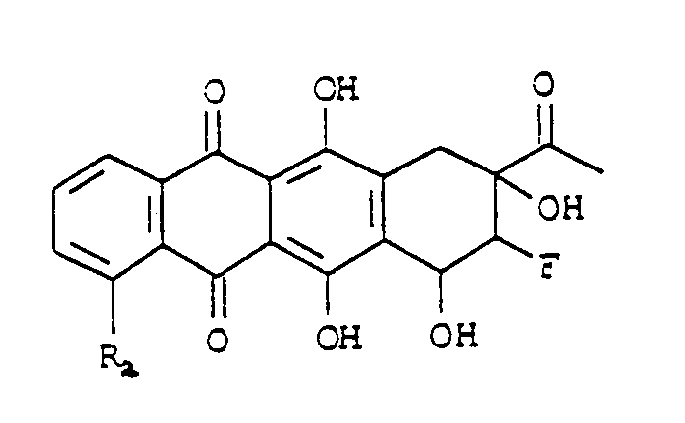
- A naphthacenedione having the formula:

- A naphthacenedione having the formula:

- A naphthacenedione having the formula:

- A naphthacenedione having the formula:

- A naphthacenedione having the formula:

- A naphthacenedione having the formula:

- Use of one or more of the compounds as claimed in claim 3 or 5 or pharmaceutically acceptable salts thereof, in combination with a pharmaceutically acceptable diluent or vector, for the production of a pharmaceutical composition useful as a chemotherapeutic agent with particular reference to antitumoral and antiviral activity.
- A process for preparing the compounds as claimed in claim 1, when R=H and R₁=F, such process providing for:i) cyclization of 1,4-dimethoxy-2,3-bis(bromomethyl)-anthraquinone suitably substituted with 3-butin-2-one with or without the presence of a suitable catalyst;ii) epoxidation with a peroxy compound;iii) opening of the oxiran ring with a nucleophilic fluorine;iv) demethylation of the phenolic hydroxyls and protection of the acetyl chain;v) brominating of the naphthacenedione at position 4 with bromine or other suitable brominating agent, such as N-bromo succinimide or 1,3-dibromo-5,5-dimethyldantoin, or poli(4-vinylpyridin bromohydrate perbromide) carried by a polymer; subsequent substitution with a hydroxyl; and finally deprotection of the acetyl group.
- A process as claimed in claim 16, for obtaining the compounds as claimed in claim 1, with X=OH, wherein a bromine atom is introduced on the acetyl group of the 7-substituted fluoro-2β-acetyl-1,2-epoxy-4α,5,12-trihydroxy-1,2,3,4-tetrahydro-6,11-naphthacenedione, and subsequently substituted with a hydroxyl either by means of direct hydrolysis of the bromine derivative or by hydrolysis of a suitable ester, such as formate obtained from the same through exchange reaction; or the hydroxyl is maintained in a suitably protected form.
- Process for preparing the compounds as claimed in claim 1, when R=F and R₁=H, such process providing for opening of the oxiran ring of the corresponding 7-substituted 2β-acetyl-1,2-epoxy-4α,5,12-trihydroxy-1,2,3,4-tetrahydro-6,11-naphtha-cenedione with a nucleophilic fluorine.
- Process for preparing the compounds as claimed in claim 3 or 5, such process providing for glycosidation of the compounds obtained by the process of claim 16 or 17 or 18 , with a suitably protected glucidic derivative in the presence of condensing agents, such as silver triflate or silver perchlorate, mercuric oxide and bromide mixtures, trimethylsilyltriflate, or acids such as p-toluensulfonic acid or Lewis acids such as a boron trihalogenide, tin tetrachloride or chemical compounds with equivalent properties, with or without the presence of a suitable dehydrating agent.
- Process as claimed in claim 19, wherein the deprotection of the obtained compound is performed with basic agents if the protective group is trifluoroacetyl, or with nickel or palladium complexes if the protecting group is allyloxycarbonyl.
- Process for preparing the compounds as claimed in claim 3, starting from 7-substituted 4-glycosilated 2β-acetyl-2α,4α,5,12-tetradydroxy-1,2,3,4-tetrahydro-6,11-naphthacenediones through the introduction of a bromine atom on the acetyl group at position 2 and substitution with a hydroxyl either by means of direct hydrolysis of the bromine derivative or hydrolysis of a suitable ester, such as formate, obtained by the same through an exchange reaction.
Applications Claiming Priority (6)
| Application Number | Priority Date | Filing Date | Title |
|---|---|---|---|
| IT956489 | 1989-11-13 | ||
| IT00956489A IT1236322B (en) | 1989-11-13 | 1989-11-13 | New fluoro-naphthacene-di:one(s) and glycosylated derivatives |
| IT9321A IT1239017B (en) | 1990-02-20 | 1990-02-20 | New fluoro-naphthacene-di:one(s) and glycosylated derivatives |
| IT932190 | 1990-02-20 | ||
| IT9357A IT1238673B (en) | 1990-03-30 | 1990-03-30 | New fluoro-naphthacene-di:one(s) and glycosylated derivatives |
| IT935790 | 1990-03-30 |
Publications (2)
| Publication Number | Publication Date |
|---|---|
| EP0436474A1 EP0436474A1 (en) | 1991-07-10 |
| EP0436474B1 true EP0436474B1 (en) | 1994-07-20 |
Family
ID=27272726
Family Applications (1)
| Application Number | Title | Priority Date | Filing Date |
|---|---|---|---|
| EP90830507A Expired - Lifetime EP0436474B1 (en) | 1989-11-13 | 1990-11-08 | New fluoro-naphtacenediones, their glycosilated derivatives and methods of making them |
Country Status (24)
| Country | Link |
|---|---|
| EP (1) | EP0436474B1 (en) |
| JP (1) | JPH03209343A (en) |
| KR (1) | KR940002983B1 (en) |
| CN (1) | CN1025608C (en) |
| AT (1) | ATE108760T1 (en) |
| AU (1) | AU641702B2 (en) |
| BR (1) | BR9005743A (en) |
| CA (1) | CA2029715A1 (en) |
| CU (1) | CU22303A3 (en) |
| DE (1) | DE69010874T2 (en) |
| DK (1) | DK0436474T3 (en) |
| ES (1) | ES2056433T3 (en) |
| HU (1) | HU208544B (en) |
| IE (1) | IE904002A1 (en) |
| IL (1) | IL96302A0 (en) |
| LV (1) | LV10422A (en) |
| MA (1) | MA21995A1 (en) |
| NO (1) | NO175101C (en) |
| NZ (1) | NZ236032A (en) |
| PL (1) | PL164019B1 (en) |
| PT (1) | PT95844B (en) |
| RU (1) | RU2015958C1 (en) |
| TN (1) | TNSN90131A1 (en) |
| YU (1) | YU47695B (en) |
Families Citing this family (12)
| Publication number | Priority date | Publication date | Assignee | Title |
|---|---|---|---|---|
| DE3943029A1 (en) * | 1989-12-27 | 1991-07-04 | Behringwerke Ag | METHOD FOR PRODUCING GLYCOSYL ANTHRACYCLINONES |
| CA2121929A1 (en) * | 1994-04-22 | 1995-10-23 | Pierre Doucet | Gear reducer |
| IT1271689B (en) * | 1994-08-04 | 1997-06-04 | Menarini Farma Ind | 8-FLUORO-ANTRACICLINE, THEIR PREPARATION PROCESSES AND PHARMACEUTICAL COMPOSITIONS CONTAINING THEM |
| AU3923995A (en) * | 1994-11-22 | 1996-06-17 | Novo Nordisk A/S | Active bio-compounds |
| WO1999058543A1 (en) * | 1998-05-13 | 1999-11-18 | Instytut Farmaceutyczny | New n-alkyloxycarbonyl derivatives of monosaccharides l-acosamine and l-daunosamine |
| WO2003035660A1 (en) * | 2001-10-23 | 2003-05-01 | Sumitomo Chemical Company, Limited | Stabilization of amrubicin hydrochloride |
| US7053191B2 (en) | 2003-05-21 | 2006-05-30 | Solux Corporation | Method of preparing 4-R-substituted 4-demethoxydaunorubicin |
| US8357785B2 (en) | 2008-01-08 | 2013-01-22 | Solux Corporation | Method of aralkylation of 4′-hydroxyl group of anthracylins |
| US8846882B2 (en) | 2011-04-29 | 2014-09-30 | Synbias Pharma Ag | Method of producing 4-demethoxydaunorubicin |
| RU2766222C2 (en) * | 2017-12-26 | 2022-02-10 | Общество с ограниченной ответственностью "НИАРМЕДИК ФАРМА" | Asymmetric derivatives of dinaphthalene polyphenols, their production method and application |
| CN114230538B (en) * | 2021-12-21 | 2023-11-17 | 蚌埠医学院 | Cyclic anthraquinone compound and preparation method and application thereof |
| EP4484412A4 (en) * | 2022-03-07 | 2025-07-02 | Univ Shanghai Jiaotong | CONDENSED QUINONE OXIMIMIDAZOLES, THEIR ONIUM DERIVATIVES, THEIR PREPARATION AND USE |
Family Cites Families (2)
| Publication number | Priority date | Publication date | Assignee | Title |
|---|---|---|---|---|
| GB8321676D0 (en) * | 1983-08-11 | 1983-09-14 | Erba Farmitalia | 4'-haloanthrocycline glycosides |
| US4697005A (en) * | 1985-03-20 | 1987-09-29 | Ohio State University Research Foundation | 1-fluoro, 4-fluoro, and 1,4-difluoro anthracycline anticancer antibiotics |
-
1990
- 1990-11-02 MA MA22269A patent/MA21995A1/en unknown
- 1990-11-06 IE IE400290A patent/IE904002A1/en unknown
- 1990-11-08 AT AT90830507T patent/ATE108760T1/en not_active IP Right Cessation
- 1990-11-08 ES ES90830507T patent/ES2056433T3/en not_active Expired - Lifetime
- 1990-11-08 EP EP90830507A patent/EP0436474B1/en not_active Expired - Lifetime
- 1990-11-08 DK DK90830507.1T patent/DK0436474T3/en active
- 1990-11-08 DE DE69010874T patent/DE69010874T2/en not_active Expired - Fee Related
- 1990-11-09 CA CA002029715A patent/CA2029715A1/en not_active Abandoned
- 1990-11-09 YU YU212390A patent/YU47695B/en unknown
- 1990-11-09 PT PT95844A patent/PT95844B/en not_active IP Right Cessation
- 1990-11-09 IL IL96302A patent/IL96302A0/en unknown
- 1990-11-12 NZ NZ236032A patent/NZ236032A/en unknown
- 1990-11-12 NO NO904907A patent/NO175101C/en unknown
- 1990-11-12 HU HU907104A patent/HU208544B/en not_active IP Right Cessation
- 1990-11-12 RU SU904831619A patent/RU2015958C1/en active
- 1990-11-12 PL PL90287728A patent/PL164019B1/en unknown
- 1990-11-12 AU AU65960/90A patent/AU641702B2/en not_active Ceased
- 1990-11-13 KR KR1019900018328A patent/KR940002983B1/en not_active Expired - Fee Related
- 1990-11-13 TN TNTNSN90131A patent/TNSN90131A1/en unknown
- 1990-11-13 BR BR909005743A patent/BR9005743A/en not_active Application Discontinuation
- 1990-11-13 CN CN90109104A patent/CN1025608C/en not_active Expired - Fee Related
- 1990-11-13 JP JP2304175A patent/JPH03209343A/en active Pending
- 1990-11-13 CU CU90175A patent/CU22303A3/en unknown
-
1993
- 1993-06-22 LV LV930656A patent/LV10422A/en unknown
Also Published As
| Publication number | Publication date |
|---|---|
| NO175101B (en) | 1994-05-24 |
| PL287728A1 (en) | 1992-11-02 |
| YU47695B (en) | 1996-01-08 |
| NO175101C (en) | 1994-08-31 |
| RU2015958C1 (en) | 1994-07-15 |
| DE69010874D1 (en) | 1994-08-25 |
| CU22303A3 (en) | 1995-01-31 |
| NO904907D0 (en) | 1990-11-12 |
| ATE108760T1 (en) | 1994-08-15 |
| KR940002983B1 (en) | 1994-04-09 |
| CN1025608C (en) | 1994-08-10 |
| PT95844A (en) | 1991-09-13 |
| MA21995A1 (en) | 1991-07-01 |
| PT95844B (en) | 1997-11-28 |
| AU641702B2 (en) | 1993-09-30 |
| BR9005743A (en) | 1991-09-24 |
| PL164019B1 (en) | 1994-06-30 |
| IE904002A1 (en) | 1991-05-22 |
| LV10422A (en) | 1995-02-20 |
| TNSN90131A1 (en) | 1991-03-05 |
| DE69010874T2 (en) | 1994-11-10 |
| ES2056433T3 (en) | 1994-10-01 |
| HU208544B (en) | 1993-11-29 |
| CN1052659A (en) | 1991-07-03 |
| EP0436474A1 (en) | 1991-07-10 |
| NO904907L (en) | 1991-05-14 |
| NZ236032A (en) | 1993-09-27 |
| CA2029715A1 (en) | 1991-05-14 |
| KR910009613A (en) | 1991-06-28 |
| HUT55337A (en) | 1991-05-28 |
| YU212390A (en) | 1992-12-21 |
| AU6596090A (en) | 1991-07-11 |
| DK0436474T3 (en) | 1994-08-29 |
| JPH03209343A (en) | 1991-09-12 |
| IL96302A0 (en) | 1991-08-16 |
Similar Documents
| Publication | Publication Date | Title |
|---|---|---|
| EP0436474A1 (en) | New fluoro-naphtacenediones, their glycosilated derivatives and methods of making them | |
| US4465671A (en) | Anthracycline glycosides use and compositions containing same | |
| EP0199920B1 (en) | New antitumor anthracyclines | |
| EP0275431B1 (en) | Novel anthracycline derivatives, a process for preparing same and their use as medicaments | |
| Matsumoto et al. | Efficient synthesis and antitumor activity of novel 14-fluoroanthracyclines | |
| US4939282A (en) | The process for preparing 6-deoxynthracyclines | |
| EP0159357B1 (en) | Carminomycinone precursors and analogues and derivatives thereof | |
| US4749693A (en) | Nitro anthracyclines, process for their preparation and use thereof | |
| EP0457215B1 (en) | 3'-deamino-4'-deoxy-4'-amino-8-fluoroanthracyclines and processes for their preparation | |
| US4563444A (en) | Anthracycline glycosides, use and compositions containing same | |
| US4448724A (en) | Synthesis of 4-demethoxydaunomycinone | |
| JP3836503B2 (en) | Anthracycline disaccharides, methods for their preparation, and pharmaceutical compositions containing them | |
| CA1179331A (en) | Regiospecific synthesis of anthracyclinone compounds such as daunomycinone | |
| US5138042A (en) | 6-deoxyanthracyclines | |
| IT9009357A1 (en) | 8-FLUORO-4-METOSSI-ANTRACICLINE, RELATED MANUFACTURING PROCEDURES AND THEIR USE. | |
| IT8909564A1 (en) | 8-FLUORO-ANTHRACYCLIN, RELATED MANUFACTURING PROCEDURES AND THEIR USE. | |
| JPH01249792A (en) | Novel oxetane derivative and preparation thereof | |
| CA2173158C (en) | Anthracycline disaccharides, process for their preparation, and pharmaceutical compositions containing them | |
| JPH0543545A (en) | New aza-saccharide derivative | |
| JPS63188694A (en) | 14-fluorodaunorubicin derivative | |
| GB2125030A (en) | Naphthacenequinone synthesis | |
| GB2218087A (en) | 4-Demethoxy-4'-deoxy-4' iodo anthracycline glycosides | |
| EP0202245A1 (en) | C-glycosidic adriamycin analogs |
Legal Events
| Date | Code | Title | Description |
|---|---|---|---|
| PUAI | Public reference made under article 153(3) epc to a published international application that has entered the european phase |
Free format text: ORIGINAL CODE: 0009012 |
|
| AK | Designated contracting states |
Kind code of ref document: A1 Designated state(s): AT BE CH DE DK ES FR GB GR LI LU NL SE |
|
| 17P | Request for examination filed |
Effective date: 19910508 |
|
| 17Q | First examination report despatched |
Effective date: 19930504 |
|
| GRAA | (expected) grant |
Free format text: ORIGINAL CODE: 0009210 |
|
| AK | Designated contracting states |
Kind code of ref document: B1 Designated state(s): AT BE CH DE DK ES FR GB GR LI LU NL SE |
|
| REF | Corresponds to: |
Ref document number: 108760 Country of ref document: AT Date of ref document: 19940815 Kind code of ref document: T |
|
| REF | Corresponds to: |
Ref document number: 69010874 Country of ref document: DE Date of ref document: 19940825 |
|
| REG | Reference to a national code |
Ref country code: DK Ref legal event code: T3 |
|
| REG | Reference to a national code |
Ref country code: ES Ref legal event code: FG2A Ref document number: 2056433 Country of ref document: ES Kind code of ref document: T3 |
|
| PGFP | Annual fee paid to national office [announced via postgrant information from national office to epo] |
Ref country code: DK Payment date: 19941025 Year of fee payment: 5 |
|
| PGFP | Annual fee paid to national office [announced via postgrant information from national office to epo] |
Ref country code: SE Payment date: 19941027 Year of fee payment: 5 |
|
| ET | Fr: translation filed | ||
| PG25 | Lapsed in a contracting state [announced via postgrant information from national office to epo] |
Ref country code: LU Free format text: LAPSE BECAUSE OF NON-PAYMENT OF DUE FEES Effective date: 19941130 |
|
| PGFP | Annual fee paid to national office [announced via postgrant information from national office to epo] |
Ref country code: NL Payment date: 19941130 Year of fee payment: 5 |
|
| REG | Reference to a national code |
Ref country code: GR Ref legal event code: FG4A Free format text: 3013207 |
|
| EAL | Se: european patent in force in sweden |
Ref document number: 90830507.1 |
|
| PLBE | No opposition filed within time limit |
Free format text: ORIGINAL CODE: 0009261 |
|
| STAA | Information on the status of an ep patent application or granted ep patent |
Free format text: STATUS: NO OPPOSITION FILED WITHIN TIME LIMIT |
|
| 26N | No opposition filed | ||
| PG25 | Lapsed in a contracting state [announced via postgrant information from national office to epo] |
Ref country code: DK Effective date: 19951108 |
|
| REG | Reference to a national code |
Ref country code: DK Ref legal event code: EBP |
|
| PG25 | Lapsed in a contracting state [announced via postgrant information from national office to epo] |
Ref country code: SE Effective date: 19951109 |
|
| PGFP | Annual fee paid to national office [announced via postgrant information from national office to epo] |
Ref country code: BE Payment date: 19951116 Year of fee payment: 6 |
|
| PGFP | Annual fee paid to national office [announced via postgrant information from national office to epo] |
Ref country code: CH Payment date: 19951117 Year of fee payment: 6 |
|
| PGFP | Annual fee paid to national office [announced via postgrant information from national office to epo] |
Ref country code: AT Payment date: 19951130 Year of fee payment: 6 |
|
| PG25 | Lapsed in a contracting state [announced via postgrant information from national office to epo] |
Ref country code: NL Effective date: 19960601 |
|
| NLV4 | Nl: lapsed or anulled due to non-payment of the annual fee |
Effective date: 19960601 |
|
| EUG | Se: european patent has lapsed |
Ref document number: 90830507.1 |
|
| PG25 | Lapsed in a contracting state [announced via postgrant information from national office to epo] |
Ref country code: AT Effective date: 19961108 |
|
| PG25 | Lapsed in a contracting state [announced via postgrant information from national office to epo] |
Ref country code: LI Effective date: 19961130 Ref country code: CH Effective date: 19961130 Ref country code: BE Effective date: 19961130 |
|
| BERE | Be: lapsed |
Owner name: A. MENARINI INDUSTRIE FARMACEUTICHE RIUNITE S.R.L Effective date: 19961130 |
|
| REG | Reference to a national code |
Ref country code: CH Ref legal event code: PL |
|
| PGFP | Annual fee paid to national office [announced via postgrant information from national office to epo] |
Ref country code: FR Payment date: 19981016 Year of fee payment: 9 |
|
| PGFP | Annual fee paid to national office [announced via postgrant information from national office to epo] |
Ref country code: GR Payment date: 19981023 Year of fee payment: 9 |
|
| PGFP | Annual fee paid to national office [announced via postgrant information from national office to epo] |
Ref country code: GB Payment date: 19981113 Year of fee payment: 9 |
|
| PGFP | Annual fee paid to national office [announced via postgrant information from national office to epo] |
Ref country code: ES Payment date: 19981116 Year of fee payment: 9 |
|
| PGFP | Annual fee paid to national office [announced via postgrant information from national office to epo] |
Ref country code: DE Payment date: 19990120 Year of fee payment: 9 |
|
| PG25 | Lapsed in a contracting state [announced via postgrant information from national office to epo] |
Ref country code: GB Free format text: LAPSE BECAUSE OF NON-PAYMENT OF DUE FEES Effective date: 19991108 |
|
| PG25 | Lapsed in a contracting state [announced via postgrant information from national office to epo] |
Ref country code: ES Free format text: LAPSE BECAUSE OF NON-PAYMENT OF DUE FEES Effective date: 19991109 |
|
| PG25 | Lapsed in a contracting state [announced via postgrant information from national office to epo] |
Ref country code: GR Free format text: LAPSE BECAUSE OF NON-PAYMENT OF DUE FEES Effective date: 19991130 |
|
| GBPC | Gb: european patent ceased through non-payment of renewal fee |
Effective date: 19991108 |
|
| PG25 | Lapsed in a contracting state [announced via postgrant information from national office to epo] |
Ref country code: FR Free format text: LAPSE BECAUSE OF NON-PAYMENT OF DUE FEES Effective date: 20000731 |
|
| PG25 | Lapsed in a contracting state [announced via postgrant information from national office to epo] |
Ref country code: DE Free format text: LAPSE BECAUSE OF NON-PAYMENT OF DUE FEES Effective date: 20000901 |
|
| REG | Reference to a national code |
Ref country code: FR Ref legal event code: ST |
|
| REG | Reference to a national code |
Ref country code: ES Ref legal event code: FD2A Effective date: 20001214 |