EP0435631B1 - Diesel fuel compositions - Google Patents
Diesel fuel compositions Download PDFInfo
- Publication number
- EP0435631B1 EP0435631B1 EP90314187A EP90314187A EP0435631B1 EP 0435631 B1 EP0435631 B1 EP 0435631B1 EP 90314187 A EP90314187 A EP 90314187A EP 90314187 A EP90314187 A EP 90314187A EP 0435631 B1 EP0435631 B1 EP 0435631B1
- Authority
- EP
- European Patent Office
- Prior art keywords
- carbon atoms
- weight
- manganese tricarbonyl
- composition according
- fuel
- Prior art date
- Legal status (The legal status is an assumption and is not a legal conclusion. Google has not performed a legal analysis and makes no representation as to the accuracy of the status listed.)
- Expired - Lifetime
Links
- 0 CC1N=C(*)N(*)C1 Chemical compound CC1N=C(*)N(*)C1 0.000 description 1
Classifications
-
- C—CHEMISTRY; METALLURGY
- C10—PETROLEUM, GAS OR COKE INDUSTRIES; TECHNICAL GASES CONTAINING CARBON MONOXIDE; FUELS; LUBRICANTS; PEAT
- C10L—FUELS NOT OTHERWISE PROVIDED FOR; NATURAL GAS; SYNTHETIC NATURAL GAS OBTAINED BY PROCESSES NOT COVERED BY SUBCLASSES C10G OR C10K; LIQUIFIED PETROLEUM GAS; USE OF ADDITIVES TO FUELS OR FIRES; FIRE-LIGHTERS
- C10L10/00—Use of additives to fuels or fires for particular purposes
- C10L10/02—Use of additives to fuels or fires for particular purposes for reducing smoke development
-
- C—CHEMISTRY; METALLURGY
- C10—PETROLEUM, GAS OR COKE INDUSTRIES; TECHNICAL GASES CONTAINING CARBON MONOXIDE; FUELS; LUBRICANTS; PEAT
- C10L—FUELS NOT OTHERWISE PROVIDED FOR; NATURAL GAS; SYNTHETIC NATURAL GAS OBTAINED BY PROCESSES NOT COVERED BY SUBCLASSES C10G OR C10K; LIQUIFIED PETROLEUM GAS; USE OF ADDITIVES TO FUELS OR FIRES; FIRE-LIGHTERS
- C10L1/00—Liquid carbonaceous fuels
- C10L1/10—Liquid carbonaceous fuels containing additives
- C10L1/14—Organic compounds
-
- C—CHEMISTRY; METALLURGY
- C10—PETROLEUM, GAS OR COKE INDUSTRIES; TECHNICAL GASES CONTAINING CARBON MONOXIDE; FUELS; LUBRICANTS; PEAT
- C10L—FUELS NOT OTHERWISE PROVIDED FOR; NATURAL GAS; SYNTHETIC NATURAL GAS OBTAINED BY PROCESSES NOT COVERED BY SUBCLASSES C10G OR C10K; LIQUIFIED PETROLEUM GAS; USE OF ADDITIVES TO FUELS OR FIRES; FIRE-LIGHTERS
- C10L1/00—Liquid carbonaceous fuels
- C10L1/10—Liquid carbonaceous fuels containing additives
- C10L1/14—Organic compounds
- C10L1/143—Organic compounds mixtures of organic macromolecular compounds with organic non-macromolecular compounds
-
- C—CHEMISTRY; METALLURGY
- C10—PETROLEUM, GAS OR COKE INDUSTRIES; TECHNICAL GASES CONTAINING CARBON MONOXIDE; FUELS; LUBRICANTS; PEAT
- C10L—FUELS NOT OTHERWISE PROVIDED FOR; NATURAL GAS; SYNTHETIC NATURAL GAS OBTAINED BY PROCESSES NOT COVERED BY SUBCLASSES C10G OR C10K; LIQUIFIED PETROLEUM GAS; USE OF ADDITIVES TO FUELS OR FIRES; FIRE-LIGHTERS
- C10L1/00—Liquid carbonaceous fuels
- C10L1/10—Liquid carbonaceous fuels containing additives
- C10L1/14—Organic compounds
- C10L1/16—Hydrocarbons
- C10L1/1616—Hydrocarbons fractions, e.g. lubricants, solvents, naphta, bitumen, tars, terpentine
-
- C—CHEMISTRY; METALLURGY
- C10—PETROLEUM, GAS OR COKE INDUSTRIES; TECHNICAL GASES CONTAINING CARBON MONOXIDE; FUELS; LUBRICANTS; PEAT
- C10L—FUELS NOT OTHERWISE PROVIDED FOR; NATURAL GAS; SYNTHETIC NATURAL GAS OBTAINED BY PROCESSES NOT COVERED BY SUBCLASSES C10G OR C10K; LIQUIFIED PETROLEUM GAS; USE OF ADDITIVES TO FUELS OR FIRES; FIRE-LIGHTERS
- C10L1/00—Liquid carbonaceous fuels
- C10L1/10—Liquid carbonaceous fuels containing additives
- C10L1/14—Organic compounds
- C10L1/18—Organic compounds containing oxygen
- C10L1/182—Organic compounds containing oxygen containing hydroxy groups; Salts thereof
- C10L1/183—Organic compounds containing oxygen containing hydroxy groups; Salts thereof at least one hydroxy group bound to an aromatic carbon atom
- C10L1/1832—Organic compounds containing oxygen containing hydroxy groups; Salts thereof at least one hydroxy group bound to an aromatic carbon atom mono-hydroxy
-
- C—CHEMISTRY; METALLURGY
- C10—PETROLEUM, GAS OR COKE INDUSTRIES; TECHNICAL GASES CONTAINING CARBON MONOXIDE; FUELS; LUBRICANTS; PEAT
- C10L—FUELS NOT OTHERWISE PROVIDED FOR; NATURAL GAS; SYNTHETIC NATURAL GAS OBTAINED BY PROCESSES NOT COVERED BY SUBCLASSES C10G OR C10K; LIQUIFIED PETROLEUM GAS; USE OF ADDITIVES TO FUELS OR FIRES; FIRE-LIGHTERS
- C10L1/00—Liquid carbonaceous fuels
- C10L1/10—Liquid carbonaceous fuels containing additives
- C10L1/14—Organic compounds
- C10L1/22—Organic compounds containing nitrogen
- C10L1/222—Organic compounds containing nitrogen containing at least one carbon-to-nitrogen single bond
- C10L1/224—Amides; Imides carboxylic acid amides, imides
-
- C—CHEMISTRY; METALLURGY
- C10—PETROLEUM, GAS OR COKE INDUSTRIES; TECHNICAL GASES CONTAINING CARBON MONOXIDE; FUELS; LUBRICANTS; PEAT
- C10L—FUELS NOT OTHERWISE PROVIDED FOR; NATURAL GAS; SYNTHETIC NATURAL GAS OBTAINED BY PROCESSES NOT COVERED BY SUBCLASSES C10G OR C10K; LIQUIFIED PETROLEUM GAS; USE OF ADDITIVES TO FUELS OR FIRES; FIRE-LIGHTERS
- C10L1/00—Liquid carbonaceous fuels
- C10L1/10—Liquid carbonaceous fuels containing additives
- C10L1/14—Organic compounds
- C10L1/22—Organic compounds containing nitrogen
- C10L1/232—Organic compounds containing nitrogen containing nitrogen in a heterocyclic ring
-
- C—CHEMISTRY; METALLURGY
- C10—PETROLEUM, GAS OR COKE INDUSTRIES; TECHNICAL GASES CONTAINING CARBON MONOXIDE; FUELS; LUBRICANTS; PEAT
- C10L—FUELS NOT OTHERWISE PROVIDED FOR; NATURAL GAS; SYNTHETIC NATURAL GAS OBTAINED BY PROCESSES NOT COVERED BY SUBCLASSES C10G OR C10K; LIQUIFIED PETROLEUM GAS; USE OF ADDITIVES TO FUELS OR FIRES; FIRE-LIGHTERS
- C10L1/00—Liquid carbonaceous fuels
- C10L1/10—Liquid carbonaceous fuels containing additives
- C10L1/14—Organic compounds
- C10L1/22—Organic compounds containing nitrogen
- C10L1/234—Macromolecular compounds
- C10L1/238—Macromolecular compounds obtained otherwise than by reactions involving only carbon-to-carbon unsaturated bonds
- C10L1/2383—Polyamines or polyimines, or derivatives thereof (poly)amines and imines; derivatives thereof (substituted by a macromolecular group containing 30C)
-
- C—CHEMISTRY; METALLURGY
- C10—PETROLEUM, GAS OR COKE INDUSTRIES; TECHNICAL GASES CONTAINING CARBON MONOXIDE; FUELS; LUBRICANTS; PEAT
- C10L—FUELS NOT OTHERWISE PROVIDED FOR; NATURAL GAS; SYNTHETIC NATURAL GAS OBTAINED BY PROCESSES NOT COVERED BY SUBCLASSES C10G OR C10K; LIQUIFIED PETROLEUM GAS; USE OF ADDITIVES TO FUELS OR FIRES; FIRE-LIGHTERS
- C10L1/00—Liquid carbonaceous fuels
- C10L1/10—Liquid carbonaceous fuels containing additives
- C10L1/14—Organic compounds
- C10L1/30—Organic compounds compounds not mentioned before (complexes)
- C10L1/305—Organic compounds compounds not mentioned before (complexes) organo-metallic compounds (containing a metal to carbon bond)
-
- F—MECHANICAL ENGINEERING; LIGHTING; HEATING; WEAPONS; BLASTING
- F02—COMBUSTION ENGINES; HOT-GAS OR COMBUSTION-PRODUCT ENGINE PLANTS
- F02B—INTERNAL-COMBUSTION PISTON ENGINES; COMBUSTION ENGINES IN GENERAL
- F02B3/00—Engines characterised by air compression and subsequent fuel addition
- F02B3/06—Engines characterised by air compression and subsequent fuel addition with compression ignition
Definitions
- This invention relates to diesel fuels, to additive packages for incorporation therein, and to their use.
- Improved fuel economy is a constant objective of all users of internal combustion engines as the cost of the fuel is a major component of operating costs. This is especially true for users of internal combustion engines used to drive land vehicles, ships, or stationary engines. Even a small improvement in fuel economy can result in a valuable reduction of operating costs. In addition it is useful to reduce the emissions of internal combustion engines, and any improvement in fuel economy contributes to this objective. This is particularly true where the engine is fuelled with a heavy (i.e. relatively viscous and non-volatile) hydrocarbon fuel, as is the case with many marine diesel engines and other heavy diesel engines used to drive vehicles. Such fuels often contain relatively high contents of sulphur which, as is well known, is an important contributor to pollution caused by exhaust gases, and also have relatively poor combustion characteristics which can constitute a limiting factor in the performance of the diesel engine burning them.
- GB-A-1 413 323 discloses a nine component diesel fuel additive for reducing deposits formed by incomplete and inefficient combustion.
- the nine components include an amide derivative obtained by reaction of a polyolefin-substituted succinic acid or anhydride with a polyamine, and an organometallic tricarbonyl cyclopentadiene, together with other components said to be necessary to achieve the desired objective.
- the present invention provides a heavy diesel fuel composition which has been shown to have improved combustion characteristics in use which lead to a valuable improvement in fuel economy and a reduction in the amount of exhaust gases produced.
- the heavy diesel fuel composition of the presentinvention comprises a cyclomatic manganese tricarbonyl (as hereinafter defined), an ashless dispersant comprising
- the cyclomatic manganese tricarbonyl compound, the ashless dispersant and the optional antioxidant are conveniently supplied to the user, i.e. the supplier or user of the diesel fuel, in the form of a package comprising these ingredients, which may, if desired, be supplied in solution or stable dispersion in diesel fuel oil or other suitable diluent oil compatible with the diesel fuel into which the additives are to be incorporated, e.g. a mineral or synthetic lubricating oil, a hydrocarbon solvent, or an oxygenated hydrocarbon solvent such as an alcohol or ester.
- Such a package may contain from 1 to 15%, preferably 2.5 to 7.5% by weight of the cyclomatic manganese tricarbonyl compound, from 50 to 99%, preferably 70 to 90%, by weight of the ashless dispersant, and from 0 to 20% by weight of the optional antioxidant.
- the presence of the diluent oil is optional, but inclusion of such diluent can facilitate the incorporation of the package of additives into the diesel fuel.
- the package is incorporated in the fuel in a proportion of 0.025 to 1% by weight of the package based on the weight of the fuel, preferably 0.05 to 0.5% by weight.
- the present invention is especially useful for use with heavy diesel fuels for marine or railroad use.
- the requirements for such fuels have been laid down in numerous industrial standards.
- Residual marine fuel standards have been issued by the same standardization authorities: ISO DIS DP 8217 having the designations ISO-F-RMA-10, RMB-10, RMC-10, RMD-15, RME-25, RMF-25, RMG-35, RMH-35, RMK-35, RML-35, RMH-45, RMK-45, RML-45, RMH-55 and RML-55; BSI Standards BSMA 100 (1982) classes M4, M5, M6, M7, M8, M9, M10, M11 and M12; and CIMAC recommended standards 2, 3, 4, 5, 6, 7, 8, 9, 10, 11 and 12. Such standards are described in, for example, ASTM Publication Code PCN 04-878000-12, "Marine Fuels" by Thornton et al December, 1983).
- the heavy diesel fuels in connection with which the present invention is especially useful contain at least 0.5% of sulphur, usually 1% or more up to about 5%. They have a density of at least 0.88 g/ml up to a maximum of about 1.
- the viscosity may vary from 10 to 500 centistokes (cSt) at 50°C, but is usually in the range of 100 to 500 cSt at 50°C.
- cyclomatic manganese tricarbonyl compounds used in the present invention are described in the literature, for example US-A- 3015668. They may be represented by the general formula: CyMn(CO)3 where Cy represents a cyclomatic hydrocarbon radical, i.e. a hydrocarbon radical containing a cyclopentadienyl nucleus. Typical of such hydrocarbon radicals are those represented by the formulae: where the radicals R1, R2, R3, R4 and R5 are each hydrogen or a monovalent hydrocarbon radical, e.g. an alkyl radical of up to 4 carbon atoms, phenyl, or alkylphenyl in which the alkyl contains up to 4 carbon atoms.
- radicals Cy contain from 5 to 13 carbon atoms each, and examples of the radical Cy are cyclopentadienyl, idenyl, methylcyclopentadienyl, propylcyclopentadienyl, diethylcyclopentadienyl, phenylcyclopentadienyl, tert-butyl-cyclopentadienyl, p-ethylphenylcyclopentadienyl and 4-tert-butyl indenyl.
- cyclomatic manganese tricarbonyl compounds which can be used in the present invention are cyclopentadienyl manganese tricarbonyl, methylcyclopentadienyl manganese tricarbonyl, indenyl manganese tricarbonyl, and ethylcyclopentadienyl manganese tricarbonyl.
- Methylcyclopentadienyl manganese tricarbonyl is commercially available and is preferred.
- Ashless dispersants are described in numerous patent specifications, mainly as additives for use in lubricant compositions, but their use in hydrocarbon fuels has also been described. Ashless dispersants leave little or no metal containing residue on combustion. They generally contain only carbon, hydrogen, oxygen and nitrogen, but sometimes contain in addition other non-metallic elements such as phosphorus, sulphur or boron.
- a preferred ashless dispersant is a product of a reaction between an alkylene polyamine and a hydrocarbon-substituted carboxylic acid or anhydride made by reaction of a polyolefin having a molecular weight from 500 to 5,000 with an unsaturated polycarboxylic acid or anhydride. These may be formed by conventional methods such as by heating the hydrocarbon substituted carboxylic acid or anhydride with the alkylene polyamine.
- the hydrocarbon-substituted anhydride may be made readily by heating a mixture of the olefin and maleic anhydride to 180°-220°C.
- the olefin is preferably a polymer or copolymer of a lower monoolefin such as ethylene, propylene, isobutene and the like.
- the more preferred source of alkenyl group is from polyisobutene having a molecular weight from 500 - 5,000.
- the alkenyl is a polyisobutene group having a molecular weight of 700-5,000 and most preferably 900-2,000.
- the preferred amines are the alkylene polyamines such as propylene diamine, dipropylene triamine, di-(1,2-butylene)triamine, tetra-(1,2-propylene)pentaamine.
- the most preferred amines are the ethylene polyamines which have the formula H2N(CH2CH2NH) n H wherein n is an integer from one to ten. These include: ethylene diamine, diethylene triamine, triethylene tetramine, tetraethylene pentaamine and pentaethylene hexamine, including mixtures thereof in which case n is the average value of the mixture. These ethylene polyamines have a primary amine group at each end so can form mono-alkenylsuccinimides and bisalkenyl-succinimides.
- especially preferred ashless dispersants for use in the present invention are the products of reaction of a polyethylenepolyamine, e.g. triethylene tetramine or tetraethylene pentamine, with a hydrocarbon substituted carboxylic acid or anhydride made by reaction of a polyolefin, preferably polyisobutene, having a molecular weight of 500 to 5,000, especially 900 to 1,200, with an unsaturated polycarboxylic acid or anhydride, e.g. maleic anhydride.
- a polyethylenepolyamine e.g. triethylene tetramine or tetraethylene pentamine
- a hydrocarbon substituted carboxylic acid or anhydride made by reaction of a polyolefin, preferably polyisobutene, having a molecular weight of 500 to 5,000, especially 900 to 1,200
- an unsaturated polycarboxylic acid or anhydride e.g. maleic anhydride.
- alkenyl succinic acid esters and diesters of alcohols containing 1-20 carbon atoms and 1-6 hydroxyl groups Representative examples are described in US 3,331,776; US 3,381,022 and US 3,522,179.
- the alkenyl succinic portion of these esters corresponds to the alkenyl succinic portion of the succinimides described above including the same preferred and most preferred sub-genus e.g. polyisobutenyl succinic acids wherein the polyisobutenyl group has an average molecular weight of 900-2,000.
- Alcohols useful in preparing the esters include methanol, ethanol, isobutanol, octadecanol, eicosanol, ethylene glycol, diethylene glycol, tetraethylene glycol, diethylene glycol monethylether, propylene glycol, tripropylene glycol, glycerol, sorbitol, 1,1,1-trimethylol ethane, 1,1,1,-trimethylol propane, 1,1,1-trimethylol butane, pentaerythritol and dipentaerythritol.
- the succinic esters are readily made by merely heating a mixture of alkenyl succinic acid, anhydrides or lower alkyl (e.g. C1-C4) ester with the alcohol while distilling out water or lower alkanol. In the case of acid-esters less alcohol is used. In fact, acid-esters made from alkenyl succinic anhydrides do not evolve water. In another method the alkenyl succinic acid or anhydride can be merely reacted with an appropriate alkylene oxide such as ethylene oxide and propylene oxide, including mixtures thereof.
- an appropriate alkylene oxide such as ethylene oxide and propylene oxide
- the ashless dispersant is an alkenyl succinic ester-amide mixture.
- alkenyl succinic ester-amide mixture may be made by heating the above-described alkenyl succinic acids, anhydrides or lower alkyl esters with an alcohol and an amine either sequentially or in a mixture.
- the alcohols and amines described above are also useful in this embodiment.
- amino alcohols can be used alone or with the alcohol and/or amine to form the ester-amide mixtures.
- the amino alcohol can contain 1-20 carbon atoms, 1-6 hydroxy groups and 1-4 amine nitrogen atoms. Examples are ethanolamine, diethanolamine, N-ethanol-diethylene triamine, trimethylol aminomethane.
- ester-amide mixtures are described in US 3,184,474; US 3,576,743; US 3,632,511; US 3,804,763; US 3,836,471; US 3,862,981; US 3,936,480; US 3,948,800; US 3,950,341; US 3,957,854; US 3,957,855; US 3,991,098; US 4,071,548 and US 4,173,540.
- Such ashless dispersants containing alkenyl succinic residues may, and is well known, be post-reacted with boron compounds, phosphorus derivatives and/or carboxylic acid acylating agents, e.g. maleic anhydride.
- Another useful class of ashless dispersants includes the Mannich condensates of hydrocarbyl-substituted phenols, formaldehyde or formaldehyde precursors (e.g. paraformaldehyde) and an amine having at least one primary amine group and containing 1-10 amine groups and 1-20 carbon atoms.
- Mannich condensates are those made by condensing a polyisobutylphenol wherein the polyisobutyl group has an average molecular weight of 800-3,000 with formaldehyde or a formaldehyde precursor and an ethylene polyamine having the formula: H2N( ⁇ CH2CH2NH) ⁇ n H wherein n is an integer from one to ten or mixtures thereof especially those in which n has an average value of 3-5.
- Another class of ashless dispersants which can advantageously be used in the diesel fuel composition of the present invention are the imidazoline dispersants which can be represented by the formula: wherein R1 represents a hydrocarbon group having 1 to 23 carbon atoms, e.g. an alkyl or alkenyl group having 7 to 22 carbon atoms, and R2 represents a hydrogen atom or a hydrocarbon radical of 1 to 22 carbon atoms, or an amino-alkyl, acylaminoalkyl or hydroxyalkyl radical having 2 to 44 carbon atoms.
- R1 represents a hydrocarbon group having 1 to 23 carbon atoms, e.g. an alkyl or alkenyl group having 7 to 22 carbon atoms
- R2 represents a hydrogen atom or a hydrocarbon radical of 1 to 22 carbon atoms, or an amino-alkyl, acylaminoalkyl or hydroxyalkyl radical having 2 to 44 carbon atoms.
- Such long-chain alkyl (or long-chain alkenyl) imidazoline compounds may be made by reaction of a corresponding long-chain fatty acid (of formula R1-COOH), for example oleic acid, with an appropriate polyamine.
- the imidazoline formed is then ordinarily called, for example, oleylimidazoline where the radical R1 represents the oleyl residue of oleic acid.
- R1 represents the oleyl residue of oleic acid.
- Other suitable alkyl substituents in the 2- position of these imidazolines include undecyl, heptadecyl, lauryl and erucyl.
- Suitable N-substituents of the imidazolines i.e.
- radicals R2 include hydroxyalkyl, aminoalkyl, acylaminoalkyl and hydrocarbon radicals such as hydroxyethyl, aminoethyl, oleylaminoethyl and stearylaminoethyl.
- Suitable ashless dispersants which may be incorporated in the diesel fuel compositions of the present invention include the products of condensation of a cyclic anhydride with a straight-chain N-alkylpolyamine of the formula: R-(NH-R'-) n -NH2 where n is an integer at least equal to 1, usually 3 to 5, R is a saturated or unsaturated linear hydrocarbon radical of 10 to 22 carbon atoms and R′ is a divalent alkylene or alkylidene radical of 1 to 6 carbon atoms.
- polyamines examples include N-oleyl-1,3-propanediamine, N-stearyl-1,3-propanediamine, N-oleyl-1,3-butanediamine, N-oleyl-2-methyl-1,3-propanediamine, N-oleyl-1,3-pentanediamine, N-oleyl-2-ethyl-1,3-propanediamine, N-stearyl-1,3-butanediamine, N-stearyl-2-methyl-1,3-propanediamine, N-stearyl-1,3-pentanediamine, N-stearyl-2-ethyl-1,3-propanediamine, N-oleyl-dipropylenetriamine and N-stearyl-dipropylenetriamine.
- Such linear N-alkylpolyamines are condensed with, e.g., a succinic, maleic, phthalic or hexahydrophthalic acid anhydride which may be substituted by one or more radicals of up to 5 carbon atoms each.
- Another class of ashless dispersant which can be incorporated in the compositions of the present invention are the products of reaction of an ethoxylated amine made by reaction of ammonia with ethylene oxide with a carboxylic acid of 8 to 30 carbon atoms.
- the ethoxylated amine may be, for example, mono-, di- or tri-ethanolamine or a polyethoxylated derivative thereof, and the carboxylic acid may be, for example, a straight or branched chain fatty acid of 10 to 22 carbon atoms, a naphthenic acid, a resinic acid or an alkyl aryl carboxylic acid.
- the heavy diesel fuel compositions of the present invention preferably include a combination of an ashless dispersant made by reaction of a polyolefin-succinic acid with a polyethylene polyamine and a long-chain alkyl imidazoline, preferably in a ratio of 1 to 4 to 4 to 1 by weight.
- an ashless dispersant made by reaction of a polyolefin-succinic acid with a polyethylene polyamine and a long-chain alkyl imidazoline, preferably in a ratio of 1 to 4 to 4 to 1 by weight.
- Other mixtures of ashless dispersants can, of course, also be used.
- the heavy diesel fuel compositions of the present invention preferably also contain an antioxidant, e.g. a phenolic, sulphurized phenolic, or aromatic amine antioxidant.
- an antioxidant e.g. a phenolic, sulphurized phenolic, or aromatic amine antioxidant.
- Any commercially available antioxidant compatible with the diesel fuel may be used, but preferably the antioxidant is a hydrocarbon soluble phenolic antioxidant and especially such an antioxidant in which at least one ortho position of the phenol is blocked. Examples of such phenolic antioxidants are well known in the art.
- Examples include 2-tert-butylphenol, 2-ethyl-6-methylphenol, 2,6-di-tert-butyl-phenol, 2,6-di-tert-butyl-4-methylphenol, 2,2'-methylene-bis-4,6-di-tert-butyl-phenol, 4,4'-methylene-bis(2,6-di-tert-butyl-phenol) and 2,2'-propylidene-bis(6-tert-butyl-4-methyl-phenol). Mixtures of such antioxidants can also be used.
- the heavy diesel fuel compositions of the present invention may also incorporate other additives commonly used in diesel fuels and compatible with the above-mentioned constituents.
- additional additives include: cold flow improvers and pour-point depressants, e.g. olefin/vinyl acetate copolymers such as ethylene/vinyl acetate copolymers and poly(alkylmethacrylates); corrosion inhibitors and antiwear additives based on carboxylic acids, such as dimerised linoleic acid, stabilisers, e.g. aliphatic amines such as dialkyl cyclohexylamine, and antifoam agents such as silicones.
- Such materials are well known in the art and are used in the usual proportions.
- Dispersant A was a polyisobutenyl succinimide ashless dispersant based on a polyisobutene having a number average molecular weight of 900 and triethylenetetramine.
- Dispersant B was a mixture of an imidazoline and an amide made by reaction of tall oil fatty acids with hydroxyethyl-ethylene diamine.
- the mixture also included 100 solvent neutral mineral lubricating oil to facilitate incorporation into the heavy diesel fuel.
- a residual marine diesel fuel having a viscosity of 465 cSt at 50°C and containing 3% sulphur was treated with the same additive mixture at the same rate.
- the fuel was used in an Atlas medium speed diesel engine having a maximum rpm of 1200. Tests were run across the full operating speed range of the engine under the conditions used during propulsion and with the power output of the engine controlled to the same level at each test speed both with the treated and the untreated fuel. Fuel consumption was determined by measuring the brake specific fuel consumption (BSFC) and the reduction in consumption obtained using the fuel containing the additive mixture compared with the consumption obtained with untreated fuel was determined. The results were as follows:
- the main engine was fuelled with heavy residual marine diesel fuel having a viscosity of 100 cSt at 50°C and containing 4% sulphur.
- the auxiliary diesel engine was supplied with fuel having a viscosity of 15 cSt at 50°C and containing 2% sulphur.
- Each engine was supplied with untreated fuel for two weeks, then with treated fuel for two periods each of two weeks, and finally with untreated fuel again for a further period of two weeks.
- the treated fuel for the main engine contained 0.066% by weight of the additive package described above and the fuel for the auxiliary engine contained 0.05% by weight of the additive package described above.
Landscapes
- Chemical & Material Sciences (AREA)
- Oil, Petroleum & Natural Gas (AREA)
- Engineering & Computer Science (AREA)
- Organic Chemistry (AREA)
- Chemical Kinetics & Catalysis (AREA)
- General Chemical & Material Sciences (AREA)
- Combustion & Propulsion (AREA)
- Liquid Carbonaceous Fuels (AREA)
- Solid Fuels And Fuel-Associated Substances (AREA)
Description
- This invention relates to diesel fuels, to additive packages for incorporation therein, and to their use.
- Improved fuel economy is a constant objective of all users of internal combustion engines as the cost of the fuel is a major component of operating costs. This is especially true for users of internal combustion engines used to drive land vehicles, ships, or stationary engines. Even a small improvement in fuel economy can result in a valuable reduction of operating costs. In addition it is useful to reduce the emissions of internal combustion engines, and any improvement in fuel economy contributes to this objective. This is particularly true where the engine is fuelled with a heavy (i.e. relatively viscous and non-volatile) hydrocarbon fuel, as is the case with many marine diesel engines and other heavy diesel engines used to drive vehicles. Such fuels often contain relatively high contents of sulphur which, as is well known, is an important contributor to pollution caused by exhaust gases, and also have relatively poor combustion characteristics which can constitute a limiting factor in the performance of the diesel engine burning them.
- There is therefore a need to be able to improve combustion efficiency and economy of heavy diesel engines, especially marine diesel engines, which burn heavy hydrocarbon fuels especially those containing appreciable amounts of sulphur.
- GB-A-1 413 323 discloses a nine component diesel fuel additive for reducing deposits formed by incomplete and inefficient combustion. The nine components include an amide derivative obtained by reaction of a polyolefin-substituted succinic acid or anhydride with a polyamine, and an organometallic tricarbonyl cyclopentadiene, together with other components said to be necessary to achieve the desired objective.
- The present invention provides a heavy diesel fuel composition which has been shown to have improved combustion characteristics in use which lead to a valuable improvement in fuel economy and a reduction in the amount of exhaust gases produced. The heavy diesel fuel composition of the presentinvention comprises a cyclomatic manganese tricarbonyl (as hereinafter defined), an ashless dispersant comprising
- (1) a product of a reaction between an ethylene polyamine mixture having an average of from 4 to 10 nitrogen atoms per molecule and a hydrocarbon-substituted carboxylic acid or anhydride made by reaction of a polyolefin having a molecular weight of from 500 to 5,000 with an unsaturated polycarboxylic acid or anhydride; or
- (2) an imidazoline dispersant of formula

- (3) an alkenyl succinic acid ester or diester made by reaction of polyolefin having a molecular weight from 500 to 5,000 with one or more alcohols containing 1-20 carbon atoms and 1-6 hydroxyl groups,
- (4) an alkenyl succinic ester-amide made by reaction of polyolefin having a molecular weight from 500 to 5,000 with (a) one or more alcohols containing 1-20 carbon atoms and 1-6 hydroxyl groups, and (b) an amine,
- (5) a Mannich condensates of hydrocarbyl-substituted phenols, formaldehyde or formaldehyde precursor, an amine having at least one primary amine group and containing 1-10 amine groups and 1-20 carbon atoms,
- (6) a product of condensation of a cyclic anhydride with a straight chain N-alkylpolyamine of the formula R-(NH-R'-)n-NH₂, wherein n is an integer of 1 to 5, R is a linear hydrocarbon radical of 10 to 22 carbon atoms and R' is a divalent alkylene or alkylidene radical of 1 to 6 carbon atoms, or
- (7) a product of reaction of an ethoxylated amine with a carboxylic acid of 8 to 30 carbon atoms,
- The cyclomatic manganese tricarbonyl compound, the ashless dispersant and the optional antioxidant are conveniently supplied to the user, i.e. the supplier or user of the diesel fuel, in the form of a package comprising these ingredients, which may, if desired, be supplied in solution or stable dispersion in diesel fuel oil or other suitable diluent oil compatible with the diesel fuel into which the additives are to be incorporated, e.g. a mineral or synthetic lubricating oil, a hydrocarbon solvent, or an oxygenated hydrocarbon solvent such as an alcohol or ester. Such a package may contain from 1 to 15%, preferably 2.5 to 7.5% by weight of the cyclomatic manganese tricarbonyl compound, from 50 to 99%, preferably 70 to 90%, by weight of the ashless dispersant, and from 0 to 20% by weight of the optional antioxidant. The presence of the diluent oil is optional, but inclusion of such diluent can facilitate the incorporation of the package of additives into the diesel fuel. Typically, the package is incorporated in the fuel in a proportion of 0.025 to 1% by weight of the package based on the weight of the fuel, preferably 0.05 to 0.5% by weight.
- The present invention is especially useful for use with heavy diesel fuels for marine or railroad use. The requirements for such fuels have been laid down in numerous industrial standards. Reference may be made to ISO Standards DIS 8217 having the designations ISO-F- DMX, DMA, DMB, and DMC; to BSI Standards BS MA 100 (1982) classes M1, M2 and M3; and to the CIMAC 1 recommended standard. These are distillate marine fuel standards. Residual marine fuel standards have been issued by the same standardization authorities: ISO DIS DP 8217 having the designations ISO-F-RMA-10, RMB-10, RMC-10, RMD-15, RME-25, RMF-25, RMG-35, RMH-35, RMK-35, RML-35, RMH-45, RMK-45, RML-45, RMH-55 and RML-55; BSI Standards BSMA 100 (1982) classes M4, M5, M6, M7, M8, M9, M10, M11 and M12; and CIMAC recommended standards 2, 3, 4, 5, 6, 7, 8, 9, 10, 11 and 12. Such standards are described in, for example, ASTM Publication Code PCN 04-878000-12, "Marine Fuels" by Thornton et al December, 1983).
- In general terms, the heavy diesel fuels in connection with which the present invention is especially useful contain at least 0.5% of sulphur, usually 1% or more up to about 5%. They have a density of at least 0.88 g/ml up to a maximum of about 1. The viscosity may vary from 10 to 500 centistokes (cSt) at 50°C, but is usually in the range of 100 to 500 cSt at 50°C.
- The cyclomatic manganese tricarbonyl compounds used in the present invention are described in the literature, for example US-A- 3015668. They may be represented by the general formula:
CyMn(CO)₃
where Cy represents a cyclomatic hydrocarbon radical, i.e. a hydrocarbon radical containing a cyclopentadienyl nucleus. Typical of such hydrocarbon radicals are those represented by the formulae:
where the radicals R₁, R₂, R₃, R₄ and R₅ are each hydrogen or a monovalent hydrocarbon radical, e.g. an alkyl radical of up to 4 carbon atoms, phenyl, or alkylphenyl in which the alkyl contains up to 4 carbon atoms. Preferred such radicals Cy contain from 5 to 13 carbon atoms each, and examples of the radical Cy are cyclopentadienyl, idenyl, methylcyclopentadienyl, propylcyclopentadienyl, diethylcyclopentadienyl, phenylcyclopentadienyl, tert-butyl-cyclopentadienyl, p-ethylphenylcyclopentadienyl and 4-tert-butyl indenyl. Specific preferred cyclomatic manganese tricarbonyl compounds which can be used in the present invention are cyclopentadienyl manganese tricarbonyl, methylcyclopentadienyl manganese tricarbonyl, indenyl manganese tricarbonyl, and ethylcyclopentadienyl manganese tricarbonyl. Methylcyclopentadienyl manganese tricarbonyl is commercially available and is preferred. - Ashless dispersants are described in numerous patent specifications, mainly as additives for use in lubricant compositions, but their use in hydrocarbon fuels has also been described. Ashless dispersants leave little or no metal containing residue on combustion. They generally contain only carbon, hydrogen, oxygen and nitrogen, but sometimes contain in addition other non-metallic elements such as phosphorus, sulphur or boron.
- A preferred ashless dispersant is a product of a reaction between an alkylene polyamine and a hydrocarbon-substituted carboxylic acid or anhydride made by reaction of a polyolefin having a molecular weight from 500 to 5,000 with an unsaturated polycarboxylic acid or anhydride. These may be formed by conventional methods such as by heating the hydrocarbon substituted carboxylic acid or anhydride with the alkylene polyamine. The hydrocarbon-substituted anhydride may be made readily by heating a mixture of the olefin and maleic anhydride to 180°-220°C. The olefin is preferably a polymer or copolymer of a lower monoolefin such as ethylene, propylene, isobutene and the like. The more preferred source of alkenyl group is from polyisobutene having a molecular weight from 500 - 5,000. In a still more preferred embodiment the alkenyl is a polyisobutene group having a molecular weight of 700-5,000 and most preferably 900-2,000.
- The preferred amines are the alkylene polyamines such as propylene diamine, dipropylene triamine, di-(1,2-butylene)triamine, tetra-(1,2-propylene)pentaamine.
- The most preferred amines are the ethylene polyamines which have the formula H₂N(CH₂CH₂NH)nH wherein n is an integer from one to ten. These include: ethylene diamine, diethylene triamine, triethylene tetramine, tetraethylene pentaamine and pentaethylene hexamine, including mixtures thereof in which case n is the average value of the mixture. These ethylene polyamines have a primary amine group at each end so can form mono-alkenylsuccinimides and bisalkenyl-succinimides.
- Thus especially preferred ashless dispersants for use in the present invention are the products of reaction of a polyethylenepolyamine, e.g. triethylene tetramine or tetraethylene pentamine, with a hydrocarbon substituted carboxylic acid or anhydride made by reaction of a polyolefin, preferably polyisobutene, having a molecular weight of 500 to 5,000, especially 900 to 1,200, with an unsaturated polycarboxylic acid or anhydride, e.g. maleic anhydride.
- Another class of useful ashless dispersants includes alkenyl succinic acid esters and diesters of alcohols containing 1-20 carbon atoms and 1-6 hydroxyl groups. Representative examples are described in US 3,331,776; US 3,381,022 and US 3,522,179. The alkenyl succinic portion of these esters corresponds to the alkenyl succinic portion of the succinimides described above including the same preferred and most preferred sub-genus e.g. polyisobutenyl succinic acids wherein the polyisobutenyl group has an average molecular weight of 900-2,000.
- Alcohols useful in preparing the esters include methanol, ethanol, isobutanol, octadecanol, eicosanol, ethylene glycol, diethylene glycol, tetraethylene glycol, diethylene glycol monethylether, propylene glycol, tripropylene glycol, glycerol, sorbitol, 1,1,1-trimethylol ethane, 1,1,1,-trimethylol propane, 1,1,1-trimethylol butane, pentaerythritol and dipentaerythritol.
- The succinic esters are readily made by merely heating a mixture of alkenyl succinic acid, anhydrides or lower alkyl (e.g. C₁-C₄) ester with the alcohol while distilling out water or lower alkanol. In the case of acid-esters less alcohol is used. In fact, acid-esters made from alkenyl succinic anhydrides do not evolve water. In another method the alkenyl succinic acid or anhydride can be merely reacted with an appropriate alkylene oxide such as ethylene oxide and propylene oxide, including mixtures thereof.
- In another embodiment the ashless dispersant is an alkenyl succinic ester-amide mixture. These may be made by heating the above-described alkenyl succinic acids, anhydrides or lower alkyl esters with an alcohol and an amine either sequentially or in a mixture. The alcohols and amines described above are also useful in this embodiment. Alternatively, amino alcohols can be used alone or with the alcohol and/or amine to form the ester-amide mixtures. The amino alcohol can contain 1-20 carbon atoms, 1-6 hydroxy groups and 1-4 amine nitrogen atoms. Examples are ethanolamine, diethanolamine, N-ethanol-diethylene triamine, trimethylol aminomethane.
- Representative examples of suitable ester-amide mixtures are described in US 3,184,474; US 3,576,743; US 3,632,511; US 3,804,763; US 3,836,471; US 3,862,981; US 3,936,480; US 3,948,800; US 3,950,341; US 3,957,854; US 3,957,855; US 3,991,098; US 4,071,548 and US 4,173,540.
- Such ashless dispersants containing alkenyl succinic residues may, and is well known, be post-reacted with boron compounds, phosphorus derivatives and/or carboxylic acid acylating agents, e.g. maleic anhydride.
- Another useful class of ashless dispersants includes the Mannich condensates of hydrocarbyl-substituted phenols, formaldehyde or formaldehyde precursors (e.g. paraformaldehyde) and an amine having at least one primary amine group and containing 1-10 amine groups and 1-20 carbon atoms. Mannich condensates useful in this invention are described in US 3,442,808; US 3,448,047; US 3,539,633; US 3,591,598; US 3,600,372; US 3,634,515; US 3,697,574; US 3,703,536; US 3,704,308; US 3,725,480; US 3,726,882; US 3,736,357; US 3,751,365; US 3,756,953; US 3,793,202; US 3,798,165; US 3,798,247; US 3,803,039; and US 3,413,347.
- More preferred Mannich condensates are those made by condensing a polyisobutylphenol wherein the polyisobutyl group has an average molecular weight of 800-3,000 with formaldehyde or a formaldehyde precursor and an ethylene polyamine having the formula:
H₂N(̵CH₂CH₂NH)̵nH
wherein n is an integer from one to ten or mixtures thereof especially those in which n has an average value of 3-5. - Another class of ashless dispersants which can advantageously be used in the diesel fuel composition of the present invention are the imidazoline dispersants which can be represented by the formula:

wherein R₁ represents a hydrocarbon group having 1 to 23 carbon atoms, e.g. an alkyl or alkenyl group having 7 to 22 carbon atoms, and R₂ represents a hydrogen atom or a hydrocarbon radical of 1 to 22 carbon atoms, or an amino-alkyl, acylaminoalkyl or hydroxyalkyl radical having 2 to 44 carbon atoms. Such long-chain alkyl (or long-chain alkenyl) imidazoline compounds may be made by reaction of a corresponding long-chain fatty acid (of formula R₁-COOH), for example oleic acid, with an appropriate polyamine. The imidazoline formed is then ordinarily called, for example, oleylimidazoline where the radical R₁ represents the oleyl residue of oleic acid. Other suitable alkyl substituents in the 2- position of these imidazolines include undecyl, heptadecyl, lauryl and erucyl. Suitable N-substituents of the imidazolines (i.e. radicals R₂) include hydroxyalkyl, aminoalkyl, acylaminoalkyl and hydrocarbon radicals such as hydroxyethyl, aminoethyl, oleylaminoethyl and stearylaminoethyl. - Other suitable ashless dispersants which may be incorporated in the diesel fuel compositions of the present invention include the products of condensation of a cyclic anhydride with a straight-chain N-alkylpolyamine of the formula:
R-(NH-R'-)n-NH₂
where n is an integer at least equal to 1, usually 3 to 5, R is a saturated or unsaturated linear hydrocarbon radical of 10 to 22 carbon atoms and R′ is a divalent alkylene or alkylidene radical of 1 to 6 carbon atoms. Examples of such polyamines include N-oleyl-1,3-propanediamine, N-stearyl-1,3-propanediamine, N-oleyl-1,3-butanediamine, N-oleyl-2-methyl-1,3-propanediamine, N-oleyl-1,3-pentanediamine, N-oleyl-2-ethyl-1,3-propanediamine, N-stearyl-1,3-butanediamine, N-stearyl-2-methyl-1,3-propanediamine, N-stearyl-1,3-pentanediamine, N-stearyl-2-ethyl-1,3-propanediamine, N-oleyl-dipropylenetriamine and N-stearyl-dipropylenetriamine. Such linear N-alkylpolyamines are condensed with, e.g., a succinic, maleic, phthalic or hexahydrophthalic acid anhydride which may be substituted by one or more radicals of up to 5 carbon atoms each. - Another class of ashless dispersant which can be incorporated in the compositions of the present invention are the products of reaction of an ethoxylated amine made by reaction of ammonia with ethylene oxide with a carboxylic acid of 8 to 30 carbon atoms. The ethoxylated amine may be, for example, mono-, di- or tri-ethanolamine or a polyethoxylated derivative thereof, and the carboxylic acid may be, for example, a straight or branched chain fatty acid of 10 to 22 carbon atoms, a naphthenic acid, a resinic acid or an alkyl aryl carboxylic acid.
- All the aforesaid types of ashless dispersants are described in the literature and many are available commercially.
- The heavy diesel fuel compositions of the present invention preferably include a combination of an ashless dispersant made by reaction of a polyolefin-succinic acid with a polyethylene polyamine and a long-chain alkyl imidazoline, preferably in a ratio of 1 to 4 to 4 to 1 by weight. Other mixtures of ashless dispersants can, of course, also be used.
- The heavy diesel fuel compositions of the present invention preferably also contain an antioxidant, e.g. a phenolic, sulphurized phenolic, or aromatic amine antioxidant. Any commercially available antioxidant compatible with the diesel fuel may be used, but preferably the antioxidant is a hydrocarbon soluble phenolic antioxidant and especially such an antioxidant in which at least one ortho position of the phenol is blocked. Examples of such phenolic antioxidants are well known in the art. Examples include 2-tert-butylphenol, 2-ethyl-6-methylphenol, 2,6-di-tert-butyl-phenol, 2,6-di-tert-butyl-4-methylphenol, 2,2'-methylene-bis-4,6-di-tert-butyl-phenol, 4,4'-methylene-bis(2,6-di-tert-butyl-phenol) and 2,2'-propylidene-bis(6-tert-butyl-4-methyl-phenol). Mixtures of such antioxidants can also be used.
- The heavy diesel fuel compositions of the present invention may also incorporate other additives commonly used in diesel fuels and compatible with the above-mentioned constituents. Such additional additives include: cold flow improvers and pour-point depressants, e.g. olefin/vinyl acetate copolymers such as ethylene/vinyl acetate copolymers and poly(alkylmethacrylates); corrosion inhibitors and antiwear additives based on carboxylic acids, such as dimerised linoleic acid, stabilisers, e.g. aliphatic amines such as dialkyl cyclohexylamine, and antifoam agents such as silicones. Such materials are well known in the art and are used in the usual proportions.
- The following Example illustrates the invention.
- An additive mixture was prepared having the following composition:
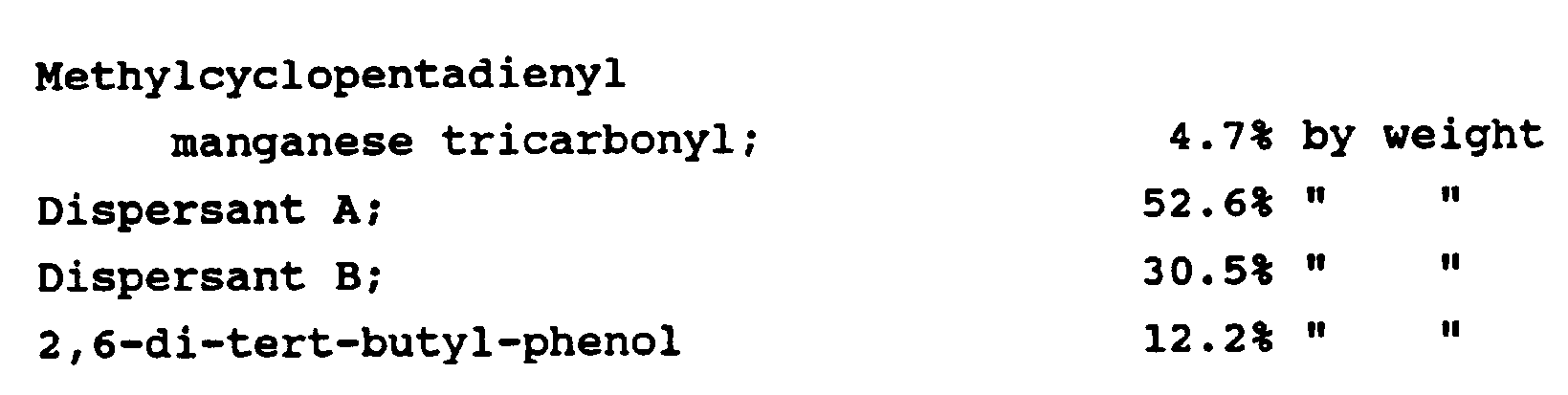
Dispersant A was a polyisobutenyl succinimide ashless dispersant based on a polyisobutene having a number average molecular weight of 900 and triethylenetetramine. Dispersant B was a mixture of an imidazoline and an amide made by reaction of tall oil fatty acids with hydroxyethyl-ethylene diamine. - The mixture also included 100 solvent neutral mineral lubricating oil to facilitate incorporation into the heavy diesel fuel.
- In the first experiment, residual marine diesel fuel having a viscosity of 115 cSt at 50°C and containing 1.9% of sulphur was treated with the aforesaid additive mixture at a treat rate of 0.066% by weight. When this treated diesel fuel was used in a single cylinder crosshead engine, a significant level of fuel economy was achieved, as compared with the untreated fuel or with the same fuel containing only the manganese compound at the same treatment rate.
- In a second experiment, a residual marine diesel fuel having a viscosity of 465 cSt at 50°C and containing 3% sulphur was treated with the same additive mixture at the same rate. The fuel was used in an Atlas medium speed diesel engine having a maximum rpm of 1200. Tests were run across the full operating speed range of the engine under the conditions used during propulsion and with the power output of the engine controlled to the same level at each test speed both with the treated and the untreated fuel. Fuel consumption was determined by measuring the brake specific fuel consumption (BSFC) and the reduction in consumption obtained using the fuel containing the additive mixture compared with the consumption obtained with untreated fuel was determined. The results were as follows:

- Having regard to the large amounts of fuel used by such engines, this represents a valuable increase in operating efficiency.
- Further tests were carried out on a ship operating at sea and fitted with a Sulzer RD68 engine as the main propulsion engine and also with an auxiliary diesel engine for operating shipboard equipment. The main engine was fuelled with heavy residual marine diesel fuel having a viscosity of 100 cSt at 50°C and containing 4% sulphur. The auxiliary diesel engine was supplied with fuel having a viscosity of 15 cSt at 50°C and containing 2% sulphur. Each engine was supplied with untreated fuel for two weeks, then with treated fuel for two periods each of two weeks, and finally with untreated fuel again for a further period of two weeks. The treated fuel for the main engine contained 0.066% by weight of the additive package described above and the fuel for the auxiliary engine contained 0.05% by weight of the additive package described above.
- It was found that the improvement in fuel economy (i.e. % reduction in fuel consumption) for the main engine was 1.5% and for the auxiliary engine was 2.5%.
and preferably also an antioxidant. The proportion of the cyclomatic manganese tricarbonyl compound should be from 0.00025 to 0.15%, preferably 0.000625 to 0.075% by weight based on the weight of the fuel. The proportion of the ashless dispersant should be from 0.0125 to 0.99%, preferably 0.025 to 0.495% by weight based on the weight of the fuel, and the proportion of the antioxidant (when present) should be from 0 to 0.2, usually 0.01 to 0.1% by weight based on the weight of the fuel.
Claims (13)
- A heavy diesel fuel composition comprising a heavy diesel fuel, a cyclomatic manganese tricarbonyl of general formula CyMn(CO)₃, wherein Cy is a hydrocarbon radical containing a cyclopentadienyl nucleus, and an ashless dispersant in which the ashless dispersant is(1) a product of a reaction between an ethylene polyamine mixture having an average of from 4 to 10 nitrogen atoms per molecule and a hydrocarbon-substituted carboxylic acid or anhydride made by reaction of a polyolefin having a molecular weight of from 500 to 5,000 with an unsaturated polycarboxylic acid or anhydride; or(2) an imidazoline dispersant of formula
 (3) an alkenyl succinic acid ester or diester made by reaction of polyolefin having a molecular weight from 500 to 5,000 with one or more alcohols containing 1-20 carbon atoms and 1-6 hydroxyl groups; or(4) an alkenyl succinic ester-amide made by reaction of polyolefin having a molecular weight from 500 to 5,000 with (a) one or more alcohols containing 1-20 carbon atoms and 1-6 hydroxyl groups, and (b) an amine; or(5) a Mannich condensate of hydrocarbyl-substituted phenols, formaldehyde or formaldehyde precursor, an amine having at least one primary amine group and containing 1-10 amine groups and 1-20 carbon atoms; or(6) a product of condensation of a cyclic anhydride with a straight chain N-alkylpolyamine of the formula R-(NH-R'-)n-NH₂, wherein n is an integer of 1 to 5, R is a linear hydrocarbon radical of 10 to 22 carbon atoms and R' is a divalent alkylene or alkylidene radical of 1 to 6 carbon atoms; or(7) a product of reaction of an ethoxylated amine with a carboxylic acid of 8 to 30 carbon atoms.
 - A composition according to claim 1 in which the proportion of the cyclomatic manganese tricarbonyl is from 0.00025 to 0.15% and the proportion of the ashless dispersant is from 0.0125 to 0.99%, both percentages being by weight based on the weight of the fuel.
- A composition according to claim 1 in which the proportion of the cyclomatic manganese tricarbonyl is from 0.000625 to 0.075% by weight and the proportion of the ashless dispersant is from 0.025 to 0.495% by weight, both percentages being based on the weight of the fuel.
- A composition according to any one of claims 1 to 3 in which the cyclomatic manganese tricarbonyl compound is cyclopentadienyl manganese tricarbonyl, methylcyclopentadienyl manganese tricarbonyl, indenyl manganese tricarbonyl, or ethylcyclopentadienyl manganese tricarbonyl.
- A composition according to any of claims 1 to 4 in which the ashless dispersant comprises a mixture of (1) the product of reaction of triethylene tetramine or tetraethylene pentamine with the reaction product of a polyisobutene having a number average molecular weight in the range 900 to 1200 with maleic anhydride, and (2) an imidazoline dispersant of the formula specified in (2) of claim 1 wherein R₁ represents alkyl or alkenyl of 7 to 22 carbon atoms and R₂ represents hydroxyethyl.
- A composition according to any one of claims 1 to 5 which also comprises an antioxidant.
- A composition according to claim 6 in which the proportion of the antioxidant is 0.01 to 0.1% by weight based on the weight of the fuel.
- A composition according to claim 6 or claim 7 in which the antioxidant is a hydrocarbon soluble phenolic antioxidant in which at least one ortho position of the phenol is blocked.
- A composition according to claim 8 in which the phenolic antioxidant is 2,6-di-tert-butyl-phenol or 2,6-di-tert-butyl-4-methylphenol.
- A composition according to any of claims 1 to 9 in which the heavy diesel fuel contains 1% or more of sulphur and has a viscosity in the range of 100 to 500 cSt (mm². s⁻¹) at 50°C.
- An additive package for incorporation in a heavy diesel fuel comprising a cyclomatic manganese tricarbonyl of general formula CyMn(CO)₃ as defined in claim 1 and an ashless dispersant according to (1) to (7) of claim 1.
- A package according to claim 11 which also comprises an antioxidant and/or a diluent oil.
- A package according to claim 12 which contains from 1 to 15% by weight of the cyclomatic manganese tricarbonyl compound, from 50 to 99% by weight of the ashless dispersant and from 0-20% by weight of the antioxidant.
Applications Claiming Priority (2)
| Application Number | Priority Date | Filing Date | Title |
|---|---|---|---|
| GB8929119 | 1989-12-22 | ||
| GB8929119A GB2239258A (en) | 1989-12-22 | 1989-12-22 | Diesel fuel compositions containing a manganese tricarbonyl |
Publications (2)
| Publication Number | Publication Date |
|---|---|
| EP0435631A1 EP0435631A1 (en) | 1991-07-03 |
| EP0435631B1 true EP0435631B1 (en) | 1994-02-09 |
Family
ID=10668456
Family Applications (1)
| Application Number | Title | Priority Date | Filing Date |
|---|---|---|---|
| EP90314187A Expired - Lifetime EP0435631B1 (en) | 1989-12-22 | 1990-12-21 | Diesel fuel compositions |
Country Status (7)
| Country | Link |
|---|---|
| US (1) | US5575823A (en) |
| EP (1) | EP0435631B1 (en) |
| JP (1) | JP3007170B2 (en) |
| CA (1) | CA2033105C (en) |
| DE (1) | DE69006588T2 (en) |
| FI (1) | FI104187B1 (en) |
| GB (1) | GB2239258A (en) |
Families Citing this family (72)
| Publication number | Priority date | Publication date | Assignee | Title |
|---|---|---|---|---|
| US5944858A (en) * | 1990-09-20 | 1999-08-31 | Ethyl Petroleum Additives, Ltd. | Hydrocarbonaceous fuel compositions and additives therefor |
| FR2679151B1 (en) * | 1991-07-18 | 1994-01-14 | Elf Aquitaine Prod Ste Nale | DISPERSING ADDITIVES FOR OIL PRODUCTS. |
| US5551957A (en) * | 1992-05-06 | 1996-09-03 | Ethyl Corporation | Compostions for control of induction system deposits |
| US6652608B1 (en) | 1994-03-02 | 2003-11-25 | William C. Orr | Fuel compositions exhibiting improved fuel stability |
| EP0763079A1 (en) * | 1994-05-31 | 1997-03-19 | ORR, William C. | Vapor phase combustion methods and compositions |
| GB9610563D0 (en) * | 1996-05-20 | 1996-07-31 | Bp Chemicals Additives | Marine diesel process and fuel therefor |
| US6083288A (en) * | 1997-07-14 | 2000-07-04 | Bp Amoco Corporation | Fuel stabilizers |
| KR20010042033A (en) * | 1998-06-15 | 2001-05-25 | 도미나가 가즈토 | Fuel oil additive and fuel oil composition |
| US7112230B2 (en) | 2001-09-14 | 2006-09-26 | Afton Chemical Intangibles Llc | Fuels compositions for direct injection gasoline engines |
| US20070187291A1 (en) * | 2001-10-19 | 2007-08-16 | Miller Stephen J | Highly paraffinic, moderately aromatic distillate fuel blend stocks prepared by low pressure hydroprocessing of fischer-tropsch products |
| US6971337B2 (en) * | 2002-10-16 | 2005-12-06 | Ethyl Corporation | Emissions control system for diesel fuel combustion after treatment system |
| US7332001B2 (en) | 2003-10-02 | 2008-02-19 | Afton Chemical Corporation | Method of enhancing the operation of diesel fuel combustion systems |
| DE102005012807A1 (en) * | 2005-03-17 | 2006-09-28 | Deutsche Bp Ag | Fuel for operating diesel engines |
| US20070193110A1 (en) * | 2006-02-21 | 2007-08-23 | Schwab Scott D | Fuel lubricity additives |
| US20070245620A1 (en) * | 2006-04-25 | 2007-10-25 | Malfer Dennis J | Diesel fuel compositions |
| US20070288755A1 (en) * | 2006-06-09 | 2007-12-13 | Trajectoire, Inc. | Method and apparatus for identifying internet registrants |
| GB0700534D0 (en) * | 2007-01-11 | 2007-02-21 | Innospec Ltd | Composition |
| US9011556B2 (en) | 2007-03-09 | 2015-04-21 | Afton Chemical Corporation | Fuel composition containing a hydrocarbyl-substituted succinimide |
| BRPI0809980B1 (en) * | 2007-04-04 | 2017-02-14 | Lubrizol Corp | fuel composition and fuel feeding method in an internal combustion engine |
| US20080289249A1 (en) * | 2007-05-22 | 2008-11-27 | Peter Wangqi Hou | Fuel additive to control deposit formation |
| EP2025737A1 (en) | 2007-08-01 | 2009-02-18 | Afton Chemical Corporation | Environmentally-friendly fuel compositions |
| US7878160B2 (en) | 2007-09-24 | 2011-02-01 | Afton Chemical Corporation | Surface passivation and to methods for the reduction of fuel thermal degradation deposits |
| US8690968B2 (en) * | 2008-04-04 | 2014-04-08 | Afton Chemical Corporation | Succinimide lubricity additive for diesel fuel and a method for reducing wear scarring in an engine |
| US8623105B2 (en) * | 2008-05-13 | 2014-01-07 | Afton Chemical Corporation | Fuel additives to maintain optimum injector performance |
| US8529643B2 (en) | 2008-05-13 | 2013-09-10 | Afton Chemical Corporation | Fuel additives for treating internal deposits of fuel injectors |
| US20100037514A1 (en) * | 2008-05-13 | 2010-02-18 | Afton Chemical Corporation | Fuel additives to maintain optimum injector performance |
| US8709108B2 (en) * | 2008-09-24 | 2014-04-29 | Afton Chemical Corporation | Fuel compositions |
| US20100107476A1 (en) * | 2008-10-31 | 2010-05-06 | Afton Chemical Corporation | Compositions and Methods Including Hexahydrotriazines Useful as Direct Injection Fuel Additives |
| US20120180382A1 (en) | 2011-01-19 | 2012-07-19 | Afton Chemical Corporation | Fuel Additives and Gasoline Containing the Additives |
| US9523057B2 (en) | 2011-02-22 | 2016-12-20 | Afton Chemical Corporation | Fuel additives to maintain optimum injector performance |
| US8758456B2 (en) | 2011-09-22 | 2014-06-24 | Afton Chemical Corporation | Fuel additive for improved performance of low sulfur diesel fuels |
| US8852297B2 (en) | 2011-09-22 | 2014-10-07 | Afton Chemical Corporation | Fuel additives for treating internal deposits of fuel injectors |
| US9574149B2 (en) | 2011-11-11 | 2017-02-21 | Afton Chemical Corporation | Fuel additive for improved performance of direct fuel injected engines |
| CA2789907A1 (en) | 2011-11-11 | 2013-05-11 | Afton Chemical Corporation | Fuel additive for improved performance of direct fuel injected engines |
| US8690970B2 (en) | 2012-02-24 | 2014-04-08 | Afton Chemical Corporation | Fuel additive for improved performance in fuel injected engines |
| AU2013201711B2 (en) | 2012-04-24 | 2014-10-30 | Afton Chemical Corporation | Fuel additives for treating internal deposits of fuel injectors |
| US8894726B2 (en) | 2012-06-13 | 2014-11-25 | Afton Chemical Corporation | Fuel additive for improved performance in fuel injected engines |
| US9458400B2 (en) | 2012-11-02 | 2016-10-04 | Afton Chemical Corporation | Fuel additive for improved performance in direct fuel injected engines |
| US9017431B2 (en) | 2013-01-16 | 2015-04-28 | Afton Chemical Corporation | Gasoline fuel composition for improved performance in fuel injected engines |
| US8915977B2 (en) | 2013-04-26 | 2014-12-23 | Afton Chemical Corporation | Gasoline fuel composition for improved performance in fuel injected engines |
| EP3071677B1 (en) | 2013-11-18 | 2022-03-23 | Afton Chemical Corporation | Mixed detergent composition for intake valve deposit control |
| US20150232774A1 (en) | 2014-02-19 | 2015-08-20 | Afton Chemical Corporation | Fuel additive for diesel engines |
| US8974551B1 (en) | 2014-02-19 | 2015-03-10 | Afton Chemical Corporation | Fuel additive for improved performance in fuel injected engines |
| US9200226B1 (en) | 2015-01-29 | 2015-12-01 | Afton Chemical Corporation | Esters of alkoxylated quaternary ammonium salts and fuels containing them |
| US9249769B1 (en) | 2015-03-24 | 2016-02-02 | Afton Chemical Corporation | Fuel additives for treating internal deposits of fuel injectors |
| US9340742B1 (en) | 2015-05-05 | 2016-05-17 | Afton Chemical Corporation | Fuel additive for improved injector performance |
| EP3504304A1 (en) | 2016-08-25 | 2019-07-03 | Evonik Degussa GmbH | Amine alkenyl substituted succinimide reaction product fuel additives, compositions, and methods |
| EP3510130B1 (en) | 2016-09-12 | 2024-12-18 | The Lubrizol Corporation | Total base number boosters for marine diesel engine lubricating compositions |
| US10273425B2 (en) | 2017-03-13 | 2019-04-30 | Afton Chemical Corporation | Polyol carrier fluids and fuel compositions including polyol carrier fluids |
| US10308888B1 (en) | 2018-06-15 | 2019-06-04 | Afton Chemical Corporation | Quaternary ammonium fuel additives |
| US10308889B1 (en) | 2018-08-03 | 2019-06-04 | Afton Chemical Corporation | Lubricity additives for fuels |
| US11046908B2 (en) | 2019-01-11 | 2021-06-29 | Afton Chemical Corporation | Oxazoline modified dispersants |
| US11390821B2 (en) | 2019-01-31 | 2022-07-19 | Afton Chemical Corporation | Fuel additive mixture providing rapid injector clean-up in high pressure gasoline engines |
| US11312915B2 (en) | 2019-07-19 | 2022-04-26 | Afton Chemical Corporation | Methods to reduce frequency of diesel particulate filter regeneration |
| US11685871B2 (en) | 2019-07-19 | 2023-06-27 | Afton Chemical Corporation | Methods to reduce frequency of diesel particulate filter regeneration |
| US11008526B2 (en) | 2019-07-23 | 2021-05-18 | Croda Inc. | Demulsifier for quaternary ammonium salt containing fuels |
| US12024686B2 (en) | 2022-09-30 | 2024-07-02 | Afton Chemical Corporation | Gasoline additive composition for improved engine performance |
| US12169192B2 (en) | 2020-11-02 | 2024-12-17 | Afton Chemical Corporation | Methods of identifying a hydrocarbon fuel |
| US12012564B2 (en) | 2021-08-25 | 2024-06-18 | Afton Chemical Corporation | Mannich-based quaternary ammonium salt fuel additives |
| US11999917B2 (en) | 2021-08-25 | 2024-06-04 | Afton Chemical Corporation | Mannich-based quaternary ammonium salt fuel additives |
| US12043808B2 (en) | 2021-12-28 | 2024-07-23 | Afton Chemical Corporation | Quaternary ammonium salt combinations for injector cleanliness |
| US11873461B1 (en) | 2022-09-22 | 2024-01-16 | Afton Chemical Corporation | Extreme pressure additives with improved copper corrosion |
| US12624303B2 (en) | 2023-07-28 | 2026-05-12 | Afton Chemical Corporation | Gasoline additive composition for improved engine performance |
| MX2023010431A (en) | 2022-09-30 | 2024-04-01 | Afton Chemical Corp | Gasoline additive composition for improved engine performance. |
| US12134742B2 (en) | 2022-09-30 | 2024-11-05 | Afton Chemical Corporation | Fuel composition |
| US11884890B1 (en) | 2023-02-07 | 2024-01-30 | Afton Chemical Corporation | Gasoline additive composition for improved engine performance |
| US11795412B1 (en) | 2023-03-03 | 2023-10-24 | Afton Chemical Corporation | Lubricating composition for industrial gear fluids |
| US12448582B2 (en) | 2023-04-06 | 2025-10-21 | Afton Chemical Corporation | Methods of improving the performance of combustion engine after-treatment devices |
| US12454653B2 (en) | 2023-12-11 | 2025-10-28 | Afton Chemical Corporation | Gasoline additive composition for improved engine performance |
| US20250304871A1 (en) | 2024-03-28 | 2025-10-02 | Afton Chemical Corporation | Multi-functional fuel additive to provide friction reduction and corrosion protection |
| US20250376632A1 (en) | 2024-06-10 | 2025-12-11 | Afton Chemical Corporation | Particulate reduction in gdi engines using mannich detergents |
| US12553003B1 (en) | 2025-02-03 | 2026-02-17 | Afton Chemical Corporation | Quaternary ammonium compounds |
Family Cites Families (38)
| Publication number | Priority date | Publication date | Assignee | Title |
|---|---|---|---|---|
| GB901689A (en) * | 1957-12-19 | 1962-07-25 | Ethyl Corp | Hydrocarbon distillate fuel compositions |
| US3112789A (en) * | 1957-12-26 | 1963-12-03 | Pure Oil Co | Fuel oil and method of operating fuel oil furnaces |
| US3015668A (en) * | 1959-11-24 | 1962-01-02 | Ethyl Corp | Process for producing cyclomatic manganese tricarbonyl compounds |
| US3094472A (en) * | 1960-02-17 | 1963-06-18 | Cities Service Res & Dev Co | Irradiation of hydrocarbon oils |
| US3197414A (en) * | 1961-06-26 | 1965-07-27 | Ethyl Corp | Tetraethyllead-tetramethyllead antiknock fluids |
| US3307928A (en) * | 1963-01-30 | 1967-03-07 | Exxon Research Engineering Co | Gasoline additives for enhancing engine cleanliness |
| US3202141A (en) * | 1963-07-01 | 1965-08-24 | Ethyl Corp | Method of operating compression ignition engine |
| US3216936A (en) * | 1964-03-02 | 1965-11-09 | Lubrizol Corp | Process of preparing lubricant additives |
| US3490882A (en) * | 1966-08-11 | 1970-01-20 | Du Pont | Stabilized distillate fuel oils and additive compositions therefor |
| US3582295A (en) * | 1967-04-07 | 1971-06-01 | Ethyl Corp | Gasoline anti-icing |
| US3701641A (en) * | 1969-08-29 | 1972-10-31 | Cities Service Oil Co | Stabilized distillate hydrocarbon fuel oil compositions and additives therefor |
| US3891401A (en) * | 1971-03-01 | 1975-06-24 | Standard Oil Co | Reducing deposits and smoke from jet fuels |
| US3994698A (en) * | 1972-02-29 | 1976-11-30 | Ethyl Corporation | Gasoline additive concentrate composition |
| GB1413323A (en) * | 1972-07-06 | 1975-11-12 | United Lubricants Ltd | Diesel fuel additives |
| US3883320A (en) * | 1972-12-07 | 1975-05-13 | Standard Oil Co | Reducing deposits and smoke from jet fuels with additives incorporating an ammonium salt |
| US3909215A (en) * | 1973-03-27 | 1975-09-30 | Chevron Res | Rust inhibitors for hydrocarbon fuels |
| US3927995A (en) * | 1973-10-23 | 1975-12-23 | Farmland Ind | Additive composition for compression-ignition engine fuels |
| US4022589A (en) * | 1974-10-17 | 1977-05-10 | Phillips Petroleum Company | Fuel additive package containing polybutene amine and lubricating oil |
| US4116644A (en) * | 1975-03-24 | 1978-09-26 | Jackisch Philip F | Gasoline compositions |
| US4047900A (en) * | 1976-04-14 | 1977-09-13 | Texaco Inc. | Motor fuel composition |
| US4247300A (en) * | 1978-04-27 | 1981-01-27 | Phillips Petroleum Company | Imidazoline fuel detergents |
| US4240803A (en) * | 1978-09-11 | 1980-12-23 | Mobil Oil Corporation | Fuel containing novel detergent |
| US4207078A (en) * | 1979-04-25 | 1980-06-10 | Texaco Inc. | Diesel fuel containing manganese tricarbonyl and oxygenated compounds |
| US4240801A (en) * | 1979-05-31 | 1980-12-23 | Ethyl Corporation | Diesel fuel composition |
| US4390345A (en) * | 1980-11-17 | 1983-06-28 | Somorjai Gabor A | Fuel compositions and additive mixtures for reducing hydrocarbon emissions |
| AT373274B (en) * | 1981-10-12 | 1984-01-10 | Lang Chem Tech Prod | ADDITION WITH COMBUSTION-PROTECTING AND SOOT-RESISTING EFFECT OF FUEL OILS, DIESEL FUELS AND OTHER LIQUID FUELS AND LIQUIDS, AND LIQUID FUEL AND FUELS WITH THIS ADDITION |
| WO1985000827A1 (en) * | 1983-08-08 | 1985-02-28 | Chevron Research Company | Diesel fuel and method for deposit control in compression ignition engines |
| CA1270642A (en) * | 1983-12-30 | 1990-06-26 | John Vincent Hanlon | Fuel compositions |
| DE3667668D1 (en) * | 1985-04-26 | 1990-01-25 | Exxon Chemical Patents Inc | HEATING OIL COMPOSITIONS. |
| GB8515974D0 (en) * | 1985-06-24 | 1985-07-24 | Shell Int Research | Gasoline composition |
| US4690687A (en) * | 1985-08-16 | 1987-09-01 | The Lubrizol Corporation | Fuel products comprising a lead scavenger |
| GB8605535D0 (en) * | 1986-03-06 | 1986-04-09 | Shell Int Research | Fuel composition |
| US4781730A (en) * | 1987-06-05 | 1988-11-01 | The Lubrizol Corporation | Fuel additive comprising a hydrocarbon soluble alkali or alkaline earth metal compound and a demulsifier |
| US4857073A (en) * | 1987-08-27 | 1989-08-15 | Wynn Oil Company | Diesel fuel additive |
| WO1989005339A1 (en) * | 1987-12-03 | 1989-06-15 | Chemical Fuels Corporation | Octane improving gasoline additives |
| ATE107347T1 (en) * | 1988-01-27 | 1994-07-15 | Lubrizol Corp | FUEL COMPOSITION. |
| GB8818711D0 (en) * | 1988-08-05 | 1988-09-07 | Shell Int Research | Lubricating oil dispersants |
| CA2010183A1 (en) * | 1989-03-02 | 1990-09-02 | John G. Bostick | Middle distillate fuel having improved storage stability |
-
1989
- 1989-12-22 GB GB8929119A patent/GB2239258A/en not_active Withdrawn
-
1990
- 1990-12-20 FI FI906327A patent/FI104187B1/en not_active IP Right Cessation
- 1990-12-21 US US07/632,355 patent/US5575823A/en not_active Expired - Lifetime
- 1990-12-21 JP JP2412600A patent/JP3007170B2/en not_active Expired - Fee Related
- 1990-12-21 DE DE69006588T patent/DE69006588T2/en not_active Expired - Fee Related
- 1990-12-21 EP EP90314187A patent/EP0435631B1/en not_active Expired - Lifetime
- 1990-12-24 CA CA002033105A patent/CA2033105C/en not_active Expired - Fee Related
Also Published As
| Publication number | Publication date |
|---|---|
| FI104187B (en) | 1999-11-30 |
| US5575823A (en) | 1996-11-19 |
| GB2239258A (en) | 1991-06-26 |
| CA2033105C (en) | 2000-02-15 |
| FI906327L (en) | 1991-06-23 |
| CA2033105A1 (en) | 1991-06-23 |
| GB8929119D0 (en) | 1990-02-28 |
| JPH04114090A (en) | 1992-04-15 |
| JP3007170B2 (en) | 2000-02-07 |
| FI104187B1 (en) | 1999-11-30 |
| EP0435631A1 (en) | 1991-07-03 |
| DE69006588D1 (en) | 1994-03-24 |
| FI906327A0 (en) | 1990-12-20 |
| DE69006588T2 (en) | 1994-05-26 |
Similar Documents
| Publication | Publication Date | Title |
|---|---|---|
| US5575823A (en) | Diesel fuel compositions | |
| US5856279A (en) | Acylated nitrogen compounds useful as additives for lubricating oil and fuel compositions | |
| US5458793A (en) | Compositions useful as additives for lubricants and liquid fuels | |
| US5336278A (en) | Fuel composition containing an aromatic amide detergent | |
| KR100533490B1 (en) | Additives for fuel compositions to reduce formation of combustion chamber deposits | |
| EP0476196B1 (en) | Hydrocarbonaceous fuel compositions and additives therefor | |
| CA2053825A1 (en) | Environmentally-friendly fuel compositions and additives therefor | |
| JP4786123B2 (en) | Gasoline additive concentrated compositions and fuel compositions and methods thereof | |
| US5482521A (en) | Friction modifiers and antiwear additives for fuels and lubricants | |
| US5696060A (en) | Acylated nitrogen compounds useful as additives for lubricating oil and fuel compositions | |
| US6051039A (en) | Diesel fuel compositions | |
| AU3422000A (en) | Fuel composition | |
| JPH04234490A (en) | Hydrocarbon fuel and additive for it | |
| MXPA02003836A (en) | Use of fatty acid salts of alkoxylated oligoamines as lubricity improvers for petroleum products. | |
| WO1997044414A1 (en) | Marine diesel process and fuel therefor | |
| AU689891B2 (en) | Fuel additive compositions containing an aliphatic amine, a polyolefin and an aromatic ester | |
| EP1116779A1 (en) | Fuel oil additive and fuel oil composition | |
| GB2261441A (en) | Fuel compositions | |
| KR20080009753A (en) | Use of fatty acid alkoxylate as a method to remove adhesion of the engine suction valve | |
| US20050268536A1 (en) | Diesel motor fuel additive composition | |
| WO2014184066A1 (en) | Polyalkenylsuccinimides for reducing injector nozzle fouling in direct injection spark ignition engines | |
| GB2308381A (en) | Two-cycle engine lubricant oil |
Legal Events
| Date | Code | Title | Description |
|---|---|---|---|
| PUAI | Public reference made under article 153(3) epc to a published international application that has entered the european phase |
Free format text: ORIGINAL CODE: 0009012 |
|
| AK | Designated contracting states |
Kind code of ref document: A1 Designated state(s): BE DE FR GB IT NL |
|
| 17P | Request for examination filed |
Effective date: 19910816 |
|
| 17Q | First examination report despatched |
Effective date: 19920225 |
|
| GRAA | (expected) grant |
Free format text: ORIGINAL CODE: 0009210 |
|
| AK | Designated contracting states |
Kind code of ref document: B1 Designated state(s): BE DE FR GB IT NL |
|
| ITF | It: translation for a ep patent filed | ||
| REF | Corresponds to: |
Ref document number: 69006588 Country of ref document: DE Date of ref document: 19940324 |
|
| ET | Fr: translation filed | ||
| PLBE | No opposition filed within time limit |
Free format text: ORIGINAL CODE: 0009261 |
|
| STAA | Information on the status of an ep patent application or granted ep patent |
Free format text: STATUS: NO OPPOSITION FILED WITHIN TIME LIMIT |
|
| 26N | No opposition filed | ||
| PGFP | Annual fee paid to national office [announced via postgrant information from national office to epo] |
Ref country code: DE Payment date: 19951129 Year of fee payment: 6 |
|
| PG25 | Lapsed in a contracting state [announced via postgrant information from national office to epo] |
Ref country code: DE Effective date: 19970902 |
|
| REG | Reference to a national code |
Ref country code: GB Ref legal event code: IF02 |
|
| PGFP | Annual fee paid to national office [announced via postgrant information from national office to epo] |
Ref country code: NL Payment date: 20051129 Year of fee payment: 16 |
|
| PGFP | Annual fee paid to national office [announced via postgrant information from national office to epo] |
Ref country code: GB Payment date: 20051214 Year of fee payment: 16 |
|
| PGFP | Annual fee paid to national office [announced via postgrant information from national office to epo] |
Ref country code: FR Payment date: 20051216 Year of fee payment: 16 |
|
| PG25 | Lapsed in a contracting state [announced via postgrant information from national office to epo] |
Ref country code: IT Free format text: LAPSE BECAUSE OF NON-PAYMENT OF DUE FEES;WARNING: LAPSES OF ITALIAN PATENTS WITH EFFECTIVE DATE BEFORE 2007 MAY HAVE OCCURRED AT ANY TIME BEFORE 2007. THE CORRECT EFFECTIVE DATE MAY BE DIFFERENT FROM THE ONE RECORDED. Effective date: 20051221 |
|
| PGFP | Annual fee paid to national office [announced via postgrant information from national office to epo] |
Ref country code: BE Payment date: 20060202 Year of fee payment: 16 |
|
| NLT1 | Nl: modifications of names registered in virtue of documents presented to the patent office pursuant to art. 16 a, paragraph 1 |
Owner name: AFTON CHEMICAL LIMITED |
|
| REG | Reference to a national code |
Ref country code: FR Ref legal event code: CD |
|
| PG25 | Lapsed in a contracting state [announced via postgrant information from national office to epo] |
Ref country code: BE Free format text: LAPSE BECAUSE OF NON-PAYMENT OF DUE FEES Effective date: 20061231 |
|
| PG25 | Lapsed in a contracting state [announced via postgrant information from national office to epo] |
Ref country code: NL Free format text: LAPSE BECAUSE OF NON-PAYMENT OF DUE FEES Effective date: 20070701 |
|
| GBPC | Gb: european patent ceased through non-payment of renewal fee |
Effective date: 20061221 |
|
| NLV4 | Nl: lapsed or anulled due to non-payment of the annual fee |
Effective date: 20070701 |
|
| REG | Reference to a national code |
Ref country code: FR Ref legal event code: ST Effective date: 20070831 |
|
| PG25 | Lapsed in a contracting state [announced via postgrant information from national office to epo] |
Ref country code: GB Free format text: LAPSE BECAUSE OF NON-PAYMENT OF DUE FEES Effective date: 20061221 |
|
| BERE | Be: lapsed |
Owner name: *AFTON CHEMICAL LTD Effective date: 20061231 |
|
| PG25 | Lapsed in a contracting state [announced via postgrant information from national office to epo] |
Ref country code: FR Free format text: LAPSE BECAUSE OF NON-PAYMENT OF DUE FEES Effective date: 20070102 |