EP0434341B1 - Diazine derivatives - Google Patents
Diazine derivatives Download PDFInfo
- Publication number
- EP0434341B1 EP0434341B1 EP90313772A EP90313772A EP0434341B1 EP 0434341 B1 EP0434341 B1 EP 0434341B1 EP 90313772 A EP90313772 A EP 90313772A EP 90313772 A EP90313772 A EP 90313772A EP 0434341 B1 EP0434341 B1 EP 0434341B1
- Authority
- EP
- European Patent Office
- Prior art keywords
- alkyl
- formula
- phenyl
- methyl
- amino
- Prior art date
- Legal status (The legal status is an assumption and is not a legal conclusion. Google has not performed a legal analysis and makes no representation as to the accuracy of the status listed.)
- Expired - Lifetime
Links
- 0 C*C(C(*)=C(C)*)=CC(C)=NC Chemical compound C*C(C(*)=C(C)*)=CC(C)=NC 0.000 description 4
Classifications
-
- C—CHEMISTRY; METALLURGY
- C07—ORGANIC CHEMISTRY
- C07D—HETEROCYCLIC COMPOUNDS
- C07D239/00—Heterocyclic compounds containing 1,3-diazine or hydrogenated 1,3-diazine rings
- C07D239/02—Heterocyclic compounds containing 1,3-diazine or hydrogenated 1,3-diazine rings not condensed with other rings
- C07D239/24—Heterocyclic compounds containing 1,3-diazine or hydrogenated 1,3-diazine rings not condensed with other rings having three or more double bonds between ring members or between ring members and non-ring members
- C07D239/28—Heterocyclic compounds containing 1,3-diazine or hydrogenated 1,3-diazine rings not condensed with other rings having three or more double bonds between ring members or between ring members and non-ring members with hetero atoms or with carbon atoms having three bonds to hetero atoms with at the most one bond to halogen, directly attached to ring carbon atoms
- C07D239/46—Two or more oxygen, sulphur or nitrogen atoms
- C07D239/48—Two nitrogen atoms
-
- A—HUMAN NECESSITIES
- A61—MEDICAL OR VETERINARY SCIENCE; HYGIENE
- A61P—SPECIFIC THERAPEUTIC ACTIVITY OF CHEMICAL COMPOUNDS OR MEDICINAL PREPARATIONS
- A61P9/00—Drugs for disorders of the cardiovascular system
-
- C—CHEMISTRY; METALLURGY
- C07—ORGANIC CHEMISTRY
- C07D—HETEROCYCLIC COMPOUNDS
- C07D401/00—Heterocyclic compounds containing two or more hetero rings, having nitrogen atoms as the only ring hetero atoms, at least one ring being a six-membered ring with only one nitrogen atom
- C07D401/02—Heterocyclic compounds containing two or more hetero rings, having nitrogen atoms as the only ring hetero atoms, at least one ring being a six-membered ring with only one nitrogen atom containing two hetero rings
- C07D401/04—Heterocyclic compounds containing two or more hetero rings, having nitrogen atoms as the only ring hetero atoms, at least one ring being a six-membered ring with only one nitrogen atom containing two hetero rings directly linked by a ring-member-to-ring-member bond
-
- C—CHEMISTRY; METALLURGY
- C07—ORGANIC CHEMISTRY
- C07D—HETEROCYCLIC COMPOUNDS
- C07D403/00—Heterocyclic compounds containing two or more hetero rings, having nitrogen atoms as the only ring hetero atoms, not provided for by group C07D401/00
- C07D403/02—Heterocyclic compounds containing two or more hetero rings, having nitrogen atoms as the only ring hetero atoms, not provided for by group C07D401/00 containing two hetero rings
- C07D403/04—Heterocyclic compounds containing two or more hetero rings, having nitrogen atoms as the only ring hetero atoms, not provided for by group C07D401/00 containing two hetero rings directly linked by a ring-member-to-ring-member bond
-
- C—CHEMISTRY; METALLURGY
- C07—ORGANIC CHEMISTRY
- C07D—HETEROCYCLIC COMPOUNDS
- C07D491/00—Heterocyclic compounds containing in the condensed ring system both one or more rings having oxygen atoms as the only ring hetero atoms and one or more rings having nitrogen atoms as the only ring hetero atoms, not provided for by groups C07D451/00 - C07D459/00, C07D463/00, C07D477/00 or C07D489/00
- C07D491/02—Heterocyclic compounds containing in the condensed ring system both one or more rings having oxygen atoms as the only ring hetero atoms and one or more rings having nitrogen atoms as the only ring hetero atoms, not provided for by groups C07D451/00 - C07D459/00, C07D463/00, C07D477/00 or C07D489/00 in which the condensed system contains two hetero rings
- C07D491/10—Spiro-condensed systems
Definitions
- This invention concerns novel diazine derivatives and, more particularly, novel cyclic amino pyrimidine derivatives which possess beneficial effects on the cardiovascular system, pharmaceutical compositions containing such a derivative as active ingredient, and processes for the manufacture of and medical use of the said derivatives.
- Pyrimidine derivatives have been studied in the search for new pharmacologically active agents. For example, a series of aminopyrimidine derivatives has been described as having cardiotonic prperties (US Patent Ser No. 4,725,600). Various 4-aminopyrimidine salts have been described which are of potential use as antifungal and antibacterial agents (US Patent Ser No. 4,339,453), and as trypanocides (UK 658,205). Bis-pyrimidinium compounds are also reported to possess trypanocidal activity (UK 1,020,306 and UK 815,833), and bisquaternary salts which include a pyrimidine moiety are reported to be useful as anti-tumour agents (Atwell et al, J. Med. Chem, Vol 22, No.2, 1979, 134). The present invention is based on the unexpected and beneficial sino-atrial node modulatory effects of a novel series of aminopyrimidine deivatives of formula I as defined below.
- R1 is (1-10C)alkyl, (3-8C)cycloalkyl, (3-8C)cycloalkyl-(1-4C)-alkyl, phenyl or phenyl(1-4C)alkyl, the phenyl moiety of the latter two optionally bearing one or more substituents independently selected from halogeno, (1-4C)alkyl, (3-6C)alkenyl, (1-4C)alkoxy, cyano, trifluoromethyl, nitro, amino, hydroxy, (1-4C)alkylamino, dialkylamino of up to six carbon atoms, (1-4C)alkylthio, (1-4C)alkylsulphinyl, (1-4C)alkylsulphonyl and (1-4C)alkylenedioxy; R2 is hydrogen, (1-4C)alkyl,
- R2 or R6 is amino or alkylamino
- the amino derivatives of the invention may exist in another tautomeric form to that depicted in formula I, or in a mixture of one or more of the possible tautomeric forms.
- the compounds of the invention may contain a chiral centre and may exist in, and be isolated in, optically active or racemic form.
- the invention includes any tautomeric, optically active or racemic form of a compound of formula I which possesses the afore-mentioned beneficial pharmacological effects.
- the compounds of formula I are quaternary salts and in some cases, for example, when R2 or R6 is amino or alkylamino, may be converted, for example by treatment with a quaternary ammonium hydroxide (and especially one in macroreticular resin form) to the corresponding neutral free bases of the formula IIIa or IIIb, respectively, in which R7 is hydrogen or (1-4C)alkyl, or to a tautomeric form thereof depending on the nature of R2 or R6.
- Neutral free bases of the compounds of formula I such as those of the formula IIIa or IIIb, are included as a further feature of the invention and may readily be reconverted to the quaternary salt form of formula I, for example, by treatment with the appropriate acid of the formula H.Y.
- saturated 9- or 10- membered bicyclic amino group as used herein means a bicyclic amino group which is fully saturated and which is linked to the pyrimidine moiety through nitrogen.
- R1 when it is alkyl is, for example, (1-6C)alkyl, such as methyl, ethyl, propyl or butyl, of which values methyl and ethyl are generally preferred.
- R1 when it is cycloalkyl is, for example, cyclopentyl, cyclohexyl or cycloheptyl.
- R2, R3, R4, R5 or R6 when it is alkyl is, for example, methyl or ethyl.
- R5 is, for example, hydrogen.
- a particular value for a substituent for the saturated azacarbobicyclic group (as defined above)when it is alkyl includes, for example, methyl or ethyl.
- R5 when it is alkenyl is, for example, allyl, but-2-enyl or 2-methyl-2-propenyl.
- R1 when it is cycloalkyl-alkyl is, for example, cyclopropyl-methyl, cylopentyl-methyl, cyclohexyl-methyl or 2-(cyclohexyl)ethyl.
- R1 when it is phenylalkyl is, for example, benzyl, 1-phenylethyl or 2-phenylethyl, any of which may optionally be substituted as defined above.
- R2 or R6 when it is alkylamino is, for example, methylamino, ethylamino, propylamino or butylamino.
- a particular value for M when it is alkyl is, for example, methyl, ethyl, propyl or butyl.
- a preferred value for M is, for example, methyl or phenyl.
- Particular values for the group - A.Z.B - include, for example, tetramethylene, ethyleneoxyethylene [ -CH2CH2.O.CH2CH2- ], ethyleneoxytrimethylene [ -CH2CH2.O.CH2CH2CH2- ], ethylenethioethylene [ -CH2CH2.S.CH2CH2- ], pentamethylene, hexamethylene, ethylenecarbonylethylene [ -CH2CH2.CO.CH2CH2- ] ethylene(ethylenedioxymethylene)ethylene and groups of the formula -CH2CH2.NR.CH2CH2- and -CH2CH2.NR.CH2CH2CH2- in which R is methyl, ethyl, propyl, butyl or phenyl, the latter optionally bearing a substituent as defined for M above.
- Values of particular interest for substituents R3 and R4 on any of the above values of -A.Z.B- include, for example, when they are both hydrogen or methyl, or when one is hydrogen and the other is methyl, phenyl or benzyl (the phenyl moiety of the latter optionally substituted as defined above).
- Preferred values for substituents R3 and R4 on any of the above values of -A.Z.B- include, for example, when they are both methyl, or when one is hydrogen and the other is methyl, phenyl or benzyl (the phenyl moiety of the latter two optionally substituted as defined above).
- Particular values for Q when it represents a saturated 9- or 10-membered bicyclic amino group include, for example, perhydroindolyl, perhydroquinolyl and perhydroisoquinolyl (unsubstituted or substituted as defined above).
- Particular values for optional substituents which may be present on a phenyl moiety in R1, R3, R4 or M as defined hereinabove include, by way of example: for halogeno, fluoro, chloro and bromo; for alkyl, methyl and ethyl; for alkenyl, allyl; for alkoxy, methoxy and ethoxy; for alkylamino, methylamino and ethylamino; for dialkylamino, dimethylamino and diethylamino; for alkylthio, methylthio and ethylthio; for alkylsulphinyl, methylsulphinyl and ethylsulphinyl; for alkylsulphonyl, methylsulphonyl and ethylsulphonyl; and for alkylenedioxy, methylenedioxy and isopropylidenedioxy.
- R1, R3, R4 or M contains a phenyl moiety it is preferably unsubstituted or else may bear one or two substituents.
- substituents which may be present on a phenyl moiety in a substituent for the saturated 9- or 10-membered bicyclic amino group defined hereinabove include, by way of example: for halogeno, fluoro, chloro and bromo; for alkyl, methyl and ethyl; for alkoxy, methoxy and ethoxy;
- Q represents a saturated 9- or 10-membered bicyclic amino group which bears a substituent which contains a phenyl moiety
- the phenyl moiety is preferably unsubstituted or else may bear one or two substituents.
- Q represents a saturated 9- or 10-membered bicyclic amino group (as defined above) it is preferred that the bicyclic amino group is unsubstituted.
- R2 and R6 are not both basic groups, that is when R2 is amino or alkylamino, R6 is not amino or alkylamino.
- Q represents a group of formula II (as defined above).
- Q represents a saturated 9- or 10-membered bicyclic amino group (as defined above).
- an amino pyrimidine derivative of the formula I (set out hereinafter, together with the other chemical formulae appearing herein in Roman numerals) wherein Q is a group of formula II;
- R1 is (1-10C)alkyl, (3-8C)cycloalkyl, (3-8C)cycloalkyl-(1-4C)alkyl, phenyl or phenyl(1-4C)alkyl, the phenyl moiety of the latter two optionally bearing one or more substituents independently selected from halogeno, (1-4C)alkyl, (3-6C)alkenyl, (1-4C)alkoxy, cyano, trifluoromethyl, nitro, amino, hydroxy, (1-4C)alkylamino, dialkylamino of up to six carbon atoms, (1-4C)alkylthio, (1-4C)alkylsulphinyl, (1-4C)alkylsulphonyl and (1-4C)alkylenedioxy;
- R1, R2, R3, R4, R5, R6, A, B, Z, and M include the relevant values mentioned above.
- particular values for the group -A.Z.B- include, for example, tetramethylene, ethyleneoxyethylene [ -CH2CH2.O.CH2CH2- ] , ethyleneoxytrimethylene [ -CH2CH2.O.CH2CH2CH2- ], ethylenethioethylene [ -CH2CH2.S.CH2CH2- ], pentamethylene, hexamethylene, ethylenecarbonylethylene [ -CH2CH2.CO.CH2CH2- ] ethylene(ethylenedioxymethylene)ethylene and groups of the formula -CH2CH2.NR.CH2CH2- and -CH2CH2.NR.CH2CH2CH2- in which R is methyl, ethyl, propyl, butyl or phenyl, the latter optionally bearing a substituent as defined for M above.
- substituents R3 and R4 on any of the above values of -A.Z.B- include, for example, when they are both hydrogen or methyl, or when one is hydrogen and the other is methyl or phenyl (the latter optionally substituted as defined above).
- Specific values for the group Q when Q is a group of formula II which are of particular interest include, for example, N -phenylpiperazino, N -( p -chlorophenyl)piperazino, piperidino, 3-methylpiperidino, 4-phenylpiperidino, 3,3-dimethylpiperidino, morpholino, hexamethyleneimino, 3-ethylpiperidino, 3,5-dimethylpiperidino, 3- n -propylpiperidino, 2-methylpiperidino, (4,4-ethylenedioxy)piperidino and p-methylphenylpiperidino.
- Specific values for the group Q when Q is a saturated 9- or 10-membered bicyclic amino group which are of particular interest include, for example perhydro-1-indolyl, perhydro-1-quinolyl, and perhydro-2-isoquinolyl.
- a group of compounds of the invention which is of interest comprises those compounds of the formula I wherein: R1 is (1-4C)alkyl (especially methyl or ethyl), R6 is (1-4C)alkyl (especially methyl or ethyl); R2 is (1-4C)alkylamino (especially methylamino); Q is a 5-7 membered cyclic aliphatic amino group selected from pyrrolidino, morpholino, piperidino, N -phenylpiperazino, N -(halogenophenyl)piperazino, N -[(1-4C)alkylphenyl]piperazino, N -[(1-4C)alkoxyphenyl]piperazino, and hexamethyleneimino, any of which groups may itself optionally bear one or two substituents independently selected from methyl, ethyl, phenyl and halogenophenyl; and Y is a physiologically acceptable anion.
- Specific values for the group Q which are of particular interest include, for example, 3-methylpyrrolidino, N -phenylpiperazino, N -( p -chlorophenyl)piperazino, piperidino, 3-methylpiperidino, 4-phenylpiperidino, 3,3-dimethylpiperidino, morpholino and hexamethyleneimino.
- R1 or R6 is, for example, methyl.
- a group of compounds of the invention which is of particular interest comprises those compounds of the formula IV wherein: Ra is (1-4C)alkyl (especially methyl or ethyl), Rb is (1-4C)alkyl (especially methyl or ethyl); Rc is (1-4C)alkyl (especially methyl); Q is a 5-7 membered cyclic aliphatic amino group selected from pyrrolidino, morpholino, piperazino, N -phenylpiperidino, N -(halogenophenyl)piperidino, N -[(1-4C)alkylphenyl]piperidino, N -[(1-4C)alkoxyphenyl]piperidino, hexamethyleneimino, any of which groups may itself optionally bear one or two substituents independently selected from methyl, ethyl, phenyl, benzyl and haolgenophenyl; or Q is a saturated 9- or 10-membered bicyclic amino
- Specific values for the group Q when Q is a group of formula II which are of particular interest include, for example, N -phenylpiperazino, N -( p -chlorophenyl)piperazino, piperidino, 3-methylpiperidino, 4-phenylpiperidino, 3,3-dimethylpiperidino, morpholino, hexamethyleneimino, 3-ethylpiperidino, 3,5-dimethylpiperidino, 3- n -propylpiperidino, 2-methylpiperidino, (4,4-ethylenedioxy)piperidino and p-methylphenylpiperidino.
- Specific values for the group Q when Q is a saturated 9- or 10-membered bicyclic amino group which are of particular interest include, for example perhydro-1-indolyl, perhydro-1-quinolyl, and perhydro-2-isoquinolyl.
- a preferred value for Ra, Rb or Rc is, for example, methyl.
- Particular physiologically acceptable counter anions Y include, for example, halide (such as chloride, bromide or iodide), sulphate, phosphate, nitrate, acetate, citrate, fumarate, succinate, trifluoroacetate, methosulphate and p -toluenesulphonate.
- halide such as chloride, bromide or iodide
- sulphate phosphate, nitrate, acetate, citrate, fumarate, succinate, trifluoroacetate
- methosulphate and p -toluenesulphonate.
- a preferred group of free bases of the invention defined above comprises those compounds of the formula IVa in which Ra, Rb, Rc and Q have any of the meanings defined above.
- the compounds of the invention are illustrated by the accompanying Examples, of which the compounds described in Examples 1, 2, 5, 6, 7, 8, 9, 10, 13, 15, 16, 18, 21, 22, 23, 24 and 26 are of particular interest, and those described in Examples 1, 2, 5, 8, 9, 10, 13, 15, 22, 23 and 26 are of special interest.
- the latter compounds, as described herein or in the form of a salt with an alternative physiologically acceptable counter anion, are provided as a further feature of the invention.
- the compounds of the invention may be obtained by standard procedures of organic chemistry already known to be applicable to the preparation of structurally analogous compounds, for example those procedures described in standard reference works on the chemistry of the pyrimidines. Such procedures for the manufacture of the novel compounds of formula I are provided as a further feature of the invention and are illustrated by the following preferred processes in which the various generic radicals have any of the meanings defined hereinbefore.
- the compounds of the invention possess useful pharmacological properties and modulate the action of the sino-atrial node in warm-blooded animals in a beneficial, selective and medically useful manner so that the agents are useful in treating cardiovascular disorders associated with an inappropriately elevated heart rate and with minimal effects on other haemodynamic parameters such as blood pressure or cardiac output.
- the beneficial and selective effects of the cardiovascular system may be demonstrated using the following standard laboratory techniques.
- This technique involves the dissection of the right atrium from a guinea pig heart, taking care not to damage the sino-atrial node region.
- the atrium is established in oxygenated (95% O2; 5% CO2) Tyrode's solution [containing 8.0g NaCl, 0.19g KCl, 0.025g MgCl2, 0.05g NaH2PO4, 1.0g NaHCO3, 0.2g CaCl2 and 2.7g glucose, per litre of deionised water] between two platinum spikes which are connected via an amplifier to a conventional rate-meter, triggered by the action potentials across the atrium.
- the preparation is bathed in oxygenated Tyrode's solution at 37 degrees Celsius and allowed to equilibrate for 30 minutes before the addition of a solution of the test compound in a mixture of dimethyl sulphoxide and Cremophor EL, diluted as required with Tyrode's solution. Further solutions of test compound are then added cumulatively at 15 minute intervals or when a steady-state beating rate has been attained. This enables an IC20 (i.e. the micromolar concentration required to reduce the beating rate by 20%) to be calculated. Typically, a compound of formula I will have an IC20 of 10 micromolar or less.
- This technique involves the dissection of the left atrium from a guinea pig heart into oxygenated Tyrodes solution.
- the atrium is then clamped in an polyacrylate plastic holder containing two stainless steel stimulating electrodes.
- the free end of the atrium (normally the atrial appendage) is attached with silk thread to an isometric force transducer.
- the atrium is then set under a resting tension of 1g and is allowed to equilibrate in oxygenated Tyrode's solution for 20 minutes before being stimulated into beating by application of 2.5 Hz, 3 mS pulses at 1.5 times the threshold voltage (normally in the range 3-7 V).
- a solution (10 ⁇ 5 M or less) of the test compound [made up as in (a) above] is then added and the effect on contractile force measured. In this way a comparison of the effect with that of a control solution without any test compound can be obtained.
- at a concentration in the range 1-30 micromolar compounds of the formula I show ⁇ 15% reduction in contractile force.
- Wistar rats Alderley Park strain
- Wistar rats Alderley Park strain
- alphaxalone/ alphadalone 1.5ml per kg
- a polyethylene cannula is inserted into the jugular vein and anaesthesia is maintained by infusion of alphaxalone/alphadalone at a rate of 0.025-0.12 ml per kg per minute.
- a polyethylene cannula is also inserted into the carotid artery and connected to a pressure transducer filled with physiological saline solution. The arterial blood pressure signal is used to trigger an internally calibrated heart rate meter and the transducer is calibrated with a mercury manometer.
- the output of the heart rate meter and of the pressure transducer are then recorded simultaneously on a standard chart recorder. After cannulation, the rat preparation is allowed to stabilize for 10 minutes. A solution of a test compound [made up as in (a) above, in a volume of 1ml per kg] is then administered via the venous cannula in four cumulative doses separated by 5 minute intervals. A group of five rats is used for each test compound. The effects on heart rate and blood pressure may then be determined in comparison with those of a control injection.
- a compound of formula I active using this procedure will require an i.v. dose of 5 mg/kg or less to produce a 30% reduction in heart rate (i.e. the ED30 dose).
- the beneficial effects of a test compound on the cardiovascular system may also be determined in anaesthetised dogs and in dogs in which tachycardia has been induced by exercise.
- the compounds of the invention show significant and predominantly selective bradycardic effects as evidenced by activity in at least two of the above mentioned test techniques. No overt toxicity is generally observed with the compounds of formula I in the above in vivo test techniques at doses several multiples of those at which significant bradycardic effects are seen.
- Example 1 the compound described hereinafter in Example 1 had an IC20 of about 10 ⁇ 6 M in procedure (a) and had an ED30 of about 2 mg/kg i.v. for reduction of heart rate in procedure (c).
- Other compounds of formula I, such as those exemplified hereinafter, will typically show activity of the same general order.
- the compounds of the present invention are of potential use in treating diseases of the cardiovascular system.
- a compound of the present invention for use in therapy, and the use of a compound of the present invention for the manufacture of a medicament for treating cardiovascular disease.
- the present invention also provides a method of modulating the action of the sino-atrial node in a warm-blooded animal, such as man, requiring such treatment which method comprises administering an effective amount of a compound of the present invention (as defined above).
- a compound of formula I When used in the treatment of diseases of the cardiovascular system, such as myocardial ischaemia affecting warm-blooded animals (and in particular man), it is envisaged that a compound of formula I will be administered orally, intravenously or by some other medically acceptable route (such as by inhalation, insufflation, sub-lingual or transdermal means) so that a dose in the general range, for example, 0.01 mg to 10 mg per kg body weight is received.
- some other medically acceptable route such as by inhalation, insufflation, sub-lingual or transdermal means
- the precise dose administered will necessarily vary according to the nature and severity of the disease and the age and sex of the patient being treated.
- the compounds of formula I will usually be administered in the form of a pharmaceutical composition, that is, together with a pharmaceutically acceptable diluent or carrier and such a composition is provided as a further feature of the invention and may be in a variety of dosage forms.
- compositions may conveniently be in unit dose form containing, for example, 5 - 200 mg of the compound of formula I.
- compositions may be obtained by conventional procedures using pharmaceutically acceptable diluents and carriers well known in the art.
- Tablets and capsules for oral administration may conveniently be formed with an enteric coating (such as one based on cellulose acetate phthalate) to minimise contact of the active ingredient of formula I with stomach acids.
- compositions of the invention may also contain one or more agents known to be of value in the diseases or conditions of the cardiovasculature intended to be treated.
- agents known to be of value in the diseases or conditions of the cardiovasculature intended to be treated may contain, in addition to the compound of formula I, for example, a known platelet aggregation inhibitor, prostanoid constrictor antagonist or synthase inhibitor (thromboxane A2 antagonist or synthase inhibitor), cyclooxygenase inhibitor, hypolipidemic agent, anti-hypertensive agent, inotropic agent, beta-adrenergic blocker, thrombolytic agent or a vasodilator.
- a known platelet aggregation inhibitor for example, a known platelet aggregation inhibitor, prostanoid constrictor antagonist or synthase inhibitor (thromboxane A2 antagonist or synthase inhibitor), cyclooxygenase inhibitor, hypolipidemic agent, anti-hypertensive agent, inotropic agent
- the compounds of formula I are also useful as pharmacological tools in the development and standardisation of test systems for the evaluation of the new cardiovascular agents in laboratory animals such as cats, dogs, rabbits, monkeys, rats and mice.
- the pyrimidine starting material was prepared as follows:- A mixture of 4-chloro-2-methyl-6-methylaminopyrimidine (525 mg, 3.3 mM; described in J . Pharm . Soc . ( Japan ) 1966, 86 , p. 952) and 4-phenylpiperidine (1.08 g, 6.6 mM) was heated as a melt at 135-140°C for 1 hour. The residue, obtained after cooling, was triturated with ether and the mixture separated by filtration. The solid was suspended in a mixture of 50% w/v potassium hydroxide solution (50 ml) and isopropanol (50 ml). The mixture was heated under reflux for 2 hours and cooled.
- the above formulations may be obtained by conventional procedures well known in the pharmaceutical art.
- the tablets may be enteric coated by conventional means, for example, to provide a coating of cellulose acetate phthalate.
Landscapes
- Chemical & Material Sciences (AREA)
- Organic Chemistry (AREA)
- Health & Medical Sciences (AREA)
- Life Sciences & Earth Sciences (AREA)
- General Health & Medical Sciences (AREA)
- Cardiology (AREA)
- Heart & Thoracic Surgery (AREA)
- Chemical Kinetics & Catalysis (AREA)
- General Chemical & Material Sciences (AREA)
- Medicinal Chemistry (AREA)
- Nuclear Medicine, Radiotherapy & Molecular Imaging (AREA)
- Pharmacology & Pharmacy (AREA)
- Engineering & Computer Science (AREA)
- Animal Behavior & Ethology (AREA)
- Bioinformatics & Cheminformatics (AREA)
- Public Health (AREA)
- Veterinary Medicine (AREA)
- Pharmaceuticals Containing Other Organic And Inorganic Compounds (AREA)
- Nitrogen Condensed Heterocyclic Rings (AREA)
- Plural Heterocyclic Compounds (AREA)
- Hydrogenated Pyridines (AREA)
- Organic Low-Molecular-Weight Compounds And Preparation Thereof (AREA)
- Organic Insulating Materials (AREA)
- Vibration Prevention Devices (AREA)
- Diaphragms For Electromechanical Transducers (AREA)
- Medicinal Preparation (AREA)
Abstract
Description
- This invention concerns novel diazine derivatives and, more particularly, novel cyclic amino pyrimidine derivatives which possess beneficial effects on the cardiovascular system, pharmaceutical compositions containing such a derivative as active ingredient, and processes for the manufacture of and medical use of the said derivatives.
- Although numerous compounds are known to have medically useful effects on the cardiovascular system, hitherto there have not existed satisfactory agents which modulate the action of the sino-atrial node in warm-blooded animals such as man in a beneficial, selective and medically useful manner so that the agents are useful in treating cardiovascular disorders associated with an inappropriately elevated heart rate and yet have minimal effects on other haemodynamic parameters such as blood pressure or cardiac output. It is an object of the invention to provide such an agent.
- Pyrimidine derivatives have been studied in the search for new pharmacologically active agents. For example, a series of aminopyrimidine derivatives has been described as having cardiotonic prperties (US Patent Ser No. 4,725,600). Various 4-aminopyrimidine salts have been described which are of potential use as antifungal and antibacterial agents (US Patent Ser No. 4,339,453), and as trypanocides (UK 658,205). Bis-pyrimidinium compounds are also reported to possess trypanocidal activity (UK 1,020,306 and UK 815,833), and bisquaternary salts which include a pyrimidine moiety are reported to be useful as anti-tumour agents (Atwell et al, J. Med. Chem, Vol 22, No.2, 1979, 134). The present invention is based on the unexpected and beneficial sino-atrial node modulatory effects of a novel series of aminopyrimidine deivatives of formula I as defined below.
- According to the invention there is provided an amino pyrimidine derivative of the formula I (set out hereinafter, together with the other chemical formulae appearing herein in Roman numerals) wherein R¹ is (1-10C)alkyl, (3-8C)cycloalkyl, (3-8C)cycloalkyl-(1-4C)-alkyl, phenyl or phenyl(1-4C)alkyl, the phenyl moiety of the latter two optionally bearing one or more substituents independently selected from halogeno, (1-4C)alkyl, (3-6C)alkenyl, (1-4C)alkoxy, cyano, trifluoromethyl, nitro, amino, hydroxy, (1-4C)alkylamino, dialkylamino of up to six carbon atoms, (1-4C)alkylthio, (1-4C)alkylsulphinyl, (1-4C)alkylsulphonyl and (1-4C)alkylenedioxy; R² is hydrogen, (1-4C)alkyl, amino or (1-4C)alkylamino; R⁶ is (1-4C)alkyl, amino or (1-4C)alkylamino; Q is a group of formula II, in which case R³ and R⁴ are independently hydrogen, (1-4C)alkyl, phenyl or benzyl the phenyl moiety of the latter two optionally bearing one or two substituents selected from (1-4C)alkyl, (1-4C)alkoxy and halogeno; R⁵ is hydrogen, (1-4C)alkyl or (2-4C)alkenyl; A and B are independently ethylene or trimethylene; Z is a direct bond between A and B, or an oxy, thio, carbonyl, methylene, ethylenedioxymethylene, ethylidene, or isopropylidene link, or Z is a group of the formula =N.M in which M is hydrogen, (1-6C)alkyl, phenyl or benzyl, the phenyl moiety of the latter two optionally bearing one or two substituents selected from (1-4C)alkyl, (1-4C)alkoxy, and halogeno; or Q represents a saturated 9- or 10-membered bicyclic amino group, which is unsubstituted or is substituted by one or two substituents selected from (1-4C)alkyl, phenyl or benzyl the phenyl moiety of the latter two optionally bearing one or two substituents selected from (1-4C)alkyl, (1-4C)alkoxy and halogeno; and Y is a physiologically acceptable anion.
- It will be understood that when R² or R⁶ is amino or alkylamino, the amino derivatives of the invention may exist in another tautomeric form to that depicted in formula I, or in a mixture of one or more of the possible tautomeric forms. It will also be understood that depending on the nature of the substituents, the compounds of the invention may contain a chiral centre and may exist in, and be isolated in, optically active or racemic form. The invention includes any tautomeric, optically active or racemic form of a compound of formula I which possesses the afore-mentioned beneficial pharmacological effects.
- The compounds of formula I are quaternary salts and in some cases, for example, when R² or R⁶ is amino or alkylamino, may be converted, for example by treatment with a quaternary ammonium hydroxide (and especially one in macroreticular resin form) to the corresponding neutral free bases of the formula IIIa or IIIb, respectively, in which R⁷ is hydrogen or (1-4C)alkyl, or to a tautomeric form thereof depending on the nature of R² or R⁶. Neutral free bases of the compounds of formula I, such as those of the formula IIIa or IIIb, are included as a further feature of the invention and may readily be reconverted to the quaternary salt form of formula I, for example, by treatment with the appropriate acid of the formula H.Y.
- The term saturated 9- or 10- membered bicyclic amino group as used herein means a bicyclic amino group which is fully saturated and which is linked to the pyrimidine moiety through nitrogen.
- A particular value for R¹ when it is alkyl is, for example, (1-6C)alkyl, such as methyl, ethyl, propyl or butyl, of which values methyl and ethyl are generally preferred.
- A particular value for R¹ when it is cycloalkyl is, for example, cyclopentyl, cyclohexyl or cycloheptyl.
- A particular value for R², R³, R⁴, R⁵ or R⁶ when it is alkyl is, for example, methyl or ethyl. A preferred value for R⁵ is, for example, hydrogen.
- A particular value for a substituent for the saturated azacarbobicyclic group (as defined above)when it is alkyl includes, for example, methyl or ethyl.
- A particular value for R⁵ when it is alkenyl is, for example, allyl, but-2-enyl or 2-methyl-2-propenyl.
- A particular value for R¹ when it is cycloalkyl-alkyl is, for example, cyclopropyl-methyl, cylopentyl-methyl, cyclohexyl-methyl or 2-(cyclohexyl)ethyl.
- A particular value for R¹ when it is phenylalkyl is, for example, benzyl, 1-phenylethyl or 2-phenylethyl, any of which may optionally be substituted as defined above.
- A particular value for R² or R⁶ when it is alkylamino is, for example, methylamino, ethylamino, propylamino or butylamino.
- A particular value for M when it is alkyl is, for example, methyl, ethyl, propyl or butyl. A preferred value for M is, for example, methyl or phenyl.
- Particular values for the group -A.Z.B- include, for example, tetramethylene, ethyleneoxyethylene [ -CH₂CH₂.O.CH₂CH₂- ], ethyleneoxytrimethylene [ -CH₂CH₂.O.CH₂CH₂CH₂- ], ethylenethioethylene [ -CH₂CH₂.S.CH₂CH₂- ], pentamethylene, hexamethylene, ethylenecarbonylethylene [ -CH₂CH₂.CO.CH₂CH₂- ] ethylene(ethylenedioxymethylene)ethylene and groups of the formula -CH₂CH₂.NR.CH₂CH₂- and -CH₂CH₂.NR.CH₂CH₂CH₂- in which R is methyl, ethyl, propyl, butyl or phenyl, the latter optionally bearing a substituent as defined for M above. Values of particular interest for substituents R³ and R⁴ on any of the above values of -A.Z.B- include, for example, when they are both hydrogen or methyl, or when one is hydrogen and the other is methyl, phenyl or benzyl (the phenyl moiety of the latter optionally substituted as defined above). Preferred values for substituents R³ and R⁴ on any of the above values of -A.Z.B- include, for example, when they are both methyl, or when one is hydrogen and the other is methyl, phenyl or benzyl (the phenyl moiety of the latter two optionally substituted as defined above).
- Particular values for Q when it represents a saturated 9- or 10-membered bicyclic amino group include, for example, perhydroindolyl, perhydroquinolyl and perhydroisoquinolyl (unsubstituted or substituted as defined above).
- Particular values for optional substituents which may be present on a phenyl moiety in R¹, R³, R⁴ or M as defined hereinabove include, by way of example:
for halogeno, fluoro, chloro and bromo;
for alkyl, methyl and ethyl;
for alkenyl, allyl;
for alkoxy, methoxy and ethoxy;
for alkylamino, methylamino and ethylamino;
for dialkylamino, dimethylamino and diethylamino;
for alkylthio, methylthio and ethylthio;
for alkylsulphinyl, methylsulphinyl and ethylsulphinyl;
for alkylsulphonyl, methylsulphonyl and ethylsulphonyl; and
for alkylenedioxy, methylenedioxy and isopropylidenedioxy. - In general, when R¹, R³, R⁴ or M contains a phenyl moiety it is preferably unsubstituted or else may bear one or two substituents.
- Particular values for optional substituents which may be present on a phenyl moiety in a substituent for the saturated 9- or 10-membered bicyclic amino group defined hereinabove include, by way of example:
for halogeno, fluoro, chloro and bromo;
for alkyl, methyl and ethyl;
for alkoxy, methoxy and ethoxy; - In general, when Q represents a saturated 9- or 10-membered bicyclic amino group which bears a substituent which contains a phenyl moiety, the phenyl moiety is preferably unsubstituted or else may bear one or two substituents.
- In general, when Q represents a saturated 9- or 10-membered bicyclic amino group (as defined above) it is preferred that the bicyclic amino group is unsubstituted.
- By way of example it is generally preferred that R² and R⁶ are not both basic groups, that is when R² is amino or alkylamino, R⁶ is not amino or alkylamino.
- In one embodiment of the invention Q represents a group of formula II (as defined above).
- In a further embodiment of the invention Q represents a saturated 9- or 10-membered bicyclic amino group (as defined above).
- In a particular embodiment of the present invention there is provided an amino pyrimidine derivative of the formula I (set out hereinafter, together with the other chemical formulae appearing herein in Roman numerals) wherein Q is a group of formula II; R¹ is (1-10C)alkyl, (3-8C)cycloalkyl, (3-8C)cycloalkyl-(1-4C)alkyl, phenyl or phenyl(1-4C)alkyl, the phenyl moiety of the latter two optionally bearing one or more substituents independently selected from halogeno, (1-4C)alkyl, (3-6C)alkenyl, (1-4C)alkoxy, cyano, trifluoromethyl, nitro, amino, hydroxy, (1-4C)alkylamino, dialkylamino of up to six carbon atoms, (1-4C)alkylthio, (1-4C)alkylsulphinyl, (1-4C)alkylsulphonyl and (1-4C)alkylenedioxy; R² is hydrogen, (1-4C)alkyl, amino or (1-4C)alkylamino; R³ and R⁴ are independently hydrogen, (1-4C)alkyl or phenyl, the latter optionally bearing one or two substituents selected from (1-4C)alkyl, (1-4C)alkoxy and halogeno; R⁵ is hydrogen, (1-4C)alkyl or (2-4C)alkenyl; R⁶ is (1-4C)alkyl, amino or (1-4C)alkylamino; A and B are independently ethylene or trimethylene; Z is a direct bond between A and B, or an oxy, thio, carbonyl, methylene, ethylenedioxymethylene, ethylidene, or isopropylidene link, or Z is a group of the formula =N.M in which M is hydrogen, (1-6C)alkyl, phenyl or benzyl, the phenyl moiety of the latter two optionally bearing one or two substituents selected from (1-4C)alkyl, (1-4C)alkoxy and halogeno; and Y is a physiologically acceptable anion.
- Particular, preferred and specific values for R¹, R², R³, R⁴, R⁵, R⁶, A, B, Z, and M include the relevant values mentioned above.
- By way of example, particular values for the group -A.Z.B- include, for example, tetramethylene, ethyleneoxyethylene [ -CH₂CH₂.O.CH₂CH₂- ], ethyleneoxytrimethylene [ -CH₂CH₂.O.CH₂CH₂CH₂- ], ethylenethioethylene [ -CH₂CH₂.S.CH₂CH₂- ], pentamethylene, hexamethylene, ethylenecarbonylethylene [ -CH₂CH₂.CO.CH₂CH₂- ] ethylene(ethylenedioxymethylene)ethylene and groups of the formula -CH₂CH₂.NR.CH₂CH₂- and -CH₂CH₂.NR.CH₂CH₂CH₂- in which R is methyl, ethyl, propyl, butyl or phenyl, the latter optionally bearing a substituent as defined for M above. Particular values for substituents R³ and R⁴ on any of the above values of -A.Z.B- include, for example, when they are both hydrogen or methyl, or when one is hydrogen and the other is methyl or phenyl (the latter optionally substituted as defined above).
- Specific values for the group Q when Q is a group of formula II which are of particular interest include, for example, N-phenylpiperazino, N-(p-chlorophenyl)piperazino, piperidino, 3-methylpiperidino, 4-phenylpiperidino, 3,3-dimethylpiperidino, morpholino, hexamethyleneimino, 3-ethylpiperidino, 3,5-dimethylpiperidino, 3-n-propylpiperidino, 2-methylpiperidino, (4,4-ethylenedioxy)piperidino and p-methylphenylpiperidino.
- Specific values for the group Q when Q is a saturated 9- or 10-membered bicyclic amino group which are of particular interest include, for example perhydro-1-indolyl, perhydro-1-quinolyl, and perhydro-2-isoquinolyl.
- A group of compounds of the invention which is of interest comprises those compounds of the formula I wherein: R¹ is (1-4C)alkyl (especially methyl or ethyl), R⁶ is (1-4C)alkyl (especially methyl or ethyl); R² is (1-4C)alkylamino (especially methylamino); Q is a 5-7 membered cyclic aliphatic amino group selected from pyrrolidino, morpholino, piperidino, N-phenylpiperazino, N-(halogenophenyl)piperazino, N-[(1-4C)alkylphenyl]piperazino, N-[(1-4C)alkoxyphenyl]piperazino, and hexamethyleneimino, any of which groups may itself optionally bear one or two substituents independently selected from methyl, ethyl, phenyl and halogenophenyl; and Y is a physiologically acceptable anion.
- Specific values for the group Q which are of particular interest include, for example, 3-methylpyrrolidino, N-phenylpiperazino, N-(p-chlorophenyl)piperazino, piperidino, 3-methylpiperidino, 4-phenylpiperidino, 3,3-dimethylpiperidino, morpholino and hexamethyleneimino.
- A preferred value for R¹ or R⁶ is, for example, methyl.
- A group of compounds of the invention which is of particular interest comprises those compounds of the formula IV wherein: Ra is (1-4C)alkyl (especially methyl or ethyl), Rb is (1-4C)alkyl (especially methyl or ethyl); Rc is (1-4C)alkyl (especially methyl); Q is a 5-7 membered cyclic aliphatic amino group selected from pyrrolidino, morpholino, piperazino, N-phenylpiperidino, N-(halogenophenyl)piperidino, N-[(1-4C)alkylphenyl]piperidino, N-[(1-4C)alkoxyphenyl]piperidino, hexamethyleneimino, any of which groups may itself optionally bear one or two substituents independently selected from methyl, ethyl, phenyl, benzyl and haolgenophenyl; or Q is a saturated 9- or 10-membered bicyclic amino group selected from perhydroindolyl, perhydroquinolyl and perhydroisoquinolyl, any of which groups may itself optionally bear one or two substituents independently selected from methyl, ethyl, phenyl, benzyl and haolgenophenyl; and Y is a physiologically acceptable anion.
- Specific values for the group Q when Q is a group of formula II which are of particular interest include, for example, N-phenylpiperazino, N-(p-chlorophenyl)piperazino, piperidino, 3-methylpiperidino, 4-phenylpiperidino, 3,3-dimethylpiperidino, morpholino, hexamethyleneimino, 3-ethylpiperidino, 3,5-dimethylpiperidino, 3-n-propylpiperidino, 2-methylpiperidino, (4,4-ethylenedioxy)piperidino and p-methylphenylpiperidino.
- Specific values for the group Q when Q is a saturated 9- or 10-membered bicyclic amino group which are of particular interest include, for example perhydro-1-indolyl, perhydro-1-quinolyl, and perhydro-2-isoquinolyl.
- A preferred value for Ra, Rb or Rc is, for example, methyl.
- Particular physiologically acceptable counter anions Y include, for example, halide (such as chloride, bromide or iodide), sulphate, phosphate, nitrate, acetate, citrate, fumarate, succinate, trifluoroacetate, methosulphate and p-toluenesulphonate.
- A preferred group of free bases of the invention defined above comprises those compounds of the formula IVa in which Ra, Rb, Rc and Q have any of the meanings defined above.
- The compounds of the invention are illustrated by the accompanying Examples, of which the compounds described in Examples 1, 2, 5, 6, 7, 8, 9, 10, 13, 15, 16, 18, 21, 22, 23, 24 and 26 are of of particular interest, and those described in Examples 1, 2, 5, 8, 9, 10, 13, 15, 22, 23 and 26 are of special interest. The latter compounds, as described herein or in the form of a salt with an alternative physiologically acceptable counter anion, are provided as a further feature of the invention.
- The compounds of the invention may be obtained by standard procedures of organic chemistry already known to be applicable to the preparation of structurally analogous compounds, for example those procedures described in standard reference works on the chemistry of the pyrimidines. Such procedures for the manufacture of the novel compounds of formula I are provided as a further feature of the invention and are illustrated by the following preferred processes in which the various generic radicals have any of the meanings defined hereinbefore.
- a) An amino pyrimidine of the formula V is reacted with an alkylating agent of the formula R⁸.L in which L is a suitable leaving group and R⁸ has the same meanings as R¹ except phenyl, substituted phenyl as defined above or cycloalkyl.
A preferred value for L is, for example, halide (especially iodide, bromide or chloride), p-toluenesulphonate or a group of the formula -O.SO₂.OR⁸.
The reaction is generally carried out by heating the alkylating agent with the compound of formula V at a temperature of, for example, 40-120 °C and is conveniently carried out in a suitable solvent or diluent, for example, in an ether such as dioxane, tetrahydrofuran or t-butyl methyl ether. Where the leaving group L is not the required counterion Y in the required compound of formula I, it may readily be exchanged by standard techniques mentioned hereinafter.
The starting materials of formula V can be made, for example, by reaction of the corresponding halogeno-pyrimidine of the formula VI wherein X is chloro or bromo with the appropriate cyclic amine of the formula IX or the appropriate 9- or 10-membered bicyclic amine at a temperature in the range, for example, 40-150°C. This particular reaction may be carried out in the presence of a suitable solvent or diluent such as a (1-4C)alkanol or N,N-dimethylformamide, or as a melt of the reagents alone. The amines of the formula IX and the 9- or 10-membered bicyclic amines, and the compounds of formula VI are in general known or may be made by conventional techniques well known in the art of organic and heterocyclic chemistry.
Although it will be appreciated that in principle it is possible for alkylation to occur on either of the endocyclic nitrogen atoms, in practice alkylation takes place predominantly on the nitrogen shown bearing R¹ in formula I and any small amount of the alternative isomer may be removed by well known methods for the purification of organic compounds, for example by chromatographic means or by fractional crystallisation. The position of alkylation can be established by standard techniques, for example by studies of the nuclear Overhauser effect on the proton magnetic resonance of the sample concerned. - b) Reacting a pyrimidinium salt of the formula VII wherein X is a suitable leaving group with an amine of the formula IX or the appropriate 9- or 10-membered bicyclic amine.
Y is an appropriate counter-ion.
The process will be seen to be analogous to that described above for the production of the starting materials of the formula V and analogous conditions may in general be used. Thus, the process is generally carried out at an elevated temperature in the range, for example, 20-150 °C and in the presence of a suitable solvent or diluent such as a (1-4C)alkanol or N,N-dimethylformamide.
A particularly suitable leaving group X is, for example, halogeno (especially chloro or bromo), dichlorophosphinoyl [-O.PO.Cl₂], or dibromophosphinoyl [-O.PO.Br₂]. The latter two groups may conveniently be introduced in situ by the reaction of the corresponding pyrimidinone with phosphorus oxychloride or oxybromide, respectively.
The pyrimidinium salts of formula VII (except those wherein R¹ is phenyl, substituted phenyl or cycloalkyl) may alternatively be obtained, for example, by analogy with process (a) above, that is by reaction of a halogenopyrimidine of the formula VI with the appropriate alkylating agent of the formula R⁸.L and, in particular, with an iodide or bromide of the formula R⁸.I or R⁸.Br.
The 1-substituted pyrimidin-4-ones may themselves be obtained by standard procedures of heterocyclic chemistry well known in the art. This procedure is particularly suitable for the production of salts of formula VII in which R¹ is phenyl, substituted phenyl and cycloalkyl. - c) For those compounds wherein R⁶ is amino or alkylamino, reacting a pyrimidium salt of formula VIII wherein X is a suitable leaving group with the appropriate amine selected from ammonia and (1-4C)alkylamine, or a salt thereof with a (1-4C)alkanoic acid (such as acetic acid).
Y is an appropriate counter-ion.
The process will be seen to be analogous to process (b) described above and analogous considerations and reaction conditions may in general be used. In general an excess of the starting amine or an alkanoic acid salt thereof will be used. The starting compounds of formula VIII may be obtained in a generally similar manner to those for formula VII compounds.
It will be appreciated that the counter anion Y⁻ may readily be changed, for example, by reaction of the compound of formula I with a suitable salt such as a silver salt or by ion-exchange chromatography on a column of a basic macroreticular resin in the form of its salt with the desired counter anion, or another conventional method.
When a neutral compound of formula IIIa, IIIb or IVa is required, it may be obtained, for example, by reaction of the appropriate compound of formula I in which R² or R6 is amino or alkylamino, with a strong base such as macroreticular resin containing quaternary ammonium hydroxide groups. The process is conveniently carried out by exposing a solution of the compound of formula I in an aqueous solvent such as an aqueous (1-4C)alkanol (for example methanol, ethanol or 2-propanol) to the resin at or near ambient temperature, for example by trickling the solution over a bed or through a column of the resin.
It will also be appreciated that certain of the various optional substituents in the compounds of the invention may be introduced by standard aromatic substitution reactions or generated by conventional functional group modifications either prior to or immediately following process (a), (b) or (c) above. Such reactions and modifications include, for example, introduction of nitro or halogeno, reduction of a nitro, reductive alkylation of nitro, oxidation of alkylthio to alkylsulphinyl or alkylsulphonyl and reduction of alkynyl or alkenyl. The reagents and reaction conditions for such procedures are well known in the chemical art.
Many of the intermediates are novel and are provided as a further feature of the present invention. In particular the present invention also provides a compound of formula V, wherein Q, R², R⁵ and R⁶ may have any of the meanings given above. - As indicated above, the compounds of the invention possess useful pharmacological properties and modulate the action of the sino-atrial node in warm-blooded animals in a beneficial, selective and medically useful manner so that the agents are useful in treating cardiovascular disorders associated with an inappropriately elevated heart rate and with minimal effects on other haemodynamic parameters such as blood pressure or cardiac output. The beneficial and selective effects of the cardiovascular system may be demonstrated using the following standard laboratory techniques.
- This technique involves the dissection of the right atrium from a guinea pig heart, taking care not to damage the sino-atrial node region. The atrium is established in oxygenated (95% O₂; 5% CO₂) Tyrode's solution [containing 8.0g NaCl, 0.19g KCl, 0.025g MgCl₂, 0.05g NaH₂PO₄, 1.0g NaHCO₃, 0.2g CaCl₂ and 2.7g glucose, per litre of deionised water] between two platinum spikes which are connected via an amplifier to a conventional rate-meter, triggered by the action potentials across the atrium. The preparation is bathed in oxygenated Tyrode's solution at 37 degrees Celsius and allowed to equilibrate for 30 minutes before the addition of a solution of the test compound in a mixture of dimethyl sulphoxide and Cremophor EL, diluted as required with Tyrode's solution. Further solutions of test compound are then added cumulatively at 15 minute intervals or when a steady-state beating rate has been attained. This enables an IC₂₀ (i.e. the micromolar concentration required to reduce the beating rate by 20%) to be calculated. Typically, a compound of formula I will have an IC₂₀ of 10 micromolar or less.
- This technique involves the dissection of the left atrium from a guinea pig heart into oxygenated Tyrodes solution. The atrium is then clamped in an polyacrylate plastic holder containing two stainless steel stimulating electrodes. The free end of the atrium (normally the atrial appendage) is attached with silk thread to an isometric force transducer. The atrium is then set under a resting tension of 1g and is allowed to equilibrate in oxygenated Tyrode's solution for 20 minutes before being stimulated into beating by application of 2.5 Hz, 3 mS pulses at 1.5 times the threshold voltage (normally in the range 3-7 V). A solution (10⁻⁵ M or less) of the test compound [made up as in (a) above] is then added and the effect on contractile force measured. In this way a comparison of the effect with that of a control solution without any test compound can be obtained. Typically, at a concentration in the range 1-30 micromolar compounds of the formula I show <15% reduction in contractile force.
- This technique involves the use of Wistar rats (Alderley Park strain) which are pre-anaesthetised by intravenous injection of alphaxalone/ alphadalone (1.5ml per kg). A polyethylene cannula is inserted into the jugular vein and anaesthesia is maintained by infusion of alphaxalone/alphadalone at a rate of 0.025-0.12 ml per kg per minute. A polyethylene cannula is also inserted into the carotid artery and connected to a pressure transducer filled with physiological saline solution. The arterial blood pressure signal is used to trigger an internally calibrated heart rate meter and the transducer is calibrated with a mercury manometer. The output of the heart rate meter and of the pressure transducer are then recorded simultaneously on a standard chart recorder. After cannulation, the rat preparation is allowed to stabilize for 10 minutes. A solution of a test compound [made up as in (a) above, in a volume of 1ml per kg] is then administered via the venous cannula in four cumulative doses separated by 5 minute intervals. A group of five rats is used for each test compound. The effects on heart rate and blood pressure may then be determined in comparison with those of a control injection.
- Typically, a compound of formula I active using this procedure will require an i.v. dose of 5 mg/kg or less to produce a 30% reduction in heart rate (i.e. the ED₃₀ dose).
- The beneficial effects of a test compound on the cardiovascular system, such as bradycardic effects without an adverse effect on heart force, blood pressure and or cardiac output, may also be determined in anaesthetised dogs and in dogs in which tachycardia has been induced by exercise. In general, the compounds of the invention show significant and predominantly selective bradycardic effects as evidenced by activity in at least two of the above mentioned test techniques. No overt toxicity is generally observed with the compounds of formula I in the above in vivo test techniques at doses several multiples of those at which significant bradycardic effects are seen.
- By way of illustration, the compound described hereinafter in Example 1 had an IC₂₀ of about 10⁻⁶ M in procedure (a) and had an ED₃₀ of about 2 mg/kg i.v. for reduction of heart rate in procedure (c). Other compounds of formula I, such as those exemplified hereinafter, will typically show activity of the same general order.
- As mentioned above the compounds of the present invention are of potential use in treating diseases of the cardiovascular system. Thus there is also provided a compound of the present invention (as defined above) for use in therapy, and the use of a compound of the present invention for the manufacture of a medicament for treating cardiovascular disease. The present invention also provides a method of modulating the action of the sino-atrial node in a warm-blooded animal, such as man, requiring such treatment which method comprises administering an effective amount of a compound of the present invention (as defined above).
- When used in the treatment of diseases of the cardiovascular system, such as myocardial ischaemia affecting warm-blooded animals (and in particular man), it is envisaged that a compound of formula I will be administered orally, intravenously or by some other medically acceptable route (such as by inhalation, insufflation, sub-lingual or transdermal means) so that a dose in the general range, for example, 0.01 mg to 10 mg per kg body weight is received. However, it will be understood that the precise dose administered will necessarily vary according to the nature and severity of the disease and the age and sex of the patient being treated.
- In general, the compounds of formula I will usually be administered in the form of a pharmaceutical composition, that is, together with a pharmaceutically acceptable diluent or carrier and such a composition is provided as a further feature of the invention and may be in a variety of dosage forms. For example, it may be in the form of tablets, capsules, solutions or suspensions for oral administration; in the form of a suppository for rectal administration; in the form of a sterile solution or suspension for administration by intravenous or intramuscular injection; in the form of an aerosol or a nebuliser solution or suspension, for administration by inhalation; in the form of a powder, together with pharmaceutically acceptable inert solid diluents such as lactose, for administration by insufflation; or in the form of a skin patch for transdermal administration. The compositions may conveniently be in unit dose form containing, for example, 5 - 200 mg of the compound of formula I.
- The compositions may be obtained by conventional procedures using pharmaceutically acceptable diluents and carriers well known in the art. Tablets and capsules for oral administration may conveniently be formed with an enteric coating (such as one based on cellulose acetate phthalate) to minimise contact of the active ingredient of formula I with stomach acids.
- The compositions of the invention may also contain one or more agents known to be of value in the diseases or conditions of the cardiovasculature intended to be treated. Thus, they may contain, in addition to the compound of formula I, for example, a known platelet aggregation inhibitor, prostanoid constrictor antagonist or synthase inhibitor (thromboxane A₂ antagonist or synthase inhibitor), cyclooxygenase inhibitor, hypolipidemic agent, anti-hypertensive agent, inotropic agent, beta-adrenergic blocker, thrombolytic agent or a vasodilator.
- In addition to their use in therapeutic medicine, the compounds of formula I are also useful as pharmacological tools in the development and standardisation of test systems for the evaluation of the new cardiovascular agents in laboratory animals such as cats, dogs, rabbits, monkeys, rats and mice.
- The invention will now be illustrated by the following non-limiting Examples in which, unless otherwise stated:-
- (i) evaporations were carried out by rotary evaporation in vacuo;
- (ii) operations were carried out at room temperature, that is in the range 18-26°C;
- (iii) flash column chromatography or medium pressure liquid chromatography (MPLC) was performed on silica gel [either Fluka Kieselgel 60 (catalogue no. 60738) obtained from Fluka AG, Buchs, Switzerland, or Merck Kieselgel Art. 9385, obtained from E Merck, Darmstadt, Germany];
- (iv) yields are given for illustration only and are not necessarily the maximum attainable by diligent process development;
- (v) proton NMR spectra were normally determined at 200 MHz in deuterated dimethyl sulphoxide as solvent, using tetramethylsilane (TMS) as an internal standard, and are expressed as chemical shifts (delta values) in parts per million relative to TMS using conventional abbreviations for designation of major peaks: s, singlet; m, multiplet; t, triplet; br, broad; d,doublet;
- (vi) conventional abbreviations are used for recrystallisation solvents, for example EtOAc for ethyl acetate, EtOH for ethanol, Et₂O for diethyl ether, IPA for 2-propanol and DMF for N,N-dimethylformamide; and
- (vii) end-products had satisfactory microanalysis, NMR and/or mass spectroscopy.
- A mixture of 2-methyl-6-methylamino-4-(4-phenylpiperidino)pyrimidine (564 mg; 2 mM) and methyl iodide (1 ml; 16 mM) in dioxan (10 ml) was heated under reflux for 15 hours. The mixture was cooled, the solvent removed in vacuo and the residue was crystallised from a mixture of methanol and ether. There was thus obtained 1,2-dimethyl-6-methylamino-4-(4-phenylpiperidino)pyrimidinium iodide (506 mg, 60% yield) m.p. 193-196°C; microanalysis found: C,50.6; H,5.8; N,12.9%; C₁₈H₂₅N₄I requires C,50.9; H,5.9; N,13.2%; NMR (200 MHz, d₆-DMSO): 1.45-1.75 (2H, octet, piperidine 3-H axial and 5-H axial), 1.85-2.00 (2H,d, piperidine 3-H equatorial and 5-H equatorial), 2.55-2.60 (3H,s, CH₃), 2.85-2.95 (3H, d, NHCH₃), 3.00-3.20 (3H, br, piperidine 2-H axial and 6-H axial), 3.45-3.55 (3H, s, N-CH₃), 4.4-4.8 (2H, br, piperidine 2-H equatorial and 6-H equatorial), 5.8-5.85 (1H, s, pyrimidine 5-H), 7.15-7.40 (5H, complex, aromatic), 7.7-7.85 (1H,q, NH).
[Note: the site of quaternisation was confirmed by conventional Nuclear Overhauser studies]. - The pyrimidine starting material was prepared as follows:-
A mixture of 4-chloro-2-methyl-6-methylaminopyrimidine (525 mg, 3.3 mM; described in J. Pharm. Soc. (Japan) 1966, 86, p. 952) and 4-phenylpiperidine (1.08 g, 6.6 mM) was heated as a melt at 135-140°C for 1 hour. The residue, obtained after cooling, was triturated with ether and the mixture separated by filtration. The solid was suspended in a mixture of 50% w/v potassium hydroxide solution (50 ml) and isopropanol (50 ml). The mixture was heated under reflux for 2 hours and cooled. The organic layer was separated and the solvent removed in vacuo. The residue was dissolved in methylene chloride (50 ml), washed with water (2 x 25 ml), dried (MgSO₄) and the solvent evaporated. The residue was purified by flash chromotography on silica (Merck Art. 9385, 100 g), using a mixture of methanol and methylene chloride (1:9 v/v) as eluant, to give 2-methyl-6-methylamino-4-(4-phenylpiperidino)-pyrimidine (700 mg, 75% yield), m.p. 186-188°C; microanalysis, found: C,71.6; H,7.5; N,19.3%; C₁₇H₂₂N₄. ¼H₂O requires C,71.2; H,7.8; N,19.5%. - The procedure described in Example 1 was repeated using the appropriate 4-(substituted amino)pyrimidine of formula V and methyl iodide. There were thus obtained the following compounds of formula I; (R¹=R²=methyl, R⁵=H, R⁶=methylamino):-
Example Q Purification * m.p. (°C) Yield (%) 2 N-phenylpiperazino a 250-252 53 3 N-p-chlorophenylpiperazino a 260-262 58 4 4-p-chlorophenylpiperidino b 192-193 46 5 piperidino c 208-210 33 6 morpholino c 215-218 55 7 hexamethyleneimino c 208.5-209 72 8 3,3-dimethylpiperidino c 183.5-184 44 9 3-methylpiperidino c 180-181 32 10 2-methylpiperidino c 179-179.5 34 11 (4,4-ethylenedioxy)piperidino a 261-262 53 *Purification: by recrystallisation from a) methanol; b) methanol/ethyl acetate; or c) methanol/ether. - The starting pyrimidines of formula V (R²=methyl R⁵=H, R⁶=methylamino) were made in an analogous manner to that described for the starting material of Example 1 and had the following properties:-
Compound No. Q Purification * m.p. (°C) Yield (%) 1 N-phenylpiperazino a 174-178 44 2 N-p-chlorophenylpiperazino a 207-209 69 3 4-p-chlorophenylpiperidino b 207-208.5 25 4 piperidino a 131-135 65 5 morpholino a 185-187 88 6 hexamethyleneimino c 127-128 60 7 3,3-dimethylpiperidino c 118.5-119 53 8 3-methylpiperidino d 99-102 51 9 4-methylpiperidino d 102-102.5 61 10 2-methylpiperidino c 125-125.5 38 11 (4,4-ethylenedioxy)piperidino c 150-150.5 72 *Purification by:-
a) column chromatography without recrystallisation;
b) recrystallisation from ethanol;
c) recrystallisation ethyl acetate; or
d) recrystallisation from hexane. - A column of quaternary ammonium hydroxide anion exchange resin was made up from Amberlite* IRA400 (hydroxide form) (50 mm long x 10 mm diameter) in deionised water. The bed of the resin was washed with 20% v/v ethanol/water (120 ml) (eluate pH = 7). A mixture of 1,2-dimethyl-6-methylamino-4-(3-methylpiperidino)pyrimidinium iodide (250 mg) and 20% v/v ethanol/water (5 ml) was then loaded on to the column and elution was carried out using 20% v/v ethanol/water (100 ml). The fractions containing the product were evaporated and the residue was dissolved in deionised water (15 ml) (Solution pH = 12). The pH of the solution was adjusted carefully to 6.7 by addition of 0.1M hydrochloric acid and the mixture was evaporated to dryness. The residue was crystallised from a mixture of methanol and ethyl acetate and there was thus obtained 1,2-dimethyl-6-methylamino-4-(3-methylpiperidino)pyrimidinium chloride (121 mg, 65% yield), m.p. 213-215°C; microanalysis, found: C, 57.0; H, 8.6; N, 20.3; Cl, 13.5%; C₁₃H₂₃ClN₄O.2H₂O requires C, 56.9; H, 8.5; N, 20.4; Cl, 13.0%; NMR: 0.90 (3H, d, CH₃), 1.10-1.90 (5H, complex, piperidine CHCH₃, CH 2 CH 2 ), 2.55 (3H, s, CH₃), 2.75 (1N, t, piperidine 2-H axial or 6-H axial), 2.85 (3H, s, NHCH₃), 3.05 (1H, t, piperidine 2-H axial or 6-H axial), 3.50 (3H, s, N-CH3), 4.20-4.50 (2H, broad, piperidine 2-H equatorial and 6-H equatorial), 5.75 (1H, s, pyrimidine 5H), 8.05 (1H, broad singlet, NH)
- A mixture of 2-amino-4-chloro-1,6-dimethylpyrimidinium iodide (0.571 g; 2mM; described in Indian Research, 1976, 21 p. 96) and 4-phenylpiperidine (0.644 g; 4 mM) in ethanol (30 ml) was heated under reflux for 15 hours. The solvent was removed in vacuo and the residue was triturated with ether. The solid was removed by filtration and recrystallised from a mixture of methanol and ether to give 2-amino-1,6-dimethyl-4-(4-phenylpiperidino)pyrimidinium iodide as a solid (0.41 g, 50% yield), m.p. 248-250°C (decomp.); microanalysis, found: C,50.0; H,5.6; N,13.7%; C₁₇H₂₃N₄I requires C,49.8; H,5.6; N,13.7%; NMR (220 MHz; d₅): 1.4-1.75 (2H,b, piperidine 3-H axial and 5-H axial), 1.85-2.0 (2H,d, piperidine 3-H equatorial and 5-H equatorial) , 2.4 (3H,s, CH₃), 2.8-3.3 (3H,b, piperidine 4-H and piperidine 2-H axial and 6-H axial), 3.45 (3H, s, N-CH₃), 4.2-4.4 (1H, broad d, piperidine 2-H equatorial or 6-H equatorial), 4.85-5.05 (1H, broad d, piperidine 6-H equatorial or 2-H equatorial), 6.7 (1H, s pyrimdine 5H), 7.1-7.4 (5H, complex, aromatic H), 7.85-8.0 (2H,br, NH₂).
[*Amberlite is a trade mark, the property of the Rohn and Haas Co.]. - The procedure described in Example 1 was repeated using the appropriate 4-substituted pyrimidine of formula V and methyl iodide. There was thus obtained the following compounds of formula I (R¹ = methyl, R⁵=H):-
EX. Q R² R⁶ m.p. (°C) Purification * Yield (%) 14 4-p-methylphenylpiperidino Me -NHMe 192-193 a 33 15 3-ethylpiperidino Me -NHMe 177-178 a 44 16 S-(+)-3-methylpiperidino Me -NHMe 187-189 a 35 17 R-(-)-3-methylpiperidino Me -NHMe 189-190 a 42 18 cis-3,5-dimethylpiperidino Me -NHMe 260-261.5 a 47 19 3-n-propylpiperidino Me -NHMe 179-181 a 48 20 3-benzylpiperidino Me -NHMe 173-175 a 17 21 3-methylpiperidino Me -NHEt 176.5-177.5 b 46 22 3-methylpiperidino Et -NHMe 177-178 c 27 23 3-methylpiperidino Et -NHEt 163-164 b 22 * Purification by:-
a) recrystallisation from methanol/ethyl acetate.
b) recrystallisation from ethyl acetate.
c) recrystallisation from ethanol/ethyl acetate. - The starting pyrimidines of formula V (R² = methyl, R⁵=H) we made in an analogous manner to that described for the starting material of Example 1 and had the following properties:-


- The procedure described in Example 1 was repeated using the appropriate 4-substituted pyrimidine of formula V and methyl iodide. There were thus obtained the following compounds of formula I (R¹=R²=methyl; R⁵=H; R⁶ = methylamino).

- The starting pyrimidines of formula V (R²= methyl; R⁵=H; R⁶ methylamino) were made in an analogous manner to that described for the starting material of Example 1 and had the following properties:-

- The following illustrate representative pharmaceutical dosage forms containing a compound of formula I, for example as illustrated in any of the previous Examples, (hereafter referred to as "compound X"), for therapeutic or prophylactic use in humans:-

- The above formulations may be obtained by conventional procedures well known in the pharmaceutical art. If required, the tablets may be enteric coated by conventional means, for example, to provide a coating of cellulose acetate phthalate.


Claims (13)
- An amino pyrimidine derivative of the formula I


- A compound as claimed in claim 1 wherein Q is a group of formula II; R¹ is (1-10C)alkyl, (3-8C)cycloalkyl, (3-8C)cycloalkyl-(1-4C)alkyl, phenyl or phenyl(1-4C)alkyl, the phenyl moiety of the latter two optionally bearing one or more substituents independently selected from halogeno, (1-4C)alkyl, (3-6C)alkenyl, (1-4C)alkoxy, cyano, trifluoromethyl, nitro, amino, hydroxy, (1-4C)alkylamino, dialkylamino of up to six carbon atoms, (1-4C)alkylthio, (1-4C)alkylsulphinyl, (1-4C)alkylsulphonyl and (1-4C)alkylenedioxy; R² is hydrogen, (1-4C)alkyl, amino or (1-4C)alkylamino; R³ and R⁴ are independently hydrogen, (1-4C)alkyl or phenyl, the latter optionally bearing one or two substituents selected from (1-4C)alkyl, (1-4C)alkoxy and halogeno; R⁵ is hydrogen, (1-4C)alkyl or (2-4C)alkenyl; R⁶ is (1-4C)alkyl, amino or (1-4C)alkylamino; A and B are independently ethylene or trimethylene; Z is a direct bond between A and B, or an oxy, thio, carbonyl, methylene, ethylenedioxymethylene, ethylidene, or isopropylidene link, or Z is a group of the formula =N.M in which M is hydrogen, (1-6C)alkyl, phenyl or benzyl, the phenyl moiety of the latter two optionally bearing one or two substituents selected from (1-4C)alkyl, (1-4C)alkoxy and halogeno; and Y is a physiologically acceptable anion.
- A compound as claimed in claim 2 wherein:
R¹ is methyl, ethyl, propyl, butyl, cyclopropyl-methyl, cylopentyl-methyl, cyclohexyl-methyl, 2-(cyclohexyl)ethyl, cyclopentyl, cyclohexyl, cycloheptyl, phenyl, benzyl, 1-phenylethyl or 2-phenylethyl, the phenyl moiety of the latter four groups optionally bearing one or two subsituents selected from fluoro, chloro, bromo, methyl, ethyl, allyl, cyano, trifluoromethyl, nitro, amino, hydroxy, methoxy, ethoxy, methylamino, ethylamino, dimethylamino, diethylamino, methylthio, ethylthio, methylsulphinyl, ethylsulphinyl, methylsulphonyl, ethylsulphonyl, methylenedioxy and isopropylidenedioxy; R² is hydrogen, methyl, ethyl, amino, methylamino, ethylamino, propylamino or butylamino; R⁶ is methyl, ethyl, amino, methylamino, ethylamino, propylamino or butylamino; R³ and R⁴ are independently selected from hydrogen, methyl, ethyl, phenyl, the latter optionally bearing one or two substituents selected from chloro, bromo, methyl, ethyl, methoxy and ethoxy; R5 is hydrogen, methyl, ethyl, allyl, but-2-enyl or 2-methyl-2-propenyl; -A.Z.B- is tetramethylene, ethyleneoxyethylene [ -CH₂CH₂.O.CH₂CH₂- ], ethyleneoxytrimethylene [ -CH₂CH₂.O.CH₂CH₂CH₂- ], ethylenethioethylene [ -CH₂CH₂.S.CH₂CH₂- ], pentamethylene, hexamethylene, ethylenecarbonylethylene [ -CH₂CH₂.CO.CH₂CH₂- ] ethylene(ethylenedioxymethylene)ethylene and groups of the formula -CH₂CH₂.NR.CH₂CH₂- and -CH₂CH₂.NR.CH₂CH₂CH₂- in which R is methyl, ethyl, propyl, butyl or phenyl, the latter optionally bearing a substituent selected from fluoro, chloro, bromo, methyl, ethyl, methoxy and ethoxy. - A compound as claimed in any one of the preceding claims wherein Q is selected from N-phenylpiperazino, N-(p-chlorophenyl)piperazino, piperidino, 3-methylpiperidino, 4-phenylpiperidino, 3,3-dimethylpiperidino, morpholino, hexamethyleneimino, 3-ethylpiperidino, 3,5-dimethylpiperidino, 3-n-propylpiperidino, 2-methylpiperidino, (4,4-ethylenedioxy)piperidino and p-methylphenylpiperidino.
- A compound of the formula I as claimed in claim 1 wherein:
R¹ is (1-4C)alkyl; R² is (1-4C)alkyl; R⁶ is (1-4C)alkylamino; R⁵ is hydrogen; and Q is a group of formula II selected from N-phenylpiperazino, N-(p-chlorophenyl)piperazino, piperidino, 3-methylpiperidino, 4-phenylpiperidino, 3,3-dimethylpiperidino, morpholino, hexamethyleneimino, 3-ethylpiperidino, 3,5-dimethylpiperidino, 3-n-propylpiperidino, 2-methylpiperidino, (4,4-ethylenedioxy)piperidino and p-methylphenylpiperidino; or Q is a saturated 9- or 10-membered bicyclic amino group selected from perhydro-1-indolyl, perhydro-1-quinolyl and perhydro-2-isoquinolyl; and Y is a physiologically acceptable anion. - A compound a claimed in claim 1 wherein the pyrimindinium cation is selected from:
1,2-dimethyl-6-methylamino-4-(4-phenylpiperidino)pyrimidinium;
1,2-dimethyl-6-methylamino-4-(N-phenylpiperazino)pyrimidinium;
1,2-dimethyl-6-methylamino-4-(piperidino)pyrimidinium;
1,2-dimethyl-6-methylamino-4-(3,3-dimethylpiperidino)pyrimidinium;
1,2-dimethyl-6-methylamino-4-(3-methylpiperidino)pyrimidinium;
1,2-dimethyl-6-methylamino-4-(2-methylpiperidino)pyrimidinium;
2-amino-1,6-dimethyl-4-(4-phenylpiperidino)pyrimidinium;
1,2-dimethyl-6-methylamino-4-(3-ethylpiperidino)pyrimidinium;
2-ethyl-1-methyl-6-methylamino-4-(3-methylpiperidino)pyrimidinium;
2-ethyl-1-methyl-6-ethylamino-4-(3-methylpiperidino)pyrimidinium; and
1,2-dimethyl-6-methylamino-4-(perhydro-1-isoquinolyl)pyrimidinium;
and Y is a physiologically-acceptable counter-ion. - A compound as claimed in any one of the preceding claims wherein the physiologically-acceptable counter anion Y is selected from halide, sulphate, phosphate, nitrate, acetate, citrate, fumarate, succinate, trifluoroacetate, methosulphate and p-toluenesulphonate.
- A non-ionic form of a compound of formula I, as defined by formula IIIa or IIIb (or a tautomeric form thereof), in which R1, R2, R⁵, R6 and Q are as defined in any one of claims 1 to 4, and R⁷ stands for (1-4C)alkyl or hydrogen.
- A non-ionic form of a compound of formula I, as defined by formula IIIa or IIIb (or a tautomeric form thereof), in which R1, R2, R⁵, R6 and Q are as defined in claim 5, and R⁷ stands for (1-4C)alkyl.
- A process for the manufacture of a compound of formula I as defined in claim 1, which process is selected from:(a) reacting an amino pyrimidine of formula V
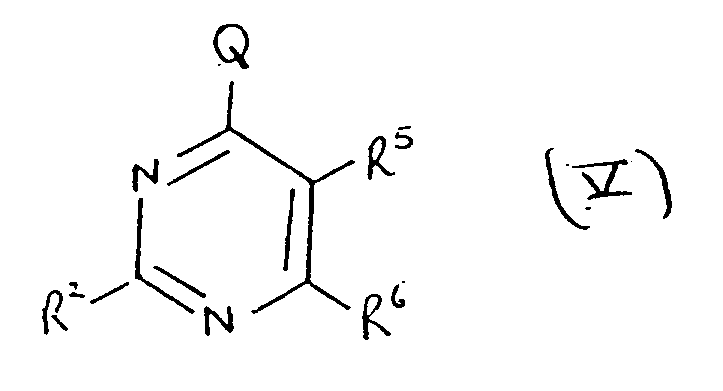 (b) reacting a pyrimidinium salt of formula VII
 (c) for those compounds in which R6 is amino or alkylamino, reacting a compound of formula VIIIand whereafter when a different counter-anion Y is required, the compound of formula I is reacted witha suitable metal salt with the desired counter-anion or subjected to ion exchange with a basic resin in the form of its salt with the desired counter-anion.
- A process for the manufacture of a non-ionic compound of formula I having the structure IIIa or IIIb (or a tautomeric form thereof) as defined in claim 9, which process comprises treating a compound of formula I with a strong base.
- A pharmaceutical composition comprising an active ingredient selected from a compound as claimed in any one of claims 1 to 9 together with or in admixture with a pharmaceutically-acceptable diluent or carrier.
- The use of a compound of the formula I as claimed in any one of claims 1 to 5 or a non-ionic form thereof having the formula IIIa or IIIb (or a tautomeric form thereof) as claimed in claim 8 or 9, for the manufacture of a medicament for modulating the action of the sino-atrial node in a warm-blooded animal.
Applications Claiming Priority (2)
| Application Number | Priority Date | Filing Date | Title |
|---|---|---|---|
| GB898929022A GB8929022D0 (en) | 1989-12-22 | 1989-12-22 | Diazine derivatives |
| GB8929022 | 1989-12-22 |
Publications (2)
| Publication Number | Publication Date |
|---|---|
| EP0434341A1 EP0434341A1 (en) | 1991-06-26 |
| EP0434341B1 true EP0434341B1 (en) | 1995-05-17 |
Family
ID=10668392
Family Applications (1)
| Application Number | Title | Priority Date | Filing Date |
|---|---|---|---|
| EP90313772A Expired - Lifetime EP0434341B1 (en) | 1989-12-22 | 1990-12-17 | Diazine derivatives |
Country Status (21)
| Country | Link |
|---|---|
| US (1) | US5252567A (en) |
| EP (1) | EP0434341B1 (en) |
| JP (1) | JPH03291277A (en) |
| KR (1) | KR910011838A (en) |
| AT (1) | ATE122672T1 (en) |
| AU (1) | AU641960B2 (en) |
| CA (1) | CA2032743A1 (en) |
| DE (1) | DE69019489T2 (en) |
| DK (1) | DK0434341T3 (en) |
| ES (1) | ES2072993T3 (en) |
| FI (1) | FI906306A7 (en) |
| GB (2) | GB8929022D0 (en) |
| HU (1) | HU207511B (en) |
| IE (1) | IE904391A1 (en) |
| IL (1) | IL96609A0 (en) |
| NO (1) | NO905378L (en) |
| NZ (1) | NZ236417A (en) |
| PT (1) | PT96315B (en) |
| TW (1) | TW215088B (en) |
| ZA (1) | ZA909852B (en) |
| ZW (1) | ZW19290A1 (en) |
Families Citing this family (8)
| Publication number | Priority date | Publication date | Assignee | Title |
|---|---|---|---|---|
| GB9022644D0 (en) * | 1990-10-18 | 1990-11-28 | Ici Plc | Heterocyclic compounds |
| WO2005014573A1 (en) * | 2003-08-07 | 2005-02-17 | Pharmacia & Upjohn Company Llc | Anthelmintic and insecticide pyrimidine derivatives |
| US7741976B2 (en) * | 2005-12-16 | 2010-06-22 | Hunt Power, L.P. | Server and method for processing meter data into a common format |
| CR20170076A (en) | 2014-08-04 | 2017-06-26 | Nuevolution As | PIRIMIDIMA DERIVATIVES REPLACED WITH OPTIONALLY CONDENSED HETEROCICLYL USEFUL FOR THE TREATMENT OF INFLAMMATORY, METABOLIC, ONCOLOGICAL AND SELF-IMMUNITY DISEASES |
| AU2020408107B2 (en) | 2019-12-20 | 2026-04-23 | Nuevolution A/S | Compounds active towards nuclear receptors |
| AU2020405446A1 (en) | 2019-12-20 | 2022-05-26 | Nuevolution A/S | Compounds active towards nuclear receptors |
| EP4126874A1 (en) | 2020-03-31 | 2023-02-08 | Nuevolution A/S | Compounds active towards nuclear receptors |
| US11613532B2 (en) | 2020-03-31 | 2023-03-28 | Nuevolution A/S | Compounds active towards nuclear receptors |
Family Cites Families (14)
| Publication number | Priority date | Publication date | Assignee | Title |
|---|---|---|---|---|
| GB815833A (en) * | 1956-09-26 | 1959-07-01 | Boots Pure Drug Co Ltd | Phenanthridine compounds |
| BE492034A (en) * | 1948-11-05 | |||
| DE1445740A1 (en) * | 1963-09-04 | 1968-11-28 | Bayer Ag | Process for the preparation of bispyrimidinium compounds |
| US4339453A (en) * | 1979-07-23 | 1982-07-13 | Merck & Co., Inc. | Antimicrobial aminopyrimidinium salts |
| US4287338A (en) * | 1980-03-10 | 1981-09-01 | The Upjohn Company | Sulfooxy-pyrimidinium, -pyridinium, and -triazinium hydroxide inner salts |
| FR2524467A1 (en) * | 1982-03-30 | 1983-10-07 | Adir | DISUBSTITUTED POLYMETHYLENE IMINES, PROCESSES FOR THEIR PREPARATION AND PHARMACEUTICAL COMPOSITIONS COMPRISING THEM |
| US4503050A (en) * | 1983-06-02 | 1985-03-05 | Riker Laboratories, Inc. | Substituted imidazo[1,2-c]pyrimidines |
| US4725600A (en) * | 1984-07-13 | 1988-02-16 | Fujisawa Pharmaceutical Co., Ltd. | Pyrimidine compounds having activity as a cardiotonic anti-hypertensive cerebrovascular vasodilator and anti-platelet aggregation agent |
| WO1987001706A2 (en) * | 1985-09-12 | 1987-03-26 | The Upjohn Company | C20 through c26 amino steroids |
| DE3703633A1 (en) * | 1986-02-14 | 1987-08-20 | Sandoz Ag | Purine derivatives, their preparation and medicaments containing them |
| US4729995A (en) * | 1986-04-21 | 1988-03-08 | Toyo Boseki Kabushiki Kaisha | Pyrimidine 2,4-dioxamate compounds and pharmaceutical compositions |
| DE3629563A1 (en) * | 1986-08-02 | 1988-02-04 | Mildenberger & Willing Verpack | PORTABLE PACKAGING BAG FROM PLASTIC FILM AND METHOD FOR THE PRODUCTION THEREOF |
| DE3639563A1 (en) * | 1986-11-20 | 1988-06-01 | Basf Ag | N-ARYLSULFONYL-N'-PYRIMIDYL (TRIAZINYL) UREAS |
| HU206337B (en) * | 1988-12-29 | 1992-10-28 | Mitsui Petrochemical Ind | Process for producing pyrimidine derivatives and pharmaceutical compositions |
-
1989
- 1989-12-22 GB GB898929022A patent/GB8929022D0/en active Pending
-
1990
- 1990-11-28 GB GB909025810A patent/GB9025810D0/en active Pending
- 1990-12-05 IE IE439190A patent/IE904391A1/en unknown
- 1990-12-07 ZA ZA909852A patent/ZA909852B/en unknown
- 1990-12-07 HU HU908115A patent/HU207511B/en not_active IP Right Cessation
- 1990-12-09 IL IL96609A patent/IL96609A0/en unknown
- 1990-12-10 ZW ZW192/90A patent/ZW19290A1/en unknown
- 1990-12-10 AU AU67914/90A patent/AU641960B2/en not_active Ceased
- 1990-12-10 NZ NZ236417A patent/NZ236417A/en unknown
- 1990-12-12 NO NO90905378A patent/NO905378L/en unknown
- 1990-12-17 EP EP90313772A patent/EP0434341B1/en not_active Expired - Lifetime
- 1990-12-17 DK DK90313772.7T patent/DK0434341T3/en active
- 1990-12-17 AT AT90313772T patent/ATE122672T1/en not_active IP Right Cessation
- 1990-12-17 DE DE69019489T patent/DE69019489T2/en not_active Expired - Fee Related
- 1990-12-17 ES ES90313772T patent/ES2072993T3/en not_active Expired - Lifetime
- 1990-12-18 US US07/629,502 patent/US5252567A/en not_active Expired - Fee Related
- 1990-12-19 CA CA002032743A patent/CA2032743A1/en not_active Abandoned
- 1990-12-20 FI FI906306A patent/FI906306A7/en not_active Application Discontinuation
- 1990-12-21 TW TW079110759A patent/TW215088B/zh active
- 1990-12-21 JP JP2404924A patent/JPH03291277A/en active Pending
- 1990-12-21 KR KR1019900021264A patent/KR910011838A/en not_active Withdrawn
- 1990-12-21 PT PT96315A patent/PT96315B/en not_active IP Right Cessation
Also Published As
| Publication number | Publication date |
|---|---|
| HU908115D0 (en) | 1991-06-28 |
| IE904391A1 (en) | 1991-07-03 |
| ATE122672T1 (en) | 1995-06-15 |
| NO905378D0 (en) | 1990-12-12 |
| KR910011838A (en) | 1991-08-07 |
| AU6791490A (en) | 1991-06-27 |
| EP0434341A1 (en) | 1991-06-26 |
| TW215088B (en) | 1993-10-21 |
| GB9025810D0 (en) | 1991-01-09 |
| ZW19290A1 (en) | 1991-09-18 |
| FI906306A7 (en) | 1991-06-23 |
| HUT56087A (en) | 1991-07-29 |
| DE69019489D1 (en) | 1995-06-22 |
| JPH03291277A (en) | 1991-12-20 |
| NO905378L (en) | 1991-06-24 |
| HU207511B (en) | 1993-04-28 |
| DK0434341T3 (en) | 1995-10-09 |
| CA2032743A1 (en) | 1991-06-23 |
| FI906306A0 (en) | 1990-12-20 |
| ES2072993T3 (en) | 1995-08-01 |
| US5252567A (en) | 1993-10-12 |
| PT96315B (en) | 1998-06-30 |
| AU641960B2 (en) | 1993-10-07 |
| ZA909852B (en) | 1991-10-30 |
| GB8929022D0 (en) | 1990-02-28 |
| PT96315A (en) | 1991-09-30 |
| IL96609A0 (en) | 1991-09-16 |
| NZ236417A (en) | 1994-04-27 |
| DE69019489T2 (en) | 1995-09-21 |
Similar Documents
| Publication | Publication Date | Title |
|---|---|---|
| EP0422178B1 (en) | Pyrimidine derivatives | |
| FI92697C (en) | Process for the preparation of imidazo [4,5-b] quinolinyloxyalkanoic acid amides useful as medicaments | |
| HUT64755A (en) | Process for the production of 2,4-diamino-quinazoline derivatives and of medical preparatives containing them | |
| EP0482804B1 (en) | Pyrrolo[2,3-d]pyrimidines with cardiovascular activity, process for their preparation and pharmaceutical compositions containing them | |
| EP0453197B1 (en) | Amine derivatives | |
| US5252567A (en) | Diazine derivatives | |
| EP0618208A1 (en) | Thiazolopyrimidine derivatives | |
| EP0431856B1 (en) | Heterocyclic compounds | |
| HU195487B (en) | Process for producing quinoline derivatives | |
| CZ283499B6 (en) | Derivatives of 2-aminopyrazine-5-carboxamide, process of their preparation, intermediate for the process, as well as a medicament and a pharmaceutical preparation in which they are comprised |
Legal Events
| Date | Code | Title | Description |
|---|---|---|---|
| PUAI | Public reference made under article 153(3) epc to a published international application that has entered the european phase |
Free format text: ORIGINAL CODE: 0009012 |
|
| AK | Designated contracting states |
Kind code of ref document: A1 Designated state(s): AT BE CH DE DK ES FR GB GR IT LI LU NL SE |
|
| 17P | Request for examination filed |
Effective date: 19911026 |
|
| 17Q | First examination report despatched |
Effective date: 19930929 |
|
| RAP1 | Party data changed (applicant data changed or rights of an application transferred) |
Owner name: ZENECA LIMITED |
|
| GRAA | (expected) grant |
Free format text: ORIGINAL CODE: 0009210 |
|
| AK | Designated contracting states |
Kind code of ref document: B1 Designated state(s): AT BE CH DE DK ES FR GB GR IT LI LU NL SE |
|
| REF | Corresponds to: |
Ref document number: 122672 Country of ref document: AT Date of ref document: 19950615 Kind code of ref document: T |
|
| ITF | It: translation for a ep patent filed | ||
| REF | Corresponds to: |
Ref document number: 69019489 Country of ref document: DE Date of ref document: 19950622 |
|
| REG | Reference to a national code |
Ref country code: GR Ref legal event code: FG4A Free format text: 3016149 |
|
| REG | Reference to a national code |
Ref country code: ES Ref legal event code: FG2A Ref document number: 2072993 Country of ref document: ES Kind code of ref document: T3 |
|
| ET | Fr: translation filed | ||
| NLT2 | Nl: modifications (of names), taken from the european patent patent bulletin |
Owner name: ZENECA LIMITED |
|
| REG | Reference to a national code |
Ref country code: DK Ref legal event code: T3 |
|
| PLBE | No opposition filed within time limit |
Free format text: ORIGINAL CODE: 0009261 |
|
| STAA | Information on the status of an ep patent application or granted ep patent |
Free format text: STATUS: NO OPPOSITION FILED WITHIN TIME LIMIT |
|
| 26N | No opposition filed | ||
| PGFP | Annual fee paid to national office [announced via postgrant information from national office to epo] |
Ref country code: SE Payment date: 20001206 Year of fee payment: 11 |
|
| PGFP | Annual fee paid to national office [announced via postgrant information from national office to epo] |
Ref country code: DE Payment date: 20001211 Year of fee payment: 11 |
|
| PGFP | Annual fee paid to national office [announced via postgrant information from national office to epo] |
Ref country code: FR Payment date: 20001212 Year of fee payment: 11 |
|
| PGFP | Annual fee paid to national office [announced via postgrant information from national office to epo] |
Ref country code: GB Payment date: 20001213 Year of fee payment: 11 Ref country code: AT Payment date: 20001213 Year of fee payment: 11 |
|
| PGFP | Annual fee paid to national office [announced via postgrant information from national office to epo] |
Ref country code: DK Payment date: 20001214 Year of fee payment: 11 |
|
| PGFP | Annual fee paid to national office [announced via postgrant information from national office to epo] |
Ref country code: ES Payment date: 20001220 Year of fee payment: 11 |
|
| PGFP | Annual fee paid to national office [announced via postgrant information from national office to epo] |
Ref country code: GR Payment date: 20001221 Year of fee payment: 11 |
|
| PGFP | Annual fee paid to national office [announced via postgrant information from national office to epo] |
Ref country code: LU Payment date: 20001222 Year of fee payment: 11 Ref country code: CH Payment date: 20001222 Year of fee payment: 11 |
|
| REG | Reference to a national code |
Ref country code: GB Ref legal event code: 732E |
|
| PGFP | Annual fee paid to national office [announced via postgrant information from national office to epo] |
Ref country code: NL Payment date: 20001231 Year of fee payment: 11 |
|
| REG | Reference to a national code |
Ref country code: CH Ref legal event code: PUE Owner name: ZENECA LIMITED TRANSFER- ASTRAZENECA AB |
|
| PGFP | Annual fee paid to national office [announced via postgrant information from national office to epo] |
Ref country code: BE Payment date: 20010315 Year of fee payment: 11 |
|
| PG25 | Lapsed in a contracting state [announced via postgrant information from national office to epo] |
Ref country code: LU Free format text: LAPSE BECAUSE OF NON-PAYMENT OF DUE FEES Effective date: 20011217 Ref country code: GB Free format text: LAPSE BECAUSE OF NON-PAYMENT OF DUE FEES Effective date: 20011217 Ref country code: DK Free format text: LAPSE BECAUSE OF NON-PAYMENT OF DUE FEES Effective date: 20011217 Ref country code: AT Free format text: LAPSE BECAUSE OF NON-PAYMENT OF DUE FEES Effective date: 20011217 |
|
| PG25 | Lapsed in a contracting state [announced via postgrant information from national office to epo] |
Ref country code: SE Free format text: LAPSE BECAUSE OF NON-PAYMENT OF DUE FEES Effective date: 20011218 |
|
| PG25 | Lapsed in a contracting state [announced via postgrant information from national office to epo] |
Ref country code: LI Free format text: LAPSE BECAUSE OF NON-PAYMENT OF DUE FEES Effective date: 20011231 Ref country code: GR Free format text: LAPSE BECAUSE OF NON-PAYMENT OF DUE FEES Effective date: 20011231 Ref country code: CH Free format text: LAPSE BECAUSE OF NON-PAYMENT OF DUE FEES Effective date: 20011231 Ref country code: BE Free format text: LAPSE BECAUSE OF NON-PAYMENT OF DUE FEES Effective date: 20011231 |
|
| REG | Reference to a national code |
Ref country code: GB Ref legal event code: IF02 |
|
| BERE | Be: lapsed |
Owner name: ASTRAZENECA A.B. Effective date: 20011231 |
|
| PG25 | Lapsed in a contracting state [announced via postgrant information from national office to epo] |
Ref country code: NL Free format text: LAPSE BECAUSE OF NON-PAYMENT OF DUE FEES Effective date: 20020701 |
|
| PG25 | Lapsed in a contracting state [announced via postgrant information from national office to epo] |
Ref country code: DE Free format text: LAPSE BECAUSE OF NON-PAYMENT OF DUE FEES Effective date: 20020702 |
|
| EUG | Se: european patent has lapsed |
Ref document number: 90313772.7 |
|
| GBPC | Gb: european patent ceased through non-payment of renewal fee |
Effective date: 20011217 |
|
| REG | Reference to a national code |
Ref country code: CH Ref legal event code: PL |
|
| PG25 | Lapsed in a contracting state [announced via postgrant information from national office to epo] |
Ref country code: FR Free format text: LAPSE BECAUSE OF NON-PAYMENT OF DUE FEES Effective date: 20020830 |
|
| NLV4 | Nl: lapsed or anulled due to non-payment of the annual fee |
Effective date: 20020701 |
|
| REG | Reference to a national code |
Ref country code: DK Ref legal event code: EBP |
|
| REG | Reference to a national code |
Ref country code: FR Ref legal event code: ST |
|
| PG25 | Lapsed in a contracting state [announced via postgrant information from national office to epo] |
Ref country code: ES Free format text: LAPSE BECAUSE OF NON-PAYMENT OF DUE FEES Effective date: 20021218 |
|
| REG | Reference to a national code |
Ref country code: ES Ref legal event code: FD2A Effective date: 20030113 |
|
| PG25 | Lapsed in a contracting state [announced via postgrant information from national office to epo] |
Ref country code: IT Free format text: LAPSE BECAUSE OF NON-PAYMENT OF DUE FEES;WARNING: LAPSES OF ITALIAN PATENTS WITH EFFECTIVE DATE BEFORE 2007 MAY HAVE OCCURRED AT ANY TIME BEFORE 2007. THE CORRECT EFFECTIVE DATE MAY BE DIFFERENT FROM THE ONE RECORDED. Effective date: 20051217 |