EP0431856B1 - Heterocyclic compounds - Google Patents
Heterocyclic compounds Download PDFInfo
- Publication number
- EP0431856B1 EP0431856B1 EP90313079A EP90313079A EP0431856B1 EP 0431856 B1 EP0431856 B1 EP 0431856B1 EP 90313079 A EP90313079 A EP 90313079A EP 90313079 A EP90313079 A EP 90313079A EP 0431856 B1 EP0431856 B1 EP 0431856B1
- Authority
- EP
- European Patent Office
- Prior art keywords
- formula
- alkyl
- phenyl
- group
- methyl
- Prior art date
- Legal status (The legal status is an assumption and is not a legal conclusion. Google has not performed a legal analysis and makes no representation as to the accuracy of the status listed.)
- Expired - Lifetime
Links
- 0 CC(P)=NC(P)=NC*=I Chemical compound CC(P)=NC(P)=NC*=I 0.000 description 1
Classifications
-
- C—CHEMISTRY; METALLURGY
- C07—ORGANIC CHEMISTRY
- C07D—HETEROCYCLIC COMPOUNDS
- C07D401/00—Heterocyclic compounds containing two or more hetero rings, having nitrogen atoms as the only ring hetero atoms, at least one ring being a six-membered ring with only one nitrogen atom
- C07D401/02—Heterocyclic compounds containing two or more hetero rings, having nitrogen atoms as the only ring hetero atoms, at least one ring being a six-membered ring with only one nitrogen atom containing two hetero rings
- C07D401/04—Heterocyclic compounds containing two or more hetero rings, having nitrogen atoms as the only ring hetero atoms, at least one ring being a six-membered ring with only one nitrogen atom containing two hetero rings directly linked by a ring-member-to-ring-member bond
-
- A—HUMAN NECESSITIES
- A61—MEDICAL OR VETERINARY SCIENCE; HYGIENE
- A61P—SPECIFIC THERAPEUTIC ACTIVITY OF CHEMICAL COMPOUNDS OR MEDICINAL PREPARATIONS
- A61P9/00—Drugs for disorders of the cardiovascular system
- A61P9/06—Antiarrhythmics
-
- A—HUMAN NECESSITIES
- A61—MEDICAL OR VETERINARY SCIENCE; HYGIENE
- A61P—SPECIFIC THERAPEUTIC ACTIVITY OF CHEMICAL COMPOUNDS OR MEDICINAL PREPARATIONS
- A61P9/00—Drugs for disorders of the cardiovascular system
- A61P9/12—Antihypertensives
-
- C—CHEMISTRY; METALLURGY
- C07—ORGANIC CHEMISTRY
- C07D—HETEROCYCLIC COMPOUNDS
- C07D251/00—Heterocyclic compounds containing 1,3,5-triazine rings
- C07D251/02—Heterocyclic compounds containing 1,3,5-triazine rings not condensed with other rings
- C07D251/12—Heterocyclic compounds containing 1,3,5-triazine rings not condensed with other rings having three double bonds between ring members or between ring members and non-ring members
- C07D251/14—Heterocyclic compounds containing 1,3,5-triazine rings not condensed with other rings having three double bonds between ring members or between ring members and non-ring members with hydrogen or carbon atoms directly attached to at least one ring carbon atom
- C07D251/16—Heterocyclic compounds containing 1,3,5-triazine rings not condensed with other rings having three double bonds between ring members or between ring members and non-ring members with hydrogen or carbon atoms directly attached to at least one ring carbon atom to only one ring carbon atom
- C07D251/18—Heterocyclic compounds containing 1,3,5-triazine rings not condensed with other rings having three double bonds between ring members or between ring members and non-ring members with hydrogen or carbon atoms directly attached to at least one ring carbon atom to only one ring carbon atom with nitrogen atoms directly attached to the two other ring carbon atoms, e.g. guanamines
-
- C—CHEMISTRY; METALLURGY
- C07—ORGANIC CHEMISTRY
- C07D—HETEROCYCLIC COMPOUNDS
- C07D403/00—Heterocyclic compounds containing two or more hetero rings, having nitrogen atoms as the only ring hetero atoms, not provided for by group C07D401/00
- C07D403/02—Heterocyclic compounds containing two or more hetero rings, having nitrogen atoms as the only ring hetero atoms, not provided for by group C07D401/00 containing two hetero rings
- C07D403/04—Heterocyclic compounds containing two or more hetero rings, having nitrogen atoms as the only ring hetero atoms, not provided for by group C07D401/00 containing two hetero rings directly linked by a ring-member-to-ring-member bond
Definitions
- This invention concerns novel heterocyclic compounds and, more particularly, novel amino 1,3,5-triazine derivatives which possess beneficial effects on the cardiovascular system, pharmaceutical compositions containing such a derivative as active ingredient, and processes for the manufacture of and medical use of the said derivatives.
- 1,3,5-triazine derivatives have been studied for their herbicidal activity. Such derivatives which are generallky 2,4,6-substitued derivatives are reported in EP 336 494, UK 814947 and UK 1132306. The preparation of selected polyhydro 1,3,5-triazines is reported in Journal. Synthetic Organic Chemistry (Japan), 34, (1976), 417-421.
- P is a group of formula II or a group of formula III
- R1 is (1-10C)alkyl, (3-8C)cycloalkyl, (3-8C)cycloalkyl(1-4C)alkyl, phenyl or phenyl(1-4C)alkyl
- R2 is hydrogen, (1-4C)alkyl, amino or (1-4C)alkylamino
- R3 and R4 are independently hydrogen, (1-4C)alkyl, phenyl or benzyl, the latter two optionally bearing one or two substituents selected from (1-4C)alkyl, (1-4C)alkoxy and halogeno
- R6 is (1-4C)alkyl, amino or (1-6C)alkylamino
- C and D are independently ethylene or trimethylene
- Z is a direct bond between C and D, or an oxy, thio, carbonyl
- the compounds of the invention may exist in, and be isolated in, optically active or racemic form.
- the invention includes any tautomeric, optically active or racemic form of a compound of formula I which possesses the afore-mentioned beneficial pharmacological effects.
- the compounds of formula I are quaternary salts and in some cases, for example, when P represents a group of formula III and R8 is hydrogen or R2 or R6 is amino or alkylamino, or when P represents a group of formula II and R2 or R6 is alkyl or alkylamino, may be converted, for example by treatment with a quaternary ammonium hydroxide (and especially one in macroreticular resin form) to the corresponding neutral free bases such as those of the formula IVa or IVb (when P is a group of formula III) or Va or Vb (when P is a group of formula II), respectively, or to a tautomeric form thereof depending on the nature of R2, R4 or R6.
- a quaternary ammonium hydroxide and especially one in macroreticular resin form
- Such neutral free bases of the compounds of formula I such as those of the formula IVa, IVb, Va or Vb in which R7 is hydrogen or (1-4C)alkyl are provided as a further feature of the invention (provided that when Q is phenyl, A is a direct bond and R1 is phenyl, then R2 and R6 are not both amino) and may readily be reconverted to the quaternary salt form of formula I, for example, by treatment with the appropriate acid of the formula H.Y.
- R1 when it is alkyl is, for example, (1-6C)alkyl, such as methyl, ethyl, propyl or butyl, of which values methyl and ethyl are generally preferred.
- R1 when it is cycloalkyl is, for example, cyclopentyl, cyclohexyl or cycloheptyl.
- R2, R3, R4 or R6 when it is alkyl or for an alkyl substituent when it is present as a part of R8 is, for example, methyl or ethyl.
- R8 when it is alkyl is, for example, methyl, ethyl, propyl, isopropyl, butyl, iso -butyl or sec -butyl; when it is alkenyl is, for example, allyl, but-2-enyl or 2-methyl-2-propenyl; and when it is alkynyl is, for example, prop-2-ynyl or but-2-ynyl.
- R1 or R8 when it is cycloalkyl-alkyl is, for example, cyclopropyl-methyl, cylopentyl-methyl, cyclohexylmethyl or 2-(cyclohexyl)ethyl.
- R1 or R8 when it is phenylalkyl or for a phenylalkyl substituent which is a part of R8 is, for example, benzyl, 1-phenylethyl or 2-phenylethyl.
- R2 or R6 when it is alkylamino is, for example, methylamino, ethylamino, propylamino or butylamino.
- R8 when it is alkylene or alkenylene linked to the nitrogen atom of the group Q.A.N- is for example, methylene, ethylidene, ethylene, isopropylidene, trimethylene, tetramethylene, vinylene or 1,3-propenylene; and a particular value for a substituent which may be present on such a linking group is, for example, methyl, ethyl, propyl, butyl, phenyl, benzyl, 1-phenylethyl or 2-phenylethyl (the benzene moiety of any of the last four groups themselves optionally substituted as defined above).
- a particular value for A when it is alkylene is, for example, methylene, ethylene, trimethylene or tetramethylene, any of which may optionally bear one or two methyl substituents.
- a preferred value for A is, for example, when it is a direct bond, methylene or ethylene.
- Particular values for optional substituents which may be present on a phenyl, pyridyl, or benzene moiety in R1, R3, R4, R5, R8 or Q as defined hereinabove include, by way of example: for halogeno, fluoro, chloro and bromo; for alkyl, methyl and ethyl; for alkenyl, allyl; for alkoxy, methoxy and ethoxy; for alkylamino, methylamino and ethylamino; for dialkylamino, dimethylamino and diethylamino; for alkylthio, methylthio and ethylthio; for alkylsulphinyl, methylsulphinyl and ethylsulphinyl; for alkylsulphonyl, methylsulphonyl and ethylsulphonyl; and for alkylenedioxy, methylenedioxy and isopropylidened
- R5 when it is alkyl is, for example, methyl, ethyl, propyl or butyl.
- Particular values for the group - C . Z . D - include, for example, tetramethylene, ethyleneoxyethylene [-CH2CH2.O.CH2CH2-], ethyleneoxytrimethylene [-CH2CH2.O.CH2CH2CH2-], ethylenethioethylene [-CH2CH2.S.CH2CH2-], pentamethylene, hexamethylene, ethylenecarbonylethylene [-CH2CH2.CO.CH2CH2-] ethylene(ethylenedioxymethylene)ethylene and groups of the formula -CH2CH2.NR.CH2CH2- and -CH2CH2.NR.CH2CH2CH2- in which R is methyl, ethyl, propyl, butyl or phenyl, the latter optionally bearing a substituent as defined for R5 above.
- Preferred values for substituents R3 and R4 on any of the above values of - C .Z. D - include, for example, when they are both hydrogen or methyl, or when one is hydrogen and the other is methyl, ethyl, phenyl or benzyl, the latter two optionally substituted as defined above.
- a further group of preferred values for substituents R3 and R4 on any of the above values of -C . Z . D- include, for example, when they are both hydrogen or methyl, or when one is hydrogen and the other is methyl or phenyl, optionally substituted as defined above.
- Q when Q is a phenyl or benzene moiety it is preferably unsubstituted or else may bear up to three substituents; and when Q is a pyridyl moiety it is preferably unsubstituted or else may bear one or two substituents.
- R2 is hydrogen or alkyl
- R6 is amino or alkylamino (especially alkylamino).
- Q is phenyl (optionally substituted as indicated herein), and for A is a direct bond.
- Q include, for example, phenyl, 4-chlorophenyl, 4-methylphenyl, 2-nitrophenyl, 2-methoxyphenyl, 4-methylthiophenyl, 2,5-dinitrophenyl, 3,5-dimethylphenyl, 3,5-dichlorophenyl and pyridyl.
- Specific values for the group Q.A.N(R8)- when R8 is alkylene or alkenylene include, for example, 1-indolinyl, 1-indolyl, 3-methyl-1-indolyl, 3-methyl-1-indolinyl, 3-ethyl-1-indolyl, 3-ethyl-1-indolinyl, 5-bromo-1-indolyl, 1,2,3,4-tetrahydro-1-quinolyl, 1,2,3,4-tetrahydro-2-isoquinolyl, 5-aza-1-indolinyl.
- More specific values for the group Q.A.N(R8)- when R8 is alkylene or alkenylene include, for example, 3-propyl-1-indolyl and 3-propyl-1-indolinyl. 2-methyl-1-indolyl and 2-methyl-1-indolinyl.
- Specific values of particular interest for the group Q.A.N(R8)- when R8 is alkylene or alkenylene include, for example, 1-indolinyl, 1-indolyl, 3-methyl-1-indolyl, 3-methyl-1-indolinyl, 3-ethyl-1-indolyl, 3-ethyl-1-indolinyl, 1,2,3,4-tetrahydro-1-quinolyl, 3-propyl-1-indolyl and 3-propyl-1-indolinyl.
- Specific values for the group of formula II include, for example, 3-methylpyrrolidino, N -phenylpiperazino, N -( p -chlorophenyl)piperazino, piperidino, 4-phenylpiperidino, 3-methylpiperidino, 3,3-dimethylpiperidino, morpholino, hexamethyleneimino, 3-benzylpiperidino, 4-benzylpiperidino, 2-ethylpiperidino, 3-ethylpiperidino, 3-propylpiperidino, 3-butylpiperidino, 3-phenylpyrollidino and 3,5-dimethylpiperidino (especially cis ).
- Specific values of special interest for the group of formula II include, for example, 3-methylpyrrolidino, 4-phenyl piperidino, 3-methylpiperidino, 3,3-dimethylpiperidino, 3-benzylpiperidino, 4-benzylpiperidino, 2-ethylpiperidino, 3-ethylpiperidino, 3-propylpiperidino, 3-butylpiperidino, 3-phenylpyrollidino and 3,5-dimethylpiperidino (especially cis ).
- R3 and R4 which are of interest include, for example, hydrogen, methyl, ethyl, propyl, butyl, benzyl and phenyl.
- R1, R3, R4 or R5 contains a phenyl moiety it is preferably unsubstituted or else may bear one or two substituents.
- R3 or R4 includes a benzyl group it is conveniently unsubstituted.
- an amino 1,3,5-triazine derivative of the formula I (set out hereinafter, together with the other chemical formulae appearing herein in Roman numerals) wherein P is a group of formula III;
- R1 is (1-10C)alkyl, (3-8C)cycloalkyl, (3-8C)cycloalkyl-(1-4C)alkyl, phenyl or phenyl(1-4C)alkyl;
- R2 is hydrogen, (1-4C)alkyl, amino or (1-4C)alkylamino;
- R8 is hydrogen, (3-6C)cycloalkyl-(1-4C)alkyl, (1-6C)alkyl, (3-6C)alkenyl, (3-6C)alkynyl or phenyl(1-4C)alkyl; or
- R8 is a (1-4C)alkylene or (2-4C)alkenylene linked to the nitrogen atom of the group Q.A.N- , either of which linking groups may optionally bear a (1-4C
- R1 is (1-10C)alkyl, (3-8C)cycloalkyl, (3-8C)cycloalkyl-(1-4C)alkyl, phenyl or phenyl(1-4C)alkyl, the phenyl moiety of the latter two optionally bearing one or more substituents independently selected from halogeno, (1-4C)alkyl, (3-6C)alkenyl, (1-4C)alkoxy, cyano, trifluoromethyl, nitro, amino, hydroxy, (1-4C)alkylamino, dialkylamino of up to six carbon atoms, (1-4C)alkylthio, (1-4C)alkylsulphinyl, (1-4C)alkyl-sulphonyl and (1-4C)alky
- a group of compounds of the invention which is of particular interest comprises those compounds of the formula XI wherein: Ra is (1-4C)alkyl (especially methyl or ethyl), Rb is (1-4C)alkyl (especially methyl or ethyl); Rc is (1-6C)alkyl, (3-6C)alkenyl, (3-6C)alkynyl or phenyl(1-4C)alkyl; or Rc is (1-4C)alkylene or (2-4C)alkenylene linked to the nitrogen atom of the group Qa.Aa.N- , either of which linking groups may optionally bear a (1-4C)alkyl substituent and either of which linking groups thereby completes a ring including two adjacent carbon atoms of Q and the nitrogen of group -Aa.N- ; Rd is (1-4C)alkyl (especially methyl); Qa is phenyl; Aa is a direct bond to the group -NRc- ; and Y is a physiologically acceptable anion
- Rc and Qa include, for example, the relevant values mentioned hereinabove for R8 and Q.
- a preferred value for Ra, Rb or Rd is, for example, methyl.
- a further group of compounds of the invention which is of particular interest comprises those compounds of the formula X wherein: Ra is (1-4C)alkyl (especially methyl or ethyl); Rd is (1-4C)alkyl (especially methyl or ethyl); Rb is (1-4C)alkyl (especially methyl); P is a 5-7 membered cyclic aliphatic amino group selected from pyrrolidino, morpholino, piperidino, N -phenylpiperazino, N -(halogenophenyl)piperazino, N -[(1-4C)alkylphenyl]piperazino, 4-phenylpiperidino, 4-[(1-4C)alkylphenyl]piperidino, N -[(1-4C)alkoxyphenyl]piperazino, and hexamethyleneimino, any of which groups may optionally bear one or two substituents independently selected from methyl, ethyl, propyl, butyl
- Specific values for the group P which are of particular interest include, for example, 3-methylpyrrolidino, N -phenylpiperazino, N -( p -chlorophenyl)piperazino, piperidino, 4-phenyl piperidino, 3-methylpiperidino, 3,3-dimethylpiperidino, morpholino, hexamethyleneimino, 3-benzylpiperidino, 4-benzylpiperidino, 2-ethylpiperidino, 3-ethylpiperidino, 3-propylpiperidino, 3-butylpiperidino, 3-phenylpyrrolidino and 3,5-dimethylpiperidino.
- Specific values for the group P which are of special interest include, for example, 3-methylpyrrolidino, 4-phenyl piperidino, 3-methylpiperidino, 3,3-dimethylpiperidino, 3-benzylpiperidino, 4-benzylpiperidino, 2-ethylpiperidino, 3-ethylpiperidino, 3-propylpiperidino, 3-butylpiperidino, 3-phenylpyrollidino and 3,5-dimethylpiperidino.
- a preferred value for Ra, Rb or Rd is, for example, methyl.
- a further group of compounds of the invention which is of particular interest comprises those compounds of the formula X wherein: Ra is (1-4C)alkyl (especially methyl or ethyl); Rd is (1-4C)alkyl (especially methyl or ethyl); Rb is (1-4C)alkyl (especially methyl); P is a 5-7 membered cyclic aliphatic amino group selected from pyrrolidino, morpholino, piperidino, N -phenylpiperazino, N -(halogenophenyl)piperazino, N -[(1-4C)alkylphenyl]piperazino, N -[(1-4C)alkoxyphenyl] piperazino, and hexamethyleneimino, any of which groups may optionally bear one or two substituents independently selected from methyl, ethyl, phenyl and halogenophenyl; and Y is a physiologically acceptable anion.
- group P which are of particular interest include, for example, 3-methylpyrrolidino, N -phenylpiperazino, N -( p -chlorophenyl)piperazino, piperidino, 4-phenylpiperidino, 3-methylpiperidino, 3,3-dimethylpiperidino, morpholino and hexamethyleneimino.
- Specific values for the group P which are of special interest include, for example, 3-methylpyrrolidino, 4-phenylpiperidino, 3-methylpiperidino, 3,3-dimethylpiperidino, 3-benzylpiperidino, 4-benzylpiperidino, 2-ethylpiperidino, 3-ethylpiperidino, 3-phenylpyrollidino and 3,5-dimethylpiperidino.
- a preferred value for Ra, Rb or Rd is, for example, methyl.
- Particular physiologically acceptable counter anions Y include, for example, halide (such as chloride, bromide or iodide), sulphate, phosphate, nitrate, acetate, citrate, fumarate, succinate, trifluoroacetate, methosulphate and p -toluenesulphonate
- a preferred group of free bases of the invention defined above comprises those compounds of the formula (Xa) in which Ra, Rb, Rd, and P have any of the meanings defined above, and those compounds of formula (XIa) in which Ra, Rb, Rd, Qa, Aa and Rc have any of the meanings defined above.
- Compounds of the invention which are of particular interest include the compounds described in Examples 1- 3, 5, 6, 8-10,12-16, 18-21, 27, 33, 37, 38, 40 and 44, of which those descibed in Examples 1, 2, 6, 13, 14, 16, 19, 40 and 44 are of special interest, and those descibed in Examples 1, 6, 16 and 19 are particularly preferred.
- the above compounds, as described herein (or, in the form of an alternative physiologically acceptable counter anion), are provided as a further feature of the invention.
- the compounds of the invention may be obtained by standard procedures of organic chemistry already known to be applicable to the preparation of structurally analogous compounds, for example those procedures described in standard reference works on the chemistry of the 1,3,5-triazines. Such procedures for the manufacture of the novel compounds of formula I are provided as a further feature of the invention and are illustrated by the following preferred processes in which the various generic radicals have any of the meanings defined hereinbefore.
- a preferred value of Z is, for example, halide (especially iodide, bromide or chloride), sulphate, p -toluenesulphate or a group of formula -OSO2OR8.
- the reaction is generally carried out by heating the alkylating agent with the compound of formula (VI) at a temperature of, for example, 40-120°C and is conveniently carried out in a suitable solvent or diluent, for example, in an ether such as dioxane, tetrahydrofuran or t -butyl methyl ether.
- a suitable solvent or diluent for example, in an ether such as dioxane, tetrahydrofuran or t -butyl methyl ether.
- the starting materials of formula (VI) can be made, for example, by reaction of the corresponding halogeno-1,3,5-triazine of the formula (VII) wherein X is chloro or bromo with the appropriate amine of the formula Q.A.N(R8)H or of formula (II) at a temperature in the range, for example, 40-150°C.
- This particular reaction may be carried out in the presence of a suitable solvent or diluent such as a (1-4C)alkanol or N,N-dimethylformamide, or as a melt of the reagents alone.
- a suitable solvent or diluent such as a (1-4C)alkanol or N,N-dimethylformamide
- the amines of the formula Q.A.N(R8)H and formula (II), and the compounds of formula V are in general known or may be made by conventional techniques well known in the art of organic and heterocyclic chemistry.
- alkylation takes place predominantly on the nitrogen shown bearing R1 in formula (I) and any small amount of the alternative isomer may be removed by well known methods for the purification of organic compounds, for example by chromatographic means or by fractional crystallisation.
- the position of alkylation can be established by standard techniques, for example by studies of the nuclear Overhauser effect on the proton magnetic resonance of the sample concerned.
- Suitable values for the leaving group X include, for example halogeno, such as chloro or bromo.
- the process will be seen to be analogous to that described above for the production of the starting materials of the formula (VI) and analogous conditions may in general be used.
- the process is generally carried out at an elevated temperature in the range, for example, 20-150°C and in the presence of a suitable solvent or diluent such as a (1-4C)alkanol or N,N-dimethylformamide.
- the 1,3,5-triazinium salts of formula (VIII) may themselves be obtained, for example, by analogy with process (a) above, that is by reaction of a halogeno-1,3,5-triazine of the formula (VII) with the appropriate alkylating agent of the formula R 9 .Z and in particular an iodide or bromide of the formula R 9 .I or R 9 .Br .
- they may also be obtained, for example, by reaction of the appropriate 1-substituted 1,3,5-triazin-4-one with a suitable chlorinating agent such as phosphorus oxychloride.
- the 1-substituted 1,3,5-triazin-4-ones may themselves be obtained by standard procedures of heterocyclic chemistry well known in the art. This procedure is particularly suitable for the production of salts of formula I in which R1 is phenyl or substituted phenyl.
- the group Y represents an appropriate counter ion.
- the process is generally carried out at an elevated temperature in the range, for example, 20-150°C and in the presence of a suitable solvent or diluent such as a (1-4C)alkanol or N,N-dimethylformamide.
- a suitable solvent or diluent such as a (1-4C)alkanol or N,N-dimethylformamide.
- a particularly suitable leaving group X is, for example, halogeno (especially chloro or bromo), dichlorophosphinoyl [-O.PO.Cl2] , or dibromophosphinoyl [-O.PO.Br2] .
- the latter two groups may conveniently be introduced in situ by the reaction of the corresponding triazinone that is a compound of formula XIII, with phosphorus oxychloride or oxybromide, respectively.
- the compound of formula XIII is heated in excess phosphorous oxychloride or oxybromide as appropriate, and the excess reagent is removed, for example by evaporation, before reaction with the amine of formula R7NH2.
- a compound of formula XIII is reacted with phosphorous oxychloride, conveniently with heating, followed by an amine of formula R7NH2 or ammonia (as appropriate).
- the reaction may be accompanied by a "Dimroth rearrangement" ⁇ see for example, Ann, 364,183, (1909); 459,39, (1927) ⁇ so that the group R7 from the amine R7NH2 ultimately resides on the ring nitrogen atom which was peviously substituted by R1, and the group R1 is present in the group R1NH as the R6 substituent.
- This rearrangement is favoured where the R1 substituent in the compound of formula XII is bulkier than R7.
- Particularly suitable conditions are when a compound of formula XIII is reacted with phosphorous oxychloride followed by addition of the appropriate amine.
- a further suitable leaving group is, for example, alkoxy and in particular ethoxy.
- Such a group may be introduced by treating the compound of formula XIII with triethyloxonium tetrafluoroborate.
- the counter anion Y ⁇ may readily be changed, for example, by reaction of the compound of formula I with a suitable salt such as a silver salt or by ion-exchange chromatography on a column of a basic macroreticular resin in the form of its salt with the desired counter anion, or another conventional method.
- a suitable salt such as a silver salt
- ion-exchange chromatography on a column of a basic macroreticular resin in the form of its salt with the desired counter anion, or another conventional method.
- a neutral compound of formula (IVa), (IVb), (Va) or (Vb) When a neutral compound of formula (IVa), (IVb), (Va) or (Vb) is required, it may be obtained, for example, by reaction of the appropriate compound of formula I in which R2 is hydrogen or R6 is amino or alkylamino, with a strong base such as macroreticular resin containing quaternary ammonium hydroxide groups.
- the process is conveniently carried out by exposing a solution of the compound of formula I in an aqueous solvent such as an aqueous (1-4C)alkanol (for example methanol, ethanol or 2-propanol) to the resin at or near ambient temperature, for example by trickling the solution over a bed or through a column of the resin.
- an aqueous solvent such as an aqueous (1-4C)alkanol (for example methanol, ethanol or 2-propanol)
- the compounds of the invention possess useful pharmacological properties and modulate the action of the sino-atrial node in warm-blooded animals in a beneficial, selective and medically useful manner so that the agents are useful in treating cardiovascular disorders associated with an inappropriately elevated heart rate and with minimal effects on other haemodynamic parameters such as blood pressure or cardiac output.
- the beneficial and selective effects of the cardiovascular system may be demonstrated using the following standard laboratory techniques.
- This technique involves the dissection of the right atrium from a guinea pig heart, taking care not to damage the sino-atrial node region.
- the atrium is established in oxygenated (95% O2; 5% CO2) Tyrode's solution [containing 8.0 g NaCl, 0.19 g KCl, 0.025 g MgCl2, 0.05 g NaH2PO4, 1.0 g NaHCO3, 0.2 g CaCl2 and 2.7 g glucose, per litre of deionised water] between two platinum spikes which are connected via an amplifier to a conventional rate-meter, triggered by the action potentials across the atrium.
- the preparation is bathed in oxygenated Tyrode's solution at 37 degrees Celsius and allowed to equilibrate for 30 minutes before the addition of a solution of the test compound in a mixture of dimethyl sulphoxide and Cremophor EL, diluted as required with Tyrode's solution. Further solutions of test compound are then added cumulatively at 15 minute intervals or when a steady-state beating rate has been attained. This enables an IC20 (i.e. the micromolar concentration required to reduce the beating rate by 20%) to be calculated. Typically, a compound of formula I will have an IC20 of 10 micromolar or less.
- This technique involves the dissection of the left atrium from a guinea pig heart into oxygenated Tyrodes solution.
- the atrium is then clamped in an polyacrylate plastic holder containing two stainless steel stimulating electrodes.
- the free end of the atrium (normally the atrial appendage) is attached with silk thread to an isometric force transducer.
- the atrium is then set under a resting tension of 1 g and is allowed to equilibrate in oxygenated Tyrode's solution for 20 minutes before being stimulated into beating by application of 2.5 Hz, 3 mS pulses at 1.5 times the threshold voltage (normally in the range 3-7 V).
- a solution (10 ⁇ 5 M or less) of the test compound [made up as in (a) above] is then added and the effect on contractile force measured. In this way a comparison of the effect with that of a control solution without any test compound can be obtained.
- concentration in the range 1-30 micromolar compounds of the formula I show ⁇ 15% reduction in contractile force.
- Wistar rats Alderley Park strain
- Wistar rats Alderley Park strain
- alphaxalone/alphadalone 1.5 ml per kg
- a polyethylene cannula is inserted into the jugular vein and anaesthesia is maintained by infusion of alphaxalone/alphadalone at a rate of 0.025-0.12 ml per kg per minute.
- a polyethylene cannula is also inserted into the carotid artery and connected to a pressure transducer filled with physiological saline solution. The arterial blood pressure signal is used to trigger an internally calibrated heart rate meter and the transducer is calibrated with a mercury manometer.
- the output of the heart rate meter and of the pressure transducer are then recorded simultaneously on a standard chart recorder.
- the rat preparation is allowed to stabilise for 10 minutes.
- a solution of a test compound [made up as in (a) above, in a volume of 1 ml per kg] is then administered via the venous cannula in four cumulative doses separated by 5 minute intervals.
- a group of five rats is used for each test compound.
- the effects on heart rate and blood pressure may then be determined in comparison with those of a control injection.
- a compound of formula I active using this procedure will require an i.v. dose of 5 mg/kg or less to produce a 30% reduction in heart rate (i.e. the ED30 dose).
- the beneficial effects of a test compound on the cardiovascular system may also be determined in anaesthetised dogs and in dogs in which tachycardia has been induced by exercise.
- the compounds of the invention show significant and predominantly selective bradycardic effects as evidenced by activity in at least two of the above mentioned test techniques. No overt toxicity is generally observed with the compounds of formula I in the above in vivo test techniques at doses several multiples of those at which significant bradycardic effects are seen.
- Example 1 the compound described hereinafter in Example 1 had an IC20 of about 4.6 x 10 ⁇ 7 M in procedure (a) and had an ED30 of 0.31 mg/kg i.v. for reduction of heart rate in procedure (c); and the compound described hereinafter in Example 37 had an IC20 of about 3 x 10 ⁇ 6 M in procedure (a) and had an ED30 of 1.1 mg/kg i.v. for reduction of heart rate in procedure (c).
- Other compounds of formula I such as those exemplified hereinafter, will typically show activity of the same general order.
- the compounds of the present invention are of potential use in treating diseases of the cardiovascular system.
- a compound of the present invention for use in therapy and the use of a compound of the present invention for the manufacture of a medicament for treating cariovascular disease.
- the present invention also provides a method of modulating the action of the sino-atrial node in a warm-blooded animal, such as man, requiring such treatment which method comprises administering an effective amount of a compound of the present invention to said animal.
- a compound of formula I When used in the treatment of diseases of the cardiovascular system, such as myocardial ischaemia affecting warm-blooded animals (and in particular man), it is envisaged that a compound of formula I will be administered orally, intravenously or by some other medically acceptable route (such as by inhalation, insufflation, sub-lingual or transdermal means) so that a dose in the general range, for example, 0.01 mg to 10 mg per kg body weight is received.
- some other medically acceptable route such as by inhalation, insufflation, sub-lingual or transdermal means
- the precise dose administered will necessarily vary according to the nature and severity of the disease and the age and sex of the patient being treated.
- the compounds of formula I will usually be administered in the form of a pharmaceutical composition, that is, together with a pharmaceutically acceptable diluent or carrier and such a composition is provided as a further feature of the invention and may be in a variety of dosage forms.
- compositions may conveniently be in unit dose form containing, for example, 5 - 200 mg of the compound of formula I.
- compositions may be obtained by conventional procedures using pharmaceutically acceptable diluents and carriers well known in the art.
- Tablets and capsules for oral administration may conveniently be formed with an enteric coating (such as one based on cellulose acetate phthalate) to minimise contact of the active ingredient of formula I with stomach acids.
- compositions of the invention may also contain one or more agents known to be of value in the diseases or conditions of the cardiovasculature intended to be treated.
- agents known to be of value in the diseases or conditions of the cardiovasculature intended to be treated may contain, in addition to the compound of formula I, for example, a known platelet aggregation inhibitor, prostanoid constrictor antagonist or synthase inhibitor (thromboxane A2 antagonist or synthase inhibitor), cyclooxygenase inhibitor, hypolipidemic agent, anti-hypertensive agent, inotropic agent, beta-adrenergic blocker, thrombolytic agent or a vasodilator.
- a known platelet aggregation inhibitor for example, a known platelet aggregation inhibitor, prostanoid constrictor antagonist or synthase inhibitor (thromboxane A2 antagonist or synthase inhibitor), cyclooxygenase inhibitor, hypolipidemic agent, anti-hypertensive agent, inotropic agent
- the compounds of formula I are also useful as pharmacological tools in the development and standardisation of test systems for the evaluation of the new cardiovascular agents in laboratory animals such as cats, dogs, rabbits, monkeys, rats and mice.
- the triazine starting material was prepared as follows: ⁇ A mixture of 4-chloro-2-methyl-6-methylamino-1,3,5-triazine (0.275 g, 1.7 mM; obtained as described in J . Pharm . Soc ., Japan , Vol 95 pp.512) and N -ethylaniline (0.25 ml, 2.0 mM) was heated at 100°C for 5 minutes. The product was cooled to ambient temperature, dissolved in a mixture of methylene chloride (15 ml) and 2M hydrochloric acid (10 ml) and stirred for one minute.
- 1,2-dimethyl-4-(3-ethylindol-1-yl)-6-methylamino-1,3,5-triazinium iodide was obtained in 10% yield as a solid, m.p. 275-276°C (with decomposition), with microanalysis, found: C,46.9; H,4.8; N,16.7%; C16H20NI requires: C,46.94; H,4.9; N-17.1%; after recrystallisation from ethanol and by reaction of 4-(3-ethylindol-1-yl)-2-methyl-6-methylamino-1,3,5-triazine with methyl iodide.
- the starting material was prepared as follows: -
- 'Amberlite' IRA400 chloride form 'Amberlite' is a trade mark of Rohm Haas and Co.
- the starting material was prepared as follows: ⁇
- the starting material was prepared by dehydrogenation of 2-(indolin-1-yl)-4-methylamino-1,3,5-triazine, which was obtained as follows:-
- Example 2 The procedure described in Example 1 was repeated using 2-methyl-6-methylamino-4-(1,2,3,4-tetrahydroquinolin-1-yl)-1,3,5-triazine and methyl iodide. There was thus obtained 1,2-dimethyl-6-methylamino-4-(1,2,3,4-tetrahydroquinolin-1-yl)-1,3,5-triazine, in 12% yield, as a solid, mp 184-186°C (with decomposition) after recrystallisation from ethylacetate.
- the starting material was prepared as follows:-
- the free base was obtained by partitioning the hydrochloride salt between saturated aqueous sodium carbonate and methylene chloride. The layers were separated, the organic layer dried and the solvent evaporated to give the free base.
- 0.25 H2O requires: C, 60.0; H, 7.8; N, 20.6%; NMR: 0.7 and 1.0(2 x 3H, t, CCH3 rotamers), 1.2-1.8(2 x 2H, m, CH2 rotamers), 1.25 (3H,t,CH3), 2.35 and 2.65 (2 x 3H, s, CH3 rotamers), 3.5(3H,?, NCH3), 3.0 and 3.55 (2 x 2H,q,CH2 rotamers), 4.05 (2H,m,NCH2), 7.2-7.53(5H, complex, aromatic), 8.8 and 9.0 (2 x 1H, br, NH rotamers).
- the quaternary group was confirmed as methyl by nuclear Overhauser studies.
- the triazine starting material was prepared as follows:-
- the above formulations may be obtained by conventional procedures well known in the pharmaceutical art.
- the tablets may be enteric coated by conventional means, for example to provide a coating of cellulose acetate phthalate.
Landscapes
- Chemical & Material Sciences (AREA)
- Organic Chemistry (AREA)
- Health & Medical Sciences (AREA)
- Engineering & Computer Science (AREA)
- Bioinformatics & Cheminformatics (AREA)
- Cardiology (AREA)
- Heart & Thoracic Surgery (AREA)
- Chemical Kinetics & Catalysis (AREA)
- General Chemical & Material Sciences (AREA)
- Medicinal Chemistry (AREA)
- Nuclear Medicine, Radiotherapy & Molecular Imaging (AREA)
- Pharmacology & Pharmacy (AREA)
- Life Sciences & Earth Sciences (AREA)
- Animal Behavior & Ethology (AREA)
- General Health & Medical Sciences (AREA)
- Public Health (AREA)
- Veterinary Medicine (AREA)
- Pharmaceuticals Containing Other Organic And Inorganic Compounds (AREA)
- Plural Heterocyclic Compounds (AREA)
- Nitrogen And Oxygen Or Sulfur-Condensed Heterocyclic Ring Systems (AREA)
- Separation Using Semi-Permeable Membranes (AREA)
- Detergent Compositions (AREA)
- Air Bags (AREA)
- Hydrogenated Pyridines (AREA)
Abstract
Description
- This invention concerns novel heterocyclic compounds and, more particularly, novel amino 1,3,5-triazine derivatives which possess beneficial effects on the cardiovascular system, pharmaceutical compositions containing such a derivative as active ingredient, and processes for the manufacture of and medical use of the said derivatives.
- Although numerous compounds are known to have medically useful effects on the cardiovascular system, hitherto there have not existed satisfactory agents which modulate the action of the sino-atrial node in warm-blooded animals such as man in a beneficial, selective and medically useful manner so that the agents are useful in treating cardiovascular disorders associated with an inappropriately elevated heart rate and yet have minimal effects on other haemodynamic parameters such as blood pressure or cardiac output. It is an object of the invention to provide such an agent.
- 1,3,5-triazine derivatives have been studied for their herbicidal activity. Such derivatives which are generallky 2,4,6-substitued derivatives are reported in EP 336 494, UK 814947 and UK 1132306. The preparation of selected polyhydro 1,3,5-triazines is reported in Journal. Synthetic Organic Chemistry (Japan), 34, (1976), 417-421.
- According to the invention there is provided a compound of the formula I (set out hereinafter, together with the other chemical formulae appearing herein in Roman numerals) wherein:
P is a group of formula II or a group of formula III;
R¹ is (1-10C)alkyl, (3-8C)cycloalkyl, (3-8C)cycloalkyl(1-4C)alkyl, phenyl or phenyl(1-4C)alkyl;
R² is hydrogen, (1-4C)alkyl, amino or (1-4C)alkylamino;
R³ and R⁴ are independently hydrogen, (1-4C)alkyl, phenyl or benzyl, the latter two optionally bearing one or two substituents selected from (1-4C)alkyl, (1-4C)alkoxy and halogeno; R⁶ is (1-4C)alkyl, amino or (1-6C)alkylamino; C and D are independently ethylene or trimethylene;
Z is a direct bond between C and D, or an oxy, thio, carbonyl, methylene, ethylenedioxymethylene, ethylidene, or isopropylidene link, or Z is a group of the formula =N.R⁵ in which R⁵ is (1-6C)alkyl, phenyl or benzyl, the phenyl moiety of the latter two optionally bearing one or two substituents selected from (1-4C)alkyl, (1-4C)alkoxy and halogeno;
R⁸ is hydrogen, (3-6C)cycloalkyl(1-4C)alkyl, (1-6C)alkyl, (3-6C)alkenyl, (3-6C)alkynyl or phenyl(1-4C)alkyl; or R⁸ is a (1-4C)alkylene or (2-4C)alkenylene linked to the nitrogen atom of the group Q.A.N- , either of which linking groups may optionally bear a (1-4C)alkyl, phenyl or phenyl(1-4C)alkyl substituent and either of which linking groups thereby completes a ring including two adjacent carbon atoms of ring Q, any carbon atoms in A and the adjacent nitrogen atom of the group -A.N- ;
A is a direct bond to the the group -N(R⁸)- or is (1-6C)alkylene;
Q is a phenyl or pyridyl moiety;
Y is a physiologically acceptable anion;
and wherein any one or more of said phenyl or pyridyl moieties in R¹, R⁸ and Q may optionally be unsubstituted or bear one or more substituents independently selected from halogeno, (1-4C)alkyl, (3-6C)alkenyl, (1-4C)alkoxy, cyano, trifluoromethyl, nitro, amino, hydroxy, (1-4C)alkylamino, dialkylamino of up to six carbon atoms, (1-4C)alkylthio, (1-4C)alkylsulphinyl, (1-4C)alkylsulphonyl and (1-4C)alkylenedioxy;
provided that when Q is phenyl, A is a direct bond, R⁸ is hydrogen, R¹ is phenyl and Y is a physiologically acceptable anion, then R² and R⁶ are not both amino. - It will be understood that when P represents a group of formula III and R⁸ is hydrogen, or when R² or R⁶ is amino or alkylamino, the amino derivatives of the invention may exist in another tautomeric form to that depicted in formula I, or in a mixture of one or more of the possible tautomeric forms. It will also be understood that when P represents a group of formula II and R² or R⁶ is amino or alkylamino, the amino derivatives of the invention may exist in another tautomeric form to that depicted in formula I, or in a mixture of one or more of the possible tautomeric forms.
- It will also be understood that when one of the substituents in the formula I compounds contains a chiral centre, the compounds of the invention may exist in, and be isolated in, optically active or racemic form. The invention includes any tautomeric, optically active or racemic form of a compound of formula I which possesses the afore-mentioned beneficial pharmacological effects.
- The compounds of formula I are quaternary salts and in some cases, for example, when P represents a group of formula III and R⁸ is hydrogen or R² or R⁶ is amino or alkylamino, or when P represents a group of formula II and R² or R⁶ is alkyl or alkylamino, may be converted, for example by treatment with a quaternary ammonium hydroxide (and especially one in macroreticular resin form) to the corresponding neutral free bases such as those of the formula IVa or IVb (when P is a group of formula III) or Va or Vb (when P is a group of formula II), respectively, or to a tautomeric form thereof depending on the nature of R², R⁴ or R⁶. Such neutral free bases of the compounds of formula I, such as those of the formula IVa, IVb, Va or Vb in which R⁷ is hydrogen or (1-4C)alkyl are provided as a further feature of the invention (provided that when Q is phenyl, A is a direct bond and R¹ is phenyl, then R² and R⁶ are not both amino) and may readily be reconverted to the quaternary salt form of formula I, for example, by treatment with the appropriate acid of the formula H.Y.
- A particular value for R¹ when it is alkyl is, for example, (1-6C)alkyl, such as methyl, ethyl, propyl or butyl, of which values methyl and ethyl are generally preferred.
- A particular value for R¹ when it is cycloalkyl is, for example, cyclopentyl, cyclohexyl or cycloheptyl.
- A particular value for R², R³, R⁴ or R⁶ when it is alkyl or for an alkyl substituent when it is present as a part of R⁸ is, for example, methyl or ethyl.
- A particular value for R⁸ when it is alkyl is, for example, methyl, ethyl, propyl, isopropyl, butyl, iso-butyl or sec-butyl; when it is alkenyl is, for example, allyl, but-2-enyl or 2-methyl-2-propenyl; and when it is alkynyl is, for example, prop-2-ynyl or but-2-ynyl.
- A particular value for R¹ or R⁸ when it is cycloalkyl-alkyl is, for example, cyclopropyl-methyl, cylopentyl-methyl, cyclohexylmethyl or 2-(cyclohexyl)ethyl.
- A particular value for R¹ or R⁸ when it is phenylalkyl or for a phenylalkyl substituent which is a part of R⁸ is, for example, benzyl, 1-phenylethyl or 2-phenylethyl.
- A particular value for R² or R⁶ when it is alkylamino is, for example, methylamino, ethylamino, propylamino or butylamino.
- A particular value for R⁸ when it is alkylene or alkenylene linked to the nitrogen atom of the group Q.A.N- is for example, methylene, ethylidene, ethylene, isopropylidene, trimethylene, tetramethylene, vinylene or 1,3-propenylene; and a particular value for a substituent which may be present on such a linking group is, for example, methyl, ethyl, propyl, butyl, phenyl, benzyl, 1-phenylethyl or 2-phenylethyl (the benzene moiety of any of the last four groups themselves optionally substituted as defined above).
- A particular value for A when it is alkylene is, for example, methylene, ethylene, trimethylene or tetramethylene, any of which may optionally bear one or two methyl substituents.
- A preferred value for A is, for example, when it is a direct bond, methylene or ethylene.
- Particular values for optional substituents which may be present on a phenyl, pyridyl, or benzene moiety in R¹, R³, R⁴, R⁵, R⁸ or Q as defined hereinabove include, by way of example:
for halogeno, fluoro, chloro and bromo;
for alkyl, methyl and ethyl;
for alkenyl, allyl;
for alkoxy, methoxy and ethoxy;
for alkylamino, methylamino and ethylamino;
for dialkylamino, dimethylamino and diethylamino;
for alkylthio, methylthio and ethylthio;
for alkylsulphinyl, methylsulphinyl and ethylsulphinyl;
for alkylsulphonyl, methylsulphonyl and ethylsulphonyl; and
for alkylenedioxy, methylenedioxy and isopropylidenedioxy. - A particular value for R⁵ when it is alkyl is, for example, methyl, ethyl, propyl or butyl.
- Particular values for the group -C.Z.D- include, for example, tetramethylene, ethyleneoxyethylene [-CH₂CH₂.O.CH₂CH₂-], ethyleneoxytrimethylene [-CH₂CH₂.O.CH₂CH₂CH₂-], ethylenethioethylene [-CH₂CH₂.S.CH₂CH₂-], pentamethylene, hexamethylene, ethylenecarbonylethylene [-CH₂CH₂.CO.CH₂CH₂-] ethylene(ethylenedioxymethylene)ethylene and groups of the formula -CH₂CH₂.NR.CH₂CH₂- and -CH₂CH₂.NR.CH₂CH₂CH₂- in which R is methyl, ethyl, propyl, butyl or phenyl, the latter optionally bearing a substituent as defined for R⁵ above. Preferred values for substituents R³ and R⁴ on any of the above values of -C.Z.D- include, for example, when they are both hydrogen or methyl, or when one is hydrogen and the other is methyl, ethyl, phenyl or benzyl, the latter two optionally substituted as defined above. A further group of preferred values for substituents R³ and R⁴ on any of the above values of -C.Z.D- include, for example, when they are both hydrogen or methyl, or when one is hydrogen and the other is methyl or phenyl, optionally substituted as defined above.
- In general, when Q is a phenyl or benzene moiety it is preferably unsubstituted or else may bear up to three substituents; and when Q is a pyridyl moiety it is preferably unsubstituted or else may bear one or two substituents.
- It is generally preferred that R² is hydrogen or alkyl, and R⁶ is amino or alkylamino (especially alkylamino). By way of example, a preferred value for Q is phenyl (optionally substituted as indicated herein), and for A is a direct bond.
- Specific values for Q include, for example, phenyl, 4-chlorophenyl, 4-methylphenyl, 2-nitrophenyl, 2-methoxyphenyl, 4-methylthiophenyl, 2,5-dinitrophenyl, 3,5-dimethylphenyl, 3,5-dichlorophenyl and pyridyl.
- Specific values for the group Q.A.N(R⁸)- when R⁸ is alkylene or alkenylene include, for example, 1-indolinyl, 1-indolyl, 3-methyl-1-indolyl, 3-methyl-1-indolinyl, 3-ethyl-1-indolyl, 3-ethyl-1-indolinyl, 5-bromo-1-indolyl, 1,2,3,4-tetrahydro-1-quinolyl, 1,2,3,4-tetrahydro-2-isoquinolyl, 5-aza-1-indolinyl. More specific values for the group Q.A.N(R⁸)- when R⁸ is alkylene or alkenylene include, for example, 3-propyl-1-indolyl and 3-propyl-1-indolinyl. 2-methyl-1-indolyl and 2-methyl-1-indolinyl.
- Specific values of particular interest for the group Q.A.N(R⁸)- when R⁸ is alkylene or alkenylene include, for example, 1-indolinyl, 1-indolyl, 3-methyl-1-indolyl, 3-methyl-1-indolinyl, 3-ethyl-1-indolyl, 3-ethyl-1-indolinyl, 1,2,3,4-tetrahydro-1-quinolyl, 3-propyl-1-indolyl and 3-propyl-1-indolinyl.
- Specific values for the group of formula II include, for example, 3-methylpyrrolidino, N-phenylpiperazino, N-(p-chlorophenyl)piperazino, piperidino, 4-phenylpiperidino, 3-methylpiperidino, 3,3-dimethylpiperidino, morpholino, hexamethyleneimino, 3-benzylpiperidino, 4-benzylpiperidino, 2-ethylpiperidino, 3-ethylpiperidino, 3-propylpiperidino, 3-butylpiperidino, 3-phenylpyrollidino and 3,5-dimethylpiperidino (especially cis).
- Specific values of special interest for the group of formula II include, for example, 3-methylpyrrolidino, 4-phenyl piperidino, 3-methylpiperidino, 3,3-dimethylpiperidino, 3-benzylpiperidino, 4-benzylpiperidino, 2-ethylpiperidino, 3-ethylpiperidino, 3-propylpiperidino, 3-butylpiperidino, 3-phenylpyrollidino and 3,5-dimethylpiperidino (especially cis).
- Specific values for R³ and R⁴ which are of interest include, for example, hydrogen, methyl, ethyl, propyl, butyl, benzyl and phenyl.
- In general, when R¹, R³, R⁴ or R⁵ contains a phenyl moiety it is preferably unsubstituted or else may bear one or two substituents.
- In general, when R³ or R⁴ includes a benzyl group it is conveniently unsubstituted.
- In one embodiment of the present invention there is provided an amino 1,3,5-triazine derivative of the formula I (set out hereinafter, together with the other chemical formulae appearing herein in Roman numerals) wherein P is a group of formula III; R¹ is (1-10C)alkyl, (3-8C)cycloalkyl, (3-8C)cycloalkyl-(1-4C)alkyl, phenyl or phenyl(1-4C)alkyl; R² is hydrogen, (1-4C)alkyl, amino or (1-4C)alkylamino; R⁸ is hydrogen, (3-6C)cycloalkyl-(1-4C)alkyl, (1-6C)alkyl, (3-6C)alkenyl, (3-6C)alkynyl or phenyl(1-4C)alkyl; or R⁸ is a (1-4C)alkylene or (2-4C)alkenylene linked to the nitrogen atom of the group Q.A.N-, either of which linking groups may optionally bear a (1-4C)alkyl, phenyl or phenyl(1-4C)alkyl substituent and either of which linking groups thereby completes a ring including two adjacent carbon atoms of ring Q, any carbon atoms in A and the adjacent nitrogen atom of the group -A.N-; R⁶ is amino, (1-6C)alkylamino or (1-4C)alkyl; A is a direct bond to the the group -N(R⁸)- or is (1-6C)alkylene; Q is a phenyl or pyridyl moiety; Y is a physiologically acceptable anion; and wherein any one or more of said phenyl, benzene or pyridyl moieties may optionally be unsubstituted or bear one or more substituents independently selected from halogeno, (1-4C)alkyl, (3-6C)alkenyl, (1-4C)alkoxy, cyano, trifluoromethyl, nitro, amino, hydroxy, (1-4C)alkylamino, dialkylamino of up to six carbon atoms, (1-4C)alkylthio, (1-4C)alkylsulphinyl, (1-4C)alkylsulphonyl and (1-4C)alkylenedioxy.
- Particular and specific values for the various groups include, for example, the relevant values mentioned hereinabove.
- In a further embodiment of the present invention there is provided an amino 1,3,5-triazine derivative of the formula I (set out hereinafter, together with the other chemical formulae appearing herein in Roman numerals) wherein P is a group of formula II; R¹ is (1-10C)alkyl, (3-8C)cycloalkyl, (3-8C)cycloalkyl-(1-4C)alkyl, phenyl or phenyl(1-4C)alkyl, the phenyl moiety of the latter two optionally bearing one or more substituents independently selected from halogeno, (1-4C)alkyl, (3-6C)alkenyl, (1-4C)alkoxy, cyano, trifluoromethyl, nitro, amino, hydroxy, (1-4C)alkylamino, dialkylamino of up to six carbon atoms, (1-4C)alkylthio, (1-4C)alkylsulphinyl, (1-4C)alkyl-sulphonyl and (1-4C)alkylenedioxy; R² is hydrogen, (1-4C)alkyl, amino or (1-4C)alkylamino; R³ and R⁴ are independently hydrogen, (1-4C)alkyl or phenyl, the latter optionally bearing one or two substituents selected from (1-4C)alkyl, (1-4C)alkoxy and halogeno; R⁶ is (1-4C)alkyl, amino or (1-4C)alkylamino; C and D are independently ethylene or trimethylene; Y is a physiologically acceptable anion; and Z is a direct bond between C and D, or an oxy, thio, carbonyl, methylene, ethylenedioxymethylene, ethylidene, or isopropylidene link, or Z is a group of the formula = N.R⁵ in which R⁵ is (1-6C)alkyl, phenyl or benzyl, the phenyl moiety of the latter two optionally bearing one or two substituents selected from (1-4C)alkyl, (1-4C)alkoxy and halogeno.
- Particular and specific values for the various groups include, for example, the relevant values mentioned hereinabove.
- A group of compounds of the invention which is of particular interest comprises those compounds of the formula XI wherein: Ra is (1-4C)alkyl (especially methyl or ethyl), Rb is (1-4C)alkyl (especially methyl or ethyl); Rc is (1-6C)alkyl, (3-6C)alkenyl, (3-6C)alkynyl or phenyl(1-4C)alkyl; or Rc is (1-4C)alkylene or (2-4C)alkenylene linked to the nitrogen atom of the group Qa.Aa.N- , either of which linking groups may optionally bear a (1-4C)alkyl substituent and either of which linking groups thereby completes a ring including two adjacent carbon atoms of Q and the nitrogen of group -Aa.N- ; Rd is (1-4C)alkyl (especially methyl); Qa is phenyl; Aa is a direct bond to the group -NRc- ; and Y is a physiologically acceptable anion.
- Specific values for Rc and Qa include, for example, the relevant values mentioned hereinabove for R⁸ and Q.
- A preferred value for Ra, Rb or Rd is, for example, methyl.
- A further group of compounds of the invention which is of particular interest comprises those compounds of the formula X wherein: Ra is (1-4C)alkyl (especially methyl or ethyl); Rd is (1-4C)alkyl (especially methyl or ethyl); Rb is (1-4C)alkyl (especially methyl); P is a 5-7 membered cyclic aliphatic amino group selected from pyrrolidino, morpholino, piperidino, N-phenylpiperazino, N-(halogenophenyl)piperazino, N-[(1-4C)alkylphenyl]piperazino, 4-phenylpiperidino, 4-[(1-4C)alkylphenyl]piperidino, N-[(1-4C)alkoxyphenyl]piperazino, and hexamethyleneimino, any of which groups may optionally bear one or two substituents independently selected from methyl, ethyl, propyl, butyl, phenyl, halogenophenyl and benzyl; and Y is a physiologically acceptable anion.
- Specific values for the group P which are of particular interest include, for example, 3-methylpyrrolidino, N-phenylpiperazino, N-(p-chlorophenyl)piperazino, piperidino, 4-phenyl piperidino, 3-methylpiperidino, 3,3-dimethylpiperidino, morpholino, hexamethyleneimino, 3-benzylpiperidino, 4-benzylpiperidino, 2-ethylpiperidino, 3-ethylpiperidino, 3-propylpiperidino, 3-butylpiperidino, 3-phenylpyrrolidino and 3,5-dimethylpiperidino.
- Specific values for the group P which are of special interest include, for example, 3-methylpyrrolidino, 4-phenyl piperidino, 3-methylpiperidino, 3,3-dimethylpiperidino, 3-benzylpiperidino, 4-benzylpiperidino, 2-ethylpiperidino, 3-ethylpiperidino, 3-propylpiperidino, 3-butylpiperidino, 3-phenylpyrollidino and 3,5-dimethylpiperidino.
- A preferred value for Ra, Rb or Rd is, for example, methyl.
- A further group of compounds of the invention which is of particular interest comprises those compounds of the formula X wherein: Ra is (1-4C)alkyl (especially methyl or ethyl); Rd is (1-4C)alkyl (especially methyl or ethyl); Rb is (1-4C)alkyl (especially methyl); P is a 5-7 membered cyclic aliphatic amino group selected from pyrrolidino, morpholino, piperidino, N-phenylpiperazino, N-(halogenophenyl)piperazino, N-[(1-4C)alkylphenyl]piperazino, N-[(1-4C)alkoxyphenyl] piperazino, and hexamethyleneimino, any of which groups may optionally bear one or two substituents independently selected from methyl, ethyl, phenyl and halogenophenyl; and Y is a physiologically acceptable anion.
- Specific values for the group P which are of particular interest include, for example, 3-methylpyrrolidino, N-phenylpiperazino, N-(p-chlorophenyl)piperazino, piperidino, 4-phenylpiperidino, 3-methylpiperidino, 3,3-dimethylpiperidino, morpholino and hexamethyleneimino.
- Specific values for the group P which are of special interest include, for example, 3-methylpyrrolidino, 4-phenylpiperidino, 3-methylpiperidino, 3,3-dimethylpiperidino, 3-benzylpiperidino, 4-benzylpiperidino, 2-ethylpiperidino, 3-ethylpiperidino, 3-phenylpyrollidino and 3,5-dimethylpiperidino.
- A preferred value for Ra, Rb or Rd is, for example, methyl.
- Particular physiologically acceptable counter anions Y include, for example, halide (such as chloride, bromide or iodide), sulphate, phosphate, nitrate, acetate, citrate, fumarate, succinate, trifluoroacetate, methosulphate and p-toluenesulphonate
- A preferred group of free bases of the invention defined above comprises those compounds of the formula (Xa) in which Ra, Rb, Rd, and P have any of the meanings defined above, and those compounds of formula (XIa) in which Ra, Rb, Rd, Qa, Aa and Rc have any of the meanings defined above.
- Compounds of the invention which are of particular interest include the compounds described in Examples 1- 3, 5, 6, 8-10,12-16, 18-21, 27, 33, 37, 38, 40 and 44, of which those descibed in Examples 1, 2, 6, 13, 14, 16, 19, 40 and 44 are of special interest, and those descibed in Examples 1, 6, 16 and 19 are particularly preferred. The above compounds, as described herein (or, in the form of an alternative physiologically acceptable counter anion), are provided as a further feature of the invention.
- The compounds of the invention may be obtained by standard procedures of organic chemistry already known to be applicable to the preparation of structurally analogous compounds, for example those procedures described in standard reference works on the chemistry of the 1,3,5-triazines. Such procedures for the manufacture of the novel compounds of formula I are provided as a further feature of the invention and are illustrated by the following preferred processes in which the various generic radicals have any of the meanings defined hereinbefore.
- A preferred value of Z is, for example, halide (especially iodide, bromide or chloride), sulphate, p-toluenesulphate or a group of formula -OSO₂OR⁸.
- The reaction is generally carried out by heating the alkylating agent with the compound of formula (VI) at a temperature of, for example, 40-120°C and is conveniently carried out in a suitable solvent or diluent, for example, in an ether such as dioxane, tetrahydrofuran or t-butyl methyl ether. Where the leaving group Z is not the required counterion Y in the required compound of formula (I), it may readily be exchanged by standard techniques mentioned hereinafter.
- The starting materials of formula (VI) can be made, for example, by reaction of the corresponding halogeno-1,3,5-triazine of the formula (VII) wherein X is chloro or bromo with the appropriate amine of the formula Q.A.N(R⁸)H or of formula (II) at a temperature in the range, for example, 40-150°C. This particular reaction may be carried out in the presence of a suitable solvent or diluent such as a (1-4C)alkanol or N,N-dimethylformamide, or as a melt of the reagents alone. The amines of the formula Q.A.N(R⁸)H and formula (II), and the compounds of formula V are in general known or may be made by conventional techniques well known in the art of organic and heterocyclic chemistry.
- Although it will be appreciated that in principle it is possible for alkylation to occur on either of the endocyclic nitrogen atoms, in practice alkylation takes place predominantly on the nitrogen shown bearing R¹ in formula (I) and any small amount of the alternative isomer may be removed by well known methods for the purification of organic compounds, for example by chromatographic means or by fractional crystallisation. The position of alkylation can be established by standard techniques, for example by studies of the nuclear Overhauser effect on the proton magnetic resonance of the sample concerned.
- Suitable values for the leaving group X include, for example halogeno, such as chloro or bromo.
- The process will be seen to be analogous to that described above for the production of the starting materials of the formula (VI) and analogous conditions may in general be used. Thus, the process is generally carried out at an elevated temperature in the range, for example, 20-150°C and in the presence of a suitable solvent or diluent such as a (1-4C)alkanol or N,N-dimethylformamide.
- The 1,3,5-triazinium salts of formula (VIII) may themselves be obtained, for example, by analogy with process (a) above, that is by reaction of a halogeno-1,3,5-triazine of the formula (VII) with the appropriate alkylating agent of the formula R⁹.Z and in particular an iodide or bromide of the formula R⁹.I or R⁹.Br. Alternatively, they may also be obtained, for example, by reaction of the appropriate 1-substituted 1,3,5-triazin-4-one with a suitable chlorinating agent such as phosphorus oxychloride. The 1-substituted 1,3,5-triazin-4-ones may themselves be obtained by standard procedures of heterocyclic chemistry well known in the art. This procedure is particularly suitable for the production of salts of formula I in which R¹ is phenyl or substituted phenyl.
- The group Y represents an appropriate counter ion.
- The process is generally carried out at an elevated temperature in the range, for example, 20-150°C and in the presence of a suitable solvent or diluent such as a (1-4C)alkanol or N,N-dimethylformamide.
- A particularly suitable leaving group X is, for example, halogeno (especially chloro or bromo), dichlorophosphinoyl [-O.PO.Cl₂], or dibromophosphinoyl [-O.PO.Br₂]. The latter two groups may conveniently be introduced in situ by the reaction of the corresponding triazinone that is a compound of formula XIII, with phosphorus oxychloride or oxybromide, respectively.
- Conveniently, the compound of formula XIII is heated in excess phosphorous oxychloride or oxybromide as appropriate, and the excess reagent is removed, for example by evaporation, before reaction with the amine of formula R⁷NH₂.
- It is preferred that a compound of formula XIII is reacted with phosphorous oxychloride, conveniently with heating, followed by an amine of formula R⁷NH₂ or ammonia (as appropriate).
- The reaction may be accompanied by a "Dimroth rearrangement" {see for example, Ann, 364,183, (1909); 459,39, (1927)} so that the group R⁷ from the amine R⁷NH₂ ultimately resides on the ring nitrogen atom which was peviously substituted by R¹, and the group R¹ is present in the group R¹NH as the R⁶ substituent. This rearrangement is favoured where the R¹ substituent in the compound of formula XII is bulkier than R⁷. Particularly suitable conditions are when a compound of formula XIII is reacted with phosphorous oxychloride followed by addition of the appropriate amine.
- A further suitable leaving group is, for example, alkoxy and in particular ethoxy. Such a group may be introduced by treating the compound of formula XIII with triethyloxonium tetrafluoroborate.
- Compounds of formula XIII may be prepared by methods known to those skilled in the art. Scheme 1 illustrates a preparation for compounds of formula XIII.
- It will also be appreciated that certain of the various optional substituents in the compounds of the invention may be introduced by standard aromatic substitution reactions or generated by conventional functional group modifications either prior to or immediately following process (a), (b) or (c) above, and as such are included in the process aspect of the invention. Such reactions and modifications include, for example, introduction of nitro or halogeno, reductive alkylation of nitro, oxidation of alkylthio to alkylsulphinyl or alkylsulphonyl and reduction of alkynyl or alkenyl. The reagents and reaction conditions for such procedures are well known in the chemical art.
- It will be appreciated that the counter anion Y⁻ may readily be changed, for example, by reaction of the compound of formula I with a suitable salt such as a silver salt or by ion-exchange chromatography on a column of a basic macroreticular resin in the form of its salt with the desired counter anion, or another conventional method.
- When a neutral compound of formula (IVa), (IVb), (Va) or (Vb) is required, it may be obtained, for example, by reaction of the appropriate compound of formula I in which R² is hydrogen or R6 is amino or alkylamino, with a strong base such as macroreticular resin containing quaternary ammonium hydroxide groups. The process is conveniently carried out by exposing a solution of the compound of formula I in an aqueous solvent such as an aqueous (1-4C)alkanol (for example methanol, ethanol or 2-propanol) to the resin at or near ambient temperature, for example by trickling the solution over a bed or through a column of the resin.
- Some of the intermediates of the present invention are novel and are thus provided as further features of the present invention. In particular the present invention provides a compound of formula (VI), wherein P, R², and R⁶ may have any of the meanings defined above.
- As indicated above, the compounds of the invention possess useful pharmacological properties and modulate the action of the sino-atrial node in warm-blooded animals in a beneficial, selective and medically useful manner so that the agents are useful in treating cardiovascular disorders associated with an inappropriately elevated heart rate and with minimal effects on other haemodynamic parameters such as blood pressure or cardiac output. The beneficial and selective effects of the cardiovascular system may be demonstrated using the following standard laboratory techniques.
- This technique involves the dissection of the right atrium from a guinea pig heart, taking care not to damage the sino-atrial node region. The atrium is established in oxygenated (95% O₂; 5% CO₂) Tyrode's solution [containing 8.0 g NaCl, 0.19 g KCl, 0.025 g MgCl₂, 0.05 g NaH₂PO₄, 1.0 g NaHCO₃, 0.2 g CaCl₂ and 2.7 g glucose, per litre of deionised water] between two platinum spikes which are connected via an amplifier to a conventional rate-meter, triggered by the action potentials across the atrium. The preparation is bathed in oxygenated Tyrode's solution at 37 degrees Celsius and allowed to equilibrate for 30 minutes before the addition of a solution of the test compound in a mixture of dimethyl sulphoxide and Cremophor EL, diluted as required with Tyrode's solution. Further solutions of test compound are then added cumulatively at 15 minute intervals or when a steady-state beating rate has been attained. This enables an IC₂₀ (i.e. the micromolar concentration required to reduce the beating rate by 20%) to be calculated. Typically, a compound of formula I will have an IC₂₀ of 10 micromolar or less.
- This technique involves the dissection of the left atrium from a guinea pig heart into oxygenated Tyrodes solution. The atrium is then clamped in an polyacrylate plastic holder containing two stainless steel stimulating electrodes. The free end of the atrium (normally the atrial appendage) is attached with silk thread to an isometric force transducer. The atrium is then set under a resting tension of 1 g and is allowed to equilibrate in oxygenated Tyrode's solution for 20 minutes before being stimulated into beating by application of 2.5 Hz, 3 mS pulses at 1.5 times the threshold voltage (normally in the range 3-7 V). A solution (10⁻⁵ M or less) of the test compound [made up as in (a) above] is then added and the effect on contractile force measured. In this way a comparison of the effect with that of a control solution without any test compound can be obtained. Typically, at a concentration in the range 1-30 micromolar compounds of the formula I show < 15% reduction in contractile force.
- This technique involves the use of Wistar rats (Alderley Park strain) which are pre-anaesthetised by intravenous injection of alphaxalone/alphadalone (1.5 ml per kg). A polyethylene cannula is inserted into the jugular vein and anaesthesia is maintained by infusion of alphaxalone/alphadalone at a rate of 0.025-0.12 ml per kg per minute. A polyethylene cannula is also inserted into the carotid artery and connected to a pressure transducer filled with physiological saline solution. The arterial blood pressure signal is used to trigger an internally calibrated heart rate meter and the transducer is calibrated with a mercury manometer. The output of the heart rate meter and of the pressure transducer are then recorded simultaneously on a standard chart recorder. After cannulation, the rat preparation is allowed to stabilise for 10 minutes. A solution of a test compound [made up as in (a) above, in a volume of 1 ml per kg] is then administered via the venous cannula in four cumulative doses separated by 5 minute intervals. A group of five rats is used for each test compound. The effects on heart rate and blood pressure may then be determined in comparison with those of a control injection.
- Typically, a compound of formula I active using this procedure will require an i.v. dose of 5 mg/kg or less to produce a 30% reduction in heart rate (i.e. the ED₃₀ dose).
- The beneficial effects of a test compound on the cardiovascular system, such as bradycardic effects without an adverse effect on heart force, blood pressure and or cardiac output, may also be determined in anaesthetised dogs and in dogs in which tachycardia has been induced by exercise. In general, the compounds of the invention show significant and predominantly selective bradycardic effects as evidenced by activity in at least two of the above mentioned test techniques. No overt toxicity is generally observed with the compounds of formula I in the above in vivo test techniques at doses several multiples of those at which significant bradycardic effects are seen.
- By way of illustration, the compound described hereinafter in Example 1 had an IC₂₀ of about 4.6 x 10⁻⁷ M in procedure (a) and had an ED₃₀ of 0.31 mg/kg i.v. for reduction of heart rate in procedure (c); and the compound described hereinafter in Example 37 had an IC₂₀ of about 3 x 10⁻⁶ M in procedure (a) and had an ED₃₀ of 1.1 mg/kg i.v. for reduction of heart rate in procedure (c). Other compounds of formula I, such as those exemplified hereinafter, will typically show activity of the same general order.
- As mentioned above the compounds of the present invention are of potential use in treating diseases of the cardiovascular system. Thus there is also provided a compound of the present invention for use in therapy, and the use of a compound of the present invention for the manufacture of a medicament for treating cariovascular disease. The present invention also provides a method of modulating the action of the sino-atrial node in a warm-blooded animal, such as man, requiring such treatment which method comprises administering an effective amount of a compound of the present invention to said animal.
- When used in the treatment of diseases of the cardiovascular system, such as myocardial ischaemia affecting warm-blooded animals (and in particular man), it is envisaged that a compound of formula I will be administered orally, intravenously or by some other medically acceptable route (such as by inhalation, insufflation, sub-lingual or transdermal means) so that a dose in the general range, for example, 0.01 mg to 10 mg per kg body weight is received. However, it will be understood that the precise dose administered will necessarily vary according to the nature and severity of the disease and the age and sex of the patient being treated.
- In general, the compounds of formula I will usually be administered in the form of a pharmaceutical composition, that is, together with a pharmaceutically acceptable diluent or carrier and such a composition is provided as a further feature of the invention and may be in a variety of dosage forms. For example, it may be in the form of tablets, capsules, solutions or suspensions for oral administration; in the form of a suppository for rectal administration; in the form of a sterile solution or suspension for administration by intravenous or intramuscular injection; in the form of an aerosol or a nebuliser solution or suspension, for administration by inhalation; in the form of a powder, together with pharmaceutically acceptable inert solid diluents such as lactose, for administration by insufflation; or in the form of a skin patch for transdermal administration. The compositions may conveniently be in unit dose form containing, for example, 5 - 200 mg of the compound of formula I.
- The compositions may be obtained by conventional procedures using pharmaceutically acceptable diluents and carriers well known in the art. Tablets and capsules for oral administration may conveniently be formed with an enteric coating (such as one based on cellulose acetate phthalate) to minimise contact of the active ingredient of formula I with stomach acids.
- The compositions of the invention may also contain one or more agents known to be of value in the diseases or conditions of the cardiovasculature intended to be treated. Thus, they may contain, in addition to the compound of formula I, for example, a known platelet aggregation inhibitor, prostanoid constrictor antagonist or synthase inhibitor (thromboxane A₂ antagonist or synthase inhibitor), cyclooxygenase inhibitor, hypolipidemic agent, anti-hypertensive agent, inotropic agent, beta-adrenergic blocker, thrombolytic agent or a vasodilator.
- In addition to their use in therapeutic medicine, the compounds of formula I are also useful as pharmacological tools in the development and standardisation of test systems for the evaluation of the new cardiovascular agents in laboratory animals such as cats, dogs, rabbits, monkeys, rats and mice.
- The invention will now be illustrated by the following non-limiting Examples in which, unless otherwise stated:-
- (i) evaporations were carried out by rotary evaporation in vacuo;
- (ii) operations were carried out at room temperature, that is in the range 18-26°C;
- (iii) flash column chromatography or medium pressure liquid chromatography (MPLC) was performed on silica gel [either Fluka Kieselgel 60 (catalogue no. 60738) obtained from Fluka AG, Buchs, Switzerland, or Merck Kieselgel Art. 9385, obtained from E Merck, Darmstadt, Germany];
- (iv) yields are given for illustration only and are not necessarily the maximum attainable by diligent process development;
- (v) proton NMR spectra were normally determined at 200 MHz in deuterated dimethyl sulphoxide as solvent, using tetramethylsilane (TMS) as an internal standard, and are expressed as chemical shifts (delta values) in parts per million relative to TMS using conventional abbreviations for designation of major peaks: s, singlet; m, multiplet; t, triplet; br, broad; d, doublet;
- (vi) conventional abbreviations are used for recrystallisation solvents, for example EtOAc for ethyl acetate, EtOH for ethanol, Et₂O for diethyl ether, IPA for 2-propanol, DMF for N,N-dimethylformamide and IMS for industrial methylated spirits; and
- (vii) all end-products were characterised by microanalysis, NMR and/or mass spectroscopy.
- A mixture of 4-N-ethylanilino-2-methyl-6-methylamino-1,3,5-triazine (2.0 g, 8.2 mM), methyl iodide (1.54 ml, 24.7 mM) and dioxan (5 ml) was heated at reflux for 16 hours. The mixture was cooled. The solvent was removed in vacuo and the residual solid was triturated with ethyl acetate. The solid was collected by filtration, washed with ethyl acetate, hexane and then recrystallised from a mixture of ethyl acetate and 2-propanol to give 1,2-dimethyl-4-N-ethylanilino-6-methylamino-1,3,5-triazinium iodide as a solid (2.13 g, 67% yield), m.p. 161-171°C; microanalysis, found: C,43.9; H,5.4; N,18.1%; C₁₄H₂₀NI requires: C,43.65; H,5.23; N,18.18%; NMR: 1.2 (3H,m, CH₂CH₃), 2.3-2.35 and 2.6-2.65 (3H, 2s, CH₃, rotamers), 2.5-2.6 and 3.0-3.1 (3H, 2d, NHCH₃, rotamers), 3.4-3.5 (3H,s, N-CH₃), 3.95-4.15 (2H,m, CH₂-CH₃), 7.25-7.55 (5H, complex, aromatic), 8.45-8.55 and 8.65-8.75 (1H, 2br, NHCH₃), rotamers).
[Notes: - (i) the rotamer signals coalesced when the NMR spectrum was determined at 100°C but the CH₃ signals were masked by the DMSO and H₂O signals;
- (ii) the site of quaternisation was confirmed by conventional nuclear Overhauser studies.]
- The triazine starting material was prepared as follows: ―A mixture of 4-chloro-2-methyl-6-methylamino-1,3,5-triazine (0.275 g, 1.7 mM; obtained as described in J. Pharm. Soc., Japan, Vol 95 pp.512) and N-ethylaniline (0.25 ml, 2.0 mM) was heated at 100°C for 5 minutes. The product was cooled to ambient temperature, dissolved in a mixture of methylene chloride (15 ml) and 2M hydrochloric acid (10 ml) and stirred for one minute. The methylene chloride layer was separated, washed successively with 2M hydrochloric acid (2 × 5 ml), water (10 ml), 2M sodium hydroxide (10 ml) and water (10 ml), then dried (MgSO₄) and evaporated to dryness. The residual solid obtained was recrystallised from hexane to give 4-N-ethylanilino-2-methyl-6-methylamino-1,3,5-triazine as a solid (0.187 g, 45.3% yield), m.p. 108.5-109°C; microanalysis, found: C,64.4; H,6.9; N,28.7%; C₁₃H₁₇N₅ requires: C,64.2; H,7.0; N,28.8%; NMR (CDCl₃): 1.2 (3H,t, CH₂-CH₃), 2.23 (3H,s, CH₃), 2.87 (3H,d NHCH₃), 2.87 (3H,d, NHCH₃), 3.02 (2H,q, CH2-CH₃), 5.05 (1H, br, NH), 7.20-7.42 (5H, complex, aromatic).
- Using a similar procedure to that described in Example 1, 1,2-dimethyl-4-(3-ethylindol-1-yl)-6-methylamino-1,3,5-triazinium iodide was obtained in 10% yield as a solid, m.p. 275-276°C (with decomposition), with microanalysis, found: C,46.9; H,4.8; N,16.7%; C₁₆H₂₀NI requires: C,46.94; H,4.9; N-17.1%; after recrystallisation from ethanol and by reaction of 4-(3-ethylindol-1-yl)-2-methyl-6-methylamino-1,3,5-triazine with methyl iodide.
- The starting material was prepared as follows:-
- (i) A mixture 4-(3-ethylindolin-1-yl)-2-methyl-6-methylamino-1,3,5-triazine (1.5 g, 5.6 mM), 30% w/w palladium on charcoal (0.15 g) and diphenyl ether (10 ml) was heated under reflux in an argon atmosphere for 45 minutes. The mixture was cooled to ambient temperature and methanol (10 ml) and methylene chloride (20 ml) were added. The catalyst was removed by filtration through diatomaceous earth. The filtrate was evaporated to low volume by distillation in vacuo and then diluted with hexane (50 ml) to give 4-(3-ethylindol-1-yl)-2-methyl-6-methylamino-1,3,5-triazine as a white solid (1.3 g, 87% yield), m.p. 174-175°C; microanalysis, found: C,67.3; H,5.9; N,26.2%; C₁₅H₁₇N₅ requires C,67.42; H,6.3; N,26.21%.
- (ii) The starting 4-(3-ethylindolin-1-yl)-2-methyl-6-methylamino-1,3,5-triazine was obtained as a solid, m.p. 168-170°, in a similar manner to that described for the analogous intermediate in Example 1 by reaction of 4-chloro-2-methyl-6-methylamino-1,3,5-triazine with 3-ethylindoline.
- The procedure described in Example 1 was repeated using the appropriate substituted amino-1,3,5-triazine of the formula VI (P = formula III, R² = methyl; R₆ = methylamino) and an alkylating agent of formula R₁.Y. The following compounds of formula I (R¹ = R² = methyl; R⁶ = methylamino; Y⁻ = iodide) were thus obtained:-

- The necessary starting materials of formula VI for Examples 4 and 5 were obtained in analogous manner to those for Examples 3 and 2, respectively, described in connection with Example 2 starting from 4-chloro-2-methyl-6-methylamino-1,3,5-triazine and 3-methylindoline and had the following properties:
2-methyl-6-methylamino-4-(3-methylindolin-1-yl)-1,3,5-triazine, m.p. 149-151°C;
2-methyl-6-methylamino-4-(3-methylindol-1-yl)-1,3,5-triazine, m.p. 209-210°C. - A column of macroreticular quaternary ammonium anion exchange resin ('Amberlite' IRA400 chloride form: 'Amberlite' is a trade mark of Rohm Haas and Co.) was converted to the quaternary ammonium hydroxide form by eluting the resin with sodium hydroxide (1M solution) until the eluate was free of chloride ions, then washing with deionised water until the eluate was pH = 7 and then with 20% v/v ethanol/water (500 ml). A mixture of 1,2-dimethyl-4-N-ethylanilino-6-methylamino-1,3,5-triazinium iodide (0.5 g) and 20% v/v ethanol/water (50 ml) was then loaded onto the column (approximate resin volume 35 ml). The column was eluted with 20% v/v ethanol/water (150 ml). The eluate was evaporated and the resultant solid was triturated with hexane to give 1,2-dimethyl-4-N-ethylanilino-6-methylimino-1,3,5-triazine as a solid (153 mg, 46% yield), m.p. 86-87°C; microanalysis, found: C,65.2; H,7.7; N,27.0%; C₁₄H₁₉N₅ requires: C,65.34; H,7.44; N,27.21%; NMR: 1.1 (3H,t, CH₂CH₃), 2.2 (3H,s, CH₃), 2.8 (3H,s, = N.CH₃), 3.8 (3H,s, N-CH₃), 3.9 (2H,q, -CH₂-CH₃), 7.20-7.4 (5H, complex, aromatic).
- Using a similar procedure to that described in Example 1, the following compounds of formula I (R¹ = methyl) were obtained by reaction of the appropriate compound of formula VI with methyl iodide:-


- The necessary starting materials of formula VI (P = Q.A.N(R⁸)- for Examples 7-19 were obtained as solids in an analogous manner to that for Example 1 by reaction of the appropriate 4-chloro-1,3,5-triazine of formula VII (X = chloro) with the appropriate amine of the formula Q.A.N(R⁸)H and had the following properties:


- Using a similar procedure to that described in Example 1, 4-N-ethylanilino-2-methylamino-1,3,5-triazine was reacted with methyl iodide to afford 4-N-ethylanilino-1-methyl-2-methylamino-1,3,5-triazinium iodide (R¹ = methyl, R² = H, R⁶ = methylamino, P = QAN(R⁸) = N-ethylanilino; in formula I) in 44% yield as a solid, mp 226-227°C (after recrystallisation from isopropyl alcohol).
- The starting material was prepared as follows:―
- (i) Triethylamine (0.16 ml, 1.12 mM) and then a 33% w/v solution of methylamine (0.13 ml, 1.12 mM) in IMS was added at 0°C to a stirred mixture of 2,4-dichloro-6-N-ethyl-anilino-1,3,5-triazine (obtained as described by PIRKL, J and FISAR, C in Czechoslavakian Patent 171995, 15 March 1978) (0.3 g, 1.12 mM) in methylene chloride (20 ml). The mixture was stirred at 0°C for 1.5 hours. The mixture was then washed with water (3 x 20 ml), dried (MgSO₄) and evaporated to dryness. There was thus obtained 2-chloro-4-N-ethylanilino-6-methylamino-1,3,5-triazine (0.19 g, 65% yield), m.p. 149-151°C.
- (ii) A mixture of 2-chloro-4-N-ethylanilino-6-methylamino-1,3,5-triazine (1.0 g, 3.8 mM), ammonium formate (1.2 g, 19 mM), 10% w/w palladium on charcoal (0.2 g) and methanol (30 ml) was stirred at 50°C for 3 hours. The mixture was then evaporated to dryness. The residual solid was dissolved in water (20 ml) and extracted with methylene chloride (3 x 20 ml). The organic extracts were combined, dried (MgSO₄) and evaporated to dryness. The residual solid was recrystallised from hexane. There was thus obtained 2-N-ethylanilino-4-methylamino-1,3,5-triazine (0.46 g, 53% yield), mp 117-118°C; microanalysis, found: C, 62.7; H, 6.6; N, 30.2%; C₁₂H₁₅N₅ requires: C, 62.9; H, 6.6; N, 30.6%.
- Using a similar procedure to that described in Example 1 but starting from the appropriate compound of formula VI and methyl iodide, the following compounds of formula I (R¹ = methyl, Y⁻ = iodide) were obtained:


- The necessary starting materials of formula VI were obtained as solids in an analogous manner to that described in Example 3 i.e by reaction of 4-chloro-2-methyl-6-methyl-amino-1,3,5-triazine, 4-chloro-2-ethyl-6-methylamino-1,3,5-triazine, 4-amino-6-chloro-2-methyl-1,3,5-triazine or 4-chloro-6-ethylamino-2-methyl-1,3,5-triazine as appropriate with the appropriate indoline of the formula Q.A.N(R⁸)H followed by dehydrogenation to the corresponding indol-1-yl derivative, and had the following properties:


- Using a similar process to that described in Example 1, 2-(indol-1-yl)-4-methylamino-1,3,5-triazine was reacted with methyl iodide to afford 4-methylamino-2-(indol-1-yl)-1-methyl-1,3,5-triazinium iodide in 29% yield as a solid, mp 284-285°C (after recrystallisation from methanol).
- The starting material was prepared by dehydrogenation of 2-(indolin-1-yl)-4-methylamino-1,3,5-triazine, which was obtained as follows:-
- (i) To a mixture of cyanuric chloride (50 g, 271 mM), acetone (200 ml) and ice (300 g) was added, over ten minutes, a mixture of indoline (32 ml, 286 mM) and 2.5N hydrochloric acid (120 ml). To this stirred mixture was added, over one hour, a solution of sodium secondary phosphate which had been prepared by neutralising 2.5N sodium hydroxide (250 ml) with orthophosphoric acid to PH 7 to 7.5. The mixture was then stirred for one hour, filtered and the resultant solid was washed with water and dried at 80°C. There was thus obtained 2,4-dichloro-6-indolin-1-yl-1,3,5-triazine (72.4 g, 87% yield), a portion of which was recrystallised from toluene, mp 254-256°C. NMR: DMSOd₆: 3.15-3.3 (2H, t, CH₂CH₂-N), 4.05-4.3 (2H, complex, CH₂CH₂N-) (rotamers), 7.0-7.4(3H, complex, aromatic), 8.15-8.4 (1H, complex, aromatic).
- (ii) To a mixture of 2,4-dichloro-6-indolin-1-yl-1,3,5-triazine (30 g, 112 mM) and methylene chloride (300 ml) at 0°C was added a 33% solution of methylamine (30 ml) in IMS. The mixture was allowed to attain ambient temperature. After two days the mixture was washed with water. The methylene chloride layer was separated, dried (MgSO₄), and the solvent evaporated. The resultant solid was recrystallised from toluene: ethanol (70: 30). There was thus obtained 2-chloro-4-indolin-1-yl-6-methylamino-1,3,5-triazine (24 g, 82% yield). m.p 239-240°C; NMR: DMSOd₆: 2.75-2.95 (3H, complex, rotamers, NHMe), 3.05-3.2 (2H,t,CH₂-CH₂N-), 4.0-4.2(2H,q,CH₂CH₂N) (rotamers), 6.9-7.3(3H, complex, aromatic), 7.9-8.1 (1H, broad, aromatic), 8.1-8.4(1H, broad, NH).
- (iii) A mixture of 2-chloro-4-indolin-1-yl-6-methylamino-1,3,5-triazine (5.0 g, 19.1 mM), ammonium formate (6.02 g, 95.6 mM), 10% w/w palladium on charcoal (1.0 g) and methanol (100 ml) was heated at 50°C, under argon, for 6 hours. The mixture was cooled, basified, and filtered. The solid collected by filtration was heated at reflux with ethanol, and the mixture refiltered. The filtrates were combined and the solvent evaporated. The residual solid was washed with water and then purified by flash column chromatography (silica, Merck 9385), eluting with ethyl acetate/hexane (1: 3). This gave a solid which was recrystallised from ethyl acetate. There was thus obtained 2-(indolin-1-yl)-4-methylamino-1,3,5-triazine (1.7 g, 39% yield); m.p. 185-187°C: micro analysis, found: C, 62.8; H, 6.1; N, 30.3%; C₁₂H₁₃N₅. 1/4 H₂O requires: C, 62.2; H, 5.8; N, 30.2%.
- The procedure described in Example 1 was repeated using 2-methyl-6-methylamino-4-(1,2,3,4-tetrahydroquinolin-1-yl)-1,3,5-triazine and methyl iodide. There was thus obtained 1,2-dimethyl-6-methylamino-4-(1,2,3,4-tetrahydroquinolin-1-yl)-1,3,5-triazine, in 12% yield, as a solid, mp 184-186°C (with decomposition) after recrystallisation from ethylacetate. NMR: DMS0d₆: 1.85-2.1(2H, complex, ―CH₂―), 2.5-2.6 (3H,s,CH₃), 2.75-2.85(2H,t,-CH₂-)2.85-3.0(3H,s, NHCH₃), 3.45-3.6 (3H,s,N⁺CH₃), 4.0-4.15(2H,t,-CH₂-), 7.1-7.3(4H, complex, aromatic), 7.65-7.85(1H,broad,NH).
- The starting material, 2-methyl-6-methylamino-4-(1,2,3,4-tetrahydroquinolin-1-yl)-1,3,5-triazine was obtained in analogous manner to that for Example 1, starting from 4-chloro-2-methyl-6-methylamino-1,3,5-triazine and 1,2,3,4-tetrahydroquinoline to give a solid product, mp 159-160°C in 52% yield, microanalysis; found: C, 66.2; H, 6.7; N, 27.4%; C₁₄H₁₇N₅ requires; C, 65.9; H, 6.7; N, 27.4.
- A solution of triethyloxonium tetra fluoroborate in methylene chloride (2.5 ml of a 1M solution, 2.5 mM) was added to a stirred solution of 1-n-butyl-4-N-ethylanilino-2-methyl-1,3,5-triazin-6-one (0.36 g, 1.26 mM) in dry methylene chloride (5 ml) at 20°C. After 48 hours, the solution was evaporated to dryness and the residue was dissolved in ethanol (15 ml). This solution was cooled to -20°C with stirring and a solution of methylamine in IMS (5 ml of 33% w: w solution, an excess) was added slowly at a rate such that the temperature of the reaction did not exceed -15°C. The solution was kept at -20°C for 1 hour after the addition was complete and then evaporated to dryness. The residue, a yellow gum, was crystallised from a mixture of acetone and diethyl ether to give 1-n-butyl-4-N-ethylanilino-2-methyl-6-methylamino-1,3,5-triazinium tetrafluoroborate as a solid (0.075 g., 16% yield), mp 127-128°C; microanalysis, found: C, 52.8; H,6.5; N, 18.0%; C₁₇H₂₆N₅BF₄ requires: C, 52.7; H, 6.7; N, 18.1%. NMR: 0.9-1.0(3H,t,CH₃), 1.15-1.30(3H,m,CH₃), 1.55-1.75(2H,m,CH₂) 2.36 and 2.55 (3H,m,CH₃, rotamers), 2.65 and 3. 0(3H,m,N-CH₃, rotamers), 3.8-3.92(2H,t,NCH₂), 4.0-4.15(2H,t,N-CH₂), 7.2-7.5(5H, complex, aromatic), 8.4-8.7(1H,br.,NH).
- The starting material was prepared as follows:-
- (i) A mixture of S-methylisothiuronium sulphate (4.9 g, 20 mM), sodium carbonate (4.24 g, 40 mM), water (20 ml) and ethyl acetate was stirred vigorously for 10 minutes at room temperature and treated with a solution of n-butylisocyanate (1.0 g, 10 mM) in ethyl acetate (10 ml). The mixture was stirred for 2 hours, filtered and the organic layer separated, washed with water (20 ml), dried (MgSO₄) and evaporated. There was thus obtained 5-n-butyl-S-methylisothiobiuret (1.7 g, 45% yield) as an oil; NMR (CDCl₃): 0.89-.0.98(3H,t,CH₃), 1.22-1.58(4H, complex, CH₂-CH₂), 2.37(3H,s,SCH₃), 3.15-3.25(2H,q,NCH₂), 4.7-7.2(3H, broad, NH₂, NH).
- (ii) A mixture of 5-n-butyl-S-methylisothiobiuret (9.45 g, 50 mM) and triethyl orthoacetate (20 ml, 118 mM) was heated at reflux for 5 hours. Excss triethyl orthoacetate was removed by distillation and the residue was distilled at 0.2 mm Hg. The fraction which distilled at 160°C was collected to give 1-n-butyl-2-methyl-4-methylthio-1,3,5-triazin-6-one (7.2 g, 68% yield) as a solid, mp 62-63°C; microanalysis, found: C, 51.0; H, 7.1; N, 20.0%; C₉H₁₅N₃OS requires: C,50.7; H, 7.0; N, 19.7%; NMR: 1.0 (3H,t,CH₃), 1.3-1.5(2H,m,CH₂), 1.62-1.82(2H,m,CH₂), 2.5(6H,s,CCH₃ and SCH₃), 3.9-4.0(2H,t,NCH₂).
- (iii) A mixture of 1-n-butyl-2-methyl-4-methylthio-1,3,5-triazin-6-one (0.213 g 1 mM) and N-ethylaniline was heated at 190-195°C under an atmosphere of argon for 16 hours. The cooled solution was subjected to flash column chromatography. Elution with EtOAc/hexane (1/3) removed ethylaniline and elution with EtOAc/hexane (1/1) gave the anilino triazinone as a gum which was dissolved in ethyl acetate and treated with excess ethereal hydrogen chloride. The mixture was evaporated to dryness and the residue recrystallised from a mixture of acetone and diethyl ether to give 1-n-butyl-4-N-ethylanilino-2-methyl-1,3,5-triazin-6-one hydrochloride as a solid (0.154 g., 48% yield), mp 127-129°C; microanalysis, found: C, 60.3; H, 6.8; N, 17.1%; C₁₆H₂₃N₄OCl requires: C, 59.5; H, 7.1; N, 17.4%; NMR: 0.9(3H,t,CH₃), 1.1(3H,t,CH₃), 1.22-1.40(2H,m,CH₂), 1.5-1.65(2H,m,CH₂), 2.3-2.5(3H, broad, CH₃), 3.75-3.85(2H,t,NCH₂), 3.85-4.0 (2H, hidden by H₂O, CH₂), 7.2-7.5(5H, complex, aromatic).
- The free base was obtained by partitioning the hydrochloride salt between saturated aqueous sodium carbonate and methylene chloride. The layers were separated, the organic layer dried and the solvent evaporated to give the free base.
- A mixture of 1-n-butyl-4-N-ethylanilino-2-methyl-1,3,5-triazin-6-one (1.0 g, 3.1 mM) and phosphorus oxychloride (20 ml) was heated at reflux for 5 hours. Excess phosphorus oxychloride was evaporated in vacuo and the residue azeotroped with toluene (2 x 10 ml). The residue was cooled to 5°C and treated with methylamine in IMS (33% w/w, 20 ml), kept at room temperature for eighteen hours, heated at reflux for 30 minutes and then evaporated to dryness. The residue was dissolved in hydrochloric acid (2 M, 20 ml), extracted with ether and the ether layer discarded. The aqueous solution was extracted with methylene chloride (4 x 10 ml) and the combined extracts dried (MgSO₄) and evaporated. The residue was purified by flash column chromatography using 10% methanol in methylene chloride as eluant to give 6-n-butylamino-1,2-dimethyl-4-N-ethylanilino-1,3,5-triazinium chloride demihemihydrate as a solid, mp 171-174°C; microanalysis, found: C,59.9; H, 8.0; N, 20.5%; C₁₇H₂₆N₅Cl. 0.25 H₂O requires: C, 60.0; H, 7.8; N, 20.6%; NMR: 0.7 and 1.0(2 x 3H, t, CCH₃ rotamers), 1.2-1.8(2 x 2H, m, CH₂ rotamers), 1.25 (3H,t,CH₃), 2.35 and 2.65 (2 x 3H, s, CH₃ rotamers), 3.5(3H,?, NCH₃), 3.0 and 3.55 (2 x 2H,q,CH₂ rotamers), 4.05 (2H,m,NCH₂), 7.2-7.53(5H, complex, aromatic), 8.8 and 9.0 (2 x 1H, br, NH rotamers).
- The quaternary group was confirmed as methyl by nuclear Overhauser studies.
- A mixture of 2-methyl-6-methylamino-4-(3-methylpiperidino)-1,3,5-triazine (221 mg; 1 mM) and methyl iodide (0.5 ml; 8 mM) and dioxane (5 ml) was heated at reflux for 15 hours. The mixture was cooled, the solvent removed under reduced pressure and the residue was crystallised from a mixture of methanol and ether. There was thus obtained 1,2-dimethyl-6-methylamino-4-(3-methylpiperidino)-1,3,5-triazinium iodide (262 mg, 72% yield) m.p. 214-214.5°C; microanalysis, found: C,39.7; H,5.8; N,19.3%; C₁₂H₂₂N₅I requires: C,39.7; H,6.1; N,19.3%; NMR (200 MHz). (CDCl₃): 0.95-1.05 (3H,q, piperidine 3-CH₃), 1.2-2.0 (5H, complex, piperidine 3H, 4-CH₂ and 5-CH₂), 2.5-2.6 (3H, s, CH₃), 2.6-3.15 (2H, complex, piperidine 2-H axial and 6-H axial), 3.05-3.15 (3H,d, NHCH₃), 3.9 (3H,s, N-CH₃), 4.45-4.7 (2H, complex piperidine 2-H equatorial and 6-H equatorial), 8.6-8.8 (1H, br, NH). [Note: the site of quaternisation was confirmed by conventional nuclear Overhauser studies].
- The triazine starting material was prepared as follows:-
- A mixture of 4-chloro-2-methyl-6-methylamino-1,3,5-triazine (1.06 g; 6.7 mM; described in J. Pharm. Soc. (Japan) 1975, 95, p.512) and 3-methylpiperidine (1.32 g, 13.3 mM) in acetone (10 ml) was stirred at ambient temperature for 6 hours. The mixture was filtered and the solid was partitioned between 3N aqueous ammonia solution (50 ml) and dichloromethane (50 ml). The organic solution was separated and dried (MgSO₄) and the solvent was removed, and the residue was crystallised from elthanol. There was thus obtained 2-methyl-6-methylamino-4-(3-methylpiperidino)-1,3-,5-triazine (608 mg, 41.3% yield) m.p. 155-155.50°C; microanalysis found: C,59.9; H,8.7; N,31.6%; C₁₁H₁₉N₅ requires C,59.7; H,8.6; N,31.7%.
- The site of quaternisation was confirmed by conventional nuclear Overhauser studies.
- The procedure described in Example 37 was repeated using the appropriate substituted amino-1,3,5-triazine of the formula VI and methyl iodide. The following compounds of formula 1 (R¹ = R² = methyl; Y⁻ = iodide) were thus obtained:-


- The necessary starting materials of formula VI (R² = methyl) were obtained as solids in an analogous manner to that for Example 1 by reaction of the appropriate 4-chloro-1,3,5-triazine of formula VII (X = chloro) with the appropriate amine of formula VIV, and had the following properties:-


- The following illustrate representative pharmaceutical dosage forms containing a compound of formula I, for example as illustrated in any of the previous Examples, (hereafter referred to as "compound X"), for therapeutic or prophylactic use in humans:-


- The above formulations may be obtained by conventional procedures well known in the pharmaceutical art. The tablets may be enteric coated by conventional means, for example to provide a coating of cellulose acetate phthalate.

-
- (i) Room Temperature, Na₂CO₃
- (ii) R²C(OEt)₃, heat
- (iii) amine of formula (II) or formula (III), heat


Claims (14)
- A compound of the formula I

P is a group of formula II or a group of formula III;
R¹ is (1-10C)alkyl, (3-8C)cycloalkyl, (3-8C)cycloalkyl-(1-4C)alkyl, phenyl or phenyl(1-4C)alkyl;
R² is hydrogen, (1-4C)alkyl, amino or (1-4C)alkylamino;
R³ and R⁴ are independently hydrogen, (1-4C)alkyl, phenyl or benzyl, the latter two optionally bearing one or two substituents selected from (1-4C)alkyl, (1-4C)alkoxy and halogeno; R⁶ is (1-4C)alkyl, amino or (1-6C)alkylamino; C and D are independently ethylene or trimethylene;
Z is a direct bond between C and D, or an oxy, thio, carbonyl, methylene, ethylenedioxymethylene, ethylidene, or isopropylidene link, or Z is a group of the formula =N.R⁵ in which R⁵ is (1-6C)alkyl, phenyl or benzyl, the phenyl moiety of the latter two optionally bearing one or two substituents selected from (1-4C)alkyl, (1-4C)alkoxy and halogeno;
R⁸ is hydrogen, (3-6C)cycloalkyl-(1-4C)alkyl, (1-6C)alkyl, (3-6C)alkenyl, (3-6C)alkynyl or phenyl(1-4C)alkyl; or R⁸ is a (1-4C)alkylene or (2-4C)alkenylene linked to the nitrogen atom of the group Q.A.N- , either of which linking groups may optionally bear a (1-4C)alkyl, phenyl or phenyl(1-4C)alkyl substituent and either of which linking groups thereby completes a ring including two adjacent carbon atoms of ring Q, any carbon atoms in A and the adjacent nitrogen atom of the group -A.N- ;
A is a direct bond to the the group -N(R⁸)- or is (1-6C)alkylene;
Q is a phenyl or pyridyl moiety;
Y is a physiologically acceptable anion;
and wherein any one or more of said phenyl or pyridyl moieties in R¹, R⁸ and Q may optionally be unsubstituted or bear one or more substituents independently selected from halogeno, (1-4C)alkyl, (3-6C)alkenyl, (1-4C)alkoxy, cyano, trifluoromethyl, nitro, amino, hydroxy, (1-4C)alkylamino, dialkylamino of up to six carbon atoms, (1-4C)alkylthio, (1-4C)alkylsulphinyl, (1-4C)alkylsulphonyl and (1-4C)alkylenedioxy;
provided that when Q is phenyl, A is a direct bond, R⁸ is hydrogen, R¹ is phenyl and Y is a physiologically acceptable anion, then R² and R⁶ are not both amino. - A compound as claimed in claim 1 wherein R¹ is methyl, ethyl, propyl, butyl, cyclopentyl, cyclohexyl, cycloheptyl cyclopropylmethyl, cylopentylmethyl, cyclohexylmethyl, 2-(cyclohexyl)ethyl, phenyl, benzyl, 1-phenylethyl or 2-phenylethyl; R² is hydrogen, methyl, ethyl, amino, methylamino, ethylamino, propylamino or butylamino; R⁶ is amino, methylamino, ethylamino, propylamino, butylamino, methyl or ethyl; and P is a group of formula III in which R⁸ is hydrogen, methyl, ethyl, propyl, isopropyl, butyl, iso-butyl sec-butyl, allyl, but-2-enyl, 2-methyl-2-propenyl, prop-2-ynyl, but-2-ynyl, cyclopropylmethyl, cylopentylmethyl, cyclohexylmethyl, 2-(cyclohexyl)ethyl, benzyl, 1-phenylethyl or 2-phenylethyl; or R⁸ is linked to the nitrogen atom of the group QAN by a methylene, ethylidene, ethylene, isopropylidene, trimethylene, tetramethylene, vinylene or 1,3-propenylene linking group, any of which linking groups may bear a methyl, ethyl, propyl, butyl, phenyl, benzyl, 1-phenylethyl or 2-phenylethyl substituent; Q is phenyl or pyridyl; A is a direct bond, methylene, ethylene, trimethylene or tetramethylene, any of which may optionally bear one or two methyl substituents; or P is a group of formula II in which case the group -C.Z.D- is tetramethylene, ethyleneoxyethylene , ethyleneoxytrimethylene, ethylenethioethylene, pentamethylene, hexamethylene, ethylenecarbonylethylene, ethylene(ethylenedioxymethylene)ethylene and groups of the formula -CH₂CH₂.NR.CH₂CH₂- and -CH₂CH₂.NR.CH₂CH₂CH₂- in which R is methyl, ethyl, propyl, butyl or phenyl; R³ and R⁴ are independently selected from hydrogen, methyl, ethyl, phenyl or benzyl; and wherein a phenyl moiety in R¹, Q or R⁸ is optionally substituted by fluoro, chloro, bromo, methyl, ethyl, allyl, cyano, trifluoromethyl, nitro, amino, hydroxy, methoxy, ethoxy, methylamino, ethylamino, dimethylamino, diethylamino, methylthio, ethylthio, methylsulphinyl, ethylsulphinyl, methylsulphonyl, ethylsulphonyl, methylenedioxy, isopropylidenedioxy; and wherein the phenyl moiety in R³, R⁴ or R is optionally substituted by fluoro, chloro, bromo, methyl, ethyl, methoxy and ethoxy.
- A compound as claimed in claim 1 or 2 wherein P is a group of formula III in which Q is phenyl, 4-chlorophenyl, 4-methylphenyl, 2-nitrophenyl, 2-methoxyphenyl, 4-methylthiophenyl, 2,5-dinitrophenyl, 3,5-dimethylphenyl, or 3,5-dichlorophenyl; A is a direct bond; and R⁸ is methyl, ethyl, propyl, isopropyl, butyl, iso-butyl sec-butyl, allyl, but-2-enyl, 2-methyl-2-propenyl, prop-2-ynyl, but-2-ynyl, cyclopropylmethyl, cylopentylmethyl, cyclohexylmethyl, 2-(cyclohexyl)ethyl, benzyl, 1-phenylethyl or 2-phenylethyl; or P is a group of formula III which comprises 1-indolinyl, 1-indolyl, 3-methyl-1-indolyl, 3-methyl-1-indolinyl, 3-ethyl-1-indolyl, 3-ethyl-1-indolinyl, 5-bromo-1-indolyl, 1,2,3,4-tetrahydro-1-quinolyl, 1,2,3,4-tetrahydro-2-isoquinolyl, 5-aza-1-indolinyl, 3-propyl-1-indolyl or 3-propyl-1-indolinyl, 2-methyl-1-indolyl and 2-methyl-1-indolinyl; or P is a group of formula II which comprises 3-methylpyrrolidino, N-phenylpiperazino, N-(p-chlorophenyl)piperazino, piperidino, 4-phenylpiperidino, 3-methylpiperidino, 3,3-dimethylpiperidino, morpholino, hexamethyleneimino, 3-benzylpiperidino, 4-benzylpiperidino, 2-ethylpiperidino, 3-ethylpiperidino, 3-propylpiperidino, 3-butylpiperidino, 3-phenylpyrollidino or 3,5-dimethylpiperidino.
- A compound according to claim 1 having the formula XI

- A compound according to claim 1 having the formula X

N-(halogenophenyl)piperazino, N-[(1-4C)alkylphenyl]piperazino, 4-phenylpiperidino, 4-[(1-4C)alkylphenyl]piperidino,
N-[(1-4C)alkoxyphenyl]piperazino, and hexamethyleneimino, any of which groups may optionally bear one or two substituents independently selected from methyl, ethyl, propyl, butyl, phenyl, halogenophenyl and benzyl; and Y is a physiologically acceptable anion. - A compound as claimed in claim 5 wherein P is selected from 3-methylpyrrolidino, 4-phenylpiperidino, 3-methylpiperidino, 3,3-dimethylpiperidino, 3-benzylpiperidino, 4-benzylpiperidino, 2-ethylpiperidino, 3-ethylpiperidino, 3-propylpiperidino, 3-butylpiperidino, 3-phenylpyrollidino and 3,5-dimethylpiperidino.
- A compound as claimed in claim 1 wherein the triazinium cation is selected from
1,2-dimethyl-4-N-ethylanilino-6-methylamino-1,3,5-triazinium;
1,2-dimethyl-4-(3-ethylindol-1-yl)-6-methylamino-1,3,5-triazinium;
1,2-dimethyl-4-N-allylanilino-6-methylamino-1,3,5-triazinium;
1,2-dimethyl-4-N-(2-butynyl)anilino-6-methylamino-1,3,5-triazinium;
1,2-dimethyl-4-N-cyclopropylmethylanilino-6-methylamino-1,3,5-triazinium;
1,2-dimethyl-4-N-ethylanilino-6-ethylamino-1,3,5-triazinium;
1,2-dimethyl-4-(4-benzylpiperidino)-6-methylamino-1,3,5-triazinium;
and
1,2-dimethyl-4-(3-ethylpiperidino)-6-methylamino-1,3,5-triazinium;
and Y is a physiologically-acceptable counter-anion. - A compound as claimed in any one of the preceding claims in which Y is selected from halide, sulphate, fluoroborate, phosphate, nitrate, acetate, benzoate, butyrate, citrate, tartrate, dibenzoyltartrate, fumarate, trifluoroacetate, methosulphate, and p-toluenesulphonate.
- A non-ionic form of a compound of formula I (as defined by structures IVa, IVb, Va, Vb, or a tautomeric form thereof),
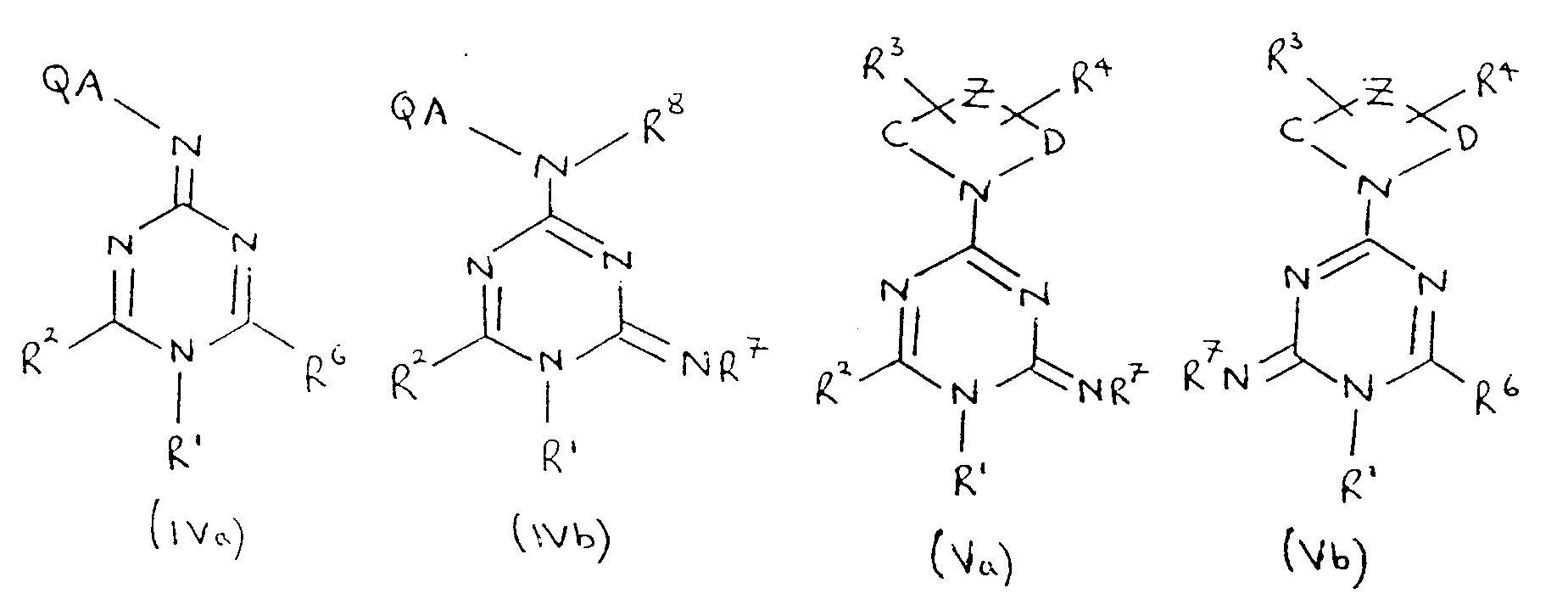
- A non-ionic form of a compound of formula I as defined by formula Xa or X1a (or a tautomeric form thereof),
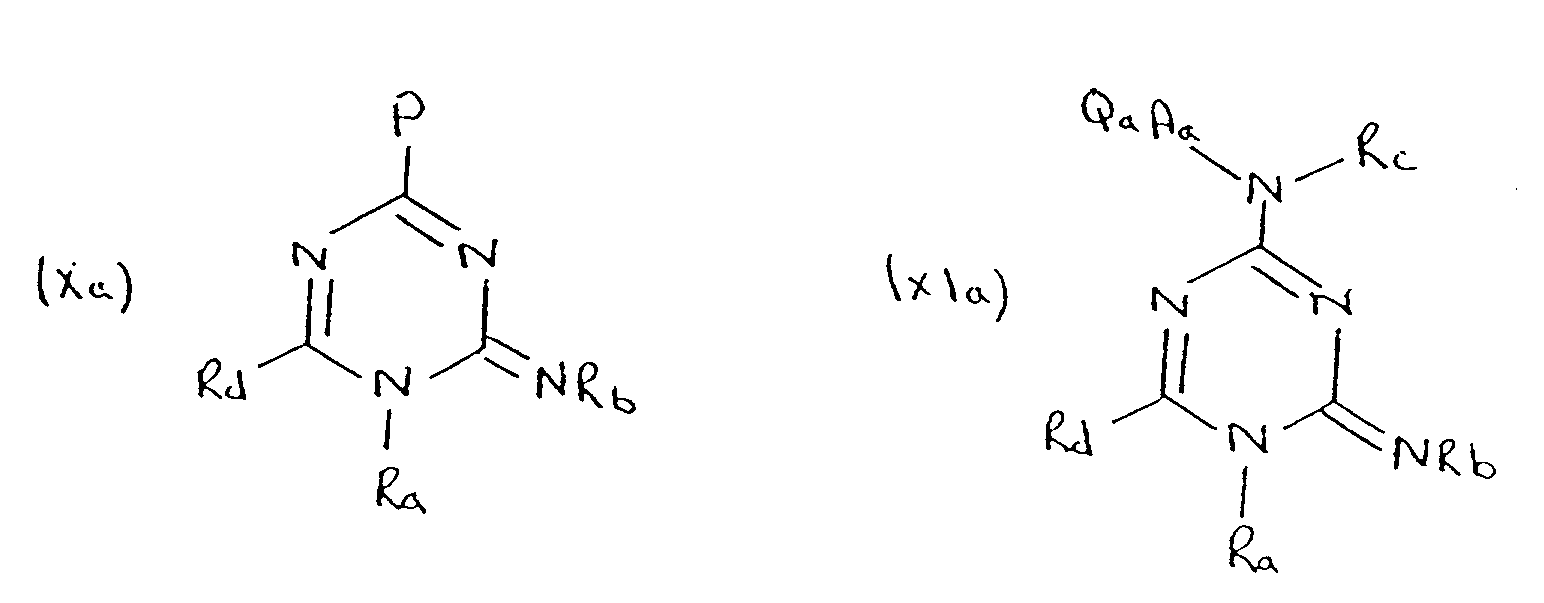
- A process for the manufacture of a compound of formula I as claimed in any one of the preceding claims, which process comprises:a) reacting an amino compound of formula (VI)
 b) reacting a 1,3,5 triazinium salt of formula (VIII),
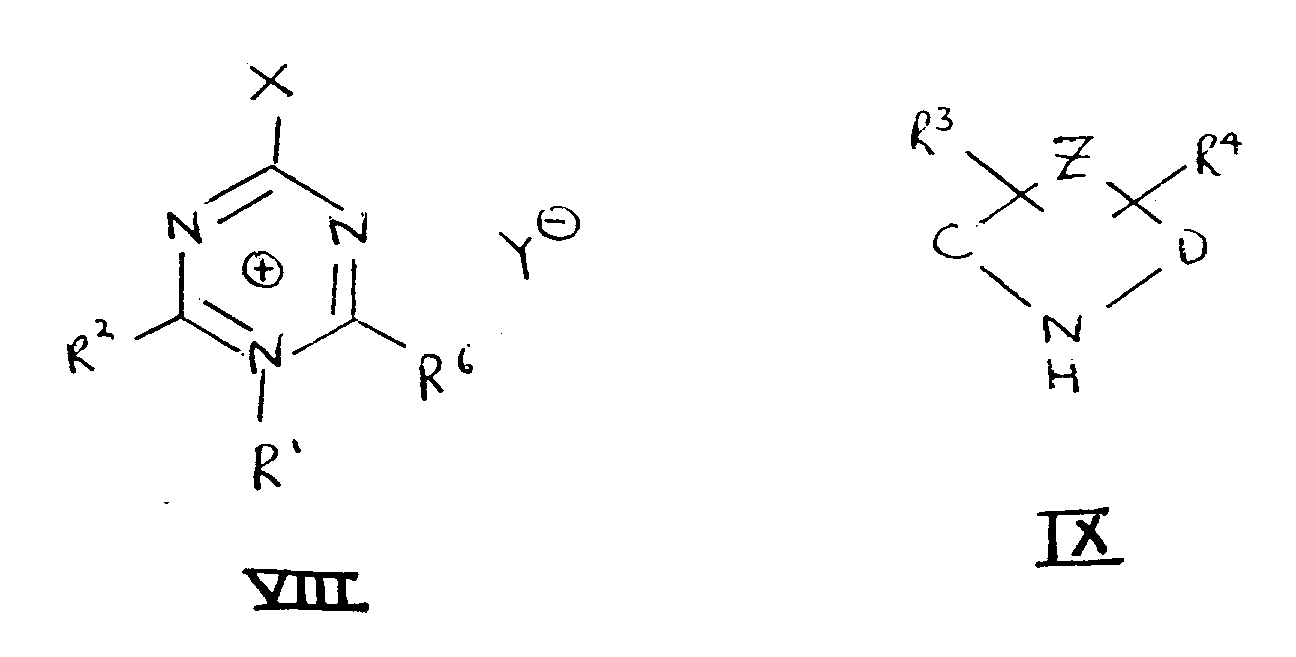 c) For those compounds of formula I in which R⁶ is amino or alkylamino, reacting a compound of the formula XII,and whereafter when a different counter-anion Y is required, the compound of formula I is reacted with a suitable metal salt with the desired counter-anion or subjected to ion exchange with a basic resin in the form of its salt with the desired counter-anion.
- A process for the manufacture of a compound as defined in claim 9 or 10, which process comprises reacting a compound of formula I in which R¹, R², R³, R⁶ and P are as defined in claim 1 with a strong base.
- A pharmaceutical composition comprising an active ingredient selected from a compound of formula I as claimed in claim 1, a compound of formula X or XI as claimed in claim 5 or 4 respectively, or an ahydro-base as claimed in claim 9 or 10, together with or in admixture with a pharmaceutically-acceptable diluent or carrier.
- The use of a compound of formula I as defined in any one of claims 1 to 8, or a non-ionic form thereof as claimed in claim 9 or 10, for the manufacture of a medicament for treating cardiovascular disease.
Applications Claiming Priority (4)
| Application Number | Priority Date | Filing Date | Title |
|---|---|---|---|
| GB8927462 | 1989-12-05 | ||
| GB898927462A GB8927462D0 (en) | 1989-12-05 | 1989-12-05 | Heterocyclic compounds |
| GB8929020 | 1989-12-22 | ||
| GB898929020A GB8929020D0 (en) | 1989-12-22 | 1989-12-22 | Aminoheterocycles |
Publications (3)
| Publication Number | Publication Date |
|---|---|
| EP0431856A2 EP0431856A2 (en) | 1991-06-12 |
| EP0431856A3 EP0431856A3 (en) | 1992-01-15 |
| EP0431856B1 true EP0431856B1 (en) | 1995-07-12 |
Family
ID=26296312
Family Applications (1)
| Application Number | Title | Priority Date | Filing Date |
|---|---|---|---|
| EP90313079A Expired - Lifetime EP0431856B1 (en) | 1989-12-05 | 1990-11-30 | Heterocyclic compounds |
Country Status (20)
| Country | Link |
|---|---|
| US (2) | US5332737A (en) |
| EP (1) | EP0431856B1 (en) |
| JP (1) | JPH03181473A (en) |
| KR (1) | KR910011836A (en) |
| AT (1) | ATE124937T1 (en) |
| AU (1) | AU640709B2 (en) |
| CA (1) | CA2031259A1 (en) |
| DE (1) | DE69020868T2 (en) |
| DK (1) | DK0431856T3 (en) |
| ES (1) | ES2074142T3 (en) |
| FI (1) | FI905918A7 (en) |
| GB (1) | GB9024617D0 (en) |
| HU (1) | HU206097B (en) |
| IE (1) | IE904116A1 (en) |
| IL (1) | IL96383A0 (en) |
| MY (1) | MY106091A (en) |
| NO (1) | NO905245L (en) |
| NZ (1) | NZ236147A (en) |
| PT (1) | PT96075A (en) |
| ZW (1) | ZW18290A1 (en) |
Families Citing this family (8)
| Publication number | Priority date | Publication date | Assignee | Title |
|---|---|---|---|---|
| AU2002322720B2 (en) | 2001-07-25 | 2008-11-13 | Raptor Pharmaceutical Inc. | Compositions and methods for modulating blood-brain barrier transport |
| US7250416B2 (en) * | 2005-03-11 | 2007-07-31 | Supergen, Inc. | Azacytosine analogs and derivatives |
| CN102379684B (en) | 2005-04-28 | 2014-11-19 | 普罗透斯数字保健公司 | Pharma-informatics system |
| KR20090071598A (en) | 2006-09-18 | 2009-07-01 | 랩터 파마슈티컬 인코포레이티드 | Treatment of liver disease by administration of receptor binding protein (RAP) -conjugates |
| US20090040326A1 (en) * | 2007-08-09 | 2009-02-12 | Micron Technology, Inc | Methods and apparatuses for supplying current using a digital sequence |
| EP2398500B1 (en) | 2009-02-20 | 2019-03-13 | 2-BBB Medicines B.V. | Glutathione-based drug delivery system |
| ES2942923T3 (en) | 2009-05-06 | 2023-06-07 | Laboratory Skin Care Inc | Dermal delivery compositions comprising complexes of active agent-calcium phosphate particles and methods of use thereof |
| US20120077778A1 (en) | 2010-09-29 | 2012-03-29 | Andrea Bourdelais | Ladder-Frame Polyether Conjugates |
Family Cites Families (13)
| Publication number | Priority date | Publication date | Assignee | Title |
|---|---|---|---|---|
| GB814947A (en) | 1954-08-16 | 1959-06-17 | Geigy Ag J R | Improvements in and relating to plant growth influencing compositions |
| NL131196C (en) | 1966-07-16 | |||
| US3729468A (en) * | 1967-07-20 | 1973-04-24 | Kowa Co | Triazine derivatives and process for their preparation |
| BE726948A (en) * | 1968-04-10 | 1969-07-01 | ||
| US4312988A (en) * | 1980-11-10 | 1982-01-26 | American Cyanamid Company | Synthesis of hydroxy functional melamine derivatives |
| FR2524467A1 (en) * | 1982-03-30 | 1983-10-07 | Adir | DISUBSTITUTED POLYMETHYLENE IMINES, PROCESSES FOR THEIR PREPARATION AND PHARMACEUTICAL COMPOSITIONS COMPRISING THEM |
| FR2544315B1 (en) * | 1983-04-12 | 1985-07-05 | Adir | DISUBSTITUTED IMINES POLYMETHYLENE, PROCESSES FOR THEIR PREPARATION, AND PHARMACEUTICAL COMPOSITIONS CONTAINING THEM |
| DE3611427A1 (en) * | 1986-04-05 | 1987-10-08 | Hoechst Ag | BIS-TERTIAERBUTYLAMINO-SUBSTITUTED 1,3,5-TRIAZINE DERIVATIVES, METHOD FOR THE PRODUCTION THEREOF, MEDICINAL PRODUCTS CONTAINING THESE COMPOUNDS AND THEIR USE |
| DE3639563A1 (en) * | 1986-11-20 | 1988-06-01 | Basf Ag | N-ARYLSULFONYL-N'-PYRIMIDYL (TRIAZINYL) UREAS |
| AU621082B2 (en) * | 1988-02-08 | 1992-03-05 | Ciba-Geigy Ag | Tetramethylpiperidino-s-triazines |
| GB8808071D0 (en) | 1988-04-07 | 1988-05-11 | Shell Int Research | Triazine herbicides |
| GB8819493D0 (en) * | 1988-08-16 | 1988-09-21 | Ucb Sa | 2-amino-4-morpholino-6-propyl-1 3 5-triazines |
| GB8819494D0 (en) * | 1988-08-16 | 1988-09-21 | Ucb Sa | Use of 2-amino-4-morpholino-6-propyl-1 3 5-triazines for preparation of psychotropic medicaments |
-
1990
- 1990-11-13 GB GB909024617A patent/GB9024617D0/en active Pending
- 1990-11-14 IE IE411690A patent/IE904116A1/en unknown
- 1990-11-18 IL IL96383A patent/IL96383A0/en unknown
- 1990-11-19 AU AU66713/90A patent/AU640709B2/en not_active Ceased
- 1990-11-20 NZ NZ236147A patent/NZ236147A/en unknown
- 1990-11-21 HU HU907224A patent/HU206097B/en not_active IP Right Cessation
- 1990-11-26 ZW ZW182/90A patent/ZW18290A1/en unknown
- 1990-11-30 EP EP90313079A patent/EP0431856B1/en not_active Expired - Lifetime
- 1990-11-30 JP JP2336882A patent/JPH03181473A/en active Pending
- 1990-11-30 ES ES90313079T patent/ES2074142T3/en not_active Expired - Lifetime
- 1990-11-30 DE DE69020868T patent/DE69020868T2/en not_active Expired - Fee Related
- 1990-11-30 FI FI905918A patent/FI905918A7/en not_active Application Discontinuation
- 1990-11-30 AT AT90313079T patent/ATE124937T1/en not_active IP Right Cessation
- 1990-11-30 DK DK90313079.7T patent/DK0431856T3/en active
- 1990-11-30 CA CA002031259A patent/CA2031259A1/en not_active Abandoned
- 1990-12-03 US US07/621,677 patent/US5332737A/en not_active Expired - Fee Related
- 1990-12-04 MY MYPI90002134A patent/MY106091A/en unknown
- 1990-12-04 NO NO90905245A patent/NO905245L/en unknown
- 1990-12-04 PT PT96075A patent/PT96075A/en not_active Application Discontinuation
- 1990-12-05 KR KR1019900020008A patent/KR910011836A/en not_active Withdrawn
-
1995
- 1995-06-07 US US08/488,458 patent/US5574037A/en not_active Expired - Fee Related
Also Published As
| Publication number | Publication date |
|---|---|
| JPH03181473A (en) | 1991-08-07 |
| EP0431856A3 (en) | 1992-01-15 |
| IL96383A0 (en) | 1991-08-16 |
| GB9024617D0 (en) | 1991-01-02 |
| HU907224D0 (en) | 1991-05-28 |
| IE904116A1 (en) | 1991-06-05 |
| AU6671390A (en) | 1991-06-13 |
| FI905918A7 (en) | 1991-06-06 |
| ES2074142T3 (en) | 1995-09-01 |
| US5332737A (en) | 1994-07-26 |
| HUT58305A (en) | 1992-02-28 |
| NO905245L (en) | 1991-06-06 |
| ZW18290A1 (en) | 1991-10-02 |
| NO905245D0 (en) | 1990-12-04 |
| ATE124937T1 (en) | 1995-07-15 |
| AU640709B2 (en) | 1993-09-02 |
| MY106091A (en) | 1995-03-31 |
| DK0431856T3 (en) | 1995-12-11 |
| NZ236147A (en) | 1993-12-23 |
| DE69020868D1 (en) | 1995-08-17 |
| PT96075A (en) | 1991-09-30 |
| CA2031259A1 (en) | 1991-06-06 |
| FI905918A0 (en) | 1990-11-30 |
| US5574037A (en) | 1996-11-12 |
| DE69020868T2 (en) | 1995-11-30 |
| EP0431856A2 (en) | 1991-06-12 |
| KR910011836A (en) | 1991-08-07 |
| HU206097B (en) | 1992-08-28 |
Similar Documents
| Publication | Publication Date | Title |
|---|---|---|
| NZ233292A (en) | Amino pyrimidine derivatives and pharmaceutical compositions | |
| CN112839655B (en) | Thyroid hormone receptor β agonist compounds | |
| EP0453197B1 (en) | Amine derivatives | |
| US5328910A (en) | Sino-atrial node modulating pyrrolopyrimidines | |
| US5574037A (en) | Amino 1,3,5-triazine derivatives as agents for cardiovascular system | |
| EP0434341B1 (en) | Diazine derivatives | |
| EP0458459A2 (en) | Substituted benzhydryl 2-hydroxypropyl piperazine derivatives | |
| US5098901A (en) | Imidazo [1,2-b][2]benzazepine and pyrimido [1,2-b][2]benzazepine antiarrhythmic agents |
Legal Events
| Date | Code | Title | Description |
|---|---|---|---|
| PUAI | Public reference made under article 153(3) epc to a published international application that has entered the european phase |
Free format text: ORIGINAL CODE: 0009012 |
|
| AK | Designated contracting states |
Kind code of ref document: A2 Designated state(s): AT BE CH DE DK ES FR GB GR IT LI LU NL SE |
|
| PUAL | Search report despatched |
Free format text: ORIGINAL CODE: 0009013 |
|
| AK | Designated contracting states |
Kind code of ref document: A3 Designated state(s): AT BE CH DE DK ES FR GB GR IT LI LU NL SE |
|
| 17P | Request for examination filed |
Effective date: 19920505 |
|
| 17Q | First examination report despatched |
Effective date: 19940419 |
|
| RAP1 | Party data changed (applicant data changed or rights of an application transferred) |
Owner name: ZENECA LIMITED |
|
| GRAA | (expected) grant |
Free format text: ORIGINAL CODE: 0009210 |
|
| AK | Designated contracting states |
Kind code of ref document: B1 Designated state(s): AT BE CH DE DK ES FR GB GR IT LI LU NL SE |
|
| REF | Corresponds to: |
Ref document number: 124937 Country of ref document: AT Date of ref document: 19950715 Kind code of ref document: T |
|
| ITF | It: translation for a ep patent filed | ||
| REF | Corresponds to: |
Ref document number: 69020868 Country of ref document: DE Date of ref document: 19950817 |
|
| ET | Fr: translation filed | ||
| REG | Reference to a national code |
Ref country code: ES Ref legal event code: FG2A Ref document number: 2074142 Country of ref document: ES Kind code of ref document: T3 |
|
| REG | Reference to a national code |
Ref country code: GR Ref legal event code: FG4A Free format text: 3016815 |
|
| REG | Reference to a national code |
Ref country code: DK Ref legal event code: T3 |
|
| PLBE | No opposition filed within time limit |
Free format text: ORIGINAL CODE: 0009261 |
|
| STAA | Information on the status of an ep patent application or granted ep patent |
Free format text: STATUS: NO OPPOSITION FILED WITHIN TIME LIMIT |
|
| 26N | No opposition filed | ||
| PGFP | Annual fee paid to national office [announced via postgrant information from national office to epo] |
Ref country code: SE Payment date: 20001106 Year of fee payment: 11 |
|
| PGFP | Annual fee paid to national office [announced via postgrant information from national office to epo] |
Ref country code: FR Payment date: 20001110 Year of fee payment: 11 |
|
| PGFP | Annual fee paid to national office [announced via postgrant information from national office to epo] |
Ref country code: DK Payment date: 20001113 Year of fee payment: 11 Ref country code: AT Payment date: 20001113 Year of fee payment: 11 |
|
| PGFP | Annual fee paid to national office [announced via postgrant information from national office to epo] |
Ref country code: DE Payment date: 20001120 Year of fee payment: 11 |
|
| PGFP | Annual fee paid to national office [announced via postgrant information from national office to epo] |
Ref country code: LU Payment date: 20001124 Year of fee payment: 11 |
|
| PGFP | Annual fee paid to national office [announced via postgrant information from national office to epo] |
Ref country code: ES Payment date: 20001128 Year of fee payment: 11 Ref country code: CH Payment date: 20001128 Year of fee payment: 11 |
|
| PGFP | Annual fee paid to national office [announced via postgrant information from national office to epo] |
Ref country code: GR Payment date: 20001129 Year of fee payment: 11 Ref country code: GB Payment date: 20001129 Year of fee payment: 11 |
|
| PGFP | Annual fee paid to national office [announced via postgrant information from national office to epo] |
Ref country code: NL Payment date: 20001130 Year of fee payment: 11 |
|
| REG | Reference to a national code |
Ref country code: GB Ref legal event code: 732E |
|
| PGFP | Annual fee paid to national office [announced via postgrant information from national office to epo] |
Ref country code: BE Payment date: 20010123 Year of fee payment: 11 |
|
| REG | Reference to a national code |
Ref country code: CH Ref legal event code: PUE Owner name: ZENECA LIMITED TRANSFER- ASTRAZENECA AB |
|
| PG25 | Lapsed in a contracting state [announced via postgrant information from national office to epo] |
Ref country code: LU Free format text: LAPSE BECAUSE OF NON-PAYMENT OF DUE FEES Effective date: 20011130 Ref country code: LI Free format text: LAPSE BECAUSE OF NON-PAYMENT OF DUE FEES Effective date: 20011130 Ref country code: GR Free format text: LAPSE BECAUSE OF NON-PAYMENT OF DUE FEES Effective date: 20011130 Ref country code: GB Free format text: LAPSE BECAUSE OF NON-PAYMENT OF DUE FEES Effective date: 20011130 Ref country code: DK Free format text: LAPSE BECAUSE OF NON-PAYMENT OF DUE FEES Effective date: 20011130 Ref country code: CH Free format text: LAPSE BECAUSE OF NON-PAYMENT OF DUE FEES Effective date: 20011130 Ref country code: BE Free format text: LAPSE BECAUSE OF NON-PAYMENT OF DUE FEES Effective date: 20011130 Ref country code: AT Free format text: LAPSE BECAUSE OF NON-PAYMENT OF DUE FEES Effective date: 20011130 |
|
| PG25 | Lapsed in a contracting state [announced via postgrant information from national office to epo] |
Ref country code: SE Free format text: LAPSE BECAUSE OF NON-PAYMENT OF DUE FEES Effective date: 20011201 Ref country code: ES Free format text: LAPSE BECAUSE OF NON-PAYMENT OF DUE FEES Effective date: 20011201 |
|
| REG | Reference to a national code |
Ref country code: GB Ref legal event code: IF02 |
|
| BERE | Be: lapsed |
Owner name: ASTRAZENECA A.B. Effective date: 20011130 |
|
| PG25 | Lapsed in a contracting state [announced via postgrant information from national office to epo] |
Ref country code: NL Free format text: LAPSE BECAUSE OF NON-PAYMENT OF DUE FEES Effective date: 20020601 |
|
| PG25 | Lapsed in a contracting state [announced via postgrant information from national office to epo] |
Ref country code: DE Free format text: LAPSE BECAUSE OF NON-PAYMENT OF DUE FEES Effective date: 20020702 |
|
| REG | Reference to a national code |
Ref country code: CH Ref legal event code: PL |
|
| GBPC | Gb: european patent ceased through non-payment of renewal fee |
Effective date: 20011130 |
|
| REG | Reference to a national code |
Ref country code: DK Ref legal event code: EBP |
|
| EUG | Se: european patent has lapsed |
Ref document number: 90313079.7 |
|
| PG25 | Lapsed in a contracting state [announced via postgrant information from national office to epo] |
Ref country code: FR Free format text: LAPSE BECAUSE OF NON-PAYMENT OF DUE FEES Effective date: 20020730 |
|
| NLV4 | Nl: lapsed or anulled due to non-payment of the annual fee |
Effective date: 20020601 |
|
| REG | Reference to a national code |
Ref country code: FR Ref legal event code: ST |
|
| REG | Reference to a national code |
Ref country code: FR Ref legal event code: ST |
|
| REG | Reference to a national code |
Ref country code: ES Ref legal event code: FD2A Effective date: 20021213 |
|
| PG25 | Lapsed in a contracting state [announced via postgrant information from national office to epo] |
Ref country code: IT Free format text: LAPSE BECAUSE OF NON-PAYMENT OF DUE FEES;WARNING: LAPSES OF ITALIAN PATENTS WITH EFFECTIVE DATE BEFORE 2007 MAY HAVE OCCURRED AT ANY TIME BEFORE 2007. THE CORRECT EFFECTIVE DATE MAY BE DIFFERENT FROM THE ONE RECORDED. Effective date: 20051130 |