EP0430987B1 - An amplification assay for hydrolase enzymes - Google Patents
An amplification assay for hydrolase enzymes Download PDFInfo
- Publication number
- EP0430987B1 EP0430987B1 EP89909212A EP89909212A EP0430987B1 EP 0430987 B1 EP0430987 B1 EP 0430987B1 EP 89909212 A EP89909212 A EP 89909212A EP 89909212 A EP89909212 A EP 89909212A EP 0430987 B1 EP0430987 B1 EP 0430987B1
- Authority
- EP
- European Patent Office
- Prior art keywords
- fad
- analog
- holoenzyme
- apo
- enzyme
- Prior art date
- Legal status (The legal status is an assumption and is not a legal conclusion. Google has not performed a legal analysis and makes no representation as to the accuracy of the status listed.)
- Expired - Lifetime
Links
- 102000004157 Hydrolases Human genes 0.000 title claims abstract description 16
- 108090000604 Hydrolases Proteins 0.000 title claims abstract description 16
- 238000003556 assay Methods 0.000 title claims abstract description 14
- 230000003321 amplification Effects 0.000 title description 3
- 238000003199 nucleic acid amplification method Methods 0.000 title description 3
- 102000004316 Oxidoreductases Human genes 0.000 claims abstract description 27
- 108090000854 Oxidoreductases Proteins 0.000 claims abstract description 27
- 239000000758 substrate Substances 0.000 claims abstract description 26
- 108010025076 Holoenzymes Proteins 0.000 claims abstract description 24
- 238000006243 chemical reaction Methods 0.000 claims abstract description 23
- 108010006591 Apoenzymes Proteins 0.000 claims abstract description 22
- 102000004160 Phosphoric Monoester Hydrolases Human genes 0.000 claims abstract description 12
- 108090000608 Phosphoric Monoester Hydrolases Proteins 0.000 claims abstract description 12
- 150000001875 compounds Chemical class 0.000 claims abstract description 9
- 239000004366 Glucose oxidase Substances 0.000 claims abstract description 4
- 229940116332 glucose oxidase Drugs 0.000 claims abstract description 4
- VWWQXMAJTJZDQX-UYBVJOGSSA-N flavin adenine dinucleotide Chemical compound C1=NC2=C(N)N=CN=C2N1[C@@H]([C@H](O)[C@@H]1O)O[C@@H]1CO[P@](O)(=O)O[P@@](O)(=O)OC[C@@H](O)[C@@H](O)[C@@H](O)CN1C2=NC(=O)NC(=O)C2=NC2=C1C=C(C)C(C)=C2 VWWQXMAJTJZDQX-UYBVJOGSSA-N 0.000 claims description 55
- 235000019162 flavin adenine dinucleotide Nutrition 0.000 claims description 40
- 239000011714 flavin adenine dinucleotide Substances 0.000 claims description 40
- 229940093632 flavin-adenine dinucleotide Drugs 0.000 claims description 40
- 238000000034 method Methods 0.000 claims description 33
- MHAJPDPJQMAIIY-UHFFFAOYSA-N Hydrogen peroxide Chemical compound OO MHAJPDPJQMAIIY-UHFFFAOYSA-N 0.000 claims description 18
- 102000004190 Enzymes Human genes 0.000 claims description 17
- 108090000790 Enzymes Proteins 0.000 claims description 17
- 229940088598 enzyme Drugs 0.000 claims description 17
- 229910019142 PO4 Inorganic materials 0.000 claims description 13
- 239000010452 phosphate Substances 0.000 claims description 13
- 125000001424 substituent group Chemical group 0.000 claims description 10
- 125000002467 phosphate group Chemical group [H]OP(=O)(O[H])O[*] 0.000 claims description 9
- 125000002887 hydroxy group Chemical group [H]O* 0.000 claims description 8
- 239000000047 product Substances 0.000 claims description 8
- QNAYBMKLOCPYGJ-UWTATZPHSA-N D-alanine Chemical compound C[C@@H](N)C(O)=O QNAYBMKLOCPYGJ-UWTATZPHSA-N 0.000 claims description 7
- QNAYBMKLOCPYGJ-UHFFFAOYSA-N D-alpha-Ala Natural products CC([NH3+])C([O-])=O QNAYBMKLOCPYGJ-UHFFFAOYSA-N 0.000 claims description 7
- 238000004519 manufacturing process Methods 0.000 claims description 7
- NBIIXXVUZAFLBC-UHFFFAOYSA-K phosphate Chemical compound [O-]P([O-])([O-])=O NBIIXXVUZAFLBC-UHFFFAOYSA-K 0.000 claims description 6
- 230000015572 biosynthetic process Effects 0.000 claims description 5
- ONIBWKKTOPOVIA-SCSAIBSYSA-N D-Proline Chemical compound OC(=O)[C@H]1CCCN1 ONIBWKKTOPOVIA-SCSAIBSYSA-N 0.000 claims description 4
- FFEARJCKVFRZRR-SCSAIBSYSA-N D-methionine Chemical compound CSCC[C@@H](N)C(O)=O FFEARJCKVFRZRR-SCSAIBSYSA-N 0.000 claims description 4
- 229930182818 D-methionine Natural products 0.000 claims description 4
- 229930182820 D-proline Natural products 0.000 claims description 4
- WQZGKKKJIJFFOK-GASJEMHNSA-N Glucose Natural products OC[C@H]1OC(O)[C@H](O)[C@@H](O)[C@@H]1O WQZGKKKJIJFFOK-GASJEMHNSA-N 0.000 claims description 4
- 239000008103 glucose Substances 0.000 claims description 4
- 230000003301 hydrolyzing effect Effects 0.000 claims description 4
- 108700019535 Phosphoprotein Phosphatases Proteins 0.000 claims description 3
- 102000045595 Phosphoprotein Phosphatases Human genes 0.000 claims description 3
- 150000001413 amino acids Chemical class 0.000 claims description 3
- 239000006227 byproduct Substances 0.000 claims description 3
- 239000002243 precursor Substances 0.000 claims description 3
- 239000003054 catalyst Substances 0.000 claims description 2
- 238000003149 assay kit Methods 0.000 claims 8
- 235000001014 amino acid Nutrition 0.000 claims 2
- 230000000977 initiatory effect Effects 0.000 claims 2
- -1 FAD analog phosphate Chemical class 0.000 claims 1
- 229910052739 hydrogen Inorganic materials 0.000 claims 1
- 239000001257 hydrogen Substances 0.000 claims 1
- 125000004435 hydrogen atom Chemical class [H]* 0.000 claims 1
- 230000035945 sensitivity Effects 0.000 abstract description 5
- 108020004774 Alkaline Phosphatase Proteins 0.000 description 18
- 102000002260 Alkaline Phosphatase Human genes 0.000 description 17
- 230000001351 cycling effect Effects 0.000 description 10
- 238000002360 preparation method Methods 0.000 description 7
- RLFWWDJHLFCNIJ-UHFFFAOYSA-N 4-aminoantipyrine Chemical compound CN1C(C)=C(N)C(=O)N1C1=CC=CC=C1 RLFWWDJHLFCNIJ-UHFFFAOYSA-N 0.000 description 6
- 108010003989 D-amino-acid oxidase Proteins 0.000 description 6
- 102000003992 Peroxidases Human genes 0.000 description 6
- LCTONWCANYUPML-UHFFFAOYSA-M Pyruvate Chemical compound CC(=O)C([O-])=O LCTONWCANYUPML-UHFFFAOYSA-M 0.000 description 6
- VYPSYNLAJGMNEJ-UHFFFAOYSA-N Silicium dioxide Chemical compound O=[Si]=O VYPSYNLAJGMNEJ-UHFFFAOYSA-N 0.000 description 6
- 238000002835 absorbance Methods 0.000 description 6
- 239000000203 mixture Substances 0.000 description 6
- 102100026908 D-amino-acid oxidase Human genes 0.000 description 5
- TWRXJAOTZQYOKJ-UHFFFAOYSA-L Magnesium chloride Chemical compound [Mg+2].[Cl-].[Cl-] TWRXJAOTZQYOKJ-UHFFFAOYSA-L 0.000 description 5
- 108040007629 peroxidase activity proteins Proteins 0.000 description 5
- KKAJSJJFBSOMGS-UHFFFAOYSA-N 3,6-diamino-10-methylacridinium chloride Chemical compound [Cl-].C1=C(N)C=C2[N+](C)=C(C=C(N)C=C3)C3=CC2=C1 KKAJSJJFBSOMGS-UHFFFAOYSA-N 0.000 description 4
- 239000000872 buffer Substances 0.000 description 4
- 230000007062 hydrolysis Effects 0.000 description 4
- 238000006460 hydrolysis reaction Methods 0.000 description 4
- 239000000243 solution Substances 0.000 description 4
- QKNYBSVHEMOAJP-UHFFFAOYSA-N 2-amino-2-(hydroxymethyl)propane-1,3-diol;hydron;chloride Chemical compound Cl.OCC(N)(CO)CO QKNYBSVHEMOAJP-UHFFFAOYSA-N 0.000 description 3
- LWKJNIMGNUTZOO-UHFFFAOYSA-N 3,5-dichloro-2-hydroxybenzenesulfonic acid Chemical compound OC1=C(Cl)C=C(Cl)C=C1S(O)(=O)=O LWKJNIMGNUTZOO-UHFFFAOYSA-N 0.000 description 3
- QTBSBXVTEAMEQO-UHFFFAOYSA-N Acetic acid Chemical compound CC(O)=O QTBSBXVTEAMEQO-UHFFFAOYSA-N 0.000 description 3
- 239000007989 BIS-Tris Propane buffer Substances 0.000 description 3
- YMWUJEATGCHHMB-UHFFFAOYSA-N Dichloromethane Chemical compound ClCCl YMWUJEATGCHHMB-UHFFFAOYSA-N 0.000 description 3
- PEDCQBHIVMGVHV-UHFFFAOYSA-N Glycerine Chemical compound OCC(O)CO PEDCQBHIVMGVHV-UHFFFAOYSA-N 0.000 description 3
- VZTDIZULWFCMLS-UHFFFAOYSA-N ammonium formate Chemical compound [NH4+].[O-]C=O VZTDIZULWFCMLS-UHFFFAOYSA-N 0.000 description 3
- 239000012491 analyte Substances 0.000 description 3
- 230000008901 benefit Effects 0.000 description 3
- WORJEOGGNQDSOE-UHFFFAOYSA-N chloroform;methanol Chemical compound OC.ClC(Cl)Cl WORJEOGGNQDSOE-UHFFFAOYSA-N 0.000 description 3
- 229910052681 coesite Inorganic materials 0.000 description 3
- 229910052906 cristobalite Inorganic materials 0.000 description 3
- 238000010511 deprotection reaction Methods 0.000 description 3
- 238000001514 detection method Methods 0.000 description 3
- 238000011534 incubation Methods 0.000 description 3
- NZDWTKFDAUOODA-CNEMSGBDSA-N n-[9-[(2r,3r,4s,5r)-3,4-dihydroxy-5-(hydroxymethyl)oxolan-2-yl]purin-6-yl]benzamide Chemical compound O[C@@H]1[C@H](O)[C@@H](CO)O[C@H]1N1C2=NC=NC(NC(=O)C=3C=CC=CC=3)=C2N=C1 NZDWTKFDAUOODA-CNEMSGBDSA-N 0.000 description 3
- 230000003647 oxidation Effects 0.000 description 3
- 238000007254 oxidation reaction Methods 0.000 description 3
- 239000000377 silicon dioxide Substances 0.000 description 3
- 235000012239 silicon dioxide Nutrition 0.000 description 3
- 229910052682 stishovite Inorganic materials 0.000 description 3
- 229910052905 tridymite Inorganic materials 0.000 description 3
- 239000011592 zinc chloride Substances 0.000 description 3
- 235000005074 zinc chloride Nutrition 0.000 description 3
- JIAARYAFYJHUJI-UHFFFAOYSA-L zinc dichloride Chemical compound [Cl-].[Cl-].[Zn+2] JIAARYAFYJHUJI-UHFFFAOYSA-L 0.000 description 3
- JCLFHZLOKITRCE-UHFFFAOYSA-N 4-pentoxyphenol Chemical compound CCCCCOC1=CC=C(O)C=C1 JCLFHZLOKITRCE-UHFFFAOYSA-N 0.000 description 2
- GFFGJBXGBJISGV-UHFFFAOYSA-N Adenine Chemical compound NC1=NC=NC2=C1N=CN2 GFFGJBXGBJISGV-UHFFFAOYSA-N 0.000 description 2
- HEDRZPFGACZZDS-UHFFFAOYSA-N Chloroform Chemical compound ClC(Cl)Cl HEDRZPFGACZZDS-UHFFFAOYSA-N 0.000 description 2
- FBPFZTCFMRRESA-KVTDHHQDSA-N D-Mannitol Chemical compound OC[C@@H](O)[C@@H](O)[C@H](O)[C@H](O)CO FBPFZTCFMRRESA-KVTDHHQDSA-N 0.000 description 2
- 108010015776 Glucose oxidase Proteins 0.000 description 2
- 108010001336 Horseradish Peroxidase Proteins 0.000 description 2
- 102000003855 L-lactate dehydrogenase Human genes 0.000 description 2
- 108700023483 L-lactate dehydrogenases Proteins 0.000 description 2
- 108010073450 Lactate 2-monooxygenase Proteins 0.000 description 2
- 229930195725 Mannitol Natural products 0.000 description 2
- YNAVUWVOSKDBBP-UHFFFAOYSA-N Morpholine Chemical compound C1COCCN1 YNAVUWVOSKDBBP-UHFFFAOYSA-N 0.000 description 2
- JUJWROOIHBZHMG-UHFFFAOYSA-N Pyridine Chemical compound C1=CC=NC=C1 JUJWROOIHBZHMG-UHFFFAOYSA-N 0.000 description 2
- AUNGANRZJHBGPY-SCRDCRAPSA-N Riboflavin Chemical compound OC[C@@H](O)[C@@H](O)[C@@H](O)CN1C=2C=C(C)C(C)=CC=2N=C2C1=NC(=O)NC2=O AUNGANRZJHBGPY-SCRDCRAPSA-N 0.000 description 2
- FAPWRFPIFSIZLT-UHFFFAOYSA-M Sodium chloride Chemical compound [Na+].[Cl-] FAPWRFPIFSIZLT-UHFFFAOYSA-M 0.000 description 2
- OIRDTQYFTABQOQ-KQYNXXCUSA-N adenosine Chemical compound C1=NC=2C(N)=NC=NC=2N1[C@@H]1O[C@H](CO)[C@@H](O)[C@H]1O OIRDTQYFTABQOQ-KQYNXXCUSA-N 0.000 description 2
- HHKZCCWKTZRCCL-UHFFFAOYSA-N bis-tris propane Chemical compound OCC(CO)(CO)NCCCNC(CO)(CO)CO HHKZCCWKTZRCCL-UHFFFAOYSA-N 0.000 description 2
- 238000006555 catalytic reaction Methods 0.000 description 2
- 230000008859 change Effects 0.000 description 2
- 238000007398 colorimetric assay Methods 0.000 description 2
- 239000012043 crude product Substances 0.000 description 2
- 238000002405 diagnostic procedure Methods 0.000 description 2
- JXTHNDFMNIQAHM-UHFFFAOYSA-N dichloroacetic acid Chemical compound OC(=O)C(Cl)Cl JXTHNDFMNIQAHM-UHFFFAOYSA-N 0.000 description 2
- 230000000694 effects Effects 0.000 description 2
- FVTCRASFADXXNN-SCRDCRAPSA-N flavin mononucleotide Chemical compound OP(=O)(O)OC[C@@H](O)[C@@H](O)[C@@H](O)CN1C=2C=C(C)C(C)=CC=2N=C2C1=NC(=O)NC2=O FVTCRASFADXXNN-SCRDCRAPSA-N 0.000 description 2
- 125000004029 hydroxymethyl group Chemical group [H]OC([H])([H])* 0.000 description 2
- 229910001629 magnesium chloride Inorganic materials 0.000 description 2
- 239000000594 mannitol Substances 0.000 description 2
- 235000010355 mannitol Nutrition 0.000 description 2
- 230000007935 neutral effect Effects 0.000 description 2
- WLJVXDMOQOGPHL-UHFFFAOYSA-N phenylacetic acid Chemical compound OC(=O)CC1=CC=CC=C1 WLJVXDMOQOGPHL-UHFFFAOYSA-N 0.000 description 2
- 230000008569 process Effects 0.000 description 2
- 108090000623 proteins and genes Proteins 0.000 description 2
- 239000011541 reaction mixture Substances 0.000 description 2
- 239000000523 sample Substances 0.000 description 2
- 238000011896 sensitive detection Methods 0.000 description 2
- 238000000108 ultra-filtration Methods 0.000 description 2
- HDPNBNXLBDFELL-UHFFFAOYSA-N 1,1,1-trimethoxyethane Chemical compound COC(C)(OC)OC HDPNBNXLBDFELL-UHFFFAOYSA-N 0.000 description 1
- JBWYRBLDOOOJEU-UHFFFAOYSA-N 1-[chloro-(4-methoxyphenyl)-phenylmethyl]-4-methoxybenzene Chemical compound C1=CC(OC)=CC=C1C(Cl)(C=1C=CC(OC)=CC=1)C1=CC=CC=C1 JBWYRBLDOOOJEU-UHFFFAOYSA-N 0.000 description 1
- MCTWTZJPVLRJOU-UHFFFAOYSA-N 1-methyl-1H-imidazole Chemical compound CN1C=CN=C1 MCTWTZJPVLRJOU-UHFFFAOYSA-N 0.000 description 1
- KMYWVDDIPVNLME-KQYNXXCUSA-N 2',3'-cyclic AMP Chemical compound NC1=NC=NC2=C1N=CN2[C@H]1[C@@H]2OP(O)(=O)O[C@@H]2[C@@H](CO)O1 KMYWVDDIPVNLME-KQYNXXCUSA-N 0.000 description 1
- VXUGVISSBXKUEL-UHFFFAOYSA-N 2-hydroxypropanoic acid;2-oxopropanoic acid Chemical compound CC(O)C(O)=O.CC(=O)C(O)=O VXUGVISSBXKUEL-UHFFFAOYSA-N 0.000 description 1
- WEVYAHXRMPXWCK-UHFFFAOYSA-N Acetonitrile Chemical compound CC#N WEVYAHXRMPXWCK-UHFFFAOYSA-N 0.000 description 1
- 229930024421 Adenine Natural products 0.000 description 1
- 239000002126 C01EB10 - Adenosine Substances 0.000 description 1
- XJINZNWPEQMMBV-UHFFFAOYSA-N CCCCCCNC Chemical compound CCCCCCNC XJINZNWPEQMMBV-UHFFFAOYSA-N 0.000 description 1
- PTHCMJGKKRQCBF-UHFFFAOYSA-N Cellulose, microcrystalline Chemical compound OC1C(O)C(OC)OC(CO)C1OC1C(O)C(O)C(OC)C(CO)O1 PTHCMJGKKRQCBF-UHFFFAOYSA-N 0.000 description 1
- AUNGANRZJHBGPY-UHFFFAOYSA-N D-Lyxoflavin Natural products OCC(O)C(O)C(O)CN1C=2C=C(C)C(C)=CC=2N=C2C1=NC(=O)NC2=O AUNGANRZJHBGPY-UHFFFAOYSA-N 0.000 description 1
- QOSSAOTZNIDXMA-UHFFFAOYSA-N Dicylcohexylcarbodiimide Chemical compound C1CCCCC1N=C=NC1CCCCC1 QOSSAOTZNIDXMA-UHFFFAOYSA-N 0.000 description 1
- ASMQGLCHMVWBQR-UHFFFAOYSA-N Diphenyl phosphate Chemical group C=1C=CC=CC=1OP(=O)(O)OC1=CC=CC=C1 ASMQGLCHMVWBQR-UHFFFAOYSA-N 0.000 description 1
- 108090000371 Esterases Proteins 0.000 description 1
- LFQSCWFLJHTTHZ-UHFFFAOYSA-N EtOH Substances CCO LFQSCWFLJHTTHZ-UHFFFAOYSA-N 0.000 description 1
- 101150013497 FADX gene Proteins 0.000 description 1
- 102100024319 Intestinal-type alkaline phosphatase Human genes 0.000 description 1
- BAWFJGJZGIEFAR-NNYOXOHSSA-O NAD(+) Chemical compound NC(=O)C1=CC=C[N+]([C@H]2[C@@H]([C@H](O)[C@@H](COP(O)(=O)OP(O)(=O)OC[C@@H]3[C@H]([C@@H](O)[C@@H](O3)N3C4=NC=NC(N)=C4N=C3)O)O2)O)=C1 BAWFJGJZGIEFAR-NNYOXOHSSA-O 0.000 description 1
- XJLXINKUBYWONI-NNYOXOHSSA-O NADP(+) Chemical compound NC(=O)C1=CC=C[N+]([C@H]2[C@@H]([C@H](O)[C@@H](COP(O)(=O)OP(O)(=O)OC[C@@H]3[C@H]([C@@H](OP(O)(O)=O)[C@@H](O3)N3C4=NC=NC(N)=C4N=C3)O)O2)O)=C1 XJLXINKUBYWONI-NNYOXOHSSA-O 0.000 description 1
- 101710163270 Nuclease Proteins 0.000 description 1
- 241000604136 Pediococcus sp. Species 0.000 description 1
- 108700020962 Peroxidase Proteins 0.000 description 1
- 101710171235 Peroxidase 16 Proteins 0.000 description 1
- 108090001050 Phosphoric Diester Hydrolases Proteins 0.000 description 1
- 102000004861 Phosphoric Diester Hydrolases Human genes 0.000 description 1
- 108010083644 Ribonucleases Proteins 0.000 description 1
- 102000006382 Ribonucleases Human genes 0.000 description 1
- 229920002684 Sepharose Polymers 0.000 description 1
- UIIMBOGNXHQVGW-DEQYMQKBSA-M Sodium bicarbonate-14C Chemical compound [Na+].O[14C]([O-])=O UIIMBOGNXHQVGW-DEQYMQKBSA-M 0.000 description 1
- 102000005262 Sulfatase Human genes 0.000 description 1
- 239000007983 Tris buffer Substances 0.000 description 1
- 241000700605 Viruses Species 0.000 description 1
- BHIIGRBMZRSDRI-UHFFFAOYSA-N [chloro(phenoxy)phosphoryl]oxybenzene Chemical compound C=1C=CC=CC=1OP(=O)(Cl)OC1=CC=CC=C1 BHIIGRBMZRSDRI-UHFFFAOYSA-N 0.000 description 1
- 230000009471 action Effects 0.000 description 1
- 230000000996 additive effect Effects 0.000 description 1
- 229960000643 adenine Drugs 0.000 description 1
- 229960005305 adenosine Drugs 0.000 description 1
- 125000003277 amino group Chemical group 0.000 description 1
- 238000005349 anion exchange Methods 0.000 description 1
- 238000005571 anion exchange chromatography Methods 0.000 description 1
- 125000003118 aryl group Chemical group 0.000 description 1
- OWMVSZAMULFTJU-UHFFFAOYSA-N bis-tris Chemical compound OCCN(CCO)C(CO)(CO)CO OWMVSZAMULFTJU-UHFFFAOYSA-N 0.000 description 1
- 230000000903 blocking effect Effects 0.000 description 1
- 239000001506 calcium phosphate Substances 0.000 description 1
- 229910000389 calcium phosphate Inorganic materials 0.000 description 1
- 235000011010 calcium phosphates Nutrition 0.000 description 1
- 238000004587 chromatography analysis Methods 0.000 description 1
- 239000000356 contaminant Substances 0.000 description 1
- 239000013068 control sample Substances 0.000 description 1
- 230000008878 coupling Effects 0.000 description 1
- 238000010168 coupling process Methods 0.000 description 1
- 238000005859 coupling reaction Methods 0.000 description 1
- 230000007423 decrease Effects 0.000 description 1
- 238000010586 diagram Methods 0.000 description 1
- 229960005215 dichloroacetic acid Drugs 0.000 description 1
- 238000005516 engineering process Methods 0.000 description 1
- 238000002474 experimental method Methods 0.000 description 1
- 238000003818 flash chromatography Methods 0.000 description 1
- 238000004108 freeze drying Methods 0.000 description 1
- 235000019420 glucose oxidase Nutrition 0.000 description 1
- 238000003018 immunoassay Methods 0.000 description 1
- 239000004615 ingredient Substances 0.000 description 1
- 229940116871 l-lactate Drugs 0.000 description 1
- 229920002521 macromolecule Polymers 0.000 description 1
- 239000000463 material Substances 0.000 description 1
- 229930027945 nicotinamide-adenine dinucleotide Natural products 0.000 description 1
- BOPGDPNILDQYTO-NNYOXOHSSA-N nicotinamide-adenine dinucleotide Chemical compound C1=CCC(C(=O)N)=CN1[C@H]1[C@H](O)[C@H](O)[C@@H](COP(O)(=O)OP(O)(=O)OC[C@@H]2[C@H]([C@@H](O)[C@@H](O2)N2C3=NC=NC(N)=C3N=C2)O)O1 BOPGDPNILDQYTO-NNYOXOHSSA-N 0.000 description 1
- 238000005580 one pot reaction Methods 0.000 description 1
- 150000002905 orthoesters Chemical class 0.000 description 1
- 239000002245 particle Substances 0.000 description 1
- 125000001997 phenyl group Chemical group [H]C1=C([H])C([H])=C(*)C([H])=C1[H] 0.000 description 1
- 229960003424 phenylacetic acid Drugs 0.000 description 1
- 239000003279 phenylacetic acid Substances 0.000 description 1
- 239000008363 phosphate buffer Substances 0.000 description 1
- 238000000746 purification Methods 0.000 description 1
- UMJSCPRVCHMLSP-UHFFFAOYSA-N pyridine Natural products COC1=CC=CN=C1 UMJSCPRVCHMLSP-UHFFFAOYSA-N 0.000 description 1
- 230000008707 rearrangement Effects 0.000 description 1
- 235000019192 riboflavin Nutrition 0.000 description 1
- 239000002151 riboflavin Substances 0.000 description 1
- 229960002477 riboflavin Drugs 0.000 description 1
- 239000011780 sodium chloride Substances 0.000 description 1
- 108060007951 sulfatase Proteins 0.000 description 1
- 238000003786 synthesis reaction Methods 0.000 description 1
- MCZDHTKJGDCTAE-UHFFFAOYSA-M tetrabutylazanium;acetate Chemical compound CC([O-])=O.CCCC[N+](CCCC)(CCCC)CCCC MCZDHTKJGDCTAE-UHFFFAOYSA-M 0.000 description 1
- JOXIMZWYDAKGHI-UHFFFAOYSA-N toluene-4-sulfonic acid Chemical compound CC1=CC=C(S(O)(=O)=O)C=C1 JOXIMZWYDAKGHI-UHFFFAOYSA-N 0.000 description 1
- QORWJWZARLRLPR-UHFFFAOYSA-H tricalcium bis(phosphate) Chemical compound [Ca+2].[Ca+2].[Ca+2].[O-]P([O-])([O-])=O.[O-]P([O-])([O-])=O QORWJWZARLRLPR-UHFFFAOYSA-H 0.000 description 1
- LENZDBCJOHFCAS-UHFFFAOYSA-N tris Chemical compound OCC(N)(CO)CO LENZDBCJOHFCAS-UHFFFAOYSA-N 0.000 description 1
- 230000007306 turnover Effects 0.000 description 1
- 238000005406 washing Methods 0.000 description 1
Images


Classifications
-
- G—PHYSICS
- G01—MEASURING; TESTING
- G01N—INVESTIGATING OR ANALYSING MATERIALS BY DETERMINING THEIR CHEMICAL OR PHYSICAL PROPERTIES
- G01N33/00—Investigating or analysing materials by specific methods not covered by groups G01N1/00 - G01N31/00
- G01N33/48—Biological material, e.g. blood, urine; Haemocytometers
- G01N33/50—Chemical analysis of biological material, e.g. blood, urine; Testing involving biospecific ligand binding methods; Immunological testing
- G01N33/53—Immunoassay; Biospecific binding assay; Materials therefor
- G01N33/536—Immunoassay; Biospecific binding assay; Materials therefor with immune complex formed in liquid phase
- G01N33/542—Immunoassay; Biospecific binding assay; Materials therefor with immune complex formed in liquid phase with steric inhibition or signal modification, e.g. fluorescent quenching
-
- C—CHEMISTRY; METALLURGY
- C12—BIOCHEMISTRY; BEER; SPIRITS; WINE; VINEGAR; MICROBIOLOGY; ENZYMOLOGY; MUTATION OR GENETIC ENGINEERING
- C12Q—MEASURING OR TESTING PROCESSES INVOLVING ENZYMES, NUCLEIC ACIDS OR MICROORGANISMS; COMPOSITIONS OR TEST PAPERS THEREFOR; PROCESSES OF PREPARING SUCH COMPOSITIONS; CONDITION-RESPONSIVE CONTROL IN MICROBIOLOGICAL OR ENZYMOLOGICAL PROCESSES
- C12Q1/00—Measuring or testing processes involving enzymes, nucleic acids or microorganisms; Compositions therefor; Processes of preparing such compositions
- C12Q1/26—Measuring or testing processes involving enzymes, nucleic acids or microorganisms; Compositions therefor; Processes of preparing such compositions involving oxidoreductase
-
- C—CHEMISTRY; METALLURGY
- C12—BIOCHEMISTRY; BEER; SPIRITS; WINE; VINEGAR; MICROBIOLOGY; ENZYMOLOGY; MUTATION OR GENETIC ENGINEERING
- C12Q—MEASURING OR TESTING PROCESSES INVOLVING ENZYMES, NUCLEIC ACIDS OR MICROORGANISMS; COMPOSITIONS OR TEST PAPERS THEREFOR; PROCESSES OF PREPARING SUCH COMPOSITIONS; CONDITION-RESPONSIVE CONTROL IN MICROBIOLOGICAL OR ENZYMOLOGICAL PROCESSES
- C12Q1/00—Measuring or testing processes involving enzymes, nucleic acids or microorganisms; Compositions therefor; Processes of preparing such compositions
- C12Q1/34—Measuring or testing processes involving enzymes, nucleic acids or microorganisms; Compositions therefor; Processes of preparing such compositions involving hydrolase
-
- C—CHEMISTRY; METALLURGY
- C12—BIOCHEMISTRY; BEER; SPIRITS; WINE; VINEGAR; MICROBIOLOGY; ENZYMOLOGY; MUTATION OR GENETIC ENGINEERING
- C12Q—MEASURING OR TESTING PROCESSES INVOLVING ENZYMES, NUCLEIC ACIDS OR MICROORGANISMS; COMPOSITIONS OR TEST PAPERS THEREFOR; PROCESSES OF PREPARING SUCH COMPOSITIONS; CONDITION-RESPONSIVE CONTROL IN MICROBIOLOGICAL OR ENZYMOLOGICAL PROCESSES
- C12Q1/00—Measuring or testing processes involving enzymes, nucleic acids or microorganisms; Compositions therefor; Processes of preparing such compositions
- C12Q1/34—Measuring or testing processes involving enzymes, nucleic acids or microorganisms; Compositions therefor; Processes of preparing such compositions involving hydrolase
- C12Q1/42—Measuring or testing processes involving enzymes, nucleic acids or microorganisms; Compositions therefor; Processes of preparing such compositions involving hydrolase involving phosphatase
-
- G—PHYSICS
- G01—MEASURING; TESTING
- G01N—INVESTIGATING OR ANALYSING MATERIALS BY DETERMINING THEIR CHEMICAL OR PHYSICAL PROPERTIES
- G01N33/00—Investigating or analysing materials by specific methods not covered by groups G01N1/00 - G01N31/00
- G01N33/48—Biological material, e.g. blood, urine; Haemocytometers
- G01N33/50—Chemical analysis of biological material, e.g. blood, urine; Testing involving biospecific ligand binding methods; Immunological testing
- G01N33/53—Immunoassay; Biospecific binding assay; Materials therefor
- G01N33/531—Production of immunochemical test materials
- G01N33/532—Production of labelled immunochemicals
- G01N33/533—Production of labelled immunochemicals with fluorescent label
-
- Y—GENERAL TAGGING OF NEW TECHNOLOGICAL DEVELOPMENTS; GENERAL TAGGING OF CROSS-SECTIONAL TECHNOLOGIES SPANNING OVER SEVERAL SECTIONS OF THE IPC; TECHNICAL SUBJECTS COVERED BY FORMER USPC CROSS-REFERENCE ART COLLECTIONS [XRACs] AND DIGESTS
- Y10—TECHNICAL SUBJECTS COVERED BY FORMER USPC
- Y10S—TECHNICAL SUBJECTS COVERED BY FORMER USPC CROSS-REFERENCE ART COLLECTIONS [XRACs] AND DIGESTS
- Y10S435/00—Chemistry: molecular biology and microbiology
- Y10S435/81—Packaged device or kit
-
- Y—GENERAL TAGGING OF NEW TECHNOLOGICAL DEVELOPMENTS; GENERAL TAGGING OF CROSS-SECTIONAL TECHNOLOGIES SPANNING OVER SEVERAL SECTIONS OF THE IPC; TECHNICAL SUBJECTS COVERED BY FORMER USPC CROSS-REFERENCE ART COLLECTIONS [XRACs] AND DIGESTS
- Y10—TECHNICAL SUBJECTS COVERED BY FORMER USPC
- Y10S—TECHNICAL SUBJECTS COVERED BY FORMER USPC CROSS-REFERENCE ART COLLECTIONS [XRACs] AND DIGESTS
- Y10S435/00—Chemistry: molecular biology and microbiology
- Y10S435/975—Kit
Definitions
- This invention relates to enzyme-linked assays.
- Alkaline phosphatase (EC 3.1.3.1) is a widely used enzyme label for immunoassays and can also be employed for the determination of gene probes.
- hydrolases have not enjoyed as wide a usage in enzyme-linked assays owing in part to the non-availability of suitable substrates for employment with them in diagnostic procedures.
- This invention discloses a family of novel substrates for a range of hydrolases, including alkaline phosphatase, which substrates are hydrolysed to produce a prosthetic group for a detector enzyme, thus providing a large amplification of the signal produced by the hydrolase.
- a recently developed method for the assay of this enzyme relies on the hydrolysis of NADP+ in a primary stage and the subsequent cycling, in a secondary stage, of the NAD+ produced, resulting in the amplification of the signal (Johannsson et al., J. Immun. Methods, (1986), 87 , 7-11, incorporated herein by reference).
- the technique has not as yet enjoyed widespread use on account of the relative instability of the primary substrate and enzymic cross-talk between components which can result in unacceptable background signals.
- a recent technique for the sensitive detection of ribonuclease relies on the production of a prosthetic group or its precursor, from a prosthetogen.
- the primary enzyme produces riboflavin, which is subsequently converted, by use of one or more ancillary enzymes, to FMN or FAD.
- Either of these prosthetic groups combines with an apoenzyme to produce a catalytically active holoenzyme which in turn catalyses the signal-producing reaction.
- the FAD converts apoglucose oxidase (EC 1.1.3.4) to the corresponding holoenzyme, which catalyses the oxidation of glucose thereby producing hydrogen peroxide which can be utilised by peroxidase (EC 1.11.1.7) to produce a coloured product (soluble or insoluble) or light (Thorpe and Kricka, Methods Enzymol. (1986), 133 , 331-353, incorporated herein by reference).
- the FAD converts apo-D-aminoacid oxidase (EC 1.4.3.3) to the corresponding holoenzyme which catalyses the oxidation of, for example, D-alanine which again results in the production of hydrogen peroxide.
- This can be determined colorimetrically (soluble or insoluble product), luminometrically (Decker and Hinkkanen, Methods Enzymol, (1986), 122 , 185-192, incorporated herein by reference) or by using a suitable electrical or electronic biosensor.
- a method of detecting a hydrolase enzyme (E.C. Division 3), preferably an alkaline phosphatase, which comprises using the enzyme to catalyse the formation from a prosthetogen of the prosthetic group flavin adenine dinucleotide (FAD), or an analog thereof which is capable of forming a holoenzyme, the prosthetogen being in the nature of a substituted FAD or FAD analog, the prosthetic group being produced by enzymic hydrolytic removal of the substituent; combining the FAD-type prosthetic group with an apoenzyme to form a holoenzyme, and using said holoenzyme as a catalyst in a signal-producing reaction.
- the invention can be applied to the sensitive detection of a range of hydrolase enzymes including, but without restriction, phosphatases, phosphodiesterases, esterases, nucleases and sulfatases.
- the prosthetogen is an FAD-phosphate (FADP) and the hydrolase is a phosphatase.
- FAD FAD-phosphate
- the hydrolase is a phosphatase.
- Suitable apoenzymes include apo-D-aminoacid oxidase and apoglucose oxidase as mentioned above, as well as apo-L-aminoacid oxidase, apoxanthine oxidase and other apoenzymes which will be apparent to those skilled in the art.
- Apo-D-aminoacid oxidase is a preferred apoenzyme for many applications since it is very shelf-stable, and has kinetic characteristics that permits the technology to be used in a 'single pot' format, with all components added as a single premix to analyte-linked alkaline phosphatase.
- Suitable substrates for it are D-alanine, D-methionine and D-proline.
- D-alanine, D-methionine and D-proline are D-alanine, D-methionine and D-proline.
- the use of apoglucose oxidase is advantageous, although its use requires a two stage format in which the first stage, involving hydrolysis of FADP, is operated at pH 8.0 and the second detection stage at a lower pH.
- the sensitivity of the signal-producing detection system based on apo-D-aminoacid oxidase may be greatly enhanced, but at the expense of increased complexity, by using "tail end cycling".
- the holoenzyme may be used to catalyse a reaction which leads to the production of a cyclable substrate which generates a detectable product.
- the additional cycling procedure is not required. It would, however, be advantageous in diagnostic procedures that require detection of a very small number of virus particles or genes (as, for example, in direct procedures for HIV).
- the reaction leading to the production of the cyclable substrate may itself give rise to a detectable side product.
- hydrogen peroxide may be generated which may be detected using horseradish peroxidase to produce a signal.
- Examples of holoenzyme-catalysed reactions resulting in the generation of hydrogen peroxide were also given above.
- the side product generated may be the same as that generated in the reaction leading to the production of the cyclable substrate and may therefore be detected in the same way, an additive effect being produced by the two processes.
- FAD may suitably carry a phosphate group at any one or more of the positions labelled A-E in formula I below.
- any phosphorylated FAD analog which, after hydrolysis by phosphatase, yields an FAD analog which acts as a prosthetic group for an apoenzyme may be employed.
- Possibilities for FAD analogs include those in which a hydroxy group for carrying phosphate is provided on the aromatic nucleus of either or both of flavine or adenine or on a substituent of these nuclei. For example hydroxyalkyl substituents might be provided on the unsubstituted positions of the flavine benzene ring.
- the flavine and/or adenine rings in FADP could be altered structurally in other ways that could be advantageous.
- an FAD analog in which a hydroxymethyl group is provided in place of either or both of the flavine methyl groups is used.
- phosphate groups may then be provided on one or more of the hydroxy groups present.
- two hydroxymethyl groups are present in the flavine of FAD either, both or neither of these may carry a phosphate group in the phosphorylated analog.
- the invention also provides a method for the synthesis of these compounds.
- a suitable method includes conversion of an FADP precursor having a protected phosphate group into FADP.
- the phosphate group may be protected as a diphenyl phosphate group, for example as shown in the Reaction Scheme below.
- Compounds having a phosphate group at the 2' and/or 3' position of the sugar molecule are preferred for use in assay methods of the present invention.
- the phosphatase can itself be the primary analyte, or it can be part of an assay procedure for detecting another analyte.
- hydrolase enzymes and substrates for use in the invention are also hydrolase enzymes and substrates for use in the invention.
- FADX is the substrate with -OX replacing an -OH in one or more of positions A, B, C, D or E of formula I or the hydroxyl group of a suitable hydroxyl-containing analog of FAD (see above).
- kits for carrying out the method hereof may comprise an FAD substrate for the enzyme being detected, and a signal producing system for detecting the presence of FAD.
- suitable signal producing systems include those referred to above.
- N-benzoyladenosine (1) was transformed into the 3'-acetate (3) by reaction with excess trimethylorthoacetate and p-toluenesulphonic acid, followed by rearrangement of the intermediate orthoester with 50% acetic acid.
- the crude 3'-acetate was purified by flash chromatography over SiO2 (230-400 mesh) with CHCl3-MeOH 93:7 and treated successively with 4,4'-dimethoxytritylchloride and diphenylphosphochloridate in pyridine. After concentration the residue was dissolved in dichloromethane and reacted with excess dichloroacetic acid.
- This material was further purified by anion exchange chromatography which under the same conditions as above gave a fraction eluting at 0.65-0.8 M ammonium formate, which after freeze-drying and redissolving in 10 mM Tris buffer (pH 8.0, 1mM Mg Cl2, 0.1 mM ZnCl2) was acted upon by alkaline phosphatase to give a product that eluted in the same place as FAD and was able to reconstitute apoglucose oxidase. Traces of FAD could be removed by treatment with a suitable apoenzyme followed by ultrafiltration to remove the macromolecules.
- Crude 2'(3')-FADP can also be prepared by coupling of adenosine 2',3'-cyclic phosphate 5'-phosphoromorpholidate (9) (J.G. Moffatt and H.G. Khorana, J. Amer. Chem. Soc., 83 (1961) 663, incorporated herein by reference) with triacetyl FMN, followed by NH3 deprotection, HCl treatment and purification as described above.
- adenosine 2',3'-cyclic phosphate 5'-phosphoromorpholidate 9
- triacetyl FMN triacetyl FMN
- adenosine 2'3'-cyclic phosphate 5'-phosphate (10) (A. Simoncsits and J. Tomasz, Biochem. Biophys. Acta. 395 (1975) 74, incorporated herein by reference) was converted to (9) by reaction with dicyclohexylcarbodiimide and morpholine and then coupled, deprotected and purified as above.
- Example 2 (Alkaline) Phosphatase Assay A. Colorimetric assay using apoglucose oxidase detector
- the FADP used contained 0.036% FAD.
- the glucose concentration in the second incubation mixture was reduced to 10% of its optimal value.
- a typical mixture for the assay of alkaline phosphatase is as follows: 0.2 M Tris-HCl buffer pH 8.0 containing 1 mM MgCl2 and 0.1 mM ZnCl2 0.2 mM FAD-phosphate Alkaline phosphatase Total Volume 0.05 mL The mixture is incubated at room temperature for 1 hour, and then a further 0.05 mL of the following mixture added: 0.2 ⁇ M apoglucose oxidase 0.01 M glucose 6 ⁇ g peroxidase 16 mM 3,5-dichloro-2-hydroxybenzene-sulphonic acid 1.6 mM 4-aminoantipyrine 0.3 M Bis-Tris pH 6.1 Total volume 0.1 mL, pH 7.0.
- FIG. 1 shows the absorbance obtained after subtraction of a control sample containing no alkaline phosphatase for an incubation time of 1 hour at room temperature with different amounts of alkaline phosphatase. Under these conditions, 1 amol of alkaline phosphatase could be detected.
- apo-D-amino acid oxidase whose holoenzyme has a pH optimum of 8.0-9.0, allows the above assay to be conducted in a single pot: 0.1 M Tris-HCl buffer pH 8.0 containing 1 mM MgCl2 and 0.1 mM ZnCl2 0.1 mM FADP 0.1 ⁇ M apo-D-amino acid oxidase 35 mM D-alanine 8 mM 3,5-dichloro-2-hydroxybenzene sulphonic acid 0.8 mM 4-aminoantipyrine 6 ⁇ g peroxidase alkaline phosphatase Total volume 0.1 mL
- the above ingredients may be mixed beforehand and added directly too the alkaline phosphatase.
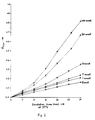
- Figure 2 shows how the absorbance increases with time at 37°C in the presence of different amounts of alkaline phosphatase.
- the final absorbance after subtraction of the blank for an incubation time of 30 min is shown in Figure 3. Again 1 amol of alkaline phosphatase could easily be detected.
- D-amino acid oxidase shows activity with a range of amino acids, and a higher rate of oxidation was achieved using D-methionine or D-proline at the same concentration.
- the rates relative to D-alanine were 2.5 and 3.0 respectively.
- Apoglucose oxidase was prepared according to the method of Morris and Buckler (Methods Enzymol. (1983) 92 , 413-425, incorporated herein by reference) and final traces of holoenzyme removed by a treatment with phenylacetic acid; a procedure based on the information presented by Hemmerich et al (Nature (1967), 213 , 728-730), incorporated herein by reference).
- the apoenzyme may be stabilised with a suitable antibody to the holoenzyme (Morris, Anal. Biochem. (1985), 151 , 235-241, incorporated herein by reference).
- Apo-D-amino acid oxidase was prepared according to the procedure described by Brumby and Massey (Biochem. Prep. (1968), 12 , 29-41, incorporated herein by reference). Residual holoenzyme was removed by absorbing the apoenzyme onto Blue Sepharose, washing away unbound holoenzyme, and subequently eluting the apoenzyme (Leonil et al J. Chromatography (1985), 347 , 316-319, incorporated herein by reference). The enzyme was desalted against 20 mM Bis Tris propane buffer pH 7.0 containing 5 g/L mannitol, aliquoted, and freeze-dried.
- peroxidase was found to contain varying levels of phosphatase. This was removed by dissolving the peroxidase in 20 mM Bis Tris propane at pH 7.0 containing 5 g/L mannitol and passing the mixture through a calcium phosphate/cellulose gel equilibrated with the same buffer, whereupon the phosphatase contaminants were removed. The eluate was aliquoted and freeze-dried.
- the column was equilibrated with 20 mM Bis Tris propane, pH 7.0, and 10 mL 5 mM FADP in the same buffer was percolated through the column at 0.61 mL/min in a closed loop configuration.
- the proportion of FAD was reduced from 0.034% to 0.0034% of FADP after 18 minutes at 4°C.
- alkaline phosphatase is used to catalyse the hydrolysis of FADP to yield FAD.
- the FAD produced subsequently combines with apo-D-aminoacid oxidase (apo DAO) to yield holo-D-aminoacid oxidase (holo DAO).
- apo DAO apo-D-aminoacid oxidase
- holo DAO holo-DAO
- the following pyruvate-L-lactate cycling system was set up in a total volume of 1ml.
- 0.2mM 4-aminoantipyrine 60 ⁇ g/ml horse radish peroxidase 10 units Lactate dehydrogenase 1.3 units (0.1mg) Lactate oxidase from Pediococcus sp .
- Rate change in absorbance/min Concentration of Pyruvate Background After pyruvate addition Net Rate 100 ⁇ m 0.0124 0.564 0.552 10 ⁇ m 0.0118 0.0822 0.0704
- DAO has the advantage that it can function effectively at pH 8, which is also suitable for alkaline phosphatase.
- the components of the assay can all be premixed, forming a "one-pot" assay system which is very convenient.
- GOD has the advantage of forming a very stable holoenzyme with a high turnover number. Its use produces an assay of very high sensitivity, but is best operated as a two-pot system since GOD works best below the pH 8.0 which is best suited for the phosphatase being detected.
Landscapes
- Health & Medical Sciences (AREA)
- Life Sciences & Earth Sciences (AREA)
- Chemical & Material Sciences (AREA)
- Immunology (AREA)
- Engineering & Computer Science (AREA)
- Organic Chemistry (AREA)
- Molecular Biology (AREA)
- Zoology (AREA)
- Wood Science & Technology (AREA)
- Proteomics, Peptides & Aminoacids (AREA)
- Physics & Mathematics (AREA)
- Biochemistry (AREA)
- Biotechnology (AREA)
- General Health & Medical Sciences (AREA)
- Microbiology (AREA)
- Analytical Chemistry (AREA)
- Hematology (AREA)
- Urology & Nephrology (AREA)
- Biomedical Technology (AREA)
- General Engineering & Computer Science (AREA)
- Biophysics (AREA)
- Bioinformatics & Cheminformatics (AREA)
- Genetics & Genomics (AREA)
- Pathology (AREA)
- Cell Biology (AREA)
- Food Science & Technology (AREA)
- General Physics & Mathematics (AREA)
- Medicinal Chemistry (AREA)
- Measuring Or Testing Involving Enzymes Or Micro-Organisms (AREA)
- Enzymes And Modification Thereof (AREA)
- Saccharide Compounds (AREA)
Abstract
Description
- This invention relates to enzyme-linked assays.
- Alkaline phosphatase (EC 3.1.3.1) is a widely used enzyme label for immunoassays and can also be employed for the determination of gene probes.
- Other hydrolases have not enjoyed as wide a usage in enzyme-linked assays owing in part to the non-availability of suitable substrates for employment with them in diagnostic procedures. This invention discloses a family of novel substrates for a range of hydrolases, including alkaline phosphatase, which substrates are hydrolysed to produce a prosthetic group for a detector enzyme, thus providing a large amplification of the signal produced by the hydrolase.
- A recently developed method for the assay of this enzyme relies on the hydrolysis of NADP⁺ in a primary stage and the subsequent cycling, in a secondary stage, of the NAD⁺ produced, resulting in the amplification of the signal (Johannsson et al., J. Immun. Methods, (1986), 87, 7-11, incorporated herein by reference). The technique has not as yet enjoyed widespread use on account of the relative instability of the primary substrate and enzymic cross-talk between components which can result in unacceptable background signals.
- A recent technique for the sensitive detection of ribonuclease, our GB 2156518A, relies on the production of a prosthetic group or its precursor, from a prosthetogen. Typically in this methodology the primary enzyme produces riboflavin, which is subsequently converted, by use of one or more ancillary enzymes, to FMN or FAD. Either of these prosthetic groups combines with an apoenzyme to produce a catalytically active holoenzyme which in turn catalyses the signal-producing reaction. In one example the FAD converts apoglucose oxidase (EC 1.1.3.4) to the corresponding holoenzyme, which catalyses the oxidation of glucose thereby producing hydrogen peroxide which can be utilised by peroxidase (EC 1.11.1.7) to produce a coloured product (soluble or insoluble) or light (Thorpe and Kricka, Methods Enzymol. (1986), 133, 331-353, incorporated herein by reference). In another example the FAD converts apo-D-aminoacid oxidase (EC 1.4.3.3) to the corresponding holoenzyme which catalyses the oxidation of, for example, D-alanine which again results in the production of hydrogen peroxide. This can be determined colorimetrically (soluble or insoluble product), luminometrically (Decker and Hinkkanen, Methods Enzymol, (1986), 122, 185-192, incorporated herein by reference) or by using a suitable electrical or electronic biosensor.
- According to the present invention there is provided a method of detecting a hydrolase enzyme (E.C. Division 3), preferably an alkaline phosphatase, which comprises using the enzyme to catalyse the formation from a prosthetogen of the prosthetic group flavin adenine dinucleotide (FAD), or an analog thereof which is capable of forming a holoenzyme, the prosthetogen being in the nature of a substituted FAD or FAD analog, the prosthetic group being produced by enzymic hydrolytic removal of the substituent; combining the FAD-type prosthetic group with an apoenzyme to form a holoenzyme, and using said holoenzyme as a catalyst in a signal-producing reaction. Depending on the exact nature of the substituent, the invention can be applied to the sensitive detection of a range of hydrolase enzymes including, but without restriction, phosphatases, phosphodiesterases, esterases, nucleases and sulfatases.
- In a preferred embodiment, the prosthetogen is an FAD-phosphate (FADP) and the hydrolase is a phosphatase. This procedure has the great advantage that the prosthetic group, FAD, is formed directly by action of a phosphatase enzyme on the prosthetogen, FADP, without the necessity to add any ancillary converting enzymes. The effectiveness and practical utility of the invention in relation to phosphatase enzymes are greatly enhanced by the additional discovery and identification of shelf-stable apoenzymes, two of which are given by example, for which the prosthetogen, FADP, despite its prosthetic group-like structure, has two important properties: it possesses no significant activity per se as a prosthetic group (which would cause high background signals), and it does not significantly interfere with the formation of the holoenzyme from apoenzyme and FAD (which would reduce the sensitivity of the system).
- Suitable apoenzymes include apo-D-aminoacid oxidase and apoglucose oxidase as mentioned above, as well as apo-L-aminoacid oxidase, apoxanthine oxidase and other apoenzymes which will be apparent to those skilled in the art. Apo-D-aminoacid oxidase is a preferred apoenzyme for many applications since it is very shelf-stable, and has kinetic characteristics that permits the technology to be used in a 'single pot' format, with all components added as a single premix to analyte-linked alkaline phosphatase. Suitable substrates for it are D-alanine, D-methionine and D-proline. For maximising the sensitivity of the invention without incorporating tail-end cycling components (see below), the use of apoglucose oxidase is advantageous, although its use requires a two stage format in which the first stage, involving hydrolysis of FADP, is operated at pH 8.0 and the second detection stage at a lower pH.
- If desired the sensitivity of the signal-producing detection system based on apo-D-aminoacid oxidase may be greatly enhanced, but at the expense of increased complexity, by using "tail end cycling". In this procedure the holoenzyme may be used to catalyse a reaction which leads to the production of a cyclable substrate which generates a detectable product. For most applications, involving determination of greater than 0.01 attomoles of alkaline phosphatase in about one hour, the additional cycling procedure is not required. It would, however, be advantageous in diagnostic procedures that require detection of a very small number of virus particles or genes (as, for example, in direct procedures for HIV).
- The reaction leading to the production of the cyclable substrate may itself give rise to a detectable side product. For example, hydrogen peroxide may be generated which may be detected using horseradish peroxidase to produce a signal. Examples of holoenzyme-catalysed reactions resulting in the generation of hydrogen peroxide were also given above.
- The side product generated may be the same as that generated in the reaction leading to the production of the cyclable substrate and may therefore be detected in the same way, an additive effect being produced by the two processes.
- FAD may suitably carry a phosphate group at any one or more of the positions labelled A-E in formula I below.

However, any phosphorylated FAD analog which, after hydrolysis by phosphatase, yields an FAD analog which acts as a prosthetic group for an apoenzyme may be employed. Possibilities for FAD analogs include those in which a hydroxy group for carrying phosphate is provided on the aromatic nucleus of either or both of flavine or adenine or on a substituent of these nuclei. For example hydroxyalkyl substituents might be provided on the unsubstituted positions of the flavine benzene ring. Alternatively the flavine and/or adenine rings in FADP could be altered structurally in other ways that could be advantageous. Preferably, however, an FAD analog in which a hydroxymethyl group is provided in place of either or both of the flavine methyl groups is used. For each analog, phosphate groups may then be provided on one or more of the hydroxy groups present. Thus, where two hydroxymethyl groups are present in the flavine of FAD either, both or neither of these may carry a phosphate group in the phosphorylated analog. - These compounds are novel and provide a further aspect of the present invention. The invention also provides a method for the synthesis of these compounds. A suitable method includes conversion of an FADP precursor having a protected phosphate group into FADP. The phosphate group may be protected as a diphenyl phosphate group, for example as shown in the Reaction Scheme below.

Compounds having a phosphate group at the 2' and/or 3' position of the sugar molecule are preferred for use in assay methods of the present invention. - The phosphatase can itself be the primary analyte, or it can be part of an assay procedure for detecting another analyte.
- Some appropriate enzyme/substrate pairs are listed by example only in the following Table.
- FADX is the substrate with -OX replacing an -OH in one or more of positions A, B, C, D or E of formula I or the hydroxyl group of a suitable hydroxyl-containing analog of FAD (see above).

- The invention also includes kits for carrying out the method hereof. A suitable kit may comprise an FAD substrate for the enzyme being detected, and a signal producing system for detecting the presence of FAD. Examples of suitable signal producing systems include those referred to above.
- The invention will be more particularly illustrated, by way of example only, with reference to the following Examples.
- N-benzoyladenosine (1) was transformed into the 3'-acetate (3) by reaction with excess trimethylorthoacetate and p-toluenesulphonic acid, followed by rearrangement of the intermediate orthoester with 50% acetic acid. The crude 3'-acetate was purified by flash chromatography over SiO₂ (230-400 mesh) with CHCl₃-MeOH 93:7 and treated successively with 4,4'-dimethoxytritylchloride and diphenylphosphochloridate in pyridine. After concentration the residue was dissolved in dichloromethane and reacted with excess dichloroacetic acid. The crude product was purified as before [SiO₂ (230-400 mesh) with CHCl₃-MeOH 96:4] to give N-benzoyl-3'-acetyladenosine-2'-diphenylphosphate (5). On reaction of (5) with 4-nitrophenyl-4-morpholinophosphochloridate and 1-methylimidazole in CH₃CN the protected morpholinophosphate (6) was obtained, which was purified as before [SiO₂ (230-400 mesh) with CHCl₃-MeOH 97:3]. Deprotection was achieved by reaction with tetra-n-butylammonium acetate and the morpholinophosphate (7) formed was coupled with excess triacetyl-FMN in DMF at 50°C for 18 h.
- Deprotection of the crude product was accomplished by reaction with conc NH₃-ethanol 4:1 for 36 h at room temperature. The reaction mixture was concentrated until neutral, dissolved in 0.01 N HCl and extracted with CHCl₃ (3x). The pH of the solution was adjusted to 2 with 1N HCl and the solution stirred for 2 h in order to hydrolyse any 2',3'-cyclic phosphate that may have formed.
- After addition of excess NH₃ the solution was concentrated till neutral and then lyophilised.
- Crude 2'(3')-FADP was isolated by FPLC on a
Mono Q HR 10/10 anion exchange column (Pharmacia) with a H₂O/1 M ammonium formate (pH 6.5) gradient. The fractions eluting with 0.65-0.8 M ammonium formate were pooled and freeze-dried. This material was further purified by anion exchange chromatography which under the same conditions as above gave a fraction eluting at 0.65-0.8 M ammonium formate, which after freeze-drying and redissolving in 10 mM Tris buffer (pH 8.0, 1mM Mg Cl₂, 0.1 mM ZnCl₂) was acted upon by alkaline phosphatase to give a product that eluted in the same place as FAD and was able to reconstitute apoglucose oxidase. Traces of FAD could be removed by treatment with a suitable apoenzyme followed by ultrafiltration to remove the macromolecules. - Crude 2'(3')-FADP can also be prepared by coupling of adenosine 2',3'-cyclic phosphate 5'-phosphoromorpholidate (9) (J.G. Moffatt and H.G. Khorana, J. Amer. Chem. Soc., 83 (1961) 663, incorporated herein by reference) with triacetyl FMN, followed by NH₃ deprotection, HCl treatment and purification as described above.
- Alternatively, adenosine 2'3'-cyclic phosphate 5'-phosphate (10) (A. Simoncsits and J. Tomasz, Biochem. Biophys. Acta. 395 (1975) 74, incorporated herein by reference) was converted to (9) by reaction with dicyclohexylcarbodiimide and morpholine and then coupled, deprotected and purified as above.
- These procedures are shown by the following reaction scheme.

- In these experiments, the FADP used contained 0.036% FAD. In order to reduce the background signal to an acceptable level, the glucose concentration in the second incubation mixture was reduced to 10% of its optimal value.
- A typical mixture for the assay of alkaline phosphatase is as follows:
0.2 M Tris-HCl buffer pH 8.0 containing 1 mM MgCl₂ and 0.1 mM ZnCl₂
0.2 mM FAD-phosphate Alkaline phosphatase
Total Volume 0.05 mL
The mixture is incubated at room temperature for 1 hour, and then a further 0.05 mL of the following mixture added:
0.2 µM apoglucose oxidase
0.01 M glucose
6 µg peroxidase
16mM 3,5-dichloro-2-hydroxybenzene-sulphonic acid
1.6 mM 4-aminoantipyrine
0.3 M Bis-Tris pH 6.1
Total volume 0.1 mL, pH 7.0. The development of colour was followed at 520 nm. After an initial lag due to the reconstitution of the apoglucose oxidase, colour production is linear with time. Figure 1 shows the absorbance obtained after subtraction of a control sample containing no alkaline phosphatase for an incubation time of 1 hour at room temperature with different amounts of alkaline phosphatase. Under these conditions, 1 amol of alkaline phosphatase could be detected. - Use of apo-D-amino acid oxidase, whose holoenzyme has a pH optimum of 8.0-9.0, allows the above assay to be conducted in a single pot:
0.1 M Tris-HCl buffer pH 8.0 containing 1 mM MgCl₂ and 0.1 mM ZnCl₂
0.1 mM FADP
0.1 µM apo-D-amino acid oxidase
35 mM D-alanine
8mM 3,5-dichloro-2-hydroxybenzene sulphonic acid
0.8 mM 4-aminoantipyrine
6 µg peroxidase
alkaline phosphatase
Total volume 0.1 mL
The above ingredients may be mixed beforehand and added directly too the alkaline phosphatase. Figure 2 shows how the absorbance increases with time at 37°C in the presence of different amounts of alkaline phosphatase. The final absorbance after subtraction of the blank for an incubation time of 30 min is shown in Figure 3. Again 1 amol of alkaline phosphatase could easily be detected. - D-amino acid oxidase shows activity with a range of amino acids, and a higher rate of oxidation was achieved using D-methionine or D-proline at the same concentration. The rates relative to D-alanine were 2.5 and 3.0 respectively.
- Apoglucose oxidase was prepared according to the method of Morris and Buckler (Methods Enzymol. (1983) 92, 413-425, incorporated herein by reference) and final traces of holoenzyme removed by a treatment with phenylacetic acid; a procedure based on the information presented by Hemmerich et al (Nature (1967), 213, 728-730), incorporated herein by reference). The apoenzyme may be stabilised with a suitable antibody to the holoenzyme (Morris, Anal. Biochem. (1985), 151, 235-241, incorporated herein by reference).
- Apo-D-amino acid oxidase was prepared according to the procedure described by Brumby and Massey (Biochem. Prep. (1968), 12, 29-41, incorporated herein by reference). Residual holoenzyme was removed by absorbing the apoenzyme onto Blue Sepharose, washing away unbound holoenzyme, and subequently eluting the apoenzyme (Leonil et al J. Chromatography (1985), 347, 316-319, incorporated herein by reference). The enzyme was desalted against 20 mM Bis Tris propane buffer pH 7.0 containing 5 g/L mannitol, aliquoted, and freeze-dried.
- Commercially obtained peroxidase was found to contain varying levels of phosphatase. This was removed by dissolving the peroxidase in 20 mM Bis Tris propane at pH 7.0 containing 5 g/L mannitol and passing the mixture through a calcium phosphate/cellulose gel equilibrated with the same buffer, whereupon the phosphatase contaminants were removed. The eluate was aliquoted and freeze-dried.
- Remaining traces of FAD were removed using apoglucose oxidase, which binds FAD tightly, but does not bind FADP.
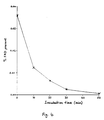
- Apoglucose oxidase (2.5 µM) was mixed with FADP (200 µM) at room temperature. The decline in the amount of residual FAD as a proportion of the amount of FADP present with time is shown in Figure 4. After 30 min the mixture was ultrafiltered to yield a sample of FADP containing less than 0.002% FAD.
- Free amino groups were introduced into glucose oxidase as described by Royer (Methods Enzymol., (1987), 135, 141-146, incorporated herein by reference). This derivatised enzyme (25 mg) was mixed with TresylSepharose 4B (5 mL) in 0.1 M sodium bicarbonate, containing 0.5 M NaCl, and gently agitated for 16 h at 4°C. After blocking unreacted tresyl groups, the gel was packed into a column (6 mm x 10 mm dia) and treated with 1 mL 25 mM phosphate, pH 1.1, containing 20% glycerol to remove the prosthetic group. This was immediately followed by 20 mL 1 M phosphate buffer, pH 7.0. The column was equilibrated with 20 mM Bis Tris propane, pH 7.0, and 10
mL 5 mM FADP in the same buffer was percolated through the column at 0.61 mL/min in a closed loop configuration. The proportion of FAD was reduced from 0.034% to 0.0034% of FADP after 18 minutes at 4°C. - In the next four Examples alkaline phosphatase is used to catalyse the hydrolysis of FADP to yield FAD. The FAD produced subsequently combines with apo-D-aminoacid oxidase (apo DAO) to yield holo-D-aminoacid oxidase (holo DAO). In the absence of any cycling the signal producing system relies on the use of holo-DAO to catalyse the conversion of D-alanine to pyruvate with the generation of hydrogen peroxide. With cycling (shown in the diagrams below the broken line), pyruvate or a product generated from pyruvate is interconverted with another compound, the interconversion reactions generating detectable hydrogen peroxide.
-

The following pyruvate-L-lactate cycling system was set up in a total volume of 1ml.
0.2M Tris HCl, pH 8.0
1mM Mg²⁺
0.1mM Zn²⁺
1mM NADH
2mM 3,5-dichloro-2-hydroxybenzenesulphonic acid
0.2mM 4-aminoantipyrine
60µg/ml horse radish peroxidase
10 units Lactate dehydrogenase
1.3 units (0.1mg) Lactate oxidase from Pediococcus sp. - The absorbance of the solution at 520nm was monitored. Then pyruvate was added to the reaction mixture and the rate of change of absorbance monitored. The results are indicated in the table below.
Rate: change in absorbance/min Concentration of Pyruvate Background After pyruvate addition Net Rate 100 µm 0.0124 0.564 0.552 10 µm 0.0118 0.0822 0.0704 - The results indicate that pyruvate-lactate cycling is possible in the presence of lactate dehydrogenase and lactate oxidase and results in the generation of detectable hydrogen peroxide.
- Other cycling systems that could be used include those illustrated by the following reaction schemes. In each case the eventual colour-forming process involves the H₂O₂ produced participating in a peroxidase-catalysed reaction.
-

-

-

Of the systems so far described, those based on the enzymes DAO and GOD are preferred for use without tail-end cycling. - DAO has the advantage that it can function effectively at pH 8, which is also suitable for alkaline phosphatase. Thus, the components of the assay can all be premixed, forming a "one-pot" assay system which is very convenient.
- GOD has the advantage of forming a very stable holoenzyme with a high turnover number. Its use produces an assay of very high sensitivity, but is best operated as a two-pot system since GOD works best below the pH 8.0 which is best suited for the phosphatase being detected.
Claims (21)
- A method of determining a hydrolase enzyme which comprises using the enzyme to catalyse the formation of flavin adenine dinucleotide (FAD), or an analog of FAD which is capable of forming a holoenzyme, from a substituted FAD or FAD analog substrate, by hydrolytic removal of the substituent, combining the FAD or FAD analog with an apoenzyme to form a holoenzyme, and using said holoenzyme as a catalyst in a signal-generating reaction.
- A method according to claim 1 wherein the enzyme to be detected is a phosphatase enzyme which catalyses the formation of FAD or FAD analog from an FAD-phosphate substrate.
- A method according to claim 1 wherein the apoenzyme is apo-D-aminoacid oxidase (apo-DAO).
- A method according to claim 3 wherein the holo-DAO thus formed acts on an aminoacid substrate to produce H₂O₂ as a detectable side product.
- A method according to claim 3 wherein the components of the assay are premixed and added to a sample suspected of containing an enzyme to be detected.
- A method according to claim 3 wherein the substrate for DAO is selected from D-alanine, D-methionine and D-proline.
- A method according to claim 1 wherein the apo-enzyme is apo-glucose oxidase (apo-GOD).
- A method according to claim 7 wherein the FAD thus formed in a first stage is used in a second stage to produce holo-GOD which acts on glucose to produce H₂O₂ as a detectable product.
- An assay kit for determining a hydrolase enzyme, which kit comprises a substituted FAD or substituted FAD analog substrate capable of being hydrolysed by said hydrolase to produce FAD or an analog of FAD which is capable of forming a holoenzyme, an apoenzyme capable of forming a holoenzyme with FAD or said analog, and a reaction system capable of initiation by said holoenzyme to generate a detectable product.
- An assay kit according to claim 9 which comprises an FAD phosphate substrate or FAD analog phosphate substrate for detecting a phosphatase, an apo-enzyme which is capable of forming a holoenzyme with FAD, or said FAD analog, and a reaction system capable of initiation by said holoenzyme to generate a detectable product.
- An assay kit according to claim 9 wherein the apoenzyme is apo-DAO.
- An assay kit according to claim 11 which includes an aminoacid substrate for holo-DAO and means for detecting the production of H₂O₂.
- An assay kit according to claim 11 wherein the substrate for DAO is selected from D-alanine, D-methionine and D-proline.
- An assay kit according to claim 11 wherein the reaction components thereof are in a premixed form.
- An assay kit according to claim 9 wherein the apoenzyme is apo-GOD.
- An assay kit according to claim 15 wherein the components for forming FAD or FAD analog are separate from the components for the reaction to be catalysed by holo-GOD, so that the two reactions can be carried out as separate stages.
- A substituted FAD or FAD analog, wherein said substituent is capable of hydrolytic removal by a hydrolase enzyme to give FAD or an FAD analog capable of forming a holoenzyme from an apoenzyme.
- A compound of claim 17 having a said substituent at the 2' and/or 3' position of the sugar moiety thereof.
- An FAD derivative substrate for a hydrolase enzyme, said derivative having the formula:

- An FAD derivative of claim 19 wherein X is a phosphate.
- A method of producing a compound of claim 20, which comprises:
hydrolysing a precursor of said compound in which at least one of A-G is a protected phosphate group, and any of A-G which is not a protected phosphate group is a group hydrolysable to a hydroxy group; and
removing the phosphate protection.
Priority Applications (1)
| Application Number | Priority Date | Filing Date | Title |
|---|---|---|---|
| AT89909212T ATE97451T1 (en) | 1988-08-02 | 1989-07-31 | A STRENGTHENING TEST PROCEDURE FOR HYDROLASE ENZYMES. |
Applications Claiming Priority (4)
| Application Number | Priority Date | Filing Date | Title |
|---|---|---|---|
| GB888818336A GB8818336D0 (en) | 1988-08-02 | 1988-08-02 | Amplification assay for phosphatase enzymes |
| GB8818336 | 1988-08-02 | ||
| GB8905347 | 1989-03-08 | ||
| GB898905347A GB8905347D0 (en) | 1989-03-08 | 1989-03-08 | An amplifiction assay for phosphatase enzyme |
Publications (2)
| Publication Number | Publication Date |
|---|---|
| EP0430987A1 EP0430987A1 (en) | 1991-06-12 |
| EP0430987B1 true EP0430987B1 (en) | 1993-11-18 |
Family
ID=26294228
Family Applications (1)
| Application Number | Title | Priority Date | Filing Date |
|---|---|---|---|
| EP89909212A Expired - Lifetime EP0430987B1 (en) | 1988-08-02 | 1989-07-31 | An amplification assay for hydrolase enzymes |
Country Status (7)
| Country | Link |
|---|---|
| US (1) | US5445942A (en) |
| EP (1) | EP0430987B1 (en) |
| JP (1) | JP2922951B2 (en) |
| AU (1) | AU633507B2 (en) |
| DE (1) | DE68910828T2 (en) |
| GB (1) | GB2240845B (en) |
| WO (1) | WO1990001559A1 (en) |
Families Citing this family (28)
| Publication number | Priority date | Publication date | Assignee | Title |
|---|---|---|---|---|
| EP0597951B1 (en) * | 1991-07-26 | 1999-03-31 | Dade Chemistry Systems Inc. | An assay with signal detection in the presence of a suspended solid support |
| GB9220027D0 (en) * | 1992-09-22 | 1992-11-04 | Mini Agriculture & Fisheries | Method and kits for detection of bacteria |
| DE4440487A1 (en) * | 1994-11-12 | 1996-05-15 | Behringwerke Ag | Heterogeneous immunoassay using a precipitable solid phase |
| US5518738A (en) * | 1995-02-09 | 1996-05-21 | Nanosystem L.L.C. | Nanoparticulate nsaid compositions |
| US5605785A (en) * | 1995-03-28 | 1997-02-25 | Eastman Kodak Company | Annealing processes for nanocrystallization of amorphous dispersions |
| US5858665A (en) * | 1996-07-25 | 1999-01-12 | Navix, Inc. | Homogeneous diagnostic assay method utilizing simultaneous target and signal amplification |
| GB9622524D0 (en) * | 1996-10-29 | 1997-01-08 | London Biotechnology Ltd | Enzyme labels for assays |
| GB2324370B (en) * | 1997-04-14 | 1999-03-03 | Stuart Harbron | Detection of hybrid double-stranded DNA with antibody after enzyme degradation of excess single-standed DNA |
| US20020077775A1 (en) * | 2000-05-25 | 2002-06-20 | Schork Nicholas J. | Methods of DNA marker-based genetic analysis using estimated haplotype frequencies and uses thereof |
| US20030195707A1 (en) * | 2000-05-25 | 2003-10-16 | Schork Nicholas J | Methods of dna marker-based genetic analysis using estimated haplotype frequencies and uses thereof |
| KR20020038103A (en) * | 2000-11-16 | 2002-05-23 | 류정열 | Vibration absorbing leaf spring |
| US20020192676A1 (en) * | 2001-06-18 | 2002-12-19 | Madonna Angelo J. | Method for determining if a type of bacteria is present in a mixture |
| JP2005511012A (en) * | 2001-08-10 | 2005-04-28 | セローノ ジェネティクス インスティテュート ソシエテ アノニム | Human cDNA and protein and uses thereof |
| JP4490112B2 (en) * | 2002-04-12 | 2010-06-23 | コロラド・スクール・オブ・マインズ | A method for detecting low concentrations of target bacteria using phage to infect target bacterial cells |
| JP4896869B2 (en) * | 2005-03-03 | 2012-03-14 | 積水メディカル株式会社 | Immunoassay and reagent |
| US20110097702A1 (en) * | 2005-03-31 | 2011-04-28 | Voorhees Kent J | Methods and compositions for in situ detection of microorganisms on a surface |
| WO2006105504A1 (en) * | 2005-03-31 | 2006-10-05 | Microphage Incorporated | Apparatus and method for detecting microorganisms using flagged bacteriophage |
| US20070178450A1 (en) * | 2006-01-27 | 2007-08-02 | Microphage (Tm) Incorporation | Method and apparatus for determining level of microorganisms using bacteriophage |
| US8697434B2 (en) * | 2008-01-11 | 2014-04-15 | Colorado School Of Mines | Detection of phage amplification by SERS nanoparticles |
| US9441204B2 (en) * | 2008-04-03 | 2016-09-13 | Colorado School Of Mines | Compositions and methods for detecting Yersinia pestis bacteria |
| JP4440333B1 (en) * | 2009-03-09 | 2010-03-24 | パナソニック株式会社 | hearing aid |
| JP5352742B2 (en) | 2009-08-07 | 2013-11-27 | オームクス コーポレーション | Enzymatic redox-change chemical elimination (E-TRACE) immunoassay |
| WO2012100078A1 (en) | 2011-01-19 | 2012-07-26 | Ohmx Corporation | Enzyme triggered redox altering chemical elimination (e-trace) immmunoassay |
| JP6203183B2 (en) | 2011-10-17 | 2017-09-27 | オームクス コーポレイション | Single direct detection of the percentage of hemoglobin A1C using an enzyme-induced redox change chemical elimination (E-TRACE) immunoassay |
| WO2013067349A1 (en) | 2011-11-04 | 2013-05-10 | Ohmx Corporation | Novel chemistry used in biosensors |
| EP2802669A1 (en) | 2012-01-09 | 2014-11-19 | Ohmx Corporation | Enzyme cascade methods for e-trace assay signal amplification |
| WO2014018899A1 (en) | 2012-07-27 | 2014-01-30 | Ohmx Corporation | Electric measurement of monolayers following pro-cleave detection of presence and activity of enzymes and other target analytes |
| EP2877592B1 (en) | 2012-07-27 | 2016-09-21 | Ohmx Corporation | Electronic measurements of monolayers following homogeneous reactions of their components |
Family Cites Families (4)
| Publication number | Priority date | Publication date | Assignee | Title |
|---|---|---|---|---|
| US4318983A (en) * | 1979-06-04 | 1982-03-09 | Miles Laboratories, Inc. | Fad-labeled specific binding assay monitored with apoglutathione reductase or apolipoamide dehydrogenase |
| US4318982A (en) * | 1979-06-04 | 1982-03-09 | Miles Laboratories, Inc. | FMN-Labeled specific binding assay |
| US4259232A (en) * | 1979-10-23 | 1981-03-31 | Miles Laboratories, Inc. | Flavin adenine dinucleotide-labeled protein and polypeptide conjugates |
| GB8628108D0 (en) * | 1986-11-25 | 1986-12-31 | London Biotechnology Ltd | Riboflavin-linked assay |
-
1989
- 1989-07-31 EP EP89909212A patent/EP0430987B1/en not_active Expired - Lifetime
- 1989-07-31 AU AU40612/89A patent/AU633507B2/en not_active Expired
- 1989-07-31 DE DE89909212T patent/DE68910828T2/en not_active Expired - Lifetime
- 1989-07-31 JP JP1508721A patent/JP2922951B2/en not_active Expired - Fee Related
- 1989-07-31 WO PCT/GB1989/000877 patent/WO1990001559A1/en not_active Ceased
-
1991
- 1991-02-01 GB GB9102160A patent/GB2240845B/en not_active Expired - Lifetime
-
1993
- 1993-01-13 US US08/015,287 patent/US5445942A/en not_active Expired - Lifetime
Non-Patent Citations (1)
| Title |
|---|
| CHEMICAL ABSTRACTS, vol. 98, no. 19, 09 May 1983, Columbus, OH (US);H. DANIEL et al., p. 409, no. 159456y# * |
Also Published As
| Publication number | Publication date |
|---|---|
| GB2240845A (en) | 1991-08-14 |
| GB2240845B (en) | 1992-02-05 |
| EP0430987A1 (en) | 1991-06-12 |
| JP2922951B2 (en) | 1999-07-26 |
| AU633507B2 (en) | 1993-02-04 |
| DE68910828D1 (en) | 1993-12-23 |
| AU4061289A (en) | 1990-03-05 |
| WO1990001559A1 (en) | 1990-02-22 |
| US5445942A (en) | 1995-08-29 |
| GB9102160D0 (en) | 1991-04-10 |
| DE68910828T2 (en) | 1994-05-11 |
| JPH04500005A (en) | 1992-01-09 |
Similar Documents
| Publication | Publication Date | Title |
|---|---|---|
| US5445942A (en) | Amplification assay for hydrolase enzymes | |
| Kricka | Chemiluminescent and bioluminescent techniques | |
| Barrio et al. | A fluorescent analog of nicotinamide adenine dinucleotide | |
| CA1258673A (en) | Enzymic method of detecting analytes and novel substrates therefor | |
| CA1124191A (en) | Glycerol oxidase and process for the production thereof and method for the quantitative determination of glycerol by glycerol oxidase | |
| US4317878A (en) | Test composition containing acidic uricase used for quantitative determination of uric acid in sample | |
| Blobstein et al. | Products obtained after in vitro reaction of 7, 12-dimethylbenz [a] anthracene 5, 6-oxide with nucleic acids | |
| Elstner et al. | The biosynthesis of the nucleoside antibiotics: IX. Purification and properties of guanosine triphosphate 8-formylhydrolase that catalyzes production of formic acid from the ureido carbon of guanosine triphosphate | |
| Weigel et al. | Mechanistic studies of the biosynthesis of 3, 6-dideoxyhexoses in Yersinia pseudotuberculosis: purification and characterization of CDP-4-keto-6-deoxy-D-glucose-3-dehydrase | |
| Berliner et al. | Structure-function relationships in lactose synthase. Structural requirements of the UDP-galactose binding site | |
| US6362328B1 (en) | Assays and probes with enzyme labels | |
| Budowsky et al. | Synthetic analogues of uridine diphosphate glucose: Biochemical and chemical studies The secondary stucture of nucleoside diphosphate sugars | |
| EP0153872B1 (en) | Method for the determination of the reduced form of nicotinamide adenine dinucleotide | |
| Yakusheva et al. | Study on the mechanism of action of adenosylcobalamin-dependent glycerol dehydratase from Aerobacter aerogenes: I. Role of structural components of adenosylcobalamin in the formation of the active site of glycerol dehydratase | |
| US4255519A (en) | Glycerol oxidase and process for the production thereof | |
| Fukushima et al. | The enzymatic synthesis of Crithidia active substance (s) and a phosphorylated D-erythroneopterin from GTP or GDP by liver preparations from Syrian golden hamsters | |
| Yamazaki et al. | Preparation of N6‐[N‐(6‐Aminohexyl) carbamoyl]‐Adenine Nucleotides and Their Application to Coenzymically Active Immobilized ADP and ATP, and Affinity Adsorbents | |
| US5156955A (en) | Nucleoside oxidase and assay method utilizing same | |
| SU1255054A3 (en) | Method of producing n-nitrophenyl-alpha-maltoheptaozide | |
| JPH0584074A (en) | Oligosaccharide oxidase, production of oligosaccharide oxidase, determination of oligosaccharide, production of oligosaccharide acid and determination of amylase activity | |
| JP2879351B2 (en) | Method for measuring freshness of seafood | |
| EP0166505A3 (en) | Isolation and quantitation of alkaline phosphatase | |
| Percival et al. | Synthesis and testing of sugar phosphofluoridates and cyclic phosphates as inhibitors of phosphoglucomutase | |
| Harborn et al. | Amplified luminometric assays of alkaline phosphatase using riboflavin phosphates | |
| Fisher et al. | Purification and semienzymic synthesis of flavin adenine dinucleotide-3′-phosphate |
Legal Events
| Date | Code | Title | Description |
|---|---|---|---|
| PUAI | Public reference made under article 153(3) epc to a published international application that has entered the european phase |
Free format text: ORIGINAL CODE: 0009012 |
|
| 17P | Request for examination filed |
Effective date: 19910131 |
|
| AK | Designated contracting states |
Kind code of ref document: A1 Designated state(s): AT BE CH DE FR GB IT LI LU NL SE |
|
| 17Q | First examination report despatched |
Effective date: 19930208 |
|
| GRAA | (expected) grant |
Free format text: ORIGINAL CODE: 0009210 |
|
| AK | Designated contracting states |
Kind code of ref document: B1 Designated state(s): AT BE CH DE FR IT LI LU NL SE |
|
| REF | Corresponds to: |
Ref document number: 97451 Country of ref document: AT Date of ref document: 19931215 Kind code of ref document: T |
|
| REF | Corresponds to: |
Ref document number: 68910828 Country of ref document: DE Date of ref document: 19931223 |
|
| ET | Fr: translation filed | ||
| ITF | It: translation for a ep patent filed | ||
| PLBE | No opposition filed within time limit |
Free format text: ORIGINAL CODE: 0009261 |
|
| STAA | Information on the status of an ep patent application or granted ep patent |
Free format text: STATUS: NO OPPOSITION FILED WITHIN TIME LIMIT |
|
| EPTA | Lu: last paid annual fee | ||
| 26N | No opposition filed | ||
| EAL | Se: european patent in force in sweden |
Ref document number: 89909212.6 |
|
| PGFP | Annual fee paid to national office [announced via postgrant information from national office to epo] |
Ref country code: DE Payment date: 20080728 Year of fee payment: 20 Ref country code: CH Payment date: 20080725 Year of fee payment: 20 Ref country code: LU Payment date: 20080728 Year of fee payment: 20 |
|
| PGFP | Annual fee paid to national office [announced via postgrant information from national office to epo] |
Ref country code: NL Payment date: 20080729 Year of fee payment: 20 Ref country code: IT Payment date: 20080728 Year of fee payment: 20 Ref country code: FR Payment date: 20080725 Year of fee payment: 20 Ref country code: AT Payment date: 20080725 Year of fee payment: 20 |
|
| PGFP | Annual fee paid to national office [announced via postgrant information from national office to epo] |
Ref country code: SE Payment date: 20080725 Year of fee payment: 20 Ref country code: BE Payment date: 20080729 Year of fee payment: 20 |
|
| REG | Reference to a national code |
Ref country code: CH Ref legal event code: PL |
|
| NLV7 | Nl: ceased due to reaching the maximum lifetime of a patent |
Effective date: 20090731 |
|
| EUG | Se: european patent has lapsed | ||
| PG25 | Lapsed in a contracting state [announced via postgrant information from national office to epo] |
Ref country code: NL Free format text: LAPSE BECAUSE OF EXPIRATION OF PROTECTION Effective date: 20090731 |