EP0430688A2 - Gemeinsame Offset-Tiefen-Migration mit restdynamischer Korrektur - Google Patents
Gemeinsame Offset-Tiefen-Migration mit restdynamischer Korrektur Download PDFInfo
- Publication number
- EP0430688A2 EP0430688A2 EP90312977A EP90312977A EP0430688A2 EP 0430688 A2 EP0430688 A2 EP 0430688A2 EP 90312977 A EP90312977 A EP 90312977A EP 90312977 A EP90312977 A EP 90312977A EP 0430688 A2 EP0430688 A2 EP 0430688A2
- Authority
- EP
- European Patent Office
- Prior art keywords
- migrated
- depth
- velocity
- post
- parts
- Prior art date
- Legal status (The legal status is an assumption and is not a legal conclusion. Google has not performed a legal analysis and makes no representation as to the accuracy of the status listed.)
- Ceased
Links
Images
Classifications
-
- G—PHYSICS
- G01—MEASURING; TESTING
- G01V—GEOPHYSICS; GRAVITATIONAL MEASUREMENTS; DETECTING MASSES OR OBJECTS; TAGS
- G01V1/00—Seismology; Seismic or acoustic prospecting or detecting
- G01V1/28—Processing seismic data, e.g. for interpretation or for event detection
- G01V1/36—Effecting static or dynamic corrections on records, e.g. correcting spread; Correlating seismic signals; Eliminating effects of unwanted energy
- G01V1/362—Effecting static or dynamic corrections; Stacking
-
- G—PHYSICS
- G01—MEASURING; TESTING
- G01V—GEOPHYSICS; GRAVITATIONAL MEASUREMENTS; DETECTING MASSES OR OBJECTS; TAGS
- G01V2210/00—Details of seismic processing or analysis
- G01V2210/50—Corrections or adjustments related to wave propagation
- G01V2210/52—Move-out correction
Definitions
- the present invention pertains to processing seismic data, and more particularly to applying residual moveout correction to common offset depth migrated data.
- NMO Normal Moveout
- United States Registration number H482 titled "Seismic Migration Method” ( John R. Berryhill et al.) relates to a seismic data processing method in which seismic traces are subjected to Fourier transformations. The coefficients of the Fourier-Transformed traces are subjected to a recursive FK migration operation. The migrated traces are thereafter inverse-Fourier-transformed. Each trace contains a signal resulting from reflection of a seismic signal at a location within the earth, and each trace is associated with at least one point in a two-dimensional spatial grid (x,y). When displayed, the processed seismic data represents the position within the earth of whatever caused the reflection.
- the method may be employed to process stacked seismic traces, each associated with a single point (x,y) in the grid, or may be employed to process unstacked seismic traces, each associated with both a seismic source location (x s ,y s ) and a different seismic receiver location (x r ,y r ) in the grid.
- the earth is modelled as a stack of M horizontal layers, each characterized by a seismic wave velocity.
- the recursive FK migration step is iterated M - 1 times for each trace, where part of the output of each iteration is stored and part discarded.
- United States Patent number 4,802,147 titled “Method for Segregating and Stacking Vertical Seismic Profile Data in Common Reflection Point Bins" ( George P.Moeckel ) relates to a method for segregating and stacking vertical seismic profile data. The offset difference between the well location and the position of the source is divided into equal segments. Vertical seismic profile moveout corrected data is placed in common reflection point bins and stacked.
- United States Patent number 4,813,027 titled “Method and Apparatus for Enhancing Seismic Data” Hans Tieman relates to a method and apparatus for stacking a plurality of seismic midpoint gathers to provide a pictorial representation of seismic events.
- the approximate propagation velocity, corresponding to a selected event in a common midpoint gather is determined by summing the common midpoint gather using first and second weights to provide respective first and second weighted sums over an offset based on an estimated velocity corresponding to the event.
- a velocity error value indicative of the approximate error between the estimated velocity and the actual velocity is developed from the sums.
- the common midpoint gather is then restacked in accordance with the determined propagation velocity to provide an enhanced pictorial representation of the seismic event.
- the first and second weighted sums are taken over a time window centered upon an estimated zero offset travel time for the event.
- the first and second weights can be selected to provide rapid, slow or intermediate convergence upon the true velocity.
- the velocity error value is determined as a function of the deviation of the peak of the first weighted sum from the center of the time window, relative to the deviation of the peak of the second weighted sum from the center of the time window.
- the velocity error value is determined as a function of the deviation of the peak of the cross-correlation of the first and second weighted sums from the center of the time window.
- United States Patent number 4,241,429 titled “Velocity Determination and Stacking Process from Seismic Exploration of Three Dimensional Reflection Geometry” ( Marvin G. Bloomquist et al) relates to a method for determining the dip and strike of subsurface interfaces and average propagation velocity of seismic waves.
- linear, multiple fold, common depth point sets of seismograms with three dimensional reflection geometry are used to determine the dip and strike of the subsurface reflecting interfaces and the average velocity of the path of the seismic energy to the reflecting interface.
- the reflections in each set appear with time differences on a hyperbola with trace spacings determined by the source receiver coordinate distance along the lines of exploration.
- the offset of the apex of this hyperbola is determined from a normal moveout velocity search of the type performed on two dimensional common depth point (CDP) sets. This search identifies the correct stacking velocity and hyperbola offset which are used to determine dip, strike and average velocity.
- CDP common depth point
- United States Patent number 4,766,574 titled "Method for Depth Imaging Multicomponent Seismic Data" ( Norman D. Whitmore , Jr., et al.) relates generally to a method of geophysical exploration. This method may be used for imaging multicomponent seismic data to obtain depth images of the earth's subsurface geological structure as well as estimates of compressional and shear wave interval velocities.
- measures are obtained of imparted seismic wavefields incident on reflecting interfaces the earth's subsurface and of resulting seismic wavefields scattered therefrom.
- the incident and scattered seismic wavefields are employed to produce time-dependent reflectivity functions which are representative of the reflecting interfaces. By migrating the time-dependent reflectivity functions, better depth images of the reflecting interfaces can be obtained.
- the dyadic set is partitioned in order to separate the variously coupled incident and reflected wavefields in the recorded multicomponent seismic data.
- the incident and reflected wavefields are cross-correlated to form reflectivity functions that are time-dependent.
- These time-dependent reflectivity functions are then iteratively migrated according to a model of wavefield velocities of propagation to obtain estimates of the compressional and shear wave interval velocity.
- the migrated reflectivity functions can then be stacked to produce depth images of the earth's subsurface geological structures.
- United States Patent number 4,802,146 titled “Method for Moveout Correction and Stacking Velocity Estimation of Offset VSP Data” ( George P. Moeckel ) relates to a moveout correction process and stacking velocity estimation process to permit stacking of vertical seismic profile (VSP) data.
- the primary reflection time is determined by using the two-way travel time, the root mean square velocity of acoustic pulses in the formation and the first arrival time of direct path acoustic pulses.
- United States Patent number 4,736,347 titled “Multiple Stacking and Spatial Mapping of Seismic Data” ( Bernard Goldberg et al.) relates to a method for determining the dip of subsurface formations and the apparent acoustic velocity.
- Seismic traces are stacked in a plurality of orthogonal measures to form multiple stacked traces at a positive offset.
- the stacking process determines the apparent velocities as functions of the travel time at the positive offset.
- the interval acoustic velocity of the first layer is then determined from knowledge of surface topography, source-receiver offset, two-way travel times and the first reflector apparent velocities.
- the first layer velocity information enables the incident and emergent angles of the raypaths at the surface to be calculated, as well as enabling the dip angles and spatial coordinates of the reflection points on the first reflecting boundary to be determined.
- Seismic data corresponding to the second reflecting boundary are then mapped spatially to the first reflecting boundary by ray tracing and by calculating the apparent velocities at the first boundary. The process is repeated for each succeedingly deeper boundary.
- the derived acoustic velocity model of the earth is displayed as a stacked seismic section in spatial coordinates. This process may be applied to obtain earth models and seismic sections in both two and three dimensions.
- United States Patent number 4,745,585 titled "Method of Migrating Seismic Data" ( Kenneth L. Larner ) relates to a method for migrating seismic data in steps where each step is a portion of the total migration. Seismic data is passed through a preselected number of migration stages. During each stage, data is migrated a plurality of times, where the migration-velocity function is a minor fraction of the velocity required to fully migrate the data in a single stage. The cascaded migration is used to migrate data having steeply-dipping events.
- a method and apparatus for applying residual moveout correction to common offset depth migrated data is disclosed for use on data where common offset depth migration has been applied using the best available velocity/depth model.
- Post migrated parts which are depth migrated common midpoint gathers, are saved.
- the post migrated parts are treated as if they were in time not depth.
- Normal moveout based on a constant velocity is removed.
- Velocity functions that is, time-velocity pairs, are derived for the post migrated parts with normal moveout removed. This derivation is done using a standard velocity analysis program. Normal moveout based on these velocity functions is applied.
- the events on the post migrated parts are imaged to the same depth.
- the corrected post migrated parts are then stacked.
- residual moveout correction is applied to common offset depth migrated data.
- each offset When seismic data is sorted into common offset panels, each offset can be processed as if it were an individual seismic section.
- Common offset depth migration converts each offset panel into a common offset depth section. Each of these represent the same subsurface structure. With a perfect velocity model, each offset section will yield identical images. For real seismic data, it is normally impossible to obtain a perfect velocity model and the migrated offset sections are different.
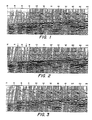
- Figures 1-3 illustrate examples of these conditions as identified by the circled areas.
- the velocity above the reflector is correct (7,250 ft/sec)
- Figure 2 it is 7,000 ft/sec, 250 ft/sec too slow and the image is over-migrated.
- Figure 3 it is 7,500 ft/sec, 250 ft/sec too high and the image is under-migrated.
- the standard pre-stack depth migration process will stack traces as they are imaged, and the post migrated parts are not available for further analysis. This result is equivalent to a brute stack. When the model is incorrect, the residual moveouts can be large, resulting in a poor stack. This is why standard pre-stack depth migration is so sensitive to the quality of the velocity model.
- a common offset depth migration program may be altered to save the imaged data before it is stacked in post migration parts. These post migration parts can then be treated with standard pre-stack processing techniques to correct for any residual moveout. This processing sequence provides a fine-tuned, moveout free set of post migration parts which produces a well imaged stacked section. This eliminates the expensive procedure of iterating to the optimum model for depth migration.
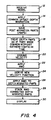
- step 12 data representing a seismic model is received.
- step 14 common offset depth migration is applied to the model.
- the model should be the best available velocity/depth model. It is to be noted that it is unusual to obtain a velocity/depth model good enough to migrate all events at all offsets to the same depth. Usually there are events that are over migrated and events that are under migrated (see Figures 1-3).
- Post migrated parts are saved at step 16.
- Post migrated parts are depth migrated common midpoint gathers. Saving the post migrated parts may be done at the same time and as part of the applying common offset depth migration.
- a constant velocity is assumed for the depth migrated data at step 18. The only requirement for the assumed velocity is that it produces a delta t at the far offsets larger than the delta t produced by the largest over migration.
- step 18 the depth migrated parts are treated as if they were Common Midpoint Gathers in time. This allows the use of well understood programs that are standard to the industry for doing velocity analysis and for the application and removal of normal moveout.
- a normal moveout is applied which corresponds to the velocity selected at Step 20.
- a new velocity function is derived for the post migrated parts with normal moveout removed at step 24.
- the velocity functions are derived in time-velocity pairs.
- a standard velocity analysis program in common use in the art may be used since the post migrated parts are being treated as if they were in time.
- normal moveout correction is applied to the time migrated post migrated parts at step 26.
- the events on the post migrated parts are now imaged to the same depth. This means that the residual or curved ends of the normal moveout corrected data has been corrected to improve the accuracy of the seismic section.
- the normal moveout corrected time migrated post migrated parts with residual moveout correction are stacked.
- the resulting seismic section may be displayed, providing a greatly improved seismic section.
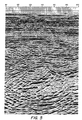
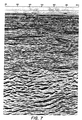
- Figure 5 shows the result of migrating the data into post migration parts with a common offset depth migration program which saves post migration parts, the correct velocity model and stacking the post migration parts. This can be considered an optimal result.
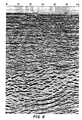
- Figure 6 was obtained by migrating and stacking the data with the low velocity model without the RMC (Residual Moveout Correction) of the present invention. Because the velocity was incorrect, the reflections were improperly migrated and did not stack correctly, resulting in a poor end result.
- Figure 7 was obtained in the same manner as Figure 6 except that RMC was used to improve the data before it was stacked. The end result rivals that of Figure 5.
- the deviation of the reflection images in the post migration parts from the ideal result can be observed, which is the imaging of perfectly flat events within post migration parts.
- the amount and direction of the deviation tells us how the velocity model needs to be changed.
- This provides the potential for developing a quick, inexpensive procedure for generating the velocity model.
- moveout deviations within post migration parts permit the design of residual depth stretching of the final depth section to produce a more accurate result.
- the application of a residual moveout and stretching permits the production of an accurate, well imaged depth section without the need of the expensive procedure of iterating, testing, and converging to the best velocity model.
Landscapes
- Engineering & Computer Science (AREA)
- Remote Sensing (AREA)
- Physics & Mathematics (AREA)
- Life Sciences & Earth Sciences (AREA)
- Acoustics & Sound (AREA)
- Environmental & Geological Engineering (AREA)
- Geology (AREA)
- General Life Sciences & Earth Sciences (AREA)
- General Physics & Mathematics (AREA)
- Geophysics (AREA)
- Geophysics And Detection Of Objects (AREA)
- Steroid Compounds (AREA)
Applications Claiming Priority (2)
| Application Number | Priority Date | Filing Date | Title |
|---|---|---|---|
| US07/444,509 US4980866A (en) | 1989-11-30 | 1989-11-30 | Common offset depth migration with residual moveout correction |
| US444509 | 1989-11-30 |
Publications (2)
| Publication Number | Publication Date |
|---|---|
| EP0430688A2 true EP0430688A2 (de) | 1991-06-05 |
| EP0430688A3 EP0430688A3 (en) | 1992-09-23 |
Family
ID=23765213
Family Applications (1)
| Application Number | Title | Priority Date | Filing Date |
|---|---|---|---|
| EP19900312977 Ceased EP0430688A3 (en) | 1989-11-30 | 1990-11-29 | Common offset depth migration with residual moveout correction |
Country Status (3)
| Country | Link |
|---|---|
| US (1) | US4980866A (de) |
| EP (1) | EP0430688A3 (de) |
| NO (1) | NO903854L (de) |
Cited By (4)
| Publication number | Priority date | Publication date | Assignee | Title |
|---|---|---|---|---|
| FR2755243A1 (fr) * | 1996-10-30 | 1998-04-30 | Elf Aquitaine | Methode perfectionnee de migration avant somme |
| WO1999036800A1 (en) * | 1998-01-16 | 1999-07-22 | Bp Amoco Corporation | Method of prestack 3-d migration |
| CN101688926B (zh) * | 2007-06-26 | 2013-08-21 | 申氏地球物理公司 | 基于拉普拉斯域波形反演的地下结构成像装置和分析方法 |
| CN110824562A (zh) * | 2018-08-08 | 2020-02-21 | 中国石油化工股份有限公司 | 一种微地震信号校正量计算方法及系统 |
Families Citing this family (18)
| Publication number | Priority date | Publication date | Assignee | Title |
|---|---|---|---|---|
| US5157638A (en) * | 1992-01-13 | 1992-10-20 | Conoco Inc. | Method of deriving statics corrections from common reflection point gathers |
| US5274605A (en) * | 1992-06-26 | 1993-12-28 | Chevron Research And Technology Company | Depth migration method using Gaussian beams |
| US5500832A (en) * | 1993-10-13 | 1996-03-19 | Exxon Production Research Company | Method of processing seismic data for migration |
| US6002642A (en) * | 1994-10-19 | 1999-12-14 | Exxon Production Research Company | Seismic migration using offset checkshot data |
| US5761062A (en) * | 1996-02-15 | 1998-06-02 | Western Atlas International, Inc. | Extended offset data processing |
| US5982706A (en) * | 1997-03-04 | 1999-11-09 | Atlantic Richfield Company | Method and system for determining normal moveout parameters for long offset seismic survey signals |
| US6026059A (en) * | 1997-11-14 | 2000-02-15 | Petroleum Geo-Services (Us), Inc. | Method of creating common-offset/common-azimuth gathers in 3-D seismic surveys and method of conducting reflection attribute variation analysis |
| US6446007B1 (en) | 1998-11-05 | 2002-09-03 | Exxonmobil Upstream Research Company | Method for controlled-amplitude prestack time migration of seismic data |
| US6757217B2 (en) * | 2001-08-31 | 2004-06-29 | Exxonmobil Upstream Research Company | Method for time-aligning multiple offset seismic data volumes |
| US6757216B1 (en) * | 2003-05-15 | 2004-06-29 | Exxonmobil Upstream Research Company | Method for post processing compensation of amplitude for misaligned and misstacked offset seismic data |
| US7065004B2 (en) * | 2004-04-22 | 2006-06-20 | Pgs Americas, Inc. | Horizon-based residual depth migration velocity analysis |
| US7480206B2 (en) * | 2004-09-13 | 2009-01-20 | Chevron U.S.A. Inc. | Methods for earth modeling and seismic imaging using interactive and selective updating |
| US7505362B2 (en) * | 2004-11-08 | 2009-03-17 | Exxonmobil Upstream Research Co. | Method for data regularization for shot domain processing |
| EP1859301B1 (de) * | 2005-02-22 | 2013-07-17 | Paradigm Geophysical Ltd. | Mehrfache unterdrückung bei der winkeldomänen-zeit- und tiefenmigration |
| FR2884619B1 (fr) * | 2005-04-19 | 2007-09-07 | Cie Generale De Geophysique Sa | Procede de traitement de donnees sismiques en vue de la realisation d'un pointe rmo |
| EP2715405B1 (de) * | 2011-05-23 | 2015-08-19 | Total SA | Verfahren zur verarbeitung seismischer daten durch bereitstellung von oebrflächenversetzten gemeinsamen bildsammlungen |
| CN113514888B (zh) * | 2021-06-18 | 2024-04-16 | 中国石油化工股份有限公司 | 一种基于非剩余时差的多次波压制方法 |
| CN115598701B (zh) * | 2022-10-17 | 2025-09-05 | 南方科技大学 | 一种双参数剩余动校正方法 |
Family Cites Families (10)
| Publication number | Priority date | Publication date | Assignee | Title |
|---|---|---|---|---|
| US4241429A (en) * | 1978-03-03 | 1980-12-23 | Mobil Oil Corporation | Velocity determination and stacking process from seismic exploration of three dimensional reflection geometry |
| US4736347A (en) * | 1984-05-18 | 1988-04-05 | Bernard Goldberg | Multiple stacking and spatial mapping of seismic data |
| US4802147A (en) * | 1985-05-23 | 1989-01-31 | Mobil Oil Corporation | Method for segregating and stacking vertical seismic profile data in common reflection point bins |
| US4802146A (en) * | 1985-05-23 | 1989-01-31 | Mobil Oil Corporation | Method for moveout correction and stacking velocity estimation of offset VSP data |
| US4745585A (en) * | 1986-04-03 | 1988-05-17 | Western Atlas International, Inc. | Method of migrating seismic data |
| USH482H (en) * | 1986-10-20 | 1988-06-07 | Seismic migration method | |
| US4766574A (en) * | 1987-03-31 | 1988-08-23 | Amoco Corporation | Method for depth imaging multicomponent seismic data |
| US4813027A (en) * | 1987-07-17 | 1989-03-14 | Arabian American Oil Company | Method and apparatus for enhancing seismic data |
| EP0309151B1 (de) * | 1987-09-21 | 1992-05-20 | Mobil Oil Corporation | Verfahren zum Schätzen von Scherwellenreflektionsdaten von gemessenen Kompressionswellenreflektionsdaten |
| US4878204A (en) * | 1988-10-28 | 1989-10-31 | Geophysical Service, Inc. | Method for true-amplitude dip moveout correction |
-
1989
- 1989-11-30 US US07/444,509 patent/US4980866A/en not_active Expired - Fee Related
-
1990
- 1990-09-04 NO NO90903854A patent/NO903854L/no unknown
- 1990-11-29 EP EP19900312977 patent/EP0430688A3/en not_active Ceased
Cited By (7)
| Publication number | Priority date | Publication date | Assignee | Title |
|---|---|---|---|---|
| FR2755243A1 (fr) * | 1996-10-30 | 1998-04-30 | Elf Aquitaine | Methode perfectionnee de migration avant somme |
| WO1998019180A1 (fr) * | 1996-10-30 | 1998-05-07 | Elf Exploration Production | Methode perfectionnee de migration avant somme |
| US6094621A (en) * | 1996-10-30 | 2000-07-25 | Elf Exploration Production | Method for migration before summation |
| WO1999036800A1 (en) * | 1998-01-16 | 1999-07-22 | Bp Amoco Corporation | Method of prestack 3-d migration |
| US6049759A (en) * | 1998-01-16 | 2000-04-11 | Bp Amoco Corporation | Method of prestack 3-D migration |
| CN101688926B (zh) * | 2007-06-26 | 2013-08-21 | 申氏地球物理公司 | 基于拉普拉斯域波形反演的地下结构成像装置和分析方法 |
| CN110824562A (zh) * | 2018-08-08 | 2020-02-21 | 中国石油化工股份有限公司 | 一种微地震信号校正量计算方法及系统 |
Also Published As
| Publication number | Publication date |
|---|---|
| NO903854D0 (no) | 1990-09-04 |
| US4980866A (en) | 1990-12-25 |
| EP0430688A3 (en) | 1992-09-23 |
| NO903854L (no) | 1991-05-31 |
Similar Documents
| Publication | Publication Date | Title |
|---|---|---|
| US4980866A (en) | Common offset depth migration with residual moveout correction | |
| US5128899A (en) | Method for sharpening prestack depth migration images by removing residual moveout from common image point gathers before stacking | |
| US4992996A (en) | Interval velocity analysis and depth migration using common reflection point gathers | |
| US6826484B2 (en) | 3D prestack time migration method | |
| US6681184B2 (en) | System for estimating azimuthal variations in seismic data | |
| US4964103A (en) | Three dimensional before stack depth migration of two dimensional or three dimensional seismic data | |
| US5051960A (en) | Method of removing records of multiple reflection events from seismic data | |
| US5640368A (en) | Migration velocity analysis using limited-aperture and monte carlo migration | |
| US5189643A (en) | Method of accurate fault location using common reflection point gathers | |
| EP0202745A2 (de) | Verfahren zur Moveout-Korrektion und Abschätzung der Sammlungsgeschwindigkheit für ausgelegte vertikale seismische Profildaten | |
| US20030021184A1 (en) | Extraction of P-wave and S-wave velocities from multi-component seismic data by joint velocity inversion | |
| US7630865B2 (en) | Complex analysis of kinematics for non-hyperbolic moveout corrections | |
| US7069150B2 (en) | Method for optimizing migration fields using time slice analysis | |
| EP0206457A2 (de) | Verfahren zum Absondern und Ansammeln von vertikalen seismischen Profildaten | |
| US4479205A (en) | Method of migrating seismic data without dependency on velocity | |
| US8139441B2 (en) | Method for bispectral picking of anelliptical NMO correction parameters | |
| US4888742A (en) | Method of migrating seismic data | |
| US5229940A (en) | Method of extracting three dimensional information from a grid of two dimensional seismic data | |
| US6442490B1 (en) | Vertical cable time processing | |
| US5157637A (en) | Method of structural traveltime tomography | |
| US4964089A (en) | Method for derivation of internal velocities from post-migration parts | |
| US5587942A (en) | 3D wave equation migration of a 2D grid of seismic data | |
| CA1311830C (en) | Method for extending the lateral subsurface coverage in vsp surveys | |
| US5097452A (en) | Analysis of migration velocity by migration of velocity spectra | |
| AU772901B2 (en) | Converted-wave analysis system and method |
Legal Events
| Date | Code | Title | Description |
|---|---|---|---|
| PUAI | Public reference made under article 153(3) epc to a published international application that has entered the european phase |
Free format text: ORIGINAL CODE: 0009012 |
|
| AK | Designated contracting states |
Kind code of ref document: A2 Designated state(s): DE FR GB NL |
|
| PUAL | Search report despatched |
Free format text: ORIGINAL CODE: 0009013 |
|
| AK | Designated contracting states |
Kind code of ref document: A3 Designated state(s): DE FR GB NL |
|
| 17P | Request for examination filed |
Effective date: 19921030 |
|
| 17Q | First examination report despatched |
Effective date: 19930702 |
|
| STAA | Information on the status of an ep patent application or granted ep patent |
Free format text: STATUS: THE APPLICATION HAS BEEN REFUSED |
|
| 18R | Application refused |
Effective date: 19940603 |