EP0430552B1 - Treatment of pulmonary dysfunction with 15-keto-prostaglandin compounds - Google Patents
Treatment of pulmonary dysfunction with 15-keto-prostaglandin compounds Download PDFInfo
- Publication number
- EP0430552B1 EP0430552B1 EP90312641A EP90312641A EP0430552B1 EP 0430552 B1 EP0430552 B1 EP 0430552B1 EP 90312641 A EP90312641 A EP 90312641A EP 90312641 A EP90312641 A EP 90312641A EP 0430552 B1 EP0430552 B1 EP 0430552B1
- Authority
- EP
- European Patent Office
- Prior art keywords
- compound
- keto
- dihydro
- difluoro
- ester
- Prior art date
- Legal status (The legal status is an assumption and is not a legal conclusion. Google has not performed a legal analysis and makes no representation as to the accuracy of the status listed.)
- Expired - Lifetime
Links
- 0 CC(CC[Cn])(COCCO)N Chemical compound CC(CC[Cn])(COCCO)N 0.000 description 6
Classifications
-
- A—HUMAN NECESSITIES
- A61—MEDICAL OR VETERINARY SCIENCE; HYGIENE
- A61K—PREPARATIONS FOR MEDICAL, DENTAL OR TOILETRY PURPOSES
- A61K31/00—Medicinal preparations containing organic active ingredients
- A61K31/557—Eicosanoids, e.g. leukotrienes or prostaglandins
Definitions
- the present invention relates to a use of a 15-ketoprostaglandin compound for the manufacture of a medicament for treating a pulmonary dysfunction.
- Prostaglandins are members of a class of organic carboxylic acid that are contained in human and most other mammalian tissues or organs and that exhibit a wide range of physiological activities.
- the primary PGs are classified based on the structural feature of the five-membered cycle moiety into PGAs, PGBs, PGCs, PGDs, PGEs, PGFs, PGGs, PGHs, PGIs and PGJs, and also on the presence or absence of unsaturation and oxidation in the chain moiety as:
- JP-A-164512/1983 discloses the protecting action of 15-cycloalkyl-6-oxo-PGE1, 15-cycloalkyl-PGI1 and I2, 15-cycloalkyl-6,9 ⁇ -nitrilo-PGI1 and 15-cycloalkyl-6,9 ⁇ -thio-PGI1 and I2 from disorder of cells.
- JP-A-203911/1983 discloses the cell-protecting action of certain 6-oxo-PGE1 and PGI1 having methyl group(s) at one or two of positions 15, 16, 17 and 20 and specific 15-cyclopentyl-PGI1.
- JP-A-73522/1984 discloses that certain PGD2 and PGE1 derivatives may be used as an agent for treating anoxic disease of cranial nerves. All these compounds, however, do not belong to 15-keto-PGs or their derivatives.
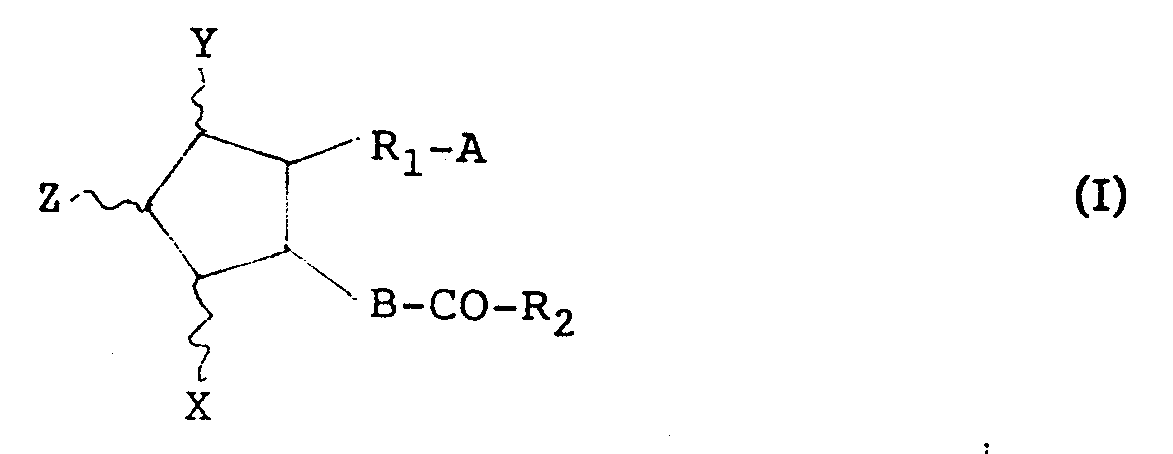
- the present invention provides a use of a 15-ketoprostaglandin according to Formula I compound for the manufacture of a medicament for treatment of a pulmonary dysfunction.
- pulmonary dysfunction means all conditions having etiology based on or accompanied by insufficiency of gas exchange function in lungs, which are symptoms or diseases having connection with either disorder of permeation of oxygen contained in expired gas into resorptive epithelium, disorder of permeation from resorptive epithelium into blood via pulmonary capillary cells or disorder of uptake of oxgen into red cells (i.e. combination with hemoglobin).
- symptoms or diseases include dyspnea or hypopnea resulted from physiologicaly active substance (such as narcotic, toxicant etc), foreign-body inhalation, anthracemia, bronchocontriction attack in hypoxic condition (caused by smoke, dust, chemical irritant etc.), broncho-pulmonary injury, pulmonary contusion or shock; pulmonary edema, atelectasis, pulmonary thromboiss, pulmonary infarction, plumonary fibrosis, pulmonary emphysema, bronchitis, bronchial asthma, adult respiratory distress syndrome (ADRS), infantile respiratory distress syndrome (IRDS), pulmonary stenosis, pulmonary congestion, pulmonary hypertension, chronic obstructive lung disease, congenital heart disease, bilateral carotid body enucleation, sudden infant death syndrome, uremia and central inhibition caused by narcotic or anesthetic.
- physiologicaly active substance such as narcotic, toxicant etc
- treatment refers to any means of control of a disease in a mammal, including preventing the disease, curing the disease, relieving the disease and arresting or relieving the development of the disease.
- Nomenclature of 15-keto-PG compounds herein uses the numbering system of prostanoic acid represented in formula (A) shown above.
- formula (A) shows a basic skeleton having twenty carbon atoms
- the 15-keto-PG compounds used in the present invention are not limited to those having the same number of carbon atoms.
- the carbon atoms in Formula (A) are numbered 2 to 7 on the ⁇ -chain starting from the ⁇ -carbon atom adjacent to the carboxylic carbon atom which is numbered 1 and towards the five-membered ring, 8 to 12 on the said ring starting from the carbon atom on which the ⁇ -chain is attached, and 13 to 20 on the ⁇ -chain starting from the carbon atom adjacent to the ring.
- PGDs, PGEs and PGFs have a hydroxy group on the carbon atom at position 9 and/or 11 but in the present specification the term "15-keto-PG compounds" includes PGs having a group other than a hydroxyl group at position 9 and/or 11. Such PGs are referred to as 9-dehydroxy-9-substituted-PG compounds or 11-dehydroxy-11-substituted-PG compounds.
- 15-keto-PG compounds are based upon the prostanoic acid. These compounds, however, can also be named according to the IUPAC naming system.
- 13,14-dihydro-15-keto-16R,S-fluoro-PGE2 is (Z)-7- ⁇ (1R,2R,3R)-3-hydroxy-2-[(4R,S)-fluoro-3-oxo-1-octyl]-5-oxocyclopentyl ⁇ -hept-5-enoic acid.
- 13,14-dihydro-15-keto-16,16-difluoro-PGE2 is (Z)-7-[(1R,2R,3R)-2-(4,4-difluoro-3-oxo-1-octyl-3-hydroxy-5-oxocyclopentyl]-hept-5-enoic acid.
- the term "unsaturated" in the definitions for R1 and R2 is intended to include at least one and optionally more than one double bond and/or triple bond isolatedly, separately or serially present between carbon atoms of the main and/or side chains.
- an unsaturation between two serial positions is represented by denoting the lower number of said two positions, and an unsaturation between two distal positions is represented by denoting both of the positions.
- Preferred unsaturation is a double bond at position 2 and a double or triple bond at position 5.
- C1-C14 aliphatic hydrocarbon residue refers to a straight or branched chain hydrocarbyl group having 1 to 14 carbon atoms (for a side chain, 1 to 3 carbon atoms being preferred) and preferably 2 to 8 carbon atoms for R1 and 6 to 12 carbon atoms for R2.
- halo denotes fluoro, chloro, bromo and iodo.
- C1-C6 throughout the specification is intended to include a group having 1 to 6 carbon atoms
- C1-C6 alkyl as a group or a moiety in hydroxy(C1-C6)alkyl includes saturated and straight or branched chain hydrocarbon radicals containing 1 to 6, carbon atoms, e.g. methyl, ethyl, propyl, isopropyl, butyl, isobutyl, t-butyl, pentyl and hexyl.
- C1-C6 alkoxy refers to the group lower-alkyl-O- wherein C1-C6 alkyl is as defined above.
- hydroxy(C1-C6)alkyl refers to C1-C6 alkyl as defined above which is substituted with at least one hydroxy group, e.g. hydroxymethyl, 1-hydroxyethyl, 2-hydroxyethyl and 1-methyl-1-hydroxyethyl.
- C1-C6 alkanoyloxy refers to a group of the formula: RCO-O- wherein RCO- is an acyl group formed by oxidation of a C1-C6 alkyl group as defined above, e.g. acetyl.
- cyclo(C1-C6)alkyl refers to a cyclic group formed by cyclization of a C1-C6 alkyl group as defined above.
- aryl includes unsubstituted or substituted aromatic carbocyclic or heterocyclic (preferably monocyclic) groups, e.g. phenyl, tolyl, xylyl and thienyl.
- substituents are halo and halo(lower)alkyl wherein halo and C1-C6 alkyl being as defined above.
- aryloxy refers to a group of the formula: ArO- wherein Ar is aryl as defined above.
- the term "functional derivative" of carboxy as A includes salts (preferably pharmaceutically acceptable salts), esters and amides.
- Suitable “pharmaceutically acceptable salts” includes conventional non-toxic salts, and may be a salt with an inorganic base, for example an alkali metal salt (e.g. sodium salt, potassium salt,) and an alkaline earth metal salt (e.g. calcium salt, magnesium salt,), ammonium salt, a salt with an organic base, for example, an amine salt (e.g.
- methylamine salt dimethylamine salt, cyclohexylamine salt, benzylamine salt, piperidine salt, ethylenediamine salt, ethanolamine salt, diethanolamine salt, triethanolamine salt, tris(hydroxymethylamino)ethane salt, monomethyl-monoethanolamine salt, procaine salt, caffeine salt,.), a basic amino acid salt (e.g. arginine salt, lysine salt.), tetraalkyl ammonium salt and the like.
- These salts can be prepared by the conventional process, for example from the corresponding acid and base or by salt interchange.
- esters are aliphatic esters, for example, C1-C6 alkyl ester e.g. methyl ester, ethyl ester, propyl ester, isopropyl ester, butyl ester, isobutyl ester, t-butyl ester, pentyl ester, 1-cyclopropylethyl ester, etc., C1-C6 alkenyl ester e.g. vinyl ester, allyl ester, C1-C6 alkynyl ester e.g. ethynyl ester, propynyl ester, hydroxy(C1-C6) alkyl ester e.g.
- C1-C6 alkyl ester e.g. methyl ester, ethyl ester, propyl ester, isopropyl ester, butyl ester, isobutyl ester, t-butyl ester, pentyl ester, 1-
- hydroxyethyl ester C1-C6 alkoxy (C1-C6)-alkyl ester e.g. methoxymethyl ester, 1-methoxyetyl ester and aromatic esters, for example, optionally substituted aryl ester e.g. phenyl ester, tosyl ester, t-butylphenyl ester, salicyl ester, 3,4-di-methoxyphenyl ester, benzamidophenyl ester, aryl(C1-C6)alkyl ester e.g. benzyl ester, trityl ester, and benzhydryl ester.
- aryl ester e.g. phenyl ester, tosyl ester, t-butylphenyl ester, salicyl ester, 3,4-di-methoxyphenyl ester, benzamidophenyl ester, aryl(C1-C6)alky
- amides are mono- or di- C1-C6 alkyl amides e.g. methylamide, ethylamide, dimethylamide, arylamide e.g. anilide, toluidide, and C1-C6 alkyl- or aryl-sulfonylamide e.g. methylsulfonylamide, ethylsulfonylamide, and tolylsulfonylamide.
- Preferred examples of A include -COOH, -COOCH3, -COOCH2CH3, -COOCH(CH3)2 and -CONHSO2CH3.
- the configuration of the ring and the ⁇ - and/or omega chain in the above formula (I) may be the same as or different from that in the primary PGs.
- the present invention also includes a mixture of a compound having a primary configuration and that of an unprimary configuration.
- Examples of the typical compounds of the present invention are 15-keto-PGs, 13,14-dihydro-15-keto-PGs and their e.g. 6-keto-derivatives, ⁇ 2-derivatives, 3R,S-methyl-derivatives, 5R,S-fluoro-derivatives, 5,5-difluoro-derivatives, 16R,S-methyl-derivatives, 16,16-dimethyl-derivatives, 16R,S-fluoro-derivatives, 16,16-difluoro-derivatives, 17S-methyl-derivatives, 17R,S-fluoro-derivatives, 17,17-difluoro-derivatives, 19-methyl-derivatives, 20-methyl-derivatives, 20-ethyl-derivatives, 19-desmethyl-derivatives and 16-desbutyl-16-phenoxy derivatives.
- 15-keto-PG compounds of the present invention When 15-keto-PG compounds of the present invention have a saturated bond between positions 13 and 14, these compounds may be in the keto-hemiacetal equilibrium by forming a hemiacetal between hydroxy group at position 11 and ketone at position 15.
- both tautomeric isomers when present, varies depending on the structure of the rest of the molecule or kind of any substituent present and, sometimes, one isomer may predominantly be present in comparison with the other.
- the compounds used in the invention include both isomers.
- the compounds used in the invention may be represented by a structure or name based on keto-form regardless of the presence or absence of the isomers, it is to be noted that such structure or name does not intend elimination of the hemiacetal type of compounds.
- any of the individual tautomeric isomers, a mixture thereof, or optical isomers, a mixture thereof, a racemic mixture, and other isomers such as steric isomers can be used in the same purpose.
- Some of the compounds used in the present invention may be prepared by the method disclosed in Japanese Patent Publications (unexamined) No. A-52753/1989, A-104040/1989, A-151519/1989.
- these compounds may be prepared by a process analogous to that described herein or to known processes.
- a practical preparation of the 15-keto compounds involves the following steps; referring to the Synthetic Charts I to III, reaction of the aldehyde (2) prepared by the Collins oxidation of commercially available (-)-Corey lactone (1) with dimethyl (2-oxoheptyl)phosphate anion to give ⁇ , ⁇ -unsaturated ketone (3), reduction of the ⁇ , ⁇ -unsaturated ketone (3) to the corresponding saturated ketone (4), protection of the carbonyl group of the ketone (4) with a diol to the corresponding ketal (5), and deprotection of the p-phenylbenzoyl group to give the corresponding alcohol (6) followed by protection of the newly derived hydroxy group with dihydropyrane to give the corresponding tetrahydropyranyl ether (7).
- a precursor of PGEs wherein the ⁇ -chain is a 13,14-dihydro-15-keto-alkyl group is prepared.
- 6-keto- PGE1s (15) of which a group constituted with carbon atoms at positions 5, 6 and 7 is may be prepared in the following steps; reduction of the tetrahydropyranyl ether (7) with, for example, diisobutyl aluminum hydride to give the corresponding lactol (8), reaction of the lactol (8), with the ylide generated from (4-carboxybutyl)triphenyl phosphonium bromide followed by esterification (10), cyclization between the 5,6-double bond and the hydroxyl group at position 9 with NBS or iodine to give the halogenated compound (11), dehydrohalogenation of the compound (11) with, for example, DBU to give the 6-keto compound (13) followed by Jones oxidation and removal of the protecting groups.
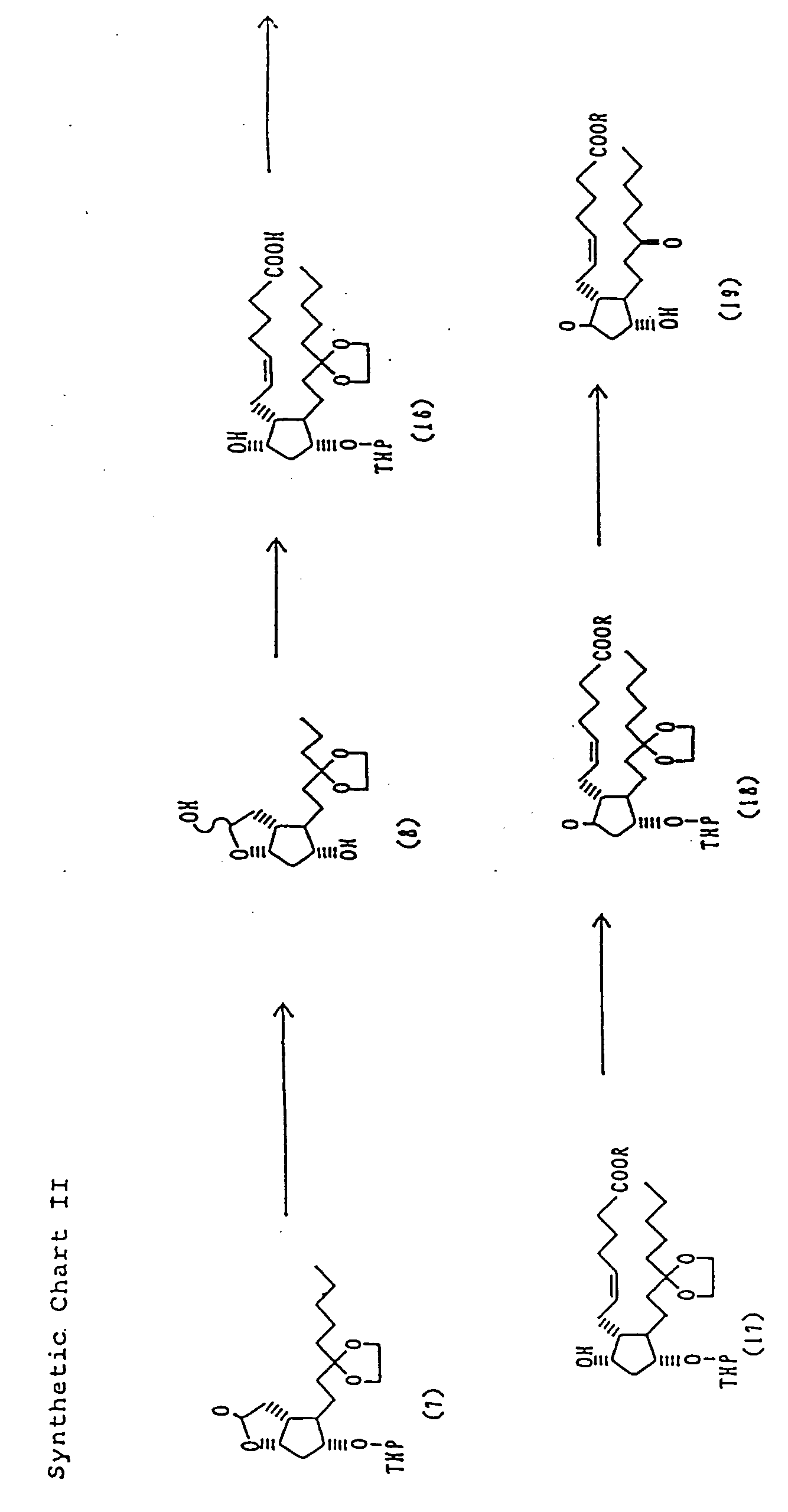
- PGE2s (19) of which a group constituted with carbon atoms at positions 5, 6 and 7 is may be prepared in the following steps; as shown in the Synthetic Chart II, reduction of the above tetrahydropyranyl ether (7) to give the lactol (8), reaction of the resultant lactol (8) with the ylide derived from (4-carboxybutyl)triphenyl phosphonium bromide to give the carboxylic acid (16) followed by esterification to give ester (17), Jones oxidation of the esters (17) to give the compound (18), and removal of the protecting groups.
- Synthesis of 5,6-dehydro-PGE2s having may be carried out by capturing a copper enolate formed by 1,4-addition of a monoalkylcopper complex or a dialkylcopper complex of the following formulae: wherein G is alkyl, to 4R-t-butyldimethylsilyloxy-2-cyclopenten-1-one with 6-alkoxycarbonyl-1-iodo-2-hexyne or the derivatives.
- the 11- ⁇ type PGEs can be prepared according to the Synthetic Chart III.
- PGE derivatives having a methyl group at position 11 in place of hydroxy can be prepared by reacting a dimethyl copper complex with PGA-type compound obtained by subjecting 9-hydroxy-11-tosylate to the Jones oxidation.
- they can be prepared by protecting the carbonyl of saturated ketone (4) produced by reducing unsaturated ketone (3), eliminating p-phenylbenzoyl and tosylating the produced alcohol, treating with DBU to form a lactol, introducing the alpha-chain by Wittig reaction, oxidizing the alcohol at position 9 to give PGA-type compound, and reacting the product with dimethyl copper complex in order to introduce a methyl group into position 11 to give an 11-methyl-PGE-type compound, which on reduction with e.g.
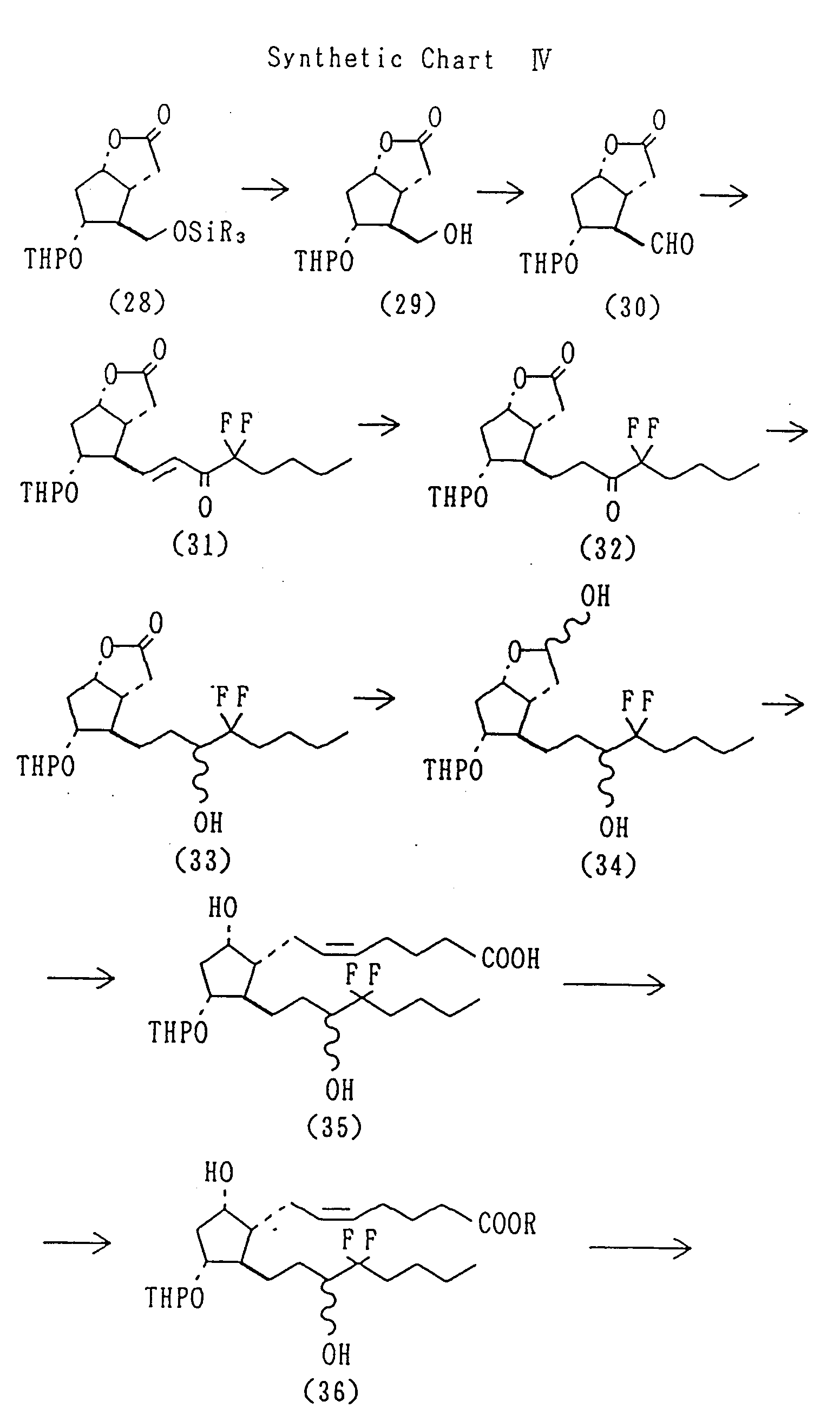
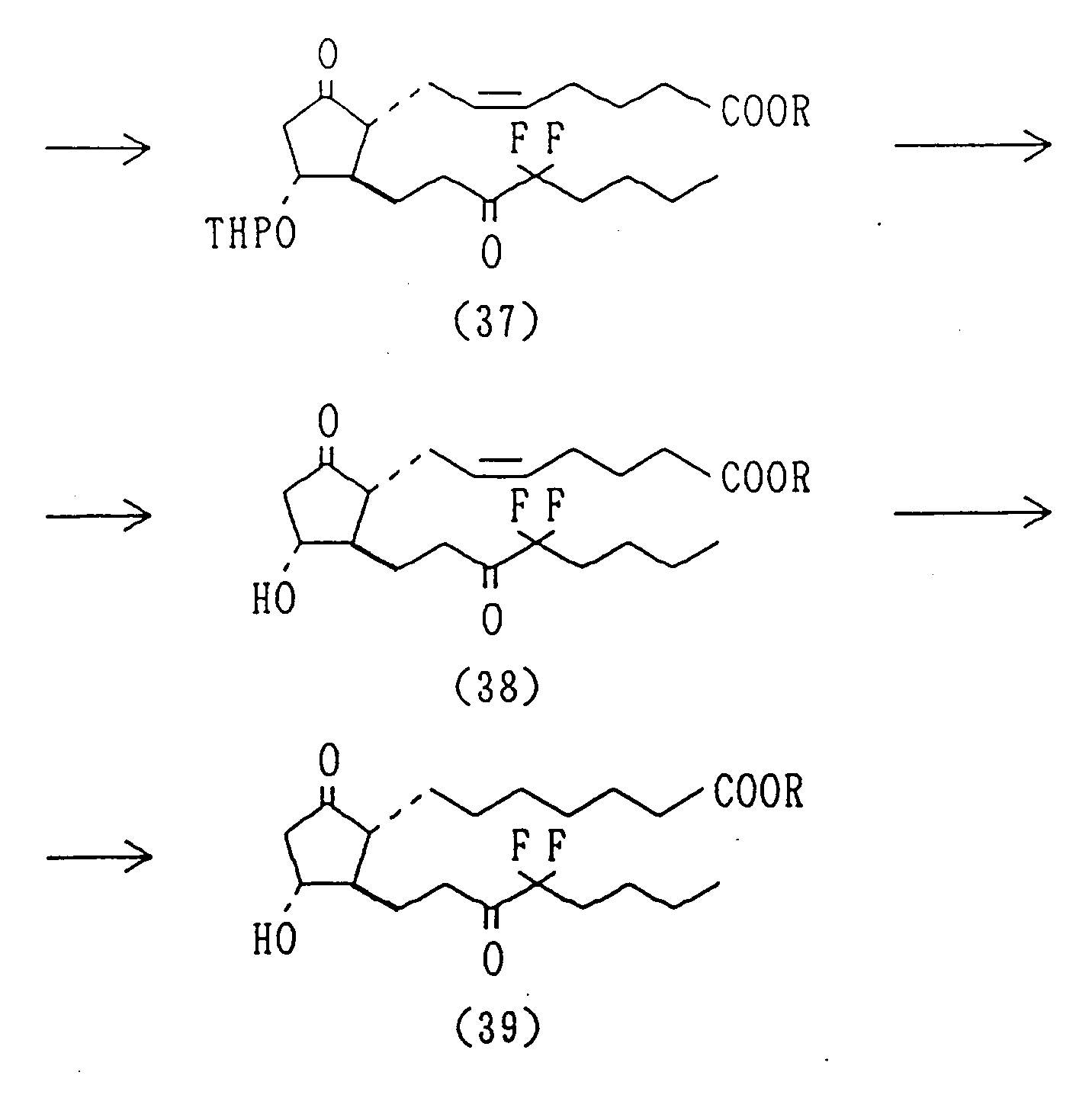
- the 16-mono- or 16,16-di-halo type PGEs can be prepared according to the synthetic chart IV.
- the synthetic route for the compounds used in the present invention is not limited to the that described above one and may vary using different protecting, reducing and/or oxidizating methods.
- Corresponding other PG compounds can be produced analogously. Since the compounds used in the present invention have an activity useful in prevention or therapy of insufficiency of gas exchange function in lungs and improving defensive ability of cells thereto or preventing death of cells therefrom, these can be used for preparing a medicament for treating pulmonary dysfunction. Such activities can be measured by the standard methods such as potassium cyanide induced cytotoxic hypoxia model or dyspnea model.
- the compounds used in the present invention may be used as a medicine for animals and human beings and usually applied systemically or locally by such methods as oral administration, intravenous injection (including instillation), subcutaneous injection, suppository and the like. While the dosage will vary depending on the particular animal or human patient, age, body weight, symptom to be treated, desired therapeutic effect, administration route, term of treatment and the like, satisfactory effects will be obtained with the dosage of 0.001 - 500 mg/kg administered in 2 to 4 divided doses a day or as a sustained form.
- solid composition of this invention for oral administration, tablets, troches, buccals, capsules, pills, powders, granules and the like are included.
- the solid composition containing one or more active substances is mixed with at least an inactive diluent, e.g. lactose, mannitol, glucose, hydrocypropyl cellulose, fine crystalline cellulose, starch, polyvinyl pyrolidone, magnesium aluminate metasilicate.
- the composition may contain additives other than the inactive diluent, for example, lubricants e.g., magnesium stearate, a disintegrator e.g. cellulose calcium gluconates, stabilizers e.g.
- cyclodextrins may increase the stability of the compounds by forming an inclusion compounds. The stability may be often increased by forming lyposome with phospholipids.
- Tablets and pills may be coated with an enteric or gastroenteric film e.g. white sugar, gelatin, hydroxypropylcellulose, hydroxypropylmethylcellulose phthalates and the like, if necessary, and furthermore they may be covered with two or more layers.
- the composition may be in the form of capsules made of substance easily absorbed e.g. gelatin.
- the composition may be in the form of buccals, when an immediate effect is desired.
- base e.g. glycerine, lactose may be used.
- Liquid compositions for oral administration include pharmaceutically acceptable emulsions, solutions, suspensions, syrups, elixirs and the like and contain a generally used inactive diluent e.g. purified water or ethyl alcohol.
- the composition may contain additives e.g. wetting agents, suspending agents, sweeteners, flavors, perfumes and preservatives.
- composition of the present invention may be in the form of sprays which may contain one or more active ingredients and which can be prepared according to a well known methods.
- An injection of this invention for non-oral administration includes sterile aqueous or nonaqueous solutions, suspensions, and emulsions.
- Diluents for the aqueous solution or suspension include, for example, distilled water for injection, physiological saline and Ringer's solution.
- Diluents for the nonaqueous solution and suspension include, for example, propylene glycol, polyethylene glycol, vegetable oils e.g. olive oil, alcohols, e.g. ethanol and polysorbates.
- the composition may contain other additives, e.g. preservatives, wetting agents, emulsifying agents, dispersing agents and the like. These are sterilized by filtration through, e.g. a bacteria-retaining filter, compounding with a sterilizer, gas sterilization or radiation sterilization. These can be prepared by producing a sterilized water or a sterilized solvent for injection before use.
- Another formulation according to the present invention is a rectal or vaginal suppository.
- This can be prepared by mixing at least one active compound according to the invention with a suppository base e.g. cacao butter and optionally containing nonionic surfactant for improving absorption.
- a suppository base e.g. cacao butter and optionally containing nonionic surfactant for improving absorption.
- the above pharmaceutical preparation can be used in the case of toxic headache, increased irritability, confusion, vertigo, paropsia, nausea, syncope, coma, spasm, hypopnea, hyperidrosis, pyrexia, leucocytosis, bleeding tendency, albuminurea, tremor, drowsiness, hypertension etc.
- the present invention also provides a method for treating disorder of oxgen uptake into blood through lung.
- Collins reagent was prepared by using chromic anhydride (13.5 g) and pyridine (21.8 ml) in dichloromethane (300 ml), and to this were added Celite (40 g) and (15RS)-16,16-difluoro-13,14-dihydro-11-O-tetrahydropyranyl-PGF 2 ⁇ benzyl ester (36) (2.550 g).
- the reaction mixture was treated in the conventional manner and the crude product was purified by silica-gel column chromatography to give the title compound (37). Yield: 1.991 g (78.6%)
- the active ingredient can be replaced by any other compound within the compounds used in the invention.
- test animals 10-12/group male Slc-ddY mice (5 weeks old, 27-30 g) were used.
- test compound was dissolved in Ringer solution in such amount that the obtained solution can be administered at 10 ml/kg body weight.
- mice were divided according to their weight into groups with even mean weight, each group consisting of 12 animals.
- mice received test compound in solution and after 5 minutes, 4 mg/kg KCN intravenously and survival time was measured based on heartbeat as an index.
- Table 1 Dose (mg/kg ,s.c.) Number of Animals Survival Time (min.-sec.) Mean ⁇ S.D. Control 0 12 9-32 ⁇ 1-48 Compound 1 0.3 10 ** 16-42 ⁇ 3-36 0.1 10 ** 13-09 ⁇ 2-10 0.03 10 8-45 ⁇ 1-16 t-test: ** p ⁇ 0.01 v.s. Control
- test animals 5/group male Crj:Wistar rats (7 weeks old, 200-250 g) were used.
- test compound was dissolved in the physiological saline in such amount that the obtained solution can be administered at 5 ml/kg body weight.
- test compound was subcutaneously administered at the dorsal skin.
- ammonium sulfate [(NH4)2SO4] was intraperitoneally administered at a dose of 600 mg/kg and survival rate after 30 minutes was measured. The results are shown in the following Table 2.
- Control animals received the physiological saline. In this case, tonic convulsion derived from dyspnea was observed after about 10 minutes and all animals deceased within 30 minutes after administration.
- Table 2 Dose ( ⁇ g/kg) Survival Rate (%) Control 0 0 Compound 1 1 20 10 80 t-test: ** p ⁇ 0.01 v.s. Control
- Test Example 2 The procedure of Test Example 2 was repeated using other Test Compounds. The results are shown in Tables 3 and 4. Table 3 Dose ( ⁇ g/kg) Survival Rate (%) Control 0 0 Compound 2 100 40
- test animals 5/group male Crj:Wistar rats (7 weeks old, 200-250 g) were used.
- test compounds were dissolved in the physiological saline in such amount that the obtained solution can be administered at 5 ml/kg body weight.
- test compound was subcutaneously administered at the dorsal skin.
- ammonium sulfate [(NH4)2SO4] was intraperitoneally administered at a dose of 600 mg/kg. After 30 minutes, survived animals were sacrificed with chloroform and rapidly after the lungs of the animal were removed and weighed. The control animals received the physiological saline and the lungs were weighed similarly.
- Rate of inhibiting increase in weight of lung was calculated comparing the weights of lungs from the animals treated with test compounds with those from the control animals. The results are shown in Tables 5-13.
- Table 5 Dose ( ⁇ g/kg) Rate of Inhibiting Increase in Weight of Lung (%) Compound 1 10 48.2 100 66.1 Table 6 Dose ( ⁇ g/kg) Rate of Inhibiting Increase in Weight of Lung (%) Compound 2 100 102.8 Table 7 Dose ( ⁇ g/kg) Rate of Inhibiting Increase in Weight of Lung (%) Compound 3 10 49.0 Table 8 Dose ( ⁇ g/kg) Rate of Inhibiting Increase in Weight of Lung (%) Compound 4 100 75.2 Table 9 Dose ( ⁇ g/kg) Rate of Inhibiting Increase in Weight of Lung (%) Compound 5 100 79.8 Table 10 Dose ( ⁇ g/kg) Rate of Inhibiting Increase in Weight of Lung (%) Compound 6 100 46.5 Table 11 Dose ( ⁇ g/kg) Rate of Inhibiting Increase in Weight of Lung
Landscapes
- Health & Medical Sciences (AREA)
- Chemical & Material Sciences (AREA)
- Medicinal Chemistry (AREA)
- Pharmacology & Pharmacy (AREA)
- Epidemiology (AREA)
- Life Sciences & Earth Sciences (AREA)
- Animal Behavior & Ethology (AREA)
- General Health & Medical Sciences (AREA)
- Public Health (AREA)
- Veterinary Medicine (AREA)
- Pharmaceuticals Containing Other Organic And Inorganic Compounds (AREA)
Abstract
Description
- The present invention relates to a use of a 15-ketoprostaglandin compound for the manufacture of a medicament for treating a pulmonary dysfunction.
- Prostaglandins (hereinafter, prostaglandins are referred to as PGs) are members of a class of organic carboxylic acid that are contained in human and most other mammalian tissues or organs and that exhibit a wide range of physiological activities. Naturally occurring PGs possess as a common structural feature the prostanoic acid skeleton:

Some synthetic analogues have somewhat modified skeletons. The primary PGs are classified based on the structural feature of the five-membered cycle moiety into PGAs, PGBs, PGCs, PGDs, PGEs, PGFs, PGGs, PGHs, PGIs and PGJs, and also on the presence or absence of unsaturation and oxidation in the chain moiety as: - Subscript 1
- - - - 13,14-unsaturated-15-OH
- Subscript 2
- - - - 5,6- and 13,14-diunsaturated-15-OH
- Subscript 3
- - - - 5,6- 13,14- and 17,18-triunsaturated-15-OH
- JP-A-164512/1983 discloses the protecting action of 15-cycloalkyl-6-oxo-PGE₁, 15-cycloalkyl-PGI₁ and I₂, 15-cycloalkyl-6,9α-nitrilo-PGI₁ and 15-cycloalkyl-6,9α-thio-PGI₁ and I₂ from disorder of cells. JP-A-203911/1983 discloses the cell-protecting action of certain 6-oxo-PGE₁ and PGI₁ having methyl group(s) at one or two of positions 15, 16, 17 and 20 and specific 15-cyclopentyl-PGI₁. JP-A-73522/1984 discloses that certain PGD₂ and PGE₁ derivatives may be used as an agent for treating anoxic disease of cranial nerves. All these compounds, however, do not belong to 15-keto-PGs or their derivatives.
- European Patent Application No. 0,310,305 describes that 15-keto-PGs can be used as catharitics.
- As a result of extensive studies about the biological properties of 15-ketoprostaglandin compounds, the present inventors have discovered that these compounds are useful as an agent for treating damaged palmonary function.
- In a first aspect, the present invention provides a use of a 15-ketoprostaglandin according to Formula I compound for the manufacture of a medicament for treatment of a pulmonary dysfunction.
- As used herein, the term "pulmonary dysfunction" means all conditions having etiology based on or accompanied by insufficiency of gas exchange function in lungs, which are symptoms or diseases having connection with either disorder of permeation of oxygen contained in expired gas into resorptive epithelium, disorder of permeation from resorptive epithelium into blood via pulmonary capillary cells or disorder of uptake of oxgen into red cells (i.e. combination with hemoglobin). Examples of said symptoms or diseases include dyspnea or hypopnea resulted from physiologicaly active substance (such as narcotic, toxicant etc), foreign-body inhalation, anthracemia, bronchocontriction attack in hypoxic condition (caused by smoke, dust, chemical irritant etc.), broncho-pulmonary injury, pulmonary contusion or shock; pulmonary edema, atelectasis, pulmonary thromboiss, pulmonary infarction, plumonary fibrosis, pulmonary emphysema, bronchitis, bronchial asthma, adult respiratory distress syndrome (ADRS), infantile respiratory distress syndrome (IRDS), pulmonary stenosis, pulmonary congestion, pulmonary hypertension, chronic obstructive lung disease, congenital heart disease, bilateral carotid body enucleation, sudden infant death syndrome, uremia and central inhibition caused by narcotic or anesthetic.
- As used herein, the term "treatment" or "treating" refers to any means of control of a disease in a mammal, including preventing the disease, curing the disease, relieving the disease and arresting or relieving the development of the disease.
- Nomenclature of 15-keto-PG compounds herein uses the numbering system of prostanoic acid represented in formula (A) shown above.
- While formula (A) shows a basic skeleton having twenty carbon atoms, the 15-keto-PG compounds used in the present invention are not limited to those having the same number of carbon atoms. The carbon atoms in Formula (A) are numbered 2 to 7 on the α-chain starting from the α-carbon atom adjacent to the carboxylic carbon atom which is numbered 1 and towards the five-membered ring, 8 to 12 on the said ring starting from the carbon atom on which the α-chain is attached, and 13 to 20 on the ω-chain starting from the carbon atom adjacent to the ring. When the number of carbon atoms is decreased in the α-chain, the number is deleted in order starting from position 2 and when the number of carbon atoms is increased in the α-chain, compounds are named as substituted derivatives having respective substituents at position 1 in place of carboxy group (C-1). Similarly, when the number of carbon atoms is decreased in the ω-chain, the number is deleted in order starting from position 20 and when the number of carbon atoms is increased in the ω-chain, compounds are named as substituted derivatives having respective substituents at position 20. Stereochemistry of the compounds is the same as that of above formula (A) unless otherwise specified. Thus, 15-keto-PG compounds having 10 carbon atoms in the ω-chain is nominated as 15-keto-20-ethyl-PGs.
- The above formula expresses a specific configuration which is the most typical one, and in this specification compounds having such a configuration are expressed without any specific reference to it.
- In general, PGDs, PGEs and PGFs have a hydroxy group on the carbon atom at position 9 and/or 11 but in the present specification the term "15-keto-PG compounds" includes PGs having a group other than a hydroxyl group at position 9 and/or 11. Such PGs are referred to as 9-dehydroxy-9-substituted-PG compounds or 11-dehydroxy-11-substituted-PG compounds.
- As stated above, nomenclature of 15-keto-PG compounds is based upon the prostanoic acid. These compounds, however, can also be named according to the IUPAC naming system. For example, 13,14-dihydro-15-keto-16R,S-fluoro-PGE₂ is (Z)-7-{(1R,2R,3R)-3-hydroxy-2-[(4R,S)-fluoro-3-oxo-1-octyl]-5-oxocyclopentyl}-hept-5-enoic acid. 13,14-dihydro-15-keto-16,16-difluoro-PGE₂ is (Z)-7-[(1R,2R,3R)-2-(4,4-difluoro-3-oxo-1-octyl-3-hydroxy-5-oxocyclopentyl]-hept-5-enoic acid.
- The compounds used in the present invention has the formula

wherein X and Y are hydrogen, hydroxy, halo, C₁-C₆ alkyl, hydroxy (C₁-C₆)alkyl, or oxo, with the proviso that at least one of X and Y is a group other than hydrogen, and 5-membered ring may have at least one double bond, Z is hydrogen or halo, A is -CH₂OH, -COCH₂OH, -COOH or its functional derivative, B is -CH₂-CH₂, -CH=CH- or -C≡C-, R₁ is bivalent saturated or unsaturated, C₁-C₁₄ aliphatic hydrocarbon residue which is unsubstituted or substituted with halo, oxo or aryl, R₂ is saturated or unsaturated, C₁-C₁₄ aliphatic hydrocarbon residue which is unsubstituted or substituted with halo, hydroxy, oxo, C₁-C₆ alkoxy, C₁-C₆ alkanoyloxy, cyclo (C₁-C₆)alkyl, aryl or aryloxy. - In the above formula, the term "unsaturated" in the definitions for R₁ and R₂ is intended to include at least one and optionally more than one double bond and/or triple bond isolatedly, separately or serially present between carbon atoms of the main and/or side chains. According to usual nomenclature, an unsaturation between two serial positions is represented by denoting the lower number of said two positions, and an unsaturation between two distal positions is represented by denoting both of the positions. Preferred unsaturation is a double bond at position 2 and a double or triple bond at position 5.
- The term "C₁-C₁₄ aliphatic hydrocarbon residue" refers to a straight or branched chain hydrocarbyl group having 1 to 14 carbon atoms (for a side chain, 1 to 3 carbon atoms being preferred) and preferably 2 to 8 carbon atoms for R₁ and 6 to 12 carbon atoms for R₂.
- The term "halo" denotes fluoro, chloro, bromo and iodo.
- The term "C₁-C₆" throughout the specification is intended to include a group having 1 to 6 carbon atoms,
- The term "C₁-C₆ alkyl" as a group or a moiety in hydroxy(C₁-C₆)alkyl includes saturated and straight or branched chain hydrocarbon radicals containing 1 to 6, carbon atoms, e.g. methyl, ethyl, propyl, isopropyl, butyl, isobutyl, t-butyl, pentyl and hexyl.
- The term "C₁-C₆ alkoxy" refers to the group lower-alkyl-O- wherein C₁-C₆ alkyl is as defined above.
- The term "hydroxy(C₁-C₆)alkyl" refers to C₁-C₆ alkyl as defined above which is substituted with at least one hydroxy group, e.g. hydroxymethyl, 1-hydroxyethyl, 2-hydroxyethyl and 1-methyl-1-hydroxyethyl.
- The term "C₁-C₆ alkanoyloxy" refers to a group of the formula: RCO-O- wherein RCO- is an acyl group formed by oxidation of a C₁-C₆ alkyl group as defined above, e.g. acetyl.
- The term "cyclo(C₁-C₆)alkyl" refers to a cyclic group formed by cyclization of a C₁-C₆ alkyl group as defined above.
- The term "aryl" includes unsubstituted or substituted aromatic carbocyclic or heterocyclic (preferably monocyclic) groups, e.g. phenyl, tolyl, xylyl and thienyl. Examples of substituents are halo and halo(lower)alkyl wherein halo and C₁-C₆ alkyl being as defined above.
- The term "aryloxy" refers to a group of the formula: ArO- wherein Ar is aryl as defined above.
- The term "functional derivative" of carboxy as A includes salts (preferably pharmaceutically acceptable salts), esters and amides.
- Suitable "pharmaceutically acceptable salts" includes conventional non-toxic salts, and may be a salt with an inorganic base, for example an alkali metal salt (e.g. sodium salt, potassium salt,) and an alkaline earth metal salt (e.g. calcium salt, magnesium salt,), ammonium salt, a salt with an organic base, for example, an amine salt (e.g. methylamine salt, dimethylamine salt, cyclohexylamine salt, benzylamine salt, piperidine salt, ethylenediamine salt, ethanolamine salt, diethanolamine salt, triethanolamine salt, tris(hydroxymethylamino)ethane salt, monomethyl-monoethanolamine salt, procaine salt, caffeine salt,.), a basic amino acid salt (e.g. arginine salt, lysine salt.), tetraalkyl ammonium salt and the like. These salts can be prepared by the conventional process, for example from the corresponding acid and base or by salt interchange.
- Examples of the esters are aliphatic esters, for example, C₁-C₆ alkyl ester e.g. methyl ester, ethyl ester, propyl ester, isopropyl ester, butyl ester, isobutyl ester, t-butyl ester, pentyl ester, 1-cyclopropylethyl ester, etc., C₁-C₆ alkenyl ester e.g. vinyl ester, allyl ester, C₁-C₆ alkynyl ester e.g. ethynyl ester, propynyl ester, hydroxy(C₁-C₆) alkyl ester e.g. hydroxyethyl ester, C₁-C₆ alkoxy (C₁-C₆)-alkyl ester e.g. methoxymethyl ester, 1-methoxyetyl ester and aromatic esters, for example, optionally substituted aryl ester e.g. phenyl ester, tosyl ester, t-butylphenyl ester, salicyl ester, 3,4-di-methoxyphenyl ester, benzamidophenyl ester, aryl(C₁-C₆)alkyl ester e.g. benzyl ester, trityl ester, and benzhydryl ester. Examples of the amides are mono- or di- C₁-C₆ alkyl amides e.g. methylamide, ethylamide, dimethylamide, arylamide e.g. anilide, toluidide, and C₁-C₆ alkyl- or aryl-sulfonylamide e.g. methylsulfonylamide, ethylsulfonylamide, and tolylsulfonylamide.
- Preferred examples of A include -COOH, -COOCH₃, -COOCH₂CH₃, -COOCH(CH₃)₂ and -CONHSO₂CH₃.
- The configuration of the ring and the α- and/or omega chain in the above formula (I) may be the same as or different from that in the primary PGs. However, the present invention also includes a mixture of a compound having a primary configuration and that of an unprimary configuration.
- Examples of the typical compounds of the present invention are 15-keto-PGs, 13,14-dihydro-15-keto-PGs and their e.g. 6-keto-derivatives, Δ²-derivatives, 3R,S-methyl-derivatives, 5R,S-fluoro-derivatives, 5,5-difluoro-derivatives, 16R,S-methyl-derivatives, 16,16-dimethyl-derivatives, 16R,S-fluoro-derivatives, 16,16-difluoro-derivatives, 17S-methyl-derivatives, 17R,S-fluoro-derivatives, 17,17-difluoro-derivatives, 19-methyl-derivatives, 20-methyl-derivatives, 20-ethyl-derivatives, 19-desmethyl-derivatives and 16-desbutyl-16-phenoxy derivatives.
- When 15-keto-PG compounds of the present invention have a saturated bond between positions 13 and 14, these compounds may be in the keto-hemiacetal equilibrium by forming a hemiacetal between hydroxy group at position 11 and ketone at position 15.
- The proportion of both tautomeric isomers, when present, varies depending on the structure of the rest of the molecule or kind of any substituent present and, sometimes, one isomer may predominantly be present in comparison with the other. However, in this invention, it is to be appreciated that the compounds used in the invention include both isomers. Further, while the compounds used in the invention may be represented by a structure or name based on keto-form regardless of the presence or absence of the isomers, it is to be noted that such structure or name does not intend elimination of the hemiacetal type of compounds.
- In the present invention, any of the individual tautomeric isomers, a mixture thereof, or optical isomers, a mixture thereof, a racemic mixture, and other isomers such as steric isomers can be used in the same purpose.
- Some of the compounds used in the present invention may be prepared by the method disclosed in Japanese Patent Publications (unexamined) No. A-52753/1989, A-104040/1989, A-151519/1989.
- Alternatively, these compounds may be prepared by a process analogous to that described herein or to known processes.
- A practical preparation of the 15-keto compounds involves the following steps; referring to the Synthetic Charts I to III, reaction of the aldehyde (2) prepared by the Collins oxidation of commercially available (-)-Corey lactone (1) with dimethyl (2-oxoheptyl)phosphate anion to give α,β-unsaturated ketone (3), reduction of the α,β-unsaturated ketone (3) to the corresponding saturated ketone (4), protection of the carbonyl group of the ketone (4) with a diol to the corresponding ketal (5), and deprotection of the p-phenylbenzoyl group to give the corresponding alcohol (6) followed by protection of the newly derived hydroxy group with dihydropyrane to give the corresponding tetrahydropyranyl ether (7). According to the above process, a precursor of PGEs wherein the ω-chain is a 13,14-dihydro-15-keto-alkyl group is prepared.
- Using the above tetrahydropyranyl ether (7), 6-keto- PGE₁s (15) of which a group constituted with carbon atoms at positions 5, 6 and 7 is

may be prepared in the following steps; reduction of the tetrahydropyranyl ether (7) with, for example, diisobutyl aluminum hydride to give the corresponding lactol (8), reaction of the lactol (8), with the ylide generated from (4-carboxybutyl)triphenyl phosphonium bromide followed by esterification (10), cyclization between the 5,6-double bond and the hydroxyl group at position 9 with NBS or iodine to give the halogenated compound (11), dehydrohalogenation of the compound (11) with, for example, DBU to give the 6-keto compound (13) followed by Jones oxidation and removal of the protecting groups. - Furthermore, PGE₂s (19) of which a group constituted with carbon atoms at positions 5, 6 and 7 is

may be prepared in the following steps; as shown in the Synthetic Chart II, reduction of the above tetrahydropyranyl ether (7) to give the lactol (8), reaction of the resultant lactol (8) with the ylide derived from (4-carboxybutyl)triphenyl phosphonium bromide to give the carboxylic acid (16) followed by esterification to give ester (17), Jones oxidation of the esters (17) to give the compound (18), and removal of the protecting groups. - Using the above tetrahydropyranyl ether (7) as the starting material, the compound having

may be prepared by using the same process as that for preparing PGE₂ having -CH₂CH=CH- and subjecting the resultant compound (18) to catalytic reduction to reduce the double bond between the positions 5 and 6 followed by removal of the protective groups. - Synthesis of 5,6-dehydro-PGE₂s having

may be carried out by capturing a copper enolate formed by 1,4-addition of a monoalkylcopper complex or a dialkylcopper complex of the following formulae:
wherein G is alkyl,
to 4R-t-butyldimethylsilyloxy-2-cyclopenten-1-one with 6-alkoxycarbonyl-1-iodo-2-hexyne or the derivatives. - The 11-β type PGEs can be prepared according to the Synthetic Chart III.
- PGE derivatives having a methyl group at position 11 in place of hydroxy can be prepared by reacting a dimethyl copper complex with PGA-type compound obtained by subjecting 9-hydroxy-11-tosylate to the Jones oxidation. Alternatively, they can be prepared by protecting the carbonyl of saturated ketone (4) produced by reducing unsaturated ketone (3), eliminating p-phenylbenzoyl and tosylating the produced alcohol, treating with DBU to form a lactol, introducing the alpha-chain by Wittig reaction, oxidizing the alcohol at position 9 to give PGA-type compound, and reacting the product with dimethyl copper complex in order to introduce a methyl group into position 11 to give an 11-methyl-PGE-type compound, which on reduction with e.g. sodium borohydride gives an 11-methyl-PGF-type compound. An 11-hydroxymethyl-PGE-type compound, is obtained by a benzophenone-sensitized photoaddition of methanol of PGA-type compound, which is reduced with, e.g. sodium borohydride, to give an 11-hydroxymethyl-PGF-type compound. The 16-mono- or 16,16-di-halo type PGEs can be prepared according to the synthetic chart IV. The synthetic route for the compounds used in the present invention is not limited to the that described above one and may vary using different protecting, reducing and/or oxidizating methods.
- Corresponding other PG compounds can be produced analogously.



Since the compounds used in the present invention have an activity useful in prevention or therapy of insufficiency of gas exchange function in lungs and improving defensive ability of cells thereto or preventing death of cells therefrom, these can be used for preparing a medicament for treating pulmonary dysfunction. Such activities can be measured by the standard methods such as potassium cyanide induced cytotoxic hypoxia model or dyspnea model. - The compounds used in the present invention may be used as a medicine for animals and human beings and usually applied systemically or locally by such methods as oral administration, intravenous injection (including instillation), subcutaneous injection, suppository and the like. While the dosage will vary depending on the particular animal or human patient, age, body weight, symptom to be treated, desired therapeutic effect, administration route, term of treatment and the like, satisfactory effects will be obtained with the dosage of 0.001 - 500 mg/kg administered in 2 to 4 divided doses a day or as a sustained form.
- As a solid composition of this invention for oral administration, tablets, troches, buccals, capsules, pills, powders, granules and the like are included. The solid composition containing one or more active substances is mixed with at least an inactive diluent, e.g. lactose, mannitol, glucose, hydrocypropyl cellulose, fine crystalline cellulose, starch, polyvinyl pyrolidone, magnesium aluminate metasilicate. The composition may contain additives other than the inactive diluent, for example, lubricants e.g., magnesium stearate, a disintegrator e.g. cellulose calcium gluconates, stabilizers e.g. α-, β- or γ-cyclodextrins, etherated cyclodextrins (e.g. dimethyl-α-, dimethyl-β-, trimethyl-β-, or hydroxypropyl-β-cyclodextrins), branched cyclodextrins (e.g. glucosyl- or maltosyl-cyclodextrins), formyl cyclodextrins, sulfur-containing cyclodextrins, misoprotols or phospholipids. Such cyclodextrins may increase the stability of the compounds by forming an inclusion compounds. The stability may be often increased by forming lyposome with phospholipids. Tablets and pills may be coated with an enteric or gastroenteric film e.g. white sugar, gelatin, hydroxypropylcellulose, hydroxypropylmethylcellulose phthalates and the like, if necessary, and furthermore they may be covered with two or more layers. Additionally, the composition may be in the form of capsules made of substance easily absorbed e.g. gelatin. The composition may be in the form of buccals, when an immediate effect is desired. For this purpose, base e.g. glycerine, lactose may be used.
- Liquid compositions for oral administration include pharmaceutically acceptable emulsions, solutions, suspensions, syrups, elixirs and the like and contain a generally used inactive diluent e.g. purified water or ethyl alcohol. The composition may contain additives e.g. wetting agents, suspending agents, sweeteners, flavors, perfumes and preservatives.
- The composition of the present invention may be in the form of sprays which may contain one or more active ingredients and which can be prepared according to a well known methods.
- An injection of this invention for non-oral administration includes sterile aqueous or nonaqueous solutions, suspensions, and emulsions. Diluents for the aqueous solution or suspension include, for example, distilled water for injection, physiological saline and Ringer's solution. Diluents for the nonaqueous solution and suspension include, for example, propylene glycol, polyethylene glycol, vegetable oils e.g. olive oil, alcohols, e.g. ethanol and polysorbates. The composition may contain other additives, e.g. preservatives, wetting agents, emulsifying agents, dispersing agents and the like. These are sterilized by filtration through, e.g. a bacteria-retaining filter, compounding with a sterilizer, gas sterilization or radiation sterilization. These can be prepared by producing a sterilized water or a sterilized solvent for injection before use.
- Another formulation according to the present invention is a rectal or vaginal suppository. This can be prepared by mixing at least one active compound according to the invention with a suppository base e.g. cacao butter and optionally containing nonionic surfactant for improving absorption.
- The above pharmaceutical preparation can be used in the case of toxic headache, increased irritability, confusion, vertigo, paropsia, nausea, syncope, coma, spasm, hypopnea, hyperidrosis, pyrexia, leucocytosis, bleeding tendency, albuminurea, tremor, drowsiness, hypertension etc.
- The present invention also provides a method for treating disorder of oxgen uptake into blood through lung.
- A more complete understanding of the present invention can be obtained by reference to the following Preparation Examples, Formulation Examples and Test Examples which are provided herein for purpose of illustration only and are not intended to limit the scope of the invention.
-
- To a solution of commercial Corey lactone (THP-form, 37.9g) in tetrahydrofuran was added a solution (1.0 M, 300 ml) of tetrabutylammonium fluoride in tetrahydrofuran and the resulting mixture was stirred at room temperature for 3 hours.
- Then the reaction mixture was concentrated under reduced pressure and the residue was subjected to column chromatography to give the title compound (29).
Yield: 21.70g (82.8%). - A solution (2.0 M, 45.5 ml) of oxalyl chloride in methylene chloride was diluted with methylene chloride under an argon atmosphere at -78°C. To this solution was added dropwise dimethylsulfoxide (12.9 ml) and the resulting mixture was stirred for 10 minutes. A solution (1S,5R,6R,7R)-6-hydroxymethyl-7-tetrahydropyranyloxy-2-oxabicylo[3.3.0]octan-3-one (29) (11.65 g) in methylene chloride was added dropwise and the mixture was stirred for 30 minutes. Then triethylamine (56 ml) was added dropwise and stirring was continued for further 1 hour. The reaction mixture was treated in the conventional manner to give the aldehyde (30) as a crude product.
- To a solution of thallium ethoxide (3.26 ml) in methylene chloride was added under an argon atmosphere dimethyl 3,3-difluoro-2-oxoheptylphosphonate (11.9 g) and the resulting mixture was stirred for 1 hour. After cooling the solution to 0°C, a solution of the aldehyde (30) obtained above in methylene chloride was added dropwise to said solution and the mixture was stirred at room temperature for 14 hours. The reaction mixture was treated with acetic acid, celite and a saturated aqueous potassium iodide solution and filtered. The filtrate was treated in the conventional manner and the crude product was subjected to column chromatography to give the tile compound (31).
Yield: 7.787 g (44.3 %). - To a solution of (1S,5R,6R,7R)-6-{(E)-4,4-difluoro-5-oxo-2-octenyl}-7-tetrahydropyranyloxy-2-oxabicyclo[3.3.0]octan-3-one (31) (5.57 g) in ethyl acetate was added 5% Pd/C (catalytic amount) and the resulting mixture was shaken under a hydrogen atmosphere at room temperature for 7 hours. The reaction mixture was filtered and the filtrate was concentrated under reduced pressure to give the tile compound (32) as a crude product. Yield: 5.48 g (97.8%).
- To a solution of (1S,5R,6R,7R)-6-(4,4-difluoro-5-oxooctyl)-7-tetrahydropyranyloxy-2-oxabicyclo[3.3.0]octan-3-one (32) (5.48 g) in methanol was added sodium borohydride (0.800 g) at 0°C and the resulting mixture was stirred for 10 minutes. The reaction mixture was treated in the conventional manner and the obtained crude product was subjected to column chromatography to give the title compound (33). Yield: 5.46 g (99.5%).
- A solution of (1S,5R,6R,7R)-6-{4,4-dihydro-5(RS)-hydroxyoctyl}-7-tetrahydropyranyloxy-2-oxabicyclo[3.3.0]-octan-3-one (33) (2.579 g) in toluene was cooled to -78°C under an argon atmosphere. To this solution was added dropwise a solution (1.5 M, 9.6 ml) of diisobutylalmium hydride in toluene and stirred for 30 minutes. The reaction mixture was treated with methanol and a saturated aqueous Rochelle salt solution. Then the solution was treated in the conventional manner to give the lactol (34) as a crude product.
- To a suspension of 4-carboxybutyl triphenyl phosphine bromide (11.72 g) in tetrahydrofuran was added dropwise under an argon atmosphere a solution (1.0 M, 52.84 ml) of potassium tert-butoxide in tetrahydrofuran and the resulting mixture was stirred for 20 minutes. The solution was cooled to 0°C and combined with a solution of lactol (34) in tetrahydrofuran. The resulting mixture was stirred at room temperature for 15 hours and then treated in the conventional manner to give the carboxylic acid (35) as a crude product.
- To a solution of the carboxylic acid (35) in acetonitrile was added under an argon atmosphere 1,8-diazabicyclo[5.4.0]undec-7-ene (DBU) (4.0 ml) and methyl iodide (1.7 ml) and the resulting solution was stirred at 60°C for 30 hours. The solution was treated in the conventional manner and the product was subjected to column chromatography to give the title compound (36).
Yield: 2.737 g (84.5%). - To a solution of Collins reagent, prepared from cromic anhydride (16.18 g) and pyridine (26.2 ml) in the conventional process, in methylene chloride was added a solution of 16,16-difluoro-13,14-dihydrol-11-O-tetrahydropyranyl-PGF2α methyl ester (36) (2.646 g) in methylene chloride under an argon atmosphere at -20°C. The resulting mixture was stirred at the same temperature for 2 hours and at -5°C for 9 hours. The solution was treated with ether and sodium hydrogen sulfate and filtered. The filtrate was concentrated under reduced pressure and the residue was subjected to column chromatography to give the title compound (37). Yield: 1.890 g (64.4%).
- Into a mixed solvent of acetic acid : water : tetrahydrofuran (3:1:1) was dissolved 16,16-difluoro-13,14-dihydro-15-keto-11-O-tetrahydroxypyranyl-PGE₂ methyl ester (37) (2.809 g) and the resulting solution was stirred at 60°C for 5 hours. The reaction mixture was concentrated under reduced pressure and the residue was subjected to chromatography to give the title compound (38).
Yield: 1.755 g (75.5%). - To a solution of 16,16-difluoro-13,14-dihydro-15-keto-PGE₂ methyl ester (38) (1.755 g) in ethyl acetate was added Pd/C (catalytic amount) and the mixture was shaken under a hydrogen atmosphere at room temperature for 6 hours. The reaction mixture was filtered. The filtrate was concentrated and the residue was subjected to column chromatography to give the title compound (39).
Yield: 1.655 g (93.8%).
¹H NMR(CDCl₃) δ0.87(3H,t,J=7Hz), 1.15-2.05(23H,m), 2.11-2.30(3H,m), 2.50(1H,dd,J=7.5 and 17Hz), 3.10-3.20 (1H,br), 3.71(3H,s), 4.05-4.20(1H,m)
MS(DI-EI) m/z 404(M⁺), 355 (M⁺-H₂O-CH₃O), 297(M⁺-C₅H₉F₂) - To a solution of 16,16-difluoro-13,14-dihydro-11-O-tetrahydropyranyl-PGF2α (35) (2.33 g) in dichloromethane (300 ml) were added DBU (2.1 ml) and benzyl bromide (2.2 ml) and the resulting mixture was stirred at room temperature for 1.5 hour. The reaction mixture was treated in the conventional manner and the crude product was purified by silica-gel column chromatography to give the title compound (36). Yield: 2.522 g (96.1%)
- Collins reagent was prepared by using chromic anhydride (13.5 g) and pyridine (21.8 ml) in dichloromethane (300 ml), and to this were added Celite (40 g) and (15RS)-16,16-difluoro-13,14-dihydro-11-O-tetrahydropyranyl-PGF2α benzyl ester (36) (2.550 g). The reaction mixture was treated in the conventional manner and the crude product was purified by silica-gel column chromatography to give the title compound (37). Yield: 1.991 g (78.6%)
- Into a mixed solvent of acetic acid:THF:water (3:1:1, 50 ml) was dissolved 16,16-difluoro-13,14-dihydro-15-keto-11-O-tetrahydropyranyl-PGE₂ benzyl ester (37) (1.550 g) and the solution was kept at 50°C for 4 hours. The reaction mixture was treated in the conventional manner and the crude product was purified by silica-gel column chromatography to give the title compound (38).
Yield: 1.225g (92.9%) - To a solution of 16,16-difluoro-13,14-dihydro-15-keto-PGE₁ benzyl ester (38) (0.844 g) in ethyl acetate (30 ml) was added 5% Pd/C and the mixture was shaken under a hydrogen atmosphere. The reaction mixture was treated in the conventional manner and the crude product was purified by silica-gel column chromatography to give the title compound (43). Yield: 0.404 g
¹H NMR(CDCl₃) δ0.94 (t,3H,J=7.5 Hz), 1.20-2.70 (m,26H), 4.19 (m,1H), 4.80 (br,2H).
MS(DI-EI) m/z 390(M⁺), 372(M⁺-H₂O), 354(M⁺-2H₂O) -
(Parts by weight) 13,14-dihydro-15-keto-16,16-difluoro-PGE₂ 1 mannitol 5 distilled water 0.4 - The above ingredients were mixed, stirred, sterilized, filtered and lyophilized to give powders for injection.
-
(Parts by weight) 13,14-dihydro-15-keto-16,16-difluoro-PGE₁ 0.2 nonion surfactant 2 distilled water 98 - The above ingredients were mixed and sterilized to give and injectable solution.
- 13,14-dihydro-15-keto-16,16-difluoro-20-ethyl-PGE₂ (50mg) dissolved in methanol (10ml) was mixed with mannitol (18.5g). The mixture was screened (with a sieve, the pore size of which being 30 mm in diameter), dried at 30°C for 90 minutes and screened again. The powders thus obtained were mixed with fine-grain silica gel (Aerosil*, 200g) and filled in No.3 hard gelatin capsules (100) to give enteric capsules which contain 0.5mg of 13,14-dihydro-15-keto-16,16-difluoro-20-ethyl-PGE₂ per capsule.
* Trade Mark -
(Parts by weight) 13,14-dihydro-15-keto-16,16-difluoro-PGF2α methyl ester 5 light anhydrous silicic acid 5 Abicel* 20 lactose 70 * Trade Mark - The above ingredients were mixed to give powders for oral administration.
-
(Parts by weight) 13,14-dihydro-15-keto-20-methyl-PGE₂ methyl ester 1 light anhydrous silicic acid 899 Panasate* 20 * Trade Mark - The above ingredients were mixed and filled in soft gelatine capsules.
- 16-desbutyl-13,14-dihydro-15-keto-16-m-trifluoromethylphenoxy-PGF2α methyl ester (50mg) dissolved in methanol (10ml) was mixed with mannitol (18.5g). The mixture was screened (with a sieve, the pore size of which being 30 mm in diameter), dried at 30°C for 90 minutes and screened again. The powders thus obtained were mixed with fine-grain silica gel (Aerosil*, 200g) and filled in No.3 hard gelatin capsules (100) to give enteric capsules which contain 0.5mg of 13,14-dihydro-15-keto-16-desbutyl-16-m-trifluoromethylphenoxy-PGF2α methyl ester per capsule.
* Trade Mark -
(Parts by weight) 13,14-dihydro-15-keto-16,16-difluoro-PGE₁ 1 mannitol 5 distilled water 0.4 - The above ingredients were mixed, stirred, sterilized, filtered and lyophilized to give powders for injection.
-
(Parts by weight) 13,14-dihydro-6,15-diketo-5R,S-fluoro-PGE₁ 0.2 nonion surfactant 2 distilled water 98 - The above ingredients were mixed and sterilized to give and injectable solution.
-
(Parts by weight) 13,14-dihydro-15-keto-16,16-difluoro-19-desmethyl-PGE₂ methyl ester 5 light anhydrous silicic acid 5 Abicel* 20 lactose 70 * Trade Mark - The above ingredients were mixed to give powders for oral administration.
-
(Parts by weight) 13,14-dihydro-15-keto-16-desbutyl-16-m-trifluoromethylphenoxy-PGE₂ methyl ester 1 light anhydrous silicic acid 899 Panasate* 20 * Trade Mark - The above ingredients were mixed and filled in soft gelatine capsules.
- In the above formulation examples, the active ingredient can be replaced by any other compound within the compounds used in the invention.
- As the test animals, 10-12/group male Slc-ddY mice (5 weeks old, 27-30 g) were used.
- For subcutaneous administration, test compound was dissolved in Ringer solution in such amount that the obtained solution can be administered at 10 ml/kg body weight.
- The mice were divided according to their weight into groups with even mean weight, each group consisting of 12 animals.
- The mice received test compound in solution and after 5 minutes, 4 mg/kg KCN intravenously and survival time was measured based on heartbeat as an index.
- The results are shown in the following Table 1.
Table 1 Dose (mg/kg ,s.c.) Number of Animals Survival Time (min.-sec.) Mean ± S.D. Control 0 12 9-32±1-48 Compound 1 0.3 10 ** 16-42±3-36 0.1 10 ** 13-09±2-10 0.03 10 8-45±1-16 t-test: ** p<0.01 v.s. Control - Test Compound:
- 13,14-dihydro-15-keto-16,16-difluoro-PGE₂
- As the test animals, 5/group male Crj:Wistar rats (7 weeks old, 200-250 g) were used.
- For subcutaneous administration, test compound was dissolved in the physiological saline in such amount that the obtained solution can be administered at 5 ml/kg body weight.
- The test compound was subcutaneously administered at the dorsal skin.
- After 30 minutes, ammonium sulfate [(NH₄)₂SO₄] was intraperitoneally administered at a dose of 600 mg/kg and survival rate after 30 minutes was measured. The results are shown in the following Table 2.
- The control animals received the physiological saline. In this case, tonic convulsion derived from dyspnea was observed after about 10 minutes and all animals deceased within 30 minutes after administration.
Table 2 Dose (µg/kg) Survival Rate (%) Control 0 0 Compound 1 1 20 10 80 t-test: ** p<0.01 v.s. Control - Compound 1:
- The same as in Test Example 1
- The procedure of Test Example 2 was repeated using other Test Compounds. The results are shown in Tables 3 and 4.
Table 3 Dose (µg/kg) Survival Rate (%) Control 0 0 Compound 2 100 40 - Compound 2:
- 13,14-dihydro-5-keto-16,16-difluoro-PGE₂ methyl ester
- Compound 3:
- 13,14-dihydro-15-keto-16,16-difluoro-PGE₁
- As the test animals, 5/group male Crj:Wistar rats (7 weeks old, 200-250 g) were used.
- For subcutaneous administration, test compounds were dissolved in the physiological saline in such amount that the obtained solution can be administered at 5 ml/kg body weight.
- The test compound was subcutaneously administered at the dorsal skin.
- After 30 minutes, ammonium sulfate [(NH₄)₂SO₄] was intraperitoneally administered at a dose of 600 mg/kg. After 30 minutes, survived animals were sacrificed with chloroform and imediately after the lungs of the animal were removed and weighed. The control animals received the physiological saline and the lungs were weighed similarly.
- Rate of inhibiting increase in weight of lung was calculated comparing the weights of lungs from the animals treated with test compounds with those from the control animals. The results are shown in Tables 5-13.
Table 5 Dose (µg/kg) Rate of Inhibiting Increase in Weight of Lung (%) Compound 1 10 48.2 100 66.1 Table 6 Dose (µg/kg) Rate of Inhibiting Increase in Weight of Lung (%) Compound 2 100 102.8 Table 7 Dose (µg/kg) Rate of Inhibiting Increase in Weight of Lung (%) Compound 3 10 49.0 Table 8 Dose (µg/kg) Rate of Inhibiting Increase in Weight of Lung (%) Compound 4 100 75.2 Table 9 Dose (µg/kg) Rate of Inhibiting Increase in Weight of Lung (%) Compound 5 100 79.8 Table 10 Dose (µg/kg) Rate of Inhibiting Increase in Weight of Lung (%) Compound 6 100 46.5 Table 11 Dose (µg/kg) Rate of Inhibiting Increase in Weight of Lung (%) Compound 7 100 46.5 Table 12 Dose (µg/kg) Rate of Inhibiting Increase in Weight of Lung (%) Compound 8 100 45.7 Table 13 Dose (µg/kg) Rate of Inhibiting Increase in Weight of Lung (%) Compound 9 100 47.3 - Test Compound:
- 1:
- The same as above.
- 2:
- The same as above.
- 3:
- The same as above.
- 4:
- 13,14-dihydro-15-keto-16,16-difluoro-PGE₁ methyl ester
- 5:
- 13,14-dihydro-15-keto-16,16-difluoro-19-desmethyl-PGE₂
- 6:
- 13,14-dihydro-15-keto-16,16-difluoro-20-methyl-PGE₂
- 7:
- 13,14-dihydro-15-keto-16,16-difluoro-11-dehydroxy-11-methyl-PGE₂ methyl ester
- 8:
- 13,14-dihydro-6,15-diketo-5,5-difluoro-PGE₁ methyl ester
- 9:
- 13,14-dihydro-15-keto-16,16-difluoro-PGF2α methyl ester
| Dose (µg/kg) | Survival Rate (%) | |
| Control | 0 | 30 |
| Compound 2 | 100 | 60 |
In the following data, NMR spectra were measured in CDCl₃ using HITACHI R-90H and mass spectra were measured by EI method at an ionization potential of 70eV using HITACHI M-80B.
*13,14-dihydro-15-keto-16,16-difluoro-PGE₂
¹H NMR (CDCl₃) δ0.93(t,3H,J=7.5 Hz), 1.20-2.70(m,24H), 4.20 (m,1H), 5.40(m,2H)
MS(DI-EI) m/z 388(M⁺), 370(M⁺-H₂O), 352(M⁺-2H₂O)
*13,14-dihydro-15-keto-16,16-difluoro-19-desmethyl-PGE₂
¹H NMR (CDCl₃) δ0.98(t,3H,J=7.5 Hz), 1.40-2.70(m,22H), 4.20(m,1H) 5.40(m,2H)
MS(DI-EI) m/z 374(M⁺), 356(M⁺-H₂O), 338(M⁺-H₂O),
*13,14-dihydro-15-keto-16,16-difluoro-20-methyl-PGE₂
¹H NMR (CDCl₃) δ0.90(t,3H,J=7.5 Hz), 1.20-2.70(m,26H), 4.20(m,1H), 5.41(m,2H)
MS(DI-EI) m/z 402(M⁺), 384(M⁺-H₂O), 368(M⁺-2H₂O)
*13,14-dihydro-15-keto-16,16-difluoro-11-dehydroxy-11-methyl-PGE₂ methyl ester
¹H NMR (CDCl₃) δ0.93(t,3H,J=7.5 Hz), 1.14(d,3H,J=6 Hz), 1.25-2.80(m,22H), 3.68(s,3H), 5.38(m,2H)
MS(DI-EI) m/z 400(M⁺), 369(M⁺-CH₃O)
*13,14-dihydro-6,15-diketo-5,5-difluoro-PGE₁ methyl ester
¹H NMR (CDCl₃) δ0.88(t,3H,J=6.6 Hz), 1.10-1.40(m,4H), 1.45-2.20(m,10H), 2.20-3.15(m,11H), 3.67(s,3H), 4.00-4.18 (m,1H)
MS(DI-EI) m/z 418(M⁺), 400(M⁺-H₂O), 360(M⁺-HF-H₂O), 99(C₆H₁₁CO⁺)
Claims (9)
- The use of a 15-ketoprostaglandin compound represented by the formula (I):
- The use according to claim 1, in which said 15-ketoprostaglandin compound is a 15-ketoprostaglandin E or F compound.
- The use according to claim 1, in which the pulmonary dysfunction is based on cytotoxic hypoxia or dyspnea.
- The use according to claim 1, in which said 15-ketoprostaglandin compound is a 16-mono- or di-halo-15-ketoprostaglandin compound.
- The use according to claim 1, in which said 15-ketoprostaglandin compound is a 13,14-dihydro-16-mono- or di-halo-15-ketoprostaglandin compound.
- The use according to claim 1, in which said 15-ketoprostaglandin compound is a 13,14-dihydro-16-mono- or di-fluoro-15-ketoprostaglandin compound.
- The use according to claim 1, in which said-15-ketoprostaglandin compound is a 6,15-diketo-prostaglandin compound.
- The use according to claim 1 for treatment of insufficiency of gas exchange function.
- The use according to claim 1 for treatment of pulmonary edema.
Applications Claiming Priority (2)
| Application Number | Priority Date | Filing Date | Title |
|---|---|---|---|
| JP30384189 | 1989-11-22 | ||
| JP303841/89 | 1989-11-22 |
Publications (3)
| Publication Number | Publication Date |
|---|---|
| EP0430552A2 EP0430552A2 (en) | 1991-06-05 |
| EP0430552A3 EP0430552A3 (en) | 1992-07-01 |
| EP0430552B1 true EP0430552B1 (en) | 1995-11-08 |
Family
ID=17925951
Family Applications (1)
| Application Number | Title | Priority Date | Filing Date |
|---|---|---|---|
| EP90312641A Expired - Lifetime EP0430552B1 (en) | 1989-11-22 | 1990-11-21 | Treatment of pulmonary dysfunction with 15-keto-prostaglandin compounds |
Country Status (5)
| Country | Link |
|---|---|
| EP (1) | EP0430552B1 (en) |
| KR (1) | KR0153779B1 (en) |
| AT (1) | ATE129895T1 (en) |
| CA (1) | CA2030344C (en) |
| DE (1) | DE69023459T2 (en) |
Families Citing this family (8)
| Publication number | Priority date | Publication date | Assignee | Title |
|---|---|---|---|---|
| DK0978284T3 (en) * | 1997-11-28 | 2008-10-27 | Sucampo Ag | Use of 15-keto-prostaglandin-E compounds as endothelin antagonists |
| ATE402925T2 (en) | 1999-10-15 | 2008-08-15 | Sucampo Ag | NEW COMPOSITION CONTAINING A BICYCLIC COMPOUND AND A GLYCERIDE |
| JP4786866B2 (en) | 2001-08-31 | 2011-10-05 | スキャンポ・アーゲー | Prostaglandin analogs as chloride channel openers |
| AR037524A1 (en) * | 2001-11-14 | 2004-11-17 | Sucampo Ag | DOSAGE UNIT INCLUDING A PROSTAGLANDINE ANALOG FOR THE CONSTIPATION TREATMENT |
| US7732487B2 (en) | 2001-11-19 | 2010-06-08 | Sucampo Ag | Method for treating a disease or condition responsive to opening of C1C-2 channel |
| JP5377970B2 (en) * | 2006-02-28 | 2013-12-25 | スキャンポ・アーゲー | Methods and compositions for treating chronic obstructive pulmonary disease |
| US20100305203A1 (en) * | 2009-05-27 | 2010-12-02 | Sucampo Ag | Method for modulating claudin mediated functions |
| US8569279B2 (en) | 2009-05-27 | 2013-10-29 | Sucampo Ag | Method for modulating claudin mediated functions |
Family Cites Families (11)
| Publication number | Priority date | Publication date | Assignee | Title |
|---|---|---|---|---|
| US3764699A (en) * | 1971-12-02 | 1973-10-09 | American Home Prod | Methods for relieving bronchial spasm with prostaglandin-f{11 and derivatives |
| DE2328132A1 (en) * | 1973-05-30 | 1975-01-02 | Schering Ag | NEW PROSTANIC ACID DERIVATIVES AND METHOD FOR THEIR PRODUCTION |
| JPS58164512A (en) | 1982-03-25 | 1983-09-29 | Ono Pharmaceut Co Ltd | Remedy for cell disorder containing prostaglandin analog compound as an active ingredient |
| JPS5973522A (en) | 1982-10-20 | 1984-04-25 | Dainippon Pharmaceut Co Ltd | Remedy for anoxia of cerebral neurocyte |
| JPS58203911A (en) | 1982-05-25 | 1983-11-28 | Ono Pharmaceut Co Ltd | Remedy for cellular disorder containing compound analogous to prostaglandin as active ingredient |
| EP0153858A3 (en) * | 1984-02-29 | 1985-12-11 | The Upjohn Company | The therapeutic use of prostaglandins |
| EP0310305B1 (en) | 1987-10-02 | 1992-07-22 | Kabushiki Kaisha Ueno Seiyaku Oyo Kenkyujo | Cathartics |
| JP2597629B2 (en) * | 1988-02-26 | 1997-04-09 | 株式会社 上野製薬応用研究所 | Stabilization of 13,14-dihydro-15-ketoprostaglandins |
| JP2597649B2 (en) * | 1988-05-11 | 1997-04-09 | 株式会社上野製薬応用研究所 | Trachea / bronchodilator |
| ES2055051T3 (en) * | 1988-05-23 | 1994-08-16 | Ueno Seiyaku Oyo Kenkyujo Kk | A METHOD FOR THE MANUFACTURE OF AN EFFECTIVE MEDICINE TO INCREASE BLOOD PRESSURE. |
| ATE135207T1 (en) * | 1989-04-04 | 1996-03-15 | Beiersdorf Ag | AGENTS FOR ATOPY PROPHYLAXIS |
-
1990
- 1990-11-20 CA CA002030344A patent/CA2030344C/en not_active Expired - Lifetime
- 1990-11-21 AT AT90312641T patent/ATE129895T1/en active
- 1990-11-21 DE DE69023459T patent/DE69023459T2/en not_active Expired - Lifetime
- 1990-11-21 EP EP90312641A patent/EP0430552B1/en not_active Expired - Lifetime
- 1990-11-22 KR KR1019900018961A patent/KR0153779B1/en not_active Expired - Fee Related
Also Published As
| Publication number | Publication date |
|---|---|
| EP0430552A2 (en) | 1991-06-05 |
| KR910009271A (en) | 1991-06-28 |
| CA2030344A1 (en) | 1991-05-23 |
| CA2030344C (en) | 2000-04-18 |
| ATE129895T1 (en) | 1995-11-15 |
| DE69023459T2 (en) | 1996-04-04 |
| DE69023459D1 (en) | 1995-12-14 |
| EP0430552A3 (en) | 1992-07-01 |
| KR0153779B1 (en) | 1998-11-16 |
Similar Documents
| Publication | Publication Date | Title |
|---|---|---|
| US5212324A (en) | Treatment of cataract with 15-keto-prostaglandin compounds | |
| US5117042A (en) | 15-keto-prostaglandin compound for improvement of encephalic function | |
| US5252605A (en) | Promotion of wound-healing with 15-keto-prostaglandin compounds | |
| US5164415A (en) | Treatment of pancreatic disease with 15-keto-prostaglandin compounds | |
| EP0345951B1 (en) | Tracheobronchodilator | |
| US5346921A (en) | Treatment of inflammation with 15-keto-prostaglandin compounds | |
| EP0458588B1 (en) | Treatment of ocular hypertension with a synergistic combination for ocular administration | |
| EP0424156B1 (en) | Treatment of hepatobiliary disease with 15-keto-prostaglandin compounds | |
| US5254588A (en) | Treatment of pulmonary dysfunction with 15-ketoprostaglandin compounds | |
| CA2030344C (en) | Treatment of pulmonary dysfunction with 15-keto-prostaglandin compounds | |
| EP0430551B1 (en) | Treatment of cardiac dysfunction with 15-keto-prostaglandin compounds | |
| EP0458589B1 (en) | Treatment of ocular hypertension with an ocular synergistic combination | |
| EP0458590B1 (en) | Treatment of ocular hypertention with a synergistic combination | |
| US5256696A (en) | Treatment of cardiac dysfunction with 15-ketoprostaglandin compounds | |
| EP0469782B1 (en) | Treatment of cataract with prostacyclin compounds | |
| EP0454429B1 (en) | Use of 15-dehydroxy-16-oxoprostaglandin derivatives in the treatment of allergic diseases | |
| US5234954A (en) | Treatment of hyperlipidemia with 15-keto-prostaglandin compounds | |
| EP0410646B1 (en) | Treatment of hyperlipidemia with 15-keto-prostaglandin compounds |
Legal Events
| Date | Code | Title | Description |
|---|---|---|---|
| PUAI | Public reference made under article 153(3) epc to a published international application that has entered the european phase |
Free format text: ORIGINAL CODE: 0009012 |
|
| 17P | Request for examination filed |
Effective date: 19901227 |
|
| AK | Designated contracting states |
Kind code of ref document: A2 Designated state(s): AT BE CH DE DK ES FR GB GR IT LI LU NL SE |
|
| PUAL | Search report despatched |
Free format text: ORIGINAL CODE: 0009013 |
|
| AK | Designated contracting states |
Kind code of ref document: A3 Designated state(s): AT BE CH DE DK ES FR GB GR IT LI LU NL SE |
|
| 17Q | First examination report despatched |
Effective date: 19940506 |
|
| GRAA | (expected) grant |
Free format text: ORIGINAL CODE: 0009210 |
|
| AK | Designated contracting states |
Kind code of ref document: B1 Designated state(s): AT BE CH DE DK ES FR GB GR IT LI LU NL SE |
|
| PG25 | Lapsed in a contracting state [announced via postgrant information from national office to epo] |
Ref country code: GR Free format text: LAPSE BECAUSE OF FAILURE TO SUBMIT A TRANSLATION OF THE DESCRIPTION OR TO PAY THE FEE WITHIN THE PRESCRIBED TIME-LIMIT Effective date: 19951108 Ref country code: AT Effective date: 19951108 Ref country code: BE Effective date: 19951108 Ref country code: ES Free format text: THE PATENT HAS BEEN ANNULLED BY A DECISION OF A NATIONAL AUTHORITY Effective date: 19951108 Ref country code: DK Effective date: 19951108 |
|
| REF | Corresponds to: |
Ref document number: 129895 Country of ref document: AT Date of ref document: 19951115 Kind code of ref document: T |
|
| PG25 | Lapsed in a contracting state [announced via postgrant information from national office to epo] |
Ref country code: LU Free format text: LAPSE BECAUSE OF NON-PAYMENT OF DUE FEES Effective date: 19951130 |
|
| REF | Corresponds to: |
Ref document number: 69023459 Country of ref document: DE Date of ref document: 19951214 |
|
| ET | Fr: translation filed | ||
| ITF | It: translation for a ep patent filed | ||
| REG | Reference to a national code |
Ref country code: CH Ref legal event code: NV Representative=s name: A. BRAUN, BRAUN, HERITIER, ESCHMANN AG PATENTANWAE |
|
| PLBE | No opposition filed within time limit |
Free format text: ORIGINAL CODE: 0009261 |
|
| STAA | Information on the status of an ep patent application or granted ep patent |
Free format text: STATUS: NO OPPOSITION FILED WITHIN TIME LIMIT |
|
| 26N | No opposition filed | ||
| REG | Reference to a national code |
Ref country code: GB Ref legal event code: IF02 |
|
| REG | Reference to a national code |
Ref country code: CH Ref legal event code: PUE Owner name: SUCAMPO AG Free format text: KABUSHIKI KAISHA UENO SEIYAKU OYO KENKYUJO#4-8, 2-CHOME, KORAIBASHI CHUO-KU#OSAKA-SHI OSAKA-FU (JP) -TRANSFER TO- SUCAMPO AG#GRABEN 5#6300 ZUG (CH) |
|
| REG | Reference to a national code |
Ref country code: GB Ref legal event code: 732E |
|
| NLS | Nl: assignments of ep-patents |
Owner name: SUCAMPO AG Effective date: 20060302 |
|
| REG | Reference to a national code |
Ref country code: FR Ref legal event code: TP |
|
| REG | Reference to a national code |
Ref country code: CH Ref legal event code: PLI Owner name: SUCAMPO PHARMACEUTICALS, INC. Free format text: SUCAMPO AG#GRABEN 5#6300 ZUG (CH) -TRANSFER TO- SUCAMPO PHARMACEUTICALS, INC.#4733 BETHESDA AVENUE, SUITE 450#BETHESDA, MD 20814 (US) |
|
| REG | Reference to a national code |
Ref country code: CH Ref legal event code: PFA Owner name: SUCAMPO AG Free format text: SUCAMPO AG#GRABEN 5#6300 ZUG (CH) -TRANSFER TO- SUCAMPO AG#GRABEN 5#6300 ZUG (CH) |
|
| PGFP | Annual fee paid to national office [announced via postgrant information from national office to epo] |
Ref country code: CH Payment date: 20091124 Year of fee payment: 20 Ref country code: DE Payment date: 20091021 Year of fee payment: 20 Ref country code: SE Payment date: 20091106 Year of fee payment: 20 |
|
| PGFP | Annual fee paid to national office [announced via postgrant information from national office to epo] |
Ref country code: NL Payment date: 20091130 Year of fee payment: 20 |
|
| PGFP | Annual fee paid to national office [announced via postgrant information from national office to epo] |
Ref country code: FR Payment date: 20091216 Year of fee payment: 20 Ref country code: IT Payment date: 20091124 Year of fee payment: 20 Ref country code: GB Payment date: 20091118 Year of fee payment: 20 |
|
| REG | Reference to a national code |
Ref country code: CH Ref legal event code: PL |
|
| REG | Reference to a national code |
Ref country code: NL Ref legal event code: V4 Effective date: 20101121 |
|
| REG | Reference to a national code |
Ref country code: GB Ref legal event code: PE20 Expiry date: 20101120 |
|
| PG25 | Lapsed in a contracting state [announced via postgrant information from national office to epo] |
Ref country code: NL Free format text: LAPSE BECAUSE OF EXPIRATION OF PROTECTION Effective date: 20101121 |
|
| EUG | Se: european patent has lapsed | ||
| PG25 | Lapsed in a contracting state [announced via postgrant information from national office to epo] |
Ref country code: GB Free format text: LAPSE BECAUSE OF EXPIRATION OF PROTECTION Effective date: 20101120 |
|
| PG25 | Lapsed in a contracting state [announced via postgrant information from national office to epo] |
Ref country code: DE Free format text: LAPSE BECAUSE OF EXPIRATION OF PROTECTION Effective date: 20101121 |