EP0429333B1 - Process for producing oxazopyrroloquinolines, novel oxazopyrroloquinolines, and use of oxazopyrroloquinolines - Google Patents
Process for producing oxazopyrroloquinolines, novel oxazopyrroloquinolines, and use of oxazopyrroloquinolines Download PDFInfo
- Publication number
- EP0429333B1 EP0429333B1 EP90403176A EP90403176A EP0429333B1 EP 0429333 B1 EP0429333 B1 EP 0429333B1 EP 90403176 A EP90403176 A EP 90403176A EP 90403176 A EP90403176 A EP 90403176A EP 0429333 B1 EP0429333 B1 EP 0429333B1
- Authority
- EP
- European Patent Office
- Prior art keywords
- opq
- solution
- pqq
- opqs
- culture
- Prior art date
- Legal status (The legal status is an assumption and is not a legal conclusion. Google has not performed a legal analysis and makes no representation as to the accuracy of the status listed.)
- Expired - Lifetime
Links
- 238000000034 method Methods 0.000 title description 30
- 230000008569 process Effects 0.000 title description 8
- -1 carboxy, mercapto, amino, carbamoyl Chemical group 0.000 claims description 69
- 150000001875 compounds Chemical class 0.000 claims description 25
- 125000001797 benzyl group Chemical group [H]C1=C([H])C([H])=C(C([H])=C1[H])C([H])([H])* 0.000 claims description 23
- 150000003839 salts Chemical class 0.000 claims description 23
- 125000002496 methyl group Chemical group [H]C([H])([H])* 0.000 claims description 22
- 208000019423 liver disease Diseases 0.000 claims description 17
- 239000003795 chemical substances by application Substances 0.000 claims description 13
- 201000010099 disease Diseases 0.000 claims description 13
- 208000037265 diseases, disorders, signs and symptoms Diseases 0.000 claims description 13
- 206010012601 diabetes mellitus Diseases 0.000 claims description 12
- 150000002148 esters Chemical class 0.000 claims description 12
- 230000002401 inhibitory effect Effects 0.000 claims description 10
- 125000000217 alkyl group Chemical group 0.000 claims description 8
- 125000004435 hydrogen atom Chemical group [H]* 0.000 claims description 8
- 125000001424 substituent group Chemical group 0.000 claims description 8
- 239000003288 aldose reductase inhibitor Substances 0.000 claims description 7
- 239000004480 active ingredient Substances 0.000 claims description 6
- 125000004432 carbon atom Chemical group C* 0.000 claims description 6
- 229940118148 Aldose reductase inhibitor Drugs 0.000 claims description 5
- 239000001257 hydrogen Substances 0.000 claims description 5
- 229910052739 hydrogen Inorganic materials 0.000 claims description 5
- 125000004464 hydroxyphenyl group Chemical group 0.000 claims description 5
- 230000002434 immunopotentiative effect Effects 0.000 claims description 5
- 125000001997 phenyl group Chemical group [H]C1=C([H])C([H])=C(*)C([H])=C1[H] 0.000 claims description 5
- MNQZXJOMYWMBOU-UHFFFAOYSA-N glyceraldehyde Chemical compound OCC(O)C=O MNQZXJOMYWMBOU-UHFFFAOYSA-N 0.000 claims description 4
- 125000002887 hydroxy group Chemical group [H]O* 0.000 claims description 4
- 125000003903 2-propenyl group Chemical group [H]C([*])([H])C([H])=C([H])[H] 0.000 claims description 3
- 125000001495 ethyl group Chemical group [H]C([H])([H])C([H])([H])* 0.000 claims description 3
- MMXZSJMASHPLLR-UHFFFAOYSA-N pyrroloquinoline quinone Chemical compound C12=C(C(O)=O)C=C(C(O)=O)N=C2C(=O)C(=O)C2=C1NC(C(=O)O)=C2 MMXZSJMASHPLLR-UHFFFAOYSA-N 0.000 description 182
- 239000000243 solution Substances 0.000 description 137
- FAPWRFPIFSIZLT-UHFFFAOYSA-M Sodium chloride Chemical compound [Na+].[Cl-] FAPWRFPIFSIZLT-UHFFFAOYSA-M 0.000 description 104
- 239000011541 reaction mixture Substances 0.000 description 85
- VEXZGXHMUGYJMC-UHFFFAOYSA-N Hydrochloric acid Chemical compound Cl VEXZGXHMUGYJMC-UHFFFAOYSA-N 0.000 description 79
- XLYOFNOQVPJJNP-UHFFFAOYSA-N water Substances O XLYOFNOQVPJJNP-UHFFFAOYSA-N 0.000 description 72
- 235000010633 broth Nutrition 0.000 description 69
- OKKJLVBELUTLKV-UHFFFAOYSA-N Methanol Chemical compound OC OKKJLVBELUTLKV-UHFFFAOYSA-N 0.000 description 63
- HEMHJVSKTPXQMS-UHFFFAOYSA-M Sodium hydroxide Chemical compound [OH-].[Na+] HEMHJVSKTPXQMS-UHFFFAOYSA-M 0.000 description 57
- 239000007788 liquid Substances 0.000 description 53
- 238000006243 chemical reaction Methods 0.000 description 52
- 239000011780 sodium chloride Substances 0.000 description 52
- 241000700159 Rattus Species 0.000 description 51
- RTZKZFJDLAIYFH-UHFFFAOYSA-N Diethyl ether Chemical compound CCOCC RTZKZFJDLAIYFH-UHFFFAOYSA-N 0.000 description 49
- MTCFGRXMJLQNBG-REOHCLBHSA-N (2S)-2-Amino-3-hydroxypropansäure Chemical compound OC[C@H](N)C(O)=O MTCFGRXMJLQNBG-REOHCLBHSA-N 0.000 description 48
- 239000002244 precipitate Substances 0.000 description 44
- 125000004029 hydroxymethyl group Chemical group [H]OC([H])([H])* 0.000 description 41
- CSCPPACGZOOCGX-UHFFFAOYSA-N Acetone Chemical compound CC(C)=O CSCPPACGZOOCGX-UHFFFAOYSA-N 0.000 description 36
- 239000006228 supernatant Substances 0.000 description 36
- 241000699670 Mus sp. Species 0.000 description 31
- 239000012153 distilled water Substances 0.000 description 28
- 239000000203 mixture Substances 0.000 description 26
- 125000002914 sec-butyl group Chemical group [H]C([H])([H])C([H])([H])C([H])(*)C([H])([H])[H] 0.000 description 26
- 229960001153 serine Drugs 0.000 description 25
- OUYCCCASQSFEME-QMMMGPOBSA-N L-tyrosine Chemical compound OC(=O)[C@@H](N)CC1=CC=C(O)C=C1 OUYCCCASQSFEME-QMMMGPOBSA-N 0.000 description 24
- LRHPLDYGYMQRHN-UHFFFAOYSA-N N-Butanol Chemical compound CCCCO LRHPLDYGYMQRHN-UHFFFAOYSA-N 0.000 description 24
- 238000000926 separation method Methods 0.000 description 24
- 210000004027 cell Anatomy 0.000 description 22
- AYFVYJQAPQTCCC-GBXIJSLDSA-N L-threonine Chemical compound C[C@@H](O)[C@H](N)C(O)=O AYFVYJQAPQTCCC-GBXIJSLDSA-N 0.000 description 21
- 229920005654 Sephadex Polymers 0.000 description 21
- 239000012507 Sephadex™ Substances 0.000 description 21
- 239000007864 aqueous solution Substances 0.000 description 21
- 238000005119 centrifugation Methods 0.000 description 21
- 230000007935 neutral effect Effects 0.000 description 21
- IAZDPXIOMUYVGZ-WFGJKAKNSA-N Dimethyl sulfoxide Chemical compound [2H]C([2H])([2H])S(=O)C([2H])([2H])[2H] IAZDPXIOMUYVGZ-WFGJKAKNSA-N 0.000 description 20
- WQZGKKKJIJFFOK-GASJEMHNSA-N Glucose Natural products OC[C@H]1OC(O)[C@H](O)[C@@H](O)[C@@H]1O WQZGKKKJIJFFOK-GASJEMHNSA-N 0.000 description 20
- BAVYZALUXZFZLV-UHFFFAOYSA-N Methylamine Chemical compound NC BAVYZALUXZFZLV-UHFFFAOYSA-N 0.000 description 20
- SMWDFEZZVXVKRB-UHFFFAOYSA-N Quinoline Chemical compound N1=CC=CC2=CC=CC=C21 SMWDFEZZVXVKRB-UHFFFAOYSA-N 0.000 description 20
- WQZGKKKJIJFFOK-VFUOTHLCSA-N beta-D-glucose Chemical compound OC[C@H]1O[C@@H](O)[C@H](O)[C@@H](O)[C@@H]1O WQZGKKKJIJFFOK-VFUOTHLCSA-N 0.000 description 20
- 238000000921 elemental analysis Methods 0.000 description 20
- 239000008103 glucose Substances 0.000 description 20
- 238000002329 infrared spectrum Methods 0.000 description 20
- 125000001449 isopropyl group Chemical group [H]C([H])([H])C([H])(*)C([H])([H])[H] 0.000 description 20
- 238000000425 proton nuclear magnetic resonance spectrum Methods 0.000 description 20
- VZGDMQKNWNREIO-UHFFFAOYSA-N tetrachloromethane Chemical compound ClC(Cl)(Cl)Cl VZGDMQKNWNREIO-UHFFFAOYSA-N 0.000 description 20
- 238000002211 ultraviolet spectrum Methods 0.000 description 20
- 125000000959 isobutyl group Chemical group [H]C([H])([H])C([H])(C([H])([H])[H])C([H])([H])* 0.000 description 19
- 230000000694 effects Effects 0.000 description 18
- 239000002609 medium Substances 0.000 description 17
- 125000000143 2-carboxyethyl group Chemical group [H]OC(=O)C([H])([H])C([H])([H])* 0.000 description 16
- DHMQDGOQFOQNFH-UHFFFAOYSA-N Glycine Chemical compound NCC(O)=O DHMQDGOQFOQNFH-UHFFFAOYSA-N 0.000 description 16
- 241000699666 Mus <mouse, genus> Species 0.000 description 16
- 125000003143 4-hydroxybenzyl group Chemical group [H]C([*])([H])C1=C([H])C([H])=C(O[H])C([H])=C1[H] 0.000 description 15
- 244000005700 microbiome Species 0.000 description 15
- 238000005273 aeration Methods 0.000 description 14
- 229940024606 amino acid Drugs 0.000 description 14
- 235000001014 amino acid Nutrition 0.000 description 14
- 150000001413 amino acids Chemical class 0.000 description 14
- 230000037396 body weight Effects 0.000 description 14
- DDRJAANPRJIHGJ-UHFFFAOYSA-N creatinine Chemical compound CN1CC(=O)NC1=N DDRJAANPRJIHGJ-UHFFFAOYSA-N 0.000 description 14
- 239000003814 drug Substances 0.000 description 14
- 231100000417 nephrotoxicity Toxicity 0.000 description 14
- 239000000126 substance Substances 0.000 description 14
- 108010053754 Aldehyde reductase Proteins 0.000 description 13
- 102100027265 Aldo-keto reductase family 1 member B1 Human genes 0.000 description 13
- 230000002378 acidificating effect Effects 0.000 description 13
- 150000001298 alcohols Chemical class 0.000 description 13
- MTCFGRXMJLQNBG-UWTATZPHSA-N D-Serine Chemical compound OC[C@@H](N)C(O)=O MTCFGRXMJLQNBG-UWTATZPHSA-N 0.000 description 12
- XLYOFNOQVPJJNP-ZSJDYOACSA-N heavy water Substances [2H]O[2H] XLYOFNOQVPJJNP-ZSJDYOACSA-N 0.000 description 11
- 230000005764 inhibitory process Effects 0.000 description 11
- 229960004441 tyrosine Drugs 0.000 description 11
- UXVMQQNJUSDDNG-UHFFFAOYSA-L Calcium chloride Chemical compound [Cl-].[Cl-].[Ca+2] UXVMQQNJUSDDNG-UHFFFAOYSA-L 0.000 description 10
- 108010062580 Concanavalin A Proteins 0.000 description 10
- 239000007836 KH2PO4 Substances 0.000 description 10
- 239000004473 Threonine Substances 0.000 description 10
- 238000005349 anion exchange Methods 0.000 description 10
- 239000001110 calcium chloride Substances 0.000 description 10
- 229910001628 calcium chloride Inorganic materials 0.000 description 10
- 238000002474 experimental method Methods 0.000 description 10
- 238000010907 mechanical stirring Methods 0.000 description 10
- 238000002844 melting Methods 0.000 description 10
- 230000008018 melting Effects 0.000 description 10
- 229910000402 monopotassium phosphate Inorganic materials 0.000 description 10
- GNSKLFRGEWLPPA-UHFFFAOYSA-M potassium dihydrogen phosphate Chemical compound [K+].OP(O)([O-])=O GNSKLFRGEWLPPA-UHFFFAOYSA-M 0.000 description 10
- 239000008057 potassium phosphate buffer Substances 0.000 description 10
- 125000000168 pyrrolyl group Chemical group 0.000 description 10
- 241000894007 species Species 0.000 description 10
- 229960002898 threonine Drugs 0.000 description 10
- ONIBWKKTOPOVIA-BYPYZUCNSA-N L-Proline Chemical compound OC(=O)[C@@H]1CCCN1 ONIBWKKTOPOVIA-BYPYZUCNSA-N 0.000 description 9
- 238000012258 culturing Methods 0.000 description 9
- 230000009897 systematic effect Effects 0.000 description 9
- BPYKTIZUTYGOLE-IFADSCNNSA-N Bilirubin Chemical compound N1C(=O)C(C)=C(C=C)\C1=C\C1=C(C)C(CCC(O)=O)=C(CC2=C(C(C)=C(\C=C/3C(=C(C=C)C(=O)N\3)C)N2)CCC(O)=O)N1 BPYKTIZUTYGOLE-IFADSCNNSA-N 0.000 description 8
- 239000004471 Glycine Substances 0.000 description 8
- 150000003863 ammonium salts Chemical class 0.000 description 8
- 229940079593 drug Drugs 0.000 description 8
- 229910052564 epsomite Inorganic materials 0.000 description 8
- 229930182830 galactose Natural products 0.000 description 8
- 238000012360 testing method Methods 0.000 description 8
- NWONKYPBYAMBJT-UHFFFAOYSA-L zinc sulfate Chemical compound [Zn+2].[O-]S([O-])(=O)=O NWONKYPBYAMBJT-UHFFFAOYSA-L 0.000 description 8
- 229910000368 zinc sulfate Inorganic materials 0.000 description 8
- 239000011686 zinc sulphate Substances 0.000 description 8
- 241000862983 Hyphomicrobium methylovorum Species 0.000 description 7
- WHUUTDBJXJRKMK-VKHMYHEASA-N L-glutamic acid Chemical compound OC(=O)[C@@H](N)CCC(O)=O WHUUTDBJXJRKMK-VKHMYHEASA-N 0.000 description 7
- ROHFNLRQFUQHCH-YFKPBYRVSA-N L-leucine Chemical compound CC(C)C[C@H](N)C(O)=O ROHFNLRQFUQHCH-YFKPBYRVSA-N 0.000 description 7
- COLNVLDHVKWLRT-QMMMGPOBSA-N L-phenylalanine Chemical compound OC(=O)[C@@H](N)CC1=CC=CC=C1 COLNVLDHVKWLRT-QMMMGPOBSA-N 0.000 description 7
- 235000010724 Wisteria floribunda Nutrition 0.000 description 7
- PNNCWTXUWKENPE-UHFFFAOYSA-N [N].NC(N)=O Chemical compound [N].NC(N)=O PNNCWTXUWKENPE-UHFFFAOYSA-N 0.000 description 7
- 230000009471 action Effects 0.000 description 7
- BFNBIHQBYMNNAN-UHFFFAOYSA-N ammonium sulfate Chemical compound N.N.OS(O)(=O)=O BFNBIHQBYMNNAN-UHFFFAOYSA-N 0.000 description 7
- 229910052921 ammonium sulfate Inorganic materials 0.000 description 7
- 210000004369 blood Anatomy 0.000 description 7
- 239000008280 blood Substances 0.000 description 7
- 229910052927 chalcanthite Inorganic materials 0.000 description 7
- 229940109239 creatinine Drugs 0.000 description 7
- 239000002158 endotoxin Substances 0.000 description 7
- 229920006008 lipopolysaccharide Polymers 0.000 description 7
- 238000004519 manufacturing process Methods 0.000 description 7
- NBIIXXVUZAFLBC-UHFFFAOYSA-N phosphoric acid Substances OP(O)(O)=O NBIIXXVUZAFLBC-UHFFFAOYSA-N 0.000 description 7
- 239000002504 physiological saline solution Substances 0.000 description 7
- 210000002966 serum Anatomy 0.000 description 7
- QGZKDVFQNNGYKY-UHFFFAOYSA-N Ammonia Chemical compound N QGZKDVFQNNGYKY-UHFFFAOYSA-N 0.000 description 6
- IJGRMHOSHXDMSA-UHFFFAOYSA-N Atomic nitrogen Chemical compound N#N IJGRMHOSHXDMSA-UHFFFAOYSA-N 0.000 description 6
- 208000002177 Cataract Diseases 0.000 description 6
- 229930195711 D-Serine Natural products 0.000 description 6
- 239000012981 Hank's balanced salt solution Substances 0.000 description 6
- KZSNJWFQEVHDMF-BYPYZUCNSA-N L-valine Chemical compound CC(C)[C@H](N)C(O)=O KZSNJWFQEVHDMF-BYPYZUCNSA-N 0.000 description 6
- 229910021380 Manganese Chloride Inorganic materials 0.000 description 6
- GLFNIEUTAYBVOC-UHFFFAOYSA-L Manganese chloride Chemical compound Cl[Mn]Cl GLFNIEUTAYBVOC-UHFFFAOYSA-L 0.000 description 6
- 125000003178 carboxy group Chemical group [H]OC(*)=O 0.000 description 6
- 239000000969 carrier Substances 0.000 description 6
- 230000003247 decreasing effect Effects 0.000 description 6
- 230000012010 growth Effects 0.000 description 6
- 210000002540 macrophage Anatomy 0.000 description 6
- 239000011565 manganese chloride Substances 0.000 description 6
- 239000011347 resin Substances 0.000 description 6
- 229920005989 resin Polymers 0.000 description 6
- 229940124597 therapeutic agent Drugs 0.000 description 6
- 231100000419 toxicity Toxicity 0.000 description 6
- 230000001988 toxicity Effects 0.000 description 6
- 210000002700 urine Anatomy 0.000 description 6
- MSWZFWKMSRAUBD-GASJEMHNSA-N 2-amino-2-deoxy-D-galactopyranose Chemical compound N[C@H]1C(O)O[C@H](CO)[C@H](O)[C@@H]1O MSWZFWKMSRAUBD-GASJEMHNSA-N 0.000 description 5
- FBPFZTCFMRRESA-FSIIMWSLSA-N D-Glucitol Natural products OC[C@H](O)[C@H](O)[C@@H](O)[C@H](O)CO FBPFZTCFMRRESA-FSIIMWSLSA-N 0.000 description 5
- 102000004190 Enzymes Human genes 0.000 description 5
- 108090000790 Enzymes Proteins 0.000 description 5
- LEVWYRKDKASIDU-IMJSIDKUSA-N L-cystine Chemical compound [O-]C(=O)[C@@H]([NH3+])CSSC[C@H]([NH3+])C([O-])=O LEVWYRKDKASIDU-IMJSIDKUSA-N 0.000 description 5
- ZDXPYRJPNDTMRX-VKHMYHEASA-N L-glutamine Chemical compound OC(=O)[C@@H](N)CCC(N)=O ZDXPYRJPNDTMRX-VKHMYHEASA-N 0.000 description 5
- 239000012979 RPMI medium Substances 0.000 description 5
- MTCFGRXMJLQNBG-UHFFFAOYSA-N Serine Natural products OCC(N)C(O)=O MTCFGRXMJLQNBG-UHFFFAOYSA-N 0.000 description 5
- 210000001744 T-lymphocyte Anatomy 0.000 description 5
- 231100000215 acute (single dose) toxicity testing Toxicity 0.000 description 5
- 238000011047 acute toxicity test Methods 0.000 description 5
- 229960003767 alanine Drugs 0.000 description 5
- 235000008206 alpha-amino acids Nutrition 0.000 description 5
- QVGXLLKOCUKJST-UHFFFAOYSA-N atomic oxygen Chemical compound [O] QVGXLLKOCUKJST-UHFFFAOYSA-N 0.000 description 5
- MSWZFWKMSRAUBD-UHFFFAOYSA-N beta-D-galactosamine Natural products NC1C(O)OC(CO)C(O)C1O MSWZFWKMSRAUBD-UHFFFAOYSA-N 0.000 description 5
- 229960003067 cystine Drugs 0.000 description 5
- 229960002989 glutamic acid Drugs 0.000 description 5
- 238000004128 high performance liquid chromatography Methods 0.000 description 5
- 229960000310 isoleucine Drugs 0.000 description 5
- 229960003136 leucine Drugs 0.000 description 5
- 229960004452 methionine Drugs 0.000 description 5
- 239000001301 oxygen Substances 0.000 description 5
- 229910052760 oxygen Inorganic materials 0.000 description 5
- 229960005190 phenylalanine Drugs 0.000 description 5
- IFGCUJZIWBUILZ-UHFFFAOYSA-N sodium 2-[[2-[[hydroxy-(3,4,5-trihydroxy-6-methyloxan-2-yl)oxyphosphoryl]amino]-4-methylpentanoyl]amino]-3-(1H-indol-3-yl)propanoic acid Chemical compound [Na+].C=1NC2=CC=CC=C2C=1CC(C(O)=O)NC(=O)C(CC(C)C)NP(O)(=O)OC1OC(C)C(O)C(O)C1O IFGCUJZIWBUILZ-UHFFFAOYSA-N 0.000 description 5
- 239000000600 sorbitol Substances 0.000 description 5
- 238000003756 stirring Methods 0.000 description 5
- 238000000108 ultra-filtration Methods 0.000 description 5
- YBJHBAHKTGYVGT-ZKWXMUAHSA-N (+)-Biotin Chemical compound N1C(=O)N[C@@H]2[C@H](CCCCC(=O)O)SC[C@@H]21 YBJHBAHKTGYVGT-ZKWXMUAHSA-N 0.000 description 4
- WQZGKKKJIJFFOK-SVZMEOIVSA-N (+)-Galactose Chemical compound OC[C@H]1OC(O)[C@H](O)[C@@H](O)[C@H]1O WQZGKKKJIJFFOK-SVZMEOIVSA-N 0.000 description 4
- VHUUQVKOLVNVRT-UHFFFAOYSA-N Ammonium hydroxide Chemical compound [NH4+].[OH-] VHUUQVKOLVNVRT-UHFFFAOYSA-N 0.000 description 4
- 241000894006 Bacteria Species 0.000 description 4
- ONIBWKKTOPOVIA-SCSAIBSYSA-N D-Proline Chemical compound OC(=O)[C@H]1CCCN1 ONIBWKKTOPOVIA-SCSAIBSYSA-N 0.000 description 4
- AYFVYJQAPQTCCC-STHAYSLISA-N D-threonine Chemical compound C[C@H](O)[C@@H](N)C(O)=O AYFVYJQAPQTCCC-STHAYSLISA-N 0.000 description 4
- QNAYBMKLOCPYGJ-REOHCLBHSA-N L-alanine Chemical compound C[C@H](N)C(O)=O QNAYBMKLOCPYGJ-REOHCLBHSA-N 0.000 description 4
- DCXYFEDJOCDNAF-REOHCLBHSA-N L-asparagine Chemical compound OC(=O)[C@@H](N)CC(N)=O DCXYFEDJOCDNAF-REOHCLBHSA-N 0.000 description 4
- 239000004158 L-cystine Substances 0.000 description 4
- 235000019393 L-cystine Nutrition 0.000 description 4
- 229930182816 L-glutamine Natural products 0.000 description 4
- HNDVDQJCIGZPNO-YFKPBYRVSA-N L-histidine Chemical compound OC(=O)[C@@H](N)CC1=CN=CN1 HNDVDQJCIGZPNO-YFKPBYRVSA-N 0.000 description 4
- AGPKZVBTJJNPAG-WHFBIAKZSA-N L-isoleucine Chemical compound CC[C@H](C)[C@H](N)C(O)=O AGPKZVBTJJNPAG-WHFBIAKZSA-N 0.000 description 4
- KDXKERNSBIXSRK-YFKPBYRVSA-N L-lysine Chemical compound NCCCC[C@H](N)C(O)=O KDXKERNSBIXSRK-YFKPBYRVSA-N 0.000 description 4
- FFEARJCKVFRZRR-BYPYZUCNSA-N L-methionine Chemical compound CSCC[C@H](N)C(O)=O FFEARJCKVFRZRR-BYPYZUCNSA-N 0.000 description 4
- 241000122249 Methylophaga thalassica Species 0.000 description 4
- VYPSYNLAJGMNEJ-UHFFFAOYSA-N Silicium dioxide Chemical compound O=[Si]=O VYPSYNLAJGMNEJ-UHFFFAOYSA-N 0.000 description 4
- 229910000147 aluminium phosphate Inorganic materials 0.000 description 4
- 235000011114 ammonium hydroxide Nutrition 0.000 description 4
- 210000003719 b-lymphocyte Anatomy 0.000 description 4
- 239000005515 coenzyme Substances 0.000 description 4
- 210000000695 crystalline len Anatomy 0.000 description 4
- BNIILDVGGAEEIG-UHFFFAOYSA-L disodium hydrogen phosphate Chemical compound [Na+].[Na+].OP([O-])([O-])=O BNIILDVGGAEEIG-UHFFFAOYSA-L 0.000 description 4
- 229910000397 disodium phosphate Inorganic materials 0.000 description 4
- 238000009472 formulation Methods 0.000 description 4
- 239000007789 gas Substances 0.000 description 4
- 239000001963 growth medium Substances 0.000 description 4
- 208000015181 infectious disease Diseases 0.000 description 4
- 239000003112 inhibitor Substances 0.000 description 4
- 229910052500 inorganic mineral Inorganic materials 0.000 description 4
- 230000022275 macrophage chemotaxis Effects 0.000 description 4
- 235000010755 mineral Nutrition 0.000 description 4
- 239000011707 mineral Substances 0.000 description 4
- 239000003226 mitogen Substances 0.000 description 4
- 230000000144 pharmacologic effect Effects 0.000 description 4
- 239000000843 powder Substances 0.000 description 4
- 238000001556 precipitation Methods 0.000 description 4
- 235000018102 proteins Nutrition 0.000 description 4
- 102000004169 proteins and genes Human genes 0.000 description 4
- 108090000623 proteins and genes Proteins 0.000 description 4
- 238000000746 purification Methods 0.000 description 4
- 239000013535 sea water Substances 0.000 description 4
- 210000000952 spleen Anatomy 0.000 description 4
- 230000009466 transformation Effects 0.000 description 4
- 229960004295 valine Drugs 0.000 description 4
- 125000003974 3-carbamimidamidopropyl group Chemical group C(N)(=N)NCCC* 0.000 description 3
- 125000004042 4-aminobutyl group Chemical group [H]C([*])([H])C([H])([H])C([H])([H])C([H])([H])N([H])[H] 0.000 description 3
- 0 CCC(C(C(C)CC(C)=C=C)=C(C)C1*=C(*)OC11)=C1C=C(C)O Chemical compound CCC(C(C(C)CC(C)=C=C)=C(C)C1*=C(*)OC11)=C1C=C(C)O 0.000 description 3
- QNAYBMKLOCPYGJ-UHFFFAOYSA-N D-alpha-Ala Natural products CC([NH3+])C([O-])=O QNAYBMKLOCPYGJ-UHFFFAOYSA-N 0.000 description 3
- OUYCCCASQSFEME-MRVPVSSYSA-N D-tyrosine Chemical compound OC(=O)[C@H](N)CC1=CC=C(O)C=C1 OUYCCCASQSFEME-MRVPVSSYSA-N 0.000 description 3
- 241000862974 Hyphomicrobium Species 0.000 description 3
- QNAYBMKLOCPYGJ-UWTATZPHSA-N L-Alanine Natural products C[C@@H](N)C(O)=O QNAYBMKLOCPYGJ-UWTATZPHSA-N 0.000 description 3
- FFEARJCKVFRZRR-UHFFFAOYSA-N L-Methionine Natural products CSCCC(N)C(O)=O FFEARJCKVFRZRR-UHFFFAOYSA-N 0.000 description 3
- CKLJMWTZIZZHCS-REOHCLBHSA-N L-aspartic acid Chemical compound OC(=O)[C@@H](N)CC(O)=O CKLJMWTZIZZHCS-REOHCLBHSA-N 0.000 description 3
- 229930182844 L-isoleucine Natural products 0.000 description 3
- 239000004395 L-leucine Substances 0.000 description 3
- 235000019454 L-leucine Nutrition 0.000 description 3
- 229930195722 L-methionine Natural products 0.000 description 3
- 239000004472 Lysine Substances 0.000 description 3
- 241000589321 Methylobacillus glycogenes Species 0.000 description 3
- 241000589323 Methylobacterium Species 0.000 description 3
- 241000122248 Methylophaga Species 0.000 description 3
- 241000186359 Mycobacterium Species 0.000 description 3
- 206010028980 Neoplasm Diseases 0.000 description 3
- 241001057811 Paracoccus <mealybug> Species 0.000 description 3
- 241000589597 Paracoccus denitrificans Species 0.000 description 3
- KWYUFKZDYYNOTN-UHFFFAOYSA-M Potassium hydroxide Chemical compound [OH-].[K+] KWYUFKZDYYNOTN-UHFFFAOYSA-M 0.000 description 3
- IQFYYKKMVGJFEH-XLPZGREQSA-N Thymidine Chemical compound O=C1NC(=O)C(C)=CN1[C@@H]1O[C@H](CO)[C@@H](O)C1 IQFYYKKMVGJFEH-XLPZGREQSA-N 0.000 description 3
- XJLXINKUBYWONI-DQQFMEOOSA-N [[(2r,3r,4r,5r)-5-(6-aminopurin-9-yl)-3-hydroxy-4-phosphonooxyoxolan-2-yl]methoxy-hydroxyphosphoryl] [(2s,3r,4s,5s)-5-(3-carbamoylpyridin-1-ium-1-yl)-3,4-dihydroxyoxolan-2-yl]methyl phosphate Chemical compound NC(=O)C1=CC=C[N+]([C@@H]2[C@H]([C@@H](O)[C@H](COP([O-])(=O)OP(O)(=O)OC[C@@H]3[C@H]([C@@H](OP(O)(O)=O)[C@@H](O3)N3C4=NC=NC(N)=C4N=C3)O)O2)O)=C1 XJLXINKUBYWONI-DQQFMEOOSA-N 0.000 description 3
- 210000000683 abdominal cavity Anatomy 0.000 description 3
- 238000009825 accumulation Methods 0.000 description 3
- 230000032683 aging Effects 0.000 description 3
- 150000001370 alpha-amino acid derivatives Chemical class 0.000 description 3
- 230000001437 anti-cataract Effects 0.000 description 3
- 229960001230 asparagine Drugs 0.000 description 3
- 229960005261 aspartic acid Drugs 0.000 description 3
- 239000000872 buffer Substances 0.000 description 3
- 125000002057 carboxymethyl group Chemical group [H]OC(=O)C([H])([H])[*] 0.000 description 3
- 230000007423 decrease Effects 0.000 description 3
- 238000011161 development Methods 0.000 description 3
- 230000018109 developmental process Effects 0.000 description 3
- 210000000416 exudates and transudate Anatomy 0.000 description 3
- 238000000855 fermentation Methods 0.000 description 3
- 230000004151 fermentation Effects 0.000 description 3
- 230000002949 hemolytic effect Effects 0.000 description 3
- 229960002885 histidine Drugs 0.000 description 3
- 210000003734 kidney Anatomy 0.000 description 3
- 210000004698 lymphocyte Anatomy 0.000 description 3
- 159000000003 magnesium salts Chemical class 0.000 description 3
- 239000000463 material Substances 0.000 description 3
- 230000004060 metabolic process Effects 0.000 description 3
- NQMRYBIKMRVZLB-UHFFFAOYSA-N methylamine hydrochloride Chemical compound [Cl-].[NH3+]C NQMRYBIKMRVZLB-UHFFFAOYSA-N 0.000 description 3
- 229930027945 nicotinamide-adenine dinucleotide Natural products 0.000 description 3
- 229910052757 nitrogen Inorganic materials 0.000 description 3
- 229920005862 polyol Polymers 0.000 description 3
- 150000003077 polyols Chemical class 0.000 description 3
- 238000002360 preparation method Methods 0.000 description 3
- 229960002429 proline Drugs 0.000 description 3
- 230000009467 reduction Effects 0.000 description 3
- 235000004400 serine Nutrition 0.000 description 3
- 239000002904 solvent Substances 0.000 description 3
- OUYCCCASQSFEME-UHFFFAOYSA-N tyrosine Natural products OC(=O)C(N)CC1=CC=C(O)C=C1 OUYCCCASQSFEME-UHFFFAOYSA-N 0.000 description 3
- 235000002374 tyrosine Nutrition 0.000 description 3
- 238000005406 washing Methods 0.000 description 3
- 229910003208 (NH4)6Mo7O24·4H2O Inorganic materials 0.000 description 2
- HBOMLICNUCNMMY-KJFJCRTCSA-N 1-[(4s,5s)-4-azido-5-(hydroxymethyl)oxolan-2-yl]-5-methylpyrimidine-2,4-dione Chemical compound O=C1NC(=O)C(C)=CN1C1O[C@H](CO)[C@@H](N=[N+]=[N-])C1 HBOMLICNUCNMMY-KJFJCRTCSA-N 0.000 description 2
- WEVYAHXRMPXWCK-UHFFFAOYSA-N Acetonitrile Chemical compound CC#N WEVYAHXRMPXWCK-UHFFFAOYSA-N 0.000 description 2
- 239000004475 Arginine Substances 0.000 description 2
- DCXYFEDJOCDNAF-UHFFFAOYSA-N Asparagine Natural products OC(=O)C(N)CC(N)=O DCXYFEDJOCDNAF-UHFFFAOYSA-N 0.000 description 2
- 108091003079 Bovine Serum Albumin Proteins 0.000 description 2
- OKTJSMMVPCPJKN-UHFFFAOYSA-N Carbon Chemical compound [C] OKTJSMMVPCPJKN-UHFFFAOYSA-N 0.000 description 2
- 229910021580 Cobalt(II) chloride Inorganic materials 0.000 description 2
- 229930182822 D-threonine Natural products 0.000 description 2
- 229930091371 Fructose Natural products 0.000 description 2
- RFSUNEUAIZKAJO-ARQDHWQXSA-N Fructose Chemical compound OC[C@H]1O[C@](O)(CO)[C@@H](O)[C@@H]1O RFSUNEUAIZKAJO-ARQDHWQXSA-N 0.000 description 2
- 239000005715 Fructose Substances 0.000 description 2
- 241000233866 Fungi Species 0.000 description 2
- WHUUTDBJXJRKMK-UHFFFAOYSA-N Glutamic acid Natural products OC(=O)C(N)CCC(O)=O WHUUTDBJXJRKMK-UHFFFAOYSA-N 0.000 description 2
- ODKSFYDXXFIFQN-BYPYZUCNSA-P L-argininium(2+) Chemical compound NC(=[NH2+])NCCC[C@H]([NH3+])C(O)=O ODKSFYDXXFIFQN-BYPYZUCNSA-P 0.000 description 2
- QIVBCDIJIAJPQS-VIFPVBQESA-N L-tryptophane Chemical compound C1=CC=C2C(C[C@H](N)C(O)=O)=CNC2=C1 QIVBCDIJIAJPQS-VIFPVBQESA-N 0.000 description 2
- ROHFNLRQFUQHCH-UHFFFAOYSA-N Leucine Natural products CC(C)CC(N)C(O)=O ROHFNLRQFUQHCH-UHFFFAOYSA-N 0.000 description 2
- KDXKERNSBIXSRK-UHFFFAOYSA-N Lysine Natural products NCCCCC(N)C(O)=O KDXKERNSBIXSRK-UHFFFAOYSA-N 0.000 description 2
- TWRXJAOTZQYOKJ-UHFFFAOYSA-L Magnesium chloride Chemical compound [Mg+2].[Cl-].[Cl-] TWRXJAOTZQYOKJ-UHFFFAOYSA-L 0.000 description 2
- 241000191760 Methylophaga marina Species 0.000 description 2
- 241001613009 Methylophaga sp. Species 0.000 description 2
- 241000283973 Oryctolagus cuniculus Species 0.000 description 2
- 102000004316 Oxidoreductases Human genes 0.000 description 2
- 108090000854 Oxidoreductases Proteins 0.000 description 2
- 241001478308 Paracoccus alcaliphilus Species 0.000 description 2
- JGSARLDLIJGVTE-MBNYWOFBSA-N Penicillin G Chemical compound N([C@H]1[C@H]2SC([C@@H](N2C1=O)C(O)=O)(C)C)C(=O)CC1=CC=CC=C1 JGSARLDLIJGVTE-MBNYWOFBSA-N 0.000 description 2
- WCUXLLCKKVVCTQ-UHFFFAOYSA-M Potassium chloride Chemical compound [Cl-].[K+] WCUXLLCKKVVCTQ-UHFFFAOYSA-M 0.000 description 2
- ONIBWKKTOPOVIA-UHFFFAOYSA-N Proline Natural products OC(=O)C1CCCN1 ONIBWKKTOPOVIA-UHFFFAOYSA-N 0.000 description 2
- 240000004808 Saccharomyces cerevisiae Species 0.000 description 2
- CDBYLPFSWZWCQE-UHFFFAOYSA-L Sodium Carbonate Chemical compound [Na+].[Na+].[O-]C([O-])=O CDBYLPFSWZWCQE-UHFFFAOYSA-L 0.000 description 2
- UIIMBOGNXHQVGW-UHFFFAOYSA-M Sodium bicarbonate Chemical compound [Na+].OC([O-])=O UIIMBOGNXHQVGW-UHFFFAOYSA-M 0.000 description 2
- QAOWNCQODCNURD-UHFFFAOYSA-N Sulfuric acid Chemical compound OS(O)(=O)=O QAOWNCQODCNURD-UHFFFAOYSA-N 0.000 description 2
- AYFVYJQAPQTCCC-UHFFFAOYSA-N Threonine Natural products CC(O)C(N)C(O)=O AYFVYJQAPQTCCC-UHFFFAOYSA-N 0.000 description 2
- 238000008050 Total Bilirubin Reagent Methods 0.000 description 2
- ZMANZCXQSJIPKH-UHFFFAOYSA-N Triethylamine Chemical class CCN(CC)CC ZMANZCXQSJIPKH-UHFFFAOYSA-N 0.000 description 2
- DTQVDTLACAAQTR-UHFFFAOYSA-N Trifluoroacetic acid Chemical compound OC(=O)C(F)(F)F DTQVDTLACAAQTR-UHFFFAOYSA-N 0.000 description 2
- QIVBCDIJIAJPQS-UHFFFAOYSA-N Tryptophan Natural products C1=CC=C2C(CC(N)C(O)=O)=CNC2=C1 QIVBCDIJIAJPQS-UHFFFAOYSA-N 0.000 description 2
- XSQUKJJJFZCRTK-UHFFFAOYSA-N Urea Chemical compound NC(N)=O XSQUKJJJFZCRTK-UHFFFAOYSA-N 0.000 description 2
- KZSNJWFQEVHDMF-UHFFFAOYSA-N Valine Natural products CC(C)C(N)C(O)=O KZSNJWFQEVHDMF-UHFFFAOYSA-N 0.000 description 2
- 241000700605 Viruses Species 0.000 description 2
- 230000001133 acceleration Effects 0.000 description 2
- 231100000403 acute toxicity Toxicity 0.000 description 2
- 230000007059 acute toxicity Effects 0.000 description 2
- 238000001042 affinity chromatography Methods 0.000 description 2
- 235000004279 alanine Nutrition 0.000 description 2
- 229940090865 aldose reductase inhibitors used in diabetes Drugs 0.000 description 2
- 229910052783 alkali metal Inorganic materials 0.000 description 2
- 229910052784 alkaline earth metal Inorganic materials 0.000 description 2
- 125000003342 alkenyl group Chemical group 0.000 description 2
- 150000001371 alpha-amino acids Chemical class 0.000 description 2
- 229910021529 ammonia Inorganic materials 0.000 description 2
- 210000000702 aorta abdominal Anatomy 0.000 description 2
- 235000009697 arginine Nutrition 0.000 description 2
- ODKSFYDXXFIFQN-UHFFFAOYSA-N arginine Natural products OC(=O)C(N)CCCNC(N)=N ODKSFYDXXFIFQN-UHFFFAOYSA-N 0.000 description 2
- 229960003121 arginine Drugs 0.000 description 2
- 235000009582 asparagine Nutrition 0.000 description 2
- 235000003704 aspartic acid Nutrition 0.000 description 2
- OQFSQFPPLPISGP-UHFFFAOYSA-N beta-carboxyaspartic acid Natural products OC(=O)C(N)C(C(O)=O)C(O)=O OQFSQFPPLPISGP-UHFFFAOYSA-N 0.000 description 2
- 210000000941 bile Anatomy 0.000 description 2
- 229960002685 biotin Drugs 0.000 description 2
- 235000020958 biotin Nutrition 0.000 description 2
- 239000011616 biotin Substances 0.000 description 2
- KGBXLFKZBHKPEV-UHFFFAOYSA-N boric acid Chemical compound OB(O)O KGBXLFKZBHKPEV-UHFFFAOYSA-N 0.000 description 2
- 210000005252 bulbus oculi Anatomy 0.000 description 2
- FAPWYRCQGJNNSJ-UBKPKTQASA-L calcium D-pantothenic acid Chemical compound [Ca+2].OCC(C)(C)[C@@H](O)C(=O)NCCC([O-])=O.OCC(C)(C)[C@@H](O)C(=O)NCCC([O-])=O FAPWYRCQGJNNSJ-UBKPKTQASA-L 0.000 description 2
- 229960002079 calcium pantothenate Drugs 0.000 description 2
- 159000000007 calcium salts Chemical class 0.000 description 2
- 150000001720 carbohydrates Chemical class 0.000 description 2
- 229910052799 carbon Inorganic materials 0.000 description 2
- 210000001715 carotid artery Anatomy 0.000 description 2
- 239000003153 chemical reaction reagent Substances 0.000 description 2
- 230000035605 chemotaxis Effects 0.000 description 2
- 238000011098 chromatofocusing Methods 0.000 description 2
- 239000000306 component Substances 0.000 description 2
- VHJLVAABSRFDPM-QWWZWVQMSA-N dithiothreitol Chemical compound SC[C@@H](O)[C@H](O)CS VHJLVAABSRFDPM-QWWZWVQMSA-N 0.000 description 2
- 210000003743 erythrocyte Anatomy 0.000 description 2
- 230000029142 excretion Effects 0.000 description 2
- 239000012091 fetal bovine serum Substances 0.000 description 2
- 239000012847 fine chemical Substances 0.000 description 2
- 235000013373 food additive Nutrition 0.000 description 2
- 239000002778 food additive Substances 0.000 description 2
- 238000004817 gas chromatography Methods 0.000 description 2
- 238000002523 gelfiltration Methods 0.000 description 2
- 239000003365 glass fiber Substances 0.000 description 2
- 235000013922 glutamic acid Nutrition 0.000 description 2
- 239000004220 glutamic acid Substances 0.000 description 2
- ZDXPYRJPNDTMRX-UHFFFAOYSA-N glutamine Natural products OC(=O)C(N)CCC(N)=O ZDXPYRJPNDTMRX-UHFFFAOYSA-N 0.000 description 2
- 235000004554 glutamine Nutrition 0.000 description 2
- 229960002449 glycine Drugs 0.000 description 2
- HNDVDQJCIGZPNO-UHFFFAOYSA-N histidine Natural products OC(=O)C(N)CC1=CN=CN1 HNDVDQJCIGZPNO-UHFFFAOYSA-N 0.000 description 2
- 235000014304 histidine Nutrition 0.000 description 2
- 230000028993 immune response Effects 0.000 description 2
- 210000000987 immune system Anatomy 0.000 description 2
- 235000014705 isoleucine Nutrition 0.000 description 2
- AGPKZVBTJJNPAG-UHFFFAOYSA-N isoleucine Natural products CCC(C)C(N)C(O)=O AGPKZVBTJJNPAG-UHFFFAOYSA-N 0.000 description 2
- 235000005772 leucine Nutrition 0.000 description 2
- 235000018977 lysine Nutrition 0.000 description 2
- SQQMAOCOWKFBNP-UHFFFAOYSA-L manganese(II) sulfate Chemical compound [Mn+2].[O-]S([O-])(=O)=O SQQMAOCOWKFBNP-UHFFFAOYSA-L 0.000 description 2
- 229910000357 manganese(II) sulfate Inorganic materials 0.000 description 2
- 238000005259 measurement Methods 0.000 description 2
- 229910052603 melanterite Inorganic materials 0.000 description 2
- 235000006109 methionine Nutrition 0.000 description 2
- 229930182817 methionine Natural products 0.000 description 2
- 244000000010 microbial pathogen Species 0.000 description 2
- 231100000956 nontoxicity Toxicity 0.000 description 2
- 235000015097 nutrients Nutrition 0.000 description 2
- 239000003960 organic solvent Substances 0.000 description 2
- 235000008729 phenylalanine Nutrition 0.000 description 2
- COLNVLDHVKWLRT-UHFFFAOYSA-N phenylalanine Natural products OC(=O)C(N)CC1=CC=CC=C1 COLNVLDHVKWLRT-UHFFFAOYSA-N 0.000 description 2
- 230000001766 physiological effect Effects 0.000 description 2
- 239000002952 polymeric resin Substances 0.000 description 2
- 159000000001 potassium salts Chemical class 0.000 description 2
- 235000013930 proline Nutrition 0.000 description 2
- 230000001737 promoting effect Effects 0.000 description 2
- 238000011084 recovery Methods 0.000 description 2
- 239000000377 silicon dioxide Substances 0.000 description 2
- 159000000000 sodium salts Chemical class 0.000 description 2
- UCSJYZPVAKXKNQ-HZYVHMACSA-N streptomycin Chemical compound CN[C@H]1[C@H](O)[C@@H](O)[C@H](CO)O[C@H]1O[C@@H]1[C@](C=O)(O)[C@H](C)O[C@H]1O[C@@H]1[C@@H](NC(N)=N)[C@H](O)[C@@H](NC(N)=N)[C@H](O)[C@H]1O UCSJYZPVAKXKNQ-HZYVHMACSA-N 0.000 description 2
- 239000000725 suspension Substances 0.000 description 2
- 238000002560 therapeutic procedure Methods 0.000 description 2
- 235000008521 threonine Nutrition 0.000 description 2
- GSEJCLTVZPLZKY-UHFFFAOYSA-O triethanolammonium Chemical class OCC[NH+](CCO)CCO GSEJCLTVZPLZKY-UHFFFAOYSA-O 0.000 description 2
- GETQZCLCWQTVFV-UHFFFAOYSA-N trimethylamine Chemical class CN(C)C GETQZCLCWQTVFV-UHFFFAOYSA-N 0.000 description 2
- 229960004799 tryptophan Drugs 0.000 description 2
- 235000014393 valine Nutrition 0.000 description 2
- 239000004474 valine Substances 0.000 description 2
- DGVVWUTYPXICAM-UHFFFAOYSA-N β‐Mercaptoethanol Chemical compound OCCS DGVVWUTYPXICAM-UHFFFAOYSA-N 0.000 description 2
- HEEACTTWORLLPM-UHFFFAOYSA-N 2-(1h-imidazol-5-yl)ethanol Chemical compound OCCC1=CNC=N1 HEEACTTWORLLPM-UHFFFAOYSA-N 0.000 description 1
- PAWQVTBBRAZDMG-UHFFFAOYSA-N 2-(3-bromo-2-fluorophenyl)acetic acid Chemical compound OC(=O)CC1=CC=CC(Br)=C1F PAWQVTBBRAZDMG-UHFFFAOYSA-N 0.000 description 1
- WFIYPADYPQQLNN-UHFFFAOYSA-N 2-[2-(4-bromopyrazol-1-yl)ethyl]isoindole-1,3-dione Chemical compound C1=C(Br)C=NN1CCN1C(=O)C2=CC=CC=C2C1=O WFIYPADYPQQLNN-UHFFFAOYSA-N 0.000 description 1
- DYRPADDIUHVCOS-ZSOIEALJSA-N 3-[(Z)-2-hydroxy-2-(4-nitrophenyl)ethenyl]-7-nitro-1,4-benzoxazin-2-one Chemical compound O\C(=C/c1nc2ccc(cc2oc1=O)[N+]([O-])=O)c1ccc(cc1)[N+]([O-])=O DYRPADDIUHVCOS-ZSOIEALJSA-N 0.000 description 1
- 208000022309 Alcoholic Liver disease Diseases 0.000 description 1
- NLXLAEXVIDQMFP-UHFFFAOYSA-N Ammonia chloride Chemical compound [NH4+].[Cl-] NLXLAEXVIDQMFP-UHFFFAOYSA-N 0.000 description 1
- 239000004254 Ammonium phosphate Substances 0.000 description 1
- 241000862972 Ancylobacter Species 0.000 description 1
- 241000586489 Ancylobacter aquaticus Species 0.000 description 1
- 241000099127 Ancylobacter sp. Species 0.000 description 1
- GMFGOEMLTVKVPS-UHFFFAOYSA-N CC(C)=NC(C(C1c2c3cc(C(O)=O)[nH]2)N=C(C)CC1C(O)=O)=C3O Chemical compound CC(C)=NC(C(C1c2c3cc(C(O)=O)[nH]2)N=C(C)CC1C(O)=O)=C3O GMFGOEMLTVKVPS-UHFFFAOYSA-N 0.000 description 1
- 206010007749 Cataract diabetic Diseases 0.000 description 1
- CKLJMWTZIZZHCS-UHFFFAOYSA-N D-OH-Asp Natural products OC(=O)C(N)CC(O)=O CKLJMWTZIZZHCS-UHFFFAOYSA-N 0.000 description 1
- 229930182820 D-proline Natural products 0.000 description 1
- 229930182827 D-tryptophan Natural products 0.000 description 1
- QIVBCDIJIAJPQS-SECBINFHSA-N D-tryptophane Chemical compound C1=CC=C2C(C[C@@H](N)C(O)=O)=CNC2=C1 QIVBCDIJIAJPQS-SECBINFHSA-N 0.000 description 1
- 229930195709 D-tyrosine Natural products 0.000 description 1
- 208000007342 Diabetic Nephropathies Diseases 0.000 description 1
- 208000032131 Diabetic Neuropathies Diseases 0.000 description 1
- QXNVGIXVLWOKEQ-UHFFFAOYSA-N Disodium Chemical class [Na][Na] QXNVGIXVLWOKEQ-UHFFFAOYSA-N 0.000 description 1
- 241000588724 Escherichia coli Species 0.000 description 1
- 241000206602 Eukaryota Species 0.000 description 1
- 208000004930 Fatty Liver Diseases 0.000 description 1
- PSJQCAMBOYBQEU-UHFFFAOYSA-N Glyoxalase I Natural products CC=CC(=O)OCC1=CC(O)C(O)C(O)C1=O PSJQCAMBOYBQEU-UHFFFAOYSA-N 0.000 description 1
- 206010019708 Hepatic steatosis Diseases 0.000 description 1
- 102000005548 Hexokinase Human genes 0.000 description 1
- 108700040460 Hexokinases Proteins 0.000 description 1
- 241000862977 Hyphomicrobium vulgare Species 0.000 description 1
- 102100034343 Integrase Human genes 0.000 description 1
- 206010023126 Jaundice Diseases 0.000 description 1
- CKLJMWTZIZZHCS-UWTATZPHSA-N L-Aspartic acid Natural products OC(=O)[C@H](N)CC(O)=O CKLJMWTZIZZHCS-UWTATZPHSA-N 0.000 description 1
- XUJNEKJLAYXESH-REOHCLBHSA-N L-Cysteine Chemical compound SC[C@H](N)C(O)=O XUJNEKJLAYXESH-REOHCLBHSA-N 0.000 description 1
- 108010009384 L-Iditol 2-Dehydrogenase Proteins 0.000 description 1
- 235000019766 L-Lysine Nutrition 0.000 description 1
- 150000008534 L-alanines Chemical class 0.000 description 1
- ODKSFYDXXFIFQN-BYPYZUCNSA-N L-arginine Chemical compound OC(=O)[C@@H](N)CCCN=C(N)N ODKSFYDXXFIFQN-BYPYZUCNSA-N 0.000 description 1
- 235000014852 L-arginine Nutrition 0.000 description 1
- 229930064664 L-arginine Natural products 0.000 description 1
- 150000008539 L-glutamic acids Chemical class 0.000 description 1
- 150000008540 L-glutamines Chemical class 0.000 description 1
- 150000008543 L-isoleucines Chemical class 0.000 description 1
- 150000008544 L-leucines Chemical class 0.000 description 1
- 150000008546 L-methionines Chemical class 0.000 description 1
- 150000008547 L-phenylalanines Chemical class 0.000 description 1
- 229930182821 L-proline Natural products 0.000 description 1
- 150000008550 L-serines Chemical class 0.000 description 1
- 150000008553 L-tyrosines Chemical class 0.000 description 1
- 102000004407 Lactalbumin Human genes 0.000 description 1
- 108090000942 Lactalbumin Proteins 0.000 description 1
- 102100026004 Lactoylglutathione lyase Human genes 0.000 description 1
- 108010050765 Lactoylglutathione lyase Proteins 0.000 description 1
- 241000124008 Mammalia Species 0.000 description 1
- 241001465754 Metazoa Species 0.000 description 1
- 241000589325 Methylobacillus Species 0.000 description 1
- 241000589308 Methylobacterium extorquens Species 0.000 description 1
- 241000589339 Methylobacterium organophilum Species 0.000 description 1
- 241001430258 Methylobacterium radiotolerans Species 0.000 description 1
- 241001148217 Methylobacterium rhodesianum Species 0.000 description 1
- 241001148218 Methylobacterium rhodinum Species 0.000 description 1
- 241000589309 Methylobacterium sp. Species 0.000 description 1
- 241001148213 Methylobacterium zatmanii Species 0.000 description 1
- 241000863391 Methylophilus Species 0.000 description 1
- 241000863393 Methylophilus methylotrophus Species 0.000 description 1
- GRYLNZFGIOXLOG-UHFFFAOYSA-N Nitric acid Chemical compound O[N+]([O-])=O GRYLNZFGIOXLOG-UHFFFAOYSA-N 0.000 description 1
- 229910019142 PO4 Inorganic materials 0.000 description 1
- 206010035664 Pneumonia Diseases 0.000 description 1
- 108010092799 RNA-directed DNA polymerase Proteins 0.000 description 1
- 206010038910 Retinitis Diseases 0.000 description 1
- 239000006146 Roswell Park Memorial Institute medium Substances 0.000 description 1
- 102100026974 Sorbitol dehydrogenase Human genes 0.000 description 1
- 241000605219 Starkeya novella Species 0.000 description 1
- 241000605118 Thiobacillus Species 0.000 description 1
- 239000007983 Tris buffer Substances 0.000 description 1
- 241000589506 Xanthobacter Species 0.000 description 1
- 241000589494 Xanthobacter autotrophicus Species 0.000 description 1
- 241000589495 Xanthobacter flavus Species 0.000 description 1
- 229920000392 Zymosan Polymers 0.000 description 1
- 238000002835 absorbance Methods 0.000 description 1
- 238000000862 absorption spectrum Methods 0.000 description 1
- 230000002411 adverse Effects 0.000 description 1
- 108010048916 alcohol dehydrogenase (acceptor) Proteins 0.000 description 1
- 239000003513 alkali Substances 0.000 description 1
- PNEYBMLMFCGWSK-UHFFFAOYSA-N aluminium oxide Inorganic materials [O-2].[O-2].[O-2].[Al+3].[Al+3] PNEYBMLMFCGWSK-UHFFFAOYSA-N 0.000 description 1
- 229910000148 ammonium phosphate Inorganic materials 0.000 description 1
- 235000019289 ammonium phosphates Nutrition 0.000 description 1
- 235000011130 ammonium sulphate Nutrition 0.000 description 1
- 238000004458 analytical method Methods 0.000 description 1
- 239000003957 anion exchange resin Substances 0.000 description 1
- 230000003266 anti-allergic effect Effects 0.000 description 1
- 230000001580 bacterial effect Effects 0.000 description 1
- 244000052616 bacterial pathogen Species 0.000 description 1
- 230000000721 bacterilogical effect Effects 0.000 description 1
- 238000004159 blood analysis Methods 0.000 description 1
- 239000006227 byproduct Substances 0.000 description 1
- 239000002775 capsule Substances 0.000 description 1
- 239000004202 carbamide Substances 0.000 description 1
- 230000010261 cell growth Effects 0.000 description 1
- 210000000170 cell membrane Anatomy 0.000 description 1
- 230000001413 cellular effect Effects 0.000 description 1
- 229920001429 chelating resin Polymers 0.000 description 1
- 238000004587 chromatography analysis Methods 0.000 description 1
- 230000007665 chronic toxicity Effects 0.000 description 1
- 231100000160 chronic toxicity Toxicity 0.000 description 1
- 208000019425 cirrhosis of liver Diseases 0.000 description 1
- 239000011248 coating agent Substances 0.000 description 1
- 238000000576 coating method Methods 0.000 description 1
- 210000001072 colon Anatomy 0.000 description 1
- 239000003086 colorant Substances 0.000 description 1
- 238000007796 conventional method Methods 0.000 description 1
- ARUVKPQLZAKDPS-UHFFFAOYSA-L copper(II) sulfate Chemical compound [Cu+2].[O-][S+2]([O-])([O-])[O-] ARUVKPQLZAKDPS-UHFFFAOYSA-L 0.000 description 1
- 229910000366 copper(II) sulfate Inorganic materials 0.000 description 1
- 210000004087 cornea Anatomy 0.000 description 1
- 235000018417 cysteine Nutrition 0.000 description 1
- XUJNEKJLAYXESH-UHFFFAOYSA-N cysteine Natural products SCC(N)C(O)=O XUJNEKJLAYXESH-UHFFFAOYSA-N 0.000 description 1
- 229960002433 cysteine Drugs 0.000 description 1
- 230000007123 defense Effects 0.000 description 1
- 230000008260 defense mechanism Effects 0.000 description 1
- 230000001419 dependent effect Effects 0.000 description 1
- 238000001784 detoxification Methods 0.000 description 1
- 201000007025 diabetic cataract Diseases 0.000 description 1
- MNNHAPBLZZVQHP-UHFFFAOYSA-N diammonium hydrogen phosphate Chemical compound [NH4+].[NH4+].OP([O-])([O-])=O MNNHAPBLZZVQHP-UHFFFAOYSA-N 0.000 description 1
- 150000005690 diesters Chemical class 0.000 description 1
- 235000005911 diet Nutrition 0.000 description 1
- 230000000378 dietary effect Effects 0.000 description 1
- 238000009792 diffusion process Methods 0.000 description 1
- 230000003292 diminished effect Effects 0.000 description 1
- 239000003937 drug carrier Substances 0.000 description 1
- 239000003480 eluent Substances 0.000 description 1
- 230000003203 everyday effect Effects 0.000 description 1
- 238000000605 extraction Methods 0.000 description 1
- 208000010706 fatty liver disease Diseases 0.000 description 1
- 239000000706 filtrate Substances 0.000 description 1
- 238000001914 filtration Methods 0.000 description 1
- 230000004153 glucose metabolism Effects 0.000 description 1
- 229960002743 glutamine Drugs 0.000 description 1
- 150000004676 glycans Chemical class 0.000 description 1
- 230000035876 healing Effects 0.000 description 1
- 208000006454 hepatitis Diseases 0.000 description 1
- 231100000283 hepatitis Toxicity 0.000 description 1
- 239000012510 hollow fiber Substances 0.000 description 1
- 229940088597 hormone Drugs 0.000 description 1
- 239000005556 hormone Substances 0.000 description 1
- 229920001477 hydrophilic polymer Polymers 0.000 description 1
- 230000002209 hydrophobic effect Effects 0.000 description 1
- 229920001600 hydrophobic polymer Polymers 0.000 description 1
- 125000002768 hydroxyalkyl group Chemical group 0.000 description 1
- CBOIHMRHGLHBPB-UHFFFAOYSA-N hydroxymethyl Chemical group O[CH2] CBOIHMRHGLHBPB-UHFFFAOYSA-N 0.000 description 1
- 239000005457 ice water Substances 0.000 description 1
- 230000036039 immunity Effects 0.000 description 1
- 239000012535 impurity Substances 0.000 description 1
- 238000009776 industrial production Methods 0.000 description 1
- 239000007924 injection Substances 0.000 description 1
- 238000002347 injection Methods 0.000 description 1
- 238000007912 intraperitoneal administration Methods 0.000 description 1
- 159000000014 iron salts Chemical class 0.000 description 1
- 206010023332 keratitis Diseases 0.000 description 1
- 210000003246 kidney medulla Anatomy 0.000 description 1
- 150000002632 lipids Chemical class 0.000 description 1
- 210000004185 liver Anatomy 0.000 description 1
- 201000007270 liver cancer Diseases 0.000 description 1
- 208000014018 liver neoplasm Diseases 0.000 description 1
- 229960003646 lysine Drugs 0.000 description 1
- 229910001629 magnesium chloride Inorganic materials 0.000 description 1
- 238000004949 mass spectrometry Methods 0.000 description 1
- 239000012533 medium component Substances 0.000 description 1
- 239000012528 membrane Substances 0.000 description 1
- 125000004372 methylthioethyl group Chemical group [H]C([H])([H])SC([H])([H])C([H])([H])* 0.000 description 1
- 230000002906 microbiologic effect Effects 0.000 description 1
- 150000007522 mineralic acids Chemical class 0.000 description 1
- 238000002156 mixing Methods 0.000 description 1
- 229910017604 nitric acid Inorganic materials 0.000 description 1
- 238000000655 nuclear magnetic resonance spectrum Methods 0.000 description 1
- 150000007523 nucleic acids Chemical class 0.000 description 1
- 102000039446 nucleic acids Human genes 0.000 description 1
- 108020004707 nucleic acids Proteins 0.000 description 1
- 239000004006 olive oil Substances 0.000 description 1
- 235000008390 olive oil Nutrition 0.000 description 1
- 210000000056 organ Anatomy 0.000 description 1
- 150000007524 organic acids Chemical class 0.000 description 1
- 235000005985 organic acids Nutrition 0.000 description 1
- 230000003647 oxidation Effects 0.000 description 1
- 238000007254 oxidation reaction Methods 0.000 description 1
- 230000001717 pathogenic effect Effects 0.000 description 1
- 230000037361 pathway Effects 0.000 description 1
- 229940056360 penicillin g Drugs 0.000 description 1
- VLTRZXGMWDSKGL-UHFFFAOYSA-N perchloric acid Chemical compound OCl(=O)(=O)=O VLTRZXGMWDSKGL-UHFFFAOYSA-N 0.000 description 1
- 210000000578 peripheral nerve Anatomy 0.000 description 1
- 210000003024 peritoneal macrophage Anatomy 0.000 description 1
- 235000021317 phosphate Nutrition 0.000 description 1
- 150000003013 phosphoric acid derivatives Chemical class 0.000 description 1
- 231100000614 poison Toxicity 0.000 description 1
- 230000007198 pollen germination Effects 0.000 description 1
- 229920000642 polymer Polymers 0.000 description 1
- 229920001282 polysaccharide Polymers 0.000 description 1
- 239000005017 polysaccharide Substances 0.000 description 1
- 239000001103 potassium chloride Substances 0.000 description 1
- 235000011164 potassium chloride Nutrition 0.000 description 1
- 230000001376 precipitating effect Effects 0.000 description 1
- 239000003755 preservative agent Substances 0.000 description 1
- 230000002335 preservative effect Effects 0.000 description 1
- 230000002265 prevention Effects 0.000 description 1
- 230000003449 preventive effect Effects 0.000 description 1
- 238000012545 processing Methods 0.000 description 1
- 239000000047 product Substances 0.000 description 1
- 230000005855 radiation Effects 0.000 description 1
- 230000035484 reaction time Effects 0.000 description 1
- 230000002829 reductive effect Effects 0.000 description 1
- 238000009877 rendering Methods 0.000 description 1
- 238000011160 research Methods 0.000 description 1
- 230000000284 resting effect Effects 0.000 description 1
- 210000001525 retina Anatomy 0.000 description 1
- 238000005185 salting out Methods 0.000 description 1
- 230000028327 secretion Effects 0.000 description 1
- UQDJGEHQDNVPGU-UHFFFAOYSA-N serine phosphoethanolamine Chemical compound [NH3+]CCOP([O-])(=O)OCC([NH3+])C([O-])=O UQDJGEHQDNVPGU-UHFFFAOYSA-N 0.000 description 1
- 239000011734 sodium Substances 0.000 description 1
- 229910000030 sodium bicarbonate Inorganic materials 0.000 description 1
- 229910000029 sodium carbonate Inorganic materials 0.000 description 1
- 239000011343 solid material Substances 0.000 description 1
- 238000005063 solubilization Methods 0.000 description 1
- 238000001179 sorption measurement Methods 0.000 description 1
- 125000004079 stearyl group Chemical group [H]C([*])([H])C([H])([H])C([H])([H])C([H])([H])C([H])([H])C([H])([H])C([H])([H])C([H])([H])C([H])([H])C([H])([H])C([H])([H])C([H])([H])C([H])([H])C([H])([H])C([H])([H])C([H])([H])C([H])([H])C([H])([H])[H] 0.000 description 1
- 231100000240 steatosis hepatitis Toxicity 0.000 description 1
- 230000001954 sterilising effect Effects 0.000 description 1
- 210000002784 stomach Anatomy 0.000 description 1
- 229960005322 streptomycin Drugs 0.000 description 1
- 239000004094 surface-active agent Substances 0.000 description 1
- 239000003826 tablet Substances 0.000 description 1
- RWRDLPDLKQPQOW-UHFFFAOYSA-N tetrahydropyrrole Substances C1CCNC1 RWRDLPDLKQPQOW-UHFFFAOYSA-N 0.000 description 1
- DPJRMOMPQZCRJU-UHFFFAOYSA-M thiamine hydrochloride Chemical compound Cl.[Cl-].CC1=C(CCO)SC=[N+]1CC1=CN=C(C)N=C1N DPJRMOMPQZCRJU-UHFFFAOYSA-M 0.000 description 1
- 229960000344 thiamine hydrochloride Drugs 0.000 description 1
- 235000019190 thiamine hydrochloride Nutrition 0.000 description 1
- 239000011747 thiamine hydrochloride Substances 0.000 description 1
- 125000004055 thiomethyl group Chemical group [H]SC([H])([H])* 0.000 description 1
- 210000001519 tissue Anatomy 0.000 description 1
- 239000003440 toxic substance Substances 0.000 description 1
- 229910021654 trace metal Inorganic materials 0.000 description 1
- 238000011282 treatment Methods 0.000 description 1
- YNJBWRMUSHSURL-UHFFFAOYSA-N trichloroacetic acid Chemical compound OC(=O)C(Cl)(Cl)Cl YNJBWRMUSHSURL-UHFFFAOYSA-N 0.000 description 1
- 150000005691 triesters Chemical class 0.000 description 1
- ITMCEJHCFYSIIV-UHFFFAOYSA-N triflic acid Chemical compound OS(=O)(=O)C(F)(F)F ITMCEJHCFYSIIV-UHFFFAOYSA-N 0.000 description 1
- 210000004881 tumor cell Anatomy 0.000 description 1
- 230000002792 vascular Effects 0.000 description 1
- 239000003981 vehicle Substances 0.000 description 1
- 230000000007 visual effect Effects 0.000 description 1
- 235000013343 vitamin Nutrition 0.000 description 1
- 229940088594 vitamin Drugs 0.000 description 1
- 239000011782 vitamin Substances 0.000 description 1
- 229930003231 vitamin Natural products 0.000 description 1
Classifications
-
- C—CHEMISTRY; METALLURGY
- C07—ORGANIC CHEMISTRY
- C07D—HETEROCYCLIC COMPOUNDS
- C07D498/00—Heterocyclic compounds containing in the condensed system at least one hetero ring having nitrogen and oxygen atoms as the only ring hetero atoms
- C07D498/12—Heterocyclic compounds containing in the condensed system at least one hetero ring having nitrogen and oxygen atoms as the only ring hetero atoms in which the condensed system contains three hetero rings
- C07D498/14—Ortho-condensed systems
-
- C—CHEMISTRY; METALLURGY
- C12—BIOCHEMISTRY; BEER; SPIRITS; WINE; VINEGAR; MICROBIOLOGY; ENZYMOLOGY; MUTATION OR GENETIC ENGINEERING
- C12P—FERMENTATION OR ENZYME-USING PROCESSES TO SYNTHESISE A DESIRED CHEMICAL COMPOUND OR COMPOSITION OR TO SEPARATE OPTICAL ISOMERS FROM A RACEMIC MIXTURE
- C12P17/00—Preparation of heterocyclic carbon compounds with only O, N, S, Se or Te as ring hetero atoms
- C12P17/18—Preparation of heterocyclic carbon compounds with only O, N, S, Se or Te as ring hetero atoms containing at least two hetero rings condensed among themselves or condensed with a common carbocyclic ring system, e.g. rifamycin
- C12P17/188—Heterocyclic compound containing in the condensed system at least one hetero ring having nitrogen atoms and oxygen atoms as the only ring heteroatoms
Definitions
- the present invention relates to a process for producing oxazopyrroloquinolines and more particularly it relates to a process for producing oxazopyrroloquinolines from pyrroloquinoline quinone obtained using microorganisms. It further relates to novel oxazopyrroloquinolines and use of oxazopyrroloquinolines.
- Oxazopyrroloquinolines are also known as 5-substituted 2,8,10-tricarboxy-1H-oxazo[5,4-h]-pyrrolo[2,3-f]quinoline (hereinafter genetically referred to as "OPQs”) and have the following chemical structural formula [I]: wherein R represents hydrogen or a lower alkyl group having 1 to 4 carbon atoms which may be substituted by substituent(s) selected from the group consisting of hydroxyl, carboxyl, mercapto, amino, carbamoyl, phenyl, hydroxyphenyl, guanidino, imidazolyl and methylmercapto groups.
- OPQs are derivatives of pyrroloquinolinequinone (hereinafter referred to as "PQQ") and are important compounds which are to be developped as medicines in the future. PQQ was found as a coenzyme for methanol dehydrogenase of methanol utilizing microorganisms.
- PQQ exists not only in microorganisms, but also in fungi of eukaryote, yeast, and besides mammals and bears important function as coenzyme. Furthermore, it has been clarified that PQQ has various physiological activities such as cell propagation-promoting action (Japanese Patent Kokai Nos. 61-58584 and 63-233783), anticataract action (Japanese Patent Kokai Nos. 63-41421, 63-48215, and 64-29313), liver disease preventive-therapeutic action (Japanese Patent Kokai No. 63-192717), action of healing of wound (Japanese Patent Kokai No. 63-152309), antiallergic action (Japanese Patent Kokai No.
- the inventors have conducted tests for toxicity to kidney and acute toxicity test on various PQQ derivatives to find that oxazopyrroloquinolines (OPQs) markedly diminished these toxicities.
- OPQs oxazopyrroloquinolines
- PQQ protein and other products and thus is consumed and in order to inhibit this consumption of PQQ
- PQQ is rapidly separated and recovered from the culture broth and, if necessary, is purified and used for production of OPQ.
- EP-A-206471 describes a process for obtaining PQQ from bacteria without referring to its further processing.
- aldose reductase is an enzyme which reduces glucose to sorbitol in the presence of NADPH. This sorbitol is converted to fructose by sorbitol dehydrogenase in the presence of NAD. The route of conversion of glucose to fructose through sorbitol is called polyol metabolism.
- Glucose is an important substance as energy source. Under conditions, glucose is entrapped in cells and thereafter most of it is converted to glucose-6-phosphoric acid by the action of hexokinase and metabolized by glycolytis pathway and thus only a small percent of glucose is metabolized through the polyol route.
- concentration of glucose in cells of insulin-non-dependent tissues such as peripheral nerve, retina, crystalline lens, cornea, vascular tract, renal glomerulus, and erythrocyte increases and glucose metabolism through polyol route is accelerated and excess sorbitol is produced. This sorbitol is high in polarity and so is inferior in diffusion through the cell membrane. Therefore, it is considered that there are caused diabetes associated diseases such as diabetic neuropathy, diabetic retinitis, diabetic cataract, diabetic keratitis, and diabetic renal diseases, etc.
- PQQ pyrroloquinolinequinone
- PQQs pyrroloquinolinequinone salts
- elderly people weaken in their immunological response to foreign invaders such as bacteria, and are susceptible to infection with weak pathogenic microoorganisms such as colon bacilli.
- weak pathogenic microoorganisms such as colon bacilli.
- those who have had a surgical operation are often infected with these pathogenic microorganisms and die of acute pneumonia. This is serious problem in care of aged people who have undergone surgical operation.
- Humoral and cellular immune systems play an important role in defense against infection with bacteria, yeast, fungi, and virus, and in the defense mechanism of the living body against tumor.
- Macrophage plays an important role in removal of foreign substances and in specific immunity in living body.
- the removal of pathogenic microorganisms and tumor cells is effected by the immune response of T cell of lymphocytes and production of antibody by B cell of lymphocytes.
- the liver is an important organ which controls most of metabolism in a living body and performs metabolism of saccharides, proteins, lipids, nucleic acids, vitamins, and hormones production of bilirubin, secretion of bile, detoxification of internal and external substances by oxidation, reduction and combination and excretion of them into bile or water-solubilization of them to accelerate excretion into urine.
- These functions may be damaged by toxic substances, medicines, alcohols, radiation and virus to cause diseases such as medicinal liver disease, alcoholic liver diseases, virus-caused hepatitis, fatty liver, jaundice. If these diseases are protracted, sometimes liver cirrhosis and cancer of liver develop.
- An object of the present invention is to provide a process for efficiently and stably producing OPQs or salts thereof.
- Another object of the present invention is to provide novel OPQs compounds.
- Still another object of the present invention is to provide an aldose reductase inhibitor, a therapeutic agent for diabetes associated, an immunopotentiating agent and liver disease inhibitor very low in general toxicity and specific toxicity to kidney.
- any microorganisms can be used which have methanol utilizing ability and have ability to produce PQQ extracellularly.
- Representative examples of strains of these microorganisms are as follows.
- nutrient media used for culturing these PQQ producing microorganisms contain methanol as the main carbon source. Furthermore, suitable amounts of nitrogen and inorganic sources are used as medium components.
- ammonium sulfate, urea, ammonium nitrate, and ammonium phosphate are used as nitrogen source and phosphates, magnesium salts, iron salts as inorganic salts and, if necessary, trace metal salts are used. Furthermore, when the strain used shows auxotrophy, it is necessary to add the nutrient substance to the medium.
- Methylophaga microorganisms require NaCl for growing, it is necessary to add NaCl to medium in an amount of about 2 - 4 % by weight or to use seawater as water used for mak ng medium.
- the culturing temperature, suitable for growth and propagation of respective strains is normally about the range of 25 - 45°C.
- the pH range for culturing, pH suitable for growth and propagation of respective strains is from about 6 - 8. However, since pH for growth of Acidomonus microorganisms is 2.0 - 5.5 and pH for growth of strain of Paracoccus alcaliphilus is 7.0 - 10.0, when these strains are used, it is necessary to select pH within these ranges.
- pH of culture broth decreases with growth of cell and so it is necessary to control pH of culture broth by adding ammonia, potassium hydroxide, sodium hydroxide, or the like in order to control the pH of culture broth during culturing.
- Ammonia is especially preferred.
- PQQ is produced in culture broth by aerobic culture by the methods such as aerated culture.
- the ⁇ -amino acids used here are represented by R-CH(NH 2 )-COOH.
- R represents hydrogen or a lower alkyl group having 1 to 4 carbon atoms which may be substituted by substituent(s), said substituent(s) being selected from the group consisting of hydroxyl, carboxyl, mercapto, amino, carbamoyl, phenyl, hydroxyphenyl, guanidino, imidazolyl and methylmercapto groups].
- Typical examples thereof are glycine, threonine, proline, tryptophan, alanine, valine, leucine, isoleucine, methionine, glutamic acid, phenylalanine, tyrosine, glutamine, serine, aspartic acid, lysine, histidine, arginine, asparagine and cysteine.
- Monomethylamine and salts thereof, such as the hydrochloride can also be used.
- These compounds are added to the culture broth in such an amount of at least 1 mole, preferably not less than 5 mole per mole of PQQ contained in the culture broth, when concentration of PQQ in the culture broth reached 10 ⁇ g - 10 g/l, preferably 100 ⁇ g - 10 g/l. The more, the better, but practically at least 0.1 g/l.
- the culture broth is used as formed but if necessary, there may be used the culture solution from which a part of water has been removed by concentration.
- pH of the reaction solution varies depending on kind of amino acid and kind of the desired OPQs and cannot be generally specified, but practically it is preferably 2 - 10.
- the details are as follows.
- Reaction temperature is practically preferably about 20 - 100°C, most preferably about 25 - 80°C.
- Reaction time is not critical, but is usually about not more than 48 hrs, preferably about 1 - 30 hrs.
- Concentration of dissolved oxygen in the reaction solution is not critical, but is preferably 0.5 - 1 ppm or more for terminating the reaction in a short time.
- PQQ can be converted to POQs by carrying out the reaction under the above conditions.
- the period before addition of the amino acid or monomethylamine to the culture broth is preferably as short as possible and is usually up to 10 hours, preferably up to 2 hours after completion of fermentation production of PQQ.
- OPQ oxazopyrroloquinoline
- Salt of OPQs can be obtained by adding an alkali corresponding to the desired salt of OPQs to a culture containing OPQs.
- solid materials such as cells are removed by usual solid-liquid separation means such as filtration and centrifugation to obtain a supernatant liquid.
- the produced OPQs may be present as a precipitate in the reaction mixture. Therefore, it is necessary to once dissolve the produced OPQs by adjusting pH of the reaction solution and the reaction mixture, respectively, to from a neutral to alkaline range and then obtain supernatant liquid. OPQs are separated and recovered from the resulting supernatant liquid.
- OPQs from the thus obtained supernatant liquid. These include, for example, a method of using resin carrier capable of adsorbing OPQs, an extracting method, a precipitating method, washing method and ultrafiltration method. These methods can be used singly or in combination to separate and purify OPQs.
- the precipitation method includes acidic precipitation method in which OPQs are precipitated with rendering the reaction mixture acidic by inorganic acids such as hydrochloric acid, sulfuric acid and nitric acid or organic acids such as trichloroacetic acid, trifluoroacetic acid and trifluoromethanesulfonic acid; the salting-out method in which OPQs are precipitated by adding to the reaction mixture alkali metal salts such as sodium chloride and potassium chloride or alkaline earth metal salts such as calcium chloride and the magnesium chloride; and solvent precipitation method in which OPQs are precipitated by mixing the reaction mixture with a solvent such as acetone in which hydroxymethyl OPQs are low in solubility.
- inorganic acids such as hydrochloric acid, sulfuric acid and nitric acid or organic acids such as trichloroacetic acid, trifluoroacetic acid and trifluoromethanesulfonic acid
- the salting-out method in which OPQs are precipitated
- Purity of powder of OPQs or precipitates containing OPQs obtained by the above purification method can be further improved by subjecting it to washing with solvents such as acetone, diethyl ether and acidic water which dissolve OPQs with difficulty.
- ultrafiltration method there may be employed a method which uses resin carriers such as SEPHADEX G-10 (manufactured by Pharmacia Fine Chemicals, Inc.) and TOYOPAL HW series (manufactured by Toso Co.) or a method which uses various ultrafiltration membranes and ultrafiltration hollow fibers.
- resin carriers such as SEPHADEX G-10 (manufactured by Pharmacia Fine Chemicals, Inc.) and TOYOPAL HW series (manufactured by Toso Co.) or a method which uses various ultrafiltration membranes and ultrafiltration hollow fibers.
- Organic solvents are preferably those which are low in compatibility with water. Suitable examples are aliphatic alcohols having 4 or more carbon atoms such as n-butanol.
- any resin carriers which adsorb and desorb OPQs can be used.
- the resin carriers include anion exchange resin carriers such as DEAE-SEPHADEX A-25 (manufactured by Pharmacia Fine Chemicals, Inc.) which is a polysaccharide carrier and DEAE-TOYOPAL 650 (manufactured by Toso Co.) and AMBERLIST A-21 (manufactured by Rohm & Haas Co.) which are hydrophilic polymer resins.
- Adsorption separation type carriers include DIAION HP series (manufactured by Mitsubishi Chemical Industries, Ltd.) and AMBERLITE XAD series (Rohm & Haas Co.) which are hydrophobic polymer resins, silica octadecyl silica and alumina.
- Typical hydrophobic resin carriers for chromatography include BUTYL-TOYOPAL 650 and PHENYL-TOYOPAL 650 (manufactured by Toso Co.).
- Identification of OPQs may be conducted by the means such as elemental analysis, nuclear magnetic resonance spectrum, infrared absorption spectrum, and mass spectrometry.
- Determination of amount of OPQs can be carried out by high performance liquid chromatography.
- OPQs include the following compounds.
- novel compounds can be produced using microorganisms as mentioned above and besides, can also be produced by using previously separated and purified PQQ. That is, the desired OPQs can be obtained by allowing PQQ or salts of PQQ to react with the same amino acid corresponding to the desired OPQs or monomethylamine in the presence of oxygen.
- the amounts of amino acid or monomethylamine and reaction conditions such as temperature and pH are the same as those in the method which uses microoraganism.
- Salts of these PQQ include alkali metal salts, alkaline earth metal salts, ammonium salts and substituted ammonium salts.
- substituted ammonium salts examples include alkyl substituted ammonium salts and hydroxyalkyl substituted ammonium salts.
- Typical examples of the salts of OPQs are sodium salts, potassium salts, magnesium salts, calcium salts, ammonium salts, trimethylammonium salts, triethylammonium salts, and triethanolammonium salts.
- the present invention further relates to novel uses of OPQs.
- aldose reductase inhibitors include aldose reductase inhibitors, diabetes associated disease therapeutic agents) immunopotentiating agents and liver disease inhibitors which contain the compounds (OPQs) represented by the following formula I or salts thereof as an active ingredient.
- R represents hydrogen or a lower alkyl group having 1 to 4 carbon atoms which may be substituted by substituent(s), selected from the group consisting of hydroxyl, carboxy, mercapto, amino, carbamoyl, phenyl, hydroxyphenyl, guanidino, imidazolyl and methylmercapto groups.
- OPQs and salts thereof used in the present invention may be those which have the above formula [I] where R may be the same as R' of ⁇ -amino acid represented by the formula R'-CH 2 (NH 2 )-COOH, but preferably is the same as R' of natural ⁇ -amino acid, more preferably is the same as R' of ⁇ -amino acid which constitutes natural protein.
- OPQs are OPQ, hydroxymethyl OPQ, 1-methylethyl OPQ, 1-methylpropyl OPQ, 2-methylpropyl OPQ, methyl OPQ, 2-carboxyethyl OPQ, 2-carbamoylethyl OPQ, 2-methylthioethyl OPQ, benzyl OPQ, 4-hydroxybenzyl OPQ, carboxymethyl OPQ, carbamoylmethyl OPQ, 4-imidazolylmethyl OPQ, 4-aminobutyl OPQ, 3-guanidinopropyl OPQ, and mercaptomethyl OPQ.
- salts of OPQs are sodium salts, potassium salts, magnesium salts, calcium salts, ammonium salts, trimethylammonium salts, triethylammonium salts and triethanolammonium salts.
- esters represented by the following formula [II] may be used besides the above-mentioned compounds.
- R represents hydrogen or a lower alkyl group having 1 to 4 carbon atoms which may be substituted by substituent(s), selected from the group consisting of hydroxyl carboxy, mercapto, amino, carbamoyl, phenyl, hydroxyphenyl, guanidino, imidazolyl and methylmercapto groups
- R 1 , R 2 and R 3 which may be identical or different, each represents a hydrogen atom, an alkyl group, an alkenyl group or a benzyl group.
- the esters used in the present invention may be any of monoesters, diesters and triesters. These esters of OPQs can be easily produced by allowing OPQs or salts thereof and alcohols to react with each other by conventional procedures.
- the alkyl groups include, for example, methyl group, ethyl group and the alkenyl group includes, for example, allyl group.
- the desired esters of OPQs can be obtained by allowing PQQ or PQQ salt to react with alcohols by conventional method to obtain esters of PQQs and then allowing the esters of PQQs to react with various amino acid or methylamine.
- aldose reductase inhibitor diabetes associated disease therapeutic agent, imunopotentiating agent and liver disease inhibitor of the present invention
- OPQs or salts thereof or esters thereof can be in either parenteral or non-parenteral formulation including a pharmaceutically acceptable carrier. They can be administered in the conventional formulations such as capsules, tablets, and powders. In the case of non-oral administration, they are administered in the formulations such as injection and liquid. Furthermore, administration in the form of slow release compositions is also effective.
- active ingredients of the present invention there may be optionally used surface active agent, vehicle, colorant, preservative, coating aid. Furthermore, they may be used in combination with other medicines.
- Dosage thereof may vary depending on kind of disease, condition of disease kind of OPQs and manner of administration, normally 1 - 100 mg, preferably 5 - 50 mg/kg(body weight)/day.
- the agents of the above dosage are administered once or with divided administration in twice or three times a day.
- OPQs including novel compounds and salts thereof can be efficiently and stably produced.
- These OPQs, and salts thereof and esters thereof are very low in toxicities such as acute or chronic toxicity and toxicity to kidney and can be effectively used as aldose reductase inhibitor, diabetes associated disease therapeutic agent and liver disease therapeutic agent.
- the compounds of the invention have immunopotentiating action to enhance activity of B cell, T cell and macrophage and so are utilized not only for inhibition of various infections and tumors, but also as preventive and therapeutic agent against diseases caused by aging.
- mice were fasted (with giving only water) and after lapse of 18 hours, blood was collected and serum was obtained therefrom. Contents of glucose, urea nitrogen and creatinine in serum were obtained using FUJI Dry Chemslide. The results were shown by average value for eight mice. The results are shown in Table 3.
- the culture broth was divided into two equal parts. To one of them was added 0.3 g/l of glycine and pH was adjusted to 8.5 and this culture broth was subjected to rotary shaking at 30°C for 24 hours to obtain a reaction mixture in which OPQ was produced. To another one was added 0.4 g/l of L-serine and pH was adjusted to 4.0 and this culture broth was subjected to rotary shaking at 30°C for 24 hours to allow a reaction to proceed to obtain a reaction mixture in which hydroxymethyl OPQ was produced. These reaction mixtures were subjected to centrifugation to obtain supernatant liquid and amount of OPQs contained therein was measured.
- Amount of OPQs in the reaction mixture was measured by high performance liquid chromatography (same in the following examples).
- Acidomonus methanolica JCM 6891 was cultured for 3 days to obtain a culture broth in the same manner as in Example 1 except using a medium prepared by dissolving in one liter of pure water 3 g of (NH 4 ) 2 SO 4 , 4 g of KH 2 PO 4 , 0.2 g of MgSO 4 ⁇ 7H 2 O, 30 mg of CaCl 2 ⁇ 2H 2 O, 30 mg of FeC 6 H 5 O 7 ⁇ XH 2 O, 5 mg of MnCl 2 ⁇ 4H 2 O, 5 mg of ZnSO 4 ⁇ 7H 2 O, 0.5 mg of CuSO 4 ⁇ 5H 2 O, 4 mg of calcium pantothenate, and 12 ml of methanol and adjusting the pH to 4.5.
- a medium prepared by dissolving in one liter of pure water 3 g of (NH 4 ) 2 SO 4 , 4 g of KH 2 PO 4 , 0.2 g of MgSO 4 ⁇ 7H 2 O, 30 mg of
- the culture broth was divided into two equal parts. To one of them was added 0.3 g/l of monomethylamine hydrochloride and pH was adjusted to 8.5 and this culture broth was subjected to stirring for 24 hours at 30°C to obtain a reaction mixture in which OPQ was produced.
- Paracoccus alcalifilus JCM 7364 was cultured for 3 days to obtain a culture broth in the same manner as in Example 1 except using a medium prepared by dissolving in one liter of pure water 3 g of (NH 4 ) 2 SO 4 , 1.4 g of KH 2 PO 4 , 2.1 g Of Na 2 HPO 4 , 0.2 g of MgSO 4 ⁇ 7H 2 O, 30 mg of CaCl 2 ⁇ 2H 2 O, 30 mg of FeC 6 H 5 O 7 ⁇ XH 2 O, 5 mg of MnCl 2 ⁇ 4H 2 O, 5 mg of ZnSO 4 ⁇ 7H 2 O, 0.5 mg of CuSO 4 ⁇ 5H 2 O, 20 ⁇ g of biotin, and 12 ml of methanol, sterilizing the solution at 120°C for 20 minutes, then aseptically adding thereto 10 wt% aqueous Na 2 CO 3 solution, and adjusting the pH to 9.0.
- the culture broth was divided into two equal parts. To one of them was added 0.4 g/l of L-serine and pH was adjusted to 8.5 and this culture broth was stirred at 30°C for 24 hours to obtain a reaction mixture in which OPQ was produced. To another one was added 0.4 g/l of L-serine and pH was adjusted to 4.0 and this culture broth was stirred at 30°C for 24 hours to obtain a reaction mixture in which hydroxymethyl OPQ was produced.
- the bacteria belonging to the genus Methylophaga were cultured for 3 days to obtain a culture broth in the same manner as in Example 1 except using a medium prepared by dissolving in one liter of sea water 3.0 g of (NH 4 ) 2 SO 4 , 1.4 g of KH 2 PO 4 , 2.1 g of Na 2 HP 4 , 0.2 g of MgSO 4 ⁇ 7H 2 O, 30 mg of CaCl 2 ⁇ 2H 2 O, 30 mg of FeC 6 H 5 O 7 ⁇ XH 2 O, 5 mg of MnCl 2 ⁇ 4H 2 O, 5 mg of ZnSO 4 ⁇ 7H 2 O, 0.5 mg of CuSO 4 ⁇ 5H 2 O, and 12 ml of methanol and adjusting the pH to 7.1.
- the culture broth was divided into two equal parts. To one of them was added 0.5 g/l of L-threonine and pH was adjusted to 8.5 and this culture broth was stirred at 30°C for 24 hours to obtain a reaction mixture in which OPQ was produced. To another one was added 0.4 g/l of D-serine and pH was adjusted to 4.0 and this solution was stirred at 30°C for 24 hours to obtain a reaction mixture in which hydroxymethyl OPQ was produced.
- Hyphomicrobium vurgare NCIB 9775 was inoculated in this medium and was subjected to rotary shaking culture at 30°C using a rotary shaker at 220 rpm. The resulting culture broth was used as a seed liquor.
- concentration of methanol in culture broth decreased. Methanol in exhaust gas was detected by analysis by gas chromatography and methanol was supplied so that concentration of methanol in culture broth was kept at 0.1 - 0.5 % by weight.
- culture was conducted in twelve culture tanks of 30 1 in capacity for 10 days and to culture broth in the culture tanks were added (1) 90 g of glycine, (2) 120 g of L-serine, (3) 120 g of D-serine, (4) 150 g of L-threonine, (5) 150 g of D-threonine, (6) 150 g of L-proline, (7) 150 g of D-proline, (8) 210 g of L-tyrosine, (9) 210 g of D-tyrosine, (10) 240 g of L-tryptophan, (11) 240 g of D-tryptophan and (12) 75 g of monomethylamine hydrochloride, respectively and reaction was allowed to proceed for 24 hours with adjusting pH of reaction solution to 8.5 to obtain reaction mixtures.
- Culture was carried out for 10 days using seven culture tanks of 30 liters in the same manner as in Example 5 except that Hyphomicrobium methylovorum DSM 1869 was used as strain and to the culture broths were added glycine in amounts of (1) 4.5 g, (2) 9.0 g, (3) 15.0 g, (4) 45 g, (5) 75 g, (6) 150 g and (7) 22 g and culture was carried out for further 5 hours with adjusting pH to 8.0 to obtain reaction mixtures.
- Hyphomicrobium methylovorum DSM 1869 was cultured for 10 days in eight culture tanks of 30 liters.
- pH of culture broth in each culture tank was adjusted to (1) 3.0, (2) 4.0, (3) 5.0, (4) 6.0, (5) 7.0, (6) 8.0, (7) 9.0, or (8) 10.0 and 30 g of glycine was added to the culture broth in each culture tank and then reaction was allowed to proceed for further 3 hours to obtain reaction mixture.
- Hyphomicrobium methylovorum DSM 1869 was cultured for 10 days in eight culture tanks of 30 liters.
- pH of culture broth in each culture tank was adjusted to (1) 2.0, (2) 3.0, (3) 4.0, (4) 5.0, (5) 6.0, (6) 7.0, (7) 8.0, (8) 9.0, or (9) 10.0 and 42 g of L-serine was added to the culture broth in each culture tank and then reaction was allowed to proceed for further 5 hours to obtain reaction mixture.
- Amount of OPQ and hydroxymethyl OPQ obtained by centrifugation of each reaction mixture in the culture tank as it was and amount of OPQ and hydroxymethyl OPQ obtained by centrifugation of reaction mixtures which had been adjused to pH 8.5 are shown in Tables 9(1) and (2).
- Hyphomicrobium methylovorum DSM 1869 was cultured for 10 days in four culture tanks of 30 liters.
- reaction mixtures temperature of each culture broth in the culture tanks was adjusted to (1) 20°C, (2) 30°C, (3) 40°C, (4) 50°C, or (5) 70°C and 48 g of L-threonine was added to each of them and reaction was allowed to proceed for 5 hours with adjusting pH of culture broth to 8.0 to obtain reaction mixtures.
- Methylobacillus glycogenes FERM P-2247 was cultured in the same manner as in Example 6. 27 g of monomethylamine hydrochloride was added to the culture broth on the 4th day after starting of culture and reaction was allowed to proceed for further 6 hours with adjusting pH of culture broth to 8.0 to obtain reaction mixture.
- Paracoccus denitrificans ATCC 19367 was cultured in the same manner as in Example 6.
- Methylophaga thalassica ATCC 33146 was cultured in the same manner as in Example 6 except that sea water was used as water for medium. 48 g of D-threonine was added to the culture broth on the 10th day after beginning of culture and reaction was allowed to proceed for 6 hours with adjusting pH of the culture broth to 8.0 to obtain a reaction mixture.
- Hyphomicrobium vurgare NCIB 9775 was inoculated in this medium and was subjected to rotary shaking culture at 30°C using a rotary shaker at 220 rpm. The resulting culture solution was used as a seed liquor.
- Culturing was carried out for 10 days using culture tank of 30 liters in the same manner as in Example 13 except that Hyphomicrobium methylovorum DSM 1869 was used as strain and then, pH of culture broth was adjusted to 4.0 and 42 g of L-serine was added thereto and reaction was allowed to proceed.
- reaction mixture was taken every time, adjusted to pH 7 and subjected to centrifugation and content of hydroxymethyl OPQ contained in the reaction mixture was measured.
- Methylobacillus glycogenes FERM P-2247 was cultured for 4 days in culture tanks of 30 liters.
- Paracoccus denitrificans ATCC 19367 was cultured for 10 days in a culture tank of 30 liter in capacity in the same manner as in Example 13 except that strain was changed.
- culture broth in the culture tank was adjusted to pH 6.0, 42 g of D-serine was added thereto, and reaction was allowed to proceed for 6 hours to obtain a reaction mixture.
- Accumulation amount of hydroxymethyl OPQ was 110 mg in 1 liter of the reaction mixture.
- Methylophaga thalassica ATCC 33146 was cultured for 10 days in a culture tank of 30 liters in capacity in the same manner as in Example 13 except that strain was changed and sea water was used as water for medium.
- Hyphomicrobium methylovorum DSM 1869 was cultured in a culture tank of 30 liters to obtain 15 1 of culture broth. Each 200 ml of this culture broth was charged in a conical flask of 1 liter in capacity and each 0.6 g of various amino acids was added thereto. The culture broth was adjusted to pH 4.7 or 9 with NaOH or HCl and reaction was allowed to proceed at 30°C for 24 hours under shaking to obtain reaction mixtures.
- Example 18 Each 200 ml of the same culture broth as the PQQ containing culture broth used in Example 18 was charged in twelve conical flasks of 1 liter in capacity, respectively.
- OPQ was present in each reaction mixture in addition to OPQs corresponding to respective amino acids.
- the reaction mixture obtained in the same manner as Example 9 at 30°C was subjected to centrifugation at 12,000 G for 20 min. to obtain supernatant liquid.
- L-serine 30.0 g was dissolved in 600 ml of distilled water and the solution was adjusted to pH 3.0 with 6N hydrochloric acid to obtain an L-serine solution.
- concentration of hydroxymethyl OPQ in the reaction mixture was about 890 mg/l.
- This reaction mixture was adjusted to pH 2.0 with 6N hydrochloric acid and 12 g of CaCl 2 ⁇ 2H 2 O was added thereto and this liquid was cooled with ice water to precipitate hydroxymethyl OPQ.
- This precipitate was recovered by centrifugal separation. To this precipitate was added 600 ml of water and this liquid was adjusted to pH 7.8 with 5N NaOH to dissolve the precipitate.
- DEAE-SEPHADEX A-25 which is an anion exchange carrier and the mixture was well stirred to adsorb hydroxymethyl OPQ onto the carrier and was left to stand. Supernatant liquid was removed and the carrier was separated and recovered.
- the fraction of 0.7M aqueous sodium chloride solution was adjusted to pH 2.0 with 6N hydrochloric acid and then cooled to 5°C to precipitate hydroxymethyl OPQ.
- the resulting precipitate was recovered by centrifugal separation and washed with dilute hydrochloric acid and then with diethyl ether and thereafter dried at about 60°C in vacuo to obtain 330 mg of hydroxymethyl OPQ.
- hydroxymethyl OPQ had orange color and gradually decomposed at 210 - 220°C and did not show clear melting point.
- This hydroxymethyl OPQ was easily soluble in water and very easily soluble under neutral and alkaline conditions and furthermore, dissolved in lower alcohols, but did not dissolve in acetone and diethyl ether.
- Color of aqueous solution of the hydroxymethyl OPQ differed depending on concentration of hydroxymethyl OPQ and pH of the aqueous solution and aqueous hydroxymethyl OPQ solution of about 10 mg/l was light yellow under neutral to alkaline condition and was reddish light yellow under acidic condition.
- Elemental analysis value, IR spectrum, 1 H-NMR spectrum, and visible ⁇ ultraviolet spectrum of the above hydroxymethyl OPQ are shown below.
- (3) 1 H-NMR spectrum ( ⁇ value, ppm): (DMSO-d 6 , internal standard: TMS) 4.98 (s,2H,C H 2 -OH), 7.27(D,1H, pyrrole ring C- H ,J 1.98Hz), 8.07 (s,1H, pyridine ring C- H ), 14.60(d,1H
- a gas permeable stopper was placed on the each conical flask and content of the flask was stirred using a rotary shaker to allow reaction to proceed for one day at 30°C.
- the reaction mixture was adjusted to pH 8.0 and amount of hydroxymethyl OPQ produced was determined by a high performance liquid chromatography.
- This precipitate was recovered by centrifugal separation and to this precipitate was added 200 ml of water and this liquid was adjusted to pH 8.7 with 5N NaOH to dissolve the precipitate.
- the thus obtained 1-methylethyl OPQ had orange color and gradually decomposed at 255 - 259°C and did not show clear melting point.
- This 1-methylethyl OPQ was easily soluble in water and very easily soluble under neutral and alkaline conditions and it also dissolved in lower alcohols, but did not dissolve in acetone and diethyl ether.
- Color of aqueous solution of the 1-methylethyl OPQ differed depending on concentration of 1-methylethyl OPQ and pH of the aqueous solution and aqueous 1-methylethyl OPQ solution of about 10 mg/l was light yellow under pH of neutral to alkaline condition and was reddish light yellow under acidic condition.
- This precipitate was recovered by centrifugal separation and to this precipitate was added 200 ml of water and this liquid was adjusted to pH 8.2 with 5N NaOH to dissolve the precipitate.
- DEAE-SEPHADEX A-25 which is an anion exchange carrier and the mixture was well stirred to adsorb 1-methylpropyl OPQ to the carrier and was left to stand. Supernatant liquid was removed and the carrier was separated and recovered.
- the thus obtained 1-methylpropyl OPQ had orange color and gradually decomposed at 250 - 254°C and did not show clear melting point.
- This 1-methylpropyl OPQ was easily soluble in water and very easily soluble under neutral and alkaline conditions and it also dissolved in lower alcohols, but did not dissolve in acetone and diethyl ether.
- Color of aqueous solution of the 1-methylpropyl OPQ differed depending on concentration of 1-methylpropyl OPQ and pH of the aqueous solution and aqueous 1-methylpropyl OPQ solution of about 10 mg/l was light yellow under pH of neutral to alkaline condition and was reddish light yellow under acidic condition.
- Elemental analysis value C 19 H 15 N 3 O 7 ⁇ H 2 O (MW 415.36) Calcd.
- This precipitate was recovered by centrifugal separation and to this precipitate was added 200 ml of water and this liquid was adjusted to pH 8.3 with 5N NaOH to dissolve the precipitate.
- DEAE-SEPHADEX A-25 which is an anion exchange carrier and the mixture was well stirred to adsorb 2-methylpropyl OPQ to the carrier and was left to stand. Supernatant liquid was removed and the carrier was separated and recovered.
- the thus obtained 2-methylpropyl OPQ had orange color and gradually decomposed at 248-252°C and did not show clear melting point.
- This 2-methylpropyl OPQ was easily soluble in water and very easily soluble under neutral and alkaline conditions and it also dissolved in lower alcohols, but did not dissolve in acetone and diethyl ether.
- Color of aqueous solution of the 2-methylpropyl OPQ differed depending on concentration of 2-methylpropyl OPQ and pH of the aqueous solution and aqueous 2-methylpropyl OPQ solution of about 10 mg/l was light yellow under pH of neutral to alkaline condition and was reddish light yellow under acidic condition.
- Elemental analysis value, IR spectrum, 1 H-NMR spectrum, and visible ⁇ ultraviolet spectrum of the above 2-methylpropyl OPQ are shown below.
- This precipitate was recovered by centrifugal separation and to this precipitate was added 250 ml of distilled water and this liquid was adjusted to pH 7.4 with 5N NaOH to dissolve the precipitate.
- DEAE-SEPHADEX A-25 which is an anion exchange carrier and the mixture was well stirred to adsorb methyl OPQ to the carrier and was left to stand. Supernatant liquid was removed and the carrier was separated and recovered.
- the obtained fraction in which methyl OPQ was eluted was adjusted to pH 1.0 with 6N hydrochloric acid and methyl OPQ was precipitated at 5°C.
- the resulting precipitate was recovered by centrifugal separation and washed with 0.1N hydrochloric acid and was dried at about 70°C in vacuo to obtain 273 mg of methyl OPQ.
- methyl OPQ had orange color and gradually decomposed at 262 - 268°C and did not show clear melting point. This was easily soluble in water and very easily soluble under neutral and alkaline conditions and it also dissolved in lower alcohols, but did not dissolve in acetone and diethyl ether.
- Color of aqueous solution of the methyl OPQ differed depending on concentration of methyl OPQ and pH of the aqueous solution and aqueous methyl OPQ solution of about 10 mg/l was light yellow under pH of neutral to alkaline condition and was reddish light yellow under acidic condition.
- Elemental analysis value, IR spectrum, 1 H-NMR spectrum, and visible ⁇ ultraviolet spectrum of the above methyl OPQ are shown below.
- Color of aqueous solution of the 2-carboxyethyl OPQ differed depending on concentration of 2-carboxyethyl OPQ and pH of the aqueous solution and aqueous 2-carboxyethyl OPQ solution of about 10 mg/l was light yellow under pH of neutral to alkaline condition and was reddish light yellow under acidic condition.
- Elemental analysis value, IR spectrum, 1 H-NMR spectrum, and visible ⁇ ultraviolet spectrum of the above 2-carboxyethyl OPQ are shown below.
- This precipitate was recovered by centrifugal separation and to this precipitate was added 250 ml of distilled water and this liquid was adjusted to pH 7.2 with 5N NaOH to dissolve the precipitate.
- DEAE-SEPHADEX A-25 which is an anion exchange carrier and the mixture was well stirred to adsorb 2-carbamoylethyl OPQ to the carrier and was left to stand. Supernatant liquid was removed and the carrier was separated and recovered.
- Color of aqueous solution of the 2-carbamoylethyl OPQ differed depending on concentration of 2-carbamoylethyl OPQ and pH of the aqueous solution and aqueous 2-carbamoylethyl OPQ solution of about 10 mg/l was light yellow under pH of neutral to alkaline condition and was reddish light yellow under acidic condition.
- Elemental analysis value C 18 H 12 N 4 O 8 ⁇ H 2 O (MW 430.33) Calcd.
- This precipitate was recovered by centrifugal separation and to this precipitate was added 250 ml of distilled water and this liquid was adjusted to pH 8.1 with 5N NaOH to dissolve the precipitate.
- Color of aqueous solution of the 2-methylthioethyl OPQ differed depending on concentration of 2-methylthioethyl OPQ and pH of the aqueous solution and aqueous 2-methylthioethyl OPQ solution of about 10 mg/l was light yellow under pH of neutral to alkaline condition and was reddish light yellow under acidic condition.
- Elemental analysis value C 18 H 13 N 3 O 7 S ⁇ H 2 O (MW 433.39) Calcd.
- This precipitate was recovered by centrifugal separation and to this precipitate was added 250 ml of distilled water and this liquid was adjusted to pH 8.1 with 5N NaOH to dissolve the precipitate.
- DEAE-SEPHADEX A-25 which is an anion exchange carrier and the mixture was well stirred to adsorb benzyl OPQ to the carrier and was left to stand. Supernatant liquid was removed and the carrier was separated and recovered.
- benzyl OPQ had orange color and gradually decomposed at 244-250°C and did not show clear melting point. This was easily soluble in water, especially soluble under neutral and alkaline conditions and it also dissolved in lower alcohols, but did not dissolve in acetone and diethyl ether.
- Color of aqueous solution of the benzyl OPQ differed depending on concentration of benzyl OPQ and pH of the aqueous solution and aqueous benzyl OPQ solution of about 10 mg/l was light yellow under pH of neutral to alkaline condition and was reddish light yellow under acidic condition.
- Elemental analysis value C 22 H 13 N 3 O 7 ⁇ H 2 O (MW 449.37) Calcd.
- This precipitate was recovered by centrifugal separation and to this precipitate was added 150 ml of distilled water and this liquid was adjusted to pH 7.3 with 5N NaOH to dissolve the precipitate.
- DEAE-SEPHADEX A-25 which is an anion exchange carrier and the mixture was well stirred to adsorb 4-hydroxybenzyl OPQ to the carrier and was left to stand. Supernatant liquid was removed and the carrier was separated and recovered.
- Color of aqueous solution of the 4-hydroxybenzyl OPQ differed depending on concentration of 4-hydroxybenzyl OPQ and pH of the aqueous solution and aqueous 4-hydroxybenzyl OPQ solution of about 10 mg/ml was light yellow under pH of neutral to alkaline condition and was reddish light yellow under acidic condition.
- Elemental analysis value C 22 H 13 N 3 O 8 ⁇ H 2 O (MW 465.37) Calcd.
- Medulla of kidney of dog was homogenized with 10mM phosphoric acid buffer (pH 7.0) containing 2mM dithiothreitol in an amount of four times the volume of kidney medulla and subjected to centrifugation.
- the supernatant liquid was purified by affinity chromatography, gel filtration and chromatofocusing to obtain electrophoretically homogeneous aldose reductase.
- Enzyme activity was measured under the same conditions as in the above measurement of aldose reductase activity except that 0.04 ml of aqueous solution of inhibitory substance in various concentrations was added in place of 0.04 ml of distilled water and degree of inhibition was calculated from comparison of the enzyme activity with the enzyme activity obtained in the absence of inhibitor.
- Lens of rabbit was homogenized with 10mM phosphoric acid buffer (pH 7.0) containing 2mM dithiothreitol in an amount of two times the volume of the lens and subjected to centrifugation.
- the supernatant liquid was purified by affinity chromatography, gel filtration and chromatofocusing to obtain electrophoretically homogeneous aldose reductase.
- degree of inhibition of these substances for aldose reductase of rabbit lens was examined in the same manner in Example 32. Degree of inhibition of these substances for aldose reductase is shown in Table 18.
- Commercially available feeding stuff (manufactured by Japan Clea Co.) was given to the rats of normal group, and rats of 50 % galactose administration group, PQQ administration group and OPQ administration group were allowed to freely take powdery feeding stuff comprising a mixture of the above-mentioned commercially available powder feeding stuff and D-galactose for food additive in equal weight.
- Advance of cataract was able to be suppressed by intraperitoneal administration of PQQ, but in case of administration of PQQ ⁇ 2Na in a dosage of 10 mg and 20 mg/kg rat, reduction in body weight was recognized and in case of administration of PQQ ⁇ 2Na in a dosage of 20 mg/kg rat, some rats died.
- Commercially available feeding stuff (manufactured by Japan Clea Co.) was given to the rats of normal group, and rats of 50 % galactose administration group, PQQ administration group and OPQ administration group were allowed to freely take powdery feeding stuff comprising a mixture of the above-mentioned commercially available powder feeding stuff and D-galactose for food additive in equal weight.
- Cataract inhibiting effect by oral administration of PQQ was low while advance of cataract was clearly inhibited by oral administration of OPQ.
- mice Male, 7 weeks old, average body weight 20 g, supplied by Japan Charles River Co.
- mice were divided into 4 groups (A - D) of 8 mice each.
- a solution of OPQ in physiological saline of pH 7.0 was intraperitoneally administered to each mouse 7 times, namely, on the 1st day, 2nd day, 3rd day, 4th day, 5th day, 6th day and 7th day.
- Dosage for one administration per one mouse was as follows: That is, 0.2 ml of the solution containing 0.2 mg/ml of OPQ for group B, 0.2 ml of the solution containing 0.5 mg/ml of OPQ for group C, 0.2 ml of the solution containing 1.0 mg/ml of OPQ for group D and 0.2 ml of physiological saline for group A.
- mice were anesthetized with ether and blood was drawn from carotid artery and 5 ml of cold Hanks solution was intraperitoneally injected and exudate cells for the abdominal cavity were collected. Exudate cells for the abdominal cavity of respective groups were gathered, washed three times with cold Hanks solution and suspended in RPMI medium at 5 x 10 5 cells/ml and macrophage-chemotaxis was measured. 50 % zymosan treated serum was used as chemotaxis factor and examination was conducted at three points for each sample. Number of chemotaxied macrophage was measured on microscope and 13 visual fields was examined for one point and the results are shown in Table 2. The value in the table is a total number of chemotaxied macrophages at 3 points for each sample. Preparation of Hanks solution and RPMI medium will be explained below.
- Respective liquids were sterilized at 121°C for 15 minutes and aseptically mixed before use.
- Test on macrophage-chemotaxis was conducted in the same manner as in Example 36 except that hydroxymethyl OPQ was intraperitoneally administered to each mouce 3 times of the 1st day, the 2nd day and the 3rd day in the following dosage for one administration per one mouse: 0.2 ml of hydroxymethyl OPQ solution containing 0.5 mg/ml of hydroxymethyl OPQ for group B, 0.2 ml of the solution containing 1.0 mg/ml of hydroxymethyl OPQ for group C, and 0.2 ml of the solution containing 1.5 mg/ml of hydroxymethyl OPQ for group D and exudate cells for the abdominal cavity were collected on the 4th day from starting of experiment. The results are shown in Table 22.
- OPQ was administered to C3H/He mouse and the mouse was bred.
- Dosage of OPQ for one administration per one mouse was 0.2 ml of OPQ solution containing 0.5 mg/ml of OPQ for group B and 0.2 ml of the solution containing 1.0 mg/ml of OPQ for group C and 0.2 ml of physiological saline was administered for group A.
- mouse On the 8th day from starting of experiment, mouse was anesthetized with ether and blood was drawn from carotid artery and spleen was aseptically extracted.
- Cells of the spleen of respective groups were broken up and these cells were floated on tris-NH 4 Cl hemolytic solution warmed to 37°C and left for 5 minutes at 37°C to hemolyze erythrocytes, followed by washing twice with cold Hanks solution.
- the cells were suspended in RPMI medium at 4 x 10 6 cells/ml and the suspension was put in a flat bottom microplate of 96 holes.
- Culture was carried out in the air containing 5 % of CO 2 at 37°C using concanavalin A (Type IV Sigma C2010) in an amount of 0.5 ⁇ g/ml or 2 ⁇ g/ml as mitogen.
- 3 H-thymidine was added in an amount of 2.5 ⁇ ci/ml and culturing was carried out for further 9 hours. Thereafter, cells were gathered on a glass fiber filter by cell harvester and 3 H on this filter was measured by a liquid scintillation counter.
- the tris-NH 4 Cl hemolytic solution was prepared in the following manner.
- Tris-NH 4 Cl hemolytic solution 0.16M NH 4 Cl 90 ml 0.17M tris (adjusted to pH 7.65 with HCl) 10 ml
- Cells of spleen were obtained in the same manner as in Example 38 except that OPQ was not administered using five C3H/He mice (male, 7 weeks old, average body weight of 20 g, supplied by Japan Charles Liver Co.).
- the cells were suspended in RPMI medium at 4 x 10 6 cells/ml and the suspension was put in a flat bottom microplate of 96 holes.
- Culture was carried out in the air containing 5 % of CO 2 at 37°C using 1.0 ⁇ g/ml of concanavalin A as mitogen with addition of 0.5 or 2.0 ⁇ g/ml of OPQ.
- 3 H-thymidine was added at 2.5 ⁇ Ci/ml and culture was carried out for further 9 hours. Thereafter, cells were gathered on a glass fiber filter by cell harvester and 3 H on the filter was measured by a liquid scintillation counter.
- intake amount of 3 H-thymidine was examined in the same manner as in Example 38 except that 25 ⁇ g/ml or 50 ⁇ g/ml of lipopolysaccharide (LPS WE E . coli 0111, Difco) was used in place of the concanavalin A as mitogen.
- LPS WE E . coli 0111, Difco lipopolysaccharide
- Examples 36 - 40 macrophage activity was examined according to chemotaxis of peritoneal macrophage (literature 1) and activity of T cell and that of B cell were examined according to blast transformation reaction using concanavalin A and lipopolysaccharide, (LPS) as mitogen (literature 2).
- mice Twentyfive SD rats (male, 7 weeks old, body weight: about 220 g; supplied by Japan Charles River Co.) were divided to five groups (A-E) each consisting of five rats.
- GPT GPT
- GOT amount of total bilirubin
- amount of total bilirubin were measured by clinical examination reagent (trademark: FUJI Dry Chemslide manufactured by Fuji Photo Film Co., Ltd.). The results are shown in Table 26 by average value of five rats.
- GPT GOT
- amount of total bilirubin which increased by administration of carbon tetrachloride all markedly decreased by administration of OPQ and it can be seen that OPQ has inhibitory effect on liver diseases.
- GPT GOT
- total amount of bilirubin which increased by administration of carbon tetrachloride sharply decreased by administration of 1-methylpropyl OPQ, 2-methylthioethyl OPQ or benzyl OPQ. It can be seen that OPQs have inhibitory effect on liver diseases.
- GPT GPT
- GOT total amount of bilirubin
- clinical examination reagent trademark: FUJI DRYCHEMSLIDE manufactured by Fuji Photo Film Co., Ltd.
- the results are shown in Table 28 by average value of five rats.
- GPT GPT
- GOT total amount of bilirubin which increased by administration of D-galactosamine all sharply decreased by administration of OPQ and it can be seen that OPQ has inhibitory effect on liver diseases.
Landscapes
- Organic Chemistry (AREA)
- Chemical & Material Sciences (AREA)
- Engineering & Computer Science (AREA)
- Zoology (AREA)
- Life Sciences & Earth Sciences (AREA)
- Wood Science & Technology (AREA)
- Chemical Kinetics & Catalysis (AREA)
- Microbiology (AREA)
- General Chemical & Material Sciences (AREA)
- Biotechnology (AREA)
- Health & Medical Sciences (AREA)
- Biochemistry (AREA)
- Bioinformatics & Cheminformatics (AREA)
- General Engineering & Computer Science (AREA)
- General Health & Medical Sciences (AREA)
- Genetics & Genomics (AREA)
- Pharmaceuticals Containing Other Organic And Inorganic Compounds (AREA)
- Nitrogen And Oxygen Or Sulfur-Condensed Heterocyclic Ring Systems (AREA)
Description
- The present invention relates to a process for producing oxazopyrroloquinolines and more particularly it relates to a process for producing oxazopyrroloquinolines from pyrroloquinoline quinone obtained using microorganisms. It further relates to novel oxazopyrroloquinolines and use of oxazopyrroloquinolines.
- Oxazopyrroloquinolines are also known as 5-substituted 2,8,10-tricarboxy-1H-oxazo[5,4-h]-pyrrolo[2,3-f]quinoline (hereinafter genetically referred to as "OPQs") and have the following chemical structural formula [I]:

- OPQs are derivatives of pyrroloquinolinequinone (hereinafter referred to as "PQQ") and are important compounds which are to be developped as medicines in the future. PQQ was found as a coenzyme for methanol dehydrogenase of methanol utilizing microorganisms.
- PQQ exists not only in microorganisms, but also in fungi of eukaryote, yeast, and besides mammals and bears important function as coenzyme. Furthermore, it has been clarified that PQQ has various physiological activities such as cell propagation-promoting action (Japanese Patent Kokai Nos. 61-58584 and 63-233783), anticataract action (Japanese Patent Kokai Nos. 63-41421, 63-48215, and 64-29313), liver disease preventive-therapeutic action (Japanese Patent Kokai No. 63-192717), action of healing of wound (Japanese Patent Kokai No. 63-152309), antiallergic action (Japanese Patent Kokai No. 63-17493), reverse transcriptase-inhibiting action (Japanese Patent Kokai Nos. 63-156724 and 1-29313), and glyoxalase I inhibiting action-carbinostatic action (Japanese Patent Kokai Nos. 63-215628 and 1-29313).
- However, it has been clarified recently that PQQ has toxicity to kidney (Watanabe et al. "Hiroshima J.Med. Sci.", Vol. 38, No. 1, pages 49-51 (1989)), and development of safe PQQ derivatives which are low in both general toxicity and toxicity to kidney has been desired.
- The inventors have conducted tests for toxicity to kidney and acute toxicity test on various PQQ derivatives to find that oxazopyrroloquinolines (OPQs) markedly diminished these toxicities.
- It is known that OPQ (R=H in the above formula) can be obtained by allowing PQQ to react with glycine. (Collection of Abstract of Presentation in Japan Chemical Society 2III B34 (1989)). However, PQQ of high purity free from impurities is used in this process. PQQ is usually produced using microorganisms and the culture solution obtained contains various foreign materials, e.g., cell, substances in microorganism such as proteins and saccharides, components of culture medium and by-products in large amounts. There is a fear of these foreign materials may have an adverse effect on reaction. Furthermore, after completion of fermentation production of PQQ, the PQQ rapidly reacts with protein and other products and thus is consumed and in order to inhibit this consumption of PQQ, PQQ is rapidly separated and recovered from the culture broth and, if necessary, is purified and used for production of OPQ.
- However, separation and recovery of PQQ from culture broth and purification thereof require troublesom steps. Besides, since content of PQQ in culture broth is very low, further complicated steps are necessary for efficient separation and purification of PQQ. Use of PQQ of high purity thus obtained causes a bottleneck in the industrial production of OPQ.
- European Journal of Biochemistry, Vol.183, No. 1, 1989, pages 41 to 47 discloses a process for the preparation of OPQ using PQQ with amino acids in the presence of NH 4 -salts. The PQQ-preparation itself is not described therein. EP-A-206471 describes a process for obtaining PQQ from bacteria without referring to its further processing.
- In general, aldose reductase is an enzyme which reduces glucose to sorbitol in the presence of NADPH. This sorbitol is converted to fructose by sorbitol dehydrogenase in the presence of NAD. The route of conversion of glucose to fructose through sorbitol is called polyol metabolism.
- Glucose is an important substance as energy source. Under conditions, glucose is entrapped in cells and thereafter most of it is converted to glucose-6-phosphoric acid by the action of hexokinase and metabolized by glycolytis pathway and thus only a small percent of glucose is metabolized through the polyol route. However, when high blood sugar state occurs due to diabetes, concentration of glucose in cells of insulin-non-dependent tissues such as peripheral nerve, retina, crystalline lens, cornea, vascular tract, renal glomerulus, and erythrocyte increases and glucose metabolism through polyol route is accelerated and excess sorbitol is produced. This sorbitol is high in polarity and so is inferior in diffusion through the cell membrane. Therefore, it is considered that there are caused diabetes associated diseases such as diabetic neuropathy, diabetic retinitis, diabetic cataract, diabetic keratitis, and diabetic renal diseases, etc.
- Therefore, prevention and curing of diabetes associated diseases are possible by inhibiting aldose reductase. Various aldose reductase inhibitors have been studied and developed, but none of them cannot be put to practical use.
- Furthermore, it has been reported that pyrroloquinolinequinone (PQQ) and pyrroloquinolinequinone salts (hereinafter generically referred to as "PQQs") found recently as novel coenzymes of oxidoreductase inhibit aldose reductase. (Japanese Patent Kokai Nos. 63-41421 and 63-48215). However, the activity thereof is still insufficient moreover, as mentioned above, it has been recently clarified that PQQ has kidney toxicity.
- No agents for curing the above-mentioned diabetes associated diseases by inhibiting aldose reductase hav become practical.
- In general, elderly people weaken in their immunological response to foreign invaders such as bacteria, and are susceptible to infection with weak pathogenic microoorganisms such as colon bacilli. Especially, those who have had a surgical operation are often infected with these pathogenic microorganisms and die of acute pneumonia. This is serious problem in care of aged people who have undergone surgical operation.
- Humoral and cellular immune systems play an important role in defense against infection with bacteria, yeast, fungi, and virus, and in the defense mechanism of the living body against tumor.
- Macrophage plays an important role in removal of foreign substances and in specific immunity in living body. The removal of pathogenic microorganisms and tumor cells is effected by the immune response of T cell of lymphocytes and production of antibody by B cell of lymphocytes.
- Furthermore, it is also understood that these immune systems participate in the removal of cells which are damaged in the course of aging. Thus, development of immunopotentiating agents has been conducted not only for inhibition of infection or tumor, but also in connection to the phenomenon of aging. Satisfactory medicines have not yet been developed.
- The liver is an important organ which controls most of metabolism in a living body and performs metabolism of saccharides, proteins, lipids, nucleic acids, vitamins, and hormones production of bilirubin, secretion of bile, detoxification of internal and external substances by oxidation, reduction and combination and excretion of them into bile or water-solubilization of them to accelerate excretion into urine. These functions may be damaged by toxic substances, medicines, alcohols, radiation and virus to cause diseases such as medicinal liver disease, alcoholic liver diseases, virus-caused hepatitis, fatty liver, jaundice. If these diseases are protracted, sometimes liver cirrhosis and cancer of liver develop.
- Medicines effective to cure these liver diseases have not yet been developed and at present, treatments therefor are only dietetic therapy and resting therapy.
- On the other hand, recently, it has been reported that pyrroloquinoline quinone and pyrrolo quinoline quinone salts found as novel coenzymes of oxidoreductase inhibit liver diseases (Japanese Patent Kokai No. 63-192717).
- Thus, development of medicines low in general toxicity' specific toxicity to kidney and having inhibition action on liver diseases has been desired.
- An object of the present invention is to provide a process for efficiently and stably producing OPQs or salts thereof.
- Another object of the present invention is to provide novel OPQs compounds.
- Still another object of the present invention is to provide an aldose reductase inhibitor, a therapeutic agent for diabetes associated, an immunopotentiating agent and liver disease inhibitor very low in general toxicity and specific toxicity to kidney.
- As a result of intensive research conducted by the inventors on production of OPQs by culturing of microorganisms, it has been found that when a microorganism capable of producing PQQ is cultured in a medium with methanol as a carbon source to accumulate PQQ in culture broth and then at least one of various amino acids and monomethylamine is added to the culture broth and PQQ is allowed to react with these compounds in the presence of oxygen, the PQQ accumulated in the culture broth is efficiently converted to OPQs. These OPQs include novel compounds, which have excellent physiological activities and can be employed for various uses.
- The process of the invention is defined in claim 1.
- In the present invention, any microorganisms can be used which have methanol utilizing ability and have ability to produce PQQ extracellularly. Representative examples of strains of these microorganisms are as follows.
- 1. Genus Methylobacillus:
Methylobacillus glycogenes ATCC 29475 (=JCM 2850=NCIB 11375), ATCC 21275 (=JCM 2841), ATCC 21452 (=JCM 2842), ATCC 21961 (=JCM 2843), ATCC 21852 (=JCM 2840=NCIB 11376), ATCC 21369 (=JCM 2844), ATCC 21958 (=JCM 2847), ATCC 21963 (=JCM 2848), ATCC 21370 (=JCM 2849), ATCC 21372 (=JCM 2852), ATCC 21959, ATCC 21371 (=JCM 2853), ATCC 21957 ATCC 21276 (=JCM 2854), ATCC 21453 (=JCM 2855), ATCC 21962 (=JCM 2856), ATCC 21704 (=JCM 2857), ATCC 21960 (=JCM 2858), ATCC 21439, NCIB 10508 (=JCM 2859), NCIB 10509, NCIB 10510 (=JCM 2860), NCIB 10511, NCIB 10512 (=JCM 2861), NCIB 10513, NCIB 10514, NCIB 10592 (=JCM 2862), NCIB 10593, NCIB 10594 (=JCM 2863), NCIB 10595, NCIB 10596 (=JCM 2864), JCM 2851 (=NRRL B-5458), JCM 2866, FERM P-1692, FERM P-1693, FERM P-1694, FERM P-2182, FERM P-2184, FERM P-2247, FERM P-2661, FERM P-2662, FERM P-2663, FERM P-4036, FERM P-4037, FERM P-4038, FERM P-4039, FERM P-4040, FERM P-4041, FERM P-4042 and FERM P-4043. (Names of the species are based on International Journal of Systematic Bacteriology, Vol. 36, pages 502-511 (1986)). - 2. Genus Methylophilus:
Methylophilus methylotrophus NCIB 10515 and ATCC 31226 (=NCIB 11809).
(Names of the species are based on International Journal of Systematic Bacteriology, Vol. 37, pages 446-448 (1987)) - 3. Genus Methylobacterium:
- Methylobacterium extorquens DSM 1337 (=JCM 2802=NCIB 9399), JCM 2803 (=NCIB 10409), ATCC 8457 (=DSM 1340=IAM 1081=JCM 2804=NCIB 2879), ATCC 14718 (=DSM 1338=JCM 2805=NCIB 9133), DSM 1339 (=JCM 2806=NCIB 9686) and NCIB 10409;
- Methylobacterium rhodinum ATCC 14821 (=JCM 2811=NCIB 9421);
- Methylobacterium rhodesianum NCIB 12249, ATCC 21611 (=JCM 2807), ATCC 21612 (=JCM 2808), ATCC 21613 (=JCM 2809), ATCC 21614 (=JCM 2810), NCIB 10597, NCIB 10598 (=JCM 2812), NCIB 10599 (=JCM 2813), NCIB 10600 (=JCM 2814), NCIB 10601 (=JCM 2817), NCIB 10602 (=JCM 2815) and NCIB 10611 (=JCM 2816);
- Methylobacterium Zatmanii NCIB 12243, NCIB 10603 (=JCM 2818), NCIB 10604 (=JCM 2825), NCIB 10606 (=JCM 2819), NCIB 10607 (=JCM 2820), NCIB 10608 (=JCM 2821), NCIB 10609 (=JCM 2822), NCIB 10610 (=JCM 2823) and NCIB 10612 (=JCM 2824);
- Methylobacterium organophilum ATCC 27886 (=JCM 2833);
- Methylobacterium mesophilius ATCC 29983 (=JCM 2829=NCIB 11561);
- Methylobacterium fujisawaensis NCIB 12417 and NCIB 11272;
- Methylobacterium radiotolerans IAM 12099 (=ATCC 27329=JCM 2830=NCIB 10815), IAM 12098 (=JCM 2831), NCIB 9142 and NCIB 9143; and
- Methylobacterium SP. ATCC 21438 (=JCM 2827), IAM 12623 (=JCM 2834), JCM 2832, NCIB 9141, NCIB 9145, NRRL B-3449, FERM P-4893, FERM P-4894, FERM P-4895, FERM P-4896, FERM P-4897 and FERM P-9466.
(Names of species are based on International Journal of Systematic Bacteriology, Vol. 33, pages 875-877 (1983) and Vol 38, pages 124-127 (1988)).
- 4. Genus Ancylobacter:
- Ancylobacter aquaticus ATCC 25396 (=CCM 1786=DSM 101=NCIB 9271), ATCC 27068 (=DSM 334), ATCC 27069, ATCC 21373 (=DSM 1106), NCIB 10516 (=DSM 2457), DSM 2666 (=FERM P-4416), DSM 2667 (=FERM P-4417), DSM 2668 (=FERM P-4418) and DSM 2669 (=FERM P-4419); and
- Ancylobacter sp. DSM 1107, DSM 1108, DSM 1277, DSM 2455 and DSM 2456.
(Names of species are based on International Journal of Systematic Bacteriology, Vol. 36, pages 415-421 (1986))
- 5. Genus Hyphomicrobium:
- Hyphomicrobium vulgare NCIB 9698, NCIB 9775, DSM 1564, NCIB 11052, NCIB 9696, DSM 1566, NCIB 9697, NCIB 9699, NCIB 10099, NCIB 10342 (=DSM 1565) and NCIB 11053; and
- Hyphomicrobium methylovorum IFO 14180, NCIB 10517 and DSM 1869 (=NCIB 11706)
(Names of species are based on Journal of Applied Microbiology, Vol. 33, pages 521-542 (1987))
- 6. Genus Xanthobacter:
- Xanthobacter autotrophicus DSM 432, DSM 431, DSM 685, DSM 1393, DSM 1618, DSM 2009 and DSM 2267; and
- Xanthobacter flavus DSM 338 (=NCIB 10071)
(Names of species are based on International Journal of Systematic Bacteriology, Vol. 28, pages 573-581 (1981))
- 7. Genus Acidomonus:
Acidomonus methanolica JCM 6891 (=IMET 10945) and JCM 3712 (=FERM P-2664)
(Names of species are based on International Journal of Systematic Bacteriology, Vol. 39, pages 50-55 (1989)) - 8. Genus Paracoccus:
- Paracoccus denitrificans ATCC 17441 (=DSM 65=IAM 12479=NCIB 11627), ATCC 13543 (=CCM 982=NRRL B-3784), ATCC 19367 (=DSM 413=IFO 13301=NCIB 8944=NRRL B-3785), CCM 1396 (=DSM 415=NCIB 9722) and IFO 12442; and
- Paracoccus alcaliphilus JCM 7364 (=FERM P-9282), FERM P-9280 and FERM P-9281
(Names of species are based on International Journal of Systematic Bacteriology Vol. 39, pages 116-121 (1989))
- 9. Genus Thiobacillus:
Thiobacillus novellus ATCC 8093 (=CCM 1077 =DSM 506=IFO 12443=NCIB 9113) and NCIB 10456.
(Names of species are based on International Journal of Systematic Bacteriology, Vol. 30, pages 225-420 (1980)) - 10. Genus Methylophaga:
- Methylophaga marina ATCC 35842 (=NCMB 2244);
- Methylophaga thalassica ATCC 33146 (IAM 12458=NCMB 2163), NCMB 2162 (=FERM P-3622) and ATCC 33145; and
- Methylophaga sp. FERM P-3619, FERM P-3620, FERM P-3623 and FERM P-3624
(Names of species are based on International Journal of Systematic Bacteriology, Vol. 37, pages 402-406 (1982))
- 11. Genus Mycobacterium:
Mycobacterium methanolica FERM P-8823, FERM P-8824, FERM P-8825, FERM P-8826, FERM P-8827, FERM P-9464, FERM P-9465 and FERM P-9497.
(The microbiol ogical properties of these strains belonging to Genus Mycobacterium are mentioned in Japanese Patent Kokai Nos. 63-28385, 64-51077, and 64-60371.) - These strains are all known.
- Mutants obtained from these strains can also be used.
- It is necessary that nutrient media used for culturing these PQQ producing microorganisms contain methanol as the main carbon source. Furthermore, suitable amounts of nitrogen and inorganic sources are used as medium components.
- Normally, for example, ammonium sulfate, urea, ammonium nitrate, and ammonium phosphate are used as nitrogen source and phosphates, magnesium salts, iron salts as inorganic salts and, if necessary, trace metal salts are used. Furthermore, when the strain used shows auxotrophy, it is necessary to add the nutrient substance to the medium.
- Since Methylophaga microorganisms require NaCl for growing, it is necessary to add NaCl to medium in an amount of about 2 - 4 % by weight or to use seawater as water used for mak ng medium.
- The culturing temperature, suitable for growth and propagation of respective strains is normally about the range of 25 - 45°C.
- The pH range for culturing, pH suitable for growth and propagation of respective strains is from about 6 - 8. However, since pH for growth of Acidomonus microorganisms is 2.0 - 5.5 and pH for growth of strain of Paracoccus alcaliphilus is 7.0 - 10.0, when these strains are used, it is necessary to select pH within these ranges.
- When an ammonium salt is used as nitrogen source, pH of culture broth decreases with growth of cell and so it is necessary to control pH of culture broth by adding ammonia, potassium hydroxide, sodium hydroxide, or the like in order to control the pH of culture broth during culturing. Ammonia is especially preferred.
- PQQ is produced in culture broth by aerobic culture by the methods such as aerated culture.
- To this culture broth is added at least one of α-amino acids and monomethylamine to allow the compound to react with PQQ contained in the culture broth in the presence of oxygen to obtain OPQs corresponding to the amino acid or monomethylamine used.
- The α-amino acids used here are represented by R-CH(NH2)-COOH.
[wherein R represents hydrogen or a lower alkyl group having 1 to 4 carbon atoms which may be substituted by substituent(s), said substituent(s) being selected from the group consisting of hydroxyl, carboxyl, mercapto, amino, carbamoyl, phenyl, hydroxyphenyl, guanidino, imidazolyl and methylmercapto groups]. - Typical examples thereof are glycine, threonine, proline, tryptophan, alanine, valine, leucine, isoleucine, methionine, glutamic acid, phenylalanine, tyrosine, glutamine, serine, aspartic acid, lysine, histidine, arginine, asparagine and cysteine.
- They may be used in the D-form, the L-form or mixtures thereof.
- Monomethylamine and salts thereof, such as the hydrochloride can also be used.
- These compounds are added to the culture broth in such an amount of at least 1 mole, preferably not less than 5 mole per mole of PQQ contained in the culture broth, when concentration of PQQ in the culture broth reached 10 µg - 10 g/ℓ, preferably 100 µg - 10 g/ℓ. The more, the better, but practically at least 0.1 g/ℓ.
- Normally, the culture broth is used as formed but if necessary, there may be used the culture solution from which a part of water has been removed by concentration.
- pH of the reaction solution varies depending on kind of amino acid and kind of the desired OPQs and cannot be generally specified, but practically it is preferably 2 - 10. The details are as follows.
- Reaction temperature is practically preferably about 20 - 100°C, most preferably about 25 - 80°C.
- Reaction time is not critical, but is usually about not more than 48 hrs, preferably about 1 - 30 hrs.
- Concentration of dissolved oxygen in the reaction solution is not critical, but is preferably 0.5 - 1 ppm or more for terminating the reaction in a short time. For this purpose, there may be employed the means of stirring by passing air, oxygen, mixed gas thereof or increasing pressure in reactor.
- PQQ can be converted to POQs by carrying out the reaction under the above conditions.
- The period before addition of the amino acid or monomethylamine to the culture broth is preferably as short as possible and is usually up to 10 hours, preferably up to 2 hours after completion of fermentation production of PQQ.
- OPQ (oxazopyrroloquinoline) (R=H in the formula [I]) is obtained by adding at least one of glycine, tryptophan, proline, threonine, tyrosine, serine and monomethylamine to culture solution and pH for reaction is especially preferably 6 - 9. Further, 1-methylethyl OPQ (R=CH(CH3)2 in the formula [I]) (5-(1-methylethyl)-2,8,10-tricarboxy 1H-oxazo[5,4-h]-pyrrolo[2,3-f]quinoline same hereinafter; "1-methylethyl" given before "OPQ" shows the substituent at 5-position of OPQs and the same is applied to other OPQs) is obtained by adding valine, 1-methylpropyl OPQ (R=CH(CH3)CH2CH3) is obtained by adding isoleucine, 2-methylpropyl OPQ (R=CH2CH(CH3)2) is obtained by adding leucine, methyl OPQ (R=CH3) is obtained by adding alanine, 2-carboxyethyl OPQ (R=CH2CH2CO2H) is obtained by adding glutamic acid, 2-carbamoylethyl OPQ (R=CH2CH2CONH2) is obtained by adding glutamine, 2-methylthioethyl OPQ (R=CH2CH2SCH3) is obtained by adding methionine, benzyl OPQ


- Furthermore hydroxymethyl OPQ (R=CH2OH) is obtained by adding serine to the culture broth and by adjusting pH in reaction to 2 - 6, most preferably 4 - 6. When pH exceeds 6, OPQ (R=H) is obtained.
- 4-Hydroxybenzyl OPQ

- Salt of OPQs can be obtained by adding an alkali corresponding to the desired salt of OPQs to a culture containing OPQs.
- From the thus obtained reaction mixture, solid materials such as cells are removed by usual solid-liquid separation means such as filtration and centrifugation to obtain a supernatant liquid.
- In the case of producing OPQs at a low pH of 3 - 5, the produced OPQs may be present as a precipitate in the reaction mixture. Therefore, it is necessary to once dissolve the produced OPQs by adjusting pH of the reaction solution and the reaction mixture, respectively, to from a neutral to alkaline range and then obtain supernatant liquid. OPQs are separated and recovered from the resulting supernatant liquid.
- There are various methods of OPQs from the thus obtained supernatant liquid. These include, for example, a method of using resin carrier capable of adsorbing OPQs, an extracting method, a precipitating method, washing method and ultrafiltration method. These methods can be used singly or in combination to separate and purify OPQs.
- Method of separation and purification of OPQs will be explained in more detail.
- The precipitation method includes acidic precipitation method in which OPQs are precipitated with rendering the reaction mixture acidic by inorganic acids such as hydrochloric acid, sulfuric acid and nitric acid or organic acids such as trichloroacetic acid, trifluoroacetic acid and trifluoromethanesulfonic acid; the salting-out method in which OPQs are precipitated by adding to the reaction mixture alkali metal salts such as sodium chloride and potassium chloride or alkaline earth metal salts such as calcium chloride and the magnesium chloride; and solvent precipitation method in which OPQs are precipitated by mixing the reaction mixture with a solvent such as acetone in which hydroxymethyl OPQs are low in solubility.
- In these precipitation methods, recovery of OPQs increases with decrease in temperature of solution.
- Purity of powder of OPQs or precipitates containing OPQs obtained by the above purification method can be further improved by subjecting it to washing with solvents such as acetone, diethyl ether and acidic water which dissolve OPQs with difficulty.
- In production of OPQs by fermentation method, removal of foreign materials such as polymers in the culture broth can be carried out by the ultrafiltration method.
- For ultrafiltration method, there may be employed a method which uses resin carriers such as SEPHADEX G-10 (manufactured by Pharmacia Fine Chemicals, Inc.) and TOYOPAL HW series (manufactured by Toso Co.) or a method which uses various ultrafiltration membranes and ultrafiltration hollow fibers.
- Water, organic solvents, etc. are used as extractants in extraction methods. Organic solvents are preferably those which are low in compatibility with water. Suitable examples are aliphatic alcohols having 4 or more carbon atoms such as n-butanol.
- For the method of using a resin carrier capable of adsorbing OPQs, any resin carriers which adsorb and desorb OPQs can be used.
Typical examples of the resin carriers include anion exchange resin carriers such as DEAE-SEPHADEX A-25 (manufactured by Pharmacia Fine Chemicals, Inc.) which is a polysaccharide carrier and DEAE-TOYOPAL 650 (manufactured by Toso Co.) and AMBERLIST A-21 (manufactured by Rohm & Haas Co.) which are hydrophilic polymer resins. Adsorption separation type carriers include DIAION HP series (manufactured by Mitsubishi Chemical Industries, Ltd.) and AMBERLITE XAD series (Rohm & Haas Co.) which are hydrophobic polymer resins, silica octadecyl silica and alumina. Typical hydrophobic resin carriers for chromatography include BUTYL-TOYOPAL 650 and PHENYL-TOYOPAL 650 (manufactured by Toso Co.). - Identification of OPQs may be conducted by the means such as elemental analysis, nuclear magnetic resonance spectrum, infrared absorption spectrum, and mass spectrometry.
- Determination of amount of OPQs can be carried out by high performance liquid chromatography.
- These OPQs include the following compounds.
-

-

-

-
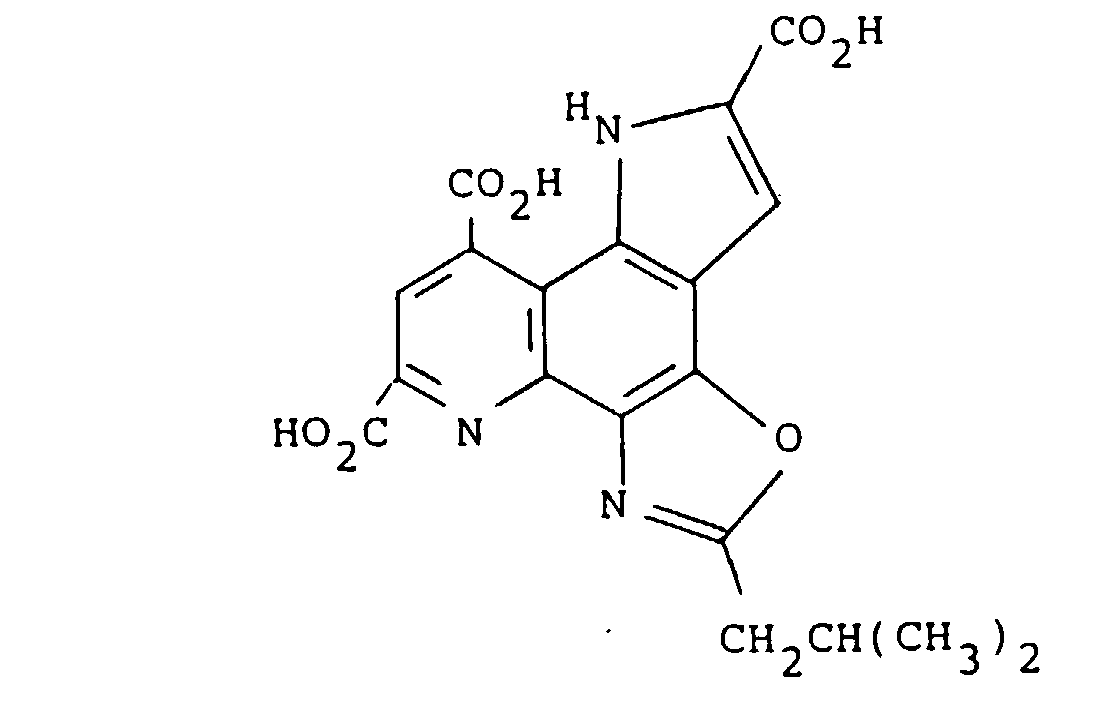
-

-

-

-

-

-

- These novel compounds can be produced using microorganisms as mentioned above and besides, can also be produced by using previously separated and purified PQQ. That is, the desired OPQs can be obtained by allowing PQQ or salts of PQQ to react with the same amino acid corresponding to the desired OPQs or monomethylamine in the presence of oxygen. The amounts of amino acid or monomethylamine and reaction conditions such as temperature and pH are the same as those in the method which uses microoraganism.
- Salts of these PQQ include alkali metal salts, alkaline earth metal salts, ammonium salts and substituted ammonium salts.
- Examples of the substituted ammonium salts are alkyl substituted ammonium salts and hydroxyalkyl substituted ammonium salts.
- Typical examples of the salts of OPQs are sodium salts, potassium salts, magnesium salts, calcium salts, ammonium salts, trimethylammonium salts, triethylammonium salts, and triethanolammonium salts.
- The present invention further relates to novel uses of OPQs.
- These uses include aldose reductase inhibitors, diabetes associated disease therapeutic agents) immunopotentiating agents and liver disease inhibitors which contain the compounds (OPQs) represented by the following formula I or salts thereof as an active ingredient.

- OPQs and salts thereof used in the present invention may be those which have the above formula [I] where R may be the same as R' of α-amino acid represented by the formula R'-CH2(NH2)-COOH, but preferably is the same as R' of natural α-amino acid, more preferably is the same as R' of α-amino acid which constitutes natural protein.
- Typical examples of OPQs are OPQ, hydroxymethyl OPQ, 1-methylethyl OPQ, 1-methylpropyl OPQ, 2-methylpropyl OPQ, methyl OPQ, 2-carboxyethyl OPQ, 2-carbamoylethyl OPQ, 2-methylthioethyl OPQ, benzyl OPQ, 4-hydroxybenzyl OPQ, carboxymethyl OPQ, carbamoylmethyl OPQ, 4-imidazolylmethyl OPQ, 4-aminobutyl OPQ, 3-guanidinopropyl OPQ, and mercaptomethyl OPQ.
- Typical examples of salts of OPQs are sodium salts, potassium salts, magnesium salts, calcium salts, ammonium salts, trimethylammonium salts, triethylammonium salts and triethanolammonium salts.
- For novel medical uses esters represented by the following formula [II] may be used besides the above-mentioned compounds.

selected from the group consisting of hydroxyl carboxy, mercapto, amino, carbamoyl, phenyl, hydroxyphenyl, guanidino, imidazolyl and methylmercapto groups and R1, R2 and R3 which may be identical or different, each represents a hydrogen atom, an alkyl group, an alkenyl group or a benzyl group. - The esters used in the present invention may be any of monoesters, diesters and triesters. These esters of OPQs can be easily produced by allowing OPQs or salts thereof and alcohols to react with each other by conventional procedures. The alkyl groups include, for example, methyl group, ethyl group and the alkenyl group includes, for example, allyl group.
- Alternatively, the desired esters of OPQs can be obtained by allowing PQQ or PQQ salt to react with alcohols by conventional method to obtain esters of PQQs and then allowing the esters of PQQs to react with various amino acid or methylamine.
- As aldose reductase inhibitor, diabetes associated disease therapeutic agent, imunopotentiating agent and liver disease inhibitor of the present invention, OPQs or salts thereof or esters thereof. can be in either parenteral or non-parenteral formulation including a pharmaceutically acceptable carrier. they can be administered in the conventional formulations such as capsules, tablets, and powders. In the case of non-oral administration, they are administered in the formulations such as injection and liquid. Furthermore, administration in the form of slow release compositions is also effective. For formulation of active ingredients of the present invention, there may be optionally used surface active agent, vehicle, colorant, preservative, coating aid. Furthermore, they may be used in combination with other medicines.
- Dosage thereof may vary depending on kind of disease, condition of disease kind of OPQs and manner of administration, normally 1 - 100 mg, preferably 5 - 50 mg/kg(body weight)/day. The agents of the above dosage are administered once or with divided administration in twice or three times a day.
- According to the present invention, OPQs including novel compounds and salts thereof can be efficiently and stably produced. These OPQs, and salts thereof and esters thereof are very low in toxicities such as acute or chronic toxicity and toxicity to kidney and can be effectively used as aldose reductase inhibitor, diabetes associated disease therapeutic agent and liver disease therapeutic agent.
- Moreover, uses of these OPQs and salts thereof as other medicines, medicines for animals and agricultural agents such as pollen germination promoting agent and pollen tube elongation promoting agent can be expected.
- The compounds of the invention have immunopotentiating action to enhance activity of B cell, T cell and macrophage and so are utilized not only for inhibition of various infections and tumors, but also as preventive and therapeutic agent against diseases caused by aging.
-
(1) Acute toxicity test: - (i) To male SPF-ICR mice of 5 weeks old (supplied by Charles River Co.) were intraperitoneally administered PQQ·2Na and OPQs in the dosages of 20, 40, 80, 160 and 200 mg/kg body weight of mouse, respectively and they were bred at 25°C for 14 days. OPQ, 1-methylpropyl OPQ, 2-methylthioethyl OPQ, and benzyl OPQ were used as the OPQs. One group consisted of 8 mice. As a result, when 20 mg/kg and 40 mg/kg of PQQ·2Na were administered, the mice survived, but five mice died with administration of 80 mg and all of eight mice died with administration of 160 mg and 200 mg.
LD50 of PQQ·2Na was about 70 mg/kg mouse.
On the other hand, no mice died with administration of OPQs. - (ii) To male SPF-ICR mice of 5 weeks old (supplied by Charles River Co.) was intraperitoneally administered OPQ in the dosages of 0.1, 0.2, 0.4, 0.8 or 1.2 g/kg body weight of mouse and they were bred at 25°C for 14 days. One group consisted of 8 mice. All mice survived with administration of 0.1 - 0.4 g, two mice died with administration of 0.8 g, and six mice died with administration 1.2 g. LD50 was about 1.0 g/kg mouse.
- (iii) To male SPF-ICR mice of 5 weeks old (supplied from Charles River Co.) was orally administered OPQ in a dosage of 1.0 g, 1.5 g or 2.0 g/kg mouse. They were bred at 25°C for 14 days. One group consisted of eight mice.
- Thereafter, the mice were fasted (with giving only water) and after lapse of 18 hours, blood was collected and serum was obtained therefrom. Contents of glucose, urea nitrogen and creatinine in serum were obtained using FUJI Dry Chemslide. The results were shown by average value for eight mice. The results are shown in Table 3.
- For administration of OPQ in all of the above dosages, contents of glucose, urea nitrogen and creatinine were nearly the same as those in the case of administration of no OPQ.
-
Table 3 Administration of compound (mg/kg mouse) Glucose (mg/dℓ) Urea nitrogen (mg/dℓ) Creatinine (mg/dℓ) No administration 105 28 0.7 OPQ 150 106 32 0.8 300 80 29 0.8 400 94 30 0.8 600 74 34 0.8 - As can be seen from the results of (a) and (b), PQQ showed toxicity to kidney while OPQs showed no toxicity to kidney.
- The following nonlimiting examples will further explain the invention.
- In one liter of pure water were dissolved 3 g of (NH4)2SO4, 1.4 g of KH2PO4, 2.1 g of Na2HPO4, 0.2 g of MgSO4·7H2O, 30 mg of CaCl2·2H2O, 30 mg of FeC6H5O7·XH2O, 5 mg of MnCl2·4H2O, 5 mg of ZnSO4·7H2O, 0.5 mg of CuSO4·5H2O, 4 mg of thiamine hydrochloride, 4 mg of calcium pantothenate, 20 µg of biotin, and 12 ml of methanol. 200 ml of this solution adjusted to pH 7.1 was put in a conical flask of 1 liter in capacity and sterilized at 120°C for 20 minutes. This was used as a culture medium.
- 1 vol% of culture broth of bacterial strains pre-cultured at 30°C for 2 days using the same medium as above was inoculated in the above medium and subjected to rotary shaking culture to obtain culture broth after 3 days from beginning of culture.
- The culture broth was divided into two equal parts. To one of them was added 0.3 g/l of glycine and pH was adjusted to 8.5 and this culture broth was subjected to rotary shaking at 30°C for 24 hours to obtain a reaction mixture in which OPQ was produced. To another one was added 0.4 g/l of L-serine and pH was adjusted to 4.0 and this culture broth was subjected to rotary shaking at 30°C for 24 hours to allow a reaction to proceed to obtain a reaction mixture in which hydroxymethyl OPQ was produced. These reaction mixtures were subjected to centrifugation to obtain supernatant liquid and amount of OPQs contained therein was measured.
- The results are shown in Table 4.
- Amount of OPQs in the reaction mixture was measured by high performance liquid chromatography (same in the following examples).
Device: High performance liquid chromatograph manufactured by Shimadzu Seisakusho Ltd.
Column: YMC ODS A-302
(4.6 mmφ x 150 mm)
Developer: 0.1M KH2PO4, 0.1M HCl04/
CH3CN:H2O = 1:9 (pH 2.5)
Flow rate: 1.5 ml/min
Detector: SHIMADZU SPD-6AV
UV-VIS detector (420 nm)
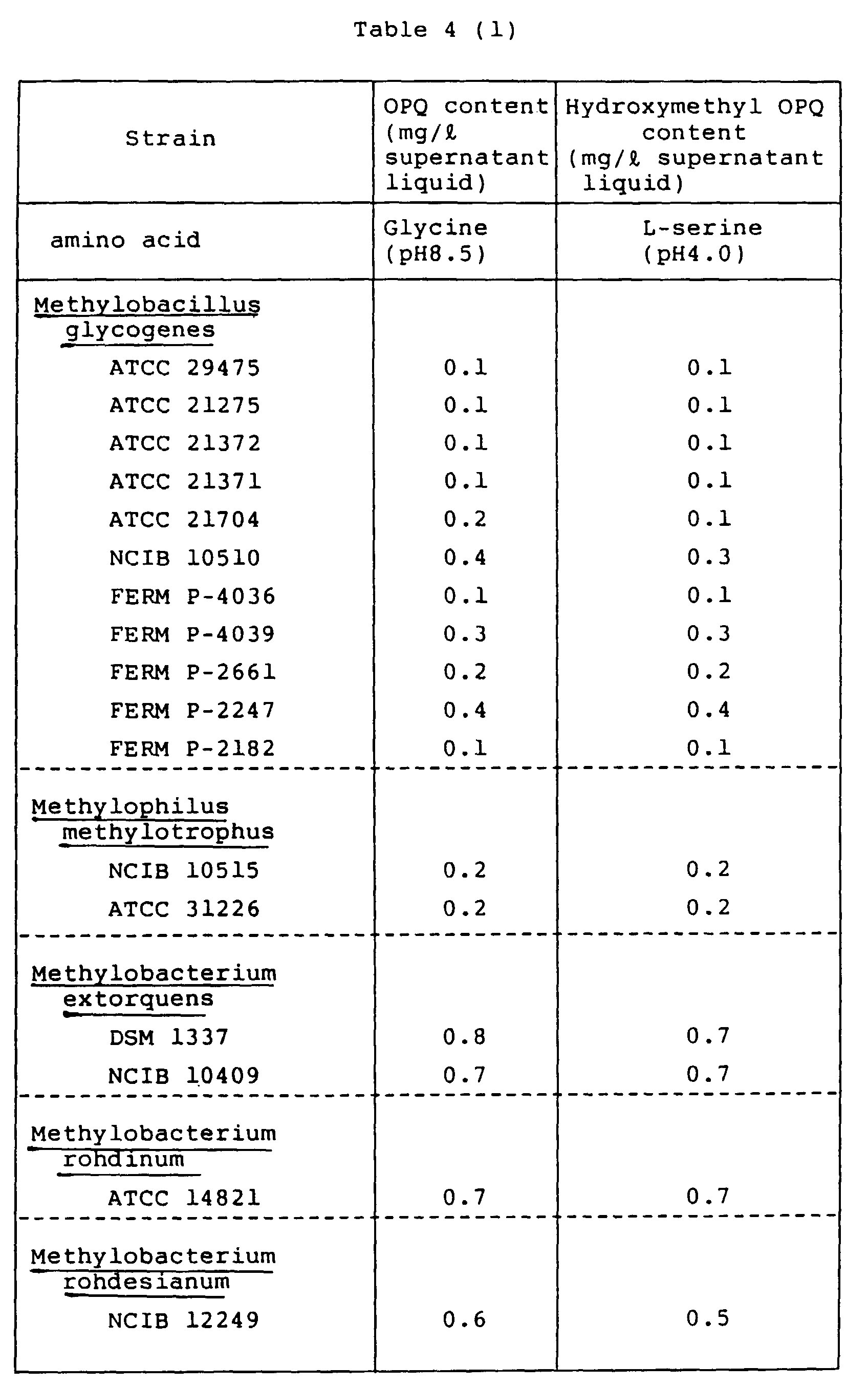


- Acidomonus methanolica JCM 6891 was cultured for 3 days to obtain a culture broth in the same manner as in Example 1 except using a medium prepared by dissolving in one liter of pure water 3 g of (NH4)2 SO4, 4 g of KH2PO4, 0.2 g of MgSO4·7H2O, 30 mg of CaCl2·2H2O, 30 mg of FeC6H5O7·XH2O, 5 mg of MnCl2·4H2O, 5 mg of ZnSO4·7H2O, 0.5 mg of CuSO4·5H2O, 4 mg of calcium pantothenate, and 12 ml of methanol and adjusting the pH to 4.5.
- The culture broth was divided into two equal parts. To one of them was added 0.3 g/l of monomethylamine hydrochloride and pH was adjusted to 8.5 and this culture broth was subjected to stirring for 24 hours at 30°C to obtain a reaction mixture in which OPQ was produced.
- To another one was added 0.4 g/l of L-serine and pH was adjusted to 4.0 and this culture broth was subjected to rotary shaking at 30°C for 24 hours to allow a reaction to proceed to obtain a reaction mixture in which hydroxymethyl OPQ was produced.
- Each of these reaction mixtures was subjected to centrifugation to obtain supernatant liquid and amount of OPQs contained therein was measured. The results are shown in Table 5.
- Paracoccus alcalifilus JCM 7364 was cultured for 3 days to obtain a culture broth in the same manner as in Example 1 except using a medium prepared by dissolving in one liter of pure water 3 g of (NH4)2 SO4, 1.4 g of KH2PO4, 2.1 g Of Na2HPO4, 0.2 g of MgSO4·7H2O, 30 mg of CaCl2·2H2O, 30 mg of FeC6H5O7·XH2O, 5 mg of MnCl2·4H2O, 5 mg of ZnSO4·7H2O, 0.5 mg of CuSO4·5H2O, 20 µg of biotin, and 12 ml of methanol, sterilizing the solution at 120°C for 20 minutes, then aseptically adding thereto 10 wt% aqueous Na2CO3 solution, and adjusting the pH to 9.0.
- The culture broth was divided into two equal parts. To one of them was added 0.4 g/l of L-serine and pH was adjusted to 8.5 and this culture broth was stirred at 30°C for 24 hours to obtain a reaction mixture in which OPQ was produced. To another one was added 0.4 g/l of L-serine and pH was adjusted to 4.0 and this culture broth was stirred at 30°C for 24 hours to obtain a reaction mixture in which hydroxymethyl OPQ was produced.
- Each of these reaction mixtures was subjected to centrifugation to obtain supernatant liquid and amount of OPQs contained therein was measured. The results are shown in Table 5.
- The bacteria belonging to the genus Methylophaga were cultured for 3 days to obtain a culture broth in the same manner as in Example 1 except using a medium prepared by dissolving in one liter of sea water 3.0 g of (NH4)2SO4, 1.4 g of KH2PO4, 2.1 g of Na2HP4, 0.2 g of MgSO4·7H2O, 30 mg of CaCl2·2H2O, 30 mg of FeC6H5O7·XH2O, 5 mg of MnCl2·4H2O, 5 mg of ZnSO4·7H2O, 0.5 mg of CuSO4· 5H2O, and 12 ml of methanol and adjusting the pH to 7.1.
- The culture broth was divided into two equal parts. To one of them was added 0.5 g/l of L-threonine and pH was adjusted to 8.5 and this culture broth was stirred at 30°C for 24 hours to obtain a reaction mixture in which OPQ was produced. To another one was added 0.4 g/l of D-serine and pH was adjusted to 4.0 and this solution was stirred at 30°C for 24 hours to obtain a reaction mixture in which hydroxymethyl OPQ was produced.
- Each of these reaction mixtures was subjected to centrifugation to obtain supernatant liquid and amount of OPQs contained therein was measured. The results are shown in Table 5.
-
Table 5 Example Strain OPQ content (mg/ℓ culture solution) Hydroxymethyl OPQ content (mg/ℓ supernatant liquid 2 Acidomonus methanolica (monomethylamine pH8.5) (L-serine, pH 4.0) JCM 6891 0.3 0.3 3 Paracoccus alcalifilus (L-serine, pH8.5) (L-serine, pH4.0) JCM 7364 0.5 0.4 4 Methylophaga marina (L-threonine, pH8.5) (D-serine, pH4.0) ATCC 35842 6.3 6.2 Methylophaga thalassica NCMB 2162 5.0 4.7 ATCC 33146 2.8 2.4 ATCC 33145 7.2 7.0 Methylophaga sp. FERM P-3623 4.8 4.6 - In one liter of pure water were dissolved 3.0 g of (NH4)2SO4, 1.4 g of KH2PO4, 2.1 g of Na2HPO4, 0.2 g of MgSO4·7H2O, 30 mg of CaCl2·2H2O, 30 mg of FeC6H5O7·XH2O, 5 mg of MnCl2·4H2O, 5 mg of ZnSO4·7H2O, 0.5 mg of CuSO4·5H2O, and 8 ml of methanol and the solution was adjusted to pH 7.1. 200 ml of this solution was put in a conical flask of 1 liter in capacity and sterilized at 120°C for 20 minutes. This was used as a culture medium.
- Hyphomicrobium vurgare NCIB 9775 was inoculated in this medium and was subjected to rotary shaking culture at 30°C using a rotary shaker at 220 rpm. The resulting culture broth was used as a seed liquor.
- 15 l of medium prepared by dissolving 1.0 g of (NH4)2SO4, 1.0 g of MgSO4·7H2O and 1.4 g of KH2PO4 in one liter of pure water was put in a culture tank of 30 l in capacity and was sterilized.
- In 10 ml of pure water were dissolved 75 mg of FeSO4·7H2O, 150 mg of ZnSO4·7H2O, 150 mg of CaCl2·2H2O, 150 mg of NaCl, 45 mg of MnSO4·4-5H2O, 3 mg of H3BO3, 1.5 mg of CuSO4·5H2O, 1.5 mg of CoCl2·2H2O, 1.5 mg of KI and 1.5 mg of (NH4)6Mo7O24· 4H2O. The resulting mineral solution was sterilized.
- After temperature of the culture tank of 30 liter lowered to 30°C, 10 ml of the above mineral solution was aseptically added to the medium in the tank and thereto ammonia water was aseptically further added to adjust pH of culture broth to 6.8.
- To this culture tank were aseptically added 150 ml of methanol and 200 ml of the above seed liquor and culture was carried out at an aeration speed of 10 l/min and at 300 rpm and at 30°C with addition of ammonia water so that pH of culture broth was kept at 6.8.
- With growth of microorganism, concentration of methanol in culture broth decreased. Methanol in exhaust gas was detected by analysis by gas chromatography and methanol was supplied so that concentration of methanol in culture broth was kept at 0.1 - 0.5 % by weight.
- In this way, culture was conducted in twelve culture tanks of 30 1 in capacity for 10 days and to culture broth in the culture tanks were added (1) 90 g of glycine, (2) 120 g of L-serine, (3) 120 g of D-serine, (4) 150 g of L-threonine, (5) 150 g of D-threonine, (6) 150 g of L-proline, (7) 150 g of D-proline, (8) 210 g of L-tyrosine, (9) 210 g of D-tyrosine, (10) 240 g of L-tryptophan, (11) 240 g of D-tryptophan and (12) 75 g of monomethylamine hydrochloride, respectively and reaction was allowed to proceed for 24 hours with adjusting pH of reaction solution to 8.5 to obtain reaction mixtures.
- Content of OPQ in the reaction mixtures is shown in Table 6.
-
Table 6 Experiment No. Content of OPQ (mg/l reaction mixture) (1) 168 (2) 162 (3) 160 (4) 154 (5) 155 (6) 44 (7) 51 (8) 105 (9) 98 (10) 126 (11) 117 (12) 143 - Culture was carried out for 10 days using seven culture tanks of 30 liters in the same manner as in Example 5 except that Hyphomicrobium methylovorum DSM 1869 was used as strain and to the culture broths were added glycine in amounts of (1) 4.5 g, (2) 9.0 g, (3) 15.0 g, (4) 45 g, (5) 75 g, (6) 150 g and (7) 22 g and culture was carried out for further 5 hours with adjusting pH to 8.0 to obtain reaction mixtures.
- Contents of OPQ in the reaction mixtures are shown in Table 7.
-
Table 7 Experiment No. Content of OPQ (mg/l reaction mixture) (1) 258 (2) 293 (3) 303 (4) 298 (5) 310 (6) 298 (7) 316 - In the same manner as in Example 6, Hyphomicrobium methylovorum DSM 1869 was cultured for 10 days in eight culture tanks of 30 liters.
- Thereafter, pH of culture broth in each culture tank was adjusted to (1) 3.0, (2) 4.0, (3) 5.0, (4) 6.0, (5) 7.0, (6) 8.0, (7) 9.0, or (8) 10.0 and 30 g of glycine was added to the culture broth in each culture tank and then reaction was allowed to proceed for further 3 hours to obtain reaction mixture.
- Amount of OPQ obtained by centrifugation of each reaction mixture in the culture tank as it was and amount of OPQ obtained by centrifugation of reaction mixtures of (1) - (5) which had been adjusted to pH 8.5 are shown in Table 8.
-
Table 8 pH Content of OPQ (mg/ℓ separated solution) (A) Centrifugation of reaction mixture as it was (B) Centrifugation of reaction mixture after adjusted to pH 8.5 (1) pH 3.0 12 202 (2) pH 4.0 179 235 (3) pH 5.0 298 296 (4) pH 6.0 293 304 (5) pH 7.0 300 301 (6) pH 8.0 298 - (7) pH 9.0 294 - (8) pH10.0 260 - - In the same manner as in Example 6, Hyphomicrobium methylovorum DSM 1869 was cultured for 10 days in eight culture tanks of 30 liters.
- Thereafter, pH of culture broth in each culture tank was adjusted to (1) 2.0, (2) 3.0, (3) 4.0, (4) 5.0, (5) 6.0, (6) 7.0, (7) 8.0, (8) 9.0, or (9) 10.0 and 42 g of L-serine was added to the culture broth in each culture tank and then reaction was allowed to proceed for further 5 hours to obtain reaction mixture.
- Amount of OPQ and hydroxymethyl OPQ obtained by centrifugation of each reaction mixture in the culture tank as it was and amount of OPQ and hydroxymethyl OPQ obtained by centrifugation of reaction mixtures which had been adjused to pH 8.5 are shown in Tables 9(1) and (2).
-

-

- In the same manner as in Example 6, Hyphomicrobium methylovorum DSM 1869 was cultured for 10 days in four culture tanks of 30 liters.
- Then, temperature of each culture broth in the culture tanks was adjusted to (1) 20°C, (2) 30°C, (3) 40°C, (4) 50°C, or (5) 70°C and 48 g of L-threonine was added to each of them and reaction was allowed to proceed for 5 hours with adjusting pH of culture broth to 8.0 to obtain reaction mixtures.
- Contents of OPQ in the reaction mixtures are shown in Table 10.
-
Table 10 Temperature Content of OPQ (mg/ℓ reaction mixture) (1) 20°C 253 (2) 30°C 294 (3) 40°C 317 (4) 50°C 317 (5) 70°C 300 - Methylobacillus glycogenes FERM P-2247 was cultured in the same manner as in Example 6. 27 g of monomethylamine hydrochloride was added to the culture broth on the 4th day after starting of culture and reaction was allowed to proceed for further 6 hours with adjusting pH of culture broth to 8.0 to obtain reaction mixture.
- Content of OPQ in the reaction mixture was 220 mg/l.
- Paracoccus denitrificans ATCC 19367 was cultured in the same manner as in Example 6.
- 42 g of D-serine was added to the culture broth on the 10th day after beginning of culture and reaction was allowed to proceed for 6 hours with adjusting pH of the culture broth to 8.0 to obtain a reaction mixture.
- Content of OPQ in the reaction mixture was 140 mg/l.
- Methylophaga thalassica ATCC 33146 was cultured in the same manner as in Example 6 except that sea water was used as water for medium. 48 g of D-threonine was added to the culture broth on the 10th day after beginning of culture and reaction was allowed to proceed for 6 hours with adjusting pH of the culture broth to 8.0 to obtain a reaction mixture.
- Content of OPQ in the reaction mixture was 163 mg/l.
- In one liter of pure water were dissolved 3 g of (NH4)2SO4, 1.4 g of KH2PO4, 2.1 g of Na2HPO4, 0.2 g of MgSO4·7H2O, 30 mg of CaCl2·2H2O, 30 mg of FeC6H5O7·H2O, 5 mg of MnCl2·4H2O, 5 mg of ZnSO4·7H2O, 0.5 mg of CuSO4·5H2O, and 12 ml of methanol and the solution was adjusted to pH 7.1. 200 ml of this solution was put in a conical flask of 1 liter in capacity and sterilized at 120°C for 20 minutes. This was used as a culture medium.
- Hyphomicrobium vurgare NCIB 9775 was inoculated in this medium and was subjected to rotary shaking culture at 30°C using a rotary shaker at 220 rpm. The resulting culture solution was used as a seed liquor.
- 15 l of a medium prepared by dissolving 1 g of (NH4)2SO4, 1 g of MgSO4·7H2O and 1.4 g of KH2PO4 in one liter of pure water was put in a culture tank of 30 l in capacity and was sterilized.
- In 10 ml of pure water were dissolved 75 mg of FeSO4·7H2O, 150 mg of ZnSO4·7H2O, 150 mg of CaCl2·2H2O, 150 mg of NaCl, 45 mg Of MnSO4·4-5H2O, 3 mg of H3BO3, 1.5 mg of CuSO4·5H2O, 1.5 mg of CoCl2·2H2O, 1.5 mg of KI and 1.5 mg of (NH4)6Mo7O24· 4H2O. The resulting mineral solution was sterilized.
- After the temperature of the culture tank lowered to 30°C, 10 ml of the mineral solution was aseptically added to the medium in the tank and furthermore, ammonia water was aseptically added thereto to adjust pH of the culture solution to 6.8.
- To this culture tank were aseptically added 150 ml of methanol and 200 ml of the above seed liquor and thereto ammonia water was further added at 30°C to maintain pH of culture broth at 6.8 with stirring with an aeration of 10 l/min and at 300 rpm. With growth of microorganism, concentration of methanol in culture broth decreased. This was detected by analyzing methanol in exhaust gas by gas chromatography and methanol in an amount corresponding to this decrease was supplied to maintain the concentration of methanol in culture solution at 0.1 - 0.5 % by weight.
- In this way, culturing was conducted in two culture tanks of 30 1 in capacity for 10 days and pH of the culture broth in the culture tank was adjusted to 4.0 and then thereto were added (1) 120 g of L-serine/15 1 and (2) 120 g of D-serine/15 1, respectively. Reaction was allowed to proceed for 24 hours at 30°C with stirring under aeration and adjusting pH of culture broth to 4.0 to obtain reaction mixtures. After adjusting pH of the reaction mixture to 7.0, and the reaction mixture was subjected to centrifugation to obtain supernatant liquid.
- Contents of hydroxymethyl OPQ in the reaction supernatant liquid are shown in Table 11.
-
Table 11 Experiment No. Content of hydroxymethyl OPQ (mg/l supernatant liquid) (1) 140 (2) 137 - Culturing was carried out for 10 days using culture tank of 30 liters in the same manner as in Example 13 except that Hyphomicrobium methylovorum DSM 1869 was used as strain and then, pH of culture broth was adjusted to 4.0 and 42 g of L-serine was added thereto and reaction was allowed to proceed.
- After addition of L-serine, reaction mixture was taken every time, adjusted to pH 7 and subjected to centrifugation and content of hydroxymethyl OPQ contained in the reaction mixture was measured.
- The results are shown in Table 12.
-
Table 12 Time elapsing after addition of L-serine Content of hydroxymethyl OPQ (mg/l reaction mixture) 1 hour 35 2 hours 109 4 hours 177 10 hours 240 14 hours 262 - In the same manner as in Example 13, Methylobacillus glycogenes FERM P-2247 was cultured for 4 days in culture tanks of 30 liters.
- Thereafter, pH of culture broth in the culture tank was adjusted to 4.5, 42 g of L-serine was added thereto and reaction was allowed to proceed for 6 hours to obtain a reaction mixture. After adjusting pH of the reaction mixture to 7.0, the reaction mixture was subjected to centrifugation to obtain supernatant liquid. Accumulation amount of hydroxymethyl OPQ in the supernatant liquid was 200 mg in 1 liter of the reaction mixture.
- Paracoccus denitrificans ATCC 19367 was cultured for 10 days in a culture tank of 30 liter in capacity in the same manner as in Example 13 except that strain was changed.
- Then, culture broth in the culture tank was adjusted to pH 6.0, 42 g of D-serine was added thereto, and reaction was allowed to proceed for 6 hours to obtain a reaction mixture. Accumulation amount of hydroxymethyl OPQ was 110 mg in 1 liter of the reaction mixture.
- Methylophaga thalassica ATCC 33146 was cultured for 10 days in a culture tank of 30 liters in capacity in the same manner as in Example 13 except that strain was changed and sea water was used as water for medium.
- Then, pH of the culture broth was adjusted to 4.0, 42 g of DL-serine was added thereto, and reaction was allowed to proceed for 6 hours at 30°C with stirring under aeration to obtain a reaction mixture. After adjusting pH of the reaction mixture to 7.0, the reaction mixture was subjected to centrifugation to obtain supernatant liquid. Accumulation amount of hydroxymethyl OPQ in the supernatant liquid was 142 mg in 1 liter of the reaction mixture.
- In the same manner as in Example 14, Hyphomicrobium methylovorum DSM 1869 was cultured in a culture tank of 30 liters to obtain 15 1 of culture broth. Each 200 ml of this culture broth was charged in a conical flask of 1 liter in capacity and each 0.6 g of various amino acids was added thereto. The culture broth was adjusted to pH 4.7 or 9 with NaOH or HCl and reaction was allowed to proceed at 30°C for 24 hours under shaking to obtain reaction mixtures.
- Reaction mixture in each flask was adjusted to pH 7.0 and then subjected to centrifugation to obtain supernatant liquid. Content of OPQs in the supernatant liquid is shown in Table 13.
-
Table 13 No. Amino acid added Content of X-OPQ produced (mg/l) X Reaction pH 4 Reaction pH 7 Reaction pH 9 1 Glycine 204 322 309 (OPQ) 2 L-alanine 144 185 167 methyl 3 L-valine 145 177 244 1-methylethyl 4 L-leucine 150 239 243 2-methylpropyl 5 L-isoleucine 139 213 280 1-methylpropyl 6 L-methionine 101 131 138 2-methylthioethyl 7 L-glutamic acid 142 222 217 2-carboxyethyl 8 L-glutamine 232 305 303 2-carbamoylethyl 9 L-phenylalanine 201 379 319 benzyl 10 L-aspartic acid 79 147 113 carboxymethyl 11 L-asparagine 14 220 215 carbamoylmethyl 12 L-arginine 115 189 40 3-guanidinopropyl 13 L-histidine 89 181 68 4-imidazolylmethyl 14 L-lysine 89 68 5 4-amino butyl X-OPQ: OPQs corresponding to respective amino acids. - Each 200 ml of the same culture broth as the PQQ containing culture broth used in Example 18 was charged in twelve conical flasks of 1 liter in capacity, respectively.
- Each 0.6 g of L-threonine, L-tyrosine, L-serine or L-cystine was added to each flask and pH of the culture broth was adjusted to 4, 7 or 9 with NaOH or HC1 and reaction was allowed to proceed at 30°C for 24 hours under shaking to obtain reaction mixtures.
- Reaction mixture in each flask was adjusted to pH 7.0 and subjected to centrifugation to obtain supernatant liquid. Content of OPQs in the supernatant liquid is shown in Table 14.
- OPQ was present in each reaction mixture in addition to OPQs corresponding to respective amino acids.
-
Table 14 No. Amino acid added Reaction pH OPQs produced (mg/l) X OPQ X-OPQ 1 L-threonine 4 115 34 Hydoxyethyl 2 L-threonine 7 291 13 3 L-threonine 9 311 3 4 L-tyrosine 4 11 91 4-Hydroxyphenylmethyl 5 L-tyrosine 7 45 209 6 L-tyrosine 9 157 59 7 L-serine 4 13 182 Hydroxymethyl 8 L-serine 7 262 66 9 L-serine 9 309 10 10 L-cystine 4 5 5 Mercaptomethyl 11 L-cystine 7 45 58 12 L-cystine 9 26 10 X-OPQ: OPQs corresponding to respective amino acids. - The reaction mixture obtained in the same manner as Example 9 at 30°C was subjected to centrifugation at 12,000 G for 20 min. to obtain supernatant liquid.
- Fifty ml each of the supernatant luquid was controlled to pH 7.2, 6.5, 5.7, 5.0, 4.7, 4.2, 3.7, 3.1, 2.6, 2.1, 1.5 and 1.0, respectively, with HCl, and then was left to stand for 4 hrs under room temperature followed by centrifugation (12000 G, 20 min.). OPQ was precipitated and recovered.
- OPQ left unrecovered in the supernatant liquid were assayed by high performance liquid chromatography. The results are shown in Table 15. OPQ was recovered in the form of precipitate when pH was 4 or less.
-
Table 15 pH OPQ in the supernatant liquid (mg/ℓ reaction mixture) 7.2 284 6.5 285 5.7 272 5.0 288 4.7 269 4.2 191 3.7 66 3.1 24 2.6 14 2.1 7 1.5 12 1.0 15 - 30.0 g of L-serine was dissolved in 600 ml of distilled water and the solution was adjusted to pH 3.0 with 6N hydrochloric acid to obtain an L-serine solution. To this L-serine solution was added 604 mg of PQQ and reaction was allowed to proceed at 30°C for 20 hours under vigorous mechanical stirring with aeration. As a result, concentration of hydroxymethyl OPQ in the reaction mixture was about 890 mg/l.
- This reaction mixture was adjusted to pH 2.0 with 6N hydrochloric acid and 12 g of CaCl2·2H2O was added thereto and this liquid was cooled with ice water to precipitate hydroxymethyl OPQ.
- This precipitate was recovered by centrifugal separation. To this precipitate was added 600 ml of water and this liquid was adjusted to pH 7.8 with 5N NaOH to dissolve the precipitate.
- To the resulting solution was added 100 ml of DEAE-SEPHADEX A-25 which is an anion exchange carrier and the mixture was well stirred to adsorb hydroxymethyl OPQ onto the carrier and was left to stand. Supernatant liquid was removed and the carrier was separated and recovered.
- 100 ml of fresh DEAE-SEPHADEX A-25 was charged in a column of 50 mmφ and the recovered carrier was charged thereover.
- Through this column were passed 300 ml of distilled water, then 3400 ml of 0.5M aqueous sodium chloride solution and subsequently 2500 ml of 0.7M aqueous sodium chloride solution. At this time, a slight amount of unreacted PQQ entrained by hydroxymethyl OPQ was present in fraction of 0.5M aqueous sodium chloride solution and hydroxymethyl OPQ was present in fraction of 0.7M aqueous sodium chloride solution.
- The fraction of 0.7M aqueous sodium chloride solution was adjusted to pH 2.0 with 6N hydrochloric acid and then cooled to 5°C to precipitate hydroxymethyl OPQ.
- The resulting precipitate was recovered by centrifugal separation and washed with dilute hydrochloric acid and then with diethyl ether and thereafter dried at about 60°C in vacuo to obtain 330 mg of hydroxymethyl OPQ.
- The thus obtained hydroxymethyl OPQ had orange color and gradually decomposed at 210 - 220°C and did not show clear melting point. This hydroxymethyl OPQ was easily soluble in water and very easily soluble under neutral and alkaline conditions and furthermore, dissolved in lower alcohols, but did not dissolve in acetone and diethyl ether.
- Color of aqueous solution of the hydroxymethyl OPQ differed depending on concentration of hydroxymethyl OPQ and pH of the aqueous solution and aqueous hydroxymethyl OPQ solution of about 10 mg/l was light yellow under neutral to alkaline condition and was reddish light yellow under acidic condition.
- Elemental analysis value, IR spectrum, 1H-NMR spectrum, and visible·ultraviolet spectrum of the above hydroxymethyl OPQ are shown below.
(1)Elemental analysis value: C16H9N3O8 (MW 371.25) Calcd. (%): C 51.76 H 2.44 N 11.32 Found (%): C 50.58 H 2.63 N 11.08
(2) IR spectrum (Vmax, cm-1): (KBr) 2500br,s, 1680sh,w, 1575sh,s, 1510s, 1150vs, 1095sh,s, 700m, 650m
(3) 1H-NMR spectrum (δ value, ppm): (DMSO-d6, internal standard: TMS) 4.98 (s,2H,CH 2 -OH), 7.27(D,1H, pyrrole ring C-H,J=1.98Hz), 8.07 (s,1H, pyridine ring C-H), 14.60(d,1H, pyrrole ring N-H, J=0.44Hz)
(4) Visible·ultraviolet spectrum (λmax·nm): (10 mM potassium phosphate buffer pH 7.0) 254, 269sh, 416 - 40 ml each of aqueous L-serine solution of 10 g/l adjusted to pH 1.5 - 9 with hydrochloric acid or sodium hydroxide was charged in a conical flask each of 100 ml in capacity and 40 mg each of PQQ was added to respective conical flask.
- A gas permeable stopper was placed on the each conical flask and content of the flask was stirred using a rotary shaker to allow reaction to proceed for one day at 30°C.
- The reaction mixture was adjusted to pH 8.0 and amount of hydroxymethyl OPQ produced was determined by a high performance liquid chromatography.
- Conditions of high performance liquid chromatography are shown below.
- Measuring device:
- Manufactured by Shimadzu
Seisakusho Ltd.
Pump LC-6A
Detector SPD-6AV
Column thermostat CTO-6AS (40°C) - Column :
- Manufactured by YMC Co. ODS A-302 4.6 mmφ x 150 mm
- Measuring wavelength:
- 259 nm
- Flow rate :
- 1.5 ml/min
- Composition of eluent:
- 0.1M KH2PO4, 0.1M HClO4 10% aqueous CH3CN solution pH 2.5 (NaOH)
- The results are shown in Table 16.
Table 16 pH of reaction solution Concentration of hydroxymethyl OPQ (mg/l) 1.5 153 2.0 580 3.0 806 4.0 791 5.0 671 7.0 245 8.0 162 9.0 60 - 7.8 g of L-valine was dissolved in 200 ml of distilled water and the solution was adjusted to pH 8.5 with 5N NaOH. Thereto was added 801 mg of PQQ · disodium salt and reaction was allowed to proceed at 30°C for 21 hours under vigorous mechanical stirring with aeration. This reaction mixture was adjusted to pH 1.6 with 6N hydrochloric acid and was cooled to 5°C to precipitate 1-methylethyl OPQ.
- This precipitate was recovered by centrifugal separation and to this precipitate was added 200 ml of water and this liquid was adjusted to pH 8.7 with 5N NaOH to dissolve the precipitate.
- To the resulting solution was added 50 ml of DEAE-SEPHADEX A-25 which was an anion exchange carrier and the mixture was well stirred to adsorb 1-methylethyl OPQ to the carrier and was left to stand. Supernatant liquid was removed and the carrier was separated and recovered.
- 75 ml of fresh DEAE-SEPHADEX A-25 was charged in a column of 50 mmφ and the recovered carrier was charged thereover.
- Through this column were passed 300 ml of distilled water to wash the content, then 3700 ml of 0.4M aqueous sodium chloride solution and subsequently 4300 ml of 0.6M aqueous sodium chloride solution. At this time, 1-methylethyl OPQ contained in the reaction mixture was mainly present in fraction of 0.6M aqueous sodium chloride solution.
- The fractions of 0.4M aqueous sodium chloride solution and 0.6M aqueous sodium chloride solution in which 1-methylethyl OPQ was eluted were adjusted to pH 1.7 with 6N hydrochloric acid. Then n-butanol was added thereto and the mixture was left to stand. Then, n-butanol layer containing 1-methylethyl OPQ was separated and recovered. Further, this n-butanol layer was mixed with 0.1N hydrochloric acid and washed and then, the n-butanol layer was separated and recovered and concentrated to dryness. Thereto was added diethyl ether and the resulting precipitate was filtrated and recovered. The precipitate was dried at about 70°C in vacuo to obtain 460 mg of 1-methylethyl OPQ.
- The thus obtained 1-methylethyl OPQ had orange color and gradually decomposed at 255 - 259°C and did not show clear melting point. This 1-methylethyl OPQ was easily soluble in water and very easily soluble under neutral and alkaline conditions and it also dissolved in lower alcohols, but did not dissolve in acetone and diethyl ether.
- Color of aqueous solution of the 1-methylethyl OPQ differed depending on concentration of 1-methylethyl OPQ and pH of the aqueous solution and aqueous 1-methylethyl OPQ solution of about 10 mg/l was light yellow under pH of neutral to alkaline condition and was reddish light yellow under acidic condition.
- Elemental analysis value, IR spectrum, 1H-NMR spectrum, and visible ultraviolet spectrum of the resulting 1-methylethyl OPQ are shown below.
- (1)


- (2) IR spectrum (Vmax, cm-1): (KBr) 2850br,s, 2530sh,s, 1575s, 1515sh,m, 1175vs, 1100sh,m, 1015sh,m, 815sh,w, 755m, 730m, 660sh,w
- (3) 1H-NMR spectrum (δ value, ppm): (DMSO-d6, internal standard: TMS)
- 1.36(d,6H,CH-(CH 3), J=6.4Hz),
- 3.74(hep,1H,CH-(CH3)2,J=6.7Hz),
- 7.29(d,1H, pyrrole ring C-H,J=1.8Hz),
- 8.00(s,1H, pyridine ring C-H),
- 13.01(brs,1H, pyrrole ring N-H)
- (4) Visible·ultraviolet spectrum (λmax,nm): (10 mM potassium phosphate buffer pH 7.0) 255, 272sh, 418
- 5.1 g of L-isoleucine was dissolved in 200 ml of distilled water and the solution was adjusted to pH 8.5 with 5N NaOH. To this L-isoleucine solution was added 805 mg of PQQ·disodium salt and reaction was allowed to proceed at 30°C for 21 hours under vigorous mechanical stirring with aeration. This reaction mixture was adjusted to pH 1.8 with 6N hydrochloric acid and was cooled to 5°C to precipitate 1-methylpropyl OPQ.
- This precipitate was recovered by centrifugal separation and to this precipitate was added 200 ml of water and this liquid was adjusted to pH 8.2 with 5N NaOH to dissolve the precipitate.
- To the resulting solution was added 50 ml of DEAE-SEPHADEX A-25 which is an anion exchange carrier and the mixture was well stirred to adsorb 1-methylpropyl OPQ to the carrier and was left to stand. Supernatant liquid was removed and the carrier was separated and recovered.
- 75 ml of fresh DEAE-SEPHADEX A-25 was charged in a column of 50 mmφ and the recovered carrier was charged thereover.
- Through this column were passed 700 ml of distilled water to wash the content, then 3800 ml of 0.5M aqueous sodium chloride solution and subsequently 1800 ml of 0.8M aqueous sodium chloride solution. At this time, 1-methylpropyl OPQ contained in the reaction mixture was mainly present in fraction of 0.5M aqueous sodium chloride solution.
- The fractions of 0.5M aqueous sodium chloride solution and 0.8M aqueous sodium chloride solution in which 1-methylpropyl OPQ was eluted were adjusted to pH 1.9 with 6N hydrochloric acid. Then n-butanol was added thereto and the mixture was left to stand. Then, n-butanol layer containing 1-methylpropyl OPQ was separated and recovered. Further, this n-butanol layer was mixed with 0.1N hydrochloric acid and washed and then, the n-butanol layer was separated and recovered and concentrated to dryness. Thereto was added diethyl ether and the resulting precipitate was filtrated. The precipitate was dried at about 70°C in vacuo to obtain 410 mg of 1-methylpropyl OPQ.
- The thus obtained 1-methylpropyl OPQ had orange color and gradually decomposed at 250 - 254°C and did not show clear melting point. This 1-methylpropyl OPQ was easily soluble in water and very easily soluble under neutral and alkaline conditions and it also dissolved in lower alcohols, but did not dissolve in acetone and diethyl ether.
- Color of aqueous solution of the 1-methylpropyl OPQ differed depending on concentration of 1-methylpropyl OPQ and pH of the aqueous solution and aqueous 1-methylpropyl OPQ solution of about 10 mg/l was light yellow under pH of neutral to alkaline condition and was reddish light yellow under acidic condition.
- Elemental analysis value, IR spectrum, 1H-NMR spectrum, and visible·ultraviolet spectrum of the above methylpropyl OPQ are shown below.
(1)Elemental analysis value: C19H15N3O7·H2O (MW 415.36) Calcd. (%): C 54.94 H 4.13 N 10.12 Found (%): C 54.68 H 4.20 N 9.88
(2) IR spectrum (νmax, cm-1): (KBr) 2900br,s, 2530sh,s, 1605s, 1520sh,m, 1180vs, 1145sh,m, 1100sh,m, 850w, 760m, 725sh,m, 670sh,w
(3) 1H-NMR spectrum (δ value, ppm): (DMSO-d6, internal standard: TMS) - 0.83(t,3H,CH(CH3)-CH2-CH 3 ,J=7.3Hz),
- 1.38(d,3H,CH(CH 3 )-CH2-CH3,J=6.8Hz)
- 1.71(m,2H,CH(CH3)-CH 2 -CH3),
- 3.54(hex,1H,CH(CH3)-CH2-CH3,J=6.5Hz),
- 7.31(d,1H,pyrrole ring C-H,J=2.4Hz),
- 7.98(s,1H,pyridine ring C-H),
- 13.07(brs,1H, pyrrole ring N-H)
- 3.2 g of L-leucine was dissolved in 200 ml of distilled water and the solution was adjusted to pH 8.5 with 5N NaOH. To this L-leucine solution was added 802 mg of PQQ·disodium salt and reaction was allowed to proceed at 30°C for 21 hours under vigorous mechanical stirring with aeration. This reaction mixture was adjusted to pH 1.7 with 6N hydrochloric acid and was cooled to 5°C to precipitate 2-methylpropyl OPQ.
- This precipitate was recovered by centrifugal separation and to this precipitate was added 200 ml of water and this liquid was adjusted to pH 8.3 with 5N NaOH to dissolve the precipitate.
- To the resulting solution was added 50 ml of DEAE-SEPHADEX A-25 which is an anion exchange carrier and the mixture was well stirred to adsorb 2-methylpropyl OPQ to the carrier and was left to stand. Supernatant liquid was removed and the carrier was separated and recovered.
- 50 ml of fresh DEAE-SEPHADEX A-25 was charged in a column of 50 mmφ and the recovered carrier was charged thereover.
- Through this column were passed 300 ml of distilled water to wash the content, then 2000 ml of 0.5M aqueous sodium chloride solution and subsequently 2000 ml of 0.8M aqueous sodium chloride solution and then 500 ml of 2M aqueous sodium chloride solution. At this time, 2-methylpropyl OPQ contained in the reaction mixture was mainly present in fraction of 0.8M aqueous sodium chloride solution.
- The fraction of 0.8M aqueous sodium chloride solution in which 2-methylpropyl OPQ was eluted were adjusted to pH 1.8 with 6N hydrochloric acid and 2-methylpropyl OPQ was precipitated at 5°C. The resulting precipitate was recovered by centrifugal separation, washed with 0.1N hydrochloric acid and then dried at about 70°C in vacuo to obtain 430 mg of 2-methylpropyl OPQ.
- The thus obtained 2-methylpropyl OPQ had orange color and gradually decomposed at 248-252°C and did not show clear melting point. This 2-methylpropyl OPQ was easily soluble in water and very easily soluble under neutral and alkaline conditions and it also dissolved in lower alcohols, but did not dissolve in acetone and diethyl ether.
- Color of aqueous solution of the 2-methylpropyl OPQ differed depending on concentration of 2-methylpropyl OPQ and pH of the aqueous solution and aqueous 2-methylpropyl OPQ solution of about 10 mg/l was light yellow under pH of neutral to alkaline condition and was reddish light yellow under acidic condition.
- Elemental analysis value, IR spectrum, 1H-NMR spectrum, and visible·ultraviolet spectrum of the above 2-methylpropyl OPQ are shown below.
(1)Elemental analysis value: C19H15N3O7·H2O (MW 415.36) Calcd. (%): C 54.94 H 4.13 N 10.12 Found (%): C 54.70 H 4.27 N 9.85
(2) IR spectrum (νmax, cm-1): (KBr) 2880br,s, 2520sh,s, 2330sh,m, 1585s, 1520sh,m, 1180vs, 760sh,m, 735m, 670sh,w.
(3) 1H-NMR spectrum (δ value, ppm): (DMSO-d6, internal standard: TMS) - 0.93 (d,6H,CH2-CH-(CH 3 )2, J=6.6Hz),
- 2.16 (m,1H,CH2-CH-(CH3)2),
- 3.08 (d,2H,CH 2 -CH-(CH3)2,J=7.0Hz),
- 7.28(d,1H, pyrrole ring C-H,J=2.2Hz),
- 7.99 (s, 1H, pyridine ring C-H,),
- 12.60 (brs,1H, pyrrole ring N-H,)
- 4.3 g of L-alanine was dissolved in 800 ml of distilled water and the solution was adjusted to pH 4.0 with 1N hydrochloric acid.
- To this L-alanine solution was added 800 mg of PQQ and reaction was allowed to proceed at 30°C for 30 hours under vigorous mechanical stirring with aeration. To this reaction mixture was added 23.4 g of sodium chloride and the mixture was adjusted to pH 1.6 with 6N hydrochloric acid and was cooled to 5°C to precipitate methyl OPQ.
- This precipitate was recovered by centrifugal separation and to this precipitate was added 250 ml of distilled water and this liquid was adjusted to pH 7.4 with 5N NaOH to dissolve the precipitate.
- To the resulting solution was added 50 ml of DEAE-SEPHADEX A-25 which is an anion exchange carrier and the mixture was well stirred to adsorb methyl OPQ to the carrier and was left to stand. Supernatant liquid was removed and the carrier was separated and recovered.
- 75 ml of fresh DEAE-SEPHADEX A-25 was charged in a column of 50 mmφ and the recovered carrier was charged thereover.
- Through this column were passed 400 ml of distilled water to wash the content and then 6900 ml of 0.5M aqueous sodium chloride solution. At this time, methyl OPQ contained in the reaction mixture was present in fraction of 0.5M aqueous sodium chloride solution.
- The obtained fraction in which methyl OPQ was eluted was adjusted to pH 1.0 with 6N hydrochloric acid and methyl OPQ was precipitated at 5°C. The resulting precipitate was recovered by centrifugal separation and washed with 0.1N hydrochloric acid and was dried at about 70°C in vacuo to obtain 273 mg of methyl OPQ.
- The thus obtained methyl OPQ had orange color and gradually decomposed at 262 - 268°C and did not show clear melting point. This was easily soluble in water and very easily soluble under neutral and alkaline conditions and it also dissolved in lower alcohols, but did not dissolve in acetone and diethyl ether.
- Color of aqueous solution of the methyl OPQ differed depending on concentration of methyl OPQ and pH of the aqueous solution and aqueous methyl OPQ solution of about 10 mg/l was light yellow under pH of neutral to alkaline condition and was reddish light yellow under acidic condition.
- Elemental analysis value, IR spectrum, 1H-NMR spectrum, and visible·ultraviolet spectrum of the above methyl OPQ are shown below.
(1)Elemental analysis value: C16H9N3O7·H2O (MW 373.28) Calcd. (%): C 51.48 H 2.97 N 11.26 Found (%): C 51.20 H 3.24 N 11.03
(2) IR spectrum (νmax, cm-1): (KBr) 2725br,s, 2480br,s, 1590s, 1515s, 1170vs, 1095sh,s, 965m, 750m, 710m.
(3) 1H-NMR spectrum (δ value, ppm): (DMSO-d6, internal standard: TMS) - 273(s,3H,CH 3 ),
- 7.18(d,1H, pyrrole ring C-H),
- 7.92(s,1H, pyridine ring C-H),
- 12.82(brs,1H, pyrrole ring N-H)
- 6.4 g of L-glutamic acid was dissolved in 800 ml of distilled water and the solution was adjusted to pH 4.0 with 5N NaOH.
- To this L-glutamic acid solution was added 800 mg of PQQ and reaction was allowed to proceed at 30°C for 26 hours under vigorous mechanical stirring with aeration. This reaction mixture was adjusted to pH 1.0 with 6N hydrochloric acid and was mixed with n-butanol and the mixture was left to stand to separate and recover n-butanol layer containing 2-carboxyethyl OPQ. Furthermore, to this n-butanol layer was added 0.1N NaOH and they were mixed. The mixture was left to stand to separate and recover aqueous layer containing 2-carboxyethyl OPQ. This liquid was adjusted to pH 8.0 with 6N hydrochloric acid and distilled water was added to make up 450 ml.
- To the resulting solution was added 50 ml of DEAE-SEPHADEX A-25 which was an anion exchange carrier and the mixture is well stirred to adsorb 2-carboxyethyl OPQ to the carrier and was left to stand. Supernatant liquid was removed and the carrier was separated and recovered.
- 75 ml of fresh DEAE-SEPHADEX A-25 was charged in a column of 50 mmφ and the recovered carrier was charged thereover.
- Through this column were passed 400 ml of distilled water to wash the content, then 3400 ml of 0.4M aqueous sodium chloride solution and subsequently 3800 ml of 0.6M aqueous sodium chloride solution. At this time, 2-carboxyethyl OPQ contained in the reaction mixture was present in fraction of 0.6M aqueous sodium chloride solution.
- This fraction in which 2-carboxyethyl OPQ was eluted was adjusted to pH 0.9 with 6N hydrochloric acid and 2-carboxyethyl OPQ was precipitated at 5°C. The resulting precipitate was recovered by centrifugal separation, washed with 0.1N hydrochloric acid and then dried at about 70°C in vacuo to obtain 358 mg of 2-carboxyethyl OPQ.
- The thus obtained 2-carboxyethyl OPQ had orange color and gradually decomposed at 266 - 271°C and did not show clear melting point. This was easily soluble in water and very easily soluble in water under neutral and alkaline conditions and it also dissolved in lower alcohols, but did not dissolve in acetone and diethyl ether.
- Color of aqueous solution of the 2-carboxyethyl OPQ differed depending on concentration of 2-carboxyethyl OPQ and pH of the aqueous solution and aqueous 2-carboxyethyl OPQ solution of about 10 mg/l was light yellow under pH of neutral to alkaline condition and was reddish light yellow under acidic condition.
- Elemental analysis value, IR spectrum, 1H-NMR spectrum, and visible·ultraviolet spectrum of the above 2-carboxyethyl OPQ are shown below.
(1)Elemental analysis value: C18H11N3O9·H2O (MW 431.31) Calcd. (%): C 50.12 H 3.04 N 9.74 Found (%): C 49.85 H 3.33 N 9.62
(2) IR spectrum (νmax, cm-1): (KBr) 2840br,s, 2500m, 2340sh,m, 1570s, 1515s, 1175vs, 1100sh,m, 755w, 730w.
(3) 1H-NMR spectrum (δ value, ppm): (DMSO-d6, internal standard: TMS) - 2.85(t,2H,CH2-CH 2 -CO2H,J=6.2Hz),
- 3.30(t,2H,CH 2 -CH2-CO2H,J=5.9Hz),
- 7.23(brs,1H, pyrrole ring C-H),
- 7.98(s,1H, pyridine ring C-H),
- 13.67(brs,1H, pyrrole ring N-H)
- 6.4 g of L-glutamine was dissolved in 800 ml of distilled water and the solution was adjusted to pH 4.0 with 1N hydrochloric acid.
- To this L-glutamine solution was added 800 mg of PQQ and reaction was allowed to proceed at 30°C for 30 hours under vigorous mechanical stirring with aeration. To this reaction mixture was added 23.4 g of sodium chloride to dissolve it therein and then was adjusted to pH 2.0 with 6N hydrochloric acid. This was cooled to 5°C to precipitate 2-carbamoylethyl OPQ.
- This precipitate was recovered by centrifugal separation and to this precipitate was added 250 ml of distilled water and this liquid was adjusted to pH 7.2 with 5N NaOH to dissolve the precipitate.
- To the resulting solution was added 50 ml of DEAE-SEPHADEX A-25 which is an anion exchange carrier and the mixture was well stirred to adsorb 2-carbamoylethyl OPQ to the carrier and was left to stand. Supernatant liquid was removed and the carrier was separated and recovered.
- 75 ml of fresh DEAE-SEPHADEX A-25 was charged in a column of 50 mmφ and the recovered carrier was charged thereover.
- Through this column were passed 400 ml of distilled water to wash the content, then 5800 ml of 0.4M aqueous sodium chloride solution, and then 1100 ml of 0.6M aqueous sodium chloride solution. At this time, nearly the whole amount of 2-carbamoylethyl OPQ contained in the reaction mixture was present in the fraction of 0.6M aqueous sodium chloride solution.
- The fractions of 0.4M aqueous sodium chloride solution and 0.6M aqueous sodium chloride solution in which 2-carbamoylethyl OPQ was eluted were adjusted to pH 1.8 with 6N hydrochloric acid and 2-carbamoylethyl OPQ was precipitated at 5°C. The resulting precipitate was recovered by centrifugal separation, washed with 0.1N hydrochloric acid and dried at about 70°C in vacuo to obtain 373 mg of 2-carbamoylethyl OPQ.
- The thus obtained 2-carbamoylethyl OPQ had orange color and gradually decomposed at 286 - 290°C and did not show clear melting point. This was easily soluble in water and very easily soluble in water under neutral and alkaline conditions and it also dissolved in lower alcohols, but did not dissolve in acetone and diethyl ether.
- Color of aqueous solution of the 2-carbamoylethyl OPQ differed depending on concentration of 2-carbamoylethyl OPQ and pH of the aqueous solution and aqueous 2-carbamoylethyl OPQ solution of about 10 mg/l was light yellow under pH of neutral to alkaline condition and was reddish light yellow under acidic condition.
- Elemental analysis value, IR spectrum, 1H-NMR spectrum, and visible·ultraviolet spectrum of the above 2-carbamoylethyl OPQ are shown below.
(1)Elemental analysis value: C18H12N4O8·H2O (MW 430.33) Calcd. (%): C 50.24 H 3.28 N 13.02 Found (%): C 50.01 H 3.50 N 12.87
(2) IR spectrum (νmax, cm-1): (KBr) 2735br,m, 2500br,m, 2300sh,m, 1555br,s, 1390s, 1180vs, 1100sh,s, 990m, 765m, 560w
(3) 1H-NMR spectrum (δ value, ppm): (DMSO-d6, internal standard: TMS) - 2.76(t,2H,CH2-CH 2 -CO-NH2,J=6.7Hz),
- 3.31(t,2H,CH 2 -CH2-CO-NH2,J=6.9Hz)
- 6.79(brs,1H,CH2-CH2CO-NH 2),
- 7.25(d,1H,pyrrole ring C-H,J=2.0Hz),
- 7.38(brs,1H,CH2-CH2-CO-NH 2),
- 7.97(s,1H,pyridine ring C-H),
- 12.91(brs,1H, pyrrole ring N-H)
- 7.2 g of L-methionine was dissolved in 400 ml of distilled water and the solution was adjusted to pH 4.0 with 6N hydrochloric acid.
- To this L-methionine solution was added 800 mg of PQQ and reaction was allowed to proceed at 30°C for 26 hours under vigorous mechanical stirring with aeration. This reaction mixture was adjusted to pH 1.5 with 6N hydrochloric acid and was cooled to 5°C to precipitate 2-methylthioethyl OPQ.
- This precipitate was recovered by centrifugal separation and to this precipitate was added 250 ml of distilled water and this liquid was adjusted to pH 8.1 with 5N NaOH to dissolve the precipitate.
- To the resulting solution was added 50 ml of DEAE-SEPHADEX A-25 which was an anion exchange carrier and the mixture was well stirred to adsorb 2-methylthioethyl OPQ to the carrier and was left to stand. Supernatant liquid was removed and the carrier was separated and recovered.
- 75 ml of fresh DEAE-SEPHADEX A-25 was charged in a column of 50 mmφ and the recovered carrier was charged thereover.
- Through this column were passed 200 ml of distilled water to wash the content, then 4800 ml of 0.4M aqueous sodium chloride solution and subsequently 3000 ml of 0.5M aqueous sodium chloride solution and then 2000 ml of 0.6M aqueous sodium chloride solution.
- At this time, most of 2-methylthioethyl OPQ contained in the reaction mixture was present in fraction of 0.5M aqueous sodium chloride solution.
- The fractions of 0.5M aqueous sodium chloride solution and 0.6M aqueous sodium chloride solution in which 2-methylthioethyl OPQ was eluted were adjusted to pH 1.3 with 6N hydrochloric acid and then 2-methylthioethyl OPQ was precipitated at 5°C. The precipitate was recovered by centrifugal separation, washed with 0.1N hydrochloric acid and dried at about 70°C in vacuo to obtain 470 mg of 2-methylthioethyl OPQ.
- The thus obtained 2-methylthioethyl OPQ had orange color and gradually decomposed at 250 - 258°C and did not show clear melting point. This was easily soluble in water, especially soluble under neutral and alkaline conditions and it also dissolved in lower alcohols, but did not dissolve in acetone and diethyl ether.
- Color of aqueous solution of the 2-methylthioethyl OPQ differed depending on concentration of 2-methylthioethyl OPQ and pH of the aqueous solution and aqueous 2-methylthioethyl OPQ solution of about 10 mg/l was light yellow under pH of neutral to alkaline condition and was reddish light yellow under acidic condition.
- Elemental analysis value, IR spectrum, 1H-NMR spectrum, and visible·ultraviolet spectrum of the above 2-methylthioethyl OPQ are shown below.
(1)Elemental analysis value: C18H13N3O7S·H2O (MW 433.39) Calcd. (%): C 49.88 H 3.49 N 9.70 Found (%): C 49.63 H 3.77 N 9.49
(2) IR spectrum (νmax, cm-1): (KBr) 2775br,s, 2500br,m, 1575s, 1510sh,s, 1175vs, 970w, 850w, 750m, 720m
(3) 1H-NMR spectrum (δ value, ppm): (DMSO-d6, internal standard: TMS) - 2.13(s,3H,CH2-CH2-S-CH 3 ),
- 2.98(t,2H,CH2-CH2-S-CH3,J=7.7Hz),
- 3.45(t,2H,CH 2 -CH2-S-CH3,J=7.9Hz),
- 7.23(d,1H,pyrrole ring C-H,J=2.0Hz),
- 7.99(s,1H, pyrridine ring C-H),
- 13.14(brs,1H, pyrrole ring N-H,)
- 8.0 g of L-phenylalanine was dissolved in 400 ml of distilled water and the solution was adjusted to pH 4.0 with 6N hydrochloric acid.
- To this L-phenylalanine solution was added 800 mg of PQQ and reaction was allowed to proceed at 30°C for 26 hours under vigorous mechanical stirring with aeration. This reaction mixture was adjusted to pH 1.4 with 6N hydrochloric acid and was cooled to 5°C to precipitate benzyl OPQ.
- This precipitate was recovered by centrifugal separation and to this precipitate was added 250 ml of distilled water and this liquid was adjusted to pH 8.1 with 5N NaOH to dissolve the precipitate.
- To the resulting solution was added 50 ml of DEAE-SEPHADEX A-25 which is an anion exchange carrier and the mixture was well stirred to adsorb benzyl OPQ to the carrier and was left to stand. Supernatant liquid was removed and the carrier was separated and recovered.
- 75 ml of fresh DEAE-SEPHADEX A-25 was charged in a column of 50 mmφ and the recovered carrier was charged thereover.
- Through this column were passed 200 ml of distilled water to wash the content, then 5000 ml of 0.4M aqueous sodium chloride solution, subsequently 5000 ml of 0.5M aqueous sodium chloride solution and furthermore 5000 ml of 0.6M aqueous sodium chloride solution. At this time, benzyl OPQ contained in the reaction mixture was mainly present in fraction of 0.5M aqueous sodium chloride solution.
- The fractions of 0.5M aqueous sodium chloride solution and 0.6M aqueous sodium chloride solution in which benzyl OPQ was eluted were adjusted to pH 1.2 with 6N hydrochloric acid and benzyl OPQ was precipitated at 5°C. The precipitate was recovered in centrifugal separation, washed with 0.1N hydrochloric acid and then dried at about 70°C in vacuo to obtain 724 mg of benzyl OPQ.
- The thus obtained benzyl OPQ had orange color and gradually decomposed at 244-250°C and did not show clear melting point. This was easily soluble in water, especially soluble under neutral and alkaline conditions and it also dissolved in lower alcohols, but did not dissolve in acetone and diethyl ether.
- Color of aqueous solution of the benzyl OPQ differed depending on concentration of benzyl OPQ and pH of the aqueous solution and aqueous benzyl OPQ solution of about 10 mg/l was light yellow under pH of neutral to alkaline condition and was reddish light yellow under acidic condition.
- Elemental analysis value, IR spectrum, 1H-NMR spectrum, and visible·ultraviolet spectrum of the above benzyl OPQ are shown below.
(1)Elemental analysis value: C22H13N3O7·H2O (MW 449.37) Calcd. (%): C 58.80 H 3.36 N 9.35 Found (%): C 58.52 H 3.61 N 9.14
(2) IR spectrum (νmax, cm-1): (KBr) 2710br,s, 2490br,s, 1575br,s, 1490sh,s, 1170vs, 980w, 710m, 690m, 660sh,w
(3) 1H-NMR spectrum (δ value, ppm): (DMSO-d6, internal standard: TMS) - 4.67(s,2H,CH 2 -C6H5),
- 7.02-7.90(m,6H, pyrrole ring C-H,CH2-C6 H 5 ),
- 7.96(s, 1H, pyridine ring C-H),
- 12.95(brs, pyrrole ring N-H,)
- 4.4 g of L-tyrosine was dissolved in 400 ml of distilled water and the solution was adjusted to pH 4.0 with 1N hydrochloric acid.
- To this L-tyrosine solution was added 800 mg of PQQ and reaction was allowed to proceed at 60°C for 24 hours under vigorous mechanical stirring with aeration. This reaction mixture was cooled to 5°C and precipitated L-tyrosine was filtered. The filtrate was adjusted to pH 1.0 with 6N hydrochloric acid and was cooled to 5°C to precipitate 4-hydroxybenzyl OPQ.
- This precipitate was recovered by centrifugal separation and to this precipitate was added 150 ml of distilled water and this liquid was adjusted to pH 7.3 with 5N NaOH to dissolve the precipitate.
- To the resulting solution was added 50 ml of DEAE-SEPHADEX A-25 which is an anion exchange carrier and the mixture was well stirred to adsorb 4-hydroxybenzyl OPQ to the carrier and was left to stand. Supernatant liquid was removed and the carrier was separated and recovered.
- 75 ml of fresh DEAE-SEPHADEX A-25 was charged in a column of 50 mmφ and the recovered carrier was charged thereover.
- Through this column were passed 500 ml of distilled water to wash the content, then 3700 ml of 0.4M aqueous sodium chloride solution and subsequently 6000 ml of 0.6M aqueous sodium chloride solution. At this time, 4-hydroxybenzyl OPQ adsorbed to the carrier was present in fraction of 0.6M aqueous sodium chloride solution.
- This fraction in which 4-hydroxybenzyl OPQ was eluted was adjusted to pH 1.0 with 6N hydrochloric acid and 4-hydroxybenzyl OPQ was precipitated at 5°C. The precipitate was recovered by centrifugal separation and dissolved in methanol and the solution was concentrated to dryness. Thereto was added diethyl ether and the resulting precipitate was filtered. The precipitate was dried at about 70°C in vacuo to obtain 357 mg of 4-hydroxybenzyl OPQ.
- The thus obtained 4-hydroxybenzyl OPQ had reddish brown color and gradually decomposed at 263 - 268°C and did not show clear melting point. This was easily soluble in water, especially soluble under neutral and alkaline conditions and it also dissolved in lower alcohols, but did not dissolve in acetone and diethyl ether.
- Color of aqueous solution of the 4-hydroxybenzyl OPQ differed depending on concentration of 4-hydroxybenzyl OPQ and pH of the aqueous solution and aqueous 4-hydroxybenzyl OPQ solution of about 10 mg/ml was light yellow under pH of neutral to alkaline condition and was reddish light yellow under acidic condition.
- Elemental analysis value, IR spectrum, 1H-NMR spectrum, and visible·ultraviolet spectrum of the above 4-hydroxybenzyl OPQ are shown below.
(1)Elemental analysis value: C22H13N3O8·H2O (MW 465.37) Calcd. (%): C 56.78 H 3.25 N 9.03 Found (%): C 56.51 H 3.52 N 8.87
(2) IR spectrum (νmax, cm-1): (KBr) 2810s, 2520s,sh, 1590s, 1500s, 1415m, 1180vs, 990w,sh, 820w,sh, 760m, 730m, 670w,sh
(3) 1H-NMR spectrum (δ value, ppm): (DMSO-d6, internal standard: TMS) - 4.54(s,2H,CH 2 -C6H4OH),
- 6.64(d,2H,J=8.6Hz,CH2 side benzene ring C-H),
- 6.81(d,2H,J=8.1Hz, OH side benzene ring C-H),
- 7.31(d,1H, pyrrole ring C-H,J=2.0Hz),
- 7.94(s,1H, pyridine ring C-H),
- 13.01(brs,1H, pyrrole ring N-H)
- Medulla of kidney of dog was homogenized with 10mM phosphoric acid buffer (pH 7.0) containing 2mM dithiothreitol in an amount of four times the volume of kidney medulla and subjected to centrifugation. The supernatant liquid was purified by affinity chromatography, gel filtration and chromatofocusing to obtain electrophoretically homogeneous aldose reductase.
- 0.05 ml of 3mM NADPH, 0.1 ml of DL-glyceraldehyde and 0.04 ml of distilled water were added to 0.8 ml of 0.1M phosphoric acid buffer (pH 6.2) and left to stand at 25°C for 3 minutes. Then, 0.01 ml of the aldose reductase solution was added thereto to start reaction and decreasing of absorbance of 340 nm was measured at 25°C with time. Amount of enzyme which consumes 1 µmole of NADPH for 1 minute was taken as 1 unit.
- Enzyme activity was measured under the same conditions as in the above measurement of aldose reductase activity except that 0.04 ml of aqueous solution of inhibitory substance in various concentrations was added in place of 0.04 ml of distilled water and degree of inhibition was calculated from comparison of the enzyme activity with the enzyme activity obtained in the absence of inhibitor. (1) OPQ, (2) methyl OPQ, (3) 1-methylpropyl OPQ, (4) 2-methylpropyl OPQ, (5) 2-carbamoylethyl OPQ, (6) hydroxymethyl OPQ, (7) 2-methylthioethyl OPQ, (8) 2-carboxyethyl OPQ, (9) 4-hydroxybenzyl OPQ, (10) 1-methylethyl OPQ, and (11) benzyl OPQ were used as inhibition substances and (12) PQQ was used as control.
- Degree of inhibition of these substances for aldose reductase is shown in Table 17.
- As can be seen from Table 17, OPQs have stronger inhibition of aldose reductase than PQQ.

- Lens of rabbit was homogenized with 10mM phosphoric acid buffer (pH 7.0) containing 2mM dithiothreitol in an amount of two times the volume of the lens and subjected to centrifugation. The supernatant liquid was purified by affinity chromatography, gel filtration and chromatofocusing to obtain electrophoretically homogeneous aldose reductase. Using (1) OPQ, (2) 1-methylpropyl OPQ, (3) 2-methylpropyl OPQ, (4) hydroxymethyl OPQ, and (5) 1-methylethyl OPQ as inhibition substances, degree of inhibition of these substances for aldose reductase of rabbit lens was examined in the same manner in Example 32. Degree of inhibition of these substances for aldose reductase is shown in Table 18.
- As can be seen from Table 18, OPQs show stronger inhibition of aldose reductase than PQQ.

- Eightyfour male Sprague-Davley rats (supplied from Japan Charles Liver Co.) of four weeks old and having a body weight of 70 - 80 g were used and the following experiments were conducted. One group consisted of six rats.
- The groups included normal group, 50 % galactose administration group, PQQ administration group, and OPQ administration group. Commercially available feeding stuff (manufactured by Japan Clea Co.) was given to the rats of normal group, and rats of 50 % galactose administration group, PQQ administration group and OPQ administration group were allowed to freely take powdery feeding stuff comprising a mixture of the above-mentioned commercially available powder feeding stuff and D-galactose for food additive in equal weight.
- To the rats of PQQ and OPQ administration groups were intraperitoneally administered PQQ·2Na or OPQ in a dosage of 2 mg, 5 mg, 10 mg and 20 mg per 1 kg of rat once a day simultaneously with starting of galactose feeding and until termination of feeding.
- On the 6th day and the 9th day from starting of experiment, eyeball was observed by stereoscopic microscope and judgment on cataract was made according to the following criteria.
- A0:
- No muddiness (normal)
- A1:
- Light white muddiness in the surface portion.
- A2:
- A slight heavy white muddiness in the surface portion.
- A3:
- Heavy white muddiness in the surface portion.
- A4:
- Heavy white muddiness in the surface portion and a slight white muddiness in the core portion.
- A5:
- Heavy white muddiness in the surface portion and the core portion.
- The results are shown in Table 19.
- Advance of cataract was able to be suppressed by intraperitoneal administration of PQQ, but in case of administration of PQQ·2Na in a dosage of 10 mg and 20 mg/kg rat, reduction in body weight was recognized and in case of administration of PQQ·2Na in a dosage of 20 mg/kg rat, some rats died.
- On the other hand, advance of cataract was more effectively suppressed by administration of OPQ than administration of PQQ and besides, no rats died being different from administration of PQQ.
-
Table 19 Anti-cataract effect of intraperitoneally administered PQQ, OPQ No Group Judgement on the 6th day Judgement on the 9th day A0 A1 A2 A3 A4 A5 A0 A1 A2 A3 A4 A5 1 Normal group 6/6 6/6 2 50% galactose administration group 1/6 1/6 4/6 4/6 2/6 3 PQQ administration group PQQ·2Na 2mg/kg rat 4/6 1/6 1/6 2/6 2/6 2/6 5mg/kg rat 3/6 2/6 1/6 1/6 3/6 2/6 10mg/kg rat 1/6 4/6 1/6 3/6 2/6 1/6 20mg/kg rat 1/6* 2/6* 1/6** 2/6** (Three rats died.) (Four rats died.) 4 OPQ administration group OPQ 2mg/kg rat 3/6 2/6 1/6 1/6 3/6 1/6 1/6 5mg/kg rat 2/6 3/6 1/6 2/6 2/6 2/6 10mg/kg rat 3/6 2/6 1/6 2/6 3/6 1/6 20mg/kg rat 4/6 2/6 2/6 4/6 * Body weight reduced (average 66 g). Body weight of rats of normal group was about 115 g on the average. ** Body weight did not increase (average 77 g). Body weight of rats of normal group was about 141 g on the average. - Thirty six male Sprague-Davley rats (supplied from Japan Charles River Co.) of four weeks old and having a body weight of 70 - 80 g were used and the following experiments were conducted. One group consisted of six rats.
- The groups included normal group, 50 % galactose administration group, PQQ administration group, and OPQ administration group. Commercially available feeding stuff (manufactured by Japan Clea Co.) was given to the rats of normal group, and rats of 50 % galactose administration group, PQQ administration group and OPQ administration group were allowed to freely take powdery feeding stuff comprising a mixture of the above-mentioned commercially available powder feeding stuff and D-galactose for food additive in equal weight.
- To the rats of PQQ and OPQ administration groups were orally administered PQQ·2Na or OPQ in a dosage of 10 mg and 20 mg per 1 kg of rat once a day simultaneously with starting of galactose feeding and until termination of feeding.
- On the 6th day and the 9th day from starting of experiment, eyeball was observed by stereoscopic microscope and judgment on cataract was made according to the same criteria as in Example 34.
- The results are shown in Table 20.
- Cataract inhibiting effect by oral administration of PQQ was low while advance of cataract was clearly inhibited by oral administration of OPQ.
-
Table 20 Anti-cataract effect of oral administration of OPQ, PQQ No Group Judgement on the 6th day Judgement on the 9th day A0 A1 A2 A3 A4 A5 A0 A1 A2 A3 A4 A5 1 Normal group 6/6 6/6 2 50% galactose administration group 1/6 1/6 4/6 4/6 2/6 3 PQQ administration group PQQ·2Na 10mg/kg rat 2/6 2/6 2/6 2/6 2/6 2/6 20mg/kg rat 2/6 2/6 2/6 2/6 3/6 1/6 4 OPQ administration group OPQ 10mg/kg rat 3/6 3/6 2/6 4/6 20mg/kg rat 2/6 4/6 3/6 3/6 - Test on macrophage-chemotaxis (1):
- Thirtytwo C3H/He mice (male, 7 weeks old, average body weight 20 g, supplied by Japan Charles River Co.) were divided into 4 groups (A - D) of 8 mice each.
- A solution of OPQ in physiological saline of pH 7.0 was intraperitoneally administered to each mouse 7 times, namely, on the 1st day, 2nd day, 3rd day, 4th day, 5th day, 6th day and 7th day. Dosage for one administration per one mouse was as follows: That is, 0.2 ml of the solution containing 0.2 mg/ml of OPQ for group B, 0.2 ml of the solution containing 0.5 mg/ml of OPQ for group C, 0.2 ml of the solution containing 1.0 mg/ml of OPQ for group D and 0.2 ml of physiological saline for group A.
- On the 8th day from starting of the experiment, the mice were anesthetized with ether and blood was drawn from carotid artery and 5 ml of cold Hanks solution was intraperitoneally injected and exudate cells for the abdominal cavity were collected. Exudate cells for the abdominal cavity of respective groups were gathered, washed three times with cold Hanks solution and suspended in RPMI medium at 5 x 10⁵ cells/ml and macrophage-chemotaxis was measured. 50 % zymosan treated serum was used as chemotaxis factor and examination was conducted at three points for each sample. Number of chemotaxied macrophage was measured on microscope and 13 visual fields was examined for one point and the results are shown in Table 2. The value in the table is a total number of chemotaxied macrophages at 3 points for each sample. Preparation of Hanks solution and RPMI medium will be explained below.
-
Hanks solution (Nissui Seiyaku Co.) 475 ml 2% Lactalbumin 25 ml 7.5% NaHCO3 1.25 ml - Respective liquids were sterilized at 121°C for 15 minutes and aseptically mixed before use.
-
RPMI [Gibco Diagnostics Laboratories (USA)] 261 ml Fetal Bovine Serum [Flow Laboratories (USA)] 30 ml 5 x 10⁻³M 2-mercapto ethanol solution 3 ml Mixture of streptomycin (100 µg/ml) and penicillin G (100 unit/ml) 3 ml 200mM L-glutamine solution 3 ml - The above components other than Fetal Bovine Serum were filtered and these were aseptically mixed before use.

- Test on macrophage-chemotaxis (2):
- Test on macrophage-chemotaxis was conducted in the same manner as in Example 36 except that hydroxymethyl OPQ was intraperitoneally administered to each mouce 3 times of the 1st day, the 2nd day and the 3rd day in the following dosage for one administration per one mouse: 0.2 ml of hydroxymethyl OPQ solution containing 0.5 mg/ml of hydroxymethyl OPQ for group B, 0.2 ml of the solution containing 1.0 mg/ml of hydroxymethyl OPQ for group C, and 0.2 ml of the solution containing 1.5 mg/ml of hydroxymethyl OPQ for group D and exudate cells for the abdominal cavity were collected on the 4th day from starting of experiment. The results are shown in Table 22.
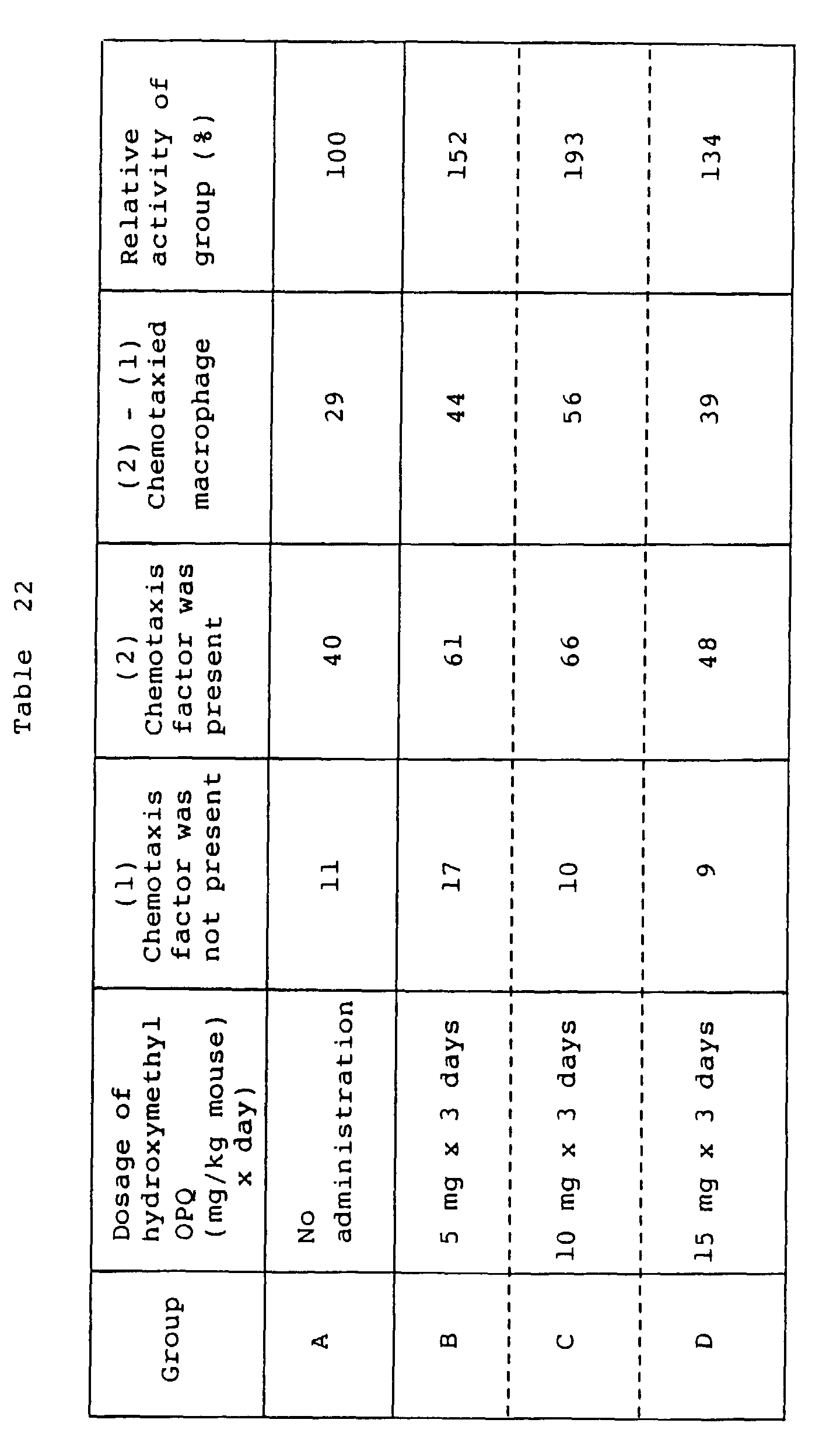
- Test on T cell blast transformation reaction (1):
- In the same manner as in Example 36, OPQ was administered to C3H/He mouse and the mouse was bred. Dosage of OPQ for one administration per one mouse was 0.2 ml of OPQ solution containing 0.5 mg/ml of OPQ for group B and 0.2 ml of the solution containing 1.0 mg/ml of OPQ for group C and 0.2 ml of physiological saline was administered for group A.
- On the 8th day from starting of experiment, mouse was anesthetized with ether and blood was drawn from carotid artery and spleen was aseptically extracted.
- Cells of the spleen of respective groups were broken up and these cells were floated on tris-NH4Cl hemolytic solution warmed to 37°C and left for 5 minutes at 37°C to hemolyze erythrocytes, followed by washing twice with cold Hanks solution. The cells were suspended in RPMI medium at 4 x 10⁶ cells/ml and the suspension was put in a flat bottom microplate of 96 holes. Culture was carried out in the air containing 5 % of CO2 at 37°C using concanavalin A (Type IV Sigma C2010) in an amount of 0.5 µg/ml or 2 µg/ml as mitogen. After 63 hours from starting of culture, 3H-thymidine was added in an amount of 2.5 µci/ml and culturing was carried out for further 9 hours. Thereafter, cells were gathered on a glass fiber filter by cell harvester and 3H on this filter was measured by a liquid scintillation counter.
- As control, same four culturings were conducted under the same conditions without adding concanavalin A.
- The results are shown in Table 23. Values in the table are average values of intake amount (cpm) of 3H in culture under four same conditions.
- The tris-NH4Cl hemolytic solution was prepared in the following manner.
- Tris-NH4Cl hemolytic solution:
0.16M NH4Cl 90 ml 0.17M tris (adjusted to pH 7.65 with HCl) 10 ml - The above two liquids were mixed and the mixture was adjusted to pH 7.2 and sterilized at 121°C for 15 minutes.
-
Table 23 Group Dosage of OPQ (mg/kg mouse x day) Concentration of concanavalin (µg/ml) Relative activity (%) 0 0.5 2 Concanavalin A 0.5µg/ml 2.0µg/ml A No administration 7312 (cpm) 11637 (cpm) 96188 (cpm) 100 100 B 5 mg x 7 days 10796 15942 140376 137 146 C 10 mg x 7 days 9124 21965 144171 189 150 - Test on T cell blast transformation reaction (2):
- Cells of spleen were obtained in the same manner as in Example 38 except that OPQ was not administered using five C3H/He mice (male, 7 weeks old, average body weight of 20 g, supplied by Japan Charles Liver Co.).
- Then, the cells were suspended in RPMI medium at 4 x 10⁶ cells/ml and the suspension was put in a flat bottom microplate of 96 holes. Culture was carried out in the air containing 5 % of CO2 at 37°C using 1.0 µg/ml of concanavalin A as mitogen with addition of 0.5 or 2.0 µg/ml of OPQ. After 63 hours from starting of culture, 3H-thymidine was added at 2.5 µCi/ml and culture was carried out for further 9 hours. Thereafter, cells were gathered on a glass fiber filter by cell harvester and 3H on the filter was measured by a liquid scintillation counter.
- As control, same four cultures were conducted under respective conditions without adding concanavalin A or OPQ. The results are shown in Table 24. Values in the table are average values of intake amount (cpm) of 3H in culture under four same conditions. Activity acceleration effect of OPQ was not recognized when concanavalin A was not added, but activity acceleration effect of OPQ was recognized when concanavalin A was added.
-
Table 24 Dosage of OPQ (µg/ml) Concentration of concanavalin (µg/ml) Relative activity (%) 0 1.0 Concanavalin A 1.0 µg/ml 0 2077 (cpm) 89091 (cpm) 100 0.5 1946 130775 146 2.0 2031 116093 130 - Test on B cell blast transformation reaction:
- Cells of spleen of C3H/He mice to which OPQ was administered were obtained in the same manner as in Example 38.
- Further, intake amount of 3H-thymidine was examined in the same manner as in Example 38 except that 25 µg/ml or 50 µg/ml of lipopolysaccharide (LPS WE E. coli 0111, Difco) was used in place of the concanavalin A as mitogen. The results are shown in Table 25. Values in the table are average values of intake amount (cpm) of 3H in culture under four same conditions.
-
Table 25 Group Dosage of OPQ (mg/kg mouse x day) Concentration of Relative Lipopolysaccharide activity (LPS) (%) (µg/ml) 0 25 50 Lipopolysaccharide 25 µg/ml 50 µg/ml A No administration 6562 (cpm) 34557 (cpm) 42247 (cpm) 100 100 B 5mg x 7 days 9303 37434 46193 108 109 C 10mg x 7 days 9301 41876 53267 121 126 - In Examples 36 - 40, macrophage activity was examined according to chemotaxis of peritoneal macrophage (literature 1) and activity of T cell and that of B cell were examined according to blast transformation reaction using concanavalin A and lipopolysaccharide, (LPS) as mitogen (literature 2).
- Literature 1:
- "Function of Macrophage and Method of Measurement of Function", pages 61-65 1985), edited by Educational Committee of Japan Bacteriological Society and published from Saikon Shuppan Co.)
- Literature 2:
- "New Method of Searching of Function of Lymphocytes", pages 350-355 (1987) edited by Junichi Yada and Michio Fujiwara and published from Chugai Igaku Co.
- Pharmacological activity (1) of OPQs on carbon tetrachloride (CCl4)-induced liver diseases:
- Twentyfive SD rats (male, 7 weeks old, body weight: about 220 g; supplied by Japan Charles River Co.) were divided to five groups (A-E) each consisting of five rats.
- All rats were fasted for 16 hours and 1.1 ml of solutions containing 0.4 mg/ml, 1.0 mg/ml and 2.0 mg/ml of OPQ were intraperitoneally administered to the rats of groups C, D and E, respectively and furthermore, after 40 minutes, OPQ in the same dosage as above was intraperitoneally administered, respectively. In these cases, OPQ was used as a solution in physiological saline. To the rats of group B was intraperitoneally administered 1.1 ml of physiological saline in place of the OPQ solution.
- Furthermore, after 20 minutes, 2.2 ml of 10 % carbon tetrachloride solution (in olive oil) was administered to stomach of the rats of groups B-E. Neither OPQ nor carbon tetrachloride was administered to the rats of group A.
- After 24 hours from administration of carbon tetrachloride, blood was collected from abdominal aorta and serum was obtained by centrifugal separation.
- GPT, GOT and amount of total bilirubin were measured by clinical examination reagent (trademark: FUJI Dry Chemslide manufactured by Fuji Photo Film Co., Ltd.). The results are shown in Table 26 by average value of five rats.
- GPT, GOT and amount of total bilirubin which increased by administration of carbon tetrachloride all markedly decreased by administration of OPQ and it can be seen that OPQ has inhibitory effect on liver diseases.

- Pharmacological activity (2) of OPQs on carbon tetrachloride (CCl4)-induced liver diseases:
- Pharmacological activity of OPQs for carbon tetrachloride-induced liver diseases was examined in the same manner as in Example 41 except that 1-methylpropyl OPQ, 2-methylthioethyl OPQ and benzyl OPQ were respectively administered twice in a dose of 5 mg/kg rat in place of the OPQ. The results are shown in Table 27.
- GPT, GOT and total amount of bilirubin which increased by administration of carbon tetrachloride sharply decreased by administration of 1-methylpropyl OPQ, 2-methylthioethyl OPQ or benzyl OPQ. It can be seen that OPQs have inhibitory effect on liver diseases.

- Pharmacological effect of OPQ on D-galactosamine-induced liver diseases:
- Thirty SD rats (male, 7 weeks old, body weight: about 240 g; supplied by Japan Charles River Co.) were divided to six groups (A-F) each consisting of five rats. All rats were fasted for 18 hours and 1.2 ml of solutions containing 0.4 mg/ml, 1.0 mg/ml, 2.0 mg/ml, and 3.0 mg/ml of OPQ were intraperitoneally administered to rats of groups C, D, E and F, respectively, and furthermore, after lapse of 40 minutes, OPQ in the same doses as above were intraperitoneally administered to the rats, respectively. In these cases, the OPQ was dissolved in physiological saline and administered to the rats. For the rats of group B, 1.2 ml of physiological saline was intraperitoneally administered in place of the OPQ solution.
- Furthermore, after lapse of 20 minutes, 1.2 ml of a solution containing 0.2 mg/ml of D-galactosamine was subcutaneously injected to the rats of groups B-F. Neither OPQ nor D-galactosamine was administered to the rats of group A.
- After lapse of 23 hours from administration of D-galactosamine, blood was collected from abdominal aorta and serum was obtained by centrifugal separation.
- GPT, GOT and total amount of bilirubin were measured by clinical examination reagent (trademark: FUJI DRYCHEMSLIDE manufactured by Fuji Photo Film Co., Ltd.). The results are shown in Table 28 by average value of five rats.
- GPT, GOT and total amount of bilirubin which increased by administration of D-galactosamine all sharply decreased by administration of OPQ and it can be seen that OPQ has inhibitory effect on liver diseases.
No mice died.
From the results of (i) - (iii), it can be seen that OPQs are much lower in toxicity than PQQ.
(2) Toxicity to kidney
(i) Toxicity to kidney determined by urine examination:
In the same manner as in the acute toxicity test, PQQ·2Na and OPQs were respectively intraperitoneally administered to mice and these mice were bred. Urine was collected every day and concentration of glucose in urine was obtained using Uristex II (manufactured by Miles·Sankyo Co.). As shown in Table 1, sugar was detected from urine of mice to which PQQ·2Na was administered, but no sugar was detected from urine of mice to which OPQs were administered.
That is, PQQ showed toxicity to kidney, but OPQs showed no toxicity to kidney.
| Administration of compound | Elapsed time (day) | ||||||||
| 1 | 2 | 3 | 6 | 7 | 8 | 10 | 13 | 14 | |
| No administration | - | - | - | - | - | - | - | - | - |
| PQQ·2Na | |||||||||
| 20mg/kg | - | - | - | - | - | - | - | - | - |
| 40mg/kg | 3+ | 4+ | 4+ | 3+ | ± | ± | ± | ± | - |
| 80mg/kg | 4+ | 4+ | 4+ | 3+ | + | ± | - | - | - |
| OPQ | |||||||||
| 20mg/kg | - | - | - | - | - | - | - | - | - |
| 40mg/kg | - | - | - | - | - | - | - | - | - |
| 80mg/kg | - | - | - | - | - | - | - | - | - |
| 160mg/kg | - | - | - | - | - | - | - | - | - |
| 200mg/kg | - | - | - | - | - | - | - | - | - |
| 400mg/kg | - | - | - | - | - | - | - | - | - |
| 800mg/kg | - | - | - | - | - | - | - | - | - |
| 1000mg/kg | - | - | - | - | - | - | - | - | - |
| 1200mg/kg | - | - | - | - | - | - | - | - | - |
| 1-methylpropyl OPQ | |||||||||
| 20mg/kg | - | - | - | - | - | - | - | - | - |
| 40mg/kg | - | - | - | - | - | - | - | - | - |
| 80mg/kg | - | - | - | - | - | - | - | - | - |
| 160mg/kg | - | - | - | - | - | - | - | - | - |
| 200mg/kg | - | - | - | - | - | - | - | - | - |
| 2-methylethyl OPQ | |||||||||
| 20mg/kg | - | - | - | - | - | - | - | - | - |
| 40mg/kg | - | - | - | - | - | - | - | - | - |
| 80mg/kg | - | - | - | - | - | - | - | - | - |
| 160mg/kg | - | - | - | - | - | - | - | - | - |
| 200mg/kg | - | - | - | - | - | - | - | - | - |
| Benzyl OPQ | |||||||||
| 20mg/kg | - | - | - | - | - | - | - | - | - |
| 40mg/kg | - | - | - | - | - | - | - | - | - |
| 80mg/kg | - | - | - | - | - | - | - | - | - |
| 160mg/kg | - | - | - | - | - | - | - | - | - |
| 200mg/kg | - | - | - | - | - | - | - | - | - |
| - No glucose was detected. ± Glucose 0.10 g/dℓ + Glucose 0.25 g/dℓ 2+ Glucose 0.50 g/dℓ 3+ Glucose 1.00 g/dℓ 4+ Glucose 2.00 g/dℓ | |||||||||
(ii) Toxicity to kidney determined by blood examination:
(a) In the same manner as in acute toxicity test, PQQ·2Na and OPQs were respectively intraperitoneally administered to mice and these mice were bred.
After one day from administration, the mice were fasted (only water was given) and after lapse of 18 hours, blood was collected and serum was obtained therefrom. Glucose, urea nitrogen and creatinine in the serum were examined using FUJI Dry Chemslide (manufactured by Fuji Photo Film Co., Ltd.). The results which were determined by average value for eight mice are shown in Table 2.
Sharp reduction of glucose and urea nitrogen and much increase of creatinine were observed with administration of PQQ·2Na and thus toxicity to kidney was recognized. On the other hand, in the case of administration of OPQs, contents of glucose, urea nitrogen and creatinine were nearly the same as those when no OPQs were administered.
| Administration of compound (mg/kg mouse) | Glucose (mg/dℓ) | Urea nitrogen (mg/dℓ) | Creatinine (mg/dℓ) |
| No administration | 78 | 24 | 0.8 |
| PQQ·2Na | |||
| 20 | 70 | 25 | 0.8 |
| 40 | 60 | 110 | 2.3 |
| 80 | 57 | 130 | 3.4 |
| 160 | 35 | 139 | 4.2 |
| OPQ | |||
| 40 | 90 | 25 | 0.7 |
| 80 | 86 | 23 | 0.8 |
| 160 | 90 | 27 | 0.7 |
| 200 | 85 | 28 | 0.8 |
| 1-methylpropyl OPQ | |||
| 40 | 87 | 26 | 0.8 |
| 80 | 104 | 22 | 0.8 |
| 160 | 87 | 27 | 0.8 |
| 200 | 66 | 27 | 0.8 |
| 2-methylthioethyl OPQ | |||
| 40 | 96 | 26 | 0.8 |
| 80 | 88 | 26 | 0.7 |
| 160 | 97 | 26 | 0.6 |
| 200 | 72 | 26 | 0.7 |
| Benzyl OPQ | |||
| 40 | 90 | 23 | 0.7 |
| 80 | 87 | 23 | 0.7 |
| 160 | 87 | 26 | 0.7 |
| 200 | 84 | 25 | 0.7 |
(b) In the same manner as in the acute toxicity test, 150 mg, 300 mg, 400 mg or 600 mg/kg was intraperitoneally administered to mice and the mice were bred for one day.
(4) Visible·ultraviolet spectrum (λmax, nm): (10 mM potassium phosphate buffer pH 7.0) 256, 272sh, 418
(4) Visible·ultraviolet spectrum (λmax, nm): (10 mM potassium phosphate buffer pH 7.0) 255, 272sh, 419
(4) Visible·ultraviolet spectrum (λmax, nm): (10 mM potassium phosphate buffer pH 7.0) 255, 272, 418
(4) Visible·ultraviolet spectrum (λmax,nm): (10 mM potassium phosphate buffer pH 7.0) 256, 275sh, 419
(4) Visible·ultraviolet spectrum (λmax,nm): (10 mM potassium phosphate buffer pH 7.0) 255, 272sh, 418
(4) Visible·ultraviolet spectrum (λmax,nm): (10 mM potassium phosphate buffer pH 7.0) 256, 273sh, 418
(4) Visible·ultraviolet spectrum (λmax, nm): (10 mM potassium phosphate buffer pH 7.0) 256, 273sh,419
(4) Visible·ultraviolet spectrum (λmax,nm): (10 mM potassium phosphate buffer pH 7.0) 256, 270sh, 420
Claims (8)
- A compound represented by the following formula and a salt thereof:

- A compound represented by the following formula and a salt thereof:

- An aldose reductase inhibitor containing as an active ingredient a compound represented by the following formula [I] or a salt or an ester thereof:

- An aldose reductase inhibitor according to claim 3, wherein the ester of the compound of the formula [I] is a compound represented by the following formula [II]:

- A diabetic combined disease curing agent which contains as an active ingredient a compound represented by the following formula [I] or a salt or an ester thereof:

- A diabetic combined disease curing agent according to claim 5, wherein the ester of the compound of the formula [I] is a compound represented by the following formula [II]:

- An immunopotentiating agent which contains as an active ingredient a compound represented by the following formula [I] or a salt thereof.

- A liver disease inhibiting agent which contains as an active ingredient a compound represented by the following formula [I] or a salt thereof:

Applications Claiming Priority (13)
| Application Number | Priority Date | Filing Date | Title |
|---|---|---|---|
| JP29245989 | 1989-11-13 | ||
| JP292459/89 | 1989-11-13 | ||
| JP30948089A JPH03170485A (en) | 1989-11-29 | 1989-11-29 | Novel oxazopyrroquinoline compounds |
| JP309480/89 | 1989-11-29 | ||
| JP32734789A JPH03188081A (en) | 1989-12-19 | 1989-12-19 | Methyloxazopyrroloquinolines |
| JP327347/89 | 1989-12-19 | ||
| JP2890790 | 1990-02-08 | ||
| JP9496290A JP3064325B2 (en) | 1990-04-12 | 1990-04-12 | Enzyme inhibitors |
| JP94962/90 | 1990-04-12 | ||
| JP168483/90 | 1990-06-28 | ||
| JP16848390A JPH0459728A (en) | 1990-06-28 | 1990-06-28 | Liver damage inhibitor |
| JP20510390A JPH0491025A (en) | 1990-08-03 | 1990-08-03 | Therapeutic agent of diabetic complication |
| JP205103/90 | 1990-08-03 |
Publications (2)
| Publication Number | Publication Date |
|---|---|
| EP0429333A1 EP0429333A1 (en) | 1991-05-29 |
| EP0429333B1 true EP0429333B1 (en) | 1996-12-04 |
Family
ID=40044098
Family Applications (1)
| Application Number | Title | Priority Date | Filing Date |
|---|---|---|---|
| EP90403176A Expired - Lifetime EP0429333B1 (en) | 1989-11-13 | 1990-11-08 | Process for producing oxazopyrroloquinolines, novel oxazopyrroloquinolines, and use of oxazopyrroloquinolines |
Country Status (3)
| Country | Link |
|---|---|
| EP (1) | EP0429333B1 (en) |
| JP (1) | JPH03294281A (en) |
| DE (1) | DE69029315T2 (en) |
Families Citing this family (7)
| Publication number | Priority date | Publication date | Assignee | Title |
|---|---|---|---|---|
| US5369112A (en) * | 1991-03-04 | 1994-11-29 | Mitsubishi Gas Chemical Company, Inc. | Method of treating cataracts caused by active oxygen |
| US5460819A (en) * | 1991-12-13 | 1995-10-24 | Children's Medical Center Corporation | Method for treating PQQ-responsive heavy metal toxicity |
| EP0555149B1 (en) * | 1992-02-07 | 1997-08-27 | Mitsubishi Gas Chemical Company, Inc. | Use of oxazopyrroloquinolines and pyrroloquinolinequinones for the manufacture of nerve growth factor production accelerators |
| EP0670321A1 (en) * | 1994-03-03 | 1995-09-06 | Mitsubishi Gas Chemical Company, Inc. | Oxazopyrroloquinoline deivatives and use thereof |
| US5834231A (en) | 1996-10-24 | 1998-11-10 | Archer Daniels Midland Co. | Bacterial strains and use thereof in fermentation process for 2-keto-L-gulonic acid production |
| EP1112344A2 (en) | 1998-09-11 | 2001-07-04 | Archer-Daniels-Midland Company | Bacterial strains for the production of 2-keto-l-gulonic acid |
| US20020006665A1 (en) | 2000-04-05 | 2002-01-17 | D'elia John | Ketogulonigenium endogenous plasmids |
Family Cites Families (13)
| Publication number | Priority date | Publication date | Assignee | Title |
|---|---|---|---|---|
| JPS6158584A (en) | 1984-08-30 | 1986-03-25 | Ube Ind Ltd | Cell proliferation promoter and cell proliferation promotion method |
| EP0206471B1 (en) | 1985-04-24 | 1992-10-14 | Mitsubishi Gas Chemical Company, Inc. | Process for preparation of pyrrolo-quinoline quinone |
| JPS6317493A (en) | 1986-07-09 | 1988-01-25 | 松下電器産業株式会社 | Processing of character font data |
| JP2518218B2 (en) | 1986-07-23 | 1996-07-24 | 三菱瓦斯化学株式会社 | Method for producing microbial cell |
| JPS6348215A (en) | 1986-08-14 | 1988-02-29 | Sogo Yatsukou Kk | Remedy for diabetic complication |
| JPH085791B2 (en) | 1986-08-07 | 1996-01-24 | 相互薬工株式会社 | Anti-cataract agent |
| JPS63215628A (en) | 1987-03-03 | 1988-09-08 | Sogo Yatsukou Kk | Glyoxalase i inhibiting agent |
| JPS6429313A (en) | 1987-07-27 | 1989-01-31 | Sogo Yatsuko Kk | Enzyme inhibitor |
| JPS63152309A (en) | 1986-08-11 | 1988-06-24 | Lion Corp | External preparation of skin |
| JPH085792B2 (en) | 1986-12-19 | 1996-01-24 | 相互薬工株式会社 | Reverse transcriptase inhibitor |
| JPS63192717A (en) | 1987-02-06 | 1988-08-10 | Ube Ind Ltd | Drugs for liver diseases |
| JPS63233783A (en) | 1987-03-23 | 1988-09-29 | Mitsubishi Gas Chem Co Inc | Method for culturing cultured cells of bryophyte |
| JP2570313B2 (en) | 1987-08-28 | 1997-01-08 | 三菱瓦斯化学株式会社 | New microorganism |
-
1990
- 1990-09-25 JP JP2251945A patent/JPH03294281A/en active Pending
- 1990-11-08 EP EP90403176A patent/EP0429333B1/en not_active Expired - Lifetime
- 1990-11-08 DE DE69029315T patent/DE69029315T2/en not_active Expired - Fee Related
Also Published As
| Publication number | Publication date |
|---|---|
| JPH03294281A (en) | 1991-12-25 |
| EP0429333A1 (en) | 1991-05-29 |
| DE69029315D1 (en) | 1997-01-16 |
| DE69029315T2 (en) | 1997-04-03 |
Similar Documents
| Publication | Publication Date | Title |
|---|---|---|
| EP0182315A2 (en) | Novel antibiotic NK84-0218 pharmaceutical compositions containing it and process for the production of the same | |
| US4845215A (en) | Purine derivative | |
| US5142096A (en) | 2,4-dihydroxy-3,5,6-trimethylbenzoic acid compounds | |
| EP0429333A1 (en) | Process for producing oxazopyrroloquinolines, novel oxazopyrroloquinolines, and use of oxazopyrroloquinolines | |
| US5429940A (en) | Process for producing oxazopyrroloquinolines, novel oxazopyrroloquinolines, and use of oxazopyrroloquinolines | |
| US4229436A (en) | Antibiotic G-6302 | |
| JP3167739B2 (en) | Method for producing L-(-)-carnitine from crotonobetaine | |
| CA1252058A (en) | Enzyme-inhibitory griseolic acid derivatives, and their use | |
| JP3731614B2 (en) | Method for producing imidazopyrroloquinolines | |
| US4623733A (en) | Antimicrobial peptide | |
| US4271067A (en) | Glycopeptide | |
| JP3063930B2 (en) | Allosamidine compound and method for producing the same | |
| US5369112A (en) | Method of treating cataracts caused by active oxygen | |
| EP1189908B1 (en) | Indolocarbazole alkaloids from a marine actinomycete | |
| SE461532B (en) | ANTI-CANCER AND IMMUNACTIVE SUBSTANCES (SPF-100) | |
| EP0142121B1 (en) | Ws 7739 substances, their preparation and pharmaceutical composition containing the same | |
| DE4327226A1 (en) | Chelators, their preparation from the antibiotics salmycin A, B or C and their use | |
| JP3681188B2 (en) | Aldose reductase inhibitor | |
| JP3686693B2 (en) | Novel physiologically active substances veractin A and B and method for producing the same | |
| JPH01240196A (en) | Novel glycopeptide-based antibiotic pa-45052 | |
| EP0808843A2 (en) | Novel macrolide compound 0406 | |
| EP0024206A2 (en) | Antitumor substance, composition comprising it and process for preparing said substance | |
| US4504655A (en) | Substances potentiating the activity of antibiotics and their production | |
| EP0289354A2 (en) | Antibiotic TAN-950A, its production and use | |
| EP0083375A1 (en) | Antibacterial effect-enhancing substance and process for its preparation |
Legal Events
| Date | Code | Title | Description |
|---|---|---|---|
| PUAI | Public reference made under article 153(3) epc to a published international application that has entered the european phase |
Free format text: ORIGINAL CODE: 0009012 |
|
| AK | Designated contracting states |
Kind code of ref document: A1 Designated state(s): DE FR GB |
|
| 17P | Request for examination filed |
Effective date: 19911017 |
|
| 17Q | First examination report despatched |
Effective date: 19930806 |
|
| GRAG | Despatch of communication of intention to grant |
Free format text: ORIGINAL CODE: EPIDOS AGRA |
|
| GRAH | Despatch of communication of intention to grant a patent |
Free format text: ORIGINAL CODE: EPIDOS IGRA |
|
| GRAH | Despatch of communication of intention to grant a patent |
Free format text: ORIGINAL CODE: EPIDOS IGRA |
|
| GRAA | (expected) grant |
Free format text: ORIGINAL CODE: 0009210 |
|
| AK | Designated contracting states |
Kind code of ref document: B1 Designated state(s): DE FR GB |
|
| REF | Corresponds to: |
Ref document number: 69029315 Country of ref document: DE Date of ref document: 19970116 |
|
| ET | Fr: translation filed | ||
| PLBE | No opposition filed within time limit |
Free format text: ORIGINAL CODE: 0009261 |
|
| STAA | Information on the status of an ep patent application or granted ep patent |
Free format text: STATUS: NO OPPOSITION FILED WITHIN TIME LIMIT |
|
| 26N | No opposition filed | ||
| PGFP | Annual fee paid to national office [announced via postgrant information from national office to epo] |
Ref country code: FR Payment date: 19981110 Year of fee payment: 9 |
|
| PGFP | Annual fee paid to national office [announced via postgrant information from national office to epo] |
Ref country code: GB Payment date: 19981113 Year of fee payment: 9 |
|
| PGFP | Annual fee paid to national office [announced via postgrant information from national office to epo] |
Ref country code: DE Payment date: 19981116 Year of fee payment: 9 |
|
| PG25 | Lapsed in a contracting state [announced via postgrant information from national office to epo] |
Ref country code: GB Free format text: LAPSE BECAUSE OF NON-PAYMENT OF DUE FEES Effective date: 19991108 |
|
| GBPC | Gb: european patent ceased through non-payment of renewal fee |
Effective date: 19991108 |
|
| PG25 | Lapsed in a contracting state [announced via postgrant information from national office to epo] |
Ref country code: FR Free format text: LAPSE BECAUSE OF NON-PAYMENT OF DUE FEES Effective date: 20000731 |
|
| PG25 | Lapsed in a contracting state [announced via postgrant information from national office to epo] |
Ref country code: DE Free format text: LAPSE BECAUSE OF NON-PAYMENT OF DUE FEES Effective date: 20000901 |
|
| REG | Reference to a national code |
Ref country code: FR Ref legal event code: ST |