EP0426331A2 - Programmable interrupt controller - Google Patents
Programmable interrupt controller Download PDFInfo
- Publication number
- EP0426331A2 EP0426331A2 EP90311376A EP90311376A EP0426331A2 EP 0426331 A2 EP0426331 A2 EP 0426331A2 EP 90311376 A EP90311376 A EP 90311376A EP 90311376 A EP90311376 A EP 90311376A EP 0426331 A2 EP0426331 A2 EP 0426331A2
- Authority
- EP
- European Patent Office
- Prior art keywords
- interrupt
- interrupt request
- triggered
- edge
- bit
- Prior art date
- Legal status (The legal status is an assumption and is not a legal conclusion. Google has not performed a legal analysis and makes no representation as to the accuracy of the status listed.)
- Granted
Links
Images


Classifications
-
- G—PHYSICS
- G06—COMPUTING OR CALCULATING; COUNTING
- G06F—ELECTRIC DIGITAL DATA PROCESSING
- G06F13/00—Interconnection of, or transfer of information or other signals between, memories, input/output devices or central processing units
- G06F13/14—Handling requests for interconnection or transfer
-
- G—PHYSICS
- G06—COMPUTING OR CALCULATING; COUNTING
- G06F—ELECTRIC DIGITAL DATA PROCESSING
- G06F13/00—Interconnection of, or transfer of information or other signals between, memories, input/output devices or central processing units
- G06F13/14—Handling requests for interconnection or transfer
- G06F13/20—Handling requests for interconnection or transfer for access to input/output bus
- G06F13/24—Handling requests for interconnection or transfer for access to input/output bus using interrupt
-
- G—PHYSICS
- G06—COMPUTING OR CALCULATING; COUNTING
- G06F—ELECTRIC DIGITAL DATA PROCESSING
- G06F13/00—Interconnection of, or transfer of information or other signals between, memories, input/output devices or central processing units
- G06F13/14—Handling requests for interconnection or transfer
- G06F13/20—Handling requests for interconnection or transfer for access to input/output bus
- G06F13/24—Handling requests for interconnection or transfer for access to input/output bus using interrupt
- G06F13/26—Handling requests for interconnection or transfer for access to input/output bus using interrupt with priority control
Definitions
- the present invention generally relates to a programmable interrupt controller for a computer system and, more particularly, to an interrupt controller having a plurality of interrupt request inputs, each of which may be programmed to detect either edge-triggered or level-triggered interrupt requests on a per input basis.
- a computer system typically includes a central processing unit (CPU) connected to a system bus having data, address, and control lines.
- the bus is connected to other computer system components, such as program memory, and also to peripheral devices via a suitable interface.
- the interface may include interface devices for translating voltages or signal formats for compatibility between the computer system and the peripheral devices. Suitable interface connectors are often employed.
- Communication between the CPU and the peripheral devices can include sensory or command information.
- a peripheral device acting as a sensor may produce data signals indicative of parameters the peripheral sensing device is sensing, such as temperature, voltage, or other parameters.
- the data signals may be translated to a suitable form and read through the interface by the CPU to provide the CPU with needed data regarding the sensed parameters.
- the peripheral devices may be controllers.
- the CPU commands a peripheral controlling device by writing suitable commands through the interface to the peripheral controlling device. The device then takes suitable action in accordance with the command.
- a first scheme is called polling.
- the CPU executes a polling routine at intervals of time.
- a hardware timer will cause the CPU to execute the polling routine periodically.
- the CPU reads information from the peripheral devices indicating whether the status of a sensed parameter has changed or whether there is a need to send a command to the peripheral device.
- the CPU takes appropriate action, such as sending commands to the peripheral device or updating a record of the status of the peripheral device stored in computer system memory.
- Polling is commonly used in computer systems which interface with a large number of peripheral devices.
- polling has the disadvantage that the polling routine must be executed frequently, thereby consuming a large amount of CPU processing time.
- the status information read from the peripheral devices indicates that no action is necessary.
- the time spent executing the polling routine in retrospect proves to be unproductive. In computer system involving a great deal of activity or real-time applications, the time spent repeating the polling routine can reduce processing efficiency.
- an interface between a CPU and a peripheral device can include circuitry which detects a change of status in the peripheral device for which service is required and provides a suitable interrupt request signal to the CPU.
- An interrupt driven system of this type provides improved processing efficiency since interrupt routines are executed only when required. However, frequently a CPU will be employed to service a plurality of peripheral devices. In such a system, questions arise as to how to go about determining which peripheral device needs to be serviced in response to an interrupt request. Also, if several peripheral devices simultaneously provide interrupt request signais, there must be a way of determining which one is serviced first. In order to provide practical answers to these questions, programmable interrupt controllers have been designed and utilized in conjunction with computer systems. An interrupt controller typically has a single interrupt request output which is connected to the interrupt request input of the CPU. The interrupt controller also has a plurality of interrupt request inputs. Each interrupt request input in connected to a peripheral device. Thus, when the peripheral device requires servicing, it produces a suitable interrupt request signal which is received by the interrupt controllers. The interrupt controller then interrupts the CPU and causes a suitable interrupt service routine to be executed.
- a well known example of an interrupt controller is the 8259A programmable interrupt controller manufactured by Intel Corporation.
- the 8259A is designed to operate with two different types of microprocessors which support multiple interrupt request inputs in two different ways.
- the first type is exemplified by the Intel 8080/8085 microprocessors which service interrupt requests by executing a software instruction for calling a subroutine which has as an operand an address of a subroutine.
- the second type is exemplified by the Intel 8086 microprocessor which services interrupt requests by using an 8-bit vector to select an interrupt service routine address from a table of addresses stored in a contiguous page of memory.
- the 8259A will interrupt the CPU and provide either a subroutine call instruction followed by an interrupt service routine address or an eight bit interrupt vector over the system bus to the CPU.
- the 8259A provides the CPU with information as to which interrupt service routine to execute, thereby ensuring that the CPU services the peripheral device which requested the interrupt in a suitable manner.
- the 8259A may be configured to detect interrupt requests on its interrupt request inputs as either low-to-high voltage transitions or as high voltage levels.
- the 8259A interrupt request inputs can be configured as either edge- triggered or level-triggered.
- Many peripheral devices have been designed to produce edge-triggered interrupt request signals in the form of low-to-high voltage transitions.
- an edge-triggered interrupt request is a transition from a recognizably low voltage to a recognizably high voltage within a predetermined time limit.
- peripheral devices which request service by means of high voltage levels are becoming more common. It is desirable for an interrupt controller to be able to detect level-triggered interrupts to allow for the use of peripheral devices which produce level-triggered interrupt requests, thereby providing for greater flexibility in interface design. It is desirable for a computer system including an interrupt controller to be flexible enough to accommodate the newer peripheral devices producing level-triggered interrupt requests while remaining backward compatible with older peripheral devices which produce edge-triggered interrupt requests.
- An aim of the present invention is to provide a programmable interrupt controller which detects edge-triggered and level-triggered interrupt requests from peripheral devices on a per peripheral device basis.
- interrupt controller comprising: a plurality of inputs connected to receive interrupt requests from a plurality of peripheral devices; an interrupt request output connected to the CPU; means for interrupting the CPU to cause the CPU to service the interrupt requests by sending an interrupt signal over the interrupt request output in response to any one of the interrupt requests; a priority resolver for assigning to each input in the pluraltiy of inputs a priority position to create a hierarchy for the purpose of resolving which interrupt request is first serviced when time overlapping interrupt requests are received; characterised in that the interrupt further comprises means for independently establishing each input to be responsive to either edge-triggered or level-triggered interrupt requests.
- a programmable interrupt controller for use in a computer system comprising a plurality of inputs connected to receive interrupt requests from a group of peripheral devices, an interrupt request output connected to the CPU, means for interrupting the CPU by sending an interrupt signal over the interrupt request output responsive to any interrupt request received over an interrupt request input to cause the CPU to service the interrupt request, a priority resolver for assigning each input a priority position in said plurality of inputs to create a hierarchy for the purpose of resolving which interrupt request is first serviced when time overlapping interrupt requests are received and means for independently establishing each input to be responsive to either edge-triggered or level-triggered interrupt requests.
- peripheral devices utilizing either edge-triggered or level-triggered interrupt requests may be used on the various interrupt request inputs.
- peripheral devices are interchangeable. Replacing an edge-triggered peripheral device with a level-triggered peripheral device merely requires changing the programming configuration of the interrupt controller.
- a computer system may be upgraded with new level-triggered peripheral devices without incurring undesirably high costs for replacing otherwise functional peripheral devices.
- a method for receiving and servicing an edge-triggered interrupt request from a first source and a level-triggered interrupt request from a second source comprising the steps of programming an interrupt controller having first and second interrupt request inputs to detect edge-triggered interrupt requests incoming over the first interrupt request input and to detect level-triggered interrupt requests incoming over the second interrupt request input, said programming being done on a per input basis, detecting an latching an edge-triggered interrupt request incoming over the first input, interrupting the CPU to cause the CPU to service the edge-triggered interrupt request, detecting a level-triggered interrupt request incoming over the second input, and interrupting the CPU to cause the CPU to service the level-triggered interrupt request.
- an interrupt controller comprising: a plurality of inputs connected to receive interrupt requests from the group of peripheral devices; an interrupt request output connected to the CPU; means for interrupting the CPU by sending an interrupt signal over the interrupt request output responsive to any one of the interrupt requests to cause the CPU to service the interrupt requests; a priority resolver for assigning each input a priority position in the plurality of inputs to create a hierarchy for the purpose of resolving which interrupt request is first serviced when time overlapping interrupt requests are received; and means for independently establishing each input to be responsive to either edge-triggered or level-triggered interrupt requests.
- a programmable interrupt controiler comprising: a plurality of interrupt request inputs; a first initialization command register having a plurality of bits, a respective one of the bits corresponding to each of the interrupt request inputs, each of the bits having a first state corresponding to edge-triggering and a second state corresponding to level-triggering, the bits being programmable between the first and second states on a per bit basis; and an interrupt request register having a plurality of stages, a respective one of the stages corresponding to each bit and each interrupt request input, each of the stages including: (a) an edge detector including an edge detector latch having a data input connected to the respective interrupt request input and a data output and operative when the respective bit of the first initialization command register is programmed to the first state for receiving an edge-sensitive interrupt request and latching the request to a level converter latch connected to receive and latch an interrupt request as a level, (b) a metastable latch connected to receive a level-triggered interrupt request when
- a computer system comprising: a central processing unit (CPU) having a program including a plurality of interrupt service routines; a group of peripheral devices including at least first and second peripheral devices having edge-triggered and level-triggered interrupt requests, respectively; a bus connected to the CPU; an interrupt controller connected between the group of peripheral devices and the bus for interrupting the CPU responsive to the edge-triggered and level-triggered interrupt requests from the group of peripherals and causing the CPU to execute the interrupt service routines, thereby servicing the interrupt requests.
- CPU central processing unit
- a group of peripheral devices including at least first and second peripheral devices having edge-triggered and level-triggered interrupt requests, respectively
- a bus connected to the CPU
- an interrupt controller connected between the group of peripheral devices and the bus for interrupting the CPU responsive to the edge-triggered and level-triggered interrupt requests from the group of peripherals and causing the CPU to execute the interrupt service routines, thereby servicing the interrupt requests.
- a method for receiving and servicing an edge-triggered request from a first source and a level-triggered interrupt request from a second source comprising the steps of: programming an interrupt controller having first and second interrupt request inputs to detect edge-triggered interrupt requests incoming over the first interrupt request input and detect level-triggered interrupt requests incoming over the second interrupt request input, the programming being done on a per input basis; detecting and latching an edge-triggered interrupt request incoming over the first input; interrupting a central processing unit (CPU) to cause the CPU to service the edge-triggered interrupt request; detecting a level-triggered interrupt request incoming over the second input; and interrupting the CPU to cause the CPU to service the level-triggered interrupt request.
- CPU central processing unit
- an interrupt controller for a computer system which allows for the peripheral devices in the group to be replaced or upgraded in a manner which may include changing the mix of edge-triggered and level-triggered interrupt requests while preserving the system's ability to service the peripheral devices.
- the interrupt controller is capable of servicing interrupt requests from any particular mix of peripheral devices having edge-triggered and level triggered interrupt requests without regard to the address location of each device.
- each peripheral can have either edge-triggered or level-triggered interrupt requests, and the interrupt controller accommodates edge-triggered and level-triggered interrupts on a per interrupt line basis.
- a computer system having a programmable interrupt controller which may be programmed in accordance with currently existing software written for previously existing programmable interrupt controllers. If the controller is so programmed, all inputs shall detect either edge triggered interrupt requests or level-triggered interrupt requests so that a controller in accordance with the invention operates in a manner consistent with such previously existing programmable interrupt controllers. Thus the controller is backward compatible with existing computer systems.
- the programmable interrupt controller of the present invention thus provides a method for receiving and servicing edge-triggered and level-triggered interrupts.
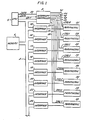
- a computer system bus 2 is connected to a central processing unit (CPU) 4, memory 6, an interrupt controller 8 , and a plurality of interfaces 10-24.
- the interfaces 10-24 may be any type of suitable shared boundary and may include electronic interface devices, such as universal asynchronous receivers/transmitters (UARTS) and suitable connectors.
- the interfaces 10-24 are connected to peripheral devices 26-40 which may be sensing or monitoring devices, such as thermocouples or voltage sensors, or control devices, such as motors, electronic switches, or other devices, suitable for computer controlled applications.
- the peripheral devices 26-40 have interrupt request outputs which are connected via lines 42-56 to interrupt request inputs on the interrupt controller 8.
- the interrupt controller 8 includes an interrupt request output connected via a line 58 to an interrupt request input on the CPU 4.
- An interrupt acknowledge line 60 is connected to carry an interrupt acknowledge signal from the CPU 4 back to the interrupt controller 8.
- the lines 58, 60 are treated as part of a system bus including data, address, and control iines.
- Figure 1 shows the interrupt request line 58 and the interrupt acknowledge line 60 running between the interrupt controller 8 and the CPU 4 as separate lines.
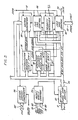
- FIG. 2 shows a more detailed diagram of the interrupt controller 8.
- a data bus buffer 62 provides an interface between the system data bus 2 ( Figure 1) and an internal data bus 64.
- An interrupt request register (IRR) 66 is connected to the data bus 64 and has eight interrupt request inputs collectively shown as 68.
- the interrupt request inputs 68 are individually designated IRQ0-IRQ7
- the IRR 66 has an interrupt request output INTR 70 which is connected to the line 58 shown in Figure 1.
- the embodiment depicted in Figure 2 includes an interrupt acknowledge input INTA 72 connected to the interrupt acknowledge line 60 from the CPU 4.
- a read/write control module 74 is provided having read and write inputs (IOR, IOW) 76, 78, a chip select input (CS) 80, and an address select input (AO) 82.
- IOR, IOW read and write inputs
- CS chip select input
- AO address select input
- a cascade control 84 is provided having a three bit cascade bus (CAS) 86 which is an output when the controller is used as a master and an input when the controller is used as a slave.
- CAS cascade bus
- ISR in service register
- the ISR 88 stores a bit corresponding to each interrupt request input 68. Bits in the ISR 88 are set to indicate which interrupt levels are being serviced.
- the IRR 66 generates an interrupt request which is delivered to the CPU 4 over the interrupt request line 70. An acknowledgement from the CPU 4 is received over the interrupt acknowledge line 72 by the IRR 66, the ISR 88, a vector generator 90, and a priority resolver 92, all of conventional design.
- the interrupt controller 8 also includes a series of initialization command word (ICW) registers, collectively shown as 94, which are written into by the CPU 4 through the data bus buffer 62 and the internal data bus 64 upon initiaiization.
- ICW registers 94 provide vector bits to the vector generator 90 which, in turns, presents a suitable interrupt vector or service routine address onto the internal data bus 64.
- the priority resolver 92 assigns each of the interrupt request inputs (IRQ0-IRQ7) 68 a priority position with respect to the other inputs 68 to create a hierarchy for resolving which interrupt request is serviced first when simultaneous or time overlapping interrupt requests are received by the IRR 66. Any suitable priority scheme may be used.
- priority may be fixed in a given order.
- priority may rotate, i.e., an input may go to the bottom of the priority hierarchy after it has been serviced.
- operation command word (OCW) registers OCW1, OCW2, and OCW3 cause the interrupt controller 8 to operate in various modes in a well known manner.
- OCW1 is stored in a mask register 96.
- the bits of the OCW1 register serve to mask selected ones of the IRQ inputs 68.
- OCW2 and OCW3 are stored in an operation register 98 and provide other operational modes.
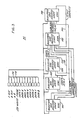
- the ICW registers 94 are depicted in more detail in Figure 3.
- the registers include ICW1 (shown as 100), ICW2 (shown as 102), ICW3 (shown as 104), ICW4 (shown as 106, and ICW5 (shown as 108).
- Figure 3 the ICW registers 94 are shown in block diagram along with certain interconnections. Still more detailed drawings, including additional logic used to interconnect the registers, are provided and discussed below. While the following discussion illustrates a preferred embodiment in terms of various functions controlled by bits in these registers, it is to be understood that an interrupt controller in accordance with the spirit and scope of the invention may include varying numbers of registers and may make bit assignments for functions, such as those described below, in arrangements different from the present embodiment.
- ICW registers 94 are programmed during initialization by the CPU 4 which writes values into the registers to set bits so as to configure the interrupt controller 8 in a desired fashion. Examples of ICW programming for various configurations are shown in Figures 9A-9E and the related text. In the present embodiment, the ICW registers 94 are written into in sequence. Alternatively the ICW registers 94 could be separately addressable for reading and writing in any desired sequence. Each register produces a signal indicating that it has been written into.
- I n Figure 3 these signals are indicated as ICW1/ICW1, COMPL ICW2, COMPL ICW3, COMPL ICW4 AND ICW5 COMPLETE. These signals are used to enable writing into the subsequent registers. While all of the ICW 94 registers are used for completely configuring the interrupt controller 8, certain registers contain bits which are particularly relevant to the disclosed embodiment. These registers are described in more detail below.
- Figure 3 may be taken as a summary of the more detailed subject matter appearing below.
- the architecture of the preferred embodiment as depicted in Figure 3 is similar in many respects to the Intel 8259A programmable interrupt controller referred to above.
- the ICW1, ICW2, ICW3, and ICW4 registers 100, 102, 104, 106 are substantially similar to comparable registers in the 8259A. Points of distinction between these registers as used in the 8259A and in the present preferred embodiment are noted below.
- the ICW5 register 108 is a novel feature of the present embodiment. Since an objective of the present invention is to provide a programmable interrupt controller in which a plurality of interrupt request inputs may be programmed to be either edge-sensitive or level-sensitive on a per interrupt basis, the ICW5 register 108 includes a bit corresponding to each interrupt request input. Each bit may be programmed in one of two states, the two states corresponding respectively to edge-sensitivity and level-sensitivity.
- a user may program an interrupt controller as depicted in Figure 3 to provide the desired per interrupt selectability of edge-triggering or level-triggering.
- a programmable interrupt controller in accordance with the invention need not follow this exact architecture. Different types of interrupt controllers will have different types of programming characteristics. It may be that configuration parameters in other interrupt controllers may be programmed in a manner other than through the use of control registers. Also, similar configuration parameters may be defined in terms of different programmable bits from those described below in conjunction with the initialization control registers. However, any such programmable interrupt controller will fall within the spirit and scope of the present invention if a plurality of interrupt request inputs may be programmed on a per interrupt basis for edge-sensitivity or level-sensitivity, either through the use of a register such as the ICW5 register 108 or through other suitable means.
- backward compatibility with the Intel 8259A is provided by using a LEVEL/EDGE bit. While the 8259A uses this single bit to program all interrupt request inputs to be either edge-sensitive or level-sensitive, the present preferred embodiment uses this same bit to select either edge-sensitivity for all interrupt request inputs or selectability on a per interrupt basis through the use of the bits in the ICW5 register 108. This use of the LEVEL/EDGE bit in this manner is an additional novel feature of the present invention. While it is defined in the present preferred embodiment to provide backward compatibility with the Intel 8259A, other programmable interrupt controllers might provide backward compatibility with previously existing interrupt controllers in an essentially analogous manner by adapting the definition of their own configuration parameters in a suitable fashion.
- Figure 3 shows various system signals which are provided to all of the initialization command word registers. These signals are all essentially conventional in nature. They are standard computer system data, address, and control bus signais.
- the lines DATA0-DATA7 are data bus lines. They are individual lines which together make up the eight bit data bus 64 shown in Figure 2.
- the line A0 is the least significant bit of a conventional address bus.
- Many large scale integrated circuits, such as interface devices and interrupt controllers may be programmed through the use of memory-mapped input/output. This is a conventional programming technique in which one or more memory addresses are used to program a peripheral device, such as an interface device or an interrupt controller.
- address bus lines may be connected in hardware to these inputs to provide addressability through software programming.
- the signals I/O WRITE PULSE, CCLK, and BCLK are conventional control signals. ln particular, the present preferred embodiment utilizes two separate clock signal CCLK and BCLK. Typically, a plurality of clock signals may be used if they have a given phase relationship between each other. In other conventional systems, a single clock may be used.
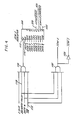
- FIG. 4 a more detailed drawing is provided showing the ICW1 register 100 and logic utilized for writing into it.
- Writing into the ICW1 register 100 is facilitated by means of the system clocks BCLK and CCLK.
- An AND gate 110 is provided for enabling the system CCLK to reach a C input 112 of the ICW1 register 100 under suitable conditions.
- a B input 114 of the ICW1 register 100 is connected directly to the system BCLK.
- an address line / 116 must be high as well as an I/0 WRITE PULSE 118.
- DATA4 is also connected to the AND gate 110.
- Data bits on the data bus 64 are written into the ICW1 register 100 in a conventional fashion to provide various defined signals representing a desired configuration of the interrupt controller.
- the Bit 3 of the ICW1 register is the LEVEL/EDGE bit 120.
- a corresponding bit defines whether all of the interrupt request inputs were level-sensitive or edge-sensitive.
- the function of the LEVEL/EDGE bit 120 has been modified to provide backward compatibility with the 8259A as well as selectability on a per interrupt basis in accordance with the invention. When the LEVEL/EDGE bit 120 is low, all interrupt request inputs are edge-sensitive.
- interrupt request inputs are programmable on a per interrupt basis to be either edge-sensitive or level-sensitive. Exactly how each interrupt request input is programmed for detecting interrupt requests in described below in conjunction with the ICW5 register 108. Defining bit 3 of the ICW1 register 100 in this manner is a practical manner for implementing the invention while also providing backward compatibility. Since many older systems employing the 8259A use peripheral devices producing edge-triggered interrupt requests, system software for configuring the 8259A would typically program bit 3 of the ICW1 register 100 to be low for edge-triggering. Thus, an interrupt controller in accordance with the invention programming this bit to be low would operate in the same manner as an 8259A. On the other hand, newer systems employing newer level-triggered peripheral devices and an interrupt controller in accordance with the invention could easily program the LEVEL/EDGE bit 120 high, thereby providing interrupt selectability on a per interrupt basis.
- the LEVEL/EDGE bit 120 could be implemented such that the high value would configure all interrupt request inputs to be level-sensitive and a low value would permit per input selectability.
- the LEVEL/EDGE bit 120 could be ignored and each interrupt request input would always be configured in accordance with a corresponding bit in ICW5 as described below.
- the state of the LEVEL/EDGE bit 120 could be reversed, i.e., a high state could correspond with edge-sensitive interrupt requests. Then it would be an EDGE/LEVEL bit.
- Bit O of the ICW1 register is an IC4 bit 122
- this bit is a 1
- the ICW4 register 106 is programmed and its bits define interrupt controller parameters as discussed in conjunction with Figure 5 and tabulated in Figures 9A-9E.
- the ICW4 register 106 is not programmed and the parameters are set to default values as described in conjunction with Figure 9E which illustrates a case in which the IC4 bit 122 is low.
- Figure 4 also shows bit 1 of the ICW1 register 100 which is a SINGLE/CASCADE bit 124.
- This bit is utilized in a conventional manner when a plurality of interrupt controllers are used in a system.
- a master interrupt controller can be used with up to eight slave controllers, thereby permitting up to sixty-four interrupt request inputs at up to sixty-four priority levels to be handled.
- the cascade control 84 has a three-bit cascade bus 86.
- the cascade mode is selected by programming the SINGLE/CASCADE bit 124 low and the controller is configured as a master (as will be described later in conjunction with the ICW4 register 106), then the three iines making up the cascade bus 86 are outputs which are used to select one of up to eight slave controllers.
- an AND gate 126 and an inverter 128 which produce high-true and low-true versions of a signal ICW1.
- the AND gate 126 has inputs connected to receive the system I/O WRITE PULSE 118 as well as the address line / 116 and the DATA4, the fourth bit of the data bus 64. Accordingly, the AND gate 126 outputs the signal ICW1 as a pulse synchronized with the I/O WRITE PULSE 118 when the ICW1 register 100 is written into.
- This signal ICW1 is used for clearing the remaining ICW registers when the programming sequence, beginning with the ICW1 register 100, commences, thereby enabling programming of the other registers in sequence.
- the ICW4 register 106 is clocked by means of the system BCLK and the system CCLK as enabled by an enabling logic network. Since, in accordance with the preferred embodiment, the ICW2 and/or ICW3 registers 102, 104 must be written as a prerequisite to writing the ICW4 register 106, the enabling logic network receives signals indicating the completion of writing into the registers 102, 104. The signals are called COMPL ICW2 and COMPL ICW3 and are shown in Figure 3 as 130 and 132, respectively.
- the network includes an AND gate 134 connected to receive as inputs a signal COMPL ICW2 (indicating that the ICW2 register 102 has been programmed) and the SINGLE/CASCADE bit 124 of the ICW1 register 100.
- An OR gate 136 is connected to receive as inputs the output of the AND gate 134 and a signal COMPL ICW3, indicating that the ICW3 register 104 has been programmed.
- the ICW3 register 104 is not programmed.
- programming the ICW4 register 106 may be enabled either by the completion of programming of the ICW3 register 104 or, in the single mode, by that of the ICW2 register 102.
- the output of the OR gate 136 is connected to an input of an AND gate 138.
- the AND gate 138 produces an output which enables the system CCLK through an AND gate 140 to the ICW4 register 106 when all necessary prerequisites are met.
- An output from the OR gate 136 is one prerequisite.
- the I/O WRITE PULSE 118 and the address line AO 116 are prerequisites for enabling the CCLK to the ICW4 register 106.
- bits 5, 6, and 7 of the data bus 64, which are not used in the ICW4 register 106, must be low. These three data bits are shown as inverted in a conventional manner to accommodate the active high inputs of the AND gate 138.
- Circuitry is also provided in Figure 5 for enabling the programmable interrupt controller 8 upon completion of programming of all of the ICW registers.
- the controller 8 is enabled when the ICW5 register 108 has been programmed if the LEVEL/EDGE bit 120 is high.
- the ICW5 register 108 is programmed to select edge-triggering or level-triggering on a per interrupt basis. If the LEVEL/EDGE bit 120 has been programmed low, all interrupt request inputs default to edge-sensitivity. Accordingly, an AND gate 142 is provided to enable the programmable interrupt controller 8 when the LEVEL/EDGE bit 120 is high and the ICW5 register 108 has been programmed, as indicated by an ICW5 COMPLETE signal 144.
- a set/reset latch 146 is provided to indicate that the ICW4 register 106 has been written into by producing a signal COMPL ICW4, shown as 148.
- the output of the latch 146 is also used to indicate that programming of the interrupt controller 8 is completed. Where the LEVEL/EDGE bit 120 is low, indicating that the interrupt controller 8 defaults to a situation where all inputs are edge-sensitive, there is no need to program the ICW5 register 108. Accordingly, the interrupt controller 8 is ready to be enabled after the ICW4 register 106 has been programmed.
- the LEVEL/EDGE bit 120 is inverted by an inverter 150 to indicate edge-triggering when high.
- a high true output 152 of the latch 146 is connected along with the inverted LEVEL/EDGE bit 120 to an AND gate 154.
- Outputs of the AND gates 142 and 154 are connected to inputs of an OR gate 156.
- the output of the OR gate 156 is a PIC ENABLE signal 158 which, when high, indicates that the programmable interrupt controller 8 is enabled.
- PIC ENABLE 158 is inverted by an inverter 160 to produce a PICENABLE signal 162 which is used where an active low signal indicating that the programmable interrupt controller is enabled is required.
- the latch 146 is clocked by the system CCLK and BCLK.
- a low value is clocked into the latch 146.
- a low-true output 164 of the latch 146 will be high, enabling the AND gate 138 which receives the ICW4 decoding signals.
- an OR gate 166 goes high, raising a first input 168 of an AND gate 170, the output of which is connected to a data input 172 of the latch 146.
- a second input 174 of the AND gate 170 is connected to ICW1.
- ICW1 is normally high and goes low only at the time when the ICW1 register 100 is written into, thereby initiating the programming of the ICW registers. Accordingly, at the moment when the ICW1 signal goes low, a low value is clocked into the latch 146.
- the low-true output 164 of the latch 146 is high, enabling the AND gate 138.
- the high-true output 152 of the latch 146 goes low, so the OR gate 166 remains low until the output of the AND gate 138 goes high.
- the latch 146 is finally set at the time when the ICW4 register 106 is written since the output of the AND gate 138 goes high, enabling the CCLK through the AND gate 140 to the C input of the ICW4 register 106 and also raising the output of the OR gate 166, thereby raising the output of the AND gate 170 connected to the data input 172 of the latch 146.
- the PIC ENABLE signal 158 goes high at the time when the latch 146 is set as the ICW4 register 106 is being written into.
- a microprocessor mode (uPM) bit 176 is set according to which type of microprocessor the interrupt controller is working with. If the uPM bit 176 is low, the interrupter controller 8 will operate in accordance with an 8080 or 8085 microprocessor by providing a sixteen bit interrupt service routine address.
- a MASTER/SLAVE (M/S) bit 178 defines whether the interrupt controller 8 is a master or slave. This bit is used in the cascade mode in which interrupt request outputs of slave controllers are connected to interrupt request inputs of a master controller.
- An automatic end of interrupt (AEOI) bit 180 may be programmed high to cause the programmable interrupt controller 8 to automatically perform a non-specific end of interrupt operation following the last interrupt acknowledge pulse received over the interrupt acknowledge line 72.
- the AEOI bit 180 may be used in a conventional manner in conjunction with rotating interrupt request priority. Rotate in automatic end of interrupt mode may be used.
- the ICW5 register 108 has eight data inputs, one corresponding to each interrupt request input.
- the data bus 64 is enabled through AND gates 182, 184, 186, 188, 190, 192, 194, 196, to each input of the ICW5 register 108.
- the bits on the data bus 64 are loaded into the register 108 to drive output signals LEVEL/EDGE IRQ0-LEVEL/EDGE IRQ7, thereby establishing on a per interrupt basis whether each input is level-sensitive or edge-sensitive.
- FIG. 6 Also shown in Figure 6 is a logic network for enabling the system CCLK to the ICW5 register 108.
- PICENABLE 162 should be high, indicating that programming of the ICW registers 94 is in progress but not complete.
- COMPL ICW4 148 should be high, indicating that the ICW4 register 106 has been already written into.
- the circuitry shown includes an AND gate 198 for enabling the system CCLK through to the C input of the ICW5 register 108.
- the AND gate 198 receives the PICENABLE signal 162 and the COMPL ICW4 signal, as well as the address line AO 116 and the I/O WRITE PULSE 118.
- Another AND gate 200 is connected to receive the system CCLK and the high-true ICW1 signals Outputs of the AND gates 198, 200 are connected to inputs of an OR gate 202 having an output connected to the C input of the ICW5 register 108.
- the AND gate 200 is provided so that the ICW5 register 108 will be written into at the time that the ICW1 register 100 is written into.
- the AND gates 182, 184, 186, 188, 190, 192, 194, 196 are disabled by their respective inputs connected to the ICW1 signal, which is low. Since this signal is inactive, the outputs of the AND gates 182-196 are all low to clear all bits of the ICW5 register 108 at the time when the ICW1 register 100 is written into.
- Each gate has two inputs, one connected to a data bus line of the internal data bus 64 and the other connected to the ICW1 signal.
- ICW1 is low only when the ICW1 register 100 is being written into. Thus, at that time all the inputs to the ICW5 register 108 will be low.
- the CCLK enabling logic includes the AND gate 200 having inputs connected to the ICW1 signal and the system CCLK. Thus, one clock pulse will be enabled through to the C input of the ICW5 register 108 at the time when the ICW1 register 100 is written into.
- a set/reset latch 204 similar to the set/reset latch 146 shown in conjunction with the ICW4 register 106.
- the latch 204 is normally high but is cleared when the ICW1 register 100 is written into. This is done by means of an AND gate 206 having an output connected to the D input of the latch 204 and an input connected to ICW1. As stated above, ICW1 goes low when the ICW1 register 100 is written into. Thus, at that time a low value is clocked into the latch 204.
- the latch 204 is set when COMPL ICW4 148 goes high, indicating that the ICW4 register 106 has already been written into, and also when PICENABLE 162 is high, indicating that, although the ICW4 register 106 has been written into, the logic connected to the D input of the set/reset latch 146 in Figure 5 has not enabled the programmable interrupt controller 8 as yet.
- These signals are input to an AND gate 208, the output of which goes high when all of the conditions described above are met.
- the AND gate 208 has an output connected to a first input of an OR gate 210.
- a second input of the OR gate 210 is connected to the output of the latch 204.
- the output of the OR gate 210 remains high even if the output of the AND gate 208 goes low.
- high values continue to be clocked into the latch 204 until the programming sequence is restarted by programming the ICW1 register 100.
- ICW1 goes low, the output of the AND gate 206 goes low, and a low value is clocked into the latch 204.
- the output of the OR gate 210 and the ICW1 signal are connected to inputs of the AND gate 206.
- FIG 7 shows a detailed logic diagram of a portion of the interrupt request register (IRR) 66 shown in Figure 2.
- the IRR 66 is made up of eight stages, each stage corresponding with one interrupt request input.
- One typical stage 212 is depicted in Figure 7.
- the IRR 66 in its entirety includes eight stages, such as those depicted in Figure 7.
- a programmable interrupt controller in accordance with the spirit and scope of the invention could include any suitable number of such stages.
- Figure 7 includes hardware designed to detect edge-triggered interrupt requests and also hardware to detect level-triggered interrupt requests.
- an input signal 214 called LEVEL/EDGE IRQ n .
- This signal indicates whether an interrupt request input corresponding to the stage 212 is edge-triggered or level-triggered.
- the LEVEL/EDGE IRQ n signal 214 could be any of the eight output signals of the ICW5 register 108 shown in Figure 6.
- an input signal IRQ n 216 is shown. This is an interrupt request input and could be any one of the interrupt request inputs 68 shown in Figure 2.
- an appropriate portion of the hardware depicted in Figure 7 is used for detecting the interrupt request and latching it into the appropriate bit of the IRR 66.
- the LEVEL/EDGE IRQ n signal 214 is high, thereby enabling the interrupt request IRQ n 216 through an AND gate 218 and an OR gate 220 to a metastability latch 222 at a data input 224.
- the metastability latch 222 is clocked by means of the system BCLK and the system CCLK as enabled by a FREEZE signal 226 through an AND gate 228.
- FREEZE 226 is normally high and goes low only during interrupt acknowledge cycles during which detection of a level-triggered interrupt request may be postponed.
- the output of the metastability latch 222 passes through an OR gate 230 to an input of an AND gate 232.
- the remaining inputs of the AND gate 232 include the ICW1 signal which is high except during the programming sequence for the ICW registers 94, and SETISRn 234. This latter signal is a pulse which is normally high but goes low when a corresponding bit of the in service register (ISR) 88 shown in Figure 2 is set.
- the output of the metastability latch 222 passes through the AND gate 232 to a data input of an interrupt request register (IRR) latch 236.
- This latch 236 stores the interrupt request so that the interrupt controller 8 can utilize it to interrupt the CPU 4 and provide suitable information for the CPU 4 to determine which interrupt service routine to execute.
- the IRR bit is reset and the ISR bit is sets If the automatic end of interrupt (AEOI) mode is selected by programming the AEOI bit 180 of the ICW4 register high, the ISR bit is cleared at the end of the final INTA pulse. Otherwise, the ISR bit is cleared when an appropriate EOI command is issued by the interrupt service routine.
- AEOI automatic end of interrupt
- FREEZE goes high, the CCLK is passed to the C input of the metastability latch 222.
- the data input to the IRR latch 236 is enabled through the OR gate 229 and AND gate 232. Thus, the output of the metastability latch 222 is latched into the IRR latch 236.
- edge-triggered operation the hardware in the lower portion of Figure 7, described previously, works essentially as described. However, the hardware in the upper portion of the drawing detects and latches an edge-triggered interrupt request and provides the latched interrupt request to an input of the OR gate 220.
- An edge-triggered interrupt request is enabled by LEVEL/EDGE IRQ n signal 214 as inverted by an inverter 238 through an AND gate 240 to an input of an edge detector 242.
- the output of the edge detector 242 is connected through an OR gate 244 to an input of a level converter 246.
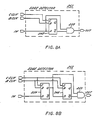
- Figures 8A and 8B show two preferred embodiments of the edge detector 242 of Figure 7.
- a latch 248 and an AND gate 250 having inputs connected to the input and the low-true output of the latch 248.
- the IRQ n signal 216 makes a transition from a low state to a high state. In order for a valid edge to be detected, the transition must take place within a specified time limits such as one clock cycles.
- the system CCLK and BCLK continually run, latching the input signal into the latch 248. When a transition is made, for one clock cycle the previously existing low input will have been latched into the latch 248, driving the low-true output high while the input subsequent to the transition is also high.
- Both inputs of the AND gate 250 are high for that time interval.
- An output signal from the AND gate 250 is high for one clock cycle. This high signal is latched into the level converter 246.
- the high-true output of the level converter 246 is routed back to an input of an AND gate 252, the output of which is connected to an input of the OR gate 244.
- the level converter 246 is latched high, it will remain high until SET ISRn goes low or ICW1 goes low, indicating that the initialization control words are being reprogrammed. This effectively latches the edge-triggered interrupt to a high state.
- the output of the level converter 246 is then connected to an input of the OR gate 220. From here on, the latched edge-triggered interrupt is treated as if it were a level-triggered interrupt as described previously.
- FIG. 8B a second embodiment of the edge detector 242 is shown.
- This embodiment differs from that of Figure 8A in that a synchronizing latch 254 is connected ahead of the latch 248.
- the IRQ n input is connected to a data input of the synchronizing latch 254, and an output of the synchronizing latch 254 is connected to an input of the edge detector latch 248 and to the AND gate 250.
- the latch 248 and the AND gate 250 work essentially the same way as those of the embodiment of Figure 8A.
- the difference is that the synchronizing latch 254 synchronizes the edge-triggered interrupt request in terms of the systems CCLK and BCLK. This provides greater reliability of operation and permits the timing characteristics of the synchronizing latch 254 to be determined in accordance with the timing characteristics of the edge-triggered interrupt request IRQ n .
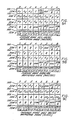
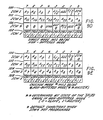
- Figures 9A-9E are tables showing typical initialization command word programming sequences for various system configurations.
- ICW1, ICW4, and ICW5 registers 100, 106, 108 the ICW2 and ICW3 registers 102, 104 are shown.
- the salient characteristics of the configuration are written out on the right, and bits which have certain required values for implementing those system configurations are identified along with the required values.
- the programmable interrupt controller 8 is configured for the cascade mode.
- bit 1 of ICW1, SINGLE/CASCADE bit 124 is set to zero.
- the controller 8 is also configured for operation along with Intel 8080 or 8085 microprocessors.
- the UPM bit 176, bit 0 of ICW4, is zero.
- the ICW2 register and the three most significant bits of the ICW1 register 100 are programmed with bits A15-A5 which provide the address of a page of memory having a table of interrupt service routine addresses.
- An address interval (ADI) bit, bit 2 of ICW1 may be is a one, indicating an interval of four bytes between interrupt service routine addresses, or a zero, indicating an interval of eight bytes between interrupt service routine addresses. In this latter case, bit 5 of the ICW1 register 100 is not used.
- the interrupt controller 8 is set to the cascade mode and a master and one or more slave interrupt controllers are employed, this particular interrupt controller 8 is programmed to be the master. This is done by setting the buffered mode bit BUF, bit 3 of ICW4, to a one and setting the M/S bit 178, bit 2 of ICW4, to a one.
- FIG. 9B there is shown a programming configuration identical to that of Figure 9A except that the programmable interrupt controller 8 is configured for use with 8086 and 8088 microprocessors. The difference is that bit 0 of ICW4, the uPM bit 176, is a one.
- bit 0 of ICW4 the uPM bit 176
- bits 3-7 of the ICW2 register 102 contain the five most significant bits of an interrupt vector supplied to the CPU 4. The three least significant bits, which make up the remainder of the interrupt vector, are determined by which interrupt request line IRQ n 216 is active.
- FIG. 9C there is shown a programming configuration identical to that of Figure 9A except that the interrupt controller 8 is configured to be a slave. This is done simply by setting the M/S bit 178, bit 2 of ICW4, to zero.
- FIG. 9D there is shown a configuration similar that of Figure 9A except that instead the cascade mode, the interrupt controller 8 is configured to the single mode. This is done by setting the SINGLE/CASCADE bit 124, bit 1 of ICW1, to a one. Similarly, the buffered mode bits bit 3 of ICW4, is set to zero because the buffered mode is not applicable here. Also, the value of the M/S bit 178 is irrelevant. It should be noted that the ICW3 register 104 has been omitted from the programming sequence shown in Figure 9D. ICW3 contains information which is only pertinent when both a master and one or more slave interrupt controllers are present.
- the ICW3 register 104 contains eight bits S7-S0 which are set to indicate whether each of the corresponding interrupt request inputs has a slave controller attached to it.
- the ICW3 register 104 contains eight bits S7-S0 which are set to indicate whether each of the corresponding interrupt request inputs has a slave controller attached to it.
- only bits 2-0 of the ICW3 register 104 are used. These three bits provide a slave ID the value of which corresponds to the interrupt request input of the master interrupt controller to which the slave device is connected.
- the ICW3 register 104 is omitted in the single mode.
- FIG. 9E there is shown a programming configuration in which the ICW4 register 106 is omitted. Whether ICW4 is programmed is determined by the IC4 bit, bit 0 of ICW1. In Figures 9A-9D, this bit has always been set high. In Figure 9E, however, this bit is zero. Accordingly, the ICW4 register 106 is omitted and certain default values are established for bits appearing in the ICW4 register 106. First of all, the system is configured as though bit 0 of ICW4 were set to zero, indicating 8080/8085 microprocessor. Second, the system is configured as though the buffer bit, bit 3 of ICW4, were zero, i.e., the system is configured for a non-buffered mode.
- the hardware signal SP/EN is treated as an input and its state determines whether the interrupt controller is configured as a master of a slave. In the case of Figure 9E, it is assumed that the signal is high. Based on this assumption, the interrupt controller configures itself as a master.
- a programmable interrupt controller having a plurality of interrupt request inputs capable of detecting either edge-triggered or level-triggered interrupt requests from peripheral devices.
- the ICW5 register 108 has a bit corresponding with each interrupt request input.
- the bits may be programmed to one of two states respectively corresponding to edge-triggering or level-triggering.
- the bits are programmable on a per bit basis. Accordingly, the interrupt request inputs of the interrupt controller may be programmed on a per interrupt basis for either level-sensitivity or edge-sensitivity.
- the interrupt request inputs may be programmed for edge-sensitivity or level-sensitivity in this manner, it is possible to upgrade a system employing the interrupt controller by changing the mix of edge-triggered or level-triggered interrupt requests.
- the system remains backward compatible with older edge-triggered peripheral devices while accommodating newer level-triggered peripheral devices.
- the interrupt controller may be configured in a manner consistent with the Intel 8259A interrupt controller.
- the controller in accordance with the invention is backward compatible with software written for programming the 8259A.
- interrupt controllers may embody the invention by providing a plurality of interrupt request inputs programmable on a per interrupt basis for either edge-sensitivity or level-sensitivity in any manner suitable to the architecture of that particular interrupt controller.
Landscapes
- Engineering & Computer Science (AREA)
- Theoretical Computer Science (AREA)
- Physics & Mathematics (AREA)
- General Engineering & Computer Science (AREA)
- General Physics & Mathematics (AREA)
- Bus Control (AREA)
- Programmable Controllers (AREA)
Abstract
Description
- The present invention generally relates to a programmable interrupt controller for a computer system and, more particularly, to an interrupt controller having a plurality of interrupt request inputs, each of which may be programmed to detect either edge-triggered or level-triggered interrupt requests on a per input basis.
- Many computer systems are designed to interface with one or more peripheral devices. A computer system typically includes a central processing unit (CPU) connected to a system bus having data, address, and control lines. The bus is connected to other computer system components, such as program memory, and also to peripheral devices via a suitable interface. The interface may include interface devices for translating voltages or signal formats for compatibility between the computer system and the peripheral devices. Suitable interface connectors are often employed. Communication between the CPU and the peripheral devices can include sensory or command information. Specifically, a peripheral device acting as a sensor may produce data signals indicative of parameters the peripheral sensing device is sensing, such as temperature, voltage, or other parameters. The data signals may be translated to a suitable form and read through the interface by the CPU to provide the CPU with needed data regarding the sensed parameters. Alternatively the peripheral devices may be controllers. The CPU commands a peripheral controlling device by writing suitable commands through the interface to the peripheral controlling device. The device then takes suitable action in accordance with the command.
- In a system including a plurality of peripheral devices, frequent or continuing communication between the CPU and the peripheral devices is often necessary. Various schemes have been used for keeping the CPU in touch with the peripheral devices. A first scheme is called polling. In a polling system, the CPU executes a polling routine at intervals of time. Typically, a hardware timer will cause the CPU to execute the polling routine periodically. During the polling routines the CPU reads information from the peripheral devices indicating whether the status of a sensed parameter has changed or whether there is a need to send a command to the peripheral device. Depending on the information received from a given peripheral device during the polling routine, the CPU takes appropriate action, such as sending commands to the peripheral device or updating a record of the status of the peripheral device stored in computer system memory. Polling is commonly used in computer systems which interface with a large number of peripheral devices. However, polling has the disadvantage that the polling routine must be executed frequently, thereby consuming a large amount of CPU processing time. In many instances, the status information read from the peripheral devices indicates that no action is necessary. Thus, the time spent executing the polling routine in retrospect proves to be unproductive. In computer system involving a great deal of activity or real-time applications, the time spent repeating the polling routine can reduce processing efficiency.
- As an alternative to polling, computer systems often service peripheral devices by means of interrupts. In an interrupt system, a peripheral device sends a signal called an interrupt request when a condition is detected requiring some type of action by the CPU. Many CPUs are designed to include interrupt request input lines. A CPU having such an interrupt request input responds to a predetermined voltage signal on the interrupt request line by executing an interrupt service routine. Thus, an interface between a CPU and a peripheral device can include circuitry which detects a change of status in the peripheral device for which service is required and provides a suitable interrupt request signal to the CPU.
- An interrupt driven system of this type provides improved processing efficiency since interrupt routines are executed only when required. However, frequently a CPU will be employed to service a plurality of peripheral devices. In such a system, questions arise as to how to go about determining which peripheral device needs to be serviced in response to an interrupt request. Also, if several peripheral devices simultaneously provide interrupt request signais, there must be a way of determining which one is serviced first. In order to provide practical answers to these questions, programmable interrupt controllers have been designed and utilized in conjunction with computer systems. An interrupt controller typically has a single interrupt request output which is connected to the interrupt request input of the CPU. The interrupt controller also has a plurality of interrupt request inputs. Each interrupt request input in connected to a peripheral device. Thus, when the peripheral device requires servicing, it produces a suitable interrupt request signal which is received by the interrupt controllers. The interrupt controller then interrupts the CPU and causes a suitable interrupt service routine to be executed.
- A well known example of an interrupt controller is the 8259A programmable interrupt controller manufactured by Intel Corporation. The 8259A is designed to operate with two different types of microprocessors which support multiple interrupt request inputs in two different ways. The first type is exemplified by the Intel 8080/8085 microprocessors which service interrupt requests by executing a software instruction for calling a subroutine which has as an operand an address of a subroutine. The second type is exemplified by the Intel 8086 microprocessor which services interrupt requests by using an 8-bit vector to select an interrupt service routine address from a table of addresses stored in a contiguous page of memory. Depending on which type of microprocessor the 8259A is programmed for, in response to an interrupt request input, the 8259A will interrupt the CPU and provide either a subroutine call instruction followed by an interrupt service routine address or an eight bit interrupt vector over the system bus to the CPU. Thus, in either case, the 8259A provides the CPU with information as to which interrupt service routine to execute, thereby ensuring that the CPU services the peripheral device which requested the interrupt in a suitable manner.
- The 8259A may be configured to detect interrupt requests on its interrupt request inputs as either low-to-high voltage transitions or as high voltage levels. In other words, the 8259A interrupt request inputs can be configured as either edge- triggered or level-triggered. Many peripheral devices have been designed to produce edge-triggered interrupt request signals in the form of low-to-high voltage transitions. Specifically, an edge-triggered interrupt request is a transition from a recognizably low voltage to a recognizably high voltage within a predetermined time limit. However, peripheral devices which request service by means of high voltage levels are becoming more common. It is desirable for an interrupt controller to be able to detect level-triggered interrupts to allow for the use of peripheral devices which produce level-triggered interrupt requests, thereby providing for greater flexibility in interface design. It is desirable for a computer system including an interrupt controller to be flexible enough to accommodate the newer peripheral devices producing level-triggered interrupt requests while remaining backward compatible with older peripheral devices which produce edge-triggered interrupt requests.
- However, programmable interrupt controllers to date have had the drawback that all interrupt request inputs are configured in the same manner. Typically, a single edge/level configuration control bit is used to program all interrupt request inputs to be either edge-triggered or level-triggered. This drawback has resulted in the disadvantage that upgrading a system to include peripheral devices producing level-triggered interrupt requests has required that all peripheral devices be so updated. It is not practicable to employ a mix of level-triggered peripheral devices and older edge-triggered peripheral devices. Decreased flexibility and increased user costs have resulted.
- An aim of the present invention is to provide a programmable interrupt controller which detects edge-triggered and level-triggered interrupt requests from peripheral devices on a per peripheral device basis.
- In accordance with the present invention, in or for a computer system including a central processing system unit (CPU), there is now provided interrupt controller comprising: a plurality of inputs connected to receive interrupt requests from a plurality of peripheral devices; an interrupt request output connected to the CPU; means for interrupting the CPU to cause the CPU to service the interrupt requests by sending an interrupt signal over the interrupt request output in response to any one of the interrupt requests; a priority resolver for assigning to each input in the pluraltiy of inputs a priority position to create a hierarchy for the purpose of resolving which interrupt request is first serviced when time overlapping interrupt requests are received; characterised in that the interrupt further comprises means for independently establishing each input to be responsive to either edge-triggered or level-triggered interrupt requests.
- Viewing the present invention from a second aspect, there is provided a programmable interrupt controller for use in a computer system comprising a plurality of inputs connected to receive interrupt requests from a group of peripheral devices, an interrupt request output connected to the CPU, means for interrupting the CPU by sending an interrupt signal over the interrupt request output responsive to any interrupt request received over an interrupt request input to cause the CPU to service the interrupt request, a priority resolver for assigning each input a priority position in said plurality of inputs to create a hierarchy for the purpose of resolving which interrupt request is first serviced when time overlapping interrupt requests are received and means for independently establishing each input to be responsive to either edge-triggered or level-triggered interrupt requests.
- This advantageously provides flexibility in designing and implementing computer systems in that peripheral devices utilizing either edge-triggered or level-triggered interrupt requests may be used on the various interrupt request inputs. Also, such peripheral devices are interchangeable. Replacing an edge-triggered peripheral device with a level-triggered peripheral device merely requires changing the programming configuration of the interrupt controller. Thus, a computer system may be upgraded with new level-triggered peripheral devices without incurring undesirably high costs for replacing otherwise functional peripheral devices.
- Viewing the present invention from a third aspect, there is provided a method for receiving and servicing an edge-triggered interrupt request from a first source and a level-triggered interrupt request from a second source comprising the steps of programming an interrupt controller having first and second interrupt request inputs to detect edge-triggered interrupt requests incoming over the first interrupt request input and to detect level-triggered interrupt requests incoming over the second interrupt request input, said programming being done on a per input basis, detecting an latching an edge-triggered interrupt request incoming over the first input, interrupting the CPU to cause the CPU to service the edge-triggered interrupt request, detecting a level-triggered interrupt request incoming over the second input, and interrupting the CPU to cause the CPU to service the level-triggered interrupt request.
- This advantageously provides programming flexibility and convenience in computer system design and also facilitates system upgrades generally as described in conjunction with the interrupt controller.
- Viewing the present invention from a fourth aspect, in a computer system including a central processing system unit (CPU) and a group of peripheral devices, there is now provided an interrupt controller comprising: a plurality of inputs connected to receive interrupt requests from the group of peripheral devices; an interrupt request output connected to the CPU; means for interrupting the CPU by sending an interrupt signal over the interrupt request output responsive to any one of the interrupt requests to cause the CPU to service the interrupt requests; a priority resolver for assigning each input a priority position in the plurality of inputs to create a hierarchy for the purpose of resolving which interrupt request is first serviced when time overlapping interrupt requests are received; and means for independently establishing each input to be responsive to either edge-triggered or level-triggered interrupt requests.
- Viewing the present invention from a fifth aspect, there is now provided a programmable interrupt controiler comprising: a plurality of interrupt request inputs; a first initialization command register having a plurality of bits, a respective one of the bits corresponding to each of the interrupt request inputs, each of the bits having a first state corresponding to edge-triggering and a second state corresponding to level-triggering, the bits being programmable between the first and second states on a per bit basis; and an interrupt request register having a plurality of stages, a respective one of the stages corresponding to each bit and each interrupt request input, each of the stages including: (a) an edge detector including an edge detector latch having a data input connected to the respective interrupt request input and a data output and operative when the respective bit of the first initialization command register is programmed to the first state for receiving an edge-sensitive interrupt request and latching the request to a level converter latch connected to receive and latch an interrupt request as a level, (b) a metastable latch connected to receive a level-triggered interrupt request when the respective bit is programmed to the second state and connected to receive the interrupt request held as a level by the level converter latch when the respective bit is programmed to the first state, the metastable latch connected to receive a system clock for latching the interrupt request, thereby providing an interrupt request synchronized with the system clock, and (c) an interrupt request register bit connected to receive and hold the synchronized interrupt request from the metastable latch.
- Viewing the present invention from a sixth aspect, there is now provided a computer system comprising: a central processing unit (CPU) having a program including a plurality of interrupt service routines; a group of peripheral devices including at least first and second peripheral devices having edge-triggered and level-triggered interrupt requests, respectively; a bus connected to the CPU; an interrupt controller connected between the group of peripheral devices and the bus for interrupting the CPU responsive to the edge-triggered and level-triggered interrupt requests from the group of peripherals and causing the CPU to execute the interrupt service routines, thereby servicing the interrupt requests.
- Viewing the present invention from a seventh aspect, there is now provided a method for receiving and servicing an edge-triggered request from a first source and a level-triggered interrupt request from a second source comprising the steps of: programming an interrupt controller having first and second interrupt request inputs to detect edge-triggered interrupt requests incoming over the first interrupt request input and detect level-triggered interrupt requests incoming over the second interrupt request input, the programming being done on a per input basis; detecting and latching an edge-triggered interrupt request incoming over the first input; interrupting a central processing unit (CPU) to cause the CPU to service the edge-triggered interrupt request; detecting a level-triggered interrupt request incoming over the second input; and interrupting the CPU to cause the CPU to service the level-triggered interrupt request.
- In an example of the present inventions there is provided an interrupt controller for a computer system which allows for the peripheral devices in the group to be replaced or upgraded in a manner which may include changing the mix of edge-triggered and level-triggered interrupt requests while preserving the system's ability to service the peripheral devices. The interrupt controller is capable of servicing interrupt requests from any particular mix of peripheral devices having edge-triggered and level triggered interrupt requests without regard to the address location of each device. In other words, each peripheral can have either edge-triggered or level-triggered interrupt requests, and the interrupt controller accommodates edge-triggered and level-triggered interrupts on a per interrupt line basis.
- In a preferred example of the present invention to be described later, there is provided a computer system having a programmable interrupt controller which may be programmed in accordance with currently existing software written for previously existing programmable interrupt controllers. If the controller is so programmed, all inputs shall detect either edge triggered interrupt requests or level-triggered interrupt requests so that a controller in accordance with the invention operates in a manner consistent with such previously existing programmable interrupt controllers. Thus the controller is backward compatible with existing computer systems. The programmable interrupt controller of the present invention thus provides a method for receiving and servicing edge-triggered and level-triggered interrupts.
- An embodiment of the present invention will now be described, by way of example only, with reference to the accompanying drawings in which:
- Figure 1 is a block diagram of a computer system utilizing an interrupt controller in accordance with the invention for servicing peripheral devices.
- Figure 2 is a block diagram of an interrupt controller in accordance with the invention.
- Figure 3 is a logic diagram showing a hardware configuration of initialization control word registers utilized in a preferred embodiment of the invention.
- Figures 4-6 are detailed logic diagrams of various initialization control word registers shown in Figure 3.
- Figure 7 is a detailed logic diagram showing a stage of the interrupt request register (IRR) shown in Figure 2.
- Figures 8A and 8B are first and second embodiments, respectively of the edge detector shown in Figure 7.
- Figures 9A-9E are tables showing how the initialization control word registers of the preferred embodiment of the programmable interrupt controller may be programmed for various system configurations.
- Referring to Figure 1, there is depicted a computer system employing an interrupt controller in accordance with the invention. A
computer system bus 2 is connected to a central processing unit (CPU) 4,memory 6, an interruptcontroller 8 , and a plurality of interfaces 10-24. The interfaces 10-24 may be any type of suitable shared boundary and may include electronic interface devices, such as universal asynchronous receivers/transmitters (UARTS) and suitable connectors. The interfaces 10-24 are connected to peripheral devices 26-40 which may be sensing or monitoring devices, such as thermocouples or voltage sensors, or control devices, such as motors, electronic switches, or other devices, suitable for computer controlled applications. The peripheral devices 26-40 have interrupt request outputs which are connected via lines 42-56 to interrupt request inputs on the interruptcontroller 8. The interruptcontroller 8 includes an interrupt request output connected via a line 58 to an interrupt request input on theCPU 4. An interrupt acknowledge line 60 is connected to carry an interrupt acknowledge signal from theCPU 4 back to the interruptcontroller 8. Typically, the lines 58, 60 are treated as part of a system bus including data, address, and control iines. For the purpose of illustration, however, Figure 1 shows the interrupt request line 58 and the interrupt acknowledge line 60 running between the interruptcontroller 8 and theCPU 4 as separate lines. - Figure 2 shows a more detailed diagram of the interrupt
controller 8. Adata bus buffer 62 provides an interface between the system data bus 2 (Figure 1) and aninternal data bus 64. An interrupt request register (IRR) 66 is connected to thedata bus 64 and has eight interrupt request inputs collectively shown as 68. The interruptrequest inputs 68 are individually designated IRQ₀-IRQ₇ The IRR 66 has an interruptrequest output INTR 70 which is connected to the line 58 shown in Figure 1. In addition, the embodiment depicted in Figure 2 includes an interrupt acknowledgeinput INTA 72 connected to the interrupt acknowledge line 60 from theCPU 4. To permit theCPU 4 to select the interruptcontroller 8 and write to and read from thecontroller 8, a read/write control module 74 is provided having read and write inputs (IOR, IOW) 76, 78, a chip select input (CS) 80, and an address select input (AO) 82. To permit a plurality of interrupt controllers to be cascaded in a single computer system, acascade control 84 is provided having a three bit cascade bus (CAS) 86 which is an output when the controller is used as a master and an input when the controller is used as a slave. - Also shown in Figure 2 is an in service register (ISR) 88. The
ISR 88 stores a bit corresponding to each interruptrequest input 68. Bits in theISR 88 are set to indicate which interrupt levels are being serviced. TheIRR 66 generates an interrupt request which is delivered to theCPU 4 over the interruptrequest line 70. An acknowledgement from theCPU 4 is received over the interrupt acknowledgeline 72 by theIRR 66, theISR 88, avector generator 90, and apriority resolver 92, all of conventional design. - The interrupt
controller 8 also includes a series of initialization command word (ICW) registers, collectively shown as 94, which are written into by theCPU 4 through thedata bus buffer 62 and theinternal data bus 64 upon initiaiization. In a conventional manner, the ICW registers 94 provide vector bits to thevector generator 90 which, in turns, presents a suitable interrupt vector or service routine address onto theinternal data bus 64. Thepriority resolver 92 assigns each of the interrupt request inputs (IRQ₀-IRQ₇) 68 a priority position with respect to theother inputs 68 to create a hierarchy for resolving which interrupt request is serviced first when simultaneous or time overlapping interrupt requests are received by theIRR 66. Any suitable priority scheme may be used. As a first example, priority may be fixed in a given order. As a second example, priority may rotate, i.e., an input may go to the bottom of the priority hierarchy after it has been serviced. Finally, operation command word (OCW) registers OCW1, OCW2, and OCW3 cause the interruptcontroller 8 to operate in various modes in a well known manner. OCW1 is stored in amask register 96. The bits of the OCW1 register serve to mask selected ones of theIRQ inputs 68. OCW2 and OCW3 are stored in anoperation register 98 and provide other operational modes. - The ICW registers 94 are depicted in more detail in Figure 3. The registers include ICW1 (shown as 100), ICW2 (shown as 102), ICW3 (shown as 104), ICW4 (shown as 106, and ICW5 (shown as 108). ln Figure 3, the ICW registers 94 are shown in block diagram along with certain interconnections. Still more detailed drawings, including additional logic used to interconnect the registers, are provided and discussed below. While the following discussion illustrates a preferred embodiment in terms of various functions controlled by bits in these registers, it is to be understood that an interrupt controller in accordance with the spirit and scope of the invention may include varying numbers of registers and may make bit assignments for functions, such as those described below, in arrangements different from the present embodiment. Also, individual bits may be defined differently as long as the overall device functions in a manner essentially consistent with the spirit and scope of the invention. The ICW registers 94 are programmed during initialization by the
CPU 4 which writes values into the registers to set bits so as to configure the interruptcontroller 8 in a desired fashion. Examples of ICW programming for various configurations are shown in Figures 9A-9E and the related text. In the present embodiment, the ICW registers 94 are written into in sequence. Alternatively the ICW registers 94 could be separately addressable for reading and writing in any desired sequence. Each register produces a signal indicating that it has been written into. I n Figure 3, these signals are indicated as ICW1/ICW1, COMPL ICW2, COMPL ICW3, COMPL ICW4 AND ICW5 COMPLETE. These signals are used to enable writing into the subsequent registers. While all of theICW 94 registers are used for completely configuring the interruptcontroller 8, certain registers contain bits which are particularly relevant to the disclosed embodiment. These registers are described in more detail below. - Figure 3 may be taken as a summary of the more detailed subject matter appearing below. The architecture of the preferred embodiment as depicted in Figure 3 is similar in many respects to the Intel 8259A programmable interrupt controller referred to above. In particular, the ICW1, ICW2, ICW3, and ICW4 registers 100, 102, 104, 106 are substantially similar to comparable registers in the 8259A. Points of distinction between these registers as used in the 8259A and in the present preferred embodiment are noted below.
- The
ICW5 register 108 is a novel feature of the present embodiment. Since an objective of the present invention is to provide a programmable interrupt controller in which a plurality of interrupt request inputs may be programmed to be either edge-sensitive or level-sensitive on a per interrupt basis, theICW5 register 108 includes a bit corresponding to each interrupt request input. Each bit may be programmed in one of two states, the two states corresponding respectively to edge-sensitivity and level-sensitivity. Thus, in accordance with the invention, a user may program an interrupt controller as depicted in Figure 3 to provide the desired per interrupt selectability of edge-triggering or level-triggering. - With this in mind, it will be seen that a programmable interrupt controller in accordance with the invention need not follow this exact architecture. Different types of interrupt controllers will have different types of programming characteristics. It may be that configuration parameters in other interrupt controllers may be programmed in a manner other than through the use of control registers. Also, similar configuration parameters may be defined in terms of different programmable bits from those described below in conjunction with the initialization control registers. However, any such programmable interrupt controller will fall within the spirit and scope of the present invention if a plurality of interrupt request inputs may be programmed on a per interrupt basis for edge-sensitivity or level-sensitivity, either through the use of a register such as the
ICW5 register 108 or through other suitable means. - As will be described below, backward compatibility with the Intel 8259A is provided by using a LEVEL/EDGE bit. While the 8259A uses this single bit to program all interrupt request inputs to be either edge-sensitive or level-sensitive, the present preferred embodiment uses this same bit to select either edge-sensitivity for all interrupt request inputs or selectability on a per interrupt basis through the use of the bits in the
ICW5 register 108. This use of the LEVEL/EDGE bit in this manner is an additional novel feature of the present invention. While it is defined in the present preferred embodiment to provide backward compatibility with the Intel 8259A, other programmable interrupt controllers might provide backward compatibility with previously existing interrupt controllers in an essentially analogous manner by adapting the definition of their own configuration parameters in a suitable fashion. - In addition, Figure 3 shows various system signals which are provided to all of the initialization command word registers. These signals are all essentially conventional in nature. They are standard computer system data, address, and control bus signais. For instance, the lines DATA0-DATA7 are data bus lines. They are individual lines which together make up the eight
bit data bus 64 shown in Figure 2. The line A0 is the least significant bit of a conventional address bus. Many large scale integrated circuits, such as interface devices and interrupt controllers, may be programmed through the use of memory-mapped input/output. This is a conventional programming technique in which one or more memory addresses are used to program a peripheral device, such as an interface device or an interrupt controller. Where one or more address inputs are designed into the devices system address bus lines may be connected in hardware to these inputs to provide addressability through software programming. Finally, the signals I/O WRITE PULSE, CCLK, and BCLK are conventional control signals. ln particular, the present preferred embodiment utilizes two separate clock signal CCLK and BCLK. Typically, a plurality of clock signals may be used if they have a given phase relationship between each other. In other conventional systems, a single clock may be used. - Turning to Figure 4, a more detailed drawing is provided showing the
ICW1 register 100 and logic utilized for writing into it. Writing into theICW1 register 100 is facilitated by means of the system clocks BCLK and CCLK. An ANDgate 110 is provided for enabling the system CCLK to reach aC input 112 of theICW1 register 100 under suitable conditions. A B input 114 of theICW1 register 100 is connected directly to the system BCLK. To permit the CPU to address individual registers within the interruptcontroller 8, an address line / 116 must be high as well as an I/0WRITE PULSE 118. When a data line DATA4 of thedata bus 64 is high, the command is interpreted as being directed to theICW1 register 100. Accordingly, DATA4 is also connected to the ANDgate 110. - Data bits on the
data bus 64 are written into theICW1 register 100 in a conventional fashion to provide various defined signals representing a desired configuration of the interrupt controller. In accordance with the preferred embodiment of the invention, theBit 3 of the ICW1 register is the LEVEL/EDGE bit 120. In the 8259A interrupt controller, a corresponding bit defines whether all of the interrupt request inputs were level-sensitive or edge-sensitive. In the present embodiment of the invention, the function of the LEVEL/EDGE bit 120 has been modified to provide backward compatibility with the 8259A as well as selectability on a per interrupt basis in accordance with the invention. When the LEVEL/EDGE bit 120 is low, all interrupt request inputs are edge-sensitive. When the LEVEL/EDGE bit 120 is high, interrupt request inputs are programmable on a per interrupt basis to be either edge-sensitive or level-sensitive. Exactly how each interrupt request input is programmed for detecting interrupt requests in described below in conjunction with theICW5 register 108. Definingbit 3 of theICW1 register 100 in this manner is a practical manner for implementing the invention while also providing backward compatibility. Since many older systems employing the 8259A use peripheral devices producing edge-triggered interrupt requests, system software for configuring the 8259A would typically programbit 3 of the ICW1 register 100 to be low for edge-triggering. Thus, an interrupt controller in accordance with the invention programming this bit to be low would operate in the same manner as an 8259A. On the other hand, newer systems employing newer level-triggered peripheral devices and an interrupt controller in accordance with the invention could easily program the LEVEL/EDGE bit 120 high, thereby providing interrupt selectability on a per interrupt basis. - For implementing an interrupt controller in accordance with the invention having backward compatibility, the implementation as described above is deemed to be the best mode for carrying out the invention. However, it will be understood that other ways of implementing edge-triggered and level-triggered interrupts are within the scope and spirit of the invention. For instance, the LEVEL/
EDGE bit 120 could be implemented such that the high value would configure all interrupt request inputs to be level-sensitive and a low value would permit per input selectability. Alternatively, the LEVEL/EDGE bit 120 could be ignored and each interrupt request input would always be configured in accordance with a corresponding bit in ICW5 as described below. Also, the state of the LEVEL/EDGE bit 120 could be reversed, i.e., a high state could correspond with edge-sensitive interrupt requests. Then it would be an EDGE/LEVEL bit. - Bit O of the ICW1 register is an
IC4 bit 122 When this bit is a 1, theICW4 register 106 is programmed and its bits define interrupt controller parameters as discussed in conjunction with Figure 5 and tabulated in Figures 9A-9E. Of theIC4 bit 122 is 0, then theICW4 register 106 is not programmed and the parameters are set to default values as described in conjunction with Figure 9E which illustrates a case in which theIC4 bit 122 is low. - Figure 4 also shows
bit 1 of the ICW1 register 100 which is a SINGLE/CASCADE bit 124. This bit is utilized in a conventional manner when a plurality of interrupt controllers are used in a system. A master interrupt controller can be used with up to eight slave controllers, thereby permitting up to sixty-four interrupt request inputs at up to sixty-four priority levels to be handled. As shown in Figure 2 and described earlier, thecascade control 84 has a three-bit cascade bus 86. If the cascade mode is selected by programming the SINGLE/CASCADE bit 124 low and the controller is configured as a master (as will be described later in conjunction with the ICW4 register 106), then the three iines making up thecascade bus 86 are outputs which are used to select one of up to eight slave controllers. - Also shown in Figure 4 are an AND
gate 126 and aninverter 128 which produce high-true and low-true versions of a signal ICW1. The ANDgate 126 has inputs connected to receive the system I/O WRITE PULSE 118 as well as the address line / 116 and the DATA4, the fourth bit of thedata bus 64. Accordingly, the ANDgate 126 outputs the signal ICW1 as a pulse synchronized with the I/O WRITE PULSE 118 when theICW1 register 100 is written into. This signal ICW1 is used for clearing the remaining ICW registers when the programming sequence, beginning with theICW1 register 100, commences, thereby enabling programming of the other registers in sequence. - Referring now to Figure 5, there is disclosed the
ICW4 register 106 and accompanying logic. As with the other registers, theICW4 register 106 is clocked by means of the system BCLK and the system CCLK as enabled by an enabling logic network. Since, in accordance with the preferred embodiment, the ICW2 and/or ICW3 registers 102, 104 must be written as a prerequisite to writing theICW4 register 106, the enabling logic network receives signals indicating the completion of writing into theregisters gate 134 connected to receive as inputs a signal COMPL ICW2 (indicating that theICW2 register 102 has been programmed) and the SINGLE/CASCADE bit 124 of theICW1 register 100. An ORgate 136 is connected to receive as inputs the output of the ANDgate 134 and a signal COMPL ICW3, indicating that theICW3 register 104 has been programmed. As shown in Figure 13 and discussed hereinafter, in the single mode, theICW3 register 104 is not programmed. Thus, programming theICW4 register 106 may be enabled either by the completion of programming of the ICW3 register 104 or, in the single mode, by that of theICW2 register 102. - The output of the
OR gate 136 is connected to an input of an ANDgate 138. The ANDgate 138 produces an output which enables the system CCLK through an ANDgate 140 to theICW4 register 106 when all necessary prerequisites are met. An output from theOR gate 136 is one prerequisite. In addition, the I/O WRITE PULSE 118 and theaddress line AO 116 are prerequisites for enabling the CCLK to theICW4 register 106. Finally,bits data bus 64, which are not used in theICW4 register 106, must be low. These three data bits are shown as inverted in a conventional manner to accommodate the active high inputs of the ANDgate 138. - Circuitry is also provided in Figure 5 for enabling the programmable interrupt
controller 8 upon completion of programming of all of the ICW registers. Thecontroller 8 is enabled when theICW5 register 108 has been programmed if the LEVEL/EDGE bit 120 is high. As will be shown below, theICW5 register 108 is programmed to select edge-triggering or level-triggering on a per interrupt basis. If the LEVEL/EDGE bit 120 has been programmed low, all interrupt request inputs default to edge-sensitivity. Accordingly, an AND gate 142 is provided to enable the programmable interruptcontroller 8 when the LEVEL/EDGE bit 120 is high and theICW5 register 108 has been programmed, as indicated by an ICW5COMPLETE signal 144. - A set/reset latch 146 is provided to indicate that the
ICW4 register 106 has been written into by producing a signal COMPL ICW4, shown as 148. The output of the latch 146 is also used to indicate that programming of the interruptcontroller 8 is completed. Where the LEVEL/EDGE bit 120 is low, indicating that the interruptcontroller 8 defaults to a situation where all inputs are edge-sensitive, there is no need to program theICW5 register 108. Accordingly, the interruptcontroller 8 is ready to be enabled after theICW4 register 106 has been programmed. - The LEVEL/
EDGE bit 120 is inverted by aninverter 150 to indicate edge-triggering when high. A hightrue output 152 of the latch 146 is connected along with the inverted LEVEL/EDGE bit 120 to an ANDgate 154. Outputs of the ANDgates 142 and 154 are connected to inputs of anOR gate 156. The output of theOR gate 156 is a PIC ENABLE signal 158 which, when high, indicates that the programmable interruptcontroller 8 is enabled. PIC ENABLE 158 is inverted by aninverter 160 to produce aPICENABLE signal 162 which is used where an active low signal indicating that the programmable interrupt controller is enabled is required. - The latch 146 is clocked by the system CCLK and BCLK. When the
CPU 4 begins to program the ICW registers, a low value is clocked into the latch 146. Thus, a low-true output 164 of the latch 146 will be high, enabling the ANDgate 138 which receives the ICW4 decoding signals. When ICW4 is written and the ANDgate 138 goes high, an ORgate 166 goes high, raising afirst input 168 of an ANDgate 170, the output of which is connected to adata input 172 of the latch 146. A second input 174 of the ANDgate 170 is connected to ICW1. ICW1 is normally high and goes low only at the time when theICW1 register 100 is written into, thereby initiating the programming of the ICW registers. Accordingly, at the moment when the ICW1 signal goes low, a low value is clocked into the latch 146. The low-true output 164 of the latch 146 is high, enabling the ANDgate 138. The high-true output 152 of the latch 146 goes low, so theOR gate 166 remains low until the output of the ANDgate 138 goes high. The latch 146 is finally set at the time when theICW4 register 106 is written since the output of the ANDgate 138 goes high, enabling the CCLK through the ANDgate 140 to the C input of theICW4 register 106 and also raising the output of theOR gate 166, thereby raising the output of the ANDgate 170 connected to thedata input 172 of the latch 146. Thus, when the LEVEL/EDGE bit 120 is low, the PIC ENABLE signal 158 goes high at the time when the latch 146 is set as theICW4 register 106 is being written into. - Also shown in Figure 5 are various bits of the ICW4 register 106 indicating various aspects of the configuration of the interrupt
controller 8. Generally speaking, these signals are defined in a manner consistent with the Intel 8259A. They are programmed by writing into theICW4 register 106 with suitable values on the respective bits of thedata bus 64. Of particular interest with respect to the disclosed embodiment are the following bits. A microprocessor mode (uPM) bit 176 is set according to which type of microprocessor the interrupt controller is working with. If theuPM bit 176 is low, theinterrupter controller 8 will operate in accordance with an 8080 or 8085 microprocessor by providing a sixteen bit interrupt service routine address. If theuPM bit 176 is high, the interruptcontroller 8 will operate in accordance with an 8086 microprocessor by providing an eight bit interrupt vector. A MASTER/SLAVE (M/S) bit 178 defines whether the interruptcontroller 8 is a master or slave. This bit is used in the cascade mode in which interrupt request outputs of slave controllers are connected to interrupt request inputs of a master controller. - An automatic end of interrupt (AEOI) bit 180 may be programmed high to cause the programmable interrupt
controller 8 to automatically perform a non-specific end of interrupt operation following the last interrupt acknowledge pulse received over the interrupt acknowledgeline 72. TheAEOI bit 180 may be used in a conventional manner in conjunction with rotating interrupt request priority. Rotate in automatic end of interrupt mode may be used. - Referring now to Figure 6, the
ICW5 register 108 is shown. TheICW5 register 108 has eight data inputs, one corresponding to each interrupt request input. Thedata bus 64 is enabled through ANDgates ICW5 register 108. When theregister 108 is written into, the bits on thedata bus 64 are loaded into theregister 108 to drive output signals LEVEL/EDGE IRQ₀-LEVEL/EDGE IRQ₇, thereby establishing on a per interrupt basis whether each input is level-sensitive or edge-sensitive. - Also shown in Figure 6 is a logic network for enabling the system CCLK to the
ICW5 register 108.PICENABLE 162 should be high, indicating that programming of the ICW registers 94 is in progress but not complete.COMPL ICW4 148 should be high, indicating that theICW4 register 106 has been already written into. The circuitry shown includes an ANDgate 198 for enabling the system CCLK through to the C input of theICW5 register 108. The ANDgate 198 receives thePICENABLE signal 162 and the COMPL ICW4 signal, as well as theaddress line AO 116 and the I/O WRITE PULSE 118. - Another AND
gate 200 is connected to receive the system CCLK and the high-true ICW1 signals Outputs of the ANDgates OR gate 202 having an output connected to the C input of theICW5 register 108. The ANDgate 200 is provided so that theICW5 register 108 will be written into at the time that theICW1 register 100 is written into. At that time, the ANDgates ICW1 register 100 is written into. This is done so that, if the LEVEL/EDGE bit 120 is low, all of the ICW5 bits will be cleared, thereby indicating that all interrupt request inputs will be edge-sensitive. Each gate has two inputs, one connected to a data bus line of theinternal data bus 64 and the other connected to the ICW1 signal. ICW1 is low only when theICW1 register 100 is being written into. Thus, at that time all the inputs to theICW5 register 108 will be low. Similarly, the CCLK enabling logic includes the ANDgate 200 having inputs connected to the ICW1 signal and the system CCLK. Thus, one clock pulse will be enabled through to the C input of the ICW5 register 108 at the time when theICW1 register 100 is written into. Accordingly, it can be assured that all ICW5 bits will be cleared when theICW1 register 100 is written into. If theICW5 register 108 is subsequently written into, its final values will be established at that time. If not, all of the interrupt request inputs will be configured for edge-triggering. - Also shown in Figure 6 is a set/
reset latch 204 similar to the set/reset latch 146 shown in conjunction with theICW4 register 106. Thelatch 204 is normally high but is cleared when theICW1 register 100 is written into. This is done by means of an ANDgate 206 having an output connected to the D input of thelatch 204 and an input connected to ICW1. As stated above, ICW1 goes low when theICW1 register 100 is written into. Thus, at that time a low value is clocked into thelatch 204. Thelatch 204 is set whenCOMPL ICW4 148 goes high, indicating that theICW4 register 106 has already been written into, and also whenPICENABLE 162 is high, indicating that, although theICW4 register 106 has been written into, the logic connected to the D input of the set/reset latch 146 in Figure 5 has not enabled the programmable interruptcontroller 8 as yet. These signals are input to an ANDgate 208, the output of which goes high when all of the conditions described above are met. The ANDgate 208 has an output connected to a first input of anOR gate 210. A second input of theOR gate 210 is connected to the output of thelatch 204. Thus, once the latch goes high, the output of theOR gate 210 remains high even if the output of the ANDgate 208 goes low. Thus, high values continue to be clocked into thelatch 204 until the programming sequence is restarted by programming theICW1 register 100. ICW1 goes low, the output of the ANDgate 206 goes low, and a low value is clocked into thelatch 204. The output of theOR gate 210 and the ICW1 signal are connected to inputs of the ANDgate 206. - The foregoing has been a description of the initialization command word registers which, in the present embodiment, are implemented the programmable interrupt
controller 8 and shown as 94 in Figure 2. - Figure 7 shows a detailed logic diagram of a portion of the interrupt request register (IRR) 66 shown in Figure 2. The
IRR 66 is made up of eight stages, each stage corresponding with one interrupt request input. Onetypical stage 212 is depicted in Figure 7. It will be understood that theIRR 66 in its entirety includes eight stages, such as those depicted in Figure 7. It will also be understood that a programmable interrupt controller in accordance with the spirit and scope of the invention could include any suitable number of such stages. - In accordance with the invention, Figure 7 includes hardware designed to detect edge-triggered interrupt requests and also hardware to detect level-triggered interrupt requests. There is shown an
input signal 214 called LEVEL/EDGE IRQn. This signal indicates whether an interrupt request input corresponding to thestage 212 is edge-triggered or level-triggered. The LEVEL/EDGE IRQn signal 214 could be any of the eight output signals of the ICW5 register 108 shown in Figure 6. Also, aninput signal IRQ n 216 is shown. This is an interrupt request input and could be any one of the interruptrequest inputs 68 shown in Figure 2. Depending on the state of the LEVEL/EDGE IRQn signal 214, an appropriate portion of the hardware depicted in Figure 7 is used for detecting the interrupt request and latching it into the appropriate bit of theIRR 66. - In the case of level-triggered operation, the LEVEL/EDGE IRQn signal 214 is high, thereby enabling the interrupt
request IRQ n 216 through an ANDgate 218 and anOR gate 220 to ametastability latch 222 at adata input 224. Themetastability latch 222 is clocked by means of the system BCLK and the system CCLK as enabled by aFREEZE signal 226 through an ANDgate 228.FREEZE 226 is normally high and goes low only during interrupt acknowledge cycles during which detection of a level-triggered interrupt request may be postponed. - The output of the
metastability latch 222 passes through an ORgate 230 to an input of an ANDgate 232. The remaining inputs of the ANDgate 232 include the ICW1 signal which is high except during the programming sequence for the ICW registers 94, and SETISRn 234. This latter signal is a pulse which is normally high but goes low when a corresponding bit of the in service register (ISR) 88 shown in Figure 2 is set. Accordingly, the output of themetastability latch 222 passes through the ANDgate 232 to a data input of an interrupt request register (IRR)latch 236. Thislatch 236 stores the interrupt request so that the interruptcontroller 8 can utilize it to interrupt theCPU 4 and provide suitable information for theCPU 4 to determine which interrupt service routine to execute. - As stated above, if FREEZE is low, indicating an interrupt acknowledge at the time a level-triggered interrupt request appears, the interrupt request will not be latched into the
metastability latch 222 until the end of the interrupt acknowledge. - During the time interval that an interrupt is being acknowledged, there will be either two or three pulses on the
INTA line 72, depending on whether the interruptcontroller 8 is configured for 8080/8085 systems or 8086 systems as per theuPM bit 176 of theICW4 register 106. During the time the interrupt is being acknowledged, theIRR latch 236 is reset and the corresponding bit of theISR 88 is set. When the ISR bit is set, the signal SETISRn 234 pulses low. Accordingly, the output of the ANDgate 232 pulses low and a low value is clocked into theIRR latch 236. This is true notwithstanding the state of themetastability latch 222. During the interrupt acknowledge and after a suitable number of INTA pulses have taken place, the IRR bit is reset and the ISR bit is sets If the automatic end of interrupt (AEOI) mode is selected by programming theAEOI bit 180 of the ICW4 register high, the ISR bit is cleared at the end of the final INTA pulse. Otherwise, the ISR bit is cleared when an appropriate EOI command is issued by the interrupt service routine. At the end of the final INTA pulse, FREEZE goes high, the CCLK is passed to the C input of themetastability latch 222. In addition, the data input to theIRR latch 236 is enabled through theOR gate 229 and ANDgate 232. Thus, the output of themetastability latch 222 is latched into theIRR latch 236. - In edge-triggered operation, the hardware in the lower portion of Figure 7, described previously, works essentially as described. However, the hardware in the upper portion of the drawing detects and latches an edge-triggered interrupt request and provides the latched interrupt request to an input of the
OR gate 220. An edge-triggered interrupt request is enabled by LEVEL/EDGE IRQn signal 214 as inverted by aninverter 238 through an ANDgate 240 to an input of anedge detector 242. The output of theedge detector 242 is connected through an ORgate 244 to an input of a level converter 246. - Figures 8A and 8B show two preferred embodiments of the
edge detector 242 of Figure 7. Referring first to Figure 8A, there is shown alatch 248 and an ANDgate 250 having inputs connected to the input and the low-true output of thelatch 248. When an edge-triggered interrupt request is received, the IRQn signal 216 makes a transition from a low state to a high state. In order for a valid edge to be detected, the transition must take place within a specified time limits such as one clock cycles. The system CCLK and BCLK continually run, latching the input signal into thelatch 248. When a transition is made, for one clock cycle the previously existing low input will have been latched into thelatch 248, driving the low-true output high while the input subsequent to the transition is also high. Both inputs of the ANDgate 250 are high for that time interval. An output signal from the ANDgate 250 is high for one clock cycle. This high signal is latched into the level converter 246. Referring briefly back to Figure 7, it will be seen that the high-true output of the level converter 246 is routed back to an input of an ANDgate 252, the output of which is connected to an input of theOR gate 244. Thus, when the level converter 246 is latched high, it will remain high until SET ISRn goes low or ICW1 goes low, indicating that the initialization control words are being reprogrammed. This effectively latches the edge-triggered interrupt to a high state. The output of the level converter 246 is then connected to an input of theOR gate 220. From here on, the latched edge-triggered interrupt is treated as if it were a level-triggered interrupt as described previously. - Referring to Figure 8B, a second embodiment of the
edge detector 242 is shown. This embodiment differs from that of Figure 8A in that a synchronizinglatch 254 is connected ahead of thelatch 248. The IRQn input is connected to a data input of the synchronizinglatch 254, and an output of the synchronizinglatch 254 is connected to an input of theedge detector latch 248 and to the ANDgate 250. Thelatch 248 and the ANDgate 250 work essentially the same way as those of the embodiment of Figure 8A. The difference is that the synchronizinglatch 254 synchronizes the edge-triggered interrupt request in terms of the systems CCLK and BCLK. This provides greater reliability of operation and permits the timing characteristics of the synchronizinglatch 254 to be determined in accordance with the timing characteristics of the edge-triggered interrupt request IRQn. - Figures 9A-9E are tables showing typical initialization command word programming sequences for various system configurations. In addition to the ICW1, ICW4, and ICW5 registers 100, 106, 108, the ICW2 and ICW3 registers 102, 104 are shown. In each case, the salient characteristics of the configuration are written out on the right, and bits which have certain required values for implementing those system configurations are identified along with the required values. Turning to Figure 9A, the programmable interrupt
controller 8 is configured for the cascade mode. Thus,bit 1 of ICW1, SINGLE/CASCADE bit 124, is set to zero. Thecontroller 8 is also configured for operation along with Intel 8080 or 8085 microprocessors. TheUPM bit 176, bit 0 of ICW4, is zero. Also, the ICW2 register and the three most significant bits of theICW1 register 100 are programmed with bits A15-A5 which provide the address of a page of memory having a table of interrupt service routine addresses. An address interval (ADI) bit,bit 2 of ICW1, may be is a one, indicating an interval of four bytes between interrupt service routine addresses, or a zero, indicating an interval of eight bytes between interrupt service routine addresses. In this latter case,bit 5 of theICW1 register 100 is not used. Finally, since the interruptcontroller 8 is set to the cascade mode and a master and one or more slave interrupt controllers are employed, this particular interruptcontroller 8 is programmed to be the master. This is done by setting the buffered mode bit BUF,bit 3 of ICW4, to a one and setting the M/S bit 178,bit 2 of ICW4, to a one. - Turning to Figure 9B, there is shown a programming configuration identical to that of Figure 9A except that the programmable interrupt
controller 8 is configured for use with 8086 and 8088 microprocessors. The difference is that bit 0 of ICW4, theuPM bit 176, is a one. In place of the interrupt routine address bits in the ICW2 and ICW1 registers 102, 100 shown in Figure 9A, in Figure 11 bits 3-7 of the ICW2 register 102 contain the five most significant bits of an interrupt vector supplied to theCPU 4. The three least significant bits, which make up the remainder of the interrupt vector, are determined by which interruptrequest line IRQ n 216 is active. - Turning to Figure 9C, there is shown a programming configuration identical to that of Figure 9A except that the interrupt
controller 8 is configured to be a slave. This is done simply by setting the M/S bit 178,bit 2 of ICW4, to zero. - Turning to Figure 9D, there is shown a configuration similar that of Figure 9A except that instead the cascade mode, the interrupt
controller 8 is configured to the single mode. This is done by setting the SINGLE/CASCADE bit 124,bit 1 of ICW1, to a one. Similarly, the buffered mode bits bit 3 of ICW4, is set to zero because the buffered mode is not applicable here. Also, the value of the M/S bit 178 is irrelevant. It should be noted that theICW3 register 104 has been omitted from the programming sequence shown in Figure 9D. ICW3 contains information which is only pertinent when both a master and one or more slave interrupt controllers are present. In the case of a master controller, as shown in Figure 9A, the ICW3 register 104 contains eight bits S7-S0 which are set to indicate whether each of the corresponding interrupt request inputs has a slave controller attached to it. In the case of a slave, as shown in Figure 9C, only bits 2-0 of theICW3 register 104 are used. These three bits provide a slave ID the value of which corresponds to the interrupt request input of the master interrupt controller to which the slave device is connected. Again, since the notion of master and slave are irrelevant if a single interrupt controller is employed, theICW3 register 104 is omitted in the single mode. - Turning finally to Figure 9E, there is shown a programming configuration in which the
ICW4 register 106 is omitted. Whether ICW4 is programmed is determined by the IC4 bit, bit 0 of ICW1. In Figures 9A-9D, this bit has always been set high. In Figure 9E, however, this bit is zero. Accordingly, theICW4 register 106 is omitted and certain default values are established for bits appearing in theICW4 register 106. First of all, the system is configured as though bit 0 of ICW4 were set to zero, indicating 8080/8085 microprocessor. Second, the system is configured as though the buffer bit,bit 3 of ICW4, were zero, i.e., the system is configured for a non-buffered mode. When the interruptcontroller 8 is configured to non-buffered mode, the hardware signal SP/EN is treated as an input and its state determines whether the interrupt controller is configured as a master of a slave. In the case of Figure 9E, it is assumed that the signal is high. Based on this assumption, the interrupt controller configures itself as a master. - In summary, there is provided, in accordance with the invention, a programmable interrupt controller having a plurality of interrupt request inputs capable of detecting either edge-triggered or level-triggered interrupt requests from peripheral devices. As shown in the illustrated embodiments the
ICW5 register 108 has a bit corresponding with each interrupt request input. The bits may be programmed to one of two states respectively corresponding to edge-triggering or level-triggering. The bits are programmable on a per bit basis. Accordingly, the interrupt request inputs of the interrupt controller may be programmed on a per interrupt basis for either level-sensitivity or edge-sensitivity. Because the interrupt request inputs may be programmed for edge-sensitivity or level-sensitivity in this manner, it is possible to upgrade a system employing the interrupt controller by changing the mix of edge-triggered or level-triggered interrupt requests. Thus, the system remains backward compatible with older edge-triggered peripheral devices while accommodating newer level-triggered peripheral devices. Furthermore, through the use of the LEVEL/EDGE bit 120, the interrupt controller may be configured in a manner consistent with the Intel 8259A interrupt controller. Thus, the controller in accordance with the invention is backward compatible with software written for programming the 8259A. - While the foregoing is a presentation of a preferred embodiment of the invention, it will be understood that the invention is not limited to the disclosed embodiment. Rather, other types of interrupt controllers may embody the invention by providing a plurality of interrupt request inputs programmable on a per interrupt basis for either edge-sensitivity or level-sensitivity in any manner suitable to the architecture of that particular interrupt controller.
Claims (14)
a plurality of inputs (42, 56) connected to receive interrupt requests from a plurality of peripheral devices (26, 40);
an interrupt request output (58) connected to the CPU (4);
means (66) for interrupting the CPU (4) to cause the CPU (4) to service the interrupt requests by sending an interrupt signal over the interrupt request output (58) in response to any one of the interrupt requests;
a priority resolver (92) for assigning to each input in the pluraltiy of inputs (42, 56) a priority position to create a hierarchy for the purpose of resolving which interrupt request is first serviced when time overlapping interrupt requests are received;
characterised in that the interrupt controller (8) further comprises means (94) for independently establishing each input to be responsive to either edge-triggered or level-triggered interrupt requests.
a central processing unit (CPU) (4) having control means including a plurality of interrupt service routines for servicing interrupt requests;
a plurality of peripheral devices (26, 40) including first peripheral devices for generating edge-triggered interrupt requests and second peripheral devices for generating level-triggered interrupt requests;
a bus (2) connected to the CPU (4);
characterised in that the system further comprises:-
an interrupt controller (8) connected between the plurality of peripheral devices (26, 40) and the bus for interrupting the CPU in response to the edge-triggered and level-triggered interrupt requests from the plurality of peripherals and for causing the CPU to execute the interrupt service routines.
programming an interrupt controller having first and second interrupt request inputs to detect edge-triggered interrupt requests incoming over the first interrupt request input and detect level-triggered interrupt requests incoming over the second interrupt request input, the programming being done on a per input basis;
detecting and latching an edge-triggered interrupt request incoming over the first input;
interrupting a central processing unit (CPU) to cause the CPU to service the edge-triggered interrupt request;
detecting a level-triggered interrupt request incoming over the second input; and
interrupting the CPU to cause the CPU to service the level-triggered interrupt request.
loading the latched edge-triggered interrupt request into a first bit of an interrupt request register corresponding to the first interrupt request input; and
loading the level-triggered interrupt request into a second bit of the interrupt request register corresponding to the second interrupt request input.
Applications Claiming Priority (2)
| Application Number | Priority Date | Filing Date | Title |
|---|---|---|---|
| US43127589A | 1989-11-03 | 1989-11-03 | |
| US431275 | 1989-11-03 |
Publications (3)
| Publication Number | Publication Date |
|---|---|
| EP0426331A2 true EP0426331A2 (en) | 1991-05-08 |
| EP0426331A3 EP0426331A3 (en) | 1991-11-06 |
| EP0426331B1 EP0426331B1 (en) | 1997-10-01 |
Family
ID=23711223
Family Applications (1)
| Application Number | Title | Priority Date | Filing Date |
|---|---|---|---|
| EP90311376A Expired - Lifetime EP0426331B1 (en) | 1989-11-03 | 1990-10-17 | Programmable interrupt controller and method |
Country Status (9)
| Country | Link |
|---|---|
| EP (1) | EP0426331B1 (en) |
| JP (1) | JPH0612526B2 (en) |
| KR (1) | KR940002087B1 (en) |
| CN (1) | CN1020813C (en) |
| AU (1) | AU635338B2 (en) |
| BR (1) | BR9005533A (en) |
| DE (1) | DE69031530D1 (en) |
| GB (1) | GB9012950D0 (en) |
| MY (1) | MY107293A (en) |
Cited By (2)
| Publication number | Priority date | Publication date | Assignee | Title |
|---|---|---|---|---|
| AU703572B2 (en) * | 1993-07-06 | 1999-03-25 | Tandem Computers Incorporated | An interrupt processing apparatus |
| EP0706136B1 (en) * | 1994-09-30 | 2001-08-08 | Nec Corporation | Interface between a cpu and an interrupt controller |
Families Citing this family (11)
| Publication number | Priority date | Publication date | Assignee | Title |
|---|---|---|---|---|
| KR100393765B1 (en) * | 1996-03-26 | 2004-03-10 | 엘지전자 주식회사 | Device for controlling interrupt |
| US6298410B1 (en) * | 1997-12-31 | 2001-10-02 | Intel Corporation | Apparatus and method for initiating hardware priority management by software controlled register access |
| CN100437394C (en) * | 2006-04-14 | 2008-11-26 | 华为技术有限公司 | A control method of a hardware unit |
| CN101872330B (en) * | 2009-11-04 | 2012-07-25 | 杭州海康威视数字技术股份有限公司 | Interrupt processing method of multi-PCIE (Peripheral Component Interface Express) equipment system |
| CN102200770B (en) * | 2011-04-06 | 2013-04-10 | 北京配天大富精密机械有限公司 | Information interactive system and method based on PCI (Peripheral Component Interconnect) and upper computer |
| US20120271968A1 (en) * | 2011-04-21 | 2012-10-25 | Microchip Technology Incorporated | Logic device for combining various interrupt sources into a single interrupt source and various signal sources to control drive strength |
| US9450585B2 (en) | 2011-04-20 | 2016-09-20 | Microchip Technology Incorporated | Selecting four signals from sixteen inputs |
| CN102693193B (en) * | 2012-04-26 | 2015-05-27 | 重庆重邮信科通信技术有限公司 | Interrupt auxiliary processing device, real-time system and interrupt processing method |
| CN103617137B (en) * | 2013-11-29 | 2016-09-07 | 暨南大学 | The interrupt control unit of a kind of compatible 8051 IP kernels and control method thereof |
| CN105278408B (en) * | 2015-10-26 | 2017-07-25 | 重庆电子工程职业学院 | A kind of Multifunctional timer circuit controlled based on computer IC |
| CN107463494B (en) * | 2017-06-30 | 2020-11-03 | 百富计算机技术(深圳)有限公司 | Interrupt service program debugging method, device, storage medium and computer equipment thereof |
Family Cites Families (3)
| Publication number | Priority date | Publication date | Assignee | Title |
|---|---|---|---|---|
| JPS5741726A (en) * | 1980-08-22 | 1982-03-09 | Hitachi Ltd | Process interruption input circuit |
| PH24865A (en) * | 1987-03-24 | 1990-12-26 | Ibm | Mode conversion of computer commands |
| CA1319441C (en) * | 1988-09-09 | 1993-06-22 | Paul R. Culley | Programmable interrupt controller |
-
1990
- 1990-06-11 GB GB909012950A patent/GB9012950D0/en active Pending
- 1990-10-03 AU AU63757/90A patent/AU635338B2/en not_active Ceased
- 1990-10-03 MY MYPI90001722A patent/MY107293A/en unknown
- 1990-10-11 JP JP2273107A patent/JPH0612526B2/en not_active Expired - Lifetime
- 1990-10-17 EP EP90311376A patent/EP0426331B1/en not_active Expired - Lifetime
- 1990-10-17 DE DE69031530T patent/DE69031530D1/en not_active Expired - Lifetime
- 1990-10-31 BR BR909005533A patent/BR9005533A/en not_active Application Discontinuation
- 1990-10-31 KR KR1019900017520A patent/KR940002087B1/en not_active Expired - Fee Related
- 1990-10-31 CN CN90108766A patent/CN1020813C/en not_active Expired - Fee Related
Cited By (2)
| Publication number | Priority date | Publication date | Assignee | Title |
|---|---|---|---|---|
| AU703572B2 (en) * | 1993-07-06 | 1999-03-25 | Tandem Computers Incorporated | An interrupt processing apparatus |
| EP0706136B1 (en) * | 1994-09-30 | 2001-08-08 | Nec Corporation | Interface between a cpu and an interrupt controller |
Also Published As
| Publication number | Publication date |
|---|---|
| CN1052202A (en) | 1991-06-12 |
| KR910010326A (en) | 1991-06-29 |
| AU6375790A (en) | 1991-05-09 |
| EP0426331A3 (en) | 1991-11-06 |
| JPH0612526B2 (en) | 1994-02-16 |
| AU635338B2 (en) | 1993-03-18 |
| MY107293A (en) | 1995-10-31 |
| JPH03196225A (en) | 1991-08-27 |
| KR940002087B1 (en) | 1994-03-17 |
| CN1020813C (en) | 1993-05-19 |
| BR9005533A (en) | 1991-09-17 |
| GB9012950D0 (en) | 1990-08-01 |
| DE69031530D1 (en) | 1997-11-06 |
| EP0426331B1 (en) | 1997-10-01 |
Similar Documents
| Publication | Publication Date | Title |
|---|---|---|
| US5261107A (en) | Programable interrupt controller | |
| EP0157075B1 (en) | Modular data processing system | |
| JP2573566B2 (en) | Bus converter | |
| US5701417A (en) | Method and apparatus for providing initial instructions through a communications interface in a multiple computer system | |
| US5642489A (en) | Bridge between two buses of a computer system with a direct memory access controller with accessible registers to support power management | |
| EP0556314B1 (en) | Method and apparatus for providing down-loaded instructions for execution by a peripheral controller | |
| US6219742B1 (en) | Method and apparatus for artificially generating general purpose events in an ACPI environment | |
| US5819096A (en) | PCI to ISA interrupt protocol converter and selection mechanism | |
| EP0006472B1 (en) | Microcontroller for controlling bidirectional transfer of data between a central control unit and a plurality of external units | |
| US5729767A (en) | System and method for accessing peripheral devices on a non-functional controller | |
| US5628027A (en) | Method of determining the configuration of devices installed on a computer bus | |
| EP0426331B1 (en) | Programmable interrupt controller and method | |
| US4888680A (en) | Peripheral device interface and controller | |
| EP0794492A2 (en) | Distributed execution of mode mismatched commands in multiprocessor computer systems | |
| US5675772A (en) | Device and method for reconfiguring a computer system with an incompatible CPU | |
| EP0234598A2 (en) | Interface circuit for subsystem controller | |
| US20010018721A1 (en) | Upgrade card for a computer system | |
| EP0437550B1 (en) | Information processing system emulation apparatus and method | |
| EP0283581A2 (en) | Computer system with mode conversion of computer commands | |
| JPS6319854Y2 (en) | ||
| US5905912A (en) | System for implementing peripheral device bus mastering in a computer using a list processor for asserting and receiving control signals external to the DMA controller | |
| KR900002438B1 (en) | Interprocessor coupling | |
| EP0676687B1 (en) | Power management units for computer systems | |
| Mustafa | Microcomputer interfacing and applications | |
| US5537664A (en) | Methods and apparatus for generating I/O recovery delays in a computer system |
Legal Events
| Date | Code | Title | Description |
|---|---|---|---|
| PUAI | Public reference made under article 153(3) epc to a published international application that has entered the european phase |
Free format text: ORIGINAL CODE: 0009012 |
|
| 17P | Request for examination filed |
Effective date: 19901213 |
|
| AK | Designated contracting states |
Kind code of ref document: A2 Designated state(s): DE FR GB IT |
|
| PUAL | Search report despatched |
Free format text: ORIGINAL CODE: 0009013 |
|
| AK | Designated contracting states |
Kind code of ref document: A3 Designated state(s): DE FR GB IT |
|
| RHK1 | Main classification (correction) |
Ipc: G06F 13/24 |
|
| 17Q | First examination report despatched |
Effective date: 19940711 |
|
| GRAG | Despatch of communication of intention to grant |
Free format text: ORIGINAL CODE: EPIDOS AGRA |
|
| GRAH | Despatch of communication of intention to grant a patent |
Free format text: ORIGINAL CODE: EPIDOS IGRA |
|
| GRAH | Despatch of communication of intention to grant a patent |
Free format text: ORIGINAL CODE: EPIDOS IGRA |
|
| GRAA | (expected) grant |
Free format text: ORIGINAL CODE: 0009210 |
|
| AK | Designated contracting states |
Kind code of ref document: B1 Designated state(s): DE FR GB IT |
|
| PG25 | Lapsed in a contracting state [announced via postgrant information from national office to epo] |
Ref country code: IT Free format text: LAPSE BECAUSE OF FAILURE TO SUBMIT A TRANSLATION OF THE DESCRIPTION OR TO PAY THE FEE WITHIN THE PRE;WARNING: LAPSES OF ITALIAN PATENTS WITH EFFECTIVE DATE BEFORE 2007 MAY HAVE OCCURRED AT ANY TIME BEFORE 2007. THE CORRECT EFFECTIVE DATE MAY BE DIFFERENT FROM THE ONE RECORDED.SCRIBED TIME-LIMIT Effective date: 19971001 Ref country code: FR Free format text: LAPSE BECAUSE OF FAILURE TO SUBMIT A TRANSLATION OF THE DESCRIPTION OR TO PAY THE FEE WITHIN THE PRESCRIBED TIME-LIMIT Effective date: 19971001 |
|
| REF | Corresponds to: |
Ref document number: 69031530 Country of ref document: DE Date of ref document: 19971106 |
|
| PG25 | Lapsed in a contracting state [announced via postgrant information from national office to epo] |
Ref country code: DE Free format text: LAPSE BECAUSE OF FAILURE TO SUBMIT A TRANSLATION OF THE DESCRIPTION OR TO PAY THE FEE WITHIN THE PRESCRIBED TIME-LIMIT Effective date: 19980103 |
|
| EN | Fr: translation not filed | ||
| PLBE | No opposition filed within time limit |
Free format text: ORIGINAL CODE: 0009261 |
|
| STAA | Information on the status of an ep patent application or granted ep patent |
Free format text: STATUS: NO OPPOSITION FILED WITHIN TIME LIMIT |
|
| 26N | No opposition filed | ||
| PGFP | Annual fee paid to national office [announced via postgrant information from national office to epo] |
Ref country code: GB Payment date: 19990930 Year of fee payment: 10 |
|
| PG25 | Lapsed in a contracting state [announced via postgrant information from national office to epo] |
Ref country code: GB Free format text: LAPSE BECAUSE OF NON-PAYMENT OF DUE FEES Effective date: 20001017 |
|
| GBPC | Gb: european patent ceased through non-payment of renewal fee |
Effective date: 20001017 |