EP0426257A2 - Durch Wärme rückstellbare Hülle - Google Patents
Durch Wärme rückstellbare Hülle Download PDFInfo
- Publication number
- EP0426257A2 EP0426257A2 EP19900202883 EP90202883A EP0426257A2 EP 0426257 A2 EP0426257 A2 EP 0426257A2 EP 19900202883 EP19900202883 EP 19900202883 EP 90202883 A EP90202883 A EP 90202883A EP 0426257 A2 EP0426257 A2 EP 0426257A2
- Authority
- EP
- European Patent Office
- Prior art keywords
- sleeve
- heat
- cable
- recoverable
- recoverable sleeve
- Prior art date
- Legal status (The legal status is an assumption and is not a legal conclusion. Google has not performed a legal analysis and makes no representation as to the accuracy of the status listed.)
- Withdrawn
Links
- 239000002245 particle Substances 0.000 claims abstract description 41
- 229920001577 copolymer Polymers 0.000 claims abstract description 14
- 239000011159 matrix material Substances 0.000 claims abstract description 13
- 230000001681 protective effect Effects 0.000 claims abstract description 12
- 229920002943 EPDM rubber Polymers 0.000 claims abstract description 11
- 229920006037 cross link polymer Polymers 0.000 claims abstract description 7
- 239000012790 adhesive layer Substances 0.000 claims abstract description 5
- 229920003020 cross-linked polyethylene Polymers 0.000 claims abstract description 3
- 239000004703 cross-linked polyethylene Substances 0.000 claims abstract description 3
- 239000000203 mixture Substances 0.000 claims description 31
- -1 polyethylene Polymers 0.000 claims description 17
- 238000000034 method Methods 0.000 claims description 13
- KAKZBPTYRLMSJV-UHFFFAOYSA-N Butadiene Chemical compound C=CC=C KAKZBPTYRLMSJV-UHFFFAOYSA-N 0.000 claims description 12
- 239000004698 Polyethylene Substances 0.000 claims description 12
- PPBRXRYQALVLMV-UHFFFAOYSA-N Styrene Chemical compound C=CC1=CC=CC=C1 PPBRXRYQALVLMV-UHFFFAOYSA-N 0.000 claims description 12
- 229920000573 polyethylene Polymers 0.000 claims description 10
- 239000000463 material Substances 0.000 claims description 9
- 238000010438 heat treatment Methods 0.000 claims description 8
- 229920000098 polyolefin Polymers 0.000 claims description 8
- 229920001200 poly(ethylene-vinyl acetate) Polymers 0.000 claims description 7
- RRHGJUQNOFWUDK-UHFFFAOYSA-N Isoprene Chemical compound CC(=C)C=C RRHGJUQNOFWUDK-UHFFFAOYSA-N 0.000 claims description 6
- 244000043261 Hevea brasiliensis Species 0.000 claims description 3
- 239000005062 Polybutadiene Substances 0.000 claims description 3
- 229920000800 acrylic rubber Polymers 0.000 claims description 3
- 229920005549 butyl rubber Polymers 0.000 claims description 3
- 229920003052 natural elastomer Polymers 0.000 claims description 3
- 229920001194 natural rubber Polymers 0.000 claims description 3
- 229920002857 polybutadiene Polymers 0.000 claims description 3
- 229920001195 polyisoprene Polymers 0.000 claims description 3
- NLHHRLWOUZZQLW-UHFFFAOYSA-N Acrylonitrile Chemical compound C=CC#N NLHHRLWOUZZQLW-UHFFFAOYSA-N 0.000 claims description 2
- 239000005038 ethylene vinyl acetate Substances 0.000 claims description 2
- 239000002861 polymer material Substances 0.000 abstract description 3
- 238000009472 formulation Methods 0.000 description 9
- 229920003031 santoprene Polymers 0.000 description 9
- 229920001903 high density polyethylene Polymers 0.000 description 8
- 239000004700 high-density polyethylene Substances 0.000 description 8
- 239000004743 Polypropylene Substances 0.000 description 7
- 239000000853 adhesive Substances 0.000 description 7
- 230000001070 adhesive effect Effects 0.000 description 7
- 210000003739 neck Anatomy 0.000 description 7
- 229920001155 polypropylene Polymers 0.000 description 7
- 239000000758 substrate Substances 0.000 description 7
- 235000019241 carbon black Nutrition 0.000 description 6
- 239000006229 carbon black Substances 0.000 description 6
- 238000004519 manufacturing process Methods 0.000 description 6
- 239000004831 Hot glue Substances 0.000 description 5
- 239000004594 Masterbatch (MB) Substances 0.000 description 5
- BGYHLZZASRKEJE-UHFFFAOYSA-N [3-[3-(3,5-ditert-butyl-4-hydroxyphenyl)propanoyloxy]-2,2-bis[3-(3,5-ditert-butyl-4-hydroxyphenyl)propanoyloxymethyl]propyl] 3-(3,5-ditert-butyl-4-hydroxyphenyl)propanoate Chemical compound CC(C)(C)C1=C(O)C(C(C)(C)C)=CC(CCC(=O)OCC(COC(=O)CCC=2C=C(C(O)=C(C=2)C(C)(C)C)C(C)(C)C)(COC(=O)CCC=2C=C(C(O)=C(C=2)C(C)(C)C)C(C)(C)C)COC(=O)CCC=2C=C(C(O)=C(C=2)C(C)(C)C)C(C)(C)C)=C1 BGYHLZZASRKEJE-UHFFFAOYSA-N 0.000 description 5
- 239000002184 metal Substances 0.000 description 5
- 229910052751 metal Inorganic materials 0.000 description 5
- BJELTSYBAHKXRW-UHFFFAOYSA-N 2,4,6-triallyloxy-1,3,5-triazine Chemical compound C=CCOC1=NC(OCC=C)=NC(OCC=C)=N1 BJELTSYBAHKXRW-UHFFFAOYSA-N 0.000 description 4
- 238000004132 cross linking Methods 0.000 description 4
- 229920001971 elastomer Polymers 0.000 description 4
- 239000000806 elastomer Substances 0.000 description 4
- 238000002156 mixing Methods 0.000 description 4
- 239000003973 paint Substances 0.000 description 4
- 229920003023 plastic Polymers 0.000 description 4
- 239000004033 plastic Substances 0.000 description 4
- 229920000642 polymer Polymers 0.000 description 4
- XOOUIPVCVHRTMJ-UHFFFAOYSA-L zinc stearate Chemical compound [Zn+2].CCCCCCCCCCCCCCCCCC([O-])=O.CCCCCCCCCCCCCCCCCC([O-])=O XOOUIPVCVHRTMJ-UHFFFAOYSA-L 0.000 description 4
- 239000006185 dispersion Substances 0.000 description 3
- 239000010410 layer Substances 0.000 description 3
- 229920000092 linear low density polyethylene Polymers 0.000 description 3
- 239000004707 linear low-density polyethylene Substances 0.000 description 3
- 229920001684 low density polyethylene Polymers 0.000 description 3
- 239000004702 low-density polyethylene Substances 0.000 description 3
- 230000005855 radiation Effects 0.000 description 3
- 238000011084 recovery Methods 0.000 description 3
- 238000012360 testing method Methods 0.000 description 3
- 229920001169 thermoplastic Polymers 0.000 description 3
- 239000004416 thermosoftening plastic Substances 0.000 description 3
- 230000007704 transition Effects 0.000 description 3
- GUTLYIVDDKVIGB-OUBTZVSYSA-N Cobalt-60 Chemical compound [60Co] GUTLYIVDDKVIGB-OUBTZVSYSA-N 0.000 description 2
- ATUOYWHBWRKTHZ-UHFFFAOYSA-N Propane Chemical compound CCC ATUOYWHBWRKTHZ-UHFFFAOYSA-N 0.000 description 2
- 239000004708 Very-low-density polyethylene Substances 0.000 description 2
- 230000004913 activation Effects 0.000 description 2
- 239000003963 antioxidant agent Substances 0.000 description 2
- 235000006708 antioxidants Nutrition 0.000 description 2
- 239000011248 coating agent Substances 0.000 description 2
- 238000000576 coating method Methods 0.000 description 2
- 239000000470 constituent Substances 0.000 description 2
- 239000013536 elastomeric material Substances 0.000 description 2
- 229920006244 ethylene-ethyl acrylate Polymers 0.000 description 2
- 239000000835 fiber Substances 0.000 description 2
- 238000010348 incorporation Methods 0.000 description 2
- 229920001179 medium density polyethylene Polymers 0.000 description 2
- 239000004701 medium-density polyethylene Substances 0.000 description 2
- 238000012986 modification Methods 0.000 description 2
- 230000004048 modification Effects 0.000 description 2
- 229920002647 polyamide Polymers 0.000 description 2
- 230000008569 process Effects 0.000 description 2
- 239000000047 product Substances 0.000 description 2
- 239000000126 substance Substances 0.000 description 2
- 238000005382 thermal cycling Methods 0.000 description 2
- 229920001866 very low density polyethylene Polymers 0.000 description 2
- 238000004073 vulcanization Methods 0.000 description 2
- 229920000181 Ethylene propylene rubber Polymers 0.000 description 1
- 239000006057 Non-nutritive feed additive Substances 0.000 description 1
- 239000004952 Polyamide Substances 0.000 description 1
- 230000003078 antioxidant effect Effects 0.000 description 1
- 230000004888 barrier function Effects 0.000 description 1
- 238000001816 cooling Methods 0.000 description 1
- 230000001351 cycling effect Effects 0.000 description 1
- 230000001066 destructive effect Effects 0.000 description 1
- 238000009826 distribution Methods 0.000 description 1
- 230000000694 effects Effects 0.000 description 1
- 238000010894 electron beam technology Methods 0.000 description 1
- 238000005516 engineering process Methods 0.000 description 1
- 239000012943 hotmelt Substances 0.000 description 1
- 238000009434 installation Methods 0.000 description 1
- 238000002844 melting Methods 0.000 description 1
- 230000008018 melting Effects 0.000 description 1
- 239000011236 particulate material Substances 0.000 description 1
- 239000008188 pellet Substances 0.000 description 1
- 230000002250 progressing effect Effects 0.000 description 1
- 230000001737 promoting effect Effects 0.000 description 1
- 239000001294 propane Substances 0.000 description 1
- 230000008439 repair process Effects 0.000 description 1
- 239000013589 supplement Substances 0.000 description 1
- XLYOFNOQVPJJNP-UHFFFAOYSA-N water Substances O XLYOFNOQVPJJNP-UHFFFAOYSA-N 0.000 description 1
Images
Classifications
-
- H—ELECTRICITY
- H02—GENERATION; CONVERSION OR DISTRIBUTION OF ELECTRIC POWER
- H02G—INSTALLATION OF ELECTRIC CABLES OR LINES, OR OF COMBINED OPTICAL AND ELECTRIC CABLES OR LINES
- H02G15/00—Cable fittings
- H02G15/08—Cable junctions
- H02G15/18—Cable junctions protected by sleeves, e.g. for communication cable
- H02G15/1806—Heat shrinkable sleeves
- H02G15/1813—Wraparound or slotted sleeves
-
- B—PERFORMING OPERATIONS; TRANSPORTING
- B29—WORKING OF PLASTICS; WORKING OF SUBSTANCES IN A PLASTIC STATE IN GENERAL
- B29C—SHAPING OR JOINING OF PLASTICS; SHAPING OF MATERIAL IN A PLASTIC STATE, NOT OTHERWISE PROVIDED FOR; AFTER-TREATMENT OF THE SHAPED PRODUCTS, e.g. REPAIRING
- B29C61/00—Shaping by liberation of internal stresses; Making preforms having internal stresses; Apparatus therefor
- B29C61/003—Shaping by liberation of internal stresses; Making preforms having internal stresses; Apparatus therefor characterised by the choice of material
-
- B—PERFORMING OPERATIONS; TRANSPORTING
- B29—WORKING OF PLASTICS; WORKING OF SUBSTANCES IN A PLASTIC STATE IN GENERAL
- B29C—SHAPING OR JOINING OF PLASTICS; SHAPING OF MATERIAL IN A PLASTIC STATE, NOT OTHERWISE PROVIDED FOR; AFTER-TREATMENT OF THE SHAPED PRODUCTS, e.g. REPAIRING
- B29C61/00—Shaping by liberation of internal stresses; Making preforms having internal stresses; Apparatus therefor
- B29C61/06—Making preforms having internal stresses, e.g. plastic memory
- B29C61/0608—Making preforms having internal stresses, e.g. plastic memory characterised by the configuration or structure of the preforms
- B29C61/0666—Making preforms having internal stresses, e.g. plastic memory characterised by the configuration or structure of the preforms comprising means indicating that the shrinking temperature is reached
- B29C2061/0683—Making preforms having internal stresses, e.g. plastic memory characterised by the configuration or structure of the preforms comprising means indicating that the shrinking temperature is reached the means being a thermochromic painting or coating
-
- B—PERFORMING OPERATIONS; TRANSPORTING
- B29—WORKING OF PLASTICS; WORKING OF SUBSTANCES IN A PLASTIC STATE IN GENERAL
- B29C—SHAPING OR JOINING OF PLASTICS; SHAPING OF MATERIAL IN A PLASTIC STATE, NOT OTHERWISE PROVIDED FOR; AFTER-TREATMENT OF THE SHAPED PRODUCTS, e.g. REPAIRING
- B29C61/00—Shaping by liberation of internal stresses; Making preforms having internal stresses; Apparatus therefor
- B29C61/06—Making preforms having internal stresses, e.g. plastic memory
- B29C61/0608—Making preforms having internal stresses, e.g. plastic memory characterised by the configuration or structure of the preforms
- B29C61/0666—Making preforms having internal stresses, e.g. plastic memory characterised by the configuration or structure of the preforms comprising means indicating that the shrinking temperature is reached
-
- B—PERFORMING OPERATIONS; TRANSPORTING
- B29—WORKING OF PLASTICS; WORKING OF SUBSTANCES IN A PLASTIC STATE IN GENERAL
- B29K—INDEXING SCHEME ASSOCIATED WITH SUBCLASSES B29B, B29C OR B29D, RELATING TO MOULDING MATERIALS OR TO MATERIALS FOR MOULDS, REINFORCEMENTS, FILLERS OR PREFORMED PARTS, e.g. INSERTS
- B29K2023/00—Use of polyalkenes or derivatives thereof as moulding material
- B29K2023/04—Polymers of ethylene
- B29K2023/06—PE, i.e. polyethylene
-
- B—PERFORMING OPERATIONS; TRANSPORTING
- B29—WORKING OF PLASTICS; WORKING OF SUBSTANCES IN A PLASTIC STATE IN GENERAL
- B29K—INDEXING SCHEME ASSOCIATED WITH SUBCLASSES B29B, B29C OR B29D, RELATING TO MOULDING MATERIALS OR TO MATERIALS FOR MOULDS, REINFORCEMENTS, FILLERS OR PREFORMED PARTS, e.g. INSERTS
- B29K2023/00—Use of polyalkenes or derivatives thereof as moulding material
- B29K2023/16—EPM, i.e. ethylene-propylene copolymers; EPDM, i.e. ethylene-propylene-diene copolymers; EPT, i.e. ethylene-propylene terpolymers
-
- B—PERFORMING OPERATIONS; TRANSPORTING
- B29—WORKING OF PLASTICS; WORKING OF SUBSTANCES IN A PLASTIC STATE IN GENERAL
- B29K—INDEXING SCHEME ASSOCIATED WITH SUBCLASSES B29B, B29C OR B29D, RELATING TO MOULDING MATERIALS OR TO MATERIALS FOR MOULDS, REINFORCEMENTS, FILLERS OR PREFORMED PARTS, e.g. INSERTS
- B29K2105/00—Condition, form or state of moulded material or of the material to be shaped
- B29K2105/06—Condition, form or state of moulded material or of the material to be shaped containing reinforcements, fillers or inserts
- B29K2105/16—Fillers
Definitions
- This invention relates to a heat recoverable sleeve for forming a protective cover on a cable, for example on telecommunications cables.
- Protection against moisture ingress to a telecommunications cable joint can be provided by wrapping an adhesive-coated wrap-around heat-recoverable sleeve around the joint and extending some way along the entrance and exit cables forming the joint, as described in, for example, UK Patent GB-A-1,506,242.
- the heat recoverable sleeve has longitudinal edges which are fastened closely together using a flexible C-shaped metal channel.
- the assembled wrap-around sleeve shrinks to fit tightly around the cable and this shrinkage, in conjunction with a hot melt adhesive on the inside surface of the sleeve, forms an effective moisture barrier around the joint.
- the effectiveness of such protective sleeves may be conveniently assessed by pressurising the joint to about 40 kPA (kilo Pascals) with air and then thermally cycling the joint in a water bath from 5 o C to 50 o C, each cycle being of 5 hours duration.
- the pressure loss for acceptable protective sleeves should be less than 5 kPa after 50 cycles. This test, and others of a similar nature, are carried out to evaluate protective sleeves for use on distribution or local network cables, even though the cables are not pressurised in service.
- a heat-recoverable sleeve for forming a protective cover on a cable, the heat-recoverable sleeve comprising a cross-linked polymer composition forming a matrix within which are dispersed discrete elastomeric particles.
- a heat-recoverable sleeve in accordance with the invention, discrete elastomeric particles are dispersed in the cross-linked polymer composition.
- Such a heat-recoverable sleeve exhibits a high resistance to propagation of splits or cracks and thus is less likely than previous heat-recoverable sleeves to split during heat-shrinking.
- Such a sleeve can moreover be manufactured using well-established manufacturing processes.
- the cross-linked polymer composition preferably comprises a polyolefin and may be a cross-linked polyethylene, or a cross-linked mixture of polyethylene with one or more of ethylene-vinyl acetate copolymer and ethylene-alkyl acrylate copolymer (in particular ethylene-ethyl acrylate copolymer).
- the cross-linked polymer composition comprises a polyethylene, in particular high density polyethylene.
- others may be used, including linear low density polyethylene, very low density polyethylene, medium density polyethylene and low density polyethylene or blends of two or more of these.
- the elastomeric particles preferably have a size in the range of from 0.1 to 100 ⁇ m (micrometres) and more preferably in the range of from 0.2 to 10 ⁇ m.
- the amount of elastomer required to be dispersed as discrete cross-linked particles throughout the high density polyethylene is preferably in the range of from 4% to 45% by weight of the sleeve composition and more preferably in the range of from 5% to 25% by weight of the composition.
- the elastomeric particles are cross-linked prior to their incorporation into the polymer composition matrix prior to its cross-linking. Such particles can thereby be reasonably uniformly dispersed throughout the polymer composition, employing conventional plastics melt-mixing equipment, such as a Buss Ko Kneader.
- the elastomeric particles may be formed of a polyolefin.
- Preferred particulate and cross-linked elastomers for use in the present invention are ethylene-propylene co-polymers (EPR) and ethylene-propylene-diene terpolymers (EPDM). These elastomers, EPR and EPDM, dispersed as cross-linked particles of average size 1.0 micrometre or less in a polypropylene matrix are commercially available under the trade names Santoprene (Monsanto plc) and Levaprene (Bayer U.K. Ltd.).
- Santoprene and Levaprene, and similar products are essentially masterbatches of cross-linked polyolefin elastomeric particles, the different grades of each having different proportions of dispersed elastomer to polypropylene matrix.
- elastomeric materials may however be used, for example, natural rubber, butyl rubber, polyisoprene, polybutadiene, a copolymer of styrene and butadiene, a copolymer of styrene and isoprene and a copolymer of butadiene and acrylonitrile.
- the heat-recoverable sleeve may be a split sleeve having a longitudinal edges formed so as to be gripped by a fastening member.
- the longitudinal edges may have grooves for receiving protrusions of a flexible metal channel member.
- Other suitable fastening members could however be used.
- the heat-recoverable sleeve may have an adhesive, for example a hot melt adhesive, coating on an inner surface for ensuring good contact to the cable to be protected.
- the heat-recoverable sleeve may have a temperature indicating paint on its outer surface which paint changes colour to indicate when the recovery of the sleeve and activation of any hot melt adhesive provided on the inner surface of the sleeve is complete.
- sleeve should be understood to include tubular sleeves, wrap round sleeves and split sleeves.
- elastomeric particle is used in its conventional sense to mean a particle formed from a material having the capability to resume its original shape when a deforming force is removed.
- the present invention provides a method of protecting a cable, which method comprises providing a heat-recoverable sleeve in accordance with the first aspect around the cable and heating the sleeve to cause the sleeve to shrink to fit tightly onto the cable.
- the heat-recoverable sleeve is a split sleeve
- the method further comprises clamping the longitudinal edges of the sleeve together using a fastening member prior to heating the heat-recoverable sleeve.
- a liner shaped to the cable may be provided around the cable before providing the heat-recoverable sleeve around the cable.
- a liner may be constructed as to enable a gradual transition to be made from a maximum joint diameter to a smaller diameter cable entering or emerging from a joint between, for example, two cables.
- a heat recoverable sleeve in accordance with the invention comprises a cross-linked polyer composition, preferably a cross-linked polyolefin, forming a matrix within which are dispersed discrete elastomeric particles.
- Such heat recoverable sleeves have substantially improved resistance to splitting, particularly as they begin to tighten around a substrate such as a cable during heat-shrinking, and can be produced using the standard and well-established manufacturing processes.
- a cross-linked high density polyethylene forms the matrix and the essentially discrete elastomeric particles have a preferred size in the range of from 0.1 to 100 ⁇ m (micrometres), more preferably in the range of from 0.2 to 10 ⁇ m.
- the amount of elastomeric particulate material required to be dispersed as discrete cross-linked particles throughout the high density polyethylene is preferably in the range of from 4% to 45% by weight of the total wrap-around sleeve composition and more preferably in the range 5% to 25% by weight of the total composition, that is including both the matrix-forming polymer and the discrete elastomeric particles.
- the elastomeric particles are cross-linked or vulcanised, as appropriate, prior to their incorporation into the high density polyethylene. Such particles can thereby be reasonably uniformly dispersed as discrete entities throughout the polyethylene, employing conventional plastics melt-mixing equipment, such as a Buss Ko Kneader.
- Preferred particulate and cross-linked elastomeric materials are ethylene-propylene co-polymers (EPR) and ethylene-propylene-diene terpolymers (EPDM). These elastomeric materials, EPR and EPDM, dispersed as cross-linked particles of average size 1.0 ⁇ m or less in a polypropylene matrix, are commercially available under the trade names SANTOPRENE (Monsanto plc) and LEVAPRENE (Bayer U.K. Ltd.). SANTOPRENE and LEVAPRENE, and similar products, are essentially masterbatches of cross-linked polyolefin elastomeric particles, the different grades of each having different proportions of dispersed elastomeric particles to polypropylene matrix.
- the molten blend is cooled and grandulated and thereafter melt-extruded as, for example, a strip with a continuous neck along each edge which, as will be described below, can subsequently be held together by means of a fastening member in the form, for example, of a flexible C-shaped metal channel.
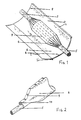
- Figure 1 illustrates one example of an extruded strip for forming the heat-recoverable sleeve 6.
- the strip shown in Figure 1 has two longitudinally extending ribs or protrusions 1 which, when positioned adjacent one another after the strip has been wrapped around, for example, a cable joint, form a neck 1 of the heat-recoverable sleeve.
- one of the ribs 1 is spaced from the longitudinal edge of the strip by a tongue 2.
- the strip is cross-linked by exposure to a high energy radiation dose of 2 Mrad to 30 Mrad or more preferably to a dose of 5 Mrad to 20 Mrad, from an electron beam or a cobalt-60 source.
- the strip is then heated above the crystalline melting point of the polyethylene and stretched by 200% to 700% at right angles to its longitudinal edges, but excluding the continuous neck 1 along each edge and the tongue 2. (Figure 1) from the stretching operation.
- the strip is cooled below about 80 o C to give the required heat-recoverable, in particular heat-shrinkable, wrap-around sleeve, having a high resistance to splitting during heat recovery around a cable joint, or other substrate.
- the bulk uncross-linked elastomeric material may be added directly to the polyethylene.
- the so-called dynamic curing or vulcanization process can be used so that the elastomeric material becomes dispersed as cured particles within the uncross-linked polyethylene.
- the mixture is milled at a temperature above the curing temperature. This initially causes cross-linked or three dimensional structures to be formed. These are, however, then broken down and dispersed as discrete particles in the uncross-linked matrix provided by the polyethylene.
- Polymers other than high density polyethylene may be used as the thermoplastics polymer material for forming, after cross-linking, the matrix in which the discrete cross-linked elastomeric particles are dispersed.
- These include linear low density polyethylene, very low density polyethylene, medium density polyethylene and low density polyethylene or blends of two or more of these.
- Blends of polyethylene and ethylene-vinyl acetate co-polymer or an ethylene-alkyl acrylate co-polymer, such as ethylene-ethyl acrylate copolymer, may also be used.
- preferred elastomeric materials for use in the present invention are ethylene-propylene copolymer (EPR) and ethylene-propylene-diene terpolymer but others may be used, including but not restricted to, natural rubber, butyl rubber, polyisoprene, polybutadiene, a copolymer of styrene and butadiene, a copolymer of styrene and isoprene and a copolymer of butadiene and acrylonitile.
- EPR ethylene-propylene copolymer
- terpolymer but others may be used, including but not restricted to, natural rubber, butyl rubber, polyisoprene, polybutadiene, a copolymer of styrene and butadiene, a copolymer of styrene and isoprene and a copolymer of butadiene and acrylonitile.
- the cable joint formed between entrance and exit cables 5 to be protected by the heat-recoverable sleeve 6 may first be covered by a liner 3.
- the liner 3 may be constructed from rigid cardboard with creases running along its entire length and separated laterally by about 18mm so as to facilitate wrapping around the joint.
- both ends of the liner 3 have long narrow triangular pieces 4 cut out to form a coronet to enable a transition from the maximum joint size to that of the entrance and exit cables 5 at the joint as shown in Figure 1.
- the heat-recoverable sleeve 6 is then wrapped around the liner 3 so that the ribs 1 meet to form the longitudinally extending neck which is then clamped by means of a fastening member, in the example shown in Figure 2 a C-shaped flexible metal channel 9.
- the heat-recoverable sleeve 6 can then be heat-shrunk.
- the inner surface of the heat-shrinkable wrap-around sleeve 6 which will contact the liner 3 surrounding the cable joint and the emerging cables 5, is preferably provided with an adhesive layer 7.
- the adhesive may be a 0.4mm to 2.0mm thick layer of a high performance adhesive and more preferably a 0.6mm to 1.0mm thick layer of a high performance adhesive.
- the adhesive is preferably a hot-melt type and suitable such adhesives may be based on a polyamide or an ethylene-vinyl acetate co-polymer. During heat-shrinking of the assembled sleeve, the adhesive layer 7 will melt and flow to form a good seal between the heat-recovered sleeve 6 and the cable joint or substrate.
- the heat-recoverable wrap-around sleeve 6 may have a temperature indicating paint spattered on its external surface which changes colour during heating to indicate when the recovery of the sleeve and activation of the hot-melt adhesive are complete.
- Such a heat-recoverable sleeve 6 shows high resistance to crack or split propagation. It is believed that this very high resistance to split propagation during heat-shrinking of the heat-shrinkable wrap-around sleeve in accordance with the present invention is due to the fact that when a split begins to develop it soon encounters an elastomeric particle. The elastomeric particle absorbs a considerable amount of the split energy before it too either splits or the split moves around it. A split of reduced energy emerges only to encounter another elastomeric particle. Accordingly, the presence of a large number of discrete elastomeric particles dissipates the split energy very quickly and stops the split progressing.
- the constituents for forming the heat-recoverable sleeve are given by formulation 1 below: Formulation 1 Parts by weight LUPOLEN 6011 PX 100 SANTOPRENE 201-87 90 Carbon black masterbatch PE2272 10 IRGANOX 1010 2.5 Triallyl cyanurate 10 Zinc stearate 1.7
- LUPOLEN 6011 PX is the trade name for a high density polyethylene supplied by BASF
- SANTOPRENE is the trade name for a dispersion of cross-linked polyolefin elastomeric particles in polypropylene supplied by MONSNTO
- Carbon black masterbatch PE2272 is produced by Cabot Plastics Ltd.
- IRGANOX 1010 is the trade name for an anti-oxidant supplied by Ciba-Geigg plc.
- formulation 1 The constituents of formulation 1 were melt-mixed in a Buss Ko Kneader and the extrudate, after cooling, was pelletised. Using a conventional plastics extruder these pellets were used to extrude a strip having a continuous neck or rib 1 (see Figure 1) running along the complete length of both longitudinal edges. The width of the strip, measured between the necks on the longitudinal edges, was 46mm and the thickness was 2.5mm. The strip was cut into 500mm long pieces and two of these were cross-linked by exposure to a radiation dose of 10 Mrad from a cobalt-60 source.
- the two cross-linked pieces were heated, one at a time, to about 150 o C when they were stretched laterally, between the necks, to a width of 170mm. While retaining the stretching force, the strips were cooled to about 75 o C to give heat-shrinkable wrap-around sleeves.
- a 0.8mm thick layer 7 of a polyamide-based hot-melt adhesive was applied to the inner surface of each sleeve.
- the outer surface was provided with a spattered coating of a temperature indicating paint.
- a joint on a length of polyethylene-sheathed telecommunications cable was surrounded by a cardboard liner 3 as illustrated in Figure 1.
- the long triangular pieces 4 on the ends of the liner 3 enable a smooth transition to be achieved from the large joint body to the cables.
- the heat-shrinkable wrap-around sleeve 6 was assembled around the joint with the adhesive layer 7 in contact with the joint.
- a cut 8 (see Figure 1) 5mm long was made with a scalpel on each end of the assembled wrap-around sleeve 6, just prior to heat-shrinking.
- Figure 2 shows the sleeve after heat-shrinking. As shown the ribs 1 or sleeve edges are held together by means of a C-shaped flexible metal channel 9 and the gap 10 between the edges is sealed by the tongue 2 ( Figure 1) which was positioned underneath the other longitudinal edge of the sleeve and in contact with the cable joint.
- the joint was pressurised to 40 kPa with air through a valve inserted in an end-cap on one end of the cable and cycled between -30 o C and +50 o C for 50 cycles, each cycle being of 5 hours duration.
- the joint pressure was monitored using a pressure gauge attached to the cable body.
- Example 1 The process described in Example 1 was repeated using formulations 2 and 3 shown below: Formulation 2 Parts by weight LUPOLEN 1804 H 100 SANTOPRENE 201-55 50 Carbon black masterbatch PE2272 10 IRGANOX 1010 2.5 Triallyl cyanurate 12 Zinc stearate 1.7 Formulation 3 Parts by weight LUPOLEN 1800 M 50 STAMYLEX 08-076 50 SANTOPRENE 201-64 60 Carbon black masterbatch PE2272 10 Irganox 1010 2.5 Triallyl cyanurate 10 Zinc stearate 1.5
- STAMYLEX 08-076 is the trade name of a linear low density polyethylene supplied by DSM whilst LUPOLEN 1804 H and LUPOLEN 1800 M are trade names for low density polyethylene supplied by BASF.
- VISTALON 504 is the trade name for an ethylene-propylene rubber marketed by Exxon Chemicals.
- a heat recoverable sleeve in accordance with the invention may be formed as a wrap-around or split sleeve or as a tubular sleeve. Where the sleeve is a split sleeve then suitable fastening means other than that described above may be used.
- a heat-recoverable sleeve in accordance with the invention may be used to protect repair joints or other joints between cables, for example telecommunications cables, other substrates.
Landscapes
- Insulating Bodies (AREA)
- Cable Accessories (AREA)
Applications Claiming Priority (2)
| Application Number | Priority Date | Filing Date | Title |
|---|---|---|---|
| GB8924658 | 1989-11-02 | ||
| GB898924658A GB8924658D0 (en) | 1989-11-02 | 1989-11-02 | A rubber reinforced heat shrinkable repair cover for telecommunications cables |
Publications (1)
| Publication Number | Publication Date |
|---|---|
| EP0426257A2 true EP0426257A2 (de) | 1991-05-08 |
Family
ID=10665562
Family Applications (1)
| Application Number | Title | Priority Date | Filing Date |
|---|---|---|---|
| EP19900202883 Withdrawn EP0426257A2 (de) | 1989-11-02 | 1990-10-31 | Durch Wärme rückstellbare Hülle |
Country Status (2)
| Country | Link |
|---|---|
| EP (1) | EP0426257A2 (de) |
| GB (1) | GB8924658D0 (de) |
Cited By (3)
| Publication number | Priority date | Publication date | Assignee | Title |
|---|---|---|---|---|
| EP0621121A3 (de) * | 1993-04-22 | 1994-12-07 | Stewing Nachrichtentechnik | Verfahren zur Verminderung der Rissanfälligkeit bei einer wärmerückstellbaren Werkstoffbahn. |
| WO1995011793A3 (de) * | 1993-10-29 | 1995-06-22 | Cellpack Gmbh | Schlauchförmige kunststoffolie, ihre verwendung und verfahren zu ihrer herstellung |
| CN114479248A (zh) * | 2022-03-02 | 2022-05-13 | 深圳市沃尔核材股份有限公司 | 一种热收缩材料、热收缩套管及制备方法 |
-
1989
- 1989-11-02 GB GB898924658A patent/GB8924658D0/en active Pending
-
1990
- 1990-10-31 EP EP19900202883 patent/EP0426257A2/de not_active Withdrawn
Cited By (4)
| Publication number | Priority date | Publication date | Assignee | Title |
|---|---|---|---|---|
| EP0621121A3 (de) * | 1993-04-22 | 1994-12-07 | Stewing Nachrichtentechnik | Verfahren zur Verminderung der Rissanfälligkeit bei einer wärmerückstellbaren Werkstoffbahn. |
| WO1995011793A3 (de) * | 1993-10-29 | 1995-06-22 | Cellpack Gmbh | Schlauchförmige kunststoffolie, ihre verwendung und verfahren zu ihrer herstellung |
| CN114479248A (zh) * | 2022-03-02 | 2022-05-13 | 深圳市沃尔核材股份有限公司 | 一种热收缩材料、热收缩套管及制备方法 |
| CN114479248B (zh) * | 2022-03-02 | 2024-05-10 | 深圳市沃尔核材股份有限公司 | 一种热收缩材料、热收缩套管及制备方法 |
Also Published As
| Publication number | Publication date |
|---|---|
| GB8924658D0 (en) | 1989-12-20 |
Similar Documents
| Publication | Publication Date | Title |
|---|---|---|
| US4963698A (en) | Cable sealing | |
| US4472468A (en) | Heat shrinkable covering and method for applying same | |
| US4972042A (en) | Blocking arrangement for suppressing fluid transmission in cables | |
| CA1039821A (en) | Heat recoverable article for joints and terminals | |
| AU2010315751B2 (en) | Wrap-around cable sleeve assemblies and methods for making and using the same | |
| US4001065A (en) | Cross-linked olefine-ester tapes | |
| CA1099351A (en) | Moisture proof electrical wire splice insulators | |
| EP0530221A1 (de) | Elastomeres vorgestrecktes rohrmaterial mit hohem stretch | |
| EP0100170B1 (de) | Wärmeschrumpffähige Umhüllung und Methode zum Anbringen derselben | |
| GB2100277A (en) | Heat shrinkable crosslinked polyolefin articles | |
| US6576846B2 (en) | Two-layered elastic tubular covering for electric components, in particular terminations for electric cables, and related manufacturing method and mounting | |
| AU619659B2 (en) | Heat shrinkable repair cover for pressurised cables | |
| US6858296B1 (en) | Power cable | |
| US4938820A (en) | Joining of sheets | |
| EP0229102B1 (de) | Dichtungsanordnung für kabel | |
| EP0426257A2 (de) | Durch Wärme rückstellbare Hülle | |
| CA1169218A (en) | Method of making shrink articles | |
| EP1025161B1 (de) | Elektrisches kabel und ein verfahren sowie zusammensetzung zu dessen herstellung | |
| CA1329113C (en) | Wrap-around heat-recoverable sealing article | |
| CA2662503A1 (en) | Thermoset cross-linked polymeric compositions and method of manufacture | |
| US10297946B1 (en) | Apparatus and methods for sealing electrical connections | |
| US4251304A (en) | Heat-recoverable articles and their use | |
| CA1222552A (en) | Cable splice closure and strain relief | |
| EP0411055B1 (de) | Verbundener gegenstand | |
| US20250279641A1 (en) | Heat-shrinkable tube and wire harness |
Legal Events
| Date | Code | Title | Description |
|---|---|---|---|
| PUAI | Public reference made under article 153(3) epc to a published international application that has entered the european phase |
Free format text: ORIGINAL CODE: 0009012 |
|
| AK | Designated contracting states |
Kind code of ref document: A2 Designated state(s): DE FR GB IT |
|
| STAA | Information on the status of an ep patent application or granted ep patent |
Free format text: STATUS: THE APPLICATION HAS BEEN WITHDRAWN |
|
| 18W | Application withdrawn |
Withdrawal date: 19920227 |
|
| R18W | Application withdrawn (corrected) |
Effective date: 19920227 |