EP0417203B1 - Process for the preparation of gamma and delta lactones - Google Patents
Process for the preparation of gamma and delta lactones Download PDFInfo
- Publication number
- EP0417203B1 EP0417203B1 EP89907450A EP89907450A EP0417203B1 EP 0417203 B1 EP0417203 B1 EP 0417203B1 EP 89907450 A EP89907450 A EP 89907450A EP 89907450 A EP89907450 A EP 89907450A EP 0417203 B1 EP0417203 B1 EP 0417203B1
- Authority
- EP
- European Patent Office
- Prior art keywords
- process according
- concentration
- substrate
- gamma
- lactone
- Prior art date
- Legal status (The legal status is an assumption and is not a legal conclusion. Google has not performed a legal analysis and makes no representation as to the accuracy of the status listed.)
- Expired - Lifetime
Links
- 238000000034 method Methods 0.000 title claims abstract description 49
- 230000008569 process Effects 0.000 title claims abstract description 44
- 125000000457 gamma-lactone group Chemical group 0.000 title claims abstract description 24
- 125000000422 delta-lactone group Chemical group 0.000 title claims abstract description 23
- 238000002360 preparation method Methods 0.000 title abstract description 4
- 241000235395 Mucor Species 0.000 claims abstract description 14
- 241000233866 Fungi Species 0.000 claims abstract description 10
- 150000001732 carboxylic acid derivatives Chemical class 0.000 claims abstract description 9
- 239000000758 substrate Substances 0.000 claims description 48
- 150000002596 lactones Chemical class 0.000 claims description 38
- 238000011534 incubation Methods 0.000 claims description 21
- 235000015097 nutrients Nutrition 0.000 claims description 21
- 239000000284 extract Substances 0.000 claims description 17
- 125000000217 alkyl group Chemical group 0.000 claims description 15
- 239000000203 mixture Substances 0.000 claims description 15
- QVGXLLKOCUKJST-UHFFFAOYSA-N atomic oxygen Chemical compound [O] QVGXLLKOCUKJST-UHFFFAOYSA-N 0.000 claims description 11
- 239000001301 oxygen Substances 0.000 claims description 11
- 229910052760 oxygen Inorganic materials 0.000 claims description 11
- IJGRMHOSHXDMSA-UHFFFAOYSA-N Atomic nitrogen Chemical compound N#N IJGRMHOSHXDMSA-UHFFFAOYSA-N 0.000 claims description 10
- 238000004519 manufacturing process Methods 0.000 claims description 10
- WQZGKKKJIJFFOK-GASJEMHNSA-N Glucose Natural products OC[C@H]1OC(O)[C@H](O)[C@@H](O)[C@@H]1O WQZGKKKJIJFFOK-GASJEMHNSA-N 0.000 claims description 9
- 239000001257 hydrogen Substances 0.000 claims description 9
- 229910052739 hydrogen Inorganic materials 0.000 claims description 9
- 229940041514 candida albicans extract Drugs 0.000 claims description 8
- YYZUSRORWSJGET-UHFFFAOYSA-N ethyl octanoate Chemical group CCCCCCCC(=O)OCC YYZUSRORWSJGET-UHFFFAOYSA-N 0.000 claims description 8
- 239000012138 yeast extract Substances 0.000 claims description 8
- OKTJSMMVPCPJKN-UHFFFAOYSA-N Carbon Chemical group [C] OKTJSMMVPCPJKN-UHFFFAOYSA-N 0.000 claims description 7
- 108090000790 Enzymes Proteins 0.000 claims description 6
- 102000004190 Enzymes Human genes 0.000 claims description 6
- 239000008121 dextrose Substances 0.000 claims description 6
- 230000002906 microbiologic effect Effects 0.000 claims description 6
- 239000001888 Peptone Substances 0.000 claims description 5
- 108010080698 Peptones Proteins 0.000 claims description 5
- 125000003342 alkenyl group Chemical group 0.000 claims description 5
- 150000001408 amides Chemical class 0.000 claims description 5
- 125000004432 carbon atom Chemical group C* 0.000 claims description 5
- 125000002887 hydroxy group Chemical group [H]O* 0.000 claims description 5
- 229910052757 nitrogen Inorganic materials 0.000 claims description 5
- 235000019319 peptone Nutrition 0.000 claims description 5
- 150000003839 salts Chemical class 0.000 claims description 5
- 239000001730 (5R)-5-butyloxolan-2-one Substances 0.000 claims description 4
- 229910052784 alkaline earth metal Inorganic materials 0.000 claims description 4
- IPBFYZQJXZJBFQ-UHFFFAOYSA-N gamma-octalactone Chemical compound CCCCC1CCC(=O)O1 IPBFYZQJXZJBFQ-UHFFFAOYSA-N 0.000 claims description 4
- 150000002431 hydrogen Chemical group 0.000 claims description 4
- UFHFLCQGNIYNRP-UHFFFAOYSA-N Hydrogen Chemical compound [H][H] UFHFLCQGNIYNRP-UHFFFAOYSA-N 0.000 claims description 3
- 125000005907 alkyl ester group Chemical group 0.000 claims description 3
- 150000001720 carbohydrates Chemical class 0.000 claims description 3
- 239000003456 ion exchange resin Substances 0.000 claims description 3
- 229920003303 ion-exchange polymer Polymers 0.000 claims description 3
- 229920006395 saturated elastomer Polymers 0.000 claims description 3
- 235000019156 vitamin B Nutrition 0.000 claims description 3
- 239000011720 vitamin B Substances 0.000 claims description 3
- NWUYHJFMYQTDRP-UHFFFAOYSA-N 1,2-bis(ethenyl)benzene;1-ethenyl-2-ethylbenzene;styrene Chemical compound C=CC1=CC=CC=C1.CCC1=CC=CC=C1C=C.C=CC1=CC=CC=C1C=C NWUYHJFMYQTDRP-UHFFFAOYSA-N 0.000 claims description 2
- 239000003513 alkali Substances 0.000 claims description 2
- -1 alkaline earth metal cation Chemical class 0.000 claims description 2
- 125000004435 hydrogen atom Chemical group [H]* 0.000 claims description 2
- 230000003287 optical effect Effects 0.000 claims description 2
- 239000013589 supplement Substances 0.000 claims description 2
- UFTFJSFQGQCHQW-UHFFFAOYSA-N triformin Chemical compound O=COCC(OC=O)COC=O UFTFJSFQGQCHQW-UHFFFAOYSA-N 0.000 claims description 2
- 241001508691 Martes zibellina Species 0.000 claims 1
- 238000012544 monitoring process Methods 0.000 claims 1
- 150000001735 carboxylic acids Chemical class 0.000 abstract description 5
- 238000000855 fermentation Methods 0.000 description 28
- 230000004151 fermentation Effects 0.000 description 28
- 244000005700 microbiome Species 0.000 description 8
- 239000002253 acid Substances 0.000 description 7
- 150000002148 esters Chemical class 0.000 description 7
- YMWUJEATGCHHMB-UHFFFAOYSA-N Dichloromethane Chemical compound ClCCl YMWUJEATGCHHMB-UHFFFAOYSA-N 0.000 description 6
- 241000306281 Mucor ambiguus Species 0.000 description 6
- 239000000796 flavoring agent Substances 0.000 description 6
- 235000019634 flavors Nutrition 0.000 description 6
- IFYYFLINQYPWGJ-UHFFFAOYSA-N gamma-decalactone Chemical compound CCCCCCC1CCC(=O)O1 IFYYFLINQYPWGJ-UHFFFAOYSA-N 0.000 description 6
- WQZGKKKJIJFFOK-VFUOTHLCSA-N beta-D-glucose Chemical compound OC[C@H]1O[C@@H](O)[C@H](O)[C@@H](O)[C@@H]1O WQZGKKKJIJFFOK-VFUOTHLCSA-N 0.000 description 5
- 238000004821 distillation Methods 0.000 description 5
- 239000001963 growth medium Substances 0.000 description 5
- 239000000463 material Substances 0.000 description 5
- 238000009631 Broth culture Methods 0.000 description 4
- LFQSCWFLJHTTHZ-UHFFFAOYSA-N Ethanol Chemical compound CCO LFQSCWFLJHTTHZ-UHFFFAOYSA-N 0.000 description 4
- 150000007513 acids Chemical class 0.000 description 4
- 229910052799 carbon Inorganic materials 0.000 description 4
- 238000006243 chemical reaction Methods 0.000 description 4
- SHZIWNPUGXLXDT-UHFFFAOYSA-N ethyl hexanoate Chemical compound CCCCCC(=O)OCC SHZIWNPUGXLXDT-UHFFFAOYSA-N 0.000 description 4
- 239000003205 fragrance Substances 0.000 description 4
- JBFHTYHTHYHCDJ-UHFFFAOYSA-N gamma-caprolactone Chemical compound CCC1CCC(=O)O1 JBFHTYHTHYHCDJ-UHFFFAOYSA-N 0.000 description 4
- 230000000813 microbial effect Effects 0.000 description 4
- 230000007483 microbial process Effects 0.000 description 4
- 239000000047 product Substances 0.000 description 4
- QTBSBXVTEAMEQO-UHFFFAOYSA-N Acetic acid Chemical compound CC(O)=O QTBSBXVTEAMEQO-UHFFFAOYSA-N 0.000 description 3
- PEDCQBHIVMGVHV-UHFFFAOYSA-N Glycerine Chemical compound OCC(O)CO PEDCQBHIVMGVHV-UHFFFAOYSA-N 0.000 description 3
- OKKJLVBELUTLKV-UHFFFAOYSA-N Methanol Chemical compound OC OKKJLVBELUTLKV-UHFFFAOYSA-N 0.000 description 3
- HEMHJVSKTPXQMS-UHFFFAOYSA-M Sodium hydroxide Chemical compound [OH-].[Na+] HEMHJVSKTPXQMS-UHFFFAOYSA-M 0.000 description 3
- 240000008042 Zea mays Species 0.000 description 3
- 235000005824 Zea mays ssp. parviglumis Nutrition 0.000 description 3
- 235000002017 Zea mays subsp mays Nutrition 0.000 description 3
- 238000004458 analytical method Methods 0.000 description 3
- 235000005822 corn Nutrition 0.000 description 3
- IFYYFLINQYPWGJ-VIFPVBQESA-N gamma-Decalactone Natural products CCCCCC[C@H]1CCC(=O)O1 IFYYFLINQYPWGJ-VIFPVBQESA-N 0.000 description 3
- 238000004817 gas chromatography Methods 0.000 description 3
- 239000008103 glucose Substances 0.000 description 3
- 239000002609 medium Substances 0.000 description 3
- 239000003960 organic solvent Substances 0.000 description 3
- 238000010189 synthetic method Methods 0.000 description 3
- 230000009466 transformation Effects 0.000 description 3
- XLYOFNOQVPJJNP-UHFFFAOYSA-N water Substances O XLYOFNOQVPJJNP-UHFFFAOYSA-N 0.000 description 3
- QPRQEDXDYOZYLA-UHFFFAOYSA-N 2-methylbutan-1-ol Chemical compound CCC(C)CO QPRQEDXDYOZYLA-UHFFFAOYSA-N 0.000 description 2
- QGZKDVFQNNGYKY-UHFFFAOYSA-N Ammonia Chemical compound N QGZKDVFQNNGYKY-UHFFFAOYSA-N 0.000 description 2
- VTYYLEPIZMXCLO-UHFFFAOYSA-L Calcium carbonate Chemical compound [Ca+2].[O-]C([O-])=O VTYYLEPIZMXCLO-UHFFFAOYSA-L 0.000 description 2
- SRBFZHDQGSBBOR-IOVATXLUSA-N D-xylopyranose Chemical compound O[C@@H]1COC(O)[C@H](O)[C@H]1O SRBFZHDQGSBBOR-IOVATXLUSA-N 0.000 description 2
- RZTOWFMDBDPERY-UHFFFAOYSA-N Delta-Hexanolactone Chemical compound CC1CCCC(=O)O1 RZTOWFMDBDPERY-UHFFFAOYSA-N 0.000 description 2
- 241000196324 Embryophyta Species 0.000 description 2
- VEXZGXHMUGYJMC-UHFFFAOYSA-N Hydrochloric acid Chemical compound Cl VEXZGXHMUGYJMC-UHFFFAOYSA-N 0.000 description 2
- XEEYBQQBJWHFJM-UHFFFAOYSA-N Iron Chemical compound [Fe] XEEYBQQBJWHFJM-UHFFFAOYSA-N 0.000 description 2
- KFZMGEQAYNKOFK-UHFFFAOYSA-N Isopropanol Chemical compound CC(C)O KFZMGEQAYNKOFK-UHFFFAOYSA-N 0.000 description 2
- 241000907556 Mucor hiemalis Species 0.000 description 2
- LRHPLDYGYMQRHN-UHFFFAOYSA-N N-Butanol Chemical compound CCCCO LRHPLDYGYMQRHN-UHFFFAOYSA-N 0.000 description 2
- 229910019142 PO4 Inorganic materials 0.000 description 2
- 241000235403 Rhizomucor miehei Species 0.000 description 2
- CZMRCDWAGMRECN-UGDNZRGBSA-N Sucrose Chemical compound O[C@H]1[C@H](O)[C@@H](CO)O[C@@]1(CO)O[C@@H]1[C@H](O)[C@@H](O)[C@H](O)[C@@H](CO)O1 CZMRCDWAGMRECN-UGDNZRGBSA-N 0.000 description 2
- 229930006000 Sucrose Natural products 0.000 description 2
- XSQUKJJJFZCRTK-UHFFFAOYSA-N Urea Chemical compound NC(N)=O XSQUKJJJFZCRTK-UHFFFAOYSA-N 0.000 description 2
- 150000001298 alcohols Chemical class 0.000 description 2
- 150000003863 ammonium salts Chemical class 0.000 description 2
- 235000013361 beverage Nutrition 0.000 description 2
- 230000015572 biosynthetic process Effects 0.000 description 2
- 125000002915 carbonyl group Chemical group [*:2]C([*:1])=O 0.000 description 2
- 235000009508 confectionery Nutrition 0.000 description 2
- 238000010924 continuous production Methods 0.000 description 2
- RGXWDWUGBIJHDO-UHFFFAOYSA-N ethyl decanoate Chemical compound CCCCCCCCCC(=O)OCC RGXWDWUGBIJHDO-UHFFFAOYSA-N 0.000 description 2
- 238000000605 extraction Methods 0.000 description 2
- 235000013305 food Nutrition 0.000 description 2
- FUZZWVXGSFPDMH-UHFFFAOYSA-N hexanoic acid Chemical compound CCCCCC(O)=O FUZZWVXGSFPDMH-UHFFFAOYSA-N 0.000 description 2
- 238000002955 isolation Methods 0.000 description 2
- 239000007788 liquid Substances 0.000 description 2
- 235000021317 phosphate Nutrition 0.000 description 2
- 229920000136 polysorbate Polymers 0.000 description 2
- BDERNNFJNOPAEC-UHFFFAOYSA-N propan-1-ol Chemical compound CCCO BDERNNFJNOPAEC-UHFFFAOYSA-N 0.000 description 2
- 230000009467 reduction Effects 0.000 description 2
- 239000007787 solid Substances 0.000 description 2
- 239000000243 solution Substances 0.000 description 2
- 239000000126 substance Substances 0.000 description 2
- 239000005720 sucrose Substances 0.000 description 2
- 239000006188 syrup Substances 0.000 description 2
- 235000020357 syrup Nutrition 0.000 description 2
- IIZPXYDJLKNOIY-JXPKJXOSSA-N 1-palmitoyl-2-arachidonoyl-sn-glycero-3-phosphocholine Chemical compound CCCCCCCCCCCCCCCC(=O)OC[C@H](COP([O-])(=O)OCC[N+](C)(C)C)OC(=O)CCC\C=C/C\C=C/C\C=C/C\C=C/CCCCC IIZPXYDJLKNOIY-JXPKJXOSSA-N 0.000 description 1
- OWEGMIWEEQEYGQ-UHFFFAOYSA-N 100676-05-9 Natural products OC1C(O)C(O)C(CO)OC1OCC1C(O)C(O)C(O)C(OC2C(OC(O)C(O)C2O)CO)O1 OWEGMIWEEQEYGQ-UHFFFAOYSA-N 0.000 description 1
- MIDXCONKKJTLDX-UHFFFAOYSA-N 3,5-dimethylcyclopentane-1,2-dione Chemical compound CC1CC(C)C(=O)C1=O MIDXCONKKJTLDX-UHFFFAOYSA-N 0.000 description 1
- GOLORTLGFDVFDW-UHFFFAOYSA-N 3-(1h-benzimidazol-2-yl)-7-(diethylamino)chromen-2-one Chemical compound C1=CC=C2NC(C3=CC4=CC=C(C=C4OC3=O)N(CC)CC)=NC2=C1 GOLORTLGFDVFDW-UHFFFAOYSA-N 0.000 description 1
- IWTBVKIGCDZRPL-LURJTMIESA-N 3-Methylbutanol Natural products CC[C@H](C)CCO IWTBVKIGCDZRPL-LURJTMIESA-N 0.000 description 1
- WGPCZPLRVAWXPW-NSHDSACASA-N 5-octyloxolan-2-one Chemical compound CCCCCCCC[C@H]1CCC(=O)O1 WGPCZPLRVAWXPW-NSHDSACASA-N 0.000 description 1
- MAUFTTLGOUBZNA-UHFFFAOYSA-N 6-n-Pentyl-alpha-pyrone Chemical compound CCCCCC1=CC=CC(=O)O1 MAUFTTLGOUBZNA-UHFFFAOYSA-N 0.000 description 1
- FHVDTGUDJYJELY-UHFFFAOYSA-N 6-{[2-carboxy-4,5-dihydroxy-6-(phosphanyloxy)oxan-3-yl]oxy}-4,5-dihydroxy-3-phosphanyloxane-2-carboxylic acid Chemical compound O1C(C(O)=O)C(P)C(O)C(O)C1OC1C(C(O)=O)OC(OP)C(O)C1O FHVDTGUDJYJELY-UHFFFAOYSA-N 0.000 description 1
- HBAQYPYDRFILMT-UHFFFAOYSA-N 8-[3-(1-cyclopropylpyrazol-4-yl)-1H-pyrazolo[4,3-d]pyrimidin-5-yl]-3-methyl-3,8-diazabicyclo[3.2.1]octan-2-one Chemical class C1(CC1)N1N=CC(=C1)C1=NNC2=C1N=C(N=C2)N1C2C(N(CC1CC2)C)=O HBAQYPYDRFILMT-UHFFFAOYSA-N 0.000 description 1
- GUBGYTABKSRVRQ-XLOQQCSPSA-N Alpha-Lactose Chemical compound O[C@@H]1[C@@H](O)[C@@H](O)[C@@H](CO)O[C@H]1O[C@@H]1[C@@H](CO)O[C@H](O)[C@H](O)[C@H]1O GUBGYTABKSRVRQ-XLOQQCSPSA-N 0.000 description 1
- OYPRJOBELJOOCE-UHFFFAOYSA-N Calcium Chemical compound [Ca] OYPRJOBELJOOCE-UHFFFAOYSA-N 0.000 description 1
- 241000222120 Candida <Saccharomycetales> Species 0.000 description 1
- 244000060011 Cocos nucifera Species 0.000 description 1
- 235000013162 Cocos nucifera Nutrition 0.000 description 1
- RYGMFSIKBFXOCR-UHFFFAOYSA-N Copper Chemical compound [Cu] RYGMFSIKBFXOCR-UHFFFAOYSA-N 0.000 description 1
- FBPFZTCFMRRESA-FSIIMWSLSA-N D-Glucitol Natural products OC[C@H](O)[C@H](O)[C@@H](O)[C@H](O)CO FBPFZTCFMRRESA-FSIIMWSLSA-N 0.000 description 1
- FBPFZTCFMRRESA-KVTDHHQDSA-N D-Mannitol Chemical compound OC[C@@H](O)[C@@H](O)[C@H](O)[C@H](O)CO FBPFZTCFMRRESA-KVTDHHQDSA-N 0.000 description 1
- FBPFZTCFMRRESA-JGWLITMVSA-N D-glucitol Chemical compound OC[C@H](O)[C@@H](O)[C@H](O)[C@H](O)CO FBPFZTCFMRRESA-JGWLITMVSA-N 0.000 description 1
- 108090000371 Esterases Proteins 0.000 description 1
- 229930091371 Fructose Natural products 0.000 description 1
- RFSUNEUAIZKAJO-ARQDHWQXSA-N Fructose Chemical compound OC[C@H]1O[C@](O)(CO)[C@@H](O)[C@@H]1O RFSUNEUAIZKAJO-ARQDHWQXSA-N 0.000 description 1
- 239000005715 Fructose Substances 0.000 description 1
- 241001489200 Fusarium poae Species 0.000 description 1
- DGAQECJNVWCQMB-PUAWFVPOSA-M Ilexoside XXIX Chemical compound C[C@@H]1CC[C@@]2(CC[C@@]3(C(=CC[C@H]4[C@]3(CC[C@@H]5[C@@]4(CC[C@@H](C5(C)C)OS(=O)(=O)[O-])C)C)[C@@H]2[C@]1(C)O)C)C(=O)O[C@H]6[C@@H]([C@H]([C@@H]([C@H](O6)CO)O)O)O.[Na+] DGAQECJNVWCQMB-PUAWFVPOSA-M 0.000 description 1
- GUBGYTABKSRVRQ-QKKXKWKRSA-N Lactose Natural products OC[C@H]1O[C@@H](O[C@H]2[C@H](O)[C@@H](O)C(O)O[C@@H]2CO)[C@H](O)[C@@H](O)[C@H]1O GUBGYTABKSRVRQ-QKKXKWKRSA-N 0.000 description 1
- FYYHWMGAXLPEAU-UHFFFAOYSA-N Magnesium Chemical compound [Mg] FYYHWMGAXLPEAU-UHFFFAOYSA-N 0.000 description 1
- GUBGYTABKSRVRQ-PICCSMPSSA-N Maltose Natural products O[C@@H]1[C@@H](O)[C@H](O)[C@@H](CO)O[C@@H]1O[C@@H]1[C@@H](CO)OC(O)[C@H](O)[C@H]1O GUBGYTABKSRVRQ-PICCSMPSSA-N 0.000 description 1
- 229930195725 Mannitol Natural products 0.000 description 1
- 241000277739 Mucor alboater Species 0.000 description 1
- 241001169397 Mucor corticola Species 0.000 description 1
- 241000114093 Mucor flavus Species 0.000 description 1
- 241000025769 Mucor luteus Species 0.000 description 1
- 241001149951 Mucor mucedo Species 0.000 description 1
- GXCLVBGFBYZDAG-UHFFFAOYSA-N N-[2-(1H-indol-3-yl)ethyl]-N-methylprop-2-en-1-amine Chemical compound CN(CCC1=CNC2=C1C=CC=C2)CC=C GXCLVBGFBYZDAG-UHFFFAOYSA-N 0.000 description 1
- 241000222640 Polyporus Species 0.000 description 1
- ZLMJMSJWJFRBEC-UHFFFAOYSA-N Potassium Chemical compound [K] ZLMJMSJWJFRBEC-UHFFFAOYSA-N 0.000 description 1
- 244000018633 Prunus armeniaca Species 0.000 description 1
- 235000009827 Prunus armeniaca Nutrition 0.000 description 1
- 241000222068 Sporobolomyces <Sporidiobolaceae> Species 0.000 description 1
- 241000223261 Trichoderma viride Species 0.000 description 1
- 239000007983 Tris buffer Substances 0.000 description 1
- 239000000654 additive Substances 0.000 description 1
- 229940072056 alginate Drugs 0.000 description 1
- 235000010443 alginic acid Nutrition 0.000 description 1
- 229920000615 alginic acid Polymers 0.000 description 1
- 150000001413 amino acids Chemical class 0.000 description 1
- 229910021529 ammonia Inorganic materials 0.000 description 1
- 150000008064 anhydrides Chemical class 0.000 description 1
- 239000002518 antifoaming agent Substances 0.000 description 1
- 239000012736 aqueous medium Substances 0.000 description 1
- 239000008346 aqueous phase Substances 0.000 description 1
- 239000007864 aqueous solution Substances 0.000 description 1
- PYMYPHUHKUWMLA-UHFFFAOYSA-N arabinose Natural products OCC(O)C(O)C(O)C=O PYMYPHUHKUWMLA-UHFFFAOYSA-N 0.000 description 1
- 239000002585 base Substances 0.000 description 1
- SRBFZHDQGSBBOR-UHFFFAOYSA-N beta-D-Pyranose-Lyxose Natural products OC1COC(O)C(O)C1O SRBFZHDQGSBBOR-UHFFFAOYSA-N 0.000 description 1
- GUBGYTABKSRVRQ-QUYVBRFLSA-N beta-maltose Chemical compound OC[C@H]1O[C@H](O[C@H]2[C@H](O)[C@@H](O)[C@H](O)O[C@@H]2CO)[C@H](O)[C@@H](O)[C@@H]1O GUBGYTABKSRVRQ-QUYVBRFLSA-N 0.000 description 1
- 239000000872 buffer Substances 0.000 description 1
- 239000007853 buffer solution Substances 0.000 description 1
- 229910052791 calcium Inorganic materials 0.000 description 1
- 239000011575 calcium Substances 0.000 description 1
- 229910000019 calcium carbonate Inorganic materials 0.000 description 1
- 159000000007 calcium salts Chemical class 0.000 description 1
- 235000013736 caramel Nutrition 0.000 description 1
- 239000004202 carbamide Substances 0.000 description 1
- 235000014633 carbohydrates Nutrition 0.000 description 1
- BVKZGUZCCUSVTD-UHFFFAOYSA-N carbonic acid Chemical class OC(O)=O BVKZGUZCCUSVTD-UHFFFAOYSA-N 0.000 description 1
- 239000005018 casein Substances 0.000 description 1
- BECPQYXYKAMYBN-UHFFFAOYSA-N casein, tech. Chemical compound NCCCCC(C(O)=O)N=C(O)C(CC(O)=O)N=C(O)C(CCC(O)=N)N=C(O)C(CC(C)C)N=C(O)C(CCC(O)=O)N=C(O)C(CC(O)=O)N=C(O)C(CCC(O)=O)N=C(O)C(C(C)O)N=C(O)C(CCC(O)=N)N=C(O)C(CCC(O)=N)N=C(O)C(CCC(O)=N)N=C(O)C(CCC(O)=O)N=C(O)C(CCC(O)=O)N=C(O)C(COP(O)(O)=O)N=C(O)C(CCC(O)=N)N=C(O)C(N)CC1=CC=CC=C1 BECPQYXYKAMYBN-UHFFFAOYSA-N 0.000 description 1
- 235000021240 caseins Nutrition 0.000 description 1
- 239000004359 castor oil Substances 0.000 description 1
- 235000019438 castor oil Nutrition 0.000 description 1
- 230000006652 catabolic pathway Effects 0.000 description 1
- 239000003795 chemical substances by application Substances 0.000 description 1
- 235000015218 chewing gum Nutrition 0.000 description 1
- 238000013375 chromatographic separation Methods 0.000 description 1
- 238000004587 chromatography analysis Methods 0.000 description 1
- 239000010941 cobalt Substances 0.000 description 1
- 229910017052 cobalt Inorganic materials 0.000 description 1
- GUTLYIVDDKVIGB-UHFFFAOYSA-N cobalt atom Chemical compound [Co] GUTLYIVDDKVIGB-UHFFFAOYSA-N 0.000 description 1
- 150000001875 compounds Chemical class 0.000 description 1
- 238000007796 conventional method Methods 0.000 description 1
- 229910052802 copper Inorganic materials 0.000 description 1
- 239000010949 copper Substances 0.000 description 1
- FYTRVXSHONWYNE-UHFFFAOYSA-N delta-octanolide Chemical compound CCCC1CCCC(=O)O1 FYTRVXSHONWYNE-UHFFFAOYSA-N 0.000 description 1
- 239000006185 dispersion Substances 0.000 description 1
- 235000013399 edible fruits Nutrition 0.000 description 1
- 239000003995 emulsifying agent Substances 0.000 description 1
- 230000002255 enzymatic effect Effects 0.000 description 1
- 230000002349 favourable effect Effects 0.000 description 1
- 238000012262 fermentative production Methods 0.000 description 1
- 238000005187 foaming Methods 0.000 description 1
- 235000015203 fruit juice Nutrition 0.000 description 1
- 230000002538 fungal effect Effects 0.000 description 1
- WGPCZPLRVAWXPW-LLVKDONJSA-N gamma-Dodecalactone Natural products CCCCCCCC[C@@H]1CCC(=O)O1 WGPCZPLRVAWXPW-LLVKDONJSA-N 0.000 description 1
- 235000011187 glycerol Nutrition 0.000 description 1
- ZEMPKEQAKRGZGQ-XOQCFJPHSA-N glycerol triricinoleate Natural products CCCCCC[C@@H](O)CC=CCCCCCCCC(=O)OC[C@@H](COC(=O)CCCCCCCC=CC[C@@H](O)CCCCCC)OC(=O)CCCCCCCC=CC[C@H](O)CCCCCC ZEMPKEQAKRGZGQ-XOQCFJPHSA-N 0.000 description 1
- 150000002314 glycerols Chemical class 0.000 description 1
- 150000002334 glycols Chemical class 0.000 description 1
- 239000003102 growth factor Substances 0.000 description 1
- 238000004128 high performance liquid chromatography Methods 0.000 description 1
- 239000004615 ingredient Substances 0.000 description 1
- 239000002054 inoculum Substances 0.000 description 1
- 229910052500 inorganic mineral Inorganic materials 0.000 description 1
- 229910052742 iron Inorganic materials 0.000 description 1
- PHTQWCKDNZKARW-UHFFFAOYSA-N isoamylol Chemical compound CC(C)CCO PHTQWCKDNZKARW-UHFFFAOYSA-N 0.000 description 1
- 239000008101 lactose Substances 0.000 description 1
- 239000000787 lecithin Substances 0.000 description 1
- 235000010445 lecithin Nutrition 0.000 description 1
- 229940067606 lecithin Drugs 0.000 description 1
- 229910052749 magnesium Inorganic materials 0.000 description 1
- 239000011777 magnesium Substances 0.000 description 1
- 159000000003 magnesium salts Chemical class 0.000 description 1
- WPBNNNQJVZRUHP-UHFFFAOYSA-L manganese(2+);methyl n-[[2-(methoxycarbonylcarbamothioylamino)phenyl]carbamothioyl]carbamate;n-[2-(sulfidocarbothioylamino)ethyl]carbamodithioate Chemical compound [Mn+2].[S-]C(=S)NCCNC([S-])=S.COC(=O)NC(=S)NC1=CC=CC=C1NC(=S)NC(=O)OC WPBNNNQJVZRUHP-UHFFFAOYSA-L 0.000 description 1
- 239000000594 mannitol Substances 0.000 description 1
- 235000010355 mannitol Nutrition 0.000 description 1
- 235000013372 meat Nutrition 0.000 description 1
- 230000004060 metabolic process Effects 0.000 description 1
- 239000002207 metabolite Substances 0.000 description 1
- 235000010755 mineral Nutrition 0.000 description 1
- 239000011707 mineral Substances 0.000 description 1
- 150000007522 mineralic acids Chemical class 0.000 description 1
- 150000002823 nitrates Chemical class 0.000 description 1
- QJGQUHMNIGDVPM-UHFFFAOYSA-N nitrogen group Chemical group [N] QJGQUHMNIGDVPM-UHFFFAOYSA-N 0.000 description 1
- 235000016709 nutrition Nutrition 0.000 description 1
- 230000035764 nutrition Effects 0.000 description 1
- LTHCSWBWNVGEFE-UHFFFAOYSA-N octanamide Chemical compound CCCCCCCC(N)=O LTHCSWBWNVGEFE-UHFFFAOYSA-N 0.000 description 1
- 150000007524 organic acids Chemical class 0.000 description 1
- 238000007254 oxidation reaction Methods 0.000 description 1
- 238000010525 oxidative degradation reaction Methods 0.000 description 1
- 239000002304 perfume Substances 0.000 description 1
- 239000012437 perfumed product Substances 0.000 description 1
- 239000000825 pharmaceutical preparation Substances 0.000 description 1
- NBIIXXVUZAFLBC-UHFFFAOYSA-K phosphate Chemical compound [O-]P([O-])([O-])=O NBIIXXVUZAFLBC-UHFFFAOYSA-K 0.000 description 1
- 239000010452 phosphate Substances 0.000 description 1
- 150000003013 phosphoric acid derivatives Chemical class 0.000 description 1
- XNGIFLGASWRNHJ-UHFFFAOYSA-L phthalate(2-) Chemical compound [O-]C(=O)C1=CC=CC=C1C([O-])=O XNGIFLGASWRNHJ-UHFFFAOYSA-L 0.000 description 1
- 239000002504 physiological saline solution Substances 0.000 description 1
- 229920001515 polyalkylene glycol Polymers 0.000 description 1
- 239000011591 potassium Substances 0.000 description 1
- 229910052700 potassium Inorganic materials 0.000 description 1
- XAEFZNCEHLXOMS-UHFFFAOYSA-M potassium benzoate Chemical compound [K+].[O-]C(=O)C1=CC=CC=C1 XAEFZNCEHLXOMS-UHFFFAOYSA-M 0.000 description 1
- 150000003138 primary alcohols Chemical class 0.000 description 1
- 238000000746 purification Methods 0.000 description 1
- 230000003134 recirculating effect Effects 0.000 description 1
- 230000001105 regulatory effect Effects 0.000 description 1
- 238000012552 review Methods 0.000 description 1
- WBHHMMIMDMUBKC-XLNAKTSKSA-N ricinelaidic acid Chemical compound CCCCCC[C@@H](O)C\C=C\CCCCCCCC(O)=O WBHHMMIMDMUBKC-XLNAKTSKSA-N 0.000 description 1
- 229960003656 ricinoleic acid Drugs 0.000 description 1
- FEUQNCSVHBHROZ-UHFFFAOYSA-N ricinoleic acid Natural products CCCCCCC(O[Si](C)(C)C)CC=CCCCCCCCC(=O)OC FEUQNCSVHBHROZ-UHFFFAOYSA-N 0.000 description 1
- 150000003333 secondary alcohols Chemical class 0.000 description 1
- 238000012807 shake-flask culturing Methods 0.000 description 1
- 229920002545 silicone oil Polymers 0.000 description 1
- 239000011734 sodium Substances 0.000 description 1
- 229910052708 sodium Inorganic materials 0.000 description 1
- 159000000000 sodium salts Chemical class 0.000 description 1
- 239000002689 soil Substances 0.000 description 1
- 238000000638 solvent extraction Methods 0.000 description 1
- 239000000600 sorbitol Substances 0.000 description 1
- 235000010356 sorbitol Nutrition 0.000 description 1
- 235000012424 soybean oil Nutrition 0.000 description 1
- 241000894007 species Species 0.000 description 1
- 238000004611 spectroscopical analysis Methods 0.000 description 1
- 239000007858 starting material Substances 0.000 description 1
- 238000003756 stirring Methods 0.000 description 1
- 238000006467 substitution reaction Methods 0.000 description 1
- 150000003467 sulfuric acid derivatives Chemical class 0.000 description 1
- 239000004094 surface-active agent Substances 0.000 description 1
- 235000019505 tobacco product Nutrition 0.000 description 1
- 239000011573 trace mineral Substances 0.000 description 1
- 235000013619 trace mineral Nutrition 0.000 description 1
- 238000000844 transformation Methods 0.000 description 1
- LENZDBCJOHFCAS-UHFFFAOYSA-N tris Chemical compound OCC(N)(CO)CO LENZDBCJOHFCAS-UHFFFAOYSA-N 0.000 description 1
- 230000035899 viability Effects 0.000 description 1
- 235000013343 vitamin Nutrition 0.000 description 1
- 239000011782 vitamin Substances 0.000 description 1
- 229940088594 vitamin Drugs 0.000 description 1
- 229930003231 vitamin Natural products 0.000 description 1
Classifications
-
- C—CHEMISTRY; METALLURGY
- C12—BIOCHEMISTRY; BEER; SPIRITS; WINE; VINEGAR; MICROBIOLOGY; ENZYMOLOGY; MUTATION OR GENETIC ENGINEERING
- C12P—FERMENTATION OR ENZYME-USING PROCESSES TO SYNTHESISE A DESIRED CHEMICAL COMPOUND OR COMPOSITION OR TO SEPARATE OPTICAL ISOMERS FROM A RACEMIC MIXTURE
- C12P17/00—Preparation of heterocyclic carbon compounds with only O, N, S, Se or Te as ring hetero atoms
- C12P17/02—Oxygen as only ring hetero atoms
-
- C—CHEMISTRY; METALLURGY
- C12—BIOCHEMISTRY; BEER; SPIRITS; WINE; VINEGAR; MICROBIOLOGY; ENZYMOLOGY; MUTATION OR GENETIC ENGINEERING
- C12P—FERMENTATION OR ENZYME-USING PROCESSES TO SYNTHESISE A DESIRED CHEMICAL COMPOUND OR COMPOSITION OR TO SEPARATE OPTICAL ISOMERS FROM A RACEMIC MIXTURE
- C12P17/00—Preparation of heterocyclic carbon compounds with only O, N, S, Se or Te as ring hetero atoms
- C12P17/02—Oxygen as only ring hetero atoms
- C12P17/06—Oxygen as only ring hetero atoms containing a six-membered hetero ring, e.g. fluorescein
-
- C—CHEMISTRY; METALLURGY
- C12—BIOCHEMISTRY; BEER; SPIRITS; WINE; VINEGAR; MICROBIOLOGY; ENZYMOLOGY; MUTATION OR GENETIC ENGINEERING
- C12P—FERMENTATION OR ENZYME-USING PROCESSES TO SYNTHESISE A DESIRED CHEMICAL COMPOUND OR COMPOSITION OR TO SEPARATE OPTICAL ISOMERS FROM A RACEMIC MIXTURE
- C12P17/00—Preparation of heterocyclic carbon compounds with only O, N, S, Se or Te as ring hetero atoms
- C12P17/02—Oxygen as only ring hetero atoms
- C12P17/04—Oxygen as only ring hetero atoms containing a five-membered hetero ring, e.g. griseofulvin, vitamin C
-
- Y—GENERAL TAGGING OF NEW TECHNOLOGICAL DEVELOPMENTS; GENERAL TAGGING OF CROSS-SECTIONAL TECHNOLOGIES SPANNING OVER SEVERAL SECTIONS OF THE IPC; TECHNICAL SUBJECTS COVERED BY FORMER USPC CROSS-REFERENCE ART COLLECTIONS [XRACs] AND DIGESTS
- Y10—TECHNICAL SUBJECTS COVERED BY FORMER USPC
- Y10S—TECHNICAL SUBJECTS COVERED BY FORMER USPC CROSS-REFERENCE ART COLLECTIONS [XRACs] AND DIGESTS
- Y10S435/00—Chemistry: molecular biology and microbiology
- Y10S435/8215—Microorganisms
- Y10S435/911—Microorganisms using fungi
- Y10S435/931—Mucor
Definitions
- Lactones are known to possess useful organoleptic properties and have been employed as flavor and fragrance materials.
- Maga in a comprehensive survey published in "Critical Reviews in Food Science and Nutrition", September, 1976, pp 1-56, summarized the aroma and flavor properties of naturally derived lactones.
- gamma-hexalactone possesses a herbaceous, sweet odor with a coumarin, caramel taste.
- Gamma-octalactone has a fruity, coconut odor and taste, while gamma- and delta- decalactones exhibit a fruity, peach-like odor and taste.
- Lactones have also been identified among the metabolites of various microorganisms. For example, Collins and Halim ( J . Agric . Food Chem. , 1972 , 20, 437) identified the delta-lactone, 6-pentyl-2-pyrone, as the predominant volatile material arising from a culture containing the soil fungus Trichoderma viride .
- Drawert, et. al. Chem . Mikrobiol . Technol . Lebensum ., 1983 , 8, 91
- a culture of the fungus of the genus Mucor or an enzyme extract thereof is incubated with a substrate, which is an organic carboxylic acid having at least four carbon atoms, or a derivative thereof including a salt, an alkyl ester, a mono, di or triglyceride or an unsubstituted, monoalkyl or dialkyl amide, to produce fermentatively the gamma or delta lactone
- the organic carboxylic acid or its derivative, used as the substrate for the microbiological process of this invention may be substituted by any group that does not interfere with formation of an hydroxyl group gamma or delta to the carbonyl group of the substrate nor with the formation of the gamma or delta lactone ring.
- the gamma or delta lactone produced will have the same substitution pattern.
- a saturated or unsaturated carboxylic acid of from four to twenty carbons in length or the corresponding derivative.
- the corresponding lactone produced will be a C 4 to C 20 gamma or delta lactone.
- R 2 COZ wherein R 2 is an alkyl or alkenyl group of 3 to 19 carbons in length; Z is -OX, -OCH 2 CHOR 3 CHOR 4 or -NR 5 R 6 ; X is hydrogen, alkyl of 1 to 6 carbons, an alkali or alkaline earth metal cation or an ion exchange resin; R 3 and R 4 independently are hydrogen, alkyl of 1 to 6 carbons or R 2 CO; and R 5 and R 6 independently are hydrogen or alkyl of 1 to 6 carbons.
- the alkyl or alkenyl group may be branched or linear.
- the four carbon moiety of the alkyl or alkenyl group which is adjacent to the COZ group is unbranched.
- the corresponding lactone produced has the formula wherein n is 1 or 2 and R 1 is hydrogen or alkyl of from one to sixteen carbons in length.
- the nutrient broth used according to the process of the invention includes the usual sources of nitrogen, carbohydrates, minerals and oxygen.
- Incubative fermentation conditions used according to the process include any pH, temperature, substrate concentration and substrate feed rate which will maintain the viability of the culture.
- the inventive process may be conducted in batch or continuous mode of operation.
- the nutrient broth, culture and substrate are combined and fermented until the lactone concentration becomes constant.
- the substrate in nutrient broth may be continuously recirculated through a fermentation reactor with the provision that substrate and product are respectively added and removed from the recirculating broth.
- the microbiological process of the invention is useful for the production in a high yield of an optically active gamma or delta lactone from an organic carboxylic acid of at least four carbons or a derivative thereof.
- the organic carboxylic acid will be a C 4 to C 20 alkanoic or alkenoic acid or its derivative and the corresponding lactones produced will have the formula wherein the wavy lines signify the (R) and (S) enantiomers of the corresponding lactones.
- Such lactones are flavor and fragrance compounds.
- By including effective amounts of one or more of the lactones produced according to this invention it is possible to augment or enhance the organoleptic properties of consumables such as beverages, chewing gums, fruit juices, tobacco products, pharmaceutical preparations, perfumes, perfumed products and the like.
- These lactones are especially valuable in certain flavor compositions where wholly natural ingredients are required.
- the substrate acid may be added directly or used in the form of its sodium salt, potassium salt, calcium salt, magnesium salt, ammonium salt, and the like.
- any of the known carboxylic acid derivatives e.g., ester, amide, anhydride, and the like
- the alcohol portion is preferably one having 1 to 6 carbon atoms.
- Examples of the preferred alcohols include primary alcohols such as methanol, ethanol, n-propanol, and n-butanol, 2-methyl butanol, 3-methyl butanol and secondary alcohols such as isopropanol.
- Glycerol esters of the substrate acids can also be employed.
- the substrate utilized may be defined by the formula: wherein R 1 may be hydrogen or an alkyl group containing from 1 to 17 carbon atoms; and wherein Z is defined as given above.
- a suitable medium is one which contains carbon sources, nitrogen soures, inorganic salts and growth factors.
- suitable carbon sources are, for example, glucose, fructose, xylose, sucrose, maltose, lactose, mannitol, sorbitol, glycerol, corn syrup and corn syrup solids.
- suitable nitrogen sources include organic and inorganic nitrogen-containing substances such as peptone, corn steep liquor, meat extract, yeast extract, casein, urea, amino acids, ammonium salts, nitrates and mixtures thereof.
- inorganic salts include phosphates, sulfates, magnesium, sodium, calcium, and potassium. These nutrients may be supplemented with, for example, one or more vitamins of the B group and one or more trace minerals such as iron, manganese, cobalt, copper as desired.
- dextrose at a concentration of about 2 to about 20 weight percent, more preferably about 4 to about 15 weight percent, and most preferably about 8 to 12 weight percent.
- B vitamins either as a separate supplement or in the form of a yeast extract. The kind and amounts of the above mentioned additives can be determined by applying the general knowledge in the art for the cultivation of microorganisms.
- the Mucor fungus is first cultivated in inoculum quantities to produce a mature culture in nutrient broth.
- the culture is inoculated into a fermentor nutrient broth and allowed to establish itself.
- the substrate is then added and fermentation continued until a steady concentration of lactone is present.
- the cultivation and fermentative incubation of the fungus can be carried out as a stationary culture or as a submerged culture (e.g., shake-flask, fermentor), preferably under aerobic conditions.
- Cultivation and incubation suitably may proceed in a pH range of from about 3 to about 9, preferably in the range of from about 4 to about 8, and most preferably about 6 to about 7.
- the pH may be regulated by the addition of an inorganic or organic acid or base such as hydrochloric acid, acetic acid, sodium hydroxide, calcium carbonate, ammonia, ion-exchange resins, or by the addition of a buffer such as phosphate, phthalate or Tris®.
- the incubation temperature is suitably maintained at between about 18°C and about 31°C, with a range from about 20°C to about 28°C being preferred and a range from about 24°C to about 27°C being especially preferred.
- the process is conveniently carried out by adding the substrate to the culture medium at the onset of cultivation, under aerobic conditions.
- the substrate may be added either alone or in combination with another carbon source, such as glucose, during fermentative incubation, or when cultivation is complete. It is preferable to add the substrate to the culture medium during the period of from 7 up to 24 hours after the growth of the culture in the fermentative broth has commenced. Desirable results can be obtained when the substrate is added continuously over the entire fermentation after an initial fungal cultivation period of from 7 up to 12 hours.
- a preferred feed rate for this continuous addition is 0.001 to 2 g per hour per liter of broth, more preferred 0.01 to 1 g per hour per liter, and most preferred 0.6 to 0.8 g per hour per liter.
- the concentration of the substrate in the medium may vary depending on the conditions employed. In practice, the concentration of the substrate in the medium may conveniently vary from 0.01% to about 10%, preferably about 0.1% to about 5%, more preferably 0.5 to about 2% by weight consistent with the manner in which it is added to the culture.
- the reaction period varies according to the specific incubation parameters, such as the strain of microorganism employed, the composition of the culture medium and the substrate present.
- shake flask cultures require from between 2 hours and about 240 hours, preferably 48 to 192 hours, more preferably 72 to 144 hours, depending upon the microbial strain and the substrate utilized.
- the fermentation period may be reduced to 90 hours or less.
- the incubation is carried out under aerobic conditions, wherein the dissolved oxygen content in the incubation broth is from 20 to 100% by weight, preferably 30% to 80%, more preferably 40 to 60%.
- the substrate is maintained in continuous contact with the aqueous phase and the microorganism.
- a surface active agent such as Tween® 80, can be added to aid in the dispersion of the substrate.
- Conventional antifoam agents such as silicone oils, polyalkylene glycol derivatives, or soya oil can be used to control foaming.
- the form in which the microorganisms are used for the fermentation is not critical.
- the fermentation may be carried out using the cells of the microorganism isolated from the culture solution, or with an enzyme extract isolated from the cells in a known manner. In the latter case, reaction can be conveniently carried out in an aqueous solution, for example in a buffer solution, in a physiological saline solution, in a fresh nutrient solution, or in water.
- the isolated cells or an enzyme extract thereof may be immobilized on a solid support and the desired transformation conducted separately. It will be convenient to employ the immobilized form of the enzyme extract in a continuous process.
- the fermentation of the substrate may also be effected by mutants of the fungus.
- the progress of the fermentative production of the lactone can be monitored by assaying for lactone concentration using standard analytical techniques such as chromatography (gas-liquid, thin layer or high pressure liquid) and spectroscopy such as IR and NMR.
- the fermentation can also be followed by measuring consumption of substrate, glucose, oxygen or by measuring pH changes.
- the fermentation is generally terminated when all of the substrate has been consumed or when no further increase in the lactone concentration is observed.
- Isolation and purification of the final products of the present invention can be achieved by conventional techniques which include solvent extraction, distillation, chromatographic separation, high pressure liquid chromatography and the like.
- the present invention avoids the complicated steps required to produce lactones by conventional synthetic methods and produces a high yield of lactone (e.g. 5-15 grams per liter of broth) compared with conventional fermentation methods which yield products at best on the order of several milligrams per liter.
- a culture of ten ml of a 24h broth culture of Mucor subtillissimus (FDO isolate 5.6) was inoculated in 200 ml of sterile broth containing 2g peptone, lg yeast extract and 20g dextrose, (hereinafter referred to as DYE broth).
- the culture was incubated at 27°C and agitated at 250 rpm for 21hr. At this time the pH of the culture was adjusted to 7.0 and 1.5g of ethyl hexanoate was added. After an additional 48h fermentation period, during which the pH was adjusted to 7.0 every 24h, the culture broth was extracted with methylene chloride and the extract was analyzed by gas chromatography.
- a 5L fermentation vessel containing 4L of PYE broth was inoculated with 800 ml of 20h culture of M. circinelloides . (FDO isolate 9.17) Temperature was maintained at 27°C, pH was maintained at 7.1 ( ⁇ 0.2), oxygen concentration was maintained at 50% saturation ( ⁇ 15%) via automatic controls. After 7h of incubation ethyl octanoate was pumped into the broth at a rate of 0.7 ml/L broth/h for a total fermentation time of 40h. One liter of this broth was acidified and extracted with methylene chloride. The extract weighed 25g and 20g was recovered after distillation. The distillate contained 56% gamma-octalactone which equals 11.2g lactone recovered per liter of fermentation broth.
- An aqueous sugar stock can be prepared by dissolving 20g sucrose and 0.1g salt in 1L water. To 2L of this aqueous stock can then be added about 0.2 g of a mixture of the following lactones: gamma hexalactone (10%), gamma and delta octalactones (40%) gamma and delta decalactones (40%) and gamma dodecalactone (10%) the percentages being by weight of the total mixture. About 1 to 2 g of gum alginate can be added to the mixture to provide body and 0.5 to 1 g lecithin as an emulsifier.
- the mixture can be placed in a high speed blender to homogenize it and then may be bottled and refrigerated.
- the resulting product is a sweet beverage having an apricot-like taste.
Landscapes
- Organic Chemistry (AREA)
- Chemical & Material Sciences (AREA)
- Engineering & Computer Science (AREA)
- Life Sciences & Earth Sciences (AREA)
- Zoology (AREA)
- Wood Science & Technology (AREA)
- Health & Medical Sciences (AREA)
- General Engineering & Computer Science (AREA)
- General Chemical & Material Sciences (AREA)
- Chemical Kinetics & Catalysis (AREA)
- Biotechnology (AREA)
- Biochemistry (AREA)
- Bioinformatics & Cheminformatics (AREA)
- Microbiology (AREA)
- General Health & Medical Sciences (AREA)
- Genetics & Genomics (AREA)
- Preparation Of Compounds By Using Micro-Organisms (AREA)
- Heterocyclic Carbon Compounds Containing A Hetero Ring Having Oxygen Or Sulfur (AREA)
- Organic Low-Molecular-Weight Compounds And Preparation Thereof (AREA)
- Pyrane Compounds (AREA)
Abstract
Description
- Lactones are known to possess useful organoleptic properties and have been employed as flavor and fragrance materials. For example, Maga, in a comprehensive survey published in "Critical Reviews in Food Science and Nutrition", September, 1976, pp 1-56, summarized the aroma and flavor properties of naturally derived lactones. According to Maga, gamma-hexalactone possesses a herbaceous, sweet odor with a coumarin, caramel taste. Gamma-octalactone has a fruity, coconut odor and taste, while gamma- and delta- decalactones exhibit a fruity, peach-like odor and taste.
- The herbaceous or fruit origin of many of the foregoing lactones has been well established. However, their isolation from plant material by extraction or distillation is often impractical or impossible because they are present in extremely low concentrations. Consequently, synthetic reaction methods are often used to manufacture lactones for use as flavor and fragrance materials.
- Lactones have also been identified among the metabolites of various microorganisms. For example, Collins and Halim (J. Agric. Food Chem., 1972, 20, 437) identified the delta-lactone, 6-pentyl-2-pyrone, as the predominant volatile material arising from a culture containing the soil fungus Trichoderma viride. Drawert, et. al. (Chem. Mikrobiol. Technol. Lebensum., 1983, 8, 91) identified milligram quantities of C3-C8 gamma-lactones from cultures of Polyporus durus in a nutrient broth. Likewise, similar yields of a series of gamma-lactones from a cultured malt broth of Fusarium poae were reported by Sarris and Latrasse (Agric. Biol. Chem., 1983, 49, 3227). US Patent No. 4,542,097 discloses the use of Pityrosporum cultures for the production of mixtures of gamma-lactones in low yields. Tahara, et. al., (Agric. Biol. Chem., 1972, 36, 2585) found that the microorganism Sporobolomyces odorus produced milligram quantities of gamma-decalactone in a 15 L fermentation broth after an extended incubation period.
- The metabolism of ricinoleic acid by several Candida strains was investigated by Okui, et. al., (J. Biochemistry, 1963, 54, 536) who showed that gamma-hydroxydecanoic acid was an intermediate in the oxidative degradation pathway. Farbood and Willis in U.S. Patent No. 4,560,656, studied this beta-oxidation process in greater detail with castor oil. With a variety of microorganisms, they were able to produce gamma-hydroxydecanoic acid and subsequently gamma-decalactone at a level of 5 to 6 grams per liter of fermentation broth.
- Methods have also been disclosed for the preparation of certain optically active lactones and the corresponding hydroxy carboxylic acids through microbial reduction of ketocarboxylic acids. For example, U.S. Patent No. 3,076,750 discloses a process for the microbial reduction of 4- and 5-ketocarboxylic acids having from 5 to 18 carbon atoms.
- The use of a microbial process to produce lactones, such as those described above, would appear to have advantages over synthetic methods because the microbial process combines into a single step the multiple reactions required by a synthetic method. Moreover, the microbial process would satisfy the desire to obtain flavor and fragrance material from natural sources.
- However, like processes utilizing plant extraction, the microbial processes described in the literature suffer from extremely poor yields and are not general in nature. They produce only certain, specific lactones and are not known to be useful for the production of lactones of varying molecular weight.
- From EP 61023 B1 a process for the enzymatic preparation of esters and lactones from carboxylic acids by reacting said carboxylic acids with alcohols in the presence of the esterase of Mucor miehei and in the absence of water was known. However, in this process lactones could only be obtained if carboxylic acids containing a lactonisable hydroxy group were used as starting materials.
- Accordingly, it is an object of the invention to develop a microbiological process for the production of lactones of variable carbon chain length. It is also desired to produce gamma or delta lactones. Yet another object is the microbiological production of such lactones with yields that will establish economical lactone manufacture. A further object is the production of lactones from the corresponding saturated or unsaturated carboxylic acids containing no lactonisable hydroxy group or derivatives thereof.
- These and other objects are achieved by the present invention which is directed to a microbiological process for the production of a gamma or delta lactone. According to this process, a culture of the fungus of the genus Mucor or an enzyme extract thereof is incubated with a substrate, which is an organic carboxylic acid having at least four carbon atoms, or a derivative thereof including a salt, an alkyl ester, a mono, di or triglyceride or an unsubstituted, monoalkyl or dialkyl amide, to produce fermentatively the gamma or delta lactone
- The organic carboxylic acid or its derivative, used as the substrate for the microbiological process of this invention may be substituted by any group that does not interfere with formation of an hydroxyl group gamma or delta to the carbonyl group of the substrate nor with the formation of the gamma or delta lactone ring. The gamma or delta lactone produced will have the same substitution pattern.
- It is preferred to use as a substrate a saturated or unsaturated carboxylic acid of from four to twenty carbons in length or the corresponding derivative. The corresponding lactone produced will be a C4 to C20 gamma or delta lactone.
- It is more preferred to use a substrate of the formula R2COZ wherein R2 is an alkyl or alkenyl group of 3 to 19 carbons in length; Z is -OX, -OCH2CHOR3CHOR4 or -NR5R6; X is hydrogen, alkyl of 1 to 6 carbons, an alkali or alkaline earth metal cation or an ion exchange resin; R3 and R4 independently are hydrogen, alkyl of 1 to 6 carbons or R2CO; and R5 and R6 independently are hydrogen or alkyl of 1 to 6 carbons. The alkyl or alkenyl group may be branched or linear. It is also preferred that the four carbon moiety of the alkyl or alkenyl group which is adjacent to the COZ group is unbranched. The corresponding lactone produced has the formula

- The nutrient broth used according to the process of the invention includes the usual sources of nitrogen, carbohydrates, minerals and oxygen. Incubative fermentation conditions used according to the process include any pH, temperature, substrate concentration and substrate feed rate which will maintain the viability of the culture.
- The inventive process may be conducted in batch or continuous mode of operation. In a batch fermentation, the nutrient broth, culture and substrate are combined and fermented until the lactone concentration becomes constant. In a continuous process, the substrate in nutrient broth may be continuously recirculated through a fermentation reactor with the provision that substrate and product are respectively added and removed from the recirculating broth.
- The microbiological process of the invention is useful for the production in a high yield of an optically active gamma or delta lactone from an organic carboxylic acid of at least four carbons or a derivative thereof. Typically, the organic carboxylic acid will be a C4 to C20 alkanoic or alkenoic acid or its derivative and the corresponding lactones produced will have the formula

- The microbial transformations described herein gives rise to gamma and delta lactones isomers having a high optical purity.
- Such lactones are flavor and fragrance compounds. By including effective amounts of one or more of the lactones produced according to this invention, it is possible to augment or enhance the organoleptic properties of consumables such as beverages, chewing gums, fruit juices, tobacco products, pharmaceutical preparations, perfumes, perfumed products and the like. These lactones are especially valuable in certain flavor compositions where wholly natural ingredients are required.
- According to the invention, conditions have now been discovered under which gamma or delta lactones of varying molecular weight can be prepared. These conditions are based upon the fermentative incubation of a fungus of the genus, Mucor in conjunction with the appropriate substrate in order to obtain a high yield of the desired lactone. Accordingly, it has been discovered that the transformation can be carried out in the presence of the Mucor fungus which can hydroxylate the carbon positioned gamma or delta to the carbonyl of the substrate. Favorable results have been obtained with members of the dimorphic fungus genera Mucor and preferably utilizing strains of the following species: M. subtillissimus, M. mucedo, M. miehei, M. circinelloides, M. luteus, M. flavus, M. corticolus and M. albo-ater. The substrate acid may be added directly or used in the form of its sodium salt, potassium salt, calcium salt, magnesium salt, ammonium salt, and the like. Alternatively, in place of the carboxylic acid, any of the known carboxylic acid derivatives (e.g., ester, amide, anhydride, and the like) may be employed. In the case of substrate acid esters, the alcohol portion is preferably one having 1 to 6 carbon atoms. Examples of the preferred alcohols include primary alcohols such as methanol, ethanol, n-propanol, and n-butanol, 2-methyl butanol, 3-methyl butanol and secondary alcohols such as isopropanol. Glycerol esters of the substrate acids can also be employed.
- In one embodiment of the invention, the substrate utilized may be defined by the formula:

- In carrying out the present invention, cultivation and fermentative incubation of the fungus are accomplished in an aqueous medium in the presence of the usual nutrient substances. A suitable medium is one which contains carbon sources, nitrogen soures, inorganic salts and growth factors. Among the suitable carbon sources are, for example, glucose, fructose, xylose, sucrose, maltose, lactose, mannitol, sorbitol, glycerol, corn syrup and corn syrup solids. Examples of suitable nitrogen sources include organic and inorganic nitrogen-containing substances such as peptone, corn steep liquor, meat extract, yeast extract, casein, urea, amino acids, ammonium salts, nitrates and mixtures thereof. Examples of inorganic salts include phosphates, sulfates, magnesium, sodium, calcium, and potassium. These nutrients may be supplemented with, for example, one or more vitamins of the B group and one or more trace minerals such as iron, manganese, cobalt, copper as desired. For the nutrient broth, it is preferred to utilize dextrose at a concentration of about 2 to about 20 weight percent, more preferably about 4 to about 15 weight percent, and most preferably about 8 to 12 weight percent. It is also preferred to employ B vitamins either as a separate supplement or in the form of a yeast extract. The kind and amounts of the above mentioned additives can be determined by applying the general knowledge in the art for the cultivation of microorganisms.
- In a typical procedure, the Mucor fungus is first cultivated in inoculum quantities to produce a mature culture in nutrient broth. The culture is inoculated into a fermentor nutrient broth and allowed to establish itself. The substrate is then added and fermentation continued until a steady concentration of lactone is present.
- The cultivation and fermentative incubation of the fungus can be carried out as a stationary culture or as a submerged culture (e.g., shake-flask, fermentor), preferably under aerobic conditions. Cultivation and incubation suitably may proceed in a pH range of from about 3 to about 9, preferably in the range of from about 4 to about 8, and most preferably about 6 to about 7. The pH may be regulated by the addition of an inorganic or organic acid or base such as hydrochloric acid, acetic acid, sodium hydroxide, calcium carbonate, ammonia, ion-exchange resins, or by the addition of a buffer such as phosphate, phthalate or Tris®. The incubation temperature is suitably maintained at between about 18°C and about 31°C, with a range from about 20°C to about 28°C being preferred and a range from about 24°C to about 27°C being especially preferred.
- In accordance with another typical procedure of the present invention, the process is conveniently carried out by adding the substrate to the culture medium at the onset of cultivation, under aerobic conditions. Alternatively, the substrate may be added either alone or in combination with another carbon source, such as glucose, during fermentative incubation, or when cultivation is complete. It is preferable to add the substrate to the culture medium during the period of from 7 up to 24 hours after the growth of the culture in the fermentative broth has commenced. Desirable results can be obtained when the substrate is added continuously over the entire fermentation after an initial fungal cultivation period of from 7 up to 12 hours. A preferred feed rate for this continuous addition is 0.001 to 2 g per hour per liter of broth, more preferred 0.01 to 1 g per hour per liter, and most preferred 0.6 to 0.8 g per hour per liter. The concentration of the substrate in the medium may vary depending on the conditions employed. In practice, the concentration of the substrate in the medium may conveniently vary from 0.01% to about 10%, preferably about 0.1% to about 5%, more preferably 0.5 to about 2% by weight consistent with the manner in which it is added to the culture.
- Under the usual conditions, mixtures of optically active gamma and delta lactones are generally produced with the gamma lactone being substantially favored. While adjustment of pH, oxygen, nutrients, and the Z group of the substrate can cause variation of the relative ratio of gamma to delta lactone, the ratio often will favor the gamma lactone. However, under certain conditions and with certain Mucor species, the delta lactone is favored. The examples teach the details for variation of the ratio of gamma to delta lactone. The lactone mixtures can be utilized as is or further purified to recover the pure gamma and/or delta lactones.
- The reaction period varies according to the specific incubation parameters, such as the strain of microorganism employed, the composition of the culture medium and the substrate present. In general, shake flask cultures require from between 2 hours and about 240 hours, preferably 48 to 192 hours, more preferably 72 to 144 hours, depending upon the microbial strain and the substrate utilized. However, when a fermentor is used, the fermentation period may be reduced to 90 hours or less.
- The incubation is carried out under aerobic conditions, wherein the dissolved oxygen content in the incubation broth is from 20 to 100% by weight, preferably 30% to 80%, more preferably 40 to 60%. Also, preferably, the substrate is maintained in continuous contact with the aqueous phase and the microorganism. Generally, vigorous stirring or shaking is satisfactory, but if desired a surface active agent, such as Tween® 80, can be added to aid in the dispersion of the substrate. Conventional antifoam agents such as silicone oils, polyalkylene glycol derivatives, or soya oil can be used to control foaming.
- The form in which the microorganisms are used for the fermentation is not critical. The fermentation may be carried out using the cells of the microorganism isolated from the culture solution, or with an enzyme extract isolated from the cells in a known manner. In the latter case, reaction can be conveniently carried out in an aqueous solution, for example in a buffer solution, in a physiological saline solution, in a fresh nutrient solution, or in water. The isolated cells or an enzyme extract thereof may be immobilized on a solid support and the desired transformation conducted separately. It will be convenient to employ the immobilized form of the enzyme extract in a continuous process. The fermentation of the substrate may also be effected by mutants of the fungus.
- The progress of the fermentative production of the lactone can be monitored by assaying for lactone concentration using standard analytical techniques such as chromatography (gas-liquid, thin layer or high pressure liquid) and spectroscopy such as IR and NMR. The fermentation can also be followed by measuring consumption of substrate, glucose, oxygen or by measuring pH changes. The fermentation is generally terminated when all of the substrate has been consumed or when no further increase in the lactone concentration is observed.
- Isolation and purification of the final products of the present invention can be achieved by conventional techniques which include solvent extraction, distillation, chromatographic separation, high pressure liquid chromatography and the like.
- The present invention avoids the complicated steps required to produce lactones by conventional synthetic methods and produces a high yield of lactone (e.g. 5-15 grams per liter of broth) compared with conventional fermentation methods which yield products at best on the order of several milligrams per liter.
- The following examples are set forth to more fully illustrate embodiments of the invention but are in no way meant to limit the scope thereof.
- A culture of ten ml of a 24h broth culture of Mucor subtillissimus (FDO isolate 5.6) was inoculated in 200 ml of sterile broth containing 2g peptone, lg yeast extract and 20g dextrose, (hereinafter referred to as DYE broth). The culture was incubated at 27°C and agitated at 250 rpm for 21hr. At this time the pH of the culture was adjusted to 7.0 and 1.5g of ethyl hexanoate was added. After an additional 48h fermentation period, during which the pH was adjusted to 7.0 every 24h, the culture broth was extracted with methylene chloride and the extract was analyzed by gas chromatography. After distillation the recovered extract weighed 0.75g and contained 5.2% of delta-hexalactone and 0.9% of gamma-hexalactone. Further results using different growth media and substrates are shown in Table I. In all cases the extract accounted for 40 to 50%, by weight, of the added substrate.

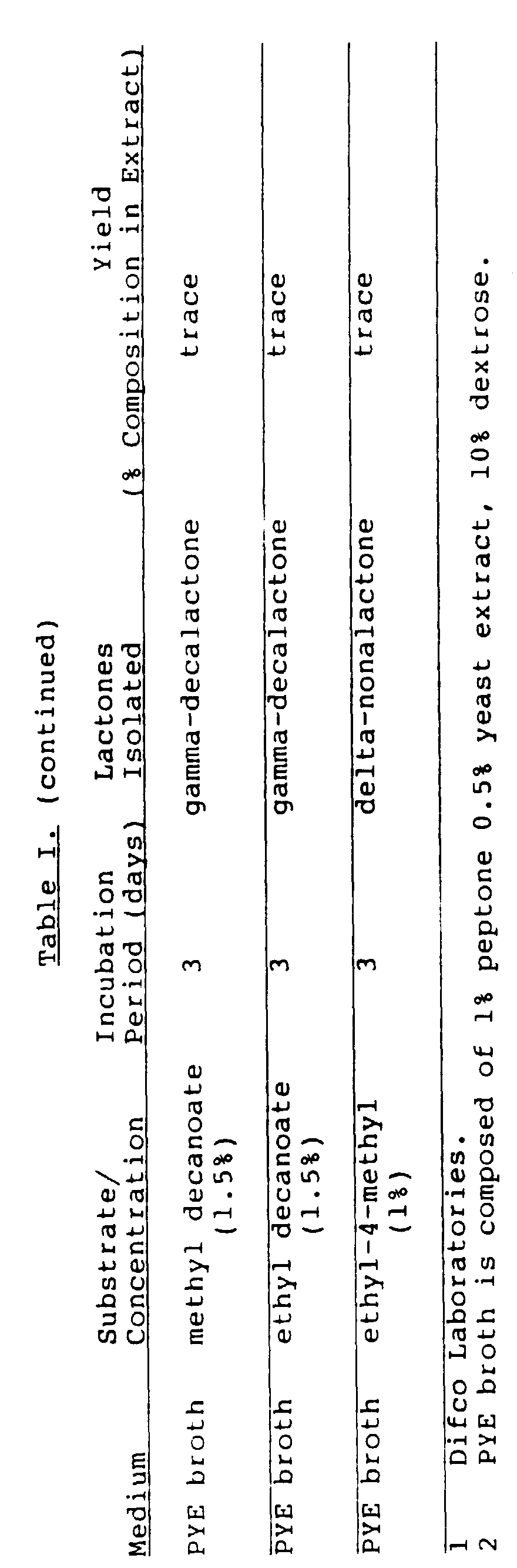
- Ten ml of a 24h broth culture of Mucor circinelloides (FDO isolate 9.17) was inoculated in 200 ml PYE broth. After 24h of incubation under the above conditions the pH was adjusted to 7.0 and 1.5g of ethyl octanoate was added. After an additional 48h fermentation the broth was extracted with organic solvent. The recovered extract weighed 0.8g and contained 49.4% gamma-octalactone and a trace of delta-octalactone. Further results using different growth media and substrates are shown in Table II.
- Although the FDO strain of Mucor circinelloides is morphologically similar to strains presently on deposit at the major culture collections, it appears to produce lactones in higher yields. Therefore the FDO culture has been submitted to ATCC to be categorized.


- Each of the following Mucor species was cultured in PYE broth as previously described for 24 to 48 hours prior to the addition of 1% (v/v) of ethyl octanoate. The cultures were extracted after an additional 3 to 5 days of fermentation and the extracts were subjected to analysis by gas chromatography. Each extract accounted for 40 to 60%, by weight, of the added substrate, except where otherwise noted. Results are shown in Table III below.


- Each of the following Mucor species was cultured in PYE broth as previously described for 24 hours, prior to the addition of 0.5% (w/v) octanamide and 1.5% (v/v) Tween®-80. The cultures were extracted after an additional 3 days fermentation and the extracts were subjected to analysis by gas chromatography. Each extract accounted for 50-60%, by weight, of the added substrate. Results are shown in Table IV below.


- A 5L fermentation vessel containing 4L of PYE broth was inoculated with 800 ml of 20h culture of M. circinelloides. (FDO isolate 9.17) Temperature was maintained at 27°C, pH was maintained at 7.1 (± 0.2), oxygen concentration was maintained at 50% saturation (± 15%) via automatic controls. After 7h of incubation ethyl octanoate was pumped into the broth at a rate of 0.7 ml/L broth/h for a total fermentation time of 40h. One liter of this broth was acidified and extracted with methylene chloride. The extract weighed 25g and 20g was recovered after distillation. The distillate contained 56% gamma-octalactone which equals 11.2g lactone recovered per liter of fermentation broth.
- Fifteen liters of PYE broth was inoculated with 400 ml of a 20h PYE broth culture of Mucor subtillisimus (FDO Isolate 5.6) in a 20L fermentor. The temperature was maintained at 27°C, pH at 6.5, dissolved oxygen concentration at 50% saturation, via automatic controls. After 5h of incubation in the fermentor vessel, ethyl caproate was pumped into the culture at a rate of 0.4 ml/h/liter culture broth, for the next 24h. The broth was then acidified and extracted with an organic solvent. After distillation, 25g of sample was recovered and this sample contained 2.6g gamma-hexalactone, 7.3g delta-hexalactone and 13.5 g caproic acid.
- Fifteen liters of PYE broth was inoculated with 100 ml of a 24h PYE broth culture of Mucor hiemalis ATCC No. 20028 in a 20L fermentor. The temperature was maintained at 27°C, pH at 6.5 and dissolved oxygen at 20%. After 18h of incubation in the fermentor vessel, ethyl decanoate was pumped into the culture at a rate of 0.6 ml/h/liter broth, for the next 52h. The culture was then acidified and extracted with an organic solvent. A total of 133g was recovered after the extract was distilled and this sample contained 3g of gamma-decalactone with the remainder being a mixture of hydroxy esters and acids.
- An aqueous sugar stock can be prepared by dissolving 20g sucrose and 0.1g salt in 1L water. To 2L of this aqueous stock can then be added about 0.2 g of a mixture of the following lactones: gamma hexalactone (10%), gamma and delta octalactones (40%) gamma and delta decalactones (40%) and gamma dodecalactone (10%) the percentages being by weight of the total mixture. About 1 to 2 g of gum alginate can be added to the mixture to provide body and 0.5 to 1 g lecithin as an emulsifier.
- The mixture can be placed in a high speed blender to homogenize it and then may be bottled and refrigerated. The resulting product is a sweet beverage having an apricot-like taste.
Claims (27)
- A microbiological process for the production of a C4 to C20 delta or gamma lactone which comprises: incubating in an aqueous nutrient broth a culture of a fungus of the genus Mucor or an enzyme extract thereof with a substrate comprising a saturated or unsaturated carboxylic acid of from four to twenty carbon atoms in length containing no lactoni - sable hydroxy group, a salt thereof, an alkyl ester thereof, a mono, di or triglyceride thereof or an unsubstituted monoalkyl or dialkyl amide thereof, thereby producing the lactone.
- A process according to claim 1 wherein the lactone has the formula

- A process according to claim 2 wherein the substrate has the formula
R2COZ
wherein R2 is an alkyl or alkenyl group of 3 to 19 carbons in length; Z is -OX, -OCH2CHOR3CHOR4 or - NR5R6; X is hydrogen, alkyl of 1 to 6 carbons, an alkali or alkaline earth metal cation or an ion exchange resin; R3 and R4 independently are hydrogen, alkyl of 1 to 6 carbons or R2CO ; and R5 and R6 independently are hydrogen or alkyl of 1 to 6 carbons. - A process according to claim 3 wherein at least the four carbon moiety of the alkyl or alkenyl group which is adjacent to the COZ group is ubranched.
- A process according to claim 1 wherein the incubation is conducted at a pH of about 3 to about 9, a temperature of about 18°C to 31°C and the nutrient broth has nutrient sources of nitrogen and carbohydrate and is in contact with an atmosphere containing from about 18% to about 100% dissolved oxygen.
- A process according to claim 1 wherein the substrate concentration in the nutrient broth is from about 0.01% to about 10% by weight, relative to the total weight of the nutrient broth, the substrate is continuously added at a feed rate of from about 1 mg to about 2g per hour per liter of nutrient broth, and the incubation period is about 1 to 10 days.
- A process according to claim 5 wherein the substrate concentration in the nutrient broth is from about 0.01% to about 10% by weight relative to the total weight of the nutrient broth, the nitrogen source is a peptone at a concentration of about 0.01 to about 3% by weight relative to the total weight of the broth and a yeast extract at a concentration of about 0.1 to 2% by weight, the carbohydrate is dextrose at a concentration of about 2% to about 20% by weight relative to the weight of the broth, the substrate is continuously added at a feed rate of from about 1 mg to about 2g per hour per liter of nutrient broth, and the incubation period is about 1 to 10 days.
- A process according to claim 7 wherein the pH is about 4 to 8, the temperature is about 20°C to about 28°C the yeast extract concentration is from about 0.1 to about 2%, the peptone concentration is from about 0.1 to 2%, the dextrose concentration is from about 4% to about 15%, the atmosphere contains from about 30% to about 80% oxygen, the substrate concentration is from about 0.1% to about 5%, the feed rate is from about 0.01g to 1g per hour per liter and the incubation period is from about 2 to 8 days.
- A process according to claim 7 wherein the pH is about 6 to about 7, the temperature is about 24'C to about 27°C the yeast extract concentration is about 0.5% to about 1%, the peptone concentration is from 0.1 to 2%, the dextrose concentration is about 8% to about 12%, the atmosphere contains from about 40% to about 60% oxygen, the substrate concentration is from 0.5% to about 2%, the feed rate is from about 0.6 to about 0.8g per hour per liter and the incubation period is from about 3 to 6 days.
- A process according to claim 7 wherein the pH is about 6 to about 7, the dextrose concentration at the beginning of the incubation is about 10%, B vitamins are added as a supplement or as the yeast extract, the substrate feed rate is about 0.6g per hour per liter and the atmosphere is about 40% to 60% dissolved oxygen.
- A process according to claim 1 further comprising monitoring the lactone concentration in the nutrient broth and terminating the incubation when the concentration of lactone remains about constant.
- A process according to claim 1 wherein the substrate is the alkyl ester.
- A process according to claim 12 wherein the alkyl group is 1 to 3 carbons in length.
- A process according to claim 1 wherein the substrate is the unsubstituted amide.
- A process according to claim 1 wherein a mixture of the gamma and delta lactones is produced.
- A process according to claim 15 wherein the mixture substantially comprises the delta lactone.
- A process according to claim 15 wherein the mixture substantially comprises the gamma lactone.
- A process according to claim 15 wherein the gamma and delta lactones are separated.
- A process according to claim 1 wherein the gamma or delta lactone is optically active.
- A process according to claim 1 wherein the gamma or delta lactone is a mixture of optical isomers.
- A process according to claim 1 wherein the gamma lactone is produced.
- A process according to claim 1 wherein the delta lactone is produced.
- A process according to claim 1 wherein gamma-octalactone is produced.
- A process according to claim 1 wherein the substrate is ethyl octanoate.
- A process according to claim 1 wherein an enzyme extract of the fungus is used as the culture.
- A process according to claim 1 wherein the living fungus is used as the culture.
- A process of claim 10 wherein the B vitamins are added in the form of a yeast extract.
Applications Claiming Priority (3)
| Application Number | Priority Date | Filing Date | Title |
|---|---|---|---|
| US07/201,087 US5032513A (en) | 1988-06-01 | 1988-06-01 | Process for the preparation of gamma and delta lactones |
| US201087 | 1988-06-01 | ||
| PCT/US1989/002261 WO1989012104A1 (en) | 1988-06-01 | 1989-05-24 | Process for the preparation of gamma and delta lactones |
Publications (2)
| Publication Number | Publication Date |
|---|---|
| EP0417203A1 EP0417203A1 (en) | 1991-03-20 |
| EP0417203B1 true EP0417203B1 (en) | 1996-09-04 |
Family
ID=22744441
Family Applications (1)
| Application Number | Title | Priority Date | Filing Date |
|---|---|---|---|
| EP89907450A Expired - Lifetime EP0417203B1 (en) | 1988-06-01 | 1989-05-24 | Process for the preparation of gamma and delta lactones |
Country Status (9)
| Country | Link |
|---|---|
| US (1) | US5032513A (en) |
| EP (1) | EP0417203B1 (en) |
| JP (1) | JPH03505817A (en) |
| KR (1) | KR0136774B1 (en) |
| AT (1) | ATE142267T1 (en) |
| AU (1) | AU3834789A (en) |
| CA (1) | CA1306967C (en) |
| DE (1) | DE68927103T2 (en) |
| WO (1) | WO1989012104A1 (en) |
Families Citing this family (15)
| Publication number | Priority date | Publication date | Assignee | Title |
|---|---|---|---|---|
| EP0409321B1 (en) * | 1989-07-20 | 1994-09-14 | Quest International B.V. | Process for producing delta-lactones |
| US5215901A (en) * | 1989-07-20 | 1993-06-01 | Unilever Patent Holdings B.V. | Process for producing delta-lactones from 11-hydroxy fatty acids |
| US5274128A (en) * | 1991-06-21 | 1993-12-28 | International Flavors & Fragrances Inc. | Octalactone-containing composition, fermentation process for producing same and organoleptic uses thereof |
| US5166366A (en) * | 1991-06-21 | 1992-11-24 | International Flavors & Fragrances Inc. | Octalactone-containing composition, fermentation process for producing same and organoleptic uses thereof |
| US5112803A (en) * | 1991-06-21 | 1992-05-12 | International Flavors & Fragrances Inc. | Octalactone-containing composition, fermentation process for producing same and organoleptic uses thereof |
| US5234947A (en) * | 1991-11-07 | 1993-08-10 | New York University | Potassium channel activating compounds and methods of use thereof |
| US5505938A (en) * | 1993-09-30 | 1996-04-09 | Lever Brothers Company, Division Of Conopco, Inc. | Straight chain saturated or unsaturated C8 -C18 alkyl aldonolactone esters and an enzymatic process for their preparation |
| EP0795607A3 (en) * | 1996-03-15 | 1999-06-30 | Givaudan-Roure (International) S.A. | Process for the preparation of a lactone |
| US5849551A (en) * | 1996-03-15 | 1998-12-15 | Givaudan-Roure (International) Sa | Microbiological process for producing γ-decalactone |
| JP3564237B2 (en) * | 1996-08-02 | 2004-09-08 | 長谷川香料株式会社 | Method for producing δ-decalactone |
| US6110520A (en) * | 1999-03-25 | 2000-08-29 | International Flavors & Fragrances Inc. | Process for preparing GAMM-hexalactone, products produced therefrom dan organoleptic uses of said products |
| US6613907B2 (en) * | 2000-11-08 | 2003-09-02 | Amr Technology, Inc. | Process for the production of piperidine derivatives with microorganisms |
| CN108148766B (en) * | 2017-12-29 | 2019-10-22 | 厦门欧米克生物科技有限公司 | A kind of mould OMK-25 and its application for producing fourth butyrolactone |
| CN112424338B (en) | 2018-07-17 | 2025-09-02 | 科纳根公司 | Biosynthesis of γ-lactones |
| WO2020191385A1 (en) * | 2019-03-21 | 2020-09-24 | Conagen Inc. | Biosynthetic production of gamma- and delta-lactones using cytochrome p450 enzymes having subterminal hydroxylase activity |
Family Cites Families (7)
| Publication number | Priority date | Publication date | Assignee | Title |
|---|---|---|---|---|
| US3076750A (en) * | 1959-07-01 | 1963-02-05 | Lever Brothers Ltd | Microbiologically reducing keto acids |
| US4138289A (en) * | 1976-05-10 | 1979-02-06 | Hoffmann-La Roche Inc. | Process for the manufacture of tertiary, optically active aliphatic compounds |
| US4396715A (en) * | 1979-04-04 | 1983-08-02 | The Simon Greenberg Foundation | Production of gamma-lactone rich flavor additives by pityrosporum species cultured on lipid rich substrates |
| US4542097A (en) * | 1980-11-10 | 1985-09-17 | Monell Chemical Senses Center | Production of gamma-lactone, rich flavor additives by Pityrosporum species cultured on lipid rich substrates |
| DE3108927A1 (en) * | 1981-03-10 | 1982-09-23 | Haarmann & Reimer Gmbh, 3450 Holzminden | METHOD FOR THE ENZYMATIC PRODUCTION OF ESTERS AND LACONS |
| WO1983001072A1 (en) * | 1981-09-28 | 1983-03-31 | Farbood, Mohamad, I. | Production of gamma-decalactone |
| JPH066058B2 (en) * | 1985-12-07 | 1994-01-26 | 不二製油株式会社 | Enzyme preparation method |
-
1988
- 1988-06-01 US US07/201,087 patent/US5032513A/en not_active Expired - Lifetime
-
1989
- 1989-05-24 KR KR1019900700201A patent/KR0136774B1/en not_active Expired - Fee Related
- 1989-05-24 AT AT89907450T patent/ATE142267T1/en not_active IP Right Cessation
- 1989-05-24 JP JP1506831A patent/JPH03505817A/en active Pending
- 1989-05-24 EP EP89907450A patent/EP0417203B1/en not_active Expired - Lifetime
- 1989-05-24 WO PCT/US1989/002261 patent/WO1989012104A1/en not_active Ceased
- 1989-05-24 DE DE68927103T patent/DE68927103T2/en not_active Expired - Lifetime
- 1989-05-24 AU AU38347/89A patent/AU3834789A/en not_active Abandoned
- 1989-05-29 CA CA000600960A patent/CA1306967C/en not_active Expired - Fee Related
Non-Patent Citations (2)
| Title |
|---|
| PATENT ABSTRACTS OF JAPAN, vol. 9, no. 196 (C-297)(1919), 13 August 1985/ * |
| PATENT ABSTRACTS OF JAPAN, vol. 9, no. 241 (C-306)(1964), 27 September 1985/ * |
Also Published As
| Publication number | Publication date |
|---|---|
| ATE142267T1 (en) | 1996-09-15 |
| DE68927103T2 (en) | 1997-02-20 |
| AU3834789A (en) | 1990-01-05 |
| US5032513A (en) | 1991-07-16 |
| KR900702043A (en) | 1990-12-05 |
| KR0136774B1 (en) | 1998-04-25 |
| DE68927103D1 (en) | 1996-10-10 |
| WO1989012104A1 (en) | 1989-12-14 |
| CA1306967C (en) | 1992-09-01 |
| JPH03505817A (en) | 1991-12-19 |
| EP0417203A1 (en) | 1991-03-20 |
Similar Documents
| Publication | Publication Date | Title |
|---|---|---|
| US5032513A (en) | Process for the preparation of gamma and delta lactones | |
| US4560656A (en) | Production of γ-decalactone | |
| EP0833938B1 (en) | Reduction of ketone groups | |
| EP0204009B1 (en) | Process for producing diol and furan and microorganism capable of same | |
| US4877731A (en) | Fermentation process for carboxylic acids | |
| US4564594A (en) | Fermentation process for production of carboxylic acids | |
| CA2202016C (en) | Process for the production of lipstatin and of tetrahydrolipstatin | |
| US5212078A (en) | Process for producing a lactone | |
| EP0419026A1 (en) | Process and means for producing diol and lactone | |
| EP0520027A1 (en) | Process for the production of natural long-chain alcohols | |
| US5128261A (en) | Natural delta-lactones and process of the production thereof | |
| US5409820A (en) | Process for the production of lovastatin using Coniothyrium fuckelii | |
| EP0371568A1 (en) | Process for producing gamma-lactones | |
| US5215901A (en) | Process for producing delta-lactones from 11-hydroxy fatty acids | |
| US5155029A (en) | Process for producing a cyclic ether | |
| US5849551A (en) | Microbiological process for producing γ-decalactone | |
| US5118882A (en) | Streptenols from streptomycetes, and the preparation and use thereof | |
| US5646022A (en) | Process for the production of gamma nonalactones in natural form | |
| CA2021270A1 (en) | Process for producing delta-lactones | |
| JP3002654B2 (en) | Biologically pure culture of microorganism and method for producing diol using the same | |
| Matsumoto et al. | Kinetic resolution of enol esters via enzyme-mediated hydrolysis. | |
| EP0795607A2 (en) | Process for the preparation of a lactone | |
| JPH0592967A (en) | Novel natural substance with 10-membered ring lactone structure | |
| JP2001527424A (en) | Metabolic control fermentation procedure for producing lovastatin hydroxy acid | |
| JPH0690772A (en) | Preparation of optically active gamma- hydroxydecanoic acid |
Legal Events
| Date | Code | Title | Description |
|---|---|---|---|
| PUAI | Public reference made under article 153(3) epc to a published international application that has entered the european phase |
Free format text: ORIGINAL CODE: 0009012 |
|
| 17P | Request for examination filed |
Effective date: 19901201 |
|
| AK | Designated contracting states |
Kind code of ref document: A1 Designated state(s): AT BE CH DE FR GB IT LI LU NL SE |
|
| 17Q | First examination report despatched |
Effective date: 19930528 |
|
| GRAA | (expected) grant |
Free format text: ORIGINAL CODE: 0009210 |
|
| AK | Designated contracting states |
Kind code of ref document: B1 Designated state(s): AT BE CH DE FR GB IT LI LU NL SE |
|
| REF | Corresponds to: |
Ref document number: 142267 Country of ref document: AT Date of ref document: 19960915 Kind code of ref document: T |
|
| REG | Reference to a national code |
Ref country code: CH Ref legal event code: NV Representative=s name: SCHMAUDER & WANN PATENTANWALTSBUERO, INHABER KLAUS |
|
| REF | Corresponds to: |
Ref document number: 68927103 Country of ref document: DE Date of ref document: 19961010 |
|
| ITF | It: translation for a ep patent filed | ||
| ET | Fr: translation filed | ||
| PLBE | No opposition filed within time limit |
Free format text: ORIGINAL CODE: 0009261 |
|
| STAA | Information on the status of an ep patent application or granted ep patent |
Free format text: STATUS: NO OPPOSITION FILED WITHIN TIME LIMIT |
|
| 26N | No opposition filed | ||
| REG | Reference to a national code |
Ref country code: GB Ref legal event code: IF02 |
|
| PGFP | Annual fee paid to national office [announced via postgrant information from national office to epo] |
Ref country code: FR Payment date: 20020412 Year of fee payment: 14 |
|
| PGFP | Annual fee paid to national office [announced via postgrant information from national office to epo] |
Ref country code: SE Payment date: 20020415 Year of fee payment: 14 Ref country code: NL Payment date: 20020415 Year of fee payment: 14 |
|
| PGFP | Annual fee paid to national office [announced via postgrant information from national office to epo] |
Ref country code: AT Payment date: 20020422 Year of fee payment: 14 |
|
| PGFP | Annual fee paid to national office [announced via postgrant information from national office to epo] |
Ref country code: CH Payment date: 20020423 Year of fee payment: 14 |
|
| PGFP | Annual fee paid to national office [announced via postgrant information from national office to epo] |
Ref country code: GB Payment date: 20020517 Year of fee payment: 14 |
|
| PGFP | Annual fee paid to national office [announced via postgrant information from national office to epo] |
Ref country code: DE Payment date: 20020518 Year of fee payment: 14 |
|
| PGFP | Annual fee paid to national office [announced via postgrant information from national office to epo] |
Ref country code: BE Payment date: 20020521 Year of fee payment: 14 |
|
| PGFP | Annual fee paid to national office [announced via postgrant information from national office to epo] |
Ref country code: LU Payment date: 20020606 Year of fee payment: 14 |
|
| PG25 | Lapsed in a contracting state [announced via postgrant information from national office to epo] |
Ref country code: DE Free format text: LAPSE BECAUSE OF THE APPLICANT RENOUNCES Effective date: 20030522 |
|
| PG25 | Lapsed in a contracting state [announced via postgrant information from national office to epo] |
Ref country code: LU Free format text: LAPSE BECAUSE OF NON-PAYMENT OF DUE FEES Effective date: 20030524 Ref country code: GB Free format text: LAPSE BECAUSE OF NON-PAYMENT OF DUE FEES Effective date: 20030524 Ref country code: AT Free format text: LAPSE BECAUSE OF NON-PAYMENT OF DUE FEES Effective date: 20030524 |
|
| PG25 | Lapsed in a contracting state [announced via postgrant information from national office to epo] |
Ref country code: SE Free format text: LAPSE BECAUSE OF NON-PAYMENT OF DUE FEES Effective date: 20030525 |
|
| PG25 | Lapsed in a contracting state [announced via postgrant information from national office to epo] |
Ref country code: LI Free format text: LAPSE BECAUSE OF NON-PAYMENT OF DUE FEES Effective date: 20030531 Ref country code: CH Free format text: LAPSE BECAUSE OF NON-PAYMENT OF DUE FEES Effective date: 20030531 Ref country code: BE Free format text: LAPSE BECAUSE OF NON-PAYMENT OF DUE FEES Effective date: 20030531 |
|
| BERE | Be: lapsed |
Owner name: *BASF CORP. Effective date: 20030531 |
|
| PG25 | Lapsed in a contracting state [announced via postgrant information from national office to epo] |
Ref country code: NL Free format text: LAPSE BECAUSE OF NON-PAYMENT OF DUE FEES Effective date: 20031201 |
|
| EUG | Se: european patent has lapsed | ||
| GBPC | Gb: european patent ceased through non-payment of renewal fee |
Effective date: 20030524 |
|
| REG | Reference to a national code |
Ref country code: CH Ref legal event code: PL |
|
| PG25 | Lapsed in a contracting state [announced via postgrant information from national office to epo] |
Ref country code: FR Free format text: LAPSE BECAUSE OF NON-PAYMENT OF DUE FEES Effective date: 20040130 |
|
| NLV4 | Nl: lapsed or anulled due to non-payment of the annual fee |
Effective date: 20031201 |
|
| REG | Reference to a national code |
Ref country code: FR Ref legal event code: ST |
|
| PG25 | Lapsed in a contracting state [announced via postgrant information from national office to epo] |
Ref country code: IT Free format text: LAPSE BECAUSE OF NON-PAYMENT OF DUE FEES;WARNING: LAPSES OF ITALIAN PATENTS WITH EFFECTIVE DATE BEFORE 2007 MAY HAVE OCCURRED AT ANY TIME BEFORE 2007. THE CORRECT EFFECTIVE DATE MAY BE DIFFERENT FROM THE ONE RECORDED. Effective date: 20050524 |