EP0416615B1 - Process for preparing chlorotrifluoroethylene - Google Patents
Process for preparing chlorotrifluoroethylene Download PDFInfo
- Publication number
- EP0416615B1 EP0416615B1 EP19900117182 EP90117182A EP0416615B1 EP 0416615 B1 EP0416615 B1 EP 0416615B1 EP 19900117182 EP19900117182 EP 19900117182 EP 90117182 A EP90117182 A EP 90117182A EP 0416615 B1 EP0416615 B1 EP 0416615B1
- Authority
- EP
- European Patent Office
- Prior art keywords
- sio2
- catalyst
- process according
- reaction
- trifluoroethane
- Prior art date
- Legal status (The legal status is an assumption and is not a legal conclusion. Google has not performed a legal analysis and makes no representation as to the accuracy of the status listed.)
- Expired - Lifetime
Links
- UUAGAQFQZIEFAH-UHFFFAOYSA-N chlorotrifluoroethylene Chemical group FC(F)=C(F)Cl UUAGAQFQZIEFAH-UHFFFAOYSA-N 0.000 title claims description 20
- 238000004519 manufacturing process Methods 0.000 title claims description 8
- VYPSYNLAJGMNEJ-UHFFFAOYSA-N Silicium dioxide Chemical compound O=[Si]=O VYPSYNLAJGMNEJ-UHFFFAOYSA-N 0.000 claims description 60
- 239000003054 catalyst Substances 0.000 claims description 35
- PXHVJJICTQNCMI-UHFFFAOYSA-N nickel Substances [Ni] PXHVJJICTQNCMI-UHFFFAOYSA-N 0.000 claims description 33
- 239000000377 silicon dioxide Substances 0.000 claims description 27
- 238000006243 chemical reaction Methods 0.000 claims description 26
- 229910052681 coesite Inorganic materials 0.000 claims description 23
- 229910052906 cristobalite Inorganic materials 0.000 claims description 23
- 235000012239 silicon dioxide Nutrition 0.000 claims description 23
- 229910052682 stishovite Inorganic materials 0.000 claims description 23
- 229910052905 tridymite Inorganic materials 0.000 claims description 23
- 238000000034 method Methods 0.000 claims description 19
- AJDIZQLSFPQPEY-UHFFFAOYSA-N 1,1,2-Trichlorotrifluoroethane Chemical compound FC(F)(Cl)C(F)(Cl)Cl AJDIZQLSFPQPEY-UHFFFAOYSA-N 0.000 claims description 16
- 239000001257 hydrogen Substances 0.000 claims description 16
- 229910052739 hydrogen Inorganic materials 0.000 claims description 16
- XEEYBQQBJWHFJM-UHFFFAOYSA-N Iron Chemical compound [Fe] XEEYBQQBJWHFJM-UHFFFAOYSA-N 0.000 claims description 14
- UFHFLCQGNIYNRP-UHFFFAOYSA-N Hydrogen Chemical compound [H][H] UFHFLCQGNIYNRP-UHFFFAOYSA-N 0.000 claims description 13
- OKTJSMMVPCPJKN-UHFFFAOYSA-N Carbon Chemical compound [C] OKTJSMMVPCPJKN-UHFFFAOYSA-N 0.000 claims description 12
- CPLXHLVBOLITMK-UHFFFAOYSA-N Magnesium oxide Chemical compound [Mg]=O CPLXHLVBOLITMK-UHFFFAOYSA-N 0.000 claims description 11
- 229910052799 carbon Inorganic materials 0.000 claims description 10
- 239000011651 chromium Substances 0.000 claims description 10
- 229910021536 Zeolite Inorganic materials 0.000 claims description 8
- HNPSIPDUKPIQMN-UHFFFAOYSA-N dioxosilane;oxo(oxoalumanyloxy)alumane Chemical compound O=[Si]=O.O=[Al]O[Al]=O HNPSIPDUKPIQMN-UHFFFAOYSA-N 0.000 claims description 8
- 239000010457 zeolite Substances 0.000 claims description 8
- 229910052742 iron Inorganic materials 0.000 claims description 7
- HCHKCACWOHOZIP-UHFFFAOYSA-N Zinc Chemical compound [Zn] HCHKCACWOHOZIP-UHFFFAOYSA-N 0.000 claims description 6
- 229910052759 nickel Inorganic materials 0.000 claims description 6
- 229910052725 zinc Inorganic materials 0.000 claims description 6
- 239000011701 zinc Substances 0.000 claims description 6
- QPLDLSVMHZLSFG-UHFFFAOYSA-N Copper oxide Chemical compound [Cu]=O QPLDLSVMHZLSFG-UHFFFAOYSA-N 0.000 claims description 5
- VYZAMTAEIAYCRO-UHFFFAOYSA-N Chromium Chemical compound [Cr] VYZAMTAEIAYCRO-UHFFFAOYSA-N 0.000 claims description 4
- 239000005751 Copper oxide Substances 0.000 claims description 4
- ATJFFYVFTNAWJD-UHFFFAOYSA-N Tin Chemical compound [Sn] ATJFFYVFTNAWJD-UHFFFAOYSA-N 0.000 claims description 4
- MCMNRKCIXSYSNV-UHFFFAOYSA-N Zirconium dioxide Chemical compound O=[Zr]=O MCMNRKCIXSYSNV-UHFFFAOYSA-N 0.000 claims description 4
- PNEYBMLMFCGWSK-UHFFFAOYSA-N aluminium oxide Inorganic materials [O-2].[O-2].[O-2].[Al+3].[Al+3] PNEYBMLMFCGWSK-UHFFFAOYSA-N 0.000 claims description 4
- 229910052804 chromium Inorganic materials 0.000 claims description 4
- 229910000431 copper oxide Inorganic materials 0.000 claims description 4
- 229910000480 nickel oxide Inorganic materials 0.000 claims description 4
- GNRSAWUEBMWBQH-UHFFFAOYSA-N oxonickel Chemical compound [Ni]=O GNRSAWUEBMWBQH-UHFFFAOYSA-N 0.000 claims description 4
- 239000011135 tin Substances 0.000 claims description 4
- 229910052718 tin Inorganic materials 0.000 claims description 4
- 229910052593 corundum Inorganic materials 0.000 claims description 2
- HBMJWWWQQXIZIP-UHFFFAOYSA-N silicon carbide Chemical compound [Si+]#[C-] HBMJWWWQQXIZIP-UHFFFAOYSA-N 0.000 claims description 2
- 229910010271 silicon carbide Inorganic materials 0.000 claims description 2
- 229910001845 yogo sapphire Inorganic materials 0.000 claims description 2
- XKRFYHLGVUSROY-UHFFFAOYSA-N Argon Chemical compound [Ar] XKRFYHLGVUSROY-UHFFFAOYSA-N 0.000 description 14
- 239000000395 magnesium oxide Substances 0.000 description 8
- 239000007864 aqueous solution Substances 0.000 description 7
- 229910052786 argon Inorganic materials 0.000 description 7
- JEIPFZHSYJVQDO-UHFFFAOYSA-N iron(III) oxide Inorganic materials O=[Fe]O[Fe]=O JEIPFZHSYJVQDO-UHFFFAOYSA-N 0.000 description 7
- 239000007789 gas Substances 0.000 description 6
- 239000012071 phase Substances 0.000 description 6
- 230000007423 decrease Effects 0.000 description 5
- 230000000694 effects Effects 0.000 description 5
- 239000000203 mixture Substances 0.000 description 5
- KDLHZDBZIXYQEI-UHFFFAOYSA-N palladium Substances [Pd] KDLHZDBZIXYQEI-UHFFFAOYSA-N 0.000 description 5
- 239000002994 raw material Substances 0.000 description 5
- XLOMVQKBTHCTTD-UHFFFAOYSA-N Zinc monoxide Chemical compound [Zn]=O XLOMVQKBTHCTTD-UHFFFAOYSA-N 0.000 description 4
- 229910052751 metal Inorganic materials 0.000 description 4
- 239000002184 metal Substances 0.000 description 4
- 238000002360 preparation method Methods 0.000 description 4
- 238000005245 sintering Methods 0.000 description 4
- XOLBLPGZBRYERU-UHFFFAOYSA-N tin dioxide Chemical compound O=[Sn]=O XOLBLPGZBRYERU-UHFFFAOYSA-N 0.000 description 4
- 229910002012 Aerosil® Inorganic materials 0.000 description 3
- 229910002651 NO3 Inorganic materials 0.000 description 3
- NHNBFGGVMKEFGY-UHFFFAOYSA-N Nitrate Chemical compound [O-][N+]([O-])=O NHNBFGGVMKEFGY-UHFFFAOYSA-N 0.000 description 3
- KWYUFKZDYYNOTN-UHFFFAOYSA-M Potassium hydroxide Chemical compound [OH-].[K+] KWYUFKZDYYNOTN-UHFFFAOYSA-M 0.000 description 3
- QDOXWKRWXJOMAK-UHFFFAOYSA-N dichromium trioxide Chemical compound O=[Cr]O[Cr]=O QDOXWKRWXJOMAK-UHFFFAOYSA-N 0.000 description 3
- 150000002431 hydrogen Chemical class 0.000 description 3
- KBJMLQFLOWQJNF-UHFFFAOYSA-N nickel(ii) nitrate Chemical compound [Ni+2].[O-][N+]([O-])=O.[O-][N+]([O-])=O KBJMLQFLOWQJNF-UHFFFAOYSA-N 0.000 description 3
- 229910052763 palladium Inorganic materials 0.000 description 3
- XLYOFNOQVPJJNP-UHFFFAOYSA-N water Substances O XLYOFNOQVPJJNP-UHFFFAOYSA-N 0.000 description 3
- IJGRMHOSHXDMSA-UHFFFAOYSA-N Atomic nitrogen Chemical compound N#N IJGRMHOSHXDMSA-UHFFFAOYSA-N 0.000 description 2
- RYGMFSIKBFXOCR-UHFFFAOYSA-N Copper Chemical compound [Cu] RYGMFSIKBFXOCR-UHFFFAOYSA-N 0.000 description 2
- 239000006004 Quartz sand Substances 0.000 description 2
- PHFQLYPOURZARY-UHFFFAOYSA-N chromium trinitrate Chemical compound [Cr+3].[O-][N+]([O-])=O.[O-][N+]([O-])=O.[O-][N+]([O-])=O PHFQLYPOURZARY-UHFFFAOYSA-N 0.000 description 2
- 229910052802 copper Inorganic materials 0.000 description 2
- 239000010949 copper Substances 0.000 description 2
- 230000000382 dechlorinating effect Effects 0.000 description 2
- 238000006298 dechlorination reaction Methods 0.000 description 2
- 230000003247 decreasing effect Effects 0.000 description 2
- 239000006185 dispersion Substances 0.000 description 2
- 238000004817 gas chromatography Methods 0.000 description 2
- 239000007791 liquid phase Substances 0.000 description 2
- 239000000463 material Substances 0.000 description 2
- BASFCYQUMIYNBI-UHFFFAOYSA-N platinum Chemical compound [Pt] BASFCYQUMIYNBI-UHFFFAOYSA-N 0.000 description 2
- 239000000047 product Substances 0.000 description 2
- 238000000197 pyrolysis Methods 0.000 description 2
- 239000011541 reaction mixture Substances 0.000 description 2
- 230000035484 reaction time Effects 0.000 description 2
- 238000003756 stirring Methods 0.000 description 2
- 229910052727 yttrium Inorganic materials 0.000 description 2
- JIAARYAFYJHUJI-UHFFFAOYSA-L zinc dichloride Chemical compound [Cl-].[Cl-].[Zn+2] JIAARYAFYJHUJI-UHFFFAOYSA-L 0.000 description 2
- VOPWNXZWBYDODV-UHFFFAOYSA-N Chlorodifluoromethane Chemical compound FC(F)Cl VOPWNXZWBYDODV-UHFFFAOYSA-N 0.000 description 1
- 229910000608 Fe(NO3)3.9H2O Inorganic materials 0.000 description 1
- VEXZGXHMUGYJMC-UHFFFAOYSA-N Hydrochloric acid Chemical compound Cl VEXZGXHMUGYJMC-UHFFFAOYSA-N 0.000 description 1
- 239000005909 Kieselgur Substances 0.000 description 1
- 229910021586 Nickel(II) chloride Inorganic materials 0.000 description 1
- 239000007868 Raney catalyst Substances 0.000 description 1
- 229910000564 Raney nickel Inorganic materials 0.000 description 1
- 238000002441 X-ray diffraction Methods 0.000 description 1
- 230000003197 catalytic effect Effects 0.000 description 1
- 239000002801 charged material Substances 0.000 description 1
- 239000003153 chemical reaction reagent Substances 0.000 description 1
- 229910017052 cobalt Inorganic materials 0.000 description 1
- 239000010941 cobalt Substances 0.000 description 1
- GUTLYIVDDKVIGB-UHFFFAOYSA-N cobalt atom Chemical compound [Co] GUTLYIVDDKVIGB-UHFFFAOYSA-N 0.000 description 1
- 230000000052 comparative effect Effects 0.000 description 1
- 238000001816 cooling Methods 0.000 description 1
- 230000006866 deterioration Effects 0.000 description 1
- UMNKXPULIDJLSU-UHFFFAOYSA-N dichlorofluoromethane Chemical compound FC(Cl)Cl UMNKXPULIDJLSU-UHFFFAOYSA-N 0.000 description 1
- 229940099364 dichlorofluoromethane Drugs 0.000 description 1
- 238000010790 dilution Methods 0.000 description 1
- 239000012895 dilution Substances 0.000 description 1
- 238000001704 evaporation Methods 0.000 description 1
- 239000012065 filter cake Substances 0.000 description 1
- 239000010419 fine particle Substances 0.000 description 1
- 239000001307 helium Substances 0.000 description 1
- 229910052734 helium Inorganic materials 0.000 description 1
- SWQJXJOGLNCZEY-UHFFFAOYSA-N helium atom Chemical compound [He] SWQJXJOGLNCZEY-UHFFFAOYSA-N 0.000 description 1
- IXCSERBJSXMMFS-UHFFFAOYSA-N hydrogen chloride Substances Cl.Cl IXCSERBJSXMMFS-UHFFFAOYSA-N 0.000 description 1
- 229910000041 hydrogen chloride Inorganic materials 0.000 description 1
- 239000011261 inert gas Substances 0.000 description 1
- MVFCKEFYUDZOCX-UHFFFAOYSA-N iron(2+);dinitrate Chemical compound [Fe+2].[O-][N+]([O-])=O.[O-][N+]([O-])=O MVFCKEFYUDZOCX-UHFFFAOYSA-N 0.000 description 1
- AXZKOIWUVFPNLO-UHFFFAOYSA-N magnesium;oxygen(2-) Chemical compound [O-2].[Mg+2] AXZKOIWUVFPNLO-UHFFFAOYSA-N 0.000 description 1
- QMMRZOWCJAIUJA-UHFFFAOYSA-L nickel dichloride Chemical compound Cl[Ni]Cl QMMRZOWCJAIUJA-UHFFFAOYSA-L 0.000 description 1
- 229910052757 nitrogen Inorganic materials 0.000 description 1
- 229910000510 noble metal Inorganic materials 0.000 description 1
- 239000002245 particle Substances 0.000 description 1
- 229910052697 platinum Inorganic materials 0.000 description 1
- 230000002035 prolonged effect Effects 0.000 description 1
- 239000000376 reactant Substances 0.000 description 1
- 238000007873 sieving Methods 0.000 description 1
- 239000007787 solid Substances 0.000 description 1
- 239000011592 zinc chloride Substances 0.000 description 1
- 235000005074 zinc chloride Nutrition 0.000 description 1
Images
Classifications
-
- C—CHEMISTRY; METALLURGY
- C07—ORGANIC CHEMISTRY
- C07C—ACYCLIC OR CARBOCYCLIC COMPOUNDS
- C07C17/00—Preparation of halogenated hydrocarbons
- C07C17/23—Preparation of halogenated hydrocarbons by dehalogenation
Definitions
- the present invention relates to a process for preparing chlorotrifluoroethylene. More particularly, the present invention relates to a process for preparing chlorotrifluoroethylene (hereinafter referred to as "CTFE") from 1,1,2-trichloro-1,2,2-trifluoroethane (CFC-113) the use of which is and will be limited.
- CTFE chlorotrifluoroethylene
- Japanese Patent Publication Nos. 5207/1982 and 5208/1982 disclose a liquid phase process comprising dechlorinating 1,1,2-trichloro-1,2,2-trifluoroethane with zinc
- Japanese Patent Publication No. 2132/1965 discloses co-pyrolysis of dichlorofluoromethane and chlorodifluoromethane
- Japanese Patent Kokai Publication No. 185734/1985 discloses a gas phase process comprising dechlorinating 1,1,2-trichloro-1,2,2-trifluoroethane with hydrogen in the presence of various active carbon as catalysts.
- a catalyst comprising a noble metal such as Pd carried on a support can be used as disclosed in Japanese Patent Publication No. 8454/1968.
- US-A-2704775 discloses preparing chlorotrifluoroethylene by reacting 1,1,2-trichloro-1,2,2-trifluoroethane with hydrogen in the presence of nickel, cobalt, copper, platinum, palladium or activated carbon as the catalyst, and of these nickel is the preferred catalyst, especially in the form of finely divided metal, as for instance Raney nickel.
- US-A-2864873 refers to process for preparing chlorotrifluoroethylene by reacting 1,1,2-trichloro-1,2,2-trifluoroethane with hydrogen in the presence of a catalyst, which comprises a metal of the group consisting of copper and nickel compulsory together with an oxide of chromium.
- One object of the present invention is to provide a novel gas phase process for preparing CTFE in a high yield.
- Another object of the present invention is to provide a novel gas phase process for preparing CTFE in which activity of a catalyst is maintained for a long reaction time and CTFE is produced with high productivity.
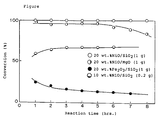
- Figure is a graph showing change of conversions in the preparation of CTFE according to the present invention.
- Ni/SiO2, Ni/MgO, Ni/Zeolite Y; iron, tin, zinc and chromium as well as their oxides such as Fe2O3, SnO2, ZnO and Cr2O3; nickel/oxide and copper oxide can be used as the catalyst.
- the catalyst component selected from the group consisting of iron, tin, zinc, chromium and their oxides, nickel oxide and copper oxide can be carried on a support.
- the activity of the catalyst is improved so that the selectivity is increased, and a life of the catalyst is prolonged.
- Preferred examples of the support are active carbon, SiO2, MgO, Al2O3, ZrO2, Zeolite Y, silica-alumina, silicon carbide, diatomaceous earth.
- Preferred combinations of the catalyst and the support are Ni/SiO2, Ni/MgO, Ni/Zeolite Y, Fe/SiO2, Cr/SiO2.
- the catalyst component may be carried on the support in an amount of from 0.1 to 50 % by weight based on the total weight.
- the molar ratio of 1,1,2-trichloro-1,2,2-trifluoroethane to hydrogen is not critical. Preferably, 1 to 10 moles, more preferably 1 to 5 moles of hydrogen is used per one mole of 1,1,2-trichloro-1,2,2-trifluoroethane. As the excessive amount of hydrogen decreases, the selectivity decreases. When the excessive amount of hydrogen is too large, a ratio of utilized hydrogen decreases.
- the reaction temperature is from 300 to 550°C, preferably from 400 to 500°C. At a temperature lower than 300°C, the conversion decreases, while at a temperature higher than 550°C, the selectivity decreases and/or the catalyst is deteriorated.
- the reaction pressure is not critical. The process of the present invention can be carried out under any practically employed pressure.
- the space velocity (SV) of the raw materials is preferably from 100 to 20,000 hr ⁇ 1.
- SV is defined by a ratio of a volume of the raw materials supplied in a unit time at a reaction temperature to an apparent packed volume of the catalyst.
- the gaseous reactants materials can be supplied with or without dilution with an inert gas such as nitrogen, argon or helium which has no influence on the reaction.
- an inert gas such as nitrogen, argon or helium which has no influence on the reaction.
- the process of the present invention is preferably carried out in the presence of steam, since steam is extremely effective for preventing deterioration of the catalyst.
- An amount of steam is up to 20 % by volume of all the volume of the charged materials.
- Each catalyst used in this Example was prepared by dispersing silica (Aerosil) or magnesium oxide in an aqueous solution of a nitrate of each metal, evaporating the dispersion to dryness, and sieving the residual solid to particle sizes of 32 mesh to 60 mesh.
- the reaction was carried out in a fixed bed flow reactor under atmospheric pressure.
- the catalyst was charged in the reactor and pre-treated in an argon stream at 450°C for 2 hours. Then, at the same temperature, the raw materials were supplied to start the reaction.
- the raw material mixture consisted of 1,1,2-trichloro-1,2,2-trifluoroethane, hydrogen and argon which were supplied at flow rates of 10 ml/min., 29 ml/min. and 56 ml/min., respectively.
- By-produced hydrogen chloride was removed by absorbing it with an aqueous solution of potassium hydroxide, and the produced materials were analyzed with gas chromatography.
- Figure shows change of conversions with time when the catalyst comprising NiO or Fe2O3 supported on the above carrier was used.
- the used catalysts clearly showed the activity on the reaction of the present invention.
- the activity of 20 wt.% NiO/SiO2 was extremely high. During the 8 hour reaction, the conversion was 100 % and the selectivity was 80 %.
- the reaction was carried out by reducing the supported amount of NiO to 10 % by weight and the amount of the supported catalyst to 0.2 g (one fifth). The results are also shown in Figure.
- the activity slightly increased in an initial stage of the reaction. Though the amount of NiO was only one tenth of the 20 wt.% Fe2O3/SiO2, the conversion was about 70 % which was about six times larger than in case of the 20 wt.% Fe2O3/SiO2.
- the selectivity was 100 %.
- NiO was reduced to metal nickel during the reaction.
- the NiO catalyst which had been reduced with hydrogen before use had the same catalytic activity as the non-reduced NiO catalyst.
- CTFE was prepared by using various supported catalysts.
- Ni/SiO2 (1, 2, 5, 10, 20 or 30 % by weight of Ni)
- Ni/MgO (20 % by weight of Ni)
- Ni/active carbon Ni/Zeolite Y
- Fe/SiO2 and Cr/SiO2 were prepared. The preparation procedures were as follows:
- MgO (20 g) was dispersed in water (500 ml). To the dispersion, 200 ml of an aqueous solution of nickel nitrate (19.5 g) was dropwise added and the mixture was stirred at room temperature for one day. Then, the mixture was heated at 80 to 90°C to evaporate water off. The residue was further dried at 120°C for one day followed by sintering in the air at 600°C for 5 minutes.
- Zeolite Y (9 g) was added to 200 ml of a 0.2 N aqueous solution of nickel chloride, and kept at 70°C for 6 hours while stirring. After cooling no room temperature, the mixture was filtered, and the filter cake was dried at 120°C for one day. This product was used without sintering at high temperature as in case of the Ni/active carbon.
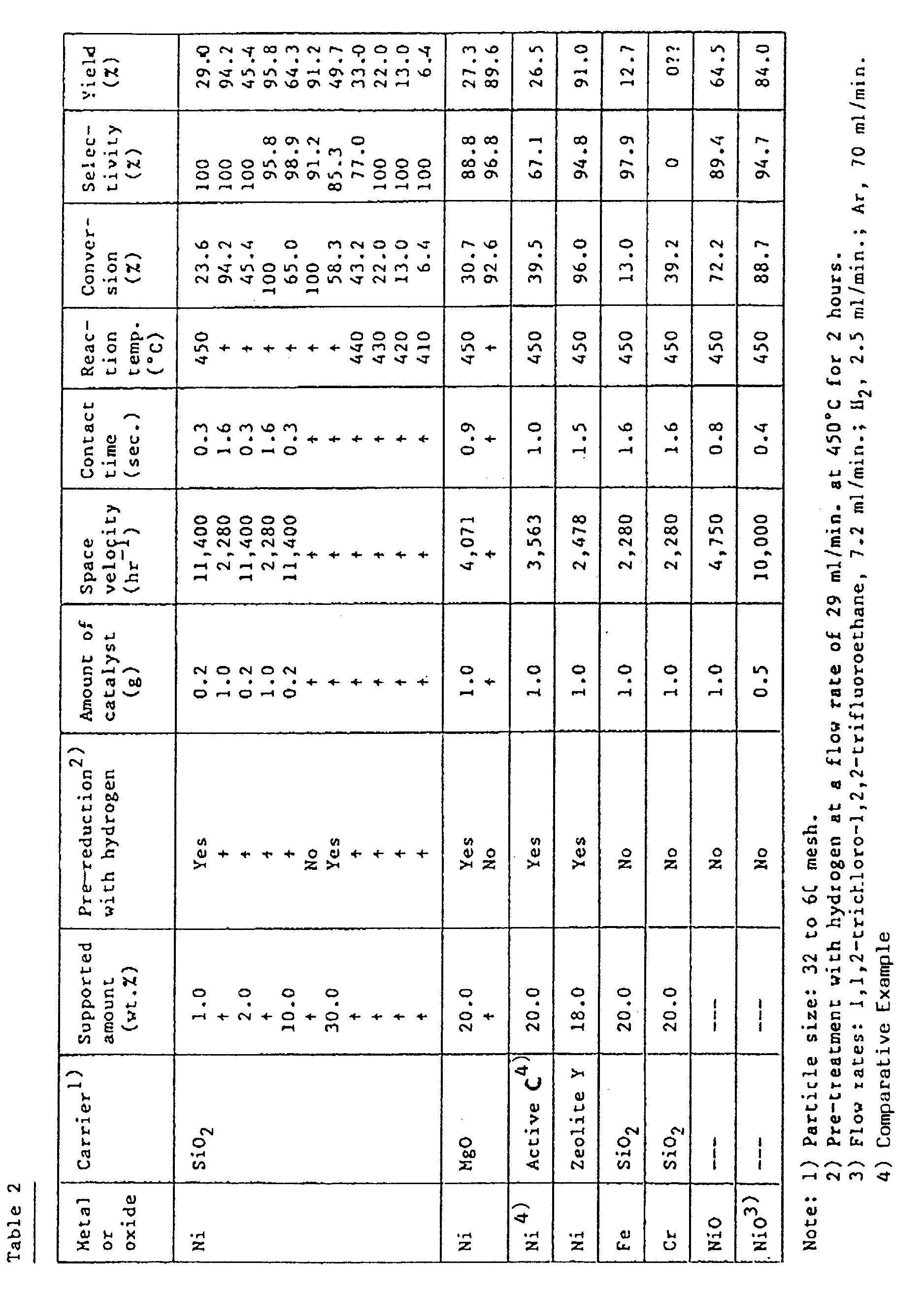
- CTFE was prepared by supplying 1,1,2-trichloro-1,2,2-trifluoroethane, hydrogen and argon at flow rates of 10 ml/min., 29 ml/min. and 56 ml/min., respectively under the conditions specified in Table 2. The results are also shown in Table 2.
- CTFE was prepared. After 24 hours, the conversion was maintained at 95 %, and the selectivity was maintained at 90 %.
- Fe2O3 Commercially available Fe2O3 (reagent grade) was sieved to 32 to 60 mesh and one gram of Fe2O3 was filled in a reactor tube. After pre-treating Fe2O3 in an argon stream at 450°C for 2 hours, the raw material mixture was supplied at following flow rates at the same temperature: 1,1,2-trichloro-1,2,2-trifluoroethane: 10 ml/min. Hydrogen: 29 ml/min. Argon: 56 ml/min.
Landscapes
- Chemical & Material Sciences (AREA)
- Organic Chemistry (AREA)
- Catalysts (AREA)
- Organic Low-Molecular-Weight Compounds And Preparation Thereof (AREA)
- Low-Molecular Organic Synthesis Reactions Using Catalysts (AREA)
Description
- The present invention relates to a process for preparing chlorotrifluoroethylene. More particularly, the present invention relates to a process for preparing chlorotrifluoroethylene (hereinafter referred to as "CTFE") from 1,1,2-trichloro-1,2,2-trifluoroethane (CFC-113) the use of which is and will be limited.
- Various methods are known for preparing CTFE. For example, Japanese Patent Publication Nos. 5207/1982 and 5208/1982 disclose a liquid phase
process comprising dechlorinating process comprising dechlorinating - By the liquid phase process using zinc, although CTFE can be obtained at a high yield, treatment of by-produced zinc chloride is troublesome. The co-pyrolysis gives CTFE in a low yield. In the gas phase process using active carbon, a space velocity cannot be larger than 500 hr⁻¹ so that the productivity is low. In the gas phase dechlorination using Pd, Pd is expensive and deactivated in a short reaction time, and the reaction should be carried out at a contact time of 10 to 60 seconds so that the productivity is low. Further, a yield of CTFE is unsatisfactory.
- US-A-2704775 discloses preparing chlorotrifluoroethylene by reacting 1,1,2-trichloro-1,2,2-trifluoroethane with hydrogen in the presence of nickel, cobalt, copper, platinum, palladium or activated carbon as the catalyst, and of these nickel is the preferred catalyst, especially in the form of finely divided metal, as for instance Raney nickel.
- US-A-2864873 refers to process for preparing chlorotrifluoroethylene by reacting 1,1,2-trichloro-1,2,2-trifluoroethane with hydrogen in the presence of a catalyst, which comprises a metal of the group consisting of copper and nickel compulsory together with an oxide of chromium.
- One object of the present invention is to provide a novel gas phase process for preparing CTFE in a high yield.
- Another object of the present invention is to provide a novel gas phase process for preparing CTFE in which activity of a catalyst is maintained for a long reaction time and CTFE is produced with high productivity.
- These and other objects of the present invention are achieved by a process for preparing CTFE according to
Claim 1. - Preferred embodiments thereof are subject matter of
Claims 2 to 9. - Figure is a graph showing change of conversions in the preparation of CTFE according to the present invention.
- In the process of the present invention, as the catalyst, Ni/SiO₂, Ni/MgO, Ni/Zeolite Y; iron, tin, zinc and chromium as well as their oxides such as Fe₂O₃, SnO₂, ZnO and Cr₂O₃; nickel/oxide and copper oxide can be used.
- The catalyst component selected from the group consisting of iron, tin, zinc, chromium and their oxides, nickel oxide and copper oxide can be carried on a support.
- Thereby, the activity of the catalyst is improved so that the selectivity is increased, and a life of the catalyst is prolonged.
- Preferred examples of the support are active carbon, SiO₂, MgO, Al₂O₃, ZrO₂, Zeolite Y, silica-alumina, silicon carbide, diatomaceous earth.
- Preferred combinations of the catalyst and the support are Ni/SiO₂, Ni/MgO, Ni/Zeolite Y, Fe/SiO₂, Cr/SiO₂.
- The catalyst component may be carried on the support in an amount of from 0.1 to 50 % by weight based on the total weight.
- The molar ratio of 1,1,2-trichloro-1,2,2-trifluoroethane to hydrogen is not critical. Preferably, 1 to 10 moles, more preferably 1 to 5 moles of hydrogen is used per one mole of 1,1,2-trichloro-1,2,2-trifluoroethane. As the excessive amount of hydrogen decreases, the selectivity decreases. When the excessive amount of hydrogen is too large, a ratio of utilized hydrogen decreases.
- The reaction temperature is from 300 to 550°C, preferably from 400 to 500°C. At a temperature lower than 300°C, the conversion decreases, while at a temperature higher than 550°C, the selectivity decreases and/or the catalyst is deteriorated. The reaction pressure is not critical. The process of the present invention can be carried out under any practically employed pressure.
- The space velocity (SV) of the raw materials is preferably from 100 to 20,000 hr⁻¹. SV is defined by a ratio of a volume of the raw materials supplied in a unit time at a reaction temperature to an apparent packed volume of the catalyst.
- The gaseous reactants materials can be supplied with or without dilution with an inert gas such as nitrogen, argon or helium which has no influence on the reaction.
- The process of the present invention is preferably carried out in the presence of steam, since steam is extremely effective for preventing deterioration of the catalyst. An amount of steam is up to 20 % by volume of all the volume of the charged materials.
- The present invention will be illustrated by following Examples.
- Each catalyst used in this Example was prepared by dispersing silica (Aerosil) or magnesium oxide in an aqueous solution of a nitrate of each metal, evaporating the dispersion to dryness, and sieving the residual solid to particle sizes of 32 mesh to 60 mesh.
- The reaction was carried out in a fixed bed flow reactor under atmospheric pressure.
- One gram of the catalyst was charged in the reactor and pre-treated in an argon stream at 450°C for 2 hours. Then, at the same temperature, the raw materials were supplied to start the reaction. The raw material mixture consisted of 1,1,2-trichloro-1,2,2-trifluoroethane, hydrogen and argon which were supplied at flow rates of 10 ml/min., 29 ml/min. and 56 ml/min., respectively. By-produced hydrogen chloride was removed by absorbing it with an aqueous solution of potassium hydroxide, and the produced materials were analyzed with gas chromatography.
- Figure shows change of conversions with time when the catalyst comprising NiO or Fe₂O₃ supported on the above carrier was used.
- The used catalysts clearly showed the activity on the reaction of the present invention.
- The activity of 20 wt.% NiO/SiO₂ was extremely high. During the 8 hour reaction, the conversion was 100 % and the selectivity was 80 %.
- To study the characteristics of the supported NiO catalyst more precisely, the reaction was carried out by reducing the supported amount of NiO to 10 % by weight and the amount of the supported catalyst to 0.2 g (one fifth). The results are also shown in Figure. The activity slightly increased in an initial stage of the reaction. Though the amount of NiO was only one tenth of the 20 wt.% Fe₂O₃/SiO₂, the conversion was about 70 % which was about six times larger than in case of the 20 wt.% Fe₂O₃/SiO₂. The selectivity was 100 %.
- The X-ray diffraction analysis of the catalysts before and after reaction revealed that NiO was reduced to metal nickel during the reaction. Actually, the NiO catalyst which had been reduced with hydrogen before use had the same catalytic activity as the non-reduced NiO catalyst.
- CTFE was prepared by using various supported catalysts. As the supported catalyst, Ni/SiO₂ (1, 2, 5, 10, 20 or 30 % by weight of Ni), Ni/MgO (20 % by weight of Ni), Ni/active carbon, Ni/Zeolite Y, Fe/SiO₂ and Cr/SiO₂ were prepared. The preparation procedures were as follows:
- To silica (Aerosil) (20 g), 107 ml of an aqueous solution of nickel nitrate (Ni(NO₃)₂.5H₂O) in a concentration shown in Table 1 was dropwise added. After completing the addition of the aqueous solution, wet silica was well kneaded and then mixed in the air at 70°C for one day followed by sintering at 450°C for 6 hours. As silica, from very fine particle one such as Aerosil to coarse one such as quartz sand can be used.
Table 1 % by weight Gram 1 0.79 2 1.59 5 4.10 10 8.65 20 19.47 30 33.37 - MgO (20 g) was dispersed in water (500 ml). To the dispersion, 200 ml of an aqueous solution of nickel nitrate (19.5 g) was dropwise added and the mixture was stirred at room temperature for one day. Then, the mixture was heated at 80 to 90°C to evaporate water off. The residue was further dried at 120°C for one day followed by sintering in the air at 600°C for 5 minutes.
- To active carbon of 32 to 60 mesh (4.54 g), 8 ml of an aqueous solution of nickel nitrate (4.42 g) was dropwise added, and resulting wet active carbon was well kneaded. Then, the wet active carbon was dried at 120°C for one day. The dried product was used without sintering at high temperature.
-
- Zeolite Y (9 g) was added to 200 ml of a 0.2 N aqueous solution of nickel chloride, and kept at 70°C for 6 hours while stirring. After cooling no room temperature, the mixture was filtered, and the filter cake was dried at 120°C for one day. This product was used without sintering at high temperature as in case of the Ni/active carbon.
- By the same procedures as in the preparation of Ni/MgO but eliminating the one day stirring and using 25.3 g of iron nitrate (Fe(NO₃)₃.9H₂O) per 20 g of SiO₂, the Fe/SiO₂ catalyst was prepared.
- By the same procedures as in the preparation of Fe/SiO₂ but using 26.3 g of chromium nitrate (Cr(NO₃)₃.9H₂O) per 20 g of SiO₂, the Cr/SiO₂ catalyst was prepared.
- By using each of the above catalysts, CTFE was prepared by supplying 1,1,2-trichloro-1,2,2-trifluoroethane, hydrogen and argon at flow rates of 10 ml/min., 29 ml/min. and 56 ml/min., respectively under the conditions specified in Table 2. The results are also shown in Table 2.
- By using a catalyst consisting of 0.5 g of nickel oxide and 3.0 g of quartz sand and supplying 1,1,2-trichloro-1,2,2-trifluoroethane, hydrogen, argon and steam at flow rates 7.2 ml/min., 20 ml/min., 70 ml/min. and 2.5 ml/min., respectively at 450°C, CTFE was prepared. After 24 hours, the conversion was maintained at 95 %, and the selectivity was maintained at 90 %.
- When no steam was supplied, after 9 hours, the conversion decreased to 84 % and the selectivity decreased to 83 %.
- Commercially available Fe₂O₃ (reagent grade) was sieved to 32 to 60 mesh and one gram of Fe₂O₃ was filled in a reactor tube. After pre-treating Fe₂O₃ in an argon stream at 450°C for 2 hours, the raw material mixture was supplied at following flow rates at the same temperature:
1,1,2-trichloro-1,2,2-trifluoroethane: 10 ml/min.
Hydrogen: 29 ml/min.
Argon: 56 ml/min. - The resulting reaction mixture was washed with water, dried and analyzed by gas chromatography. The conversion of 1,1,2-trichloro-1,2,2-trifluoroethane was 28 % and the selectivity of CTFE was 98.9 %.
-
- In the same manner as in Example 4 but using the catalyst of Table 3, the reaction was carried out and the resulting reaction mixture was analyzed. The results are shown in Table 3.
Table 3 Example No Catalyst Conversion (%) Selectivity (%) 5 SnO₂ 9.1 76.5 6 NiO 56.1 88.7 7 CuO 10.3 73.4 8 ZnO 4.2 73.5
Claims (9)
- A process for preparing chlorotrifluoroethylene which comprises reacting 1,1,2-trichloro-1,2,2-trifluoroethane with hydrogen in the presence of a catalyst selected from the group consisting of Ni/SiO₂, Ni/MgO, Ni/Zeolite Y, iron, tin, zinc, chromium and their oxides, nickel oxide and copper oxide.
- The process according to Claim 1, wherein the catalyst selected from the group consisting of iron, tin, zinc, chromium and their oxides, nickel oxide and copper oxide is carried on a carrier.
- The process according to Claim 2, wherein said carrier is selected from the group consisting of active carbon, SiO₂, MgO, Al₂O₃, ZrO₂, Zeolite Y, silica-alumina, silicon carbide and diatomaeous earth.
- The process according to Claim 2, wherein said catalyst is selected from the group consisting of Fe/SiO₂ and Cr/SiO₂.
- The process according to any of the preceding claims, wherein the molar ratio of hydrogen to 1,1,2-trichloro-1,2,2-trifluoroethane is from 1:1 to 10:1.
- The process according to any of the preceding claims, wherein the molar ratio of hydrogen to 1,1,2-trichloro-1,2,2-trifluoroethane is from 1:1 to 5:1.
- The process according to any of the preceding claims, wherein the reaction temperature is from 300 to 550 °C.
- The process according to any of the preceding claims, wherein the reaction is carried out at a space velocity of from 100 to 20000 h⁻¹.
- The process according to any of the preceding claims, wherein the reaction is carried out in the presence of steam.
Applications Claiming Priority (4)
| Application Number | Priority Date | Filing Date | Title |
|---|---|---|---|
| JP232374/89 | 1989-09-06 | ||
| JP23237489 | 1989-09-06 | ||
| JP2061814A JP2653208B2 (en) | 1989-09-06 | 1990-03-13 | Method for producing chlorotrifluoroethylene |
| JP61814/90 | 1990-03-13 |
Publications (2)
| Publication Number | Publication Date |
|---|---|
| EP0416615A1 EP0416615A1 (en) | 1991-03-13 |
| EP0416615B1 true EP0416615B1 (en) | 1995-12-06 |
Family
ID=26402893
Family Applications (1)
| Application Number | Title | Priority Date | Filing Date |
|---|---|---|---|
| EP19900117182 Expired - Lifetime EP0416615B1 (en) | 1989-09-06 | 1990-09-06 | Process for preparing chlorotrifluoroethylene |
Country Status (3)
| Country | Link |
|---|---|
| EP (1) | EP0416615B1 (en) |
| JP (1) | JP2653208B2 (en) |
| DE (1) | DE69023991T2 (en) |
Cited By (1)
| Publication number | Priority date | Publication date | Assignee | Title |
|---|---|---|---|---|
| US10696613B1 (en) * | 2019-07-09 | 2020-06-30 | Honeywell International Inc. | Gas phase process for chlorotrifluoroethylene |
Families Citing this family (8)
| Publication number | Priority date | Publication date | Assignee | Title |
|---|---|---|---|---|
| RU2006142354A (en) | 2004-05-01 | 2008-06-10 | Хонейвелл Интернэшнл, Инк. (Us) | METHOD FOR PRODUCING HALOLEPHINS |
| US10934233B2 (en) | 2018-02-05 | 2021-03-02 | Honeywell International Inc. | Gas phase process for chlorotrifluoroethylene |
| CN112657525B (en) * | 2021-01-21 | 2022-07-08 | 中化蓝天集团有限公司 | Integral cordierite carrier hydrodechlorination catalyst, preparation method and application thereof |
| CN112495394A (en) * | 2020-12-10 | 2021-03-16 | 中化蓝天集团有限公司 | Hydrodechlorination catalyst and preparation method of chlorotrifluoroethylene |
| WO2022121398A1 (en) * | 2020-12-10 | 2022-06-16 | 中化蓝天集团有限公司 | Hydrodechlorination catalyst and application thereof in preparation of chlorotrifluoroethylene |
| CN112547093B (en) * | 2020-12-10 | 2023-07-07 | 中化蓝天集团有限公司 | A kind of hydrodechlorination catalyst and its preparation method and application |
| WO2024062827A1 (en) * | 2022-09-22 | 2024-03-28 | Agc株式会社 | Method for producing chlorotrifluoroethylene and trifluoroethylene |
| WO2025193251A1 (en) * | 2024-03-14 | 2025-09-18 | The Chemours Company Fc, Llc | Process of producing fluoroolefin compositions by catalytic hydrodechlorination of hydrochlorofluorocarbons and compositions thereof |
Family Cites Families (6)
| Publication number | Priority date | Publication date | Assignee | Title |
|---|---|---|---|---|
| US2704775A (en) * | 1951-02-02 | 1955-03-22 | Union Carbide & Carbon Corp | Preparation of halogenated olefines |
| US2864873A (en) * | 1954-03-16 | 1958-12-16 | Allied Chem | Production of 1, 1, 2-trifluoro-2-chloroethylene |
| US3333011A (en) * | 1963-10-01 | 1967-07-25 | Allied Chem | Production of chlorotrifluoroethylene |
| US3636173A (en) * | 1969-07-28 | 1972-01-18 | Phillips Petroleum Co | Hydrodehalogenation process and catalyst |
| JPS6261936A (en) * | 1985-09-13 | 1987-03-18 | Asahi Glass Co Ltd | Production of chlorotrifluoroethylene |
| IT1196518B (en) * | 1986-07-18 | 1988-11-16 | Ausimont Spa | PREPARATION OF FLUOROETHYLENE AND CHLOROFLUOROETHYLENE FROM CHLOROFLUOROETHANE |
-
1990
- 1990-03-13 JP JP2061814A patent/JP2653208B2/en not_active Expired - Fee Related
- 1990-09-06 EP EP19900117182 patent/EP0416615B1/en not_active Expired - Lifetime
- 1990-09-06 DE DE1990623991 patent/DE69023991T2/en not_active Expired - Fee Related
Cited By (2)
| Publication number | Priority date | Publication date | Assignee | Title |
|---|---|---|---|---|
| US10696613B1 (en) * | 2019-07-09 | 2020-06-30 | Honeywell International Inc. | Gas phase process for chlorotrifluoroethylene |
| WO2021007061A1 (en) * | 2019-07-09 | 2021-01-14 | Honeywell International Inc. | Gas phase process for chlorotrifluoroethylene |
Also Published As
| Publication number | Publication date |
|---|---|
| DE69023991T2 (en) | 1996-05-23 |
| DE69023991D1 (en) | 1996-01-18 |
| EP0416615A1 (en) | 1991-03-13 |
| JP2653208B2 (en) | 1997-09-17 |
| JPH03173840A (en) | 1991-07-29 |
Similar Documents
| Publication | Publication Date | Title |
|---|---|---|
| EP0055512B1 (en) | Process for the manufacture of 1-4-butanediol and tetrahydrofuran | |
| EP1109767B1 (en) | Two-stage process for the production of 1,3-propanediol by catalytic hydrogenation of 3-hydroxypropanal | |
| CA2126007C (en) | Fluorination catalyst and fluorination process | |
| EP0449977B1 (en) | Improved hydrogenolysis/dehydrohalogenation process | |
| EP0057007B1 (en) | Process for the production of glycollic acid esters | |
| EP0416615A1 (en) | Process for preparing chlorotrifluoroethylene | |
| JPH01168346A (en) | Hydrogenating catalyst, production thereof and catalytic method using said catalyst | |
| JPS59199644A (en) | Manufacture of substituted phenol | |
| JPS646183B2 (en) | ||
| EP0069242B1 (en) | Process for the preparation of indoles | |
| EP0459463A1 (en) | Process for preparing 1-chloro-1,2,2-trifluoroethylene or 1,2,2-trifluoroethylene | |
| EP0516000B1 (en) | Process for fluorinating halogenated hydrocarbon | |
| EP0333926A1 (en) | Process for preparing vinylidene fluoride by the direct fluorination of vinylidene chloride | |
| US4250093A (en) | Process for the preparation of laotams | |
| EP0567478B1 (en) | Catalytic hydrogenolysis | |
| EP0716065B1 (en) | Process for producing hexafluorocyclobutene and process for producing hexafluorocyclobutane | |
| KR950008282B1 (en) | Bromofluoroethylhypofluorite and preparation method thereof | |
| US5106810A (en) | Methanol dissociation catalysts | |
| JP2874017B2 (en) | Method for producing gamma-butyrolactone | |
| JP2874016B2 (en) | Production method of γ-butyrolactone | |
| JPS5941974B2 (en) | Hydrogenation method for α,β-unsaturated aldehydes | |
| US4675306A (en) | Preparation of catalyst for producing alcohols | |
| US6303093B1 (en) | Method for manufacturing transition-metal carbides, and their use as catalysts | |
| JPS5814818B2 (en) | Catalyst for carbonylation of aromatic nitro compounds | |
| CA1219286A (en) | Production of monoethylene glycol monomethyl ether, monoethylene glycol and ethanol from hydrogenolysis of polyalkylene glycols |
Legal Events
| Date | Code | Title | Description |
|---|---|---|---|
| PUAI | Public reference made under article 153(3) epc to a published international application that has entered the european phase |
Free format text: ORIGINAL CODE: 0009012 |
|
| 17P | Request for examination filed |
Effective date: 19901204 |
|
| AK | Designated contracting states |
Kind code of ref document: A1 Designated state(s): DE FR GB IT |
|
| 17Q | First examination report despatched |
Effective date: 19930629 |
|
| GRAA | (expected) grant |
Free format text: ORIGINAL CODE: 0009210 |
|
| AK | Designated contracting states |
Kind code of ref document: B1 Designated state(s): DE FR GB IT |
|
| ITF | It: translation for a ep patent filed | ||
| REF | Corresponds to: |
Ref document number: 69023991 Country of ref document: DE Date of ref document: 19960118 |
|
| ET | Fr: translation filed | ||
| PLBE | No opposition filed within time limit |
Free format text: ORIGINAL CODE: 0009261 |
|
| STAA | Information on the status of an ep patent application or granted ep patent |
Free format text: STATUS: NO OPPOSITION FILED WITHIN TIME LIMIT |
|
| 26N | No opposition filed | ||
| REG | Reference to a national code |
Ref country code: GB Ref legal event code: IF02 |
|
| PGFP | Annual fee paid to national office [announced via postgrant information from national office to epo] |
Ref country code: DE Payment date: 20070830 Year of fee payment: 18 |
|
| PGFP | Annual fee paid to national office [announced via postgrant information from national office to epo] |
Ref country code: GB Payment date: 20070905 Year of fee payment: 18 |
|
| PGFP | Annual fee paid to national office [announced via postgrant information from national office to epo] |
Ref country code: IT Payment date: 20070926 Year of fee payment: 18 |
|
| PGFP | Annual fee paid to national office [announced via postgrant information from national office to epo] |
Ref country code: FR Payment date: 20070914 Year of fee payment: 18 |
|
| GBPC | Gb: european patent ceased through non-payment of renewal fee |
Effective date: 20080906 |
|
| REG | Reference to a national code |
Ref country code: FR Ref legal event code: ST Effective date: 20090529 |
|
| PG25 | Lapsed in a contracting state [announced via postgrant information from national office to epo] |
Ref country code: DE Free format text: LAPSE BECAUSE OF NON-PAYMENT OF DUE FEES Effective date: 20090401 Ref country code: IT Free format text: LAPSE BECAUSE OF NON-PAYMENT OF DUE FEES Effective date: 20080906 |
|
| PG25 | Lapsed in a contracting state [announced via postgrant information from national office to epo] |
Ref country code: FR Free format text: LAPSE BECAUSE OF NON-PAYMENT OF DUE FEES Effective date: 20080930 |
|
| PG25 | Lapsed in a contracting state [announced via postgrant information from national office to epo] |
Ref country code: GB Free format text: LAPSE BECAUSE OF NON-PAYMENT OF DUE FEES Effective date: 20080906 |