EP0415671A2 - Gastric retention device - Google Patents
Gastric retention device Download PDFInfo
- Publication number
- EP0415671A2 EP0415671A2 EP90309318A EP90309318A EP0415671A2 EP 0415671 A2 EP0415671 A2 EP 0415671A2 EP 90309318 A EP90309318 A EP 90309318A EP 90309318 A EP90309318 A EP 90309318A EP 0415671 A2 EP0415671 A2 EP 0415671A2
- Authority
- EP
- European Patent Office
- Prior art keywords
- shape memory
- erodible
- stomach
- gastric
- molding
- Prior art date
- Legal status (The legal status is an assumption and is not a legal conclusion. Google has not performed a legal analysis and makes no representation as to the accuracy of the status listed.)
- Granted
Links
Images





Classifications
-
- A—HUMAN NECESSITIES
- A61—MEDICAL OR VETERINARY SCIENCE; HYGIENE
- A61K—PREPARATIONS FOR MEDICAL, DENTAL OR TOILETRY PURPOSES
- A61K9/00—Medicinal preparations characterised by special physical form
-
- A—HUMAN NECESSITIES
- A61—MEDICAL OR VETERINARY SCIENCE; HYGIENE
- A61K—PREPARATIONS FOR MEDICAL, DENTAL OR TOILETRY PURPOSES
- A61K9/00—Medicinal preparations characterised by special physical form
- A61K9/0012—Galenical forms characterised by the site of application
- A61K9/0053—Mouth and digestive tract, i.e. intraoral and peroral administration
- A61K9/0065—Forms with gastric retention, e.g. floating on gastric juice, adhering to gastric mucosa, expanding to prevent passage through the pylorus
Definitions
- the present invention relates to a device for extended retention in the stomach and more particularly but not exclusively to a device which can retain a drug in the stomach for a predetermined definite period of time and release the drug over or after passage of a definite time.
- Known devices for retaining a drug in the stomach for a definite period after administration include the floating type comprising a composition (U.S.Patent No.4,126,672) of a gel-forming high mol.wt. substance (hydroxypropylmethyl cellulose, etc.) and hydrogenated cotton seed oil having carried thereon a drug and which is designed to have a specific gravity of 1 or less and so float in the stomach to increase the residence time of the drug in the stomach; the mucous membrane adhesion type - formulated with a component which is polyallylamine (for example, PAA-HCl-H manufactured by Nitto Spinning Co.,Ltd.) or an anionic high mol.wt.
- a composition U.S.Patent No.4,126,672
- a gel-forming high mol.wt. substance hydroxypropylmethyl cellulose, etc.
- hydrogenated cotton seed oil having carried thereon a drug and which is designed to have a specific gravity of 1 or less and so float in
- gastric residence time is unaffected but is influenced more by whether the subject is fasted or fed.
- P.Gruber et.al., Journal of Pharmaceutical Science, 76 , 117-122 (1987); S.Sangekar, et.al., Indian Journal of Pharmacy, 35 , 187,191 (1987)].
- mucous membrane adhesion type gastric residence time is short and residence time varies greatly.
- the swelling type and fibre type have the problems that both require a special fastener or constraint means to maintain the compressed state, that there is the danger of the constraint force being released prior to or during administration, and that plastic deformation might occur or elasticity might be diminished so that restoration to the original shape is not adequate.
- the present invention provides a device for extended retention in the stomach, the device comprising a molding which comprises shape memory material joined to or mixed with material erodible in vivo , said molding being of a size, shape and durability to remain in the stomach for a definite residence time.
- the device can carry a drug to provide a gastric drug delivery system.
- the present invention can thus provide a device which can ensure retention of a drug in the stomach for a definite period.
- the invention includes a device which can maintain a small-sized dosage form safely prior to administration and yet readily revert to the original form in the stomach after administration, by using a shape memory substance.
- the invention can provide easy control of gastric residence time, by selection of material erodible in vivo and/or by a coating treatment.
- the shape memory material may be a substance having crosslinked structure and crystal structure below its melting point, but which above its melting poiint is amorphous and plastic, or a substance having a glass transition point (Tg) at about room temperature and which has a large change in modulus of elasticity around Tg.
- Tg glass transition point
- examples of such substances include polynorbornenes (containing an agent to prevent senile memory decay) and derivatives thereof (e.g. NOSOREX R , manufactured by Nippon Zeon Co.,Ltd.); polyurethanes (e.g.
- DIARY R manufactured by Mitsubishi Heavy Industry Co., Ltd.
- trans-polyisoprenes KURAPRENE R , manufactured by Kuraray Co.,Ltd
- styrene type hybrid polymers e.g. ASMER R , manufactured by Asahi Chemical Industry Co.,Ltd.
- ethylene-vinyl acetate copolymers polycaprolactone; crosslinked polyethylene, polyamide; polyfluorinated vinylidene; etc.
- substances having a melting point or Tg close to body temperature with the maximum load around body temperature being 150 to 3000 g are preferred for the present invention.
- Tg and physical properties can be varied by altering the isocyanate or polyol constituents, the chain extension agent, the formulation ratios, etc.
- the polyurethane used in the present invention may be urethane elastomer described in Japanese Laid-Open Patent Application No.1-264829 and mixtures thereof which have the physical properties described above.
- the material erodible in vivo is a material which has a definite flexibility and strength but which upon contact with body fluids gradually disintegrates or swells or melts or dissolves to loose its shape.
- erodible substance which can be used in the present invention include polyethylene oxide, polyvinyl alcohol, soluble cellulose (HPC, HP-MC, MC (methyl cellulose), HPMCP, CAP, etc.), ethylene vinyl alcohol, ethylene-maleic acid copolymers, polyacrylate, methacrylic acid copolymer, a blend of methacrylic acid copolymer and aminoalkyl methacrylate copolymer, polycapronolactone, poly(ortho) ester, polyurethane, PVP, polylactone, polyamide, polypeptide, gelatin, polyacrylonitrile, polyester, etc. These substances may be used singly or in a suitable combination of two or more.
- the device of the present invention is a molding comprising shape memory material and material erodible in vivo which are conjugated or mixed with each other.
- suitable adhesives may also be used.
- the device adopts a shape and size in the stomach such as not to pass through the pylorus, but after the erodible substance is released the remains of the device can pass through the pylorus.
- the device of the present invention can be constructed with at least 3 coplanar limbs extending from a centre (e.g. it can be Y-shaped, cross-shaped, tetrapod type, etc.), or it can be ring-shaped or of circular or cylindrical shape.
- the device provides a gap or gaps through which gastric contents can pass.
- the devices shown in Figs.1 and 2 are Y-shaped or cross-shaped comprising a conjugate of shape memory and erodible materials.
- Part (A) is of the shape memory material and since this part should be discharged from the stomach, its size can be as large as will still readily pass through the pylorus or other gastrointestinal tracts and is generally 2 cm or less, preferably about 0.5 to about 1.5 cm, in shorter diameter.
- the tip portion (B) of each limb is of material erodible in vivo . The length of this portion is e.g. 1 to 3 cm, which may give 2 to 7.1 cm as shorter diameter of the device as a whole.
- the joint part (C) is formed by physical meshing or with fusing agent or adhesive.
- the fusing agent is a substance which has a strong affinity to (A) and (B) and is appropriately chosen depending upon the latter materials. Examples of the fusing agent are polyurethane, ethylene vinyl acetate polymer, etc.
- As the adhesive there may be used an epoxy resin or cyanoacrylate resin adhesive.
- the device of the present invention must have such a strength or durability that it is retained in the stomach for a definite period of time, against gastric motility.
- a component showing a maximum load of 150 to 3000 g (when measured by the method described in Reference Example 1) at about body temperature may be used.
- the thickness be at least e.g. 0.5 mm, preferably about 2.8 mm, and the limb width at least 2 mm, preferably about 2.8 mm.
- the outer limbs are for example at an angle of 60 o to the central limb.
- the device shown in Fig.3(c) has 4 extending limbs. At the central portion of the device, a shape memory material or a conventional pharmaceutiocally acceptable pillar-shaped substance is jointed - where shape memory material (A) is used, erodible substance (B) is further adhered to the tip portion.
- the device shown in Fig.7 is an example of a molding comprising a laminate of the shape memory and erodible materials.
- This Y-shaped or cross-shaped device has the erodible material in three layers, between which strip- or yarn-like shape memory material is disposed lattice-like.
- the thickness of each erodible layer is suitably about 0.5 mm. It is appropriate that each shape memory layer has a thickness of about 0.5 mm and a width of about 2 mm.
- This shape memory material is disposed lattice-like at intervals of 0.5 mm to 2 mm between the thin layers made of the erodible material.
- the thus disposed shape memory and in vivo erodible layers are subjected to thermal compression molding followed by cutting to the required shape.
- the shaped laminate is disintegrated into small pieces of the shape memory material as gastric erosion proceeds and therefore, eventual discharge from the digestive tract is easy.
- Another construction of the device in accordance with the present invention is a molding comprising a homogeneous mixture of the shape memory and erodible materials.
- the mixing ratio of these substances is such that the restoring force of the shape memory material is maintained; for example, 1 to 4 parts by weight of the erodible material are used per 1 part of the shape memory material.
- the coating may be coated.
- the coating may be applied to the entire surface of the device or only to part(s) thereof, e.g. to an erodible part or parts. Any coating agent is usable so long as it is suitable for pharmaceutical preparations.
- the coating agent examples include EUDRAGIT RS (trademark, manufactured by Rohm & Haas Co.,Ltd., component: 1 : 2 : 0.1 copolymer of ethyl acrylate, methyl methacrylate and trimethylammonioethyl methacrylate), EUDRAGIT RS (trademark, manufactured by Rohm & Haas Co.,Ltd., component: 1 : 2 : 0.1 copolymer of ethyl acrylate, methyl methacrylate and trimethylammonioethyl methacrylate), EUDRAGIT L (trademark, manufactured by Rohm & Haas Co.,Ltd., component: 1 : 1 copolymer of ethyl methacrylate and methyl methacrylate, EUDRAGIT S (trademark, manufactured by Rohm & Haas Co.,Ltd., component: 2 : 1 copolymer of methyl methacrylate and methacrylic acid
- hydroxypropylmethyl cellulose hydroxypropylmethyl cellulose
- JP XI hydroxypropylmethyl cellulose phthalate
- JP XI cellulose acetate phthalate
- Shellac JP XI
- plasticizer examples include triacetin, MACROGOL 400, triethyl citrate, Tween 80, castor oil, etc.
- the device of the present invention is administered by folding into a shape suited for administration.
- the device is folded at a site of the shape memory substance.
- the folded device may be administered as it is; alternatively, the device is enclosed in a capsule and the capsule is provided for administration.
- the folded device may also be coated with conventional coating agents such as hydroxypropylmethyl cellulose, hydroxypropyl cellulose, methyl cellulose, or the like.
- the drug component (which may have been subjected to treatment for sustained-release dosage form) is adhered or applied to the device.
- sustained-release dosage form conventonal techniques used to prepare durable preparations are adopted.
- a sustained-release tablet is prepared and the tablet is fixed to the device.
- the item to be fixed may be at a limb portion or at a centre portion (usually of shape memory material) of the device.
- the method of fixing may be varied depending on preparation form; in the case of, e.g. a tablet, a socket-like housing can be provided at the central part made of shape memory material, and the tablet sealed in the housing.
- a drug-containing material may be applied to a limb to form a layer by means of casting, dipping or conventional spray coating.
- a drug is mixed with a single base or a plurality of bases of melting point higher than room temperature.
- the mixture is heated to dissolve or suspend the drug and the melt is immediately poured into a mold having a desired shape and a limb portion for a device of the present invention is placed in the mold. After cooling to room temperature, the cast is withdrawn.
- the base any substance can be used as long as it is a suitable additive for drugs, can adhere to the limb portion and has a melting point higher than room temperature.
- the base is appropriately chosen to obtain an adequate release rate, depending on the physical properties of the drug. Specific examples of the base include oils and fats, higher fatty acids, high alcohols, higher fatty acid esters and mixtures thereof.
- a known coating may also be applied on the thus cast drug layer for release control.
- a drug and a base are suspended or dissolved in water or an organic solvent.
- the limb portion of the device of the present invention is dipped in the suspension or solution for a short period and then withdrawn.
- the solvent is removed by heating or air-drying to precipitate and adhere the drug and base onto the surface of the limb.
- the procedures of dipping and removal of the solvent are repeated to obtain accummulated layers containing the drug on the surface of the limb.
- the base used is chosen from substances which can be used as additives to drugs and have the property of readily adhering to the limb portion after removal of the solvent, so as to achieve an appropriate release rate depending upon physical properties of the drug. Specific examples include substances exemplified as coating agents in the present specification. Any solvent can be used without any particular restriction, provided that it can suspend or dissolve these substances and can be removed with heating or by air-drying.
- the drug component can instead be mixed with the erodible material.
- the device of the present invention When the device of the present invention is applied clinically a feeling of satiety follows administration, and therefore the device can be used as an agent for the treatment of obesity.
- the present invention is not only applicable to elivery of drugs for the treatment of diseases associated with the stomach or gastrointestinal tracts such as the small intestine, colon, etc. but also to all drugs which are absorbed through the digestive tract and require duration in blood concentration.
- the device according to the invention is applicable to, for example, Pirenzepine hydrochloride for the treatment of diseases associated with the digestive tract; Ambroxol, Theophylline and Ketotifen fumarate as antitussives and expectorants; Allopurinol and Benzbromarone for the treatment of gout; Disopyramide phosphate for the treatment of arrhythmia; Nicardipine hydrochloride and Nifedipine as vasodilators; Terfenadine for the treatment of allergic diseases (rhinitis, pollen allergy); Eperipson hydrochloride as antispasmodic; Tamoxifen citrate as anti-cancer agent; Bromocriptine mesilate, etc.
- the devices of the present invention can be manufactured by a number of processes, for example, according to the following prcesses.
- Manufacturing machines used are, for example, heat compression plastics molding machines, extrusion molding machines, injection molding machines, etc.
- the part erodible in vivo is most usually coated. Where a mixture of the shape memory and erodible materials is used, the whole device may be coated.
- an external force is applied at a temperature higher than the m.p. or Tg of the shape memory substance to form the desired shape. Then the device is cooled to near room temperature.
- the system may also be coated with a conventionally used component or enclosed in a capsule.
- the device of the present invention can be converted into a small-sized shape which is readily administered, by folding the shape memory part.
- This small-sized form is not maintained by constraint of elastic material so that there is no danger of the constraint being released prior to administration; however the device can revert to its original shape in the stomach after administration.
- the device of the present invention is of readily controlled gastric residence time, since the period for erosion of the erodible portion can be controlled by appropriate choice of erodible material and/or coating agent.
- rectangular flat plates having a thickness of 1.5 mm were obtained from 3 g and 4 g of polynorbornbene, respectively.
- the maximum load (the maximum force required to bend or break the flat plate) was determined in a water bath at 37 o C in a manner similar to Testing Method for Flexural Creep of Plastics (JIS, K7116).
- the device used was a Rheometer NRN-2010J-CW manufactured by Fudo Co., Ltd.
- the test speed was 2 cm/min and the interval between supporting stands was 25 mm.
- cross-shaped samples were prepared from flat plates having thicknesses of 1.5 mm and 2 mm, respectively.
- the cross-shaped samples were administered to fasted and fed male Beagle dogs (weighing 12-16 kg). Twenty four hours after administration, a gastroendoscope was inserted to observe the content of the stomach.
- the flat discs having a thickness of 1 mm obtained in Reference Example 1 (a) were cut to prepare Y-shaped samples having a shortest diameter of 3 cm and a width of 4 mm.
- Y-shaped samples were prepared from flat plates having a thickness of 1.5 mm.
- the two kinds of Y-shaped sample obtained in (a) were folded at 40 o C. After cooling to room temperature, the samples were packed in size No.0 capsules.
- test samples 6 male Beagle dogs were fasted for 1 day; 30 minutes after giving a solid feed, each of the test samples was administered together with 50 ml of water. Twelve and twenty-four hours after administration, a gastroendoscope was inserted to count the number of test samples retained in the stomach.
- a polynorbornene flat disk having a thickness of 1.5 mm obtained in Reference Example 1 (a) was cut to prepare a Y-shaped sample having a shortest diameter of 1.3 cm and a width of 4 mm.
- a polynorbornee flat disk having a thickness of 1.5 mm obtained in Reference Example 1 (a) was cut to prepare a Y-shaped sample having a shortest diameter of 1.3 cm and a width of 4 mm.
- a rectangular flat plate made of polynorbornene having a thickness of 2 mm obtained in Reference Example 1 (a) was cut to prepare a pillar-shaped part having a thickness of 2 mm, a width of 2.25 mm and a length of 5 mm.
- Example 1 The gastric device obtained in Example 1 was folded at 40 o C and then cooled to room temperature. A 6% aqueous solution of hydroxypropylmethyl cellulose was coated onto the folded device at 30 o C in a conventional manner to give a gastric device for oral administration in accordance with the present invention.
- the coating solution obtained above was coated onto the Polyethylene Oxide 18 R parts of Y-shaped gastric drug retainers obtained in Example 1.
- the amounts of coating were 20%, 25%, 30% and 35% (wt/wt), based on the total weight.
- the thus obtained retainers were folded at 40 o C. After cooling to room temperature (Fig.4 (a)), each retainer was encased in a No.0 capsule (Fig.4 (b)).
- Polynorbornene flat disks having a thickness of 2.8 mm obtained in Reference Example 3 were cut to prepare Y-shaped samples having a shortest diameter of 1.3 cm and a width of 2.8 mm.
- the first plates obtained in (b) were adhered one by one to the Y-shaped samples obtained in (a) above at the tip portion of each limb using epoxy resin adhesive to prepare gastric drug retainers as shown in Fig.1.
- Example 5 The coating solution obtained in Example 5 was coated onto the Polyethylene Oxide 18 parts of the gastric drug retainers in amounts of 5%, 10% and 15% (wt/wt), based on the total weight.
- the thus obtained retainers were folded at 40 o C. After cooling to room temperature (Fig.4 (a)), each retainer was encased in a size No.0 capsule (Fig.4 (b)).
- Polynorbornene flat discs having a thickness of 2.8 mm. obtained in Reference Example 3 were cut to prepare Y-shaped samples having a shortest diameter of 1.3 cm and a width of 2.8 mm.
- Example 5 The coating solution obtained in Example 5 was coated onto the polyvinylalcohol parts of the gastric drug retainers in amounts of 5%, 7.5%, 10% and 15% (wt/wt), based on the total weight.
- the thus obtained retainers were folded at 40 o C. After cooling to room temperature (Fig.4 (a)), each retainer was encased in a size No.0 capsule (Fig.4 (b)).
- pillar parts obtained in (a) were inserted into a metal mold for injection molding at intervals of 120 o radially.
- the shape memory substance Diary MM-4500 (trade name, manufactured by Mitsubushi Heavy Industries, Ltd., component: polyurethane) was subjected to injection molding to join the pillar parts (obtained in (a)) to it to give a gastric drug retainer having a shortest diameter of 3 cm, a thickness of 2.8 mm and a width of 2.8 mm (Fig. 5 (c)).
- Conditions of the injection molding Temperature ( o C) Injection Pressure (Kg/cm2) Injection Speed Metal Mold Temp ( o C) Cylinder Nozzle Rear Middle Front 195 205 215 200 800-1200 Fast 25
- PVA B-24 (trade name, made by Denki Kagaku Kogyo K.K., component: partially saponified polyvinyl alcohol) was added glycerine (as a plasticizer) in the ratio of 10% (w/w), and the resultant was mixed using a grinding machine.
- the resultant mixture was dried for 2 hours at 105 o C, and subjected to injection molding to give a pillar part having a length of 1.4 cm, a thickness of 2.8 mm and a width of 2.8 mm, and having a junction protrusion.
- Conditions of the injection molding Temperature ( o C) Injection Pressure (Kg/cm2) Injection Speed Metal Mold Temp ( o C) Cylinder Nozzle Rear Middle Front 155 195 215 200 1600-1800 Slow 65
- HPC-H (trade name, made by Nippon Soda Co.,Ltd., component: hydroxypropylcellulose) was subjected to injection molding to give a pillar part having a length of 1.4 cm., a thickness of 2.8 mm and a width of 2.8 mm, and having a junction protrustion.
- Conditions of the injection molding Temperature ( o C) Injection Pressure (Kg/cm2) Injection Speed Metal Mold Temp ( o C) Cylinder Nozzle Rear Middle Front 140 150 160 150 800-1200 Slow 65
- Example 10 To HPC-H (trade name, made by Nippon Soda Co.,Ltd., component: hydroxypropylcellulose) were added Ethocel STD4 (trade name, made by Dow Chemicals Ltd., component: ethylcellulose) in the ratio of 20% (w/w) and PEG 400 in the ratio of 15% (w/w), and the resultant was mixed using a grinding mixing machine. The resultant mixture was dried at 105 o C for 2 hours, and subjected to injection molding under the conditions mentioned in Example 10 (a) to give a pillar part having a length of 1.4 cm, a thickness of 2.8 mm and a width of 2.8 mm and having a junction protrustion.
- Ethocel STD4 trade name, made by Dow Chemicals Ltd., component: ethylcellulose
- PEO-18 was subjected to injection molding in a manner similar to Example 8 (a) to give a pillar part having a length of 1.1 cm, a thickness of 2.8 mm and a width of 2.8 mm (Part B).
- a centre portion A (obtained in (a) above) and three Parts B at radial intervals of 120 o were inserted in a metal mold for injection molding as shown in Fig.6 (b).
- thermoplastic polyurethane trade name: Mirakutoran E280, made by Nihon Miracutoran Co.,Ltd.,
- Fig.6 (c) a gastric retention device
- Conditions of the injection molding Temperature ( o C) Injection Pressure (Kg/cm2) Injection Speed Metal Mold Temp ( o C) Cylinder Nozzle Rear Middle Front 160 180 190 200 800-1200 Slow 35
- Example 12 (a) A centre portion A obtained in Example 12 (a), and three Parts B obtained in Example 12 (b) at radial intervals of 120 o were inserted in a metal mold for injection molding as shown in Fig.6 (b). Between Parts A nad B Diary MM-4500 (shape memory substance) was inserted and subjected to injection molding under the conditions of Example 8 (b) to join Parts A and B to give a gastric device (Fig.6 (c)).
- Diary MM-4500 shape memory substance
- Part A Using an oil press, 1 g of polynorbornene was subjected to compression molding at 150 o under 100 kg/cm2 to give a flat disk having a thickness of 0.5 mm and a diameter of 5 cm. The disk was cut into widths of 2 mm with an interval of 1 mm (Part A).
- Part D Using an oil press, a mixture of 0.85 g of PVA-210 R and 0.15 g of glycerine was subjected to compression molding at a temperature of 160 o C under a pressure of 100 kg/cm2 to give a flat disk having a thickness of 0.5 mm and a diameter of 5 cm (Part D)
- Example 14 (a) Two parts obtained in Example 14 (a) were inserted between three parts obtained in (a) above, each part being inserted as in Example 14 and Fig. 7(a).
- the layered parts were subjected to compression molding at 130 o C under 100 kg/cm2 and the resulting molding was cooled to room temperature to give a flat disk having a thickness of 2 mm and a diameter of 5 cm.
- the flat disk was cut to prepare a cross-shaped sample having a shortest diameter of 3 cm and a Y-shaped sample.
- the samples were folded at 40 o C. After cooling to room temperature, each sample was encased in a No.00 capsule to prepare a gastric drug retainer.
- Tablets are prepared using the following formulation (active ingredient: nicardipine hydrochloride).
- active ingredient nicardipine hydrochloride
- Nicardipine hydrochloride 40 mg.
- Tablets were prepared using the following formulation (active ingredient: nicardipine hydrochloride) by wet granulation: Nicardipine-HCl 60 mg. HPC-H 48 mg. HPC-M 12 mg. 120 mg.
- Example 5 To the gastric retention device (Y-shaped, 25% coating) made by Example 5 were fixed the above sustained-release tablets (two, three or four) by using an epoxy resin adhesive.
- Plasma level of nicardipine was measured by liquid chromatography (S.Kobayashi, Journal of Chromatography, 420 , 439-444, 1987).
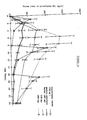
- Fig.9 are shown the changes of plasma level in the case of four sustained-release tablets attached to a gastric device and one conventional tablet administered at the same time and in the case of four sustained-release tablets and one conventional tablet being administered at the same time.
- AUC increase and the plasma level become significantly high 12 hours and 24 hours after administration when using the invention.
- Fig.10 are shown the changes of plasma level in the cases of respective gastric devices to which two, three and four sustained-release tablets were fixed being administered together with one tablet, and in the case of a conventional tablet (160 mg) being administered.
- a conventional tablet 160 mg
- Example 6 The following formulation was melted, mixed and solidified under cooling around the limb portion of the 10% coated Y-shaped gastric device obtained in Example 6 (Fig.11).
- Example 21 (a) One conventional tablet obtained in Example 21 (a) and the gastric device obtained in above (a) were administered, at the same time, to six male Beagle dogs, together with 50 ml of water.
- the test method is similar to that of Example 21 (d).
- Fig.12 is shown the change of the plasma level with time. As a result, it is apparent that, in the case of the drug administered by the casting method, good sustained-release (single dose per day) can be obtained.
- the flat plates obtained in (a) were adhered by using an epoxy resin adhesive, one by one, to the Y-shaped sample obtained in Example 6 (a) at the tip portions of each limb to prepare a gastric device.
- the drug-containing portion of the Y-shaped gastric device obtained in (b) was coated with a 5% (wt/wt of the total amount) layer using a coating solution.
- the above gastric device was administered to Beagle dogs as in Example 21, and the plasma level was measured. The results are shown in Fig.13. It is apparent that good sustained-release (single dose per day) is obtained in this case using a mixture of drug and erodible material.
- a preferred device comprises a shaped body of shape memory material and material erodible in vivo (gastrically) joined or mixed together, the shaped body being capable of being and remaining folded at a region or regions of shape memory material to facilitate administration and of reverting in the stomach to the memorized unfolded configuration in which it is of such size, shape and durability as to be retained in the stomach without blocking the passage of food therein, and the erodible material eroding controlledly in the stomach to leave device remains which can pass from the stomach.
- the shaped body may comprise a laminate of layers of the erodible material about a layer of the shape memory material which on its own can exit from the stomach - e.g. which is of filament(s), mesh strip(s), ribbon(s) or islands of the shape memory material which, when free of the erodible material, can pass from the stomach and through the patient's body. It may be of a mixture of the shape memory and erodible materials. It may instead be made of separate parts of the shape memory and erodible materials jointed together by physical engagement and/or by adhesive and/or by jointing material. A given device may employ one or more of these arrangements.
- the device may carry a drug (e.g. as a tablet or in a coating), preferably in sustained release form. All or part (e.g. the portion(s) of erodible material) may be coated to help control rate of erosion and/or drug release.
Landscapes
- Health & Medical Sciences (AREA)
- Chemical & Material Sciences (AREA)
- Medicinal Chemistry (AREA)
- Pharmacology & Pharmacy (AREA)
- Epidemiology (AREA)
- Life Sciences & Earth Sciences (AREA)
- Animal Behavior & Ethology (AREA)
- General Health & Medical Sciences (AREA)
- Public Health (AREA)
- Veterinary Medicine (AREA)
- Nutrition Science (AREA)
- Physiology (AREA)
- Medicinal Preparation (AREA)
- Medicines Containing Material From Animals Or Micro-Organisms (AREA)
- Medicines Containing Plant Substances (AREA)
- Compounds Of Unknown Constitution (AREA)
- Glass Compositions (AREA)
- Manufacture Of Alloys Or Alloy Compounds (AREA)
- Seal Device For Vehicle (AREA)
- Materials For Medical Uses (AREA)
- Dental Preparations (AREA)
Abstract
Description
- The present invention relates to a device for extended retention in the stomach and more particularly but not exclusively to a device which can retain a drug in the stomach for a predetermined definite period of time and release the drug over or after passage of a definite time.
- Known devices for retaining a drug in the stomach for a definite period after administration include the floating type comprising a composition (U.S.Patent No.4,126,672) of a gel-forming high mol.wt. substance (hydroxypropylmethyl cellulose, etc.) and hydrogenated cotton seed oil having carried thereon a drug and which is designed to have a specific gravity of 1 or less and so float in the stomach to increase the residence time of the drug in the stomach; the mucous membrane adhesion type - formulated with a component which is polyallylamine (for example, PAA-HCl-H manufactured by Nitto Spinning Co.,Ltd.) or an anionic high mol.wt. substance (for example, carboxyvinyl polymer) and adheres to mucous membrane (for example, Japanese Patent Application Laid-Open Nos.62-132830 and 62-77335), or comprising a composition of a water-soluble high mol.wt. substance (for example, polyethylene oxide, polyvinyl alcohol) and an oil (for example, medium chain triglyceride) whereby a gel layer is formed after administration to control release of the drug and retard mobility of the drug into the gastrointestinal tract by its adherence to mucous membrane; the swelling type obtained by compressing erodible polymer to a small size and enclosing it in a capsule, the polymer reverting to its original form (due to its elasticity) on dissolution of the capsule in the stomach after administration (e.g. Japanese Laid-Open Patent Application No.62-26215); and the fibre type using compressed or constrained fibres or ribbon (Japanese Patent Application Laid-Open Nos.63-23815 and 2-29268).
- With the floating type of device, even though its specific gravity is controlled, gastric residence time is unaffected but is influenced more by whether the subject is fasted or fed. [P.Gruber, et.al., Journal of Pharmaceutical Science, 76, 117-122 (1987); S.Sangekar, et.al., Indian Journal of Pharmacy, 35, 187,191 (1987)]. In the mucous membrane adhesion type, gastric residence time is short and residence time varies greatly. The swelling type and fibre type have the problems that both require a special fastener or constraint means to maintain the compressed state, that there is the danger of the constraint force being released prior to or during administration, and that plastic deformation might occur or elasticity might be diminished so that restoration to the original shape is not adequate.
- The present invention provides a device for extended retention in the stomach, the device comprising a molding which comprises shape memory material joined to or mixed with material erodible in vivo, said molding being of a size, shape and durability to remain in the stomach for a definite residence time. The device can carry a drug to provide a gastric drug delivery system.
- The present invention can thus provide a device which can ensure retention of a drug in the stomach for a definite period. The invention includes a device which can maintain a small-sized dosage form safely prior to administration and yet readily revert to the original form in the stomach after administration, by using a shape memory substance. The invention can provide easy control of gastric residence time, by selection of material erodible in vivo and/or by a coating treatment.
- The shape memory material may be a substance having crosslinked structure and crystal structure below its melting point, but which above its melting poiint is amorphous and plastic, or a substance having a glass transition point (Tg) at about room temperature and which has a large change in modulus of elasticity around Tg. Examples of such substances include polynorbornenes (containing an agent to prevent senile memory decay) and derivatives thereof (e.g. NOSOREXR, manufactured by Nippon Zeon Co.,Ltd.); polyurethanes (e.g. DIARYR, manufactured by Mitsubishi Heavy Industry Co., Ltd.); trans-polyisoprenes (KURAPRENER, manufactured by Kuraray Co.,Ltd); styrene type hybrid polymers (e.g. ASMERR, manufactured by Asahi Chemical Industry Co.,Ltd.); ethylene-vinyl acetate copolymers; polycaprolactone; crosslinked polyethylene, polyamide; polyfluorinated vinylidene; etc. Of these, substances having a melting point or Tg close to body temperature with the maximum load around body temperature being 150 to 3000 g (measured by the method described in Reference Example 1) are preferred for the present invention.
- In polyurethanes, Tg and physical properties can be varied by altering the isocyanate or polyol constituents, the chain extension agent, the formulation ratios, etc. The polyurethane used in the present invention may be urethane elastomer described in Japanese Laid-Open Patent Application No.1-264829 and mixtures thereof which have the physical properties described above.
- The material erodible in vivo is a material which has a definite flexibility and strength but which upon contact with body fluids gradually disintegrates or swells or melts or dissolves to loose its shape. Examples of erodible substance which can be used in the present invention include polyethylene oxide, polyvinyl alcohol, soluble cellulose (HPC, HP-MC, MC (methyl cellulose), HPMCP, CAP, etc.), ethylene vinyl alcohol, ethylene-maleic acid copolymers, polyacrylate, methacrylic acid copolymer, a blend of methacrylic acid copolymer and aminoalkyl methacrylate copolymer, polycapronolactone, poly(ortho) ester, polyurethane, PVP, polylactone, polyamide, polypeptide, gelatin, polyacrylonitrile, polyester, etc. These substances may be used singly or in a suitable combination of two or more.
- The device of the present invention is a molding comprising shape memory material and material erodible in vivo which are conjugated or mixed with each other. For purposes of improving adherence and controlling strength, suitable adhesives may also be used. The device adopts a shape and size in the stomach such as not to pass through the pylorus, but after the erodible substance is released the remains of the device can pass through the pylorus. The device of the present invention can be constructed with at least 3 coplanar limbs extending from a centre (e.g. it can be Y-shaped, cross-shaped, tetrapod type, etc.), or it can be ring-shaped or of circular or cylindrical shape. Preferably, the device provides a gap or gaps through which gastric contents can pass.
- The invention is illustrated, by way of example, in the following description of embodiments to be read in conjunction with the accompanying drawings, in which :
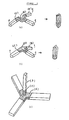
- FIGURES 1 and 2 show respectively Y-shaped and cruciform devices of the present invention; in these and subsequent FIGURES, (A), (B) and (C) denote respectively shape memory, in vivo erodible, and joint parts.
- FIGURE 3 shows at (a), (b) and (c) three other devices according to the present invention, those at (a) and (b) being shown in planar and folded form;
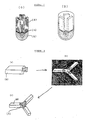
- FIGURE 4 shows a device according to the invention wherein the part erodible in vivo is coated. FIGURE 4(a) shows the folded state and FIGURE 4(b) shows the folded device encased in a capsule;
- FIGURE 5 shows a manufacturing process for a Y-shaped device according to the invention, using an injection molding machine. Erodible parts (B) (Fig.5a) are placed in a metal mold (Fig.5b) and shape memory portion (A) is injected at the centre to join parts A and B to form the device;
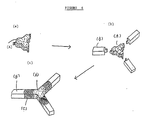
- FIGURE 6 shows a flow chart for preparing a Y-shaped device comprising a conjugate of shape memory and in vivo erodible materials, the joint part for which is formed by using a fusing agent; FIGURE 6(b) shows the shape memory portion (A) of Fig.6a and the parts (B) of erodible substance in a mold for injection molding; FIGURE 6(c) shows a Y-shaped device obtained after joining them by injecting fusing agent between the parts (A) and (B);
- FIGURE 7 shows a flow chart for preparing cruciform and Y-shaped devices comprising a laminate of shape memory and erodible materials. In Fig.7, (A) represents a layer of shape memory material and (B) a thin layer of material erodible in vivo; FIGURE 7(a) shows two such layers (A) disposed lattice-like between three layers (B); FIGURE 7(b) shows a flat disk compression molded from the 7(a) assembly; FIGURE 7(c) shows cruciform and Y-shaped devices according to the invention cut from 7(b) disks; FIGURE 7(d) shows the latter devices folded for oral administration; one or both layer(s) (A) could insted be of one or more yarns of shape memory material, with no (or a restricted amount of) overlapping in the layer so that the latter on its own can exit from the stomach.
- FIGURE 8 shows construction by compression molding of a Y-shaped device, comprising a conjugate of shape memory material (A) , erodible material (B) and fusing agent (C);
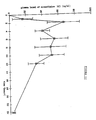
- FIGURE 9 shows the plasma level of nicardipine hydrochloride as a function of time after orally administering to Beagle dogs the sustained release tablets and the devices prepared by Example 21. (The plasma level is a mean value ± SE in the case of 6 dogs);
- FIGURE 10 shows the change with time of plasma level of nicardipine hydrochloride after orally administering to Beagle dogs ordinary tablets and the devices prepared by Example 21. For comparison, the results for the gastric retention device (containing 280 mg of the drug), which results are shown in Fig.9, are also shown in the Figure. (The plasma level is a mean value ± SE in the case of 6 dogs);
- FIGURE 11 shows a device according to the invention to the erodible limb parts of which a drug-containing part (D) is attached;
- FIGURE 12 shows the change with time of plasma level of nicardipine hydrochloride after orally administering to Beagle dogs the device prepared by Example 22 and conventional tablets prepared by Example 21 (a). (The plasma level is a mean value ± SE in the case of 6 dogs);
- FIGURE 13 shows the change with time of plasma level of nicardipine hydrochloride after orally administering to Beagle dogs the device prepared by Example 23; and
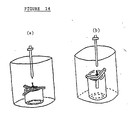
- FIGURE 14 shows the test method in Reference Example 2 in the case of applying the maximum load in vertical and horizontal directions to the Y-shaped device.
- The devices shown in Figs.1 and 2 are Y-shaped or cross-shaped comprising a conjugate of shape memory and erodible materials.
- Part (A) is of the shape memory material and since this part should be discharged from the stomach, its size can be as large as will still readily pass through the pylorus or other gastrointestinal tracts and is generally 2 cm or less, preferably about 0.5 to about 1.5 cm, in shorter diameter. The tip portion (B) of each limb is of material erodible in vivo. The length of this portion is e.g. 1 to 3 cm, which may give 2 to 7.1 cm as shorter diameter of the device as a whole. The joint part (C) is formed by physical meshing or with fusing agent or adhesive. The fusing agent is a substance which has a strong affinity to (A) and (B) and is appropriately chosen depending upon the latter materials. Examples of the fusing agent are polyurethane, ethylene vinyl acetate polymer, etc. As the adhesive, there may be used an epoxy resin or cyanoacrylate resin adhesive.
- The device of the present invention must have such a strength or durability that it is retained in the stomach for a definite period of time, against gastric motility. For a Y-shaped or cross-shaped device having such a strength, a component showing a maximum load of 150 to 3000 g (when measured by the method described in Reference Example 1) at about body temperature may be used. In the case of using, for example, polynorbornene, it is advisable that the thickness be at least e.g. 0.5 mm, preferably about 2.8 mm, and the limb width at least 2 mm, preferably about 2.8 mm. This applies also to shapes such as shown in Fig.3(a) and Fig.3(b). In the arrow-shaped embodiment of Fig.3(b) , the outer limbs are for example at an angle of 60o to the central limb.
- The device shown in Fig.3(c) has 4 extending limbs. At the central portion of the device, a shape memory material or a conventional pharmaceutiocally acceptable pillar-shaped substance is jointed - where shape memory material (A) is used, erodible substance (B) is further adhered to the tip portion.
- The device shown in Fig.7 is an example of a molding comprising a laminate of the shape memory and erodible materials. This Y-shaped or cross-shaped device has the erodible material in three layers, between which strip- or yarn-like shape memory material is disposed lattice-like. The thickness of each erodible layer is suitably about 0.5 mm. It is appropriate that each shape memory layer has a thickness of about 0.5 mm and a width of about 2 mm. This shape memory material is disposed lattice-like at intervals of 0.5 mm to 2 mm between the thin layers made of the erodible material. The thus disposed shape memory and in vivo erodible layers are subjected to thermal compression molding followed by cutting to the required shape. The shaped laminate is disintegrated into small pieces of the shape memory material as gastric erosion proceeds and therefore, eventual discharge from the digestive tract is easy.
- Another construction of the device in accordance with the present invention is a molding comprising a homogeneous mixture of the shape memory and erodible materials. The mixing ratio of these substances is such that the restoring force of the shape memory material is maintained; for example, 1 to 4 parts by weight of the erodible material are used per 1 part of the shape memory material.
- For purposes of controlling the erosion rate of the device it may be coated. The coating may be applied to the entire surface of the device or only to part(s) thereof, e.g. to an erodible part or parts. Any coating agent is usable so long as it is suitable for pharmaceutical preparations. Preferred examples of the coating agent include EUDRAGIT RS (trademark, manufactured by Rohm & Haas Co.,Ltd., component: 1 : 2 : 0.1 copolymer of ethyl acrylate, methyl methacrylate and trimethylammonioethyl methacrylate), EUDRAGIT RS (trademark, manufactured by Rohm & Haas Co.,Ltd., component: 1 : 2 : 0.1 copolymer of ethyl acrylate, methyl methacrylate and trimethylammonioethyl methacrylate), EUDRAGIT L (trademark, manufactured by Rohm & Haas Co.,Ltd., component: 1 : 1 copolymer of ethyl methacrylate and methyl methacrylate, EUDRAGIT S (trademark, manufactured by Rohm & Haas Co.,Ltd., component: 2 : 1 copolymer of methyl methacrylate and methacrylic acid),EUDRAGIT L30D-55 (trademark, manufactured by Rohm & Haas Co.,Ltd., component: 1 : 1 copolymer of ethyl acrylate and methacrylic acid), ETHOCEL (trademark, manufactured by Dow Chemicals); TC-5 (trademark, manufactured by Shin-Etsu Chemical Co., Ltd.. component: hydroxypropylmethyl cellulose), hydroxypropylmethyl cellulose phthalate (JP XI), cellulose acetate phthalate (JP XI), Shellac (JP XI), etc. These substances may be used singly or in appropriate mixtures thereof. If necessary and desired, a plasticizer may also be added thereto. Examples of the plasticizer include triacetin, MACROGOL 400, triethyl citrate,
Tween 80, castor oil, etc. - The device of the present invention is administered by folding into a shape suited for administration. The device is folded at a site of the shape memory substance. In oral administration, the folded device may be administered as it is; alternatively, the device is enclosed in a capsule and the capsule is provided for administration. The folded device may also be coated with conventional coating agents such as hydroxypropylmethyl cellulose, hydroxypropyl cellulose, methyl cellulose, or the like.
- In order to impart a drug component to the device of the present invention, the drug component (which may have been subjected to treatment for sustained-release dosage form) is adhered or applied to the device. For sustained-release dosage form, conventonal techniques used to prepare durable preparations are adopted. For example, a sustained-release tablet is prepared and the tablet is fixed to the device.
- The item to be fixed may be at a limb portion or at a centre portion (usually of shape memory material) of the device. The method of fixing may be varied depending on preparation form; in the case of, e.g. a tablet, a socket-like housing can be provided at the central part made of shape memory material, and the tablet sealed in the housing. Alternatively, a drug-containing material may be applied to a limb to form a layer by means of casting, dipping or conventional spray coating.
- In one such casting method a drug is mixed with a single base or a plurality of bases of melting point higher than room temperature. The mixture is heated to dissolve or suspend the drug and the melt is immediately poured into a mold having a desired shape and a limb portion for a device of the present invention is placed in the mold. After cooling to room temperature, the cast is withdrawn. As the base, any substance can be used as long as it is a suitable additive for drugs, can adhere to the limb portion and has a melting point higher than room temperature. The base is appropriately chosen to obtain an adequate release rate, depending on the physical properties of the drug. Specific examples of the base include oils and fats, higher fatty acids, high alcohols, higher fatty acid esters and mixtures thereof. For achieving a more suitable drug release rate, a known coating may also be applied on the thus cast drug layer for release control.
- In one dipping method, a drug and a base are suspended or dissolved in water or an organic solvent. The limb portion of the device of the present invention is dipped in the suspension or solution for a short period and then withdrawn. Immediately thereafter, the solvent is removed by heating or air-drying to precipitate and adhere the drug and base onto the surface of the limb. The procedures of dipping and removal of the solvent are repeated to obtain accummulated layers containing the drug on the surface of the limb. The base used is chosen from substances which can be used as additives to drugs and have the property of readily adhering to the limb portion after removal of the solvent, so as to achieve an appropriate release rate depending upon physical properties of the drug. Specific examples include substances exemplified as coating agents in the present specification. Any solvent can be used without any particular restriction, provided that it can suspend or dissolve these substances and can be removed with heating or by air-drying.
- Where possible, the drug component can instead be mixed with the erodible material.
- When the device of the present invention is applied clinically a feeling of satiety follows administration, and therefore the device can be used as an agent for the treatment of obesity. The present invention is not only applicable to elivery of drugs for the treatment of diseases associated with the stomach or gastrointestinal tracts such as the small intestine, colon, etc. but also to all drugs which are absorbed through the digestive tract and require duration in blood concentration.
- The device according to the invention is applicable to, for example, Pirenzepine hydrochloride for the treatment of diseases associated with the digestive tract; Ambroxol, Theophylline and Ketotifen fumarate as antitussives and expectorants; Allopurinol and Benzbromarone for the treatment of gout; Disopyramide phosphate for the treatment of arrhythmia; Nicardipine hydrochloride and Nifedipine as vasodilators; Terfenadine for the treatment of allergic diseases (rhinitis, pollen allergy); Eperipson hydrochloride as antispasmodic; Tamoxifen citrate as anti-cancer agent; Bromocriptine mesilate, etc.
- The devices of the present invention can be manufactured by a number of processes, for example, according to the following prcesses.
- (1) The shape memory material or the portion containing it is heated, and the desired shape of the device is constructed by applying pressure followed by cooling under pressure below the Tg or the melting point. Then the or each part of in vivo erodible material, of previously fixed shape, is jointed with the shape memory material by using a suitable adhesive agent and/or by applying a mechanical interlocking method.
- (2) A filamentous or ribbon-like shape memory material is sandwiched between in vivo erodible layers and a desired shape is constructed by compression molding and cutting to final form (Y-shape, cruciform, etc). If necessary, a suitable adhesive agent may be combined.
- (3) A shape memory material and an erodible material are put in a metallic mold, and a desired shape is formed according to method (1). The materials may be put in the mold together or separately to give contacting surfaces between them. Between the surfaces a substance having affinity to both materials may put to join them.
- For manufacturing devices according to the invention, any manufacturing equipment may be used. Manufacturing machines used are, for example, heat compression plastics molding machines, extrusion molding machines, injection molding machines, etc.
- When a coating is applied to the device to control drug release, the part erodible in vivo is most usually coated. Where a mixture of the shape memory and erodible materials is used, the whole device may be coated.
- In order to fold the thus prepared device, an external force is applied at a temperature higher than the m.p. or Tg of the shape memory substance to form the desired shape. Then the device is cooled to near room temperature. For easier administration, the system may also be coated with a conventionally used component or enclosed in a capsule.
- The device of the present invention can be converted into a small-sized shape which is readily administered, by folding the shape memory part. This small-sized form is not maintained by constraint of elastic material so that there is no danger of the constraint being released prior to administration; however the device can revert to its original shape in the stomach after administration. The device of the present invention is of readily controlled gastric residence time, since the period for erosion of the erodible portion can be controlled by appropriate choice of erodible material and/or coating agent.
- The present invention is described below in more detail by referring to the Examples.
- In the Reference Examples, bending strength when the thickness of a flat plate made of shape memory substance used in the present invention is varied, and the gastric retention test of the Y-shaped and cross-shaped samples prepared from the flat plate, are explained.
-
- After 2 g of polynorbornene was subjected to compression molding at 150oC under 100 kg/cm², the molding was cooled to room temperature to give a flat disk having a thickness of 1 mm and a diameter of 5 cm. The disk was cut into a rectangular flat plate having a thickness of 1 mm, a length of 35 mm and a width of 10 mm.
- In a similar manner, rectangular flat plates having a thickness of 1.5 mm were obtained from 3 g and 4 g of polynorbornbene, respectively.
- With these rectangular flat plates, the maximum load (the maximum force required to bend or break the flat plate) was determined in a water bath at 37oC in a manner similar to Testing Method for Flexural Creep of Plastics (JIS, K7116). The device used was a Rheometer NRN-2010J-CW manufactured by Fudo Co., Ltd. The test speed was 2 cm/min and the interval between supporting stands was 25 mm.
- Flat disks having a thickness of 1 mm and a diameter of 5 cm obtained in (a) were cut to prepare cross-shaped samples having a shortest diameter of 3 cm and a width of 4 mm. Such samples were folded at 40oC. After cooling to room temperature, the samples were packed in size No.0 capsules.
- In a similar manner, cross-shaped samples were prepared from flat plates having thicknesses of 1.5 mm and 2 mm, respectively.
- The cross-shaped samples were administered to fasted and fed male Beagle dogs (weighing 12-16 kg). Twenty four hours after administration, a gastroendoscope was inserted to observe the content of the stomach.
- The results obtained by measuring the maximum load in (a) described above and the result of the gastric retention test determined in (b) are shown below.
TABLE 1 Bending strength and gastric retention of sample pieces. Gastric Rention, % (Retention Rate) Thickness Bending Strength Fasted Fed 1 mm 252 g 50 (3/6) * 67 (4.6) 1.5 mm 690 g 71 (5/7) 100 (6/6) 2 mm 1282 g 100 (6/6) 100 (6/6) * Numerals in parentheses indicate the number of dogs with gastric retention.the total number of dogs tested. - These results reveal that when tested under the conditions in this Reference Example, the maximum load of the rectangular plate must be 690 g or more, for retention of the device in the fed stomach for 24 hrs. or more.
- The flat discs having a thickness of 1 mm obtained in Reference Example 1 (a) were cut to prepare Y-shaped samples having a shortest diameter of 3 cm and a width of 4 mm.
- In a similar manner, Y-shaped samples were prepared from flat plates having a thickness of 1.5 mm.
- With these samples, the maximum loads in two directions (vertical and horizontal, i.e. perpendicular and parallel to the plane of the samples) was determined in a water bath at 37oC using a Rheometer NRN-2010J-CW (test speed: 2cm/min; cylinder diameter: 2.5cm).
- The two kinds of Y-shaped sample obtained in (a) were folded at 40oC. After cooling to room temperature, the samples were packed in size No.0 capsules.
- 6 male Beagle dogs were fasted for 1 day; 30 minutes after giving a solid feed, each of the test samples was administered together with 50 ml of water. Twelve and twenty-four hours after administration, a gastroendoscope was inserted to count the number of test samples retained in the stomach.
- The results are shown in the following Table 2.
TABLE 2 Strength (g) Gastric Retention, % (retention rate) Thickness Vertical horizontal 12 hours 24 hours 1.0 mm 104 280 83(5/6)* 67(4.6) 1.5 mm 323 378 100(6/6) 100(6/6) * Numerals in parentheses indicate the number of dogs with gastric retention.the total number of dogs tested. - Flat discs having a thickness of 2 mm made of polynorbornene obtained in a similar manner to Reference Example 1 (a) were cut to prepare Y-shaped samples having a shortest diameter of 3 cm and a width of 2 mm. The samples were folded at 40oC. After cooling to room temperature, the samples were packed in size No.1 capsules.
- In a similar way, Y-shaped samples having a thickness of 2.5 mm, a width of 2.5 mm and a shortest diameter of 3 cm, and Y-shaped samples having a thickness of 2.8 mm, a width of 2.8 mm and a shortest diameter of 3 cm were obtained, and were packed in size No.1 capsules.
- Gastric retention was tested for the above Y-shaped samples by the same method as Reference Example 2. The results are shown in the following Table 3.
TABLE 3 Strength (g) Gastric Retention, % (retention rate) Thickness Vertical horizontal 12 hours 24 hours 2.0 mm 350 90 33(2/6)* 33(2.6) 2.5 mm 382 128 83(5/6)* 83(5.6) 2.8 mm 886 250 100(6/6) 100(6/6) * Numerals in parentheses indicate the number of dogs with gastric retention.the total number of dogs tested. - These results (Reference Examples 2 and 3) reveal that the strength (the maximum load) of the Y-shaped sample made of polynorbornene must be 323 g (vertical direction) and 250 g (horizontal direction) respectively, for retention in the stomach for 24 hrs. or more after feeding.
- A polynorbornene flat disk having a thickness of 1.5 mm obtained in Reference Example 1 (a) was cut to prepare a Y-shaped sample having a shortest diameter of 1.3 cm and a width of 4 mm.
- Using an oil press, 3.5 g of Polyethylene Oxide 18 R (PEO-18 R , manufactured by Seitetsu Kagaku Co.,Ltd.) was subjected to compression molding at a temperature of 110oC under a pressure of 100 kg/cm² to give a flat plate having a length of 1.7 cm, a thickness of 1.5 mm and a width of 4 mm.
- Flat plates obtained in (b) were adhered one by one to the Y-shaped sample obtained in (a) above at the tip portion of each limb to prepare a gastric drug retainer as shown in Fig.1.
- A polynorbornee flat disk having a thickness of 1.5 mm obtained in Reference Example 1 (a) was cut to prepare a Y-shaped sample having a shortest diameter of 1.3 cm and a width of 4 mm.
- Using an oil press, a mixture of 3.43 g of PVA-210 R (trademark, manufactured by Kuraray Co.,Ltd., component: polyvinyl alcohol) and 0.07 g of glycerine was subjected to compression molding at a temperature of 160o under a pressure of 100 kg/cm² to give flat plates having a length of 1.7 cm, a thickness of 1.5 mm and a width of 4 mm.
- Flat plates obtained in (b) were adhered one by one to the Y-shaped sample obtained in (a) above at the tip portion of each limb to prepare a gastric retainer as shown in Fig.1.
- A rectangular flat plate made of polynorbornene having a thickness of 2 mm obtained in Reference Example 1 (a) was cut to prepare a pillar-shaped part having a thickness of 2 mm, a width of 2.25 mm and a length of 5 mm.
- Using an oil press, 4 g of
Polyethylene Oxide 18 R was subjected to compression molding at a temperature of 110oC under a pressure of 100 kg/cm² to give a pillar-shaped part having a length of 1.5 cm, a thickness of 2 mm and a width of 2.25 mm. - The pillar-shaped part obtained in (a) above was perpendicularly adhered to the Y-shaped gastric device obtained in Exmaple 1 at the central portion thereof by epoxy resin and a part obtained in (b) above was further adhered thereon at the tip portion thereof by epoxy resin to prepare a gastric device as shown in Fig.3(c).
- The gastric device obtained in Example 1 was folded at 40oC and then cooled to room temperature. A 6% aqueous solution of hydroxypropylmethyl cellulose was coated onto the folded device at 30oC in a conventional manner to give a gastric device for oral administration in accordance with the present invention.
- In methanol were dissolved 4 parts of EUDRAGIT RS and 1 part of EUDRAGIT L100 to make a 10% (wt/wt) solution. As plasticizer, 2% (wt/wt) of triacetin was added to the solution to prepare a coating solution.
- The coating solution obtained above was coated onto the
Polyethylene Oxide 18 R parts of Y-shaped gastric drug retainers obtained in Example 1. The amounts of coating were 20%, 25%, 30% and 35% (wt/wt), based on the total weight. The thus obtained retainers were folded at 40oC. After cooling to room temperature (Fig.4 (a)), each retainer was encased in a No.0 capsule (Fig.4 (b)). - Gastric retention was examined with the gastric drug retainers described above according to the method described in Reference Example 2. The results are shown in Table 4.
TABLE 4 Gastric Retention, % (retention rate) Coating Rate 12 Hours 24 Hours 20% 67 (4/6) * 33 (2.6) 25% 67 (4/6) 17 (1/6) 30% 50 (3/6) 17 (1/6) 35% 100 (6/6) 83 (5/6) * Numerals in parentheses indicate the number of dogs with gastric retention.the total number of dogs tested. - Polynorbornene flat disks having a thickness of 2.8 mm obtained in Reference Example 3 were cut to prepare Y-shaped samples having a shortest diameter of 1.3 cm and a width of 2.8 mm.
- Using an oil press, 6.0 g of polyethylene oxide 18 (PEO-18, manufactured by Seitetsu Kagaku Kogyo Co.,Ltd.) was subjected to compression molding at a temperature of 110oC under a pressure of 100 kg/cm² to give a flat disc having a thickness of 2.8 mm. The flat discs were cut to prepare flat plates having a length of 1.7 cm, a thickness of 2.8 mm and a width of 2.8 mm.
- The first plates obtained in (b) were adhered one by one to the Y-shaped samples obtained in (a) above at the tip portion of each limb using epoxy resin adhesive to prepare gastric drug retainers as shown in Fig.1.
- The coating solution obtained in Example 5 was coated onto the
Polyethylene Oxide 18 parts of the gastric drug retainers in amounts of 5%, 10% and 15% (wt/wt), based on the total weight. The thus obtained retainers were folded at 40oC. After cooling to room temperature (Fig.4 (a)), each retainer was encased in a size No.0 capsule (Fig.4 (b)). - Gastric retention was examined with the gastric drug retainers described above according to the method described in Reference Example 2. The results are shown in Table 5.
TABLE 5 Gastric Retention % (Retention Rate) Coating Rate 12 Hours 24 Hours 5% 0 (0/6)* -- 10% 67 (4/6) 17 (1/6) 15% 67 (4/6) 17 (1/6) * Numerals in parentheses indicate the number of dogs with gastric retention.the total number of dogs tested. - Polynorbornene flat discs having a thickness of 2.8 mm. obtained in Reference Example 3 were cut to prepare Y-shaped samples having a shortest diameter of 1.3 cm and a width of 2.8 mm.
- Using an oil press, mixtures of Denkapoval B24 (trade name, manufactured by Denki Kagaku Kogyo K.K., component: partially saponified polyvinylalcohol) and glycerine were subjected to compression molding under the conditions of Example 2b) to give flat discs having a thickness of 2.8 mm. The ratios of polyvinylalcohol to glycerine (w/w %) are 5% 15% and 23% respectively. These flat discs were cut to prepare flat plates having a length of 1.7 cm and a width of 2.8 mm.
-
- Flat plates obtained in (b) were adhered one by one to the Y-shaped samples obtained in (a) above at the tip portion of each limb by using epoxy resin adhesive to prepare gastric drug retainers as shown in Fig.1.
- The coating solution obtained in Example 5 was coated onto the polyvinylalcohol parts of the gastric drug retainers in amounts of 5%, 7.5%, 10% and 15% (wt/wt), based on the total weight. The thus obtained retainers were folded at 40oC. After cooling to room temperature (Fig.4 (a)), each retainer was encased in a size No.0 capsule (Fig.4 (b)).
- Gastric retention was examined with the gastric drug retainers described above according to the method described in Reference Example 2. The results are shown in Table 6.
TABLE 6 Glycerine % Coating % Gastric Retention, % (retention rate) 12 hours 24 hours 7.5 67 (4/6) * 0 (0.6) 5 10.0 83 (5/6 50 (3/6) 15 7.5 20 (1/5) 0 (0/5) 23 7.5 50 (3/6) 0 (0/6 10.0 60 (3/5) 20 (1/5) * Numerals in parentheses indicate the number of dogs with gastric retention.the total number of dogs tested. - Using an injection molding machine (40/15MSS, manufactured by Mitsubishi Heavy Industries, Ltd.), PEO-18 was subjected to injection molding under the conditions shown below to give a pillar part having a length of 1.4 cm, a thickness of 2.8 mm and a width of 2.8 mm, and having a junction protrusion (Fig.5 (a)).
Conditions of the injection molding: Temperature ( o C) Injection Pressure (Kg/cm²) Injection Speed Metal Mold Temp (oC) Cylinder Nozzle Rear Middle Front 140 145 150 150 1600-1800 Slow 25 - Three pillar parts obtained in (a) were inserted into a metal mold for injection molding at intervals of 120o radially. For the centre portion among these parts, the shape memory substance, Diary MM-4500 (trade name, manufactured by Mitsubushi Heavy Industries, Ltd., component: polyurethane) was subjected to injection molding to join the pillar parts (obtained in (a)) to it to give a gastric drug retainer having a shortest diameter of 3 cm, a thickness of 2.8 mm and a width of 2.8 mm (Fig. 5 (c)).
Conditions of the injection molding: Temperature ( o C) Injection Pressure (Kg/cm²) Injection Speed Metal Mold Temp (oC) Cylinder Nozzle Rear Middle Front 195 205 215 200 800-1200 Fast 25 - Strength of the gastric drug retainer described above in vitro was examined in a manner similar to the test performed in Reference Example 2. The results are shown in Table 7.
- To PVA B-24 (trade name, made by Denki Kagaku Kogyo K.K., component: partially saponified polyvinyl alcohol) was added glycerine (as a plasticizer) in the ratio of 10% (w/w), and the resultant was mixed using a grinding machine. The resultant mixture was dried for 2 hours at 105oC, and subjected to injection molding to give a pillar part having a length of 1.4 cm, a thickness of 2.8 mm and a width of 2.8 mm, and having a junction protrusion.
Conditions of the injection molding: Temperature ( o C) Injection Pressure (Kg/cm²) Injection Speed Metal Mold Temp (oC) Cylinder Nozzle Rear Middle Front 155 195 215 200 1600-1800 Slow 65 - Three pillar parts obtained in (a) were inserted into a metal mold for injection molding at intervals of 120o radially. For the centre portion among these parts, Diary (the shape memory substance) was subjected to injection molding to join the pillar parts (obtained in (a)) to it to give a gastric drug retainer having a shortest diameter of 3 cm, a thickness of 2.8 mm and a width of 2.8 mm. Strength of the device in vitro was examined in a manner similar to the test of Reference Example 2. The results are shown in Table 7.
- HPC-H (trade name, made by Nippon Soda Co.,Ltd., component: hydroxypropylcellulose) was subjected to injection molding to give a pillar part having a length of 1.4 cm., a thickness of 2.8 mm and a width of 2.8 mm, and having a junction protrustion.
Conditions of the injection molding: Temperature ( o C) Injection Pressure (Kg/cm²) Injection Speed Metal Mold Temp (oC) Cylinder Nozzle Rear Middle Front 140 150 160 150 800-1200 Slow 65 - Three pillar parts obtained in (a) were inserted into a metal mold for injection molding at intervals of 120o radially. For the centre portion among these parts, Diary was subjected to injection molding to join the pillar parts (obtained in (a)), to it to give a gastric device having a shortest diameter of 3 cm, a thickness of 2.8 mm and a width of 2.8 mm. Strength of the gastric device described above in vitro was examined in a manner similar to the test performed in Reference Example 2. The results are shown in Table 7.
- To HPC-H (trade name, made by Nippon Soda Co.,Ltd., component: hydroxypropylcellulose) were added Ethocel STD4 (trade name, made by Dow Chemicals Ltd., component: ethylcellulose) in the ratio of 20% (w/w) and PEG 400 in the ratio of 15% (w/w), and the resultant was mixed using a grinding mixing machine. The resultant mixture was dried at 105oC for 2 hours, and subjected to injection molding under the conditions mentioned in Example 10 (a) to give a pillar part having a length of 1.4 cm, a thickness of 2.8 mm and a width of 2.8 mm and having a junction protrustion.
- Three pillar parts obtained in (a) were inserted into a metal mold for injection molding at intervals of 120o radially. For the centre portion among these parts, Diary was subjected to injection molding to join the pillar parts (obtained in (a)) to it to give a gastric retention device having a shortest diameter of 3 cm, a thickness of 2.8 mm and a width of 2.8 mm. Strength of the gastric device described above in vitro was examined in a manner similar to the test performed in Reference Example 2. The results are shown in Table 7.
TABLE 7 Test results for strength of gastric devices in vitro. Gastric Device Strength (g) Vertical Horizontal Ex.8 848 322 Ex.9 348 155 Ex.10 649 272 Ex.11 339 155 - 5.2 g of polynorbornene was subjected to compression molding at 150oC and at a pressure of 100 kg/cm², and cooled to room temperature to give a plate disc having a thickness of 2.8 mm and a diameter of 5 cm. These plate discs were cut to prepare Y-shaped parts having a shortest diameter of 1 cm, a width of 2.8 mm, and a junction protrusion (Part A) (Fig.6 (a)).
- PEO-18 was subjected to injection molding in a manner similar to Example 8 (a) to give a pillar part having a length of 1.1 cm, a thickness of 2.8 mm and a width of 2.8 mm (Part B).
- A centre portion A (obtained in (a) above) and three Parts B at radial intervals of 120o were inserted in a metal mold for injection molding as shown in Fig.6 (b). Between Parts A and B was inserted thermoplastic polyurethane (trade name: Mirakutoran E280, made by Nihon Miracutoran Co.,Ltd.,) by injection molding under the conditions shown below to join parts A and B to give a gastric retention device (Fig.6 (c)).
Conditions of the injection molding: Temperature ( o C) Injection Pressure (Kg/cm²) Injection Speed Metal Mold Temp (oC) Cylinder Nozzle Rear Middle Front 160 180 190 200 800-1200 Slow 35 - A centre portion A obtained in Example 12 (a), and three Parts B obtained in Example 12 (b) at radial intervals of 120o were inserted in a metal mold for injection molding as shown in Fig.6 (b). Between Parts A nad B Diary MM-4500 (shape memory substance) was inserted and subjected to injection molding under the conditions of Example 8 (b) to join Parts A and B to give a gastric device (Fig.6 (c)).
- Using an oil press, 1 g of polynorbornene was subjected to compression molding at 150o under 100 kg/cm² to give a flat disk having a thickness of 0.5 mm and a diameter of 5 cm. The disk was cut into widths of 2 mm with an interval of 1 mm (Part A).
- Using an oil press, 1 g of
Polyethylene Oxide 18 R was subjected to compression molding at a temperature of 110o under a pressure of 100 kg/cm² to give a flat disk having a thickness of 0.5 mm and a diameter of 5 mm. - Two Parts A obtained in (a) above were inserted between three Parts B obtained in (b) above, with the cut widths of parts A aligned as in Fig.7 (a). After the resulting parts were overlaid to true up the circumferences, the layered parts were subjected to compression molding at 110oC under 100 kg/cm² and the resulting molding was cooled to room temperature to give a flat disk having a thickness of 2 mm and a diameter of 5 cm. The flat disk was cut to prepare a cross-shaped sample having a shortest diameter of 3 cm and a Y-shaped sample (cf.Fig.7 (b)). The samples were folded at 40oC (cf.Fig.7 (c)). After cooling to room temperature, each sample was encased in a No.00 capsule.
- Shape restorability and erodibility of the gastric drug retainers described above in vitro were examined using a Sartorius elution tester (100 ml of JP XI disintegration test medium I, 160 g of beads, 37oC, 1.2 rpm). The test results are shown in Table 8.
TABLE 8 Shape restorability and erodibility of gastric drug retainer in vitro. Item Tested 1 Hour 12 Hours 24 Hours Shape restorability Completely restored Erodibility Little changed Water permeated to swell Eroded into small pieces of 4-5 mm - Using an oil press, a mixture of 0.85 g of PVA-210 R and 0.15 g of glycerine was subjected to compression molding at a temperature of 160oC under a pressure of 100 kg/cm² to give a flat disk having a thickness of 0.5 mm and a diameter of 5 cm (Part D)
- Two parts obtained in Example 14 (a) were inserted between three parts obtained in (a) above, each part being inserted as in Example 14 and Fig. 7(a). After the resulting part composites were overlaid to true up the circumferences, the layered parts were subjected to compression molding at 130oC under 100 kg/cm² and the resulting molding was cooled to room temperature to give a flat disk having a thickness of 2 mm and a diameter of 5 cm. The flat disk was cut to prepare a cross-shaped sample having a shortest diameter of 3 cm and a Y-shaped sample. The samples were folded at 40oC. After cooling to room temperature, each sample was encased in a No.00 capsule to prepare a gastric drug retainer.
- Shape restorability and erodibility of the gastric drug retainers described above in vitro were examined by the rotary flask method (40 ml of JP XI disintegration test medium I, 150 g of beads, 37oC, 40 rpm). The test results are shown in Table 9.
TABLE 9 Shape restorability and erodibility of gastric drug retainer in vitro. Item Tested 1 Hour 12 Hours 24 Hours Shape restorability Completely restored Erodibility Little changed Water permeated to swell Eroded into small pieces of 4-5 mm - Using an oil press, 4 g of a mixture obtained by formulating 1 to 4 parts of PEO-18 R in 1 part of polynorbornene was subjected to compression molding to give a flat plate having a thickness of 2 mm and a diameter of 5 cm. This flat plate was cut into a cross-shaped sample having a shortest diameter of 3 cm and a width of 4 mm. The thus obtained retainer was folded at 40oC. After cooling to room temperature, each retainer was encased in a No.000 capsule to prepare a gastric drug retainer.
- Shape restorability and erodibility of the gastric drug retainers described above in vitro were examined in a manner similar to the test performed in Example 14. The test results are shown in Table 10.
TABLE 10 Polynorborne:PEO-18 R Shape Restorability (30 mins). Erodibility (24 hours) 50 : 50 Completely restored No erosion 40 : 60 Completely restored No erosion 35 : 65 Completely restored No erosion 30 : 70 Completely restored No erosion 25 : 75 Completely restored No erosion 20 : 80 Completely restored Eroded - 0.3 g of polynorbornene and 6.88 g of PVA B-24 (containing glycerine as plasticizer) were placed successively as coaxial circles with radii being 6 mm and 25 mm, and were subjected to compression molding at 130oC under 100 kg/cm². The molding was cooled to room temperature to give a flat disk having a thickness of 2.8 mm and a diameter of 5 cm. The disk was cut to prepare a Y-shaped sample having a shortest diameter of 3 cm and a width of 2.8 mm (Fig.8 (a)).
- Strength of the sample (the gastric device) described above in vitro was examined according to the method shown in Reference Example 2. The results are shown in Table 11.
- 0.18 g of polynorbornene, 0.43 g of mixed equal amounts of polynorbornene and PEO-18, and 5.38 g of PEO-18 were placed successively as coaxial circles with radii being 4 mm, 8 mm and 25 mm, and were subjected to compression molding at 130oC under 100 kg/cm². The molding was cooled to room temperature to give a plate disk having a thickness of 2.8 mm and a diameter of 5 cm. The disk was cut to prepare a Y-shaped gastric device having a shortest diameter of 3 cm and a width of 2.8 mm.
- Strength of the gastric device in vitro was examined according to the method shown in Reference Example 2. The results are shown in Table 11.
- 0.18 g of polynorbornene, 0.43 g of Diary (MM-4500) and 5.38 g of PEO-18 were placed successively as coaxial circles with radii being 4 mm, 8 mm and 25 mm, and were subjected to compression molding at 130oC under 100 kg/cm². The molding was cooled to room temperature to give a flat disk having a thickness of 2.8 mm and a diameter of 5 cm. The disk was cut to prepare a Y-shaped gastric device having a shortest diameter of 3 cm and a width of 2.8 mm (Fig.8 (b)).
- Strength of the gastric retention device in vitro was examined according to the method shown in Reference Example 2. The results are shown in Table 11.
- 0.18 g of polynorbornene, 0.43 g of ethylene-vinylacetate copolymer (trade name: Flovac, vinylacetate: 20%, made by Seitetsu Kagaku Co.,Ltd) and 5.38 g of PEO-18 were placed successively as coaxial circles with radii being 4 mm, 8 mm and 25 mm, and were subjected to compression molding at 130oC under 100 kg/cm². The molding was cooled to room temperature to give a flat disk having a thickness of 2.8 mm and a diameter of 5 cm. The disk was cut to prepare a Y-shaped gastric device having a shortest diameter of 3 cm and a width of 2.8 mm.
- Strength of the gastric retention device in vitro was examined according to the method shown in Reference Example 2. The results are shown in Table 11.
TABLE 11 Strength ofgastric devices in vitro. Gastric Device Strength (g) Vertical Horizontal Ex.17 743 200 Ex.18 353 96 Ex.19 401 118 Ex.20 355 105 - Tablets are prepared using the following formulation (active ingredient: nicardipine hydrochloride).
Nicardipine hydrochloride 40 mg. Lactose 140 mg. CMC- Ca 20 mg. 200 mg. - Tablets were prepared using the following formulation (active ingredient: nicardipine hydrochloride) by wet granulation:
Nicardipine- HCl 60 mg. HPC-H 48 mg. HPC- M 12 mg. 120 mg. - To the gastric retention device (Y-shaped, 25% coating) made by Example 5 were fixed the above sustained-release tablets (two, three or four) by using an epoxy resin adhesive.
- One tablet obtained in (a) and a gastric device from (c), were administered to together six male Beagle dogs, together with 50 ml of water. As controls, one tablet obtained in (a) and four sustained-release tablets obtained in (b) or conventional tablets (160 mg as nicardipine hydrochloride) were administered orally similarly. The Beagle dogs were fasted for one day before the administration, and, 30 minutes before the administration, were given a solid feed (50 g); 1, 2, 4, 6, 8, 10, 12 and 24 hours after the administration, blood was taken from a fore-limb.
- Plasma level of nicardipine was measured by liquid chromatography (S.Kobayashi, Journal of Chromatography, 420, 439-444, 1987).
- In Fig.9 are shown the changes of plasma level in the case of four sustained-release tablets attached to a gastric device and one conventional tablet administered at the same time and in the case of four sustained-release tablets and one conventional tablet being administered at the same time. As a result, it is apparent that AUC increase and the plasma level become significantly high 12 hours and 24 hours after administration when using the invention.
- In Fig.10 are shown the changes of plasma level in the cases of respective gastric devices to which two, three and four sustained-release tablets were fixed being administered together with one tablet, and in the case of a conventional tablet (160 mg) being administered. As a result, it is apparent that, by controlling the administration amount of sustained-release tablets, good sustained release (single dose per day) can be obtained.
- The following formulation was melted, mixed and solidified under cooling around the limb portion of the 10% coated Y-shaped gastric device obtained in Example 6 (Fig.11).
Formulation: Nicardipine hydrochloride 60 mg. Cetyl alcohol 60 mg. Polyethylene glycol 6000 30 mg. Polyethylene glycol 400 30 mg. 180 mg. - One conventional tablet obtained in Example 21 (a) and the gastric device obtained in above (a) were administered, at the same time, to six male Beagle dogs, together with 50 ml of water. The test method is similar to that of Example 21 (d).
- In Fig.12 is shown the change of the plasma level with time. As a result, it is apparent that, in the case of the drug administered by the casting method, good sustained-release (single dose per day) can be obtained.
- 3 g of polynorbornene and 3 g of nicardipine hydrochloride were mixed, and subjected to compression molding using an oil press at 110oC under 100 kg/cm², and then cut to prepare flat plates having a length of 1.7 cm, a thickness of 2.8 mm and a width of 2.8 mm.
- The flat plates obtained in (a) were adhered by using an epoxy resin adhesive, one by one, to the Y-shaped sample obtained in Example 6 (a) at the tip portions of each limb to prepare a gastric device.
- The drug-containing portion of the Y-shaped gastric device obtained in (b) was coated with a 5% (wt/wt of the total amount) layer using a coating solution.
- The above gastric device was administered to Beagle dogs as in Example 21, and the plasma level was measured. The results are shown in Fig.13. It is apparent that good sustained-release (single dose per day) is obtained in this case using a mixture of drug and erodible material.
- A preferred device according to the invention comprises a shaped body of shape memory material and material erodible in vivo (gastrically) joined or mixed together, the shaped body being capable of being and remaining folded at a region or regions of shape memory material to facilitate administration and of reverting in the stomach to the memorized unfolded configuration in which it is of such size, shape and durability as to be retained in the stomach without blocking the passage of food therein, and the erodible material eroding controlledly in the stomach to leave device remains which can pass from the stomach.
- The shaped body may comprise a laminate of layers of the erodible material about a layer of the shape memory material which on its own can exit from the stomach - e.g. which is of filament(s), mesh strip(s), ribbon(s) or islands of the shape memory material which, when free of the erodible material, can pass from the stomach and through the patient's body. It may be of a mixture of the shape memory and erodible materials. It may instead be made of separate parts of the shape memory and erodible materials jointed together by physical engagement and/or by adhesive and/or by jointing material. A given device may employ one or more of these arrangements. The device may carry a drug (e.g. as a tablet or in a coating), preferably in sustained release form. All or part (e.g. the portion(s) of erodible material) may be coated to help control rate of erosion and/or drug release.
Claims (13)
Applications Claiming Priority (2)
| Application Number | Priority Date | Filing Date | Title |
|---|---|---|---|
| JP22524589 | 1989-08-31 | ||
| JP225245/89 | 1989-08-31 |
Publications (3)
| Publication Number | Publication Date |
|---|---|
| EP0415671A2 true EP0415671A2 (en) | 1991-03-06 |
| EP0415671A3 EP0415671A3 (en) | 1991-08-21 |
| EP0415671B1 EP0415671B1 (en) | 1995-03-29 |
Family
ID=16826278
Family Applications (1)
| Application Number | Title | Priority Date | Filing Date |
|---|---|---|---|
| EP90309318A Expired - Lifetime EP0415671B1 (en) | 1989-08-31 | 1990-08-24 | Gastric retention device |
Country Status (18)
| Country | Link |
|---|---|
| EP (1) | EP0415671B1 (en) |
| JP (1) | JPH03163011A (en) |
| KR (1) | KR910004178A (en) |
| CN (1) | CN1049787A (en) |
| AT (1) | ATE120367T1 (en) |
| AU (1) | AU645518B2 (en) |
| CA (1) | CA2024450A1 (en) |
| DD (1) | DD297337A5 (en) |
| DE (1) | DE69018165T2 (en) |
| DK (1) | DK0415671T3 (en) |
| ES (1) | ES2072987T3 (en) |
| FI (1) | FI904253A7 (en) |
| IE (1) | IE67450B1 (en) |
| MX (1) | MX22149A (en) |
| NO (1) | NO903808L (en) |
| NZ (1) | NZ235076A (en) |
| PT (1) | PT95141A (en) |
| RU (1) | RU2070029C1 (en) |
Cited By (33)
| Publication number | Priority date | Publication date | Assignee | Title |
|---|---|---|---|---|
| WO1995033449A1 (en) * | 1994-06-07 | 1995-12-14 | Lts Lohmann Therapie-Systeme Gmbh | Active substance carrier for the controlled release of active substances in the gastro-intestinal tract with delayed passage through the pylorus |
| WO2004006885A3 (en) * | 2002-07-10 | 2004-03-18 | Mnemoscience Gmbh | Systems for releasing active ingredients, based on biodegradable or biocompatible polymers with a shape memory effect |
| WO2004034930A3 (en) * | 2002-10-12 | 2004-08-05 | Uroplant Gmbh | Bladder implant |
| WO2004073690A1 (en) * | 2003-02-19 | 2004-09-02 | Mnemoscience Gmbh | Self-expanding device for the gastrointestinal or urogenital area |
| DE102004031014A1 (en) * | 2004-06-26 | 2006-01-12 | Raumedic Ag | Device for targeted liberation of substances in a cavity |
| WO2006072948A3 (en) * | 2005-01-06 | 2006-11-02 | Intec Pharma Ltd | Gastro-retentive diagnostic assemblies |
| WO2007115169A3 (en) * | 2006-03-30 | 2008-03-20 | Gelesis Inc | Polymeric materials as stomach filler and their preparation |
| US20110123614A1 (en) * | 2009-11-20 | 2011-05-26 | Tyco Healthcare Group | Oral Dosage Forms for Delivery of Therapeutic Agents |
| EP2335691A1 (en) | 2004-05-11 | 2011-06-22 | Bayer Schering Pharma AG | Formulations comprising vardenafil with controlled release of active ingredient |
| US8158143B2 (en) | 2000-07-14 | 2012-04-17 | Helmholtz-Zentrum Geesthacht Zentrum Fuer Material- Und Kuestenforschung Gmbh | Systems for releasing active ingredients, based on biodegradable or biocompatible polymers with a shape memory effect |
| KR20170016960A (en) * | 2014-06-11 | 2017-02-14 | 메사추세츠 인스티튜트 오브 테크놀로지 | Residence structures and related methods |
| WO2018064630A1 (en) * | 2016-09-30 | 2018-04-05 | Lyndra, Inc. | Gastric residence systems for sustained delivery of adamantane-class drugs |
| EP3320898A1 (en) * | 2016-11-11 | 2018-05-16 | ratiopharm GmbH | Dosage form comprising a carrier structure and method for manufacturing the dosage form |
| WO2018102799A1 (en) * | 2016-12-02 | 2018-06-07 | Clexio Biosciences Ltd. | Gastric residence system |
| EP3510988A1 (en) * | 2006-01-18 | 2019-07-17 | Intec Pharma Ltd. | Delivery device for oral intake of an agent |
| EP3386488A4 (en) * | 2015-12-08 | 2019-08-07 | Lyndra, Inc. | GEOMETRIC CONFIGURATIONS OF GASTRIC RESIDENCE SYSTEMS |
| EP3463313A4 (en) * | 2016-05-27 | 2019-12-18 | Lyndra, Inc. | MATERIAL ARCHITECTURE FOR GASTRIC STAY SYSTEMS |
| US10596110B2 (en) | 2014-06-11 | 2020-03-24 | Massachusetts Institute Of Technology | Residence structures and related methods |
| CN110996906A (en) * | 2017-06-09 | 2020-04-10 | 林德拉有限公司 | Gastric resident system with release rate modifying membrane |
| WO2020102629A1 (en) * | 2018-11-15 | 2020-05-22 | Massachusetts Institute Of Technology | Thermally controlled residence devices |
| US11179341B2 (en) | 2017-05-17 | 2021-11-23 | Massachusetts Institute Of Technology | Self-righting articles |
| US11202903B2 (en) | 2018-05-17 | 2021-12-21 | Massachusetts Institute Of Technology | Systems for electrical stimulation |
| WO2022089588A1 (en) * | 2020-10-30 | 2022-05-05 | 南京三迭纪医药科技有限公司 | Gastroretentive pharmaceutical dosage form |
| US11541015B2 (en) | 2017-05-17 | 2023-01-03 | Massachusetts Institute Of Technology | Self-righting systems, methods, and related components |
| US11541216B2 (en) | 2019-11-21 | 2023-01-03 | Massachusetts Institute Of Technology | Methods for manufacturing tissue interfacing components |
| US11576859B2 (en) | 2015-10-23 | 2023-02-14 | Lyndra Therapeutics, Inc. | Gastric residence systems for sustained release of therapeutic agents and methods of use thereof |
| US11771829B2 (en) | 2019-02-01 | 2023-10-03 | Massachusetts Institute Of Technology | Systems and methods for liquid injection |
| US11793751B2 (en) | 2017-09-20 | 2023-10-24 | Lyndra Therapeutics, Inc. | Encapsulation of gastric residence systems |
| RU2806007C2 (en) * | 2015-12-08 | 2023-10-25 | Линдра Терапьютикс, Инк. | Geometric arrangements of systems of prolonged stay in stomach |
| WO2023234868A1 (en) * | 2022-06-03 | 2023-12-07 | The Chloroplast Pte. Ltd | A gastric residence article for oral administration |
| US12186431B2 (en) | 2014-12-23 | 2025-01-07 | Esocap Ag | Pharmaceutical dosage form for application to mucous membranes |
| WO2025195482A1 (en) * | 2024-03-22 | 2025-09-25 | 厦门君德医药科技有限公司 | Gastric retention apparatus |
| US12673141B2 (en) | 2020-12-31 | 2026-07-07 | Ozyegin Universitesi | System for shape memory alloy enabled drug release |
Families Citing this family (18)
| Publication number | Priority date | Publication date | Assignee | Title |
|---|---|---|---|---|
| KR100188281B1 (en) * | 1996-04-22 | 1999-06-01 | 윤종용 | Speaker system for television |
| DE19850309A1 (en) * | 1998-10-30 | 2000-05-04 | Lohmann Therapie Syst Lts | Expandable gastroretensive therapy system with extended stomach stay |
| RU2196571C2 (en) * | 1998-12-07 | 2003-01-20 | Санкт-Петербургская Государственная Химико-Фармацевтическая Академия | Agent for treatment of diseases caused by microorganisms and protozoa |
| US20050202090A1 (en) * | 2002-01-03 | 2005-09-15 | Clarke Allan J. | Novel pharmaceutical dosage forms and method for producing same |
| DE102005059606A1 (en) * | 2005-12-12 | 2007-06-14 | Raumedic Ag | Active agent-application device for application in a gastro-intestinal tract, in a bladder or in uterus, comprises application mechanism with the agent, and a holding mechanism for the application mechanism |
| DK2276473T3 (en) * | 2008-04-18 | 2017-01-09 | Intec Pharma Ltd | GASTRORETENTIV drug TO carbidopa / levodopa |
| CN102319486A (en) * | 2011-06-21 | 2012-01-18 | 四川大学 | The shape memory of focus supersonic Synchronization Control shape memory drug-carrying polymer and the method for drug release |
| US10485758B2 (en) | 2014-06-02 | 2019-11-26 | Clexio Biosciences Ltd. | Expandable gastroretentive dosage form |
| WO2016178971A1 (en) * | 2015-05-01 | 2016-11-10 | Massachusetts Institute Of Technology | Triggerable shape memory induction devices |
| JP2018537201A (en) * | 2015-12-02 | 2018-12-20 | クレキシオ バイオサイエンシーズ エルティーディー. | Apparatus and method for adjusting gastric retention dosage forms |
| RU2019103297A (en) * | 2016-07-11 | 2020-08-11 | Интек Фарма Лтд. | Gastro-retentive formulations for oral administration and the route of their use |
| TWI837082B (en) * | 2017-11-22 | 2024-04-01 | 美商萊恩卓治療公司 | Materials architecture for gastric residence systems |
| WO2019111132A1 (en) | 2017-12-04 | 2019-06-13 | Clexio Biosciences Ltd. | Long acting gastric residence system |
| CA3118056A1 (en) * | 2018-08-15 | 2020-02-20 | Lyndra, Inc. | Systems for enteric delivery of therapeutic agents |
| US11529310B2 (en) | 2020-12-08 | 2022-12-20 | Ruminant Biotech Corp Limited | Devices and methods for delivery of substances to animals |
| CN121668141A (en) * | 2023-07-12 | 2026-03-17 | 哈尔滨商业大学 | Gastric retention shape memory composite membrane |
| CN121752250A (en) * | 2023-08-24 | 2026-03-27 | 厦门君德医药科技有限公司 | Oral gastric retentates |
| WO2025042349A1 (en) * | 2023-08-24 | 2025-02-27 | Junion Therapeutics (Xiamen) Co., Ltd. | A gastric residence article for oral administration |
Family Cites Families (5)
| Publication number | Priority date | Publication date | Assignee | Title |
|---|---|---|---|---|
| US4451260A (en) * | 1982-03-26 | 1984-05-29 | Minnesota Mining And Manufacturing Company | Sustained release oral medicinal delivery device |
| NZ200564A (en) * | 1982-05-10 | 1987-03-06 | Ahi Operations Ltd | Device for slowly releasing chemicals into body cavities of animals |
| DE3680024D1 (en) * | 1985-05-10 | 1991-08-08 | Merck & Co Inc | DISPENSING SYSTEM FOR MEDICINAL PRODUCTS THAT CAN BE RESTRICTED IN THE STOMACH DURING A CONTROLLED PERIOD. |
| US4767627A (en) * | 1985-05-29 | 1988-08-30 | Merck & Co., Inc. | Drug delivery device which can be retained in the stomach for a controlled period of time |
| US5002772A (en) * | 1988-05-31 | 1991-03-26 | Pfizer Inc. | Gastric retention system for controlled drug release |
-
1990
- 1990-08-23 JP JP2223353A patent/JPH03163011A/en active Pending
- 1990-08-24 AT AT90309318T patent/ATE120367T1/en not_active IP Right Cessation
- 1990-08-24 EP EP90309318A patent/EP0415671B1/en not_active Expired - Lifetime
- 1990-08-24 DK DK90309318.5T patent/DK0415671T3/en active
- 1990-08-24 DE DE69018165T patent/DE69018165T2/en not_active Expired - Fee Related
- 1990-08-24 ES ES90309318T patent/ES2072987T3/en not_active Expired - Lifetime
- 1990-08-28 NZ NZ235076A patent/NZ235076A/en unknown
- 1990-08-29 MX MX2214990A patent/MX22149A/en unknown
- 1990-08-29 PT PT95141A patent/PT95141A/en unknown
- 1990-08-29 FI FI904253A patent/FI904253A7/en not_active IP Right Cessation
- 1990-08-30 AU AU61990/90A patent/AU645518B2/en not_active Ceased
- 1990-08-30 DD DD90343736A patent/DD297337A5/en not_active IP Right Cessation
- 1990-08-30 IE IE315290A patent/IE67450B1/en not_active IP Right Cessation
- 1990-08-30 RU SU904831116A patent/RU2070029C1/en active
- 1990-08-30 NO NO90903808A patent/NO903808L/en unknown
- 1990-08-31 CA CA002024450A patent/CA2024450A1/en not_active Abandoned
- 1990-08-31 KR KR1019900013602A patent/KR910004178A/en not_active Ceased
- 1990-08-31 CN CN90107441A patent/CN1049787A/en active Pending
Cited By (86)
| Publication number | Priority date | Publication date | Assignee | Title |
|---|---|---|---|---|
| AU702676B2 (en) * | 1994-06-07 | 1999-03-04 | Lts Lohmann Therapie-Systeme Gmbh | Active substance carrier for the controlled release of active substances in the gastrointestinal tract with delayed passage through the pylorus |
| WO1995033449A1 (en) * | 1994-06-07 | 1995-12-14 | Lts Lohmann Therapie-Systeme Gmbh | Active substance carrier for the controlled release of active substances in the gastro-intestinal tract with delayed passage through the pylorus |
| US8158143B2 (en) | 2000-07-14 | 2012-04-17 | Helmholtz-Zentrum Geesthacht Zentrum Fuer Material- Und Kuestenforschung Gmbh | Systems for releasing active ingredients, based on biodegradable or biocompatible polymers with a shape memory effect |
| WO2004006885A3 (en) * | 2002-07-10 | 2004-03-18 | Mnemoscience Gmbh | Systems for releasing active ingredients, based on biodegradable or biocompatible polymers with a shape memory effect |
| WO2004034930A3 (en) * | 2002-10-12 | 2004-08-05 | Uroplant Gmbh | Bladder implant |
| WO2004073690A1 (en) * | 2003-02-19 | 2004-09-02 | Mnemoscience Gmbh | Self-expanding device for the gastrointestinal or urogenital area |
| EP2335691A1 (en) | 2004-05-11 | 2011-06-22 | Bayer Schering Pharma AG | Formulations comprising vardenafil with controlled release of active ingredient |
| DE102004031014A1 (en) * | 2004-06-26 | 2006-01-12 | Raumedic Ag | Device for targeted liberation of substances in a cavity |
| WO2006000272A3 (en) * | 2004-06-26 | 2007-01-25 | Raumedic Ag | Device for the targeted release of substances in a cavity |
| WO2006072948A3 (en) * | 2005-01-06 | 2006-11-02 | Intec Pharma Ltd | Gastro-retentive diagnostic assemblies |
| EP3510988A1 (en) * | 2006-01-18 | 2019-07-17 | Intec Pharma Ltd. | Delivery device for oral intake of an agent |
| WO2007115169A3 (en) * | 2006-03-30 | 2008-03-20 | Gelesis Inc | Polymeric materials as stomach filler and their preparation |
| AU2007233110B2 (en) * | 2006-03-30 | 2011-12-22 | Exotech Bio Solutions Ltd. | Polymeric materials as stomach filler and their preparation |
| EP2324822A3 (en) * | 2009-11-20 | 2012-01-04 | Tyco Healthcare Group LP | Oral dosage forms for delivery of therapeutic agents comprising a mechnical fastener |
| US9421169B2 (en) | 2009-11-20 | 2016-08-23 | Covidien Lp | Oral dosage forms for delivery of therapeutic agents |
| US20160338950A1 (en) * | 2009-11-20 | 2016-11-24 | Covidien Lp | Oral Dosage Forms for Delivery of Therapeutic Agents |
| US20110123614A1 (en) * | 2009-11-20 | 2011-05-26 | Tyco Healthcare Group | Oral Dosage Forms for Delivery of Therapeutic Agents |
| US10806700B2 (en) * | 2009-11-20 | 2020-10-20 | Covidien Lp | Oral dosage forms for delivery of therapeutic agents |
| EP4516322A3 (en) * | 2014-06-11 | 2025-05-14 | Massachusetts Institute of Technology | Residence structures and related methods |
| US11246829B2 (en) | 2014-06-11 | 2022-02-15 | Massachusetts Institute Of Technology | Residence structures and related methods |
| KR20220162852A (en) * | 2014-06-11 | 2022-12-08 | 메사추세츠 인스티튜트 오브 테크놀로지 | Residence structures and related methods |
| US11389399B2 (en) | 2014-06-11 | 2022-07-19 | Massachusetts Institute Of Technology | Residence structures and related methods |
| US10182985B2 (en) | 2014-06-11 | 2019-01-22 | Massachusetts Institute Of Technology | Residence structures and related methods |
| AU2015274451B2 (en) * | 2014-06-11 | 2019-06-20 | Massachusetts Institute Of Technology | Residence structures and related methods |
| US11357723B2 (en) | 2014-06-11 | 2022-06-14 | Massachusetts Institute Of Technology | Residence structures and related methods |
| AU2021203086B2 (en) * | 2014-06-11 | 2023-02-23 | Massachusetts Institute Of Technology | Residence structures and related methods |
| KR20170016960A (en) * | 2014-06-11 | 2017-02-14 | 메사추세츠 인스티튜트 오브 테크놀로지 | Residence structures and related methods |
| AU2015274451C1 (en) * | 2014-06-11 | 2019-09-12 | Massachusetts Institute Of Technology | Residence structures and related methods |
| EP3725357A1 (en) * | 2014-06-11 | 2020-10-21 | Massachusetts Institute Of Technology | Residence structures and related methods |
| US10517819B2 (en) | 2014-06-11 | 2019-12-31 | Massachusetts Institute Of Technology | Residence structures and related methods |
| US10517820B2 (en) | 2014-06-11 | 2019-12-31 | Massachusetts Institute Of Technology | Residence structures and related methods |
| US10532027B2 (en) | 2014-06-11 | 2020-01-14 | Massachusetts Institute Of Technology | Residence structures and related methods |
| US10596110B2 (en) | 2014-06-11 | 2020-03-24 | Massachusetts Institute Of Technology | Residence structures and related methods |
| US10610482B2 (en) | 2014-06-11 | 2020-04-07 | Massachusetts Institute Of Technology | Residence structures and related methods |
| EP3155024A4 (en) * | 2014-06-11 | 2018-01-17 | Massachusetts Institute Of Technology | Residence structures and related methods |
| US10716751B2 (en) | 2014-06-11 | 2020-07-21 | Massachusetts Institute Of Technology | Residence structures and related methods |
| US10716752B2 (en) | 2014-06-11 | 2020-07-21 | Massachusetts Institute Of Technology | Residence structures and related methods |
| US12186431B2 (en) | 2014-12-23 | 2025-01-07 | Esocap Ag | Pharmaceutical dosage form for application to mucous membranes |
| US11576859B2 (en) | 2015-10-23 | 2023-02-14 | Lyndra Therapeutics, Inc. | Gastric residence systems for sustained release of therapeutic agents and methods of use thereof |
| AU2016366192B2 (en) * | 2015-12-08 | 2022-08-04 | Nortiva Bio, Inc. | Geometric configurations for gastric residence systems |
| RU2806007C2 (en) * | 2015-12-08 | 2023-10-25 | Линдра Терапьютикс, Инк. | Geometric arrangements of systems of prolonged stay in stomach |
| EP3386488A4 (en) * | 2015-12-08 | 2019-08-07 | Lyndra, Inc. | GEOMETRIC CONFIGURATIONS OF GASTRIC RESIDENCE SYSTEMS |
| EP4302817A3 (en) * | 2015-12-08 | 2024-02-21 | Lyndra Therapeutics, Inc. | Geometric configurations for gastric residence systems |
| IL259838B2 (en) * | 2015-12-08 | 2023-02-01 | Lyndra Therapeutics Inc | Geometric configurations for gastric residence systems, methods of producing same and methods of use thereof |
| US11992552B2 (en) | 2015-12-08 | 2024-05-28 | Lyndra Therapeutics, Inc. | Geometric configurations for gastric residence systems |
| IL259838B (en) * | 2015-12-08 | 2022-10-01 | Lyndra Therapeutics Inc | Geometric configurations for stomach stay systems, methods for their preparation and uses |
| US12109305B2 (en) | 2016-05-27 | 2024-10-08 | Lyndra Therapeutics, Inc. | Materials architecture for gastric residence systems |
| EP3463313A4 (en) * | 2016-05-27 | 2019-12-18 | Lyndra, Inc. | MATERIAL ARCHITECTURE FOR GASTRIC STAY SYSTEMS |
| AU2017268840B2 (en) * | 2016-05-27 | 2022-02-10 | Nortiva Bio, Inc. | Materials architecture for gastric residence systems |
| WO2018064630A1 (en) * | 2016-09-30 | 2018-04-05 | Lyndra, Inc. | Gastric residence systems for sustained delivery of adamantane-class drugs |
| US11576866B2 (en) | 2016-09-30 | 2023-02-14 | Lyndra Therapeutics, Inc. | Gastric residence systems for sustained delivery of adamantane-class drugs |
| AU2017336154B2 (en) * | 2016-09-30 | 2023-11-09 | Nortiva Bio, Inc. | Gastric residence systems for sustained delivery of adamantane-class drugs |
| WO2018087288A1 (en) | 2016-11-11 | 2018-05-17 | Ratiopharm Gmbh | Dosage form comprising a carrier structure and method for manufacturing the dosage form |
| EP3320898A1 (en) * | 2016-11-11 | 2018-05-16 | ratiopharm GmbH | Dosage form comprising a carrier structure and method for manufacturing the dosage form |
| CN110035718A (en) * | 2016-12-02 | 2019-07-19 | 克雷西奥生物科技有限公司 | Gastric retention system |
| WO2018102799A1 (en) * | 2016-12-02 | 2018-06-07 | Clexio Biosciences Ltd. | Gastric residence system |
| CN110035718B (en) * | 2016-12-02 | 2021-04-06 | 克雷西奥生物科技有限公司 | gastric retention system |
| US12268832B2 (en) | 2017-05-17 | 2025-04-08 | Massachusetts Institute Of Technology | Self-righting systems, methods, and related components |
| US11541016B2 (en) | 2017-05-17 | 2023-01-03 | Massachusetts Institute Of Technology | Self-righting systems, methods, and related components |
| US11541015B2 (en) | 2017-05-17 | 2023-01-03 | Massachusetts Institute Of Technology | Self-righting systems, methods, and related components |
| US11369574B2 (en) | 2017-05-17 | 2022-06-28 | Massachusetts Institute Of Technology | Self-righting systems and related components and methods |
| US11311489B2 (en) | 2017-05-17 | 2022-04-26 | Massachusetts Institute Of Technology | Components with high API loading |
| US11607390B2 (en) | 2017-05-17 | 2023-03-21 | Massachusetts Institute Of Technology | Self-righting systems and related components and methods |
| US12064520B2 (en) | 2017-05-17 | 2024-08-20 | Massachusetts Institute Of Technology | Components with high API loading |
| US12036324B2 (en) | 2017-05-17 | 2024-07-16 | Massachusetts Institute Of Technology | Self-righting systems and related components and methods |
| US11712421B2 (en) | 2017-05-17 | 2023-08-01 | Massachusetts Institute Of Technology | Self-actuating articles |
| US11207272B2 (en) | 2017-05-17 | 2021-12-28 | Massachusetts Institute Of Technology | Tissue anchoring articles |
| US11179341B2 (en) | 2017-05-17 | 2021-11-23 | Massachusetts Institute Of Technology | Self-righting articles |
| US12678605B2 (en) | 2017-05-17 | 2026-07-14 | Massachusetts Institute Of Technology | Tissue anchoring articles |
| EP3634382A4 (en) * | 2017-06-09 | 2021-07-07 | Lyndra Therapeutics, Inc. | HOME GASTRIC SYSTEMS WITH FILMS MODULATING THE RELEASE RATE |
| CN110996906A (en) * | 2017-06-09 | 2020-04-10 | 林德拉有限公司 | Gastric resident system with release rate modifying membrane |
| TWI811221B (en) * | 2017-06-09 | 2023-08-11 | 美商萊恩卓治療公司 | Gastric residence systems with release rate-modulating films |
| US12023406B2 (en) | 2017-06-09 | 2024-07-02 | Lyndra Therapeutics, Inc. | Gastric residence systems with release rate-modulating films |
| US12268776B2 (en) | 2017-09-20 | 2025-04-08 | Lyndra Therapeutics, Inc. | Encapsulation of gastric residence systems |
| US11793751B2 (en) | 2017-09-20 | 2023-10-24 | Lyndra Therapeutics, Inc. | Encapsulation of gastric residence systems |
| US11202903B2 (en) | 2018-05-17 | 2021-12-21 | Massachusetts Institute Of Technology | Systems for electrical stimulation |
| US12059562B2 (en) | 2018-05-17 | 2024-08-13 | Massachusetts Institute Of Technology | Systems for electrical stimulation |
| WO2020102629A1 (en) * | 2018-11-15 | 2020-05-22 | Massachusetts Institute Of Technology | Thermally controlled residence devices |
| US11648381B2 (en) | 2018-11-15 | 2023-05-16 | Massachusetts Institute Of Technology | Thermally controlled residence devices |
| US11771829B2 (en) | 2019-02-01 | 2023-10-03 | Massachusetts Institute Of Technology | Systems and methods for liquid injection |
| US11541216B2 (en) | 2019-11-21 | 2023-01-03 | Massachusetts Institute Of Technology | Methods for manufacturing tissue interfacing components |
| WO2022089588A1 (en) * | 2020-10-30 | 2022-05-05 | 南京三迭纪医药科技有限公司 | Gastroretentive pharmaceutical dosage form |
| CN116507321A (en) * | 2020-10-30 | 2023-07-28 | 南京三迭纪医药科技有限公司 | Gastric Retentive Drug Forms |
| US12673141B2 (en) | 2020-12-31 | 2026-07-07 | Ozyegin Universitesi | System for shape memory alloy enabled drug release |
| WO2023234868A1 (en) * | 2022-06-03 | 2023-12-07 | The Chloroplast Pte. Ltd | A gastric residence article for oral administration |
| WO2025195482A1 (en) * | 2024-03-22 | 2025-09-25 | 厦门君德医药科技有限公司 | Gastric retention apparatus |
Also Published As
| Publication number | Publication date |
|---|---|
| MX22149A (en) | 1993-10-01 |
| JPH03163011A (en) | 1991-07-15 |
| FI904253A7 (en) | 1991-03-01 |
| CA2024450A1 (en) | 1991-03-01 |
| DE69018165D1 (en) | 1995-05-04 |
| RU2070029C1 (en) | 1996-12-10 |
| FI904253A0 (en) | 1990-08-29 |
| NO903808D0 (en) | 1990-08-30 |
| EP0415671A3 (en) | 1991-08-21 |
| DE69018165T2 (en) | 1995-08-10 |
| ATE120367T1 (en) | 1995-04-15 |
| NO903808L (en) | 1991-03-01 |
| NZ235076A (en) | 1993-02-25 |
| DK0415671T3 (en) | 1995-07-24 |
| AU6199090A (en) | 1991-03-07 |
| IE903152A1 (en) | 1991-03-27 |
| DD297337A5 (en) | 1992-01-09 |
| KR910004178A (en) | 1991-03-28 |
| AU645518B2 (en) | 1994-01-20 |
| IE67450B1 (en) | 1996-04-03 |
| ES2072987T3 (en) | 1995-08-01 |
| CN1049787A (en) | 1991-03-13 |
| PT95141A (en) | 1992-05-29 |
| EP0415671B1 (en) | 1995-03-29 |
Similar Documents
| Publication | Publication Date | Title |
|---|---|---|
| EP0415671B1 (en) | Gastric retention device | |
| EP0516141B1 (en) | Pharmaceutical controlled-release composition with bioadhesive properties | |
| Bussemer et al. | Pulsatile drug-delivery systems | |
| EP0153105B1 (en) | Diffusion coated multiple-units dosage form | |
| US5972389A (en) | Gastric-retentive, oral drug dosage forms for the controlled-release of sparingly soluble drugs and insoluble matter | |
| EP0825854B1 (en) | Pharmaceutical dosage form with multiple enteric polymer coatings for colonic delivery | |
| EP0153104B1 (en) | Diffusion coated multiple-units dosage form | |
| EP0396425B2 (en) | Extended release pharmaceutical formulations | |
| EP0758244B1 (en) | Controlled-release dosage forms of azithromycin | |
| FI109874B (en) | Coating for programmed release of an active ingredient from an oral solid pharmaceutical dosage form | |
| EP0827398A1 (en) | Pharmaceutical dosage form for colonic delivery | |
| WO1999008662A1 (en) | Sustained release drug delivery system suitable for oral administration | |
| KR20010074641A (en) | Composition and pharmaceutical dosage form for colonic drug delivery using polysaccharides | |
| WO2006080630A1 (en) | Pharmaceutical combination preparation for oral delivery for the treatment of diabetes mellitus | |
| WO1998022096A1 (en) | Pharmaceutical dosage form with multiple enteric polymer coatings for colonic delivery | |
| CZ118899A3 (en) | A sustained release composition, a method of preparing the composition, a method of improving drug release profile, and using the composition | |
| AU7732496A (en) | Pharmaceutical dosage form for colonic delivery | |
| HK1001554B (en) | Diffusion coated multiple-units dosage form |
Legal Events
| Date | Code | Title | Description |
|---|---|---|---|
| PUAI | Public reference made under article 153(3) epc to a published international application that has entered the european phase |
Free format text: ORIGINAL CODE: 0009012 |
|
| AK | Designated contracting states |
Kind code of ref document: A2 Designated state(s): AT BE CH DE DK ES FR GB GR IT LI LU NL SE |
|
| PUAL | Search report despatched |
Free format text: ORIGINAL CODE: 0009013 |
|
| AK | Designated contracting states |
Kind code of ref document: A3 Designated state(s): AT BE CH DE DK ES FR GB GR IT LI LU NL SE |
|
| 17P | Request for examination filed |
Effective date: 19911210 |
|
| 17Q | First examination report despatched |
Effective date: 19921023 |
|
| GRAA | (expected) grant |
Free format text: ORIGINAL CODE: 0009210 |
|
| AK | Designated contracting states |
Kind code of ref document: B1 Designated state(s): AT BE CH DE DK ES FR GB GR IT LI LU NL SE |
|
| REF | Corresponds to: |
Ref document number: 120367 Country of ref document: AT Date of ref document: 19950415 Kind code of ref document: T |
|
| ET | Fr: translation filed | ||
| REF | Corresponds to: |
Ref document number: 69018165 Country of ref document: DE Date of ref document: 19950504 |
|
| ITF | It: translation for a ep patent filed | ||
| REG | Reference to a national code |
Ref country code: DK Ref legal event code: T3 |
|
| PGFP | Annual fee paid to national office [announced via postgrant information from national office to epo] |
Ref country code: LU Payment date: 19950801 Year of fee payment: 6 |
|
| REG | Reference to a national code |
Ref country code: ES Ref legal event code: FG2A Ref document number: 2072987 Country of ref document: ES Kind code of ref document: T3 |
|
| PGFP | Annual fee paid to national office [announced via postgrant information from national office to epo] |
Ref country code: SE Payment date: 19950816 Year of fee payment: 6 Ref country code: GR Payment date: 19950816 Year of fee payment: 6 Ref country code: ES Payment date: 19950816 Year of fee payment: 6 |
|
| PGFP | Annual fee paid to national office [announced via postgrant information from national office to epo] |
Ref country code: GB Payment date: 19950818 Year of fee payment: 6 Ref country code: BE Payment date: 19950818 Year of fee payment: 6 |
|
| PGFP | Annual fee paid to national office [announced via postgrant information from national office to epo] |
Ref country code: DK Payment date: 19950828 Year of fee payment: 6 Ref country code: DE Payment date: 19950828 Year of fee payment: 6 |
|
| PGFP | Annual fee paid to national office [announced via postgrant information from national office to epo] |
Ref country code: FR Payment date: 19950829 Year of fee payment: 6 Ref country code: AT Payment date: 19950829 Year of fee payment: 6 |
|
| PGFP | Annual fee paid to national office [announced via postgrant information from national office to epo] |
Ref country code: NL Payment date: 19950830 Year of fee payment: 6 |
|
| REG | Reference to a national code |
Ref country code: GR Ref legal event code: FG4A Free format text: 3016358 |
|
| PGFP | Annual fee paid to national office [announced via postgrant information from national office to epo] |
Ref country code: CH Payment date: 19951019 Year of fee payment: 6 |
|
| PLBE | No opposition filed within time limit |
Free format text: ORIGINAL CODE: 0009261 |
|
| STAA | Information on the status of an ep patent application or granted ep patent |
Free format text: STATUS: NO OPPOSITION FILED WITHIN TIME LIMIT |
|
| 26N | No opposition filed | ||
| PG25 | Lapsed in a contracting state [announced via postgrant information from national office to epo] |
Ref country code: LU Free format text: LAPSE BECAUSE OF NON-PAYMENT OF DUE FEES Effective date: 19960824 Ref country code: GB Effective date: 19960824 Ref country code: DK Effective date: 19960824 Ref country code: AT Effective date: 19960824 |
|
| REG | Reference to a national code |
Ref country code: DK Ref legal event code: EBP |
|
| PG25 | Lapsed in a contracting state [announced via postgrant information from national office to epo] |
Ref country code: SE Effective date: 19960825 |
|
| PG25 | Lapsed in a contracting state [announced via postgrant information from national office to epo] |
Ref country code: ES Free format text: LAPSE BECAUSE OF THE APPLICANT RENOUNCES Effective date: 19960826 |
|
| PG25 | Lapsed in a contracting state [announced via postgrant information from national office to epo] |
Ref country code: LI Effective date: 19960831 Ref country code: CH Effective date: 19960831 Ref country code: BE Effective date: 19960831 |
|
| BERE | Be: lapsed |
Owner name: YAMANOUCHI PHARMACEUTICAL CO. LTD Effective date: 19960831 |
|
| PG25 | Lapsed in a contracting state [announced via postgrant information from national office to epo] |
Ref country code: GR Free format text: THE PATENT HAS BEEN ANNULLED BY A DECISION OF A NATIONAL AUTHORITY Effective date: 19970228 |
|
| PG25 | Lapsed in a contracting state [announced via postgrant information from national office to epo] |
Ref country code: NL Effective date: 19970301 |
|
| REG | Reference to a national code |
Ref country code: GR Ref legal event code: MM2A Free format text: 3016358 |
|
| REG | Reference to a national code |
Ref country code: CH Ref legal event code: PL |
|
| GBPC | Gb: european patent ceased through non-payment of renewal fee |
Effective date: 19960824 |
|
| PG25 | Lapsed in a contracting state [announced via postgrant information from national office to epo] |
Ref country code: FR Effective date: 19970430 |
|
| NLV4 | Nl: lapsed or anulled due to non-payment of the annual fee |
Effective date: 19970301 |
|
| PG25 | Lapsed in a contracting state [announced via postgrant information from national office to epo] |
Ref country code: DE Effective date: 19970501 |
|
| EUG | Se: european patent has lapsed |
Ref document number: 90309318.5 |
|
| REG | Reference to a national code |
Ref country code: FR Ref legal event code: ST |
|
| REG | Reference to a national code |
Ref country code: ES Ref legal event code: FD2A Effective date: 19991007 |
|
| PG25 | Lapsed in a contracting state [announced via postgrant information from national office to epo] |
Ref country code: IT Free format text: LAPSE BECAUSE OF NON-PAYMENT OF DUE FEES;WARNING: LAPSES OF ITALIAN PATENTS WITH EFFECTIVE DATE BEFORE 2007 MAY HAVE OCCURRED AT ANY TIME BEFORE 2007. THE CORRECT EFFECTIVE DATE MAY BE DIFFERENT FROM THE ONE RECORDED. Effective date: 20050824 |