EP0414724B1 - Ferromagnetic materials - Google Patents
Ferromagnetic materials Download PDFInfo
- Publication number
- EP0414724B1 EP0414724B1 EP89904829A EP89904829A EP0414724B1 EP 0414724 B1 EP0414724 B1 EP 0414724B1 EP 89904829 A EP89904829 A EP 89904829A EP 89904829 A EP89904829 A EP 89904829A EP 0414724 B1 EP0414724 B1 EP 0414724B1
- Authority
- EP
- European Patent Office
- Prior art keywords
- alloy
- range
- curie temperature
- fe3ga
- annealing
- Prior art date
- Legal status (The legal status is an assumption and is not a legal conclusion. Google has not performed a legal analysis and makes no representation as to the accuracy of the status listed.)
- Expired - Lifetime
Links
- 239000003302 ferromagnetic material Substances 0.000 title claims description 12
- 229910045601 alloy Inorganic materials 0.000 claims abstract description 21
- 239000000956 alloy Substances 0.000 claims abstract description 21
- 229910052785 arsenic Inorganic materials 0.000 claims abstract description 5
- RQNWIZPPADIBDY-UHFFFAOYSA-N arsenic atom Chemical compound [As] RQNWIZPPADIBDY-UHFFFAOYSA-N 0.000 claims abstract description 4
- 239000011572 manganese Substances 0.000 claims abstract description 4
- PWHULOQIROXLJO-UHFFFAOYSA-N Manganese Chemical group [Mn] PWHULOQIROXLJO-UHFFFAOYSA-N 0.000 claims abstract description 3
- 229910017052 cobalt Chemical group 0.000 claims abstract description 3
- 239000010941 cobalt Chemical group 0.000 claims abstract description 3
- GUTLYIVDDKVIGB-UHFFFAOYSA-N cobalt atom Chemical group [Co] GUTLYIVDDKVIGB-UHFFFAOYSA-N 0.000 claims abstract description 3
- 229910052748 manganese Inorganic materials 0.000 claims abstract description 3
- 239000000463 material Substances 0.000 claims description 15
- 238000000034 method Methods 0.000 claims description 10
- 238000000137 annealing Methods 0.000 claims description 8
- 239000000155 melt Substances 0.000 claims description 5
- 239000000470 constituent Substances 0.000 claims description 3
- 239000011261 inert gas Substances 0.000 claims description 2
- 238000001816 cooling Methods 0.000 claims 1
- 238000004519 manufacturing process Methods 0.000 claims 1
- 239000007787 solid Substances 0.000 claims 1
- XEEYBQQBJWHFJM-UHFFFAOYSA-N Iron Chemical group [Fe] XEEYBQQBJWHFJM-UHFFFAOYSA-N 0.000 abstract description 20
- 239000000203 mixture Substances 0.000 abstract description 14
- 229910052742 iron Inorganic materials 0.000 abstract description 9
- 229910052733 gallium Inorganic materials 0.000 abstract description 6
- GYHNNYVSQQEPJS-UHFFFAOYSA-N Gallium Chemical compound [Ga] GYHNNYVSQQEPJS-UHFFFAOYSA-N 0.000 abstract description 4
- 230000005294 ferromagnetic effect Effects 0.000 abstract description 3
- 230000007704 transition Effects 0.000 abstract description 2
- 230000007423 decrease Effects 0.000 abstract 1
- 229910001218 Gallium arsenide Inorganic materials 0.000 description 5
- 239000013078 crystal Substances 0.000 description 5
- 238000005538 encapsulation Methods 0.000 description 4
- 229910011255 B2O3 Inorganic materials 0.000 description 2
- PXHVJJICTQNCMI-UHFFFAOYSA-N Nickel Chemical compound [Ni] PXHVJJICTQNCMI-UHFFFAOYSA-N 0.000 description 2
- VYPSYNLAJGMNEJ-UHFFFAOYSA-N Silicium dioxide Chemical compound O=[Si]=O VYPSYNLAJGMNEJ-UHFFFAOYSA-N 0.000 description 2
- JKWMSGQKBLHBQQ-UHFFFAOYSA-N diboron trioxide Chemical compound O=BOB=O JKWMSGQKBLHBQQ-UHFFFAOYSA-N 0.000 description 2
- 239000000374 eutectic mixture Substances 0.000 description 2
- 238000010438 heat treatment Methods 0.000 description 2
- 239000007788 liquid Substances 0.000 description 2
- 238000006467 substitution reaction Methods 0.000 description 2
- 238000005266 casting Methods 0.000 description 1
- 230000001419 dependent effect Effects 0.000 description 1
- 238000010586 diagram Methods 0.000 description 1
- 239000008393 encapsulating agent Substances 0.000 description 1
- 230000005307 ferromagnetism Effects 0.000 description 1
- 230000005291 magnetic effect Effects 0.000 description 1
- WPBNNNQJVZRUHP-UHFFFAOYSA-L manganese(2+);methyl n-[[2-(methoxycarbonylcarbamothioylamino)phenyl]carbamothioyl]carbamate;n-[2-(sulfidocarbothioylamino)ethyl]carbamodithioate Chemical compound [Mn+2].[S-]C(=S)NCCNC([S-])=S.COC(=O)NC(=S)NC1=CC=CC=C1NC(=S)NC(=O)OC WPBNNNQJVZRUHP-UHFFFAOYSA-L 0.000 description 1
- 229910001172 neodymium magnet Inorganic materials 0.000 description 1
- 229910052759 nickel Inorganic materials 0.000 description 1
- 230000005408 paramagnetism Effects 0.000 description 1
- 229910052761 rare earth metal Inorganic materials 0.000 description 1
- 238000012552 review Methods 0.000 description 1
- 239000000377 silicon dioxide Substances 0.000 description 1
Images


Classifications
-
- H—ELECTRICITY
- H01—ELECTRIC ELEMENTS
- H01F—MAGNETS; INDUCTANCES; TRANSFORMERS; SELECTION OF MATERIALS FOR THEIR MAGNETIC PROPERTIES
- H01F1/00—Magnets or magnetic bodies characterised by the magnetic materials therefor; Selection of materials for their magnetic properties
- H01F1/01—Magnets or magnetic bodies characterised by the magnetic materials therefor; Selection of materials for their magnetic properties of inorganic materials
- H01F1/40—Magnets or magnetic bodies characterised by the magnetic materials therefor; Selection of materials for their magnetic properties of inorganic materials of magnetic semiconductor materials, e.g. CdCr2S4
Definitions
- This invention relates to ferromagnetic materials.
- Ferromagnetic materials display a marked increase in magnetisation in an independently established magnetic field. Ferromagnetic materials may be used in a wide variety of uses including motors or galvanometers.
- the temperature at which ferromagnetism changes to paramagnetism is defined as the Curie Temperature, T c .
- Ferromagnetic materials based on rare earth elements may have Curie Temperatures up to 700-800°C, but they oxidise [Goldschmidt Report Reviews Information 4/75 no.35 and 2/79 no.48].
- the inclusion of iron within an alloy is a well established possible method of producing a ferrromagnetic material.
- Nd2Fe14B has one of the highest reported Curie Temperatures (315°C) of rare earth-iron based alloys. Iron may in turn be used to dope GaAs in order to produce a material with ferromagnetic properties.
- One of the most recent reports of such material is that of I.R. Harris et al. in the Journal of Crystal Growth 82 pp450-458 1987.
- the present invention provides an improved stable ferromagnetic GaAs based material with an increased Curie Temperature.
- a ferromagnetic material comprises the alloy M3Ga 2-x AS x where 0.15 ⁇ x ⁇ 0.99, and where M may represent Fe or a component of the alloy where iron is partially substituted by either manganese or cobalt.
- M3 represents Fe3 and x is a value within the continuous range 0.15 ⁇ x ⁇ 0.99, then x would have the preferred range of 0.15 ⁇ x ⁇ 0.85.
- the most preferential range for x in this alloy may be expressed as 0.15 ⁇ x ⁇ 0.75.
- M3 represents Fe3 and the range of x is 0.21 ⁇ x ⁇ 0.99
- cast material consists of single phase Fe3GaAs with a eutectic mixture at the grain boundaries.
- the as cast material exhibits phases in addition to a eutectic mixture at grain boundaries.
- the predominant phase is hexagonal B82-type Fe3Ga 2-x As x with a minimal amount of the phase GaAs.
- the In-type sub-lattice is filled by a combination of Ga and As atoms and three quarters of the two nickel type sites are taken up by the iron atoms.
- Lattice structural transition occurs within the composition range of 0.75 ⁇ x ⁇ 0.85.
- the ordering process is complete.
- the ferromagnetic material Fe3Ga 2-x As x may subsequently be variously heat treated in order to achieve higher Curie Temperatures. Suitable annealing temperatures would be between approximately 600°C and 900°C. Where M3 represents partial substitution of iron with manganese, then this substitution is used to maintain high Curie Temperatures.
- the ferromagnetic material M3Ga 2-x As x may be produced using typical methods such as casting or single crystal growth. Both methods require encapsulation of melt constituents to prevent loss of arsenic from the melt whilst in a furnace environment. Boric oxide is an example of a commonly used encapsulation material.
- the Liquid Encapsulation Czochralski technique for growth of single crystal material may be used for the growth of the alloy M3Ga 2-x As x , and has been described in U.K. Patent Number 1 113 069.
- the melt constituents 1 Fe, Ga and GaAs
- the crucible 2 and contents 1 are then heated by electric heaters 4 fed through a power supply 5.
- An orientated seed 6 is lowered into the pressurised chamber 7 by a motor 8.
- controlled growth takes place by rotating and retracting the seed 6 away from the melt 1, through the encapsulant 3 and into the pressurised chamber environment 7. This results in a single crystal, or near single crystal, boule 9. All growth procedures are controlled by a control panel 10.
- This composition has a saturation magnetisation of 1.1 x 10 ⁇ 4Tm3/kg (88 emu/g) at 298K ( Figure 2), a Curie Temperature of 240°C ( Figure 3) and an a-spacing of 4.055 x 10 ⁇ 10m ( Figure 4).
- This composition has a saturation magnetisation of 9.0 x 10 ⁇ 5Tm3/kg (72 emu/g) at 298K ( Figure 2), a Curie Temperature of 232°C ( Figure 3) and an a-spacing of 4.048 x 10 ⁇ 10m ( Figure 4).
- This composition has a saturation magnetisation of 9.9 x 10 ⁇ 3Tm3/kg (79 emu/g) at 298K ( Figure 2), a Curie Temperature of 215°C ( Figure 3) and an a-spacing of 4.033 x 10 ⁇ 10m.
- Alloys may be variously heat treated to homogenise the microstructure.
- the heat treatment may occur within a vacuum or without a vacuum.
- the heat treatment may require an air, inert gas or arsenic ambient at air or other pressures, or a flowing medium of any of these.
- the annealing temperatures employed is dependent upon the annealing environment used and the material properties required.
- This composition in the as cast state has a Curie Temperature of 244°C. After annealing the example at about 600°C in a vacuum of 1.33 x 10 ⁇ 4Nm ⁇ 2 (10 ⁇ 6 Torr) for three days the Curie Temperature increases to 282°C.
- This composition has a saturation magnetisation of 1.2 x 10 ⁇ 4Tm3/kg (94 emu/g) at 298K and a Curie Temperature of 416°C.
- This composition has a saturation magnetisation of 8.9 x 10 ⁇ 5Tm3/kg (71 emu/g) at 298K and a Curie Temperature of 346°C.
Landscapes
- Engineering & Computer Science (AREA)
- Power Engineering (AREA)
- Hard Magnetic Materials (AREA)
Abstract
Description
- This invention relates to ferromagnetic materials.
- Ferromagnetic materials display a marked increase in magnetisation in an independently established magnetic field. Ferromagnetic materials may be used in a wide variety of uses including motors or galvanometers. The temperature at which ferromagnetism changes to paramagnetism is defined as the Curie Temperature, Tc.
- Ferromagnetic materials based on rare earth elements may have Curie Temperatures up to 700-800°C, but they oxidise [Goldschmidt Report Reviews Information 4/75 no.35 and 2/79 no.48]. The inclusion of iron within an alloy is a well established possible method of producing a ferrromagnetic material. Nd₂Fe₁₄B has one of the highest reported Curie Temperatures (315°C) of rare earth-iron based alloys. Iron may in turn be used to dope GaAs in order to produce a material with ferromagnetic properties. One of the most recent reports of such material is that of I.R. Harris et al. in the Journal of Crystal Growth 82 pp450-458 1987. This publication reported the growth of Fe₃GaAs as a ferromagnetic material (Curie Temperature=about 100°C) and discussed this alloy with reference to previous work carried out on iron doped GaAs.
- The present invention provides an improved stable ferromagnetic GaAs based material with an increased Curie Temperature.
- According to this invention a ferromagnetic material comprises the alloy M₃Ga2-xASx where 0.15≦x≦0.99, and where M may represent Fe or a component of the alloy where iron is partially substituted by either manganese or cobalt.
- Where M₃ represents Fe₃ and x is a value within the continuous range 0.15≦x≦0.99, then x would have the preferred range of 0.15≦x≦0.85. The most preferential range for x in this alloy may be expressed as 0.15≦x≦0.75.
- Where M₃ represents Fe₃ and the range of x is 0.21≦x≦0.99, as cast material consists of single phase Fe₃GaAs with a eutectic mixture at the grain boundaries. In the range 0.15≦x≦0.21 for the same alloy the as cast material exhibits phases in addition to a eutectic mixture at grain boundaries.
- In as cast material where M₃ represents Fe₃ and the range of x is 0.85≦x≦0.99, the predominant phase is hexagonal B8₂-type Fe₃Ga2-xAsx with a minimal amount of the phase GaAs. Within the B8₂-type (Ni₂In-type) the In-type sub-lattice is filled by a combination of Ga and As atoms and three quarters of the two nickel type sites are taken up by the iron atoms.
- Lattice structural transition (ordering) occurs within the composition range of 0.75≦x≦0.85. The structure is still hexagonal, but there is a change of the a and c spacings such that


- The ferromagnetic material Fe₃Ga2-xAsx may subsequently be variously heat treated in order to achieve higher Curie Temperatures. Suitable annealing temperatures would be between approximately 600°C and 900°C.
Where M₃ represents partial substitution of iron with manganese, then this substitution is used to maintain high Curie Temperatures. - This invention will now be described by way of example only with reference to the accompanying diagrams of which:-
- Figure 1 is a schematic representation of Liquid Encapsulation Czochralski (LEC) growing equipment.
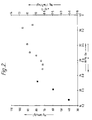
- Figure 2 is a graph of the saturation magnetisation of M₃Ga2-xAsx against the atomic percentage of Gallium for as cast material where M₃ represents Fe₃.
- Figure 3 is a graph of the variation in Curie Temperature with increasing Gallium content for as cast material where M₃ represents Fe₃.
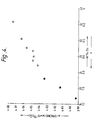
- Figure 4 is a graph of the a-spacing versus the atomic percentage of Gallium in the alloy for as cast material where M₃ represents Fe₃.
- The ferromagnetic material M₃Ga2-xAsx may be produced using typical methods such as casting or single crystal growth. Both methods require encapsulation of melt constituents to prevent loss of arsenic from the melt whilst in a furnace environment. Boric oxide is an example of a commonly used encapsulation material.
- The Liquid Encapsulation Czochralski technique for growth of single crystal material may be used for the growth of the alloy M₃Ga2-xAsx, and has been described in U.K. Patent Number 1 113 069. As shown in Figure 1, the melt constituents 1 (Fe, Ga and GaAs) of applicable ratios are placed in a silica crucible 2 and covered with
boric oxide 3. The crucible 2 and contents 1 are then heated by electric heaters 4 fed through apower supply 5. An orientated seed 6 is lowered into the pressurised chamber 7 by amotor 8. When the seed 6 has been partially immersed in the molten alloy 1, controlled growth takes place by rotating and retracting the seed 6 away from the melt 1, through theencapsulant 3 and into the pressurised chamber environment 7. This results in a single crystal, or near single crystal, boule 9. All growth procedures are controlled by acontrol panel 10. - Specific compositions will now be given by way of example only where all examples are as cast material except Example 6:-
-
Fe₃Ga1.85As0.15
This composition has a saturation magnetisation of 1.1 x 10⁻⁴Tm³/kg (84 emu/g) at 298K (Figure 2) and a Curie Temperature of 431°C (Figure 3). -
Fe₃Ga1.79As0.21
This composition has a saturation magnetisation of 1.2 x 10⁻⁴Tm³/kg (97 emu/g) at 298K (Figure 2), a Curie Temperature of 370°C (Figure 3) and an a-spacing of 4.07 x 10⁻¹⁰m (Figure 4). -
Fe₃Ga1.5As0.5
This composition has a saturation magnetisation of 1.1 x 10⁻⁴Tm³/kg (88 emu/g) at 298K (Figure 2), a Curie Temperature of 240°C (Figure 3) and an a-spacing of 4.055 x 10⁻¹⁰m (Figure 4). -
Fe₃Ga1.25As0.75
This composition has a saturation magnetisation of 9.0 x 10⁻⁵Tm³/kg (72 emu/g) at 298K (Figure 2), a Curie Temperature of 232°C (Figure 3) and an a-spacing of 4.048 x 10⁻¹⁰m (Figure 4). -
Fe₃Ga1.1As0.9
This composition has a saturation magnetisation of 9.9 x 10⁻³Tm³/kg (79 emu/g) at 298K (Figure 2), a Curie Temperature of 215°C (Figure 3) and an a-spacing of 4.033 x 10⁻¹⁰m. -
Fe₃Ga1.4As0.6
- Alloys may be variously heat treated to homogenise the microstructure. The heat treatment may occur within a vacuum or without a vacuum. The heat treatment may require an air, inert gas or arsenic ambient at air or other pressures, or a flowing medium of any of these. The annealing temperatures employed is dependent upon the annealing environment used and the material properties required.
- This composition in the as cast state has a Curie Temperature of 244°C. After annealing the example at about 600°C in a vacuum of 1.33 x 10⁻⁴Nm⁻² (10⁻⁶ Torr) for three days the Curie Temperature increases to 282°C.
-
Fe2.7Mn0.3Ga1.85As0.15
This composition has a saturation magnetisation of 1.2 x 10⁻⁴Tm³/kg (94 emu/g) at 298K and a Curie Temperature of 416°C. -
Fe2.7Co0.3Ga1.85As0.15
This composition has a saturation magnetisation of 8.9 x 10⁻⁵Tm³/kg (71 emu/g) at 298K and a Curie Temperature of 346°C.
Claims (12)
- A ferromagnetic material comprising of Fe₃Ga2-xAsx where x has the range 0.15 ≦ x ≦ 0.85.
- The alloy of claim 1 where x has the range 0.15 ≦ x ≦ 0.75.
- The alloy of claims 1 or 2 where the Curie temperature is at least 431°C.
- The alloy of claims 1 or 2 where the saturation magnetisation is at least 1.2 x 10⁻⁴Tm³/kg (97 emu/g) at 298K.
- A ferromagnetic material comprising of MGa2-xAsx where x has the range 0.15 ≦ x ≦ 0.99 and M is either Fe₃ partially substituted by manganese or Fe₃ partially substituted by cobalt.
- The alloy of claim 5 where the Curie temperature is at least 416°C.
- The alloy of claim 5 where the saturation magnetisation is at least 1.2 x 10⁻⁴Tm³/kg (94 emu/g) at 298K.
- A method of manufacturing a ferromagnetic material Fe₃Ga2-xAsx where x has the range 0.15 ≦ x ≦ 0.99, comprising the steps of forming a melt of the constituents of the material and allowing the melt, on cooling, to form a solid alloy;
characterised by the step of annealing the alloy at a temperature between approximately 600°C and 900°C. - The method of claim 8 where annealing occurs in a vacuum.
- The method of claim 8 where annealing occurs in am ambient of one of air, arsenic and inert gas.
- The method of claim 8 where the ambient is a flowing medium.
- The method of claim 8 where annealing takes place in a vacuum of 1.33 x 10⁻⁴ Pa (10⁻⁶ Torr) for three days at a temperature of substantially 600°C.
Priority Applications (1)
| Application Number | Priority Date | Filing Date | Title |
|---|---|---|---|
| AT89904829T ATE103100T1 (en) | 1988-04-28 | 1989-04-14 | FERROMAGNETIC MATERIALS. |
Applications Claiming Priority (2)
| Application Number | Priority Date | Filing Date | Title |
|---|---|---|---|
| GB8810125 | 1988-04-28 | ||
| GB888810125A GB8810125D0 (en) | 1988-04-28 | 1988-04-28 | Ferromagnetic materials |
Publications (2)
| Publication Number | Publication Date |
|---|---|
| EP0414724A1 EP0414724A1 (en) | 1991-03-06 |
| EP0414724B1 true EP0414724B1 (en) | 1994-03-16 |
Family
ID=10636064
Family Applications (1)
| Application Number | Title | Priority Date | Filing Date |
|---|---|---|---|
| EP89904829A Expired - Lifetime EP0414724B1 (en) | 1988-04-28 | 1989-04-14 | Ferromagnetic materials |
Country Status (7)
| Country | Link |
|---|---|
| US (1) | US5114669A (en) |
| EP (1) | EP0414724B1 (en) |
| JP (1) | JP2768779B2 (en) |
| CA (1) | CA1337922C (en) |
| DE (1) | DE68913971T2 (en) |
| GB (2) | GB8810125D0 (en) |
| WO (1) | WO1989010620A1 (en) |
Families Citing this family (3)
| Publication number | Priority date | Publication date | Assignee | Title |
|---|---|---|---|---|
| US5296048A (en) * | 1989-05-31 | 1994-03-22 | International Business Machines Corporation | Class of magnetic materials for solid state devices |
| DE69008770T2 (en) * | 1989-05-31 | 1994-11-24 | Ibm | Magnetic materials for solid state devices. |
| US20090056998A1 (en) * | 2007-08-31 | 2009-03-05 | International Business Machines Corporation | Methods for manufacturing a semi-buried via and articles comprising the same |
Family Cites Families (3)
| Publication number | Priority date | Publication date | Assignee | Title |
|---|---|---|---|---|
| US3126346A (en) * | 1964-03-24 | Ferromagnetic compositions and their preparation | ||
| GB932678A (en) * | 1960-10-31 | 1963-07-31 | Du Pont | Ferromagnetic compositions |
| SE7511398L (en) * | 1974-10-21 | 1976-04-22 | Western Electric Co | MAGNETIC DEVICE |
-
1988
- 1988-04-28 GB GB888810125A patent/GB8810125D0/en active Pending
-
1989
- 1989-04-14 WO PCT/GB1989/000381 patent/WO1989010620A1/en not_active Ceased
- 1989-04-14 DE DE68913971T patent/DE68913971T2/en not_active Expired - Fee Related
- 1989-04-14 EP EP89904829A patent/EP0414724B1/en not_active Expired - Lifetime
- 1989-04-14 JP JP1504548A patent/JP2768779B2/en not_active Expired - Fee Related
- 1989-04-14 US US07/623,981 patent/US5114669A/en not_active Expired - Lifetime
- 1989-04-27 CA CA000598000A patent/CA1337922C/en not_active Expired - Fee Related
-
1990
- 1990-10-24 GB GB9023375A patent/GB2235467B/en not_active Expired - Lifetime
Also Published As
| Publication number | Publication date |
|---|---|
| WO1989010620A1 (en) | 1989-11-02 |
| JPH03504028A (en) | 1991-09-05 |
| GB2235467B (en) | 1991-09-25 |
| US5114669A (en) | 1992-05-19 |
| GB9023375D0 (en) | 1990-12-19 |
| GB2235467A (en) | 1991-03-06 |
| CA1337922C (en) | 1996-01-16 |
| GB8810125D0 (en) | 1988-06-02 |
| DE68913971D1 (en) | 1994-04-21 |
| DE68913971T2 (en) | 1994-10-13 |
| EP0414724A1 (en) | 1991-03-06 |
| JP2768779B2 (en) | 1998-06-25 |
Similar Documents
| Publication | Publication Date | Title |
|---|---|---|
| US5228930A (en) | Rare earth permanent magnet power, method for producing same and bonded magnet | |
| US4533408A (en) | Preparation of hard magnetic alloys of a transition metal and lanthanide | |
| CA2074161C (en) | Ferromagnetic materials | |
| Dreizler et al. | Transformation kinetics of the ferromagnetic alloy Mn-Al-C | |
| JPH0663056B2 (en) | Non-sintered permanent magnet alloy and manufacturing method thereof | |
| US4849034A (en) | Thermal treatment for increasing magnetostrictive response of rare earth-iron alloy rods | |
| JPS586778B2 (en) | Anisotropic permanent magnet alloy and its manufacturing method | |
| US4221613A (en) | Rare earth-cobalt system permanent magnetic alloys and method of preparing same | |
| Wiener | Metallurgy of oriented silicon steels | |
| EP0476606B1 (en) | Permanent magnet powders | |
| US3147112A (en) | Ferromagnetic mn-ga alloy and method of production | |
| US5114669A (en) | Ferromagnetic materials | |
| JPH06207203A (en) | Rare earth permanent magnet manufacturing method | |
| JP2625163B2 (en) | Manufacturing method of permanent magnet powder | |
| KR102712342B1 (en) | MAGNETIC SUBSTANCES BASED ON Mn-Bi-Sb AND FABRICATION METHOD THEREOF | |
| US4396441A (en) | Permanent magnet having ultra-high coercive force and large maximum energy product and method of producing the same | |
| US4473400A (en) | Magnetic metallic glass alloy | |
| US4213802A (en) | Method of treating a permanent magnet alloy | |
| US4116726A (en) | As-cast permanent magnet Sm-Co-Cu material with iron, produced by annealing and rapid quenching | |
| JPH06207204A (en) | Production of rare earth permanent magnet | |
| Walter et al. | Crystallization of amorphous Fe75Si15B10 ribbon and powder | |
| CN115637394B (en) | Cobalt-reinforced iron-nickel-based hard magnetic alloy and preparation method thereof | |
| CN112216458A (en) | A kind of enhanced magnetocaloric effect material and preparation method thereof | |
| US3207638A (en) | Manganese, gallium, iron magnetic alloy and method of producing particular crystal structure thereof | |
| Koon et al. | Composition dependence of the coercive force and microstructure of crystallized amorphous (Fe x B 1-x) 0.9 Tb 0.05 La 0.05 alloys |
Legal Events
| Date | Code | Title | Description |
|---|---|---|---|
| PUAI | Public reference made under article 153(3) epc to a published international application that has entered the european phase |
Free format text: ORIGINAL CODE: 0009012 |
|
| 17P | Request for examination filed |
Effective date: 19901018 |
|
| AK | Designated contracting states |
Kind code of ref document: A1 Designated state(s): AT BE CH DE FR GB IT LI LU NL SE |
|
| 17Q | First examination report despatched |
Effective date: 19921207 |
|
| GRAA | (expected) grant |
Free format text: ORIGINAL CODE: 0009210 |
|
| ITF | It: translation for a ep patent filed | ||
| AK | Designated contracting states |
Kind code of ref document: B1 Designated state(s): AT BE CH DE FR GB IT LI LU NL SE |
|
| REF | Corresponds to: |
Ref document number: 103100 Country of ref document: AT Date of ref document: 19940415 Kind code of ref document: T |
|
| REF | Corresponds to: |
Ref document number: 68913971 Country of ref document: DE Date of ref document: 19940421 |
|
| ET | Fr: translation filed | ||
| EPTA | Lu: last paid annual fee | ||
| K2C2 | Correction of patent specification (partial reprint) published |
Effective date: 19940316 |
|
| NLXE | Nl: other communications concerning ep-patents (part 3 heading xe) |
Free format text: ON 940923 A NEW PAGE 4 OF THE TRANSLATION OF THE PATENT SPECIFICATION HAS BEEN RECEIVED IN CONNECTION WITH A CORRECTION ISSUED BY THE E.P.O. |
|
| ET1 | Fr: translation filed ** revision of the translation of the patent or the claims | ||
| PLBE | No opposition filed within time limit |
Free format text: ORIGINAL CODE: 0009261 |
|
| STAA | Information on the status of an ep patent application or granted ep patent |
Free format text: STATUS: NO OPPOSITION FILED WITHIN TIME LIMIT |
|
| EAL | Se: european patent in force in sweden |
Ref document number: 89904829.2 |
|
| 26N | No opposition filed | ||
| REG | Reference to a national code |
Ref country code: GB Ref legal event code: 732E |
|
| BECA | Be: change of holder's address |
Free format text: 20011123 *QINETIQ LTD:85 BUCKINGHAM GATE, LONDON SW14 0LX |
|
| REG | Reference to a national code |
Ref country code: GB Ref legal event code: IF02 |
|
| PGFP | Annual fee paid to national office [announced via postgrant information from national office to epo] |
Ref country code: AT Payment date: 20020307 Year of fee payment: 14 |
|
| PGFP | Annual fee paid to national office [announced via postgrant information from national office to epo] |
Ref country code: CH Payment date: 20020314 Year of fee payment: 14 |
|
| PGFP | Annual fee paid to national office [announced via postgrant information from national office to epo] |
Ref country code: SE Payment date: 20020319 Year of fee payment: 14 Ref country code: LU Payment date: 20020319 Year of fee payment: 14 |
|
| PGFP | Annual fee paid to national office [announced via postgrant information from national office to epo] |
Ref country code: BE Payment date: 20020417 Year of fee payment: 14 |
|
| REG | Reference to a national code |
Ref country code: FR Ref legal event code: TP |
|
| NLS | Nl: assignments of ep-patents |
Owner name: QINETIQ LIMITED |
|
| PGFP | Annual fee paid to national office [announced via postgrant information from national office to epo] |
Ref country code: FR Payment date: 20030310 Year of fee payment: 15 |
|
| PGFP | Annual fee paid to national office [announced via postgrant information from national office to epo] |
Ref country code: GB Payment date: 20030313 Year of fee payment: 15 |
|
| PGFP | Annual fee paid to national office [announced via postgrant information from national office to epo] |
Ref country code: DE Payment date: 20030324 Year of fee payment: 15 |
|
| PGFP | Annual fee paid to national office [announced via postgrant information from national office to epo] |
Ref country code: NL Payment date: 20030325 Year of fee payment: 15 |
|
| PG25 | Lapsed in a contracting state [announced via postgrant information from national office to epo] |
Ref country code: LU Free format text: LAPSE BECAUSE OF NON-PAYMENT OF DUE FEES Effective date: 20030414 Ref country code: AT Free format text: LAPSE BECAUSE OF NON-PAYMENT OF DUE FEES Effective date: 20030414 |
|
| PG25 | Lapsed in a contracting state [announced via postgrant information from national office to epo] |
Ref country code: SE Free format text: LAPSE BECAUSE OF NON-PAYMENT OF DUE FEES Effective date: 20030415 |
|
| PG25 | Lapsed in a contracting state [announced via postgrant information from national office to epo] |
Ref country code: LI Free format text: LAPSE BECAUSE OF NON-PAYMENT OF DUE FEES Effective date: 20030430 Ref country code: CH Free format text: LAPSE BECAUSE OF NON-PAYMENT OF DUE FEES Effective date: 20030430 Ref country code: BE Free format text: LAPSE BECAUSE OF NON-PAYMENT OF DUE FEES Effective date: 20030430 |
|
| BERE | Be: lapsed |
Owner name: *QINETIQ LTD Effective date: 20030430 |
|
| EUG | Se: european patent has lapsed | ||
| REG | Reference to a national code |
Ref country code: CH Ref legal event code: PL |
|
| PG25 | Lapsed in a contracting state [announced via postgrant information from national office to epo] |
Ref country code: GB Free format text: LAPSE BECAUSE OF NON-PAYMENT OF DUE FEES Effective date: 20040414 |
|
| PG25 | Lapsed in a contracting state [announced via postgrant information from national office to epo] |
Ref country code: NL Free format text: LAPSE BECAUSE OF NON-PAYMENT OF DUE FEES Effective date: 20041101 |
|
| PG25 | Lapsed in a contracting state [announced via postgrant information from national office to epo] |
Ref country code: DE Free format text: LAPSE BECAUSE OF NON-PAYMENT OF DUE FEES Effective date: 20041103 |
|
| GBPC | Gb: european patent ceased through non-payment of renewal fee |
Effective date: 20040414 |
|
| PG25 | Lapsed in a contracting state [announced via postgrant information from national office to epo] |
Ref country code: FR Free format text: LAPSE BECAUSE OF NON-PAYMENT OF DUE FEES Effective date: 20041231 |
|
| NLV4 | Nl: lapsed or anulled due to non-payment of the annual fee |
Effective date: 20041101 |
|
| REG | Reference to a national code |
Ref country code: FR Ref legal event code: ST |
|
| PG25 | Lapsed in a contracting state [announced via postgrant information from national office to epo] |
Ref country code: IT Free format text: LAPSE BECAUSE OF NON-PAYMENT OF DUE FEES;WARNING: LAPSES OF ITALIAN PATENTS WITH EFFECTIVE DATE BEFORE 2007 MAY HAVE OCCURRED AT ANY TIME BEFORE 2007. THE CORRECT EFFECTIVE DATE MAY BE DIFFERENT FROM THE ONE RECORDED. Effective date: 20050414 |