EP0413818B1 - Process for producing a human neutrophil chemotactic factor polypeptide - Google Patents
Process for producing a human neutrophil chemotactic factor polypeptide Download PDFInfo
- Publication number
- EP0413818B1 EP0413818B1 EP89905179A EP89905179A EP0413818B1 EP 0413818 B1 EP0413818 B1 EP 0413818B1 EP 89905179 A EP89905179 A EP 89905179A EP 89905179 A EP89905179 A EP 89905179A EP 0413818 B1 EP0413818 B1 EP 0413818B1
- Authority
- EP
- European Patent Office
- Prior art keywords
- polypeptide
- formula
- nucleotide sequence
- human
- ncf
- Prior art date
- Legal status (The legal status is an assumption and is not a legal conclusion. Google has not performed a legal analysis and makes no representation as to the accuracy of the status listed.)
- Expired - Lifetime
Links
Images


Classifications
-
- C—CHEMISTRY; METALLURGY
- C12—BIOCHEMISTRY; BEER; SPIRITS; WINE; VINEGAR; MICROBIOLOGY; ENZYMOLOGY; MUTATION OR GENETIC ENGINEERING
- C12N—MICROORGANISMS OR ENZYMES; COMPOSITIONS THEREOF; PROPAGATING, PRESERVING, OR MAINTAINING MICROORGANISMS; MUTATION OR GENETIC ENGINEERING; CULTURE MEDIA
- C12N15/00—Mutation or genetic engineering; DNA or RNA concerning genetic engineering, vectors, e.g. plasmids, or their isolation, preparation or purification; Use of hosts therefor
-
- C—CHEMISTRY; METALLURGY
- C07—ORGANIC CHEMISTRY
- C07K—PEPTIDES
- C07K14/00—Peptides having more than 20 amino acids; Gastrins; Somatostatins; Melanotropins; Derivatives thereof
- C07K14/435—Peptides having more than 20 amino acids; Gastrins; Somatostatins; Melanotropins; Derivatives thereof from animals; from humans
- C07K14/52—Cytokines; Lymphokines; Interferons
- C07K14/54—Interleukins [IL]
- C07K14/5421—IL-8
-
- A—HUMAN NECESSITIES
- A61—MEDICAL OR VETERINARY SCIENCE; HYGIENE
- A61K—PREPARATIONS FOR MEDICAL, DENTAL OR TOILETRY PURPOSES
- A61K38/00—Medicinal preparations containing peptides
Definitions
- This invention relates to an expression vector in which a DNA encoding a human neutrophil chemotactic factor polypeptide is inserted, a transformant (a Escherichia coli cell transformed with the expression vector), and a process for production of the said polypeptide by using the said transformant.
- Human neutrophil chemotactic factor (abbreviated NCF hereinafter) is a physiologically active polypeptide which is produced from human mononuclear leukocytes stimulated with lipopolysaccharide, and has biological activity specifically to attract neutrophils, and is evaluated as one of the modulating factors relating to the initial stage of the inflammatory reaction (Yoshimura, T. et al., J. Immunol., 139 , 788, 1987).
- NCF derived from human mononuclear leukocytes its partial amino acid sequence has already been determined (Yoshimura, T. et al., Proc. Natl. Acad. Sci., USA, 84 , 9233, 1987).
- the present inventors have succeeded in isolation of a cDNA encoding the human NCF based on the above partial amino acid sequence (see Referntial Example 1).
- the base sequence of the cloned human NCF cDNA was identical in the coding region with the base sequence reported by Schmid and Weissmann (J. Immunol., 139 , 250, 1987).
- a human NCF polypeptide was found to be a polypeptide with the low molecular weight of 8.4kD since the complete primary structure of its polypeptide was established by the genetic analysis.
- physiologically active polypeptides such as interleukin-1, interleukin-2, interleukin-3, TNF ⁇ (tumor necrosis factor), lymphotoxin (TNF ⁇ ), GM-CSF (granulocyte-macrophage colony stimulating factor), G-CSF (granulocyte colony stimulation factor) and various interferons
- TNF ⁇ tumor necrosis factor
- TNF ⁇ lymphotoxin
- GM-CSF granulocyte-macrophage colony stimulating factor
- G-CSF granulocyte colony stimulation factor
- the degree of this degradation is closely related to the structure of the polypeptide, and this relationship is more likely when the molecular weight of the required polypeptide is lower, and particularly, most likely in the case of an extremely lower molecular weight polypeptide in E. coli (Itakura, K. et al., Science 198 , 1056, 1977).
- cDNA coding for human MDNCF has been cloned.
- Said cDNA is 1.7 kb long and codes for a polypeptide consisting of 99 amino acids.
- the present inventors attemped to express directly the human NCF polypeptide with such lower molecular weight by applying recombinant DNA technology using E. coli as the host. Consequently, it has been found unexpectedly that the said polypeptide could be produced efficietly without significant degradation in the host cells.
- the object of this invention is to offer the efficient process of a human NCF polypeptide by recombinant DNA technology.
- Another object of this invention is to offer a recombinant expression vector in which a DNA encoding a human NCF polypeptide is inserted and a host cell transformed with the said vector.
- a human NCF polypeptide particularly, a polypeptide consisting of an amino acid sequence represented by formula [I] shown in Table 1, can be produced by applying recombinant DNA technology in Escherichia coli.
- the DNA encoding a human NCF polypeptide can be isolated, for example, according to the method as described in Referential Example 1 and the method reported by Schmid and Weissmann as mentioned above. It is also possible to perform the total synthesis of the said DNA chemically. As regards the extra region or deficient region of the resulting DNA, the required DNA can be produced by the methods of the digestion and/or repairment such as, for example, digesting by an appropriate restriction enzyme and ligating with chemically synthesized oligodeoxyribonucleotides.
- the base sequence from the SD sequence to the translation initiation codon is preferably represented by formula [D]. 5'-XGGAGGTTTYATT-3' formula [D] wherein X means (A)x, x being 1 to 5, and Y means (A)y(T)z, y being 0 to 3, z being 0 or 1.
- a transformant of this invention can be obtained by introducing the expression vector constructed as above into a proper host cell, for example E. coli according to the method of Cohen et al. (Cohen, S. N., et al., Proc. Natl. Acad. Sci., USA, 69 , 2110, 1972),
- the human NCF polypeptide can be produced by cultivating the transformant of this invention under suitable culture conditions.
- the extract containing the said polypeptide can be obtained from the culture after destroying the cells, for example by lysozyme digestion and freeze-thawing, sonication or by using a French press, followed by collecting the extract by centrifugation or filtration.
- the human NCF polypeptide can be purified from the extract by purification methods characterized by combination of treatment for removing nucleic acids, salting-out, anion and/or cation exchange chromatography, ultrafiltration, gel filtration, if necessary, dialysis, electrophoresis, affinity chromatography using specific antibodies, and so on.
- Example 2 The highly purified human NCF polypeptide obtained in Example (to be referred to as the recombinant human NCF) was used for analyses as shown below.
- Molecular weight of the recombinant human NCF was measured by SDS-polyacrylamide gel electrophoretic analysis.
- molecular weight marker proteins the standard protein kit (Pharmacia Fine Chemicals, Sweden) consisting of the following proteins was used: lysozyme (14.4kD), soybean trypsin inhibitor (20.1kD), carbonic anhydrase (30kD), ovalbumin (43kD), bovine serum albumin (67kD) and phosphorylase b (94kD).
- the recombinant human NCF had a molecular weight of approximately 8-10kD.
- amino acid sequences of the recombinant human NCF were determined by the Automated Edman degradation method.
- the recombinant human NCF was previously treated by reductive cleavage of disulfide bonds with 2-mercaptoethanol, followed by S- ⁇ -4-pyridylethylation of cysteine residues with 4-vinyl pyridine according to the method of Fullmer (Anal. Biochem., 142 , 336, 1984).
- the recombinant human NCF was treated with 70% formic acid by the method of Sonderegger et al. (Anal. Biochem., 122 , 298, 1982) to cleave specifically Asp-Pro peptide bond. From the resulting two peptide fragments, the C-terminal fragment was isolated by high-performance liquid chromatography using a column of SynChropak RP-P (SynChrom, Inc., USA) under the elution condition of a linear gradient of acetonitrile concentration from 0 to 50% in 0.1% trifluoroacetic acid.
- pyridylethylated human NCF was digested with a metalloendopeptidase (EC 3.4.24; Seikagaku Kogyo, Japan) and the resulting peptide fragments were isolated by high-performance liquid chromatography under the elution condition of a linear gradient of acetonitrile concentration from 0 to 30% in 0.1% trifluoroacetic acid.
- a metalloendopeptidase EC 3.4.24; Seikagaku Kogyo, Japan
- N-terminal amino acid sequences of the pyridylethylated NCF and each peptide fragment were determined with a Protein Sequencer, Model 470A (Applied Biosystems, USA) and a SP8440 UV/VIS detector (Spectra-Physics, USA).
- N-terminal amino acid sequence of the pyridylethylated recombinant human NCF was as follows: This amino acid sequence was completely identical with the amino acid sequence from N-terminal Ser to Asn at the 36th position of the human NCF polypeptide represented by formula [I] shown in Table 1. A methionine residue due to the translation initiation codon (ATG) could not be detected at the N-terminus.
- N-terminal amino acid sequence of the acid-cleavaged C-terminal fragment was as follows: This amino acid sequence was identical with the amino acid sequence from the 53rd position from the N-terminus to the C-terminal Ser of the human NCF polypeptide represented by formula [I] shown in Table 1.
- amino acid sequences of the two peptide fragments prepared by digestion with metalloendopeptidase were determined as follows: and LysLeuSerAspGlyArgGluLeuCysLeuAspPro These amino acid sequences were identical with the amino acid sequence of 19 residues from the 23rd position to the 41st position from the N-terminus and the amino acid sequence of 12 residues from the 42nd position to the 53rd position from the N-terminus of the human NCF polypeptide represented by formula [I] shown in Table 1.
- amino acid sequence of the recombinant human NCF polypeptide is completely identical with the sequence deduced from a base sequence encoding the human NCF.
- the recombinant human NCF polypeptide was lyophilized without any carrier component. Contents of water and ash in this lyophilized product were determined to be 6.01% and 0.52%, respectively.
- Extinction coefficient value of the recombinant human NCF was calculated to be 8.25 at 280 nm under the conditions of 1% aqueous solution and 1cm optical path length.
- Neutrophil chemotactic activity was measured in a multiwell chemotaxis Boyden chamber (Neuro Probe, Inc., USA) as reported by Harvath, L. et al. (J. Immunol. Methods, 37 , 39, 1980).
- Recombinant NCF was serially diluted in Dulbecco's Modified Eagle's Medium (DMEM) supplemented with 1% bovine serum albumin (BSA).
- DMEM Dulbecco's Modified Eagle's Medium
- BSA bovine serum albumin
- Normal human neutrophils were purified from Buffy coat collected from healthy donors (National Institutes of Health, Blood Bank, USA) by separating on Ficoll-Hypaque followed by lysing contaminating red blood cells with ACK-lysing buffer.
- the purity of neutrophils were more than 95% by staining cells with Giemsa solution.
- the viability was also more than 95% as judged by a trypan blue dye exclusion test.
- the neutrophil cells were incubated at a cell density of one million cells/ml in DMEM supplemented with 1% BSA for 40 minutes at 37°C.
- the migrated neutrophils which adhered onto a membrane (3 ⁇ m: Nuclepore Corp., USA) were fixed with methanol and stained with Giemsa solution. At 0.1 ng/ml significant migration was observed by examining with microscope. At 10 ng/ml maximal migration was observed.
- the migrated cells were identified to be neutrophils morphologically.
- DNA fragment encoding the polypeptide corresponding to the amino acids from the 18th position to the 97th position from the N-terminus of human NCF precursor polypeptide was isolated by digestion with restriction endonucleases Pst I and EcoRI. This DNA fragment was then cloned into a phage vector M13mp18 (Takara Shuzo Co., Japan) at a region between the restriction endonuclease cleavage site of Pst I and that of Eco RI in the polylinker sequence.
- an specific base sequence being 5'-TTTAAATTATG-3' was inserted between the codon corresponding to Arg at the 27th position from N-terminus of the human NCF precursor polypeptide and the codon corresponding to Ser at the 28th position, by the technique of site-directed mutagenesis according to the method of Kunkel el al. (Methods in Enzymol., 154 , 367-382, 1987).
- the site-directed mutagenesis was carried out using a Muta-Gene in vitro mutanegesis kit according to the instruction manual (Bio-Rad Labs., USA).
- E. coli JM105 was infected with the recombinant phage DNA, and then it was cultivated to collect the recombinant phage. Then, E. coli CJ236 was infected with the recombinant phage obtained as above and cultivated in 2xTY medium [composition; 1.6% tryptone, 1% yeast extract, 0.5% sodium chloride] supplemented with uridine (1 ⁇ g/ml) and chloramphenicol (20 ⁇ g/ml) at 37°C for 5 hours. The single-stranded phage DNA containing uracils was isolated from the culture medium.
- a mutagenic oligodeoxyribonucleotide primer consisting of 33 bases represented by the following formula [E] was chemically synthesized. 5'-GTTTTGCCAAGGTTTAAATTATGAGTGCTAAAG-3' formula [E] The 5'-end of the mutagenic primer was previously phosphorylated. The phosphorylated primer was annealed with the single-stranded phage DNA containing uracils prepared as above in an annealing buffer [20 mM Tris-HCl buffer (pH 7.4) containing 2 mM magnesium chloride and 50 mM sodium chloride] by incubating at 70°C for 10 minutes, followed by cooling down to 30°C at a rate of 1°C per minute.
- an annealing buffer [20 mM Tris-HCl buffer (pH 7.4) containing 2 mM magnesium chloride and 50 mM sodium chloride
- the primer was extended with T4 DNA polymerase in a synthesis buffer [10 mM Tris-HCl buffer (pH 7.4) containing 0.4 mM each deoxynucleoside triphosphate (dGTP, dATP, dCTP, dTTP), 0,75 mM ATP, 3.75 mM magnesium chloride and 1.5 mM dithiothreitol] to synthesize a complementary strand and the ends were ligated with T4 DNA ligase by sequential incubating on ice for 5 minutes, at 25°C for 5 minutes and at 37°C for 90 minutes. The reaction was stopped by freezing at -20°C.
- the circular double-stranded DNA was introduced into E. coli JM105 cells, and they were cultivated to isolate the mutated double-stranded replicative form DNA. The nucleotide sequence of the mutated DNA was confirmed by sequencing the single-stranded DNA isolated from the culture medium.
- the resultant mutated double-stranded DNA was digested with restriction endonucleases Dra I and Eco RI in order to isolate a DNA fragment containing most of the coding region for human NCF polypeptide.
- the isolated DNA fragment is, hereinafter, referred to as the NCF(DraI-EcoRI)-fragment.
- NCF(DraI-EcoRI)-fragment was ligated by T4 DNA ligase with a chemically synthesized oligodeoxynucleotide adaptor represented by the following formula [F].
- the resultant ligated DNA fragment is referred to as the NCF(DraI-XhoI)-fragment.
- an expression plasmid pEP205 as mentioned in Referential Example 2 was digested with restriction endonucleases Dra I and Xho I, and the resulting larger DNA fragment including an ampicillin-resistance gene and a replication origin (hereinafter referred to as the EP205 vector-DNA fragment) was isolated, and this EP205 vector-DNA fragment was ligated by T4 DNA ligase with the NCF(DraI-XhoI)-fragment previously prepared in order to construct an expression plasmid pHNP101 for producing human NCF (see Schema 1).
- the resulting expression plasmid pHNP101 was introduced into E. coli HB101 by the following manner.
- E. coli HB101 was inoculated in the LB broth [composition; 1% tryptone, 0,5% yeast extract, 1% sodium chloride (pH 7.5)], and cultivated overngiht at 30°C.
- One milliliter of the resulting culture was inoculated in 100 ml of LB broth and further cultivated at 30°C until the turbidity at 600 nm of the culture reached approximately 0.6.
- the cells were collected by centrifugation, They were resuspended in 50 ml of 50 mM calcium chloride, and allowed to stand for 60 minutes in ice water. Then, the cells were collected by centrifugation and again suspended in 10 ml of 50 mM calcium chloride containing 20 % glycerol.
- the expression plasmid pHNP101 was mixed and incubated sequentially in ice water for 20 minutes and at room temperature for 60 minutes. Then, the LB broth was added to the cell suspension, and it was cultivated under shaking at 37°C for 60 minutes. An aliquot of the resulting cell suspension was seeded on the LB agar (1.5% agar) plates containing 25 ⁇ g/ml of ampicillin. After cultivation at 37°C overnight, ampicillin-resistant colonies were selected to obtain transformants, One of the transformants was named E. coli HB101/pHNP101 and it was used for production of the human NCF polypeptide.
- E. coli HB101/pHNP101 obtained in section (2) was cultivated in the LB broth overnight at 37°C.
- the culture was inoculated in 100-fold volumes of the nutrient medium [composition; 1.5% sodium phosphate, dibasic 12-water, 0.3% potassium phosphate, monobasic, 0.1% ammonium chloride, 2 mg/liter vitamine B1, 0.5% casamino acid, 2 mM magnesium sulfate, 0.1 mM calcium chloride, 1% tryptone, 0.5% yeast extract, 1% sodium chloride and 0.4% glycerol] and then, 3-indoleacrylic acid was added to give a final concentration of 20 ⁇ g/ml.
- the cultivation was done at 35°C for 28 hours.
- the cells were collected by centrifugation, and suspended in 50 mM Tris-HCl buffer (pH 8.0) containing 0.1% lysozyme and 30 mM sodium chloride. The suspension was allowed to stand in ice water for 30 minutes. Further, freezing in a dry ice/ethanol bath and thawing at 37°C were repeated to disrupt the cells. After adding 1/50 volume of 10% ethyleneimine polymer, a clarified cell-extract was obtained by centrifugation. To this cell-extact, ammonium sulfate was added to give a 70% saturation, and the formed precipitate was collected by centrifugation.
- Tris-HCl buffer pH 8.0
- the precipitate was dissolved in distilled water and it was dialyzed against 5 mM phosphate buffered saline (pH 6,5) (hereinafter referred to as PBS).
- PBS phosphate buffered saline
- the dialysate was applied onto a column of Sephacryl S-200 (Pharmacia, Sweden), and the fractions containing polypeptides having about 6 to 10kD molecular weight were collected and pooled.
- the molecular sizes of polypeptides in each eluate were measured by SDS-polyacylamide gel electrophoretic analysis.
- the pooled fraction was dialyzed against 20 mM phosphate buffer (pH 6.5) (hereinafter referred to as PB).
- the dialysate was applied onto a column of CM-Sepharose CL-6B (Pharmacia, Sweden) previously equilibrated with PB.
- the column was washed with PB, and eluted with a linear gradient of sodium chloride molarity from 0 to 0.5 M in PB.
- the fractions containing the human NCF polypeptide were collected and pooled, and concentrated by ultrafiltration. Further, the concentrate was subjected to gel filtration on Toyopearl HW-55 column (TOSOH Co., Japan) to obtain the highly purified human NCF polypeptide.
- the cDNA library was constructed by insertion of cDNA synthesized from normal human monocyte polyadenylated mRNA obtained from the monocyte stimulated with 10 ⁇ g/ml lipopolysaccharide for 6 hurs, into the EcoRI site of the phage vector lambda gt10.
- One half million individual plaques were screened for hybridization with [32P]-labeled two kinds of chemically synthesized oligonucleotide probes represented by the following formulae:
- 13 putative positive clones were obtained. From these positive clones, one clone (termed r-MDNCF 2-1) was selected in the second screening by using the another probe.
- the phage DNA in r-MDNCF 2-1 was subcloned into the pUC19 plasmid.
- the resulting recombinant plasmid was termed pUC19-1.7-5.
- the cloned cDNA in a recombinant plasmid pUC19-1.7-5 contains a nucleotide sequence encoding human NCF shown in Table 3.
- Plasmid pBR322 was digested with restriction endonucleases Ava I and Pvu II, and the resulting larger DNA fragment (about 3.7 kbp in size) was isolated. After filling-in its cohesive ends to blunt-ends with E. coli DNA polymerase I (Klenow fragment) in the presence of dGTP, dATP, dCTP and dTTP, both ends were ligated by T4 DNA ligase to construct a new plasmid vector (designated pBRS6), which was deleted a copy number regulatory gene region located near the replication origin of the plasmid pBR322.
- the plasmid vector pBRS6 was digested with restriction endonucleases Eco RI and Pst I, and a smaller DNA fragment containing an upstream region of the ampicillin-resistance gene (about 0.75 kbp in size) was isolated.
- the resultant DNA fragment is referred to as the Amp(PstI-EcoRI)-fragment.
- This Amp(PstI-EcoRI)-fragment was cloned in a phage vector M13mp18 as mentioned in Example.
- a phage vector M13mp18 By using the resultant recombinant phage DNA, one base (T) in the nucleotide sequence of the Amp(PstI-EcoRI)-fragment was changed to another base (C) by the site-directed mutagenesis according to the method as mentioned in Example, in order to eliminate the specific nucleotide sequence (AAATTT) recognizable with the restriction endonuclease Dra I.
- the single-stranded phage DNA containing uracils was isolated from the culture medium of E. coli CJ236 infected with the above recombinant phage DNA,
- the oligodeoxyribonucleotide represented by the following formula [G] was chemically synthesized. 5'-CAGAACTTTGAAAGTGCTC-3' formula [G]
- the phosphorylated primer was annealed with the uracil-containing DNA template. According to the method described in Example section (1), the desired mutated double-stranded DNA was isolated.
- the resultant mutated double-stranded DNA was digested with restriction endonucleases Pst I and Eco RI in order to isolate a DNA fragment corresponding to the Amp(PstI-EcoRI)-fragment as mentioned above, but not containing the restriction endonuclease Dra I cleavage recognition sequence [hereinafter referred to as the mutated Amp(PstI-EcoRI)-fragment].
- the mutated Amp(PstI-EcoRI)-fragment was ligated with the larger DNA fragment isolated from the vector pBRS6 by digestion with restriction endonucleases Eco RI and Pst I, in order to construct a new vector which was eliminated the Dra I cleavage recognition sequence in the ampicillin resisitance gene of the plasmid vector pBRS6.
- This new vector is designated pBRS601.
- this new vector pBRS601 was digested with restriction endonuclease Dra I, and the resulting larger DNA fragment was isolated.
- the larger DNA fragment was ligated with Sma I linker (Takara Shuzo Co., Japan) by T4 DNA ligase to construct a new plasmid vector.
- This resulting new plasmid vector is a derivative of plasmid pBRS6 and is not containing any recognition sequences for the restriction endonuclease Dra I.
- This new plasmid vector is designated pBRS602.
- pBRS602(AatII-SalI)-fragment The nucleotide sequence of the Sma I linker is shown below. 5'-CCCGGG-3' Furthermore, this new vector pBRS602 was digested with restriction endonuclease Aat II and Sal I, and the resulting larger DNA fragment was isolated [hereinafter referred to as the pBRS602(AatII-SalI)-fragment].
- an expression plasmid pHIPH383a for producing human interleukin-1 ⁇ as mentioned in Referential Example 3 was digested with restriction endonucleases Aat II and Sal I, and the resulting DNA fragment containing E. coli tryptophan promoter sequence and the coding region for human interleukin-1 ⁇ was isolated. This resulting DNA fragment is referred to as the trp promoter/IL1 ⁇ -DNA fragment.
- This trp promoter/IL1 ⁇ -DNA fragment was ligated with the pBRS602(AatII-SalI)-fragment by T4 DNA ligase to construct a new expression plasmid (see Schema 2).
- This new expression plasmid is designated pEP205.
- the cloned cDNA encoding human interleukin-1 ⁇ precursor polypeptide was isolated according to the method described in European Patent Publication No. 0188920.
- the cDNA insert was isolated by digestion with restriction endonuclease Pst I, and further digested with restriction endonucleases Eco RI and Bst NI, to isolate a DNA fragment (411 bp in size) containing a middle portion of the coding region for the mature human interleukin-1 ⁇ .
- the isolated DNA fragment is corresponding to the nucleotide sequence from base No. 398 to No. 808 in Table 5 shown in European Patent Publication No. 0188920.
- This DNA fragment was sequentially ligated by T4 DNA ligase with chemically synthesized oligodeoxyribonucleotide adaptors represented by the following formulae [H] and [I].
- the resulting DNA fragment is referred to as the SD-IL1-frgment.
- the synthetic oligodeoxyribonucleotide adaptor [H] was prepared by sequential ligation of the following five kinds of DNA fragments represented by formulae [a]-[e].
- a base sequence of the formula [I] was as follows; Separately, an expression vector pEP302 (Furutani, Y., et al., Nucleic Acids Res., 13 , 5869, 1985) was digested with restriction endonucleases Hpa I and Bam HI, and the resulting larger DNA fragment containing E. coli tryptophan promoter sequence and an ampicillin resistance gene, was isolated (hereinafter referred to as the EP302 vector-DNA fragment).
- the EP302 vector-DNA fragment was ligated by T4 DNA ligase with the SD-IL1-fragment prepared as above to construct an expression plasmid pHIPH383a for producing the mature human interleukin-1 ⁇ polypeptide (see Schema 3).
- Neutrophils infiltrate into the foci of bacterial infection, inflammation site and around malignant tumor cells, and play important role in homeostatic defence mechanism.
- Neutrophils are attracted and further activated by NCF or by the combination of NCF with interleukin-1.
- the use of the combination of NCF and interleukin-1 are expected as a drug for treatment of certain bacterial infectious diseases or cancers.
Landscapes
- Health & Medical Sciences (AREA)
- Chemical & Material Sciences (AREA)
- Life Sciences & Earth Sciences (AREA)
- Organic Chemistry (AREA)
- Genetics & Genomics (AREA)
- Zoology (AREA)
- Engineering & Computer Science (AREA)
- Molecular Biology (AREA)
- General Health & Medical Sciences (AREA)
- Biochemistry (AREA)
- Biophysics (AREA)
- Gastroenterology & Hepatology (AREA)
- Proteomics, Peptides & Aminoacids (AREA)
- Medicinal Chemistry (AREA)
- Toxicology (AREA)
- Bioinformatics & Cheminformatics (AREA)
- Biomedical Technology (AREA)
- Biotechnology (AREA)
- General Engineering & Computer Science (AREA)
- Wood Science & Technology (AREA)
- Physics & Mathematics (AREA)
- Microbiology (AREA)
- Plant Pathology (AREA)
- Preparation Of Compounds By Using Micro-Organisms (AREA)
- Peptides Or Proteins (AREA)
- Medicines Containing Material From Animals Or Micro-Organisms (AREA)
- Compounds Of Unknown Constitution (AREA)
- Medicines That Contain Protein Lipid Enzymes And Other Medicines (AREA)
- Micro-Organisms Or Cultivation Processes Thereof (AREA)
Abstract
Description
- This invention relates to an expression vector in which a DNA encoding a human neutrophil chemotactic factor polypeptide is inserted, a transformant (a Escherichia coli cell transformed with the expression vector), and a process for production of the said polypeptide by using the said transformant.
- Human neutrophil chemotactic factor (abbreviated NCF hereinafter) is a physiologically active polypeptide which is produced from human mononuclear leukocytes stimulated with lipopolysaccharide, and has biological activity specifically to attract neutrophils, and is evaluated as one of the modulating factors relating to the initial stage of the inflammatory reaction (Yoshimura, T. et al., J. Immunol., 139, 788, 1987).
- As for the said NCF derived from human mononuclear leukocytes, its partial amino acid sequence has already been determined (Yoshimura, T. et al., Proc. Natl. Acad. Sci., USA, 84, 9233, 1987). The present inventors have succeeded in isolation of a cDNA encoding the human NCF based on the above partial amino acid sequence (see Referntial Example 1). The base sequence of the cloned human NCF cDNA was identical in the coding region with the base sequence reported by Schmid and Weissmann (J. Immunol., 139, 250, 1987). A human NCF polypeptide was found to be a polypeptide with the low molecular weight of 8.4kD since the complete primary structure of its polypeptide was established by the genetic analysis.
- As regards various physiologically active polypeptides, such as interleukin-1, interleukin-2, interleukin-3, TNFα (tumor necrosis factor), lymphotoxin (TNFβ), GM-CSF (granulocyte-macrophage colony stimulating factor), G-CSF (granulocyte colony stimulation factor) and various interferons, the production of these polypeptides having the molecular weight of more than 10kD has been succeeded by the use of recombinant DNA technology. But in the case of producing a polypeptide with the low molecular weight by recombinant DNA technology, especially by using E. coli as the host, it is usually produced as a fused protein with the protein derived from E. coli in general, in order to avoid degradation in the host cells. For example, Schulz et al. reported that it is extremely difficult to produce directly a human somatomedin C polypeptide (7.7kD) consisiting of 69 amino acid residues by recombinant DNA technology using E. coli as the host, and they succeeded in the efficient production of it as a dimer polypeptide or the truncated derivatives of the dimer polypeptide by recombinant DNA technology in E. coli (Schulz, M-F. et al., J. Bacteriol., 169, 5385, 1987). The degree of this degradation is closely related to the structure of the polypeptide, and this relationship is more likely when the molecular weight of the required polypeptide is lower, and particularly, most likely in the case of an extremely lower molecular weight polypeptide in E. coli (Itakura, K. et al., Science 198, 1056, 1977).
- The FASEB Journal, 1988, 2(5), abstract 6683 indicates that a cDNA coding for human MDNCF has been cloned. Said cDNA is 1.7 kb long and codes for a polypeptide consisting of 99 amino acids.
- The present inventors attemped to express directly the human NCF polypeptide with such lower molecular weight by applying recombinant DNA technology using E. coli as the host. Consequently, it has been found unexpectedly that the said polypeptide could be produced efficietly without significant degradation in the host cells.
- The object of this invention is to offer the efficient process of a human NCF polypeptide by recombinant DNA technology.
- Another object of this invention is to offer a recombinant expression vector in which a DNA encoding a human NCF polypeptide is inserted and a host cell transformed with the said vector.
- Other object will be understood from the following descriptions.
- According to this invention, a human NCF polypeptide, particularly, a polypeptide consisting of an amino acid sequence represented by formula [I] shown in Table 1, can be produced by applying recombinant DNA technology in Escherichia coli.


- As a base sequence of a DNA encoding a polypeptide consisting of an amino acid sequence represented by formula of [I], the DNA consisting of a base sequence represented by formula [A] shown in Table 2 and its degenerative sequence are illustrated.

- The DNA encoding a human NCF polypeptide can be isolated, for example, according to the method as described in Referential Example 1 and the method reported by Schmid and Weissmann as mentioned above. It is also possible to perform the total synthesis of the said DNA chemically. As regards the extra region or deficient region of the resulting DNA, the required DNA can be produced by the methods of the digestion and/or repairment such as, for example, digesting by an appropriate restriction enzyme and ligating with chemically synthesized oligodeoxyribonucleotides.
- By adding a translation initiation codon ATG to the 5'-terminus (upstream) of this DNA, ligating a DNA fragment containing a termination codon to the 3'-terminus (downstream) of the DNA having the initiation codon, connecting the resulting DNA with a proper promoter (e.g. trp, lac, phoS, PL, SV40 early promoter) and SD sequence, and then inserting the resulting DNA having the proper promoter and SD sequence into a proper vector (e.g. plasmid pBR322), an expression vector for production of the human NCF polypeptide is constructed.
- The base sequence from the SD sequence to the translation initiation codon is preferably represented by formula [D].
5'-XGGAGGTTTYATT-3' formula [D]
wherein X means (A)x, x being 1 to 5, and Y means (A)y(T)z, y being 0 to 3, z being 0 or 1. - A transformant of this invention can be obtained by introducing the expression vector constructed as above into a proper host cell, for example E. coli according to the method of Cohen et al. (Cohen, S. N., et al., Proc. Natl. Acad. Sci., USA, 69, 2110, 1972),
- The human NCF polypeptide can be produced by cultivating the transformant of this invention under suitable culture conditions. The extract containing the said polypeptide can be obtained from the culture after destroying the cells, for example by lysozyme digestion and freeze-thawing, sonication or by using a French press, followed by collecting the extract by centrifugation or filtration.
- The human NCF polypeptide can be purified from the extract by purification methods characterized by combination of treatment for removing nucleic acids, salting-out, anion and/or cation exchange chromatography, ultrafiltration, gel filtration, if necessary, dialysis, electrophoresis, affinity chromatography using specific antibodies, and so on.
- The chemical, physicochemical and biological properties of the human NCF polypeptide will be described hereinafter in detail.
- The highly purified human NCF polypeptide obtained in Example (to be referred to as the recombinant human NCF) was used for analyses as shown below.
- Molecular weight of the recombinant human NCF was measured by SDS-polyacrylamide gel electrophoretic analysis. As molecular weight marker proteins, the standard protein kit (Pharmacia Fine Chemicals, Sweden) consisting of the following proteins was used: lysozyme (14.4kD), soybean trypsin inhibitor (20.1kD), carbonic anhydrase (30kD), ovalbumin (43kD), bovine serum albumin (67kD) and phosphorylase b (94kD).
- As a result, the recombinant human NCF had a molecular weight of approximately 8-10kD.
- Polymerized molecule of the recombinant human NCF due to the formation of intermolecular disulfide bond was not detected significantly.
- An amino acid sequences of the recombinant human NCF were determined by the Automated Edman degradation method.
- The recombinant human NCF was previously treated by reductive cleavage of disulfide bonds with 2-mercaptoethanol, followed by S-β-4-pyridylethylation of cysteine residues with 4-vinyl pyridine according to the method of Fullmer (Anal. Biochem., 142, 336, 1984).
- Separately, several kinds of peptide fragments of the recombinant human NCF were prepared and isolated according to the following methods.
- The recombinant human NCF was treated with 70% formic acid by the method of Sonderegger et al. (Anal. Biochem., 122, 298, 1982) to cleave specifically Asp-Pro peptide bond. From the resulting two peptide fragments, the C-terminal fragment was isolated by high-performance liquid chromatography using a column of SynChropak RP-P (SynChrom, Inc., USA) under the elution condition of a linear gradient of acetonitrile concentration from 0 to 50% in 0.1% trifluoroacetic acid.
- And the pyridylethylated human NCF was digested with a metalloendopeptidase (EC 3.4.24; Seikagaku Kogyo, Japan) and the resulting peptide fragments were isolated by high-performance liquid chromatography under the elution condition of a linear gradient of acetonitrile concentration from 0 to 30% in 0.1% trifluoroacetic acid.
- N-terminal amino acid sequences of the pyridylethylated NCF and each peptide fragment were determined with a Protein Sequencer, Model 470A (Applied Biosystems, USA) and a SP8440 UV/VIS detector (Spectra-Physics, USA).
- It was found that the N-terminal amino acid sequence of the pyridylethylated recombinant human NCF was as follows:

This amino acid sequence was completely identical with the amino acid sequence from N-terminal Ser to Asn at the 36th position of the human NCF polypeptide represented by formula [I] shown in Table 1. A methionine residue due to the translation initiation codon (ATG) could not be detected at the N-terminus. - It was also found that the N-terminal amino acid sequence of the acid-cleavaged C-terminal fragment was as follows:

This amino acid sequence was identical with the amino acid sequence from the 53rd position from the N-terminus to the C-terminal Ser of the human NCF polypeptide represented by formula [I] shown in Table 1. - The amino acid sequences of the two peptide fragments prepared by digestion with metalloendopeptidase were determined as follows:

and
LysLeuSerAspGlyArgGluLeuCysLeuAspPro
These amino acid sequences were identical with the amino acid sequence of 19 residues from the 23rd position to the 41st position from the N-terminus and the amino acid sequence of 12 residues from the 42nd position to the 53rd position from the N-terminus of the human NCF polypeptide represented by formula [I] shown in Table 1. - Consequently, it has been confirmed that the amino acid sequence of the recombinant human NCF polypeptide is completely identical with the sequence deduced from a base sequence encoding the human NCF.
- The recombinant human NCF polypeptide was lyophilized without any carrier component. Contents of water and ash in this lyophilized product were determined to be 6.01% and 0.52%, respectively.
- Extinction coefficient value of the recombinant human NCF was calculated to be 8.25 at 280 nm under the conditions of 1% aqueous solution and 1cm optical path length.
- Neutrophil chemotactic activity was measured in a multiwell chemotaxis Boyden chamber (Neuro Probe, Inc., USA) as reported by Harvath, L. et al. (J. Immunol. Methods, 37, 39, 1980). Recombinant NCF was serially diluted in Dulbecco's Modified Eagle's Medium (DMEM) supplemented with 1% bovine serum albumin (BSA). Normal human neutrophils were purified from Buffy coat collected from healthy donors (National Institutes of Health, Blood Bank, USA) by separating on Ficoll-Hypaque followed by lysing contaminating red blood cells with ACK-lysing buffer. The purity of neutrophils were more than 95% by staining cells with Giemsa solution. The viability was also more than 95% as judged by a trypan blue dye exclusion test. The neutrophil cells were incubated at a cell density of one million cells/ml in DMEM supplemented with 1% BSA for 40 minutes at 37°C. The migrated neutrophils which adhered onto a membrane (3 µm: Nuclepore Corp., USA) were fixed with methanol and stained with Giemsa solution. At 0.1 ng/ml significant migration was observed by examining with microscope. At 10 ng/ml maximal migration was observed. The migrated cells were identified to be neutrophils morphologically.
- For simplification of the description, the following abbreviations are used in the present specification and claims.
- A:
- adenine
- C:
- cytosine
- G:
- guanine
- T:
- thymine
- I:
- Inosine
- dATP:
- deoxyadenosine triphosphate
- dCTP:
- deoxycytidine triphosphate
- dGTP:
- deoxyguanosine triphosphate
- dTTP:
- deoxythymidine triphosphate
- ATP:
- adenosine triphosphate
- DNA:
- deoxyribonucleic acid
- cDNA:
- complementary DNA
- kbp:
- kilobase pairs
- SD sequence:
- Shine-Dalgarno sequence
- kD:
- kilodaltons
- SDS:
- sodium laurylsulfate
- [3H]-thymidine:
- tritiated thymidine
- The following Example and Referential Examples illustrate this invention more specifically.
- It should be understood however that the invention is in no way limited to these examples.
- For a better understanding of the following Example and Referential Examples,
Schemata 1 to 3 are attached to the present specification. -
Schema 1 shows a process of constructing an expression plasmid pHNP101 (Example); -
Schema 2 shows a process of constructing an expression vector pEP205 (Referential Example 2); -
Schema 3 shows a process of constructing an expression plasmid pHIPH383a (Referential Example 3). - Human NCF polypeptide having an amino acid sequence represented by formula [I] in Table 1, was produced by the following methods.
- From the recombinant plasmid pUC19-1.7-5 in which human NCFcDNA was inserted as mentioned in Referential Example 1, DNA fragment encoding the polypeptide corresponding to the amino acids from the 18th position to the 97th position from the N-terminus of human NCF precursor polypeptide (corresponding to the base sequence from the base No. 52 to No. 291 in Table 3) was isolated by digestion with restriction endonucleases PstI and EcoRI. This DNA fragment was then cloned into a phage vector M13mp18 (Takara Shuzo Co., Japan) at a region between the restriction endonuclease cleavage site of PstI and that of EcoRI in the polylinker sequence. By using the resultant recombinant phage DNA, an specific base sequence being 5'-TTTAAATTATG-3' was inserted between the codon corresponding to Arg at the 27th position from N-terminus of the human NCF precursor polypeptide and the codon corresponding to Ser at the 28th position, by the technique of site-directed mutagenesis according to the method of Kunkel el al. (Methods in Enzymol., 154, 367-382, 1987). The site-directed mutagenesis was carried out using a Muta-Gene in vitro mutanegesis kit according to the instruction manual (Bio-Rad Labs., USA).
- E. coli JM105 was infected with the recombinant phage DNA, and then it was cultivated to collect the recombinant phage. Then, E. coli CJ236 was infected with the recombinant phage obtained as above and cultivated in 2xTY medium [composition; 1.6% tryptone, 1% yeast extract, 0.5% sodium chloride] supplemented with uridine (1 µg/ml) and chloramphenicol (20 µg/ml) at 37°C for 5 hours. The single-stranded phage DNA containing uracils was isolated from the culture medium.
- Separately, a mutagenic oligodeoxyribonucleotide primer consisting of 33 bases represented by the following formula [E] was chemically synthesized.
5'-GTTTTGCCAAGGTTTAAATTATGAGTGCTAAAG-3' formula [E]
The 5'-end of the mutagenic primer was previously phosphorylated. The phosphorylated primer was annealed with the single-stranded phage DNA containing uracils prepared as above in an annealing buffer [20 mM Tris-HCl buffer (pH 7.4) containing 2 mM magnesium chloride and 50 mM sodium chloride] by incubating at 70°C for 10 minutes, followed by cooling down to 30°C at a rate of 1°C per minute. Then, the primer was extended with T4 DNA polymerase in a synthesis buffer [10 mM Tris-HCl buffer (pH 7.4) containing 0.4 mM each deoxynucleoside triphosphate (dGTP, dATP, dCTP, dTTP), 0,75 mM ATP, 3.75 mM magnesium chloride and 1.5 mM dithiothreitol] to synthesize a complementary strand and the ends were ligated with T4 DNA ligase by sequential incubating on ice for 5 minutes, at 25°C for 5 minutes and at 37°C for 90 minutes. The reaction was stopped by freezing at -20°C. The circular double-stranded DNA (heteroduplex) was introduced into E. coli JM105 cells, and they were cultivated to isolate the mutated double-stranded replicative form DNA. The nucleotide sequence of the mutated DNA was confirmed by sequencing the single-stranded DNA isolated from the culture medium. - The resultant mutated double-stranded DNA was digested with restriction endonucleases DraI and EcoRI in order to isolate a DNA fragment containing most of the coding region for human NCF polypeptide. The isolated DNA fragment is, hereinafter, referred to as the NCF(DraI-EcoRI)-fragment.
- This NCF(DraI-EcoRI)-fragment was ligated by T4 DNA ligase with a chemically synthesized oligodeoxynucleotide adaptor represented by the following formula [F].

The resultant ligated DNA fragment is referred to as the NCF(DraI-XhoI)-fragment. - Separately, an expression plasmid pEP205 as mentioned in Referential Example 2 was digested with restriction endonucleases DraI and XhoI, and the resulting larger DNA fragment including an ampicillin-resistance gene and a replication origin (hereinafter referred to as the EP205 vector-DNA fragment) was isolated, and this EP205 vector-DNA fragment was ligated by T4 DNA ligase with the NCF(DraI-XhoI)-fragment previously prepared in order to construct an expression plasmid pHNP101 for producing human NCF (see Schema 1).
- The resulting expression plasmid pHNP101 was introduced into E. coli HB101 by the following manner.
- E. coli HB101 was inoculated in the LB broth [composition; 1% tryptone, 0,5% yeast extract, 1% sodium chloride (pH 7.5)], and cultivated overngiht at 30°C. One milliliter of the resulting culture was inoculated in 100 ml of LB broth and further cultivated at 30°C until the turbidity at 600 nm of the culture reached approximately 0.6. After standing for 30 minutes in ice water, the cells were collected by centrifugation, They were resuspended in 50 ml of 50 mM calcium chloride, and allowed to stand for 60 minutes in ice water. Then, the cells were collected by centrifugation and again suspended in 10 ml of 50 mM calcium chloride containing 20 % glycerol.
- To this cell suspension, the expression plasmid pHNP101 was mixed and incubated sequentially in ice water for 20 minutes and at room temperature for 60 minutes. Then, the LB broth was added to the cell suspension, and it was cultivated under shaking at 37°C for 60 minutes. An aliquot of the resulting cell suspension was seeded on the LB agar (1.5% agar) plates containing 25 µg/ml of ampicillin. After cultivation at 37°C overnight, ampicillin-resistant colonies were selected to obtain transformants, One of the transformants was named E. coli HB101/pHNP101 and it was used for production of the human NCF polypeptide.
- E. coli HB101/pHNP101 obtained in section (2) was cultivated in the LB broth overnight at 37°C. The culture was inoculated in 100-fold volumes of the nutrient medium [composition; 1.5% sodium phosphate, dibasic 12-water, 0.3% potassium phosphate, monobasic, 0.1% ammonium chloride, 2 mg/liter vitamine B1, 0.5% casamino acid, 2 mM magnesium sulfate, 0.1 mM calcium chloride, 1% tryptone, 0.5% yeast extract, 1% sodium chloride and 0.4% glycerol] and then, 3-indoleacrylic acid was added to give a final concentration of 20 µg/ml. The cultivation was done at 35°C for 28 hours. The cells were collected by centrifugation, and suspended in 50 mM Tris-HCl buffer (pH 8.0) containing 0.1% lysozyme and 30 mM sodium chloride. The suspension was allowed to stand in ice water for 30 minutes. Further, freezing in a dry ice/ethanol bath and thawing at 37°C were repeated to disrupt the cells. After adding 1/50 volume of 10% ethyleneimine polymer, a clarified cell-extract was obtained by centrifugation. To this cell-extact, ammonium sulfate was added to give a 70% saturation, and the formed precipitate was collected by centrifugation. The precipitate was dissolved in distilled water and it was dialyzed against 5 mM phosphate buffered saline (pH 6,5) (hereinafter referred to as PBS). The dialysate was applied onto a column of Sephacryl S-200 (Pharmacia, Sweden), and the fractions containing polypeptides having about 6 to 10kD molecular weight were collected and pooled. The molecular sizes of polypeptides in each eluate were measured by SDS-polyacylamide gel electrophoretic analysis. The pooled fraction was dialyzed against 20 mM phosphate buffer (pH 6.5) (hereinafter referred to as PB). Then, the dialysate was applied onto a column of CM-Sepharose CL-6B (Pharmacia, Sweden) previously equilibrated with PB. The column was washed with PB, and eluted with a linear gradient of sodium chloride molarity from 0 to 0.5 M in PB. The fractions containing the human NCF polypeptide were collected and pooled, and concentrated by ultrafiltration. Further, the concentrate was subjected to gel filtration on Toyopearl HW-55 column (TOSOH Co., Japan) to obtain the highly purified human NCF polypeptide.
- By SDS-polyacrylamide gel electrophoretic analysis, any impurity was not detected in the highly purified human NCF polypeptide preparation.
- This human NCF preparation was used for chemical, physicochemical and biological analyses as shown previously.
- The cDNA library was constructed by insertion of cDNA synthesized from normal human monocyte polyadenylated mRNA obtained from the monocyte stimulated with 10 µg/ml lipopolysaccharide for 6 hurs, into the EcoRI site of the phage vector lambda gt10. One half million individual plaques were screened for hybridization with [32P]-labeled two kinds of chemically synthesized oligonucleotide probes represented by the following formulae:

In the first screening, 13 putative positive clones were obtained. From these positive clones, one clone (termed r-MDNCF 2-1) was selected in the second screening by using the another probe. The phage DNA in r-MDNCF 2-1 was subcloned into the pUC19 plasmid. - The resulting recombinant plasmid was termed pUC19-1.7-5. The cloned cDNA in a recombinant plasmid pUC19-1.7-5 contains a nucleotide sequence encoding human NCF shown in Table 3.

- Plasmid pBR322 was digested with restriction endonucleases AvaI and PvuII, and the resulting larger DNA fragment (about 3.7 kbp in size) was isolated. After filling-in its cohesive ends to blunt-ends with E. coli DNA polymerase I (Klenow fragment) in the presence of dGTP, dATP, dCTP and dTTP, both ends were ligated by T4 DNA ligase to construct a new plasmid vector (designated pBRS6), which was deleted a copy number regulatory gene region located near the replication origin of the plasmid pBR322.
- The plasmid vector pBRS6 was digested with restriction endonucleases EcoRI and PstI, and a smaller DNA fragment containing an upstream region of the ampicillin-resistance gene (about 0.75 kbp in size) was isolated. The resultant DNA fragment is referred to as the Amp(PstI-EcoRI)-fragment.
- This Amp(PstI-EcoRI)-fragment was cloned in a phage vector M13mp18 as mentioned in Example. By using the resultant recombinant phage DNA, one base (T) in the nucleotide sequence of the Amp(PstI-EcoRI)-fragment was changed to another base (C) by the site-directed mutagenesis according to the method as mentioned in Example, in order to eliminate the specific nucleotide sequence (AAATTT) recognizable with the restriction endonuclease DraI.
- The single-stranded phage DNA containing uracils was isolated from the culture medium of E. coli CJ236 infected with the above recombinant phage DNA, As a mutagenic primer, the oligodeoxyribonucleotide represented by the following formula [G] was chemically synthesized.
5'-CAGAACTTTGAAAGTGCTC-3' formula [G]
The phosphorylated primer was annealed with the uracil-containing DNA template. According to the method described in Example section (1), the desired mutated double-stranded DNA was isolated. - The resultant mutated double-stranded DNA was digested with restriction endonucleases PstI and EcoRI in order to isolate a DNA fragment corresponding to the Amp(PstI-EcoRI)-fragment as mentioned above, but not containing the restriction endonuclease DraI cleavage recognition sequence [hereinafter referred to as the mutated Amp(PstI-EcoRI)-fragment]. The mutated Amp(PstI-EcoRI)-fragment was ligated with the larger DNA fragment isolated from the vector pBRS6 by digestion with restriction endonucleases EcoRI and PstI, in order to construct a new vector which was eliminated the DraI cleavage recognition sequence in the ampicillin resisitance gene of the plasmid vector pBRS6. This new vector is designated pBRS601.
- Further, this new vector pBRS601 was digested with restriction endonuclease DraI, and the resulting larger DNA fragment was isolated. The larger DNA fragment was ligated with SmaI linker (Takara Shuzo Co., Japan) by T4 DNA ligase to construct a new plasmid vector. This resulting new plasmid vector is a derivative of plasmid pBRS6 and is not containing any recognition sequences for the restriction endonuclease DraI. This new plasmid vector is designated pBRS602.
- The nucleotide sequence of the SmaI linker is shown below.
5'-CCCGGG-3'
Furthermore, this new vector pBRS602 was digested with restriction endonuclease AatII and SalI, and the resulting larger DNA fragment was isolated [hereinafter referred to as the pBRS602(AatII-SalI)-fragment]. - Separately, an expression plasmid pHIPH383a for producing human interleukin-1α as mentioned in Referential Example 3, was digested with restriction endonucleases AatII and SalI, and the resulting DNA fragment containing E. coli tryptophan promoter sequence and the coding region for human interleukin-1α was isolated. This resulting DNA fragment is referred to as the trp promoter/IL1α-DNA fragment.
- This trp promoter/IL1α-DNA fragment was ligated with the pBRS602(AatII-SalI)-fragment by T4 DNA ligase to construct a new expression plasmid (see Schema 2).
- This new expression plasmid is designated pEP205.
- The cloned cDNA encoding human interleukin-1α precursor polypeptide was isolated according to the method described in European Patent Publication No. 0188920.
- From the recombinant plasmid pHL4 containing human interleukin-1α precursor cDNA (Furutani, Y., et al., Nucleic Acids Res., 13, 5869, 1985), the cDNA insert was isolated by digestion with restriction endonuclease PstI, and further digested with restriction endonucleases EcoRI and BstNI, to isolate a DNA fragment (411 bp in size) containing a middle portion of the coding region for the mature human interleukin-1α. The isolated DNA fragment is corresponding to the nucleotide sequence from base No. 398 to No. 808 in Table 5 shown in European Patent Publication No. 0188920.
- This DNA fragment was sequentially ligated by T4 DNA ligase with chemically synthesized oligodeoxyribonucleotide adaptors represented by the following formulae [H] and [I]. The resulting DNA fragment is referred to as the SD-IL1-frgment.
- The synthetic oligodeoxyribonucleotide adaptor [H] was prepared by sequential ligation of the following five kinds of DNA fragments represented by formulae [a]-[e].
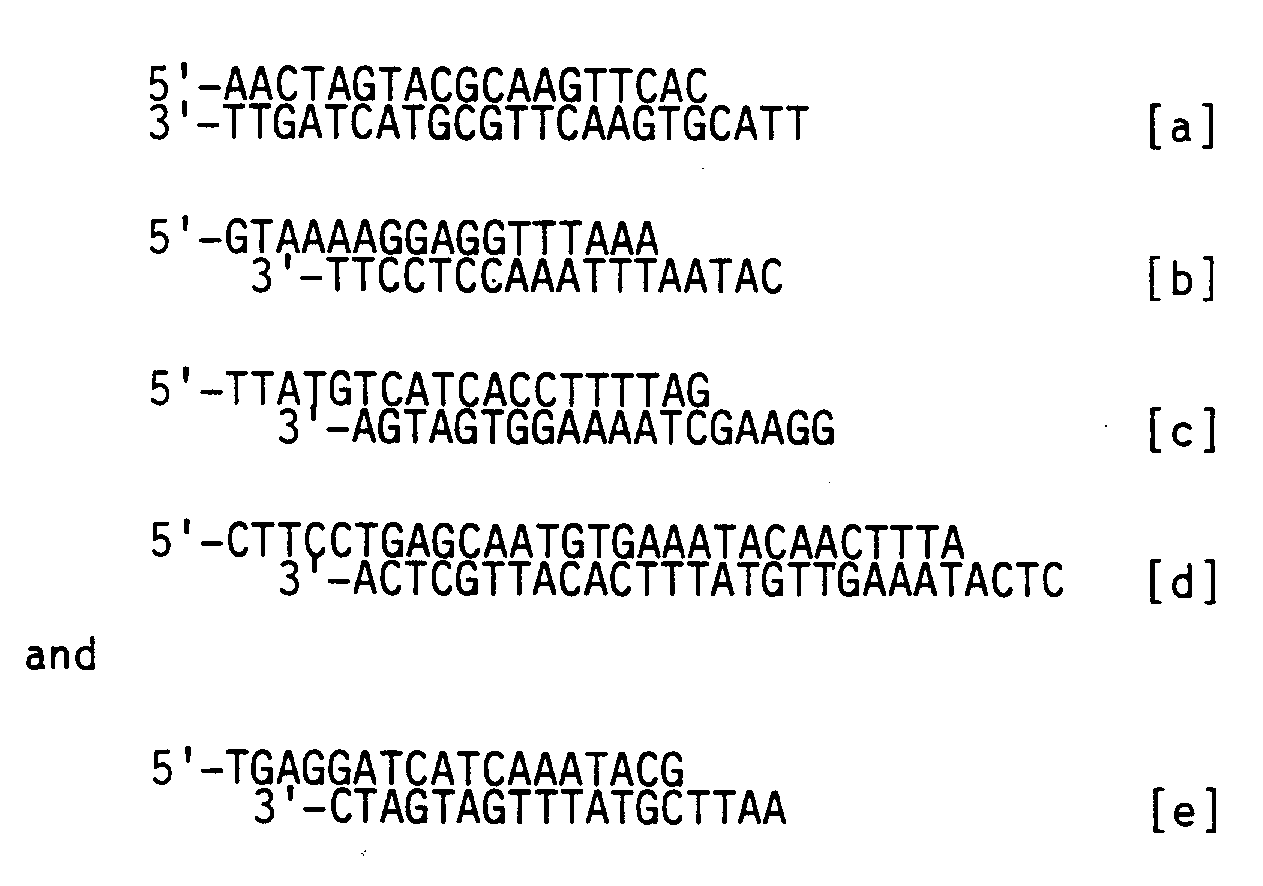
A base sequence of the formula [I] was as follows;
Separately, an expression vector pEP302 (Furutani, Y., et al., Nucleic Acids Res., 13, 5869, 1985) was digested with restriction endonucleases HpaI and BamHI, and the resulting larger DNA fragment containing E. coli tryptophan promoter sequence and an ampicillin resistance gene, was isolated (hereinafter referred to as the EP302 vector-DNA fragment). - The EP302 vector-DNA fragment was ligated by T4 DNA ligase with the SD-IL1-fragment prepared as above to construct an expression plasmid pHIPH383a for producing the mature human interleukin-1α polypeptide (see Schema 3).
- Neutrophils infiltrate into the foci of bacterial infection, inflammation site and around malignant tumor cells, and play important role in homeostatic defence mechanism. Neutrophils are attracted and further activated by NCF or by the combination of NCF with interleukin-1. For example, the use of the combination of NCF and interleukin-1 are expected as a drug for treatment of certain bacterial infectious diseases or cancers.
Claims (7)
- A process for producing a human neutrophil chemotactic factor polypeptide having an amino acid sequence of formula [I]:which comprises:

directly expressing a nucleotide sequence encoding said polypeptide having amino acid sequence of formula [I] in Escherichia coli transformed with an expression vector inclusive of said nucleotide sequence. - A process according to claim 1, wherein the nucleotide sequence encoding the human neutrophil chemotactic factor polypeptide is a nucleotide sequence of formula [A].

- A process for producing a human neutrophil chemotactic factor polypeptide having an amino acid sequence of formula [I]:which comprises:

directly expressing a nucleotide sequence encoding said polypeptide having an amino acid sequence of formula [I] in Escherichia coli transformed with an expression vector inclusive of a nucleotide sequence which a nucleotide sequence represented by formula [B] is connected upstream a nucleotide sequence represented by formula [A]:wherein X is (A)x, wherein x is 1 to 5, and Y is (A)y(T)z, wherein y is 0 to 3 and z is 0 or 1.
- A process according to claim 3, wherein the nucleotide sequence represented by formula [B] is a nucleotide sequence of formula [C].
5'-AAAAGGAGGTTTAAATTATG-3' formula [C] - A process according to claim 1, wherein the expression vector is the recombinant plasmid pHNP101, said plasmid being obtainable according to construction schema 1 of the description.
- A process according to claim 1, wherein the direct expression is controlled under the regulation of a trp promoter in Escherichia coli.
- A purification method of a human neutrophil chemotactic factor polypeptide produced by the method claimed in any one of claims 1 to 6 , which is characterized by the combination of the following steps in the treatment of said polypeptide: destruction of the transformants, treatment for removing nucleic acids, anion and/or cation exchange chromatography, and gel filtration.
Applications Claiming Priority (3)
| Application Number | Priority Date | Filing Date | Title |
|---|---|---|---|
| US18916488A | 1988-05-02 | 1988-05-02 | |
| US189164 | 1988-05-02 | ||
| PCT/JP1989/000437 WO1989010962A1 (en) | 1988-05-02 | 1989-04-26 | Process for producing a human neutrophil chemotactic factor polypeptide |
Publications (2)
| Publication Number | Publication Date |
|---|---|
| EP0413818A1 EP0413818A1 (en) | 1991-02-27 |
| EP0413818B1 true EP0413818B1 (en) | 1994-12-28 |
Family
ID=22696203
Family Applications (1)
| Application Number | Title | Priority Date | Filing Date |
|---|---|---|---|
| EP89905179A Expired - Lifetime EP0413818B1 (en) | 1988-05-02 | 1989-04-26 | Process for producing a human neutrophil chemotactic factor polypeptide |
Country Status (7)
| Country | Link |
|---|---|
| US (1) | US5306627A (en) |
| EP (1) | EP0413818B1 (en) |
| JP (1) | JPH03505037A (en) |
| KR (1) | KR900700615A (en) |
| AT (1) | ATE116366T1 (en) |
| DE (1) | DE68920321T2 (en) |
| WO (1) | WO1989010962A1 (en) |
Families Citing this family (7)
| Publication number | Priority date | Publication date | Assignee | Title |
|---|---|---|---|---|
| ATA901588A (en) | 1987-11-19 | 1994-07-15 | Sandoz Ag | NEUTROPHILE ACTIVATION FACTOR (NAF) DERIVED FROM HUMAN MONONYCYTES AND METHOD FOR THE PRODUCTION THEREOF |
| US5652338A (en) * | 1988-03-16 | 1997-07-29 | The United States Of America As Represented By The Department Of Health And Human Services | Neutrophil chemotactic factor |
| WO1991008231A1 (en) * | 1989-11-29 | 1991-06-13 | Brigham And Women's Hospital | [Ala IL-8]77 AS A LEUKOCYTE ADHESION INHIBITOR |
| US5241049A (en) * | 1989-12-22 | 1993-08-31 | Zymogenetics, Inc. | Neutrophil chemoattractants |
| AU2003299641C1 (en) | 2002-12-16 | 2016-06-02 | Cormorant Pharmaceuticals Ab | Human monoclonal antibodies against interleukin 8 (IL-8) |
| JP2007006419A (en) * | 2005-06-27 | 2007-01-11 | Pioneer Electronic Corp | Speaker damper, speaker and speaker assembling method |
| MX2020006171A (en) | 2018-01-12 | 2020-09-03 | Bristol Myers Squibb Co | Combination therapy with anti-il-8 antibodies and anti-pd-1 antibodies for treating cancer. |
-
1989
- 1989-04-26 JP JP1504941A patent/JPH03505037A/en active Pending
- 1989-04-26 AT AT89905179T patent/ATE116366T1/en not_active IP Right Cessation
- 1989-04-26 DE DE68920321T patent/DE68920321T2/en not_active Expired - Lifetime
- 1989-04-26 EP EP89905179A patent/EP0413818B1/en not_active Expired - Lifetime
- 1989-04-26 KR KR1019890702514A patent/KR900700615A/en not_active Withdrawn
- 1989-04-26 WO PCT/JP1989/000437 patent/WO1989010962A1/en not_active Ceased
-
1991
- 1991-06-04 US US07/711,275 patent/US5306627A/en not_active Expired - Lifetime
Non-Patent Citations (3)
| Title |
|---|
| Biological/Abstracts/RRM, abstract no. 36/22061 (Philadelphia, US), K. Matsushima et al. & Lymphokine Res. 7 (3). 1988. 325 * |
| Chemical Abstracts, vol. 108, no. 9, 29 February 1988 (Columbus, Ohio, US) J. Schmid et al. s. pp. 174-175, abstr. no. 69870z & J. Immunol. 1987, 139 (1), 250-256. * |
| J. Exp. Med., vol. 167, June 1988, K. Marsushima et al. pp. 1883-1893. * |
Also Published As
| Publication number | Publication date |
|---|---|
| US5306627A (en) | 1994-04-26 |
| ATE116366T1 (en) | 1995-01-15 |
| EP0413818A1 (en) | 1991-02-27 |
| JPH03505037A (en) | 1991-11-07 |
| WO1989010962A1 (en) | 1989-11-16 |
| KR900700615A (en) | 1990-08-16 |
| DE68920321D1 (en) | 1995-02-09 |
| DE68920321T2 (en) | 1995-05-24 |
Similar Documents
| Publication | Publication Date | Title |
|---|---|---|
| EP0188920B1 (en) | Interleukin 1 and its derivative | |
| EP0251037B1 (en) | Novel human TNF polypeptide mutants and DNAs encoding said mutants | |
| CA1341240C (en) | Dna encoding human tumor necrosis factor and human tumor necrosis factor polypeptide | |
| US4677064A (en) | Human tumor necrosis factor | |
| US5180811A (en) | Proteins having a tnf action comprising tnf-fibromectin fusion protein | |
| EP0237967A2 (en) | IL-1 beta derivatives and drugs | |
| WO1983002457A1 (en) | Interferon-alpha 76 | |
| IL76699A (en) | Recombinant human tumor necrosis factor, its production and pharmaceutical compositions containing it | |
| AU642399B2 (en) | A polypeptide having human monocyte chemotactic factor activity and a DNA encoding said polypeptide | |
| AU622125B2 (en) | Neutrophil-activating factor | |
| US4973479A (en) | Interferon-α61 | |
| US4975276A (en) | Interferon-alpha 54 | |
| US5306627A (en) | Process for producing a human neutrophil chemotactic factor peptide and a recombinant expression vector for the said polypeptide | |
| JPS6361960B2 (en) | ||
| US5401643A (en) | Method of preparing an active human neutrophil chemotactic factor polypeptide | |
| EP0098864A1 (en) | Interferon-alpha 74 | |
| WO1990000563A1 (en) | A method of treating diseases caused by immunodeficiency states by administering human neutrophil chemotactic factor to human | |
| JP2698976B2 (en) | Novel polypeptide and DNA encoding the same | |
| JP2515975B2 (en) | Polypeptide having antitumor effect | |
| JP2579747B2 (en) | Novel DNA encoding human interleukin 1 | |
| US5290917A (en) | Modified polypeptides of IL-1α | |
| JPH0673095A (en) | Polypeptidfe having human interleukin 1 activity | |
| JPH08245695A (en) | Antitumor active substance | |
| JPH02207788A (en) | Polypeptide having human monocyte chemotactic factor, dna coding same and preparation of them |
Legal Events
| Date | Code | Title | Description |
|---|---|---|---|
| PUAI | Public reference made under article 153(3) epc to a published international application that has entered the european phase |
Free format text: ORIGINAL CODE: 0009012 |
|
| 17P | Request for examination filed |
Effective date: 19900905 |
|
| AK | Designated contracting states |
Kind code of ref document: A1 Designated state(s): AT BE CH DE FR GB IT LI LU NL SE |
|
| 17Q | First examination report despatched |
Effective date: 19930608 |
|
| GRAA | (expected) grant |
Free format text: ORIGINAL CODE: 0009210 |
|
| RAP1 | Party data changed (applicant data changed or rights of an application transferred) |
Owner name: THE GOVERNMENT OF THE UNITED STATES OF AMERICA AS |
|
| REF | Corresponds to: |
Ref document number: 116366 Country of ref document: AT Date of ref document: 19950115 Kind code of ref document: T |
|
| EAL | Se: european patent in force in sweden |
Ref document number: 89905179.1 |
|
| REF | Corresponds to: |
Ref document number: 68920321 Country of ref document: DE Date of ref document: 19950209 |
|
| ITF | It: translation for a ep patent filed | ||
| ET | Fr: translation filed | ||
| PLBE | No opposition filed within time limit |
Free format text: ORIGINAL CODE: 0009261 |
|
| STAA | Information on the status of an ep patent application or granted ep patent |
Free format text: STATUS: NO OPPOSITION FILED WITHIN TIME LIMIT |
|
| 26N | No opposition filed | ||
| REG | Reference to a national code |
Ref country code: GB Ref legal event code: IF02 |
|
| PGFP | Annual fee paid to national office [announced via postgrant information from national office to epo] |
Ref country code: LU Payment date: 20080505 Year of fee payment: 20 Ref country code: DE Payment date: 20080602 Year of fee payment: 20 Ref country code: CH Payment date: 20080430 Year of fee payment: 20 |
|
| PGFP | Annual fee paid to national office [announced via postgrant information from national office to epo] |
Ref country code: AT Payment date: 20080402 Year of fee payment: 20 |
|
| PGFP | Annual fee paid to national office [announced via postgrant information from national office to epo] |
Ref country code: BE Payment date: 20080527 Year of fee payment: 20 Ref country code: IT Payment date: 20080429 Year of fee payment: 20 |
|
| PGFP | Annual fee paid to national office [announced via postgrant information from national office to epo] |
Ref country code: NL Payment date: 20080424 Year of fee payment: 20 Ref country code: SE Payment date: 20080429 Year of fee payment: 20 |
|
| PGFP | Annual fee paid to national office [announced via postgrant information from national office to epo] |
Ref country code: FR Payment date: 20080417 Year of fee payment: 20 |
|
| PGFP | Annual fee paid to national office [announced via postgrant information from national office to epo] |
Ref country code: GB Payment date: 20080429 Year of fee payment: 20 |
|
| BE20 | Be: patent expired |
Owner name: THE *GOVERNMENT OF THE UNITED STATES OF AMERICA AS Effective date: 20090426 |
|
| REG | Reference to a national code |
Ref country code: CH Ref legal event code: PL |
|
| REG | Reference to a national code |
Ref country code: GB Ref legal event code: PE20 Expiry date: 20090425 |
|
| PG25 | Lapsed in a contracting state [announced via postgrant information from national office to epo] |
Ref country code: NL Free format text: LAPSE BECAUSE OF EXPIRATION OF PROTECTION Effective date: 20090426 |
|
| EUG | Se: european patent has lapsed | ||
| NLV7 | Nl: ceased due to reaching the maximum lifetime of a patent |
Effective date: 20090426 |
|
| PG25 | Lapsed in a contracting state [announced via postgrant information from national office to epo] |
Ref country code: GB Free format text: LAPSE BECAUSE OF EXPIRATION OF PROTECTION Effective date: 20090425 |