EP0407494B1 - Sealing pump - Google Patents
Sealing pump Download PDFInfo
- Publication number
- EP0407494B1 EP0407494B1 EP89911677A EP89911677A EP0407494B1 EP 0407494 B1 EP0407494 B1 EP 0407494B1 EP 89911677 A EP89911677 A EP 89911677A EP 89911677 A EP89911677 A EP 89911677A EP 0407494 B1 EP0407494 B1 EP 0407494B1
- Authority
- EP
- European Patent Office
- Prior art keywords
- piston
- seat
- pump
- valve
- container
- Prior art date
- Legal status (The legal status is an assumption and is not a legal conclusion. Google has not performed a legal analysis and makes no representation as to the accuracy of the status listed.)
- Expired - Lifetime
Links
- 238000007789 sealing Methods 0.000 title claims abstract description 16
- 239000007788 liquid Substances 0.000 claims abstract description 42
- 230000005484 gravity Effects 0.000 description 3
- 239000000443 aerosol Substances 0.000 description 2
- 230000000994 depressogenic effect Effects 0.000 description 2
- 239000000463 material Substances 0.000 description 2
- -1 polypropylene Polymers 0.000 description 2
- 239000004698 Polyethylene Substances 0.000 description 1
- 239000004743 Polypropylene Substances 0.000 description 1
- 230000001419 dependent effect Effects 0.000 description 1
- 239000012530 fluid Substances 0.000 description 1
- 230000003993 interaction Effects 0.000 description 1
- 239000006210 lotion Substances 0.000 description 1
- 230000013011 mating Effects 0.000 description 1
- 229920000573 polyethylene Polymers 0.000 description 1
- 229920001155 polypropylene Polymers 0.000 description 1
- 238000005086 pumping Methods 0.000 description 1
- 230000000717 retained effect Effects 0.000 description 1
- 239000000344 soap Substances 0.000 description 1
- 229910001220 stainless steel Inorganic materials 0.000 description 1
- 239000010935 stainless steel Substances 0.000 description 1
Images

Classifications
-
- B—PERFORMING OPERATIONS; TRANSPORTING
- B05—SPRAYING OR ATOMISING IN GENERAL; APPLYING FLUENT MATERIALS TO SURFACES, IN GENERAL
- B05B—SPRAYING APPARATUS; ATOMISING APPARATUS; NOZZLES
- B05B11/00—Single-unit hand-held apparatus in which flow of contents is produced by the muscular force of the operator at the moment of use
- B05B11/01—Single-unit hand-held apparatus in which flow of contents is produced by the muscular force of the operator at the moment of use characterised by the means producing the flow
- B05B11/10—Pump arrangements for transferring the contents from the container to a pump chamber by a sucking effect and forcing the contents out through the dispensing nozzle
- B05B11/1001—Piston pumps
-
- B—PERFORMING OPERATIONS; TRANSPORTING
- B05—SPRAYING OR ATOMISING IN GENERAL; APPLYING FLUENT MATERIALS TO SURFACES, IN GENERAL
- B05B—SPRAYING APPARATUS; ATOMISING APPARATUS; NOZZLES
- B05B11/00—Single-unit hand-held apparatus in which flow of contents is produced by the muscular force of the operator at the moment of use
- B05B11/01—Single-unit hand-held apparatus in which flow of contents is produced by the muscular force of the operator at the moment of use characterised by the means producing the flow
- B05B11/10—Pump arrangements for transferring the contents from the container to a pump chamber by a sucking effect and forcing the contents out through the dispensing nozzle
- B05B11/1042—Components or details
- B05B11/1059—Means for locking a pump or its actuation means in a fixed position
- B05B11/106—Means for locking a pump or its actuation means in a fixed position in a retracted position, e.g. in an end-of-dispensing-stroke position
-
- B—PERFORMING OPERATIONS; TRANSPORTING
- B05—SPRAYING OR ATOMISING IN GENERAL; APPLYING FLUENT MATERIALS TO SURFACES, IN GENERAL
- B05B—SPRAYING APPARATUS; ATOMISING APPARATUS; NOZZLES
- B05B11/00—Single-unit hand-held apparatus in which flow of contents is produced by the muscular force of the operator at the moment of use
- B05B11/01—Single-unit hand-held apparatus in which flow of contents is produced by the muscular force of the operator at the moment of use characterised by the means producing the flow
- B05B11/10—Pump arrangements for transferring the contents from the container to a pump chamber by a sucking effect and forcing the contents out through the dispensing nozzle
- B05B11/1042—Components or details
- B05B11/1066—Pump inlet valves
-
- B—PERFORMING OPERATIONS; TRANSPORTING
- B05—SPRAYING OR ATOMISING IN GENERAL; APPLYING FLUENT MATERIALS TO SURFACES, IN GENERAL
- B05B—SPRAYING APPARATUS; ATOMISING APPARATUS; NOZZLES
- B05B11/00—Single-unit hand-held apparatus in which flow of contents is produced by the muscular force of the operator at the moment of use
- B05B11/01—Single-unit hand-held apparatus in which flow of contents is produced by the muscular force of the operator at the moment of use characterised by the means producing the flow
- B05B11/10—Pump arrangements for transferring the contents from the container to a pump chamber by a sucking effect and forcing the contents out through the dispensing nozzle
- B05B11/1042—Components or details
- B05B11/1066—Pump inlet valves
- B05B11/1067—Pump inlet valves actuated by pressure
-
- B—PERFORMING OPERATIONS; TRANSPORTING
- B05—SPRAYING OR ATOMISING IN GENERAL; APPLYING FLUENT MATERIALS TO SURFACES, IN GENERAL
- B05B—SPRAYING APPARATUS; ATOMISING APPARATUS; NOZZLES
- B05B11/00—Single-unit hand-held apparatus in which flow of contents is produced by the muscular force of the operator at the moment of use
- B05B11/01—Single-unit hand-held apparatus in which flow of contents is produced by the muscular force of the operator at the moment of use characterised by the means producing the flow
- B05B11/10—Pump arrangements for transferring the contents from the container to a pump chamber by a sucking effect and forcing the contents out through the dispensing nozzle
- B05B11/1097—Pump arrangements for transferring the contents from the container to a pump chamber by a sucking effect and forcing the contents out through the dispensing nozzle with means for sucking back the liquid or other fluent material in the nozzle after a dispensing stroke
Definitions
- the present invention relates to manually operated reciprocating pumps for dispensing liquids from a container.
- a conventional throttling pump for dispensing liquids from a container includes a hollow body having opening in each end, into the upper end of which is fitted a hollow piston which is slidable reciprocally in the body with sealing fit, which piston is connected at its upper end to an actuator.
- the piston and body define an interior chamber having an opening at each end.
- the upper opening of the piston connects with a nozzle of the actuator from which the liquid is dispensed.
- An outlet valve is located in the upper opening and may be a ball-type valve.
- An inlet ball-type valve is located in the lower opening in the lower end portion of the body.
- the ball-type valves comprise floating balls which seat on circular valve seats formed in the piston and body.
- the pump described above is prone to leakage around the valves.
- an increase in temperature can cause the liquid to expand and cause a sufficient pressure increase in the container such that both the upper and lower valves open, allowing the liquid to flow out of container and through the actuator nozzle.
- the pump is upended there will be leakage around the valves. Accordingly, it is desireable to provide a positive seal for the pump so that a container and pump may be conveniently transported as a unit without having to provide a separate cap for the container which must be replaced by the pump when the unit is to be used.
- a final problem associated with the conventional pump design is its reduced effectiveness when it is not vertically oriented during use. Since during the initial portion of the piston stroke, before a pressure differential is developed, the balls of the valves are held in place by gravity, the balls may not seal the valves if the pump is moved from the vertical position. In addition, when a viscous liquid is being pumped, the balls will tend to be suspended in the liquid and the sealing of the valves will be slowed, reducing the pump's effectiveness.
- U. S. Patent No. 4,606,479 to Van Brocklin discloses a pump in which the ball-type valves of the conventional pump are replaced with a valve member which is movable inside the piston and operates as an upper valve by seating its upper end in a valve seat in the upper end of the piston, and which operates as a lower valve by frictionally engaging a cylindrical sleeve which is movable to seat around a ring formed in the lower end of the body.
- the pump does not however have the capability to draw material back from the actuator nozzle tip.
- French Patent No. 1,509,866 discloses an aerosol pump in which the upper valve is a movable element associated with a support that fits within the piston. This disclosure does not provide for sealing of the piston and the support, nor does it provide for a quick closing of the lower valve upon a downward dispensing stroke.
- French Patent No. 1,512,926 discloses an aerosol pump in which the lower valve is a movable element that interacts with the piston. This disclosure does not provide for a means to hold the upper valve open for a brief initial portion of an upward stroke in order to draw excess liquid contents back from the nozzle to the pump chamber and/or actuator.
- the invention consists in a pump for dispensing liquids from a container, comprising: a hollow body having upper and lower ends having openings therein; a hollow piston slidable reciprocally with sealing fit in said body, said piston having upper and lower ends having openings therein; means for biasing said piston against a downward stroke and for biasing said piston with an upward stroke; a chamber defined by said piston and body; an actuator seated on the upper end of said piston; said pump comprising: a piston seat slidable reciprocally inside said piston, said piston seat having a larger diameter segment at its lower end sized for sealing fit inside said lower end of said piston during a terminal portion of a downward stroke of said piston and an initial portion of an upward stroke of said piston, said larger diameter segment having a lower valve member formed at its bottom, and said piston seat having a smaller diameter segment at its upper end sized to provide a space between said smaller diameter segment and the inner walls of said piston, and having a bore therein; an upper valve positioned in the upper end of said piston, said upper end of
- the invention thus provides a pump for dispensing liquids from a container which may be positively sealed for transporting the container; which may be easily primed when used with viscous liquids; which may draw any undispensed liquid from the dispensing nozzle back into the piston chamber; and which may be operable in any orientation without requiring gravitational forces for effectiveness.
- Pump 110 comprises a hollow body 112 having an upper opening 114 in its upper end 116 and a lower opening 118 in its lower end 120.
- the body 112 is cylindrical and has a flange 122 extending radially outwardly from its upper end 116.
- vent 117 is provided in the upper end 116 of the body 112.
- the lower end 120 of the body 112 is tapered in the vicinity of the lower opening 118.
- a hollow tube 124 extends from the lower end of the body 112, and a diptube 126 which extends down into the container 128 bay be fitted onto tube 124. During operation of the pump 110, liquid is drawn up from container 128 through the diptube 126 into tube 124 and thence into pump 110.
- a hollow piston 130 which is slidable reciprocally with sealing fit in body 112 is fitted into the upper end 116 of body 112.
- Piston 130 has an upper end 132 with an opening 134 therein, and a lower end 136 with an opening 138 therein.
- piston 130 is cylindrical.
- the lower end 136 has a larger diameter than the upper end 132.
- An annular chamber 140 may be provided in the lower end 136 of the piston 130.
- piston seat 142 sized to be received inside piston 130 is fitted inside the piston 130 and the body 112. Piston seat 142 is slidable reciprocally inside piston 130. As shown in FIG. 3 , piston seat 142 has a larger diameter segment 144 at its lower end sized for sealing fit inside piston 130 when piston 130 is at the end of a downward stroke. A lower valve member 168 is located at the bottom of the smaller diameter segment 144. Preferably, the larger diameter segment has a flange 143 located between the lower valve member 168 and the segment 144. Flow passages 146 are provided in the larger diameter segment 144 so that liquid flowing up from the container 128 can enter the body 12.
- Piston seat 142 has a smaller diameter segment 148 at its upper end sized to provide a space between the exterior of the smaller diameter segment 148 and the inner walls 152 of the piston 130.
- the smaller diameter segment 148 is a sleeve, i.e. it has a central bore 149 extending downwardly from its upper end to about the larger diameter segment 144.
- the sleeve is a split sleeve, as shown in FIG. 6 , i.e., the bore 149 has channels 151 communicating with a chamber 150.
- Ribs 147 are provided on the outer walls of piston seat 142 to extend to about the inner diameter of the piston 130.
- Chamber 150 is defined by the inner walls of the piston 130, the inner walls of the body 112 and the outer walls of the piston seat 142.
- Means for biasing piston 130 against a downward stroke and for biasing it with an upward stroke is provided, and preferably comprises a coil spring 154.
- the upper end 156 of the coil spring 154 fits into annular chamber 140 in the lower end of piston 130.
- the lower end 158 of coil spring 154 may be located to act as a stop for the piston seat 142 by acting on the flange 143.
- An upper valve 160 is positioned in the upper end 132 of piston 130. Upper valve 160 is moveable to open the opening 134 in the upper end 132 of piston 130 during a downward stroke of piston 130 to dispense liquids from the chamber 150. Upper valve 160 is biased to be closed by the action of the biasing means. Upper valve 160 comprises an upper valve seat 164 formed in the upper end 132 of piston 130 and a valve member 162 having a stem 163 extending downwardly through the valve seat 164. Stem 163 is sized and adapted to be slidably fitted inside bore 149 of the smaller diameter segment 148 of piston seat 142. Stem 163 is sized to frictionally engage bore 149. Upper valve 160 is openable to dispense liquid from body 12 and piston 30 by a downward stroke of piston 30 because the upper valve seat 164 moves downwardly while the upper valve member 162 remains held stationary by the frictional engagement of stem 163 in bore 149.
- a lower valve 166 is positioned in the lower end of body 112.
- Lower valve 166 is moveable to open the opening 118 in lower end 120 of body 112 during an upward stroke of piston 130, to permit liquid to enter chamber 150.
- Lower valve 166 is biased to open the opening 118 in the lower end 120 of body 112.
- Lower valve 166 comprises a lower valve seat 170 formed in the lower end 120 of body 112 and the lower valve member 168 formed on the bottom of piston seat 142.
- Lower valve 166 is closeable by a downward stroke of piston 130 because of the force applied to the upper valve member 162 by the lower end of an actuator 180 causes the piston seat 142 to move downwardly, thereby seating the lower valve member 168 in the lower valve seat 170.
- Frictional engagement of the inner walls of the piston 130 with the ribs 147 on the piston seat 142 will similarly operate to close the lower valve 166.
- the frictional engagement of the inner walls of the piston 130 with the outer walls of the larger diameter segment 144 of the piston seat 142 will cause the lower valve member 166 to close.
- the actuator 180 may be seated on the upper end of piston 130.
- Actuator 180 has a nozzle 182 for dispensing liquid, and an upper surface 184 for finger actuation of the pump 110.
- Actuator 180 is adapted to press on the upper end of the upper valve member 162 after the upper valve 160 opens, and causes stem 163 to telescope inside bore 149 during the terminal portion of a downward stroke of the piston 130.
- Container closure 186 has a central aperture 188 through which extends the upper end 132 of piston 130. Piston 130 is retained in the body 112 by providing its lower end 136 with a larger diameter than its upper end 132 so that the lower end 136 cannot pass through the aperture 188 of the closure 186.
- Container closure 186 fits over the neck of the container 128, and may be held in place by screw threads formed on both, or by a snap fit combination.
- the container closure 186 further comprises a collar 190 extending upwardly from closure 186, and the holding means comprises mating threads 192 and 194 formed on the outer surface of actuator 180 and on the inner surface of collar 190.
- the various components of the pump 110 are formed of polymeric materials, preferably polypropylene or polyethylene.
- the coil spring is preferably formed of stainless steel.
- FIGS. 1-5 The operation of the pump 110 is shown in FIGS. 1-5. Beginning from the biased rest position shown in FIG. 1 with the piston 130 in the up position, the upper valve 166 is held closed by the frictional engagement of the stem 163 inside the bore 149 of the piston seat 142. Force applied to the actuator 180 causes the piston 130 to move downwardly, as shown in FIG. 2. During the downward stroke, the upper valve member member 162 remains stationary due to the frictional engagement of the stem 163 in the bore 149, while the valve seat 164 moves downwardly with the piston 130, so that the upper valve 160 is opened. As the actuator 180 and piston 130 continue through their downward stroke, as shown in FIGS. 2 and 3, the lower end of the actuator 180 contacts the upper end of upper valve member 162 and pushes on it.
- piston seat 142 moves downwardly until the lower valve member 168 seats in lower valve seat 170, closing lower valve 166.
- a lip or other protrusion may be provided on the inner walls of piston 130 at its upper end 32 to contact and press on the upper valve member 162 to push it downwardly.
- the piston seat 142 may also be moved downwardly by the frictional engagement of the ribs 147 with the downwardly moving piston 130.
- the upper valve 160 is opened and the lower valve 166 is closed, allowing the pressure in chamber 150 to increase so that the contents of the chamber 150 travel through the opening 134 and into the actuator 180 and are dispensed through actuator nozzle 182 during the remainder of the downward stroke.
- the inner walls of the lower end 136 of the piston 130 are sealingly fitted around the outer walls of the larger diameter segment 144 of the piston seat 142. If the pump is provided with holding means, the piston may be held at the end of the downward stroke, as shown in FIG. 4, to prevent leakage of the contents of the container.
- the piston 130 which is in frictional engagement with the larger diameter segment 144 of the piston seat 142 or the ribs 147 of the piston seat 142, carries the piston seat 142 upwardly and thereby opens the lower valve 166 by lifting the lower valve member 168 up off of the lower valve seat 170.
- the upper valve 160 remains open, since upper valve member 162 moves upwardly with the piston seat 142, and thus the valve seat 164, which is moving upwardly with the piston 130, does not contact the upper valve member 162.
- the upper valve 160 will close when the upper valve seat 164 contacts the upper valve member 162, and liquid will be drawn into the chamber 150 as previously described.
- vent 117 vents the container 128 to the compartment 196 defined by the closure 186, the body 112, and the piston 130, which compartment 196 is in turn vented to the atmosphere through the aperture 188 around the piston 130.
- the vent 117 allows the pressure in the container 128 to equilibrate with atmospheric pressure so that there is no build up of vacuum in the container 128 which would cause it to collapse and which would impede operation of the pump 110.
- the pump 110 provides a sealing closure of the container 128 when the piston 130 is sufficiently depressed so that the inner walls of the piston 130 slide onto the larger diameter segment 144 of the piston seat 142.
- This sealing closure can be maintained by the holding means described above to provide a sealed pump and container during transport of the container 128 and pump 110.
- the telescoping interaction between the upper and lower valve members holds the upper valve open during the initial portion of an upward stroke, so that the pump 110 can draw liquid at the nozzle 182 back into itself.
- the volume of the pump 110 which must be filled by each pump stroke is reduced, and also allows the creation of higher pressure differentials between the chamber 150 and the container 128 during each pump cycle, so that less liquid is required to prime the pump, and making it easier for the pump 110 to cause viscous liquids to be drawn into the chamber 150 when the pump 10 is being primed. Further, the action of the mechanically coupled valves is not impeded by viscous fluids.
- the described embodiment of the invention also provides a pump mechanism which is useable in any position. Since the operation of the pump is based on mechanically activated valves, the pump is unaffected by gravity, and it will provide effective pumping in any position.
Landscapes
- Closures For Containers (AREA)
Abstract
Description
- The present invention relates to manually operated reciprocating pumps for dispensing liquids from a container.
- A conventional throttling pump for dispensing liquids from a container includes a hollow body having opening in each end, into the upper end of which is fitted a hollow piston which is slidable reciprocally in the body with sealing fit, which piston is connected at its upper end to an actuator. The piston and body define an interior chamber having an opening at each end. The upper opening of the piston connects with a nozzle of the actuator from which the liquid is dispensed. An outlet valve is located in the upper opening and may be a ball-type valve. An inlet ball-type valve is located in the lower opening in the lower end portion of the body. The ball-type valves comprise floating balls which seat on circular valve seats formed in the piston and body. The operation of such ball-type valves is dependent on liquid pressure causing the ball to move away from the valve seat. Typically, during a dispensing stroke of the piston, force is applied to the actuator, which causes the piston to slide downwardly into the body, causing the piston chamber to decrease in size and the pressure inside the chamber to increase. The liquid pressure inside the chamber causes the upper valve to open, while the lower valve is held closed by the same pressure, so that liquid flows out of the chamber and is dispensed. A spring is provided to return the piston to an up position when the actuator is released. During an upward stroke, a vacuum is formed in the chamber causing the upper valve to close and the lower valve to open so that liquid is drawn through the opening in the lower end of the body into the chamber.
- It has been found that the pump described above is prone to leakage around the valves. For example, an increase in temperature can cause the liquid to expand and cause a sufficient pressure increase in the container such that both the upper and lower valves open, allowing the liquid to flow out of container and through the actuator nozzle. Similarly, if the pump is upended there will be leakage around the valves. Accordingly, it is desireable to provide a positive seal for the pump so that a container and pump may be conveniently transported as a unit without having to provide a separate cap for the container which must be replaced by the pump when the unit is to be used.
- In addition, it has been found that it is desireable to provide a way for liquid which is in the dispensing nozzle of the actuator to be drawn back into the pump so that drops of liquid are not left on the tip of the nozzle.
- An additional problem arises when a conventional pump is used to dispense viscous liquids such as liquid soap or lotions. The conventional pump may be very difficult to prime with such viscous liquids, since the leakage of air around the valves may reduce the vacuum created in the piston chamber by an upward stroke so that there is an insufficient pressure differential between the piston chamber and the container, to overcome gravity and the flow resistance of the viscous liquid.
- A final problem associated with the conventional pump design is its reduced effectiveness when it is not vertically oriented during use. Since during the initial portion of the piston stroke, before a pressure differential is developed, the balls of the valves are held in place by gravity, the balls may not seal the valves if the pump is moved from the vertical position. In addition, when a viscous liquid is being pumped, the balls will tend to be suspended in the liquid and the sealing of the valves will be slowed, reducing the pump's effectiveness.
- Several improvements over the conventional pump design have been proposed. U. S. Patent No. 4,606,479 to Van Brocklin discloses a pump in which the ball-type valves of the conventional pump are replaced with a valve member which is movable inside the piston and operates as an upper valve by seating its upper end in a valve seat in the upper end of the piston, and which operates as a lower valve by frictionally engaging a cylindrical sleeve which is movable to seat around a ring formed in the lower end of the body. The pump does not however have the capability to draw material back from the actuator nozzle tip.
- French Patent No. 1,509,866 discloses an aerosol pump in which the upper valve is a movable element associated with a support that fits within the piston. This disclosure does not provide for sealing of the piston and the support, nor does it provide for a quick closing of the lower valve upon a downward dispensing stroke.
- French Patent No. 1,512,926 discloses an aerosol pump in which the lower valve is a movable element that interacts with the piston. This disclosure does not provide for a means to hold the upper valve open for a brief initial portion of an upward stroke in order to draw excess liquid contents back from the nozzle to the pump chamber and/or actuator.
- Other patents of interest include U.S. Patent No. 3,237,571 to Corsette; U.S. Patent No. 3,627,206 to Boris; U.S. Patent No. 4230,242 to Meshberg; and U.S. Patent No. 4212,332 to Kutik et al.
- It is an object of the present invention to provide a pump for dispensing liquids from a container, which pump substantially overcomes one or more of the afore-mentioned problems.
- Accordingly, the invention consists in a pump for dispensing liquids from a container, comprising: a hollow body having upper and lower ends having openings therein; a hollow piston slidable reciprocally with sealing fit in said body, said piston having upper and lower ends having openings therein; means for biasing said piston against a downward stroke and for biasing said piston with an upward stroke; a chamber defined by said piston and body; an actuator seated on the upper end of said piston;
said pump comprising:
a piston seat slidable reciprocally inside said piston, said piston seat having a larger diameter segment at its lower end sized for sealing fit inside said lower end of said piston during a terminal portion of a downward stroke of said piston and an initial portion of an upward stroke of said piston, said larger diameter segment having a lower valve member formed at its bottom, and said piston seat having a smaller diameter segment at its upper end sized to provide a space between said smaller diameter segment and the inner walls of said piston, and having a bore therein;
an upper valve positioned in the upper end of said piston, said upper valve comprising an upper valve seat formed in the upper end of said piston, and an upper valve member having a stem extending downwardly and slidably fitting inside said bore of the smaller diameter segment of said piston seat, said stem being sized to frictionally engage said bore, said upper valve being openable to dispense liquid from said chamber by a downward stroke of said piston whereby said upper valve seat moves downwardly while said upper valve member remains held stationary by the frictional engagement of said stem in said bore; and
a lower valve positioned in the lower end of said body, said lower valve comprising a lower valve seat formed in the lower end of said body, and said lower valve member formed on the lower end of said piston seat, said lower valve being closable by a downward stroke of said piston whereby said actuator contacts said upper valve member, causing said piston seat to move downwardly and seat said lower valve member against said lower valve seat;
said pump being characterised by:
ribs formed on said smaller diameter segment of said piston seat and extending outwardly therefrom, said ribs being sized for frictional engagement with said inner walls of said piston, whereby said piston seat is moved downwardly with said piston during a downward stroke of said piston to cause similarly said lower valve to close. - The invention thus provides a pump for dispensing liquids from a container which may be positively sealed for transporting the container; which may be easily primed when used with viscous liquids; which may draw any undispensed liquid from the dispensing nozzle back into the piston chamber; and which may be operable in any orientation without requiring gravitational forces for effectiveness.
- The invention will now be described by way of example, with reference to the accompanying drawings, wherein:
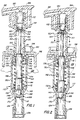
- FIG. 1 is a cross-sectional view of an embodiment of a pump of the present invention with its piston in an up position.
- FIG. 2 is a cross-sectional view of the pump of FIG. 1, showing the initial portion of a downward stroke.
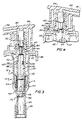
- FIG. 3 is a cross-sectional view of the pump of FIG. 1, showing the piston in the down position at the end of a downward stroke.
- FIG. 4 is a cross-sectional view of the pump of FIG. 1 showing the piston holding means.
- FIG. 5 is a cross-sectional view of the pump of FIG. 1 showing the middle portion of an upward stroke.
- FIG. 6 is a cross-sectional view of the piston seat of the pump of FIG. 1.
- With reference to the drawings, an embodiment of a
sealing pump 110 in accordance with the invention is shown.Pump 110 comprises ahollow body 112 having an upper opening 114 in itsupper end 116 and alower opening 118 in itslower end 120. Preferably thebody 112 is cylindrical and has aflange 122 extending radially outwardly from itsupper end 116. Preferablyvent 117 is provided in theupper end 116 of thebody 112. Preferably thelower end 120 of thebody 112 is tapered in the vicinity of thelower opening 118. Ahollow tube 124 extends from the lower end of thebody 112, and adiptube 126 which extends down into thecontainer 128 bay be fitted ontotube 124. During operation of thepump 110, liquid is drawn up fromcontainer 128 through thediptube 126 intotube 124 and thence intopump 110. - A
hollow piston 130 which is slidable reciprocally with sealing fit inbody 112 is fitted into theupper end 116 ofbody 112. Piston 130 has anupper end 132 with an opening 134 therein, and alower end 136 with an opening 138 therein. Preferablypiston 130 is cylindrical. Preferably thelower end 136 has a larger diameter than theupper end 132. Anannular chamber 140 may be provided in thelower end 136 of thepiston 130. - A
piston seat 142 sized to be received insidepiston 130 is fitted inside thepiston 130 and thebody 112. Pistonseat 142 is slidable reciprocally insidepiston 130. As shown in FIG. 3 ,piston seat 142 has alarger diameter segment 144 at its lower end sized for sealing fit insidepiston 130 whenpiston 130 is at the end of a downward stroke. Alower valve member 168 is located at the bottom of thesmaller diameter segment 144. Preferably, the larger diameter segment has aflange 143 located between thelower valve member 168 and thesegment 144.Flow passages 146 are provided in thelarger diameter segment 144 so that liquid flowing up from thecontainer 128 can enter the body 12. - Piston
seat 142 has asmaller diameter segment 148 at its upper end sized to provide a space between the exterior of thesmaller diameter segment 148 and theinner walls 152 of thepiston 130. Thesmaller diameter segment 148 is a sleeve, i.e. it has acentral bore 149 extending downwardly from its upper end to about thelarger diameter segment 144. Preferably the sleeve is a split sleeve, as shown in FIG. 6 , i.e., thebore 149 haschannels 151 communicating with achamber 150. -
Ribs 147 are provided on the outer walls ofpiston seat 142 to extend to about the inner diameter of thepiston 130.Chamber 150 is defined by the inner walls of thepiston 130, the inner walls of thebody 112 and the outer walls of thepiston seat 142. - Means for biasing
piston 130 against a downward stroke and for biasing it with an upward stroke is provided, and preferably comprises acoil spring 154. Theupper end 156 of thecoil spring 154 fits intoannular chamber 140 in the lower end ofpiston 130. The lower end 158 ofcoil spring 154 may be located to act as a stop for thepiston seat 142 by acting on theflange 143. - An
upper valve 160 is positioned in theupper end 132 ofpiston 130.Upper valve 160 is moveable to open theopening 134 in theupper end 132 ofpiston 130 during a downward stroke ofpiston 130 to dispense liquids from thechamber 150.Upper valve 160 is biased to be closed by the action of the biasing means.Upper valve 160 comprises anupper valve seat 164 formed in theupper end 132 ofpiston 130 and avalve member 162 having astem 163 extending downwardly through thevalve seat 164.Stem 163 is sized and adapted to be slidably fitted insidebore 149 of thesmaller diameter segment 148 ofpiston seat 142.Stem 163 is sized to frictionally engagebore 149.Upper valve 160 is openable to dispense liquid from body 12 and piston 30 by a downward stroke of piston 30 because theupper valve seat 164 moves downwardly while theupper valve member 162 remains held stationary by the frictional engagement ofstem 163 inbore 149. - A
lower valve 166 is positioned in the lower end ofbody 112.Lower valve 166 is moveable to open theopening 118 inlower end 120 ofbody 112 during an upward stroke ofpiston 130, to permit liquid to enterchamber 150.Lower valve 166 is biased to open theopening 118 in thelower end 120 ofbody 112.Lower valve 166 comprises alower valve seat 170 formed in thelower end 120 ofbody 112 and thelower valve member 168 formed on the bottom ofpiston seat 142.Lower valve 166 is closeable by a downward stroke ofpiston 130 because of the force applied to theupper valve member 162 by the lower end of anactuator 180 causes thepiston seat 142 to move downwardly, thereby seating thelower valve member 168 in thelower valve seat 170. Frictional engagement of the inner walls of thepiston 130 with theribs 147 on thepiston seat 142 will similarly operate to close thelower valve 166. In addition, when thepiston 130 is sufficiently depressed, the frictional engagement of the inner walls of thepiston 130 with the outer walls of thelarger diameter segment 144 of thepiston seat 142 will cause thelower valve member 166 to close. - The
actuator 180 may be seated on the upper end ofpiston 130.Actuator 180 has anozzle 182 for dispensing liquid, and anupper surface 184 for finger actuation of thepump 110.Actuator 180 is adapted to press on the upper end of theupper valve member 162 after theupper valve 160 opens, and causes stem 163 to telescope inside bore 149 during the terminal portion of a downward stroke of thepiston 130. -
Pump 110 is secured tocontainer 128 by a sealingcontainer closure 186. Theflange 122 ofbody 112 fits intocontainer closure 186.Container closure 186 has acentral aperture 188 through which extends theupper end 132 ofpiston 130.Piston 130 is retained in thebody 112 by providing itslower end 136 with a larger diameter than itsupper end 132 so that thelower end 136 cannot pass through theaperture 188 of theclosure 186.Container closure 186 fits over the neck of thecontainer 128, and may be held in place by screw threads formed on both, or by a snap fit combination. - Means for holding
piston 130 in place at the bottom of a downward stroke is preferably provided. Preferably, thecontainer closure 186 further comprises acollar 190 extending upwardly fromclosure 186, and the holding means comprisesmating threads actuator 180 and on the inner surface ofcollar 190. - Preferably the various components of the
pump 110 are formed of polymeric materials, preferably polypropylene or polyethylene. The coil spring is preferably formed of stainless steel. - The operation of the
pump 110 is shown in FIGS. 1-5. Beginning from the biased rest position shown in FIG. 1 with thepiston 130 in the up position, theupper valve 166 is held closed by the frictional engagement of thestem 163 inside thebore 149 of thepiston seat 142. Force applied to theactuator 180 causes thepiston 130 to move downwardly, as shown in FIG. 2. During the downward stroke, the uppervalve member member 162 remains stationary due to the frictional engagement of thestem 163 in thebore 149, while thevalve seat 164 moves downwardly with thepiston 130, so that theupper valve 160 is opened. As theactuator 180 andpiston 130 continue through their downward stroke, as shown in FIGS. 2 and 3, the lower end of the actuator 180 contacts the upper end ofupper valve member 162 and pushes on it. Once the actuator contacts theupper valve member 162, the frictional engagement of thestem 163 inside thebore 149 ofpiston seat 142 causes thepiston seat 142 to move downwardly until thelower valve member 168 seats inlower valve seat 170, closinglower valve 166. If desired, a lip or other protrusion may be provided on the inner walls ofpiston 130 at its upper end 32 to contact and press on theupper valve member 162 to push it downwardly. Thepiston seat 142 may also be moved downwardly by the frictional engagement of theribs 147 with the downwardly movingpiston 130. At this point, theupper valve 160 is opened and thelower valve 166 is closed, allowing the pressure inchamber 150 to increase so that the contents of thechamber 150 travel through theopening 134 and into theactuator 180 and are dispensed throughactuator nozzle 182 during the remainder of the downward stroke. - As the downward stroke of
piston 130 continues, thestem 163 telescopes into thebore 149, by the action of theactuator 180 pushing on theupper valve member 162, during which time theupper valve 160 remains open. - At the terminal portion of the downward stroke, shown in FIG. 3, the inner walls of the
lower end 136 of thepiston 130 are sealingly fitted around the outer walls of thelarger diameter segment 144 of thepiston seat 142. If the pump is provided with holding means, the piston may be held at the end of the downward stroke, as shown in FIG. 4, to prevent leakage of the contents of the container. - When the force on the actuator is released, the
coil spring 154 causes thepiston 130 to move upwardly. - The
piston 130, which is in frictional engagement with thelarger diameter segment 144 of thepiston seat 142 or theribs 147 of thepiston seat 142, carries thepiston seat 142 upwardly and thereby opens thelower valve 166 by lifting thelower valve member 168 up off of thelower valve seat 170. During this time theupper valve 160 remains open, sinceupper valve member 162 moves upwardly with thepiston seat 142, and thus thevalve seat 164, which is moving upwardly with thepiston 130, does not contact theupper valve member 162. When the piston seat reaches the end of its travel, theupper valve 160 will close when theupper valve seat 164 contacts theupper valve member 162, and liquid will be drawn into thechamber 150 as previously described. - During each stroke, the
vent 117 vents thecontainer 128 to thecompartment 196 defined by theclosure 186, thebody 112, and thepiston 130, whichcompartment 196 is in turn vented to the atmosphere through theaperture 188 around thepiston 130. Thevent 117 allows the pressure in thecontainer 128 to equilibrate with atmospheric pressure so that there is no build up of vacuum in thecontainer 128 which would cause it to collapse and which would impede operation of thepump 110. - The
pump 110 provides a sealing closure of thecontainer 128 when thepiston 130 is sufficiently depressed so that the inner walls of thepiston 130 slide onto thelarger diameter segment 144 of thepiston seat 142. This sealing closure can be maintained by the holding means described above to provide a sealed pump and container during transport of thecontainer 128 and pump 110. - In addition, the telescoping interaction between the upper and lower valve members holds the upper valve open during the initial portion of an upward stroke, so that the
pump 110 can draw liquid at thenozzle 182 back into itself. - Further, by providing the described piston seat which extends into the
body 112 andpiston 130, the volume of thepump 110 which must be filled by each pump stroke is reduced, and also allows the creation of higher pressure differentials between thechamber 150 and thecontainer 128 during each pump cycle, so that less liquid is required to prime the pump, and making it easier for thepump 110 to cause viscous liquids to be drawn into thechamber 150 when the pump 10 is being primed. Further, the action of the mechanically coupled valves is not impeded by viscous fluids. - The described embodiment of the invention also provides a pump mechanism which is useable in any position. Since the operation of the pump is based on mechanically activated valves, the pump is unaffected by gravity, and it will provide effective pumping in any position.
Claims (4)
- A pump for dispensing liquids from a container, comprising: a hollow body (112) having upper and lower ends having openings therein; a hollow piston (130) slidable reciprocally with sealing fit in said body, said piston having upper and lower ends having openings therein; means (154) for biasing said piston against a downward stroke and for biasing said piston with an upward stroke; a chamber (148) defined by said piston and body; an actuator (180) seated on the upper end of said piston;
said pump comprising:
a piston seat (142) slidable reciprocally inside said piston, said piston seat having a larger diameter segment (144) at its lower end sized for sealing fit inside said lower end of said piston during a terminal portion of a downward stroke of said piston and an initial portion of an upward stroke of said piston, said larger diameter segment having a lower valve member formed at its bottom, and said piston seat (142) having a smaller diameter segment (148) at its upper end sized to provide a space between said smaller diameter segment and the inner walls of said piston, and having a bore (149) therein;
an upper valve (160) positioned in the upper end of said piston (130), said upper valve comprising an upper valve seat (164) formed in the upper end of said piston (130), and an upper valve member (162) having a stem (163) extending downwardly and slidably fitting inside said bore of the smaller diameter segment (148) of said piston seat (142), said stem (163) being sized to frictionally engage said bore (149), said upper valve (160) being openable to dispense liquid from said chamber by a downward stroke of said piston (130) whereby said upper valve seat (164) moves downwardly while said upper valve member (162) remains held stationary by the frictional engagement of said stem in said bore (149); and
a lower valve (166) positioned in the lower end of said body (112), said lower valve (166) comprising a lower valve seat (170) formed in the lower end of said body (112), and said lower valve member (168) formed on the lower end of said piston seat (142), said lower valve (166) being closable by a downward stroke of said piston (130) whereby said actuator (180) contacts said upper valve member (162), causing said piston seat (142) to move downwardly and seat said lower valve member (168) against said lower valve seat (170);
said pump being characterised by:
ribs (147) formed on said smaller diameter segment (148) of said piston seat (142) and extending outwardly therefrom, said ribs being sized for frictional engagement with said inner walls of said piston (130), whereby said piston seat (142) is moved downwardly with said piston (130) during a downward stroke of said piston (130) to cause similarly lower valve (166) to close. - A pump for dispensing liquids from a container in accordance with claim 1, wherein said actuator (180) is adapted to press on the upper end of said upper valve member (162) after opening of said upper valve (160) during a downward stroke, whereby said stem (163) is telescoped inside said bore of said piston seat (142) during a downward stroke.
- A pump for dispensing liquids from a container in accordance with claim 1 or 2, comprising a container closure (186) fitted onto said upper end of said body (112) having a central aperture (188) therein through which extends said smaller diameter segment of said piston (130) with slidable sealing fit.
- A pump for dispensing liquids from a container in accordance with any preceding claim, comprising means (192, 194) for holding said piston in place at the end of a downward stroke.
Applications Claiming Priority (3)
| Application Number | Priority Date | Filing Date | Title |
|---|---|---|---|
| US256327 | 1988-10-11 | ||
| US07/256,327 US4991747A (en) | 1988-10-11 | 1988-10-11 | Sealing pump |
| PCT/US1989/004495 WO1990003929A1 (en) | 1988-10-11 | 1989-10-05 | Sealing pump |
Publications (3)
| Publication Number | Publication Date |
|---|---|
| EP0407494A1 EP0407494A1 (en) | 1991-01-16 |
| EP0407494A4 EP0407494A4 (en) | 1992-01-22 |
| EP0407494B1 true EP0407494B1 (en) | 1994-09-21 |
Family
ID=22971831
Family Applications (1)
| Application Number | Title | Priority Date | Filing Date |
|---|---|---|---|
| EP89911677A Expired - Lifetime EP0407494B1 (en) | 1988-10-11 | 1989-10-05 | Sealing pump |
Country Status (4)
| Country | Link |
|---|---|
| US (1) | US4991747A (en) |
| EP (1) | EP0407494B1 (en) |
| DE (1) | DE68918441D1 (en) |
| WO (1) | WO1990003929A1 (en) |
Families Citing this family (35)
| Publication number | Priority date | Publication date | Assignee | Title |
|---|---|---|---|---|
| FR2649382B1 (en) * | 1989-07-04 | 1991-10-31 | Aerosols & Bouchage | MINIATURE DISTRIBUTORS |
| US5199167A (en) * | 1989-07-04 | 1993-04-06 | Societe Francaise D/Aerosols Et De Bouchage | Method of manufacture of miniature dispenser |
| US5192006A (en) * | 1991-05-01 | 1993-03-09 | Risdon Corporation | Low profile pump |
| US5255823A (en) * | 1992-05-21 | 1993-10-26 | Risdon Corporation | Actuator and cap for a fluid dispenser |
| US5277340A (en) * | 1992-11-05 | 1994-01-11 | Risdon Corporation | Dispensing container |
| US5458289A (en) * | 1993-03-01 | 1995-10-17 | Bespak Plc | Liquid dispensing apparatus with reduced clogging |
| US5335858A (en) * | 1993-04-14 | 1994-08-09 | Dunning Walter B | Pump sprayer having leak preventing seals and closures |
| US6000581A (en) * | 1993-06-23 | 1999-12-14 | American Cyanamid Company | Dispenser gun for viscous or semi-viscous products |
| US5816452A (en) * | 1993-06-23 | 1998-10-06 | American Cyanamid Company | Dispenser gun for viscous or semi-viscous products |
| SG47866A1 (en) * | 1993-06-23 | 1998-04-17 | American Cyanamid Co | Dispenser gun for viscous or semi-viscous products |
| DE9311935U1 (en) * | 1993-08-10 | 1993-10-21 | Baldwin-Gegenheimer Gmbh, 86165 Augsburg | Liquid spray device for printing machines |
| GB9405891D0 (en) | 1994-03-24 | 1994-05-11 | English Glass Company The Limi | Dispenser pumps |
| US5425477A (en) * | 1994-06-29 | 1995-06-20 | Monturas, S.A. | Pump sprayer with stationary discharge |
| FR2723618B1 (en) * | 1994-08-11 | 1996-10-31 | Sofab | MEMBRANE PUMP |
| US5664706A (en) * | 1994-10-13 | 1997-09-09 | Bespak Plc | Apparatus for dispensing liquid in aerosol spray form |
| EP1543886B1 (en) * | 1995-01-27 | 2009-08-26 | Yoshino Kogyosho Co., Ltd. | Liquid jet pump comprising a discharge valve opening bar |
| AU738185B2 (en) * | 1995-01-27 | 2001-09-13 | Yoshino Kogyosho Co., Ltd. | Liquid jet pump |
| EP0779106B1 (en) * | 1995-12-15 | 2003-02-05 | Canyon Corporation | A push-type dispenser |
| DE19606701A1 (en) * | 1996-02-22 | 1997-08-28 | Caideil M P Teoranta Tourmakea | Discharge device for media |
| CN2314128Y (en) * | 1997-12-25 | 1999-04-14 | 丁要武 | Waterproofing mechanism for emulsion pump |
| FR2784717B1 (en) * | 1998-10-16 | 2001-12-07 | Sofab | LOW CAPACITY PUMP WITH IMPROVED COMPATIBILITY |
| US6305571B1 (en) * | 2000-06-07 | 2001-10-23 | Donny Chu | Lid device with splashless baffle |
| FR2816375B1 (en) * | 2000-11-07 | 2003-04-11 | Oreal | PUMP FOR DISPENSING A PRODUCT, ESPECIALLY A COSMETIC OR CARE PRODUCT |
| US6516976B2 (en) | 2000-12-19 | 2003-02-11 | Kimberly-Clark Worldwide, Inc. | Dosing pump for liquid dispensers |
| US6543651B2 (en) | 2000-12-19 | 2003-04-08 | Kimberly-Clark Worldwide, Inc. | Self-contained viscous liquid dispenser |
| FR2823184B1 (en) * | 2001-04-04 | 2003-08-15 | Valois Sa | FLUID PRODUCT DISPENSING PUMP |
| US6695176B1 (en) * | 2002-08-08 | 2004-02-24 | Saint-Gobain Calmar Inc. | Pump dispenser having an improved discharge valve |
| DE10334032B4 (en) * | 2003-07-18 | 2005-06-23 | Ing. Erich Pfeiffer Gmbh | valve means |
| CA2470532C (en) * | 2004-06-09 | 2008-11-18 | Hygiene-Technik Inc. | Draw back pump |
| US20070080173A1 (en) * | 2005-10-06 | 2007-04-12 | Coe Matthew T | Fluid dispenser with a safety dispensing actuator |
| EP2242409B1 (en) * | 2008-02-18 | 2019-12-25 | Essity Hygiene and Health Aktiebolag | Disposable pump with suck-back mechanism |
| DE102008027599A1 (en) * | 2008-06-10 | 2009-12-31 | Meadwestvaco Calmar Gmbh | Fluidaustragkopf |
| GB0912065D0 (en) * | 2009-07-10 | 2009-08-19 | Reckitt & Colman Overseas | A fluid delivery system |
| ITMI20131251A1 (en) * | 2013-07-25 | 2015-01-26 | Meadwestvaco Calmar S R L | MANUAL-OPERATED PUMP FOR THE DELIVERY OF FLUID SUBSTANCES WITH EASY OPERATION |
| IT202000023515A1 (en) * | 2020-10-06 | 2022-04-06 | Coster Tecnologie Speciali Spa | FLUID SUBSTANCE DELIVERY DEVICE |
Family Cites Families (15)
| Publication number | Priority date | Publication date | Assignee | Title |
|---|---|---|---|---|
| US1196584A (en) * | 1915-10-16 | 1916-08-29 | George T Randolph | Pump-piston. |
| US3128018A (en) * | 1961-07-07 | 1964-04-07 | Drackett Co | Fluid dispensing pump with sealing means |
| US3185354A (en) * | 1963-06-04 | 1965-05-25 | Valve Corp Of America | Pump dispensing device for liquid containers |
| FR1399208A (en) * | 1963-06-21 | 1965-05-14 | Lanvin Parfums | Sprayer |
| US3187960A (en) * | 1964-05-08 | 1965-06-08 | Sterling Drug Inc | Non-metallic pump dispenser |
| US3362343A (en) * | 1966-03-01 | 1968-01-09 | Clamar Inc | Liquid dispenser |
| US3362344A (en) * | 1966-03-01 | 1968-01-09 | Calmar Inc | Liquid dispenser |
| US3391647A (en) * | 1967-01-30 | 1968-07-09 | Calmar Inc | Liquid dispensing pump |
| FR1509866A (en) * | 1967-02-02 | 1968-01-12 | Calmar | Liquid dispenser |
| CA1008825A (en) * | 1974-03-28 | 1977-04-19 | William E. Warren | Pump assembly for an atomizing piston pump |
| GB1470597A (en) * | 1974-08-21 | 1977-04-14 | Sterling Winthrop Group Ltd | Reciprocating pumps for dispensing pastes liquids and other substances |
| DE2902624C2 (en) * | 1979-01-24 | 1985-10-10 | Pfeiffer Zerstäuber Vertriebsgesellschaft mbH & Co KG, 7760 Radolfzell | Dispensing pump |
| US4286736A (en) * | 1980-02-20 | 1981-09-01 | Diamond International Corporation | Liquid Dispenser |
| US4340158A (en) * | 1980-06-13 | 1982-07-20 | Realex Corporation | Vent-sealing, down-locked pump dispenser |
| US4524888A (en) * | 1981-07-30 | 1985-06-25 | Canyon Corporation | Dispenser |
-
1988
- 1988-10-11 US US07/256,327 patent/US4991747A/en not_active Expired - Lifetime
-
1989
- 1989-10-05 EP EP89911677A patent/EP0407494B1/en not_active Expired - Lifetime
- 1989-10-05 DE DE68918441T patent/DE68918441D1/en not_active Expired - Lifetime
- 1989-10-05 WO PCT/US1989/004495 patent/WO1990003929A1/en not_active Ceased
Also Published As
| Publication number | Publication date |
|---|---|
| DE68918441D1 (en) | 1994-10-27 |
| WO1990003929A1 (en) | 1990-04-19 |
| EP0407494A1 (en) | 1991-01-16 |
| US4991747A (en) | 1991-02-12 |
| EP0407494A4 (en) | 1992-01-22 |
Similar Documents
| Publication | Publication Date | Title |
|---|---|---|
| EP0407494B1 (en) | Sealing pump | |
| EP0179853B1 (en) | Pump for dispensing liquid from a container | |
| EP3774076B1 (en) | All plastic water resistant pump | |
| US4986453A (en) | Atomizing pump | |
| US5192006A (en) | Low profile pump | |
| EP2892656B1 (en) | Foam dispenser | |
| US4735347A (en) | Single puff atomizing pump dispenser | |
| EP0755305B1 (en) | Manually operated reciprocating liquid pump | |
| US4434916A (en) | Manually operated liquid dispensing pump | |
| US2884164A (en) | Fluid dispenser | |
| US5301852A (en) | Manually operated pump for dispensing liquid or creamy substances at a predetermined constant pressure | |
| CA2617202C (en) | Vacuum release mechanism | |
| JPH06191571A (en) | Dispenser for dispensing liquid substances or substances in cream or paste form | |
| US4056216A (en) | Liquid dispensing pump automatically sealable against leakage | |
| US4503997A (en) | Dispensing pump adapted for pressure filling | |
| US5108013A (en) | Pump for dispensing liquid from a container | |
| US7988021B2 (en) | Sliding-jacket pump | |
| US4953758A (en) | Valve construction | |
| CA3064689C (en) | All plastic water resistant pump | |
| GB2212477A (en) | Metering dispenser for inverted bottle | |
| JPH0518665U (en) | Day Spencer |
Legal Events
| Date | Code | Title | Description |
|---|---|---|---|
| PUAI | Public reference made under article 153(3) epc to a published international application that has entered the european phase |
Free format text: ORIGINAL CODE: 0009012 |
|
| 17P | Request for examination filed |
Effective date: 19901002 |
|
| AK | Designated contracting states |
Kind code of ref document: A1 Designated state(s): DE FR GB IT |
|
| A4 | Supplementary search report drawn up and despatched |
Effective date: 19911202 |
|
| AK | Designated contracting states |
Kind code of ref document: A4 Designated state(s): DE FR GB IT |
|
| 17Q | First examination report despatched |
Effective date: 19921009 |
|
| GRAA | (expected) grant |
Free format text: ORIGINAL CODE: 0009210 |
|
| AK | Designated contracting states |
Kind code of ref document: B1 Designated state(s): DE FR GB IT |
|
| PG25 | Lapsed in a contracting state [announced via postgrant information from national office to epo] |
Ref country code: IT Free format text: LAPSE BECAUSE OF FAILURE TO SUBMIT A TRANSLATION OF THE DESCRIPTION OR TO PAY THE FEE WITHIN THE PRE;WARNING: LAPSES OF ITALIAN PATENTS WITH EFFECTIVE DATE BEFORE 2007 MAY HAVE OCCURRED AT ANY TIME BEFORE 2007. THE CORRECT EFFECTIVE DATE MAY BE DIFFERENT FROM THE ONE RECORDED.SCRIBED TIME-LIMIT Effective date: 19940921 |
|
| REF | Corresponds to: |
Ref document number: 68918441 Country of ref document: DE Date of ref document: 19941027 |
|
| ET | Fr: translation filed | ||
| PG25 | Lapsed in a contracting state [announced via postgrant information from national office to epo] |
Ref country code: DE Effective date: 19941222 |
|
| PLBE | No opposition filed within time limit |
Free format text: ORIGINAL CODE: 0009261 |
|
| STAA | Information on the status of an ep patent application or granted ep patent |
Free format text: STATUS: NO OPPOSITION FILED WITHIN TIME LIMIT |
|
| 26N | No opposition filed | ||
| REG | Reference to a national code |
Ref country code: FR Ref legal event code: CD |
|
| REG | Reference to a national code |
Ref country code: GB Ref legal event code: IF02 |
|
| REG | Reference to a national code |
Ref country code: GB Ref legal event code: 732E |
|
| REG | Reference to a national code |
Ref country code: GB Ref legal event code: 732E |
|
| REG | Reference to a national code |
Ref country code: FR Ref legal event code: TP |
|
| PGFP | Annual fee paid to national office [announced via postgrant information from national office to epo] |
Ref country code: GB Payment date: 20030922 Year of fee payment: 15 |
|
| PGFP | Annual fee paid to national office [announced via postgrant information from national office to epo] |
Ref country code: FR Payment date: 20030923 Year of fee payment: 15 |
|
| PG25 | Lapsed in a contracting state [announced via postgrant information from national office to epo] |
Ref country code: GB Free format text: LAPSE BECAUSE OF NON-PAYMENT OF DUE FEES Effective date: 20041005 |
|
| GBPC | Gb: european patent ceased through non-payment of renewal fee |
Effective date: 20041005 |
|
| PG25 | Lapsed in a contracting state [announced via postgrant information from national office to epo] |
Ref country code: FR Free format text: LAPSE BECAUSE OF NON-PAYMENT OF DUE FEES Effective date: 20050630 |
|
| REG | Reference to a national code |
Ref country code: FR Ref legal event code: ST |