EP0405344B1 - 2-amino-1,2,3,4,-tetrahydronaphthalene derivatives with cardiovascular activity, process for their preparation and pharmaceutical compositions containing them - Google Patents
2-amino-1,2,3,4,-tetrahydronaphthalene derivatives with cardiovascular activity, process for their preparation and pharmaceutical compositions containing them Download PDFInfo
- Publication number
- EP0405344B1 EP0405344B1 EP90111831A EP90111831A EP0405344B1 EP 0405344 B1 EP0405344 B1 EP 0405344B1 EP 90111831 A EP90111831 A EP 90111831A EP 90111831 A EP90111831 A EP 90111831A EP 0405344 B1 EP0405344 B1 EP 0405344B1
- Authority
- EP
- European Patent Office
- Prior art keywords
- chf
- activity
- dimethoxy
- amino
- mixture
- Prior art date
- Legal status (The legal status is an assumption and is not a legal conclusion. Google has not performed a legal analysis and makes no representation as to the accuracy of the status listed.)
- Expired - Lifetime
Links
- 238000000034 method Methods 0.000 title claims description 19
- 230000008569 process Effects 0.000 title claims description 10
- 238000002360 preparation method Methods 0.000 title claims description 9
- 230000005792 cardiovascular activity Effects 0.000 title description 4
- 239000008194 pharmaceutical composition Substances 0.000 title description 4
- 150000001875 compounds Chemical class 0.000 claims abstract description 47
- 239000000203 mixture Substances 0.000 claims abstract description 32
- OBBIBUQLAQRGFP-UHFFFAOYSA-N 5,6-dimethoxy-3,4-dihydro-1h-naphthalen-2-one Chemical compound C1C(=O)CCC2=C(OC)C(OC)=CC=C21 OBBIBUQLAQRGFP-UHFFFAOYSA-N 0.000 claims description 8
- 238000006722 reduction reaction Methods 0.000 claims description 8
- 230000009467 reduction Effects 0.000 claims description 7
- 125000001797 benzyl group Chemical group [H]C1=C([H])C([H])=C(C([H])=C1[H])C([H])([H])* 0.000 claims description 3
- 150000004681 metal hydrides Chemical class 0.000 claims description 3
- 238000006268 reductive amination reaction Methods 0.000 claims description 3
- BEOOHQFXGBMRKU-UHFFFAOYSA-N sodium cyanoborohydride Chemical compound [Na+].[B-]C#N BEOOHQFXGBMRKU-UHFFFAOYSA-N 0.000 claims description 3
- -1 tetrabutylammonium cyanoborohydride Chemical compound 0.000 claims description 3
- UFHFLCQGNIYNRP-UHFFFAOYSA-N Hydrogen Chemical compound [H][H] UFHFLCQGNIYNRP-UHFFFAOYSA-N 0.000 claims description 2
- 150000001412 amines Chemical class 0.000 claims description 2
- 229910052739 hydrogen Inorganic materials 0.000 claims description 2
- 239000001257 hydrogen Substances 0.000 claims description 2
- 229910052987 metal hydride Inorganic materials 0.000 claims 2
- 125000002924 primary amino group Chemical group [H]N([H])* 0.000 abstract description 16
- 230000000297 inotrophic effect Effects 0.000 abstract description 10
- 230000002425 cardiocirculatory effect Effects 0.000 abstract description 5
- 230000000304 vasodilatating effect Effects 0.000 abstract description 5
- OKKJLVBELUTLKV-UHFFFAOYSA-N Methanol Chemical compound OC OKKJLVBELUTLKV-UHFFFAOYSA-N 0.000 description 58
- LFQSCWFLJHTTHZ-UHFFFAOYSA-N Ethanol Chemical compound CCO LFQSCWFLJHTTHZ-UHFFFAOYSA-N 0.000 description 42
- RTZKZFJDLAIYFH-UHFFFAOYSA-N Diethyl ether Chemical compound CCOCC RTZKZFJDLAIYFH-UHFFFAOYSA-N 0.000 description 33
- 230000000694 effects Effects 0.000 description 30
- JWRFCMVNMCTPJC-UHFFFAOYSA-N 4-[2-[(5,6-dimethoxy-1,2,3,4-tetrahydronaphthalen-2-yl)amino]-1-hydroxypropyl]phenol Chemical compound C1CC2=C(OC)C(OC)=CC=C2CC1NC(C)C(O)C1=CC=C(O)C=C1 JWRFCMVNMCTPJC-UHFFFAOYSA-N 0.000 description 28
- 239000000243 solution Substances 0.000 description 21
- ZMANZCXQSJIPKH-UHFFFAOYSA-N Triethylamine Chemical compound CCN(CC)CC ZMANZCXQSJIPKH-UHFFFAOYSA-N 0.000 description 18
- VEXZGXHMUGYJMC-UHFFFAOYSA-N Hydrochloric acid Chemical compound Cl VEXZGXHMUGYJMC-UHFFFAOYSA-N 0.000 description 17
- 239000007787 solid Substances 0.000 description 16
- XEKOWRVHYACXOJ-UHFFFAOYSA-N Ethyl acetate Chemical compound CCOC(C)=O XEKOWRVHYACXOJ-UHFFFAOYSA-N 0.000 description 12
- LCGFVWKNXLRFIF-UHFFFAOYSA-N 1,2,3,4-tetrahydronaphthalen-2-amine Chemical compound C1=CC=C2CC(N)CCC2=C1 LCGFVWKNXLRFIF-UHFFFAOYSA-N 0.000 description 10
- HEDRZPFGACZZDS-UHFFFAOYSA-N Chloroform Chemical compound ClC(Cl)Cl HEDRZPFGACZZDS-UHFFFAOYSA-N 0.000 description 10
- KDLHZDBZIXYQEI-UHFFFAOYSA-N Palladium Chemical compound [Pd] KDLHZDBZIXYQEI-UHFFFAOYSA-N 0.000 description 10
- KWYUFKZDYYNOTN-UHFFFAOYSA-M Potassium hydroxide Chemical compound [OH-].[K+] KWYUFKZDYYNOTN-UHFFFAOYSA-M 0.000 description 9
- 238000004458 analytical method Methods 0.000 description 8
- 231100000673 dose–response relationship Toxicity 0.000 description 8
- XLYOFNOQVPJJNP-UHFFFAOYSA-N water Substances O XLYOFNOQVPJJNP-UHFFFAOYSA-N 0.000 description 8
- DXPOSRCHIDYWHW-UHFFFAOYSA-N Xamoterol Chemical compound C=1C=C(O)C=CC=1OCC(O)CNCCNC(=O)N1CCOCC1 DXPOSRCHIDYWHW-UHFFFAOYSA-N 0.000 description 7
- 102000016967 beta-1 Adrenergic Receptors Human genes 0.000 description 7
- 108010014494 beta-1 Adrenergic Receptors Proteins 0.000 description 7
- 102000005962 receptors Human genes 0.000 description 7
- 108020003175 receptors Proteins 0.000 description 7
- 229960004928 xamoterol Drugs 0.000 description 7
- CSCPPACGZOOCGX-UHFFFAOYSA-N Acetone Chemical compound CC(C)=O CSCPPACGZOOCGX-UHFFFAOYSA-N 0.000 description 6
- 239000004480 active ingredient Substances 0.000 description 6
- VYFYYTLLBUKUHU-UHFFFAOYSA-N dopamine Chemical group NCCC1=CC=C(O)C(O)=C1 VYFYYTLLBUKUHU-UHFFFAOYSA-N 0.000 description 6
- 230000003993 interaction Effects 0.000 description 6
- 239000012299 nitrogen atmosphere Substances 0.000 description 6
- 239000000047 product Substances 0.000 description 6
- AQHHHDLHHXJYJD-UHFFFAOYSA-N propranolol Chemical compound C1=CC=C2C(OCC(O)CNC(C)C)=CC=CC2=C1 AQHHHDLHHXJYJD-UHFFFAOYSA-N 0.000 description 6
- 239000011541 reaction mixture Substances 0.000 description 6
- 230000000638 stimulation Effects 0.000 description 6
- 238000003756 stirring Methods 0.000 description 6
- JWZZKOKVBUJMES-UHFFFAOYSA-N (+-)-Isoprenaline Chemical compound CC(C)NCC(O)C1=CC=C(O)C(O)=C1 JWZZKOKVBUJMES-UHFFFAOYSA-N 0.000 description 5
- IPHFEAMSIOVYCA-UHFFFAOYSA-N 1,2,3,4-tetrahydronaphthalene;hydrochloride Chemical compound Cl.C1=CC=C2CCCCC2=C1 IPHFEAMSIOVYCA-UHFFFAOYSA-N 0.000 description 5
- 0 O*c(cc1)ccc1O Chemical compound O*c(cc1)ccc1O 0.000 description 5
- XSQUKJJJFZCRTK-UHFFFAOYSA-N Urea Chemical class NC(N)=O XSQUKJJJFZCRTK-UHFFFAOYSA-N 0.000 description 5
- 230000009471 action Effects 0.000 description 5
- RNLQIBCLLYYYFJ-UHFFFAOYSA-N amrinone Chemical compound N1C(=O)C(N)=CC(C=2C=CN=CC=2)=C1 RNLQIBCLLYYYFJ-UHFFFAOYSA-N 0.000 description 5
- 229960002105 amrinone Drugs 0.000 description 5
- 230000008602 contraction Effects 0.000 description 5
- 229940039009 isoproterenol Drugs 0.000 description 5
- 210000005246 left atrium Anatomy 0.000 description 5
- 230000000144 pharmacologic effect Effects 0.000 description 5
- 238000012360 testing method Methods 0.000 description 5
- 238000002560 therapeutic procedure Methods 0.000 description 5
- QTBSBXVTEAMEQO-UHFFFAOYSA-N Acetic acid Chemical compound CC(O)=O QTBSBXVTEAMEQO-UHFFFAOYSA-N 0.000 description 4
- IJGRMHOSHXDMSA-UHFFFAOYSA-N Atomic nitrogen Chemical compound N#N IJGRMHOSHXDMSA-UHFFFAOYSA-N 0.000 description 4
- 241000700199 Cavia porcellus Species 0.000 description 4
- 239000007832 Na2SO4 Substances 0.000 description 4
- JUJWROOIHBZHMG-UHFFFAOYSA-N Pyridine Chemical compound C1=CC=NC=C1 JUJWROOIHBZHMG-UHFFFAOYSA-N 0.000 description 4
- PMZURENOXWZQFD-UHFFFAOYSA-L Sodium Sulfate Chemical compound [Na+].[Na+].[O-]S([O-])(=O)=O PMZURENOXWZQFD-UHFFFAOYSA-L 0.000 description 4
- WYURNTSHIVDZCO-UHFFFAOYSA-N Tetrahydrofuran Chemical compound C1CCOC1 WYURNTSHIVDZCO-UHFFFAOYSA-N 0.000 description 4
- 238000006243 chemical reaction Methods 0.000 description 4
- 229940079593 drug Drugs 0.000 description 4
- 239000003814 drug Substances 0.000 description 4
- 230000000004 hemodynamic effect Effects 0.000 description 4
- 238000002329 infrared spectrum Methods 0.000 description 4
- 230000007246 mechanism Effects 0.000 description 4
- XQYZDYMELSJDRZ-UHFFFAOYSA-N papaverine Chemical compound C1=C(OC)C(OC)=CC=C1CC1=NC=CC2=CC(OC)=C(OC)C=C12 XQYZDYMELSJDRZ-UHFFFAOYSA-N 0.000 description 4
- 239000000546 pharmaceutical excipient Substances 0.000 description 4
- 230000002829 reductive effect Effects 0.000 description 4
- 238000011160 research Methods 0.000 description 4
- 150000003839 salts Chemical class 0.000 description 4
- QZAYGJVTTNCVMB-UHFFFAOYSA-N serotonin Chemical compound C1=C(O)C=C2C(CCN)=CNC2=C1 QZAYGJVTTNCVMB-UHFFFAOYSA-N 0.000 description 4
- 229910052938 sodium sulfate Inorganic materials 0.000 description 4
- 235000011152 sodium sulphate Nutrition 0.000 description 4
- 230000004936 stimulating effect Effects 0.000 description 4
- 210000003437 trachea Anatomy 0.000 description 4
- SFLSHLFXELFNJZ-QMMMGPOBSA-N (-)-norepinephrine Chemical compound NC[C@H](O)C1=CC=C(O)C(O)=C1 SFLSHLFXELFNJZ-QMMMGPOBSA-N 0.000 description 3
- JRZGPXSSNPTNMA-UHFFFAOYSA-N 1,2,3,4-tetrahydronaphthalen-1-amine Chemical compound C1=CC=C2C(N)CCCC2=C1 JRZGPXSSNPTNMA-UHFFFAOYSA-N 0.000 description 3
- 241000282472 Canis lupus familiaris Species 0.000 description 3
- 206010019280 Heart failures Diseases 0.000 description 3
- VYPSYNLAJGMNEJ-UHFFFAOYSA-N Silicium dioxide Chemical compound O=[Si]=O VYPSYNLAJGMNEJ-UHFFFAOYSA-N 0.000 description 3
- 239000002253 acid Substances 0.000 description 3
- 230000001270 agonistic effect Effects 0.000 description 3
- 102000016966 beta-2 Adrenergic Receptors Human genes 0.000 description 3
- 108010014499 beta-2 Adrenergic Receptors Proteins 0.000 description 3
- AIXAANGOTKPUOY-UHFFFAOYSA-N carbachol Chemical compound [Cl-].C[N+](C)(C)CCOC(N)=O AIXAANGOTKPUOY-UHFFFAOYSA-N 0.000 description 3
- 229960004484 carbachol Drugs 0.000 description 3
- 125000004432 carbon atom Chemical group C* 0.000 description 3
- 239000003054 catalyst Substances 0.000 description 3
- 210000003169 central nervous system Anatomy 0.000 description 3
- 230000002057 chronotropic effect Effects 0.000 description 3
- 229960003638 dopamine Drugs 0.000 description 3
- 230000003291 dopaminomimetic effect Effects 0.000 description 3
- 210000002837 heart atrium Anatomy 0.000 description 3
- 239000007788 liquid Substances 0.000 description 3
- HQKMJHAJHXVSDF-UHFFFAOYSA-L magnesium stearate Substances [Mg+2].CCCCCCCCCCCCCCCCCC([O-])=O.CCCCCCCCCCCCCCCCCC([O-])=O HQKMJHAJHXVSDF-UHFFFAOYSA-L 0.000 description 3
- VLKZOEOYAKHREP-UHFFFAOYSA-N n-Hexane Chemical compound CCCCCC VLKZOEOYAKHREP-UHFFFAOYSA-N 0.000 description 3
- 229960002748 norepinephrine Drugs 0.000 description 3
- SFLSHLFXELFNJZ-UHFFFAOYSA-N norepinephrine Natural products NCC(O)C1=CC=C(O)C(O)=C1 SFLSHLFXELFNJZ-UHFFFAOYSA-N 0.000 description 3
- 238000000655 nuclear magnetic resonance spectrum Methods 0.000 description 3
- 239000004031 partial agonist Substances 0.000 description 3
- 230000036961 partial effect Effects 0.000 description 3
- 230000002093 peripheral effect Effects 0.000 description 3
- 229960003712 propranolol Drugs 0.000 description 3
- 239000002904 solvent Substances 0.000 description 3
- RYHBNJHYFVUHQT-UHFFFAOYSA-N 1,4-Dioxane Chemical compound C1COCCO1 RYHBNJHYFVUHQT-UHFFFAOYSA-N 0.000 description 2
- UEVQKJHGJOAKTN-UHFFFAOYSA-N 2-[(5,6-dimethoxy-1,2,3,4-tetrahydronaphthalen-2-yl)amino]-1-(4-phenylmethoxyphenyl)propan-1-one;hydrochloride Chemical compound Cl.C1CC2=C(OC)C(OC)=CC=C2CC1NC(C)C(=O)C(C=C1)=CC=C1OCC1=CC=CC=C1 UEVQKJHGJOAKTN-UHFFFAOYSA-N 0.000 description 2
- ZRAWBNSMCVRLPF-UHFFFAOYSA-N 2-[benzyl-(5,6-dimethoxy-1,2,3,4-tetrahydronaphthalen-2-yl)amino]-1-(4-phenylmethoxyphenyl)propan-1-one Chemical compound C1CC2=C(OC)C(OC)=CC=C2CC1N(C(C)C(=O)C=1C=CC(OCC=2C=CC=CC=2)=CC=1)CC1=CC=CC=C1 ZRAWBNSMCVRLPF-UHFFFAOYSA-N 0.000 description 2
- 229930008281 A03AD01 - Papaverine Natural products 0.000 description 2
- GUBGYTABKSRVRQ-XLOQQCSPSA-N Alpha-Lactose Chemical compound O[C@@H]1[C@@H](O)[C@@H](O)[C@@H](CO)O[C@H]1O[C@@H]1[C@@H](CO)O[C@H](O)[C@H](O)[C@H]1O GUBGYTABKSRVRQ-XLOQQCSPSA-N 0.000 description 2
- OKTJSMMVPCPJKN-UHFFFAOYSA-N Carbon Chemical compound [C] OKTJSMMVPCPJKN-UHFFFAOYSA-N 0.000 description 2
- FBPFZTCFMRRESA-FSIIMWSLSA-N D-Glucitol Natural products OC[C@H](O)[C@H](O)[C@@H](O)[C@H](O)CO FBPFZTCFMRRESA-FSIIMWSLSA-N 0.000 description 2
- FBPFZTCFMRRESA-KVTDHHQDSA-N D-Mannitol Chemical compound OC[C@@H](O)[C@@H](O)[C@H](O)[C@H](O)CO FBPFZTCFMRRESA-KVTDHHQDSA-N 0.000 description 2
- FBPFZTCFMRRESA-JGWLITMVSA-N D-glucitol Chemical compound OC[C@H](O)[C@@H](O)[C@H](O)[C@H](O)CO FBPFZTCFMRRESA-JGWLITMVSA-N 0.000 description 2
- 108010010803 Gelatin Proteins 0.000 description 2
- DGAQECJNVWCQMB-PUAWFVPOSA-M Ilexoside XXIX Chemical compound C[C@@H]1CC[C@@]2(CC[C@@]3(C(=CC[C@H]4[C@]3(CC[C@@H]5[C@@]4(CC[C@@H](C5(C)C)OS(=O)(=O)[O-])C)C)[C@@H]2[C@]1(C)O)C)C(=O)O[C@H]6[C@@H]([C@H]([C@@H]([C@H](O6)CO)O)O)O.[Na+] DGAQECJNVWCQMB-PUAWFVPOSA-M 0.000 description 2
- GUBGYTABKSRVRQ-QKKXKWKRSA-N Lactose Natural products OC[C@H]1O[C@@H](O[C@H]2[C@H](O)[C@@H](O)C(O)O[C@@H]2CO)[C@H](O)[C@@H](O)[C@H]1O GUBGYTABKSRVRQ-QKKXKWKRSA-N 0.000 description 2
- 229930195725 Mannitol Natural products 0.000 description 2
- 102000004861 Phosphoric Diester Hydrolases Human genes 0.000 description 2
- 108090001050 Phosphoric Diester Hydrolases Proteins 0.000 description 2
- 229930006000 Sucrose Natural products 0.000 description 2
- CZMRCDWAGMRECN-UGDNZRGBSA-N Sucrose Chemical compound O[C@H]1[C@H](O)[C@@H](CO)O[C@@]1(CO)O[C@@H]1[C@H](O)[C@@H](O)[C@H](O)[C@@H](CO)O1 CZMRCDWAGMRECN-UGDNZRGBSA-N 0.000 description 2
- 230000001800 adrenalinergic effect Effects 0.000 description 2
- 239000000332 adrenergic beta-1 receptor antagonist Substances 0.000 description 2
- 239000000556 agonist Substances 0.000 description 2
- 150000001298 alcohols Chemical class 0.000 description 2
- 239000003513 alkali Substances 0.000 description 2
- 230000003042 antagnostic effect Effects 0.000 description 2
- 239000005557 antagonist Substances 0.000 description 2
- 125000003118 aryl group Chemical group 0.000 description 2
- 230000015572 biosynthetic process Effects 0.000 description 2
- 229910052799 carbon Inorganic materials 0.000 description 2
- MOIPGXQKZSZOQX-UHFFFAOYSA-N carbonyl bromide Chemical compound BrC(Br)=O MOIPGXQKZSZOQX-UHFFFAOYSA-N 0.000 description 2
- 230000000747 cardiac effect Effects 0.000 description 2
- 229940124461 cardiostimulant Drugs 0.000 description 2
- 239000001913 cellulose Substances 0.000 description 2
- 229920002678 cellulose Polymers 0.000 description 2
- 239000003610 charcoal Substances 0.000 description 2
- 238000004587 chromatography analysis Methods 0.000 description 2
- 230000002860 competitive effect Effects 0.000 description 2
- 229940125890 compound Ia Drugs 0.000 description 2
- 238000009833 condensation Methods 0.000 description 2
- 230000005494 condensation Effects 0.000 description 2
- 238000006482 condensation reaction Methods 0.000 description 2
- 235000013681 dietary sucrose Nutrition 0.000 description 2
- 238000011156 evaluation Methods 0.000 description 2
- 239000000706 filtrate Substances 0.000 description 2
- 229920000159 gelatin Polymers 0.000 description 2
- 239000008273 gelatin Substances 0.000 description 2
- 235000019322 gelatine Nutrition 0.000 description 2
- 235000011852 gelatine desserts Nutrition 0.000 description 2
- 230000004217 heart function Effects 0.000 description 2
- 238000005984 hydrogenation reaction Methods 0.000 description 2
- 230000005764 inhibitory process Effects 0.000 description 2
- 229940124975 inotropic drug Drugs 0.000 description 2
- 239000000543 intermediate Substances 0.000 description 2
- 239000008101 lactose Substances 0.000 description 2
- 235000019359 magnesium stearate Nutrition 0.000 description 2
- 239000000594 mannitol Substances 0.000 description 2
- 235000010355 mannitol Nutrition 0.000 description 2
- 229910052757 nitrogen Inorganic materials 0.000 description 2
- 229960001789 papaverine Drugs 0.000 description 2
- 229910052697 platinum Inorganic materials 0.000 description 2
- 239000002798 polar solvent Substances 0.000 description 2
- BWHMMNNQKKPAPP-UHFFFAOYSA-L potassium carbonate Chemical compound [K+].[K+].[O-]C([O-])=O BWHMMNNQKKPAPP-UHFFFAOYSA-L 0.000 description 2
- 239000002244 precipitate Substances 0.000 description 2
- 150000003141 primary amines Chemical class 0.000 description 2
- UMJSCPRVCHMLSP-UHFFFAOYSA-N pyridine Natural products COC1=CC=CN=C1 UMJSCPRVCHMLSP-UHFFFAOYSA-N 0.000 description 2
- 230000002040 relaxant effect Effects 0.000 description 2
- 210000005245 right atrium Anatomy 0.000 description 2
- 238000000926 separation method Methods 0.000 description 2
- 229940076279 serotonin Drugs 0.000 description 2
- 229910052708 sodium Inorganic materials 0.000 description 2
- 239000011734 sodium Substances 0.000 description 2
- 239000008259 solid foam Substances 0.000 description 2
- 239000000600 sorbitol Substances 0.000 description 2
- 235000010356 sorbitol Nutrition 0.000 description 2
- 125000001424 substituent group Chemical group 0.000 description 2
- 229960004793 sucrose Drugs 0.000 description 2
- 239000000725 suspension Substances 0.000 description 2
- 238000003786 synthesis reaction Methods 0.000 description 2
- 239000000454 talc Substances 0.000 description 2
- 229910052623 talc Inorganic materials 0.000 description 2
- 235000012222 talc Nutrition 0.000 description 2
- YLQBMQCUIZJEEH-UHFFFAOYSA-N tetrahydrofuran Natural products C=1C=COC=1 YLQBMQCUIZJEEH-UHFFFAOYSA-N 0.000 description 2
- 230000001225 therapeutic effect Effects 0.000 description 2
- 229940124549 vasodilator Drugs 0.000 description 2
- 239000003071 vasodilator agent Substances 0.000 description 2
- BDHOUGWYKHSPIX-SECBINFHSA-N (2r)-5,6-dimethoxy-1,2,3,4-tetrahydronaphthalen-2-amine Chemical compound C1[C@H](N)CCC2=C(OC)C(OC)=CC=C21 BDHOUGWYKHSPIX-SECBINFHSA-N 0.000 description 1
- BDHOUGWYKHSPIX-VIFPVBQESA-N (2s)-5,6-dimethoxy-1,2,3,4-tetrahydronaphthalen-2-amine Chemical compound C1[C@@H](N)CCC2=C(OC)C(OC)=CC=C21 BDHOUGWYKHSPIX-VIFPVBQESA-N 0.000 description 1
- METKIMKYRPQLGS-GFCCVEGCSA-N (R)-atenolol Chemical compound CC(C)NC[C@@H](O)COC1=CC=C(CC(N)=O)C=C1 METKIMKYRPQLGS-GFCCVEGCSA-N 0.000 description 1
- QEDVGROSOZBGOZ-WXXKFALUSA-N (e)-but-2-enedioic acid;n-[2-[[2-hydroxy-3-(4-hydroxyphenoxy)propyl]amino]ethyl]morpholine-4-carboxamide Chemical compound OC(=O)\C=C\C(O)=O.C=1C=C(O)C=CC=1OCC(O)CNCCNC(=O)N1CCOCC1.C=1C=C(O)C=CC=1OCC(O)CNCCNC(=O)N1CCOCC1 QEDVGROSOZBGOZ-WXXKFALUSA-N 0.000 description 1
- JAYBQRKXEFDRER-UHFFFAOYSA-N 4-(2-amino-1-hydroxypropyl)phenol Chemical compound CC(N)C(O)C1=CC=C(O)C=C1 JAYBQRKXEFDRER-UHFFFAOYSA-N 0.000 description 1
- JAYBQRKXEFDRER-RCOVLWMOSA-N 4-Hydroxynorephedrine Chemical compound C[C@H](N)[C@H](O)C1=CC=C(O)C=C1 JAYBQRKXEFDRER-RCOVLWMOSA-N 0.000 description 1
- BDHOUGWYKHSPIX-UHFFFAOYSA-N 5,6-dimethoxy-1,2,3,4-tetrahydronaphthalen-2-amine Chemical compound C1C(N)CCC2=C(OC)C(OC)=CC=C21 BDHOUGWYKHSPIX-UHFFFAOYSA-N 0.000 description 1
- HBAQYPYDRFILMT-UHFFFAOYSA-N 8-[3-(1-cyclopropylpyrazol-4-yl)-1H-pyrazolo[4,3-d]pyrimidin-5-yl]-3-methyl-3,8-diazabicyclo[3.2.1]octan-2-one Chemical class C1(CC1)N1N=CC(=C1)C1=NNC2=C1N=C(N=C2)N1C2C(N(CC1CC2)C)=O HBAQYPYDRFILMT-UHFFFAOYSA-N 0.000 description 1
- 108060003345 Adrenergic Receptor Proteins 0.000 description 1
- 102000017910 Adrenergic receptor Human genes 0.000 description 1
- 229920000945 Amylopectin Polymers 0.000 description 1
- 102000007527 Autoreceptors Human genes 0.000 description 1
- 108010071131 Autoreceptors Proteins 0.000 description 1
- COHANGYZPWZBQM-UHFFFAOYSA-N CC(C(C(CC1)CCC1O)O)N Chemical compound CC(C(C(CC1)CCC1O)O)N COHANGYZPWZBQM-UHFFFAOYSA-N 0.000 description 1
- NYJYFSGMYHSTNZ-UHFFFAOYSA-N Cc(cc1)ccc1N=O Chemical compound Cc(cc1)ccc1N=O NYJYFSGMYHSTNZ-UHFFFAOYSA-N 0.000 description 1
- 206010009192 Circulatory collapse Diseases 0.000 description 1
- 229920002261 Corn starch Polymers 0.000 description 1
- 102000015554 Dopamine receptor Human genes 0.000 description 1
- 108050004812 Dopamine receptor Proteins 0.000 description 1
- ULGZDMOVFRHVEP-RWJQBGPGSA-N Erythromycin Chemical class O([C@@H]1[C@@H](C)C(=O)O[C@@H]([C@@]([C@H](O)[C@@H](C)C(=O)[C@H](C)C[C@@](C)(O)[C@H](O[C@H]2[C@@H]([C@H](C[C@@H](C)O2)N(C)C)O)[C@H]1C)(C)O)CC)[C@H]1C[C@@](C)(OC)[C@@H](O)[C@H](C)O1 ULGZDMOVFRHVEP-RWJQBGPGSA-N 0.000 description 1
- 241000282326 Felis catus Species 0.000 description 1
- 102000003834 Histamine H1 Receptors Human genes 0.000 description 1
- 108090000110 Histamine H1 Receptors Proteins 0.000 description 1
- 102000003710 Histamine H2 Receptors Human genes 0.000 description 1
- 108090000050 Histamine H2 Receptors Proteins 0.000 description 1
- FYYHWMGAXLPEAU-UHFFFAOYSA-N Magnesium Chemical compound [Mg] FYYHWMGAXLPEAU-UHFFFAOYSA-N 0.000 description 1
- 235000019759 Maize starch Nutrition 0.000 description 1
- 241001465754 Metazoa Species 0.000 description 1
- HPXRVTGHNJAIIH-UHFFFAOYSA-N OC1CCCCC1 Chemical compound OC1CCCCC1 HPXRVTGHNJAIIH-UHFFFAOYSA-N 0.000 description 1
- 241000283973 Oryctolagus cuniculus Species 0.000 description 1
- 208000018737 Parkinson disease Diseases 0.000 description 1
- 239000002202 Polyethylene glycol Substances 0.000 description 1
- ZLMJMSJWJFRBEC-UHFFFAOYSA-N Potassium Chemical compound [K] ZLMJMSJWJFRBEC-UHFFFAOYSA-N 0.000 description 1
- ADUKCCWBEDSMEB-NSHDSACASA-N Prenalterol Chemical compound CC(C)NC[C@H](O)COC1=CC=C(O)C=C1 ADUKCCWBEDSMEB-NSHDSACASA-N 0.000 description 1
- 235000002595 Solanum tuberosum Nutrition 0.000 description 1
- 244000061456 Solanum tuberosum Species 0.000 description 1
- 229920002472 Starch Polymers 0.000 description 1
- 235000021355 Stearic acid Nutrition 0.000 description 1
- 229960000583 acetic acid Drugs 0.000 description 1
- 231100000403 acute toxicity Toxicity 0.000 description 1
- 230000007059 acute toxicity Effects 0.000 description 1
- 239000000853 adhesive Substances 0.000 description 1
- 230000001070 adhesive effect Effects 0.000 description 1
- 230000008484 agonism Effects 0.000 description 1
- 229910052783 alkali metal Inorganic materials 0.000 description 1
- 229910052784 alkaline earth metal Inorganic materials 0.000 description 1
- 239000002160 alpha blocker Substances 0.000 description 1
- 150000001414 amino alcohols Chemical class 0.000 description 1
- 239000000164 antipsychotic agent Substances 0.000 description 1
- 229940005529 antipsychotics Drugs 0.000 description 1
- 210000000709 aorta Anatomy 0.000 description 1
- 239000008346 aqueous phase Substances 0.000 description 1
- 239000007864 aqueous solution Substances 0.000 description 1
- 230000003126 arrythmogenic effect Effects 0.000 description 1
- 229960002274 atenolol Drugs 0.000 description 1
- 239000002585 base Substances 0.000 description 1
- 230000006399 behavior Effects 0.000 description 1
- 102000012740 beta Adrenergic Receptors Human genes 0.000 description 1
- 108010079452 beta Adrenergic Receptors Proteins 0.000 description 1
- 239000011230 binding agent Substances 0.000 description 1
- 230000017531 blood circulation Effects 0.000 description 1
- 229940124630 bronchodilator Drugs 0.000 description 1
- 239000000168 bronchodilator agent Substances 0.000 description 1
- CJZGTCYPCWQAJB-UHFFFAOYSA-L calcium stearate Chemical compound [Ca+2].CCCCCCCCCCCCCCCCCC([O-])=O.CCCCCCCCCCCCCCCCCC([O-])=O CJZGTCYPCWQAJB-UHFFFAOYSA-L 0.000 description 1
- 239000008116 calcium stearate Substances 0.000 description 1
- 235000013539 calcium stearate Nutrition 0.000 description 1
- 239000002775 capsule Substances 0.000 description 1
- 239000002368 cardiac glycoside Substances 0.000 description 1
- 229940097217 cardiac glycoside Drugs 0.000 description 1
- 230000001325 cardiostimulating effect Effects 0.000 description 1
- 238000010531 catalytic reduction reaction Methods 0.000 description 1
- 150000003943 catecholamines Chemical class 0.000 description 1
- 235000013339 cereals Nutrition 0.000 description 1
- 238000012512 characterization method Methods 0.000 description 1
- 239000003795 chemical substances by application Substances 0.000 description 1
- 230000006957 competitive inhibition Effects 0.000 description 1
- 238000001816 cooling Methods 0.000 description 1
- 238000002425 crystallisation Methods 0.000 description 1
- 230000008025 crystallization Effects 0.000 description 1
- 238000006264 debenzylation reaction Methods 0.000 description 1
- 230000006735 deficit Effects 0.000 description 1
- 238000011161 development Methods 0.000 description 1
- 201000010099 disease Diseases 0.000 description 1
- 208000037265 diseases, disorders, signs and symptoms Diseases 0.000 description 1
- 239000002934 diuretic Substances 0.000 description 1
- 229940030606 diuretics Drugs 0.000 description 1
- 239000003136 dopamine receptor stimulating agent Substances 0.000 description 1
- 230000002526 effect on cardiovascular system Effects 0.000 description 1
- 239000003480 eluent Substances 0.000 description 1
- IDGUHHHQCWSQLU-UHFFFAOYSA-N ethanol;hydrate Chemical compound O.CCO IDGUHHHQCWSQLU-UHFFFAOYSA-N 0.000 description 1
- 230000001747 exhibiting effect Effects 0.000 description 1
- 238000001914 filtration Methods 0.000 description 1
- 238000009472 formulation Methods 0.000 description 1
- 239000007903 gelatin capsule Substances 0.000 description 1
- 239000012362 glacial acetic acid Substances 0.000 description 1
- 239000008187 granular material Substances 0.000 description 1
- 230000000742 histaminergic effect Effects 0.000 description 1
- 150000004678 hydrides Chemical class 0.000 description 1
- 230000001077 hypotensive effect Effects 0.000 description 1
- 230000001771 impaired effect Effects 0.000 description 1
- 238000000338 in vitro Methods 0.000 description 1
- 238000001727 in vivo Methods 0.000 description 1
- 230000002779 inactivation Effects 0.000 description 1
- 230000006698 induction Effects 0.000 description 1
- 230000001939 inductive effect Effects 0.000 description 1
- 239000003112 inhibitor Substances 0.000 description 1
- 239000007972 injectable composition Substances 0.000 description 1
- 238000002347 injection Methods 0.000 description 1
- 239000007924 injection Substances 0.000 description 1
- 229910052500 inorganic mineral Inorganic materials 0.000 description 1
- 239000004041 inotropic agent Substances 0.000 description 1
- 230000002366 lipolytic effect Effects 0.000 description 1
- 239000012280 lithium aluminium hydride Substances 0.000 description 1
- 230000005923 long-lasting effect Effects 0.000 description 1
- 239000000314 lubricant Substances 0.000 description 1
- 229910052749 magnesium Inorganic materials 0.000 description 1
- 230000010534 mechanism of action Effects 0.000 description 1
- 230000001404 mediated effect Effects 0.000 description 1
- 238000002844 melting Methods 0.000 description 1
- 230000008018 melting Effects 0.000 description 1
- 230000002503 metabolic effect Effects 0.000 description 1
- 230000037353 metabolic pathway Effects 0.000 description 1
- VNWKTOKETHGBQD-UHFFFAOYSA-N methane Natural products C VNWKTOKETHGBQD-UHFFFAOYSA-N 0.000 description 1
- 230000011987 methylation Effects 0.000 description 1
- 238000007069 methylation reaction Methods 0.000 description 1
- 239000011707 mineral Substances 0.000 description 1
- 235000010755 mineral Nutrition 0.000 description 1
- 230000004048 modification Effects 0.000 description 1
- 238000012986 modification Methods 0.000 description 1
- 230000002107 myocardial effect Effects 0.000 description 1
- NAOKLYZYIAGWOC-UHFFFAOYSA-N n-benzyl-5,6-dimethoxy-1,2,3,4-tetrahydronaphthalen-2-amine Chemical compound C1CC2=C(OC)C(OC)=CC=C2CC1NCC1=CC=CC=C1 NAOKLYZYIAGWOC-UHFFFAOYSA-N 0.000 description 1
- 230000007935 neutral effect Effects 0.000 description 1
- QIQXTHQIDYTFRH-UHFFFAOYSA-N octadecanoic acid Chemical compound CCCCCCCCCCCCCCCCCC(O)=O QIQXTHQIDYTFRH-UHFFFAOYSA-N 0.000 description 1
- OQCDKBAXFALNLD-UHFFFAOYSA-N octadecanoic acid Natural products CCCCCCCC(C)CCCCCCCCC(O)=O OQCDKBAXFALNLD-UHFFFAOYSA-N 0.000 description 1
- 239000012074 organic phase Substances 0.000 description 1
- 230000001053 orthosympathetic effect Effects 0.000 description 1
- 238000007911 parenteral administration Methods 0.000 description 1
- 230000001717 pathogenic effect Effects 0.000 description 1
- 210000005259 peripheral blood Anatomy 0.000 description 1
- 239000011886 peripheral blood Substances 0.000 description 1
- 239000000810 peripheral vasodilating agent Substances 0.000 description 1
- 229960002116 peripheral vasodilator Drugs 0.000 description 1
- 230000003285 pharmacodynamic effect Effects 0.000 description 1
- 238000011458 pharmacological treatment Methods 0.000 description 1
- 229920001223 polyethylene glycol Polymers 0.000 description 1
- 239000001267 polyvinylpyrrolidone Substances 0.000 description 1
- 229920000036 polyvinylpyrrolidone Polymers 0.000 description 1
- 235000013855 polyvinylpyrrolidone Nutrition 0.000 description 1
- 230000001242 postsynaptic effect Effects 0.000 description 1
- 229910052700 potassium Inorganic materials 0.000 description 1
- 239000011591 potassium Substances 0.000 description 1
- 235000015320 potassium carbonate Nutrition 0.000 description 1
- 229910000027 potassium carbonate Inorganic materials 0.000 description 1
- 230000003389 potentiating effect Effects 0.000 description 1
- IENZQIKPVFGBNW-UHFFFAOYSA-N prazosin Chemical compound N=1C(N)=C2C=C(OC)C(OC)=CC2=NC=1N(CC1)CCN1C(=O)C1=CC=CO1 IENZQIKPVFGBNW-UHFFFAOYSA-N 0.000 description 1
- 229960001289 prazosin Drugs 0.000 description 1
- 238000001556 precipitation Methods 0.000 description 1
- 229960004358 prenalterol Drugs 0.000 description 1
- 238000002203 pretreatment Methods 0.000 description 1
- 125000006239 protecting group Chemical group 0.000 description 1
- 238000010992 reflux Methods 0.000 description 1
- 230000004044 response Effects 0.000 description 1
- 229920006395 saturated elastomer Polymers 0.000 description 1
- 206010040560 shock Diseases 0.000 description 1
- 239000000377 silicon dioxide Substances 0.000 description 1
- 239000003381 stabilizer Substances 0.000 description 1
- 235000019698 starch Nutrition 0.000 description 1
- 239000008117 stearic acid Substances 0.000 description 1
- 230000000707 stereoselective effect Effects 0.000 description 1
- 229930002534 steroid glycoside Natural products 0.000 description 1
- 150000008143 steroidal glycosides Chemical class 0.000 description 1
- 239000000126 substance Substances 0.000 description 1
- 238000006467 substitution reaction Methods 0.000 description 1
- 230000002889 sympathetic effect Effects 0.000 description 1
- 230000002195 synergetic effect Effects 0.000 description 1
- 230000009885 systemic effect Effects 0.000 description 1
- 230000000213 tachycardiac effect Effects 0.000 description 1
- 125000005329 tetralinyl group Chemical group C1(CCCC2=CC=CC=C12)* 0.000 description 1
- GIZSHQYTTBQKOQ-UHFFFAOYSA-N threo-Syringoylglycerol Chemical compound COC1=CC(C(O)C(O)CO)=CC(OC)=C1O GIZSHQYTTBQKOQ-UHFFFAOYSA-N 0.000 description 1
- ILWRPSCZWQJDMK-UHFFFAOYSA-N triethylazanium;chloride Chemical compound Cl.CCN(CC)CC ILWRPSCZWQJDMK-UHFFFAOYSA-N 0.000 description 1
- 238000005406 washing Methods 0.000 description 1
- 229960000229 xamoterol fumarate Drugs 0.000 description 1
Classifications
-
- A—HUMAN NECESSITIES
- A61—MEDICAL OR VETERINARY SCIENCE; HYGIENE
- A61K—PREPARATIONS FOR MEDICAL, DENTAL OR TOILETRY PURPOSES
- A61K31/00—Medicinal preparations containing organic active ingredients
- A61K31/13—Amines
- A61K31/135—Amines having aromatic rings, e.g. ketamine, nortriptyline
-
- C—CHEMISTRY; METALLURGY
- C07—ORGANIC CHEMISTRY
- C07C—ACYCLIC OR CARBOCYCLIC COMPOUNDS
- C07C217/00—Compounds containing amino and etherified hydroxy groups bound to the same carbon skeleton
- C07C217/54—Compounds containing amino and etherified hydroxy groups bound to the same carbon skeleton having etherified hydroxy groups bound to carbon atoms of at least one six-membered aromatic ring and amino groups bound to acyclic carbon atoms or to carbon atoms of rings other than six-membered aromatic rings of the same carbon skeleton
- C07C217/74—Compounds containing amino and etherified hydroxy groups bound to the same carbon skeleton having etherified hydroxy groups bound to carbon atoms of at least one six-membered aromatic ring and amino groups bound to acyclic carbon atoms or to carbon atoms of rings other than six-membered aromatic rings of the same carbon skeleton with rings other than six-membered aromatic rings being part of the carbon skeleton
-
- A—HUMAN NECESSITIES
- A61—MEDICAL OR VETERINARY SCIENCE; HYGIENE
- A61P—SPECIFIC THERAPEUTIC ACTIVITY OF CHEMICAL COMPOUNDS OR MEDICINAL PREPARATIONS
- A61P9/00—Drugs for disorders of the cardiovascular system
- A61P9/04—Inotropic agents, i.e. stimulants of cardiac contraction; Drugs for heart failure
-
- A—HUMAN NECESSITIES
- A61—MEDICAL OR VETERINARY SCIENCE; HYGIENE
- A61P—SPECIFIC THERAPEUTIC ACTIVITY OF CHEMICAL COMPOUNDS OR MEDICINAL PREPARATIONS
- A61P9/00—Drugs for disorders of the cardiovascular system
- A61P9/08—Vasodilators for multiple indications
-
- C—CHEMISTRY; METALLURGY
- C07—ORGANIC CHEMISTRY
- C07C—ACYCLIC OR CARBOCYCLIC COMPOUNDS
- C07C2602/00—Systems containing two condensed rings
- C07C2602/02—Systems containing two condensed rings the rings having only two atoms in common
- C07C2602/04—One of the condensed rings being a six-membered aromatic ring
- C07C2602/10—One of the condensed rings being a six-membered aromatic ring the other ring being six-membered, e.g. tetraline
Definitions
- the present invention refers to compounds having cardiovascular activity belonging to the 2-amino-1,2,3,4-tetrahydronaphthalene type, to a process for their preparation and to pharmaceutical compositions containing them.
- Cardiac insufficiency or cardio-circulatory failure is a major sanitary problem all over the world.
- peripheral vasodilators More recently also peripheral vasodilators have been used.
- the above compound of formula (I) has three asymmetric carbon atoms in the positions marked by an asterisk and it should be understood that the present invention includes both the single enantiomers or diastereoisomers and the mixtures thereof, as well as the pharmaceutically acceptable salts of all these compounds.
- the derivatives of 2-aminotetrahydronaphthalene are a class of compounds exhibiting interesting pharmacological properties because of their capacity of binding to the different receptors of the orthosympathetic system.
- the 5,6 and 6,7 - dihydroxy derivatives of 2-aminotetraline contain in particular, fixed in a semi-rigid structure, the dopamine moiety which has in recent years given rise to a remarkable amount of research efforts.
- Dopaminergic drugs may have in fact different therapeutic uses: drugs stimulating the post-synaptic dopamine receptors in the Central Nervous System (CNS) may be effective against Parkinson's disease; drugs acting as agonists of dopamine autoreceptors, always in the CNS, may be used as antipsychotics.
- CNS Central Nervous System
- Dopaminergic receptors are however present also on the peripheral sympathetic terminations so that, particularly in the last years, many research efforts have been paid to dopaminergic structure having peripheral cardiovascular activity.
- the closest structural analogues of the compound (I) of the invention were first disclosed by Gorczynski R. J. et al in J.Med.Chem. 1981,24,835-839.
- the compound n° 14 of said paper is the structural closest analogue of the compound (I) and it has been therefore used as reference compound.
- EP-A-209275 and EP-A-273017 disclose 6,7-dihydroxyderivatives; in the case of the latter application, said derivatives are moreover trisubstituted on the aromatic ring of the tetraline moiety.
- the compounds of the present invention can be prepared by reductive amination of 5,6-dimethoxy-2-tetralone (II) with the appropriate primary amine (III) (or the salts thereof), according to the following reaction scheme :
- the condensation reaction is generally carried out in polar solvents such as dioxane or lower alcohols, preferably methanol or ethanol, at temperatures ranging from 0°C to 40°C, preferably under nitrogen atmosphere, at a pH adjusted around to neutral by addition of an acid, such as HCl or CH3COOH, or of a base, such as triethylamine or pyridine.
- polar solvents such as dioxane or lower alcohols, preferably methanol or ethanol, at temperatures ranging from 0°C to 40°C, preferably under nitrogen atmosphere, at a pH adjusted around to neutral by addition of an acid, such as HCl or CH3COOH, or of a base, such as triethylamine or pyridine.
- the simultaneous reduction is effected by means of alkali hydrides, preferably sodium or lithium cyanoborohydrides or a mixture of sodium cyanoborohydride and tetrabutylammonium cyanoborohydride in a 4:1 to 1:1 by weight ratio.
- alkali hydrides preferably sodium or lithium cyanoborohydrides or a mixture of sodium cyanoborohydride and tetrabutylammonium cyanoborohydride in a 4:1 to 1:1 by weight ratio.
- reduction can be carried out with hydrogen in the presence of suited catalysts, such as Pt or Pd/C, under reduced pressure or at room pressure.
- suited catalysts such as Pt or Pd/C
- the compounds are recovered from the reaction mixture by per se known methods and are generally transformed into a mineral acid addition salt, preferably with hydrochloric acid, and crystallized as such.
- Compound (I) can be prepared in form of a single stereoisomer or as couple of epimers, by condensation of 5,6-dimethoxy-2-tetralone (II) with a p-OH-norephedrine stereoisomer of known configuration and optionally by subsequent separation of the epimers obtained by crystallization or by chromatography.
- the condensation reaction of aminotetralin with the bromoketone is generally carried out in polar solvents, such as water, dioxane or lower alcohols, and preferably in ethanol or in an ethanol-water mixture, in the presence of an acid binding agent such as triethylamine or pyridine.
- polar solvents such as water, dioxane or lower alcohols, and preferably in ethanol or in an ethanol-water mixture
- an acid binding agent such as triethylamine or pyridine.
- the reaction may be carried out also in the absence of solvents at such a temperature to allow the partial or complete melting of the reaction mixture.
- the subsequent reduction can be effected by hydrogenation in the presence of suited catalysts, such as Pt or Pd/C or with alkali or alkali-earth metal hydrides and subsequent hydrogenolytic debenzylation.
- the threo-isomers, with respect to the ⁇ and ⁇ carbon atoms may be obtained, for instance, by condensation of an aminotetralin (IV), in which R1 is benzyl or a group having a similar steric hindrance, easly cleavable, with bromoketone (V) and subsequent reduction.
- IV aminotetralin
- R1 is benzyl or a group having a similar steric hindrance, easly cleavable
- bromoketone (V) bromoketone
- the presence of the benzyl group or of a group of similar steric hindrance allows to obtain a stereospecific reduction of aminoketones (VI) so as to attain the threo form of aminoalcohols (VII), according to a modification of the process described by Van Dijk J.
- the mixture is stirred under nitrogen for about 20 hours, then is acidified to pH about 1 with concentrated HCl and it is evaporated to dryness.
- the residue is taken up into 250 ml of absolute ethanol, 2,750 ml of ethyl ether are added, the obtained solid is filtered, taken up into water, adjusted to slightly basic pH (about 9.5) and extracted repeatedly with chloroform.
- the chloroform solutions are combined, washed with water to neutrality, dried over Na2SO4 and evaporated to dryness.
- the residue is taken up into 500 ml of methanol, saturated with HCl, decolorized with active charcoal, filtered, evaporated to dryness, taken up into 50 ml of absolute ethanol and precipitated with anhydrous ethyl ether.
- the reaction mixture is filtered, acidified to pH 1 with HCl and evaporated to dryness.
- the residue is taken up into 2,000 ml of water, washed with CHCl3.
- the aqueous phase is adjusted to pH 9.2 with 10% KOH and repeatedly extracted with CHCl3.
- the combined organic phases are washed with water to neutrality, dried over Na2SO4 and evaporated to dryness.
- the residue is taken up into methanol and decolorized with active charcoal, then filtered and evaporated under vacuum.
- the resulting solid is taken up into about 100 ml of absolute ethanol and the product is precipitated by addition of about 250 ml of anhydrous ethyl ether, then crystallized from 50:50 absolute ethanol/ethyl ether.
- compound Ic consisting of a mixture of the two diastereoisomers (-) ( ⁇ R, ⁇ S, ⁇ S) and (+) ( ⁇ R, ⁇ S, ⁇ R), are dissolved in methanol. The solvent is evaporated to give a solid foam which is taken up with 15 ml of methanol and the obtained suspension is refluxed for 4 hours. The mixture is cooled to 60°C, the solid is filtered, washed with diethyl ether and dried under vacuum at 60°C.
- (+) ( ⁇ R, ⁇ R)-5,6-dimethoxy-2-[[2-(4-benzyloxyphenyl)-2-oxo-1-methylethyl]amino]-1,2,3,4-tetrahydronaphthalene hydrochloride are suspended in 25 ml of methanol.
- 0.1 g of 5% Pd/C are added and the the mixture is hydrogenated at 35 p.s.i. under stirring.
- the catalyst is filtered, the solvent is evaporated and the solid foam is dissolved in 10 ml of warm acetone, filtering off the solid residue and cooling to room temperature under stirring.
- the atria were subjected to a 0.5 g starting tension and suspended in a bath containing aerated Krebs-Henseleit solution with 95% O2 and 5% CO2 kept at 32°C.
- the preparation was stimulated at a 4 Hz frequency with pulses during 5 msec each.
- the contraction strength was detected by an isometric transducer and recorded on a microdynamometer.
- the preparation was prepared in the same way and under the same conditions as described above, but it was not subjected to electric stimulation. Frequency was detected by a cardiotachograph.
- CHF 1255 proved to exert in these preparations a cardiostimulating activity with a potency comparable to those of dopamine and of CHF 1026, which was used as the prior art reference compound.
- CHF 1255 shows a reduced intrinsic activity : therefore, based on its activity, which, as will be evidenced hereinafter, is of the beta-1 stimulating kind, it must be considered as a partial agonist of beta-1 adrenergic receptors. This behaviour was further confirmed in isolated left atria of other animal species (cat and guinea pig), in which the compound shows an inotropic activity with an effectiveness of 45-31% that of isoproterenol. The partial agonism of CHF 1255 towards beta-1 adrenergic receptors is of great importance for the characterization of the compound.
- the rational of the therapy with partial agonists is related to the induction of a beta-agonistic effect that can be modulated.
- these compounds acting both as agonists and as antagonists, stimulate the impaired cardiac function in patients affected with cardiac failure, under rest or reduced exercise conditions.
- CHF 1296 and CHF 1297 proved to be completely inactive, further confirming thereby that minimal structural changes play in this kind of compounds a fundamental role for the activity.
- CHF 1255 has been subsequently subjected to a series of tests in order to study the mechanism of its inotropic activity.
- cardiostimulant action of the compound may be due to catecholamines release or to the stimulation of alpha-adrenergic cardiac receptors as well as to the stimulation of histaminergic H1 and H2 receptors.
- Isolated rat left atrium interactions with beta - adrenergic receptors.
- beta-1 adrenergic receptors The affinity for beta-1 adrenergic receptors has been evaluated in the rat left atrium as previously described.
- Isolated guinea-pig trachea interactions with beta-2 adrenergic receptors.
- CHF 1255 does not stimulate beta-2 adrenergic receptors.
- the relaxing effect is probably to be ascribed to other mechanisms, since it is not competitively antagonized by an high dose of propranolol.
- CHF 1255 Because of its selective agonistic activity on adrenergic beta-1 receptors, CHF 1255, differently from CHF 1026, has no tachycardic and arrhythmogenic activity due to the stimulation of beta-2 receptors.
- CHF 1255 has been compared with two recently introduced inotropic drugs, having different mechanisms of action, xamoterol fumarate and amrinone, the former being a partial agonist of adrenergic beta-1 receptors and the latter being an inhibitor of phosphodiesterase.
- the potency of CHF 1255 is about 10 times higher than that of amrinone and about 300 times lower than that of xamoterol.
- CHF 1255 also induces an important hemodynamic action, differently from xamoterol.
- CHF 1255 is active against the different agents but, differently from papaverine having the same ED40 for the different experimental conditions, proved to be particularly active on the norepinephrine induced contraction.
- CHF 1255 The ⁇ -blocking activity of CHF 1255 has been confirmed in the rabbit isolated aorta, with a competitive inhibition of the norepinephrine dose - response curve.
- CHF 1255 The interesting hemodynamic properties of CHF 1255 were confirmed in vivo in the anaesthetized dog.
- Anaesthezized dog cardiovascular activity.
- Beagle dogs were anaesthetized with sodium penthobarbital (30 mg/kg iv) thoracotomized and instrumented for recording cardiocirculatory parameters.
- CHF 1255 and the reference drugs were administered i.v. in bolus.
- hemodynamic effects are more relevant than those of amrinone (1-3-10 ⁇ mol/kg iv).
- CHF 1255 showed also remarkable inotropic effect increasing the dF/dT index (peak of the first derivative of the aortic flow in ml/sec ⁇ 2), useful for the evaluation of the cardiac function.
- CHF 1255 has shown therefore to have a very interesting pharmacological profile and it has to be considered as belonging to the class of "inodilators" since it is endowed with both inotropic and vasodilator actions.
- CHF 1389 proved to be as effective as CHF 1255 in the rat isolated left atrium whereas CHF 1388 did not show any inotropic activity.
- the vasodilating activity of CHF 1255 is mainly due to CHF 1388.
- CHF 1255 Compound Ia
- the overall activity of CHF 1255 is therefore due to a synergic interaction of the effects produced by the two diastereoisomeric mixtures, each having its specific action so as to justify an independent therapeutic use.
- the present invention also relates to pharmaceutical compositions containing as the active ingredient the compound of formula (I) or one of the isomers thereof as such or in form of a pharmaceutically acceptable salt thereof, in combination with pharmaceutically acceptable excipients.
- Said compositions can be used for the cardiovascular therapy, particularly as inotropic agents.
- compositions will be administered preferably by the oral or parenteral routes, in form of capsules, tablets or vials respectively.
- compositions for the oral administration in unit doses can be prepared by admixing the active ingredient with a solid powdered excipient, such as lactose, saccharose, sorbitol, mannitol; potato, cereal or maize starch, amylopectin, cellulose or gelatin derivatives, and optionally also with lubricants such as talc, magnesium or calcium stearate, polyethylene glycol or silica.
- a solid powdered excipient such as lactose, saccharose, sorbitol, mannitol
- potato cereal or maize starch
- amylopectin cellulose or gelatin derivatives
- lubricants such as talc, magnesium or calcium stearate, polyethylene glycol or silica.
- Hard gelatin capsules can contain granulates of the active ingredient, together with solid powdered excipients, such as lactose, saccharose, sorbitol, mannitol, starches of the above indicated types, cellulose or gelatin derivatives, and they can also contain stearic acid or magnesium stearate or talc.
- the unit dose for the above described formulations will range from 10 to 100 mg of the active ingredient.
- the excipients can be a pharmaceutically acceptable sterile liquid, such as water or an aqueous polyvinylpyrrolidone solution and optionally a stabilizer and/or a buffer.
- a pharmaceutically acceptable sterile liquid such as water or an aqueous polyvinylpyrrolidone solution and optionally a stabilizer and/or a buffer.
- the active ingredient can be dissolved in the liquid and filter sterilized before the distribution into vials, or it can be directly freeze-dried, in which case vials containing injection liquid will be contained in the packages, to restore the solution before use.
- transdermic systems which consist of adhesive matrices which can be applied to skin.
- the active ingredient is incorporated in an appropriate concentration and is gradually released through the skin to enter the hematic circle.
Landscapes
- Health & Medical Sciences (AREA)
- Chemical & Material Sciences (AREA)
- Organic Chemistry (AREA)
- Pharmacology & Pharmacy (AREA)
- Animal Behavior & Ethology (AREA)
- Veterinary Medicine (AREA)
- Cardiology (AREA)
- Public Health (AREA)
- General Health & Medical Sciences (AREA)
- Medicinal Chemistry (AREA)
- Life Sciences & Earth Sciences (AREA)
- Bioinformatics & Cheminformatics (AREA)
- Engineering & Computer Science (AREA)
- Nuclear Medicine, Radiotherapy & Molecular Imaging (AREA)
- General Chemical & Material Sciences (AREA)
- Chemical Kinetics & Catalysis (AREA)
- Heart & Thoracic Surgery (AREA)
- Hospice & Palliative Care (AREA)
- Epidemiology (AREA)
- Acyclic And Carbocyclic Compounds In Medicinal Compositions (AREA)
- Organic Low-Molecular-Weight Compounds And Preparation Thereof (AREA)
- Farming Of Fish And Shellfish (AREA)
- Superconductors And Manufacturing Methods Therefor (AREA)
- Medicines That Contain Protein Lipid Enzymes And Other Medicines (AREA)
- Plural Heterocyclic Compounds (AREA)
- Hydrogenated Pyridines (AREA)
Abstract
Description
- The present invention refers to compounds having cardiovascular activity belonging to the 2-amino-1,2,3,4-tetrahydronaphthalene type, to a process for their preparation and to pharmaceutical compositions containing them.
- Cardiac insufficiency or cardio-circulatory failure is a major sanitary problem all over the world.
- The classical therapy of this disease has since many years relied upon the use of cardiac glycosides and diuretics.
- More recently also peripheral vasodilators have been used.
- Many patients, however are not sensitive or are poorly sensitive to said therapies and, as a consequence, the pharmacological treatment of cardiac failure is still considered unsatisfactory, asking therefore for the search of new cardioactive drugs able to act on the main pathogenetic factors of the cardiocirculatory failure, namely the decrease of myocardial contractility and the impairments in peripheral blood flow.
- It has now been found that the compound of formula (I)
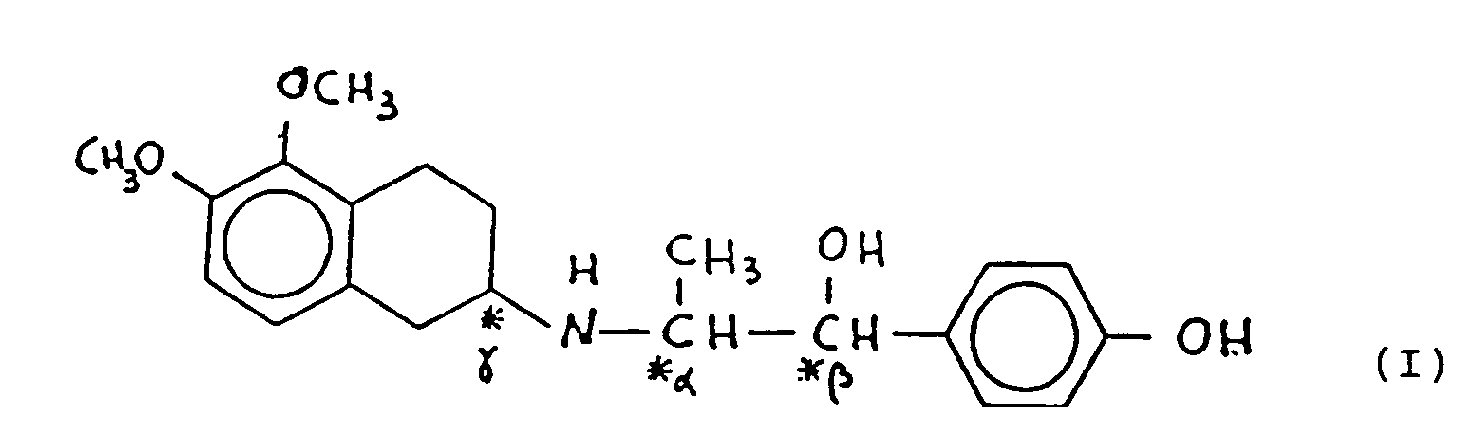
is endowed with inotropic and vasodilating activities so as to be advantageously used in the therapy of cardiocirculatory failure. - The above compound of formula (I) has three asymmetric carbon atoms in the positions marked by an asterisk and it should be understood that the present invention includes both the single enantiomers or diastereoisomers and the mixtures thereof, as well as the pharmaceutically acceptable salts of all these compounds.
- The derivatives of 2-aminotetrahydronaphthalene (or 2-aminotetraline) are a class of compounds exhibiting interesting pharmacological properties because of their capacity of binding to the different receptors of the orthosympathetic system.
- The 5,6 and 6,7 - dihydroxy derivatives of 2-aminotetraline contain in particular, fixed in a semi-rigid structure, the dopamine moiety which has in recent years given rise to a remarkable amount of research efforts.
- Dopaminergic drugs may have in fact different therapeutic uses: drugs stimulating the post-synaptic dopamine receptors in the Central Nervous System (CNS) may be effective against Parkinson's disease; drugs acting as agonists of dopamine autoreceptors, always in the CNS, may be used as antipsychotics.
- Dopaminergic receptors are however present also on the peripheral sympathetic terminations so that, particularly in the last years, many research efforts have been paid to dopaminergic structure having peripheral cardiovascular activity.
- There are many structure-activity studies of 2-aminotetraline derivatives, whose results gave rise to different hypothesis on the importance and on the effects of the configuration of the C₂ carbon, of the optimal substitution on the amine, of the kind and number of the substituents on the aromatic ring and of changes of other parameters.
- From these studies it is evident that 2-aminotetralines are rather heterogeneous as far as their pharmacological effects and their mechanism of action are concerned, the latter involving, besides both central and peripheral dopaminergic receptors, also adrenergic receptors both alpha and beta.
- Also in this class, such as in other classes of sympathicomimetics, it is possible to notice how even very small structural differences may result in remarkable effects on the degree or on the kind of activity, depending on various interdependent factors such as the kind and position of substituents, conformation, interactions with the receptor site, metabolic pathway.
- Many 2-aminotetraline derivatives are known and disclosed in patents and scientific papers.
- The closest structural analogues of the compound (I) of the invention were first disclosed by Gorczynski R. J. et al in J.Med.Chem. 1981,24,835-839. The compound n° 14 of said paper is the structural closest analogue of the compound (I) and it has been therefore used as reference compound.
- The 2-aminotetraline derivatives disclosed in EP-A-209275, EP-A-273017 and EP-A-211721 have structural differences in comparison with the compound I, which are significant under the pharmacological point of view.
- In fact, both EP-A-209275 and EP-A-273017 disclose 6,7-dihydroxyderivatives; in the case of the latter application, said derivatives are moreover trisubstituted on the aromatic ring of the tetraline moiety.
- The compounds of EP-A-211721, besides having structural differences, exhibit a completely different pharmacological action, namely lipolytic activity.
- Finally, 5,6-dihydroxy derivatives of 2-aminotetraline having a potent and selective beta-2 stimulating adrenergic activity and which may be used as bronchodilators are known from GB-A-2123410 in the applicant's name.
- The compounds of the present invention can be prepared by reductive amination of 5,6-dimethoxy-2-tetralone (II) with the appropriate primary amine (III) (or the salts thereof), according to the following reaction scheme :

- The condensation reaction is generally carried out in polar solvents such as dioxane or lower alcohols, preferably methanol or ethanol, at temperatures ranging from 0°C to 40°C, preferably under nitrogen atmosphere, at a pH adjusted around to neutral by addition of an acid, such as HCl or CH₃COOH, or of a base, such as triethylamine or pyridine.
- The simultaneous reduction is effected by means of alkali hydrides, preferably sodium or lithium cyanoborohydrides or a mixture of sodium cyanoborohydride and tetrabutylammonium cyanoborohydride in a 4:1 to 1:1 by weight ratio.
- Alternatively, reduction can be carried out with hydrogen in the presence of suited catalysts, such as Pt or Pd/C, under reduced pressure or at room pressure.
- The compounds are recovered from the reaction mixture by per se known methods and are generally transformed into a mineral acid addition salt, preferably with hydrochloric acid, and crystallized as such.
- Compound (I) can be prepared in form of a single stereoisomer or as couple of epimers, by condensation of 5,6-dimethoxy-2-tetralone (II) with a p-OH-norephedrine stereoisomer of known configuration and optionally by subsequent separation of the epimers obtained by crystallization or by chromatography.
- The intermediates used in the preparation of the compounds are known and, if not commercially available, are prepared according to methods known in literature. Particularly, the stereoisomers of p-hydroxynorephedrine have been prepared by the processes described by Smith H.E. et al in J.Med. Chem. 20(7), 978(1977).
- Compounds (I) can also be prepared according to a different process, as shown in the following reaction scheme :

wherein R₁ and R₂ are H, CH₂-C₆H₅ or other easily cleavable protective group. - The condensation reaction of aminotetralin with the bromoketone is generally carried out in polar solvents, such as water, dioxane or lower alcohols, and preferably in ethanol or in an ethanol-water mixture, in the presence of an acid binding agent such as triethylamine or pyridine. The reaction may be carried out also in the absence of solvents at such a temperature to allow the partial or complete melting of the reaction mixture. The subsequent reduction can be effected by hydrogenation in the presence of suited catalysts, such as Pt or Pd/C or with alkali or alkali-earth metal hydrides and subsequent hydrogenolytic debenzylation.
- This process proved to be particularly advantageous to obtain the compounds of the invention in a given configuration. The threo-isomers, with respect to the α and β carbon atoms may be obtained, for instance, by condensation of an aminotetralin (IV), in which R₁ is benzyl or a group having a similar steric hindrance, easly cleavable, with bromoketone (V) and subsequent reduction. The presence of the benzyl group or of a group of similar steric hindrance, allows to obtain a stereospecific reduction of aminoketones (VI) so as to attain the threo form of aminoalcohols (VII), according to a modification of the process described by Van Dijk J. e Moed H.D. in Recueil 78,22,1959. The erythro isomers, always with respect to the α and β carbon atoms, are obtained by chemical or catalytic reduction of aminoketones (VI) wherein R₁=H. Compounds having a given configuration with respect to carbon γ can be obtained starting from the suitable aminotetraline enantiomer (IV), obtained either by enantioselective synthesis or by known separation methods. Compounds (VI) are novel and are a further object of the invention, as useful intermediates for the preparation of compounds (I).
- A solution of 25 g (0.122 mole) of (±)-4-hydroxynorephedrine hydrochloride in 326 ml of methanol, adjusted to pH -7 with 5% KOH is slowly added to a solution containing 35.41 g (0.171 mol.) of 5,6-dimethoxy-2-tetralone in 346 ml of methanol, cooled to about 12°C and under nitrogen atmosphere. The reaction mixture is stirred under nitrogen for about 20 hours at room temperature; thereafter a mixture of 11.84 g of NaBH₃CN and 5.59 g of (C₄H₉)₄NBH₃CN is added during about 2 hours, keeping the temperature below 30°C. The mixture is stirred under nitrogen for about 20 hours, then is acidified to pH about 1 with concentrated HCl and it is evaporated to dryness. The residue is taken up into 250 ml of absolute ethanol, 2,750 ml of ethyl ether are added, the obtained solid is filtered, taken up into water, adjusted to slightly basic pH (about 9.5) and extracted repeatedly with chloroform. The chloroform solutions are combined, washed with water to neutrality, dried over Na₂SO₄ and evaporated to dryness. The residue is taken up into 500 ml of methanol, saturated with HCl, decolorized with active charcoal, filtered, evaporated to dryness, taken up into 50 ml of absolute ethanol and precipitated with anhydrous ethyl ether. The precipitate is filtered and dried under vacuum at 40°C. 14.5 g are obtained of a mixture of the four stereoisomers (+) (αS, βR, γR); (-) (αR, βS, γS); (+) (αR, βS, γR); (-) (αS, βR, γS). (30% yield); m.p. 202-210°C: MF = C₂₁H₂₇NO₄.HCl MW = 393.92.
- Elementary analysis, IR and NMR spectra are in agreement.
- A solution of 31.72 g (0.154 mol.) of 5,6-dimethoxy-2-tetralone in 428 ml of absolute ethanol, kept at a temperature from 10°C to 15°C, under nitrogen atmosphere, is slowly added with a solution of 13.99 g (0.084 mole) of (-) (αS, βR) 4-hydroxynorephedrine in 223 ml of absolute ethanol and glacial acetic acid to pH about 7.8. The mixture is stirred under nitrogen atmosphere for about 2 hours at room temperature. 4.51 g of 10% Pd/C are added and the mixture is hydrogenated with Parr system at room temperature at 30 p.s.i. for 20 hours. The reaction mixture is filtered, acidified to pH 1 with HCl and evaporated to dryness. The residue is taken up into 2,000 ml of water, washed with CHCl₃. The aqueous phase is adjusted to pH 9.2 with 10% KOH and repeatedly extracted with CHCl₃. The combined organic phases are washed with water to neutrality, dried over Na₂SO₄ and evaporated to dryness. The residue is taken up into methanol and decolorized with active charcoal, then filtered and evaporated under vacuum. The resulting solid is taken up into about 100 ml of absolute ethanol and the product is precipitated by addition of about 250 ml of anhydrous ethyl ether, then crystallized from 50:50 absolute ethanol/ethyl ether. 14.18 g of a mixture of the two diastereoisomers (-) (αS, βR, γS) and (+) (αS, βR, γR) are obtained (43% yield); m.p. = 214-218°C. MF = C₂₁H₂₇NO₄.HCl. MW = 393.92.
[α]²⁰ = (C = 1,87% in MeOH) -18,64°. - Elementary analysis, NMR and IR spectra in agreement.
- Following the procedure described above but starting from 5,6-dimethoxy-2-tetralone and (+) ( R, βS) -4-hydroxynorephedrine, the following compound is obtained:
(αR, βS)-5,6-dimethoxy-2[[2-(4-hydroxyphenyl)-2-hydroxy-1-methylethyl]amino]1,2,3,4-tetrahydronaphthalene hydrochloride (Ic), consisting of a mixture of diastereoisomers (+) (αR, βS, γR) and (-) (αR, βS, γS)
m.p. = 219-221°C
MF = C₂₁H₂₇NO₄ . HCl MW = 393,92
[α]²⁰ = (C = 2,002% in MeOH) -17,48°. -
- a) 5,6-dimethoxy-2[[2-(4-benzyloxyphenyl)-2-oxo-1-methylethyl]amino]-1,2,3,4-tetrahydronaphthalene hydrochloride.
A solution containing 20.0 g (0.082 mol.) of 5,6-dimethoxy-2-aminotetrahydronaphthalene (IV; R₁=H), 26.2 g (0.082 mol.) of 2-bromo(4 benzyloxy)-1-propiophenone (V) and 9.1 g (0.09 mol.) of triethylamine in 82 ml of 95% absolute ethanol is refluxed with stirring, under nitrogen atmosphere, for 6 hours. At the end of the reaction, the solution is evaporated under vacuum, the resulting residue is taken up into 500 ml of ethyl ether, under stirring. The resulting solid is filtered, taken up into 500 ml of a 15% K₂CO₃ aqueous solution and extracted with ethyl acetate ( 3 x 300 ml). The organic solution is washed with water and dried over Na₂SO₄, then filtered and added with ether/HCl, to precipitate the product as hydrochloride, which is filtered and recrystallized from 50:50 ethanol/ether. 28.8 g of a mixture of four stereoisomers of the following configurations: (+) (αR, γR); (-) (αS, γS); (-) (αR, γS); (+) (αS, γR) are obtained (73% yield). MW = 482.02 MF = C₂₈H₃₁NO₄ . HCl m.p. = 270-275°C.
Elementary analysis and IR spectrum are in agreement. - b) Erythro-5,6-dimethoxy-2[[2-(4-hydroxyphenyl)-2-hydroxy-1-methylethyl]amino]1,2,3,4-tetrahydronaphthalene hydrochloride (Ia).
3 g of 10% Pd/C are added to a solution containing 11.0 g (0.023 mol.) of 5,6-dimethoxy-2[[2-(4-benzyloxyphenyl)-2-oxo-1-methylethyl]amino]-1,2,3,4-tetrahydronaphthalene hydrochloride (VI; R₁=H, R₂=CH₂C₆H₅) in 600 ml of 95% CH₃OH and hydrogenation is carried out in Parr apparatus at room temperature and under 35 p.s.i. pressure for 30 minutes. The mixture is filtered, evaporated to dryness, triturated thoroughly in ethyl acetate, then the resulting solid is filtered, dried under vacuum, recrystallized from 50:50 ethanol/ether, to obtain 5.6 g of the product (81% yield)consisting of the same stereoisomers of Example 1. -
- a) 5,6-dimethoxy-2[[2-(4-benzyloxyphenyl)-2-oxo-1-methylethyl]-N-benzylamino]-1,2,3,4-tetrahydronaphthalene (VI; R₁, R₂= CH₂-C₆H₅).
32.1 g of 2-bromo(4-benzyloxy)-1-propiophenone (V) and 14 ml of triethylamine are added to a solution of 29.7 g of 5,6-dimethoxy-2-benzylamino-1,2,3,4-tetrahydronaphthalene (IV; R₁=CH₂-C₆H₅) in 90 ml of absolute ethanol. The reaction mixture is refluxed for 8 hours, slowly adding further 20 ml of triethylamine, then it is cooled and filtered washing the residue with ethanol and ether. The solution is evaporated to dryness, then adjusted to pH 8.2 with methanolic potassium hydroxide, evaporated to dryness, taken up into 200 ml of chloroform, washed with water and dried over Na₂SO₄, filtered and evaporated to dryness to obtain 30 g of the product which is further purified by chromatography (eluent : 70:30 hexane/ethyl acetate).
23 g of the product are obtained (40% yield). - b) Threo-5,6-dimethoxy-2[[2-(4-benzyloxyphenyl)-2-hydroxy-1-methyl-ethyl]-N-benzylamino]-1,2,3,4-tetrahydronaphthalene hydrochloride (VII; R₁, R₂=CH₂-C₆H₅).
A solution of 3.8 g 5,6-dimethoxy-2[[2-(4-benzyloxyphenyl)-2-oxo-1-methylethyl]-N-benzylamino]-1,2,3,4-tetrahydronaphthalene (VI; R₁, R₂=CH₂-C₆H₅) in 120 ml of tetrahydrofuran are added to a suspension of 0.32 g of lithium aluminium hydride in 60 ml of tetrahydrofuran, with stirring and under nitrogen atmosphere, at a temperature lower than 25°C. The reaction mixture is stirred at room temperature for 30 minutes, then 1 ml of ethyl acetate is added, stirring for 5 minutes, then the mixture is filtered through Celite R and ether/HCl (about 20 ml) is added to the clear solution to obtain a precipitate which is filtered and dried at 50°C under reduced pressure. 3.7 g of the product are obtained (97% yield). - c) Threo-5,6-dimethoxy-2[[2-(4-hydroxyphenyl)-2-hydroxy-1-methylethyl]amino]-1,2,3,4-tetrahydronaphthalene hydrochloride (Ic).
2.3 g of 20% Pd/C are added to a solution containing 6,7 g di threo-5,6-dimethoxy-2[N[2-(4-benzyloxyphenyl)-2-hydroxy-1-methylethyl]-N-benzylamino]-1,2,3,4-tetrahydronaphthalene hydrochloride (VII; R₁, R₂=CH₂-C₆H₅) in 200 ml of absolute ethanol, then the mixture is hydrogenated in a Parr apparatus at room temperature under 35 p.s.i. pressure for 6 hours. The mixture is filtered, concentrated to about 60 ml, then ethyl ether (about 400 ml) is added thereto to complete precipitation. The resulting solid is recrystallized from acetone. 3.2 g of a mixture of four stereoisomers of the following configurations: (αS, βS, γS); (αR, βR, γR); (αS, βS, γR), (αR, βR, γS) are obtained (68% yield) m.p. = 200-201°C. - Elementary analysis, IR and NMR spectra are in agreement.
- (-) (αR, βS, γS)-5,6-dimethoxy-2-[[2-(4-hydroxyphenyl)-2-hydroxy-1-methylethyl]amino]-1,2,3,4-tetrahydronaphthalene hydrochloride (Ie).
- 1.5 g of compound Ic, consisting of a mixture of the two diastereoisomers (-) (αR, βS, γS) and (+) (αR, βS, γR), are dissolved in methanol. The solvent is evaporated to give a solid foam which is taken up with 15 ml of methanol and the obtained suspension is refluxed for 4 hours. The mixture is cooled to 60°C, the solid is filtered, washed with diethyl ether and dried under vacuum at 60°C.
- 0.5 g a white crystalline solid are obtained.
[α]²⁰ = -40.27° (C=1.008 in MeOH)
[α]²⁰ = -48.21° (C=1.008 in MeOH) - G.L.C. analysis:
- % of (-) (αR, βS, γS) = 93.5
% of (+) (αR, βS, γR) = 6.5. - In a similar way, starting from a mixture of the two stereoisomers (+) (αS, βR, γR) and (-) (αS, βR, γS), (+) (αS, βR, γR))-5,6-dimethoxy-2-[[2-(4-hydroxyphenyl)-2hydroxy-1-methylethyl]amino]-1,2,3,4-tetrahydronaphthalene hydrochloride is obtained
m.p. = 230°-231°C
[α]²⁰ = +35.85° (C=1.00 in MeOH)
[α]²⁰ = +43.32° (C=1.00 in MeOH) - G.L.C. analysis:
- % of (+) (αS, βR, γR) = 92.5
% of (-) (αS, βR, γS) = 7.5. - (+) (αR, βS, γR)-5,6-dimethoxy-2-[[2-(4-hydroxyphenyl)-2-hydroxy-1-methylethyl]amino]-1,2,3,4-tetrahydronaphthalene hydrochloride.
- a) (+) (αR, γR)-5,6-dimethoxy-2-[(2-(4-benzyloxyphenyl)-2-oxo-1-methylethyl]amino]-1,2,3,4-tetrahydronaphthalene hydrochloride.
1.2 g of (+) (R)-5,6-dimethoxy-2-aminotetrahydronaphthalene and 1.9 g of 2-bromo-(4-benzyloxy)-1-propiophenone are dissolved in 11 ml of ethanol, added with 0.8 of triethylamine and refluxed for 4 hours.
After standing overnight, the solid is filtered which consist of the diastereoisomer (+) (αS, γR). The filtrate is evaporated, the residue is dissolved in 5 ml of ethanol, 1.5 ml of a 10% triethylamine HCl in ethanol are added, the mixture is stirred for 1 hour, kept at 4°C for 2 days, the solid is filtered off, the filtrate is evaporated, the residue is dissolved in 30 ml of ethanol and, after addition of a 1 M HCl solution in methanol, the mixture is allowed to stand for 2 hours.
The precipitated solid is filtered, washed with ethanol and then with ether and dried at 40°C under vacuum.
The obtained solid is suspended in 25 ml of a refluxing 6:4 ethanol/methanol mixture for 1 hour. After standing 2 hours, the mixture is filtered, washed with diethyl ether and dried under vacuum at 40°C.
0.4 g a white solid consisting of the stereoisomer (+) (αR, γR) are obtained with a diastereoisomeric purity ≃ 90%
m.p. = 263-265°C (dec.) - b) (+) (αR, βS, γR)-5,6-dimethoxy-2-[[2-(4-hydroxyphenyl)-2-hydroxy-1-methylethyl]amino]-1,2,3,4-tetrahydronaphthalene hydrochloride.
- 0.4 g of (+) (αR, γR)-5,6-dimethoxy-2-[[2-(4-benzyloxyphenyl)-2-oxo-1-methylethyl]amino]-1,2,3,4-tetrahydronaphthalene hydrochloride are suspended in 25 ml of methanol. 0.1 g of 5% Pd/C are added and the the mixture is hydrogenated at 35 p.s.i. under stirring.
- The catalyst is filtered, the solvent is evaporated and the solid foam is dissolved in 10 ml of warm acetone, filtering off the solid residue and cooling to room temperature under stirring.
- After standing overnight, the solid is filtered, washed with diethyl ether and dried at 70°C under vacuum for 24 hours.
- 0.2 g of (+) (αR, βS, γR) isomer are obtained
[α]²⁰ = +51.45° (C=1.036 in MeOH)
[α]²⁰ = +60.91° (C=1.036 in MeOH) - G.L.C. analysis:
- % of (+) (αR, βS, γR) = 98.49
% of (+) (αS, βR, γR) = 1.51 - With the same method, starting from
(-) (S)-5,6-dimethoxy-2-aminotetrahydronaphthalene and 2-bromo-(4-benzyloxy)-1-propiophenone, the following compounds are obtained: - a) (-) (αS, γS)-5,6-dimethoxy-2-[[2-(4-benzyloxyphenyl)-2-oxo-1-methylethyl]amino]-1,2,3,4-tetrahydronaphtalene hydrochloride.
- b) (-) (αS, βR, γS)-5,6-dimethoxy-2-[[2-(4-hydroxyphenyl)-2-hydroxy-1-methylethyl]amino]-1,2,3,4-tetrahydronaphtalene hydrochloride (Ih).
- G.L.C. analysis:
- % of (-) (αS, βR, γS) = 95.9
% of (-) (αR, βS, γS) = 4.1. - The inotropic and chronotropic effects of compound (Ia) of the invention were determined in vitro using, respectively, isolated rat left atrium and right atrium.
- The atria were subjected to a 0.5 g starting tension and suspended in a bath containing aerated Krebs-Henseleit solution with 95% O₂ and 5% CO₂ kept at 32°C. The preparation was stimulated at a 4 Hz frequency with pulses during 5 msec each. The contraction strength was detected by an isometric transducer and recorded on a microdynamometer.
- The preparation was prepared in the same way and under the same conditions as described above, but it was not subjected to electric stimulation. Frequency was detected by a cardiotachograph.
- The results were expressed as the percentage of the response obtained with a maximal dose (10⁻⁸ M) of isoproterenol which was determined at the beginning of the test. In Table 1 the potency (EC₅₀ = effective concentration inducing the 50% of the maximal effect) and the relative intrinsic activity (expressed as α and compared with that of isoproterenol, taken = 1) are shown.
- Beside compound Ia and the control compound, two other 2-aminotetralin derivatives, i.e. compounds (VIII) and (IX), were assayed in these tests. Said compounds were prepared within the scope of a structure-activity research carried out in order to define the structural characteristics necessary to cause the desired activity in this kind of compounds.

- For the sake of shortness, hereinafter the compounds will be identified by means of the experimental abbrevations (CHF) shown in the Table.
- As it can be desumed by the data reported in Table 1, CHF 1255 proved to exert in these preparations a cardiostimulating activity with a potency comparable to those of dopamine and of CHF 1026, which was used as the prior art reference compound.
- However, contrary to the control compounds, CHF 1255 shows a reduced intrinsic activity : therefore, based on its activity, which, as will be evidenced hereinafter, is of the beta-1 stimulating kind, it must be considered as a partial agonist of beta-1 adrenergic receptors. This behaviour was further confirmed in isolated left atria of other animal species (cat and guinea pig), in which the compound shows an inotropic activity with an effectiveness of 45-31% that of isoproterenol. The partial agonism of CHF 1255 towards beta-1 adrenergic receptors is of great importance for the characterization of the compound.
- In fact, the research efforts have been directed for a long time to the synthesis and development of partial agonistic beta-1 stimulating molecules : starting from this assumption, prenalterol and, more recently, xamoterol, have been prepared, the latter being less effective ( it has an agonistic action of 40% that of isoproterenol), but better tolerated.
- The rational of the therapy with partial agonists is related to the induction of a beta-agonistic effect that can be modulated. As a matter of fact these compounds, acting both as agonists and as antagonists, stimulate the impaired cardiac function in patients affected with cardiac failure, under rest or reduced exercise conditions.
- On the contrary, during physical exercise, when the sympatethic tonus is high, they are able to protect the heart against adrenergic overstimulation, antagonizing its effects.
- Another important fact evident from Table 1 is that CHF 1296 and CHF 1297 proved to be completely inactive, further confirming thereby that minimal structural changes play in this kind of compounds a fundamental role for the activity.
- CHF 1255 has been subsequently subjected to a series of tests in order to study the mechanism of its inotropic activity.
- It has been possible to show, as previously said, that this activity is due to the stimulation of beta-1 adrenergic receptors.
- Studies carried out in different experimental models allowed to exclude that the cardiostimulant action of the compound may be due to catecholamines release or to the stimulation of alpha-adrenergic cardiac receptors as well as to the stimulation of histaminergic H₁ and H₂ receptors.
- It has also been excluded that the cardiostimulant activity of CHF 1255 is due to phosphodiesterase inhibition.
- The affinity for beta-1 adrenergic receptors has been evaluated in the rat left atrium as previously described.
- In this test, dose - response curves of CHF 1255 were recorded in the absence and in the presence of increasing concentrations (10⁻⁸ - 3 x 10⁻⁷ M) of a selective beta-1 blocker, atenolol.
- The pre-treatment with the beta-1 blocker shifted to the right in a dose-dependent way the dose - response curve of CHF 1255, showing therefore for this compound an interaction of competitive type for the beta-1 adrenergic receptors.
- The selectivity of this interaction has been studied by evaluating the effects on beta-2 adrenergic receptors, in the guinea-pig isolated trachea, using CHF 1026 as reference compound.
- Trachea strips were isolated and prepared according to the method described by Emerson J e Mackay D in J Pharm Pharmacol 1979, 31, 798, immersed in Krebs-Henseleit solution (37°C, 95% 0₂ + 5% C0₂), subjected to an initial tension of 1 g and contracted with carbachol (3 x 10⁻⁷ M).
- Dose-response curves of CHF 1255 and CHF 1026 were recorded in the absence and in the presence of propranolol (10⁻⁶ M), used as antagonist and added to the bath before the stimulation with carbachol.
- The obtained results are shown in Table 2, expressed as potency (EC₅₀ calculated from the dose - response curve) and intrinsic activity (α, isoproterenol=1).


- Both compounds exert a dose-dependent inhibition of the carbachol-induced contractions, but while in the presence of propranolol the dose-response curve of CHF 1026 is parallelely shifted to the right, showing a competitive antagonistic action, the effects of CHF 1255 remain unchanged.
- According to these results it is possible to state that, differently from CHF 1026, CHF 1255 does not stimulate beta-2 adrenergic receptors. The relaxing effect is probably to be ascribed to other mechanisms, since it is not competitively antagonized by an high dose of propranolol.
- Because of its selective agonistic activity on adrenergic beta-1 receptors, CHF 1255, differently from CHF 1026, has no tachycardic and arrhythmogenic activity due to the stimulation of beta-2 receptors.
- The activity of CHF 1255 has been compared with two recently introduced inotropic drugs, having different mechanisms of action, xamoterol fumarate and amrinone, the former being a partial agonist of adrenergic beta-1 receptors and the latter being an inhibitor of phosphodiesterase.
- The effects of the compounds were evaluated in rat isolated atria according to the previously described method.
- The results are reported in Table 3.
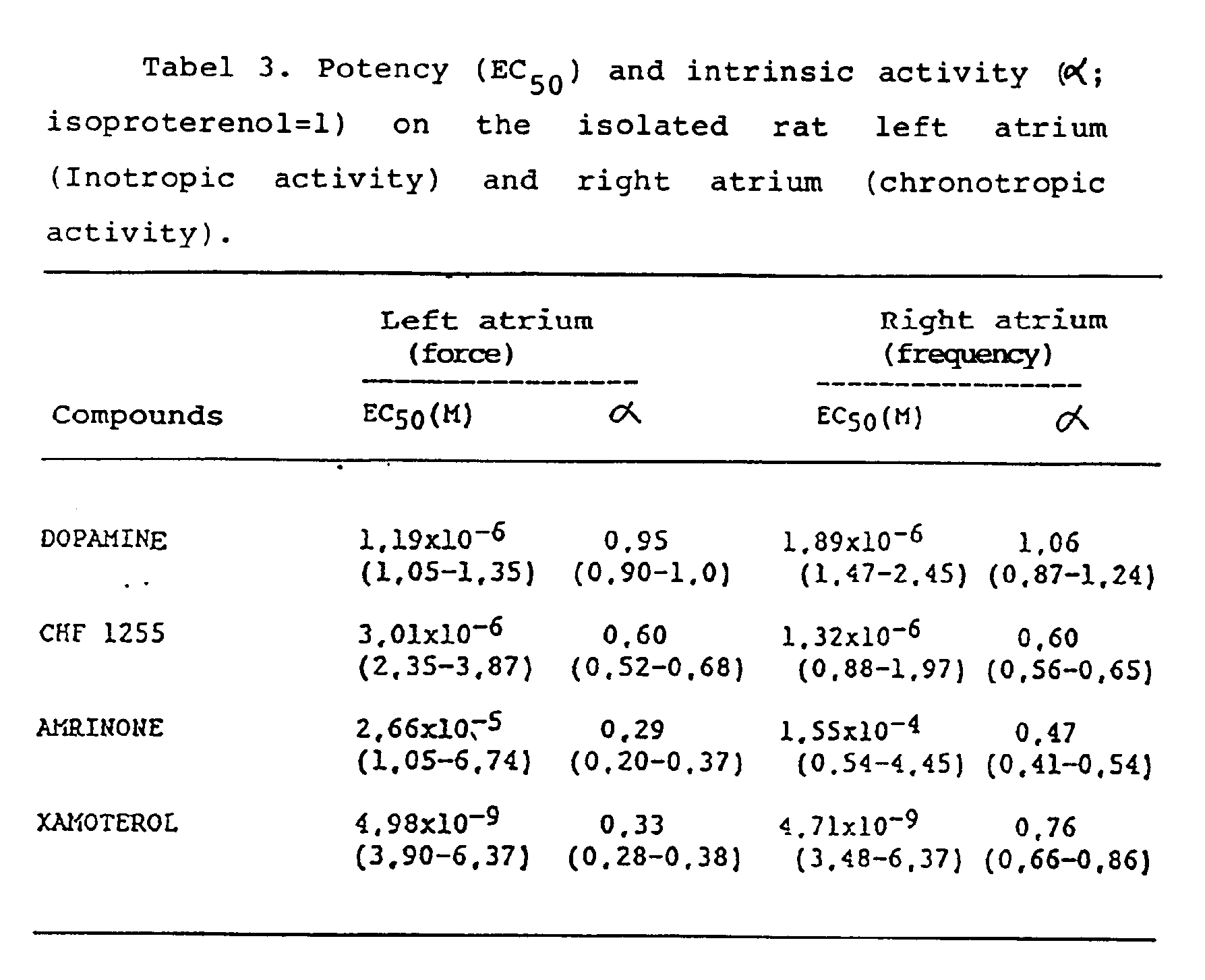
- The potency of CHF 1255, exspressed as concentration producing 50% of the maximum effect (increase of contraction force), is about 10 times higher than that of amrinone and about 300 times lower than that of xamoterol.
- It should be noticed that the chronotropic efficacy of CHF 1255 is remarkably lower than that of xamoterol.
- This is very important because an inotropic drug should not cause an excessive increase of heart-rate.
- CHF 1255 also induces an important hemodynamic action, differently from xamoterol.
- The vasodilating effect of CHF 1255 has been evaluated in the arterial rat hind quarter perfused with Krebs-Henseleit solution at constant flow.
- The increase of arterial resistances was induced by K⁺-enriched solution (40 mM), norepinephrine (5 x 10⁻⁶ M) and serotonin (5 x 10⁻⁷ M).
- Papaverine and prazosin, powerful α-blocker vasodilator, were used as reference compounds.
- The results are reported in Table 4.
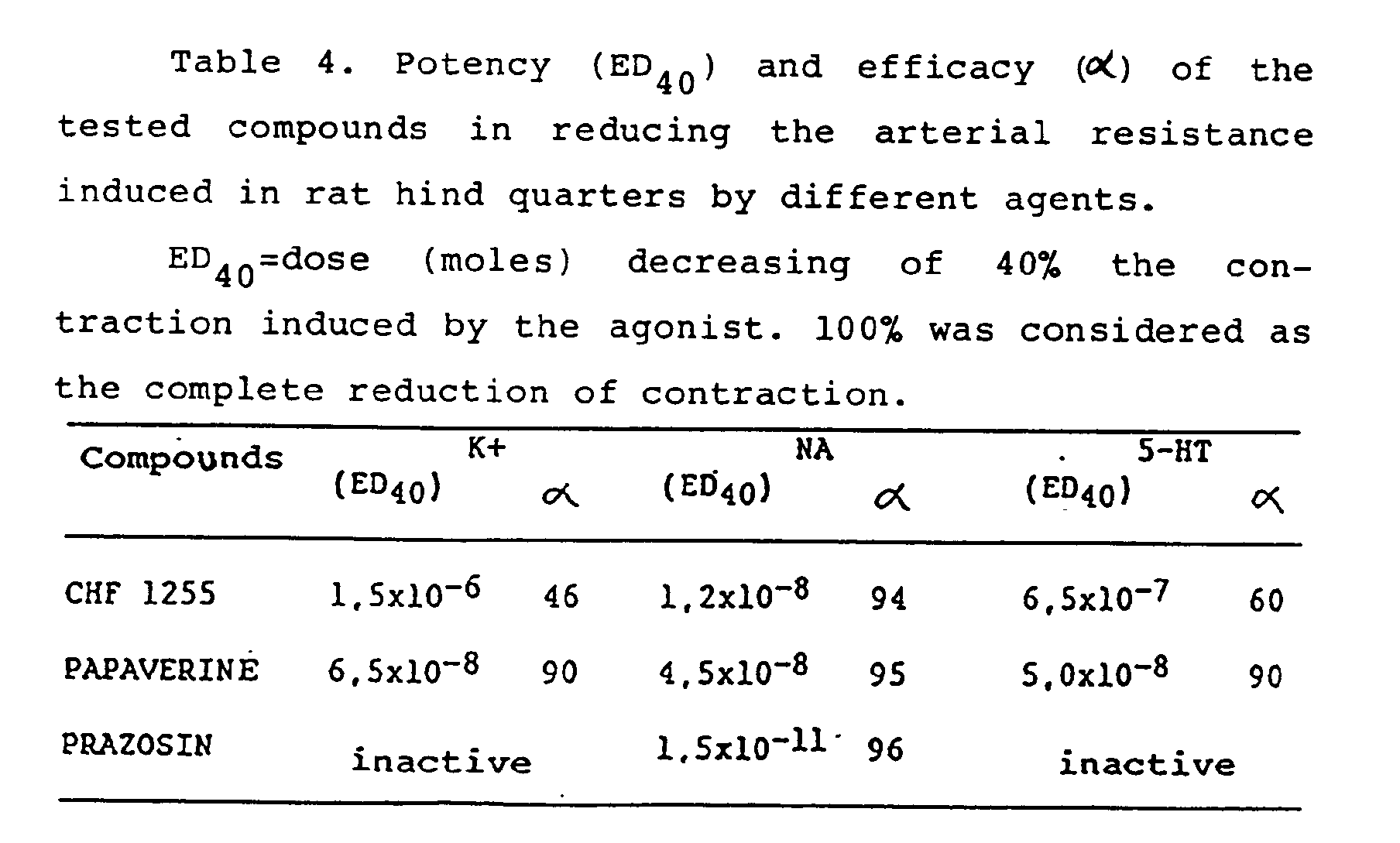
- CHF 1255 is active against the different agents but, differently from papaverine having the same ED₄₀ for the different experimental conditions, proved to be particularly active on the norepinephrine induced contraction.
- This effect is due to an α-blocking activity whereas the activity against the potassium or serotonin induced contraction is probably due to an aspecific mechanism which could even account for the relaxing activity on the isolated guinea-pig trachea which is not mediated by beta-2 receptors.
- The α-blocking activity of CHF 1255 has been confirmed in the rabbit isolated aorta, with a competitive inhibition of the norepinephrine dose - response curve.
- The interesting hemodynamic properties of CHF 1255 were confirmed in vivo in the anaesthetized dog.
- Beagle dogs were anaesthetized with sodium penthobarbital (30 mg/kg iv) thoracotomized and instrumented for recording cardiocirculatory parameters.
- CHF 1255 and the reference drugs (amrinone and xamoterol) were administered i.v. in bolus.
- CHF 1255 at the doses of 0.3-1-3 µmoles/kg i.v. confirmed its activity in changing hemodynamic parameters.
- It has in fact, differently from xamoterol, whose effects are negligible, a good hypotensive action (respectively -17, -22 and -31%) and a marked reduction of the systemic arterial resistances (-28, -37 and -45%) together with a significant increase of the stroke volume (10, 16 and 21) and of the cardiac output (17,28 and 34%).
- It shoud be noted that the hemodynamic effects are more relevant than those of amrinone (1-3-10 µmol/kg iv).
- CHF 1255 showed also remarkable inotropic effect increasing the dF/dT index (peak of the first derivative of the aortic flow in ml/sec⁻²), useful for the evaluation of the cardiac function.
- CHF 1255 has shown therefore to have a very interesting pharmacological profile and it has to be considered as belonging to the class of "inodilators" since it is endowed with both inotropic and vasodilator actions.
- Its activity is also long-lasting probably because not easily subjected to metabolic inactivation by catechol-0-methyltransferases (COMT), because of the methylation of the catecholic groups.
- We have also studied wether the pharmacodynamic effects of CHF 1255 were to be ascribed to a particular isomer, by carring out tests using the diastereoisomeric mixture (αS, βR) (CHF 1389) and the diastereoisomeric mixture (αR, βS) (CHF 1388).
- CHF 1389 proved to be as effective as CHF 1255 in the rat isolated left atrium whereas CHF 1388 did not show any inotropic activity.
- On the other hand, the vasodilating activity of CHF 1255 is mainly due to CHF 1388.
- The overall activity of CHF 1255 (Compound Ia) is therefore due to a synergic interaction of the effects produced by the two diastereoisomeric mixtures, each having its specific action so as to justify an independent therapeutic use.
- The results are shown in Table 5.
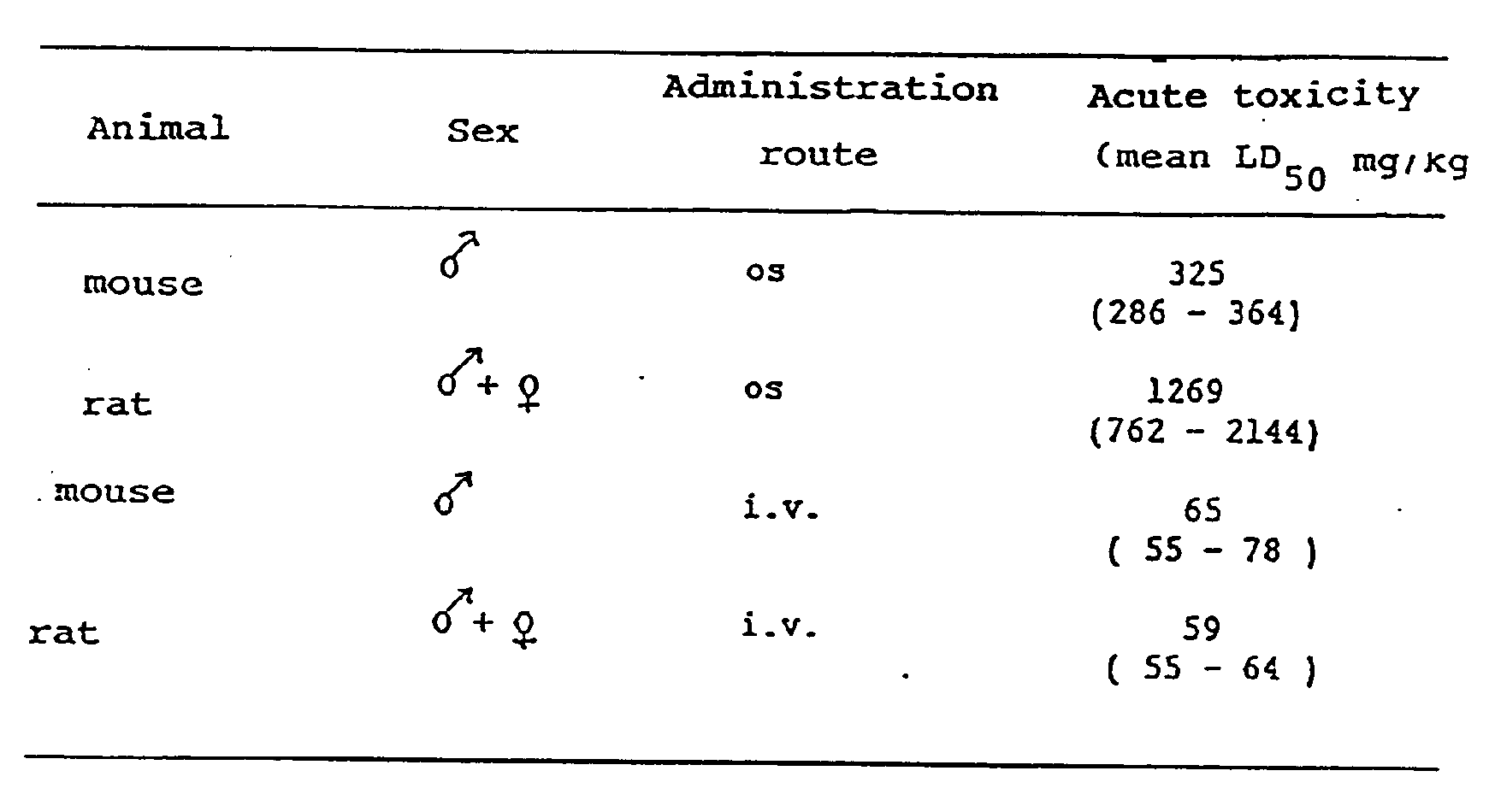
- The present invention also relates to pharmaceutical compositions containing as the active ingredient the compound of formula (I) or one of the isomers thereof as such or in form of a pharmaceutically acceptable salt thereof, in combination with pharmaceutically acceptable excipients. Said compositions can be used for the cardiovascular therapy, particularly as inotropic agents.
- The compositions will be administered preferably by the oral or parenteral routes, in form of capsules, tablets or vials respectively.
- The pharmaceutical compositions for the oral administration in unit doses, can be prepared by admixing the active ingredient with a solid powdered excipient, such as lactose, saccharose, sorbitol, mannitol; potato, cereal or maize starch, amylopectin, cellulose or gelatin derivatives, and optionally also with lubricants such as talc, magnesium or calcium stearate, polyethylene glycol or silica.
- Tablets can be variously coated according to well-known pharmaceutical techniques. Hard gelatin capsules can contain granulates of the active ingredient, together with solid powdered excipients, such as lactose, saccharose, sorbitol, mannitol, starches of the above indicated types, cellulose or gelatin derivatives, and they can also contain stearic acid or magnesium stearate or talc. The unit dose for the above described formulations will range from 10 to 100 mg of the active ingredient.
- In case of injectable formulations for the parenteral administration, the excipients can be a pharmaceutically acceptable sterile liquid, such as water or an aqueous polyvinylpyrrolidone solution and optionally a stabilizer and/or a buffer.
- The active ingredient can be dissolved in the liquid and filter sterilized before the distribution into vials, or it can be directly freeze-dried, in which case vials containing injection liquid will be contained in the packages, to restore the solution before use.
- Another particularly advantageous methods for the administration of the compounds of the invention is provided by transdermic systems, which consist of adhesive matrices which can be applied to skin. In said systems the active ingredient is incorporated in an appropriate concentration and is gradually released through the skin to enter the hematic circle.
[α]²⁰ = -49.03° (C=1.03 in MeOH)
Claims (9)
- A process for the preparation of the compound of formula (I)


- The process as claimed in claim 1, in which the reductive amination is carried out using metal hydrides.
- The process as claimed in claim 2, in which sodium cyanoborohydride or a mixture or sodium cyanoborohydride with tetrabutylammonium cyanoborohydride in a 4:1 to 1:1 weight ratio are used as the metal hydrides.
- The process for the preparation of the compounds of formula (I)
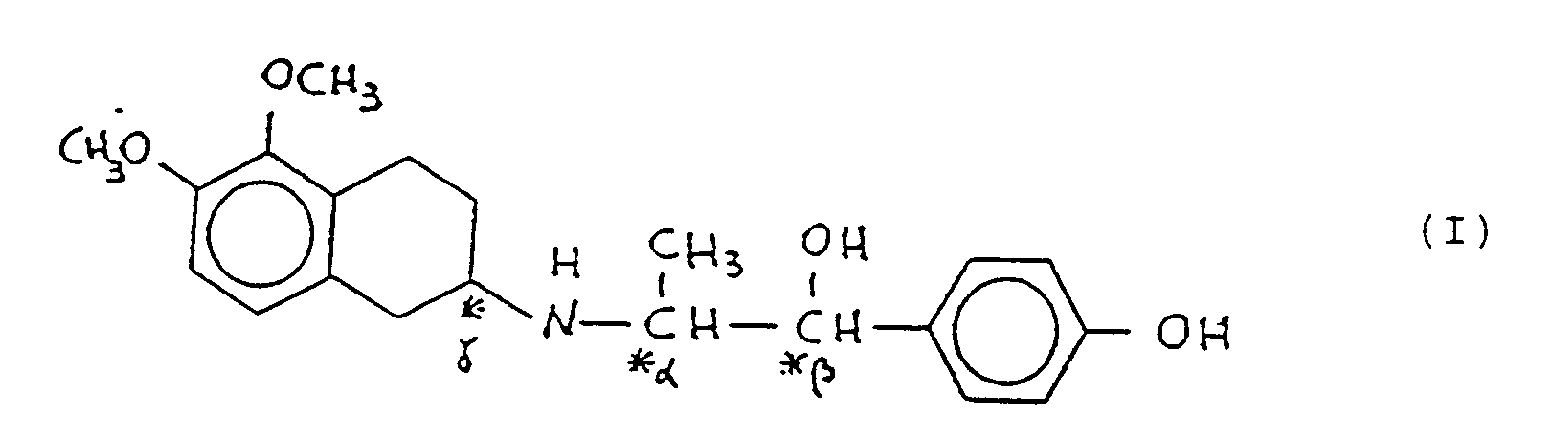
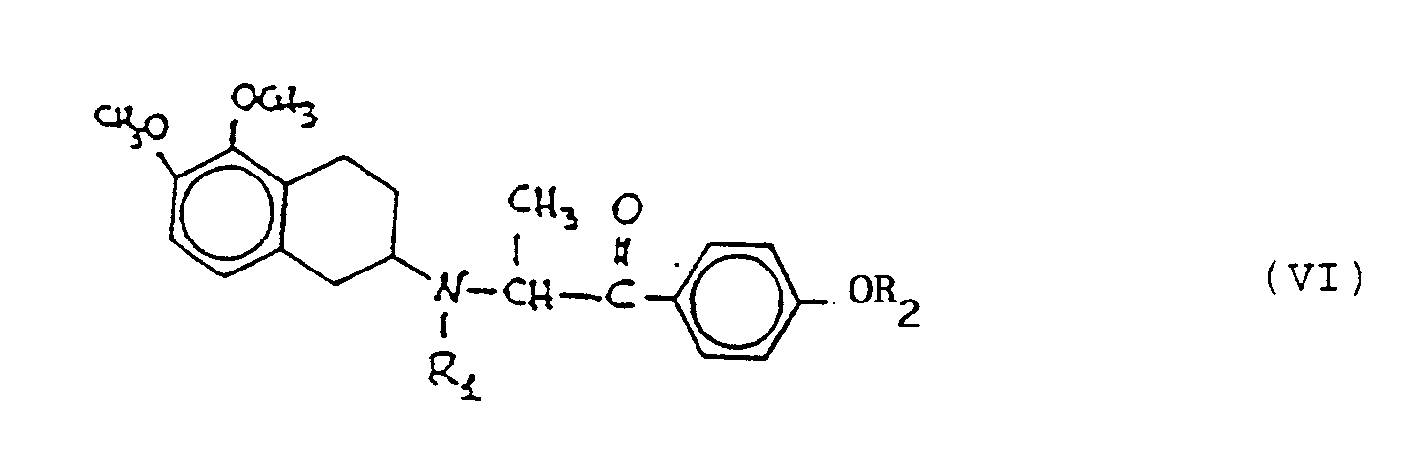
Priority Applications (1)
| Application Number | Priority Date | Filing Date | Title |
|---|---|---|---|
| AT90111831T ATE93837T1 (en) | 1989-06-27 | 1990-06-22 | 2-AMINO-1,2,3,4-TETRAHYDRONAPHTHALINE DERIVATIVES WITH CARDIOVASCULAR ACTIVITIES, PROCESSES FOR THEIR PREPARATION AND PHARMACEUTICAL COMPOSITIONS CONTAINING THEM. |
Applications Claiming Priority (2)
| Application Number | Priority Date | Filing Date | Title |
|---|---|---|---|
| IT2099689 | 1989-06-27 | ||
| IT8920996A IT1230931B (en) | 1989-06-27 | 1989-06-27 | DERIVATIVES OF 2 AMINO 1,2,3,4 TETRAHYDRONAPHTHALENE WITH CARDIOVASCULAR ACTIVITY, PROCEDURE FOR THEIR PREPARATION AND PHARMACEUTICAL COMPOSITIONS CONTAINING THEM |
Publications (3)
| Publication Number | Publication Date |
|---|---|
| EP0405344A2 EP0405344A2 (en) | 1991-01-02 |
| EP0405344A3 EP0405344A3 (en) | 1991-02-06 |
| EP0405344B1 true EP0405344B1 (en) | 1993-09-01 |
Family
ID=11175160
Family Applications (1)
| Application Number | Title | Priority Date | Filing Date |
|---|---|---|---|
| EP90111831A Expired - Lifetime EP0405344B1 (en) | 1989-06-27 | 1990-06-22 | 2-amino-1,2,3,4,-tetrahydronaphthalene derivatives with cardiovascular activity, process for their preparation and pharmaceutical compositions containing them |
Country Status (18)
| Country | Link |
|---|---|
| US (1) | US5096929A (en) |
| EP (1) | EP0405344B1 (en) |
| JP (1) | JPH0363253A (en) |
| KR (1) | KR910000135A (en) |
| AT (1) | ATE93837T1 (en) |
| AU (1) | AU633931B2 (en) |
| CA (1) | CA2019828A1 (en) |
| DE (1) | DE69003031T2 (en) |
| DK (1) | DK0405344T3 (en) |
| FI (1) | FI903202A7 (en) |
| HU (1) | HUT58276A (en) |
| IE (1) | IE902313A1 (en) |
| IT (1) | IT1230931B (en) |
| MA (1) | MA21884A1 (en) |
| NO (1) | NO173542C (en) |
| NZ (1) | NZ234253A (en) |
| PT (1) | PT94498A (en) |
| ZA (1) | ZA904962B (en) |
Families Citing this family (4)
| Publication number | Priority date | Publication date | Assignee | Title |
|---|---|---|---|---|
| ES2041211B1 (en) * | 1992-02-17 | 1994-05-16 | Uriach & Cia Sa J | Di: hydro- and tetra:hydro-naphthalene derivs. prepn. - by redn. of corresp. naphthalenone derivs. and opt. alkylation or acylation of obtd. alcohol(s), used for regulating smooth musculature contraction |
| JP3708624B2 (en) * | 1996-03-27 | 2005-10-19 | キッセイ薬品工業株式会社 | 3,4-disubstituted phenylethanolaminotetralin carboxylic acid derivative |
| US6711436B1 (en) | 1997-08-08 | 2004-03-23 | Duke University | Compositions, apparatus and methods for facilitating surgical procedures |
| DE69833665T2 (en) * | 1997-08-08 | 2006-11-09 | Duke University | COMPOSITIONS FOR SIMPLIFYING SURGICAL PROCEDURES |
Family Cites Families (7)
| Publication number | Priority date | Publication date | Assignee | Title |
|---|---|---|---|---|
| US2776993A (en) * | 1954-06-09 | 1957-01-08 | Gordon A Alles | 1-paramethoxyphenyl-2-cyclopentylamino-1-propanol compounds |
| DE1618005A1 (en) * | 1966-09-22 | 1971-09-09 | Thomae Gmbh Dr K | Process for the preparation of new amino-dihalogen-phenyl-ethylamines |
| US4011258A (en) * | 1973-06-21 | 1977-03-08 | Aktiebolaget Draco | Orally active bronchospasmolytic compounds |
| IT1218322B (en) * | 1982-06-10 | 1990-04-12 | Chiesi Farma Spa | 1,2,3,4-TETRAIDRONAFTALENE DERIVATIVES, PREPARATION PROCEDURE AND RELATED PHARMACEUTICAL COMPOSITIONS |
| EP0209275B1 (en) * | 1985-06-26 | 1988-10-19 | Smithkline Beckman Corporation | Benz-trisubstituted 2-aminotetralins |
| IL79323A (en) * | 1985-07-10 | 1990-03-19 | Sanofi Sa | Phenylethanolaminotetralines,their preparation and pharmaceutical compositions containing them |
| IT1199339B (en) * | 1986-12-23 | 1988-12-30 | Sigma Tau Ind Farmaceuti | N-ALCHIL DERIVATIVES OF THE 2-AMINO-6,7-DIMETOXY TETRALINE, PROCEDURES FOR THEIR PREPARATION AND PHARMACEUTICAL COMPOSITIONS FOR ANTI-HYPERTENSIVE ACTIVITY THAT CONTAIN THEM |
-
1989
- 1989-06-27 IT IT8920996A patent/IT1230931B/en active
-
1990
- 1990-06-22 AT AT90111831T patent/ATE93837T1/en not_active IP Right Cessation
- 1990-06-22 DE DE90111831T patent/DE69003031T2/en not_active Expired - Fee Related
- 1990-06-22 EP EP90111831A patent/EP0405344B1/en not_active Expired - Lifetime
- 1990-06-22 DK DK90111831.5T patent/DK0405344T3/en active
- 1990-06-26 PT PT94498A patent/PT94498A/en not_active Application Discontinuation
- 1990-06-26 FI FI903202A patent/FI903202A7/en not_active IP Right Cessation
- 1990-06-26 IE IE231390A patent/IE902313A1/en unknown
- 1990-06-26 US US07/544,201 patent/US5096929A/en not_active Expired - Fee Related
- 1990-06-26 MA MA22156A patent/MA21884A1/en unknown
- 1990-06-26 NO NO902838A patent/NO173542C/en unknown
- 1990-06-26 JP JP2168153A patent/JPH0363253A/en active Pending
- 1990-06-26 AU AU57832/90A patent/AU633931B2/en not_active Ceased
- 1990-06-26 ZA ZA904962A patent/ZA904962B/en unknown
- 1990-06-26 KR KR1019900009498A patent/KR910000135A/en not_active Withdrawn
- 1990-06-26 NZ NZ234253A patent/NZ234253A/en unknown
- 1990-06-26 CA CA002019828A patent/CA2019828A1/en not_active Abandoned
- 1990-06-26 HU HU903990A patent/HUT58276A/en unknown
Also Published As
| Publication number | Publication date |
|---|---|
| DK0405344T3 (en) | 1993-10-25 |
| IT8920996A0 (en) | 1989-06-27 |
| CA2019828A1 (en) | 1990-12-27 |
| NO902838D0 (en) | 1990-06-26 |
| DE69003031D1 (en) | 1993-10-07 |
| PT94498A (en) | 1991-02-08 |
| HU903990D0 (en) | 1990-11-28 |
| NO902838L (en) | 1990-12-28 |
| ZA904962B (en) | 1991-04-24 |
| DE69003031T2 (en) | 1993-12-16 |
| JPH0363253A (en) | 1991-03-19 |
| HUT58276A (en) | 1992-02-28 |
| FI903202A7 (en) | 1990-12-28 |
| NO173542B (en) | 1993-09-20 |
| NO173542C (en) | 1993-12-29 |
| AU633931B2 (en) | 1993-02-11 |
| ATE93837T1 (en) | 1993-09-15 |
| IE902313L (en) | 1990-12-27 |
| KR910000135A (en) | 1991-01-29 |
| FI903202A0 (en) | 1990-06-26 |
| US5096929A (en) | 1992-03-17 |
| IE902313A1 (en) | 1991-01-16 |
| AU5783290A (en) | 1991-01-10 |
| NZ234253A (en) | 1992-04-28 |
| IT1230931B (en) | 1991-11-08 |
| EP0405344A2 (en) | 1991-01-02 |
| MA21884A1 (en) | 1990-12-31 |
| EP0405344A3 (en) | 1991-02-06 |
Similar Documents
| Publication | Publication Date | Title |
|---|---|---|
| US4564628A (en) | Substituted 2-aminotetralins | |
| EP1096926B1 (en) | Methods and compounds for treating depression | |
| CZ284256B6 (en) | Novel process for preparing formoterol and related compounds | |
| EP0168505A1 (en) | Substituted 2-aminotetralins and processes for synthesis | |
| US5070106A (en) | Compounds active on the cardiovascular system | |
| JPH09500880A (en) | Aminoindane and related compounds useful as calcium channel antagonists | |
| EP0558487A1 (en) | Piperidine compounds, their preparation and use | |
| JPWO1994001392A1 (en) | (-)-Ritodrine | |
| US5942529A (en) | Benzisothiazolyl-substituted aminomethylchromans | |
| EP0457883B1 (en) | New bicyclic amino-substituted compounds | |
| CZ293974B6 (en) | 3,4-Disubstituted phenylethanolaminotetralin carboxamide derivative, pharmaceutical composition and preparation containing thereof | |
| AU633931B2 (en) | 2-amino-1,2,3,4-tetrahydronaphthalene derivatives with cardiovascular activity, process for their preparation and pharmaceutical compositions containing them. | |
| DE69713319T2 (en) | 3,4-DISUBSTITUTED PHENYLETHANOLAMINOTETRALINE CARBOXYLATE DERIVATIVES | |
| EP0420120B1 (en) | Optically active benzyl alcohol compound and pharmaceutical composition | |
| US6498196B1 (en) | Compounds useful in pain management | |
| BG99253A (en) | Epi - epibatydine derivatives | |
| JP2003522814A (en) | Amino alcohol derivative | |
| US5132313A (en) | Non-competitive NMDA receptor antagonists and methods for their use | |
| US5464859A (en) | Benzospiroalkene derivatives | |
| US20040102652A1 (en) | Optically active2-aminotetralin derivatives, the processes for the preparation thereof and the therapeutical use of pharmaceutical compositions containing them | |
| US5137908A (en) | 4-azahexacyclododecane compounds | |
| AU6972594A (en) | Enantiomers of 4-(5-fluoro-2,3-dihydro-1h-inden-2-yl)-1h-imidazole | |
| GB2117771A (en) | Enantiomers of substituted phenylazacycloalkanes | |
| AU8455082A (en) | Therapeutically useful tetralin derivatives iii,processes forpreparation and pharmaceutical preparations for such compounds | |
| FR2500823A1 (en) | 1-Aminoalkyl- tetra:hydro-naphthalene derivs. - useful as adrenergic and dopaminergic stimulants and inhibitors |
Legal Events
| Date | Code | Title | Description |
|---|---|---|---|
| PUAI | Public reference made under article 153(3) epc to a published international application that has entered the european phase |
Free format text: ORIGINAL CODE: 0009012 |
|
| PUAL | Search report despatched |
Free format text: ORIGINAL CODE: 0009013 |
|
| AK | Designated contracting states |
Kind code of ref document: A2 Designated state(s): AT BE CH DE DK ES FR GB GR IT LI LU NL SE |
|
| AK | Designated contracting states |
Kind code of ref document: A3 Designated state(s): AT BE CH DE DK ES FR GB GR IT LI LU NL SE |
|
| 17P | Request for examination filed |
Effective date: 19910510 |
|
| 17Q | First examination report despatched |
Effective date: 19921126 |
|
| GRAA | (expected) grant |
Free format text: ORIGINAL CODE: 0009210 |
|
| AK | Designated contracting states |
Kind code of ref document: B1 Designated state(s): AT BE CH DE DK ES FR GB GR IT LI LU NL SE |
|
| PG25 | Lapsed in a contracting state [announced via postgrant information from national office to epo] |
Ref country code: GR Free format text: LAPSE BECAUSE OF FAILURE TO SUBMIT A TRANSLATION OF THE DESCRIPTION OR TO PAY THE FEE WITHIN THE PRESCRIBED TIME-LIMIT Effective date: 19930901 |
|
| REF | Corresponds to: |
Ref document number: 93837 Country of ref document: AT Date of ref document: 19930915 Kind code of ref document: T |
|
| REF | Corresponds to: |
Ref document number: 69003031 Country of ref document: DE Date of ref document: 19931007 |
|
| ET | Fr: translation filed | ||
| REG | Reference to a national code |
Ref country code: DK Ref legal event code: T3 |
|
| ITF | It: translation for a ep patent filed | ||
| REG | Reference to a national code |
Ref country code: GR Ref legal event code: FG4A Free format text: 3009869 |
|
| PG25 | Lapsed in a contracting state [announced via postgrant information from national office to epo] |
Ref country code: GB Effective date: 19940622 Ref country code: DK Effective date: 19940622 Ref country code: AT Effective date: 19940622 |
|
| REG | Reference to a national code |
Ref country code: DK Ref legal event code: EBP |
|
| PG25 | Lapsed in a contracting state [announced via postgrant information from national office to epo] |
Ref country code: SE Effective date: 19940623 Ref country code: ES Free format text: LAPSE BECAUSE OF NON-PAYMENT OF DUE FEES Effective date: 19940623 |
|
| PG25 | Lapsed in a contracting state [announced via postgrant information from national office to epo] |
Ref country code: LU Free format text: LAPSE BECAUSE OF NON-PAYMENT OF DUE FEES Effective date: 19940630 Ref country code: LI Effective date: 19940630 Ref country code: CH Effective date: 19940630 Ref country code: BE Effective date: 19940630 |
|
| PLBE | No opposition filed within time limit |
Free format text: ORIGINAL CODE: 0009261 |
|
| STAA | Information on the status of an ep patent application or granted ep patent |
Free format text: STATUS: NO OPPOSITION FILED WITHIN TIME LIMIT |
|
| 26N | No opposition filed | ||
| BERE | Be: lapsed |
Owner name: CHIESI FARMACEUTICI S.P.A. Effective date: 19940630 |
|
| PG25 | Lapsed in a contracting state [announced via postgrant information from national office to epo] |
Ref country code: NL Effective date: 19950101 |
|
| EUG | Se: european patent has lapsed |
Ref document number: 90111831.5 Effective date: 19950110 |
|
| GBPC | Gb: european patent ceased through non-payment of renewal fee |
Effective date: 19940622 |
|
| NLV4 | Nl: lapsed or anulled due to non-payment of the annual fee | ||
| PG25 | Lapsed in a contracting state [announced via postgrant information from national office to epo] |
Ref country code: FR Effective date: 19950228 |
|
| REG | Reference to a national code |
Ref country code: CH Ref legal event code: PL |
|
| PG25 | Lapsed in a contracting state [announced via postgrant information from national office to epo] |
Ref country code: DE Effective date: 19950301 |
|
| EUG | Se: european patent has lapsed |
Ref document number: 90111831.5 |
|
| REG | Reference to a national code |
Ref country code: FR Ref legal event code: ST Ref country code: GR Ref legal event code: MM2A Free format text: 3009869 |
|
| REG | Reference to a national code |
Ref country code: ES Ref legal event code: FD2A Effective date: 19940617 |
|
| PG25 | Lapsed in a contracting state [announced via postgrant information from national office to epo] |
Ref country code: IT Free format text: LAPSE BECAUSE OF NON-PAYMENT OF DUE FEES Effective date: 20050622 |