EP0404162B1 - Composition for treating pigmentation - Google Patents
Composition for treating pigmentation Download PDFInfo
- Publication number
- EP0404162B1 EP0404162B1 EP90111782A EP90111782A EP0404162B1 EP 0404162 B1 EP0404162 B1 EP 0404162B1 EP 90111782 A EP90111782 A EP 90111782A EP 90111782 A EP90111782 A EP 90111782A EP 0404162 B1 EP0404162 B1 EP 0404162B1
- Authority
- EP
- European Patent Office
- Prior art keywords
- moles
- kojic acid
- chloasma
- composition
- endogenous
- Prior art date
- Legal status (The legal status is an assumption and is not a legal conclusion. Google has not performed a legal analysis and makes no representation as to the accuracy of the status listed.)
- Expired - Lifetime
Links
Classifications
-
- A—HUMAN NECESSITIES
- A61—MEDICAL OR VETERINARY SCIENCE; HYGIENE
- A61Q—SPECIFIC USE OF COSMETICS OR SIMILAR TOILETRY PREPARATIONS
- A61Q19/00—Preparations for care of the skin
- A61Q19/02—Preparations for care of the skin for chemically bleaching or whitening the skin
-
- A—HUMAN NECESSITIES
- A61—MEDICAL OR VETERINARY SCIENCE; HYGIENE
- A61K—PREPARATIONS FOR MEDICAL, DENTAL OR TOILETRY PURPOSES
- A61K31/00—Medicinal preparations containing organic active ingredients
- A61K31/33—Heterocyclic compounds
- A61K31/335—Heterocyclic compounds having oxygen as the only ring hetero atom, e.g. fungichromin
- A61K31/35—Heterocyclic compounds having oxygen as the only ring hetero atom, e.g. fungichromin having six-membered rings with one oxygen as the only ring hetero atom
-
- A—HUMAN NECESSITIES
- A61—MEDICAL OR VETERINARY SCIENCE; HYGIENE
- A61K—PREPARATIONS FOR MEDICAL, DENTAL OR TOILETRY PURPOSES
- A61K8/00—Cosmetics or similar toiletry preparations
-
- A—HUMAN NECESSITIES
- A61—MEDICAL OR VETERINARY SCIENCE; HYGIENE
- A61K—PREPARATIONS FOR MEDICAL, DENTAL OR TOILETRY PURPOSES
- A61K8/00—Cosmetics or similar toiletry preparations
- A61K8/02—Cosmetics or similar toiletry preparations characterised by special physical form
- A61K8/0208—Tissues; Wipes; Patches
-
- A—HUMAN NECESSITIES
- A61—MEDICAL OR VETERINARY SCIENCE; HYGIENE
- A61K—PREPARATIONS FOR MEDICAL, DENTAL OR TOILETRY PURPOSES
- A61K8/00—Cosmetics or similar toiletry preparations
- A61K8/18—Cosmetics or similar toiletry preparations characterised by the composition
- A61K8/30—Cosmetics or similar toiletry preparations characterised by the composition containing organic compounds
- A61K8/49—Cosmetics or similar toiletry preparations characterised by the composition containing organic compounds containing heterocyclic compounds
- A61K8/4973—Cosmetics or similar toiletry preparations characterised by the composition containing organic compounds containing heterocyclic compounds with oxygen as the only hetero atom
- A61K8/498—Cosmetics or similar toiletry preparations characterised by the composition containing organic compounds containing heterocyclic compounds with oxygen as the only hetero atom having 6-membered rings or their condensed derivatives, e.g. coumarin
-
- A—HUMAN NECESSITIES
- A61—MEDICAL OR VETERINARY SCIENCE; HYGIENE
- A61P—SPECIFIC THERAPEUTIC ACTIVITY OF CHEMICAL COMPOUNDS OR MEDICINAL PREPARATIONS
- A61P17/00—Drugs for dermatological disorders
-
- A—HUMAN NECESSITIES
- A61—MEDICAL OR VETERINARY SCIENCE; HYGIENE
- A61P—SPECIFIC THERAPEUTIC ACTIVITY OF CHEMICAL COMPOUNDS OR MEDICINAL PREPARATIONS
- A61P3/00—Drugs for disorders of the metabolism
Definitions
- the present invention relates to a medicament for safely and effectively treating pigmentation diseases such as senile moles, sunlight induced moles, pigmented spots after inflammation, or chloasma not attributable to exogenous stimulation such as sunburn, which have been regarded as refractory diseases.
- pigmentation diseases such as senile moles, sunlight induced moles, pigmented spots after inflammation, or chloasma not attributable to exogenous stimulation such as sunburn, which have been regarded as refractory diseases.
- kojic acid used as melanogenesis inhibitor is disclosed in Japanese Patent No. 1,352,153.
- the object of the present invention is to provide medicaments for effectively treating senile moles, sunlight-induced moles, pigmented spots after inflammation, or endogenous chloasma not attributable to exogenous stimulation such as sunburn, etc, which have been regarded as refractory diseases with no known therapeutic agents up to now.
- the present inventors have worked to solve the problems described above and have found that kojic acid used for inhibiting the formation of melanin such as chloasma, freckles, caused by exogenous stimulation such as ultraviolet rays, is extremely effective to cure diseases such as senile moles, sunlight-induced moles, pigmented spots after inflammation and endogenous chloasma, all of whose generating mechanisms are quite different; and, thus, the present invention has been accomplished.
- the present invention relates to the use of kojic acid for the manufacture of a medicament for the treatment of endogenous chloasma, senile moles, sunlight-induced moles or pigmented spots after inflammation.
- Pigmented spots after inflammation are refractory blackish brown pigmented spots that remaine after cure of some skin diseases.
- Endogenous chloasma are not exogenous liver spots caused by ordinary sunburn but endogenous liver spots attributed to an abnormality in hormone metabolism or administration of various medicaments for the treatment of organ diseases, and are refractory pigmental degenerations.
- Kojic acid of the present invention is a substance obtained by culturing the bacteria belonging to the genus Aspergillus, the genus Escharichia, the genus Actobacter, the genus Gluconobacter, and is 5-oxy-2-oxymethyl- ⁇ -pyrone.
- This substance has the effect of inhibiting melanin formation and has been used such as for whitening cosmetics.
- composition of the present invention is applied to the affected part mainly by percutaneous administration to the skin. Therefore, the composition is prepared in the form of ointment, liquid, lotion, cream, or aerosol.
- agents, additives and extenders are used in a conventional manner to obtain the preparations for percutaneous administration.
- a content of kojic acid which is the effective component contained in the preparation for percutaneous administration is 0.1 to 5.0 % (by weight).
- the preparation When using the preparation for percutaneous administration, the preparation is sufficiently applied to the affected part twice a day (in the morning and at night).
- LD50 is 2.050 mg/kg in mice and 2.260 mg/kg in rats, by subcutaneous administration. Therefore, the present invention is quite safe as a medicament.
- composition of the present invention on clinical tests are shown below with respect to therapeutic effects to endogenous chloasma, senile moles and pigmented spots after inflammation.
- the sample was sufficiently applied to the left area of the affected part on the faces of the patients in a dose of 0.5 g each twice a day (in the morning and at night). As a control for the test, the right area of each affected part remained untreated.
- the left area (applied part) was compared with the right area (unapplied part) with passage of time and the condition of cure was visually evaluated.
- the components are mixed with stirring and dissolved to obtain the liquid.
- A, B and C are mixed with stirring and dissolved to obtain the emulsified lotion.
- the components of A are mixed.
- the components of B are mixed and stirred with heating.
- A is mixed with the mixture of B upon cooling to obtain the oleophilic ointment.
- A The components of A are mixed to form a gel. Then, B, C and D are successively added to A to obtain the water-soluble ointment.
- Example 5 Emulsified ointment
- the components are homogeneously mixed with heating and cooled to obtain the emulsified ointment.
- a and B are heated to dissolve, respectively.
- B is added to A to emulsify and cooled to prepare the cream.
- C is dissolved and added to the cream to obtain the cream composition.
- the components are mixed and dissolved.
- the solution is put in an aerosol container to obtain the aerosol.
- a and B are heated to dissolve, respectively.
- B is added to A, homogenously stirred and cooled.
- the resultant mixture is spread on a backing to obtain the cataplasm.
- A is heated to dissolve, to which B is gradually added and stirred homogenously. Then, C is added to the mixture and spread on a backing to obtain the plaster.
- percent is by weight.
- the present invention provides the extremely effective medicaments for the treatment of pigmentation such as endogenous chloasma, senile moles, sunlight-induced moles, pigmented spots after inflammation, etc., which have been heretofore difficult to cure and the aggravation of which causes serious conditions. Further, no side effects are observed in administering and, therefore, the compositions of the present invention are quite safe and effective medicaments.
Landscapes
- Health & Medical Sciences (AREA)
- Life Sciences & Earth Sciences (AREA)
- Veterinary Medicine (AREA)
- Public Health (AREA)
- General Health & Medical Sciences (AREA)
- Animal Behavior & Ethology (AREA)
- Epidemiology (AREA)
- Pharmacology & Pharmacy (AREA)
- Chemical & Material Sciences (AREA)
- Medicinal Chemistry (AREA)
- Engineering & Computer Science (AREA)
- Birds (AREA)
- Chemical Kinetics & Catalysis (AREA)
- General Chemical & Material Sciences (AREA)
- Bioinformatics & Cheminformatics (AREA)
- Dermatology (AREA)
- Organic Chemistry (AREA)
- Nuclear Medicine, Radiotherapy & Molecular Imaging (AREA)
- Obesity (AREA)
- Hematology (AREA)
- Diabetes (AREA)
- Biomedical Technology (AREA)
- Cosmetics (AREA)
- Pharmaceuticals Containing Other Organic And Inorganic Compounds (AREA)
- Pyrane Compounds (AREA)
Description
- The present invention relates to a medicament for safely and effectively treating pigmentation diseases such as senile moles, sunlight induced moles, pigmented spots after inflammation, or chloasma not attributable to exogenous stimulation such as sunburn, which have been regarded as refractory diseases.
- As applications to the skin for reducing freckles, etc. generated on the skin surface attributable to exogenous stimulation such as sunburn, the use of bleachable substances such as hydroquinone and melanogenesis inhibitors such as kojic acid is heretofore known. For example, kojic acid used as melanogenesis inhibitor is disclosed in Japanese Patent No. 1,352,153.
- However, no effective agent for the treatment of senile moles, sunlight-induced moles, pigmented spots after inflammation, endogenous chloasma not attributable to exogenous stimulation such as sunburn, is known yet.
- The object of the present invention is to provide medicaments for effectively treating senile moles, sunlight-induced moles, pigmented spots after inflammation, or endogenous chloasma not attributable to exogenous stimulation such as sunburn, etc, which have been regarded as refractory diseases with no known therapeutic agents up to now.
- The present inventors have worked to solve the problems described above and have found that kojic acid used for inhibiting the formation of melanin such as chloasma, freckles, caused by exogenous stimulation such as ultraviolet rays, is extremely effective to cure diseases such as senile moles, sunlight-induced moles, pigmented spots after inflammation and endogenous chloasma, all of whose generating mechanisms are quite different; and, thus, the present invention has been accomplished.
- The present invention relates to the use of kojic acid for the manufacture of a medicament for the treatment of endogenous chloasma, senile moles, sunlight-induced moles or pigmented spots after inflammation.
- In senile moles, which develop with the aging of the skin, and sunlight-induced moles, caused by exposure to excessive sunlight, which are subject of the treatment of the claimed composition, the conditions become worse as the count of melanocyte in the skin increases, and these diseases might sometimes ultimately be transformed into cancer. Pigmented spots after inflammation are refractory blackish brown pigmented spots that remaine after cure of some skin diseases.
- Endogenous chloasma are not exogenous liver spots caused by ordinary sunburn but endogenous liver spots attributed to an abnormality in hormone metabolism or administration of various medicaments for the treatment of organ diseases, and are refractory pigmental degenerations.
- Kojic acid of the present invention is a substance obtained by culturing the bacteria belonging to the genus Aspergillus, the genus Escharichia, the genus Actobacter, the genus Gluconobacter, and is 5-oxy-2-oxymethyl-γ-pyrone.
- This substance has the effect of inhibiting melanin formation and has been used such as for whitening cosmetics.
- The composition of the present invention is applied to the affected part mainly by percutaneous administration to the skin. Therefore, the composition is prepared in the form of ointment, liquid, lotion, cream, or aerosol. In the present invention, agents, additives and extenders. conventionally used for the preparations, are used in a conventional manner to obtain the preparations for percutaneous administration.
- A content of kojic acid which is the effective component contained in the preparation for percutaneous administration is 0.1 to 5.0 % (by weight).
- When using the preparation for percutaneous administration, the preparation is sufficiently applied to the affected part twice a day (in the morning and at night).
- The toxicity of kojic acid, which is the effective ingredient of the present invention, is extremely low; LD₅₀ is 2.050 mg/kg in mice and 2.260 mg/kg in rats, by subcutaneous administration. Therefore, the present invention is quite safe as a medicament.
- Next, the results of the composition of the present invention on clinical tests are shown below with respect to therapeutic effects to endogenous chloasma, senile moles and pigmented spots after inflammation.
- Cream obtained in Example 6
- Patients under consultation at university hospitals: endogenous chloasma, 62 patients; senile moles, 24 patients; and pigmented spots after inflammation, 22 patients.
- The sample was sufficiently applied to the left area of the affected part on the faces of the patients in a dose of 0.5 g each twice a day (in the morning and at night). As a control for the test, the right area of each affected part remained untreated.
- After application, the left area (applied part) was compared with the right area (unapplied part) with passage of time and the condition of cure was visually evaluated.
- The criteria for evaluation are as follows:
- Markedly effective:
- The pigmented spots almost disappeared
- Effective:
- Judged to be considerably effective
- Somewhat effective:
- Pigmentation was slightly reduced
- The results are shown in Table 1 described below.

- In the therapeutic period of the above test, the effects revealed in one month at the earliest and four months at the latest.
-
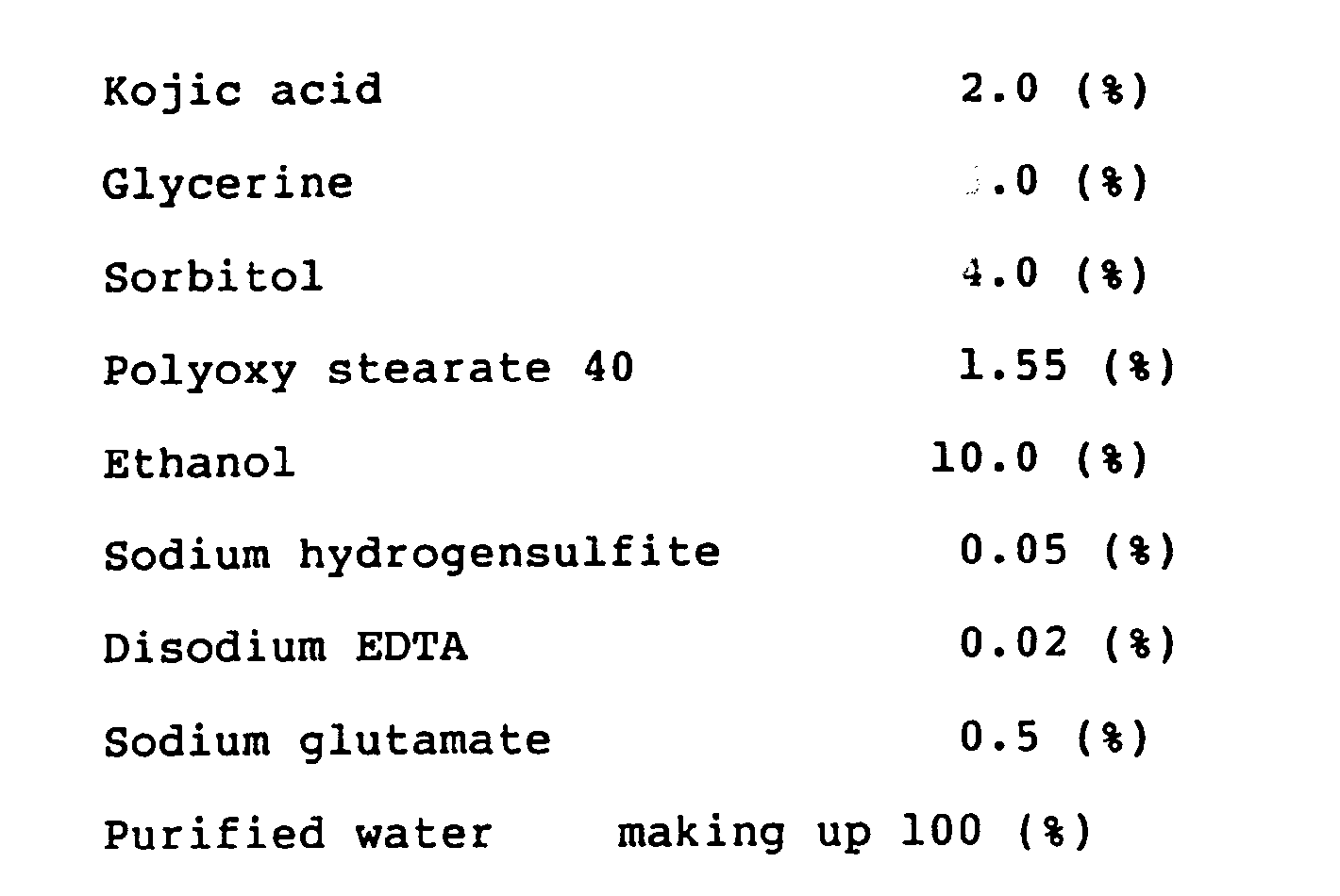
- The components are mixed with stirring and dissolved to obtain the liquid.
-
- A:

- B:
- Soy bean lecithin
- 0.8 (%)
- dl-α-Tocopherol
- 0.1 (%)
- Ethanol
- 5.0 (%)
- Polyethylene glycol 400
- 6.0 (%)
- Purified water
- 20.0 (%)
- C:
- Purified water
- 1.0 (%)
- Disodium EDTA
- 0.02 (%)
- Potassium hydrogentartrate
- 0.2 (%)
- The components of A, B and C are mixed with stirring and dissolved to obtain the emulsified lotion.
-
- A:
- Kojic acid
- 3.0 (%)
- Polysorbate 20
- 5.0 (%)
- Dextran
- 0.07 (%)
- Ethanol
- 5.0 (%)
- B:

- The components of A are mixed. The components of B are mixed and stirred with heating. A is mixed with the mixture of B upon cooling to obtain the oleophilic ointment.
-
- A:
- Carboxyvinyl polymer
- 1.0 (%)
- Propylene glycol
- 10.0 (%)
- Ethanol
- 8.0 (%)
- Diisopropanol amine
- 0.15 (%)
- B:
- Triacetyne
- 30.0 (%)
- Xanthane gum
- 2.0 (%)
- C:
- Purified water
- 3.0 (%)
- Sodium hydrogensulfite
- 0.03 (%)
- D:
- Purified water
- 10.0 (%)
- Kojic acid
- 1.5 (%)
- The components of A are mixed to form a gel. Then, B, C and D are successively added to A to obtain the water-soluble ointment.
-

- The components are homogeneously mixed with heating and cooled to obtain the emulsified ointment.
-
- A:


- B:
- Polysorbate 60
- 2.5 (%)
- Monostearic acid glyceride
- 1.5 (%)
- Cetanol
- 3.0 (%)
- Vaseline
- 5.0 (%)
- Octydodecyl myristate
- 5.0 (%)
- Octyl dodecanol
- 6.0 (%)
- Squalane
- 11.0 (%)
- dl-α-Tocopherol
- 0.15 (%)
- C:
- Purified water
- 10.0 (%)
- Kojic acid
- 2.0 (%)
- A and B are heated to dissolve, respectively. B is added to A to emulsify and cooled to prepare the cream. Separately, C is dissolved and added to the cream to obtain the cream composition.
-

- The components are mixed and dissolved. The solution is put in an aerosol container to obtain the aerosol.
-
- A:

- B:
- Sodium polyacrylate
- 7.0 (%)
- Aluminum chloride
- 0.3 (%)
- Concentrated glycerin
- 20.0 (%)
- Titanium oxide
- 4.0 (%)
- Kojic acid
- 5.0 (%)
- A and B are heated to dissolve, respectively. B is added to A, homogenously stirred and cooled. The resultant mixture is spread on a backing to obtain the cataplasm.
-
- A:

- B:
- Ester gum
- 15.0 (%)
- Polybutene
- 15.0 (%)
- Butylhydroxytoluene
- 1.0 (%)
- C:
- Kojic acid
- 4.0 (%)
- A is heated to dissolve, to which B is gradually added and stirred homogenously. Then, C is added to the mixture and spread on a backing to obtain the plaster.
- In the Examples, percent is by weight.
- The present invention provides the extremely effective medicaments for the treatment of pigmentation such as endogenous chloasma, senile moles, sunlight-induced moles, pigmented spots after inflammation, etc., which have been heretofore difficult to cure and the aggravation of which causes serious conditions. Further, no side effects are observed in administering and, therefore, the compositions of the present invention are quite safe and effective medicaments.
Claims (1)
- Use of kojic acid for the manufacture of a medicament for the treatment of endogenous chloasma, senile moles, sunlight-induced moles or pigmented spots after inflammation.
Applications Claiming Priority (2)
| Application Number | Priority Date | Filing Date | Title |
|---|---|---|---|
| JP161155/89 | 1989-06-23 | ||
| JP16115589 | 1989-06-23 |
Publications (2)
| Publication Number | Publication Date |
|---|---|
| EP0404162A1 EP0404162A1 (en) | 1990-12-27 |
| EP0404162B1 true EP0404162B1 (en) | 1993-02-24 |
Family
ID=15729642
Family Applications (1)
| Application Number | Title | Priority Date | Filing Date |
|---|---|---|---|
| EP90111782A Expired - Lifetime EP0404162B1 (en) | 1989-06-23 | 1990-06-21 | Composition for treating pigmentation |
Country Status (7)
| Country | Link |
|---|---|
| EP (1) | EP0404162B1 (en) |
| JP (1) | JP2977865B2 (en) |
| KR (1) | KR0159917B1 (en) |
| AU (1) | AU632585B2 (en) |
| CA (1) | CA2018824C (en) |
| DE (1) | DE69000960T2 (en) |
| HK (1) | HK51694A (en) |
Families Citing this family (5)
| Publication number | Priority date | Publication date | Assignee | Title |
|---|---|---|---|---|
| CN1096845C (en) * | 1996-11-04 | 2002-12-25 | 普罗克特和甘保尔公司 | Skin Lightening compsns. |
| ES2183017T3 (en) * | 1996-11-04 | 2003-03-16 | Childrens Hosp Medical Center | COMPOSITIONS TO CLEAR THE SKIN. |
| DE69933518T2 (en) * | 1998-02-06 | 2007-08-23 | The Ester C Company, Prescott | STABLE LIQUID COMPOSITIONS OF CALCIUM ASCORBATE AND METHOD FOR THE PRODUCTION AND USE THEREOF |
| CN1313091C (en) * | 2001-06-26 | 2007-05-02 | Zila保健品公司 | Vitamin C composition |
| JP6502011B2 (en) * | 2013-10-07 | 2019-04-17 | 三省製薬株式会社 | Glutathione production promoter |
Family Cites Families (6)
| Publication number | Priority date | Publication date | Assignee | Title |
|---|---|---|---|---|
| JPS60202806A (en) * | 1984-03-26 | 1985-10-14 | Sansho Seiyaku Kk | Whitening cosmetic |
| JPS638310A (en) * | 1986-06-27 | 1988-01-14 | Sansho Seiyaku Kk | Drug capable of inhibiting melanization for external use |
| JPS63270619A (en) * | 1987-04-30 | 1988-11-08 | Sansho Seiyaku Kk | Drug for external use |
| FR2616325B1 (en) * | 1987-06-12 | 1990-11-09 | Moet Hennessy Rech | COMPOSITION CONTAINING HYDROQUINONE AND KOJIC ACID AND PHARMACEUTICAL COMPOSITION, ESPECIALLY DERMATOLOGICAL, WITH DEPIGMENTING OR ANTI-INFLAMMATORY ACTIVITY, OR COSMETIC COMPRISING KOJIC ACID AND HYDROQUINONE |
| JP2565513B2 (en) * | 1987-09-25 | 1996-12-18 | 三省製薬株式会社 | Topical drug for suppressing melanin production |
| JPS6483010A (en) * | 1987-09-25 | 1989-03-28 | Sansho Seiyaku Kk | Melanization inhibitory drug for external use |
-
1990
- 1990-05-30 JP JP2142879A patent/JP2977865B2/en not_active Expired - Lifetime
- 1990-06-12 CA CA002018824A patent/CA2018824C/en not_active Expired - Lifetime
- 1990-06-18 AU AU57551/90A patent/AU632585B2/en not_active Expired
- 1990-06-21 DE DE9090111782T patent/DE69000960T2/en not_active Expired - Lifetime
- 1990-06-21 EP EP90111782A patent/EP0404162B1/en not_active Expired - Lifetime
- 1990-06-23 KR KR1019900009354A patent/KR0159917B1/en not_active Expired - Lifetime
-
1994
- 1994-05-19 HK HK51694A patent/HK51694A/en not_active IP Right Cessation
Also Published As
| Publication number | Publication date |
|---|---|
| KR910000144A (en) | 1991-01-29 |
| JP2977865B2 (en) | 1999-11-15 |
| JPH0386821A (en) | 1991-04-11 |
| EP0404162A1 (en) | 1990-12-27 |
| KR0159917B1 (en) | 1998-12-01 |
| AU5755190A (en) | 1991-01-03 |
| DE69000960D1 (en) | 1993-04-01 |
| HK51694A (en) | 1994-05-27 |
| AU632585B2 (en) | 1993-01-07 |
| CA2018824C (en) | 2001-09-11 |
| DE69000960T2 (en) | 1993-08-05 |
| CA2018824A1 (en) | 1990-12-23 |
Similar Documents
| Publication | Publication Date | Title |
|---|---|---|
| JP2593714B2 (en) | Whitening agent | |
| DE69534908T2 (en) | USE OF STATINE FOR THE TREATMENT OF SKIN DISEASES | |
| JP3911642B2 (en) | Topical skin preparation | |
| WO1999059580A1 (en) | Preventives/remedies for skin diseases | |
| JP3698325B2 (en) | Retinoid composition | |
| US6338854B1 (en) | Photoaging skin-care preparation and method of treating wrinkled skin | |
| JP2937446B2 (en) | Blackening agent to prevent gray hair | |
| JPH06107531A (en) | Whitening cosmetics | |
| EP0561305A1 (en) | Skin whitening composition containing teprenone | |
| JP2844103B2 (en) | External preparation for skin | |
| US5922758A (en) | Methods and compositions employing 2,4-dienoic acid esters of tocopherols to prevent or reduce skin damage | |
| JP2000016917A (en) | Skin whitening cosmetic | |
| JP2878353B2 (en) | External preparation for skin | |
| JP3251635B2 (en) | External preparation for skin | |
| CA2018824C (en) | Use of kojic acid for treating pigmentation diseases | |
| JPH0533683B2 (en) | ||
| JPH08133955A (en) | Skin preparation for external use | |
| JP2720246B2 (en) | External preparation for skin | |
| JPH0296581A (en) | Biotin ester and skin ointment and hair tonic using the ester | |
| JP3072768B2 (en) | Pigmentation treatment | |
| WO2001045697A1 (en) | Skin external agents and drugs | |
| EP0241573A1 (en) | Topical agents for inhibiting the melanin generation | |
| KR100202058B1 (en) | Mixed Whitening Agent Composition | |
| JPH04305519A (en) | Skin humectant for external use | |
| JP3421071B2 (en) | External preparation containing oil-soluble licorice extract |
Legal Events
| Date | Code | Title | Description |
|---|---|---|---|
| PUAI | Public reference made under article 153(3) epc to a published international application that has entered the european phase |
Free format text: ORIGINAL CODE: 0009012 |
|
| AK | Designated contracting states |
Kind code of ref document: A1 Designated state(s): CH DE FR GB IT LI NL SE |
|
| 17P | Request for examination filed |
Effective date: 19901224 |
|
| 17Q | First examination report despatched |
Effective date: 19911212 |
|
| GRAA | (expected) grant |
Free format text: ORIGINAL CODE: 0009210 |
|
| AK | Designated contracting states |
Kind code of ref document: B1 Designated state(s): CH DE FR GB IT LI NL SE |
|
| ITF | It: translation for a ep patent filed | ||
| REF | Corresponds to: |
Ref document number: 69000960 Country of ref document: DE Date of ref document: 19930401 |
|
| ET | Fr: translation filed | ||
| PLBE | No opposition filed within time limit |
Free format text: ORIGINAL CODE: 0009261 |
|
| STAA | Information on the status of an ep patent application or granted ep patent |
Free format text: STATUS: NO OPPOSITION FILED WITHIN TIME LIMIT |
|
| 26N | No opposition filed | ||
| EAL | Se: european patent in force in sweden |
Ref document number: 90111782.0 |
|
| PGFP | Annual fee paid to national office [announced via postgrant information from national office to epo] |
Ref country code: CH Payment date: 19970616 Year of fee payment: 8 |
|
| PGFP | Annual fee paid to national office [announced via postgrant information from national office to epo] |
Ref country code: SE Payment date: 19970617 Year of fee payment: 8 |
|
| PGFP | Annual fee paid to national office [announced via postgrant information from national office to epo] |
Ref country code: NL Payment date: 19970630 Year of fee payment: 8 |
|
| PG25 | Lapsed in a contracting state [announced via postgrant information from national office to epo] |
Ref country code: SE Free format text: LAPSE BECAUSE OF NON-PAYMENT OF DUE FEES Effective date: 19980622 |
|
| PG25 | Lapsed in a contracting state [announced via postgrant information from national office to epo] |
Ref country code: LI Free format text: LAPSE BECAUSE OF NON-PAYMENT OF DUE FEES Effective date: 19980630 Ref country code: CH Free format text: LAPSE BECAUSE OF NON-PAYMENT OF DUE FEES Effective date: 19980630 |
|
| PG25 | Lapsed in a contracting state [announced via postgrant information from national office to epo] |
Ref country code: NL Free format text: LAPSE BECAUSE OF NON-PAYMENT OF DUE FEES Effective date: 19990101 |
|
| REG | Reference to a national code |
Ref country code: CH Ref legal event code: PL |
|
| EUG | Se: european patent has lapsed |
Ref document number: 90111782.0 |
|
| NLV4 | Nl: lapsed or anulled due to non-payment of the annual fee |
Effective date: 19990101 |
|
| REG | Reference to a national code |
Ref country code: GB Ref legal event code: IF02 |
|
| PGFP | Annual fee paid to national office [announced via postgrant information from national office to epo] |
Ref country code: FR Payment date: 20090618 Year of fee payment: 20 |
|
| PGFP | Annual fee paid to national office [announced via postgrant information from national office to epo] |
Ref country code: DE Payment date: 20090630 Year of fee payment: 20 Ref country code: GB Payment date: 20090623 Year of fee payment: 20 |
|
| PGFP | Annual fee paid to national office [announced via postgrant information from national office to epo] |
Ref country code: IT Payment date: 20090626 Year of fee payment: 20 |
|
| REG | Reference to a national code |
Ref country code: GB Ref legal event code: PE20 Expiry date: 20100620 |
|
| PG25 | Lapsed in a contracting state [announced via postgrant information from national office to epo] |
Ref country code: GB Free format text: LAPSE BECAUSE OF EXPIRATION OF PROTECTION Effective date: 20100620 |
|
| PG25 | Lapsed in a contracting state [announced via postgrant information from national office to epo] |
Ref country code: DE Free format text: LAPSE BECAUSE OF EXPIRATION OF PROTECTION Effective date: 20100621 |