EP0402020A1 - An integrated process for the preparation of methylene diphenylene diisocyanates and polymethylene polyphenylene poly (isocyanates) from diamines and polyamines - Google Patents
An integrated process for the preparation of methylene diphenylene diisocyanates and polymethylene polyphenylene poly (isocyanates) from diamines and polyamines Download PDFInfo
- Publication number
- EP0402020A1 EP0402020A1 EP90305738A EP90305738A EP0402020A1 EP 0402020 A1 EP0402020 A1 EP 0402020A1 EP 90305738 A EP90305738 A EP 90305738A EP 90305738 A EP90305738 A EP 90305738A EP 0402020 A1 EP0402020 A1 EP 0402020A1
- Authority
- EP
- European Patent Office
- Prior art keywords
- methylene diphenylene
- urea
- bis
- temperature
- polymethylene polyphenylene
- Prior art date
- Legal status (The legal status is an assumption and is not a legal conclusion. Google has not performed a legal analysis and makes no representation as to the accuracy of the status listed.)
- Withdrawn
Links
- -1 polymethylene Polymers 0.000 title claims abstract description 131
- 238000000034 method Methods 0.000 title claims abstract description 47
- 239000012948 isocyanate Substances 0.000 title claims abstract description 37
- 150000002513 isocyanates Chemical class 0.000 title claims abstract description 33
- 229920000265 Polyparaphenylene Polymers 0.000 title claims abstract description 29
- 229920000768 polyamine Polymers 0.000 title claims abstract description 24
- 150000004985 diamines Chemical class 0.000 title claims abstract description 16
- 238000002360 preparation method Methods 0.000 title claims abstract description 14
- JIABEENURMZTTI-UHFFFAOYSA-N 1-isocyanato-2-[(2-isocyanatophenyl)methyl]benzene Chemical class O=C=NC1=CC=CC=C1CC1=CC=CC=C1N=C=O JIABEENURMZTTI-UHFFFAOYSA-N 0.000 title claims abstract description 11
- 238000006243 chemical reaction Methods 0.000 claims abstract description 51
- XSQUKJJJFZCRTK-UHFFFAOYSA-N Urea Chemical compound NC(N)=O XSQUKJJJFZCRTK-UHFFFAOYSA-N 0.000 claims abstract description 40
- 239000004202 carbamide Substances 0.000 claims abstract description 38
- XLJMAIOERFSOGZ-UHFFFAOYSA-N anhydrous cyanic acid Natural products OC#N XLJMAIOERFSOGZ-UHFFFAOYSA-N 0.000 claims abstract description 32
- OWIKHYCFFJSOEH-UHFFFAOYSA-N Isocyanic acid Chemical compound N=C=O OWIKHYCFFJSOEH-UHFFFAOYSA-N 0.000 claims abstract description 30
- 125000005265 dialkylamine group Chemical group 0.000 claims abstract description 19
- 239000002904 solvent Substances 0.000 claims description 37
- 239000000203 mixture Substances 0.000 claims description 26
- RTZKZFJDLAIYFH-UHFFFAOYSA-N Diethyl ether Chemical compound CCOCC RTZKZFJDLAIYFH-UHFFFAOYSA-N 0.000 claims description 16
- 150000003512 tertiary amines Chemical class 0.000 claims description 16
- HPNMFZURTQLUMO-UHFFFAOYSA-N diethylamine Chemical compound CCNCC HPNMFZURTQLUMO-UHFFFAOYSA-N 0.000 claims description 14
- 125000003118 aryl group Chemical group 0.000 claims description 13
- 125000001424 substituent group Chemical group 0.000 claims description 13
- DLYUQMMRRRQYAE-UHFFFAOYSA-N tetraphosphorus decaoxide Chemical compound O1P(O2)(=O)OP3(=O)OP1(=O)OP2(=O)O3 DLYUQMMRRRQYAE-UHFFFAOYSA-N 0.000 claims description 13
- LSNNMFCWUKXFEE-UHFFFAOYSA-M Bisulfite Chemical compound OS([O-])=O LSNNMFCWUKXFEE-UHFFFAOYSA-M 0.000 claims description 12
- 229920002396 Polyurea Polymers 0.000 claims description 12
- 239000003960 organic solvent Substances 0.000 claims description 12
- UAGAQPUIDMGOLD-UHFFFAOYSA-N 4-pyridin-1-ium-4-ylpyridin-1-ium;dichloride Chemical compound Cl.Cl.C1=NC=CC(C=2C=CN=CC=2)=C1 UAGAQPUIDMGOLD-UHFFFAOYSA-N 0.000 claims description 10
- MVPPADPHJFYWMZ-UHFFFAOYSA-N chlorobenzene Chemical compound ClC1=CC=CC=C1 MVPPADPHJFYWMZ-UHFFFAOYSA-N 0.000 claims description 10
- 239000003456 ion exchange resin Substances 0.000 claims description 10
- 229920003303 ion-exchange polymer Polymers 0.000 claims description 10
- ROSDSFDQCJNGOL-UHFFFAOYSA-N protonated dimethyl amine Natural products CNC ROSDSFDQCJNGOL-UHFFFAOYSA-N 0.000 claims description 10
- AOJFQRQNPXYVLM-UHFFFAOYSA-N pyridin-1-ium;chloride Chemical group [Cl-].C1=CC=[NH+]C=C1 AOJFQRQNPXYVLM-UHFFFAOYSA-N 0.000 claims description 10
- 150000003254 radicals Chemical class 0.000 claims description 10
- UAOMVDZJSHZZME-UHFFFAOYSA-N diisopropylamine Chemical compound CC(C)NC(C)C UAOMVDZJSHZZME-UHFFFAOYSA-N 0.000 claims description 8
- 125000000449 nitro group Chemical group [O-][N+](*)=O 0.000 claims description 8
- RZJRJXONCZWCBN-UHFFFAOYSA-N octadecane Chemical compound CCCCCCCCCCCCCCCCCC RZJRJXONCZWCBN-UHFFFAOYSA-N 0.000 claims description 8
- 229920006395 saturated elastomer Polymers 0.000 claims description 8
- 125000003277 amino group Chemical group 0.000 claims description 7
- 229910052736 halogen Inorganic materials 0.000 claims description 7
- 150000002367 halogens Chemical class 0.000 claims description 7
- 239000001257 hydrogen Substances 0.000 claims description 7
- 229910052739 hydrogen Inorganic materials 0.000 claims description 7
- 229920005989 resin Polymers 0.000 claims description 7
- 239000011347 resin Substances 0.000 claims description 7
- 239000008096 xylene Substances 0.000 claims description 7
- RFFLAFLAYFXFSW-UHFFFAOYSA-N 1,2-dichlorobenzene Chemical compound ClC1=CC=CC=C1Cl RFFLAFLAYFXFSW-UHFFFAOYSA-N 0.000 claims description 6
- 125000001931 aliphatic group Chemical group 0.000 claims description 6
- 150000001412 amines Chemical class 0.000 claims description 6
- 229910052799 carbon Inorganic materials 0.000 claims description 6
- USIUVYZYUHIAEV-UHFFFAOYSA-N diphenyl ether Chemical compound C=1C=CC=CC=1OC1=CC=CC=C1 USIUVYZYUHIAEV-UHFFFAOYSA-N 0.000 claims description 6
- CYGLJMZRMNTQEE-UHFFFAOYSA-N [2-[[2-(carbamoylamino)phenyl]methyl]phenyl]urea Chemical compound NC(=O)NC1=CC=CC=C1CC1=CC=CC=C1NC(N)=O CYGLJMZRMNTQEE-UHFFFAOYSA-N 0.000 claims description 5
- JQVDAXLFBXTEQA-UHFFFAOYSA-N dibutylamine Chemical compound CCCCNCCCC JQVDAXLFBXTEQA-UHFFFAOYSA-N 0.000 claims description 5
- 239000000376 reactant Substances 0.000 claims description 5
- 150000003460 sulfonic acids Chemical class 0.000 claims description 5
- 150000003738 xylenes Chemical class 0.000 claims description 5
- QPFMBZIOSGYJDE-UHFFFAOYSA-N 1,1,2,2-tetrachloroethane Chemical compound ClC(Cl)C(Cl)Cl QPFMBZIOSGYJDE-UHFFFAOYSA-N 0.000 claims description 4
- AFVFQIVMOAPDHO-UHFFFAOYSA-N Methanesulfonic acid Chemical compound CS(O)(=O)=O AFVFQIVMOAPDHO-UHFFFAOYSA-N 0.000 claims description 4
- 150000005840 aryl radicals Chemical class 0.000 claims description 4
- LQNUZADURLCDLV-UHFFFAOYSA-N nitrobenzene Chemical compound [O-][N+](=O)C1=CC=CC=C1 LQNUZADURLCDLV-UHFFFAOYSA-N 0.000 claims description 4
- JOXIMZWYDAKGHI-UHFFFAOYSA-N toluene-4-sulfonic acid Chemical compound CC1=CC=C(S(O)(=O)=O)C=C1 JOXIMZWYDAKGHI-UHFFFAOYSA-N 0.000 claims description 4
- NWUYHJFMYQTDRP-UHFFFAOYSA-N 1,2-bis(ethenyl)benzene;1-ethenyl-2-ethylbenzene;styrene Chemical compound C=CC1=CC=CC=C1.CCC1=CC=CC=C1C=C.C=CC1=CC=CC=C1C=C NWUYHJFMYQTDRP-UHFFFAOYSA-N 0.000 claims description 3
- 230000002378 acidificating effect Effects 0.000 claims description 3
- 229940043279 diisopropylamine Drugs 0.000 claims description 3
- 125000001033 ether group Chemical group 0.000 claims description 3
- 229940038384 octadecane Drugs 0.000 claims description 3
- 229940098779 methanesulfonic acid Drugs 0.000 claims description 2
- 125000004435 hydrogen atom Chemical class [H]* 0.000 claims 4
- CHRJZRDFSQHIFI-UHFFFAOYSA-N 1,2-bis(ethenyl)benzene;styrene Chemical class C=CC1=CC=CC=C1.C=CC1=CC=CC=C1C=C CHRJZRDFSQHIFI-UHFFFAOYSA-N 0.000 claims 1
- AJMWRRGEHRPWHL-UHFFFAOYSA-N 4-ethylmorpholine;pyridine;hydrobromide;hydrochloride Chemical compound Cl.Br.C1=CC=NC=C1.CCN1CCOCC1 AJMWRRGEHRPWHL-UHFFFAOYSA-N 0.000 claims 1
- 229920006026 co-polymeric resin Polymers 0.000 claims 1
- 125000002147 dimethylamino group Chemical group [H]C([H])([H])N(*)C([H])([H])[H] 0.000 claims 1
- UPMLOUAZCHDJJD-UHFFFAOYSA-N 4,4'-Diphenylmethane Diisocyanate Chemical compound C1=CC(N=C=O)=CC=C1CC1=CC=C(N=C=O)C=C1 UPMLOUAZCHDJJD-UHFFFAOYSA-N 0.000 abstract description 8
- 229920000538 Poly[(phenyl isocyanate)-co-formaldehyde] Polymers 0.000 abstract description 4
- 235000013877 carbamide Nutrition 0.000 description 49
- 150000003672 ureas Chemical class 0.000 description 19
- VEXZGXHMUGYJMC-UHFFFAOYSA-N Hydrochloric acid Chemical compound Cl VEXZGXHMUGYJMC-UHFFFAOYSA-N 0.000 description 15
- 230000000875 corresponding effect Effects 0.000 description 12
- 239000000047 product Substances 0.000 description 12
- 229910000041 hydrogen chloride Inorganic materials 0.000 description 11
- CTQNGGLPUBDAKN-UHFFFAOYSA-N O-Xylene Chemical compound CC1=CC=CC=C1C CTQNGGLPUBDAKN-UHFFFAOYSA-N 0.000 description 10
- 238000004128 high performance liquid chromatography Methods 0.000 description 10
- IXCSERBJSXMMFS-UHFFFAOYSA-N hydrogen chloride Substances Cl.Cl IXCSERBJSXMMFS-UHFFFAOYSA-N 0.000 description 10
- 150000003839 salts Chemical class 0.000 description 10
- 239000007787 solid Substances 0.000 description 10
- YXFVVABEGXRONW-UHFFFAOYSA-N Toluene Chemical compound CC1=CC=CC=C1 YXFVVABEGXRONW-UHFFFAOYSA-N 0.000 description 9
- YWEUIGNSBFLMFL-UHFFFAOYSA-N diphosphonate Chemical compound O=P(=O)OP(=O)=O YWEUIGNSBFLMFL-UHFFFAOYSA-N 0.000 description 9
- 239000007789 gas Substances 0.000 description 9
- 230000015572 biosynthetic process Effects 0.000 description 8
- 239000000543 intermediate Substances 0.000 description 8
- 238000005979 thermal decomposition reaction Methods 0.000 description 8
- 238000001914 filtration Methods 0.000 description 6
- 238000010438 heat treatment Methods 0.000 description 6
- 230000035484 reaction time Effects 0.000 description 6
- TUMNHQRORINJKE-UHFFFAOYSA-N 1,1-diethylurea Chemical compound CCN(CC)C(N)=O TUMNHQRORINJKE-UHFFFAOYSA-N 0.000 description 5
- 238000004458 analytical method Methods 0.000 description 5
- 238000000354 decomposition reaction Methods 0.000 description 5
- 238000003786 synthesis reaction Methods 0.000 description 5
- UNVLDGXMSWHXMH-UHFFFAOYSA-N 4-ethylmorpholin-4-ium;chloride Chemical compound Cl.CCN1CCOCC1 UNVLDGXMSWHXMH-UHFFFAOYSA-N 0.000 description 4
- LFQSCWFLJHTTHZ-UHFFFAOYSA-N Ethanol Chemical compound CCO LFQSCWFLJHTTHZ-UHFFFAOYSA-N 0.000 description 4
- JUJWROOIHBZHMG-UHFFFAOYSA-N Pyridine Chemical compound C1=CC=NC=C1 JUJWROOIHBZHMG-UHFFFAOYSA-N 0.000 description 4
- 150000001335 aliphatic alkanes Chemical class 0.000 description 4
- 239000006227 byproduct Substances 0.000 description 4
- 125000004432 carbon atom Chemical group C* 0.000 description 4
- 239000007795 chemical reaction product Substances 0.000 description 4
- GPRLSGONYQIRFK-UHFFFAOYSA-N hydron Chemical compound [H+] GPRLSGONYQIRFK-UHFFFAOYSA-N 0.000 description 4
- 239000007788 liquid Substances 0.000 description 4
- 229940078552 o-xylene Drugs 0.000 description 4
- 239000002002 slurry Substances 0.000 description 4
- JIAARYAFYJHUJI-UHFFFAOYSA-L zinc dichloride Chemical compound [Cl-].[Cl-].[Zn+2] JIAARYAFYJHUJI-UHFFFAOYSA-L 0.000 description 4
- YZUPZGFPHUVJKC-UHFFFAOYSA-N 1-bromo-2-methoxyethane Chemical compound COCCBr YZUPZGFPHUVJKC-UHFFFAOYSA-N 0.000 description 3
- UHOVQNZJYSORNB-UHFFFAOYSA-N Benzene Chemical compound C1=CC=CC=C1 UHOVQNZJYSORNB-UHFFFAOYSA-N 0.000 description 3
- YMWUJEATGCHHMB-UHFFFAOYSA-N Dichloromethane Chemical compound ClCCl YMWUJEATGCHHMB-UHFFFAOYSA-N 0.000 description 3
- KRHYYFGTRYWZRS-UHFFFAOYSA-N Fluorane Chemical class F KRHYYFGTRYWZRS-UHFFFAOYSA-N 0.000 description 3
- WSFSSNUMVMOOMR-UHFFFAOYSA-N Formaldehyde Chemical compound O=C WSFSSNUMVMOOMR-UHFFFAOYSA-N 0.000 description 3
- CPELXLSAUQHCOX-UHFFFAOYSA-N Hydrogen bromide Chemical compound Br CPELXLSAUQHCOX-UHFFFAOYSA-N 0.000 description 3
- DGAQECJNVWCQMB-PUAWFVPOSA-M Ilexoside XXIX Chemical compound C[C@@H]1CC[C@@]2(CC[C@@]3(C(=CC[C@H]4[C@]3(CC[C@@H]5[C@@]4(CC[C@@H](C5(C)C)OS(=O)(=O)[O-])C)C)[C@@H]2[C@]1(C)O)C)C(=O)O[C@H]6[C@@H]([C@H]([C@@H]([C@H](O6)CO)O)O)O.[Na+] DGAQECJNVWCQMB-PUAWFVPOSA-M 0.000 description 3
- MGJKQDOBUOMPEZ-UHFFFAOYSA-N N,N'-dimethylurea Chemical compound CNC(=O)NC MGJKQDOBUOMPEZ-UHFFFAOYSA-N 0.000 description 3
- IMNFDUFMRHMDMM-UHFFFAOYSA-N N-Heptane Chemical compound CCCCCCC IMNFDUFMRHMDMM-UHFFFAOYSA-N 0.000 description 3
- 229920000557 Nafion® Polymers 0.000 description 3
- ZMANZCXQSJIPKH-UHFFFAOYSA-N Triethylamine Chemical compound CCN(CC)CC ZMANZCXQSJIPKH-UHFFFAOYSA-N 0.000 description 3
- 239000002253 acid Substances 0.000 description 3
- 125000000217 alkyl group Chemical group 0.000 description 3
- 150000004945 aromatic hydrocarbons Chemical class 0.000 description 3
- 238000004821 distillation Methods 0.000 description 3
- 150000002431 hydrogen Chemical class 0.000 description 3
- RAXXELZNTBOGNW-UHFFFAOYSA-N imidazole Natural products C1=CNC=N1 RAXXELZNTBOGNW-UHFFFAOYSA-N 0.000 description 3
- IQPQWNKOIGAROB-UHFFFAOYSA-N isocyanate group Chemical group [N-]=C=O IQPQWNKOIGAROB-UHFFFAOYSA-N 0.000 description 3
- 239000007791 liquid phase Substances 0.000 description 3
- 239000000463 material Substances 0.000 description 3
- VLKZOEOYAKHREP-UHFFFAOYSA-N n-Hexane Chemical compound CCCCCC VLKZOEOYAKHREP-UHFFFAOYSA-N 0.000 description 3
- 229910052757 nitrogen Inorganic materials 0.000 description 3
- 229920001228 polyisocyanate Polymers 0.000 description 3
- 239000005056 polyisocyanate Substances 0.000 description 3
- 238000010992 reflux Methods 0.000 description 3
- 229910052708 sodium Inorganic materials 0.000 description 3
- 239000011734 sodium Substances 0.000 description 3
- 239000000126 substance Substances 0.000 description 3
- 239000012808 vapor phase Substances 0.000 description 3
- XLYOFNOQVPJJNP-UHFFFAOYSA-N water Substances O XLYOFNOQVPJJNP-UHFFFAOYSA-N 0.000 description 3
- GWEHVDNNLFDJLR-UHFFFAOYSA-N 1,3-diphenylurea Chemical compound C=1C=CC=CC=1NC(=O)NC1=CC=CC=C1 GWEHVDNNLFDJLR-UHFFFAOYSA-N 0.000 description 2
- PAMIQIKDUOTOBW-UHFFFAOYSA-N 1-methylpiperidine Chemical compound CN1CCCCC1 PAMIQIKDUOTOBW-UHFFFAOYSA-N 0.000 description 2
- GXDHCNNESPLIKD-UHFFFAOYSA-N 2-methylhexane Chemical compound CCCCC(C)C GXDHCNNESPLIKD-UHFFFAOYSA-N 0.000 description 2
- LAIUFBWHERIJIH-UHFFFAOYSA-N 3-Methylheptane Chemical compound CCCCC(C)CC LAIUFBWHERIJIH-UHFFFAOYSA-N 0.000 description 2
- QTBSBXVTEAMEQO-UHFFFAOYSA-N Acetic acid Chemical compound CC(O)=O QTBSBXVTEAMEQO-UHFFFAOYSA-N 0.000 description 2
- QGZKDVFQNNGYKY-UHFFFAOYSA-N Ammonia Chemical compound N QGZKDVFQNNGYKY-UHFFFAOYSA-N 0.000 description 2
- PAYRUJLWNCNPSJ-UHFFFAOYSA-N Aniline Chemical compound NC1=CC=CC=C1 PAYRUJLWNCNPSJ-UHFFFAOYSA-N 0.000 description 2
- IJGRMHOSHXDMSA-UHFFFAOYSA-N Atomic nitrogen Chemical compound N#N IJGRMHOSHXDMSA-UHFFFAOYSA-N 0.000 description 2
- CKDWPUIZGOQOOM-UHFFFAOYSA-N Carbamyl chloride Chemical compound NC(Cl)=O CKDWPUIZGOQOOM-UHFFFAOYSA-N 0.000 description 2
- HEDRZPFGACZZDS-UHFFFAOYSA-N Chloroform Chemical compound ClC(Cl)Cl HEDRZPFGACZZDS-UHFFFAOYSA-N 0.000 description 2
- 102100032373 Coiled-coil domain-containing protein 85B Human genes 0.000 description 2
- JOYRKODLDBILNP-UHFFFAOYSA-N Ethyl urethane Chemical group CCOC(N)=O JOYRKODLDBILNP-UHFFFAOYSA-N 0.000 description 2
- 101000868814 Homo sapiens Coiled-coil domain-containing protein 85B Proteins 0.000 description 2
- 238000004566 IR spectroscopy Methods 0.000 description 2
- NBIIXXVUZAFLBC-UHFFFAOYSA-N Phosphoric acid Chemical compound OP(O)(O)=O NBIIXXVUZAFLBC-UHFFFAOYSA-N 0.000 description 2
- PPBRXRYQALVLMV-UHFFFAOYSA-N Styrene Chemical compound C=CC1=CC=CC=C1 PPBRXRYQALVLMV-UHFFFAOYSA-N 0.000 description 2
- 238000009835 boiling Methods 0.000 description 2
- 239000003153 chemical reaction reagent Substances 0.000 description 2
- 238000001816 cooling Methods 0.000 description 2
- PAFZNILMFXTMIY-UHFFFAOYSA-N cyclohexylamine Chemical compound NC1CCCCC1 PAFZNILMFXTMIY-UHFFFAOYSA-N 0.000 description 2
- 230000001419 dependent effect Effects 0.000 description 2
- 125000004177 diethyl group Chemical group [H]C([H])([H])C([H])([H])* 0.000 description 2
- LVTYICIALWPMFW-UHFFFAOYSA-N diisopropanolamine Chemical compound CC(O)CNCC(C)O LVTYICIALWPMFW-UHFFFAOYSA-N 0.000 description 2
- SNRUBQQJIBEYMU-UHFFFAOYSA-N dodecane Chemical compound CCCCCCCCCCCC SNRUBQQJIBEYMU-UHFFFAOYSA-N 0.000 description 2
- LIWAQLJGPBVORC-UHFFFAOYSA-N ethylmethylamine Chemical compound CCNC LIWAQLJGPBVORC-UHFFFAOYSA-N 0.000 description 2
- 239000013067 intermediate product Substances 0.000 description 2
- ZFSLODLOARCGLH-UHFFFAOYSA-N isocyanuric acid Chemical compound OC1=NC(O)=NC(O)=N1 ZFSLODLOARCGLH-UHFFFAOYSA-N 0.000 description 2
- 238000004519 manufacturing process Methods 0.000 description 2
- VNWKTOKETHGBQD-UHFFFAOYSA-N methane Chemical compound C VNWKTOKETHGBQD-UHFFFAOYSA-N 0.000 description 2
- UAEPNZWRGJTJPN-UHFFFAOYSA-N methylcyclohexane Chemical compound CC1CCCCC1 UAEPNZWRGJTJPN-UHFFFAOYSA-N 0.000 description 2
- 125000000325 methylidene group Chemical group [H]C([H])=* 0.000 description 2
- 238000002156 mixing Methods 0.000 description 2
- 239000012071 phase Substances 0.000 description 2
- 229920002635 polyurethane Polymers 0.000 description 2
- 239000004814 polyurethane Substances 0.000 description 2
- UMJSCPRVCHMLSP-UHFFFAOYSA-N pyridine Natural products COC1=CC=CN=C1 UMJSCPRVCHMLSP-UHFFFAOYSA-N 0.000 description 2
- ZVCDLGYNFYZZOK-UHFFFAOYSA-M sodium cyanate Chemical compound [Na]OC#N ZVCDLGYNFYZZOK-UHFFFAOYSA-M 0.000 description 2
- 125000000542 sulfonic acid group Chemical group 0.000 description 2
- VZGDMQKNWNREIO-UHFFFAOYSA-N tetrachloromethane Chemical compound ClC(Cl)(Cl)Cl VZGDMQKNWNREIO-UHFFFAOYSA-N 0.000 description 2
- 150000003585 thioureas Chemical class 0.000 description 2
- 235000005074 zinc chloride Nutrition 0.000 description 2
- 239000011592 zinc chloride Substances 0.000 description 2
- UOCLXMDMGBRAIB-UHFFFAOYSA-N 1,1,1-trichloroethane Chemical compound CC(Cl)(Cl)Cl UOCLXMDMGBRAIB-UHFFFAOYSA-N 0.000 description 1
- YBBLOADPFWKNGS-UHFFFAOYSA-N 1,1-dimethylurea Chemical compound CN(C)C(N)=O YBBLOADPFWKNGS-UHFFFAOYSA-N 0.000 description 1
- WSLDOOZREJYCGB-UHFFFAOYSA-N 1,2-Dichloroethane Chemical compound ClCCCl WSLDOOZREJYCGB-UHFFFAOYSA-N 0.000 description 1
- MUDPSIDGQZPULE-UHFFFAOYSA-N 1,2-dichlorobenzene;1,1,1,2-tetrachloroethane Chemical compound ClCC(Cl)(Cl)Cl.ClC1=CC=CC=C1Cl MUDPSIDGQZPULE-UHFFFAOYSA-N 0.000 description 1
- PQWHYODXTBJHQG-UHFFFAOYSA-N 1,3-bis(4-ethoxyphenyl)urea Chemical compound C1=CC(OCC)=CC=C1NC(=O)NC1=CC=C(OCC)C=C1 PQWHYODXTBJHQG-UHFFFAOYSA-N 0.000 description 1
- UERKTBSAPLOJRQ-UHFFFAOYSA-N 1-amino-1-phenylurea Chemical compound NC(=O)N(N)C1=CC=CC=C1 UERKTBSAPLOJRQ-UHFFFAOYSA-N 0.000 description 1
- DURPTKYDGMDSBL-UHFFFAOYSA-N 1-butoxybutane Chemical compound CCCCOCCCC DURPTKYDGMDSBL-UHFFFAOYSA-N 0.000 description 1
- FMYVTFRADSNGDN-UHFFFAOYSA-N 1-ethoxy-4-isocyanatobenzene Chemical compound CCOC1=CC=C(N=C=O)C=C1 FMYVTFRADSNGDN-UHFFFAOYSA-N 0.000 description 1
- WIGRVUWJNPVKPB-UHFFFAOYSA-N 1-methylpyrrolidin-1-ium;chloride Chemical compound Cl.CN1CCCC1 WIGRVUWJNPVKPB-UHFFFAOYSA-N 0.000 description 1
- YTOPFCCWCSOHFV-UHFFFAOYSA-N 2,6-dimethyl-4-tridecylmorpholine Chemical compound CCCCCCCCCCCCCN1CC(C)OC(C)C1 YTOPFCCWCSOHFV-UHFFFAOYSA-N 0.000 description 1
- GRZNODNSNCXOHE-UHFFFAOYSA-N 2-chloro-1-oxidopyridin-1-ium;hydron;chloride Chemical compound Cl.[O-][N+]1=CC=CC=C1Cl GRZNODNSNCXOHE-UHFFFAOYSA-N 0.000 description 1
- KXLLKSHFFVQKTQ-UHFFFAOYSA-N 2-cyanoethylurea Chemical compound NC(=O)NCCC#N KXLLKSHFFVQKTQ-UHFFFAOYSA-N 0.000 description 1
- IBZKBSXREAQDTO-UHFFFAOYSA-N 2-methoxy-n-(2-methoxyethyl)ethanamine Chemical compound COCCNCCOC IBZKBSXREAQDTO-UHFFFAOYSA-N 0.000 description 1
- VVPUKGGMORYPNS-UHFFFAOYSA-N 3-ethylpyridine;hydrochloride Chemical compound Cl.CCC1=CC=CN=C1 VVPUKGGMORYPNS-UHFFFAOYSA-N 0.000 description 1
- RPKWNMFDAOACCX-UHFFFAOYSA-N 4-chloro-3-nitrobenzenesulfonic acid Chemical compound OS(=O)(=O)C1=CC=C(Cl)C([N+]([O-])=O)=C1 RPKWNMFDAOACCX-UHFFFAOYSA-N 0.000 description 1
- XGAFCCUNHIMIRV-UHFFFAOYSA-N 4-chloropyridine;hydron;chloride Chemical compound Cl.ClC1=CC=NC=C1 XGAFCCUNHIMIRV-UHFFFAOYSA-N 0.000 description 1
- ONMOULMPIIOVTQ-UHFFFAOYSA-N 98-47-5 Chemical compound OS(=O)(=O)C1=CC=CC([N+]([O-])=O)=C1 ONMOULMPIIOVTQ-UHFFFAOYSA-N 0.000 description 1
- CPELXLSAUQHCOX-UHFFFAOYSA-M Bromide Chemical class [Br-] CPELXLSAUQHCOX-UHFFFAOYSA-M 0.000 description 1
- QHDOMNSNOCTPGT-UHFFFAOYSA-N CCNC(NCC)=O.N=C=O Chemical class CCNC(NCC)=O.N=C=O QHDOMNSNOCTPGT-UHFFFAOYSA-N 0.000 description 1
- VEXZGXHMUGYJMC-UHFFFAOYSA-M Chloride anion Chemical class [Cl-] VEXZGXHMUGYJMC-UHFFFAOYSA-M 0.000 description 1
- VYZAMTAEIAYCRO-UHFFFAOYSA-N Chromium Chemical compound [Cr] VYZAMTAEIAYCRO-UHFFFAOYSA-N 0.000 description 1
- XDTMQSROBMDMFD-UHFFFAOYSA-N Cyclohexane Chemical compound C1CCCCC1 XDTMQSROBMDMFD-UHFFFAOYSA-N 0.000 description 1
- RGSFGYAAUTVSQA-UHFFFAOYSA-N Cyclopentane Chemical compound C1CCCC1 RGSFGYAAUTVSQA-UHFFFAOYSA-N 0.000 description 1
- XBPCUCUWBYBCDP-UHFFFAOYSA-N Dicyclohexylamine Chemical compound C1CCCCC1NC1CCCCC1 XBPCUCUWBYBCDP-UHFFFAOYSA-N 0.000 description 1
- IAZDPXIOMUYVGZ-UHFFFAOYSA-N Dimethylsulphoxide Chemical compound CS(C)=O IAZDPXIOMUYVGZ-UHFFFAOYSA-N 0.000 description 1
- OTMSDBZUPAUEDD-UHFFFAOYSA-N Ethane Chemical compound CC OTMSDBZUPAUEDD-UHFFFAOYSA-N 0.000 description 1
- KMTRUDSVKNLOMY-UHFFFAOYSA-N Ethylene carbonate Chemical compound O=C1OCCO1 KMTRUDSVKNLOMY-UHFFFAOYSA-N 0.000 description 1
- XOTCXWQAPVALFW-UHFFFAOYSA-N N,N-dimethylacetamide N-methylmethanamine Chemical compound C(C)(=O)N(C)C.CNC XOTCXWQAPVALFW-UHFFFAOYSA-N 0.000 description 1
- SECXISVLQFMRJM-UHFFFAOYSA-N N-Methylpyrrolidone Chemical compound CN1CCCC1=O SECXISVLQFMRJM-UHFFFAOYSA-N 0.000 description 1
- 238000005481 NMR spectroscopy Methods 0.000 description 1
- ZLMJMSJWJFRBEC-UHFFFAOYSA-N Potassium Chemical compound [K] ZLMJMSJWJFRBEC-UHFFFAOYSA-N 0.000 description 1
- CZPWVGJYEJSRLH-UHFFFAOYSA-N Pyrimidine Chemical compound C1=CN=CN=C1 CZPWVGJYEJSRLH-UHFFFAOYSA-N 0.000 description 1
- 229910006069 SO3H Inorganic materials 0.000 description 1
- QYKIQEUNHZKYBP-UHFFFAOYSA-N Vinyl ether Chemical compound C=COC=C QYKIQEUNHZKYBP-UHFFFAOYSA-N 0.000 description 1
- HCHKCACWOHOZIP-UHFFFAOYSA-N Zinc Chemical compound [Zn] HCHKCACWOHOZIP-UHFFFAOYSA-N 0.000 description 1
- NMHOCCBOAKTWLP-UHFFFAOYSA-N [N+](=O)([O-])C(C1=CC=CC=C1)[N+](=O)[O-].[N+](=O)([O-])C1=CC=CC=C1 Chemical class [N+](=O)([O-])C(C1=CC=CC=C1)[N+](=O)[O-].[N+](=O)([O-])C1=CC=CC=C1 NMHOCCBOAKTWLP-UHFFFAOYSA-N 0.000 description 1
- 150000001242 acetic acid derivatives Chemical class 0.000 description 1
- 238000013019 agitation Methods 0.000 description 1
- 150000001298 alcohols Chemical class 0.000 description 1
- 150000001338 aliphatic hydrocarbons Chemical class 0.000 description 1
- 229910052783 alkali metal Inorganic materials 0.000 description 1
- 229910000147 aluminium phosphate Inorganic materials 0.000 description 1
- 229910021529 ammonia Inorganic materials 0.000 description 1
- 125000006615 aromatic heterocyclic group Chemical class 0.000 description 1
- JPNZKPRONVOMLL-UHFFFAOYSA-N azane;octadecanoic acid Chemical class [NH4+].CCCCCCCCCCCCCCCCCC([O-])=O JPNZKPRONVOMLL-UHFFFAOYSA-N 0.000 description 1
- 239000002585 base Substances 0.000 description 1
- WRUAHXANJKHFIL-UHFFFAOYSA-N benzene-1,3-disulfonic acid Chemical compound OS(=O)(=O)C1=CC=CC(S(O)(=O)=O)=C1 WRUAHXANJKHFIL-UHFFFAOYSA-N 0.000 description 1
- SRSXLGNVWSONIS-UHFFFAOYSA-N benzenesulfonic acid Chemical compound OS(=O)(=O)C1=CC=CC=C1 SRSXLGNVWSONIS-UHFFFAOYSA-N 0.000 description 1
- 229940092714 benzenesulfonic acid Drugs 0.000 description 1
- AGSPXMVUFBBBMO-UHFFFAOYSA-N beta-aminopropionitrile Chemical compound NCCC#N AGSPXMVUFBBBMO-UHFFFAOYSA-N 0.000 description 1
- 239000004305 biphenyl Substances 0.000 description 1
- 235000010290 biphenyl Nutrition 0.000 description 1
- 125000006267 biphenyl group Chemical group 0.000 description 1
- 239000001273 butane Substances 0.000 description 1
- 229950005499 carbon tetrachloride Drugs 0.000 description 1
- 239000003054 catalyst Substances 0.000 description 1
- 239000003518 caustics Substances 0.000 description 1
- 238000005119 centrifugation Methods 0.000 description 1
- 229920001429 chelating resin Polymers 0.000 description 1
- 239000007806 chemical reaction intermediate Substances 0.000 description 1
- 229910052804 chromium Inorganic materials 0.000 description 1
- 239000011651 chromium Substances 0.000 description 1
- 239000010941 cobalt Substances 0.000 description 1
- 229910017052 cobalt Inorganic materials 0.000 description 1
- GUTLYIVDDKVIGB-UHFFFAOYSA-N cobalt atom Chemical compound [Co] GUTLYIVDDKVIGB-UHFFFAOYSA-N 0.000 description 1
- 150000001875 compounds Chemical class 0.000 description 1
- 238000010924 continuous production Methods 0.000 description 1
- 238000007796 conventional method Methods 0.000 description 1
- 229920001577 copolymer Polymers 0.000 description 1
- 238000005336 cracking Methods 0.000 description 1
- 150000001913 cyanates Chemical class 0.000 description 1
- 150000001924 cycloalkanes Chemical class 0.000 description 1
- 125000000113 cyclohexyl group Chemical group [H]C1([H])C([H])([H])C([H])([H])C([H])(*)C([H])([H])C1([H])[H] 0.000 description 1
- KBXRGBYSPXRSOZ-UHFFFAOYSA-N cyclohexyl(dimethyl)azanium;chloride Chemical compound Cl.CN(C)C1CCCCC1 KBXRGBYSPXRSOZ-UHFFFAOYSA-N 0.000 description 1
- NISGSNTVMOOSJQ-UHFFFAOYSA-N cyclopentanamine Chemical compound NC1CCCC1 NISGSNTVMOOSJQ-UHFFFAOYSA-N 0.000 description 1
- 125000001511 cyclopentyl group Chemical group [H]C1([H])C([H])([H])C([H])([H])C([H])(*)C1([H])[H] 0.000 description 1
- 125000005442 diisocyanate group Chemical group 0.000 description 1
- 229960001760 dimethyl sulfoxide Drugs 0.000 description 1
- 238000001035 drying Methods 0.000 description 1
- 238000005516 engineering process Methods 0.000 description 1
- 150000002148 esters Chemical class 0.000 description 1
- 239000000706 filtrate Substances 0.000 description 1
- 125000005843 halogen group Chemical group 0.000 description 1
- FYAQQULBLMNGAH-UHFFFAOYSA-N hexane-1-sulfonic acid Chemical class CCCCCCS(O)(=O)=O FYAQQULBLMNGAH-UHFFFAOYSA-N 0.000 description 1
- 229910000042 hydrogen bromide Inorganic materials 0.000 description 1
- 229910000040 hydrogen fluoride Inorganic materials 0.000 description 1
- 229910000039 hydrogen halide Inorganic materials 0.000 description 1
- 239000012433 hydrogen halide Substances 0.000 description 1
- 229910000043 hydrogen iodide Chemical class 0.000 description 1
- PSXRWZBTVAZNSF-UHFFFAOYSA-N hydron;quinoline;chloride Chemical compound Cl.N1=CC=CC2=CC=CC=C21 PSXRWZBTVAZNSF-UHFFFAOYSA-N 0.000 description 1
- 238000011065 in-situ storage Methods 0.000 description 1
- 239000011261 inert gas Substances 0.000 description 1
- XMBWDFGMSWQBCA-UHFFFAOYSA-M iodide Chemical class [I-] XMBWDFGMSWQBCA-UHFFFAOYSA-M 0.000 description 1
- 238000002955 isolation Methods 0.000 description 1
- 108010028309 kalinin Proteins 0.000 description 1
- 150000002576 ketones Chemical class 0.000 description 1
- WPBNNNQJVZRUHP-UHFFFAOYSA-L manganese(2+);methyl n-[[2-(methoxycarbonylcarbamothioylamino)phenyl]carbamothioyl]carbamate;n-[2-(sulfidocarbothioylamino)ethyl]carbamodithioate Chemical compound [Mn+2].[S-]C(=S)NCCNC([S-])=S.COC(=O)NC(=S)NC1=CC=CC=C1NC(=S)NC(=O)OC WPBNNNQJVZRUHP-UHFFFAOYSA-L 0.000 description 1
- 229910052751 metal Inorganic materials 0.000 description 1
- 239000002184 metal Substances 0.000 description 1
- VPKDCDLSJZCGKE-UHFFFAOYSA-N methanediimine Chemical compound N=C=N VPKDCDLSJZCGKE-UHFFFAOYSA-N 0.000 description 1
- GYNNXHKOJHMOHS-UHFFFAOYSA-N methyl-cycloheptane Natural products CC1CCCCCC1 GYNNXHKOJHMOHS-UHFFFAOYSA-N 0.000 description 1
- GDOPTJXRTPNYNR-UHFFFAOYSA-N methyl-cyclopentane Natural products CC1CCCC1 GDOPTJXRTPNYNR-UHFFFAOYSA-N 0.000 description 1
- PQCWTNQXCXUEAO-UHFFFAOYSA-N n,n-diethylaniline;hydron;chloride Chemical compound Cl.CCN(CC)C1=CC=CC=C1 PQCWTNQXCXUEAO-UHFFFAOYSA-N 0.000 description 1
- IUSOXUFUXZORBF-UHFFFAOYSA-N n,n-dioctyloctan-1-amine;hydrochloride Chemical compound [Cl-].CCCCCCCC[NH+](CCCCCCCC)CCCCCCCC IUSOXUFUXZORBF-UHFFFAOYSA-N 0.000 description 1
- IJDNQMDRQITEOD-UHFFFAOYSA-N n-butane Chemical compound CCCC IJDNQMDRQITEOD-UHFFFAOYSA-N 0.000 description 1
- INFSYNLQBZDWRI-UHFFFAOYSA-N n-ethyl-n-methylethanamine;hydrobromide Chemical compound [Br-].CC[NH+](C)CC INFSYNLQBZDWRI-UHFFFAOYSA-N 0.000 description 1
- OFBQJSOFQDEBGM-UHFFFAOYSA-N n-pentane Natural products CCCCC OFBQJSOFQDEBGM-UHFFFAOYSA-N 0.000 description 1
- PSZYNBSKGUBXEH-UHFFFAOYSA-N naphthalene-1-sulfonic acid Chemical compound C1=CC=C2C(S(=O)(=O)O)=CC=CC2=C1 PSZYNBSKGUBXEH-UHFFFAOYSA-N 0.000 description 1
- 229910017464 nitrogen compound Inorganic materials 0.000 description 1
- 150000002830 nitrogen compounds Chemical class 0.000 description 1
- ZCYXXKJEDCHMGH-UHFFFAOYSA-N nonane Chemical compound CCCC[CH]CCCC ZCYXXKJEDCHMGH-UHFFFAOYSA-N 0.000 description 1
- BKIMMITUMNQMOS-UHFFFAOYSA-N normal nonane Natural products CCCCCCCCC BKIMMITUMNQMOS-UHFFFAOYSA-N 0.000 description 1
- TVMXDCGIABBOFY-UHFFFAOYSA-N octane Chemical compound CCCCCCCC TVMXDCGIABBOFY-UHFFFAOYSA-N 0.000 description 1
- DGTNSSLYPYDJGL-UHFFFAOYSA-N phenyl isocyanate Chemical compound O=C=NC1=CC=CC=C1 DGTNSSLYPYDJGL-UHFFFAOYSA-N 0.000 description 1
- ZUOUZKKEUPVFJK-UHFFFAOYSA-N phenylbenzene Natural products C1=CC=CC=C1C1=CC=CC=C1 ZUOUZKKEUPVFJK-UHFFFAOYSA-N 0.000 description 1
- 239000002798 polar solvent Substances 0.000 description 1
- 229920001467 poly(styrenesulfonates) Polymers 0.000 description 1
- 229920000642 polymer Polymers 0.000 description 1
- 238000006116 polymerization reaction Methods 0.000 description 1
- 229920002717 polyvinylpyridine Polymers 0.000 description 1
- 239000011148 porous material Substances 0.000 description 1
- 229910052700 potassium Inorganic materials 0.000 description 1
- 239000011591 potassium Substances 0.000 description 1
- XAEFZNCEHLXOMS-UHFFFAOYSA-M potassium benzoate Chemical compound [K+].[O-]C(=O)C1=CC=CC=C1 XAEFZNCEHLXOMS-UHFFFAOYSA-M 0.000 description 1
- GKKCIDNWFBPDBW-UHFFFAOYSA-M potassium cyanate Chemical compound [K]OC#N GKKCIDNWFBPDBW-UHFFFAOYSA-M 0.000 description 1
- 239000002243 precursor Substances 0.000 description 1
- RUOJZAUFBMNUDX-UHFFFAOYSA-N propylene carbonate Chemical compound CC1COC(=O)O1 RUOJZAUFBMNUDX-UHFFFAOYSA-N 0.000 description 1
- BBFCIBZLAVOLCF-UHFFFAOYSA-N pyridin-1-ium;bromide Chemical compound Br.C1=CC=NC=C1 BBFCIBZLAVOLCF-UHFFFAOYSA-N 0.000 description 1
- 238000000197 pyrolysis Methods 0.000 description 1
- 239000012429 reaction media Substances 0.000 description 1
- 238000011084 recovery Methods 0.000 description 1
- 238000007127 saponification reaction Methods 0.000 description 1
- 238000000926 separation method Methods 0.000 description 1
- DOQQTKLDEQSKIE-UHFFFAOYSA-N silver;isocyanate Chemical compound [Ag+].[N-]=C=O DOQQTKLDEQSKIE-UHFFFAOYSA-N 0.000 description 1
- 239000011877 solvent mixture Substances 0.000 description 1
- HXJUTPCZVOIRIF-UHFFFAOYSA-N sulfolane Chemical compound O=S1(=O)CCCC1 HXJUTPCZVOIRIF-UHFFFAOYSA-N 0.000 description 1
- OBTWBSRJZRCYQV-UHFFFAOYSA-N sulfuryl difluoride Chemical compound FS(F)(=O)=O OBTWBSRJZRCYQV-UHFFFAOYSA-N 0.000 description 1
- BFKJFAAPBSQJPD-UHFFFAOYSA-N tetrafluoroethene Chemical group FC(F)=C(F)F BFKJFAAPBSQJPD-UHFFFAOYSA-N 0.000 description 1
- CXWXQJXEFPUFDZ-UHFFFAOYSA-N tetralin Chemical compound C1=CC=C2CCCCC2=C1 CXWXQJXEFPUFDZ-UHFFFAOYSA-N 0.000 description 1
- DVKJHBMWWAPEIU-UHFFFAOYSA-N toluene 2,4-diisocyanate Chemical compound CC1=CC=C(N=C=O)C=C1N=C=O DVKJHBMWWAPEIU-UHFFFAOYSA-N 0.000 description 1
- ILWRPSCZWQJDMK-UHFFFAOYSA-N triethylazanium;chloride Chemical compound Cl.CCN(CC)CC ILWRPSCZWQJDMK-UHFFFAOYSA-N 0.000 description 1
- IMNIMPAHZVJRPE-UHFFFAOYSA-N triethylenediamine Chemical compound C1CN2CCN1CC2 IMNIMPAHZVJRPE-UHFFFAOYSA-N 0.000 description 1
- ITMCEJHCFYSIIV-UHFFFAOYSA-N triflic acid Chemical compound OS(=O)(=O)C(F)(F)F ITMCEJHCFYSIIV-UHFFFAOYSA-N 0.000 description 1
- 229910052720 vanadium Inorganic materials 0.000 description 1
- GPPXJZIENCGNKB-UHFFFAOYSA-N vanadium Chemical compound [V]#[V] GPPXJZIENCGNKB-UHFFFAOYSA-N 0.000 description 1
- 238000005406 washing Methods 0.000 description 1
- 239000011701 zinc Substances 0.000 description 1
- 229910052725 zinc Inorganic materials 0.000 description 1
Classifications
-
- C—CHEMISTRY; METALLURGY
- C07—ORGANIC CHEMISTRY
- C07C—ACYCLIC OR CARBOCYCLIC COMPOUNDS
- C07C273/00—Preparation of urea or its derivatives, i.e. compounds containing any of the groups, the nitrogen atoms not being part of nitro or nitroso groups
- C07C273/18—Preparation of urea or its derivatives, i.e. compounds containing any of the groups, the nitrogen atoms not being part of nitro or nitroso groups of substituted ureas
- C07C273/1809—Preparation of urea or its derivatives, i.e. compounds containing any of the groups, the nitrogen atoms not being part of nitro or nitroso groups of substituted ureas with formation of the N-C(O)-N moiety
- C07C273/1818—Preparation of urea or its derivatives, i.e. compounds containing any of the groups, the nitrogen atoms not being part of nitro or nitroso groups of substituted ureas with formation of the N-C(O)-N moiety from -N=C=O and XNR'R"
- C07C273/1827—X being H
-
- C—CHEMISTRY; METALLURGY
- C07—ORGANIC CHEMISTRY
- C07C—ACYCLIC OR CARBOCYCLIC COMPOUNDS
- C07C263/00—Preparation of derivatives of isocyanic acid
- C07C263/06—Preparation of derivatives of isocyanic acid from or via ureas
-
- C—CHEMISTRY; METALLURGY
- C07—ORGANIC CHEMISTRY
- C07C—ACYCLIC OR CARBOCYCLIC COMPOUNDS
- C07C275/00—Derivatives of urea, i.e. compounds containing any of the groups, the nitrogen atoms not being part of nitro or nitroso groups
- C07C275/28—Derivatives of urea, i.e. compounds containing any of the groups, the nitrogen atoms not being part of nitro or nitroso groups having nitrogen atoms of urea groups bound to carbon atoms of six-membered aromatic rings of a carbon skeleton
-
- C—CHEMISTRY; METALLURGY
- C08—ORGANIC MACROMOLECULAR COMPOUNDS; THEIR PREPARATION OR CHEMICAL WORKING-UP; COMPOSITIONS BASED THEREON
- C08G—MACROMOLECULAR COMPOUNDS OBTAINED OTHERWISE THAN BY REACTIONS ONLY INVOLVING UNSATURATED CARBON-TO-CARBON BONDS
- C08G18/00—Polymeric products of isocyanates or isothiocyanates
- C08G18/06—Polymeric products of isocyanates or isothiocyanates with compounds having active hydrogen
- C08G18/70—Polymeric products of isocyanates or isothiocyanates with compounds having active hydrogen characterised by the isocyanates or isothiocyanates used
- C08G18/72—Polyisocyanates or polyisothiocyanates
- C08G18/74—Polyisocyanates or polyisothiocyanates cyclic
- C08G18/76—Polyisocyanates or polyisothiocyanates cyclic aromatic
- C08G18/7657—Polyisocyanates or polyisothiocyanates cyclic aromatic containing two or more aromatic rings
- C08G18/7664—Polyisocyanates or polyisothiocyanates cyclic aromatic containing two or more aromatic rings containing alkylene polyphenyl groups
-
- C—CHEMISTRY; METALLURGY
- C08—ORGANIC MACROMOLECULAR COMPOUNDS; THEIR PREPARATION OR CHEMICAL WORKING-UP; COMPOSITIONS BASED THEREON
- C08G—MACROMOLECULAR COMPOUNDS OBTAINED OTHERWISE THAN BY REACTIONS ONLY INVOLVING UNSATURATED CARBON-TO-CARBON BONDS
- C08G18/00—Polymeric products of isocyanates or isothiocyanates
- C08G18/06—Polymeric products of isocyanates or isothiocyanates with compounds having active hydrogen
- C08G18/70—Polymeric products of isocyanates or isothiocyanates with compounds having active hydrogen characterised by the isocyanates or isothiocyanates used
- C08G18/72—Polyisocyanates or polyisothiocyanates
- C08G18/74—Polyisocyanates or polyisothiocyanates cyclic
- C08G18/76—Polyisocyanates or polyisothiocyanates cyclic aromatic
- C08G18/7657—Polyisocyanates or polyisothiocyanates cyclic aromatic containing two or more aromatic rings
- C08G18/7664—Polyisocyanates or polyisothiocyanates cyclic aromatic containing two or more aromatic rings containing alkylene polyphenyl groups
- C08G18/7671—Polyisocyanates or polyisothiocyanates cyclic aromatic containing two or more aromatic rings containing alkylene polyphenyl groups containing only one alkylene bisphenyl group
-
- Y—GENERAL TAGGING OF NEW TECHNOLOGICAL DEVELOPMENTS; GENERAL TAGGING OF CROSS-SECTIONAL TECHNOLOGIES SPANNING OVER SEVERAL SECTIONS OF THE IPC; TECHNICAL SUBJECTS COVERED BY FORMER USPC CROSS-REFERENCE ART COLLECTIONS [XRACs] AND DIGESTS
- Y02—TECHNOLOGIES OR APPLICATIONS FOR MITIGATION OR ADAPTATION AGAINST CLIMATE CHANGE
- Y02P—CLIMATE CHANGE MITIGATION TECHNOLOGIES IN THE PRODUCTION OR PROCESSING OF GOODS
- Y02P20/00—Technologies relating to chemical industry
- Y02P20/10—Process efficiency
Definitions
- the present invention relates to a multi-step process for the preparation of methylene diphenylene diisocyanates and the higher polymethylene polyphenylene poly (isocyanate) homologs thereof (commonly known in the trade as MDI and PMDI respectively) from methylene diphenylene diamines or polymethylene polyphenylene polyamines and isocyanic acid to form a methylene diphenylene bis urea or a polymethylene polyphenylene polyurea respectively, which urea is then reacted with a dialkyl amine such as diethylamine, to give the methylene diphenylene (dialkyl urea) or polymethylene polyphenylene poly (alkylurea) products which are then thermally treated in a inert organic solvent in the presence of a reaction promoter to produce the corresponding isocyanates which, among other things are especially useful for the preparation of polyurethanes and modified polyurethanes.
- MDI and PMDI polymethylene poly
- German Democratic Republic Industrial Patent No. 228,544 related to the production of acyl isocyanates describes the synthesis of 1, 1-diacyl-3, 3-dialkylureas from, for example 1, 1-dimethylurea.
- tertiary amine hydrohalides such as pyridine hydrochloride, phosphorus pentoxide (P2O5) organic sulfonic acids and sulfonated aromatic ion exchange resins are all excellent promoters for the thermal decomposition of the intermediate dialkyl ureas or poly (alkylureas) of this invention to the corresponding isocyanate and at relatively mild reaction temperatures and short residence times in an organic solvent.
- van Landeghem et al French Patent No. 1,473,821, February 13, 1967; C.J. Hearsey, U. S. Patent No. 3,898,259, August 5, 1975 and Rosenthal et al in the U.S. Patent No. 3,936,484, February 3, 1976.
- van Landeghem shows thermal decomposition of trisubstituted ureas in an organic solvent having specified dielectric constants at 140° to 170°C with long reaction times of from 6 to 10 hours and modest yields of 60 to 75%.
- catalysts include metal salts, such as acetates, stearates, and linoleates of manganese, zinc, cobalt, chromium and vanadium, tertiary amine bases, such as aliphatic, cycloaliphatic, aromatic and mixed tertiary amines, aliphatic heterocyclic amines such as N-methylpiperidine or N, N′-dimethylpiperidine as well as aromatic heterocyclic amines such as pyridine and pyrimidine. Other nitrogen compounds such as imidazole are indicated as being suitable. However, under the reaction conditions described, tertiary amines as shown by van Landeghem do not catalyze urea decomposition.
- Rosenthal et al U.S. Patent No. 3,936,484 discloses the thermal decomposition of di- and tri-substituted ureas to isocyanates at temperatures above 230°C in a solvent with short residence times and isocyanate yields of from 60 to 80%.
- the Hearsey U.S. Patent No. 3,898,259 describes the introduction of gaseous hydrogen chloride into the liquid phase urea decomposition reaction to give reduced reaction times with isocyanate yields of from 80 - 90%.
- An excess of gaseous HCl is employed at temperatures of from 100° to 200°C and a by-product carbamoyl chloride intermediate formed.
- A.Hentschel et al U.S. Patent No. 4,223,145, September 16, 1980 discloses the formation of an HCl adduct of a tri-substituted urea using at most, a 10% excess of HCl. This adduct is then decomposed in a closed system at from 80° to 180° C.
- This invention relates to a novel integrated multi-step process for the preparation of methylene diphenylene diisocyanates and the higher polymethylene polyphenylene poly (isocyanate) homologs thereof from diamines or polyamines and isocyanic acid (HNCO).
- the methylene diphenylene diamines or or polymethylene polyphenylene polyamines are reacted with isocyanic acid to convert the amino groups to urea groups, which methylene diphenylene bis ureas or polymethylene polyphenylene poly (ureas) are then reacted with a dialkyl amine, such as diethylamine to produce a methylene diphenylene (dialkyl urea) or polymethylene polyphenylene poly (alkyl urea) product which is slurried in or dissolved in an inert organic solvent and thermally decomposed in the presence of a reaction promoter selected from tertiary amine hydrohalides, phosphorus pentoxide, organic sulfonic acids and sulfonated aromatic ion exchange resins to produce the corresponding isocyanate.
- a reaction promoter selected from tertiary amine hydrohalides, phosphorus pentoxide, organic sulfonic acids and sul
- MDI and PMDI diisocyanates and polyisocyanates
- a methylene diphenylene diisocyanate or polymethylene polyphenylene poly (isocyanate) is produced by a process which comprises the steps of:
- the isocyanic acid employed in Step (a) of the process of the present invention may be produced or generated by known methods such as the pyrolysis of urea or cyanuric acid, reaction of cyanate salts such as sodium, potassium or silver cyanate and the like with an acid such as acetic or hydrochloric acid and the like.
- the isocyanic acid may be generated and used in situ, or it may be distilled away from its source and used in the process of the invention as a gas or dissolved in an appropriate solvent.
- the molar ratio of the (-NH2) groups of the diamines or polyamines to isocyanic acid is generally one to one. However, an excess of isocyanic acid of up to about 50% may be employed. Alternatively, an excess of up to about 30% (-NH2) groups may be used and any unreacted or partially reacted diamines or polyamines separated from the bis urea produced and recycled.
- the molar ratio of the dialkylamine reactant, such as dimethylamine, to the urea groups (-NHCONH2) is generally one to one. However, an excess of dialkylamine of from about 10% to a ten-fold excess may advantageously be employed to drive the reaction to completion. Unreacted dialkylamine may be easily recovered by distillation for recycle in the reaction.
- dialkylamines or mixtures thereof which may be employed in Step (b) of the process of the invention conform to the general fomula R′R ⁇ HN wherein R′ and R ⁇ are as defined above.
- R′ and R ⁇ are each alkyl groups having from 1 to 8 carbon atoms.
- Representative dialkylamines include, for example, dimethylamine, diethylamine, methylethylamine, diisopropylamine, dicyclohexylamine, dibutylamine, cyclopentylamine, cyclohexylamine, bis (2-methoxyethyl)amine, bis (2-phenoxyethyl)mine, and the like.
- Solvents or mixtures of solvents which are stable and substantially chemically inert to the components of the reaction system are employed in each of the process steps of the present invention.
- Suitable solvents which may be employed include, for example, the aromatic hydrocarbons such as benzene, toluene, xylene, tetrahydronaphthalene as well as higher alkyl-substituted aromatic hydrocarbons; alkanes and substituted alkanes as well as cycloalkanes having from 5 to 20 carbon atoms such as, for example, n-hexane, n-heptane, octane, nonane, cyclohexane, dodecane, octadecane, 2-methyl- hexane, 2-ethylhexane, methylcyclohexane, cyclopentane and the like; halogenated or nitrated aromatic or aliphatic hydro- carbons such
- ketones, esters, alcohols as well as water and highly polar solvents such as sulfolane, dimethysulfoxide, ethylene carbonate or propylene carbonate may also be used.
- the diamines, polyamines, the reaction intermediates such as the bis ureas, polyureas or the reaction products be completely miscible with the solvents at the concentrations employed.
- Advantage may be taken of differing solubilities of the reagents, intermediates and reaction products in the various solvents or mixture of solvents to separate the reaction components or to drive the reaction to increased product.
- the same solvent or mixture of solvents may be used throughout the reaction system or different solvents or solvent mixtures used in different steps of the process.
- the intermediate bis urea or polyurea obtained by the reaction of the diamine or polyamine with isocyanic acid in in Step (a) may, if desirable be isolated from the reaction system and further processed according to the process of the invention or it may simply be carried forward as a solution or a slurry without isolation for completion of the process to produce the desired isocyanate.
- the intermediate bis urea or polyurea may be essentially insoluble and the urea easily separated from unreacted diamine or polyamine or partly reacted amine urea by-products by conventional techniques such as filtration, centrifugation, and the like.
- the separated bis urea,polyurea or the crude intermediate product may be reacted with a dialkyl amine to produce the desired bis dialkyl urea or poly (alkyl urea).
- the dialkyl amine reactant may be added as a gas, a liquid, a solid or as a solution in solvent.
- the dialkyl amine may be added to the reactor along with the diamine or polyamine. Ammonia generated in this part of the reaction is removed by any convenient means.
- the R′ and R ⁇ of the dialkylureido (-NHCONR′R ⁇ ) group described hereinabove may also be substituted or unsubstituted monovalent radicals selected from saturated or mono-olefinic unsaturated straight or branched chain aliphatic or cycloaliphatic radicals optionally containing alkoxyalkyl radicals with one or more ether linkages, aryl radicals, or aralkyl radicals or R and R′ together form a substituted or unsubstituted saturated or mono-olefinic unsaturated divalent aliphatic radical.
- methylene diphenylene bis (dialkylureas) produced as intermediate products of the present invention include, for example, methylene diphenylene bis (dimethylurea), methylene diphenylene bis (diphenyl or diethyl or dibutyl ureas) and the like as well as the polymethylene polyphenylene poly (diethyl or dibutyl or dipropyl, etc. ureas).
- the tertiary amine hydrohalide salts employed in the process of the present invention to promote thermal decomposition of the bis dialkyl or polyalkyl ureas to the corresponding isocyanate may be prepared, for example, by reacting the tertiary amine selected with a hydrogen halide such as HCl. Salts of hydrogen fluoride, chloride, bromide or iodide may be used.
- the tertiary amines used to prepare the hydrohalide will conform to the general formula R,R′,R ⁇ N wherein R,R′ and R ⁇ are not hydrogen but may be an aliphatic radical having from 1 to 10 carbon atoms, a cycloatiphatic radical such as cyclopentyl, cyclohexyl and cycloheptyl radicals, an aromatic radical, or an aralkyl radical.
- Such radicals may be substituted with, for example, nitro or halo groups which are non-reactive with the isocyanate produced.
- Suitable amine salts include, for example, triethylamine hydrochloride, hydrobromide or hydrofluoride, trioctylamine hydro-chloride, hydrobromide or hydrofluoride, N-Methyldiethylamine hydrobromide or hydrochloride, N,N-diethylaniline hydrochloride and N,N-dimethylcyclohexylamine hydrochloride.
- Hydrohalide salts of heterocyclic tertiary amines and heterocyclic aromatic amines may also be employed.
- Representative salts include, for example, N-methylpyrrolidine hydrochloride, pyridine hydro- chloride or hydrobromide, 3-ethylpyridine hydrochloride, the hydrohalide salt of 1,4- diazabicyclo [2.2.2] octane, 4-chloro- pyridine hydrochloride, 4,4′-bipyridine dihydrochloride, quinoline hydrochloride or the like. Salts of amine oxides such as 2-chloropyridine N-oxide hydrochloride may also be used as a promoter.
- the hydrohalide may be formed with an amine which may be part of a polymer such as polyvinyl pyridine or a resin prepared from tertiary amine groups attached to a styrene divinylbenzenepolymer.
- the tertiary amine hydrohalide is generally employed in the process at a molar ratio of one to one based on the urea groups. However, an excess of the tertiary amine hydrohalide promoter may be used.
- the phosphorus pentoxide employed in the process of the present invention to promote thermal decomposition of the bis dialkyl or polyalkyl ureas to the corresponding isocyanate is commercially available material produced by burning phosporus in dry air.
- the phosphorus pentoxide promoter is generally employed in the process at a molar ratio of one to one based on the urea groups. However, an excess of the phosphorus pentoxide promoter of up to three to one may be used. No advantage is gained by using higher amounts which may lead to by-product formation.
- the organic sulfonic acid employed in the process of the present invention to promote the thermal decomposition of the bis dialkyl or polyalkyl ureas may be an alkane sulfonic acid or a halogenated alkane sulfonic acid having up to 10 carbon atoms in the alkyl group, or an aromatic sulfonic acid which may contain substituents on the aromatic ring such as halogens, alkyl radicals, aromatic radicals, nitro groups and the like.
- the organic sulfonic acid may be in the form of an acidic sulfonated aromatic ion exchange resin such as, for example, the sulfonated styrene/divinyl-benzene copolymer (sold, for example, commercially as "Amberlyst 15" by Rohm & Haas Co.) and having a bulk density of approximately 565 g./l, a hydrogen ion concentration of approximately 4.9 milliequivalents/g.dry, a surface area of from about 40 to 50 m2/g.
- an acidic sulfonated aromatic ion exchange resin such as, for example, the sulfonated styrene/divinyl-benzene copolymer (sold, for example, commercially as "Amberlyst 15" by Rohm & Haas Co.) and having a bulk density of approximately 565 g./l, a hydrogen ion concentration of approximately 4.9 milliequi
- an acidic perfluoroalkane sulfonic acid resin such as "Nafion" (sold for example, commercially by the DuPont Co.) and having an equivalent weight of between about 110 and 1500, a hydrogen ion concentration of between about 0.7 - 1.0 milliequivalents/g. dry and prepared, for example, by the polymerization of tetrafluoroethylene with a sulfonyl fluoride vinyl ether, followed by saponification with caustic to form the alkali metal salt and treatment with an acid to convert the salt to the sulfonic acid form.
- an acidic perfluoroalkane sulfonic acid resin such as "Nafion" (sold for example, commercially by the DuPont Co.) and having an equivalent weight of between about 110 and 1500, a hydrogen ion concentration of between about 0.7 - 1.0 milliequivalents/g. dry and prepared, for example, by the polymerization of tetrafluoro
- sulfonic acid promoters suitable for use in the process of this invention include, for example, methane, ethane, butane, hexane sulfonic acids, and the like, trifluoromethane sulfonic acid, benzene sulfonic acid, 1,3-benzene disulfonic acid, p-toluene sulfonic acid, naphthalene sulfonic acid, 4-chloro-3-nitrobenzene sulfonic acid, 3 nitrobenzene sulfonic acid, and the like, as well as the sulfonated aromatic ion exchange resins which include the "Amberlyst 15" and “Nafion” described hereinabove and also include the "Dowex 50" (Dow Chemical), "AG50
- the ion exchange resins may be supplied commercially in the hydrogen ion form or the salt form such as the sodium or potassium salt.
- the salt can readily be converted to the active hydrogen ion form by, for example, treating with aqueous hydrochloric acid, washing with water to a constant pH in the range of 5.5 to 7 and then drying to remove residual water.
- the organic sulfonic acid promoter is generally employed in the process of the instant invention at a molar ratio of one to one based on the urea groups to sulfonic acid groups. No advantage is gained by using large excess amounts which may lead to by-product formation.
- the process of the present invention can be suitably carried out by adding the bis dialkyl or polyalkyl urea to a solvent or a mixture of solvents comprising the reaction medium.
- the urea may be soluble in the solvent or solvents or soluble at reaction temperatures or the urea may be in the form of a slurry.
- Reactions using a sulfonic acid ion exchange resin promoter may also be carried out in a fixed bed of resin by passing a solvent solution of the urea through a bed maintained at the desired reaction temperature.
- a general procedure for carrying out Step (a) of the process is to charge the methylene diphenylene diamine or polyamine together with a solvent into the reaction vessel.
- the isocyanic acid is introduced into the reactor as a gas, optionally diluted with an inert gas, as a liquid, or as a solution in an appropriate solvent.
- the isocyanic acid can be charged to the reactor first together with a solvent and the diamine or polyamine then added as a liquid, a solid, a solution in suitable solvent or as a slurry in a suitable inert liquid.
- the reaction vessel is heated or cooled as necessary to provide the desired reaction temperature for the appropriate period. Heating and/or cooling means may be employed interior or exterior of the reaction vessel to maintain temperature within desired ranges.
- the desired reaction product may be recovered by standard filtration and/or distillation procedures.
- the Step (a) reaction of the diamines or polyamines with isocyanic acid will proceed at temperatures of from about -30°C to about 200°C, preferably from about -10°C to about 100°C. Reaction time is dependent on the temperature but will generally range between about two minutes to several hours.
- the Step (b) reaction of the intermediate bis urea or polyurea and the dialkyl amines will proceed at temperatures of from about 50°C to about 200°C, preferably from about 90°C to about 150°C. The reaction time depends on the temperature but will generally range between about 30 minutes to about 8 hours.
- the process of the present invention may be carried out as a batch, semi-continuous or continuous process and the order of addition of the materials and reactants may be varied to suit the particular apparatus, reactants and promoter employed.
- the reaction of the invention may be carried out in any suitable reactor which is equipped with a means for temperature control and agitation. Heating and/or cooling means may be employed interior or exterior of the reaction vessel to maintain temperature within the desired range.
- Step (c) thermal decomposition of the bis dialkyl or poly (alkyl) ureas is carried out at temperatures of from about 50°C to about 220°C, preferably from about 90°C to 150°C. Reaction time is dependent on decomposition temperature but will generally range between about 5 minutes and several hours.
- reaction steps of this invention are generally carried out at atmospheric pressure, but depending on the boiling points of the solvents employed and the isocyanate product, it may be carried out at super-atmospheric or sub-atmospheric pressures.
- the isocyanate formed may be recovered by filtration, by distillation of either the solvent or the isocyanate, whichever is lower boiling, or by other known methods, and will depend on the solvent employed and the isocyanate produced.
- the mixture was heated from an initial temperature of 80°C to a maximum of 140°C over three hours. Analysis of the product by a combination of HPLC and nuclear magnetic resonance showed that a mixture of poly methylene polyphenylene poly (diethylureas) had been made with an approximate yield of 85% based on starting polyamine. Unreacted diethylamine was distilled out of the reactor and then methanesulfonic acid, 2.0g, and 50g mixed xylenes were added. The mixture was heated to reflux at 144°C for 30 minutes and then the xylene phase was analyzed by infrared spectroscopy for the isocyanate group. The yield of polymethylene polyphenylene polyisocyanate was 81%.
- Isocyanic acid generated by the reaction of sodium cyanate with hydrogen chloride, was distilled away from the sodium cyanate and carried as a gas diluted with nitrogen into a 250ml, 3 neck round bottom flask equipped with a magnetic stirrer, condenser, and gas inlet tube containing 2.0g of 4,4′-methylene diphenylene diamine in 130g o-dichlorobenzene.
- the reaction was held at -10°C by a refrigerated bath. Solids precipitated in the flask on addition of the isocyanic acid. After an excess of isocyanic acid has been added, the reaction was warmed to room temperature and stirred for 30 minutes.
- the solids formed were collected by filtration, transferred to a pressure vessel, and suspended in 100 ml mixed xylenes. 3g dimethylamine was charged to the vessel which was then heated to 140°C under autogenous pressure for 4 hours. Analysis of the product by HPLC showed an overall yield of 90% of 4,4′-methylene diphenylene bis (dimethylurea). The product was returned to the round bottom flask and the residual dimethylamine was distilled overhead. Then 3.0g of phosphorus pentoxide was added in one portion and the mixture was heated at 120°C for 90 min. The product characterized by infrared and HPLC analysis, showed 95% conversion of the 4,4′-methylene diphenylene bis (dimethylurea) with a 90% yield of the corresponding isocyanate.
- a solution of 4,4′-methylene diphenylene bis (diethylurea) was prepared by reacting a mixture of 4.0g, (20 mmoles) of 4,4′-methylene diphenylene diamine in 100g chlorobenzene with 35g of a 5wt% chlorobenzene solution of isocyanic acid, containing 1.75g, (41 mmoles) of isocyanic acid at 50°C for 30 min., adding 4.4g of diethylamine and heating the resulting mixture at reflux for 4 hrs. The product solution was combined with 20g of "Amberlyst 15" resin stirred, and heated for 2 hours at 130°C.
- Example 1 A number of runs were carried out according to procedures of Example 1 employing various diamines or polyamines, dialkylamines, solvents, reaction temperatures and cracking promoters. The products were characterized by infrared spectroscopy or high pressure liquid chromatography.
- the reaction conditions for synthesis of the corresponding bis (dialkyl) urea compounds are set forth in Table 1 below. These urea compounds, including solvent were converted to the corresponding isocyanate.
- the reaction conditions and results for making the corresponding isocyanates from the bis (dialkylurea) compounds of Table 1 are set forth in Table 2 below.
Landscapes
- Chemical & Material Sciences (AREA)
- Organic Chemistry (AREA)
- Health & Medical Sciences (AREA)
- Chemical Kinetics & Catalysis (AREA)
- Medicinal Chemistry (AREA)
- Polymers & Plastics (AREA)
- Organic Low-Molecular-Weight Compounds And Preparation Thereof (AREA)
Abstract
A multi-step process for the preparation of methylene diphenylene diisocyanates (MDI) or polymethylene polyphenylene poly (isocyanates) (PMDI) from methylene diphenylene diamines or polymethylene polyphenylene polyamines comprises reacting the diamine or polyamine with isocyanic acid to form a urea which is then reacted with a dialkyl amine to give a corresponding dialkyl urea or poly (alkyl urea) product which is then thermally reacted in the presence of various reaction promoters to give the corresponding isocyanate MDI or PMDI product.
Description
- The present invention relates to a multi-step process for the preparation of methylene diphenylene diisocyanates and the higher polymethylene polyphenylene poly (isocyanate) homologs thereof (commonly known in the trade as MDI and PMDI respectively) from methylene diphenylene diamines or polymethylene polyphenylene polyamines and isocyanic acid to form a methylene diphenylene bis urea or a polymethylene polyphenylene polyurea respectively, which urea is then reacted with a dialkyl amine such as diethylamine, to give the methylene diphenylene (dialkyl urea) or polymethylene polyphenylene poly (alkylurea) products which are then thermally treated in a inert organic solvent in the presence of a reaction promoter to produce the corresponding isocyanates which, among other things are especially useful for the preparation of polyurethanes and modified polyurethanes.
- A number of processes have been reported for the preparation of mono- and disubstituted ureas and amines as in the preparation of, for example, the bis (diethylurea of toluene by reacting toluene -2,4-diisocyanate with diethylamine described in French Patent No. 1570670, June 13, 1969.
- An article by N.A. Ivanov entitled "Synthesis of Substituted Ureas and Thioureas and Their Thermal Stability", Chemistry Department of the Kalinin Agricultural Institute describes the synthesis of thioureas, mono substituted ureas and toluene-2, 4-diamines.
- German Democratic Republic Industrial Patent No. 228,544 related to the production of acyl isocyanates describes the synthesis of 1, 1-diacyl-3, 3-dialkylureas from, for example 1, 1-dimethylurea.
- Czechoslovakian Patent No. 200,441 discloses a method for the preparation of aminophenylurea by reacting phenylenediamine diamine with one mole of cyanic acid in the presence of sodium or potassium cyanate.
- An article of Y. Shimonura et al entitled "Reactions of Isocyanic Acid with Various Reagents", Fukui Daigaku Kogakuba Kenkyu Hokoku, Vol. 31, No. 2, pp 115, 1983 describes the reaction of 2-cyanoethylamine with isocyanic acid to give 2-cyanoethylurea. The synthesis of isocyanic acid from cyanuric acid by thermal decomposition is also set forth.
- Applicants have found that tertiary amine hydrohalides, such as pyridine hydrochloride, phosphorus pentoxide (P₂O₅) organic sulfonic acids and sulfonated aromatic ion exchange resins are all excellent promoters for the thermal decomposition of the intermediate dialkyl ureas or poly (alkylureas) of this invention to the corresponding isocyanate and at relatively mild reaction temperatures and short residence times in an organic solvent.
- Processes have been reported in the literature for the preparation of aromatic mono- and polyisocyanates by the vapor or solvent phase decomposition of substituted ureas using various promoters to help convert the urea groups to isocyanate groups.
- The vapor phase production of aromatic isocyanates from symmetrical bis aryl ureas in a solventless system in the presence of hydrogen chloride,phosphorus pentoxide or zinc chloride was described by A. Hofmann in the Proc. Royal Soc., London, Vol. IX p. 274 (1858). By heating a mixture of diphenyl urea with phosphorus pentoxide, zinc chloride or gaseous HCl. Hofmann distilled phenyl isocyanate ovehead. No details of the experimental procecure are presented and yield of isocyanate not given.
- A. Hofmann, Chemisch Berichte, Vol. 3, pp. 653-658 (1870) described heating diphenyl urea in the presence of phosphoric acid giving yields too small to be considered for the preparation of the isocyanate.
- Subsequent work by Iwakura and Nagakubo reported in the Bulletin Tokyo Inst. Technol., Vol. 13, p.25 (1950) and Chemical Abstracts, Vol.44, p. 3924e (1950) describes the preparation of an aromatic isocyanate (p-ethoxyphenylisocyanat) by heating a solution of bis aryl urea such as bis (p-ethoxyphenyl) urea in the presence of hydrogen chloride gas.
- The vapor phase decomposition of bis aryl ureas at 350°C° and higher temperatures has been described by W.D. Bennet et al, Journ. Am. Chem. Soc., Vol. 75, p.2101 (1952) and Slocombe et al in U.S. Pat. No. 2,773,086, December 4, 1956 in the presence of gaseous HCl as a promoter. Yields are reported in the 60 to 70% range for the vapor phase reaction and only a 5% yield for liquid phase reaction. A carbamoyl chloride intermediate is formed.
- The liquid phase decomposition of trisubstituted ureas to isocyanates has been described by van Landeghem et al, French Patent No. 1,473,821, February 13, 1967; C.J. Hearsey, U. S. Patent No. 3,898,259, August 5, 1975 and Rosenthal et al in the U.S. Patent No. 3,936,484, February 3, 1976. van Landeghem shows thermal decomposition of trisubstituted ureas in an organic solvent having specified dielectric constants at 140° to 170°C with long reaction times of from 6 to 10 hours and modest yields of 60 to 75%. A variety of catalysts are shown but not exemplified or claimed, and include metal salts, such as acetates, stearates, and linoleates of manganese, zinc, cobalt, chromium and vanadium, tertiary amine bases, such as aliphatic, cycloaliphatic, aromatic and mixed tertiary amines, aliphatic heterocyclic amines such as N-methylpiperidine or N, N′-dimethylpiperidine as well as aromatic heterocyclic amines such as pyridine and pyrimidine. Other nitrogen compounds such as imidazole are indicated as being suitable. However, under the reaction conditions described, tertiary amines as shown by van Landeghem do not catalyze urea decomposition.
- Rosenthal et al U.S. Patent No. 3,936,484 discloses the thermal decomposition of di- and tri-substituted ureas to isocyanates at temperatures above 230°C in a solvent with short residence times and isocyanate yields of from 60 to 80%.
- The Hearsey U.S. Patent No. 3,898,259 describes the introduction of gaseous hydrogen chloride into the liquid phase urea decomposition reaction to give reduced reaction times with isocyanate yields of from 80 - 90%. An excess of gaseous HCl is employed at temperatures of from 100° to 200°C and a by-product carbamoyl chloride intermediate formed.
- A.Hentschel et al U.S. Patent No. 4,223,145, September 16, 1980 discloses the formation of an HCl adduct of a tri-substituted urea using at most, a 10% excess of HCl. This adduct is then decomposed in a closed system at from 80° to 180° C.
- This invention relates to a novel integrated multi-step process for the preparation of methylene diphenylene diisocyanates and the higher polymethylene polyphenylene poly (isocyanate) homologs thereof from diamines or polyamines and isocyanic acid (HNCO). The methylene diphenylene diamines or or polymethylene polyphenylene polyamines are reacted with isocyanic acid to convert the amino groups to urea groups, which methylene diphenylene bis ureas or polymethylene polyphenylene poly (ureas) are then reacted with a dialkyl amine, such as diethylamine to produce a methylene diphenylene (dialkyl urea) or polymethylene polyphenylene poly (alkyl urea) product which is slurried in or dissolved in an inert organic solvent and thermally decomposed in the presence of a reaction promoter selected from tertiary amine hydrohalides, phosphorus pentoxide, organic sulfonic acids and sulfonated aromatic ion exchange resins to produce the corresponding isocyanate.
- It is an object of the present invention therefore, to provide an improved multi-step process for the preparation of diisocyanates and polyisocyanates (MDI and PMDI) from the urea reaction product of a diamine or polyamine and isocyanic acid which has been reacted with a dialkyl amine to give a methylene diphenylene (dialkyl urea) or polymethylene polyphenylene poly (alkyl urea) precursor to the corresponding isocyanate.
- It is another object of this invention to provide an improved reaction (thermal decompostion) system for the conversion of the intermediate dialkyl or polyalkyl ureas to the corresponding isocyanate product.
- These and other objects and advantages of this invention will become apparent from the description of the invention which follows, and from the claims.
- In accordance with the present invention a methylene diphenylene diisocyanate or polymethylene polyphenylene poly (isocyanate) is produced by a process which comprises the steps of:
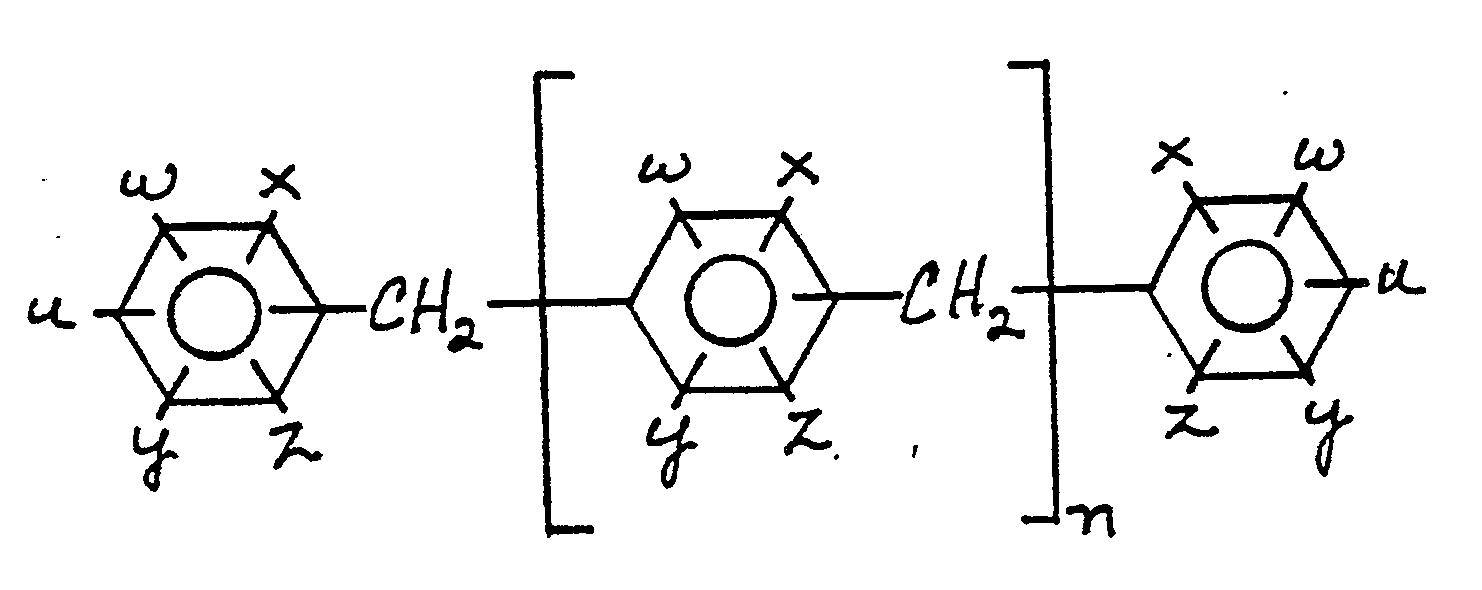
- (a) reacting a methylene diphenylene diamine having the formula:
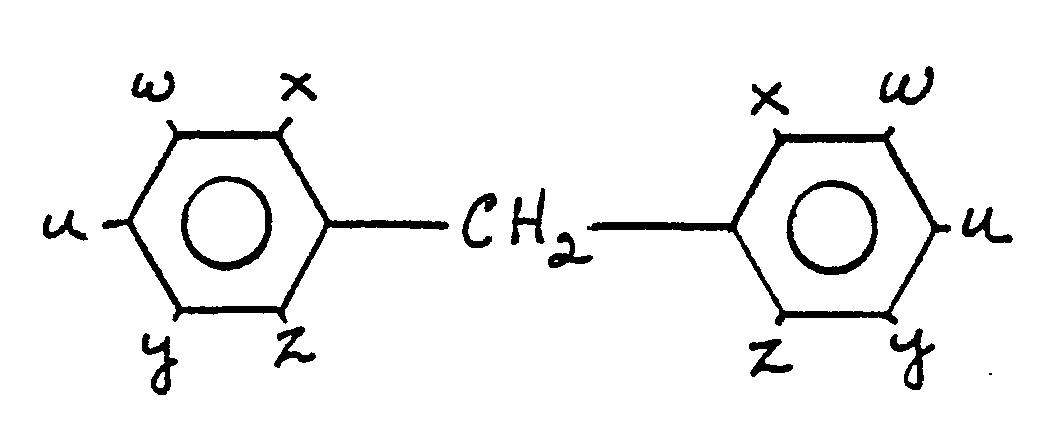

- (b) reacting said bis urea or polyurea thus produced with a dialkyl amine (NHR′R˝) wherein R′ and R˝ are substituted or unsubstituted mono-valent radicals selected from saturated or mono-olefinic unsaturated straight or branched chain aliphatic or cycloaliphatic radicals optionally containing alkoxyalkyl radicals with one or more ether linkages, aryl radicals, or aralkyl radicals, or R′ and R˝ together form a substituted or unsubstituted saturated or mono-olefinic unsaturated divalent aliphatic radical, at a temperature of from about 50°C to about 200°C, preferably from about 90°C to 150°C in the presence of a solvent or mixture of solvents which are stable and substantially chemically inert to the components of the reaction system to produce a methylene diphenylene bis (dialkyl urea) having the general formula:

- (c) thermally decomposing said methylene diphenylene bis (dialkylurea) or polymethylene polyphenylene poly (alkylurea) dissolved in or slurried in an organic solvent or mixture of solvents which are stable and substantially chemically inert to the.components of the reaction system, in the presence of a reaction promoter selected from the group consisting, of a tertiary amine hydrohalide, such as pyridine hydrochloride, phosphorus pentoxide, organic sulfonic acids, and sulfonated aromatic ion exchange resins, at a temperature within the range of from about 50°C to about 220°C, preferably from about 90°C to about 150°C; and
- (d) recovering the methylene diphenylene diisocyanate or polymethylene polyphenylene poly (isocyanate).
- The isocyanic acid employed in Step (a) of the process of the present invention may be produced or generated by known methods such as the pyrolysis of urea or cyanuric acid, reaction of cyanate salts such as sodium, potassium or silver cyanate and the like with an acid such as acetic or hydrochloric acid and the like. The isocyanic acid may be generated and used in situ, or it may be distilled away from its source and used in the process of the invention as a gas or dissolved in an appropriate solvent.
- In the present process the molar ratio of the (-NH₂) groups of the diamines or polyamines to isocyanic acid is generally one to one. However, an excess of isocyanic acid of up to about 50% may be employed. Alternatively, an excess of up to about 30% (-NH₂) groups may be used and any unreacted or partially reacted diamines or polyamines separated from the bis urea produced and recycled. In the subsequent reaction employing the bis urea the molar ratio of the dialkylamine reactant, such as dimethylamine, to the urea groups (-NHCONH₂) is generally one to one. However, an excess of dialkylamine of from about 10% to a ten-fold excess may advantageously be employed to drive the reaction to completion. Unreacted dialkylamine may be easily recovered by distillation for recycle in the reaction.
- The dialkylamines or mixtures thereof which may be employed in Step (b) of the process of the invention conform to the general fomula R′R˝HN wherein R′ and R˝ are as defined above. Preferably R′ and R˝ are each alkyl groups having from 1 to 8 carbon atoms. Representative dialkylamines include, for example, dimethylamine, diethylamine, methylethylamine, diisopropylamine, dicyclohexylamine, dibutylamine, cyclopentylamine, cyclohexylamine, bis (2-methoxyethyl)amine, bis (2-phenoxyethyl)mine, and the like.
- Solvents or mixtures of solvents which are stable and substantially chemically inert to the components of the reaction system are employed in each of the process steps of the present invention. Suitable solvents which may be employed include, for example, the aromatic hydrocarbons such as benzene, toluene, xylene, tetrahydronaphthalene as well as higher alkyl-substituted aromatic hydrocarbons; alkanes and substituted alkanes as well as cycloalkanes having from 5 to 20 carbon atoms such as, for example, n-hexane, n-heptane, octane, nonane, cyclohexane, dodecane, octadecane, 2-methyl- hexane, 2-ethylhexane, methylcyclohexane, cyclopentane and the like; halogenated or nitrated aromatic or aliphatic hydro- carbons such as, for example, methylene chloride, chloroform, carbontetrachloride, 1 ,2-dichloroethane, chlorobenzene, trichloroethane, tetrachloroethane dichlorobenzene, nitrobenzene dinitrotoluenes and the like; aromatic or aliphatic ether such as for example, diphenylether and dibutylether and the like; tertiary amines such as, for example, pyridine, triethylamine, N-methylpyrolidone and the like. Certain ketones, esters, alcohols as well as water and highly polar solvents, such as sulfolane, dimethysulfoxide, ethylene carbonate or propylene carbonate may also be used. It is not necessary that the diamines, polyamines, the reaction intermediates such as the bis ureas, polyureas or the reaction products be completely miscible with the solvents at the concentrations employed. Advantage may be taken of differing solubilities of the reagents, intermediates and reaction products in the various solvents or mixture of solvents to separate the reaction components or to drive the reaction to increased product. The same solvent or mixture of solvents may be used throughout the reaction system or different solvents or solvent mixtures used in different steps of the process.
- The intermediate bis urea or polyurea obtained by the reaction of the diamine or polyamine with isocyanic acid in in Step (a) may, if desirable be isolated from the reaction system and further processed according to the process of the invention or it may simply be carried forward as a solution or a slurry without isolation for completion of the process to produce the desired isocyanate. In appropriate solvents, the intermediate bis urea or polyurea may be essentially insoluble and the urea easily separated from unreacted diamine or polyamine or partly reacted amine urea by-products by conventional techniques such as filtration, centrifugation, and the like. The separated bis urea,polyurea or the crude intermediate product may be reacted with a dialkyl amine to produce the desired bis dialkyl urea or poly (alkyl urea). The dialkyl amine reactant may be added as a gas, a liquid, a solid or as a solution in solvent. Alternatively, the dialkyl amine may be added to the reactor along with the diamine or polyamine. Ammonia generated in this part of the reaction is removed by any convenient means.
- The R′ and R˝ of the dialkylureido (-NHCONR′R˝) group described hereinabove may also be substituted or unsubstituted monovalent radicals selected from saturated or mono-olefinic unsaturated straight or branched chain aliphatic or cycloaliphatic radicals optionally containing alkoxyalkyl radicals with one or more ether linkages, aryl radicals, or aralkyl radicals or R and R′ together form a substituted or unsubstituted saturated or mono-olefinic unsaturated divalent aliphatic radical.
- Representative methylene diphenylene bis (dialkylureas) produced as intermediate products of the present invention include, for example, methylene diphenylene bis (dimethylurea), methylene diphenylene bis (diphenyl or diethyl or dibutyl ureas) and the like as well as the polymethylene polyphenylene poly (diethyl or dibutyl or dipropyl, etc. ureas).
- The tertiary amine hydrohalide salts employed in the process of the present invention to promote thermal decomposition of the bis dialkyl or polyalkyl ureas to the corresponding isocyanate may be prepared, for example, by reacting the tertiary amine selected with a hydrogen halide such as HCl. Salts of hydrogen fluoride, chloride, bromide or iodide may be used. The tertiary amines used to prepare the hydrohalide will conform to the general formula R,R′,R˝N wherein R,R′ and R˝ are not hydrogen but may be an aliphatic radical having from 1 to 10 carbon atoms, a cycloatiphatic radical such as cyclopentyl, cyclohexyl and cycloheptyl radicals, an aromatic radical, or an aralkyl radical. Such radicals may be substituted with, for example, nitro or halo groups which are non-reactive with the isocyanate produced. Suitable amine salts include, for example, triethylamine hydrochloride, hydrobromide or hydrofluoride, trioctylamine hydro-chloride, hydrobromide or hydrofluoride, N-Methyldiethylamine hydrobromide or hydrochloride, N,N-diethylaniline hydrochloride and N,N-dimethylcyclohexylamine hydrochloride. Hydrohalide salts of heterocyclic tertiary amines and heterocyclic aromatic amines may also be employed. Representative salts include, for example, N-methylpyrrolidine hydrochloride, pyridine hydro- chloride or hydrobromide, 3-ethylpyridine hydrochloride, the hydrohalide salt of 1,4- diazabicyclo [2.2.2] octane, 4-chloro- pyridine hydrochloride, 4,4′-bipyridine dihydrochloride, quinoline hydrochloride or the like. Salts of amine oxides such as 2-chloropyridine N-oxide hydrochloride may also be used as a promoter. In addition, the hydrohalide may be formed with an amine which may be part of a polymer such as polyvinyl pyridine or a resin prepared from tertiary amine groups attached to a styrene divinylbenzenepolymer. The tertiary amine hydrohalide is generally employed in the process at a molar ratio of one to one based on the urea groups. However, an excess of the tertiary amine hydrohalide promoter may be used.
- The phosphorus pentoxide employed in the process of the present invention to promote thermal decomposition of the bis dialkyl or polyalkyl ureas to the corresponding isocyanate is commercially available material produced by burning phosporus in dry air. The phosphorus pentoxide promoter is generally employed in the process at a molar ratio of one to one based on the urea groups. However, an excess of the phosphorus pentoxide promoter of up to three to one may be used. No advantage is gained by using higher amounts which may lead to by-product formation.
- The organic sulfonic acid employed in the process of the present invention to promote the thermal decomposition of the bis dialkyl or polyalkyl ureas may be an alkane sulfonic acid or a halogenated alkane sulfonic acid having up to 10 carbon atoms in the alkyl group, or an aromatic sulfonic acid which may contain substituents on the aromatic ring such as halogens, alkyl radicals, aromatic radicals, nitro groups and the like. The organic sulfonic acid may be in the form of an acidic sulfonated aromatic ion exchange resin such as, for example, the sulfonated styrene/divinyl-benzene copolymer (sold, for example, commercially as "Amberlyst 15" by Rohm & Haas Co.) and having a bulk density of approximately 565 g./l, a hydrogen ion concentration of approximately 4.9 milliequivalents/g.dry, a surface area of from about 40 to 50 m²/g. and an average pore diameter of from about 200 to 600 Angstrom units, or an acidic perfluoroalkane sulfonic acid resin such as "Nafion" (sold for example, commercially by the DuPont Co.) and having an equivalent weight of between about 110 and 1500, a hydrogen ion concentration of between about 0.7 - 1.0 milliequivalents/g. dry and prepared, for example, by the polymerization of tetrafluoroethylene with a sulfonyl fluoride vinyl ether, followed by saponification with caustic to form the alkali metal salt and treatment with an acid to convert the salt to the sulfonic acid form. Mixtures of the sulfonic acid promoters may be employed but it is preferable to use a single acid promoter to simplify separation and recovery of the aromatic isocyanate produced. Representative organic sulfonic acid promoters suitable for use in the process of this invention include, for example, methane, ethane, butane, hexane sulfonic acids, and the like, trifluoromethane sulfonic acid, benzene sulfonic acid, 1,3-benzene disulfonic acid, p-toluene sulfonic acid, naphthalene sulfonic acid, 4-chloro-3-nitrobenzene sulfonic acid, 3 nitrobenzene sulfonic acid, and the like, as well as the sulfonated aromatic ion exchange resins which include the "Amberlyst 15" and "Nafion" described hereinabove and also include the "Dowex 50" (Dow Chemical), "AG50W" (Bio-Rad), and "Amberlite" (Rohm and Haas) resin materials. The ion exchange resins may be supplied commercially in the hydrogen ion form or the salt form such as the sodium or potassium salt. The salt can readily be converted to the active hydrogen ion form by, for example, treating with aqueous hydrochloric acid, washing with water to a constant pH in the range of 5.5 to 7 and then drying to remove residual water.
- The organic sulfonic acid promoter is generally employed in the process of the instant invention at a molar ratio of one to one based on the urea groups to sulfonic acid groups. No advantage is gained by using large excess amounts which may lead to by-product formation.
- The process of the present invention can be suitably carried out by adding the bis dialkyl or polyalkyl urea to a solvent or a mixture of solvents comprising the reaction medium. The urea may be soluble in the solvent or solvents or soluble at reaction temperatures or the urea may be in the form of a slurry. Reactions using a sulfonic acid ion exchange resin promoter may also be carried out in a fixed bed of resin by passing a solvent solution of the urea through a bed maintained at the desired reaction temperature. A general procedure for carrying out Step (a) of the process is to charge the methylene diphenylene diamine or polyamine together with a solvent into the reaction vessel. The isocyanic acid is introduced into the reactor as a gas, optionally diluted with an inert gas, as a liquid, or as a solution in an appropriate solvent. Alternatively, the isocyanic acid can be charged to the reactor first together with a solvent and the diamine or polyamine then added as a liquid, a solid, a solution in suitable solvent or as a slurry in a suitable inert liquid. The reaction vessel is heated or cooled as necessary to provide the desired reaction temperature for the appropriate period. Heating and/or cooling means may be employed interior or exterior of the reaction vessel to maintain temperature within desired ranges. The desired reaction product may be recovered by standard filtration and/or distillation procedures.
- In the process of the present invention, the Step (a) reaction of the diamines or polyamines with isocyanic acid will proceed at temperatures of from about -30°C to about 200°C, preferably from about -10°C to about 100°C. Reaction time is dependent on the temperature but will generally range between about two minutes to several hours. The Step (b) reaction of the intermediate bis urea or polyurea and the dialkyl amines will proceed at temperatures of from about 50°C to about 200°C, preferably from about 90°C to about 150°C. The reaction time depends on the temperature but will generally range between about 30 minutes to about 8 hours.
- The process of the present invention may be carried out as a batch, semi-continuous or continuous process and the order of addition of the materials and reactants may be varied to suit the particular apparatus, reactants and promoter employed.
- The reaction of the invention may be carried out in any suitable reactor which is equipped with a means for temperature control and agitation. Heating and/or cooling means may be employed interior or exterior of the reaction vessel to maintain temperature within the desired range.
- As indicated hereinabove, the Step (c) thermal decomposition of the bis dialkyl or poly (alkyl) ureas is carried out at temperatures of from about 50°C to about 220°C, preferably from about 90°C to 150°C. Reaction time is dependent on decomposition temperature but will generally range between about 5 minutes and several hours.
- The reaction steps of this invention are generally carried out at atmospheric pressure, but depending on the boiling points of the solvents employed and the isocyanate product, it may be carried out at super-atmospheric or sub-atmospheric pressures. The isocyanate formed may be recovered by filtration, by distillation of either the solvent or the isocyanate, whichever is lower boiling, or by other known methods, and will depend on the solvent employed and the isocyanate produced.
- The present invention is more fully illustrated by the following examples, which include particular features of the invention. However, the examples are not to be construed as limiting the invention in any way, it being understood that numerous variations are possible without departing from the spirit and scope of the invention.
- A mixture of 2.0g (10 mmoles) of 4,4′-methylene diphenylene diamine in 130g o-xylene was charged to a 250 ml, 3 neck round bottom flask equipped with a mechanical stirrer, condenser and thermometer. This mixture was heated to 130°C and the resulting solution was stirred while 15g of 7.0 weight percent solution of isocyanic acid in o-xylene containing 1.05g (24 mmoles ) of isocyanic acid was added over 10 minutes. Solids began to precipitate immediately on addition of the isocyanic acid solution. After 20 min. additional mixing, the solids were collected by filtration. Analysis of the filtrate and the recovered solids by high pressure liquid chromatography (HPLC) showed 96% conversion of the methylene diphenylene diamine with 98% selectivity to methylene diphenylene bis urea. The solids were returned to the reaction flask, suspended in 100g fresh o-xylene and 2.5g diethylamine (34 mmoles) was added and the mixture was heated for 2 hours. The initial temperature was 100°C but as the diethylamine was consumed, the temperature rose to 135°C and the solids dissolved. Analysis of the product by HPLC showed essentially quantitative conversion of the bis urea with 90% selectivity to methylene diphenylene bis (diethylurea). Unreacted diethylamine was distilled out of the reactor and then pyridine hydrochloride, 2.90g (25.1 mmoles) was added to the mixture of 4,4′-methylene diphenylene bis (diethylurea) in o-xylene and the mixture was heated to reflux at 142°C for 60 min. A sample was taken and reacted with ethanol to convert isocyanate groups to ethyl carbamate groups. This sample was then analyzed by high pressure liquid chromatography (HPLC). Conversion of the 4,4′-methylene diphenylene bis (diethylurea) was 98% with a selectivity of 93% to 4,4′-methylene diphenylene diisocyanate and 5% to the mono-diethylurea mono-isocyanate derivative. The overall yield of 4,4′-methylene diphenylene diisocyanate was 84% based on the starting 4,4′-methylene diphenylene diamine.
- A 250 ml, 3 neck, round bottom flask equipped with a mechanical stirrer, condenser and thermometer was used. Polymethylene polyphenylene polyamine, 2g, made by condensing aniline with formaldehyde using methods described in the literature (Kirk-Othmer, Encyclopedia of Chemical Technology, 3rd Edition Vol.2, pp 342-343, John Wiley and Sons, N.Y. 1978) in 100g mixed xylenes was treated with 25g of 5.0 weight percent solution of isocyanic acid in mixed xylenes at 80°C. An oil formed as the isocyanic acid was added. After 30 min. mixing, the excess isocyanic acid was distilled out and then 3g of diethylamine was added. The mixture was heated from an initial temperature of 80°C to a maximum of 140°C over three hours. Analysis of the product by a combination of HPLC and nuclear magnetic resonance showed that a mixture of poly methylene polyphenylene poly (diethylureas) had been made with an approximate yield of 85% based on starting polyamine. Unreacted diethylamine was distilled out of the reactor and then methanesulfonic acid, 2.0g, and 50g mixed xylenes were added. The mixture was heated to reflux at 144°C for 30 minutes and then the xylene phase was analyzed by infrared spectroscopy for the isocyanate group. The yield of polymethylene polyphenylene polyisocyanate was 81%.
- Isocyanic acid, generated by the reaction of sodium cyanate with hydrogen chloride, was distilled away from the sodium cyanate and carried as a gas diluted with nitrogen into a 250ml, 3 neck round bottom flask equipped with a magnetic stirrer, condenser, and gas inlet tube containing 2.0g of 4,4′-methylene diphenylene diamine in 130g o-dichlorobenzene. The reaction was held at -10°C by a refrigerated bath. Solids precipitated in the flask on addition of the isocyanic acid. After an excess of isocyanic acid has been added, the reaction was warmed to room temperature and stirred for 30 minutes. The solids formed were collected by filtration, transferred to a pressure vessel, and suspended in 100 ml mixed xylenes. 3g dimethylamine was charged to the vessel which was then heated to 140°C under autogenous pressure for 4 hours. Analysis of the product by HPLC showed an overall yield of 90% of 4,4′-methylene diphenylene bis (dimethylurea). The product was returned to the round bottom flask and the residual dimethylamine was distilled overhead. Then 3.0g of phosphorus pentoxide was added in one portion and the mixture was heated at 120°C for 90 min. The product characterized by infrared and HPLC analysis, showed 95% conversion of the 4,4′-methylene diphenylene bis (dimethylurea) with a 90% yield of the corresponding isocyanate.
- Using the procedures of Example 1, a solution of 4,4′-methylene diphenylene bis (diethylurea) was prepared by reacting a mixture of 4.0g, (20 mmoles) of 4,4′-methylene diphenylene diamine in 100g chlorobenzene with 35g of a 5wt% chlorobenzene solution of isocyanic acid, containing 1.75g, (41 mmoles) of isocyanic acid at 50°C for 30 min., adding 4.4g of diethylamine and heating the resulting mixture at reflux for 4 hrs. The product solution was combined with 20g of "Amberlyst 15" resin stirred, and heated for 2 hours at 130°C. At the end of the reaction time, the mixture was cooled to room temperature and solid resin was removed by filtration. Analysis of the chlorobenzene solution by HPLC after addition of ethanol to convert the isocyanate to its ethyl carbamate derivative showed an 85% yield of methylene diphenylene diisocyanate.
- A number of runs were carried out according to procedures of Example 1 employing various diamines or polyamines, dialkylamines, solvents, reaction temperatures and cracking promoters. The products were characterized by infrared spectroscopy or high pressure liquid chromatography. The reaction conditions for synthesis of the corresponding bis (dialkyl) urea compounds are set forth in Table 1 below. These urea compounds, including solvent were converted to the corresponding isocyanate. The reaction conditions and results for making the corresponding isocyanates from the bis (dialkylurea) compounds of Table 1 are set forth in Table 2 below.
TABLE 1 Example No. Polyamine or Diamine (g.) Solvent (g.) HNCO-g. Solvent (g) Temp. (°C) Time Dialkyl Amine (g.) Temp. (°C) Time 5 4′,4′/2,4′ MDA 90.10 (1.22) Diphenyl Ether (100) 1.00 (as gas) 150 10 min. DEA (15) 150 2 hrs 6 PMPPA (2.4) Nitro-Benzene (150) 5 (as gas) 30 1 hr. DMA (15) 140 2 hrs 7 4,4′-MDA (1.22) Tetrachloroethane (100) 1.00,1,2-tetrachloroethane (10) 50 1/2 hr. DBA (3) 110 8 hrs 8 4,4′-MDA (1.22) Octadecane (100) 1.00 Toluene (20) 30 1 hr. DIPA (4.2) 120 6 hrs. 9 4,4′-MDA (1.22) o-Dichlorobenzene (100) 0.70 (as gas) 50 1 hr. DEA (3) 140 3 hrs MDA - Methylene diphenylene diamine PMPPA - Polymethylene polyphenylene polyamine DEA - Diethylamine DBA - Dibutylamine DIPA - Diisopropylamine DMA - Dimethylamine TABLE 2 Example No. Promoter (g) Temp. (°C) Time (min) Isocyanate Yield (%) 5 p-toluene SO₃H (2.8) 100 30 85 6 "Nafion" (25) (as slurry) 90 15 80 7 N-ethylmorpholine hydrochloride (2) 130 60 75 8 4,4′-dipyridyl dihydrochloride (3) 150 30 70 9 pyridine hydrobromide (2.0) 120 60 89
Claims (11)
1. A process for the preparation of methylene diphenylene diisocyanates and polymethylene polyphenylene poly (isocyanates) which comprises the steps of
(a) reacting a methylene diphenylene diamine having the formula:

or a polymethylene polyphenylene polyamine having the formula:

wherein n equals an integer of from 1 to 8 and at least one of the substituents u, w, x, y and z on the ring is an amino group and the other substituents which may be different on the ring are hydrogen, a 1 to 6 carbon alkyl group, a halogen, ether or nitro group, with isocyanic acid at a temperature of from about -30°C to about 200°C in the presence of an inert organic solvent to convert the amino groups to urea groups to produce a methylene diphenylene bis urea or a polymethylene polyphenylene polyurea;
(b) reacting said bis urea or polyurea thus produced with a dialkyl amine (NHR′R˝) wherein R′ and R˝ are substituted or unsubstituted mono-valent radicals selected from saturated or mono-olefinic unsaturated straight or branched chain aliphatic or cycloaliphatic radicals optionally containing alkoxyalkyl radicals with one or more ether linkages, aryl radicals, or aralkyl radicals, or R′ and R˝ together form a substituted or unsubstituted saturated or mono-olefinic unsaturated divalent aliphatic radical, at a temperature of from about 50°C to about 200°C in an inert organic solvent to produce a methylene diphenylene bis (dialkyl urea) having the general formula:

or a polymethylene polyphenylene poly (alkyl urea) having the formula:

wherein n equals an integer of from 1 to 8 and at least one of the substituents u, w, x, y and z on the ring is a dialkylureido group having the formula (-NHCONR′R˝) and the other substituents which may be different on the ring, are hydrogen, a 1 to 6 carbon alkyl group, a halogen, an ether group or a nitro group and R′ and R˝ are as defined above
(c) thermally decomposing said methylene diphenylene bis (dialkylurea) or polymethylene polyphenylene poly (alkylurea) dissolved or slurried in an inert organic solvent or mixture of solvents, in the presence of a reaction promoter selected from tertiary amine hydrohalides, phosphorus pentoxide, organic sulfonic acids, and sulfonated aromatic ion exchange resins, at a temperature of from about 50oC to about 200oC; and
(d) recovering the methylene diphenylene diisocyanate or polymethylene polyphenylene poly (isocyanate).
2. A process according to Claim 1 wherein the temperature of reacting the diamine or polyamine with isocyanic acid is in the range of from about -10oC to 150oC.
3. A process according to Claim 1 or Claim 2 wherein the temperature of reacting the bis urea or polyurea with a dialkyl amine is in the range of from about 90oC to 150oC.
4. A process according to any one of Claims 1 to 3 wherein the temperature of thermally decomposing the bis (dialkylurea) or poly (alkylurea) is in the range of from about 90oC to 150oC.
5. A process for the preparation of methylene diphenylene diisocyanates which comprises the steps of
(a) reacting a methylene diphenylene diamine having the formula:

wherein at least one of the substituents u, w, x, y and z on the ring is an amine group and the other substituents which may be different on the ring are hydrogen, a 1 to 6 carbon alkyl group, a halogen, an ether or nitro group, with isocyanic acid at a temperature of from about -10°C to 150°C in the presence of an inert organic solvent to convert the amino groups to urea groups to produce a methylene diphenylene bis urea;
(b) reacting said bis urea or polyurea thus produced with a dialkyl amine (NHR′R˝) wherein R′ and R˝ are substituted or unsubstituted mono-valent radicals selected from saturated or mono-olefinic unsaturated straight or branched chain aliphatic or cycloaliphatic radicals optionally containing alkoxyalkyl radicals with one or more ether linkages, aryl radicals, or aralkyl radicals, or R′ and R˝ together form a substituted or unsubstituted saturated or mono-olefinic unsaturated divalent aliphatic radical, at a temperature of from about 90°C to about 150°C in an inert organic solvent to produce a methylene diphenylene bis (dialkyl urea) having the formula:
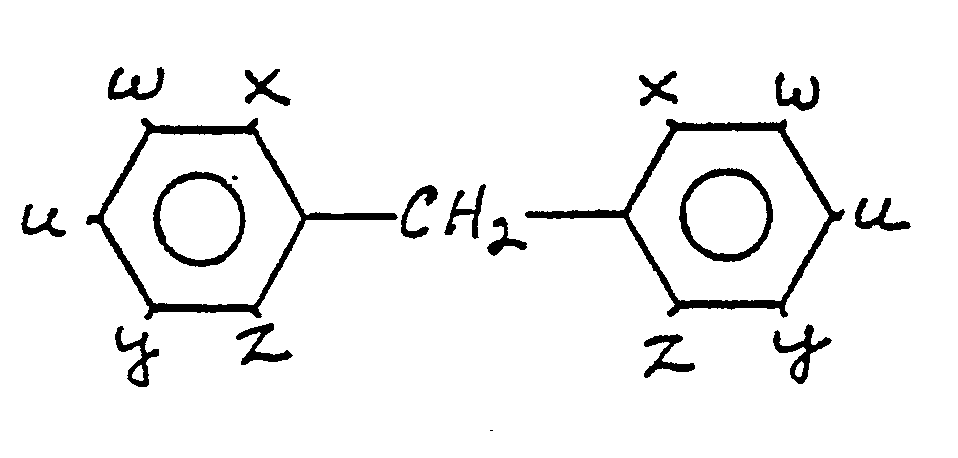
wherein at least one of the substituents u, w, x, y and z on the ring is a dialkylureido group having the formula (-NHCONR′R˝) and the other substituents which may be different on the ring are hydrogen, a 1 to 6 carbon alkyl group, a halogen, an ether group or nitro group, and R′ and R˝ are as defined above;
(c) thermally decomposing said methylene diphenylene bis (dialkylurea) dissolved in or slurried in an inert organic solvent or mixture of solvents in the presence of a reaction promoter selected from tertiary amine hydrohalides, phosphorus pentoxide, organic sulfonic acids and sulfonated aromatic ion exchange resins, at a temperature of from about 90°C to 150°C; and
(d) recovering the methylene diphenylene diisocyanate.
6. A process according to any one of Claims 1 to 5 wherein the diamine is selected from 4,4′-methylene diphenylene diamine and mixtures of 2,4′- and ,4,4′-methylene diphenylene diamine.
7. A process according to any one of Claims 1 to 6 wherein the dialykl amine reactant is selected from dimethylamine, diethylamine, dibutylamine and diisopropylamine.
8. A process according to any one of Claims 1 to 7 wherein the organic solvents employed in the steps of the process are selected from xylenes, o-dichlorobenzene, chlorobenzene, tetrachloroethane, nitrobenzene, diphenyl ether and octadecane.
9. A process according to any one of Claims 1 to 8 wherein the tertiary amine hydrohalide is selected from pyridine hydrochloride, pyridine hydrobromide N-ethylmorpholine hydrochloride, and 4,4′ dipyridyl dihydrochloride.
10. A process according to any one of Claims 1 to 9 wherein the organic sulfonic acid is selected from methane sulfonic acid and p-toluene sulfonic acid.
11. A process according to any one of Claims 1 to 9, wherein the sulfonated aromatic ion exchange resin is selected from sulfonated styrene/divinylbenzene copolymer resins and acidic perfluoroalkane sulfonic acid resins.
Applications Claiming Priority (2)
| Application Number | Priority Date | Filing Date | Title |
|---|---|---|---|
| US36146789A | 1989-06-05 | 1989-06-05 | |
| US361467 | 1989-06-05 |
Publications (1)
| Publication Number | Publication Date |
|---|---|
| EP0402020A1 true EP0402020A1 (en) | 1990-12-12 |
Family
ID=23422178
Family Applications (1)
| Application Number | Title | Priority Date | Filing Date |
|---|---|---|---|
| EP90305738A Withdrawn EP0402020A1 (en) | 1989-06-05 | 1990-05-25 | An integrated process for the preparation of methylene diphenylene diisocyanates and polymethylene polyphenylene poly (isocyanates) from diamines and polyamines |
Country Status (4)
| Country | Link |
|---|---|
| EP (1) | EP0402020A1 (en) |
| JP (1) | JPH0327351A (en) |
| AU (1) | AU5629290A (en) |
| CA (1) | CA2017660A1 (en) |
Families Citing this family (3)
| Publication number | Priority date | Publication date | Assignee | Title |
|---|---|---|---|---|
| JP2006232245A (en) * | 2005-02-22 | 2006-09-07 | Yoko Takahashi | Umbrella storage type bicycle |
| EP2042485A1 (en) * | 2007-09-28 | 2009-04-01 | Huntsman International Llc | Process for fractionating a mixture of polyisocyanates |
| KR102618935B1 (en) * | 2015-01-30 | 2023-12-27 | 바스프 에스이 | Polyphenylene polymethylene polyisocyanate with low by-product content |
Citations (8)
| Publication number | Priority date | Publication date | Assignee | Title |
|---|---|---|---|---|
| US2773086A (en) * | 1953-01-19 | 1956-12-04 | Monsanto Chemicals | Production of isocyanates from substituted ureas |
| FR1473821A (en) * | 1963-07-05 | 1967-03-24 | Carbochimique Et Inst Francais | New isocyanic ester manufacturing processes |
| GB1154278A (en) * | 1966-05-14 | 1969-06-04 | Ciba Ltd | Process for the manufacture of N-Aryl-N',N'-Dialkylureas |
| FR2139577A5 (en) * | 1971-06-01 | 1973-01-05 | Quimco Gmbh | |
| US3936484A (en) * | 1974-09-25 | 1976-02-03 | Atlantic Richfield Company | Production of isocyanates from substituted ureas |
| GB2029413A (en) * | 1978-08-26 | 1980-03-19 | Akzo Nv | Preparation of organic mono- and polyisocyanates |
| US4873364A (en) * | 1988-12-09 | 1989-10-10 | Arco Chemical Technology, Inc. | Process for the preparation of methylene diphenylene diisocyanates and polymethylene polyphenylene poly (diisocyanates) |
| EP0371698A1 (en) * | 1988-11-30 | 1990-06-06 | ARCO Chemical Technology, L.P. | Process for the preparation of methylene diphenylene bis (dialkyl-ureas) and polymethylene polyphenylene poly (dialkyl-ureas) |
-
1990
- 1990-05-25 EP EP90305738A patent/EP0402020A1/en not_active Withdrawn
- 1990-05-28 CA CA002017660A patent/CA2017660A1/en not_active Abandoned
- 1990-06-04 JP JP2144601A patent/JPH0327351A/en active Pending
- 1990-06-05 AU AU56292/90A patent/AU5629290A/en not_active Abandoned
Patent Citations (8)
| Publication number | Priority date | Publication date | Assignee | Title |
|---|---|---|---|---|
| US2773086A (en) * | 1953-01-19 | 1956-12-04 | Monsanto Chemicals | Production of isocyanates from substituted ureas |
| FR1473821A (en) * | 1963-07-05 | 1967-03-24 | Carbochimique Et Inst Francais | New isocyanic ester manufacturing processes |
| GB1154278A (en) * | 1966-05-14 | 1969-06-04 | Ciba Ltd | Process for the manufacture of N-Aryl-N',N'-Dialkylureas |
| FR2139577A5 (en) * | 1971-06-01 | 1973-01-05 | Quimco Gmbh | |
| US3936484A (en) * | 1974-09-25 | 1976-02-03 | Atlantic Richfield Company | Production of isocyanates from substituted ureas |
| GB2029413A (en) * | 1978-08-26 | 1980-03-19 | Akzo Nv | Preparation of organic mono- and polyisocyanates |
| EP0371698A1 (en) * | 1988-11-30 | 1990-06-06 | ARCO Chemical Technology, L.P. | Process for the preparation of methylene diphenylene bis (dialkyl-ureas) and polymethylene polyphenylene poly (dialkyl-ureas) |
| US4873364A (en) * | 1988-12-09 | 1989-10-10 | Arco Chemical Technology, Inc. | Process for the preparation of methylene diphenylene diisocyanates and polymethylene polyphenylene poly (diisocyanates) |
Also Published As
| Publication number | Publication date |
|---|---|
| JPH0327351A (en) | 1991-02-05 |
| CA2017660A1 (en) | 1990-12-05 |
| AU5629290A (en) | 1990-12-06 |
Similar Documents
| Publication | Publication Date | Title |
|---|---|---|
| Twitchett | Chemistry of the production of organic isocyanates | |
| Saunders et al. | The chemistry of the organic isocyanates. | |
| CA1116177A (en) | Process for the preparation of diphenylmethane dicarbamates and polymethylene polyphenyl carbamates | |
| CA1144564A (en) | Process for the preparation of n,o- disubstituted urethanes useful for the preparation of isocyanates | |
| US4996359A (en) | Process for the preparation of aromatic bis dialkyl ureas | |
| CA1121373A (en) | Process for the preparation of an aryl mono-, di-, and/or polyurethane | |
| US4236016A (en) | Process for the preparation of urethanes | |
| JPH0114218B2 (en) | ||
| EP0402020A1 (en) | An integrated process for the preparation of methylene diphenylene diisocyanates and polymethylene polyphenylene poly (isocyanates) from diamines and polyamines | |
| US4871871A (en) | Process for the preparation of aromatic mono- and polyisocyanates | |
| US4873364A (en) | Process for the preparation of methylene diphenylene diisocyanates and polymethylene polyphenylene poly (diisocyanates) | |
| EP0408277A2 (en) | Process for the preparation of aliphatic isocyanates | |
| US4883908A (en) | Process for the preparation of aromatic isocyanates from dialkyl ureas using an organic sulfonic acid promoter | |
| US6034265A (en) | Process for the synthesis of aromatic urethanes | |
| US4230876A (en) | Process for the preparation of urethanes | |
| EP0391716A1 (en) | An integrated process for the preparation of aromatic mono- and polyisocyanates from aromatic amines | |
| JP4988118B2 (en) | Continuous synthesis of aromatic urethane | |
| US4096165A (en) | Method of manufacturing aromatic isocyanates | |
| GB2075974A (en) | Preparation of n-monosubstituted carbamates | |
| US3267122A (en) | Bis-(gamma-isocyanato)-alkoxy alkanes and preparation thereof | |
| US4978779A (en) | Preparation of methylene diphenylene diisocyanates and polymethylene polyphenylene poly (isocyanates) using an organic sulfonic acid promoter | |
| EP0371698A1 (en) | Process for the preparation of methylene diphenylene bis (dialkyl-ureas) and polymethylene polyphenylene poly (dialkyl-ureas) | |
| EP0778825B1 (en) | Improved process for making sulfonyl isocyanates | |
| US3651118A (en) | Process for the preparation of 1 3-cyclohexylene diisocyanates | |
| US4267353A (en) | Preparation of aromatic urethanes |
Legal Events
| Date | Code | Title | Description |
|---|---|---|---|
| PUAI | Public reference made under article 153(3) epc to a published international application that has entered the european phase |
Free format text: ORIGINAL CODE: 0009012 |
|
| AK | Designated contracting states |
Kind code of ref document: A1 Designated state(s): BE DE FR GB IT NL |
|
| 17P | Request for examination filed |
Effective date: 19901227 |
|
| STAA | Information on the status of an ep patent application or granted ep patent |
Free format text: STATUS: THE APPLICATION HAS BEEN WITHDRAWN |
|
| 18W | Application withdrawn |
Withdrawal date: 19920116 |