EP0394713A1 - Roller bottle - Google Patents
Roller bottle Download PDFInfo
- Publication number
- EP0394713A1 EP0394713A1 EP90106356A EP90106356A EP0394713A1 EP 0394713 A1 EP0394713 A1 EP 0394713A1 EP 90106356 A EP90106356 A EP 90106356A EP 90106356 A EP90106356 A EP 90106356A EP 0394713 A1 EP0394713 A1 EP 0394713A1
- Authority
- EP
- European Patent Office
- Prior art keywords
- roller bottle
- liner
- microporous
- roller
- bottle
- Prior art date
- Legal status (The legal status is an assumption and is not a legal conclusion. Google has not performed a legal analysis and makes no representation as to the accuracy of the status listed.)
- Granted
Links
- 230000010261 cell growth Effects 0.000 claims abstract description 21
- 238000012258 culturing Methods 0.000 claims abstract description 7
- 239000000463 material Substances 0.000 claims description 21
- 238000005304 joining Methods 0.000 claims description 8
- -1 polyethylene terephthalate Polymers 0.000 claims description 7
- 239000011521 glass Substances 0.000 claims description 5
- 239000005020 polyethylene terephthalate Substances 0.000 claims description 5
- 229920005989 resin Polymers 0.000 claims description 5
- 239000011347 resin Substances 0.000 claims description 5
- 239000004743 Polypropylene Substances 0.000 claims description 4
- 239000004699 Ultra-high molecular weight polyethylene Substances 0.000 claims description 4
- 229920001903 high density polyethylene Polymers 0.000 claims description 4
- 239000004700 high-density polyethylene Substances 0.000 claims description 4
- 229920000139 polyethylene terephthalate Polymers 0.000 claims description 4
- 229920000915 polyvinyl chloride Polymers 0.000 claims description 4
- 239000004800 polyvinyl chloride Substances 0.000 claims description 4
- SCUZVMOVTVSBLE-UHFFFAOYSA-N prop-2-enenitrile;styrene Chemical compound C=CC#N.C=CC1=CC=CC=C1 SCUZVMOVTVSBLE-UHFFFAOYSA-N 0.000 claims description 4
- 229920000785 ultra high molecular weight polyethylene Polymers 0.000 claims description 3
- 239000010935 stainless steel Substances 0.000 claims description 2
- 229910001220 stainless steel Inorganic materials 0.000 claims description 2
- RTZKZFJDLAIYFH-UHFFFAOYSA-N ether Substances CCOCC RTZKZFJDLAIYFH-UHFFFAOYSA-N 0.000 claims 3
- 229920001155 polypropylene Polymers 0.000 claims 3
- 229920000638 styrene acrylonitrile Polymers 0.000 claims 3
- 230000012010 growth Effects 0.000 claims 1
- 229920005992 thermoplastic resin Polymers 0.000 claims 1
- 230000000694 effects Effects 0.000 abstract description 3
- 238000013459 approach Methods 0.000 description 5
- 238000003466 welding Methods 0.000 description 4
- 230000015572 biosynthetic process Effects 0.000 description 3
- 238000003780 insertion Methods 0.000 description 3
- 230000037431 insertion Effects 0.000 description 3
- 239000007788 liquid Substances 0.000 description 3
- 238000003306 harvesting Methods 0.000 description 2
- NOESYZHRGYRDHS-UHFFFAOYSA-N insulin Chemical compound N1C(=O)C(NC(=O)C(CCC(N)=O)NC(=O)C(CCC(O)=O)NC(=O)C(C(C)C)NC(=O)C(NC(=O)CN)C(C)CC)CSSCC(C(NC(CO)C(=O)NC(CC(C)C)C(=O)NC(CC=2C=CC(O)=CC=2)C(=O)NC(CCC(N)=O)C(=O)NC(CC(C)C)C(=O)NC(CCC(O)=O)C(=O)NC(CC(N)=O)C(=O)NC(CC=2C=CC(O)=CC=2)C(=O)NC(CSSCC(NC(=O)C(C(C)C)NC(=O)C(CC(C)C)NC(=O)C(CC=2C=CC(O)=CC=2)NC(=O)C(CC(C)C)NC(=O)C(C)NC(=O)C(CCC(O)=O)NC(=O)C(C(C)C)NC(=O)C(CC(C)C)NC(=O)C(CC=2NC=NC=2)NC(=O)C(CO)NC(=O)CNC2=O)C(=O)NCC(=O)NC(CCC(O)=O)C(=O)NC(CCCNC(N)=N)C(=O)NCC(=O)NC(CC=3C=CC=CC=3)C(=O)NC(CC=3C=CC=CC=3)C(=O)NC(CC=3C=CC(O)=CC=3)C(=O)NC(C(C)O)C(=O)N3C(CCC3)C(=O)NC(CCCCN)C(=O)NC(C)C(O)=O)C(=O)NC(CC(N)=O)C(O)=O)=O)NC(=O)C(C(C)CC)NC(=O)C(CO)NC(=O)C(C(C)O)NC(=O)C1CSSCC2NC(=O)C(CC(C)C)NC(=O)C(NC(=O)C(CCC(N)=O)NC(=O)C(CC(N)=O)NC(=O)C(NC(=O)C(N)CC=1C=CC=CC=1)C(C)C)CC1=CN=CN1 NOESYZHRGYRDHS-UHFFFAOYSA-N 0.000 description 2
- 238000004519 manufacturing process Methods 0.000 description 2
- 238000007567 mass-production technique Methods 0.000 description 2
- 238000012986 modification Methods 0.000 description 2
- 230000004048 modification Effects 0.000 description 2
- 239000004814 polyurethane Substances 0.000 description 2
- 230000001954 sterilising effect Effects 0.000 description 2
- 238000004659 sterilization and disinfection Methods 0.000 description 2
- 239000000126 substance Substances 0.000 description 2
- 239000012780 transparent material Substances 0.000 description 2
- 102000004877 Insulin Human genes 0.000 description 1
- 108090001061 Insulin Proteins 0.000 description 1
- 102000014150 Interferons Human genes 0.000 description 1
- 108010050904 Interferons Proteins 0.000 description 1
- CBENFWSGALASAD-UHFFFAOYSA-N Ozone Chemical compound [O-][O+]=O CBENFWSGALASAD-UHFFFAOYSA-N 0.000 description 1
- 239000004793 Polystyrene Substances 0.000 description 1
- 229920005830 Polyurethane Foam Polymers 0.000 description 1
- 102000003990 Urokinase-type plasminogen activator Human genes 0.000 description 1
- 108090000435 Urokinase-type plasminogen activator Proteins 0.000 description 1
- 238000004026 adhesive bonding Methods 0.000 description 1
- 239000006227 byproduct Substances 0.000 description 1
- 238000004113 cell culture Methods 0.000 description 1
- 239000004927 clay Substances 0.000 description 1
- 239000011248 coating agent Substances 0.000 description 1
- 238000000576 coating method Methods 0.000 description 1
- 239000002131 composite material Substances 0.000 description 1
- 230000003247 decreasing effect Effects 0.000 description 1
- 238000011161 development Methods 0.000 description 1
- 238000005516 engineering process Methods 0.000 description 1
- 239000006260 foam Substances 0.000 description 1
- 239000003292 glue Substances 0.000 description 1
- 239000001963 growth medium Substances 0.000 description 1
- 238000002347 injection Methods 0.000 description 1
- 239000007924 injection Substances 0.000 description 1
- 229940125396 insulin Drugs 0.000 description 1
- 229940079322 interferon Drugs 0.000 description 1
- 230000013011 mating Effects 0.000 description 1
- 239000002609 medium Substances 0.000 description 1
- 238000000034 method Methods 0.000 description 1
- 239000012229 microporous material Substances 0.000 description 1
- 239000004745 nonwoven fabric Substances 0.000 description 1
- 230000002093 peripheral effect Effects 0.000 description 1
- 229920003023 plastic Polymers 0.000 description 1
- 239000004033 plastic Substances 0.000 description 1
- 229920000728 polyester Polymers 0.000 description 1
- 229920000098 polyolefin Polymers 0.000 description 1
- 229920002223 polystyrene Polymers 0.000 description 1
- 229920002635 polyurethane Polymers 0.000 description 1
- 239000011496 polyurethane foam Substances 0.000 description 1
- 239000000047 product Substances 0.000 description 1
- 238000007790 scraping Methods 0.000 description 1
- 238000012414 sterilization procedure Methods 0.000 description 1
- 239000012815 thermoplastic material Substances 0.000 description 1
- 229960005356 urokinase Drugs 0.000 description 1
- 229960004854 viral vaccine Drugs 0.000 description 1
Images

Classifications
-
- C—CHEMISTRY; METALLURGY
- C12—BIOCHEMISTRY; BEER; SPIRITS; WINE; VINEGAR; MICROBIOLOGY; ENZYMOLOGY; MUTATION OR GENETIC ENGINEERING
- C12M—APPARATUS FOR ENZYMOLOGY OR MICROBIOLOGY; APPARATUS FOR CULTURING MICROORGANISMS FOR PRODUCING BIOMASS, FOR GROWING CELLS OR FOR OBTAINING FERMENTATION OR METABOLIC PRODUCTS, i.e. BIOREACTORS OR FERMENTERS
- C12M27/00—Means for mixing, agitating or circulating fluids in the vessel
- C12M27/10—Rotating vessel
- C12M27/12—Roller bottles; Roller tubes
-
- C—CHEMISTRY; METALLURGY
- C12—BIOCHEMISTRY; BEER; SPIRITS; WINE; VINEGAR; MICROBIOLOGY; ENZYMOLOGY; MUTATION OR GENETIC ENGINEERING
- C12M—APPARATUS FOR ENZYMOLOGY OR MICROBIOLOGY; APPARATUS FOR CULTURING MICROORGANISMS FOR PRODUCING BIOMASS, FOR GROWING CELLS OR FOR OBTAINING FERMENTATION OR METABOLIC PRODUCTS, i.e. BIOREACTORS OR FERMENTERS
- C12M23/00—Constructional details, e.g. recesses, hinges
- C12M23/20—Material Coatings
-
- C—CHEMISTRY; METALLURGY
- C12—BIOCHEMISTRY; BEER; SPIRITS; WINE; VINEGAR; MICROBIOLOGY; ENZYMOLOGY; MUTATION OR GENETIC ENGINEERING
- C12M—APPARATUS FOR ENZYMOLOGY OR MICROBIOLOGY; APPARATUS FOR CULTURING MICROORGANISMS FOR PRODUCING BIOMASS, FOR GROWING CELLS OR FOR OBTAINING FERMENTATION OR METABOLIC PRODUCTS, i.e. BIOREACTORS OR FERMENTERS
- C12M23/00—Constructional details, e.g. recesses, hinges
- C12M23/28—Constructional details, e.g. recesses, hinges disposable or single use
-
- C—CHEMISTRY; METALLURGY
- C12—BIOCHEMISTRY; BEER; SPIRITS; WINE; VINEGAR; MICROBIOLOGY; ENZYMOLOGY; MUTATION OR GENETIC ENGINEERING
- C12M—APPARATUS FOR ENZYMOLOGY OR MICROBIOLOGY; APPARATUS FOR CULTURING MICROORGANISMS FOR PRODUCING BIOMASS, FOR GROWING CELLS OR FOR OBTAINING FERMENTATION OR METABOLIC PRODUCTS, i.e. BIOREACTORS OR FERMENTERS
- C12M25/00—Means for supporting, enclosing or fixing the microorganisms, e.g. immunocoatings
- C12M25/06—Plates; Walls; Drawers; Multilayer plates
Definitions
- the present invention relates to roller bottles for cell growth and production, and more particularly concerns a device having a greatly increased internal surface area of the roller bottle in order to achieve enhanced quantities of cells grown from a single roller bottle.
- the invention includes the utilization of a liner or a sleeve comprised of a foamed, woven or textured material. Also, the material may be microporous.
- the interstices or minute openings and surfaces formed in the texture, weave or foam of the sleeve or liner has the effect of increasing substantially the effective surface area on the internal surface of each roller bottle. For this reason, the invention provides a cost effective approach to the greatly increased number of roller bottles being utilized for cell growth.
- the invention includes the utilization of the foamed, microporous textured or woven sleeve of the invention in a single use roller bottle. With such an arrangement, the sleeve is inserted prior to the final welding or joining of the parts forming the roller bottle together. Alternatively, a reusable roller bottle may be utilized which may be opened for insertion of a sleeve of the invention sequentially for each use of the bottle. With such an arrangement, once the cells are harvested from a culturing stage in the use of the roller bottle, the sleeve is removed and discarded, and the roller bottle sterilized for subsequent use. After sterilization, of course, a new liner or sleeve is inserted for the additional use.
- roller bottles Containers which are used in the laboratory and like situations for culturing of cells are commonly known as "roller bottles.” These roller bottles are generally cylindrically shaped and are adapted to rotate about their axes. The internal surfaces of such roller bottles are for providing active surfaces for the growth of cells. A liquid growth medium is introduced into the roller bottles. The rotating movement of the bottle keeps the internal surfaces wetted with the liquid medium, thereby encouraging the growth of cells. Rotating rollers in an appropriate apparatus are employed to rotate these roller bottles. Usually, the roller bottle apparatus, as is described below, is adapted to be placed inside an incubator or incubating room to control the temperature of cell growth inside the roller bottles.
- cell by-products such as pharmaceutical substances that are secreted by cells; for example, insulin, interferon, urokinase or viral vaccines.
- the standard roller bottles have been successful in increasing the yield of cell growth in as much as the entire inside peripheral surface can be utilized for cell culturing.
- roller bottle rotation devices are widely used in standard sizes and incubators. These devices are in place in many laboratories and are designed to accept roller bottles of a specific size and shape. Thus, to replace these would be expensive and cause substantial lack of standardization throughout the laboratory field.
- roller bottles The outside configuration or diameter of roller bottles is generally not one of the parameters which has changed to improve the yield of cells grown in roller bottles. Accordingly, improvements in roller bottles for increasing cell growth, for practical purposes, is limited to modifications of interior surfaces of the roller bottles, and/or improvements in harvesting the cells once they are grown.
- roller bottles are used on a daily basis and are discarded, once they are used. Therefore, the cost of roller bottles must be decreased because of the vast increase in equipment and development costs for medical applications.
- Another approach to increase the yield of cells developed internally of roller bottles includes the combination of increasing the surface area thereof, and the use of involved mechanical devices cooperating with these increased surfaces in order to remove a greater harvest of cells once they are developed on the increased surface internally of the bottles.
- Representative of these devices include those taught and claimed in U.S. Patent No. 4,004,981 issued January 25, 1987; U.S. Patent No. 4,065,359 issued December 27, 1977; and U.S. Patent No. 4,600,694 issued July 15, 1986.
- a device for roller bottles which is inserted into the roller bottles in the form of a liner or sleeve which increases the actual surface area useful for cell growth thereon.
- the sleeve or liner is comprised of a foamed, textured or woven material which provides minute surfaces surrounding the interstices forming the texture, weave and/or foamed characteristics of the sleeve or liner of the invention.
- each roller bottle has a substantial increase in cell growth production area or surface for each use of the bottle.
- the invention contemplates, as one embodiment, the use of the sleeve or liner of the invention in a single-use roller bottle. That is, the sleeve or liner is inserted into the formed bottle prior to the top or cap of the roller bottle being welded into place on the cylindrical body portion of the roller bottle. Thus, the roller bottle is used a single time, cells are grown on the surfaces thereof, and the cells are thereafter removed and the roller bottle thrown away.
- the sleeve or liner of the invention may be used in a multiple or repeat use roller bottle. That is, the roller bottle may have one or both ends screwed onto or otherwise removably attached to the cylindrical body portion of the roller bottle. This provides access to the internal area of the roller bottle for repeat insertion of one of the liners or sleeves of the invention.
- the roller bottle may be used, and cells are developed or cultured on the internal surface of the roller bottle on the interstices and uneven areas of the liner of the invention, the cells are harvested and the top or bottom or both are removed from the used roller bottle and the used liner is removed and discarded. Thereafter, the parts forming the roller bottle are sterilized and a new liner is inserted for subsequent use of the same roller bottle.
- thermoplastic materials including, for example, polystyrene, polyethylene terephthalate, the polyolefins, polyurethane and polyvinyl chloride. These materials are representative of materials which would be utilized for the single-use form of roller bottle utilizing the sleeve or liner of the invention here.
- Such a single-use roller bottle may be blow-molded, as will be understood by practitioners-in-the-art, which reduces the cost of the individual roller bottles produced in accordance herewith.
- the materials selected for such repeat use must be comprised of a material which will tolerate repeated sterilization procedures.
- Materials which may be used include, for example, glass, stainless steel or certain resins which tolerate the conditions necessary for sterilization.
- reusable bottles allow considerable cost savings to the end user, because the disposable inserts of the invention are cheaper than the cost of purchasing a new roller bottle.
- the inserts of the invention may be made from a variety of materials which improve cell growth surface area.
- Polyethylene terephthalate, polyurethane and certain papers having the appearance or property of "woven" characteristics may be utilized for the inserts. Whereas these materials were not desirable in the past because of their poor structural properties in a foamed, woven, microporous or textured format, by utilizing them as liners or sleeves in a separate roller bottle provides the support required for these materials which are, otherwise, desirable for cell growth surfaces.
- Representative specific materials which may be used for the sleeves or liners of the invention include microporous materials such as polypropylene, ultrahigh molecular weight polyethylene, high density polyethylene and styrene acrylonitrile, all of which may be obtained from either Porex Technologies, 500 Bohannon Road, Fairburn, Georgia 30213, or Chromex Corporation, 19 Clay Street, Brooklyn, New York 11222.
- a further representative material is foamed polyurethaneether which may be obtained from W. R. Grace, Organic Chemical Division, 55 Hayden Avenue, Lexington, Massachusetts 02173.
- textured or woven paper such as 40 pound basis weight medical grade paper supplied by James River Corporation, 100 Island Avenue, Parchment, Michigan 49004-1391 or 42 pound basis weight medical grade paper supplied by CPM Incorporated, P.0. Box 1280, 131 Sullivan Street, Claremont, New Hampshire 03743.
- non-woven fabrics or composites may be used such as spun-bonded polyester which may be obtained from Eaton-Dikeman, P.0. Box A, Mount Holly Springs, Pennsylvania 17065-0238.
- roller bottle 10 an exploded view of roller bottle generally designated 10 is shown.
- the roller bottle includes a cylindrical body 12 comprised of a transparent material for making proper observation of the internal area of the roller bottle during and after use.
- a transparent material for making proper observation of the internal area of the roller bottle during and after use.
- all roller bottles are comprised of a clear or transparent material for observation of the contents thereof.
- it will be understood in connection with this invention that once a liner or sleeve of the invention is inserted into the roller bottle, that the actual internal contents of the roller bottle will not be available for observation other than, perhaps, through the transparent top or bottom wall of the roller bottle.
- the sleeve or liner, once it is inserted into the formed roller bottle may be treated prior to the top being molded onto the final roller bottle formation. That is, the interior surfaces of the formed roller bottle may be tissue culture treated by and of several known methods such as corona discharge, liquid coating, or ozone injection prior to assembly.
- one end 16 of the tubular body portion 12 of the invention is inserted into an annular groove 18 of bottom end cap 20.
- Cap 20 includes a serrated rim 22. If the embodiment, as is shown in Fig. 1, is to result in a single-use bottle, the two parts may then be permanently joined by ultrasonic welding, gluing or spin welding or the like. Alternatively, if the bottle is to be a reusable bottle, the end 16 may be joined onto the bottom part 20 in order to gain subsequent access to that end of the container.
- the parts may be press-fit, as shown, or cooperating screw threads may be utilized, for example.
- the bottom portion 20 and the cylindrical portion 12 may be molded as a single glass part.
- the top cap 26 has a serrated rim 28, similar to that of the bottom cap 20 and is somewhat conical in shape. It is provided with an integral, substantially smaller diameter neck having integral external screw threads 32, for receiving thereon a closure cap 34 which, as will be understood has mating internal threads for cooperating with threads 32. Cap 34 has a serrated exterior surface to facilitate gripping by the user. It is within the purview of this invention that cap 34 and neck 30 include an intermediate positioning arrangement to allow access of the incubating humid environment for proper cell growth environment. Such an arrangement is taught and claimed in U.S. Patent Number 4,289,248 which is incorporated herein by reference, in its entirety.
- the roller bottles are utilized in an apparatus where a plurality of such bottles are rotated in a cell culture environment for a period of time.
- Representative of such apparatus is that shown in Fig. 3.
- the bottles may be stacked as shown in Fig. 3 such that the serrated portions such as 22, 28 shown in Figs. 1 and 2 may cooperate with each other on the individual bottles for rotating a plurality of bottles simultaneously.
- each one of those stacked bottles have an increased surface area for the actual culturing environment internally of each one of the roller bottles.
- the liners or sleeves of the invention increase substantially the effective internal surface area for cell growth culturing for each individual bottle.
- a representative foamed sleeve 60 which, as stated above, may be, for example, a polyurethane foam.
- the sleeve 60 has open ends 62, 64 at opposite ends thereof. It will be understood by practitioners-in-the-art in forming such sleeves, that the end 64 may be, for example, closed so that a cylindrical closed end sleeve is provided for insertion into a roller bottle.
- roller bottle 50 includes a cylindrical body portion 52, a cap 54 having a serrated rim 58 and a bottom cap 56 having a serrated rim 59.
- the container 50 shown in Fig. 5 includes a cap 62 cooperating with the neck of container 50.
- a sleeve 60 is inserted prior to the joining of the cap 54 to the cylindrical body portion 52. Since the closure is a permanent closure, the two parts may be joined together by, for example, sonic welding if the parts are comprised of a plastic material for that purpose. Otherwise, the parts may be joined together by the use of a glue or they may be press fit, depending upon the material being utilized for the container, and as long as the connection is properly sealed against leakage.
- a simplified one-piece unitary roller bottle having a greatly increased surface area for cell growth formation therein simply by the utilization of a separately formed sleeve which may be formed in substantial number at greatly reduced cost.
- a reusable glass bottle may be used many times with relatively inexpensive sleeves.
- roller bottles of different lengths may be produced, in accordance with roller bottle apparatus requirements already in existence. These modifications may be made without any expensive reassembly provisions in order to produce the roller bottles.
- mass production techniques may be used in a simplified form to produce many roller bottles of the kind to which this invention is directed.
Landscapes
- Health & Medical Sciences (AREA)
- Organic Chemistry (AREA)
- Wood Science & Technology (AREA)
- Bioinformatics & Cheminformatics (AREA)
- Life Sciences & Earth Sciences (AREA)
- Engineering & Computer Science (AREA)
- Zoology (AREA)
- Chemical & Material Sciences (AREA)
- Microbiology (AREA)
- Sustainable Development (AREA)
- Biotechnology (AREA)
- General Health & Medical Sciences (AREA)
- General Engineering & Computer Science (AREA)
- Biochemistry (AREA)
- Genetics & Genomics (AREA)
- Biomedical Technology (AREA)
- Clinical Laboratory Science (AREA)
- Immunology (AREA)
- Apparatus Associated With Microorganisms And Enzymes (AREA)
- Rolls And Other Rotary Bodies (AREA)
- Massaging Devices (AREA)
Abstract
Description
- The present invention relates to roller bottles for cell growth and production, and more particularly concerns a device having a greatly increased internal surface area of the roller bottle in order to achieve enhanced quantities of cells grown from a single roller bottle. The invention includes the utilization of a liner or a sleeve comprised of a foamed, woven or textured material. Also, the material may be microporous. Thus, the interstices or minute openings and surfaces formed in the texture, weave or foam of the sleeve or liner has the effect of increasing substantially the effective surface area on the internal surface of each roller bottle. For this reason, the invention provides a cost effective approach to the greatly increased number of roller bottles being utilized for cell growth.
- The invention includes the utilization of the foamed, microporous textured or woven sleeve of the invention in a single use roller bottle. With such an arrangement, the sleeve is inserted prior to the final welding or joining of the parts forming the roller bottle together. Alternatively, a reusable roller bottle may be utilized which may be opened for insertion of a sleeve of the invention sequentially for each use of the bottle. With such an arrangement, once the cells are harvested from a culturing stage in the use of the roller bottle, the sleeve is removed and discarded, and the roller bottle sterilized for subsequent use. After sterilization, of course, a new liner or sleeve is inserted for the additional use.
- Containers which are used in the laboratory and like situations for culturing of cells are commonly known as "roller bottles." These roller bottles are generally cylindrically shaped and are adapted to rotate about their axes. The internal surfaces of such roller bottles are for providing active surfaces for the growth of cells. A liquid growth medium is introduced into the roller bottles. The rotating movement of the bottle keeps the internal surfaces wetted with the liquid medium, thereby encouraging the growth of cells. Rotating rollers in an appropriate apparatus are employed to rotate these roller bottles. Usually, the roller bottle apparatus, as is described below, is adapted to be placed inside an incubator or incubating room to control the temperature of cell growth inside the roller bottles.
- As will be understood by practitioners-in-the-art, it is desirable to grow large amounts of cells, mostly for cell by-products, such as pharmaceutical substances that are secreted by cells; for example, insulin, interferon, urokinase or viral vaccines. The standard roller bottles have been successful in increasing the yield of cell growth in as much as the entire inside peripheral surface can be utilized for cell culturing.
- In conceiving ways to increase the yield of growing cells in roller bottles, there are substantial constraints which have to be considered in suggesting improvements. In particular, roller bottle rotation devices are widely used in standard sizes and incubators. These devices are in place in many laboratories and are designed to accept roller bottles of a specific size and shape. Thus, to replace these would be expensive and cause substantial lack of standardization throughout the laboratory field.
- The outside configuration or diameter of roller bottles is generally not one of the parameters which has changed to improve the yield of cells grown in roller bottles. Accordingly, improvements in roller bottles for increasing cell growth, for practical purposes, is limited to modifications of interior surfaces of the roller bottles, and/or improvements in harvesting the cells once they are grown.
- One of the problems of the approaches which have taken place in the past has to do with the fact that involved mechanical improvements to roller bottles increase the cost thereof. Literally, thousands of roller bottles are used on a daily basis and are discarded, once they are used. Therefore, the cost of roller bottles must be decreased because of the vast increase in equipment and development costs for medical applications.
- Various approaches have been used in order to increase the surface area internally of roller bottles. One approach is to increase the amount of actual surface available for cells to grow on. Representative prior art devices which increase the surface area internally of conventional roller bottles are U.S. Patent No. 3,941,661, issued March 2, 1976; U.S. Patent No. 4,317,886, issued March 2, 1982; and co-pending U.S. Application Serial Number 204,796 filed June 10, 1988.
- Another approach to increase the yield of cells developed internally of roller bottles includes the combination of increasing the surface area thereof, and the use of involved mechanical devices cooperating with these increased surfaces in order to remove a greater harvest of cells once they are developed on the increased surface internally of the bottles. Representative of these devices include those taught and claimed in U.S. Patent No. 4,004,981 issued January 25, 1987; U.S. Patent No. 4,065,359 issued December 27, 1977; and U.S. Patent No. 4,600,694 issued July 15, 1986.
- While each of the above three patents have the effect of increasing the surface area internally of roller bottles and increasing the yield of cells removed therefrom, the internal device utilized in these patents in the arrangements for scraping the cells from the increased surface areas are very involved, and increase the cost of the individual roller bottles, and the product derived therefrom, substantially. Moreover, these are not single-use devices and have been used largely in the labs where they originated.
- With this invention, by contrast, a device is provided for roller bottles which is inserted into the roller bottles in the form of a liner or sleeve which increases the actual surface area useful for cell growth thereon. The sleeve or liner is comprised of a foamed, textured or woven material which provides minute surfaces surrounding the interstices forming the texture, weave and/or foamed characteristics of the sleeve or liner of the invention.
- Because of this, the actual surfaces involved for cell growth include areas positioned at planes diverging from the general plane of the liner or sleeve of the invention. For this reason, each roller bottle has a substantial increase in cell growth production area or surface for each use of the bottle.
- The invention contemplates, as one embodiment, the use of the sleeve or liner of the invention in a single-use roller bottle. That is, the sleeve or liner is inserted into the formed bottle prior to the top or cap of the roller bottle being welded into place on the cylindrical body portion of the roller bottle. Thus, the roller bottle is used a single time, cells are grown on the surfaces thereof, and the cells are thereafter removed and the roller bottle thrown away.
- Alternatively, the sleeve or liner of the invention may be used in a multiple or repeat use roller bottle. That is, the roller bottle may have one or both ends screwed onto or otherwise removably attached to the cylindrical body portion of the roller bottle. This provides access to the internal area of the roller bottle for repeat insertion of one of the liners or sleeves of the invention. Thus, once the roller bottle is used, and cells are developed or cultured on the internal surface of the roller bottle on the interstices and uneven areas of the liner of the invention, the cells are harvested and the top or bottom or both are removed from the used roller bottle and the used liner is removed and discarded. Thereafter, the parts forming the roller bottle are sterilized and a new liner is inserted for subsequent use of the same roller bottle.
- In viewing generally the conditions for producing roller bottles in accordance with this invention, a variety of thermoplastic materials may be utilized, including, for example, polystyrene, polyethylene terephthalate, the polyolefins, polyurethane and polyvinyl chloride. These materials are representative of materials which would be utilized for the single-use form of roller bottle utilizing the sleeve or liner of the invention here. Such a single-use roller bottle may be blow-molded, as will be understood by practitioners-in-the-art, which reduces the cost of the individual roller bottles produced in accordance herewith.
- Alternatively, if a reusable roller bottle is to be formed in accordance with this invention, the materials selected for such repeat use must be comprised of a material which will tolerate repeated sterilization procedures. Materials which may be used include, for example, glass, stainless steel or certain resins which tolerate the conditions necessary for sterilization. Of course, reusable bottles allow considerable cost savings to the end user, because the disposable inserts of the invention are cheaper than the cost of purchasing a new roller bottle.
- The inserts of the invention may be made from a variety of materials which improve cell growth surface area. Polyethylene terephthalate, polyurethane and certain papers having the appearance or property of "woven" characteristics may be utilized for the inserts. Whereas these materials were not desirable in the past because of their poor structural properties in a foamed, woven, microporous or textured format, by utilizing them as liners or sleeves in a separate roller bottle provides the support required for these materials which are, otherwise, desirable for cell growth surfaces.
- Representative specific materials which may be used for the sleeves or liners of the invention include microporous materials such as polypropylene, ultrahigh molecular weight polyethylene, high density polyethylene and styrene acrylonitrile, all of which may be obtained from either Porex Technologies, 500 Bohannon Road, Fairburn, Georgia 30213, or Chromex Corporation, 19 Clay Street, Brooklyn, New York 11222. A further representative material is foamed polyurethaneether which may be obtained from W. R. Grace, Organic Chemical Division, 55 Hayden Avenue, Lexington, Massachusetts 02173.
- As further exemplary of materials which may comprise the sleeve or liner of the invention is textured or woven paper such as 40 pound basis weight medical grade paper supplied by James River Corporation, 100 Island Avenue, Parchment, Michigan 49004-1391 or 42 pound basis weight medical grade paper supplied by CPM Incorporated, P.0. Box 1280, 131 Sullivan Street, Claremont, New Hampshire 03743.
- In addition, non-woven fabrics or composites may be used such as spun-bonded polyester which may be obtained from Eaton-Dikeman, P.0. Box A, Mount Holly Springs, Pennsylvania 17065-0238.
- Other objects and advantages of this invention will be apparent from the following description, the accompanying drawings and the appended claims.
-
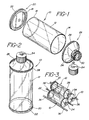
- Fig. 1 is an exploded view of one embodiment of roller bottle utilized in the invention;
- Fig. 2 is a perspective view of the assembled bottle of Fig. 1;
- Fig. 3 is a perspective view of a roller bottle assembly apparatus illustrating how bottles are arranged and rotated during use in such an apparatus;
- Fig. 4 is a perspective view of a sleeve or liner of the invention; and
- Fig. 5 is a perspective view of another embodiment of the invention illustrating a single-use roller bottle with the liner of the invention contained therein.
- Referring to the drawings in which like reference characters refer to like parts throughout the several views thereof, an exploded view of roller bottle generally designated 10 is shown. The roller bottle includes a
cylindrical body 12 comprised of a transparent material for making proper observation of the internal area of the roller bottle during and after use. Generally, in this connection, it is desirable that all roller bottles are comprised of a clear or transparent material for observation of the contents thereof. However, it will be understood in connection with this invention, that once a liner or sleeve of the invention is inserted into the roller bottle, that the actual internal contents of the roller bottle will not be available for observation other than, perhaps, through the transparent top or bottom wall of the roller bottle. - It should be understood, further, that the sleeve or liner, once it is inserted into the formed roller bottle may be treated prior to the top being molded onto the final roller bottle formation. That is, the interior surfaces of the formed roller bottle may be tissue culture treated by and of several known methods such as corona discharge, liquid coating, or ozone injection prior to assembly.
- Referring further to the embodiment shown in Fig. 1, one
end 16 of thetubular body portion 12 of the invention is inserted into anannular groove 18 ofbottom end cap 20.Cap 20 includes aserrated rim 22. If the embodiment, as is shown in Fig. 1, is to result in a single-use bottle, the two parts may then be permanently joined by ultrasonic welding, gluing or spin welding or the like. Alternatively, if the bottle is to be a reusable bottle, theend 16 may be joined onto thebottom part 20 in order to gain subsequent access to that end of the container. The parts may be press-fit, as shown, or cooperating screw threads may be utilized, for example. - However, if the container is glass, the
bottom portion 20 and thecylindrical portion 12 may be molded as a single glass part. - The
top cap 26 has aserrated rim 28, similar to that of thebottom cap 20 and is somewhat conical in shape. It is provided with an integral, substantially smaller diameter neck having integralexternal screw threads 32, for receiving thereon aclosure cap 34 which, as will be understood has mating internal threads for cooperating withthreads 32.Cap 34 has a serrated exterior surface to facilitate gripping by the user. It is within the purview of this invention that cap 34 andneck 30 include an intermediate positioning arrangement to allow access of the incubating humid environment for proper cell growth environment. Such an arrangement is taught and claimed in U.S. Patent Number 4,289,248 which is incorporated herein by reference, in its entirety. - Again, if the embodiment is to be a reusable one as shown in the assembled position in Fig. 2, cooperating screw threads, not shown, may be used for
cap 26 fitting on theopen end 14 of thecylindrical body portion 12. Alternatively, this can be a press fit connection as long as the desired non-leaking joint is obtained. - As discussed above, the roller bottles are utilized in an apparatus where a plurality of such bottles are rotated in a cell culture environment for a period of time. Representative of such apparatus is that shown in Fig. 3. As can be seen, the bottles may be stacked as shown in Fig. 3 such that the serrated portions such as 22, 28 shown in Figs. 1 and 2 may cooperate with each other on the individual bottles for rotating a plurality of bottles simultaneously.
- It will be observed that if the lower bottles in Fig. 3 are rotated in a clockwise direction, then the upper bottle having serrated rims which mesh with those of the lower bottles will rotate in a counterclockwise direction. At any rate, many more bottles than are shown in the drawing can be stacked in the manner shown thereby increasing the capacity of the roller apparatus.
- As a feature of the invention here, each one of those stacked bottles have an increased surface area for the actual culturing environment internally of each one of the roller bottles. Thus, the liners or sleeves of the invention increase substantially the effective internal surface area for cell growth culturing for each individual bottle.
- Referring now to Fig. 4, a representative foamed
sleeve 60 is shown which, as stated above, may be, for example, a polyurethane foam. Thesleeve 60 has open ends 62, 64 at opposite ends thereof. It will be understood by practitioners-in-the-art in forming such sleeves, that theend 64 may be, for example, closed so that a cylindrical closed end sleeve is provided for insertion into a roller bottle. - Referring now to Fig. 5, a representative single-use roller bottle is shown. That is,
roller bottle 50 includes acylindrical body portion 52, acap 54 having aserrated rim 58 and a bottom cap 56 having a serrated rim 59. Thecontainer 50 shown in Fig. 5 includes acap 62 cooperating with the neck ofcontainer 50. In the formation of the arrangement shown in Fig. 5, which is a single-use arrangement, asleeve 60 is inserted prior to the joining of thecap 54 to thecylindrical body portion 52. Since the closure is a permanent closure, the two parts may be joined together by, for example, sonic welding if the parts are comprised of a plastic material for that purpose. Otherwise, the parts may be joined together by the use of a glue or they may be press fit, depending upon the material being utilized for the container, and as long as the connection is properly sealed against leakage. - Thus, as will be appreciated from the above, there is provided in accordance with this invention, a simplified one-piece unitary roller bottle having a greatly increased surface area for cell growth formation therein simply by the utilization of a separately formed sleeve which may be formed in substantial number at greatly reduced cost. Thus, a reusable glass bottle may be used many times with relatively inexpensive sleeves.
- By the same token, if the roller bottle is to be used a single time, a relatively inexpensive resin material with the cooperating sleeve of the invention inserted therein may be used. With that arrangement, as will be understood, because of this substantially increased surface area useful for cultivating cells in the internal area of the bottle, the bottle is much more cost effective. As will be understood, with either embodiment used here, mass production techniques are readily available for reducing the cost thereof.
- While the forms of apparatus herein described constitute preferred embodiments of the invention, it is to be understood that the invention is not limited to these precise forms of apparatus and that changes may be made therein without departing from the scope of the invention which is defined in the appended claims.
- For example, roller bottles of different lengths may be produced, in accordance with roller bottle apparatus requirements already in existence. These modifications may be made without any expensive reassembly provisions in order to produce the roller bottles. Thus, mass production techniques may be used in a simplified form to produce many roller bottles of the kind to which this invention is directed.
Claims (10)
Priority Applications (1)
| Application Number | Priority Date | Filing Date | Title |
|---|---|---|---|
| AT90106356T ATE101646T1 (en) | 1989-04-27 | 1990-04-03 | ROLL BOTTLE. |
Applications Claiming Priority (2)
| Application Number | Priority Date | Filing Date | Title |
|---|---|---|---|
| US07/344,318 US4912058A (en) | 1989-04-27 | 1989-04-27 | Roller bottle |
| US344318 | 1989-04-27 |
Publications (2)
| Publication Number | Publication Date |
|---|---|
| EP0394713A1 true EP0394713A1 (en) | 1990-10-31 |
| EP0394713B1 EP0394713B1 (en) | 1994-02-16 |
Family
ID=23350015
Family Applications (1)
| Application Number | Title | Priority Date | Filing Date |
|---|---|---|---|
| EP90106356A Expired - Lifetime EP0394713B1 (en) | 1989-04-27 | 1990-04-03 | Roller bottle |
Country Status (6)
| Country | Link |
|---|---|
| US (1) | US4912058A (en) |
| EP (1) | EP0394713B1 (en) |
| JP (1) | JPH0728721B2 (en) |
| AT (1) | ATE101646T1 (en) |
| DE (1) | DE69006624D1 (en) |
| IE (1) | IE63833B1 (en) |
Cited By (5)
| Publication number | Priority date | Publication date | Assignee | Title |
|---|---|---|---|---|
| GB2301374A (en) * | 1995-05-16 | 1996-12-04 | Indian Inst Technology | Vessel for culturing plantlets |
| GB2304732A (en) * | 1995-08-31 | 1997-03-26 | Ashby Scient Ltd | Culture vessel comprising pitted growth substrate |
| US6130080A (en) * | 1995-08-31 | 2000-10-10 | Ashby Scientific, Inc. | Roller bottle having pitted or cratered inner surface for cell growth |
| WO2005092506A1 (en) * | 2004-03-03 | 2005-10-06 | Hach Company | A system and method for providing a reaction surface of a predetermined area for a limited volume |
| EP4375362A1 (en) | 2022-11-28 | 2024-05-29 | Universität Zürich | A rotating tissue culture insert for the position inside a rotatable roller bottle partially filled with a liquid for the cultivation of cells |
Families Citing this family (28)
| Publication number | Priority date | Publication date | Assignee | Title |
|---|---|---|---|---|
| FR2666094A1 (en) * | 1990-08-22 | 1992-02-28 | Cyclopore Sa | Cell mass-culture bottle and method for its assembly |
| US5650325A (en) * | 1990-11-29 | 1997-07-22 | Spielmann; Richard | Apparatus having a rotatable stack of parallel trays with culturing surfaces on opposite sides for liquid/gas exchange |
| BE1004610A5 (en) * | 1990-11-29 | 1992-12-22 | Spielmann Richard | BIOREACTOR ROTARY LARGE AREA FOR CELL CULTURE adherent OR SUSPENDED. |
| US5151366A (en) * | 1991-05-24 | 1992-09-29 | Invitro Scientific Products, Inc. | Cell culture flask |
| US5272084A (en) * | 1991-12-18 | 1993-12-21 | Corning Incorporated | Cell culture vessels having interior ridges and method for cultivating cells in same |
| US5362642A (en) * | 1993-02-10 | 1994-11-08 | Hyclone Laboratories | Methods and containment system for storing, reconstituting, dispensing and harvesting cell culture media |
| US5508174A (en) * | 1993-06-18 | 1996-04-16 | The United States Of America As Represented By The Secretary Of The Air Force | Method and micro roller bottle for in vitro exposure of cells to volatile chemicals |
| US5492826A (en) * | 1993-12-10 | 1996-02-20 | William Beaumont Hospital | Apparatus and method for seeding endothelial cells |
| US5527705A (en) * | 1994-09-12 | 1996-06-18 | Becton, Dickinson And Company | Roller bottle for trans-membrane co-culture of cells and method for its use |
| GB9517717D0 (en) * | 1995-08-31 | 1995-11-01 | Ashby Scient Ltd | Means for the growth of cells & micro-organisms |
| US6006387A (en) * | 1995-11-30 | 1999-12-28 | Cyclo3Pss Textile Systems, Inc. | Cold water ozone disinfection |
| US5763382A (en) * | 1996-01-03 | 1998-06-09 | Cyclo3Pss Textile Systems, Inc. | Cold water wash formula |
| US5866419A (en) * | 1996-09-16 | 1999-02-02 | Meder; Martin G. | Roller bottle |
| US6245557B1 (en) | 1999-06-30 | 2001-06-12 | Robert P. Fouts | Cell and protein harvesting assemblies and methods |
| US6458398B1 (en) | 1999-10-18 | 2002-10-01 | Eco Pure Food Safety Systems, Inc. | Cold water disinfection of foods |
| US6841384B2 (en) * | 2002-08-08 | 2005-01-11 | Becton Dickinson Company | Advanced roller bottle system for cell and tissue culturing |
| USD482794S1 (en) | 2002-09-20 | 2003-11-25 | Becton, Dickinson And Company | Roller bottle |
| CN101120083B (en) | 2003-10-08 | 2013-03-27 | 威尔森沃尔夫制造公司 | Method and device for cell culture using gas permeable material |
| EP1692257B1 (en) | 2003-11-10 | 2013-04-24 | Wheaton Industries, Inc. | Compartmentalized device for cell culture, cell processing, and sample dialysis |
| US7022518B1 (en) * | 2005-01-31 | 2006-04-04 | Glen Feye | Apparatus and method for co-culturing of cells |
| US7745209B2 (en) | 2005-07-26 | 2010-06-29 | Corning Incorporated | Multilayered cell culture apparatus |
| JP2010512149A (en) | 2006-12-07 | 2010-04-22 | ウィルソン ウォルフ マニュファクチャリング コーポレイション | Apparatus and method effective for cell culture |
| CA2730104A1 (en) * | 2008-07-08 | 2010-01-14 | Wilson Wolf Manufacturing Corporation | Improved gas permeable cell culture device and method of use |
| US8501468B2 (en) * | 2010-03-01 | 2013-08-06 | Wheaton Industries, Inc. | Culturing cells in a compartmentalized roller bottle |
| US8945917B2 (en) * | 2011-05-19 | 2015-02-03 | Counci of Scientific & Industrial Research and School of Environmental Studies | Enhanced surface area conico-cylindrical flask (ES-CCF) for biofilm cultivation |
| CN105296350A (en) * | 2015-11-30 | 2016-02-03 | 苏州钧隆塑胶有限公司 | Bacterium cultivation bottle with multi-layer movable bottle bottoms |
| WO2020041422A1 (en) | 2018-08-21 | 2020-02-27 | Lifecycle Biotechnologies, Lp | Oscillating bioreactor system |
| CN118086021A (en) * | 2024-01-31 | 2024-05-28 | 广东永顺生物制药股份有限公司 | A kind of rotating bottle for cell culture and its use |
Citations (5)
| Publication number | Priority date | Publication date | Assignee | Title |
|---|---|---|---|---|
| FR403203A (en) * | 1909-05-21 | 1909-10-28 | Montreux Sa Lab De | Device for cultivating, growing, storing, packaging and shipping germs such as microbes, yeasts, bacteria, etc., in non-liquid form |
| GB568114A (en) * | 1943-09-21 | 1945-03-19 | George Rice | Jar for use in the production of pure cultures such as mushroom spawn |
| FR1559214A (en) * | 1967-03-02 | 1969-03-07 | ||
| US3941661A (en) * | 1974-01-16 | 1976-03-02 | The Curators Of The University Of Missouri | Roller culture bottle insert |
| US4337104A (en) * | 1978-10-10 | 1982-06-29 | Becton, Dickinson And Company | Method for manufacturing a roller bottle |
Family Cites Families (12)
| Publication number | Priority date | Publication date | Assignee | Title |
|---|---|---|---|---|
| GB1376131A (en) * | 1971-02-09 | 1974-12-04 | Nat Res Dev | Improvements in and relating to cell culture systems |
| US3812016A (en) * | 1971-08-13 | 1974-05-21 | H Muller | Culture-growing apparatus |
| US4046138A (en) * | 1974-08-29 | 1977-09-06 | The Kendall Company | Diagnostic device for liquid samples |
| US4004981A (en) * | 1975-05-01 | 1977-01-25 | Merck & Co., Inc. | Cell removing device |
| US4065359A (en) * | 1975-05-01 | 1977-12-27 | Merck & Co., Inc. | Cell removing device |
| DE2907628C2 (en) * | 1979-02-27 | 1981-02-05 | C.A. Greiner Und Soehne Gmbh & Co Kg, 7440 Nuertingen | Sample tubes for the examination of samples in the clinical field, in particular urine samples |
| US4289248A (en) * | 1979-10-15 | 1981-09-15 | Becton, Dickinson And Company | Container closure assembly having intermediate positioning means |
| US4317886A (en) * | 1980-08-11 | 1982-03-02 | Becton, Dickinson And Company | Multiple interior surface roller bottle |
| FR2547823B1 (en) * | 1983-06-24 | 1986-10-31 | Commissariat Energie Atomique | TRANSPARENT WALL IN POLYURETHANE FOAM CONTAINING MICROORGANISMS, METHOD FOR THE PREPARATION THEREOF AND USE OF THIS WALL IN A BIOPHOTOREACTOR |
| US4600694A (en) * | 1985-05-24 | 1986-07-15 | Clyde Robert A | Apparatus for harvesting cells |
| GB8716997D0 (en) * | 1987-07-18 | 1987-08-26 | Sterilin Ltd | Cell culture vessel |
| US4829004A (en) * | 1987-11-24 | 1989-05-09 | The University Of Michigan | Roller bottle system |
-
1989
- 1989-04-27 US US07/344,318 patent/US4912058A/en not_active Expired - Fee Related
-
1990
- 1990-04-03 EP EP90106356A patent/EP0394713B1/en not_active Expired - Lifetime
- 1990-04-03 DE DE90106356T patent/DE69006624D1/en not_active Expired - Lifetime
- 1990-04-03 AT AT90106356T patent/ATE101646T1/en not_active IP Right Cessation
- 1990-04-24 IE IE146090A patent/IE63833B1/en not_active IP Right Cessation
- 1990-04-26 JP JP2111641A patent/JPH0728721B2/en not_active Expired - Lifetime
Patent Citations (5)
| Publication number | Priority date | Publication date | Assignee | Title |
|---|---|---|---|---|
| FR403203A (en) * | 1909-05-21 | 1909-10-28 | Montreux Sa Lab De | Device for cultivating, growing, storing, packaging and shipping germs such as microbes, yeasts, bacteria, etc., in non-liquid form |
| GB568114A (en) * | 1943-09-21 | 1945-03-19 | George Rice | Jar for use in the production of pure cultures such as mushroom spawn |
| FR1559214A (en) * | 1967-03-02 | 1969-03-07 | ||
| US3941661A (en) * | 1974-01-16 | 1976-03-02 | The Curators Of The University Of Missouri | Roller culture bottle insert |
| US4337104A (en) * | 1978-10-10 | 1982-06-29 | Becton, Dickinson And Company | Method for manufacturing a roller bottle |
Cited By (7)
| Publication number | Priority date | Publication date | Assignee | Title |
|---|---|---|---|---|
| GB2301374A (en) * | 1995-05-16 | 1996-12-04 | Indian Inst Technology | Vessel for culturing plantlets |
| GB2304732A (en) * | 1995-08-31 | 1997-03-26 | Ashby Scient Ltd | Culture vessel comprising pitted growth substrate |
| US6130080A (en) * | 1995-08-31 | 2000-10-10 | Ashby Scientific, Inc. | Roller bottle having pitted or cratered inner surface for cell growth |
| US6444459B1 (en) | 1995-08-31 | 2002-09-03 | Ashby Scientific Ltd. | Apparatus having pitted or cratered inner surface for culturing biological material and methods thereof |
| WO2005092506A1 (en) * | 2004-03-03 | 2005-10-06 | Hach Company | A system and method for providing a reaction surface of a predetermined area for a limited volume |
| EP4375362A1 (en) | 2022-11-28 | 2024-05-29 | Universität Zürich | A rotating tissue culture insert for the position inside a rotatable roller bottle partially filled with a liquid for the cultivation of cells |
| WO2024115006A1 (en) | 2022-11-28 | 2024-06-06 | Universität Zürich | A rotating tissue culture insert for the position inside a rotatable roller bottle partially filled with a liquid for the cultivation of cells |
Also Published As
| Publication number | Publication date |
|---|---|
| IE901460L (en) | 1990-10-27 |
| IE901460A1 (en) | 1991-02-13 |
| ATE101646T1 (en) | 1994-03-15 |
| EP0394713B1 (en) | 1994-02-16 |
| DE69006624D1 (en) | 1994-03-24 |
| JPH0728721B2 (en) | 1995-04-05 |
| US4912058A (en) | 1990-03-27 |
| IE63833B1 (en) | 1995-06-14 |
| JPH02303479A (en) | 1990-12-17 |
Similar Documents
| Publication | Publication Date | Title |
|---|---|---|
| US4912058A (en) | Roller bottle | |
| US11905506B2 (en) | Multilayered cell culture apparatus | |
| US5527705A (en) | Roller bottle for trans-membrane co-culture of cells and method for its use | |
| US4939151A (en) | Adherent cell culture flask | |
| US5803299A (en) | Container for multiple trash bags | |
| US4027427A (en) | Method and apparatus for the production of spawn | |
| AU669637B2 (en) | Vessel and closure assembly | |
| US11555172B2 (en) | Cell and tissue culture container | |
| US3448011A (en) | Sterile filter | |
| AU706560B2 (en) | Reusable vented flask cap cover | |
| MXPA96001792A (en) | Matrix of tej cultivation | |
| JPH01199572A (en) | Rotary container | |
| JPH10179137A (en) | Culture container | |
| EP1400585B1 (en) | Roller bottle | |
| US4772558A (en) | Blood culture system | |
| JPS6192561A (en) | Dish for bacterium cultivation | |
| US20080076170A1 (en) | Cell culture insert and cell culture vessel | |
| EP0345415B1 (en) | Expanded surface roller bottle | |
| EP0790300B1 (en) | Culture vessel and assembly | |
| US5470743A (en) | Transmembrane cell culture device | |
| EP0141104A1 (en) | Culture Flask | |
| US4840908A (en) | Culture bottle assembly | |
| US4861725A (en) | Mammalian cell culture apparatus | |
| JP2862170B2 (en) | Assembly for cell growth or tissue culture | |
| US6245557B1 (en) | Cell and protein harvesting assemblies and methods |
Legal Events
| Date | Code | Title | Description |
|---|---|---|---|
| PUAI | Public reference made under article 153(3) epc to a published international application that has entered the european phase |
Free format text: ORIGINAL CODE: 0009012 |
|
| AK | Designated contracting states |
Kind code of ref document: A1 Designated state(s): AT BE CH DE DK ES FR GB GR IT LI LU NL SE |
|
| 17P | Request for examination filed |
Effective date: 19901204 |
|
| 17Q | First examination report despatched |
Effective date: 19920820 |
|
| GRAA | (expected) grant |
Free format text: ORIGINAL CODE: 0009210 |
|
| AK | Designated contracting states |
Kind code of ref document: B1 Designated state(s): AT BE CH DE DK ES FR GB GR IT LI LU NL SE |
|
| PG25 | Lapsed in a contracting state [announced via postgrant information from national office to epo] |
Ref country code: IT Free format text: LAPSE BECAUSE OF FAILURE TO SUBMIT A TRANSLATION OF THE DESCRIPTION OR TO PAY THE FEE WITHIN THE PRESCRIBED TIME-LIMIT;WARNING: LAPSES OF ITALIAN PATENTS WITH EFFECTIVE DATE BEFORE 2007 MAY HAVE OCCURRED AT ANY TIME BEFORE 2007. THE CORRECT EFFECTIVE DATE MAY BE DIFFERENT FROM THE ONE RECORDED. Effective date: 19940216 Ref country code: DE Effective date: 19940216 Ref country code: DK Effective date: 19940216 Ref country code: GR Free format text: LAPSE BECAUSE OF FAILURE TO SUBMIT A TRANSLATION OF THE DESCRIPTION OR TO PAY THE FEE WITHIN THE PRESCRIBED TIME-LIMIT Effective date: 19940216 Ref country code: SE Effective date: 19940216 Ref country code: CH Effective date: 19940216 Ref country code: AT Effective date: 19940216 Ref country code: LI Effective date: 19940216 Ref country code: ES Free format text: THE PATENT HAS BEEN ANNULLED BY A DECISION OF A NATIONAL AUTHORITY Effective date: 19940216 Ref country code: NL Effective date: 19940216 |
|
| REF | Corresponds to: |
Ref document number: 101646 Country of ref document: AT Date of ref document: 19940315 Kind code of ref document: T |
|
| REF | Corresponds to: |
Ref document number: 69006624 Country of ref document: DE Date of ref document: 19940324 |
|
| ET | Fr: translation filed | ||
| PG25 | Lapsed in a contracting state [announced via postgrant information from national office to epo] |
Ref country code: LU Free format text: LAPSE BECAUSE OF NON-PAYMENT OF DUE FEES Effective date: 19940430 |
|
| REG | Reference to a national code |
Ref country code: CH Ref legal event code: PL |
|
| NLV1 | Nl: lapsed or annulled due to failure to fulfill the requirements of art. 29p and 29m of the patents act | ||
| PLBE | No opposition filed within time limit |
Free format text: ORIGINAL CODE: 0009261 |
|
| STAA | Information on the status of an ep patent application or granted ep patent |
Free format text: STATUS: NO OPPOSITION FILED WITHIN TIME LIMIT |
|
| 26N | No opposition filed | ||
| PGFP | Annual fee paid to national office [announced via postgrant information from national office to epo] |
Ref country code: GB Payment date: 19980325 Year of fee payment: 9 |
|
| PGFP | Annual fee paid to national office [announced via postgrant information from national office to epo] |
Ref country code: FR Payment date: 19980409 Year of fee payment: 9 |
|
| PGFP | Annual fee paid to national office [announced via postgrant information from national office to epo] |
Ref country code: BE Payment date: 19980609 Year of fee payment: 9 |
|
| PG25 | Lapsed in a contracting state [announced via postgrant information from national office to epo] |
Ref country code: GB Free format text: LAPSE BECAUSE OF NON-PAYMENT OF DUE FEES Effective date: 19990403 |
|
| PG25 | Lapsed in a contracting state [announced via postgrant information from national office to epo] |
Ref country code: BE Free format text: LAPSE BECAUSE OF NON-PAYMENT OF DUE FEES Effective date: 19990430 |
|
| BERE | Be: lapsed |
Owner name: BECTON DICKINSON & CY Effective date: 19990430 |
|
| GBPC | Gb: european patent ceased through non-payment of renewal fee |
Effective date: 19990403 |
|
| PG25 | Lapsed in a contracting state [announced via postgrant information from national office to epo] |
Ref country code: FR Free format text: LAPSE BECAUSE OF NON-PAYMENT OF DUE FEES Effective date: 19991231 |
|
| REG | Reference to a national code |
Ref country code: FR Ref legal event code: ST |