EP0393926A1 - 1-Aminoisoquinoline derivatives - Google Patents
1-Aminoisoquinoline derivatives Download PDFInfo
- Publication number
- EP0393926A1 EP0393926A1 EP90303943A EP90303943A EP0393926A1 EP 0393926 A1 EP0393926 A1 EP 0393926A1 EP 90303943 A EP90303943 A EP 90303943A EP 90303943 A EP90303943 A EP 90303943A EP 0393926 A1 EP0393926 A1 EP 0393926A1
- Authority
- EP
- European Patent Office
- Prior art keywords
- alkyl
- group
- compound
- phenyl
- compound according
- Prior art date
- Legal status (The legal status is an assumption and is not a legal conclusion. Google has not performed a legal analysis and makes no representation as to the accuracy of the status listed.)
- Granted
Links
- OSILBMSORKFRTB-UHFFFAOYSA-N isoquinolin-1-amine Chemical class C1=CC=C2C(N)=NC=CC2=C1 OSILBMSORKFRTB-UHFFFAOYSA-N 0.000 title 1
- 150000001875 compounds Chemical class 0.000 claims abstract description 82
- 125000001997 phenyl group Chemical group [H]C1=C([H])C([H])=C(*)C([H])=C1[H] 0.000 claims abstract description 18
- 125000000217 alkyl group Chemical group 0.000 claims abstract description 15
- 125000004169 (C1-C6) alkyl group Chemical group 0.000 claims abstract description 13
- -1 cyano, hydroxy, carbamoyl Chemical group 0.000 claims abstract description 9
- 229910052739 hydrogen Inorganic materials 0.000 claims abstract description 9
- 239000001257 hydrogen Substances 0.000 claims abstract description 9
- 125000004435 hydrogen atom Chemical group [H]* 0.000 claims abstract description 8
- 125000005913 (C3-C6) cycloalkyl group Chemical group 0.000 claims abstract description 7
- 229910052736 halogen Inorganic materials 0.000 claims abstract description 7
- 150000002367 halogens Chemical class 0.000 claims abstract description 7
- 238000000034 method Methods 0.000 claims abstract description 7
- 125000002924 primary amino group Chemical group [H]N([H])* 0.000 claims abstract description 7
- 125000002023 trifluoromethyl group Chemical group FC(F)(F)* 0.000 claims abstract description 7
- 125000004191 (C1-C6) alkoxy group Chemical group 0.000 claims abstract description 6
- 238000002360 preparation method Methods 0.000 claims abstract description 6
- 239000008194 pharmaceutical composition Substances 0.000 claims abstract description 5
- 238000002560 therapeutic procedure Methods 0.000 claims abstract description 5
- 125000006700 (C1-C6) alkylthio group Chemical group 0.000 claims abstract description 4
- 125000004093 cyano group Chemical group *C#N 0.000 claims abstract description 4
- 125000001054 5 membered carbocyclic group Chemical group 0.000 claims abstract description 3
- 125000004008 6 membered carbocyclic group Chemical group 0.000 claims abstract description 3
- 125000003178 carboxy group Chemical group [H]OC(*)=O 0.000 claims abstract description 3
- 230000027119 gastric acid secretion Effects 0.000 claims abstract description 3
- 125000005842 heteroatom Chemical group 0.000 claims abstract description 3
- 125000002887 hydroxy group Chemical group [H]O* 0.000 claims abstract description 3
- 150000003839 salts Chemical class 0.000 claims description 17
- 238000006243 chemical reaction Methods 0.000 claims description 9
- 125000001797 benzyl group Chemical group [H]C1=C([H])C([H])=C(C([H])=C1[H])C([H])([H])* 0.000 claims description 7
- 239000003937 drug carrier Substances 0.000 claims description 4
- 125000001424 substituent group Chemical group 0.000 claims description 4
- 150000001412 amines Chemical class 0.000 claims description 3
- QJGQUHMNIGDVPM-UHFFFAOYSA-N nitrogen group Chemical group [N] QJGQUHMNIGDVPM-UHFFFAOYSA-N 0.000 claims description 3
- 125000006239 protecting group Chemical group 0.000 claims description 3
- ITFBZWFVFUSCGU-UHFFFAOYSA-N 7-methoxy-n-(2-methylphenyl)isoquinolin-1-amine;hydrochloride Chemical compound Cl.C12=CC(OC)=CC=C2C=CN=C1NC1=CC=CC=C1C ITFBZWFVFUSCGU-UHFFFAOYSA-N 0.000 claims description 2
- 230000005764 inhibitory process Effects 0.000 claims description 2
- CKOJHVNCIKKFQO-UHFFFAOYSA-N n-[(2-methoxyphenyl)methyl]isoquinolin-1-amine;hydrochloride Chemical compound Cl.COC1=CC=CC=C1CNC1=NC=CC2=CC=CC=C12 CKOJHVNCIKKFQO-UHFFFAOYSA-N 0.000 claims 1
- 125000004178 (C1-C4) alkyl group Chemical group 0.000 abstract description 3
- 125000004890 (C1-C6) alkylamino group Chemical group 0.000 abstract description 3
- 239000003112 inhibitor Substances 0.000 abstract description 3
- RTZKZFJDLAIYFH-UHFFFAOYSA-N Diethyl ether Chemical compound CCOCC RTZKZFJDLAIYFH-UHFFFAOYSA-N 0.000 description 75
- LFQSCWFLJHTTHZ-UHFFFAOYSA-N Ethanol Chemical compound CCO LFQSCWFLJHTTHZ-UHFFFAOYSA-N 0.000 description 72
- 239000003921 oil Substances 0.000 description 26
- 235000019198 oils Nutrition 0.000 description 26
- 239000000243 solution Substances 0.000 description 25
- WGQKYBSKWIADBV-UHFFFAOYSA-N benzylamine Chemical compound NCC1=CC=CC=C1 WGQKYBSKWIADBV-UHFFFAOYSA-N 0.000 description 22
- OKKJLVBELUTLKV-UHFFFAOYSA-N Methanol Chemical compound OC OKKJLVBELUTLKV-UHFFFAOYSA-N 0.000 description 21
- 239000007787 solid Substances 0.000 description 21
- 239000000463 material Substances 0.000 description 16
- 239000000203 mixture Substances 0.000 description 16
- XLYOFNOQVPJJNP-UHFFFAOYSA-N water Substances O XLYOFNOQVPJJNP-UHFFFAOYSA-N 0.000 description 15
- HEDRZPFGACZZDS-UHFFFAOYSA-N Chloroform Chemical compound ClC(Cl)Cl HEDRZPFGACZZDS-UHFFFAOYSA-N 0.000 description 14
- 239000003153 chemical reaction reagent Substances 0.000 description 13
- YMWUJEATGCHHMB-UHFFFAOYSA-N Dichloromethane Chemical compound ClCCl YMWUJEATGCHHMB-UHFFFAOYSA-N 0.000 description 12
- XEKOWRVHYACXOJ-UHFFFAOYSA-N Ethyl acetate Chemical compound CCOC(C)=O XEKOWRVHYACXOJ-UHFFFAOYSA-N 0.000 description 12
- HEMHJVSKTPXQMS-UHFFFAOYSA-M Sodium hydroxide Chemical compound [OH-].[Na+] HEMHJVSKTPXQMS-UHFFFAOYSA-M 0.000 description 12
- 239000002904 solvent Substances 0.000 description 11
- QCQCHGYLTSGIGX-GHXANHINSA-N 4-[[(3ar,5ar,5br,7ar,9s,11ar,11br,13as)-5a,5b,8,8,11a-pentamethyl-3a-[(5-methylpyridine-3-carbonyl)amino]-2-oxo-1-propan-2-yl-4,5,6,7,7a,9,10,11,11b,12,13,13a-dodecahydro-3h-cyclopenta[a]chrysen-9-yl]oxy]-2,2-dimethyl-4-oxobutanoic acid Chemical compound N([C@@]12CC[C@@]3(C)[C@]4(C)CC[C@H]5C(C)(C)[C@@H](OC(=O)CC(C)(C)C(O)=O)CC[C@]5(C)[C@H]4CC[C@@H]3C1=C(C(C2)=O)C(C)C)C(=O)C1=CN=CC(C)=C1 QCQCHGYLTSGIGX-GHXANHINSA-N 0.000 description 10
- 230000000694 effects Effects 0.000 description 10
- RNVCVTLRINQCPJ-UHFFFAOYSA-N o-toluidine Chemical compound CC1=CC=CC=C1N RNVCVTLRINQCPJ-UHFFFAOYSA-N 0.000 description 10
- VYPSYNLAJGMNEJ-UHFFFAOYSA-N Silicium dioxide Chemical compound O=[Si]=O VYPSYNLAJGMNEJ-UHFFFAOYSA-N 0.000 description 8
- 239000003208 petroleum Substances 0.000 description 8
- 239000000741 silica gel Substances 0.000 description 8
- 229910002027 silica gel Inorganic materials 0.000 description 8
- PXJACNDVRNAFHD-UHFFFAOYSA-N (2-methoxyphenyl)methanamine Chemical group COC1=CC=CC=C1CN PXJACNDVRNAFHD-UHFFFAOYSA-N 0.000 description 7
- KRKNYBCHXYNGOX-UHFFFAOYSA-N citric acid group Chemical group C(CC(O)(C(=O)O)CC(=O)O)(=O)O KRKNYBCHXYNGOX-UHFFFAOYSA-N 0.000 description 7
- 230000002496 gastric effect Effects 0.000 description 7
- 108091006112 ATPases Proteins 0.000 description 6
- 102000057290 Adenosine Triphosphatases Human genes 0.000 description 6
- VEXZGXHMUGYJMC-UHFFFAOYSA-N Hydrochloric acid Chemical compound Cl VEXZGXHMUGYJMC-UHFFFAOYSA-N 0.000 description 6
- ZMXDDKWLCZADIW-UHFFFAOYSA-N N,N-Dimethylformamide Chemical compound CN(C)C=O ZMXDDKWLCZADIW-UHFFFAOYSA-N 0.000 description 6
- CDBYLPFSWZWCQE-UHFFFAOYSA-L Sodium Carbonate Chemical compound [Na+].[Na+].[O-]C([O-])=O CDBYLPFSWZWCQE-UHFFFAOYSA-L 0.000 description 6
- 238000001816 cooling Methods 0.000 description 6
- 239000013078 crystal Substances 0.000 description 6
- 208000037265 diseases, disorders, signs and symptoms Diseases 0.000 description 6
- IXCSERBJSXMMFS-UHFFFAOYSA-N hydrogen chloride Substances Cl.Cl IXCSERBJSXMMFS-UHFFFAOYSA-N 0.000 description 6
- 229910000041 hydrogen chloride Inorganic materials 0.000 description 6
- 238000003756 stirring Methods 0.000 description 6
- 208000006386 Bone Resorption Diseases 0.000 description 5
- 210000000988 bone and bone Anatomy 0.000 description 5
- 230000024279 bone resorption Effects 0.000 description 5
- 239000003480 eluent Substances 0.000 description 5
- 239000000047 product Substances 0.000 description 5
- 239000000725 suspension Substances 0.000 description 5
- 239000003826 tablet Substances 0.000 description 5
- RDOXTESZEPMUJZ-UHFFFAOYSA-N anisole Chemical compound COC1=CC=CC=C1 RDOXTESZEPMUJZ-UHFFFAOYSA-N 0.000 description 4
- 201000010099 disease Diseases 0.000 description 4
- 239000003814 drug Substances 0.000 description 4
- AWJUIBRHMBBTKR-UHFFFAOYSA-N isoquinoline Chemical compound C1=NC=CC2=CC=CC=C21 AWJUIBRHMBBTKR-UHFFFAOYSA-N 0.000 description 4
- 238000010992 reflux Methods 0.000 description 4
- 229910000029 sodium carbonate Inorganic materials 0.000 description 4
- CJAAPVQEZPAQNI-UHFFFAOYSA-N (2-methylphenyl)methanamine Chemical group CC1=CC=CC=C1CN CJAAPVQEZPAQNI-UHFFFAOYSA-N 0.000 description 3
- NIUYZXACHPTIQY-UHFFFAOYSA-N 1-methylsulfanyl-3,4-dihydroisoquinoline;hydroiodide Chemical compound I.C1=CC=C2C(SC)=NCCC2=C1 NIUYZXACHPTIQY-UHFFFAOYSA-N 0.000 description 3
- HBAQYPYDRFILMT-UHFFFAOYSA-N 8-[3-(1-cyclopropylpyrazol-4-yl)-1H-pyrazolo[4,3-d]pyrimidin-5-yl]-3-methyl-3,8-diazabicyclo[3.2.1]octan-2-one Chemical class C1(CC1)N1N=CC(=C1)C1=NNC2=C1N=C(N=C2)N1C2C(N(CC1CC2)C)=O HBAQYPYDRFILMT-UHFFFAOYSA-N 0.000 description 3
- 206010065687 Bone loss Diseases 0.000 description 3
- ZMANZCXQSJIPKH-UHFFFAOYSA-N Triethylamine Chemical compound CCN(CC)CC ZMANZCXQSJIPKH-UHFFFAOYSA-N 0.000 description 3
- 239000002253 acid Substances 0.000 description 3
- 239000002585 base Substances 0.000 description 3
- 239000002775 capsule Substances 0.000 description 3
- 238000004440 column chromatography Methods 0.000 description 3
- 239000000543 intermediate Substances 0.000 description 3
- 239000010502 orange oil Substances 0.000 description 3
- 229920006395 saturated elastomer Polymers 0.000 description 3
- RYHBNJHYFVUHQT-UHFFFAOYSA-N 1,4-Dioxane Chemical compound C1COCCO1 RYHBNJHYFVUHQT-UHFFFAOYSA-N 0.000 description 2
- DVHOIKSDQCZHOV-UHFFFAOYSA-N 1-chloro-5-methoxyisoquinoline Chemical compound N1=CC=C2C(OC)=CC=CC2=C1Cl DVHOIKSDQCZHOV-UHFFFAOYSA-N 0.000 description 2
- MSQCQINLJMEVNJ-UHFFFAOYSA-N 1-chloroisoquinoline Chemical compound C1=CC=C2C(Cl)=NC=CC2=C1 MSQCQINLJMEVNJ-UHFFFAOYSA-N 0.000 description 2
- RQJDUEKERVZLLU-UHFFFAOYSA-N 4-Hydroxybenzylamine Chemical compound NCC1=CC=C(O)C=C1 RQJDUEKERVZLLU-UHFFFAOYSA-N 0.000 description 2
- CIWBSHSKHKDKBQ-JLAZNSOCSA-N Ascorbic acid Chemical compound OC[C@H](O)[C@H]1OC(=O)C(O)=C1O CIWBSHSKHKDKBQ-JLAZNSOCSA-N 0.000 description 2
- 208000007882 Gastritis Diseases 0.000 description 2
- 208000018522 Gastrointestinal disease Diseases 0.000 description 2
- PEDCQBHIVMGVHV-UHFFFAOYSA-N Glycerine Chemical compound OCC(O)CO PEDCQBHIVMGVHV-UHFFFAOYSA-N 0.000 description 2
- 201000002980 Hyperparathyroidism Diseases 0.000 description 2
- 208000010191 Osteitis Deformans Diseases 0.000 description 2
- 208000001132 Osteoporosis Diseases 0.000 description 2
- 208000027868 Paget disease Diseases 0.000 description 2
- KDLHZDBZIXYQEI-UHFFFAOYSA-N Palladium Chemical compound [Pd] KDLHZDBZIXYQEI-UHFFFAOYSA-N 0.000 description 2
- BHHGXPLMPWCGHP-UHFFFAOYSA-N Phenethylamine Chemical group NCCC1=CC=CC=C1 BHHGXPLMPWCGHP-UHFFFAOYSA-N 0.000 description 2
- 239000002202 Polyethylene glycol Substances 0.000 description 2
- 208000007107 Stomach Ulcer Diseases 0.000 description 2
- WYURNTSHIVDZCO-UHFFFAOYSA-N Tetrahydrofuran Chemical compound C1CCOC1 WYURNTSHIVDZCO-UHFFFAOYSA-N 0.000 description 2
- 239000004480 active ingredient Substances 0.000 description 2
- 125000004414 alkyl thio group Chemical group 0.000 description 2
- 230000001262 anti-secretory effect Effects 0.000 description 2
- 125000003118 aryl group Chemical group 0.000 description 2
- 125000001246 bromo group Chemical group Br* 0.000 description 2
- 150000001735 carboxylic acids Chemical class 0.000 description 2
- 239000000969 carrier Substances 0.000 description 2
- 239000003054 catalyst Substances 0.000 description 2
- 235000010980 cellulose Nutrition 0.000 description 2
- 229920002678 cellulose Polymers 0.000 description 2
- 239000003795 chemical substances by application Substances 0.000 description 2
- 125000001309 chloro group Chemical group Cl* 0.000 description 2
- 238000004587 chromatography analysis Methods 0.000 description 2
- 238000002425 crystallisation Methods 0.000 description 2
- 208000035475 disorder Diseases 0.000 description 2
- 239000006185 dispersion Substances 0.000 description 2
- 229940079593 drug Drugs 0.000 description 2
- 238000011067 equilibration Methods 0.000 description 2
- 238000001704 evaporation Methods 0.000 description 2
- 230000008020 evaporation Effects 0.000 description 2
- 238000009472 formulation Methods 0.000 description 2
- 239000012458 free base Substances 0.000 description 2
- 239000007789 gas Substances 0.000 description 2
- 208000021302 gastroesophageal reflux disease Diseases 0.000 description 2
- 239000007903 gelatin capsule Substances 0.000 description 2
- 125000005843 halogen group Chemical group 0.000 description 2
- 125000000623 heterocyclic group Chemical group 0.000 description 2
- 208000006278 hypochromic anemia Diseases 0.000 description 2
- CGIGDMFJXJATDK-UHFFFAOYSA-N indomethacin Chemical compound CC1=C(CC(O)=O)C2=CC(OC)=CC=C2N1C(=O)C1=CC=C(Cl)C=C1 CGIGDMFJXJATDK-UHFFFAOYSA-N 0.000 description 2
- 229910052816 inorganic phosphate Inorganic materials 0.000 description 2
- 239000007788 liquid Substances 0.000 description 2
- HQKMJHAJHXVSDF-UHFFFAOYSA-L magnesium stearate Chemical compound [Mg+2].CCCCCCCCCCCCCCCCCC([O-])=O.CCCCCCCCCCCCCCCCCC([O-])=O HQKMJHAJHXVSDF-UHFFFAOYSA-L 0.000 description 2
- 208000027202 mammary Paget disease Diseases 0.000 description 2
- UZKWTJUDCOPSNM-UHFFFAOYSA-N methoxybenzene Substances CCCCOC=C UZKWTJUDCOPSNM-UHFFFAOYSA-N 0.000 description 2
- 239000003960 organic solvent Substances 0.000 description 2
- 210000002997 osteoclast Anatomy 0.000 description 2
- 238000007911 parenteral administration Methods 0.000 description 2
- 229920001223 polyethylene glycol Polymers 0.000 description 2
- 238000006748 scratching Methods 0.000 description 2
- 230000002393 scratching effect Effects 0.000 description 2
- SUKJFIGYRHOWBL-UHFFFAOYSA-N sodium hypochlorite Chemical compound [Na+].Cl[O-] SUKJFIGYRHOWBL-UHFFFAOYSA-N 0.000 description 2
- 238000010561 standard procedure Methods 0.000 description 2
- FKKJJPMGAWGYPN-UHFFFAOYSA-N thiophen-2-ylmethanamine Chemical group NCC1=CC=CS1 FKKJJPMGAWGYPN-UHFFFAOYSA-N 0.000 description 2
- RQEUFEKYXDPUSK-SSDOTTSWSA-N (1R)-1-phenylethanamine Chemical group C[C@@H](N)C1=CC=CC=C1 RQEUFEKYXDPUSK-SSDOTTSWSA-N 0.000 description 1
- 125000002861 (C1-C4) alkanoyl group Chemical group 0.000 description 1
- IDPURXSQCKYKIJ-UHFFFAOYSA-N 1-(4-methoxyphenyl)methanamine Chemical group COC1=CC=C(CN)C=C1 IDPURXSQCKYKIJ-UHFFFAOYSA-N 0.000 description 1
- MPMDYPSDYGHVBM-UHFFFAOYSA-N 1-chloro-6,7-dimethoxyisoquinoline Chemical compound C1=NC(Cl)=C2C=C(OC)C(OC)=CC2=C1 MPMDYPSDYGHVBM-UHFFFAOYSA-N 0.000 description 1
- UTZJYSXOFHCSGZ-UHFFFAOYSA-N 1-chloro-6-methoxyisoquinoline Chemical compound ClC1=NC=CC2=CC(OC)=CC=C21 UTZJYSXOFHCSGZ-UHFFFAOYSA-N 0.000 description 1
- SSBMOLGNIQJGPF-UHFFFAOYSA-N 1-chloro-7-methoxyisoquinoline Chemical compound C1=CN=C(Cl)C2=CC(OC)=CC=C21 SSBMOLGNIQJGPF-UHFFFAOYSA-N 0.000 description 1
- IIZPXYDJLKNOIY-JXPKJXOSSA-N 1-palmitoyl-2-arachidonoyl-sn-glycero-3-phosphocholine Chemical compound CCCCCCCCCCCCCCCC(=O)OC[C@H](COP([O-])(=O)OCC[N+](C)(C)C)OC(=O)CCC\C=C/C\C=C/C\C=C/C\C=C/CCCCC IIZPXYDJLKNOIY-JXPKJXOSSA-N 0.000 description 1
- QAOBBBBDJSWHMU-WMBBNPMCSA-N 16,16-dimethylprostaglandin E2 Chemical compound CCCCC(C)(C)[C@H](O)\C=C\[C@H]1[C@H](O)CC(=O)[C@@H]1C\C=C/CCCC(O)=O QAOBBBBDJSWHMU-WMBBNPMCSA-N 0.000 description 1
- WZFUQSJFWNHZHM-UHFFFAOYSA-N 2-[4-[2-(2,3-dihydro-1H-inden-2-ylamino)pyrimidin-5-yl]piperazin-1-yl]-1-(2,4,6,7-tetrahydrotriazolo[4,5-c]pyridin-5-yl)ethanone Chemical compound C1C(CC2=CC=CC=C12)NC1=NC=C(C=N1)N1CCN(CC1)CC(=O)N1CC2=C(CC1)NN=N2 WZFUQSJFWNHZHM-UHFFFAOYSA-N 0.000 description 1
- 125000000094 2-phenylethyl group Chemical group [H]C1=C([H])C([H])=C(C([H])=C1[H])C([H])([H])C([H])([H])* 0.000 description 1
- GQQVWNYEBUSOCR-UHFFFAOYSA-N 5-methoxy-n-(2-methylphenyl)isoquinolin-1-amine Chemical compound N1=CC=C2C(OC)=CC=CC2=C1NC1=CC=CC=C1C GQQVWNYEBUSOCR-UHFFFAOYSA-N 0.000 description 1
- NKWIITBYELRPAR-UHFFFAOYSA-N 5-methoxy-n-(2-phenylethyl)isoquinolin-1-amine;hydrochloride Chemical compound Cl.N1=CC=C2C(OC)=CC=CC2=C1NCCC1=CC=CC=C1 NKWIITBYELRPAR-UHFFFAOYSA-N 0.000 description 1
- JCSPZSMADFQKFB-UHFFFAOYSA-N 5-methoxy-n-[(2-methylphenyl)methyl]isoquinolin-1-amine Chemical compound N1=CC=C2C(OC)=CC=CC2=C1NCC1=CC=CC=C1C JCSPZSMADFQKFB-UHFFFAOYSA-N 0.000 description 1
- CXORJVFTGCKJEM-UHFFFAOYSA-N 6,7-dimethoxy-n-(2-methylphenyl)isoquinolin-1-amine;hydrochloride Chemical compound Cl.C=12C=C(OC)C(OC)=CC2=CC=NC=1NC1=CC=CC=C1C CXORJVFTGCKJEM-UHFFFAOYSA-N 0.000 description 1
- UPMPJEYAZZSMRK-UHFFFAOYSA-N 6,7-dimethoxy-n-[(2-methoxyphenyl)methyl]isoquinolin-1-amine;hydrochloride Chemical compound Cl.COC1=CC=CC=C1CNC1=NC=CC2=CC(OC)=C(OC)C=C12 UPMPJEYAZZSMRK-UHFFFAOYSA-N 0.000 description 1
- CMTRMYVGNGZOFM-UHFFFAOYSA-N 6-methoxy-n-(2-methylphenyl)isoquinolin-1-amine;hydrochloride Chemical compound Cl.N=1C=CC2=CC(OC)=CC=C2C=1NC1=CC=CC=C1C CMTRMYVGNGZOFM-UHFFFAOYSA-N 0.000 description 1
- NIVHNZCPAUQQDQ-UHFFFAOYSA-N 6-methoxy-n-[(2-methoxyphenyl)methyl]isoquinolin-1-amine;hydrochloride Chemical compound Cl.N=1C=CC2=CC(OC)=CC=C2C=1NCC1=CC=CC=C1OC NIVHNZCPAUQQDQ-UHFFFAOYSA-N 0.000 description 1
- URKZNAUINBWMFY-UHFFFAOYSA-N 7-methoxy-n-[(2-methoxyphenyl)methyl]isoquinolin-1-amine;hydrochloride Chemical compound Cl.C12=CC(OC)=CC=C2C=CN=C1NCC1=CC=CC=C1OC URKZNAUINBWMFY-UHFFFAOYSA-N 0.000 description 1
- GUBGYTABKSRVRQ-XLOQQCSPSA-N Alpha-Lactose Chemical compound O[C@@H]1[C@@H](O)[C@@H](O)[C@@H](CO)O[C@H]1O[C@@H]1[C@@H](CO)O[C@H](O)[C@H](O)[C@H]1O GUBGYTABKSRVRQ-XLOQQCSPSA-N 0.000 description 1
- 235000003911 Arachis Nutrition 0.000 description 1
- 244000105624 Arachis hypogaea Species 0.000 description 1
- BSYNRYMUTXBXSQ-UHFFFAOYSA-N Aspirin Chemical compound CC(=O)OC1=CC=CC=C1C(O)=O BSYNRYMUTXBXSQ-UHFFFAOYSA-N 0.000 description 1
- IAZDPXIOMUYVGZ-UHFFFAOYSA-N Dimethylsulphoxide Chemical compound CS(C)=O IAZDPXIOMUYVGZ-UHFFFAOYSA-N 0.000 description 1
- VGGSQFUCUMXWEO-UHFFFAOYSA-N Ethene Chemical compound C=C VGGSQFUCUMXWEO-UHFFFAOYSA-N 0.000 description 1
- 239000005977 Ethylene Substances 0.000 description 1
- 108010010803 Gelatin Proteins 0.000 description 1
- UFHFLCQGNIYNRP-UHFFFAOYSA-N Hydrogen Chemical compound [H][H] UFHFLCQGNIYNRP-UHFFFAOYSA-N 0.000 description 1
- 206010022653 Intestinal haemorrhages Diseases 0.000 description 1
- GUBGYTABKSRVRQ-QKKXKWKRSA-N Lactose Natural products OC[C@H]1O[C@@H](O[C@H]2[C@H](O)[C@@H](O)C(O)O[C@@H]2CO)[C@H](O)[C@@H](O)[C@H]1O GUBGYTABKSRVRQ-QKKXKWKRSA-N 0.000 description 1
- 241000124008 Mammalia Species 0.000 description 1
- AFVFQIVMOAPDHO-UHFFFAOYSA-M Methanesulfonate Chemical compound CS([O-])(=O)=O AFVFQIVMOAPDHO-UHFFFAOYSA-M 0.000 description 1
- CMWTZPSULFXXJA-UHFFFAOYSA-N Naproxen Natural products C1=C(C(C)C(O)=O)C=CC2=CC(OC)=CC=C21 CMWTZPSULFXXJA-UHFFFAOYSA-N 0.000 description 1
- IOVCWXUNBOPUCH-UHFFFAOYSA-M Nitrite anion Chemical compound [O-]N=O IOVCWXUNBOPUCH-UHFFFAOYSA-M 0.000 description 1
- 206010035669 Pneumonia aspiration Diseases 0.000 description 1
- UIIMBOGNXHQVGW-UHFFFAOYSA-M Sodium bicarbonate Chemical class [Na+].OC([O-])=O UIIMBOGNXHQVGW-UHFFFAOYSA-M 0.000 description 1
- 229920002472 Starch Polymers 0.000 description 1
- CZMRCDWAGMRECN-UGDNZRGBSA-N Sucrose Chemical compound O[C@H]1[C@H](O)[C@@H](CO)O[C@@]1(CO)O[C@@H]1[C@H](O)[C@@H](O)[C@H](O)[C@@H](CO)O1 CZMRCDWAGMRECN-UGDNZRGBSA-N 0.000 description 1
- 229930006000 Sucrose Natural products 0.000 description 1
- 239000007983 Tris buffer Substances 0.000 description 1
- 241000860832 Yoda Species 0.000 description 1
- 201000008629 Zollinger-Ellison syndrome Diseases 0.000 description 1
- 229960001138 acetylsalicylic acid Drugs 0.000 description 1
- 150000007513 acids Chemical class 0.000 description 1
- 230000001154 acute effect Effects 0.000 description 1
- 125000001931 aliphatic group Chemical group 0.000 description 1
- 125000003545 alkoxy group Chemical group 0.000 description 1
- 125000003282 alkyl amino group Chemical group 0.000 description 1
- 125000004644 alkyl sulfinyl group Chemical group 0.000 description 1
- 125000004390 alkyl sulfonyl group Chemical group 0.000 description 1
- 125000002947 alkylene group Chemical group 0.000 description 1
- WNROFYMDJYEPJX-UHFFFAOYSA-K aluminium hydroxide Chemical compound [OH-].[OH-].[OH-].[Al+3] WNROFYMDJYEPJX-UHFFFAOYSA-K 0.000 description 1
- 229910021502 aluminium hydroxide Inorganic materials 0.000 description 1
- 229940069428 antacid Drugs 0.000 description 1
- 239000003159 antacid agent Substances 0.000 description 1
- 239000011260 aqueous acid Substances 0.000 description 1
- 239000008365 aqueous carrier Substances 0.000 description 1
- 239000007864 aqueous solution Substances 0.000 description 1
- 239000003125 aqueous solvent Substances 0.000 description 1
- 229960005070 ascorbic acid Drugs 0.000 description 1
- 235000010323 ascorbic acid Nutrition 0.000 description 1
- 239000011668 ascorbic acid Substances 0.000 description 1
- 201000009408 aspiration pneumonitis Diseases 0.000 description 1
- 230000009286 beneficial effect Effects 0.000 description 1
- 239000011230 binding agent Substances 0.000 description 1
- 210000004027 cell Anatomy 0.000 description 1
- 239000001913 cellulose Substances 0.000 description 1
- 230000001684 chronic effect Effects 0.000 description 1
- CCGSUNCLSOWKJO-UHFFFAOYSA-N cimetidine Chemical compound N#CNC(=N/C)\NCCSCC1=NC=N[C]1C CCGSUNCLSOWKJO-UHFFFAOYSA-N 0.000 description 1
- 229960001380 cimetidine Drugs 0.000 description 1
- 229940110456 cocoa butter Drugs 0.000 description 1
- 235000019868 cocoa butter Nutrition 0.000 description 1
- 238000004040 coloring Methods 0.000 description 1
- 238000011340 continuous therapy Methods 0.000 description 1
- 230000003247 decreasing effect Effects 0.000 description 1
- 229960001760 dimethyl sulfoxide Drugs 0.000 description 1
- 238000001035 drying Methods 0.000 description 1
- 208000000718 duodenal ulcer Diseases 0.000 description 1
- 230000003804 effect on potassium Effects 0.000 description 1
- 239000000839 emulsion Substances 0.000 description 1
- 238000005538 encapsulation Methods 0.000 description 1
- 239000003925 fat Substances 0.000 description 1
- 235000019197 fats Nutrition 0.000 description 1
- 238000001914 filtration Methods 0.000 description 1
- 235000011087 fumaric acid Nutrition 0.000 description 1
- 150000002238 fumaric acids Chemical class 0.000 description 1
- DDRPCXLAQZKBJP-UHFFFAOYSA-N furfurylamine Chemical group NCC1=CC=CO1 DDRPCXLAQZKBJP-UHFFFAOYSA-N 0.000 description 1
- 125000002541 furyl group Chemical group 0.000 description 1
- 230000004927 fusion Effects 0.000 description 1
- 201000000052 gastrinoma Diseases 0.000 description 1
- 229920000159 gelatin Polymers 0.000 description 1
- 235000019322 gelatine Nutrition 0.000 description 1
- 235000011852 gelatine desserts Nutrition 0.000 description 1
- 235000011187 glycerol Nutrition 0.000 description 1
- 150000002334 glycols Chemical class 0.000 description 1
- 239000003485 histamine H2 receptor antagonist Substances 0.000 description 1
- 235000011167 hydrochloric acid Nutrition 0.000 description 1
- XMBWDFGMSWQBCA-UHFFFAOYSA-N hydrogen iodide Chemical class I XMBWDFGMSWQBCA-UHFFFAOYSA-N 0.000 description 1
- 238000005984 hydrogenation reaction Methods 0.000 description 1
- XLYOFNOQVPJJNP-UHFFFAOYSA-M hydroxide Chemical compound [OH-] XLYOFNOQVPJJNP-UHFFFAOYSA-M 0.000 description 1
- 238000011534 incubation Methods 0.000 description 1
- 229960000905 indomethacin Drugs 0.000 description 1
- 238000002347 injection Methods 0.000 description 1
- 239000007924 injection Substances 0.000 description 1
- 238000007918 intramuscular administration Methods 0.000 description 1
- 238000001990 intravenous administration Methods 0.000 description 1
- 150000002537 isoquinolines Chemical class 0.000 description 1
- 239000008101 lactose Substances 0.000 description 1
- 239000000787 lecithin Substances 0.000 description 1
- 235000010445 lecithin Nutrition 0.000 description 1
- 229940067606 lecithin Drugs 0.000 description 1
- 239000012669 liquid formulation Substances 0.000 description 1
- 239000007937 lozenge Substances 0.000 description 1
- 239000000314 lubricant Substances 0.000 description 1
- ZLNQQNXFFQJAID-UHFFFAOYSA-L magnesium carbonate Chemical compound [Mg+2].[O-]C([O-])=O ZLNQQNXFFQJAID-UHFFFAOYSA-L 0.000 description 1
- 239000001095 magnesium carbonate Substances 0.000 description 1
- 229910000021 magnesium carbonate Inorganic materials 0.000 description 1
- 239000000347 magnesium hydroxide Substances 0.000 description 1
- 229910001862 magnesium hydroxide Inorganic materials 0.000 description 1
- 235000019359 magnesium stearate Nutrition 0.000 description 1
- 229910052943 magnesium sulfate Inorganic materials 0.000 description 1
- 150000002689 maleic acids Chemical class 0.000 description 1
- 238000002844 melting Methods 0.000 description 1
- 230000008018 melting Effects 0.000 description 1
- 125000000956 methoxy group Chemical group [H]C([H])([H])O* 0.000 description 1
- 125000002496 methyl group Chemical group [H]C([H])([H])* 0.000 description 1
- 125000002816 methylsulfanyl group Chemical group [H]C([H])([H])S[*] 0.000 description 1
- 150000007522 mineralic acids Chemical class 0.000 description 1
- 238000012544 monitoring process Methods 0.000 description 1
- 210000004877 mucosa Anatomy 0.000 description 1
- JGBPDPYLBGSBJF-UHFFFAOYSA-N n-(2-methylphenyl)isoquinolin-1-amine;hydrochloride Chemical compound Cl.CC1=CC=CC=C1NC1=NC=CC2=CC=CC=C12 JGBPDPYLBGSBJF-UHFFFAOYSA-N 0.000 description 1
- CLJQYDKIAPWZCK-UHFFFAOYSA-N n-(2-phenylethyl)isoquinolin-1-amine Chemical compound N=1C=CC2=CC=CC=C2C=1NCCC1=CC=CC=C1 CLJQYDKIAPWZCK-UHFFFAOYSA-N 0.000 description 1
- XYAXTLVPXBCROU-UHFFFAOYSA-N n-(furan-2-ylmethyl)isoquinolin-1-amine Chemical compound N=1C=CC2=CC=CC=C2C=1NCC1=CC=CO1 XYAXTLVPXBCROU-UHFFFAOYSA-N 0.000 description 1
- JAXDURNITHTPTA-UHFFFAOYSA-N n-(thiophen-2-ylmethyl)isoquinolin-1-amine Chemical compound N=1C=CC2=CC=CC=C2C=1NCC1=CC=CS1 JAXDURNITHTPTA-UHFFFAOYSA-N 0.000 description 1
- ZHGWGDOSCLUIHD-UHFFFAOYSA-N n-[(2-methoxyphenyl)methyl]isoquinolin-1-amine Chemical compound COC1=CC=CC=C1CNC1=NC=CC2=CC=CC=C12 ZHGWGDOSCLUIHD-UHFFFAOYSA-N 0.000 description 1
- OGQJVJUNQZIVMG-UHFFFAOYSA-N n-[(2-methylphenyl)methyl]-3,4-dihydroisoquinolin-1-amine;hydroiodide Chemical compound I.CC1=CC=CC=C1CNC1=NCCC2=CC=CC=C12 OGQJVJUNQZIVMG-UHFFFAOYSA-N 0.000 description 1
- NJADKIVMRFPSRE-UHFFFAOYSA-N n-[(2-methylphenyl)methyl]isoquinolin-1-amine;hydrochloride Chemical compound Cl.CC1=CC=CC=C1CNC1=NC=CC2=CC=CC=C12 NJADKIVMRFPSRE-UHFFFAOYSA-N 0.000 description 1
- VACUCNDAEWCFHZ-UHFFFAOYSA-N n-[(4-methoxyphenyl)methyl]isoquinolin-1-amine Chemical compound C1=CC(OC)=CC=C1CNC1=NC=CC2=CC=CC=C12 VACUCNDAEWCFHZ-UHFFFAOYSA-N 0.000 description 1
- FCHRJWUUZQINQD-UHFFFAOYSA-N n-benzyl-3,4-dihydroisoquinolin-1-amine;hydrochloride Chemical compound Cl.N=1CCC2=CC=CC=C2C=1NCC1=CC=CC=C1 FCHRJWUUZQINQD-UHFFFAOYSA-N 0.000 description 1
- SKUCLSLSZTVKGN-UHFFFAOYSA-N n-benzyl-n-methylisoquinolin-1-amine Chemical compound N=1C=CC2=CC=CC=C2C=1N(C)CC1=CC=CC=C1 SKUCLSLSZTVKGN-UHFFFAOYSA-N 0.000 description 1
- VHOZFSQGOUEHHG-UHFFFAOYSA-N n-benzylisoquinolin-1-amine Chemical compound N=1C=CC2=CC=CC=C2C=1NCC1=CC=CC=C1 VHOZFSQGOUEHHG-UHFFFAOYSA-N 0.000 description 1
- RIWRFSMVIUAEBX-UHFFFAOYSA-N n-methyl-1-phenylmethanamine Chemical group CNCC1=CC=CC=C1 RIWRFSMVIUAEBX-UHFFFAOYSA-N 0.000 description 1
- CMWTZPSULFXXJA-VIFPVBQESA-N naproxen Chemical compound C1=C([C@H](C)C(O)=O)C=CC2=CC(OC)=CC=C21 CMWTZPSULFXXJA-VIFPVBQESA-N 0.000 description 1
- 229960002009 naproxen Drugs 0.000 description 1
- 229910000510 noble metal Inorganic materials 0.000 description 1
- 239000000041 non-steroidal anti-inflammatory agent Substances 0.000 description 1
- 229940021182 non-steroidal anti-inflammatory drug Drugs 0.000 description 1
- 230000003287 optical effect Effects 0.000 description 1
- 150000007524 organic acids Chemical class 0.000 description 1
- 239000012074 organic phase Substances 0.000 description 1
- 230000011164 ossification Effects 0.000 description 1
- 230000036961 partial effect Effects 0.000 description 1
- 239000008188 pellet Substances 0.000 description 1
- 235000011007 phosphoric acid Nutrition 0.000 description 1
- 150000003016 phosphoric acids Chemical class 0.000 description 1
- 229920000036 polyvinylpyrrolidone Polymers 0.000 description 1
- 235000013855 polyvinylpyrrolidone Nutrition 0.000 description 1
- 239000001267 polyvinylpyrrolidone Substances 0.000 description 1
- 239000002244 precipitate Substances 0.000 description 1
- 239000003755 preservative agent Substances 0.000 description 1
- 230000002335 preservative effect Effects 0.000 description 1
- 229940127293 prostanoid Drugs 0.000 description 1
- 150000003814 prostanoids Chemical class 0.000 description 1
- 108090000623 proteins and genes Proteins 0.000 description 1
- 102000004169 proteins and genes Human genes 0.000 description 1
- 150000003254 radicals Chemical class 0.000 description 1
- 238000011084 recovery Methods 0.000 description 1
- 230000002829 reductive effect Effects 0.000 description 1
- 239000008159 sesame oil Substances 0.000 description 1
- 235000011803 sesame oil Nutrition 0.000 description 1
- 150000004760 silicates Chemical class 0.000 description 1
- 239000011734 sodium Substances 0.000 description 1
- 229910000030 sodium bicarbonate Inorganic materials 0.000 description 1
- 239000008107 starch Substances 0.000 description 1
- 235000019698 starch Nutrition 0.000 description 1
- 230000003637 steroidlike Effects 0.000 description 1
- 150000003431 steroids Chemical class 0.000 description 1
- 238000007920 subcutaneous administration Methods 0.000 description 1
- 239000005720 sucrose Substances 0.000 description 1
- 235000011149 sulphuric acid Nutrition 0.000 description 1
- 239000000829 suppository Substances 0.000 description 1
- 239000000375 suspending agent Substances 0.000 description 1
- 238000003786 synthesis reaction Methods 0.000 description 1
- 239000006188 syrup Substances 0.000 description 1
- 235000020357 syrup Nutrition 0.000 description 1
- 150000003512 tertiary amines Chemical class 0.000 description 1
- YLQBMQCUIZJEEH-UHFFFAOYSA-N tetrahydrofuran Natural products C=1C=COC=1 YLQBMQCUIZJEEH-UHFFFAOYSA-N 0.000 description 1
- 230000001225 therapeutic effect Effects 0.000 description 1
- 125000001544 thienyl group Chemical group 0.000 description 1
- 238000004809 thin layer chromatography Methods 0.000 description 1
- LENZDBCJOHFCAS-UHFFFAOYSA-N tris Chemical compound OCC(N)(CO)CO LENZDBCJOHFCAS-UHFFFAOYSA-N 0.000 description 1
- 235000013311 vegetables Nutrition 0.000 description 1
- 239000001993 wax Substances 0.000 description 1
Classifications
-
- C—CHEMISTRY; METALLURGY
- C07—ORGANIC CHEMISTRY
- C07D—HETEROCYCLIC COMPOUNDS
- C07D405/00—Heterocyclic compounds containing both one or more hetero rings having oxygen atoms as the only ring hetero atoms, and one or more rings having nitrogen as the only ring hetero atom
- C07D405/02—Heterocyclic compounds containing both one or more hetero rings having oxygen atoms as the only ring hetero atoms, and one or more rings having nitrogen as the only ring hetero atom containing two hetero rings
- C07D405/12—Heterocyclic compounds containing both one or more hetero rings having oxygen atoms as the only ring hetero atoms, and one or more rings having nitrogen as the only ring hetero atom containing two hetero rings linked by a chain containing hetero atoms as chain links
-
- A—HUMAN NECESSITIES
- A61—MEDICAL OR VETERINARY SCIENCE; HYGIENE
- A61P—SPECIFIC THERAPEUTIC ACTIVITY OF CHEMICAL COMPOUNDS OR MEDICINAL PREPARATIONS
- A61P1/00—Drugs for disorders of the alimentary tract or the digestive system
-
- A—HUMAN NECESSITIES
- A61—MEDICAL OR VETERINARY SCIENCE; HYGIENE
- A61P—SPECIFIC THERAPEUTIC ACTIVITY OF CHEMICAL COMPOUNDS OR MEDICINAL PREPARATIONS
- A61P1/00—Drugs for disorders of the alimentary tract or the digestive system
- A61P1/16—Drugs for disorders of the alimentary tract or the digestive system for liver or gallbladder disorders, e.g. hepatoprotective agents, cholagogues, litholytics
-
- A—HUMAN NECESSITIES
- A61—MEDICAL OR VETERINARY SCIENCE; HYGIENE
- A61P—SPECIFIC THERAPEUTIC ACTIVITY OF CHEMICAL COMPOUNDS OR MEDICINAL PREPARATIONS
- A61P43/00—Drugs for specific purposes, not provided for in groups A61P1/00-A61P41/00
-
- C—CHEMISTRY; METALLURGY
- C07—ORGANIC CHEMISTRY
- C07D—HETEROCYCLIC COMPOUNDS
- C07D217/00—Heterocyclic compounds containing isoquinoline or hydrogenated isoquinoline ring systems
- C07D217/22—Heterocyclic compounds containing isoquinoline or hydrogenated isoquinoline ring systems with hetero atoms or with carbon atoms having three bonds to hetero atoms with at the most one bond to halogen, e.g. ester or nitrile radicals, directly attached to carbon atoms of the nitrogen-containing ring
-
- C—CHEMISTRY; METALLURGY
- C07—ORGANIC CHEMISTRY
- C07D—HETEROCYCLIC COMPOUNDS
- C07D409/00—Heterocyclic compounds containing two or more hetero rings, at least one ring having sulfur atoms as the only ring hetero atoms
- C07D409/02—Heterocyclic compounds containing two or more hetero rings, at least one ring having sulfur atoms as the only ring hetero atoms containing two hetero rings
- C07D409/12—Heterocyclic compounds containing two or more hetero rings, at least one ring having sulfur atoms as the only ring hetero atoms containing two hetero rings linked by a chain containing hetero atoms as chain links
Definitions
- the present invention relates to novel substituted isoquinoline derivatives, processes for their preparation, intermediates useful in their preparation, pharmaceutical compositions containing them and their use in therapy.
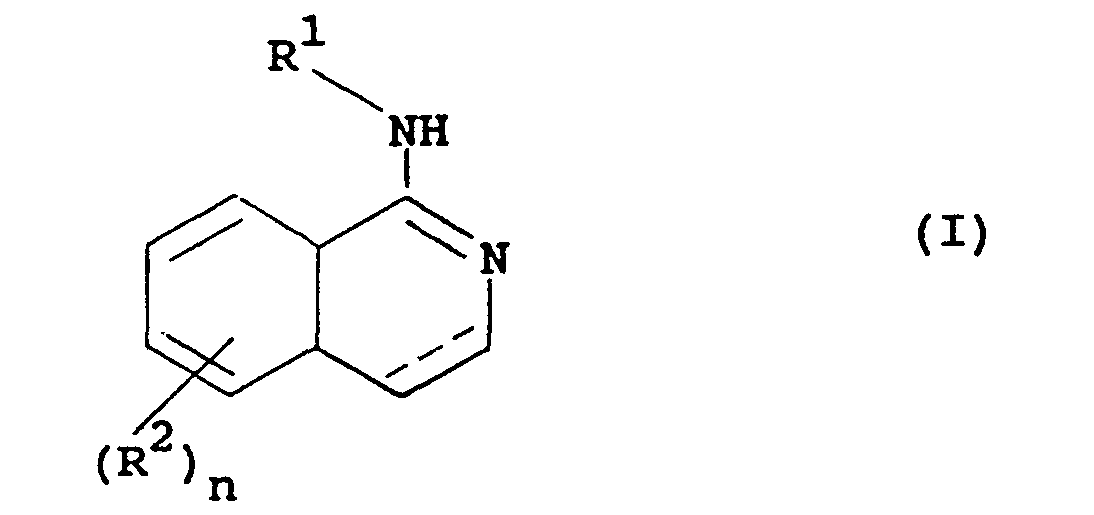
- the present invention provides, in a first aspect, a compound of structure (I) : in which
- R 1 is a substituted phenyl group or benzyl group. More preferably, R 1 is a phenyl or benzyl group substituted by a single substituent; in particular in the 2-position. Most preferably R 1 is a phenyl or benzyl group substituted in the 2-position by a C 1-6 alkyl group for example a methyl group.
- n is 2 and one group R 2 is in the 7-position.
- n is 0; most preferably n is 1 and the group R 2 is in the 7-position; more preferably n is 0.
- R 2 is C 1-6 alkylphenyl, C 1-6 alkylthio, C 1-4 -alkanoyl, amino, C 1 - 6 alkylamino, diC 1-6 alkylamino, halogen, trifluoromethyl or cyano.
- R 2 is C 1-6 alkoxy, for example methoxy.
- R 3 is hydrogen or C 1-4 alkyl; preferably hydrogen.
- C 1-6 alkyl groups can be straight or branched.
- Alkylene chains (CH 2 ) m in which m is 1 to 6 include straight and branched chains.
- Heterocyclic groups Het include for example, furanyl and thienyl groups; other standard groups will be apparent to those skilled in the art.
- compounds of structure (I) in which one or more of R 1 or R 2 is a C 3 - 6 alkyl group may contain an asymmetric centre due to the presence of the C 3 - 6 alkyl group.
- Such compounds will exist as two (or more) optical isomers (enantiomers/diasteroisomers). Both the pure enantiomers, racemic mixtures (50% of each enantiomer) and unequal mixtures of the two are included within the scope of the present invention. Further, all diastereomeric forms possible (pure enantiomers and mixtures thereof) are within the scope of the invention.
- compositions of structure (I) can form pharmaceutically acceptable acid addition salts with suitable organic and inorganic acids the nature of which will be apparent to persons skilled in the art.
- pharmaceutically acceptable salts can be formed by reaction with hydrochloric, sulphuric, or phosphoric acids; aliphatic, aromatic or heterocyclic sulphonic acids or carboxylic acids such as for example, citric, maleic or fumaric acids.
- carboxylic acids especially citric acid, have improved solubility characteristics when compared to the parent compound.
- the present invention provides a process for the preparation of a compound of structure (I) which comprises
- Suitable groups X displaceable by an amine include for example, aryl or alkylsulphonates, for example, toluene-p-sulphonate or methane sulphonate, alkylthio, alkylsulphonyl, alkylsulphinyl or alkoxy.
- X is a halo atom, for example, chloro or bromo, or an alkylthio group, in particular methylthio.
- Suitable leaving groups X 1 will be apparent to those skilled in the art and include for example a halo moiety, preferably chloro or bromo.
- Suitable nitrogen protecting groups R 4 will be apparent to those skilled in the art for example as described in "Protective Groups in Organic Synthesis” T.W. Greene, 1981 (Wiley).
- the reaction between compounds of structure (11) and compounds of structure (III) is carried out at elevated temperature optionally in the presence of an organic solvent.
- Suitable solvents include, for example, dimethylformamide, tetrahydrofuran, dioxan, ethanol or anisole.
- the reaction is carried out at elevated temperature under fusion conditions in the absence of a solvent.
- the reaction between compounds of structure (IV) and compounds of structure (V) is carried out in an organic solvent at a temperature of between ambient and reflux temperature of the solvent used, preferably in the presence of a base.
- Suitable solvents include for example, lower alkanols such as ethanol.
- Suitable bases include for example, tertiary amine bases such as triethylamine.
- the reduction of a compound of structure (VI) is carried out by for example hydrogenation, over a noble metal catalyst in a suitable solvent.
- a noble metal catalyst in a suitable solvent.
- the reaction is carried out over a palladium on carbon catalyst in ethanol as a solvent.
- the intermediates of structure (11) and (IV) can be prepared by standard techniques.
- the compounds of structure (I) and their pharmaceutically acceptable salts exert an anti-secretory effect by inhibition of the gastrointestinal H K ATPase enzyme.
- the present invention provides compounds of structure (I) and pharmaceutically acceptable salts thereof for use in therapy.
- the compounds of structure (I) and their pharmaceutically acceptable salts inhibit exogenously and endogenously stimulated gastric acid secretion and are useful in the treatment of gastrointestinal diseases in mammals, in particular humans.
- diseases include, for example, gastric and duodenal ulcers, aspiration pneumonitis and Zollinger-Ellison Syndrome.
- the compounds of structure (I) can be used in the treatment of other disorders where an anti-secretory effect is desirable for example in patients with gastritis, NSAID induced gastritis, acute upper intestinal bleeding, in patients with a history of chronic and excessive alcohol consumption, and in patients with gastro oesophageal reflux disease (GERD).
- gastritis NSAID induced gastritis
- acute upper intestinal bleeding in patients with a history of chronic and excessive alcohol consumption
- gastro oesophageal reflux disease GABA
- the compounds of structure (I) can be expected to be of use in medicine as inhibitors of bone resorption.
- bone affected diseases such as osteoporosis, Paget's disease and hyperparathyroidism and related disorders this balance is disturbed.
- Bone resorption or bone loss
- the present compounds can be expected to be inhibitors of osteoclast activity and bone resorption and to be of use in medicine in the treatment of diseases in which bone loss is a factor, in particular osteoporosis, Paget's disease and hyperparathyroidism.
- the compounds of the present invention are usually administered in a standard pharmaceutical composition.
- the present invention therefore provides in a further aspect pharmaceutical compositions comprising a compound of structure (I) or a pharmaceutically acceptable salt thereof and a pharmaceutically acceptable carrier.
- the compounds of structure (I) and their pharmaceutically acceptable salts which are active when given orally can be formulated as liquids, for example syrups, suspensions or emulsions, tablets, capsules and lozenges.
- a liquid formulation will generally consist of a suspension or solution of the compound or pharmaceutically acceptable salt in a suitable liquid carrier(s) for example, ethanol, glycerine, non-aqueous solvent, for example polyethylene glycol, oils, or water with a suspending agent, preservative, flavouring or colouring agent.
- a suitable liquid carrier(s) for example, ethanol, glycerine, non-aqueous solvent, for example polyethylene glycol, oils, or water with a suspending agent, preservative, flavouring or colouring agent.
- a composition in the form of a tablet can be prepared using any suitable pharmaceutical carrier(s) routinely used for preparing solid formulations.
- suitable pharmaceutical carrier(s) include magnesium stearate, starch, lactose, sucrose and cellulose.
- a composition in the form of a capsule can be prepared using routine encapsulation procedures.
- pellets containing the active ingredient can be prepared using standard carriers and then filled into a hard gelatin capsule; alternatively, a dispersion or suspension can be prepared using any suitable pharmaceutical carrier(s), for example aqueous gums, celluloses, silicates or oils and the dispersion or suspension then filled into a soft gelatin capsule.
- Typical parenteral compositions consist of a solution or suspension of the compound or pharmaceutically acceptable salt in a sterile aqueous carrier or parenterally acceptable oil, for example polyethylene glycol, polyvinyl pyrrolidone, lecithin, arachis oil or sesame oil.
- a sterile aqueous carrier or parenterally acceptable oil for example polyethylene glycol, polyvinyl pyrrolidone, lecithin, arachis oil or sesame oil.
- the solution can be lyophilised and then reconstituted with a suitable solvent just prior to administration.
- a typical suppository formulation comprises a compound of formula (I) or a pharmaceutically acceptable salt thereof which is active when administered in this way, with a binding and/or lubricating agent such as polymeric glycols, gelatins or cocoa butter or other low melting vegetable or synthetic waxes or fats.
- a binding and/or lubricating agent such as polymeric glycols, gelatins or cocoa butter or other low melting vegetable or synthetic waxes or fats.
- composition is in unit dose form such as a tablet or capsule.
- Each dosage unit for oral administration contains preferably from 1 to 250 mg (and for parenteral administration contains preferably from 0.1 to 25 mg) of a compound of the formula (I) or a pharmaceutically acceptable salt thereof calculated as the free base.
- the daily dosage regimen for an adult patient may be, for example, an oral dose of between 1 mg and 500 mg, preferably between 1 mg and 250 mg, or an intravenous, subcutaneous, or intramuscular dose of between 0.1 mg and 100 mg, preferably between 0.1 mg and 25 mg, of the compound of the formula (I) or a pharmaceutically acceptable salt thereof calculated as the free base, the compound being administered 1 to 4 times per day.
- the compounds will be administered for a period of continuous therapy, for example for a week or more.
- the compounds of the present invention can be co-administered with further active ingredients, such as antacids (for example magnesium carbonate or hydroxide and aluminium hydroxide), non-steroidal anti-flammatory drugs (for example indomethacin, aspirin or naproxen), steroids, or nitrite scavengers (for example ascorbic acid or aminosul- phonic acid), or other drugs used for treating gastric ulcers (for example pirenzipine, prostanoids for example 16,16 dimethyl PGE 2 , or histamine H 2 -antagonists (for example, cimetidine).
- active ingredients such as antacids (for example magnesium carbonate or hydroxide and aluminium hydroxide), non-steroidal anti-flammatory drugs (for example indomethacin, aspirin or naproxen), steroids, or nitrite scavengers (for example ascorbic acid or aminosul- phonic acid), or other drugs used for treating gastric ulcers (for example
- a tablet for oral administration is prepared by combining into a 9 mm tablet.
- An injection for parenteral administration was prepared from the following
- the compound of structure 1 was dissolved in the citric acid and the pH slowly adjusted to pH 3.2 with the sodium hydroxide solution. The solution was then made up to 100 ml with water, sterilised by filtration and sealed into appropriately sized ampoules and vials.
- Lyophilised gastric vesicles were prepared from pig fundic mucosa after the method of Keeling et. al. (Biochem. Pharmacol., 34, 2967, 1985).
- K +- stimulated ATPase activity was determined at 37° in the presence of the following : 10 mM Pipes/Tris buffer pH 7.0, 2 mM MgS0 4 , 1 mM KCI, 2 mM Na 2 ATP and 3-6 ⁇ g protein/ml lyophilised gastric vesicles. After incubation for 30 minutes, the inorganic phosphate hydrolysed from ATP was determined by the method of Yoda and Hokin (Biochem. Biophys. Res. Commun. 40, 880, 1970).
Landscapes
- Chemical & Material Sciences (AREA)
- Organic Chemistry (AREA)
- Health & Medical Sciences (AREA)
- Chemical Kinetics & Catalysis (AREA)
- Life Sciences & Earth Sciences (AREA)
- General Chemical & Material Sciences (AREA)
- Medicinal Chemistry (AREA)
- Nuclear Medicine, Radiotherapy & Molecular Imaging (AREA)
- Bioinformatics & Cheminformatics (AREA)
- Pharmacology & Pharmacy (AREA)
- Engineering & Computer Science (AREA)
- Animal Behavior & Ethology (AREA)
- General Health & Medical Sciences (AREA)
- Public Health (AREA)
- Veterinary Medicine (AREA)
- Gastroenterology & Hepatology (AREA)
- Pharmaceuticals Containing Other Organic And Inorganic Compounds (AREA)
- Other In-Based Heterocyclic Compounds (AREA)
- Plural Heterocyclic Compounds (AREA)
Abstract

Description
- The present invention relates to novel substituted isoquinoline derivatives, processes for their preparation, intermediates useful in their preparation, pharmaceutical compositions containing them and their use in therapy.
- Accordingly, the present invention provides, in a first aspect, a compound of structure (I) :

- R1 is C1-6alkyl, C3-6cycloalkyl, C3-6cycloalkylC1-6alkyl, phenyl(CH2)m the phenyl group being optionally substituted by 1-3 radicals selected from C1-6alkyl, C1-6alkoxy, amino C1-6alkylthio, halogen, cyano, hydroxy, carbamoyl, carboxy, Cl-6alkanoyl and trifluoromethyl or Het(CH2)m in which Het is a 5 or 6 membered carbocyclic ring containing one or more heteroatoms and m is 0 to 6;
- R2 is C1-6alkyl, phenyl, C1-6alkoxy, C1-6alkylthio, hydroxy, C1-6alkanoyl, amino, C1-6alkylamino, di-C1 -ε alkylamino, halogen, trifluoromethyl or cyano;
- R3 is hydrogen or C1-4-alkyl;
- n is 0, 1 or 2, and the dotted line indicates the optional presence of a double bond;
- or a pharmaceutically acceptable salt thereof.
- Preferably R1 is a substituted phenyl group or benzyl group. More preferably, R1 is a phenyl or benzyl group substituted by a single substituent; in particular in the 2-position. Most preferably R1 is a phenyl or benzyl group substituted in the 2-position by a C1-6alkyl group for example a methyl group.
- Suitably, n is 2 and one group R2 is in the 7-position. Preferably n is 0; most preferably n is 1 and the group R2 is in the 7-position; more preferably n is 0.
- Suitably R2 is C1-6alkylphenyl, C1-6alkylthio, C1-4-alkanoyl, amino, C1-6alkylamino, diC1-6alkylamino, halogen, trifluoromethyl or cyano. Preferably R2 is C1-6alkoxy, for example methoxy.
- Suitably R3 is hydrogen or C1-4alkyl; preferably hydrogen.
- C1-6alkyl groups (either alone or as part of another group) can be straight or branched.
- Alkylene chains (CH2)m in which m is 1 to 6 include straight and branched chains. For example, ethylene or a-methylmethylene

- Heterocyclic groups Het, include for example, furanyl and thienyl groups; other standard groups will be apparent to those skilled in the art.
- It will be appreciated that compounds of structure (I) in which one or more of R1 or R2 is a C3-6alkyl group (either alone or as part of another group for example a benzyl or phenethyl group) may contain an asymmetric centre due to the presence of the C3-6alkyl group. Such compounds will exist as two (or more) optical isomers (enantiomers/diasteroisomers). Both the pure enantiomers, racemic mixtures (50% of each enantiomer) and unequal mixtures of the two are included within the scope of the present invention. Further, all diastereomeric forms possible (pure enantiomers and mixtures thereof) are within the scope of the invention.
- Compounds of structure (I) can form pharmaceutically acceptable acid addition salts with suitable organic and inorganic acids the nature of which will be apparent to persons skilled in the art. For example, pharmaceutically acceptable salts can be formed by reaction with hydrochloric, sulphuric, or phosphoric acids; aliphatic, aromatic or heterocyclic sulphonic acids or carboxylic acids such as for example, citric, maleic or fumaric acids. In particular, salts formed with such carboxylic acids, especially citric acid, have improved solubility characteristics when compared to the parent compound.
- In a further aspect, the present invention provides a process for the preparation of a compound of structure (I) which comprises
- (a) reaction of a compound of structure (II) with a compound of structure (III) :

- (b) for compounds of structure (I) in which a double bond is present and in which R1 is C1-6alkyl, C3-6cycloalkyl, C3-6cycloalkylC1-6alkyl or optionally substituted phenyl(CH2)m or Het(CH2)m group in which m is 1 to 6, and R3 is hydrogen reaction of a compound of structure (IV) with a compound of structure (V)

- (c) for compounds of structure (I) in which a double bond is present reduction of a compound of structure (VI)

- • removing any protecting groups;
- • converting a group R1 into another group R1;
- • forming a pharmaceutically acceptable salt.
- Suitable groups X displaceable by an amine, include for example, aryl or alkylsulphonates, for example, toluene-p-sulphonate or methane sulphonate, alkylthio, alkylsulphonyl, alkylsulphinyl or alkoxy. Preferably X is a halo atom, for example, chloro or bromo, or an alkylthio group, in particular methylthio.
- Suitable leaving groups X1 will be apparent to those skilled in the art and include for example a halo moiety, preferably chloro or bromo.
- Suitable nitrogen protecting groups R4 will be apparent to those skilled in the art for example as described in "Protective Groups in Organic Synthesis" T.W. Greene, 1981 (Wiley).
- The reaction between compounds of structure (11) and compounds of structure (III) is carried out at elevated temperature optionally in the presence of an organic solvent. Suitable solvents include, for example, dimethylformamide, tetrahydrofuran, dioxan, ethanol or anisole. Preferably the reaction is carried out at elevated temperature under fusion conditions in the absence of a solvent.
- The reaction between compounds of structure (IV) and compounds of structure (V) is carried out in an organic solvent at a temperature of between ambient and reflux temperature of the solvent used, preferably in the presence of a base. Suitable solvents include for example, lower alkanols such as ethanol. Suitable bases include for example, tertiary amine bases such as triethylamine.
- The reduction of a compound of structure (VI) is carried out by for example hydrogenation, over a noble metal catalyst in a suitable solvent. Suitably the reaction is carried out over a palladium on carbon catalyst in ethanol as a solvent.
- The intermediates of structure (11) and (IV) can be prepared by standard techniques.
- The intermediates of structure (III) and (V) are commercially available or can be prepared by standard techniques.
- The compounds of structure (I) and their pharmaceutically acceptable salts exert an anti-secretory effect by inhibition of the gastrointestinal H K ATPase enzyme.
- In a further aspect therefore the present invention provides compounds of structure (I) and pharmaceutically acceptable salts thereof for use in therapy. The compounds of structure (I) and their pharmaceutically acceptable salts inhibit exogenously and endogenously stimulated gastric acid secretion and are useful in the treatment of gastrointestinal diseases in mammals, in particular humans. Such diseases include, for example, gastric and duodenal ulcers, aspiration pneumonitis and Zollinger-Ellison Syndrome.
- Further, the compounds of structure (I) can be used in the treatment of other disorders where an anti-secretory effect is desirable for example in patients with gastritis, NSAID induced gastritis, acute upper intestinal bleeding, in patients with a history of chronic and excessive alcohol consumption, and in patients with gastro oesophageal reflux disease (GERD).
- In addition to the foregoing use the compounds of structure (I) can be expected to be of use in medicine as inhibitors of bone resorption. In normal subjects there is a balance between bone resorption and bone formation, however in subjects with bone affected diseases such as osteoporosis, Paget's disease and hyperparathyroidism and related disorders this balance is disturbed. As a consequence the subject suffers a loss of bone tissue, decreased bone mass and bone fragility which can result in fracturing of bones. Bone resorption (or bone loss) is associated with the activity of osteoclast cells, and it is thought that agents which inhibit the activity of such cells (and so inhibit bone resorption) will have a beneficial effect on the reduction of bone loss and be of benefit in the treatment of the above-noted disease states. The present compounds can be expected to be inhibitors of osteoclast activity and bone resorption and to be of use in medicine in the treatment of diseases in which bone loss is a factor, in particular osteoporosis, Paget's disease and hyperparathyroidism.
- In therapeutic use, the compounds of the present invention are usually administered in a standard pharmaceutical composition. The present invention therefore provides in a further aspect pharmaceutical compositions comprising a compound of structure (I) or a pharmaceutically acceptable salt thereof and a pharmaceutically acceptable carrier.
- The compounds of structure (I) and their pharmaceutically acceptable salts which are active when given orally can be formulated as liquids, for example syrups, suspensions or emulsions, tablets, capsules and lozenges.
- A liquid formulation will generally consist of a suspension or solution of the compound or pharmaceutically acceptable salt in a suitable liquid carrier(s) for example, ethanol, glycerine, non-aqueous solvent, for example polyethylene glycol, oils, or water with a suspending agent, preservative, flavouring or colouring agent.
- A composition in the form of a tablet can be prepared using any suitable pharmaceutical carrier(s) routinely used for preparing solid formulations. Examples of such carriers include magnesium stearate, starch, lactose, sucrose and cellulose.
- A composition in the form of a capsule can be prepared using routine encapsulation procedures. For example, pellets containing the active ingredient can be prepared using standard carriers and then filled into a hard gelatin capsule; alternatively, a dispersion or suspension can be prepared using any suitable pharmaceutical carrier(s), for example aqueous gums, celluloses, silicates or oils and the dispersion or suspension then filled into a soft gelatin capsule.
- Typical parenteral compositions consist of a solution or suspension of the compound or pharmaceutically acceptable salt in a sterile aqueous carrier or parenterally acceptable oil, for example polyethylene glycol, polyvinyl pyrrolidone, lecithin, arachis oil or sesame oil. Alternatively, the solution can be lyophilised and then reconstituted with a suitable solvent just prior to administration.
- A typical suppository formulation comprises a compound of formula (I) or a pharmaceutically acceptable salt thereof which is active when administered in this way, with a binding and/or lubricating agent such as polymeric glycols, gelatins or cocoa butter or other low melting vegetable or synthetic waxes or fats.
- Preferably the composition is in unit dose form such as a tablet or capsule.
- Each dosage unit for oral administration contains preferably from 1 to 250 mg (and for parenteral administration contains preferably from 0.1 to 25 mg) of a compound of the formula (I) or a pharmaceutically acceptable salt thereof calculated as the free base.
- When used in therapy, for the treatment of gastro-intestinal diseases and other conditions caused or exacerbated by gastric acidity, the daily dosage regimen for an adult patient may be, for example, an oral dose of between 1 mg and 500 mg, preferably between 1 mg and 250 mg, or an intravenous, subcutaneous, or intramuscular dose of between 0.1 mg and 100 mg, preferably between 0.1 mg and 25 mg, of the compound of the formula (I) or a pharmaceutically acceptable salt thereof calculated as the free base, the compound being administered 1 to 4 times per day. Suitably the compounds will be administered for a period of continuous therapy, for example for a week or more. In addition, the compounds of the present invention can be co-administered with further active ingredients, such as antacids (for example magnesium carbonate or hydroxide and aluminium hydroxide), non-steroidal anti-flammatory drugs (for example indomethacin, aspirin or naproxen), steroids, or nitrite scavengers (for example ascorbic acid or aminosul- phonic acid), or other drugs used for treating gastric ulcers (for example pirenzipine, prostanoids for example 16,16 dimethyl PGE2, or histamine H2-antagonists (for example, cimetidine).
- The following examples illustrate the invention. Temperatures are recorded in degrees centigrade.
- 1-Chloroisoquinoline (J.O.C. (1958) 23, 1071) (1.64 g, 0.01 mol) and o-toluidine (1.07 g, 0.01 mol) were heated together at reflux temperature in dry dioxan (20 ml) for 18 hours. After this time a light brown oil had precipitated in the hot solution. After cooling the mixture was evaporated to dryness to give an off-white, sticky solid. This was treated with diethyl ether (50 ml), collected, washed with ether and dried to give a white solid (2.07 g). This solid was crystallised from ethanol/ ether to give the title compound (1.97 g) as its hydrochloride salt, m.p. 229-231 `

- 1-chloroisoquinoline (1.64 g, 0.01 mol) and benzylamine (2.14 g, 0.02 mol) were mixed at room temperature and heated, with stirring, in an oil-bath at 50* for 4 hours. The mixture was cooled to give a crystalline solid which was equilibrated between methylene chloride (CH2CI2) and aqueous Na2CO3. The CH2Cl2 fraction was washed with water, dried and evaporated to dryness to give an oil which crystallised on standing (3.0 g). This material was twice re-crystallised from ether/40-60 petroleum ether to give the title compound as buff crystals, m.p. 101-1020.

- Substituting 2-methylbenzylamine (2.03 gm, 0.017 mol) for benzylamine and using corresponding molar proportions of the other reagents in Example 2 gave a brown oil (3.1 g). This was dissolved in the minimum amount of methanol and 2N HCI added to precipitate a buff-coloured solid which was collected, washed with water and dried (1.67 g).
- Crystallisation from absolute ethanol gave the title compound as its hydrochloride salt, m.p. 244-248°.

- Substituting 2-methoxybenzylamine (1.67 g 0.0122 mol) for benzylamine and using corresponding molar proportions of the other reagents in Example 2 gave a brown oil which was dissolved in the minimum amount of methanol and aqueous 2NHCI added. The solution was basified with 2N. NaOH and the precipitated buff-coloured solid collected, washed with water and dried (1.60 g). This material was crystallised from methanol to give the title compound (1.0 g) as buff-coloured needles, m.p. 111-113°.

- Substituting N-methylbenzylamine (1.48 g, 0.0122 mol) for benzylamine and using corresponding molar proportions of the other reagents in Example 2 gave a brown oil (2.42 g, may contain trace of CH2Cl2). This material was purified by column chromatography on silica gel using CH2CI2 as eluting solvent to give a pale-green oil (0.82 g) which solidified on standing and was re-crystallised from ether/40-60 petroleum ether to give the title compound (0.76 g), m.p. 53.5-54.5°.

- Substituting 2-phenylethylamine (1.48 g 0.0122 mol) for benzylamine and using corresponding molar proportions of the other reagents in Example 2 gave a brown oil which crystallised on standing (2.48 g). This material was crystallised twice from ether/40-60 petroleum ether to give the title compound (1.03 g) as a white solid, m.p. 110-112°.

- Substituting R-(+)-α-methylbenzylamine (1.48 g, 0.0122 mol) for benzylamine and using corresponding molar proportions of the other reagents in Example 2 gave a brown oil which could not be crystallised. This material was chromatographed on silica gel using methylene chloride as eluting solvent. Fractions were monitored by thin-layer chromatography and those containing product were combined and evaporated to dryness to give an oil (0.6 g) which solidified on standing. Crystallisation from ether/40-60 petroleum ether gave the title compound (0.36 g) as pale-yellow crystals, m.p. 79-80` ,


- Substituting 8-(-)-a-methylbenzylamine (1.48 g 0.0122 mol) for R-(+)-a-methylbenzylanine and using corresponding molar proportions of the other reagents in Example 7 gave, after chromatography a crystalline solid (0.79 g). This material was re-crystallised from ether/40-60 petroleum ether to give the title compound (0.37 g), m.p. 81-83°,
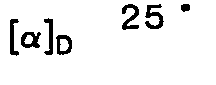

- Substituting 4-methoxybenzylamine (3.34 g, 0.0244 mol) for benzylamine and using corresponding molar proportions of the other reagents in Example 2 gave a green oil which could not be crystallised. This material was chromatographed on silica gel using CH2CI2 as eluting solvent. Fractions containing product were combined and evaporated to dryness to give a green oil (1.6 g). This was crystallised from ether/40-60 petroleum ether to give the title compound (1.07 g) as a colourless crystalline solid, m.p. 55-56°.

- Substituting 2-thiophenemethylamine (1.39 g, 0.0122 mol) for benzylamine and using corresponding molar proportions of the other reagents in Example 2 gave a brown oil which solidified on scratching (1.25 g). This material could not be satisfactorally crystallised so it was chromatographed on silica gel using CH2CI2 as eluent. Fractions containing major product (t.l.c.) were combined and evaporated to dryness to give an oil which solidified on standing (0.9 g). This material was crystallised twice from ether/40-60 petroleum ether to give the title compound (0.6 g) as orange-yellow crystals, m.p. 86.5-87.5°.

- Substituting furfurylamine (1.2 g, 0.0122 mol) for 2-thiophenemethylamine and using corresponding molar proportions of the other reagents in Example 10 gave, after similar chromatography, a pale-orange oil which solidified on scratching (1.14 g). This material was crystallised twice from ether/40-60 petroleum ether to give the title compound (0.76 g) as pale-pink crystals, m.p. 76-77°.

- 5-Methoxy-1-chloroisoquinoline (J.A.C.S. (1947), 69, 1939) (1.5 g, 0. 00777 mol) and benzylamine (1.67 g, 0.0156 mol) were mixed at room temperature and heated, with stirring, in an oil-bath at 150° for 4 hours. After cooling the mixture was equilibrated between CH2Cl2 and aqueous Na2C03. The CH2CI2 fraction was washed with water, dried and evaporated to dryness. The oil produced was dissolved in the minimum amount of methanol and aqueous 2N. HCI added to precipitate a buff solid which was collected, washed with water and dried (2.15 g). This material was crystallised from ethanol/methanol to give the title compound (1.40 g) as its hydrochloride salt, m.p. 247-252 (Dec).

- 5-methoxy-1-chloroisoquinoline (1.5 g, 0.00777 mol) and o-toluidine (0.835 gm, 0.00777 mol) were mixed in anisole (10 ml) and heated with stirring in an oil-bath at 140° for four hours. After cooling the mixture was dissolved in methanol and ether was added to precipitate a tacky solid. The solvent was decanted off and the precipitate washed with more ether. The insoluble residue was equilibrated between N. HCI and ether, the aqueous acid solution filtered and basified with saturated aqueous Na2CO3 to precipitate a buff solid which was collected, washed with water and dried (0.77 g). This material was crystallised from diethyl ether to give the title compound (0.62 g) as fluffy, light-buff needles, m.p. 111-112°.

- Substituting 2-methylbenzylamine (1.25 g, 0.01033 mol) for benzylamine and using corresponding molar proportions of the other reagents in Example 12 produced, after equilibration between aqueous Na2CO3 and CH2CI2 and drying and evaporation of the organic phase a light brown solid (1.09 g). This material was crystallised from ethanol/H2O to give the title compound (0.7 g) as its partial hydrate, m.p. 121-125 (Not sharp).

- 6,7-Dimethoxy-1-chloroisoquinoline (J. Am. Pharm. Assoc., Sci. Ed. (1952), 41, 643-50; C.A. 47, 11205d.) (1.0 gm, 0.00447 mol) and 2-methoxybenzylamine (1.22 gm, 0.00894 mol) were mixed at room temperature and heated, with stirring, in an oil-bath at 140° for 1.5 hours. After cooling the mixture was dissolved in chloroform and the solution washed with saturated NaHCO3 solution and water, dried and evaporated. The resulting oil was chromatographed on silica gel, using chloroform as eluent. Fractions were monitored by t.l.c. and those containing pure product were combined, evaporated to dryness and the residue (0.25 g) dissolved in ethanol containing ethanolic hydrogen chloride. This solution was evaporated to dryness and the residue crystallised from ethanol/diethyl ether to give the title compound as its hydrochloride salt (0.22 gm), m.p. 225-229°.

- Substituting o-toluidine (1.91 g, 0.0178 mol) for 2-methoxybenzylamine and using corresponding molar proportions of other reagents in Example 15 produced, after column chromatography, an oil (0.54 gm). This was dissolved in ethanolic hydrogen chloride, the solution evaporated to dryness and the residue crystallised from ethanol/diethyl ether to give the title compound as its hydrochloride salt (0.40 g), m.p. 253-255°.

- 6-Methoxy-1-chloroisoquinoline (JACS. (1947), 69, 1939) (1.65 g, 0.0085 mol) =nd 2-methoxybenzylamine (2.33 g, 0.017 mol) were mixed at room temperature and stirred in an oil-bath at 140° for 2 hours. After cooling the solid mass was dissolved in chloroform and the solution washed with saturated NaHC03 -(x3) and water, dried and evaporated to give a pale-orange oil (2.3 g). This was dissolved in ethanol, ethanolic hydrogen chloride added and the solution evaporated to dryness. The residual solid was crystallised from ethanol/diethyl ether to give the title compound as its hydrochloride salt (1.24 g), m.p. 222-227°.

- Substituting o-toluidine (1.37 g, 0.0128 mol) for 2 methoxybenzylamine and using corresponding molar proportions of other reagents in Example 17 gave, after equilibration of the product between aqueous NaHCOa and CHCI3 a dark-orange oil (1.6 g). This was chromatographed on silica gel using chloroform as eluent to give a pale-yellow oil (0.5 g). This was dissolved in ethanolic hydrogen chloride, the solution evaporated to dryness and the residue crystallised from ethanol/diethyl ether to give the title compound as its hydrochloride salt (0.4 g), m.p. 230-240°.

- 7-Methoxy-1-chloroisoquinoline (JACS, (1947), 69, 1939) (1.5 g, 0.00775 mol) and 2-methoxybenzylamine (2.12 g, 0.015 mol) were mixed at room temperature and heated with stirring in an oil-bath at 140° for 2 hours. After cooling the solidified mass was equilibrated between chloroform and saturated aqueous NaHCOs. The chloroform solution was washed with water, dried and evaporated to dryness to produce an oil which was chromatographed on silica gel using chloroform as eluent. Monitoring fractions by t.l.c. and H.P.L.C. and combination of appropriate samples gave, after evaporation, a buff-coloured oil (0.58 g). This was dissolved in ethanolic hydrogen chloride, the solution evaporated to dryness and the residue crystallised from ethanol/ether to give a buff solid (0.54 g). This was re-crystallised from ethanol/ether, with charcoaling, to give the title compound as its white hydrochloride salt (0.35 g), m.p. 197-201°.

- Substituting o-toluidine (1.01 g, 0.0095 mol) for 2-methoxybenzylamine and using corresponding molar proportions of other reagents in Example 19 gave, after column chromatography (silica gel, CHCI3 eluent) a pale-yellow oil (0.6 g). This oil was dissolved in ethanol, ethanolic hydrogen chloride added and the solution evaporated to dryness. The solid produced was crystallised from ethanol/diethyl ether to give the title compound as its hydrochloride salt (0.4 g), m.p. 150-152°.

- 1-Methylthio-3,4-dihydroisoquinoline hydroiodide (J. Het. Chem. (1979), 16, 1313-1316) (0.9 g, 0.00295 mol), benzylamine (0.32 g, 0.00299 mol) and dry dimethylformamide (10 ml) were mixed at room temperature and heated with stirring in an oil-bath for 1 hour at 110°. The mixture was cooled and poured onto water (100 ml) to give a clear solution (pH=8). This solution was basified with 2N. NaOH (pH=11), and extracted with ethyl acetate (x 2). The ethyl acetate solution was washed with water, dried and evaporated to give a colourless oil. This material was dissolved in ethanol/ether and anhydrous ethanolic HCI added. On standing in the cold a white solid crystallised and was collected (0.9 g). This material was re-crystallised twice from ethanol/ether to give the title compound (0.53 g) as its slightly green hydrochloride salt, m.p. 229-232°.

- 1-Methylthio-3,4-dihydroisoquinoline hydroiodide (1.52 g, 0.005 mol) was dissolved in a solution of ethanol (50 ml) containing 2-methylbenzylamine (0.61 g, 0.005 mol). The colourless solution was heated at reflux temperature for six hours with effluent gases being passed through a CHLOROS trap. The solution was then cooled and stood in the refrigerator overnight to give white crystals (1.38 g). This material was crystallised from methanol/ ethanol to give the title compound (1.06 g) as its hydroiodide salt, m.p. 241-243°.

- 1-Methylthio-3,4-dihydroisoquinoline hydroiodide (0.6 g, 0.00197 mol) and 4-hydroxybenzylamine (0.24 g, 0.00195 mol) were heated together at reflux temperature in ethanol (25 ml) for five hours. Effluent gases were passed through a CHLOROS trap. The mixture was then cooled and the ethanol evaporated off at reduced pressure. The tacky residue was dissolved in dilute HCI and the solution extracted with ethyl acetate. The clear aqueous solution was basified with 6N. NaOH and re-extracted with ethyl acetate. The latter organic extract was washed with water, dried and evaporated to dryness to give a white sticky solid. This was treated with ether and the ether decanted off. The residual solid was crystallised from absolute ethanol to give the title compound (0.11 g) as white crystals, m.p. 177-179°.

- A tablet for oral administration is prepared by combining

- An injection for parenteral administration was prepared from the following

- The compound of structure 1 was dissolved in the citric acid and the pH slowly adjusted to pH 3.2 with the sodium hydroxide solution. The solution was then made up to 100 ml with water, sterilised by filtration and sealed into appropriately sized ampoules and vials.
- The effects of a single high concentration (100 µM) of a compound of structure (I) on K-stimulated ATPase activity in lyophilised gastric vesicles was determined. Preferred compounds of structure (I) were also tested over a range of concentrations to determine IC50 values.
- Lyophilised gastric vesicles were prepared from pig fundic mucosa after the method of Keeling et. al. (Biochem. Pharmacol., 34, 2967, 1985).
- K+-stimulated ATPase activity was determined at 37° in the presence of the following : 10 mM Pipes/Tris buffer pH 7.0, 2 mM MgS04, 1 mM KCI, 2 mM Na2ATP and 3-6 µg protein/ml lyophilised gastric vesicles. After incubation for 30 minutes, the inorganic phosphate hydrolysed from ATP was determined by the method of Yoda and Hokin (Biochem. Biophys. Res. Commun. 40, 880, 1970).
- Compounds of structure (I) were dissolved in dimethylsulphoxide which up to the highest concentration used had no effect on K -stimulated ATPase activity.
- The effect of the highest concentration of each compound of structure (I) on the recovery of a standard amount of inorganic phosphate was also determined.
- The compounds of examples 1 to 4 and 6 to 23 gave ICso values in the range of from 0.48 to 60 µM.
Claims (10)


Applications Claiming Priority (2)
| Application Number | Priority Date | Filing Date | Title |
|---|---|---|---|
| GB898908229A GB8908229D0 (en) | 1989-04-12 | 1989-04-12 | Compounds |
| GB8908229 | 1989-04-12 |
Publications (2)
| Publication Number | Publication Date |
|---|---|
| EP0393926A1 true EP0393926A1 (en) | 1990-10-24 |
| EP0393926B1 EP0393926B1 (en) | 1994-09-21 |
Family
ID=10654865
Family Applications (1)
| Application Number | Title | Priority Date | Filing Date |
|---|---|---|---|
| EP90303943A Expired - Lifetime EP0393926B1 (en) | 1989-04-12 | 1990-04-11 | 1-Aminoisoquinoline derivatives |
Country Status (5)
| Country | Link |
|---|---|
| US (1) | US5200417A (en) |
| EP (1) | EP0393926B1 (en) |
| JP (1) | JPH02290816A (en) |
| DE (1) | DE69012634T2 (en) |
| GB (1) | GB8908229D0 (en) |
Cited By (6)
| Publication number | Priority date | Publication date | Assignee | Title |
|---|---|---|---|---|
| WO1999011622A1 (en) * | 1997-09-03 | 1999-03-11 | Guilford Pharmaceuticals Inc. | Amino-substituted compounds, methods, and compositions for inhibiting parp activity |
| WO2000024718A1 (en) * | 1998-10-23 | 2000-05-04 | Akzo Nobel N.V. | Serine protease inhibitor |
| WO2017091661A1 (en) * | 2015-11-25 | 2017-06-01 | Strovel Jeffrey William | Bicyclic bet bromodomain inhibitors and uses thereof |
| US10266536B2 (en) | 2013-03-14 | 2019-04-23 | Convergene Llc | Methods and compositions for inhibition of bromodomain-containing proteins |
| EP4096666A4 (en) * | 2020-01-29 | 2024-05-22 | Georgetown University | COMPOSITIONS AND METHODS FOR TREATING NEURODEGENERATIVE, NEURODEVELOPMENTAL, MYODENERATIVE AND LYSOSOMAL STORAGE DISEASES |
| US12497395B2 (en) | 2019-04-24 | 2025-12-16 | Convergene, Llc | Small molecule bromodomain inhibitors and uses therof |
Families Citing this family (22)
| Publication number | Priority date | Publication date | Assignee | Title |
|---|---|---|---|---|
| US5434163A (en) * | 1993-05-14 | 1995-07-18 | The Medical College Of Pennsylvania | Treatment of Cryptococcus neoformans infection |
| US5556863A (en) * | 1993-06-11 | 1996-09-17 | Astra Aktiebolag | Compound for gastric acid secretion inhibition |
| IS4164A (en) * | 1993-06-11 | 1994-12-12 | Ab Astra | Compounds that inhibit gastric acid flow |
| US6291425B1 (en) | 1999-09-01 | 2001-09-18 | Guilford Pharmaceuticals Inc. | Compounds, methods and pharmaceutical compositions for treating cellular damage, such as neural or cardiovascular tissue damage |
| US6635642B1 (en) | 1997-09-03 | 2003-10-21 | Guilford Pharmaceuticals Inc. | PARP inhibitors, pharmaceutical compositions comprising same, and methods of using same |
| US6426415B1 (en) | 1997-09-03 | 2002-07-30 | Guilford Pharmaceuticals Inc. | Alkoxy-substituted compounds, methods and compositions for inhibiting parp activity |
| US6514983B1 (en) | 1997-09-03 | 2003-02-04 | Guilford Pharmaceuticals Inc. | Compounds, methods and pharmaceutical compositions for treating neural or cardiovascular tissue damage |
| US6197785B1 (en) | 1997-09-03 | 2001-03-06 | Guilford Pharmaceuticals Inc. | Alkoxy-substituted compounds, methods, and compositions for inhibiting PARP activity |
| US6346536B1 (en) | 1997-09-03 | 2002-02-12 | Guilford Pharmaceuticals Inc. | Poly(ADP-ribose) polymerase inhibitors and method for treating neural or cardiovascular tissue damage using the same |
| US6395749B1 (en) | 1998-05-15 | 2002-05-28 | Guilford Pharmaceuticals Inc. | Carboxamide compounds, methods, and compositions for inhibiting PARP activity |
| US6387902B1 (en) | 1998-12-31 | 2002-05-14 | Guilford Pharmaceuticals, Inc. | Phenazine compounds, methods and pharmaceutical compositions for inhibiting PARP |
| WO2001090077A1 (en) | 2000-05-19 | 2001-11-29 | Guilford Pharmaceuticals, Inc. | Sulfonamide and carbamide derivatives of 6(5h)phenanthridinones and their uses |
| AU2001275085A1 (en) | 2000-06-01 | 2001-12-11 | Guilford Pharmaceuticals Inc. | Methods, compounds and compositions for treating gout |
| UA80393C2 (en) | 2000-12-07 | 2007-09-25 | Алтана Фарма Аг | Pharmaceutical preparation comprising an pde inhibitor dispersed on a matrix |
| MY140561A (en) | 2002-02-20 | 2009-12-31 | Nycomed Gmbh | Dosage form containing pde 4 inhibitor as active ingredient |
| DK1606261T3 (en) | 2003-03-10 | 2010-01-18 | Nycomed Gmbh | Hitherto unknown method of making roflumilast |
| CA2560654A1 (en) * | 2004-04-01 | 2006-09-20 | Teva Pharmaceutical Industries Ltd. | Imroved formulations of 6-mercaptopurine |
| US8188067B2 (en) * | 2004-04-01 | 2012-05-29 | Teva Pharmaceutical Industries Ltd. | Formulations of 6-mercaptopurine |
| AU2006224619B2 (en) * | 2005-03-16 | 2012-06-07 | Takeda Gmbh | Taste masked dosage form containing roflumilast |
| WO2009128955A1 (en) * | 2008-04-18 | 2009-10-22 | Teva Pharmaceutical Industries Ltd. | Treatment of inflammatory bowel disease with 6-mercaptopurine |
| US9556144B2 (en) | 2012-06-15 | 2017-01-31 | Curegenix, Inc. | Compound as WNT signaling inhibitor, composition, and use thereof |
| WO2017066619A1 (en) | 2015-10-16 | 2017-04-20 | Teva Pharmaceutical Industries Ltd. | Treatment of non-alcoholic fatty liver disease or non-alcoholic steatohepatitis with delayed-release 6-mercaptopurine |
Citations (2)
| Publication number | Priority date | Publication date | Assignee | Title |
|---|---|---|---|---|
| GB1244501A (en) * | 1968-03-09 | 1971-09-02 | Aspro Nicholas Ltd | Heterocyclic amines |
| FR8482M (en) * | 1966-10-31 | 1972-06-09 |
Family Cites Families (4)
| Publication number | Priority date | Publication date | Assignee | Title |
|---|---|---|---|---|
| US2666059A (en) * | 1950-08-11 | 1954-01-12 | American Cyanamid Co | Anilinoisoquinolines and processes of preparing the same |
| US3702849A (en) * | 1967-10-26 | 1972-11-14 | Pfizer | 4-(isoquinolin-1-yl) piperazine-1-carboxylic acid esters |
| FR2028672A6 (en) * | 1968-03-06 | 1970-10-16 | Rhone Poulenc Sa | |
| FR2076625A5 (en) * | 1970-01-21 | 1971-10-15 | Rhone Poulenc Sa |
-
1989
- 1989-04-12 GB GB898908229A patent/GB8908229D0/en active Pending
-
1990
- 1990-04-04 US US07/504,781 patent/US5200417A/en not_active Expired - Fee Related
- 1990-04-09 JP JP2093830A patent/JPH02290816A/en active Pending
- 1990-04-11 DE DE69012634T patent/DE69012634T2/en not_active Expired - Fee Related
- 1990-04-11 EP EP90303943A patent/EP0393926B1/en not_active Expired - Lifetime
Patent Citations (2)
| Publication number | Priority date | Publication date | Assignee | Title |
|---|---|---|---|---|
| FR8482M (en) * | 1966-10-31 | 1972-06-09 | ||
| GB1244501A (en) * | 1968-03-09 | 1971-09-02 | Aspro Nicholas Ltd | Heterocyclic amines |
Cited By (16)
| Publication number | Priority date | Publication date | Assignee | Title |
|---|---|---|---|---|
| WO1999011622A1 (en) * | 1997-09-03 | 1999-03-11 | Guilford Pharmaceuticals Inc. | Amino-substituted compounds, methods, and compositions for inhibiting parp activity |
| WO2000024718A1 (en) * | 1998-10-23 | 2000-05-04 | Akzo Nobel N.V. | Serine protease inhibitor |
| RU2232760C2 (en) * | 1998-10-23 | 2004-07-20 | Акцо Нобель Н.В. | Serine protease inhibitor and pharmaceutical composition based on thereof |
| US6903107B1 (en) | 1998-10-23 | 2005-06-07 | Akzo Nobel N.V. | Serine protease inhibitor |
| US10266536B2 (en) | 2013-03-14 | 2019-04-23 | Convergene Llc | Methods and compositions for inhibition of bromodomain-containing proteins |
| US10717739B2 (en) | 2013-03-14 | 2020-07-21 | Convergene Llc | Methods and compositions for inhibition of bromodomain-containing proteins |
| WO2017091661A1 (en) * | 2015-11-25 | 2017-06-01 | Strovel Jeffrey William | Bicyclic bet bromodomain inhibitors and uses thereof |
| US10508106B2 (en) | 2015-11-25 | 2019-12-17 | Convergene Llc | Bicyclic BET bromodomain inhibitors and uses thereof |
| CN109641886A (en) * | 2015-11-25 | 2019-04-16 | 康威基内有限公司 | Bicyclic BET bromo domain inhibitors and uses thereof |
| US11028079B2 (en) | 2015-11-25 | 2021-06-08 | Convergene, Llc | Small molecule BET bromodomain inhibitors and uses thereof |
| AU2016361441B2 (en) * | 2015-11-25 | 2021-08-12 | Convergene Llc | Bicyclic BET bromodomain inhibitors and uses thereof |
| EP4050005A1 (en) * | 2015-11-25 | 2022-08-31 | Convergene Llc | Bicyclic bet bromodomain inhibitors and uses thereof |
| CN109641886B (en) * | 2015-11-25 | 2022-11-18 | 康威基内有限公司 | Bicyclic BET bromodomain inhibitors and uses thereof |
| CN115806550A (en) * | 2015-11-25 | 2023-03-17 | 康威基内有限公司 | Bicyclic BET bromodomain inhibitors and uses thereof |
| US12497395B2 (en) | 2019-04-24 | 2025-12-16 | Convergene, Llc | Small molecule bromodomain inhibitors and uses therof |
| EP4096666A4 (en) * | 2020-01-29 | 2024-05-22 | Georgetown University | COMPOSITIONS AND METHODS FOR TREATING NEURODEGENERATIVE, NEURODEVELOPMENTAL, MYODENERATIVE AND LYSOSOMAL STORAGE DISEASES |
Also Published As
| Publication number | Publication date |
|---|---|
| JPH02290816A (en) | 1990-11-30 |
| GB8908229D0 (en) | 1989-05-24 |
| DE69012634T2 (en) | 1995-03-02 |
| US5200417A (en) | 1993-04-06 |
| DE69012634D1 (en) | 1994-10-27 |
| EP0393926B1 (en) | 1994-09-21 |
Similar Documents
| Publication | Publication Date | Title |
|---|---|---|
| US5200417A (en) | Substituted 4-amino-isoquinoline compounds, pharmaceutical composition and method of use | |
| US4806549A (en) | 4-amino-3-carbonyl substituted quinolines | |
| US4935431A (en) | Substituted 7-amino-thienopyridine derivatives as gastric acid secretion inhibitors | |
| US5280026A (en) | Thienopyrimidines | |
| EP0441034A2 (en) | Support for fragrance samples | |
| EP0404355A1 (en) | Pyridopyrimidine derivatives, process for the preparation thereof and pharmaceutical compositions containing them | |
| NZ227125A (en) | Quinazoline derivatives and pharmaceutical compositions | |
| US5051508A (en) | Dihydropyrrolo quinoline derivatives | |
| US5089504A (en) | Substituted 4-aminoquinoline derivatives as gastric acid secretion inhibitors | |
| US5143920A (en) | Substituted 4-aminoquinoline derivatives as gastric secretion inhibitors | |
| EP0404322B1 (en) | Quinazoline derivatives | |
| WO1993015056A1 (en) | Pyridone derivatives, their preparation and use as medicines | |
| US5089498A (en) | Substituted 4-aminoquinoline derivatives as gastric acid secretion inhibitors | |
| US5006535A (en) | Substituted heterocylic 4-aminoquinoline derivatives as gastric acid secretion inhibitors | |
| US5420135A (en) | Substituted quinoline derivatives | |
| US5082841A (en) | 3-carbonyl-4-amino-8-substituted quinoline compounds useful in inhibiting gastric acid secretions. | |
| US4988695A (en) | Pyrrolocinnolines for use as inhibitors of gastric acid secretion | |
| EP0404356B1 (en) | Substituted thienopyrimidine derivatives, their preparation, pharmaceutical compositions and medical use | |
| US5082848A (en) | Substituted 4-aminoquinoline derivatives as gastric acid secretion inhibitors | |
| US5049567A (en) | Substituted 4-aminoquinazoline derivatives and method of use |
Legal Events
| Date | Code | Title | Description |
|---|---|---|---|
| PUAI | Public reference made under article 153(3) epc to a published international application that has entered the european phase |
Free format text: ORIGINAL CODE: 0009012 |
|
| AK | Designated contracting states |
Kind code of ref document: A1 Designated state(s): CH DE FR GB IT LI NL |
|
| 17P | Request for examination filed |
Effective date: 19910316 |
|
| 17Q | First examination report despatched |
Effective date: 19930126 |
|
| RAP1 | Party data changed (applicant data changed or rights of an application transferred) |
Owner name: SMITHKLINE BEECHAM INTERCREDIT B.V. |
|
| GRAA | (expected) grant |
Free format text: ORIGINAL CODE: 0009210 |
|
| AK | Designated contracting states |
Kind code of ref document: B1 Designated state(s): CH DE FR GB IT LI NL |
|
| PG25 | Lapsed in a contracting state [announced via postgrant information from national office to epo] |
Ref country code: IT Free format text: LAPSE BECAUSE OF FAILURE TO SUBMIT A TRANSLATION OF THE DESCRIPTION OR TO PAY THE FEE WITHIN THE PRE;WARNING: LAPSES OF ITALIAN PATENTS WITH EFFECTIVE DATE BEFORE 2007 MAY HAVE OCCURRED AT ANY TIME BEFORE 2007. THE CORRECT EFFECTIVE DATE MAY BE DIFFERENT FROM THE ONE RECORDED.SCRIBED TIME-LIMIT Effective date: 19940921 Ref country code: FR Effective date: 19940921 |
|
| REF | Corresponds to: |
Ref document number: 69012634 Country of ref document: DE Date of ref document: 19941027 |
|
| EN | Fr: translation not filed | ||
| PG25 | Lapsed in a contracting state [announced via postgrant information from national office to epo] |
Ref country code: GB Effective date: 19950411 |
|
| PG25 | Lapsed in a contracting state [announced via postgrant information from national office to epo] |
Ref country code: CH Effective date: 19950430 Ref country code: LI Effective date: 19950430 |
|
| PLBE | No opposition filed within time limit |
Free format text: ORIGINAL CODE: 0009261 |
|
| STAA | Information on the status of an ep patent application or granted ep patent |
Free format text: STATUS: NO OPPOSITION FILED WITHIN TIME LIMIT |
|
| 26N | No opposition filed | ||
| PG25 | Lapsed in a contracting state [announced via postgrant information from national office to epo] |
Ref country code: NL Effective date: 19951101 |
|
| GBPC | Gb: european patent ceased through non-payment of renewal fee |
Effective date: 19950411 |
|
| REG | Reference to a national code |
Ref country code: CH Ref legal event code: PL |
|
| NLV4 | Nl: lapsed or anulled due to non-payment of the annual fee |
Effective date: 19951101 |
|
| PG25 | Lapsed in a contracting state [announced via postgrant information from national office to epo] |
Ref country code: DE Effective date: 19960103 |