EP0390527B1 - Toners for use in electrophotography and production thereof - Google Patents
Toners for use in electrophotography and production thereof Download PDFInfo
- Publication number
- EP0390527B1 EP0390527B1 EP90303292A EP90303292A EP0390527B1 EP 0390527 B1 EP0390527 B1 EP 0390527B1 EP 90303292 A EP90303292 A EP 90303292A EP 90303292 A EP90303292 A EP 90303292A EP 0390527 B1 EP0390527 B1 EP 0390527B1
- Authority
- EP
- European Patent Office
- Prior art keywords
- particles
- monomer
- toner
- polymer particles
- carbon black
- Prior art date
- Legal status (The legal status is an assumption and is not a legal conclusion. Google has not performed a legal analysis and makes no representation as to the accuracy of the status listed.)
- Expired - Lifetime
Links
- 238000004519 manufacturing process Methods 0.000 title description 12
- 239000002245 particle Substances 0.000 claims description 156
- 239000000178 monomer Substances 0.000 claims description 92
- 229920000642 polymer Polymers 0.000 claims description 84
- 239000003795 chemical substances by application Substances 0.000 claims description 65
- 239000006229 carbon black Substances 0.000 claims description 48
- 239000000203 mixture Substances 0.000 claims description 34
- 238000000034 method Methods 0.000 claims description 31
- 239000000725 suspension Substances 0.000 claims description 29
- 239000004372 Polyvinyl alcohol Substances 0.000 claims description 25
- 229920002451 polyvinyl alcohol Polymers 0.000 claims description 25
- 239000003505 polymerization initiator Substances 0.000 claims description 23
- XLYOFNOQVPJJNP-UHFFFAOYSA-N water Substances O XLYOFNOQVPJJNP-UHFFFAOYSA-N 0.000 claims description 18
- 238000013019 agitation Methods 0.000 claims description 13
- 230000009477 glass transition Effects 0.000 claims description 10
- 239000011159 matrix material Substances 0.000 claims description 10
- 239000000375 suspending agent Substances 0.000 claims description 9
- 239000012798 spherical particle Substances 0.000 claims description 7
- 238000005406 washing Methods 0.000 claims description 7
- 239000007788 liquid Substances 0.000 claims description 4
- 230000000379 polymerizing effect Effects 0.000 claims description 4
- 238000001035 drying Methods 0.000 claims description 2
- OKKJLVBELUTLKV-UHFFFAOYSA-N Methanol Chemical compound OC OKKJLVBELUTLKV-UHFFFAOYSA-N 0.000 description 30
- -1 for example Substances 0.000 description 26
- 239000006185 dispersion Substances 0.000 description 22
- 238000007127 saponification reaction Methods 0.000 description 20
- 229920001577 copolymer Polymers 0.000 description 16
- 238000010557 suspension polymerization reaction Methods 0.000 description 15
- PPBRXRYQALVLMV-UHFFFAOYSA-N Styrene Chemical compound C=CC1=CC=CC=C1 PPBRXRYQALVLMV-UHFFFAOYSA-N 0.000 description 14
- 150000002978 peroxides Chemical class 0.000 description 14
- RTAQQCXQSZGOHL-UHFFFAOYSA-N Titanium Chemical compound [Ti] RTAQQCXQSZGOHL-UHFFFAOYSA-N 0.000 description 13
- 239000002253 acid Substances 0.000 description 13
- 239000002270 dispersing agent Substances 0.000 description 13
- 239000000975 dye Substances 0.000 description 13
- 238000006116 polymerization reaction Methods 0.000 description 13
- HEMHJVSKTPXQMS-UHFFFAOYSA-M Sodium hydroxide Chemical compound [OH-].[Na+] HEMHJVSKTPXQMS-UHFFFAOYSA-M 0.000 description 12
- 239000000843 powder Substances 0.000 description 11
- 229920005989 resin Polymers 0.000 description 11
- 239000011347 resin Substances 0.000 description 11
- 239000003086 colorant Substances 0.000 description 10
- 238000003801 milling Methods 0.000 description 10
- 239000000758 substrate Substances 0.000 description 10
- LFQSCWFLJHTTHZ-UHFFFAOYSA-N Ethanol Chemical compound CCO LFQSCWFLJHTTHZ-UHFFFAOYSA-N 0.000 description 9
- 239000003513 alkali Substances 0.000 description 9
- 239000000243 solution Substances 0.000 description 8
- 239000007822 coupling agent Substances 0.000 description 7
- 239000002609 medium Substances 0.000 description 7
- 150000003839 salts Chemical class 0.000 description 7
- MYRTYDVEIRVNKP-UHFFFAOYSA-N 1,2-Divinylbenzene Chemical compound C=CC1=CC=CC=C1C=C MYRTYDVEIRVNKP-UHFFFAOYSA-N 0.000 description 6
- VEXZGXHMUGYJMC-UHFFFAOYSA-N Hydrochloric acid Chemical compound Cl VEXZGXHMUGYJMC-UHFFFAOYSA-N 0.000 description 6
- 239000012736 aqueous medium Substances 0.000 description 6
- 238000004140 cleaning Methods 0.000 description 6
- 238000009826 distribution Methods 0.000 description 6
- 229920003171 Poly (ethylene oxide) Polymers 0.000 description 5
- VYPSYNLAJGMNEJ-UHFFFAOYSA-N Silicium dioxide Chemical compound O=[Si]=O VYPSYNLAJGMNEJ-UHFFFAOYSA-N 0.000 description 5
- XTXRWKRVRITETP-UHFFFAOYSA-N Vinyl acetate Chemical compound CC(=O)OC=C XTXRWKRVRITETP-UHFFFAOYSA-N 0.000 description 5
- 150000002148 esters Chemical class 0.000 description 5
- MCMNRKCIXSYSNV-UHFFFAOYSA-N Zirconium dioxide Chemical compound O=[Zr]=O MCMNRKCIXSYSNV-UHFFFAOYSA-N 0.000 description 4
- 239000007864 aqueous solution Substances 0.000 description 4
- 235000014113 dietary fatty acids Nutrition 0.000 description 4
- 239000000194 fatty acid Substances 0.000 description 4
- 229930195729 fatty acid Natural products 0.000 description 4
- 229920000620 organic polymer Polymers 0.000 description 4
- RAPZEAPATHNIPO-UHFFFAOYSA-N risperidone Chemical compound FC1=CC=C2C(C3CCN(CC3)CCC=3C(=O)N4CCCCC4=NC=3C)=NOC2=C1 RAPZEAPATHNIPO-UHFFFAOYSA-N 0.000 description 4
- 239000000126 substance Substances 0.000 description 4
- GOXQRTZXKQZDDN-UHFFFAOYSA-N 2-Ethylhexyl acrylate Chemical compound CCCCC(CC)COC(=O)C=C GOXQRTZXKQZDDN-UHFFFAOYSA-N 0.000 description 3
- LYCAIKOWRPUZTN-UHFFFAOYSA-N Ethylene glycol Chemical compound OCCO LYCAIKOWRPUZTN-UHFFFAOYSA-N 0.000 description 3
- XEEYBQQBJWHFJM-UHFFFAOYSA-N Iron Chemical compound [Fe] XEEYBQQBJWHFJM-UHFFFAOYSA-N 0.000 description 3
- YIVJZNGAASQVEM-UHFFFAOYSA-N Lauroyl peroxide Chemical compound CCCCCCCCCCCC(=O)OOC(=O)CCCCCCCCCCC YIVJZNGAASQVEM-UHFFFAOYSA-N 0.000 description 3
- KWYUFKZDYYNOTN-UHFFFAOYSA-M Potassium hydroxide Chemical compound [OH-].[K+] KWYUFKZDYYNOTN-UHFFFAOYSA-M 0.000 description 3
- 239000008346 aqueous phase Substances 0.000 description 3
- 230000008901 benefit Effects 0.000 description 3
- 238000006243 chemical reaction Methods 0.000 description 3
- 229920001971 elastomer Polymers 0.000 description 3
- 239000003995 emulsifying agent Substances 0.000 description 3
- 150000002484 inorganic compounds Chemical class 0.000 description 3
- 229910010272 inorganic material Inorganic materials 0.000 description 3
- 229910052751 metal Inorganic materials 0.000 description 3
- 239000002184 metal Substances 0.000 description 3
- 239000000049 pigment Substances 0.000 description 3
- 229920001200 poly(ethylene-vinyl acetate) Polymers 0.000 description 3
- 239000010936 titanium Substances 0.000 description 3
- 229910052719 titanium Inorganic materials 0.000 description 3
- DNIAPMSPPWPWGF-GSVOUGTGSA-N (R)-(-)-Propylene glycol Chemical compound C[C@@H](O)CO DNIAPMSPPWPWGF-GSVOUGTGSA-N 0.000 description 2
- OZAIFHULBGXAKX-UHFFFAOYSA-N 2-(2-cyanopropan-2-yldiazenyl)-2-methylpropanenitrile Chemical compound N#CC(C)(C)N=NC(C)(C)C#N OZAIFHULBGXAKX-UHFFFAOYSA-N 0.000 description 2
- NIXOWILDQLNWCW-UHFFFAOYSA-N 2-Propenoic acid Natural products OC(=O)C=C NIXOWILDQLNWCW-UHFFFAOYSA-N 0.000 description 2
- KGIGUEBEKRSTEW-UHFFFAOYSA-N 2-vinylpyridine Chemical class C=CC1=CC=CC=N1 KGIGUEBEKRSTEW-UHFFFAOYSA-N 0.000 description 2
- 239000004342 Benzoyl peroxide Substances 0.000 description 2
- SOGAXMICEFXMKE-UHFFFAOYSA-N Butylmethacrylate Chemical compound CCCCOC(=O)C(C)=C SOGAXMICEFXMKE-UHFFFAOYSA-N 0.000 description 2
- VTYYLEPIZMXCLO-UHFFFAOYSA-L Calcium carbonate Chemical compound [Ca+2].[O-]C([O-])=O VTYYLEPIZMXCLO-UHFFFAOYSA-L 0.000 description 2
- VYZAMTAEIAYCRO-UHFFFAOYSA-N Chromium Chemical compound [Cr] VYZAMTAEIAYCRO-UHFFFAOYSA-N 0.000 description 2
- RYGMFSIKBFXOCR-UHFFFAOYSA-N Copper Chemical compound [Cu] RYGMFSIKBFXOCR-UHFFFAOYSA-N 0.000 description 2
- CSNNHWWHGAXBCP-UHFFFAOYSA-L Magnesium sulfate Chemical compound [Mg+2].[O-][S+2]([O-])([O-])[O-] CSNNHWWHGAXBCP-UHFFFAOYSA-L 0.000 description 2
- BAPJBEWLBFYGME-UHFFFAOYSA-N Methyl acrylate Chemical compound COC(=O)C=C BAPJBEWLBFYGME-UHFFFAOYSA-N 0.000 description 2
- PXHVJJICTQNCMI-UHFFFAOYSA-N Nickel Chemical compound [Ni] PXHVJJICTQNCMI-UHFFFAOYSA-N 0.000 description 2
- 239000004743 Polypropylene Substances 0.000 description 2
- 239000006087 Silane Coupling Agent Substances 0.000 description 2
- FAPWRFPIFSIZLT-UHFFFAOYSA-M Sodium chloride Chemical compound [Na+].[Cl-] FAPWRFPIFSIZLT-UHFFFAOYSA-M 0.000 description 2
- QAOWNCQODCNURD-UHFFFAOYSA-N Sulfuric acid Chemical compound OS(O)(=O)=O QAOWNCQODCNURD-UHFFFAOYSA-N 0.000 description 2
- HCHKCACWOHOZIP-UHFFFAOYSA-N Zinc Chemical compound [Zn] HCHKCACWOHOZIP-UHFFFAOYSA-N 0.000 description 2
- XLOMVQKBTHCTTD-UHFFFAOYSA-N Zinc monoxide Chemical compound [Zn]=O XLOMVQKBTHCTTD-UHFFFAOYSA-N 0.000 description 2
- UMHKOAYRTRADAT-UHFFFAOYSA-N [hydroxy(octoxy)phosphoryl] octyl hydrogen phosphate Chemical compound CCCCCCCCOP(O)(=O)OP(O)(=O)OCCCCCCCC UMHKOAYRTRADAT-UHFFFAOYSA-N 0.000 description 2
- 150000003973 alkyl amines Chemical class 0.000 description 2
- 229910052782 aluminium Inorganic materials 0.000 description 2
- XAGFODPZIPBFFR-UHFFFAOYSA-N aluminium Chemical compound [Al] XAGFODPZIPBFFR-UHFFFAOYSA-N 0.000 description 2
- DIZPMCHEQGEION-UHFFFAOYSA-H aluminium sulfate (anhydrous) Chemical compound [Al+3].[Al+3].[O-]S([O-])(=O)=O.[O-]S([O-])(=O)=O.[O-]S([O-])(=O)=O DIZPMCHEQGEION-UHFFFAOYSA-H 0.000 description 2
- 239000000987 azo dye Substances 0.000 description 2
- 229910052788 barium Inorganic materials 0.000 description 2
- DSAJWYNOEDNPEQ-UHFFFAOYSA-N barium atom Chemical compound [Ba] DSAJWYNOEDNPEQ-UHFFFAOYSA-N 0.000 description 2
- TZCXTZWJZNENPQ-UHFFFAOYSA-L barium sulfate Chemical compound [Ba+2].[O-]S([O-])(=O)=O TZCXTZWJZNENPQ-UHFFFAOYSA-L 0.000 description 2
- 235000019400 benzoyl peroxide Nutrition 0.000 description 2
- OSGAYBCDTDRGGQ-UHFFFAOYSA-L calcium sulfate Chemical compound [Ca+2].[O-]S([O-])(=O)=O OSGAYBCDTDRGGQ-UHFFFAOYSA-L 0.000 description 2
- 150000004649 carbonic acid derivatives Chemical class 0.000 description 2
- 150000001732 carboxylic acid derivatives Chemical class 0.000 description 2
- 239000012876 carrier material Substances 0.000 description 2
- 150000001768 cations Chemical class 0.000 description 2
- 230000008859 change Effects 0.000 description 2
- 229910052804 chromium Inorganic materials 0.000 description 2
- 239000011651 chromium Substances 0.000 description 2
- 229910052802 copper Inorganic materials 0.000 description 2
- 239000010949 copper Substances 0.000 description 2
- 230000000694 effects Effects 0.000 description 2
- 238000007720 emulsion polymerization reaction Methods 0.000 description 2
- 125000003700 epoxy group Chemical group 0.000 description 2
- 125000000524 functional group Chemical group 0.000 description 2
- 238000010438 heat treatment Methods 0.000 description 2
- 150000004761 hexafluorosilicates Chemical class 0.000 description 2
- 239000003112 inhibitor Substances 0.000 description 2
- 239000003999 initiator Substances 0.000 description 2
- SZVJSHCCFOBDDC-UHFFFAOYSA-N iron(II,III) oxide Inorganic materials O=[Fe]O[Fe]O[Fe]=O SZVJSHCCFOBDDC-UHFFFAOYSA-N 0.000 description 2
- 150000001247 metal acetylides Chemical class 0.000 description 2
- 229920003145 methacrylic acid copolymer Polymers 0.000 description 2
- 125000005397 methacrylic acid ester group Chemical group 0.000 description 2
- 150000004767 nitrides Chemical class 0.000 description 2
- 150000002825 nitriles Chemical class 0.000 description 2
- 239000012071 phase Substances 0.000 description 2
- 150000003016 phosphoric acids Chemical class 0.000 description 2
- 229920000647 polyepoxide Polymers 0.000 description 2
- 229920001155 polypropylene Polymers 0.000 description 2
- 238000010298 pulverizing process Methods 0.000 description 2
- 150000003242 quaternary ammonium salts Chemical class 0.000 description 2
- 239000011369 resultant mixture Substances 0.000 description 2
- 150000004760 silicates Chemical class 0.000 description 2
- 239000000377 silicon dioxide Substances 0.000 description 2
- 238000003756 stirring Methods 0.000 description 2
- 229910052712 strontium Inorganic materials 0.000 description 2
- CIOAGBVUUVVLOB-UHFFFAOYSA-N strontium atom Chemical compound [Sr] CIOAGBVUUVVLOB-UHFFFAOYSA-N 0.000 description 2
- UBXAKNTVXQMEAG-UHFFFAOYSA-L strontium sulfate Chemical compound [Sr+2].[O-]S([O-])(=O)=O UBXAKNTVXQMEAG-UHFFFAOYSA-L 0.000 description 2
- 239000004094 surface-active agent Substances 0.000 description 2
- 229920006163 vinyl copolymer Polymers 0.000 description 2
- 125000000391 vinyl group Chemical group [H]C([*])=C([H])[H] 0.000 description 2
- 229920002554 vinyl polymer Polymers 0.000 description 2
- 229910052725 zinc Inorganic materials 0.000 description 2
- 239000011701 zinc Substances 0.000 description 2
- 229910000859 α-Fe Inorganic materials 0.000 description 2
- JMYZLRSSLFFUQN-UHFFFAOYSA-N (2-chlorobenzoyl) 2-chlorobenzenecarboperoxoate Chemical compound ClC1=CC=CC=C1C(=O)OOC(=O)C1=CC=CC=C1Cl JMYZLRSSLFFUQN-UHFFFAOYSA-N 0.000 description 1
- KTZVZZJJVJQZHV-UHFFFAOYSA-N 1-chloro-4-ethenylbenzene Chemical compound ClC1=CC=C(C=C)C=C1 KTZVZZJJVJQZHV-UHFFFAOYSA-N 0.000 description 1
- NVZWEEGUWXZOKI-UHFFFAOYSA-N 1-ethenyl-2-methylbenzene Chemical compound CC1=CC=CC=C1C=C NVZWEEGUWXZOKI-UHFFFAOYSA-N 0.000 description 1
- JZHGRUMIRATHIU-UHFFFAOYSA-N 1-ethenyl-3-methylbenzene Chemical compound CC1=CC=CC(C=C)=C1 JZHGRUMIRATHIU-UHFFFAOYSA-N 0.000 description 1
- HIQAWCBKWSQMRQ-UHFFFAOYSA-N 16-methylheptadecanoic acid;2-methylprop-2-enoic acid;propan-2-ol;titanium Chemical compound [Ti].CC(C)O.CC(=C)C(O)=O.CC(=C)C(O)=O.CC(C)CCCCCCCCCCCCCCC(O)=O HIQAWCBKWSQMRQ-UHFFFAOYSA-N 0.000 description 1
- IEKHISJGRIEHRE-UHFFFAOYSA-N 16-methylheptadecanoic acid;propan-2-ol;titanium Chemical compound [Ti].CC(C)O.CC(C)CCCCCCCCCCCCCCC(O)=O.CC(C)CCCCCCCCCCCCCCC(O)=O.CC(C)CCCCCCCCCCCCCCC(O)=O IEKHISJGRIEHRE-UHFFFAOYSA-N 0.000 description 1
- SMZOUWXMTYCWNB-UHFFFAOYSA-N 2-(2-methoxy-5-methylphenyl)ethanamine Chemical compound COC1=CC=C(C)C=C1CCN SMZOUWXMTYCWNB-UHFFFAOYSA-N 0.000 description 1
- PXKSAXUKRMRORY-ZWKOTPCHSA-N 2-(3,4-dichlorophenyl)-n-[(1s,2r)-2-(2,5-dihydropyrrol-1-yl)cyclohexyl]-n-methylacetamide Chemical compound N1([C@@H]2CCCC[C@@H]2N(C)C(=O)CC=2C=C(Cl)C(Cl)=CC=2)CC=CC1 PXKSAXUKRMRORY-ZWKOTPCHSA-N 0.000 description 1
- SJIXRGNQPBQWMK-UHFFFAOYSA-N 2-(diethylamino)ethyl 2-methylprop-2-enoate Chemical compound CCN(CC)CCOC(=O)C(C)=C SJIXRGNQPBQWMK-UHFFFAOYSA-N 0.000 description 1
- JKNCOURZONDCGV-UHFFFAOYSA-N 2-(dimethylamino)ethyl 2-methylprop-2-enoate Chemical compound CN(C)CCOC(=O)C(C)=C JKNCOURZONDCGV-UHFFFAOYSA-N 0.000 description 1
- NLELMFKBXZLTNC-UHFFFAOYSA-N 2-ethylhexyl prop-2-enoate;styrene Chemical compound C=CC1=CC=CC=C1.CCCCC(CC)COC(=O)C=C NLELMFKBXZLTNC-UHFFFAOYSA-N 0.000 description 1
- JQXYBDVZAUEPDL-UHFFFAOYSA-N 2-methylidene-5-phenylpent-4-enoic acid Chemical compound OC(=O)C(=C)CC=CC1=CC=CC=C1 JQXYBDVZAUEPDL-UHFFFAOYSA-N 0.000 description 1
- CFVWNXQPGQOHRJ-UHFFFAOYSA-N 2-methylpropyl prop-2-enoate Chemical compound CC(C)COC(=O)C=C CFVWNXQPGQOHRJ-UHFFFAOYSA-N 0.000 description 1
- HNNQYHFROJDYHQ-UHFFFAOYSA-N 3-(4-ethylcyclohexyl)propanoic acid 3-(3-ethylcyclopentyl)propanoic acid Chemical compound CCC1CCC(CCC(O)=O)C1.CCC1CCC(CCC(O)=O)CC1 HNNQYHFROJDYHQ-UHFFFAOYSA-N 0.000 description 1
- OXYZDRAJMHGSMW-UHFFFAOYSA-N 3-chloropropyl(trimethoxy)silane Chemical compound CO[Si](OC)(OC)CCCCl OXYZDRAJMHGSMW-UHFFFAOYSA-N 0.000 description 1
- LVNLBBGBASVLLI-UHFFFAOYSA-N 3-triethoxysilylpropylurea Chemical compound CCO[Si](OCC)(OCC)CCCNC(N)=O LVNLBBGBASVLLI-UHFFFAOYSA-N 0.000 description 1
- SJECZPVISLOESU-UHFFFAOYSA-N 3-trimethoxysilylpropan-1-amine Chemical compound CO[Si](OC)(OC)CCCN SJECZPVISLOESU-UHFFFAOYSA-N 0.000 description 1
- UUEWCQRISZBELL-UHFFFAOYSA-N 3-trimethoxysilylpropane-1-thiol Chemical compound CO[Si](OC)(OC)CCCS UUEWCQRISZBELL-UHFFFAOYSA-N 0.000 description 1
- XDLMVUHYZWKMMD-UHFFFAOYSA-N 3-trimethoxysilylpropyl 2-methylprop-2-enoate Chemical compound CO[Si](OC)(OC)CCCOC(=O)C(C)=C XDLMVUHYZWKMMD-UHFFFAOYSA-N 0.000 description 1
- JLBJTVDPSNHSKJ-UHFFFAOYSA-N 4-Methylstyrene Chemical compound CC1=CC=C(C=C)C=C1 JLBJTVDPSNHSKJ-UHFFFAOYSA-N 0.000 description 1
- KFDVPJUYSDEJTH-UHFFFAOYSA-N 4-ethenylpyridine Chemical compound C=CC1=CC=NC=C1 KFDVPJUYSDEJTH-UHFFFAOYSA-N 0.000 description 1
- JTHZUSWLNCPZLX-UHFFFAOYSA-N 6-fluoro-3-methyl-2h-indazole Chemical compound FC1=CC=C2C(C)=NNC2=C1 JTHZUSWLNCPZLX-UHFFFAOYSA-N 0.000 description 1
- 229920002126 Acrylic acid copolymer Polymers 0.000 description 1
- NLHHRLWOUZZQLW-UHFFFAOYSA-N Acrylonitrile Chemical compound C=CC#N NLHHRLWOUZZQLW-UHFFFAOYSA-N 0.000 description 1
- 229910052580 B4C Inorganic materials 0.000 description 1
- 229910052582 BN Inorganic materials 0.000 description 1
- OMPJBNCRMGITSC-UHFFFAOYSA-N Benzoylperoxide Chemical compound C=1C=CC=CC=1C(=O)OOC(=O)C1=CC=CC=C1 OMPJBNCRMGITSC-UHFFFAOYSA-N 0.000 description 1
- PZNSFCLAULLKQX-UHFFFAOYSA-N Boron nitride Chemical compound N#B PZNSFCLAULLKQX-UHFFFAOYSA-N 0.000 description 1
- OYPRJOBELJOOCE-UHFFFAOYSA-N Calcium Chemical compound [Ca] OYPRJOBELJOOCE-UHFFFAOYSA-N 0.000 description 1
- BVKZGUZCCUSVTD-UHFFFAOYSA-L Carbonate Chemical compound [O-]C([O-])=O BVKZGUZCCUSVTD-UHFFFAOYSA-L 0.000 description 1
- ZAMOUSCENKQFHK-UHFFFAOYSA-N Chlorine atom Chemical compound [Cl] ZAMOUSCENKQFHK-UHFFFAOYSA-N 0.000 description 1
- 235000008733 Citrus aurantifolia Nutrition 0.000 description 1
- QPLDLSVMHZLSFG-UHFFFAOYSA-N Copper oxide Chemical compound [Cu]=O QPLDLSVMHZLSFG-UHFFFAOYSA-N 0.000 description 1
- 239000005751 Copper oxide Substances 0.000 description 1
- 206010011703 Cyanosis Diseases 0.000 description 1
- VGGSQFUCUMXWEO-UHFFFAOYSA-N Ethene Chemical compound C=C VGGSQFUCUMXWEO-UHFFFAOYSA-N 0.000 description 1
- JIGUQPWFLRLWPJ-UHFFFAOYSA-N Ethyl acrylate Chemical compound CCOC(=O)C=C JIGUQPWFLRLWPJ-UHFFFAOYSA-N 0.000 description 1
- 239000005977 Ethylene Substances 0.000 description 1
- PXGOKWXKJXAPGV-UHFFFAOYSA-N Fluorine Chemical compound FF PXGOKWXKJXAPGV-UHFFFAOYSA-N 0.000 description 1
- PEDCQBHIVMGVHV-UHFFFAOYSA-N Glycerol Natural products OCC(O)CO PEDCQBHIVMGVHV-UHFFFAOYSA-N 0.000 description 1
- DGAQECJNVWCQMB-PUAWFVPOSA-M Ilexoside XXIX Chemical compound C[C@@H]1CC[C@@]2(CC[C@@]3(C(=CC[C@H]4[C@]3(CC[C@@H]5[C@@]4(CC[C@@H](C5(C)C)OS(=O)(=O)[O-])C)C)[C@@H]2[C@]1(C)O)C)C(=O)O[C@H]6[C@@H]([C@H]([C@@H]([C@H](O6)CO)O)O)O.[Na+] DGAQECJNVWCQMB-PUAWFVPOSA-M 0.000 description 1
- CERQOIWHTDAKMF-UHFFFAOYSA-M Methacrylate Chemical compound CC(=C)C([O-])=O CERQOIWHTDAKMF-UHFFFAOYSA-M 0.000 description 1
- CERQOIWHTDAKMF-UHFFFAOYSA-N Methacrylic acid Chemical compound CC(=C)C(O)=O CERQOIWHTDAKMF-UHFFFAOYSA-N 0.000 description 1
- VVQNEPGJFQJSBK-UHFFFAOYSA-N Methyl methacrylate Chemical compound COC(=O)C(C)=C VVQNEPGJFQJSBK-UHFFFAOYSA-N 0.000 description 1
- GYCMBHHDWRMZGG-UHFFFAOYSA-N Methylacrylonitrile Chemical compound CC(=C)C#N GYCMBHHDWRMZGG-UHFFFAOYSA-N 0.000 description 1
- ZOKXTWBITQBERF-UHFFFAOYSA-N Molybdenum Chemical compound [Mo] ZOKXTWBITQBERF-UHFFFAOYSA-N 0.000 description 1
- 239000000020 Nitrocellulose Substances 0.000 description 1
- 239000004952 Polyamide Substances 0.000 description 1
- 229920001214 Polysorbate 60 Polymers 0.000 description 1
- 239000004793 Polystyrene Substances 0.000 description 1
- XBDQKXXYIPTUBI-UHFFFAOYSA-M Propionate Chemical compound CCC([O-])=O XBDQKXXYIPTUBI-UHFFFAOYSA-M 0.000 description 1
- 206010037660 Pyrexia Diseases 0.000 description 1
- BLRPTPMANUNPDV-UHFFFAOYSA-N Silane Chemical compound [SiH4] BLRPTPMANUNPDV-UHFFFAOYSA-N 0.000 description 1
- PMZURENOXWZQFD-UHFFFAOYSA-L Sodium Sulfate Chemical compound [Na+].[Na+].[O-]S([O-])(=O)=O PMZURENOXWZQFD-UHFFFAOYSA-L 0.000 description 1
- 229910000831 Steel Inorganic materials 0.000 description 1
- 235000011941 Tilia x europaea Nutrition 0.000 description 1
- GWEVSGVZZGPLCZ-UHFFFAOYSA-N Titan oxide Chemical compound O=[Ti]=O GWEVSGVZZGPLCZ-UHFFFAOYSA-N 0.000 description 1
- WGLPBDUCMAPZCE-UHFFFAOYSA-N Trioxochromium Chemical compound O=[Cr](=O)=O WGLPBDUCMAPZCE-UHFFFAOYSA-N 0.000 description 1
- 229920002433 Vinyl chloride-vinyl acetate copolymer Polymers 0.000 description 1
- QCWXUUIWCKQGHC-UHFFFAOYSA-N Zirconium Chemical compound [Zr] QCWXUUIWCKQGHC-UHFFFAOYSA-N 0.000 description 1
- 229910026551 ZrC Inorganic materials 0.000 description 1
- SMEGJBVQLJJKKX-HOTMZDKISA-N [(2R,3S,4S,5R,6R)-5-acetyloxy-3,4,6-trihydroxyoxan-2-yl]methyl acetate Chemical compound CC(=O)OC[C@@H]1[C@H]([C@@H]([C@H]([C@@H](O1)O)OC(=O)C)O)O SMEGJBVQLJJKKX-HOTMZDKISA-N 0.000 description 1
- OTCHGXYCWNXDOA-UHFFFAOYSA-N [C].[Zr] Chemical compound [C].[Zr] OTCHGXYCWNXDOA-UHFFFAOYSA-N 0.000 description 1
- 238000005299 abrasion Methods 0.000 description 1
- KXKVLQRXCPHEJC-UHFFFAOYSA-N acetic acid trimethyl ester Natural products COC(C)=O KXKVLQRXCPHEJC-UHFFFAOYSA-N 0.000 description 1
- 229940081735 acetylcellulose Drugs 0.000 description 1
- 230000002378 acidificating effect Effects 0.000 description 1
- 125000005396 acrylic acid ester group Chemical group 0.000 description 1
- 239000000654 additive Substances 0.000 description 1
- 230000002411 adverse Effects 0.000 description 1
- 230000002776 aggregation Effects 0.000 description 1
- 238000004220 aggregation Methods 0.000 description 1
- 150000005215 alkyl ethers Chemical class 0.000 description 1
- PNEYBMLMFCGWSK-UHFFFAOYSA-N aluminium oxide Inorganic materials [O-2].[O-2].[O-2].[Al+3].[Al+3] PNEYBMLMFCGWSK-UHFFFAOYSA-N 0.000 description 1
- 150000001412 amines Chemical class 0.000 description 1
- 239000003945 anionic surfactant Substances 0.000 description 1
- 150000001450 anions Chemical class 0.000 description 1
- 125000003118 aryl group Chemical group 0.000 description 1
- 239000000440 bentonite Substances 0.000 description 1
- 229910000278 bentonite Inorganic materials 0.000 description 1
- SVPXDRXYRYOSEX-UHFFFAOYSA-N bentoquatam Chemical compound O.O=[Si]=O.O=[Al]O[Al]=O SVPXDRXYRYOSEX-UHFFFAOYSA-N 0.000 description 1
- INAHAJYZKVIDIZ-UHFFFAOYSA-N boron carbide Chemical compound B12B3B4C32B41 INAHAJYZKVIDIZ-UHFFFAOYSA-N 0.000 description 1
- CQEYYJKEWSMYFG-UHFFFAOYSA-N butyl acrylate Chemical compound CCCCOC(=O)C=C CQEYYJKEWSMYFG-UHFFFAOYSA-N 0.000 description 1
- 229910052791 calcium Inorganic materials 0.000 description 1
- 239000011575 calcium Substances 0.000 description 1
- 229910000019 calcium carbonate Inorganic materials 0.000 description 1
- ZFXVRMSLJDYJCH-UHFFFAOYSA-N calcium magnesium Chemical compound [Mg].[Ca] ZFXVRMSLJDYJCH-UHFFFAOYSA-N 0.000 description 1
- 239000001506 calcium phosphate Substances 0.000 description 1
- 229910000389 calcium phosphate Inorganic materials 0.000 description 1
- 235000011010 calcium phosphates Nutrition 0.000 description 1
- 125000002915 carbonyl group Chemical group [*:2]C([*:1])=O 0.000 description 1
- 125000003178 carboxy group Chemical group [H]OC(*)=O 0.000 description 1
- 239000003093 cationic surfactant Substances 0.000 description 1
- 229920002301 cellulose acetate Polymers 0.000 description 1
- 229910000420 cerium oxide Inorganic materials 0.000 description 1
- 239000013522 chelant Substances 0.000 description 1
- 239000000460 chlorine Substances 0.000 description 1
- 229910052801 chlorine Inorganic materials 0.000 description 1
- 229910000423 chromium oxide Inorganic materials 0.000 description 1
- 229910017052 cobalt Inorganic materials 0.000 description 1
- 239000010941 cobalt Substances 0.000 description 1
- GUTLYIVDDKVIGB-UHFFFAOYSA-N cobalt atom Chemical compound [Co] GUTLYIVDDKVIGB-UHFFFAOYSA-N 0.000 description 1
- 230000000052 comparative effect Effects 0.000 description 1
- 150000001875 compounds Chemical class 0.000 description 1
- 238000011109 contamination Methods 0.000 description 1
- 238000001816 cooling Methods 0.000 description 1
- 229910000431 copper oxide Inorganic materials 0.000 description 1
- 229910000365 copper sulfate Inorganic materials 0.000 description 1
- ARUVKPQLZAKDPS-UHFFFAOYSA-L copper(II) sulfate Chemical compound [Cu+2].[O-][S+2]([O-])([O-])[O-] ARUVKPQLZAKDPS-UHFFFAOYSA-L 0.000 description 1
- 229910052593 corundum Inorganic materials 0.000 description 1
- 239000010431 corundum Substances 0.000 description 1
- 125000004093 cyano group Chemical group *C#N 0.000 description 1
- 238000000354 decomposition reaction Methods 0.000 description 1
- 230000007547 defect Effects 0.000 description 1
- 239000008367 deionised water Substances 0.000 description 1
- 229910021641 deionized water Inorganic materials 0.000 description 1
- SNVXETNSVRUKHB-UHFFFAOYSA-N dichloro-methyl-(3,3,4,4,5,5,6,6,6-nonafluorohexyl)silane Chemical compound C[Si](Cl)(Cl)CCC(F)(F)C(F)(F)C(F)(F)C(F)(F)F SNVXETNSVRUKHB-UHFFFAOYSA-N 0.000 description 1
- MROCJMGDEKINLD-UHFFFAOYSA-N dichlorosilane Chemical class Cl[SiH2]Cl MROCJMGDEKINLD-UHFFFAOYSA-N 0.000 description 1
- AHUXYBVKTIBBJW-UHFFFAOYSA-N dimethoxy(diphenyl)silane Chemical compound C=1C=CC=CC=1[Si](OC)(OC)C1=CC=CC=C1 AHUXYBVKTIBBJW-UHFFFAOYSA-N 0.000 description 1
- CVQVSVBUMVSJES-UHFFFAOYSA-N dimethoxy-methyl-phenylsilane Chemical compound CO[Si](C)(OC)C1=CC=CC=C1 CVQVSVBUMVSJES-UHFFFAOYSA-N 0.000 description 1
- HTDKEJXHILZNPP-UHFFFAOYSA-N dioctyl hydrogen phosphate Chemical compound CCCCCCCCOP(O)(=O)OCCCCCCCC HTDKEJXHILZNPP-UHFFFAOYSA-N 0.000 description 1
- XMQYIPNJVLNWOE-UHFFFAOYSA-N dioctyl hydrogen phosphite Chemical compound CCCCCCCCOP(O)OCCCCCCCC XMQYIPNJVLNWOE-UHFFFAOYSA-N 0.000 description 1
- 239000002612 dispersion medium Substances 0.000 description 1
- XHWQYYPUYFYELO-UHFFFAOYSA-N ditridecyl phosphite Chemical compound CCCCCCCCCCCCCOP([O-])OCCCCCCCCCCCCC XHWQYYPUYFYELO-UHFFFAOYSA-N 0.000 description 1
- GMSCBRSQMRDRCD-UHFFFAOYSA-N dodecyl 2-methylprop-2-enoate Chemical compound CCCCCCCCCCCCOC(=O)C(C)=C GMSCBRSQMRDRCD-UHFFFAOYSA-N 0.000 description 1
- 239000000806 elastomer Substances 0.000 description 1
- 229910001651 emery Inorganic materials 0.000 description 1
- 238000010556 emulsion polymerization method Methods 0.000 description 1
- 239000003822 epoxy resin Substances 0.000 description 1
- UIWXSTHGICQLQT-UHFFFAOYSA-N ethenyl propanoate Chemical compound CCC(=O)OC=C UIWXSTHGICQLQT-UHFFFAOYSA-N 0.000 description 1
- FWDBOZPQNFPOLF-UHFFFAOYSA-N ethenyl(triethoxy)silane Chemical compound CCO[Si](OCC)(OCC)C=C FWDBOZPQNFPOLF-UHFFFAOYSA-N 0.000 description 1
- NKSJNEHGWDZZQF-UHFFFAOYSA-N ethenyl(trimethoxy)silane Chemical compound CO[Si](OC)(OC)C=C NKSJNEHGWDZZQF-UHFFFAOYSA-N 0.000 description 1
- SUPCQIBBMFXVTL-UHFFFAOYSA-N ethyl 2-methylprop-2-enoate Chemical compound CCOC(=O)C(C)=C SUPCQIBBMFXVTL-UHFFFAOYSA-N 0.000 description 1
- 239000005038 ethylene vinyl acetate Substances 0.000 description 1
- 238000002474 experimental method Methods 0.000 description 1
- 239000010419 fine particle Substances 0.000 description 1
- 229910052731 fluorine Inorganic materials 0.000 description 1
- 239000011737 fluorine Substances 0.000 description 1
- NVVZQXQBYZPMLJ-UHFFFAOYSA-N formaldehyde;naphthalene-1-sulfonic acid Chemical compound O=C.C1=CC=C2C(S(=O)(=O)O)=CC=CC2=C1 NVVZQXQBYZPMLJ-UHFFFAOYSA-N 0.000 description 1
- 239000012634 fragment Substances 0.000 description 1
- 239000002223 garnet Substances 0.000 description 1
- 239000011521 glass Substances 0.000 description 1
- 235000011187 glycerol Nutrition 0.000 description 1
- VOZRXNHHFUQHIL-UHFFFAOYSA-N glycidyl methacrylate Chemical compound CC(=C)C(=O)OCC1CO1 VOZRXNHHFUQHIL-UHFFFAOYSA-N 0.000 description 1
- 229910052736 halogen Inorganic materials 0.000 description 1
- 125000005843 halogen group Chemical group 0.000 description 1
- 150000002367 halogens Chemical class 0.000 description 1
- LNEPOXFFQSENCJ-UHFFFAOYSA-N haloperidol Chemical compound C1CC(O)(C=2C=CC(Cl)=CC=2)CCN1CCCC(=O)C1=CC=C(F)C=C1 LNEPOXFFQSENCJ-UHFFFAOYSA-N 0.000 description 1
- 229920001519 homopolymer Polymers 0.000 description 1
- 125000002887 hydroxy group Chemical group [H]O* 0.000 description 1
- 230000006872 improvement Effects 0.000 description 1
- 230000003993 interaction Effects 0.000 description 1
- 229910052742 iron Inorganic materials 0.000 description 1
- 125000000959 isobutyl group Chemical group [H]C([H])([H])C([H])(C([H])([H])[H])C([H])([H])* 0.000 description 1
- 239000012948 isocyanate Substances 0.000 description 1
- 150000002513 isocyanates Chemical class 0.000 description 1
- 238000004898 kneading Methods 0.000 description 1
- PBOSTUDLECTMNL-UHFFFAOYSA-N lauryl acrylate Chemical compound CCCCCCCCCCCCOC(=O)C=C PBOSTUDLECTMNL-UHFFFAOYSA-N 0.000 description 1
- 239000004571 lime Substances 0.000 description 1
- 239000000395 magnesium oxide Substances 0.000 description 1
- CPLXHLVBOLITMK-UHFFFAOYSA-N magnesium oxide Inorganic materials [Mg]=O CPLXHLVBOLITMK-UHFFFAOYSA-N 0.000 description 1
- 229910052943 magnesium sulfate Inorganic materials 0.000 description 1
- 235000019341 magnesium sulphate Nutrition 0.000 description 1
- AXZKOIWUVFPNLO-UHFFFAOYSA-N magnesium;oxygen(2-) Chemical compound [O-2].[Mg+2] AXZKOIWUVFPNLO-UHFFFAOYSA-N 0.000 description 1
- 239000006247 magnetic powder Substances 0.000 description 1
- 238000002844 melting Methods 0.000 description 1
- 230000008018 melting Effects 0.000 description 1
- IWVKTOUOPHGZRX-UHFFFAOYSA-N methyl 2-methylprop-2-enoate;2-methylprop-2-enoic acid Chemical compound CC(=C)C(O)=O.COC(=O)C(C)=C IWVKTOUOPHGZRX-UHFFFAOYSA-N 0.000 description 1
- HTEAGOMAXMOFFS-UHFFFAOYSA-N methyl 2-methylprop-2-enoate;prop-2-enoic acid Chemical compound OC(=O)C=C.COC(=O)C(C)=C HTEAGOMAXMOFFS-UHFFFAOYSA-N 0.000 description 1
- 229910052750 molybdenum Inorganic materials 0.000 description 1
- 239000011733 molybdenum Substances 0.000 description 1
- 238000006386 neutralization reaction Methods 0.000 description 1
- 230000003472 neutralizing effect Effects 0.000 description 1
- 229910052759 nickel Inorganic materials 0.000 description 1
- 229910000480 nickel oxide Inorganic materials 0.000 description 1
- 229920001220 nitrocellulos Polymers 0.000 description 1
- HMZGPNHSPWNGEP-UHFFFAOYSA-N octadecyl 2-methylprop-2-enoate Chemical compound CCCCCCCCCCCCCCCCCCOC(=O)C(C)=C HMZGPNHSPWNGEP-UHFFFAOYSA-N 0.000 description 1
- KCAMXZBMXVIIQN-UHFFFAOYSA-N octan-3-yl 2-methylprop-2-enoate Chemical compound CCCCCC(CC)OC(=O)C(C)=C KCAMXZBMXVIIQN-UHFFFAOYSA-N 0.000 description 1
- NZIDBRBFGPQCRY-UHFFFAOYSA-N octyl 2-methylprop-2-enoate Chemical compound CCCCCCCCOC(=O)C(C)=C NZIDBRBFGPQCRY-UHFFFAOYSA-N 0.000 description 1
- ANISOHQJBAQUQP-UHFFFAOYSA-N octyl prop-2-enoate Chemical compound CCCCCCCCOC(=O)C=C ANISOHQJBAQUQP-UHFFFAOYSA-N 0.000 description 1
- 239000003921 oil Substances 0.000 description 1
- 150000002894 organic compounds Chemical class 0.000 description 1
- 239000011368 organic material Substances 0.000 description 1
- TWNQGVIAIRXVLR-UHFFFAOYSA-N oxo(oxoalumanyloxy)alumane Chemical compound O=[Al]O[Al]=O TWNQGVIAIRXVLR-UHFFFAOYSA-N 0.000 description 1
- BMMGVYCKOGBVEV-UHFFFAOYSA-N oxo(oxoceriooxy)cerium Chemical compound [Ce]=O.O=[Ce]=O BMMGVYCKOGBVEV-UHFFFAOYSA-N 0.000 description 1
- GNRSAWUEBMWBQH-UHFFFAOYSA-N oxonickel Chemical compound [Ni]=O GNRSAWUEBMWBQH-UHFFFAOYSA-N 0.000 description 1
- RVTZCBVAJQQJTK-UHFFFAOYSA-N oxygen(2-);zirconium(4+) Chemical compound [O-2].[O-2].[Zr+4] RVTZCBVAJQQJTK-UHFFFAOYSA-N 0.000 description 1
- PNJWIWWMYCMZRO-UHFFFAOYSA-N pent‐4‐en‐2‐one Natural products CC(=O)CC=C PNJWIWWMYCMZRO-UHFFFAOYSA-N 0.000 description 1
- 230000002093 peripheral effect Effects 0.000 description 1
- 229920006287 phenoxy resin Polymers 0.000 description 1
- 239000013034 phenoxy resin Substances 0.000 description 1
- QIWKUEJZZCOPFV-UHFFFAOYSA-N phenyl 2-methylprop-2-enoate Chemical compound CC(=C)C(=O)OC1=CC=CC=C1 QIWKUEJZZCOPFV-UHFFFAOYSA-N 0.000 description 1
- WRAQQYDMVSCOTE-UHFFFAOYSA-N phenyl prop-2-enoate Chemical compound C=CC(=O)OC1=CC=CC=C1 WRAQQYDMVSCOTE-UHFFFAOYSA-N 0.000 description 1
- AQSJGOWTSHOLKH-UHFFFAOYSA-N phosphite(3-) Chemical compound [O-]P([O-])[O-] AQSJGOWTSHOLKH-UHFFFAOYSA-N 0.000 description 1
- 229920001490 poly(butyl methacrylate) polymer Polymers 0.000 description 1
- 229920003229 poly(methyl methacrylate) Polymers 0.000 description 1
- 229920002285 poly(styrene-co-acrylonitrile) Polymers 0.000 description 1
- 229920001467 poly(styrenesulfonates) Polymers 0.000 description 1
- 229920002037 poly(vinyl butyral) polymer Polymers 0.000 description 1
- 229920002647 polyamide Polymers 0.000 description 1
- 239000004926 polymethyl methacrylate Substances 0.000 description 1
- 229920002223 polystyrene Polymers 0.000 description 1
- 229920001343 polytetrafluoroethylene Polymers 0.000 description 1
- 239000004810 polytetrafluoroethylene Substances 0.000 description 1
- 229920003225 polyurethane elastomer Polymers 0.000 description 1
- 229920002689 polyvinyl acetate Polymers 0.000 description 1
- 239000011118 polyvinyl acetate Substances 0.000 description 1
- 229920000915 polyvinyl chloride Polymers 0.000 description 1
- 239000004800 polyvinyl chloride Substances 0.000 description 1
- 238000002360 preparation method Methods 0.000 description 1
- 125000002924 primary amino group Chemical group [H]N([H])* 0.000 description 1
- 230000008569 process Effects 0.000 description 1
- BDERNNFJNOPAEC-UHFFFAOYSA-N propan-1-ol Chemical compound CCCO BDERNNFJNOPAEC-UHFFFAOYSA-N 0.000 description 1
- NHARPDSAXCBDDR-UHFFFAOYSA-N propyl 2-methylprop-2-enoate Chemical compound CCCOC(=O)C(C)=C NHARPDSAXCBDDR-UHFFFAOYSA-N 0.000 description 1
- PNXMTCDJUBJHQJ-UHFFFAOYSA-N propyl prop-2-enoate Chemical compound CCCOC(=O)C=C PNXMTCDJUBJHQJ-UHFFFAOYSA-N 0.000 description 1
- 239000004576 sand Substances 0.000 description 1
- 239000013049 sediment Substances 0.000 description 1
- 238000004062 sedimentation Methods 0.000 description 1
- 238000010008 shearing Methods 0.000 description 1
- FZHAPNGMFPVSLP-UHFFFAOYSA-N silanamine Chemical class [SiH3]N FZHAPNGMFPVSLP-UHFFFAOYSA-N 0.000 description 1
- 229910000077 silane Inorganic materials 0.000 description 1
- 150000004756 silanes Chemical class 0.000 description 1
- HBMJWWWQQXIZIP-UHFFFAOYSA-N silicon carbide Chemical compound [Si+]#[C-] HBMJWWWQQXIZIP-UHFFFAOYSA-N 0.000 description 1
- 229910010271 silicon carbide Inorganic materials 0.000 description 1
- 229920002379 silicone rubber Polymers 0.000 description 1
- 239000004945 silicone rubber Substances 0.000 description 1
- 239000000344 soap Substances 0.000 description 1
- 239000011734 sodium Substances 0.000 description 1
- 229910052708 sodium Inorganic materials 0.000 description 1
- 239000011780 sodium chloride Substances 0.000 description 1
- 229910052938 sodium sulfate Inorganic materials 0.000 description 1
- 235000011152 sodium sulphate Nutrition 0.000 description 1
- 235000019832 sodium triphosphate Nutrition 0.000 description 1
- 239000008247 solid mixture Substances 0.000 description 1
- 239000010959 steel Substances 0.000 description 1
- 150000003440 styrenes Chemical class 0.000 description 1
- 150000003457 sulfones Chemical class 0.000 description 1
- 150000003467 sulfuric acid derivatives Chemical class 0.000 description 1
- 238000010558 suspension polymerization method Methods 0.000 description 1
- 229920002803 thermoplastic polyurethane Polymers 0.000 description 1
- 229920005992 thermoplastic resin Polymers 0.000 description 1
- LLZRNZOLAXHGLL-UHFFFAOYSA-J titanic acid Chemical class O[Ti](O)(O)O LLZRNZOLAXHGLL-UHFFFAOYSA-J 0.000 description 1
- OGIDPMRJRNCKJF-UHFFFAOYSA-N titanium oxide Inorganic materials [Ti]=O OGIDPMRJRNCKJF-UHFFFAOYSA-N 0.000 description 1
- QORWJWZARLRLPR-UHFFFAOYSA-H tricalcium bis(phosphate) Chemical compound [Ca+2].[Ca+2].[Ca+2].[O-]P([O-])([O-])=O.[O-]P([O-])([O-])=O QORWJWZARLRLPR-UHFFFAOYSA-H 0.000 description 1
- GQIUQDDJKHLHTB-UHFFFAOYSA-N trichloro(ethenyl)silane Chemical compound Cl[Si](Cl)(Cl)C=C GQIUQDDJKHLHTB-UHFFFAOYSA-N 0.000 description 1
- ZNOCGWVLWPVKAO-UHFFFAOYSA-N trimethoxy(phenyl)silane Chemical compound CO[Si](OC)(OC)C1=CC=CC=C1 ZNOCGWVLWPVKAO-UHFFFAOYSA-N 0.000 description 1
- MTPVUVINMAGMJL-UHFFFAOYSA-N trimethyl(1,1,2,2,2-pentafluoroethyl)silane Chemical compound C[Si](C)(C)C(F)(F)C(F)(F)F MTPVUVINMAGMJL-UHFFFAOYSA-N 0.000 description 1
- UNXRWKVEANCORM-UHFFFAOYSA-I triphosphate(5-) Chemical compound [O-]P([O-])(=O)OP([O-])(=O)OP([O-])([O-])=O UNXRWKVEANCORM-UHFFFAOYSA-I 0.000 description 1
- UONOETXJSWQNOL-UHFFFAOYSA-N tungsten carbide Chemical compound [W+]#[C-] UONOETXJSWQNOL-UHFFFAOYSA-N 0.000 description 1
- 229920001567 vinyl ester resin Polymers 0.000 description 1
- 239000005050 vinyl trichlorosilane Substances 0.000 description 1
- 239000011787 zinc oxide Substances 0.000 description 1
- XOOUIPVCVHRTMJ-UHFFFAOYSA-L zinc stearate Chemical compound [Zn+2].CCCCCCCCCCCCCCCCCC([O-])=O.CCCCCCCCCCCCCCCCCC([O-])=O XOOUIPVCVHRTMJ-UHFFFAOYSA-L 0.000 description 1
- 229910052726 zirconium Inorganic materials 0.000 description 1
- 229910001928 zirconium oxide Inorganic materials 0.000 description 1
- 150000007934 α,β-unsaturated carboxylic acids Chemical class 0.000 description 1
Images
Classifications
-
- G—PHYSICS
- G03—PHOTOGRAPHY; CINEMATOGRAPHY; ANALOGOUS TECHNIQUES USING WAVES OTHER THAN OPTICAL WAVES; ELECTROGRAPHY; HOLOGRAPHY
- G03G—ELECTROGRAPHY; ELECTROPHOTOGRAPHY; MAGNETOGRAPHY
- G03G9/00—Developers
- G03G9/08—Developers with toner particles
- G03G9/0819—Developers with toner particles characterised by the dimensions of the particles
-
- G—PHYSICS
- G03—PHOTOGRAPHY; CINEMATOGRAPHY; ANALOGOUS TECHNIQUES USING WAVES OTHER THAN OPTICAL WAVES; ELECTROGRAPHY; HOLOGRAPHY
- G03G—ELECTROGRAPHY; ELECTROPHOTOGRAPHY; MAGNETOGRAPHY
- G03G9/00—Developers
- G03G9/08—Developers with toner particles
- G03G9/0802—Preparation methods
- G03G9/0804—Preparation methods whereby the components are brought together in a liquid dispersing medium
- G03G9/0806—Preparation methods whereby the components are brought together in a liquid dispersing medium whereby chemical synthesis of at least one of the toner components takes place
-
- G—PHYSICS
- G03—PHOTOGRAPHY; CINEMATOGRAPHY; ANALOGOUS TECHNIQUES USING WAVES OTHER THAN OPTICAL WAVES; ELECTROGRAPHY; HOLOGRAPHY
- G03G—ELECTROGRAPHY; ELECTROPHOTOGRAPHY; MAGNETOGRAPHY
- G03G9/00—Developers
- G03G9/08—Developers with toner particles
- G03G9/0802—Preparation methods
- G03G9/0815—Post-treatment
-
- G—PHYSICS
- G03—PHOTOGRAPHY; CINEMATOGRAPHY; ANALOGOUS TECHNIQUES USING WAVES OTHER THAN OPTICAL WAVES; ELECTROGRAPHY; HOLOGRAPHY
- G03G—ELECTROGRAPHY; ELECTROPHOTOGRAPHY; MAGNETOGRAPHY
- G03G9/00—Developers
- G03G9/08—Developers with toner particles
- G03G9/0827—Developers with toner particles characterised by their shape, e.g. degree of sphericity
Definitions
- This invention relates to toners for use in electrophotography and production thereof.
- Toners or developing agents in the form of finely divided particles for developing electrostatic latent images in electrophotography have been heretofore produced by a so-called crushing method.
- a colorant such as carbon black
- an electric charge controlling agent such as a certain dyestuff
- an anti-offset agent such as a wax
- the resin used be brittle so that a mixture of the resin and the additives as mentioned above be readily crushed.
- the resultant toner is excessively finely divided during the use in an electrophotographic apparatus, and contaminates the inside of the apparatus or forms fog on developed positive images.
- the resultant toner is apt to aggregate together and is undesirably reduced in fluidity, but also there takes place filming on an photoconductive body to deteriorate quality of positive images.
- a charge controlling agents has an important effect upon copying performance of toners, but since the known charge controlling agents are in many cases 1-20 ⁇ m in particle size, much time is needed to disperse the agent in a resin and thus producitivity is low. Moreover, as a matter of fact, the agent can not be uniformly dispersed in a resin even after kneading over a long period of time.
- the conventional crushing method has many disadvantages, and therefore there have been proposed in recent years many methods to produce toners directly by suspension or emulsion polymerization of a radical polymerizable monomer which contains colorants therein such as carbon black.
- a radical polymerizable monomer which contains colorants therein such as carbon black.
- an oily monomer phase is polymerized in an aqueous phase containing a suspending agent dissolved therein such as polyvinyl alcohol. Accordingly, at least some portions of the suspending agent remain inevitably on the surface of the resultant polymer particles even after repeated washing, so that the polymer particles are very sensitive to humidity.
- toners are low in triboelectricity under high humidity, and are apt to produce noncharged or reversely charged toners during the use, to provide a toner image with undesired fog or a toner image with an insufficient darkness.
- the toners produced by a conventional suspension or emulsion polymerization method that the toner is substantially spherical and has a high fluidity so that there is no need of adding a fluidizing agent such as silica to the toner. But, because of that sphericity, the toner is inferior in "blade cleanability".
- an latent image is formed on the surface of an photoconductive body to which electrostatic charges have been given, the latent image is developed by the toner to a toner image, and the toner image is transferred onto a substrate, and then the toner image is fixed thereon, to provide a copy. Therefore, it is necessary that the toner remaining on the photoconductive body is removed therefrom after the toner image has been transferred onto the substrate to copy in succession.
- a blade cleaning method is known according to which the toner is scraped off with a cleaning blade after the toner image has been transferred onto the substrate.
- the blade is formed of various elastomers, among which a polyurethane elastomer is most preferred from the standpoit of mechanical properties such as resistance to abrasion.
- sperical toner particles enter beneath the blade when the blade scrapes the photoconductive body and roll between the blade and the surface of photoconductive body, so that the toner remains on the photoconductive body after the cleaning of the body with the blade.
- toner particles by suspension polymerization there has been proposed a method in which spherical polymer particles are agitated in a suspension medium at a high rate before the completion of the polymerization so that the spherical polymer particles are deformed, as described in Japanese Patent Application Laid-open No. 62-266560.
- the polymer particles are apt to aggregate to each other on account of unreacted monomers remaining in the reaction system or the deformed polymer particles are restored to their original spherical particles at relatively high temp eratures where the polymer particles are readily deformed, on account of surface tension they possess. Namely, effective deformation of spherical polymer particles is not attained.
- Agitiation of the polymer particles at small rates or at low temperatures also fails to effectively deform the sperical polymer particles, although the aggregation of the particles is restrained.
- the polymer particles produced by the suspension polymerization have rather a wide particle size distribution.
- large spherical particles might be readily deformed, but small particles are not, and accordingly there arises a wide distribution in degree of deformation. Accordingly, as a further defect of the above method, small spherical particles remain undeformed and such small spherical particles elude cleaning by a blade on the photoconductive body.
- a further method of producing toners has been recently proposed in which finely divided particles are adhered and fixed onto the toner particles by a so-called impact method, as described in Japanese Patent Application Laid-open No. 62-129866.
- toner particles have a significant size distribution, it is necessary that the finely divided particles are of not more than about 1 ⁇ m so that they are successfully fixed on the individual toner particles accordingto this method. Little improvement in blade cleanability is attained with such toner particles having such fine particles foced thereon.
- the present invention has been accomplished to solve the problems involved in the conventional toner particles and their production.
- the general object of the invention is to provide toners for use in electrophotography which are improved in blade cleanability and a method for the production of such toners.
- toners which contain carbon black and a charge controlling agent divided equally and finely among individual particles, and are free from undesirable effects deriving from a suspension agent used in suspension polymerization, and in addition, which are deformed and has excellent blade cleanability, and hence produce high quality toner images irrespectively of ambient conditions.
- a flat disklike toner particle having a diameter of 3-30 ⁇ m, a thickness of 1-15 ⁇ m and a flatness of not more than 0.5 as the flatness of disklike toner particle is herein defined as a ratio of average thickness to average diameter of the particle
- a further toner particle of the invention is flat and oval and has a major axis 3-30 ⁇ m in length, a minor axis 1-25 ⁇ m in length and a flatness of not more than 0.5 as the flatness of oval toner particle is herein defined as a ratio of twice the average thickness to the sum of average major axis and the average minor axis.
- the toner particles of the invention mav be a mixture of the disklike and oval toner particles. Either flat shape is referred to as deformed particles.
- Such toner particles of the invention can be produced by suspending a radical polymerizable liquid monomer containing carbon black and a charge controlling agent in water, suspension polymerizing the monomer to provide spherical polymer particles composed of a matrix of the polymer and the carbon black and charge controlling agent dispersed the-rein and. having a diameter of 1-30 ⁇ m, and treating the suspension containing the polymer particles at temperatures in the range of ⁇ 10 degrees C of the glass transition temperature of the matrix forming the polymer particles with a continuous, wet type agitation mill, thereby to deform the polymer particles so that they have a flat dislike or flat oval shape.
- the above mentioned flat dislike or flat, oval toner particle is advantageously produced by a method comprising the folowing steps carried out in sequence:
- any radical polymerizable monomer which is known as usable for the production of toner by suspension polymerization is usable in the invention. Therefore, such monomers include,for example, styrene, substituted styrenes such as o-methylstyrene, m-methylstyrene, p-methylstyrene or p-chlorostyrene; vinyl esters such as vinyl acetate or vinyl propionate; acrylic acid esters such as methyl acrylate, ethyl acrylate, propyl acrylate, n-butyl acrylate, isobutyl acrylate, n-octyl acrylate, dodecyl acrylate, 2-ethylhexyl acrylate, stearyl acrylate, phenyl acrylate or ⁇ -chloromethyl acrylate; methacrylic acid esters such as methyl methacrylate, ethyl methacrylate, propyl methacryl
- a polyfunctional monomer may be used together with the above mentioned monomers to improve fixation and anti-offset properties of toners.
- a polyfunctional monomer for example, divinylbenzene or ethylene glycol dimethyacrylate.
- the polyfunctional monomer may be used normally in amounts of not more than about 1 % by weight based on the radical polymerizable monomer. When the polyfunctional monomer is used in excess, the resultant polymer particles are too high in melting points to fix sufficiently on a substrate.
- carbon black as a colorant and a charge controlling agent are dispersed minutely and finely both as finely divided particles of not more than 1 ⁇ m in particle size in the radical polymerizable monomer.
- the monomer and carbon black are stirred in the presence of a peroxide polymerization initiator with, for example, a ball mill.
- the peroxide polymerization initiator used includes, for instance, benzoyl peroxide, lauroyl peroxide, o-chlorobenzoyl peroxide and o-methoxy benzoyl peroxide, and especially lauroyl peroxide is preferred.
- the mixture of the monomer and carbon black is stirred in the presence of the peroxide polymerization initiator over a period of several hours, thereby to dispese the carbon black evenly in the monomer as finely divided particles of not more than 1 ⁇ m in particle size, preferably of not more than 0.5 ⁇ m in particle size.
- the dispersion of carbon black in the monomer may be carried out at room temperatures, but if desired, at elevated tempertures, for example, at about 50-80°C to accelerate the dispersion.
- Carbon black is used in amounts of about 2-10 parts by weight in relation to 100 parts by weight of the radical polymerizable monomer.
- the peroxide polymerization initiator is used usually in amounts of about 10-50 parts, preferably of about 10-40 parts by weight, in relation to 100 parts by weight of carbon black used.
- the use of the peroxide polymerization initiator in amounts of less than about 10 parts by weight in relation to 100 parts by weight of carbon black used fails to disperse carbon black minutely and uniformly in the monomer, whereas the use of the peroxide polymerization initiator in amounts of more than about 50 parts by weight in relation to 100 parts by weight of carbon black used, the decomposition fragments of the initiator remain in the resultant polymer particles.
- Such polymer particles undesirably smell bad when being heated and melted to fix on a substrate during electrophotographic process.
- an azobisnitrile polymerization initiator such as azobisisobutyronitrile or azobisdimethylvaleronitrile
- a peroxide polymerization initiator in place of a peroxide polymerization initiator in the step of the carbon black dispersion, fails to uniformly and minutely disperse carbon black in the monomer, but carbon black aggregates together, and most of the carbon black used are dispersed as large particles in the monomer.
- the monomer in part polymerizes in the presence of the azobisnitrile polymerization initiator, to increase the viscosity of the mixture of the monomer and the carbon black. This adversely affects the preparation of suspension of fine droplets of the monomer composition in an aqueous medium.
- the carbon black and the peroxide may be added together to the monomer and then the carbon black may be dispersed in the monomer by use of, for instance, a ball mill, or the carbon black may be in advance dispersed preliminarily in the monomer and then a peroxide may be dissolved thereinto, followed by stirring, for example, in an autoclave.
- Any colorant may be used together with carbon black, if needed. Such colorants may or may not be soluble in the monomer. There are mentioned such colorants in, for example, Japanese Patent Application Laid-open No. 62-246073. When a colorant insoluble in the monomer is used, such a colorant may be dispersed minutely and uniformly in the monomer with aid of a peroxide polymerization initiator or other suitable dispersing agent in the same manner as carbon black is dispersed in the monomer.
- a charge controlling agent is then dispersed evenly as finely divided particles in the monomer mixture with carbon black.
- a charge controlling agent is added to the monomer mixture together with a dispersing agent soluble in the monomer, and the resultant mixture is stirred for, for example, about 50-200 hours, with a ball mill, thereby to pulverize and disperse the agent evently as finely divided particles of not more than about 0.5 ⁇ m, preferably of not more than about 0.3 ⁇ m in the monomer.
- This dispersion may also be carried out at elevated temperatures such as at about 50-80°C to accelerate the dispersion.
- the charge controlling agent is used usually in an amount of about 0.01-10 parts, preferably of about 0.05-5 parts, most preferably of about 0.1-1 parts by weight, in relation to 100 parts by weight of the monomer used.
- the charge controlling agent used is at least one selected from the group consisting of a powder of an inorganic compound, a powder of an organic compound including metallized dyes and pigments, and organic carboxylic acid metal salts, and a powder of an organic polymer.
- the powder of inorganic compound as a charge controlling agent includes, for example, nitrides, carbides, oxides, sulfates, carbonates, titanic acid salts, phosphoric acid salts, silicates and hexafluorosilicates.
- nitrides such as boron nitride
- carbides such as titanium carbide, tungsten carbide, zirconium carbide, boron carbide or silicon carbide
- oxides such as silica, chromium oxide, cerium oxide, zirconium oxide, titanium oxide, magnesium oxide, aluminum oxide, copper oxide, nickel oxide or zinc oxide
- carbonates such as calcium carbonate or magensium carbonate
- phosphoric acid salts such as calcium phosphate
- hexafluorosilicates of such as sodium, calcium, strontium, barium, zinc or aluminum Further examples include emery, alundum, garnet,
- These inorganic charge controlling agent may be coated with silane or titanium coupling agents.
- the coupling agent used is selected depending upon the triboelectricity of toners required. When a negatively charged toner is to be produced, a coupling agent which is readily negatively charged is used, for example, dichlorosilanes, and when a positively charged toner is to be produced, a coupling agent which is readily positively charged is used, for example, aminosilanes. Some examples of these coupling agents are described hereinbefore.
- the powder of organic compond as a charge controlling agent at usable a variety of compounds including metallized dyes and pigments but also carboxylic acid metal salts.
- a positive charge controlling agent for example, an electron donating dye, such as a nigrosine dye represented by: wherein X ⁇ is an anion species, an alkoxylated amine, an alkyl amide or a quaternary ammonium salt.
- an electron accepting dye such as a chromium containing dye represented by: wherein X+ is a cation species
- a chromium containing dye represented by: wherein X+ is a cation species
- Spiron Black TRH from Hodogaya Kagaku Kogyo K.K., Japan
- a negative charge controlling agents for example, sulfonyl amines of copper phthalocyanines, oil black, naphthenic acid metal salts and zinc stearate, resinous acid soaps.
- organic polymers are also known as usable as a charge controlling agent, and a polymer is suitably selected depending upon the triboelectricity of toners required.
- a polymer which is readily negatively charged is used, for example, a polymer or a copolymer of a monomer having an aromatic nucleus as an electron attracting group, such as styrene or derivatives thereof. Therefore, such polymers include, for example, polystyrene, styrene-butyl acrylate copolymer, styrene-2-ethylhexyl acrylate copolyner or styrene-butyl methacrylate copolymer.
- Polymers containing therein halogen atoms such as chlorine or fluorine are also usable as negative charge controlling agents, and they may be exemplified by polyvinyl chloride.
- halogen atoms such as chlorine or fluorine
- polyvinyl chloride When a positively charged toner is to be produced, a polymer which is readily positively charged is used, for example, polymethyl methacrylate, polybutyl methacrylate or polyamides.
- These polymeric charge controlling agents preferably have glass transition temperatures of not less than about 70°C.
- the organic polymer used as a charge controlling agent is preferably produced by emulsion polymerization in the absence of an emulsifier so that the resultant polymer contains no emulsifier.
- an organic polymer produced in the presence of an emulsifier may be used if the emlusifier is removed.
- charge controlling agent as described above may be used singly or as a mixture of two or more.
- the dispersing agent used to disperse the charge controlling agent in the monomer may be either a low molecular weight substance or a high molecular weight substance.
- the low molecular weight substance includes, for example, surfactants, silane coupling agents, titanium coupling agents and oligomeric organic materials which contain therein isocyanate or epoxy groups.
- surfactants for example, anionic surfactants such as fatty acid salts, alkylsulfuric acid esters, alkylbenzenesulfonic acid salts, alkylnaphthalenesulfonic acid salts, dialkylsulfosuccinic acid esters, alkylphosphoric acid esters, naphthalenesulfonic acid-formalin condensates or polyoxyethylene alkylsulfuric acid salts; nonionic sufactants such as polyoxyethylene alkyl ether, polyoxyethylene alkyl phenol ether, polyoxyethylene fatty acid esters, polyoxyethylene sorbitan fatty acid esters, polyoxyethylene alkyl amines, glycerine fatty acid esters or oxyethylene-oxypropylene block polymers; and cationic surfactants such as alkyl amines or quaternary ammonium salts.
- anionic surfactants such as fatty acid salts, alkylsulfuric acid esters, al
- the silane coupling agent may be exemplified by ⁇ -chloropropyltrimethoxysilane, vinyltrichlorosilane, vinyltrimethoxysilane, vinyltriethoxysilane, ⁇ -methacryloxypropyltrimethoxysilane, ⁇ -glycydoxypropyltrimethoxysilane, ⁇ -mercaptopropyltrimethoxysilane, ⁇ -aminopropyltrimethoxysilane, ⁇ -ureidopropyltriethoxysilane, 3,3,4,4,5,5,6,6,6-nonafluorohexlytrichlorosilane and 3,3,4,4,5,5,6,6,6-nonafluorohexylmethyldichlorosilane.
- reactive silanes for example, methyltrimethoxsilane, phenyltrimethoxysilane, methylphenyldimethoxysilane and
- the titanium coupling agent may be exemplified by isopropyltriisostearoyl titanate, isopropyltris(dioctylpyroohosphate) titanate, isopropyltris(N-aminoethylaminoethyl) titanate, tetraoctylbis(ditridecylphosphite) titanate, tetra2,2-diallyloxymethyl-1-butyl bis(ditridecyl)phosphite titanate, bis(dioctylpyrophosphate)oxyacetate titanate, bis(dioctylpyrophosphate)ethylene titanate, isopropyltrioctanoyl titanate, isopropyldimethacrylisostearoyl titanate, isopropyltridecylbenzenesulfonyl titanate, isopropylisostearoyldiacryl titanate, is
- the high molecular weight dispersing agent preferably includes homopolymers or copolymers which have functional groups therein, such as carboxyls, sulfones, hydroxyls, halogens, epoxys, cyanos, nitriles, butyrals, esters, carbonyls or aminos.
- the high molecular weight polymeric dispersing agent includes, for instance, vinyl (co)polymers, rubber polymers, cellulosic polymers and cross-linkable polymers.
- the vinyl (co)polymers includes, for example, styrene-acrylic acid copolymers, styrene-dimethylaminoethyl methacrylate copolymers, styrene-methacrylic acid copolymers, styrene-2-hydroxyethyl methacrylate copolymers, styrene-acrylonitrile copolymers, styrene-glycidyl methacrylate copolymers, methyl methacrylate-acrylic acid copolymers, methyl methacrylate-dimethylaminoethyl methacrylate copolymers, methyl methacrylate-methacrylic acid copolymers, methyl methacrylate-2-hydroxyethyl methacrylate copoly
- the rubber polymer includes, for example, acrylonitril-butadiene copolymers, and the cellulosic polymer includes, for example, nitrocellulose and acetyl cellulose.
- the cross-linkable polymer includes, for instance, epoxy resins, phenoxy resins and urethane resins. These polymers may be used singly or as a mixture of two or more.
- a dispersing agent a polymer having functional groups therein which have a strong interaction with a charge controlling agent used.
- a charge controlling agent used for example, when an electron accepting dyes such as metallized azo dyes or an electron accepting organic complex is used as a negatively triboelectrified charge controlling agent, ethylene-vinyl acetate copolymers are preferably used as a dispersing agent.
- the amount of the dispersing agent used varies depending on the particle size of the charge controlling agent used, however, it is usually in amounts of about 1-100 parts, preferably of about 10-50 parts by weight, in relation to 100 parts by weight of the charge controlling agent used.
- the resultant mixture which contains the monomer, carbon black and charge controlling agent is too high, and the finely pulverizing of the charge controlling agent is not attained.
- the dispersing agent is used only in small amounts, the charge controlling agent is not uniformly dispersed in the monomer.
- the charge controlling agent may be in advance preliminarily dispersed in the monomer using, for example, a ball mill, and then the dispersing agent may be dissolved in the monoer, followed by stirring, or the dispersing agent may be aaded to the monomer together with the charge controlling agent and stired using, for example, a ball mill.
- charge controlling agents have been found to inhibit undesired polymerization of monomers in an aqueous medium in suspension polymerization, which will be described in more detail hereinafter.
- a charge controlling agent is exemplified by "Spiron Black TRH" (by Hodogaya Kagaku Kogyo K.K., Japan), a chromium containing azo dye. Therefore, this dye is preferably used in the invention both as a charge controlling agent and as a polymerization inhibitor in an aqueous medium in suspension polymerization.
- the dye may be dispersed in monomers only as a polymerization inhibitor in an aqueous medium in suspension polymerization, apart from its original function as a charge controlling agent. In this case, other charge controlling agents may be dispersed together with the dye in monomers.
- carbon black and a charge controlling agent are dispersed evenly as finely divided particles in the monomer as hereinbefore described, and if necessary an additional amount of the monomer are further added to the dispersion, and then an azobisnitrile polymerization initiatoris added to the dispersion, to form a monomer composition.
- the azobisnitrile polymerization initiator usable includes, for example, azobisdimethylvaleronitrile and azobisdimethylisobutyronitrile, however, azobisdimethylvaleronitrile is especially preferred since it is highly soluble in the monomer.
- the monomer composition in the form of a dispersion thus containing an azobisnitrile polymerization initiator is then dispersed in an aqueous medium as small droplets by use of, for example, a homozinizer, and is heated so that suspension polymerization proceeds to produce spherical polymer particles.
- the azobisnitrile polymerization initiator is used usually in amounts of about 1-10 parts, preferbly of about 2-5 parts by weight, in relation to 100 parts by weight of the monomer used.
- the amount is less than about 1 part by weight in relation to 100 parts by weight of the monomer used, the polymerization proceeds only very slowly, and it is substantially impossible to polymerize the monomer in a high polymerization rate, while when the amount is more than about 100 parts by weight in relation to 100 parts by weight of the monomer used, the resultant polymer is low in molecular weight, and is insufficient in anti-offset properties.
- the mixture of the monomer, carbon black, as azobisnitrile polymerization initiator, and optionally a charge controlling agent are mixed with water, and severely stirred by use of, for example, a homogenizer, to provide an aqueous dispersion of droplets of the monomer composition of 1-30 ⁇ m in diameter in the aqueous medium.
- the water as a dispersion medium in suspension polymerization contains polyvinyl alcohol as a suspending agent which has usually an average polymerization degree of 500-3000 and a saponification degree of about 80-99 mole %.
- the polyvinyl alcohol is contained in water usually in an amount of 0.1-5 % by weight.
- the water may further contain a water soluble inorganic salts such as sodium chloride, sodium sulfate or aluminum sulfate to inhibit the polymerization of the monomer in an aqueous phase.
- the suspension is then stirred at temperatures usually of about 40-95°C, preferably of about 50-90°C, to carry out suspension polymerization of the monomer to provide substantially true spherical polymer particles of 1-30 ⁇ m in diameter which has a flatness of not less than 0.98, the flatness being defined hereinafter.
- the suspension which contains the resultant substantially true spherical polymer particels is treated with a continuous wet type agitation mill in the presence of polyvinyl alcohol as a suspending agent at temperatures in the range of ⁇ 10 degrees C of the glass transition temperature of the matrix forming the polymer, thereby to deform the spherical particles into flat dislike or flat oval particles.
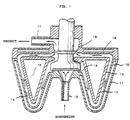
- the continuous wet type agitation mill is known. As illustrated in Fig. 1, the mill contains an annular stator 11 having a triangular section and a rotor 12 therein similar to the stator in shape. A milling zone l3 is formed as an annular gap of a small breadth between the stator and the rotor. The milling zone contains a milling medium 14 therein to impart mechanical impact to suspended particles to deform them so that they get flat.
- the suspension is introduced into the milling zone through an inlet 15 at the lower part of the mill and travels along the gap, and is then separated from the medium at a separator 16.
- the suspension which contains deformed polymer particles are obtained from an outlet 17. While the polymer particles in the suspension are deformed in the milling zone, warm water is supplied to passages 18 within the stator and the rotor to control the temperature of the suspension.
- the milling medium also travels centrifugally along the milling zone having a W-shaped section and returns to the inlet. Zirconia, glass or steel spherules of, for example, about 0,3-1.5 mm in diameter are used as the milling medium, although not limited thereto.
- annular, continuous, wet type agitation mill has an advantage that the rotor produces a larger shearing force in the direction of rotation than a ball mill or a sand mill, and can exert anisotropic stress on the particles, so that they are effectively deformed even when they have a significant particle size distribution. Namely, the particles are deformed irrespectively of their diameters, so that the resultant toner particles have a greatly improved blade cleanability. In addition, such particles make contact with a substrate with a large surface area when transferred from a photoconductive body, and thus fixed thereon at relatively low temperatures. Similarly, the individual particles have a large contact area on a substrate, so that a small amount of such particles produces dark images, and consumption of toner is reduced.
- a flat dislike polymer particle having a diameter of 3-30 ⁇ m, a thickness of 1-15 ⁇ m and a flatness of not more, than 0.5, or a flat oval polymer particle having a major axis 3-30 ⁇ m in length, a minor axis 1-25 ⁇ m in length and a flatness of not more than 0.5 according to the invention.
- the polyvinyl alcohol used as a suspending agent in the stage of the suspension polymerization and deformation of the polymer particles may be saponified.
- the saponification of the polyvinyl alcohol may be carried out by adding a saponification agent to the suspension containing the polymer particles.
- the particles are separated from the suspension, and the particles may be treated with a saponification agent.
- the saponification is carried out using an alkali or an acid.
- an alkali used, the amount thereof may be between about an equivalent to and about 1000 times as much as the equivalent of the vinyl acetate component contained in the polyvinyl alcohol used, and preferably in an amount of about 5-50 times the equivalent of the vinyl acetate component.
- the amount is not critical, and an amount less than the equivalent may satisfactoriry saponify the polyvinyl alcohol used. If necessary, a minimum amount of the saponification agent required may be determined by a simple experiment well known in the chemistry of polyvinyl alcohol.
- the alkali used as a saponification agent includes, for example, sodium hydroxide and potassium hydroxide.
- the saponification may be carried out as follows.
- An aqueous solution of a lower aliphatic alcohol such as methanol, ethanol, propanol, among which methanol is most preferred, in amounts of about 1-50 % by volume, preferably of about 5-30 % by volume, containing an alkali, is added to a suspension containing the polymer particles, and the mixture is stirred at temperatures of about 30-70°C for about 1-10 hours, although these reaction conditions are not critical.
- a lower aliphatic alcohol such as methanol
- methanol in particular is used, the vinyl acetate unit in the polyvinyl alcohol reacts with methanol to produce methyl acetate by an ester exchange reaction, so that the saponification reaction proceeds rapidly.
- the polymer particles are separated, washed with water or preferably with an aqueous alcohol solution as previously mentioned, and then washed with an aqueous solution or an aqueous alcohol solution which contains an acid such as hydrochloric acid to neutralize the alkali used, and finally the particles are washed with water or an aqueous alcohol solution.
- an aqueous alcohol solution and especially an aqueous methanol solution which contains methanol in amounts of about 1-50 %, preferably of about 5-30 % by volume.
- the washing for neutralizing the alkali contains an acid usually in amounts of equivalent at most to the amount of the alkali used in the saponification.
- the washing for the particles after the neutralization of alkalis is also preferably an aqueous alcohol solution, and especially an aqueous methanol solution which contains methanol in amounts of about 1-50 %, preferably of about 5-30 % by volume.
- the saponification of the polyvinyl alcohol may be alternatively carried out using an acid.
- an aqueous solution or preferably an aqueous alcohol solution as before described of an acid such as sulfuric acid or hydrochloric acid is added to a suspension of the polymer particles, stirred under heating, neutralized with an alkali, washed with water, and dried.
- the polymer particles may be dried, and if necessary classified, to provide a toner for use in electrophotography.
- carbon black and a charge controlling agent are minutely and evenly dispersed in a radical polymerizable monomer, the monomer is suspension polymerized to spherical polymer particles of 1-30 ⁇ m in diameter, the particles are deformed into flat dislike or flat oval particles, and then the polyvinyl alcohol remaining on the particles may be removed therefrom by saponification and washing.
- the resultant toner is insensitive to humidity and has a high stability to change of ambient conditions. Further, the toner is deformed in shape so that it has an excellent blade cleanability and is readily fixed on a substrate at a relatively low temperature.
- Dispersion at carbon black and a charge controlling agent into a radical polymerizable monomer, polymerization of such a monomer composition containing the carbon black and charge controlling agent in the presence of polyvinyl alcohol as a suspensing agent, and saponification of the polyvinyl alcohol is substantially the same throughout herein the specification. Therefore, such description may be omitted occasionally hereinafter if invention is not rendered unclear.
- the toner particles according to the invention may be used either as a two-component toner, a nonmagnetic one-component toner, or a magnetic one-component toner.
- a magnetic toner a magnetic powder is preferably mixed with and dispersed in the monomer with a suitable means such as a ball mill, and then the monomer is mixed with carbon black and optionally with a charge controlling agent, followed by suspension polymerization of the monomer in the manner as hereinbefore described.
- a ferrite or a magnetite is used in an amount of about 30-300 parts, preferably of about 30-100 parts by weight, in relation to 100 parts by weight of the monomer.
- the particles are mixed with a carrier material well known in the art to form a two-component toner.
- the carrier material usable includes, for example, an iron powder, a ferrite powder, a powder mixture of resins and magnetic substances, and a magnetite powder.
- the polymer particles are used usually in an amount of about 2-20% by weight, preferably of about 5-10 % by weight of the toner.
- the monomer composition was then added to 300 parts by weight of water containing 3 parts by weight of polyvinyl alcohol (having an average polymerization degree of 1700 and a saponification degree of 80 mole %) as a suspending agent, and the mixture was agitated using a homogenizer (Model 610 from K.K. Nippon Seiki Seisakusho, Japan) at 6000 rpm to disperse the monomer composition in the water.
- a homogenizer Model 610 from K.K. Nippon Seiki Seisakusho, Japan
- the resultant aqueous dispersion was stirred at 70°C for 5 hours, and then at 90°C for another 1 hour.
- the resultant spherical polymer particles were found to have a glass transition temperature of 63°C.
- the particle size distribution of the polymer particles is shown in the Table 2.
- the suspension was then continuously fed into an continuous, annular, wet type agitation mill (Kobol Mill from Shinko Foudler K.K.), as an example of such a mill is shown in Fig, 1, and the polymer particles were deformed under the conditions of temperature, suspension travelling speed and rotor peripheral speed shown in the Table 2.
- Zirconia spherules of 0.75-1.0 mm in diameter were used as a milling medium.
- the charge rate of the medium in the milling zone was 70 %.
- a mixture of 77 % by volume of water and 23 % by volume of methanol containing sodium hydroxide in an amount of equivalents ten times the vinyl acetate component of the polyvinyl alcohol used was added to the suspension and stirred at 50°C for 3 hours to saponify the polyvinyl alcohol.
- the resultant deformed flat polymer particles were recovered and washed with water, and then with aqueous solution containing hydrochloric acid in an amount equivalent to the amount of sodium hydroxide used to neutralize the sodium hydroxide.
- the polymer particles were dried under reduced pressures to provide toner particles.
- the shape, average size and flatness of toner particles were measured with randomly selected 50 particles on through electromicrophotographs.
- the triboelectric charge of the toner particles was measured by a blow-off method with a mixture of the particles and iron carrier powder with the latter in an amount of 5 % by weight based on the mixture.
- the amount of reversely charged toner particles was determined by means of an electric charge distribution analyzer (from Hosokawa Micron K.K., Japan).
- the blade cleanability was measured as follows. After 10000 times copying using an electrostatic copying machine Rheodry 4515 from Toshiba K.K., Japan, at normal temperature and normal humidity, the surface of the electroconductive body after the blade cleaning and toner images formed on paper were observed. In the. table 2, the results are shown in three grades: A, electroconductive body was completely cleaned and toner images were of high quality; B, electroconductive body was partly uncleaned and toner images were partly contaminated; C, electroconductive body remained substantially uncleaned.
- the nip gap is a measure of fixability of toners on a substrate, and the smaller the nip gap, the better the fixability.
- the nip gap was measured as follows. Using a fixability testing roll machine composed of a heat roll of polytetrafluoroethylene and a back-up roll of a silicone rubber and with varied nip gaps, toners were fixed on paper. In the Table 2 were given the values of nip gap where toners were fixed at a fixing rate of not less than 90 %. The fixability of- toners was measured by change in darkness when toner images were rubbed after a predetermined time passed since the toners had been fixed.
- the toner consumption was measured as follows. Using an LED printer K-II from Japan Kenteck K.K. with a surface electric potential adjusted so as to provide toner images having a darkness of 1.2, 1000 sheets of compies were made, and the power consumption by that time was measured.
- the supension prepared in the Example 1 was treated with the same agitation mill as in the Example 1 under the conditions shown in the Table 2, and otherwise in the same manner, toner particles were produced. The results are shown in the Table 2.
Landscapes
- Physics & Mathematics (AREA)
- General Physics & Mathematics (AREA)
- Developing Agents For Electrophotography (AREA)
- Polymerisation Methods In General (AREA)
Description
- This invention relates to toners for use in electrophotography and production thereof.
- Toners or developing agents in the form of finely divided particles for developing electrostatic latent images in electrophotography have been heretofore produced by a so-called crushing method. According to this method, a colorant such as carbon black, an electric charge controlling agent such as a certain dyestuff, and an anti-offset agent such as a wax are mixed and kneaded together with a melted thermoplastic resin, thereby to disperse them in the resin, cooling, crushing and pulverizing the resultant solid mixture with, for example, a jet mill, to powders of a desired particle size.
- In this method, it is necessary that the resin used be brittle so that a mixture of the resin and the additives as mentioned above be readily crushed. However, when a resin used is too brittle, the resultant toner is excessively finely divided during the use in an electrophotographic apparatus, and contaminates the inside of the apparatus or forms fog on developed positive images. On the other hand, when a resin used is readily melted, the resultant toner is apt to aggregate together and is undesirably reduced in fluidity, but also there takes place filming on an photoconductive body to deteriorate quality of positive images.
- It is also necessary that individual toner particles have colorants and charge controlling agents equally and finely dispersed therein, and be capable of being equally electrified so as to produce high quality positive images. However, according to the conventional crushing method, colorants and charge controlling agents are unequally divided among individual toner particles with varied particle sizes. Thus, it is inevitable that positive images have background contamination as well as fog thereon. The apparatus is also contaminated.
- In particular, a charge controlling agents has an important effect upon copying performance of toners, but since the known charge controlling agents are in many cases 1-20 µm in particle size, much time is needed to disperse the agent in a resin and thus producitivity is low. Moreover, as a matter of fact, the agent can not be uniformly dispersed in a resin even after kneading over a long period of time.
- As above set forth, the conventional crushing method has many disadvantages, and therefore there have been proposed in recent years many methods to produce toners directly by suspension or emulsion polymerization of a radical polymerizable monomer which contains colorants therein such as carbon black. In these methods, an oily monomer phase is polymerized in an aqueous phase containing a suspending agent dissolved therein such as polyvinyl alcohol. Accordingly, at least some portions of the suspending agent remain inevitably on the surface of the resultant polymer particles even after repeated washing, so that the polymer particles are very sensitive to humidity. Thus, such toners are low in triboelectricity under high humidity, and are apt to produce noncharged or reversely charged toners during the use, to provide a toner image with undesired fog or a toner image with an insufficient darkness.
- It is an advantage of the toners produced by a conventional suspension or emulsion polymerization method that the toner is substantially spherical and has a high fluidity so that there is no need of adding a fluidizing agent such as silica to the toner. But, because of that sphericity, the toner is inferior in "blade cleanability".
- In an electrostatic photography using plain paper as a substrate on which toner images are fixed, an latent image is formed on the surface of an photoconductive body to which electrostatic charges have been given, the latent image is developed by the toner to a toner image, and the toner image is transferred onto a substrate, and then the toner image is fixed thereon, to provide a copy. Therefore, it is necessary that the toner remaining on the photoconductive body is removed therefrom after the toner image has been transferred onto the substrate to copy in succession. As one of the methods for removing the toner remaining on the photoconductive body, a blade cleaning method is known according to which the toner is scraped off with a cleaning blade after the toner image has been transferred onto the substrate. The blade is formed of various elastomers, among which a polyurethane elastomer is most preferred from the standpoit of mechanical properties such as resistance to abrasion.
- In such a blade cleaning method, sperical toner particles enter beneath the blade when the blade scrapes the photoconductive body and roll between the blade and the surface of photoconductive body, so that the toner remains on the photoconductive body after the cleaning of the body with the blade.
- Thus, in the production of toner particles by suspension polymerization, there has been proposed a method in which spherical polymer particles are agitated in a suspension medium at a high rate before the completion of the polymerization so that the spherical polymer particles are deformed, as described in Japanese Patent Application Laid-open No. 62-266560. However, according to the method, the polymer particles are apt to aggregate to each other on account of unreacted monomers remaining in the reaction system or the deformed polymer particles are restored to their original spherical particles at relatively high temp eratures where the polymer particles are readily deformed, on account of surface tension they possess. Namely, effective deformation of spherical polymer particles is not attained. Agitiation of the polymer particles at small rates or at low temperatures also fails to effectively deform the sperical polymer particles, although the aggregation of the particles is restrained. Furthermore, the polymer particles produced by the suspension polymerization have rather a wide particle size distribution. Thus, large spherical particles might be readily deformed, but small particles are not, and accordingly there arises a wide distribution in degree of deformation. Accordingly, as a further defect of the above method, small spherical particles remain undeformed and such small spherical particles elude cleaning by a blade on the photoconductive body.
- A further method of producing toners has been recently proposed in which finely divided particles are adhered and fixed onto the toner particles by a so-called impact method, as described in Japanese Patent Application Laid-open No. 62-129866. However, since toner particles have a significant size distribution, it is necessary that the finely divided particles are of not more than about 1 µm so that they are successfully fixed on the individual toner particles accordingto this method. Little improvement in blade cleanability is attained with such toner particles having such fine particles foced thereon.
- Meanwhile, there is disclosed a method of improving triboelectricity of toner particles in Japanese Patent Application Laid-open No. 62-140636 or No. 62-246075. In this methods, finely divided triboelectric or electroconductive particles are forcibly made to collide with the surface of toner particles at high velocity, or toner particles are softened in a hot air stream and such particles are adhered onto the surface of toner particles. This method is not applicable, however, to deformed toner particles since the deformed toner particles have a tendency to become spherical under the conditions employed. In conclusion, no method has hitherto been known which improves both triboelectricity and blade cleanability of toner particles.
- The present invention has been accomplished to solve the problems involved in the conventional toner particles and their production.
- Therefore, the general object of the invention is to provide toners for use in electrophotography which are improved in blade cleanability and a method for the production of such toners.
- More specifically, it is an important object of the invention to provide toners which contain carbon black and a charge controlling agent divided equally and finely among individual particles, and are free from undesirable effects deriving from a suspension agent used in suspension polymerization, and in addition, which are deformed and has excellent blade cleanability, and hence produce high quality toner images irrespectively of ambient conditions.
- It is also an object of the invention to provide a method for producing such toners.
- Other features and advantages of the invention will be apparent from the following description taken in connection with the accompanying drawings, in which:
- Figure 1 is a sectional view of a continuous, wet type agitation mill preferably used for the production of deformed polymer particles according to the present invention;
- According to the invention, there is provided a flat disklike toner particle having a diameter of 3-30 µm, a thickness of 1-15 µm and a flatness of not more than 0.5 as the flatness of disklike toner particle is herein defined as a ratio of average thickness to average diameter of the particle
- A further toner particle of the invention is flat and oval and has a major axis 3-30 µm in length, a minor axis 1-25 µm in length and a flatness of not more than 0.5 as the flatness of oval toner particle is herein defined as a ratio of twice the average thickness to the sum of average major axis and the average minor axis.
- The toner particles of the invention mav be a mixture of the disklike and oval toner particles. Either flat shape is referred to as deformed particles.
- Such toner particles of the invention can be produced by suspending a radical polymerizable liquid monomer containing carbon black and a charge controlling agent in water, suspension polymerizing the monomer to provide spherical polymer particles composed of a matrix of the polymer and the carbon black and charge controlling agent dispersed the-rein and. having a diameter of 1-30 µm, and treating the suspension containing the polymer particles at temperatures in the range of ± 10 degrees C of the glass transition temperature of the matrix forming the polymer particles with a continuous, wet type agitation mill, thereby to deform the polymer particles so that they have a flat dislike or flat oval shape.
- More specifically, the above mentioned flat dislike or flat, oval toner particle is advantageously produced by a method comprising the folowing steps carried out in sequence:
- (a) the step of dispersing carbon black and a charge controlling agent minutely and uniformly both as finely divided particles of not more than 1 µm in particle size in a radical polymerizable liquid monomer;
- (b) the step of adding an azobisnitrile polymerization initiator to the resultant monomer composition, suspending the composition in water- containing polyvinyl alcohol as a suspending agent, suspension polymerizing the monomer to provide spherical polymer particles composed of a matrix of the polymer and the carbon black and charge controlling agent dispersed therein and having a diameter of 1-30 µm, and treating the suspension containing the polymer particles at temperatures in the range of ± 10 degrees C of the glass transition temperature of the matrix forming the polymer particles with a continuous wet type agitation mill, thereby to deform the spherical particles into flat dislike or flat oval particles;
- (c) the step of saponifying the polyvinyl alcohol;
- (d) the step of recovering, drying and washing the polymer particles, and when necessary classifying to a desired particle size.
- Any radical polymerizable monomer which is known as usable for the production of toner by suspension polymerization is usable in the invention. Therefore, such monomers include,for example, styrene, substituted styrenes such as o-methylstyrene, m-methylstyrene, p-methylstyrene or p-chlorostyrene; vinyl esters such as vinyl acetate or vinyl propionate; acrylic acid esters such as methyl acrylate, ethyl acrylate, propyl acrylate, n-butyl acrylate, isobutyl acrylate, n-octyl acrylate, dodecyl acrylate, 2-ethylhexyl acrylate, stearyl acrylate, phenyl acrylate or α-chloromethyl acrylate; methacrylic acid esters such as methyl methacrylate, ethyl methacrylate, propyl methacrylate, n-butyl methacrylate, isobutyl, methacrylate, n-octyl methacrylate, dodecyl methacrylate, 1-ethylhexyl methacrylate, stearyl methacrylate, phenyl methacrylate, α-chloromethyl methacrylate, dimethylaminoethyl methacrylate, diethylaminoethyl methacrylate or glycidyl methacrylate; unsaturated nitriles such as acrylonitrile or methacrylonitrile; α, β-unsaturated carboxylic acids such as acrylic acid or methacrylic acid; and vinylpyridines such as 2-vinylpyridine or 4-vinylpyridine. These monomers are used singly or as a mixture of two or more. Among these, however, styrene or a mixture of styrene and acrylic or methacrylic acid esters are preferred.
- A polyfunctional monomer may be used together with the above mentioned monomers to improve fixation and anti-offset properties of toners. There may be mentioned as such a polyfunctional monomer, for example, divinylbenzene or ethylene glycol dimethyacrylate. However, a variety of polyfunctional monomers are already known in the art, and any one of these may be used, if desired. The polyfunctional monomer may be used normally in amounts of not more than about 1 % by weight based on the radical polymerizable monomer. When the polyfunctional monomer is used in excess, the resultant polymer particles are too high in melting points to fix sufficiently on a substrate.
- According to the invention, carbon black as a colorant and a charge controlling agent are dispersed minutely and finely both as finely divided particles of not more than 1 µm in particle size in the radical polymerizable monomer. For this purpose, the monomer and carbon black are stirred in the presence of a peroxide polymerization initiator with, for example, a ball mill. The peroxide polymerization initiator used includes, for instance, benzoyl peroxide, lauroyl peroxide, o-chlorobenzoyl peroxide and o-methoxy benzoyl peroxide, and especially lauroyl peroxide is preferred. Usually the mixture of the monomer and carbon black is stirred in the presence of the peroxide polymerization initiator over a period of several hours, thereby to dispese the carbon black evenly in the monomer as finely divided particles of not more than 1 µm in particle size, preferably of not more than 0.5 µm in particle size. The dispersion of carbon black in the monomer may be carried out at room temperatures, but if desired, at elevated tempertures, for example, at about 50-80°C to accelerate the dispersion.
- Carbon black is used in amounts of about 2-10 parts by weight in relation to 100 parts by weight of the radical polymerizable monomer. In turn, the peroxide polymerization initiator is used usually in amounts of about 10-50 parts, preferably of about 10-40 parts by weight, in relation to 100 parts by weight of carbon black used. The use of the peroxide polymerization initiator in amounts of less than about 10 parts by weight in relation to 100 parts by weight of carbon black used fails to disperse carbon black minutely and uniformly in the monomer, whereas the use of the peroxide polymerization initiator in amounts of more than about 50 parts by weight in relation to 100 parts by weight of carbon black used, the decomposition fragments of the initiator remain in the resultant polymer particles. Such polymer particles undesirably smell bad when being heated and melted to fix on a substrate during electrophotographic process.
- The use of an azobisnitrile polymerization initiator, such as azobisisobutyronitrile or azobisdimethylvaleronitrile, in place of a peroxide polymerization initiator in the step of the carbon black dispersion, fails to uniformly and minutely disperse carbon black in the monomer, but carbon black aggregates together, and most of the carbon black used are dispersed as large particles in the monomer. Furthermore, the monomer in part polymerizes in the presence of the azobisnitrile polymerization initiator, to increase the viscosity of the mixture of the monomer and the carbon black. This adversely affects the preparation of suspension of fine droplets of the monomer composition in an aqueous medium.
- In the dispersion of carbon black in the monomer in the presence of a peroxide polymerization initiator, the carbon black and the peroxide may be added together to the monomer and then the carbon black may be dispersed in the monomer by use of, for instance, a ball mill, or the carbon black may be in advance dispersed preliminarily in the monomer and then a peroxide may be dissolved thereinto, followed by stirring, for example, in an autoclave.
- Any colorant may be used together with carbon black, if needed. Such colorants may or may not be soluble in the monomer. There are mentioned such colorants in, for example, Japanese Patent Application Laid-open No. 62-246073. When a colorant insoluble in the monomer is used, such a colorant may be dispersed minutely and uniformly in the monomer with aid of a peroxide polymerization initiator or other suitable dispersing agent in the same manner as carbon black is dispersed in the monomer.
- After the dispersion of carbon black in the monomer as set forth above, a charge controlling agent is then dispersed evenly as finely divided particles in the monomer mixture with carbon black. Usually a charge controlling agent is added to the monomer mixture together with a dispersing agent soluble in the monomer, and the resultant mixture is stirred for, for example, about 50-200 hours, with a ball mill, thereby to pulverize and disperse the agent evently as finely divided particles of not more than about 0.5 µm, preferably of not more than about 0.3µm in the monomer. This dispersion may also be carried out at elevated temperatures such as at about 50-80°C to accelerate the dispersion.
- The charge controlling agent is used usually in an amount of about 0.01-10 parts, preferably of about 0.05-5 parts, most preferably of about 0.1-1 parts by weight, in relation to 100 parts by weight of the monomer used.
- The charge controlling agent used is at least one selected from the group consisting of a powder of an inorganic compound, a powder of an organic compound including metallized dyes and pigments, and organic carboxylic acid metal salts, and a powder of an organic polymer.
- The powder of inorganic compound as a charge controlling agent includes, for example, nitrides, carbides, oxides, sulfates, carbonates, titanic acid salts, phosphoric acid salts, silicates and hexafluorosilicates. More specifically, there may be mentioned as such inorganic compounds, for example, nitrides such as boron nitride; carbides such as titanium carbide, tungsten carbide, zirconium carbide, boron carbide or silicon carbide; oxides such as silica, chromium oxide, cerium oxide, zirconium oxide, titanium oxide, magnesium oxide, aluminum oxide, copper oxide, nickel oxide or zinc oxide; strontium sulfate, barium sulfate, calcium sulfate, aluminum sulfate, magnesium sulfate or copper sulfate; carbonates such as calcium carbonate or magensium carbonate; phosphoric acid salts such as calcium phosphate; silicates of such as zirconium, copper, cobalt, nickel, magnesium calcium, strontium, barium, aluminum or zinc; hexafluorosilicates of such as sodium, calcium, strontium, barium, zinc or aluminum. Further examples include emery, alundum, garnet, corundum, lime, tripolyphosphate, halloycite, bentonite, molybdenum acid chelate pigments and acidic terra.
- These inorganic charge controlling agent may be coated with silane or titanium coupling agents. The coupling agent used is selected depending upon the triboelectricity of toners required. When a negatively charged toner is to be produced, a coupling agent which is readily negatively charged is used, for example, dichlorosilanes, and when a positively charged toner is to be produced, a coupling agent which is readily positively charged is used, for example, aminosilanes. Some examples of these coupling agents are described hereinbefore.
- As the powder of organic compond as a charge controlling agent at usable a variety of compounds including metallized dyes and pigments but also carboxylic acid metal salts. There may be mentioned as a positive charge controlling agent, for example, an electron donating dye, such as a nigrosine dye represented by:


- There may be further mentioned as a negative charge controlling agents, for example, sulfonyl amines of copper phthalocyanines, oil black, naphthenic acid metal salts and zinc stearate, resinous acid soaps.
- A variety of organic polymers are also known as usable as a charge controlling agent, and a polymer is suitably selected depending upon the triboelectricity of toners required. When a negatively charged toner is to be produced, a polymer which is readily negatively charged is used, for example, a polymer or a copolymer of a monomer having an aromatic nucleus as an electron attracting group, such as styrene or derivatives thereof. Therefore, such polymers include, for example, polystyrene, styrene-butyl acrylate copolymer, styrene-2-ethylhexyl acrylate copolyner or styrene-butyl methacrylate copolymer. Polymers containing therein halogen atoms such as chlorine or fluorine are also usable as negative charge controlling agents, and they may be exemplified by polyvinyl chloride. When a positively charged toner is to be produced, a polymer which is readily positively charged is used, for example, polymethyl methacrylate, polybutyl methacrylate or polyamides. These polymeric charge controlling agents preferably have glass transition temperatures of not less than about 70°C.
- The organic polymer used as a charge controlling agent is preferably produced by emulsion polymerization in the absence of an emulsifier so that the resultant polymer contains no emulsifier. However, an organic polymer produced in the presence of an emulsifier may be used if the emlusifier is removed.
- Those charge controlling agent as described above may be used singly or as a mixture of two or more.
- The dispersing agent used to disperse the charge controlling agent in the monomer may be either a low molecular weight substance or a high molecular weight substance. The low molecular weight substance includes, for example, surfactants, silane coupling agents, titanium coupling agents and oligomeric organic materials which contain therein isocyanate or epoxy groups.
- More specifically, there may be mentioned as surfactants, for example, anionic surfactants such as fatty acid salts, alkylsulfuric acid esters, alkylbenzenesulfonic acid salts, alkylnaphthalenesulfonic acid salts, dialkylsulfosuccinic acid esters, alkylphosphoric acid esters, naphthalenesulfonic acid-formalin condensates or polyoxyethylene alkylsulfuric acid salts; nonionic sufactants such as polyoxyethylene alkyl ether, polyoxyethylene alkyl phenol ether, polyoxyethylene fatty acid esters, polyoxyethylene sorbitan fatty acid esters, polyoxyethylene alkyl amines, glycerine fatty acid esters or oxyethylene-oxypropylene block polymers; and cationic surfactants such as alkyl amines or quaternary ammonium salts.
- The silane coupling agent may be exemplified by γ-chloropropyltrimethoxysilane, vinyltrichlorosilane, vinyltrimethoxysilane, vinyltriethoxysilane, γ-methacryloxypropyltrimethoxysilane, γ-glycydoxypropyltrimethoxysilane, γ-mercaptopropyltrimethoxysilane, γ-aminopropyltrimethoxysilane, γ-ureidopropyltriethoxysilane, 3,3,4,4,5,5,6,6,6-nonafluorohexlytrichlorosilane and 3,3,4,4,5,5,6,6,6-nonafluorohexylmethyldichlorosilane. Further, there may be mentioned as reactive silanes, for example, methyltrimethoxsilane, phenyltrimethoxysilane, methylphenyldimethoxysilane and diphenyldimethoxysilane.
- The titanium coupling agent may be exemplified by isopropyltriisostearoyl titanate, isopropyltris(dioctylpyroohosphate) titanate, isopropyltris(N-aminoethylaminoethyl) titanate, tetraoctylbis(ditridecylphosphite) titanate, tetra2,2-diallyloxymethyl-1-butyl bis(ditridecyl)phosphite titanate, bis(dioctylpyrophosphate)oxyacetate titanate, bis(dioctylpyrophosphate)ethylene titanate, isopropyltrioctanoyl titanate, isopropyldimethacrylisostearoyl titanate, isopropyltridecylbenzenesulfonyl titanate, isopropylisostearoyldiacryl titanate, isopropyltri(dioctylphosphate) titanate, isopropyltricumylphenyl titanate and tetraisopropylbis(dioctylphosphite)titanate.
- On the other hand, the high molecular weight dispersing agent preferably includes homopolymers or copolymers which have functional groups therein, such as carboxyls, sulfones, hydroxyls, halogens, epoxys, cyanos, nitriles, butyrals, esters, carbonyls or aminos.
- More specifically, the high molecular weight polymeric dispersing agent includes, for instance, vinyl (co)polymers, rubber polymers, cellulosic polymers and cross-linkable polymers. The vinyl (co)polymers includes, for example, styrene-acrylic acid copolymers, styrene-dimethylaminoethyl methacrylate copolymers, styrene-methacrylic acid copolymers, styrene-2-hydroxyethyl methacrylate copolymers, styrene-acrylonitrile copolymers, styrene-glycidyl methacrylate copolymers, methyl methacrylate-acrylic acid copolymers, methyl methacrylate-dimethylaminoethyl methacrylate copolymers, methyl methacrylate-methacrylic acid copolymers, methyl methacrylate-2-hydroxyethyl methacrylate copolymers, methyl methacrylate-acrylonitrile copolymers, methyl methacrylate-glycidyl methacrylate copolymers, vinyl chloride-vinyl acetate copolymers, vinyl chloride-vinyl acetate-vinyl alcohol copolymers, polyvinyl butyral resins, vinylidene chloride-acrylonitrile copolymers, acrylonitrile-butyl acrylate-2-hydroxyethyl methacrylate copolymers, ethylene-vinyl acetate copolymers, polyvinyl acetate resins and partially sulfonated polystyrene resins. The rubber polymer includes, for example, acrylonitril-butadiene copolymers, and the cellulosic polymer includes, for example, nitrocellulose and acetyl cellulose. The cross-linkable polymer includes, for instance, epoxy resins, phenoxy resins and urethane resins. These polymers may be used singly or as a mixture of two or more.
- Most preferably, there is used, as a dispersing agent, a polymer having functional groups therein which have a strong interaction with a charge controlling agent used. By way of example, when an electron accepting dyes such as metallized azo dyes or an electron accepting organic complex is used as a negatively triboelectrified charge controlling agent, ethylene-vinyl acetate copolymers are preferably used as a dispersing agent.
- In the dispersion of the charge controlling agent in the monomer, the amount of the dispersing agent used varies depending on the particle size of the charge controlling agent used, however, it is usually in amounts of about 1-100 parts, preferably of about 10-50 parts by weight, in relation to 100 parts by weight of the charge controlling agent used. When excessive amounts of the dispersing agent are used, the resultant mixture which contains the monomer, carbon black and charge controlling agent is too high, and the finely pulverizing of the charge controlling agent is not attained. When the dispersing agent is used only in small amounts, the charge controlling agent is not uniformly dispersed in the monomer.
- Similarly to the dispersion of carbon black in the monomer, the charge controlling agent may be in advance preliminarily dispersed in the monomer using, for example, a ball mill, and then the dispersing agent may be dissolved in the monoer, followed by stirring, or the dispersing agent may be aaded to the monomer together with the charge controlling agent and stired using, for example, a ball mill.
- Some of the charge controlling agents have been found to inhibit undesired polymerization of monomers in an aqueous medium in suspension polymerization, which will be described in more detail hereinafter. Such a charge controlling agent is exemplified by "Spiron Black TRH" (by Hodogaya Kagaku Kogyo K.K., Japan), a chromium containing azo dye. Therefore, this dye is preferably used in the invention both as a charge controlling agent and as a polymerization inhibitor in an aqueous medium in suspension polymerization. However, if desired, the dye may be dispersed in monomers only as a polymerization inhibitor in an aqueous medium in suspension polymerization, apart from its original function as a charge controlling agent. In this case, other charge controlling agents may be dispersed together with the dye in monomers.
- In the method of the invention, carbon black and a charge controlling agent are dispersed evenly as finely divided particles in the monomer as hereinbefore described, and if necessary an additional amount of the monomer are further added to the dispersion, and then an azobisnitrile polymerization initiatoris added to the dispersion, to form a monomer composition. The azobisnitrile polymerization initiator usable includes, for example, azobisdimethylvaleronitrile and azobisdimethylisobutyronitrile, however, azobisdimethylvaleronitrile is especially preferred since it is highly soluble in the monomer.
- The monomer composition in the form of a dispersion thus containing an azobisnitrile polymerization initiator is then dispersed in an aqueous medium as small droplets by use of, for example, a homozinizer, and is heated so that suspension polymerization proceeds to produce spherical polymer particles.
- When no azobisnitrile polymerization initiator is added anew to the monomer composition, substantially no suspension polymerization occurs even under heating, since substantially all the peroxide polymerization initiator which has been added to the monomer in the stage of the dispersion of carbon black in the monomer are decomposed during the dispersion, and therefore it is necessary that a polymerization initiator be anew added to the monomer in the stage of suspension polymerization. The polymerization initiator added in the stage of polymerization should be an azobisnitrile polymerization initiator, not a peroxide. The addition of a peroxide polymerization initiator is substantially useless since the initiator fails to polymerize the monomer, or if polymerization takes place, the resultant polymer has a very low molecular weight, and has no sufficient anti-offset properties.
- The azobisnitrile polymerization initiator is used usually in amounts of about 1-10 parts, preferbly of about 2-5 parts by weight, in relation to 100 parts by weight of the monomer used. When the amount is less than about 1 part by weight in relation to 100 parts by weight of the monomer used, the polymerization proceeds only very slowly, and it is substantially impossible to polymerize the monomer in a high polymerization rate, while when the amount is more than about 100 parts by weight in relation to 100 parts by weight of the monomer used, the resultant polymer is low in molecular weight, and is insufficient in anti-offset properties.
- As previously described, the mixture of the monomer, carbon black, as azobisnitrile polymerization initiator, and optionally a charge controlling agent are mixed with water, and severely stirred by use of, for example, a homogenizer, to provide an aqueous dispersion of droplets of the monomer composition of 1-30 µm in diameter in the aqueous medium.
- It is preferred that the water as a dispersion medium in suspension polymerization contains polyvinyl alcohol as a suspending agent which has usually an average polymerization degree of 500-3000 and a saponification degree of about 80-99 mole %. The polyvinyl alcohol is contained in water usually in an amount of 0.1-5 % by weight. The water may further contain a water soluble inorganic salts such as sodium chloride, sodium sulfate or aluminum sulfate to inhibit the polymerization of the monomer in an aqueous phase.
- The suspension is then stirred at temperatures usually of about 40-95°C, preferably of about 50-90°C, to carry out suspension polymerization of the monomer to provide substantially true spherical polymer particles of 1-30 µm in diameter which has a flatness of not less than 0.98, the flatness being defined hereinafter.
- In accordance with the invention, the suspension which contains the resultant substantially true spherical polymer particels is treated with a continuous wet type agitation mill in the presence of polyvinyl alcohol as a suspending agent at temperatures in the range of ± 10 degrees C of the glass transition temperature of the matrix forming the polymer, thereby to deform the spherical particles into flat dislike or flat oval particles.
- The continuous wet type agitation mill is known. As illustrated in Fig. 1, the mill contains an
annular stator 11 having a triangular section and arotor 12 therein similar to the stator in shape. A milling zone l3 is formed as an annular gap of a small breadth between the stator and the rotor. The milling zone contains a millingmedium 14 therein to impart mechanical impact to suspended particles to deform them so that they get flat. - The suspension is introduced into the milling zone through an
inlet 15 at the lower part of the mill and travels along the gap, and is then separated from the medium at aseparator 16. The suspension which contains deformed polymer particles are obtained from anoutlet 17. While the polymer particles in the suspension are deformed in the milling zone, warm water is supplied topassages 18 within the stator and the rotor to control the temperature of the suspension. The milling medium also travels centrifugally along the milling zone having a W-shaped section and returns to the inlet. Zirconia, glass or steel spherules of, for example, about 0,3-1.5 mm in diameter are used as the milling medium, although not limited thereto. - It is necessary that treatment of the suspension containing the polymer particles with the annular, continuous, wet type agitation mill is carried out at temperatures in the range of ± 10 degrees C of the glass transition temperature of the matrix which forms the polymer. When the suspension is treated at temperatures lower than the glass transition temperature of the polymer by 10°C, the polymer particles crushed, rather than deformed. On the other hand, when the suspension is treated at temperatures higher than the glass transition temperature of the polymer by 10°C, the polymer particles are apt to aggregate to each other to form mass, but also the polymer particles become spherical again on account of surface tension even after the particles have been deformed, so that deformation efficiency is low. The treatment is carried out usually over a period of 0.5-10 hours, preferably 2-5 hours.
- The use of an annular, continuous, wet type agitation mill has an advantage that the rotor produces a larger shearing force in the direction of rotation than a ball mill or a sand mill, and can exert anisotropic stress on the particles, so that they are effectively deformed even when they have a significant particle size distribution. Namely, the particles are deformed irrespectively of their diameters, so that the resultant toner particles have a greatly improved blade cleanability. In addition, such particles make contact with a substrate with a large surface area when transferred from a photoconductive body, and thus fixed thereon at relatively low temperatures. Similarly, the individual particles have a large contact area on a substrate, so that a small amount of such particles produces dark images, and consumption of toner is reduced.
- As above set forth, there is obtained a flat dislike polymer particle having a diameter of 3-30 µm, a thickness of 1-15 µm and a flatness of not more, than 0.5, or a flat oval polymer particle having a major axis 3-30 µm in length, a minor axis 1-25 µm in length and a flatness of not more than 0.5 according to the invention.
- According to the invention, after the deformation of the particles as described hereinbefore, the polyvinyl alcohol used as a suspending agent in the stage of the suspension polymerization and deformation of the polymer particles may be saponified.
- In one method, the saponification of the polyvinyl alcohol may be carried out by adding a saponification agent to the suspension containing the polymer particles. In another method, the particles are separated from the suspension, and the particles may be treated with a saponification agent.
- The saponification is carried out using an alkali or an acid. When an alkali is used, the amount thereof may be between about an equivalent to and about 1000 times as much as the equivalent of the vinyl acetate component contained in the polyvinyl alcohol used, and preferably in an amount of about 5-50 times the equivalent of the vinyl acetate component. However, the amount is not critical, and an amount less than the equivalent may satisfactoriry saponify the polyvinyl alcohol used. If necessary, a minimum amount of the saponification agent required may be determined by a simple experiment well known in the chemistry of polyvinyl alcohol. The alkali used as a saponification agent includes, for example, sodium hydroxide and potassium hydroxide.
- In a preferred embodiment, the saponification may be carried out as follows. An aqueous solution of a lower aliphatic alcohol, such as methanol, ethanol, propanol, among which methanol is most preferred, in amounts of about 1-50 % by volume, preferably of about 5-30 % by volume, containing an alkali, is added to a suspension containing the polymer particles, and the mixture is stirred at temperatures of about 30-70°C for about 1-10 hours, although these reaction conditions are not critical.
- The use of a lower aliphatic alcohol, such as methanol, in the alkali saponification of the polyvinyl alcohol is advantageous in that the alcohol raises wettability of the polymer particles to water, thereby to carry out the saponification in a short period of time. Further, methanol in particular is used, the vinyl acetate unit in the polyvinyl alcohol reacts with methanol to produce methyl acetate by an ester exchange reaction, so that the saponification reaction proceeds rapidly.
- After the saponification in this manner, in particular the polyvinyl alcohol remaining on the surface of the polymer particles, the polymer particles are separated, washed with water or preferably with an aqueous alcohol solution as previously mentioned, and then washed with an aqueous solution or an aqueous alcohol solution which contains an acid such as hydrochloric acid to neutralize the alkali used, and finally the particles are washed with water or an aqueous alcohol solution.
- As the washing for the particles after the saponification is preferred an aqueous alcohol solution, and especially an aqueous methanol solution which contains methanol in amounts of about 1-50 %, preferably of about 5-30 % by volume. The washing for neutralizing the alkali contains an acid usually in amounts of equivalent at most to the amount of the alkali used in the saponification. The washing for the particles after the neutralization of alkalis is also preferably an aqueous alcohol solution, and especially an aqueous methanol solution which contains methanol in amounts of about 1-50 %, preferably of about 5-30 % by volume.
- The saponification of the polyvinyl alcohol may be alternatively carried out using an acid. By way of example, an aqueous solution or preferably an aqueous alcohol solution as before described of an acid such as sulfuric acid or hydrochloric acid is added to a suspension of the polymer particles, stirred under heating, neutralized with an alkali, washed with water, and dried.
- After the saponification of the polyvinyl alcohol, the polymer particles may be dried, and if necessary classified, to provide a toner for use in electrophotography.
- As above set out, carbon black and a charge controlling agent are minutely and evenly dispersed in a radical polymerizable monomer, the monomer is suspension polymerized to spherical polymer particles of 1-30 µm in diameter, the particles are deformed into flat dislike or flat oval particles, and then the polyvinyl alcohol remaining on the particles may be removed therefrom by saponification and washing. Thus, the resultant toner is insensitive to humidity and has a high stability to change of ambient conditions. Further, the toner is deformed in shape so that it has an excellent blade cleanability and is readily fixed on a substrate at a relatively low temperature.
- Dispersion at carbon black and a charge controlling agent into a radical polymerizable monomer, polymerization of such a monomer composition containing the carbon black and charge controlling agent in the presence of polyvinyl alcohol as a suspensing agent, and saponification of the polyvinyl alcohol is substantially the same throughout herein the specification. Therefore, such description may be omitted occasionally hereinafter if invention is not rendered unclear.
- The toner particles according to the invention may be used either as a two-component toner, a nonmagnetic one-component toner, or a magnetic one-component toner. In the production of a magnetic toner, a magnetic powder is preferably mixed with and dispersed in the monomer with a suitable means such as a ball mill, and then the monomer is mixed with carbon black and optionally with a charge controlling agent, followed by suspension polymerization of the monomer in the manner as hereinbefore described. In the production of a magnetic toner, a ferrite or a magnetite is used in an amount of about 30-300 parts, preferably of about 30-100 parts by weight, in relation to 100 parts by weight of the monomer.
- When the polymer particles are used as a toner in a two-component developing manner, the particles are mixed with a carrier material well known in the art to form a two-component toner. The carrier material usable includes, for example, an iron powder, a ferrite powder, a powder mixture of resins and magnetic substances, and a magnetite powder. In a two-component toner, the polymer particles are used usually in an amount of about 2-20% by weight, preferably of about 5-10 % by weight of the toner.
- The invention will now be described with reference to examples which relates to non-magnetic two-component toners, however, the invention is not limited thereto.
- An amount of 5 parts by weight of carbon black "Diablack" (tradename) #52 (volatile matters 0.8 %, pH 8.0, particle size 27 mµ, from Mitsubishi Kasei Kogyo K.K., Japan) and 1 part by weight of lauroyl peroxide were added to and mixed with 50 parts by weight of styrene in a ball mill for 30 minutes to preliminarily disperse the carbon black in the monomer. The mixture was then further agitated in an autoclave at 70°C for 1 hour. In this monomer- mixture with carbon black, the carbon black was found about 0.1 µm in particle size and there took no sedimentation in the dispersion.
- An amount of 0.4 parts by weight of an ethylene-vinyl acetate copolymer "Soablene CH" (tradename, from Nippon Gosei Kagaku Kogyo K.K., Japan) as a dispersing agent and 1.0 part by weight of a negative charge controlling agent, a dyestuff named "Spiron Black TRH" (tradename, from Hodogaya Kagaku Kogyo K.K., Japan) were added to the dispersion, and stirred with a ball mill for 100 hours, to provide a monomer composition. After this dispersion procedure, the dyestuff powder was found of about 0.3 µm in particle size, and was found not to sediment in the dispersion.
- To the resultant dispersion were then added 37 parts by weight of styrene, 13 parts by weight of 2-ethylhexyl acrylate, 0.2 parts by weight of divinylbenzene, 3 parts by weight of azobisdimethylvaleronitrile and 3 parts by weight of polypropylene wax as an anti-offset agent, to form a monomer composition of which components are shown in Table 1.
- The monomer composition was then added to 300 parts by weight of water containing 3 parts by weight of polyvinyl alcohol (having an average polymerization degree of 1700 and a saponification degree of 80 mole %) as a suspending agent, and the mixture was agitated using a homogenizer (Model 610 from K.K. Nippon Seiki Seisakusho, Japan) at 6000 rpm to disperse the monomer composition in the water.
TABLE 1 Monomer Composition Phase (parts by weight) Styrene 87 2- Ethylhexyl acrylate 13 Divinylbenzene 0.2 Carbon black 5.0 Spiron Black TRH 1.0 Polypropylene wax 3 Azobisdimethylvaleronitrile 3 Aqueous Phase (parts by weight) Polyvinyl alcohol 3 Deionized water 300 - The resultant aqueous dispersion was stirred at 70°C for 5 hours, and then at 90°C for another 1 hour. The resultant spherical polymer particles were found to have a glass transition temperature of 63°C. The particle size distribution of the polymer particles is shown in the Table 2.
- The suspension was then continuously fed into an continuous, annular, wet type agitation mill (Kobol Mill from Shinko Foudler K.K.), as an example of such a mill is shown in Fig, 1, and the polymer particles were deformed under the conditions of temperature, suspension travelling speed and rotor peripheral speed shown in the Table 2. Zirconia spherules of 0.75-1.0 mm in diameter were used as a milling medium. The charge rate of the medium in the milling zone was 70 %.
- A mixture of 77 % by volume of water and 23 % by volume of methanol containing sodium hydroxide in an amount of equivalents ten times the vinyl acetate component of the polyvinyl alcohol used was added to the suspension and stirred at 50°C for 3 hours to saponify the polyvinyl alcohol.
- The resultant deformed flat polymer particles were recovered and washed with water, and then with aqueous solution containing hydrochloric acid in an amount equivalent to the amount of sodium hydroxide used to neutralize the sodium hydroxide. The polymer particles were dried under reduced pressures to provide toner particles.
- The flatness, triboelectric charge (blow-off method) and amount of reversely charged toner particles were determined. Further, blade cleanability, nip gap and toner consumption were measured by applying the toner to an electrostatic copying machine. The results are shown in the Table 2.
- The shape, average size and flatness of toner particles were measured with randomly selected 50 particles on through electromicrophotographs. The triboelectric charge of the toner particles was measured by a blow-off method with a mixture of the particles and iron carrier powder with the latter in an amount of 5 % by weight based on the mixture. The amount of reversely charged toner particles was determined by means of an electric charge distribution analyzer (from Hosokawa Micron K.K., Japan).
- The blade cleanability was measured as follows. After 10000 times copying using an electrostatic copying machine Rheodry 4515 from Toshiba K.K., Japan, at normal temperature and normal humidity, the surface of the electroconductive body after the blade cleaning and toner images formed on paper were observed. In the. table 2, the results are shown in three grades: A, electroconductive body was completely cleaned and toner images were of high quality; B, electroconductive body was partly uncleaned and toner images were partly contaminated; C, electroconductive body remained substantially uncleaned.
- The nip gap is a measure of fixability of toners on a substrate, and the smaller the nip gap, the better the fixability. The nip gap was measured as follows. Using a fixability testing roll machine composed of a heat roll of polytetrafluoroethylene and a back-up roll of a silicone rubber and with varied nip gaps, toners were fixed on paper. In the Table 2 were given the values of nip gap where toners were fixed at a fixing rate of not less than 90 %. The fixability of- toners was measured by change in darkness when toner images were rubbed after a predetermined time passed since the toners had been fixed.
- The toner consumption was measured as follows. Using an LED printer K-II from Japan Kenteck K.K. with a surface electric potential adjusted so as to provide toner images having a darkness of 1.2, 1000 sheets of compies were made, and the power consumption by that time was measured.
- The supension prepared in the Example 1 was treated with the same agitation mill as in the Example 1 under the conditions shown in the Table 2, and otherwise in the same manner, toner particles were produced. The results are shown in the Table 2.
- With or without saponification and deformation treatment of polymer particles as designated in the Table 2, toner particles were produced. The results are shown in the table 2.


Claims (4)
- A flat disklike toner particle for use in electrophotography, the toner particle having a diameter of 3-30 µm, a thickness of 1-15 µm and a flatness of not more than 0.5, the flatness of flat dislike toner particles being defined as the ratio of average thickness to average diameter of the particles.
- A flat oval toner particle for use electrophotography, the toner particle having a major axis of 3-30 µm in length, a minor axis of 1-25 µm in length and a flatness or not more than 0.5, the flatness of the flat oval toner particles being defined as the ratio of twice the average thickness to the sum of the lengths of the average major axis and the average minor axis.
- A method of producing a deformed toner particle for use in electrophotography as claimed in claim 1 or 2, which comprises: suspending a radical polymerizable liquid monomer containing carbon black and a charge controlling agent in water; suspension polymerizing the monomer to provide spherical polymer particles composed of a matrix of the polymer and the carbon black and charge controlling agent dispersed therein, having a diameter of 1-30 µm; and treating the suspension containing the polymer particles at temperatures in the range of +/-10 degrees C of the glass transition temperature of the matrix forming the polymer particles with a continuous wet type agitation mill.
- A method according to claim 3, of producing a deformed toner particle for use in electrophotography which comprises the following steps carried out in sequence:(a) dispersing both carbon black and a charge controlling agent minutely and uniformly as finely divided particles of not more than 1 µm in particle size in a radical polymerizable liquid monomer;(b) adding an azobisnitrile polymerization initiator to the resultant monomer composition, suspending the composition in water containing polyvinyl alcohol as a suspending agent, suspension polymerizing the monomer to provide spherical polymer particles composed of a matrix of the polymer and the carbon black and charge controlling agent dispersed therein, having a diameter of 1-30 µm, and treating the suspension containing the polymer particles at temperatures in the range of +/-10 degrees C of the glass transition temperature of the matrix forming the polymer particles with a continuous wet type agitation mill thereby to deform the spherical particles into flat disklike or flat oval particles;(c) saponifying the polyvinyl alcohol; and(d) recovering, drying and washing the polymer particles, and when necessary classifying to a desired particle size.
Applications Claiming Priority (12)
| Application Number | Priority Date | Filing Date | Title |
|---|---|---|---|
| JP1079393A JPH02256069A (en) | 1989-03-29 | 1989-03-29 | Method for producing toner for developing electrostatic latent images |
| JP79394/89 | 1989-03-29 | ||
| JP79395/89 | 1989-03-29 | ||
| JP1079395A JPH02256070A (en) | 1989-03-29 | 1989-03-29 | Production of toner for developing electrostatic latent image |
| JP1079397A JPH02256071A (en) | 1989-03-29 | 1989-03-29 | Method for producing toner for developing electrostatic latent images |
| JP79397/89 | 1989-03-29 | ||
| JP1079392A JPH02256067A (en) | 1989-03-29 | 1989-03-29 | Method for producing toner for developing electrostatic latent images |
| JP79396/89 | 1989-03-29 | ||
| JP1079394A JPH0820766B2 (en) | 1989-03-29 | 1989-03-29 | Toner for developing electrostatic latent image and manufacturing method thereof |
| JP79392/89 | 1989-03-29 | ||
| JP1079396A JPH02256061A (en) | 1989-03-29 | 1989-03-29 | Production of toner for developing electrostatic latent image |
| JP79393/89 | 1989-03-29 |
Publications (3)
| Publication Number | Publication Date |
|---|---|
| EP0390527A2 EP0390527A2 (en) | 1990-10-03 |
| EP0390527A3 EP0390527A3 (en) | 1991-05-02 |
| EP0390527B1 true EP0390527B1 (en) | 1996-02-21 |
Family
ID=27551453
Family Applications (1)
| Application Number | Title | Priority Date | Filing Date |
|---|---|---|---|
| EP90303292A Expired - Lifetime EP0390527B1 (en) | 1989-03-29 | 1990-03-28 | Toners for use in electrophotography and production thereof |
Country Status (4)
| Country | Link |
|---|---|
| US (1) | US5328795A (en) |
| EP (1) | EP0390527B1 (en) |
| CA (1) | CA2013199A1 (en) |
| DE (1) | DE69025416T2 (en) |
Families Citing this family (17)
| Publication number | Priority date | Publication date | Assignee | Title |
|---|---|---|---|---|
| US5559168A (en) * | 1988-08-30 | 1996-09-24 | Nippon Shokubai Co., Ltd. | Method for production of microfine colored particles and electrophotographic toner using the particles |
| US5639584A (en) * | 1992-05-29 | 1997-06-17 | Minolta Camera Kabushiki Kaisha | Toner for developing electrostatic latent images |
| US5470687A (en) * | 1993-04-28 | 1995-11-28 | Canon Kabushiki Kaisha | Process for producing toner particles using free space formed in a polymeric medium |
| JPH06332255A (en) * | 1993-05-24 | 1994-12-02 | Hodogaya Chem Co Ltd | Electrostatic charge image developing toner and its production |
| JP3020390B2 (en) * | 1993-08-19 | 2000-03-15 | 三田工業株式会社 | Excellent two-component magnetic developer toner with excellent spent resistance |
| JP3114458B2 (en) * | 1993-09-22 | 2000-12-04 | ミノルタ株式会社 | Liquid developer and method for producing the same |
| JP2832424B2 (en) * | 1995-06-19 | 1998-12-09 | クリオス株式会社 | Coating materials for forming granite-like colorful patterns and resin flakes used for them |
| US6611672B2 (en) * | 2000-09-26 | 2003-08-26 | Ricoh Company, Ltd. | Image forming apparatus, monocolor image forming apparatus, toner recycling apparatus and intermediate transfer member |
| US6806015B2 (en) * | 2001-02-06 | 2004-10-19 | Konica Corporation | Image forming method using flattened spheroidal toner |
| EP1424603B1 (en) * | 2002-11-15 | 2006-10-04 | Ricoh Company, Ltd. | Toner and image forming apparatus using the toner |
| US7384722B2 (en) * | 2003-06-23 | 2008-06-10 | Ricoh Company Limited | Method for preparing functional particulate organic material, toner using the functional particulate organic material, and image forming method and apparatus using the toner |
| JP4906251B2 (en) * | 2003-08-29 | 2012-03-28 | 株式会社リコー | Process cartridge and image forming apparatus |
| JP2006113511A (en) * | 2004-09-17 | 2006-04-27 | Ricoh Co Ltd | Image forming apparatus |
| KR101223644B1 (en) * | 2007-12-14 | 2013-01-17 | 삼성전자주식회사 | Toner and process for preparing the same |
| US9116462B2 (en) * | 2013-11-15 | 2015-08-25 | Fuji Xerox Co., Ltd. | Image forming apparatus |
| CN106133613A (en) | 2014-03-27 | 2016-11-16 | 佳能株式会社 | Toner and the manufacture method of toner |
| US9423708B2 (en) | 2014-03-27 | 2016-08-23 | Canon Kabushiki Kaisha | Method for producing toner particle |
Family Cites Families (7)
| Publication number | Priority date | Publication date | Assignee | Title |
|---|---|---|---|---|
| US2965573A (en) * | 1958-05-02 | 1960-12-20 | Haloid Xerox Inc | Xerographic developer |
| US4171274A (en) * | 1977-07-07 | 1979-10-16 | Xerox Corporation | Alteration of tesselated magnetic particles by fracture |
| US4330460A (en) * | 1980-04-14 | 1982-05-18 | Xerox Corporation | Process for preparing colored toner particles employing a halogen salt to inhibit the aqueous phase polymerization |
| JPS5746255A (en) * | 1980-09-03 | 1982-03-16 | Matsushita Electric Ind Co Ltd | Picture forming particle |
| GB2091435A (en) * | 1980-12-18 | 1982-07-28 | Konishiroku Photo Ind | Toner for developing electrostatic latent images |
| JPS57129444A (en) * | 1981-02-03 | 1982-08-11 | Matsushita Electric Ind Co Ltd | Production of magnetic toner |
| US4904560A (en) * | 1987-06-29 | 1990-02-27 | Bando Chemical Industries, Ltd. | Suspension polymerization process for producing electrophotographic toners |
-
1990
- 1990-03-28 CA CA002013199A patent/CA2013199A1/en not_active Abandoned
- 1990-03-28 EP EP90303292A patent/EP0390527B1/en not_active Expired - Lifetime
- 1990-03-28 DE DE69025416T patent/DE69025416T2/en not_active Expired - Fee Related
- 1990-03-29 US US07/501,136 patent/US5328795A/en not_active Expired - Fee Related
Also Published As
| Publication number | Publication date |
|---|---|
| DE69025416T2 (en) | 1996-08-01 |
| DE69025416D1 (en) | 1996-03-28 |
| CA2013199A1 (en) | 1990-09-29 |
| EP0390527A3 (en) | 1991-05-02 |
| US5328795A (en) | 1994-07-12 |
| EP0390527A2 (en) | 1990-10-03 |
Similar Documents
| Publication | Publication Date | Title |
|---|---|---|
| US5328795A (en) | Toners for use in electrophotography and production thereof | |
| US5354640A (en) | Toner for developing electrostatic image | |
| EP0297839B1 (en) | A process for producing toners for use in electrophotography | |
| WO2005024522A1 (en) | Toner | |
| JPS63250660A (en) | magnetic toner | |
| EP0524016A1 (en) | Production of toners for use in electrophotography and method of developing electrostatic latent images using such toners | |
| JPH0784407A (en) | Toner for electrostatic image development | |
| JP3069938B2 (en) | Electrostatic image developing toner and method of manufacturing the same | |
| JP2007183650A (en) | Toner manufacturing method, toner, image forming method, and image forming apparatus | |
| JPH02256071A (en) | Method for producing toner for developing electrostatic latent images | |
| JP3289598B2 (en) | Developer | |
| JPH0820766B2 (en) | Toner for developing electrostatic latent image and manufacturing method thereof | |
| JPH02256061A (en) | Production of toner for developing electrostatic latent image | |
| JPH02256067A (en) | Method for producing toner for developing electrostatic latent images | |
| JP2505773B2 (en) | Image forming method and apparatus | |
| JPH01306864A (en) | Method for producing toner for developing electrostatic latent images | |
| JPS62266559A (en) | Production of toner | |
| JP2614222B2 (en) | Image forming method and apparatus | |
| JPH07113787B2 (en) | Method for producing developer for developing electrostatic image | |
| JPH01302271A (en) | Method for producing toner for developing electrostatic latent images | |
| JPH01306865A (en) | Production of toner for development of electrostatic latent image | |
| JPH0451822B2 (en) | ||
| JP2003029533A (en) | Developing method and image forming method | |
| JPH0257303B2 (en) | ||
| JP3536456B2 (en) | Electrostatic charge developing toner and method for producing the same |
Legal Events
| Date | Code | Title | Description |
|---|---|---|---|
| PUAI | Public reference made under article 153(3) epc to a published international application that has entered the european phase |
Free format text: ORIGINAL CODE: 0009012 |
|
| AK | Designated contracting states |
Kind code of ref document: A2 Designated state(s): BE DE FR GB |
|
| PUAL | Search report despatched |
Free format text: ORIGINAL CODE: 0009013 |
|
| AK | Designated contracting states |
Kind code of ref document: A3 Designated state(s): BE DE FR GB |
|
| 17P | Request for examination filed |
Effective date: 19910716 |
|
| 17Q | First examination report despatched |
Effective date: 19940324 |
|
| GRAA | (expected) grant |
Free format text: ORIGINAL CODE: 0009210 |
|
| AK | Designated contracting states |
Kind code of ref document: B1 Designated state(s): BE DE FR GB |
|
| PG25 | Lapsed in a contracting state [announced via postgrant information from national office to epo] |
Ref country code: FR Effective date: 19960221 |
|
| REF | Corresponds to: |
Ref document number: 69025416 Country of ref document: DE Date of ref document: 19960328 |
|
| PG25 | Lapsed in a contracting state [announced via postgrant information from national office to epo] |
Ref country code: GB Effective date: 19960521 |
|
| EN | Fr: translation not filed | ||
| PLBE | No opposition filed within time limit |
Free format text: ORIGINAL CODE: 0009261 |
|
| STAA | Information on the status of an ep patent application or granted ep patent |
Free format text: STATUS: NO OPPOSITION FILED WITHIN TIME LIMIT |
|
| GBPC | Gb: european patent ceased through non-payment of renewal fee |
Effective date: 19960521 |
|
| 26N | No opposition filed | ||
| PGFP | Annual fee paid to national office [announced via postgrant information from national office to epo] |
Ref country code: DE Payment date: 19980403 Year of fee payment: 9 |
|
| PGFP | Annual fee paid to national office [announced via postgrant information from national office to epo] |
Ref country code: BE Payment date: 19980518 Year of fee payment: 9 |
|
| PG25 | Lapsed in a contracting state [announced via postgrant information from national office to epo] |
Ref country code: BE Free format text: LAPSE BECAUSE OF NON-PAYMENT OF DUE FEES Effective date: 19990331 |
|
| BERE | Be: lapsed |
Owner name: BANDO CHEMICAL INDUSTRIES LTD Effective date: 19990331 |
|
| PG25 | Lapsed in a contracting state [announced via postgrant information from national office to epo] |
Ref country code: DE Free format text: LAPSE BECAUSE OF NON-PAYMENT OF DUE FEES Effective date: 20000101 |