EP0390102A2 - Process for the preparation of pyridine-2,3-dicarboxylic acids - Google Patents
Process for the preparation of pyridine-2,3-dicarboxylic acids Download PDFInfo
- Publication number
- EP0390102A2 EP0390102A2 EP90105892A EP90105892A EP0390102A2 EP 0390102 A2 EP0390102 A2 EP 0390102A2 EP 90105892 A EP90105892 A EP 90105892A EP 90105892 A EP90105892 A EP 90105892A EP 0390102 A2 EP0390102 A2 EP 0390102A2
- Authority
- EP
- European Patent Office
- Prior art keywords
- acid
- dihydroxy
- process according
- carbon atoms
- dihydroxybenzoate
- Prior art date
- Legal status (The legal status is an assumption and is not a legal conclusion. Google has not performed a legal analysis and makes no representation as to the accuracy of the status listed.)
- Withdrawn
Links
- GJAWHXHKYYXBSV-UHFFFAOYSA-N quinolinic acid Chemical class OC(=O)C1=CC=CN=C1C(O)=O GJAWHXHKYYXBSV-UHFFFAOYSA-N 0.000 title claims abstract description 36
- 238000000034 method Methods 0.000 title claims description 37
- 230000008569 process Effects 0.000 title claims description 21
- 238000002360 preparation method Methods 0.000 title claims description 8
- QGZKDVFQNNGYKY-UHFFFAOYSA-N Ammonia Chemical compound N QGZKDVFQNNGYKY-UHFFFAOYSA-N 0.000 claims abstract description 38
- 238000006114 decarboxylation reaction Methods 0.000 claims abstract description 20
- 229910021529 ammonia Inorganic materials 0.000 claims abstract description 19
- KOWNSWQGWUEUTK-WIUJKTOSSA-N O/C(/C(=O)O)=C(C=CC(=O)O)/C(=O)O Chemical compound O/C(/C(=O)O)=C(C=CC(=O)O)/C(=O)O KOWNSWQGWUEUTK-WIUJKTOSSA-N 0.000 claims abstract description 16
- 108030005104 2,3-dihydroxybenzoate 3,4-dioxygenases Proteins 0.000 claims abstract description 15
- 230000009471 action Effects 0.000 claims abstract description 12
- 150000001450 anions Chemical class 0.000 claims abstract description 9
- 150000001768 cations Chemical class 0.000 claims abstract description 6
- 229910052751 metal Inorganic materials 0.000 claims abstract description 6
- 239000002184 metal Substances 0.000 claims abstract description 6
- 239000007788 liquid Substances 0.000 claims abstract description 4
- 230000002123 temporal effect Effects 0.000 claims abstract description 4
- 125000002924 primary amino group Chemical class [H]N([H])* 0.000 claims abstract 2
- GLDQAMYCGOIJDV-UHFFFAOYSA-N 2,3-dihydroxybenzoic acid Chemical compound OC(=O)C1=CC=CC(O)=C1O GLDQAMYCGOIJDV-UHFFFAOYSA-N 0.000 claims description 67
- 229940082044 2,3-dihydroxybenzoic acid Drugs 0.000 claims description 24
- 125000004432 carbon atom Chemical group C* 0.000 claims description 20
- 229910052739 hydrogen Inorganic materials 0.000 claims description 13
- 239000001257 hydrogen Substances 0.000 claims description 13
- 125000003545 alkoxy group Chemical group 0.000 claims description 10
- 125000000217 alkyl group Chemical group 0.000 claims description 10
- 125000005843 halogen group Chemical group 0.000 claims description 10
- -1 mercapto, phenyl Chemical group 0.000 claims description 9
- 125000003118 aryl group Chemical group 0.000 claims description 6
- 150000002431 hydrogen Chemical group 0.000 claims description 6
- WPYMKLBDIGXBTP-UHFFFAOYSA-N benzoic acid Chemical compound OC(=O)C1=CC=CC=C1 WPYMKLBDIGXBTP-UHFFFAOYSA-N 0.000 claims description 5
- 125000000951 phenoxy group Chemical group [H]C1=C([H])C([H])=C(O*)C([H])=C1[H] 0.000 claims description 5
- UFHFLCQGNIYNRP-UHFFFAOYSA-N Hydrogen Chemical compound [H][H] UFHFLCQGNIYNRP-UHFFFAOYSA-N 0.000 claims description 4
- 235000010233 benzoic acid Nutrition 0.000 claims description 4
- 244000005700 microbiome Species 0.000 claims description 4
- 239000002243 precursor Substances 0.000 claims description 4
- BMHCSEJDJONPSF-UHFFFAOYSA-N 3,4-dihydroxynaphthalene-2-carboxylic acid Chemical compound C1=CC=C2C(O)=C(O)C(C(=O)O)=CC2=C1 BMHCSEJDJONPSF-UHFFFAOYSA-N 0.000 claims description 3
- DNIUGLPAZRMKLG-UHFFFAOYSA-N 5-ethyl-2,3-dihydroxybenzoic acid Chemical compound CCC1=CC(O)=C(O)C(C(O)=O)=C1 DNIUGLPAZRMKLG-UHFFFAOYSA-N 0.000 claims description 3
- 229910019142 PO4 Inorganic materials 0.000 claims description 3
- 125000004435 hydrogen atom Chemical group [H]* 0.000 claims description 3
- 239000010452 phosphate Substances 0.000 claims description 3
- CGTPNLIMTMQUGV-UHFFFAOYSA-N 2,3-dihydroxy-5-(methoxymethyl)benzoic acid Chemical compound COCC1=CC(O)=C(O)C(C(O)=O)=C1 CGTPNLIMTMQUGV-UHFFFAOYSA-N 0.000 claims description 2
- SWVFZVOSPWZVHN-UHFFFAOYSA-N 2,3-dihydroxy-5-(propan-2-yloxymethyl)benzoic acid Chemical compound CC(C)OCC1=CC(O)=C(O)C(C(O)=O)=C1 SWVFZVOSPWZVHN-UHFFFAOYSA-N 0.000 claims description 2
- UQTLOUQCBWGEHW-UHFFFAOYSA-N 2,3-dihydroxy-5-(propoxymethyl)benzoic acid Chemical compound CCCOCC1=CC(O)=C(O)C(C(O)=O)=C1 UQTLOUQCBWGEHW-UHFFFAOYSA-N 0.000 claims description 2
- NCLKLKFWHLNSPF-UHFFFAOYSA-N 2,3-dihydroxy-5-methylbenzoic acid Chemical compound CC1=CC(O)=C(O)C(C(O)=O)=C1 NCLKLKFWHLNSPF-UHFFFAOYSA-N 0.000 claims description 2
- GPKZHQGOHSDTOZ-UHFFFAOYSA-N 5-(bromomethyl)-2,3-dihydroxybenzoic acid Chemical compound OC(=O)C1=CC(CBr)=CC(O)=C1O GPKZHQGOHSDTOZ-UHFFFAOYSA-N 0.000 claims description 2
- NYMCARQFSNCOGG-UHFFFAOYSA-N 5-(chloromethyl)-2,3-dihydroxybenzoic acid Chemical compound OC(=O)C1=CC(CCl)=CC(O)=C1O NYMCARQFSNCOGG-UHFFFAOYSA-N 0.000 claims description 2
- RWWFONWDTQZKMU-UHFFFAOYSA-N 5-(dibromomethyl)-2,3-dihydroxybenzoic acid Chemical compound OC(=O)C1=CC(C(Br)Br)=CC(O)=C1O RWWFONWDTQZKMU-UHFFFAOYSA-N 0.000 claims description 2
- YQFQHNMQARKXOC-UHFFFAOYSA-N 5-(dichloromethyl)-2,3-dihydroxybenzoic acid Chemical compound OC(=O)C1=CC(C(Cl)Cl)=CC(O)=C1O YQFQHNMQARKXOC-UHFFFAOYSA-N 0.000 claims description 2
- ZKOGNCYGJCYLIA-UHFFFAOYSA-N 5-(ethoxymethyl)-2,3-dihydroxybenzoic acid Chemical compound CCOCC1=CC(O)=C(O)C(C(O)=O)=C1 ZKOGNCYGJCYLIA-UHFFFAOYSA-N 0.000 claims description 2
- 239000005711 Benzoic acid Substances 0.000 claims description 2
- JUJWROOIHBZHMG-UHFFFAOYSA-N Pyridine Chemical group C1=CC=NC=C1 JUJWROOIHBZHMG-UHFFFAOYSA-N 0.000 claims description 2
- 150000005173 2,3-dihydroxybenzoic acids Chemical class 0.000 abstract description 3
- 210000004027 cell Anatomy 0.000 description 30
- 150000003839 salts Chemical class 0.000 description 15
- 239000002609 medium Substances 0.000 description 14
- 238000005119 centrifugation Methods 0.000 description 13
- 230000015572 biosynthetic process Effects 0.000 description 11
- YCIMNLLNPGFGHC-UHFFFAOYSA-N catechol Chemical compound OC1=CC=CC=C1O YCIMNLLNPGFGHC-UHFFFAOYSA-N 0.000 description 11
- 235000013350 formula milk Nutrition 0.000 description 11
- 238000006243 chemical reaction Methods 0.000 description 10
- 239000000126 substance Substances 0.000 description 10
- 108090000790 Enzymes Proteins 0.000 description 9
- 102000004190 Enzymes Human genes 0.000 description 9
- 229940088598 enzyme Drugs 0.000 description 9
- 239000000284 extract Substances 0.000 description 9
- 150000003141 primary amines Chemical class 0.000 description 9
- FAPWRFPIFSIZLT-UHFFFAOYSA-M Sodium chloride Chemical compound [Na+].[Cl-] FAPWRFPIFSIZLT-UHFFFAOYSA-M 0.000 description 8
- BFNBIHQBYMNNAN-UHFFFAOYSA-N ammonium sulfate Chemical compound N.N.OS(O)(=O)=O BFNBIHQBYMNNAN-UHFFFAOYSA-N 0.000 description 8
- 229910052921 ammonium sulfate Inorganic materials 0.000 description 8
- 235000011130 ammonium sulphate Nutrition 0.000 description 8
- 229910052799 carbon Inorganic materials 0.000 description 8
- JBEBGTMCZIGUTK-TZFCGSKZSA-N (2Z,4E)-2-hydroxymuconic acid Chemical class OC(=O)\C=C\C=C(/O)C(O)=O JBEBGTMCZIGUTK-TZFCGSKZSA-N 0.000 description 7
- GLDQAMYCGOIJDV-UHFFFAOYSA-M 2,3-dihydroxybenzoate Chemical compound OC1=CC=CC(C([O-])=O)=C1O GLDQAMYCGOIJDV-UHFFFAOYSA-M 0.000 description 7
- QTJJMXJJLLAWNP-UHFFFAOYSA-N 2-hydroxy-3-(3-oxoprop-1-enyl)but-2-enedioic acid Chemical compound OC(=O)C(O)=C(C(O)=O)C=CC=O QTJJMXJJLLAWNP-UHFFFAOYSA-N 0.000 description 7
- OKTJSMMVPCPJKN-UHFFFAOYSA-N Carbon Chemical compound [C] OKTJSMMVPCPJKN-UHFFFAOYSA-N 0.000 description 7
- 229920001817 Agar Polymers 0.000 description 6
- YXFVVABEGXRONW-UHFFFAOYSA-N Toluene Chemical compound CC1=CC=CC=C1 YXFVVABEGXRONW-UHFFFAOYSA-N 0.000 description 6
- 239000008272 agar Substances 0.000 description 6
- AVKUERGKIZMTKX-NJBDSQKTSA-N ampicillin Chemical compound C1([C@@H](N)C(=O)N[C@H]2[C@H]3SC([C@@H](N3C2=O)C(O)=O)(C)C)=CC=CC=C1 AVKUERGKIZMTKX-NJBDSQKTSA-N 0.000 description 6
- 229960000723 ampicillin Drugs 0.000 description 6
- 230000002255 enzymatic effect Effects 0.000 description 6
- 239000000047 product Substances 0.000 description 6
- QKNYBSVHEMOAJP-UHFFFAOYSA-N 2-amino-2-(hydroxymethyl)propane-1,3-diol;hydron;chloride Chemical compound Cl.OCC(N)(CO)CO QKNYBSVHEMOAJP-UHFFFAOYSA-N 0.000 description 5
- LCTONWCANYUPML-UHFFFAOYSA-M Pyruvate Chemical compound CC(=O)C([O-])=O LCTONWCANYUPML-UHFFFAOYSA-M 0.000 description 5
- 229940071221 dihydroxybenzoate Drugs 0.000 description 5
- 239000000543 intermediate Substances 0.000 description 5
- 238000004519 manufacturing process Methods 0.000 description 5
- 239000000758 substrate Substances 0.000 description 5
- UEUXEKPTXMALOB-UHFFFAOYSA-J tetrasodium;2-[2-[bis(carboxylatomethyl)amino]ethyl-(carboxylatomethyl)amino]acetate Chemical compound [Na+].[Na+].[Na+].[Na+].[O-]C(=O)CN(CC([O-])=O)CCN(CC([O-])=O)CC([O-])=O UEUXEKPTXMALOB-UHFFFAOYSA-J 0.000 description 5
- 241000588724 Escherichia coli Species 0.000 description 4
- 239000006137 Luria-Bertani broth Substances 0.000 description 4
- 238000002835 absorbance Methods 0.000 description 4
- 238000012258 culturing Methods 0.000 description 4
- 239000012634 fragment Substances 0.000 description 4
- SIOXPEMLGUPBBT-UHFFFAOYSA-N picolinic acid Chemical compound OC(=O)C1=CC=CC=N1 SIOXPEMLGUPBBT-UHFFFAOYSA-N 0.000 description 4
- 239000011780 sodium chloride Substances 0.000 description 4
- 239000012064 sodium phosphate buffer Substances 0.000 description 4
- 239000000243 solution Substances 0.000 description 4
- 241000894007 species Species 0.000 description 4
- QTBSBXVTEAMEQO-UHFFFAOYSA-N Acetic acid Chemical compound CC(O)=O QTBSBXVTEAMEQO-UHFFFAOYSA-N 0.000 description 3
- QGZKDVFQNNGYKY-UHFFFAOYSA-O Ammonium Chemical compound [NH4+] QGZKDVFQNNGYKY-UHFFFAOYSA-O 0.000 description 3
- USFZMSVCRYTOJT-UHFFFAOYSA-N Ammonium acetate Chemical compound N.CC(O)=O USFZMSVCRYTOJT-UHFFFAOYSA-N 0.000 description 3
- 239000005695 Ammonium acetate Substances 0.000 description 3
- 235000019257 ammonium acetate Nutrition 0.000 description 3
- 229940043376 ammonium acetate Drugs 0.000 description 3
- AIYUHDOJVYHVIT-UHFFFAOYSA-M caesium chloride Chemical compound [Cl-].[Cs+] AIYUHDOJVYHVIT-UHFFFAOYSA-M 0.000 description 3
- 150000001732 carboxylic acid derivatives Chemical class 0.000 description 3
- 229940098124 cesium chloride Drugs 0.000 description 3
- 150000001875 compounds Chemical class 0.000 description 3
- 230000000875 corresponding effect Effects 0.000 description 3
- LVPMIMZXDYBCDF-UHFFFAOYSA-N isocinchomeronic acid Chemical compound OC(=O)C1=CC=C(C(O)=O)N=C1 LVPMIMZXDYBCDF-UHFFFAOYSA-N 0.000 description 3
- 239000000203 mixture Substances 0.000 description 3
- 108090000623 proteins and genes Proteins 0.000 description 3
- 239000007858 starting material Substances 0.000 description 3
- 239000006228 supernatant Substances 0.000 description 3
- 230000009466 transformation Effects 0.000 description 3
- XLYOFNOQVPJJNP-UHFFFAOYSA-N water Chemical compound O XLYOFNOQVPJJNP-UHFFFAOYSA-N 0.000 description 3
- UYEILDGRSAARCQ-UHFFFAOYSA-N 1-methyl-1,2-dinitrosoguanidine Chemical compound O=NN(C)C(=N)NN=O UYEILDGRSAARCQ-UHFFFAOYSA-N 0.000 description 2
- NLXLAEXVIDQMFP-UHFFFAOYSA-N Ammonia chloride Chemical compound [NH4+].[Cl-] NLXLAEXVIDQMFP-UHFFFAOYSA-N 0.000 description 2
- CURLTUGMZLYLDI-UHFFFAOYSA-N Carbon dioxide Chemical compound O=C=O CURLTUGMZLYLDI-UHFFFAOYSA-N 0.000 description 2
- 108010080972 Catechol 2,3-dioxygenase Proteins 0.000 description 2
- DYDCUQKUCUHJBH-UWTATZPHSA-N D-Cycloserine Chemical compound N[C@@H]1CONC1=O DYDCUQKUCUHJBH-UWTATZPHSA-N 0.000 description 2
- DYDCUQKUCUHJBH-UHFFFAOYSA-N D-Cycloserine Natural products NC1CONC1=O DYDCUQKUCUHJBH-UHFFFAOYSA-N 0.000 description 2
- WQZGKKKJIJFFOK-GASJEMHNSA-N Glucose Natural products OC[C@H]1OC(O)[C@H](O)[C@@H](O)[C@@H]1O WQZGKKKJIJFFOK-GASJEMHNSA-N 0.000 description 2
- 108010093096 Immobilized Enzymes Proteins 0.000 description 2
- KFZMGEQAYNKOFK-UHFFFAOYSA-N Isopropanol Chemical compound CC(C)O KFZMGEQAYNKOFK-UHFFFAOYSA-N 0.000 description 2
- 239000006142 Luria-Bertani Agar Substances 0.000 description 2
- CSNNHWWHGAXBCP-UHFFFAOYSA-L Magnesium sulfate Chemical compound [Mg+2].[O-][S+2]([O-])([O-])[O-] CSNNHWWHGAXBCP-UHFFFAOYSA-L 0.000 description 2
- PXHVJJICTQNCMI-UHFFFAOYSA-N Nickel Chemical compound [Ni] PXHVJJICTQNCMI-UHFFFAOYSA-N 0.000 description 2
- 241000589516 Pseudomonas Species 0.000 description 2
- 241000589776 Pseudomonas putida Species 0.000 description 2
- VYPSYNLAJGMNEJ-UHFFFAOYSA-N Silicium dioxide Chemical compound O=[Si]=O VYPSYNLAJGMNEJ-UHFFFAOYSA-N 0.000 description 2
- 238000004458 analytical method Methods 0.000 description 2
- 150000001559 benzoic acids Chemical class 0.000 description 2
- 239000000872 buffer Substances 0.000 description 2
- FPPNZSSZRUTDAP-UWFZAAFLSA-N carbenicillin Chemical compound N([C@H]1[C@H]2SC([C@@H](N2C1=O)C(O)=O)(C)C)C(=O)C(C(O)=O)C1=CC=CC=C1 FPPNZSSZRUTDAP-UWFZAAFLSA-N 0.000 description 2
- 229960003669 carbenicillin Drugs 0.000 description 2
- 238000006473 carboxylation reaction Methods 0.000 description 2
- RWGFKTVRMDUZSP-UHFFFAOYSA-N cumene Chemical compound CC(C)C1=CC=CC=C1 RWGFKTVRMDUZSP-UHFFFAOYSA-N 0.000 description 2
- 230000008034 disappearance Effects 0.000 description 2
- 239000012153 distilled water Substances 0.000 description 2
- 230000000694 effects Effects 0.000 description 2
- 239000008103 glucose Substances 0.000 description 2
- 230000012010 growth Effects 0.000 description 2
- 239000004009 herbicide Substances 0.000 description 2
- 238000011534 incubation Methods 0.000 description 2
- 238000002955 isolation Methods 0.000 description 2
- TXXHDPDFNKHHGW-UHFFFAOYSA-N muconic acid Chemical compound OC(=O)C=CC=CC(O)=O TXXHDPDFNKHHGW-UHFFFAOYSA-N 0.000 description 2
- 231100000350 mutagenesis Toxicity 0.000 description 2
- 238000002703 mutagenesis Methods 0.000 description 2
- 230000003647 oxidation Effects 0.000 description 2
- 238000007254 oxidation reaction Methods 0.000 description 2
- 235000021317 phosphate Nutrition 0.000 description 2
- 239000008363 phosphate buffer Substances 0.000 description 2
- 229940081066 picolinic acid Drugs 0.000 description 2
- YHUVMHKAHWKQBI-UHFFFAOYSA-N quinoline-2,3-dicarboxylic acid Chemical compound C1=CC=C2N=C(C(O)=O)C(C(=O)O)=CC2=C1 YHUVMHKAHWKQBI-UHFFFAOYSA-N 0.000 description 2
- 108091008146 restriction endonucleases Proteins 0.000 description 2
- 239000001488 sodium phosphate Substances 0.000 description 2
- 238000005199 ultracentrifugation Methods 0.000 description 2
- MTOBWJUHQXQURZ-TZFCGSKZSA-N (3e,5z)-6-hydroxy-2-oxohexa-3,5-dienoic acid Chemical compound O\C=C/C=C/C(=O)C(O)=O MTOBWJUHQXQURZ-TZFCGSKZSA-N 0.000 description 1
- PUCYIVFXTPWJDD-UHFFFAOYSA-N 1,6-dihydroxycyclohexa-2,4-dienecarboxylic acid Chemical compound OC1C=CC=CC1(O)C(O)=O PUCYIVFXTPWJDD-UHFFFAOYSA-N 0.000 description 1
- CZNMTSLFDOPSIV-UHFFFAOYSA-N 2,3-dihydroxy-4-(trifluoromethyl)benzoic acid Chemical compound OC(=O)C1=CC=C(C(F)(F)F)C(O)=C1O CZNMTSLFDOPSIV-UHFFFAOYSA-N 0.000 description 1
- ZHDLAGPONFNQMZ-UHFFFAOYSA-N 2,3-dihydroxy-p-cumic acid Chemical compound CC(C)C1=CC=C(C(O)=O)C(O)=C1O ZHDLAGPONFNQMZ-UHFFFAOYSA-N 0.000 description 1
- QIADQBIXDULDTJ-XYMCEGRYSA-N 2-hydroxy-3-carboxy-6-oxo-7-methylocta-2,4-dienoic acid Chemical compound CC(C)C(=O)\C=C/C(/C(O)=O)=C(/O)C(O)=O QIADQBIXDULDTJ-XYMCEGRYSA-N 0.000 description 1
- OEUMAONYVQQDBW-UHFFFAOYSA-N 2-hydroxy-7-methyl-6-oxoocta-2,4-dienoic acid Chemical compound CC(C)C(=O)C=CC=C(O)C(O)=O OEUMAONYVQQDBW-UHFFFAOYSA-N 0.000 description 1
- QXGJCWSBOZXWOV-UHFFFAOYSA-N 3,4-dihydroxyphthalic acid Chemical compound OC(=O)C1=CC=C(O)C(O)=C1C(O)=O QXGJCWSBOZXWOV-UHFFFAOYSA-N 0.000 description 1
- SCIGPACFQIIQPB-UHFFFAOYSA-N 5-(bromomethyl)pyridine-2,3-dicarboxylic acid Chemical compound OC(=O)C1=CC(CBr)=CN=C1C(O)=O SCIGPACFQIIQPB-UHFFFAOYSA-N 0.000 description 1
- JBKRIODDVXLROM-UHFFFAOYSA-N 5-(chloromethyl)pyridine-2,3-dicarboxylic acid Chemical compound OC(=O)C1=CC(CCl)=CN=C1C(O)=O JBKRIODDVXLROM-UHFFFAOYSA-N 0.000 description 1
- HJTWBNGMGOEEMG-UHFFFAOYSA-N 5-(dichloromethyl)pyridine-2,3-dicarboxylic acid Chemical compound OC(=O)C1=CC(C(Cl)Cl)=CN=C1C(O)=O HJTWBNGMGOEEMG-UHFFFAOYSA-N 0.000 description 1
- OFHPENDFRWXHEH-UHFFFAOYSA-N 5-(ethoxymethyl)pyridine-2,3-dicarboxylic acid Chemical compound CCOCC1=CN=C(C(O)=O)C(C(O)=O)=C1 OFHPENDFRWXHEH-UHFFFAOYSA-N 0.000 description 1
- CJSGMWRJOBFTCK-UHFFFAOYSA-N 5-(methoxymethyl)pyridine-2,3-dicarboxylic acid Chemical compound COCC1=CN=C(C(O)=O)C(C(O)=O)=C1 CJSGMWRJOBFTCK-UHFFFAOYSA-N 0.000 description 1
- QFZJSJMTQDYADE-UHFFFAOYSA-N 5-(propan-2-yloxymethyl)pyridine-2,3-dicarboxylic acid Chemical compound CC(C)OCC1=CN=C(C(O)=O)C(C(O)=O)=C1 QFZJSJMTQDYADE-UHFFFAOYSA-N 0.000 description 1
- OYHJMSIGUJRHHV-UHFFFAOYSA-N 5-(propoxymethyl)pyridine-2,3-dicarboxylic acid Chemical compound CCCOCC1=CN=C(C(O)=O)C(C(O)=O)=C1 OYHJMSIGUJRHHV-UHFFFAOYSA-N 0.000 description 1
- OPIFSICVWOWJMJ-AEOCFKNESA-N 5-bromo-4-chloro-3-indolyl beta-D-galactoside Chemical compound O[C@@H]1[C@@H](O)[C@@H](O)[C@@H](CO)O[C@H]1OC1=CNC2=CC=C(Br)C(Cl)=C12 OPIFSICVWOWJMJ-AEOCFKNESA-N 0.000 description 1
- MTAVBTGOXNGCJR-UHFFFAOYSA-N 5-ethylpyridine-2,3-dicarboxylic acid Chemical compound CCC1=CN=C(C(O)=O)C(C(O)=O)=C1 MTAVBTGOXNGCJR-UHFFFAOYSA-N 0.000 description 1
- JPIJMXOJEHMTPU-UHFFFAOYSA-N 5-methylpyridine-2,3-dicarboxylic acid Chemical compound CC1=CN=C(C(O)=O)C(C(O)=O)=C1 JPIJMXOJEHMTPU-UHFFFAOYSA-N 0.000 description 1
- LXJKAVDDRGVIQD-UHFFFAOYSA-N 6-(trifluoromethyl)pyridine-2,3-dicarboxylic acid Chemical compound OC(=O)C1=CC=C(C(F)(F)F)N=C1C(O)=O LXJKAVDDRGVIQD-UHFFFAOYSA-N 0.000 description 1
- OKBHXGBLXDNJJD-UHFFFAOYSA-N 6-(trifluoromethyl)pyridine-2-carboxylic acid Chemical compound OC(=O)C1=CC=CC(C(F)(F)F)=N1 OKBHXGBLXDNJJD-UHFFFAOYSA-N 0.000 description 1
- GBYOHSZBFWOXHR-UHFFFAOYSA-N 7,7,7-trifluoro-2-hydroxy-6-oxohepta-2,4-dienoic acid Chemical compound OC(=O)C(O)=CC=CC(=O)C(F)(F)F GBYOHSZBFWOXHR-UHFFFAOYSA-N 0.000 description 1
- 229920000936 Agarose Polymers 0.000 description 1
- VHUUQVKOLVNVRT-UHFFFAOYSA-N Ammonium hydroxide Chemical compound [NH4+].[OH-] VHUUQVKOLVNVRT-UHFFFAOYSA-N 0.000 description 1
- 108010022470 Benzoate 1,2-dioxygenase Proteins 0.000 description 1
- UXVMQQNJUSDDNG-UHFFFAOYSA-L Calcium chloride Chemical compound [Cl-].[Cl-].[Ca+2] UXVMQQNJUSDDNG-UHFFFAOYSA-L 0.000 description 1
- 102000012410 DNA Ligases Human genes 0.000 description 1
- 108010061982 DNA Ligases Proteins 0.000 description 1
- 101710088194 Dehydrogenase Proteins 0.000 description 1
- 229920002307 Dextran Polymers 0.000 description 1
- 108010067770 Endopeptidase K Proteins 0.000 description 1
- 241000620209 Escherichia coli DH5[alpha] Species 0.000 description 1
- 241001131785 Escherichia coli HB101 Species 0.000 description 1
- PLUBXMRUUVWRLT-UHFFFAOYSA-N Ethyl methanesulfonate Chemical compound CCOS(C)(=O)=O PLUBXMRUUVWRLT-UHFFFAOYSA-N 0.000 description 1
- OFOBLEOULBTSOW-UHFFFAOYSA-N Malonic acid Chemical compound OC(=O)CC(O)=O OFOBLEOULBTSOW-UHFFFAOYSA-N 0.000 description 1
- 241000192041 Micrococcus Species 0.000 description 1
- TXXHDPDFNKHHGW-CCAGOZQPSA-N Muconic acid Natural products OC(=O)\C=C/C=C\C(O)=O TXXHDPDFNKHHGW-CCAGOZQPSA-N 0.000 description 1
- 102000016943 Muramidase Human genes 0.000 description 1
- 108010014251 Muramidase Proteins 0.000 description 1
- 108010062010 N-Acetylmuramoyl-L-alanine Amidase Proteins 0.000 description 1
- 238000005481 NMR spectroscopy Methods 0.000 description 1
- FSUFJFXVPFLENK-UHFFFAOYSA-N OC(=O)C(O)=C(C(O)=O)C=CC(=O)C(F)(F)F Chemical compound OC(=O)C(O)=C(C(O)=O)C=CC(=O)C(F)(F)F FSUFJFXVPFLENK-UHFFFAOYSA-N 0.000 description 1
- 229930182555 Penicillin Natural products 0.000 description 1
- JGSARLDLIJGVTE-MBNYWOFBSA-N Penicillin G Chemical compound N([C@H]1[C@H]2SC([C@@H](N2C1=O)C(O)=O)(C)C)C(=O)CC1=CC=CC=C1 JGSARLDLIJGVTE-MBNYWOFBSA-N 0.000 description 1
- 239000004952 Polyamide Substances 0.000 description 1
- 101000702488 Rattus norvegicus High affinity cationic amino acid transporter 1 Proteins 0.000 description 1
- 229930006000 Sucrose Natural products 0.000 description 1
- CZMRCDWAGMRECN-UGDNZRGBSA-N Sucrose Chemical compound O[C@H]1[C@H](O)[C@@H](CO)O[C@@]1(CO)O[C@@H]1[C@H](O)[C@@H](O)[C@H](O)[C@@H](CO)O1 CZMRCDWAGMRECN-UGDNZRGBSA-N 0.000 description 1
- JZRWCGZRTZMZEH-UHFFFAOYSA-N Thiamine Natural products CC1=C(CCO)SC=[N+]1CC1=CN=C(C)N=C1N JZRWCGZRTZMZEH-UHFFFAOYSA-N 0.000 description 1
- 229920004890 Triton X-100 Polymers 0.000 description 1
- 239000013504 Triton X-100 Substances 0.000 description 1
- 238000011481 absorbance measurement Methods 0.000 description 1
- 230000035508 accumulation Effects 0.000 description 1
- 238000009825 accumulation Methods 0.000 description 1
- 239000008351 acetate buffer Substances 0.000 description 1
- 239000002253 acid Substances 0.000 description 1
- 238000005273 aeration Methods 0.000 description 1
- 235000010443 alginic acid Nutrition 0.000 description 1
- 229910052783 alkali metal Inorganic materials 0.000 description 1
- 150000001340 alkali metals Chemical class 0.000 description 1
- 229910052784 alkaline earth metal Inorganic materials 0.000 description 1
- 150000001342 alkaline earth metals Chemical class 0.000 description 1
- 150000003973 alkyl amines Chemical class 0.000 description 1
- 235000019270 ammonium chloride Nutrition 0.000 description 1
- 239000000908 ammonium hydroxide Substances 0.000 description 1
- 150000003863 ammonium salts Chemical class 0.000 description 1
- 125000000129 anionic group Chemical group 0.000 description 1
- 239000003242 anti bacterial agent Substances 0.000 description 1
- 229940088710 antibiotic agent Drugs 0.000 description 1
- 150000001491 aromatic compounds Chemical class 0.000 description 1
- 150000004945 aromatic hydrocarbons Chemical class 0.000 description 1
- 229940050390 benzoate Drugs 0.000 description 1
- 102000005936 beta-Galactosidase Human genes 0.000 description 1
- 108010005774 beta-Galactosidase Proteins 0.000 description 1
- 239000008366 buffered solution Substances 0.000 description 1
- 239000001110 calcium chloride Substances 0.000 description 1
- 229910001628 calcium chloride Inorganic materials 0.000 description 1
- 229940041514 candida albicans extract Drugs 0.000 description 1
- 150000001721 carbon Chemical group 0.000 description 1
- 239000001569 carbon dioxide Substances 0.000 description 1
- 229910002092 carbon dioxide Inorganic materials 0.000 description 1
- 238000004113 cell culture Methods 0.000 description 1
- 230000010261 cell growth Effects 0.000 description 1
- 210000002421 cell wall Anatomy 0.000 description 1
- 239000001913 cellulose Substances 0.000 description 1
- 229920002678 cellulose Polymers 0.000 description 1
- 239000013043 chemical agent Substances 0.000 description 1
- 238000004587 chromatography analysis Methods 0.000 description 1
- 239000013611 chromosomal DNA Substances 0.000 description 1
- 238000003776 cleavage reaction Methods 0.000 description 1
- 238000010367 cloning Methods 0.000 description 1
- 238000012411 cloning technique Methods 0.000 description 1
- 229960003077 cycloserine Drugs 0.000 description 1
- 230000000911 decarboxylating effect Effects 0.000 description 1
- 230000007812 deficiency Effects 0.000 description 1
- 230000002950 deficient Effects 0.000 description 1
- 230000001627 detrimental effect Effects 0.000 description 1
- BNIILDVGGAEEIG-UHFFFAOYSA-L disodium hydrogen phosphate Chemical compound [Na+].[Na+].OP([O-])([O-])=O BNIILDVGGAEEIG-UHFFFAOYSA-L 0.000 description 1
- 229910000397 disodium phosphate Inorganic materials 0.000 description 1
- 235000019800 disodium phosphate Nutrition 0.000 description 1
- 230000007515 enzymatic degradation Effects 0.000 description 1
- 238000006911 enzymatic reaction Methods 0.000 description 1
- 238000001976 enzyme digestion Methods 0.000 description 1
- ZMMJGEGLRURXTF-UHFFFAOYSA-N ethidium bromide Chemical compound [Br-].C12=CC(N)=CC=C2C2=CC=C(N)C=C2[N+](CC)=C1C1=CC=CC=C1 ZMMJGEGLRURXTF-UHFFFAOYSA-N 0.000 description 1
- 229960005542 ethidium bromide Drugs 0.000 description 1
- 125000001495 ethyl group Chemical group [H]C([H])([H])C([H])([H])* 0.000 description 1
- 238000002474 experimental method Methods 0.000 description 1
- 239000000835 fiber Substances 0.000 description 1
- 229930195733 hydrocarbon Natural products 0.000 description 1
- 150000002430 hydrocarbons Chemical class 0.000 description 1
- MTNDZQHUAFNZQY-UHFFFAOYSA-N imidazoline Chemical compound C1CN=CN1 MTNDZQHUAFNZQY-UHFFFAOYSA-N 0.000 description 1
- 238000011065 in-situ storage Methods 0.000 description 1
- 230000001965 increasing effect Effects 0.000 description 1
- 230000002452 interceptive effect Effects 0.000 description 1
- 150000002500 ions Chemical class 0.000 description 1
- 125000001449 isopropyl group Chemical group [H]C([H])([H])C([H])(*)C([H])([H])[H] 0.000 description 1
- 239000004325 lysozyme Substances 0.000 description 1
- 229960000274 lysozyme Drugs 0.000 description 1
- 235000010335 lysozyme Nutrition 0.000 description 1
- 229910052943 magnesium sulfate Inorganic materials 0.000 description 1
- 235000019341 magnesium sulphate Nutrition 0.000 description 1
- 239000011159 matrix material Substances 0.000 description 1
- 230000037353 metabolic pathway Effects 0.000 description 1
- 125000002496 methyl group Chemical group [H]C([H])([H])* 0.000 description 1
- 238000010369 molecular cloning Methods 0.000 description 1
- 150000002762 monocarboxylic acid derivatives Chemical class 0.000 description 1
- 229910000402 monopotassium phosphate Inorganic materials 0.000 description 1
- 235000019796 monopotassium phosphate Nutrition 0.000 description 1
- 239000003471 mutagenic agent Substances 0.000 description 1
- 230000007935 neutral effect Effects 0.000 description 1
- 229910052759 nickel Inorganic materials 0.000 description 1
- 239000008188 pellet Substances 0.000 description 1
- 229940049954 penicillin Drugs 0.000 description 1
- NBIIXXVUZAFLBC-UHFFFAOYSA-K phosphate Chemical compound [O-]P([O-])([O-])=O NBIIXXVUZAFLBC-UHFFFAOYSA-K 0.000 description 1
- XNGIFLGASWRNHJ-UHFFFAOYSA-L phthalate(2-) Chemical compound [O-]C(=O)C1=CC=CC=C1C([O-])=O XNGIFLGASWRNHJ-UHFFFAOYSA-L 0.000 description 1
- XNGIFLGASWRNHJ-UHFFFAOYSA-N phthalic acid Chemical class OC(=O)C1=CC=CC=C1C(O)=O XNGIFLGASWRNHJ-UHFFFAOYSA-N 0.000 description 1
- 150000003022 phthalic acids Chemical class 0.000 description 1
- 239000000049 pigment Substances 0.000 description 1
- 239000013612 plasmid Substances 0.000 description 1
- 239000013600 plasmid vector Substances 0.000 description 1
- 229920002401 polyacrylamide Polymers 0.000 description 1
- 229920002647 polyamide Polymers 0.000 description 1
- 229940057838 polyethylene glycol 4000 Drugs 0.000 description 1
- GNSKLFRGEWLPPA-UHFFFAOYSA-M potassium dihydrogen phosphate Chemical compound [K+].OP(O)([O-])=O GNSKLFRGEWLPPA-UHFFFAOYSA-M 0.000 description 1
- LWIHDJKSTIGBAC-UHFFFAOYSA-K potassium phosphate Substances [K+].[K+].[K+].[O-]P([O-])([O-])=O LWIHDJKSTIGBAC-UHFFFAOYSA-K 0.000 description 1
- 238000012545 processing Methods 0.000 description 1
- AKMJJGSUTRBWGW-UHFFFAOYSA-N pyridine-2-carboxylic acid Chemical class OC(=O)C1=CC=CC=N1.OC(=O)C1=CC=CC=N1 AKMJJGSUTRBWGW-UHFFFAOYSA-N 0.000 description 1
- 150000003222 pyridines Chemical class 0.000 description 1
- 230000005855 radiation Effects 0.000 description 1
- 238000010188 recombinant method Methods 0.000 description 1
- 230000009467 reduction Effects 0.000 description 1
- 238000007363 ring formation reaction Methods 0.000 description 1
- 239000000523 sample Substances 0.000 description 1
- 229920006395 saturated elastomer Polymers 0.000 description 1
- 230000007017 scission Effects 0.000 description 1
- 238000012216 screening Methods 0.000 description 1
- 239000000377 silicon dioxide Substances 0.000 description 1
- 239000001509 sodium citrate Substances 0.000 description 1
- NLJMYIDDQXHKNR-UHFFFAOYSA-K sodium citrate Chemical compound O.O.[Na+].[Na+].[Na+].[O-]C(=O)CC(O)(CC([O-])=O)C([O-])=O NLJMYIDDQXHKNR-UHFFFAOYSA-K 0.000 description 1
- 229910000162 sodium phosphate Inorganic materials 0.000 description 1
- 235000011008 sodium phosphates Nutrition 0.000 description 1
- FHOORYTUOJZFMM-UHFFFAOYSA-M sodium;2,3-dihydroxybenzoate Chemical compound [Na+].OC1=CC=CC(C([O-])=O)=C1O FHOORYTUOJZFMM-UHFFFAOYSA-M 0.000 description 1
- 239000002689 soil Substances 0.000 description 1
- 238000002798 spectrophotometry method Methods 0.000 description 1
- 238000003756 stirring Methods 0.000 description 1
- 239000011550 stock solution Substances 0.000 description 1
- 125000001424 substituent group Chemical group 0.000 description 1
- 239000005720 sucrose Substances 0.000 description 1
- KYMBYSLLVAOCFI-UHFFFAOYSA-N thiamine Chemical compound CC1=C(CCO)SCN1CC1=CN=C(C)N=C1N KYMBYSLLVAOCFI-UHFFFAOYSA-N 0.000 description 1
- 235000019157 thiamine Nutrition 0.000 description 1
- 229960003495 thiamine Drugs 0.000 description 1
- 239000011721 thiamine Substances 0.000 description 1
- 238000000844 transformation Methods 0.000 description 1
- PIEPQKCYPFFYMG-UHFFFAOYSA-N tris acetate Chemical compound CC(O)=O.OCC(N)(CO)CO PIEPQKCYPFFYMG-UHFFFAOYSA-N 0.000 description 1
- RYFMWSXOAZQYPI-UHFFFAOYSA-K trisodium phosphate Chemical compound [Na+].[Na+].[Na+].[O-]P([O-])([O-])=O RYFMWSXOAZQYPI-UHFFFAOYSA-K 0.000 description 1
- 238000000870 ultraviolet spectroscopy Methods 0.000 description 1
- 238000005406 washing Methods 0.000 description 1
- 239000012138 yeast extract Substances 0.000 description 1
Classifications
-
- C—CHEMISTRY; METALLURGY
- C07—ORGANIC CHEMISTRY
- C07D—HETEROCYCLIC COMPOUNDS
- C07D213/00—Heterocyclic compounds containing six-membered rings, not condensed with other rings, with one nitrogen atom as the only ring hetero atom and three or more double bonds between ring members or between ring members and non-ring members
- C07D213/02—Heterocyclic compounds containing six-membered rings, not condensed with other rings, with one nitrogen atom as the only ring hetero atom and three or more double bonds between ring members or between ring members and non-ring members having three double bonds between ring members or between ring members and non-ring members
- C07D213/04—Heterocyclic compounds containing six-membered rings, not condensed with other rings, with one nitrogen atom as the only ring hetero atom and three or more double bonds between ring members or between ring members and non-ring members having three double bonds between ring members or between ring members and non-ring members having no bond between the ring nitrogen atom and a non-ring member or having only hydrogen or carbon atoms directly attached to the ring nitrogen atom
- C07D213/60—Heterocyclic compounds containing six-membered rings, not condensed with other rings, with one nitrogen atom as the only ring hetero atom and three or more double bonds between ring members or between ring members and non-ring members having three double bonds between ring members or between ring members and non-ring members having no bond between the ring nitrogen atom and a non-ring member or having only hydrogen or carbon atoms directly attached to the ring nitrogen atom with hetero atoms or with carbon atoms having three bonds to hetero atoms with at the most one bond to halogen, e.g. ester or nitrile radicals, directly attached to ring carbon atoms
- C07D213/78—Carbon atoms having three bonds to hetero atoms, with at the most one bond to halogen, e.g. ester or nitrile radicals
- C07D213/79—Acids; Esters
- C07D213/80—Acids; Esters in position 3
-
- C—CHEMISTRY; METALLURGY
- C12—BIOCHEMISTRY; BEER; SPIRITS; WINE; VINEGAR; MICROBIOLOGY; ENZYMOLOGY; MUTATION OR GENETIC ENGINEERING
- C12N—MICROORGANISMS OR ENZYMES; COMPOSITIONS THEREOF; PROPAGATING, PRESERVING, OR MAINTAINING MICROORGANISMS; MUTATION OR GENETIC ENGINEERING; CULTURE MEDIA
- C12N9/00—Enzymes; Proenzymes; Compositions thereof; Processes for preparing, activating, inhibiting, separating or purifying enzymes
- C12N9/0004—Oxidoreductases (1.)
- C12N9/0069—Oxidoreductases (1.) acting on single donors with incorporation of molecular oxygen, i.e. oxygenases (1.13)
-
- C—CHEMISTRY; METALLURGY
- C12—BIOCHEMISTRY; BEER; SPIRITS; WINE; VINEGAR; MICROBIOLOGY; ENZYMOLOGY; MUTATION OR GENETIC ENGINEERING
- C12P—FERMENTATION OR ENZYME-USING PROCESSES TO SYNTHESISE A DESIRED CHEMICAL COMPOUND OR COMPOSITION OR TO SEPARATE OPTICAL ISOMERS FROM A RACEMIC MIXTURE
- C12P7/00—Preparation of oxygen-containing organic compounds
- C12P7/40—Preparation of oxygen-containing organic compounds containing a carboxyl group including Peroxycarboxylic acids
- C12P7/44—Polycarboxylic acids
-
- C—CHEMISTRY; METALLURGY
- C12—BIOCHEMISTRY; BEER; SPIRITS; WINE; VINEGAR; MICROBIOLOGY; ENZYMOLOGY; MUTATION OR GENETIC ENGINEERING
- C12Y—ENZYMES
- C12Y113/00—Oxidoreductases acting on single donors with incorporation of molecular oxygen (oxygenases) (1.13)
- C12Y113/11—Oxidoreductases acting on single donors with incorporation of molecular oxygen (oxygenases) (1.13) with incorporation of two atoms of oxygen (1.13.11)
- C12Y113/11014—2,3-Dihydroxybenzoate 3,4-dioxygenase (1.13.11.14)
-
- Y—GENERAL TAGGING OF NEW TECHNOLOGICAL DEVELOPMENTS; GENERAL TAGGING OF CROSS-SECTIONAL TECHNOLOGIES SPANNING OVER SEVERAL SECTIONS OF THE IPC; TECHNICAL SUBJECTS COVERED BY FORMER USPC CROSS-REFERENCE ART COLLECTIONS [XRACs] AND DIGESTS
- Y02—TECHNOLOGIES OR APPLICATIONS FOR MITIGATION OR ADAPTATION AGAINST CLIMATE CHANGE
- Y02E—REDUCTION OF GREENHOUSE GAS [GHG] EMISSIONS, RELATED TO ENERGY GENERATION, TRANSMISSION OR DISTRIBUTION
- Y02E50/00—Technologies for the production of fuel of non-fossil origin
- Y02E50/10—Biofuels, e.g. bio-diesel
-
- Y—GENERAL TAGGING OF NEW TECHNOLOGICAL DEVELOPMENTS; GENERAL TAGGING OF CROSS-SECTIONAL TECHNOLOGIES SPANNING OVER SEVERAL SECTIONS OF THE IPC; TECHNICAL SUBJECTS COVERED BY FORMER USPC CROSS-REFERENCE ART COLLECTIONS [XRACs] AND DIGESTS
- Y10—TECHNICAL SUBJECTS COVERED BY FORMER USPC
- Y10S—TECHNICAL SUBJECTS COVERED BY FORMER USPC CROSS-REFERENCE ART COLLECTIONS [XRACs] AND DIGESTS
- Y10S435/00—Chemistry: molecular biology and microbiology
- Y10S435/8215—Microorganisms
- Y10S435/822—Microorganisms using bacteria or actinomycetales
- Y10S435/874—Pseudomonas
- Y10S435/877—Pseudomonas putida
Definitions
- the present invention pertains to a process for the preparation of pyridine-2,3-dicarboxylic acids.
- Pyridine dicarboxylic acids are useful chemical intermediates for the preparation of a wide variety of final compounds.
- U.S. Patent No. 4,518,780 describes cyclization of 2-carbamoyl-3-carboxypyridines, (obtained from pyridine-2,3-dicarboxylic acids) to yield imidazoline herbicides.
- a variety of such herbicides are known; see for example U.S. Patents Nos. 4,188,487, 4,404,012, 4,459,408, 4,459,409, 4,638,068, 4,474,962, 4,562,257, 4,608,079, and 4,647,301, among others.
- the aromatic substrates while optionally substituted in the meta and para positions, are unsubstituted in the position ortho to the carboxylic acid.
- catechol 2,3-oxygenase is not operative on an aromatic compound having a carboxylic acid function adjacent to the catechol function, e.g. , on a 2,3-dihydroxybenzoic acid type of structure.
- the present invention is based on the discovery that 3-carboxy-2-hydroxymuconic acid semialdehyde can be formed from 2,3-dihydroxybenzoate structures under the influence of a 2,3-dihydroxybenzoate-3,4-dioxygenase but because the same is so susceptible to chemical and enzymatic decarboxylation, it normally cannot be further processed, as for example to a pyridine-2,3-dicarboxylic acid under the influence of ammonia, except under specified parameters.
- the present invention thus provides a process for the preparation of pyridine dicarboxylic acids of the formula: in which: R1 is hydrogen, alkyl of 1 to 12 carbon atoms, alkoxy of 1 to 12 carbon atoms, halogeno, mercapto, phenyl, or phenoxy; R2, taken independently of R3, is hydrogen, alkyl of 1 to 12 carbon atoms, alkoxy of 1 to 12 carbon atoms, halogeno, mercapto, phenyl, or phenoxy; and R3, taken independently of R2, is hydrogen or alkyl of 1 to 12 carbon atoms, unsubstituted or substituted with halogeno or alkoxy of 1 to 12 carbon atoms, or R2 and R3, taken together, are the residue of an aromatic ring fused to the depicted pyridine ring, and the salts thereof.
- a 2,3-dihydroxybenzoic acid of the formula: in which R1, R2, and R3 are as defined above, or a salt thereof, is subjected to the action of 2,3-dihydroxybenzoate-3,4-dioxygenase in a liquid medium lacking active decarboxylase and having a pH from 4 to 9, an ionic strength below about 1 molar, and a low concentration of metal cations and complex anions, to accumulate 2-hydroxy-3-carboxymuconic acid semialdehyde, and in temporal proximity, reacting the 2-hydroxy-3-carboxymuconic acid semialdehyde thus formed with a source of ammonia or a primary amine.
- carboxylic acid function is intended to include the anionic form and the salts thereof, as for example the alkali metal, alkaline earth metal, ammonium, and amine salts.
- the 2,3-dihydroxybenzoate-3,4-dioxygenases employed are metapyrocatechases which have been reported in the literature to be present in a variety of naturally occurring microorganisms such as Pseudomonas [see De Frank et al., supra ] and Micrococci [see Eaton et al., supra ].
- decarboxylating enzymes also will be present so that the 2-hydroxy-3-carboxymuconic acid semialdehyde produced is quickly converted to 2-hydroxymuconic acid semialdehyde.
- Isolation of the enzyme 2,3-dihydroxybenzoate-3,4-dioxygenases free of active decarboxylase can be accomplished by cloning techniques or mutant selection from wild-type species. Mutant selection involves a three step procedure: (i) identification of strains which utilize dihydroxybenzoate as the sole carbon source; (ii) mutagenesis of the strains so isolated; and (iii) mutant selection for the ability to oxidize 2,3-dihydroxybenzoate but a deficiency in its ability to use 2,3-dihydroxybenzoate as a carbon source.
- the first step of the procedure is performed by screening for growth on a minimal salt agar medium containing dihydroxybenzoate, or a precursor such as cumene, phthalate, benzoate, as the sole carbon source to select wild-type strains which utilize 2,3-dihydroxybenzoate as a carbon source.
- the selected strain is subjected to the action of a physical, chemical, or biological mutagenic agent such as exposure to UV radiation, to chemical agents such as N-methyl-N′-nitroso-N-nitrosoguanidine or ethyl methanesulfonate, or biologically through the use of transposons.
- a physical, chemical, or biological mutagenic agent such as exposure to UV radiation
- chemical agents such as N-methyl-N′-nitroso-N-nitrosoguanidine or ethyl methanesulfonate
- transposons See in general, Manual of Methods for General Bacteriology , P. Gerhardt, Ed., American Soc. for Microbiol,, 1981, Chapter 13.
- the third step of the procedure involves mutant enrichment by culturing the mutagenized strain in minimum medium in the presence of dihydroxybenzoate and one or more antibiotics which interfere with formation of normal cell wall structure, such as cycloserine, penicillin, carbenicillin, etc. to select for mutants which are deficient in their ability to use dihydroxybenzoate as a carbon source.
- antibiotics which interfere with formation of normal cell wall structure, such as cycloserine, penicillin, carbenicillin, etc.
- mutants suitable for the present purpose generally are obtained in the first cycle.
- the desired mutants are readily identified since they are characterized by the production of yellow colored zones around or in the colonies, indicating the accumulation of muconic acid semialdehydes.
- a typical composition contains 0.6 g/L of disodium phosphate, 0.3 g/L of monopotassium phosphate, 0.5 g/L of sodium chloride, 0.1 g/L of ammonium chloride, 0.1 mmol/L of calcium chloride, and 1mmol/L of magnesium sulfate, in distilled water.
- the enzyme actually used can be isolated from mutants of ubiquitous wild-type microorganisms as described above or expressed by other species such as E. coli which have been modified by recombinant techniques.
- the 2,3-dihydroxybenzoate-3,4-dioxygenase gene can be cloned into another species free of decarboxylase for 2-hydroxy-3-carboxy-6-oxohexa-2,4-dienoic acid.
- the actual enzymatic conversion can be effected either by conventional culturing techniques or by bringing the enzyme into contact with the substrates of Formula II.
- the enzyme can be free, in form of either a cell free extract or a whole cell preparation, or immobilized on a suitable support or matrix such as a cross-linked dextran or agarose, silica, polyamide, or cellulose, or encapsulated in polyacrylamide, alginates, or fibers. Methods for such immobilization are described in the literature (see, for example, Methods of Enzymology, 44 , 1976).
- decarboxylation can be monitored by simple UV absorbance measurements since at neutral pH, the desired 2-hydroxy-3-carboxy-6-oxohexa-2,4-dienoic acid has a strong absorbance peak at 340 nm whereas the decarboxylated 2-hydroxy-6-oxohexa-2,4-dienoic acid has a strong absorbance peak at 375 nm.
- decarboxylation can be quantitatively followed by the disappearance of the peak at 340 nm and appearance of a peak at 375 nm.
- pH ionic strength
- concentration of metal cations and complex anions preferably at from about 5 to about 7.
- pH 4.4 and a temperature of 52°C for example, the half-life of 2-hydroxy-3-carboxy-6-oxohexa-2,4-dienoic acid is about 2 minutes and at pH 8 it is about 1.5 minutes at the same temperature.
- pH 6 on the other hand, the half-life increase about six fold, to about 13 minutes.
- the concentration of metal cations and complex anions is important.
- concentration of metal cations and complex anions For example, the presence of 1mM of nickel will reduce the half-life by as much as 20%.
- the reaction with a source of ammonia or a primary amine is performed in close temporal proximity to the formation of 2-hydroxy-3-carboxy-6-oxohexa-2,4-dienoic acid. As noted this can occur virtually simultaneously by conducting the enzymatic reaction in the presence of a source of ammonia or a primary amine, or by bring the 2-hydroxy-3-carboxy-6-oxohexa-2,4-dienoic acid into contact with a source of ammonia or a primary amine shortly after formation. Conditions which discourage decarboxylation, as discussed above, should be maintained. Hence the product should not be exposed to excessive temperatures nor to a high concentration of complex anions.
- the starting material can carry a wide variety of substituents in the 5- and 6-positions (R2 and R1, respectively).
- R1 and R2 independently of the other, can be alkyl of 1 to 12 carbon atoms, alkoxy of 1 to 12 carbon atoms, halogeno, mercapto, phenyl, or phenoxy.
- R1 and R2 taken together are the residue of an aromatic ring fused to the depicted ring.
- Representative starting materials are 2,3-dihydroxybenzoic acid, 2,3-dihydroxy-5-methylbenzoic acid, 2,3-dihydroxy-5-ethylbenzoic acid, 2,3-dihydroxy-5-bromomethylbenzoic acid, 2,3-dihydroxy-5-chloromethylbenzoic acid, 2,3-dihydroxy-5-dibromomethylbenzoic acid, 2,3-dihydroxy-5-dichloromethylbenzoic acid, 3,4-dihydroxy-2-carboxynaphthalene, 2,3-dihydroxy-5-methoxymethylbenzoic acid, 2,3-dihydroxy-5-ethoxymethylbenzoic acid, 2,3-dihydroxy-5-propoxymethylbenzoic acid, and 2,3-dihydroxy-5-isopropoxymethylbenzoic acid.
- pyridine-2,3-dicarboxylic acid 5-methylpyridine-2,3-dicarboxylic acid, 5-ethylpyridine-2,3-dicarboxylic acid, 5-bromomethylpyridine-2,3-dicarboxylic acid, 5-chloromethylpyridine-2,3-dicarboxylic acid, 5-dibromomethylpyridine-2,3-dicarboxylic acid, 5-dichloromethylpyridine-2,3-dicarboxylic acid, quinoline-2,3-dicarboxylic acid, 5-methoxymethylpyridine-2,3-dicarboxylic acid, 5-ethoxymethylpyridine-2,3-dicarboxylic acid, 5-propoxymethylpyridine-2,3-dicarboxylic acid, and 5-isopropoxymethylpyridine-2,3-dicarboxylic acid.
- a primary amine notably an alkyl amine of 1 to 6 carbon atoms
- a source of ammonia leads to generation of the quaternary salt of the pyridine-2,3-dicarboxylic acid.
- a source of ammonia one can employ a salt with a weak, non-interfering acid, such ammonium acetate or ammonium sulfate.
- the preferred starting materials by reason of the commercial value of the final pyridine dicarboxylic acids thus are those in which R1 and R3 are hydrogen and R2 is hydrogen or alkyl of 1 to 6 carbon atoms, unsubstituted or substituted with halo or alkoxy of 1 to 6 carbon atom, particularly those compounds in which R2 is hydrogen, methyl, or ethyl.
- the 2,3-dihydroxybenzoic acids of Formula II can be added directly or generated from a suitable precursor such as a phthalic or benzoic acids.
- a suitable precursor such as a phthalic or benzoic acids.
- Particularly useful in this regard are benzoic acids of the formula: in which R1, R2, and R3 are as herein defined, by the action of a benzoate-2,3-oxygenase and benzoate-2,3-dihydro-2,3-dioldehydrogenase under enzymatically reactive conditions.
- Such formation can be accomplished concurrently with the subsequent transformation by utilizing benzoate-2,3-oxygenase, benzoate-2,3-dihydro-2,3-dioldehydrogenase, and 2,3-dihydroxybenzoate-3,4-dioxygenases.
- the transformations can be performed sequentially in discrete steps.
- the process can be practiced by formation of the 2-hydroxy-3-carboxymuconic acid semialdehyde followed by in situ treatment with ammonium or a primary amine.
- the enzymatic conversion of the 2,3-dihydroxybenzoic acids of Formula II can be conducted in the presence of a source of ammonia, such as an ammonium salt, or of the primary amine.
- the selected mutant can be cultured in minimal medium containing glucose and a 2,3-dihydroxybenzoic acid of Formula II, the cells then harvested, and the supernatant incubated with ammonium sulfate.
- the 2,3-dihydroxybenzoic acids of Formula II can be fed into a buffered solution of soluble cell extract containing the enzyme and ammonium sulfate to form the corresponding pyridine dicarboxylic acid directly.
- a 2,3-dihydroxybenzoic acid of Formula II or a precursor therefor can be passed over the immobilized enzyme and the eluant subsequently brought into contact with a source of ammonia such as ammonium sulfate.
- a 2,3-dihydroxybenzoic acid of Formula II is passed over the immobilized enzyme in the presence of a source of ammonia such as ammonium sulfate or ammonium acetate.
- Soil samples are used to inoculate minimal salts agar medium containing 5mM of 2,3-dihydroxybenzoic acid as the sole carbon source. Numerous isolates are thereby obtained. Typical are two Pseudomonas strains (labelled CEL 449 and CEL 3504) which are Gram negative rods producing a fluorescent pigment on King's B medium.
- CEL 449 is mutagenized by centrifuging a 5ml sample of a culture (grown to exponential phase in LB broth), suspending the isolated cells in 5ml of 0.1M sodium citrate (pH 5.5) and 5 ⁇ g/ml of N-methyl-N′-nitroso-N-nitrosoguanidine for 30 minutes, and washing the cells.
- Minimal salts medium containing 5mM of 2,3-dihydroxybenzoic acid, 1mg/ml of carbenicillin, and 100 ⁇ g/ml of D-cycloserine are inoculated with the washed cells and incubated for 15 hours. The cells are collected by centrifugation and washed with distilled water. Viable cells are recultured in minimal medium containing 10 mM of pyruvate. The mutagenesis/mutant enrichment steps can be repeated, although suitable mutants generally are obtained on the first cycle. The cell culture is spread onto minimal salts agar medium containing 1 mM of pyruvate and 5 mM of 2,3-dihydroxybenzoic acid.
- a second strain designated CEL 464, was produced by repeating the foregoing procedures but utilizing CEL 3504 as the source strain.
- CEL 454 is cultured for 16 hours in 500 mL. of LB broth containing 30 mM of pyruvate. One millimolar dihydroxybenzoate is added and the culture is further incubated for 30°C for two hours. The cells are washed, harvested by centrifugation, and lysed in a French press. Cell debris is removed by ultracentrifugation at 100,000 xg at 4°C for two hours to yield soluble cell extract which is stable for several months when stored at -85°C.
- soluble cell extract Two milliliters of soluble cell extract are added to 25 mL of 10 mM of sodium phosphate buffer (pH 7.0) and 10 mM of ammonium sulfate. Into this is fed a stock solution of 250 mM of sodium dihydroxybenzoate at a rate of approximately 1 mM/hour. After approximately 24 hours, the reaction is terminated (by addition of 100 ⁇ g/ml of proteinase K). Chromatographic analysis indicates 4.1 mM of pyridine-2,3-dicarboxylic acid, approximately 668 mg/L, had accumulated.
- CEL 464 is grown in 1 L of minimal medium containing 20 mM of glucose for approximately 15 hours. One millimole of 2,3-dihydroxybenzoic acid is added and the culture incubated for 2 hours. The cells are harvested by centrifugation, concentrated 20-fold in 10 mM phosphate buffer, 10 mM of 2,3-dihydroxybenzoic acid, and 50 mM of ammonium sulfate, and incubated aerobically for six hours at 30°C. After removal of the cells by centrifugation, the supernatant contains 4.0 mM of pyridine-2,3-dicarboxylic acid.
- CEL 3504 is cultured for 16 hours in 500 mL. of LB broth, harvested by centrifugation, and washed with M9 minimal salts solution ⁇ Miller, Experiments in Molecular Genetics , Cold Spring Harbor Laboratory, Cold Spring Harbor, NY, (1987) ⁇ .
- the cell pellets are suspended in 50 mM of Tris-HCl (pH 8.0) containing 25% sucrose to give a final volume of 8.0 mL, to which 5.0 mL of lysozyme (4 mg/mL in 0.25 M sodium ethylenediaminetetraacetic acid at pH 8.0) are added.
- the single chromosomal DNA band is pulled from the gradient tube, ethidium bromide is ex tracted with isopropanol saturated with cesium chloride, and the DNA dialysed in 10 mM Tris-HCl (pH 8.0) and 1 mM of sodium ethylenediaminetetraacetic acid.
- Plasmid vector pUC19 (Norrander et al., Gene, 26 , 101-106) from E. coli HB101 is purified using the procedure of Maniatis et al., Molecular Cloning: a Laboratory Manual , Cold Spring Harbor Laboratory, Cold Spring Harbor, NY, (1982).
- the purified CEL 3504 DNA and pUC19 DNA are digested with restriction enzyme Eco R and ligated with T4 DNA ligase. Competent cells of E.
- coli DH5 ⁇ are transformed selecting ampicillin resistance on LB agar medium (Miller, supra ) containing 100 ⁇ g/mL of ampicillin, 0.1 mM of isopropylthio- ⁇ -D-galactoside, and 250 ⁇ g/mL of 5-bromo-4-chloro-3-indolyl- ⁇ -D-galactoside.
- White colonies unable to express ⁇ -galactosidase are patched to M9 minimal salts agar containing 100 ⁇ g/mL of ampicillin, 0.1 mM of isopropylthio- ⁇ -D-galactoside, and 1 ⁇ g/mL of thiamine.
- the plates are incubated for 48 hours at 37°C and then sprayed with a solution of 0.25 M 2,3-dihydroxybenzoate. Patches of cell growth producing a yellow zone are restreaked onto LB agar containing ampicillin to yield the desired recombinant E. coli strain.
- Plasmid DNA isolated from such selected strains (pCE41 isolated from CEL 194) is purified by cesium chloride gradient centrifugation and analyzed by restriction enzyme digestion.
- a 6.2 kb Eco RI fragment carries the 2,3-dihydroxybenzoate-3,4-dioxgenase gene.
- CEL 194(pCE4l) is grown aerobically at 37°C on a liquid medium containing 10g/L of bactotryptone, 5 g/L of yeast extract, 10g/L of sodium chloride, 0.1 mg/L of ampicillin, and 0.1 mmol/L of isopropylthio- ⁇ -D-galactoside.
- Cells are harvested by centrifugation at the end of exponential growth, resuspended in 10 mL of 10 mM sodium phosphate buffer (pH 6.8), and incubated aerobically at 37°C.
- 2,3-Dihydroxybenzoate (0.1 mM) then is added.
- UV spectrophotometry indicates a strong band at 340 nm with no band at 375 nm, indicating the formation of 2-hydroxy-3-carboxymuconic acid semialdehyde with no decarboxylation. Removal of cells by centrifugation provides a solution of 2-hydroxy-3-carboxymuconic acid semialdehyde in 10 mM phosphate buffer.
- CEL 194(pCE41) is cultured for 16 hours at 37°C in 500 mL. of LB broth containing 100 ⁇ g/mL of ampicillin and 0.1 mM of isopropylthio- ⁇ -D-galactoside. The cells are harvested by centrifugation, washed, suspended in 10 mM of sodium phosphate buffer (pH 7.5), and lysed in a French press. Cell debris is removed by ultracentrifugation at 100,000 xg at 4°C for two hours to yield soluble cell extract.
- Two milliliters of soluble cell extract are added to 18 mL of 10 mM of sodium phosphate buffer (pH 7.5), 10 mM of ammonium sulfate, and 0.5 mM of 2,3-dihydroxybenzoate in a 20 mL reactor.
- the mixture is incubated with stirring at 30°C with additional 2,3-dihydroxybenzoate being added at a rate of approximately 10 ⁇ m/hour. After 16 hours, approximately 535 mg/L of pyridine-2,3-dicarboxylic acid accumulate.
- CEL 194(pCE41) is cultured in 4 L of LB medium at 37°C for 16 hours.
- the cells are harvested by centrifugation and used to inoculate 400 mL of 1 mM Trisacetate buffer containing 10 mM of ammonium acetate in a fermenter.
- the culture is incubated at 37°C with aeration, maintaing a pH of 8.0 by addition of acetic acid or ammonium hydroxide as necessary.
- 2,3-Dihydroxybenzoic acid is introduced at a rate of 30 ⁇ mol/min. After 17 hours, pyridine-2,3-dicarboxylic acid has accumulated to a concentration of 418 mg/L.
Landscapes
- Chemical & Material Sciences (AREA)
- Organic Chemistry (AREA)
- Life Sciences & Earth Sciences (AREA)
- Wood Science & Technology (AREA)
- Zoology (AREA)
- Engineering & Computer Science (AREA)
- Health & Medical Sciences (AREA)
- Bioinformatics & Cheminformatics (AREA)
- Genetics & Genomics (AREA)
- General Engineering & Computer Science (AREA)
- General Health & Medical Sciences (AREA)
- Biochemistry (AREA)
- Microbiology (AREA)
- Biotechnology (AREA)
- Medicinal Chemistry (AREA)
- Molecular Biology (AREA)
- Biomedical Technology (AREA)
- Chemical Kinetics & Catalysis (AREA)
- General Chemical & Material Sciences (AREA)
- Enzymes And Modification Thereof (AREA)
- Pyridine Compounds (AREA)
- Preparation Of Compounds By Using Micro-Organisms (AREA)
- Quinoline Compounds (AREA)
- Micro-Organisms Or Cultivation Processes Thereof (AREA)
Abstract
Pyridine-2,3-dicarboxylic acids are prepared by the action of 2,3-dihydroxybenzoate-3,4-dioxygenase on 2,3-dihydroxybenzoic acids in a liquid medium which lacks active decarboxylase and which has a pH from 4 to 9, an ionic strength below about 1 molar, and a low concentration of metal cations and complex anions. In close temporal proximity, the 2-hydroxy-3-carboxymuconic acid semialdehyde which forms is allowed to react with a source of ammonia or a primary amine, avoiding substantial decarboxylation.
Description
- The present invention pertains to a process for the preparation of pyridine-2,3-dicarboxylic acids.
- Pyridine dicarboxylic acids are useful chemical intermediates for the preparation of a wide variety of final compounds. For example, U.S. Patent No. 4,518,780 describes cyclization of 2-carbamoyl-3-carboxypyridines, (obtained from pyridine-2,3-dicarboxylic acids) to yield imidazoline herbicides. A variety of such herbicides are known; see for example U.S. Patents Nos. 4,188,487, 4,404,012, 4,459,408, 4,459,409, 4,638,068, 4,474,962, 4,562,257, 4,608,079, and 4,647,301, among others.
- In addition to the traditional sources of pyridine derivatives, biological conversion of aromatic hydrocarbons such as toluene to 2-hydroxymuconic semialdehydes via catechol intermediates has been reported. Upon reaction with ammonia, the 2-hydroxymuconic semialdehydes yield picolinic acid (pyridine-2-carboxylic acid) derivatives. See U.S. Patents Nos. 4,617,156, 4,654,303, 4,666,841, and 4,673,646.
- While various optionally substituted hydrocarbons can be employed as substrates in these processes, they will not afford pyridine-2,3-dicarboxylic acids. Thus with benzoic acid (including that formed by oxidation of toluene), the initially operative enzymes are benzoate 1,2-dioxygenase and 1,2-dihydro-1,2-dihydroxy benzoate dehydrogenase, leading to conversion of the aromatic substrate to a catechol (see U.S. Patent No. 4,654,303). The catechol in turn is converted to the hydroxymuconic acid derivative by the action of catechol 2,3-oxygenase. As described in the above references, however, the aromatic substrates, while optionally substituted in the meta and para positions, are unsubstituted in the position ortho to the carboxylic acid. In fact catechol 2,3-oxygenase is not operative on an aromatic compound having a carboxylic acid function adjacent to the catechol function, e.g., on a 2,3-dihydroxybenzoic acid type of structure.
- Various workers have reported on the enzymatic degradation of 2,3-dihydroxybenzoic acid derivatives through the action of a different enzyme, namely 2,3-dihydroxybenzoate-3,4-dioxygenase (rather than a catechol-2,3-dioxygenase).
- Ribbons et al., Arch. Biochem. Biophys., 1970, 138, 557-565, for example, noted formation of a semialdehyde product from a para-substituted 2,3-dihydroxybenzoic acid. Upon treatment with ammonia, however, this gave a picolinic acid product, not a dicarboxylic acid. In light of subsequent work, this would indicate decarboxylation had occurred.
- DeFrank et al., J. Bacteriol., 1977, 129, 1365-1374, reported that a mutant of Pseudomonas putida PL-RF-1 which lacked decarboxylase converted 2,3-dihydroxycumate (2,3-dihydroxy-4-isopropylbenzoic acid) into a substance which absorbed at the 345 nm wavelength and which was postulated to be 2-hydroxy-3-carboxy-6-oxo-7-methylocta-2,4-dienoic acid. This decarboxylated spontaneously (or enzymatically in the presence of extracts from a wild-type strain producing active decarboxylate) to yield the isopropyl substituted 2-hydroxymuconic acid semialdehyde (2-hydroxy-6-oxo-7-methylocta-2,4-dienoic acid).
- Andreoni et al., Biochem. J., 1981, 194, 607-610 also observed that when 2,3-dihydroxybenzoic acid was subjected to the action of a Pseudomonas putida extract, carbon dioxide was evolved with 2-hydroxymuconic acid semialdehyde being identified by NMR as the product.
- Eaton et al., Arch. Microbiol., 1982, 132, 185-188, studied the action of several strains of Micrococcus on phthalate esters and noted in one case that 2,3-dihydroxybenzoate (presumably following meta oxidation to yield 3,4-dihydroxyphthalate and decarboxylation) also yielded 2-hydroxymuconic acid semialdehyde (absorbing at 375 nm). Since this most likely would occur through the action of a 2,3-dihydroxy-3,4-dioxygenase, Eaton et al. depicted 3-carboxy 2-hydroxymuconic acid semialdehyde as the putative cleavage product. Thus eventual formation of 2-hydroxymuconic acid semialdehyde could only be traced to decarboxylation as, they noted, in fact had been previously reported.
- Engesser et al., Arch. Microbiol., 1988, 149, 198-206, noted the possibility of 2,3-dihydroxy-4-trifluoromethylbenzoic acid being oxidized to the corresponding 3-carboxy-2-hydroxymuconic acid semialdehyde (2-hydroxy-3-carboxy-6-oxo-7,7,7-trifluorohepta-2,4-dienoic acid). They too found, however, that decarboxylation occurred and that the intermediate in fact was the corresponding 2-hydroxymuconic acid semialdehyde 2-hydroxy-6-oxo-7,7,7-trifluorohepta-2,4-dienoic acid, not the 3-carboxy intermediate. Hence reaction of this intermediate with ammonium produced 6-trifluoromethyl-picolinic acid with no evidence of 6-trifluoromethyl-pyridine-2,3-dicarboxylic acid having been formed.
- Hence while the possibility of 3-carboxy-2-hydroxymuconic acid semialdehydes being formed from 2,3-dihydroxybenzoate structures under the influence of a 2,3-dihydroxy-3,4-dioxygenase has been postulated, there is at best only circumstantial evidence for its formation and in no case has conversion to pyridine dicarboxylic acids been observed. Quite to the contrary, in each case in which the semialdehyde product has been reacted with ammonia, a picolinic acid (a monocarboxylic acid) rather than a pyridine dicarboxylic acid has been formed.
- The present invention is based on the discovery that 3-carboxy-2-hydroxymuconic acid semialdehyde can be formed from 2,3-dihydroxybenzoate structures under the influence of a 2,3-dihydroxybenzoate-3,4-dioxygenase but because the same is so susceptible to chemical and enzymatic decarboxylation, it normally cannot be further processed, as for example to a pyridine-2,3-dicarboxylic acid under the influence of ammonia, except under specified parameters.
- The present invention thus provides a process for the preparation of pyridine dicarboxylic acids of the formula:
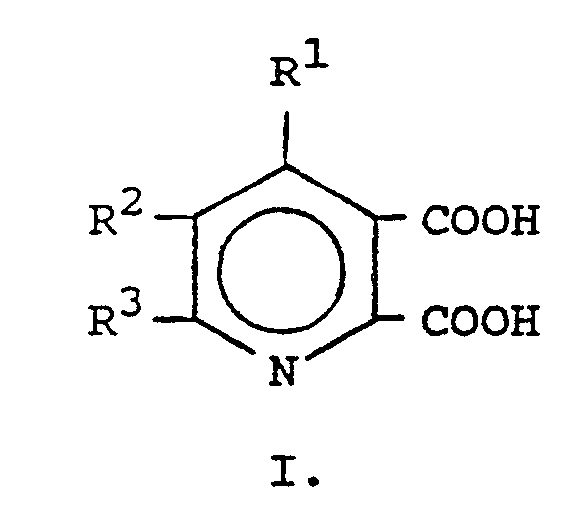
R¹ is hydrogen, alkyl of 1 to 12 carbon atoms, alkoxy of 1 to 12 carbon atoms, halogeno, mercapto, phenyl, or phenoxy;
R², taken independently of R³, is hydrogen, alkyl of 1 to 12 carbon atoms, alkoxy of 1 to 12 carbon atoms, halogeno, mercapto, phenyl, or phenoxy; and
R³, taken independently of R², is hydrogen or alkyl of 1 to 12 carbon atoms, unsubstituted or substituted with halogeno or alkoxy of 1 to 12 carbon atoms, or
R² and R³, taken together, are the residue of an aromatic ring fused to the depicted pyridine ring, and the salts thereof. - According to the process of the present invention, a 2,3-dihydroxybenzoic acid of the formula:

- Throughout this specification reference to the carboxylic acid function is intended to include the anionic form and the salts thereof, as for example the alkali metal, alkaline earth metal, ammonium, and amine salts.
- The 2,3-dihydroxybenzoate-3,4-dioxygenases employed are metapyrocatechases which have been reported in the literature to be present in a variety of naturally occurring microorganisms such as Pseudomonas [see De Frank et al., supra] and Micrococci [see Eaton et al., supra]. In the metabolic pathways of these wild-type species, decarboxylating enzymes also will be present so that the 2-hydroxy-3-carboxymuconic acid semialdehyde produced is quickly converted to 2-hydroxymuconic acid semialdehyde. Moreover it has been found that 2-hydroxy-3-carboxymuconic acid semialdehyde itself is highly labile to chemical decarboxylation so that even if the enzymatic environment is free of active decarboxylase, loss of the 3-carboxy group occurs extremely rapidly if not virtually immediately. The present process therefore requires not only that the enzymatic environment be free of active decarboxylase but that the formation of 2-hydroxy-3-carboxymuconic acid semialdehyde and subsequent reaction with ammonia or a primary amine occur under conditions which minimize chemical decarboxylation.
- Isolation of the enzyme 2,3-dihydroxybenzoate-3,4-dioxygenases free of active decarboxylase can be accomplished by cloning techniques or mutant selection from wild-type species. Mutant selection involves a three step procedure: (i) identification of strains which utilize dihydroxybenzoate as the sole carbon source; (ii) mutagenesis of the strains so isolated; and (iii) mutant selection for the ability to oxidize 2,3-dihydroxybenzoate but a deficiency in its ability to use 2,3-dihydroxybenzoate as a carbon source.
- The first step of the procedure is performed by screening for growth on a minimal salt agar medium containing dihydroxybenzoate, or a precursor such as cumene, phthalate, benzoate, as the sole carbon source to select wild-type strains which utilize 2,3-dihydroxybenzoate as a carbon source.
- In the second step of the procedure, the selected strain is subjected to the action of a physical, chemical, or biological mutagenic agent such as exposure to UV radiation, to chemical agents such as N-methyl-N′-nitroso-N-nitrosoguanidine or ethyl methanesulfonate, or biologically through the use of transposons. See in general, Manual of Methods for General Bacteriology, P. Gerhardt, Ed., American Soc. for Microbiol,, 1981, Chapter 13.
- The third step of the procedure involves mutant enrichment by culturing the mutagenized strain in minimum medium in the presence of dihydroxybenzoate and one or more antibiotics which interfere with formation of normal cell wall structure, such as cycloserine, penicillin, carbenicillin, etc. to select for mutants which are deficient in their ability to use dihydroxybenzoate as a carbon source. Again these general procedures are well known. See Manual of Methods for General Bacteriology, supra.
- Following incubation, viable cells are recovered and cultured on minimal salt agar containing pyruvate and dihydroxybenzoate. This procedure can be repeated several times, although mutants suitable for the present purpose generally are obtained in the first cycle. The desired mutants are readily identified since they are characterized by the production of yellow colored zones around or in the colonies, indicating the accumulation of muconic acid semialdehydes.
- For reasons discussed below, minimal salts media are preferably utilized in all culturing procedures. A typical composition contains 0.6 g/L of disodium phosphate, 0.3 g/L of monopotassium phosphate, 0.5 g/L of sodium chloride, 0.1 g/L of ammonium chloride, 0.1 mmol/L of calcium chloride, and 1mmol/L of magnesium sulfate, in distilled water.
- The enzyme actually used can be isolated from mutants of ubiquitous wild-type microorganisms as described above or expressed by other species such as E. coli which have been modified by recombinant techniques. Thus having selected a suitable source strain as discussed above in step 1, the 2,3-dihydroxybenzoate-3,4-dioxygenase gene can be cloned into another species free of decarboxylase for 2-hydroxy-3-carboxy-6-oxohexa-2,4-dienoic acid.
- From analysis to date, it appears the 2,3-dihydroxybenzoate-3,4-dioxygenase gene is a 1.8 kb SalI fragment contained within a 6.2 kb EcoRI fragment. Enzyme produced by E. coli into which this fragment has introduced has been found to be particularly suitable for use in the process of the present invention since the relevant decarboxylase is not normally present in E. coli.
- The actual enzymatic conversion can be effected either by conventional culturing techniques or by bringing the enzyme into contact with the substrates of Formula II. The enzyme can be free, in form of either a cell free extract or a whole cell preparation, or immobilized on a suitable support or matrix such as a cross-linked dextran or agarose, silica, polyamide, or cellulose, or encapsulated in polyacrylamide, alginates, or fibers. Methods for such immobilization are described in the literature (see, for example, Methods of Enzymology, 44, 1976).
- In addition to the enzyme preparation being free of active decarboxylase, it is also important to conduct the transformation within certain parameters which minimize chemical decarboxylation. Decarboxylation can be monitored by simple UV absorbance measurements since at neutral pH, the desired 2-hydroxy-3-carboxy-6-oxohexa-2,4-dienoic acid has a strong absorbance peak at 340 nm whereas the decarboxylated 2-hydroxy-6-oxohexa-2,4-dienoic acid has a strong absorbance peak at 375 nm. Thus decarboxylation can be quantitatively followed by the disappearance of the peak at 340 nm and appearance of a peak at 375 nm.
- Among the parameters affecting chemical decarboxylation are pH, ionic strength, concentration of metal cations and complex anions, and temperature. The pH should be maintained above about 4 and below about 9, preferably at from about 5 to about 7. At pH 4.4 and a temperature of 52°C, for example, the half-life of 2-hydroxy-3-carboxy-6-oxohexa-2,4-dienoic acid is about 2 minutes and at pH 8 it is about 1.5 minutes at the same temperature. At pH 6, on the other hand, the half-life increase about six fold, to about 13 minutes.
- Moreover, it is desirable to maintain the ionic strength below about 1 molar since the lower the ionic strength, the greater the half-life. Also important is the concentration of metal cations and complex anions. For example, the presence of 1mM of nickel will reduce the half-life by as much as 20%. Use of excessive amounts of buffer, leading to a high concentration of complex ions such as phosphate anions, also has a detrimental effect. Reducing the concentration of sodium phosphate for example from 100 mM to 15 mM produces a 4 to 5 fold increase in half-life. Finally, lower temperature significantly reduces chemical decarboxylation, a reduction of 15°C for example increasing the half-life of 2-hydroxy-3-carboxy-6-oxohexa-2,4-dienoic acid more than four-fold. Desirably the temperature should be below about 50°C. Thus pH, ionic strength, the concentration of metal cations and complex anions, and temperature all have an effect on the rate of chemical decarboxylation. Of these factors, pH, the concentration of complex anions, and temperature appear to be particularly important. By proper selection, it is possible to decrease the rate of decarboxylation to the point at which substantial quantities of the particular 2-hydroxy-3-carboxy-6-oxohexa-2,4-dienoic acid accumulate and can be reacted with a source of ammonia or a primary amine for formation of the desired pyridine dicarboxylic acid. It is to be appreciated that the precise combination of these parameters will vary, depending upon the particular substrate employed, and that some experimentation to arrive at the preferred combination may be necessary. As noted, however, the objective is to minimize decarboxylation and arriving at the optimum conditions for any given embodiment can be readily ascertained with UV spectrophotometric analysis.
- The reaction with a source of ammonia or a primary amine is performed in close temporal proximity to the formation of 2-hydroxy-3-carboxy-6-oxohexa-2,4-dienoic acid. As noted this can occur virtually simultaneously by conducting the enzymatic reaction in the presence of a source of ammonia or a primary amine, or by bring the 2-hydroxy-3-carboxy-6-oxohexa-2,4-dienoic acid into contact with a source of ammonia or a primary amine shortly after formation. Conditions which discourage decarboxylation, as discussed above, should be maintained. Hence the product should not be exposed to excessive temperatures nor to a high concentration of complex anions. It similarly is desirable to avoid conditions during both the early enzymatic processing which can contribute to decarboxylation. For example, excessive use of buffer can contribute to a high concentration of phosphate, leading to an increase in the rate of decarboxylation, as shown above. It is for this reason that minimal salts media should be employed in all culturing procedures.
- Apart from the structural requirements in the 1-, 2-, and 3-positions of the aromatic ring, the starting material can carry a wide variety of substituents in the 5- and 6-positions (R² and R¹, respectively). In addition to hydrogen, each of R¹ and R², independently of the other, can be alkyl of 1 to 12 carbon atoms, alkoxy of 1 to 12 carbon atoms, halogeno, mercapto, phenyl, or phenoxy. Alternatively, R¹ and R², taken together, are the residue of an aromatic ring fused to the depicted ring. Hence, utilizing 3,4-dihydroxynaphthalene-2-carboxylic acid, there is obtained quinoline-2,3-dicarboxylic acid.
- The 4-position of the compounds of Formula II can be unsubstituted (R³ = hydrogen) or can be substituted with alkyl of 1 to 12 carbon atoms, which in turn can be unsubstituted or substituted with halogeno or alkoxy of 1 to 12 carbon atoms.
- Representative starting materials are 2,3-dihydroxybenzoic acid, 2,3-dihydroxy-5-methylbenzoic acid, 2,3-dihydroxy-5-ethylbenzoic acid, 2,3-dihydroxy-5-bromomethylbenzoic acid, 2,3-dihydroxy-5-chloromethylbenzoic acid, 2,3-dihydroxy-5-dibromomethylbenzoic acid, 2,3-dihydroxy-5-dichloromethylbenzoic acid, 3,4-dihydroxy-2-carboxynaphthalene, 2,3-dihydroxy-5-methoxymethylbenzoic acid, 2,3-dihydroxy-5-ethoxymethylbenzoic acid, 2,3-dihydroxy-5-propoxymethylbenzoic acid, and 2,3-dihydroxy-5-isopropoxymethylbenzoic acid. These respectively yield pyridine-2,3-dicarboxylic acid, 5-methylpyridine-2,3-dicarboxylic acid, 5-ethylpyridine-2,3-dicarboxylic acid, 5-bromomethylpyridine-2,3-dicarboxylic acid, 5-chloromethylpyridine-2,3-dicarboxylic acid, 5-dibromomethylpyridine-2,3-dicarboxylic acid, 5-dichloromethylpyridine-2,3-dicarboxylic acid, quinoline-2,3-dicarboxylic acid, 5-methoxymethylpyridine-2,3-dicarboxylic acid, 5-ethoxymethylpyridine-2,3-dicarboxylic acid, 5-propoxymethylpyridine-2,3-dicarboxylic acid, and 5-isopropoxymethylpyridine-2,3-dicarboxylic acid. Use of a primary amine, notably an alkyl amine of 1 to 6 carbon atoms, in place of a source of ammonia leads to generation of the quaternary salt of the pyridine-2,3-dicarboxylic acid. In general it is desirable to add the ammonia in a less basic form. Thus as a source of ammonia, one can employ a salt with a weak, non-interfering acid, such ammonium acetate or ammonium sulfate.
- The preferred starting materials by reason of the commercial value of the final pyridine dicarboxylic acids thus are those in which R¹ and R³ are hydrogen and R² is hydrogen or alkyl of 1 to 6 carbon atoms, unsubstituted or substituted with halo or alkoxy of 1 to 6 carbon atom, particularly those compounds in which R² is hydrogen, methyl, or ethyl.
- The 2,3-dihydroxybenzoic acids of Formula II can be added directly or generated from a suitable precursor such as a phthalic or benzoic acids. Particularly useful in this regard are benzoic acids of the formula:

- The process can be practiced by formation of the 2-hydroxy-3-carboxymuconic acid semialdehyde followed by in situ treatment with ammonium or a primary amine. Alternatively the enzymatic conversion of the 2,3-dihydroxybenzoic acids of Formula II can be conducted in the presence of a source of ammonia, such as an ammonium salt, or of the primary amine. For example, the selected mutant can be cultured in minimal medium containing glucose and a 2,3-dihydroxybenzoic acid of Formula II, the cells then harvested, and the supernatant incubated with ammonium sulfate. Alternatively, the 2,3-dihydroxybenzoic acids of Formula II can be fed into a buffered solution of soluble cell extract containing the enzyme and ammonium sulfate to form the corresponding pyridine dicarboxylic acid directly. Similarly, a 2,3-dihydroxybenzoic acid of Formula II or a precursor therefor can be passed over the immobilized enzyme and the eluant subsequently brought into contact with a source of ammonia such as ammonium sulfate. Alternatively, a 2,3-dihydroxybenzoic acid of Formula II is passed over the immobilized enzyme in the presence of a source of ammonia such as ammonium sulfate or ammonium acetate.
- The following examples will serve to further typify the nature of this invention but should not be construed as a limitation on the scope thereof, which is defined solely by the appended claims.
- Soil samples are used to inoculate minimal salts agar medium containing 5mM of 2,3-dihydroxybenzoic acid as the sole carbon source. Numerous isolates are thereby obtained. Typical are two Pseudomonas strains (labelled CEL 449 and CEL 3504) which are Gram negative rods producing a fluorescent pigment on King's B medium.
- CEL 449 is mutagenized by centrifuging a 5ml sample of a culture (grown to exponential phase in LB broth), suspending the isolated cells in 5ml of 0.1M sodium citrate (pH 5.5) and 5 µg/ml of N-methyl-N′-nitroso-N-nitrosoguanidine for 30 minutes, and washing the cells.
- Minimal salts medium containing 5mM of 2,3-dihydroxybenzoic acid, 1mg/ml of carbenicillin, and 100µg/ml of D-cycloserine are inoculated with the washed cells and incubated for 15 hours. The cells are collected by centrifugation and washed with distilled water. Viable cells are recultured in minimal medium containing 10 mM of pyruvate. The mutagenesis/mutant enrichment steps can be repeated, although suitable mutants generally are obtained on the first cycle. The cell culture is spread onto minimal salts agar medium containing 1 mM of pyruvate and 5 mM of 2,3-dihydroxybenzoic acid. This is incubated at 30°C and colonies which grow are transferred to minimal salts agar medium containing 1 mM of pyruvate and 5 mM of 2,3-dihydroxybenzoic acid and those colonies which produced a yellow color are selected for their inability to utilize 2,3-dihydroxybenzoic acid as a carbon source. One colony (over 60 such colonies can be identified) produced by the foregoing method was designated CEL 454.
- A second strain, designated CEL 464, was produced by repeating the foregoing procedures but utilizing CEL 3504 as the source strain.
- CEL 454 is cultured for 16 hours in 500 mL. of LB broth containing 30 mM of pyruvate. One millimolar dihydroxybenzoate is added and the culture is further incubated for 30°C for two hours. The cells are washed, harvested by centrifugation, and lysed in a French press. Cell debris is removed by ultracentrifugation at 100,000 xg at 4°C for two hours to yield soluble cell extract which is stable for several months when stored at -85°C.
- Two milliliters of soluble cell extract are added to 25 mL of 10 mM of sodium phosphate buffer (pH 7.0) and 10 mM of ammonium sulfate. Into this is fed a stock solution of 250 mM of sodium dihydroxybenzoate at a rate of approximately 1 mM/hour. After approximately 24 hours, the reaction is terminated (by addition of 100 µg/ml of proteinase K). Chromatographic analysis indicates 4.1 mM of pyridine-2,3-dicarboxylic acid, approximately 668 mg/L, had accumulated.
- CEL 464 is grown in 1 L of minimal medium containing 20 mM of glucose for approximately 15 hours. One millimole of 2,3-dihydroxybenzoic acid is added and the culture incubated for 2 hours. The cells are harvested by centrifugation, concentrated 20-fold in 10 mM phosphate buffer, 10 mM of 2,3-dihydroxybenzoic acid, and 50 mM of ammonium sulfate, and incubated aerobically for six hours at 30°C. After removal of the cells by centrifugation, the supernatant contains 4.0 mM of pyridine-2,3-dicarboxylic acid.
- CEL 3504 is cultured for 16 hours in 500 mL. of LB broth, harvested by centrifugation, and washed with M9 minimal salts solution {Miller, Experiments in Molecular Genetics, Cold Spring Harbor Laboratory, Cold Spring Harbor, NY, (1987)}. The cell pellets are suspended in 50 mM of Tris-HCl (pH 8.0) containing 25% sucrose to give a final volume of 8.0 mL, to which 5.0 mL of lysozyme (4 mg/mL in 0.25 M sodium ethylenediaminetetraacetic acid at pH 8.0) are added. This mixture is incubated on ice for five minutes and 4.5 mL of 2% Triton X-100 in 50 mM of Tris-HCl (pH 8.0) and 60 mM of sodium ethylenediaminetetraacetic acid are added and mixed by inversion. After incubation for 16 hours at 4°C, cell debris was removed by centrifugation at 27,000 xg at 4°C.
- To the supernatant are added 6 mL of 5M sodium chloride solution and 7.5 mL of 40% of polyethylene glycol 4000 in 50 mM of Tris-HCl and 20 mM of sodium ethylenediaminetetraacetic acid and the whole mixed by inversion and incubated for 16 hours at 4°C. The DNA is pelleted by centrifugation at 3,000 xg at 4°C, suspended in 10 mM Tris-HCl (pH 8.0) containing 1 mM of sodium ethylenediaminetetraacetic acid and 170 mM of sodium chloride, and purified by cesium chloride gradient centrifugation. The single chromosomal DNA band is pulled from the gradient tube, ethidium bromide is ex tracted with isopropanol saturated with cesium chloride, and the DNA dialysed in 10 mM Tris-HCl (pH 8.0) and 1 mM of sodium ethylenediaminetetraacetic acid.
- Plasmid vector pUC19 (Norrander et al., Gene, 26, 101-106) from E. coli HB101 is purified using the procedure of Maniatis et al., Molecular Cloning: a Laboratory Manual, Cold Spring Harbor Laboratory, Cold Spring Harbor, NY, (1982). The purified CEL 3504 DNA and pUC19 DNA are digested with restriction enzyme EcoR and ligated with T4 DNA ligase. Competent cells of E. coli DH5α are transformed selecting ampicillin resistance on LB agar medium (Miller, supra) containing 100 µg/mL of ampicillin, 0.1 mM of isopropylthio-β-D-galactoside, and 250 µg/mL of 5-bromo-4-chloro-3-indolyl-β-D-galactoside.
- White colonies unable to express β-galactosidase are patched to M9 minimal salts agar containing 100 µg/mL of ampicillin, 0.1 mM of isopropylthio-β-D-galactoside, and 1 µg/mL of thiamine. The plates are incubated for 48 hours at 37°C and then sprayed with a solution of 0.25 M 2,3-dihydroxybenzoate. Patches of cell growth producing a yellow zone are restreaked onto LB agar containing ampicillin to yield the desired recombinant E. coli strain.
- Plasmid DNA isolated from such selected strains (pCE41 isolated from CEL 194) is purified by cesium chloride gradient centrifugation and analyzed by restriction enzyme digestion. A 6.2 kb EcoRI fragment carries the 2,3-dihydroxybenzoate-3,4-dioxgenase gene.
- CEL 194(pCE4l) is grown aerobically at 37°C on a liquid medium containing 10g/L of bactotryptone, 5 g/L of yeast extract, 10g/L of sodium chloride, 0.1 mg/L of ampicillin, and 0.1 mmol/L of isopropylthio-β-D-galactoside. Cells are harvested by centrifugation at the end of exponential growth, resuspended in 10 mL of 10 mM sodium phosphate buffer (pH 6.8), and incubated aerobically at 37°C.
- 2,3-Dihydroxybenzoate (0.1 mM) then is added. Within twenty minutes, UV spectrophotometry indicates a strong band at 340 nm with no band at 375 nm, indicating the formation of 2-hydroxy-3-carboxymuconic acid semialdehyde with no decarboxylation. Removal of cells by centrifugation provides a solution of 2-hydroxy-3-carboxymuconic acid semialdehyde in 10 mM phosphate buffer. The following table exemplifies the effect of various parameters on the half-life of 2-hydroxy-3-carboxymuconic acid semialdehyde, decarboxylation being monitored by the disappearance of the 340 nm absorbance and the appearance of the 375 nm absorbance. In each case, the variable is underlined.

- CEL 194(pCE41) is cultured for 16 hours at 37°C in 500 mL. of LB broth containing 100 µg/mL of ampicillin and 0.1 mM of isopropylthio-β-D-galactoside. The cells are harvested by centrifugation, washed, suspended in 10 mM of sodium phosphate buffer (pH 7.5), and lysed in a French press. Cell debris is removed by ultracentrifugation at 100,000 xg at 4°C for two hours to yield soluble cell extract.
- Two milliliters of soluble cell extract are added to 18 mL of 10 mM of sodium phosphate buffer (pH 7.5), 10 mM of ammonium sulfate, and 0.5 mM of 2,3-dihydroxybenzoate in a 20 mL reactor. The mixture is incubated with stirring at 30°C with additional 2,3-dihydroxybenzoate being added at a rate of approximately 10 µm/hour. After 16 hours, approximately 535 mg/L of pyridine-2,3-dicarboxylic acid accumulate.
- CEL 194(pCE41) is cultured in 4 L of LB medium at 37°C for 16 hours. The cells are harvested by centrifugation and used to inoculate 400 mL of 1 mM Trisacetate buffer containing 10 mM of ammonium acetate in a fermenter. The culture is incubated at 37°C with aeration, maintaing a pH of 8.0 by addition of acetic acid or ammonium hydroxide as necessary. 2,3-Dihydroxybenzoic acid is introduced at a rate of 30 µmol/min. After 17 hours, pyridine-2,3-dicarboxylic acid has accumulated to a concentration of 418 mg/L.
- The microorganisms referred to herein have been deposited with the the ATCC as follows:
CEL Designation ATCC No. CEL 449 53,886 CEL 454 53,887 CEL 464 53,888 CEL 3504 53,889 CEL 194 (pCE41) 67,924
Claims (14)
1. Process for the preparation of a pyridine-2,3-dicarboxylic acid of the formula:
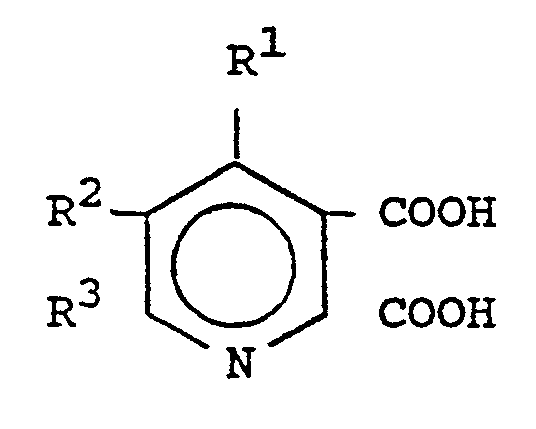
in which:
R¹ is hydrogen, alkyl of 1 to 12 carbon atoms, alkoxy of 1 to 12 carbon atoms, halogeno, mercapto, phenyl, or phenoxy;
R², taken independently of R³, is hydrogen, alkyl of 1 to 12 carbon atoms, alkoxy of 1 to 12 carbon atoms, halogeno, mercapto, phenyl, or phenoxy; and
R³, taken independently of R², is hydrogen or alkyl of 1 to 12 carbon atoms, unsubstituted or substituted with halogeno or alkoxy of 1 to 12 carbon atoms, or
R² and R³, taken together, are the residue of an aromatic ring fused to the depicted pyridine ring which comprises subjecting a 2,3-dihydroxybenzoic acid of the formula: 
in which R¹, R², and R³ are as herein defined,
to the action of 2,3-dihydroxybenzoate-3,4-dioxygenase in a liquid medium lacking active decarboxylase and having a pH from 4 to 9, an ionic strength below about 1 molar, and a low concentration of metal cations and complex anions, to accumulate 2-hydroxy-3-carboxymuconic acid semialdehyde, and in sufficiently close temporal proximity to avoid substantial decarboxylation, reacting the 2-hydroxy-3-carboxymuconic acid semialdehyde thus formed with a source of ammonia or a primary amine.
R¹ is hydrogen, alkyl of 1 to 12 carbon atoms, alkoxy of 1 to 12 carbon atoms, halogeno, mercapto, phenyl, or phenoxy;
R², taken independently of R³, is hydrogen, alkyl of 1 to 12 carbon atoms, alkoxy of 1 to 12 carbon atoms, halogeno, mercapto, phenyl, or phenoxy; and
R³, taken independently of R², is hydrogen or alkyl of 1 to 12 carbon atoms, unsubstituted or substituted with halogeno or alkoxy of 1 to 12 carbon atoms, or
R² and R³, taken together, are the residue of an aromatic ring fused to the depicted pyridine ring which comprises subjecting a 2,3-dihydroxybenzoic acid of the formula:
to the action of 2,3-dihydroxybenzoate-3,4-dioxygenase in a liquid medium lacking active decarboxylase and having a pH from 4 to 9, an ionic strength below about 1 molar, and a low concentration of metal cations and complex anions, to accumulate 2-hydroxy-3-carboxymuconic acid semialdehyde, and in sufficiently close temporal proximity to avoid substantial decarboxylation, reacting the 2-hydroxy-3-carboxymuconic acid semialdehyde thus formed with a source of ammonia or a primary amine.
2. The process according to claim 1 wherein said 2,3-dihydroxybenzoic acid is subjected to the action of a 2,3-dihydroxybenzoate-3,4-dioxygenase in the presence of ammonia.
3. The process according to claim 1 said 2,3-dihydroxybenzoate-3,4-dioxygenase has been expressed by a recombinant vector which does not express active decarboxylase for 2-hydroxy-3-carboxymuconic acid semialdehyde.
4. The process according to claim 1 wherein said 2,3-dihydroxybenzoate-3,4-dioxygenase is unbound in the form of a whole-cell or cell-free preparation.
5. The process according to claim 1 wherein said 2,3-dihydroxybenzoate-3,4-dioxygenase is immobilized on a support.
6. The process according to claim 1 wherein R¹ and R³ are hydrogen and R² is hydrogen or alkyl of 1 to 6 carbon atoms, unsubstituted or substituted with halo or alkoxy of 1 to 6 carbon atoms.
7. The process according to claim 6 wherein said 2,3-dihydroxybenzoic acid is selected from the group consisting of (i) a 2,3-dihydroxybenzoic acid which is 2,3-dihydroxybenzoic acid, 2,3-dihydroxy-5-methylbenzoic acid, 2,3-dihydroxy-5-ethylbenzoic acid, 2,3-dihydroxy-5-bromomethylbenzoic acid, 2,3-dihydroxy-5-chloromethylbenzoic acid, 2,3-dihydroxy-5-dibromomethylbenzoic acid, 2,3-dihydroxy-5-dichloromethylbenzoic acid, 3,4-dihydroxy-2-carboxynaphthalene, 2,3-dihydroxy-5-methoxymethylbenzoic acid, 2,3-dihydroxy-5-ethoxymethylbenzoic acid, 2,3-dihydroxy-5-propoxymethylbenzoic acid, or 2,3-dihydroxy-5-isopropoxymethylbenzoic acid, and (ii) biological precursors therefor.
8. The process according to claim 7 wherein said 2,3-dihydroxybenzoic acid is 2,3-dihydroxybenzoic acid.
9. The process according to claim 7 wherein said 2,3-dihydroxybenzoic acid is 2,3-dihydroxy-5-ethylbenzoic acid.
10. The process according to claim 1 wherein the temperature is maintained below about 50°C.
11. The process according to claim 1 wherein the concentration of complex anions is below about 100 mM.
12. The process according to claim 11 wherein the concentration of phosphate anions is below about 100 mM.
13. The process according to claim 1 wherein said 2,3-dihydroxybenzoic acid is generated from a benzoic acid of the formula:

in which R¹, R², and R³ are as herein defined,
is subjected to the action of a 2,3-oxygenase under enzymatically reactive conditions.
is subjected to the action of a 2,3-oxygenase under enzymatically reactive conditions.
14. A recombinant microorganism which produces 2,3-dihydroxybenzoate-3,4-dioxygenase but does not produce active decarboxylase for 2-hydroxy-3-carboxymuconic acid semialdehyde.
Applications Claiming Priority (2)
| Application Number | Priority Date | Filing Date | Title |
|---|---|---|---|
| US07/332,339 US5166060A (en) | 1989-03-31 | 1989-03-31 | Process for the preparation of pyridine-2,3-dicarboxylic acids |
| US332339 | 1989-03-31 |
Publications (2)
| Publication Number | Publication Date |
|---|---|
| EP0390102A2 true EP0390102A2 (en) | 1990-10-03 |
| EP0390102A3 EP0390102A3 (en) | 1992-02-26 |
Family
ID=23297786
Family Applications (1)
| Application Number | Title | Priority Date | Filing Date |
|---|---|---|---|
| EP19900105892 Withdrawn EP0390102A3 (en) | 1989-03-31 | 1990-03-28 | Process for the preparation of pyridine-2,3-dicarboxylic acids |
Country Status (6)
| Country | Link |
|---|---|
| US (1) | US5166060A (en) |
| EP (1) | EP0390102A3 (en) |
| JP (1) | JPH03218358A (en) |
| AU (1) | AU5241690A (en) |
| CA (1) | CA2012680A1 (en) |
| IL (1) | IL93796A0 (en) |
Cited By (1)
| Publication number | Priority date | Publication date | Assignee | Title |
|---|---|---|---|---|
| WO2016202875A1 (en) * | 2015-06-15 | 2016-12-22 | Biome Bioplastics Limited | Process for the preparation of 2,4- or 2,5-pyridinedicarboxylic acid and copolymers derived therefrom |
Families Citing this family (3)
| Publication number | Priority date | Publication date | Assignee | Title |
|---|---|---|---|---|
| US5264362A (en) * | 1991-03-18 | 1993-11-23 | Lonza Ltd. | Microbiological process for the production of 6-hydroxynicotinic acid |
| US5266469A (en) * | 1991-03-18 | 1993-11-30 | Lonza Ltd. | Microbiological process for the production of 6-hydroxynicotinic acid |
| WO2012081084A1 (en) * | 2010-12-14 | 2012-06-21 | 株式会社ジナリス | Novel microorganism and method for producing 2,3-dihydroxybenzoic acid and salicylic acid using same |
Family Cites Families (3)
| Publication number | Priority date | Publication date | Assignee | Title |
|---|---|---|---|---|
| US4535059A (en) * | 1983-01-13 | 1985-08-13 | Celanese Corporation | Muconic acid productivity by a stabilized mutant microorganism population |
| US4654303A (en) * | 1983-09-15 | 1987-03-31 | Celanese Corporation | Construction of novel mutant microorganisms |
| US4617156A (en) * | 1984-02-22 | 1986-10-14 | Celanese Corporation | 2-hydroxymuconic semialdehyde bisulfite adduct |
-
1989
- 1989-03-31 US US07/332,339 patent/US5166060A/en not_active Expired - Fee Related
-
1990
- 1990-03-19 IL IL93796A patent/IL93796A0/en unknown
- 1990-03-21 CA CA002012680A patent/CA2012680A1/en not_active Abandoned
- 1990-03-28 EP EP19900105892 patent/EP0390102A3/en not_active Withdrawn
- 1990-03-30 JP JP2084747A patent/JPH03218358A/en active Pending
- 1990-03-30 AU AU52416/90A patent/AU5241690A/en not_active Abandoned
Cited By (4)
| Publication number | Priority date | Publication date | Assignee | Title |
|---|---|---|---|---|
| WO2016202875A1 (en) * | 2015-06-15 | 2016-12-22 | Biome Bioplastics Limited | Process for the preparation of 2,4- or 2,5-pyridinedicarboxylic acid and copolymers derived therefrom |
| US10612057B2 (en) | 2015-06-15 | 2020-04-07 | Biome Bioplastics Limited | Process for the preparation of 2,4- or 2,5-pyridinedicarboxylic acid and copolymers derived therefrom |
| US11807886B2 (en) | 2015-06-15 | 2023-11-07 | Biome Bioplastics Limited | Process for the preparation of copolymers derived from 2,4- or 2,5-pyridinedicarboxylic acid |
| US12454710B2 (en) | 2015-06-15 | 2025-10-28 | Biome Bioplastics Limited | Process for the preparation of 2,4- or 2,5-pyridinedicarboxylic acid and copolymers derived therefrom |
Also Published As
| Publication number | Publication date |
|---|---|
| IL93796A0 (en) | 1990-12-23 |
| JPH03218358A (en) | 1991-09-25 |
| CA2012680A1 (en) | 1990-09-30 |
| AU5241690A (en) | 1990-10-04 |
| EP0390102A3 (en) | 1992-02-26 |
| US5166060A (en) | 1992-11-24 |
Similar Documents
| Publication | Publication Date | Title |
|---|---|---|
| Pouyssegur et al. | Genetic control of the 2-keto-3-deoxy-d-gluconate metabolism in Escherichia coli K-12: kdg regulon | |
| Ichikawa et al. | The isolation and properties of Pseudomonas mutants with an enhanced productivity of 7 β-(4-carboxybutanamido)-cephalosporanic acid acylase | |
| US5166060A (en) | Process for the preparation of pyridine-2,3-dicarboxylic acids | |
| JP3694065B2 (en) | Biotechnological process for producing cyclic S-α-aminocarboxylic acid and R-α-aminocarboxamide | |
| CZ297887B6 (en) | Process for preparing enantiomer of (1R, 4S)- or (1S, 4R)-1-amino-4-(hydroxymethyl)-2-cyclopentene derivative and (1R, 4S)-N-butyryl-1-amino-4-(hydroxymethyl)-2-cyclopentene enantiomer | |
| KR100274205B1 (en) | Microbiological process for hydroxylation of nitrogen-heterocyclic-carboxylic acids | |
| CA1237997A (en) | Construction of novel mutant microorganisms | |
| CZ279492B6 (en) | Microbiological process for producing 6-hydroxypicolic acid | |
| US5436145A (en) | Process for preparing 6-hydroxy nitrogen-containing 6-membered ring compounds | |
| US5284767A (en) | Microorganisms useful for the production of hydroxylated heterocycles | |
| US6090616A (en) | Microorganism, lactamase enzyme obtained therefrom, and their use | |
| US5308765A (en) | Esterase genes, esterase, recombinant plasmids and transformants containing the recombinant plasmid and methods of producing optically acitve carboxylic acids and their enantiomeric esters using said transformants | |
| US5110943A (en) | Certain phenoxy (or 5-trifluoromethyl-pyridyl-oxy)-phenoxy-2-yl-propane derivatives | |
| US5702930A (en) | Microbiological process for the preparation of heteroaromatic carboxylic acids using Alcaligenes faecalis | |
| EP0268331B1 (en) | Microbial preparation of catechols | |
| US4673646A (en) | Production of 2-hydroxymuconic semialdehyde | |
| US5270203A (en) | Biologically pure culture of Alcaligenes faecalis DSM 6335 | |
| KR100273731B1 (en) | Method for preparing 2,5-dihydroxyphenylacetic acid | |
| US5264361A (en) | Microbiological process for the production of 6-hydroxypicolinic acid | |
| US5955328A (en) | Fermentative preparation of 2,5-dihydroxyphenylacetic acid with Beauveria | |
| US4666841A (en) | Production of picolinic acid and pyridine products | |
| US4617156A (en) | 2-hydroxymuconic semialdehyde bisulfite adduct | |
| CZ76393A3 (en) | Micro-biological process for preparing derivatives of malonyl-7-aminocephalosporanic acid | |
| KR100265673B1 (en) | Method for preparing halogenated hydroxyphenylacetic acids | |
| KR100216996B1 (en) | Microbiological preparation of 6-hydroxynicotinic acid |
Legal Events
| Date | Code | Title | Description |
|---|---|---|---|
| PUAI | Public reference made under article 153(3) epc to a published international application that has entered the european phase |
Free format text: ORIGINAL CODE: 0009012 |
|
| AK | Designated contracting states |
Kind code of ref document: A2 Designated state(s): AT BE CH DE DK ES FR GB GR IT LI LU NL SE |
|
| PUAL | Search report despatched |
Free format text: ORIGINAL CODE: 0009013 |
|
| AK | Designated contracting states |
Kind code of ref document: A3 Designated state(s): AT BE CH DE DK ES FR GB GR IT LI LU NL SE |
|
| STAA | Information on the status of an ep patent application or granted ep patent |
Free format text: STATUS: THE APPLICATION IS DEEMED TO BE WITHDRAWN |
|
| 18D | Application deemed to be withdrawn |
Effective date: 19920827 |