EP0382602A1 - Vitrage prêt à la pose et procédé de fabrication - Google Patents
Vitrage prêt à la pose et procédé de fabrication Download PDFInfo
- Publication number
- EP0382602A1 EP0382602A1 EP90400275A EP90400275A EP0382602A1 EP 0382602 A1 EP0382602 A1 EP 0382602A1 EP 90400275 A EP90400275 A EP 90400275A EP 90400275 A EP90400275 A EP 90400275A EP 0382602 A1 EP0382602 A1 EP 0382602A1
- Authority
- EP
- European Patent Office
- Prior art keywords
- glazing
- adhesive bead
- ready
- joint
- conductive strip
- Prior art date
- Legal status (The legal status is an assumption and is not a legal conclusion. Google has not performed a legal analysis and makes no representation as to the accuracy of the status listed.)
- Granted
Links
Images

Classifications
-
- B—PERFORMING OPERATIONS; TRANSPORTING
- B32—LAYERED PRODUCTS
- B32B—LAYERED PRODUCTS, i.e. PRODUCTS BUILT-UP OF STRATA OF FLAT OR NON-FLAT, e.g. CELLULAR OR HONEYCOMB, FORM
- B32B17/00—Layered products essentially comprising sheet glass, or glass, slag, or like fibres
- B32B17/06—Layered products essentially comprising sheet glass, or glass, slag, or like fibres comprising glass as the main or only constituent of a layer, next to another layer of a specific material
- B32B17/10—Layered products essentially comprising sheet glass, or glass, slag, or like fibres comprising glass as the main or only constituent of a layer, next to another layer of a specific material of synthetic resin
- B32B17/10005—Layered products essentially comprising sheet glass, or glass, slag, or like fibres comprising glass as the main or only constituent of a layer, next to another layer of a specific material of synthetic resin laminated safety glass or glazing
- B32B17/10165—Functional features of the laminated safety glass or glazing
- B32B17/10174—Coatings of a metallic or dielectric material on a constituent layer of glass or polymer
-
- B—PERFORMING OPERATIONS; TRANSPORTING
- B29—WORKING OF PLASTICS; WORKING OF SUBSTANCES IN A PLASTIC STATE IN GENERAL
- B29C—SHAPING OR JOINING OF PLASTICS; SHAPING OF MATERIAL IN A PLASTIC STATE, NOT OTHERWISE PROVIDED FOR; AFTER-TREATMENT OF THE SHAPED PRODUCTS, e.g. REPAIRING
- B29C45/00—Injection moulding, i.e. forcing the required volume of moulding material through a nozzle into a closed mould; Apparatus therefor
- B29C45/14—Injection moulding, i.e. forcing the required volume of moulding material through a nozzle into a closed mould; Apparatus therefor incorporating preformed parts or layers, e.g. injection moulding around inserts or for coating articles
- B29C45/14336—Coating a portion of the article, e.g. the edge of the article
- B29C45/14434—Coating brittle material, e.g. glass
-
- B—PERFORMING OPERATIONS; TRANSPORTING
- B32—LAYERED PRODUCTS
- B32B—LAYERED PRODUCTS, i.e. PRODUCTS BUILT-UP OF STRATA OF FLAT OR NON-FLAT, e.g. CELLULAR OR HONEYCOMB, FORM
- B32B17/00—Layered products essentially comprising sheet glass, or glass, slag, or like fibres
- B32B17/06—Layered products essentially comprising sheet glass, or glass, slag, or like fibres comprising glass as the main or only constituent of a layer, next to another layer of a specific material
- B32B17/10—Layered products essentially comprising sheet glass, or glass, slag, or like fibres comprising glass as the main or only constituent of a layer, next to another layer of a specific material of synthetic resin
- B32B17/10005—Layered products essentially comprising sheet glass, or glass, slag, or like fibres comprising glass as the main or only constituent of a layer, next to another layer of a specific material of synthetic resin laminated safety glass or glazing
- B32B17/10009—Layered products essentially comprising sheet glass, or glass, slag, or like fibres comprising glass as the main or only constituent of a layer, next to another layer of a specific material of synthetic resin laminated safety glass or glazing characterized by the number, the constitution or treatment of glass sheets
- B32B17/10036—Layered products essentially comprising sheet glass, or glass, slag, or like fibres comprising glass as the main or only constituent of a layer, next to another layer of a specific material of synthetic resin laminated safety glass or glazing characterized by the number, the constitution or treatment of glass sheets comprising two outer glass sheets
-
- B—PERFORMING OPERATIONS; TRANSPORTING
- B60—VEHICLES IN GENERAL
- B60J—WINDOWS, WINDSCREENS, NON-FIXED ROOFS, DOORS, OR SIMILAR DEVICES FOR VEHICLES; REMOVABLE EXTERNAL PROTECTIVE COVERINGS SPECIALLY ADAPTED FOR VEHICLES
- B60J10/00—Sealing arrangements
- B60J10/70—Sealing arrangements specially adapted for windows or windscreens
Definitions
- the present invention relates to a glazing ready for installation, which can be mounted in an automotive body bay, or disassembled from said bay by heating with a thermoplastic adhesive bead.
- Glazing ready for installation for example windshields or rear glasses of motor vehicles, which can be assembled and disassembled by heating with a thermoplastic adhesive bead
- a thermoplastic adhesive bead for example from the publication of French patent FR-A-2508267 .
- This document describes a glazing which has along its periphery an electrically conductive strip on which the thermoplastic adhesive bead is applied.
- a suitable current source for mounting the glazing in the body bay, it is sufficient to connect the conductive strip to a suitable current source.
- the heat produced softens the adhesive bead which can stick to the frame of the body bay.
- To dismantle the window glazing in the event of replacement of the glazing for example, it is sufficient again to connect the conductive strip to a current source in order to heat and soften the cord to detach the glazing from the frame of the opening.
- the glazing ready for installation described above is not entirely satisfactory because when it is glued to the frame, there remains between the periphery of the glazing and the vehicle body a gap which must be filled with a molding or a gasket. finish.
- the glazing described in this document comprises all around its periphery, a flexible plastic finishing joint, partially covering the interior face of the glazing, the adhesive bead being placed against this joint, and an electrically resistant metallic element, partially embedded in the finishing joint and partly in the adhesive bead made of a thermoplastic material which can be heated by the Joule effect up to its softening temperature.
- the installation of the glazing does not require any additional finishing operation, on the other hand, the installation of the finishing joint around the glazing always requires delicate manual operations during the manufacture of the glazing. In addition, depending on the profile of the finishing joint, it may be necessary to use an additional layer of adhesive to adhere this joint to the surface of the glazing.
- the invention proposes glazing which overcomes the aforementioned drawbacks. It offers glazing ready for installation, which not only can be assembled and disassembled automatically, without manual intervention, but which, moreover, can be easily manufactured without the delicate operation of mounting the finishing joint on the periphery of the glazing.
- the monolithic or laminated glazing in accordance with the invention, comprises on its periphery, an electrically conductive strip capable of heating a thermoplastic adhesive bead, and a finishing joint which is in intimate contact with the periphery of the glazing and which is obtained by encapsulation glazing.
- the encapsulation of the glazing or overmolding of the finishing seal not only eliminates the manual intervention of mounting the seal, but also provides a natural adhesion of said seal to the glazing and it is no longer necessary to use an additional adhesive layer.
- the electrically conductive strip can be a metallic resistance partially or totally embedded in the adhesive bead. In this case, preferably, it can be deposited by a known method of co-extrusion on the around the glazing.
- the profile of the conductive strip can have various shapes.
- the conductive strip is a strip which runs along the periphery of the glazing and which is deposited directly on the glass surface.
- this strip can be obtained by the known method using the deposition of a conductive paste by screen printing, followed by baking, baking which generally merges with the heat treatment necessary for bending and / or tempering the glazing.
- the conductive strip on the surface of the glass can also be obtained by other known metallization methods, for example by the method of spraying molten metals or the metallization method under vacuum.
- the conductive strip can also be stuck on the glass, using a suitable adhesive.
- the adhesive bead can be deposited by extrusion, optionally by coextrusion at the same time as the conductive strip, after manufacture by overmolding of the finishing joint. We can then advantageously use the extra thickness of the finishing joint to deposit the adhesive bead.
- the adhesive bead can be deposited on the glazing before the molding of the finishing joint. It is then possible in this variant, advantageously, to use the adhesive bead as a flexible overmolding seal as described in more detail below.
- the material constituting the finishing joint, obtained by overmolding can be a thermoplastic material, for example polyamide, polyvinyl chloride, a thermoplastic polyurethane, ABS, or a thermosetting material, for example a thermoplastic polyurethane, an elastomer such as EPDM, etc ...
- a thermoplastic material for example polyamide, polyvinyl chloride, a thermoplastic polyurethane, ABS, or a thermosetting material, for example a thermoplastic polyurethane, an elastomer such as EPDM, etc ...
- the finishing joint can be obtained by an overmolding which uses a pressure injection of the molten plastic material (thermoplastic injection).
- Overmolding can also use reactive injection, that is to say the injection of a mixture of reaction components which react in the mold to force the plastic.
- the invention also relates to a method for manufacturing a glazing ready for installation, in which the finishing joint is produced by encapsulating the glazing.
- the adhesive bead is used as a flexible overmolding seal.
- the overmolding of the glazing requires the use of a flexible seal which serves to determine the limit of the overmolding of the plastic material on the glazing.
- This flexible joint must have an elasticity in a direction substantially perpendicular to the surface of the glazing, while having sufficient rigidity to withstand the injection pressure.
- the adhesive bead previously deposited on the glazing is used as flexible joint.
- a judicious choice, but within the reach of those skilled in the art for the material constituting the cord, allows the latter to fulfill this additional function of flexible joint.
- To improve the mechanical strength of the adhesive bead in its function of flexible joint advantageously uses the already described variant of the bead containing the heating resistance.
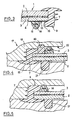
- the glazing shown in Figure 1 is a laminated glazing 1, formed of two glass sheets 2, 3 and an intermediate layer 4.
- the face of the glass sheet interior 3 intended to be oriented towards the interior of the passenger compartment, carries on its periphery a strip 5 formed of a metallic layer electrically conductive.
- This strip 5 is obtained by screen printing by depositing a conductive paste, cooked during the heat treatment necessary for bending the glazing.
- the glazing On the conductive strip, the glazing has an adhesive bead 6, deposited by extrusion directly on the glazing.
- a profile 7 obtained by encapsulation (or overmolding) of the glazing surrounds the entire edge or periphery of the glazing (ends of the faces and edges of the glazing) and acts as a finishing joint. This finishing joint is in contact with the entire periphery of the glazing, to which it naturally adheres, due to its manufacturing process.
- the laminated glazing produced beforehand is first overmolded, for example by implementing the method described in European patent publication EP-A-0 127 546.
- the adhesive bead 6 At the exit of the encapsulation mold, the adhesive bead 6 is deposited by extrusion, for example using an industrial robot.
- the thickness of the adhesive bead 6 must be greater than the thickness of the part 8 of the encapsulation joint 7 covering the internal face of the glazing.
- the base 9 of the encapsulation seal can be used as a shim, when the adhesive seal is crushed, when the glazing is mounted in the bodywork bay. This base is then preferably straight, that is to say substantially parallel to the edge of the internal face of the glazing.
- the side 10 intended to be oriented towards the bodywork carries several elastic sealing lips 11 which, when the glazing is in the position mounted in the bodywork bay (not shown) are applied against it.
- the outer part 12 of the finishing joint is thin and profiled.
- the glazing ready for installation is a laminated glazing formed by two sheets of glass 2 and 3 and an intermediate layer 4.
- the sheet of the inner glass sheet 3 intended to be oriented towards the passenger compartment has a border 13, based on an enamel, generally a black enamel, which fulfills a function aesthetic by hiding the bead of glue from view and possibly a protective function for the bonding between UV radiation
- the encapsulation profile 7 is first formed by overmolding the laminated glazing, then on the overmolded glazing, the adhesive seal 14 and its internal metal strip 15 serving as electrical resistance are deposited directly by coextrusion.
- the adhesive bead 14 and its internal metal strip 15 can be formed by coextrusion, independently of the glazing, and the preformed bead is then deposited on the overmolded glazing.
- the glazing ready for installation shown in FIG. 3, is a laminated glazing formed from two glass sheets 2, 3 and an intermediate layer 4.
- the face of the inner glass sheet, intended to be oriented towards the passenger compartment has an edge 13 based on an enamel as in the glazing described above.
- the adhesive bead 14 contains a metal strip 15 forming the electrical resistance necessary for heating the bead during assembly.
- the adhesive bead 14 is separated from the finishing joint 7 obtained by overmolding by a space 16 corresponding to the width of the sealing joint used during overmolding delimiting the surface of the edge of the glazing to be overmolded.
- This glazing ready for installation can be manufactured by first depositing the adhesive bead 14 and the heating resistor 15 by coextrusion and then by manufacturing the finishing joint 7 by overmolding by using a mold as shown in FIG. 4.
- the prior deposition of the adhesive bead 14 makes it possible to use the heating necessary for the molding operation to improve the adhesion of the bead with the glass (or the enamel).
- FIG. 4 there is shown in section, the mold 17 used for the manufacture of a glazing unit described in relation to FIG. 3.
- the glazing unit already provided with the adhesive bead 14 and the heating resistor 15 is placed between the two parts 18, 19 of the mold.
- the seal 20 belonging to the upper part 18 of the mold is arranged just near the adhesive bead 14.
- the width of this seal corresponds to the space 16 mentioned above.
- the other seal 21 is embedded in the lower part 19 of the mold.
- the peripheral space between the two parts of the mold, the glazing and the seals, is filled by injection of the material capable of forming the finishing seal 7.
- Figure 5 there is shown in section the mold used for the manufacture of a glazing as described in relation to Figure 3, but first forming the adhesive bead 14 by coextrusion with the conductive metal strip 15 and in then serving as this bead as a seal for the overmolding operation of the glazing to form the finish seal.
- the other elements of the mold are similar to those described above, apart from the lower face 22 of the upper part of the mold which is adapted to the new seal used in this variant, namely the adhesive bead which, in all configurations protrudes from the base 9 of the encapsulated joint 7.
- the metal strip incorporated in the adhesive bead mechanically reinforces the latter and helps to maintain it during the injection.
Landscapes
- Engineering & Computer Science (AREA)
- Mechanical Engineering (AREA)
- Manufacturing & Machinery (AREA)
- Joining Of Glass To Other Materials (AREA)
- Adhesives Or Adhesive Processes (AREA)
- Securing Of Glass Panes Or The Like (AREA)
Abstract
Description
- La présente invention concerne un vitrage prêt à la pose, pouvant être monté dans une baie de carrosserie automobile, ou démonté de ladite baie par chauffage d'un cordon adhésif thermoplastique.
- Des vitrages prêts à la pose, par exemple des pare-brise ou des lunettes arrières de véhicules automobiles, pouvant être montés et démontés par chauffage d'un cordon adhésif thermoplastique, sont connus par exemple de la publication de brevet français FR-A-2508267. Ce document décrit un vitrage qui présente le long de son pourtour une bande électriquement conductrice sur laquelle est appliqué le cordon adhésif thermoplastique. Pour le montage du vitrage dans la baie de carrosserie, il suffit de connecter la bande conductrice à une source de courant convenable. Par effet Joule, la chaleur produite ramollit le cordon adhésif qui peut coller au cadre de la baie de carrosserie. Pour le démontage du vitrage de la baie, en cas de remplacement du vitrage par exemple, il suffit à nouveau de connecter la bande conductrice à une source de courant afin de chauffer et ramollir le cordon pour décoller le vitrage du cadre de la baie.
- Le vitrage prêt à la pose décrit ci-dessus ne donne pas entière satisfaction car lorsqu'il est collé sur le cadre, il subsiste entre la périphérie du vitrage et la carrosserie du véhicule un interstice qui doit être comblé par une moulure ou un joint de finition.
- On a alors proposé dans la publication de brevet européen EP 0128837, un vitrage prêt à la pose qui n'exige après sa mise en place sur la cadre aucune opération de finition supplémentaire. Le vitrage décrit dans ce document comprend tout autour de sa périphérie, un joint de finition en matière plastique souple, recouvrant partiellement la face intérieure du vitrage, le cordon adhésif étant disposé contre ce joint, et un élément métallique électriquement résistant, noyé en partie dans le joint de finition et en partie dans le cordon adhésif fait d'une matière thermoplastique pouvant être chauffé par effet Joule jusqu'à sa température de ramollissement.
- Si la mise en place du vitrage n'exige aucune opération complémentaire de finition, en revanche, la mise en place du joint de finition autour du vitrage nécessite toujours des opérations manuelles délicates lors de la fabrication du vitrage. En outre, il peut s'avérer nécessaire, selon le profil du joint de finition, d'utiliser une couche de colle supplémentaire pour faire adhérer ce joint à la surface du vitrage.
- L'invention propose un vitrage qui obvie aux inconvénients cités. Elle propose un vitrage prêt à la pose, qui non seulement peut être monté et démonté d'une manière automatique, sans intervention manuelle, mais qui, en outre, peut être fabriqué aisément sans l'opération délicate du montage du joint de finition sur la périphérie du vitrage.
- Le vitrage monolithique ou feuilleté, conformément à l'invention, comprend sur sa périphérie, une bande électriquement conductrice apte à chauffer un cordon adhésif thermoplastique, et un joint de finition qui est en contact intime avec la périphérie du vitrage et qui est obtenu par encapsulation du vitrage.
- L'encapsulation du vitrage ou surmoulage du joint de finition, non seulement élimine l'intervention manuelle de montage du joint, mais procure en outre une adhésion naturelle dudit joint au vitrage et il n'est plus nécessaire d'utiliser une couche adhésive supplémentaire.
- La bande électriquement conductrice peut être une résistance métallique noyée partiellement ou totalement dans le cordon adhésif. Dans ce cas, de préférence, elle peut être déposée par un procédé connu de co-extrusion sur le pourtour du vitrage. Le profil de la bande conductrice peut présenter des formes variées.
- Dans une variante, la bande conductrice est une bande qui longe le pourtour du vitrage et qui est déposée directement sur la surface de verre. Dans ce cas, cette bande peut être obtenue par le procédé connu utilisant le dépôt d'une pâte conductrice par sérigraphie, suivi d'une cuisson, cuisson qui se confond généralement avec le traitement thermique nécessaire pour le bombage et/ou la trempe du vitrage. La bande conductrice à la surface du verre peut être obtenue aussi par d'autres procédés de métallisation connus, par exemple par le procédé de projection de métaux fondus ou le procédé de métallisation sous vide. La bande conductrice peut encore être collée sur le verre, à l'aide d'un adhésif adéquat.
- Le cordon adhésif peut être déposé par extrusion, éventuellement par coextrusion en même temps que la bande conductrice, après la fabrication par surmoulage du joint de finition. On peut alors se servir avantageusement de la surépaisseur du joint de finition pour déposer le cordon adhésif.
- Dans une variante, au contraire, le cordon adhésif peut être déposé sur le vitrage avant le surmoulage du joint de finition. On peut alors dans cette variante, avantageusement, utiliser le cordon adhésif en tant que joint souple de surmoulage comme décrit plus en détail par la suite.
- La matière constituant le joint de finition, obtenu par surmoulage, peut être une matière thermoplastique, par exemple du polyamide, du chlorure de polyvinyle, un polyuréthane thermoplastique, de l'ABS, ou une matière thermodurcissable, par exemple un polyuréthane thermoplastique, un élastomère tel que l'EPDM, etc...
- Le joint de finition peut être obtenu par un surmoulage qui utilise une injection sous pression de la matière plastique fondue (injection thermoplastique). Le surmoulage peut aussi utiliser l'injection réactive, c'est-à-dire l'injection d'un mélange de composants réactionnels qui réagissent dans le moule pour forcer la matière plastique.
- L'invention concerne aussi un procédé pour la fabrication d'un vitrage pret à la pose, dans lequel on fabrique le joint de finition par encapsulation du vitrage.
- Selon un des aspects du procédé, on utilise le cordon adhésif en tant que joint souple de surmoulage.
- Comme décrit dans la publication de brevet européen EP-A 0127546, le surmoulage des vitrages nécessite l'utilisation d'un joint souple qui sert à déterminer la limite du surmoulage de la matière plastique sur le vitrage. Ce joint souple doit présenter une élasticité dans une direction sensiblement perpendiculaire à la surface du vitrage, tout en présentant une rigidité suffisante pour supporter la pression d'injection. Selon l'invention, on utilise en tant que joint souple le cordon adhésif préalablement déposé sur le vitrage. Un choix judicieux mais à la portée de l'homme de métier pour la matière constituant le cordon, permet à celui-ci de remplir cette fonction supplémentaire de joint souple. Pour améliorer la tenue mécanique du cordon adhésif dans sa fonction de joint souple, on utilise avantageusement la variante déjà décrite du cordon contenant la résistance chauffante.
- D'autres caractéristiques et avantages de l'invention apparaîtront dans la description suivante d'exemples de réalisations de vitrages prêts à la pose et leur procédé de fabrication.
- La figure 1 représente en coupe transversale le bord d'un vitrage prêt à la pose selon l'invention.
- La figure 2 représente en coupe transversale le bord d'une variante du vitrage.
- La figure 3 représente le bord d'une autre variante.
- La figure 4 représente une coupe transversale partielle d'un moule utilisé pour fabriquer le vitrage de la figure 3.
- La figure 5 représente une coupe transversale partielle d'un moule utilisé pour fabriquer un vitrage comme celui représenté sur la figure 2.
- Le vitrage représenté sur la figure 1 est un vitrage feuilleté 1, formé de deux feuilles de verre 2, 3 et d'une couche intercalaire 4. La face de la feuille de verre intérieure 3 destinée à être orientée vers l'intérieur de l'habitacle, porte sur sa périphérie une bande 5 formée d'une couche métallique conductrice de l'électricité.
- Cette bande 5 est obtenue par sérigraphie par un dépôt d'une pâte conductrice, cuite au cours du traitement thermique nécessaire au bombage du vitrage. Sur la bande conductrice, le vitrage présente un cordon adhésif 6, déposé par extrusion directement sur le vitrage. Un profil 7 obtenu par encapsulation (ou surmoulage) du vitrage entoure tout le bord ou périphérie du vitrage (extrémités des faces et chants du vitrage) et fait office de joint de finition. Ce joint de finition est en contact avec toute la périphérie du vitrage, auquel il adhère naturellement, de par son procédé de fabrication. Pour fabriquer ce vitrage prêt à la pose, on effectue d'abord le surmoulage du vitrage feuilleté fabriqué au préalable, par exemple par mise en oeuvre du procédé décrit dans la publication de brevet européen EP-A-0 127 546. A la sortie du moule d'encapsulation, on dépose le cordon adhésif 6 par extrusion, par exemple à l'aide d'un robot industriel.
- L'épaisseur du cordon adhésif 6 doit être supérieure à l'épaisseur de la partie 8 du joint d'encapsulation 7 recouvrant la face interne du vitrage. La base 9 du joint d'encapsulation peut être utilisée comme cale d'épaisseur, au moment de l'écrasement du joint adhésif, lors du montage du vitrage dans la baie de carrosserie. Cette base est alors de préférence droite, c'est-à-dire sensiblement parallèle au bord de la face interne du vitrage. Le côté 10 destiné à être orienté vers la carrosserie porte plusieurs lèvres élastiques d'étanchéité 11 qui lorsque le vitrage est en position monté dans la baie de carrosserie (non représenté) s'appliquent contre elle. La partie extérieure 12 du joint de finition est mince et profilée.
- Le vitrage prêt à la pose, représenté sur la figure 2, est un vitrage feuilleté formé de deux feuilles de verre 2 et 3 et d'une couche intercalaire 4. La feuille de la feuille de verre intérieure 3 destinée à être orientée vers l'habitacle présente une bordure 13, à base d'un émail, généralement un émail noir, qui remplit une fonction esthétique en cachant à la vue le cordon de colle et éventuellement une fonction de protection du collage entre les rayonnements U.V.
- Comme le vitrage précédent, il est muni d'un profil surmoulé 7 semblable au vitrage précédent et d'un cordon adhésif 14. La résistance électrique nécessaire au chauffage du cordon adhésif lors du montage du vitrage est ici une bande métallique 15 noyée dans le cordon adhésif 14.
- Pour fabriquer ce vitrage, on forme d'abord le profil d'encapsulation 7 par surmoulage du vitrage feuilleté, puis sur le vitrage surmoulé, on dépose directement par coextrusion le joint adhésif 14 et sa bande métallique interne 15 servant de résistance électrique. Dans une variante, on peut former le cordon adhésif 14 et sa bande métallique interne 15 par coextrusion, indépendemment du vitrage et on dépose ensuite le cordon préformé sur le vitrage surmoulé.
- Le vitrage prêt à la pose, représenté sur la figure 3, est un vitrage feuilleté formé de deux feuilles de verre 2, 3 et d'une couche intercalaire 4. La face de la feuille de verre intérieure, destinée à être orientée vers l'habitacle présente une bordure 13 à base d'un émail comme dans le vitrage décrit précédemment. Le cordon adhésif 14 contient une bande métallique 15 formant la résistance électrique nécessaire au chauffage du cordon lors du montage. Le cordon adhésif 14 est séparé du joint de finition 7 obtenu par surmoulage par un espace 16 correspondant à la largeur du joint d'étanchéité utilisé lors du surmoulage délimitant la surface de la bordure du vitrage à surmouler. Ce vitrage prêt à la pose peut être fabriqué en déposant d'abord le cordon adhésif 14 et la résistance chauffante 15 par coextrusion et ensuite en fabriquant le joint de finition 7 par surmoulage par utilisation d'un moule comme représenté sur la figure 4. Le dépôt préalable du cordon adhésif 14 permet d'utiliser le chauffage nécessaire à l'opération de surmoulage pour améliorer l'adhésion du cordon avec le verre (ou l'émail).
- Sur la figure 4, on a représenté en section, le moule 17 utilisé pour la fabrication d'un vitrage décrit en relation avec la figure 3. Le vitrage déjà muni du cordon adhésif 14 et de la résistance chauffante 15 est placé entre les deux parties 18, 19 du moule. Le joint d'étanchéité 20 appartenant à la partie supérieure 18 du moule est disposé juste à proximité du cordon adhésif 14. La largeur de ce joint d'étanchéité correspond à l'espace 16 cité précédemment. L'autre joint d'étanchéité 21 est incrusté dans la partie inférieure 19 du moule. L'espace périphérique entre les deux parties du moule, le vitrage et les joints d'étanchéité, est rempli par injection de la matière apte à former le joint de finition 7.
- Sur la figure 5, on a représenté en section le moule utilisé pour la fabrication d'un vitrage comme décrit en relation avec la figure 3, mais en formant d'abord le cordon adhésif 14 par coextrusion avec la bande métallique conductrice 15 et en se servant ensuite de ce cordon comme joint d'étanchéité pour l'opération de surmoulage du vitrage pour former le joint de finition. Les autres éléments du moule sont semblables à ceux décrits précédemment, à part la face inférieure 22 de la partie supérieure du moule qui est adaptée au nouveau joint d'étanchéité utilisé dans cette variante, à savoir le cordon de collage qui, dans toutes les configurations déborde de la base 9 du joint encapsulé 7.
- La bande métallique incorporée dans le cordon adhésif renforce mécaniquement celui-ci et aide à son maintien au cours de l'injection.
- On peut encore améliorer le maintien du cordon adhésif par un joint souple supplémentaire (non représenté) du type des joints connus dans les procédés de surmoulage, prévu dans la partie supérieure du moule et qui en position de moulage se trouve accolé au cordon adhésif, du côté opposé au bord du vitrage.
Claims (8)
- on dépose d'abord le cordon adhésif sur le vitrage,
- on place le vitrage muni du cordon dans un moule d'encapsulation,
- on réalise le surmoulage du joint de finition.
Applications Claiming Priority (2)
| Application Number | Priority Date | Filing Date | Title |
|---|---|---|---|
| FR8901458A FR2642709B1 (fr) | 1989-02-06 | 1989-02-06 | Vitrage pret a la pose et procede de fabrication |
| FR8901458 | 1989-02-06 |
Publications (2)
| Publication Number | Publication Date |
|---|---|
| EP0382602A1 true EP0382602A1 (fr) | 1990-08-16 |
| EP0382602B1 EP0382602B1 (fr) | 1993-04-21 |
Family
ID=9378482
Family Applications (1)
| Application Number | Title | Priority Date | Filing Date |
|---|---|---|---|
| EP90400275A Expired - Lifetime EP0382602B1 (fr) | 1989-02-06 | 1990-02-02 | Vitrage prêt à la pose et procédé de fabrication |
Country Status (4)
| Country | Link |
|---|---|
| EP (1) | EP0382602B1 (fr) |
| DE (1) | DE69001363T2 (fr) |
| ES (1) | ES2044458T3 (fr) |
| FR (1) | FR2642709B1 (fr) |
Cited By (10)
| Publication number | Priority date | Publication date | Assignee | Title |
|---|---|---|---|---|
| US5544458A (en) * | 1993-03-05 | 1996-08-13 | Donnelly Corporation | Vehicle panel assembly |
| FR2740738A1 (fr) * | 1995-11-03 | 1997-05-09 | Soc D Toits Ouvrants Automobil | Structure de panneau mobile destine a l'obturation d'une ouverture, notamment pour toit ouvrant de vehicule |
| FR2757805A1 (fr) * | 1996-12-30 | 1998-07-03 | Saint Gobain Vitrage | Vitrage surmoule et procede de fabrication |
| GB2323622A (en) * | 1997-03-27 | 1998-09-30 | Honda Motor Co Ltd | Method and apparatus for mounting vehicle window glass |
| EP1084888A1 (fr) * | 1999-09-20 | 2001-03-21 | Eftec Europe Holding AG, c/o Revisa Treuhand AG | Procédé de collage d'un panneau sur une carrosserie |
| US6284360B1 (en) | 1997-09-30 | 2001-09-04 | 3M Innovative Properties Company | Sealant composition, article including same, and method of using same |
| US6316099B1 (en) | 1999-03-31 | 2001-11-13 | 3M Innovative Properties Company | Multi-layered sealant |
| US7351940B2 (en) * | 2000-07-19 | 2008-04-01 | Telezygology Inc. | Product with multiple functions, such as on board technology, eg panel or pipe with enhanced systems within |
| FR3092812A1 (fr) * | 2019-02-20 | 2020-08-21 | Saint-Gobain Glass France | Procédé de montage / démontage d’un vitrage par un joint thermofusible dans lequel est emprisonné un système chauffant |
| WO2021229179A1 (fr) * | 2020-05-13 | 2021-11-18 | Saint-Gobain Glass France | Vitrage de vehicule avec excitateur audio |
Citations (2)
| Publication number | Priority date | Publication date | Assignee | Title |
|---|---|---|---|---|
| EP0276602A1 (fr) * | 1986-12-19 | 1988-08-03 | Boussois S.A. | Vitrage prêt à sa pose et son procédé de fabrication et de fixation |
| EP0292364A1 (fr) * | 1987-05-20 | 1988-11-23 | Boussois S.A. | Dispositif pour fixer un vitrage sur un cadre rigide |
-
1989
- 1989-02-06 FR FR8901458A patent/FR2642709B1/fr not_active Expired - Fee Related
-
1990
- 1990-02-02 ES ES90400275T patent/ES2044458T3/es not_active Expired - Lifetime
- 1990-02-02 EP EP90400275A patent/EP0382602B1/fr not_active Expired - Lifetime
- 1990-02-02 DE DE90400275T patent/DE69001363T2/de not_active Expired - Fee Related
Patent Citations (2)
| Publication number | Priority date | Publication date | Assignee | Title |
|---|---|---|---|---|
| EP0276602A1 (fr) * | 1986-12-19 | 1988-08-03 | Boussois S.A. | Vitrage prêt à sa pose et son procédé de fabrication et de fixation |
| EP0292364A1 (fr) * | 1987-05-20 | 1988-11-23 | Boussois S.A. | Dispositif pour fixer un vitrage sur un cadre rigide |
Cited By (23)
| Publication number | Priority date | Publication date | Assignee | Title |
|---|---|---|---|---|
| US5665397A (en) * | 1993-03-05 | 1997-09-09 | Donnelly Corporation | Apparatus for making vehicle panel assembly |
| US5807515A (en) * | 1993-03-05 | 1998-09-15 | Donnelly Corporation | Method for making vehicle panel assembly |
| US5544458A (en) * | 1993-03-05 | 1996-08-13 | Donnelly Corporation | Vehicle panel assembly |
| FR2740738A1 (fr) * | 1995-11-03 | 1997-05-09 | Soc D Toits Ouvrants Automobil | Structure de panneau mobile destine a l'obturation d'une ouverture, notamment pour toit ouvrant de vehicule |
| US6134851A (en) * | 1996-12-30 | 2000-10-24 | Saint-Gobain Vitrage | Encapsulated window and manufacturing process |
| FR2757805A1 (fr) * | 1996-12-30 | 1998-07-03 | Saint Gobain Vitrage | Vitrage surmoule et procede de fabrication |
| WO1998029274A1 (fr) * | 1996-12-30 | 1998-07-09 | Saint Gobain Vitrage | Vitrage surmoule et procede de fabrication |
| GB2323622B (en) * | 1997-03-27 | 2001-06-06 | Honda Motor Co Ltd | Method of,and apparatus for,mounting vehicular window glass |
| US6245173B1 (en) | 1997-03-27 | 2001-06-12 | Honda Giken Kogyo Kabushiki Kaisha | Method of mounting vehicular window glass |
| US6042670A (en) * | 1997-03-27 | 2000-03-28 | Honda Giken Kogyo Kabushiki Kaisha | Method of mounting vehicular window glass |
| GB2323622A (en) * | 1997-03-27 | 1998-09-30 | Honda Motor Co Ltd | Method and apparatus for mounting vehicle window glass |
| US6372827B2 (en) | 1997-09-30 | 2002-04-16 | 3M Innovative Properties Company | Sealant composition, article including same, and method of using same |
| US6284360B1 (en) | 1997-09-30 | 2001-09-04 | 3M Innovative Properties Company | Sealant composition, article including same, and method of using same |
| US6406782B2 (en) | 1997-09-30 | 2002-06-18 | 3M Innovative Properties Company | Sealant composition, article including same, and method of using same |
| US6316099B1 (en) | 1999-03-31 | 2001-11-13 | 3M Innovative Properties Company | Multi-layered sealant |
| US6740399B1 (en) | 1999-03-31 | 2004-05-25 | 3M Innovative Properties Company | Multi-layered sealant |
| EP1084888A1 (fr) * | 1999-09-20 | 2001-03-21 | Eftec Europe Holding AG, c/o Revisa Treuhand AG | Procédé de collage d'un panneau sur une carrosserie |
| US7351940B2 (en) * | 2000-07-19 | 2008-04-01 | Telezygology Inc. | Product with multiple functions, such as on board technology, eg panel or pipe with enhanced systems within |
| US7800030B2 (en) | 2000-07-19 | 2010-09-21 | Dickory Rudduck | Product with multiple functions such as on board technology, e.g. panel or pipe with enhanced systems within |
| FR3092812A1 (fr) * | 2019-02-20 | 2020-08-21 | Saint-Gobain Glass France | Procédé de montage / démontage d’un vitrage par un joint thermofusible dans lequel est emprisonné un système chauffant |
| WO2021229179A1 (fr) * | 2020-05-13 | 2021-11-18 | Saint-Gobain Glass France | Vitrage de vehicule avec excitateur audio |
| FR3110161A1 (fr) * | 2020-05-13 | 2021-11-19 | Saint-Gobain Glass France | Vitrage de véhicule avec excitateur audio |
| US12542987B2 (en) | 2020-05-13 | 2026-02-03 | Saint-Gobain Sekurit France | Vehicle glazing with audio exciter |
Also Published As
| Publication number | Publication date |
|---|---|
| DE69001363D1 (de) | 1993-05-27 |
| EP0382602B1 (fr) | 1993-04-21 |
| ES2044458T3 (es) | 1994-01-01 |
| DE69001363T2 (de) | 1993-10-21 |
| FR2642709A1 (fr) | 1990-08-10 |
| FR2642709B1 (fr) | 1994-04-15 |
Similar Documents
| Publication | Publication Date | Title |
|---|---|---|
| EP0121479B1 (fr) | Vitrage de sécurité, et notamment pare-brise pour véhicules automobiles | |
| EP0545896B1 (fr) | Vitrage automobile prêt à monter et procédé de fabrication | |
| EP0127546B1 (fr) | Procédé et dispositif de fabrication de vitrages surmoulés et produits obtenus | |
| EP0128837B1 (fr) | Vitrage prêt à la pose notamment pour automobile | |
| EP0620134B1 (fr) | Vitrage automobile prééquipé pour le collage dans une baie et procédé de fabrication | |
| EP0121481B1 (fr) | Perfectionnement au montage par collage d'un vitrage dans une baie, notamment de véhicule automobile | |
| EP0217703B1 (fr) | Vitre d'automobile chauffable électrique | |
| EP0494824B1 (fr) | Vitrage automobile destiné au collage | |
| EP0885135B1 (fr) | Vitrage surmoule et procede de fabrication | |
| FR2508267A1 (fr) | Procede pour monter un vitrage dans la baie d'une carrosserie ou pour l'en demonter et vitrage pour la realisation de ce procede | |
| EP0382602B1 (fr) | Vitrage prêt à la pose et procédé de fabrication | |
| EP0531201B1 (fr) | Montage d'un vitrage automobile du côté intérieur | |
| EP0537067B1 (fr) | Vitrage automobile prééquipé d'un cadre en élastomère | |
| FR2543535A1 (fr) | Vitrage de securite, et notamment pare-brise pour vehicules automobiles | |
| EP0429361B1 (fr) | Panneau de toit ouvrant pour véhicule automobile, et procédé de fabrication de ce panneau | |
| EP0292364A1 (fr) | Dispositif pour fixer un vitrage sur un cadre rigide | |
| FR2744201A1 (fr) | Plaque vitroceramique | |
| EP3898303B1 (fr) | Vitrage a joint profile encapsule comportant une piece rapportee fixee au moyen d'un crochet | |
| EP0276602A1 (fr) | Vitrage prêt à sa pose et son procédé de fabrication et de fixation | |
| EP1139697B1 (fr) | Vitrage avec connexion électrique | |
| FR2649749A1 (fr) | Vitre coulissante pour vehicule automobile, et son procede de fabrication | |
| EP0850794B1 (fr) | Vitrage équipé d'un cadre en matière plastique, pièces et procédé pour sa fabrication | |
| EP1080967B1 (fr) | Profilé d'étanchéité à section transversale en U, en élastomère ou en plastomère, dépourvu d'armature rigide | |
| EP0938995B1 (fr) | Nouveau profilé d'étanchéité pour encadrement de vitre coulissante, notamment de porte de véhicule automobile, et son procédé de fabrication | |
| BE890747A (fr) | Panneau destine a etre assemble par collage et procede d'assemblage |
Legal Events
| Date | Code | Title | Description |
|---|---|---|---|
| PUAI | Public reference made under article 153(3) epc to a published international application that has entered the european phase |
Free format text: ORIGINAL CODE: 0009012 |
|
| AK | Designated contracting states |
Kind code of ref document: A1 Designated state(s): BE CH DE ES FR GB IT LI LU SE |
|
| 17P | Request for examination filed |
Effective date: 19910204 |
|
| 17Q | First examination report despatched |
Effective date: 19910204 |
|
| GRAA | (expected) grant |
Free format text: ORIGINAL CODE: 0009210 |
|
| AK | Designated contracting states |
Kind code of ref document: B1 Designated state(s): BE CH DE ES FR GB IT LI LU SE |
|
| REF | Corresponds to: |
Ref document number: 69001363 Country of ref document: DE Date of ref document: 19930527 |
|
| ITF | It: translation for a ep patent filed | ||
| GBT | Gb: translation of ep patent filed (gb section 77(6)(a)/1977) |
Effective date: 19930708 |
|
| REG | Reference to a national code |
Ref country code: ES Ref legal event code: FG2A Ref document number: 2044458 Country of ref document: ES Kind code of ref document: T3 |
|
| PLBE | No opposition filed within time limit |
Free format text: ORIGINAL CODE: 0009261 |
|
| STAA | Information on the status of an ep patent application or granted ep patent |
Free format text: STATUS: NO OPPOSITION FILED WITHIN TIME LIMIT |
|
| 26N | No opposition filed | ||
| EPTA | Lu: last paid annual fee | ||
| EAL | Se: european patent in force in sweden |
Ref document number: 90400275.5 |
|
| REG | Reference to a national code |
Ref country code: GB Ref legal event code: IF02 |
|
| PGFP | Annual fee paid to national office [announced via postgrant information from national office to epo] |
Ref country code: GB Payment date: 20040128 Year of fee payment: 15 |
|
| PGFP | Annual fee paid to national office [announced via postgrant information from national office to epo] |
Ref country code: SE Payment date: 20040204 Year of fee payment: 15 |
|
| PGFP | Annual fee paid to national office [announced via postgrant information from national office to epo] |
Ref country code: FR Payment date: 20040211 Year of fee payment: 15 |
|
| PGFP | Annual fee paid to national office [announced via postgrant information from national office to epo] |
Ref country code: LU Payment date: 20040212 Year of fee payment: 15 |
|
| PGFP | Annual fee paid to national office [announced via postgrant information from national office to epo] |
Ref country code: CH Payment date: 20040218 Year of fee payment: 15 |
|
| PGFP | Annual fee paid to national office [announced via postgrant information from national office to epo] |
Ref country code: ES Payment date: 20040227 Year of fee payment: 15 |
|
| PGFP | Annual fee paid to national office [announced via postgrant information from national office to epo] |
Ref country code: DE Payment date: 20040302 Year of fee payment: 15 |
|
| PGFP | Annual fee paid to national office [announced via postgrant information from national office to epo] |
Ref country code: BE Payment date: 20040312 Year of fee payment: 15 |
|
| PG25 | Lapsed in a contracting state [announced via postgrant information from national office to epo] |
Ref country code: LU Free format text: LAPSE BECAUSE OF NON-PAYMENT OF DUE FEES Effective date: 20050202 Ref country code: IT Free format text: LAPSE BECAUSE OF NON-PAYMENT OF DUE FEES;WARNING: LAPSES OF ITALIAN PATENTS WITH EFFECTIVE DATE BEFORE 2007 MAY HAVE OCCURRED AT ANY TIME BEFORE 2007. THE CORRECT EFFECTIVE DATE MAY BE DIFFERENT FROM THE ONE RECORDED. Effective date: 20050202 Ref country code: GB Free format text: LAPSE BECAUSE OF NON-PAYMENT OF DUE FEES Effective date: 20050202 |
|
| PG25 | Lapsed in a contracting state [announced via postgrant information from national office to epo] |
Ref country code: SE Free format text: LAPSE BECAUSE OF NON-PAYMENT OF DUE FEES Effective date: 20050203 Ref country code: ES Free format text: LAPSE BECAUSE OF NON-PAYMENT OF DUE FEES Effective date: 20050203 |
|
| PG25 | Lapsed in a contracting state [announced via postgrant information from national office to epo] |
Ref country code: LI Free format text: LAPSE BECAUSE OF NON-PAYMENT OF DUE FEES Effective date: 20050228 Ref country code: CH Free format text: LAPSE BECAUSE OF NON-PAYMENT OF DUE FEES Effective date: 20050228 Ref country code: BE Free format text: LAPSE BECAUSE OF NON-PAYMENT OF DUE FEES Effective date: 20050228 |
|
| BERE | Be: lapsed |
Owner name: *SAINT-GOBAIN VITRAGE INTERNATIONAL Effective date: 20050228 |
|
| PG25 | Lapsed in a contracting state [announced via postgrant information from national office to epo] |
Ref country code: DE Free format text: LAPSE BECAUSE OF NON-PAYMENT OF DUE FEES Effective date: 20050901 |
|
| GBPC | Gb: european patent ceased through non-payment of renewal fee |
Effective date: 20050202 |
|
| EUG | Se: european patent has lapsed | ||
| REG | Reference to a national code |
Ref country code: CH Ref legal event code: PL |
|
| PG25 | Lapsed in a contracting state [announced via postgrant information from national office to epo] |
Ref country code: FR Free format text: LAPSE BECAUSE OF NON-PAYMENT OF DUE FEES Effective date: 20051031 |
|
| REG | Reference to a national code |
Ref country code: FR Ref legal event code: ST Effective date: 20051031 |
|
| REG | Reference to a national code |
Ref country code: ES Ref legal event code: FD2A Effective date: 20050203 |
|
| BERE | Be: lapsed |
Owner name: *SAINT-GOBAIN VITRAGE INTERNATIONAL Effective date: 20050228 |