EP0379047B1 - Enteral delivery set assembly with internalized microbial filter - Google Patents
Enteral delivery set assembly with internalized microbial filter Download PDFInfo
- Publication number
- EP0379047B1 EP0379047B1 EP19900100437 EP90100437A EP0379047B1 EP 0379047 B1 EP0379047 B1 EP 0379047B1 EP 19900100437 EP19900100437 EP 19900100437 EP 90100437 A EP90100437 A EP 90100437A EP 0379047 B1 EP0379047 B1 EP 0379047B1
- Authority
- EP
- European Patent Office
- Prior art keywords
- closure
- filter
- projection
- product container
- top surface
- Prior art date
- Legal status (The legal status is an assumption and is not a legal conclusion. Google has not performed a legal analysis and makes no representation as to the accuracy of the status listed.)
- Expired - Lifetime
Links
- 230000000813 microbial effect Effects 0.000 title claims description 14
- 239000000463 material Substances 0.000 claims description 10
- 239000012528 membrane Substances 0.000 claims description 10
- 239000004033 plastic Substances 0.000 claims description 6
- 229920003023 plastic Polymers 0.000 claims description 6
- 230000000670 limiting effect Effects 0.000 claims description 3
- 239000007788 liquid Substances 0.000 claims description 2
- 229920002994 synthetic fiber Polymers 0.000 claims description 2
- 239000012209 synthetic fiber Substances 0.000 claims description 2
- 235000016709 nutrition Nutrition 0.000 description 19
- 235000013305 food Nutrition 0.000 description 7
- 238000004519 manufacturing process Methods 0.000 description 6
- 238000000034 method Methods 0.000 description 5
- 230000008569 process Effects 0.000 description 3
- 230000000717 retained effect Effects 0.000 description 3
- 239000004743 Polypropylene Substances 0.000 description 2
- 239000004809 Teflon Substances 0.000 description 2
- 229920006362 Teflon® Polymers 0.000 description 2
- 238000001914 filtration Methods 0.000 description 2
- 239000012530 fluid Substances 0.000 description 2
- 238000001990 intravenous administration Methods 0.000 description 2
- 235000021056 liquid food Nutrition 0.000 description 2
- 239000000203 mixture Substances 0.000 description 2
- 238000000465 moulding Methods 0.000 description 2
- -1 polypropylene Polymers 0.000 description 2
- 229920001155 polypropylene Polymers 0.000 description 2
- 230000004044 response Effects 0.000 description 2
- 241000894006 Bacteria Species 0.000 description 1
- 206010010071 Coma Diseases 0.000 description 1
- 208000028399 Critical Illness Diseases 0.000 description 1
- 208000034809 Product contamination Diseases 0.000 description 1
- QVGXLLKOCUKJST-UHFFFAOYSA-N atomic oxygen Chemical compound [O] QVGXLLKOCUKJST-UHFFFAOYSA-N 0.000 description 1
- 230000004888 barrier function Effects 0.000 description 1
- DQXBYHZEEUGOBF-UHFFFAOYSA-N but-3-enoic acid;ethene Chemical compound C=C.OC(=O)CC=C DQXBYHZEEUGOBF-UHFFFAOYSA-N 0.000 description 1
- 235000019577 caloric intake Nutrition 0.000 description 1
- 238000011109 contamination Methods 0.000 description 1
- 230000037213 diet Effects 0.000 description 1
- 235000005911 diet Nutrition 0.000 description 1
- 239000005038 ethylene vinyl acetate Substances 0.000 description 1
- 239000000835 fiber Substances 0.000 description 1
- 239000002657 fibrous material Substances 0.000 description 1
- 239000011888 foil Substances 0.000 description 1
- 230000036541 health Effects 0.000 description 1
- 230000002209 hydrophobic effect Effects 0.000 description 1
- 229910052500 inorganic mineral Inorganic materials 0.000 description 1
- 230000003993 interaction Effects 0.000 description 1
- 230000002262 irrigation Effects 0.000 description 1
- 238000003973 irrigation Methods 0.000 description 1
- 230000014759 maintenance of location Effects 0.000 description 1
- 235000012054 meals Nutrition 0.000 description 1
- 239000011707 mineral Substances 0.000 description 1
- 210000003928 nasal cavity Anatomy 0.000 description 1
- 229910052760 oxygen Inorganic materials 0.000 description 1
- 239000001301 oxygen Substances 0.000 description 1
- 238000004806 packaging method and process Methods 0.000 description 1
- 229920001200 poly(ethylene-vinyl acetate) Polymers 0.000 description 1
- 239000013049 sediment Substances 0.000 description 1
- 239000007787 solid Substances 0.000 description 1
- 210000002784 stomach Anatomy 0.000 description 1
- 229920003048 styrene butadiene rubber Polymers 0.000 description 1
- 230000009469 supplementation Effects 0.000 description 1
- 229920002725 thermoplastic elastomer Polymers 0.000 description 1
Images


Classifications
-
- B—PERFORMING OPERATIONS; TRANSPORTING
- B65—CONVEYING; PACKING; STORING; HANDLING THIN OR FILAMENTARY MATERIAL
- B65D—CONTAINERS FOR STORAGE OR TRANSPORT OF ARTICLES OR MATERIALS, e.g. BAGS, BARRELS, BOTTLES, BOXES, CANS, CARTONS, CRATES, DRUMS, JARS, TANKS, HOPPERS, FORWARDING CONTAINERS; ACCESSORIES, CLOSURES, OR FITTINGS THEREFOR; PACKAGING ELEMENTS; PACKAGES
- B65D51/00—Closures not otherwise provided for
- B65D51/16—Closures not otherwise provided for with means for venting air or gas
- B65D51/1605—Closures not otherwise provided for with means for venting air or gas whereby the interior of the container is maintained in permanent gaseous communication with the exterior
- B65D51/1616—Closures not otherwise provided for with means for venting air or gas whereby the interior of the container is maintained in permanent gaseous communication with the exterior by means of a filter
-
- A—HUMAN NECESSITIES
- A61—MEDICAL OR VETERINARY SCIENCE; HYGIENE
- A61J—CONTAINERS SPECIALLY ADAPTED FOR MEDICAL OR PHARMACEUTICAL PURPOSES; DEVICES OR METHODS SPECIALLY ADAPTED FOR BRINGING PHARMACEUTICAL PRODUCTS INTO PARTICULAR PHYSICAL OR ADMINISTERING FORMS; DEVICES FOR ADMINISTERING FOOD OR MEDICINES ORALLY; BABY COMFORTERS; DEVICES FOR RECEIVING SPITTLE
- A61J1/00—Containers specially adapted for medical or pharmaceutical purposes
- A61J1/14—Details; Accessories therefor
- A61J1/1406—Septums, pierceable membranes
-
- A—HUMAN NECESSITIES
- A61—MEDICAL OR VETERINARY SCIENCE; HYGIENE
- A61J—CONTAINERS SPECIALLY ADAPTED FOR MEDICAL OR PHARMACEUTICAL PURPOSES; DEVICES OR METHODS SPECIALLY ADAPTED FOR BRINGING PHARMACEUTICAL PRODUCTS INTO PARTICULAR PHYSICAL OR ADMINISTERING FORMS; DEVICES FOR ADMINISTERING FOOD OR MEDICINES ORALLY; BABY COMFORTERS; DEVICES FOR RECEIVING SPITTLE
- A61J1/00—Containers specially adapted for medical or pharmaceutical purposes
- A61J1/14—Details; Accessories therefor
- A61J1/1412—Containers with closing means, e.g. caps
- A61J1/1418—Threaded type
-
- A—HUMAN NECESSITIES
- A61—MEDICAL OR VETERINARY SCIENCE; HYGIENE
- A61J—CONTAINERS SPECIALLY ADAPTED FOR MEDICAL OR PHARMACEUTICAL PURPOSES; DEVICES OR METHODS SPECIALLY ADAPTED FOR BRINGING PHARMACEUTICAL PRODUCTS INTO PARTICULAR PHYSICAL OR ADMINISTERING FORMS; DEVICES FOR ADMINISTERING FOOD OR MEDICINES ORALLY; BABY COMFORTERS; DEVICES FOR RECEIVING SPITTLE
- A61J1/00—Containers specially adapted for medical or pharmaceutical purposes
- A61J1/14—Details; Accessories therefor
- A61J1/1475—Inlet or outlet ports
-
- A—HUMAN NECESSITIES
- A61—MEDICAL OR VETERINARY SCIENCE; HYGIENE
- A61J—CONTAINERS SPECIALLY ADAPTED FOR MEDICAL OR PHARMACEUTICAL PURPOSES; DEVICES OR METHODS SPECIALLY ADAPTED FOR BRINGING PHARMACEUTICAL PRODUCTS INTO PARTICULAR PHYSICAL OR ADMINISTERING FORMS; DEVICES FOR ADMINISTERING FOOD OR MEDICINES ORALLY; BABY COMFORTERS; DEVICES FOR RECEIVING SPITTLE
- A61J1/00—Containers specially adapted for medical or pharmaceutical purposes
- A61J1/14—Details; Accessories therefor
- A61J1/1443—Containers with means for dispensing liquid medicaments in a filtered or sterile way, e.g. with bacterial filters
- A61J1/145—Containers with means for dispensing liquid medicaments in a filtered or sterile way, e.g. with bacterial filters using air filters
-
- A—HUMAN NECESSITIES
- A61—MEDICAL OR VETERINARY SCIENCE; HYGIENE
- A61J—CONTAINERS SPECIALLY ADAPTED FOR MEDICAL OR PHARMACEUTICAL PURPOSES; DEVICES OR METHODS SPECIALLY ADAPTED FOR BRINGING PHARMACEUTICAL PRODUCTS INTO PARTICULAR PHYSICAL OR ADMINISTERING FORMS; DEVICES FOR ADMINISTERING FOOD OR MEDICINES ORALLY; BABY COMFORTERS; DEVICES FOR RECEIVING SPITTLE
- A61J1/00—Containers specially adapted for medical or pharmaceutical purposes
- A61J1/14—Details; Accessories therefor
- A61J1/1468—Containers characterised by specific material properties
Definitions
- the present invention relates generally to an enteral delivery set assembly, and more particularly, to a closure which features an internalized microbial filter.
- enteral feeding is providing nourishment through the oral tract by defined nutritional diets.
- enteral feeding utilizes a nasogastric tube to transport the liquid nutritional products from the container through the patient's nasal cavity and thence into the stomach.
- Early enteral nutritional product containers were empty, sterilized pouches which were filled with sterilized, canned product at the point of use. The filled pouch was spiked by a cannula.
- a multi-layer plastic bottle was developed having a central layer which provided an oxygen barrier, therefore permitting the bottle to be pre-filled with food product which provided greater shelf-life and less spoilage.
- This type of plastic bottle utilizes a membrane which must be pierced so as to permit the commencement of the feeding process.
- Ported closures are well known, an example of which is Steidley, U.S. Pat. No. 4,022,258 which discloses a closure for surgical irrigation fluid containers as opposed to one for enteral nutritional product containers.
- Steidley discloses a large spike member which can pierce a plastic cap with the spike member including a conventional filter positioned adjacent the external surface of the cap.
- Steidley does not address the unique problems associated with the physical composition of enteral nutritional products. Enteral nutritional products are dissimilar from fluids introduced by intravenous feeding primarily due to the presence of minerals and other solids which tend to form a sediment which settles to the bottom of the inverted container during feeding. Additionally, enteral nutritional products are extremely viscous.
- valves associated with enteral nutritional product containers include a ball and an externally positioned filter, both of which are added to the closure structure after the molding process of the closure is completed.
- a closure for a product container as defined in the precharacterizing part of claim 1.
- a closure for a product container comprising, a generally cylindrical side wall, said side wall having threads along the inner surface thereof for threadedly engaging the neck of said container, a planar top surface, said top surface having a first projection extending upwardly therefrom, said first projection being associated with a spikable membrane, and a bottom surface having an aperture which extends through said closure to said top surface, said bottom surface having a filter secured thereto.
- a closure for an enteral nutritional product container comprising, a generally cylindrical side wall, said side wall having threads along the inner surface thereof for threadedly engaging the neck of said container, a planar top surface, said top surface having a first projection and a second projection extending upwardly therefrom, said first projection being associated with a spikable membrane, said second projection being associated with a microbial filter which allows atmospheric air to enter said container and with means to limit atmospheric air access to said microbial filter, said first projection located diagonally across said closure from said means to limit atmospheric air access to said microbial filter, and a bottom surface, said bottom surface having an aperture which extends through said closure to said top surface, said microbial filter being secured to said bottom surface and extending across the opening of said aperture.
- a closure for a product container comprising, a generally cylindrical side wall, a planar top surface, said top surface having a first projection and a second projection, said first projection being associated with a spikable membrane, said second projection being associated with a filter and with means to limit air access to said filter, and a bottom surface, said bottom surface having an aperture which extends through said closure to said top surface, said filter being secured to said bottom surface and extending across the opening of said aperture.
- the filter may be fabricated from a woven synthetic fiber material.
- the filter may be secured to the bottom surface adjacent an annular raised portion thereof.
- the present invention provides an enteral delivery set assembly which permits the less costly and yet more efficient production of such closures, while at the same time ensuring proper microbial filtration.
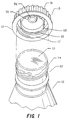
- Fig. 1 is a perspective view of the closure which is utilized in an enteral delivery set assembly in accordance with the present invention shown with a portion of an enteral nutritional product container.
- Fig. 2 is a vertical sectional view of a prior art closure similar to the sectional view taken along line 3-3 of Fig. 1.
- Fig. 3 is a vertical sectional view taken along line 3-3 of Fig. 1.
- Fig. 4 is a bottom plan view of the closure shown in Figs. 1 and 3, after cannulation has occurred.
- Fig. 5 is a top elevational view of the closure shown in Figs. 1 and 3.
- Fig. 6 is a top elevational view of a modified embodiment of the invention, which embodiment more closely resembles the prior art shown in Fig. 2.
- Figure 1 illustrates a closure for an enteral delivery set assembly embodying this invention designated generally by the numeral 10, shown in conjunction with a portion of an enteral nutritional product container 12.
- the container 12 has a membrane seal 13 which typically is of foil or of thin plastic.
- the closure 10 includes as a basic component thereof, cylindrical side wall 15 having an outer surface 16 as well as an inner surface 17. Along the inner surface 17 are threads 20 for threadedly engaging the closure 10 to the neck 22 of the container 12 at the threaded neck portion thereof 24.
- prior art closures included cylindrical side walls 15 with an outer surface 16 and an inner surface 17, they also included first projection 25 which was cylindrical in shape and associated with a membrane base 28. Also extending upwardly from the top surface of the prior art closures is a second projection 29 associated with external filter means 30.
- the external filter means has a filter side wall 31 as well as a filter top surface 32 in which a filter 33 is retained.
- the interior portion of second projection 29 forms channel 34 into which ball 35 fits. The cooperation between channel 34 and ball 35 acts as a valve to permit air to enter the container to prevent vacuum build-up and thus assist with the flow of product during feeding.
- first projection 25 Extending upwardly from top surface 45 are first projection 25 and second projection 49.
- First projection 25 resembles conventional projections associated with cannulation of the closure, with its base including membrane 28.
- Second projection 49 is of a generally cylindrical configuration.
- Preferably heat staked to bottom surface 50 is an internalized microbial filter 52. Heat staking or fusing occurs when two materials are brought together in the presence of sufficient heat and pressure so as to form one material.
- the filter is preferably woven from a synthetic, semi-permeable, hydrophobic fiber material. Commercially available materials that are useful as filters include Pallflex, a porus teflon product with a fiber backing made by the Pall Corporation and Zitex, a porus teflon material made by the Norton Company.
- the cap to which the filter 52 is heat staked is fabricated from a semi-rigid plastic material, such as polypropylene, a mixture of polypropylene and a thermoplastic elastomer, e.g. styrene-butadiene block copolymer or ethylene vinyl acetate.
- a semi-rigid plastic material such as polypropylene, a mixture of polypropylene and a thermoplastic elastomer, e.g. styrene-butadiene block copolymer or ethylene vinyl acetate.
- Second projection 49 still has a channel 34 associated therewith with filter 52 stretching across the opening 54 of the aperture associated with channel 34.
- the upper surface of second projection 49 includes means to limit the atmospheric air access to filter 52, with these means being disclosed as air grate 55 which has several small holes into which air may pass prior to interaction with the surface of filter 52. While the interior walls of second projection 49 may be beveled near air grate 55, based on the characteristics of the molds associated with prior art closures, such beveled edges are not necessary, since the necessity for the presence of ball 35 has been eliminated.
- annular raised portion 57 depends from bottom surface 50, with gasket 40 being retained between inner surface 17 and the wall associated with the annular raised portion 57. If necessary, gasket 40 may be held in place by gasket retaining means 58, which may be little more than a semi-rigid flap or an outwardly radiating flange associated with the free end of the annular raised portion 57.
- gasket retaining means 58 may be little more than a semi-rigid flap or an outwardly radiating flange associated with the free end of the annular raised portion 57.
- a plow member 60 Depending downwardly from a section of annular raised portion 57, however the closure of this invention may be fabricated without such a plow member.
- the closure 10 when viewed from the top preferably resembles the embodiment as shown in Fig. 5 with the bottom portion substantially similar to that shown in Fig. 1, including uncannulated bottom surface 50.
- membrane 28 is pierced, such that the closure when inverted on an open enteral nutritional container allows for the passage of food product through first projection 25.
- filter 52 In the inverted position, filter 52 is in direct contact with the food product. As long as the filter is wet, it permits the introduction of atmospheric air minus the bacteria into the enteral nutritionals container. More importantly, this direct contact is critical to the invention, since if the liquid food product is allowed to dry on the filter, the dried product tends to clog the filter, thereby restricting the needed flow of air into the food product. In prior art devices, the presence of the ball tended to preclude direct contact between the food product and the filter means, such that the filter would not be sufficiently wet to worry about clogging.
- the closure of this invention may be fabricated by molding the actual cap and then fusing the heat staked material of the filter to the bottom surface of this closure thereby obviating the need for the ball and the housing of the conventional filter means.
- a conventional filter means may be utilized with the closure of this invention, although such second filter means is not necessary.
Landscapes
- Health & Medical Sciences (AREA)
- Pharmacology & Pharmacy (AREA)
- Life Sciences & Earth Sciences (AREA)
- Animal Behavior & Ethology (AREA)
- General Health & Medical Sciences (AREA)
- Public Health (AREA)
- Veterinary Medicine (AREA)
- Engineering & Computer Science (AREA)
- Mechanical Engineering (AREA)
- Medical Preparation Storing Or Oral Administration Devices (AREA)
- Infusion, Injection, And Reservoir Apparatuses (AREA)
- Closures For Containers (AREA)
Description
- The present invention relates generally to an enteral delivery set assembly, and more particularly, to a closure which features an internalized microbial filter.
- Many individuals in health care facilities are able to achieve sufficient caloric intake through eating prepared meals. However, a sizable number of such patients are unable to ingest enough food to meet their body's needs. Examples of these individuals would include burn patients, whose daily caloric needs are often in excess of 5,000 calories, and critically ill, weak, or comatose patients who may be unable to chew their food. For these patients, caloric supplementation through parenteral, also known as intravenous, feeding is not a viable alternative.
- In response to this problem, liquid foods have been developed for enteral feeding. Enteral feeding is providing nourishment through the oral tract by defined nutritional diets. Typically, enteral feeding utilizes a nasogastric tube to transport the liquid nutritional products from the container through the patient's nasal cavity and thence into the stomach. Early enteral nutritional product containers were empty, sterilized pouches which were filled with sterilized, canned product at the point of use. The filled pouch was spiked by a cannula. However, there are shortcomings associated with that type of packaging including potential product contamination and extensive set-up-time. In response to that problem, a multi-layer plastic bottle was developed having a central layer which provided an oxygen barrier, therefore permitting the bottle to be pre-filled with food product which provided greater shelf-life and less spoilage. This type of plastic bottle utilizes a membrane which must be pierced so as to permit the commencement of the feeding process.
- However, a problem arises once cannulation has occurred since the nutritional product container periodically requires the introduction of a small amount of atmospheric air to preclude the establishment of a vacuum in the system, which would terminate the feeding process. This problem has traditionally been overcome in the pre-filled industry by the providing of a valve means to introduce atmospheric air into the enteral nutritional product container. Normally associated with such valve means is a microbial filter.
- Ported closures are well known, an example of which is Steidley, U.S. Pat. No. 4,022,258 which discloses a closure for surgical irrigation fluid containers as opposed to one for enteral nutritional product containers. Steidley discloses a large spike member which can pierce a plastic cap with the spike member including a conventional filter positioned adjacent the external surface of the cap. However, Steidley does not address the unique problems associated with the physical composition of enteral nutritional products. Enteral nutritional products are dissimilar from fluids introduced by intravenous feeding primarily due to the presence of minerals and other solids which tend to form a sediment which settles to the bottom of the inverted container during feeding. Additionally, enteral nutritional products are extremely viscous.
- Conventional valves associated with enteral nutritional product containers include a ball and an externally positioned filter, both of which are added to the closure structure after the molding process of the closure is completed. Also known from US-A-4,235,344 is a closure for a product container as defined in the precharacterizing part of claim 1. Although there has been a long felt need to decrease the manufacturing cost and simplify the manufacturing process associated with the valves by eliminating the ball and redesigning the filter, the fact that the exterior microbial filter currently used prevents contamination of the enteral nutritional product has discouraged experimentation.
- It is thus apparent that the need exists for an improved closure for pre-filled enteral nutritional product containers which provides the less costly and more efficient production of such closures, while at the same time ensuring proper microbial filtration.
- The above-mentioned problems are overcome by a closure for a product container as defined in the appended claims.
- There is disclosed a closure for a product container, said closure comprising, a generally cylindrical side wall, said side wall having threads along the inner surface thereof for threadedly engaging the neck of said container, a planar top surface, said top surface having a first projection extending upwardly therefrom, said first projection being associated with a spikable membrane, and a bottom surface having an aperture which extends through said closure to said top surface, said bottom surface having a filter secured thereto.
- There is also disclosed a closure for an enteral nutritional product container, said closure comprising, a generally cylindrical side wall, said side wall having threads along the inner surface thereof for threadedly engaging the neck of said container, a planar top surface, said top surface having a first projection and a second projection extending upwardly therefrom, said first projection being associated with a spikable membrane, said second projection being associated with a microbial filter which allows atmospheric air to enter said container and with means to limit atmospheric air access to said microbial filter, said first projection located diagonally across said closure from said means to limit atmospheric air access to said microbial filter, and a bottom surface, said bottom surface having an aperture which extends through said closure to said top surface, said microbial filter being secured to said bottom surface and extending across the opening of said aperture.
- There is also disclosed a closure for a product container, said closure comprising, a generally cylindrical side wall, a planar top surface, said top surface having a first projection and a second projection, said first projection being associated with a spikable membrane, said second projection being associated with a filter and with means to limit air access to said filter, and a bottom surface, said bottom surface having an aperture which extends through said closure to said top surface, said filter being secured to said bottom surface and extending across the opening of said aperture.
- Furthermore, the filter may be fabricated from a woven synthetic fiber material. The filter may be secured to the bottom surface adjacent an annular raised portion thereof.
- The present invention provides an enteral delivery set assembly which permits the less costly and yet more efficient production of such closures, while at the same time ensuring proper microbial filtration.
- Other aspects and advantages of the invention will be apparent from the following description, the accompanying drawings and the appended claims.
- Fig. 1 is a perspective view of the closure which is utilized in an enteral delivery set assembly in accordance with the present invention shown with a portion of an enteral nutritional product container.
- Fig. 2 is a vertical sectional view of a prior art closure similar to the sectional view taken along line 3-3 of Fig. 1.
- Fig. 3 is a vertical sectional view taken along line 3-3 of Fig. 1.
- Fig. 4 is a bottom plan view of the closure shown in Figs. 1 and 3, after cannulation has occurred.
- Fig. 5 is a top elevational view of the closure shown in Figs. 1 and 3.
- Fig. 6 is a top elevational view of a modified embodiment of the invention, which embodiment more closely resembles the prior art shown in Fig. 2.
- Having reference to the drawings, attention is directed first to Figure 1 which illustrates a closure for an enteral delivery set assembly embodying this invention designated generally by the
numeral 10, shown in conjunction with a portion of an enteralnutritional product container 12. Thecontainer 12 has amembrane seal 13 which typically is of foil or of thin plastic. - The
closure 10 includes as a basic component thereof,cylindrical side wall 15 having anouter surface 16 as well as aninner surface 17. Along theinner surface 17 arethreads 20 for threadedly engaging theclosure 10 to theneck 22 of thecontainer 12 at the threaded neck portion thereof 24. - To fully appreciate this invention, it is necessary to consider the prior art of closures for enteral nutritional product containers. Whereas prior art closures included
cylindrical side walls 15 with anouter surface 16 and aninner surface 17, they also includedfirst projection 25 which was cylindrical in shape and associated with amembrane base 28. Also extending upwardly from the top surface of the prior art closures is asecond projection 29 associated with external filter means 30. The external filter means has afilter side wall 31 as well as afilter top surface 32 in which afilter 33 is retained. The interior portion ofsecond projection 29 formschannel 34 into whichball 35 fits. The cooperation betweenchannel 34 andball 35 acts as a valve to permit air to enter the container to prevent vacuum build-up and thus assist with the flow of product during feeding. When the closure is in its operative mode, the container is inverted such thatball 35 rests againstbeveled portion 36. At other times, the ball is still retained in thechannel 34 by conventional ball retention means 37. Thus, in the fabrication of the closures associated with the prior art, filter means 30,ball 35 and agasket 40 are manually assembled into the prior art closure embodiment shown in Fig. 2. The viscous and sedimentary nature of enteral nutritional products results in a tendency for the ball to become lodged or stuck against thebeveled portion 36 as product is delivered over a long time period. This condition results in partial to total system occlusion which prevents continued product delivery to the patient. - As can be clearly seen in Fig. 3, the closure of this invention eliminates
ball 35 and with the possible exception of aesthetic purposes, eliminates the need for the housing associated withfilter means 30. Extending upwardly fromtop surface 45 arefirst projection 25 andsecond projection 49.First projection 25 resembles conventional projections associated with cannulation of the closure, with itsbase including membrane 28. -
Second projection 49 is of a generally cylindrical configuration. Preferably heat staked tobottom surface 50 is an internalizedmicrobial filter 52. Heat staking or fusing occurs when two materials are brought together in the presence of sufficient heat and pressure so as to form one material. The filter is preferably woven from a synthetic, semi-permeable, hydrophobic fiber material. Commercially available materials that are useful as filters include Pallflex, a porus teflon product with a fiber backing made by the Pall Corporation and Zitex, a porus teflon material made by the Norton Company. Preferably the cap to which thefilter 52 is heat staked is fabricated from a semi-rigid plastic material, such as polypropylene, a mixture of polypropylene and a thermoplastic elastomer, e.g. styrene-butadiene block copolymer or ethylene vinyl acetate. -
Second projection 49 still has achannel 34 associated therewith withfilter 52 stretching across theopening 54 of the aperture associated withchannel 34. The upper surface ofsecond projection 49 includes means to limit the atmospheric air access to filter 52, with these means being disclosed asair grate 55 which has several small holes into which air may pass prior to interaction with the surface offilter 52. While the interior walls ofsecond projection 49 may be beveled nearair grate 55, based on the characteristics of the molds associated with prior art closures, such beveled edges are not necessary, since the necessity for the presence ofball 35 has been eliminated. - As can be seen in Figs. 3 and 4, an annular raised
portion 57 depends frombottom surface 50, withgasket 40 being retained betweeninner surface 17 and the wall associated with the annular raisedportion 57. If necessary,gasket 40 may be held in place by gasket retaining means 58, which may be little more than a semi-rigid flap or an outwardly radiating flange associated with the free end of the annular raisedportion 57. Depending downwardly from a section of annular raisedportion 57 is aplow member 60, however the closure of this invention may be fabricated without such a plow member. - In actual operation, the
closure 10 when viewed from the top preferably resembles the embodiment as shown in Fig. 5 with the bottom portion substantially similar to that shown in Fig. 1, including uncannulatedbottom surface 50. Once cannulation occurs,membrane 28 is pierced, such that the closure when inverted on an open enteral nutritional container allows for the passage of food product throughfirst projection 25. In the inverted position, filter 52 is in direct contact with the food product. As long as the filter is wet, it permits the introduction of atmospheric air minus the bacteria into the enteral nutritionals container. More importantly, this direct contact is critical to the invention, since if the liquid food product is allowed to dry on the filter, the dried product tends to clog the filter, thereby restricting the needed flow of air into the food product. In prior art devices, the presence of the ball tended to preclude direct contact between the food product and the filter means, such that the filter would not be sufficiently wet to worry about clogging. - The closure of this invention may be fabricated by molding the actual cap and then fusing the heat staked material of the filter to the bottom surface of this closure thereby obviating the need for the ball and the housing of the conventional filter means. However, as shown in Fig. 6, it may be desirable to place a conventional filter means over
second projection 49, since the radical departure in appearance of the closure associated with Fig. 5, may lead some to believe that the closure does not include a microbial filter thus, for aesthetic purposes and for peace of mind for those otherwise uninformed, a conventional filter means may be utilized with the closure of this invention, although such second filter means is not necessary. - This $500,000,000 industry has long sought to reduce the cost and simplify the manufacturing process associated with closures having microbial filters. This invention solves this long felt need. While the form of apparatus and the method of forming the same herein described constitutes a preferred embodiment of this invention, it is to be understood that the invention is not limited to this precise form of apparatus or method and that changes may be made therein without departing from the scope of the invention which is defined in the appended claims.
Where technical features mentioned in any claim are followed by reference signs, those reference signs have been included for the sole purpose of increasing the intelligibility of the claims and accordingly, such reference signs do not have any limiting effect on the scope of each element identified by way of example by such reference signs.
Claims (6)
- A closure for a product container, said closure comprising a generally cylindrical side wall (15), said side wall having threads (20) along the inner surface thereof for threadedly engaging the neck (22) of said container (12), a planar top surface (45), said top surface having a first tubular projection (25) extending upwardly therefrom, said first projection (25) being associated with a spikable membrane (28), and a bottom surface (50) having an aperture (54) which extends through said closure to said top surface, the bottom surface having a filter (52) secured thereto which comprises a semipermeable membrane pervious to air and impervious to liquids, characterized in that said top surface has a second projection (49) extending upwardly therefrom, said second projection having a channel (34) therein and being associated with means (55) for limiting atmospheric air access to said filter (52).
- A closure for a product container according to claim 1, characterized in that said filter (52) is heat staked material which is fused to said bottom surface.
- A closure for a product container according to claim 1 or 2, characterized in that said filter (52) is a microbial filter.
- A closure for a product container according to claim 1, 2 or 3, characterized in that said filter (52) comprises a woven synthetic fiber material.
- A closure for a product container according to claim 1, 2, 3 or 4, characterized in that said closure comprises a semi-rigid plastic material.
- A closure for a product container according to one or more of claims 1-5, characterized in that said first projection (25) is located diagonally across said closure from said means (55) for limiting atmospheric air access to said filter (52).
Applications Claiming Priority (2)
| Application Number | Priority Date | Filing Date | Title |
|---|---|---|---|
| US07/298,711 US4934545A (en) | 1989-01-19 | 1989-01-19 | Closure with microbial filter |
| US298711 | 1989-01-19 |
Publications (2)
| Publication Number | Publication Date |
|---|---|
| EP0379047A1 EP0379047A1 (en) | 1990-07-25 |
| EP0379047B1 true EP0379047B1 (en) | 1993-07-21 |
Family
ID=23151703
Family Applications (1)
| Application Number | Title | Priority Date | Filing Date |
|---|---|---|---|
| EP19900100437 Expired - Lifetime EP0379047B1 (en) | 1989-01-19 | 1990-01-10 | Enteral delivery set assembly with internalized microbial filter |
Country Status (6)
| Country | Link |
|---|---|
| US (1) | US4934545A (en) |
| EP (1) | EP0379047B1 (en) |
| JP (1) | JP2958345B2 (en) |
| CA (1) | CA2008148C (en) |
| DE (1) | DE69002244T2 (en) |
| IE (1) | IE63048B1 (en) |
Families Citing this family (64)
| Publication number | Priority date | Publication date | Assignee | Title |
|---|---|---|---|---|
| US5125522A (en) * | 1988-12-22 | 1992-06-30 | Abbott Laboratories | Enteral delivery set assembly |
| US5188628A (en) * | 1990-11-06 | 1993-02-23 | Sandoz Ltd. | Closure device for enteral fluid containers |
| USD330332S (en) | 1990-11-30 | 1992-10-20 | Abbott Laboratories | Combined bottle cap and dust cover |
| US5082136A (en) * | 1991-02-06 | 1992-01-21 | Enviro-Packaging Corp. | Container and cap construction |
| US5409834A (en) * | 1993-04-06 | 1995-04-25 | Birdwell; Robert S. | Method and apparatus for removing pollutants from a source of polluted air |
| GB9405249D0 (en) * | 1994-03-17 | 1994-04-27 | Smithkline Beecham Plc | Container |
| US5653943A (en) * | 1994-04-07 | 1997-08-05 | Johnson & Johnson Medical, Inc. | Vented storage container |
| USD372531S (en) | 1994-07-20 | 1996-08-06 | Abbott Laboratories | Combined bottle and cap |
| USD374481S (en) | 1994-07-20 | 1996-10-08 | Abbott Laboratories | Combined bottle and cap |
| USD427306S (en) * | 1995-07-10 | 2000-06-27 | Abbott Laboratories | Combined bottle and closure |
| USD407817S (en) | 1995-07-10 | 1999-04-06 | Abbott Laboratories | Bottle and closure |
| US5782383A (en) * | 1996-09-04 | 1998-07-21 | Rexan Closures Inc. | Dispensing closure for sealed enteral fluid containers |
| WO1998013273A1 (en) * | 1996-09-27 | 1998-04-02 | Nuclear Filter Technology, Inc. | Method of fabricating and devices employing vents |
| US5988426A (en) * | 1996-11-08 | 1999-11-23 | Stern; Brett | Leakproof vented beverage lid |
| US6398048B1 (en) * | 1997-09-19 | 2002-06-04 | Gregory Kevorkian | Vented beverage container |
| US6085664A (en) * | 1997-09-19 | 2000-07-11 | Aero Transportation Products, Inc. | Vented hatch cover |
| US7107783B2 (en) * | 1997-09-19 | 2006-09-19 | Advanced Porcus Technologies, Llc | Self-cooling containers for liquids |
| US20040173556A1 (en) * | 1997-09-19 | 2004-09-09 | Smolko Daniel D. | Vented closures for containers |
| US8758488B1 (en) * | 1997-09-29 | 2014-06-24 | Nuclear Filter Technology, Inc. | Method of fabricating and devices employing vents |
| US6012596A (en) * | 1998-03-19 | 2000-01-11 | Abbott Laboratories | Adaptor cap |
| EP1078880B1 (en) | 1999-08-05 | 2003-03-19 | The Procter & Gamble Company | Dispensing device comprising a reservoir and attachment means provided with protected piercing means |
| US6386392B1 (en) | 1999-11-02 | 2002-05-14 | The Procter & Gamble Company | Reservoirs for use with cleaning devices |
| US6321941B1 (en) | 2000-04-20 | 2001-11-27 | The Procter & Gamble Company | Consumer safe fitment for connecting a reservoir to a dispensing appliance |
| US6837400B2 (en) | 2003-03-07 | 2005-01-04 | Nalge Nunc International Corporation | Solvent identification bottle with adjustable dispensing feature |
| DE102004027734A1 (en) | 2004-06-07 | 2005-12-22 | Filtertek B.V., Newcastle West | Device for connecting a ventilator with the patient |
| US7673653B2 (en) | 2004-06-17 | 2010-03-09 | Filtertek Inc. | Check valve |
| DE202005010459U1 (en) * | 2004-11-22 | 2005-10-13 | Filtertek B.V., Newcastle West | Device for introducing air into containers used in artificial nutrition |
| DE102005029746B4 (en) | 2005-06-24 | 2017-10-26 | Boehringer Ingelheim International Gmbh | atomizer |
| US7611502B2 (en) * | 2005-10-20 | 2009-11-03 | Covidien Ag | Connector for enteral fluid delivery set |
| US7896859B2 (en) | 2005-10-20 | 2011-03-01 | Tyco Healthcare Group Lp | Enteral feeding set |
| US10589907B2 (en) * | 2006-04-12 | 2020-03-17 | Volo Brands Llc | Disposable lid having spout with filter for beverage container |
| US20080054497A1 (en) * | 2006-08-31 | 2008-03-06 | Medex Cardio-Pulmonary, Inc.. | Vented cap humidification system |
| FR2913005B1 (en) * | 2007-02-23 | 2009-05-15 | Airsec Soc Par Actions Simplif | UNITARY OBJECT STORAGE AND DISTRIBUTION ASSEMBLY WITH A FIRST OPENING WITNESS |
| US20090169693A1 (en) * | 2007-12-27 | 2009-07-02 | Hoffman Karl K | Interior-mountable pressure relief valve |
| US8231597B2 (en) * | 2008-02-08 | 2012-07-31 | Codan Us Corporation | Enteral feeding safety reservoir and system |
| US20100175850A1 (en) * | 2009-01-09 | 2010-07-15 | Kaucic Edward M | Relief Vent for a Hot Fill Fluid Container |
| US8628509B2 (en) * | 2009-05-11 | 2014-01-14 | Abbott Laboratories | Enteral connectors and systems |
| CN102458341B (en) * | 2009-06-04 | 2014-10-29 | 株式会社Jms | Cover and nutrient container using same |
| CN101642723B (en) * | 2009-09-02 | 2012-01-25 | 中国科学院长春应用化学研究所 | Temperature-controllable solvent vapor pressure gradiometer |
| GB2474520B (en) * | 2009-10-19 | 2015-08-26 | London & General Packaging Ltd | Spray dispenser |
| JP2013539707A (en) | 2010-10-14 | 2013-10-28 | メディベーターズ インコーポレイテッド | Universal cap |
| US20120305518A1 (en) * | 2011-06-01 | 2012-12-06 | The Coca-Cola Company | Hot fill containers and methods |
| FR2980971B1 (en) * | 2011-10-11 | 2014-12-05 | Cair L G L | CAP AND NUTRITION SYSTEM ENTERALE |
| USD708946S1 (en) * | 2012-11-16 | 2014-07-15 | Frederick A. Hutchison | Container cap |
| USD705059S1 (en) * | 2012-12-07 | 2014-05-20 | Frederick A. Hutchison | Container cap |
| USD713931S1 (en) | 2013-01-09 | 2014-09-23 | Central Garden & Pet Company | Sprayer |
| US10456786B2 (en) * | 2013-03-12 | 2019-10-29 | Abbott Laboratories | Septums and related methods |
| USD706135S1 (en) * | 2013-03-13 | 2014-06-03 | Frederick A. Hutchison | Container cap |
| DE202015102323U1 (en) * | 2015-05-06 | 2016-08-09 | Octapharma Plasma Gmbh | Blood plasma collection bottle |
| CN105878015A (en) * | 2016-04-01 | 2016-08-24 | 苏州创扬医药科技股份有限公司 | Pasted film type combined cover with pressing pad |
| US11648179B2 (en) | 2016-05-16 | 2023-05-16 | Haemonetics Corporation | Sealer-less plasma bottle and top for same |
| US11559464B2 (en) | 2016-05-16 | 2023-01-24 | Haemonetics Corporation | Sealer-less plasma bottle and top for same |
| USD835264S1 (en) * | 2016-05-23 | 2018-12-04 | Solmetex Llc | Container |
| USD840534S1 (en) * | 2016-05-23 | 2019-02-12 | Solmetex Llc | Dental amalgam separation container |
| USD840533S1 (en) * | 2016-05-23 | 2019-02-12 | Solmetex Llc | Dental amalgam separation container |
| USD848612S1 (en) * | 2016-05-23 | 2019-05-14 | Solmetex Llc | Dental amalgam separation container |
| US11963836B2 (en) | 2016-10-12 | 2024-04-23 | Solmetex Llc | Detachable recycling container |
| USD835778S1 (en) * | 2016-11-28 | 2018-12-11 | Solmetex Llc | Dental amalgam separation container adapter |
| USD835779S1 (en) * | 2016-05-23 | 2018-12-11 | Solmetex Llc | Dental amalgam separation container |
| US11660175B2 (en) | 2016-05-23 | 2023-05-30 | Solmetex, Llc | Detachable recycling container |
| USD842105S1 (en) * | 2018-02-20 | 2019-03-05 | Paw Bioscience Products, Llc | Connector cap for tubes |
| EP4140529A4 (en) * | 2020-04-23 | 2024-05-29 | Otsuka Techno Corporation | URINARY CATHETER CAP |
| MX2023009647A (en) * | 2021-02-19 | 2023-08-24 | Braunform Gmbh | LID TO CLOSE A CONTAINER TO ADMINISTER A MEDICINAL PRODUCT AND METHOD TO PRODUCE IT. |
| USD1033225S1 (en) * | 2021-12-13 | 2024-07-02 | S. C. Johnson & Son, Inc. | Actuator overcap |
Family Cites Families (3)
| Publication number | Priority date | Publication date | Assignee | Title |
|---|---|---|---|---|
| US4022258A (en) * | 1975-10-28 | 1977-05-10 | American Hospital Supply Corporation | Ported closure and connector therefor |
| US4153173A (en) * | 1978-03-13 | 1979-05-08 | Baxter Travenol Laboratories, Inc. | Cap closure and method of producing same |
| US4235344A (en) * | 1979-01-29 | 1980-11-25 | Baxter Travenol Laboratories, Inc. | Irrigation cap |
-
1989
- 1989-01-19 US US07/298,711 patent/US4934545A/en not_active Expired - Lifetime
- 1989-12-28 IE IE420489A patent/IE63048B1/en not_active IP Right Cessation
-
1990
- 1990-01-10 DE DE90100437T patent/DE69002244T2/en not_active Expired - Fee Related
- 1990-01-10 EP EP19900100437 patent/EP0379047B1/en not_active Expired - Lifetime
- 1990-01-18 JP JP1047490A patent/JP2958345B2/en not_active Expired - Fee Related
- 1990-01-19 CA CA 2008148 patent/CA2008148C/en not_active Expired - Fee Related
Also Published As
| Publication number | Publication date |
|---|---|
| IE894204L (en) | 1990-07-19 |
| CA2008148A1 (en) | 1990-07-19 |
| US4934545A (en) | 1990-06-19 |
| EP0379047A1 (en) | 1990-07-25 |
| DE69002244T2 (en) | 1994-01-05 |
| IE63048B1 (en) | 1995-03-22 |
| JPH02228966A (en) | 1990-09-11 |
| CA2008148C (en) | 2002-09-24 |
| DE69002244D1 (en) | 1993-08-26 |
| JP2958345B2 (en) | 1999-10-06 |
Similar Documents
| Publication | Publication Date | Title |
|---|---|---|
| US4934545A (en) | Closure with microbial filter | |
| EP0380934B1 (en) | Enteral delivery universal port assembly | |
| US5125522A (en) | Enteral delivery set assembly | |
| US4335770A (en) | Enteral feeding container | |
| US5332113A (en) | Cap assembly | |
| JP4427455B2 (en) | Connector device | |
| US8366697B2 (en) | Enteral feeding safety reservoir and system | |
| CA3000099C (en) | Enteral feeding connector | |
| AU753628B2 (en) | Closure system for containers | |
| AU758854B2 (en) | Improved adaptor cap | |
| US5542922A (en) | System and method for dispensing liquid medicaments to infants | |
| US20120283690A1 (en) | Enteral feeding safety reservoir and system | |
| AU4748290A (en) | Closure and port assembly | |
| US4053648A (en) | Bottle for sterile dispensing of flowable contents | |
| CN104367476A (en) | Cap and nutritional supplement container using same | |
| US8864736B2 (en) | Enteral feeding safety reservoir and system | |
| USRE29916E (en) | Bottle for sterile dispensing of flowable contents | |
| RU2328320C2 (en) | Connector of medicinal agent oral set | |
| MXPA00009101A (en) | Improved adaptor cap | |
| CA2823317A1 (en) | Enteral feeding safety reservoir and system |
Legal Events
| Date | Code | Title | Description |
|---|---|---|---|
| PUAI | Public reference made under article 153(3) epc to a published international application that has entered the european phase |
Free format text: ORIGINAL CODE: 0009012 |
|
| AK | Designated contracting states |
Kind code of ref document: A1 Designated state(s): DE GB IT NL |
|
| 17P | Request for examination filed |
Effective date: 19901214 |
|
| 17Q | First examination report despatched |
Effective date: 19920525 |
|
| GRAA | (expected) grant |
Free format text: ORIGINAL CODE: 0009210 |
|
| AK | Designated contracting states |
Kind code of ref document: B1 Designated state(s): DE GB IT NL |
|
| REF | Corresponds to: |
Ref document number: 69002244 Country of ref document: DE Date of ref document: 19930826 |
|
| ITF | It: translation for a ep patent filed | ||
| PLBE | No opposition filed within time limit |
Free format text: ORIGINAL CODE: 0009261 |
|
| STAA | Information on the status of an ep patent application or granted ep patent |
Free format text: STATUS: NO OPPOSITION FILED WITHIN TIME LIMIT |
|
| 26N | No opposition filed | ||
| REG | Reference to a national code |
Ref country code: GB Ref legal event code: IF02 |
|
| PGFP | Annual fee paid to national office [announced via postgrant information from national office to epo] |
Ref country code: GB Payment date: 20041210 Year of fee payment: 16 |
|
| PGFP | Annual fee paid to national office [announced via postgrant information from national office to epo] |
Ref country code: NL Payment date: 20041215 Year of fee payment: 16 |
|
| PGFP | Annual fee paid to national office [announced via postgrant information from national office to epo] |
Ref country code: DE Payment date: 20050131 Year of fee payment: 16 |
|
| PG25 | Lapsed in a contracting state [announced via postgrant information from national office to epo] |
Ref country code: GB Free format text: LAPSE BECAUSE OF NON-PAYMENT OF DUE FEES Effective date: 20060110 |
|
| PGFP | Annual fee paid to national office [announced via postgrant information from national office to epo] |
Ref country code: IT Payment date: 20060131 Year of fee payment: 17 |
|
| PG25 | Lapsed in a contracting state [announced via postgrant information from national office to epo] |
Ref country code: NL Free format text: LAPSE BECAUSE OF NON-PAYMENT OF DUE FEES Effective date: 20060801 Ref country code: DE Free format text: LAPSE BECAUSE OF NON-PAYMENT OF DUE FEES Effective date: 20060801 |
|
| GBPC | Gb: european patent ceased through non-payment of renewal fee |
Effective date: 20060110 |
|
| NLV4 | Nl: lapsed or anulled due to non-payment of the annual fee |
Effective date: 20060801 |
|
| PG25 | Lapsed in a contracting state [announced via postgrant information from national office to epo] |
Ref country code: IT Free format text: LAPSE BECAUSE OF NON-PAYMENT OF DUE FEES Effective date: 20070110 |