EP0377779A1 - Aluminium alloy product having improved combinations of strength, toughness and corrosion resistance - Google Patents
Aluminium alloy product having improved combinations of strength, toughness and corrosion resistance Download PDFInfo
- Publication number
- EP0377779A1 EP0377779A1 EP89111695A EP89111695A EP0377779A1 EP 0377779 A1 EP0377779 A1 EP 0377779A1 EP 89111695 A EP89111695 A EP 89111695A EP 89111695 A EP89111695 A EP 89111695A EP 0377779 A1 EP0377779 A1 EP 0377779A1
- Authority
- EP
- European Patent Office
- Prior art keywords
- alloy
- alloy product
- zinc
- magnesium
- strength
- Prior art date
- Legal status (The legal status is an assumption and is not a legal conclusion. Google has not performed a legal analysis and makes no representation as to the accuracy of the status listed.)
- Granted
Links
Images

Classifications
-
- G—PHYSICS
- G11—INFORMATION STORAGE
- G11B—INFORMATION STORAGE BASED ON RELATIVE MOVEMENT BETWEEN RECORD CARRIER AND TRANSDUCER
- G11B23/00—Record carriers not specific to the method of recording or reproducing; Accessories, e.g. containers, specially adapted for co-operation with the recording or reproducing apparatus ; Intermediate mediums; Apparatus or processes specially adapted for their manufacture
- G11B23/02—Containers; Storing means both adapted to cooperate with the recording or reproducing means
- G11B23/04—Magazines; Cassettes for webs or filaments
- G11B23/08—Magazines; Cassettes for webs or filaments for housing webs or filaments having two distinct ends
- G11B23/087—Magazines; Cassettes for webs or filaments for housing webs or filaments having two distinct ends using two different reels or cores
- G11B23/08707—Details
- G11B23/08778—Driving features, e.g. belt
-
- C—CHEMISTRY; METALLURGY
- C22—METALLURGY; FERROUS OR NON-FERROUS ALLOYS; TREATMENT OF ALLOYS OR NON-FERROUS METALS
- C22C—ALLOYS
- C22C21/00—Alloys based on aluminium
- C22C21/10—Alloys based on aluminium with zinc as the next major constituent
-
- C—CHEMISTRY; METALLURGY
- C22—METALLURGY; FERROUS OR NON-FERROUS ALLOYS; TREATMENT OF ALLOYS OR NON-FERROUS METALS
- C22F—CHANGING THE PHYSICAL STRUCTURE OF NON-FERROUS METALS AND NON-FERROUS ALLOYS
- C22F1/00—Changing the physical structure of non-ferrous metals or alloys by heat treatment or by hot or cold working
- C22F1/04—Changing the physical structure of non-ferrous metals or alloys by heat treatment or by hot or cold working of aluminium or alloys based thereon
- C22F1/053—Changing the physical structure of non-ferrous metals or alloys by heat treatment or by hot or cold working of aluminium or alloys based thereon of alloys with zinc as the next major constituent
Definitions
- the present invention relates to an aluminum alloy product having improved combinations of strength, toughness and corrosion resistance.
- This invention further relates to an aluminum-zinc-magnesium-copper alloy having at least about 10% greater yield strength than the Aluminum Association's 7X50-T6 aluminum, the strongest aluminum alloy currently in wide use for demanding aerospace applications such as upper wing members, with toughness and corrosion properties comparable or superior to those of 7X50-T6 aluminum.
- Precipitation-hardened 7075 alloy products exhibit high strength values in the T6 temper.
- Aluminum alloys 7050 and 7150, herein referred to as 7X50 exhibit still higher strengths in T6-type tempers.
- 7X50 alloy products be artificially aged to a T76, T74 or T73-type temper, their resistances to stress corrosion cracking and/or exfoliation corrosion improve in the order stated (with T73 being best), but usually at some cost to strength vis-a-vis the T6 condition.
- the overall performance levels of 7X50 alloys greatly exceed those of 7075 aluminum, or other 7XXX alloys currently in wide aerospace use.
- T7-type designation was recently registered for the aforementioned 7XXX alloys, that being T77 tempering which attains strength levels at or near peak strength (T6) in combination with T76, or even T74, corrosion resistance properties.
- Means for aging 7075 aluminum to this temper are set forth in U.S. Patent No. 4,477,292 and British Patent No. 1,480,351.
- This invention relates to: aluminum alloy products having very high strength and specific strength (strength divided by density) values, substantially exceeding those of 7X50, while maintaining or even improving the toughness and corrosion resistance properties of the previous products; and to an improved AI-Zn-Mg-Cu alloy product having EXCO corrosion resistance levels of "EB" or better with at least about 15% greater yield strength than a similarly-sized 7X50 counterpart in the T76 condition, at least about 10% greater yield strength than a 7X50-T6 counterpart, or at least about 5% greater strength than its 7X50-T77 counterpart.
- the improved alloy products of this invention When the improved alloy products of this invention are artificially aged to produce exfoliation corrosion resistance properties of "EC" or lower (EXCO levels comparable to those of 7X50-T76 products), the invention alloy will typically possess at least about 20% greater strength than its 7X50-T76 counterpart, at least about 15% greater strength than its 7X50-T6 counterpart and at least about 9% greater yield strength than a 7X50-T77 alloy counterpart product.
- the invention also relates to aerospace structural members, such as upper wing skin plates, extrusions or the like, from this improved high strength alloy.
- a preferred embodiment of the invention concerns an alloy consisting essentially of about 7.6 to about 8.4 or 8.6% zinc, account 1.6 or 1.8% to about 2.3% magnesium, about 2 to 2.6 or 2.8% copper, and at least one element selected from zirconium, vanadium and hafnium present in an amount not exceeding about 0.2% for zirconium and vanadium, or about 0.4% for hafnium, the balance aluminum and incidental elements and impurities.
- the benefits from Zr, V and/or Hf addition may be further enhanced with up to about 0.3 or 0.4% manganese.
- all compositional limits are by weight percent unless otherwise indicated.
- the improved alloy products of this invention exhibit substantially greater combinations of yield strength, fracture toughness and corrosion resistance as shown in the accompanying Figures. Because these preferred ranges of elements do not excessively increase alloy density relative to 7X50 aluminum, significant increases in specific strength are also realized by the invention.
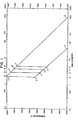
- One preferred method for artificially aging this alloy composition includes: solution heat treating; heating to one or more temperatures within about 175 to 325 F for 2 or more hours; heating for a cumulative time-temperature effect substantially within ABCD of accompanying Figure 1; and heating to one or more temperatures within about 175 to 325° F for 3 or more hours.
- Another set of improved properties, with only slightly lower strengths, is imparted by subjecting this alloy composition to: solution heat treatment; treating to one or more temperatures within about 175 to 275 F for amount 2 or more hours; and heating within about 300 to 345 ° F for 2 or more hours.
- T6-type tempers are obtained by precipitation hardening within about 175 to 325 F.
- Plate and extrusion products of 7075 aluminum for example, are typically T6-aged by heating for about 24 hours at 250 F in a circulatory-air furnace.
- Products of 7X50 aluminum are first treated at 250 F, followed by a higher temperature treatment, within about 325 to 350 F, to obtain optimum or peak (T6) strength.
- the total amount of zinc, magnesium and copper present should not exceed a dissolvable amount, by which it is meant an amount that can be brought into solid solution during solution heat treatment (SHT) so that fewer than one volume percent of undissolved intermetallic phases (about 1 micron in size or larger and containing Zn, Cu and/or Mg) remains after solution heat treatment. On a more preferred basis, less than one-half volume percent (0.5%) of such undissolved phases should remain after SHT. It is therefore advantageous to limit combined zinc, magnesium and copper contents to between about 11.9 or 12.1% and about 12.5, 12.7 or even 13%.
- the invention alloy should also maintain a total zinc-copper (Zn + Cu) content between about 9.9 and 11.0%.
- Alloy products of this invention should further include at least one ancillary element selected from: zirconium, for instance, between about 0.03 and 0.15% zirconium; vanadium, for instance, between about 0.05 and 0.15% vanadium; and hafnium, for instance, between about 0.03 and 0.4% hafnium.
- ancillary element selected from: zirconium, for instance, between about 0.03 and 0.15% zirconium; vanadium, for instance, between about 0.05 and 0.15% vanadium; and hafnium, for instance, between about 0.03 and 0.4% hafnium.
- ancillary element selected from: zirconium, for instance, between about 0.03 and 0.15% zirconium; vanadium, for instance, between about 0.05 and 0.15% vanadium; and hafnium, for instance, between about 0.03 and 0.4% hafnium.
- manganese preferably between about 0.07 or 0.1% to about 0.3 or 0.35%.
- the nickel content of the invention alloy are maintained below about 0.04 or 0.05%, or more preferably below a maximum of about 0.01 or 0.02% nickel; the calcium content should be kept below about 0.015 or 0.02%, more preferably below about 0.01 or 0.005% maximum; and the chromium level should be less than about 0.08%, or more preferably below a maximum of about 0.04 or 0.05% chromium.
- the invention alloy possesses less need to maintain its iron and silicon contents at an extremely low level. It is generally believed that Fe and Si are both harmful to toughness, but the measured fracture toughnesses for alloy products containing about 0.05% iron and about 0.05% silicon were similar to those values for alloys containing about 0.05% each of these impurities, both toughness levels resembling that of a 7XXX product possessing lower strength, namely 7150-T6 aluminum. Conventional metallurgical wisdom predicts that toughness properties should decrease with increasing strength unless iron and silicon contents are purposefully lowered. The invention alloy was found to offer surprisingly less sensitivity to variations in the tolerable amounts of these two impurities, however.
- the invention alloy can accommodate cumulative iron and silicon concentrations up to about 0.4 or 0.5%.
- the invention alloy can contain about 0.04 or 0.05 or 0.06% up to 0.15 or even 0.2 or 0.25% or 0.3% each of iron and silicon.
- Elements other than those named hereinabove are preferably limited to 0.1 or 0.2% or possibly 0.3% maximum, more preferably 0.05% maximum.
- the combined total of other elements not named hereinabove is preferably not over 0.5 or 1 %, more preferably not over about 0.1 or 0.2%.
- the invention alloy is especially well suited for critical aerospace applications, such as upper wing skin panels or members (typically plate), and other high strength-high exfoliation resistance end uses.
- Products may be directly cast or formed into useful shapes from this alloy by any known or subsequently developed technique including rolling, forging and extrusion.
- the resulting sheet, plate, rod, bar or the like may vary greatly in size and shape.
- plate products made from this preferred composition may have cross-sectional thicknesses ranging from about 0.3 or 0.35 inch, up to about 1.5, 2 or even 3 or more inches. It should be further understood, however, that the invention alloy may also be made into products having cross-sectional thicknesses even smaller than about 0.3 inch.
- the alloy products of this invention are primarily ingot-derived. Once an ingot has been cast from this composition, it is homogenized by heating to one or more temperatures between about 860° and 920 F after which it is worked (and sometimes machined) into a desired shape.
- the product if desired, should then be solution heat treated by heating to one or more temperatures between about 840 or 850 F and about 880 or 900 F to take substantial portions, preferably all or substantially all, of the soluble zinc, magnesium and copper into solution, it being again understood that with physical processes which are not always perfect, probably every last vestige of these main alloying ingredients will not be dissolved during SHT (solutionizing). After heating to elevated temperatures as just described, the product should be rapidly cooled or quenched to complete the solution heat treating procedure.
- solution heat treat shall be meant to include quenching unless expressly stated to the contrary.
- precipitation-hardenable alloy product is subjected to three main aging steps, phases or treatments, although clear lines of demarcation may not exist between each step or phase.
- ramping up to and/or down from given (or target) treatment temperatures in itself, can produce precipitation (aging) effects which can, and often need to be, taken into account by integrating such ramping conditions, and their precipitation-hardening effects, into the total aging treatment program.
- aging precipitation
- each stage (step or phase) will be more fully described as a distinct operation hereafter. It is believed that the first stage serves to precipitation harden the alloy product; the second (higher temperature) stage then exposes alloy product to one or more elevated temperatures for increasing its resistance to exfoliation and stress corrosion cracking (SCC); while the third stage further precipitation hardens the invention alloy to a very high strength level.
- SCC stress corrosion cracking
- invention alloy is precipitation hardened to strengthen it, for example, to a point at or near peak strength (whether underaged or slightly overaged) although less than peak strength conditions (or underaging) may be desired in some cases.
- Such precipitation hardening can be accomplished by heating to one or more elevated temperatures below about 330°F, preferably between about 175 and 325 F, for a significant period of time ranging from about 2 or 3 hours to about 30 hours or more.
- a substantially similar treatment may occur through gradual ramping to the second (higher temperature) treatment stage, with or without any hold time at temperature(s) in said first range.
- precipitation hardening significantly strengthens the alloy over the strength level which it achieves promptly after quenching (hereinafter, "as-quenched” or “solution heat treated” strength).
- Such precipitation hardening improves strengths by at least 30%, and preferably by at least 40 to 50% or more, for example, about 60 or 70%, of the difference between as-quenched and peak yield strength.
- the precipitation hardening of alloy product entering the second treatment (or phase) should have carried (or increased) the alloy product's yield strength by at least about 30%, and preferably more, of the way from as-quenched or solution heat treated strength (i.e., low strength) toward peak strength.
- This first treatment phase can also extend until the alloy achieves up to about 95% of peak strength (underaged), peak strength itself, or even until alloy strength runs slightly past peak and back down to about 95% of peak strength (through overaging). It should be understood, however, that for some embodiments, relative strengths may also increase during the second treatment phase depending on the extent to which peak strength was approached during the first treatment phase.
- invention alloy is preferably subjected to heating at one or more elevated temperatures above about 340°F or 350°F, preferably within the range of about 360 to 500 F, for a few minutes or more.
- elevated temperatures above about 340°F or 350°F, preferably within the range of about 360 to 500 F, for a few minutes or more.
- the effects of this treatment for a particular alloy can commence at a temperature of about 345 or 350 F and continue as the temperatures are further increased such that "ramping up” and/or “ramping down” of temperatures between about 345°, 350° or 355°F and higher temperatures within the aforesaid perimeter can be taken into account and integrated into determining the equivalent aging effect within the aforesaid perimeter ABCD.
- This treatment may proceed for 3 or more minutes at one or more temperatures between about 360 and 490 F; for 4 or more minutes at one or more temperatures between about 360° and 480 F; or for 5 or more minutes at one or more temperatures between about 360° and 475 F.
- the 3-, 4-, and 5-minute thresholds of ABCD in Figure 1 are shown by lines U-V, W-X and Y-Z, respectively.
- Typical second phase treatments include subjecting the alloy product to cumulative times and temperatures within the perimeter ABCD of Figure 1, even though one, or more than one, temperature within ABCD may be employed for such treatment. As is apparent from Figure 1, there is a correlation between time and temperature for this preferred second treatment.
- alloy exposure temperatures vary inversely with duration such that shorter times are used at relatively higher temperatures, while longer times are more appropriate at the lower temperatures, below about 400°F or so.
- Second phase treatments may be carried out by immersing alloy products into a substantially hot liquid such as molten salt, hot oil or even molten metal.
- a furnace hot air and/or other gases may also be used depending on the size, shape and quantity of product to be treated.
- a fluidized bed-type apparatus may be used, said apparatus providing more rapid heating than a hot air furnace but slower, more uniform heating than a molten salt bath.
- Fluidized bed heat-ups are especially advantageous for presenting fewer environmental complications.
- Induction heaters may also be used for artificial aging according to the invention, for instance, in the second phase of this preferred method.
- the heating operations of this invention can be ramped-up fairly slowly such that much or even all of the treatments, especially the precipitation-hardening treatments of the first and/or third phases, can be accomplished by or during ramping-up to and/or -down from the elevated second phase temperature or temperatures such that there may not be discrete disruptions or interruptions between phases.
- the second phase can be considered to start when the corrosion properties start to improve. This typically involves some time at temperatures of about 360° or so or more after achieving the strengthening described (precipitation-hardening) in the first phase as mentioned hereinbefore.
- the second phase can be considered accomplished when the desired degree of corrosion resistance is achieved and the temperature is suitably lowered for third phase precipitation-hardening.
- the corrosion resistance can improve in the third phase such that the second phase can be shortened to a level less than the desired corrosion resistance to allow for this effect.
- alloy product is precipitation-hardened at one or more elevated temperatures up to about 330 F, typically between about 175 and 325 F, for about 2 to 30 hours or more.
- elevated temperatures up to about 330 F, typically between about 175 and 325 F, for about 2 to 30 hours or more.
- the invention alloy is able to achieve significantly higher strength levels than those attained by 7075 aluminum and other 7XXX counterparts.
- the invention alloy When aged to achieve corrosion properties comparable to those of T6-aged products, for example, having EXCO corrosion ratings of "EB" or better, the invention alloy produces minimum or guaranteeable yield strengths (compression and/or tension) at least about 15% greater than the minimum strengths for a similarly-sized, shaped and formed 7X50 alloy product aged to a T76 temper (or 7050-T76); and at least atbout 10% greater relative strength than a 7X50-T6 product.
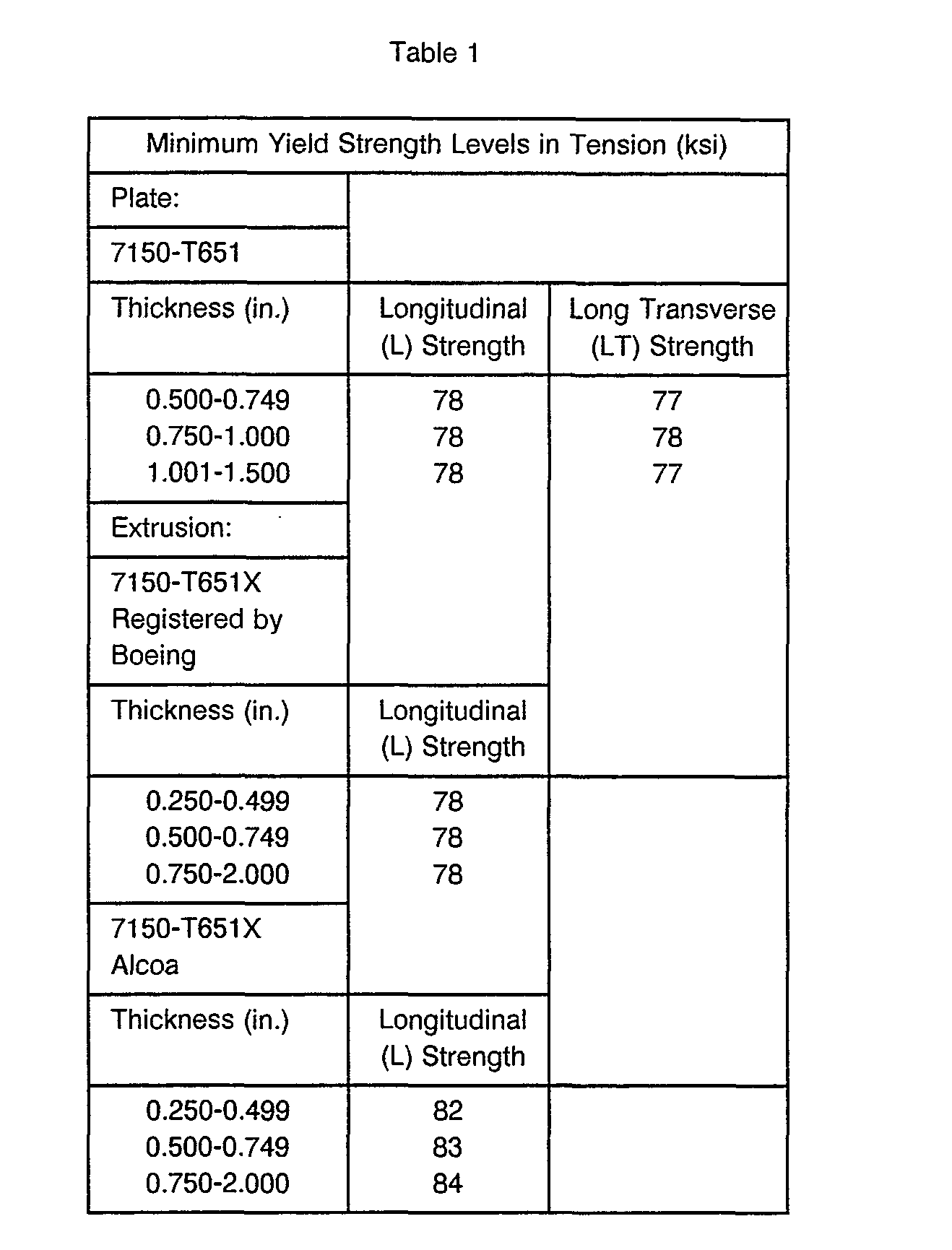
- minimum strengths for typical 7150-T6 products are listed in following Table 1, it being recalled that 7150-T6 is currently the strongest aluminum alloy commercially used by the aerospace industry in upper wing skins and other high strength applications. Improved alloy products of this invention also exhibit about 5% greater minimum strengths than a 7X50-T77 product at EC levels of exfoliation resistance or better.
- Relative strength values for artificially aged alloy products of the invention will vary to some extent depending on their size, shape and method of manufacture. For example, improved plate products should consistently achieve minimum strengths of about 82 to 85 ksi with differing cross-sectional thicknesses. Improved extrusions, on the other hand, should attain minimum yield strengths of about 86 to 90 ksi without suffering from excessive exfoliation corrosion.
- the alloy products of this invention achieve high strengths while having imparted thereto corrosion resistance properties which typically exceed those associated with 7X50-T6 products.
- the invention alloy exhibits SCC and exfoliation corrosion resistances which meet or exceed those of T76-aged 7XXX alloy products.
- SCC and exfoliation corrosion resistances which meet or exceed those of T76-aged 7XXX alloy products.
- these improved products may withstand alternate immersion testing at constant stresses of about 35 ksi, thereby achieving an SCC resistance level comparable to that of T74-aged products.
- Exfoliation resistances of the invention alloy are also consistently improved over those levels associated with 7X50-T6 aluminum (typically an EXCO rating of "EC").
- Table 2 sets forth the corrosion resistance standards currently required of 7075, 7050 and 7150 products aged to the T73, T74, T76 and T6 tempers, respectively.
- the first test usually conducted on products having short transverse thicknesses greater than about 1.5 inch, subjects short transverse bar specimens, 1/8 inch (3.2 mm) in diameter, to alternate immersion testing in accordance with ASTM Standard G44-75. More specifically, these bar-shaped specimens are exposed to cycles of immersing in a 3.5% NaCI aqueous solution for 10 minutes, followed by 50 minutes of air drying while being pulled from both ends under a constant strain (ksi).
- Such testing is carried out for a minimum of 20 days (or for less time should the specimen fail or crack before 20 days have passed).
- the other preferred SCC test conducted in accordance with ASTM Standard G38-73, is typically reserved for extruded alloy products. This test consists of compressing the opposite ends of a C-shaped ring using constant strain levels and alternate immersion conditions substantially similar to those set forth above.
- the exfoliation test used for comparison purposes herein is more commonly known as the EXCO test as performed in accordance with ASTM Standards G34-72 and G34-79.
- alloy compositions of this invention there exists another method for thermally treating alloy compositions of this invention to achieve slightly lower strength improvements than those achieved with the preferred "low-high-low” aging practice described earlier, but still higher than those strength levels associated with any 7050 and 7150 counterparts.
- the invention alloy produces actual strengths at least about 3 to 5% greater, and as much as 11 to 14% greater, than 7X50-T6 aluminum with typically better toughness and corrosion resistance properties.
- the steps (or phases) to this second preferred practice, after solution heat treating include: heating to one or more temperatures within about 175 to 285 F for about 2 or more hours, or more preferably, for about 6 to 30 hours; and heating to one or more temperatures within about 300 to 345 F for about 2 or more hours, or more preferably, for about 5 to 18 hours.
- these same conditions are applied to a 7075 or 7X50 product, they will result in T76 corrosion resistances in combination with relative strengths below those associated with T6-type aging.
- Table 3 there is provided a general description of the 7XXX alloys comparatively analyzed for purposes of this invention, said alloys having been generally grouped into sets based on the percentage of magnesium present therein.
- Table 3 lists the respective weight percents of zinc, magnesium and copper present in each 7XXX alloy; their combined total of zinc, magnesium and copper contents; the measured density for each alloy; and the respective first and second stage aging conditions employed. The third aging stage was not given a separate column in Table 3 as it was consistently 24 hours at 250° F for all alloys so listed.
- Table 3 also lists the tensile yield strength (TYS), specific TYS (TYS/density), compressive yield strength (CYS), and specific CYS (CYS/density) values for each alloy, followed by their respective electrical conductivity values (in terms of % IACS), said conductivity values serving as approximations of alloy corrosion resistance performance.
- the last columns in Table 3 then list actual EXCO test results for each alloy, and the measured Kr25 toughness values for the same, said toughness measured in accordance with ASTM Standard E561-86.
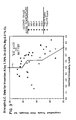
- Strength/toughness values for the preferred embodiments of this invention which also contain less than about 2-3% magnesium, are marked with a filled black square " 0 " and boxed in parallelogram D. Figure 2 then vividly distinguishes the improved combinations of properties attainable by this invention.
- Preferred embodiments of this invention possess improved combinations of relative strength, fracture toughness and corrosion resistance that were not previously attained with high zinc-aluminum alloys. Because such property combinations are achieved with little cost to alloy density, the invention is especially well suited for many critical aerospace applications, including upper wing assemblies and the like.
- alloy 1 of the invention they still exhibit improved combinations of properties which are greater than those of their 7050 and 7150 counterparts. Comparative properties for several members of this alloy family are illustrated within polygon C of Figure 2, such as alloy No. 6 from Table 5 which can have a range of about 10.1 to 10.9% zinc, about 1.8 to 2.2% magnesium, and about 1.2 to 1.8% copper, the balance being as otherwise set forth hereinabove, including one or more of zirconium, hafnium and/or vanadium (with or without manganese).
- the new products of this invention contain preferably 8% or more zinc in order to achieve the desired high strength. Alloys containing at least 7 or 7.5% zinc are considered useful as are zinc contents of 9 or 10%.
- the zinc content for the improved products may be as high as 16% or possibly higher, for instance 18 or 20%.
- a maximum zinc of about 12% is preferred in some embodiments although maximum zinc levels up to as much as 13 or 14 or even 15% may be applied in the practice of this invention.
- Suitable ranges for zinc include: from about 7.5 or 8% or more up to about 9 or 9.5%; from about 8.5 or 9% up to about 10 or 10.5%, or even 11 %; and from about 9.5 or 10% up to about 11.5 or 12%.
- the improved aluminum alloy products generally contain magnesium in minimum amounts of about 1.5% although a minimum of at least 1.75 or 2% is preferred in some embodiments.
- the maximum amount for magnesium is about 4 or 4.25%, or possibly even 4.5% magnesium.
- Suitable ranges for magnesium include: from about 1.5% to about 2.5 or 3%; from about 1.7 or 2% up to about 3 or 3.5%; and from about 2% up to about 4 or 4.5%.
- Copper is present in an amount of at least 1 or 1.5% with the maximum copper being about 2.5 or 2.75%, or in some cases about 3%.
- Suitable ranges for copper include: from about 1% to about 2%; from about 1.3 or 1.5% up to about 2.5 or 2.7%, or even 3%; and from about 1% to about 2.5 or 3%.
- One preferred range for copper is about 1.75 or 2% to 2.5 or 2.75%.
- One range of alloys considered useful in practicing this invention contains from about 8% to about 11 or 11.5% zinc, from about 2% to about 3% magnesium and from about 1.75% to about 2.5% copper.
- Another preferred alloy contains 7 to 12% zinc, 1.5 to 2.7% magnesium, 1.75 to 3% copper, and one or more of zirconium, manganese, vanadium or hafnium. Still another contains 7 to 12% zinc, magnesium and copper as just stated and 0.05 to 0.2% zirconium.
- the amount of zinc, magnesium and copper not exceed a dissolvable amount, by which is meant an amount that can be brought into solid solution during solution heat treatment such that not more than one volume percent of undissolved intermetallic phases greater than about 1 micron containing Zn, Cu and/or Mg is present after solution heat treating. Preferably, not over one-half volume percent of said intermetallic phases remains. Accordingly, it can be advantageous to limit the combined total of zinc, magnesium and copper to levels not exceeding about 16 or 17%. A preferred minimum for zinc, magnesium and copper should be at least about 12% although total contents of about 11 or 10.5% may also be sufficient. In some embodiments, the amount of copper present exceeds the amount of magnesium present, while in other embodiments, copper is less than or equal to the magnesium account.
Landscapes
- Chemical & Material Sciences (AREA)
- Engineering & Computer Science (AREA)
- Materials Engineering (AREA)
- Mechanical Engineering (AREA)
- Metallurgy (AREA)
- Organic Chemistry (AREA)
- Physics & Mathematics (AREA)
- Thermal Sciences (AREA)
- Crystallography & Structural Chemistry (AREA)
- Forging (AREA)
- Extrusion Of Metal (AREA)
- Powder Metallurgy (AREA)
- Conductive Materials (AREA)
Abstract
Description
- The present invention relates to an aluminum alloy product having improved combinations of strength, toughness and corrosion resistance. This invention further relates to an aluminum-zinc-magnesium-copper alloy having at least about 10% greater yield strength than the Aluminum Association's 7X50-T6 aluminum, the strongest aluminum alloy currently in wide use for demanding aerospace applications such as upper wing members, with toughness and corrosion properties comparable or superior to those of 7X50-T6 aluminum.
- Precipitation-hardened 7075 alloy products exhibit high strength values in the T6 temper.
Aluminum alloys 7050 and 7150, herein referred to as 7X50, exhibit still higher strengths in T6-type tempers. Should 7075 and 7X50 alloy products be artificially aged to a T76, T74 or T73-type temper, their resistances to stress corrosion cracking and/or exfoliation corrosion improve in the order stated (with T73 being best), but usually at some cost to strength vis-a-vis the T6 condition. The overall performance levels of 7X50 alloys greatly exceed those of 7075 aluminum, or other 7XXX alloys currently in wide aerospace use. - Another T7-type designation was recently registered for the aforementioned 7XXX alloys, that being T77 tempering which attains strength levels at or near peak strength (T6) in combination with T76, or even T74, corrosion resistance properties. Means for aging 7075 aluminum to this temper are set forth in U.S. Patent No. 4,477,292 and British Patent No. 1,480,351.
- This invention relates to: aluminum alloy products having very high strength and specific strength (strength divided by density) values, substantially exceeding those of 7X50, while maintaining or even improving the toughness and corrosion resistance properties of the previous products; and to an improved AI-Zn-Mg-Cu alloy product having EXCO corrosion resistance levels of "EB" or better with at least about 15% greater yield strength than a similarly-sized 7X50 counterpart in the T76 condition, at least about 10% greater yield strength than a 7X50-T6 counterpart, or at least about 5% greater strength than its 7X50-T77 counterpart. When the improved alloy products of this invention are artificially aged to produce exfoliation corrosion resistance properties of "EC" or lower (EXCO levels comparable to those of 7X50-T76 products), the invention alloy will typically possess at least about 20% greater strength than its 7X50-T76 counterpart, at least about 15% greater strength than its 7X50-T6 counterpart and at least about 9% greater yield strength than a 7X50-T77 alloy counterpart product. The invention also relates to aerospace structural members, such as upper wing skin plates, extrusions or the like, from this improved high strength alloy.
- A preferred embodiment of the invention concerns an alloy consisting essentially of about 7.6 to about 8.4 or 8.6% zinc, account 1.6 or 1.8% to about 2.3% magnesium, about 2 to 2.6 or 2.8% copper, and at least one element selected from zirconium, vanadium and hafnium present in an amount not exceeding about 0.2% for zirconium and vanadium, or about 0.4% for hafnium, the balance aluminum and incidental elements and impurities. The benefits from Zr, V and/or Hf addition may be further enhanced with up to about 0.3 or 0.4% manganese. As used herein, all compositional limits are by weight percent unless otherwise indicated.
- The improved alloy products of this invention exhibit substantially greater combinations of yield strength, fracture toughness and corrosion resistance as shown in the accompanying Figures. Because these preferred ranges of elements do not excessively increase alloy density relative to 7X50 aluminum, significant increases in specific strength are also realized by the invention. One preferred method for artificially aging this alloy composition includes: solution heat treating; heating to one or more temperatures within about 175 to 325 F for 2 or more hours; heating for a cumulative time-temperature effect substantially within ABCD of accompanying Figure 1; and heating to one or more temperatures within about 175 to 325° F for 3 or more hours. Another set of improved properties, with only slightly lower strengths, is imparted by subjecting this alloy composition to: solution heat treatment; treating to one or more temperatures within about 175 to 275 F for
amount 2 or more hours; and heating within about 300 to 345 ° F for 2 or more hours. - In the drawings:
- Further features, other objects and advantages of this invention will become clearer from the following detailed description made with reference to the drawings in which:
- Figure 1 is a graph showing preferred time-temperature treatments for imparting improved corrosion resistance to one embodiment of the invention;
- Figure 2 is a graph plotting relative toughness versus longitudinal yield strength for certain 7XXX alloy products, including those made according to the invention; and
- Figure 3 is a graph plotting longitudinal yield strength versus electrical conductivity for one preferred composition treated at various second-step aging temperatures.
- As used throughout this description of the invention, the following definitions shall apply:
- a. The term "ksi" shall mean kilopounds per square inch.
- b. The term "minimum strength" shall mean the strength level at which 99% of the product is expected to conform with 95% confidence using standard statistical methods.
- c. The term "ingot-derived" shall mean solidified from liquid metal by known or subsequently developed casting processes rather than through powder metallurgy or similar techniques. The term expressly includes, but shall not be limited to, direct chill (DC) continuous casting, electromagnetic continuous (EMC) casting and variations thereof.
- d. The term "7XXX" or "7000 Series", when referring to alloys, shall mean structural aluminum alloys containing zinc as their main alloying element, or the ingredient present in largest quantity.
- e. The term "counterpart", when used to compare products made from different 7XXX alloys, shall mean a part or product, e.g. an extrusion, of similar shape, thickness and manufacturing history.
- f. The term "7X50" shall mean any alloy currently or subsequently registered in this family or subgroup of 7XXX alloys. The term expressly includes, but shall not be limited to, 7050 aluminum and substantially identical 7150 aluminum. For every numerical range set forth, it should be noted that all numbers within the range, including every fraction or decimal between its stated minimum and maximum, are considered to be designated and disclosed by this description. As such, a preferred elemental range of about 7.6 to 8.4 or 8.6% zinc expressly covers zinc contents of 7.7, 7.8, 7.9%...and so on, up to about 8.4% zinc. Similarly, artificial aging to one or more temperatures between about 300 and 345 F would include thermal treatments at 301, 302° F,...315, 316° F,...and so on, up to the stated maximum.
- For most currently used 7000 Series (or 7XXX) alloys, T6-type tempers are obtained by precipitation hardening within about 175 to 325 F. Plate and extrusion products of 7075 aluminum, for example, are typically T6-aged by heating for about 24 hours at 250 F in a circulatory-air furnace. Products of 7X50 aluminum, on the other hand, are first treated at 250 F, followed by a higher temperature treatment, within about 325 to 350 F, to obtain optimum or peak (T6) strength.
- An alternative method for thermally treating 7075 aluminum and other 7XXX alloys is set forth in British Patent No. 1,480,351, referred to hereinabove. According to this method, improved combinations of strength and corrosion resistance are imparted from a multi-stage, or "low-high-low", temperature treatment which includes solution heat treating, precipitation hardening at about 175 to 325° F, further aging by subjecting to a temperature within about 360 to 450 F for a cumulative time-temperature treatment as described therein, then again precipitation hardening for about 2 to 30 hours between about 175 to 325 F.
- In accordance with this invention, still higher relative strengths are attainable when 7XXX alloy products having a total zinc content ranging from about 6 or 8% to about 16% have been subjected to low-high-low aging conditions similar to those described directly above. Although 7XXX alloys containing relatively higher amounts of zinc (e.g. 8 to 10% or more) have been known to exhibit significantly greater strengths than 7075 aluminum for some time, they were considered commercially impractical because of their high densities relative to 7075 aluminum and because they were much more susceptible to exfoliation and stress corrosion cracking. In earlier versions of such high zinc-aluminum alloys, strength improvements usually translated into unacceptable toughness reductions as well.
- In more preferred embodiments of this invention, it has been determined that a particular range of elements exhibits substantially better combinations of specific strength, fracture toughness and exfoliation corrosion resistance. Improved 7XXX alloy products containing about 7.6 to about 8.4 or 8.6% zinc, about 1.6 or 1.8% to about 2.3% magnesium and about 2 to about 2.6 or 2.8% copper possess significantly greater levels of strength than their 7X50 counterparts while maintaining, or even slightly improving their toughness and/or corrosion resistance performances, particularly when thermally treated by one of two preferred methods. For greater toughness values, the amount of magnesium in the invention alloy should be kept at or below about 2 or 2.1 %. For better resistance to exfoliation and stress corrosion cracking, copper contents should be maintained higher, preferably above about 2.2%, while better combinations of strength and density (or specific strength) are achieved with relatively lower zinc contents, below about 8.1 %. In any event, the total amount of zinc, magnesium and copper present should not exceed a dissolvable amount, by which it is meant an amount that can be brought into solid solution during solution heat treatment (SHT) so that fewer than one volume percent of undissolved intermetallic phases (about 1 micron in size or larger and containing Zn, Cu and/or Mg) remains after solution heat treatment. On a more preferred basis, less than one-half volume percent (0.5%) of such undissolved phases should remain after SHT. It is therefore advantageous to limit combined zinc, magnesium and copper contents to between about 11.9 or 12.1% and about 12.5, 12.7 or even 13%. The invention alloy should also maintain a total zinc-copper (Zn + Cu) content between about 9.9 and 11.0%.
- Alloy products of this invention should further include at least one ancillary element selected from: zirconium, for instance, between about 0.03 and 0.15% zirconium; vanadium, for instance, between about 0.05 and 0.15% vanadium; and hafnium, for instance, between about 0.03 and 0.4% hafnium. One or more of these elements may be further supplemented with at least some manganese, preferably between about 0.07 or 0.1% to about 0.3 or 0.35%. In any event, the total content of such ancillary elements should not exceed about 0.5 or 0.6%, or an amount which may be maintained in a supersaturated state following alloy solidification. It is believed that such elements, or complications of elements, enhance alloy performance by suppressing recrystallization to some extent, especially in cases where the alloy is cold worked prior to solution heat treatment. Unlike earlier high zinc-aluminum alloys, it is neither necessary nor sufficient for this alloy composition to include any nickel, calcium or chromium. Rather, the 7XXX products exhibiting greater combinations of properties hereunder are substantially nickel-free, calcium-free and chromium-free. By use of the term "substantially free" above, it is meant that preferably no quantity of such elements is present, it being understood, however, that alloying materials, operating conditions and equipment are not always ideal such that minor amounts of undesirable contaminants may find their way into the invention alloy. In any event, it should be further understood that the nickel content of the invention alloy are maintained below about 0.04 or 0.05%, or more preferably below a maximum of about 0.01 or 0.02% nickel; the calcium content should be kept below about 0.015 or 0.02%, more preferably below about 0.01 or 0.005% maximum; and the chromium level should be less than about 0.08%, or more preferably below a maximum of about 0.04 or 0.05% chromium.
- It is another surprising feature that the invention alloy possesses less need to maintain its iron and silicon contents at an extremely low level. It is generally believed that Fe and Si are both harmful to toughness, but the measured fracture toughnesses for alloy products containing about 0.05% iron and about 0.05% silicon were similar to those values for alloys containing about 0.05% each of these impurities, both toughness levels resembling that of a 7XXX product possessing lower strength, namely 7150-T6 aluminum. Conventional metallurgical wisdom predicts that toughness properties should decrease with increasing strength unless iron and silicon contents are purposefully lowered. The invention alloy was found to offer surprisingly less sensitivity to variations in the tolerable amounts of these two impurities, however. Although total iron and/or silicon contents of about 0.2 or 0.25% maximum are more preferred, it is also possible for the invention alloy to accommodate cumulative iron and silicon concentrations up to about 0.4 or 0.5%. Thus, the invention alloy can contain about 0.04 or 0.05 or 0.06% up to 0.15 or even 0.2 or 0.25% or 0.3% each of iron and silicon. Elements other than those named hereinabove are preferably limited to 0.1 or 0.2% or possibly 0.3% maximum, more preferably 0.05% maximum. The combined total of other elements not named hereinabove is preferably not over 0.5 or 1 %, more preferably not over about 0.1 or 0.2%.
- Because of the combinations of properties attainable, the invention alloy is especially well suited for critical aerospace applications, such as upper wing skin panels or members (typically plate), and other high strength-high exfoliation resistance end uses. Products may be directly cast or formed into useful shapes from this alloy by any known or subsequently developed technique including rolling, forging and extrusion. The resulting sheet, plate, rod, bar or the like, may vary greatly in size and shape. For most aerospace applications, plate products made from this preferred composition may have cross-sectional thicknesses ranging from about 0.3 or 0.35 inch, up to about 1.5, 2 or even 3 or more inches. It should be further understood, however, that the invention alloy may also be made into products having cross-sectional thicknesses even smaller than about 0.3 inch.
- The alloy products of this invention are primarily ingot-derived. Once an ingot has been cast from this composition, it is homogenized by heating to one or more temperatures between about 860° and 920 F after which it is worked (and sometimes machined) into a desired shape. The product, if desired, should then be solution heat treated by heating to one or more temperatures between about 840 or 850 F and about 880 or 900 F to take substantial portions, preferably all or substantially all, of the soluble zinc, magnesium and copper into solution, it being again understood that with physical processes which are not always perfect, probably every last vestige of these main alloying ingredients will not be dissolved during SHT (solutionizing). After heating to elevated temperatures as just described, the product should be rapidly cooled or quenched to complete the solution heat treating procedure. Such cooling is typically accomplished by immersion in a suitably sized tank of cold water, though water sprays and/or air chilling may be used as supplementary or substitute cooling means. After quenching, certain products may need to be cold worked, such as by stretching, so as to relieve internal stresses. A solution heat treated (and quenched) product, with or without cold working, is then considered to be in a precipitation-hardenable condition, or ready for artificial aging according to one of two preferred methods. As used hereinafter, the term "solution heat treat" shall be meant to include quenching unless expressly stated to the contrary.
- In the first preferred thermal aging treatment, precipitation-hardenable alloy product is subjected to three main aging steps, phases or treatments, although clear lines of demarcation may not exist between each step or phase. It is generally known that ramping up to and/or down from given (or target) treatment temperatures, in itself, can produce precipitation (aging) effects which can, and often need to be, taken into account by integrating such ramping conditions, and their precipitation-hardening effects, into the total aging treatment program. Such integration was described in greater detail in U.S. Patent No. 3,645,804. With ramping and its corresponding integration, the three phases for thermally treating invention alloy according to this aging practice may be effected in a single, programmable furnace. For convenience purposes, though, each stage (step or phase) will be more fully described as a distinct operation hereafter. It is believed that the first stage serves to precipitation harden the alloy product; the second (higher temperature) stage then exposes alloy product to one or more elevated temperatures for increasing its resistance to exfoliation and stress corrosion cracking (SCC); while the third stage further precipitation hardens the invention alloy to a very high strength level.
- In the first treatment stage summarized above, invention alloy is precipitation hardened to strengthen it, for example, to a point at or near peak strength (whether underaged or slightly overaged) although less than peak strength conditions (or underaging) may be desired in some cases. Such precipitation hardening can be accomplished by heating to one or more elevated temperatures below about 330°F, preferably between about 175 and 325 F, for a significant period of time ranging from about 2 or 3 hours to about 30 hours or more. A substantially similar treatment may occur through gradual ramping to the second (higher temperature) treatment stage, with or without any hold time at temperature(s) in said first range. In any event, such precipitation hardening significantly strengthens the alloy over the strength level which it achieves promptly after quenching (hereinafter, "as-quenched" or "solution heat treated" strength). Such precipitation hardening improves strengths by at least 30%, and preferably by at least 40 to 50% or more, for example, about 60 or 70%, of the difference between as-quenched and peak yield strength. In other words, the precipitation hardening of alloy product entering the second treatment (or phase) should have carried (or increased) the alloy product's yield strength by at least about 30%, and preferably more, of the way from as-quenched or solution heat treated strength (i.e., low strength) toward peak strength. This first treatment phase can also extend until the alloy achieves up to about 95% of peak strength (underaged), peak strength itself, or even until alloy strength runs slightly past peak and back down to about 95% of peak strength (through overaging). It should be understood, however, that for some embodiments, relative strengths may also increase during the second treatment phase depending on the extent to which peak strength was approached during the first treatment phase.
- Following this first phase of thermal treatment, invention alloy is preferably subjected to heating at one or more elevated temperatures above about 340°F or 350°F, preferably within the range of about 360 to 500 F, for a few minutes or more. For instance, the effects of this treatment for a particular alloy can commence at a temperature of about 345 or 350 F and continue as the temperatures are further increased such that "ramping up" and/or "ramping down" of temperatures between about 345°, 350° or 355°F and higher temperatures within the aforesaid perimeter can be taken into account and integrated into determining the equivalent aging effect within the aforesaid perimeter ABCD. This treatment may proceed for 3 or more minutes at one or more temperatures between about 360 and 490 F; for 4 or more minutes at one or more temperatures between about 360° and 480 F; or for 5 or more minutes at one or more temperatures between about 360° and 475 F. The 3-, 4-, and 5-minute thresholds of ABCD in Figure 1 are shown by lines U-V, W-X and Y-Z, respectively. Typical second phase treatments include subjecting the alloy product to cumulative times and temperatures within the perimeter ABCD of Figure 1, even though one, or more than one, temperature within ABCD may be employed for such treatment. As is apparent from Figure 1, there is a correlation between time and temperature for this preferred second treatment. Generally, alloy exposure temperatures vary inversely with duration such that shorter times are used at relatively higher temperatures, while longer times are more appropriate at the lower temperatures, below about 400°F or so.
- When heating alloy products to one or more temperatures for "x" minutes according to this preferred second treatment phase, it is to be understood that such treatment embraces heating to any number of temperatures within said range for a cumulative time "x" above the lowest temperature of said range. As such, heating for 5 or more minutes within about 360 to 475 F does not require holding for 5 minutes at each or even any particular temperature within said range, but rather, that the cumulative time at all temperatures within 360 to 475" F is 5 minutes or more.
- It is generally believed that the foregoing second treatment phase improves this alloy's resistance to stress corrosion cracking (SCC), exfoliation and other detrimental corrosion effects. With respect to Figure 1, better properties of SCC resistance are believed achievable when heating for time-temperature effects closer to line C-D, while greater combinations of strength and exfoliation resistance are attainable when aging at conditions closer to line A-B of Figure 1. Second phase treatments may be carried out by immersing alloy products into a substantially hot liquid such as molten salt, hot oil or even molten metal. A furnace (hot air and/or other gases) may also be used depending on the size, shape and quantity of product to be treated. In the alternative, a fluidized bed-type apparatus may be used, said apparatus providing more rapid heating than a hot air furnace but slower, more uniform heating than a molten salt bath. Fluidized bed heat-ups are especially advantageous for presenting fewer environmental complications. Induction heaters may also be used for artificial aging according to the invention, for instance, in the second phase of this preferred method.
- The heating operations of this invention can be ramped-up fairly slowly such that much or even all of the treatments, especially the precipitation-hardening treatments of the first and/or third phases, can be accomplished by or during ramping-up to and/or -down from the elevated second phase temperature or temperatures such that there may not be discrete disruptions or interruptions between phases. However, the second phase can be considered to start when the corrosion properties start to improve. This typically involves some time at temperatures of about 360° or so or more after achieving the strengthening described (precipitation-hardening) in the first phase as mentioned hereinbefore. In some embodiments, the second phase can be considered accomplished when the desired degree of corrosion resistance is achieved and the temperature is suitably lowered for third phase precipitation-hardening. However, in other cases, the corrosion resistance can improve in the third phase such that the second phase can be shortened to a level less than the desired corrosion resistance to allow for this effect.
- During the third phase of this preferred treatment method, alloy product is precipitation-hardened at one or more elevated temperatures up to about 330 F, typically between about 175 and 325 F, for about 2 to 30 hours or more. With such treatment, the invention alloy is able to achieve significantly higher strength levels than those attained by 7075 aluminum and other 7XXX counterparts. When aged to achieve corrosion properties comparable to those of T6-aged products, for example, having EXCO corrosion ratings of "EB" or better, the invention alloy produces minimum or guaranteeable yield strengths (compression and/or tension) at least about 15% greater than the minimum strengths for a similarly-sized, shaped and formed 7X50 alloy product aged to a T76 temper (or 7050-T76); and at least atbout 10% greater relative strength than a 7X50-T6 product. minimum strengths for typical 7150-T6 products are listed in following Table 1, it being recalled that 7150-T6 is currently the strongest aluminum alloy commercially used by the aerospace industry in upper wing skins and other high strength applications. Improved alloy products of this invention also exhibit about 5% greater minimum strengths than a 7X50-T77 product at EC levels of exfoliation resistance or better.
- When the improved alloy products of this invention are thermally treated to achieve slightly lower minimum EXCO ratings of "EC" or better, their relative strengths exceed those of 7X50-T76 products (having "EB" EXCO levels or better) by at least about 20%, those of 7X50-T6 products (with "EC" EXCO values or lower) by about 15% or more; and those minimum strengths associated with 7X50-T77 aged products by about 9% or more. For the preceding percent-improvement calculations, minimum yield strengths of existing commercial alloy tempers were used rather than actual strength values (which generally run higher) since minimum strengths are usually employed for design considerations. Should actual (or typical) strengths of existing tempers be compared, the invention alloy is expected to still exhibit the same level of strength improvement, about 5-20% or more, over its 7X50-T6, -T76 or -T77 counterparts.
- Relative strength values for artificially aged alloy products of the invention will vary to some extent depending on their size, shape and method of manufacture. For example, improved plate products should consistently achieve minimum strengths of about 82 to 85 ksi with differing cross-sectional thicknesses. Improved extrusions, on the other hand, should attain minimum yield strengths of about 86 to 90 ksi without suffering from excessive exfoliation corrosion.
- The alloy products of this invention achieve high strengths while having imparted thereto corrosion resistance properties which typically exceed those associated with 7X50-T6 products. In most cases, the invention alloy exhibits SCC and exfoliation corrosion resistances which meet or exceed those of T76-aged 7XXX alloy products. Hence, when such products are thermally treated by the three-stages (or phases) described above, they possess an ability to survive 20 days or more of alternate immersion testing in a 3.5% NaCI solution without cracking while under constant stresses of about 25 ksi for plate products (or at least about 17 ksi for extrusions). Under other aging conditions, these improved products may withstand alternate immersion testing at constant stresses of about 35 ksi, thereby achieving an SCC resistance level comparable to that of T74-aged products. Exfoliation resistances of the invention alloy are also consistently improved over those levels associated with 7X50-T6 aluminum (typically an EXCO rating of "EC").
- Table 2 sets forth the corrosion resistance standards currently required of 7075, 7050 and 7150 products aged to the T73, T74, T76 and T6 tempers, respectively. To determine whether commercial alloys meet these standards, a given test specimen is subjected to one of two preferred SCC tests. The first test, usually conducted on products having short transverse thicknesses greater than about 1.5 inch, subjects short transverse bar specimens, 1/8 inch (3.2 mm) in diameter, to alternate immersion testing in accordance with ASTM Standard G44-75. More specifically, these bar-shaped specimens are exposed to cycles of immersing in a 3.5% NaCI aqueous solution for 10 minutes, followed by 50 minutes of air drying while being pulled from both ends under a constant strain (ksi). Such testing is carried out for a minimum of 20 days (or for less time should the specimen fail or crack before 20 days have passed). The other preferred SCC test, conducted in accordance with ASTM Standard G38-73, is typically reserved for extruded alloy products. This test consists of compressing the opposite ends of a C-shaped ring using constant strain levels and alternate immersion conditions substantially similar to those set forth above. The exfoliation test used for comparison purposes herein is more commonly known as the EXCO test as performed in accordance with ASTM Standards G34-72 and G34-79.

- There exists another method for thermally treating alloy compositions of this invention to achieve slightly lower strength improvements than those achieved with the preferred "low-high-low" aging practice described earlier, but still higher than those strength levels associated with any 7050 and 7150 counterparts. With this second preferred aging practice, the invention alloy produces actual strengths at least about 3 to 5% greater, and as much as 11 to 14% greater, than 7X50-T6 aluminum with typically better toughness and corrosion resistance properties. The steps (or phases) to this second preferred practice, after solution heat treating, include: heating to one or more temperatures within about 175 to 285 F for about 2 or more hours, or more preferably, for about 6 to 30 hours; and heating to one or more temperatures within about 300 to 345 F for about 2 or more hours, or more preferably, for about 5 to 18 hours. When these same conditions are applied to a 7075 or 7X50 product, they will result in T76 corrosion resistances in combination with relative strengths below those associated with T6-type aging.
- In Table 3, there is provided a general description of the 7XXX alloys comparatively analyzed for purposes of this invention, said alloys having been generally grouped into sets based on the percentage of magnesium present therein. Table 3 lists the respective weight percents of zinc, magnesium and copper present in each 7XXX alloy; their combined total of zinc, magnesium and copper contents; the measured density for each alloy; and the respective first and second stage aging conditions employed. The third aging stage was not given a separate column in Table 3 as it was consistently 24 hours at 250° F for all alloys so listed. Table 3 also lists the tensile yield strength (TYS), specific TYS (TYS/density), compressive yield strength (CYS), and specific CYS (CYS/density) values for each alloy, followed by their respective electrical conductivity values (in terms of % IACS), said conductivity values serving as approximations of alloy corrosion resistance performance. The last columns in Table 3 then list actual EXCO test results for each alloy, and the measured Kr25 toughness values for the same, said toughness measured in accordance with ASTM Standard E561-86.

- The tensile yield strength and Kr25 toughness values for the Table 3 samples were then plotted along the x and y axes, respectively, of accompanying Figure 2. It is believed that Figure 2 underscores the importance of magnesium content for the improved alloy product of this invention. In Figure 2, comparative strength/toughness data for alloys containing greater than about 3% magnesium are marked with a black circle "0" and boxed within triangle A; comparative alloys with about 2.3-3% magnesium designated with a small triangle "Δ" (except for the typical strength-toughness values of 7150-T77 alloy products shown by star symbol "*") are boxed within polygon B, while the same data for alloys containing less than about 2.3% magnesium are marked with a small square "o" and boxed by polygon C. Strength/toughness values for the preferred embodiments of this invention which also contain less than about 2-3% magnesium, are marked with a filled black square "0" and boxed in parallelogram D. Figure 2 then vividly distinguishes the improved combinations of properties attainable by this invention.
- From the four groups of data points comprising Figure 2, it is made clearer how the invention achieves greater combinations of these two main properties. In Figure 2, strength levels typically increase from left to right along the horizontal (or x-axis), while toughnesses increase from the bottom to top of the Figure's y-axis as illustrated. Within data groupings A, B and C of Figure 2, strength increases are typically traded for better toughness properties such that higher strengths may be achieved at lower toughnesses and vice versa. On the other hand, parallelogram D data points for the preferred alloy composition of this invention clearly show improvement in both strength and toughness by advancing outwardly along this Figure's x-axis as well as upwardly along its y-axis.
- In following Table 4, 0.375-inch sections of laboratory-produced aluminum samples containing about 7.76% zinc, about 2.07% magnesium and about 2.51% copper were solution heat treated, stretched and artificially aged for various second stage times and temperatures according to the two preferred treatment methods described above. Tensile yield strengths, electrical conductivities (in terms of % IACS) and EXCO corrosion test results for each sample were then measured and plotted in accompanying Figure 3. More specifically, plotted data points for alloys subjected to preferred 3-stage aging conditions are shown by solid shapes according to the key to the right of Figure 3, while strength-E.C. values for 2-stage aged alloys are shown as hollow squares and triangles. Typical yield strength-electrical conductivity values for 7150-T6 (shown by the star symbol "*") and 7150-T77 (shown by the plus symbol " + ") were taken plotted on this same graph for comparison purposes. Actual EXCO test results of "EB" or better are then shown to the right of line L midway through Figure 3. From this comparison, it is again made clear the extent to which the invention alloy outperforms its high strengths 7150-T6 and 7150 T77 counterparts in terms of both strength and exfoliation resistance combinations.

- Preferred embodiments of this invention possess improved combinations of relative strength, fracture toughness and corrosion resistance that were not previously attained with high zinc-aluminum alloys. Because such property combinations are achieved with little cost to alloy density, the invention is especially well suited for many critical aerospace applications, including upper wing assemblies and the like.
- In a broader sense, it is believed that the strength, toughness and corrosion resistance improvements realized by this invention can translate to an entire family of aluminum-zinc alloys containing 7 or 8% to 10% Zn wherein each family member comprises about 1.6-2.3% magnesium, with zinc and copper contents varying according to the following relationship: for every 0.25% that zinc levels exceed 8% (up to a maximum of about 11 % zinc), the total copper contents should be reduced 0.1 % from a maximum of about 2.5% copper. Under this formulation, alloys having the following nominal amounts of designated elements would be illustrative:

alloys 2 through 6 possess generally lower strength, toughness and/or corrosion resistance properties than preferred embodiments (e.g. alloy 1) of the invention, they still exhibit improved combinations of properties which are greater than those of their 7050 and 7150 counterparts. Comparative properties for several members of this alloy family are illustrated within polygon C of Figure 2, such as alloy No. 6 from Table 5 which can have a range of about 10.1 to 10.9% zinc, about 1.8 to 2.2% magnesium, and about 1.2 to 1.8% copper, the balance being as otherwise set forth hereinabove, including one or more of zirconium, hafnium and/or vanadium (with or without manganese). - In more general terms, the new products of this invention contain preferably 8% or more zinc in order to achieve the desired high strength. Alloys containing at least 7 or 7.5% zinc are considered useful as are zinc contents of 9 or 10%. The zinc content for the improved products may be as high as 16% or possibly higher, for
instance 18 or 20%. A maximum zinc of about 12% is preferred in some embodiments although maximum zinc levels up to as much as 13 or 14 or even 15% may be applied in the practice of this invention. Suitable ranges for zinc include: from about 7.5 or 8% or more up to about 9 or 9.5%; from about 8.5 or 9% up to about 10 or 10.5%, or even 11 %; and from about 9.5 or 10% up to about 11.5 or 12%. - The improved aluminum alloy products generally contain magnesium in minimum amounts of about 1.5% although a minimum of at least 1.75 or 2% is preferred in some embodiments. The maximum amount for magnesium is about 4 or 4.25%, or possibly even 4.5% magnesium. Suitable ranges for magnesium include: from about 1.5% to about 2.5 or 3%; from about 1.7 or 2% up to about 3 or 3.5%; and from about 2% up to about 4 or 4.5%. Copper is present in an amount of at least 1 or 1.5% with the maximum copper being about 2.5 or 2.75%, or in some cases about 3%. Suitable ranges for copper include: from about 1% to about 2%; from about 1.3 or 1.5% up to about 2.5 or 2.7%, or even 3%; and from about 1% to about 2.5 or 3%. One preferred range for copper is about 1.75 or 2% to 2.5 or 2.75%. One range of alloys considered useful in practicing this invention contains from about 8% to about 11 or 11.5% zinc, from about 2% to about 3% magnesium and from about 1.75% to about 2.5% copper. Another preferred alloy contains 7 to 12% zinc, 1.5 to 2.7% magnesium, 1.75 to 3% copper, and one or more of zirconium, manganese, vanadium or hafnium. Still another contains 7 to 12% zinc, magnesium and copper as just stated and 0.05 to 0.2% zirconium.
- In practicing the invention, it is preferred, especially from the standpoint of toughness and fatigue properties, that the amount of zinc, magnesium and copper not exceed a dissolvable amount, by which is meant an amount that can be brought into solid solution during solution heat treatment such that not more than one volume percent of undissolved intermetallic phases greater than about 1 micron containing Zn, Cu and/or Mg is present after solution heat treating. Preferably, not over one-half volume percent of said intermetallic phases remains. Accordingly, it can be advantageous to limit the combined total of zinc, magnesium and copper to levels not exceeding about 16 or 17%. A preferred minimum for zinc, magnesium and copper should be at least about 12% although total contents of about 11 or 10.5% may also be sufficient. In some embodiments, the amount of copper present exceeds the amount of magnesium present, while in other embodiments, copper is less than or equal to the magnesium account.
- Some alloys considered suitable in accordance with still broader embodiments of this invention include:

- Having described the presently preferred embodiments, it is to be understood that the invention may be otherwise embodied within the scope of the appended claims which are intended to embrace all equivalents and all embodiments within the spirit of the invention.
Claims (15)
Applications Claiming Priority (2)
| Application Number | Priority Date | Filing Date | Title |
|---|---|---|---|
| US297676 | 1981-08-31 | ||
| US29767689A | 1989-01-13 | 1989-01-13 |
Publications (3)
| Publication Number | Publication Date |
|---|---|
| EP0377779A1 true EP0377779A1 (en) | 1990-07-18 |
| EP0377779B1 EP0377779B1 (en) | 1998-05-20 |
| EP0377779B2 EP0377779B2 (en) | 2001-09-05 |
Family
ID=23147292
Family Applications (1)
| Application Number | Title | Priority Date | Filing Date |
|---|---|---|---|
| EP89111695A Expired - Lifetime EP0377779B2 (en) | 1989-01-13 | 1989-06-27 | Aluminium alloy product having improved combinations of strength, toughness and corrosion resistance |
Country Status (4)
| Country | Link |
|---|---|
| EP (1) | EP0377779B2 (en) |
| JP (1) | JPH02190434A (en) |
| CA (1) | CA1340618C (en) |
| DE (1) | DE68928676T3 (en) |
Cited By (20)
| Publication number | Priority date | Publication date | Assignee | Title |
|---|---|---|---|---|
| EP0587274A1 (en) * | 1992-08-13 | 1994-03-16 | Reynolds Metals Company | Method of producing an aluminum-zinc-magnesium-copper alloy having improved exfoliation resistance and fracture toughness and product thereof |
| EP0670377A1 (en) * | 1994-03-02 | 1995-09-06 | Pechiney Recherche (Gie) | High-strength aluminium alloy 7000 and manufacturing process |
| WO1996003748A1 (en) * | 1994-07-27 | 1996-02-08 | Minnesota Mining And Manufacturing Company | Tape cartridge base plate comprising a novel aluminum alloy |
| WO1997027343A1 (en) * | 1996-01-25 | 1997-07-31 | Pechiney Rhenalu | THICK AlZnMgCu ALLOY PRODUCTS HAVING IMPROVED PROPERTIES |
| EP0829552A1 (en) * | 1996-09-11 | 1998-03-18 | Aluminum Company Of America | Aluminium alloy products suited for commercial jet aircraft wing members |
| WO2002052053A1 (en) * | 2000-12-21 | 2002-07-04 | Alcoa Inc. | Aluminum alloy products and artificial aging nethod |
| FR2820438A1 (en) * | 2001-02-07 | 2002-08-09 | Pechiney Rhenalu | PROCESS FOR MANUFACTURING A CORROSIVE PRODUCT WITH HIGH RESISTANCE IN ALZNMAGCU ALLOY |
| GB2402943B (en) * | 2002-06-24 | 2006-03-29 | Corus Aluminium Walzprod Gmbh | Method for producing a high strength Al-Zn-Mg-Cu alloy |
| AU2007229365B2 (en) * | 2000-12-21 | 2008-06-05 | Arconic Inc. | Aluminium Alloy Products and Artificial Aging Method |
| WO2008120237A1 (en) * | 2007-03-30 | 2008-10-09 | Director General, Defence Research & Development Organisation | Alloy composition and preparation thereof |
| WO2008156532A3 (en) * | 2007-05-14 | 2009-01-29 | Alcoa Inc | Aluminium alloy products having improved property combinations and method for their production |
| CN100462462C (en) * | 2007-05-16 | 2009-02-18 | 东北轻合金有限责任公司 | 7055 aluminum alloy in high intensity, and high toughness, and preparation method |
| US7666267B2 (en) | 2003-04-10 | 2010-02-23 | Aleris Aluminum Koblenz Gmbh | Al-Zn-Mg-Cu alloy with improved damage tolerance-strength combination properties |
| RU2404276C2 (en) * | 2004-10-05 | 2010-11-20 | Алерис Алюминум Кобленц Гмбх | PRODUCT FROM HIGH-STRENGTH, HIGH-VISCOSITY Al-Zn ALLOY AND MANUFACTURING METHOD OF SUCH PRODUCT |
| US7883591B2 (en) | 2004-10-05 | 2011-02-08 | Aleris Aluminum Koblenz Gmbh | High-strength, high toughness Al-Zn alloy product and method for producing such product |
| US20120024433A1 (en) * | 2010-07-30 | 2012-02-02 | Alcoa Inc. | Multi-alloy assembly having corrosion resistance and method of making the same |
| US8206517B1 (en) | 2009-01-20 | 2012-06-26 | Alcoa Inc. | Aluminum alloys having improved ballistics and armor protection performance |
| US8840737B2 (en) | 2007-05-14 | 2014-09-23 | Alcoa Inc. | Aluminum alloy products having improved property combinations and method for artificially aging same |
| US10472707B2 (en) | 2003-04-10 | 2019-11-12 | Aleris Rolled Products Germany Gmbh | Al—Zn—Mg—Cu alloy with improved damage tolerance-strength combination properties |
| CN116536600A (en) * | 2023-05-22 | 2023-08-04 | 东北轻合金有限责任公司 | A heat treatment process that can realize synergistic improvement of strength and toughness of 7xxx aluminum alloy products |
Families Citing this family (8)
| Publication number | Priority date | Publication date | Assignee | Title |
|---|---|---|---|---|
| US20040099352A1 (en) * | 2002-09-21 | 2004-05-27 | Iulian Gheorghe | Aluminum-zinc-magnesium-copper alloy extrusion |
| US20050034794A1 (en) * | 2003-04-10 | 2005-02-17 | Rinze Benedictus | High strength Al-Zn alloy and method for producing such an alloy product |
| DE502005001724D1 (en) | 2005-01-19 | 2007-11-29 | Fuchs Kg Otto | Quench-resistant aluminum alloy and method for producing a semifinished product from this alloy |
| US8083871B2 (en) | 2005-10-28 | 2011-12-27 | Automotive Casting Technology, Inc. | High crashworthiness Al-Si-Mg alloy and methods for producing automotive casting |
| FR2907796B1 (en) | 2006-07-07 | 2011-06-10 | Aleris Aluminum Koblenz Gmbh | ALUMINUM ALLOY PRODUCTS OF THE AA7000 SERIES AND METHOD FOR MANUFACTURING THE SAME |
| RU2443798C2 (en) | 2006-07-07 | 2012-02-27 | Алерис Алюминум Кобленц Гмбх | Manufacturing methods of products from aluminium alloys of aa2000 series |
| DE102012008245B4 (en) * | 2012-04-25 | 2020-07-02 | Audi Ag | Process for curing a component |
| JP2018080355A (en) * | 2016-11-14 | 2018-05-24 | 株式会社神戸製鋼所 | Aluminum alloy extrusion material |
Citations (7)
| Publication number | Priority date | Publication date | Assignee | Title |
|---|---|---|---|---|
| CH429198A (en) * | 1961-05-03 | 1967-01-31 | Aluminum Co Of America | Process for the thermal treatment of objects made of aluminum alloys |
| SU346369A1 (en) * | 1970-11-23 | 1972-07-28 | ALLOY BASED ON ALUMINUM | |
| US3791876A (en) * | 1972-10-24 | 1974-02-12 | Aluminum Co Of America | Method of making high strength aluminum alloy forgings and product produced thereby |
| DE2314183A1 (en) * | 1973-03-22 | 1974-10-03 | Herbert Dobbertin | Aluminium alloy rivet stock heat treatment - to avoid time-dependency of rivetting properties |
| GB1480351A (en) * | 1973-10-26 | 1977-07-20 | Aluminum Co Of America | Producing combined high strength and high corrosion in al-zn-mg-cu alloys |
| FR2518579A1 (en) * | 1981-12-23 | 1983-06-24 | Aluminum Co Of America | ALUMINUM ALLOY WITH HIGH MECHANICAL STRENGTH, RESISTANT TO EXFOLIATION AND PROCESS FOR PRODUCING SAID ALLOY |
| US4732610A (en) * | 1986-02-24 | 1988-03-22 | Aluminum Company Of America | Al-Zn-Mg-Cu powder metallurgy alloy |
Family Cites Families (3)
| Publication number | Priority date | Publication date | Assignee | Title |
|---|---|---|---|---|
| US3198676A (en) * | 1964-09-24 | 1965-08-03 | Aluminum Co Of America | Thermal treatment of aluminum base alloy article |
| SU450846A1 (en) † | 1971-02-19 | 1974-11-25 | Предприятие П/Я Г-4361 | Aluminum based alloy |
| EP0368005B1 (en) * | 1988-10-12 | 1996-09-11 | Aluminum Company Of America | A method of producing an unrecrystallized aluminum based thin gauge flat rolled, heat treated product |
-
1989
- 1989-06-14 CA CA 605699 patent/CA1340618C/en not_active Expired - Lifetime
- 1989-06-27 JP JP16515189A patent/JPH02190434A/en active Pending
- 1989-06-27 EP EP89111695A patent/EP0377779B2/en not_active Expired - Lifetime
- 1989-06-27 DE DE1989628676 patent/DE68928676T3/en not_active Expired - Lifetime
Patent Citations (7)
| Publication number | Priority date | Publication date | Assignee | Title |
|---|---|---|---|---|
| CH429198A (en) * | 1961-05-03 | 1967-01-31 | Aluminum Co Of America | Process for the thermal treatment of objects made of aluminum alloys |
| SU346369A1 (en) * | 1970-11-23 | 1972-07-28 | ALLOY BASED ON ALUMINUM | |
| US3791876A (en) * | 1972-10-24 | 1974-02-12 | Aluminum Co Of America | Method of making high strength aluminum alloy forgings and product produced thereby |
| DE2314183A1 (en) * | 1973-03-22 | 1974-10-03 | Herbert Dobbertin | Aluminium alloy rivet stock heat treatment - to avoid time-dependency of rivetting properties |
| GB1480351A (en) * | 1973-10-26 | 1977-07-20 | Aluminum Co Of America | Producing combined high strength and high corrosion in al-zn-mg-cu alloys |
| FR2518579A1 (en) * | 1981-12-23 | 1983-06-24 | Aluminum Co Of America | ALUMINUM ALLOY WITH HIGH MECHANICAL STRENGTH, RESISTANT TO EXFOLIATION AND PROCESS FOR PRODUCING SAID ALLOY |
| US4732610A (en) * | 1986-02-24 | 1988-03-22 | Aluminum Company Of America | Al-Zn-Mg-Cu powder metallurgy alloy |
Cited By (40)
| Publication number | Priority date | Publication date | Assignee | Title |
|---|---|---|---|---|
| EP0587274A1 (en) * | 1992-08-13 | 1994-03-16 | Reynolds Metals Company | Method of producing an aluminum-zinc-magnesium-copper alloy having improved exfoliation resistance and fracture toughness and product thereof |
| EP1464719A1 (en) * | 1994-03-02 | 2004-10-06 | Pechiney Rhenalu | High strength aluminium 7000 alloy and process for production |
| EP0670377A1 (en) * | 1994-03-02 | 1995-09-06 | Pechiney Recherche (Gie) | High-strength aluminium alloy 7000 and manufacturing process |
| FR2716896A1 (en) * | 1994-03-02 | 1995-09-08 | Pechiney Recherche | 7000 alloy with high mechanical strength and process of obtaining. |
| US5560789A (en) * | 1994-03-02 | 1996-10-01 | Pechiney Recherche | 7000 Alloy having high mechanical strength and a process for obtaining it |
| WO1996003748A1 (en) * | 1994-07-27 | 1996-02-08 | Minnesota Mining And Manufacturing Company | Tape cartridge base plate comprising a novel aluminum alloy |
| WO1997027343A1 (en) * | 1996-01-25 | 1997-07-31 | Pechiney Rhenalu | THICK AlZnMgCu ALLOY PRODUCTS HAVING IMPROVED PROPERTIES |
| FR2744136A1 (en) * | 1996-01-25 | 1997-08-01 | Pechiney Rhenalu | THICK ALZNMGCU ALLOY PRODUCTS WITH IMPROVED PROPERTIES |
| EP0829552A1 (en) * | 1996-09-11 | 1998-03-18 | Aluminum Company Of America | Aluminium alloy products suited for commercial jet aircraft wing members |
| US6972110B2 (en) | 2000-12-21 | 2005-12-06 | Alcoa Inc. | Aluminum alloy products having improved property combinations and method for artificially aging same |
| EP2322677A1 (en) * | 2000-12-21 | 2011-05-18 | Alcoa Inc. | Aluminum alloy products |
| US8524014B2 (en) | 2000-12-21 | 2013-09-03 | Alcoa Inc. | Aluminum alloy products having improved property combinations and method for artificially aging same |
| CN103088241A (en) * | 2000-12-21 | 2013-05-08 | 阿尔科公司 | Aluminum alloy products and artificial aging nethod |
| CN102134671B (en) * | 2000-12-21 | 2013-12-11 | 阿尔科公司 | Aluminum alloy products and artificial aging method |
| AU2007229365B2 (en) * | 2000-12-21 | 2008-06-05 | Arconic Inc. | Aluminium Alloy Products and Artificial Aging Method |
| US8083870B2 (en) | 2000-12-21 | 2011-12-27 | Alcoa Inc. | Aluminum alloy products having improved property combinations and method for artificially aging same |
| CN103088241B (en) * | 2000-12-21 | 2015-04-22 | 阿尔科公司 | Aluminum alloy products and artificial aging method |
| EP2322677B1 (en) | 2000-12-21 | 2015-12-16 | Alcoa Inc. | Aluminum alloy products |
| WO2002052053A1 (en) * | 2000-12-21 | 2002-07-04 | Alcoa Inc. | Aluminum alloy products and artificial aging nethod |
| US7678205B2 (en) | 2000-12-21 | 2010-03-16 | Alcoa Inc. | Aluminum alloy products having improved property combinations and method for artificially aging same |
| EP1231290A1 (en) * | 2001-02-07 | 2002-08-14 | Pechiney Rhenalu | Method for making a high strength, wrought AlZnMgCu alloy product |
| FR2820438A1 (en) * | 2001-02-07 | 2002-08-09 | Pechiney Rhenalu | PROCESS FOR MANUFACTURING A CORROSIVE PRODUCT WITH HIGH RESISTANCE IN ALZNMAGCU ALLOY |
| DE10392805B4 (en) | 2002-06-24 | 2022-11-17 | Novelis Koblenz Gmbh | Process for producing high-strength Al-Zn-Mg-Cu alloy |
| GB2402943B (en) * | 2002-06-24 | 2006-03-29 | Corus Aluminium Walzprod Gmbh | Method for producing a high strength Al-Zn-Mg-Cu alloy |
| US7666267B2 (en) | 2003-04-10 | 2010-02-23 | Aleris Aluminum Koblenz Gmbh | Al-Zn-Mg-Cu alloy with improved damage tolerance-strength combination properties |
| US10472707B2 (en) | 2003-04-10 | 2019-11-12 | Aleris Rolled Products Germany Gmbh | Al—Zn—Mg—Cu alloy with improved damage tolerance-strength combination properties |
| RU2404276C2 (en) * | 2004-10-05 | 2010-11-20 | Алерис Алюминум Кобленц Гмбх | PRODUCT FROM HIGH-STRENGTH, HIGH-VISCOSITY Al-Zn ALLOY AND MANUFACTURING METHOD OF SUCH PRODUCT |
| US7883591B2 (en) | 2004-10-05 | 2011-02-08 | Aleris Aluminum Koblenz Gmbh | High-strength, high toughness Al-Zn alloy product and method for producing such product |
| WO2008120237A1 (en) * | 2007-03-30 | 2008-10-09 | Director General, Defence Research & Development Organisation | Alloy composition and preparation thereof |
| CN101835915B (en) * | 2007-03-30 | 2012-05-23 | 总理事,国防研发机构 | Alloy composition and preparation thereof |
| US8840737B2 (en) | 2007-05-14 | 2014-09-23 | Alcoa Inc. | Aluminum alloy products having improved property combinations and method for artificially aging same |
| US8673209B2 (en) | 2007-05-14 | 2014-03-18 | Alcoa Inc. | Aluminum alloy products having improved property combinations and method for artificially aging same |
| RU2465360C2 (en) * | 2007-05-14 | 2012-10-27 | Алкоа Инк. | Products from aluminium alloy, which have improved combinations of properties |
| AU2008267121B2 (en) * | 2007-05-14 | 2013-11-14 | Arconic Technologies Llc | Aluminium alloy products having improved property combinations and method for their production |
| EP3026136A1 (en) * | 2007-05-14 | 2016-06-01 | Alcoa Inc. | Aluminum alloy products having improved property combinations and method for artificially aging same |
| WO2008156532A3 (en) * | 2007-05-14 | 2009-01-29 | Alcoa Inc | Aluminium alloy products having improved property combinations and method for their production |
| CN100462462C (en) * | 2007-05-16 | 2009-02-18 | 东北轻合金有限责任公司 | 7055 aluminum alloy in high intensity, and high toughness, and preparation method |
| US8206517B1 (en) | 2009-01-20 | 2012-06-26 | Alcoa Inc. | Aluminum alloys having improved ballistics and armor protection performance |
| US20120024433A1 (en) * | 2010-07-30 | 2012-02-02 | Alcoa Inc. | Multi-alloy assembly having corrosion resistance and method of making the same |
| CN116536600A (en) * | 2023-05-22 | 2023-08-04 | 东北轻合金有限责任公司 | A heat treatment process that can realize synergistic improvement of strength and toughness of 7xxx aluminum alloy products |
Also Published As
| Publication number | Publication date |
|---|---|
| JPH02190434A (en) | 1990-07-26 |
| DE68928676D1 (en) | 1998-06-25 |
| DE68928676T2 (en) | 1998-12-03 |
| EP0377779B1 (en) | 1998-05-20 |
| EP0377779B2 (en) | 2001-09-05 |
| CA1340618C (en) | 1999-06-29 |
| DE68928676T3 (en) | 2002-06-13 |
Similar Documents
| Publication | Publication Date | Title |
|---|---|---|
| EP0377779B2 (en) | Aluminium alloy product having improved combinations of strength, toughness and corrosion resistance | |
| US5221377A (en) | Aluminum alloy product having improved combinations of properties | |
| US4305763A (en) | Method of producing an aluminum alloy product | |
| JP4964586B2 (en) | High strength Al-Zn alloy and method for producing such an alloy product | |
| US4863528A (en) | Aluminum alloy product having improved combinations of strength and corrosion resistance properties and method for producing the same | |
| EP2288738B1 (en) | Al-zn-mg alloy product with reduced quench sensitivity | |
| US10301710B2 (en) | Aluminum alloy that is not sensitive to quenching, as well as method for the production of a semi-finished product | |
| EP2049696B1 (en) | High strength, heat treatable al-zn-mg aluminum alloy | |
| US5496426A (en) | Aluminum alloy product having good combinations of mechanical and corrosion resistance properties and formability and process for producing such product | |
| US4477292A (en) | Three-step aging to obtain high strength and corrosion resistance in Al-Zn-Mg-Cu alloys | |
| EP1831415B1 (en) | Method for producing a high strength, high toughness al-zn alloy product | |
| JP2023085484A (en) | 7XXX series aluminum alloy products | |
| CA2135790C (en) | Low density, high strength al-li alloy having high toughness at elevated temperatures | |
| US11472532B2 (en) | Extrados structural element made from an aluminium copper lithium alloy | |
| EP3521467B1 (en) | A low cost, low density, substantially ag-free and zn-free aluminum-lithium plate alloy for aerospace application | |
| ES3053222T3 (en) | Method of manufacturing 2xxx-series aluminum alloy products | |
| US20010020501A1 (en) | Aluminum alloy extrusions having a substantially unrecrystallized structure | |
| WO2002097148A2 (en) | Aluminum alloys and methods of making the same | |
| EP0571542B1 (en) | Low density aluminum lithium alloy | |
| EP0495844B1 (en) | Auxiliary heat treatment for aluminium-lithium alloys | |
| WO2025147529A1 (en) | Method for producing high-strength aluminum-zinc-magnesium-copper alloys | |
| CN112921218A (en) | High strength press quenched 7XXX alloys | |
| JP2023005182A (en) | Aluminum alloy extruded material and method for manufacturing the same |
Legal Events
| Date | Code | Title | Description |
|---|---|---|---|
| PUAI | Public reference made under article 153(3) epc to a published international application that has entered the european phase |
Free format text: ORIGINAL CODE: 0009012 |
|
| AK | Designated contracting states |
Kind code of ref document: A1 Designated state(s): AT BE CH DE ES FR GB GR IT LI LU NL SE |
|
| RBV | Designated contracting states (corrected) |
Designated state(s): DE FR GB |
|
| 17P | Request for examination filed |
Effective date: 19901204 |
|
| 17Q | First examination report despatched |
Effective date: 19920817 |
|
| GRAG | Despatch of communication of intention to grant |
Free format text: ORIGINAL CODE: EPIDOS AGRA |
|
| GRAG | Despatch of communication of intention to grant |
Free format text: ORIGINAL CODE: EPIDOS AGRA |
|
| GRAH | Despatch of communication of intention to grant a patent |
Free format text: ORIGINAL CODE: EPIDOS IGRA |
|
| GRAH | Despatch of communication of intention to grant a patent |
Free format text: ORIGINAL CODE: EPIDOS IGRA |
|
| GRAA | (expected) grant |
Free format text: ORIGINAL CODE: 0009210 |
|
| AK | Designated contracting states |
Kind code of ref document: B1 Designated state(s): DE FR GB |
|
| REF | Corresponds to: |
Ref document number: 68928676 Country of ref document: DE Date of ref document: 19980625 |
|
| ET | Fr: translation filed | ||
| PLBQ | Unpublished change to opponent data |
Free format text: ORIGINAL CODE: EPIDOS OPPO |
|
| PLBI | Opposition filed |
Free format text: ORIGINAL CODE: 0009260 |
|
| 26 | Opposition filed |
Opponent name: PECHINEY Effective date: 19990210 |
|
| PLBF | Reply of patent proprietor to notice(s) of opposition |
Free format text: ORIGINAL CODE: EPIDOS OBSO |
|
| PLBF | Reply of patent proprietor to notice(s) of opposition |
Free format text: ORIGINAL CODE: EPIDOS OBSO |
|
| PLBF | Reply of patent proprietor to notice(s) of opposition |
Free format text: ORIGINAL CODE: EPIDOS OBSO |
|
| PLBF | Reply of patent proprietor to notice(s) of opposition |
Free format text: ORIGINAL CODE: EPIDOS OBSO |
|
| PLAW | Interlocutory decision in opposition |
Free format text: ORIGINAL CODE: EPIDOS IDOP |
|
| PLAW | Interlocutory decision in opposition |
Free format text: ORIGINAL CODE: EPIDOS IDOP |
|
| PUAH | Patent maintained in amended form |
Free format text: ORIGINAL CODE: 0009272 |
|
| STAA | Information on the status of an ep patent application or granted ep patent |
Free format text: STATUS: PATENT MAINTAINED AS AMENDED |
|
| 27A | Patent maintained in amended form |
Effective date: 20010905 |
|
| AK | Designated contracting states |
Kind code of ref document: B2 Designated state(s): DE FR GB |
|
| REG | Reference to a national code |
Ref country code: GB Ref legal event code: IF02 |
|
| ET3 | Fr: translation filed ** decision concerning opposition | ||
| PGFP | Annual fee paid to national office [announced via postgrant information from national office to epo] |
Ref country code: DE Payment date: 20080620 Year of fee payment: 20 |
|
| PGFP | Annual fee paid to national office [announced via postgrant information from national office to epo] |
Ref country code: GB Payment date: 20080620 Year of fee payment: 20 |
|
| REG | Reference to a national code |
Ref country code: GB Ref legal event code: PE20 Expiry date: 20090626 |
|
| PG25 | Lapsed in a contracting state [announced via postgrant information from national office to epo] |
Ref country code: GB Free format text: LAPSE BECAUSE OF EXPIRATION OF PROTECTION Effective date: 20090626 |
|
| PGFP | Annual fee paid to national office [announced via postgrant information from national office to epo] |
Ref country code: FR Payment date: 20080425 Year of fee payment: 20 |