EP0376664B1 - Method for manufacturing colored glass cloth - Google Patents
Method for manufacturing colored glass cloth Download PDFInfo
- Publication number
- EP0376664B1 EP0376664B1 EP89313550A EP89313550A EP0376664B1 EP 0376664 B1 EP0376664 B1 EP 0376664B1 EP 89313550 A EP89313550 A EP 89313550A EP 89313550 A EP89313550 A EP 89313550A EP 0376664 B1 EP0376664 B1 EP 0376664B1
- Authority
- EP
- European Patent Office
- Prior art keywords
- glass cloth
- pigment dispersion
- water
- cloth
- colored
- Prior art date
- Legal status (The legal status is an assumption and is not a legal conclusion. Google has not performed a legal analysis and makes no representation as to the accuracy of the status listed.)
- Expired - Lifetime
Links
Images
Classifications
-
- D—TEXTILES; PAPER
- D06—TREATMENT OF TEXTILES OR THE LIKE; LAUNDERING; FLEXIBLE MATERIALS NOT OTHERWISE PROVIDED FOR
- D06P—DYEING OR PRINTING TEXTILES; DYEING LEATHER, FURS OR SOLID MACROMOLECULAR SUBSTANCES IN ANY FORM
- D06P3/00—Special processes of dyeing or printing textiles, or dyeing leather, furs, or solid macromolecular substances in any form, classified according to the material treated
- D06P3/80—Inorganic fibres
-
- C—CHEMISTRY; METALLURGY
- C03—GLASS; MINERAL OR SLAG WOOL
- C03C—CHEMICAL COMPOSITION OF GLASSES, GLAZES OR VITREOUS ENAMELS; SURFACE TREATMENT OF GLASS; SURFACE TREATMENT OF FIBRES OR FILAMENTS MADE FROM GLASS, MINERALS OR SLAGS; JOINING GLASS TO GLASS OR OTHER MATERIALS
- C03C25/00—Surface treatment of fibres or filaments made from glass, minerals or slags
- C03C25/10—Coating
- C03C25/465—Coatings containing composite materials
- C03C25/475—Coatings containing composite materials containing colouring agents
Definitions
- the present invention relates to a method for manufacturing a colored glass cloth in which a glass cloth is immersed in and colored with a pigment dispersion.
- Conventional glass cloths for IC are manufactured by the steps of conducting a de-sizing treatment for removing a sizing agent attached to the surface of a woven glass cloth or a size for warping; applying a surface treating agent onto the surfaces of glass fibers; after drying, usually immersing the dried glass cloth in a green pigment dispersion; squeezing an excess of the dispersion so as to keep the amount of the dispersion attached at a predetermined value; and then drying it to give a product.
- a glass cloth for IC substrates is required to have quick impregnation properties for improving productivity and adhesion properties.
- various methods for spreading out strands or yarns constituting the glass cloth by means of ultrasonic wave, static electricity, water, etc.
- the water jet needle method which uses a device disclosed in EP-A-0197502 corresponding to JP-A-61-230900 (the term "JP-A” as used herein means an "unexamined published Japanese patent application”), is excellent in terms of productivity, effect and product quality and is highly estimated on the market.
- the glass cloth treated by the water jet needle method is more likely to cause color unevenness and poor coloration as compared to ordinary colored glass cloths, because of differences in the permeation rate and in the amount of a pigment dispersion in the coloration step due to the degree of spreading-out and the water content of the strands or yarns. Accordingly, it is keenly demanded to overcome this problem.
- GB-A-1288405 discloses a process for manufacturing a colored glass cloth wherein the glass cloth is immersed in water, then squeezed and dried slightly to a moisture content of 10 to 40%, eg 30% before being immersed in at least one pigment bath containing a pigment dispersion.
- An object of the present invention is to provide a method for efficiently manufacturing a uniformly colored glass cloth, which can prevent color unevenness and poor coloration.
- a method for manufacturing a colored glass cloth comprising the steps of immersing a water-containing glass cloth in a pigment dispersion, squeezing an excess of the pigment dispersion attached to the glass cloth from the glass cloth, and then drying it, characterized in that, before immersion in the pigment dispersion, the glass cloth is subjected to the steps of spreading out using a water jet needle and then removing some of the water from the cloth so that it has a water content of from 20 to 25% by weight.
- the glass cloth according to the present invention can be applied not only to an IC substrate but to other materials which require uniform coloration.
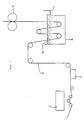
- Fig. 1 is a schematic view of an embodiment of the process scheme of the present invention.
- Fig. 1 is a schematic view of an embodiment of the process scheme of the present invention.
- a glass cloth 3 which is to be subjected to a spreading-out treatment is passed through a water jet needle device 1.
- high-pressure water is uniformly applied to the glass cloth through a nozzle having a bore diameter of from 0.1 to 0.5 mm at a pressure of from 10 to 300 kg/cm2, whereby the glass cloth takes a state such that spreading-out occurs between filaments of strands or yarns which constitute the glass cloth, namely, the strands or yarns are spread out.
- the glass cloth is passed over a suction device 2, whereby not only the water contained in the glass cloth is transferred and separated by air which permeates through the glass cloth to make uniform the distribution of water content, but the water content is controlled to from 20 to 25 by weight.
- the glass cloth whose water content has been controlled as described above is introduced into a pigment bath 4 in which a pigment dispersion 6 is charged and impregnated therewith.
- An excess of the pigment dispersion attached to the glass cloth is squeezed by means of mangle rollers 5 so as to keep the amount of the pigment dispersion attached at a predetermined value, and the glass cloth is then introduced into a dryer to continuously dry it, thereby obtaining a product.
- a pigment dispersion of low concentration which has been squeezed by means of the mangle rollers 5 a predetermined amount of a fresh pigment dispersion is supplied to the pigment bath in order to prevent the concentration of the pigment dispersion from being lowered, thereby allowing to overflow as a waste liquor 7.
- the overflowed waste liquor can be reused through adjustment of its concentration. Since the glass cloth contains water, the pigment dispersion attached to the glass cloth is diluted with this water, so that the color of the glass cloth becomes pale. Therefore, in view of the water content, the concentration of the pigment contained in the pigment dispersion is made high several times that used in the conventional methods in which the dried glass cloth is colored.
- a glass cloth (“WEA18W”, produced by Nitto Boseki Co., Ltd., unit weight: 212 g/m2) was uniformly spread out using a water jet needle device with a nozzle bore diameter of 0.13 mm and a water pressure of 100 kg/cm2. Subsequently, the glass cloth was fed into a suction device using a conveyor to prepare a water-containing glass cloth having a water content of 25% by weight. The water-containing glass cloth was then immersed in each of pigment dispersions having a concentration of 2 times and 4 times that of a pigment dispersion used for coloring ordinary glass cloths, respectively.
- the glass cloth was subjected to squeezing by means of mangle rollers so that the amount of the pigment dispersion attached was 32% by weight, and then dried in a dryer at 120°C to obtain a colored glass cloth.
- the results are shown in Table 1.
- a colored glass cloth was obtained in the same manner as in Example 1, except that a glass cloth which had not been spread out was immersed in an ordinary pigment dispersion. The results are shown in Table 1.
- a glass cloth was spread out under the same conditions as in Examples 1 and 2 and immediately thereafter, was immersed in the same pigment dispersion as used in Comparative Example 1, without adjusting the water content by means of the suction device, followed by treating in the same manner as in Example 1 to obtain a colored glass cloth.
- the results are shown in Table 1.
- the water content is controlled in the suction step, and the coloration and drying are conducted, it is possible to effect these two treatments on the same production line, thus leading to an increase of productivity and product quality.
- the glass cloth which is colored after being impregnated with a predetermined amount of water in advance is less in color unevenness than that of Comparative Example 1 in which the glass cloth in the dry state is colored during the production of an ordinary IC cloth, and the color unevenness does not occur even when the degree of coloration is lowered. This indicates that the amount of the pigment to be used can be small, leading to an advantage from the economical viewpoint.
Landscapes
- Chemical & Material Sciences (AREA)
- Engineering & Computer Science (AREA)
- Life Sciences & Earth Sciences (AREA)
- Materials Engineering (AREA)
- Chemical Kinetics & Catalysis (AREA)
- General Life Sciences & Earth Sciences (AREA)
- Composite Materials (AREA)
- General Chemical & Material Sciences (AREA)
- Geochemistry & Mineralogy (AREA)
- Organic Chemistry (AREA)
- Inorganic Chemistry (AREA)
- Textile Engineering (AREA)
- Coloring (AREA)
- Surface Treatment Of Glass Fibres Or Filaments (AREA)
- Treatment Of Fiber Materials (AREA)
Description
- The present invention relates to a method for manufacturing a colored glass cloth in which a glass cloth is immersed in and colored with a pigment dispersion.
- Conventional glass cloths for IC are manufactured by the steps of conducting a de-sizing treatment for removing a sizing agent attached to the surface of a woven glass cloth or a size for warping; applying a surface treating agent onto the surfaces of glass fibers; after drying, usually immersing the dried glass cloth in a green pigment dispersion; squeezing an excess of the dispersion so as to keep the amount of the dispersion attached at a predetermined value; and then drying it to give a product.
- A glass cloth for IC substrates is required to have quick impregnation properties for improving productivity and adhesion properties. In order to satisfy this requirement, there have been proposed various methods for spreading out strands or yarns constituting the glass cloth by means of ultrasonic wave, static electricity, water, etc.
- Among these spreading-out methods, the water jet needle method which uses a device disclosed in EP-A-0197502 corresponding to JP-A-61-230900 (the term "JP-A" as used herein means an "unexamined published Japanese patent application"), is excellent in terms of productivity, effect and product quality and is highly estimated on the market.
- However, when a glass cloth treated by the water jet needle method is used for forming an IC substrate, the coloration is likely to become non-uniform so that when formed into an IC substrate, its appearance is poor.
- The problem of non-uniform coloration is observed even when a glass cloth is immersed in a pigment dispersion which is used for coloring ordinary glass cloths, and such problem has not yet been completely solved.
- In addition, the glass cloth treated by the water jet needle method is more likely to cause color unevenness and poor coloration as compared to ordinary colored glass cloths, because of differences in the permeation rate and in the amount of a pigment dispersion in the coloration step due to the degree of spreading-out and the water content of the strands or yarns. Accordingly, it is keenly demanded to overcome this problem.
- GB-A-1288405 discloses a process for manufacturing a colored glass cloth wherein the glass cloth is immersed in water, then squeezed and dried slightly to a moisture content of 10 to 40%, eg 30% before being immersed in at least one pigment bath containing a pigment dispersion.
- An object of the present invention is to provide a method for efficiently manufacturing a uniformly colored glass cloth, which can prevent color unevenness and poor coloration.
- The present inventors have made intensive and extensive studies in order to overcome these problems. As a result, it has been found that a glass cloth is more uniformly colored by controlling its water content, leading to the accomplishment of the present invention.
- According to the present invention, there is provided a method for manufacturing a colored glass cloth, comprising the steps of immersing a water-containing glass cloth in a pigment dispersion, squeezing an excess of the pigment dispersion attached to the glass cloth from the glass cloth, and then drying it, characterized in that, before immersion in the pigment dispersion, the glass cloth is subjected to the steps of spreading out using a water jet needle and then removing some of the water from the cloth so that it has a water content of from 20 to 25% by weight.
- The glass cloth according to the present invention can be applied not only to an IC substrate but to other materials which require uniform coloration.
- Fig. 1 is a schematic view of an embodiment of the process scheme of the present invention.
- An embodiment of the present invention will now be described with reference to the accompanying drawing.
- Fig. 1 is a schematic view of an embodiment of the process scheme of the present invention.
- It is necessary to control the water content of a glass cloth before it is colored. As shown in Fig. 1, a
glass cloth 3 which is to be subjected to a spreading-out treatment is passed through a water jet needle device 1. In this step, high-pressure water is uniformly applied to the glass cloth through a nozzle having a bore diameter of from 0.1 to 0.5 mm at a pressure of from 10 to 300 kg/cm², whereby the glass cloth takes a state such that spreading-out occurs between filaments of strands or yarns which constitute the glass cloth, namely, the strands or yarns are spread out. In this state, since the water content in the glass cloth is in the range of from 30 to 35% by weight, the glass cloth is passed over asuction device 2, whereby not only the water contained in the glass cloth is transferred and separated by air which permeates through the glass cloth to make uniform the distribution of water content, but the water content is controlled to from 20 to 25 by weight. - The glass cloth whose water content has been controlled as described above is introduced into a
pigment bath 4 in which a pigment dispersion 6 is charged and impregnated therewith. - An excess of the pigment dispersion attached to the glass cloth is squeezed by means of
mangle rollers 5 so as to keep the amount of the pigment dispersion attached at a predetermined value, and the glass cloth is then introduced into a dryer to continuously dry it, thereby obtaining a product. - Since a pigment dispersion of low concentration which has been squeezed by means of the
mangle rollers 5, a predetermined amount of a fresh pigment dispersion is supplied to the pigment bath in order to prevent the concentration of the pigment dispersion from being lowered, thereby allowing to overflow as a waste liquor 7. The overflowed waste liquor can be reused through adjustment of its concentration. Since the glass cloth contains water, the pigment dispersion attached to the glass cloth is diluted with this water, so that the color of the glass cloth becomes pale. Therefore, in view of the water content, the concentration of the pigment contained in the pigment dispersion is made high several times that used in the conventional methods in which the dried glass cloth is colored. - When the water content of the glass cloth is adjusted at from 20 to 25% by weight, a more uniformly colored glass cloth can be obtained.
- The present invention will be illustrated in more detail by the following Examples and Comparative Examples.
- A glass cloth ("WEA18W", produced by Nitto Boseki Co., Ltd., unit weight: 212 g/m²) was uniformly spread out using a water jet needle device with a nozzle bore diameter of 0.13 mm and a water pressure of 100 kg/cm². Subsequently, the glass cloth was fed into a suction device using a conveyor to prepare a water-containing glass cloth having a water content of 25% by weight. The water-containing glass cloth was then immersed in each of pigment dispersions having a concentration of 2 times and 4 times that of a pigment dispersion used for coloring ordinary glass cloths, respectively. After the immersion, the glass cloth was subjected to squeezing by means of mangle rollers so that the amount of the pigment dispersion attached was 32% by weight, and then dried in a dryer at 120°C to obtain a colored glass cloth. The results are shown in Table 1.
- A colored glass cloth was obtained in the same manner as in Example 1, except that a glass cloth which had not been spread out was immersed in an ordinary pigment dispersion. The results are shown in Table 1.
- A glass cloth was spread out under the same conditions as in Examples 1 and 2 and immediately thereafter, was immersed in the same pigment dispersion as used in Comparative Example 1, without adjusting the water content by means of the suction device, followed by treating in the same manner as in Example 1 to obtain a colored glass cloth. The results are shown in Table 1.

- (1) The water content was calculated by the following equation:

- (2) The concentration of the pigment dispersion used in the Comparative Examples was taken as 1.
- (3) The degree of coloration was evaluated in the following manner. That is, a light having a wavelength of 380 to 780 nm was applied to the glass cloth, and the intensity of a reflected light therefrom was measured using a spectrophotometer (Model U-3200, manufactured by Hitachi, Ltd.). The determination was made while taking the intensity of the reflected light before and after the coloration in Comparative Example 1 as 0 and 100, respectively.
- (4) The color unevenness was visually judged by the panel of three persons under the following criterion.
- ⓞ:
- All persons judged that no color unevenness occurred.
- o:
- Two persons judged that no color unevenness occurred.
- x:
- All persons judged that color unevenness occurred.
- According to the present invention, since immediately after the spreading-out treatment, the water content is controlled in the suction step, and the coloration and drying are conducted, it is possible to effect these two treatments on the same production line, thus leading to an increase of productivity and product quality.
- Further, as is also clear from Table 1, the glass cloth which is colored after being impregnated with a predetermined amount of water in advance is less in color unevenness than that of Comparative Example 1 in which the glass cloth in the dry state is colored during the production of an ordinary IC cloth, and the color unevenness does not occur even when the degree of coloration is lowered. This indicates that the amount of the pigment to be used can be small, leading to an advantage from the economical viewpoint.
- While the invention has been described in detail and with reference to specific embodiments thereof, it will be apparent to one skilled in the art that various changes and modifications can be made therein without departing from the scope thereof.
Claims (2)
- A method for manufacturing a colored glass cloth, comprising the steps of immersing a water-containing glass cloth in a pigment dispersion, squeezing an excess of the pigment dispersion attached to the glass cloth from the glass cloth, and drying it, characterized in that, before immersion in the pigment dispersion, the glass cloth is subjected to the steps of spreading out using a water jet needle and then removing some of the water from the cloth so that it has a water content of from 20 to 25% by weight.
- A method as claimed in claim 1, wherein the immersing step is effected in a bath (4) containing the pigment dispersion, and a predetermined amount of a fresh pigment dispersion is supplied to the bath in order to prevent the concentration of the pigment dispersion from being lowered.
Applications Claiming Priority (2)
| Application Number | Priority Date | Filing Date | Title |
|---|---|---|---|
| JP331823/88 | 1988-12-28 | ||
| JP63331823A JP2773170B2 (en) | 1988-12-28 | 1988-12-28 | Method for producing colored glass cloth |
Publications (2)
| Publication Number | Publication Date |
|---|---|
| EP0376664A1 EP0376664A1 (en) | 1990-07-04 |
| EP0376664B1 true EP0376664B1 (en) | 1993-02-17 |
Family
ID=18248040
Family Applications (1)
| Application Number | Title | Priority Date | Filing Date |
|---|---|---|---|
| EP89313550A Expired - Lifetime EP0376664B1 (en) | 1988-12-28 | 1989-12-22 | Method for manufacturing colored glass cloth |
Country Status (4)
| Country | Link |
|---|---|
| EP (1) | EP0376664B1 (en) |
| JP (1) | JP2773170B2 (en) |
| KR (1) | KR0132667B1 (en) |
| DE (1) | DE68904956T2 (en) |
Family Cites Families (2)
| Publication number | Priority date | Publication date | Assignee | Title |
|---|---|---|---|---|
| US3488208A (en) * | 1966-10-24 | 1970-01-06 | Burlington Industries Inc | Multi-colored dyeing of textiles |
| JPS61230900A (en) * | 1985-04-03 | 1986-10-15 | 日東紡績株式会社 | High-pressure fluid machining device |
-
1988
- 1988-12-28 JP JP63331823A patent/JP2773170B2/en not_active Expired - Fee Related
-
1989
- 1989-12-22 EP EP89313550A patent/EP0376664B1/en not_active Expired - Lifetime
- 1989-12-22 DE DE8989313550T patent/DE68904956T2/en not_active Expired - Fee Related
- 1989-12-27 KR KR1019890019608A patent/KR0132667B1/en not_active Expired - Fee Related
Also Published As
| Publication number | Publication date |
|---|---|
| JPH02182982A (en) | 1990-07-17 |
| KR0132667B1 (en) | 1998-04-14 |
| JP2773170B2 (en) | 1998-07-09 |
| DE68904956T2 (en) | 1993-06-09 |
| KR900010142A (en) | 1990-07-06 |
| EP0376664A1 (en) | 1990-07-04 |
| DE68904956D1 (en) | 1993-03-25 |
Similar Documents
| Publication | Publication Date | Title |
|---|---|---|
| EP0079143A2 (en) | Pseudoplastic gel transfer | |
| DE3225781C2 (en) | Process for modifying the light reflecting properties of a glass surface | |
| US5815867A (en) | Pretreatment of yarn and subsequent dyeing of yarn or fabric woven therewith | |
| DE60008836T2 (en) | Glass fiber wall panels with pattern effect | |
| US4771497A (en) | Process and apparatus for the continuous treatment of lengths of textile material, such as carpets | |
| US2366347A (en) | Method of dyeing | |
| EP0376664A1 (en) | Method for manufacturing colored glass cloth | |
| US4356212A (en) | Method and apparatus for treating textile cord | |
| US3412411A (en) | Method for dyeing tubular knit material | |
| GB2067614A (en) | A method of and apparatus for uniformly arranging the nap or pile of a cloth | |
| US4888840A (en) | Method for mercerizing textile fabric webs and apparatus for carrying out the method | |
| US5626632A (en) | Process for dyeing cationic dyeable polyamide fiber | |
| US2960382A (en) | Method of bleaching linoleum using hydrogen peroxide bleach | |
| US2104748A (en) | Crisp sheer fabrics and process of making same | |
| JPH1077586A (en) | Production of ununiformly printed fabric | |
| DE2406186A1 (en) | PROCESS FOR PRINTING TEXTILE MATERIALS | |
| DE3109373A1 (en) | Process for applying liquor in foamed form to fibrous piece goods or webs | |
| DE3112408A1 (en) | Process for dyeing a fabric web | |
| GB2026053A (en) | Yarn processing method | |
| JPH0770906A (en) | Continuous impregnation method | |
| KR0109430Y1 (en) | Coating machine structure for fabric | |
| EP0069436A1 (en) | Apparatus for continuously reducing the weight of fabrics of polyester fibers with alkali | |
| US2221329A (en) | Art of treating leatherboard | |
| JPH0247378A (en) | Method for improving appearance quality of printed fabric | |
| JPH01174672A (en) | White cloth and processing thereof |
Legal Events
| Date | Code | Title | Description |
|---|---|---|---|
| PUAI | Public reference made under article 153(3) epc to a published international application that has entered the european phase |
Free format text: ORIGINAL CODE: 0009012 |
|
| AK | Designated contracting states |
Kind code of ref document: A1 Designated state(s): DE GB IT |
|
| 17P | Request for examination filed |
Effective date: 19901221 |
|
| 17Q | First examination report despatched |
Effective date: 19920102 |
|
| GRAA | (expected) grant |
Free format text: ORIGINAL CODE: 0009210 |
|
| AK | Designated contracting states |
Kind code of ref document: B1 Designated state(s): DE GB IT |
|
| REF | Corresponds to: |
Ref document number: 68904956 Country of ref document: DE Date of ref document: 19930325 |
|
| ITF | It: translation for a ep patent filed | ||
| PLBE | No opposition filed within time limit |
Free format text: ORIGINAL CODE: 0009261 |
|
| STAA | Information on the status of an ep patent application or granted ep patent |
Free format text: STATUS: NO OPPOSITION FILED WITHIN TIME LIMIT |
|
| 26N | No opposition filed | ||
| REG | Reference to a national code |
Ref country code: GB Ref legal event code: IF02 |
|
| PGFP | Annual fee paid to national office [announced via postgrant information from national office to epo] |
Ref country code: DE Payment date: 20061214 Year of fee payment: 18 |
|
| PGFP | Annual fee paid to national office [announced via postgrant information from national office to epo] |
Ref country code: GB Payment date: 20061220 Year of fee payment: 18 |
|
| PGFP | Annual fee paid to national office [announced via postgrant information from national office to epo] |
Ref country code: IT Payment date: 20061231 Year of fee payment: 18 |
|
| GBPC | Gb: european patent ceased through non-payment of renewal fee |
Effective date: 20071222 |
|
| PG25 | Lapsed in a contracting state [announced via postgrant information from national office to epo] |
Ref country code: DE Free format text: LAPSE BECAUSE OF NON-PAYMENT OF DUE FEES Effective date: 20080701 |
|
| PG25 | Lapsed in a contracting state [announced via postgrant information from national office to epo] |
Ref country code: GB Free format text: LAPSE BECAUSE OF NON-PAYMENT OF DUE FEES Effective date: 20071222 |
|
| PG25 | Lapsed in a contracting state [announced via postgrant information from national office to epo] |
Ref country code: IT Free format text: LAPSE BECAUSE OF NON-PAYMENT OF DUE FEES Effective date: 20071222 |