EP0376623B1 - Process of bonding aromatic polyamide fibers to rubber compounds - Google Patents
Process of bonding aromatic polyamide fibers to rubber compounds Download PDFInfo
- Publication number
- EP0376623B1 EP0376623B1 EP89313414A EP89313414A EP0376623B1 EP 0376623 B1 EP0376623 B1 EP 0376623B1 EP 89313414 A EP89313414 A EP 89313414A EP 89313414 A EP89313414 A EP 89313414A EP 0376623 B1 EP0376623 B1 EP 0376623B1
- Authority
- EP
- European Patent Office
- Prior art keywords
- rubber
- fibers
- weight
- resorcinol
- latex
- Prior art date
- Legal status (The legal status is an assumption and is not a legal conclusion. Google has not performed a legal analysis and makes no representation as to the accuracy of the status listed.)
- Expired - Lifetime
Links
- 229920001971 elastomer Polymers 0.000 title claims abstract description 116
- 239000005060 rubber Substances 0.000 title claims abstract description 116
- 239000000835 fiber Substances 0.000 title claims abstract description 104
- 150000001875 compounds Chemical class 0.000 title claims abstract description 45
- 238000000034 method Methods 0.000 title claims abstract description 31
- 239000004760 aramid Substances 0.000 title claims abstract description 26
- 229920003235 aromatic polyamide Polymers 0.000 title claims abstract description 26
- 239000000203 mixture Substances 0.000 claims abstract description 64
- WSFSSNUMVMOOMR-UHFFFAOYSA-N Formaldehyde Chemical compound O=C WSFSSNUMVMOOMR-UHFFFAOYSA-N 0.000 claims abstract description 56
- GHMLBKRAJCXXBS-UHFFFAOYSA-N resorcinol Chemical compound OC1=CC=CC(O)=C1 GHMLBKRAJCXXBS-UHFFFAOYSA-N 0.000 claims abstract description 56
- 229920000126 latex Polymers 0.000 claims abstract description 34
- 239000000853 adhesive Substances 0.000 claims abstract description 33
- 230000001070 adhesive effect Effects 0.000 claims abstract description 33
- 229920000642 polymer Polymers 0.000 claims abstract description 30
- 229920005989 resin Polymers 0.000 claims abstract description 27
- 239000011347 resin Substances 0.000 claims abstract description 27
- 239000004816 latex Substances 0.000 claims abstract description 25
- 239000005056 polyisocyanate Substances 0.000 claims abstract description 10
- 229920001228 polyisocyanate Polymers 0.000 claims abstract description 10
- 239000003795 chemical substances by application Substances 0.000 claims abstract description 9
- 230000003213 activating effect Effects 0.000 claims abstract description 8
- -1 poly(dichlorobutadiene) Polymers 0.000 claims description 14
- 244000043261 Hevea brasiliensis Species 0.000 claims description 12
- 229920003052 natural elastomer Polymers 0.000 claims description 12
- 229920001194 natural rubber Polymers 0.000 claims description 12
- ZAMOUSCENKQFHK-UHFFFAOYSA-N Chlorine atom Chemical compound [Cl] ZAMOUSCENKQFHK-UHFFFAOYSA-N 0.000 claims description 11
- 229910052801 chlorine Inorganic materials 0.000 claims description 11
- 239000000460 chlorine Substances 0.000 claims description 11
- 239000007787 solid Substances 0.000 claims description 11
- 229920000915 polyvinyl chloride Polymers 0.000 claims description 7
- 239000004800 polyvinyl chloride Substances 0.000 claims description 7
- 239000005062 Polybutadiene Substances 0.000 claims description 6
- 229920002857 polybutadiene Polymers 0.000 claims description 6
- NLHHRLWOUZZQLW-UHFFFAOYSA-N Acrylonitrile Chemical compound C=CC#N NLHHRLWOUZZQLW-UHFFFAOYSA-N 0.000 claims description 4
- 239000004709 Chlorinated polyethylene Substances 0.000 claims description 4
- 229920001577 copolymer Polymers 0.000 claims description 4
- PDKAXHLOFWCWIH-UHFFFAOYSA-N 1,1-dichlorobuta-1,3-diene Chemical compound ClC(Cl)=CC=C PDKAXHLOFWCWIH-UHFFFAOYSA-N 0.000 claims description 3
- MTAZNLWOLGHBHU-UHFFFAOYSA-N butadiene-styrene rubber Chemical compound C=CC=C.C=CC1=CC=CC=C1 MTAZNLWOLGHBHU-UHFFFAOYSA-N 0.000 claims description 3
- HQQADJVZYDDRJT-UHFFFAOYSA-N ethene;prop-1-ene Chemical group C=C.CC=C HQQADJVZYDDRJT-UHFFFAOYSA-N 0.000 claims description 3
- NBVXSUQYWXRMNV-UHFFFAOYSA-N fluoromethane Chemical compound FC NBVXSUQYWXRMNV-UHFFFAOYSA-N 0.000 claims description 3
- 229910052736 halogen Inorganic materials 0.000 abstract description 19
- 150000002367 halogens Chemical class 0.000 abstract description 19
- 239000000243 solution Substances 0.000 description 14
- 229920000459 Nitrile rubber Polymers 0.000 description 13
- 229920001084 poly(chloroprene) Polymers 0.000 description 10
- YXFVVABEGXRONW-UHFFFAOYSA-N Toluene Chemical compound CC1=CC=CC=C1 YXFVVABEGXRONW-UHFFFAOYSA-N 0.000 description 9
- 229920002994 synthetic fiber Polymers 0.000 description 7
- 239000012209 synthetic fiber Substances 0.000 description 7
- ISWSIDIOOBJBQZ-UHFFFAOYSA-N Phenol Chemical compound OC1=CC=CC=C1 ISWSIDIOOBJBQZ-UHFFFAOYSA-N 0.000 description 6
- XLOMVQKBTHCTTD-UHFFFAOYSA-N Zinc monoxide Chemical compound [Zn]=O XLOMVQKBTHCTTD-UHFFFAOYSA-N 0.000 description 6
- 229940125904 compound 1 Drugs 0.000 description 6
- PEDCQBHIVMGVHV-UHFFFAOYSA-N Glycerine Chemical compound OCC(O)CO PEDCQBHIVMGVHV-UHFFFAOYSA-N 0.000 description 5
- 229920002681 hypalon Polymers 0.000 description 5
- 238000005259 measurement Methods 0.000 description 5
- 239000000047 product Substances 0.000 description 5
- ZNRLMGFXSPUZNR-UHFFFAOYSA-N 2,2,4-trimethyl-1h-quinoline Chemical compound C1=CC=C2C(C)=CC(C)(C)NC2=C1 ZNRLMGFXSPUZNR-UHFFFAOYSA-N 0.000 description 4
- 239000006229 carbon black Substances 0.000 description 4
- 230000000052 comparative effect Effects 0.000 description 4
- 229940126214 compound 3 Drugs 0.000 description 4
- 239000000126 substance Substances 0.000 description 4
- 239000000758 substrate Substances 0.000 description 4
- XLYOFNOQVPJJNP-UHFFFAOYSA-N water Substances O XLYOFNOQVPJJNP-UHFFFAOYSA-N 0.000 description 4
- ZWEHNKRNPOVVGH-UHFFFAOYSA-N 2-Butanone Chemical compound CCC(C)=O ZWEHNKRNPOVVGH-UHFFFAOYSA-N 0.000 description 3
- QTBSBXVTEAMEQO-UHFFFAOYSA-N Acetic acid Chemical compound CC(O)=O QTBSBXVTEAMEQO-UHFFFAOYSA-N 0.000 description 3
- UHOVQNZJYSORNB-UHFFFAOYSA-N Benzene Chemical compound C1=CC=CC=C1 UHOVQNZJYSORNB-UHFFFAOYSA-N 0.000 description 3
- XEKOWRVHYACXOJ-UHFFFAOYSA-N Ethyl acetate Chemical compound CCOC(C)=O XEKOWRVHYACXOJ-UHFFFAOYSA-N 0.000 description 3
- LYCAIKOWRPUZTN-UHFFFAOYSA-N Ethylene glycol Chemical compound OCCO LYCAIKOWRPUZTN-UHFFFAOYSA-N 0.000 description 3
- 239000004952 Polyamide Substances 0.000 description 3
- HEMHJVSKTPXQMS-UHFFFAOYSA-M Sodium hydroxide Chemical compound [OH-].[Na+] HEMHJVSKTPXQMS-UHFFFAOYSA-M 0.000 description 3
- 235000021355 Stearic acid Nutrition 0.000 description 3
- YACLQRRMGMJLJV-UHFFFAOYSA-N chloroprene Chemical compound ClC(=C)C=C YACLQRRMGMJLJV-UHFFFAOYSA-N 0.000 description 3
- 239000002131 composite material Substances 0.000 description 3
- 238000010438 heat treatment Methods 0.000 description 3
- 229920006173 natural rubber latex Polymers 0.000 description 3
- QIQXTHQIDYTFRH-UHFFFAOYSA-N octadecanoic acid Chemical compound CCCCCCCCCCCCCCCCCC(O)=O QIQXTHQIDYTFRH-UHFFFAOYSA-N 0.000 description 3
- OQCDKBAXFALNLD-UHFFFAOYSA-N octadecanoic acid Natural products CCCCCCCC(C)CCCCCCCCC(O)=O OQCDKBAXFALNLD-UHFFFAOYSA-N 0.000 description 3
- 229920002647 polyamide Polymers 0.000 description 3
- 229920000728 polyester Polymers 0.000 description 3
- 239000008117 stearic acid Substances 0.000 description 3
- 229920003051 synthetic elastomer Polymers 0.000 description 3
- 239000005061 synthetic rubber Substances 0.000 description 3
- 239000011787 zinc oxide Substances 0.000 description 3
- 239000004953 Aliphatic polyamide Substances 0.000 description 2
- RTZKZFJDLAIYFH-UHFFFAOYSA-N Diethyl ether Chemical compound CCOCC RTZKZFJDLAIYFH-UHFFFAOYSA-N 0.000 description 2
- VYPSYNLAJGMNEJ-UHFFFAOYSA-N Silicium dioxide Chemical compound O=[Si]=O VYPSYNLAJGMNEJ-UHFFFAOYSA-N 0.000 description 2
- NINIDFKCEFEMDL-UHFFFAOYSA-N Sulfur Chemical compound [S] NINIDFKCEFEMDL-UHFFFAOYSA-N 0.000 description 2
- 239000000654 additive Substances 0.000 description 2
- 239000012790 adhesive layer Substances 0.000 description 2
- 150000001299 aldehydes Chemical class 0.000 description 2
- 229920003231 aliphatic polyamide Polymers 0.000 description 2
- 230000005540 biological transmission Effects 0.000 description 2
- 229910052799 carbon Inorganic materials 0.000 description 2
- 229940125782 compound 2 Drugs 0.000 description 2
- 229920005558 epichlorohydrin rubber Polymers 0.000 description 2
- 235000011187 glycerol Nutrition 0.000 description 2
- WXZMFSXDPGVJKK-UHFFFAOYSA-N pentaerythritol Chemical compound OCC(CO)(CO)CO WXZMFSXDPGVJKK-UHFFFAOYSA-N 0.000 description 2
- 150000002989 phenols Chemical class 0.000 description 2
- 229920006389 polyphenyl polymer Polymers 0.000 description 2
- 239000010734 process oil Substances 0.000 description 2
- 150000005846 sugar alcohols Polymers 0.000 description 2
- 229910052717 sulfur Inorganic materials 0.000 description 2
- 239000011593 sulfur Substances 0.000 description 2
- 238000004073 vulcanization Methods 0.000 description 2
- KATAXDCYPGGJNJ-UHFFFAOYSA-N 1,3-bis(oxiran-2-ylmethoxy)propan-2-ol Chemical compound C1OC1COCC(O)COCC1CO1 KATAXDCYPGGJNJ-UHFFFAOYSA-N 0.000 description 1
- VGHSXKTVMPXHNG-UHFFFAOYSA-N 1,3-diisocyanatobenzene Chemical compound O=C=NC1=CC=CC(N=C=O)=C1 VGHSXKTVMPXHNG-UHFFFAOYSA-N 0.000 description 1
- VETPHHXZEJAYOB-UHFFFAOYSA-N 1-n,4-n-dinaphthalen-2-ylbenzene-1,4-diamine Chemical compound C1=CC=CC2=CC(NC=3C=CC(NC=4C=C5C=CC=CC5=CC=4)=CC=3)=CC=C21 VETPHHXZEJAYOB-UHFFFAOYSA-N 0.000 description 1
- OOOOSXOVMLSGMO-UHFFFAOYSA-N 3H-1,3-benzothiazole-2-thione dimethylcarbamothioylsulfanyl N,N-dimethylcarbamodithioate Chemical compound CN(C(SSC(N(C)C)=S)=S)C.SC=1SC2=C(N1)C=CC=C2 OOOOSXOVMLSGMO-UHFFFAOYSA-N 0.000 description 1
- UPMLOUAZCHDJJD-UHFFFAOYSA-N 4,4'-Diphenylmethane Diisocyanate Chemical compound C1=CC(N=C=O)=CC=C1CC1=CC=C(N=C=O)C=C1 UPMLOUAZCHDJJD-UHFFFAOYSA-N 0.000 description 1
- SOKFWRPORPTXSA-UHFFFAOYSA-N 4-[2-(4-hydroxyphenyl)-2-methylpropyl]phenol Chemical compound C=1C=C(O)C=CC=1C(C)(C)CC1=CC=C(O)C=C1 SOKFWRPORPTXSA-UHFFFAOYSA-N 0.000 description 1
- 244000025254 Cannabis sativa Species 0.000 description 1
- 235000012766 Cannabis sativa ssp. sativa var. sativa Nutrition 0.000 description 1
- 235000012765 Cannabis sativa ssp. sativa var. spontanea Nutrition 0.000 description 1
- 239000004215 Carbon black (E152) Substances 0.000 description 1
- 229920000742 Cotton Polymers 0.000 description 1
- FBPFZTCFMRRESA-FSIIMWSLSA-N D-Glucitol Natural products OC[C@H](O)[C@H](O)[C@@H](O)[C@H](O)CO FBPFZTCFMRRESA-FSIIMWSLSA-N 0.000 description 1
- FBPFZTCFMRRESA-JGWLITMVSA-N D-glucitol Chemical compound OC[C@H](O)[C@@H](O)[C@H](O)[C@H](O)CO FBPFZTCFMRRESA-JGWLITMVSA-N 0.000 description 1
- BRLQWZUYTZBJKN-UHFFFAOYSA-N Epichlorohydrin Chemical compound ClCC1CO1 BRLQWZUYTZBJKN-UHFFFAOYSA-N 0.000 description 1
- 239000004593 Epoxy Substances 0.000 description 1
- PDQAZBWRQCGBEV-UHFFFAOYSA-N Ethylenethiourea Chemical compound S=C1NCCN1 PDQAZBWRQCGBEV-UHFFFAOYSA-N 0.000 description 1
- 239000005057 Hexamethylene diisocyanate Substances 0.000 description 1
- NTIZESTWPVYFNL-UHFFFAOYSA-N Methyl isobutyl ketone Chemical compound CC(C)CC(C)=O NTIZESTWPVYFNL-UHFFFAOYSA-N 0.000 description 1
- UIHCLUNTQKBZGK-UHFFFAOYSA-N Methyl isobutyl ketone Natural products CCC(C)C(C)=O UIHCLUNTQKBZGK-UHFFFAOYSA-N 0.000 description 1
- 239000006057 Non-nutritive feed additive Substances 0.000 description 1
- CTQNGGLPUBDAKN-UHFFFAOYSA-N O-Xylene Chemical compound CC1=CC=CC=C1C CTQNGGLPUBDAKN-UHFFFAOYSA-N 0.000 description 1
- 239000002202 Polyethylene glycol Substances 0.000 description 1
- 239000004902 Softening Agent Substances 0.000 description 1
- ZJCCRDAZUWHFQH-UHFFFAOYSA-N Trimethylolpropane Chemical compound CCC(CO)(CO)CO ZJCCRDAZUWHFQH-UHFFFAOYSA-N 0.000 description 1
- XTXRWKRVRITETP-UHFFFAOYSA-N Vinyl acetate Chemical compound CC(=O)OC=C XTXRWKRVRITETP-UHFFFAOYSA-N 0.000 description 1
- BZHJMEDXRYGGRV-UHFFFAOYSA-N Vinyl chloride Chemical compound ClC=C BZHJMEDXRYGGRV-UHFFFAOYSA-N 0.000 description 1
- QYKIQEUNHZKYBP-UHFFFAOYSA-N Vinyl ether Chemical class C=COC=C QYKIQEUNHZKYBP-UHFFFAOYSA-N 0.000 description 1
- NIXOWILDQLNWCW-UHFFFAOYSA-N acrylic acid group Chemical group C(C=C)(=O)O NIXOWILDQLNWCW-UHFFFAOYSA-N 0.000 description 1
- 150000007933 aliphatic carboxylic acids Chemical class 0.000 description 1
- 125000005907 alkyl ester group Chemical group 0.000 description 1
- 229940072049 amyl acetate Drugs 0.000 description 1
- PGMYKACGEOXYJE-UHFFFAOYSA-N anhydrous amyl acetate Natural products CCCCCOC(C)=O PGMYKACGEOXYJE-UHFFFAOYSA-N 0.000 description 1
- 239000003963 antioxidant agent Substances 0.000 description 1
- 239000007864 aqueous solution Substances 0.000 description 1
- 150000004945 aromatic hydrocarbons Chemical class 0.000 description 1
- 238000005452 bending Methods 0.000 description 1
- 239000002981 blocking agent Substances 0.000 description 1
- 235000009120 camo Nutrition 0.000 description 1
- 239000003054 catalyst Substances 0.000 description 1
- 235000005607 chanvre indien Nutrition 0.000 description 1
- 239000007795 chemical reaction product Substances 0.000 description 1
- 229920006235 chlorinated polyethylene elastomer Polymers 0.000 description 1
- XENVCRGQTABGKY-ZHACJKMWSA-N chlorohydrin Chemical compound CC#CC#CC#CC#C\C=C\C(Cl)CO XENVCRGQTABGKY-ZHACJKMWSA-N 0.000 description 1
- 230000006835 compression Effects 0.000 description 1
- 238000007906 compression Methods 0.000 description 1
- 238000009833 condensation Methods 0.000 description 1
- 230000005494 condensation Effects 0.000 description 1
- 230000006866 deterioration Effects 0.000 description 1
- 229920003244 diene elastomer Polymers 0.000 description 1
- 239000006185 dispersion Substances 0.000 description 1
- 239000003995 emulsifying agent Substances 0.000 description 1
- 239000003822 epoxy resin Substances 0.000 description 1
- 239000002657 fibrous material Substances 0.000 description 1
- 239000011487 hemp Substances 0.000 description 1
- MNWFXJYAOYHMED-UHFFFAOYSA-M heptanoate Chemical compound CCCCCCC([O-])=O MNWFXJYAOYHMED-UHFFFAOYSA-M 0.000 description 1
- RRAMGCGOFNQTLD-UHFFFAOYSA-N hexamethylene diisocyanate Chemical compound O=C=NCCCCCCN=C=O RRAMGCGOFNQTLD-UHFFFAOYSA-N 0.000 description 1
- 229930195733 hydrocarbon Natural products 0.000 description 1
- 150000002430 hydrocarbons Chemical class 0.000 description 1
- 125000004435 hydrogen atom Chemical group [H]* 0.000 description 1
- 239000004615 ingredient Substances 0.000 description 1
- 239000010410 layer Substances 0.000 description 1
- 239000000395 magnesium oxide Substances 0.000 description 1
- CPLXHLVBOLITMK-UHFFFAOYSA-N magnesium oxide Inorganic materials [Mg]=O CPLXHLVBOLITMK-UHFFFAOYSA-N 0.000 description 1
- AXZKOIWUVFPNLO-UHFFFAOYSA-N magnesium;oxygen(2-) Chemical compound [O-2].[Mg+2] AXZKOIWUVFPNLO-UHFFFAOYSA-N 0.000 description 1
- 230000014759 maintenance of location Effects 0.000 description 1
- FPYJFEHAWHCUMM-UHFFFAOYSA-N maleic anhydride Chemical compound O=C1OC(=O)C=C1 FPYJFEHAWHCUMM-UHFFFAOYSA-N 0.000 description 1
- 238000004519 manufacturing process Methods 0.000 description 1
- 239000000463 material Substances 0.000 description 1
- 125000005395 methacrylic acid group Chemical group 0.000 description 1
- 125000002560 nitrile group Chemical group 0.000 description 1
- 239000003960 organic solvent Substances 0.000 description 1
- AICOOMRHRUFYCM-ZRRPKQBOSA-N oxazine, 1 Chemical compound C([C@@H]1[C@H](C(C[C@]2(C)[C@@H]([C@H](C)N(C)C)[C@H](O)C[C@]21C)=O)CC1=CC2)C[C@H]1[C@@]1(C)[C@H]2N=C(C(C)C)OC1 AICOOMRHRUFYCM-ZRRPKQBOSA-N 0.000 description 1
- 239000003973 paint Substances 0.000 description 1
- 239000005011 phenolic resin Substances 0.000 description 1
- 239000004014 plasticizer Substances 0.000 description 1
- 229920001515 polyalkylene glycol Polymers 0.000 description 1
- 229920000647 polyepoxide Polymers 0.000 description 1
- 229920001223 polyethylene glycol Polymers 0.000 description 1
- 229920001451 polypropylene glycol Polymers 0.000 description 1
- 239000004814 polyurethane Substances 0.000 description 1
- 229920002635 polyurethane Polymers 0.000 description 1
- 230000002787 reinforcement Effects 0.000 description 1
- 230000003014 reinforcing effect Effects 0.000 description 1
- 239000012783 reinforcing fiber Substances 0.000 description 1
- 239000012763 reinforcing filler Substances 0.000 description 1
- 229920006395 saturated elastomer Polymers 0.000 description 1
- 150000003335 secondary amines Chemical class 0.000 description 1
- 238000000926 separation method Methods 0.000 description 1
- 238000010008 shearing Methods 0.000 description 1
- 239000000377 silicon dioxide Substances 0.000 description 1
- 239000002904 solvent Substances 0.000 description 1
- 239000000600 sorbitol Substances 0.000 description 1
- 241000894007 species Species 0.000 description 1
- 238000003756 stirring Methods 0.000 description 1
- 150000003509 tertiary alcohols Chemical class 0.000 description 1
- DVKJHBMWWAPEIU-UHFFFAOYSA-N toluene 2,4-diisocyanate Chemical compound CC1=CC=C(N=C=O)C=C1N=C=O DVKJHBMWWAPEIU-UHFFFAOYSA-N 0.000 description 1
- 229920002554 vinyl polymer Polymers 0.000 description 1
- 210000002268 wool Anatomy 0.000 description 1
- 239000008096 xylene Substances 0.000 description 1
Images



Classifications
-
- C—CHEMISTRY; METALLURGY
- C08—ORGANIC MACROMOLECULAR COMPOUNDS; THEIR PREPARATION OR CHEMICAL WORKING-UP; COMPOSITIONS BASED THEREON
- C08J—WORKING-UP; GENERAL PROCESSES OF COMPOUNDING; AFTER-TREATMENT NOT COVERED BY SUBCLASSES C08B, C08C, C08F, C08G or C08H
- C08J5/00—Manufacture of articles or shaped materials containing macromolecular substances
- C08J5/04—Reinforcing macromolecular compounds with loose or coherent fibrous material
- C08J5/06—Reinforcing macromolecular compounds with loose or coherent fibrous material using pretreated fibrous materials
-
- C—CHEMISTRY; METALLURGY
- C08—ORGANIC MACROMOLECULAR COMPOUNDS; THEIR PREPARATION OR CHEMICAL WORKING-UP; COMPOSITIONS BASED THEREON
- C08J—WORKING-UP; GENERAL PROCESSES OF COMPOUNDING; AFTER-TREATMENT NOT COVERED BY SUBCLASSES C08B, C08C, C08F, C08G or C08H
- C08J2321/00—Characterised by the use of unspecified rubbers
-
- Y—GENERAL TAGGING OF NEW TECHNOLOGICAL DEVELOPMENTS; GENERAL TAGGING OF CROSS-SECTIONAL TECHNOLOGIES SPANNING OVER SEVERAL SECTIONS OF THE IPC; TECHNICAL SUBJECTS COVERED BY FORMER USPC CROSS-REFERENCE ART COLLECTIONS [XRACs] AND DIGESTS
- Y10—TECHNICAL SUBJECTS COVERED BY FORMER USPC
- Y10S—TECHNICAL SUBJECTS COVERED BY FORMER USPC CROSS-REFERENCE ART COLLECTIONS [XRACs] AND DIGESTS
- Y10S156/00—Adhesive bonding and miscellaneous chemical manufacture
- Y10S156/91—Bonding tire cord and elastomer: improved adhesive system
-
- Y—GENERAL TAGGING OF NEW TECHNOLOGICAL DEVELOPMENTS; GENERAL TAGGING OF CROSS-SECTIONAL TECHNOLOGIES SPANNING OVER SEVERAL SECTIONS OF THE IPC; TECHNICAL SUBJECTS COVERED BY FORMER USPC CROSS-REFERENCE ART COLLECTIONS [XRACs] AND DIGESTS
- Y10—TECHNICAL SUBJECTS COVERED BY FORMER USPC
- Y10T—TECHNICAL SUBJECTS COVERED BY FORMER US CLASSIFICATION
- Y10T428/00—Stock material or miscellaneous articles
- Y10T428/29—Coated or structually defined flake, particle, cell, strand, strand portion, rod, filament, macroscopic fiber or mass thereof
- Y10T428/2913—Rod, strand, filament or fiber
- Y10T428/2933—Coated or with bond, impregnation or core
- Y10T428/2964—Artificial fiber or filament
- Y10T428/2967—Synthetic resin or polymer
- Y10T428/2969—Polyamide, polyimide or polyester
Definitions
- This invention relates to a method of bonding aromatic polyamide fibers to rubber compounds.
- Synthetic fibers are widely used as such reinforcing fiber materials since they are in general superior to natural fibers such as cotton, wool or hemp in properties such as strength, modulus of elasticity, resistance to friction and dimensional stability when being exposed to water or heat.
- polyamide fibers including aliphatic polyamide fibers and aromatic polyamide fibers and polyester fibers are especially preferred as reinforcements among a variety of synthetic fibers.
- a further method is also diclosed in Japanese Patent Laid-open No. 59-89375 wherein an RFL solution is used which is composed of aqueous mixture of a chloroprene/dichlorobutadiene copolymer latex and resorcinol/formalin resin.
- high saturation or complete saturation rubbers such as high saturation nitrile rubber, ethylene/propylene rubber, chlorinated polyethylene, chlorosulfonated polyethylene, epichlorohydrin rubber or fluorocarbon rubber have come to be used increasingly in various industrial fields in recent years. These rubbers are more poorly bonded to synthetic fibers.
- aromatic polyamide fibers are very poorly wettable to RFL solutions due to their more inactive surface than those of aliphatic polyamide fibers or polyester fibers. Accordingly, when vulcanized composite products of aromatic polyamide fibers and rubbers produced by such known methods as above do not stand uses where large shearing force is generated between the rubber and fibers by, for example, bending, compression or elongation under high temperature conditions, since the adhesion therebetween is insufficient to lead to separation failure at interface between the fibers and rubbers. Thus, the composite products are of short life and fail to make the best use of excellent properties that the aromatic polyamide fibers possess.
- US-A-3 190 764 discloses a method of bonding a rubbery composition to a reinforcing element such as a polyester cord or a polyamide cord.
- the method comprises a first step wherein the cord is treated with a first dip adhesive composition comprising an epoxy resin, a phenol/aldehyde condensate and a diene rubber latex such as a chloroprene rubber latex at a temperature insufficient to cause a substantial reaction of the composition, but at a temperature sufficient to solidify the composition, in particular, to remain the composition substantially unreacted because of the absence of an epoxy curing agent, and a second step wherein the cord is treated with a second dip adhesive composition comprising a phenol/aldehyde condensate and a rubber latex at a high temperature to complete the reaction of the compositions.
- EP-A-0 194 678 discloses a method for bonding a nitrile group-containing highly saturated polymer rubber to fibers on vulcanization. The method comprises treating the fibers with an aqueous dispersion comprising a halogen-containing polymer latex and a resorcinol/formaldehyde resin.
- an object of the invention to obviate the problems involved in the prior art adhesion of aromatic polyamide fibers to rubber compounds, and to provide a process to attain strong and durable adhesion between aromatic polyamide fibers and rubbers.
- a process of bonding aromatic polyamide fibers to a rubber compound being natural rubber, styrene/butadiene rubber, acrylonitrile/butadiene rubber, ethylene/propylene rubber, epichlordydrin rubber or fluorocarbon rubber which comprises:
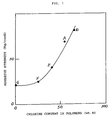
- Fig. 1 is a graph which shows the relation between chlorine contents of polymers in the adhesive compositions used in accordance with the invention and adhesion strength of the resultant adherends of natural rubber compounds and aromatic polyamide fiber cords and
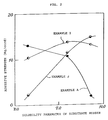
- Fig. 2 is a graph which shows the relation between solubility parameters of substrate rubbers and adhesion strength between fiber cords and the substrate rubbers.
- the resorcinol/formalin resin used in the first step of the invention is per se already known in the art of adhesion of rubbers and fibers.
- the resin is initial or low molecular weight condensates which are prepared by condensation of resorcinol and formalin in a molar ratio of resorcinol/formalin in the range from of 1/3 to 3/1 in the presence of a base catalyst.
- the resin is used as aqueous solutions of 5-80 % by weight in solid content when aqueous mixtures of the resin and rubber latices or RFL solutions are prepared.
- the polymer which contains halogens in amounts of not less than 45 % weight used in the invention is preferably chlorine containing polymers, and includes, for example, polyvinylcholoride, chlorinated rubber, chlorinated polyethylene, poly(dichlorobutadiene), copolymers of dichlorobutadiene with at least one of such comonomers as vinyl acetate, vinylchloride, maleic anhydride, acrylic esters, methacrylic esters, acrylonitrile, vinyl ethers, ethylene, propylene or chloroprene.
- polyvinyl choloride, chlorinated rubber or their mixtures are preferred.
- the aromatic polyamide fibers are treated with an aqueous mixture composed of the resorcinol/formalin resin and a latex of the polymer which contains halogens in amounts of not less than 45 % by weight.
- the aqueous mixture has a high affinity and wettability to aromatic polyamide fibers on account of high polarity of the halogen containing polymers, but also the mixture forms adhesive layers having large cohesive strength on the fibers.
- polymers containing halogens in amounts of less than 45 % by weight based on the polymers fails to form such cohesive layers on the fibers, and hence such halogen containing polymers are not suitable for use in the process of the invention.
- aqueous mixture containing a latex of polymers which contain halogens in amounts of less than 40 % by weight based on the polymer fails to produce strong adhesion between the aromatic polyamide fibers and rubbers.
- the aqueous mixture used in the first step of the process contains the halogen containing polymer in amounts preferably of 50-1000 parts by weight, more preferably in amounts of 200-800 parts by weight, in relation to 100 parts by weight of the resorcinol/formalin resin. Further, the solid contents of the aqueous mixture is preferably in the range of 5-80 % by weight based on the mixture.
- the fibers are usually dipped into the aqueous mixture, and then dried, preferably under heating at temperatures, for instance, of about 100-270°C, for several minutes to fix the mixture on the fibers.
- the treatment of the aromatic polyamide fibers only with a latex of the halogen containing polymers fails to provide strong adhesion between the fibers and rubbers. Meanwhile, there is found a tendency that more the halogen content of the halogen containing polymers, the harder the adhesive layers, and the more the amount of the resorcinol/formalin resin and the halogen containing polymers fixed on the fibers, the smaller the resistance to flexing fatigue. Consequently, it is preferred that the halogen content of the halogen containing polymers is not more than 50 % by weight based on the polymers.
- the amount of the resorcinol/formalin resin and the halogen containing polymers fixed on the fibers is as small as possible from the standpoint as above described. However, when the amount is rendered small, the resultant adhesion strength may undesirably vary.
- the aromatic polyamide fibers are further treated with an aqueous adhesive composition which comprises a resorcinol/formalin resin and a latex of rubber which is the same as the rubber of the rubber compound to which the fibers are to be bonded as the second step of the process of the invention.
- This second step makes it possible to attain fixed, strong and durable adhesion between the fibers and rubbers without deterioration of resistance to flexing fatigue even when small amounts of the aqueous mixture are fixed on the fibers in the first step.
- the resorcinol/formalin resin used in the second step may be the same as or different from that used in the first step.
- the adhesive composition usually contains a suitable vulcanizing agent depending upon the adhesive rubber used.
- solubility parameter is useful as an index to indicate to what degree two rubbers are close to each other in respect of chemical structures, or roughly in respect of polarities.
- a variety of methods are known to calculate the solubility parameters.
- a representative method is Small's method, described in detail in J. Paint Technol., 42 , 76 (1970) under the title of New Values of the Solubility Parameters from Vapor Pressure Data.
- the use of rubber (as the adhesive rubber) which has a solubility parameter larger or smaller by one or more than the rubber in the rubber compound fails to produce strong adhesion between the fibers and the rubbers since such an adhesive rubber is too far from the substrate rubber species in the rubber compound in the polarity, and therefore very poorly adhesive thereto.
- the adhesive composition used preferably contains the adhesive rubber in amounts of 50-1000 parts by weight, more preferably of 200-800 parts by weight, in relation to 100 parts by weight of the resorcinol/formalin resin in the adhesive composition. It is further preferred that the adhesive composition contains solids in amounts of 5-80 % by weight.
- the fibers are usually dipped into the aqueous adhesive composition, and then dried, preferably under heating at temperatures, for instance, of about 100-270°C, for several minutes to fix the composition on the fibers.
- the aromatic polyamide fibers may be pretreated with at least one activating agent selected from the group consisting of polyisocyanate compounds and polyepoxy compounds prior to the first step.
- the activating agent is usually used in the form of solutions in organic solvents.
- the fibers are dipped into the solution, and then dried, preferably under heating, for example, at temperatures of about 100-270°C so that the activating agent reacts with and is fixed on the fibers.
- the solvents used are not specifically limited, but there may be preferably used aromatic hydrocarbons such as benzene, xylene or toluene, aliphatic ketones such as methyl ethyl ketone or methyl isobutyl ketone, alkyl esters of lower aliphatic carboxylic acids, especially acetic acid, such as ethyl acetate or amyl acetate.
- aromatic hydrocarbons such as benzene, xylene or toluene
- aliphatic ketones such as methyl ethyl ketone or methyl isobutyl ketone
- alkyl esters of lower aliphatic carboxylic acids especially acetic acid, such as ethyl acetate or amyl acetate.
- the content of the activating agent in the activating solution is usually in the range of 10-50 % by weight.
- the polyisocyanates used are not specifically limited, but preferred examples include tolylenediisocyanate, m-phenylenediisocyanate, diphenylmethane diisocyanate, hexamethylenediisocyanate and polymethylene polyphenyl polyisocyanate.
- the polyisocyanates may be in the form of adducts with compounds which have not less than two active hydrogens in the molecule such as polyhydric alcohols exemplified by trimethylolpropane or pentaerythritol, or in the form of blocked polyisocyanates which are obtained by the reaction of the polyisocyanates with blocking agents such as phenols, tertiary alcohols or secondary amines.
- the polyepoxy compounds used include, for example, reaction products of polyhydric compounds with halogen containing epoxide compounds such as epichlorohydrin.
- polyhydric compounds for example, polyhydric alcohols such as ethylene glycol, glycerine, sorbitol or pentaerythritol; polyalkylene glycols such as polyethylene glycol or polypropylene glycol; or polyfunctional phenols such as resorcinol or bis(4-hydroxyphenyl)dimethylethane; or phenol resins such as phenol/formalin resins or resorcinol/formalin resins.
- polyhydric alcohols such as ethylene glycol, glycerine, sorbitol or pentaerythritol
- polyalkylene glycols such as polyethylene glycol or polypropylene glycol
- polyfunctional phenols such as resorcinol or bis(4-hydroxyphenyl)dimethylethane
- the pretreatment of the fibers as above activates the surfaces of the aromatic polyamide fibers to improve the wettability of the fibers to the aqueous mixture of resorcinol/formalin resin and the halogen containing polymers applied to the fibers in the first step. Further, the activating agent fixed on the fibers reacts with methylol groups of the resorcinol/formalin resin applied to the fibers in the first step, or is resinated during the vulcanization of the rubber together with the fibers, thereby to form strong and durable adhesion between the fibers and the rubbers.
- the fibers are finally placed in close contact with rubber compounds or mixes in the third step, and the rubber compounds are vulcanized together with the fibers in conventional manners known in the rubbers used.
- the rubber compounds used may of course contain known rubber chemicals or additives depending upon the individual rubbers used. There may be mentioned as such chemicals or additives, for example, reinforcing fillers including carbon black or silica, softening agents, antioxidants, plasticizers, vucanization accelerators, processing aids and the like.
- Processes of the invention thus provide aromatic polyamide fibers-rubber adherend composites which have strong and durable adhesion therebetween, and they are suitably employed in the production of dynamic rubber products such as automobile tires, transmission belts or conveyor belts.
- PVC latex Polyvinyl chloride latex
- Zeon 150X50 (Nippon Zeon K.K.) having a solid content of 48 % by weight.
- the polyvinyl chloride had a chlorine content of 57 % by weight and a solubility parameter of 9.7.
- Chlorinated rubber latex Chlorinated rubber latex
- Chloroprene rubber latex Chloroprene rubber latex
- LV-60 (Denki Kagaku Kogyo K.K.) having a solid content of 50 % by weight.
- the chloroprene had a chlorine content of 41 % by weight and a solubility parameter of 9.2.
- Chlorosulfonated polyethylene rubber latex Chlorosulfonated polyethylene rubber latex
- Chlorosulfonated polyethylene rubber latex (Sumitomo Seika K.K.) having a solid content of 40 % by weight.
- the chlorosulfonated polyethylene had a chlorine content of 25 % by weight and a solubility parameter of 9.1.
- SBR latex Styrene/butadiene rubber latex
- Nipol LX 110 (Nippon Zeon K.K.) having a solid content of 40 % by weight.
- Nipol 1043 (Nippon Zeon K.K.) having a solubility paramere of 9.7.
- Chloroprene rubber Chloroprene rubber
- Neoprene WRT Showa Denko K.K. having a solubility parameter of 9.2.
- Denacol EX 313 glycerol polyglycidyl ether, Nagase Kasei Kogyo K.K.
- Chlorinated natural rubber Chlorinated natural rubber
- Aromatic polyamide fiber cords ("Technola” by Teijin K.K., 1500D/1x3) were dipped into an aqueous mixture (a) as shown in the Table 1, and then dried at 200°C for two minutes.
- Example A and Comparative C as shown in the Table 1, the cords were dipped into an aqueous mixture (b) of which ingredients are shown in the Table 1, and dried at 200°C for two minutes.
- the thus treated fiber cords were placed in close contact with a rubber compound 1 shown below, and the rubber compound was vulcanized at 150°C for 30 minutes.
- the fiber cords were treated with the aqueous mixture (a), but not with the aqueous mixture (b), and vulcanized with the rubber compound 1.
- Unvalcunized Rubber Compound 1 (parts by weight) Natural rubber 100 Zinc oxide 5 Stearic acid 2 Sulfur 2.5 FEF carbon black 45 Process oil 5 N-hydroxydiethylene-2-benzothiazyl sulfenamide 1 2,2,4-trimethyl-1,2-dihydroquinoline 0.2
- the same aromatic polyamide fiber cords as in the Example 1 were dipped into an aqueous mixture (a) as shown in the Table 2, and then dried at 200°C for two minutes.
- the fiber cords were then dippied in the same aqueous mixture (b) as in the Example A, and dried at 200°C for two minutes.
- the fiber cords were then placed in close contact with the same rubber compound as in the Example 1, and the rubber compound was vulcanized at 150°C for 30 minutes.
- the same aromatic polyamide fiber cords as in the Example 1 were dipped into an aqueous mixture (a) as shown in the Table 3, and then dried at 200°C for two minutes.
- the fiber cords were then dippied in an aqueous mixture (b) as shown in the Table 3, and dried at 200°C for two minutes.
- the fiber cords were treated with an aqueous mixture (a) and then with an adhesive composition (b) which contained natural rubber having a solubility parameter of 8.3.
- an adhesive composition (b) which contained natural rubber having a solubility parameter of 8.3.
- nitrile rubber has a solubility parameter of 9.7, more than that of the natural rubber as an adhesive rubber by 1.4, so that no strong adhesion is obtained between the nitrile rubber compound 3 and the fiber cords, as the results are shown in parentheses.
- Example J when the fiber cords were treated with an adhesive composition containing a latex of nitrile rubber, they were strongly bonded to the rubber compound 3 of nitrile rubber. However, there was not attained a strong adhesion between the fiber cords and the rubber compound 1 of natural rubber, as the nitrile rubber has a solubility parameter of 9.7 whereas the natural rubber has a solubility parameter of 8.3, the difference of the solubility parameters being 1.4.
- the fiber cords were treated with a latex of chloroprene rubber, and were strongly bonded to the rubber compound 2 of chloroprene rubber.
- the same aromatic polyamide fiber cords as in the Example 1 were dipped into an aqueous mixture (a) as shown in the Table 4, and then dried at 200°C for two minutes.
- the fiber cords were then dippied in an aqueous mixture (b) as shown in the Table 4, and dried at 200°C for two minutes.
- the fiber cords were then placed in close contact with the nitrile rubber compound 3, and the rubber compound was vulcanized at 150°C for 30 minutes.
- the adherends were fixed at their one ends to a frame, and then travelled along a pair of rotational bars, with the other ends connected to a load of 1.5 kg. Then the bars were moved up and down in the opposite directions 100000 times while rotating in such a manner that the distance between the rotational axes of the bars oscillatorily changed, thereby to estimate the tensile strength retention which is defined by tensile strength after the flexing test divided tensile strength before the test. The results are shown in the Table 4.
- the same aromatic polyamide fiber cords as in the Example 1 were dipped into an aqueous mixture (c) as shown in the Table 5, and then dried at 200°C for two minutes.
- the fiber cords were then dippied in an aqueous mixtures (a) and (b) in succession in the same manner as in the Example A, and dried at 200°C for two minutes.
- the fiber cords were then placed in close contact with the rubber compound 1, and the rubber compound was vulcanized at 150°C for 30 minutes.
Landscapes
- Chemical & Material Sciences (AREA)
- Engineering & Computer Science (AREA)
- Materials Engineering (AREA)
- Medicinal Chemistry (AREA)
- Health & Medical Sciences (AREA)
- Chemical Kinetics & Catalysis (AREA)
- Manufacturing & Machinery (AREA)
- Polymers & Plastics (AREA)
- Organic Chemistry (AREA)
- Treatments For Attaching Organic Compounds To Fibrous Goods (AREA)
- Adhesives Or Adhesive Processes (AREA)
- Manufacture Of Macromolecular Shaped Articles (AREA)
- Polyamides (AREA)
- Reinforced Plastic Materials (AREA)
Abstract
Description
- This invention relates to a method of bonding aromatic polyamide fibers to rubber compounds.
- Industrial rubber products such as automobile tires, rubber hoses, power transmission belts and conveyor belts are normally reinforced with fiber materials. Synthetic fibers are widely used as such reinforcing fiber materials since they are in general superior to natural fibers such as cotton, wool or hemp in properties such as strength, modulus of elasticity, resistance to friction and dimensional stability when being exposed to water or heat. In recent years, polyamide fibers including aliphatic polyamide fibers and aromatic polyamide fibers and polyester fibers are especially preferred as reinforcements among a variety of synthetic fibers.
- Meanwhile, a variety of methods of bonding fibers to rubber compounds or mixes are known, among which there is a well known method wherein fibers are treated with so-called RFL solutions, namely aqueous mixtures of resorcinol/formalin resins and rubber latices, and placed in contact with rubber compounds, and then the rubber compounds are vulcanized together with the fibers. Resorting to this method, adhesion is attained to a degree between synthetic fibers and rubber compounds. However, adhesion between synthetic fibers and rubber compounds is an important factor to determine the properties of the industrial rubber products. In this regard, since synthetic fibers are poorly wettable to RFL solutions, the adhesion attained is still unsatisfactory.
- Therefore, a number of methods have heretofore been proposed wherein a variety of modified RFL solutions are employed to improve adhesion between synthetic fibers and rubber compounds. For instance, a method is disclosed in Japanese Patent Laid-open No. 49-96048 in which an RFL solution is used which contains a chlorohydrin rubber latex and a chloroprene rubber latex together with resorcinol/formalin resin for bonding polyamide fibers to chloroprene rubber mixes.
- A further method is also diclosed in Japanese Patent Laid-open No. 59-89375 wherein an RFL solution is used which is composed of aqueous mixture of a chloroprene/dichlorobutadiene copolymer latex and resorcinol/formalin resin.
- On the other side, high saturation or complete saturation rubbers such as high saturation nitrile rubber, ethylene/propylene rubber, chlorinated polyethylene, chlorosulfonated polyethylene, epichlorohydrin rubber or fluorocarbon rubber have come to be used increasingly in various industrial fields in recent years. These rubbers are more poorly bonded to synthetic fibers.
- Thus, a still further method has been proposed, as disclosed in Japanese Patent Laid-open No. 61-207442, to bond high saturation hydrocarbon rubbers such as hydrogenated nitrile rubbers to fibers wherein an RFL solution is employed which is composed of aqueous mixtures of halogen containing polymers such as epichlorohydrin rubber, chloroprene rubber, chlorosulfonated polyethylene rubber or chlorinated polyethylene rubber, together with resorcinol/formalin resin.
- However, aromatic polyamide fibers are very poorly wettable to RFL solutions due to their more inactive surface than those of aliphatic polyamide fibers or polyester fibers. Accordingly, when vulcanized composite products of aromatic polyamide fibers and rubbers produced by such known methods as above do not stand uses where large shearing force is generated between the rubber and fibers by, for example, bending, compression or elongation under high temperature conditions, since the adhesion therebetween is insufficient to lead to separation failure at interface between the fibers and rubbers. Thus, the composite products are of short life and fail to make the best use of excellent properties that the aromatic polyamide fibers possess.
- US-A-3 190 764 discloses a method of bonding a rubbery composition to a reinforcing element such as a polyester cord or a polyamide cord. The method comprises a first step wherein the cord is treated with a first dip adhesive composition comprising an epoxy resin, a phenol/aldehyde condensate and a diene rubber latex such as a chloroprene rubber latex at a temperature insufficient to cause a substantial reaction of the composition, but at a temperature sufficient to solidify the composition, in particular, to remain the composition substantially unreacted because of the absence of an epoxy curing agent, and a second step wherein the cord is treated with a second dip adhesive composition comprising a phenol/aldehyde condensate and a rubber latex at a high temperature to complete the reaction of the compositions.
- EP-A-0 194 678 discloses a method for bonding a nitrile group-containing highly saturated polymer rubber to fibers on vulcanization. The method comprises treating the fibers with an aqueous dispersion comprising a halogen-containing polymer latex and a resorcinol/formaldehyde resin.
- It is, therefore, an object of the invention to obviate the problems involved in the prior art adhesion of aromatic polyamide fibers to rubber compounds, and to provide a process to attain strong and durable adhesion between aromatic polyamide fibers and rubbers.
- According to the invention there is provided a process of bonding aromatic polyamide fibers to a rubber compound being natural rubber, styrene/butadiene rubber, acrylonitrile/butadiene rubber, ethylene/propylene rubber, epichlordydrin rubber or fluorocarbon rubber which comprises:
- a first step of treating fibers with an aqueous mixture consisting essentially of a resorcinol/formalin resin and a latex of a polymer being polyvinyl chloride, chlorinated rubber, chlorinated polyethylene, poly(dichlorobutadiene) or a copolymer of dichlorobutadiene containing chlorine in an amount of not less than 45% by weight based on the polymer;
- a second step of treating the fibers with an aqueous adhesive composition consisting essentially of a resorcinol/formalin resin and a latex of an adhesive rubber which is the same as the rubber of the rubber compound, the adhesive rubber being present in the adhesive composition in an amount of from 50 to 1000 parts by weight in relation to 100 parts by weight of the resorcinol/formalin resin; and
- a third step of placing the fibers in close contact with the rubber compound and vulcanizing the rubber together with the fibers.
- Fig. 1 is a graph which shows the relation between chlorine contents of polymers in the adhesive compositions used in accordance with the invention and adhesion strength of the resultant adherends of natural rubber compounds and aromatic polyamide fiber cords and
- Fig. 2 is a graph which shows the relation between solubility parameters of substrate rubbers and adhesion strength between fiber cords and the substrate rubbers.
- The resorcinol/formalin resin used in the first step of the invention is per se already known in the art of adhesion of rubbers and fibers. The resin is initial or low molecular weight condensates which are prepared by condensation of resorcinol and formalin in a molar ratio of resorcinol/formalin in the range from of 1/3 to 3/1 in the presence of a base catalyst. Usually the resin is used as aqueous solutions of 5-80 % by weight in solid content when aqueous mixtures of the resin and rubber latices or RFL solutions are prepared.
- The polymer which contains halogens in amounts of not less than 45 % weight used in the invention is preferably chlorine containing polymers, and includes, for example, polyvinylcholoride, chlorinated rubber, chlorinated polyethylene, poly(dichlorobutadiene), copolymers of dichlorobutadiene with at least one of such comonomers as vinyl acetate, vinylchloride, maleic anhydride, acrylic esters, methacrylic esters, acrylonitrile, vinyl ethers, ethylene, propylene or chloroprene. In particular, polyvinyl choloride, chlorinated rubber or their mixtures are preferred.
- In the first step of the process of the invention, the aromatic polyamide fibers are treated with an aqueous mixture composed of the resorcinol/formalin resin and a latex of the polymer which contains halogens in amounts of not less than 45 % by weight. The aqueous mixture has a high affinity and wettability to aromatic polyamide fibers on account of high polarity of the halogen containing polymers, but also the mixture forms adhesive layers having large cohesive strength on the fibers.
- The use of polymers containing halogens in amounts of less than 45 % by weight based on the polymers fails to form such cohesive layers on the fibers, and hence such halogen containing polymers are not suitable for use in the process of the invention. In particular, the use of aqueous mixture containing a latex of polymers which contain halogens in amounts of less than 40 % by weight based on the polymer fails to produce strong adhesion between the aromatic polyamide fibers and rubbers.
- The aqueous mixture used in the first step of the process contains the halogen containing polymer in amounts preferably of 50-1000 parts by weight, more preferably in amounts of 200-800 parts by weight, in relation to 100 parts by weight of the resorcinol/formalin resin. Further, the solid contents of the aqueous mixture is preferably in the range of 5-80 % by weight based on the mixture.
- In the first step, the fibers are usually dipped into the aqueous mixture, and then dried, preferably under heating at temperatures, for instance, of about 100-270°C, for several minutes to fix the mixture on the fibers.
- The treatment of the aromatic polyamide fibers only with a latex of the halogen containing polymers fails to provide strong adhesion between the fibers and rubbers. Meanwhile, there is found a tendency that more the halogen content of the halogen containing polymers, the harder the adhesive layers, and the more the amount of the resorcinol/formalin resin and the halogen containing polymers fixed on the fibers, the smaller the resistance to flexing fatigue. Consequently, it is preferred that the halogen content of the halogen containing polymers is not more than 50 % by weight based on the polymers. It is further preferred that the amount of the resorcinol/formalin resin and the halogen containing polymers fixed on the fibers is as small as possible from the standpoint as above described. However, when the amount is rendered small, the resultant adhesion strength may undesirably vary.
- Thus, in accordance with the invention, the aromatic polyamide fibers are further treated with an aqueous adhesive composition which comprises a resorcinol/formalin resin and a latex of rubber which is the same as the rubber of the rubber compound to which the fibers are to be bonded as the second step of the process of the invention. This second step makes it possible to attain fixed, strong and durable adhesion between the fibers and rubbers without deterioration of resistance to flexing fatigue even when small amounts of the aqueous mixture are fixed on the fibers in the first step.
- The resorcinol/formalin resin used in the second step may be the same as or different from that used in the first step.
- The adhesive composition usually contains a suitable vulcanizing agent depending upon the adhesive rubber used.
- The concept of solubility parameter is useful as an index to indicate to what degree two rubbers are close to each other in respect of chemical structures, or roughly in respect of polarities.
- A variety of methods are known to calculate the solubility parameters. A representative method is Small's method, described in detail in J. Paint Technol., 42, 76 (1970) under the title of New Values of the Solubility Parameters from Vapor Pressure Data. The larger is the difference in the solubility parameters, the farther are the rubbers from each other in chemical structure. The use of rubber (as the adhesive rubber) which has a solubility parameter larger or smaller by one or more than the rubber in the rubber compound fails to produce strong adhesion between the fibers and the rubbers since such an adhesive rubber is too far from the substrate rubber species in the rubber compound in the polarity, and therefore very poorly adhesive thereto.
- The adhesive composition used preferably contains the adhesive rubber in amounts of 50-1000 parts by weight, more preferably of 200-800 parts by weight, in relation to 100 parts by weight of the resorcinol/formalin resin in the adhesive composition. It is further preferred that the adhesive composition contains solids in amounts of 5-80 % by weight.
- In the second step, the fibers are usually dipped into the aqueous adhesive composition, and then dried, preferably under heating at temperatures, for instance, of about 100-270°C, for several minutes to fix the composition on the fibers.
- In the process of the invention, the aromatic polyamide fibers may be pretreated with at least one activating agent selected from the group consisting of polyisocyanate compounds and polyepoxy compounds prior to the first step. The activating agent is usually used in the form of solutions in organic solvents. The fibers are dipped into the solution, and then dried, preferably under heating, for example, at temperatures of about 100-270°C so that the activating agent reacts with and is fixed on the fibers.
- The solvents used are not specifically limited, but there may be preferably used aromatic hydrocarbons such as benzene, xylene or toluene, aliphatic ketones such as methyl ethyl ketone or methyl isobutyl ketone, alkyl esters of lower aliphatic carboxylic acids, especially acetic acid, such as ethyl acetate or amyl acetate. The content of the activating agent in the activating solution is usually in the range of 10-50 % by weight.
- The polyisocyanates used are not specifically limited, but preferred examples include tolylenediisocyanate, m-phenylenediisocyanate, diphenylmethane diisocyanate, hexamethylenediisocyanate and polymethylene polyphenyl polyisocyanate. The polyisocyanates may be in the form of adducts with compounds which have not less than two active hydrogens in the molecule such as polyhydric alcohols exemplified by trimethylolpropane or pentaerythritol, or in the form of blocked polyisocyanates which are obtained by the reaction of the polyisocyanates with blocking agents such as phenols, tertiary alcohols or secondary amines.
- The polyepoxy compounds used include, for example, reaction products of polyhydric compounds with halogen containing epoxide compounds such as epichlorohydrin. There may be mentioned as such polyhydric compounds, for example, polyhydric alcohols such as ethylene glycol, glycerine, sorbitol or pentaerythritol; polyalkylene glycols such as polyethylene glycol or polypropylene glycol; or polyfunctional phenols such as resorcinol or bis(4-hydroxyphenyl)dimethylethane; or phenol resins such as phenol/formalin resins or resorcinol/formalin resins.
- The pretreatment of the fibers as above set forth activates the surfaces of the aromatic polyamide fibers to improve the wettability of the fibers to the aqueous mixture of resorcinol/formalin resin and the halogen containing polymers applied to the fibers in the first step. Further, the activating agent fixed on the fibers reacts with methylol groups of the resorcinol/formalin resin applied to the fibers in the first step, or is resinated during the vulcanization of the rubber together with the fibers, thereby to form strong and durable adhesion between the fibers and the rubbers.
- The fibers are finally placed in close contact with rubber compounds or mixes in the third step, and the rubber compounds are vulcanized together with the fibers in conventional manners known in the rubbers used.
- The rubber compounds used may of course contain known rubber chemicals or additives depending upon the individual rubbers used. There may be mentioned as such chemicals or additives, for example, reinforcing fillers including carbon black or silica, softening agents, antioxidants, plasticizers, vucanization accelerators, processing aids and the like.
- Processes of the invention thus provide aromatic polyamide fibers-rubber adherend composites which have strong and durable adhesion therebetween, and they are suitably employed in the production of dynamic rubber products such as automobile tires, transmission belts or conveyor belts.
- The invention will now be described with reference to examples, however, the invention is not limited to the examples. In the examples, parts and percents are by weight unless otherwise specified.
- In the examples, the following rubbers and latices were used.
- Zeon 150X50 (Nippon Zeon K.K.) having a solid content of 48 % by weight. The polyvinyl chloride had a chlorine content of 57 % by weight and a solubility parameter of 9.7.
- An amount of 30 parts by weight of chlorinated rubber CR-150 (Asahi Denka K.K.) having a chlorine content of 65 % by weight and a solubility parameter of 9.5 was added to 60 parts by weight of toluene. The resultant solution was added to a mixture of 100 parts by weight of water and 1.4 parts by weight of an emulsifier, followed by stirring with a homomixer, to provide a latex having a solid content of 20 % by weight.
- LV-60 (Denki Kagaku Kogyo K.K.) having a solid content of 50 % by weight. The chloroprene had a chlorine content of 41 % by weight and a solubility parameter of 9.2.
- Chlorosulfonated polyethylene rubber latex (Sumitomo Seika K.K.) having a solid content of 40 % by weight. The chlorosulfonated polyethylene had a chlorine content of 25 % by weight and a solubility parameter of 9.1.
- The latex of a solid content of 60 % by weight and a solubility parameter of 8.3.
- Nipol LX 110 (Nippon Zeon K.K.) having a solid content of 40 % by weight.
- Nipol 1043 (Nippon Zeon K.K.) having a solubility paramere of 9.7.
- Neoprene WRT (Showa Denko K.K.) having a solubility parameter of 9.2.
- Millionate MR (polymethylene polyphenyl polyisocyanate, Nippon Polyurethane Kogyo K.K.) or PAPI (Kasei Upjohn K.K.)
- Denacol EX 313 (glycerol polyglycidyl ether, Nagase Kasei Kogyo K.K.)
- CR-150 (Asahi Denka K.K.) having a chlorine contenr of 65 % by weight and a solubility parameter of 9.5.
- The abbreviations of adhesion failure stand for the followings.
- F : Fibers failure
- F-A: Interface failure between fibers and adhesive
- A : Adhesive failure
- A-R: Interface failure between adhesive and rubber
- R : Rubber cohesive failure
- Aromatic polyamide fiber cords ("Technola" by Teijin K.K., 1500D/1x3) were dipped into an aqueous mixture (a) as shown in the Table 1, and then dried at 200°C for two minutes.
- Then, in the Example A and Comparative C, as shown in the Table 1, the cords were dipped into an aqueous mixture (b) of which ingredients are shown in the Table 1, and dried at 200°C for two minutes.
- The thus treated fiber cords were placed in close contact with a
rubber compound 1 shown below, and the rubber compound was vulcanized at 150°C for 30 minutes. - In the Comparative Examples B and D, the fiber cords were treated with the aqueous mixture (a), but not with the aqueous mixture (b), and vulcanized with the
rubber compound 1.Unvalcunized Rubber Compound 1 (parts by weight) Natural rubber 100 Zinc oxide 5 Stearic acid 2 Sulfur 2.5 FEF carbon black 45 Process oil 5 N-hydroxydiethylene-2- benzothiazyl sulfenamide 1 2,2,4-trimethyl-1,2-dihydroquinoline 0.2 - The resultant adherends were subjected to measurement of 180° peeling adhesion strength between the fiber cords and the rubber at a peeling rate of 100 mm per minute by an adhesion test. The results are shown in the Table 1.
Table 1 Example Comparative A B C D Aqueous Mixture (a) Resorcinol 5.0 5.0 5.0 5.0 Formalin 3.1 3.1 3.1 3.1 PVC latex 61.6 61.6 - - Natural rubber latex - - 61.6 61.6 Water 84.3 84.3 84.3 84.3 Aqueous Mixture (b) Resorcinol 5.0 - 5.0 - Formalin 3.1 - 3.1 - Natural rubber latex 61.6 - 61.6 - Water 84.3 - 84.3 - Adhesion Strength (Kg/cord) 13.1 2.7 3.5 5.1 Adhesion Failure R A-R F-A F-A - The same aromatic polyamide fiber cords as in the Example 1 were dipped into an aqueous mixture (a) as shown in the Table 2, and then dried at 200°C for two minutes. The fiber cords were then dippied in the same aqueous mixture (b) as in the Example A, and dried at 200°C for two minutes.
- The fiber cords were then placed in close contact with the same rubber compound as in the Example 1, and the rubber compound was vulcanized at 150°C for 30 minutes.
- The resultant adherends were subjected to measurement of 180° peeling adhesion strength between the fiber cords and the rubber at a peeling rate of 100 mm per minute by an adhesion test. The results are shown in the Table 2.
- Based on the results of the Examples A and E, and the Comparative Examples C, F and G, the relation between the chlorine contents of the polymers in the aqueous mixture (a) and the peeling adhesion strength in the resultant adherends is illustrated in Fig. 1.
- As apparent, when the aromatic polyamide fiber cords are first treated with an aqueous mixture or an RFL solution containing a polyvinyl chloride latex or a chlorinated rubber latex, and then with an adhesive composition containing natural rubber, followed by vulcanizing with a rubber compound, an adherend is obtained which has a strong adhesion between the fiber cords and the rubber.

- The same aromatic polyamide fiber cords as in the Example 1 were dipped into an aqueous mixture (a) as shown in the Table 3, and then dried at 200°C for two minutes. The fiber cords were then dippied in an aqueous mixture (b) as shown in the Table 3, and dried at 200°C for two minutes.
- The fiber cords were then placed in close contact with the
aforesaid rubber compound 1, or rubber compounds 2 or 3 as shown below, and the rubber compounds were vulcanized at 150°C for 30 minutes.Unvalcunized Rubber Compound 2 (parts by weight) Neoprene WRT 100 Magnesium oxide 4 Zinc oxide 5 SFR carbon black 40 2-mercaptoimidazoline 0.5 N,N'-di-β-naphthyl-p-phenylenediamine 0.5 2,2,4-trimethyl-1,2-dihydroquinoline 0.5 Process oil 10 Stearic acid 0.5 Unvalcunized Rubber Compound 3 (parts by weight) Nitrile rubber 100 Zinc oxide No. 1 5 Stearic acid 1 Sulfur 0.5 SFR carbon black 40 Tetramethylthiuram disulfide 2 Mercaptobenzothiazol 0.5 - The resultant adherends were subjected to measurement of 180° peeling adhesion strength between the fiber cords and the rubber at a peeling rate of 100 mm per minute by an adhesion test. The results are shown in the Table 3.


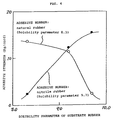
- Based on the results with the adherends which were obtained in the Examples A, I and J using adhesive compositions which contained natural rubber or nitrile rubber, the relation between the solubility parameters of the substrate rubber or the rubber in the rubber compounds and adhesion strength between the fiber cords and the rubbers is illustrated in Fig. 2.
- In the Example A, the fiber cords were treated with an aqueous mixture (a) and then with an adhesive composition (b) which contained natural rubber having a solubility parameter of 8.3. Thus, the
compound 1 of natural rubber is bonded strongly to the fiber cords. - On the contrary, nitrile rubber has a solubility parameter of 9.7, more than that of the natural rubber as an adhesive rubber by 1.4, so that no strong adhesion is obtained between the nitrile rubber compound 3 and the fiber cords, as the results are shown in parentheses.
- In the Example J, when the fiber cords were treated with an adhesive composition containing a latex of nitrile rubber, they were strongly bonded to the rubber compound 3 of nitrile rubber. However, there was not attained a strong adhesion between the fiber cords and the
rubber compound 1 of natural rubber, as the nitrile rubber has a solubility parameter of 9.7 whereas the natural rubber has a solubility parameter of 8.3, the difference of the solubility parameters being 1.4. - In the Example I, the fiber cords were treated with a latex of chloroprene rubber, and were strongly bonded to the rubber compound 2 of chloroprene rubber.
- The same aromatic polyamide fiber cords as in the Example 1 were dipped into an aqueous mixture (a) as shown in the Table 4, and then dried at 200°C for two minutes. The fiber cords were then dippied in an aqueous mixture (b) as shown in the Table 4, and dried at 200°C for two minutes.
- The fiber cords were then placed in close contact with the nitrile rubber compound 3, and the rubber compound was vulcanized at 150°C for 30 minutes.
- The resultant adherends were subjected to measurement of 180° peeling adhesion strength between the fiber cords and the rubber at a peeling rate of 100 mm per minute by an adhesion test. The results are shown in the Table 4.
- The adherends were fixed at their one ends to a frame, and then travelled along a pair of rotational bars, with the other ends connected to a load of 1.5 kg. Then the bars were moved up and down in the opposite directions 100000 times while rotating in such a manner that the distance between the rotational axes of the bars oscillatorily changed, thereby to estimate the tensile strength retention which is defined by tensile strength after the flexing test divided tensile strength before the test. The results are shown in the Table 4.


- The same aromatic polyamide fiber cords as in the Example 1 were dipped into an aqueous mixture (c) as shown in the Table 5, and then dried at 200°C for two minutes. The fiber cords were then dippied in an aqueous mixtures (a) and (b) in succession in the same manner as in the Example A, and dried at 200°C for two minutes.
- The fiber cords were then placed in close contact with the
rubber compound 1, and the rubber compound was vulcanized at 150°C for 30 minutes. - The resultant adherends were subjected to measurement of 180° peeling adhesion strength between the fiber cords and the rubber at a peeling rate of 100 mm per minute by an adhesion test. The results are shown in the Table 5.
Table 5 Example X Y Z Aqueous Mixture (c) PAPI 9.0 - 4.5 Polyepoxy compound - 9.0 4.5 10% NaOH solution - 1.0 0.5 Toluene 141 140 140.5 Adhesion Strength (Kg/cord) 13.2 12.8 11.5 Adhesion Failure R R R
Claims (5)
- A process of bonding aromatic polyamide fibers to a rubber compound being natural rubber, styrene/butadiene rubber, acrylonitrile/butadiene rubber, ethylene/propylene rubber, epichlordydrin rubber or fluorocarbon rubber which comprises:a first step of treating fibers with an aqueous mixture consisting essentially of a resorcinol/formalin resin and a latex of a polymer being polyvinyl chloride, chlorinated rubber, chlorinated polyethylene, poly(dichlorobutadiene) or a copolymer of dichlorobutadiene containing chlorine in an amount of not less than 45 by weight based on the polymer;a second step of treating the fibers with an aqueous adhesive composition consisting essentially of a resorcinol/formalin resin and a latex of an adhesive rubber which is the same as the rubber of the rubber compound, the adhesive rubber being present in the adhesive composition in an amount of from 50 to 1000 parts by weight in relation to 100 parts by weight of the resorcinol/formalin resin; anda third step of placing the fibers in close contact with the rubber compound and vulcanizing the rubber together with the fibers.
- A process according to claim 1 wherein the polymer contains no more than 50% by weight chlorine based on the weight of the polymer.
- A process according to claim 1 or 2 wherein the aqueous mixture contains from 5 to 80% by weight solids.
- A process according to any of claims 1 to 3 wherein the adhesive composition contains solids in an amount of from 5 to 80% by weight.
- A process according to any preceding claim wherein the fibers are pretreated with at least one activating agent, being a polyisocyanate or a polyepoxy compound.
Priority Applications (1)
| Application Number | Priority Date | Filing Date | Title |
|---|---|---|---|
| EP95118841A EP0708134B1 (en) | 1988-12-23 | 1989-12-21 | Process of bonding aromatic polyamide fibers to rubber compounds |
Applications Claiming Priority (4)
| Application Number | Priority Date | Filing Date | Title |
|---|---|---|---|
| JP327235/88 | 1988-12-23 | ||
| JP32723588A JPH02170830A (en) | 1988-12-23 | 1988-12-23 | Bonding of aromatic polyamide fiber and rubber compound |
| JP32723488A JPH02175974A (en) | 1988-12-23 | 1988-12-23 | Bonding of aromatic polyamide fiber to rubber formulation |
| JP327234/88 | 1988-12-23 |
Related Child Applications (2)
| Application Number | Title | Priority Date | Filing Date |
|---|---|---|---|
| EP95118841A Division EP0708134B1 (en) | 1988-12-23 | 1989-12-21 | Process of bonding aromatic polyamide fibers to rubber compounds |
| EP95118841.6 Division-Into | 1989-12-21 |
Publications (3)
| Publication Number | Publication Date |
|---|---|
| EP0376623A2 EP0376623A2 (en) | 1990-07-04 |
| EP0376623A3 EP0376623A3 (en) | 1991-07-31 |
| EP0376623B1 true EP0376623B1 (en) | 1996-07-31 |
Family
ID=26572439
Family Applications (2)
| Application Number | Title | Priority Date | Filing Date |
|---|---|---|---|
| EP95118841A Expired - Lifetime EP0708134B1 (en) | 1988-12-23 | 1989-12-21 | Process of bonding aromatic polyamide fibers to rubber compounds |
| EP89313414A Expired - Lifetime EP0376623B1 (en) | 1988-12-23 | 1989-12-21 | Process of bonding aromatic polyamide fibers to rubber compounds |
Family Applications Before (1)
| Application Number | Title | Priority Date | Filing Date |
|---|---|---|---|
| EP95118841A Expired - Lifetime EP0708134B1 (en) | 1988-12-23 | 1989-12-21 | Process of bonding aromatic polyamide fibers to rubber compounds |
Country Status (5)
| Country | Link |
|---|---|
| US (3) | US5306369A (en) |
| EP (2) | EP0708134B1 (en) |
| AT (2) | ATE208801T1 (en) |
| CA (1) | CA2006403C (en) |
| DE (2) | DE68926908T2 (en) |
Families Citing this family (17)
| Publication number | Priority date | Publication date | Assignee | Title |
|---|---|---|---|---|
| EP0708134B1 (en) * | 1988-12-23 | 2001-11-14 | Bando Chemical Industries, Ltd. | Process of bonding aromatic polyamide fibers to rubber compounds |
| US5691415A (en) * | 1992-03-16 | 1997-11-25 | Tosoh Corporation | Reinforced elastic body and production process thereof |
| US5565507A (en) * | 1994-06-28 | 1996-10-15 | Milliken Research Corporation | Adhesive composition |
| KR100353910B1 (en) * | 1994-11-04 | 2002-12-28 | 도소 가부시키가이샤 | Treatment Agents for Bonding, Treated Polyester Fibers, Elastomers and Methods for Making the Same |
| JP3601550B2 (en) * | 1995-06-07 | 2004-12-15 | 日本ゼオン株式会社 | Adhesive composition and composite of rubber and fiber |
| KR20000026308A (en) * | 1998-10-20 | 2000-05-15 | 구광시 | Adhesive composition for rubber reinforced fiber and dipped cord for reinforcing rubber and dipped cord cloth |
| US6607828B1 (en) * | 1998-12-16 | 2003-08-19 | Mitsuboshi Belting Ltd. | Method of bonding an ethylene-α-olefin rubber composition to a fiber cord and a fiber cord-rubber laminate made according to the method |
| JP2003139198A (en) * | 2001-01-26 | 2003-05-14 | Mitsuboshi Belting Ltd | Short fiber bonding treatment method, rubber composition, and power transmission belt |
| GB2384780B (en) * | 2001-12-07 | 2005-12-07 | Thomas Swan & Company Ltd | A method and composition for bonding fibres to rubbers |
| US20040014389A1 (en) * | 2002-07-18 | 2004-01-22 | Judy Chu | Polychloprene composite having adhesive with copolymer of polychloroprene and dichlorobutadiene |
| MXPA05006668A (en) * | 2002-12-23 | 2005-12-14 | Invista Tech Sarl | Adhesion between textile reinforcing materials and rubber_. |
| DE112005003521A5 (en) * | 2005-01-26 | 2008-01-03 | Interkordsa Gmbh | High-adhesion cord |
| US20090075770A1 (en) * | 2006-03-24 | 2009-03-19 | Bando Chemical Industries, Ltd. | Power transmission belt |
| US8142316B2 (en) * | 2006-12-05 | 2012-03-27 | Veyance Technologies, Inc. | Power transmission belts |
| JP5391772B2 (en) * | 2009-03-26 | 2014-01-15 | 富士ゼロックス株式会社 | Recording device |
| CN111868161B (en) * | 2018-03-23 | 2023-03-17 | 阪东化学株式会社 | Crosslinked rubber composition and method for producing same |
| TR2022008347A1 (en) * | 2022-05-23 | 2023-12-21 | Kordsa Teknik Tekstil As | TEXTILE MATERIALS AND PRODUCTION METHODS WITH HIGH ADHESION RAW VALUE |
Family Cites Families (14)
| Publication number | Priority date | Publication date | Assignee | Title |
|---|---|---|---|---|
| US3190764A (en) * | 1961-06-28 | 1965-06-22 | Goodyear Tire & Rubber | Method of bonding a rubbery composition to a reinforcing element |
| US3577310A (en) * | 1966-10-14 | 1971-05-04 | Montedison Spa | Method of bonding olefin elastomer to textile fiber and product obtained |
| US3803035A (en) * | 1970-10-05 | 1974-04-09 | Goodyear Tire & Rubber | Epoxide finish additive |
| GB1541409A (en) * | 1975-04-25 | 1979-02-28 | Dunlop Ltd | Reinforced elastomeric articles |
| DE3043426A1 (en) * | 1980-11-18 | 1982-07-08 | Bayer Ag, 5090 Leverkusen | METHOD FOR IMPREGNATING TEXTILE CORDS |
| JPS58118332U (en) * | 1982-02-05 | 1983-08-12 | 三ツ星ベルト株式会社 | Power transmission belt |
| US4448813A (en) * | 1982-09-20 | 1984-05-15 | The B. F. Goodrich Company | Preparation of cord for bonding to rubber |
| JPH0742448B2 (en) * | 1985-03-12 | 1995-05-10 | 日本ゼオン株式会社 | Method of bonding rubber compound and fiber |
| US5151142A (en) * | 1986-01-13 | 1992-09-29 | Bridgestone Corporation | Heavy duty pneumatic radial tires using rubber reinforcing fiber cords with improved adhesion |
| US4933236A (en) * | 1986-06-23 | 1990-06-12 | Celanese Corporation | Polyester yarn and adhesively activated with a quaternary ammonium salt of a polyepoxide |
| JPS6387303A (en) * | 1986-09-30 | 1988-04-18 | Toyo Tire & Rubber Co Ltd | Pneumatic radial tire improved in durability |
| US4978409A (en) * | 1988-07-06 | 1990-12-18 | Bando Chemical Industries, Ltd. | Method of bonding fibers to hydrogenated nitrile rubber |
| EP0708134B1 (en) * | 1988-12-23 | 2001-11-14 | Bando Chemical Industries, Ltd. | Process of bonding aromatic polyamide fibers to rubber compounds |
| US5118545A (en) * | 1990-03-05 | 1992-06-02 | The Goodyear Tire & Rubber Company | Adhesion of aramid cord to rubber |
-
1989
- 1989-12-21 EP EP95118841A patent/EP0708134B1/en not_active Expired - Lifetime
- 1989-12-21 CA CA002006403A patent/CA2006403C/en not_active Expired - Fee Related
- 1989-12-21 DE DE68926908T patent/DE68926908T2/en not_active Expired - Fee Related
- 1989-12-21 DE DE68929346T patent/DE68929346T2/en not_active Expired - Fee Related
- 1989-12-21 EP EP89313414A patent/EP0376623B1/en not_active Expired - Lifetime
- 1989-12-21 AT AT95118841T patent/ATE208801T1/en not_active IP Right Cessation
- 1989-12-21 AT AT89313414T patent/ATE140944T1/en not_active IP Right Cessation
-
1992
- 1992-07-13 US US07/911,377 patent/US5306369A/en not_active Expired - Fee Related
-
1993
- 1993-12-06 US US08/161,486 patent/US5484497A/en not_active Expired - Fee Related
-
1995
- 1995-12-04 US US08/566,510 patent/US5728245A/en not_active Expired - Fee Related
Also Published As
| Publication number | Publication date |
|---|---|
| DE68929346T2 (en) | 2002-08-08 |
| EP0708134B1 (en) | 2001-11-14 |
| DE68929346D1 (en) | 2001-12-20 |
| US5484497A (en) | 1996-01-16 |
| DE68926908T2 (en) | 1997-03-06 |
| US5728245A (en) | 1998-03-17 |
| EP0708134A3 (en) | 1996-10-23 |
| US5306369A (en) | 1994-04-26 |
| EP0708134A2 (en) | 1996-04-24 |
| EP0376623A2 (en) | 1990-07-04 |
| ATE208801T1 (en) | 2001-11-15 |
| EP0376623A3 (en) | 1991-07-31 |
| CA2006403C (en) | 1999-05-11 |
| DE68926908D1 (en) | 1996-09-05 |
| ATE140944T1 (en) | 1996-08-15 |
| CA2006403A1 (en) | 1990-06-23 |
Similar Documents
| Publication | Publication Date | Title |
|---|---|---|
| EP0353473B1 (en) | Method of bonding fibers to hydrogenated nitrile rubber | |
| EP0708134B1 (en) | Process of bonding aromatic polyamide fibers to rubber compounds | |
| US3036948A (en) | Adhesion of polyester fiber directly to butyl rubber by means of epoxy resin | |
| US4883712A (en) | Carbon fiber cord for rubber reinforcement | |
| EP0194678B1 (en) | Method for bonding rubbers to fibers | |
| EP0688810B1 (en) | Fiber-reinforced elastic body and power transmission belt using the same | |
| JPH0369934B2 (en) | ||
| US5691415A (en) | Reinforced elastic body and production process thereof | |
| JPH042605B2 (en) | ||
| JPH0860555A (en) | Method of treating polyester fiber | |
| JPH0633340B2 (en) | Method for bonding aromatic polyamide fiber and rubber compound | |
| JP3030466B2 (en) | Method for bonding aromatic polyamide fiber to rubber compound | |
| JP3008373B2 (en) | Bonding method between fiber and rubber compound | |
| JP3284214B2 (en) | Reinforced elastic body and method of manufacturing the same | |
| JP2005213412A (en) | Rubber / fiber composite | |
| JPH0218426A (en) | Adhesion method between hydrogenated nitrile rubber compound and fibers | |
| US3837993A (en) | Adhesion of textiles to rubber | |
| JP2998134B2 (en) | Method for bonding aromatic polyamide fiber to rubber compound | |
| JPH0641526B2 (en) | Method of bonding hydrogenated nitrile rubber compound to fiber | |
| JP3212794B2 (en) | Bonding method of polyester fiber for high pressure hose | |
| JPH07216755A (en) | Adhesion treatment method for polyester fiber and ethylene-propylene rubber | |
| JPH10280280A (en) | Polyester fiber bonding method | |
| JPH05339548A (en) | Adhesive between aromatic polyamide fiber and rubber compound | |
| JPH07258975A (en) | Adhesion treatment method for polyester fiber for high pressure hose | |
| JPH03227456A (en) | Method for treating aromatic polyamide fiber |
Legal Events
| Date | Code | Title | Description |
|---|---|---|---|
| PUAI | Public reference made under article 153(3) epc to a published international application that has entered the european phase |
Free format text: ORIGINAL CODE: 0009012 |
|
| AK | Designated contracting states |
Kind code of ref document: A2 Designated state(s): AT DE FR GB IT |
|
| PUAL | Search report despatched |
Free format text: ORIGINAL CODE: 0009013 |
|
| AK | Designated contracting states |
Kind code of ref document: A3 Designated state(s): AT DE FR GB IT |
|
| 17P | Request for examination filed |
Effective date: 19911015 |
|
| 17Q | First examination report despatched |
Effective date: 19940218 |
|
| GRAH | Despatch of communication of intention to grant a patent |
Free format text: ORIGINAL CODE: EPIDOS IGRA |
|
| GRAH | Despatch of communication of intention to grant a patent |
Free format text: ORIGINAL CODE: EPIDOS IGRA |
|
| GRAA | (expected) grant |
Free format text: ORIGINAL CODE: 0009210 |
|
| AK | Designated contracting states |
Kind code of ref document: B1 Designated state(s): AT DE FR GB IT |
|
| PG25 | Lapsed in a contracting state [announced via postgrant information from national office to epo] |
Ref country code: AT Effective date: 19960731 |
|
| REF | Corresponds to: |
Ref document number: 140944 Country of ref document: AT Date of ref document: 19960815 Kind code of ref document: T |
|
| XX | Miscellaneous (additional remarks) |
Free format text: TEILANMELDUNG 95118841.6 EINGEREICHT AM 30/11/95. |
|
| REF | Corresponds to: |
Ref document number: 68926908 Country of ref document: DE Date of ref document: 19960905 |
|
| ITF | It: translation for a ep patent filed | ||
| ET | Fr: translation filed | ||
| PLBE | No opposition filed within time limit |
Free format text: ORIGINAL CODE: 0009261 |
|
| STAA | Information on the status of an ep patent application or granted ep patent |
Free format text: STATUS: NO OPPOSITION FILED WITHIN TIME LIMIT |
|
| 26N | No opposition filed | ||
| PGFP | Annual fee paid to national office [announced via postgrant information from national office to epo] |
Ref country code: GB Payment date: 20011219 Year of fee payment: 13 |
|
| REG | Reference to a national code |
Ref country code: GB Ref legal event code: IF02 |
|
| PGFP | Annual fee paid to national office [announced via postgrant information from national office to epo] |
Ref country code: DE Payment date: 20020109 Year of fee payment: 13 |
|
| PG25 | Lapsed in a contracting state [announced via postgrant information from national office to epo] |
Ref country code: GB Free format text: LAPSE BECAUSE OF NON-PAYMENT OF DUE FEES Effective date: 20021221 |
|
| PG25 | Lapsed in a contracting state [announced via postgrant information from national office to epo] |
Ref country code: DE Free format text: LAPSE BECAUSE OF NON-PAYMENT OF DUE FEES Effective date: 20030701 |
|
| GBPC | Gb: european patent ceased through non-payment of renewal fee |
Effective date: 20021221 |
|
| PGFP | Annual fee paid to national office [announced via postgrant information from national office to epo] |
Ref country code: FR Payment date: 20041208 Year of fee payment: 16 |
|
| PG25 | Lapsed in a contracting state [announced via postgrant information from national office to epo] |
Ref country code: IT Free format text: LAPSE BECAUSE OF NON-PAYMENT OF DUE FEES;WARNING: LAPSES OF ITALIAN PATENTS WITH EFFECTIVE DATE BEFORE 2007 MAY HAVE OCCURRED AT ANY TIME BEFORE 2007. THE CORRECT EFFECTIVE DATE MAY BE DIFFERENT FROM THE ONE RECORDED. Effective date: 20051221 |
|
| PG25 | Lapsed in a contracting state [announced via postgrant information from national office to epo] |
Ref country code: FR Free format text: LAPSE BECAUSE OF NON-PAYMENT OF DUE FEES Effective date: 20060831 |
|
| REG | Reference to a national code |
Ref country code: FR Ref legal event code: ST Effective date: 20060831 |