EP0372612B1 - Hydroxylhydrocarbyl-modified aminoalkyl silicones - Google Patents
Hydroxylhydrocarbyl-modified aminoalkyl silicones Download PDFInfo
- Publication number
- EP0372612B1 EP0372612B1 EP19890202972 EP89202972A EP0372612B1 EP 0372612 B1 EP0372612 B1 EP 0372612B1 EP 19890202972 EP19890202972 EP 19890202972 EP 89202972 A EP89202972 A EP 89202972A EP 0372612 B1 EP0372612 B1 EP 0372612B1
- Authority
- EP
- European Patent Office
- Prior art keywords
- organosiloxane
- amine
- formula
- silicones
- hydrocarbon radicals
- Prior art date
- Legal status (The legal status is an assumption and is not a legal conclusion. Google has not performed a legal analysis and makes no representation as to the accuracy of the status listed.)
- Expired - Lifetime
Links
- 229920001296 polysiloxane Polymers 0.000 title description 34
- 125000004103 aminoalkyl group Chemical group 0.000 title description 19
- -1 halogenated hydrocarbon radicals Chemical class 0.000 claims description 20
- 239000004215 Carbon black (E152) Substances 0.000 claims description 12
- 229930195733 hydrocarbon Natural products 0.000 claims description 12
- 125000005375 organosiloxane group Chemical group 0.000 claims description 11
- 239000001257 hydrogen Substances 0.000 claims description 9
- 229910052739 hydrogen Inorganic materials 0.000 claims description 9
- 125000004435 hydrogen atom Chemical group [H]* 0.000 claims description 8
- 125000002887 hydroxy group Chemical group [H]O* 0.000 claims description 4
- UFHFLCQGNIYNRP-UHFFFAOYSA-N Hydrogen Chemical class [H][H] UFHFLCQGNIYNRP-UHFFFAOYSA-N 0.000 claims description 3
- 125000003545 alkoxy group Chemical group 0.000 claims description 3
- 125000004433 nitrogen atom Chemical group N* 0.000 claims description 3
- 229920001400 block copolymer Polymers 0.000 claims description 2
- 239000000551 dentifrice Substances 0.000 description 17
- 150000001412 amines Chemical class 0.000 description 16
- 150000001875 compounds Chemical class 0.000 description 15
- 239000000047 product Substances 0.000 description 15
- 125000004432 carbon atom Chemical group C* 0.000 description 11
- 229920000435 poly(dimethylsiloxane) Polymers 0.000 description 11
- 150000003512 tertiary amines Chemical class 0.000 description 11
- KFZMGEQAYNKOFK-UHFFFAOYSA-N Isopropanol Chemical compound CC(C)O KFZMGEQAYNKOFK-UHFFFAOYSA-N 0.000 description 10
- WFDIJRYMOXRFFG-UHFFFAOYSA-N Acetic anhydride Chemical compound CC(=O)OC(C)=O WFDIJRYMOXRFFG-UHFFFAOYSA-N 0.000 description 9
- 125000003277 amino group Chemical group 0.000 description 8
- 229920013822 aminosilicone Polymers 0.000 description 8
- 238000010186 staining Methods 0.000 description 8
- QTBSBXVTEAMEQO-UHFFFAOYSA-N Acetic acid Chemical compound CC(O)=O QTBSBXVTEAMEQO-UHFFFAOYSA-N 0.000 description 7
- 239000000243 solution Substances 0.000 description 7
- 238000006243 chemical reaction Methods 0.000 description 6
- 239000000203 mixture Substances 0.000 description 6
- 150000002924 oxiranes Chemical class 0.000 description 6
- 229920000642 polymer Polymers 0.000 description 6
- 230000009257 reactivity Effects 0.000 description 6
- GHXZTYHSJHQHIJ-UHFFFAOYSA-N Chlorhexidine Chemical compound C=1C=C(Cl)C=CC=1NC(N)=NC(N)=NCCCCCCN=C(N)N=C(N)NC1=CC=C(Cl)C=C1 GHXZTYHSJHQHIJ-UHFFFAOYSA-N 0.000 description 5
- 229960003260 chlorhexidine Drugs 0.000 description 5
- 239000003921 oil Substances 0.000 description 5
- 238000004448 titration Methods 0.000 description 5
- 230000007423 decrease Effects 0.000 description 4
- 239000004205 dimethyl polysiloxane Substances 0.000 description 4
- 235000013870 dimethyl polysiloxane Nutrition 0.000 description 4
- 238000009472 formulation Methods 0.000 description 4
- 125000002496 methyl group Chemical group [H]C([H])([H])* 0.000 description 4
- IAYPIBMASNFSPL-UHFFFAOYSA-N Ethylene oxide Chemical compound C1CO1 IAYPIBMASNFSPL-UHFFFAOYSA-N 0.000 description 3
- HEMHJVSKTPXQMS-UHFFFAOYSA-M Sodium hydroxide Chemical compound [OH-].[Na+] HEMHJVSKTPXQMS-UHFFFAOYSA-M 0.000 description 3
- YXFVVABEGXRONW-UHFFFAOYSA-N Toluene Chemical compound CC1=CC=CC=C1 YXFVVABEGXRONW-UHFFFAOYSA-N 0.000 description 3
- 229960000583 acetic acid Drugs 0.000 description 3
- 230000029936 alkylation Effects 0.000 description 3
- 238000005804 alkylation reaction Methods 0.000 description 3
- 208000002925 dental caries Diseases 0.000 description 3
- 239000000839 emulsion Substances 0.000 description 3
- 208000024693 gingival disease Diseases 0.000 description 3
- 230000002209 hydrophobic effect Effects 0.000 description 3
- 230000004048 modification Effects 0.000 description 3
- 238000012986 modification Methods 0.000 description 3
- 125000001997 phenyl group Chemical group [H]C1=C([H])C([H])=C(*)C([H])=C1[H] 0.000 description 3
- NBIIXXVUZAFLBC-UHFFFAOYSA-K phosphate Chemical compound [O-]P([O-])([O-])=O NBIIXXVUZAFLBC-UHFFFAOYSA-K 0.000 description 3
- 150000003254 radicals Chemical class 0.000 description 3
- QORWJWZARLRLPR-UHFFFAOYSA-H tricalcium bis(phosphate) Chemical compound [Ca+2].[Ca+2].[Ca+2].[O-]P([O-])([O-])=O.[O-]P([O-])([O-])=O QORWJWZARLRLPR-UHFFFAOYSA-H 0.000 description 3
- IJGRMHOSHXDMSA-UHFFFAOYSA-N Atomic nitrogen Chemical compound N#N IJGRMHOSHXDMSA-UHFFFAOYSA-N 0.000 description 2
- HEDRZPFGACZZDS-UHFFFAOYSA-N Chloroform Chemical compound ClC(Cl)Cl HEDRZPFGACZZDS-UHFFFAOYSA-N 0.000 description 2
- RTZKZFJDLAIYFH-UHFFFAOYSA-N Diethyl ether Chemical compound CCOCC RTZKZFJDLAIYFH-UHFFFAOYSA-N 0.000 description 2
- VEXZGXHMUGYJMC-UHFFFAOYSA-N Hydrochloric acid Chemical compound Cl VEXZGXHMUGYJMC-UHFFFAOYSA-N 0.000 description 2
- GOOHAUXETOMSMM-UHFFFAOYSA-N Propylene oxide Chemical compound CC1CO1 GOOHAUXETOMSMM-UHFFFAOYSA-N 0.000 description 2
- 239000002253 acid Substances 0.000 description 2
- 150000001299 aldehydes Chemical class 0.000 description 2
- 238000004458 analytical method Methods 0.000 description 2
- 239000003242 anti bacterial agent Substances 0.000 description 2
- 230000000844 anti-bacterial effect Effects 0.000 description 2
- 230000000675 anti-caries Effects 0.000 description 2
- 230000004888 barrier function Effects 0.000 description 2
- 230000008901 benefit Effects 0.000 description 2
- 239000011248 coating agent Substances 0.000 description 2
- 238000000576 coating method Methods 0.000 description 2
- 238000011161 development Methods 0.000 description 2
- 238000007922 dissolution test Methods 0.000 description 2
- 230000000694 effects Effects 0.000 description 2
- 238000002474 experimental method Methods 0.000 description 2
- 239000000796 flavoring agent Substances 0.000 description 2
- 239000012362 glacial acetic acid Substances 0.000 description 2
- 230000036541 health Effects 0.000 description 2
- 238000010438 heat treatment Methods 0.000 description 2
- 238000000034 method Methods 0.000 description 2
- 201000001245 periodontitis Diseases 0.000 description 2
- 229940085991 phosphate ion Drugs 0.000 description 2
- 239000000843 powder Substances 0.000 description 2
- 150000003141 primary amines Chemical class 0.000 description 2
- 125000002924 primary amino group Chemical group [H]N([H])* 0.000 description 2
- 150000003242 quaternary ammonium salts Chemical class 0.000 description 2
- 150000003335 secondary amines Chemical group 0.000 description 2
- 239000002904 solvent Substances 0.000 description 2
- 239000000126 substance Substances 0.000 description 2
- 239000001993 wax Substances 0.000 description 2
- QBJWYMFTMJFGOL-UHFFFAOYSA-N 2-hexadecyloxirane Chemical compound CCCCCCCCCCCCCCCCC1CO1 QBJWYMFTMJFGOL-UHFFFAOYSA-N 0.000 description 1
- 208000006558 Dental Calculus Diseases 0.000 description 1
- BLRPTPMANUNPDV-UHFFFAOYSA-N Silane Chemical compound [SiH4] BLRPTPMANUNPDV-UHFFFAOYSA-N 0.000 description 1
- 208000014735 Tooth injury Diseases 0.000 description 1
- 238000009825 accumulation Methods 0.000 description 1
- 125000002015 acyclic group Chemical group 0.000 description 1
- 125000003282 alkyl amino group Chemical group 0.000 description 1
- 125000000217 alkyl group Chemical group 0.000 description 1
- 239000004599 antimicrobial Substances 0.000 description 1
- 125000003118 aryl group Chemical group 0.000 description 1
- KCXMKQUNVWSEMD-UHFFFAOYSA-N benzyl chloride Chemical compound ClCC1=CC=CC=C1 KCXMKQUNVWSEMD-UHFFFAOYSA-N 0.000 description 1
- 229940073608 benzyl chloride Drugs 0.000 description 1
- 235000019658 bitter taste Nutrition 0.000 description 1
- 230000005587 bubbling Effects 0.000 description 1
- 239000004075 cariostatic agent Substances 0.000 description 1
- 229920006317 cationic polymer Polymers 0.000 description 1
- 125000003636 chemical group Chemical group 0.000 description 1
- 239000003795 chemical substances by application Substances 0.000 description 1
- 239000004927 clay Substances 0.000 description 1
- 239000002537 cosmetic Substances 0.000 description 1
- 239000006184 cosolvent Substances 0.000 description 1
- 125000004122 cyclic group Chemical group 0.000 description 1
- 210000003298 dental enamel Anatomy 0.000 description 1
- 239000006185 dispersion Substances 0.000 description 1
- 239000012153 distilled water Substances 0.000 description 1
- 239000000975 dye Substances 0.000 description 1
- 230000008020 evaporation Effects 0.000 description 1
- 238000001704 evaporation Methods 0.000 description 1
- 239000012467 final product Substances 0.000 description 1
- 235000019634 flavors Nutrition 0.000 description 1
- 239000008394 flocculating agent Substances 0.000 description 1
- 239000012530 fluid Substances 0.000 description 1
- 150000002222 fluorine compounds Chemical class 0.000 description 1
- 235000013355 food flavoring agent Nutrition 0.000 description 1
- 150000003948 formamides Chemical class 0.000 description 1
- 229940083124 ganglion-blocking antiadrenergic secondary and tertiary amines Drugs 0.000 description 1
- 150000008282 halocarbons Chemical class 0.000 description 1
- 150000002430 hydrocarbons Chemical class 0.000 description 1
- 239000004615 ingredient Substances 0.000 description 1
- 230000002401 inhibitory effect Effects 0.000 description 1
- 230000003993 interaction Effects 0.000 description 1
- MEFBJEMVZONFCJ-UHFFFAOYSA-N molybdate Chemical compound [O-][Mo]([O-])(=O)=O MEFBJEMVZONFCJ-UHFFFAOYSA-N 0.000 description 1
- 239000000178 monomer Substances 0.000 description 1
- 210000002200 mouth mucosa Anatomy 0.000 description 1
- 239000002324 mouth wash Substances 0.000 description 1
- 229940051866 mouthwash Drugs 0.000 description 1
- PHQOGHDTIVQXHL-UHFFFAOYSA-N n'-(3-trimethoxysilylpropyl)ethane-1,2-diamine Chemical compound CO[Si](OC)(OC)CCCNCCN PHQOGHDTIVQXHL-UHFFFAOYSA-N 0.000 description 1
- 229910052757 nitrogen Inorganic materials 0.000 description 1
- QJGQUHMNIGDVPM-UHFFFAOYSA-N nitrogen group Chemical group [N] QJGQUHMNIGDVPM-UHFFFAOYSA-N 0.000 description 1
- 125000000466 oxiranyl group Chemical group 0.000 description 1
- 239000002245 particle Substances 0.000 description 1
- 230000010399 physical interaction Effects 0.000 description 1
- 238000003918 potentiometric titration Methods 0.000 description 1
- 239000002244 precipitate Substances 0.000 description 1
- 230000008569 process Effects 0.000 description 1
- 230000005588 protonation Effects 0.000 description 1
- 125000001453 quaternary ammonium group Chemical group 0.000 description 1
- 229920005604 random copolymer Polymers 0.000 description 1
- 230000035484 reaction time Effects 0.000 description 1
- 229920006395 saturated elastomer Polymers 0.000 description 1
- 239000002453 shampoo Substances 0.000 description 1
- 229910000077 silane Inorganic materials 0.000 description 1
- 239000007787 solid Substances 0.000 description 1
- ANOBYBYXJXCGBS-UHFFFAOYSA-L stannous fluoride Chemical compound F[Sn]F ANOBYBYXJXCGBS-UHFFFAOYSA-L 0.000 description 1
- 229960002799 stannous fluoride Drugs 0.000 description 1
- 239000007858 starting material Substances 0.000 description 1
- 125000001424 substituent group Chemical group 0.000 description 1
- 239000000758 substrate Substances 0.000 description 1
- 229920001059 synthetic polymer Polymers 0.000 description 1
- 239000011269 tar Substances 0.000 description 1
- 235000019640 taste Nutrition 0.000 description 1
- 239000000606 toothpaste Substances 0.000 description 1
- 229940034610 toothpaste Drugs 0.000 description 1
- 238000000870 ultraviolet spectroscopy Methods 0.000 description 1
- XLYOFNOQVPJJNP-UHFFFAOYSA-N water Chemical compound O XLYOFNOQVPJJNP-UHFFFAOYSA-N 0.000 description 1
- 238000004078 waterproofing Methods 0.000 description 1
Classifications
-
- A—HUMAN NECESSITIES
- A61—MEDICAL OR VETERINARY SCIENCE; HYGIENE
- A61K—PREPARATIONS FOR MEDICAL, DENTAL OR TOILETRY PURPOSES
- A61K8/00—Cosmetics or similar toiletry preparations
- A61K8/18—Cosmetics or similar toiletry preparations characterised by the composition
- A61K8/72—Cosmetics or similar toiletry preparations characterised by the composition containing organic macromolecular compounds
- A61K8/84—Cosmetics or similar toiletry preparations characterised by the composition containing organic macromolecular compounds obtained by reactions otherwise than those involving only carbon-carbon unsaturated bonds
- A61K8/89—Polysiloxanes
- A61K8/896—Polysiloxanes containing atoms other than silicon, carbon, oxygen and hydrogen, e.g. dimethicone copolyol phosphate
- A61K8/898—Polysiloxanes containing atoms other than silicon, carbon, oxygen and hydrogen, e.g. dimethicone copolyol phosphate containing nitrogen, e.g. amodimethicone, trimethyl silyl amodimethicone or dimethicone propyl PG-betaine
-
- A—HUMAN NECESSITIES
- A61—MEDICAL OR VETERINARY SCIENCE; HYGIENE
- A61Q—SPECIFIC USE OF COSMETICS OR SIMILAR TOILETRY PREPARATIONS
- A61Q11/00—Preparations for care of the teeth, of the oral cavity or of dentures; Dentifrices, e.g. toothpastes; Mouth rinses
-
- C—CHEMISTRY; METALLURGY
- C08—ORGANIC MACROMOLECULAR COMPOUNDS; THEIR PREPARATION OR CHEMICAL WORKING-UP; COMPOSITIONS BASED THEREON
- C08G—MACROMOLECULAR COMPOUNDS OBTAINED OTHERWISE THAN BY REACTIONS ONLY INVOLVING UNSATURATED CARBON-TO-CARBON BONDS
- C08G77/00—Macromolecular compounds obtained by reactions forming a linkage containing silicon with or without sulfur, nitrogen, oxygen or carbon in the main chain of the macromolecule
- C08G77/04—Polysiloxanes
- C08G77/22—Polysiloxanes containing silicon bound to organic groups containing atoms other than carbon, hydrogen and oxygen
- C08G77/26—Polysiloxanes containing silicon bound to organic groups containing atoms other than carbon, hydrogen and oxygen nitrogen-containing groups
-
- C—CHEMISTRY; METALLURGY
- C08—ORGANIC MACROMOLECULAR COMPOUNDS; THEIR PREPARATION OR CHEMICAL WORKING-UP; COMPOSITIONS BASED THEREON
- C08G—MACROMOLECULAR COMPOUNDS OBTAINED OTHERWISE THAN BY REACTIONS ONLY INVOLVING UNSATURATED CARBON-TO-CARBON BONDS
- C08G77/00—Macromolecular compounds obtained by reactions forming a linkage containing silicon with or without sulfur, nitrogen, oxygen or carbon in the main chain of the macromolecule
- C08G77/04—Polysiloxanes
- C08G77/38—Polysiloxanes modified by chemical after-treatment
- C08G77/382—Polysiloxanes modified by chemical after-treatment containing atoms other than carbon, hydrogen, oxygen or silicon
- C08G77/388—Polysiloxanes modified by chemical after-treatment containing atoms other than carbon, hydrogen, oxygen or silicon containing nitrogen
Definitions
- the application concerns novel aminoalkylsilicone compounds which are useful in dentifrices and other consumer products.
- Staining can be troublesome, whether or not chlorhexidine is the cause.
- the accumulation of stains on tooth surfaces poses an esthetic problem for many individuals.
- Plaque is a common factor in caries, gum disease and staining and greatly contributes to their development. Proper oral hygiene as currently practiced requires that plaque be removed or prevented not only for cosmetic purposes but also to climinate a source of potential injury to teeth and gums.
- Silicones have previously been suggested for inclusion in dentifrice compositions in that it has been proposed that they would coat the teeth and thereby prevent cavities and staining.
- British Patent Specification 689,679 discloses a mouthwash containing an organopolysiloxane for the purpose of preventing adhesion of, or for removal of, tars, stains, tartar and food particles from the teeth.
- polymers such as those disclosed in the '679 specification, have not generally been successfully used for coating the teeth since it has been found that the polysiloxane does not adhere to the teeth for prolonged periods of time. Therefore, the need for dentifrice formulations including a hydrophobic substance which effectively coats the teeth has not been satisfied.
- Viccaro, et al. copending application EP-A-0 373 688 filed simultaneous herewith and entitled "Dentifrices Containing Aminoalkyl Silicones” discloses dentifrice formulations including aminoalkylsilicones for coating the teeth and inhibiting stain and caries.
- the aminoalkylsilicones have been found to be more substantive than alkylsilicones, apparently due to the interaction of the positively charged nitrogen of the amine with the negative charges on the surface of the teeth.
- amine groups tend to react with certain chemical groups found in toothpaste components such as the aldehydes of flavoring ingredients. Consequently, aminoalkylsilicones bearing amine groups capable of being protonated over a broad pH range yet of reduced reactivity are desirable.
- Silicones have been used or proposed for use in many consumer products other than dentifrices. Where silicones are included to coat charged objects, such as furs, aminoalkylsilicones will be of use. Like dentifrices, these products may contain compounds having moieties which tend to react undesirably with amine groups. Therefore, aminoalkylsilicones in which the amine group is somewhat deactivated would be useful in these applications, as well.
- organosiloxanes which are said to be useful for a variety of applications in the synthetic polymer art, particularly as flocculating agents for aqueous dispersion of clay.
- the organosiloxanes of the Morehouse patent include units of the formula: wherein -OZ- is the divalent group derived from a monoepoxide by opening of the oxirane ring, HO is interconnected to N through 2 carbon atoms, a is an integer from 0 to 1, n is an integer from 3 to 15, and R may be hydrogen, monovalent hydrocarbon or Morehouse does not appear to suggest that his compounds would be useful in dentifrices and the like, nor does he seem to recognize the desirability of using compounds which can yield a higher positive charge density.
- the invention also embraces the process of making the components, and compositions employing them.
- the silicones of this invention are produced by treating silicones containing primary or secondary amine functional groups with epoxides such as ethylene oxide. This reaction effectively converts most amines to tertiary amines with one or two beta-hydroxylhydrocarbyl substituents. The tertiary molecular structure and the electron withdrawing property of beta-hydroxyls reduce the amine reactivity, but still maintain the pKa between seven and nine. Thus, in most formulation conditions, these novel silicones remain as cationic polymers and have good physical interactions with the substrate surface but show reduced chemical reactivities toward flavoring agents, dyes and skin.
- R is selected from hydrocarbon radicals, halogenated hydrocarbon radicals, hydrogen, hydroxyl, and alkyoxyl groups. Especially preferred are methyl, phenyl and -trifluoropropyl. R groups having from 1 to 10 and particularly 1 to 4 carbon atoms are preferred.
- the divalent hydrocarbon radical of R1 preferably includes from 1 to 20 carbon atoms, preferably 3 to 20 carbon atoms.
- Preferred R3 groups include hydrogen, hydrocarbon radicals, methyl or phenyl. Hydrogen and methyl are particularly preferred. Where R3 is a hydrocarbon radical, it is preferred that the radical includes 30 or fewer carbon atoms, even more preferably 20 or fewer.
- R3 include 10 or fewer, or even 4 or fewer, carbon atoms 4 or fewer.
- R3 may be saturated, unsaturated, cyclic, acyclic, alkyl or aromatic.
- n is preferably 1;
- m is preferably 2; and
- b is preferably 1.
- the units of formula A are: Preferably, the units of Formula A are present in the organosiloxane with units of Formula B: R5 d R4 c SiO (4-d-c)/2 B wherein R4 and R5 are the same or different monovalent radicals, d and c are integers of 0, 1, 2 or 3 and d plus c is 1, 2 or 3.
- R4 and R5 are hydrocarbon radicals, halogenated hydrocarbons, hydrogen, hydroxyl or alkoxyl. Methyl, phenyl and -trifluoropropyl are especially preferred for R4 and R5.
- R4 and R5 will include from 1 to 20 carbon atoms, preferably from 1 to 10 carbon atoms, more preferably from 1 to 4 carbon atoms. It is particularly preferred that a plus c equal 2.
- each of the "R" groups described above e.g., R, R1, R2, etc. includes no greater than 20 carbon atoms, even more preferably no greater than 10 carbon atoms.
- the modified aminosilicones of the invention include at least 1 unit of Formula A, and preferably units of Formula B, as well, and may be in the form of random copolymers, block copolymers, linear polymers or branched polymers.
- the content of Formula A in the polymer ranges by number of repeat units between 0.5% and 100%, preferably between 1% and 10%, more preferably between 5 and 10%.
- the molecular weight of the modified aminoalkyl silicone preferably ranges from 1000 to 100,000. Molecular weights above 5000 are strongly preferred for a compound which will effectively provide a hydrophobic barrier for a surface. 100,000 is the preferred molecular weight ceiling.
- a viscosity in the range of 50 10 ⁇ 3 Pa.s (cps) to 3000 10 ⁇ 3 Pa.s (cps) is preferred.
- the compounds of the invention may be prepared by mixing epoxide compounds with aminosilicones in a pressure reactor and heating for about 24 hours, after which the unreacted epoxide compound is vacuum stripped off.
- the amount of epoxide to be used is calculated based upon the amount of amine functional groups on the aminoalkyl silicone.
- 2 epoxides are reacted for every primary amine and one epoxide for every secondary amine, in order to convert them to tertiary amines.
- a stoichiometric amount or up to 25% excess of epoxide can be used.
- the reaction is preferably conducted between 25°C and 150°C, especially between 50°C and 100°C.
- the pressure is preferably maintained from 50 6.89 kPa (psi) to 300 6.89 kPa (psi); particularly from 50 6.89 kPa (psi) to 150 6.89 kPa (psi).
- Typical aminosilicone starting compounds would include Dow Corning® Q2-8075.
- the compounds of the invention are useful in numerous consumer products which employ silicones, including hard surface cleaners, shampoos, waterproofing agents and car waxes.
- Dentifrices which include aminoalkyl silicones of the invention can be used to form a hydrophobic barrier on the surface of teeth which is useful in preventing staining of teeth and in preventing cavities. Yet, the modified compounds tend not to react with aldehydic flavors and other amine-reactive compounds.
- the antistaining properties of dentifrices incorporating the modified aminosilicones of the invention are of particular significance when the compounds of the invention are used in conjunction with a quaternary ammonium salt such as chlorhexidine. In such event, the dentifrice provides the antistain and anticaries benefit of the aminoalkyl silicone together with the antibacterial and gum disease-fighting benefits of the quaternary ammonium salt, without the usual disadvantage of staining. Anti-calculue effects may also result.
- the antistaining properties of the amino alkyl silicones may likewise be of use when other staining compounds such as stannous fluoride are included in a dentifrice.
- the positively charged nitrogen-containing silicones of the invention are attracted to negatively charges surfaces such as enamel so that silicones including alkyl amine groups are more substantive to the surface of teeth and other charged surfaces.
- increasing the number of aminoalkyl groups per molecule enhances the substantivity of the silicone.
- increasing the charge density improves substantivity, as well.
- modification of the aminoalkyl silicones in accordance with the invention decreases the reactivity of the amino groups toward aldehydes and other reactive groups found in some consumer products including dentifrices.
- modified aminoalkyl silicones of the invention may be used in the form of oils or emulsions.
- a preferred class of aminoalkyl silicone are the amodimethicones.
- Dentifrices including the compounds of the invention are disclosed in greater detail in Lin et al. application EP-A-0 371 551 filed simultaneously herewith entitled “Dentifrices Including Modified Aminoalkyl Silicones” and incorporated by reference herein.
- the modified amines of the invention become protonated and bear positive charges when the pH is below their pKas.
- the pKas will range from about 7 to about 9.5.
- the aminoalkyl polysiloxanes which are to be modified in accordance with the invention may be end capped. If end capped, one or more of the end capping groups, R e , preferably includes one or more nitrogen atoms.
- R e may be -(CH2)3-NH2 or -(CH2)3-NHCH2CH2-NH2.
- Amodimethicones are polydimethyl siloxane polymers containing aminoalkyl groups.
- the aminoalkyl groups may be present either pendent or at one or more ends of the polydimethylsiloxane chain.
- the modified amine groups cause the amodimethicone polymer to develop a net positive charge in aqueous systems over a wide range of pH say, from pH 1 to 9.
- Amodimethicones are commercially available and include Dow Corning® Q2-8075 mentioned above.
- the product was a reactive silicone which precipitated out during the amine titration.
- the product was analyzed for amine content (total, secondary plus tertiary, and tertiary) via potentiometric titration, (see Official and Tentative Methods of the American oil Chemists Society; Tf la-64 and Tf 2a-64). As indicated below, 93% of the amine was present in its tertiary form.
- Example 2 250 g of Amodimethicone Oil (1) and 33 g of propylene oxide were reacted initially at 50°C and 100 6.89 kPa (psi) until an exotherm of approximately 70°C was observed. Following the exotherm, the reaction was carried out at 100°C and 100 psi for about 20-24 hours. The product was "stripped" and analyzed as in Example 2.
- Example 4 As in Example 4, 65 g of (1), 33 g of 1,2-epoxy-octadecane (ex Aldrich) and 100 g of isopropanol were reacted together. The final product was a solid yellowish "wax" at room temperature which upon heating (45-50°C) becomes a viscous yellowish oil.
- Example 2 The product was analyzed as in Example 2 with one modification being made. It was necessary to use Toluene as a cosolvent together with acetic anhydride and glacial acetic acid since the product was found to be insoluble in a solution of acetic anhydride and glacial acetic acid alone.
- Example 2 100 g of silicone fluid (2), 11.6 g of ethylene oxide and 110 g of 2-propanol were reacted together. The reaction conditions were 50°C and 100 6.89 kPa (psi) for 24 hours. The final stripped product was milky white in appearance. There were two changes made in the analysis of the product. First, chloroform was the solvent chosen for total as well as secondary plus tertiary amine determination since the product was insoluble in a solution of ether and isopropanol. Second, the hydrochloric acid titrant was 0.2N.
- Example 2 The same phenomenon, observed in Example 1 where the titrating solution became turbid and formed a precipitate, was observed when titrating this product for total and secondary plus tertiary amine content. The titration showed that all amines were converted to tertiary amines.
- hydroxyapatite powder (3.5%) was first treated with a 5% silicone emulsion (60-70ml) for ten minutes, filered, washed with distilled water, and then exposed in a pH 5, 150ml acetic acid solution including 5% silicone emulsion. Aliquots were withdrawn at various time intervals and filtered off the hydroxyapatite powder. The amounts of phosphate ion in the aliquots were measured by UV spectrophotometry at 710 nm with molybdate solution in accordance with Official Methods of Analysis, Association of Official Analytical Chemists, edited by Sidney Williams, Arlington, Virginia, p. 632 (1984). The results are shown in Table 1.
- the ethoxylated aminoalkyl silicone had the structure of (4) in Example 2.
Landscapes
- Health & Medical Sciences (AREA)
- Chemical & Material Sciences (AREA)
- Life Sciences & Earth Sciences (AREA)
- Public Health (AREA)
- Animal Behavior & Ethology (AREA)
- Organic Chemistry (AREA)
- Veterinary Medicine (AREA)
- Medicinal Chemistry (AREA)
- Chemical Kinetics & Catalysis (AREA)
- General Health & Medical Sciences (AREA)
- Polymers & Plastics (AREA)
- Epidemiology (AREA)
- Birds (AREA)
- General Chemical & Material Sciences (AREA)
- Oral & Maxillofacial Surgery (AREA)
- Silicon Polymers (AREA)
- Cosmetics (AREA)
- Compositions Of Macromolecular Compounds (AREA)
- Treatments For Attaching Organic Compounds To Fibrous Goods (AREA)
Description
- The application concerns novel aminoalkylsilicone compounds which are useful in dentifrices and other consumer products.
- Great strides have been made in recent years in the field of oral health care. However, much remains to be done. While the development of anticaries agents, especially the fluorides, has led to a decline in the incidence of tooth caries it is desirable to even further decrease the number of teeth affected thereby. Moreover, attention in the oral health care field has increasingly focused on the problems of gum disease, periodontitis. While antibacterial agents have been proposed for inclusion in products for use by consumers in the treatment of periodontitis, certain problems have been associated with their use. For example, use of chlorhexidine, which has been known as as antibacterial agent, has been associated with staining problems; it produces yellow to dark brown stains on teeth, tongue and oral mucosa. Furthermore, chlorhexidine has a very bitter taste.
- There has been a need, therefore, for developing a dentifrice formulation including chlorhexidine or other antimicrobial agents such as quaternary ammonium antibacterial compounds, which does not cause staining of the teeth and which has an improved taste. Moreover, dentifrices having improved anticavity effects are also desirable.
- Staining can be troublesome, whether or not chlorhexidine is the cause. The accumulation of stains on tooth surfaces poses an esthetic problem for many individuals.
- Plaque is a common factor in caries, gum disease and staining and greatly contributes to their development. Proper oral hygiene as currently practiced requires that plaque be removed or prevented not only for cosmetic purposes but also to climinate a source of potential injury to teeth and gums.
- Silicones have previously been suggested for inclusion in dentifrice compositions in that it has been proposed that they would coat the teeth and thereby prevent cavities and staining. For example, British Patent Specification 689,679 discloses a mouthwash containing an organopolysiloxane for the purpose of preventing adhesion of, or for removal of, tars, stains, tartar and food particles from the teeth. However, polymers such as those disclosed in the '679 specification, have not generally been successfully used for coating the teeth since it has been found that the polysiloxane does not adhere to the teeth for prolonged periods of time. Therefore, the need for dentifrice formulations including a hydrophobic substance which effectively coats the teeth has not been satisfied.
- Viccaro, et al. copending application EP-A-0 373 688 filed simultaneous herewith and entitled "Dentifrices Containing Aminoalkyl Silicones" discloses dentifrice formulations including aminoalkylsilicones for coating the teeth and inhibiting stain and caries. The aminoalkylsilicones have been found to be more substantive than alkylsilicones, apparently due to the interaction of the positively charged nitrogen of the amine with the negative charges on the surface of the teeth. However, amine groups tend to react with certain chemical groups found in toothpaste components such as the aldehydes of flavoring ingredients. Consequently, aminoalkylsilicones bearing amine groups capable of being protonated over a broad pH range yet of reduced reactivity are desirable.
- Silicones have been used or proposed for use in many consumer products other than dentifrices. Where silicones are included to coat charged objects, such as furs, aminoalkylsilicones will be of use. Like dentifrices, these products may contain compounds having moieties which tend to react undesirably with amine groups. Therefore, aminoalkylsilicones in which the amine group is somewhat deactivated would be useful in these applications, as well.
- Attempts have been made to modify the structure of aminosilicones to decrease the reactivity of the amino groups. In U.S. Patent No. 4,507,455 aminosilicones are reacted with acetic anhydride to form amides. It is believed that the modifications seriously limit the pH range over which the amines will be protonated thereby detracting from the usefulness of the respective aminoalkylsilicones in applications, such as those mentioned above, wherein protonation of the amine is important. Also, U.S. Patent No. 4,472,566 discloses the reaction of aminosilicones with benzylchloride to yield secondary and tertiary amines.
- Morehouse U.S. Patent No. 3,032,577 discloses organosiloxanes which are said to be useful for a variety of applications in the synthetic polymer art, particularly as flocculating agents for aqueous dispersion of clay. The organosiloxanes of the Morehouse patent include units of the formula:

wherein -OZ- is the divalent group derived from a monoepoxide by opening of the oxirane ring, HO is interconnected to N through 2 carbon atoms, a is an integer from 0 to 1, n is an integer from 3 to 15, and R may be hydrogen, monovalent hydrocarbon or
Morehouse does not appear to suggest that his compounds would be useful in dentifrices and the like, nor does he seem to recognize the desirability of using compounds which can yield a higher positive charge density. - We have now discovered a novel class of modified aminosilicones which have reduced reactivity but still retain positive charges over a broad pH range. The invention also embraces the process of making the components, and compositions employing them. The silicones of this invention are produced by treating silicones containing primary or secondary amine functional groups with epoxides such as ethylene oxide. This reaction effectively converts most amines to tertiary amines with one or two beta-hydroxylhydrocarbyl substituents. The tertiary molecular structure and the electron withdrawing property of beta-hydroxyls reduce the amine reactivity, but still maintain the pKa between seven and nine. Thus, in most formulation conditions, these novel silicones remain as cationic polymers and have good physical interactions with the substrate surface but show reduced chemical reactivities toward flavoring agents, dyes and skin.
- The novel silicones of the invention comprise an organosiloxane including at least one unit of formula A:

wherein
a is from 0 to 2, n is from 1 to 5, R is a monovalent radical,
R¹ is a divalent hydrocarbon radical, R² is
R³ is selected from the group consisting of hydrogen and monovalent hydrocarbon radicals, m is 1 or 2, and b is 0 or 1, whereby when m = 1 and/or b = the remainder of the valences on the N-atoms are satisfied by H-atoms. - R is selected from hydrocarbon radicals, halogenated hydrocarbon radicals, hydrogen, hydroxyl, and alkyoxyl groups. Especially preferred are methyl, phenyl and -trifluoropropyl. R groups having from 1 to 10 and particularly 1 to 4 carbon atoms are preferred. The divalent hydrocarbon radical of R¹ preferably includes from 1 to 20 carbon atoms, preferably 3 to 20 carbon atoms. Preferred R³ groups include hydrogen, hydrocarbon radicals, methyl or phenyl. Hydrogen and methyl are particularly preferred. Where R³ is a hydrocarbon radical, it is preferred that the radical includes 30 or fewer carbon atoms, even more preferably 20 or fewer. Depending on the use to which the compounds are put, it may be desirable that R³ include 10 or fewer, or even 4 or fewer, carbon atoms 4 or fewer. R₃ may be saturated, unsaturated, cyclic, acyclic, alkyl or aromatic. n is preferably 1; m is preferably 2; and b is preferably 1.
- Examples of the units of formula A are:

Preferably, the units of Formula A are present in the organosiloxane with units of Formula B:
R⁵dR⁴cSiO(4-d-c)/2 B
wherein R⁴ and R⁵ are the same or different monovalent radicals, d and c are integers of 0, 1, 2 or 3 and d plus c is 1, 2 or 3. R⁴ and R⁵ are hydrocarbon radicals, halogenated hydrocarbons, hydrogen, hydroxyl or alkoxyl. Methyl, phenyl and -trifluoropropyl are especially preferred for R⁴ and R⁵. Generally, R⁴ and R⁵ will include from 1 to 20 carbon atoms, preferably from 1 to 10 carbon atoms, more preferably from 1 to 4 carbon atoms. It is particularly preferred that a plus c equal 2. - Preferably, each of the "R" groups described above, e.g., R, R¹, R², etc. includes no greater than 20 carbon atoms, even more preferably no greater than 10 carbon atoms.
- The modified aminosilicones of the invention include at least 1 unit of Formula A, and preferably units of Formula B, as well, and may be in the form of random copolymers, block copolymers, linear polymers or branched polymers. The content of Formula A in the polymer ranges by number of repeat units between 0.5% and 100%, preferably between 1% and 10%, more preferably between 5 and 10%. The molecular weight of the modified aminoalkyl silicone preferably ranges from 1000 to 100,000. Molecular weights above 5000 are strongly preferred for a compound which will effectively provide a hydrophobic barrier for a surface. 100,000 is the preferred molecular weight ceiling. A viscosity in the range of 50 10⁻³ Pa.s (cps) to 3000 10⁻³ Pa.s (cps) is preferred.
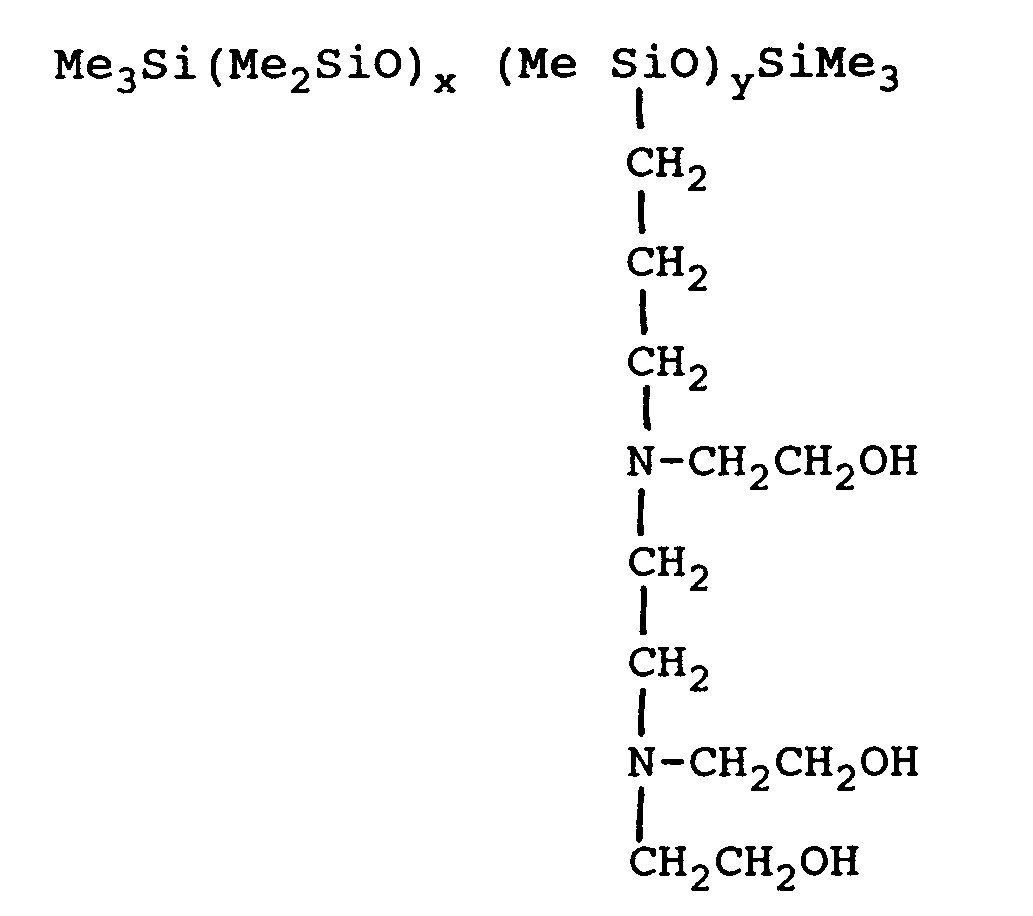
- An Example of the modified polysiloxanes of the invention is as follows:

- The compounds of the invention may be prepared by mixing epoxide compounds with aminosilicones in a pressure reactor and heating for about 24 hours, after which the unreacted epoxide compound is vacuum stripped off. The amount of epoxide to be used is calculated based upon the amount of amine functional groups on the aminoalkyl silicone. Preferably, 2 epoxides are reacted for every primary amine and one epoxide for every secondary amine, in order to convert them to tertiary amines. A stoichiometric amount or up to 25% excess of epoxide can be used. The reaction is preferably conducted between 25°C and 150°C, especially between 50°C and 100°C. The pressure is preferably maintained from 50 6.89 kPa (psi) to 300 6.89 kPa (psi); particularly from 50 6.89 kPa (psi) to 150 6.89 kPa (psi). Typical aminosilicone starting compounds would include Dow Corning® Q2-8075.
- The compounds of the invention are useful in numerous consumer products which employ silicones, including hard surface cleaners, shampoos, waterproofing agents and car waxes.
- Dentifrices which include aminoalkyl silicones of the invention can be used to form a hydrophobic barrier on the surface of teeth which is useful in preventing staining of teeth and in preventing cavities. Yet, the modified compounds tend not to react with aldehydic flavors and other amine-reactive compounds. The antistaining properties of dentifrices incorporating the modified aminosilicones of the invention are of particular significance when the compounds of the invention are used in conjunction with a quaternary ammonium salt such as chlorhexidine. In such event, the dentifrice provides the antistain and anticaries benefit of the aminoalkyl silicone together with the antibacterial and gum disease-fighting benefits of the quaternary ammonium salt, without the usual disadvantage of staining. Anti-calculue effects may also result. The antistaining properties of the amino alkyl silicones may likewise be of use when other staining compounds such as stannous fluoride are included in a dentifrice.
- It is our view that the positively charged nitrogen-containing silicones of the invention are attracted to negatively charges surfaces such as enamel so that silicones including alkyl amine groups are more substantive to the surface of teeth and other charged surfaces. Moreover, increasing the number of aminoalkyl groups per molecule enhances the substantivity of the silicone. Also, increasing the charge density improves substantivity, as well. At the same time, modification of the aminoalkyl silicones in accordance with the invention decreases the reactivity of the amino groups toward aldehydes and other reactive groups found in some consumer products including dentifrices.
- The modified aminoalkyl silicones of the invention may be used in the form of oils or emulsions.
- A preferred class of aminoalkyl silicone are the amodimethicones.
- Dentifrices including the compounds of the invention are disclosed in greater detail in Lin et al. application EP-A-0 371 551 filed simultaneously herewith entitled "Dentifrices Including Modified Aminoalkyl Silicones" and incorporated by reference herein.
- The modified amines of the invention become protonated and bear positive charges when the pH is below their pKas. Depending on structure, the pKas will range from about 7 to about 9.5.
- The aminoalkyl polysiloxanes which are to be modified in accordance with the invention may be end capped. If end capped, one or more of the end capping groups, Re, preferably includes one or more nitrogen atoms. For example, Re may be -(CH₂)₃-NH₂ or -(CH₂)₃-NHCH₂CH₂-NH₂.
- As indicated above, a preferred class of aminoalkyl polysiloxanes useful in preparing the compounds of the invention is that of the amodimethicones. Amodimethicones are polydimethyl siloxane polymers containing aminoalkyl groups. The aminoalkyl groups may be present either pendent or at one or more ends of the polydimethylsiloxane chain. The modified amine groups cause the amodimethicone polymer to develop a net positive charge in aqueous systems over a wide range of pH say, from pH 1 to 9. Amodimethicones are commercially available and include Dow Corning® Q2-8075 mentioned above.
- The following specific examples further illustrate the invention, but the invention is not limited thereto.
-

50 g of N-2-aminoethyl-3-amino propyl trimethoxy silane (ex Petrarch), 39.2 g of propylene oxide (ex Aldrich) and 90 g of 2-propanol were reacted together and then stripped of the solvent. - The product was a reactive silicone which precipitated out during the amine titration.
-

Into a cooled Parr Pressure Reactor was placed 80 g of amodimethicone Oil (1) and 6.5g of ethylene oxide. The contents were then heated at 50°C and 100 psi and stirred for approximately 24 hours. Within 0.5 hours of the start of the reaction, an exotherm was observed at 75°C. After the 24 hour reaction time, the heat was removed and the contents cooled to room temperature. Following this the pressure was released from the reactor and the unreacted epoxide removed by just bubbling through concentrated sodium hydroxide solution followed by evaporation under reduced pressure. - The product was analyzed for amine content (total, secondary plus tertiary, and tertiary) via potentiometric titration, (see Official and Tentative Methods of the American oil Chemists Society; Tf la-64 and Tf 2a-64). As indicated below, 93% of the amine was present in its tertiary form.
-
Total amine (1° + 2° + 3°): 1000 x 10⁻⁶ mol/g Secondary plus tertiary amine (2° + 3°): 1049 x 10-6 mol/g Tertiary amine (3°): 929 x 10-6 mol/g - The results show that 93% of the total mine present was of the tertiary form.
-

As in Example 2, 250 g of Amodimethicone Oil (1) and 33 g of propylene oxide were reacted initially at 50°C and 100 6.89 kPa (psi) until an exotherm of approximately 70°C was observed. Following the exotherm, the reaction was carried out at 100°C and 100 psi for about 20-24 hours. The product was "stripped" and analyzed as in Example 2. -
Total amine: 1110 x 10⁻⁶ mol/g Secondary plus tertiary amine 1077 x 10⁻⁶ mol/g Tertiary amine: 947 x 10⁻⁶ mol/g
Approximately 85% of Total amine was converted to tertiary form. -

- As in Example 4, 65 g of (1), 33 g of 1,2-epoxy-octadecane (ex Aldrich) and 100 g of isopropanol were reacted together. The final product was a solid yellowish "wax" at room temperature which upon heating (45-50°C) becomes a viscous yellowish oil.
- The product was analyzed as in Example 2 with one modification being made. It was necessary to use Toluene as a cosolvent together with acetic anhydride and glacial acetic acid since the product was found to be insoluble in a solution of acetic anhydride and glacial acetic acid alone.
-
Total amine: 754 x 10⁻⁶ mol/g Secondary plus tertiary amine: 673 x 10⁻⁶ mol/g Tertiary amine: 611 x 10⁻⁶ mol/g - About 81% of the total amine content was converted to the tertiary form.
-

As in Example 2, 100 g of silicone fluid (2), 11.6 g of ethylene oxide and 110 g of 2-propanol were reacted together. The reaction conditions were 50°C and 100 6.89 kPa (psi) for 24 hours. The final stripped product was milky white in appearance. There were two changes made in the analysis of the product. First, chloroform was the solvent chosen for total as well as secondary plus tertiary amine determination since the product was insoluble in a solution of ether and isopropanol. Second, the hydrochloric acid titrant was 0.2N. The same phenomenon, observed in Example 1 where the titrating solution became turbid and formed a precipitate, was observed when titrating this product for total and secondary plus tertiary amine content. The titration showed that all amines were converted to tertiary amines. - In these sequential exposure experiments, hydroxyapatite powder (3.5%) was first treated with a 5% silicone emulsion (60-70ml) for ten minutes, filered, washed with distilled water, and then exposed in a pH 5, 150ml acetic acid solution including 5% silicone emulsion. Aliquots were withdrawn at various time intervals and filtered off the hydroxyapatite powder. The amounts of phosphate ion in the aliquots were measured by UV spectrophotometry at 710 nm with molybdate solution in accordance with Official Methods of Analysis, Association of Official Analytical Chemists, edited by Sidney Williams, Arlington, Virginia, p. 632 (1984). The results are shown in Table 1.
- The ethoxylated aminoalkyl silicone had the structure of (4) in Example 2.
TABLE 1 ACID DISSOLUTION TESTS OF HYDROXAPATITE POWDER WHICH WAS TREATED WITH AMINOSILICONES 5 Min. 10 Min. 20 Min. 30 Min. 40 Min. 50 Min. 60 Min. Sequential exposure Ethoxylated Aminoalkyl silicone 316 350 370 381 357 386 366 Polydimethylsiloxane 344 358 380 404 380 431 417 Untreated HAP 373 432 425 447 444 440 438 - This experiment demonstrates that after 60 minutes exposure to the acid solution, the untreated powder lost 438 ppm phosphate ions whereas the one treated with the modified amino alkyl silicone of the invention lost only 366 ppm phosphate ion.
Claims (5)
- An organosiloxane comprised of at least one unit of formula A:

a is from 0 to 2, n is from 1 to 5, R is a monovalent radical selected from hydrocarbon radicals, halogenated hydrocarbon radicals, hydrogen, hydroxyl and alkoxyl groups, R¹ is a divalent hydrocarbon radical, R² is
m is 1 or 2, and b is 0 or 1, whereby when m = 1 and/or b = 0, the remainder of the valences on the N-atoms are satisfied by H-atoms,
the content of the formula A in the organosiloxane ranging, by number of repeat units, from 0.5 % to 100 %. - Organosiloxane of claim 1 wherein said unit is:

- The organosiloxane of claim 1 further comprising at least one unit of formula B,
R⁵dR⁴cSiO(4-d-c)/2 B
wherein R⁴ and R⁵ are monovalent radicals which can be the same or different selected from hydrocarbon radicals, halogenated hydrocarbon radicals, hydrogen, hydroxyl and alkoxyl groups, d and c are integers of 0, 1, 2 or and d plus c is 1, 2 or 3. - The organosiloxane of claim 3 having the formula

- The organosiloxane of claim 3 having the formula
Applications Claiming Priority (2)
| Application Number | Priority Date | Filing Date | Title |
|---|---|---|---|
| US27672688A | 1988-11-28 | 1988-11-28 | |
| US276726 | 1988-11-28 |
Publications (3)
| Publication Number | Publication Date |
|---|---|
| EP0372612A2 EP0372612A2 (en) | 1990-06-13 |
| EP0372612A3 EP0372612A3 (en) | 1991-07-03 |
| EP0372612B1 true EP0372612B1 (en) | 1994-01-05 |
Family
ID=23057843
Family Applications (1)
| Application Number | Title | Priority Date | Filing Date |
|---|---|---|---|
| EP19890202972 Expired - Lifetime EP0372612B1 (en) | 1988-11-28 | 1989-11-23 | Hydroxylhydrocarbyl-modified aminoalkyl silicones |
Country Status (5)
| Country | Link |
|---|---|
| EP (1) | EP0372612B1 (en) |
| JP (1) | JPH02256689A (en) |
| CA (1) | CA2003971A1 (en) |
| DE (1) | DE68912098T2 (en) |
| ES (1) | ES2061954T3 (en) |
Families Citing this family (5)
| Publication number | Priority date | Publication date | Assignee | Title |
|---|---|---|---|---|
| US5078988A (en) * | 1988-11-28 | 1992-01-07 | Chesebrough-Pond's Usa Co., Division Of Conopco, Inc. | Dentrifrices including modified aminoalkyl silicones |
| US5064544A (en) * | 1990-06-01 | 1991-11-12 | Lever Brothers Company, Division Of Conopco, Inc. | Liquid fabric conditioner containing compatible amino alkyl silicones |
| AU641014B2 (en) * | 1990-06-01 | 1993-09-09 | Unilever Plc | Liquid fabric conditioner and dryer sheet fabric conditioner containing compatible silicones |
| US5164522A (en) * | 1990-06-29 | 1992-11-17 | Karlshamns Ab | Cationic silicones |
| DE102006022842A1 (en) * | 2006-05-16 | 2007-11-22 | Wacker Chemie Ag | About methylol crosslinkable silicone polymers |
Family Cites Families (7)
| Publication number | Priority date | Publication date | Assignee | Title |
|---|---|---|---|---|
| BE666745A (en) * | 1964-07-14 | 1966-01-12 | ||
| GB1194885A (en) * | 1967-06-16 | 1970-06-17 | Prev Coat Corp | Novel Silicone-Containing Dentifrices |
| US4161518A (en) * | 1977-12-29 | 1979-07-17 | Minnesota Mining And Manufacturing Company | Compositions and methods for inhibiting plaque formation |
| JPS57197287A (en) * | 1981-05-26 | 1982-12-03 | Unitika Ltd | Organic silane compound |
| JPS5857471A (en) * | 1981-09-29 | 1983-04-05 | Unitika Ltd | Coating composition |
| JPS61296184A (en) * | 1985-06-20 | 1986-12-26 | 信越化学工業株式会社 | Fiber treatment agent |
| US5032387A (en) * | 1986-11-06 | 1991-07-16 | Princeton Pharmaceutical Inc. | Dental and oral hygiene preparations |
-
1989
- 1989-11-23 DE DE1989612098 patent/DE68912098T2/en not_active Expired - Fee Related
- 1989-11-23 EP EP19890202972 patent/EP0372612B1/en not_active Expired - Lifetime
- 1989-11-23 ES ES89202972T patent/ES2061954T3/en not_active Expired - Lifetime
- 1989-11-27 CA CA 2003971 patent/CA2003971A1/en not_active Abandoned
- 1989-11-28 JP JP30884689A patent/JPH02256689A/en active Pending
Also Published As
| Publication number | Publication date |
|---|---|
| EP0372612A2 (en) | 1990-06-13 |
| JPH02256689A (en) | 1990-10-17 |
| EP0372612A3 (en) | 1991-07-03 |
| DE68912098D1 (en) | 1994-02-17 |
| DE68912098T2 (en) | 1994-04-28 |
| CA2003971A1 (en) | 1990-05-28 |
| ES2061954T3 (en) | 1994-12-16 |
Similar Documents
| Publication | Publication Date | Title |
|---|---|---|
| US4994593A (en) | Hydroxylhydrocarbyl-modified aminoalkyl silicones | |
| EP0371551B1 (en) | Dentifrices including modified aminoalkyl silicones | |
| EP0373688B1 (en) | Dentifrices containing amino alkyl silicones | |
| JP2996630B2 (en) | Cleaning compositions for hair care applications and uses thereof | |
| EP1172411B1 (en) | Silicone compositions for personal care products and method of manufacture | |
| FR2736262A1 (en) | DETERGENT COSMETIC COMPOSITIONS FOR CAPILLARY USE AND USE THEREOF | |
| US5154915A (en) | Dentifrices containing aminoalkyl silicones and sarcosinate surfactants | |
| JP2716850B2 (en) | Novel organopolysiloxane and method for producing the same | |
| EP0372612A2 (en) | Hydroxylhydrocarbyl-modified aminoalkyl silicones | |
| US6390102B1 (en) | Silicone compositions for personal care products and method for making | |
| EP0376363B1 (en) | Dentifrices containing amino alkyl silicones and sarcosinate surfactants | |
| EP1303558B1 (en) | Silicone compositions for personal care products and method for making | |
| EP1172398A2 (en) | Silicone compositions for personal care products and method for making | |
| MXPA97003135A (en) | Cosmetic compositions detergents for capillary use and its use |
Legal Events
| Date | Code | Title | Description |
|---|---|---|---|
| PUAI | Public reference made under article 153(3) epc to a published international application that has entered the european phase |
Free format text: ORIGINAL CODE: 0009012 |
|
| AK | Designated contracting states |
Kind code of ref document: A2 Designated state(s): CH DE ES FR GB IT LI NL SE |
|
| PUAL | Search report despatched |
Free format text: ORIGINAL CODE: 0009013 |
|
| AK | Designated contracting states |
Kind code of ref document: A3 Designated state(s): CH DE ES FR GB IT LI NL SE |
|
| 17P | Request for examination filed |
Effective date: 19910628 |
|
| 17Q | First examination report despatched |
Effective date: 19920930 |
|
| RAP3 | Party data changed (applicant data changed or rights of an application transferred) |
Owner name: UNILEVER PLC Owner name: UNILEVER N.V. |
|
| GRAA | (expected) grant |
Free format text: ORIGINAL CODE: 0009210 |
|
| AK | Designated contracting states |
Kind code of ref document: B1 Designated state(s): CH DE ES FR GB IT LI NL SE |
|
| REF | Corresponds to: |
Ref document number: 68912098 Country of ref document: DE Date of ref document: 19940217 |
|
| ET | Fr: translation filed | ||
| ITF | It: translation for a ep patent filed | ||
| PGFP | Annual fee paid to national office [announced via postgrant information from national office to epo] |
Ref country code: FR Payment date: 19941007 Year of fee payment: 6 |
|
| PGFP | Annual fee paid to national office [announced via postgrant information from national office to epo] |
Ref country code: SE Payment date: 19941014 Year of fee payment: 6 |
|
| PGFP | Annual fee paid to national office [announced via postgrant information from national office to epo] |
Ref country code: DE Payment date: 19941024 Year of fee payment: 6 |
|
| PGFP | Annual fee paid to national office [announced via postgrant information from national office to epo] |
Ref country code: CH Payment date: 19941025 Year of fee payment: 6 |
|
| PGFP | Annual fee paid to national office [announced via postgrant information from national office to epo] |
Ref country code: GB Payment date: 19941026 Year of fee payment: 6 |
|
| PLBE | No opposition filed within time limit |
Free format text: ORIGINAL CODE: 0009261 |
|
| STAA | Information on the status of an ep patent application or granted ep patent |
Free format text: STATUS: NO OPPOSITION FILED WITHIN TIME LIMIT |
|
| PGFP | Annual fee paid to national office [announced via postgrant information from national office to epo] |
Ref country code: ES Payment date: 19941118 Year of fee payment: 6 |
|
| PGFP | Annual fee paid to national office [announced via postgrant information from national office to epo] |
Ref country code: NL Payment date: 19941130 Year of fee payment: 6 |
|
| REG | Reference to a national code |
Ref country code: ES Ref legal event code: FG2A Ref document number: 2061954 Country of ref document: ES Kind code of ref document: T3 |
|
| 26N | No opposition filed | ||
| EAL | Se: european patent in force in sweden |
Ref document number: 89202972.9 |
|
| PG25 | Lapsed in a contracting state [announced via postgrant information from national office to epo] |
Ref country code: GB Effective date: 19951123 |
|
| PG25 | Lapsed in a contracting state [announced via postgrant information from national office to epo] |
Ref country code: SE Effective date: 19951124 Ref country code: ES Free format text: LAPSE BECAUSE OF NON-PAYMENT OF DUE FEES Effective date: 19951124 |
|
| PG25 | Lapsed in a contracting state [announced via postgrant information from national office to epo] |
Ref country code: LI Effective date: 19951130 Ref country code: CH Effective date: 19951130 |
|
| PG25 | Lapsed in a contracting state [announced via postgrant information from national office to epo] |
Ref country code: NL Effective date: 19960601 |
|
| REG | Reference to a national code |
Ref country code: CH Ref legal event code: PL |
|
| GBPC | Gb: european patent ceased through non-payment of renewal fee |
Effective date: 19951123 |
|
| PG25 | Lapsed in a contracting state [announced via postgrant information from national office to epo] |
Ref country code: FR Effective date: 19960731 |
|
| NLV4 | Nl: lapsed or anulled due to non-payment of the annual fee |
Effective date: 19960601 |
|
| PG25 | Lapsed in a contracting state [announced via postgrant information from national office to epo] |
Ref country code: DE Effective date: 19960801 |
|
| EUG | Se: european patent has lapsed |
Ref document number: 89202972.9 |
|
| REG | Reference to a national code |
Ref country code: FR Ref legal event code: ST |
|
| REG | Reference to a national code |
Ref country code: ES Ref legal event code: FD2A Effective date: 19961213 |
|
| PG25 | Lapsed in a contracting state [announced via postgrant information from national office to epo] |
Ref country code: IT Free format text: LAPSE BECAUSE OF NON-PAYMENT OF DUE FEES;WARNING: LAPSES OF ITALIAN PATENTS WITH EFFECTIVE DATE BEFORE 2007 MAY HAVE OCCURRED AT ANY TIME BEFORE 2007. THE CORRECT EFFECTIVE DATE MAY BE DIFFERENT FROM THE ONE RECORDED. Effective date: 20051123 |