EP0371509B1 - Antibiotics and process for producing them - Google Patents
Antibiotics and process for producing them Download PDFInfo
- Publication number
- EP0371509B1 EP0371509B1 EP89122134A EP89122134A EP0371509B1 EP 0371509 B1 EP0371509 B1 EP 0371509B1 EP 89122134 A EP89122134 A EP 89122134A EP 89122134 A EP89122134 A EP 89122134A EP 0371509 B1 EP0371509 B1 EP 0371509B1
- Authority
- EP
- European Patent Office
- Prior art keywords
- methanol
- water
- antibiotics
- acetonitrile
- antibiotic
- Prior art date
- Legal status (The legal status is an assumption and is not a legal conclusion. Google has not performed a legal analysis and makes no representation as to the accuracy of the status listed.)
- Expired - Lifetime
Links
Images


Classifications
-
- C—CHEMISTRY; METALLURGY
- C12—BIOCHEMISTRY; BEER; SPIRITS; WINE; VINEGAR; MICROBIOLOGY; ENZYMOLOGY; MUTATION OR GENETIC ENGINEERING
- C12P—FERMENTATION OR ENZYME-USING PROCESSES TO SYNTHESISE A DESIRED CHEMICAL COMPOUND OR COMPOSITION OR TO SEPARATE OPTICAL ISOMERS FROM A RACEMIC MIXTURE
- C12P1/00—Preparation of compounds or compositions, not provided for in groups C12P3/00 - C12P39/00, by using microorganisms or enzymes
- C12P1/04—Preparation of compounds or compositions, not provided for in groups C12P3/00 - C12P39/00, by using microorganisms or enzymes by using bacteria
-
- C—CHEMISTRY; METALLURGY
- C12—BIOCHEMISTRY; BEER; SPIRITS; WINE; VINEGAR; MICROBIOLOGY; ENZYMOLOGY; MUTATION OR GENETIC ENGINEERING
- C12P—FERMENTATION OR ENZYME-USING PROCESSES TO SYNTHESISE A DESIRED CHEMICAL COMPOUND OR COMPOSITION OR TO SEPARATE OPTICAL ISOMERS FROM A RACEMIC MIXTURE
- C12P1/00—Preparation of compounds or compositions, not provided for in groups C12P3/00 - C12P39/00, by using microorganisms or enzymes
- C12P1/06—Preparation of compounds or compositions, not provided for in groups C12P3/00 - C12P39/00, by using microorganisms or enzymes by using actinomycetales
-
- A—HUMAN NECESSITIES
- A61—MEDICAL OR VETERINARY SCIENCE; HYGIENE
- A61P—SPECIFIC THERAPEUTIC ACTIVITY OF CHEMICAL COMPOUNDS OR MEDICINAL PREPARATIONS
- A61P31/00—Antiinfectives, i.e. antibiotics, antiseptics, chemotherapeutics
-
- C—CHEMISTRY; METALLURGY
- C12—BIOCHEMISTRY; BEER; SPIRITS; WINE; VINEGAR; MICROBIOLOGY; ENZYMOLOGY; MUTATION OR GENETIC ENGINEERING
- C12N—MICROORGANISMS OR ENZYMES; COMPOSITIONS THEREOF; PROPAGATING, PRESERVING, OR MAINTAINING MICROORGANISMS; MUTATION OR GENETIC ENGINEERING; CULTURE MEDIA
- C12N1/00—Microorganisms; Compositions thereof; Processes of propagating, maintaining or preserving microorganisms or compositions thereof; Processes of preparing or isolating a composition containing a microorganism; Culture media therefor
- C12N1/20—Bacteria; Culture media therefor
- C12N1/205—Bacterial isolates
-
- C—CHEMISTRY; METALLURGY
- C12—BIOCHEMISTRY; BEER; SPIRITS; WINE; VINEGAR; MICROBIOLOGY; ENZYMOLOGY; MUTATION OR GENETIC ENGINEERING
- C12R—INDEXING SCHEME ASSOCIATED WITH SUBCLASSES C12C - C12Q, RELATING TO MICROORGANISMS
- C12R2001/00—Microorganisms ; Processes using microorganisms
- C12R2001/01—Bacteria or Actinomycetales ; using bacteria or Actinomycetales
- C12R2001/465—Streptomyces
-
- Y—GENERAL TAGGING OF NEW TECHNOLOGICAL DEVELOPMENTS; GENERAL TAGGING OF CROSS-SECTIONAL TECHNOLOGIES SPANNING OVER SEVERAL SECTIONS OF THE IPC; TECHNICAL SUBJECTS COVERED BY FORMER USPC CROSS-REFERENCE ART COLLECTIONS [XRACs] AND DIGESTS
- Y10—TECHNICAL SUBJECTS COVERED BY FORMER USPC
- Y10S—TECHNICAL SUBJECTS COVERED BY FORMER USPC CROSS-REFERENCE ART COLLECTIONS [XRACs] AND DIGESTS
- Y10S435/00—Chemistry: molecular biology and microbiology
- Y10S435/8215—Microorganisms
- Y10S435/822—Microorganisms using bacteria or actinomycetales
- Y10S435/886—Streptomyces
Definitions
- the present invention relates to antibiotic substances named "AB-021 Antibiotics" and to the main components thereof, i.e. antibiotic AB-021 a and antibiotic AB-021 b.
- the present invention relates to the process for preparing said antibiotics by means of the fermentation of Streptomyces s p. NCIB 40068, and to their use in the treatment of the infective diseases caused by microorganisms susceptible to said antibiotics.
- antibiotic AB-021 a and antibiotic AB-021 b are different from the known antibiotics.
- ABS-021 Antibiotics used in the present application is meant to denote a mixture which comprises all of the components endowed with biological activity such as, for example, antifungal and/or antibacterial activity, produced by the fermentation of Streptomyces s p. NCIB 40068 under the conditions specified in the following.
- Said biologically active components comprise, but are not limited to, those designated as AB-021 a and AB-021 b, which can be isolated from the mixture.
- the number and the mutual ratios of the components which constitute the AB-021 antibiotics may vary as a function of the fermentation conditions (such as, e.g., the culture medium, fermentation temperature, the duration of the fermentation, the aeration), and of the bacterial strain used.
- the present invention is not limited to the use of Streptomyces s p. NCIB 40068, but also comprises the use of variants and/or mutants spontaneously or artificially obtained from the above microorganism, provided that they produce the AB-021 antibiotics.
- the present invention is directed to the AB-021 antibiotics obtainable by means of the controlled cultivation under aerobic conditions of Streptomyces s p. NCIB 40068, or of an equivalent spontaneous or artificial variant or mutant thereof, in an aqueous nutrient cultivation medium, containing sources of carbon and nitrogen as well as inorganic salts and metals in trace amounts, and subsequent separation of said antibiotics and of the main components thereof, i.e. antibiotics AB-021 a and AB-021 b.
- AB-021 a a component of the AB-021 antibiotics, is a powder of light yellow colour, characterized by:
- AB-021 b a component of the AB-021 antibiotics, is a powder of deep yellow colour, characterized by:
- the microorganism Streptomyces s p. NCIB 40068 was isolated from a sample of soil collected at Cappella di Terza (Novara), and catalogued for internal laboratory use under the designation SD-505 W.
- Streptomyces s p. NCIB 40068 can undergo variations and/or mutations of either spontaneous or artificial character.
- artificial variants or mutants can be obtained by treating the microorganism with chemical mutagenic agents, such as, e.g., nitrous acid, nitroso-guanidine, halogenated alkylamines and the like, or with physical agents, such as X-rays or U.V. light and high-frequency waves.
- chemical mutagenic agents such as, e.g., nitrous acid, nitroso-guanidine, halogenated alkylamines and the like
- physical agents such as X-rays or U.V. light and high-frequency waves.
- Spontaneous variants or mutants can be obtained as well by isolating and selecting different colonies obtained from Streptomyces s p. NCIB 40068.
- the process for the preparation of AB-021 antibiotics comprises the cultivation of Streptomyces s p. NCIB 40068 or an equivalent (spontaneous or man-made) variant or mutant thereof under conditions of controlled aerobic fermentation in an aqueous nutrient medium, and the subsequent separation of said AB-021 antibiotic by means of per se known methods.
- nutrient culture media or fermentation broths those which are commonly used for the production of antibiotics can be used; however, some nutrient culture media are preferred.
- Said cultivation media should contain sources of carbon and nitrogen which can be assimilated by the microorganisms of the genus Streptomyces and should furthermore show low levels of inorganic salts.
- metal traces should contain traces of those metals which are necessary for the growth and the development of the microorganisms and for the production of the antibiotics. Said metal traces can already be present as impurities in the sources of carbon and of organic nitrogen provided in the culture media for the bacterial growth or, optionally, they can be added to the culture media.
- carbohydrates in particular saccharides, such as, e.g., dextrose or maltose or, as an alternative and/or complement, starches and products which are considered similar to starches from an industrial point of view, such as, e.g., dextrin or soluble starch, or also polyalcohols, such as, e.g., glycerol.
- saccharides such as, e.g., dextrose or maltose
- starches and products which are considered similar to starches from an industrial point of view, such as, e.g., dextrin or soluble starch, or also polyalcohols, such as, e.g., glycerol.
- Said compounds can be used individually or combined with one another in variable proportions.
- concentration and type of the carbon source in the culture medium generally depend on the type and amount of the other ingredients contained in said medium; anyway, concentrations of from 0.5 to 5% by weight generally lead to satisfactory results.
- both proteinic extracts such as, e.g., yeast extract, meat extract or casein hydrolysate, or meals such as, e.g., soybean meal, or commercially available products for that purpose such as, e.g., Proflo, Corn Steep Liquor or Distillers' Solubles, can be used.
- the concentrations in the culture medium generally range from 0.2 % to 6 % by weight.
- inorganic salts there can be used, for example, sodium salts, potassium salts, magnesium salts, ammonium salts and calcium salts, such as phosphates, sulfates, chlorides, carbonates and nitrates.
- Examples of the trace metals contained in the culture medium are cobalt, iron, manganese and the like.
- Some culture media display a particular ability to stimulate the production of AB-021 antibiotics by Streptomyces s p. NCIB 40068; among these,for example, the following aqueous formulations can be mentioned, which have been used in the following preparation Examples.
- the strain of Streptomyces s p. NCIB 40068 can be cultivated and fermented at temperatures of from 20 ° C to 35 ° C, preferably of from 25 ° C to 30 ° C.
- the pH value generally is within the range of from about 5 to about 9.
- the sterile air which is injected into the culture medium is generally used in amounts such as to maintain in the medium an oxygen concentration higher than 20% of the saturation value.
- the production of the AB-021 antibiotics, during the fermentation, can be monitored by means of antibiotic activity tests on broth samples, using microbial and fungal species sensitive to said antibiotics, or by HPLC analysis.
- the fermentation is carried out for a time sufficient for obtaining a substantial antibiotic activity; 24 to 150 hours are generally sufficient for said purpose.
- the AB-021 antibiotics and the main components thereof i.e.AB-021 a and AB-021 b
- the culture broth can be separated from the culture broth and subsequently purified by means of methods conventional in the art of fermentation.
- Such methods include, e.g., extraction with solvents, precipitation with non-solvents, ultrafiltration, column chromatography, silica-gel chromatography, cellulose chromatography, reverse-phase chromatography, chromatography on non-ionic, macroporous resins, and the like.
- the antibiotics produced during the fermentation can be found in the culture broth and/or in the mycelium mass.
- a preferred method for recovering AB-021 antibiotics consists in filtering off the mycelium mass from the culture broth, subjecting the mycelium thus separated to an extraction with acetone or methanol and concentrating the extract under vacuum until complete removal of the solvent. Thereby an aqueous suspension is obtained.
- the thus obtained culture broth containing the AB-021 antibiotics is filtered through fibreglass filters and is then percolated on a column of a non-ionic polystyrene resin, such as, e.g., XAD-2 resin (Rohm & Haas Co.), which adsorbs the AB-021 antibiotics.
- a non-ionic polystyrene resin such as, e.g., XAD-2 resin (Rohm & Haas Co.)
- the resin is then washed with two volumes, based on its bed, of water, and thereafter is eluted with three volumes, also based on its bed, of an 8:2 (V/V) mixture of acetone:water.
- the two pure components AB-021 a and AB-021 b are then isolated from the crude product by means of reverse phase chromatography, using a column packed with silica (MATREXO silica C18 sold by Amicon Europe, Lausanne, Switzerland) with an eluent system formed by an eluent "A” consisting of water containing 10 mM monohydrogen ammonium phosphate and by an eluent "B” consisting of methanol, using a linear gradient of from 30% up to 70% of eluent "B” in eluent "A".
- silica MATREXO silica C18 sold by Amicon Europe, Lausanne, Switzerland
- the fractions which contain antibiotic AB-021 a in pure form and antibiotic AB-021 b in pure form are separately concentrated under vacuum until complete removal of methanol. By cooling the remaining aqueous solutions down to 2 ° C, the precipitation of antibiotic AB-021 a and antibiotic AB-021 b respectively, is effected. Thereafter said antibiotics are centrifuged off. AB-021 a and AB-021 b, separated from their respective solutions as described above, are suspended in water and centrifuged again and, after removing the supernatant solutions and drying under vacuum at 40 ° C for 2 hours, pure antibiotic AB-021 a and pure antibiotic AB-021 b, respectively are obtained.
- the AB-021 antibiotics and the components thereof, i.e., AB-021 a and AB-021 b, are endowed with antifungal and antibacterial activity.
- the antimicrobial activity of AB-021 antibiotics was determined by the usual methods, by adding increasing concentrations of the antibiotic to an agarized culture medium capable of supporting the growth of the sensitive microbial species.
- the minimum concentration of AB-021 antibiotics which under these conditions causes a reduction in mycelial growth of at least 50% as referred to the control (EDso) was furthermore determined.
- yeast Candida albicans
- bacteria Sarcina lutea
- the minimum concentration which completely inhibits growth (MIC) was determined.
- the fungicidal activity in vivo was measured by using the following method.
- the AB-021 antibiotics in water-acetone solution (20% acetone V/V) were sprayed onto the lower sides of leaves of plants grown in pots inside a conditioned room.
- the antibiotics according to the present invention are preferably employed in the form of suitable formulations.
- formulations contain, besides the antibiotic according to the present invention as their active principle, inert solid carriers (e.g., kaolin, silica, talc, attapulgite, diatomaceous earth, etc.) or inert liquid carriers (e.g., organic solvents, vegetable or mineral oils, water and mixtures thereof), and optionally other additives which are normally used in the art of formulations, such as surfactants, suspending agents, dispersants and wetting agents.
- inert solid carriers e.g., kaolin, silica, talc, attapulgite, diatomaceous earth, etc.
- inert liquid carriers e.g., organic solvents, vegetable or mineral oils, water and mixtures thereof
- additives which are normally used in the art of formulations, such as surfactants, suspending agents, dispersants and wetting agents.
- the doses to be applied vary as a function of different factors, such as the type and the degree of infestation, the type of composition used and climatic and environmental factors.
- acetone extract was concentrated under vacuum until the solvent was completely removed and the residual aqueous solution containing the AB-021 antibiotics (about 1 litre) was combined with 400 ml of methanol and was chromatographed on a column (inner diameter 90 mm, length 360 mm) containing 1.0 kg of silica (MATREXO Silica C18) with a forecolumn (50 mm x 50 mm) packed with the same stationary phase, using an eluent system which was formed by an eluent "A" constituted by water containing 10 mM monohydrogen ammonium phosphate and an eluent "B" constituted by methanol, the gradient being as indicated in the following Table:
- Pure AB-021 a antibiotic was contained in 2550 ml within the elution range of from 15000 to 17550 ml, while AB-021 b antibiotic was contained in 3000 ml within the elution range of from 21450 to 24450 ml.
- the culture thus obtained was used to inoculate 3 Erlenmeyer flasks, each containing 100 ml of medium “C” (SCM), with an inoculum of 5% of the volume.
- the Erlenmeyer flasks were kept stirred at 180 rpm, at 30 ° C for 24-72 hours.
- the resulting broth was separated from the mycelium by means of centrifugation which was carried out in the same way as in Example 2.
Landscapes
- Chemical & Material Sciences (AREA)
- Life Sciences & Earth Sciences (AREA)
- Organic Chemistry (AREA)
- Engineering & Computer Science (AREA)
- Health & Medical Sciences (AREA)
- Zoology (AREA)
- Wood Science & Technology (AREA)
- Biotechnology (AREA)
- Genetics & Genomics (AREA)
- Bioinformatics & Cheminformatics (AREA)
- General Health & Medical Sciences (AREA)
- Biochemistry (AREA)
- Microbiology (AREA)
- General Engineering & Computer Science (AREA)
- General Chemical & Material Sciences (AREA)
- Chemical Kinetics & Catalysis (AREA)
- Medicinal Chemistry (AREA)
- Mycology (AREA)
- Tropical Medicine & Parasitology (AREA)
- Biomedical Technology (AREA)
- Virology (AREA)
- Nuclear Medicine, Radiotherapy & Molecular Imaging (AREA)
- Public Health (AREA)
- Communicable Diseases (AREA)
- Pharmacology & Pharmacy (AREA)
- Oncology (AREA)
- Animal Behavior & Ethology (AREA)
- Veterinary Medicine (AREA)
- Preparation Of Compounds By Using Micro-Organisms (AREA)
- Compounds Of Unknown Constitution (AREA)
- Medicines Containing Material From Animals Or Micro-Organisms (AREA)
- Pharmaceuticals Containing Other Organic And Inorganic Compounds (AREA)
- Micro-Organisms Or Cultivation Processes Thereof (AREA)
- Saccharide Compounds (AREA)
- Agricultural Chemicals And Associated Chemicals (AREA)
Abstract
Description
- The present invention relates to antibiotic substances named "AB-021 Antibiotics" and to the main components thereof, i.e. antibiotic AB-021 a and antibiotic AB-021 b.
- Furthermore, the present invention relates to the process for preparing said antibiotics by means of the fermentation of Streptomyces s p. NCIB 40068, and to their use in the treatment of the infective diseases caused by microorganisms susceptible to said antibiotics.
- The AB-021 antibiotics, as well as the components thereof, i.e. antibiotic AB-021 a and antibiotic AB-021 b, are different from the known antibiotics.
- The term "AB-021 Antibiotics" used in the present application is meant to denote a mixture which comprises all of the components endowed with biological activity such as, for example, antifungal and/or antibacterial activity, produced by the fermentation of Streptomyces s p. NCIB 40068 under the conditions specified in the following.
- Said biologically active components comprise, but are not limited to, those designated as AB-021 a and AB-021 b, which can be isolated from the mixture.
- It is self-evident that the number and the mutual ratios of the components which constitute the AB-021 antibiotics may vary as a function of the fermentation conditions (such as, e.g., the culture medium, fermentation temperature, the duration of the fermentation, the aeration), and of the bacterial strain used.
- Furthermore, it is to be understood that the present invention is not limited to the use of Streptomyces s p. NCIB 40068, but also comprises the use of variants and/or mutants spontaneously or artificially obtained from the above microorganism, provided that they produce the AB-021 antibiotics.
- Therefore, the present invention is directed to the AB-021 antibiotics obtainable by means of the controlled cultivation under aerobic conditions of Streptomyces s p. NCIB 40068, or of an equivalent spontaneous or artificial variant or mutant thereof, in an aqueous nutrient cultivation medium, containing sources of carbon and nitrogen as well as inorganic salts and metals in trace amounts, and subsequent separation of said antibiotics and of the main components thereof, i.e. antibiotics AB-021 a and AB-021 b.
- AB-021 a, a component of the AB-021 antibiotics, is a powder of light yellow colour, characterized by:
- (a) an approximate elemental analysis, determined on a sample left to stand under vacuum for 2 hours at 40 ° C as follows:said analysis revealing neither sulfur nor phosphorus;

- (b) a molecular weight of about 1139, as determined by FAB-MS spectroscopy, yielding a peak at 1138, corresponding to (M-H)-, under the following operating conditions:
- - Negative ions, FAB, Xe at 9.5 kV
- - Matrix: glycerol
- - Finnigan Mat 8428;
- (c) an U.V. absorption spectrum as shown in Figure 1 of the attached drawings. Said spectrum shows absorbance maxima of 0.193 at 232.8 nm; 2.064 at 318.4 nm; 2.44 at 332.6 nm; and 2.113 at 349.6 nm; determined at a concentration of 0.025 mg/ml in 1:1 (V/V) acetonitrile: water;
- (d) an infrared (I.R.) absorption spectrum in KBr pellet as shown in Figure 2 of the attached drawings, exhibiting the following absorption maxima (cm-1): 3365; 3015; 2923; 2851; 1700; 1634; 1594; 1541; 1431; 1380; 1329; 1262; 1128; 1095; 1056; 1004; 968; 919; 878; 843; 804; 754;
- (e) an 'H-NMR-spectrum recorded on a BRUKER
AM 300 MHz spectrometer in hexa-deutero-dimethylsulfoxide (DMSO-d6) to which very small amounts of tetradeuterated acetic acid had been added and shown in Figure 3, which spectrum exhibits the following signals: - (The chemical shifts were indirectly based on TMS = 0.00 ppm (STMS) by using the central peak of hexa-deuterodimethylsulfoxide at 6TMS = 2.56 ppm as internal reference.)
- 6TMS (ppm) : 7.18 (d, 1 H); 6.69 (dd, 1 H); 6.59 (dd, 1 H); 6.52 - 6.09 (m, 9H); 5.96 - 5.70 (m, 3H); 5.70 - 5.31 (m, 8H); 4.27 - 4.02 (m, 4H); 4.02 - 3.82 (m, 4H); 3.82 - 3.58 (m, 4H); 3.30 (t, 1 H); 2.82 (t, 2H); 2.73 - 2.45 (*) (m, 3H); 2.41 - 1.98 (m, 13H); 1.91 (s, 3H ); 1.79 - 1.12 (m, 24-25H), 1.00 (d, 3H; 0.95 (d, 3H); 0.89 (d, 3H); 0.85 (d, 3H);
- (f) a 13C-NMR spectrum recorded on a BRUKER
AM 300 MHz spectrometer in hexa-deutero-dimethylsulfoxide (DMSO-d6) to which very small amounts of tetradeuterated acetic acid had been added and shown in Figure 4, which spectrum exhibits the following signals:- (The chemical shifts were indirectly based on TMS = 0.00 ppm (δTMS) by using the central peak of hexa-deuterodimethylsulfoxide at 6TMS = 39.85 ppm as internal reference; the data concerning the multiplicity of the signals were obtained by means of DEPT tests at 45°, 90 ° and 135°.)
- 6TMS (ppm) : 212.1 (s); 169.9 (s); 138.8 (d); 138.5 (d); 137.0 (d); 136.9 (d); 136.7 (d); 136.1 (d); 135.9 (d); 135.9 (d); 134.0 (d); 133.3 (d); 133.0 (d), 132.9 (d); 132.5 (d); 132.4 (d); 132.0 (d), 131.5 (d); 131.0 (d); 131.0 (d); 129.3 (d), 128.9 (d); 128.0 (d); 126.7 (d); 126.4 (d); 125.3 (d); 75.3 (d); 72.3 (d); 71.2 (d); 70.6 (d); 69.7 (d); 68.9 (d); 68.4 (d); 68.0 (d); 67.1 (d); 67.1 (d); 65.7 (d); 64.2 (d); 64.2 (d); 52.1 (d); 41.5 (d); 39.9 (d); 49.2 (t); 46.2 (t); 46.0 (t); 45.2 (t); 45.2 (t); 44.9 (t); 43.9 (t); 41.2 (t); 40.8 (t); 40.7 (t); 39.2 (t); 38.8 (t); 34.1 (t); 32.8 (t); 32.1 (t); 29.3 (t); 24.1 (t); 22.8 (q); 18.4 (q); 13.2 (q); 10.5 (q); 9.1 (q).
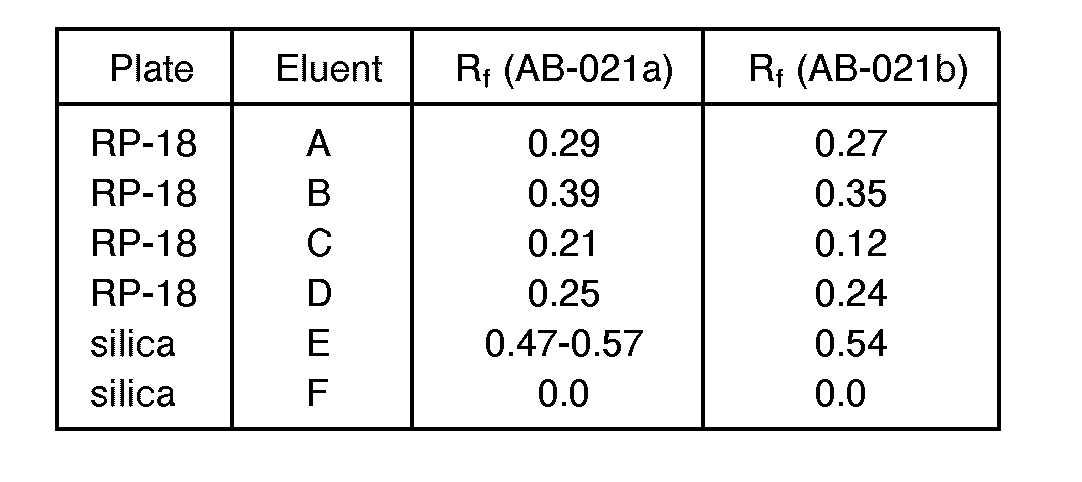
- (g) retention coefficients in thin-layer chromatography on silica (Kieselgel) plates of the type 60 F 254 (Merck-Schuchardt) and on reverse-phase silica plates of the type RP-18F 254 (Merck-Schuchardt) in the following eluent systems and compared to antibiotic AB-021 b (distance covered by eluent: 15 cm):
- eluent A : methanol : acetonitrile : 25 mM monohydrogen sodium phosphate in water (4:4:2);
- eluent B : methanol : acetonitrile : 25 mM dihydrogen potassium phosphate + 7 mM tetramethylammonium chloride in water (4:4:2);
- eluent C : methanol : 10 mM monohydrogen ammonium phosphate in water (adjusted to pH 7.5 with phosphoric acid) (8:2);
- eluent D : methanol : acetonitrile : 10 mM monohydrogen ammonium phosphate in water(adjusted to pH 7.5 with phosphoric acid)(4:4:2);
- eluent E : ethanol : dioxane : aqueous solution of ammonia (30%) : water (8:1:1:1);
- eluent F : methylene chloride : methanol (17:3).
-
- A. Fluorescence in U.V. light (366 nm)
- B. Anisaldehyde (T-27 reactant) - Thin Layer Chromatography - page 205 Author: Justus G. Kirchner - 2nd Ed. Publisher: John Wiley & Sons.
- C. o-Aminophenol (T-11 reactant) - Thin Layer Chromatography - page 201 Author: Justus G. Kirchner - 2nd Ed. Publisher: John Wiley & Sons.
- (h) a retention time (Rt) of about 8 minutes when subjected to reverse-phase HPLC column chromatography under the following conditions:
- Column : Hibar LichroCARTO Li-Chrosorb RP-18 (7 µm) 260 x 4.0 mm (Merck, Darmstadt, F.R. of Germany)
- Forecolumn : Guard Pak@ RCSS C 18 (Millipore Waters)
- Eluent : methanol : acetonitrile : 10 mM monohydrogen ammonium phosphate in water (1:1:1)
- (*) within this range, also the peak of DMSO-d6 appears.
- Flow rate : 0.8 ml/minute
- Detector : U.V. at 333 nm
- Temperature : 40 ° C (Under the same conditions antibiotic AB-021 b is eluted after about 11.8 minutes.)
- (i) a good solubility in dimethylsulfoxide and in (1:1 V/V) ethanol/water or (1:1 V/V) methanol/water mixtures [V/V = volume/volume], poor solubility in water, fairly good solubility in ethanol and methanol;
- (j) a diagram derived from a thermogravimetric analysis carried out under nitrogen, with a temperature increase rate of 20 ° C/minute within the temperature range of from 30 ° C up to 700 ° C on a PERKIN-
ELMER 7 SERIES Thermal Analysis System, said plot being shown in Figure 5, in which on the abscissa the temperature is given in ° C, and on the ordinate the percent weight loss is indicated. In said Figure 5 also the first derivative of the curve is shown. - AB-021 b, a component of the AB-021 antibiotics, is a powder of deep yellow colour, characterized by:
- (a) an approximate elemental analysis, determined on a sample left to stand under vacuum at 40 ° C for 2 hours, as follows:

- (b) a molecular weight of about 1165 as determined by FAB-MS spectroscopy, affording a peak at 1164, corresponding to (M-H)-, under the following operating conditions:
- - Negative ions, FAB, Xe at 9.5 kV
- - Matrix: glycerol
- - Finnigan Mat 8424;
- (c) the U.V. absorption spectrum shown in Figure 6 of the attached drawings. Said spectrum shows the following absorbance maxima: 0.90 at 369.0 nm; 2.01 at 350.0 nm; 2.21 at 332.6 nm; 1.49 at 318.0 nm; measured at a concentration of 0.02 mg/ml in 1 : 1 (V/V) acetonitrile/water;
- (d) an infrared (I.R.) absorption spectrum (KBr pellet) as shown in Figure 7 of the attached drawings, exhibiting the following absorption maxima (cm-1):
- 3902, 3853, 3747, 3375, 3013, 2921, 2853, 2757, 1895, 1699, 1669, 1645, 1576, 1540, 1430, 1378, 1324, 1261, 1160, 1094, 1059, 1004, 969, 919, 878, 843, 803, 779, 697;
- (e) a 1H-NMR spectrum recorded on a
BRUKER AM 300 MHz spectrometer in hexa-deutero-dimethylsulfoxide (DMSO-d6) to which small amounts of tetradeuterated acetic acid had been added and shown in Figure 8 of the attached drawings, said spectrum exhibiting the following signals: (The chemical shifts were indirectly based on TMS = 0.00 ppm (δTMS) by using the central peak of hexa-deuterodimethylsulfoxide at 6TMS = 2.56 ppm as internal reference.)- δTMS (ppm) : 7.21 (d, 1 H); 6.75 (dd, 1 H), 6.63 (dd, 1 H); 6.57 - 6.07 (m, 11 H); 5.93 - 5.70 (m, 3H); 5.70 - 5.33 (m, 8H); 4.25 - 4.02 (m, 4H); 4.02 - 3.83 (m, 4H), 3.83 - 3.59 (m, 4H); 3.29 (t, 1 H); 2.82 (t, 2H); 2.72 - 2.44 (*) (m, 6-7H); 2.41 - 2.00 (m, 14H); 1.92 (s, 3H), 1.80 - 1.14 (m, 21 H); 1.00 (d, 3H); 0.95 (d, 3H), 0.84 (d, 3H).
- (f) a 13C-NMR spectrum recorded on a
BRUKER AM 300 MHz spectrometer in hexa-deutero-dimethylsulfoxide (DMSO-d6) and shown in Figure 9 of the attached drawings, said spectrum exhibiting the following signals: - (The chemical shifts were indirectly based on TMS = 0.00 ppm (δTMS) by using the central peak of hexa-deuterodimethylsulfoxide at δTMS = 39.85 ppm as internal reference. The data concerning the multiplicity of the signals were obtained by means of DEPT tests at 45 ° , 90 ° and 135 °.)
- δTMS (ppm) : 212.0 (s); 169.2 (s); 139.1 (d); 138.1 (d); 137.1 (d); 136.7 (d); 136.2 (d); 135.8 (d); 135.8 (d); 135.1 (d); 133.8 (d); 133.1 (d); 132.8 (d); 132.8 (d); 132.6 (d); 132.3 (d); 132.2 (d); 132.1 (d); 131.8 (d); 131.2 (d); 130.9 (d); 130.8 (d); 129.2 (d); 128.7 (d); 127.9 (d); 126.4 (d); 126.2 (d); 125.2 (d); 75.4 (d); 72.6 (d); 71.0 (d); 70.6 (d); 69.6 (d); 68.9 (d); 68.4 (d); 68.0 (d); 67.3 (d); 67.2 (d); 65.6 (d); 64.4 (d); 64.4 (d); 51.9 (d); 41.3 (d); 39.6 (d); 49.2 (t), 45.8 (t), 45.7 (t); 45.0 (t); 44.9 (t); 44.7 (t), 43.6 (t); 41.1 (t);
- (*) Within this range also the peak of DMSO-d6 appears. 40.7 (t); 40.5 (t); 39.0 (t); 38.7 (t); 33.9 (t); 32.5 (t); 31.9 (t); 29.0 (t); 23.9 (t); 18.1 (q); 12.8 (q); 10.4 (q); 8.7 (q).
- (g) the retention coefficients (Rf) in thin-layer chromatography and the retention times (Rt) on a reverse-phase HPLC column, respectively, as reported under paragraphs (g) and (h) of the description of the physico-chemical characteristics of antibiotic AB-021 a.
- (h) a diagram derived from a thermogravimetric analysis carried out under nitrogen, with a temperature increase rate of 20 ° C/minute within the temperature range of from 30 ° C up to 700 °C on a PERKIN-
ELMER 7 SERIES Thermal Analysis System, said plot being shown in Figure 10, in which on the abscissa the temperature is given in ° C, and on the ordinate the percent weight loss is indicated. In said Figure 10 also the first derivative of the curve is shown. - The microorganism Streptomyces s p. NCIB 40068 was isolated from a sample of soil collected at Cappella di Terza (Novara), and catalogued for internal laboratory use under the designation SD-505 W.
- A culture of this microorganism was deposited on September 29th 1988, in compliance with the Budapest Treaty, with the National Collection of Industrial Bacteria (c/o the National Collection of Industrial and Marine Bacteria Ltd., Torry Research Station, P.O. Box 31, 135 Abbey Road, Aberdeen AB 98 DG, Scotland, United Kingdom), where it was given the access number NCIB 40068.
- The morphological characteristics of the strain are listed in Table A (the names of the culture media are those assigned by the International Streptomyces Program).

- In Tables B and C, some characteristics of this strain are reported.


- The analysis of the cellular wall of Streptomyces sp. NCIB 40068 was carried out according to the method described by M.P. Starr, H. Stolp, H.G. Truper, A. Ballows, H.G. Shegel in "The Prokaryotes" - Vol. II Streptomycetacee - Springer Verlag Ed., 1981). Said analysis demonstrates the absence of characteristic sugars; thus it confirms that the strain SD-505W belongs to the Streptomyces genus.
- Like other microorganisms; Streptomyces s p. NCIB 40068 can undergo variations and/or mutations of either spontaneous or artificial character.
- For example, artificial variants or mutants can be obtained by treating the microorganism with chemical mutagenic agents, such as, e.g., nitrous acid, nitroso-guanidine, halogenated alkylamines and the like, or with physical agents, such as X-rays or U.V. light and high-frequency waves.
- Spontaneous variants or mutants can be obtained as well by isolating and selecting different colonies obtained from Streptomyces s p. NCIB 40068.
- All of the variants and/or mutants, both of natural origin or man-made, which belong to the species Streptomyces and produce AB-021 antibiotics are considered to be equivalent to the Streptomyces s p. strain NCIB 40068 microorganism and are comprised within the scope of the present invention.
- The process for the preparation of AB-021 antibiotics comprises the cultivation of Streptomyces s p. NCIB 40068 or an equivalent (spontaneous or man-made) variant or mutant thereof under conditions of controlled aerobic fermentation in an aqueous nutrient medium, and the subsequent separation of said AB-021 antibiotic by means of per se known methods.
- As nutrient culture media or fermentation broths those which are commonly used for the production of antibiotics can be used; however, some nutrient culture media are preferred.
- Said cultivation media should contain sources of carbon and nitrogen which can be assimilated by the microorganisms of the genus Streptomyces and should furthermore show low levels of inorganic salts.
- Moreover, they should contain traces of those metals which are necessary for the growth and the development of the microorganisms and for the production of the antibiotics. Said metal traces can already be present as impurities in the sources of carbon and of organic nitrogen provided in the culture media for the bacterial growth or, optionally, they can be added to the culture media.
- As carbon source there can generally be used carbohydrates, in particular saccharides, such as, e.g., dextrose or maltose or, as an alternative and/or complement, starches and products which are considered similar to starches from an industrial point of view, such as, e.g., dextrin or soluble starch, or also polyalcohols, such as, e.g., glycerol.
- Said compounds can be used individually or combined with one another in variable proportions.
- The concentration and type of the carbon source in the culture medium generally depend on the type and amount of the other ingredients contained in said medium; anyway, concentrations of from 0.5 to 5% by weight generally lead to satisfactory results.
- As the source of organic nitrogen, both proteinic extracts such as, e.g., yeast extract, meat extract or casein hydrolysate, or meals such as, e.g., soybean meal, or commercially available products for that purpose such as, e.g., Proflo, Corn Steep Liquor or Distillers' Solubles, can be used.
- These products can be used individually or combined with one another in variable proportions. The concentrations in the culture medium generally range from 0.2 % to 6 % by weight.
- As inorganic salts there can be used, for example, sodium salts, potassium salts, magnesium salts, ammonium salts and calcium salts, such as phosphates, sulfates, chlorides, carbonates and nitrates.
- Examples of the trace metals contained in the culture medium are cobalt, iron, manganese and the like.
- Some culture media display a particular ability to stimulate the production of AB-021 antibiotics by Streptomyces s p. NCIB 40068; among these,for example, the following aqueous formulations can be mentioned, which have been used in the following preparation Examples.


- The strain of Streptomyces s p. NCIB 40068 can be cultivated and fermented at temperatures of from 20 ° C to 35 ° C, preferably of from 25 ° C to 30 ° C.
- The pH value generally is within the range of from about 5 to about 9.
- The sterile air which is injected into the culture medium is generally used in amounts such as to maintain in the medium an oxygen concentration higher than 20% of the saturation value.
- The production of the AB-021 antibiotics, during the fermentation, can be monitored by means of antibiotic activity tests on broth samples, using microbial and fungal species sensitive to said antibiotics, or by HPLC analysis.
- The fermentation is carried out for a time sufficient for obtaining a substantial antibiotic activity; 24 to 150 hours are generally sufficient for said purpose.
- After the cultivation under the above fermentation conditions the AB-021 antibiotics and the main components thereof,i.e.AB-021 a and AB-021 b, can be separated from the culture broth and subsequently purified by means of methods conventional in the art of fermentation.
- Such methods include, e.g., extraction with solvents, precipitation with non-solvents, ultrafiltration, column chromatography, silica-gel chromatography, cellulose chromatography, reverse-phase chromatography, chromatography on non-ionic, macroporous resins, and the like.
- The antibiotics produced during the fermentation can be found in the culture broth and/or in the mycelium mass.
- A preferred method for recovering AB-021 antibiotics consists in filtering off the mycelium mass from the culture broth, subjecting the mycelium thus separated to an extraction with acetone or methanol and concentrating the extract under vacuum until complete removal of the solvent. Thereby an aqueous suspension is obtained.
- The thus obtained culture broth containing the AB-021 antibiotics is filtered through fibreglass filters and is then percolated on a column of a non-ionic polystyrene resin, such as, e.g., XAD-2 resin (Rohm & Haas Co.), which adsorbs the AB-021 antibiotics.
- The resin is then washed with two volumes, based on its bed, of water, and thereafter is eluted with three volumes, also based on its bed, of an 8:2 (V/V) mixture of acetone:water.
- The fractions containing AB-021 antibiotics, identified by means of biological activity tests on Botrytis, are combined and are then concentrated under vacuum until the disappearance of solvent, and the resulting aqueous suspension is combined with the one previously obtained from the mycelium to yield a crude product containing AB-021 antibiotics.
- The two pure components AB-021 a and AB-021 b are then isolated from the crude product by means of reverse phase chromatography, using a column packed with silica (MATREXO silica C18 sold by Amicon Europe, Lausanne, Switzerland) with an eluent system formed by an eluent "A" consisting of water containing 10 mM monohydrogen ammonium phosphate and by an eluent "B" consisting of methanol, using a linear gradient of from 30% up to 70% of eluent "B" in eluent "A".
- The fractions which contain antibiotic AB-021 a in pure form and antibiotic AB-021 b in pure form are separately concentrated under vacuum until complete removal of methanol. By cooling the remaining aqueous solutions down to 2 ° C, the precipitation of antibiotic AB-021 a and antibiotic AB-021 b respectively, is effected. Thereafter said antibiotics are centrifuged off. AB-021 a and AB-021 b, separated from their respective solutions as described above, are suspended in water and centrifuged again and, after removing the supernatant solutions and drying under vacuum at 40 ° C for 2 hours, pure antibiotic AB-021 a and pure antibiotic AB-021 b, respectively are obtained.
- The AB-021 antibiotics and the components thereof, i.e., AB-021 a and AB-021 b, are endowed with antifungal and antibacterial activity.
- Their antifungal activity is particularly high against phytopathogenic fungi which infest agrarian cultivations of cereals, fruit trees and horticultural cultivations, as well as against pathogenic fungi in man.
- The antifungal activities, both in vitro and in vivo, of the AB-021 antibiotics were determined by means of the methods described in the following:
- The antimicrobial activity of AB-021 antibiotics was determined by the usual methods, by adding increasing concentrations of the antibiotic to an agarized culture medium capable of supporting the growth of the sensitive microbial species.
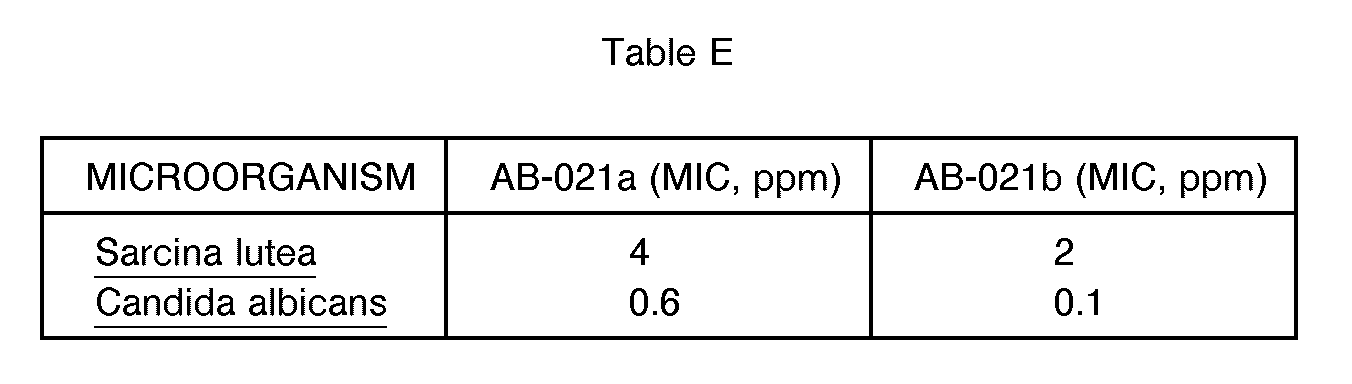
- For phytopathogenic fungi, the minimum concentration of AB-021 antibiotics which under these conditions causes a reduction in mycelial growth of at least 50% as referred to the control (EDso) was furthermore determined. For yeast (Candida albicans) and bacteria (Sarcina lutea), the minimum concentration which completely inhibits growth (MIC) was determined.
- In Tables D and E the data of biological activity which were obtained in vitro by means of the just described methods are reported.
-

- The fungicidal activity in vivo was measured by using the following method. The AB-021 antibiotics in water-acetone solution (20% acetone V/V) were sprayed onto the lower sides of leaves of plants grown in pots inside a conditioned room.
- One day later, an inoculum of the tested fungus was sprayed on the upper sides of said plant leaves and the latter were then kept under incubation conditions inside a conditioned room for about eight days.
- At the end of said time, the seriousness of the infection was evaluated by means of an evaluation scale ranging from 100 (= healthy plant) down to 0 (= completely infected plant).
- The data concerning the preventive activity in vivo as obtained by means of the just described method is reported in Table E.

- Strictly analogous results of antifungal activity were obtained when the individual antibiotics AB-021 a and AB-021 b were employed separately.
- For their practical application, both in agriculture and in other sectors uf use, the antibiotics according to the present invention are preferably employed in the form of suitable formulations.
- These formulations contain, besides the antibiotic according to the present invention as their active principle, inert solid carriers (e.g., kaolin, silica, talc, attapulgite, diatomaceous earth, etc.) or inert liquid carriers (e.g., organic solvents, vegetable or mineral oils, water and mixtures thereof), and optionally other additives which are normally used in the art of formulations, such as surfactants, suspending agents, dispersants and wetting agents.
- In case of special application requirements, or in order to expand the range of action of the formulations, other active ingredients, such as, e.g., other insecticides, herbicides and fungicides can be added to the above compositions.
- The doses to be applied vary as a function of different factors, such as the type and the degree of infestation, the type of composition used and climatic and environmental factors.
- For practical use in agriculture, doses of AB-021 antibiotics usually ranging from 10 to 500 g/ha yield satisfactory results.
- The following examples serve to illustrate the present invention without limiting it.
- A culture of Streptomyces s p. NCIB 40068 grown on a plate of medium "A" (PM8) described above, thickened with agar, was suspended in 5 ml of sterile distilled water. Said suspension was used to inoculate an Erlenmeyer flask containing 100 ml of medium "A" (PM8) which subsequently was kept stirred at 180 rpm, at 28 ° C for 55 hours. Said culture was used to inoculate an Erlenmeyer flask containing 1000 ml of medium "A" (PM8) which subsequently was kept stirred at 150 rpm, at 28 ° C for 40 hours. With the resulting culture a fermenter of 40 litres rated capacity, containing 28 litres of medium "B" (PGC), was then inoculated.
- While the temperature was kept at 28 ° C and the concentration of dissolved oxygen was maintained above 20% of the saturation value, the fermentation was carried out for 74 hours.
- 28 litres of fermentation broth obtained as described above were centrifuged and the mycelium thus separated was extracted with 7 litres of acetone.
- The acetone extract was concentrated under vacuum until the solvent was completely removed and the residual aqueous solution containing the AB-021 antibiotics (about 1 litre) was combined with 400 ml of methanol and was chromatographed on a column (inner diameter 90 mm, length 360 mm) containing 1.0 kg of silica (MATREXO Silica C18) with a forecolumn (50 mm x 50 mm) packed with the same stationary phase, using an eluent system which was formed by an eluent "A" constituted by water containing 10 mM monohydrogen ammonium phosphate and an eluent "B" constituted by methanol, the gradient being as indicated in the following Table:

- Pure AB-021 a antibiotic was contained in 2550 ml within the elution range of from 15000 to 17550 ml, while AB-021 b antibiotic was contained in 3000 ml within the elution range of from 21450 to 24450 ml.
- The fractions thus collected were evaporated under vacuum until the methanol was completely removed, and were then left to stand for 24 hours at 4 ° C. From these solutions, AB-021 a and AB-021 b, respectively precipitated and were then isolated by centrifugation. Thereafter the centrifuge cakes were suspended again in water in order to remove any residual salt traces, and were then centrifuged again.
- After drying, 198 mg of antibiotic AB-021 a, a light-yellow coloured powder, and 210 mg of antibiotic AB-021 b, a yellow-coloured powder, were obtained.
- The physico-chemical characteristics of the products have been reported above.
- A culture of Streptomyces s p. NCIB 40068 grown on a plate of agarized medium "A" (PM8) was suspended in 6 ml of sterile distilled water. Said suspension was used to inoculate 3 Erlenmeyer flasks, each containing 100 ml of medium "A" (PM8). The inoculated Erlenmeyer flasks were then kept stirred at 180 rpm, at 28 ° C for 48 hours. The culture thus obtained was used to inoculate 50 Erlenmeyer flasks, each containing 100 ml of medium "B" (PGC), with an inoculum of 5% of the volume. The Erlenmeyer flasks were kept stirred at 180 rpm, at 28 ° C for 72 hours. The resulting broth was then collected and separated from the mycelium by means of centrifugation at 6000 rpm for 20 minutes.
- A culture of Streptomyces s p. NCIB 40068,grown on a plate of agarized medium "A" (PM8),was suspended in 5 ml of sterile distilled water. Said suspension was used to inoculate an Erlenmeyer flask containing 100 ml of medium "A" (PM8). The inoculated Erlenmeyer flask was then kept stirred at 180 rpm, at 28 ° C for 48 hours.
- The culture thus obtained was used to inoculate 3 Erlenmeyer flasks, each containing 100 ml of medium "C" (SCM), with an inoculum of 5% of the volume. The Erlenmeyer flasks were kept stirred at 180 rpm, at 30 ° C for 24-72 hours. At the end of the fermentation, the resulting broth was separated from the mycelium by means of centrifugation which was carried out in the same way as in Example 2.
Claims (17)

((*) Within this range, also the peak of DMSO-d6 appears); 68.9 (d); 68.4 (d); 68.0 (d); 67.1 (d); 67.1 (d); 65.7 (d); 64.2 (d); 64.2 (d); 52.1 (d); 41.5 (d); 39.9 (d); 49.2 (t); 46.2 (t); 46.0 (t); 45.2 (t); 45.2 (t); 44.9 (t); 43.9 (t); 41.2 (t); 40.8 (t); 40.7 (t); 39.2 (t); 38.8 (t); 34.1 (t); 32.8 (t); 32.1 (t); 29.3 (t); 24.1 (t); 22.8 (q); 18.4 (q); 13.2 (q); 10.5 (q); 9.1 (q).

((*) Within this range also the peak of DMSO-d6 appears); DMSO-d6 appears);
Applications Claiming Priority (2)
| Application Number | Priority Date | Filing Date | Title |
|---|---|---|---|
| IT2280888 | 1988-12-01 | ||
| IT8822808A IT1227657B (en) | 1988-12-01 | 1988-12-01 | AB-021 ANTIBIOTICS AND PROCESS FOR THEIR PRODUCTION |
Publications (3)
| Publication Number | Publication Date |
|---|---|
| EP0371509A2 EP0371509A2 (en) | 1990-06-06 |
| EP0371509A3 EP0371509A3 (en) | 1991-03-13 |
| EP0371509B1 true EP0371509B1 (en) | 1995-02-01 |
Family
ID=11200668
Family Applications (1)
| Application Number | Title | Priority Date | Filing Date |
|---|---|---|---|
| EP89122134A Expired - Lifetime EP0371509B1 (en) | 1988-12-01 | 1989-11-30 | Antibiotics and process for producing them |
Country Status (13)
| Country | Link |
|---|---|
| US (1) | US5126265A (en) |
| EP (1) | EP0371509B1 (en) |
| JP (1) | JPH02288889A (en) |
| KR (1) | KR0140218B1 (en) |
| AT (1) | ATE118011T1 (en) |
| AU (1) | AU636317B2 (en) |
| BR (1) | BR8906050A (en) |
| CA (1) | CA2004197C (en) |
| DE (1) | DE68920973T2 (en) |
| ES (1) | ES2067520T3 (en) |
| IL (1) | IL92452A (en) |
| IT (1) | IT1227657B (en) |
| ZA (1) | ZA899034B (en) |
Families Citing this family (12)
| Publication number | Priority date | Publication date | Assignee | Title |
|---|---|---|---|---|
| DK162990D0 (en) * | 1990-07-06 | 1990-07-06 | Novo Nordisk As | MICRO |
| IT1243795B (en) * | 1990-08-21 | 1994-06-28 | Mini Ricerca Scient Tecnolog | ANTIBIOTICS AB-023 AND PROCESS FOR THEIR PREPARATION |
| IT1259423B (en) * | 1991-12-04 | 1996-03-18 | Giorgio Cassani | ANTIBIOTIC AB-041 EQUIPPED WITH HERBICIDE ACTIVITY, OBTAINED FROM STREPTOMYCES SP., AND PROCESS FOR ITS PRODUCTION |
| US5714375A (en) * | 1995-06-05 | 1998-02-03 | Nobl Laboratories, Inc. | Ileal symbiont intracellularis propagation in suspended host cells |
| US5885823A (en) * | 1995-06-05 | 1999-03-23 | Nobl Laboratories, Inc. | Lawsonia intracellularis cultivation, anti-Lawsonia intracellularis vaccines and diagnostic agents |
| US6436395B1 (en) | 1996-09-18 | 2002-08-20 | Merck & Co., Inc. | Rosellinia subiculata ATCC 74386 and fungus ATCC 74387 for producing sordarin compounds for fungi control |
| JP3328250B2 (en) * | 1998-12-09 | 2002-09-24 | 岸本産業株式会社 | Resist residue remover |
| US8834891B2 (en) * | 2005-03-14 | 2014-09-16 | Boehringer Ingelheim Vetmedica, Inc. | Immunogenic compositions comprising Lawsonia intracellularis |
| US8398994B2 (en) * | 2005-07-15 | 2013-03-19 | Boehringer Ingelheim Vetmedica, Inc. | Lawsonia vaccine and methods of use thereof |
| US8470336B2 (en) * | 2006-05-25 | 2013-06-25 | Boehringer Ingelheim Vetmedica, Inc. | Vaccination of young animals against Lawsonia intracellularis infections |
| EP2200643B1 (en) | 2007-09-17 | 2013-09-04 | Boehringer Ingelheim Vetmedica, Inc. | A live lawsonia intracellularis vaccine administered in combination with an antibiotic for use in the treatment of lawsonia intracellularis infections in pigs |
| DE102020129458B4 (en) | 2020-05-20 | 2024-04-04 | Andreas Plur | Method and device for producing a coating |
Family Cites Families (6)
| Publication number | Priority date | Publication date | Assignee | Title |
|---|---|---|---|---|
| FR2262510B1 (en) * | 1974-03-01 | 1977-11-04 | Rhone Poulenc Ind | |
| US4076802A (en) * | 1977-03-30 | 1978-02-28 | Hoffmann-La Roche Inc. | Antibiotic X-4357B |
| US4133876A (en) * | 1977-05-31 | 1979-01-09 | Eli Lilly And Company | Antibiotic A-32887 and process for production thereof |
| US4132779A (en) * | 1977-06-20 | 1979-01-02 | American Cyanamid Company | Antibiotic BL580 Zeta and use thereof as anticoccidial agent |
| US4705688A (en) * | 1986-06-30 | 1987-11-10 | American Cyanamid Company | Antibiotic LL-E19020 α and β |
| IT1221982B (en) * | 1987-07-08 | 1990-08-31 | Mini Ricerca Scient Tecnolog | ANTIBIOTICS AB 006 AND PROCESS FOR THEIR PRODUCTION |
-
1988
- 1988-12-01 IT IT8822808A patent/IT1227657B/en active
-
1989
- 1989-11-27 US US07/441,652 patent/US5126265A/en not_active Expired - Fee Related
- 1989-11-27 IL IL9245289A patent/IL92452A/en not_active IP Right Cessation
- 1989-11-27 ZA ZA899034A patent/ZA899034B/en unknown
- 1989-11-29 AU AU45719/89A patent/AU636317B2/en not_active Ceased
- 1989-11-29 CA CA002004197A patent/CA2004197C/en not_active Expired - Fee Related
- 1989-11-30 EP EP89122134A patent/EP0371509B1/en not_active Expired - Lifetime
- 1989-11-30 ES ES89122134T patent/ES2067520T3/en not_active Expired - Lifetime
- 1989-11-30 AT AT89122134T patent/ATE118011T1/en not_active IP Right Cessation
- 1989-11-30 DE DE68920973T patent/DE68920973T2/en not_active Expired - Fee Related
- 1989-11-30 BR BR898906050A patent/BR8906050A/en not_active Application Discontinuation
- 1989-12-01 KR KR1019890017773A patent/KR0140218B1/en not_active Expired - Fee Related
- 1989-12-01 JP JP1313098A patent/JPH02288889A/en active Pending
Also Published As
| Publication number | Publication date |
|---|---|
| BR8906050A (en) | 1990-07-31 |
| JPH02288889A (en) | 1990-11-28 |
| EP0371509A3 (en) | 1991-03-13 |
| ZA899034B (en) | 1990-09-26 |
| AU636317B2 (en) | 1993-04-29 |
| KR0140218B1 (en) | 1998-07-01 |
| US5126265A (en) | 1992-06-30 |
| IL92452A0 (en) | 1990-08-31 |
| EP0371509A2 (en) | 1990-06-06 |
| CA2004197C (en) | 1998-06-30 |
| DE68920973D1 (en) | 1995-03-16 |
| ATE118011T1 (en) | 1995-02-15 |
| IT1227657B (en) | 1991-04-23 |
| IL92452A (en) | 1994-06-24 |
| KR900009992A (en) | 1990-07-06 |
| DE68920973T2 (en) | 1995-09-28 |
| CA2004197A1 (en) | 1990-06-01 |
| ES2067520T3 (en) | 1995-04-01 |
| IT8822808A0 (en) | 1988-12-01 |
| AU4571989A (en) | 1990-06-14 |
Similar Documents
| Publication | Publication Date | Title |
|---|---|---|
| EP0438461B1 (en) | Nematocidal preparations | |
| US5126265A (en) | Ab-021 antibiotics and process for producing them | |
| CA1339264C (en) | Ab-006 antibiotics and process for their production | |
| JP2865302B2 (en) | 2-Pyranone derivative, method for producing the same, and antibacterial agent containing the same | |
| EP0346831B1 (en) | Antibiotics and process for producing them | |
| JP2746372B2 (en) | F-0368 substance | |
| US5397570A (en) | Antibiotics AB-023 and process for preparing them | |
| EP0232572B1 (en) | New agrochemical named "substance no. 51262", its preparation and use | |
| EP0545490B1 (en) | Antibiotic AB-041 and the process for its production | |
| CA1209068A (en) | Physiologically active substances ss 12538, their preparation and a novel microorganism producing same | |
| US2972569A (en) | Hortesin, an antifungal agent derived from streptomyces versipellis | |
| US4730039A (en) | Leucanicidin | |
| JPH01299268A (en) | Antifungal fermentation product, its derivative and composition thereof | |
| US5275938A (en) | Process for producing leucanicidin | |
| KR950005548B1 (en) | Antibiotic GTX-01 and its manufacturing method | |
| JPH07304622A (en) | Novel insecticidal active substance SF2775 substance, its production method and insecticide containing it | |
| DE19611366A1 (en) | New natural di:methyl-tetralone derivative 'hyphodermin A' |
Legal Events
| Date | Code | Title | Description |
|---|---|---|---|
| PUAI | Public reference made under article 153(3) epc to a published international application that has entered the european phase |
Free format text: ORIGINAL CODE: 0009012 |
|
| AK | Designated contracting states |
Kind code of ref document: A2 Designated state(s): AT BE CH DE ES FR GB LI NL SE |
|
| PUAL | Search report despatched |
Free format text: ORIGINAL CODE: 0009013 |
|
| AK | Designated contracting states |
Kind code of ref document: A3 Designated state(s): AT BE CH DE ES FR GB LI NL SE |
|
| 17P | Request for examination filed |
Effective date: 19910620 |
|
| RAP1 | Party data changed (applicant data changed or rights of an application transferred) |
Owner name: MINISTERO DELL' UNIVERSITA' E DELLA RICERCA SCIENT |
|
| 17Q | First examination report despatched |
Effective date: 19930625 |
|
| GRAA | (expected) grant |
Free format text: ORIGINAL CODE: 0009210 |
|
| AK | Designated contracting states |
Kind code of ref document: B1 Designated state(s): AT BE CH DE ES FR GB LI NL SE |
|
| REF | Corresponds to: |
Ref document number: 118011 Country of ref document: AT Date of ref document: 19950215 Kind code of ref document: T |
|
| REF | Corresponds to: |
Ref document number: 68920973 Country of ref document: DE Date of ref document: 19950316 |
|
| ET | Fr: translation filed | ||
| REG | Reference to a national code |
Ref country code: ES Ref legal event code: FG2A Ref document number: 2067520 Country of ref document: ES Kind code of ref document: T3 |
|
| PLBE | No opposition filed within time limit |
Free format text: ORIGINAL CODE: 0009261 |
|
| STAA | Information on the status of an ep patent application or granted ep patent |
Free format text: STATUS: NO OPPOSITION FILED WITHIN TIME LIMIT |
|
| 26N | No opposition filed | ||
| PGFP | Annual fee paid to national office [announced via postgrant information from national office to epo] |
Ref country code: SE Payment date: 19981105 Year of fee payment: 10 |
|
| PGFP | Annual fee paid to national office [announced via postgrant information from national office to epo] |
Ref country code: FR Payment date: 19981110 Year of fee payment: 10 |
|
| PGFP | Annual fee paid to national office [announced via postgrant information from national office to epo] |
Ref country code: AT Payment date: 19981112 Year of fee payment: 10 |
|
| PGFP | Annual fee paid to national office [announced via postgrant information from national office to epo] |
Ref country code: ES Payment date: 19981123 Year of fee payment: 10 |
|
| PGFP | Annual fee paid to national office [announced via postgrant information from national office to epo] |
Ref country code: NL Payment date: 19981126 Year of fee payment: 10 |
|
| PGFP | Annual fee paid to national office [announced via postgrant information from national office to epo] |
Ref country code: GB Payment date: 19981204 Year of fee payment: 10 |
|
| PGFP | Annual fee paid to national office [announced via postgrant information from national office to epo] |
Ref country code: DE Payment date: 19981207 Year of fee payment: 10 |
|
| PGFP | Annual fee paid to national office [announced via postgrant information from national office to epo] |
Ref country code: CH Payment date: 19981210 Year of fee payment: 10 |
|
| PGFP | Annual fee paid to national office [announced via postgrant information from national office to epo] |
Ref country code: BE Payment date: 19990119 Year of fee payment: 10 |
|
| PG25 | Lapsed in a contracting state [announced via postgrant information from national office to epo] |
Ref country code: LI Free format text: LAPSE BECAUSE OF NON-PAYMENT OF DUE FEES Effective date: 19991130 Ref country code: GB Free format text: LAPSE BECAUSE OF NON-PAYMENT OF DUE FEES Effective date: 19991130 Ref country code: CH Free format text: LAPSE BECAUSE OF NON-PAYMENT OF DUE FEES Effective date: 19991130 Ref country code: BE Free format text: LAPSE BECAUSE OF NON-PAYMENT OF DUE FEES Effective date: 19991130 Ref country code: AT Free format text: LAPSE BECAUSE OF NON-PAYMENT OF DUE FEES Effective date: 19991130 |
|
| PG25 | Lapsed in a contracting state [announced via postgrant information from national office to epo] |
Ref country code: SE Free format text: LAPSE BECAUSE OF NON-PAYMENT OF DUE FEES Effective date: 19991201 Ref country code: ES Free format text: LAPSE BECAUSE OF NON-PAYMENT OF DUE FEES Effective date: 19991201 |
|
| BERE | Be: lapsed |
Owner name: MINISTERO DELL' UNIVERSITA' E DELLA RICERCA SCIEN Effective date: 19991130 |
|
| PG25 | Lapsed in a contracting state [announced via postgrant information from national office to epo] |
Ref country code: NL Free format text: LAPSE BECAUSE OF NON-PAYMENT OF DUE FEES Effective date: 20000601 |
|
| REG | Reference to a national code |
Ref country code: CH Ref legal event code: PL |
|
| GBPC | Gb: european patent ceased through non-payment of renewal fee |
Effective date: 19991130 |
|
| PG25 | Lapsed in a contracting state [announced via postgrant information from national office to epo] |
Ref country code: FR Free format text: LAPSE BECAUSE OF NON-PAYMENT OF DUE FEES Effective date: 20000731 |
|
| NLV4 | Nl: lapsed or anulled due to non-payment of the annual fee |
Effective date: 20000601 |
|
| EUG | Se: european patent has lapsed |
Ref document number: 89122134.3 |
|
| PG25 | Lapsed in a contracting state [announced via postgrant information from national office to epo] |
Ref country code: DE Free format text: LAPSE BECAUSE OF NON-PAYMENT OF DUE FEES Effective date: 20000901 |
|
| REG | Reference to a national code |
Ref country code: FR Ref legal event code: ST |
|
| REG | Reference to a national code |
Ref country code: ES Ref legal event code: FD2A Effective date: 20001214 |