EP0370730B1 - Method of producing ethylenediamines - Google Patents
Method of producing ethylenediamines Download PDFInfo
- Publication number
- EP0370730B1 EP0370730B1 EP89312005A EP89312005A EP0370730B1 EP 0370730 B1 EP0370730 B1 EP 0370730B1 EP 89312005 A EP89312005 A EP 89312005A EP 89312005 A EP89312005 A EP 89312005A EP 0370730 B1 EP0370730 B1 EP 0370730B1
- Authority
- EP
- European Patent Office
- Prior art keywords
- catalyst
- reaction
- volume
- ammonia
- filled
- Prior art date
- Legal status (The legal status is an assumption and is not a legal conclusion. Google has not performed a legal analysis and makes no representation as to the accuracy of the status listed.)
- Expired - Lifetime
Links
- 238000000034 method Methods 0.000 title claims description 42
- 150000002171 ethylene diamines Chemical class 0.000 title description 10
- 239000003054 catalyst Substances 0.000 claims description 118
- QGZKDVFQNNGYKY-UHFFFAOYSA-N Ammonia Chemical compound N QGZKDVFQNNGYKY-UHFFFAOYSA-N 0.000 claims description 101
- 238000006243 chemical reaction Methods 0.000 claims description 97
- 229910021529 ammonia Inorganic materials 0.000 claims description 48
- -1 aziridine compound Chemical class 0.000 claims description 29
- PIICEJLVQHRZGT-UHFFFAOYSA-N Ethylenediamine Chemical compound NCCN PIICEJLVQHRZGT-UHFFFAOYSA-N 0.000 claims description 16
- 239000007792 gaseous phase Substances 0.000 claims description 14
- 239000007795 chemical reaction product Substances 0.000 claims description 11
- 239000011973 solid acid Substances 0.000 claims description 10
- 239000000203 mixture Substances 0.000 claims description 9
- 238000006297 dehydration reaction Methods 0.000 claims description 5
- 239000001257 hydrogen Substances 0.000 claims description 3
- 229910052739 hydrogen Inorganic materials 0.000 claims description 3
- 125000001495 ethyl group Chemical group [H]C([H])([H])C([H])([H])* 0.000 claims description 2
- 125000002496 methyl group Chemical group [H]C([H])([H])* 0.000 claims description 2
- 125000004435 hydrogen atom Chemical group [H]* 0.000 claims 1
- 239000007789 gas Substances 0.000 description 43
- NOWKCMXCCJGMRR-UHFFFAOYSA-N Aziridine Chemical compound C1CN1 NOWKCMXCCJGMRR-UHFFFAOYSA-N 0.000 description 24
- IJGRMHOSHXDMSA-UHFFFAOYSA-N Atomic nitrogen Chemical compound N#N IJGRMHOSHXDMSA-UHFFFAOYSA-N 0.000 description 21
- XLYOFNOQVPJJNP-UHFFFAOYSA-N water Substances O XLYOFNOQVPJJNP-UHFFFAOYSA-N 0.000 description 18
- 239000000047 product Substances 0.000 description 14
- HZAXFHJVJLSVMW-UHFFFAOYSA-N 2-Aminoethan-1-ol Chemical compound NCCO HZAXFHJVJLSVMW-UHFFFAOYSA-N 0.000 description 13
- ZCCIPPOKBCJFDN-UHFFFAOYSA-N calcium nitrate Chemical compound [Ca+2].[O-][N+]([O-])=O.[O-][N+]([O-])=O ZCCIPPOKBCJFDN-UHFFFAOYSA-N 0.000 description 12
- 239000006227 byproduct Substances 0.000 description 11
- 229910052680 mordenite Inorganic materials 0.000 description 11
- 239000010457 zeolite Substances 0.000 description 11
- 229910021536 Zeolite Inorganic materials 0.000 description 10
- HNPSIPDUKPIQMN-UHFFFAOYSA-N dioxosilane;oxo(oxoalumanyloxy)alumane Chemical compound O=[Si]=O.O=[Al]O[Al]=O HNPSIPDUKPIQMN-UHFFFAOYSA-N 0.000 description 10
- 229910052757 nitrogen Inorganic materials 0.000 description 10
- 229910001220 stainless steel Inorganic materials 0.000 description 10
- 239000010935 stainless steel Substances 0.000 description 10
- OZDGMOYKSFPLSE-UHFFFAOYSA-N 2-Methylaziridine Chemical compound CC1CN1 OZDGMOYKSFPLSE-UHFFFAOYSA-N 0.000 description 7
- OAICVXFJPJFONN-UHFFFAOYSA-N Phosphorus Chemical compound [P] OAICVXFJPJFONN-UHFFFAOYSA-N 0.000 description 6
- HEMHJVSKTPXQMS-UHFFFAOYSA-M Sodium hydroxide Chemical compound [OH-].[Na+] HEMHJVSKTPXQMS-UHFFFAOYSA-M 0.000 description 6
- 238000005342 ion exchange Methods 0.000 description 6
- 229910052698 phosphorus Inorganic materials 0.000 description 6
- 239000011574 phosphorus Substances 0.000 description 6
- 229910052710 silicon Inorganic materials 0.000 description 6
- WSLDOOZREJYCGB-UHFFFAOYSA-N 1,2-Dichloroethane Chemical compound ClCCCl WSLDOOZREJYCGB-UHFFFAOYSA-N 0.000 description 5
- VYPSYNLAJGMNEJ-UHFFFAOYSA-N Silicium dioxide Chemical compound O=[Si]=O VYPSYNLAJGMNEJ-UHFFFAOYSA-N 0.000 description 5
- XUIMIQQOPSSXEZ-UHFFFAOYSA-N Silicon Chemical compound [Si] XUIMIQQOPSSXEZ-UHFFFAOYSA-N 0.000 description 5
- 239000007864 aqueous solution Substances 0.000 description 5
- 239000008188 pellet Substances 0.000 description 5
- 239000010703 silicon Substances 0.000 description 5
- 239000000243 solution Substances 0.000 description 5
- NBIIXXVUZAFLBC-UHFFFAOYSA-N Phosphoric acid Chemical compound OP(O)(O)=O NBIIXXVUZAFLBC-UHFFFAOYSA-N 0.000 description 4
- 150000001541 aziridines Chemical class 0.000 description 4
- 229910052796 boron Inorganic materials 0.000 description 4
- 239000010949 copper Substances 0.000 description 4
- 239000007788 liquid Substances 0.000 description 4
- 150000003839 salts Chemical class 0.000 description 4
- 229910052814 silicon oxide Inorganic materials 0.000 description 4
- HXKKHQJGJAFBHI-UHFFFAOYSA-N 1-aminopropan-2-ol Chemical compound CC(O)CN HXKKHQJGJAFBHI-UHFFFAOYSA-N 0.000 description 3
- CSWPOLMVXVBCSV-UHFFFAOYSA-N 2-ethylaziridine Chemical compound CCC1CN1 CSWPOLMVXVBCSV-UHFFFAOYSA-N 0.000 description 3
- 229910052783 alkali metal Inorganic materials 0.000 description 3
- 229910052784 alkaline earth metal Inorganic materials 0.000 description 3
- QVGXLLKOCUKJST-UHFFFAOYSA-N atomic oxygen Chemical compound [O] QVGXLLKOCUKJST-UHFFFAOYSA-N 0.000 description 3
- 238000004587 chromatography analysis Methods 0.000 description 3
- 239000000470 constituent Substances 0.000 description 3
- 238000004821 distillation Methods 0.000 description 3
- 239000011261 inert gas Substances 0.000 description 3
- 230000000977 initiatory effect Effects 0.000 description 3
- XEEYBQQBJWHFJM-UHFFFAOYSA-N iron Substances [Fe] XEEYBQQBJWHFJM-UHFFFAOYSA-N 0.000 description 3
- 229940102253 isopropanolamine Drugs 0.000 description 3
- KFIGICHILYTCJF-UHFFFAOYSA-N n'-methylethane-1,2-diamine Chemical compound CNCCN KFIGICHILYTCJF-UHFFFAOYSA-N 0.000 description 3
- 239000001301 oxygen Substances 0.000 description 3
- 229910052760 oxygen Inorganic materials 0.000 description 3
- 238000012856 packing Methods 0.000 description 3
- 230000002829 reductive effect Effects 0.000 description 3
- 239000011734 sodium Substances 0.000 description 3
- 239000007858 starting material Substances 0.000 description 3
- 229910052718 tin Inorganic materials 0.000 description 3
- 229910052719 titanium Inorganic materials 0.000 description 3
- 239000010936 titanium Substances 0.000 description 3
- 229910052721 tungsten Inorganic materials 0.000 description 3
- 229910052726 zirconium Inorganic materials 0.000 description 3
- IKHGUXGNUITLKF-UHFFFAOYSA-N Acetaldehyde Chemical compound CC=O IKHGUXGNUITLKF-UHFFFAOYSA-N 0.000 description 2
- 239000005995 Aluminium silicate Substances 0.000 description 2
- NLXLAEXVIDQMFP-UHFFFAOYSA-N Ammonia chloride Chemical compound [NH4+].[Cl-] NLXLAEXVIDQMFP-UHFFFAOYSA-N 0.000 description 2
- ZOXJGFHDIHLPTG-UHFFFAOYSA-N Boron Chemical compound [B] ZOXJGFHDIHLPTG-UHFFFAOYSA-N 0.000 description 2
- 229910052684 Cerium Inorganic materials 0.000 description 2
- RPNUMPOLZDHAAY-UHFFFAOYSA-N Diethylenetriamine Chemical compound NCCNCCN RPNUMPOLZDHAAY-UHFFFAOYSA-N 0.000 description 2
- QAOWNCQODCNURD-UHFFFAOYSA-N Sulfuric acid Chemical compound OS(O)(=O)=O QAOWNCQODCNURD-UHFFFAOYSA-N 0.000 description 2
- 229910052776 Thorium Inorganic materials 0.000 description 2
- ATJFFYVFTNAWJD-UHFFFAOYSA-N Tin Chemical compound [Sn] ATJFFYVFTNAWJD-UHFFFAOYSA-N 0.000 description 2
- RTAQQCXQSZGOHL-UHFFFAOYSA-N Titanium Chemical compound [Ti] RTAQQCXQSZGOHL-UHFFFAOYSA-N 0.000 description 2
- BZHJMEDXRYGGRV-UHFFFAOYSA-N Vinyl chloride Chemical compound ClC=C BZHJMEDXRYGGRV-UHFFFAOYSA-N 0.000 description 2
- XLOMVQKBTHCTTD-UHFFFAOYSA-N Zinc monoxide Chemical compound [Zn]=O XLOMVQKBTHCTTD-UHFFFAOYSA-N 0.000 description 2
- QCWXUUIWCKQGHC-UHFFFAOYSA-N Zirconium Chemical compound [Zr] QCWXUUIWCKQGHC-UHFFFAOYSA-N 0.000 description 2
- 229910052782 aluminium Inorganic materials 0.000 description 2
- XAGFODPZIPBFFR-UHFFFAOYSA-N aluminium Chemical compound [Al] XAGFODPZIPBFFR-UHFFFAOYSA-N 0.000 description 2
- 235000012211 aluminium silicate Nutrition 0.000 description 2
- 229910052787 antimony Inorganic materials 0.000 description 2
- 229910052797 bismuth Inorganic materials 0.000 description 2
- NLSCHDZTHVNDCP-UHFFFAOYSA-N caesium nitrate Chemical compound [Cs+].[O-][N+]([O-])=O NLSCHDZTHVNDCP-UHFFFAOYSA-N 0.000 description 2
- 229910001424 calcium ion Inorganic materials 0.000 description 2
- 150000001875 compounds Chemical class 0.000 description 2
- 239000012141 concentrate Substances 0.000 description 2
- 229910052802 copper Inorganic materials 0.000 description 2
- 238000005260 corrosion Methods 0.000 description 2
- 230000007797 corrosion Effects 0.000 description 2
- 238000010586 diagram Methods 0.000 description 2
- GUJOJGAPFQRJSV-UHFFFAOYSA-N dialuminum;dioxosilane;oxygen(2-);hydrate Chemical compound O.[O-2].[O-2].[O-2].[Al+3].[Al+3].O=[Si]=O.O=[Si]=O.O=[Si]=O.O=[Si]=O GUJOJGAPFQRJSV-UHFFFAOYSA-N 0.000 description 2
- 238000010438 heat treatment Methods 0.000 description 2
- 125000002887 hydroxy group Chemical group [H]O* 0.000 description 2
- NLYAJNPCOHFWQQ-UHFFFAOYSA-N kaolin Chemical compound O.O.O=[Al]O[Si](=O)O[Si](=O)O[Al]=O NLYAJNPCOHFWQQ-UHFFFAOYSA-N 0.000 description 2
- 229910052746 lanthanum Inorganic materials 0.000 description 2
- MRELNEQAGSRDBK-UHFFFAOYSA-N lanthanum(3+);oxygen(2-) Chemical compound [O-2].[O-2].[O-2].[La+3].[La+3] MRELNEQAGSRDBK-UHFFFAOYSA-N 0.000 description 2
- 239000000463 material Substances 0.000 description 2
- 239000002808 molecular sieve Substances 0.000 description 2
- 239000000178 monomer Substances 0.000 description 2
- 229910052901 montmorillonite Inorganic materials 0.000 description 2
- 229910052758 niobium Inorganic materials 0.000 description 2
- 239000010955 niobium Substances 0.000 description 2
- URLJKFSTXLNXLG-UHFFFAOYSA-N niobium(5+);oxygen(2-) Chemical compound [O-2].[O-2].[O-2].[O-2].[O-2].[Nb+5].[Nb+5] URLJKFSTXLNXLG-UHFFFAOYSA-N 0.000 description 2
- TWNQGVIAIRXVLR-UHFFFAOYSA-N oxo(oxoalumanyloxy)alumane Chemical compound O=[Al]O[Al]=O TWNQGVIAIRXVLR-UHFFFAOYSA-N 0.000 description 2
- RVTZCBVAJQQJTK-UHFFFAOYSA-N oxygen(2-);zirconium(4+) Chemical compound [O-2].[O-2].[Zr+4] RVTZCBVAJQQJTK-UHFFFAOYSA-N 0.000 description 2
- 235000011007 phosphoric acid Nutrition 0.000 description 2
- 229920000768 polyamine Polymers 0.000 description 2
- 238000006268 reductive amination reaction Methods 0.000 description 2
- 238000010992 reflux Methods 0.000 description 2
- URGAHOPLAPQHLN-UHFFFAOYSA-N sodium aluminosilicate Chemical compound [Na+].[Al+3].[O-][Si]([O-])=O.[O-][Si]([O-])=O URGAHOPLAPQHLN-UHFFFAOYSA-N 0.000 description 2
- 239000006228 supernatant Substances 0.000 description 2
- 229910052715 tantalum Inorganic materials 0.000 description 2
- WFKWXMTUELFFGS-UHFFFAOYSA-N tungsten Chemical compound [W] WFKWXMTUELFFGS-UHFFFAOYSA-N 0.000 description 2
- 239000010937 tungsten Substances 0.000 description 2
- 229910052727 yttrium Inorganic materials 0.000 description 2
- 229910052725 zinc Inorganic materials 0.000 description 2
- 239000011701 zinc Substances 0.000 description 2
- 229910001928 zirconium oxide Inorganic materials 0.000 description 2
- BNGXYYYYKUGPPF-UHFFFAOYSA-M (3-methylphenyl)methyl-triphenylphosphanium;chloride Chemical compound [Cl-].CC1=CC=CC(C[P+](C=2C=CC=CC=2)(C=2C=CC=CC=2)C=2C=CC=CC=2)=C1 BNGXYYYYKUGPPF-UHFFFAOYSA-M 0.000 description 1
- VILCJCGEZXAXTO-UHFFFAOYSA-N 2,2,2-tetramine Chemical class NCCNCCNCCN VILCJCGEZXAXTO-UHFFFAOYSA-N 0.000 description 1
- HXMVNCMPQGPRLN-UHFFFAOYSA-N 2-hydroxyputrescine Chemical group NCCC(O)CN HXMVNCMPQGPRLN-UHFFFAOYSA-N 0.000 description 1
- ZSLUVFAKFWKJRC-IGMARMGPSA-N 232Th Chemical compound [232Th] ZSLUVFAKFWKJRC-IGMARMGPSA-N 0.000 description 1
- VEXZGXHMUGYJMC-UHFFFAOYSA-M Chloride anion Chemical compound [Cl-] VEXZGXHMUGYJMC-UHFFFAOYSA-M 0.000 description 1
- KZBUYRJDOAKODT-UHFFFAOYSA-N Chlorine Chemical compound ClCl KZBUYRJDOAKODT-UHFFFAOYSA-N 0.000 description 1
- ZAMOUSCENKQFHK-UHFFFAOYSA-N Chlorine atom Chemical compound [Cl] ZAMOUSCENKQFHK-UHFFFAOYSA-N 0.000 description 1
- RYGMFSIKBFXOCR-UHFFFAOYSA-N Copper Chemical compound [Cu] RYGMFSIKBFXOCR-UHFFFAOYSA-N 0.000 description 1
- 229910052693 Europium Inorganic materials 0.000 description 1
- UFHFLCQGNIYNRP-UHFFFAOYSA-N Hydrogen Chemical compound [H][H] UFHFLCQGNIYNRP-UHFFFAOYSA-N 0.000 description 1
- 229910019142 PO4 Inorganic materials 0.000 description 1
- NINIDFKCEFEMDL-UHFFFAOYSA-N Sulfur Chemical compound [S] NINIDFKCEFEMDL-UHFFFAOYSA-N 0.000 description 1
- GWEVSGVZZGPLCZ-UHFFFAOYSA-N Titan oxide Chemical compound O=[Ti]=O GWEVSGVZZGPLCZ-UHFFFAOYSA-N 0.000 description 1
- 238000002441 X-ray diffraction Methods 0.000 description 1
- HCHKCACWOHOZIP-UHFFFAOYSA-N Zinc Chemical compound [Zn] HCHKCACWOHOZIP-UHFFFAOYSA-N 0.000 description 1
- 239000002253 acid Substances 0.000 description 1
- 229910052768 actinide Inorganic materials 0.000 description 1
- 150000001255 actinides Chemical class 0.000 description 1
- 230000002411 adverse Effects 0.000 description 1
- 239000003905 agrochemical Substances 0.000 description 1
- 230000001476 alcoholic effect Effects 0.000 description 1
- 125000002947 alkylene group Chemical group 0.000 description 1
- ILRRQNADMUWWFW-UHFFFAOYSA-K aluminium phosphate Chemical compound O1[Al]2OP1(=O)O2 ILRRQNADMUWWFW-UHFFFAOYSA-K 0.000 description 1
- 229910000147 aluminium phosphate Inorganic materials 0.000 description 1
- 150000001412 amines Chemical class 0.000 description 1
- LHIJANUOQQMGNT-UHFFFAOYSA-N aminoethylethanolamine Chemical compound NCCNCCO LHIJANUOQQMGNT-UHFFFAOYSA-N 0.000 description 1
- 235000019270 ammonium chloride Nutrition 0.000 description 1
- WATWJIUSRGPENY-UHFFFAOYSA-N antimony atom Chemical compound [Sb] WATWJIUSRGPENY-UHFFFAOYSA-N 0.000 description 1
- 229910000410 antimony oxide Inorganic materials 0.000 description 1
- 229910052788 barium Inorganic materials 0.000 description 1
- 239000000440 bentonite Substances 0.000 description 1
- 229910000278 bentonite Inorganic materials 0.000 description 1
- SVPXDRXYRYOSEX-UHFFFAOYSA-N bentoquatam Chemical compound O.O=[Si]=O.O=[Al]O[Al]=O SVPXDRXYRYOSEX-UHFFFAOYSA-N 0.000 description 1
- 230000015572 biosynthetic process Effects 0.000 description 1
- JCXGWMGPZLAOME-UHFFFAOYSA-N bismuth atom Chemical compound [Bi] JCXGWMGPZLAOME-UHFFFAOYSA-N 0.000 description 1
- 229910000416 bismuth oxide Inorganic materials 0.000 description 1
- YZYDPPZYDIRSJT-UHFFFAOYSA-K boron phosphate Chemical compound [B+3].[O-]P([O-])([O-])=O YZYDPPZYDIRSJT-UHFFFAOYSA-K 0.000 description 1
- 229910000149 boron phosphate Inorganic materials 0.000 description 1
- 150000001642 boronic acid derivatives Chemical class 0.000 description 1
- 229910052793 cadmium Inorganic materials 0.000 description 1
- CXKCTMHTOKXKQT-UHFFFAOYSA-N cadmium oxide Inorganic materials [Cd]=O CXKCTMHTOKXKQT-UHFFFAOYSA-N 0.000 description 1
- CFEAAQFZALKQPA-UHFFFAOYSA-N cadmium(2+);oxygen(2-) Chemical compound [O-2].[Cd+2] CFEAAQFZALKQPA-UHFFFAOYSA-N 0.000 description 1
- 229910052792 caesium Inorganic materials 0.000 description 1
- FJDQFPXHSGXQBY-UHFFFAOYSA-L caesium carbonate Chemical compound [Cs+].[Cs+].[O-]C([O-])=O FJDQFPXHSGXQBY-UHFFFAOYSA-L 0.000 description 1
- 229910000024 caesium carbonate Inorganic materials 0.000 description 1
- 239000011575 calcium Substances 0.000 description 1
- AXCZMVOFGPJBDE-UHFFFAOYSA-L calcium dihydroxide Chemical compound [OH-].[OH-].[Ca+2] AXCZMVOFGPJBDE-UHFFFAOYSA-L 0.000 description 1
- 239000000920 calcium hydroxide Substances 0.000 description 1
- 229910001861 calcium hydroxide Inorganic materials 0.000 description 1
- ZMIGMASIKSOYAM-UHFFFAOYSA-N cerium Chemical compound [Ce][Ce][Ce][Ce][Ce][Ce][Ce][Ce][Ce][Ce][Ce][Ce][Ce][Ce][Ce][Ce][Ce][Ce][Ce][Ce][Ce][Ce][Ce][Ce][Ce][Ce][Ce][Ce][Ce][Ce][Ce][Ce][Ce][Ce][Ce][Ce][Ce][Ce] ZMIGMASIKSOYAM-UHFFFAOYSA-N 0.000 description 1
- 239000000460 chlorine Substances 0.000 description 1
- 229910052801 chlorine Inorganic materials 0.000 description 1
- 239000004927 clay Substances 0.000 description 1
- 239000002734 clay mineral Substances 0.000 description 1
- 229910017052 cobalt Inorganic materials 0.000 description 1
- 239000010941 cobalt Substances 0.000 description 1
- GUTLYIVDDKVIGB-UHFFFAOYSA-N cobalt atom Chemical compound [Co] GUTLYIVDDKVIGB-UHFFFAOYSA-N 0.000 description 1
- 238000007796 conventional method Methods 0.000 description 1
- XTVVROIMIGLXTD-UHFFFAOYSA-N copper(II) nitrate Chemical compound [Cu+2].[O-][N+]([O-])=O.[O-][N+]([O-])=O XTVVROIMIGLXTD-UHFFFAOYSA-N 0.000 description 1
- 150000001923 cyclic compounds Chemical class 0.000 description 1
- 238000010908 decantation Methods 0.000 description 1
- 230000018044 dehydration Effects 0.000 description 1
- 239000008367 deionised water Substances 0.000 description 1
- 229910021641 deionized water Inorganic materials 0.000 description 1
- TYIXMATWDRGMPF-UHFFFAOYSA-N dibismuth;oxygen(2-) Chemical compound [O-2].[O-2].[O-2].[Bi+3].[Bi+3] TYIXMATWDRGMPF-UHFFFAOYSA-N 0.000 description 1
- 229910001873 dinitrogen Inorganic materials 0.000 description 1
- ZPWVASYFFYYZEW-UHFFFAOYSA-L dipotassium hydrogen phosphate Chemical compound [K+].[K+].OP([O-])([O-])=O ZPWVASYFFYYZEW-UHFFFAOYSA-L 0.000 description 1
- 229910000396 dipotassium phosphate Inorganic materials 0.000 description 1
- 235000019797 dipotassium phosphate Nutrition 0.000 description 1
- 229940079593 drug Drugs 0.000 description 1
- 239000003814 drug Substances 0.000 description 1
- 239000000706 filtrate Substances 0.000 description 1
- 239000012467 final product Substances 0.000 description 1
- 238000004817 gas chromatography Methods 0.000 description 1
- 229910052732 germanium Inorganic materials 0.000 description 1
- GNPVGFCGXDBREM-UHFFFAOYSA-N germanium atom Chemical compound [Ge] GNPVGFCGXDBREM-UHFFFAOYSA-N 0.000 description 1
- 239000008187 granular material Substances 0.000 description 1
- 125000005843 halogen group Chemical group 0.000 description 1
- 239000001307 helium Substances 0.000 description 1
- 229910052734 helium Inorganic materials 0.000 description 1
- SWQJXJOGLNCZEY-UHFFFAOYSA-N helium atom Chemical compound [He] SWQJXJOGLNCZEY-UHFFFAOYSA-N 0.000 description 1
- 150000002431 hydrogen Chemical group 0.000 description 1
- 229910052742 iron Inorganic materials 0.000 description 1
- MVFCKEFYUDZOCX-UHFFFAOYSA-N iron(2+);dinitrate Chemical compound [Fe+2].[O-][N+]([O-])=O.[O-][N+]([O-])=O MVFCKEFYUDZOCX-UHFFFAOYSA-N 0.000 description 1
- 229910052747 lanthanoid Inorganic materials 0.000 description 1
- 150000002602 lanthanoids Chemical class 0.000 description 1
- FZLIPJUXYLNCLC-UHFFFAOYSA-N lanthanum atom Chemical compound [La] FZLIPJUXYLNCLC-UHFFFAOYSA-N 0.000 description 1
- FYDKNKUEBJQCCN-UHFFFAOYSA-N lanthanum(3+);trinitrate Chemical compound [La+3].[O-][N+]([O-])=O.[O-][N+]([O-])=O.[O-][N+]([O-])=O FYDKNKUEBJQCCN-UHFFFAOYSA-N 0.000 description 1
- 229910000464 lead oxide Inorganic materials 0.000 description 1
- 239000007791 liquid phase Substances 0.000 description 1
- 229910052744 lithium Inorganic materials 0.000 description 1
- 229910052748 manganese Inorganic materials 0.000 description 1
- 229910021645 metal ion Inorganic materials 0.000 description 1
- SCZVXVGZMZRGRU-UHFFFAOYSA-N n'-ethylethane-1,2-diamine Chemical compound CCNCCN SCZVXVGZMZRGRU-UHFFFAOYSA-N 0.000 description 1
- 229910052759 nickel Inorganic materials 0.000 description 1
- GUCVJGMIXFAOAE-UHFFFAOYSA-N niobium atom Chemical compound [Nb] GUCVJGMIXFAOAE-UHFFFAOYSA-N 0.000 description 1
- 229910000484 niobium oxide Inorganic materials 0.000 description 1
- ZKATWMILCYLAPD-UHFFFAOYSA-N niobium pentoxide Inorganic materials O=[Nb](=O)O[Nb](=O)=O ZKATWMILCYLAPD-UHFFFAOYSA-N 0.000 description 1
- 229910000069 nitrogen hydride Inorganic materials 0.000 description 1
- QGLKJKCYBOYXKC-UHFFFAOYSA-N nonaoxidotritungsten Chemical compound O=[W]1(=O)O[W](=O)(=O)O[W](=O)(=O)O1 QGLKJKCYBOYXKC-UHFFFAOYSA-N 0.000 description 1
- SIWVEOZUMHYXCS-UHFFFAOYSA-N oxo(oxoyttriooxy)yttrium Chemical compound O=[Y]O[Y]=O SIWVEOZUMHYXCS-UHFFFAOYSA-N 0.000 description 1
- VTRUBDSFZJNXHI-UHFFFAOYSA-N oxoantimony Chemical compound [Sb]=O VTRUBDSFZJNXHI-UHFFFAOYSA-N 0.000 description 1
- YEXPOXQUZXUXJW-UHFFFAOYSA-N oxolead Chemical compound [Pb]=O YEXPOXQUZXUXJW-UHFFFAOYSA-N 0.000 description 1
- 125000004430 oxygen atom Chemical group O* 0.000 description 1
- 238000005192 partition Methods 0.000 description 1
- 230000000737 periodic effect Effects 0.000 description 1
- 235000021317 phosphate Nutrition 0.000 description 1
- 150000003013 phosphoric acid derivatives Chemical class 0.000 description 1
- 150000004885 piperazines Chemical class 0.000 description 1
- 229920001296 polysiloxane Polymers 0.000 description 1
- 229910052700 potassium Inorganic materials 0.000 description 1
- 238000002360 preparation method Methods 0.000 description 1
- 238000000746 purification Methods 0.000 description 1
- 229910052701 rubidium Inorganic materials 0.000 description 1
- 229910002027 silica gel Inorganic materials 0.000 description 1
- 239000000741 silica gel Substances 0.000 description 1
- 229910052708 sodium Inorganic materials 0.000 description 1
- XMVONEAAOPAGAO-UHFFFAOYSA-N sodium tungstate Chemical compound [Na+].[Na+].[O-][W]([O-])(=O)=O XMVONEAAOPAGAO-UHFFFAOYSA-N 0.000 description 1
- 238000003756 stirring Methods 0.000 description 1
- 229910052712 strontium Inorganic materials 0.000 description 1
- 229910052717 sulfur Inorganic materials 0.000 description 1
- 239000011593 sulfur Substances 0.000 description 1
- 150000003467 sulfuric acid derivatives Chemical class 0.000 description 1
- GUVRBAGPIYLISA-UHFFFAOYSA-N tantalum atom Chemical compound [Ta] GUVRBAGPIYLISA-UHFFFAOYSA-N 0.000 description 1
- 239000004753 textile Substances 0.000 description 1
- OGIDPMRJRNCKJF-UHFFFAOYSA-N titanium oxide Inorganic materials [Ti]=O OGIDPMRJRNCKJF-UHFFFAOYSA-N 0.000 description 1
- 229910052723 transition metal Inorganic materials 0.000 description 1
- 229910001930 tungsten oxide Inorganic materials 0.000 description 1
- CMPGARWFYBADJI-UHFFFAOYSA-L tungstic acid Chemical compound O[W](O)(=O)=O CMPGARWFYBADJI-UHFFFAOYSA-L 0.000 description 1
- 238000005406 washing Methods 0.000 description 1
- 239000002699 waste material Substances 0.000 description 1
- VWQVUPCCIRVNHF-UHFFFAOYSA-N yttrium atom Chemical compound [Y] VWQVUPCCIRVNHF-UHFFFAOYSA-N 0.000 description 1
- 239000011787 zinc oxide Substances 0.000 description 1
Images
Classifications
-
- C—CHEMISTRY; METALLURGY
- C07—ORGANIC CHEMISTRY
- C07C—ACYCLIC OR CARBOCYCLIC COMPOUNDS
- C07C209/00—Preparation of compounds containing amino groups bound to a carbon skeleton
- C07C209/60—Preparation of compounds containing amino groups bound to a carbon skeleton by condensation or addition reactions, e.g. Mannich reaction, addition of ammonia or amines to alkenes or to alkynes or addition of compounds containing an active hydrogen atom to Schiff's bases, quinone imines, or aziranes
Definitions
- Ethylenediamines that is, ethylenediamine and its derivatives, find extensive use in many fields including the textile industry and the rubber industry, and also as agricultural chemicals and medicines.
- US-A-2318730 describes the preparation of alkylene polyamines by the reaction of an aziridine with ammonia in the presence of water.
- J.A.C.S., 1948, 70 , pages 184 to 186 describes the reaction of aziridines with amines and liquid ammonia in the presence of ammonium chloride as catalyst.
- a method comprising reacting ethylene dichloride with ammonia under high pressures is known as a technique of industrially producing ethylenediamine.
- EDC method ammonia under high pressures
- the conversion of ethylene dichloride is almost quantitative, but the resulting ethylenediamine further reacts with ethylene dichloride to form ethylenamines such as diethylenetriamine and triethylenepentamine as by-products.
- this method should properly be said to be a method of producing ethylenamines as well rather than a method of producing ethylenediamine alone.
- this method has the disadvantage that by-product inorganic salts and vinyl chloride monomer must be discarded, and that because of the need for additional equipment for disposing of these compounds and the corrosion of the reaction apparatus by a chlorine ion, the cost of the entire equipment becomes high.
- a method of producing ethylenediamine by reductive amination of monoethanolamine is also known. This method involves reacting monoethanolamine with ammonia in the presence of hydrogen using a nickel- or cobalt-containing catalyst. This reaction does not produce ethylenediamine alone, but forms ethylenamines as well. Furthermore, this method has the disadvantage that the conversion of monoethanolamine is low, alcoholic hydroxyl-containing by-products such as cyclic amines or aminoethylethanolamine form, and that the reaction requires pressures as high as several tens of kg/cm2 to one hundred and several tens of kg/cm2.
- a reaction in a flow system was also disclosed (European Patent No. 252424). This method requires a high reaction pressure of at least about 10 kg/cm2, and yet the selectivity for ethylenediamine is at most 60 % by weight and cyclized products of aminoethylethanolamine are formed as by-products in an amount of 20 to 40 % by weight.
- ethylenediamines can be produced with a very high conversion and selectivity by a novel reaction of aziridine compounds with ammonia in the gaseous phase in the presence of a solid acid catalyst.
- the present invention provides a method of producing an ethylenediamine of the formula wherein R represents hydrogen, methyl or ethyl, which comprises reacting an aziridine compound of the formula wherein R is as defined, with ammonia in the gaseous phase in the presence of a solid acid catalyst.
- the aziridine compounds of formula (II) used in this invention are specifically ethylenimine, propylenimine and 2-ethylethylenimine, and they are converted to the corresponding ethylenediamines of formula (I), i.e. ethylenediamine, methylethylenediamine, and ethylethylenediamine.
- solid acids may be used as the solid acid catalysts (to be sometimes referred to as catalyst B hereinafter).
- examples include oxides such as silicone oxide, zirconium oxide, titanium oxide, aluminum oxide, zinc oxide, cadmium oxide, lead oxide, bismuth oxide, niobium oxide, lanthanum oxide, antimony oxide and yttrium oxide; clay minerals such as kaolin, bentonite and montmorillonite; molecular sieves (including various metal ion exchangers) known as zeolites such as mordenite Y-type zeolite and ZSM-5; and oxo acid salts such as phosphates, borates, sulfates, niobates, tungstates, molybdates and titanates. Among them, the molecular sieves are preferred because they give high conversions and selectivities. These solid acids may be used singly or in combination.
- the method of preparing catalyst B is not particularly limited, and all methods heretofore practiced
- the method of this invention is carried out by passing a starting gas composed of the aziridine compound of formula (II) and ammonia over the solid acid catalyst (catalyst B).
- the starting gas may, as required, be diluted with an inert gas such as nitrogen or helium.
- the mole ratio between ammonia and the aziridine compound in the starting gas affects the selectivity of the ethylenediamine compound formed. If the mole ratio of ammonia to the aziridine compound is low, the amounts of by-product cyclic compounds (piperazines) and by-product polyamines such as diethylenetriamines and triethylenetetramines increase, and the selectivity for the desired ethylenediamine compound is lowered. On the other hand, if the above mole ratio is high, the selectivity for the ethylenediamine compound increases, but the productivity is reduced.
- the mole ratio of ammonia to the aziridine compound in the starting mixture is at least 1, especially from 1 to 50.
- the reaction temperature may be properly preset depending upon the types of the aziridine compound, the final product, and/or catalyst B. Preferably, it is 100 to 500 °C, especially 200 to 450 °C.
- the reaction pressure may be atmospheric, reduced or elevated pressure.
- the space velocity, which varies with the catalyst, the reaction temperature, the reaction materials, etc., is preferably 100 to 30,000 hr ⁇ 1, especially preferably 500 to 10,000 hr ⁇ 1.
- the reactor used may be of the fixed bed flowing type or the fluidized bed type.
- ethylenediamines can be produced also by using in the above reaction a product containing aziridine compounds obtained by the gaseous phase intramolecular dehydration reaction of an alkanolamine as a starting material instead of the isolated aziridine compound.
- a method of producing an ethylenediamine of formula (I) which comprises forming a reaction product containing said aziridine compound of formula (II) by the gaseous phase intramolecular dehydration (to be referred to as the first-stage reaction) of an alkanolamine of the formula wherein X represents OH or NH2, Y represents NH2 when X is OH and OH when X is NH2, and R is as defined above, in the presence of a catalyst (sometimes referred to as catalyst A), and reacting said reaction product containing said aziridine compound of formula (II) with ammonia in the gaseous phase in the presence of a solid acid catalyst (catalyst B) (this reaction may be referred to as the second-stage reaction).
- a catalyst sometimes referred to as catalyst A
- Catalyst A in the first-stage reaction may be any catalyst which has the function of converting the alkanolamine into an iziridine compound by the gaseous phase intramolecular dehydration reaction.
- the tungsten oxide-type catalyst disclosed in Japanese Patent Publication No. 10593/1975
- the catalyst composed of tungsten oxide and silicon disclosed in U.S. Patent No. 4,301,036, the niobium- or tantalum-containing catalysts disclosed in U.S. Patents Nos. 4,289,656, 4,337,175 and 4,477,591
- the silicon-contain ing catalyst disclosed in European Laid-Open Patent Publication No. 227,461
- the phosphorus-containing catalysts disclosed in European Laid-Open Patent Publications Nos. 228,898 and 230,776.
- the following phosphorus containing or silicon-containing catalyst are particularly preferred.
- the conditions for the first-stage reaction differ depending upon the catalyst used.
- the reaction temperature is 300 to 500 °C.
- the concentration of the alkanolamine in the starting gas is 1 to 100 % by volume.
- the space velocity is 50 to 20,000 hr ⁇ 1.
- the reaction pressure may be atmospheric, reduced or elevated pressure.
- an inert gas such as nitrogen, ammonia or the recycled unreacted aziridine compound in the starting gas does not adversely affect the reaction.
- the second-stage reaction involves reacting the reaction product of the first-stage reaction with ammonia in the gaseous phase in the presence of catalyst B to produce ethylenediamines.
- the catalyst B is as described above.
- the aziridine compound in the product obtained by the first-stage reaction reacts with ammonia in the presence of catalyst B to give ethylenediamine selectively.
- the conditions for the second-stage reaction have already been described.
- the reaction temperature is 200 to 500 °C;
- the concentration of the aziridine compound in the starting gas is 1 to 50 % by volume;
- the concentration of ammonia is 1 to 99 % by volume;
- SV is 100 to 20,000 hr ⁇ 1.
- the starting gas to be submitted to the second-stage reaction may contain an inert gas such as nitrogen and the unreacted alkanolamine or by-products such as water and a small amount of acetaldehyde resulting in the first-stage reaction.
- an inert gas such as nitrogen
- the unreacted alkanolamine or by-products such as water and a small amount of acetaldehyde resulting in the first-stage reaction.
- the unreacted ammonia and aziridine compound may be separated from the ethylenediamine product, and reused in the second reaction system.
- Both the first-stage reaction and the second-stage reaction may generally be carried out by using a fixed bed-type reactor. If desired, a fluidized bed-type or moving bed-type reactor may be used.
- the first-stage reaction and the second-stage reaction may be combined as follows:
- reaction product from the first-stage reaction may be supplemented with ammonia and an aziridine compound, and then submitted to the second-stage reaction.
- reaction product from the first-stage reaction may be submitted to a purification step to purify the aziridine compound and remove the unreacted alkanolamine and the by-product, and introduced as a material for the second-stage reaction.
- ethylenediamines can be produced advantageously by the novel gaseous phase reaction. Since this method does not use a starting compound having a halogen atom or an oxygen atom, inorganic salts or chlorine-containing wastes attributed to the starting material do not result as by-products. Furthermore, a high-purity product can be obtained by the method of this invention because hydroxyl group-containing by-products which are difficult to separate from the desired ethylenediamines do not form. Moreover, the method of this invention can be practiced by a gaseous phase flow system, and has excellent productivity.
- the conversion of the alkanolamine, the conversion of the aziridine compound, the selectivity for the ethylenediamine, the selectivity for aziridine compound, and the one-pass yield of the ethylenediamine are defined as follows.
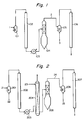
- Figure 1 is a diagram showing the reaction apparatus used in Example 27, and Figure 2 is a diagram showing the reaction apparatus used in Example 27.
- Aluminum oxide (granules) were pulverized to a size of 9 to 16 mesh, and calcined in air at 500 °C for 2 hours to obtain catalyst B.
- Five milliliters of catalyst B was filled in a stainless steel reaction tube having an inside diameter of 10 mm, and then the reaction tube was immersed in a molten salt bath.
- a starting gas composed of 95 % by volume of ammonia and 5 % by volume of ethylenimine was passed through the reaction tube at a space velosity of 3,000 hr ⁇ 1 (STP), and reacted.
- STP space velosity of 3,000 hr ⁇ 1
- Zirconium oxide (20 g) was kneaded with water, and dried at 120 °C in air, calcined at 500 °C for 2 hours, and pulverized to a size of 9 to 16 mesh to obtain catalyst B.
- a starting gas composed of 95 % by volume of ammonia and 5 % by volume of propylenimine was passed at a space velocity of 4,000 hr ⁇ 1 (STP) and reacted at a temperature of 380 °C. The results are shown in Table 1.
- Niobium pentoxide (20 g) was kneaded with water, dried at 120 °C in air, calcined at 500 °C for 2 hours, and pulverized to a size of 9 to 16 mesh to obtain catalyst B.
- a starting gas composed of 90 % by volume of ammonia and 10 % by volume of propylenimine was passed at a space velocity of 3,000 hr ⁇ 1 (STP) and reacted at a temperature of 300 °C.
- STP space velocity
- Tungstic acid (4.2 g) and 10 g of silicon oxide were kneaded with water, dried at 120 °C in air, calcined at 500 °C for 2 hours, and pulverized to a size of 9 to 16 mesh to obtain catalyst B.
- a starting gas composed of 90 % by volume of ammonia and 10 % by volume of 2-ethylethylenimine was passed at a space velocity of 3,000 hr ⁇ 1 (STP) and reacted at a temperature of 350 °C.
- STP space velocity
- Aluminum phosphate (10 g) was kneaded with water, dried at 120 °C in air, calcined at 500 °C for 2 hours, and pulverized to a size of 9 to 16 mesh to obtain catalyst B.
- a starting gas composed of 80 % by volume of ammonia and 20 % by volume of ethylenimine was passed at a space velocity of 5,000 hr ⁇ 1 (STP) and reacted at 380 °C.
- STP space velocity
- Cesium carbonate (5.43 g), 1.72 g of 95 % sulfuric acid and 10 g of silicon oxide were kneaded with water, dried in air at 120 °C, calcined at 500 °C for 2 hours, and pulverized to a size of 9 to 16 mesh to obtain catalyst B.
- a starting gas composed of 50 % by volume of ammonia, 5 % by volume of 2-ethylethylenimine and 45 % by volume of nitrogen was passed at a space velocity of 7,000 hr ⁇ 1 (STP) and reacted at 390 °C.
- STP space velocity
- Kaolin (10 g) was kneaded with water, dried in air at 120 °C, calcined at 500 °C for 2 hours, and pulverized to a size of 9 to 16 mesh to obtain catalyst B.
- a starting gas composed of 80 % by volume of ammonia and 20 % by volume of propylenimine was passed at a space velocity of 6,000 hr ⁇ 1 (STP) and reacted at 400 °C. The results are shown in Table 1.
- Example 1 Using the catalyst B prepared in Example 1, a starting gas composed of 80 % by volume of ammonia and 20 % by volume of ethylenimine was passed at a space velocity of 500 hr ⁇ 1 (STP) and reacted at 120 °C. The results are shown in Table 1.
- Montmorillonite (10 g) was kneaded with water, dried in air at 120 °C, calcined at 500 °C for 2 hours, and pulverized to a size of 9 to 16 mesh to obtain catalyst B.
- a starting gas composed of 80 % by volume of ammonia and 20 % by volume of ethylenimine was passed at a space velocity of 4,000 hr ⁇ 1 (STP) and reacted at 300 °C. The results are shown in Table 1.
- ZSM-5 zeolite (10 g) was compression-molded, dried in air at 120 °C, calcined at 500 °C for 2 hours and pulverized to a size of 9 to 16 mesh to obtain catalyst B.
- a starting gas composed of 90 % by volume of ammonia and 10 % by volume of ethylenimine was passed at a space velocity of 9,000 hr ⁇ 1 (STP) and reacted at 430 °C. The results are shown in Table 1.
- H-mordenite (10 g) was compression-molded, dried in air at 120 °C, calcined at 500 °C for 2 hours and pulverized to a size of 9 to 16 mesh to obtain catalyst B.
- a starting gas composed of 90 % by volume of ammonia and 10 % by volume of ethylenimine was passed at a space velocity of 5,000 hr ⁇ 1 (STP) and reacted at 360 °C.
- STP space velocity
- a 1N aqueous solution of calcium nitrate was added to Na-Y type zeolite, and the mixture was stirred at 80 °C for 24 hours.
- the supernatant liquid was removed by decantation, and a fresh supply of a 1N aqueous calcium nitrate solution was added. This operation was repeated twice.
- the product was fully washed with water, and then filtered and dried to obtain a Na-Y type zeolite ion-exchanged with Ca. From the atomic absorptiometry of the supernatant liquid, the filtrate and the washing combined, and the fluorescent X-ray analysis of the resulting Na-Y type zeolite, the Ca ion exchange ratio was 63 %.
- Na-mordenite (La ion exchange ratio 85 %) ion-exchanged with La was prepared by the same procedure as in Example 19 except that Na-mordenite was used instead of the Na-Y type zeolite and an aqueous solution of lanthanum nitrate was used instead of the 1N aqueous calcium nitrate solution.
- Ten grams of this product was compression-molded, dried in air at 120 °C, calcined at 500 °C for 2 hours, and pulverized to a size of 9 to 16 mesh to obtain catalyst B.
- H-mordenite (Fe ion exchange ratio 50 %) ion-exchanged with Fe was prepared by the same procedure as in Example 19 except that H-mordenite was used instead of the Na-Y type zeolite and an aqueous solution of iron nitrate was used instead of the 1N aqueous calcium nitrate solution. Ten grams of this product was compression-molded, dried in air at 120 °C, calcined at 500 °C for 2 hours, and pulverized to a size of 9 to 16 mesh to obtain catalyst B.
- H-mordenite (Cu ion exchange ratio 10 %) ion-exchanged with Cu was prepared by the same procedure as in Example 19 except that H-mordenite was used instead of the Na-Y type zeolite and an aqueous solution of copper nitrate was used instead of the 1N aqueous calcium nitrate solution. Ten grams of this product was compression-molded, dried in air at 120 °C, calcined at 450 °C for 2 hours, and pulverized to a size of 9 to 16 mesh to obtain catalyst B.
- H-mordenite (Pd ion exchange ratio 10 %) ion-exchanged with Pd was prepared by the procedure as in Example 19 except that H-mordenite was used instead of the Na-Y type zeolite and an aqueous solution of [Pd(NH3)4]Cl2 was used instead of the 1N aqueous calcium nitrate solution.
- Ten grams of this product was compression-molded, dried in air at 120 °C, calcined at 400 °C for 2 hours, and pulverized to a size of 9 to 16 mesh to obtain catalyst B.
- One liter of catalyst A and 0.35 liter of catalyst B were filled in the stacked state in a stainless steel reaction tube having an inside diameter of 30 mm with the catalyst A on top, and then heated at 400 °C with a heat medium.
- a starting gas composed of 5 % by volume of monoethanolamine and 95 % by volume of ammonia was passed through the reaction tube at a space velocity of 3,500 hr ⁇ 1 for the catalyst A layer and 10,000 hr ⁇ 1 for the catalyst B layer and continuously reacted.
- the reaction conditions and the results of gas chromatographic analysis of the reaction product after 24 hours from the initiation of the reaction are shown in Table 2.
- Catalyst A was prepared as in Example 24 except that its shape was changed to a pellet having a diameter of 4 mm and a length of 6 mm.
- One liter of the catalyst A and 0.35 liter of the catalyst B used in Example 24 were mixed, and filled in a stainless steel reaction tube having an inside diameter of 30 mm.
- the temperature of the heat medium for the reactor was prescribed at 380 °C.
- a starting gas composed of 10 % by volume of monoethanolamine and 90 % by volume of ammonia was passed through the tube and continuously reacted. The reaction conditions and the results are shown in Table 2.
- Example 24 One liter of catalyst A used in Example 24 and 0.35 liter of catalyst B used in Example 24 were filled in stainless steel reaction tubes having an inside diameter of 30 mm set up respectively in separate reactors, and the outlet of the reactor filled with catalyst A was connected to the inlet of the reactor equipped with catalyst B.
- the temperature of the heat medium for the reactor filled with catalyst A was preset at 410 °C, and the temperature of the heat medium for the reactor filled with catalyst B, at 380 °C.
- a starting gas composed of 20 % by volume of monoethanolamine and 80 % by volume of ammonia was passed through the reactors and continuously reacted. The reaction conditions and the results are shown in Table 2.
- Catalyst A (1.06 liters) was filled in a stainless steel reaction tube (102), and heated at 400 °C with a heat medium.
- Monoethanolamine was fed from a feed line (1) to an evaporator (101), and the monoethanolamine vapor was passed through the reaction tube under a pressure of 80 mmHg at a space velocity of 200 hr ⁇ 1 and continuously reacted.
- the product gas was cooled to -10 °C with a condenser (103) and collected, and introduced into a distillation column (104) consisting of a stainless steel tube having an inside diameter of 50 mm and a height of 200 mm at a site about 1/3 of its height from the top.
- a stainless steel reaction tube (106) having an inside diameter of 30 mm and filled with 0.338 liter of catalyst B was heated at 320 °C with a heat medium.
- the starting gas was passed through the reaction tube at a space velocity of 6,000 hr ⁇ 1.
- the reaction conditions and the results of gas-chromatographic analysis of the reaction product sampled 24 hours after the initiation of the reaction are shown in Table 3.
- a reaction was carried out by using the same catalysts as in Example 24 and the apparatus shown in the flowsheet of Figure 2.
- Catalyst A (1.06 liters) was filled in a stainless steel reaction tube (202) having an inside diameter of 30 mm and heated at 400 °C with a heat medium.
- Monoethanolamine was fed into an evaporator (201) from a feed line (21), and the monoethanolamine vapor was diluted with nitrogen gas from a line (22) to prepare a starting gas containing 20 % by volume of monoethanolamine.
- the starting gas was passed through the reaction tube at a space velocity of 1,000 hr ⁇ 1 and continuously reacted.
- the product gas was cooled to 100 °C with a condenser (203) and introduced into the bottom portion of a collector column (204) having an inside diameter of 200 mm and a height of 2,000 mm and filled with packings having a diameter of 6.35 mm (Mcmahon).
- Monoethanolamine as a collected liquid was fed at a rate of 4 kg/hr from the top of the column via a feed line (23).
- the collected liquid withdrawn from the bottom of the column was introduced into a distillation column (205) consisting of a stainless steel tube having an inside diameter of 50 mm and a height of 200 mm at a site about 1/3 of its height from the top.
- a stainless steel reaction tube (207) filled with 0.5 liter of catalyst B was heated at 350 °C with a heat medium, and the starting gas was passed through the reaction tube at a space velocity of 4,000 hr ⁇ 1.
- the reaction conditions and the results of gas-chromatographic analysis of the reaction product 24 hours from the initiation of the reaction are shown in Table 3.
- Cesium nitrate (350 g), 8 g of sodium hydroxide and 184 g of 85 % phosphoric acid were dissolved in 6 liters of deionized water, and as a carrier, 1.2 kg of silica gel was added. Furthermore, 7.6 g of aluminum nitrate was added, and the mixture was concentrated by heating. The concentrate was dried at 120 °C for 12 hours, then pulverized, fully kneaded with a small amount of water, and molded into pellets each having a diameter of 5 mm and a length of 5 mm. The pellets were dried in air at 200 °C for 12 hours and then calcined at 700 °C for 4 hours to give catalyst A having the composition Cs 0.9 Na 0.1 P 0.8 Al 0.01 by atomic ratios.
- Acid clay (1 kg) was mixed with a small amount of water and molded into pellets each having an outside diameter of 5 mm and a length of 5 mm. The pellets were dried in air at 120 °C for 12 hours, and then calcined at 500 °C for 5 hours to give catalyst B.
- Example 24 was repeated except that a starting gas composed of 10 % by volume of isopropanolamine and 90 % by volume of ammonia was used.
- the results were as follows:
Landscapes
- Chemical & Material Sciences (AREA)
- Organic Chemistry (AREA)
- Chemical Kinetics & Catalysis (AREA)
- Organic Low-Molecular-Weight Compounds And Preparation Thereof (AREA)
- Low-Molecular Organic Synthesis Reactions Using Catalysts (AREA)
- Catalysts (AREA)
Description
- Ethylenediamines, that is, ethylenediamine and its derivatives, find extensive use in many fields including the textile industry and the rubber industry, and also as agricultural chemicals and medicines.
- US-A-2318730 describes the preparation of alkylene polyamines by the reaction of an aziridine with ammonia in the presence of water. J.A.C.S., 1948, 70, pages 184 to 186 describes the reaction of aziridines with amines and liquid ammonia in the presence of ammonium chloride as catalyst.
- A method comprising reacting ethylene dichloride with ammonia under high pressures (EDC method) is known as a technique of industrially producing ethylenediamine. In this method, the conversion of ethylene dichloride is almost quantitative, but the resulting ethylenediamine further reacts with ethylene dichloride to form ethylenamines such as diethylenetriamine and triethylenepentamine as by-products. Hence, this method should properly be said to be a method of producing ethylenamines as well rather than a method of producing ethylenediamine alone. Furthermore, this method has the disadvantage that by-product inorganic salts and vinyl chloride monomer must be discarded, and that because of the need for additional equipment for disposing of these compounds and the corrosion of the reaction apparatus by a chlorine ion, the cost of the entire equipment becomes high.
- A method of producing ethylenediamine by reductive amination of monoethanolamine is also known. This method involves reacting monoethanolamine with ammonia in the presence of hydrogen using a nickel- or cobalt-containing catalyst. This reaction does not produce ethylenediamine alone, but forms ethylenamines as well. Furthermore, this method has the disadvantage that the conversion of monoethanolamine is low, alcoholic hydroxyl-containing by-products such as cyclic amines or aminoethylethanolamine form, and that the reaction requires pressures as high as several tens of kg/cm² to one hundred and several tens of kg/cm².
- Recently, a method (MEA method) starting from monoethanolamine but not going through reductive amination was disclosed in some patent documents (Japanese Laid-Open Patent Publications Nos. 236752/1986, 18324/1986 and 94944/1985). This method involves a batch reaction in the liquid phase and requires high reaction pressures, and the selectivity for ethylenediamine is not sufficient.
- A reaction in a flow system was also disclosed (European Patent No. 252424). This method requires a high reaction pressure of at least about 10 kg/cm², and yet the selectivity for ethylenediamine is at most 60 % by weight and cyclized products of aminoethylethanolamine are formed as by-products in an amount of 20 to 40 % by weight.
- It is an object of this invention to solve the above problems of conventional methods of producing ethylenediamines, and to provide a method of producing ethylenediamines at a high selectivity by a gaseous phase reaction without involving the problems of the formation of by-products such as inorganic salts and vinyl chloride monomer and the corrosion of the equipment as in the EDC method, and without requiring high pressures as in the MEA method.
- We have now found that ethylenediamines can be produced with a very high conversion and selectivity by a novel reaction of aziridine compounds with ammonia in the gaseous phase in the presence of a solid acid catalyst.
- Thus, the present invention provides a method of producing an ethylenediamine of the formula

wherein R represents hydrogen, methyl or ethyl,
which comprises reacting an aziridine compound of the formula
wherein R is as defined,
with ammonia in the gaseous phase in the presence of a solid acid catalyst. - The aziridine compounds of formula (II) used in this invention are specifically ethylenimine, propylenimine and 2-ethylethylenimine, and they are converted to the corresponding ethylenediamines of formula (I), i.e. ethylenediamine, methylethylenediamine, and ethylethylenediamine.
- All types of solid acids may be used as the solid acid catalysts (to be sometimes referred to as catalyst B hereinafter). Examples include oxides such as silicone oxide, zirconium oxide, titanium oxide, aluminum oxide, zinc oxide, cadmium oxide, lead oxide, bismuth oxide, niobium oxide, lanthanum oxide, antimony oxide and yttrium oxide; clay minerals such as kaolin, bentonite and montmorillonite; molecular sieves (including various metal ion exchangers) known as zeolites such as mordenite Y-type zeolite and ZSM-5; and oxo acid salts such as phosphates, borates, sulfates, niobates, tungstates, molybdates and titanates. Among them, the molecular sieves are preferred because they give high conversions and selectivities. These solid acids may be used singly or in combination. The method of preparing catalyst B is not particularly limited, and all methods heretofore practiced generally can be used.
- The method of this invention is carried out by passing a starting gas composed of the aziridine compound of formula (II) and ammonia over the solid acid catalyst (catalyst B). The starting gas may, as required, be diluted with an inert gas such as nitrogen or helium.
- The mole ratio between ammonia and the aziridine compound in the starting gas affects the selectivity of the ethylenediamine compound formed. If the mole ratio of ammonia to the aziridine compound is low, the amounts of by-product cyclic compounds (piperazines) and by-product polyamines such as diethylenetriamines and triethylenetetramines increase, and the selectivity for the desired ethylenediamine compound is lowered. On the other hand, if the above mole ratio is high, the selectivity for the ethylenediamine compound increases, but the productivity is reduced. Preferably, the mole ratio of ammonia to the aziridine compound in the starting mixture is at least 1, especially from 1 to 50.
- The reaction temperature may be properly preset depending upon the types of the aziridine compound, the final product, and/or catalyst B. Preferably, it is 100 to 500 °C, especially 200 to 450 °C.
- The reaction pressure may be atmospheric, reduced or elevated pressure. The space velocity, which varies with the catalyst, the reaction temperature, the reaction materials, etc., is preferably 100 to 30,000 hr⁻¹, especially preferably 500 to 10,000 hr⁻¹. The reactor used may be of the fixed bed flowing type or the fluidized bed type.
- We have also found that ethylenediamines can be produced also by using in the above reaction a product containing aziridine compounds obtained by the gaseous phase intramolecular dehydration reaction of an alkanolamine as a starting material instead of the isolated aziridine compound.
- Thus, according to this invention, there is also provided a method of producing an ethylenediamine of formula (I) which comprises forming a reaction product containing said aziridine compound of formula (II) by the gaseous phase intramolecular dehydration (to be referred to as the first-stage reaction) of an alkanolamine of the formula

wherein X represents OH or NH₂, Y represents NH₂ when X is OH and OH when X is NH₂, and R is as defined above, in the presence of a catalyst (sometimes referred to as catalyst A), and reacting said reaction product containing said aziridine compound of formula (II) with ammonia in the gaseous phase in the presence of a solid acid catalyst (catalyst B) (this reaction may be referred to as the second-stage reaction). - Catalyst A in the first-stage reaction may be any catalyst which has the function of converting the alkanolamine into an iziridine compound by the gaseous phase intramolecular dehydration reaction. For example, there can be used the tungsten oxide-type catalyst disclosed in Japanese Patent Publication No. 10593/1975, the catalyst composed of tungsten oxide and silicon disclosed in U.S. Patent No. 4,301,036, the niobium- or tantalum-containing catalysts disclosed in U.S. Patents Nos. 4,289,656, 4,337,175 and 4,477,591, the silicon-contain ing catalyst disclosed in European Laid-Open Patent Publication No. 227,461, and the phosphorus-containing catalysts disclosed in European Laid-Open Patent Publications Nos. 228,898 and 230,776. The following phosphorus containing or silicon-containing catalyst are particularly preferred.
- (1) Phosphorus-containing catalysts of the general formula
XaPbMcOd
wherein X represents at least one element selected from the group consisting of elements of Group IIIA of the periodic table, silicon, germanium, tin, lead, antimony, bismuth, transition metal elements, lanthanide elements and actinide elements (examples of these elements are B, Al, Tl, Si, Sn, Sb, Bi, Cu, Zn, Cd, Y, Ti, Zr, Nb, Ta, W, Mn, Fe, Ni, La, Ce, Eu and Th), P represents phosphorus, M represents at least one element selected from the group consisting of alkali metal elements and alkaline earth metal elements (examples of these elements are Li, Na, K, Rb, Cs, Sr and Ba), O represents oxygen, when a is 1, b is 0.01 to 6 and c is 0 to 3, and d is a number determined by the values of a, b and c and the states of bonding of the various constituent elements,
described in European Laid-Open Patent Publication No. 230,776. - (2) Phosphorus-containing of the general formula
XaPbYcOd
wherein X represents at least one element selected from the group consisting of alkali metal elements and alkaline earth metal elements, P represents phosphorus, Y represents at least one element selected from the group consisting of boron, aluminum, silicon, sulfur, titanium, copper, yttrium, zirconium, niobium, tuntalum, tungsten, lanthanum and thorium, O represents oxygen, when a is 1, b is 0.05 to 3 and c is 0 to 1, and d is a number determined by the values of a, b and c and the state of bonding of the various constituent elements,
disclosed in European Laid-Open Patent Publication No. 228,898. - (3) Silicon-containing catalysts of the general formula
SiaXbYcOd
wherein X represents at least one element selected from the group consisting of alkali metal elements and alkaline earth metal elements, Y represents at least one element selected from the group consisting of boron, aluminum, titanium, zirconium, tin, zinc and cerium, O represents oxygen, when a is 1, b is 0.005 to 1, and c is 0 to 1, and d is a number determined by the values of a, b and c, and the state of bonding of the various constituent elements,
disclosed in European Laid-Open Patent Publication No. 227,461. - The conditions for the first-stage reaction differ depending upon the catalyst used. Usually, the reaction temperature is 300 to 500 °C. The concentration of the alkanolamine in the starting gas is 1 to 100 % by volume. The space velocity is 50 to 20,000 hr⁻¹. The reaction pressure may be atmospheric, reduced or elevated pressure. The inclusion of an inert gas such as nitrogen, ammonia or the recycled unreacted aziridine compound in the starting gas does not adversely affect the reaction.
- The second-stage reaction involves reacting the reaction product of the first-stage reaction with ammonia in the gaseous phase in the presence of catalyst B to produce ethylenediamines.
- The catalyst B is as described above.
- In the second-stage reaction, the aziridine compound in the product obtained by the first-stage reaction reacts with ammonia in the presence of catalyst B to give ethylenediamine selectively. The conditions for the second-stage reaction have already been described. Preferably, the reaction temperature is 200 to 500 °C; the concentration of the aziridine compound in the starting gas is 1 to 50 % by volume; the concentration of ammonia is 1 to 99 % by volume; and SV is 100 to 20,000 hr⁻¹.
- The starting gas to be submitted to the second-stage reaction (the product of the first-stage reaction) may contain an inert gas such as nitrogen and the unreacted alkanolamine or by-products such as water and a small amount of acetaldehyde resulting in the first-stage reaction. After the second-stage reaction, the unreacted ammonia and aziridine compound may be separated from the ethylenediamine product, and reused in the second reaction system.
- Both the first-stage reaction and the second-stage reaction may generally be carried out by using a fixed bed-type reactor. If desired, a fluidized bed-type or moving bed-type reactor may be used. The first-stage reaction and the second-stage reaction may be combined as follows:
- (a) A reaction tube filled with catalyst A and a reaction tube filled with catalyst B are separately constructed, and the first-stage reaction and the second-stage reaction are carried out independently.
- (b) Catalyst A and catalyst B are stacked in one reaction tube so that catalyst A is positioned on its inlet (front) side and catalyst B on its outlet (rear) side. The first-stage reaction is carried out in the inlet side of the reaction tube, and the second-stage reaction is carried out in the outlet side. Preferably, the temperatures of reactions are independently controlled by, for example, providing a partition in a heating bath portion of the reaction tube.
- (c) Catalysts A and B are filled in one reaction tube as a mixture or in the alternately stacked state, and the first-stage reaction and the second-stage reaction are carried out in the same reaction tube.
- In the case of (a) and (b), the reaction product from the first-stage reaction may be supplemented with ammonia and an aziridine compound, and then submitted to the second-stage reaction. In the case of (a), the reaction product from the first-stage reaction may be submitted to a purification step to purify the aziridine compound and remove the unreacted alkanolamine and the by-product, and introduced as a material for the second-stage reaction.
- According to this invention, ethylenediamines can be produced advantageously by the novel gaseous phase reaction. Since this method does not use a starting compound having a halogen atom or an oxygen atom, inorganic salts or chlorine-containing wastes attributed to the starting material do not result as by-products. Furthermore, a high-purity product can be obtained by the method of this invention because hydroxyl group-containing by-products which are difficult to separate from the desired ethylenediamines do not form. Moreover, the method of this invention can be practiced by a gaseous phase flow system, and has excellent productivity.
- The following examples illustrate the present invention specifically. In these examples, the conversion of the alkanolamine, the conversion of the aziridine compound, the selectivity for the ethylenediamine, the selectivity for aziridine compound, and the one-pass yield of the ethylenediamine are defined as follows.

- In the accompanying drawings, Figure 1 is a diagram showing the reaction apparatus used in Example 27, and Figure 2 is a diagram showing the reaction apparatus used in Example 27.
- Aluminum oxide (granules) were pulverized to a size of 9 to 16 mesh, and calcined in air at 500 °C for 2 hours to obtain catalyst B. Five milliliters of catalyst B was filled in a stainless steel reaction tube having an inside diameter of 10 mm, and then the reaction tube was immersed in a molten salt bath. A starting gas composed of 95 % by volume of ammonia and 5 % by volume of ethylenimine was passed through the reaction tube at a space velosity of 3,000 hr⁻¹ (STP), and reacted. The reaction product was analyzed by gas chromatography, and the results shown in Table 1 were obtained.
- Zirconium oxide (20 g) was kneaded with water, and dried at 120 °C in air, calcined at 500 °C for 2 hours, and pulverized to a size of 9 to 16 mesh to obtain catalyst B. In the presence of catalyst B, a starting gas composed of 95 % by volume of ammonia and 5 % by volume of propylenimine was passed at a space velocity of 4,000 hr⁻¹ (STP) and reacted at a temperature of 380 °C. The results are shown in Table 1.
- Niobium pentoxide (20 g) was kneaded with water, dried at 120 °C in air, calcined at 500 °C for 2 hours, and pulverized to a size of 9 to 16 mesh to obtain catalyst B. In the presence of catalyst B, a starting gas composed of 90 % by volume of ammonia and 10 % by volume of propylenimine was passed at a space velocity of 3,000 hr⁻¹ (STP) and reacted at a temperature of 300 °C. The results are shown in Table 1.
- Tungstic acid (4.2 g) and 10 g of silicon oxide were kneaded with water, dried at 120 °C in air, calcined at 500 °C for 2 hours, and pulverized to a size of 9 to 16 mesh to obtain catalyst B. In the presence of catalyst B, a starting gas composed of 90 % by volume of ammonia and 10 % by volume of 2-ethylethylenimine was passed at a space velocity of 3,000 hr⁻¹ (STP) and reacted at a temperature of 350 °C. The results are shown in Table 1.
- Aluminum phosphate (10 g) was kneaded with water, dried at 120 °C in air, calcined at 500 °C for 2 hours, and pulverized to a size of 9 to 16 mesh to obtain catalyst B. In the presence of catalyst B, a starting gas composed of 80 % by volume of ammonia and 20 % by volume of ethylenimine was passed at a space velocity of 5,000 hr⁻¹ (STP) and reacted at 380 °C. The results are shown in Table 1.
- In the presence of the catalyst B prepared in Example 5, a starting gas composed of 10 % by volume of ammonia, 10 % by volume of ethylenimine and 80 % by volume of nitrogen was passed at a space velocity of 4,000 hr⁻¹ (STP) and reacted at 370 °C. The results are shown in Table 1.
- Boron phosphate (10 g) was kneaded with water, dried in air at 120 °C, calcined at 500 °C for 2 hours, and pulverized to a size of 9 to 16 mesh to obtain catalyst B. In the presence of catalyst B, a starting gas composed of 5 % by volume of ammonia, 5 % by volume of propylenimine and 90 % by volume of nitrogen was passed at a space velocity of 4,000 hr⁻¹ (STP) and reacted at 350°C. The results are shown in Table 1.
- Potassium hydrogen phosphate (2.27 g) and 10 g of silicon oxide were kneaded with water, dried in air at 120 °C, calcined at 500 °C for 2 hours, and pulverized to a size of 9 to 16 mesh to obtain catalyst B. In the presence of catalyst B, a starting gas composed of 80 % by volume of ammonia and 20 % by volume of ethylenimine was passed at a space velocity of 4,000 hr⁻¹ (STP) and reacted at 400 °C. The results are shown in Table 1.
- Using the catalyst B prepared in Example 8, a starting gas composed of 50 % by volume of ammonia and 50 % by volume of ethylenimine was passed at a space velocity of 2,500 hr⁻¹ (STP) and reacted at 380°C. The results are shown in Table 1.
- Cesium carbonate (5.43 g), 1.72 g of 95 % sulfuric acid and 10 g of silicon oxide were kneaded with water, dried in air at 120 °C, calcined at 500 °C for 2 hours, and pulverized to a size of 9 to 16 mesh to obtain catalyst B. In the presence of catalyst B, a starting gas composed of 50 % by volume of ammonia, 5 % by volume of 2-ethylethylenimine and 45 % by volume of nitrogen was passed at a space velocity of 7,000 hr⁻¹ (STP) and reacted at 390 °C. The results are shown in Table 1.
- Sodium tungstate (5.50 g) and 10 g of silicon oxide were kneaded with water, dried in air at 120 °C, calcined at 500 °C for 2 hours, and pulverized to a size of 9 to 16 mesh to obtain catalyst B. In the presence of the catalyst B, a starting gas composed of 50 % by volume of ammonia, 5 % by volume of propylenimine and 45 % by volume of nitrogen was passed at a space velocity of 5,000 hr⁻¹ (STP) and reacted at 390 °C. The results are shown in Table 1.
- Kaolin (10 g) was kneaded with water, dried in air at 120 °C, calcined at 500 °C for 2 hours, and pulverized to a size of 9 to 16 mesh to obtain catalyst B. In the presence of the catalyst B, a starting gas composed of 80 % by volume of ammonia and 20 % by volume of propylenimine was passed at a space velocity of 6,000 hr⁻¹ (STP) and reacted at 400 °C. The results are shown in Table 1.
- Using the catalyst B prepared in Example 1, a starting gas composed of 80 % by volume of ammonia and 20 % by volume of ethylenimine was passed at a space velocity of 500 hr⁻¹ (STP) and reacted at 120 °C. The results are shown in Table 1.
- Montmorillonite (10 g) was kneaded with water, dried in air at 120 °C, calcined at 500 °C for 2 hours, and pulverized to a size of 9 to 16 mesh to obtain catalyst B. In the presence of catalyst B, a starting gas composed of 80 % by volume of ammonia and 20 % by volume of ethylenimine was passed at a space velocity of 4,000 hr⁻¹ (STP) and reacted at 300 °C. The results are shown in Table 1.
- ZSM-5 zeolite (10 g) was compression-molded, dried in air at 120 °C, calcined at 500 °C for 2 hours and pulverized to a size of 9 to 16 mesh to obtain catalyst B. In the presence of catalyst B, a starting gas composed of 90 % by volume of ammonia and 10 % by volume of ethylenimine was passed at a space velocity of 9,000 hr⁻¹ (STP) and reacted at 430 °C. The results are shown in Table 1.
- H-mordenite (10 g) was compression-molded, dried in air at 120 °C, calcined at 500 °C for 2 hours and pulverized to a size of 9 to 16 mesh to obtain catalyst B. In the presence of catalyst B, a starting gas composed of 90 % by volume of ammonia and 10 % by volume of ethylenimine was passed at a space velocity of 5,000 hr⁻¹ (STP) and reacted at 360 °C. The results are shown in Table 1.
- Using the catalyst B prepared in Example 16, a starting gas composed of 70 % by volume of ammonia, 10 % by volume of ethylenimine and 20 % by volume of nitrogen was passed at a space velocity of 1,000 hr⁻¹ (STP) and reacted at 250 °C. The results are shown in Table 1.
- Using the catalyst B prepared in Example 16, a starting gas composed of 85 % by volume of ammonia and 15 % by volume of ethylenimine was passed at a space velocity of 1,000 hr⁻¹ (STP) under a pressure of 270 mmHg and reacted at 300 °C. The results are shown in Table 1.
- A 1N aqueous solution of calcium nitrate was added to Na-Y type zeolite, and the mixture was stirred at 80 °C for 24 hours. The supernatant liquid was removed by decantation, and a fresh supply of a 1N aqueous calcium nitrate solution was added. This operation was repeated twice. The product was fully washed with water, and then filtered and dried to obtain a Na-Y type zeolite ion-exchanged with Ca. From the atomic absorptiometry of the supernatant liquid, the filtrate and the washing combined, and the fluorescent X-ray analysis of the resulting Na-Y type zeolite, the Ca ion exchange ratio was 63 %.
- Ten grams of the resulting Na-Y type zeolite (Ca ion exchange ratio 63 %) was compression-molded, dried in air at 120 °C, calcined at 450 °C for 2 hours and pulverized to a size of 9 to 16 mesh to obtain catalyst B.
- Using the resulting catalyst B, a starting gas composed of 95 % by volume of ammonia and 5 % by volume of ethylenimine was passed at a space velocity of 6,000 hr⁻¹ and reacted at 340 °C. The results are shown in Table 1.
- Na-mordenite (La ion exchange ratio 85 %) ion-exchanged with La was prepared by the same procedure as in Example 19 except that Na-mordenite was used instead of the Na-Y type zeolite and an aqueous solution of lanthanum nitrate was used instead of the 1N aqueous calcium nitrate solution. Ten grams of this product was compression-molded, dried in air at 120 °C, calcined at 500 °C for 2 hours, and pulverized to a size of 9 to 16 mesh to obtain catalyst B.
- In the presence of catalyst B, a starting gas composed of 90 % by volume of ammonia, 5 % by volume of ethylenimine and 5 % by volume of nitrogen was passed at a space velocity of 3,000 hr⁻¹ (STP), and reacted at 320 °C. The results are shown in Table 1.
- H-mordenite (Fe ion exchange ratio 50 %) ion-exchanged with Fe was prepared by the same procedure as in Example 19 except that H-mordenite was used instead of the Na-Y type zeolite and an aqueous solution of iron nitrate was used instead of the 1N aqueous calcium nitrate solution. Ten grams of this product was compression-molded, dried in air at 120 °C, calcined at 500 °C for 2 hours, and pulverized to a size of 9 to 16 mesh to obtain catalyst B.
- In the presence of catalyst B, a starting gas composed of 80 % by volume of ammonia and 20 % by volume of ethylenimine passed at a space velocity of 2,000 hr⁻¹ (STP), and reacted at 340 °C. The results are shown in Table 1.
- H-mordenite (Cu ion exchange ratio 10 %) ion-exchanged with Cu was prepared by the same procedure as in Example 19 except that H-mordenite was used instead of the Na-Y type zeolite and an aqueous solution of copper nitrate was used instead of the 1N aqueous calcium nitrate solution. Ten grams of this product was compression-molded, dried in air at 120 °C, calcined at 450 °C for 2 hours, and pulverized to a size of 9 to 16 mesh to obtain catalyst B.
- In the presence of catalyst B, a starting gas composed of 85 % by volume of ammonia and 15 % by volume of ethylenimine passed at a space velocity of 3,000 hr⁻¹ (STP), and reacted at 380 °C. The results are shown in Table 1.
- H-mordenite (Pd ion exchange ratio 10 %) ion-exchanged with Pd was prepared by the procedure as in Example 19 except that H-mordenite was used instead of the Na-Y type zeolite and an aqueous solution of [Pd(NH₃)₄]Cl₂ was used instead of the 1N aqueous calcium nitrate solution. Ten grams of this product was compression-molded, dried in air at 120 °C, calcined at 400 °C for 2 hours, and pulverized to a size of 9 to 16 mesh to obtain catalyst B.
- In the presence of catalyst B, a starting gas composed of 70 % by volume of ammonia, 10 % by volume of ethylenimine and 20 % by volume of nitrogen was passed at a space velocity of 1,500 hr⁻¹ (STP), and reacted at 270 °C. The results are shown in Table 1.


- Calcium hydroxide (2.22 kg) and 120 g of sodium hydroxide were suspended in 10 liters of pure water, and 1.73 kg of 85 % by weight orthophosphoric acid was added. The mixture was heated with sufficient stirring. The concentrate was evaporated to dryness, and further dried in air at 120 °C for 12 hours. The product was pulverized, kneaded fully with a small amount of water, the kneaded mixture was molded into a ring shape having an outside diameter of 6 mm, a length of 6 mm and an inside diameter of 2 mm, dried in air at 200 °C for 12 hours, and calcined at 700 °C for 5 hours to give a catalyst A having the composition of Ca₁P0.5Na0.1 by atomic ratios.
- Zeolon (registered trademark) 900H E type (diameter 1/9 inch) made by Norton Co., U. S. A. which is a proton exchanged mordenite was used as a catalyst B.
- One liter of catalyst A and 0.35 liter of catalyst B were filled in the stacked state in a stainless steel reaction tube having an inside diameter of 30 mm with the catalyst A on top, and then heated at 400 °C with a heat medium. A starting gas composed of 5 % by volume of monoethanolamine and 95 % by volume of ammonia was passed through the reaction tube at a space velocity of 3,500 hr⁻¹ for the catalyst A layer and 10,000 hr⁻¹ for the catalyst B layer and continuously reacted. The reaction conditions and the results of gas chromatographic analysis of the reaction product after 24 hours from the initiation of the reaction are shown in Table 2.
- Catalyst A was prepared as in Example 24 except that its shape was changed to a pellet having a diameter of 4 mm and a length of 6 mm. One liter of the catalyst A and 0.35 liter of the catalyst B used in Example 24 were mixed, and filled in a stainless steel reaction tube having an inside diameter of 30 mm. The temperature of the heat medium for the reactor was prescribed at 380 °C. A starting gas composed of 10 % by volume of monoethanolamine and 90 % by volume of ammonia was passed through the tube and continuously reacted. The reaction conditions and the results are shown in Table 2.
- One liter of catalyst A used in Example 24 and 0.35 liter of catalyst B used in Example 24 were filled in stainless steel reaction tubes having an inside diameter of 30 mm set up respectively in separate reactors, and the outlet of the reactor filled with catalyst A was connected to the inlet of the reactor equipped with catalyst B. The temperature of the heat medium for the reactor filled with catalyst A was preset at 410 °C, and the temperature of the heat medium for the reactor filled with catalyst B, at 380 °C. A starting gas composed of 20 % by volume of monoethanolamine and 80 % by volume of ammonia was passed through the reactors and continuously reacted. The reaction conditions and the results are shown in Table 2.
- By using the same catalysts as in Example 24, the reaction was carried out by using the apparatus shown in the flowsheet of Figure 1.
- Catalyst A (1.06 liters) was filled in a stainless steel reaction tube (102), and heated at 400 °C with a heat medium. Monoethanolamine was fed from a feed line (1) to an evaporator (101), and the monoethanolamine vapor was passed through the reaction tube under a pressure of 80 mmHg at a space velocity of 200 hr⁻¹ and continuously reacted. The product gas was cooled to -10 °C with a condenser (103) and collected, and introduced into a distillation column (104) consisting of a stainless steel tube having an inside diameter of 50 mm and a height of 200 mm at a site about 1/3 of its height from the top. In the inside of the column, packings with a diameter of 6.35 mm (Mcmahon) were filled at a layer height of 400 mm in the concentrating portion and at a layer height of 1200 mm in the recovering portion. The operating pressure was 400 mmHg, and the reflux ratio was 4. From the top of the column, ethylenimine in a concentration of 99.1 % by weight was obtained in an amount of 195 g per hour. The resulting ethylenimine was fed into an evaporator (105) via a line (2) and mixed with an ammonia gas from a line (2) to prepare a starting gas containing 5 % by volume of ethylenimine. A stainless steel reaction tube (106) having an inside diameter of 30 mm and filled with 0.338 liter of catalyst B was heated at 320 °C with a heat medium. The starting gas was passed through the reaction tube at a space velocity of 6,000 hr⁻¹. The reaction conditions and the results of gas-chromatographic analysis of the reaction product sampled 24 hours after the initiation of the reaction are shown in Table 3.
- A reaction was carried out by using the same catalysts as in Example 24 and the apparatus shown in the flowsheet of Figure 2.
- Catalyst A (1.06 liters) was filled in a stainless steel reaction tube (202) having an inside diameter of 30 mm and heated at 400 °C with a heat medium. Monoethanolamine was fed into an evaporator (201) from a feed line (21), and the monoethanolamine vapor was diluted with nitrogen gas from a line (22) to prepare a starting gas containing 20 % by volume of monoethanolamine. The starting gas was passed through the reaction tube at a space velocity of 1,000 hr⁻¹ and continuously reacted. The product gas was cooled to 100 °C with a condenser (203) and introduced into the bottom portion of a collector column (204) having an inside diameter of 200 mm and a height of 2,000 mm and filled with packings having a diameter of 6.35 mm (Mcmahon). Monoethanolamine as a collected liquid was fed at a rate of 4 kg/hr from the top of the column via a feed line (23). The collected liquid withdrawn from the bottom of the column was introduced into a distillation column (205) consisting of a stainless steel tube having an inside diameter of 50 mm and a height of 200 mm at a site about 1/3 of its height from the top. In the inside of the column, packings having a diameter of 6.35 mm (Mcmahon) were filled in a layer height of 400 mm in the concentrating portion and at a layer height of 1,200 mm in the recovering portion. The operating pressure was 400 mmHg, and the reflux ratio was 4. From the top of the distillation column, 192 g/hr of ethylenimine in a concentration of 98.9 % by weight was obtained. The resulting ethylenimine was fed into an evaporator (206) via a feed line (24) and mixed with ammonia gas from a feed line (25) to prepare a starting gas containing 20 % by volume of ethylenimine. A stainless steel reaction tube (207) filled with 0.5 liter of catalyst B was heated at 350 °C with a heat medium, and the starting gas was passed through the reaction tube at a space velocity of 4,000 hr⁻¹. The reaction conditions and the results of gas-chromatographic analysis of the
reaction product 24 hours from the initiation of the reaction are shown in Table 3. - Cesium nitrate (350 g), 8 g of sodium hydroxide and 184 g of 85 % phosphoric acid were dissolved in 6 liters of deionized water, and as a carrier, 1.2 kg of silica gel was added. Furthermore, 7.6 g of aluminum nitrate was added, and the mixture was concentrated by heating. The concentrate was dried at 120 °C for 12 hours, then pulverized, fully kneaded with a small amount of water, and molded into pellets each having a diameter of 5 mm and a length of 5 mm. The pellets were dried in air at 200 °C for 12 hours and then calcined at 700 °C for 4 hours to give catalyst A having the composition Cs0.9Na0.1P0.8Al0.01 by atomic ratios.
- Acid clay (1 kg) was mixed with a small amount of water and molded into pellets each having an outside diameter of 5 mm and a length of 5 mm. The pellets were dried in air at 120 °C for 12 hours, and then calcined at 500 °C for 5 hours to give catalyst B.
- By using catalysts A and B, the same reaction as in Example 24 was repeated. The reaction conditions and the results are shown in Table 2.

- Example 24 was repeated except that a starting gas composed of 10 % by volume of isopropanolamine and 90 % by volume of ammonia was used. The results were as follows:
- Isopropanolamine concentration:
- 10 % by volume
- Isopropanolamine conversion:
- 78.4 mole %
- 2-Methylethylenimine selectivity:
- 33.2 mole
- Methylethylenediamine selectivity:
- 51.7 mole %
- Methylethylenediamine one-pass yield:
- 40.5 mole %
Claims (11)
- A method of producing an ethylenediamine of the formula


with ammonia in the gaseous phase in the presence of a solid acid catalyst. - A method according to claim 1 in which the mole ratio of ammonia to the aziridine compound (II) is at least 1/1.
- A method according to claim 1 or 2 in which the reaction is carried out at a temperature of 100 to 500°C.
- A method according to claim 1, 2 or 3 in which the solid acid catalyst is a molecular sieve-type catalyst.
- A method according to any one of claims 1 to 4 wherein the aziridine compound (II) is contained in or derived from a reaction product obtained by the gaseous phase intramolecular dehydration reaction of an alkanolamine of the formula

- A method according to claim 5 in which a reactor is used which has catalyst A filled in its inlet side and the solid acid catalyst (catalyst B) filled in its outlet side, the catalysts A and B being in the stacked state.
- A method according to claim 5 in which a reactor is used which has a mixture of catalyst A and catalyst B filled therein.
- A method according to claim 5 in which a reactor filled with catalyst A is connected with a reactor filled with catalyst B with the first-mentioned reactor having positioned ahead.
- A method according to any one of claims 5 to 8 in which the reaction in the presence of catalyst A is carried out at a temperature of 300 to 500°C and a space velocity of 50 to 20,000 hr⁻¹ while maintaining the concentration of the alkanolamine at 1 to 100% by volume and the concentration of ammonia at 0 to 99% by volume.
- A method according to any one of claims 5 to 9 in which the reaction in the presence of catalyst B is carried out at a temperature of 200 to 500°C and a space velocity of 100 to 20,000 hr⁻¹ while maintaining the concentration of the aziridine compound at 1 to 50% by volume and the concentration of ammonia at 1 to 99% by volume.
- A method according to any one of claims 5 to 10 in which the aziridine compound is separated from the reaction product obtained by the gaseous phase intramolecular dehydration reaction of the alkanolamine in the presence of catalyst A, and then reacted with ammonia in the gaseous phase in the presence of catalyst B.
Applications Claiming Priority (4)
| Application Number | Priority Date | Filing Date | Title |
|---|---|---|---|
| JP29366488 | 1988-11-22 | ||
| JP293664/88 | 1988-11-22 | ||
| JP30221888 | 1988-12-01 | ||
| JP302218/88 | 1988-12-01 |
Publications (3)
| Publication Number | Publication Date |
|---|---|
| EP0370730A2 EP0370730A2 (en) | 1990-05-30 |
| EP0370730A3 EP0370730A3 (en) | 1991-04-03 |
| EP0370730B1 true EP0370730B1 (en) | 1994-03-16 |
Family
ID=26559512
Family Applications (1)
| Application Number | Title | Priority Date | Filing Date |
|---|---|---|---|
| EP89312005A Expired - Lifetime EP0370730B1 (en) | 1988-11-22 | 1989-11-20 | Method of producing ethylenediamines |
Country Status (7)
| Country | Link |
|---|---|
| EP (1) | EP0370730B1 (en) |
| JP (1) | JPH0791239B2 (en) |
| KR (1) | KR950000777B1 (en) |
| CN (1) | CN1027811C (en) |
| AU (1) | AU616324B2 (en) |
| CA (1) | CA2003449A1 (en) |
| DE (1) | DE68913917T2 (en) |
Families Citing this family (7)
| Publication number | Priority date | Publication date | Assignee | Title |
|---|---|---|---|---|
| KR20000063913A (en) * | 2000-08-10 | 2000-11-06 | 하현준 | Process for preparing 1,2-diaminopropane alcohols from aziridines |
| DE10260692B4 (en) * | 2002-12-23 | 2009-05-20 | Continental Automotive Gmbh | liquid-crystal display |
| CN103816927B (en) | 2013-12-18 | 2015-12-30 | 西安近代化学研究所 | A kind of catalyst for the synthesis of Ethylenimine, preparation method and application |
| JP2020503261A (en) * | 2016-11-30 | 2020-01-30 | ビーエーエスエフ ソシエタス・ヨーロピアBasf Se | Method for converting ethylene glycol to ethylenediamine using zeolite catalyst |
| US11104637B2 (en) * | 2016-11-30 | 2021-08-31 | Basf Se | Process for the conversion of monoethanolamine to ethylenediamine employing a copper-modified zeolite of the MOR framework structure |
| CN113042026B (en) * | 2021-03-30 | 2023-03-03 | 盐城工学院 | Catalyst for preparing aziridine by catalytic dehydration of ethanolamine and preparation method thereof |
| CN118831612B (en) * | 2024-06-28 | 2024-12-27 | 常州景星泽瑞科技有限公司 | A catalyst for synthesizing ethylenediamine by ethylene dichloride method, a preparation method thereof, and a method for synthesizing ethylenediamine by using the catalyst |
Family Cites Families (4)
| Publication number | Priority date | Publication date | Assignee | Title |
|---|---|---|---|---|
| US2318730A (en) * | 1941-05-24 | 1943-05-11 | Carbide & Carbon Chem Corp | Process of making alkylene polyamines |
| FR1336403A (en) * | 1962-08-10 | 1963-08-30 | Ciba Geigy | Process for preparing ethylene-1,2-diamines |
| US3527757A (en) * | 1966-12-16 | 1970-09-08 | Jefferson Chem Co Inc | Alkylation of amines with alkyleneimines |
| US3565941A (en) * | 1968-07-31 | 1971-02-23 | Dow Chemical Co | Process for the selective alkylation of polyalkylene polyamines |
-
1989
- 1989-11-17 JP JP1297458A patent/JPH0791239B2/en not_active Expired - Lifetime
- 1989-11-20 EP EP89312005A patent/EP0370730B1/en not_active Expired - Lifetime
- 1989-11-20 DE DE68913917T patent/DE68913917T2/en not_active Expired - Fee Related
- 1989-11-21 CA CA002003449A patent/CA2003449A1/en not_active Abandoned
- 1989-11-22 AU AU45439/89A patent/AU616324B2/en not_active Ceased
- 1989-11-22 KR KR1019890016977A patent/KR950000777B1/en not_active Expired - Fee Related
- 1989-11-22 CN CN89109261A patent/CN1027811C/en not_active Expired - Fee Related
Also Published As
| Publication number | Publication date |
|---|---|
| KR900007781A (en) | 1990-06-02 |
| AU616324B2 (en) | 1991-10-24 |
| CN1043316A (en) | 1990-06-27 |
| AU4543989A (en) | 1990-05-31 |
| KR950000777B1 (en) | 1995-02-02 |
| DE68913917D1 (en) | 1994-04-21 |
| JPH0791239B2 (en) | 1995-10-04 |
| DE68913917T2 (en) | 1994-06-23 |
| CA2003449A1 (en) | 1990-05-22 |
| EP0370730A3 (en) | 1991-04-03 |
| EP0370730A2 (en) | 1990-05-30 |
| JPH02275842A (en) | 1990-11-09 |
| CN1027811C (en) | 1995-03-08 |
Similar Documents
| Publication | Publication Date | Title |
|---|---|---|
| EP0227461B1 (en) | Process for preparing cyclic amines | |
| EP0228898B1 (en) | Process for producing cyclic amines | |
| US4841061A (en) | Process for producing cyclic amines | |
| EP0232182A2 (en) | Process for producing bases | |
| EP0370730A2 (en) | Method of producing ethylenediamines | |
| EP0418657A2 (en) | Process for producing methacrylic acid and methacrolein by catalytic oxidation of isobutane | |
| US5262570A (en) | Method of producing ethylenediamines | |
| US5235107A (en) | Method of producing ethylenediamines | |
| JPH04352760A (en) | Production of aminoalkylsulfonic acids | |
| JP3811205B2 (en) | Production method of dimethylamine | |
| US4457905A (en) | Process for oxidation and ammoxidation | |
| JP4164603B2 (en) | Method for producing ε-caprolactam | |
| JPS61183249A (en) | Production of noncyclic ethyleneamine | |
| KR100321116B1 (en) | Process for the preparation of alkylenecarbonate using lead halides and/or indium halides as catalyst | |
| US4521395A (en) | Process for oxidation and ammoxidation | |
| EP0713861A1 (en) | Process for the preparation of benzophenone imine | |
| US6927307B2 (en) | Method for reactivating catalyst for methacrylic acid preparation | |
| JPS61291551A (en) | Production of aromatic secondary amino compound | |
| JPH0788353B2 (en) | Method for producing aziridine compound | |
| CA1174698A (en) | Oxidative coupling of aromatic methyl groups | |
| EP0433959B1 (en) | Process for preparing monoallylamine | |
| JP2764093B2 (en) | Preparation of acyclic ethyleneamines | |
| JP2001172230A (en) | Method for producing diarylamines | |
| JPH0237911B2 (en) | ||
| JPS6348261B2 (en) |
Legal Events
| Date | Code | Title | Description |
|---|---|---|---|
| PUAI | Public reference made under article 153(3) epc to a published international application that has entered the european phase |
Free format text: ORIGINAL CODE: 0009012 |
|
| AK | Designated contracting states |
Kind code of ref document: A2 Designated state(s): BE CH DE ES FR GB IT LI NL SE |
|
| PUAL | Search report despatched |
Free format text: ORIGINAL CODE: 0009013 |
|
| 17P | Request for examination filed |
Effective date: 19901219 |
|
| AK | Designated contracting states |
Kind code of ref document: A3 Designated state(s): BE CH DE ES FR GB IT LI NL SE |
|
| 17Q | First examination report despatched |
Effective date: 19930303 |
|
| GRAA | (expected) grant |
Free format text: ORIGINAL CODE: 0009210 |
|
| AK | Designated contracting states |
Kind code of ref document: B1 Designated state(s): BE CH DE ES FR GB IT LI NL SE |
|
| PG25 | Lapsed in a contracting state [announced via postgrant information from national office to epo] |
Ref country code: LI Effective date: 19940316 Ref country code: ES Free format text: THE PATENT HAS BEEN ANNULLED BY A DECISION OF A NATIONAL AUTHORITY Effective date: 19940316 Ref country code: CH Effective date: 19940316 |
|
| ITF | It: translation for a ep patent filed | ||
| ET | Fr: translation filed | ||
| REF | Corresponds to: |
Ref document number: 68913917 Country of ref document: DE Date of ref document: 19940421 |
|
| REG | Reference to a national code |
Ref country code: CH Ref legal event code: PL |
|
| PGFP | Annual fee paid to national office [announced via postgrant information from national office to epo] |
Ref country code: FR Payment date: 19941109 Year of fee payment: 6 |
|
| PGFP | Annual fee paid to national office [announced via postgrant information from national office to epo] |
Ref country code: GB Payment date: 19941110 Year of fee payment: 6 |
|
| PGFP | Annual fee paid to national office [announced via postgrant information from national office to epo] |
Ref country code: NL Payment date: 19941130 Year of fee payment: 6 |
|
| PGFP | Annual fee paid to national office [announced via postgrant information from national office to epo] |
Ref country code: BE Payment date: 19950104 Year of fee payment: 6 |
|
| PLBE | No opposition filed within time limit |
Free format text: ORIGINAL CODE: 0009261 |
|
| STAA | Information on the status of an ep patent application or granted ep patent |
Free format text: STATUS: NO OPPOSITION FILED WITHIN TIME LIMIT |
|
| EAL | Se: european patent in force in sweden |
Ref document number: 89312005.5 |
|
| 26N | No opposition filed | ||
| PG25 | Lapsed in a contracting state [announced via postgrant information from national office to epo] |
Ref country code: GB Effective date: 19951120 |
|
| PG25 | Lapsed in a contracting state [announced via postgrant information from national office to epo] |
Ref country code: BE Effective date: 19951130 |
|
| BERE | Be: lapsed |
Owner name: NIPPON SHOKUBAI KAGAKU KOGYO CO. LTD Effective date: 19951130 |
|
| PG25 | Lapsed in a contracting state [announced via postgrant information from national office to epo] |
Ref country code: NL Effective date: 19960601 |
|
| GBPC | Gb: european patent ceased through non-payment of renewal fee |
Effective date: 19951120 |
|
| PG25 | Lapsed in a contracting state [announced via postgrant information from national office to epo] |
Ref country code: FR Effective date: 19960731 |
|
| NLV4 | Nl: lapsed or anulled due to non-payment of the annual fee |
Effective date: 19960601 |
|
| REG | Reference to a national code |
Ref country code: FR Ref legal event code: ST |
|
| PGFP | Annual fee paid to national office [announced via postgrant information from national office to epo] |
Ref country code: SE Payment date: 19961118 Year of fee payment: 8 |
|
| PGFP | Annual fee paid to national office [announced via postgrant information from national office to epo] |
Ref country code: DE Payment date: 19961202 Year of fee payment: 8 |
|
| PG25 | Lapsed in a contracting state [announced via postgrant information from national office to epo] |
Ref country code: SE Free format text: LAPSE BECAUSE OF NON-PAYMENT OF DUE FEES Effective date: 19971121 |
|
| PG25 | Lapsed in a contracting state [announced via postgrant information from national office to epo] |
Ref country code: DE Free format text: LAPSE BECAUSE OF NON-PAYMENT OF DUE FEES Effective date: 19980801 |
|
| EUG | Se: european patent has lapsed |
Ref document number: 89312005.5 |
|
| PG25 | Lapsed in a contracting state [announced via postgrant information from national office to epo] |
Ref country code: IT Free format text: LAPSE BECAUSE OF NON-PAYMENT OF DUE FEES;WARNING: LAPSES OF ITALIAN PATENTS WITH EFFECTIVE DATE BEFORE 2007 MAY HAVE OCCURRED AT ANY TIME BEFORE 2007. THE CORRECT EFFECTIVE DATE MAY BE DIFFERENT FROM THE ONE RECORDED. Effective date: 20051120 |