EP0369799B1 - Magnetic window seal assembly - Google Patents
Magnetic window seal assembly Download PDFInfo
- Publication number
- EP0369799B1 EP0369799B1 EP89311900A EP89311900A EP0369799B1 EP 0369799 B1 EP0369799 B1 EP 0369799B1 EP 89311900 A EP89311900 A EP 89311900A EP 89311900 A EP89311900 A EP 89311900A EP 0369799 B1 EP0369799 B1 EP 0369799B1
- Authority
- EP
- European Patent Office
- Prior art keywords
- windowpane
- seal assembly
- vehicle
- sealing strip
- window
- Prior art date
- Legal status (The legal status is an assumption and is not a legal conclusion. Google has not performed a legal analysis and makes no representation as to the accuracy of the status listed.)
- Expired - Lifetime
Links
- 238000007789 sealing Methods 0.000 claims description 86
- 241001074085 Scophthalmus aquosus Species 0.000 claims description 83
- 230000006835 compression Effects 0.000 claims description 11
- 238000007906 compression Methods 0.000 claims description 11
- CWYNVVGOOAEACU-UHFFFAOYSA-N Fe2+ Chemical compound [Fe+2] CWYNVVGOOAEACU-UHFFFAOYSA-N 0.000 claims description 7
- 239000002184 metal Substances 0.000 claims description 7
- 229910052751 metal Inorganic materials 0.000 claims description 7
- 239000000919 ceramic Substances 0.000 claims description 6
- 230000003247 decreasing effect Effects 0.000 claims description 4
- 230000000295 complement effect Effects 0.000 claims description 3
- 229920001971 elastomer Polymers 0.000 claims description 2
- 239000005060 rubber Substances 0.000 claims description 2
- 239000000463 material Substances 0.000 description 6
- 238000000576 coating method Methods 0.000 description 4
- 230000007423 decrease Effects 0.000 description 4
- XEEYBQQBJWHFJM-UHFFFAOYSA-N Iron Chemical compound [Fe] XEEYBQQBJWHFJM-UHFFFAOYSA-N 0.000 description 3
- 239000011248 coating agent Substances 0.000 description 3
- 230000001419 dependent effect Effects 0.000 description 2
- 239000004677 Nylon Substances 0.000 description 1
- 229910000831 Steel Inorganic materials 0.000 description 1
- 239000004809 Teflon Substances 0.000 description 1
- 229920006362 Teflon® Polymers 0.000 description 1
- 239000000853 adhesive Substances 0.000 description 1
- 230000001070 adhesive effect Effects 0.000 description 1
- 239000002390 adhesive tape Substances 0.000 description 1
- 238000013459 approach Methods 0.000 description 1
- 230000000712 assembly Effects 0.000 description 1
- 238000000429 assembly Methods 0.000 description 1
- 230000000694 effects Effects 0.000 description 1
- 239000013536 elastomeric material Substances 0.000 description 1
- 230000008030 elimination Effects 0.000 description 1
- 238000003379 elimination reaction Methods 0.000 description 1
- 230000004907 flux Effects 0.000 description 1
- 239000011521 glass Substances 0.000 description 1
- 229910052742 iron Inorganic materials 0.000 description 1
- 230000003137 locomotive effect Effects 0.000 description 1
- 239000006249 magnetic particle Substances 0.000 description 1
- 230000005389 magnetism Effects 0.000 description 1
- 238000000034 method Methods 0.000 description 1
- 229920003052 natural elastomer Polymers 0.000 description 1
- 229920001194 natural rubber Polymers 0.000 description 1
- 229920001778 nylon Polymers 0.000 description 1
- 239000002245 particle Substances 0.000 description 1
- 239000004033 plastic Substances 0.000 description 1
- 229920003023 plastic Polymers 0.000 description 1
- 229920000728 polyester Polymers 0.000 description 1
- 229920002635 polyurethane Polymers 0.000 description 1
- 239000004814 polyurethane Substances 0.000 description 1
- 229920000915 polyvinyl chloride Polymers 0.000 description 1
- 239000004800 polyvinyl chloride Substances 0.000 description 1
- 239000000843 powder Substances 0.000 description 1
- 229910052710 silicon Inorganic materials 0.000 description 1
- 239000010703 silicon Substances 0.000 description 1
- 239000010959 steel Substances 0.000 description 1
- 229920003051 synthetic elastomer Polymers 0.000 description 1
- 239000005061 synthetic rubber Substances 0.000 description 1
Images

Classifications
-
- B—PERFORMING OPERATIONS; TRANSPORTING
- B60—VEHICLES IN GENERAL
- B60J—WINDOWS, WINDSCREENS, NON-FIXED ROOFS, DOORS, OR SIMILAR DEVICES FOR VEHICLES; REMOVABLE EXTERNAL PROTECTIVE COVERINGS SPECIALLY ADAPTED FOR VEHICLES
- B60J1/00—Windows; Windscreens; Accessories therefor
-
- B—PERFORMING OPERATIONS; TRANSPORTING
- B60—VEHICLES IN GENERAL
- B60J—WINDOWS, WINDSCREENS, NON-FIXED ROOFS, DOORS, OR SIMILAR DEVICES FOR VEHICLES; REMOVABLE EXTERNAL PROTECTIVE COVERINGS SPECIALLY ADAPTED FOR VEHICLES
- B60J10/00—Sealing arrangements
- B60J10/70—Sealing arrangements specially adapted for windows or windscreens
- B60J10/74—Sealing arrangements specially adapted for windows or windscreens for sliding window panes, e.g. sash guides
- B60J10/79—Sealing arrangements specially adapted for windows or windscreens for sliding window panes, e.g. sash guides for flush-glass windows, i.e. for windows flush with the vehicle body or the window frame
-
- B—PERFORMING OPERATIONS; TRANSPORTING
- B60—VEHICLES IN GENERAL
- B60J—WINDOWS, WINDSCREENS, NON-FIXED ROOFS, DOORS, OR SIMILAR DEVICES FOR VEHICLES; REMOVABLE EXTERNAL PROTECTIVE COVERINGS SPECIALLY ADAPTED FOR VEHICLES
- B60J10/00—Sealing arrangements
- B60J10/20—Sealing arrangements characterised by the shape
- B60J10/24—Sealing arrangements characterised by the shape having tubular parts
-
- B—PERFORMING OPERATIONS; TRANSPORTING
- B60—VEHICLES IN GENERAL
- B60J—WINDOWS, WINDSCREENS, NON-FIXED ROOFS, DOORS, OR SIMILAR DEVICES FOR VEHICLES; REMOVABLE EXTERNAL PROTECTIVE COVERINGS SPECIALLY ADAPTED FOR VEHICLES
- B60J10/00—Sealing arrangements
- B60J10/30—Sealing arrangements characterised by the fastening means
- B60J10/38—Sealing arrangements characterised by the fastening means using magnetic means
Definitions
- the present invention relates to a frameless window assembly using a magnetic seal and having a movable windowpane capable of having all edges flush with the adjacent vehicle body panel.
- full flush window systems pose unique problems with respect to windowpane movement. For example, since a full flush windowpane is flush with the vehicle body at the beltline, opening of the window requires lateral or transverse inward movement of the windowpane at the beltline prior to its descent into the tracking channel in the vehicle door. Conventional framed automotive windows do not permit such lateral or transverse movement of the windowpane. Although elimination of window framework to allow for such movement would circumvent this problem, it is difficult to achieve a satisfactory window seal in frameless systems using conventional sealing techniques.
- automotive windows are conventionally sealed using elastomeric strips which depend primarily upon compression for their sealing force.
- the use of conventional sealing strips generally requires higher compression to form an adequate seal, making it difficult to open and close the windows of the vehicle.
- repeated compression of a sealing strip particularly one requiring high compressive force for sealing, shortens the effective sealing life of the strip. If less compression of the strip is used to offset these problems, the integrity of the seal between the windowpane and vehicle body is reduced. This leads to increased windowpane flutter, wind noise and air entering the passenger compartment during operation of the vehicle.
- a full flush or a frameless window assembly having a satisfactory seal between the window and the automotive body. It would also be desirable to provide a window assembly in which the sealing force is not entirely dependent upon the compression of the sealing member. It would further be desirable to provide a satisfactory window assembly including a window which is opened and closed by a camming mechanism, in which the sealing member does not offer undue compressive resistance to lateral or transverse movement of the windowpane at the beltline. It would also be desirable to provide a magnetic window assembly in a frameless system in which the door can be easily opened with the windowpane in the ascended, i.e. window opening closed, position.
- US-4535563 discloses a window assembly having the features of the precharacterizing portion of claim 1.
- a window assembly in an automotive vehicle comprising:-
- said mounting portion of the seal assembly is mounted on said vehicle and said second magnetic element is associated with, or forms part of, an edge portion of the windowpane.
- said mounting portion of the seal assembly is mounted on an edge portion of the windowpane and said second magnetic element is associated with, or forms part of, the vehicle.
- said compressible body portion of the seal assembly includes a common wall, an outer wall and side walls extending therebetween, said walls defining a hollow interior of said body portion; said mounting portion of the seal assembly, for attaching said sealing strip to said one of said adjacent body panels of the vehicle, extends from and shares said common wall with said body portion; said first magnetic element of the seal assembly is embedded in said outer wall of said body portion; and said second magnetic element of the seal assembly complementary to said first magnetic element, is attached to a lateral edge of said windowpane for cooperative engagement with said first magnetic element.
- said side walls are bellowed, and:- with the windowpane in a closed position, said sealing strip is compressively tapered by selective compression of said body portion along the length of said sealing strip, causing at least a portion of said bellowed side walls to compress in an accordion-like fashion.
- said windowpane is located between the beltline and roofline of said vehicle and forward of the B-pillar of said vehicle, and:- said mounting portion of the seal assembly is a U-shaped mounting portion, for attaching said sealing strip to said adjacent side panels of the vehicle, said U-shaped mounting portion defining a U-shaped channel and said mounting portion including gripping ribs extending into said U-shaped channel; and:- said U-shaped mounting portion of the seal assembly is mounted on a lateral edge of said B pillar adjacent to said lateral edge of said windowpane, and:- said sealing strip of the sealing assembly is compressively tapered when in sealing engagement with said adjacent body panels of the vehicle and said windowpane, said sealing strip being less compressed at the beltline relative to the roofline of the vehicle.
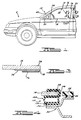
- Automotive vehicle V has a window opening 12 for a side windowpane 14.
- Window opening 12 is generally defined by roofline 16, beltline 18, mirror panel 20, and B pillar 22, with mirror panel 20 and B pillar 22 respectively defining the forward 24 and rearward 26 tracking lines for windowpane movement.
- window seal assembly 10 sealingly engages the lateral edge portions of windowpane 14 adjacent to mirror panel 20 and B pillar 22.
- FIG 2 is a partial cross-section taken along the line 2-2 of Figure 1, window seal assembly 10 used in the present invention is shown engaging lateral edge portion 28 of windowpane 14 and B pillar 22.
- B pillar 22 generally comprises inner sheet metal 30 and outer sheet metal 32 pinch-welded together to form pillar flanges 34 and 36.
- a decorative applique 38 of glass or plastic or the like can be attached to the outer surface of B pillar 22 by conventional means such as an adhesive 40 or double-sided adhesive tape.
- Mirror panel 20 also generally comprises two sheets of metal pinch-welded together to form a panel flange (not shown in the Figures), generally extending along forward tracking line 24, which provides a point of attachment for window seal assembly 10, similar to B pillar flange 36 described below.
- window seal assembly 10 is described below in relation to lateral edge 28 of windowpane 14 and flange 36 of B pillar 22, it should be understood that a similar arrangement of window seal assembly 10 is provided between the flange of mirror panel 20 and the lateral edge portion of windowpane 14 proximate thereto. It should also be appreciated that in vehicles lacking a mirror panel, the window seal assembly can instead directly engage the A pillar 42 of the vehicle.
- any panel, pillar or the like providing a forward tracking line for windowpane and a suitable point of attachment for windowpane seal assembly as described below can be utilized.
- window seal assembly 10 comprises a flexible sealing strip 44 which, in the section shown in Figure 2, is mounted on flange 36 of B pillar 22.
- Sealing strip 44 comprises a generally tubular body portion 46 and a U-shaped mounting portion 48 extending from and sharing common wall 50 with body portion 46.
- common and outer walls 50, 52 and side walls 54, 56 cooperate to define a hollow body interior 58 which extends at least substantially the entire length of sealing strip 44.
- the hollow tubular structure and side wall bellows of body portion 46 permit variable compression and expansion of body portion 46 of sealing strip 44 by an "accordian-like" action.
- Sealing strip 44 can be constructed of a conventional elastomeric material suitable for use in the sealing strip art. Suitable materials include polyvinyl chloride, natural or synthetic rubber, or the like. Preferably sealing strip 44 is comprised of rubber. Outer wall 52 of sealing strip 44 can also include a friction-reducing coating on its outer surface 60 to facilitate sliding of windowpane 14 into its ascended or descended positions. Alternatively, a friction-reducing coating can be provided on the opposing surface 62 of the second magnetic element 72 (to be described below), or on both surfaces 60 and 62. Suitable coating materials including low-friction coatings such as teflon, polyurethane and silicon, or flocking comprised of nylon or polyester.
- U-shaped mounting portion 48 of sealing strip 44 defines a U-shaped channel 64 for mounting sealing strip 44 onto flange 36 of B pillar 22.
- U-shaped mounting portion 48 is also provided with one or more gripping ribs 66 extending into U-shaped channel 64 which help maintain sealing strip 44 in position on flange 36.
- sealing strip 44 be provided with a metal core element 68, as is conventional in the art, for additional structural and gripping strength.
- sealing strip 44 further comprises a first magnetic element 70 embedded in outer wall 52 of body portion 46.
- Magnetic element 70 generally comprises either a permanent magnet or a ferrous material such as iron or steel.
- first magnetic element 70 may be in the form of a strip, particles, powder or the like, magnetic element 70 is preferably provided in the form of a strip which extends substantially the length of sealing strip 44.
- flexible elastomeric magnets such as those commonly used in refrigerator seals and which can be coextruded with sealing strip 44.
- window seal assembly 10 further comprises a second magnetic element 72 complementary to first magnetic element 70, mounted onto lateral edge portion 28 of side windowpane 14.
- Windowpane 14 is preferably provided with a ceramic layer 74 to which second magnetic element 72 is adhesively attached.
- Second magnetic element 72 also comprises a permanent magnet or a ferrous material as described with respect to first magnetic element 70.
- second magnetic element 76 mounted on edge portion 28 of windowpane 14 is depicted in Figure 3.
- second magnetic element 76 is provided with a nonmagnetic rim 78 which is in turn attached or adhesively bonded to ceramic layer 74.
- the second magnetic element can be provided directly in the ceramic layer by the addition of iron powder, magnetic particles, and the like, or can be directly attached to the window without an intermediate ceramic layer.
- both elements can be permanent magnets.
- permanent magnets with multiple pole magnetism patterns are used for magnetic elements, their orientation must be vertical such that each magnetic field is continuous for the entire length of the sealing portion strip.
- first and second magnetic elements herein described preferably comprise combinations of permanent magnets and ferrous materials, the magnetic aspect of the window seal assembly used in the present invention can instead be provided by electromagnetic means.
- window seal assembly 110 also comprises a flexible sealing strip 144 with a first magnetic element 170 embedded therein.
- sealing strip 144 is mounted directly on lateral edge portion 28 of side windowpane 14 by its U-shaped mounting portion 148.
- Second magnetic element 172 can be provided by the metal of the B pillar 22 of the vehicle body as shown in Figure 4, or, alternatively, in the form of a strip of magnetic or ferrous material (not shown in the Figures) attached thereto.
- FIG. 2 and 5 cross-sections of window seal assembly 10 taken along lines 2-2 and 5-5 of Figure 1, respectively, the operation of window seal assembly used in the present invention in sealing engagement with windowpane 14 and B pillar 22 can be further understood.
- body portion 46 of flexible sealing strip 44 When in sealing engagement, body portion 46 of flexible sealing strip 44 is compressively tapered along its length. As shown by Figures 2 and 5, when in position on B pillar 22, hollow body portion 46 of sealing strip 44 is increasingly compressed and decreases in width as it ascends from beltline 18 toward roofline 16 of vehicle V.
- sealing strip width is meant the distance between outer wall 52 and common wall 50 of body portion 46.
- this tapering can also be obtained or enhanced by providing a structurally tapered sealing strip in which the width of bellowed side walls 54, 56, and consequently the cross-sectional area of hollow interior 58 of body portion 46, is decreased as sealing strip 44 ascends from beltline 18 toward roofline 16.
- the compressibility of sealing strip 44 and its tapered configuration when in sealing engagement allows for the use of a camming mechanism for movement of a full flush window and, in addition, provides for a tear-away action of the magnetic seal used in the present invention.
- FIG. 6 shows windowpane 14 in an ascended or closed position.
- windowpane 14 pivots at its transverse roofline edge 80, allowing beltline edge 82 of windowpane 14 to move laterally or transversely inwardly (hereinafter referred to as a "camming" action), toward the passenger compartment.
- beltline transverse edge 82 of windowpane 14 has moved inward sufficiently to clear the beltline edge 84 of the vehicle door 86, windowpane 14 can begin its decent into a window tracking channel (not shown in the Figures) within the door, as shown in Figure 8.
- transverse roofline edge 80 of windowpane 14 must be held relatively stable in place provide a pivot point for the windowpane's inward movement at the beltline.
- the window sealing mechanism at the lateral edges of windowpane 14 must allow for the lateral or transverse movement of the windowpane 14 at its transverse beltline edge 82 so that the camming action for the opening of the window is not impeded.
- the sealing strip stop short of full compression or, if structurally tapered, short of a full taper, i.e. retaining some bellows in side walls 54, 56 at the roofline portion, in order to maintain good contact between seal surfaces.
- the relatively increased compressibility of the body portion of the sealing strip as it approaches beltline 18 results in a window seal assembly which does not offer undue compressive resistance to such movement of the windowpane's transverse beltline edge 82.
- the camming action required for full flush window movement is not impeded by the window seal assembly used in the present invention.
- a further feature of the window seal assembly used in the present invention is the tear-away action of the magnetic seal.
- tear-away action is particularly advantageous in frameless window systems in which the window is directly sealed to the automotive vehicle body and opening of the door requires the breaking of the magnetic seal.
- the sealing strip used in the present invention has a tapered configuration, with the body portion being less compressed at the beltline than at the roofline.
- the seal will naturally first break-away from beltline portion, and tear or peel away from the beltline to the roofline, allowing the door to be opened with ease.
- This offers an advantage over conventional magnetic seals utilizing sealing members which are uniformly configured in sealing engagement, since the require breaking of the magnetic seal at all points simultaneously.
- the tear-away action is less pronounced but is offset by the decrease in length of engagement of the magnetic seal.
- window seal assembly used in the present invention is herein described as directed toward automotive side windows located between the vehicle's roofline and beltline, the window seal assembly used in the present invention is not limited to automotive side windows.
- the window seal assembly used in the invention can be employed in a variety of vehicle window openings, wherever any of its features as described herein would be desirable.
- the window seal assembly can be used for vehicle "moonroofs", truck windows, locomotive windows or the like.
Landscapes
- Engineering & Computer Science (AREA)
- Mechanical Engineering (AREA)
- Seal Device For Vehicle (AREA)
- Window Of Vehicle (AREA)
- Specific Sealing Or Ventilating Devices For Doors And Windows (AREA)
Description
- The present invention relates to a frameless window assembly using a magnetic seal and having a movable windowpane capable of having all edges flush with the adjacent vehicle body panel.
- In recent years there has been much interest in aerodynamically designed automotive vehicles having windowpanes with all edges substantially flush (hereinafter referred to as "full flush") with the vehicle body. One such system is described in our copending European patent application No. 89311899.2 (EP-A-0 369 798). Full flush window systems, however, pose unique problems with respect to windowpane movement. For example, since a full flush windowpane is flush with the vehicle body at the beltline, opening of the window requires lateral or transverse inward movement of the windowpane at the beltline prior to its descent into the tracking channel in the vehicle door. Conventional framed automotive windows do not permit such lateral or transverse movement of the windowpane. Although elimination of window framework to allow for such movement would circumvent this problem, it is difficult to achieve a satisfactory window seal in frameless systems using conventional sealing techniques.
- For example, automotive windows are conventionally sealed using elastomeric strips which depend primarily upon compression for their sealing force. In frameless window systems, the use of conventional sealing strips generally requires higher compression to form an adequate seal, making it difficult to open and close the windows of the vehicle. Moreover, repeated compression of a sealing strip, particularly one requiring high compressive force for sealing, shortens the effective sealing life of the strip. If less compression of the strip is used to offset these problems, the integrity of the seal between the windowpane and vehicle body is reduced. This leads to increased windowpane flutter, wind noise and air entering the passenger compartment during operation of the vehicle.
- One alternative to compression-dependent sealing involves the use of magnetic elements in the sealing arrangement. Conventional magnetic seals such as that proposed in US-4535563, do not, however, offer an adequate solution to the sealing problems encountered in full flush or frameless window systems. For example, in frameless systems the windowpane is sealed directly to the automotive body and opening of the vehicle door requires breaking the seal between the windowpane and the vehicle. If the windowpane is sealed to the body using a conventional magnetic sealing arrangement, opening the vehicle door is difficult since the magnetic seal must be broken at all points simultaneously. In addition, in full flush window systems having lateral or transverse windowpane movement at the beltline, conventional magnetic sealing assemblies offer undue resistance to such movement. The resistance can be so great as to prevent use of a conventional camming mechanism for lateral or transverse windowpane movement.
- Thus, it would be desirable to provide a full flush or a frameless window assembly having a satisfactory seal between the window and the automotive body. It would also be desirable to provide a window assembly in which the sealing force is not entirely dependent upon the compression of the sealing member. It would further be desirable to provide a satisfactory window assembly including a window which is opened and closed by a camming mechanism, in which the sealing member does not offer undue compressive resistance to lateral or transverse movement of the windowpane at the beltline. It would also be desirable to provide a magnetic window assembly in a frameless system in which the door can be easily opened with the windowpane in the ascended, i.e. window opening closed, position.
- US-4535563, noted above, discloses a window assembly having the features of the precharacterizing portion of
claim 1. - According to the present invention, there is provided a window assembly in an automotive vehicle, comprising:-
- (a) a frameless movable windowpane,
- (b) a window opening, which opening is defined by adjacent body panels of the vehicle and which is opened and closed by the windowpane, and
- (c) a seal assembly, serving for sealing the windowpane, when in the closed position, with the edges of the windowpane flush with said adjacent body panels of the vehicle,
said seal assembly comprising:-- (i) an elongate flexible sealing strip having a first end and a second end, and comprising a compressible body portion, and a mounting portion for attaching said sealing strip either to one of said adjacent body panels of the vehicle or to an edge portion of said windowpane;
- (ii) a first magnetic element attached to said body portion; and
- (iii) a second magnetic element attached either to said edge portion of said windowpane or to said one of said adjacent body panels of the vehicle, whichever is not occupied by said mounting portion;
- In one embodiment:-
said mounting portion of the seal assembly is mounted on said vehicle and said second magnetic element is associated with, or forms part of, an edge portion of the windowpane. - In another embodiment:-
said mounting portion of the seal assembly is mounted on an edge portion of the windowpane and said second magnetic element is associated with, or forms part of, the vehicle. - In a preferred embodiment:-
said compressible body portion of the seal assembly includes a common wall, an outer wall and side walls extending therebetween, said walls defining a hollow interior of said body portion;
said mounting portion of the seal assembly, for attaching said sealing strip to said one of said adjacent body panels of the vehicle, extends from and shares said common wall with said body portion;
said first magnetic element of the seal assembly is embedded in said outer wall of said body portion; and
said second magnetic element of the seal assembly complementary to said first magnetic element, is attached to a lateral edge of said windowpane for cooperative engagement with said first magnetic element. - In a preferred embodiment:-
in the seal assembly said side walls are bellowed,
and:-
with the windowpane in a closed position, said sealing strip is compressively tapered by selective compression of said body portion along the length of said sealing strip, causing at least a portion of said bellowed side walls to compress in an accordion-like fashion. - In a preferred embodiment:-
said windowpane is located between the beltline and roofline of said vehicle and forward of the B-pillar of said vehicle,
and:-
said mounting portion of the seal assembly is a U-shaped mounting portion, for attaching said sealing strip to said adjacent side panels of the vehicle, said U-shaped mounting portion defining a U-shaped channel and said mounting portion including gripping ribs extending into said U-shaped channel;
and:-
said U-shaped mounting portion of the seal assembly is mounted on a lateral edge of said B pillar adjacent to said lateral edge of said windowpane,
and:-
said sealing strip of the sealing assembly is compressively tapered when in sealing engagement with said adjacent body panels of the vehicle and said windowpane, said sealing strip being less compressed at the beltline relative to the roofline of the vehicle. - The present invention will be understood from the following description of the preferred embodiments taken in conjunction with the drawings in which:
- Figure 1 is a partial side view of an automotive vehicle having a frameless window system with a movable windowpane shown in the fully ascended position;
- Figure 2 is a cross-sectional view, broken away, taken along line 2-2 of Figure 1, illustrating a preferred embodiment of the magnetic window seal assembly used in the present invention;
- Figure 3 is a cross-sectional view of a alternative preferred embodiment of the second magnetic element used in the present invention;
- Figure 4 is a cross-sectional view, broken away, similar to Figure 2, but showing an alternative preferred embodiment of the magnetic window seal assembly used in the present invention;
- Figure 5 is a cross-sectional view taken along the line 5-5 of Figure 1, illustrating the tapering of the sealing strip of Figure 2 when in sealing engagement with windowpane and B pillar; and
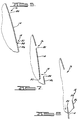
- Figures 6-8 are schematic representations of the lateral or transverse movement of a fully flush windowpane at its beltline edge and its descent into a vehicle door.
- Referring first to Figure 1, an automotive vehicle V with a frameless window system denoted generally by the numeral 10 is shown. Automotive vehicle V has a
window opening 12 for aside windowpane 14.Window opening 12 is generally defined byroofline 16,beltline 18,mirror panel 20, andB pillar 22, withmirror panel 20 andB pillar 22 respectively defining the forward 24 and rearward 26 tracking lines for windowpane movement. Whenside windowpane 14 is in an ascended position, i.e. window opening closed, window seal assembly 10 sealingly engages the lateral edge portions ofwindowpane 14 adjacent to mirrorpanel 20 andB pillar 22. - Turning now to Figure 2, which is a partial cross-section taken along the line 2-2 of Figure 1, window seal assembly 10 used in the present invention is shown engaging
lateral edge portion 28 ofwindowpane 14 andB pillar 22. As shown in Figure 2,B pillar 22 generally comprisesinner sheet metal 30 and outer sheet metal 32 pinch-welded together to formpillar flanges decorative applique 38 of glass or plastic or the like can be attached to the outer surface ofB pillar 22 by conventional means such as an adhesive 40 or double-sided adhesive tape. -
Mirror panel 20 also generally comprises two sheets of metal pinch-welded together to form a panel flange (not shown in the Figures), generally extending along forward trackingline 24, which provides a point of attachment for window seal assembly 10, similar toB pillar flange 36 described below. Thus, although window seal assembly 10 is described below in relation tolateral edge 28 ofwindowpane 14 andflange 36 ofB pillar 22, it should be understood that a similar arrangement of window seal assembly 10 is provided between the flange ofmirror panel 20 and the lateral edge portion ofwindowpane 14 proximate thereto. It should also be appreciated that in vehicles lacking a mirror panel, the window seal assembly can instead directly engage the A pillar 42 of the vehicle. Alternatively, any panel, pillar or the like providing a forward tracking line for windowpane and a suitable point of attachment for windowpane seal assembly as described below can be utilized. - As shown in Figure 2, window seal assembly 10 comprises a
flexible sealing strip 44 which, in the section shown in Figure 2, is mounted onflange 36 ofB pillar 22. Sealingstrip 44 comprises a generallytubular body portion 46 and a U-shaped mountingportion 48 extending from and sharingcommon wall 50 withbody portion 46. As shown in Figure 2, common andouter walls side walls strip 44. The hollow tubular structure and side wall bellows ofbody portion 46 permit variable compression and expansion ofbody portion 46 of sealingstrip 44 by an "accordian-like" action. - Sealing
strip 44 can be constructed of a conventional elastomeric material suitable for use in the sealing strip art. Suitable materials include polyvinyl chloride, natural or synthetic rubber, or the like. Preferably sealingstrip 44 is comprised of rubber.Outer wall 52 of sealingstrip 44 can also include a friction-reducing coating on itsouter surface 60 to facilitate sliding ofwindowpane 14 into its ascended or descended positions. Alternatively, a friction-reducing coating can be provided on the opposing surface 62 of the second magnetic element 72 (to be described below), or on bothsurfaces 60 and 62. Suitable coating materials including low-friction coatings such as teflon, polyurethane and silicon, or flocking comprised of nylon or polyester. - As further shown in Figure 2,
U-shaped mounting portion 48 of sealingstrip 44 defines a U-shaped channel 64 for mounting sealingstrip 44 ontoflange 36 ofB pillar 22. U-shaped mountingportion 48 is also provided with one or moregripping ribs 66 extending into U-shaped channel 64 which help maintain sealingstrip 44 in position onflange 36. It is also preferred that sealingstrip 44 be provided with a metal core element 68, as is conventional in the art, for additional structural and gripping strength. - As shown in Figure 2, sealing
strip 44 further comprises a firstmagnetic element 70 embedded inouter wall 52 ofbody portion 46.Magnetic element 70 generally comprises either a permanent magnet or a ferrous material such as iron or steel. Although firstmagnetic element 70 may be in the form of a strip, particles, powder or the like,magnetic element 70 is preferably provided in the form of a strip which extends substantially the length of sealingstrip 44. Most preferred are flexible elastomeric magnets such as those commonly used in refrigerator seals and which can be coextruded with sealingstrip 44. - Referring again to Figure 2, window seal assembly 10 further comprises a second
magnetic element 72 complementary to firstmagnetic element 70, mounted ontolateral edge portion 28 ofside windowpane 14.Windowpane 14 is preferably provided with aceramic layer 74 to which secondmagnetic element 72 is adhesively attached. Secondmagnetic element 72 also comprises a permanent magnet or a ferrous material as described with respect to firstmagnetic element 70. - An alternative embodiment of second
magnetic element 76 mounted onedge portion 28 ofwindowpane 14 is depicted in Figure 3. In Figure 3, secondmagnetic element 76 is provided with anonmagnetic rim 78 which is in turn attached or adhesively bonded toceramic layer 74. Alternatively (not shown in the Figures), the second magnetic element can be provided directly in the ceramic layer by the addition of iron powder, magnetic particles, and the like, or can be directly attached to the window without an intermediate ceramic layer. - Although it is preferred that one of the magnetic elements is a permanent magnet while the other is a ferrous metal, in accordance with the present invention both elements can be permanent magnets. In such case, care should be taken in mounting the first and second magnetic elements on the vehicle so that the magnetic flux of first and second magnetic elements be oriented in inverse directions, i.e. with opposite poles adjacent to each other so that the first and second magnetic elements will be attracted to each other. If permanent magnets with multiple pole magnetism patterns are used for magnetic elements, their orientation must be vertical such that each magnetic field is continuous for the entire length of the sealing portion strip. It should also be appreciated that, although first and second magnetic elements herein described preferably comprise combinations of permanent magnets and ferrous materials, the magnetic aspect of the window seal assembly used in the present invention can instead be provided by electromagnetic means.
- Turning now to Figure 4, another preferred embodiment of the magnetic window seal assembly used in the present invention is shown and denoted generally by the numeral 110. As in the embodiment depicted in Figure 2,
window seal assembly 110 also comprises aflexible sealing strip 144 with a firstmagnetic element 170 embedded therein. In the embodiment shown in Figure 4, however, sealingstrip 144 is mounted directly onlateral edge portion 28 ofside windowpane 14 by itsU-shaped mounting portion 148. Secondmagnetic element 172 can be provided by the metal of theB pillar 22 of the vehicle body as shown in Figure 4, or, alternatively, in the form of a strip of magnetic or ferrous material (not shown in the Figures) attached thereto. - Referring now to Figures 2 and 5, cross-sections of window seal assembly 10 taken along lines 2-2 and 5-5 of Figure 1, respectively, the operation of window seal assembly used in the present invention in sealing engagement with
windowpane 14 andB pillar 22 can be further understood. When in sealing engagement,body portion 46 offlexible sealing strip 44 is compressively tapered along its length. As shown by Figures 2 and 5, when in position onB pillar 22,hollow body portion 46 of sealingstrip 44 is increasingly compressed and decreases in width as it ascends frombeltline 18 towardroofline 16 of vehicle V. By sealing strip width is meant the distance betweenouter wall 52 andcommon wall 50 ofbody portion 46. It should also be appreciated that this tapering can also be obtained or enhanced by providing a structurally tapered sealing strip in which the width of bellowedside walls hollow interior 58 ofbody portion 46, is decreased as sealingstrip 44 ascends frombeltline 18 towardroofline 16. The compressibility of sealingstrip 44 and its tapered configuration when in sealing engagement, as discussed below in greater detail, allows for the use of a camming mechanism for movement of a full flush window and, in addition, provides for a tear-away action of the magnetic seal used in the present invention. - Turning now to the Figures 6-8, a schematic representation of the opening a full flush frameless window system by a camming mechanism is shown. Figure 6 shows
windowpane 14 in an ascended or closed position. Upon opening of the window, as shown in Figure 7,windowpane 14 pivots at itstransverse roofline edge 80, allowing beltline edge 82 ofwindowpane 14 to move laterally or transversely inwardly (hereinafter referred to as a "camming" action), toward the passenger compartment. Once beltline transverse edge 82 ofwindowpane 14 has moved inward sufficiently to clear thebeltline edge 84 of thevehicle door 86,windowpane 14 can begin its decent into a window tracking channel (not shown in the Figures) within the door, as shown in Figure 8. - At the beginning of the camming action of
movable windowpane 14,transverse roofline edge 80 ofwindowpane 14 must be held relatively stable in place provide a pivot point for the windowpane's inward movement at the beltline. In addition, the window sealing mechanism at the lateral edges ofwindowpane 14 must allow for the lateral or transverse movement of thewindowpane 14 at its transverse beltline edge 82 so that the camming action for the opening of the window is not impeded. Both of these features are provided by the window seal assembly used in the present invention more fully as described below. - As described previously, due to the variable compression or tapered structure of the body portion of the sealing strip, there is a decrease in the relative compressibility of the body portion at the
roofline 16. This decrease in relative compressibility of the sealing strip at the roofline stabilizes thetransverse roofline edge 80 ofwindowpane 14 at the windowpane's uppermost lateral sealing points, creating a hinge-like effect and permittingwindowpane 14 to stably pivot at theroofline 16. Although decreased compressibility of the sealing strip at theroofline 16 is desired, it is preferred that the sealing strip stop short of full compression or, if structurally tapered, short of a full taper, i.e. retaining some bellows inside walls - With respect to lateral or transverse movement of
windowpane 14 at the beltline 18, the relatively increased compressibility of the body portion of the sealing strip as it approaches beltline 18 results in a window seal assembly which does not offer undue compressive resistance to such movement of the windowpane's transverse beltline edge 82. Thus the camming action required for full flush window movement is not impeded by the window seal assembly used in the present invention. - A further feature of the window seal assembly used in the present invention is the tear-away action of the magnetic seal. Such tear-away action is particularly advantageous in frameless window systems in which the window is directly sealed to the automotive vehicle body and opening of the door requires the breaking of the magnetic seal. When in sealing engagement with the windowpane in the ascended position, the sealing strip used in the present invention has a tapered configuration, with the body portion being less compressed at the beltline than at the roofline. Upon opening of the door, the seal will naturally first break-away from beltline portion, and tear or peel away from the beltline to the roofline, allowing the door to be opened with ease. This offers an advantage over conventional magnetic seals utilizing sealing members which are uniformly configured in sealing engagement, since the require breaking of the magnetic seal at all points simultaneously. When the window is partially descended, the tear-away action is less pronounced but is offset by the decrease in length of engagement of the magnetic seal.
- It should be understood that although the window seal assembly used in the present invention is herein described as directed toward automotive side windows located between the vehicle's roofline and beltline, the window seal assembly used in the present invention is not limited to automotive side windows. In accordance with the principles of the present invention, the window seal assembly used in the invention can be employed in a variety of vehicle window openings, wherever any of its features as described herein would be desirable. For example, the window seal assembly can be used for vehicle "moonroofs", truck windows, locomotive windows or the like.
said body portion of said sealing strip of the seal assembly is an elongated tubular hollow portion which is compressible laterally,
and in that:-
with the windowpane in a closed position, the edges of the windowpane being flush with said adjacent body panels of the vehicle and said window seal assembly being in operative sealing engagement with said windowpane, said body portion has a tapered configuration, said compressible body portion decreasing in width from said first end of the sealing strip to said second end of the sealing strip.
Claims (14)
- A window assembly (10, 110) in an automotive vehicle (V), comprising:-(a) a frameless movable windowpane (14),(b) a window opening (12), which opening is defined by adjacent body panels of the vehicle (V) and which is opened and closed by the windowpane (14), and(c) a seal assembly (10, 110), serving for sealing the windowpane (14), when in the closed position, with the edges of the windowpane flush with said adjacent body panels of the vehicle (V),the window assembly being characterised in that:-
said seal assembly (10, 110) comprising:-(i) an elongate flexible sealing strip (44, 144) having a first end and a second end, and comprising a compressible body portion (46), and a mounting portion (48, 148) for attaching said sealing strip (44, 144) either to one of said adjacent body panels of the vehicle (V) or to an edge portion of said windowpane (14);(ii) a first magnetic element (70, 170) attached to said body portion (46); and(iii) a second magnetic element (72, 172) attached either to said edge portion of said windowpane (14) or to said one of said adjacent body panels of the vehicle (V), whichever is not occupied by said mounting portion (48, 148);
said body portion (46) of said sealing strip (44, 144) of the seal assembly (10, 110) is an elongated tubular hollow portion which is compressible laterally,
and in that:-
with the windowpane (14) in a closed position, the edges of the windowpane (14) being flush with said adjacent body panels of the vehicle (V) and said window seal assembly (10, 110) being in operative sealing engagement with said windowpane (14), said body portion (46) has a tapered configuration, said compressible body portion (46) decreasing in width from said first end of the sealing strip (44, 144) to said second end of the sealing strip (44, 144). - A window assembly according to claim 1, wherein said mounting portion (48) of the seal assembly (10) is mounted on said vehicle (V) and said second magnetic element (72) is associated with, or forms part of, an edge portion (28) of the windowpane (14).
- A window assembly according to claim 1, wherein said mounting portion (148) of the seal assembly (110) is mounted on an edge portion (28) of the windowpane (14) and said second magnetic element (172) is associated with, or forms part of, the vehicle (V).
- A window assembly according to claim 3, wherein the second magnetic element (172) of the seal assembly (110) is constituted by the vehicle (V) which is ferrous in nature.
- A window assembly according to any one of claims 1 to 4, wherein said sealing strip (44, 144) of the seal assembly (10, 110) is structurally tapered.
- A window assembly according to any preceding claim, wherein at least one of said magnetic elements (70, 170, 72, 172) of the seal assembly (10, 110) is a permanent magnet.
- A window assembly according to any preceding claim, wherein at least one of said magnetic elements (70, 170, 72, 172) of the seal assembly (10, 110) is a ferrous metal.
- A window assembly according to claim 1, wherein:-
said compressible body portion (46) of the seal assembly (10) includes a common wall (50), an outer wall (52) and side walls (54, 56) extending therebetween, said walls (50, 52, 54, 56) defining a hollow interior (58) of said body portion (46);
said mounting portion (48) of the seal assembly (10), for attaching said sealing strip (44) to said one of said adjacent body panels of the vehicle (V), extends from and shares said common wall (50) with said body portion (46);
said first magnetic element (70) of the seal assembly (10) is embedded in said outer wall (52) of said body portion (46); and
said second magnetic element (72) of the seal assembly (10, 110) complementary to said first magnetic element (70), is attached to a lateral edge (28) of said windowpane (14) for cooperative engagement with said first magnetic element (70). - A window assembly according to claim 8, wherein said first magnetic element (70) of the seal assembly (10) is a flexible elastomeric magnet.
- A window assembly according to claim 8 or 9, wherein:-
in the seal assembly (10) said side walls (54, 56) are bellowed,
and wherein:-
with the windowpane (14) in a closed position, said sealing strip (44) is compressively tapered by selective compression of said body portion (46) along the length of said sealing strip (44), causing at least a portion of said bellowed side walls (54, 56) to compress in an accordion-like fashion. - A window assembly according to any one of claims 8 to 10, the seal assembly (10) further comprising a ceramic layer (74) on said lateral edge (28) of said windowpane (14), wherein said second magnetic element (72) is bonded to said ceramic layer (74).
- A window assembly according to any preceding claim, wherein said sealing strip (44) of the seal assembly (10, 110) is comprised of rubber.
- A window assembly according to claim 9, wherein said windowpane (14) is located between the beltline (18) and roofline (16) of said vehicle (V) and forward of the B-pillar (22) of said vehicle (V),
and wherein:-
said mounting portion (48) of the seal assembly (10, 110) is a U-shaped mounting portion (48), for attaching said sealing strip (44) to said adjacent side panels of the vehicle (V), said U-shaped mounting portion (48) defining a U-shaped channel (64) and said mounting portion (48) including gripping ribs (66) extending into said U-shaped channel (64);
and wherein:-
said U-shaped mounting portion (48) of the seal assembly (10, 110) is mounted on a lateral edge of said B pillar (22) adjacent to said lateral edge (28) of said windowpane (14),
and wherein:-
said sealing strip (44) of the sealing assembly is compressively tapered when in sealing engagement with said adjacent body panels of the vehicle (V) and said windowpane (14), said sealing strip (44) being less compressed at the beltline (18) relative to the roofline (16) of the vehicle (V). - A window assembly according to claim 13, wherein said windowpane (14) is moved by a camming mechanism.
Applications Claiming Priority (2)
| Application Number | Priority Date | Filing Date | Title |
|---|---|---|---|
| US27248488A | 1988-11-16 | 1988-11-16 | |
| US272484 | 1988-11-16 |
Publications (3)
| Publication Number | Publication Date |
|---|---|
| EP0369799A2 EP0369799A2 (en) | 1990-05-23 |
| EP0369799A3 EP0369799A3 (en) | 1990-12-27 |
| EP0369799B1 true EP0369799B1 (en) | 1994-02-09 |
Family
ID=23039995
Family Applications (1)
| Application Number | Title | Priority Date | Filing Date |
|---|---|---|---|
| EP89311900A Expired - Lifetime EP0369799B1 (en) | 1988-11-16 | 1989-11-16 | Magnetic window seal assembly |
Country Status (6)
| Country | Link |
|---|---|
| EP (1) | EP0369799B1 (en) |
| JP (1) | JP2860566B2 (en) |
| KR (1) | KR900007641A (en) |
| AU (1) | AU637771B2 (en) |
| CA (1) | CA1326874C (en) |
| DE (1) | DE68913009T2 (en) |
Families Citing this family (22)
| Publication number | Priority date | Publication date | Assignee | Title |
|---|---|---|---|---|
| CA2002151A1 (en) * | 1989-05-11 | 1990-11-11 | Scott E. Baker | Magnetic seal |
| IT1248065B (en) * | 1991-06-17 | 1995-01-05 | Ilpea Ind Spa | MAGNETIC GASKET SUITABLE IN PARTICULAR TO CARRY OUT A SEAL BETWEEN A FIXED PART, SUCH AS, FOR EXAMPLE, THE BODY OF A VEHICLE, AND AN OPENING PART, SUCH AS, FOR EXAMPLE, THE DOOR, IN CURVILINEOUS AREAS. |
| FR2724600B1 (en) * | 1994-09-20 | 1997-04-18 | Peugeot | ARRANGEMENT FOR HOLDING A GLASS OF A DOOR OF A MOTOR VEHICLE ON THE BODY THEREOF |
| IT1284803B1 (en) * | 1996-09-19 | 1998-05-22 | Fiat Auto Spa | PART COVERING SYSTEM OF THE DOOR OF A MOTOR VEHICLE |
| GB9711357D0 (en) * | 1997-06-02 | 1997-07-30 | Hobby Peter | Flexible strip |
| IT247920Y1 (en) * | 1999-03-09 | 2002-09-16 | Italdesign Spa | SERVO-ASSISTED SYSTEM FOR THE OPENING AND CLOSING OF LATERALID GLASSES IN A CAR. |
| GB2348232B (en) * | 1999-03-25 | 2003-10-01 | Draftex Ind Ltd | Sealing,trimming and finishing strips |
| DE10040919A1 (en) * | 2000-08-18 | 2002-03-07 | Webasto Vehicle Sys Int Gmbh | Seal for vehicle roof has magnetic element in it to act with first or second roof part |
| FR2813244B1 (en) * | 2000-08-28 | 2003-03-07 | Renault | VEHICLE OPENING ELEMENT WITH A MAGNETIC SEAL |
| US20050198904A1 (en) * | 2004-03-12 | 2005-09-15 | Browne Alan L. | Active seal assemblies for movable windows |
| KR100551802B1 (en) * | 2004-05-13 | 2006-02-13 | 기아자동차주식회사 | Noise prevention method and device for automobile door window |
| JP5091405B2 (en) * | 2005-12-28 | 2012-12-05 | 有限会社ヤマヱ | Liquid purification device |
| CA2650843C (en) * | 2006-05-05 | 2013-05-21 | Grant W. Crider | Portal covering for controlled environments |
| DE202006008136U1 (en) * | 2006-05-19 | 2006-07-20 | Rehau Ag + Co | Sealing profile with magnet e.g. for shower cabin doors, has mounting element and soft seal part, which contain polymer-bound magnetic strip PVC components and magnetic strip joined and connected by coextrusion work tool |
| DE102009035561A1 (en) * | 2009-07-31 | 2011-02-03 | Aktiebolaget Skf | Sealing arrangement for sealing gap between housing of rechargeable battery of power supply arrangement and housing of electric car, has tolerance element for adjusting variable distance between housing and component |
| FR2978517B1 (en) * | 2011-07-29 | 2014-05-30 | Jpr | JOINT CONNECTION BETWEEN TWO MOBILE STRUCTURES BETWEEN THEM. |
| CN102642310B (en) * | 2012-05-09 | 2014-05-07 | 安徽万朗磁塑集团有限公司 | Fully-automatic production line for sealing strips of refrigerator doors |
| US10718435B2 (en) * | 2018-03-12 | 2020-07-21 | Gdc, Inc. | Compressible seal for sealing an interface between a recreational vehicle slide out and a recreational vehicle frame |
| CN111422046B (en) * | 2020-04-22 | 2022-03-25 | 东风汽车集团有限公司 | Magnetic glass guide groove sealing strip and sealing system |
| CN115709636B (en) * | 2022-11-16 | 2026-01-02 | 北京海纳川汽车部件股份有限公司 | Frameless door glass sealing structure and vehicles with it |
| CN116039352B (en) * | 2023-01-29 | 2026-01-02 | 奇瑞汽车股份有限公司 | A vehicle-mounted water-repellent sealing device and control method for removing rainwater. |
| FR3155746B1 (en) * | 2023-11-24 | 2025-11-28 | Saint Gobain | VEHICLE GLAZING WITH MAGNETIC SUPPORT |
Family Cites Families (4)
| Publication number | Priority date | Publication date | Assignee | Title |
|---|---|---|---|---|
| JPS55120517U (en) * | 1979-02-20 | 1980-08-26 | ||
| FR2544372B1 (en) * | 1982-11-08 | 1985-11-08 | Mesnel Sa Ets | MAGNETIC "FLUSHING" MOBILE WINDOWS, ESPECIALLY FOR AUTOMOBILE DOORS |
| FR2555650B1 (en) * | 1983-11-30 | 1987-07-10 | Laques Indochin Caoutchouc Ind | SEALING DEVICE FOR MOBILE PANEL, PARTICULARLY SIDE GLASS OF AUTOMOBILE |
| JPS61165818U (en) * | 1985-04-04 | 1986-10-15 |
-
1989
- 1989-08-14 CA CA000608237A patent/CA1326874C/en not_active Expired - Fee Related
- 1989-10-18 AU AU43515/89A patent/AU637771B2/en not_active Ceased
- 1989-11-02 JP JP1287309A patent/JP2860566B2/en not_active Expired - Fee Related
- 1989-11-15 KR KR1019890016656A patent/KR900007641A/en not_active Withdrawn
- 1989-11-16 DE DE68913009T patent/DE68913009T2/en not_active Expired - Fee Related
- 1989-11-16 EP EP89311900A patent/EP0369799B1/en not_active Expired - Lifetime
Also Published As
| Publication number | Publication date |
|---|---|
| AU4351589A (en) | 1990-05-24 |
| KR900007641A (en) | 1990-06-01 |
| EP0369799A2 (en) | 1990-05-23 |
| EP0369799A3 (en) | 1990-12-27 |
| DE68913009D1 (en) | 1994-03-24 |
| AU637771B2 (en) | 1993-06-10 |
| JPH02175429A (en) | 1990-07-06 |
| JP2860566B2 (en) | 1999-02-24 |
| DE68913009T2 (en) | 1994-05-19 |
| CA1326874C (en) | 1994-02-08 |
Similar Documents
| Publication | Publication Date | Title |
|---|---|---|
| US4999951A (en) | Magnetic window seal assembly | |
| EP0369799A2 (en) | Magnetic window seal assembly | |
| US5355628A (en) | Weatherstrip for a vehicle door | |
| US5038521A (en) | Sealing strips | |
| EP1232887B1 (en) | Door frame structure of motor vehicle | |
| US5345717A (en) | Window construction for vehicles | |
| US6691464B2 (en) | Vertical slider window assembly | |
| EP0612638B1 (en) | Four-sided flush glass assembly | |
| US5027556A (en) | Window sealing and guiding arrangements | |
| JP2816405B2 (en) | Automobile frame structure and frame manufacturing method | |
| EP0599538A1 (en) | Belt weatherstrip | |
| EP0783988B1 (en) | Weather strip for motor vehicles | |
| EP0376450A2 (en) | Sealing system for movable dual pane glass | |
| EP0684158A1 (en) | Flexible sealing unit for movable windows | |
| EP0739770A1 (en) | Four sided flush sealing system | |
| EP0436298B1 (en) | A door glass weather-stripping for motor vehicle | |
| EP0521611B1 (en) | Door seals | |
| US5367831A (en) | Flush mount magnetic header seal | |
| US20040134132A1 (en) | Sealing and guiding strips | |
| US4581851A (en) | Window arrangement having a pane which is adjustable in height, particularly for motor vehicles | |
| JPS633284Y2 (en) | ||
| US6748638B2 (en) | Apparatus and method for locating a vehicle window panel | |
| JPH07223437A (en) | Weather strip mounting structure | |
| EP0747265A1 (en) | Retaining, sealing or finishing strips | |
| GB2086459A (en) | Improvements in and relating to sealing strips |
Legal Events
| Date | Code | Title | Description |
|---|---|---|---|
| PUAI | Public reference made under article 153(3) epc to a published international application that has entered the european phase |
Free format text: ORIGINAL CODE: 0009012 |
|
| AK | Designated contracting states |
Kind code of ref document: A2 Designated state(s): DE FR GB |
|
| PUAL | Search report despatched |
Free format text: ORIGINAL CODE: 0009013 |
|
| AK | Designated contracting states |
Kind code of ref document: A3 Designated state(s): DE FR GB |
|
| 17P | Request for examination filed |
Effective date: 19901228 |
|
| 17Q | First examination report despatched |
Effective date: 19920124 |
|
| GRAA | (expected) grant |
Free format text: ORIGINAL CODE: 0009210 |
|
| AK | Designated contracting states |
Kind code of ref document: B1 Designated state(s): DE FR GB |
|
| REF | Corresponds to: |
Ref document number: 68913009 Country of ref document: DE Date of ref document: 19940324 |
|
| ET | Fr: translation filed | ||
| PLBE | No opposition filed within time limit |
Free format text: ORIGINAL CODE: 0009261 |
|
| STAA | Information on the status of an ep patent application or granted ep patent |
Free format text: STATUS: NO OPPOSITION FILED WITHIN TIME LIMIT |
|
| 26N | No opposition filed | ||
| PGFP | Annual fee paid to national office [announced via postgrant information from national office to epo] |
Ref country code: DE Payment date: 20001124 Year of fee payment: 12 |
|
| REG | Reference to a national code |
Ref country code: GB Ref legal event code: IF02 |
|
| PG25 | Lapsed in a contracting state [announced via postgrant information from national office to epo] |
Ref country code: DE Free format text: LAPSE BECAUSE OF NON-PAYMENT OF DUE FEES Effective date: 20020702 |
|
| PGFP | Annual fee paid to national office [announced via postgrant information from national office to epo] |
Ref country code: GB Payment date: 20041207 Year of fee payment: 16 |
|
| PGFP | Annual fee paid to national office [announced via postgrant information from national office to epo] |
Ref country code: FR Payment date: 20041222 Year of fee payment: 16 |
|
| REG | Reference to a national code |
Ref country code: FR Ref legal event code: CD |
|
| PG25 | Lapsed in a contracting state [announced via postgrant information from national office to epo] |
Ref country code: GB Free format text: LAPSE BECAUSE OF NON-PAYMENT OF DUE FEES Effective date: 20051116 |
|
| GBPC | Gb: european patent ceased through non-payment of renewal fee |
Effective date: 20051116 |
|
| PG25 | Lapsed in a contracting state [announced via postgrant information from national office to epo] |
Ref country code: FR Free format text: LAPSE BECAUSE OF NON-PAYMENT OF DUE FEES Effective date: 20060731 |
|
| REG | Reference to a national code |
Ref country code: FR Ref legal event code: ST Effective date: 20060731 |