EP0369443B1 - Positively chargeable developer - Google Patents
Positively chargeable developer Download PDFInfo
- Publication number
- EP0369443B1 EP0369443B1 EP89121222A EP89121222A EP0369443B1 EP 0369443 B1 EP0369443 B1 EP 0369443B1 EP 89121222 A EP89121222 A EP 89121222A EP 89121222 A EP89121222 A EP 89121222A EP 0369443 B1 EP0369443 B1 EP 0369443B1
- Authority
- EP
- European Patent Office
- Prior art keywords
- toner
- developer according
- fine
- amount
- parts
- Prior art date
- Legal status (The legal status is an assumption and is not a legal conclusion. Google has not performed a legal analysis and makes no representation as to the accuracy of the status listed.)
- Expired - Lifetime
Links
- VYPSYNLAJGMNEJ-UHFFFAOYSA-N Silicium dioxide Chemical compound O=[Si]=O VYPSYNLAJGMNEJ-UHFFFAOYSA-N 0.000 claims description 155
- 239000002245 particle Substances 0.000 claims description 83
- 239000000377 silicon dioxide Substances 0.000 claims description 69
- 239000000843 powder Substances 0.000 claims description 68
- 239000011347 resin Substances 0.000 claims description 38
- 229920005989 resin Polymers 0.000 claims description 38
- 230000005291 magnetic effect Effects 0.000 claims description 25
- YCKRFDGAMUMZLT-UHFFFAOYSA-N Fluorine atom Chemical compound [F] YCKRFDGAMUMZLT-UHFFFAOYSA-N 0.000 claims description 19
- 239000011737 fluorine Substances 0.000 claims description 19
- 229910052731 fluorine Inorganic materials 0.000 claims description 19
- FZHAPNGMFPVSLP-UHFFFAOYSA-N silanamine Chemical compound [SiH3]N FZHAPNGMFPVSLP-UHFFFAOYSA-N 0.000 claims description 16
- 230000002209 hydrophobic effect Effects 0.000 claims description 14
- 239000007822 coupling agent Substances 0.000 claims description 13
- 238000007254 oxidation reaction Methods 0.000 claims description 13
- 230000003647 oxidation Effects 0.000 claims description 12
- 238000002425 crystallisation Methods 0.000 claims description 10
- 230000008025 crystallization Effects 0.000 claims description 10
- 238000009736 wetting Methods 0.000 claims description 10
- 125000004432 carbon atom Chemical group C* 0.000 claims description 9
- 125000003545 alkoxy group Chemical group 0.000 claims description 6
- 125000000217 alkyl group Chemical group 0.000 claims description 6
- 125000003118 aryl group Chemical group 0.000 claims description 6
- 239000010419 fine particle Substances 0.000 claims description 6
- 125000002947 alkylene group Chemical group 0.000 claims description 5
- 239000011230 binding agent Substances 0.000 claims description 5
- 125000000843 phenylene group Chemical group C1(=C(C=CC=C1)*)* 0.000 claims description 5
- 125000003277 amino group Chemical group 0.000 claims description 3
- 229910052799 carbon Inorganic materials 0.000 claims description 3
- 150000001875 compounds Chemical class 0.000 claims description 3
- 125000001302 tertiary amino group Chemical group 0.000 claims description 3
- 238000012360 testing method Methods 0.000 claims description 3
- SSROBHHOWHPCHF-UHFFFAOYSA-N n-octyl-n-(3-trimethoxysilylpropyl)octan-1-amine Chemical compound CCCCCCCCN(CCC[Si](OC)(OC)OC)CCCCCCCC SSROBHHOWHPCHF-UHFFFAOYSA-N 0.000 claims 1
- 238000000034 method Methods 0.000 description 46
- UQSXHKLRYXJYBZ-UHFFFAOYSA-N iron oxide Inorganic materials [Fe]=O UQSXHKLRYXJYBZ-UHFFFAOYSA-N 0.000 description 27
- 229920001577 copolymer Polymers 0.000 description 19
- 238000011161 development Methods 0.000 description 17
- XEEYBQQBJWHFJM-UHFFFAOYSA-N Iron Chemical compound [Fe] XEEYBQQBJWHFJM-UHFFFAOYSA-N 0.000 description 14
- 235000013980 iron oxide Nutrition 0.000 description 14
- 239000003795 chemical substances by application Substances 0.000 description 13
- 235000012239 silicon dioxide Nutrition 0.000 description 12
- -1 siloxane units Chemical group 0.000 description 12
- 239000002033 PVDF binder Substances 0.000 description 11
- 239000000203 mixture Substances 0.000 description 11
- 229920002981 polyvinylidene fluoride Polymers 0.000 description 11
- 239000000463 material Substances 0.000 description 10
- 229910052710 silicon Inorganic materials 0.000 description 10
- 239000010703 silicon Substances 0.000 description 10
- RMAQACBXLXPBSY-UHFFFAOYSA-N silicic acid Chemical compound O[Si](O)(O)O RMAQACBXLXPBSY-UHFFFAOYSA-N 0.000 description 9
- XUIMIQQOPSSXEZ-UHFFFAOYSA-N Silicon Chemical compound [Si] XUIMIQQOPSSXEZ-UHFFFAOYSA-N 0.000 description 7
- PPBRXRYQALVLMV-UHFFFAOYSA-N Styrene Chemical compound C=CC1=CC=CC=C1 PPBRXRYQALVLMV-UHFFFAOYSA-N 0.000 description 7
- 238000009826 distribution Methods 0.000 description 7
- XLYOFNOQVPJJNP-UHFFFAOYSA-N water Substances O XLYOFNOQVPJJNP-UHFFFAOYSA-N 0.000 description 7
- FAPWRFPIFSIZLT-UHFFFAOYSA-M Sodium chloride Chemical compound [Na+].[Cl-] FAPWRFPIFSIZLT-UHFFFAOYSA-M 0.000 description 6
- 230000004927 fusion Effects 0.000 description 6
- 239000004115 Sodium Silicate Substances 0.000 description 5
- 238000004140 cleaning Methods 0.000 description 5
- 230000000694 effects Effects 0.000 description 5
- 230000007613 environmental effect Effects 0.000 description 5
- NTHWMYGWWRZVTN-UHFFFAOYSA-N sodium silicate Chemical group [Na+].[Na+].[O-][Si]([O-])=O NTHWMYGWWRZVTN-UHFFFAOYSA-N 0.000 description 5
- 229910052911 sodium silicate Inorganic materials 0.000 description 5
- 239000000243 solution Substances 0.000 description 5
- 238000006243 chemical reaction Methods 0.000 description 4
- 238000000354 decomposition reaction Methods 0.000 description 4
- 238000004090 dissolution Methods 0.000 description 4
- 238000001035 drying Methods 0.000 description 4
- FFUAGWLWBBFQJT-UHFFFAOYSA-N hexamethyldisilazane Chemical compound C[Si](C)(C)N[Si](C)(C)C FFUAGWLWBBFQJT-UHFFFAOYSA-N 0.000 description 4
- SZVJSHCCFOBDDC-UHFFFAOYSA-N iron(II,III) oxide Inorganic materials O=[Fe]O[Fe]O[Fe]=O SZVJSHCCFOBDDC-UHFFFAOYSA-N 0.000 description 4
- 238000010298 pulverizing process Methods 0.000 description 4
- 238000012546 transfer Methods 0.000 description 4
- 229910000859 α-Fe Inorganic materials 0.000 description 4
- 239000000654 additive Substances 0.000 description 3
- 229910052782 aluminium Inorganic materials 0.000 description 3
- 230000000052 comparative effect Effects 0.000 description 3
- LIKFHECYJZWXFJ-UHFFFAOYSA-N dimethyldichlorosilane Chemical compound C[Si](C)(Cl)Cl LIKFHECYJZWXFJ-UHFFFAOYSA-N 0.000 description 3
- 239000008151 electrolyte solution Substances 0.000 description 3
- 238000004898 kneading Methods 0.000 description 3
- 238000004519 manufacturing process Methods 0.000 description 3
- 238000005259 measurement Methods 0.000 description 3
- 239000011780 sodium chloride Substances 0.000 description 3
- 239000000126 substance Substances 0.000 description 3
- SJECZPVISLOESU-UHFFFAOYSA-N 3-trimethoxysilylpropan-1-amine Chemical compound CO[Si](OC)(OC)CCCN SJECZPVISLOESU-UHFFFAOYSA-N 0.000 description 2
- RSWGJHLUYNHPMX-UHFFFAOYSA-N Abietic-Saeure Natural products C12CCC(C(C)C)=CC2=CCC2C1(C)CCCC2(C)C(O)=O RSWGJHLUYNHPMX-UHFFFAOYSA-N 0.000 description 2
- IJGRMHOSHXDMSA-UHFFFAOYSA-N Atomic nitrogen Chemical compound N#N IJGRMHOSHXDMSA-UHFFFAOYSA-N 0.000 description 2
- PXHVJJICTQNCMI-UHFFFAOYSA-N Nickel Chemical compound [Ni] PXHVJJICTQNCMI-UHFFFAOYSA-N 0.000 description 2
- BPQQTUXANYXVAA-UHFFFAOYSA-N Orthosilicate Chemical compound [O-][Si]([O-])([O-])[O-] BPQQTUXANYXVAA-UHFFFAOYSA-N 0.000 description 2
- 239000004952 Polyamide Substances 0.000 description 2
- 239000004743 Polypropylene Substances 0.000 description 2
- 239000004793 Polystyrene Substances 0.000 description 2
- KHPCPRHQVVSZAH-HUOMCSJISA-N Rosin Natural products O(C/C=C/c1ccccc1)[C@H]1[C@H](O)[C@@H](O)[C@@H](O)[C@@H](CO)O1 KHPCPRHQVVSZAH-HUOMCSJISA-N 0.000 description 2
- GWEVSGVZZGPLCZ-UHFFFAOYSA-N Titan oxide Chemical compound O=[Ti]=O GWEVSGVZZGPLCZ-UHFFFAOYSA-N 0.000 description 2
- XLOMVQKBTHCTTD-UHFFFAOYSA-N Zinc monoxide Chemical compound [Zn]=O XLOMVQKBTHCTTD-UHFFFAOYSA-N 0.000 description 2
- 238000010521 absorption reaction Methods 0.000 description 2
- 239000002253 acid Substances 0.000 description 2
- 230000000996 additive effect Effects 0.000 description 2
- 150000001721 carbon Chemical group 0.000 description 2
- IJOOHPMOJXWVHK-UHFFFAOYSA-N chlorotrimethylsilane Chemical compound C[Si](C)(C)Cl IJOOHPMOJXWVHK-UHFFFAOYSA-N 0.000 description 2
- 229910052681 coesite Inorganic materials 0.000 description 2
- 239000003086 colorant Substances 0.000 description 2
- 229910052906 cristobalite Inorganic materials 0.000 description 2
- 239000006185 dispersion Substances 0.000 description 2
- 239000000975 dye Substances 0.000 description 2
- 230000005684 electric field Effects 0.000 description 2
- 239000003337 fertilizer Substances 0.000 description 2
- 238000000227 grinding Methods 0.000 description 2
- 230000000977 initiatory effect Effects 0.000 description 2
- 150000002500 ions Chemical class 0.000 description 2
- 230000007774 longterm Effects 0.000 description 2
- 229910052751 metal Inorganic materials 0.000 description 2
- 239000002184 metal Substances 0.000 description 2
- 229910044991 metal oxide Inorganic materials 0.000 description 2
- 150000004706 metal oxides Chemical class 0.000 description 2
- 239000000049 pigment Substances 0.000 description 2
- BASFCYQUMIYNBI-UHFFFAOYSA-N platinum Chemical compound [Pt] BASFCYQUMIYNBI-UHFFFAOYSA-N 0.000 description 2
- 229920002647 polyamide Polymers 0.000 description 2
- 238000006116 polymerization reaction Methods 0.000 description 2
- 229920001155 polypropylene Polymers 0.000 description 2
- 229920002223 polystyrene Polymers 0.000 description 2
- 229920001343 polytetrafluoroethylene Polymers 0.000 description 2
- 239000004810 polytetrafluoroethylene Substances 0.000 description 2
- 229920002620 polyvinyl fluoride Polymers 0.000 description 2
- 238000002360 preparation method Methods 0.000 description 2
- 239000002904 solvent Substances 0.000 description 2
- 238000001694 spray drying Methods 0.000 description 2
- 229910052682 stishovite Inorganic materials 0.000 description 2
- KHPCPRHQVVSZAH-UHFFFAOYSA-N trans-cinnamyl beta-D-glucopyranoside Natural products OC1C(O)C(O)C(CO)OC1OCC=CC1=CC=CC=C1 KHPCPRHQVVSZAH-UHFFFAOYSA-N 0.000 description 2
- 229910052905 tridymite Inorganic materials 0.000 description 2
- 239000012808 vapor phase Substances 0.000 description 2
- NWUYHJFMYQTDRP-UHFFFAOYSA-N 1,2-bis(ethenyl)benzene;1-ethenyl-2-ethylbenzene;styrene Chemical compound C=CC1=CC=CC=C1.CCC1=CC=CC=C1C=C.C=CC1=CC=CC=C1C=C NWUYHJFMYQTDRP-UHFFFAOYSA-N 0.000 description 1
- YQJPWWLJDNCSCN-UHFFFAOYSA-N 1,3-diphenyltetramethyldisiloxane Chemical compound C=1C=CC=CC=1[Si](C)(C)O[Si](C)(C)C1=CC=CC=C1 YQJPWWLJDNCSCN-UHFFFAOYSA-N 0.000 description 1
- VXEGSRKPIUDPQT-UHFFFAOYSA-N 4-[4-(4-methoxyphenyl)piperazin-1-yl]aniline Chemical compound C1=CC(OC)=CC=C1N1CCN(C=2C=CC(N)=CC=2)CC1 VXEGSRKPIUDPQT-UHFFFAOYSA-N 0.000 description 1
- 239000004925 Acrylic resin Substances 0.000 description 1
- 229920000178 Acrylic resin Polymers 0.000 description 1
- 229910002012 Aerosil® Inorganic materials 0.000 description 1
- 229910002014 Aerosil® 130 Inorganic materials 0.000 description 1
- 238000004438 BET method Methods 0.000 description 1
- OYPRJOBELJOOCE-UHFFFAOYSA-N Calcium Chemical compound [Ca] OYPRJOBELJOOCE-UHFFFAOYSA-N 0.000 description 1
- VEXZGXHMUGYJMC-UHFFFAOYSA-M Chloride anion Chemical compound [Cl-] VEXZGXHMUGYJMC-UHFFFAOYSA-M 0.000 description 1
- 239000013032 Hydrocarbon resin Substances 0.000 description 1
- KKCBUQHMOMHUOY-UHFFFAOYSA-N Na2O Inorganic materials [O-2].[Na+].[Na+] KKCBUQHMOMHUOY-UHFFFAOYSA-N 0.000 description 1
- 229920001774 Perfluoroether Polymers 0.000 description 1
- 239000004698 Polyethylene Substances 0.000 description 1
- 239000004111 Potassium silicate Substances 0.000 description 1
- 229910003910 SiCl4 Inorganic materials 0.000 description 1
- 229920007962 Styrene Methyl Methacrylate Polymers 0.000 description 1
- 239000004110 Zinc silicate Substances 0.000 description 1
- YKTSYUJCYHOUJP-UHFFFAOYSA-N [O--].[Al+3].[Al+3].[O-][Si]([O-])([O-])[O-] Chemical compound [O--].[Al+3].[Al+3].[O-][Si]([O-])([O-])[O-] YKTSYUJCYHOUJP-UHFFFAOYSA-N 0.000 description 1
- 230000002411 adverse Effects 0.000 description 1
- 125000002723 alicyclic group Chemical group 0.000 description 1
- 125000001931 aliphatic group Chemical group 0.000 description 1
- 150000001447 alkali salts Chemical class 0.000 description 1
- 229910052915 alkaline earth metal silicate Inorganic materials 0.000 description 1
- 229910045601 alloy Inorganic materials 0.000 description 1
- 239000000956 alloy Substances 0.000 description 1
- AZDRQVAHHNSJOQ-UHFFFAOYSA-N alumane Chemical compound [AlH3] AZDRQVAHHNSJOQ-UHFFFAOYSA-N 0.000 description 1
- XAGFODPZIPBFFR-UHFFFAOYSA-N aluminium Chemical compound [Al] XAGFODPZIPBFFR-UHFFFAOYSA-N 0.000 description 1
- PNEYBMLMFCGWSK-UHFFFAOYSA-N aluminium oxide Inorganic materials [O-2].[O-2].[O-2].[Al+3].[Al+3] PNEYBMLMFCGWSK-UHFFFAOYSA-N 0.000 description 1
- 150000001412 amines Chemical class 0.000 description 1
- 150000003863 ammonium salts Chemical class 0.000 description 1
- 239000011324 bead Substances 0.000 description 1
- ABHNFDUSOVXXOA-UHFFFAOYSA-N benzyl-chloro-dimethylsilane Chemical compound C[Si](C)(Cl)CC1=CC=CC=C1 ABHNFDUSOVXXOA-UHFFFAOYSA-N 0.000 description 1
- 230000015572 biosynthetic process Effects 0.000 description 1
- 229910052791 calcium Inorganic materials 0.000 description 1
- 239000011575 calcium Substances 0.000 description 1
- JHLNERQLKQQLRZ-UHFFFAOYSA-N calcium silicate Chemical compound [Ca+2].[Ca+2].[O-][Si]([O-])([O-])[O-] JHLNERQLKQQLRZ-UHFFFAOYSA-N 0.000 description 1
- 239000006229 carbon black Substances 0.000 description 1
- 239000004203 carnauba wax Substances 0.000 description 1
- 235000013869 carnauba wax Nutrition 0.000 description 1
- ITKVLPYNJQOCPW-UHFFFAOYSA-N chloro-(chloromethyl)-dimethylsilane Chemical compound C[Si](C)(Cl)CCl ITKVLPYNJQOCPW-UHFFFAOYSA-N 0.000 description 1
- KMVZWUQHMJAWSY-UHFFFAOYSA-N chloro-dimethyl-prop-2-enylsilane Chemical compound C[Si](C)(Cl)CC=C KMVZWUQHMJAWSY-UHFFFAOYSA-N 0.000 description 1
- 239000011248 coating agent Substances 0.000 description 1
- 238000000576 coating method Methods 0.000 description 1
- 239000010941 cobalt Substances 0.000 description 1
- 229910017052 cobalt Inorganic materials 0.000 description 1
- GUTLYIVDDKVIGB-UHFFFAOYSA-N cobalt atom Chemical compound [Co] GUTLYIVDDKVIGB-UHFFFAOYSA-N 0.000 description 1
- 239000008119 colloidal silica Substances 0.000 description 1
- 239000002131 composite material Substances 0.000 description 1
- 238000007334 copolymerization reaction Methods 0.000 description 1
- 239000013078 crystal Substances 0.000 description 1
- 230000006866 deterioration Effects 0.000 description 1
- IGFFTOVGRACDBL-UHFFFAOYSA-N dichloro-phenyl-prop-2-enylsilane Chemical compound C=CC[Si](Cl)(Cl)C1=CC=CC=C1 IGFFTOVGRACDBL-UHFFFAOYSA-N 0.000 description 1
- ZOMNIUBKTOKEHS-UHFFFAOYSA-L dimercury dichloride Chemical class Cl[Hg][Hg]Cl ZOMNIUBKTOKEHS-UHFFFAOYSA-L 0.000 description 1
- JJQZDUKDJDQPMQ-UHFFFAOYSA-N dimethoxy(dimethyl)silane Chemical compound CO[Si](C)(C)OC JJQZDUKDJDQPMQ-UHFFFAOYSA-N 0.000 description 1
- 239000004205 dimethyl polysiloxane Substances 0.000 description 1
- 235000013870 dimethyl polysiloxane Nutrition 0.000 description 1
- 239000002270 dispersing agent Substances 0.000 description 1
- ZOIVSVWBENBHNT-UHFFFAOYSA-N dizinc;silicate Chemical compound [Zn+2].[Zn+2].[O-][Si]([O-])([O-])[O-] ZOIVSVWBENBHNT-UHFFFAOYSA-N 0.000 description 1
- 229920001971 elastomer Polymers 0.000 description 1
- 239000003792 electrolyte Substances 0.000 description 1
- 239000000839 emulsion Substances 0.000 description 1
- 238000007720 emulsion polymerization reaction Methods 0.000 description 1
- BITPLIXHRASDQB-UHFFFAOYSA-N ethenyl-[ethenyl(dimethyl)silyl]oxy-dimethylsilane Chemical compound C=C[Si](C)(C)O[Si](C)(C)C=C BITPLIXHRASDQB-UHFFFAOYSA-N 0.000 description 1
- DRUOQOFQRYFQGB-UHFFFAOYSA-N ethoxy(dimethyl)silicon Chemical compound CCO[Si](C)C DRUOQOFQRYFQGB-UHFFFAOYSA-N 0.000 description 1
- RSIHJDGMBDPTIM-UHFFFAOYSA-N ethoxy(trimethyl)silane Chemical compound CCO[Si](C)(C)C RSIHJDGMBDPTIM-UHFFFAOYSA-N 0.000 description 1
- 230000005294 ferromagnetic effect Effects 0.000 description 1
- 238000009472 formulation Methods 0.000 description 1
- 239000007789 gas Substances 0.000 description 1
- 239000011521 glass Substances 0.000 description 1
- 125000005843 halogen group Chemical group 0.000 description 1
- 238000010438 heat treatment Methods 0.000 description 1
- RBTKNAXYKSUFRK-UHFFFAOYSA-N heliogen blue Chemical compound [Cu].[N-]1C2=C(C=CC=C3)C3=C1N=C([N-]1)C3=CC=CC=C3C1=NC([N-]1)=C(C=CC=C3)C3=C1N=C([N-]1)C3=CC=CC=C3C1=N2 RBTKNAXYKSUFRK-UHFFFAOYSA-N 0.000 description 1
- UQEAIHBTYFGYIE-UHFFFAOYSA-N hexamethyldisiloxane Chemical compound C[Si](C)(C)O[Si](C)(C)C UQEAIHBTYFGYIE-UHFFFAOYSA-N 0.000 description 1
- 229920001519 homopolymer Polymers 0.000 description 1
- 229920006270 hydrocarbon resin Polymers 0.000 description 1
- 125000004435 hydrogen atom Chemical group [H]* 0.000 description 1
- 125000002887 hydroxy group Chemical group [H]O* 0.000 description 1
- 229910052738 indium Inorganic materials 0.000 description 1
- APFVFJFRJDLVQX-UHFFFAOYSA-N indium atom Chemical compound [In] APFVFJFRJDLVQX-UHFFFAOYSA-N 0.000 description 1
- 230000005764 inhibitory process Effects 0.000 description 1
- 229910052500 inorganic mineral Inorganic materials 0.000 description 1
- 239000003456 ion exchange resin Substances 0.000 description 1
- 229920003303 ion-exchange polymer Polymers 0.000 description 1
- 229910052742 iron Inorganic materials 0.000 description 1
- WTFXARWRTYJXII-UHFFFAOYSA-N iron(2+);iron(3+);oxygen(2-) Chemical compound [O-2].[O-2].[O-2].[O-2].[Fe+2].[Fe+3].[Fe+3] WTFXARWRTYJXII-UHFFFAOYSA-N 0.000 description 1
- VBMVTYDPPZVILR-UHFFFAOYSA-N iron(2+);oxygen(2-) Chemical class [O-2].[Fe+2] VBMVTYDPPZVILR-UHFFFAOYSA-N 0.000 description 1
- HCWCAKKEBCNQJP-UHFFFAOYSA-N magnesium orthosilicate Chemical compound [Mg+2].[Mg+2].[O-][Si]([O-])([O-])[O-] HCWCAKKEBCNQJP-UHFFFAOYSA-N 0.000 description 1
- 239000000395 magnesium oxide Substances 0.000 description 1
- CPLXHLVBOLITMK-UHFFFAOYSA-N magnesium oxide Inorganic materials [Mg]=O CPLXHLVBOLITMK-UHFFFAOYSA-N 0.000 description 1
- 239000000391 magnesium silicate Substances 0.000 description 1
- 229910052919 magnesium silicate Inorganic materials 0.000 description 1
- 235000019792 magnesium silicate Nutrition 0.000 description 1
- AXZKOIWUVFPNLO-UHFFFAOYSA-N magnesium;oxygen(2-) Chemical compound [O-2].[Mg+2] AXZKOIWUVFPNLO-UHFFFAOYSA-N 0.000 description 1
- 239000000696 magnetic material Substances 0.000 description 1
- 239000006247 magnetic powder Substances 0.000 description 1
- 229910001507 metal halide Inorganic materials 0.000 description 1
- 150000005309 metal halides Chemical class 0.000 description 1
- 150000002739 metals Chemical class 0.000 description 1
- ADFPJHOAARPYLP-UHFFFAOYSA-N methyl 2-methylprop-2-enoate;styrene Chemical compound COC(=O)C(C)=C.C=CC1=CC=CC=C1 ADFPJHOAARPYLP-UHFFFAOYSA-N 0.000 description 1
- 239000005055 methyl trichlorosilane Substances 0.000 description 1
- JLUFWMXJHAVVNN-UHFFFAOYSA-N methyltrichlorosilane Chemical compound C[Si](Cl)(Cl)Cl JLUFWMXJHAVVNN-UHFFFAOYSA-N 0.000 description 1
- 239000011859 microparticle Substances 0.000 description 1
- 239000000178 monomer Substances 0.000 description 1
- 239000000025 natural resin Substances 0.000 description 1
- 229910052759 nickel Inorganic materials 0.000 description 1
- 229910052757 nitrogen Inorganic materials 0.000 description 1
- 239000012188 paraffin wax Substances 0.000 description 1
- 230000002093 peripheral effect Effects 0.000 description 1
- 239000003208 petroleum Substances 0.000 description 1
- 239000005011 phenolic resin Substances 0.000 description 1
- 230000000704 physical effect Effects 0.000 description 1
- 229910052697 platinum Inorganic materials 0.000 description 1
- 229920001490 poly(butyl methacrylate) polymer Polymers 0.000 description 1
- 229920000435 poly(dimethylsiloxane) Polymers 0.000 description 1
- 229920003229 poly(methyl methacrylate) Polymers 0.000 description 1
- 229920002037 poly(vinyl butyral) polymer Polymers 0.000 description 1
- 229920000573 polyethylene Polymers 0.000 description 1
- 229920000642 polymer Polymers 0.000 description 1
- 239000004926 polymethyl methacrylate Substances 0.000 description 1
- 229920001296 polysiloxane Polymers 0.000 description 1
- 229920002635 polyurethane Polymers 0.000 description 1
- 239000004814 polyurethane Substances 0.000 description 1
- 229920002689 polyvinyl acetate Polymers 0.000 description 1
- 239000011118 polyvinyl acetate Substances 0.000 description 1
- 229920002102 polyvinyl toluene Polymers 0.000 description 1
- 235000019353 potassium silicate Nutrition 0.000 description 1
- NNHHDJVEYQHLHG-UHFFFAOYSA-N potassium silicate Chemical compound [K+].[K+].[O-][Si]([O-])=O NNHHDJVEYQHLHG-UHFFFAOYSA-N 0.000 description 1
- 229910052913 potassium silicate Inorganic materials 0.000 description 1
- 230000002265 prevention Effects 0.000 description 1
- 239000011164 primary particle Substances 0.000 description 1
- 150000003242 quaternary ammonium salts Chemical class 0.000 description 1
- 239000011541 reaction mixture Substances 0.000 description 1
- 230000000717 retained effect Effects 0.000 description 1
- 125000000467 secondary amino group Chemical group [H]N([*:1])[*:2] 0.000 description 1
- 239000011163 secondary particle Substances 0.000 description 1
- 229910000077 silane Inorganic materials 0.000 description 1
- 150000004760 silicates Chemical class 0.000 description 1
- FDNAPBUWERUEDA-UHFFFAOYSA-N silicon tetrachloride Chemical compound Cl[Si](Cl)(Cl)Cl FDNAPBUWERUEDA-UHFFFAOYSA-N 0.000 description 1
- 239000005049 silicon tetrachloride Substances 0.000 description 1
- 229920002545 silicone oil Polymers 0.000 description 1
- 239000002002 slurry Substances 0.000 description 1
- 235000019794 sodium silicate Nutrition 0.000 description 1
- 238000001179 sorption measurement Methods 0.000 description 1
- 238000003860 storage Methods 0.000 description 1
- 229920003048 styrene butadiene rubber Polymers 0.000 description 1
- 239000004094 surface-active agent Substances 0.000 description 1
- 238000010557 suspension polymerization reaction Methods 0.000 description 1
- 239000000057 synthetic resin Substances 0.000 description 1
- 229920003002 synthetic resin Polymers 0.000 description 1
- 235000007586 terpenes Nutrition 0.000 description 1
- 150000003512 tertiary amines Chemical class 0.000 description 1
- 239000004408 titanium dioxide Substances 0.000 description 1
- XJDNKRIXUMDJCW-UHFFFAOYSA-J titanium tetrachloride Chemical compound Cl[Ti](Cl)(Cl)Cl XJDNKRIXUMDJCW-UHFFFAOYSA-J 0.000 description 1
- 238000002834 transmittance Methods 0.000 description 1
- CAPIMQICDAJXSB-UHFFFAOYSA-N trichloro(1-chloroethyl)silane Chemical compound CC(Cl)[Si](Cl)(Cl)Cl CAPIMQICDAJXSB-UHFFFAOYSA-N 0.000 description 1
- FLPXNJHYVOVLSD-UHFFFAOYSA-N trichloro(2-chloroethyl)silane Chemical compound ClCC[Si](Cl)(Cl)Cl FLPXNJHYVOVLSD-UHFFFAOYSA-N 0.000 description 1
- 239000005051 trimethylchlorosilane Substances 0.000 description 1
- PQDJYEQOELDLCP-UHFFFAOYSA-N trimethylsilane Chemical compound C[SiH](C)C PQDJYEQOELDLCP-UHFFFAOYSA-N 0.000 description 1
- 239000001993 wax Substances 0.000 description 1
- 239000011787 zinc oxide Substances 0.000 description 1
- 235000019352 zinc silicate Nutrition 0.000 description 1
- 229910006297 γ-Fe2O3 Inorganic materials 0.000 description 1
Classifications
-
- G—PHYSICS
- G03—PHOTOGRAPHY; CINEMATOGRAPHY; ANALOGOUS TECHNIQUES USING WAVES OTHER THAN OPTICAL WAVES; ELECTROGRAPHY; HOLOGRAPHY
- G03G—ELECTROGRAPHY; ELECTROPHOTOGRAPHY; MAGNETOGRAPHY
- G03G9/00—Developers
- G03G9/08—Developers with toner particles
- G03G9/087—Binders for toner particles
- G03G9/08702—Binders for toner particles comprising macromolecular compounds obtained by reactions only involving carbon-to-carbon unsaturated bonds
- G03G9/08713—Polyvinylhalogenides
- G03G9/0872—Polyvinylhalogenides containing fluorine
-
- G—PHYSICS
- G03—PHOTOGRAPHY; CINEMATOGRAPHY; ANALOGOUS TECHNIQUES USING WAVES OTHER THAN OPTICAL WAVES; ELECTROGRAPHY; HOLOGRAPHY
- G03G—ELECTROGRAPHY; ELECTROPHOTOGRAPHY; MAGNETOGRAPHY
- G03G9/00—Developers
- G03G9/08—Developers with toner particles
- G03G9/097—Plasticisers; Charge controlling agents
- G03G9/09708—Inorganic compounds
- G03G9/09716—Inorganic compounds treated with organic compounds
Definitions
- the present invention relates to a positively chargeable developer for developing an electrostatically charged image, used in image forming methods such as electrophotography, electrostatic recording and electrostatic printing. More particularly, it relates to a positively chargeable developer used in direct or indirect electrophotographic development, that is strongly positively chargeable in a uniform state and can make visible a negatively electrostatically charged image, or make visible a positively electrostatically charged image by reversal development, to give a toner image with a high quality.
- know methods include the magnetic brush development as disclosed in U.S. Patent No. 2,874,063, the cascade development as disclosed in U.S. Patent No. 2,618,552, the powder cloud development as disclosed in U.S. Patent No. 2,221,776, and the method in which a conductive magnetic toner is used, as disclosed in U.S. Patent No. 3,909,258.
- toners used in these development processes there has been hitherto used fine powder obtained by dispersing a dye and/or pigment in a natural or synthetic resin.
- particles formed by finely grinding a binder resin such as polystyrene comprising a colorant dispersed therein, to have a size of about 1 to 30 ⁇ are used as the toner.
- a toner incorporated with magnetic material particles such as magnetite is also used as the magnetic toner.
- the toner is usually used by mixture with carrier particles such as glass beads and ion powder.
- Japanese Patent Publication No. 53-22447 As a method of obtaining a developer capable of controlling positive electrostatic charge, a proposal is seen in Japanese Patent Publication No. 53-22447. This is a method in which a metal oxide powder treated with aminosilane is internally added in the toner particles. Detailed studies on this method made it clear that the method has some problems when, for example, colloidal silica, alumina, titanium dioxide, zinc oxide, iron oxides, ⁇ -ferrite or magnesium oxide was treated using various aminosilane compounds to obtain developers according to Examples described in the specification of this publication.
- aminosilane coupling agent conventionally used include, for example, the following: H2NCH2CH2CH2Si(0CH3)3 H2NCH2CH2CH2Si(0C2H5)3 H2NCONHCH2CH2CH2Si(0C2H5)3 H2NCH2CH2NHCH2CH2CH2Si(0CH3)3 H2NCH2CH2NHCH2CH2NHCH2CH2Si(0CH3)3 H3CNHCH2CH2CH2Si(0C2H5)3 H2N(CH2CH2NH)2CH2CH2Si(0CH3)3 H3C-NHCONHC3H6Si(0CH3)3
- the silica treated with these aminosilane coupling agents when used as an additive of the toner, causes water absorption or moisture absorption as a result of the copying under conditions of high temperature and high humidity, resulting in a lowering of image density. It also brings about changes with time during long-term storage of the toner to cause image deterioration such as ground fogging or reveral fogging.
- a hydrophobic property imparting agent is usually used in combination so that the toner may have environmental resistance and triboelectric stability.
- Japanese Unexamined Patent Publication No. 59-34539 discloses a method in which a positively chargeable silica prescribed to have hydrophobic property within a specified range is used as a component of a positively chargeable toner.
- the positively chargeable silica subjected to hydrophobic treatment has the problem that the reversal fogging becomes more serious with an increase in the hydrophobic property.
- a powder treated with an agent for making it hydrophobic is frictionally charged together with ion powder, it has the property of being negatively charged and tends to be strongly negatively chargeable with an increase in the hydrophobic property. Thus, this tends to be the cause of generating the reversal fogging in the state that no sufficient electrostatic charges have been imparted to the toner as in the initial stage of copying.
- Conventional agents for making the toner hydrophobic are exemplified by the following: Hexamethyldisilazane, trimethylsilane, trimethylchlorosilane, trimethylethoxysilane, dimethyldichlorosilane, methyltrichlorosilane, allyldimethylchlorosilane, allylphenyldichlorosilane, benzyldimethylchlorosilane, bromomethydimethylchlorosilane, ⁇ -chloroethyltrichlorosilane, ⁇ -chloroethyltrichlorosilane, chloromethyldimethylchlorosilane, triorganosilylmercaptane, trimethylsilylmercaptane, triorganosilylacrylate, vinyldimethylacethoxysilane, and also dimethylethoxysilane, dimethyldimethoxysilane, diphenyldiethoxysil
- Japanese Unexamined Patent Publication No. 59-201063 discloses a method of obtaining the positively chargeable toner. This is a method in which fine powder of silica treated with silicone oil containing amine in the side chain is incorporated into a developer.
- Japanese Patent Publications No. 48-8136, No. 48-8141 and No. 51-1130 teach that a friction-reducing material such as polyvinylidene fluoride powder is used as an additive of the developer.
- a friction-reducing material such as polyvinylidene fluoride powder is used as an additive of the developer.
- the method effectively prevents the poorness in cleaning resistance and the melt-adhesion of toner to a drum, but on the other hand has the problems that the sharpness of toner images may be extremely lowered, the latent images on the photosensitive member tend to be deformed under conditions of high temperature and high humidity, and the stability in duration is unsatisfactory.
- Japanese Unexamined Patent publication No. 61-160760 (corresponding to U.S. Patent No. 4,666,813 discloses a method in which fine particles of specific polyvinylidene fluoride are externally added to the toner. Detailed studies on this method obtained a good result particularly in relation to the cleaning performance. In some instances, however, a lowering of image density is seen when the toner is loaded in the high-speed copying machine and tested for long-term duration.
- the EP-A-0 293 009 which represents a state of the art within the meaning of Art. 54(3) and (4) EPC discloses a hydrophobic silica-type micropowder as a fludity improver for a positively chargeable resin powder. The silica microparticles are treated with a silane compound having a secondary or tertiary amino group. The use of negatively chargeable fine fluorine resin particles are not disclosed in the EP-A-0 293 009
- the JP-A-63 129 349 discloses a fine silica powder which is treated with dibutylaminoethyltrimethoxysilane and dimethyl- dichlorosilane.
- the combination of a particularly treated fine silica powder and negatively chargeable fine fluorine resin particles is not disclosed in this document.
- dimethyldichlorosilane which is a hydrophobic property imparting agent, leads to reversal fogging as explained above.
- an object of the present invention is to provide a positively chargeable developer that has a satisfactory frictional chargeability and can obtain a good image free from ground fogging and reversal fogging.
- Another object of the present invention is to provide a positively chargeable developer that can maintain a good image quality even when the developer is continually used over a long period of time.
- Still another object of the present invention is to provide a positively chargeable developer capable of reproducing a stable image and not affected by the variation of temperature and humidity.
- a further object of the present invention is to provide a positively chargeable developer that can retain a good cleaning performance.
- a developer for developing electrostatic latent images comprising a toner, a fine silica powder and negatively chargeable fine fluorine resin particles; said fine silica powder being treated with only an aminosilane coupling agent having a tertiary amino group represented by the formula: wherein R1 represents an alkoxy group; R2 and R3 may be the same or different and each represent an alkoxy group, an alkyl group or an aryl group; R4 represents an alkylene group or phenylene group; and R5 and R6 may be the same or different and each represents an alkyl group or an aryl group, provided that the alkylene group or phenylene group may have an amino group and that the total of the carbon atom number of R5 and R6 is not less than 8, and having an oxidation potential of not more than 800 mV.
- R1 represents an alkoxy group
- R2 and R3 may be the same or different and each represent an alkoxy group, an alkyl group or an aryl group
- R4 may be substituted with a halogen atom to the extent that the positive chargeability of the fine silica powder thus treated may not be adversely affected.
- R1, R2 and R3 may each preferably be a group having 1 to 4 carbon atoms
- R4 may preferably be a group having 2 to 10 carbon atoms
- R5 and R6 may each preferably be a group having 2 to 12 carbon atoms.
- aminosilane coupling agents according to the present invention are available from Toray Silicone C., Ltd. or Shin-Etsu Chemical Co., Ltd.
- the fine silica powder contained in the developer of the present invention is treated with the aminosilane coupling agent having an oxidation potential of not more than 800 mV, and preferably not more than 700 mV.
- An oxidation potential more than 800 mV may result in an unsatisfactory chargeability of the silica treated and makes it impossible to obtain a satisfactory image density particularly under conditions of high temperature and high humidity.
- the fine silica powder contained in the developer of the present invention may preferably be made hydrophobic to a degree of not less than 50, measured in a wetting degree test.
- a degree less than 50 makes it impossible to obtain a satisfactory image density under conditions of high temperature and high humidity due to the hygroscopicity of the silica.
- a degree not more than 20 may result in a low image density even under conditions of normal temperature and normal humidity.
- the employment of the silica treated with the aminosilane having an oxidation potential of not more than 800 mV and in which the amino group at the terminal of the aminosilane coupling agent is formed of a tertiary amine and the total of the carbon atom number of the groups, containing no silicon, among the tertiary amino substituents, is not less than 8 makes it possible to be well satisfactory in the hydrophobic property and chargeability and achieve good image quality and durability when it is used as a mixture with the toner.
- the above fine silica powder is treated, for example, in the following way:
- the fine silica powder is vigorously stirred, optionally with heating, during which the treating agent or a solution thereof is sprayed as it is or after having been vaporized.
- the fine silica powder is previously formed into a slurry, and while it is stirred, the treating agent or a solution thereof is dropwise added therein.
- the surface can be thus treated.
- the powder thus treated may preferably be further heated at a temperature of from about 50 to 350°C.
- a silicic acid powder prepared by the dry process or wet process can be used as the fine silica powder that serves as a component of the developer in the present invention.
- the fine silica powder prepared by the dry process is preferred since it can be finer and have a higher fluidity than the silica prepared by the wet process.
- the dry process herein mentioned refers to a process of preparing a fine silica powder formed by vapor phase oxidation of a silicon halide.
- it is a process that utilizes heat decomposition oxidation reaction in the oxyhydrogen flame of silicon tetrachloride gas.
- the reaction basically proceeds as follows.
- silica according to the present invention includes these, too.
- Fine silica powders used in the present invention produced by the vapor phase oxidation of the silicon halide, include, for example, those which are on the market under the following trade names.
- the wet process preparation method for the fine silica powder used in the present invention various conventionally known methods can be applied.
- they include the decomposition of sodium silicate in the presence of an acid, a reaction scheme of which is shown below.
- they include the decomposition of sodium silicate in the presence of ammonium salts or alkali salts, a method in which an alkaline earth metal silicate is produced from sodium silicate, followed by decomposition in the presence of an acid to form silicic acid, a method in which a sodium silicate solution is formed into silicic acid through an ion-exchange resin, and a method in which naturally occurring silicic acid or silicate is utilized.
- anhydrous silicon dioxide silica
- silicates such as aluminum silicate, sodium silicate, potassium silicate, magnesium silicate, and zinc silicate.
- Fine silicic acid powders synthesized by the wet process include, for example, those which are on the market under the following trade names.
- the "oxidation potential" prescribed in the specification concerning the present invention is measured in the following way.
- the developer that employs the fine silica powder treated with the aminosilane coupling agent having an oxidation potential of not more than 800 mV, measured by such a method, has a satisfactory chargeability and is superior in view of the environmental resistance and triboelectric stability.
- the silica treated with the aminosilane coupling agent having been made hydrophobic to a degree of wetting of not less than 50, can be preferably used in the present invention.
- the "degree of wetting" herein mentioned is obtained by the following test.
- a 200 ml separatory funnel In a 200 ml separatory funnel, 1.0 g of sample fine silica particles are collected, and 100 ml of ion-exchanged water is added using a graduated cylinder. Next, the separatory funnel is set in a Turbula-shaker mixer TC-2 Type, and the contents are dispersed at 90 r.p.m. for 10 minutes. The separatory funnel is detached from the Turbula-shaker mixer TC-2 Type, and left to stand for 10 minutes. Thereafter, 20 to 30 ml of the dispersion is draw out of the separatory funnel, and then dispensed into a 10 mm cell.
- the degree of wetting is regarded as 0.
- the triboelectric value of the fine silica particles according to the present invention is measured by the following method: A fine silica powder left to stand overnight in an environment of 25°C and 50 to 60 % RH is mixed with iron powder carrier having a particle diameter of 200 mesh-pass/300 mesh-on, in a weight proportion of 2:98. The resulting mixture is precisely weighed out to give 0.5 to 1.5 g, and attracted on a 400 mesh metal screen connected with an electrometer, under application of a pressure of 25 cm H2O, where the amount of triboelectric charges per unit weight is determined from the separated and attracted fine silica particles and the amount of electrostatic charges thereof.
- the surface-treated fine silica particles having triboelectric charges in an amount of from +100 ⁇ c/g to + 300 ⁇ c/g, measured by the above method, are used in the present invention.
- the fine silica particles is used in combination with a negatively chargeable fine fluorine resin particles, which are then used as a mixture with a positively chargeable toner.
- These fine particles that satisfy the above values of physical properties give the positively chargeable developer having better development performance, environmental resistance and durability than the conventional toners.
- the negatively chargeable fine fluorine resin particles used in the present invention are prepared by a method such as spray drying, suspension polymerization, emulsion polymerization, seed polymerization, or mechanical pulverization.
- the fine resin particles of the present invention may be selected from the fine particles of fluorine resins such as polyvinyl fluoride (PVF), polytetrafluoroethylene (PTFE), polyvinylidene fluoride (PVDF), and perfluoroalkoxy fluorine resins (PFA).
- PVDF polyvinylidene fluoride
- PVDF is preferred in view of its ability to feed and disperse the positively chargeable silica to positively chargeable toner particles and also in view of its function as a cleaning aid.
- the amount of triboelectric charges of the negatively chargeable fine fluorine resin particles is measured in the following way: In a pot made of aluminum, having a volume of about 200 cc, 2 g of the fine resin particles left to stand overnight in an environment of 25°C and 50 to 60 % RH and 98 g of carrier iron powder (e.g., EFV200/300; a product of Nihon Teppun Co., Ltd.) not coated with resin, having a main particle size of from 200 to 300 mesh, are thoroughly mixed (vertically shaken about 50 times in hands) in the above environment, and the amount of triboelectric charges of the fine resin particles is measured by the conventional blow-off method, using an aluminum cell having a 400 mesh screen.
- carrier iron powder e.g., EFV200/300; a product of Nihon Teppun Co., Ltd.
- the amount of triboelectric charges of the negatively chargeable fine fluorine resin particles may preferably range from -10 ⁇ c/g to -40 ⁇ c/g.
- the value derived from the following measuring method is regarded as the degree of crystallization.
- This is a method in which the value is obtained from the heat of fusion determined from a fusion peak of a differential scanning calorimeter (DSC).
- DSC differential scanning calorimeter
- the fine resin particles used in the present invention may preferably have a degree of crystallization of not less than 60 %, and more preferably not less than 70 %.
- a degree of crystallization which is less than 60 % highly tends to cause the problems of a lowering of image density and a fogging when a latent image has a low development contrast or the high speed development is carried out.
- the above fine resin particles may be controlled to have a primary average particle diameter of from 0.01 to 4 ⁇ m, and preferably from 0.1 to 3 ⁇ m.
- Pulverization, disintegration or classification may be operated to control the average particle diameter.
- the primary average particle diameter images of secondary particles are photographed at 20,000 to 100,000 magnifications using a scanning electron microscope, and the average particle diameter of several ten to several hundred primary particles is determined from the resulting photograph.
- a primary average particle diameter more than 4 ⁇ m, of the fine resin particles may cause fogging undesirably.
- a primary average particle diameter less than 0.01 ⁇ m can hardly bring about the effect of addition.
- the above fine resin particles may be in an amount of from 0.01 to 5.0 parts by weight, and preferably from 0.05 to 2.0 parts by weight, based on 100 parts by weight of the toner particles.
- An amount more than 5 parts by weight may result in an increase in fog because of the presence of release matters not adhering to the toner particles, and may cause a density uneveness in an environment of high temperature and high humidity.
- the addition thereof in an amount less than 0.01 part by weight may bring about little effect.
- the above negatively chargeable fine fluorine resin particles uniformly impart positively chargeable silica particles to the surfaces of the positively chargeable toner particles, and hence make it possible to generate stable positive charges. Even under severe development conditions that the development under a low contrast of a latent image or the high-speed development is continued for a long time, the above fine resin particles act as cushioning materials, so that the developer may deteriorate with difficulty and a stable image quality can be obtained from the initial stage for a long period of time.
- Binder resins for the toner according to the present invention are exemplified by homopolymers of styrene and substituted products thereof, such as polystyrene and polyvinyltoluene; styrene copolymers such as a styrene-propylene copolymer, a styrenevinyltoluene copolymer, a styrene-vinylnaphthalene copolymer, a styrene-methyl acrylate copolymer, a styrene-ethyl acrylate copolymer, a styrene-butyl acrylate copolymer, a styrene-octyl acrylate copolymer, a styrene-dimethylaminoethyl acrylate copolymer, a styrene-methyl methacrylate copolymer
- Colorants that can be added in the positively chargeable developer of the present invention include dyes and pigments.
- dyes and pigments For example, carbon black, copper phthalocyanine and black iron oxide can be used.
- a positive chargeability controlling agent such as Nigrosine or a quaternary ammonium salt can be used in the toner of the present invention.
- the positively chargeable toner used in the present invention may preferably be made to have an amount of triboelectric charges of from +9 ⁇ c/g to +20 ⁇ c/g, using the positive chargeability controlling agent or a positively chargeable resin.
- the positively chargeable toner particles which can be used in the present invention mean toner particles in which the amount of triboelectric charges becomes positive when similarly measured on toner particles left to stand overnight in an environment of 25°C and 50 to 60 % RH, after toner particles and carrier iron powder are mixed in a proportion of 10:90 in the method of measuring the amount of triboelectric charge of silica as previously described.
- the amount of triboelectric charges of the positively chargeable toner particles may favorably range from +5 ⁇ c/g to +40 ⁇ c/g, preferably from +9 ⁇ c/g to +20 ⁇ c/g, and more preferably from +9 ⁇ c/g to +15 ⁇ c/g.
- the toner particles may have a volume average particle diameter of from 5 to 30 ⁇ m, preferably from 5 to 20 ⁇ m, and more preferably from 7 to 15 ⁇ m.
- the particle diameter of the toner is measured in the following way: Coulter Counter TA-II Type (manufactured by Coulter Electronics Inc.) is used as a measuring apparatus, to which Interface (manufactured by Nikkaki) that outputs number average distribution and volume average distribution and CX-I Personal Computer (manufactured by Canon Inc.) are connected.
- As an electrolytic solution an aqueous 1 % NaCl solution is prepared using first-grade sodium chloride.
- 0.1 to 5 ml of a surface active agent preferably an alkylbenzene sulfonate
- a surface active agent preferably an alkylbenzene sulfonate
- the electrolytic solution in which the sample has been suspended is put in an ultrasonic dispersing machine, and dispersion treatment is carried out for about 1 to 3 minutes.
- Particle size distribution of the particles of 2 to 40 ⁇ is measured with the above Coulter Counter TA-II Type, using a 100 ⁇ aperture as an aperture, to determine the volume average distribution and number average distribution.
- the toner On account of triboelectric chargeability and electrostatic transfer performance, it is preferred for the toner to have a volume specific resistance of not less than 1010 ⁇ cm, and particularly not less than 101 ⁇ cm.
- the volume specific resistance herein mentioned is defined as the value calculated from an electric current value observed when the toner is molded under pressure of 100 kg/cm, an electric field of 100 V/cm is applied to the resulting mold and 1 minute has lapsed after the application of electric field.
- the toner comprises a magnetic toner
- substances that are magnetized when placed in a magnetic field are used.
- powder of ferromagnetic metals such as iron, cobalt and nickel, or alloy powder thereof, or powder of compounds such as magnetite, ⁇ -Fe2O3 and ferrite.
- the Si element may preferably be contained in the magnetic iron oxide in an amount of from 0.1 to 1.5 % by weight, more preferably from 0.20 to 1.0 %, and still more preferably from 0.25 to 0.70 % by weight, based on Fe element.
- An amount less than 0.1 % by weight may result in a poorness in the effect of improving the properties of particles as desired in the present invention.
- An amount more than 1.5 % by weight may undesirably result in an increase in the silicic acid component remaining on the particle surfaces.
- the magnetic iron oxide used in the magnetic toner according to the present invention has a content A (based on the iron element) of silicon element present up to about 10 % by weight dissolution of iron element of about 0.7 % by weight or less, preferably 0.01 to 0.5 % by weight, and a content B (based on the iron element) of silicon element in the range of 90 to 100 % by weight dissolution of the iron element of 0.2 to 5 % by weight, preferably 0.5 to 3 % by weight.
- the content A of the silicon element up to about 10 % by weight dissolution of iron element refers to the content of silicon element at the most peripheral area and surface of the magnetic iron oxide particles.
- a value thereof more than 0.7 % by weight may result in heterogeneousness of the surface composition of the magnetic iron oxide or loss of moisture resistance because of the silicic acid component, highly tending to bring about no satisfactory achievement of the effect aimed in the present invention.
- the content B of the silicon element in the range of 90 to 100 % by weight dissolution of the iron element refers to the content of silicon element at the center of the magnetic iron oxide particles.
- a content less than 0.2 % by weight may result in a non-uniform particle size distribution, tending to make it difficult to achieve uniform composition or structure of each magnetic iron oxide particle.
- a content more than 5 % by weight may cause an increase of the viscosity of a reaction mixture in the course of manufacture, resulting not only in a poor efficiency but also in inhibition of uniform reaction in a reaction vessel, thus tending to bring about a magnetic iron oxide some of particles of which have no uniform constitution.
- the ratio of content B/content A is not less than 1.0, and preferably ranges from 3 to 10.
- a ratio of less than 1.0, of the content B/content A may result in an insufficient amount of the silicic acid component present in the nuclei of magnetic iron oxide at the initial stage for the formation of the magnetic iron oxide, tending to make it difficult to prepare magnetic iron oxide particles with a uniform particle size and a sharp particle size distribution.
- the contents A and B of Si in the magnetic iron oxide can be measured by the method as described in Japanese Unexamined Patent Publication No. 62-279352 (corresponding to U.S. Patent No. 4,820,603).
- the magnetic powder may be contained in an amount of from 10 to 70 % by weight based on toner weight. On account of the prevention of fogging at the time of reversal development, it may preferably be contained in an amount of from 35 to 60 % by weight, and more preferably from 37 to 47 % by weight.
- Methods of preparing the toner used in of the present invention are exemplified by a method in which component materials are thoroughly kneaded using a heat kneading machine such as a heat roll mixer, a kneader or an extruder, followed by mechanical grinding and classification to give the toner; a method in which materials are dispersed in a binder resin solution, followed by spray drying to give the toner; and a method of preparing the toner by polymerization, in which prescribed materials are mixed in a monomer that constitutes a binder resin, to give an emulsion, which is then polymerized.
- a heat kneading machine such as a heat roll mixer, a kneader or an extruder, followed by mechanical grinding and classification to give the toner
- a method in which materials are dispersed in a binder resin solution, followed by spray drying to give the toner and a method of preparing the toner by polymerization, in which prescribed materials are
- the resulting treated fine silica powder (fine silica powder A; amount of triboelectric charges: +200 ⁇ c/g) had a degree of wetting, of 57.
- fine silica powder A coarse silica powder A; amount of triboelectric charges: +200 ⁇ c/g
- a degree of wetting, of 57 To 100 parts of the above black toner, 0.4 part of this treated fine silica powder, 0.5 part of fine polyvinylidene fluoride particles (degree of crystallization: 70 %; primary average particle diameter: 0.4 ⁇ m; amount of triboelectric charges: -22 ⁇ c/g) were added, and these were blended to give a one-component type positively chargeable developer.
- This developer was applied in a commercially available multiple two-color copying machine (trade name: NP-5540; manufactured by Canon Inc.) and images were produced.
- the copying machine NP-5540 is a one-touch multiple two-color copying machine equipped with a photosensitive drum having a laminate type organic photoconductive material (OPC), and employs a multistage developing unit.
- OPC organic photoconductive material
- a system is employed in which part of the latent image on the photosensitive drum is erased with an LED or a fuse lamp, and another image is inserted to the corresponding part.
- V SL drum potential
- V DC DC bias
- VDC is changed and the tolerance limit VDC of reversal fog at the V SL part is assumed as V′ DC .
- V′ DC the tolerance limit VDC of reversal fog at the V SL part
- V′ DC the tolerance limit VDC of reversal fog at the V SL part
- transferred toner images were continuously produced to examine its durability. Transferred images after 40,000 sheet copying were also found to be not inferior to the initial images.
- copying was tested under environmental conditions of high temperature and high humidity (35°C, 85 % RH) or low temperature and low humidity (15°C, 10 % RH). As a result, fog-free good images were obtained in 10,000 sheet duration.
- Example 1 was repeated to prepare a positively chargeable developer, except that fine silica powder A used in Example 1 was replaced with fine silica powder B, C or D as shown in Table 1.
- Example 1 was repeated except that the fine silica powder A used in Example 1 was replace with a fine silica powder (degree of wetting: 0) prepared using ⁇ -aminopropyltrimethoxysilane (oxidation potential: 900 mV) as the treating agent.
- the reversal fogging and the durability were on the level slightly poorer than those in Example 1, and good results were seen.
- the initial density was greatly lowered to 0.80.
- Example 1 was repeated except that fine silica powder A used in Example 1 was replaced with a fine silica powder (degree of wetting: 45) prepared using aminopropyltrimethoxysilane (oxidation potential: 900 mV) and hexamethyldisilazane (an agent for making the powder hydrophobic) as treating agents.
- was as low as 160 V
- the initial density was as high as 1.30, the density was lowered to 1.12 after 10,000 sheet duration. In the environment of 35°C and 85 % RH, the initial image density was 0.95.
- Example 1 was repeated except that fine silica powder A used in Example 1 was replaced with an untreated fine silica powder (degree of wetting: 0) and the fine polyvinylidene fluoride particles were not used.
- the reversal fogging was in a good state, but the initial density even in the environment of 23.5°C and 65 % RH was as low as 0.75, and the image density was also unsatisfactory.
- the images obtained in the environment of 35°C and 85 % RH were poor and also had an initial density of 0.50.
- Styrene/n-butyl acrylate copolymer 100 parts (copolymerization ratio : 80/20; Mw : about 250,000)
- Low molecular polypropylene wax 3 parts Nigrosine 2 parts
- a positively chargeable black toner (amount of triboelectric charges: +12 ⁇ c/g) with a volume average particle diameter of 11 ⁇ m was prepared in the same manner as in Example 1.
- Example 5 was repeated to prepare one-component type positively chargeable developers, except that fine silica powder A was replaced with fine silica powder B, C or D. Image production was tested in the same manner as in Example 1. Results obtained are shown in Tables 4 and 5.
- Table 4 Example Fine silica powder 23.5°C, 65%RH Initial density Initial reversal fog
- the two-component type developer thus prepared was applied in a commercially available copying machine (trade name: NP-5540; manufactured by Canon Inc.), and images were produced. Results obtained are shown in Tables 7 and 8.
- Example 9 was repeated using the two-component type developer except that the fine polyvinylidene fluoride particles as shown below in Table 6 were used. Images were produced in the same manner as in Example 9. Results obtained are shown in Tables 7 and 8.
Landscapes
- Physics & Mathematics (AREA)
- Chemical & Material Sciences (AREA)
- General Physics & Mathematics (AREA)
- Chemical Kinetics & Catalysis (AREA)
- Spectroscopy & Molecular Physics (AREA)
- Inorganic Chemistry (AREA)
- Developing Agents For Electrophotography (AREA)
Description
- The present invention relates to a positively chargeable developer for developing an electrostatically charged image, used in image forming methods such as electrophotography, electrostatic recording and electrostatic printing. More particularly, it relates to a positively chargeable developer used in direct or indirect electrophotographic development, that is strongly positively chargeable in a uniform state and can make visible a negatively electrostatically charged image, or make visible a positively electrostatically charged image by reversal development, to give a toner image with a high quality.
- A large number of methods have been conventionally known as electrophotography, as disclosed in U.S. Patent No. 2,297,691, Japanese Patent Publication No. 42-23910 (U.S. Patent No. 3,666,363) and Japanese Patent Publication No. 43-24748 (U.S. Patent No. 4,071,361), etc. In general, copies are obtained by forming an electrostatic latent image on a photosensitive member utilizing a photoconductive material and according to various means, subsequently developing the latent image by using a developer (hereinafter often "toner") to form it into a visible image, and transferring the toner image to a transfer medium such as paper as necessary, followed by fixing by the action of heat, pressure, a pressure heat fixing roller, or solvent vapor. In the case when the process comprises an image transfer step, there is commonly provided with a step of removing the toner remaining on the photosensitive member.
- As developing processes in which an electrostatic latent image is formed into a visible image by using a toner, know methods include the magnetic brush development as disclosed in U.S. Patent No. 2,874,063, the cascade development as disclosed in U.S. Patent No. 2,618,552, the powder cloud development as disclosed in U.S. Patent No. 2,221,776, and the method in which a conductive magnetic toner is used, as disclosed in U.S. Patent No. 3,909,258.
- As toners used in these development processes, there has been hitherto used fine powder obtained by dispersing a dye and/or pigment in a natural or synthetic resin. For example, particles formed by finely grinding a binder resin such as polystyrene comprising a colorant dispersed therein, to have a size of about 1 to 30 µ are used as the toner. A toner incorporated with magnetic material particles such as magnetite is also used as the magnetic toner. In a system in which a two-component type developer is used, the toner is usually used by mixture with carrier particles such as glass beads and ion powder.
- As a method of obtaining a developer capable of controlling positive electrostatic charge, a proposal is seen in Japanese Patent Publication No. 53-22447. This is a method in which a metal oxide powder treated with aminosilane is internally added in the toner particles. Detailed studies on this method made it clear that the method has some problems when, for example, colloidal silica, alumina, titanium dioxide, zinc oxide, iron oxides, γ-ferrite or magnesium oxide was treated using various aminosilane compounds to obtain developers according to Examples described in the specification of this publication.
- Most developers can not retain for a long time the properties desired to make reproduction with fidelity from latent images. They show desirable performance at the beginning, but can not retain the initial properties after continual use for a long period of time and turn to stand no use. For example, after a large number of copies are taken, fogging may occur and, in the copying of line images, black spots of toner may be generated around edges thereof, resulting also in a lowering of image density. As another problem, the development and transfer carried out under environmental conditions of high temperature and high humidity may result in a lowering of image density, and generation of black spots around line images, blank areas, and fog.
- An aminosilane coupling agent conventionally used include, for example, the following:
H₂NCH₂CH₂CH₂Si(0CH₃)₃
H₂NCH₂CH₂CH₂Si(0C₂H₅)₃

H₂NCONHCH₂CH₂CH₂Si(0C₂H₅)₃
H₂NCH₂CH₂NHCH₂CH₂CH₂Si(0CH₃)₃
H₂NCH₂CH₂NHCH₂CH₂NHCH₂CH₂CH₂Si(0CH₃)₃


H₃CNHCH₂CH₂CH₂Si(0C₂H₅)₃
H₂N(CH₂CH₂NH)₂CH₂CH₂CH₂Si(0CH₃)₃
H₃C-NHCONHC₃H₆Si(0CH₃)₃
- The silica treated with these aminosilane coupling agents, when used as an additive of the toner, causes water absorption or moisture absorption as a result of the copying under conditions of high temperature and high humidity, resulting in a lowering of image density. It also brings about changes with time during long-term storage of the toner to cause image deterioration such as ground fogging or reveral fogging. When the aminosilane coupling agents as described above are used, a hydrophobic property imparting agent is usually used in combination so that the toner may have environmental resistance and triboelectric stability.
- Japanese Unexamined Patent Publication No. 59-34539 (corresponding to U.S. Patent No. 4,618,556) discloses a method in which a positively chargeable silica prescribed to have hydrophobic property within a specified range is used as a component of a positively chargeable toner. The positively chargeable silica subjected to hydrophobic treatment, however, has the problem that the reversal fogging becomes more serious with an increase in the hydrophobic property. In general, when a powder treated with an agent for making it hydrophobic is frictionally charged together with ion powder, it has the property of being negatively charged and tends to be strongly negatively chargeable with an increase in the hydrophobic property. Thus, this tends to be the cause of generating the reversal fogging in the state that no sufficient electrostatic charges have been imparted to the toner as in the initial stage of copying.
- Conventional agents for making the toner hydrophobic are exemplified by the following: Hexamethyldisilazane, trimethylsilane, trimethylchlorosilane, trimethylethoxysilane, dimethyldichlorosilane, methyltrichlorosilane, allyldimethylchlorosilane, allylphenyldichlorosilane, benzyldimethylchlorosilane, bromomethydimethylchlorosilane, α-chloroethyltrichlorosilane, β-chloroethyltrichlorosilane, chloromethyldimethylchlorosilane, triorganosilylmercaptane, trimethylsilylmercaptane, triorganosilylacrylate, vinyldimethylacethoxysilane, and also dimethylethoxysilane, dimethyldimethoxysilane, diphenyldiethoxysilnane, hexamethyldisiloxane, 1,3-divinyltetramethyldisiloxane, 1,3-diphenyltetramethyldisiloxane, and a dimethylpolysiloxane having 2 to 12 siloxane units per molecule and containing in the unit positioned at the terminal a hydroxy group bonded to Si for each one. These are used alone or in the form of a mixture of two or more kinds.
- Japanese Unexamined Patent Publication No. 59-201063 (corresponding to U.S. Patent No. 4,568,625) discloses a method of obtaining the positively chargeable toner. This is a method in which fine powder of silica treated with silicone oil containing amine in the side chain is incorporated into a developer.
- Detailed studies of this method confirmed that the image quality, density and fog were all in good states in commonly available copying machines even when a large number of copies were taken. When, however, the above toner is loaded into a high-speed copying machine (process speed: not less than 300 mm/s), a copying machine that can achieve multi-color development, and a digital copying machine having a low potential contrast of the image, the initial properties can not be retained after the continual use of the toner for a long period of time and the problem of the reversal fogging tends to occur.
- Besides the fine silica powder, it is also known to add other additives in the developer. For example, Japanese Patent Publications No. 48-8136, No. 48-8141 and No. 51-1130 teach that a friction-reducing material such as polyvinylidene fluoride powder is used as an additive of the developer. Detailed studies on this method, however, revealed that the method effectively prevents the poorness in cleaning resistance and the melt-adhesion of toner to a drum, but on the other hand has the problems that the sharpness of toner images may be extremely lowered, the latent images on the photosensitive member tend to be deformed under conditions of high temperature and high humidity, and the stability in duration is unsatisfactory.
- As a method of improving the cleaning performance, Japanese Unexamined Patent publication No. 61-160760 (corresponding to U.S. Patent No. 4,666,813 discloses a method in which fine particles of specific polyvinylidene fluoride are externally added to the toner. Detailed studies on this method obtained a good result particularly in relation to the cleaning performance. In some instances, however, a lowering of image density is seen when the toner is loaded in the high-speed copying machine and tested for long-term duration. The EP-A-0 293 009 which represents a state of the art within the meaning of Art. 54(3) and (4) EPC discloses a hydrophobic silica-type micropowder as a fludity improver for a positively chargeable resin powder. The silica microparticles are treated with a silane compound having a secondary or tertiary amino group. The use of negatively chargeable fine fluorine resin particles are not disclosed in the EP-A-0 293 009
- The JP-A-63 129 349 discloses a fine silica powder which is treated with dibutylaminoethyltrimethoxysilane and dimethyl- dichlorosilane. The combination of a particularly treated fine silica powder and negatively chargeable fine fluorine resin particles is not disclosed in this document. Furthermore, the use of dimethyldichlorosilane, which is a hydrophobic property imparting agent, leads to reversal fogging as explained above.
- Accordingly, an object of the present invention is to provide a positively chargeable developer that has a satisfactory frictional chargeability and can obtain a good image free from ground fogging and reversal fogging.
- Another object of the present invention is to provide a positively chargeable developer that can maintain a good image quality even when the developer is continually used over a long period of time.
- Still another object of the present invention is to provide a positively chargeable developer capable of reproducing a stable image and not affected by the variation of temperature and humidity.
- A further object of the present invention is to provide a positively chargeable developer that can retain a good cleaning performance.
- The above objects of the present invention can be achieved by a developer for developing electrostatic latent images, comprising a toner, a fine silica powder and negatively chargeable fine fluorine resin particles;
said fine silica powder being treated with only an aminosilane coupling agent having a tertiary amino group represented by the formula:
- The hydrogen atom possessed by R₄ may be substituted with a halogen atom to the extent that the positive chargeability of the fine silica powder thus treated may not be adversely affected. R₁, R₂ and R₃ may each preferably be a group having 1 to 4 carbon atoms, R₄ may preferably be a group having 2 to 10 carbon atoms, and R₅ and R₆ may each preferably be a group having 2 to 12 carbon atoms.
- The following aminosilane coupling agents are specifically exemplified.
(H₉C₄)₂NCH₂CH₂CH₂-Si-(0CH₃)₃
(H₉C₄)₂NCH₂CH₂CH₂-Si-(0C₂H₅)₃


- The aminosilane coupling agents according to the present invention are available from Toray Silicone C., Ltd. or Shin-Etsu Chemical Co., Ltd.
- The fine silica powder contained in the developer of the present invention is treated with the aminosilane coupling agent having an oxidation potential of not more than 800 mV, and preferably not more than 700 mV. An oxidation potential more than 800 mV may result in an unsatisfactory chargeability of the silica treated and makes it impossible to obtain a satisfactory image density particularly under conditions of high temperature and high humidity.
- The fine silica powder contained in the developer of the present invention may preferably be made hydrophobic to a degree of not less than 50, measured in a wetting degree test. A degree less than 50 makes it impossible to obtain a satisfactory image density under conditions of high temperature and high humidity due to the hygroscopicity of the silica. A degree not more than 20 may result in a low image density even under conditions of normal temperature and normal humidity.
- Thus, the employment of the silica treated with the aminosilane having an oxidation potential of not more than 800 mV and in which the amino group at the terminal of the aminosilane coupling agent is formed of a tertiary amine and the total of the carbon atom number of the groups, containing no silicon, among the tertiary amino substituents, is not less than 8 makes it possible to be well satisfactory in the hydrophobic property and chargeability and achieve good image quality and durability when it is used as a mixture with the toner.
- The above fine silica powder is treated, for example, in the following way: The fine silica powder is vigorously stirred, optionally with heating, during which the treating agent or a solution thereof is sprayed as it is or after having been vaporized. Alternatively, the fine silica powder is previously formed into a slurry, and while it is stirred, the treating agent or a solution thereof is dropwise added therein. The surface can be thus treated. Thereafter, the powder thus treated may preferably be further heated at a temperature of from about 50 to 350°C.
- As the fine silica powder that serves as a component of the developer in the present invention, a silicic acid powder prepared by the dry process or wet process can be used. The fine silica powder prepared by the dry process is preferred since it can be finer and have a higher fluidity than the silica prepared by the wet process.
- The dry process herein mentioned refers to a process of preparing a fine silica powder formed by vapor phase oxidation of a silicon halide. For example, it is a process that utilizes heat decomposition oxidation reaction in the oxyhydrogen flame of silicon tetrachloride gas. The reaction basically proceeds as follows.
-

- In this preparation step, it is also possible to use a metal halide such as aluminum halide or titanium chloride together with the silicon halide to give a composite fine powder of silica and another metal oxide. The silica according to the present invention includes these, too.
- Commercially available fine silica powders used in the present invention, produced by the vapor phase oxidation of the silicon halide, include, for example, those which are on the market under the following trade names.
- Aerosil 130, 200, 300, 380, OX50, TT600, MOX80, MOX170, COK84 (Aerosil Japan, Ltd.);
- Ca-O-SiL M-5, MS-7, MS-75, HS-5, EH-5 (CABOT CO.);
- Wacker HDK N 20 V15, N20E, T30, T40 (WACKER-CHEMIE GMBH);
- D-C Fine Silica (Dow-Corning Corp.); and
- Fransol (Franzil Co.).
- On the other hand, as the wet process preparation method for the fine silica powder used in the present invention, various conventionally known methods can be applied. For example, they include the decomposition of sodium silicate in the presence of an acid, a reaction scheme of which is shown below.

- Besides, they include the decomposition of sodium silicate in the presence of ammonium salts or alkali salts, a method in which an alkaline earth metal silicate is produced from sodium silicate, followed by decomposition in the presence of an acid to form silicic acid, a method in which a sodium silicate solution is formed into silicic acid through an ion-exchange resin, and a method in which naturally occurring silicic acid or silicate is utilized.
- In the fine silica powder herein mentioned, there can be applied anhydrous silicon dioxide (silica), as well as silicates such as aluminum silicate, sodium silicate, potassium silicate, magnesium silicate, and zinc silicate.
- Commercially available fine silicic acid powders synthesized by the wet process include, for example, those which are on the market under the following trade names.
-
- Carplex
- Shionogi & Co., Ltd.
- Nipsil
- Nippon Silica Co., Ltd.
- Tokusil
- Tokuyama Soda Co., Ltd.
- Finesil
- "
- Vitasil
- Taki Fertilizer Manufacturing Co., Ltd.
- Silton, Silnex
- Mizusawa Kagaku Co., Ltd.
- Starsil
- Kamishima Kagaku Co., Ltd.
- Himezil
- Ehime Yakuhin Co., Ltd.
- Sailoid
- Fuji-Davison Co., Ltd.
- Hi-Sil
- Pittsburg Plate Glass Co.
- Durosil
- Füllstoff-Gesellschaft Marquart
- Ultrasil
- "
- Manosil
- Hardman and Holden
- Hoesch
- Chemische Fabrik Hoesch K-G
- Sil-Stone
- Stone Rubber Co.
- Nalco
- Nalco Chelical Co.
- Quso
- Philadelphia Quaetz Co.
- Imsil
- Illinis Minerals Co.
- Calcium Silikat
- Chemische Fabrik Hoesch K-G
- Calsil
- Füllstoff-Gesellschaft Marquart
- Fortafil
- Imperial Chemical Industries, Ltd.
- Microcal
- Joseph Crosfield & Sons, Ltd.
- Monosil
- Hardman and Holden
- Vulkasil
- Farbenfabiken Bryer, A.-G.
- Tufknit
- Durham Chemicals, Ltd.
- Silmos
- Shiraishi Kogyo Co., Ltd.
- Starlex
- Kamishima Kagaku Co., Ltd.
- Fricosil
- Taki Fertilizer Manufacturing Co., Ltd.
- Of the above fine silicic acid powders, those having a specific surface area of not less than 30 m/g, and particularly ranging from 50 to 400 m/g, according to nitrogen adsorption measured by BET method, give good results.
- The "oxidation potential" prescribed in the specification concerning the present invention is measured in the following way.
- It is measured using platinum electrodes as the sample electrode and the counter electrode, using a saturated calomel electrode as the reference electrode, and using 0.1N n-tetrabutylammonium perchloride as the support electrolyte. It is also possible to use other measuring methods while making reference to the measuring method in the present invention. As solvents, those capable of dissolving each sample compound were selected in every instance. The developer that employs the fine silica powder treated with the aminosilane coupling agent having an oxidation potential of not more than 800 mV, measured by such a method, has a satisfactory chargeability and is superior in view of the environmental resistance and triboelectric stability.
- The silica treated with the aminosilane coupling agent, having been made hydrophobic to a degree of wetting of not less than 50, can be preferably used in the present invention. The "degree of wetting" herein mentioned is obtained by the following test.
- In a 200 mℓ separatory funnel, 1.0 g of sample fine silica particles are collected, and 100 mℓ of ion-exchanged water is added using a graduated cylinder. Next, the separatory funnel is set in a Turbula-shaker mixer TC-2 Type, and the contents are dispersed at 90 r.p.m. for 10 minutes. The separatory funnel is detached from the Turbula-shaker mixer TC-2 Type, and left to stand for 10 minutes. Thereafter, 20 to 30 mℓ of the dispersion is draw out of the separatory funnel, and then dispensed into a 10 mm cell. Using ion-exchanged water as a blank (100 %), the turbidity of a water layer at a wavelength of 500 nm is measured with a colorimeter. The value read in this measurement (transmittance T%) is regarded as the degree of wetting.
- Here, in the case when the silica is entirely wet with water, the degree of wetting is regarded as 0.
- The triboelectric value of the fine silica particles according to the present invention is measured by the following method: A fine silica powder left to stand overnight in an environment of 25°C and 50 to 60 % RH is mixed with iron powder carrier having a particle diameter of 200 mesh-pass/300 mesh-on, in a weight proportion of 2:98. The resulting mixture is precisely weighed out to give 0.5 to 1.5 g, and attracted on a 400 mesh metal screen connected with an electrometer, under application of a pressure of 25 cm H₂O, where the amount of triboelectric charges per unit weight is determined from the separated and attracted fine silica particles and the amount of electrostatic charges thereof.
- The surface-treated fine silica particles, having triboelectric charges in an amount of from +100 µc/g to + 300 µc/g, measured by the above method, are used in the present invention.
- The effect is exhibited when these fine silica particles are used in an amount of from 0.05 to 10 parts by weight based on 100 parts by weight of the toner, and a developer showing positive chargeability with excellent stability can be provided when it is used particularly preferably in an amount of from 0.1 to 3 parts by weight. As for a preferred embodiment for the form of addition, it is preferred that 0.01 to 1 part by weight of the surface-treated fine silica powder, based on 100 parts by weight of the toner, is adhered on the surfaces of toner particles.
- In the present invention, the fine silica particles is used in combination with a negatively chargeable fine fluorine resin particles, which are then used as a mixture with a positively chargeable toner. These fine particles that satisfy the above values of physical properties give the positively chargeable developer having better development performance, environmental resistance and durability than the conventional toners.
- The negatively chargeable fine fluorine resin particles used in the present invention are prepared by a method such as spray drying, suspension polymerization, emulsion polymerization, seed polymerization, or mechanical pulverization. The fine resin particles of the present invention may be selected from the fine particles of fluorine resins such as polyvinyl fluoride (PVF), polytetrafluoroethylene (PTFE), polyvinylidene fluoride (PVDF), and perfluoroalkoxy fluorine resins (PFA). In particular, polyvinylidene fluoride (PVDF) is preferred in view of its ability to feed and disperse the positively chargeable silica to positively chargeable toner particles and also in view of its function as a cleaning aid.
- The amount of triboelectric charges of the negatively chargeable fine fluorine resin particles is measured in the following way: In a pot made of aluminum, having a volume of about 200 cc, 2 g of the fine resin particles left to stand overnight in an environment of 25°C and 50 to 60 % RH and 98 g of carrier iron powder (e.g., EFV200/300; a product of Nihon Teppun Co., Ltd.) not coated with resin, having a main particle size of from 200 to 300 mesh, are thoroughly mixed (vertically shaken about 50 times in hands) in the above environment, and the amount of triboelectric charges of the fine resin particles is measured by the conventional blow-off method, using an aluminum cell having a 400 mesh screen.
- The amount of triboelectric charges of the negatively chargeable fine fluorine resin particles may preferably range from -10 µc/g to -40 µc/g.
- In the present invention, regarding the measurement of the degree of crystallization of the negatively chargeable fine fluorine resin particles, the value derived from the following measuring method is regarded as the degree of crystallization. This is a method in which the value is obtained from the heat of fusion determined from a fusion peak of a differential scanning calorimeter (DSC). Using about 20 mg of a sample, measurement is made at a rate of temperature rise of 10°C/min for temperatures of from 50 to 200°C, and the heat of fusion, ΔH(cal/g) of this sample is calculated from the ratio of the area of the fusion peak at this time to the area of the fusion peak of the reference indium. Assuming the heat of fusion of a perfect crystal as ΔHc = 15 cal/g, here is used the value obtained from the degree of crystallization = ΔH/ΔHc x 100 (%).
- The fine resin particles used in the present invention may preferably have a degree of crystallization of not less than 60 %, and more preferably not less than 70 %. A degree of crystallization which is less than 60 % highly tends to cause the problems of a lowering of image density and a fogging when a latent image has a low development contrast or the high speed development is carried out.
- The above fine resin particles may be controlled to have a primary average particle diameter of from 0.01 to 4 µm, and preferably from 0.1 to 3 µm.
- Pulverization, disintegration or classification may be operated to control the average particle diameter. As to the primary average particle diameter, images of secondary particles are photographed at 20,000 to 100,000 magnifications using a scanning electron microscope, and the average particle diameter of several ten to several hundred primary particles is determined from the resulting photograph.
- A primary average particle diameter more than 4 µm, of the fine resin particles may cause fogging undesirably. On the other hand, a primary average particle diameter less than 0.01 µm can hardly bring about the effect of addition.
- The above fine resin particles may be in an amount of from 0.01 to 5.0 parts by weight, and preferably from 0.05 to 2.0 parts by weight, based on 100 parts by weight of the toner particles. An amount more than 5 parts by weight may result in an increase in fog because of the presence of release matters not adhering to the toner particles, and may cause a density uneveness in an environment of high temperature and high humidity. The addition thereof in an amount less than 0.01 part by weight may bring about little effect.
- The above negatively chargeable fine fluorine resin particles uniformly impart positively chargeable silica particles to the surfaces of the positively chargeable toner particles, and hence make it possible to generate stable positive charges. Even under severe development conditions that the development under a low contrast of a latent image or the high-speed development is continued for a long time, the above fine resin particles act as cushioning materials, so that the developer may deteriorate with difficulty and a stable image quality can be obtained from the initial stage for a long period of time.
- Binder resins for the toner according to the present invention are exemplified by homopolymers of styrene and substituted products thereof, such as polystyrene and polyvinyltoluene; styrene copolymers such as a styrene-propylene copolymer, a styrenevinyltoluene copolymer, a styrene-vinylnaphthalene copolymer, a styrene-methyl acrylate copolymer, a styrene-ethyl acrylate copolymer, a styrene-butyl acrylate copolymer, a styrene-octyl acrylate copolymer, a styrene-dimethylaminoethyl acrylate copolymer, a styrene-methyl methacrylate copolymer, a styrene-ethyl methacrylate copolymer, a styrene-butyl methacrylate copolymer, a styrene-dimethylaminoethyl methacrylate copolymer, a styrene-vinylmethylether copolymer, a styrene-vinylethylether copolymer, a styrene-vinylmethylketone copolymer, a styrenebutadiene copolymer, a styrene-isoprene copolymer, a styrene-maleic acid copolymer, and a styrene-maleate copolymer; polymethyl methacrylate, polybutyl methacrylate, polyvinyl acetate, polyethylene, polypropylene, polyurethane, polyamide, polyvinylbutyral, polyamide, polyacrylic resins, rosin, modified rosin, terpen resins, phenol resins, aliphatic or alicyclic hydrocarbon resins, aromatic petroleum resins, paraffin wax, and carnauba wax. These can be used alone or by mixture. In particular, styrene polymers are preferred.
- Colorants that can be added in the positively chargeable developer of the present invention include dyes and pigments. For example, carbon black, copper phthalocyanine and black iron oxide can be used.
- A positive chargeability controlling agent such as Nigrosine or a quaternary ammonium salt can be used in the toner of the present invention. The positively chargeable toner used in the present invention may preferably be made to have an amount of triboelectric charges of from +9 µc/g to +20 µc/g, using the positive chargeability controlling agent or a positively chargeable resin.
- The positively chargeable toner particles which can be used in the present invention mean toner particles in which the amount of triboelectric charges becomes positive when similarly measured on toner particles left to stand overnight in an environment of 25°C and 50 to 60 % RH, after toner particles and carrier iron powder are mixed in a proportion of 10:90 in the method of measuring the amount of triboelectric charge of silica as previously described.
- The amount of triboelectric charges of the positively chargeable toner particles may favorably range from +5 µc/g to +40 µc/g, preferably from +9 µc/g to +20 µc/g, and more preferably from +9 µc/g to +15 µc/g.
- The toner particles may have a volume average particle diameter of from 5 to 30 µm, preferably from 5 to 20 µm, and more preferably from 7 to 15 µm.
- The particle diameter of the toner is measured in the following way: Coulter Counter TA-II Type (manufactured by Coulter Electronics Inc.) is used as a measuring apparatus, to which Interface (manufactured by Nikkaki) that outputs number average distribution and volume average distribution and CX-I Personal Computer (manufactured by Canon Inc.) are connected. As an electrolytic solution, an aqueous 1 % NaCl solution is prepared using first-grade sodium chloride. In 100 to 150 mℓ of the aqueous electrolytic solution, 0.1 to 5 mℓ of a surface active agent (preferably an alkylbenzene sulfonate) is added as a dispersant, and 0.5 to 50 mg of the sample to be measured is further added. The electrolytic solution in which the sample has been suspended is put in an ultrasonic dispersing machine, and dispersion treatment is carried out for about 1 to 3 minutes. Particle size distribution of the particles of 2 to 40 µ is measured with the above Coulter Counter TA-II Type, using a 100 µ aperture as an aperture, to determine the volume average distribution and number average distribution.
- On account of triboelectric chargeability and electrostatic transfer performance, it is preferred for the toner to have a volume specific resistance of not less than 10¹⁰ Ω·cm, and particularly not less than 10¹ Ω·cm. The volume specific resistance herein mentioned is defined as the value calculated from an electric current value observed when the toner is molded under pressure of 100 kg/cm, an electric field of 100 V/cm is applied to the resulting mold and 1 minute has lapsed after the application of electric field.
- As magnetic fine particles contained in the toner in an embodiment in which the toner comprises a magnetic toner, substances that are magnetized when placed in a magnetic field are used. There can be used powder of ferromagnetic metals such as iron, cobalt and nickel, or alloy powder thereof, or powder of compounds such as magnetite, γ-Fe₂O₃ and ferrite.
- Preferred are magnetic iron oxide particles in which Si element is present so that its quantity gradually increases from the surfaces of the particles to centers.
- On account of moisture resistance, the Si element may preferably be contained in the magnetic iron oxide in an amount of from 0.1 to 1.5 % by weight, more preferably from 0.20 to 1.0 %, and still more preferably from 0.25 to 0.70 % by weight, based on Fe element. An amount less than 0.1 % by weight may result in a poorness in the effect of improving the properties of particles as desired in the present invention. An amount more than 1.5 % by weight may undesirably result in an increase in the silicic acid component remaining on the particle surfaces.
- The magnetic iron oxide used in the magnetic toner according to the present invention has a content A (based on the iron element) of silicon element present up to about 10 % by weight dissolution of iron element of about 0.7 % by weight or less, preferably 0.01 to 0.5 % by weight, and a content B (based on the iron element) of silicon element in the range of 90 to 100 % by weight dissolution of the iron element of 0.2 to 5 % by weight, preferably 0.5 to 3 % by weight. The content A of the silicon element up to about 10 % by weight dissolution of iron element refers to the content of silicon element at the most peripheral area and surface of the magnetic iron oxide particles. A value thereof more than 0.7 % by weight may result in heterogeneousness of the surface composition of the magnetic iron oxide or loss of moisture resistance because of the silicic acid component, highly tending to bring about no satisfactory achievement of the effect aimed in the present invention. The content B of the silicon element in the range of 90 to 100 % by weight dissolution of the iron element refers to the content of silicon element at the center of the magnetic iron oxide particles. A content less than 0.2 % by weight may result in a non-uniform particle size distribution, tending to make it difficult to achieve uniform composition or structure of each magnetic iron oxide particle. A content more than 5 % by weight may cause an increase of the viscosity of a reaction mixture in the course of manufacture, resulting not only in a poor efficiency but also in inhibition of uniform reaction in a reaction vessel, thus tending to bring about a magnetic iron oxide some of particles of which have no uniform constitution.
- In the magnetic iron oxide of the present invention, the ratio of content B/content A is not less than 1.0, and preferably ranges from 3 to 10. A ratio of less than 1.0, of the content B/content A may result in an insufficient amount of the silicic acid component present in the nuclei of magnetic iron oxide at the initial stage for the formation of the magnetic iron oxide, tending to make it difficult to prepare magnetic iron oxide particles with a uniform particle size and a sharp particle size distribution.
- The contents A and B of Si in the magnetic iron oxide can be measured by the method as described in Japanese Unexamined Patent Publication No. 62-279352 (corresponding to U.S. Patent No. 4,820,603).
- The magnetic powder may be contained in an amount of from 10 to 70 % by weight based on toner weight. On account of the prevention of fogging at the time of reversal development, it may preferably be contained in an amount of from 35 to 60 % by weight, and more preferably from 37 to 47 % by weight.
- Methods of preparing the toner used in of the present invention are exemplified by a method in which component materials are thoroughly kneaded using a heat kneading machine such as a heat roll mixer, a kneader or an extruder, followed by mechanical grinding and classification to give the toner; a method in which materials are dispersed in a binder resin solution, followed by spray drying to give the toner; and a method of preparing the toner by polymerization, in which prescribed materials are mixed in a monomer that constitutes a binder resin, to give an emulsion, which is then polymerized.
- The present invention will be described below by giving Examples. In the following formulation, "part(s)" is by weight.
-

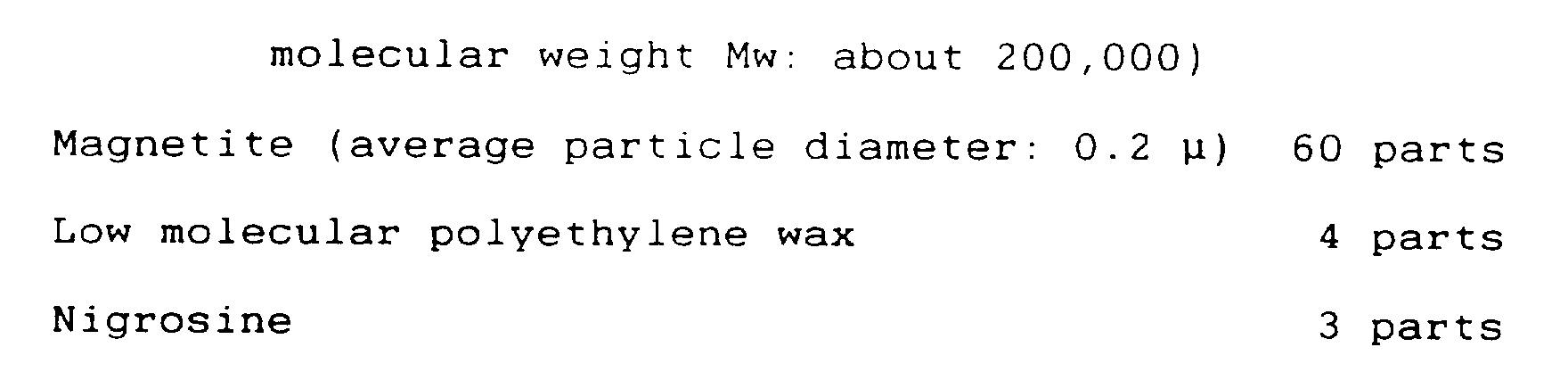
- The above materials were thoroughly blended with a blender, followed by kneading with a twin-roll kneader heated to 150°C. The kneaded product was left to cool and thereafter crushed with a cutter mill, followed by pulverization using a jet-air fine pulverizer and further by classification using an air classifier. A fine black powder with a number average particle diameter of 10 µ (volume average particle diameter: 12 µ) was thus obtained as a positively chargeable black toner (amount of triboelectric charges: +10µc/g).
- On the other hand, 100 parts of a fine silica powder (specific surface area: about 200 m/g) synthesized by the dry process was stirred, during which its temperature was maintained at about 200°C. Using dibutylaminopropyltrimethoxysilane (oxidation potential: 670 mV) as a treating agent, 20 parts of this agent was sprayed on the above fine silica powder and treated for 30 minutes.
- The resulting treated fine silica powder (fine silica powder A; amount of triboelectric charges: +200 µc/g) had a degree of wetting, of 57. To 100 parts of the above black toner, 0.4 part of this treated fine silica powder, 0.5 part of fine polyvinylidene fluoride particles (degree of crystallization: 70 %; primary average particle diameter: 0.4 µm; amount of triboelectric charges: -22 µc/g) were added, and these were blended to give a one-component type positively chargeable developer.
- This developer was applied in a commercially available multiple two-color copying machine (trade name: NP-5540; manufactured by Canon Inc.) and images were produced.
- The copying machine NP-5540 is a one-touch multiple two-color copying machine equipped with a photosensitive drum having a laminate type organic photoconductive material (OPC), and employs a multistage developing unit. In this copying machine, a system is employed in which part of the latent image on the photosensitive drum is erased with an LED or a fuse lamp, and another image is inserted to the corresponding part. Thus, the drum potential (VSL) at the part erased with an LED is greatly lowered and the difference between the drum potential and the DC bias (VDC) at the time of development, i.e., |VDC-VSL|, is larger than conventional copying machines, so that a toner with a larger reversal fog latitude is required. Here, VDC is changed and the tolerance limit VDC of reversal fog at the VSL part is assumed as V′DC. As a result, a reversal fog latitude of as good as 300 V for |V′DC-VSL| was shown at the initial stage and also the image density was well as high as 1.35. Using this developer, transferred toner images were continuously produced to examine its durability. Transferred images after 40,000 sheet copying were also found to be not inferior to the initial images. On the other hand, copying was tested under environmental conditions of high temperature and high humidity (35°C, 85 % RH) or low temperature and low humidity (15°C, 10 % RH). As a result, fog-free good images were obtained in 10,000 sheet duration.
- Example 1 was repeated to prepare a positively chargeable developer, except that fine silica powder A used in Example 1 was replaced with fine silica powder B, C or D as shown in Table 1.


- Results of development are shown in Tables 2 and 3.
-
Table 2 Example Fine silica powder 23.5°C, 65%RH Initial density Initial reversal fog |VDC-VSL| After 50,000 sheet duration Density |VDC-VSL| 2 B 1.35 ≧330 V 1.30 ≧250 V 3 C 1.30 ≧330 V 1.27 ≧280 V 4 D 1.30 ≧330 V 1.25 ≧260 V Table 3 Example Fine silica powder 35°C, 80%RH Initial density Initial reversal fog |VDC-VSL| After 50,000 sheet duration Density |VDC-VSL| 2 B 1.30 ≧330 V 1.27 ≧300 V 3 C 1.25 ≧330 V 1.28 ≧300 V 4 D 1.23 ≧330 V 1.28 ≧300 V - As the above shows, fog-free good images with a well high density were obtained both at the initial stage and after 50,000 sheet duration, even at normal temperature and normal humidity or high temperature and high humidity.
- Example 1 was repeated except that the fine silica powder A used in Example 1 was replace with a fine silica powder (degree of wetting: 0) prepared using γ-aminopropyltrimethoxysilane (oxidation potential: 900 mV) as the treating agent. The reversal fogging and the durability were on the level slightly poorer than those in Example 1, and good results were seen. In the environment of 35°C and 85 % RH, however, the initial density was greatly lowered to 0.80.
- Example 1 was repeated except that fine silica powder A used in Example 1 was replaced with a fine silica powder (degree of wetting: 45) prepared using aminopropyltrimethoxysilane (oxidation potential: 900 mV) and hexamethyldisilazane (an agent for making the powder hydrophobic) as treating agents. However, the reversal fog latitude |V'DC-VSL| was as low as 160 V Although the initial density was as high as 1.30, the density was lowered to 1.12 after 10,000 sheet duration. In the environment of 35°C and 85 % RH, the initial image density was 0.95.
- Example 1 was repeated except that fine silica powder A used in Example 1 was replaced with an untreated fine silica powder (degree of wetting: 0) and the fine polyvinylidene fluoride particles were not used. The reversal fogging was in a good state, but the initial density even in the environment of 23.5°C and 65 % RH was as low as 0.75, and the image density was also unsatisfactory. The images obtained in the environment of 35°C and 85 % RH were poor and also had an initial density of 0.50.
-
Styrene/n-butyl acrylate copolymer 100 parts (copolymerization ratio : 80/20; Mw : about 250,000) Magnetite 100 parts (Si content A= 0.4, Si content B= 1.45, B/A = 3.5; average particle diameter : 0.2µm) Low molecular polypropylene wax 3 parts Nigrosine 2 parts - Using the above materials, a positively chargeable black toner (amount of triboelectric charges: +12 µc/g) with a volume average particle diameter of 11 µm was prepared in the same manner as in Example 1.
- Next, 100 parts of the positively chargeable black toner, 0.4 part of fine silica powder A and 0.5 part of fine polyvinylidene fluoride particles (degree of crystallization: 70 %; primary average particle diameter: 0.4 µm; amount of triboelectric charges: -22 µc/g) were blended to give a one-component type positively chargeable developer.
- Using the one-component type positively chargeable developer thus prepared, image production was tested in the same manner as in Example 1. Results obtained are shown in Tables 4 and 5.
- Example 5 was repeated to prepare one-component type positively chargeable developers, except that fine silica powder A was replaced with fine silica powder B, C or D. Image production was tested in the same manner as in Example 1. Results obtained are shown in Tables 4 and 5.
Table 4 Example Fine silica powder 23.5°C, 65%RH Initial density Initial reversal fog |V'DC-VSL| After 50,000 sheet duration Density |V'DC-VSL| 5 A 1.40 ≧330 V 1.35 ≧280 V 6 B 1.38 ≧330 V 1.35 ┌≧250 V 7 C 1.37 ≧330 V 1.30 ≧280 V 8 D 1.40 ≧330 V 1.30 ≧260 V Table 5 Example Fine silica powder 35°C, 80%RH Initial density Initial reversal fog |V'DC-VSL| After 50,000 sheet duration Density |V'DC-VSL| 5 A 1.33 ≧330 V 1.30 ≧300V 6 B 1.35 ≧330 V 1.28 ┌≧300 V 7 C 1.35 ≧330 V 1.30 ≧300V 8 D 1.30 ≧330 V 1.30 ≧300V -


- The above materials were thoroughly blended with a blender, followed by kneading with a twin-roll kneader heated to 145°C. The kneaded product was left to cool and thereafter crushed with a cutter mill, followed by pulverization using a jet-air fine pulverizer and further by classification using an air classifier. A positively chargeable cyan toner (amount of triboelectric charges: +20µc/g) with a volume average particle diameter of 13 µm was thus obtained.
- Next, 100 parts of the positively chargeable cyan toner, 0.4 part of fine silica powder A and 0.5 part of fine polyvinylidene fluoride particles (degree of crystallization: 70 %; primary average particle diameter: 0.4 µm; amount of triboelectric charges: -22 µc/g) were blended to give a positively chargeable cyan toner mixture.
- Subsequently, 8 parts of the positively chargeable cyan toner mixture and 92 parts of resincoated ferrite carrier (obtained by coating spherical ferrite particles of 60 µm in average particle diameter, with an acrylic resin) were blended to prepare a two-component type developer.
- The two-component type developer thus prepared was applied in a commercially available copying machine (trade name: NP-5540; manufactured by Canon Inc.), and images were produced. Results obtained are shown in Tables 7 and 8.
- Example 9 was repeated using the two-component type developer except that the fine polyvinylidene fluoride particles as shown below in Table 6 were used. Images were produced in the same manner as in Example 9. Results obtained are shown in Tables 7 and 8.
-
Table 6 Example Degree of crystalisation Primary average particle diameter Amount of triboelectric charges (%) (µm) (µc/g) 10 77 0.2 -35 11 82 0.3 -32 12 75 0.4 -25 Table 7 Example 23.5°C, 65%RH Initial density Initial reversal fog |V'DC-VSL After 50,000 sheet duration Density |V'DC-VSL| 9 1.42 ≧330 V 1.35 ≧280 V 10 1.38 ≧330 V 1.32 ≧280 V 11 1.38 ≧330 V 1.31 ≧280 V 12 1.35 ≧330 V 1.38 ≧300 V Table 8 Example 35°C, 80%RH Initial density Initial reversal fog |V'DC-VSL| After 50,000 sheet duration Density |V'DC-VSL| 9 1.40 ≧330 V 1.33 ≧300 V 10 1.33 ≧330 V 1.31 ≧300 V 11 1.33 ≧330 V 1.30 ≧300 V 12 1.28 ≧330 V 1.32 ≧300 V
Claims (21)
- A developer for developing electrostatic latent images, comprising a toner, a fine silica powder and negatively chargeable fine fluorine resin particles;
said fine silica powder being treated with only an aminosilane coupling agent having a tertiary amino group represented by the formula:
- A developer according to Claim 1, wherein the fine silica powder treated with said aminosilane coupling agent is made hydrophobic to a degree of not less than 50, measured in a wetting degree test.
- A developer according to claim 1, wherein the aminosilane coupling agent is a compound selected from the group consisting of dibutylaminopropyltrimethoxysilane, dibutylaminomethyltrimethoxysilane, dioctylaminopropyltrimethoxysilane and dihexylaminopropyltrimethoxysilane.
- A developer according to Claim 1, wherein R₁ represents an alkoxy group having 1 to 4 carbon atoms; R₂ and R₃ each represent an alkoxy group or alkyl group, each having 1 to 4 carbon atoms; R₄ represents an alkylene group having 2 to 10 carbon atoms or phenylene group; and R₅ and R₆ each represent an alkyl group having 2 to 12 carbon atoms or aryl group having 6 to 12 carbon atoms.
- A developer according to Claim 1, wherein said toner comprises a positively chargeable toner.
- A developer according to Claim 5, wherein said toner comprises a positively chargeable toner having an amount of triboelectric charges, of from +5 µc/g to +40 µc/g.
- A developer according to Claim 5, wherein said toner comprises a positively chargeable toner having an amount of triboelectric charges, of from +9 µc/g to +20 µc/g.
- A developer according to Claim 5, wherein said toner comprises a positively chargeable toner having an amount of triboelectric charges, of from +9 µc/g to +15 µc/g.
- A developer according to Claim 1 wherein said negatively chargeable fine fluorine resin particles have a primary average particle diameter of from 0.01 to 4 µm.
- A developer according to Claim 1, wherein said negatively chargeable fine fluorine resin particles have a primary average particle diameter of from 0.1 to 3 µm.
- A developer according to Claim 1, wherein said negatively chargeable fine fluorine resin particles have an amount of triboelectric charges, of -10 µc/g to -40 µc/g.
- A developer according to Claim 1, wherein said negatively chargeable fine fluorine resin particles have a degree of crystallization, of not less than 60 %.
- A developer according to Claim 1, wherein said negatively chargeable fine fluorine resin particles have a degree of crystallization, of not less than 70 %.
- A developer according to Claim 1, wherein said fine silica powder has an amount of triboelectric charges, of from +100 µc/g to +300 µc/g.
- A developer according to Claim 1, wherein said fine silica powder is contained in an amount of from 0.05 to 10 parts by weight based on 100 parts by weight of the toner.
- A developer according to Claim 1, wherein said fine silica powder is contained in an amount of from 0.1 to 3 parts by weight based on 100 parts by weight of the toner.
- A developer according to Claim 1, wherein said fine silica powder is mixed in an amount of from 0.05 to 10 parts by weight based on 100 parts by weight of the toner, and said negatively chargeable fine fluorine resin particles are mixed in an amount of from 0.01 to 5 parts by weight based on 100 parts by weight of the toner.
- A developer according to Claim 1, wherein said fine silica powder is mixed in an amount of from 0.1 to 3 parts by weight based on 100 parts by weight of the toner, and said negatively chargeable fine fluorine resin particles are mixed in an amount of from 0.05 to 2 parts by weight based on 100 parts by weight of the toner.
- A developer according to any one of the preceding claims, wherein said toner comprises a positively chargeable magnetic toner.
- A developer according to Claim 19, wherein said positively chargeable magnetic toner has an amount of triboelectric charges, of from +9 µc/g to +20 µc/g and has a volume average particle diameter of from 5 to 30 µm.
- A developer according to Claim 19, wherein said positively chargeable magnetic toner comprises a binder resin and magnetic fine particles; said magnetic fine particles being contained in an amount of from 10 to 70 % by weight based on the toner weight.
Applications Claiming Priority (2)
| Application Number | Priority Date | Filing Date | Title |
|---|---|---|---|
| JP63290475A JP2810389B2 (en) | 1988-11-17 | 1988-11-17 | Positively chargeable developer |
| JP290475/88 | 1988-11-17 |
Publications (3)
| Publication Number | Publication Date |
|---|---|
| EP0369443A2 EP0369443A2 (en) | 1990-05-23 |
| EP0369443A3 EP0369443A3 (en) | 1990-09-05 |
| EP0369443B1 true EP0369443B1 (en) | 1996-04-10 |
Family
ID=17756493
Family Applications (1)
| Application Number | Title | Priority Date | Filing Date |
|---|---|---|---|
| EP89121222A Expired - Lifetime EP0369443B1 (en) | 1988-11-17 | 1989-11-16 | Positively chargeable developer |
Country Status (4)
| Country | Link |
|---|---|
| US (1) | US5024915A (en) |
| EP (1) | EP0369443B1 (en) |
| JP (1) | JP2810389B2 (en) |
| DE (1) | DE68926215T2 (en) |
Families Citing this family (24)
| Publication number | Priority date | Publication date | Assignee | Title |
|---|---|---|---|---|
| SG78355A1 (en) * | 1990-10-26 | 2001-02-20 | Canon Kk | Developer for developing electrostatic image image forming method electrophotographic apparatus apparatus unit and facsimile apparatus |
| US5534377A (en) * | 1991-02-28 | 1996-07-09 | Tomoegawa Paper Co., Ltd. | Nonmagnetic one-component developing method |
| JP2633130B2 (en) * | 1991-03-08 | 1997-07-23 | キヤノン株式会社 | Magnetic toner, image forming method, surface-modified silica fine powder and method for producing the same |
| JP2738162B2 (en) * | 1991-05-13 | 1998-04-08 | 三菱化学株式会社 | Toner for developing electrostatic images |
| US5126225A (en) * | 1991-07-18 | 1992-06-30 | Eastman Kodak Company | Toners and developers containing ether-containing quaternary ammonium salts as charge control agents |
| US5256516A (en) * | 1992-07-31 | 1993-10-26 | Xerox Corporation | Toner compositions with dendrimer charge enhancing additives |
| JP3318997B2 (en) * | 1993-02-03 | 2002-08-26 | 三菱マテリアル株式会社 | Hydrophobic silica powder, its production method and developer for electrophotography |
| US5455137A (en) * | 1993-12-21 | 1995-10-03 | International Business Machines Corporation | Toner composition |
| US5789131A (en) * | 1994-12-28 | 1998-08-04 | Minolta Co., Ltd. | Developer for developing electrostatic latent image |
| DE69612892T2 (en) * | 1995-02-10 | 2001-10-25 | Canon K.K., Tokio/Tokyo | Imaging process, imaging device and toner elements |
| JPH09319134A (en) * | 1996-05-29 | 1997-12-12 | Konica Corp | Static-charge-image development toner and multicolor image forming method |
| US5914210A (en) * | 1996-08-01 | 1999-06-22 | Minolta Co., Ltd. | Developer and developing method |
| US5989768A (en) * | 1997-03-06 | 1999-11-23 | Cabot Corporation | Charge-modified metal oxides with cyclic silazane and electrostatographic systems incorporating same |
| US5955232A (en) * | 1997-07-22 | 1999-09-21 | Cabot Corporation | Toners containing positively chargeable modified pigments |
| JP3733706B2 (en) * | 1997-08-29 | 2006-01-11 | コニカミノルタビジネステクノロジーズ株式会社 | Negative charge toner for one-component development and one-component development method |
| US6242147B1 (en) | 1997-09-03 | 2001-06-05 | Minolta Co., Ltd. | Negatively chargeable toner and developing device using thereof |
| US6218067B1 (en) | 1998-11-06 | 2001-04-17 | Cabot Corporation | Toners containing chargeable modified pigments |
| US20080070146A1 (en) * | 2006-09-15 | 2008-03-20 | Cabot Corporation | Hydrophobic-treated metal oxide |
| US8435474B2 (en) * | 2006-09-15 | 2013-05-07 | Cabot Corporation | Surface-treated metal oxide particles |
| US8455165B2 (en) * | 2006-09-15 | 2013-06-04 | Cabot Corporation | Cyclic-treated metal oxide |
| US8202502B2 (en) * | 2006-09-15 | 2012-06-19 | Cabot Corporation | Method of preparing hydrophobic silica |
| US8221947B2 (en) * | 2008-12-18 | 2012-07-17 | Eastman Kodak Company | Toner surface treatment |
| JP2010271532A (en) * | 2009-05-21 | 2010-12-02 | Shin Etsu Polymer Co Ltd | Conductive roller and image forming apparatus |
| US10030292B2 (en) | 2014-05-26 | 2018-07-24 | Hrl Laboratories, Llc | Hydride-coated microparticles and methods for making the same |
Family Cites Families (9)
| Publication number | Priority date | Publication date | Assignee | Title |
|---|---|---|---|---|
| DK418578A (en) * | 1977-09-22 | 1979-03-23 | Hitachi Metals Ltd | MAGNETIC TONER |
| GB2128764B (en) * | 1982-08-23 | 1986-02-19 | Canon Kk | Electrostatographic developer |
| JPS6020954A (en) * | 1983-07-13 | 1985-02-02 | Unitika Ltd | Polyester composition |
| JPS6023863A (en) * | 1983-07-19 | 1985-02-06 | Canon Inc | Image forming method |
| JPS6115153A (en) * | 1984-06-30 | 1986-01-23 | Tomoegawa Paper Co Ltd | Developer for positive charge image |
| US4666813A (en) * | 1985-01-08 | 1987-05-19 | Canon Kabushiki Kaisha | Developer for developing electrostatic latent images contains vinylidene fluoride polymer |
| JPS6261609A (en) * | 1985-09-13 | 1987-03-18 | Sumitomo Jukikai Envirotec Kk | Horizontal flow multi-bed type rapid filter apparatus |
| JPS63129349A (en) * | 1986-11-20 | 1988-06-01 | Canon Inc | Developer for electrostatic image development |
| JP2630946B2 (en) * | 1987-05-29 | 1997-07-16 | 東レ・ダウコーニング・シリコーン株式会社 | Fluidity improver for positively chargeable resin powder |
-
1988
- 1988-11-17 JP JP63290475A patent/JP2810389B2/en not_active Expired - Fee Related
-
1989
- 1989-11-16 US US07/437,207 patent/US5024915A/en not_active Expired - Lifetime
- 1989-11-16 EP EP89121222A patent/EP0369443B1/en not_active Expired - Lifetime
- 1989-11-16 DE DE68926215T patent/DE68926215T2/en not_active Expired - Fee Related
Also Published As
| Publication number | Publication date |
|---|---|
| EP0369443A3 (en) | 1990-09-05 |
| DE68926215T2 (en) | 1996-09-12 |
| DE68926215D1 (en) | 1996-05-15 |
| EP0369443A2 (en) | 1990-05-23 |
| JP2810389B2 (en) | 1998-10-15 |
| US5024915A (en) | 1991-06-18 |
| JPH02135461A (en) | 1990-05-24 |
Similar Documents
| Publication | Publication Date | Title |
|---|---|---|
| US5024915A (en) | Positively chargeable developer | |
| US4640882A (en) | Image forming method of negative latent images using silica particles | |
| EP0247884B1 (en) | Magnetic toner | |
| EP0418876B1 (en) | Process for producing toner for developing electrostatic image | |
| EP0519715A1 (en) | Magnetic toner and process for producing magnetic toner | |
| JPH0760273B2 (en) | Magnetic developer | |
| JP2899038B2 (en) | Toner for developing electrostatic images | |
| JPH05297631A (en) | Toner and image forming method | |
| JPH07104611B2 (en) | Positively chargeable one-component magnetic developer | |
| JP3535561B2 (en) | Magnetic toner | |
| JPS5934539A (en) | Positively charged developer | |
| JP2603287B2 (en) | Frictional magnetic toner | |
| JP2728551B2 (en) | Positively chargeable non-magnetic toner | |
| JPS6261065A (en) | magnetic developer | |
| JP4416304B2 (en) | Magnetic toner | |
| JPH0812465B2 (en) | Positively charged developer | |
| JP2603286B2 (en) | Magnetic toner | |
| JP3086995B2 (en) | Magnetic toner and image forming method | |
| JP2694536B2 (en) | Positively chargeable magnetic developer | |
| JP2892150B2 (en) | Image forming method | |
| JP2769814B2 (en) | Magnetic toner for developing electrostatic images | |
| JP2775323B2 (en) | Image forming method | |
| JPH0772663A (en) | Toner for electrostatic image development | |
| JPH06103403B2 (en) | Positively charged magnetic developer | |
| JPS61277965A (en) | Developer having positive electric chargeability |
Legal Events
| Date | Code | Title | Description |
|---|---|---|---|
| PUAI | Public reference made under article 153(3) epc to a published international application that has entered the european phase |
Free format text: ORIGINAL CODE: 0009012 |
|
| AK | Designated contracting states |
Kind code of ref document: A2 Designated state(s): DE FR GB IT |
|
| PUAL | Search report despatched |
Free format text: ORIGINAL CODE: 0009013 |
|
| AK | Designated contracting states |
Kind code of ref document: A3 Designated state(s): DE FR GB IT |
|
| 17P | Request for examination filed |
Effective date: 19901221 |
|
| 17Q | First examination report despatched |
Effective date: 19930611 |
|
| GRAA | (expected) grant |
Free format text: ORIGINAL CODE: 0009210 |
|
| AK | Designated contracting states |
Kind code of ref document: B1 Designated state(s): DE FR GB IT |
|
| REF | Corresponds to: |
Ref document number: 68926215 Country of ref document: DE Date of ref document: 19960515 |
|
| ET | Fr: translation filed | ||
| ITF | It: translation for a ep patent filed | ||
| GRAH | Despatch of communication of intention to grant a patent |
Free format text: ORIGINAL CODE: EPIDOS IGRA |
|
| PLBE | No opposition filed within time limit |
Free format text: ORIGINAL CODE: 0009261 |
|
| STAA | Information on the status of an ep patent application or granted ep patent |
Free format text: STATUS: NO OPPOSITION FILED WITHIN TIME LIMIT |
|
| 26N | No opposition filed | ||
| REG | Reference to a national code |
Ref country code: GB Ref legal event code: IF02 |
|
| PGFP | Annual fee paid to national office [announced via postgrant information from national office to epo] |
Ref country code: FR Payment date: 20041109 Year of fee payment: 16 |
|
| PGFP | Annual fee paid to national office [announced via postgrant information from national office to epo] |
Ref country code: GB Payment date: 20041110 Year of fee payment: 16 |
|
| PGFP | Annual fee paid to national office [announced via postgrant information from national office to epo] |
Ref country code: DE Payment date: 20041111 Year of fee payment: 16 |
|
| PG25 | Lapsed in a contracting state [announced via postgrant information from national office to epo] |
Ref country code: IT Free format text: LAPSE BECAUSE OF NON-PAYMENT OF DUE FEES;WARNING: LAPSES OF ITALIAN PATENTS WITH EFFECTIVE DATE BEFORE 2007 MAY HAVE OCCURRED AT ANY TIME BEFORE 2007. THE CORRECT EFFECTIVE DATE MAY BE DIFFERENT FROM THE ONE RECORDED. Effective date: 20051116 Ref country code: GB Free format text: LAPSE BECAUSE OF NON-PAYMENT OF DUE FEES Effective date: 20051116 |
|
| PG25 | Lapsed in a contracting state [announced via postgrant information from national office to epo] |
Ref country code: DE Free format text: LAPSE BECAUSE OF NON-PAYMENT OF DUE FEES Effective date: 20060601 |
|
| GBPC | Gb: european patent ceased through non-payment of renewal fee |
Effective date: 20051116 |
|
| PG25 | Lapsed in a contracting state [announced via postgrant information from national office to epo] |
Ref country code: FR Free format text: LAPSE BECAUSE OF NON-PAYMENT OF DUE FEES Effective date: 20060731 |
|
| REG | Reference to a national code |
Ref country code: FR Ref legal event code: ST Effective date: 20060731 |