EP0368317A2 - Method of forming an image-receiving element in diffusion transfer photography - Google Patents
Method of forming an image-receiving element in diffusion transfer photography Download PDFInfo
- Publication number
- EP0368317A2 EP0368317A2 EP89120800A EP89120800A EP0368317A2 EP 0368317 A2 EP0368317 A2 EP 0368317A2 EP 89120800 A EP89120800 A EP 89120800A EP 89120800 A EP89120800 A EP 89120800A EP 0368317 A2 EP0368317 A2 EP 0368317A2
- Authority
- EP
- European Patent Office
- Prior art keywords
- alkali
- layer
- polymer
- hydrolyzing
- air
- Prior art date
- Legal status (The legal status is an assumption and is not a legal conclusion. Google has not performed a legal analysis and makes no representation as to the accuracy of the status listed.)
- Granted
Links
- 238000000034 method Methods 0.000 title claims abstract description 23
- 238000009792 diffusion process Methods 0.000 title claims abstract description 8
- 238000012546 transfer Methods 0.000 title claims abstract description 8
- 229920000642 polymer Polymers 0.000 claims abstract description 55
- 230000003301 hydrolyzing effect Effects 0.000 claims abstract description 28
- 239000003795 chemical substances by application Substances 0.000 claims abstract description 24
- 239000004902 Softening Agent Substances 0.000 claims abstract description 21
- 238000006460 hydrolysis reaction Methods 0.000 claims abstract description 19
- 239000000203 mixture Substances 0.000 claims abstract description 15
- 239000007788 liquid Substances 0.000 claims abstract description 14
- 230000007062 hydrolysis Effects 0.000 claims abstract description 8
- 238000001704 evaporation Methods 0.000 claims abstract description 5
- BQCADISMDOOEFD-UHFFFAOYSA-N Silver Chemical compound [Ag] BQCADISMDOOEFD-UHFFFAOYSA-N 0.000 claims abstract description 4
- 229910052709 silver Inorganic materials 0.000 claims abstract description 4
- 239000004332 silver Substances 0.000 claims abstract description 4
- 238000007664 blowing Methods 0.000 claims abstract 4
- OKKJLVBELUTLKV-UHFFFAOYSA-N Methanol Chemical compound OC OKKJLVBELUTLKV-UHFFFAOYSA-N 0.000 claims description 18
- 229920001747 Cellulose diacetate Polymers 0.000 claims description 9
- HEMHJVSKTPXQMS-UHFFFAOYSA-M Sodium hydroxide Chemical compound [OH-].[Na+] HEMHJVSKTPXQMS-UHFFFAOYSA-M 0.000 claims description 9
- KWYUFKZDYYNOTN-UHFFFAOYSA-M Potassium hydroxide Chemical compound [OH-].[K+] KWYUFKZDYYNOTN-UHFFFAOYSA-M 0.000 claims description 6
- LFQSCWFLJHTTHZ-UHFFFAOYSA-N Ethanol Chemical compound CCO LFQSCWFLJHTTHZ-UHFFFAOYSA-N 0.000 claims description 5
- 229920002284 Cellulose triacetate Polymers 0.000 claims description 2
- NNLVGZFZQQXQNW-ADJNRHBOSA-N [(2r,3r,4s,5r,6s)-4,5-diacetyloxy-3-[(2s,3r,4s,5r,6r)-3,4,5-triacetyloxy-6-(acetyloxymethyl)oxan-2-yl]oxy-6-[(2r,3r,4s,5r,6s)-4,5,6-triacetyloxy-2-(acetyloxymethyl)oxan-3-yl]oxyoxan-2-yl]methyl acetate Chemical compound O([C@@H]1O[C@@H]([C@H]([C@H](OC(C)=O)[C@H]1OC(C)=O)O[C@H]1[C@@H]([C@@H](OC(C)=O)[C@H](OC(C)=O)[C@@H](COC(C)=O)O1)OC(C)=O)COC(=O)C)[C@@H]1[C@@H](COC(C)=O)O[C@@H](OC(C)=O)[C@H](OC(C)=O)[C@H]1OC(C)=O NNLVGZFZQQXQNW-ADJNRHBOSA-N 0.000 claims description 2
- 238000010438 heat treatment Methods 0.000 description 33
- 238000001035 drying Methods 0.000 description 32
- 238000006243 chemical reaction Methods 0.000 description 11
- 229920002678 cellulose Polymers 0.000 description 9
- 239000001913 cellulose Substances 0.000 description 8
- 239000011248 coating agent Substances 0.000 description 6
- 238000000576 coating method Methods 0.000 description 6
- 230000008859 change Effects 0.000 description 4
- SMEGJBVQLJJKKX-HOTMZDKISA-N [(2R,3S,4S,5R,6R)-5-acetyloxy-3,4,6-trihydroxyoxan-2-yl]methyl acetate Chemical compound CC(=O)OC[C@@H]1[C@H]([C@@H]([C@H]([C@@H](O1)O)OC(=O)C)O)O SMEGJBVQLJJKKX-HOTMZDKISA-N 0.000 description 3
- 229940081735 acetylcellulose Drugs 0.000 description 3
- 229920002301 cellulose acetate Polymers 0.000 description 3
- 238000012423 maintenance Methods 0.000 description 3
- 239000000463 material Substances 0.000 description 3
- 230000035515 penetration Effects 0.000 description 3
- 230000008569 process Effects 0.000 description 3
- PEDCQBHIVMGVHV-UHFFFAOYSA-N Glycerine Chemical compound OCC(O)CO PEDCQBHIVMGVHV-UHFFFAOYSA-N 0.000 description 2
- 230000021736 acetylation Effects 0.000 description 2
- 238000006640 acetylation reaction Methods 0.000 description 2
- 239000003513 alkali Substances 0.000 description 2
- 230000003247 decreasing effect Effects 0.000 description 2
- 230000008020 evaporation Effects 0.000 description 2
- 238000002474 experimental method Methods 0.000 description 2
- IJGRMHOSHXDMSA-UHFFFAOYSA-N Atomic nitrogen Chemical compound N#N IJGRMHOSHXDMSA-UHFFFAOYSA-N 0.000 description 1
- 238000004566 IR spectroscopy Methods 0.000 description 1
- 238000010521 absorption reaction Methods 0.000 description 1
- 230000004913 activation Effects 0.000 description 1
- 150000001298 alcohols Chemical class 0.000 description 1
- 229910052783 alkali metal Inorganic materials 0.000 description 1
- 150000001340 alkali metals Chemical class 0.000 description 1
- 230000002238 attenuated effect Effects 0.000 description 1
- 230000008033 biological extinction Effects 0.000 description 1
- 230000015572 biosynthetic process Effects 0.000 description 1
- 238000010276 construction Methods 0.000 description 1
- 230000007423 decrease Effects 0.000 description 1
- 229910001873 dinitrogen Inorganic materials 0.000 description 1
- 230000000694 effects Effects 0.000 description 1
- 238000007765 extrusion coating Methods 0.000 description 1
- 239000007789 gas Substances 0.000 description 1
- 235000011187 glycerol Nutrition 0.000 description 1
- 150000004679 hydroxides Chemical class 0.000 description 1
- 230000007246 mechanism Effects 0.000 description 1
- -1 methanol and ethanol Chemical class 0.000 description 1
- 238000002156 mixing Methods 0.000 description 1
- 230000037361 pathway Effects 0.000 description 1
- 238000012545 processing Methods 0.000 description 1
- 230000000750 progressive effect Effects 0.000 description 1
- 230000005855 radiation Effects 0.000 description 1
- 238000007767 slide coating Methods 0.000 description 1
- 239000002904 solvent Substances 0.000 description 1
- 150000005846 sugar alcohols Polymers 0.000 description 1
- NRUVOKMCGYWODZ-UHFFFAOYSA-N sulfanylidenepalladium Chemical compound [Pd]=S NRUVOKMCGYWODZ-UHFFFAOYSA-N 0.000 description 1
- XLYOFNOQVPJJNP-UHFFFAOYSA-N water Substances O XLYOFNOQVPJJNP-UHFFFAOYSA-N 0.000 description 1
Images
Classifications
-
- G—PHYSICS
- G03—PHOTOGRAPHY; CINEMATOGRAPHY; ANALOGOUS TECHNIQUES USING WAVES OTHER THAN OPTICAL WAVES; ELECTROGRAPHY; HOLOGRAPHY
- G03C—PHOTOSENSITIVE MATERIALS FOR PHOTOGRAPHIC PURPOSES; PHOTOGRAPHIC PROCESSES, e.g. CINE, X-RAY, COLOUR, STEREO-PHOTOGRAPHIC PROCESSES; AUXILIARY PROCESSES IN PHOTOGRAPHY
- G03C8/00—Diffusion transfer processes or agents therefor; Photosensitive materials for such processes
- G03C8/24—Photosensitive materials characterised by the image-receiving section
- G03C8/26—Image-receiving layers
-
- G—PHYSICS
- G03—PHOTOGRAPHY; CINEMATOGRAPHY; ANALOGOUS TECHNIQUES USING WAVES OTHER THAN OPTICAL WAVES; ELECTROGRAPHY; HOLOGRAPHY
- G03C—PHOTOSENSITIVE MATERIALS FOR PHOTOGRAPHIC PURPOSES; PHOTOGRAPHIC PROCESSES, e.g. CINE, X-RAY, COLOUR, STEREO-PHOTOGRAPHIC PROCESSES; AUXILIARY PROCESSES IN PHOTOGRAPHY
- G03C8/00—Diffusion transfer processes or agents therefor; Photosensitive materials for such processes
- G03C8/42—Structural details
- G03C8/52—Bases or auxiliary layers; Substances therefor
Definitions
- the present invention relates to a process for producing image-receiving elements used in diffusion transfer photographic materials. More particularly, the present invention relates to a method by which a surface of an alkali-impermeable polymer layer preliminarily formed on a continuously running web is hydrolyzed to be converted to an alkali-permeable polymer.
- alkali-impermeable polymer as used herein means a polymer that remains substantially impermeable to aqueous alkalies for a predetermined period of time within which photographic processing is completed.
- alkali-permeable polymer as used herein means a polymer that is reasonably permeable to aqueous alkalies for a predetermined period of time during which an internal phase material is allowed to take part in the process of image formation. In a preferred embodiment of the present invention as it is applied to the field of its intended use, an image is formed in a layer of the alkali-permeable polymer.
- softening agent means a solvent that swells the alkali-impermeable polymer layer, thereby assisting the hydrolyzing agent penetrate into the layer.
- a hydrolysis method is shown in U.S. Patent No. 3,078,178.
- the method comprises the step of supplying a hydrolyzing agent to the surface of an acetyl cellulose layer and immediately thereafter, pressing the acetyl cellulose layer onto the smooth surface of a heating drum, thereby hydrolyzing the surface area or the acetyl cellulose layer to be converted to alkali-permeable cellulose.
- the layer of alkali-impermeable polymer is pressed onto the drum after the surface area of the polymer has become completely soft, so any flaws or undulations on the drum surface are readily transferred onto the polymer surface and it cannot be provided with a desired smoothness unless strict maintenance and control is performed on the drum surface to maintain a smooth and glossy state.
- An object, therefore, of the present invention is to provide a method by which a surface of an alkali-impermeable polymer layer is hydrolyzed to convert the polymer to an alkali-permeable polymer, thus obtaining diffusion transfer photographic image-receiving element without involving any of the difficulties previously encountered in the maintenance and control of a drum surface and without impairing the smoothness of the polymer surface.
- the above-stated object of the present invention can be attained by a method which forms a silver image-receiving element in diffusion transfer photography by hydrolyzing a surface of an alkali-impermeable polymer on a continuously running web so as to convert the polymer to an alkali-permeable polymer, which method comprises the steps of applying a liquid mixture of a hydrolyzing agent and a softening agent to the surface of said alkali-impermeable polymer layer, evaporating the softening agent in said liquid mixture by means of a drying apparatus which does not contact the surface of said layer, and then accelerating the occurrence of hydrolysis by means of a heating apparatus which does not contact the surface of said layer.
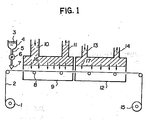
- a web 2 having a layer of alkali-impermeable polymer formed on its surface is continuously unwound from a supply roll 1 by means of a drive unit (not shown). With its back side being supported by pass rollers 8, the web 2 travels successively through a coating zone 7, a drying apparatus 9 and a heating apparatus 12 and is wound onto a takeup roll 15.
- the layout of the system shown in Figure 1 is so designed that the web 2 can be transported without making contact with the coated surface.
- a liquid mixture 3 consisting of a hydrolyzing agent and a softening agent in a feed vessel 4 is coated continuously onto the web via a pipe 5 and a metering pump 6.
- the drying apparatus 9 is equipped with a drying air supply duct 10 and a drying air exhaust duct 11 and supplies drying air 16 from an air source (not shown).
- the heating apparatus 12 is equipped with a heating air supply duct 13 and a heating air exhaust duct 14 and heating air 17 is supplied from an air source.
- the surface of the web 2 having a layer of alkali-impermeable polymer formed on its surface is coated in the coating zone 7 with the liquid mixture 3 consisting of a hydrolyzing agent and a softening agent.
- the softening agent swells a near-surface area of the layer of alkali-impermeable polymer, thereby assisting in the penetration of the hydrolyzing agent into that layer.
- the greater part of the softening agent in the liquid mixture 3 evaporates to form a concentrated layer of the hydrolyzing agent on the surface of the layer of alkali-impermeable polymer.
- the web 2 then enters the heating apparatus 12, where it is heated with hot air to initiate hydrolysis reaction in the area where the hydrolyzing agent is present.
- the heating apparatus 12 is heated with hot air to initiate hydrolysis reaction in the area where the hydrolyzing agent is present.
- the temperature of the web 2 rises sharply to accelerate the hydrolysis of the polymer.
- at least the surface of the layer of alkali-impermeable polymer is converted to an alkali-permeable polymer.
- the movement of hydrolyzing agent through the polymer layer ceases and the hydrolysis reaction is terminated since there is no further penetration of the hydrolyzing agent.
- the surface temperature of the web levels off at the temperature of the heating air and becomes constant.
- the pathway of the web 2 travelling through the drying apparatus 9 and the heating apparatus 12 is so designed that it can be transported without contacting the coated surface. This is effective in permitting the web 2 to reach the takeup roll 15 without any damage to the smoothness of the surface on which an image-receiving element is to be formed.
- the effective temperature range for the drying air 16 and heating air 17 is from 50 to 120°C. In order to minimize the thickness of the layer which undergoes conversion to an alkali-permeable polymer, temperatures above 80°C are preferred. On the other hand, if one wants to prevent thermal deformation of the web, temperatures below 100°C are preferred.
- the rate of hydrolysis reaction can be varied by selecting appropriate conditions for each of the drying air 16 and heating air 17, and allowing for control of the thickness of the layer which is to be converted to an alkali-permeable polymer.
- Illustrative alkali-impermeable polymeric materials that can be used in the present invention are cellulose esters such as cellulose diacetate and cellulose triacetate.
- Useful hydrolyzing agents include hydroxides of alkali metals such as sodium hydroxide and potassium hydroxide.
- Useful softening agents include lower alcohols such as methanol and ethanol, which may be mixed with (no more than 50 vol%) of water.
- the method of controlling the rate of hydrolysis reaction by adding a polyhydric alcohol (Oh ⁇ 2) or a derivative thereof as shown in Unexamined Published Japanese Patent Application No. 63-47757 may be employed in combination with the above method of selecting proper conditions for both the drying air 16 and heating air 17.
- the mechanism of the coating zone 7 is not limited to any particular type and any of the known systems such as slide coating (JP-B-33-8977), certain coating (JP-B-49-24133) and extrusion coating (JP-B-45-12390) may be adopted.
- nitrogen gas may be used as the drying air and heating air.
- Other heating media such as radiation heat may be used as long as they permit non-contact drying or heating.
- the drying apparatus may be the same as the heating apparatus in construction. The difference between them resides in that the drying apparatus is provided mainly for assisting the penetration of the hydrolyzing agent into the layer of alkali-impermeable polymer whereas the heating device is provided for causing hydrolysis reaction. Thus, the drying apparatus is distinguishable from the heating apparatus in view of the differences of process and effect. However, the drying air may have the substantial same conditions as the heating air.
- the web 2 consisted of an alkali-impermeable polymer layer (cellulose diacetate) about 8 ⁇ m thick and an overlying layer about 1.5 ⁇ m thick that contained palladium sulfide as a silver precipitant.
- This liquid mixture 3 was applied to the web 2 in a coating volume of 22 cc/m2 and fed into the drying apparatus 9 about 3 seconds later.
- the web was dried with drying air (95°C) for about 5 seconds with the air flow rate on the web surface being controlled at 0.5 - 1.0 m/sec.
- the web was subsequently heated for about 40 seconds.
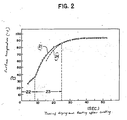
- Figure 2 shows the temperature profile of the web surface as it was held in the drying apparatus 9 and heating apparatus 12.
- the horizontal axis of the graph in Figure 2 plots the lapse of time after the liquid mixture 3 was coated onto the web.
- the period indicated by 22 is the duration of time for which the web stayed in the drying apparatus 9. In this period, the liquid mixture 3 penetrated into the cellulose diacetate layer while the greater part of methanol as the softening agent evaporated. The web surface did not experience any significant increase in temperature.
- the period indicted by 23 corresponds to the stage at which the web 2 in the heating apparatus 12 underwent progressive hydrolysis reaction. As the residual amount of methanol decreased and the rate of its evaporation became low, the temperature of the web surface rose sharply to accelerate the progress of its hydrolysis.
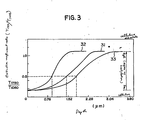
- Figure 3 shows how the depth by which the surface of cellulose diacetate layer was converted to cellulose varied depending upon the drying and heating conditions employed.
- the horizontal axis of the graph in Figure 3 plots the depth from the surface of cellulose diacetate layer, and the vertical axis plots the conversion density as determined from microscopic infrared absorption data.
- conversion density as used herein means the degree of cellulose diacetate to cellulose conversion as achieved by hydrolysis. This parameter is expressed by T1750/T1050 where T1750 and T1050 are the extinction coefficients measured by microscopic infrared spectroscopy.
- Curve 31 in Figure 3 represents the results of the case where the temperature of drying air was 100°C, drying air flow rate was 2 - 4 m/sec, and the temperature of heating air was 100°C; curve 32 represents the results of the case where the respective parameters were 120°C, 6 - 7 m/sec, and 120°C; and curve 33 represents the results of the case for 50°C, 0.5 - 1 m/sec and 50°C.
- the flow rate of heating air was varied from 0.5 to 7 m/sec but no significant change occurred.
- a mixture of a hydrolyzing agent and a softening agent is coated onto the near-surface area of an alkaline-impermeable polymer layer, which is thereafter passed through a drying and a heating apparatus which does not contact the polymer layer, thereby allowing the softening agent to evaporate and the polymer layer to undergo hydrolysis reaction in sequential steps.
- a uniform alkali-permeable polymer layer can be produced without impairing its surface smoothness and without involving any difficulty in maintaining high degree of smoothness by special procedures of maintenance and control.
- drying and heating conditions are properly selected, not only the thickness of the layer in which the alkali-impermeable polymer is converted to the alkali-permeable polymer but also the degree of its change can be so controlled as to produce a diffusion transfer photographic image-receiving element having desired photographic performance.
Landscapes
- Physics & Mathematics (AREA)
- General Physics & Mathematics (AREA)
- Engineering & Computer Science (AREA)
- Architecture (AREA)
- Structural Engineering (AREA)
- Application Of Or Painting With Fluid Materials (AREA)
- Thermal Transfer Or Thermal Recording In General (AREA)
- Ink Jet Recording Methods And Recording Media Thereof (AREA)
Abstract
Description
- The present invention relates to a process for producing image-receiving elements used in diffusion transfer photographic materials. More particularly, the present invention relates to a method by which a surface of an alkali-impermeable polymer layer preliminarily formed on a continuously running web is hydrolyzed to be converted to an alkali-permeable polymer.
- The term "alkali-impermeable polymer" as used herein means a polymer that remains substantially impermeable to aqueous alkalies for a predetermined period of time within which photographic processing is completed. The term "alkali-permeable polymer" as used herein means a polymer that is reasonably permeable to aqueous alkalies for a predetermined period of time during which an internal phase material is allowed to take part in the process of image formation. In a preferred embodiment of the present invention as it is applied to the field of its intended use, an image is formed in a layer of the alkali-permeable polymer.
- The term "softening agent" as used herein means a solvent that swells the alkali-impermeable polymer layer, thereby assisting the hydrolyzing agent penetrate into the layer.
- Techniques of hydrolyzing the layer of an alkali-impermeable polymer on a support to convert its surface area to an alkali-permeable polymer, thereby forming a diffusion transfer photographic image-receiving element are described in USP3,772,025 and USP3,671,241. However, these patents do not show how to perform hydrolysis in order to form a smooth-surfaced image-receiving element.
- A hydrolysis method is shown in U.S. Patent No. 3,078,178. The method comprises the step of supplying a hydrolyzing agent to the surface of an acetyl cellulose layer and immediately thereafter, pressing the acetyl cellulose layer onto the smooth surface of a heating drum, thereby hydrolyzing the surface area or the acetyl cellulose layer to be converted to alkali-permeable cellulose. In this method, the layer of alkali-impermeable polymer is pressed onto the drum after the surface area of the polymer has become completely soft, so any flaws or undulations on the drum surface are readily transferred onto the polymer surface and it cannot be provided with a desired smoothness unless strict maintenance and control is performed on the drum surface to maintain a smooth and glossy state.
- An object, therefore, of the present invention is to provide a method by which a surface of an alkali-impermeable polymer layer is hydrolyzed to convert the polymer to an alkali-permeable polymer, thus obtaining diffusion transfer photographic image-receiving element without involving any of the difficulties previously encountered in the maintenance and control of a drum surface and without impairing the smoothness of the polymer surface.
- The above-stated object of the present invention can be attained by a method which forms a silver image-receiving element in diffusion transfer photography by hydrolyzing a surface of an alkali-impermeable polymer on a continuously running web so as to convert the polymer to an alkali-permeable polymer, which method comprises the steps of applying a liquid mixture of a hydrolyzing agent and a softening agent to the surface of said alkali-impermeable polymer layer, evaporating the softening agent in said liquid mixture by means of a drying apparatus which does not contact the surface of said layer, and then accelerating the occurrence of hydrolysis by means of a heating apparatus which does not contact the surface of said layer.
-
- Figure 1 shows an embodiment of the present invention;
- Figure 2 shows the temperature profile of a web having an alkali-impermeable polymer layer; and
- Figure 3 is a graph showing the relationship between the drying/heating conditions and the conversion density.
- An embodiment of the present invention is described hereinafter with reference to the accompanying drawings.
- As shown in Figure 1, a
web 2 having a layer of alkali-impermeable polymer formed on its surface is continuously unwound from asupply roll 1 by means of a drive unit (not shown). With its back side being supported by pass rollers 8, theweb 2 travels successively through a coating zone 7, adrying apparatus 9 and aheating apparatus 12 and is wound onto atakeup roll 15. The layout of the system shown in Figure 1 is so designed that theweb 2 can be transported without making contact with the coated surface. - In the coating zone 7, a
liquid mixture 3 consisting of a hydrolyzing agent and a softening agent in a feed vessel 4 is coated continuously onto the web via apipe 5 and ametering pump 6. Thedrying apparatus 9 is equipped with a dryingair supply duct 10 and a drying air exhaust duct 11 andsupplies drying air 16 from an air source (not shown). In a similar way, theheating apparatus 12 is equipped with a heatingair supply duct 13 and a heatingair exhaust duct 14 and heating air 17 is supplied from an air source. - The surface of the
web 2 having a layer of alkali-impermeable polymer formed on its surface is coated in the coating zone 7 with theliquid mixture 3 consisting of a hydrolyzing agent and a softening agent. The softening agent swells a near-surface area of the layer of alkali-impermeable polymer, thereby assisting in the penetration of the hydrolyzing agent into that layer. - In the
drying apparatus 9, the greater part of the softening agent in theliquid mixture 3 evaporates to form a concentrated layer of the hydrolyzing agent on the surface of the layer of alkali-impermeable polymer. - The
web 2 then enters theheating apparatus 12, where it is heated with hot air to initiate hydrolysis reaction in the area where the hydrolyzing agent is present. At this stage, there is a certain amount of softening agent left intact and the hydrolyzing agent continues to penetrate the polymer layer. As the residual amount of softening agent decreases and the rate of its evaporation reduces, the temperature of theweb 2 rises sharply to accelerate the hydrolysis of the polymer. As a result of this reaction, at least the surface of the layer of alkali-impermeable polymer is converted to an alkali-permeable polymer. When all of the softening agent is evaporated, the movement of hydrolyzing agent through the polymer layer ceases and the hydrolysis reaction is terminated since there is no further penetration of the hydrolyzing agent. The surface temperature of the web levels off at the temperature of the heating air and becomes constant. - The pathway of the
web 2 travelling through thedrying apparatus 9 and theheating apparatus 12 is so designed that it can be transported without contacting the coated surface. This is effective in permitting theweb 2 to reach thetakeup roll 15 without any damage to the smoothness of the surface on which an image-receiving element is to be formed. - The effective temperature range for the
drying air 16 and heating air 17 is from 50 to 120°C. In order to minimize the thickness of the layer which undergoes conversion to an alkali-permeable polymer, temperatures above 80°C are preferred. On the other hand, if one wants to prevent thermal deformation of the web, temperatures below 100°C are preferred. Since the relationship between the rate and temperature of reaction is governed by the well known Arrhenius' equation:
K = KoE exp(-E/RT)
(where Ko is the frequency factor; E is the activation energy; R is the gas constant; and T is the absolute temperature), the rate of hydrolysis reaction can be varied by selecting appropriate conditions for each of thedrying air 16 and heating air 17, and allowing for control of the thickness of the layer which is to be converted to an alkali-permeable polymer. - Illustrative alkali-impermeable polymeric materials that can be used in the present invention are cellulose esters such as cellulose diacetate and cellulose triacetate.
- Useful hydrolyzing agents include hydroxides of alkali metals such as sodium hydroxide and potassium hydroxide.
- Useful softening agents include lower alcohols such as methanol and ethanol, which may be mixed with (no more than 50 vol%) of water.
- Further, the method of controlling the rate of hydrolysis reaction by adding a polyhydric alcohol (Oh ≧ 2) or a derivative thereof as shown in Unexamined Published Japanese Patent Application No. 63-47757 may be employed in combination with the above method of selecting proper conditions for both the drying
air 16 and heating air 17. - The mechanism of the coating zone 7 is not limited to any particular type and any of the known systems such as slide coating (JP-B-33-8977), certain coating (JP-B-49-24133) and extrusion coating (JP-B-45-12390) may be adopted.
- Besides atmospheric air, nitrogen gas may be used as the drying air and heating air. Other heating media such as radiation heat may be used as long as they permit non-contact drying or heating.
- The drying apparatus may be the same as the heating apparatus in construction. The difference between them resides in that the drying apparatus is provided mainly for assisting the penetration of the hydrolyzing agent into the layer of alkali-impermeable polymer whereas the heating device is provided for causing hydrolysis reaction. Thus, the drying apparatus is distinguishable from the heating apparatus in view of the differences of process and effect. However, the drying air may have the substantial same conditions as the heating air.
- The following examples are provided for the purpose of further illustrating the present invention but are in no way to be taken as limiting.
- The
web 2 consisted of an alkali-impermeable polymer layer (cellulose diacetate) about 8 µm thick and an overlying layer about 1.5 µm thick that contained palladium sulfide as a silver precipitant. - The
liquid mixture 3 was prepared by mixing 3 g of sodium hydroxide (hydrolyzing agent), 100 cc of methanol (softening agent), and 8 g of glycerin as a polyhdric alcohol (OH = 3) for controlling the rate of hydrolysis reaction. - This
liquid mixture 3 was applied to theweb 2 in a coating volume of 22 cc/m² and fed into thedrying apparatus 9 about 3 seconds later. The web was dried with drying air (95°C) for about 5 seconds with the air flow rate on the web surface being controlled at 0.5 - 1.0 m/sec. - Under the same conditions as in the drying zone, the web was subsequently heated for about 40 seconds.
- Figure 2 shows the temperature profile of the web surface as it was held in the
drying apparatus 9 andheating apparatus 12. The horizontal axis of the graph in Figure 2 plots the lapse of time after theliquid mixture 3 was coated onto the web. The period indicated by 22 is the duration of time for which the web stayed in thedrying apparatus 9. In this period, theliquid mixture 3 penetrated into the cellulose diacetate layer while the greater part of methanol as the softening agent evaporated. The web surface did not experience any significant increase in temperature. The period indicted by 23 corresponds to the stage at which theweb 2 in theheating apparatus 12 underwent progressive hydrolysis reaction. As the residual amount of methanol decreased and the rate of its evaporation became low, the temperature of the web surface rose sharply to accelerate the progress of its hydrolysis. When all of the methanol had been evaporated, the movement of the hydrolyzing agent through the layer ceased and the hydrolysis reaction was terminated since there was no additional supply of the hydrolyzing agent. The surface temperature of the web leveled off at the temperature of the heating air and became constant. - As a result, a uniform layer of alkali-permeable cellulose formed in a thickness of about 2 µm on the web surface without impairing its gloss. Further, the web surface did not have any undulations due to heat.
- An experiment was conducted with the web 2 (comprising a layer of alkali-impermeable polymer) and the liquid mixture 3 (containing a hydrolyzing agent, a softening agent and a reaction control agent) being both the same as those used in Example 1. In this experiment, however, the drying and heating conditions were varied at three different levels.
- Figure 3 shows how the depth by which the surface of cellulose diacetate layer was converted to cellulose varied depending upon the drying and heating conditions employed. The horizontal axis of the graph in Figure 3 plots the depth from the surface of cellulose diacetate layer, and the vertical axis plots the conversion density as determined from microscopic infrared absorption data. The term "conversion density" as used herein means the degree of cellulose diacetate to cellulose conversion as achieved by hydrolysis. This parameter is expressed by T₁₇₅₀/T₁₀₅₀ where T₁₇₅₀ and T₁₀₅₀ are the extinction coefficients measured by microscopic infrared spectroscopy.
- As Figure 3 shows, the cellulose diacetate layer was converted to cellulose almost completely (low degree of acetylation) in the area near to its surface but as the depth of conversion site increased, the conversion density decreased gradually (the degree or acetylation increased) until it became almost zero at a certain depth.
-
Curve 31 in Figure 3 represents the results of the case where the temperature of drying air was 100°C, drying air flow rate was 2 - 4 m/sec, and the temperature of heating air was 100°C;curve 32 represents the results of the case where the respective parameters were 120°C, 6 - 7 m/sec, and 120°C; andcurve 33 represents the results of the case for 50°C, 0.5 - 1 m/sec and 50°C. The flow rate of heating air was varied from 0.5 to 7 m/sec but no significant change occurred. - Under all of the conditions tested, a uniform alkaline-permeable cellulose layer was formed without experiencing any loss in the surface gloss.
- Further, it is worth noting that the depth of conversion to cellulose in the direction of layer thickness could be controlled by properly selecting the drying and heating conditions. If the depth of the point of T₁₇₅₀/ T₁₀₅₀ = 0.5 (see Figure 3) from the surface is taken as the thickness (t) of the layer in which cellulose diacetate was converted to cellulose, t is about 1.5 µm under the medium conditions shown by
curve 31, whereas t is about 0.9 µm and the change of T₁₇₅₀/ T₁₀₅₀ in the direction of layer thickness is abrupt under the enhanced drying and heating conditions shown bycurve 32. In contrast, t increases to about 1.8 µm and the change of T₁₇₅₀/ T₁₀₅₀ is slight under the attenuated drying and heating conditions shown bycurve 33. - According to the present invention, a mixture of a hydrolyzing agent and a softening agent is coated onto the near-surface area of an alkaline-impermeable polymer layer, which is thereafter passed through a drying and a heating apparatus which does not contact the polymer layer, thereby allowing the softening agent to evaporate and the polymer layer to undergo hydrolysis reaction in sequential steps. As a result, a uniform alkali-permeable polymer layer can be produced without impairing its surface smoothness and without involving any difficulty in maintaining high degree of smoothness by special procedures of maintenance and control. Further, if the drying and heating conditions are properly selected, not only the thickness of the layer in which the alkali-impermeable polymer is converted to the alkali-permeable polymer but also the degree of its change can be so controlled as to produce a diffusion transfer photographic image-receiving element having desired photographic performance.
Claims (6)
Applications Claiming Priority (2)
| Application Number | Priority Date | Filing Date | Title |
|---|---|---|---|
| JP283125/88 | 1988-11-09 | ||
| JP63283125A JPH02129631A (en) | 1988-11-09 | 1988-11-09 | Formation of image receiving element for diffusion transfer |
Publications (3)
| Publication Number | Publication Date |
|---|---|
| EP0368317A2 true EP0368317A2 (en) | 1990-05-16 |
| EP0368317A3 EP0368317A3 (en) | 1991-07-17 |
| EP0368317B1 EP0368317B1 (en) | 1995-02-15 |
Family
ID=17661553
Family Applications (1)
| Application Number | Title | Priority Date | Filing Date |
|---|---|---|---|
| EP89120800A Expired - Lifetime EP0368317B1 (en) | 1988-11-09 | 1989-11-09 | Method of forming an image-receiving element in diffusion transfer photography |
Country Status (4)
| Country | Link |
|---|---|
| US (1) | US5112651A (en) |
| EP (1) | EP0368317B1 (en) |
| JP (1) | JPH02129631A (en) |
| DE (1) | DE68921145T2 (en) |
Families Citing this family (1)
| Publication number | Priority date | Publication date | Assignee | Title |
|---|---|---|---|---|
| US5277811A (en) * | 1992-04-14 | 1994-01-11 | Millipore Corporation | Process for forming porous polymeric product from a nonporous polymeric composition and product |
Family Cites Families (15)
| Publication number | Priority date | Publication date | Assignee | Title |
|---|---|---|---|---|
| US2769722A (en) * | 1954-04-08 | 1956-11-06 | Graniteville Co | Process for preparing a heat insulated fabric |
| US2760884A (en) * | 1954-07-22 | 1956-08-28 | Celastic Corp | Composition and method for impregnation of sheet materials with synthetic resin latices |
| US2838420A (en) * | 1956-08-23 | 1958-06-10 | Kimberly Clark Co | Method for drying impregnated porous webs |
| US3078178A (en) * | 1960-03-02 | 1963-02-19 | Polaroid Corp | Method of hydrolizing and polishing surface of cellulose ester substrate and photographic product produced therefrom |
| ZA661252B (en) * | 1965-03-08 | |||
| US3772025A (en) * | 1967-10-16 | 1973-11-13 | Polaroid Corp | Diffusion transfer receiving sheets |
| US3607269A (en) * | 1968-04-01 | 1971-09-21 | Polaroid Corp | Image-receiving elements and photographic processes employing same |
| JPS5028254B1 (en) * | 1971-03-26 | 1975-09-13 | ||
| JPS5033845B2 (en) * | 1971-08-25 | 1975-11-04 | ||
| JPS5149411B2 (en) * | 1971-11-15 | 1976-12-27 | ||
| JPS5085402A (en) * | 1973-11-29 | 1975-07-10 | ||
| US4336279A (en) * | 1978-07-04 | 1982-06-22 | Metzger Wesley A | Apparatus and process for drying and curing coated substrates |
| JPS60122939A (en) * | 1983-12-07 | 1985-07-01 | Fuji Photo Film Co Ltd | Photographic element for silver salt diffusion transfer method |
| JPS612150A (en) * | 1984-06-14 | 1986-01-08 | Fuji Photo Film Co Ltd | Image receiving element for diffusion transfer photographic process |
| JPS61248041A (en) * | 1985-04-25 | 1986-11-05 | Fuji Photo Film Co Ltd | Imprevement of adhering between photographic layers |
-
1988
- 1988-11-09 JP JP63283125A patent/JPH02129631A/en active Pending
-
1989
- 1989-11-08 US US07/433,232 patent/US5112651A/en not_active Expired - Lifetime
- 1989-11-09 DE DE68921145T patent/DE68921145T2/en not_active Expired - Fee Related
- 1989-11-09 EP EP89120800A patent/EP0368317B1/en not_active Expired - Lifetime
Also Published As
| Publication number | Publication date |
|---|---|
| US5112651A (en) | 1992-05-12 |
| EP0368317A3 (en) | 1991-07-17 |
| EP0368317B1 (en) | 1995-02-15 |
| DE68921145T2 (en) | 1995-06-01 |
| JPH02129631A (en) | 1990-05-17 |
| DE68921145D1 (en) | 1995-03-23 |
Similar Documents
| Publication | Publication Date | Title |
|---|---|---|
| US10207287B2 (en) | Machine and treatment process via chromatogenous grafting of a hydroxylated substrate | |
| US6613148B1 (en) | Method and apparatus for applying highly viscous liquid to substrate | |
| WO2010014293A1 (en) | Method and apparatus for thermal processing of photosensitive printing elements | |
| EP0368317B1 (en) | Method of forming an image-receiving element in diffusion transfer photography | |
| US5077912A (en) | Process for drying coated web | |
| US4853743A (en) | Moisture-controlled image recording apparatus | |
| US7532287B2 (en) | Optical compensation sheet comprising a liquid crystal layer wider than an oriented layer | |
| US4218533A (en) | Process for producing photographic material | |
| US2829980A (en) | Method of coating and smoothing paper | |
| US4905036A (en) | Image forming process and system, including heating step or device for increased density of images | |
| US3078178A (en) | Method of hydrolizing and polishing surface of cellulose ester substrate and photographic product produced therefrom | |
| US5452524A (en) | Photosensitive material drying method and apparatus | |
| JP2002067520A (en) | Drying equipment | |
| JPH09122572A (en) | Coating method and device | |
| US6113288A (en) | Water deposition apparatus and method | |
| US5708904A (en) | Photographic emulsion surface reforming method | |
| JPS54161652A (en) | Successive double-side coating process | |
| JPH07185424A (en) | Resin coating device | |
| EP0813108A1 (en) | Vapor deposition method and apparatus | |
| US4841339A (en) | Image forming method | |
| JPH02149451A (en) | Manufacturing equipment and manufacturing method for inorganic coated optical fiber | |
| GB1582637A (en) | Flotation drying | |
| JP2022040798A (en) | Manufacturing method, aerogel structure and manufacturing apparatus | |
| JPH0549991A (en) | Reverse roll coating method and device therefor | |
| JPH0376814B2 (en) |
Legal Events
| Date | Code | Title | Description |
|---|---|---|---|
| PUAI | Public reference made under article 153(3) epc to a published international application that has entered the european phase |
Free format text: ORIGINAL CODE: 0009012 |
|
| AK | Designated contracting states |
Kind code of ref document: A2 Designated state(s): DE GB |
|
| PUAL | Search report despatched |
Free format text: ORIGINAL CODE: 0009013 |
|
| AK | Designated contracting states |
Kind code of ref document: A3 Designated state(s): DE GB |
|
| 17P | Request for examination filed |
Effective date: 19911121 |
|
| 17Q | First examination report despatched |
Effective date: 19920515 |
|
| GRAA | (expected) grant |
Free format text: ORIGINAL CODE: 0009210 |
|
| AK | Designated contracting states |
Kind code of ref document: B1 Designated state(s): DE GB |
|
| REF | Corresponds to: |
Ref document number: 68921145 Country of ref document: DE Date of ref document: 19950323 |
|
| PLBE | No opposition filed within time limit |
Free format text: ORIGINAL CODE: 0009261 |
|
| STAA | Information on the status of an ep patent application or granted ep patent |
Free format text: STATUS: NO OPPOSITION FILED WITHIN TIME LIMIT |
|
| 26N | No opposition filed | ||
| REG | Reference to a national code |
Ref country code: GB Ref legal event code: IF02 |
|
| PGFP | Annual fee paid to national office [announced via postgrant information from national office to epo] |
Ref country code: GB Payment date: 20041104 Year of fee payment: 16 Ref country code: DE Payment date: 20041104 Year of fee payment: 16 |
|
| PG25 | Lapsed in a contracting state [announced via postgrant information from national office to epo] |
Ref country code: GB Free format text: LAPSE BECAUSE OF NON-PAYMENT OF DUE FEES Effective date: 20051109 |
|
| PG25 | Lapsed in a contracting state [announced via postgrant information from national office to epo] |
Ref country code: DE Free format text: LAPSE BECAUSE OF NON-PAYMENT OF DUE FEES Effective date: 20060601 |
|
| GBPC | Gb: european patent ceased through non-payment of renewal fee |
Effective date: 20051109 |