EP0366826B1 - Swab retaining vial cap - Google Patents
Swab retaining vial cap Download PDFInfo
- Publication number
- EP0366826B1 EP0366826B1 EP88118382A EP88118382A EP0366826B1 EP 0366826 B1 EP0366826 B1 EP 0366826B1 EP 88118382 A EP88118382 A EP 88118382A EP 88118382 A EP88118382 A EP 88118382A EP 0366826 B1 EP0366826 B1 EP 0366826B1
- Authority
- EP
- European Patent Office
- Prior art keywords
- vial
- cap
- applicator
- section
- swab
- Prior art date
- Legal status (The legal status is an assumption and is not a legal conclusion. Google has not performed a legal analysis and makes no representation as to the accuracy of the status listed.)
- Expired - Lifetime
Links
- 238000000034 method Methods 0.000 claims description 10
- 238000007789 sealing Methods 0.000 claims description 7
- 239000000463 material Substances 0.000 claims description 6
- 239000000126 substance Substances 0.000 claims description 5
- 238000003780 insertion Methods 0.000 claims 1
- 230000037431 insertion Effects 0.000 claims 1
- 238000012360 testing method Methods 0.000 description 10
- 239000004033 plastic Substances 0.000 description 5
- 229920003023 plastic Polymers 0.000 description 5
- 238000010276 construction Methods 0.000 description 4
- 229920000742 Cotton Polymers 0.000 description 2
- PPBRXRYQALVLMV-UHFFFAOYSA-N Styrene Chemical compound C=CC1=CC=CC=C1 PPBRXRYQALVLMV-UHFFFAOYSA-N 0.000 description 2
- 238000011109 contamination Methods 0.000 description 2
- 241000894006 Bacteria Species 0.000 description 1
- 241000700605 Viruses Species 0.000 description 1
- 239000013078 crystal Substances 0.000 description 1
- 230000003247 decreasing effect Effects 0.000 description 1
- 238000002405 diagnostic procedure Methods 0.000 description 1
- 229920001684 low density polyethylene Polymers 0.000 description 1
- 239000004702 low-density polyethylene Substances 0.000 description 1
- 238000004519 manufacturing process Methods 0.000 description 1
- 244000005700 microbiome Species 0.000 description 1
- 238000010561 standard procedure Methods 0.000 description 1
- 229920002994 synthetic fiber Polymers 0.000 description 1
- 239000002023 wood Substances 0.000 description 1
Images
Classifications
-
- A—HUMAN NECESSITIES
- A61—MEDICAL OR VETERINARY SCIENCE; HYGIENE
- A61F—FILTERS IMPLANTABLE INTO BLOOD VESSELS; PROSTHESES; DEVICES PROVIDING PATENCY TO, OR PREVENTING COLLAPSING OF, TUBULAR STRUCTURES OF THE BODY, e.g. STENTS; ORTHOPAEDIC, NURSING OR CONTRACEPTIVE DEVICES; FOMENTATION; TREATMENT OR PROTECTION OF EYES OR EARS; BANDAGES, DRESSINGS OR ABSORBENT PADS; FIRST-AID KITS
- A61F15/00—Auxiliary appliances for wound dressings; Dispensing containers for dressings or bandages
- A61F15/001—Packages or dispensers for bandages, cotton balls, drapes, dressings, gauze, gowns, sheets, sponges, swabsticks or towels
-
- A—HUMAN NECESSITIES
- A61—MEDICAL OR VETERINARY SCIENCE; HYGIENE
- A61B—DIAGNOSIS; SURGERY; IDENTIFICATION
- A61B10/00—Instruments for taking body samples for diagnostic purposes; Other methods or instruments for diagnosis, e.g. for vaccination diagnosis, sex determination or ovulation-period determination; Throat striking implements
- A61B10/0096—Casings for storing test samples
-
- A—HUMAN NECESSITIES
- A61—MEDICAL OR VETERINARY SCIENCE; HYGIENE
- A61F—FILTERS IMPLANTABLE INTO BLOOD VESSELS; PROSTHESES; DEVICES PROVIDING PATENCY TO, OR PREVENTING COLLAPSING OF, TUBULAR STRUCTURES OF THE BODY, e.g. STENTS; ORTHOPAEDIC, NURSING OR CONTRACEPTIVE DEVICES; FOMENTATION; TREATMENT OR PROTECTION OF EYES OR EARS; BANDAGES, DRESSINGS OR ABSORBENT PADS; FIRST-AID KITS
- A61F13/00—Bandages or dressings; Absorbent pads
- A61F13/15—Absorbent pads, e.g. sanitary towels, swabs or tampons for external or internal application to the body; Supporting or fastening means therefor; Tampon applicators
- A61F13/38—Swabs having a stick-type handle, e.g. cotton tips
Definitions
- This invention relates to testing swabs and storage or transport vials therefor and to a method of taking a culture sample.
- the applicator has an elongate shaft made of wood or a plastics material. At one end of the shaft is a cotton or synthetic swab. Such applicators may be kept in a sterile package until they are to be used.
- a sealed transport or storage vial containing a culture preserving substance For diagnostic and other medical purposes, it is known to provide a sealed transport or storage vial containing a culture preserving substance.
- the vial is sealed at one end by a removable cap or plug and the interior of and the contents of the vial are sterile.
- the applicator In order to carry out a diagnostic test on a patient, the applicator is used to obtain a culture sample from the area to be tested, for example the patient's throat. After removal of the cap or plug from the vial, the applicator is then placed into the open end of the vial. The open end of the vial is then sealed with the cap. The vial is then transported to the laboratory where the contents thereof are tested.
- a potential difficulty with this known system for taking a culture sample test is that it is possible for the doctor or nurse who takes the test to contaminate the test sample by the handling of the swab applicator. Furthermore, because it is necessary for a technician to handle the applicator again when the vial has reached the testing laboratory, further contamination can occur in the laboratory unless the vial and the contents thereof are handled with care. The lab technician could himself be contaminated by his handling of the swab applicator or by touching the inside of the vial.
- US-A-4,175,008 discloses a culture specimen collection and transport package comprising a swab applicator, a containment vial therefor and a cap for said vial, as set out in the preamble of claim 1
- the present invention seeks to alleviate some or all of the aforementioned problems with known systems.
- a special swab applicator wherein the portion of the applicator that is actually handled by the nurse or doctor taking the test is not inserted in or transported in the vial.
- a special vial cap is also provided herein, which cap is able to capture the section of the applicator that is placed in the transport vial. The use of such a cap avoids the need for the lab technician to touch or handle the bottom section of the applicator after it has been transported in the vial.
- the invention relates to a combination of a swab applicator, a containment vial therefor, and a cap for the vial as claimed in claim 1.
- a method of taking a culture sample with a swab applicator and a vial with a cap as claimed in claim 8.
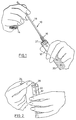
- Figure 1 is an illustration showing how a swab applicator and transport vial constructed in accordance with the invention are used.
- Figure 2 is a further illustration showing how the swab applicator can be broken off after it is inserted into the vial.
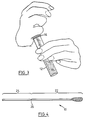
- Figure 3 is an illustration showing how a cap constructed in accordance with the present invention can be reattached to the vial.
- Figure 4 is a side view of a swab applicator for use in the combination of the invention.
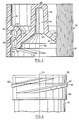
- Figure 5 is a side view, partially in cross-section, illustrating a preferred form of vial cap.
- Figure 6 is a side view of the upper end of a transport vial for use with the cap of Figure 5.
- Figures 1 to 3 illustrate how the combination of a swab applicator 10, a containment vial 12 therefor, and a cap 14 for the vial constructed in accordance with the invention can be used by a doctor or nurse or other person taking a culture sample.
- the swab applicator 10 is applied to the area or substance to be tested by rubbing the swab material 16, which may be cotton or a synthetic material, over the area or substance.
- the long shaft 18 is employed both to reach difficult to reach areas such as the throat and to prevent contact between the hands of the nurse or doctor and the area or material being tested.
- the swab applicator After the culture sample has been taken, it is known to place the swab applicator in a vial for transport or storage. If necessary or desirable, the vial can contain a culture preserving substance 20 which keeps the culture, if any, alive in the vial but does not permit it to grow. The vial could also be empty. After the known swab applicator has been placed in the vial, the open end 21 of the vial is sealed with a cap or plug. The sealed vial is then brought to a laboratory or other testing area where the nature of the bacteria, virus or microorganism obtained is determined if possible.
- the method of taking a culture sample according to the present invention differs from the aforementioned known procedure in several ways.
- the construction of which is shown in detail in Figure 4 only a lower section 22 of the applicator is actually inserted into the vial. This is because the swab applicator 10 is considerably longer than the length of the vial.
- the applicator has an upper section 24 which is the portion that is actually handled by the nurse or doctor taking the test. The nurse or doctor should avoid handling or touching in any way the lower section 22 in order to avoid possible contamination thereof.
- a frangible joint 26 is pre-formed during the manufacturing of the applicator between the upper and lower sections.
- the cap and the vial Because of the construction of the cap and the vial, there is a double seal between them and, in addition, the upper end of the lower section 22 of the applicator is captured in the cap 14. Accordingly, when the vial reaches the laboratory for testing, the applicator can easily be removed from the vial by removal of the cap to which the applicator is now attached.
- the cap 14 is preferably made of soft plastic such as low density polyethylene (food grade) which makes it reasonably flexible.
- the cap has a generally cylindrical rim 30 that extends the full height of the cap and that preferably has serrations 32 on its outside surface so that it can be grasped easily in a user's fingers.
- a lower portion of the rim has threads 34 on the inside surface thereof.
- the threads have a triple start and are of the right hand type.
- the thread lead in this embodiment is 0,606 cm (.2389 inch) and the thread pitch is 0,202 cm (.0796 inch).
- the cap has a central section 36 closing the area inside the rim.
- This section has a central, axially-extending bore portion 38 adapted to fit snuggly around one end of the broken swab applicator 10.
- This bore portion has one open end 40 to receive the end of the applicator and an upper, closed end 42.
- the bore 44 tapers slightly inwardly from bottom to top.
- the central section of the cap also has means for directing the upper end of the lower section 22 of the applicator into the central bore portion.
- the directing means comprises a conical-shaped connecting wall 46 extending outwardly from the open end 40 of the central bore portion.
- the inner surface of the connecting wall 46 slopes at an angle of approximately 55° to the central axis of the cap.
- the central section of the cap further includes an inner cylindrical rim 48 spaced radially inwardly from the rim 30.
- the rim 48 extends along the inside surface of the vial.
- the connecting wall 46 is integrally connected to the rim 48 at a point approximately mid-way up the height of the rim.
- Sealing means are preferably formed on the radially exterior surface of the rim 48 for engaging the inside surface of the vial. Preferably these sealing means take the form of two rounded annular protruberances 50 extending outwardly from the rim.
- protruberances which are made from the same plastics material as the cap, act in a manner somewhat similar to O-rings to form a seal between the cap and the vial.
- the inner rim 48 is connected to the outer rim by a short, radially extending connecting shoulder 52 that extends the entire circumference of the cap. Formed in the bottom of this shoulder is an annular V-shaped groove 54 into which the top end 56 of the vial is pressed for an additional seal between the vial and the cap.
- the vial 12 which preferably is made of a rigid clear or transparent or translucent plastic has a widened top portion 58 and an open top.
- the preferred plastics material is crystal styrene (food grade).
- Formed on the outer surface of the top portion are suitable threads 60 constructed to cooperate and engage the threads of the cap 14.
- the threads Preferably the threads have a triple start and are right-hand.
- the threads on the vial have a sloping top surface 62. This sloping surface together with the sloping surfaces of the threads 34 of the cap permit the cap 14 to be simply pushed by force onto the top of the vial, if desired.
- the threads 34 will slide over the threads 60 upon application of sufficient force without damage thereto.
- the sloping surface 62 extends at approximately 45° to the center axis 64 of the vial.
- the threads 34 have a steeply sloped lower surface 66 and an upper surface 68 with a more gradual slope.
- the lower surface 66 extends at an angle of approximately 45° to the center axis 70 of the cap.
- the slope of the upper surface 68 can be 7 to 8° relative to the bottom of the cap.
- a new vial cap has been provided by this invention, which cap is able to capture one end of a suitable swab applicator so that the swab applicator need not be touched or handled after it has been placed in a transport vial.
- a preferred form of this cap can either be screwed onto the vial or applied thereto simply by pushing the cap down onto the vial.
- the cap is able to seal the vial effectively so that the contents thereof cannot become contaminated or contaminate the surrounding area.
Landscapes
- Health & Medical Sciences (AREA)
- Life Sciences & Earth Sciences (AREA)
- General Health & Medical Sciences (AREA)
- Public Health (AREA)
- Heart & Thoracic Surgery (AREA)
- Veterinary Medicine (AREA)
- Engineering & Computer Science (AREA)
- Animal Behavior & Ethology (AREA)
- Biomedical Technology (AREA)
- Epidemiology (AREA)
- Vascular Medicine (AREA)
- Pathology (AREA)
- Medical Informatics (AREA)
- Molecular Biology (AREA)
- Surgery (AREA)
- Sampling And Sample Adjustment (AREA)
- Apparatus Associated With Microorganisms And Enzymes (AREA)
Description
- This invention relates to testing swabs and storage or transport vials therefor and to a method of taking a culture sample.
- It is a common practice to use swab applicators to obtain culture samples or samples of a similar nature. Commonly, the applicator has an elongate shaft made of wood or a plastics material. At one end of the shaft is a cotton or synthetic swab. Such applicators may be kept in a sterile package until they are to be used.
- For diagnostic and other medical purposes, it is known to provide a sealed transport or storage vial containing a culture preserving substance. The vial is sealed at one end by a removable cap or plug and the interior of and the contents of the vial are sterile. In order to carry out a diagnostic test on a patient, the applicator is used to obtain a culture sample from the area to be tested, for example the patient's throat. After removal of the cap or plug from the vial, the applicator is then placed into the open end of the vial. The open end of the vial is then sealed with the cap. The vial is then transported to the laboratory where the contents thereof are tested.
- A potential difficulty with this known system for taking a culture sample test is that it is possible for the doctor or nurse who takes the test to contaminate the test sample by the handling of the swab applicator. Furthermore, because it is necessary for a technician to handle the applicator again when the vial has reached the testing laboratory, further contamination can occur in the laboratory unless the vial and the contents thereof are handled with care. The lab technician could himself be contaminated by his handling of the swab applicator or by touching the inside of the vial.
- US-A-4,175,008 discloses a culture specimen collection and transport package comprising a swab applicator, a containment vial therefor and a cap for said vial, as set out in the preamble of
claim 1 - The present invention seeks to alleviate some or all of the aforementioned problems with known systems. There is disclosed herein a special swab applicator wherein the portion of the applicator that is actually handled by the nurse or doctor taking the test is not inserted in or transported in the vial. Thus the chances of the culture sample being contaminated by the doctor or nurse are decreased. A special vial cap is also provided herein, which cap is able to capture the section of the applicator that is placed in the transport vial. The use of such a cap avoids the need for the lab technician to touch or handle the bottom section of the applicator after it has been transported in the vial.
- The invention relates to a combination of a swab applicator, a containment vial therefor, and a cap for the vial as claimed in
claim 1. - According to a further aspect of the invention, there is provided a method of taking a culture sample with a swab applicator and a vial with a cap as claimed in claim 8.
- Further features and advantages will become apparent from the following detailed description of a preferred embodiment when considered in conjunction with the accompanying drawings.
- Figure 1 is an illustration showing how a swab applicator and transport vial constructed in accordance with the invention are used.
- Figure 2 is a further illustration showing how the swab applicator can be broken off after it is inserted into the vial.
- Figure 3 is an illustration showing how a cap constructed in accordance with the present invention can be reattached to the vial.
- Figure 4 is a side view of a swab applicator for use in the combination of the invention.
- Figure 5 is a side view, partially in cross-section, illustrating a preferred form of vial cap.
- Figure 6 is a side view of the upper end of a transport vial for use with the cap of Figure 5.
- Figures 1 to 3 illustrate how the combination of a
swab applicator 10, acontainment vial 12 therefor, and acap 14 for the vial constructed in accordance with the invention can be used by a doctor or nurse or other person taking a culture sample. In accordance with the standard procedure for a test of this nature, theswab applicator 10 is applied to the area or substance to be tested by rubbing theswab material 16, which may be cotton or a synthetic material, over the area or substance. Thelong shaft 18 is employed both to reach difficult to reach areas such as the throat and to prevent contact between the hands of the nurse or doctor and the area or material being tested. After the culture sample has been taken, it is known to place the swab applicator in a vial for transport or storage. If necessary or desirable, the vial can contain aculture preserving substance 20 which keeps the culture, if any, alive in the vial but does not permit it to grow. The vial could also be empty. After the known swab applicator has been placed in the vial, theopen end 21 of the vial is sealed with a cap or plug. The sealed vial is then brought to a laboratory or other testing area where the nature of the bacteria, virus or microorganism obtained is determined if possible. - The method of taking a culture sample according to the present invention differs from the aforementioned known procedure in several ways. After the culture sample has been taken with the applicator, the construction of which is shown in detail in Figure 4, only a
lower section 22 of the applicator is actually inserted into the vial. This is because theswab applicator 10 is considerably longer than the length of the vial. The applicator has anupper section 24 which is the portion that is actually handled by the nurse or doctor taking the test. The nurse or doctor should avoid handling or touching in any way thelower section 22 in order to avoid possible contamination thereof. Afrangible joint 26 is pre-formed during the manufacturing of the applicator between the upper and lower sections. This weak or frangible joint can be created by a small knife cut that slightly reduces the cross-section of the shaft. After the lower section of the applicator has been placed in the vial, it is simple for the nurse or doctor to break off theupper section 24 as shown in Figure 2. Thesection 24 can then be disposed of since it is no longer required. It should be noted that in the preferred embodiment shown in Figure 2 thelower section 22 projects slightly from the top of the vial, thus the length of thelower section 22 is slightly greater than the vial chamber. Theslight projection 28 is advantagous for reasons that will become apparent hereinafter. After the upper section has been removed, thevial cap 14 is replaced onto the vial in the manner shown in Figure 3. Because of the construction of the cap and the vial, there is a double seal between them and, in addition, the upper end of thelower section 22 of the applicator is captured in thecap 14. Accordingly, when the vial reaches the laboratory for testing, the applicator can easily be removed from the vial by removal of the cap to which the applicator is now attached. - The construction of the
special vial cap 14 will now be described with reference to Figure 5. It is preferably made of soft plastic such as low density polyethylene (food grade) which makes it reasonably flexible. The cap has a generallycylindrical rim 30 that extends the full height of the cap and that preferably hasserrations 32 on its outside surface so that it can be grasped easily in a user's fingers. In the preferred embodiment shown, a lower portion of the rim hasthreads 34 on the inside surface thereof. In one preferred embodiment, the threads have a triple start and are of the right hand type. The thread lead in this embodiment is 0,606 cm (.2389 inch) and the thread pitch is 0,202 cm (.0796 inch). The cap has acentral section 36 closing the area inside the rim. This section has a central, axially-extendingbore portion 38 adapted to fit snuggly around one end of thebroken swab applicator 10. This bore portion has oneopen end 40 to receive the end of the applicator and an upper, closed end 42. In the preferred embodiment shown, thebore 44 tapers slightly inwardly from bottom to top. Thus, as the end of the applicator enters thebore 44, the grip of the cap on the applicator gradually increases becoming quite strong as the end of the applicator reaches the closed end 42. - The central section of the cap also has means for directing the upper end of the
lower section 22 of the applicator into the central bore portion. In the illustrated preferred embodiment the directing means comprises a conical-shaped connectingwall 46 extending outwardly from theopen end 40 of the central bore portion. In the illustrated embodiment, the inner surface of the connectingwall 46 slopes at an angle of approximately 55° to the central axis of the cap. It will thus be seen that even if the upper end of the applicator after the breaking step is not located on the center axis of the vial, the cap attachment process will eventually push or force the end of the applicator towards the center axis of the vial and into thebore 44. - The central section of the cap further includes an inner
cylindrical rim 48 spaced radially inwardly from therim 30. When thecap 14 is fully attached to the vial, therim 48 extends along the inside surface of the vial. As shown in Figure 5, the connectingwall 46 is integrally connected to therim 48 at a point approximately mid-way up the height of the rim. Sealing means are preferably formed on the radially exterior surface of therim 48 for engaging the inside surface of the vial. Preferably these sealing means take the form of two roundedannular protruberances 50 extending outwardly from the rim. These protruberances, which are made from the same plastics material as the cap, act in a manner somewhat similar to O-rings to form a seal between the cap and the vial. Theinner rim 48 is connected to the outer rim by a short, radially extending connectingshoulder 52 that extends the entire circumference of the cap. Formed in the bottom of this shoulder is an annular V-shapedgroove 54 into which thetop end 56 of the vial is pressed for an additional seal between the vial and the cap. - Turning now to the construction of the vial itself, the upper portion of a preferred form of vial is shown in Figure 6. The
vial 12 which preferably is made of a rigid clear or transparent or translucent plastic has a widenedtop portion 58 and an open top. The preferred plastics material is crystal styrene (food grade). Formed on the outer surface of the top portion aresuitable threads 60 constructed to cooperate and engage the threads of thecap 14. Preferably the threads have a triple start and are right-hand. Preferably the threads on the vial have a slopingtop surface 62. This sloping surface together with the sloping surfaces of thethreads 34 of the cap permit thecap 14 to be simply pushed by force onto the top of the vial, if desired. Thus, thethreads 34 will slide over thethreads 60 upon application of sufficient force without damage thereto. In one preferred embodiment of the vial, the slopingsurface 62 extends at approximately 45° to thecenter axis 64 of the vial. As shown in Figure 5, thethreads 34 have a steeply slopedlower surface 66 and anupper surface 68 with a more gradual slope. In a preferred embodiment, thelower surface 66 extends at an angle of approximately 45° to thecenter axis 70 of the cap. The slope of theupper surface 68 can be 7 to 8° relative to the bottom of the cap. - It will thus be seen that a new vial cap has been provided by this invention, which cap is able to capture one end of a suitable swab applicator so that the swab applicator need not be touched or handled after it has been placed in a transport vial. A preferred form of this cap can either be screwed onto the vial or applied thereto simply by pushing the cap down onto the vial. In addition to seizing the end of the swab applicator in the vial, the cap is able to seal the vial effectively so that the contents thereof cannot become contaminated or contaminate the surrounding area.
Claims (12)
- A combination of a swab applicator (10), a containment vial (12) therefor, and a cap (14) for said vial (12), comprising:
an elongate vial (12) having one open end (21) and a closed end;
a cap (14) for said vial (12) having a rim (30, 34) for attachment of said cap (14) to said vial (12) and a central section (36) characterized in that said central section is closing the area inside said rim, and has a central, axially-extending bore portion (44) adapted to fit snuggly around an end of a swab applicator (10) and to capture same;
and a swab applicator (10) separate from the cap (14) has a long shaft (18) and swab material (16) at one end of said shaft (18), said shaft (18) having a first section (22) having a length corresponding approximately to the inside length of said vial (12) and a second section (24) joined to said first section (22) by a frangible joint (26);
wherein after use of said swab applicator (10) to obtain a culture sample, said swab applicator (10) can be inserted into the open end of the vial (12) so that said first section (22) is contained in said vial (12), said second section (24) can be broken off by the user, and said cap (14) can be attached to said vial (12) to seal said vial (12) and capture one end of said first section (22) of the applicator. - A combination according to claim 1 wherein said central section (36) of said cap (14) has conical-shaped means (46) for directing said one end of said first section (22) into said central bore portion (44).
- A combination according to claim 2 wherein said directing means (46) is a conical-shaped wall extending outwardly from an open end of said central bore portion (44).
- A combination according to claim 2 wherein the frangible joint (26) in the applicator is formed by a cut in said shaft that reduces the cross-section thereof at said joint.
- A combination according to claim 2 wherein said cap (14) is provided with sealing means (50) for sealing the connection between said cap (14) and said vial (12).
- A combination according to claim 5 wherein said cap (14) includes an inner cylindrical rim (48) spaced radially inwardly from the first mentioned rim (30, 34) and said sealing means (50) are formed on the radially exterior surface of said inner rim (48).
- A combination according to claim 6 wherein said sealing means (50) are rounded annular protuberances extending outwardly from said inner rim (48).
- A method of taking a culture sample with a swab applicator (10) and a vial (12) with a cap (14) characterized by:
applying said applicator (10) to an area or substance to obtain a culture sample on one end of said applicator (10);
inserting said one end of the applicator (10) into said vial (12) which has an open top (21);
breaking off an upper section (24) of said applicator (10) leaving a lower section (22) inside said vial (12) of a length substantially equal to the inside length of the said vial (12); and
attaching said cap (14) to the top of said vial (12) so as to effect a sealing engagement between said cap (14) and said vial (12) and so as to capture an end of said lower section (22) in said cap (14). - A method according to claim 8 wherein said upper section (24) is broken off at a frangible joint (26) preformed between the upper (24) and lower (22) sections.
- A method according to claim 9 wherein said cap (14) is attached to said vial (12) by cooperating threads (34, 60) formed on said cap (14) and on said vial (12).
- A method according to claim 10 wherein said end of the lower section (22) is captured by insertion of the end into a central, axially-extending bore portion (44) of said cap (14) a friction fit being created between the inner surface of said bore portion (44) and said lower section (22) of the applicator (10).
- A method according to claim 9 wherein only the upper section (24) of said applicator (10) is touched by the user during the sample taking and the breaking step.
Priority Applications (1)
| Application Number | Priority Date | Filing Date | Title |
|---|---|---|---|
| DE19883851330 DE3851330T2 (en) | 1988-11-04 | 1988-11-04 | Cap for closing a smear in a sample container. |
Applications Claiming Priority (1)
| Application Number | Priority Date | Filing Date | Title |
|---|---|---|---|
| US06/822,766 US4803998A (en) | 1986-01-27 | 1986-01-27 | Swab retaining vial cap and method of use |
Publications (2)
| Publication Number | Publication Date |
|---|---|
| EP0366826A1 EP0366826A1 (en) | 1990-05-09 |
| EP0366826B1 true EP0366826B1 (en) | 1994-08-31 |
Family
ID=25236908
Family Applications (1)
| Application Number | Title | Priority Date | Filing Date |
|---|---|---|---|
| EP88118382A Expired - Lifetime EP0366826B1 (en) | 1986-01-27 | 1988-11-04 | Swab retaining vial cap |
Country Status (2)
| Country | Link |
|---|---|
| US (1) | US4803998A (en) |
| EP (1) | EP0366826B1 (en) |
Families Citing this family (72)
| Publication number | Priority date | Publication date | Assignee | Title |
|---|---|---|---|---|
| US5380492A (en) * | 1990-12-18 | 1995-01-10 | Seymour; Eugene H. | Sampling device and sample adequacy system |
| US5283038A (en) * | 1990-12-18 | 1994-02-01 | Saliva Diagnostic Systems, Inc. | Fluid sampling and testing device |
| US5477863A (en) * | 1993-04-14 | 1995-12-26 | Grant; Michael A. | Collection kit with a sample collector |
| US5370128A (en) * | 1993-12-02 | 1994-12-06 | Wainwright; Sharon R. | Pap brush and pap unit container systems |
| US5404764A (en) * | 1994-02-07 | 1995-04-11 | Guest; Rodger L. | Liquid sample container system |
| US5711309A (en) * | 1996-01-26 | 1998-01-27 | Goldenberg; Robert A. | Apparatus for collecting middle ear specimens |
| USD388519S (en) * | 1996-04-02 | 1997-12-30 | Charm Sciences, Inc. | Pocket-size sanitation test kit |
| USD407499S (en) | 1997-03-31 | 1999-03-30 | Charm Sciences, Inc. | Pocket-size sanitation kit |
| GB2325156B (en) * | 1997-05-14 | 2001-01-10 | Nicola Perkins | Equipment for the removal of cosmetics |
| US6021681A (en) * | 1997-06-27 | 2000-02-08 | The United States Of America As Represented By The United States Department Of Energy | Sampling device with a capped body and detachable handle |
| US5980468A (en) * | 1997-09-22 | 1999-11-09 | Zimmon Scientific Corporation | Apparatus and method for serial collection storage and processing of biopsy specimens |
| USD408082S (en) * | 1997-12-29 | 1999-04-13 | Charm Sciences, Inc. | Pocket-size sanitation test kit |
| CA2237209C (en) | 1998-05-08 | 2002-01-29 | Institute Of Legal Medicine Of The University Of Berne | Foldable cardboard box for contact-free drying and long-term storage of biological evidence recovered on cotton swabs and forensic evidence collection kit including same |
| US6173851B1 (en) * | 1999-03-18 | 2001-01-16 | Anesta Corporation | Method and apparatus for the interim storage of medicated oral dosage forms |
| US6716396B1 (en) | 1999-05-14 | 2004-04-06 | Gen-Probe Incorporated | Penetrable cap |
| US7087028B2 (en) | 2000-02-24 | 2006-08-08 | R&G Medical And Development Corp. | Method and apparatus for sampling cervical tissue |
| US6383804B1 (en) * | 2000-07-13 | 2002-05-07 | International Bioproducts, Inc. | Sampling device with snap-off head and method of use |
| CA2337282C (en) * | 2001-03-05 | 2006-01-03 | Victor Daykin | Biological specimen collection apparatus |
| ATE457200T1 (en) * | 2001-03-09 | 2010-02-15 | Gen Probe Inc | PERMEABLE HOOD |
| US7243799B2 (en) * | 2001-05-15 | 2007-07-17 | Cephalon, Inc. | Portable container for disposing of a medicated oral dosage form |
| CA3122193C (en) * | 2002-12-26 | 2025-05-06 | Meso Scale Technologies, Llc. | Assay cartridges and methods of using the same |
| US20040267181A1 (en) * | 2003-06-26 | 2004-12-30 | Asd | Swab sample collection and recovery device |
| US20050010133A1 (en) * | 2003-07-08 | 2005-01-13 | Larry Pestes | Specimen collection system |
| US20050010132A1 (en) * | 2003-07-08 | 2005-01-13 | Dale Pestes | Swab having easily displaceable tip for collecting a saliva sample and inserting it into a collection device, and method of using same |
| US7337907B2 (en) * | 2003-08-01 | 2008-03-04 | Polyzen, Inc. | Press-flat centrifuge tube and specimen collection assembly comprising same |
| GB0322983D0 (en) * | 2003-10-01 | 2003-11-05 | Isohelix Limitd | Sampling kits, devices and uses thereof |
| US7303532B2 (en) * | 2004-01-30 | 2007-12-04 | Bianca Salvatore J | Trace evidence collection method and apparatus |
| US20050288606A1 (en) * | 2004-06-25 | 2005-12-29 | Continental Plastic Corp | Culture swab with protective cap and safety pin |
| US8097225B2 (en) * | 2004-07-28 | 2012-01-17 | Honeywell International Inc. | Microfluidic cartridge with reservoirs for increased shelf life of installed reagents |
| ITMI20051057A1 (en) * | 2005-06-08 | 2006-12-09 | Copan Innovation Ltd | DEVELOPMENT, COLLECTION AND TRANSPORT OF BIOLOGICAL SAMPLES |
| US7915032B2 (en) * | 2006-03-03 | 2011-03-29 | Capitol Vial Inc. | Sample collection system and method |
| US20080077046A1 (en) * | 2006-08-24 | 2008-03-27 | Cytyc Corporation | Snap-off specimen collection device |
| US8080645B2 (en) | 2007-10-01 | 2011-12-20 | Longhorn Vaccines & Diagnostics Llc | Biological specimen collection/transport compositions and methods |
| US8652782B2 (en) | 2006-09-12 | 2014-02-18 | Longhorn Vaccines & Diagnostics, Llc | Compositions and methods for detecting, identifying and quantitating mycobacterial-specific nucleic acids |
| US8097419B2 (en) | 2006-09-12 | 2012-01-17 | Longhorn Vaccines & Diagnostics Llc | Compositions and method for rapid, real-time detection of influenza A virus (H1N1) swine 2009 |
| US9481912B2 (en) | 2006-09-12 | 2016-11-01 | Longhorn Vaccines And Diagnostics, Llc | Compositions and methods for detecting and identifying nucleic acid sequences in biological samples |
| EP2171420A1 (en) * | 2007-07-31 | 2010-04-07 | Micronics, Inc. | Sanitary swab collection system, microfluidic assay device, and methods for diagnostic assays |
| US9683256B2 (en) | 2007-10-01 | 2017-06-20 | Longhorn Vaccines And Diagnostics, Llc | Biological specimen collection and transport system |
| US11041215B2 (en) | 2007-08-24 | 2021-06-22 | Longhorn Vaccines And Diagnostics, Llc | PCR ready compositions and methods for detecting and identifying nucleic acid sequences |
| EP3058954B1 (en) | 2007-08-27 | 2017-03-01 | Longhorn Vaccines and Diagnostics, LLC | Immunogenic compositions and methods |
| US10004799B2 (en) | 2007-08-27 | 2018-06-26 | Longhorn Vaccines And Diagnostics, Llc | Composite antigenic sequences and vaccines |
| DK2195466T3 (en) | 2007-10-01 | 2013-01-14 | Longhorn Vaccines & Diagnostics Llc | Method for storing biological samples |
| US11041216B2 (en) | 2007-10-01 | 2021-06-22 | Longhorn Vaccines And Diagnostics, Llc | Compositions and methods for detecting and quantifying nucleic acid sequences in blood samples |
| US7850922B2 (en) * | 2008-02-13 | 2010-12-14 | Capitol Vial Inc. | Fluid sample collection system |
| US7854895B2 (en) * | 2008-02-13 | 2010-12-21 | Capitol Vial Inc. | Fluid sample collection system and method |
| DE202008004471U1 (en) | 2008-04-01 | 2008-08-21 | Rest, Georg | Containers for securing, storing and transporting biological samples |
| US20100022916A1 (en) * | 2008-07-24 | 2010-01-28 | Javanbakhsh Esfandiari | Method and Apparatus for Collecting and Preparing Biological Samples for Testing |
| US8376958B2 (en) * | 2008-11-19 | 2013-02-19 | Daniel Larkin | Gynecological container cap having a boundary configured to detach a gynecological sampler from a sampling device |
| US8127627B2 (en) * | 2009-06-04 | 2012-03-06 | World Bioproducts, Llc | Device for collecting samples and method of use |
| JP5065503B2 (en) * | 2010-02-05 | 2012-11-07 | 株式会社シン・コーポレイション | Inspection kit |
| US8765487B2 (en) * | 2010-09-01 | 2014-07-01 | Clinical Innovations | Detection of amniotic fluid in vaginal secretions of pregnant women due to premature rupture of fetal membranes |
| US11555816B2 (en) | 2010-09-01 | 2023-01-17 | Clinical Innovations, Llc | Detection of amniotic fluid in vaginal secretions of pregnant women due to premature rupture of fetal membranes |
| US10338065B2 (en) | 2010-09-01 | 2019-07-02 | Clinical Innovations, Llc | Detection of amniotic fluid in vaginal secretions of pregnant women due to premature rupture of fetal membranes |
| CA2824404C (en) | 2011-01-06 | 2023-01-03 | Meso Scale Technologies, Llc | Assay cartridges for pcr analysis and methods of use thereof |
| WO2013112916A1 (en) | 2012-01-26 | 2013-08-01 | Longhorn Vaccines And Diagnostics, Llc | Composite antigenic sequences and vaccines |
| EP2989461B1 (en) | 2013-04-23 | 2019-03-06 | Cordant Research Solutions, LLC | Methods to determine body drug concentration from an oral fluid |
| ITMI20131088A1 (en) * | 2013-06-28 | 2014-12-29 | Copan Italia Spa | FLOCKED BUFFER AND METHOD FOR THE COLLECTION AND TRANSFER OF SAMPLES OF BIOLOGICAL MATERIAL |
| TWI502067B (en) * | 2013-12-10 | 2015-10-01 | Nat Univ Tsing Hua | Clinical specimen sampler and method thereof |
| US9976136B2 (en) | 2015-05-14 | 2018-05-22 | Longhorn Vaccines And Diagnostics, Llc | Rapid methods for the extraction of nucleic acids from biological samples |
| WO2017008228A1 (en) * | 2015-07-13 | 2017-01-19 | Coyote Bioscience Co., Ltd. | Device and method for sample collection |
| JP6945971B2 (en) * | 2016-06-08 | 2021-10-06 | 株式会社ミズホメディー | Detection kit for infectious disease testing in the field of ophthalmology |
| KR102103141B1 (en) * | 2018-09-08 | 2020-04-21 | (주)바이오다인 | vial device of preparing storing and smearing of exfoliative cells |
| WO2021007939A1 (en) * | 2019-07-12 | 2021-01-21 | 姚香怡 | Cell collection device and method |
| EP4089180B1 (en) | 2019-09-17 | 2025-06-25 | Longhorn Vaccines and Diagnostics, LLC | Multipurpose compositions for collecting and transporting biological material |
| US12485166B2 (en) | 2020-02-06 | 2025-12-02 | Longhorn Vaccines And Diagnostics, Llc | Vaccines for the treatment and prevention of zoonotic infections |
| WO2022087122A1 (en) | 2020-10-20 | 2022-04-28 | Longhorn Vaccines And Diagnostics, Llc | Immunogenic antigens |
| USD1021132S1 (en) | 2021-01-22 | 2024-04-02 | Leadway (Hk) Limited | Sample collection bottle |
| KR102458507B1 (en) * | 2021-06-05 | 2022-10-25 | (주)바이온라이프사이언스 | Container for sampling and preserving of a specimen |
| KR102458602B1 (en) * | 2021-06-05 | 2022-10-25 | (주)바이온라이프사이언스 | Container cover for preserving of a specimen |
| KR102458506B1 (en) * | 2021-06-05 | 2022-10-25 | (주)바이온라이프사이언스 | Container cover for preserving of a specimen |
| KR102576279B1 (en) * | 2021-07-06 | 2023-09-11 | 주식회사 노블바이오 | Quantitative saliva sampling tool |
| CN114933958B (en) * | 2022-07-21 | 2023-06-16 | 北京泰豪生物科技有限公司 | Sample collector and nucleic acid detection device |
Family Cites Families (15)
| Publication number | Priority date | Publication date | Assignee | Title |
|---|---|---|---|---|
| US2835246A (en) * | 1954-12-22 | 1958-05-20 | Boettger Paul | Handling medical specimens |
| GB990020A (en) * | 1960-06-02 | 1965-04-22 | Davidson Maxwell Wingate | Apparatus for the production of energy-bearing compression waves in fluid in a system operable by pressure fluid |
| US3368549A (en) * | 1964-10-19 | 1968-02-13 | S E Massengill Company | Diagnostic swabs |
| US3815580A (en) * | 1972-08-31 | 1974-06-11 | C Oster | Apparatus for and method of collecting and preserving cytologic samples |
| US3788510A (en) * | 1972-12-15 | 1974-01-29 | A Collins | Container closure |
| US4014746A (en) * | 1973-05-08 | 1977-03-29 | U.S. Medical Research And Development, Inc. | Method of and apparatus for collecting cultures |
| US3890204A (en) * | 1974-09-26 | 1975-06-17 | Marion Health And Safety Inc | Culture collecting package |
| US4150950A (en) * | 1977-09-28 | 1979-04-24 | Corning Glass Works | Transport system for clinical specimens |
| US4175008A (en) * | 1978-06-26 | 1979-11-20 | Bio-Pharmaceutical Packaging Corp. | Culture specimen collection and transport package |
| US4223093A (en) * | 1978-08-25 | 1980-09-16 | Precision Dynamics Corporation | Culture collection and transport device |
| US4312950A (en) * | 1980-03-31 | 1982-01-26 | Hillwood Corporation | Disposable swab and culture unit |
| US4311792A (en) * | 1980-04-14 | 1982-01-19 | Marion Health And Safety, Inc. | Culture collecting and transporting unit |
| US4353868A (en) * | 1981-05-29 | 1982-10-12 | Sherwood Medical Industries Inc. | Specimen collecting device |
| US4592884A (en) * | 1984-03-12 | 1986-06-03 | Little Rapids Corp. | Method for making specimen containers |
| US4586604A (en) * | 1984-06-28 | 1986-05-06 | Continental Plastic Corporation | Culture collection instrument and sealed swab holder therefor |
-
1986
- 1986-01-27 US US06/822,766 patent/US4803998A/en not_active Expired - Lifetime
-
1988
- 1988-11-04 EP EP88118382A patent/EP0366826B1/en not_active Expired - Lifetime
Also Published As
| Publication number | Publication date |
|---|---|
| EP0366826A1 (en) | 1990-05-09 |
| US4803998A (en) | 1989-02-14 |
Similar Documents
| Publication | Publication Date | Title |
|---|---|---|
| US4803998A (en) | Swab retaining vial cap and method of use | |
| KR100856772B1 (en) | Urine Specimen Container and How to Use It | |
| EP0189118B1 (en) | Blood collection assembly | |
| US6752965B2 (en) | Self resealing elastomeric closure | |
| EP0867378B1 (en) | Assembly for collecting blood or other body fluids | |
| EP0129029B1 (en) | Low contamination closure for blood collection tubes | |
| EP2430420B1 (en) | Closure, containing apparatus, and method of using same | |
| CA2067691C (en) | Stopper-shield combination closure | |
| US3711871A (en) | Sanitary liquid specimen collector | |
| EP1284160B1 (en) | Liquid specimen collection system | |
| US3777739A (en) | Method and apparatus for collecting urine | |
| US4250893A (en) | Sample collection device | |
| EP0058008A2 (en) | Device for use in the collection and transportation of medical specimens | |
| US20110130740A1 (en) | Medication Bottle for Use with Oral Syringe | |
| WO1979001131A1 (en) | Liquid sample collector device | |
| EP0901819B1 (en) | Collection container assembly | |
| US5405001A (en) | Removable and pierceable activation closure for two-compartment vial | |
| CA1326809C (en) | Swab retaining vial cap | |
| CA2611289A1 (en) | Device for the withdrawal, collection and transport of biological specimens | |
| EP1174085B1 (en) | Assembly for collecting blood or other body fluids | |
| CA2059071A1 (en) | Perforable safety stopper for test tubes for taking biological fluid samples | |
| MXPA00008724A (en) | Improved urine specimen container and method for using same | |
| HK1064737B (en) | Self-resealing closure for a container | |
| MXPA98001956A (en) | Set to collect blood or other fluids corpora |
Legal Events
| Date | Code | Title | Description |
|---|---|---|---|
| PUAI | Public reference made under article 153(3) epc to a published international application that has entered the european phase |
Free format text: ORIGINAL CODE: 0009012 |
|
| AK | Designated contracting states |
Kind code of ref document: A1 Designated state(s): AT BE CH DE ES FR GB GR IT LI LU NL SE |
|
| RBV | Designated contracting states (corrected) |
Designated state(s): DE FR GB IT |
|
| 17P | Request for examination filed |
Effective date: 19901108 |
|
| 17Q | First examination report despatched |
Effective date: 19921102 |
|
| GRAA | (expected) grant |
Free format text: ORIGINAL CODE: 0009210 |
|
| AK | Designated contracting states |
Kind code of ref document: B1 Designated state(s): DE FR GB IT |
|
| PG25 | Lapsed in a contracting state [announced via postgrant information from national office to epo] |
Ref country code: IT Free format text: LAPSE BECAUSE OF FAILURE TO SUBMIT A TRANSLATION OF THE DESCRIPTION OR TO PAY THE FEE WITHIN THE PRE;WARNING: LAPSES OF ITALIAN PATENTS WITH EFFECTIVE DATE BEFORE 2007 MAY HAVE OCCURRED AT ANY TIME BEFORE 2007. THE CORRECT EFFECTIVE DATE MAY BE DIFFERENT FROM THE ONE RECORDED.SCRIBED TIME-LIMIT Effective date: 19940831 Ref country code: FR Effective date: 19940831 |
|
| REF | Corresponds to: |
Ref document number: 3851330 Country of ref document: DE Date of ref document: 19941006 |
|
| RAP4 | Party data changed (patent owner data changed or rights of a patent transferred) |
Owner name: NCS DIAGNOSTICS INC. |
|
| EN | Fr: translation not filed | ||
| PLBE | No opposition filed within time limit |
Free format text: ORIGINAL CODE: 0009261 |
|
| STAA | Information on the status of an ep patent application or granted ep patent |
Free format text: STATUS: NO OPPOSITION FILED WITHIN TIME LIMIT |
|
| 26N | No opposition filed | ||
| PGFP | Annual fee paid to national office [announced via postgrant information from national office to epo] |
Ref country code: DE Payment date: 19960117 Year of fee payment: 8 |
|
| PG25 | Lapsed in a contracting state [announced via postgrant information from national office to epo] |
Ref country code: DE Effective date: 19970801 |
|
| PGFP | Annual fee paid to national office [announced via postgrant information from national office to epo] |
Ref country code: GB Payment date: 19991103 Year of fee payment: 12 |
|
| PG25 | Lapsed in a contracting state [announced via postgrant information from national office to epo] |
Ref country code: GB Free format text: LAPSE BECAUSE OF NON-PAYMENT OF DUE FEES Effective date: 20001104 |
|
| GBPC | Gb: european patent ceased through non-payment of renewal fee |
Effective date: 20001104 |