EP0366291A2 - Disc player with manual search function - Google Patents
Disc player with manual search function Download PDFInfo
- Publication number
- EP0366291A2 EP0366291A2 EP89310190A EP89310190A EP0366291A2 EP 0366291 A2 EP0366291 A2 EP 0366291A2 EP 89310190 A EP89310190 A EP 89310190A EP 89310190 A EP89310190 A EP 89310190A EP 0366291 A2 EP0366291 A2 EP 0366291A2
- Authority
- EP
- European Patent Office
- Prior art keywords
- level
- reproducing
- manual
- manual search
- command
- Prior art date
- Legal status (The legal status is an assumption and is not a legal conclusion. Google has not performed a legal analysis and makes no representation as to the accuracy of the status listed.)
- Granted
Links
Images

Classifications
-
- G—PHYSICS
- G11—INFORMATION STORAGE
- G11B—INFORMATION STORAGE BASED ON RELATIVE MOVEMENT BETWEEN RECORD CARRIER AND TRANSDUCER
- G11B19/00—Driving, starting, stopping record carriers not specifically of filamentary or web form, or of supports therefor; Control thereof; Control of operating function ; Driving both disc and head
- G11B19/02—Control of operating function, e.g. switching from recording to reproducing
-
- G—PHYSICS
- G11—INFORMATION STORAGE
- G11B—INFORMATION STORAGE BASED ON RELATIVE MOVEMENT BETWEEN RECORD CARRIER AND TRANSDUCER
- G11B21/00—Head arrangements not specific to the method of recording or reproducing
- G11B21/02—Driving or moving of heads
- G11B21/08—Track changing or selecting during transducing operation
- G11B21/081—Access to indexed tracks or parts of continuous track
- G11B21/083—Access to indexed tracks or parts of continuous track on discs
Definitions
- the present invention relates to a disc player for playing a disc such as a digital audio disc, video disc, or the like, which is provided with the so-called manual search function for the so-called music select.
- the disc player can perform the manual search mode in which the playing operation and jumping operation are alternately executed as long as a manual search command is generated by manual switch operation whereby a user can search for a desired program in a disc mounted therein.
- Each playing operation during the manual search continues during a short period, for instance, about a few seconds.
- the reproducing level during each playing operation during the manual search is set at such a reduced level that the content of a program can be approximately discriminated since the sound quality is not always good during such operation.
- the reproduced sound level is reduced during the manual search mode to a level lower than the reproduced sound level when the manual search command is manually initiated by means of, for example, a keyboard.
- the reproducing level in the manual search operating mode is set to a level lower than the reproducing level at the initiation of the manual search command, and when the change command is generated, the reproducing level in the manual search operating mode is changed to a designated level.
- the reproducing level at the initiation of the manual search command and a predetermined level are compared with each other and the reproducing level in the manual search operating mode may be set to the level which is equal to the smaller one of the particular reproducing level and the predetermined level.
- a CD player is shown in which a disc (called CD) 1 on which a plurality of programs have been recorded is rotated by a turntable 2a driven by a spindle motor 2.
- the signal recorded on the disc 1 is read by a pickup 3 in association with the rotation of the disc 1.
- the pickup 3 is supported by a carriage (not shown) which is moved in the radial direction of the disc 1 by a carriage motor 4.
- An information reading point, for example, a light spot to read information, of the pickup 3 is freely positioned in the radial direction of the disc 1.
- various servo systems such as spindle servo system, focusing servo system, tracking servo system, carriage servo system, and the like are provided, since they have already been well known, they are not shown in the drawings.
- the spindle motor 2 and carriage motor 4 are controlled by a playing section control circuit 5 as well as the spindle servo system and carriage servo system (not shown).
- the control circuit 5 drives the spindle motor 2 and carriage motor 4 and executes the on/off controls of the various servo system in known manners.
- a so-called RF (radio frequency) signal which is output from the pickup 3 is amplified by an RF amplifier 8 and, thereafter, it is supplied to an EFM (eight-to-fourteen modulation) demodulator 9.
- the EFM demodulator 9 demodulates pulse signals which are obtained by slicing the RF signal and forms PCM data, that is, digital data including a main code representing time-division multiplexed audio signals of both of the right and left channels and also a subcode.
- the digital data including the audio information signal which is issued from the EFM demodulator 9 is supplied to a deinterleave interpolation circuit 10.
- the deinterleave interpolating circuit 10 deinterleaves the digital data whose order is rearranged in accordance with the original interleave which has been executed before recording on the disc in cooperation with a RAM 11 and also transmits the digital data to an error correcting circuit 12.
- the circuit 10 interpolates the erroneous data in the output data of the error correcting circuit 12 by a mean value interpolating method or the like.
- the error correcting circuit 12 executes the error correction by using a CIRC (Cross Interleave Reed Solomon Code) and supplies the digital data to the deinterleave interpolating circuit 10. If the erroneous data cannot be corrected, a signal indicative of the uncorrectable stage is output.
- CIRC Cross Interleave Reed Solomon Code
- the output data of the deinterleave interpolating circuit 10 is supplied to a digital attenuator 13.
- the attenuator 13 attenuates the input data by using a divider and the like by only the value corresponding to the attenuation factor indicated by the data which is output from the system controller 7.
- Output data of the digital attenuator 13 is supplied to a D/A (digital/analog) converter 14.
- the D/A converter 14 has a demultiplexer for separating every channel of the digital data including the time-sharingly multiplexed audio information of the right and left channels.
- the audio signals of both of the right and left channels are reproduced. Unnecessary components are eliminated from the reproduction audio signals of both of the right and left channels by LPFs (low pass filters) 15 and 16. Thereafter, the audio signals are supplied to audio output terminals.
- the system controller 7 is constructed by a microcomputer comprising, for instance, a processor, a ROM, a RAM, a timer, and the like.
- a command corresponding to the key operation which is supplied from a manual operating section 18 such as a keyboard
- the system controller 7 executes the arithmetic operation on the basis of the data or program stored in the ROM, RAM, etc. and, thereafter, supplies a command signal to play, search, jump, or the like to the playing section control circuit 5 and also supplies the data indicative of the attenuation factor to the digital attenuator 13.
- step S1 the data A which indicates the attenuation factor corresponding to the reproducing level designated by the key operation of the operating section 18 in the playing mode and which is supplied to the digital attenuator 13 is transferred to and stored into a predetermined address in the RAM by the processor.
- step S2 the processor checks to see if a command to change the reproducing level has been generated by the key operation of the operating section 18 or not (step S2).
- step S2 the processor supplies data E which is smaller than the data A stored in the predetermined address in the RAM by only a predetermined value to the digital attenuator 13 as data ATT indicative of the attenuation factor (step S4). If the command to change the reproducing level is determined to have been generated in step S2, the processor supplies the digital attenuator 13 with data ATT indicative of the attenuation factor corresponding to data B representative of a reproduction level which has been newly designated by the manual key operation to the digital attenuator 13 (step S3).
- step S3 or S4 the processor accesses and executes a subroutine for performing the manual searching operation in which the jump command and play command are alternately supplied to the playing section control circuit 5 (step S5).
- step S5 A check is then made to see if a release command has been generated by the key operation of the operating section 18 or not (step S6). If the release command has been generated in step S6, the processor transmits the data A stored in the predetermined address in the RAM to the digital attenuator 13 as the data ATT (step S7). The execution of the routine which was being executed just before the processing routine advanced to step S1 is restarted.
- the attenuation factor of the digital attenuator 13 is smaller than that determined in the operating mode at the initiation of the manual search command.
- the attenuation factor of the digital attenuator 13 is set to the value corresponding to the reproducing level which is manually newly designated by the operation section 18. Therefore, during the manual searching mode, if the reproducing level is too much decreased to listen to the reproduced sound the user can set the reproducing level into a desired level while listening to the reproduced sound.
- Fig. 3 is a flowchart showing another example of the operation of the processor in the system controller 7 in the apparatus of Fig. 1. Since steps S15 to S17 in the flowchart of Fig. 3 are substantially similar to steps S5 to S7 in the flowchart of Fig. 2, only the operations at steps S11 to S14 will now be described hereinbelow.
- step S11 the data A which indicates the attenuation factor corresponding to the reproducing level designated by the key operation of the operating section 18 in the playing mode and which is supplied to the digital attenuator 13 is transferred to or stored into a predetermined address in the RAM.
- step S14 the processor compares the attenuation A with a predetermined data D and moves to step S14 if relatively little attenuation A is in effect.
- of the data A may be compared with the absolute value
- the value of the data D which has previously been stored in the predetermined address in the ROM is -12 dB and that the actual reproducing level in the operating mode at the initiation of the manual searching command is -6 dB, the value of
- the reproducing level in the manual searching mode is equalized to the smaller one of the reproducing level in the operating mode at the initiation of the manual searching command or mode and the desired or predetermined reproducing level. Therefore, if the reproducing level in the operating mode at the initial phase of the manual searching mode is larger than the predetermined reproducing level, the reproducing level in the manual searching mode can be set to a predetermined small value. If, moreover, the reproducing level in the operating mode at the initial phase of the manual searching mode is smaller than the predetermined reproducing level, the reproducing level in the manual searching mode is kept at the same as the reproducing level in the operating mode at the initial phase of the manual searching mode. Consequently, it is possible to prevent a situation such that the reproducing level in the manual searching mode decreases to a too low level to listen to the reproduced sound.
- the reproducing level in the manual searching mode is set to a level smaller than the reproducing level in the operating mode at the initiation of the manual searching mode or command. If the change command is generated, the reproducing level in the manual searching mode is changed to the designated level. Therefore, when the manual searching mode is set, and the reproducing level is reduced too low to listen to the reproduced sound, the user can set the reproducing level to a desired level while listening to the reproduced sound.
- the reproducing level in the manual searching mode can be preferably set.
- the reproducing level in the operating mode at the initiation of the manual searching command or mode is compared with a predetermined level and the reproducing level in the manual searching mode is equalized to the smaller one of the reproducing level at the initiation of the manual searching mode and the predetermined level. If, therefore the reproducing level at the initiation of the manual searching mode is larger than the predetermined level, the reproducing level in the manual searching mode can be set to the predetermined small value. Further, if the reproducing level at the initiation of the manual searching mode is smaller than the predetermined level, the reproducing level in the manual searching mode is set to the same value as the reproducing level in the operating mode at the initiation of the manual searching mode. Thus, it can be avoided that the reproducing level during the manual searching mode is too decreased to listen the the reproduced sound.
Landscapes
- Signal Processing For Digital Recording And Reproducing (AREA)
- Signal Processing Not Specific To The Method Of Recording And Reproducing (AREA)
- Indexing, Searching, Synchronizing, And The Amount Of Synchronization Travel Of Record Carriers (AREA)
Abstract
Description
- The present invention relates to a disc player for playing a disc such as a digital audio disc, video disc, or the like, which is provided with the so-called manual search function for the so-called music select.
- In general, the disc player can perform the manual search mode in which the playing operation and jumping operation are alternately executed as long as a manual search command is generated by manual switch operation whereby a user can search for a desired program in a disc mounted therein. Each playing operation during the manual search continues during a short period, for instance, about a few seconds. The reproducing level during each playing operation during the manual search is set at such a reduced level that the content of a program can be approximately discriminated since the sound quality is not always good during such operation.
- In the conventional disc player, the reproduced sound level is reduced during the manual search mode to a level lower than the reproduced sound level when the manual search command is manually initiated by means of, for example, a keyboard.
- However, it has been a problem that the reproduced sound level during the manual search mode becomes too low to listen to the reproduced sound when the reproduced sound level is relatively low upon the initiation of the manual search command.
- It is an object of the present invention to provide a disc player in which the reproducing level thereof during the manual search can be adjusted to a level generated to distinguish the content of the sound information represented by the reproduced sound.
- According to the present invention, so long as a change command is not generated during the manual search operating mode to alternately execute the playing operation and jumping operation, the reproducing level in the manual search operating mode is set to a level lower than the reproducing level at the initiation of the manual search command, and when the change command is generated, the reproducing level in the manual search operating mode is changed to a designated level.
- According to an additional feature of the present invention, the reproducing level at the initiation of the manual search command and a predetermined level are compared with each other and the reproducing level in the manual search operating mode may be set to the level which is equal to the smaller one of the particular reproducing level and the predetermined level. Certain embodiments of the invention will now be described by way of example only.
-
- Fig. 1 is a block diagram showing an embodiment of the present invention;
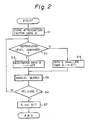
- Fig. 2 is a flowchart showing an example of the operation of a processor in the apparatus of Fig. 1; and
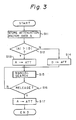
- Fig. 3 is a flowchart showing another example of the operation of the processor in the apparatus of Fig. 1.
- In. Fig. 1, a CD player is shown in which a disc (called CD) 1 on which a plurality of programs have been recorded is rotated by a turntable 2a driven by a
spindle motor 2. The signal recorded on the disc 1 is read by apickup 3 in association with the rotation of the disc 1. Thepickup 3 is supported by a carriage (not shown) which is moved in the radial direction of the disc 1 by a carriage motor 4. An information reading point, for example, a light spot to read information, of thepickup 3 is freely positioned in the radial direction of the disc 1. In addition, although various servo systems such as spindle servo system, focusing servo system, tracking servo system, carriage servo system, and the like are provided, since they have already been well known, they are not shown in the drawings. - The
spindle motor 2 and carriage motor 4 are controlled by a playingsection control circuit 5 as well as the spindle servo system and carriage servo system (not shown). In accordance with commands from asystem controller 7, thecontrol circuit 5 drives thespindle motor 2 and carriage motor 4 and executes the on/off controls of the various servo system in known manners. - A so-called RF (radio frequency) signal which is output from the
pickup 3 is amplified by anRF amplifier 8 and, thereafter, it is supplied to an EFM (eight-to-fourteen modulation)demodulator 9. TheEFM demodulator 9 demodulates pulse signals which are obtained by slicing the RF signal and forms PCM data, that is, digital data including a main code representing time-division multiplexed audio signals of both of the right and left channels and also a subcode. The digital data including the audio information signal which is issued from theEFM demodulator 9 is supplied to adeinterleave interpolation circuit 10. The deinterleave interpolatingcircuit 10 deinterleaves the digital data whose order is rearranged in accordance with the original interleave which has been executed before recording on the disc in cooperation with aRAM 11 and also transmits the digital data to anerror correcting circuit 12. When a signal indicating that the digital data is uncorrectable is output from theerror correcting circuit 12, thecircuit 10 interpolates the erroneous data in the output data of theerror correcting circuit 12 by a mean value interpolating method or the like. On the other hand, theerror correcting circuit 12 executes the error correction by using a CIRC (Cross Interleave Reed Solomon Code) and supplies the digital data to the deinterleave interpolatingcircuit 10. If the erroneous data cannot be corrected, a signal indicative of the uncorrectable stage is output. - The output data of the deinterleave interpolating
circuit 10 is supplied to adigital attenuator 13. Theattenuator 13 attenuates the input data by using a divider and the like by only the value corresponding to the attenuation factor indicated by the data which is output from thesystem controller 7. Output data of thedigital attenuator 13 is supplied to a D/A (digital/analog)converter 14. The D/A converter 14 has a demultiplexer for separating every channel of the digital data including the time-sharingly multiplexed audio information of the right and left channels. The audio signals of both of the right and left channels are reproduced. Unnecessary components are eliminated from the reproduction audio signals of both of the right and left channels by LPFs (low pass filters) 15 and 16. Thereafter, the audio signals are supplied to audio output terminals. - On the other hand, the subcode which was output from the
EFM demodulator 9 is supplied to thesystem controller 7. Thesystem controller 7 is constructed by a microcomputer comprising, for instance, a processor, a ROM, a RAM, a timer, and the like. In response to a command corresponding to the key operation which is supplied from amanual operating section 18 such as a keyboard, thesystem controller 7 executes the arithmetic operation on the basis of the data or program stored in the ROM, RAM, etc. and, thereafter, supplies a command signal to play, search, jump, or the like to the playingsection control circuit 5 and also supplies the data indicative of the attenuation factor to thedigital attenuator 13. - The operation of the processor in the
system controller 7 in the above construction will be described with reference to the flowchart of Fig. 2. - If a manual search command is given from the manual operation section when the operating mode has been set into the playing mode during the execution of the main routine, playing mode control routine, or the like, the processing routine of the processor advances to step S1. In step S1, the data A which indicates the attenuation factor corresponding to the reproducing level designated by the key operation of the
operating section 18 in the playing mode and which is supplied to thedigital attenuator 13 is transferred to and stored into a predetermined address in the RAM by the processor. Next, the processor checks to see if a command to change the reproducing level has been generated by the key operation of theoperating section 18 or not (step S2). If NO in step S2, the processor supplies data E which is smaller than the data A stored in the predetermined address in the RAM by only a predetermined value to thedigital attenuator 13 as data ATT indicative of the attenuation factor (step S4). If the command to change the reproducing level is determined to have been generated in step S2, the processor supplies thedigital attenuator 13 with data ATT indicative of the attenuation factor corresponding to data B representative of a reproduction level which has been newly designated by the manual key operation to the digital attenuator 13 (step S3). - After completion of the execution in step S3 or S4, the processor accesses and executes a subroutine for performing the manual searching operation in which the jump command and play command are alternately supplied to the playing section control circuit 5 (step S5). A check is then made to see if a release command has been generated by the key operation of the
operating section 18 or not (step S6). If the release command has been generated in step S6, the processor transmits the data A stored in the predetermined address in the RAM to thedigital attenuator 13 as the data ATT (step S7). The execution of the routine which was being executed just before the processing routine advanced to step S1 is restarted. - So long as the command to change the reproducing level is not generated during the manual searching mode in steps S2 and S4 in the above operation, the attenuation factor of the
digital attenuator 13 is smaller than that determined in the operating mode at the initiation of the manual search command. On the other hand, if the command to change the reproducing level has been generated during the manual searching mode in steps S2 and S3, the attenuation factor of thedigital attenuator 13 is set to the value corresponding to the reproducing level which is manually newly designated by theoperation section 18. Therefore, during the manual searching mode, if the reproducing level is too much decreased to listen to the reproduced sound the user can set the reproducing level into a desired level while listening to the reproduced sound. - Fig. 3 is a flowchart showing another example of the operation of the processor in the
system controller 7 in the apparatus of Fig. 1. Since steps S15 to S17 in the flowchart of Fig. 3 are substantially similar to steps S5 to S7 in the flowchart of Fig. 2, only the operations at steps S11 to S14 will now be described hereinbelow. - If the manual search command is generated when the operating mode has been set into the playing mode by the execution of the main routine, playing mode control routine, or the like, the processing routine of the processor advances to step S11. In step S11, the data A which indicates the attenuation factor corresponding to the reproducing level designated by the key operation of the
operating section 18 in the playing mode and which is supplied to thedigital attenuator 13 is transferred to or stored into a predetermined address in the RAM. Next, the processor compares the attenuation A with a predetermined data D and moves to step S14 if relatively little attenuation A is in effect. If the attenuations are expressed in the decibel system, for example, the absolute value | A | of the data A may be compared with the absolute value | D | of the predetermined data D which has previously been stored in a predetermined address in the ROM, thereby determining whether | A | is larger than | D | or not (step S12). If NO in step S12, that is, | A | is not larger than | D | as relatively little attenuation is in effect, the processor supplies the data D to thedigital attenuator 13 as the data ATT indicative of the attenuation factor (step 14). Then, step S15 follows. To the contrary, if YES in step S12, namely, | A | is larger than | D | , the processor supplies the data A as data ATT to the digital attenuator 13 (step S13). Then, step S15 follows. - If it is assumed that the value of the data D which has previously been stored in the predetermined address in the ROM is -12 dB and that the actual reproducing level in the operating mode at the initiation of the manual searching command is -6 dB, the value of |-12 | is larger than the value | -6| , so that the reproducing level in the manual searching mode is set to -12 dB by the operation performed by the steps S12 to S14. If, on the other hand, the reproducing level in the operating mode at the initiation of the manual search command is -20 dB, the value | -12 | is smaller than the value | -20 | , so that the reproducing level in the manual searching mode is set to -20 dB.
- As mentioned above, the reproducing level in the manual searching mode is equalized to the smaller one of the reproducing level in the operating mode at the initiation of the manual searching command or mode and the desired or predetermined reproducing level. Therefore, if the reproducing level in the operating mode at the initial phase of the manual searching mode is larger than the predetermined reproducing level, the reproducing level in the manual searching mode can be set to a predetermined small value. If, moreover, the reproducing level in the operating mode at the initial phase of the manual searching mode is smaller than the predetermined reproducing level, the reproducing level in the manual searching mode is kept at the same as the reproducing level in the operating mode at the initial phase of the manual searching mode. Consequently, it is possible to prevent a situation such that the reproducing level in the manual searching mode decreases to a too low level to listen to the reproduced sound.
- As described in detail above, in the disc player according to the invention, so long as the command to change the reproducing level is not generated in the manual searching mode, the reproducing level in the manual searching mode is set to a level smaller than the reproducing level in the operating mode at the initiation of the manual searching mode or command. If the change command is generated, the reproducing level in the manual searching mode is changed to the designated level. Therefore, when the manual searching mode is set, and the reproducing level is reduced too low to listen to the reproduced sound, the user can set the reproducing level to a desired level while listening to the reproduced sound. Thus, the reproducing level in the manual searching mode can be preferably set.
- According to another feature of the present invention, the reproducing level in the operating mode at the initiation of the manual searching command or mode is compared with a predetermined level and the reproducing level in the manual searching mode is equalized to the smaller one of the reproducing level at the initiation of the manual searching mode and the predetermined level. If, therefore the reproducing level at the initiation of the manual searching mode is larger than the predetermined level, the reproducing level in the manual searching mode can be set to the predetermined small value. Further, if the reproducing level at the initiation of the manual searching mode is smaller than the predetermined level, the reproducing level in the manual searching mode is set to the same value as the reproducing level in the operating mode at the initiation of the manual searching mode. Thus, it can be avoided that the reproducing level during the manual searching mode is too decreased to listen the the reproduced sound.
Claims (2)
Applications Claiming Priority (2)
| Application Number | Priority Date | Filing Date | Title |
|---|---|---|---|
| JP63251229A JPH0772971B2 (en) | 1988-10-05 | 1988-10-05 | Disc player playback level setting method |
| JP251229/88 | 1988-10-05 |
Publications (3)
| Publication Number | Publication Date |
|---|---|
| EP0366291A2 true EP0366291A2 (en) | 1990-05-02 |
| EP0366291A3 EP0366291A3 (en) | 1992-05-06 |
| EP0366291B1 EP0366291B1 (en) | 1994-06-01 |
Family
ID=17219631
Family Applications (1)
| Application Number | Title | Priority Date | Filing Date |
|---|---|---|---|
| EP89310190A Expired - Lifetime EP0366291B1 (en) | 1988-10-05 | 1989-10-05 | Disc player with manual search function |
Country Status (4)
| Country | Link |
|---|---|
| US (1) | US5105402A (en) |
| EP (1) | EP0366291B1 (en) |
| JP (1) | JPH0772971B2 (en) |
| DE (1) | DE68915690T2 (en) |
Families Citing this family (5)
| Publication number | Priority date | Publication date | Assignee | Title |
|---|---|---|---|---|
| JP3336629B2 (en) * | 1992-06-09 | 2002-10-21 | ソニー株式会社 | Optical disk device and optical pickup moving method |
| JP3789490B2 (en) * | 1992-06-30 | 2006-06-21 | パイオニア株式会社 | CD-ROM player and high-speed playback method of audio data |
| US5815471A (en) * | 1996-03-19 | 1998-09-29 | Pics Previews Inc. | Method and apparatus for previewing audio selections |
| US6553404B2 (en) | 1997-08-08 | 2003-04-22 | Prn Corporation | Digital system |
| CA2311924C (en) * | 1997-08-08 | 2005-04-26 | Qorvis Media Group, Inc. | Method and apparatus for distributing audiovisual content |
Family Cites Families (7)
| Publication number | Priority date | Publication date | Assignee | Title |
|---|---|---|---|---|
| JPS6022425B2 (en) * | 1979-04-18 | 1985-06-01 | 日本ビクター株式会社 | Fast-forward playback audio signal monitoring device |
| FR2469040A1 (en) * | 1979-10-29 | 1981-05-08 | Inst Francais Du Petrole | DEVICE FOR AMPLIFYING AND SAMPLING ANALOG SIGNALS |
| JPS58142614A (en) * | 1982-02-18 | 1983-08-24 | Sony Corp | Gain controlling device |
| JPS58168314A (en) * | 1982-03-30 | 1983-10-04 | Nec Corp | Automatic gain control amplifying circuit |
| GB2123596B (en) * | 1982-05-23 | 1986-04-16 | Sony Corp | Reproducing apparatus |
| WO1985001377A1 (en) * | 1983-09-09 | 1985-03-28 | Sony Corporation | Apparatus for reproducing audio signal |
| US4831466A (en) * | 1986-07-30 | 1989-05-16 | Kabushiki Kaisha Kenwood | Magnetic tape recording signal level adjustment device |
-
1988
- 1988-10-05 JP JP63251229A patent/JPH0772971B2/en not_active Expired - Lifetime
-
1989
- 1989-09-18 US US07/408,242 patent/US5105402A/en not_active Expired - Fee Related
- 1989-10-05 EP EP89310190A patent/EP0366291B1/en not_active Expired - Lifetime
- 1989-10-05 DE DE68915690T patent/DE68915690T2/en not_active Expired - Fee Related
Also Published As
| Publication number | Publication date |
|---|---|
| DE68915690T2 (en) | 1994-10-27 |
| US5105402A (en) | 1992-04-14 |
| JPH0298866A (en) | 1990-04-11 |
| EP0366291B1 (en) | 1994-06-01 |
| EP0366291A3 (en) | 1992-05-06 |
| DE68915690D1 (en) | 1994-07-07 |
| JPH0772971B2 (en) | 1995-08-02 |
Similar Documents
| Publication | Publication Date | Title |
|---|---|---|
| EP0363186B1 (en) | Method for setting a sound recording level | |
| US4926485A (en) | Output level control apparatus | |
| US5177728A (en) | Disc player for playing different types of discs which automatically identifies the type of a currently loaded disc | |
| US5195075A (en) | Output level controlling apparatus | |
| JPH06180939A (en) | Multiple-type cd player | |
| EP0366291B1 (en) | Disc player with manual search function | |
| US4916559A (en) | Method for fading out recorded data at end of predetermined period | |
| US4839746A (en) | Information reproduction method for complex and CD disks | |
| EP0446995A1 (en) | Information recording device as well as information read device | |
| JPH035961A (en) | Recording medium playback device | |
| US5233588A (en) | Disk reproduction apparatus and method for searching thereof | |
| US5202866A (en) | Digital audio disk player | |
| JPH03203069A (en) | Audio device reproducing method | |
| EP0272139B1 (en) | Reproduction method for disk player | |
| JPH0636302A (en) | Method of regenerating optical disk | |
| EP0386914B1 (en) | Disc player | |
| JP3024044B2 (en) | Digital recording and playback device | |
| JPH08273284A (en) | Optical disc player | |
| JP2997323B2 (en) | Recording method for write-once optical disc | |
| JPH0731408Y2 (en) | Disk recording system | |
| JPH0636460A (en) | Disk reproducing device | |
| JPH052816A (en) | Compact disc playback device | |
| JPH0298887A (en) | Sound recording level setting method | |
| JPH10302448A (en) | Disk player | |
| JPH02232870A (en) | Disk player |
Legal Events
| Date | Code | Title | Description |
|---|---|---|---|
| PUAI | Public reference made under article 153(3) epc to a published international application that has entered the european phase |
Free format text: ORIGINAL CODE: 0009012 |
|
| AK | Designated contracting states |
Kind code of ref document: A2 Designated state(s): DE FR GB |
|
| PUAL | Search report despatched |
Free format text: ORIGINAL CODE: 0009013 |
|
| AK | Designated contracting states |
Kind code of ref document: A3 Designated state(s): DE FR GB |
|
| 17P | Request for examination filed |
Effective date: 19920704 |
|
| 17Q | First examination report despatched |
Effective date: 19931014 |
|
| GRAA | (expected) grant |
Free format text: ORIGINAL CODE: 0009210 |
|
| AK | Designated contracting states |
Kind code of ref document: B1 Designated state(s): DE FR GB |
|
| REF | Corresponds to: |
Ref document number: 68915690 Country of ref document: DE Date of ref document: 19940707 |
|
| ET | Fr: translation filed | ||
| REG | Reference to a national code |
Ref country code: GB Ref legal event code: 746 Effective date: 19940817 |
|
| REG | Reference to a national code |
Ref country code: FR Ref legal event code: DL |
|
| PLBE | No opposition filed within time limit |
Free format text: ORIGINAL CODE: 0009261 |
|
| STAA | Information on the status of an ep patent application or granted ep patent |
Free format text: STATUS: NO OPPOSITION FILED WITHIN TIME LIMIT |
|
| 26N | No opposition filed | ||
| PGFP | Annual fee paid to national office [announced via postgrant information from national office to epo] |
Ref country code: FR Payment date: 19950925 Year of fee payment: 7 |
|
| PGFP | Annual fee paid to national office [announced via postgrant information from national office to epo] |
Ref country code: GB Payment date: 19950929 Year of fee payment: 7 |
|
| PGFP | Annual fee paid to national office [announced via postgrant information from national office to epo] |
Ref country code: DE Payment date: 19951031 Year of fee payment: 7 |
|
| PG25 | Lapsed in a contracting state [announced via postgrant information from national office to epo] |
Ref country code: GB Effective date: 19961005 |
|
| GBPC | Gb: european patent ceased through non-payment of renewal fee |
Effective date: 19961005 |
|
| PG25 | Lapsed in a contracting state [announced via postgrant information from national office to epo] |
Ref country code: FR Effective date: 19970630 |
|
| PG25 | Lapsed in a contracting state [announced via postgrant information from national office to epo] |
Ref country code: DE Effective date: 19970701 |
|
| REG | Reference to a national code |
Ref country code: FR Ref legal event code: ST |