EP0366288A2 - Gepufferte Verschlüsselung - Google Patents
Gepufferte Verschlüsselung Download PDFInfo
- Publication number
- EP0366288A2 EP0366288A2 EP89310149A EP89310149A EP0366288A2 EP 0366288 A2 EP0366288 A2 EP 0366288A2 EP 89310149 A EP89310149 A EP 89310149A EP 89310149 A EP89310149 A EP 89310149A EP 0366288 A2 EP0366288 A2 EP 0366288A2
- Authority
- EP
- European Patent Office
- Prior art keywords
- bit stream
- cryptographic bit
- buffer
- cryptographic
- data
- Prior art date
- Legal status (The legal status is an assumption and is not a legal conclusion. Google has not performed a legal analysis and makes no representation as to the accuracy of the status listed.)
- Withdrawn
Links
- 239000000872 buffer Substances 0.000 claims abstract description 84
- 238000000034 method Methods 0.000 claims abstract description 49
- 238000007620 mathematical function Methods 0.000 claims abstract description 7
- 238000004891 communication Methods 0.000 claims description 11
- 238000012545 processing Methods 0.000 claims description 11
- 230000003139 buffering effect Effects 0.000 claims description 10
- 230000006870 function Effects 0.000 claims description 8
- 230000008569 process Effects 0.000 abstract description 38
- 230000007246 mechanism Effects 0.000 abstract description 12
- 230000001934 delay Effects 0.000 abstract description 6
- 238000012360 testing method Methods 0.000 description 9
- 238000010586 diagram Methods 0.000 description 6
- 230000007958 sleep Effects 0.000 description 6
- 238000013461 design Methods 0.000 description 3
- 230000005540 biological transmission Effects 0.000 description 2
- 230000003111 delayed effect Effects 0.000 description 2
- 238000012546 transfer Methods 0.000 description 2
- 238000013459 approach Methods 0.000 description 1
- 230000008901 benefit Effects 0.000 description 1
- 230000001010 compromised effect Effects 0.000 description 1
- 230000006872 improvement Effects 0.000 description 1
- 229920006395 saturated elastomer Polymers 0.000 description 1
- 230000009466 transformation Effects 0.000 description 1
- 230000001131 transforming effect Effects 0.000 description 1
Images


Classifications
-
- H—ELECTRICITY
- H04—ELECTRIC COMMUNICATION TECHNIQUE
- H04L—TRANSMISSION OF DIGITAL INFORMATION, e.g. TELEGRAPHIC COMMUNICATION
- H04L9/00—Cryptographic mechanisms or cryptographic arrangements for secret or secure communications; Network security protocols
- H04L9/06—Cryptographic mechanisms or cryptographic arrangements for secret or secure communications; Network security protocols the encryption apparatus using shift registers or memories for block-wise or stream coding, e.g. DES systems or RC4; Hash functions; Pseudorandom sequence generators
- H04L9/065—Encryption by serially and continuously modifying data stream elements, e.g. stream cipher systems, RC4, SEAL or A5/3
Definitions
- This invention relates generally to buffered cyphering, i.e., to systems and methods for encrypting and decrypting digitally represented data streams using buffering to increase the throughput of data communications.
- the same secret cryptographic bit stream may be used at both transmitting and receiving ends and the mathematical operation may be that of EXCLUSIVE-ORing the plaintext and the cryptographic bit stream to produce the ciphertext at the transmitter and then, again, EXCLUSIVE-ORing the ciphertext and the cryptographic bit stream at the receiving end to reproduce the plaintext.
- the generation of the cryptographic bit stream is typically accomplished by use of a key and a particular algorithm which takes the key and generates the same stream of data bits each time the key is used.
- use of the key and the cryptographic bit stream generating algorithm at both the transmitting end and the receiving end yields identical cryptographic bit streams at both ends for use in the encryption and decryption process.
- secure transfers of data using such a process is the fact that the generation of the cryptographic bit streams with the algorithms and keys is a time consuming process which has been accomplished in real time in prior art systems while data was held up for encrypting prior to transmission and for decrypting upon reception.
- the process of generating the stream cryptographic bit stream can be improved by using a simpler or less sophisticated algorithm with the key; however, while this may improve performance, security may be compromised in that the cryptographic bit stream may be more easily duplicated by unauthorised persons seeking access to the data.
- Another approach for improving this throughput problem involves the use of higher performance processing or computing capability in generating the cryptographic bit stream with the key and the algorithm. That is, with faster computing capability, the real time generation of the cryptographic bit stream from the algorithm and key is accomplished with greater speed and, therefore, less delay.
- this solution poses an obvious impact in costs, since it usually requires a jump from the use of one processor to another processor in a higher performance family of processors. The cost of this hardware difference may be an order of magnitude.
- the present invention provides a method for ciphering - encrypting and/or decrypting - data in a data processing system, comprising: generating a cryptographic bit stream, in advance of and thus independently of receipt of data to be ciphered; buffering the cryptographic bit stream upon its generation; and retrieving the cryptographic bit stream, or sufficient thereof, form the buffer and combining it with the data to be ciphered using it, as that data is received.
- this invention advantageously uses buffering, whether for encryption and/or decryption processes by generation of the cryptographic bit streams in advance of their needs by the system and storing these cryptographic bit streams in buffers until they are needed, whereupon the cryptographic bit streams are instantly available for combination with the plaintext (at the transmitter) and ciphertext (at the receiver) for encryption and decryption, respectively.
- An encryption mechanism such as a processor programmed in accordance with an appropriate algorithm, has applied thereto an encryption or decryption key and initialising values.
- the encryption mechanism generates a cryptographic bit stream which is an intermediate stream of generated values. This intermediate stream is then stored in a buffer until plaintext data is presented for encrypted transmission, at which time the series of bits of the cryptographic bit stream are conveyed from the buffer to a mathematical function, for combination with the plaintext, to produce the ciphertext which is transmitted to the receiver.
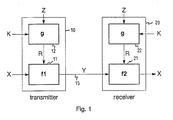
- X represents a message in plaintext consisting of a sequence of data X0, X1, . . . that may be individual bits or uniform groups of bits, e.g., bytes.
- the term "word” may be hereinafter used to refer to one of these bits or groups of bits.
- the plaintext message X is applied to a function f1 which is represented by block 11 within the transmitter 10.
- the cryptographic bit stream R of generated values R0, R1, . . ., which are also individual bits or uniform groups of bits is generated by an encryption mechanism g as initialised by the series Z of initialising values and with the encryption key K.
- the transformation of the plaintext message X to a ciphertext, encrypted message Y at block 11 takes places by the real time generation, a word at a time, of the cryptographic bit stream R by the encryption mechanism g of block 12.
- the ciphertext message is conveyed along a communications link 15 to a function f2 depicted as block 21 within a receiver 20.
- An encryption mechanism g depicted by block 22, receives a decryption key K and initialising values Z, as in block 12 of the transmitter 10, to produce, in real time, a cryptographic bit stream R of values to be combined with the ciphertext message Y at block 21 to reproduce the plaintext message X output from the receiver 20.
- the cryptographic bit stream R being generated in real time, require significant amounts of time for their generation, such that the cryptographic bit stream R may, at both the transmitter and receiver, be generated at a slower rate than the plaintext message X is applied to block 11 of the transmitter and as the ciphertext message Y is applied to block 21 of the receiver.
- the cryptographic bit stream R may, at both the transmitter and receiver, be generated at a slower rate than the plaintext message X is applied to block 11 of the transmitter and as the ciphertext message Y is applied to block 21 of the receiver.
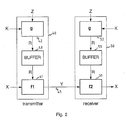
- Fig. 2 wherein one form of modified stream cipher system of this invention is shown, which includes pregeneration of the cryptographic bit streams and storage thereof in buffers until needed by the mathematical combining functions for encryption and decryption.
- Fig. 2 as in Fig. 1, the plaintext message X is applied to a mathematical function f1, as shown by block 41, to which is applied a cryptographic bit stream R for combination therewith to produce the ciphertext message Y that is conveyed to a similar block 51 in the receiver 50.
- the encryption mechanism g shown as block 41 in the receiver 40
- the decryption mechanism g shown as block 52 in the receiver 50, function identically to the encryption and decryption mechanisms shown as blocks 12 and 22, respectively, in Fig. 1.
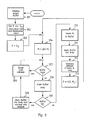
- the buffer 43 in the case where the buffer management is for the transmitter, and the buffer 53, in the case where the buffer management is for the receiver, are initialised at 301 by clearing the buffers of all previous entries.
- the secret encryption key, and ZO the initialisation value, are obtained. K will be used by the encryption mechanisms 12 and 22 to generate the cryptographic bit stream R, as set forth below.
- the variable Z is initialised with the value ZO.
- the key K and the current value of Z is used to generate a word, Ri, of the cryptographic bit stream R.
- a test is made to determine if the buffer 43, in the case of buffer management for the transmitter, or the buffer 53, in the buffer management for the receiver, are in use. Use of the buffer at this point would indicate that its contents were being used for combination with a plaintext value at block 41 or with a ciphertext value at block 51. If the buffer is in use, the process sleeps at 309 until such time that the process is awakened by the process described in Fig. 4, in the case of buffer management for the transmitter, or by the process described in Fig. 5, in the case of buffer management for the receiver. When awakened the process loops back to the test at 305. When the buffer is found to be not in use, processing continues at 306 where a flag is set to indicate that the buffer is now in use by this buffer management process.
- the buffer is examined to determine if it is full, and if so at 308 the flag set at 306 is reset and any other process, the transmitter in the case of buffer management for the transmitter and the receiver in the case of buffer management for the receiver, is awakened if it was sleeping. Processing then proceeds to 309 where the buffer management process sleeps. In the case that the test at 307 indicates that the buffer is not full, processing continues at 310 where the value of the cryptographic bit stream R, generated at 304, is inserted into the buffer. The flag set at 306 is reset at 311. At 312 any other process, the transmitter in the case of buffer management for the transmitter and the receiver in the case of buffer management for the receiver, is awakened if it was sleeping. At 313 a new value of Z is computed, using some function h applied to the current value of Z and Ri.
- a test is made to determine if there is additional information to be transmitted. If so, processing continues at 75.
- a plaintext value X to be encrypted and transferred along the communications link 45 is obtained.
- a test is made to determine if the buffer 43 is busy. If so, the operation sleeps at 101 until such time as it is awakened because buffer 43 may no longer be busy.
- a flag is set at 77 to indicate that the buffer is now busy with the transmit encryption process.
- a test is made to determine if the buffer 43 is empty.
- buffer 43 is empty, the buffer is then marked not busy at 79 which allows the process described in Fig. 3 to obtain control of the buffer to add additional words of the cryptographic bit stream thereto; furthermore, at 79 the process described for Fig. 3 is awakened in case it is sleeping. From 79 the operation then sleeps at 101 until awakened because buffer 43 may no longer be empty.
- the next word of the cryptographic bit stream R is removed from the buffer.
- the flag set at 77 is reset so that the buffer is now marked not busy.
- the process described for Fig. 3 is awakened if it was sleeping because the buffer was either busy or full.
- the mathematical operation f1 at block 41 is applied to one word, X, of the plaintext and the word, R, removed at 80 to obtain a word of the ciphertext Y.
- the word of the ciphertext Y is sent along the communications link 45 to the receiver 50, whereupon operation of this process returns to the start thereof.
- Fig. 5 shows the complimentary process at the receiver 50.
- a test is performed to determine if there is additional input to be processed. If so, processing continues at 85.
- a ciphertext value Y which was received along the communications link 45 is obtained for decryption.
- a test is made to determine if the buffer 53 is busy. If so, the operation sleeps at 106 until such time as it is awakened because buffer 53 may no longer be busy. When buffer 53 is not busy, a flag is set at 87 to indicate that the buffer is now busy with the receive encryption process.
- a test is made to determine if buffer 53 is empty. If buffer 53 is empty, the buffer is then marked not busy at 89 which allows the process described in Fig.
- the next word of the cryptographic bit stream, R is removed from the buffer.
- the flag set at 87 is reset so that the buffer is now marked not busy.
- the process described for Fig. 3 is awakened if it was sleeping because the buffer was either busy or full.
- the mathematical operation f2 at block 51 is applied to one word, Y, of the ciphertext and the word, Ri, removed at 90 to obtain a word of the plaintext X.
- the particular mathematical functions f1 and f2 may be the EXCLUSIVE-OR function.
- the cryptographic bit stream R in both the transmitter 40 and the receiver 50 are identical security is maintained by maintaining secrecy of the identical key K at both the transmitter 40 and the receiver 50.
- the disclosed arrangement provides a substantial increase in throughput by the provision of buffers to store these cryptographic bit streams until they are actually used so that the generation thereof, which presents the greatest performance impact when accomplished in real time, is, in these embodiments, accomplished well in advance of its actual use.
- the use of the buffer whether at the transmitting end of a link or at the receiving end thereof, is carefully segregated. Although its use appears interleaved, the protocol is one of the slow process having undivided use of the buffer at all times possible. Note also the shift of emphasis in this respect between transmitting, where the data can be delayed and loading of the buffer is suspended on the buffer becoming full, and the receiving end, where the data incoming is not so easily delayed and the reception is suspended only on the buffer becoming empty.
Landscapes
- Engineering & Computer Science (AREA)
- Computer Security & Cryptography (AREA)
- Computer Networks & Wireless Communication (AREA)
- Signal Processing (AREA)
- Communication Control (AREA)
- Storage Device Security (AREA)
Applications Claiming Priority (2)
| Application Number | Priority Date | Filing Date | Title |
|---|---|---|---|
| US07/264,225 US5016275A (en) | 1988-10-28 | 1988-10-28 | Buffered encryption/decryption |
| US264225 | 1988-10-28 |
Publications (2)
| Publication Number | Publication Date |
|---|---|
| EP0366288A2 true EP0366288A2 (de) | 1990-05-02 |
| EP0366288A3 EP0366288A3 (de) | 1992-02-19 |
Family
ID=23005114
Family Applications (1)
| Application Number | Title | Priority Date | Filing Date |
|---|---|---|---|
| EP19890310149 Withdrawn EP0366288A3 (de) | 1988-10-28 | 1989-10-04 | Gepufferte Verschlüsselung |
Country Status (3)
| Country | Link |
|---|---|
| US (1) | US5016275A (de) |
| EP (1) | EP0366288A3 (de) |
| JP (1) | JPH0380645A (de) |
Cited By (6)
| Publication number | Priority date | Publication date | Assignee | Title |
|---|---|---|---|---|
| EP0673133A1 (de) * | 1994-03-18 | 1995-09-20 | Koninklijke KPN N.V. | Kryptografische Datenverarbeitung unter Verwendung einer Kaskadierung kryptografischer Elemente in einer Rückkoppelung |
| RU2138126C1 (ru) * | 1998-07-14 | 1999-09-20 | Военная академия связи | Способ шифрования/дешифрования сообщений хэширующей функцией и устройство, его реализующее |
| RU2140716C1 (ru) * | 1999-01-18 | 1999-10-27 | Государственное унитарное предприятие Специализированный центр программных систем "Спектр" | Способ криптографического преобразования блоков цифровых данных |
| RU2147792C1 (ru) * | 1996-04-29 | 2000-04-20 | Моторола, Инк. | Использование шифровального сервера для шифрования сообщений |
| RU2147793C1 (ru) * | 1996-05-17 | 2000-04-20 | Моторола, Инк. | Дешифрование повторно передаваемых данных в системе шифрованной связи |
| WO2001072075A1 (en) * | 2000-03-21 | 2001-09-27 | Telefonaktiebolaget Lm Ericsson (Publ) | Encrypting and decrypting |
Families Citing this family (13)
| Publication number | Priority date | Publication date | Assignee | Title |
|---|---|---|---|---|
| FR2643529B1 (fr) * | 1989-02-22 | 1991-06-07 | Kudelski Sa Fabr Enregistr Nag | Systeme de television a peage utilisant une carte a memoire associee a un decodeur |
| US5283832A (en) * | 1991-10-22 | 1994-02-01 | Motorola, Inc. | Paging message encryption |
| US6760779B1 (en) | 1996-07-08 | 2004-07-06 | William K. Riceman | Apparatus and method for high speed data communication |
| US5917914A (en) * | 1997-04-24 | 1999-06-29 | Cirrus Logic, Inc. | DVD data descrambler for host interface and MPEG interface |
| FI107487B (fi) * | 1999-03-08 | 2001-08-15 | Nokia Mobile Phones Ltd | Datalähetyksen salausmenetelmä radiojärjestelmässä |
| GB0004178D0 (en) * | 2000-02-22 | 2000-04-12 | Nokia Networks Oy | Integrity check in a communication system |
| US7260217B1 (en) * | 2002-03-01 | 2007-08-21 | Cavium Networks, Inc. | Speculative execution for data ciphering operations |
| CA2519116C (en) * | 2003-03-13 | 2012-11-13 | Drm Technologies, Llc | Secure streaming container |
| US7770027B2 (en) * | 2004-11-15 | 2010-08-03 | Nintendo Co., Ltd. | Semiconductor memory device |
| JP4912797B2 (ja) * | 2006-08-30 | 2012-04-11 | 三菱電機株式会社 | 暗号装置及び復号装置及び暗号方法及び復号方法及びプログラム |
| JP5435845B2 (ja) | 2007-02-20 | 2014-03-05 | 株式会社メガチップス | 信号処理装置 |
| US20130177155A1 (en) * | 2012-10-05 | 2013-07-11 | Comtech Ef Data Corp. | Method and System for Generating Normal Distributed Random Variables Based On Cryptographic Function |
| US10623183B2 (en) | 2017-11-01 | 2020-04-14 | International Business Machines Corporation | Postponing entropy depletion in key management systems with hardware security modules |
Family Cites Families (7)
| Publication number | Priority date | Publication date | Assignee | Title |
|---|---|---|---|---|
| US2995624A (en) * | 1959-03-11 | 1961-08-08 | Zenith Radio Corp | Secrecy communication system |
| US4172213A (en) * | 1977-11-17 | 1979-10-23 | Burroughs Corporation | Byte stream selective encryption/decryption device |
| US4471164A (en) * | 1981-10-13 | 1984-09-11 | At&T Bell Laboratories | Stream cipher operation using public key cryptosystem |
| US4520232A (en) * | 1982-04-30 | 1985-05-28 | Wilson William J | Polygraphic encryption-decryption system |
| JPS5992649A (ja) * | 1982-11-19 | 1984-05-28 | Fujitsu Ltd | ブロツク形デ−タ暗号器制御方式 |
| US4642424A (en) * | 1984-01-03 | 1987-02-10 | At&T Information Systems Inc. | Cryptographic transmission system |
| US4802217A (en) * | 1985-06-07 | 1989-01-31 | Siemens Corporate Research & Support, Inc. | Method and apparatus for securing access to a computer facility |
-
1988
- 1988-10-28 US US07/264,225 patent/US5016275A/en not_active Expired - Lifetime
-
1989
- 1989-10-04 EP EP19890310149 patent/EP0366288A3/de not_active Withdrawn
- 1989-10-06 JP JP1260384A patent/JPH0380645A/ja active Pending
Cited By (8)
| Publication number | Priority date | Publication date | Assignee | Title |
|---|---|---|---|---|
| EP0673133A1 (de) * | 1994-03-18 | 1995-09-20 | Koninklijke KPN N.V. | Kryptografische Datenverarbeitung unter Verwendung einer Kaskadierung kryptografischer Elemente in einer Rückkoppelung |
| NL9400428A (nl) * | 1994-03-18 | 1995-11-01 | Nederland Ptt | Inrichting voor het cryptografisch bewerken van datapakketten, alsmede werkwijze voor het genereren van cryptografische bewerkingsdata. |
| US5809147A (en) * | 1994-03-18 | 1998-09-15 | Koninklijke Ptt Nederland | Device for cryptographically processing data packets and method of generating cryptographic processing data |
| RU2147792C1 (ru) * | 1996-04-29 | 2000-04-20 | Моторола, Инк. | Использование шифровального сервера для шифрования сообщений |
| RU2147793C1 (ru) * | 1996-05-17 | 2000-04-20 | Моторола, Инк. | Дешифрование повторно передаваемых данных в системе шифрованной связи |
| RU2138126C1 (ru) * | 1998-07-14 | 1999-09-20 | Военная академия связи | Способ шифрования/дешифрования сообщений хэширующей функцией и устройство, его реализующее |
| RU2140716C1 (ru) * | 1999-01-18 | 1999-10-27 | Государственное унитарное предприятие Специализированный центр программных систем "Спектр" | Способ криптографического преобразования блоков цифровых данных |
| WO2001072075A1 (en) * | 2000-03-21 | 2001-09-27 | Telefonaktiebolaget Lm Ericsson (Publ) | Encrypting and decrypting |
Also Published As
| Publication number | Publication date |
|---|---|
| US5016275A (en) | 1991-05-14 |
| JPH0380645A (ja) | 1991-04-05 |
| EP0366288A3 (de) | 1992-02-19 |
Similar Documents
| Publication | Publication Date | Title |
|---|---|---|
| US5016275A (en) | Buffered encryption/decryption | |
| US5345508A (en) | Method and apparatus for variable-overhead cached encryption | |
| US5444781A (en) | Method and apparatus for decryption using cache storage | |
| US4322576A (en) | Message format for secure communication over data links | |
| US4503287A (en) | Two-tiered communication security employing asymmetric session keys | |
| US6504930B2 (en) | Encryption and decryption method and apparatus using a work key which is generated by executing a decryption algorithm | |
| EP0002389B1 (de) | Mehrfachbereichdatenverbindung | |
| EP0592808B1 (de) | Geschäftliche Datenmaskierung | |
| EP0725511B1 (de) | Verfahren zur Verschlüsselung/Entschlüsselung von Daten unter Verwendung von Cipher-Block-Chaining (CBC) und Message Authentication Code (MAC) | |
| EP0861540B1 (de) | Verfahren und Einrichtung zur Verschlüsselung von MPEG Paketen | |
| US5384848A (en) | Encrypted virtual terminal equipment having initialization device for preventing reply attack | |
| US5438622A (en) | Method and apparatus for improving the security of an electronic codebook encryption scheme utilizing an offset in the pseudorandom sequence | |
| US6347143B1 (en) | Cryptographic device with encryption blocks connected parallel | |
| US5008938A (en) | Encryption apparatus | |
| US20030084308A1 (en) | Memory encryption | |
| EP0002578A1 (de) | Datenverbindungsmethode | |
| EP1161811B1 (de) | Verfahren und vorrichtung zur verschlüsselung und entschlüsselung von daten | |
| US7894608B2 (en) | Secure approach to send data from one system to another | |
| US7277543B1 (en) | Cryptographic combiner using two sequential non-associative operations | |
| WO2004086672A1 (ja) | 暗号化および復号のための装置、方法、プログラム並びに記録媒体 | |
| US5694473A (en) | Decryption of retransmitted data in an encrypted communication system | |
| US6542607B1 (en) | Device and method for the cryptographic processing of a digital data stream presenting any number of data | |
| US12362909B2 (en) | Method for processing encrypted data | |
| US4856063A (en) | No-overhead synchronization for cryptographic systems | |
| US5428686A (en) | Secure communication system having long-term keying variable |
Legal Events
| Date | Code | Title | Description |
|---|---|---|---|
| PUAI | Public reference made under article 153(3) epc to a published international application that has entered the european phase |
Free format text: ORIGINAL CODE: 0009012 |
|
| AK | Designated contracting states |
Kind code of ref document: A2 Designated state(s): DE FR GB |
|
| 17P | Request for examination filed |
Effective date: 19900820 |
|
| PUAL | Search report despatched |
Free format text: ORIGINAL CODE: 0009013 |
|
| AK | Designated contracting states |
Kind code of ref document: A3 Designated state(s): DE FR GB |
|
| 17Q | First examination report despatched |
Effective date: 19931123 |
|
| STAA | Information on the status of an ep patent application or granted ep patent |
Free format text: STATUS: THE APPLICATION IS DEEMED TO BE WITHDRAWN |
|
| 18D | Application deemed to be withdrawn |
Effective date: 19940406 |