EP0366275A2 - Verfahren zur Isolierung von transponierbaren Elementen aus Sterptomyceten und anderen Organismen - Google Patents
Verfahren zur Isolierung von transponierbaren Elementen aus Sterptomyceten und anderen Organismen Download PDFInfo
- Publication number
- EP0366275A2 EP0366275A2 EP89309968A EP89309968A EP0366275A2 EP 0366275 A2 EP0366275 A2 EP 0366275A2 EP 89309968 A EP89309968 A EP 89309968A EP 89309968 A EP89309968 A EP 89309968A EP 0366275 A2 EP0366275 A2 EP 0366275A2
- Authority
- EP
- European Patent Office
- Prior art keywords
- host cell
- plasmid
- origin
- functional
- gene
- Prior art date
- Legal status (The legal status is an assumption and is not a legal conclusion. Google has not performed a legal analysis and makes no representation as to the accuracy of the status listed.)
- Withdrawn
Links
- 238000000034 method Methods 0.000 title claims abstract description 46
- 241000187747 Streptomyces Species 0.000 title abstract description 19
- 239000013612 plasmid Substances 0.000 claims abstract description 165
- 108090000623 proteins and genes Proteins 0.000 claims abstract description 74
- 239000003550 marker Substances 0.000 claims abstract description 27
- 241000187398 Streptomyces lividans Species 0.000 claims abstract description 18
- 230000001131 transforming effect Effects 0.000 claims abstract description 11
- 108020004414 DNA Proteins 0.000 claims description 72
- 230000010076 replication Effects 0.000 claims description 37
- 229950006334 apramycin Drugs 0.000 claims description 32
- XZNUGFQTQHRASN-XQENGBIVSA-N apramycin Chemical compound O([C@H]1O[C@@H]2[C@H](O)[C@@H]([C@H](O[C@H]2C[C@H]1N)O[C@@H]1[C@@H]([C@@H](O)[C@H](N)[C@@H](CO)O1)O)NC)[C@@H]1[C@@H](N)C[C@@H](N)[C@H](O)[C@H]1O XZNUGFQTQHRASN-XQENGBIVSA-N 0.000 claims description 32
- 239000013598 vector Substances 0.000 claims description 31
- 108020004511 Recombinant DNA Proteins 0.000 claims description 23
- 239000013599 cloning vector Substances 0.000 claims description 23
- 241000588724 Escherichia coli Species 0.000 claims description 16
- 230000009466 transformation Effects 0.000 claims description 16
- 229960000723 ampicillin Drugs 0.000 claims description 13
- AVKUERGKIZMTKX-NJBDSQKTSA-N ampicillin Chemical group C1([C@@H](N)C(=O)N[C@H]2[C@H]3SC([C@@H](N3C2=O)C(O)=O)(C)C)=CC=CC=C1 AVKUERGKIZMTKX-NJBDSQKTSA-N 0.000 claims description 13
- NSFFHOGKXHRQEW-UHFFFAOYSA-N Thiostrepton B Natural products N1C(=O)C(C)NC(=O)C(=C)NC(=O)C(C)NC(=O)C(C(C)CC)NC(C(C2=N3)O)C=CC2=C(C(C)O)C=C3C(=O)OC(C)C(C=2SC=C(N=2)C2N=3)NC(=O)C(N=4)=CSC=4C(C(C)(O)C(C)O)NC(=O)C(N=4)CSC=4C(=CC)NC(=O)C(C(C)O)NC(=O)C(N=4)=CSC=4C21CCC=3C1=NC(C(=O)NC(=C)C(=O)NC(=C)C(N)=O)=CS1 NSFFHOGKXHRQEW-UHFFFAOYSA-N 0.000 claims description 10
- 229930188070 thiostrepton Natural products 0.000 claims description 10
- 229940063214 thiostrepton Drugs 0.000 claims description 10
- NSFFHOGKXHRQEW-AIHSUZKVSA-N thiostrepton Chemical group C([C@]12C=3SC=C(N=3)C(=O)N[C@H](C(=O)NC(/C=3SC[C@@H](N=3)C(=O)N[C@H](C=3SC=C(N=3)C(=O)N[C@H](C=3SC=C(N=3)[C@H]1N=1)[C@@H](C)OC(=O)C3=CC(=C4C=C[C@H]([C@@H](C4=N3)O)N[C@H](C(N[C@@H](C)C(=O)NC(=C)C(=O)N[C@@H](C)C(=O)N2)=O)[C@@H](C)CC)[C@H](C)O)[C@](C)(O)[C@@H](C)O)=C\C)[C@@H](C)O)CC=1C1=NC(C(=O)NC(=C)C(=O)NC(=C)C(N)=O)=CS1 NSFFHOGKXHRQEW-AIHSUZKVSA-N 0.000 claims description 10
- NSFFHOGKXHRQEW-OFMUQYBVSA-N thiostrepton A Natural products CC[C@H](C)[C@@H]1N[C@@H]2C=Cc3c(cc(nc3[C@H]2O)C(=O)O[C@H](C)[C@@H]4NC(=O)c5csc(n5)[C@@H](NC(=O)[C@H]6CSC(=N6)C(=CC)NC(=O)[C@@H](NC(=O)c7csc(n7)[C@]8(CCC(=N[C@@H]8c9csc4n9)c%10nc(cs%10)C(=O)NC(=C)C(=O)NC(=C)C(=O)N)NC(=O)[C@H](C)NC(=O)C(=C)NC(=O)[C@H](C)NC1=O)[C@@H](C)O)[C@](C)(O)[C@@H](C)O)[C@H](C)O NSFFHOGKXHRQEW-OFMUQYBVSA-N 0.000 claims description 10
- 230000002463 transducing effect Effects 0.000 claims description 9
- 241000701959 Escherichia virus Lambda Species 0.000 claims description 8
- 238000012258 culturing Methods 0.000 claims description 8
- 101710134389 Carboxy-terminal domain RNA polymerase II polypeptide A small phosphatase 2 Proteins 0.000 claims description 5
- 102100021588 Sterol carrier protein 2 Human genes 0.000 claims description 5
- 238000012216 screening Methods 0.000 claims description 5
- 238000010361 transduction Methods 0.000 claims description 4
- 230000026683 transduction Effects 0.000 claims description 4
- 238000001890 transfection Methods 0.000 claims description 4
- 238000004113 cell culture Methods 0.000 claims description 2
- 108700026220 vif Genes Proteins 0.000 claims 6
- 238000003780 insertion Methods 0.000 abstract description 16
- 230000037431 insertion Effects 0.000 abstract description 16
- 210000004027 cell Anatomy 0.000 description 72
- 239000012634 fragment Substances 0.000 description 52
- 239000000243 solution Substances 0.000 description 37
- LFQSCWFLJHTTHZ-UHFFFAOYSA-N Ethanol Chemical compound CCO LFQSCWFLJHTTHZ-UHFFFAOYSA-N 0.000 description 24
- 239000000203 mixture Substances 0.000 description 22
- 108091008146 restriction endonucleases Proteins 0.000 description 21
- FAPWRFPIFSIZLT-UHFFFAOYSA-M Sodium chloride Chemical compound [Na+].[Cl-] FAPWRFPIFSIZLT-UHFFFAOYSA-M 0.000 description 20
- 241001646716 Escherichia coli K-12 Species 0.000 description 14
- TWRXJAOTZQYOKJ-UHFFFAOYSA-L Magnesium chloride Chemical compound [Mg+2].[Cl-].[Cl-] TWRXJAOTZQYOKJ-UHFFFAOYSA-L 0.000 description 14
- 239000008188 pellet Substances 0.000 description 13
- 229920001817 Agar Polymers 0.000 description 12
- 239000008272 agar Substances 0.000 description 12
- 239000000872 buffer Substances 0.000 description 11
- HEDRZPFGACZZDS-UHFFFAOYSA-N Chloroform Chemical compound ClC(Cl)Cl HEDRZPFGACZZDS-UHFFFAOYSA-N 0.000 description 10
- 238000005119 centrifugation Methods 0.000 description 10
- ISWSIDIOOBJBQZ-UHFFFAOYSA-N phenol group Chemical group C1(=CC=CC=C1)O ISWSIDIOOBJBQZ-UHFFFAOYSA-N 0.000 description 10
- 239000011780 sodium chloride Substances 0.000 description 10
- 230000017105 transposition Effects 0.000 description 10
- 108010086093 Mung Bean Nuclease Proteins 0.000 description 9
- HEMHJVSKTPXQMS-UHFFFAOYSA-M Sodium hydroxide Chemical compound [OH-].[Na+] HEMHJVSKTPXQMS-UHFFFAOYSA-M 0.000 description 9
- 229930006000 Sucrose Natural products 0.000 description 9
- CZMRCDWAGMRECN-UGDNZRGBSA-N Sucrose Chemical compound O[C@H]1[C@H](O)[C@@H](CO)O[C@@]1(CO)O[C@@H]1[C@H](O)[C@@H](O)[C@H](O)[C@@H](CO)O1 CZMRCDWAGMRECN-UGDNZRGBSA-N 0.000 description 9
- 239000007984 Tris EDTA buffer Substances 0.000 description 9
- 230000003115 biocidal effect Effects 0.000 description 9
- 239000005720 sucrose Substances 0.000 description 9
- AIYUHDOJVYHVIT-UHFFFAOYSA-M caesium chloride Chemical compound [Cl-].[Cs+] AIYUHDOJVYHVIT-UHFFFAOYSA-M 0.000 description 8
- 230000002068 genetic effect Effects 0.000 description 8
- 238000011534 incubation Methods 0.000 description 8
- 239000001974 tryptic soy broth Substances 0.000 description 8
- VMHLLURERBWHNL-UHFFFAOYSA-M Sodium acetate Chemical compound [Na+].CC([O-])=O VMHLLURERBWHNL-UHFFFAOYSA-M 0.000 description 7
- ZMMJGEGLRURXTF-UHFFFAOYSA-N ethidium bromide Chemical compound [Br-].C12=CC(N)=CC=C2C2=CC=C(N)C=C2[N+](CC)=C1C1=CC=CC=C1 ZMMJGEGLRURXTF-UHFFFAOYSA-N 0.000 description 7
- 229960005542 ethidium bromide Drugs 0.000 description 7
- 229910001629 magnesium chloride Inorganic materials 0.000 description 7
- QKNYBSVHEMOAJP-UHFFFAOYSA-N 2-amino-2-(hydroxymethyl)propane-1,3-diol;hydron;chloride Chemical compound Cl.OCC(N)(CO)CO QKNYBSVHEMOAJP-UHFFFAOYSA-N 0.000 description 6
- KCXVZYZYPLLWCC-UHFFFAOYSA-N EDTA Chemical compound OC(=O)CN(CC(O)=O)CCN(CC(O)=O)CC(O)=O KCXVZYZYPLLWCC-UHFFFAOYSA-N 0.000 description 6
- KFZMGEQAYNKOFK-UHFFFAOYSA-N Isopropanol Chemical compound CC(C)O KFZMGEQAYNKOFK-UHFFFAOYSA-N 0.000 description 6
- 102000016943 Muramidase Human genes 0.000 description 6
- 108010014251 Muramidase Proteins 0.000 description 6
- 108010062010 N-Acetylmuramoyl-L-alanine Amidase Proteins 0.000 description 6
- 238000010276 construction Methods 0.000 description 6
- 239000004325 lysozyme Substances 0.000 description 6
- 229960000274 lysozyme Drugs 0.000 description 6
- 235000010335 lysozyme Nutrition 0.000 description 6
- 239000002609 medium Substances 0.000 description 6
- 239000012528 membrane Substances 0.000 description 6
- UXVMQQNJUSDDNG-UHFFFAOYSA-L Calcium chloride Chemical compound [Cl-].[Cl-].[Ca+2] UXVMQQNJUSDDNG-UHFFFAOYSA-L 0.000 description 5
- 238000005273 aeration Methods 0.000 description 5
- 239000001110 calcium chloride Substances 0.000 description 5
- 235000011148 calcium chloride Nutrition 0.000 description 5
- 229910001628 calcium chloride Inorganic materials 0.000 description 5
- 239000000047 product Substances 0.000 description 5
- 239000001632 sodium acetate Substances 0.000 description 5
- 235000017281 sodium acetate Nutrition 0.000 description 5
- 239000006228 supernatant Substances 0.000 description 5
- BFSVOASYOCHEOV-UHFFFAOYSA-N 2-diethylaminoethanol Chemical compound CCN(CC)CCO BFSVOASYOCHEOV-UHFFFAOYSA-N 0.000 description 4
- 230000005526 G1 to G0 transition Effects 0.000 description 4
- WQZGKKKJIJFFOK-GASJEMHNSA-N Glucose Natural products OC[C@H]1OC(O)[C@H](O)[C@@H](O)[C@@H]1O WQZGKKKJIJFFOK-GASJEMHNSA-N 0.000 description 4
- DHMQDGOQFOQNFH-UHFFFAOYSA-N Glycine Chemical compound NCC(O)=O DHMQDGOQFOQNFH-UHFFFAOYSA-N 0.000 description 4
- 210000000349 chromosome Anatomy 0.000 description 4
- 238000000605 extraction Methods 0.000 description 4
- 230000010354 integration Effects 0.000 description 4
- 238000002955 isolation Methods 0.000 description 4
- 210000001938 protoplast Anatomy 0.000 description 4
- QTBSBXVTEAMEQO-UHFFFAOYSA-N Acetic acid Chemical compound CC(O)=O QTBSBXVTEAMEQO-UHFFFAOYSA-N 0.000 description 3
- JOCBASBOOFNAJA-UHFFFAOYSA-N N-tris(hydroxymethyl)methyl-2-aminoethanesulfonic acid Chemical compound OCC(CO)(CO)NCCS(O)(=O)=O JOCBASBOOFNAJA-UHFFFAOYSA-N 0.000 description 3
- 240000004808 Saccharomyces cerevisiae Species 0.000 description 3
- 239000007983 Tris buffer Substances 0.000 description 3
- 239000011543 agarose gel Substances 0.000 description 3
- 238000004458 analytical method Methods 0.000 description 3
- 239000003242 anti bacterial agent Substances 0.000 description 3
- 229940088710 antibiotic agent Drugs 0.000 description 3
- 230000001851 biosynthetic effect Effects 0.000 description 3
- 238000006243 chemical reaction Methods 0.000 description 3
- 230000002759 chromosomal effect Effects 0.000 description 3
- 238000010367 cloning Methods 0.000 description 3
- 230000029087 digestion Effects 0.000 description 3
- 239000000499 gel Substances 0.000 description 3
- 239000008103 glucose Substances 0.000 description 3
- 239000004615 ingredient Substances 0.000 description 3
- 238000002156 mixing Methods 0.000 description 3
- 238000012986 modification Methods 0.000 description 3
- 230000004048 modification Effects 0.000 description 3
- 238000011160 research Methods 0.000 description 3
- 239000000523 sample Substances 0.000 description 3
- 238000006467 substitution reaction Methods 0.000 description 3
- 235000013619 trace mineral Nutrition 0.000 description 3
- 239000011573 trace mineral Substances 0.000 description 3
- LENZDBCJOHFCAS-UHFFFAOYSA-N tris Chemical compound OCC(N)(CO)CO LENZDBCJOHFCAS-UHFFFAOYSA-N 0.000 description 3
- XLYOFNOQVPJJNP-UHFFFAOYSA-N water Substances O XLYOFNOQVPJJNP-UHFFFAOYSA-N 0.000 description 3
- 241000255581 Drosophila <fruit fly, genus> Species 0.000 description 2
- 239000004471 Glycine Substances 0.000 description 2
- 239000007836 KH2PO4 Substances 0.000 description 2
- DCXYFEDJOCDNAF-REOHCLBHSA-N L-asparagine Chemical compound OC(=O)[C@@H](N)CC(N)=O DCXYFEDJOCDNAF-REOHCLBHSA-N 0.000 description 2
- CSNNHWWHGAXBCP-UHFFFAOYSA-L Magnesium sulfate Chemical compound [Mg+2].[O-][S+2]([O-])([O-])[O-] CSNNHWWHGAXBCP-UHFFFAOYSA-L 0.000 description 2
- 108091028043 Nucleic acid sequence Proteins 0.000 description 2
- 239000007994 TES buffer Substances 0.000 description 2
- 239000008346 aqueous phase Substances 0.000 description 2
- 229940041514 candida albicans extract Drugs 0.000 description 2
- 239000000306 component Substances 0.000 description 2
- 238000011161 development Methods 0.000 description 2
- 230000018109 developmental process Effects 0.000 description 2
- VHJLVAABSRFDPM-QWWZWVQMSA-N dithiothreitol Chemical compound SC[C@@H](O)[C@H](O)CS VHJLVAABSRFDPM-QWWZWVQMSA-N 0.000 description 2
- 238000001962 electrophoresis Methods 0.000 description 2
- 238000009585 enzyme analysis Methods 0.000 description 2
- 210000003527 eukaryotic cell Anatomy 0.000 description 2
- 238000010353 genetic engineering Methods 0.000 description 2
- 229910001385 heavy metal Inorganic materials 0.000 description 2
- XLYOFNOQVPJJNP-ZSJDYOACSA-N heavy water Substances [2H]O[2H] XLYOFNOQVPJJNP-ZSJDYOACSA-N 0.000 description 2
- 239000012145 high-salt buffer Substances 0.000 description 2
- 238000004519 manufacturing process Methods 0.000 description 2
- 230000007246 mechanism Effects 0.000 description 2
- 229910000402 monopotassium phosphate Inorganic materials 0.000 description 2
- 235000019796 monopotassium phosphate Nutrition 0.000 description 2
- 230000035772 mutation Effects 0.000 description 2
- 239000012071 phase Substances 0.000 description 2
- 238000007747 plating Methods 0.000 description 2
- GNSKLFRGEWLPPA-UHFFFAOYSA-M potassium dihydrogen phosphate Chemical compound [K+].OP(O)([O-])=O GNSKLFRGEWLPPA-UHFFFAOYSA-M 0.000 description 2
- OTYBMLCTZGSZBG-UHFFFAOYSA-L potassium sulfate Chemical compound [K+].[K+].[O-]S([O-])(=O)=O OTYBMLCTZGSZBG-UHFFFAOYSA-L 0.000 description 2
- 229910052939 potassium sulfate Inorganic materials 0.000 description 2
- PFNFFQXMRSDOHW-UHFFFAOYSA-N spermine Chemical compound NCCCNCCCCNCCCN PFNFFQXMRSDOHW-UHFFFAOYSA-N 0.000 description 2
- 230000002269 spontaneous effect Effects 0.000 description 2
- 238000010186 staining Methods 0.000 description 2
- 230000009897 systematic effect Effects 0.000 description 2
- 241001515965 unidentified phage Species 0.000 description 2
- 239000012138 yeast extract Substances 0.000 description 2
- 239000011592 zinc chloride Substances 0.000 description 2
- 235000005074 zinc chloride Nutrition 0.000 description 2
- JIAARYAFYJHUJI-UHFFFAOYSA-L zinc dichloride Chemical compound [Cl-].[Cl-].[Zn+2] JIAARYAFYJHUJI-UHFFFAOYSA-L 0.000 description 2
- 229910003208 (NH4)6Mo7O24·4H2O Inorganic materials 0.000 description 1
- ACTOXUHEUCPTEW-BWHGAVFKSA-N 2-[(4r,5s,6s,7r,9r,10r,11e,13e,16r)-6-[(2s,3r,4r,5s,6r)-5-[(2s,4r,5s,6s)-4,5-dihydroxy-4,6-dimethyloxan-2-yl]oxy-4-(dimethylamino)-3-hydroxy-6-methyloxan-2-yl]oxy-10-[(2s,5s,6r)-5-(dimethylamino)-6-methyloxan-2-yl]oxy-4-hydroxy-5-methoxy-9,16-dimethyl-2-o Chemical compound O([C@H]1/C=C/C=C/C[C@@H](C)OC(=O)C[C@@H](O)[C@@H]([C@H]([C@@H](CC=O)C[C@H]1C)O[C@H]1[C@@H]([C@H]([C@H](O[C@@H]2O[C@@H](C)[C@H](O)[C@](C)(O)C2)[C@@H](C)O1)N(C)C)O)OC)[C@@H]1CC[C@H](N(C)C)[C@@H](C)O1 ACTOXUHEUCPTEW-BWHGAVFKSA-N 0.000 description 1
- 241000894006 Bacteria Species 0.000 description 1
- 229930188120 Carbomycin Natural products 0.000 description 1
- 108091026890 Coding region Proteins 0.000 description 1
- 229910021592 Copper(II) chloride Inorganic materials 0.000 description 1
- 102000053602 DNA Human genes 0.000 description 1
- 102000012410 DNA Ligases Human genes 0.000 description 1
- 108010061982 DNA Ligases Proteins 0.000 description 1
- 101000820585 Homo sapiens SUN domain-containing ossification factor Proteins 0.000 description 1
- 101000673946 Homo sapiens Synaptotagmin-like protein 1 Proteins 0.000 description 1
- 229910021578 Iron(III) chloride Inorganic materials 0.000 description 1
- 102000003960 Ligases Human genes 0.000 description 1
- 108090000364 Ligases Proteins 0.000 description 1
- 229910021380 Manganese Chloride Inorganic materials 0.000 description 1
- GLFNIEUTAYBVOC-UHFFFAOYSA-L Manganese chloride Chemical compound Cl[Mn]Cl GLFNIEUTAYBVOC-UHFFFAOYSA-L 0.000 description 1
- LRHPLDYGYMQRHN-UHFFFAOYSA-N N-Butanol Chemical class CCCCO LRHPLDYGYMQRHN-UHFFFAOYSA-N 0.000 description 1
- 108700026244 Open Reading Frames Proteins 0.000 description 1
- 241000364057 Peoria Species 0.000 description 1
- UZQBOFAUUTZOQE-UHFFFAOYSA-N Pikromycin Natural products CC1CC(C)C(=O)C=CC(O)(C)C(CC)OC(=O)C(C)C(=O)C(C)C1OC1C(O)C(N(C)C)CC(C)O1 UZQBOFAUUTZOQE-UHFFFAOYSA-N 0.000 description 1
- 108010034634 Repressor Proteins Proteins 0.000 description 1
- 102000009661 Repressor Proteins Human genes 0.000 description 1
- 102100021651 SUN domain-containing ossification factor Human genes 0.000 description 1
- 238000012300 Sequence Analysis Methods 0.000 description 1
- 238000002105 Southern blotting Methods 0.000 description 1
- 239000004187 Spiramycin Substances 0.000 description 1
- 241000187758 Streptomyces ambofaciens Species 0.000 description 1
- 241001446311 Streptomyces coelicolor A3(2) Species 0.000 description 1
- 241000187122 Streptomyces virginiae Species 0.000 description 1
- 239000004098 Tetracycline Substances 0.000 description 1
- 239000004182 Tylosin Substances 0.000 description 1
- 229930194936 Tylosin Natural products 0.000 description 1
- FQVHOULQCKDUCY-OGHXVOSASA-N [(2s,3s,4r,6s)-6-[(2r,3s,4r,5r,6s)-6-[[(1s,3r,7r,8s,9s,10r,12r,14e,16s)-7-acetyloxy-8-methoxy-3,12-dimethyl-5,13-dioxo-10-(2-oxoethyl)-4,17-dioxabicyclo[14.1.0]heptadec-14-en-9-yl]oxy]-4-(dimethylamino)-5-hydroxy-2-methyloxan-3-yl]oxy-4-hydroxy-2,4-dimeth Chemical compound O([C@@H]1[C@@H](C)O[C@H]([C@@H]([C@H]1N(C)C)O)O[C@H]1[C@@H](CC=O)C[C@@H](C)C(=O)/C=C/[C@@H]2O[C@H]2C[C@@H](C)OC(=O)C[C@H]([C@@H]1OC)OC(C)=O)[C@H]1C[C@@](C)(O)[C@@H](OC(=O)CC(C)C)[C@H](C)O1 FQVHOULQCKDUCY-OGHXVOSASA-N 0.000 description 1
- 238000002835 absorbance Methods 0.000 description 1
- 239000002253 acid Substances 0.000 description 1
- 150000007513 acids Chemical class 0.000 description 1
- 229960001230 asparagine Drugs 0.000 description 1
- 102000005936 beta-Galactosidase Human genes 0.000 description 1
- 108010005774 beta-Galactosidase Proteins 0.000 description 1
- -1 but not limited to Substances 0.000 description 1
- 229960003669 carbenicillin Drugs 0.000 description 1
- FPPNZSSZRUTDAP-UWFZAAFLSA-N carbenicillin Chemical compound N([C@H]1[C@H]2SC([C@@H](N2C1=O)C(O)=O)(C)C)C(=O)C(C(O)=O)C1=CC=CC=C1 FPPNZSSZRUTDAP-UWFZAAFLSA-N 0.000 description 1
- 229950005779 carbomycin Drugs 0.000 description 1
- 239000006285 cell suspension Substances 0.000 description 1
- 239000007795 chemical reaction product Substances 0.000 description 1
- 239000003795 chemical substances by application Substances 0.000 description 1
- 229940000425 combination drug Drugs 0.000 description 1
- 238000012790 confirmation Methods 0.000 description 1
- 239000000470 constituent Substances 0.000 description 1
- ORTQZVOHEJQUHG-UHFFFAOYSA-L copper(II) chloride Chemical compound Cl[Cu]Cl ORTQZVOHEJQUHG-UHFFFAOYSA-L 0.000 description 1
- 239000008121 dextrose Substances 0.000 description 1
- 238000000502 dialysis Methods 0.000 description 1
- 238000009792 diffusion process Methods 0.000 description 1
- 238000005516 engineering process Methods 0.000 description 1
- 239000000284 extract Substances 0.000 description 1
- 230000006801 homologous recombination Effects 0.000 description 1
- 238000002744 homologous recombination Methods 0.000 description 1
- 239000005457 ice water Substances 0.000 description 1
- 230000000415 inactivating effect Effects 0.000 description 1
- RBTARNINKXHZNM-UHFFFAOYSA-K iron trichloride Chemical compound Cl[Fe](Cl)Cl RBTARNINKXHZNM-UHFFFAOYSA-K 0.000 description 1
- 229960000318 kanamycin Drugs 0.000 description 1
- 229930027917 kanamycin Natural products 0.000 description 1
- SBUJHOSQTJFQJX-NOAMYHISSA-N kanamycin Chemical compound O[C@@H]1[C@@H](O)[C@H](O)[C@@H](CN)O[C@@H]1O[C@H]1[C@H](O)[C@@H](O[C@@H]2[C@@H]([C@@H](N)[C@H](O)[C@@H](CO)O2)O)[C@H](N)C[C@@H]1N SBUJHOSQTJFQJX-NOAMYHISSA-N 0.000 description 1
- 229930182823 kanamycin A Natural products 0.000 description 1
- 101150066555 lacZ gene Proteins 0.000 description 1
- 239000007788 liquid Substances 0.000 description 1
- 229910052943 magnesium sulfate Inorganic materials 0.000 description 1
- 235000019341 magnesium sulphate Nutrition 0.000 description 1
- 239000011565 manganese chloride Substances 0.000 description 1
- 235000002867 manganese chloride Nutrition 0.000 description 1
- 238000013507 mapping Methods 0.000 description 1
- 230000002503 metabolic effect Effects 0.000 description 1
- 230000037353 metabolic pathway Effects 0.000 description 1
- 239000002207 metabolite Substances 0.000 description 1
- HUKYPYXOBINMND-UHFFFAOYSA-N methymycin Natural products CC1CC(C)C(=O)C=CC(O)(C)C(CC)OC(=O)C(C)C1OC1C(O)C(N(C)C)CC(C)O1 HUKYPYXOBINMND-UHFFFAOYSA-N 0.000 description 1
- 238000010369 molecular cloning Methods 0.000 description 1
- 239000002773 nucleotide Substances 0.000 description 1
- 125000003729 nucleotide group Chemical group 0.000 description 1
- 235000016709 nutrition Nutrition 0.000 description 1
- 230000008520 organization Effects 0.000 description 1
- 108010083127 phage repressor proteins Proteins 0.000 description 1
- UZQBOFAUUTZOQE-VSLWXVDYSA-N pikromycin Chemical compound C[C@H]1C[C@@H](C)C(=O)\C=C\[C@@](O)(C)[C@@H](CC)OC(=O)[C@H](C)C(=O)[C@H](C)[C@H]1O[C@H]1[C@H](O)[C@@H](N(C)C)C[C@@H](C)O1 UZQBOFAUUTZOQE-VSLWXVDYSA-N 0.000 description 1
- 229940113116 polyethylene glycol 1000 Drugs 0.000 description 1
- 238000001556 precipitation Methods 0.000 description 1
- 230000008569 process Effects 0.000 description 1
- 210000001236 prokaryotic cell Anatomy 0.000 description 1
- 102000004169 proteins and genes Human genes 0.000 description 1
- 230000006798 recombination Effects 0.000 description 1
- 238000005215 recombination Methods 0.000 description 1
- 238000011084 recovery Methods 0.000 description 1
- 230000008929 regeneration Effects 0.000 description 1
- 238000011069 regeneration method Methods 0.000 description 1
- 230000003362 replicative effect Effects 0.000 description 1
- 150000003839 salts Chemical class 0.000 description 1
- 229920006395 saturated elastomer Polymers 0.000 description 1
- 235000010339 sodium tetraborate Nutrition 0.000 description 1
- 241000894007 species Species 0.000 description 1
- 229940063675 spermine Drugs 0.000 description 1
- 235000019372 spiramycin Nutrition 0.000 description 1
- 229960001294 spiramycin Drugs 0.000 description 1
- 229930191512 spiramycin Natural products 0.000 description 1
- 239000000725 suspension Substances 0.000 description 1
- 230000002194 synthesizing effect Effects 0.000 description 1
- 238000010189 synthetic method Methods 0.000 description 1
- 229960002180 tetracycline Drugs 0.000 description 1
- 235000019364 tetracycline Nutrition 0.000 description 1
- 229930101283 tetracycline Natural products 0.000 description 1
- 150000003522 tetracyclines Chemical class 0.000 description 1
- 125000002480 thymidyl group Chemical group 0.000 description 1
- 231100000331 toxic Toxicity 0.000 description 1
- 230000002588 toxic effect Effects 0.000 description 1
- 238000013518 transcription Methods 0.000 description 1
- 230000035897 transcription Effects 0.000 description 1
- 108010050327 trypticase-soy broth Proteins 0.000 description 1
- 239000012137 tryptone Substances 0.000 description 1
- 229960004059 tylosin Drugs 0.000 description 1
- WBPYTXDJUQJLPQ-VMXQISHHSA-N tylosin Chemical compound O([C@@H]1[C@@H](C)O[C@H]([C@@H]([C@H]1N(C)C)O)O[C@@H]1[C@@H](C)[C@H](O)CC(=O)O[C@@H]([C@H](/C=C(\C)/C=C/C(=O)[C@H](C)C[C@@H]1CC=O)CO[C@H]1[C@@H]([C@H](OC)[C@H](O)[C@@H](C)O1)OC)CC)[C@H]1C[C@@](C)(O)[C@@H](O)[C@H](C)O1 WBPYTXDJUQJLPQ-VMXQISHHSA-N 0.000 description 1
- 235000019375 tylosin Nutrition 0.000 description 1
- 238000005199 ultracentrifugation Methods 0.000 description 1
- 238000012800 visualization Methods 0.000 description 1
Images


Classifications
-
- C—CHEMISTRY; METALLURGY
- C12—BIOCHEMISTRY; BEER; SPIRITS; WINE; VINEGAR; MICROBIOLOGY; ENZYMOLOGY; MUTATION OR GENETIC ENGINEERING
- C12N—MICROORGANISMS OR ENZYMES; COMPOSITIONS THEREOF; PROPAGATING, PRESERVING, OR MAINTAINING MICROORGANISMS; MUTATION OR GENETIC ENGINEERING; CULTURE MEDIA
- C12N15/00—Mutation or genetic engineering; DNA or RNA concerning genetic engineering, vectors, e.g. plasmids, or their isolation, preparation or purification; Use of hosts therefor
- C12N15/09—Recombinant DNA-technology
- C12N15/63—Introduction of foreign genetic material using vectors; Vectors; Use of hosts therefor; Regulation of expression
- C12N15/74—Vectors or expression systems specially adapted for prokaryotic hosts other than E. coli, e.g. Lactobacillus, Micromonospora
- C12N15/76—Vectors or expression systems specially adapted for prokaryotic hosts other than E. coli, e.g. Lactobacillus, Micromonospora for Actinomyces; for Streptomyces
-
- C—CHEMISTRY; METALLURGY
- C12—BIOCHEMISTRY; BEER; SPIRITS; WINE; VINEGAR; MICROBIOLOGY; ENZYMOLOGY; MUTATION OR GENETIC ENGINEERING
- C12N—MICROORGANISMS OR ENZYMES; COMPOSITIONS THEREOF; PROPAGATING, PRESERVING, OR MAINTAINING MICROORGANISMS; MUTATION OR GENETIC ENGINEERING; CULTURE MEDIA
- C12N15/00—Mutation or genetic engineering; DNA or RNA concerning genetic engineering, vectors, e.g. plasmids, or their isolation, preparation or purification; Use of hosts therefor
Definitions
- the present invention comprises a novel method for isolating transposable elements from a wide variety of cell sources.
- Transposable elements such as transposons, insertion sequences, or transposing bacteriophages, are found in both prokaryotic and eukaryotic cells. These elements are capable of insertion events at few or many different sites along the genome. This ability to transpose and insert, even in the absence of DNA homology, has allowed transposable elements to be exploited as powerful genetic tools.
- Some examples of the utility of such elements include gene mapping, use as promoter probes, construction of insertion mutations, the mediation of intergeneric recombination, the insertion of genetic information into the genome of a recipient strain and the genetic tagging of specific genes.
- transposable elements from Streptomyces were isolated only after serendipitous events such as a noted increase in plasmid or phage size. Such occurrences are relatively rare, as most prokaryotic transposable elements transpose at rates of 10 ⁇ 4 to 10 ⁇ 7 per generation.
- the present invention enables the scientist to select for and identify these rare events and provides an easy, systematic method for the large-scale isolation of useful transposable elements, particularly in the large and industrially important group of organisms known as Streptomyces .
- the development and exploitation of recombinant DNA technology in Streptomyces depends upon the availability of genetic tools for the introduction of foreign DNA or of multiple copies of native DNA into the genome of these cells. This development has been retarded by the very low number of transposable elements presently available for use in Streptomyces .
- the present invention is useful and especially important in that it allows the rapid and systematic search for such useful genetic tools. It is important to have the ability to isolate a variety of transposable elements since different elements tend to have different characteristics. It is these different characteristics such as transposition frequency, target site specificity, and transposition mechanisms that make particular elements useful for particular genetic manipulations.
- the present invention allows for the introduction of a variety of new and useful genetic tools and cloning systems in this commercially important group. These new genetic tools will allow for the genetic manipulation of these organisms and analysis of metabolic pathways and genetic organization. Furthermore, the discovery of new transposable elements will facilitate the cloning of genes both for increasing the yields of known antibiotics and other useful metabolites and also for producing new antibiotics and other new metabolic derivatives.
- the present invention also provides a transposable element from Streptomyces which was specifically isolated by employing the novel method disclosed herein.
- This element is useful for insertionally inactivating chromosomal genes as well as for inserting any sort of foreign DNA into the Streptomyces genome.
- the invention therefore helps to fulfill the long-felt need for such discrete, clearly defined elements for use in Streptomyces , thereby releasing the skilled artisan from reliance upon extra-chromosomal elements or homologous integration.
- Ap R the ampicillin-resistant phenotype or gene conferring same.
- Gene - a DNA segment which encodes a promoter function, a ribosome binding site and a translatable gene product.
- Insertion sequence - small (generally less than 2000 bp) elements which encode no known genes unrelated to insertion function.
- Ori an origin of replication.
- Recombinant DNA cloning vector any autonomously replicating agent, including, but not limited to, plasmids and phages, comprising a DNA molecule to which one or more additional DNA segments can be or have been added.
- Repressor a protein which represses or prevents expression of specific gene products.
- Selectable marker - a gene or combination of genes of known function, the expression of which can be easily determined.
- Transposable element - a transposon, an insertion sequence, a transposing bacteriophage or a discrete piece of double standed DNA which is capable of insertion at few or many sites in a genome.
- Transposon - a transposable element, generally larger than 2 kb that may contain additional determinants unrelated to insertion function such as antibiotic or heavy metal resistance-conferring genes or biosynthetic genes.
- Tsr R the thiostrepton resistant phenotype or gene conferring same.
- the present invention is a method for screening a cell culture for a transposable element, said method comprising:
- the present invention further comprises a method for selecting host cells which contain vectors comprising transposable elements as well as a method for isolating such transposable elements from such vectors.
- Such methods of isolating transposable elements may be accomplished by transducing, transfecting or transforming a first host cell with a recombinant DNA cloning vector containing a repressor gene that functions in a second host cell, a promoter which is sensitive to the repressor protein in the second host cell, driven by said promoter and an origin of replication that is functional in the second host cell.
- the invention can also be practiced by employing a vector which further comprises a second selectable marker which is functional in the second host cell in the presence of the expressed repressor function.
- a vector is particularly useful in comparing transformation efficiency to efficiency of "trapping" transposable elements.
- the vector can also comprise a third selectable marker which is functional in the first host cell, thereby allowing selection of transfectants, transformants or transductants after the first introduction of the vector into the first host cell. It is also possible to use selectable markers which are functional in both the first and second host cells for purposes of the present invention.
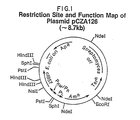
- Plasmid pCZA126 contains the P R and P L repressible promoters from bacteriophage lambda operating in tandem to drive the expression of an apramycin resistance-conferring gene. Plasmid pCZA126 also contains the bacteriophage lambda cI857 repressor gene which, when functioning, produces a repressor function in E. coli so that the tandem P R P L promoters cannot promote the expression of the apramycin resistanceconferring gene.
- apramycin resistance-conferring gene The coding region of the apramycin resistance-conferring gene is from pKC462A, which was deposited on June 3, 1985. (NRRL B-15983).
- Plasmid pCZA126 also contains the ColE1 origin of replication and ampicillin resistance-conferring gene of plasmid pBR322, and the SCP2* derivative origin of replication and thiostrepton resistance-conferring gene of plasmid pHJL400 (Larson and Hershberger, 1986, Plasmid 15 :199-209).
- a restriction site and function map of plasmid pCZA126 is presented in Figure 1 of the accompanying drawings. Plasmid pCZA126 can be obtained from E.
- coli K12 JM109/pCZA126 a strain deposited on September 14, 1988 and made part of the permanent stock culture collection of the Northern Regional Research Laboratory (NRRL), Agricultural Research Service, 1815 North University Street, U.S. Department of Agriculture, Peoria, IL 61604. It is available to the public as a source and stock reservoir of the plasmid under the accession number NRRL B-18416.
- Plasmid pCZA126 was first transformed into Streptomyces lividans CT2, a strain also deposited on September 14, 1988 with the above mentioned NRRL under the accession number NRRL 18418. The transformants were selected on media containing thiostrepton, then the plasmid DNA was isolated from the transformants and back-transformed into E. coli K12 JM109 cells. Any disruption of the cI857 gene results in the conversion of the transformed E. coli cells to apramycin resistance. An apramycin resistant colony was selected and restriction enzyme analysis of the constituent plasmid revealed an approximately 1.6 kb insertion within the cI857 gene. Further sequence analysis and Southern hybridization analysis showed the insert to be an insertion sequence of S. lividans CT2 origin.
- eukaryotic transposable elements may be isolated by shuttling the vector into various eukaryotic cells.
- yeast elements for example, one can use the origin of replication from yeast plasmid YEP24 and the URA3 or LEU2 selectable markers.
- the cells of multicellular organisms may also be screened for the presence of transposable elements by substitution of the various elements of the desired vector.
- Rubin et al ., U.S. Patent No. 4,670,388 disclose various phages and selectable markers which are useful in Drosophila genetics. These factors can easily be transferred into a vector of the present invention to allow for screening of Drosophila for transposable elements.
- the elements may also be substituted to increase the ease or efficiency of screening in Streptomyces species.
- Streptomyces origin of replication from pHJL400 which is present in pCZA126 can be easily replaced by one of many origins of replication known to those skilled in the art.
- Table 1 is an illustrative, but not comprehensive, listing of Streptomyces plasmids from which additional, functional Streptomyces origins of replication can be obtained.
- all or part of the plasmids may be used to construct vectors exemplifying the present invention so long as the origin of replication function is not disrupted.
- the plasmid containing host and depository accession number are also listed in Table 1.
- Table I Streptomyces Plasmids Plasmid Host Accession Number SCP2 Streptomyces coelicolor A3(2) NRRL 15042 pEL7 Streptomyces ambofaciens NRRL 12523 SLP1 Streptomyces lividans NCIB1 11417 pNM100 Streptomyces virginiae NRRL 15156 pEL103 Streptomyces granuloruber A39912.13/pEL103 NRRL 12549 pIJ702 Streptomyces lividans ATCC2 39155 1National Collection of Industrial Bacteria (NCIB), Torry Research Station, Post Office Box 31, 135 Abbey Road, Aberdeen AB98DG, Scotland, United Kingdom 2American Type Culture Collection (ATCC), 12301 Parklawn Drive, Rockville, Maryland 20582, United States of America Other origins of replication such as SLP1.2 (Horinouchi e
- Bacteriol. 162 :406), pSRC1-b (Shindoh et al ., 1984, J. Antibiot. 37 :512), pSLl (Nakano et al. , 1982, FEMS Microbiol. Lett. 13 :279) and pSF765 (Murakami et al ., 1983, J. Antibiot. 36 :429) may also be used for constructing vectors within the scope of the present invention.
- E. coli origin of replication is not a critical component of the present invention
- substitution of functional origin of replication-containing and, if desired, antibiotic resistance-conferring restriction fragments from E. coli plasmids such as, for example, pCZ1O1 (Schoner et al ., 1984, Proc. Natl. Acad. Sci. USA81 :54O3), pACYC184, pBR325, pBR328 and the like can also be used for purposes of the present invention.
- pCZ1O1 Schot al ., 1984, Proc. Natl. Acad. Sci. USA81 :54O3
- pACYC184 pBR325, pBR328 and the like
- selectable markers may also be substituted for the antibiotic resistance-conferring genes exemplified herein.
- colorimetric markers such as the ⁇ -galactosidase system or nutritional markers such as the yeast URA3 or LEU2 genes may be employed.
- Many different antibiotic resistance conferring genes may also be employed in the vector of the present invention, such as, but not limited to, the tylosin, spiramycin, carbomycin or picromycin resistance-conferring genes of various Streptomyces species.
- antibiotic-resistance conferring genes which are functional in E. coli , such as the kanamycin and tetracycline resistance-conferring genes, to name but a few.
- Some genes, such as the native E. coli apramycin resistance-conferring gene, are functional in both E. coli and Streptomyces . Skilled artisans will understand that all of these genes can be used, alone or in combination, for purposes of further exemplifying the present invention.
- the repressor/promoter system of the illustrative vector used in the present method may also be altered according to the needs of the skilled artisan. For example, those systems which require incubation at 37°C should utilize the bacteriophage ⁇ cI repressor, as opposed to the cI857 repressor which does not function well at temperatures near 37°C.
- the lac Z repressor/promoter system could also be used in the present invention.
- the sequence encoding the repressor function could easily be changed, so long as the alternate sequence still encodes a functional repressor. Such an alternative sequence would provide alternate target sites for transposition events.
- a very versatile transposon trap plasmid may have several origins of replication that function in various species. Accordingly, the invention can easily be practiced in both eukaryotic and prokaryotic systems and therefore is in no way limited by the examples set forth below.
- the present invention further comprises a newly isolated insertion element, designated IS 493 .
- the nucleotide sequence of IS 493 comprises: wherein A is deoxyadenyl, G is deoxyguanyl, C is deoxycytidyl, and T is thymidyl.
- the IS 493 transposable element can be obtained from plasmid pZCA141, which can be conventionally isolated from E. coli K12 JM109/pCZA141, a strain deposited on September 14, 1988 and made part of the permanent stock culture collection of the NRRL.
- a culture of E. coli K12 JM109/pCZA141 can be obtained from the NRRL under the accession number NRRL B-18417.
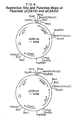
- a restriction site and function map of plasmid pCZA141 is presented in Figure 2 of the accompanying drawings.
- a variety of vectors can be constructed to utilize the integrating function of the IS 493 transposable element, such as illustrative vectors pCZA152, pCZA153, pCZA154 and pCZA155.
- Plasmid pCZA150 is constructed by first isolating plasmid pKC462A from E. coli K12 SF8/pKC462A (NRRL B-15973). Plasmid pKC462A is digested with restriction enzymes Pst I and Bam HI and the ⁇ 1.5 kb restriction fragment is isolated. This restriction fragment contains the apramycin resistance-conferring gene. Plasmid pUC19 (BRL) is also digested with restriction enzymes Pst I and Bam HI, then the ⁇ 1.5 kb apramycin resistance-conferring restriction fragment is ligated into the Pst I/ Bam HI cut plasmid pUC19 to form plasmid pOJ107.
- plasmid pCZA141 is digested with restriction enzyme Hin dIII and the ⁇ 2.1 kb IS 493 -containing restriction fragment is isolated. This fragment is then ligated into Hin dIII digested plasmid pOJ107 to form plasmids pCZA150 and pCZA151, which differ only with respect to the orientation of the IS 493 -containing restriction fragment.
- the orientation of the IS 493 element within these plasmids is determined by digesting the plasmids with restriction enzymes Sau I and Bam HI and checking for the presence of specific restriction fragments.
- Plasmids which contain ⁇ 2.9 kb and ⁇ 3.4 kb restriction fragments are designated plasmid pCZA150, while those plasmids which contain ⁇ 1.7 and 4.6 kb restriction fragments are designated plasmid pCZA151.
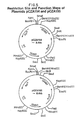
- Restriction site and function maps of plasmid pCZA150 and pCZA151 are presented in Figure 3 of the accompanying drawings.
- Plasmid pCZA150 is cut with restriction enzyme Bam HI and, along with some of the ⁇ 2.1 kb, Hin dIII-cut, IS 493 containing restriction fragment of plasmid pCZA141, is treated with mung bean nuclease to "blunt" the ends of the restriction sites.
- the "blunted” IS 493 containing restriction fragment is then ligated into the Bam HI digested, "blunted" pCZA150 to form plasmids pCZA152 and pCZA153, which differ only with respect to the orientation of the second IS 493 -containing restriction fragment.
- This second IS 493 element within these plasmids is determined by digesting the plasmids with restriction enzymes Sau I and Sma I and checking for the presence of specific restriction fragments.
- the plasmids which contain ⁇ 2.93 kb, ⁇ 5.3 kb and ⁇ 0.23 kb restriction fragments are designated plasmid pCZA152, while those plasmids which contain ⁇ 3.63 kb, ⁇ 2.93 kb and ⁇ 1.9 kb restriction fragments are designated plasmid pCZA153.
- Restriction site and function maps of plasmids pCZA152 and pCZA153 are presented in Figure 4 of the accompanying drawings.
- plasmid pCZA151 is cut with restriction enzyme Bam HI and treated with mung bean nuclease.
- the "blunted" IS 493 containing restriction fragment of pCZA141 is then ligated into the Bam HI-digested, blunted pCZA151 to form plasmids pCZA154 and pCZA155, which differ only with respect to the orientation of the second IS 493 -containing restriction fragment.
- the orientation of the second IS 493 element within these plasmids is determined by digesting the plasmids with restriction enzymes Sau I and Sma I and checking for the presence of specific restriction fragments.
- plasmids which contain ⁇ 1.96 kb, ⁇ 4.6 kb and ⁇ 1.9 kb restriction fragments are designated plasmid pCZA154, while those plasmids which contain ⁇ 3.63 kb, ⁇ 4.6 kb and ⁇ 0.23 kb restriction fragments are designated plasmid pCZA155.
- Restriction site and function maps of plasmids pCZA154 and pCZA155 are presented in Figure 5 of the accompanying drawings. Transformation of a pool containing plasmids pCZA152, pCZA153, pCZA154 and pCZA155 into Streptomyces lividans CT2 results in transformed colonies which are resistant to the antibiotic apramycin.
- Transposition events such as those made possible by IS 493 , are very useful because transposition may occur in a variety of locations in the genome and does not require DNA homology for integration.
- integration of DNA by transposition mechanisms is not limited to organisms that have functional homologous recombination systems.
- the IS 493 transposable element is in no way limited to the use in the plasmids herein described, as many different techniques and cloning vectors could be used to introduce the transposable element into the host cell.
- the types of genes integrated into the chromosome via transposition using the IS 493 element are also virtually limitless.
- the antibiotic resistance-conferring genes of the exemplified plasmids could be replaced by many different antibiotic resistance conferring genes or the antibiotic resistance-conferring genes could be replaced by heavy metal resistance-conferring genes or biosynthetic genes.
- the stable integration of biosynthetic genes into the chromosome of a host cell can cause increased production of the desired gene product or the production of new, hybrid gene products.
- Those skilled in the art recognize that virtually any gene encoding any function can be transposed into the host chromosome using the IS 493 element disclosed herein. Therefore, the addition of any extraneous DNA within the parameters of the IS 493 element would be within the scope of the present invention.
- Plasmid pCZA126 can be obtained from the Northern Regional Research Center in E. coli K12 JM109 under the accession number NRRL B-18416.
- the lyophils of E. coli K12 JM109/pCZA126 are plated onto L-agar plates (10 g of Bacto-tryptone, 10 g of NaCl, 5 g of Bacto-Yeast Extract, and 15 g of agar per liter) containing 25 ⁇ g/ml ampicillin to obtain a single colony isolate of the strain.
- This colony is used to inoculate about 500 ml of L broth (L agar without agar) containing 25 ⁇ g/ml ampicillin, and the resulting culture is incubated at 37°C with aeration until the cells reach stationary phase.
- Plasmid DNA is obtained from the cells in accordance with the following procedure, which is adapted from Maniatis et al,, 1982, Molecular Cloning (Cold Spring Harbor Laboratory). This same procedure is used, but on a smaller scale and with the ultracentrifugation steps replaced with phenol followed by chloroform extractions, to prepare the plasmid DNA used to identify the E. coli transformants.
- the lysed cell mixture is centrifuged in a Beckman SW27 rotor (or its equivalent) at 20,000 rpm for 20 minutes at 4°C. About 36 ml of supernatant are recovered, and 2.5 volumes of ethanol are added, mixed, and the resulting solution left on ice for 15 minutes.
- the plasmid DNA is collected by centrifugation at 12,000Xg for 30 minutes at room temperature. The supernatant is discarded, and the DNA pellet is washed with 70% ethanol at room temperature. The ethanol wash is decanted, and the pellet is dried in a vacuum desiccator. The pellet is then resuspended in 8 ml of TE buffer.
- CsCl Eight grams are added to the DNA solution. About 0.8 ml of a 10 mg/ml solution of ethidium bromide in water are added for each 10 ml of CsCl-DNA solution. The final density of the solution is about 1.55 g/ml, and the ethidium bromide concentraton is about 800 pg/ml.
- the solution is transferred to a Beckman Type 50 centrifuge tube, filled to the top with TE buffer containing 1.55 g/ml CsCl, sealed, and centrifuged at 45,000 rpm for 24 hours at 20°C. After centrifugation, two bands of DNA are visible in ordinary light and become even more prominent in UV light. The cap is removed from the tube, and the lower DNA band is recovered using a syringe with a #21 hypodermic needle inserted through the side of the centrifuge tube.
- the ethidium bromide is removed from the solution of plasmid DNA by several extractions with water-saturated 1-butanol, and the CsCl is removed by dialysis against TE buffer. After extractions with buffered phenol and then chloroform, the DNA is precipitated, washed with 70% ethanol, and dried. About 0.5 mg of plasmid pCZA126 DNA can be obtained by this procedure.
- Trace element solution ( ⁇ 1 L): Ingredient Amount ZnCl2 40 mg FeCl3 ⁇ 6H2O 200 mg CuCl2 ⁇ 2H2O 10 mg MnCl2 ⁇ 4H2O 10 mg Na2B4O7 ⁇ 10H2O 10 mg (NH4)6Mo7O24 ⁇ 4H2O 10 mg H2O 1 L 3.
- Streptomyces lividans CT2 (NRRL 18418) is plated on YMX agar and incubated at 30°C for about 72 hours. A plug of cells is removed from the plate and used to inoculate 10 ml of TSB. The culture is homogenized and incubated at 30°C for ⁇ 30 hours. About 4 ml of this culture are homogenized and used to inoculate 100 ml of TSB containing 0.4% glycine. The culture is incubated at 30°C for about 24 hours. About 4 ml of this culture are again homogenized and used to inoculate 100 ml of TSB containing 0.4% glycine. The culture is incubated at 30°C for about 16 hours.
- the cells are harvested and washed three times with 10.3% sucrose.
- the cells are resuspended in 100 ml of P media containing l mg/ml lysozyme, and the resulting solution is incubated at 30°C for 2 hours. During this protoplasting step, the cells are pipetted up and down to disperse clumps.
- the protoplasts are collected and washed three times with P medium.
- the protoplasts are then suspended in 10 ml of P medium. This process usually generates about 2 to 5 ⁇ 107 protoplasts per 150 ⁇ l of solution.
- Approximately 150 ⁇ l of the protoplast solution are added to 10 ⁇ l of the transforming DNA, either in ligation or TE buffer, and mixed. About 100 ⁇ l of 50% polyethylene glycol 1000 in P media are then added and mixed. After a brief (1 to 2 minutes) incubation at room temperature, the cell-DNA mixture is brought to a volume of 1 ml by the addition of P media. The cell suspension is plated onto modified R2 generation medium; about 0.1 ml of cells is inoculated per R2 plate.
- the plates are then incubated for about four days at 30°C, when colonies become visible to the naked eye.
- the single colonies were then used to inoculate 10 ml TSB cultures containing 25 ⁇ g/ml thiostrepton.
- the cultures were homogenized and then grown overnight at 30°C in a rotary shaker.
- Plasmid isolation for analysis and confirmation of structurally intact plasmid pCZA126 is done as follows.
- the mycelium is collected by centrifugation, washed twice with 10.3% sucrose and then suspended in 1-2 ml of 10.3% sucrose.
- Four hundred ⁇ l of the cell mixture are transferred to a small tube, and 100 ⁇ l of 5X Lysozyme solution (125mM Tris-HCl, pH8; 125mM EDTA, pH8; 10.3% sucrose; 10mg/ml Lysozyme) are added.
- the suspension is incubated at 30°C for 30-60 minutes, followed by the addition and mixing of 300 ⁇ l of 0.3 M NaOH containing 1% SDS. The latter solution is kept at 50°C before its addition to the cell mix.
- the cell mixture is placed at 80°C for 10 minutes, cooled to room temperature, and then extracted with 200 ⁇ l of phenol:CHCl3 (50:50).
- the aqueous phase is transferred to a clean tube, made 0.3 M in NaOAc, and then, one volume of isopropanol is added.
- the DNA is incubated at room temperature for five minutes and then pelleted by centrifugation.
- the pellet is dissolved in 500 ⁇ l of TE buffer, and about 25 ⁇ l of 0.1 M spermine are added to the solution of DNA, and the mixture is incubated at room temperature for 5 minutes.
- the DNA pellet is rinsed with 75% ethanol, then resuspended and reprecipitated from 0.3 M sodium acetate using ethanol. After this last precipitation, the plasmid DNA is suspended in 50 ⁇ l of TE buffer. Restriction enzyme cutting and electrophoretic analysis of the reaction products are used to confirm plasmid structure.
- Example 2 The culture isolated in Example 2 is grown to stationary phase in TSB plus 25 ⁇ g/ml thiostrepton and homogenized. Five ml of the homogenized culture are used to inoculate 100 ml of TSB also containing 25 ⁇ g/ml thiostrepton. The 100 ml of culture are incubated at 30°C with aeration until the Streptomyces lividans /pCZA126 cells reach stationary phase.
- the cells are collected and washed once with a 10.3% sucrose solution.
- the cells are then suspended in 24 ml of 10.3% sucrose, and 6 ml of 5X lysozyme solution are added.
- the solution is mixed and then incubated at 30°C for 30-60 minutes, and then, about 18 ml of a solution that is 0.3 M NaOH, 1% SDS, and prewarmed to 50°C are added, mixed and the resulting mixture is incubated at 80°C for 10 minutes.
- the mixture is then cooled to room temperature, and 12 ml of a solution made by mixing 500 g phenol and 500 g CHCl3 in 200 ml H2O are added and mixed well with the cell-extract.
- the phases are separated by centrifugation at 6000-8000 rpm for 10 minutes; approximately 45 ml of the resulting upper phase are transferred to a clean bottle.
- the solution is then centrifuged at 52,000 rpm for 48 hours at 20°C in a Beckman Ti-75 fixed-angle rotor.
- the fraction containing the plasmid band is extracted 5 times with isopropanol saturated with 20X SSC (0.3 M NaCl and 0.3 M Nacitrate) to remove the ethidium bromide.
- the sample is dialyzed against 1000 volumes of H2O and then against 1500 volumes of TE buffer. The procedure yields about 50 ⁇ g of plasmid pCZA126 DNA at a concentration of ⁇ 0.2 ⁇ g/ ⁇ l and is stored at 4°C.
- the plasmids isolated from Streptomyces lividans CT2 are then back-transformed into competent Escherichia coli K12 JM109 obtained from Stratagen (11099 North Torrey Pines Rd., LaJolla, CA 92037).
- a 0.1 ml aliquot of the cells was added to about 0.1 ⁇ g of the DNA from the previous Example.
- the cell-DNA mixture was incubated on ice for one hour, heat-shocked at 42°C for 90 seconds, and then chilled on ice for two minutes.
- the DNA and cell mixture was added to a tube containing 0.9 ml L medium with 10 mM MgSO4, 10 mM MgCl2 and 10 mM glucose, then the mixture was incubated for 45 minutes at 30°C with gentle shaking.
- the repressor gene of plasmid pCZA126 is located on a Pst I restriction fragment.
- the plasmid DNA from each isolate purified above was digested with Pst I to check for possible insertions of transposable elements.
- Approximately .5 ⁇ g plasmid DNA in 10 ⁇ l H2O is mixed with 2 ⁇ l of 10X Pst I buffer (100 mM Tris-HCl, pH 7.5, 1M NaCl, and 100 mM MgCl2), 7 ⁇ l H2O and l ⁇ l ( ⁇ 15 units; unit definitions herein correspond to those of New England Biolabs, 32 Tozer Road, Beverly, MA 01915-9990, unless otherwise indicated) of restriction enzyme Pst I.
- the resulting reaction is incubated at 37°C for two hours.
- the DNA is electrophoresed on a 1% agarose gel and the DNA bands are visualized by long-range UV light after staining with ethidium bromide.
- a small number of the plasmids contain an ⁇ 1.2 K Pst I restriction fragment which corresponds to the expected size of the natural cI857 gene-containing DNA fragment.
- the clones carrying these plasmids probably became apramycin resistant due to a simple point mutation in the cI857 gene or spontaneous chromosomal apramycin resistance.
- the number of these colonies with spontaneous chromosomal apramycin resistance can be reduced by plating the cells on a media containing ampicillin or carbenicillin since this selects for a subpopulation consisting of only those cells that have been transformed with plasmid.
- Plasmid pKC462A is obtained from the Northern Regional Research Center in E. coli K12 SF8/pKC426A under the accession number NRRL B-15973. Plasmid DNA is extracted from the cells in substantial accordance with the teaching of Example 1. The apramycin resistance-conferring gene of plasmid pKC462A is found on an approximately 1.5 kb Bam HI- Pst I restriction fragment. To isolate this fragment, about 1 ⁇ g of plasmid pKC462A DNA in 10 ⁇ l H2O is mixed with 2 Ml 10X Pst I buffer, 7 ⁇ l H2O and 1 ⁇ l restriction enzyme Pst I.
- the Pst I- Bam HI digested plasmid PKC462A is then electrophoresed on a 1% agarose gel until the desired ⁇ 1.5 kb restriction fragment is clearly separated from the other digestion products. Visualization of the electrophoresed DNA is accomplished by staining the gel in a dilute solution (0.5 ⁇ g/ml) of ethidium bromide and exposing the stained gel to long-wave UV light. After the desired fragment is located, a small slit is made in the gel in front of the fragment, and a small piece of Schleicher and Schuell (Keene, NH 03431) NA-45 DEAE membrane was placed in the slit.
- the ⁇ 1.5 kb Pst I- Bam HI restriction fragment is non-covalently bound to the DEAE membrane.
- plasmid pUC19 (available from BRL, Gaithersburg, Maryland 20877) is also digested with restriction enzymes Pst I and Bam HI, then electrophoresed and the ⁇ 2.7 kb vector fragment is isolated as above. The purified, digested vector fragment of pUC19 is then resuspended in 50 ⁇ l TE buffer.
- plasmid pOJ107 A restriction site and function map of plasmid pOJ107 is presented in Figure 3 of the accompanying drawings.
- E. coli K12 MM294 cells that are competent for transformation
- the lyophils of E. coli K12 MM294 obtained from the NRRL are reconstituted to isolate single colonies.
- One single-colony isolate of MM294 is inoculated into 5 ml of L broth and the culture is incubated at 37°C overnight with aeration. Fifty ⁇ l of the overnight culture are used to inoculate 5 ml of L broth. The culture is incubated at 37°C overnight with aeration. The following morning, the culture is diluted to 200 ml with L broth.
- the diluted culture is incubated at 37°C with aeration until the absorbance at 550 nm (A550) is about 0.5, which indicates a cell density of about 1 ⁇ 108 cells/ml.
- the culture is cooled for ten minutes in an ice-water bath, and the cells are then collected by centrifugation at 4000Xg for 10 minutes at 4°C.
- the cell pellet is resuspended in 100 ml of cold 10 mM NaCl and then immediately repelleted by centrifugation.
- the cell pellet is resuspended in 100 ml of 30 mM CaCl2 and incubated on ice for 20 minutes.
- the cells are again collected by centrifugation and resuspended in 10 ml of 30 mM CaCl2. A one-half ml aliquot of the cells was added to the ligated DNA prepared above.
- the cell-DNA mixture is incubated on ice for one hour, heat-shocked at 42°C for 90 seconds, and then chilled on ice for about two minutes.
- the cell-DNA mixture is centrifuged, and the cell pellet is resuspended into 0.5 ml of L broth in a 1.5 ml tube and incubated at. 37°C for one hour.
- Plasmid DNA is obtained from the E. coli K12 MM294/pOJ107 transformants in substantial accordance with the teaching of Example 1.
- Plasmid pCZA141 which contains IS 493 on an approximately 2.1 kb HindIII restriction fragment is obtained from the NRRL from E. coli K12 JM109/pCZA141 under the accession number NRRL B-18417.
- a restriction site and function map of plasmid pCZA141 is presented in Figure 2 of the accompanying drawings.
- plasmid pOJ107 About 1 ⁇ g of plasmid pOJ107 is then digested with restriction enzyme Hin dIII and the. linear vector is isolated as taught above.
- the ⁇ 2.1 kb Hin dIII restriction fragment of plasmid pCZA141 is then ligated into the Hin dIII-digested vector pOJ170 in substantial accordance with the teaching of Example 5A.
- the plasmids isolated from the resultant apramycin resistant colonies are analyzed by restriction digestion.
- plasmid pCZA150 Those plasmids which contain ⁇ 2.9 kb and ⁇ 3.4 kb Sau I- Bam HI restriction fragments are designated plasmid pCZA150, while those plasmids which contain ⁇ 1.7 kb and ⁇ 4.6 kb Sau I- Bam HI restriction fragments are designated plasmid pCZA151. Restriction site and function maps of plasmids pCZA150 and pCZA151 are presented in Figure 3 of the accompanying drawings.
- plasmid pCZA150 is digested with restriction enzyme Bam HI in substantial accordance with the teaching of Example 5A.
- Ten units of Mung Bean Nuclease (Pharmacia) is added and the mixture is incubated for 10 minutes at 37°C, then extracted with a 1:1 mixture of phenol/chloroform.
- a 1:10 volume of 3M NaAcetate is added to the aqueous phase along with 3 volume of ethanol.
- the sample is centrifuged for 5 minutes in an Eppendorf centrifuge and the liquid is discarded.
- the pellet is rinsed with 70% ethanol, then air dried and resuspended in 20 ⁇ l TE.
- plasmid pCZA152 Those plasmids which contain ⁇ 5.3 kb, ⁇ 2.93 kb and ⁇ 0.23 kb restriction fragments are designated plasmid pCZA152, while those plasmids which contain ⁇ 3.63 kb, ⁇ 2.93 kb and ⁇ 1.9 kb restriction fragments are designated plasmid pCZA153. Restriction site and function maps of plasmids pCZA152 and pCZA153 are presented in Figure 4 of the accompanying drawings.
- plasmid pCZA151 is digested with restriction enzyme Bam HI and treated with Mung Bean Nuclease as taught above.
- About 1 ⁇ g of the ⁇ 2.1 kb Hin dIII-cut, Mung Bean Nuclease treated restriction fragment from plasmid pCZA141 is then ligated into the Bam HI-cut, Mung Bean Nuclease treated plasmid pCZA151 in substantial accordance with the teachings above.
- the plasmids isolated from apramycin resistant colonies are digested with restriction enzymes Sau I and Sma I.
- plasmids pCZA154 Those plasmids which contain ⁇ 4.6 kb, ⁇ 1.96 kb and ⁇ 1.9 kb restriction fragments are designated plasmid pCZA154, while those plasmids which contain ⁇ 4.6 kb, ⁇ 3.63 kb and ⁇ 0.23 kb restriction fragments are designated plasmids pCZA155.
- Restriction site and function maps of plasmids pCZA154 and pCZA155 are presented in Figure 5 of the accompanying drawings.
- a pool of plasmids pCZA152, pCZA153, pCZA154 and pCZA155 is next transformed into Streptomyces lividans CT2 in substantial accordance with the teaching of Example 2.
- the plated cells are covered with an apramycin overlay at a final concentration of 25 ⁇ g/ml.
- the emergence of apramycin resistant colonies demonstrates a transposable event wherein the apramycin resistance-conferring gene has been integrated into the Streptomyces lividans chromosome.
Landscapes
- Genetics & Genomics (AREA)
- Health & Medical Sciences (AREA)
- Engineering & Computer Science (AREA)
- Life Sciences & Earth Sciences (AREA)
- Chemical & Material Sciences (AREA)
- Wood Science & Technology (AREA)
- Organic Chemistry (AREA)
- Biotechnology (AREA)
- General Engineering & Computer Science (AREA)
- Biomedical Technology (AREA)
- Zoology (AREA)
- Bioinformatics & Cheminformatics (AREA)
- Molecular Biology (AREA)
- Microbiology (AREA)
- Plant Pathology (AREA)
- Physics & Mathematics (AREA)
- Biochemistry (AREA)
- General Health & Medical Sciences (AREA)
- Biophysics (AREA)
- Micro-Organisms Or Cultivation Processes Thereof (AREA)
- Preparation Of Compounds By Using Micro-Organisms (AREA)
Applications Claiming Priority (2)
| Application Number | Priority Date | Filing Date | Title |
|---|---|---|---|
| US25209588A | 1988-09-30 | 1988-09-30 | |
| US252095 | 1988-09-30 |
Publications (2)
| Publication Number | Publication Date |
|---|---|
| EP0366275A2 true EP0366275A2 (de) | 1990-05-02 |
| EP0366275A3 EP0366275A3 (de) | 1991-07-31 |
Family
ID=22954583
Family Applications (1)
| Application Number | Title | Priority Date | Filing Date |
|---|---|---|---|
| EP19890309968 Withdrawn EP0366275A3 (de) | 1988-09-30 | 1989-09-29 | Verfahren zur Isolierung von transponierbaren Elementen aus Sterptomyceten und anderen Organismen |
Country Status (4)
| Country | Link |
|---|---|
| EP (1) | EP0366275A3 (de) |
| JP (1) | JPH02142473A (de) |
| DK (1) | DK478589A (de) |
| IL (1) | IL91821A0 (de) |
Cited By (1)
| Publication number | Priority date | Publication date | Assignee | Title |
|---|---|---|---|---|
| EP0629698A1 (de) * | 1992-10-08 | 1994-12-21 | Eli Lilly And Company | Hypertransposierbarkeitverleihende DNS-Sequenzen und mit den Sequenzen hergestellte Vektoren |
-
1989
- 1989-09-28 DK DK478589A patent/DK478589A/da not_active Application Discontinuation
- 1989-09-28 IL IL91821A patent/IL91821A0/xx unknown
- 1989-09-29 JP JP1256940A patent/JPH02142473A/ja active Pending
- 1989-09-29 EP EP19890309968 patent/EP0366275A3/de not_active Withdrawn
Non-Patent Citations (2)
| Title |
|---|
| CHEMICAL ABSTRACTS, vol. 96, 1982, page 160, abstract no. 116751g, Columbus, Ohio, US; M. LIEB: "A fine structure map of spontaneous and induced mutations in the lambda repressor gene, including insertions of IS elements", & MGG. MOL. GEN. GENET. 1981, 184(3), 364-71 * |
| JOURNAL OF BACTERIOLOGY, vol. 171, no. 9, September 1989, pages 4807-4813; P.J. SOLENBERG et al.: "Method for selection of transposable DNA and characterization of a new insertion sequence. IS493, from Streptomyces lividans" * |
Cited By (1)
| Publication number | Priority date | Publication date | Assignee | Title |
|---|---|---|---|---|
| EP0629698A1 (de) * | 1992-10-08 | 1994-12-21 | Eli Lilly And Company | Hypertransposierbarkeitverleihende DNS-Sequenzen und mit den Sequenzen hergestellte Vektoren |
Also Published As
| Publication number | Publication date |
|---|---|
| JPH02142473A (ja) | 1990-05-31 |
| EP0366275A3 (de) | 1991-07-31 |
| DK478589D0 (da) | 1989-09-28 |
| IL91821A0 (en) | 1990-06-10 |
| DK478589A (da) | 1990-03-31 |
Similar Documents
| Publication | Publication Date | Title |
|---|---|---|
| Olsen et al. | Development of broad-host-range vectors and gene banks: self-cloning of the Pseudomonas aeruginosa PAO chromosome | |
| Grinter | A broad-host-range cloning vector transposable to various replicons | |
| Kranklin et al. | Construction of a partial diploid for the degradative pathway encoded by the TOL plasmid (pWW0) from Pseudomonas putida mt-2: evidence for the positive nature of the regulation by the xylR gene | |
| US4626504A (en) | DNA transfer vector for gram-negative bacteria | |
| WO1992014819A1 (en) | A positive selection vector for the bacteriophage p1 cloning system | |
| EP0118367B1 (de) | Rekombinant-DNS Klonierungsvektor pVE1, Deletions- und Hybridmutante, und rekombinante Derivate derselben Produkte und Verfahren | |
| WO1988001646A1 (en) | Universal system for transposon mutagenesis | |
| US4332898A (en) | Hybrid plasmid and process of making same | |
| US4703009A (en) | RDNA cloning vector pVE1, deletion and hybrid mutants and recombinant derivatives thereof products and processes | |
| US5264354A (en) | Method for isolating transposable elements from streptomyces | |
| US4343906A (en) | Hybrid plasmid of pBR322 and Streptomyces plasmid and E. coli containing same | |
| SU1479004A3 (ru) | Способ конструировани вектора pVM061 | |
| US4362817A (en) | Hybrid plasmid and process of making same | |
| HU197354B (en) | Process for selecting streptomyces containing recombinant dna | |
| EP0354641B1 (de) | Für eine 4''-0-Isovalerylacylase kodierende rekombinante DNS | |
| EP0070522B1 (de) | Plasmid p SVH 1 und seine Verwendung | |
| JPH0771494B2 (ja) | Dna物質伝達のためのベクター | |
| EP0213898B1 (de) | Wirt-Vektor-System | |
| US4362816A (en) | Hybrid plasmid and process of making same | |
| US4992371A (en) | Hybrid plasmids having a streptomycetes replicon and an escherichia coli replicon | |
| US4686184A (en) | Gene transfer vector | |
| US4879241A (en) | Tylosin resistance-conferring gene, designated tlrB, for use in streptomyces and other organisms | |
| Finlay et al. | Characterization of conjugative plasmid EDP208 | |
| EP0035914A2 (de) | Plasmid-Vektoren, Plasmide und deren Herstellung sowie Klonierungsverfahren unter Verwendung derselben | |
| JP2526203B2 (ja) | ストレプトミセスプラスミドpsg5 |
Legal Events
| Date | Code | Title | Description |
|---|---|---|---|
| PUAI | Public reference made under article 153(3) epc to a published international application that has entered the european phase |
Free format text: ORIGINAL CODE: 0009012 |
|
| 17P | Request for examination filed |
Effective date: 19891007 |
|
| AK | Designated contracting states |
Kind code of ref document: A2 Designated state(s): AT BE CH DE ES FR GB GR IT LI NL SE |
|
| PUAL | Search report despatched |
Free format text: ORIGINAL CODE: 0009013 |
|
| AK | Designated contracting states |
Kind code of ref document: A3 Designated state(s): AT BE CH DE ES FR GB GR IT LI NL SE |
|
| 17Q | First examination report despatched |
Effective date: 19940823 |
|
| STAA | Information on the status of an ep patent application or granted ep patent |
Free format text: STATUS: THE APPLICATION IS DEEMED TO BE WITHDRAWN |
|
| 18D | Application deemed to be withdrawn |
Effective date: 19950303 |