EP0365237B1 - R2o-al203/b203-p205 glasses - Google Patents
R2o-al203/b203-p205 glasses Download PDFInfo
- Publication number
- EP0365237B1 EP0365237B1 EP89310557A EP89310557A EP0365237B1 EP 0365237 B1 EP0365237 B1 EP 0365237B1 EP 89310557 A EP89310557 A EP 89310557A EP 89310557 A EP89310557 A EP 89310557A EP 0365237 B1 EP0365237 B1 EP 0365237B1
- Authority
- EP
- European Patent Office
- Prior art keywords
- glasses
- glass
- mole
- al2o3
- metal oxides
- Prior art date
- Legal status (The legal status is an assumption and is not a legal conclusion. Google has not performed a legal analysis and makes no representation as to the accuracy of the status listed.)
- Expired - Lifetime
Links
Classifications
-
- C—CHEMISTRY; METALLURGY
- C03—GLASS; MINERAL OR SLAG WOOL
- C03C—CHEMICAL COMPOSITION OF GLASSES, GLAZES OR VITREOUS ENAMELS; SURFACE TREATMENT OF GLASS; SURFACE TREATMENT OF FIBRES OR FILAMENTS MADE FROM GLASS, MINERALS OR SLAGS; JOINING GLASS TO GLASS OR OTHER MATERIALS
- C03C3/00—Glass compositions
- C03C3/12—Silica-free oxide glass compositions
- C03C3/16—Silica-free oxide glass compositions containing phosphorus
- C03C3/19—Silica-free oxide glass compositions containing phosphorus containing boron
-
- C—CHEMISTRY; METALLURGY
- C03—GLASS; MINERAL OR SLAG WOOL
- C03C—CHEMICAL COMPOSITION OF GLASSES, GLAZES OR VITREOUS ENAMELS; SURFACE TREATMENT OF GLASS; SURFACE TREATMENT OF FIBRES OR FILAMENTS MADE FROM GLASS, MINERALS OR SLAGS; JOINING GLASS TO GLASS OR OTHER MATERIALS
- C03C3/00—Glass compositions
- C03C3/12—Silica-free oxide glass compositions
- C03C3/16—Silica-free oxide glass compositions containing phosphorus
-
- C—CHEMISTRY; METALLURGY
- C03—GLASS; MINERAL OR SLAG WOOL
- C03C—CHEMICAL COMPOSITION OF GLASSES, GLAZES OR VITREOUS ENAMELS; SURFACE TREATMENT OF GLASS; SURFACE TREATMENT OF FIBRES OR FILAMENTS MADE FROM GLASS, MINERALS OR SLAGS; JOINING GLASS TO GLASS OR OTHER MATERIALS
- C03C3/00—Glass compositions
- C03C3/12—Silica-free oxide glass compositions
- C03C3/16—Silica-free oxide glass compositions containing phosphorus
- C03C3/17—Silica-free oxide glass compositions containing phosphorus containing aluminium or beryllium
Definitions
- This invention relates to R2O-Al2O3/B2O3-P2O5 glasses.
- composition ranges indicate the required presence of PbO, the patent asserts that part or all of the PbO may be replaced with divalent metal oxides.
- borate-based and phosphate-based glasses commonly demonstrate poorer chemical durability and resistance to attack by moisture than silica-based compositions, and that disadvantage becomes even more of a problem as the glasses are devised to manifest lower transition temperatures.
- phosphate-based glasses demonstrating low transition temperatures are typically readily attacked by boiling water and, in not infrequent cases, exhibit hygroscopicity.
- the transition temperature of a glass is the temperature at which increases in specific heat and thermal expansion coefficient take place which are accompanied by a sharp drop in viscosity.
- the principal objective of the present invention was to develop glasses exhibiting transition temperatures below 350°C, with working temperatures, i.e., temperatures at which the glass manifests a viscosity of about 103-106 Pa.s (104-107 poises), below 450°C, which glasses display remarkable chemical durability when contacted with boiling water.
- Al2O3 with, desirably, B2O3 enhances the chemical durability and improves the stability of the glass.
- B2O3 Over 7 mole % Al2O3 or over 10 mole % B2O3 however, renders the glass too refractory.
- the inclusion of at least 5 mole % Li2O is required because Na2O alone appears to impact unfavorably upon the durability of the glass and/or renders the glass difficult to melt.
- the combination of Li2O+Cu2O has the capacity for reducing the Tg of the glass while maintaining the desired exceptional chemical durability. K2O adversely affects the Tg such that any amount thereof must be avoided.
- Up to 5% total of at least one member of the group consisting of MgO, CaO, SrO, BaO, MnO, and ZnO may optionally be included. Larger concentrations hazard undue raising of the Tg of the glass and can adversely affect the chemical durability exhibited by the glass. Additions of up to 5% ZrO2 are useful in developing a glass manifesting a uniform white opacity. SiO2 may be tolerated at levels up to about 3% and fluoride in amounts up to about 5%. The sum of all optional additions to the base glass compositions will be less than 10%.
- composition intervals expressed in terms of mole percent are not possible mathematically, the following ranges comprise approximate values of the operable composition intervals in terms of weight percent: P2O5 55-73 Li2O 0-8 Al2O3 0-5 Na2O+Li2O 7-23 B2O3 0-10 Cu2O 0-20 Al2O3+B2O3 1.75-10 Li2O+Cu2O 5-30 Na2O 7-15
- U. S. Patent No. 3,215,543 discloses the production of articles composed of mica particles entrained in a glassy matrix, that glass matrix consisting essentially, in mole %, of 6-20% RO, wherein RO consists of CaO, MgO, and/or ZnO, 22-42.5% R2O, wherein R2O consists of the alkali metal oxides, 6-(16+ d 6 )% Al2O3, and (36- d 3 )-(56-d)% P2O5, wherein d represents the percentage of RO.
- U. S. Patent No. 3,407,091 was concerned with preparing sealing glasses composed, in weight percent, of 4-27% Na2O and/or K2O, 4-30% ZnO, 2-10% Al2O3, and 60-67% P2O5.
- Patent No. 3,215,543, supra Cu2O is nowhere mentioned; there is no recognition of the remarkably low Tg manifested by glasses of the present invention; and no working example of the patent falls within the ranges of the present inventive compositions.
- U. S. Patent No. 3,481,749 records compositions suitable for the production of glasses to be used, for example, as lubricants in the extrusion of metallic bodies at elevated temperatures.
- the glasses were required to be readily attacked by water to allow rapid elimination from the metallic body during washing in water.
- the glasses consisted essentially, in mole %, of 9-33% R2O, 16-20% BaO, CaO, MgO, PbO, and/or ZnO, 10-20% Al2O3, and 29-61% P2O5.
- concentrations of Al2O3 and the recited divalent metal oxides are outside the operable ranges of the present invention.
- U. S. Patent No. 3,885,973 presents glasses exhibiting low transformation temperatures, but relatively high solution rates in water, consisting essentially, in mole %, of 5-25% Li2O, 5-30% ZnO, 58-76% P2O5, and 0-10% alkaline earth metal oxides. No references are made to Na2O, Al2O3, or B2O3.
- U. S. Patent No. 3,926,649 discloses glasses demonstrating a low Tg, but also a relatively high rate of solution in water, consisting essentially, in mole %, of 75 ⁇ 2.5% P2O5+B2O3 and 25 ⁇ 2.5% alkali metal oxides + alkaline earth metal oxides + ZnO. Al2O3 and Cu2O are nowhere mentioned and none of the working examples had a composition coming within the ranges of the present invention.
- U. S. Patent No. 3,935,018 describes the preparation of glasses displaying a low Tg, but, again, a relatively high rate of solution in water, consisting essentially, in mole %, of 0-30% PbO, 1.2-3.5% B2O3, 50-72% P2O5, 0-5% transition metal oxides, and the remainder consisting of alkali metal oxides, alkaline earth metal oxides, and ZnO.
- Al2O3 is not mentioned and none of the working examples has a composition which is operable in the present invention.
- U. S. Patent No. 3,964,919 is drawn to glasses manifesting a low Tg, but, yet again, a relatively high rate of solution in water, consisting essentially, in mole % of 50-75% P2O5, 0.1-10% of at least one member of the group of up to 1.6% CrO3, up to 7% MoO3, and up to 7% WO3, and 15-49.9% of at least one oxide of the group of alkali metal oxides and alkaline earth metal oxides, and which may contain up to 5% by weight H2O.
- the maximum of 2% total of Al2O3+B2O3 as optional components places those compositions outside of the ranges required in the instant invention.
- U. S. Patent No. 3,979,322 is directed to glasses suitable for use in laser applications consisting essentially, in mole %, of 1-30% alkali metal oxides, 20-45% alkaline earth metal oxides and/or ZnO, 0-27% PbO, B2O3, Al2O3, and/or Nb2O5, 0.1-25% Nd2O3, and 35-49% P2O5.
- the level of divalent metal oxide is far in excess of that operable in the present invention.
- U. S. Patent No. 3,989,532 is drawn to glasses manifesting a low Tg, but also hygroscopicity, consisting essentially, in mole %, of 0-2% Al2O3 and/or SiO2, 1.2-3.5% B2O3, 2.7-20% alkaline earth metal oxides, ⁇ 5% alkali metal oxides, and ⁇ 52% P2O5.
- the hygroscopic behavior exhibited by the glasses would render them unsuitable in the present invention. None of the working examples had a composition coming within the ranges of the instant invention.
- U. S. Patent No. 4,026,714 was concerned with the production of glasses demonstrating a low Tg with hygroscopic behavior consisting essentially, in mole %, of 4-30% alkali metal oxides, alkaline earth metal oxides, and/or ZnO, 1-12% PbO, 3.5-12% Al2O3, B2O3, and/or SiO2, and 52-72% P2O5. None of the working examples comes within the composition intervals of the present invention.
- U. S. Patent No. 4,046,540 is directed to the preparation of glasses displaying a low Tg and being capable of injection molding. Operable ranges of glasses consisted essentially, in mole %, of 12-20% Na2O, 4-6% PbO, 1.2-3.5% B2O3, 58-65% P2O5, and the remainder consisting of Li2O, CaO, and/or MgO. No reference is made to Al2O3 or Cu2O, the P2O5 content exceeds that operable in the present invention, and all of the working examples are outside of the composition intervals of the instant invention.
- U. S. Patent No. 4,060,422 discusses sealing glasses for laser applications consisting essentially, in mole %, of 4-12% Li2O, 5-25% PbO, 15-35% ZnO, 1-4% Al2O3, 2-10% V2O5, and 45-65% P2O5.
- the divalent metal oxide content far exceeds that which can be tolerated in the present invention.
- U. S. Patent No. 4,075,120 records glasses suitable for use in laser applications consisting essentially, in mole %, of 5-40% alkali metal oxides, 5-30% alkaline earth metal oxides, 0.01-15% R2O3, wherein R2O3 is selected from the group consisting of Al2O3, La2O3, Y2O3, Tm2O3, B2O3, Er2O3, and mixtures thereof, 35-65% P2O5, and 0.01-7% Nd2O3.
- the alkaline earth metal oxides are required constituents and none of the working examples (exclusive of the presence of Nd2O3) had a composition coming within the ranges found to be operable in the instant invention.
- U. S. Patent No. 4,229,220 is drawn to glasses suitable for coating glass laser discs consisting essentially, in mole %, of 0-20% Li2O, 0-17% Na2O, 8-20% Li2O+Na2O, 7-28% CuO, 4-10% Al2O3, 51-59% P2O5, 0-8% B2O3, 0-23% ZnO, 0-15% BaO, and 0-13% V2O5. None of the working examples has a composition coming within the ranges of the present invention.
- U. S. Patent No. 4,239,645 discloses glasses suitable for use in laser applications consisting essentially, in mole %, of 10-25% R2O, wherein R2O consists of 0-25% Li2O, 0-25% Na2O, and 0-8% K2O, 5-15% RO, wherein RO consists of 0-15% MgO, 0-15% CaO, 0-15% SrO, 0-15% BaO, and 0-15% ZnO, 1-15% Al2O3, 55-70% P2O5, and 0.01-5% Nd2O3. None of the working examples (exclusive of Nd2O3) comes within the composition intervals of the instant invention.
- U. S. Patent No. 4,248,732 refers to glasses operable in laser applications consisting essentially, in mole %, of 5-40% alkali metal oxides, 5-30% RO, wherein RO is at least one oxide of the group BaO, BeO, CaO, MgO, SrO, and ZnO, 0.01-15% R2O3, wherein R2O3 is at least one oxide of the group Al2O3, B2O3, Er2O3, La2O3, Tm2O3, and Y2O3, 0.01-7% Nd2O3, 35-65% P2O5, and 0.1-10% by weight of a solarization inhibiting oxide of the group CeO2, Nb2O5, Sb2O3, SiO2, and TiO2. None of the working examples (exclusive of Nd2O3 and the solarization inhibitor) had a composition coming within the ranges of the present invention.
- U. S. Patent No. 4,391,915 reports glasses suitable for use in pressing optical components consisting essentially, in weight %, of 0-3% Li2O, 5-20% K2O, 8-15% BaO, 4.5-9% ZnO, 0-6% MgO, 0-18% PbO, 3.5-9% Al2O3, 0-3% B2O3, 0-1% SiO1, 0-3% B2O3, and 45-55% P2O5.
- the total content of divalent metal oxides is greater than desired in the glasses of the instant invention; the use of high concentrations of K2O is not desired; and none of the working examples was within the composition intervals of the instant invention.
- U. S. Patent No. 4,439,530 refers to optical glasses basically consisting essentially, in weight percent, of 3-30% R2O, wherein R2O consists of 0-30% Na2O and/or K2O, 8-65% PbO, 18-38% P2O5, and 1-45% Ta2O5.
- R2O consists of 0-30% Na2O and/or K2O, 8-65% PbO, 18-38% P2O5, and 1-45% Ta2O5.
- a large number of optional ingredients may be present in various amounts including 0-3% Al2O3 and 0-15% B2O3.
- the P2O5 level is much lower than is required in the present invention.
- U. S. Patent No. 4,544,974 reports glasses suitable for bonding metals or metal oxides into a composite structure.
- the glasses consisted essentially, in mole %, of 10-40% alkali metal oxide or alkaline earth metal oxide, 0-25% CuO or ZnO, 5-15% Al2O3, 0-25% B2O3, 0-30% SiO2, and 10-35% P2O5.
- the P2O5 content is much lower than is required in the present invention.
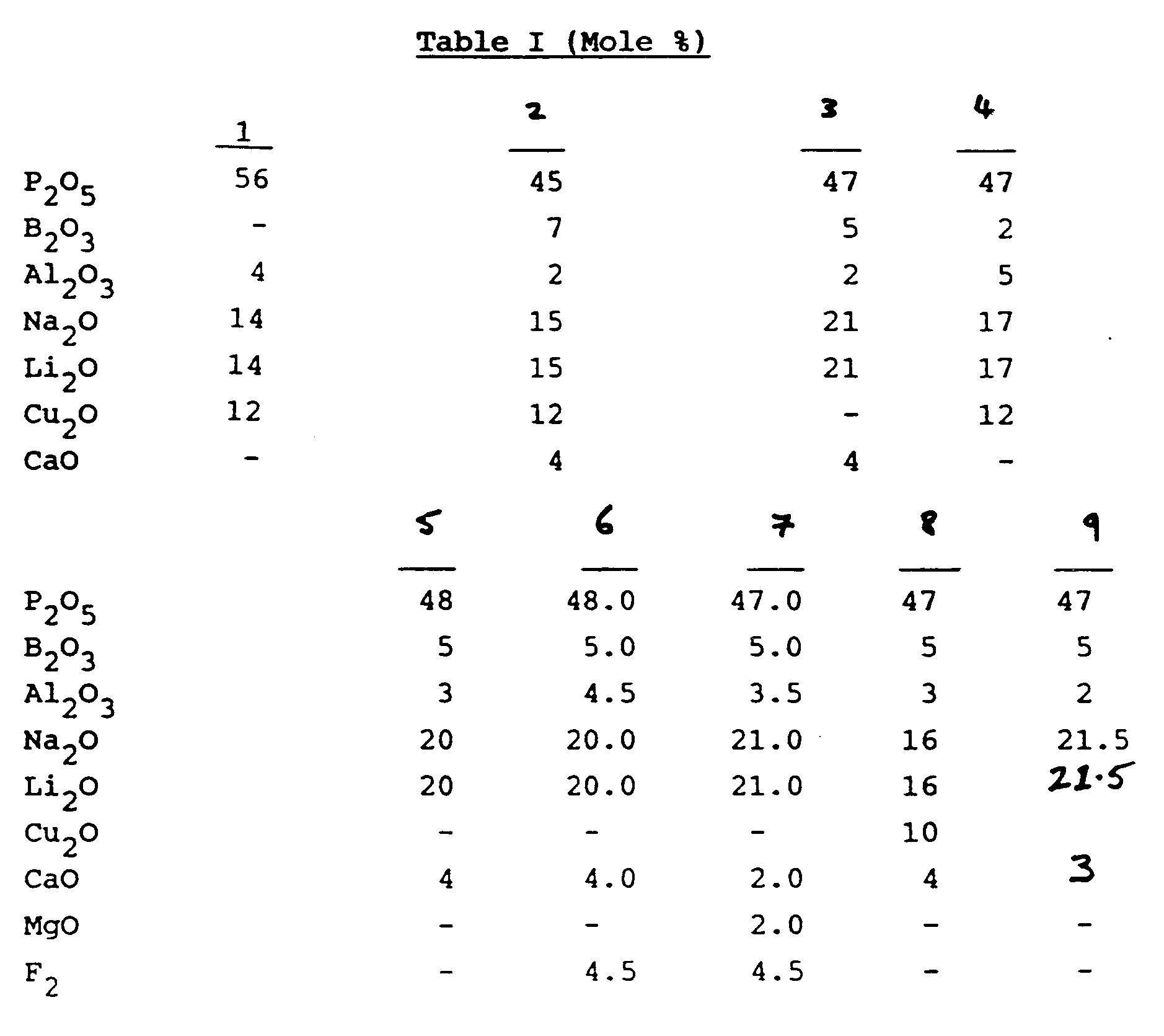
- Table I reports a number of glass compositions, expressed in terms of mole percent on the oxide basis, illustrative of the inventive glasses.
- Table IA lists the same compositions, but wherein the values of the individual constituents have been converted to weight percent. Inasmuch as it is not known with which cation it is combined and because the amount included is relatively small, the fluoride content is merely recorded in percent in addition to the base glass.
- the actual batch ingredients for preparing the glasses can comprise any materials, either the oxides or other compounds, which, when melted together, will be transformed into the desired oxide in the proper proportions.
- Li2CO3 can conveniently be utilized as the source of Li2O.
- the batch ingredients were compounded, ballmilled together to assist in producing a homogeneous melt, and thereafter charged into silica crucibles. After placing lids thereon, the crucibles were introduced into a furnace operating at about 1000°C and held at that temperature for about 3 hours. Each melt was then poured into a steel mold to yield a rectangular glass slab with dimensions of about 203 x 102 x 13 mm (8" x 4" x 0.5") and that slab was annealed overnight at 300°C.
- Rectangular tab-shaped pieces weighing about 30-40 grams were cut from the slabs and heat treated in cups of aluminum foil to temperatures within the range of 350°-425°C, and glass cane was handdrawn from each cup to obtain a close approximation of the working temperature of the glass.
- compositions reported in the Tables below are capable of being melted in large scale melting units and shaped into bodies of desired geometries employing techniques conventional in the commercial glassmaking art.
- Samples having the approximate dimensions of 35 x 25 x 15 mm were cut from each glass slab and then ground and polished for testing the chemical durability thereof.
- each sample was accurately weighed and thereafter immersed into a bath of boiling water. After a residence time of one hour the sample was withdrawn from the bath, dried in the ambient environment, and then weighed to determine any loss of weight in the sample.
- each sample was accurately weighed and then immersed into a bath operating at 75°C consisting of a 0.3% by weight aqueous solution of SUPER SOILAX detergent marketed by Economics Laboratories, St. Paul, Minnesota, the solution exhibiting a pH of about 10. After a dwell period of 24 hours the sample was removed from the bath, dried in the ambient environment, and reweighed to measure any weight loss.
- the Tg of each glass was measured employing differential scanning calorimetry techniques standard in the glass art.
- Table II records the color (COLOR) of the glass before any testing, the percent weight loss in the boiling water test (H2O), the percent weight loss in the SUPER SOILAX test (SUPER), the Tg of the glass in °C, and the working temperature of the glass in °C as determined by pulling cane (PULL).
- Example 10 the measures of resistance to attack by water and alkalies exhibited by Examples 1-9, while not equivalent to those demonstrated by the glass compositions encompassed within our copending European application, corresponding to US 258,675 (Attorneys ref: SS 6247) filed simultaneously herewith are exceptional for phosphate-based compositions.
- Example 10 the sum of Li2O+Na2O exceeds the maximum permitted.
- Example 11 illustrates that insufficient Al2O3 and/or B2O3 results in a glass that is hygroscopic and which becomes sticky or tacky when cooled in a humid atmosphere.
- Example 12 demonstrates the need for a combination of Li2O and Na2O, rather than one alone, to assure that the desired resistance to attack by water and alkalies is secured.
- inventive glasses This high resistance to attack by moisture has recommended the use of the inventive glasses in a wide range of applications including, for example, electronic devices, optical and ophthalmic lenses, and coatings for optical waveguides. Furthermore, because the viscosity relationships exhibited by the inventive glasses at relatively low working temperatures render them capable of being shaped into articles of complex configurations through extrusion, injection molding, and other techniques conventionally employed in the plastic forming art, the range of products for which the inventive glass-ceramics are useful is greatly broadened.
Landscapes
- Chemical & Material Sciences (AREA)
- Life Sciences & Earth Sciences (AREA)
- Engineering & Computer Science (AREA)
- Chemical Kinetics & Catalysis (AREA)
- General Chemical & Material Sciences (AREA)
- Geochemistry & Mineralogy (AREA)
- Materials Engineering (AREA)
- Organic Chemistry (AREA)
- Glass Compositions (AREA)
- Dental Preparations (AREA)
- Pharmaceuticals Containing Other Organic And Inorganic Compounds (AREA)
- Crystals, And After-Treatments Of Crystals (AREA)
- Vending Machines For Individual Products (AREA)
- Photoreceptors In Electrophotography (AREA)
- Electrochromic Elements, Electrophoresis, Or Variable Reflection Or Absorption Elements (AREA)
- Materials For Medical Uses (AREA)
- Cosmetics (AREA)
Abstract
Description
- This invention relates to R₂O-Al₂O₃/B₂O₃-P₂O₅ glasses.
- It has long been recognized that the energy expended in forming and re-forming articles of inorganic glasses is a significant cost factor. Moreover, the requirement of higher shaping temperatures demands the use of glass contact surfaces prepared from materials exhibiting greater refractoriness, which materials are typically more expensive. Furthermore, where a glass is to be utilized as a sealant, its transition temperature or transformation temperature (Tg) must be lower than the components being sealed together in order to avoid thermal deformation of the latter. Therefore, there has been considerable research to develop sealing glasses demonstrating transition temperatures below 450°C, and preferably below 350°C.
- Because glass compositions containing silica as the principal network former or glass former typically exhibit transition temperatures substantially in excess of 450°C, the search for glass compositions manifesting the desired low transition temperatures has customarily led to the use of B₂O₃ and/or P₂O₅ as the primary network forming component. U. S. Patent No. 3,732,181 is illustrative of that practice. The patent discloses three broad areas of composition:
- (1) PbO + P₂O₅ ≧95 mole %, wherein PbO constitutes 20-80 mole %;
- (2) PbO + R₂O (alkali metal oxides) + P₂O₅ ≧95 mole %, wherein PbO comprises 5-60 mole %, R₂O constitutes 5-35 mole %, and P₂O₅ is present up to 85 mole %; and
- (3) PbO + R₂O + B₂O₃ + P₂O₅ ≧95 mole %, wherein PbO comprises 5-30 mole %, R₂O constitutes 5-30 mole %, B₂O₃ composes 5-20 mole %, and P₂O₅ comprises 15-85 mole %.
- Although the above-cited composition ranges indicate the required presence of PbO, the patent asserts that part or all of the PbO may be replaced with divalent metal oxides.
- Experience in the glass composition art has indicated that borate-based and phosphate-based glasses commonly demonstrate poorer chemical durability and resistance to attack by moisture than silica-based compositions, and that disadvantage becomes even more of a problem as the glasses are devised to manifest lower transition temperatures. For example, phosphate-based glasses demonstrating low transition temperatures are typically readily attacked by boiling water and, in not infrequent cases, exhibit hygroscopicity. As customarily defined, the transition temperature of a glass is the temperature at which increases in specific heat and thermal expansion coefficient take place which are accompanied by a sharp drop in viscosity.
- Therefore, the principal objective of the present invention was to develop glasses exhibiting transition temperatures below 350°C, with working temperatures, i.e., temperatures at which the glass manifests a viscosity of about 10³-10⁶ Pa.s (10⁴-10⁷ poises), below 450°C, which glasses display remarkable chemical durability when contacted with boiling water.
- We have found that the above objective can be achieved in glasses essentially free of K₂O and consisting, expressed in terms of mole percent on the oxide basis of

- The presence of Al₂O₃ with, desirably, B₂O₃ enhances the chemical durability and improves the stability of the glass. Over 7 mole % Al₂O₃ or over 10 mole % B₂O₃ however, renders the glass too refractory. The inclusion of at least 5 mole % Li₂O is required because Na₂O alone appears to impact unfavorably upon the durability of the glass and/or renders the glass difficult to melt. The combination of Li₂O+Cu₂O has the capacity for reducing the Tg of the glass while maintaining the desired exceptional chemical durability. K₂O adversely affects the Tg such that any amount thereof must be avoided.
- Up to 5% total of at least one member of the group consisting of MgO, CaO, SrO, BaO, MnO, and ZnO may optionally be included. Larger concentrations hazard undue raising of the Tg of the glass and can adversely affect the chemical durability exhibited by the glass. Additions of up to 5% ZrO₂ are useful in developing a glass manifesting a uniform white opacity. SiO₂ may be tolerated at levels up to about 3% and fluoride in amounts up to about 5%. The sum of all optional additions to the base glass compositions will be less than 10%.
- Although the complete conversion of composition intervals expressed in terms of mole percent to ranges expressed in terms of weight percent is not possible mathematically, the following ranges comprise approximate values of the operable composition intervals in terms of weight percent:
P₂O₅ 55-73 Li₂O 0-8 Al₂O₃ 0-5 Na₂O+Li₂O 7-23 B₂O₃ 0-10 Cu₂O 0-20 Al₂O₃+B₂O₃ 1.75-10 Li₂O+Cu₂O 5-30 Na₂O 7-15 - U. S. Patent No. 3,215,543 discloses the production of articles composed of mica particles entrained in a glassy matrix, that glass matrix consisting essentially, in mole %, of 6-20% RO, wherein RO consists of CaO, MgO, and/or ZnO, 22-42.5% R₂O, wherein R₂O consists of the alkali metal oxides, 6-(16+


- U. S. Patent No. 3,407,091 was concerned with preparing sealing glasses composed, in weight percent, of 4-27% Na₂O and/or K₂O, 4-30% ZnO, 2-10% Al₂O₃, and 60-67% P₂O₅. In like manner to Patent No. 3,215,543, supra, Cu₂O is nowhere mentioned; there is no recognition of the remarkably low Tg manifested by glasses of the present invention; and no working example of the patent falls within the ranges of the present inventive compositions.
- U. S. Patent No. 3,481,749 records compositions suitable for the production of glasses to be used, for example, as lubricants in the extrusion of metallic bodies at elevated temperatures. The glasses were required to be readily attacked by water to allow rapid elimination from the metallic body during washing in water. The glasses consisted essentially, in mole %, of 9-33% R₂O, 16-20% BaO, CaO, MgO, PbO, and/or ZnO, 10-20% Al₂O₃, and 29-61% P₂O₅. The concentrations of Al₂O₃ and the recited divalent metal oxides are outside the operable ranges of the present invention.
- U. S. Patent No. 3,732,181 was discussed in some detail above. Al₂O₃ was nowhere asserted to be a glass component and high quantities of PbO are required, so, self-evidently, all of the working examples recorded therein are outside of the operable composition intervals of the present invention.
- U. S. Patent No. 3,885,973 presents glasses exhibiting low transformation temperatures, but relatively high solution rates in water, consisting essentially, in mole %, of 5-25% Li₂O, 5-30% ZnO, 58-76% P₂O₅, and 0-10% alkaline earth metal oxides. No references are made to Na₂O, Al₂O₃, or B₂O₃.
- U. S. Patent No. 3,926,649 discloses glasses demonstrating a low Tg, but also a relatively high rate of solution in water, consisting essentially, in mole %, of 75±2.5% P₂O₅+B₂O₃ and 25±2.5% alkali metal oxides + alkaline earth metal oxides + ZnO. Al₂O₃ and Cu₂O are nowhere mentioned and none of the working examples had a composition coming within the ranges of the present invention.
- U. S. Patent No. 3,935,018 describes the preparation of glasses displaying a low Tg, but, again, a relatively high rate of solution in water, consisting essentially, in mole %, of 0-30% PbO, 1.2-3.5% B₂O₃, 50-72% P₂O₅, 0-5% transition metal oxides, and the remainder consisting of alkali metal oxides, alkaline earth metal oxides, and ZnO. Al₂O₃ is not mentioned and none of the working examples has a composition which is operable in the present invention.
- U. S. Patent No. 3,964,919 is drawn to glasses manifesting a low Tg, but, yet again, a relatively high rate of solution in water, consisting essentially, in mole % of 50-75% P₂O₅, 0.1-10% of at least one member of the group of up to 1.6% CrO₃, up to 7% MoO₃, and up to 7% WO₃, and 15-49.9% of at least one oxide of the group of alkali metal oxides and alkaline earth metal oxides, and which may contain up to 5% by weight H₂O. The maximum of 2% total of Al₂O₃+B₂O₃ as optional components places those compositions outside of the ranges required in the instant invention.
- U. S. Patent No. 3,979,322 is directed to glasses suitable for use in laser applications consisting essentially, in mole %, of 1-30% alkali metal oxides, 20-45% alkaline earth metal oxides and/or ZnO, 0-27% PbO, B₂O₃, Al₂O₃, and/or Nb₂O₅, 0.1-25% Nd₂O₃, and 35-49% P₂O₅. The level of divalent metal oxide is far in excess of that operable in the present invention.
- U. S. Patent No. 3,989,532 is drawn to glasses manifesting a low Tg, but also hygroscopicity, consisting essentially, in mole %, of 0-2% Al₂O₃ and/or SiO₂, 1.2-3.5% B₂O₃, 2.7-20% alkaline earth metal oxides, ≧5% alkali metal oxides, and ≧52% P₂O₅. The hygroscopic behavior exhibited by the glasses would render them unsuitable in the present invention. None of the working examples had a composition coming within the ranges of the instant invention.
- U. S. Patent No. 4,026,714 was concerned with the production of glasses demonstrating a low Tg with hygroscopic behavior consisting essentially, in mole %, of 4-30% alkali metal oxides, alkaline earth metal oxides, and/or ZnO, 1-12% PbO, 3.5-12% Al₂O₃, B₂O₃, and/or SiO₂, and 52-72% P₂O₅. None of the working examples comes within the composition intervals of the present invention.
- U. S. Patent No. 4,046,540 is directed to the preparation of glasses displaying a low Tg and being capable of injection molding. Operable ranges of glasses consisted essentially, in mole %, of 12-20% Na₂O, 4-6% PbO, 1.2-3.5% B₂O₃, 58-65% P₂O₅, and the remainder consisting of Li₂O, CaO, and/or MgO. No reference is made to Al₂O₃ or Cu₂O, the P₂O₅ content exceeds that operable in the present invention, and all of the working examples are outside of the composition intervals of the instant invention.
- U. S. Patent No. 4,060,422 discusses sealing glasses for laser applications consisting essentially, in mole %, of 4-12% Li₂O, 5-25% PbO, 15-35% ZnO, 1-4% Al₂O₃, 2-10% V₂O₅, and 45-65% P₂O₅. The divalent metal oxide content far exceeds that which can be tolerated in the present invention.
- U. S. Patent No. 4,075,120 records glasses suitable for use in laser applications consisting essentially, in mole %, of 5-40% alkali metal oxides, 5-30% alkaline earth metal oxides, 0.01-15% R₂O₃, wherein R₂O₃ is selected from the group consisting of Al₂O₃, La₂O₃, Y₂O₃, Tm₂O₃, B₂O₃, Er₂O₃, and mixtures thereof, 35-65% P₂O₅, and 0.01-7% Nd₂O₃. The alkaline earth metal oxides are required constituents and none of the working examples (exclusive of the presence of Nd₂O₃) had a composition coming within the ranges found to be operable in the instant invention.
- U. S. Patent No. 4,229,220 is drawn to glasses suitable for coating glass laser discs consisting essentially, in mole %, of 0-20% Li₂O, 0-17% Na₂O, 8-20% Li₂O+Na₂O, 7-28% CuO, 4-10% Al₂O₃, 51-59% P₂O₅, 0-8% B₂O₃, 0-23% ZnO, 0-15% BaO, and 0-13% V₂O₅. None of the working examples has a composition coming within the ranges of the present invention.
- U. S. Patent No. 4,239,645 discloses glasses suitable for use in laser applications consisting essentially, in mole %, of 10-25% R₂O, wherein R₂O consists of 0-25% Li₂O, 0-25% Na₂O, and 0-8% K₂O, 5-15% RO, wherein RO consists of 0-15% MgO, 0-15% CaO, 0-15% SrO, 0-15% BaO, and 0-15% ZnO, 1-15% Al₂O₃, 55-70% P₂O₅, and 0.01-5% Nd₂O₃. None of the working examples (exclusive of Nd₂O₃) comes within the composition intervals of the instant invention.
- U. S. Patent No. 4,248,732 refers to glasses operable in laser applications consisting essentially, in mole %, of 5-40% alkali metal oxides, 5-30% RO, wherein RO is at least one oxide of the group BaO, BeO, CaO, MgO, SrO, and ZnO, 0.01-15% R₂O₃, wherein R₂O₃ is at least one oxide of the group Al₂O₃, B₂O₃, Er₂O₃, La₂O₃, Tm₂O₃, and Y₂O₃, 0.01-7% Nd₂O₃, 35-65% P₂O₅, and 0.1-10% by weight of a solarization inhibiting oxide of the group CeO₂, Nb₂O₅, Sb₂O₃, SiO₂, and TiO₂. None of the working examples (exclusive of Nd₂O₃ and the solarization inhibitor) had a composition coming within the ranges of the present invention.
- U. S. Patent No. 4,391,915 reports glasses suitable for use in pressing optical components consisting essentially, in weight %, of 0-3% Li₂O, 5-20% K₂O, 8-15% BaO, 4.5-9% ZnO, 0-6% MgO, 0-18% PbO, 3.5-9% Al₂O₃, 0-3% B₂O₃, 0-1% SiO₁, 0-3% B₂O₃, and 45-55% P₂O₅. The total content of divalent metal oxides is greater than desired in the glasses of the instant invention; the use of high concentrations of K₂O is not desired; and none of the working examples was within the composition intervals of the instant invention.
- U. S. Patent No. 4,439,530 refers to optical glasses basically consisting essentially, in weight percent, of 3-30% R₂O, wherein R₂O consists of 0-30% Na₂O and/or K₂O, 8-65% PbO, 18-38% P₂O₅, and 1-45% Ta₂O₅. A large number of optional ingredients may be present in various amounts including 0-3% Al₂O₃ and 0-15% B₂O₃. The P₂O₅ level is much lower than is required in the present invention.
- U. S. Patent No. 4,544,974 reports glasses suitable for bonding metals or metal oxides into a composite structure. The glasses consisted essentially, in mole %, of 10-40% alkali metal oxide or alkaline earth metal oxide, 0-25% CuO or ZnO, 5-15% Al₂O₃, 0-25% B₂O₃, 0-30% SiO₂, and 10-35% P₂O₅. The P₂O₅ content is much lower than is required in the present invention.
- "Oxide Glasses of Very Low Softening Point. Parts 1 and 2. Preparation and Properties of Some Lead Phosphate Glasses," N. H. Ray et al., Glass Technology 14, No. 2, pages 50-59, April 1973, provides an extensive review of phosphate-based glasses but none of the compositions recorded there came within the ranges of the present invention.
- Table I reports a number of glass compositions, expressed in terms of mole percent on the oxide basis, illustrative of the inventive glasses. Table IA lists the same compositions, but wherein the values of the individual constituents have been converted to weight percent. Inasmuch as it is not known with which cation it is combined and because the amount included is relatively small, the fluoride content is merely recorded in percent in addition to the base glass. The actual batch ingredients for preparing the glasses can comprise any materials, either the oxides or other compounds, which, when melted together, will be transformed into the desired oxide in the proper proportions. For example, Li₂CO₃ can conveniently be utilized as the source of Li₂O.
- The batch ingredients were compounded, ballmilled together to assist in producing a homogeneous melt, and thereafter charged into silica crucibles. After placing lids thereon, the crucibles were introduced into a furnace operating at about 1000°C and held at that temperature for about 3 hours. Each melt was then poured into a steel mold to yield a rectangular glass slab with dimensions of about 203 x 102 x 13 mm (8" x 4" x 0.5") and that slab was annealed overnight at 300°C.
- Rectangular tab-shaped pieces weighing about 30-40 grams were cut from the slabs and heat treated in cups of aluminum foil to temperatures within the range of 350°-425°C, and glass cane was handdrawn from each cup to obtain a close approximation of the working temperature of the glass.
- Although the above description involved laboratory melting and forming techniques only, it will be appreciated that the compositions reported in the Tables below are capable of being melted in large scale melting units and shaped into bodies of desired geometries employing techniques conventional in the commercial glassmaking art.


- Samples having the approximate dimensions of 35 x 25 x 15 mm were cut from each glass slab and then ground and polished for testing the chemical durability thereof. In one test each sample was accurately weighed and thereafter immersed into a bath of boiling water. After a residence time of one hour the sample was withdrawn from the bath, dried in the ambient environment, and then weighed to determine any loss of weight in the sample. In a second test each sample was accurately weighed and then immersed into a bath operating at 75°C consisting of a 0.3% by weight aqueous solution of SUPER SOILAX detergent marketed by Economics Laboratories, St. Paul, Minnesota, the solution exhibiting a pH of about 10. After a dwell period of 24 hours the sample was removed from the bath, dried in the ambient environment, and reweighed to measure any weight loss. The Tg of each glass was measured employing differential scanning calorimetry techniques standard in the glass art.
- Table II records the color (COLOR) of the glass before any testing, the percent weight loss in the boiling water test (H₂O), the percent weight loss in the SUPER SOILAX test (SUPER), the Tg of the glass in °C, and the working temperature of the glass in °C as determined by pulling cane (PULL).
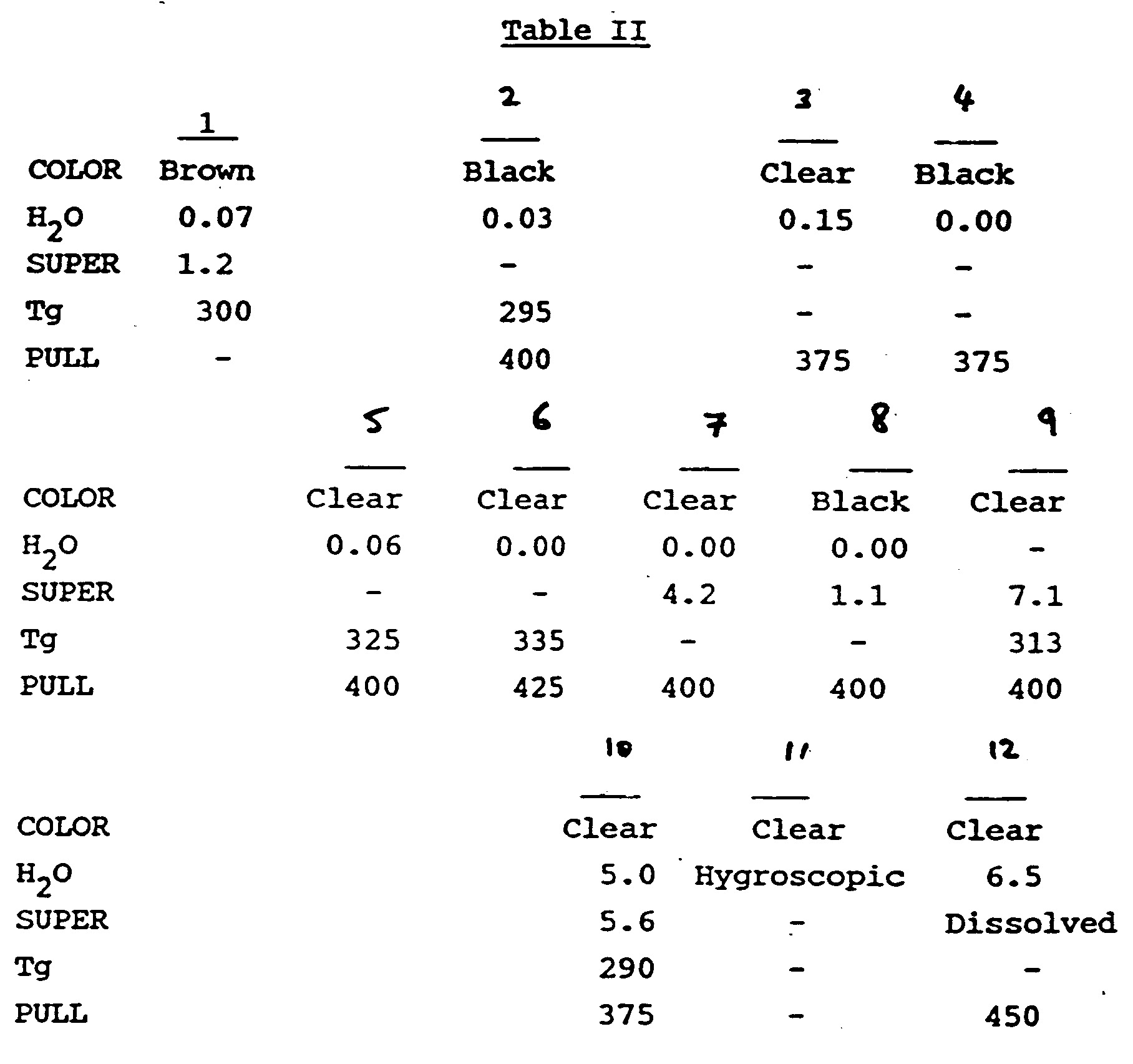
- The measures of resistance to attack by water and alkalies exhibited by Examples 1-9, while not equivalent to those demonstrated by the glass compositions encompassed within our copending European application, corresponding to US 258,675 (Attorneys ref: SS 6247) filed simultaneously herewith are exceptional for phosphate-based compositions. The dramatic reduction in this resistance which takes place in glass compositions only slightly outside the sharply delimited ranges of the present inventive glasses is readily observed in Examples 10-12. Thus, in Example 10 the sum of Li₂O+Na₂O exceeds the maximum permitted. Example 11 illustrates that insufficient Al₂O₃ and/or B₂O₃ results in a glass that is hygroscopic and which becomes sticky or tacky when cooled in a humid atmosphere. Example 12 demonstrates the need for a combination of Li₂O and Na₂O, rather than one alone, to assure that the desired resistance to attack by water and alkalies is secured.
- This high resistance to attack by moisture has recommended the use of the inventive glasses in a wide range of applications including, for example, electronic devices, optical and ophthalmic lenses, and coatings for optical waveguides. Furthermore, because the viscosity relationships exhibited by the inventive glasses at relatively low working temperatures render them capable of being shaped into articles of complex configurations through extrusion, injection molding, and other techniques conventionally employed in the plastic forming art, the range of products for which the inventive glass-ceramics are useful is greatly broadened.
Claims (2)
- A glass characterized by exhibiting a transition temperature below 350°C, a working temperature below 450°C, and excellent resistance to attack by water and mild aqueous alkaline solutions, and being essentially free of K₂O and consisting, expressed in terms of mole percent on the oxide basis, of

- A method for the preparation of a glass as claimed in claim 1 wherein the suitable batch ingredients, for the glasses, as oxides or other compounds, which, upon being melted together are converted to the desired oxides, are melted together in the proper proportions to produce the desired glass.
Priority Applications (1)
| Application Number | Priority Date | Filing Date | Title |
|---|---|---|---|
| AT89310557T ATE92445T1 (en) | 1988-10-17 | 1989-10-13 | PHOSPHATE GLASS CONTAINING ALKALI OXIDES AND ALUMINUM OXIDE AND/OR BORON OXIDE. |
Applications Claiming Priority (2)
| Application Number | Priority Date | Filing Date | Title |
|---|---|---|---|
| US258674 | 1988-10-17 | ||
| US07/258,674 US4920081A (en) | 1988-10-17 | 1988-10-17 | R2 O-Al2 O3 /B2 O3 -P2 O5 glasses |
Publications (3)
| Publication Number | Publication Date |
|---|---|
| EP0365237A2 EP0365237A2 (en) | 1990-04-25 |
| EP0365237A3 EP0365237A3 (en) | 1990-12-27 |
| EP0365237B1 true EP0365237B1 (en) | 1993-08-04 |
Family
ID=22981636
Family Applications (1)
| Application Number | Title | Priority Date | Filing Date |
|---|---|---|---|
| EP89310557A Expired - Lifetime EP0365237B1 (en) | 1988-10-17 | 1989-10-13 | R2o-al203/b203-p205 glasses |
Country Status (10)
| Country | Link |
|---|---|
| US (1) | US4920081A (en) |
| EP (1) | EP0365237B1 (en) |
| JP (1) | JPH02116641A (en) |
| KR (1) | KR900006245A (en) |
| AT (1) | ATE92445T1 (en) |
| AU (1) | AU616312B2 (en) |
| BR (1) | BR8905091A (en) |
| CA (1) | CA1333074C (en) |
| DE (1) | DE68908074T2 (en) |
| ES (1) | ES2044135T3 (en) |
Families Citing this family (16)
| Publication number | Priority date | Publication date | Assignee | Title |
|---|---|---|---|---|
| US5367125A (en) * | 1989-01-20 | 1994-11-22 | Dassault Electronique | Aluminum based article having an insert with vitreous material hermetically sealed thereto |
| US5036025A (en) * | 1990-10-02 | 1991-07-30 | Hoya Optics Inc. | Infrared absorbing green glass |
| US5122484A (en) * | 1991-05-23 | 1992-06-16 | Corning Incorporated | Zinc phosphate low temperature glasses |
| JP2518749B2 (en) * | 1991-07-11 | 1996-07-31 | 五鈴精工硝子株式会社 | Tinted glass |
| US5252523A (en) * | 1991-10-09 | 1993-10-12 | Corning Incorporated | Bioabsorbable chlorophosphate glasses and bioabsorbable glass-polymer blends made therefrom |
| US5256604A (en) * | 1992-04-24 | 1993-10-26 | Corning Incorporated | Low melting, durable phosphate glasses |
| DE19546313C1 (en) * | 1995-12-12 | 1997-01-23 | Schott Glaswerke | New copper oxide-contg. alumino-phosphate glass |
| GB9811663D0 (en) * | 1998-06-01 | 1998-07-29 | Giltech Ltd | Composition |
| US6277776B1 (en) * | 1998-06-22 | 2001-08-21 | Ipg Photonics Corporation | Fluorophosphate splice glass for joining optical fibers |
| US6667258B2 (en) | 2001-01-19 | 2003-12-23 | Corning Incorporated | Zinc phosphate glass compositions |
| JP6505975B2 (en) * | 2013-03-15 | 2019-04-24 | スコット コーポレーションSchott Corporation | Optical bonding and formed products using low softening point optical glass for infrared optics |
| US10081758B2 (en) | 2015-12-04 | 2018-09-25 | Ecolab Usa Inc. | Controlled release solid scale inhibitors |
| US9834469B2 (en) * | 2016-02-02 | 2017-12-05 | Schott Corporation | Aluminophosphate glass composition |
| WO2017200864A1 (en) | 2016-05-16 | 2017-11-23 | Ecolab USA, Inc. | Slow-release scale inhibiting compositions |
| US11142680B2 (en) | 2016-12-23 | 2021-10-12 | Championx Usa Inc. | Controlled release solid scale inhibitors |
| WO2020013980A1 (en) | 2018-07-09 | 2020-01-16 | Corning Incorporated | Organic-inorganic composites and methods of manufacturing thereof |
Family Cites Families (6)
| Publication number | Priority date | Publication date | Assignee | Title |
|---|---|---|---|---|
| JPS5342333B2 (en) * | 1975-03-18 | 1978-11-10 | ||
| US4075120A (en) * | 1975-05-14 | 1978-02-21 | Kogre, Inc. | Laser phosphate glass compositions |
| JPS5438311A (en) * | 1977-08-31 | 1979-03-22 | Hoya Glass Works Ltd | Low temperature melting coating glass capable of highly absorbing laser |
| JPS553336A (en) * | 1978-06-20 | 1980-01-11 | Hoya Corp | Low melting point glass for edge-cladding disc laser glass |
| US4874724A (en) * | 1988-10-17 | 1989-10-17 | Corning Incorporated | Alkali zinc aluminophosphate glass-ceramics |
| CA1333073C (en) * | 1988-10-17 | 1994-11-15 | George Halsey Beall | Zinc-containing phosphate glasses |
-
1988
- 1988-10-17 US US07/258,674 patent/US4920081A/en not_active Expired - Lifetime
-
1989
- 1989-07-24 CA CA000606430A patent/CA1333074C/en not_active Expired - Fee Related
- 1989-09-13 JP JP1238355A patent/JPH02116641A/en active Pending
- 1989-10-06 KR KR1019890014417A patent/KR900006245A/en not_active Withdrawn
- 1989-10-06 BR BR898905091A patent/BR8905091A/en not_active Application Discontinuation
- 1989-10-10 AU AU42730/89A patent/AU616312B2/en not_active Ceased
- 1989-10-13 AT AT89310557T patent/ATE92445T1/en not_active IP Right Cessation
- 1989-10-13 DE DE89310557T patent/DE68908074T2/en not_active Expired - Fee Related
- 1989-10-13 ES ES89310557T patent/ES2044135T3/en not_active Expired - Lifetime
- 1989-10-13 EP EP89310557A patent/EP0365237B1/en not_active Expired - Lifetime
Also Published As
| Publication number | Publication date |
|---|---|
| ATE92445T1 (en) | 1993-08-15 |
| EP0365237A2 (en) | 1990-04-25 |
| JPH02116641A (en) | 1990-05-01 |
| DE68908074D1 (en) | 1993-09-09 |
| AU616312B2 (en) | 1991-10-24 |
| BR8905091A (en) | 1990-05-15 |
| KR900006245A (en) | 1990-05-07 |
| CA1333074C (en) | 1994-11-15 |
| US4920081A (en) | 1990-04-24 |
| EP0365237A3 (en) | 1990-12-27 |
| AU4273089A (en) | 1990-04-26 |
| ES2044135T3 (en) | 1994-01-01 |
| DE68908074T2 (en) | 1994-03-03 |
Similar Documents
| Publication | Publication Date | Title |
|---|---|---|
| US4940677A (en) | Zinc-containing phosphate glasses | |
| US4282035A (en) | Lead-free and cadmium-free frits | |
| US5021366A (en) | Fluorine-free phosphate glasses | |
| US4920081A (en) | R2 O-Al2 O3 /B2 O3 -P2 O5 glasses | |
| US5153151A (en) | High index fluorine-free phosphate glasses | |
| CA2017521C (en) | Rare earth-containing zinc phosphate glasses | |
| EP0494358B1 (en) | Alkali zinc halophosphate glasses | |
| EP0365235B1 (en) | Zinc-containing phosphate glasses | |
| US5256604A (en) | Low melting, durable phosphate glasses | |
| JPS61232243A (en) | Glass for spectacle and optical use | |
| US4391915A (en) | Precision pressed optical components made of glass and glass suitable therefor | |
| JPS60171244A (en) | Optical glass | |
| JPS63265840A (en) | Optical glass | |
| EP0481166A1 (en) | Phosphate glasses for glass molds | |
| US4469800A (en) | Moldable fluoroborate optical glasses | |
| US5607886A (en) | Optical glass for mold pressing having softening capability at low temperature | |
| JP2987039B2 (en) | Glass for bonding and sealing | |
| US5162826A (en) | High index ophthalmic glasses | |
| JP3034427B2 (en) | Low temperature softening optical glass for mold press | |
| JPH07247136A (en) | Optical glass having low melting point and optical goods | |
| JPH0797234A (en) | Low-melting optical glass | |
| JPH07247135A (en) | Optical glass having low melting point and optical goods | |
| GB2164932A (en) | Glass composition |
Legal Events
| Date | Code | Title | Description |
|---|---|---|---|
| PUAI | Public reference made under article 153(3) epc to a published international application that has entered the european phase |
Free format text: ORIGINAL CODE: 0009012 |
|
| AK | Designated contracting states |
Kind code of ref document: A2 Designated state(s): AT BE DE ES FR GB IT NL |
|
| PUAL | Search report despatched |
Free format text: ORIGINAL CODE: 0009013 |
|
| AK | Designated contracting states |
Kind code of ref document: A3 Designated state(s): AT BE DE ES FR GB IT NL |
|
| RHK1 | Main classification (correction) |
Ipc: C03C 3/16 |
|
| 17P | Request for examination filed |
Effective date: 19910604 |
|
| 17Q | First examination report despatched |
Effective date: 19911008 |
|
| GRAA | (expected) grant |
Free format text: ORIGINAL CODE: 0009210 |
|
| AK | Designated contracting states |
Kind code of ref document: B1 Designated state(s): AT BE DE ES FR GB IT NL |
|
| REF | Corresponds to: |
Ref document number: 92445 Country of ref document: AT Date of ref document: 19930815 Kind code of ref document: T |
|
| REF | Corresponds to: |
Ref document number: 68908074 Country of ref document: DE Date of ref document: 19930909 |
|
| ITF | It: translation for a ep patent filed | ||
| ET | Fr: translation filed | ||
| REG | Reference to a national code |
Ref country code: ES Ref legal event code: FG2A Ref document number: 2044135 Country of ref document: ES Kind code of ref document: T3 |
|
| PLBE | No opposition filed within time limit |
Free format text: ORIGINAL CODE: 0009261 |
|
| STAA | Information on the status of an ep patent application or granted ep patent |
Free format text: STATUS: NO OPPOSITION FILED WITHIN TIME LIMIT |
|
| 26N | No opposition filed | ||
| PGFP | Annual fee paid to national office [announced via postgrant information from national office to epo] |
Ref country code: AT Payment date: 19950918 Year of fee payment: 7 |
|
| PGFP | Annual fee paid to national office [announced via postgrant information from national office to epo] |
Ref country code: ES Payment date: 19951016 Year of fee payment: 7 |
|
| PG25 | Lapsed in a contracting state [announced via postgrant information from national office to epo] |
Ref country code: AT Effective date: 19961013 |
|
| PG25 | Lapsed in a contracting state [announced via postgrant information from national office to epo] |
Ref country code: ES Free format text: LAPSE BECAUSE OF THE APPLICANT RENOUNCES Effective date: 19961014 |
|
| REG | Reference to a national code |
Ref country code: ES Ref legal event code: FD2A Effective date: 19991007 |
|
| REG | Reference to a national code |
Ref country code: GB Ref legal event code: IF02 |
|
| PGFP | Annual fee paid to national office [announced via postgrant information from national office to epo] |
Ref country code: GB Payment date: 20020913 Year of fee payment: 14 |
|
| PGFP | Annual fee paid to national office [announced via postgrant information from national office to epo] |
Ref country code: NL Payment date: 20020919 Year of fee payment: 14 |
|
| PGFP | Annual fee paid to national office [announced via postgrant information from national office to epo] |
Ref country code: FR Payment date: 20021003 Year of fee payment: 14 |
|
| PGFP | Annual fee paid to national office [announced via postgrant information from national office to epo] |
Ref country code: BE Payment date: 20021125 Year of fee payment: 14 |
|
| PG25 | Lapsed in a contracting state [announced via postgrant information from national office to epo] |
Ref country code: GB Free format text: LAPSE BECAUSE OF NON-PAYMENT OF DUE FEES Effective date: 20031013 |
|
| PG25 | Lapsed in a contracting state [announced via postgrant information from national office to epo] |
Ref country code: BE Free format text: LAPSE BECAUSE OF NON-PAYMENT OF DUE FEES Effective date: 20031031 |
|
| BERE | Be: lapsed |
Owner name: *CORNING INC. Effective date: 20031031 |
|
| PG25 | Lapsed in a contracting state [announced via postgrant information from national office to epo] |
Ref country code: NL Free format text: LAPSE BECAUSE OF NON-PAYMENT OF DUE FEES Effective date: 20040501 |
|
| GBPC | Gb: european patent ceased through non-payment of renewal fee |
Effective date: 20031013 |
|
| PG25 | Lapsed in a contracting state [announced via postgrant information from national office to epo] |
Ref country code: FR Free format text: LAPSE BECAUSE OF NON-PAYMENT OF DUE FEES Effective date: 20040630 |
|
| NLV4 | Nl: lapsed or anulled due to non-payment of the annual fee |
Effective date: 20040501 |
|
| REG | Reference to a national code |
Ref country code: FR Ref legal event code: ST |
|
| PG25 | Lapsed in a contracting state [announced via postgrant information from national office to epo] |
Ref country code: IT Free format text: LAPSE BECAUSE OF NON-PAYMENT OF DUE FEES;WARNING: LAPSES OF ITALIAN PATENTS WITH EFFECTIVE DATE BEFORE 2007 MAY HAVE OCCURRED AT ANY TIME BEFORE 2007. THE CORRECT EFFECTIVE DATE MAY BE DIFFERENT FROM THE ONE RECORDED. Effective date: 20051013 |
|
| PGFP | Annual fee paid to national office [announced via postgrant information from national office to epo] |
Ref country code: DE Payment date: 20071130 Year of fee payment: 19 |
|
| PG25 | Lapsed in a contracting state [announced via postgrant information from national office to epo] |
Ref country code: DE Free format text: LAPSE BECAUSE OF NON-PAYMENT OF DUE FEES Effective date: 20090501 |