EP0364112A2 - Tastaturgerät - Google Patents
Tastaturgerät Download PDFInfo
- Publication number
- EP0364112A2 EP0364112A2 EP89309494A EP89309494A EP0364112A2 EP 0364112 A2 EP0364112 A2 EP 0364112A2 EP 89309494 A EP89309494 A EP 89309494A EP 89309494 A EP89309494 A EP 89309494A EP 0364112 A2 EP0364112 A2 EP 0364112A2
- Authority
- EP
- European Patent Office
- Prior art keywords
- keyboard
- embedded
- keys
- keypad
- key
- Prior art date
- Legal status (The legal status is an assumption and is not a legal conclusion. Google has not performed a legal analysis and makes no representation as to the accuracy of the status listed.)
- Withdrawn
Links
Images


Classifications
-
- G—PHYSICS
- G06—COMPUTING OR CALCULATING; COUNTING
- G06F—ELECTRIC DIGITAL DATA PROCESSING
- G06F3/00—Input arrangements for transferring data to be processed into a form capable of being handled by the computer; Output arrangements for transferring data from processing unit to output unit, e.g. interface arrangements
- G06F3/01—Input arrangements or combined input and output arrangements for interaction between user and computer
- G06F3/02—Input arrangements using manually operated switches, e.g. using keyboards or dials
- G06F3/0202—Constructional details or processes of manufacture of the input device
- G06F3/0219—Special purpose keyboards
Definitions
- This invention relates to personal and portable computers typically designed with a standard typewriter keyboard arrangement. More particularly, the present invention relates to a keyboard for a personal computer used to input data to be store and/or displayed on a computer.
- the typewriter keyboard arrangement was selected for the computer keyboard arrangement with the exception of special function keys such as the dedicated keypad, control, alternate, special function keys (e.g. F1, F2, F3, etc.), escape, number lock, and other such keys which were never contemplated on a standard typewriter.
- special function keys such as the dedicated keypad, control, alternate, special function keys (e.g. F1, F2, F3, etc.), escape, number lock, and other such keys which were never contemplated on a standard typewriter.
- designers of computer keyboards have struggled to properly locate the additional keys necessary for proper operation of a keyboard.
- As the sophistication of the computer has grown, so have the number of keys necessary for proper operation of computers with enhanced functions.
- the additional keys necessary for a computer keyboard were typically accommodated by increasing the size of the keyboard.
- the size of the keyboard grew as necessary to accommodate the additional keys without any discomfort to the typist or computer operator.
- the increase in keyboard size did not pose any deleterious consequences for desktop computers.
- a new and unique numeric keypad arrangement is disclosed in the present invention.
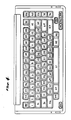
- the keys of keyboard 200 are arranged in the second, third, fourth and fifth rows to provide keys which serve up to four separate and distinct functions.
- number keys for the numerals 7, 8, and 9 operate in the normal keyboard operation for the numbers 7, 8 and 9.
- the keys 7, 8, and 9 operate in the normal manner as in a typewriter to wit to yield the "&", "*", "(" characters respectively.
- Other character and number keys on the keyboard behave in a similar fashion as those keys found on a standard typewriter or prior art computer keyboard.
- the number keys and the keys in the embedded keypad have two additional features however depending on whether the "Num Lock" key 90 is depressed and/or the Fn key 59 is depressed. By depressing a combination of the Num Lock key 90 and/or the Fn key 59 the cursor control keys in the embedded keyboard are utilized or the numeral keys are utilized.
- the various functions for the embedded keys are illustrated in Figure 2.
- the present keyboard 200 has two modes of operation; normal and select.
- the default mode at computer system power-up shall be the normal mode.
- Enhanced operation will be available in the normal mode.
- a "Function" key 59, additional to the twelve standard function keys, and designated as “Fn” will provide access to the embedded numeric keys and cursor/screen control keys. Each mode is more specifically described below.
- the keyboard will be uniquely configured to emulate enhanced operation; i.e. QWERTY, Numeric Pad and Cursor Control Keys. This is accomplished by an embedded numeric pad and separate cursor keys as illustrated in Figure 2.
- the embedded numeric pad is enabled/disabled via the Num Lock key 90.
- embedded numeric keys illustrated in Figure 2 will transmit the key codes of an enhanced numeric pad provided the optional keypad (not shown in Figure 1) is not attached to the back of the keyboard.
- the optional keypad is attached, the embedded numeric pad is disabled via the keyboard, and the embedded numeric keys (more fully illustrated in Figure 2) will normally transmit alpha codes - regardless of the state of the Num Lock key 90.
- the following key stations also transmit enhanced codes: 62, 64, 124, 125, 126.
- the key codes are designated on the key caps in Figure 4.
- the Num Lock 90 key provides access to the embedded numeric keys illustrated in Figure 1 (more fully illustrated in Figure 2) provided that the optional keypad (not shown) is not attached.
- the SENSE line (see Figure 3) detects the presence of the optional keypad. If the keypad is attached, the status of the Num Lock key LED (light emitting diode not shown) determines if scan codes from the embedded keypad are interpreted by the keyboard system as digits or cursor/screen control functions.
- Operation of the Fn key 59 is unique; its only purpose is to flag the keyboard processor. No codes are sent across the system interface.
- the operation of Fn 59 depends on the state of the Num Lock Key: - With Num Lock off (LED off), the operation of Fn 59 and an embedded numeric key together transmits the enhanced numeric scan code of a key, or the screen control code of the cursor keys. - With Num Lock on (LED on), operation Fn and an embedded numeric key transmits the default (alpha) scan code of a key or the screen control code of the cursor keys.
- All scan codes accessed via Fn 59 will send complete make/break codes. For example, if Fn is released while an embedded numeric key is still pressed, the break code of the embedded character must be transmitted before any subsequent made code is sent. This will occur regardless of the state of the Num Lock or keypad presence.
- Embedded numeric keys in the QWERTY section are distinguished by shell coloured legends in a solid black quadrant, or by a black boxed legend, however these colors should not be viewed as a limitation of the invention.
- a new and unique embedded keypad has been invented which takes advantage of the number keys 7, 8 and 9 while providing a standard keypad arrangement for those with special proficiency in 10-key numeric keypads while at the same time provide cursor controls embedded in the embedded keypad.
Landscapes
- Engineering & Computer Science (AREA)
- General Engineering & Computer Science (AREA)
- Theoretical Computer Science (AREA)
- Human Computer Interaction (AREA)
- Physics & Mathematics (AREA)
- General Physics & Mathematics (AREA)
- Input From Keyboards Or The Like (AREA)
Applications Claiming Priority (2)
| Application Number | Priority Date | Filing Date | Title |
|---|---|---|---|
| US25815088A | 1988-10-14 | 1988-10-14 | |
| US258150 | 1994-06-10 |
Publications (2)
| Publication Number | Publication Date |
|---|---|
| EP0364112A2 true EP0364112A2 (de) | 1990-04-18 |
| EP0364112A3 EP0364112A3 (de) | 1991-12-11 |
Family
ID=22979299
Family Applications (1)
| Application Number | Title | Priority Date | Filing Date |
|---|---|---|---|
| EP19890309494 Withdrawn EP0364112A3 (de) | 1988-10-14 | 1989-09-19 | Tastaturgerät |
Country Status (2)
| Country | Link |
|---|---|
| EP (1) | EP0364112A3 (de) |
| CA (1) | CA1336510C (de) |
Cited By (4)
| Publication number | Priority date | Publication date | Assignee | Title |
|---|---|---|---|---|
| DE4210652A1 (de) * | 1992-03-31 | 1993-10-07 | Silitek Corp | Verfahren zum Betreiben einer Computertastatur |
| GB2360015B (en) * | 2000-01-21 | 2004-07-14 | John Victor Parkinson | Keyboard with improved shift arrangements |
| EP1936474A1 (de) * | 2006-12-20 | 2008-06-25 | DeLaval Holding AB | Verbesserungen bei der Dateneingabe in Einrichtungen zur Ausführung von Vorgängen im Zusammenhang mit Tieren |
| USRE43082E1 (en) | 1998-12-10 | 2012-01-10 | Eatoni Ergonomics, Inc. | Touch-typable devices based on ambiguous codes and methods to design such devices |
Family Cites Families (1)
| Publication number | Priority date | Publication date | Assignee | Title |
|---|---|---|---|---|
| US4522518A (en) * | 1983-07-07 | 1985-06-11 | Schmidt John R | Character data input keyboard arrangement having central matrix of keys |
-
1989
- 1989-08-16 CA CA 608493 patent/CA1336510C/en not_active Expired - Fee Related
- 1989-09-19 EP EP19890309494 patent/EP0364112A3/de not_active Withdrawn
Cited By (4)
| Publication number | Priority date | Publication date | Assignee | Title |
|---|---|---|---|---|
| DE4210652A1 (de) * | 1992-03-31 | 1993-10-07 | Silitek Corp | Verfahren zum Betreiben einer Computertastatur |
| USRE43082E1 (en) | 1998-12-10 | 2012-01-10 | Eatoni Ergonomics, Inc. | Touch-typable devices based on ambiguous codes and methods to design such devices |
| GB2360015B (en) * | 2000-01-21 | 2004-07-14 | John Victor Parkinson | Keyboard with improved shift arrangements |
| EP1936474A1 (de) * | 2006-12-20 | 2008-06-25 | DeLaval Holding AB | Verbesserungen bei der Dateneingabe in Einrichtungen zur Ausführung von Vorgängen im Zusammenhang mit Tieren |
Also Published As
| Publication number | Publication date |
|---|---|
| EP0364112A3 (de) | 1991-12-11 |
| CA1336510C (en) | 1995-08-01 |
Similar Documents
| Publication | Publication Date | Title |
|---|---|---|
| US5387042A (en) | Multilingual keyboard system | |
| US6512511B2 (en) | Hand grippable combined keyboard and game controller system | |
| US5790103A (en) | Ergonomic keyboard entry system | |
| CA2318411C (en) | Data entry system | |
| US6760013B2 (en) | Hand held gaming and data entry system | |
| US8766825B2 (en) | Multifunction display-based user interface for devices | |
| US7255502B2 (en) | Keyboard with improved function and editing sections | |
| US5128672A (en) | Dynamic predictive keyboard | |
| US5006001A (en) | Keyboard with one hand character key array and one hand mapping key array | |
| US6862017B2 (en) | Window keyboard | |
| CA2248292A1 (en) | Keypad | |
| US6142687A (en) | One handed sequential alpha numerical keyboard | |
| US7173814B2 (en) | Notebook computer keyboard system | |
| US6786823B2 (en) | Game keyboard device | |
| EP0364112A2 (de) | Tastaturgerät | |
| US4766418A (en) | Control keyboard for a multiple system accessing unit | |
| CN101382839A (zh) | 一种可方便地进行模式转换的键盘 | |
| EP0201294B1 (de) | Eingabetastatur | |
| US20030046320A1 (en) | Calculator device | |
| US20020061218A1 (en) | Keyboard for engineering uses | |
| US20040017360A1 (en) | Computer keyboard having a single key providing a shift-tab function | |
| JP2580946B2 (ja) | キー入力制御装置 | |
| CN2167404Y (zh) | 电脑用脚踏辅助键盘 | |
| WO1997013190A1 (en) | A combined computer keyboard and calculator | |
| JPS61264421A (ja) | キ−ボ−ド |
Legal Events
| Date | Code | Title | Description |
|---|---|---|---|
| PUAI | Public reference made under article 153(3) epc to a published international application that has entered the european phase |
Free format text: ORIGINAL CODE: 0009012 |
|
| AK | Designated contracting states |
Kind code of ref document: A2 Designated state(s): DE FR GB IT NL |
|
| PUAL | Search report despatched |
Free format text: ORIGINAL CODE: 0009013 |
|
| AK | Designated contracting states |
Kind code of ref document: A3 Designated state(s): DE FR GB IT NL |
|
| 17P | Request for examination filed |
Effective date: 19920529 |
|
| STAA | Information on the status of an ep patent application or granted ep patent |
Free format text: STATUS: THE APPLICATION HAS BEEN WITHDRAWN |
|
| 18W | Application withdrawn |
Withdrawal date: 19921109 |