EP0361909A2 - Cyclo-olefinic random copolymer composition and reaction product thereof - Google Patents
Cyclo-olefinic random copolymer composition and reaction product thereof Download PDFInfo
- Publication number
- EP0361909A2 EP0361909A2 EP89309865A EP89309865A EP0361909A2 EP 0361909 A2 EP0361909 A2 EP 0361909A2 EP 89309865 A EP89309865 A EP 89309865A EP 89309865 A EP89309865 A EP 89309865A EP 0361909 A2 EP0361909 A2 EP 0361909A2
- Authority
- EP
- European Patent Office
- Prior art keywords
- olefin
- units
- cyclo
- copolymer
- alpha
- Prior art date
- Legal status (The legal status is an assumption and is not a legal conclusion. Google has not performed a legal analysis and makes no representation as to the accuracy of the status listed.)
- Granted
Links
- 0 C(C*1C2)C2C2C1S1*=*C2C1 Chemical compound C(C*1C2)C2C2C1S1*=*C2C1 0.000 description 2
Classifications
-
- C—CHEMISTRY; METALLURGY
- C08—ORGANIC MACROMOLECULAR COMPOUNDS; THEIR PREPARATION OR CHEMICAL WORKING-UP; COMPOSITIONS BASED THEREON
- C08L—COMPOSITIONS OF MACROMOLECULAR COMPOUNDS
- C08L23/00—Compositions of homopolymers or copolymers of unsaturated aliphatic hydrocarbons having only one carbon-to-carbon double bond; Compositions of derivatives of such polymers
-
- C—CHEMISTRY; METALLURGY
- C08—ORGANIC MACROMOLECULAR COMPOUNDS; THEIR PREPARATION OR CHEMICAL WORKING-UP; COMPOSITIONS BASED THEREON
- C08L—COMPOSITIONS OF MACROMOLECULAR COMPOUNDS
- C08L23/00—Compositions of homopolymers or copolymers of unsaturated aliphatic hydrocarbons having only one carbon-to-carbon double bond; Compositions of derivatives of such polymers
- C08L23/02—Compositions of homopolymers or copolymers of unsaturated aliphatic hydrocarbons having only one carbon-to-carbon double bond; Compositions of derivatives of such polymers not modified by chemical after-treatment
- C08L23/04—Homopolymers or copolymers of ethene
- C08L23/08—Copolymers of ethene
- C08L23/0807—Copolymers of ethene with unsaturated hydrocarbons only containing four or more carbon atoms
- C08L23/0823—Copolymers of ethene with unsaturated hydrocarbons only containing four or more carbon atoms with aliphatic cyclic olefins
-
- C—CHEMISTRY; METALLURGY
- C08—ORGANIC MACROMOLECULAR COMPOUNDS; THEIR PREPARATION OR CHEMICAL WORKING-UP; COMPOSITIONS BASED THEREON
- C08G—MACROMOLECULAR COMPOUNDS OBTAINED OTHERWISE THAN BY REACTIONS ONLY INVOLVING UNSATURATED CARBON-TO-CARBON BONDS
- C08G61/00—Macromolecular compounds obtained by reactions forming a carbon-to-carbon link in the main chain of the macromolecule
- C08G61/02—Macromolecular compounds containing only carbon atoms in the main chain of the macromolecule, e.g. polyxylylenes
- C08G61/04—Macromolecular compounds containing only carbon atoms in the main chain of the macromolecule, e.g. polyxylylenes only aliphatic carbon atoms
- C08G61/06—Macromolecular compounds containing only carbon atoms in the main chain of the macromolecule, e.g. polyxylylenes only aliphatic carbon atoms prepared by ring-opening of carbocyclic compounds
- C08G61/08—Macromolecular compounds containing only carbon atoms in the main chain of the macromolecule, e.g. polyxylylenes only aliphatic carbon atoms prepared by ring-opening of carbocyclic compounds of carbocyclic compounds containing one or more carbon-to-carbon double bonds in the ring
-
- C—CHEMISTRY; METALLURGY
- C08—ORGANIC MACROMOLECULAR COMPOUNDS; THEIR PREPARATION OR CHEMICAL WORKING-UP; COMPOSITIONS BASED THEREON
- C08L—COMPOSITIONS OF MACROMOLECULAR COMPOUNDS
- C08L15/00—Compositions of rubber derivatives
-
- C—CHEMISTRY; METALLURGY
- C08—ORGANIC MACROMOLECULAR COMPOUNDS; THEIR PREPARATION OR CHEMICAL WORKING-UP; COMPOSITIONS BASED THEREON
- C08L—COMPOSITIONS OF MACROMOLECULAR COMPOUNDS
- C08L23/00—Compositions of homopolymers or copolymers of unsaturated aliphatic hydrocarbons having only one carbon-to-carbon double bond; Compositions of derivatives of such polymers
- C08L23/02—Compositions of homopolymers or copolymers of unsaturated aliphatic hydrocarbons having only one carbon-to-carbon double bond; Compositions of derivatives of such polymers not modified by chemical after-treatment
- C08L23/16—Ethylene-propylene or ethylene-propylene-diene copolymers
-
- C—CHEMISTRY; METALLURGY
- C08—ORGANIC MACROMOLECULAR COMPOUNDS; THEIR PREPARATION OR CHEMICAL WORKING-UP; COMPOSITIONS BASED THEREON
- C08L—COMPOSITIONS OF MACROMOLECULAR COMPOUNDS
- C08L53/00—Compositions of block copolymers containing at least one sequence of a polymer obtained by reactions only involving carbon-to-carbon unsaturated bonds; Compositions of derivatives of such polymers
-
- C—CHEMISTRY; METALLURGY
- C08—ORGANIC MACROMOLECULAR COMPOUNDS; THEIR PREPARATION OR CHEMICAL WORKING-UP; COMPOSITIONS BASED THEREON
- C08L—COMPOSITIONS OF MACROMOLECULAR COMPOUNDS
- C08L65/00—Compositions of macromolecular compounds obtained by reactions forming a carbon-to-carbon link in the main chain; Compositions of derivatives of such polymers
-
- C—CHEMISTRY; METALLURGY
- C08—ORGANIC MACROMOLECULAR COMPOUNDS; THEIR PREPARATION OR CHEMICAL WORKING-UP; COMPOSITIONS BASED THEREON
- C08L—COMPOSITIONS OF MACROMOLECULAR COMPOUNDS
- C08L9/00—Compositions of homopolymers or copolymers of conjugated diene hydrocarbons
- C08L9/06—Copolymers with styrene
-
- C—CHEMISTRY; METALLURGY
- C08—ORGANIC MACROMOLECULAR COMPOUNDS; THEIR PREPARATION OR CHEMICAL WORKING-UP; COMPOSITIONS BASED THEREON
- C08K—Use of inorganic or non-macromolecular organic substances as compounding ingredients
- C08K5/00—Use of organic ingredients
- C08K5/04—Oxygen-containing compounds
- C08K5/14—Peroxides
-
- C—CHEMISTRY; METALLURGY
- C08—ORGANIC MACROMOLECULAR COMPOUNDS; THEIR PREPARATION OR CHEMICAL WORKING-UP; COMPOSITIONS BASED THEREON
- C08L—COMPOSITIONS OF MACROMOLECULAR COMPOUNDS
- C08L2205/00—Polymer mixtures characterised by other features
- C08L2205/02—Polymer mixtures characterised by other features containing two or more polymers of the same C08L -group
-
- C—CHEMISTRY; METALLURGY
- C08—ORGANIC MACROMOLECULAR COMPOUNDS; THEIR PREPARATION OR CHEMICAL WORKING-UP; COMPOSITIONS BASED THEREON
- C08L—COMPOSITIONS OF MACROMOLECULAR COMPOUNDS
- C08L53/00—Compositions of block copolymers containing at least one sequence of a polymer obtained by reactions only involving carbon-to-carbon unsaturated bonds; Compositions of derivatives of such polymers
- C08L53/02—Compositions of block copolymers containing at least one sequence of a polymer obtained by reactions only involving carbon-to-carbon unsaturated bonds; Compositions of derivatives of such polymers of vinyl-aromatic monomers and conjugated dienes
Definitions
- This invention relates to a cyclo-olefinic random copolymer composition having excellent heat resistance, heat aging resistance, chemical resistance, weather resistance, solvent resistance, dielectric properties, rigidity, impact strength and moldability, and a reaction product thereof.
- Japanese Laid-Open Patent Publication No. 168708/1985 discloses a cyclo-olefinic random copolymer comprising ethylene and a specific cyclo-olefin component as a resin having excellent heat resistance, rigidity, weather resistance, transparency and dimensional accuracy during molding. This resin, however, does not necessarily have sufficient impact strength.
- the cyclo-olefinic random copolymer (A) used in the polymer composition of this invention comprises an ethylene component and a cyclo-olefin component.
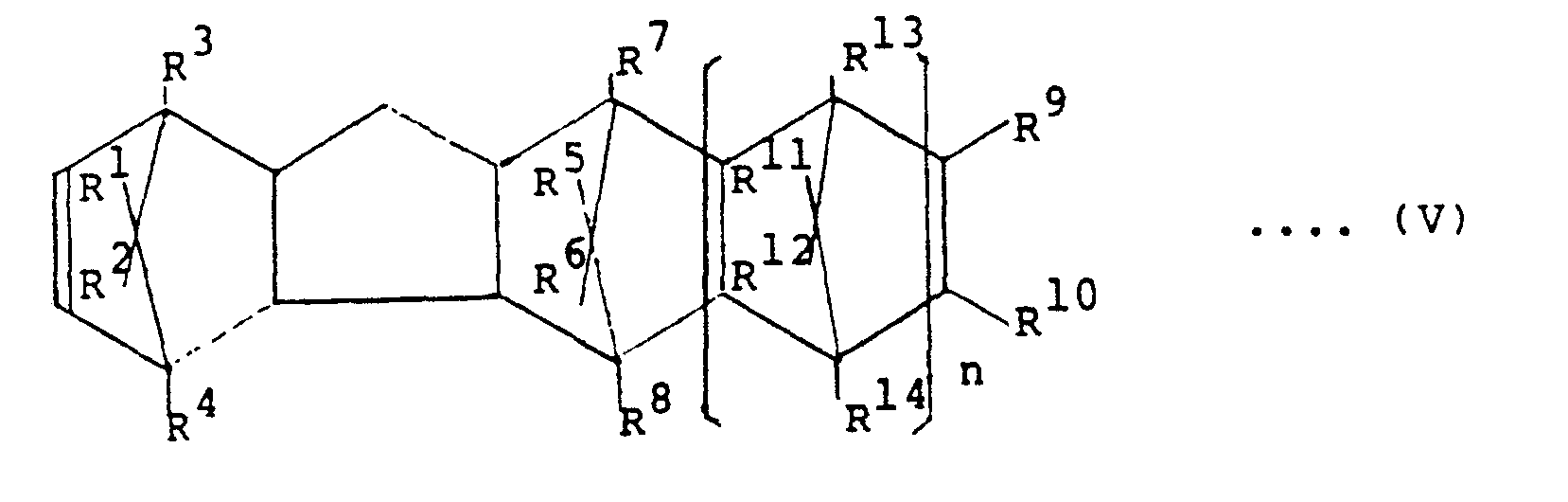
- Cyclo olefins of the following formulae (I) to (V) are especially preferably used in this invention.
- Cyclo-olefins of formula (V) wherein R 1 , R 2 , R 3 , R 4 , R 5 , R 6 , R 7 , R 8 , R 9 and R 10 an n are as defined in formula (I), and R 11 , R 12 , R 13 and R' 4 , independently from each other and from R 1 , are selected from a hydrogen atom, halogen atoms and monovalent hydrocarbon groups.
- cyclo-olefins of formulae (I) and (II) are especially preferred. These cyclo-olefins may be used singly or in combination with one another.
- the monovalent hydrocarbon group defined for R 1 to R 14 is preferably a linear or branched alkyl group having 1 to 10 carbon atoms.
- cyclo-olefins of general formula (I) examples include bicyclo[2.2.1 ]hept-2-ene
- Examples of the cycloolefins of general formula (11) include pentacyclo[6.6.1.1 3,6 .0 2,7 .0 9,14 ]-4-hexadecene
- the cycloolefins represented by formulae (I) and (II) may easily be produced by condensing cyclopentadienes with the corresponding olefins by the Diels-Alder reaction.
- the compounds of formula (IV) are described in Japanese Laid-Open Patent Publication No. 243111/1988, and can be produced by the Diels-Aider reaction of dicyclopentdienes and cyclopentadienes.
- the cyclo-olefins of formula (V) are disclosed in W089/01950, Laid-Open Specification (PCTJP85/00849). They may be easily obtained by the Diels-Alder reaction of pentacyclo-[6.5.1 1,7 .1 9,12 .0 2,6 .0 11,13 ]-pentadec-3-nes(partially hydrogenated products of tricyclopentadienes) and cyclopentadienes.
- the cyclo-olefinic random copolymer (A) used in the present invention can be produced by copolymerizing ethylene with at least one of the cyclo-olefins described above.
- the production method is disclosed, for example, in U. S. Patent No. 4,614,778.
- another copolymerizable unsaturated monomer may be used in combi nation in the copolymerization.
- alpha-olefins having 3 to 20 carbon atoms such as propylene, 1-butene, 4-methyl-1-pentene, 1-hexene, 1-octene, 1-decene, 1-dodecene, 1-tetradecene, 1-hexadecene, 1-octadecene and 1-eicosene and cycloolefins and cycloodienes such as norbornene, ethylidene norbornene and cyclopentadiene.
- alpha-olefins having 3 to 20 carbon atoms such as propylene, 1-butene, 4-methyl-1-pentene, 1-hexene, 1-octene, 1-decene, 1-dodecene, 1-tetradecene, 1-hexadecene, 1-octadecene and 1-eicosene and cycloolefins and cycloodienes such as norbornen
- the cyclo-olefinic random copolymer (A) used in this invention preferably contains 40 to 85 mole %, particularly 50 to 75 mole %, of units derived from the ethylene component, and 15 to 60 mole %, particularly 25 to 50 mole %, of units derived from the cyclo-olefin component.
- the proportion of the other olefin component if used should be smaller than that of the ethylene component.
- the cyclo-olefinic random copolymer (A) has an intrinsic viscosity [ ⁇ ], measured in decalin at 135 C, of 0.05 to 10 dl/g, preferably 0.08 to 5 dl/g.
- the cyclo-olefinic random copolymer is substantially linear, and does not contain a gel-like crosslinked structure. This can be substantiated by the fact that it completely dissolves in decalin at 135 ° C.
- the cyclo-olefinic random copolymer (A) has a softening temperature measured by a thermomechanical analyzer (TMA) of at least 70 ° C, preferably 90 to 250 C, particularly preferably 100 to 200°C, and a glass transition temperature (Tg) of usually 50 to 230 C, preferably 70 to 210 ° C.
- TMA thermomechanical analyzer
- Tg glass transition temperature
- the cyclo-olefinic random copolymer (A) conveniently used in this invention has a crystallinity, measured by X-ray diffractometry, of 0 to 10 %, preferably 0 to 7%, especially preferably 0 to 5 %.
- the flexible polymer constituting another component of the polymer composition of this invention is selected from the group consisting of
- these flexible polymers have a glass transition temperature of not more than 0 °.
- the individual flexible polymers will be described below in detail.
- the flexible cyclo-olefin random copolymer comprises an ethylene component, a cyclo-olefin component and an alpha-olefin component having 3 to 20 carbon atoms.
- Examples of the cyclo-olefin component may be the same as described hereinabove with regard to the copolymer (A).
- the cyclo-olefin component may be one or a combination of the cycloolefins
- the alpha-olefin component may be one or a combination of the alpha-olefins.
- the flexible cyclo-olefinic random copolymer (a) preferably comprises 40 to 98 mole % of the ethylene component, 2 to 20 mole % of the cyclo-olefin component and 2 to 50 mole % of the alpha-olefin component having 3 to 20 carbon atoms based on the total weight of the ethylene component, the cyclo- olefin component and the alpha-olefin component.
- the copolymer (a) comprises 50 to 90 mole % of the ethylene component, 2 to 15 mole % of the cyclo-olefin component and 5 to 40 mole % of the alpha-olefin component having 3 to 20 carbon atoms.
- the flexible cyclo-olefinic random copolymer (A) is substantially linear with the above components arranged randomly.
- the flexible cyclo-olefinic random copolymer (a) has an intrinsic viscosity [77], measured in decalin at 135 * C, of preferably 0.01 to 10 dl/g, especially preferably 0.08 to 7 dl/g.
- the cyclo-olefinic random copolymer (A) and the flexible cyclo-olefinic random copolymer (a) used in this invention can be produced, for example, by the methods disclosed in Japanese Laid-Open Patent Publications Nos. 168708/1985, 120816/1986, 115912/1986, 115916/1986, 271308/1986, 272216/1986, 252406/1987 and 252407/1987.
- the amorphous or low-crystalline flexible olefinic copolymer comprises at least two components selected from the group consisting of an ethylene component and alpha-olefin components having 3 to 20 carbon atoms.
- the alpha-olefins may be those exemplified hereinabove.
- the flexible olefinic copolymer (b) may be, for example, a copolymer of ethylene and an alpha-olefin having 3 to 20 carbon atoms or a copolymer of propylene and an alpha-olefin having 4 to 20 carbon atoms.
- the alpha-olefin constituting the copolymer of the ethylene component and the alpha-olefin component (b) preferably has 3 to 10 carbon atoms.
- the alpha-olefin in the copolymer (b) of propylene and the other alpha-olefin preferably has 4 to 10 carbon atoms.
- a preferred example of the copolymer of the ethylene component and the alpha-olefin component is a copolymer composed of 30 to 95 mole % of ethylene and 70 to 5 mole % of an alpha-oiefin having 3 to 20 carbon atoms, based on the total weight of these components.
- a copolymer composed of 30 to 95 mole % of propylene and 70 to 5 mole % of an alpha-olefin having 4 to 20 carbon atoms based on the total weight of these components is preferred as the copolymer of propylene and the alpha-olefin component.
- the flexible olefin/nonconjugated diene copolymer (c) may preferably be, for example, a copolymer of ethylene, an alpha-olefin having 3 to 20 carbon atoms and a nonconjugated diene or a copolymer of propylene, an alpha-olefin having 4 to 20 carbon atoms, and a nonconjugated diene.
- the alpha-olefin as one component of the copolymer may be the same as those exemplified above.
- Alpha-olefins having 3 to 10 carbon atoms are preferred among those having 3 to 20 carbon atoms, and alpha-olefins having 4 to 10 carbon atoms are preferred among those having 4 to 20 carbon atoms.
- nonconjugated diene examples include aliphatic non-conjugated dienes such as 1,4-hexadiene, 1,6-octadiene, 2-methyl-1,5-hexadiene, 6-methyl-1,5-heptadiene and 7-methyl-1,6-octadiene, cyclic nonconjugated dienes such as cyclohexadiene, dicyclopentadiene, methyltetrahydroindene, 5-vinylnorbornene, 5-ethylidene-2-norbornene, 5-methylene-2-norbornene, 5-isopropylidene-2-norbornene and 6-cloromehtyl-5-iso propenyl-2-norbornene, 2,3-idiisopropylidene-5-norbornene, 2-ethylidene-3-isopropylidene-5-norbornene and 2-propenyl-2,2-norborna
- the flexible olefin/nonconjugated diene copolymer (c) may preferably be, for example, a copolymer composed of 30 to 95 mole % of ethylene and 70 to 5 mole % of an alpha-olefin having 3 to 20 carbon atoms based on the total amount of the ethylene and alpha-olefin components and 1 to 20 mole %, preferably 2 to 15 mole %, of the conjugated diene component based on the total amount of the ethylene, alpha-olefin and nonconjugated diene components or a copolymer composed of 50 to 95 mole % of propylene and 50 to 5 mole % of an alpha-olefin having 4 to 20 carbon atoms based on the total amount of the etrhylene and alpha-olefin components, and 1 to 20 mole %, preferably 2 to 15 mole %, of the nonconjugated diene component based on the total
- the flexible aromatic vinyl copolymer (d) is a random or block copolymer composed of the aromatic vinyl hydrocarbon component, or a hydrogenation product of the copolymer.
- Styrene is a preferred example of the aromatic vinyl hydrocarbon.
- Examples of preferred conjugated dienes include butadiene and isoprene.
- a styrene/butadiene block copolymer rubber may advantageously be used as the flexible aromatic vinyl copolymer (d).
- the flexible aromatic vinyl copolymer (d) is a copolymer composed of 10 to 70 mole % of the aromatic vinyl hydrocarbon component and 90 to 30 mole % of the conjugated diene component based on the total amount of the aromatic vinyl hydrocarbon component and the conjugated diene component, or a hydrogenation product of the copolymer.
- the above-exemplified hydrogenated styrene/butadiene/styrene block copolymer rubber is a copolymer rubber obtained by partially or wholly hydrogenating the double bonds remaining in a styrene / butadiene/styrene block copolymer rubber.
- the hydrogenated styrene/isoprene / styrene block copoiymer rubber is a copolymer rubber obtained by partially or wholly hydrogenating the double bonds remaining in a styrene/isoprene/styrene block copolymer rubber.
- these flexible polymers (a), (b), (c) and (d) have a glass transition temperature of not more than 0 C, preferably not more than -10 C, especially preferably not more than -20 C, and an intrinsic viscosity [ ], measured in decalin at 135 C, of preferably 0.01 to 10 dl/g, especially preferably 0.08 to 7 dlig.
- the amorphous or low-crystalline nature of the polymer is expressed by its crystalinity, measured by X-ray diffractometry, of 0 to 10 %, preferably 0 to 7 %, especially preferably 0 to 5 %.
- the flexible copolymers may be used singly or in combination with one another.
- Another component of the polymer composition of this invention is an organic peroxide (C).
- organic peroxide (C) examples include ketone peroxides such as methyl ethyl ketone peroxide and cyclohexanone peroxide; peroxy ketals such as 1,1-bis(t-butylperoxy)cyclohexane and 2,2-bis(t-butyl- peroxy)octane; hydroperoxides such as t-butyl hydro peroxide, cumene hydroperoxide, 2,5-dimethylhexane-2,5-dihydroxyperoxide and 1,1,3.3-tetramethylbutyl hydro peroxide; dialkyl peroxides such as di-t-butyl peroxide, 2,5-dimethyl-2,5-di(t-butylperoxy)hexane and 2,5-dimethyl-2,5-di(t-butylperoxy)hexyne-3; diacyl peroxides such as lauryl peroxide and benzoyl peroxide; and peroxy
- the polymer composition of this invention comprises 100 parts by weight of the cyclo-olefinic random copolymer (A), 5 to 150 parts by weight of at least one flexible polymer (B), and 0.004 to 1.0 part by weight of the organic peroxide (C).
- the polymer composition of this invention contains 5 to 150 parts by weight, preferably 5 to 100 parts by weight, especially preferably 10 to 80 parts by weight, of the flexible copolymer (B) per 100 parts by weight of the cyclo-olefinic random copolymer (A).
- the amount of the component (C) incorporated is 0.004 to 1 part by weight, preferably 0.05 to 0.5 part by weight, per 100 parts by weight of component (A).
- the polymer composition may further comprise a compound having at least two radical-polymerizable functional groups in the molecule as component (D).
- component (D) is preferred because the gives a polymer reaction product having higher impact strength.
- the compouind (D) having at least two radical-polymerizable functional groups in the molecule are divinylbenzene, vinyl acrylate and vinyl methacrylate.
- the amount of the component (d) to be included is not more than 1 part by weight, preferably 0.1 to 0.5 part by weight, per 100 parts by weight of components (A) and (B) combined.
- the copoiymer composition in accordance with this invention may comprise, in addition to these components (A), (B), (C) and (D), conventional additives such as heat stabilizers, weather stabilizers, antistatic agents, slip agents, antiblocking agents, antihaze agents, lubricants, dyes, pigments, natural oils, synthetic oils, waxes, and orgnaic or inorganic fillers.
- additives such as heat stabilizers, weather stabilizers, antistatic agents, slip agents, antiblocking agents, antihaze agents, lubricants, dyes, pigments, natural oils, synthetic oils, waxes, and orgnaic or inorganic fillers.
- the stabilizers include, for example, phenolic antioxidants such as tetrakis(methylene-3-(3,5-di-t-butyl-4-hydroxyphenyl)propionate]methane, alkyl beta(3,5-di-t-butyl-4-hydroxyphenyl)propionates and 2,2'-ox- amidebis(ethyl-3-(3,5-di-t-butyl-4-hydroxyphenyl)propionate; fatty acid metal salts such as zinc stearate, calcium stearate and calcium 12-hydroxystearate; and esters of fatty acids with polyhydric alcohols, such as glycerol monostearate, glycerol monolaurate, glycerol distearate, pentaerythritol distearate and pentaerythritol tristearatre.
- phenolic antioxidants such as tetrakis(methylene-3-(3,5-di-t-butyl
- tetrakis[methylene-3-(3,5-di-t-butyl-4-hydroxyphenyl)propionateJmethane, zinc stearate and glycerol monostearate may be used.
- the organic or inorganic fillers may include, for example, silica, diatomaceous earth, alumina, titanium dioxide, magnesium oxide, pumice powder, pumice balloon, aluminum hydroxide, magnesium hydroxide, basic magnesium carbonate, dolomite, calcium sulfate, potassium titanate, barium sulfate, calcium sulfite, talc, clay, mica, asbestos, glass fibers, glass flakes, glass beads, calcium silicate, montmorillonite, bentonite, graphite, aluminum powder, molybednum sulfide, boron fibers, silicon carbide fibers, polyethylene fibers, polypropylene fibers, polyester fibers and polyamide fibers.
- the polymer composition of this invention may be prepared by known methods.
- the components may be mixed simultaneously. But is is also possible to mix components (A) and (B), and then mix the resulting mixture with component (C) or both components (C) and (D). The latter method is preferred.
- the additives are to be included, they are preferably mixed with components (A) and (8).
- components (A) and (8) may be carried out by an extruder.
- components (A) and (B) are fully dissolved in suitable solvents, for example saturated hydrocarbons such as heptane, hexane, decane and cyclohexane, or aromatic hydroxarbons such as toluene, benzene or xylene, and the solutions are then mixed (solution blending method).
- suitable solvents for example saturated hydrocarbons such as heptane, hexane, decane and cyclohexane, or aromatic hydroxarbons such as toluene, benzene or xylene.
- suitable solvents for example saturated hydrocarbons such as heptane, hexane, decane and cyclohexane, or aromatic hydroxarbons such as toluene, benzene or xylene.
- the above heat-treatment is carried out by exposing the polymer composition to a temperature at which the organic peroxide (C) is decomposed, or at a higher temperature, preferably a temperautre at which the half life of the organic peroxide (C) is 1 minute, or a higher temperature.
- This heat-treatment reaction may be performed in the molten state by using, for example, an extruder.
- the compositon is dissolved in a solvent, and the heat-treament is carried out in solution.
- the heat-treatment conditions may vary depending upon the type of the organic peroxide used. For example, when the treatment is carried out in the molten state, a temperature of 150 to 300 C, and a period of 10 seconds to 30 minutes may preferably be employed. In the case of the treatment in solution, a temperature of 50 to 300 C and a period of 10 seconds to 2 hours may preferably be used.
- This reaction treatment may also be effected simultaneously with the operation of mixing component (C) to the composition composed of components (A) and (B).
- the organic peroxide (C) is decomposed and a radical reaction takes place to give a reaction product in which components (A) and (B) are partially crosslinked.
- the radical-polymerizable compouind (D) is pressent in the composition, crosslinking takes place more easily to give a reaction product having excellent strength.
- the resulting reaction product of the polymer composition has a crosslinked structure, and therefore has excellent heat resistance, chemical resistance, solvent resistance, dielectric properties, rigidity, transparency, impact strength and moldability. It can be advantageously used in the applications which conventional cyclo-olefinic random copolymer compositions find.
- a reaction product of polymer compositions of the inveniton having a low molecular weight are useful as as synthetic waxes in candles, impregnating agents for match splints, paper treating agents, sizing agents, rubber antioxidants, cardboard water-proofing agents, retarders for chemical fertilizers, ceramic binders, electrical insulators for paper capacitors, electric wires and cables, neutron deceleration agents, textile finishing aids, water-repellent agents for building materials, coating protecting agents, gloss agents, thixotropy imparting agents, agents for imparting hardness to pencil and crayon cores, substrates for carbon ink, electrophotographic toners, lubricants for molding of synthetic resins, mold releasing agents, resin colorants, hot-melt adhesives and lubricating greases.
- Polymer compositions of the invention having high molecular weights are useful as water tanks of electrical irons, electronic oven parts, base boards for printied circuits, circuit base boards for high frequency waves, electrically conductive sheets or films, camera bodies, housings of various measuring devices and instruments, various exterior and interior finishing materials for automobiles, automotive part, films, sheets and helmets.
- the polymer reaction product provided by this invention is molded by known methods.
- it may be fabricated by extrusion, injection molding, blow molding, rotational molding, and foaming-molding by using a single-screw extruder, a vent-type exruder, a twin-screw extruder, a conical twin-screw extruder, a co-kneader, a piasticator, a mixtruder, a twin-screw conical screw extruder, a planetary screw extruder, a gear extruder, a screwless extruder, etc.
- the polymer composition of this invention comprises the cyclo-olefinic random copolymer (A), the flexible copolymer (B) and the organic peroxide (C), it can be crosslinked by radical reaction to give a reaction product having excellent heat resistance, heat aging resistance, chemical resistance, solvent resistance, dielectric properties, rigidity and impact strength, particularly impact strength at low temperatures.
- An injection-molding machine (model IS-35 supplied by Toshiba Machinery Co., Ltd.) and a mold for a test sample were used, and the composition was molded under the following molding conditions.
- Test specimen shape 5 x 1/4 x 1/2 t inches
- Load 264 psi
- Thermomechanical analyzer made by Du Pont by the heat distortion behavior of a sheet having a thickness of 1 mm. Specificlaly, a quartz needle was placed on the sheet and a load of 49 g was applied. The temperature was elevated at a speed of 5 °C/min. The temperature at which the needle penetrated the sheet to a depth of 0.635 mm was defined aas the softening temperature.
- PCM 45 supplied by Ikegai Tekko Co., Ltd.
- Perhexyne 25B (trademark) (a product of Nippon Oils and Fats Co., Ltd., chemical structure: as component (C) and 3g of divinylbenzene as component (D) were added to 1 kg of the pellets composed of components (A) and (B), and they were fully mixed. The resulting mixture was reacted in the molten state by using the above twin-screw extruder (cylinder temperature 230 °C) and pelletized.
- Test pieces were prepared by the above methods, and their properties were measured.
- Example 1 was repeated except that the type or amount of component (C) was varied. The results are shown in Table 1.
- Example 1 was repeated except that each of he polymers indicated in Table 2 was used instead of the ethyfene/propylene random copolymer as component (B).
- Example 1 was repeated except that an ethylene/DMON random copolymer having an ethylene content of 71 mole %, an MFR of 20 g/10 min., an intrinsic viscosity of 0.60 dl/g, a softenintg point (TMA) of 115 °C, and a Tg of 98 °C was used instead of the ethylene/DMON random coppolymer used in Example 1.
- the resulting composition had the following properties.
- Example 1 was repeated except that components (C) and (D) were not used.
- the resulting compostion had the following properties.
Landscapes
- Chemical & Material Sciences (AREA)
- Health & Medical Sciences (AREA)
- Chemical Kinetics & Catalysis (AREA)
- Medicinal Chemistry (AREA)
- Polymers & Plastics (AREA)
- Organic Chemistry (AREA)
- Compositions Of Macromolecular Compounds (AREA)
- Addition Polymer Or Copolymer, Post-Treatments, Or Chemical Modifications (AREA)
Abstract
Description
- This invention relates to a cyclo-olefinic random copolymer composition having excellent heat resistance, heat aging resistance, chemical resistance, weather resistance, solvent resistance, dielectric properties, rigidity, impact strength and moldability, and a reaction product thereof.
- Japanese Laid-Open Patent Publication No. 168708/1985 discloses a cyclo-olefinic random copolymer comprising ethylene and a specific cyclo-olefin component as a resin having excellent heat resistance, rigidity, weather resistance, transparency and dimensional accuracy during molding. This resin, however, does not necessarily have sufficient impact strength.
- In an attempt to improve the impact strength of the above resin, a composition comprising the above resin and a rubber component is described in Japanese Laid-Open Patent publication No. 273655/88. The impact strength of this composittion, however, is still insufficient, and a further improvement in impact strength is desired.
- It is an object of this invention to provide a cyclo-olefinic random copolymer composition having excellent heat resistance, heat aging resistance, chemical resistance, weather resistance, solvent resistance, dielectric properties, rigidity, impact strength and moldability, and a reaction product thereof.
- Other objects of this invention along with its advantages will become apparent from the following description.
- These objects and advantages are firstly achieved by a reaction product of a polymer composition comprising
- (A) 100 parts by weight of a cyclo-olefinic random copolymer comprising an ethylene component and a cyclo-olefin component and having an intrinsic viscosity [η] measured in decalin at 135 C, of 0.05 to 10 dl/g, a glass transition temperature (Tg) of 50 to 230 C, and a softening point of at least 70 C,
- (B) 5 to 150 parts by weight of at least one flexible polymer having a glass transition temperature of not more than 0 ° C selected from the group consisting of
- (a) a flexible cyclo-olefinic random copolymer comprising an ethylene component, a cyclo-olefin component and an alpha-olefin component having 3 to 20 carbon atoms,
- (b) an amorphous or low-crystalline flexible olefinic copolymer, comprising at least two components selected from the group consisting of an ethylene component and alpha-olefin components having 3 to 20 carbon atoms,
- (c) a flexible olefin/nonconjugated diene copolymer comprising a non-conjugated diene component and at least two components selected from the group consisting of an ethylene component and alpha-olefin components having 3 to 20 carbon atoms, and
- (d) a flexible aromatic vinyl copolymer selected from the group consisting of random copolymers and block copolymers each comprising an aromatic vinyl hydrocarbon component and a conjugated diene component, and hydrogenation products of these copolymers, and
- (C) 0.004 to 1.0 part by weight of an organic peroxide.
- The cyclo-olefinic random copolymer (A) used in the polymer composition of this invention comprises an ethylene component and a cyclo-olefin component. Cyclo olefins of the following formulae (I) to (V) are especially preferably used in this invention.
- Cyclo-olefins of fofmula (I)

- Cyclo-olefins of formula (II)

- Cyclo-olefins of formula (III)

- Cyclo-olefins of formula (IV)

- Cyclo-olefins of formula (V)

- The cyclo-olefins of formulae (I) and (II) are especially preferred. These cyclo-olefins may be used singly or in combination with one another.
- In these formulae (I) to (V), the monovalent hydrocarbon group defined for R1 to R14 is preferably a linear or branched alkyl group having 1 to 10 carbon atoms.
- Examples of the cyclo-olefins of general formula (I) include bicyclo[2.2.1 ]hept-2-ene

- 6-methylbicyclo[2.2,1 ]hepf-2-ene,
- 5,6-dimethylbicyclo[2.2.1 ]hept-2-ene,
- 1-methylbicyclo[2.2.1 ]hept-2-ene,
- 6-ethylbicyclo[2.2.1]hept-2-ene,
- 6-n-butylbicyclo[2.2.1 ]hept-2-ene,
- 6-isobutyibicyclo[2.2,1]hept-2-ene,
- 7-methylbicyclo[2.2,1 ]hept-2-ene,
- 1,4,5,8-dimethano-1,2,3,4,4a,5,8,8a-octahydronaphthalene
- 2-methyl-1,4,5,8-dimethano-1,2.3,4,4a,5,8,8a-octahydronaphthalene,
- 2-ethyl-1,4,5,8-dimethano-1,2,3,4,4a,5,8,8a-octahydronaphthalene,
- 2-propyl-1,4.5,8-dimethano-1,2,3,4,4a,5,8,8a-octahydronaphthalene,
- 2-hexyl-1,4,5,8-dimethano-1,2,3,4,4a,5,8,8a-octahydronaphthalene,
- 2,3-dimethyl-1,4,5,8-dimethano-1,2,3,4,4a,5,8,8a-octahydronaphthalene,
- 2-methyl-3-ethyl-1,4,5,8-dimethano-1,2,3,4,4a,5,8,8a-octahydronaphthalene,
- 2-chloro-1,4,5,8-dimethano-1,2,3,4,4a,5,8,8a-octahydronaphthalene,
- 2-bromo-1,4,5,8-dimethano-1,2,3,4,4a,5,8,8a-octahydronaphthalene,
- 2-fluoro-1,4,5,8-dimethano-1,2,3,4,4a,5,8,8a-octahydronaphthalene,
- 2,3-dichloro-1,4,5,8-dimethano-1,2,3,4,4a,5,8,8a-octahydronaphthalene.
- 2-cyclohexyl-1,4,5,8-dimethano-1,2,3,4,4a,5,8,8a-octahydronaphthalene,
- 2-n-butyl-1,4,5,8-dimethano-1,2,3,4,4a,5,8,8a-octahydronaphthalene,
- 2-isobutyl-1,4,5,8-dimethano-1,2,3,4,4a,5,8,8aoctahydronaphthalene,
- 5,1 0-dimethyltetracyclo[4.4.0.12,5.17,10]-3-dodecene
- 2.10-dimethyltetracyclo[4.4.0.12,5.17,10]-3-dodecene,
- 11,12-dimethyltetracyclo[4.4.0.12,5.17,10]-3-dodecene,
- 2,7,9-trimethyltetracyclo[4.4.0.12,5.17,10]-3-dodecene,
- 2,7,9-trimethyltetracyclo[4.4.0.12,5.17,10]-3-dodecene,
- 9-ethyl-2,7-dimethyltetracyclo[4.4.0.12,5.17,10]-3-dodecene,
- 9-isobutyl-2,7-dimethyltetracyclo[4.4.0.12,5.17,10]-3-dodecene,
- 9,11,12-trimethyltetracyclo[4.4.0.12,5.17,10]-3-dodecene,
- 9-ethyl-11.12-dimethyltetracyclo[4.4.0.12,5.17,1°]-3-dodecene,
- 9-isobutyl-11,12-dimethyltetracyclo[4.4.0.12,5.17,10]-3-dodecene,
- 5,8.9,1O-tetramethyltetracyclo[4.4.0.12,5.17,10]-3-dodecene,
- hexacyclo[6.6.1.13,6.110,13.02,7.09,14]-4-heptadecene
- 12-methylhexacyclo[6-6.1.13,6.110,13.02,7.09,14]-4-heptadecene,
- 12-ethylhexacyclo[6.6.1.13,6.110,13.02,7.09,14]-4-heptadecene,
- 12-isobutylhexacyclo[6.6.1.13,6.110,13.02,7.09,14]-4-heptadecene,
- 1,6,10-trimethyl-12-isobutylhexacyclo[6.6.1.13,6.110,13.02,7.09,14]-4-heptadecene,
- octacycio[8.8.0.12,9.14,7.111,18.113,16.03,8.012,17]-5-dococene
- 15-methyloctacyclo[8.8.0.12,9.14,7.111,18.113,16.03,8.012,17]-5-dococene,and
- 15-ethyloctacyclo[8.8.0.12,9.14,7.111,18.113,16.08,8.012,17]-5-dococene.
- Examples of the cycloolefins of general formula (11) include pentacyclo[6.6.1.13,6.02,7.09,14]-4-hexadecene

- 1,3-dimethylpentacyclo[6.6.1.13,6.02,7.09,14]-4-hexadecene.
- 1,6-dimethylpentacyclo[6.6.1.13,6.02,7.09,14]-4-hexadecene,
- 15,16-dimethylpentacyclo[6.6.1.13,6.02,7.09,141-4-hexadecene,
- pentacyclo[6.5.1.13,6.02,7.09,13]-4-pentadecene,
- 1,3-dimethylpentacyclo[6.5.1.13,6.02,7.09,13]-4-pentadecene,
- 1,6-dimethylpentacyclo[6.5.1.13,6.02,7.09,13]-4-pentadecene,
- 14,15-dimethylpentacycIO[6.5.1.13,6.02,7.09,13]-4-pentadecene,
- heptacyclo(8.7.0.12,9.14,7.111,17.03,8.012,16]-5-eicocene
- 2-methyl-tricyclo[4.3.0.12,5]-3-decene,
- 5-methyl-tricyclo[4.3.0.12.5]-3-decene,
- tricyclo[ 4.4.0.12,5]-3-undecene
- 10-methyl-tricyclo[4.4.0.12,5]-3-undecene.
- The cycloolefins represented by formulae (I) and (II) may easily be produced by condensing cyclopentadienes with the corresponding olefins by the Diels-Alder reaction.
- Examples of the cyclo-olefins of formula (III) include
- 2-ethylidene-1,4,5,8-dimethano-1,2,3,4,4a,5,8,8a-octahydronaphthalene,
- 2-ethylidene-3-methyl-1,4,5,8-dimethano-1,2,3,4,4a,5,8,8a-octahydronaphthalene,
- 2-ethylidene-3-ethyl-1,4,5,8-dimethano-1,2,3,4,4a,5,8,8a-octahydronaphthalene.
- 2-ethylidene-3-isopropyl-1,4,5,8-dimethano-1,2,3.4,4a,5,8,8a-octahydronaphthalene,
- 2-ethyiidene-3-butyl-1,4.5,8-dimethano-1,2,3,4,4a,5,8,8a-octahydronaphthaiene,
- 2-n-propylidene-1,4,5,8-dimethano-1,2,3,4,4a,5,8,8a-octahydronaphthalene,
- 2-n-propylidene-3-methyl-1,4,5,8-dimethano-1,2,3,4,4a,5,8,8a-octahydronaphthalene,
- 2-n-propylidene-3-ethyl-1,4,5,8-dimethano-1,2,3,4,4a,5,8,8a-octahydronaphthalene,
- 2-n-propylidene-3-isopropyl-1,4,5,8-dimethano-1,2,3,4,4a,5,8,8a-octahydronaphthalene,
- 2-n-propylidene-1,4,5,8-3-butyl-1,4,5,8-dimethano-1,2,3,4,4a,5,8,8a-octahydronaphthalene,
- 2-isopropylidene-1,4,5,8-dimethano-1,2,3,4,4a,5,8,8a-octahydronaphthalene,
- 2-isopropylidene-3-methyl-1,4,5,8-dimethano-1,2,3,4,4a,5,8,8a-octahydronaphthalene,
- 2-isopropyiidene-3-ethyl-1,4,5,8-dimethano-1,2,3,4,4a,5,8,8a-octahydronaphthalene,
- 2-isopropylidene-3-isopropyi-1,4,5,8-dimethano-1,2,3,4,4a,5,8,8a-octahydronaphthalene, and
- 2-isopropylidene-3-butyl-1,4,5,8-dimethano-1,2,3,4,4a,5,8,8a-octahydronaphthalene.
- These compounds of formula (III) are described in Japanese Laid-Open Patent Publication No. 305111/1988, and can be easily produced by contacting cyclopentadiene compounds (or dicyclopentaidnes) with alkylidenebicyclo[2.2.1]hept-2-ene compounds such as 5-ethylidenebicyclo[2.2.1]hept-2-enesby the Diels-Alder reaction.
- An example of the compounds of formula (IV) is 4,9,5,8-dimethano-3a,4,4a,5,8,8a,9,9a-octahydro-1H-benzoindene of the following formula

- The compounds of formula (IV) are described in Japanese Laid-Open Patent Publication No. 243111/1988, and can be produced by the Diels-Aider reaction of dicyclopentdienes and cyclopentadienes.
- Examples of the cyclo-olefins of formula (V) include
- heptacyc10[13,6.119,17.112,15.0.02,7.011,16]-icos-4-ene

- trimethyl-heptacyclo[13,6.119,17.112,15.0.02,7.011,16]-icos-4-ene

- tetramethyl-heptacyclo[13,6.119,17.112,15.0.02.7.011,16]-icos-4-ene

- nonacyclo[11,11115,0.113,20.115,18.02,10.04,9.012,21.014,19]-pentacos-6-ene

- methyl-heptacyclo[13,6.119,17.112,15.0.02,7.011,16]-icos-4-ene

- methyl-heptacyclo(13,6.119,17.112,15.0.02,7.011,16]-icos-4-ene

- The cyclo-olefins of formula (V) are disclosed in W089/01950, Laid-Open Specification (PCTJP85/00849). They may be easily obtained by the Diels-Alder reaction of pentacyclo-[6.5.11,7.19,12.02,6.011,13]-pentadec-3-nes(partially hydrogenated products of tricyclopentadienes) and cyclopentadienes.
- The cyclo-olefinic random copolymer (A) used in the present invention can be produced by copolymerizing ethylene with at least one of the cyclo-olefins described above. The production method is disclosed, for example, in U. S. Patent No. 4,614,778. As required, another copolymerizable unsaturated monomer may be used in combi nation in the copolymerization. Examples of the other unsaturated monomer are alpha-olefins having 3 to 20 carbon atoms such as propylene, 1-butene, 4-methyl-1-pentene, 1-hexene, 1-octene, 1-decene, 1-dodecene, 1-tetradecene, 1-hexadecene, 1-octadecene and 1-eicosene and cycloolefins and cycloodienes such as norbornene, ethylidene norbornene and cyclopentadiene.
- The cyclo-olefinic random copolymer (A) used in this invention preferably contains 40 to 85 mole %, particularly 50 to 75 mole %, of units derived from the ethylene component, and 15 to 60 mole %, particularly 25 to 50 mole %, of units derived from the cyclo-olefin component. The proportion of the other olefin component if used should be smaller than that of the ethylene component.
- The cyclo-olefinic random copolymer (A) has an intrinsic viscosity [η], measured in decalin at 135 C, of 0.05 to 10 dl/g, preferably 0.08 to 5 dl/g. The cyclo-olefinic random copolymer is substantially linear, and does not contain a gel-like crosslinked structure. This can be substantiated by the fact that it completely dissolves in decalin at 135 ° C.
- The cyclo-olefinic random copolymer (A) has a softening temperature measured by a thermomechanical analyzer (TMA) of at least 70 ° C, preferably 90 to 250 C, particularly preferably 100 to 200°C, and a glass transition temperature (Tg) of usually 50 to 230 C, preferably 70 to 210 ° C.
- Furthermore, the cyclo-olefinic random copolymer (A) conveniently used in this invention has a crystallinity, measured by X-ray diffractometry, of 0 to 10 %, preferably 0 to 7%, especially preferably 0 to 5 %.
- The flexible polymer constituting another component of the polymer composition of this invention is selected from the group consisting of
- (a) a flexible cyclo-olefinic random copolymer comprising an ethylene component, a cyclo-olefin component and an alpha-olefin component having 3 to 20 carbon atoms,
- (b) an amorphous or low-crystalline flexible olefinic copolymer comprising at least two components selected from the group consisting of an ethylene component and alpha-olefin components having 3 to 20 carbon atoms,
- (c) a flexible olefin/nonconjugated diene copolymer comprising a nonconjugated diene component and at least two components selected from the group consisting of an ethylene component and alpha-olefin components having 3 to 20 carbon atoms, and
- (d) a flexible aromatic vinyl copolymer selected from the group consisting of random copolymers and block copolymers each comprising an aromatic vinyl hydrocarbon component and a conjugated diene component, and hydrogenation products of these copolymers.
- As a common characteristic, these flexible polymers have a glass transition temperature of not more than 0 °. The individual flexible polymers will be described below in detail.
- The flexible cyclo-olefin random copolymer comprises an ethylene component, a cyclo-olefin component and an alpha-olefin component having 3 to 20 carbon atoms. Examples of the cyclo-olefin component may be the same as described hereinabove with regard to the copolymer (A). The cyclo-olefin component may be one or a combination of the cycloolefins, and the alpha-olefin component may be one or a combination of the alpha-olefins.
- The flexible cyclo-olefinic random copolymer (a) preferably comprises 40 to 98 mole % of the ethylene component, 2 to 20 mole % of the cyclo-olefin component and 2 to 50 mole % of the alpha-olefin component having 3 to 20 carbon atoms based on the total weight of the ethylene component, the cyclo- olefin component and the alpha-olefin component. Especially preferably, the copolymer (a) comprises 50 to 90 mole % of the ethylene component, 2 to 15 mole % of the cyclo-olefin component and 5 to 40 mole % of the alpha-olefin component having 3 to 20 carbon atoms.
- Preferably, the flexible cyclo-olefinic random copolymer (A) is substantially linear with the above components arranged randomly.
- The flexible cyclo-olefinic random copolymer (a) has an intrinsic viscosity [77], measured in decalin at 135 * C, of preferably 0.01 to 10 dl/g, especially preferably 0.08 to 7 dl/g.
- The cyclo-olefinic random copolymer (A) and the flexible cyclo-olefinic random copolymer (a) used in this invention can be produced, for example, by the methods disclosed in Japanese Laid-Open Patent Publications Nos. 168708/1985, 120816/1986, 115912/1986, 115916/1986, 271308/1986, 272216/1986, 252406/1987 and 252407/1987.
- The amorphous or low-crystalline flexible olefinic copolymer comprises at least two components selected from the group consisting of an ethylene component and alpha-olefin components having 3 to 20 carbon atoms. The alpha-olefins may be those exemplified hereinabove.
- Preferably, the flexible olefinic copolymer (b) may be, for example, a copolymer of ethylene and an alpha-olefin having 3 to 20 carbon atoms or a copolymer of propylene and an alpha-olefin having 4 to 20 carbon atoms.
- The alpha-olefin constituting the copolymer of the ethylene component and the alpha-olefin component (b) preferably has 3 to 10 carbon atoms.
- The alpha-olefin in the copolymer (b) of propylene and the other alpha-olefin preferably has 4 to 10 carbon atoms.
- A preferred example of the copolymer of the ethylene component and the alpha-olefin component is a copolymer composed of 30 to 95 mole % of ethylene and 70 to 5 mole % of an alpha-oiefin having 3 to 20 carbon atoms, based on the total weight of these components. A copolymer composed of 30 to 95 mole % of propylene and 70 to 5 mole % of an alpha-olefin having 4 to 20 carbon atoms based on the total weight of these components is preferred as the copolymer of propylene and the alpha-olefin component.
- The flexible olefin/nonconjugated diene copolymer (c) may preferably be, for example, a copolymer of ethylene, an alpha-olefin having 3 to 20 carbon atoms and a nonconjugated diene or a copolymer of propylene, an alpha-olefin having 4 to 20 carbon atoms, and a nonconjugated diene.
- The alpha-olefin as one component of the copolymer may be the same as those exemplified above. Alpha-olefins having 3 to 10 carbon atoms are preferred among those having 3 to 20 carbon atoms, and alpha-olefins having 4 to 10 carbon atoms are preferred among those having 4 to 20 carbon atoms.
- Examples of the nonconjugated diene are aliphatic non-conjugated dienes such as 1,4-hexadiene, 1,6-octadiene, 2-methyl-1,5-hexadiene, 6-methyl-1,5-heptadiene and 7-methyl-1,6-octadiene, cyclic nonconjugated dienes such as cyclohexadiene, dicyclopentadiene, methyltetrahydroindene, 5-vinylnorbornene, 5-ethylidene-2-norbornene, 5-methylene-2-norbornene, 5-isopropylidene-2-norbornene and 6-cloromehtyl-5-iso propenyl-2-norbornene, 2,3-idiisopropylidene-5-norbornene, 2-ethylidene-3-isopropylidene-5-norbornene and 2-propenyl-2,2-norbornadiene.
- The flexible olefin/nonconjugated diene copolymer (c) may preferably be, for example, a copolymer composed of 30 to 95 mole % of ethylene and 70 to 5 mole % of an alpha-olefin having 3 to 20 carbon atoms based on the total amount of the ethylene and alpha-olefin components and 1 to 20 mole %, preferably 2 to 15 mole %, of the conjugated diene component based on the total amount of the ethylene, alpha-olefin and nonconjugated diene components or a copolymer composed of 50 to 95 mole % of propylene and 50 to 5 mole % of an alpha-olefin having 4 to 20 carbon atoms based on the total amount of the etrhylene and alpha-olefin components, and 1 to 20 mole %, preferably 2 to 15 mole %, of the nonconjugated diene component based on the total amount of the propylene, alpha-olefin and nonconjugated diene components.
- The flexible aromatic vinyl copolymer (d) is a random or block copolymer composed of the aromatic vinyl hydrocarbon component, or a hydrogenation product of the copolymer. Styrene is a preferred example of the aromatic vinyl hydrocarbon.
- Examples of preferred conjugated dienes include butadiene and isoprene.
- Advantageously, a styrene/butadiene block copolymer rubber, a styrene/butadiene/styrene block copolymer rubber, a styrene/isoprene/block copolymer rubber, a styrene/isoprene/styrene block copolymer rubber, a hydrogenated styrene/butadieneistyrene block copolymer rubber, a hydrogenated styrene/isoprene/styrene block copolymer rubber and a styrene/butadiene random copolymer rubber, for example, may advantageously be used as the flexible aromatic vinyl copolymer (d).
- Preferably, the flexible aromatic vinyl copolymer (d) is a copolymer composed of 10 to 70 mole % of the aromatic vinyl hydrocarbon component and 90 to 30 mole % of the conjugated diene component based on the total amount of the aromatic vinyl hydrocarbon component and the conjugated diene component, or a hydrogenation product of the copolymer.
- The above-exemplified hydrogenated styrene/butadiene/styrene block copolymer rubber is a copolymer rubber obtained by partially or wholly hydrogenating the double bonds remaining in a styrene/butadiene/styrene block copolymer rubber. The hydrogenated styrene/isoprene/styrene block copoiymer rubber is a copolymer rubber obtained by partially or wholly hydrogenating the double bonds remaining in a styrene/isoprene/styrene block copolymer rubber.
- As common propergies, these flexible polymers (a), (b), (c) and (d) have a glass transition temperature of not more than 0 C, preferably not more than -10 C, especially preferably not more than -20 C, and an intrinsic viscosity [ ], measured in decalin at 135 C, of preferably 0.01 to 10 dl/g, especially preferably 0.08 to 7 dlig.
- For the purpose of this invention, the amorphous or low-crystalline nature of the polymer is expressed by its crystalinity, measured by X-ray diffractometry, of 0 to 10 %, preferably 0 to 7 %, especially preferably 0 to 5 %.
- The flexible copolymers may be used singly or in combination with one another.
- Another component of the polymer composition of this invention is an organic peroxide (C).
- Examples of the organic peroxide (C) include ketone peroxides such as methyl ethyl ketone peroxide and cyclohexanone peroxide; peroxy ketals such as 1,1-bis(t-butylperoxy)cyclohexane and 2,2-bis(t-butyl- peroxy)octane; hydroperoxides such as t-butyl hydro peroxide, cumene hydroperoxide, 2,5-dimethylhexane-2,5-dihydroxyperoxide and 1,1,3.3-tetramethylbutyl hydro peroxide; dialkyl peroxides such as di-t-butyl peroxide, 2,5-dimethyl-2,5-di(t-butylperoxy)hexane and 2,5-dimethyl-2,5-di(t-butylperoxy)hexyne-3; diacyl peroxides such as lauryl peroxide and benzoyl peroxide; and peroxy esters such as t-butyl peroxyacetate, t-butyl peroxybenzoate and 2,5-dimethyl-2,5-di (benzoylperoxy) hexane.
- The polymer composition of this invention comprises 100 parts by weight of the cyclo-olefinic random copolymer (A), 5 to 150 parts by weight of at least one flexible polymer (B), and 0.004 to 1.0 part by weight of the organic peroxide (C).
- More specificlally, the polymer composition of this invention contains 5 to 150 parts by weight, preferably 5 to 100 parts by weight, especially preferably 10 to 80 parts by weight, of the flexible copolymer (B) per 100 parts by weight of the cyclo-olefinic random copolymer (A).
- The amount of the component (C) incorporated is 0.004 to 1 part by weight, preferably 0.05 to 0.5 part by weight, per 100 parts by weight of component (A).
- In addition to the cyclo-olefinic random copolymer (A), the flexible copolymer (B) and the organic peroxide (C), the polymer composition may further comprise a compound having at least two radical-polymerizable functional groups in the molecule as component (D).
- The inclusion of component (D) is preferred because the gives a polymer reaction product having higher impact strength.
- The compouind (D) having at least two radical-polymerizable functional groups in the molecule are divinylbenzene, vinyl acrylate and vinyl methacrylate. The amount of the component (d) to be included is not more than 1 part by weight, preferably 0.1 to 0.5 part by weight, per 100 parts by weight of components (A) and (B) combined.
- As required, the copoiymer composition in accordance with this invention may comprise, in addition to these components (A), (B), (C) and (D), conventional additives such as heat stabilizers, weather stabilizers, antistatic agents, slip agents, antiblocking agents, antihaze agents, lubricants, dyes, pigments, natural oils, synthetic oils, waxes, and orgnaic or inorganic fillers. The amounts of these additives are properly determined according to the purposes for which the additivees are used.
- The stabilizers include, for example, phenolic antioxidants such as tetrakis(methylene-3-(3,5-di-t-butyl-4-hydroxyphenyl)propionate]methane, alkyl beta(3,5-di-t-butyl-4-hydroxyphenyl)propionates and 2,2'-ox- amidebis(ethyl-3-(3,5-di-t-butyl-4-hydroxyphenyl)propionate; fatty acid metal salts such as zinc stearate, calcium stearate and calcium 12-hydroxystearate; and esters of fatty acids with polyhydric alcohols, such as glycerol monostearate, glycerol monolaurate, glycerol distearate, pentaerythritol distearate and pentaerythritol tristearatre. They may be incorporated either singly or in combination. For example, a combination of tetrakis[methylene-3-(3,5-di-t-butyl-4-hydroxyphenyl)propionateJmethane, zinc stearate and glycerol monostearate may be used.
- The organic or inorganic fillers may include, for example, silica, diatomaceous earth, alumina, titanium dioxide, magnesium oxide, pumice powder, pumice balloon, aluminum hydroxide, magnesium hydroxide, basic magnesium carbonate, dolomite, calcium sulfate, potassium titanate, barium sulfate, calcium sulfite, talc, clay, mica, asbestos, glass fibers, glass flakes, glass beads, calcium silicate, montmorillonite, bentonite, graphite, aluminum powder, molybednum sulfide, boron fibers, silicon carbide fibers, polyethylene fibers, polypropylene fibers, polyester fibers and polyamide fibers.
- The polymer composition of this invention may be prepared by known methods. For examples, the components may be mixed simultaneously. But is is also possible to mix components (A) and (B), and then mix the resulting mixture with component (C) or both components (C) and (D). The latter method is preferred. When the additives are to be included, they are preferably mixed with components (A) and (8).
- Mixing of components (A) and (8) may be carried out by an extruder. Alternatively, components (A) and (B) are fully dissolved in suitable solvents, for example saturated hydrocarbons such as heptane, hexane, decane and cyclohexane, or aromatic hydroxarbons such as toluene, benzene or xylene, and the solutions are then mixed (solution blending method). It is also possible to synthesize components (A) and (8) in separate polymerization vessels, and the resulting polymers (A) and (B) are blended in another vessel. The resulting composition of comonents (A) and (8) are then mixed with component (C) or both components (C) and (D) to give the polymer composition of this invention.
- When the polymer composition of this invention is heat-treated at a temperature at which the organic peroxide as component (C) is decomposed, a reaction product of the polymer composition results.
- The above heat-treatment is carried out by exposing the polymer composition to a temperature at which the organic peroxide (C) is decomposed, or at a higher temperature, preferably a temperautre at which the half life of the organic peroxide (C) is 1 minute, or a higher temperature.
- This heat-treatment reaction may be performed in the molten state by using, for example, an extruder. Alternatively, the compositon is dissolved in a solvent, and the heat-treament is carried out in solution.
- The heat-treatment conditions may vary depending upon the type of the organic peroxide used. For example, when the treatment is carried out in the molten state, a temperature of 150 to 300 C, and a period of 10 seconds to 30 minutes may preferably be employed. In the case of the treatment in solution, a temperature of 50 to 300 C and a period of 10 seconds to 2 hours may preferably be used.
- This reaction treatment may also be effected simultaneously with the operation of mixing component (C) to the composition composed of components (A) and (B).
- In the above heat-treatment, the organic peroxide (C) is decomposed and a radical reaction takes place to give a reaction product in which components (A) and (B) are partially crosslinked. When the radical-polymerizable compouind (D) is pressent in the composition, crosslinking takes place more easily to give a reaction product having excellent strength.
- The resulting reaction product of the polymer composition has a crosslinked structure, and therefore has excellent heat resistance, chemical resistance, solvent resistance, dielectric properties, rigidity, transparency, impact strength and moldability. It can be advantageously used in the applications which conventional cyclo-olefinic random copolymer compositions find.
- Specifically, a reaction product of polymer compositions of the inveniton having a low molecular weight are useful as as synthetic waxes in candles, impregnating agents for match splints, paper treating agents, sizing agents, rubber antioxidants, cardboard water-proofing agents, retarders for chemical fertilizers, ceramic binders, electrical insulators for paper capacitors, electric wires and cables, neutron deceleration agents, textile finishing aids, water-repellent agents for building materials, coating protecting agents, gloss agents, thixotropy imparting agents, agents for imparting hardness to pencil and crayon cores, substrates for carbon ink, electrophotographic toners, lubricants for molding of synthetic resins, mold releasing agents, resin colorants, hot-melt adhesives and lubricating greases. Polymer compositions of the invention having high molecular weights are useful as water tanks of electrical irons, electronic oven parts, base boards for printied circuits, circuit base boards for high frequency waves, electrically conductive sheets or films, camera bodies, housings of various measuring devices and instruments, various exterior and interior finishing materials for automobiles, automotive part, films, sheets and helmets.
- The polymer reaction product provided by this invention is molded by known methods. For example, it may be fabricated by extrusion, injection molding, blow molding, rotational molding, and foaming-molding by using a single-screw extruder, a vent-type exruder, a twin-screw extruder, a conical twin-screw extruder, a co-kneader, a piasticator, a mixtruder, a twin-screw conical screw extruder, a planetary screw extruder, a gear extruder, a screwless extruder, etc.
- Since the polymer composition of this invention comprises the cyclo-olefinic random copolymer (A), the flexible copolymer (B) and the organic peroxide (C), it can be crosslinked by radical reaction to give a reaction product having excellent heat resistance, heat aging resistance, chemical resistance, solvent resistance, dielectric properties, rigidity and impact strength, particularly impact strength at low temperatures.
- The following examples specifically illustrate the present invenion.
- The various properties in this.invention are measured and evaluated by the following methods.
- Measured at a temperature of 260 °C under a load of 2.16 kg in accordance with ASTM D1238.
- An injection-molding machine (model IS-35 supplied by Toshiba Machinery Co., Ltd.) and a mold for a test sample were used, and the composition was molded under the following molding conditions.
- Cylinder temperature: 220 °C
- Mold temperature: 60 °C
- Injection pressure: primary = 1000 kg/cm2
- secondary = 800 kg/cm2
- Injection speed (primary): 30 mm/sec.
- Screw rotating speed: 150 rpm
- Cycles: Injection + pressure holding = 7 sec.
- cooling = 15 sec.
-
- Performed in accordance with ASTM D790
- Test piece shape: 5 x 1/2 x 1/8 t inches
- Span distnace: 51 mm
- Test speed: 20 mm/min.
- Test temperature: 23 °C
-
- Performed in accordance with ASTM D256
- Test specimen shape: 5/2 x 1/2 x 1/8 t inches (notched)
- Test temperature: 23 °C
- Test specimen shape: 5 x 1/4 x 1/2 t inches Load: 264 psi
- Measured by means of a Thermomechanical analyzer made by Du Pont by the heat distortion behavior of a sheet having a thickness of 1 mm. Specificlaly, a quartz needle was placed on the sheet and a load of 49 g was applied. The temperature was elevated at a speed of 5 °C/min. The temperature at which the needle penetrated the sheet to a depth of 0.635 mm was defined aas the softening temperature.
- Measured at a temperature elevation rate of 10 °C/min. by using DSC-20 (supplied by SEIKO Electronics INdustry Co., Ltd.).
- Four kilograms of pellets of a random copolymer of ethylene and 1,4,5,6-dimethano-1,2,3,4,4a,5,8,8a-octahydronapthalene (abbreviated as DMON) having an ethylene content, measured by 13C-NMR, of 62 mole %, an MFR260 °C of 35 g/10 min. an intrinsic viscosity, measured in decalin at 135 °C, of 0.47 dl/g, a softening temperature (TMA) of 148 °C a Tg of 137°C as component (A) and 1 kg of pellets of an ethylene-propylene random copolymer (ethylene content 80 mole %, Tg=54°C, MFR230 °C=0.7 g/10 min., [η]=2.2 dl/g) as component (B) were fully mixed, and then melt-blended by a twin-screw extruder (PCM 45 supplied by Ikegai Tekko Co., Ltd.) at a cylinder temperature of 220 °C. The blend was then pelletized by a pelletizer. One kilogram of Perhexyne 25B (trademark) (a product of Nippon Oils and Fats Co., Ltd., chemical structure:

- Test pieces were prepared by the above methods, and their properties were measured.
- The results are shown in Table 1.
- Example 1 was repeated except that each of he polymers indicated in Table 2 was used instead of the ethyfene/propylene random copolymer as component (B).
- The results are shown in Table 2.


- Example 1 was repeated except that an ethylene/DMON random copolymer having an ethylene content of 71 mole %, an MFR of 20 g/10 min., an intrinsic viscosity of 0.60 dl/g, a softenintg point (TMA) of 115 °C, and a Tg of 98 °C was used instead of the ethylene/DMON random coppolymer used in Example 1. The resulting composition had the following properties.
-
- Flexural modulus: 17300 kg/cm2
- Flexural strength: 640 kg/cm2
- Izod impact strength: 60 kg-cm/cm
- HOT: 90 °C
- MFR260°C: 7 g/10 mn.
- Example 1 was repeated except that components (C) and (D) were not used.
- The resulting compostion had the following properties.
- Flexural modulus: 22000 kg/cm2
- Flexural strength: 790 kg/cm2
- lzod impact strength: 5 kg-cm/cm
- HOT:124°C
- MFR260°C: 16.2 g/10 mn.


Claims (13)


Applications Claiming Priority (2)
| Application Number | Priority Date | Filing Date | Title |
|---|---|---|---|
| JP246559/88 | 1988-09-30 | ||
| JP24655988 | 1988-09-30 |
Publications (3)
| Publication Number | Publication Date |
|---|---|
| EP0361909A2 true EP0361909A2 (en) | 1990-04-04 |
| EP0361909A3 EP0361909A3 (en) | 1991-02-06 |
| EP0361909B1 EP0361909B1 (en) | 1996-11-27 |
Family
ID=17150217
Family Applications (1)
| Application Number | Title | Priority Date | Filing Date |
|---|---|---|---|
| EP89309865A Expired - Lifetime EP0361909B1 (en) | 1988-09-30 | 1989-09-28 | Cyclo-olefinic random copolymer composition and reaction product thereof |
Country Status (8)
| Country | Link |
|---|---|
| US (1) | US4992511A (en) |
| EP (1) | EP0361909B1 (en) |
| KR (1) | KR910008853B1 (en) |
| AT (1) | ATE145660T1 (en) |
| CA (1) | CA1334878C (en) |
| DE (1) | DE68927491T2 (en) |
| MY (1) | MY105597A (en) |
| SG (1) | SG49298A1 (en) |
Cited By (11)
| Publication number | Priority date | Publication date | Assignee | Title |
|---|---|---|---|---|
| EP0482626A3 (en) * | 1990-10-24 | 1992-08-12 | Mitsui Petrochemical Industries, Ltd. | Cycloolefin random copolymer composition and uses thereof |
| US5270393A (en) * | 1990-10-24 | 1993-12-14 | Mitsui Petrochemical Industries, Ltd. | Ethylene cycloolefin random copolymer compositions |
| EP0671433A1 (en) * | 1994-03-09 | 1995-09-13 | Mitsui Petrochemical Industries, Ltd. | Polymer composition and core-shell elastomer used therefor |
| EP0719806A3 (en) * | 1994-12-28 | 1997-02-12 | Mitsui Petrochemical Ind | Composition of a copolymer of a cycloolefin |
| EP0995776A4 (en) * | 1997-07-02 | 2003-05-28 | Kaneka Corp | Cycloolefin copolymer resin composition and process for producing the same |
| WO2003053721A1 (en) * | 2001-12-21 | 2003-07-03 | Pirelli Pneumatici S.P.A. | Tyre comprising a cycloolefin polymer, tread band and elastomeric composition used therein |
| EP1862504A4 (en) * | 2005-03-18 | 2008-09-24 | Mitsui Chemicals Inc | RESIN COMPOSITION FOR ENCAPSULATION OF SOLAR CELL |
| EP1860152A4 (en) * | 2005-03-07 | 2008-09-24 | Mitsui Chemicals Inc | RESIN COMPOSITION OF CYCLIC OLEFIN AND SUBSTRATE FORMED THEREFROM |
| EP1790690A4 (en) * | 2004-08-30 | 2008-09-24 | Fuji Bakelite Co Ltd | Molded article for clean room and method for producing same |
| RU2342410C1 (en) * | 2004-08-30 | 2008-12-27 | Мицуи Кемикалз, Инк. | Method of obtaining resin composition |
| EP2143763A4 (en) * | 2007-04-27 | 2010-09-29 | Mitsui Chemicals Inc | RESIN COMPOSITION AND MOLDED ARTICLE OBTAINED FROM THE COMPOSITION |
Families Citing this family (45)
| Publication number | Priority date | Publication date | Assignee | Title |
|---|---|---|---|---|
| US5298551A (en) * | 1989-01-12 | 1994-03-29 | Mitsui Petrochemical Industries, Ltd. | Vinyl chloride resin compositions |
| CA2010320C (en) * | 1989-02-20 | 2001-04-17 | Yohzoh Yamamoto | Sheet or film of cyclo-olefin polymer |
| US5414044A (en) * | 1989-07-19 | 1995-05-09 | Mitsui Petrochemical Industries, Ltd. | Polyolefin resin composition and crosslinked molded article and process for the production thereof |
| FR2654433B1 (en) * | 1989-11-16 | 1992-01-17 | Norsolor Sa | THERMOPLASTIC COMPOSITIONS WITH ELASTIC MEMORY AND PREPARATION METHOD THEREOF. |
| DE3940138A1 (en) * | 1989-12-05 | 1991-06-06 | Hilti Ag | USE OF HAERTBAR CYCLOALIPHATE DERIVATIVES IN DUPLICATE |
| JPH03223381A (en) * | 1990-01-30 | 1991-10-02 | Mitsui Petrochem Ind Ltd | Hot-melt self-adhesive composition |
| JP2914826B2 (en) * | 1991-07-22 | 1999-07-05 | 株式会社大協精工 | Hygiene container |
| US5567776A (en) * | 1992-05-26 | 1996-10-22 | Mitsui Petrochemical Industries, Ltd. | Cycloolefin copolymer composition and method for the preperation thereof |
| US5494969A (en) * | 1993-01-29 | 1996-02-27 | Mitsui Petrochemical Industries, Ltd. | Cycloolefin polymer composition |
| US6964798B2 (en) | 1993-11-16 | 2005-11-15 | Baxter International Inc. | Multi-layered polymer based thin film structure for medical grade products |
| US6632318B1 (en) | 1999-09-09 | 2003-10-14 | Baxter International Inc. | Method for solvent bonding polyolefins |
| US6297322B1 (en) | 1999-09-09 | 2001-10-02 | Baxter International Inc. | Cycloolefin blends and method for solvent bonding polyolefins |
| US6613187B1 (en) | 1999-09-09 | 2003-09-02 | Baxter International Inc | Solvent bonding method for polyolefin materials |
| US6590033B2 (en) | 1999-09-09 | 2003-07-08 | Baxter International Inc. | Cycloolefin blends and method for solvent bonding polyolefins |
| US6255396B1 (en) | 1999-09-09 | 2001-07-03 | Baxter International Inc. | Cycloolefin blends and method for solvent bonding polyolefins |
| US6497676B1 (en) * | 2000-02-10 | 2002-12-24 | Baxter International | Method and apparatus for monitoring and controlling peritoneal dialysis therapy |
| US6372848B1 (en) | 2000-10-10 | 2002-04-16 | Baxter International Inc. | Blend of ethylene and α-olefin copolymers obtained using a metallocene catalyst for fabricating medical films and tubings |
| US6696524B2 (en) * | 2001-02-20 | 2004-02-24 | E. I. Du Pont De Nemours And Company | Low Tg ethylene-based polymer, cycloolefin polymer blends |
| US20020172615A1 (en) * | 2001-03-08 | 2002-11-21 | Archie Woodworth | Apparatus for and method of manufacturing a prefilled sterile container |
| US20020150709A1 (en) * | 2001-04-16 | 2002-10-17 | Hetzler Kevin George | Method of fusing a component to a medical storage or transfer device and container assembly |
| US6595961B2 (en) | 2001-04-16 | 2003-07-22 | Becton, Dickinson And Company | Sterilizable transfer or storage device for medicaments, drugs and vaccines |
| US20030077466A1 (en) * | 2001-10-19 | 2003-04-24 | Smith Sidney T. | Multilayered polymer structure |
| US20030125662A1 (en) * | 2002-01-03 | 2003-07-03 | Tuan Bui | Method and apparatus for providing medical treatment therapy based on calculated demand |
| US7238164B2 (en) * | 2002-07-19 | 2007-07-03 | Baxter International Inc. | Systems, methods and apparatuses for pumping cassette-based therapies |
| WO2004067630A1 (en) * | 2003-01-28 | 2004-08-12 | Cryovac, Inc. | Cycloolefinic copolymer for high modulus film |
| US20050209563A1 (en) * | 2004-03-19 | 2005-09-22 | Peter Hopping | Cassette-based dialysis medical fluid therapy systems, apparatuses and methods |
| KR20070015178A (en) | 2004-04-27 | 2007-02-01 | 백스터 인터내셔널 인코포레이티드 | Stirring-Tank Reactor System |
| KR100969440B1 (en) * | 2005-09-27 | 2010-07-14 | 에스씨아이브이에이엑스 가부시키가이샤 | Thermal Imprint Resin |
| EP2052023A1 (en) * | 2006-08-04 | 2009-04-29 | ExxonMobil Chemical Patents, Inc., A Corporation of the State of Delaware | Polymer compositions comprising cyclic olefin polymers, polyolefin modifiers, and fillers |
| WO2008018952A1 (en) * | 2006-08-04 | 2008-02-14 | Exxonmobil Chemical Patents Inc. | Polymer compositions comprising cyclic olefin copolymers and polyolefin modifiers |
| US8148472B1 (en) * | 2006-08-04 | 2012-04-03 | Exxonmobil Research And Engineering Company | Polymer compositions comprising cyclic olefin polymers, polyolefin modifiers and non-functionalized plasticizers |
| US8870812B2 (en) | 2007-02-15 | 2014-10-28 | Baxter International Inc. | Dialysis system having video display with ambient light adjustment |
| US7731689B2 (en) | 2007-02-15 | 2010-06-08 | Baxter International Inc. | Dialysis system having inductive heating |
| US7998115B2 (en) * | 2007-02-15 | 2011-08-16 | Baxter International Inc. | Dialysis system having optical flowrate detection |
| US8558964B2 (en) | 2007-02-15 | 2013-10-15 | Baxter International Inc. | Dialysis system having display with electromagnetic compliance (“EMC”) seal |
| US8361023B2 (en) * | 2007-02-15 | 2013-01-29 | Baxter International Inc. | Dialysis system with efficient battery back-up |
| US8519057B2 (en) * | 2007-06-01 | 2013-08-27 | Exxonmobil Chemical Patents Inc. | Impact modification and functionalization of copolymers of olefins and dienes |
| US8519056B2 (en) | 2007-06-01 | 2013-08-27 | Exxonmobil Chemical Patents Inc. | Blends of co-precipitated hydrogenated ethylene-dicyclpentadiene and elastomeric polymers to provide impact modified structural polyolefins |
| JP5367249B2 (en) * | 2007-10-23 | 2013-12-11 | ポリプラスチックス株式会社 | Cyclic olefin resin film and method for producing cyclic olefin resin preform |
| US20120003410A1 (en) * | 2010-04-15 | 2012-01-05 | Tatarka Paul D | Partially crystalline cycloolefin elastomer medical tubing |
| US9452593B2 (en) * | 2010-04-15 | 2016-09-27 | Topas Advanced Polymers, Inc. | Melt blends of amorphous cycloolefin polymers and partially crystalline cycloolefin elastomers with improved toughness |
| US20120021151A1 (en) * | 2010-04-15 | 2012-01-26 | Tatarka Paul D | Transparent, Flexible Products Made With Partially Crystalline Cycloolefin Elastomer |
| WO2018016527A1 (en) | 2016-07-22 | 2018-01-25 | 京セラ株式会社 | Organic insulating body, metal-clad laminate and wiring board |
| US11179516B2 (en) | 2017-06-22 | 2021-11-23 | Baxter International Inc. | Systems and methods for incorporating patient pressure into medical fluid delivery |
| CN114685718A (en) * | 2020-12-31 | 2022-07-01 | 江苏博睿光电股份有限公司 | A kind of cyclic olefin copolymer and its preparation method and application |
Family Cites Families (5)
| Publication number | Priority date | Publication date | Assignee | Title |
|---|---|---|---|---|
| US4203884A (en) * | 1979-04-19 | 1980-05-20 | Monsanto Company | Thermoplastic compositions of polynorbornene and polyolefin resin |
| US4614778A (en) * | 1984-02-03 | 1986-09-30 | Hirokazu Kajiura | Random copolymer |
| SG64882A1 (en) * | 1987-05-01 | 2001-06-19 | Mitsui Chemicals Inc | Cycloolefin type random copolymer compositions and uses thereof |
| EP0335985B1 (en) * | 1987-10-08 | 1996-02-07 | Mitsui Petrochemical Industries, Ltd. | Random cycloolefin copolymer composition |
| JPH0751609B2 (en) * | 1988-01-20 | 1995-06-05 | 日本石油株式会社 | Random copolymer and method for producing the same |
-
1989
- 1989-09-28 US US07/413,695 patent/US4992511A/en not_active Expired - Lifetime
- 1989-09-28 AT AT89309865T patent/ATE145660T1/en not_active IP Right Cessation
- 1989-09-28 DE DE68927491T patent/DE68927491T2/en not_active Expired - Lifetime
- 1989-09-28 EP EP89309865A patent/EP0361909B1/en not_active Expired - Lifetime
- 1989-09-28 CA CA000614327A patent/CA1334878C/en not_active Expired - Lifetime
- 1989-09-28 SG SG1996008897A patent/SG49298A1/en unknown
- 1989-09-29 MY MYPI89001337A patent/MY105597A/en unknown
- 1989-09-30 KR KR1019890014096A patent/KR910008853B1/en not_active Expired
Cited By (17)
| Publication number | Priority date | Publication date | Assignee | Title |
|---|---|---|---|---|
| EP0482626A3 (en) * | 1990-10-24 | 1992-08-12 | Mitsui Petrochemical Industries, Ltd. | Cycloolefin random copolymer composition and uses thereof |
| US5239006A (en) * | 1990-10-24 | 1993-08-24 | Mitsui Petrochemical Industries, Ltd. | Cycloolefin random copolymer composition and uses thereof |
| US5270393A (en) * | 1990-10-24 | 1993-12-14 | Mitsui Petrochemical Industries, Ltd. | Ethylene cycloolefin random copolymer compositions |
| EP0671433A1 (en) * | 1994-03-09 | 1995-09-13 | Mitsui Petrochemical Industries, Ltd. | Polymer composition and core-shell elastomer used therefor |
| US5574100A (en) * | 1994-03-09 | 1996-11-12 | Mitsui Petrochemical Industries, Ltd. | Polymer composition and core-shell elastomer used therefor |
| US5770655A (en) * | 1994-03-09 | 1998-06-23 | Mitsui Petrochemical Industries, Ltd. | Polymer composition and core-shell elastomer used therefor |
| EP0719806A3 (en) * | 1994-12-28 | 1997-02-12 | Mitsui Petrochemical Ind | Composition of a copolymer of a cycloolefin |
| US5854349A (en) * | 1994-12-28 | 1998-12-29 | Mitsui Petrochemical Industries, Ltd. | Cycloolefin copolymer composition |
| EP0995776A4 (en) * | 1997-07-02 | 2003-05-28 | Kaneka Corp | Cycloolefin copolymer resin composition and process for producing the same |
| WO2003053721A1 (en) * | 2001-12-21 | 2003-07-03 | Pirelli Pneumatici S.P.A. | Tyre comprising a cycloolefin polymer, tread band and elastomeric composition used therein |
| EP1790690A4 (en) * | 2004-08-30 | 2008-09-24 | Fuji Bakelite Co Ltd | Molded article for clean room and method for producing same |
| RU2342410C1 (en) * | 2004-08-30 | 2008-12-27 | Мицуи Кемикалз, Инк. | Method of obtaining resin composition |
| RU2357987C2 (en) * | 2004-08-30 | 2009-06-10 | Фудзи Бэйклайт Ко., Лтд. | Clean-room moulded product and making process |
| EP1860152A4 (en) * | 2005-03-07 | 2008-09-24 | Mitsui Chemicals Inc | RESIN COMPOSITION OF CYCLIC OLEFIN AND SUBSTRATE FORMED THEREFROM |
| EP1862504A4 (en) * | 2005-03-18 | 2008-09-24 | Mitsui Chemicals Inc | RESIN COMPOSITION FOR ENCAPSULATION OF SOLAR CELL |
| EP2143763A4 (en) * | 2007-04-27 | 2010-09-29 | Mitsui Chemicals Inc | RESIN COMPOSITION AND MOLDED ARTICLE OBTAINED FROM THE COMPOSITION |
| RU2439104C2 (en) * | 2007-04-27 | 2012-01-10 | Мицуи Кемикалз, Инк. | Polymer composition and moulded article made from said composition |
Also Published As
| Publication number | Publication date |
|---|---|
| US4992511A (en) | 1991-02-12 |
| CA1334878C (en) | 1995-03-21 |
| EP0361909B1 (en) | 1996-11-27 |
| DE68927491T2 (en) | 1997-03-27 |
| SG49298A1 (en) | 1998-05-18 |
| MY105597A (en) | 1994-11-30 |
| KR910008853B1 (en) | 1991-10-21 |
| KR900004826A (en) | 1990-04-13 |
| DE68927491D1 (en) | 1997-01-09 |
| EP0361909A3 (en) | 1991-02-06 |
| ATE145660T1 (en) | 1996-12-15 |
Similar Documents
| Publication | Publication Date | Title |
|---|---|---|
| EP0361909B1 (en) | Cyclo-olefinic random copolymer composition and reaction product thereof | |
| JP2881751B2 (en) | Plating composition and plating | |
| US4918133A (en) | Cycloolefin type random copolymer compositions | |
| US5414044A (en) | Polyolefin resin composition and crosslinked molded article and process for the production thereof | |
| DE69501378T2 (en) | Resin composition | |
| KR960009295B1 (en) | Cycloolefin Resin Composition | |
| EP0458365B1 (en) | Polyolefin resin compositions and processes for the preparation thereof | |
| JP2817261B2 (en) | Crosslinked impact-resistant cyclic olefin resin composition and method for producing the same | |
| JP2720406B2 (en) | Adhesive for cyclic olefin resin | |
| EP0423346A1 (en) | Cycloolefinic resin composition | |
| JP2795515B2 (en) | Thermoplastic resin composition | |
| JP2600296B2 (en) | Polyolefin resin composition | |
| US5298551A (en) | Vinyl chloride resin compositions | |
| JP2653707B2 (en) | Injection molded product made of cyclic olefin polymer | |
| JP2837705B2 (en) | Cyclic olefin polymer composition | |
| US5304606A (en) | Thermoplastic resin composition | |
| JPH05239284A (en) | Flame-retardant cycloolefinic resin composition | |
| JP2740248B2 (en) | Thermoplastic elastomer composition | |
| EP0409601B1 (en) | Polyolefin resin composition, and crosslinked molded article and process for the production thereof | |
| JP3034884B2 (en) | Method for producing impact-resistant cyclic olefin resin composition | |
| JPH05279520A (en) | Thermoplastic elastomer composition | |
| JPH03203945A (en) | Polycarbonate resin composition | |
| KR910008771B1 (en) | Random cycloolefin copolymer composition | |
| KR950012930B1 (en) | Thermoplastic resin composition | |
| JP2598096B2 (en) | Cyclic olefin random copolymer composition |
Legal Events
| Date | Code | Title | Description |
|---|---|---|---|
| PUAI | Public reference made under article 153(3) epc to a published international application that has entered the european phase |
Free format text: ORIGINAL CODE: 0009012 |
|
| AK | Designated contracting states |
Kind code of ref document: A2 Designated state(s): AT BE CH DE ES FR GB GR IT LI LU NL SE |
|
| PUAL | Search report despatched |
Free format text: ORIGINAL CODE: 0009013 |
|
| AK | Designated contracting states |
Kind code of ref document: A3 Designated state(s): AT BE CH DE ES FR GB GR IT LI LU NL SE |
|
| 17P | Request for examination filed |
Effective date: 19910328 |
|
| 17Q | First examination report despatched |
Effective date: 19940519 |
|
| GRAH | Despatch of communication of intention to grant a patent |
Free format text: ORIGINAL CODE: EPIDOS IGRA |
|
| GRAH | Despatch of communication of intention to grant a patent |
Free format text: ORIGINAL CODE: EPIDOS IGRA |
|
| GRAA | (expected) grant |
Free format text: ORIGINAL CODE: 0009210 |
|
| AK | Designated contracting states |
Kind code of ref document: B1 Designated state(s): AT BE CH DE ES FR GB GR IT LI LU NL SE |
|
| PG25 | Lapsed in a contracting state [announced via postgrant information from national office to epo] |
Ref country code: BE Effective date: 19961127 Ref country code: CH Effective date: 19961127 Ref country code: LI Effective date: 19961127 Ref country code: ES Free format text: THE PATENT HAS BEEN ANNULLED BY A DECISION OF A NATIONAL AUTHORITY Effective date: 19961127 Ref country code: AT Effective date: 19961127 Ref country code: GR Free format text: LAPSE BECAUSE OF FAILURE TO SUBMIT A TRANSLATION OF THE DESCRIPTION OR TO PAY THE FEE WITHIN THE PRESCRIBED TIME-LIMIT Effective date: 19961127 |
|
| REF | Corresponds to: |
Ref document number: 145660 Country of ref document: AT Date of ref document: 19961215 Kind code of ref document: T |
|
| ET | Fr: translation filed | ||
| REF | Corresponds to: |
Ref document number: 68927491 Country of ref document: DE Date of ref document: 19970109 |
|
| ITF | It: translation for a ep patent filed | ||
| PG25 | Lapsed in a contracting state [announced via postgrant information from national office to epo] |
Ref country code: SE Effective date: 19970227 |
|
| REG | Reference to a national code |
Ref country code: CH Ref legal event code: PL |
|
| PG25 | Lapsed in a contracting state [announced via postgrant information from national office to epo] |
Ref country code: LU Free format text: LAPSE BECAUSE OF NON-PAYMENT OF DUE FEES Effective date: 19970930 |
|
| PLBE | No opposition filed within time limit |
Free format text: ORIGINAL CODE: 0009261 |
|
| STAA | Information on the status of an ep patent application or granted ep patent |
Free format text: STATUS: NO OPPOSITION FILED WITHIN TIME LIMIT |
|
| 26N | No opposition filed | ||
| REG | Reference to a national code |
Ref country code: FR Ref legal event code: CD |
|
| NLT1 | Nl: modifications of names registered in virtue of documents presented to the patent office pursuant to art. 16 a, paragraph 1 |
Owner name: MITSUI CHEMICALS, INC. |
|
| REG | Reference to a national code |
Ref country code: GB Ref legal event code: IF02 |
|
| PGFP | Annual fee paid to national office [announced via postgrant information from national office to epo] |
Ref country code: IT Payment date: 20080926 Year of fee payment: 20 Ref country code: NL Payment date: 20080915 Year of fee payment: 20 Ref country code: FR Payment date: 20080915 Year of fee payment: 20 |
|
| PGFP | Annual fee paid to national office [announced via postgrant information from national office to epo] |
Ref country code: DE Payment date: 20081002 Year of fee payment: 20 |
|
| PGFP | Annual fee paid to national office [announced via postgrant information from national office to epo] |
Ref country code: GB Payment date: 20081001 Year of fee payment: 20 |
|
| REG | Reference to a national code |
Ref country code: GB Ref legal event code: PE20 Expiry date: 20090927 |
|
| PG25 | Lapsed in a contracting state [announced via postgrant information from national office to epo] |
Ref country code: GB Free format text: LAPSE BECAUSE OF EXPIRATION OF PROTECTION Effective date: 20090927 Ref country code: NL Free format text: LAPSE BECAUSE OF EXPIRATION OF PROTECTION Effective date: 20090928 |
|
| NLV7 | Nl: ceased due to reaching the maximum lifetime of a patent |