EP0360419A1 - Fuel compositions - Google Patents
Fuel compositions Download PDFInfo
- Publication number
- EP0360419A1 EP0360419A1 EP89308510A EP89308510A EP0360419A1 EP 0360419 A1 EP0360419 A1 EP 0360419A1 EP 89308510 A EP89308510 A EP 89308510A EP 89308510 A EP89308510 A EP 89308510A EP 0360419 A1 EP0360419 A1 EP 0360419A1
- Authority
- EP
- European Patent Office
- Prior art keywords
- alkyl
- copolymer
- vinyl ether
- polymer
- alkyl vinyl
- Prior art date
- Legal status (The legal status is an assumption and is not a legal conclusion. Google has not performed a legal analysis and makes no representation as to the accuracy of the status listed.)
- Granted
Links
Classifications
-
- C—CHEMISTRY; METALLURGY
- C10—PETROLEUM, GAS OR COKE INDUSTRIES; TECHNICAL GASES CONTAINING CARBON MONOXIDE; FUELS; LUBRICANTS; PEAT
- C10L—FUELS NOT OTHERWISE PROVIDED FOR; NATURAL GAS; SYNTHETIC NATURAL GAS OBTAINED BY PROCESSES NOT COVERED BY SUBCLASSES C10G OR C10K; LIQUIFIED PETROLEUM GAS; USE OF ADDITIVES TO FUELS OR FIRES; FIRE-LIGHTERS
- C10L1/00—Liquid carbonaceous fuels
- C10L1/10—Liquid carbonaceous fuels containing additives
- C10L1/14—Organic compounds
- C10L1/18—Organic compounds containing oxygen
-
- C—CHEMISTRY; METALLURGY
- C10—PETROLEUM, GAS OR COKE INDUSTRIES; TECHNICAL GASES CONTAINING CARBON MONOXIDE; FUELS; LUBRICANTS; PEAT
- C10L—FUELS NOT OTHERWISE PROVIDED FOR; NATURAL GAS; SYNTHETIC NATURAL GAS OBTAINED BY PROCESSES NOT COVERED BY SUBCLASSES C10G OR C10K; LIQUIFIED PETROLEUM GAS; USE OF ADDITIVES TO FUELS OR FIRES; FIRE-LIGHTERS
- C10L1/00—Liquid carbonaceous fuels
- C10L1/10—Liquid carbonaceous fuels containing additives
- C10L1/14—Organic compounds
- C10L1/18—Organic compounds containing oxygen
- C10L1/192—Macromolecular compounds
- C10L1/195—Macromolecular compounds obtained by reactions involving only carbon-to-carbon unsaturated bonds
- C10L1/1955—Macromolecular compounds obtained by reactions involving only carbon-to-carbon unsaturated bonds homo- or copolymers of compounds having one or more unsaturated aliphatic radicals each having one carbon bond to carbon double bond, and at least one being terminated by an alcohol, ether, aldehyde, ketonic, ketal, acetal radical
-
- C—CHEMISTRY; METALLURGY
- C10—PETROLEUM, GAS OR COKE INDUSTRIES; TECHNICAL GASES CONTAINING CARBON MONOXIDE; FUELS; LUBRICANTS; PEAT
- C10L—FUELS NOT OTHERWISE PROVIDED FOR; NATURAL GAS; SYNTHETIC NATURAL GAS OBTAINED BY PROCESSES NOT COVERED BY SUBCLASSES C10G OR C10K; LIQUIFIED PETROLEUM GAS; USE OF ADDITIVES TO FUELS OR FIRES; FIRE-LIGHTERS
- C10L1/00—Liquid carbonaceous fuels
- C10L1/10—Liquid carbonaceous fuels containing additives
- C10L1/14—Organic compounds
- C10L1/146—Macromolecular compounds according to different macromolecular groups, mixtures thereof
-
- C—CHEMISTRY; METALLURGY
- C10—PETROLEUM, GAS OR COKE INDUSTRIES; TECHNICAL GASES CONTAINING CARBON MONOXIDE; FUELS; LUBRICANTS; PEAT
- C10L—FUELS NOT OTHERWISE PROVIDED FOR; NATURAL GAS; SYNTHETIC NATURAL GAS OBTAINED BY PROCESSES NOT COVERED BY SUBCLASSES C10G OR C10K; LIQUIFIED PETROLEUM GAS; USE OF ADDITIVES TO FUELS OR FIRES; FIRE-LIGHTERS
- C10L1/00—Liquid carbonaceous fuels
- C10L1/10—Liquid carbonaceous fuels containing additives
- C10L1/14—Organic compounds
- C10L1/18—Organic compounds containing oxygen
- C10L1/192—Macromolecular compounds
- C10L1/195—Macromolecular compounds obtained by reactions involving only carbon-to-carbon unsaturated bonds
- C10L1/196—Macromolecular compounds obtained by reactions involving only carbon-to-carbon unsaturated bonds derived from monomers containing a carbon-to-carbon unsaturated bond and a carboxyl group or salts, anhydrides or esters thereof homo- or copolymers of compounds having one or more unsaturated aliphatic radicals each having one carbon bond to carbon double bond, and at least one being terminated by a carboxyl radical or of salts, anhydrides or esters thereof
- C10L1/1963—Macromolecular compounds obtained by reactions involving only carbon-to-carbon unsaturated bonds derived from monomers containing a carbon-to-carbon unsaturated bond and a carboxyl group or salts, anhydrides or esters thereof homo- or copolymers of compounds having one or more unsaturated aliphatic radicals each having one carbon bond to carbon double bond, and at least one being terminated by a carboxyl radical or of salts, anhydrides or esters thereof mono-carboxylic
-
- C—CHEMISTRY; METALLURGY
- C10—PETROLEUM, GAS OR COKE INDUSTRIES; TECHNICAL GASES CONTAINING CARBON MONOXIDE; FUELS; LUBRICANTS; PEAT
- C10L—FUELS NOT OTHERWISE PROVIDED FOR; NATURAL GAS; SYNTHETIC NATURAL GAS OBTAINED BY PROCESSES NOT COVERED BY SUBCLASSES C10G OR C10K; LIQUIFIED PETROLEUM GAS; USE OF ADDITIVES TO FUELS OR FIRES; FIRE-LIGHTERS
- C10L1/00—Liquid carbonaceous fuels
- C10L1/10—Liquid carbonaceous fuels containing additives
- C10L1/14—Organic compounds
- C10L1/18—Organic compounds containing oxygen
- C10L1/192—Macromolecular compounds
- C10L1/195—Macromolecular compounds obtained by reactions involving only carbon-to-carbon unsaturated bonds
- C10L1/196—Macromolecular compounds obtained by reactions involving only carbon-to-carbon unsaturated bonds derived from monomers containing a carbon-to-carbon unsaturated bond and a carboxyl group or salts, anhydrides or esters thereof homo- or copolymers of compounds having one or more unsaturated aliphatic radicals each having one carbon bond to carbon double bond, and at least one being terminated by a carboxyl radical or of salts, anhydrides or esters thereof
- C10L1/1966—Macromolecular compounds obtained by reactions involving only carbon-to-carbon unsaturated bonds derived from monomers containing a carbon-to-carbon unsaturated bond and a carboxyl group or salts, anhydrides or esters thereof homo- or copolymers of compounds having one or more unsaturated aliphatic radicals each having one carbon bond to carbon double bond, and at least one being terminated by a carboxyl radical or of salts, anhydrides or esters thereof poly-carboxylic
-
- C—CHEMISTRY; METALLURGY
- C10—PETROLEUM, GAS OR COKE INDUSTRIES; TECHNICAL GASES CONTAINING CARBON MONOXIDE; FUELS; LUBRICANTS; PEAT
- C10L—FUELS NOT OTHERWISE PROVIDED FOR; NATURAL GAS; SYNTHETIC NATURAL GAS OBTAINED BY PROCESSES NOT COVERED BY SUBCLASSES C10G OR C10K; LIQUIFIED PETROLEUM GAS; USE OF ADDITIVES TO FUELS OR FIRES; FIRE-LIGHTERS
- C10L1/00—Liquid carbonaceous fuels
- C10L1/10—Liquid carbonaceous fuels containing additives
- C10L1/14—Organic compounds
- C10L1/22—Organic compounds containing nitrogen
-
- C—CHEMISTRY; METALLURGY
- C10—PETROLEUM, GAS OR COKE INDUSTRIES; TECHNICAL GASES CONTAINING CARBON MONOXIDE; FUELS; LUBRICANTS; PEAT
- C10L—FUELS NOT OTHERWISE PROVIDED FOR; NATURAL GAS; SYNTHETIC NATURAL GAS OBTAINED BY PROCESSES NOT COVERED BY SUBCLASSES C10G OR C10K; LIQUIFIED PETROLEUM GAS; USE OF ADDITIVES TO FUELS OR FIRES; FIRE-LIGHTERS
- C10L1/00—Liquid carbonaceous fuels
- C10L1/10—Liquid carbonaceous fuels containing additives
- C10L1/14—Organic compounds
- C10L1/22—Organic compounds containing nitrogen
- C10L1/234—Macromolecular compounds
- C10L1/236—Macromolecular compounds obtained by reactions involving only carbon-to-carbon unsaturated bonds derivatives thereof
- C10L1/2364—Macromolecular compounds obtained by reactions involving only carbon-to-carbon unsaturated bonds derivatives thereof homo- or copolymers derived from unsaturated compounds containing amide and/or imide groups
Definitions
- This invention concerns fuel compositions containing a cold flow improver.
- Mineral oils containing paraffin wax such as the distillate fuels used as diesel fuel and heating oil have the characteristic of becoming less fluid as the temperature of the oil decreases. This loss of fluidity is due to the crystallisation of the wax into plate-like crystals which eventually form a spongy mass entrapping the oil therein, the temperature at which the wax crystals begin to form being known as the Cloud Point and the temperature at which the wax prevents the oil pouring being known as the Pour Point.
- US Patent 3,252,771 relates to the use of polymers of C16 to C18 alpha-olefins with aluminium trichloride/alkyl halide catalysts as pour depressants in distillate fuels of the "broad boiling", easy-to-treat types available in the United States in the early 1960's.
- GB 1154966 discloses the use of certain polymers derived from mono olefinically unsaturated compounds which at least partly consist of at least one mono olefinically unsaturated aliphatic compound having an unbranched saturated hydrocarbon chain of at least 18 carbon atoms as pour point depressants for wax-containing fuels having at least 3 per cent by weight of waxes with a melting point above 35°C and a boiling point above 350°C.
- UK Patent 1437132 suggests blends of polymers having long side chains which are particularly useful for flow improvers for petroleum fuel oils and crude oils.
- the wax crystals which are formed do not pass through the vehicle paper fuel filters but form a permeable cake on the filter allowing the liquid fuel to pass and the wax crystals will subsequently dissolve as the engine and the fuel heats up, which can be caused by the bulk fuel being heated by recycled fuel.
- a build up of wax can, however, block the filters, leading to diesel vehicle cold starting problems and problems during the first hour of driving in cold weather.
- a fuel oil composition comprises a major proportion by weight of a distillate fuel oil and a minor proportion by weight of a polymer of a hydrocarbyl vinyl ether wherein the hydrocarbyl group contains 1 to 17 carbon atoms.
- This invention also provides the use as a cold flow improver in a distillate fuel oil of a polymer of a hydrocarbyl vinyl ether wherein the hydrocarbyl group contains 1 to 17 carbon atoms.
- the distillate fuel oils can be for example middle distillate fuels such as a diesel fuel, an aviation fuel, kerosene or jet fuel or a heating oil or a vacuum (process) gas oil, etc.
- suitable middle distillate fuels are those boiling in the range of 120° to 500°C (ASTM D1160), preferably those boiling in the range 150° to 400°C, for example, those having a relatively high final boiling point (FBP) of above 340°C.
- FBP final boiling point
- the low temperature flow problem is most usually encountered with diesel fuels and with heating oils.
- the polymer of the hydrocarbyl vinyl ether usually a polymer of an alkyl vinyl ether, (hereinafter sometimes referred to as AVE) added to the distillate fuel oil can be a homopolymer, a mixture of homopolymers, a copolymer of hydrocarbyl vinyl ethers of different hydrocarbyl chain length, a copolymer of one or more hydrocarbyl vinyl ethers with one or more copolymerisable monomers or a mixture of such copolymers in all cases in which the hydrocarbyl group has 1 to 17 carbon atoms.
- polymer of a hydrocarbyl vinyl ether means a polymer derived from a hydrocarbyl vinyl ether as the or one of the monomers.
- the polymers are derived from hydrocarbyl vinyl ethers.
- the hydrocarbyl group which has to have 1 to 17 carbon atoms can be alkyl, alkaryl, aralkyl, aryl, alkenyl, alkinyl, etc.
- alkaryl are tolyl, xylyl, 4-decylphenyl of aralkyl are 2-phenyl ethyl, benzyl of aryl are naphthyl and of alkenyl, pentenyl, dodecenyl, hexadecenyl.
- the hydrocarbyl group is alkyl and the description which follows will be with reference to alkyl vinyl ethers.
- alkyl vinyl ethers readily polymerise under cationic conditions using an acidic catalyst, for example SnCl2, BF3, Al2 (SO3)3 H2SO4 7H2O,
- the polymer ie homopolymer or copolymer
- the polymer ie homopolymer or copolymer, to be derived from a monomer having at least one relatively long chain alkyl group, eg at least 12 carbon atoms, either as the alkyl group of the alkyl vinyl ether in homopolymers or, in the case of copolymers, as the alkyl group in the alkyl vinyl ether and/or as part of the monomer copolymerisable therewith.
- Suitable and preferred polymers of AVE include the following:
- copolymers that there is at least one relatively long chain alkyl group, eg of at least 12 carbon atoms, derived either from the AVE and/or from the copolymerisable monomer.
- Examples of C12 to C17 alkyl vinyl ethers include the n-dodecyl, tetradecyl and hexadecyl vinyl ethers
- examples of C1 to C10 alkyl acrylates and methacrylates include the ethyl and n-hexylacrylates and methacrylates
- examples of C1 to C10 olefins are ethylene, propylene, 1-butene, 1-hexene
- examples of di(C1 to C10 alkyl) fumarates and maleates include di-methyl di-ethyl, di-n-butyl and di-n-octyl fumarates and maleates.
- a specific example is a copolymer of n-tetradecyl vinyl ether copolymerised with ethyl acrylate ie
- Examples of short chain alkyl vinyl ethers include the methyl, propyl, n- and iso-butyl and hexyl vinyl ethers
- examples of the long chain dialkyl fumarates, maleates and N,N dialkyl acrylamides include the di-dodecyl, tetradecyl and hexadecyl fumarates, maleates and acrylamides
- examples of the C12 to C18 alkyl acrylates and methacrylates include the dodecyl, hexadecyl and octadecyl acrylates and methacrylates.
- a specific example is the copolymer of ethyl vinyl ether with tetradecyl, octadecyl fumarate. where n is an integer.
- n, R1 and R4 are as defined above.
- R1 is long chain alkyl and R4, R5, R6 and R7 are short chain alkyl and for 4(b) R1 is short chain alkyl and R4, R5, R6 and R7 are long chain alkyl.
- Suitable examples of short chain AVEs are given in 4(b) above.
- Examples of long chain alcohols are the aliphatic alcohols, R8OH where R8 is a C12 to C18 substituted or unsubstituted alkyl group.
- Suitable examples are dodecanol, tetradecanol and octadecanol.
- the long chain primary or secondary amine may have the formula where R9R10HN where R9 is hydrogen or an alkyl group, and R10 is an alkyl group.
- hydrocarbyl groups are alkyl, aralkyl or cycloalkyl groups.
- the alkyl and the alkyl portion of the alkaryl groups can be branched but are preferably straight chain.
- Preferred alkyl groups contain 10 to 18, especially 12 to 16 carbon atoms and preferred alkaryl and aralkyl groups contain 16 to 24 carbon atoms.
- Especially preferred alkyl groups are C12 to C18 alkyl groups eg tetradecyl, hexadecyl, octadecyl, or a mixture such as hexadecyl/tetradecyl.
- the AVE copolymers should have a molecular weight of between 1,500 and 50,000, preferably between 2,500 and 15,000.
- the AVE polymers Compared with the olefin copolymers where the methylene link is much less flexible than the ether link in the AVE polymers used in the fuel oil compositions of this invention, the AVE polymers have similar wax crystal modifier properties to for example poly-1-octadecene polymers but better oil solubility.
- the amount of hydrocarbyl vinyl ether polymer added to the fuel oil is a minor proportion by weight and preferably this is between 0.0001 and 5.0% by weight, for example 0.001 to 0.5% by weight (active matter) based on the weight of the fuel oil.
- the hydrocarbyl vinyl ether polymer may be conveniently dissolved in a suitable solvent to form a concentrate of from 20 to 90%, e.g. 30 to 80 weight % of polymer in the solvent.
- suitable. solvents include kerosene, aromatic naphthas, mineral lubricating oils, etc.
- additives which may be included in the fuel oil with the alkyl vinyl ether polymer include for example other flow improvers.
- the flow improver can be one of the following:-
- the unsaturated comonomers from which the linear copolymers (i) are derived and which may be copolymerized with ethylene include unsaturated mono and diesters of the general formula: wherein R2 is hydrogen or methyl; R1 is a -OOCR4 group or hydrocarbyl wherein R4 is hydrogen or a C1 to C28, more usually C1 to C17, and preferably a C1 to C8 straight or branched chain alkyl groups or R1 is a -COOR4 group wherein R4 is as previously described but is not hydrogen and R3 is hydrogen or -COOR4 as previous defined.
- the monomer when R1 and R3 are hydrogen and R2 is -OOCR4 includes vinyl alcohol esters of C1 to C29, more usually C1 to C18 monocarboxylic acid, and preferably C2 to C5 monocarboxylic acid.
- vinyl esters which may be copolymerized with ethylene include vinyl acetate, vinyl propionate and vinyl butyrate or isobutyrate, vinyl acetate being preferred.
- the copolymers contain from 20 to 40 wt % of the vinyl ester more preferably from 25 to 35 wt% vinyl ester. They may also be mixtures of two copolymers such as those described in United States patent No 3961916.
- the group R7 is preferably C1 to C28, more usually C1 to C17 and more preferably a C1 to C8 straight or branched chain alkyl group.
- R5 and R6 are preferably hydrogen and R8 a C1 to C20 alkyl group.
- suitable olefins are propylene, hexene-1, octene-1, dodecene-1 and tetradecene-1.
- the ethylene content is 50 to 65 weight per cent although higher amount can be used eg 80 weight % for ethylene - propylene copolymers.
- these copolymers have a number average molecular weight as measured a by vapour phase osmometry of 1000 to 6000, preferably 1000 to 3000.
- Particularly suitable linear copolymeric flow improvers (i) are copolymers of ethylene and a vinyl ester.
- the vinyl ester can be a vinyl ester of a monocarboxylic acid, for example one containing 1 to 20 carbon atoms per molecular.
- Examples are vinyl acetate, vinyl propionate and vinyl butyrate. Most preferred however is vinyl acetate.
- the copolymer of ethylene and a vinyl ester will consist of 3 to 40, preferably 3 to 20, molar proportions of ethylene per molar proportion of the vinyl ester.
- the copolymer usually has a number average molecular weight of between 1000 and 50,000, preferably between 1,500 and 5,000. The molecular weights can be measured by cryoscopic methods or by vapour phase osmometry, for example by using a Mechrolab Vapour Phase Osmometer Model 310A.
- Particularly preferred comb copolymeric flow improvers are (ii) copolymers of an ester of fumaric acid and a vinyl ester.
- the ester of fumaric acid can be either a mono- or a di-ester and alkyl esters are preferred.
- the or each alkyl group can contain 6 to 30, preferably 10 to 20 carbon atoms, and mono- or di- (C14 to C18) alkyl esters are especially suitable, either as single esters or as mixed esters. Generally di-alkyl esters are preferred to mono- esters.
- Suitable vinyl esters with which the fumarate ester is copolymerised are those described above in connection with ethylene/vinyl ester copolymers. Vinyl acetate is particularly preferred.
- the fumarate esters are preferably copolymerised with the vinyl ester in a molar proportion of between 1.5:1 and 1:1.5, for example about 1:1.
- These copolymers usually have a number average molecular weight of from 1000 to 100,000, as measured for example by Vapour Phase Osmometry such as by a Mechrolab Vapour Pressure Osmometer.
- such polymers include a dialkyl fumarate/vinyl acetate copolymer eg ditetradecyl fumarate/vinyl copolymer; a styrene dialkyl fumarate ester copolymer eg styrene/dihexadecyl fumarate copolymer; a poly dialkyl fumarate, eg poly (di octadecyl fumarate); an alpha-olefin dialkyl maleate copolymer eg copolymer of tetradecene and di hexadecyl maleate, a dialkyl itaconate/vinyl acetate copolymer eg dihexadecyl itaconate/vinyl acetate; poly-(n-alkyl methacrylates) eg poly(tetradecyl methacrylate); poly (n-alkyl acrylates) e
- Linear polymer derived from ethylene oxide (iii) include the poly oxyalkylene esters, ethers, esters/ethers, amide/esters and mixtures thereof, particularly those containing at least one, preferably at least two C10 to C30 linear saturated alkyl groups of a polyoxyalkylene glycol group of molecular weight 100 to 5,000, preferably 200 to 5,000, the alkylene group in said polyoxyalkylene glycol containing from 1 to 4 carbon atoms.
- European patent publication No 0,061,985 A2 describe some of these additives.
- the preferred esters, ethers or ester/ethers may be structurally depicted by the formula: R-O-(A)-O-R1 where R and R1 are the same or different and may be
- the alkyl group being linear and saturated and containing 10 to 30 carbon atoms
- A represents the polyoxyalkylene segment of the glycol in which the alkylene group has 1 to 4 carbon atoms, such as polyoxymethylene, polyoxyethylene or polyoxytrimethylene moiety which is substantially linear; some degree of branching with lower alkyl side chains (such as in polyoxypropylene glycol) may be tolerated but it is preferred the glycol should be substantially linear.
- Suitable glycols generally are the substantially linear polyethylene glycol (PEG) and polypropylene glycols (PPG) having a molecular weight of about 100 to 5,000, preferably about 200 to 2,000.
- Esters are preferred and fatty acids containing from 10-30 carbon atoms are useful for reacting with the glycols to form the ester additives and it is preferred to use a C18-C24 fatty acid, especially behenic acids.
- the esters may also be prepared by esterifying polyethoxylated fatty acids or polyethoxylated alcohols.
- Examples of the monomeric compounds (iv) as flow improver include polar nitrogen containing compounds, for example an amine salt of, a mono amide or a diamide of, or a half amine salt, half amide of a dicarboxylic acid, tricarboxylic acid or anhydride thereof.
- polar nitrogen containing compounds for example an amine salt of, a mono amide or a diamide of, or a half amine salt, half amide of a dicarboxylic acid, tricarboxylic acid or anhydride thereof.
- These polar compounds are generally formed by reaction of at least one molar proportion of hydrocarbyl substituted amines with a molar proportion of hydrocarbyl acid having 1 to 4 carboxylic acid groups or their anhydrides; ester/amides may also be used containing 30 to 300, preferably 50 to 150 total carbon atoms.
- These nitrogen compounds are described in US patent No 4,211, 534.
- Suitable amines are usually long chain C12-C40 primary, secondary, tertiary or quaternary amines or mixtures thereof but shorter chain amines may be used provided the resulting nitrogen compound is oil soluble and therefore normally containing about 30 to 300 total carbon atoms.
- the nitrogen compound preferably contains at least one straight chain C8-C40, preferably C14 to C24 alkyl segment.
- the amine salt or half amine salt can be derived from a primary, secondary, tertiary or quaternary amine but the amide can only be derived from a primary or secondary amine.
- the amines are preferably aliphatic amines and the amine is preferably a secondary amine in particular an aliphatic secondary amine of the formula R1R2NH.
- R1 and R2 which can be the same or different contain at least 10 carbon atoms, especially 12 to 22 carbon atoms.
- Examples of amines include dodecyl amine, tetradecyl amine, octadecyl amine, eicosyl amine, cocoamine, hydrogenated tallow amine and the like.
- secondary amines examples include dioctadecyl amine, methyl-behenyl amine and the like. Amine mixtures are also suitable and many amines derived from natural materials are mixtures.
- the preferred amine is a secondary hydrogenated tallow amine of the formula HNR1R2 wherein R1 and R2 are alkyl groups derived from hydrogenated tallow fat composed of approximately 4% C14, 31% C16, 59% C18.
- carboxylic acids for preparing these nitrogen compounds (and their anhydrides) include cyclo-hexane, 1,2 dicarboxylic acid, cyclohexane dicarboxylic acid, cyclopentane 1,2 dicarboxylic acid, naphthalene dicarboxylic acid, citric acid and the like. Generally, these acids will have about 3-13 carbon atoms in the cyclic moiety. Preferred acids are benzene dicarboxylic acids such as phthalic acid, terephthalic acid, and iso-phthalic acid. Phthalic acid or its anhydride is particularly preferred.
- Suitable sulpho carboxylic acids are ortho sulpho benzoic acid and mono-alkyl sulpho succinic acid.
- One suitable compound is the half amine salt, half amide of the dicarboxylic acid in which the amine is a secondary amine.
- the half amine salt, half amide of phthalic acid and dihydrogenated tallow amine - Armeen 2HT (approx 4 wt% n-C14 alkyl, 30 wt% n-C16 alkyl, 60 wt% n-C18 alkyl, the remainder being unsaturated).
- Another preferred compound is the diamide formed by dehydrating this amide-amine salt.
- a copolymer having a number average molecular weight of about 20,000 as determined by membrane osmometry was prepared by copolymerising methyl vinyl ether and maleic anhydride using a free radical catalyst.
- the anhydride groups of the resulting copolymer were then esterified with either n-tetradecanol, n-hexadecanol or a mixture of these two alcohols.
- the resulting esterified copolymers are identified as C1, C2 and C3 respectively.
- Copolymers C1, C2, C3 and C4 were added in conjunction with a prior art copolymer (X) which was an ethylene/vinyl acetate copolymer containing 36 weight % of vinyl acetate units, M n about 2,500, to three middle distillate fuel oils F1, F2 and F3 having the following ASTM D 86 distillation characteristics (all °C): IBP 20% 90% FBP% Cloud Pt CFPP base F1 170 228 316 347 -6 -12 F2 164 240 330 356 -10.5 -14 F 3 232 270 326 344 -7 -9
- the results of the Wax Appearance Temperature measurements are expressed in Table 1 as degrees depression below the WAT of the fuel without the additive polymers to illustrate their effectiveness as WAT (hence Cloud Point) depressants.
- the Wax Appearance Temperature is measured by different scanning calorimetry using a Du Pont 990 differential scanning calorimeter. In the test a 10 microlitre sample of the fuel is cooled at 10°C/min from a temperature at least 30°C above the expected cloud point of the fuel. The observed onset of crystallisation is estimated, without correction for thermal lag (approximately 2°C), as the wax appearance temperature (WAT) is indicated by the differential scanning calorimeter.
- Copolymer C4 of Example 1 was added to three further fuel oils F4, F5 and F6 having the following ASTM D86 distillation characteristics (all °C): IBP 20% 90% FBP% Cloud Pt CFPP base F4 159 210 316 350 -12 F5 184 226 368 398 6 0 F6 168 231 325 350 -9
- Table 2 ppm ai Polymer 0 250 500 750 1000 1500 WAP Depression (ASTM D 3117-72) 3.4 5.8 WAT (D.S.C.Mettler) -18.0 -20.9 -22.0 -22.6 -22.1 -23.9
- CFPP results of adding to fuel oil F5 (CFPP 0°C) a mixture of 1 part by weight of C4 with 4 parts by weight of a prior art copolymer mixture Y and Y alone are given.
- Y was a 3:1 (by weight) mixture of respectively an ethylene-vinyl acetate copolymer containing about 36 wt % vinyl acetate of number average mol. wt. 2,500 and a copolymer containing about 17 wt % vinyl acetate of number average molecular weight 3000.
- Table 3 ppm ai - 50 100 150 175 200 250 300 500 C4:Y(1:4) 3 13 19 20 19 20 Y alone -6 -11 -13 -16
- the cold flow properties of the blend were determined by the Cold Filter Plugging Point Test (CFPPT). This test is carried out by the procedure described in detail in "Journal of the Institute of Petroleum", Vol 52, No 510, June 1966 pp 173-185. In brief, a 40 ml sample of the oil to be tested is cooled by a bath maintained at about -34°C. Periodically (at each one degree Centrigrade drop in temperature starting from 10°C above the cloud point) the cooled oil is tested for its ability to flow through a fine screen within 1 minute. This cold property is tested with a device consisting of a pipette to whose lower end is attached an inverted funnel positioned below the surface of the oil to be tested.
- CFPPT Cold Filter Plugging Point Test
- Table 4 shows WAP, CP and WAT depressions by the C4 alone or in fuels with X added are equivalent to those with Z. Pour points with X are improved on adding C4 whereas pour point regression occurs on adding Z. This result is confirmed by slow cool tests where the sample is cooled from room temperature to -25°C in a cold box. Here Z/X 1000/100 ppm ai gave a gelled sample whereas C4/X 1000/100 ppm ai gave a completely fluid sample.
Landscapes
- Chemical & Material Sciences (AREA)
- Oil, Petroleum & Natural Gas (AREA)
- Engineering & Computer Science (AREA)
- Chemical Kinetics & Catalysis (AREA)
- General Chemical & Material Sciences (AREA)
- Organic Chemistry (AREA)
- Health & Medical Sciences (AREA)
- Emergency Medicine (AREA)
- Liquid Carbonaceous Fuels (AREA)
- Addition Polymer Or Copolymer, Post-Treatments, Or Chemical Modifications (AREA)
- Solid Fuels And Fuel-Associated Substances (AREA)
- Catalysts (AREA)
- Eyeglasses (AREA)
- External Artificial Organs (AREA)
- Superconductors And Manufacturing Methods Therefor (AREA)
Abstract
Description
- This invention concerns fuel compositions containing a cold flow improver.
- Mineral oils containing paraffin wax such as the distillate fuels used as diesel fuel and heating oil have the characteristic of becoming less fluid as the temperature of the oil decreases. This loss of fluidity is due to the crystallisation of the wax into plate-like crystals which eventually form a spongy mass entrapping the oil therein, the temperature at which the wax crystals begin to form being known as the Cloud Point and the temperature at which the wax prevents the oil pouring being known as the Pour Point.
- It has long been known that various additives act as Pour Point depressants when blended with waxy mineral oils. These compositions modify the size and shape of wax crystals and reduce the cohesive forces between the crystals and between the wax and the oil in such a manner as to permit the oil to remain fluid at a lower temperature so being pourable and able to pass through coarse filters.
- Various Pour Point depressants have been described in the literature and several of these are in commercial use. For example, US Patent No. 3,048,479 teaches the use of copolymers of ethylene and C₁-C₅ vinyl esters, e.g. vinyl acetate, as Pour Point depressants for fuels, specifically heating oils, diesel and jet fuels. Hydrocarbon polymeric pour depressants based on ethylene and higher alpha-olefins, e.g. propylene, are also known. US Patent 3,252,771 relates to the use of polymers of C₁₆ to C₁₈ alpha-olefins with aluminium trichloride/alkyl halide catalysts as pour depressants in distillate fuels of the "broad boiling", easy-to-treat types available in the United States in the early 1960's.
- GB 1154966 discloses the use of certain polymers derived from mono olefinically unsaturated compounds which at least partly consist of at least one mono olefinically unsaturated aliphatic compound having an unbranched saturated hydrocarbon chain of at least 18 carbon atoms as pour point depressants for wax-containing fuels having at least 3 per cent by weight of waxes with a melting point above 35°C and a boiling point above 350°C.
- UK Patent 1437132 suggests blends of polymers having long side chains which are particularly useful for flow improvers for petroleum fuel oils and crude oils.
- For Europe in the late 1960's, early 1970's, greater emphasis was placed upon improving the filterability of oils at temperatures between the Cloud Point (CP) and the Pour Point as determined by the more severe Cold Filter Plugging Point (CFPP) Test (IP 309/80) and many patents have since been issued relating to additives for improving fuel performance in this test. Thus US Patent 3,961,916 teaches the use of a mixture of copolymers, to control the size of the wax crystals.
- In operation of diesel engines at low temperatures, the wax crystals which are formed do not pass through the vehicle paper fuel filters but form a permeable cake on the filter allowing the liquid fuel to pass and the wax crystals will subsequently dissolve as the engine and the fuel heats up, which can be caused by the bulk fuel being heated by recycled fuel. A build up of wax can, however, block the filters, leading to diesel vehicle cold starting problems and problems during the first hour of driving in cold weather.
- Such difficulties can be substantially overcome by adding certain homo polymers or copolymers of alkyl vinyl ethers to a middle distillate fuel oil in accordance with this invention. Since the wax crystals are smaller, the compositions of our invention unlike those of UK patent No 1437132, will better meet the conditions of the CFPP test and diesel vehicle operability in cold weather.
- According to this invention a fuel oil composition comprises a major proportion by weight of a distillate fuel oil and a minor proportion by weight of a polymer of a hydrocarbyl vinyl ether wherein the hydrocarbyl group contains 1 to 17 carbon atoms. This invention also provides the use as a cold flow improver in a distillate fuel oil of a polymer of a hydrocarbyl vinyl ether wherein the hydrocarbyl group contains 1 to 17 carbon atoms.
- The distillate fuel oils can be for example middle distillate fuels such as a diesel fuel, an aviation fuel, kerosene or jet fuel or a heating oil or a vacuum (process) gas oil, etc. Generally, suitable middle distillate fuels are those boiling in the range of 120° to 500°C (ASTM D1160), preferably those boiling in the range 150° to 400°C, for example, those having a relatively high final boiling point (FBP) of above 340°C. The low temperature flow problem is most usually encountered with diesel fuels and with heating oils.
- The polymer of the hydrocarbyl vinyl ether, usually a polymer of an alkyl vinyl ether, (hereinafter sometimes referred to as AVE) added to the distillate fuel oil can be a homopolymer, a mixture of homopolymers, a copolymer of hydrocarbyl vinyl ethers of different hydrocarbyl chain length, a copolymer of one or more hydrocarbyl vinyl ethers with one or more copolymerisable monomers or a mixture of such copolymers in all cases in which the hydrocarbyl group has 1 to 17 carbon atoms. Thus the term polymer of a hydrocarbyl vinyl ether means a polymer derived from a hydrocarbyl vinyl ether as the or one of the monomers.
- The polymers are derived from hydrocarbyl vinyl ethers. The hydrocarbyl group which has to have 1 to 17 carbon atoms can be alkyl, alkaryl, aralkyl, aryl, alkenyl, alkinyl, etc. Examples of alkaryl are tolyl, xylyl, 4-decylphenyl of aralkyl are 2-phenyl ethyl, benzyl of aryl are naphthyl and of alkenyl, pentenyl, dodecenyl, hexadecenyl. Preferably however the hydrocarbyl group is alkyl and the description which follows will be with reference to alkyl vinyl ethers.
- Alkyl vinyl ethers are inexpensive derivatives of alcohols and can be obtained by reaction of an alcohol with acetaldehyde followed by dehydration, i.e. R-OH+CH₃CHO R-O-CH₃ ROCH=CH₃

or by the reaction of acetylene with an alcohol catalysed by a potassium (or sodium) alkoxide. - The alkyl vinyl ethers readily polymerise under cationic conditions using an acidic catalyst, for example SnCl₂, BF₃, Al₂ (SO₃)₃ H₂SO₄ 7H₂O,
- Usually, it is desirable for the polymer, ie homopolymer or copolymer, to be derived from a monomer having at least one relatively long chain alkyl group, eg at least 12 carbon atoms, either as the alkyl group of the alkyl vinyl ether in homopolymers or, in the case of copolymers, as the alkyl group in the alkyl vinyl ether and/or as part of the monomer copolymerisable therewith.
- Suitable and preferred polymers of AVE include the following:
- 1. Homopolymers of AVE. The alkyl group can be of any chain length from C₁ to C₁₇ but is preferably C₁₂ to C₁₆. The alkyl group is preferably straight-chained, but a certain proportion (up to 25%) may contain a low level of branching (e.g. 2- + 3-methyl substituted chains). Examples of suitable AVEs are those where the alkyl group is n-decyl, n-dodecyl, n-tetradecyl, n-hexadecyl, n-hepta or n-eicosyl.
- 2. Mixtures of homopolymers of AVE such as those described in 1 above, for example a mixture of n-hexadecyl vinyl ether and n-tetradecyl vinyl ether.
- 3. Copolymers of AVEs. Suitable and preferred alkyl groups in the AVE are as described above in connection with homopolymers of AVE 1. Very suitable copolymers are copolymers of mixtures of n-alkyl vinyl ethers where the alkyl group ranges from 1 to 17 carbon atoms, often giving an average alkyl chain length of 12 to 13 eg about 12.5 carbon atoms. Thus a suitable copolymer is a copolymer of a substantially equimolar mixture of AVES wherein the alkyl groups are n-alkyl groups of chain lengths 8, 10, 12, 14 and 16. Another suitable copolymer is a copolymer of a short chain, alkyl vinyl ether, e.g. C₃ or C₄ alkyl vinyl either, with mixed C₁₂ to C₁₆ n-alkyl vinyl ethers.
- 4. Copolymers of one or more alkyl vinyl ethers with one or more copolymerisable monomers. Usually these copolymerisable monomers are ethylenically unsaturated. Examples of these monomers include olefins or haloolefins; dienes, for example alkoxybutadienes; acrylate or methacrylate esters; acrylonitrile, maleic anhydride, maleate or fumarate esters; and allyl or vinyl substituted heterocyclic compounds, for example allyl or vinyl pyrrole or allyl or vinyl carbazole. Alkyl vinyl ethers copolymerise with such monomers using free-radical initiators (e.g. AIBN (azo-iso butyro nitrile) di-t-butyl peroxide, t-butyl per-octanoate or t-butyl perbenzoate) or coordination - type catalysts.
- It is preferred with these copolymers that there is at least one relatively long chain alkyl group, eg of at least 12 carbon atoms, derived either from the AVE and/or from the copolymerisable monomer.
- More specific examples are as follows:
- 4(a) Long chain alkyl vinyl ethers copolymerised with short chain monomers for example C₁₂ to C₁₆ alkyl vinyl ethers copolymerised with C₁ to C₁₀ alkyl acrylates, C₁ to C₁₀ alkyl methacrylates, C₁ to C₆ olefins or di(C₁ to C₁₀ alkyl) fumarates or maleates.
- Examples of C₁₂ to C₁₇ alkyl vinyl ethers include the n-dodecyl, tetradecyl and hexadecyl vinyl ethers, examples of C₁ to C₁₀ alkyl acrylates and methacrylates include the ethyl and n-hexylacrylates and methacrylates, examples of C₁ to C₁₀ olefins are ethylene, propylene, 1-butene, 1-hexene, and examples of di(C₁ to C₁₀ alkyl) fumarates and maleates, include di-methyl di-ethyl, di-n-butyl and di-n-octyl fumarates and maleates. A specific example is a copolymer of n-tetradecyl vinyl ether copolymerised with ethyl acrylate ie,

- 4(b) Short chain alkyl vinyl ethers, for example C₁ to C₁₀ alkyl vinyl ethers copolymerised with long chain monomers for example di (C₁₂ to C₁₈) alkyl fumarates and maleates, C₁₂ to C₁₈ alkyl acrylates and methacrylates and N,N di (C₁₂ to C₁₈) alkyl acrylamides.
- Examples of short chain alkyl vinyl ethers include the methyl, propyl, n- and iso-butyl and hexyl vinyl ethers, examples of the long chain dialkyl fumarates, maleates and N,N dialkyl acrylamides include the di-dodecyl, tetradecyl and hexadecyl fumarates, maleates and acrylamides, examples of the C₁₂ to C₁₈ alkyl acrylates and methacrylates include the dodecyl, hexadecyl and octadecyl acrylates and methacrylates.
- A specific example is the copolymer of ethyl vinyl ether with tetradecyl, octadecyl fumarate.

- General equations for the reactants and the resulting polymers for 4(a) and 4(b) above are
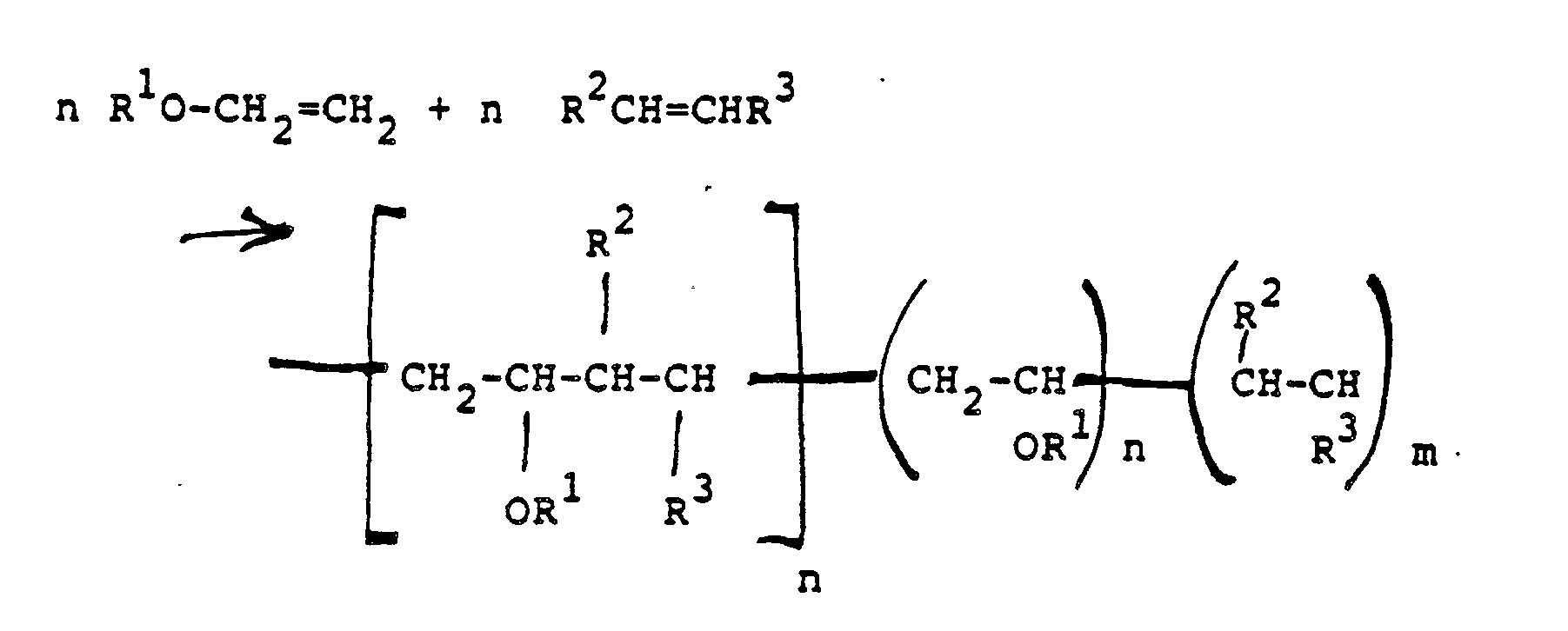

- For reacting an AVE with a methacrylate the reaction is

- For 4(a) R¹ is long chain alkyl and R⁴, R⁵, R⁶ and R⁷ are short chain alkyl and for 4(b) R¹ is short chain alkyl and R⁴, R⁵, R⁶ and R⁷ are long chain alkyl.
- 4(c) Copolymers of short chain length AVE, eg a C₁ to C₁₀ alkyl vinyl ether, with an ethylenically unsaturated carboxylic acid or carboxylic acid anhydride subsequently reacted with an alcohol or an amine or both. Thus one may copolymerise a C₁ to C₁₀ alkyl vinyl ether with acrylic acid, methacrylic acid or maleic anhydride and react the copolymer with a long-chain alcohol, eg a C₁₂ to C₁₈ alcohol and/or a long-chain primary or secondary amine, eg an amine in which at least one of the hydrocarbyl groups contains at least 12 carbon atoms.
- Suitable examples of short chain AVEs are given in 4(b) above. Examples of long chain alcohols are the aliphatic alcohols, R⁸OH where R⁸ is a C₁₂ to C₁₈ substituted or unsubstituted alkyl group. Suitable examples are dodecanol, tetradecanol and octadecanol.
- The long chain primary or secondary amine may have the formula where R⁹R¹⁰HN where R⁹ is hydrogen or an alkyl group, and R¹⁰ is an alkyl group. Examples of hydrocarbyl groups are alkyl, aralkyl or cycloalkyl groups. The alkyl and the alkyl portion of the alkaryl groups can be branched but are preferably straight chain. Preferred alkyl groups contain 10 to 18, especially 12 to 16 carbon atoms and preferred alkaryl and aralkyl groups contain 16 to 24 carbon atoms. Especially preferred alkyl groups are C₁₂ to C₁₈ alkyl groups eg tetradecyl, hexadecyl, octadecyl, or a mixture such as hexadecyl/tetradecyl.
- Specific examples are the copolymerisation of methyl vinyl ether with maleic anhydride followed by reaction of the copolymer with tetradecanol or with dihexadecyl amine.

- In general the AVE copolymers should have a molecular weight of between 1,500 and 50,000, preferably between 2,500 and 15,000.
- Compared with the olefin copolymers where the methylene link is much less flexible than the ether link in the AVE polymers used in the fuel oil compositions of this invention, the AVE polymers have similar wax crystal modifier properties to for example poly-1-octadecene polymers but better oil solubility.
- The amount of hydrocarbyl vinyl ether polymer added to the fuel oil is a minor proportion by weight and preferably this is between 0.0001 and 5.0% by weight, for example 0.001 to 0.5% by weight (active matter) based on the weight of the fuel oil.
- The hydrocarbyl vinyl ether polymer may be conveniently dissolved in a suitable solvent to form a concentrate of from 20 to 90%, e.g. 30 to 80 weight % of polymer in the solvent. Suitable. solvents include kerosene, aromatic naphthas, mineral lubricating oils, etc.
- Other additives which may be included in the fuel oil with the alkyl vinyl ether polymer include for example other flow improvers.
- The flow improver can be one of the following:-
- (i) Linear copolymers of ethylene and some other comonomer, for example a vinyl ester, an acrylate, a methacrylate, an -olefin, styrene, etc,
- (ii) Comb polymers, ie polymers with C₈-C₃₀ alkyl side chain branches;
- (iii) Linear polymers derived from ethylene oxide, for example polyethylene glycol esters and amino derivatives thereof;
- (iv) Monomeric compounds, for example amine salts and amides of polycarboxylic acids such as citric acid and phthalic acid. Also amide/amine salts of sulpho-carboxylic acids such as ₀-sulpho benzoic and sulpho-succinic acid may be used.
- The unsaturated comonomers from which the linear copolymers (i) are derived and which may be copolymerized with ethylene, include unsaturated mono and diesters of the general formula:

- Other linear copolymers (i) are derived from comonomers of the formula:
CHR⁵ = CR⁶X where
R⁵ is H or alkyl, R⁶ is H or methyl and X is -COOR⁷ or hydrocarbyl where R⁷ is alkyl. This includes acrylates, CH₂ = COOR⁷, methacrylates, CH₂ = CMeCOOR⁷, styrene CH₂ = CH.C₆H₅ and olefins CHR⁵ =CR⁶R⁸ where R⁸ is alkyl. The group R⁷ is preferably C₁ to C₂₈, more usually C₁ to C₁₇ and more preferably a C₁ to C₈ straight or branched chain alkyl group. For the olefins R⁵ and R⁶ are preferably hydrogen and R⁸ a C¹ to C₂₀ alkyl group. Thus suitable olefins are propylene, hexene-1, octene-1, dodecene-1 and tetradecene-1. - For this type of copolymer it is preferred that the ethylene content is 50 to 65 weight per cent although higher amount can be used eg 80 weight % for ethylene - propylene copolymers.
- It is preferred that these copolymers have a number average molecular weight as measured a by vapour phase osmometry of 1000 to 6000, preferably 1000 to 3000.
- Particularly suitable linear copolymeric flow improvers (i) are copolymers of ethylene and a vinyl ester.
- The vinyl ester can be a vinyl ester of a monocarboxylic acid, for example one containing 1 to 20 carbon atoms per molecular. Examples are vinyl acetate, vinyl propionate and vinyl butyrate. Most preferred however is vinyl acetate.
- Usually the copolymer of ethylene and a vinyl ester will consist of 3 to 40, preferably 3 to 20, molar proportions of ethylene per molar proportion of the vinyl ester. The copolymer usually has a number average molecular weight of between 1000 and 50,000, preferably between 1,500 and 5,000. The molecular weights can be measured by cryoscopic methods or by vapour phase osmometry, for example by using a Mechrolab Vapour Phase Osmometer Model 310A.
- Particularly preferred comb copolymeric flow improvers are (ii) copolymers of an ester of fumaric acid and a vinyl ester. The ester of fumaric acid can be either a mono- or a di-ester and alkyl esters are preferred. The or each alkyl group can contain 6 to 30, preferably 10 to 20 carbon atoms, and mono- or di- (C₁₄ to C₁₈) alkyl esters are especially suitable, either as single esters or as mixed esters. Generally di-alkyl esters are preferred to mono- esters.
- Suitable vinyl esters with which the fumarate ester is copolymerised are those described above in connection with ethylene/vinyl ester copolymers. Vinyl acetate is particularly preferred.
- The fumarate esters are preferably copolymerised with the vinyl ester in a molar proportion of between 1.5:1 and 1:1.5, for example about 1:1. These copolymers usually have a number average molecular weight of from 1000 to 100,000, as measured for example by Vapour Phase Osmometry such as by a Mechrolab Vapour Pressure Osmometer.
- Comb polymers (ii) have the following general formula:

A is H, Me or CH₂CO₂R′ (where R′ = C₁₀ - C₂₂ alkyl) (Me = methyl) B is CO₂R or R˝ (where R˝ = C₁₀ - C₃₀ alkyl, PhR′ (Ph = phenyl)
D is H or CO₂R′
E is H or Me, CH₂CO₂R′
F is OCOR˝ (R‴ = C₁ - C₂₂ alkyl), CO₂R′, Ph, R′ or PhR′
G is H or CO₂R′
and n is an integer - In general terms, such polymers include a dialkyl fumarate/vinyl acetate copolymer eg ditetradecyl fumarate/vinyl copolymer; a styrene dialkyl fumarate ester copolymer eg styrene/dihexadecyl fumarate copolymer; a poly dialkyl fumarate, eg poly (di octadecyl fumarate); an alpha-olefin dialkyl maleate copolymer eg copolymer of tetradecene and di hexadecyl maleate, a dialkyl itaconate/vinyl acetate copolymer eg dihexadecyl itaconate/vinyl acetate; poly-(n-alkyl methacrylates) eg poly(tetradecyl methacrylate); poly (n-alkyl acrylates) eg poly (tetra decyl acrylate); poly - alkenes eg poly (1-octadecene) etc.
- Linear polymer derived from ethylene oxide (iii) include the poly oxyalkylene esters, ethers, esters/ethers, amide/esters and mixtures thereof, particularly those containing at least one, preferably at least two C₁₀ to C₃₀ linear saturated alkyl groups of a polyoxyalkylene glycol group of molecular weight 100 to 5,000, preferably 200 to 5,000, the alkylene group in said polyoxyalkylene glycol containing from 1 to 4 carbon atoms. European patent publication No 0,061,985 A2 describe some of these additives. The preferred esters, ethers or ester/ethers may be structurally depicted by the formula:
R-O-(A)-O-R¹
where R and R¹ are the same or different and may be - i) n-alkyl
- ii) n-alkyl - -

- iii) n-alkyl - O - - (CH₂)n

- iv) n-alkyl - O - (CH₂)n -
 -
-
- the alkyl group being linear and saturated and containing 10 to 30 carbon atoms, and A represents the polyoxyalkylene segment of the glycol in which the alkylene group has 1 to 4 carbon atoms, such as polyoxymethylene, polyoxyethylene or polyoxytrimethylene moiety which is substantially linear; some degree of branching with lower alkyl side chains (such as in polyoxypropylene glycol) may be tolerated but it is preferred the glycol should be substantially linear.
- Suitable glycols generally are the substantially linear polyethylene glycol (PEG) and polypropylene glycols (PPG) having a molecular weight of about 100 to 5,000, preferably about 200 to 2,000. Esters are preferred and fatty acids containing from 10-30 carbon atoms are useful for reacting with the glycols to form the ester additives and it is preferred to use a C₁₈-C₂₄ fatty acid, especially behenic acids. The esters may also be prepared by esterifying polyethoxylated fatty acids or polyethoxylated alcohols.
- Examples of the monomeric compounds (iv) as flow improver include polar nitrogen containing compounds, for example an amine salt of, a mono amide or a diamide of, or a half amine salt, half amide of a dicarboxylic acid, tricarboxylic acid or anhydride thereof. These polar compounds are generally formed by reaction of at least one molar proportion of hydrocarbyl substituted amines with a molar proportion of hydrocarbyl acid having 1 to 4 carboxylic acid groups or their anhydrides; ester/amides may also be used containing 30 to 300, preferably 50 to 150 total carbon atoms. These nitrogen compounds are described in US patent No 4,211, 534. Suitable amines are usually long chain C₁₂-C₄₀ primary, secondary, tertiary or quaternary amines or mixtures thereof but shorter chain amines may be used provided the resulting nitrogen compound is oil soluble and therefore normally containing about 30 to 300 total carbon atoms. The nitrogen compound preferably contains at least one straight chain C₈-C₄₀, preferably C₁₄ to C₂₄ alkyl segment.
- The amine salt or half amine salt can be derived from a primary, secondary, tertiary or quaternary amine but the amide can only be derived from a primary or secondary amine. The amines are preferably aliphatic amines and the amine is preferably a secondary amine in particular an aliphatic secondary amine of the formula R¹R²NH. Preferably R¹ and R² which can be the same or different contain at least 10 carbon atoms, especially 12 to 22 carbon atoms. Examples of amines include dodecyl amine, tetradecyl amine, octadecyl amine, eicosyl amine, cocoamine, hydrogenated tallow amine and the like. Examples of secondary amines include dioctadecyl amine, methyl-behenyl amine and the like. Amine mixtures are also suitable and many amines derived from natural materials are mixtures. The preferred amine is a secondary hydrogenated tallow amine of the formula HNR₁R₂ wherein R₁ and R₂ are alkyl groups derived from hydrogenated tallow fat composed of approximately 4% C₁₄, 31% C₁₆, 59% C₁₈.
- Examples of suitable carboxylic acids for preparing these nitrogen compounds (and their anhydrides) include cyclo-hexane, 1,2 dicarboxylic acid, cyclohexane dicarboxylic acid, cyclopentane 1,2 dicarboxylic acid, naphthalene dicarboxylic acid, citric acid and the like. Generally, these acids will have about 3-13 carbon atoms in the cyclic moiety. Preferred acids are benzene dicarboxylic acids such as phthalic acid, terephthalic acid, and iso-phthalic acid. Phthalic acid or its anhydride is particularly preferred.
- Examples of suitable sulpho carboxylic acids are ortho sulpho benzoic acid and mono-alkyl sulpho succinic acid.
- One suitable compound is the half amine salt, half amide of the dicarboxylic acid in which the amine is a secondary amine. Especially preferred is the half amine salt, half amide of phthalic acid and dihydrogenated tallow amine - Armeen 2HT (approx 4 wt% n-C₁₄ alkyl, 30 wt% n-C₁₆ alkyl, 60 wt% n-C₁₈ alkyl, the remainder being unsaturated).
- Another preferred compound is the diamide formed by dehydrating this amide-amine salt.
- A copolymer having a number average molecular weight of about 20,000 as determined by membrane osmometry was prepared by copolymerising methyl vinyl ether and maleic anhydride using a free radical catalyst. The anhydride groups of the resulting copolymer were then esterified with either n-tetradecanol, n-hexadecanol or a mixture of these two alcohols. The resulting esterified copolymers are identified as C1, C2 and C3 respectively.
- A copolymer (C4) of a di(n-tetradecyl) fumarate and n-butyl vinyl ether was prepared according to the following reaction conditions:

AIBN = Catalyst tl/2 = 25 mins at 90°C. This was added as initial charge 0.6g followed by 0.1g each hour for six hours. The reaction was monitored by IR and GC (to determine free fumarate content). - Copolymers C1, C2, C3 and C4 were added in conjunction with a prior art copolymer (X) which was an ethylene/vinyl acetate copolymer containing 36 weight % of vinyl acetate units,
M n about 2,500, to three middle distillate fuel oils F1, F2 and F3 having the following ASTM D 86 distillation characteristics (all °C):IBP 20% 90% FBP% Cloud Pt CFPP base F1 170 228 316 347 -6 -12 F2 164 240 330 356 -10.5 -14 F 3 232 270 326 344 -7 -9 Table 1 Fuel F1 Δ WAT/°C 100 ppm X + 500 ppm C1 1.9 100 ppm X + 500 ppm C3 3.0 100 ppm X + 500 ppm C2 2.9 100 ppm X + 1000 ppm C1 2.7 100 ppm X + 1000 ppm C3 3.7 100 ppm X + 1000 ppm C2 3.2 100 ppm X + 1000 ppm C4 2.7 Fuel F2 100 ppm X + 500 ppm C1 2.0 100 ppm X + 500 ppm C3 2.6 100 ppm X + 500 ppm C2 1.1 100 ppm X + 1000 ppm C1 2.8 100 ppm X + 1000 ppm C3 3.4 100 ppm X + 1000 ppm C2 1.1 100 ppm X + 1000 ppm C4 2.8 Fuel F3 100 ppm X + 500 ppm C1 0.7 100 ppm X + 500 ppm C3 0.8 100 ppm X + 500 ppm C2 0.4 100 ppm X + 1000 ppm C1 1.1 100 ppm X + 1000 ppm C3 1.4 100 ppm X + 1000 ppm C2 0.4 100 ppm X + 1000 ppm C4 1.1 - The Wax Appearance Temperature (WAT) is measured by different scanning calorimetry using a Du Pont 990 differential scanning calorimeter. In the test a 10 microlitre sample of the fuel is cooled at 10°C/min from a temperature at least 30°C above the expected cloud point of the fuel. The observed onset of crystallisation is estimated, without correction for thermal lag (approximately 2°C), as the wax appearance temperature (WAT) is indicated by the differential scanning calorimeter.
- The depression of the wax appearance temperature WAT is shown by comparing the result of the treated fuel (WAT₁) with that of the untreated fuel ( WAT₀) as ΔWAT = WAT₀ - WAT₁. Depression of the WAT is indicated by a positive result.
- Copolymer C4 of Example 1 was added to three further fuel oils F4, F5 and F6 having the following ASTM D86 distillation characteristics (all °C):
IBP 20% 90% FBP% Cloud Pt CFPP base F4 159 210 316 350 -12 F5 184 226 368 398 6 0 F6 168 231 325 350 -9 Table 2 ppm ai Polymer 0 250 500 750 1000 1500 WAP Depression (ASTM D 3117-72) 3.4 5.8 WAT (D.S.C.Mettler) -18.0 -20.9 -22.0 -22.6 -22.1 -23.9 - In Table 3 the CFPP results of adding to fuel oil F5 (CFPP 0°C) a mixture of 1 part by weight of C4 with 4 parts by weight of a prior art copolymer mixture Y and Y alone are given. Y was a 3:1 (by weight) mixture of respectively an ethylene-vinyl acetate copolymer containing about 36 wt % vinyl acetate of number average mol. wt. 2,500 and a copolymer containing about 17 wt % vinyl acetate of number average molecular weight 3000.
Table 3 ppm ai - 50 100 150 175 200 250 300 500 C4:Y(1:4) 3 13 19 20 19 20 Y alone -6 -11 -13 -16 - The cold flow properties of the blend were determined by the Cold Filter Plugging Point Test (CFPPT). This test is carried out by the procedure described in detail in "Journal of the Institute of Petroleum", Vol 52, No 510, June 1966 pp 173-185. In brief, a 40 ml sample of the oil to be tested is cooled by a bath maintained at about -34°C. Periodically (at each one degree Centrigrade drop in temperature starting from 10°C above the cloud point) the cooled oil is tested for its ability to flow through a fine screen within 1 minute. This cold property is tested with a device consisting of a pipette to whose lower end is attached an inverted funnel positioned below the surface of the oil to be tested. Stretched across the mouth of the funnel is a 350 mesh screen having an area of about 0.45 square inch. The periodic tests are each initiated by applying a vacuum of 20cm of water to the upper end of the pipette whereby the oil is drawn through the screen up into the pipette to a mark indicating 20 ml of oil. The test is repeated with each one degree drop in temperature until the oil fails to fill the pipette within 60 seconds. The results of the test can be quoted as CFPP (°C) which is the fail temperature of the fuel treated with the flow improver.
- In this case what is quoted is ΔCFPP(°C) which is the difference between the fail temperature of the untreated fuel (CFPP₀) and the fuel treated with the additive (CFPP₁) ie ΔCFPP = CFPP₀ - CFPP₁.
- In Table 4 the results of adding different amounts of copolymer C4, prior art copolymer X and prior art cloud point depressing additive Z to fuel oil F6 are shown. Z is a C₁₄ dialkyl fumarate/vinyl acetate copolymer.
Table 4 ppm X 0 0 0 100 100 100 ppm Polymer C4 0 500 1000 0 500 1000 Cloud Point -6 -10 -10 -6 -9(-9) -10 Wax Appearance Point -11 -14 -15(-14) -12 -14 -14(-12) DSC WAT -11 -12.5 -13(-13) -10 -11.5 -12.5(-12) Pour Point -15 -29.0 -25(-24) -30 -35 -45(-21) Results in°C Results in brackets C₁₄ dialkyl fumarate/vinyl acetate copolymer,Z. - Table 4 shows WAP, CP and WAT depressions by the C4 alone or in fuels with X added are equivalent to those with Z. Pour points with X are improved on adding C4 whereas pour point regression occurs on adding Z. This result is confirmed by slow cool tests where the sample is cooled from room temperature to -25°C in a cold box. Here Z/X 1000/100 ppm ai gave a gelled sample whereas C4/X 1000/100 ppm ai gave a completely fluid sample.
Claims (29)
Priority Applications (1)
| Application Number | Priority Date | Filing Date | Title |
|---|---|---|---|
| AT89308510T ATE81148T1 (en) | 1988-08-24 | 1989-08-22 | FUEL COMPOSITIONS. |
Applications Claiming Priority (2)
| Application Number | Priority Date | Filing Date | Title |
|---|---|---|---|
| GB888820071A GB8820071D0 (en) | 1988-08-24 | 1988-08-24 | Fuel compositions |
| GB8820071 | 1988-08-24 |
Publications (2)
| Publication Number | Publication Date |
|---|---|
| EP0360419A1 true EP0360419A1 (en) | 1990-03-28 |
| EP0360419B1 EP0360419B1 (en) | 1992-09-30 |
Family
ID=10642616
Family Applications (1)
| Application Number | Title | Priority Date | Filing Date |
|---|---|---|---|
| EP89308510A Expired - Lifetime EP0360419B1 (en) | 1988-08-24 | 1989-08-22 | Fuel compositions |
Country Status (12)
| Country | Link |
|---|---|
| EP (1) | EP0360419B1 (en) |
| JP (1) | JP2839291B2 (en) |
| KR (1) | KR0134192B1 (en) |
| CN (1) | CN1031464C (en) |
| AT (1) | ATE81148T1 (en) |
| DE (1) | DE68903084T2 (en) |
| ES (1) | ES2036035T3 (en) |
| FI (1) | FI893952L (en) |
| GB (1) | GB8820071D0 (en) |
| GR (1) | GR3006159T3 (en) |
| NO (1) | NO174428C (en) |
| RU (1) | RU1838382C (en) |
Cited By (12)
| Publication number | Priority date | Publication date | Assignee | Title |
|---|---|---|---|---|
| EP0463518A1 (en) * | 1990-06-29 | 1992-01-02 | Hoechst Aktiengesellschaft | Terpolymers of ethylene, their preparation and their use for mineral oil distillates |
| EP0485774A1 (en) * | 1990-11-14 | 1992-05-20 | BASF Aktiengesellschaft | Petrolium middle distillate with improved cold flowcharacteristics |
| EP0486836A1 (en) * | 1990-11-14 | 1992-05-27 | BASF Aktiengesellschaft | Petroleum middle distillate with improved cold flow characteristics |
| US5205839A (en) * | 1990-06-29 | 1993-04-27 | Hoechst Aktiengesellschaft | Terpolymers of ethylene, their preparation and their use as additives for mineral oil distillates |
| US5214224A (en) * | 1992-07-09 | 1993-05-25 | Comer David G | Dispersing asphaltenes in hydrocarbon refinery streams with α-olefin/maleic anhydride copolymer |
| US5232963A (en) * | 1992-07-09 | 1993-08-03 | Nalco Chemical Company | Dispersing gums in hydrocarbon streams with β-olefin/maleic anhydride copolymer |
| WO1994000535A1 (en) * | 1992-06-30 | 1994-01-06 | Exxon Chemical Patents Inc. | Additives and fuel compositions |
| EP0654526A3 (en) * | 1993-11-09 | 1996-03-27 | Lubrizol Corp | Cloud point lowering composition. |
| EP0890633A1 (en) * | 1997-07-08 | 1999-01-13 | Clariant GmbH | Middle distillates and ethylene and unsaturated carboxylic esters copolymers containing fuel oils |
| WO2004035715A1 (en) * | 2002-10-14 | 2004-04-29 | Basf Aktiengesellschaft | Use of ether vinyl hydrocarbyl homopolymers for increasing effect of a cold flow improving agent |
| US6846338B2 (en) | 1997-07-08 | 2005-01-25 | Clariant Gmbh | Fuel oils based on middle distillates and copolymers of ethylene and unsaturated carboxylic esters |
| WO2024115211A1 (en) | 2022-11-30 | 2024-06-06 | Basf Se | Homo- and copolymers of vinyl ethers for reducing crystallization of paraffin crystals in fuels |
Citations (6)
| Publication number | Priority date | Publication date | Assignee | Title |
|---|---|---|---|---|
| GB1154966A (en) * | 1966-03-17 | 1969-06-11 | Shell Int Research | Fuel Composition with a Depressed Pour Point |
| GB1161188A (en) * | 1967-07-07 | 1969-08-13 | Shell Int Research | Crude Oil with improved Flow Properties |
| DE1941581A1 (en) * | 1968-08-21 | 1970-02-26 | Mobil Oil Corp | Hydrocarbon mixtures with improved fluidity |
| FR2080410A5 (en) * | 1970-02-04 | 1971-11-12 | Mobil Oil Corp | |
| DE2047448A1 (en) * | 1970-09-26 | 1972-03-30 | Badische Anilin & Soda Fabrik AG, 6700 Ludwigshafen | Petroleum viscosity reducing additive - comprising polyvinyl ether and ethylene-vinylacetate copolymer |
| FR2189503A1 (en) * | 1972-06-21 | 1974-01-25 | Texaco Development Corp |
-
1988
- 1988-08-24 GB GB888820071A patent/GB8820071D0/en active Pending
-
1989
- 1989-08-22 ES ES198989308510T patent/ES2036035T3/en not_active Expired - Lifetime
- 1989-08-22 EP EP89308510A patent/EP0360419B1/en not_active Expired - Lifetime
- 1989-08-22 AT AT89308510T patent/ATE81148T1/en not_active IP Right Cessation
- 1989-08-22 DE DE8989308510T patent/DE68903084T2/en not_active Expired - Fee Related
- 1989-08-23 FI FI893952A patent/FI893952L/en not_active Application Discontinuation
- 1989-08-23 NO NO893394A patent/NO174428C/en unknown
- 1989-08-23 RU SU894614903A patent/RU1838382C/en active
- 1989-08-24 KR KR1019890012064A patent/KR0134192B1/en not_active Expired - Fee Related
- 1989-08-24 JP JP1218451A patent/JP2839291B2/en not_active Expired - Lifetime
- 1989-08-24 CN CN89106506A patent/CN1031464C/en not_active Expired - Fee Related
-
1992
- 1992-11-05 GR GR920402479T patent/GR3006159T3/el unknown
Patent Citations (6)
| Publication number | Priority date | Publication date | Assignee | Title |
|---|---|---|---|---|
| GB1154966A (en) * | 1966-03-17 | 1969-06-11 | Shell Int Research | Fuel Composition with a Depressed Pour Point |
| GB1161188A (en) * | 1967-07-07 | 1969-08-13 | Shell Int Research | Crude Oil with improved Flow Properties |
| DE1941581A1 (en) * | 1968-08-21 | 1970-02-26 | Mobil Oil Corp | Hydrocarbon mixtures with improved fluidity |
| FR2080410A5 (en) * | 1970-02-04 | 1971-11-12 | Mobil Oil Corp | |
| DE2047448A1 (en) * | 1970-09-26 | 1972-03-30 | Badische Anilin & Soda Fabrik AG, 6700 Ludwigshafen | Petroleum viscosity reducing additive - comprising polyvinyl ether and ethylene-vinylacetate copolymer |
| FR2189503A1 (en) * | 1972-06-21 | 1974-01-25 | Texaco Development Corp |
Cited By (16)
| Publication number | Priority date | Publication date | Assignee | Title |
|---|---|---|---|---|
| EP0463518A1 (en) * | 1990-06-29 | 1992-01-02 | Hoechst Aktiengesellschaft | Terpolymers of ethylene, their preparation and their use for mineral oil distillates |
| US5200484A (en) * | 1990-06-29 | 1993-04-06 | Hoechst Aktiengesellschaft | Terpolymers of ethylene, their preparation and their use as additives for mineral oil distillates |
| US5205839A (en) * | 1990-06-29 | 1993-04-27 | Hoechst Aktiengesellschaft | Terpolymers of ethylene, their preparation and their use as additives for mineral oil distillates |
| EP0485774A1 (en) * | 1990-11-14 | 1992-05-20 | BASF Aktiengesellschaft | Petrolium middle distillate with improved cold flowcharacteristics |
| EP0486836A1 (en) * | 1990-11-14 | 1992-05-27 | BASF Aktiengesellschaft | Petroleum middle distillate with improved cold flow characteristics |
| TR28208A (en) * | 1992-06-30 | 1996-02-16 | Exxon Chemical Patents Inc | Additives and fuel combinations. |
| WO1994000535A1 (en) * | 1992-06-30 | 1994-01-06 | Exxon Chemical Patents Inc. | Additives and fuel compositions |
| US5232963A (en) * | 1992-07-09 | 1993-08-03 | Nalco Chemical Company | Dispersing gums in hydrocarbon streams with β-olefin/maleic anhydride copolymer |
| US5214224A (en) * | 1992-07-09 | 1993-05-25 | Comer David G | Dispersing asphaltenes in hydrocarbon refinery streams with α-olefin/maleic anhydride copolymer |
| EP0654526A3 (en) * | 1993-11-09 | 1996-03-27 | Lubrizol Corp | Cloud point lowering composition. |
| EP0890633A1 (en) * | 1997-07-08 | 1999-01-13 | Clariant GmbH | Middle distillates and ethylene and unsaturated carboxylic esters copolymers containing fuel oils |
| DE19729055A1 (en) * | 1997-07-08 | 1999-01-14 | Clariant Gmbh | Fuel oils based on middle distillates and copolymers of ethylene and unsaturated carboxylic acid esters |
| DE19729055C2 (en) * | 1997-07-08 | 2000-07-27 | Clariant Gmbh | Fuel oils based on middle distillates and copolymers of ethylene and unsaturated carboxylic acid esters |
| US6846338B2 (en) | 1997-07-08 | 2005-01-25 | Clariant Gmbh | Fuel oils based on middle distillates and copolymers of ethylene and unsaturated carboxylic esters |
| WO2004035715A1 (en) * | 2002-10-14 | 2004-04-29 | Basf Aktiengesellschaft | Use of ether vinyl hydrocarbyl homopolymers for increasing effect of a cold flow improving agent |
| WO2024115211A1 (en) | 2022-11-30 | 2024-06-06 | Basf Se | Homo- and copolymers of vinyl ethers for reducing crystallization of paraffin crystals in fuels |
Also Published As
| Publication number | Publication date |
|---|---|
| DE68903084D1 (en) | 1992-11-05 |
| JPH02105891A (en) | 1990-04-18 |
| KR900003343A (en) | 1990-03-26 |
| GR3006159T3 (en) | 1993-06-21 |
| KR0134192B1 (en) | 1998-04-18 |
| ATE81148T1 (en) | 1992-10-15 |
| FI893952A7 (en) | 1990-02-25 |
| NO174428B (en) | 1994-01-24 |
| JP2839291B2 (en) | 1998-12-16 |
| CN1031464C (en) | 1996-04-03 |
| NO174428C (en) | 1994-05-04 |
| RU1838382C (en) | 1993-08-30 |
| DE68903084T2 (en) | 1993-02-18 |
| CN1043157A (en) | 1990-06-20 |
| GB8820071D0 (en) | 1988-09-28 |
| FI893952A0 (en) | 1989-08-23 |
| NO893394L (en) | 1990-02-26 |
| NO893394D0 (en) | 1989-08-23 |
| FI893952L (en) | 1990-02-25 |
| ES2036035T3 (en) | 1993-05-01 |
| EP0360419B1 (en) | 1992-09-30 |
Similar Documents
| Publication | Publication Date | Title |
|---|---|---|
| EP0214786B1 (en) | Middle distillate compositions with improved low temperature properties | |
| EP0225688B1 (en) | Oil and fuel oil compositions | |
| US4211534A (en) | Combination of ethylene polymer, polymer having alkyl side chains, and nitrogen containing compound to improve cold flow properties of distillate fuel oils | |
| EP0156577B2 (en) | Middle distillate compositions with improved cold flow properties | |
| EP0282342B1 (en) | Fuel compositions | |
| US3966428A (en) | Ethylene backbone polymers in combination with ester polymers having long alkyl side chains are low viscosity distillate fuel cold flow improvers | |
| US4882034A (en) | Crude oil or fuel oil compositions | |
| EP0306290B1 (en) | Flow improvers and cloud point depressants | |
| EP0525040B1 (en) | Additives for distillate fuels and distillate fuels containing them | |
| EP0308176A1 (en) | Fuel oil additives | |
| EP0360419B1 (en) | Fuel compositions | |
| EP0316108B1 (en) | Fuel oil additives | |
| EP0343981A1 (en) | Fuel oil compositions | |
| JPH10505124A (en) | Oil additives, compositions and polymers for use therein | |
| EP0183447B1 (en) | Polyesters as flow improvers for hydrocarbons | |
| EP0213879B1 (en) | Middle distillate composition with improved cold flow properties | |
| KR100190266B1 (en) | Additives for distillate fuels and distillate fuels containing the same |
Legal Events
| Date | Code | Title | Description |
|---|---|---|---|
| PUAI | Public reference made under article 153(3) epc to a published international application that has entered the european phase |
Free format text: ORIGINAL CODE: 0009012 |
|
| 17P | Request for examination filed |
Effective date: 19890920 |
|
| AK | Designated contracting states |
Kind code of ref document: A1 Designated state(s): AT BE CH DE ES FR GB GR IT LI LU NL SE |
|
| 17Q | First examination report despatched |
Effective date: 19901207 |
|
| GRAA | (expected) grant |
Free format text: ORIGINAL CODE: 0009210 |
|
| AK | Designated contracting states |
Kind code of ref document: B1 Designated state(s): AT BE CH DE ES FR GB GR IT LI LU NL SE |
|
| REF | Corresponds to: |
Ref document number: 81148 Country of ref document: AT Date of ref document: 19921015 Kind code of ref document: T |
|
| REF | Corresponds to: |
Ref document number: 68903084 Country of ref document: DE Date of ref document: 19921105 |
|
| ET | Fr: translation filed | ||
| ITF | It: translation for a ep patent filed | ||
| REG | Reference to a national code |
Ref country code: GR Ref legal event code: FG4A Free format text: 3006159 |
|
| REG | Reference to a national code |
Ref country code: ES Ref legal event code: FG2A Ref document number: 2036035 Country of ref document: ES Kind code of ref document: T3 |
|
| PLBE | No opposition filed within time limit |
Free format text: ORIGINAL CODE: 0009261 |
|
| STAA | Information on the status of an ep patent application or granted ep patent |
Free format text: STATUS: NO OPPOSITION FILED WITHIN TIME LIMIT |
|
| PG25 | Lapsed in a contracting state [announced via postgrant information from national office to epo] |
Ref country code: LU Free format text: LAPSE BECAUSE OF NON-PAYMENT OF DUE FEES Effective date: 19930831 |
|
| 26N | No opposition filed | ||
| EAL | Se: european patent in force in sweden |
Ref document number: 89308510.0 |
|
| PGFP | Annual fee paid to national office [announced via postgrant information from national office to epo] |
Ref country code: GR Payment date: 19950628 Year of fee payment: 7 |
|
| PGFP | Annual fee paid to national office [announced via postgrant information from national office to epo] |
Ref country code: SE Payment date: 19950630 Year of fee payment: 7 |
|
| PGFP | Annual fee paid to national office [announced via postgrant information from national office to epo] |
Ref country code: ES Payment date: 19950714 Year of fee payment: 7 |
|
| PGFP | Annual fee paid to national office [announced via postgrant information from national office to epo] |
Ref country code: AT Payment date: 19950720 Year of fee payment: 7 |
|
| PGFP | Annual fee paid to national office [announced via postgrant information from national office to epo] |
Ref country code: BE Payment date: 19950728 Year of fee payment: 7 |
|
| PGFP | Annual fee paid to national office [announced via postgrant information from national office to epo] |
Ref country code: NL Payment date: 19950801 Year of fee payment: 7 |
|
| PGFP | Annual fee paid to national office [announced via postgrant information from national office to epo] |
Ref country code: CH Payment date: 19950803 Year of fee payment: 7 |
|
| PG25 | Lapsed in a contracting state [announced via postgrant information from national office to epo] |
Ref country code: AT Effective date: 19960822 |
|
| PG25 | Lapsed in a contracting state [announced via postgrant information from national office to epo] |
Ref country code: SE Effective date: 19960823 Ref country code: ES Free format text: LAPSE BECAUSE OF NON-PAYMENT OF DUE FEES Effective date: 19960823 |
|
| PG25 | Lapsed in a contracting state [announced via postgrant information from national office to epo] |
Ref country code: LI Effective date: 19960831 Ref country code: CH Effective date: 19960831 Ref country code: BE Effective date: 19960831 |
|
| BERE | Be: lapsed |
Owner name: EXXON CHEMICAL PATENTS INC. Effective date: 19960831 |
|
| PG25 | Lapsed in a contracting state [announced via postgrant information from national office to epo] |
Ref country code: GR Free format text: THE PATENT HAS BEEN ANNULLED BY A DECISION OF A NATIONAL AUTHORITY Effective date: 19970228 |
|
| PG25 | Lapsed in a contracting state [announced via postgrant information from national office to epo] |
Ref country code: NL Effective date: 19970301 |
|
| REG | Reference to a national code |
Ref country code: GR Ref legal event code: MM2A Free format text: 3006159 |
|
| REG | Reference to a national code |
Ref country code: CH Ref legal event code: PL |
|
| NLV4 | Nl: lapsed or anulled due to non-payment of the annual fee |
Effective date: 19970301 |
|
| EUG | Se: european patent has lapsed |
Ref document number: 89308510.0 |
|
| REG | Reference to a national code |
Ref country code: ES Ref legal event code: FD2A Effective date: 19990503 |
|
| PGFP | Annual fee paid to national office [announced via postgrant information from national office to epo] |
Ref country code: GB Payment date: 20000718 Year of fee payment: 12 Ref country code: FR Payment date: 20000718 Year of fee payment: 12 |
|
| PGFP | Annual fee paid to national office [announced via postgrant information from national office to epo] |
Ref country code: DE Payment date: 20000724 Year of fee payment: 12 |
|
| PG25 | Lapsed in a contracting state [announced via postgrant information from national office to epo] |
Ref country code: GB Free format text: LAPSE BECAUSE OF NON-PAYMENT OF DUE FEES Effective date: 20010822 |
|
| GBPC | Gb: european patent ceased through non-payment of renewal fee |
Effective date: 20010822 |
|
| PG25 | Lapsed in a contracting state [announced via postgrant information from national office to epo] |
Ref country code: FR Free format text: LAPSE BECAUSE OF NON-PAYMENT OF DUE FEES Effective date: 20020430 |
|
| PG25 | Lapsed in a contracting state [announced via postgrant information from national office to epo] |
Ref country code: DE Free format text: LAPSE BECAUSE OF NON-PAYMENT OF DUE FEES Effective date: 20020501 |
|
| REG | Reference to a national code |
Ref country code: FR Ref legal event code: ST |
|
| PG25 | Lapsed in a contracting state [announced via postgrant information from national office to epo] |
Ref country code: IT Free format text: LAPSE BECAUSE OF NON-PAYMENT OF DUE FEES Effective date: 20050822 |